
Coral Gables City Zoning Code
ARTICLE 10
PARKING AND ACCESS
Section 10-101. Purpose and applicability.
- Purpose.The purpose of this Article is to ensure that:
- Adequate off-street parking is provided for uses that are permitted by these regulations.
- Vehicular use areas are designed and lighted to promote public safety.
- Vehicular use areas and landscaped areas relate to each other in a manner that protects and enhances community character.
- Adequate loading areas are provided that do not interfere with the function of other vehicular use areas.
- Sufficient parking is provided in nonresidential areas that are near residential neighborhoods, so that the character and quality of life in the residential neighborhoods are protected from overflow parking.
- Applicability.
- Except as provided for in subsections 2, 4 and 5, the requirements of this Article apply to:
- New buildings, uses, or structures.
- The net new area of any building, structure, or outdoor use that is modified or expanded.
- The net new parking demand generated by a change in the use of all or part of a building, structure, or property in residential, mixed use, and special use districts.
- The requirements of this Article do not apply to a change of use in the MX Districts.
- Parking and loading areas that are required by this Article shall be maintained for as long as the use to which they relate is continued.
- Except as provided for in subsections 2, 4 and 5, the requirements of this Article apply to:
Section 10-102. Geometric standards for parking and vehicular use areas.
- Dimensions and configuration of parking spaces.
- Required minimum parking space dimensions:
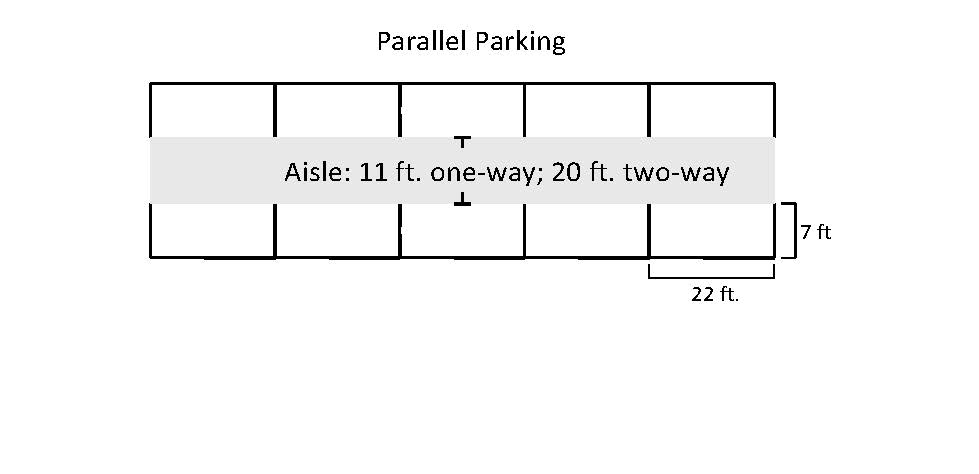
- Parallel parking spaces: Seven (7) feet including the gutter by twenty-two (22) feet
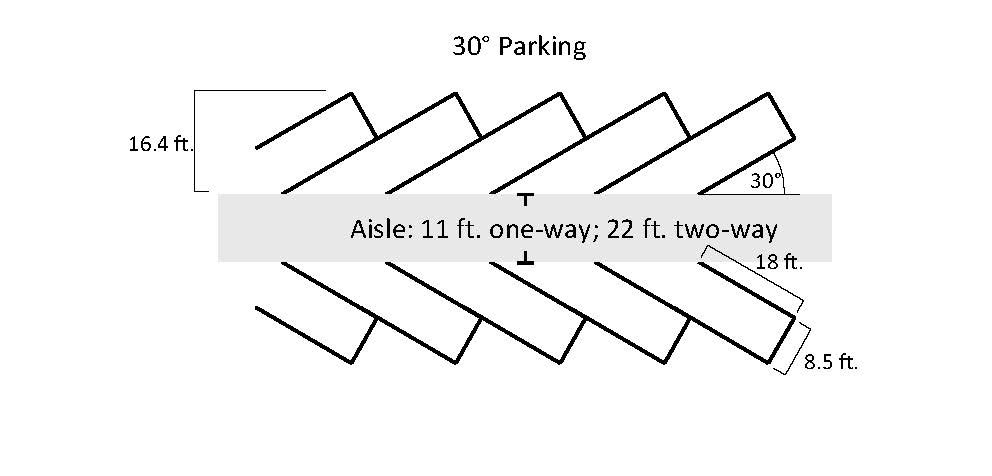
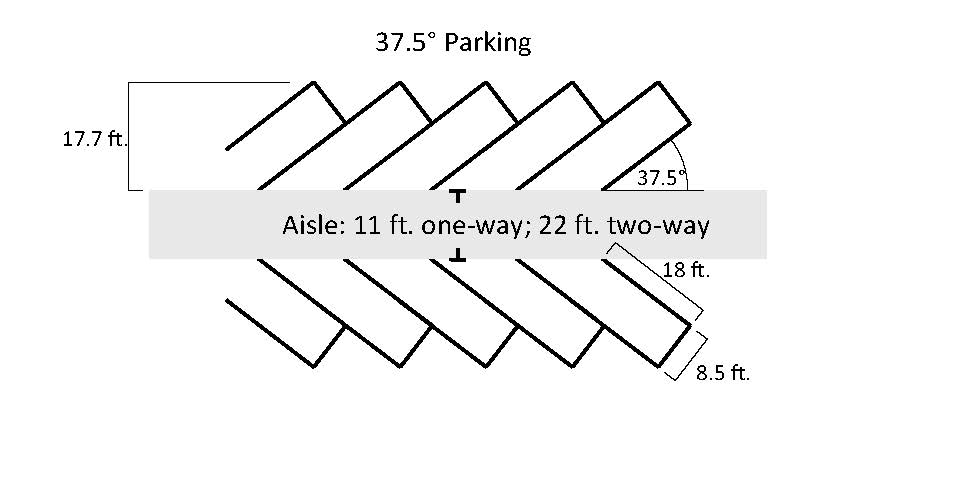
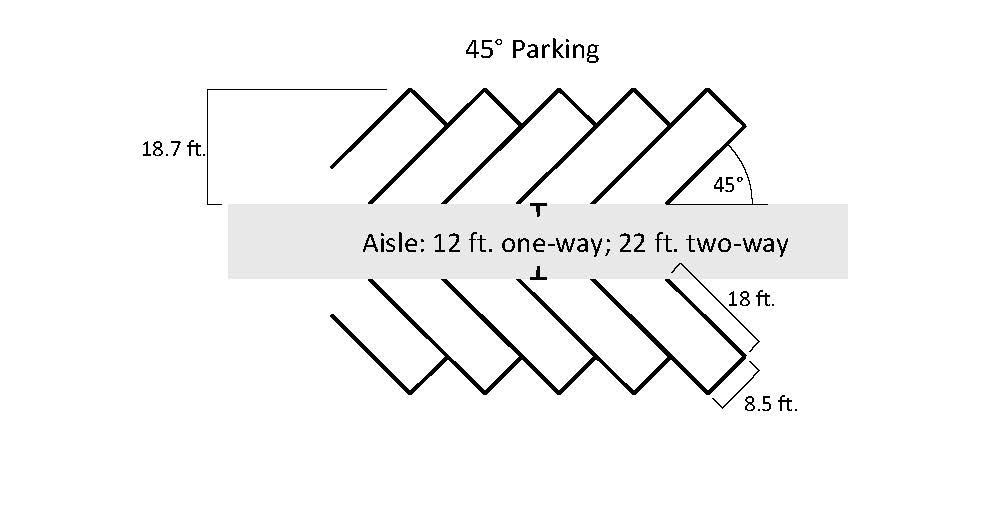
- Angled and reverse angled parking spaces: Eight and one-half (8½) feet by eighteen (18) feet.
- Disabled parking spaces shall be dimensioned in accordance with Chapter 11 of the Florida Building Code.
- At the discretion of the Public Works Director, these dimensions set forth in this subsection may be adjusted depending on considerations such as design speed, right-of-way widths, and other limitations impacting parking dimensions and orientation.
- Curbing. Curbing shall be provided for all angled parking spaces that abut a sidewalk such that cars are curbed at sixteen and one-half (16 ½) feet. The balance of the required depth of the parking spaces between the curb and the sidewalk shall be clear of obstructions.
- Required aisle widths. Minimum required aisle widths shall be as follows:
- Required minimum parking space dimensions:
| ParkingAngle | One-WayAisle | Two-WayAisle | ||
|---|---|---|---|---|
| 0° (parallel) (a); 30° (b); 37.5° (c) | 11 feet | 20 feet | ||
| 45° (d) | 12 feet | 22 feet | ||
| 52.5° (e) | 14 feet | 22 feet | ||
| 60° (f) | 16 feet | 22 feet | ||
| 90° (g) | 22 feet | 22 feet | ||
(a)* | (b) | |||
 |  | |||
| (c) | (d) | |||
 |  | |||
| (e) | (f) | |||
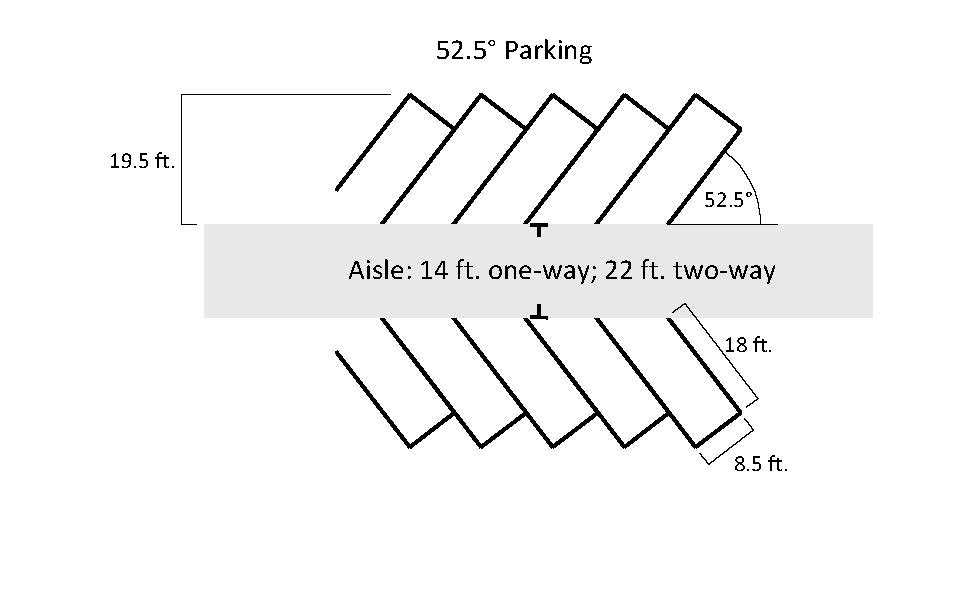 | 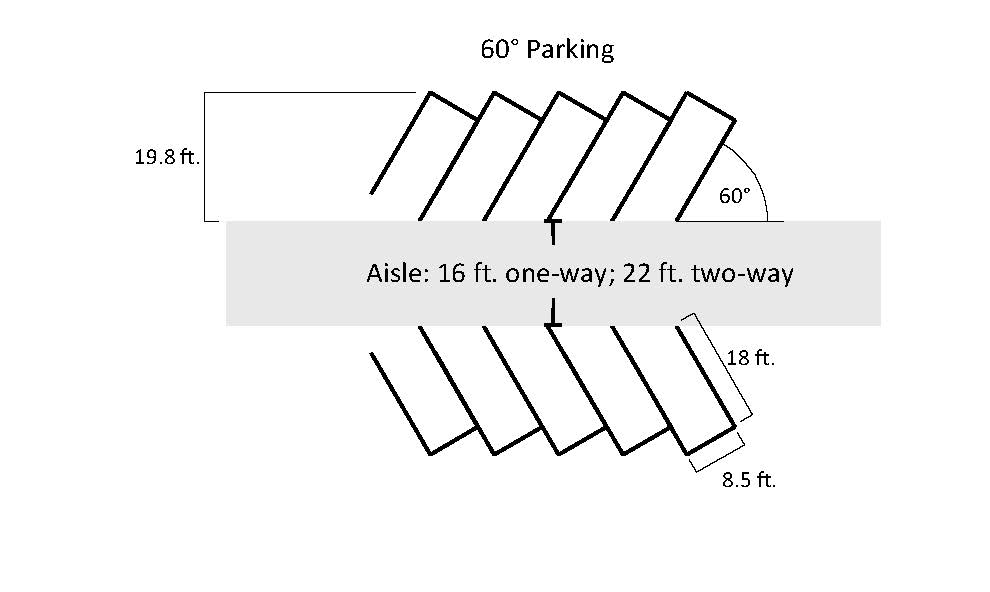 | |||
| (g)** | ||||
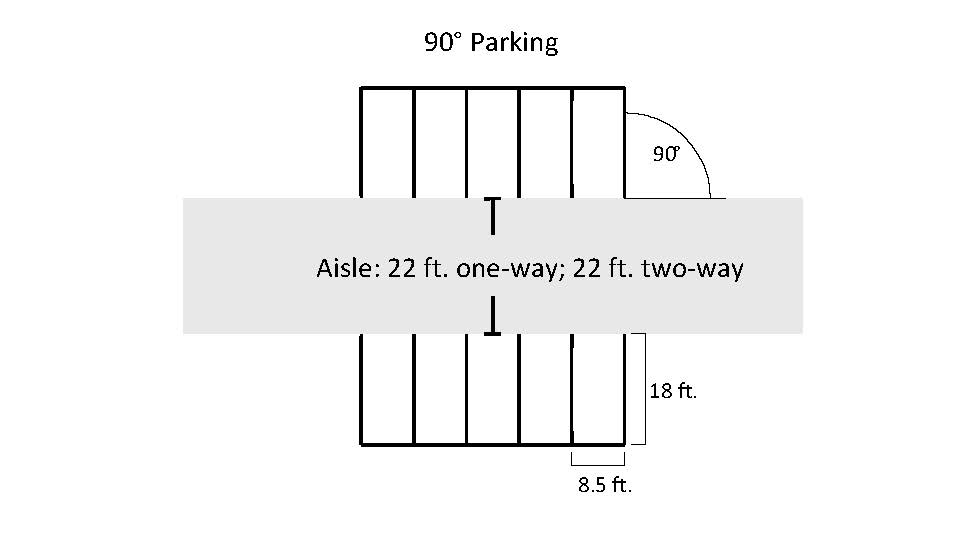 | ||||
* Parallel parking spaces shall be setback an additional one and a half (1 ½ ) feet from walls.
** 90 degree parking spaces shall be setback an additional one (1) foot from walls.
- Dimensions of garages and carports.
- Twelve (12) feet minimum is recommended, the minimum dimensions of garages, carports and porte-cocheres are as follows:
| Type | Interior Width | Interior Length |
| One-car garage or carport | 10 feet | 22 feet |
| Two-car garage or carport | 20 feet | 22 feet |
| Porte-cochere | 10 feet | 22 feet |
| For each additional space | An additional ten (10) feet in width shall be required for each additional car being stored in a garage or carport. |
- A minimum clearance of nine (9) feet by eighteen-and-a-half (18.5) feet must be maintained within garages to satisfy the requirements for storage of one (1) vehicle.
- Existing carports that were constructed before October 1, 1992 may be converted into enclosed garages if they have the following minimum dimensions:
| Type | Interior Width | Interior Length |
| One-car garage | 9 feet | 19 feet |
| Two-car garage | 18.5 feet | 19 feet |
- Dimensions of loading spaces. Loading spaces shall be at least ten (10) feet wide by twenty-five (25) feet long, and shall provide at least fourteen (14) feet of vertical clearance.
- Configuration and connectivity of access driveways and aisles.
- Access to parking spaces. Access to parking spaces shall be provided in accordance with the following:
| Accesstoparkingspacesfrom: | Permittedmethodsofaccesstoparking: | Permittedmethodsofegressfromparking: |
| Alley | Direct access from alley to parking space; or access from aisle to parking space. | Directly from parking space to alley or from aisle to alley. Forward and reverse (back-out) movements are permitted. |
| Local residential street | Direct access from street to parking space; or access from aisle to parking space. | Directly from parking space to street or from aisle to street. Forward and reverse (back-out) movements are permitted for SFR District. |
| Arterials | Access only from aisle. | Directly from aisle to street; back out for SFR District on lots of less than seventy five (75) feet. |
- Ingress and egress driveways.
- The maximum width of separated ingress and egress driveways within the public right-of-way shall be eleven (11) feet. The maximum width of combined driveways within the public right-of-way shall match the entrance and exit aisle width, pursuant to the provisions in Section 10-102 (A)(3).
- Ingress and egress driveways shall connect to the adjacent street or alley such that the intersection of the centerlines of the driveway and the street create an angle that is between eighty (80) and one-hundred (100) degrees.
- Ingress and egress driveways shall be designed such that:
- Drivers can enter and exit the from the property without endangering themselves, pedestrians, or vehicles traveling on abutting streets;
- Interference with the free and convenient flow of traffic on adjacent streets or alleys is minimized; and
- Pedestrians and sidewalk users are given priority;
- Landscape within the private property and public right-of-way maintain a consistent tree placement and shade canopy, and provide ample front yard vegetation.
D. Configuration of parking bays within automated parking systems. Automated parking systems shall be designed or restricted such that the positioning of any one vehicle within the automated parking system does not prevent access to any other vehicle, unless the bays that contain the obstructing vehicle and obstructed vehicle are under the control of the same person.
E. Pedestrian access to and through vehicular use areas and parking garages. All vehicular use areas and parking garages shall provide safe pedestrian access to the abutting sidewalk or public right-of-way. Pedestrian pass-throughs of ten (10) feet, minimum, shall be provided within vehicular use areas for each two hundred and fifty (250) linear feet or fraction thereof of frontage to enhance public pedestrian access, provided that properties abut alleys, streets, or other publicly owned properties.
Section 10-103. Parking, driveway, and vehicular use areas: provision, location and setbacks.
- Provision of driveways and driveway approaches.
- Driveways and driveway approaches required. All vehicular use areas shall have a driveway or driveway approach connection to the alley or street.
- Permitting and construction costs. Permitting and construction of driveway approaches within the public right-of-way shall be at the sole expense of the property owner.
- Setbacks.
- Setbacks from buildings. All parts of parking spaces shall be set back from building entrances and exits distance of at least three (3) feet from the outside edge of the open door.
- Parking garages and accessory decks (above grade). Parking garages and accessory decks above established grade are subject to the same setback regulations as principal buildings.
- Parking garages (underground). There is no minimum setback for parking garages or parts thereof that are located completely underground, below established grade.
- Vehicular use areas. Vehicular use areas shall be set back:
- Sufficient distance to comply with zoning district, perimeter landscaping, and sight triangle requirements; or
- If no zoning district, perimeter landscaping, or sight triangle requirement applies: five (5) feet, minimum, from all property lines.
Section 10-104. Materials, construction, and drainage.
- Surfacing. Surfacing of all access aisles, driveways and off-street parking areas shall be composed of one or more of the following:
- Asphalt.
- Chattahoochee gravel laid in asphalt with all loose gravel removed.
- Clay or cement brick.
- Concrete.
- Decorative concrete pavers.
- Loose gravel, provided that areas of loose gravel are set back five (5) feet from all property lines and bordered by another permitted driveway material.
- Rock laid in asphalt with all loose gravel removed.
- Wood block.
- Permeable pavement or pavers.
- Marble, porphyry, or other specialty paving supportive of vehicular traffic.
- Engineering standards. The design, materials, drainage requirements, and engineering specifications of parking spaces, access aisles, driveways, points of ingress and egress, turnarounds, and other related items not specifically addressed in this Article shall comply with the technical standards promulgated or approved by the Director of the Public Works Department.
- Parking of vehicles on any surface on private property other than the aforementioned surfaces shall be prohibited.
Section 10-105. Landscaping, screening, and design.
- General.Landscaping shall be provided as required by Article 6, Landscape.
- Screening of integrated structured parking when required. Screening of parking that is structurally and architecturally integrated into or located under a building is required when:
- The building is in an MF2, MF3, MF4, and all MX Districts;
- Any part of the area in or under the building that is used for parking (from finished floor to ceiling) is located above established grade and closer than twenty (20) feet to the front building setback line; and
- No intervening use (e.g., retail, lobby, etc.) is located between the parking and the front setback line.
- Parking garage exterior design.
- The exterior façades of parking garages shall be designed and improved so that the use of the building for parking is not readily apparent and shall reflect the architectural character and exterior finishes of the principal building that is to be served.
- Parking garage openings shall be screened from surrounding properties and rights-of-way to minimize visible interior lights and car headlights.
- Pipes, conduits, and mechanical systems attached to a garage ceiling shall not be visible from any sidewalk and concealed with decorative screening, as approved by the Board of Architects.
- Automated parking systems. Automated parking systems shall be located within a structure so that a visual barrier is in place to screen the parking from pedestrian view. The structure shall be subject to all standards that apply to the design and location of parking garages.
Section 10-106. Visibility triangles.
- General.
- All triangles of visibility that are required by this Section shall be kept clear of visual obstructions between a height of two and a half (2½) feet and eight (8) feet above the established grade.
- Ingress and egress driveways.All ingress and egress driveways in residential districts and Special Use Districts that connect to streets, the legs of the triangle of visibility shall be as follows:
- Be ten (10) feet long; and
- Meet at the point of intersection of the driveway and the property line (flare outs and abutting public right- of-way are included within the triangle of visibility).
- Meet at the point of intersection of a line that extends from the edge of the driveway and the closest travel lane of the abutting street (flare outs and abutting public right-of-way are included within the triangle of visibility).
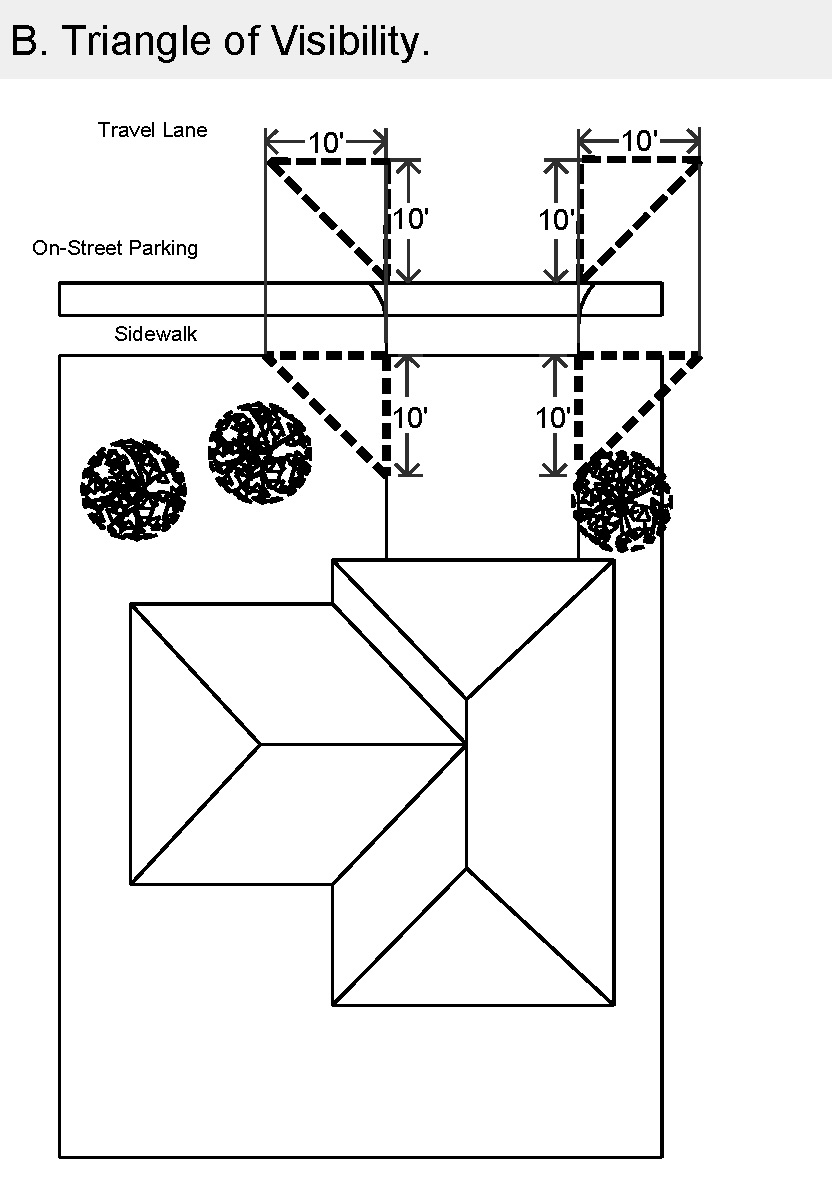 |
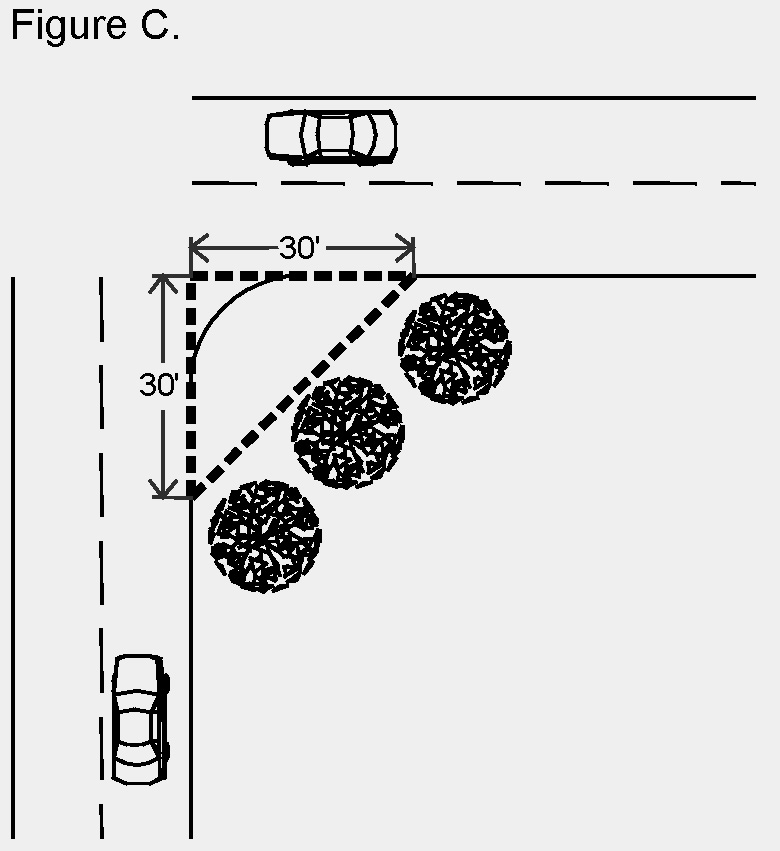
- Street intersections.Triangles of visibility shall be maintained at all street intersections within or abutting residential and special use districts (see Figure C). The legs of the triangles of visibility shall:
- Be a minimum of thirty (30) feet long; and
- Meet at the point of intersection of a line that extends from the edge of pavement of the intersecting streets (curb radii are included within the triangle of visibility).
- In cases where site specific conditions prohibit compliance with triangle of visibility requirements the Building and Zoning Director may approve and require the use of convex mirrors at driveways within private property but prohibited at public right-of-way. The Building and Zoning Director shall impose conditions as appropriate on a case-by-case basis.
(Ord. No. 2022-65, 10/25/2022)
Section 10-107. Illumination.
Illumination of parking areas shall be provided in accordance with the standards set out in Chapter 8C of the Miami-Dade County Code.
Section 10-108. Common driveways.
- Common driveways. Adjacent properties are permitted to share a common driveway, provided:
- The property owner(s) submit an appropriate restrictive covenant or access easement in recordable form acceptable to the City Attorney; and
- The restrictive covenant or access easement provides for the continued existence of the shared driveway until such time as the City Manager releases the obligation of the restrictive covenant or access easement.
Section 10-109. Remote off-street parking and Payment-in-lieu
- Remote off-street parking. Use of Remote Parking may be allowed as an alternative to, or in conjunction with providing required parking onsite. The one-time payment into the Parking Trust Fund for use of Remote Parking shall be satisfied for one hundred percent (100%) of the requested remote parking spaces to comply with up to one hundred percent (100%) of the required on-site parking and shall be collected prior to the issuance of a building permit in the amount established by the City Commission.
- Definition. For purposes of this subsection, the "applicant" is defined as the owner(s) of the land of which the uses(s) seeking to utilize remote parking is located. The owner of the land on which the remote parking is located may not apply for remote parking, unless that owner also owns the property on which the use seeking to utilize remote parking is located.
- Applicability.
- Location of remote parking spaces. The proposed building site location and the location of the remote parking spaces shall both be located within the CBD, the Design & Innovation District, or located within one-hundred (100) feet of the Ponce de Leon right of way, south of SW 8th Street. The remote parking facility(ies) shall not be located in a single-family zoning district.
- Distance. The remote parking spaces shall be located within one thousand (1,000) feet of the building site, measured from the property line of the site to the property line of the off-street parking facility(ies) containing the remote parking spaces.
- Minimum and maximum remote parking. A minimum of ten (10) remote parking spaces shall be requested and up to one-hundred (100%) percent of the Code required off-street parking. A Payment-in-lieu may be requested if a building site requires less than ten (10) off-site parking spaces.
- Approval process. Remote off-street parking for new construction requesting more than twenty-five (25) parking spaces shall be subject to a Conditional Use approval as set-forth in Article 14-203.2 of the Zoning Code, including conditions to allow a combination of Remote Parking and Payment-in-lieu. The Development Services Director may review and approve an requesting twenty-five (25) remote off-street parking spaces or less located in the City upon finding that all of the requirements of this subsection have been satisfied.
- Miracle Mile. Projects facing Miracle Mile shall remote park one hundred percent (100%) of their required parking with no reductions. No minimum number of remote parking spaces are required. The Development Services Director may review and approve an application requesting less than twenty-five (25) remote off-street parking spaces.
- Application. The applicant shall file an application in the form specified by the City, including site plans, and shall be accompanied by applicable fees.
- Covenant. The property owner(s) shall submit an appropriate covenant prior to issuance of the first building permit which shall run with the land and declaration of restrictions for the remote parking spaces in recordable form acceptable to the City Attorney and acceptable in substance to the Director of Development Services, including at least all of the following:
- That the owner of the remote spaces (and the heirs, successors, personal representatives and assigns, and upon all mortgagees and lessees and others presently or in the future having any interest in the property) assures that the remote parking spaces are in excess of those parking spaces required to serve any existing development and the continued rights to the remote parking spaces until such time as the City Manager or designee releases the obligation, and if the spaces are leased, the City’s right to access the remote spaces to inspect them as provided herein;
- That, upon any relocating of the remote parking spaces to another location that meets the requirements of this subsection, an application shall be submitted to amend the remote parking approval promptly, at least ninety (90) days prior to the termination of the remote parking arrangement. Such amendment shall be subject to the same application requirements, procedure and fee as a new application, and shall be implemented in a manner that assures the continuous availability of the remote parking for the project;
- That any unplanned changes shall be reported in the facts related to the application or approved remote parking arrangement to the Director of Development Services within five (5) business days of the occurrence of the change, and shall submit a remedial plan consistent with the requirements of subsection 8 below, together with the review fee, within ten (10) business days of the occurrence of the change. The Development Services Director shall have the sole but reasonable discretion to approve the remedial plan and set the timing of implementation, and may extend the above deadlines if good cause is shown;
- That the City shall be authorized to inspect the remote parking spaces at will to determine the continuing adequacy of the remote parking arrangements, during the normal hours of operation of the use that is being served by the remote parking spaces;
- That an affidavit shall be annually submitted confirming that the facts supporting the applicant’s initial approval of the use of remote parking remain accurate at the time of renewal of the certificate(s) of use for the applicant’s property(ies);
- That at the time of entering into a new lease or renewing a lease, renewed documentation and affidavits shall be submitted; and
- That any material failure to meet the requirements of this subsection (or the requirements of the related agreements, covenants or conditions) that is not cured as provided herein will immediately subject the applicant to the original and full parking requirements of the Zoning Code. The materiality of any failure shall be determined by the Development Services Director, in consultation with the City Attorney.
- That a submitted survey shows the exact location, traffic flow, and current physical layout of the proposed remote parking spaces.
- Remedial plan. The purpose of a remedial plan is to provide remedy options if the initial remote parking agreement has been terminated and other spaces meeting the criteria are no longer available and shall be accompanied by a review fee. If the Development Services Director finds, in his or her reasonable discretion, that the remedial plan fully meets the parking requirements for the remaining uses and square footages, utilizing any combination of alternatives permitted by the City Code and Zoning Code in effect at the time, and the requirements of this subsection, then the Development Services Director shall approve the remedial plan. The remedial plan may include any or all of the following options, and shall be implemented according to the timing and schedule established in the individual remedial plan:
- Provide a one-time Payment-in-lieu of required parking in accordance with Section 74-172(d) of the Code of Ordinances, or
- Modify the use of the applicant’s property(ies) so that the remote parking spaces are no longer required to be provided to meet the Code parking standards (for example, by reducing the square footage of uses, or changing one or more uses to a use(s) with a lower parking requirement), or
- Secure alternate remote parking spaces meeting all of the requirements of this subsection, including execution of any required agreements and affidavits, or
- Provide additional onsite parking spaces.
- Renewal. The applicant shall, prior to the annual renewal of the certificate(s) of use for the applicant’s property(ies) using remote parking, submit renewed documentation if required, and an affidavit affirming that the matters originally approved remain in effect, which shall be reviewed by the Development Services Director. The certificate(s) of use shall not be issued unless the affidavit, and documentation if required, demonstrates that all the requirements of this subsection continue to be met for the remote parking arrangement as it was approved.
- Noncompliance. If the Development Services Director discovers at any time, including during a renewal review, that the applicable requirements of this subsection are not met in any material way or that the remote parking is not maintained continually as described in the application and provided in the recorded covenant, he or she shall notify the applicant and require the applicant either to (i) demonstrate that the violation has been cured or did not exist, or (ii) provide a remedial plan meeting the requirements of subsection above, together with the review fee. The materiality of any noncompliance shall be determined by the Development Services Director, in consultation with the City Attorney. The applicant's response shall be reviewed and approved in the sole but reasonable discretion of the Development Services Director. The Development Services Director shall set the deadline for the applicant to develop and submit the remedial plan and may extend it if good cause is shown.
Also, if the Development Services Director determines that the applicant has failed to meet any of the following four (4) requirements, the Director shall deem the applicant’s remote parking approval void, and the applicant shall not again seek to use remote parking until six (6) months have elapsed from the date that the approval is deemed void:- The requirement to notify the City of changes within the required time frame;
- The requirement to submit a remedial plan by any deadline set or extended by the Development Services Director;
- The requirement to implement the remedial plan according to the implementation schedule approved or extended by the Development Services Director; or
- The requirement to comply in any other material regard with all of the requirements of this subsection, including failure to comply with the recorded covenants as required herein. The materiality of any noncompliance shall be determined by the Development Services Director, in consultation with the City Attorney. The Development Services Director shall also have the discretion in consultation with the City Attorney to begin Code Enforcement procedures as set forth in Section 14-300.
- City Commission Waiver.
- Standard for waivers. The City Commission may approve a waiver pursuant to this subsection finding that the waiver will neither (A) harm the public interest nor (B) create parking problems in the area surrounding the applicant’s project site.
- Requirements that may be waived. An applicant may request that the City Commission review its application for remote parking and, following a public hearing, approve a waiver of one (1) or more of these requirements, and may impose any conditions it deems necessary on such waiver:
- The one-thousand (1,000) foot maximum distance between the remote parking spaces and the applicant’s project site; and
- The requirement that the remote parking be located within the CBD or Design & Innovation District, or one-hundred (100) feet from the Ponce de Leon right of way, south of SW 8th Street; and
- The requirement that the land containing the use seeking to utilize remote parking be located within the CBD or the Design & Innovation District, or one-hundred (100) feet from the North Ponce de Leon right of way.
- Effect of waiver. All of the remaining requirements, that have not been waived by the City Commission, must be satisfied.
- Appeals. The applicant may appeal any determinations made by the Development Services Director under this subsection through the process set forth in Section 14-208 of the Zoning Code.
- Payment-in-lieu. Payment-in-lieu may be allowed per Chapter 74 Sec. 74-172(d) of the City Code, provided that:
- The applicant’s prior agreement to Remote Park has been terminated by the private parking facility and the Director of Development Services has determined that obtaining Remote Parking elsewhere is infeasible or impracticable; or
- Less than ten (10) parking spaces are required and on-site parking is determined infeasible or impracticable, as determined in the reasonable discretion of the Director of Development Services, and the physical layout of the property(ies) cannot reasonably be altered to provide the required parking.
The Payment-in-lieu shall be satisfied by a one-time payment prior to the issuance of building permit(s) or issuance or renewal of certificate(s) of use in the amount established by the City Commission. The Payment-in-lieu fee shall be collected in addition to any Remote Parking payments into the Parking Trust Fund.
(Ord. No. 2023-04, 01/24/2023)
Section 10-110. Amount of required parking.
- The following are exempt from parking.
- Central Business District Overlay:
- Ground floor retail, residential, and restaurants that are located within the Central Business District Overlay shall be exempt from the parking requirements.
- Buildings that are located within the Central Business District Overlay (CBD) that have a floor-area-ratio of 1.25 or less (1.45 or less if Mediterranean bonus is used) are not required to provide off-street parking for any uses except residential units.
- MX-1 fronting Giralda Plaza:
- Buildings that have a maximum lot width of one-hundred (100) feet and of a maximum height of forty-five (45) feet and three (3) stories, off-street parking shall not be required.
- Parking requirements may be fulfilled by shared or remote parking, or by payment in lieu, as per Section 10-109, or by shared parking as per Section 10-111.
- MX2 Design & Innovation District Overlay:
- First-floor showrooms and art galleries shall be exempt from the parking requirements.
- Buildings of four (4) stories or less, off-street parking shall not be required.
- Building Alterations.
- Any single-family residence or duplex building or structure which existed as of March 11, 1964, may be altered -- including renovations, remodels, repairs, changes of building types. and changes in use -- without providing off-street parking facilities or additional off-street parking facilities if there is no more than a twenty-five (25%) percent total increase in floor area, based on conditions as of March 10, 1964, and if there is no change in zoning to a zoning district requiring more off-street parking than the existing zoning district.
- Any building or structure, other than single-family residences or duplexes, which is increased in size more than twenty-five (25%) percent of the gross floor area as it existed as of March 11, 1964, shall provide off-street parking for the added portion as outlined hereinafter but will not be required to provide additional parking facilities for the presently existing portion unless required by a change of zoning.
- Any building or structure, which has an existing occupied roof deck that is used as an amenity to an office use and permitted as of February 9, 2021, may enclose the occupied roof deck without providing additional off-street parking. The newly enclosed space shall be used solely as an amenity to the existing office use.
- A restrictive covenantshall be required and shall authorized the City of Coral Gables to inspect the enclosed roof deck at any time while in use to ensure compliance.
- If the eclosed deck is not complying with any of these limitations, it will be deemed in violation of this subsection and therefore will be required to provide the additional required parking may result in Code Enforcement proceedings and revocation of Certificate of Use.
- Central Business District Overlay:
- Calculation of parking requirements.
- Required parking shall be provided for each use on a building site, according to the following table:
| Use | Minimumparkingrequirements |
|---|---|
| Residential | |
| Detached dwellings. | One (1) parking space per unit consisting of a roofed structure, which utilizes the same materials as the principle structure and that is a garage, carport, or porte-cochere. |
| Duplex. | One (1) parking space per unit consisting of a roofed structure, which utilizes the same materials as the principle structure and that is a garage, carport, or porte-cochere. |
| Live work. | One (1) space per unit, plus one (1) space per three-hundred-and-fifty (350) square feet of work area. |
| Multi-family dwellings. | Efficiency and one (1) and bedroom units – 1.0 space per unit. Two (2) bedroom units – 1.75 spaces per unit. Three (3) or more bedroom units – 2.25 spaces per unit. |
| Single-family dwellings. | One (1) parking spaces per unit consisting of a roofed structure, which utilizes the same materials as the principle structure and that is a garage, carport, or porte-cochere. |
| Townhouses. | Two (2) parking spaces per unit consisting of a roofed structure, which utilizes the same materials as the principle structure and that is a garage, carport, or port-cochere. |
| Non-residential | |
| Adult uses. | One (1) space per three-hundred (300) square feet of floor area. |
| Alcoholic beverage sales. | One (1) space per three-hundred (300) square feet of floor area. |
| Animal grooming/boarding. | One (1) space per three-hundred (300) square feet of floor area. |
| Assisted living facilities. | One (1) space per two (2) ALF units. |
| Auto service stations. | One (1) space per three-hundred (300) square feet of floor area. |
| Bed and breakfast. | One (1) space, per three (3) sleeping rooms. |
| Camp. | One (1) space per FTE, plus one (1) space per four (4) students aged sixteen (16) years or older based on maximum capacity. |
| Cemeteries. | If services provided in a building, one (1) space per five (5) fixed seats plus one (1) space for each thirty (30) square feet of floor area used for temporary seating. |
| Community center. | One (1) space per three-hundred (300) square feet of floor area. |
| Congregate care. | One (1) space per FTE, plus one (1) space per four (4) beds. |
| Day care. | Day care for children: One (1) space per FTE plus one (1) space for each ten (10) visitors. Day care for adults: One (1) space per FTE plus one (1) space for each ten (10) visitors. |
| Educational facilities. | One (1) space per student station. |
| Funeral homes. | One (1) space per five (5) fixed seats plus one (1) space for each fifty (50) square feet of floor area used for temporary seating. |
| Golf or tennis grounds. | Four (4) spaces per hole (golf). Three (3) spaces per court (tennis). One (1) space per eighteen (18) linear feet of bleachers. |
| Group homes. | One (1) space per FTE, plus one (1) space per four (4) beds. |
| Heliport and helistop. | One (1) space per tie-down. |
| Hospitals. | Two (2) spaces per patient bed. |
| Indoor recreation / entertainment. | The greater of one (1) space per five (5) fixed seats or one (1) space per three-hundred (300) square feet of floor area. |
| Manufacturing. | One (1) space per three-hundred (300) square feet office floor area, plus one (1) space per one-thousand (1,000) square feet of all other floor area. |
| Marinas and marina facilities. | One (1) space per marina slip, plus one (1) space per three-hundred-and-fifty (350) square feet of floor area of indoor marina facilities. |
| Medical clinic. | One (1) space per FTE plus one (1) space per two-hundred (200) square feet of floor area. |
| Medical Marijuana Retail Center. | One (1) space per FTE and one (1) space for every two (2) PTEs, plus one (1) space per 150 square feet of floor area. |
| Nursing homes. | One (1) space per FTE, plus one (1) space per four (4) beds. |
| Offices. | One (1) space per three hundred (300) square feet of floor area. |
| Outdoor recreation / entertainment. | One (1) space per four (4) visitors during estimated peak use periods. |
| Outdoor retail sales, display and/or storage. | One (1) space per three hundred and fifty (350) square feet of land area delineated or put to such use. |
| Overnight accommodations. | One and one-eighth (1 1/8) spaces per sleeping room. |
| Private club. | One (1) space per three-hundred (300) square feet of floor area. |
| Private yacht basin. | Three (3) spaces per four (4) yacht slips. |
| Public transportation facility. | One (1) space per one hundred (100) square feet of terminal and station area. |
| Religious institution. | One (1) space per five (5) fixed seats plus one (1) space per fifty (50) square feet of assembly room area without fixed seats; provided however, any more liberal parking requirements for uses authorizing buildings of public assemblage shall be substituted for this provision. |
| Research and technology uses. | One (1) space per three-hundred (300) square feet of office floor area, plus one (1) space per one thousand (1,000) square feet all other floor area. |
| Restaurants. | One (1) spaces per three hundred (300) square feet of floor area. |
| Restaurants, fast food. | One (1) spaces per (300) square feet of floor area. |
| Retail sales and services. | One (1) space per three-hundred (300) square feet of floor area. |
| Sales and/or leasing offices. | One (1) space per three-hundred (300) square feet of floor area. |
| Schools. | One (1) space per FTE, plus one (1) space per five (5) students aged sixteen (16) years or older based on maximum capacity. |
| Self-storage warehouses. | One (1) space per three-hundred (300) square feet of office floor area, plus one (1) space per one thousand (1,000) square feet all other floor area. |
| Telecommunications towers. | Zero (0) spaces. |
| TV / radio studios. | One (1) space per three-hundred (300) square feet of floor area, plus one (1) space per three (3) studio audience members at maximum capacity. |
| Utility / infrastructure Facilities. | Zero (0) spaces. |
| Utility substations. | Zero (0) spaces. |
| Vehicle sales / displays. | One (1) space per three-hundred (300) square feet of office floor area, plus one (1) space per six-hundred (600) square feet of showroom floor area, plus one (1) space per five (500) square feet of all other floor area. |
| Vehicle service, major. | One (1) space per three-hundred (300) square feet of office floor area, plus one (1) space per five hundred (500) square feet all other floor area |
| Veterinary offices. | One (1) space per three-hundred (300) square feet of floor area. |
| Wholesale / distribution / warehouse facility. | One (1) space per three-hundred (300) square feet of office floor area, plus one (1) space per one thousand (1,000) square feet all other floor area. |
| Post office. | One (1) space per three-hundred (300) square feet of floor area. |
- If a calculation of required parking spaces results in a fractional space, the number of required parking spaces shall be rounded down to the next whole number.
C. Alternative parking requirements.If a use is not listed in this Article, then the off-street parking requirement shall be the same as the requirement for a functionally similar use that is listed herein, as determined by the Development Review Official.
D. Loading spaces. Loading spaces shall be provided for all nonresidential or mixed use buildings that exceed a floor area of one hundred thousand (100,000) square feet of floor area, as follows:
| Nonresidential Floor Area | Required Loading Spaces |
| Zero (0) | |
| 100,000 sq. ft. to 199,999 sq. ft. | One (1) |
| 200,000 sq. ft. to 299,999 sq. ft. | Two (2) |
| 300,000 sq. ft. to 399,999 sq. ft. | Three (3) |
| Each additional 100,000 sq. ft. or fraction thereof | One (1) additional loading space |
- Calculation of compliance with parking requirement.
- Excluded parking spaces. Parking spaces that meet any of the following criteria shall not be counted in determining the amount of parking provided pursuant to this Section 10-109:
- Off-street parking spaces that are operated as a commercial parking lot.
- Off-street parking spaces that are provided for residential and overnight accommodation uses and are available only upon payment of a fee.
- Valet parking spaces. Valet parking spaces for overnight accommodations, restaurants, and minor vehicle sales in any zoning district may comprise up to twenty-five (25%) percent of the required parking spaces for those uses.
- Remote parking spaces. Remote parking spaces may comprise up to one-hundred (100%) percent of the required parking spaces if approved pursuant to Section 10-108.B.
- Counted parking spaces. All parking and loading spaces that are provided on-site and all parking spaces that are in permitted remote off-street parking facilities count in determining the amount of parking provided pursuant to this Section 10-110.B, except as provided in Section 10-109.B(1)(4).
- Non-residential back-of-house uses exempt from parking requirements. The following back-of-house uses will be exempt from parking requirements for non-residential uses: stairs, elevators, service corridors, loading areas, trash areas, storage areas, electrical rooms / FPL vault room, emergency generator rooms, and fire pump rooms.
- Residential back-of-house uses exempt from parking requirements. Parking shall only be required for residential units. All other floor area shall be exempt from parking requirements.
- Excluded parking spaces. Parking spaces that meet any of the following criteria shall not be counted in determining the amount of parking provided pursuant to this Section 10-109:
- Electric Vehicle Charging. Except single-family residences, duplexes, and townhouses, electric vehicle charging stations and infrastructure are required for new construction as provided below.
- Reserved Electric Vehicle Parking. When ten (10) or more off-street parking spaces are required, a minimum of five percent (5%) of the required off-street parking spaces shall be reserved for electric vehicle parking, and provide an electric charging station for each space, with a minimum of one (1) space reserved for electric vehicle parking, subject to the following:
- The electric vehicle charging station shall have a minimum charging level of AC Level 2.
- All components of the electric vehicle charging station shall be located entirely within the confines of the building and not visible from outside any portion of the structure.
- All components shall be located above the minimum flood elevation.
- The charging station shall contain a retraction device, coiled cord, or a place to hang cords and connectors above the ground surface.
- Signage shall be posted at the charging station stating, “Charging Station.” Signs shall have no greater length than eighteen (18) inches.
- If a calculation of required parking spaces results in a fractional space, the number of required parking spaces shall be rounded up to the next whole number.
- Electric Vehicle Infrastructure Readiness. In addition to subsection F. 1. above, when ten (10) or more off-street parking spaces are required, a minimum of fifteen percent (15%) of the required off-street parking spaces shall have Electric Vehicle Supply Equipment infrastructure installed for the future installation of Electric Vehicle Charging Stations (“EV-Ready”), subject to the following:
- Each requiredparking space shall include make-ready infrastructure with a minimum of 40-Amps on an independent 240-volt AC circuit for every electric vehicle Space.
- If a calculation of required parking spaces results in a fractional space, the number of required parking spaces shall be rounded up to the next whole number.
- Electric Vehicle Infrastructure Capability. In addition to subsection F. 1. and 2. above, when ten (10) or more off-street parking spaces are required, a minimum of twenty percent (20%) of the required off-street parking spaces shall have listed raceway (conduit) and electrical capacity (breaker space) allocated in the electrical room to accommodate future EVSE installations (“EV-Capable”), subject to the following:
- All conduits and subpanels installed throughout the new construction shall be sized to accommodate a minimum of 40A breakers for each parking space.
- If a calculation of required parking spaces results in a fractional space, the number of required parking spaces shall be rounded up to the next whole number.
- 100% of remaining parking spaces will have sleeving and required structural penetrations of sufficient diameter and number to allow for future installation of EV charging infrastructure.
- Reserved Electric Vehicle Parking. When ten (10) or more off-street parking spaces are required, a minimum of five percent (5%) of the required off-street parking spaces shall be reserved for electric vehicle parking, and provide an electric charging station for each space, with a minimum of one (1) space reserved for electric vehicle parking, subject to the following:
- Bicycle Parking. Bicycle parking shall be provided at a minimum of one (1) bicycle space per four (4) residential units and one (1) bicycle space per twenty thousand (20,000) square feet of non-residential use building area. Bicycle parking location shall be convenient and shall be subject to site plan review.
- Boats, recreational vehicles or similar accessory vehicles shall be parked or stored within an enclosed garage or storage area.
(Ord. No. 2021-12, 03/09/2022; Ord. No. 2022-41, 07/25/2022)
Section 10-111. Shared parking reduction standards.
- Intent and Purpose. The intent and purpose of this section is to recognize the synergy among different uses within a mixed use development such that peak times for parking for one use occurs at a different time from another use. Also, because mixed uses gives the opportunity for persons being able to live and work within the same building, parking requirements are reduced. It is further recognized that the reduction of excessive parking spaces can positively affect the aesthetics of the building design that meets the spirit and intent of Section 5-102, “Design Review Standards” of the Zoning Code.
- Reductions from the minimum required parking spaces from the Zoning Code may be approved as part of a Mixed Use (MX ) site plan or Planned Area Development (PAD) that meets the standards of Leadership in Energy and Environmental Design (LEED) criteria specified by the U.S. Green Building Council, or similar rating agency. Reductions shall be calculated using an accredited system for calculating shared parking. Such reduction shall exclude any and all proposed and anticipated parking spaces reserved exclusively for a specific use such as office, residential, retail, etc. Dedicated valet parking spaces, however, may be part of the shared parking reduction. A restrictive covenant shall be required stating that the amount of parking required as a result of the shared parking reduction shall not be reserved exclusively for a specific use.
The number of required spaces may be reduced by any one (1) or more of the following methods, as may be required by the City:- Urban Land Institute (ULI) Shared Parking Methodology using the City’s parking code requirements. A ULI Shared Parking Methodology and the assumptions in the calculation must be approved by the City.
- Shared parking matrix. The shared parking matrix provides the method for calculating shared parking for mixed use buildings and planned area developments.
- Methodology. MX or PAD projects containing two (2) or more uses shall multiply the amount of required parking for each individual use, as provided within Section 10-109, by the appropriate percentage listed in the table below for each of the designated time periods. Calculate the resulting sum for each of the six (6) vertical columns within the table below. The minimum parking requirement shall be the highest sum resulting from the calculations.
| Weekday | Weekend | |||||
| Use | Day; 8am - 5pm | Evening; 5pm - 12am | Night; 12am - 8am | Day; 8am - 5pm | Evening; 5pm - 12am | Night; 12am - 8am |
| Residential | 60% | 90% | 100% | 80% | 90% | 100% |
| Office | 100% | 10% | 5% | 10% | 5% | 5% |
| Retail | 70% | 90% | 5% | 100% | 70% | 5% |
| Restaurant | 50% | 100% | 10% | 75% | 100% | 10% |
| Hotel | 80% | 100% | 80% | 80% | 100% | 75% |
| Entertainment | 40% | 100% | 10% | 80% | 100% | 10% |
| Other | 100% | 100% | 100% | 100% | 100% | 100% |
- Applicants may provide a parking study completed by a licensed professional engineer, engineering firm or similar, justifying the proposed parking solution as provided below.
- Parking study. A study must be prepared using a professionally appropriate methodology that is approved by the City, detailing land uses in accordance with Institute of Transportation Engineers (ITE) parking generation categories. At a minimum, the methodology must incorporate all of the following considerations, as well as any other data or analyses that the City deems appropriate for the requested reduction:
- Parking characteristics of similar projects and uses. The study must evaluate factors such as the uses, hours of operation, peak parking demands, location, amount and type of off-street parking that is proposed, the proposed impact on nearby on-street parking, and occupancy rates of similar uses and projects in comparison to those of the proposed uses and project.
- Operational assessment. The study must demonstrate how the project will optimize the parking operations and traffic conditions within a quarter (1/4) mile of the project boundaries, and propose and agree to provide appropriate mechanisms to protect the surrounding neighborhood, including appropriate signage and the locations of all ingress and egress points.
- Transit. The study must analyze the impact of nearby transit services on parking demand for the project, and must also analyze the projected use of other alternative modes of travel such as bicycle and pedestrian. The study must reference and the project must propose to contribute to the enhancement of nearby transit services through expanding routes and lengthening hours of service.
- Valet plan. If valet services are proposed, the study must reference and the project must propose to provide adequately staffed valet services during the hours of operation of all uses, including an appropriate time following closing to accommodate the departure of valet parked cars. Projects shall submit an operational plan for the valet service, specifying details, including maximum wait times, distance from valet drop-off points to valet parking areas, operational modifications to the functioning of any required parking areas such as stacking, and the number of operators at peak and non-peak hours.
- Parking study. A study must be prepared using a professionally appropriate methodology that is approved by the City, detailing land uses in accordance with Institute of Transportation Engineers (ITE) parking generation categories. At a minimum, the methodology must incorporate all of the following considerations, as well as any other data or analyses that the City deems appropriate for the requested reduction:
Section 10-112. Miscellaneous parking standards.
- Tandem spaces. Tandem spaces are permitted as required parking, provided each set of tandem parking spaces are assigned to an individual unit within the building.
- Automated, parking systems, structures and vertical parking lifts. Parking spaces in automated, parking systems, structures, and vertical parking may be utilized for required or supplemental parking spaces per this Article for residential and non-residential uses, provided that all of the following are satisfied:
- Systems may be self-service, valet-operated, or fully automated.
- Vertical parking lift systems shall be limited to two-levels/decks and each lift shall be controlled exclusively by one (1) tenant/unit.
- The use of automated mechanical parking systems, structures and vertical parking lifts parking does not increase the building bulk and mass, in that the building and mechanical access parking structure or parking lift(s) is no greater in volume than the largest building and parking structure that could be constructed on the parcel proposed for development in strict compliance with the underlying zoning district regulations, with the same number of parking spaces configured exclusively as conventional structured parking.
- All systems shall have an average delivery rate of no more than five (5) minutes.
The parking system shall be located entirely within the confines of the building and is not visible from outside any portion of the structure.
- Implementation and monitoring of all vertical parking lifts as provided in Section 10-110 shall be enforced via a restrictive covenant subject to final review and approval by the City Attorney's Office prior to issuance of a Certificate of Occupancy of the applicable structure(s). This covenant, running with the land shall hold the City harmless against any claims arising from accidents as a result of the use of mechanical parking lifts, in a form acceptable to the City Attorney.


