
Coral Gables City Zoning Code
ARTICLE 14
PROCESS
Section 14-202. General Development Review Procedures
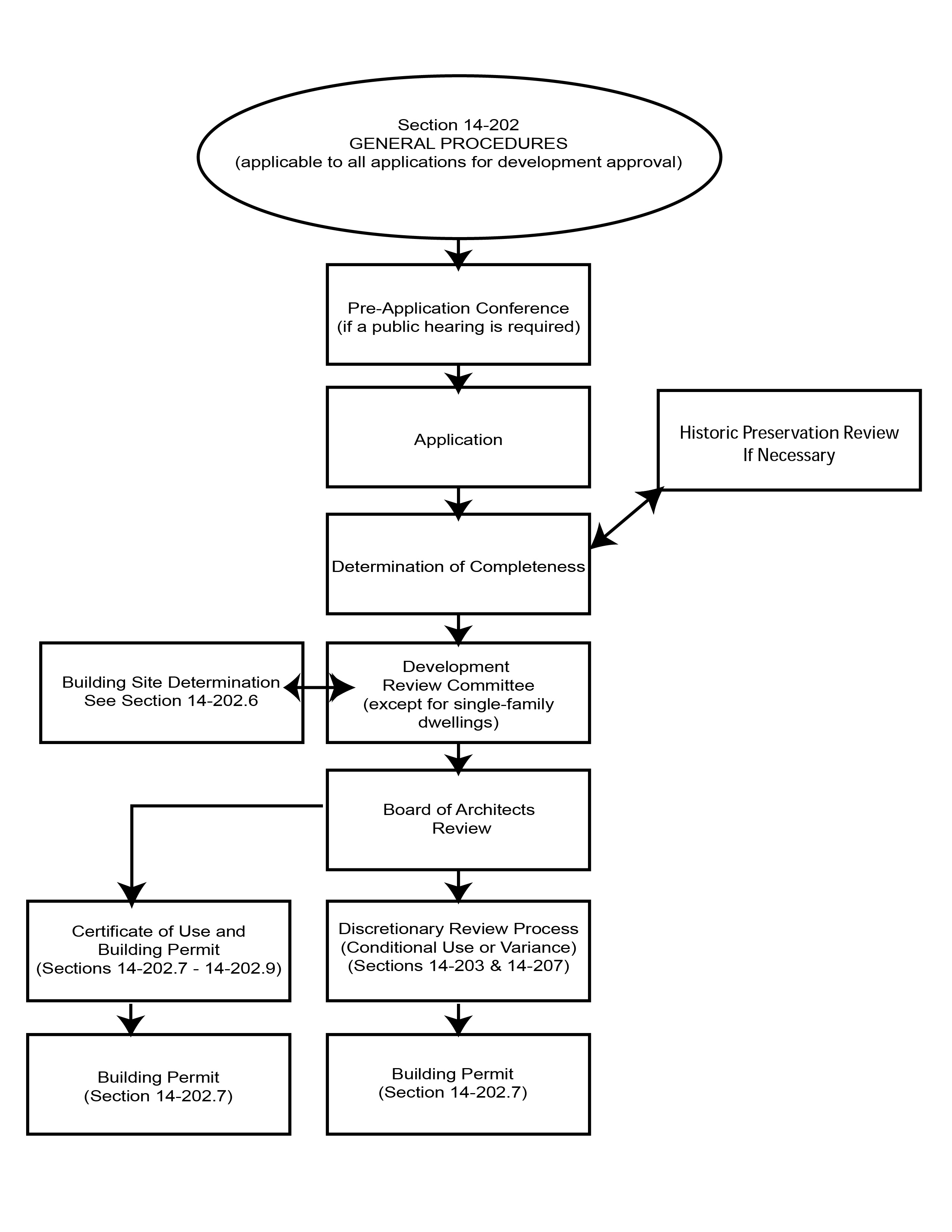
Section 14-219. Affordable Housing.
[Reserved]
Section 14-301. Purpose and applicability.
The purpose of this Article is to establish procedures for enforcement and penalties for violations of these regulations. The provisions of this Article are supplemental to any other procedures and remedies available to the City of Coral Gables. Nothing contained in this Article prohibits the City of Coral Gables from enforcing its codes or ordinances by other Code Enforcement provisions of the City of Coral Gables Code of Ordinances or other applicable law.
Section 14-101.1. Powers and duties.
The City is governed by a City Commission consisting of five (5) elected members, including a Mayor, as more particularly set forth in the City Charter. In addition to any authority granted the City Commission by state law, City Charter or other regulations of the City, the City Commission shall have the power and duty to act as the final decision maker regarding these regulations with respect to certain types of applications and appeals. In accordance with the standards and procedures of Section 14-200, Development Review, the City Commission is the final decision maker for:
| Powersandduties | ApplicableStandards/Procedures |
|---|---|
| Abandonment and Vacations (including mitigation plan approval) | Section 14-211 |
| Annexation | See Florida Statutes |
| Appeals (from decisions by the Board of Adjustment, Board of Architects and the Historic Preservation Board) | Section 14-208 |
| Appeals of Concurrency Review | Section 14-208.3 |
| Comprehensive Plan Text and Map Amendments | Section 14-213 |
| Conditional Uses | Section 14-203 |
| Coral Gables Mediterranean Architectural Design Special Location Site Plan Review | Section 5-201 |
| Development Agreements | Section 14-217 |
| Historic Preservation – Applications for Tax Exemption | Section 8-121 |
| Moratorium | Section 14-209 |
| Planned Area Development Designation | Section 14-206 |
| Platting/Subdivision and Variances | Section 14-210 |
| Protection of Landowner’s Rights | Section 14-214 and 14-216 |
| Separation/Establishment of a Building Site | Section 14-202.6 and 14-203 |
| Site plan (MXD, PAD, other) | Article 14 |
| Transfer of Development Rights | Section 14-204 |
| University Campus District Modification to the Adopted Campus Master Plan | Appendix D |
| Vested Rights Determination | Section 14-216 |
| Zoning Code Text and Map Amendments | Section 14-212 |
| Zoning in Progress Request | Section 14-209 |
Section 14-102.1. Powers and duties.
Pursuant to the City Charter, and subject to those provisions, a Planning and Zoning Board is created to act as the Local Planning Agency (LPA) of the City. In addition to any power or duty delegated by the City Commission or the City Manager, the Planning and Zoning Board shall act as the recommending Board to the City Commission for:
| Powers and duties | Applicable Standards/Procedures |
|---|---|
| Abandonment and Vacations (including mitigation plan approval) | Section 14-201 |
| Annexation | See Florida Statutes |
| Comprehensive Plan Text and Map Amendments | Section 14-213 |
| Conditional Uses | Section 14-203 |
| Coral Gables Mediterranean Architectural Design Special Location Site Plan Review | Section 5-201 |
| Development Agreements | Section 14-217 |
| Moratorium | Section 14-209 |
| Planned Area Development Designation | Section 14-206 |
| Platting/Subdivision | Section 14-210 |
| Separation/Establishment of a Building Site | Section 14-202.6 and 14-203 |
| Site plan (MXD, PAD, other) | Article 14 |
| Subdivision Review for a Tentative Plat and Variances | Section 14-210 |
| Transfer of Development Rights | Section 14-204 |
| University Campus District Modification to the Adopted Campus Master Plan | Appendix D |
| Zoning Code Text and Map Amendments | Section 14-212 |
| Zoning in Progress Request | Section 14-209 |
Section 14-102.2. Membership; Terms; Vacancies; Removal.
- Membership.
- The Planning and Zoning Board shall be composed of seven (7) members, five (5) of whom shall be appointed by the City Commission, one of whom shall be nominated by the City Manager, subject to approval of the City Commission, and one of whom shall be nominated by the six (6) members so appointed, subject to approval of the City Commission. In the event that the six (6) members shall fail to agree on the seventh (7th) member, such member shall then be nominated by the City Commission after a thirty (30) day waiting period.
- In making appointments to the Planning and Zoning Board, membership shall be sought from a diverse economic, social and professional representation and shall include members qualified and experienced in the fields of architecture, planning, landscape architecture, engineering, construction, planning and land use law and real estate. Each member of the Board shall also be a citizen and/or an owner, or spouse of an owner, of real property located within the City of Coral Gables during the term of appointment and also for at least five (5) years prior to appointment.
- A representative of the school district appointed by the school board as a non-voting member of the Planning and Zoning Board shall be invited to attend and participate in the Board meetings when Comprehensive Land Use Plan and Zoning Code Map amendments are on the agenda which would, if approved, increase residential density on the property that is the subject of the application and have a potential impact on a public school.
- Terms. The members of the Planning and Zoning Board shall serve at the pleasure of the City Commission. All appointments shall be for a two (2) year period commencing June 1st, and ending on May 31st of the next odd year or until their successor is appointed. No member of the Planning and Zoning Board shall serve more than eight (8) consecutive years on the Board.
- Vacancies. Appointments to fill any vacancy on the Board shall be for the remainder of the unexpired term. Appointments to unexpired terms shall not count as one of the four (4) terms for which a member is eligible for appointment.
- Removal. Any member of the Planning and Zoning Board may be removed with or without cause by a majority vote of the City Commission. A board member shall be automatically terminated if they fail to attend two of three successive meeting unless excused. Excused absences shall include jury duty, illness and absence from the City when a board member is unable to attend remotely. In addition, excessive absences, as defined in Section 2-54 of the City Code, shall constitute grounds for removal by the City Manager.
(Ord. No. 2025-25, 09/10/2025)
Section 14-102.3. Meetings; Quorum; Required vote.
- Meetings. The Planning and Zoning Board shall schedule one (1) regular meeting each month, and special meetings at such times as the Board may determine or at the call of the Chairperson or Secretary thereof, for the consideration of business before the Board. All meetings of the Board shall be open to the public. The time and place of the meetings, and the order of business and procedures to be followed at meetings, shall be as prescribed by the Chairperson and the Secretary of the Board.
- Quorum; Required Vote. Four (4) members of the Board shall constitute a quorum and the affirmative vote of four (4) members shall be necessary for the adoption of any motion. A vote of less than four (4) members on a motion regarding an application shall be deemed a tie vote. Whenever a tie vote occurs, and no other available motion on the application is made and approved before the next application is called for consideration or before recess or adjournment is called, whichever occurs first, the application shall proceed to the City Commission without a recommendation. A workshop meeting where no business is conducted may be held without a quorum. If only four (4) members of the Board are present, an applicant may request and be entitled to a continuance to the next regularly scheduled meeting of the Board. If a matter is continued due to lack of a quorum, the Chairperson or Secretary of the Board may set a special meeting to consider such matter. In the event that four (4) votes are not obtained an applicant may request a continuance or allow the application to proceed to the City Commission without a recommendation, except for items related to an amendment to the Comprehensive Plan. It is provided, that the failure to obtain four (4) affirmative votes to amend the Comprehensive Plan shall be deemed a recommendation of denial of such amendment.
(Ord. No. 2022-68, 11/09/2022)
Section 14-102.4. Officers; Staff.
- Officers. The Planning and Zoning Board shall annually elect a chairperson and a vice-chairperson from among its members. All officers shall be elected for one (1) year terms and shall be eligible for re-election.
- Staff/Secretary. The ex-officio member of the Board shall provide such support services to the Board as may be necessary to assist the Board in the performance of its duties and shall serve as the Secretary for the Board.
Section 14-102.5. Rules and records.
The Planning and Zoning Board may establish such rules of procedure as it may determine necessary to carry out its duties. Such rules of procedure shall be approved by the City Commission. All meetings shall be conducted in accordance with Florida law and written records of the proceedings shall be a public record maintained and filed with the Secretary of the Board.
Section 14-103.1. Powers and duties.
Pursuant to the City Charter, and subject to those provisions, a Board of Architects is a design review administrative board created to ensure that the City’s architecture meets the design review standards of the Zoning Code, is consistent with the City’s regulations and to preserve the traditional aesthetic character of the community. In addition to any power or duty delegated by the City Commission or the City Manager, the Board of Architects shall act as a recommending and a decision making Board for the following:
Section 14-103.2. Membership; Terms; Vacancies; Removal.
- Membership.
- The Board of Architects shall be composed of at least seven (7) members who serve as either regular or alternate members, depending on their designation at appointment.
- The City Manager, subject to the approval of the City Commission, shall appoint all regular and alternate members of the Board of Architects, considering the following qualifications:
- Each member shall have been a registered architect or landscape architect responsible for the design and construction of projects within the City of Coral Gables during the last five (5) years and shall have a minimum of ten (10) years experience in their profession.
- Each member shall either be a resident or have their principal place of business in the City of Coral Gables.
- Terms. The members of the Board of Architects shall serve at the pleasure of the City Commission. The terms of the members shall be as follows:
- Two (2) years per term.
- The term of the members of the Board of Architects shall be so established that the terms of two (2) members of the Board will expire on June 30 and December 31 of each year, and two (2) new members will be appointed on July 1 and January 1 of each year.
- Vacancies. Appointments to fill any vacancy on the Board shall be for the remainder of the unexpired term.
- Removal.Any member of the Board of Architects may be removed with or without cause by a majority vote of the City Commission. Regular board members shall be automatically terminated for twelve (12) unexcused absences in a twelve (12) month period. Excused absences shall include illness and absence from the City.
Section 14-103.3. Meetings; Panel Review; Review by Full Board; Conflict Resolution Meeting; Special Master Quasi-Judicial Hearing.
- Meetings. The Board of Architects may meet at least once each week, and such other times as the Board may determine, for the consideration of the business before the Board. All meetings shall be open to the public and the order of business and procedure to be followed shall be as prescribed by the Board. Rules of Procedure of the Board shall be approved by a majority of all Board members present. The Secretary for the Board shall be responsible for setting the agenda of the Board prior to a meeting of the Board. If a matter is postponed due to lack of a quorum, the Chairperson or the Secretary of the Board may set a special meeting as soon as practicable to consider such matter. Meetings of the Panel or the full Board are not quasi-judicial in nature, unless related to an appeal.
- Panel Review. Any case brought before the Board may be heard by a panel of two (2) or three (3) members. A quorum of the full Board is not necessary to convene a Panel for official action. The approval of two (2) members on a two (2) or three (3) member Panel, signified by their signature on each set of plans and specifications required to be submitted with each application for a permit, shall be a prerequisite to the issuance of any permit required to be approved by the Board. The Board may review and recommend approval to another decision-making authority having jurisdiction or approve, approve with conditions or deny any application by use of a Panel.
- Review by full Board. At any time before the meeting or during the Panel review, the City Architect, a Board member or the applicant may determine that the Panel should be expanded to include all Board members present, in which case all Board members present will serve as the Panel, with a majority vote of the expanded Panel required for any action. In the case of a tie vote, the Board shall deliberate and revote to see if the motion to approve or deny carries. If there is still a tie vote, the motion fails and the decision is treated as a denial for failure to obtain a majority affirmative vote.
- Conflict Resolution Meeting; Board of Architect Special Master Quasi-Judicial Hearing. In the event a person is aggrieved by a decision, a conflict resolution meeting shall be convened to address the aggrieved party’s concerns. Such meeting shall be held with the City Attorney or designee, and any other member of the City Staff that the Planning and Zoning Director deems appropriate. Any settlement that is reached shall then be presented to a Board of Architect Special Master as part of a quasi-judicial public hearing on the settlement. The qualifications of such Board of Architect Special Master shall be in accordance with Sec. 14-103.2. of the Zoning Code, and the appointment shall be for a two (2) year term by the City Manager, in consultation with the Board of Architects and approved by the City Commission. If the conflict resolution meeting does not result in a settlement, the Board of Architect Special Master shall hear the appeal in a quasi-judicial public hearing. Hearings regarding a single-family residence shall be heard by one (1) Special Master. Hearings regarding all other properties shall be heard by a panel of three (3) Special Masters. The decision of the Special Master(s) on the settlement or the appeal shall be final unless appealed directly to the City Commission in accordance with Sec. 14-208.2. of the Zoning Code. If the design of a project should change substantially, as determined by the City Architect, during the Conflict Resolution or Special Master Hearing process, the Board of Architects shall be required to review the changes to the design.
(Ord. No. 2024-05, 01/10/2024)
Section 14-103.4. Officers; Staff.
- Officers.The Board of Architects shall annually elect a chairperson and a vice-chairperson from among its members. All officers shall be elected for one (1) year terms and shall be eligible for re-election.
- Staff/Secretary. The City Manager is authorized and empowered to appoint a Secretary for the Board.
Section 14-103.5. Rules and records.
The Board of Architects may establish such rules of procedure as it may determine necessary to carry out its duties. Such rules of procedure shall be approved by the City Commission. All meetings shall be conducted in accordance with Florida law and written records of the proceedings shall be a public record maintained and filed with the Secretary of the Board.
Section 14-104.1. Powers and duties.
Pursuant to the City Charter, and subject to those provisions, a Board of Adjustment is created to provide relief from hardships and errors in the application of the regulations. In addition to any power or duty delegated by the City Commission or the City Manager, the Board of Adjustment shall have the following powers and duties:
| Powers and duties | Applicable Standards/Procedures |
| Appeals (from staff decisions, including interpretations of this code by the Director of Building and Zoning, other than the City Architect or Historic Preservation Officer) | Section 14-208 |
| Determinations of Compliance with Distance Requirements | Section 3-500 |
| Variances | Section 14-207 |
| Recommend Amendments to the Zoning Code to the City Commission | Section 14-212 |
Section 14-104.2. Membership; Terms; Vacancies; Removal.
- Membership.
- The Board of Adjustment shall be composed of seven (7) members, five (5) of whom shall be appointed by the City Commission, one of whom shall be nominated by the City Manager, subject to approval of the City Commission and one of whom shall be nominated by the six (6) members so appointed, subject to approval of the City Commission. In the event that the six (6) members shall fail to agree on the seventh (7th) member, such member shall then be appointed by the City Commission.
- In making appointments to the Board of Adjustment, membership shall be sought from a diverse economic, social and professional representation and shall include members qualified and experienced in the fields of architecture, planning, landscape architecture, engineering, construction, planning and land use law and real estate. Each member of the Board shall also be a citizen and/or an owner, or spouse of an owner, of real property located within the City of Coral Gables during the term of appointment and also for at least five (5) years prior to appointment.
- Terms. The members of the Board of Adjustment shall serve at the pleasure of the City Commission. All appointments shall be for a two (2) year period commencing June 1, and ending on May 31st of the next odd year or until their successor is appointed. No member of the Board of Adjustment shall serve more than eight (8) consecutive years on the Board.
- Vacancies. Appointments to fill any vacancy on the Board shall be for the remainder of the unexpired term. Appointments to unexpired terms shall not count as one of the four (4) terms for which a member is eligible for appointment, unless the unexpired term is two (2) years or more.
- Removal. Any member of the Board of Adjustment may be removed with or without cause by a majority vote of the City Commission. A board member shall be automatically terminated if they fail to attend two of three successive meeting unless excused. Excused absences shall include jury duty, illness and absence from the City when a board member is unable to attend remotely. In addition, excessive absences, as defined in Section 2-54 of the City Code, shall constitute grounds for removal by the City Manager.
(Ord. No. 2025-25, 09/10/2025)
Section 14-104.3. Meetings; Quorum; Required vote.
- Meetings. The Board of Adjustment shall hold one regular meeting per month, and special meetings at such times as the Board may determine or at the call of the Chairperson or Secretary thereof, for the consideration of business before the Board. All meetings of the Board shall be open to the public. The time and place of the meetings, and the order of business and procedure to be followed at meetings, shall be as prescribed by the Chairperson and the Secretary of the Board.
- Quorum; Required vote. Four (4) members of the Board shall constitute a quorum and the affirmative vote of four (4) members of the Board present shall be necessary to authorize a variance or grant an appeal. A tie-vote shall result in the automatic continuance of the matter to the next meeting, which shall be continued until a majority vote is achieved. If only four (4) members of the Board are present, an applicant shall be entitled to a postponement to the next regularly scheduled meeting of the Board. If a matter is postponed due to lack of a quorum, the Chairperson or the Secretary of the Board may set a special meeting to consider such matter.
Section 14-104.4. Officers; Staff.
- Officers. The Board of Adjustment annually shall elect a chairperson and a vice-chairperson from among its members. All officers shall be elected for one (1) year terms and shall be eligible for re-election.
- Staff/Secretary. The ex-officio member of the Board shall provide such support services to the Board as may be necessary to assist the Board in the performance of its duties and shall serve as the Secretary for the Board.
Section 14-104.5. Rules and records.
The Board of Adjustment may establish such rules of procedure as it may determine necessary to carry out its duties. Such rules of procedure shall be approved by the City Commission. All meetings shall be conducted in accordance with Florida law and written records of the proceedings shall be a public record maintained and filed with the Secretary of the Board.
Section 14-105.1 Powers and duties.
Pursuant to the City Charter, and subject to those provisions, a Historic Preservation Board is created to preserve, protect and harmonize new development with the historic resources that serve as visible reminders of the history and cultural heritage of the City, state or nation. In addition to any power or duty delegated by the City Commission or the City Manager, the Historic Preservation Board shall have the following powers and duties:
| Powers and duties | Applicable Standards/Procedures |
|---|---|
| Designation of Historic Landmarks and Historic Districts | Article 8 |
| Review of development applications affecting historic resources; Special Certificates of Appropriateness (including variances) | Article 8; Section 14-207 |
| Delegate to the Historic Preservation Officer the authority to grant Standard Certificate of Appropriateness and other appropriate duties | Section 14-107.5.; Article 8 |
| Participation in national register program | Article 8 |
| Enforcement of maintenance and repairs provisions | Article 8 |
| Unsafe structures | Section 14-300 |
| Recommend to the City Commission concerning the transfer of development rights, facade easements and the imposition of other restrictions, and the negotiations of historical property contracts for the purposes of historic preservation | Article 8 and Section 14-204 |
| Increase public awareness of the value of historic conservation by developing and participating in public information programs | Article 8 |
| Make recommendations to the City Commission concerning the utilization of grants from federal and state agencies or private groups and individuals, and utilization of City funds to promote the preservation of archaeologically, historically and aesthetically significant sites, districts and zones | Article 8 |
| Evaluate and comment upon decisions of other public agencies affecting the physical development and appearance of archaeologically, historically and aesthetically significant sites, districts and zones | Article 8 |
| Contact public and private organizations and individuals and endeavor to arrange intervening agreements to ensure preservation of archaeologically, historically or aesthetically significant sites, districts and zones for which demolition or destruction is proposed | Article 8 |
| In the name of the City and with the approval of the City Commission, apply for, solicit, receive, or expend any federal, state, or private grant, gift, or bequest of any funding, property, or interest in property in furtherance of the purposes of historical, archaeological, and heritage conservation | Article 8 |
| Recommend approval of historic markers and plaques and give recognition to designated historic landmarks and historic landmark districts within the City | Article 8 |
| Advise the City Commission on all matters related to the use, administration and maintenance of City-owned designated historic landmarks and historic landmark districts | Article 8 |
Section 14-105.2. Membership; Terms; Vacancies; Removal.
- Membership.
- The Historic Preservation Board shall be composed of nine (9) members to be confirmed/appointed by the City Commission: one (1) member shall be nominated by each member of the City Commission; two (2) citizen at large members shall be nominated by the Commission as a whole; one (1) shall be nominated by the City Manager; and one (1) shall be nominated by the Board as a whole.
- In making appointments to the Historic Preservation Board, membership shall be sought from persons of knowledge, experience, mature judgment, and background, having ability and desire to act in the public interest and representing insofar as may be possible the various special professional training, experience, and interests required to make informed and equitable decisions concerning conservation and protection of the physical environment, and also as follows:
- The nominations made by the City Commission and City Manager shall include the following:
- One (1) architect or preservation architect registered in the state.
- One (1) historian or architectural historian.
- One (1) certified planner or registered landscape architect.
- One (1) professional in the field of real estate, development, or licensed general contractor.
- One (1) attorney-at-law.
- Three (3) citizen at large members.
- The nomination made by the Board shall be an architect or preservation architect registered in the state.
- Each member of the Board shall be a resident of the City during the term of his appointment, and also for at least five (5) years prior to appointment unless waived by a four fifths (4/5) vote of the City Commission.
- Special advisors may be appointed by the City Commission upon recommendation by the Historic Preservation Board.
- The nominations made by the City Commission and City Manager shall include the following:
- Terms.The members of the Historic Preservation Board shall serve at the pleasure of the City Commission. All appointments shall be for a two (2) year period commencing June 1, and ending on May 31 of the next odd year or until their successor is appointed. No member of the Historic Preservation Board shall serve more than eight (8) consecutive years on the Board.
- Vacancies.Appointments to fill any vacancy on the Historic Preservation Board shall be for the remainder of the unexpired term. Appointments to unexpired terms shall not count as one (1) of the four (4) terms for which a member is eligible for appointment, unless the unexpired term is two (2) years or more.
- Removal. Any member of the Historic Preservation Board may be removed with or without cause by a majority vote of the City Commission. A board member shall be automatically terminated if they fail to attend two of three successive meeting unless excused. Excused absences shall include jury duty, illness and absence from the City when a board member is unable to attend remotely. In addition, excessive absences, as defined in Section 2-54 of the City Code, shall constitute grounds for removal by the City Manager.
(Ord. No. 2025-25, 09/10/2025)
Section 14-105.3. Meetings; Quorum; Required vote.
- Meetings. The Historic Preservation Board shall hold regular meetings and may hold special meetings at such times as the Board may determine or at the call of the Chairperson or Secretary thereof, for the consideration of business before the Board. All meetings of the Board shall be open to the public. The time and place of the meetings, and the order of business and procedure to be followed at meetings, shall be as prescribed by the Chairperson and Secretary of the Board.
- Quorum; Required Vote. Five (5) members of the Board shall constitute a quorum and the affirmative vote of a majority of the full Board shall be required for the adoption of any motion. A workshop meeting where no business is conducted may be held without a quorum. A tie vote or the lack of a majority vote shall result in the automatic continuance of the matter to the next meeting, which shall be continued until a majority vote is achieved. If a matter is postponed due to lack of a quorum, the Chairperson of the Board or the Historic Preservation Officer may set a special meeting as soon as practicable to consider such matter.
Section 14-105.4. Officers; Staff.
- Officers. The Historic Preservation Board annually shall elect a chairperson and a vice-chairperson from among its members, as well as any other officers determined necessary by the Board. The Secretary of the Board shall be the Historic Preservation Officer who shall not be eligible to vote. All officers shall be elected for one (1) year terms and shall be eligible for re-election.
- Staff. The City Manager shall appoint a Historic Preservation Officer to assist the Board. The appointee shall be experienced and knowledgeable in respect to architectural history, urban design, local history, landscape materials, site planning and land use regulations and shall have the duties specified in Section 14-107.5.
Section 14-105.5. Rules and records.
The Historic Preservation Board may establish such rules of procedure as it may determine necessary to carry out its duties. Such rules of procedure shall be approved by the City Commission. All meetings shall be conducted in accordance with Florida law and written records of the proceedings shall be a public record maintained and filed with the Secretary of the Board.
Section 14-106.1. Powers and duties.
Pursuant to the City Charter and Chapter 162 of the Florida Statutes, and subject to those provisions, a Code Enforcement Board is created to enforce the codes and regulations in effect in the City. The Code Enforcement Board shall have the following powers and duties:
Section 14-106.2. Membership; Terms; Vacancies; Removal.
- Membership.
- The Code Enforcement Board shall be composed of seven (7) members, appointed by the City Commission.
- In making appointments to the Code Enforcement Board, membership shall be sought from persons residing in the City who have experience or interest in the fields of zoning and building control. Whenever possible, membership shall consist of an architect, a businessman, an engineer, a general contractor, a subcontractor and a realtor, but shall not be limited to these professions if there are no qualified persons available.
- Terms.The members of the Code Enforcement Board shall serve at the pleasure of the City Commission. All appointments shall be for three (3) year staggered terms.
- Vacancies.Appointments to fill any vacancy on the Board shall be for the remainder of the unexpired term. Appointments to unexpired terms shall not count as one of the three (3) terms for which a member is eligible for appointment, unless the unexpired term is three (3) years or more.
- Removal.Any member of the Code Enforcement Board may be removed with or without cause by a majority vote of the City Commission. A board member shall be automatically terminated if they fail to attend two of three successive meeting unless excused. Excused absences shall include jury duty, illness and absence from the City when a board member is unable to attend remotely. In addition, excessive absences, as defined in Section 2-54 of the City Code, shall constitute grounds for removal by the City Manager.
(Ord. No. 2025-25, 09/10/2025)
Section 14-106.3. Meetings; Quorum; Required vote.
- Meetings. The Code Enforcement Board shall hold regular meetings at least once every two (2) months and may hold special meetings at such times as the Board may determine or at the call of the Chairperson or Secretary thereof, for the consideration of business before the Board. All meetings of the Board shall be open to the public. The time and place of the meetings, and the order of business and procedure to be followed at meetings, shall be as prescribed by the Chairperson and Secretary of the Board.
- Quorum; Required vote. Four (4) members of the Board shall constitute a quorum and the affirmative vote of a majority of the full Board shall be required for the adoption of any motion. If a matter is postponed due to lack of a quorum, the Chairperson or Secretary of the Board may set a special meeting to consider such matter. If only four (4) members of the Board are present, an applicant shall be entitled to a postponement to the next regularly scheduled meeting of the Board.
Section 14-106.4. Officers; Staff.
- Officers. The Code Enforcement Board annually shall elect a chairperson and a vice-chairperson from among its members. All officers shall be elected for one (1) year terms and shall be eligible for re-election.
- Staff.A Code Enforcement Officer shall be appointed by the City Manager to assist the Board and initiate enforcement actions.
Section 14-106.5. Rules and records.
The Code Enforcement Board may establish such rules of procedure as it may determine necessary to carry out its duties. All meetings shall be conducted in accordance with Florida law and written records of the proceedings shall be a public record maintained and filed with the Secretary of the Board.
Section 14-107.1. City Manager.
The City Manager is the chief executive officer for the City of Coral Gables with ultimate authority over the implementation of these regulations. The City Manager has the authority to delegate his authority to City staff as necessary for the effective administration and enforcement of the regulations.
Section 14-107.2. City Attorney.
The City Attorney serves as the final authority with regard to legal issues involving interpretation and implementation of these regulations. An action to review any decision of the City Attorney may be taken by any person or persons, jointly or separately, aggrieved by such decision by filing with the Circuit Court in the manner and within the time prescribed by the Florida Rules of Appellate Procedure.
Section 14-107.3. Development Services Department.
The Development Services Director is the official charged with the administration of certain provisions of these regulations:
| Powersandduties | ApplicableStandards/Procedures |
| Building Permits | Section 14-202. |
| Certificates of Use | Section 14-202. |
| Determination of Compliance with Development Standards | Articles 2 and 14 |
| Enforcement of Zoning Code | Section 14-300 |
| Interpretation of provisions of these regulations within the jurisdiction of the Development Services Department, Board of Adjustment and Board of Architects | Articles 2 and 14 |
| Preparation of reports and recommendations for the Board of Adjustment and Board of Architects | Sections 14-207 and 14-208 |
| Coordination of Concurrency Management Program | Section 14-218 |
Section 14-107.4. Planning and Zoning Division.
The Director of the Planning and Zoning Division is the official charged with the administration of certain provisions of these regulations:
| Powersandduties | ApplicableStandards/Procedures |
| Building Site Determination | Section 14-202.6. |
| Comprehensive Plan (CP) Text and Map Amendments | Section 14-213. |
| Conditional Uses | Section 14-203. |
| Ensure Compliance with the CP | |
| Interpretation of provisions of these regulations within the jurisdiction of the Planning and Zoning Board | Articles 2 and 14 |
| Planned Area Developments | Section 14-206 |
| Preparation of reports and recommendations to the City Commission and the Planning and Zoning Board | Articles 2 and 14 |
| Platting/Subdivisions | Section 14-210 |
| Development Agreements | Section 14-217 |
| Transfer of Development Rights | Section 14-204 |
| Zoning Code Text Amendments | Section 14-212 |
| Zoning Code Map Amendments | Section 14-212 |
| Zoning in Progress Resolution | Section 14-209.3. |
Section 14-107.5. Historical Resources Department and Historic Preservation Officer.
- The Historical Resources Department shall be responsible for and enforce the provisions of these regulations as they relate to the historical resources of the City.
- The City Manager shall appoint a person to serve as Historic Preservation Officer to serve as secretary to the Historic Preservation Board. The appointee shall be experienced and knowledgeable in respect to architectural history, local history, landscape materials, site planning and land use regulations. The Historic Preservation Officer shall:
- Schedule meetings of the Historic Preservation Board, prepare agendas, ensure that proper notice is carried out by persons or departments assigned to such duties, and provide the Board with such support as may be required to perform their duties.
- Prepare designation reports, which establish and define the historic significance and character of the proposed designated historic landmarks and historic landmark districts and all other items as described in Section 8-103 et seq. for designation reports.
- Prepare national register of historic places nomination proposals.
- Provide applicable advice, standards, guidelines and procedures to prospective applicants for Certificates of Appropriateness for historic landmarks and historic landmark districts.
- Upon receipt of a complete application for a Certificate of Appropriateness for a designated historic landmark and for properties within an historic landmark district, review such application, which may include a field check of the site and referral to other departments or agencies as necessary, to determine any adverse effect upon the public welfare; and approve or deny standard Certificates of Appropriateness.
- Develop and maintain a survey and record of unique historically or archaeologically significant sites, districts or zones within the City.
- Maintain and update an official inventory delineating historic landmarks and a photographic documentation of all officially designated historic landmarks and historic landmark districts.
- Prepare summary reports of all decisions on applications for all Certificates of Appropriateness for designated historic landmarks and historic landmark districts including criteria and conditions for approval or denial.
- Issue standard Certificates of Appropriateness and certificates of transferable development rights in accordance with the provisions of Article 8 and Section 14-204.
- Issue all approved Certificates of Appropriateness for designated historic landmarks and for properties within historic landmark districts.
- Review and approve all final development plans for designated historic landmarks and historic landmark districts, for compliance with terms and conditions of applicable Certificates of Appropriateness, prior to issuance of any building permit.
- Recommend to the Board concerning façade easements and the importance of other restrictions for the purpose of historic preservation.
- Commencement of enforcement of maintenance and repair provisions pursuant to Section 14-300.
- Work with state, county, other local governments, other city departments, public agencies, and private groups as required to provide a continuing effort to protect and preserve significant elements of the manmade and the natural environment through public education and encouragement of sound conservation policies.
- Issue letters determining the historical significance of a property. Such determinations do not constitute development orders and are valid for a period of eighteen (18) months.
Section 14-107.6. City Architect.
The City Architect shall be a registered architect who is responsible for reviewing and submitting recommendations regarding the design of new buildings and structures and modifications to existing structures in the City in accordance with the procedures in Section 14-200 and the standards in Section 5-100 of these regulations. The City Architect serves on the Development Review Committee.
Section 14-107.7. Development Review Official.
The Development Review Official (DRO), who shall be qualified pursuant to the requirements of the position, is responsible for the overall coordination of the administration of these regulations. Specifically, the DRO is responsible for receiving applications for development approval, determining whether they are complete, and coordinating the review of the Development Review Committee. If it is determined appropriate by the City Manager, more than one (1) Development Review Official may be appointed.
Section 14-107.8. Building Official.
The Building Official is responsible for the implementation of the various building codes adopted pursuant to the Florida Building Code and other applicable state statutes. The Building Official issues building permits and certificates of occupancy, upon a determination by the City of compliance of such applications with the City’s regulations and any prior approvals by the City.
Section 14-107.9. Zoning Official.
The Zoning Official is the Development Services Department representative responsible for the Department’s duties under this Code.
Section 14-107.10. Public Works Director.
The Public Works Director is charged with the implementation, development and maintenance of the technical standards for site development relating to platting in the City.
Section 14-107.11. Code Enforcement Officer.
The Code Enforcement Officer is charged with the initiation of and prosecution of enforcement actions pursuant to Section 14-300 of these regulations. The Code Enforcement Officer prepares reports and recommendations for the Code Enforcement Board.
Section 14-108.1. Purpose and intent.
The Development Review Committee (DRC) is an administrative staff committee, which reviews projects of varying scope that may benefit from staff input before the projects are presented to the City Commission and/or the various development review Boards appointed by the City Commission (the “Boards”). An optional conceptual review by the Board of Architects is available prior to submitting a DRC application.
The DRC is also an administrative and technical committee that provides input on technical issues raised by a development project for consistency with policies established by the City Commission. The DRC is intended to streamline and coordinate the review of the development process by identifying and addressing all of the issues that will subsequently be heard by the City Commission and/or other Boards of the City, therefore, minimizing the number of reviews by the City Commission and the Boards, and providing applicants with a single administrative committee at which they can be provided input, advice and comments regarding all applicable provisions and regulations applicable to the development applications, projects or similar reviews. The comments and input provided by the DRC is not meant to be an exhaustive technical review and additional comments may be raised upon formal submittal of more detailed development plans. Although the DRC meetings are open to the public, no decision is made at the meeting and public comment is not intended to be solicited.
On all applications referenced in this article, the DRC shall conduct a public review of projects. Public review by the DRC shall occur when the application is filed with the appropriate department for review. The review of projects and comments on development proposals by the DRC shall not be construed to be an approval of any project presented to the development review committee.
(Ord. No. 2022-11, 03/29/2022)
Section 14-108.2. Applications requiring review.
- The following development applications shall require DRC review:
- All new buildings other than single family residences and duplexes;
- All plats, re-plats and subdivisions;
- Designations of overlay districts;
- Planned area developments (PADs);
- Transfer of development rights (TDRs);
- Conditional Uses;
- Street and alley vacations;
- Amendments to the University of Miami Campus Master Plan;
- Development Agreements;
- Applications for properties requiring site plan review by the Planning and Zoning Board and other administrative reviews and/or approvals that may be included or amended; and
- Other reviews as determined by the City Manager or the Development Services Director.
- The following development applications may be scheduled at the discretion of the DRC Chairperson:
- Commercial, multi-family and industrial projects;
- Additions to commercial, multi-family, industrial, and mixed use projects;
- Administrative review of off-site landscaping mitigation;
- Interior building renovation for uses permitted within the property’s zoning district;
- Change of use otherwise permitted by code, when additional parking is required; and
- Encroachments permitted by resolution of the City Commission.
Section 14-108.3. Membership.
The DRC shall be composed of representatives from every department/division of the City Administration, which reviews an application for development approval, including the Planning and Zoning Division, Building Division, Fire Department, Police Department, Public Works Landscape Division, Historical Resources Department, Parking Division, Public Works Department, and other departments as may be necessary and as determined by the City Manager. The Chairperson of the DRC shall be designated by the Development Services Director.
Section 14-108.4. Responsibilities.
The DRC reviews applications for development approvals for compliance with all applicable city, local, regional, state, and federal regulations. The DRC Chairperson coordinates all comments from each member of the DRC and provides input and comments on the application to assist the applicant in the development review process.
The DRC may identify changes and/or modifications on any plan(s) and or specification(s) presented as may be necessary to conform to the provisions of all applicable local, regional, state and federal requirements under the city authority. Technical review for all DRC members shall be in written form and shall cite relevant code sections, if appropriate. The DRC may also suggest or recommend such changes on any plans and specifications as may be requisite or appropriate to the maintenance of a high standard of construction, architecture, historic preservation, traffic and pedestrian circulation, landscape and open space, fire protection, public safety, engineering, infrastructure, planning, and zoning, in keeping with the protection and maintenance of the general health safety and welfare of the community and City of Coral Gables.
Section 14-108.5. Applications.
Applications for review by the DRC shall be submitted to the Planning and Zoning Division and shall be accompanied by an application fee as required herein and as adopted by the City Commission by separate Resolution. All plans, documents and support materials required to be submitted with the application shall be determined by the DRC Chairperson at the pre-application meeting. A listing of general information required to be submitted with the application is provided on the application form, unless determined otherwise by DRC Chairperson to be inapplicable. The DRC application shall be maintained and updated by the Planning and Zoning Division.
Section 14-108.6. Pre-application meeting.
All applicants are required to schedule a pre-application meeting with the Planning and Zoning Director, or designee, a minimum of seven (7) days prior to the DRC meeting submittal deadline to review the application requirements and determine the specific plans, documents and support materials that are required to be filed with the application.
Section 14-108.7. DRC meetings.
The DRC shall meet on the last Friday of every month, unless conflicting with a designated holiday in which case the meeting will be scheduled on the Friday before the last Friday of the month. Nothing contained herein precludes the Chairperson from calling a special meeting to be held outside the time prescribed in this section. Applications for review by the DRC shall be submitted a minimum of twenty-one (21) calendar days prior to the DRC meeting. The DRC Chairperson shall provide the applicant with copies of all comments submitted by the members of the DRC following the meeting. Action minutes shall be maintained by the DRC Chairperson.
The subject property shall be posted by the applicant at least ten (10) days prior to the DRC meeting. Such posting shall consist of a sign that shall be provided to the applicant by the Planning and Zoning Director, the surface of which shall not be larger than forty (40) square inches in area.
Section 14-201.1. General.
The purpose of this Article is to establish the requirements for each type of development approval, beginning with general procedures which are applicable to all levels of approval and followed by specific procedures which are applicable to each process, including a graphic describing the process for each type of approval.
These regulations on the following page establish the following types of procedures required to obtain development approval.
| Developmentapprovals | RefertoSection14-200andArticle15 Seealso... | Preliminaryreview | Recommendationafterpublichearingof… | Finaldecisionmade by… |
|---|---|---|---|---|
| Abandonment and Vacations | Section 14-211 | Development Review Committee | Planning and Zoning Board | City Commission |
| Appeals | ||||
| Appeals from City Architect | Section 14-208 | Not Required | Board of Architects | |
| Appeals from City Officials (other than HPO) | Section 14-208 | Not Required | Board of Adjustment | |
| Appeals from Decisions of the Board of Architects | Section 14-208 | Not Required | City Commission | |
| Appeals from Decisions of the Board of Adjustment | Section 14-208 | Not Required | City Commission | |
| Appeals from Historic Preservation Board | Article 8 & Section 14-208 | Not Required | City Commission | |
| Appeals from Historic Preservation Officer | Article 8 & Section 14-208 | Historic Preservation Board | ||
| Comprehensive Plan (CP) | ||||
| Map Change | Section 14-213 | Planning and Zoning Division | Planning and Zoning Board | City Commission |
| Text Change | Section 14-213 | Planning and Zoning Division | Planning and Zoning Board | City Commission |
| Conditional Uses | Section 14-203 | Development Review Committee, Board of Adjustment | Board of Architects, Planning and Zoning Board | City Commission |
| Development Agreement | Section 14-217 | Board of Architects, Planning and Zoning Board | City Commission | |
| Historic Preservation | ||||
| Historic Designation | Article 8 | Historical Resources Department, Historic Preservation Officer | NA | Historic Preservation Board |
| Standard Certificate of Appropriateness | Article 8 | Historic Preservation Officer | NA | Historic Preservation Officer |
| Special Certificate of Appropriateness | Article 8 | HPO, Development Services Department | NA | Historic Preservation Board |
| Planned Area Development | Section 14-206 | Planning and Zoning Board | City Commission | |
| Separation or Establishment of a Building Site | Section 14-202.6.and 14-203 | Development Review Official | Planning and Zoning Board | City Commission |
| Subdivision/Platting | Section 14-210 | Development Review Official | Planning and Zoning Board | City Commission |
| Transfer of Development Rights | Section 14-204 | Development Review Committee, Board of Adjustment | Planning and Zoning Board & Historic Preservation Board | City Commission |
| Variances | Section 14-207 | Historical Resources Department or Department of Development Services | Not Required | Board of Adjustment or Historic Preservation Board |
| Vested Rights | Section 14-215 | Development Review Official | Planning and Zoning Board | City Commission |
| Zoning in Progress / Moratorium | Section 14-209 | Planning and Zoning Division | ||
| Zoning Code | ||||
| Map Amendment | Section 14-212 | Development Review Official | Planning and Zoning Board | City Commission |
| Text Amendment | Section 14-212 | Development Review Official | Planning and Zoning Board | City Commission |
Section 14-202.1. Pre-application conference.
- All applicants for development review when the applications require a public hearing for approval shall schedule a pre-application conference with the appropriate Development Review Official to discuss the nature of the application, applicable standards, application information requirements, application format requirements, and the timing of review and approval. Such required pre-application conference may be conducted after the submittal of an initial application. Any other applicant for development approval may request a pre-application conference with the appropriate Development Review Official.
- Prior to the scheduling of the pre-application conference, the applicant shall provide information requested on a pre-application form provided by the appropriate Development Review Official.
- At the pre-application conference, the appropriate Development Review Official shall determine whether the proposed application contains a parcel with a buildable lot, provide the applicant with all required application forms and a checklist that sets forth all of the information that will be required of the applicant in order to review the application for compliance with these regulations. This determination by the Development Review Official shall not constitute a development order.
Section 14-202.2. Application.
- Form of application. All applications for development approval shall be submitted on a form approved by the City and as provided by the applicable Department’s “Development Review Handbook.”
- Payment of application fee. The application fee required by the City Code shall accompany all applications.
- Proof of ownership or authorized agency. All applications shall include sworn proof of ownership of the property in question or sworn proof that they are the owner’s agent on a form approved by the City.
- All applications for single-family dwellings shall be reviewed to determine if there is a buildable lot.
- Plans and specifications. Such plans and specifications as are required by the City shall be prepared by a registered architect, registered landscape architect and/or registered engineer, qualified under the laws of the State of Florida to prepare such plans and specifications.
- Simultaneous applications. If more than one (1) approval is requested for a particular development proposal, with the exception of an application for a building permit, certificate of completion/occupancy or certificate of use, an applicant is required to submit all applications for development review at the same time.
Section 14-202.3. Determination of completeness.
- Upon receipt of the application, the designated Development Review Official shall review the application to determine whether:
- All required information is provided in an acceptable format;
- The required fee is paid;
- Whether the information is technically competent to proceed forward with additional City review; and
- Whether the application needs to be initially reviewed by the Historic Preservation Officer in accordance with the provisions of Article 8.
- If any required information is not provided, the applicable fee not paid and/or if the application or any part of the application is determined not technically competent, then:
- The Development Review Official shall notify the applicant of the specific deficiency in the application; and
- The applicant shall either:
- Submit the specifically identified information in a technically competent form; or
- Withdraw the application.
Failure to comply with either 2(a) or (b) above within one hundred and twenty (120) days of the date of notification of the deficiencies by the Development Review Official shall constitute a withdrawal.
Section 14-202.4. Review by Development Review Committee.
Section 14-202.5. Permitted uses.
- Except as provided in Article 8, for historic properties, any use listed as a permitted use in a single-family or duplex residential district may be permitted subject to City Architect or Board of Architects review and subject to obtaining a certificate of use and a building permit.
- Prior to the issuance of a building permit, the Board of Architects shall review plans for additions, exterior alterations and/or all new construction, except for the following which shall be reviewed and approved by the City Architect or the assigned Development Review Official:
- Awnings.
- Awning recovers.
- Demolition of entire structures.
- Door replacement.
- Driveway replacement with different materials.
- Fences.
- Fountains.
- Flagpoles.
- Hurricane shutters.
- Landscaping.
- Miscellaneous minor revisions to permits.
- Painting (using colors on Board of Architects’ approved color pallet).
- Patio.
- Planters.
- Re-roofs.
- Recreation equipment.
- Reflecting pools.
- Screen enclosure.
- Screen walls for mechanical equipment.
- Spas in association with an existing swimming pool.
- Tiling.
- Trellis.
- Walkways.
- Window replacement.
- Wood decks.
- Any other matter, as determined by the Board of Architects.
The City Architect or assigned Development Review Official may refer any item provided in this section to the Board of Architects for review.
- Preparation, approval and revision of architectural drawings. The following procedures shall be followed in preparing, obtaining approval and revising preliminary and final working drawings:
- Architectural drawings. All architectural drawings for new residential buildings or alterations or additions to existing residential structures shall be prepared by and bear an impression seal of a registered architect qualified under the laws of the State of Florida to prepare such plans and specifications. All other architectural drawings shall be prepared by and bear an impression seal of a registered architect or registered engineer qualified under the laws of the State of Florida to prepare such drawings.
- Approval in principle. Preliminary approval in principle shall be obtained from the Board of Architects before proceeding with the final working drawings. The drawings for approval in principle shall preferably be single-line plan or plans and shall have a plot plan, floor plan and shall show all affected elevations. Photographs of adjoining properties shall be presented with the preliminary plans. Plans for additions or exterior alterations to existing buildings shall show all elevations of all facades of the building where the alterations occur, or to which the addition is attached. Whenever the estimated cost of construction of any addition, exterior alteration and/or new construction will exceed seventy-five-thousand ($75,000) dollars, such preliminary plans shall be submitted in duplicate.
- Revisions to preliminary plans. When the designing architect and/or engineer revises preliminary plans in accordance with the suggestions of the Board of Architects, the applicant shall present the original drawings showing the Board's suggestions with the revised drawings.
- Revisions to final working drawings. After plans have been approved, no deviations from the approved design shall be permitted without the approval of the Board of Architects except for properties designated historic which shall require Historic Preservation Board review and approval in accordance with the provisions of Article 8.
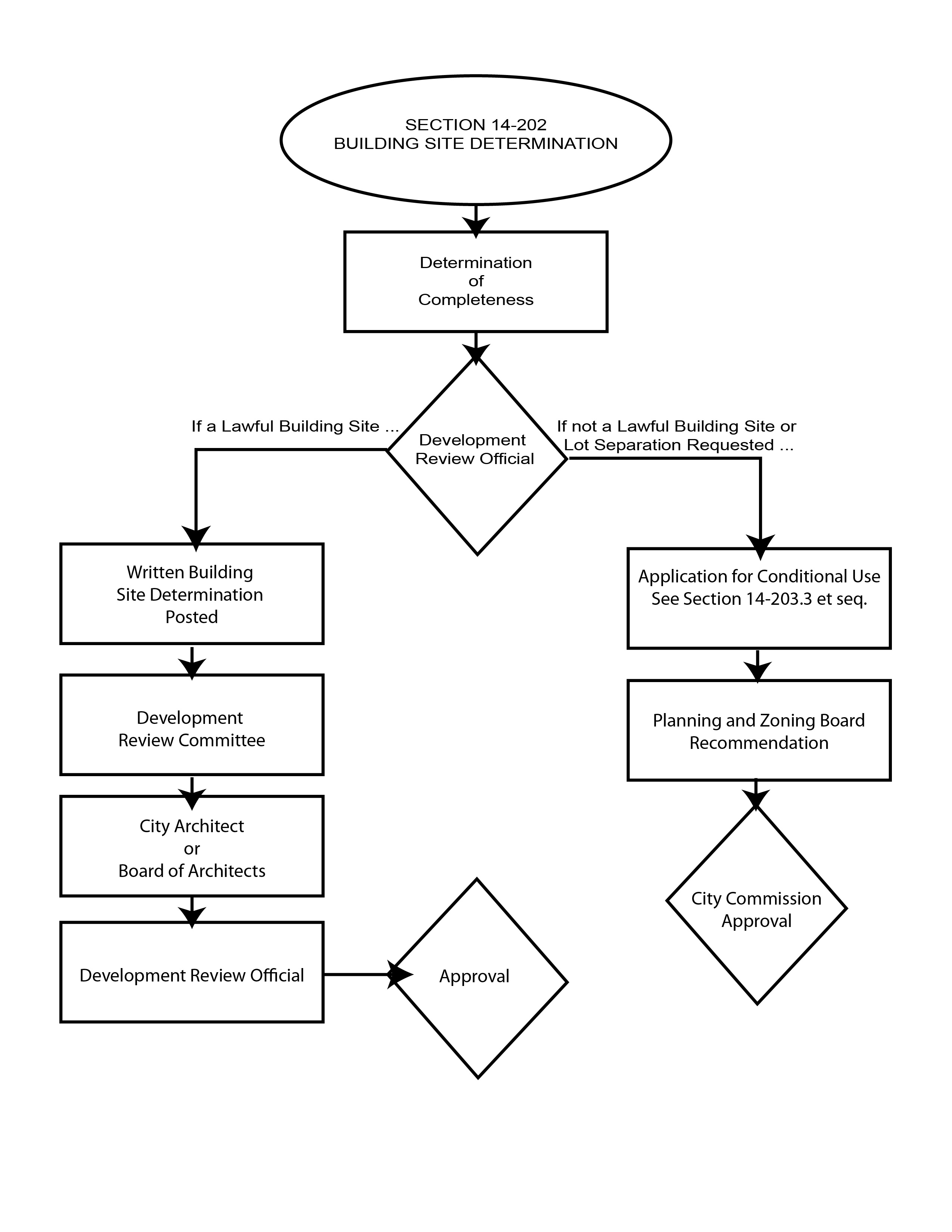
Section 14-202.6. Building site determination.
- Except as provided in subsection I below, prior to the issuance of a building permit for a single-family dwelling or duplex building, an application for a building site determination shall be submitted to the Development Services Department in writing upon an application form approved by the City and shall be accompanied by applicable fees.
- An application for building site determination shall be reviewed in accordance with the provisions of Sections 14-202.2 and 14-202.5 of these regulations.
- If the Development Review Official determines that the parcel proposed for development is a lawful building site, a written site determination shall be issued to the applicant and posted in the Office of the City Clerk and on the property which is the subject of the determination and the application for development approval shall proceed to be reviewed in accordance with the procedures established in Sections 14-202.3- 5.
- In the event that an application for a building site determination is denied by the Development Review Official or any change is proposed for the purpose of creating a new building site, the applicant shall submit an application for conditional use approval, together with a proposed site plan, and such application shall be reviewed in accordance with the procedures established in Section 14-203 of these regulations and the applicable standards in subsection F below.
- Standards for approval.
- All buildings or structures located in Districts shall be constructed or erected upon a building site containing at least one (1) platted lot and such building site shall have a minimum street frontage of fifty (50) feet.
- Building site requirements. Wherever there may exist a single-family residence(s), duplex building(s) or any lawful accessory building(s) or structure(s) which was heretofore constructed on property containing one (1) or more platted lots or portions thereof, such lot or lots shall thereafter constitute only one (1) building site and no permit shall be issued for the construction of more than one (1) single-family residence or duplex building. Such structures shall include but not be limited to swimming pools, tennis courts, walls, fences or other at grade and above ground improvements. Only one (1) single-family residence or duplex shall be constructed upon any one (1) building site having not less than the minimum street frontage required by this code.
- Removal of buildings. If a single-family residence or duplex building is demolished or removed, whether voluntarily or involuntarily or by an act of God or casualty, no permit shall be issued for the construction of more than one (1) building on the building site.
- Any application which meets all of the following criteria shall be deemed a lawful building site:
- That no more than one (1) building or structure is located on a building site, except as may be provided for herein concerning lawful accessory buildings for accessory use.
- That no building site shall be reduced or diminished such that the street frontage of the parcel is less than prescribed by the Zoning Code.
- That no encroachments including fences, walls and other associated improvements (excluding primary and accessory habitable structures) occupy the site or tie any site together. For purposes of determining whether a lawful building site exists, the Development Services Department may advise a property owner of an encroachment by an abutting property, but shall only consider encroachments created by the current property owner of their predecessor interest.
- That the building site created, separated or established will not result in existing structures becoming non-conforming as it relates to setbacks, lot area, lot width and depth, ground coverage and other applicable provisions of the Zoning Code and/or City Code.
- That none of the following exist on the subject property:
- Unity of title preventing the separation of the parcels or property; or
- Any declarations of restrictive covenants that prevent the establishment of a building site.
- If applicable, the analysis of the permit history identifies exceptional or unusual circumstances unique to the property.
- No structure on the proposed site is an accessory use to a structure on an adjacent parcel.
- Approval of a building site.
- The Development Services Department shall issue a building site determination in written form and posted within the Department and City Clerk’s Office. Within thirty (30) calendar days of the expiration of the sixty (60) day appeal period, the applicant shall complete the following:
- Record the City determination letter and accompanying survey (signed and sealed) or any other information utilized by the City in its determination.
- Provide one (1) copy of the recorded documents to the Department. Failure of the applicant to complete the above shall render the determination void.
- If the property is determined to be a building site, the Department may prescribe conditions, restrictions or safeguards deemed necessary, to satisfy the provisions within this Code.
- The Development Services Department shall issue a building site determination in written form and posted within the Department and City Clerk’s Office. Within thirty (30) calendar days of the expiration of the sixty (60) day appeal period, the applicant shall complete the following:
- When reviewing and providing a recommendation on an application for conditional use for a building site determination, the Planning and Zoning Division, Planning and Zoning Board and the City Commission shall consider and evaluate the request together with a proposed site plan and provide findings that the application satisfies the following criteria:
- That the building site(s) created would have a lot area equal to or larger than the majority of the existing building sites of the same zoning designation within a minimum of one thousand (1,000) feet of the perimeter of the subject property. The Development Review Official may determine that the comparison of building sites within one thousand (1,000) feet of the subject property shall be based on one (1) or more of the following: building sites located on the same street as the subject property; building sites with similar characteristics such as golf course frontage, water frontage, cul-de-sac frontage; and, building sites within the same platted subdivision.
- That exceptional or unusual circumstances exist, that are site specific such as unusual site configuration or partially platted lots, or are code specific such as properties having two (2) or more zoning or land use designations, multiple facings or through-block sites, which would warrant the separation or establishment of a building site(s).
- That the proposed building site(s) maintains and preserves open space and specimen trees, promotes neighborhood compatibility, preserves historic character, maintains property values and enhances visual attractiveness of the area.
- That the application satisfies at least two (2) of the following three (3) criteria:
- That the building site(s) created would have a street frontage, golf course frontage (if applicable), and water frontage (if applicable) equal to or larger than the majority of the existing building sites of the same zoning designation within a minimum of one thousand (1,000) feet of the perimeter of the subject property. For a cul-de-sac building site(s), the comparison of street frontages and water frontages (if applicable) shall include those similarly situated cul-de-sac building sites within one thousand (1,000) feet. If no cul-de-sac building sites exist within one thousand (1,000) feet then the comparison may be expanded to include all cul-de-sac building sites within the platted subdivision and any adjacent platted subdivision.
- That the building site(s) separated or established would not result in any existing structures becoming non-conforming as it relates to setbacks, lot area, lot width and depth, ground coverage and other applicable provisions of the Zoning Code, Comprehensive Plan and City Code. The voluntary demolition of a building or structure within the last ten (10) years which eliminates any of the conditions identified in this criterion shall result in non-compliance with this criterion.
- That the building site(s) created has been owned by the current owner continuously for a minimum of ten (10) years prior to an application submittal for conditional use for a building site determination.
- Conditions of approval (if applicable). If an application is recommended for approval, the Planning and Zoning Division, Planning and Zoning Board, and City Commission may prescribe conditions, restrictions or safeguards deemed necessary to satisfy the provisions within this Section. The following conditions are the minimum required for an approval:
- The new single-family residences constructed on the separated building sites shall meet all applicable requirements of the Zoning Code, and no variances shall be required or requested.
- The plans depicting the site plans and elevations of the residences on the separated building sites and submitted as part of the conditional use application shall be made part of the approval with any instructions or exceptions provided by the City Commission. Any changes to the plans are subject to Sec. 14-203.10 of the Zoning Code.
- A bond shall be required, as determined by the building official, to ensure the timely removal of any non-conformities as a result of the building site separation approval.
- Exemptions.
- Construction of a new building(s) on an existing building site. Property owners who demolish an existing lawful building shall be presumed to have a lawful building site and may build on such site improvements permitted by the current Code provisions for such site.
- Involuntary destruction of building(s). Parcels which are occupied with existing lawful and/or legally nonconforming building and accessory structure(s) on platted parcels or partially platted parcels if involuntarily destroyed either by an act of God or casualty shall not be required to undergo the building site determination process but shall be presumed to have a lawful building site provided the following are satisfied:
- The property owner provides evidence in the form of a survey, aerial, etc. to substantiate existence of a building or accessory structure(s) prior to the event.
- The Department after reviewing the evidence provided determined that the property was a lawful building site.
- Sale of the property to adjoining property owner. The sale of property between two (2) previously lawfully established building sites which results in an increase/decrease of the size of the properties shall be determined to be lawfully established building sites if all existing structures do not become nonconforming as they relate to all applicable provisions of the Zoning Code for the zoning district in which the property is located and all other applicable Comprehensive Plan and City Code provisions.
- Involuntary destruction of building(s) in association with the sale of property to adjoining property owner. When a parcel that at one time complied with the laws governing building sites, is diminished by the property owner through the sale of a portion or portions of the building site thus creating a nonconforming parcel, the property owner may only rebuild the structure(s) previously located on the property if said destruction was involuntary. All new improvements shall be required to comply with all applicable codes in effect at the time.
- A determination that a parcel is a lawful building site by the Department of Building and Zoning shall be effective for a period of one (1) year. If a building permit is not obtained in this one (1) year period, such determination shall be null and void.
Section 14-202.7. Building permit.
- Permit required.
- Where required by the Florida Building Code, a permit must be obtained before commencement of any construction, demolition, modification or renovation of a building, structure, awning or canopy, unless this requirement is waived by the Building Official, except that the Building Official may not waive any required approvals by the Board of Architects.
- All building permits and sign permits shall be in conformity with these regulations and any applicable development approval related to the parcel proposed for development.
- Applications for permits will be accepted only from persons currently licensed in their respective fields and for whom no revocation or suspension of license is pending, provided, however, a sole owner may make application, and if approved, obtain a permit and supervise the work in connection with the construction, maintenance, alteration or repair of a single-family residence or duplex for his own use and occupancy and may make application for, and if approved, obtain a permit for maintenance and minor repairs on any type building. The construction of more than one (1) residence or duplex by an individual owner in any twelve (12) month period shall be construed as contracting, and such owner shall then be required to be licensed as a contractor. Such licensed contractor or owner shall be held responsible to the Building Official for the proper supervision and conduct of all work covered thereby.
- All general contractors or owner/builders shall submit a list of all subcontractors to be employed on the project. The Development Services Department will review the list to insure that all subcontractors are properly certified, licensed, and insured. Should the general contractor or owner/builder change subcontractors during the project, it will be necessary for the Development Services Department to be notified prior to permitting the new subcontractor to commence work on the project. Any project found to be using unauthorized subcontractors is subject to a stop work order until the Building Official is satisfied that proper conditions exist and all permitting conditions are met.
- Procedure. All applications for building permits shall be submitted to the Development Services Department. Upon receipt of an application, the Development Review Official shall determine whether the application conforms to these regulations and any applicable development approval. If the Development Review Official determines that the application does not conform, the Development Review Official shall inform the applicant of the decision. If the Building Official determines that the application does conform, the building permit may be issued. If the Building Official determines that the application does not conform, he shall identify the application’s deficiencies and deny the application.
- Posting of bond. Before any building permit shall be issued, the owner of the affected property of the contractor shall deposit with the city that amount which in the opinion of the Building Official and/or the City Manager shall be adequate to reimburse the City, or any neighboring property owner, for damage which may result to sidewalks, parkways, parkway trees and shrubs, street pavement of other municipal or private property, or improvement from such work and the equipment and materials used in connection therewith, and for the removal of debris or excess material upon the completion of said work, and shall sign an undertaking to the City to pay the amount of any deficiency between the amount of said deposit and the cost of repairing any such damage or removal of any such debris or excess materials. Upon completion of the work, the Building Official, or such other person as may be designated by the City Manager, shall make final inspection and if the person shall find that no damage has resulted, and no debris or material remains on the site, the said deposit shall be returned to the depositor, or, if any damage shall be repaired by the City, or any debris or excess material be removed by the City, and the cost thereof shall be less than the deposit, then the difference between such cost and the amount of the deposit shall be returned to the depositor. Such bonds shall not be refunded until all code requirements are completed including necessary driveways and sidewalks.
- Incomplete buildings. No building not fully completed in substantial compliance with plans and specifications upon which a building permit was issued shall be permitted to be maintained on any land for more than one (1) year after the commencement of erection of any building, addition or renovation. A building site inspection shall be conducted six (6) months after the commencement of construction at which time evidence that work is proceeding shall be provided by the contractor. Work shall be considered to have commenced and be in active progress when, in the opinion of the Building and Zoning Director, a full complement of workmen and equipment is present at the site to diligently incorporate materials and equipment into the structure throughout the day on each full working day, weather permitting. This provision shall not be applicable in case of civil commotion or strike or when the building work is halted due to an injunction or other court order.
Section 14-202.8. Zoning permit.
No person shall commence or cause to be commenced any miscellaneous work, which does not otherwise require a building permit, which affects the aesthetics, appearance, or architectural design of any structure, site or site improvements until an application for a zoning permit therefore has been previously filed with the Development Services Department. No such miscellaneous work which affects the aesthetics, appearance, or architectural design of any structure, site or site improvements shall commence until a permit has been issued by the City in every case where the cost of such proposed work exceeds five hundred ($500) dollars in labor and materials. All work done under and pursuant to any zoning permit shall conform to the approved plans and/or specifications.
Section 14-202.9. Certificate of use.
Except for single family and multi-family uses, no person shall commence any use of any property, nor shall an occupational license or building permit be issued until an application for a Certificate of Use therefore has been filed with and approved by the Development Services Department on a form provided by the Department. Any use of a property under and pursuant to any Certificate of Use shall conform to the Certificate of Use. Any use for which a Certificate of Use has been issued must commence within one-hundred and eighty (180) days of the issuance of the Certificate of Use, and is valid for a period not to exceed one (1) year from the date of the issuance. All Certificates of Use shall be renewed by the applicant each year.
Section 14-202.10. Resubmission of application affecting same property.
No application shall be accepted during the following time periods after the denial of a substantially similar application affecting the same property or any portion thereof:
A. Conditional uses and variances: six (6) months.
B. Change in zoning map, zoning text amendments, comprehensive plan text, future land use map, amendments and application for abandonment and vacation of non-fee interests: twelve (12) months.
Section 14-203.1. Purpose and applicability.
The purpose of providing for conditional uses within each zoning district is to recognize that there are uses which may have beneficial effects and serve important public interests, but which may, but not necessarily, have adverse effects on the environment, particularly residential areas, overburden public services, or change the desired character of an area. Individualized review of these uses is necessary due to the potential individual or cumulative impacts that they may have on the surrounding area or neighborhood. The review process allows the imposition of conditions to mitigate identified concerns or to deny the use if concerns cannot be resolved.
Section 14-203.2. General procedures for conditional uses.
The following graphic summarizes the procedures required to obtain conditional use approval:
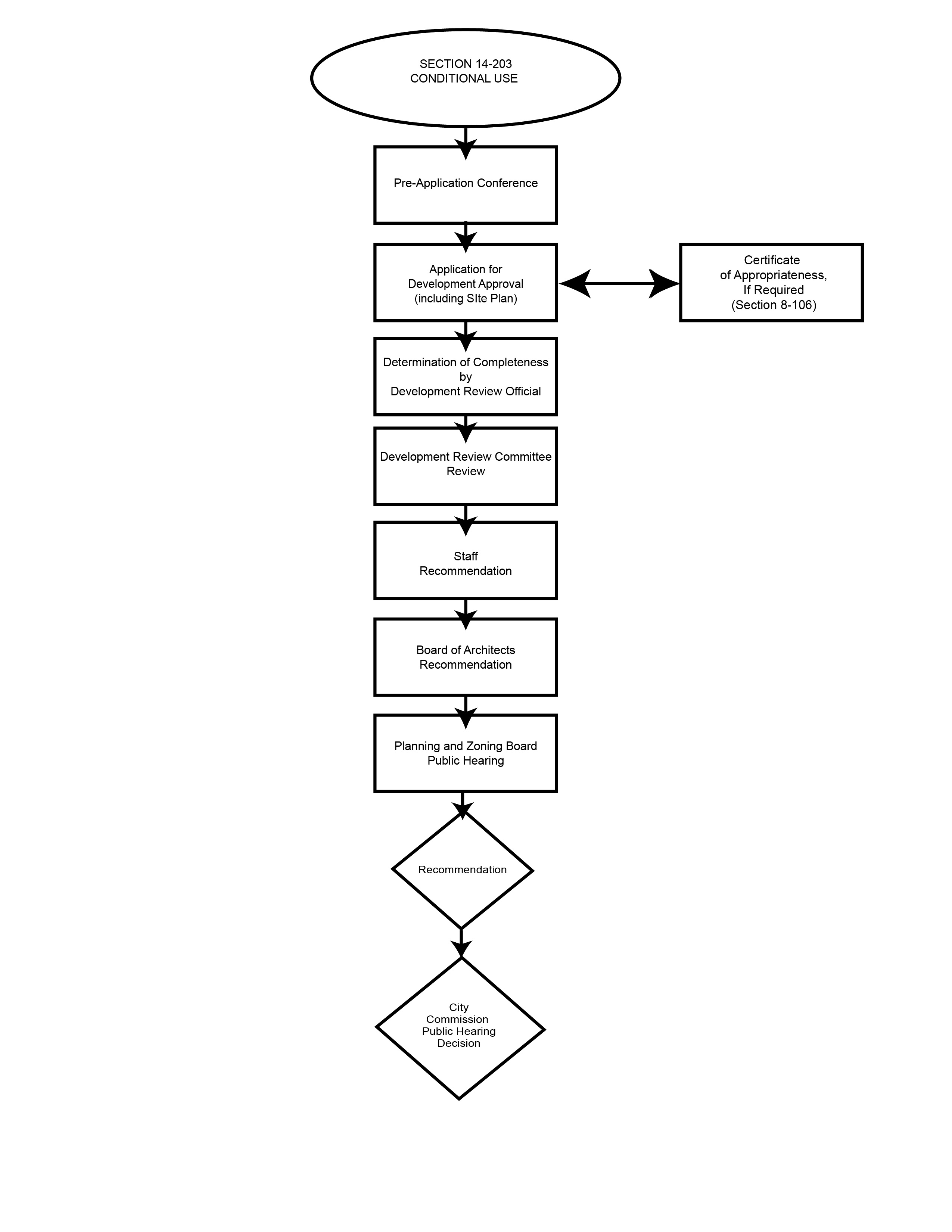
Section 14-203.3. Application.
An application for conditional use approval shall be made in writing upon form approved by the City, including a site plan, and shall be accompanied by applicable fees.
Section 14-203.4. Staff review, report and recommendation.
- City staff shall review the application for conditional use approval in accordance with the provisions of Section 14-202. of these regulations and this Article. In the event that such application involves historic properties, it shall be referred to the Historic Resources Department for review and approval in accordance with Article 6 prior to any further review under the provisions of this Article.
- Upon completion of review of an application, City staff shall:
- Provide a report that summarizes the application, including whether the application complies with each of the standards for granting conditional use approval in Section 14-203.8.
- Provide written recommended findings of fact regarding the standards for granting conditional use approval in Section 14-203.8.
- Provide a recommendation as to whether the application should be approved, approved with conditions, or denied.
- Provide the report and recommendation, with a copy to the applicant, to the Planning and Zoning Board for review.
- Schedule the application for hearing before the Planning and Zoning Board upon completion of the Board of Architect’s review.
- Provide notice of the hearing of a conditional use application before the Planning and Zoning Board in accordance with the provisions of Article 15 of these regulations.
- Schedule and provide notice before the City Commission of a conditional use application in accordance with the provisions of Article 15 of these regulations.
Section 14-203.5. Board of Architects review and recommendation.
Upon receipt of the recommendation of City staff, the Board of Architects shall review the application and the recommendation of staff to determine if the application is consistent with the standards of these regulations and any design requirements set out in the zoning district in which the parcel is located. The Board of Architects approval is required prior to the Planning and Zoning Board’s consideration of an application for conditional use approval.
Section 14-203.6. Planning and Zoning Board recommendation.
The Planning and Zoning Board shall review the application for conditional use approval, consider the recommendations of staff and the Board of Architects, conduct a quasi-judicial public hearing on the application and recommend to the City Commission whether they should grant the approval, grant the approval subject to specified conditions or deny the application. The Planning and Zoning Board may recommend such conditions to the approval that are necessary to ensure compliance with the standards set out in Section 14-203.8.
Section 14-203.7. City Commission decision.
The City Commission shall review the application, the recommendations of staff, the Board of Architects and the Planning and Zoning Board, and shall conduct a quasi-judicial public hearing and grant the approval, grant the approval subject to specified conditions or deny the application. The City Commission may attach such conditions to the approval that are necessary to ensure compliance with the standards set out in Section 14-203.8.
Section 14-203.8. Standards for review.
The Planning and Zoning Board and the City Commission shall provide findings of fact that a conditional use complies with the following standards and the criteria applicable to each conditional use:
- The proposed conditional use is consistent with and furthers the goals, policies and objectives of the Comprehensive Plan and furthers the purposes of these regulations and other City ordinances and actions designed to implement the Plan.
- The available use to which the property may be put is appropriate to the property that is subject to the proposed conditional use and compatible with existing and planned uses in the area.
- The proposed conditional use does not conflict with the needs and character of the neighborhood and the City.
- The proposed conditional use will not adversely or unreasonably affect the use of other property in the area.
- The proposed use is compatible with the nature, condition and development of adjacent uses, buildings and structures and will not adversely affect the adjacent uses, buildings or structures.
- The parcel proposed for development is adequate in size and shape to accommodate all development features.
- The nature of the proposed development is not detrimental to the health, safety and general welfare of the community.
- The design of the proposed driveways, circulation patterns and parking is well defined to promote vehicular and pedestrian circulation.
- The proposed conditional use satisfies the concurrency standards of Section 14-218. and will not adversely burden public facilities, including the traffic-carrying capacities of streets, in an unreasonable or disproportionate manner.
Section 14-203.9. Effect of decision.
Approval of a conditional use shall be deemed to authorize only the particular use for which it is issued and shall entitle the recipient to apply for a certificate of use or building permit or any other approval that may be required by these regulations, the City or regional, state or federal agencies. In the event an approval of a conditional use changes the design of the proposed building, final review of the design shall be conducted by the Board of Architects.
Section 14-203.10. Changes to an Approved Conditional Use.
- Minor revisions. The Development Review Official is authorized to allow minor revisions to an approved conditional use after receipt of comments from the Development Review Committee. A minor revision is one which:
- Does not affect the conditional use criteria applicable to the conditional use.
- Does not change the use.
- Does not change a condition of approval.
- Does not increase the density of the development.
- Does not increase the intensity of the development.
- Does not result in a material modification or the cancellation of any condition placed upon the use as originally approved.
- Does not add property to the parcel proposed for development.
- Does not increase the height of the buildings.
- Other revisions. Any other adjustments or changes not specified as “minor” shall be granted only in accordance with the procedures for original approval.
- When a conditional use includes site plan approval, revisions to the approved site plan shall be in accordance with Section 14-203.12.
Section 14-203.11. Expiration of approval.
An application for a building permit shall be made within one (1) year of the date of the conditional use approval, and all required certificates of occupancy shall be obtained within one (1) year of the date of issuance of the initial building permit. Permitted time frames do not change with successive owners and an extension of time may be granted by the Development Review Official for a period not to exceed two (2) years but only within the original period of validity.
Section 14-203.12. Amendments to an Approved Site Plan.
Amendments to an approved Site Plan shall be considered as major or minor. The Development Review Official, with recommendations from other departments, as needed, shall determine whether proposed changes are major or minor.
- Minor amendments. Minor amendments are changes which do not substantially alter the development features related to an approved site plan, are compatible with the adopted design, and do not exceed the provisions of applicable land use and zoning regulations in terms of land usage, open space, and the physical relationship of elements within the site. Minor amendments shall include small changes in floor area, density, lot coverage, height, setbacks, landscape open space, the location of buildings, parking, or mix of uses, which do not exceed five (5%) percent of that which is shown on the site plan approved by the City Commission at public hearings. Such minor amendment shall be reviewed by the Development Review Official and approved administratively by the Planning Director.
- Major amendments. Major amendments represent substantial deviations from the site plan approved by the City Commission. Major amendments shall include any increases in floor area, density, and habitable height. Major amendments shall also include significant changes in lot coverage, setbacks, open space, location of buildings which exceed five (5%) percent of that which is shown on the approved site plan by the City Commission at public hearings. Requests for major amendments shall be subject to the review and approval process set forth in Section 14-203 and may be made no more than once (1) per twelve (12) month period.
Section 14-204.1. General procedures for Transfer of Development Rights.
The following graphic summarizes the review and approval procedures for the Transfer of Development Rights (TDRs).
Section 14-204.2. Purpose and applicability.
The purpose of these provisions is to allow the transfer/sending of unused development rights of:
- Local historic landmarks to other properties within the approved sending areas of the city to encourage historic preservation and to provide an economic incentive to property owners to designate, protect, enhance and preserve historic properties.
- Parcels designated for open space conveyed to the City to encourage more open space in the city.
- Native and natural habitats on land conveyed to the City to encourage the permanent preservation of native habitats, mature tree canopy, and natural ecosystems within the City.
(Ord. No. 2025-39, 12/9/25)
Section 14-204.3. Application.
An application to transfer/send and receive TDRs shall be made in writing upon an application form approved by the City. The application to transfer/send shall be filed with the Historical Resources Department and the application to receive TDRs shall be filed with the Planning and Zoning Division.
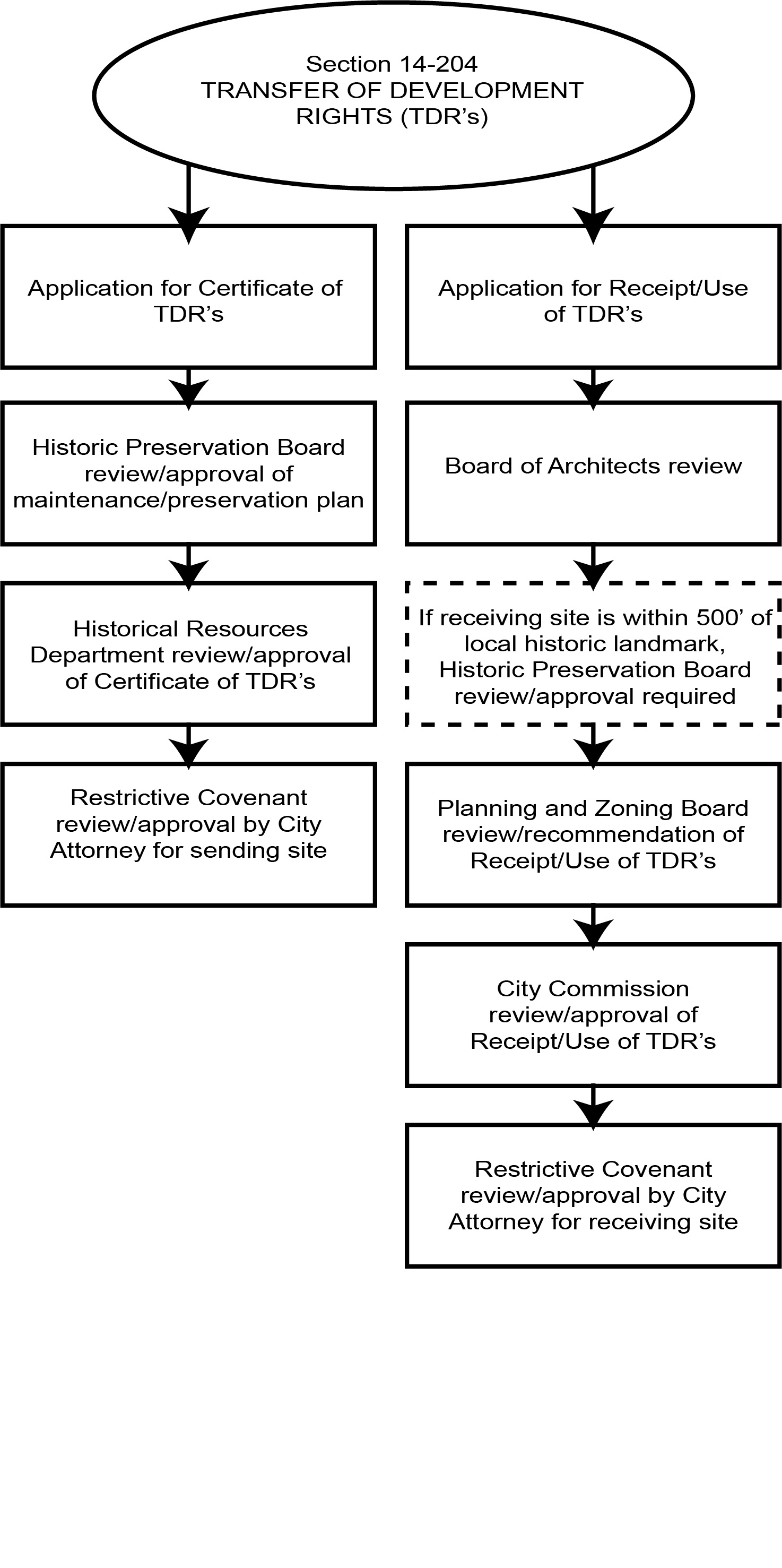
Section 14-204.4. Transfer/sending of TDRs and issuance of a Certificate of TDRs.
- Transfer/sending of TDRs. The TDRs rights eligible to be transferred from the property shall be calculated as follows: the difference between the existing gross floor area on the property and the maximum floor area permitted on the property by the applicable zoning district, including any available development bonuses.
- Transfer/sending of TDRs from a sending site. The Historic Preservation Officer shall have the authority to grant approval to transfer/send TDRs if all of the following are satisfied:
- The sending site has been designated as a local historic landmark or a contributing property within a local historic district pursuant to Article 8.
- The sending site is (i) located within the boundaries of the CBD and designated commercial zoning or (ii) located north of Navarre Avenue, east of LeJeune Road, west of Douglas Road, and south of SW 8th Street, is zoned Commercial, MF2, or MF3.
- The Development Services Department has calculated the unused development rights or TDRs eligible to be transferred from the property per Section 14-204.4.A.
- The property owner(s) have provided a maintenance/preservation plan prepared by a certified architect or engineer of the State of Florida, which sets forth a maintenance schedule and/or rehabilitation treatment if applicable for those architectural elements that contribute the historic integrity of the property or restoration of original features. Those features are identified by the “Review Guide,” a section of the local designation report produced by the Historical Resources Department.
- Inspection of the property may be completed by the Historic Resources Department to determine compliance with the above criteria.
- Historic Preservation Board review and approval of the maintenance/preservation plan to determine compliance with Article 8.
- A property must not be subject to any Code Enforcement violations, City-imposed liens, unpaid fines, or overdue assessments or fees. The City Attorney, in consultation with City staff, may waive this requirement through a stipulation providing for correction of the Code Enforcement violation under appropriate conditions and settlement of the amounts due.
The approval to transfer/send shall be via the issuance of a Certificate of TDRs. The Historic Preservation Officer may recommend conditions of approval that are necessary to ensure compliance with the standards set out herein.
- Transfer/sending of TDRs to create a city park.
The Parks and Recreation Advisory Board shall review all requests to transfer/send TDRs if all of the following are satisfied:- The sending site is identified as a future city park as part of the acquisition of the subject property.
- The Development Services Department has calculated the TDRs eligible to be transferred per Section 14-204.4.A.
- The public benefit is demonstrated for the sending site and the potential impacts of the receiver site(s) are studied.
- Ownership of the sending site is transferred to the City of Coral Gables as part of the application to transfer development rights to the receiver site.
The City Commission shall consider to transfer/send TDRs via Resolution upon the positive recommendation from the Parks and Recreation Advisory Board. The Resolution may include conditions of approval that are necessary to ensure compliance with the standards set out herein.
Transfer/Sending of TDRs for the Conservation of Native and Natural Habitats.
The Landscape Beautification Advisory Board shall review all requests to transfer/send TDRs for conservation purposes if all of the following are satisfied:
The sending site shall be fully subject to a Grant of Conservation Easement Agreement (GOCEA). The property survey shall demonstrate that the majority of the sending site consists of mature native habitats or other natural habitats, with a minimum of forty percent (40%) tree canopy. Supporting environmental or ecological assessments verifying the significance of the habitat shall be submitted and reviewed for confirmation by the Greenspace Management Division.
A Grant of Conservation Easement Agreement (GOCEA) shall be required in a form approved by the City Attorney and shall apply to all land subject to Conservation TDRs to prohibit future development on all designated natural habitat areas of the property, preserve existing native vegetation, and ensure perpetual conservation.
The TDRs eligible to be transferred shall be calculated by dividing the average fair market value by the average TDR unit rate, or cost per square-foot of TDR to be transferred in the private market.
A minimum of two (2) independent Uniform Standards of Professional Appraisal Practice (USPAP) compliant appraisals by qualified appraisers who are members of the Appraisal Institute. Each appraisal shall determine the fair market value of the property under existing zoning and applicable land use conditions. The average of these appraisals shall establish the fair market value of the property.
The TDR unit value shall be determined from the average of two (2) or more recent sales or transfers within the city limits, prepared by qualified appraisers who are members of the Appraisal Institute. The resulting average value shall represent the dollar amount assigned to each TDR.
The total number of transferable development rights shall be calculated as:
Number of TDRs = (Average Fair Market Value) ÷ TDR Unit Value ($ per TDR)
Ecological Bonus: Additional TDRs may be granted for sending sites that demonstrate exceptional habitat quality, tree canopy coverage, or other measurable conservation value beyond the minimum eligibility criteria. Verification of such ecological value shall be provided through documentation prepared and certified by a qualified environmental professional, arborist, or ecologist, as applicable. The Landscape Beautification Advisory Board shall review the verified documentation and site conditions and recommend the number of bonus TDRs, not to exceed fifteen percent (15%) of the base TDRs, with final approval by the City Commission.
Documentation: All appraisal assumptions, data sources, comparable sales, and valuation methodologies shall be fully documented in the appraisal reports to substantiate valuation conclusions and ensure transparency in the determination of the TDR Unit Value.
The City Commission shall consider to transfer/send TDRs via Resolution upon the positive recommendation from the Landscape Beautification Advisory Board. Property owners voluntarily participate in the Conservation TDR program with the understanding that all land subject to a GOCEA must be conveyed to the City. All remaining portions of the original property not conveyed as part of the Conservation TDR shall remain in compliance with applicable zoning requirements. The City Commission may consider allowing the transfer of certain conservation TDRs to additional MX zoning districts outside of the specified receiving sites contained with Section 14-204.5. The resolution may include conditions necessary to ensure compliance with the standards set out herein.
(Ord. No. 2025-39, 12/9/25)
Section 14-204.5. Use of TDRs on receiver sites.
- Use of TDRs on receiver sites. The receiving sites shall be:
- Located within the boundaries of the CBD and designated mixed-use zoning, or
- Located within the boundaries of the North Ponce de Leon Boulevard Mixed Use District and designated mixed-use zoning, or
- Located within the boundaries of the Design & Innovation District and designated mixed-use zoning, or
- Located within the boundaries of the University Station Rapid Transit District Overlay, or
- Designated by the City Commission when located in a Planned Area Development (PAD) and zoned MX2 or MX3.
Use of TDRs as receiver sites are prohibited on properties within the Zain/Friedman Miracle Mile Downtown District Overlay facing Miracle Mile.
B. Maximum TDR floor area ratio (FAR) increase on receiver sites. An increase of up to twenty-five (25%) percent of permitted gross FAR and approved Mediterranean architectural style bonuses gross FAR may be permitted.
(Ord. 2021-13, 03/23/2021; Ord. No. 2022-29, 05/31/2022; Ord. No. 2026-05, 01/27/2026; Ord. No. 2026-10, 04/14/2026)
Section 14-204.6. Review and approval of use of TDRs on receiver sites.
- An application to transfer development rights to a receiver site shall be reviewed subject to all of the following:
- In conformance with any applicable conditions of approval pursuant to the Certificate of TDRs.
- Board of Architects review and approval subject to Section 5-100, Design Review Standards.
- If the receiving site is within five (500) hundred feet of a local historic landmark, Historic Preservation Board review and approval is required to determine if the proposal shall not adversely affect the historic, architectural, or aesthetic character of the property.
- Planning and Zoning Board review and recommendation and City Commission review and approval by resolution the application satisfies all of the following:
- Applicable site plan review requirements per Section 14-202., General Development Review Procedures and conditional use review requirements per Section 14-203, Conditional Uses.
- The extent to which the application is consistent with the Zoning Code and City Code otherwise applicable to the subject property or properties, including density, bulk, size, area and use, and the reasons why such departures are determined to be in the public interest.
- The physical design of the proposed site plan and the manner in which the design makes use of adequate provisions for public services, provides adequate control over vehicular traffic, provides for and protects designated common open areas, and furthers the amenities of light and air, recreation and visual enjoyment.
- The conformity of the proposal with the Goals, Objectives and Policies of the City’s Comprehensive Plan.
- Notice of hearings provided in accordance with the provisions of Article 15 of these regulations.
The Planning and Zoning Board may recommend, and the City Commission may impose conditions of approval that are necessary to ensure compliance with the standards set out herein.
Section 14-204.7. Approvals and restrictions.
A Restrictive Covenant shall be required on both the sending and receiving properties outlining any/all applicable conditions of approval pursuant to these provisions. For Conservation TDRs, the Restrictive Covenant shall be recorded in conjunction with the Grant of Conservation Easement Agreement (GOCEA) and shall ensure perpetual preservation of the designated natural habitat areas. All Restrictive Covenant(s) shall require review and approval by the City Attorney prior to recordation. The applicants shall be responsible for all costs associated herein.
(Ord. No. 2025-39, 12/9/25)
Section 14-204.8. TDRs list of local historic landmarks.
The Historical Resources Department shall maintain a list of local historic landmark properties eligible as TDRs transfer/sending sites.
Section 14-204.9. Expiration of approvals.
- Approvals for use of TDRs on receiver sites, shall be valid for up to two (2) years from date of issuance, in accordance with Section 1-111, Time limitation of approvals. Certificates of TDR, regardless of the date of issuance, shall have no expiration date. Conservation TDRs shall remain valid contingent upon the perpetual enforcement of the recorded Grant of Conservation Easement Agreement (GOCEA) and any associated Restrictive Covenants.
Section 14-205.1. Purpose and applicability.
When it is necessary that two (2) or more lots, parcels or portions thereof are added or joined, in whole or in part, a Unity of Title or Declaration of Restrictive Covenant in lieu of a Unity of Title shall be filed to ensure the properties are planned, developed and maintained as an integral development and/or project and are consistent with and satisfy the requirements of these regulations and the City Code of Ordinances.
Section 14-205.2. Unity of Title.
- General requirements. As a prerequisite to the issuance of a building permit, the owner(s) in fee simple title shall submit a Unity of Title in recordable form to the Development Services Department providing that all of the property encompassing the parcel proposed for development upon which the building and appurtenances are to be located shall be held together as one (1) tract of land and providing that no part or parcel shall be conveyed or mortgaged separate and apart from the parcel proposed for development, as set forth under the building permit in the following cases:
- Whenever the required off-street parking is located on contiguous lots or parcels or is otherwise located off-site, as provided for under Article 10 of these regulations.
- Whenever the parcel proposed for development consists of more than one (1) lot or parcel and the main building is located on one (1) lot or parcel and accessory buildings or structures are located on the remaining lot or parcel comprising the parcel proposed for development.
- Whenever the parcel proposed for development consists of more than one (1) lot or parcel and the main building is located on one (1) or more of the lots or parcels and the remaining lots or parcels encompassing the parcel proposed for development are required to meet the minimum standards of these regulations.
- Whenever a building is to be constructed or erected upon a lot or parcel which is larger in frontage, depth and/or area than the minimum required by these regulations and which lot or parcel would be susceptible to resubdivision in accordance with Section 14-210.
- Whenever the Board of Adjustment provides that a Unity of Title shall be executed as a condition for the granting of a variance.
- Whenever a Unity of Title is specifically required by an ordinance or resolution adopted by the City Commission.
- Whenever a parcel proposed for development in any residential district consists of more than one (1) platted lot.
- Approval. The Unity of Title shall be subject to review and approval by the City Attorney as to form and content, together with any additional necessary legal instruments to preserve the intent of these regulations and to properly enforce these regulations and Code of Ordinances and shall be signed and joined by all mortgage holders.
- Release.Any Unity of Title required by this section shall not be released except upon approval by resolution passed and adopted by the City Commission and executed by the City Manager and City Clerk.
- Recording. The owner(s) shall pay all fees as required by the City Code of Ordinances for the processing and recording of the Unity of Title.
- Enforcement. Enforcement of the Unity of Title shall be by action at law or in equity with costs and reasonable attorney’s fees and City fees payable to the prevailing party.
Section 14-205.3. Declaration of Restrictive Covenant in Lieu of a Unity of Title.
- General Requirements. In the case of separate but contiguous and abutting parcels proposed for development located in Mixed Use Districts owned by one (1) separate or multiple owners wishing to use said property as one (1) parcel, the Building and Zoning Director may approve a Declaration of Restrictive Covenant in Lieu of a Unity of Title together with a Reciprocal Easement and Operating Agreement approved for legal form and sufficiency by the City Attorney. The Declaration of Restrictive Covenant shall run with the land and be binding upon the heirs, successors, personal representatives and assigns, and upon all mortgagees and lessees and others presently or in the future having any interest in the property. In such instances, the property owner(s) shall agree that in the event that ownership of the subject properties comes under a single ownership, the applicants, successors and assigns, shall file a Declaration of Restrictive Covenant covering the subject properties.
- Declaration of restrictive covenant shall comply with the following:
- Submit a record of the existing height, existing size and site conditions, to include both plan and photographic evidence.
- Develop, maintain and operate the property as a single building site.
- Develop individual building sites within the subject property in accordance with the provisions of the City’s Comprehensive Plan and these regulations.
- The City shall only release a Declaration of Restrictive Covenant if the individual properties satisfy all applicable regulations, Code of Ordinances and Comprehensive Plan requirements and the release does not create substandard or nonconforming building sites.
- Requests for modification of an existing Declaration of Restrictive Covenant shall be submitted to the Building and Zoning Director and satisfy the following:
- Provide written consent of the current owner(s) of the phase or portion of the property for which modification is sought.
- The modification shall not create a fire emergency situation or be in conflict with the provisions of these regulations, Code of Ordinances and Comprehensive Plan.
- The Building and Zoning Director may impose conditions within the Declaration of Restrictive Covenant to insure the above provisions are satisfied or waive such provisions if not applicable to the parcel proposed for development.
- Subsequent owners of all parcels shall be bound by the terms, provisions and conditions of the Declaration of Restrictive Covenant.
- The conveyance of portions of the subject property to third parties shall require a Reciprocal Easement and Operating Agreement executed by third parties in recordable form including the following:
- Easements in the common area of each parcel for the following:
- Ingress to and egress from the other parcels.
- For the passage and parking of vehicles.
- For the passage and accommodation of pedestrians.
- Easements for access roads across the common area of each parcel to public and private roadways.
- Easements for the following on each parcel to permit the following:
- The installation, use, operation, maintenance, repair, replacement, relocation and/or removal of utility facilities in appropriate areas.
- The installation, use, maintenance, repair, replacement and/or removal of common construction improvements such as footings, supports and foundations.
- The attachment and support of buildings or other associated structures and/or improvements.
- For building overhangs and other overhangs and projections encroaching upon such parcel from adjoining parcel such as, by way of example, including the following: marquees; signage; canopies; lighting devices; awnings; wing walls; etc.
- Reservation of rights to grant easements to utility companies.
- Reservation of rights to road rights-of-way and curb cuts.
- Pedestrian and vehicular traffic over dedicated private right roads and access roads.
- Appropriate agreements between the owners of the parcels as to the obligation for maintenance of the property to include the following: maintenance and repair of all private roadways; parking facilities; common areas; landscaping; and, common facilities and the like.
- Easements in the common area of each parcel for the following:
- These provisions of the Reciprocal Easement and Operating Agreement shall not be amended without prior written request and approval of the City Attorney. In addition, such Reciprocal Easement and Operating Agreement shall contain such other provisions with respect to the operation, maintenance and development of the property as to which the City and the parties thereto may agree, all to the end that although the property may have several owners, it will be constructed, conveyed, maintained and operated in accordance with the approved site plan.
- Requisites.
- The owner(s) shall provide a Certificate of Ownership by way of an opinion of title from an Attorney-At-Law licensed to practice in the State of Florida or from an abstract of title company licensed to do business in Miami-Dade County, Florida; said opinion of title shall be based upon an abstract or certified title information brought up within ten (10) days of the requirement that such Declaration of Restrictive Covenant be recorded.
- The opinion of title shall include the names and addresses of all mortgagees and lien holders, the description of the mortgages and/or liens and the status of all real estate taxes due and payable.
- A subordination agreement signed and executed by the mortgagees and/or lien holders shall accompany and be made part of the Declarations of Restrictive Covenants.
- The Declaration of Restrictive Covenants shall be executed with the same formality and manner as a warranty deed under the laws of the State of Florida.
- The City may also require that the property owners file additional documents with appropriate state and local agencies to ensure that the properties are treated for the purposes herein as a single building site. Such documents shall include, where appropriate, declaration of condominium, approved by the State of Florida and recorded in the public records of Miami-Dade County. Copies shall be provided to the City together with the application for Declaration of Restrictive Covenant in lieu.
- Approval. The Declaration of Restrictive Covenant shall be subject to review and approval by the City Attorney as to form and content, together with any additional legal instruments to preserve the intent of the ordinance to promote single building sites and to properly enforce these regulations, Code of Ordinances, and Comprehensive Plan.
- Appeal. Appeal of the Building and Zoning Director’s decision shall be to the Board of Adjustment in accordance with the provisions of Section 14-208.
- Release. A release of a Declaration of Restrictive Covenant shall require approval from the City Commission upon review and recommendation by the Development Services Department. Approval shall be via a Resolution passed and adopted by the City Commission and release executed by the City Manager and City Clerk. The Development Services Department and the City Commission must find that upon demonstration and affirmative finding that the same is no longer necessary to preserve and protect the property for the purposes herein intended.
- Recording. The owner(s) shall pay all fees as required by these regulations and/or Code of Ordinances for the processing and recording of the Declaration of Restrictive Covenant. The Declaration of Restrictive Covenant shall be in effect for a period of thirty (30) years from the date the documents are recorded in the public records of Miami-Dade County, Florida, after which they shall be extended automatically for successive periods of ten (10) years unless released pursuant to the Release provisions contained herein.
- Enforcement. Enforcement of the declaration of restrictive covenant shall be by action at law or in equity with costs and reasonable attorney’s fees to the prevailing party.
- Dedication of Public Park Space
- The general requirement in subsection (A) that parcels be contiguous and abutting for development located in Mixed Use Districts shall not apply when a non-contiguous or non-abutting parcel is dedicated for public park space and satisfies all of the following:
- The applicant shall submit an application for conditional use approval together with a proposed site plan.
- The dedicated public park parcel is of equal or lower density and intensity than the development parcel(s) where the project will be located.
- The dedicated public park parcel is located within 1,000 ft. from the development parcel.
- The dedicated public park parcel is a minimum of 5,000 sq. ft. and no more than forty-five percent (45%) of the development parcel.
- Use of Transfer of Development Rights (TDRs) are prohibited.
- There is a demonstrated public benefit found in the dedicated public park parcel.
- The potential impacts of the development parcel are studied.
- separate covenant on the dedicated public park parcel will be recorded in the public records of Miami-Dade County outlining any/all applicable conditions of approval pursuant to these provisions and dedicating the parcel for public use in perpetuity.
- The Parks and Recreation Advisory Board shall review all requests to create a single building site with non-contiguous or non-abutting parcels for the creation of dedicated public park space.
- The general requirement in subsection (A) that parcels be contiguous and abutting for development located in Mixed Use Districts shall not apply when a non-contiguous or non-abutting parcel is dedicated for public park space and satisfies all of the following:
(Ord. No. 2022-45, 08/24/2022)
Section 14-206.1. Required findings.
The Planning and Zoning Board shall recommend to the City Commission the approval, approval with modifications, or denial of the plan for the proposed PAD and shall include not only conclusions but also findings of fact related to the specific proposal and shall set forth with particularity in what respects the proposal would or would not be in the public interest. These findings shall include, but shall not be limited to the following:
- In what respects the proposed plan is or is not consistent with the stated purpose and intent of the PAD regulations.
- The extent to which the proposed plan departs from the zoning and subdivision regulations otherwise applicable to the subject property, including density, size, area, bulk and use, and the reasons why such departures are or are not deemed to be in the public interest.
- The extent to which the proposed plan meets the requirements and standards of the PAD regulations.
- The physical design of the proposed PAD and the manner in which said design does or does not make adequate provision for public services, provide adequate control over vehicular traffic, provide for and protect designated common open areas, and further the amenities of light and air, recreation and visual enjoyment.
- The compatibility of the proposed PAD with the adjacent properties and neighborhood as well as the current neighborhood context including current uses.
- The desirability of the proposed PAD to physical development of the entire community.
- The conformity of the proposed PAD with the goals and objectives and Future Land Use Maps of the City of Coral Gables Comprehensive Plan.
Section 14-206.2. Binding nature of approval for a PAD.
All terms, conditions, restrictive covenants, safeguards and stipulations made at the time of approval of the Development Plan for a PAD shall be binding upon the applicant or any successors in interest. Deviations from approved plans or failure to comply with any requirements, conditions, restrictions or safeguards imposed by the City Commission shall constitute a violation of these regulations.
Section 14-206.3. General procedures for plan approval.
- Pre-application conference - Planning and Zoning Division. Before submitting an application for approval of a Planned Area Development the applicant or his representative shall confer with the City of Coral Gables Planning and Zoning Division before entering into binding commitments or incurring substantial expense. The applicant is encouraged to submit a tentative land use sketch for review and to obtain information on any projected plans, programs or other matters that may affect the proposed development. The pre-application conference should address, but shall not be limited to, such matters as:
- The proper relationship between the proposed development and the surrounding uses and the effect of the plan upon the Comprehensive Plan of the City of Coral Gables.
- The adequacy of existing and proposed streets, utilities and other public facilities and services within the proposed Planned Area Development.
- The character, design and appropriateness of the proposed land uses and their adequacy to encourage desirable living conditions, to provide separation and screening between uses where desirable and to preserve the natural and scenic areas and vistas of property.
- The adequacy of open space and recreation areas existing and proposed to serve the needs of the development.
- Pre-application review. The applicant shall distribute a copy of his plans or exhibits to the Director of Building and Zoning, Public Works Director, Public Works Landscape Director, Planning Director, Fire Chief and the Historical Resources Director (if applicable) and upon their review of the plans they shall advise the applicant of any recommended revisions, changes or additional information necessary before the filing of a formal application.
- Board of Architects review. After preliminary review by the departments, and the Historical Resources Department (if applicable), the applicant shall revise the plans to incorporate all recommended revisions and changes and shall submit such plans to the Board of Architects for review and preliminary approval prior to filing a formal application for Planning and Zoning Board review.
- Development plan--General requirements.
- Professional services required: plans for buildings or structures within a Planned Area Development shall be prepared by a registered Architect with the assistance of a registered Engineer and a registered Landscape Architect, all being qualified under the laws of the State of Florida to prepare such plans.
- Legal description of site: should the legal description of the site for a Planned Area Development contain a metes and bounds description, such description shall be prepared by a registered land surveyor. The legal description shall be accompanied by a map at a scale suitable for reproduction for advertising for public hearing, showing exact location of the development.
- Development proposal: the Development Plan shall consist of a map or map series and any technical reports and supporting data necessary to substantiate, describe or aid the Development Plan. The plans for the development proposal shall include the following written and graphic materials:
- Site condition map: site condition map or map series indicating the following:
- Title of Planned Area Development and name of the owner(s) and developer.
- Scale, date, north arrow and the relationship of the site to such external facilities as highways, roads, streets, residential areas, shopping areas and cultural complexes.
- Boundaries of the subject property, all existing streets, buildings, water courses, easements, section lines and other important physical features within the proposed project. Other information on physical features affecting the proposed project as may be required.
- Existing contour lines at one foot intervals. Datum shall be National Geodetic Vertical Datum (N.G.V.D.) (if required by City Staff).
- The location of all existing storm drainage, water, sewer, electric, telephone and other utility provisions.
- Plan of pedestrian and vehicular circulation showing the location and proposed circulation system of arterial, collector, local and private streets, including driveways, service areas, loading areas and points of access to existing public rights-of-way and indicating the width, typical sections and street names. The applicant is encouraged to submit one (1) or more companion proposals for a pedestrian system, transit system or other alternative for the movement of persons by means other than privately owned automobiles.
- Exterior facade elevations (if deemed appropriate or necessary by City Staff) of all proposed buildings to be located on the development site.
- Isometrics or perspective and/or massing model(s) (if deemed appropriate or necessary by City Staff) of the proposed development.
- Map of existing land use.
- Existing and proposed lot(s) lines and/or property lines.
- Master site plan--A general plan for the use of all lands within the proposed Planned Area Development. The plan shall serve as the generalized zoning for the development and shall guide the location of permissible uses and structures. Such plan shall show the general location, function and extent of all components or units of the plan, indicating the proposed gross floor area and/or floor area ratio of all existing and proposed buildings, structures and other improvements including maximum heights, types and number of dwelling units, landscaped open space provisions such as parks, passive or scenic areas, common areas, leisure time facilities, and areas of public or quasi-public institutional uses.
- Location and size of all existing and proposed signs.
- Existing and proposed utility systems including sanitary sewers, storm sewers and/or storm water drainage system and water, electric, gas and telephone lines. The applicant shall submit a statement indicating what proposed arrangements have been made with appropriate agencies for the provision of needed utilities to and within the Planned Area Development including, water supply, sewer, storm drainage collection and disposal, electric power, gas, and telephone.
- General landscape plan indicating the proposed treatment of materials used for public, private and common open spaces and treatment of the perimeter of the development including buffering techniques such as screening, berms and walls, significant landscape features or areas shall be noted as shall the provisions for same.
- Description of adjacent land areas, including land uses, zoning, densities, circulation systems, public facilities, and unique natural features of the landscape.
- Proposed easements for utilities, including water, power, telephone, storm sewer, sanitary sewer and fire lanes showing dimensions and use.
- Location of proposed off-street parking. Smaller developments (as determined by the Planning Director) shall also be required to include stall size, aisle widths, location of attendant spaces, number of spaces by use, number of standard and compact spaces.
- Location and designation of historic landmarks located within the development site which have been approved as provided within the Zoning Code or notation of those structures which may be worthy of historic designation.
- Certified survey showing property boundary, existing buildings and their dimensions, setbacks from streets, (public and private) and property lines, easements, streets, alleys, topographical data, water areas, unique natural features, existing vegetation and all trees with an upright trunk of either nine (9) or more inches in circumference (as measured at the narrowest point below four and one-half (4½) feet above ground level) or twelve (12) or more feet in height (if required by City Staff).
- Proposed development schedule indicating the appropriate date when construction of the development can be expected to begin and be completed, including initiation and completion dates of separate phases of a phased development and the proposed schedule for the construction and improvement of common areas within said phases, including any auxiliary and/or accessory buildings and required parking.
- Location and designation of proposed traffic regulation devices within the development.
- Statistical information including:
- Total square footage and/or acreage of the development site.
- Maximum building coverage expressed as a percentage of the development site area.
- The land area (expressed as a percent of the total site area) devoted to:
- Landscaped open space; and
- Common areas usable for recreation or leisure purposes.
- Copies of any covenants, easements and/or agreements required by this section or any other ordinance and/or regulations for the Planned Area Development.
- Site condition map: site condition map or map series indicating the following:
Section 14-206.4. Application and review procedures for approval of plans.
- Application. The applicant for a Planned Area Development shall file a written application therefore with the Planning and Zoning Division on forms prepared by such department. All plans shall have the details needed to enable the department heads, Fire Chief, Boards and City Commission to determine whether the proposed development complies with this section and all other applicable ordinances and regulations of the City. The plans shall have the preliminary approval of the Board of Architects as provided for under Section 14-206.4.C. herein. Upon receipt of such completed application, all supporting data and exhibits and payment of the required costs and fees, the time periods established in this subsection shall commence.
- Review of plans. Upon acceptance of the application, the Planning Department shall transmit the Plan Package to the Director of Building and Zoning, Public Works Director, Public Works Landscape Director, Fire Chief and the Historical Resources Director (if applicable) for their review and comments. Within sixty (60) days from the filing date, the Director of Building and Zoning, Public Works Director, Public Service Director, Planning Director, Fire Chief and the Historical Resources Director (if applicable) shall review the preliminary plan and shall submit in writing to the Planning and Zoning Board their comments concerning the proposed development. The comments shall include any changes which should be made to bring the plans in compliance with applicable rules and regulations.
- Public hearing. The Planning and Zoning Board shall hold a public hearing within ninety (90) days from the date of filing the application. Such public hearing shall be in accordance with the provisions of Section 15-102 herein. The Planning and Zoning Board shall recommend to the City Commission the approval, approval with modifications, or denial of the plan for the proposed Planned Area Development and shall include not only conclusions but also findings of fact related to the specific proposal and shall set forth particularly in what respects the proposal would or would not be in the public interest. These findings shall include, but shall not be limited to the following:
- In what respects the proposed plan is or is not consistent with the stated purpose and intent of the Planned Area Development regulations.
- The extent to which the proposed plan departs from the zoning and subdivision regulations otherwise applicable to the subject property, including density, size, area, bulk and use, and the reasons why such departures are or are not deemed to be in the public interest.
- The extent to which the proposed plan meets the requirements and standards of the Planned Area Development regulations.
- The physical design of the proposed Planned Area Development and the manner in which said design does or does not make adequate provision for public services, provide adequate control over vehicular traffic, provide for and protect designated common open areas, and further the amenities of light and air, recreation and visual enjoyment.
- The compatibility of the proposed Planned Area Development with the adjacent properties and neighborhood.
- The desirability of the proposed Planned Area Development to physical development of the entire community.
- The conformity of the proposed Planned Area Development with the goals and objectives and Future Land Use Maps of the City of Coral Gables Comprehensive Plan.
E. Approval by the City Commission. The City Commission upon receipt of the recommendations of the Planning and Zoning Board shall approve, approve with modifications, or disapprove the Preliminary Development Plan for the proposed Planned Area Development. The approval of the Development Plan shall be by Ordinance. No building permits shall be issued, no construction shall be permitted and no plats shall be recorded on land within a Planned Area Development until the Final Development Plan has been approved by the City Commission.
E. Notice of hearings before the Planning and Zoning Board and City Commission for PADs shall be in accordance with the provisions of Article 15 of these regulations.
Section 14-206.5. Amendments to the development plan.
Amendments to the Development Plan shall be considered as major or minor. Minor amendments as specified in Section 14-203.10.A may be approved administratively by the Planning Director with recommendations from other departments, as needed. Major amendments as specified in Section 14-203.10.B shall be subject to the review and approval process set forth in Section 14-203. The Planning Director, with recommendations from other departments, as needed, shall determine whether proposed changes are major or minor.
- Minor amendments. Minor amendments are changes which do not substantially alter the development features related to an approved site plan, compatible with the adopted design, and do not exceed the provisions of applicable land use and zoning regulations in terms of land usage, open space, and the physical relationship of elements within the site Minor amendments shall include , small changes in floor area, density, lot coverage, height, setbacks, landscaped open space, the location of buildings, parking, or mix of uses, which do not exceed five (5 %) percent of that which is shown on the site plan approved by the City Commission at public hearings. Such minor amendment shall be reviewed by the Development Review Official and may be approved administratively by the Planning Director.
- Major amendments. Major amendments represent substantial deviations from the site plan approved by the City Commission. Major amendments shall include any increases in floor area, density, and habitable height. Major amendments shall also include significant changes in lot coverage, setbacks, open space, location of buildings, which exceed five (5 %) percent of that which is shown on the approved site plan by the City Commission at public hearing. Requests for major amendments shall be subject to the review and approval process set forth in Section 14-203 and may be made no more than once (1) per twelve (12) month period, unless the Planning Director determines there is good cause or a public need for the proposed amendment.
Section 14-206.6. Time limitation of approval and construction.
- Approvals granted pursuant to this Article shall obtain a building permit and begin construction within eighteen (18) months from time of the approval. Failure to obtain a building permit and/or begin construction shall render the approval null and void. Permitted time frames do not change with successive owners, provided however, one (1), six (6) month extension of time may be granted by the Development Review Official.
- If the Planned Area Development is to be developed in stages, the developer must begin construction of each stage within the time limits specified in the Development Plan (or subsequent updates). Construction in each phase shall include all the elements of that phase specified in the Development Plan.
Section 14-206.7. Monitoring construction.
The City Manager or his designee shall periodically monitor the construction within the Planned Area Development with respect to start of construction and Development Phasing. If the City Manager or his designee finds that either the developer has failed to begin construction within the specified time period or that the developer is not proceeding in accordance with the approved Development Phasing with respect to timing of construction of an approved mix of project elements, he shall report to the City Commission and the City Commission shall review the Planned Area Development and may extend the time for start of construction or the length of time to complete a phase, revoke approval of the Planned Area Development or recommend that the developer amend the Development Plan subject to procedures specified in Section 14-206.6. herein.
Section 14-206.8. Mediterranean Village Planned Area Development.
For rules and regulations regarding the approved PAD bounded by Ponce de Leon Boulevard on the west, Sevilla Avenue on the north, Galiano Street on the east, and Malaga Avenue on the south, see “Appendix C - Mediterranean Village Planned Area Development.”
Section 14-207.1. Purpose and applicability.
Except as provided in Section 14-207. for variances from platting standards, the purpose of this Article is to establish a procedure for granting variances from the literal terms of these regulations where there are practical difficulties or unnecessary and undue hardships so that the spirit of these regulations shall be observed, public safety and welfare secured, and substantial justice done.
Section 14-207.2. General procedures for variances.
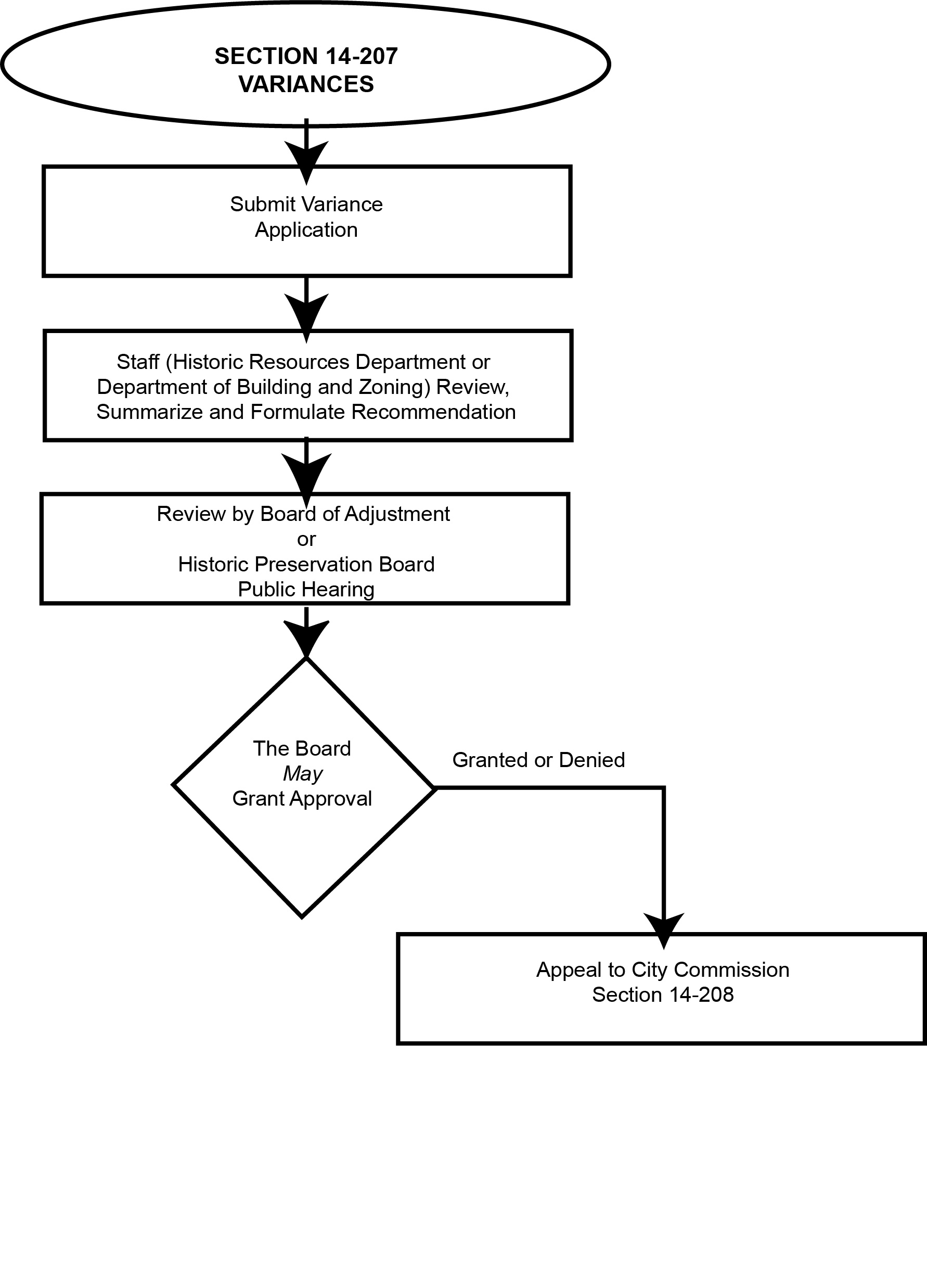
Section 14-207.3. Application.
An application for a variance shall be made in writing upon an application form approved by the City staff, and shall be accompanied by applicable fees.
Section 14-207.4. City Staff review, report and recommendation.
- City staff shall review the application in accordance with the provisions of Section 14-202. of these regulations.
- Upon completion of review of an application, City staff shall:
- Provide a report that summarizes the application and the effect of the proposed variance, including whether the variance complies with each of the standards for granting variances in Section 14-207.
- Provide written recommended findings of fact regarding the standards for granting variances as provided for in Section 14-207.
- Provide a recommendation as to whether the application should be approved, approved with conditions, or denied.
- Schedule the application for hearing before the Board of Adjustment or the Historic Preservation Board.
- Provide notice of the hearing in accordance with the provisions of Article 15 of these regulations.
Section 14-207.5. Review, hearing and decision on variances.
The Board of Adjustment or the Historic Preservation Board in the case of variance involving historic properties, shall review the application for a variance, the report, recommendation, and proposed findings prepared by City staff, conduct a quasi-judicial public hearing on the application in accordance with the requirements of Section 15-104 and render a decision, based upon written findings of fact, granting, granting with conditions, or denying the variance.
Section 14-207.6. Standards for variances.
- In order to authorize any variance from the terms of these regulations, the Board of Adjustment or Historic Preservation Board, as the case may be, shall find:
- That special conditions and circumstances exist which are peculiar to the land, structure or building involved and which are not applicable to other lands, structures or buildings in the same zoning district.
- That the special conditions and circumstances do not result from the actions of the applicant.
- That granting the variance requested will not confer on the applicant any special privilege that is denied by these regulations to other lands, buildings or structures in the same zoning district.
- That literal interpretation of the provisions of these regulations would deprive the applicant of rights commonly enjoyed by other properties in the same zoning district under the terms of these regulations and would work unnecessary and undue hardship on the applicant.
- That the variance granted is the minimum variance that will make possible the reasonable use of the land, building or structure.
- That granting the variance will not change the use to one that is not permitted in the zoning district or different from other land in the same district.
- That the granting of the variance will be in harmony with the general intent and purpose of these regulations, and that such variance will not be injurious to the area involved or otherwise detrimental to the public welfare.
- That the granting of the variance is appropriate for the continued preservation of an historic landmark or historic landmark district.
- No nonconforming use of neighboring lands, structures, or buildings in the same district, and no permitted use of land, structures, or buildings in other districts, shall be considered grounds for the issuance of a variance.
- Under no circumstances shall the Board of Adjustment or the Historic Preservation Board grant a variance to permit the following:
- A use not permitted in the district involved, or any use expressly or by implication prohibited by the terms of these regulations in said district; and
- The reduction or diminishing of a building site upon which a single-family residence or duplex has heretofore been constructed.
- The Board of Adjustment or the Historic Preservation Board may impose such reasonable conditions on the grant of a variance in order to ensure that the variance will have a minimum impact on surrounding properties.
Section 14-207.7. Time limit for variances.
Any variance granted under this Code, or in effect on the date that this Code took effect, shall become null and void and of no effect twelve (12) months from and after the date of the approval granting the same, unless within such period of twelve (12) months a building permit for the building or structure involved embodying the substantive matter for which the variance was granted shall have been issued; or if the use or adoption of such variance does not require the issuance of a building permit, unless the requested action permitted by the variance shall have taken place within the said twelve (12) month period. One (1) additional extension of twelve (12) months may be granted by the Development Review Official for good cause shown.
Section 14-207.8. Effect of decision.
Approval of a variance shall be deemed to authorize only the particular use for which it is issued and shall entitle the recipient to apply for review by the Board of Architects, if applicable, a certificate of use or building permit or any other approval that may be required by these regulations, the City or regional, state or federal agencies.
Section 14-207.9. Appeals.
An appeal from any decision of the Board of Adjustment or the Historic Preservation Board regarding variances may be taken to the City Commission by an aggrieved party in accordance with the provisions of Section 14-208 of these regulations.
Section 14-208.1. Purpose and applicability.
The purpose of this Article is to set forth procedures for appealing the decisions of City staff where it is alleged that there is an error in any order, requirement, decision or interpretation made in the enforcement or interpretation of these regulations and to set forth standard procedures for appealing the decisions of the City’s decision making bodies.
Section 14-208.2. General procedures for appeals.
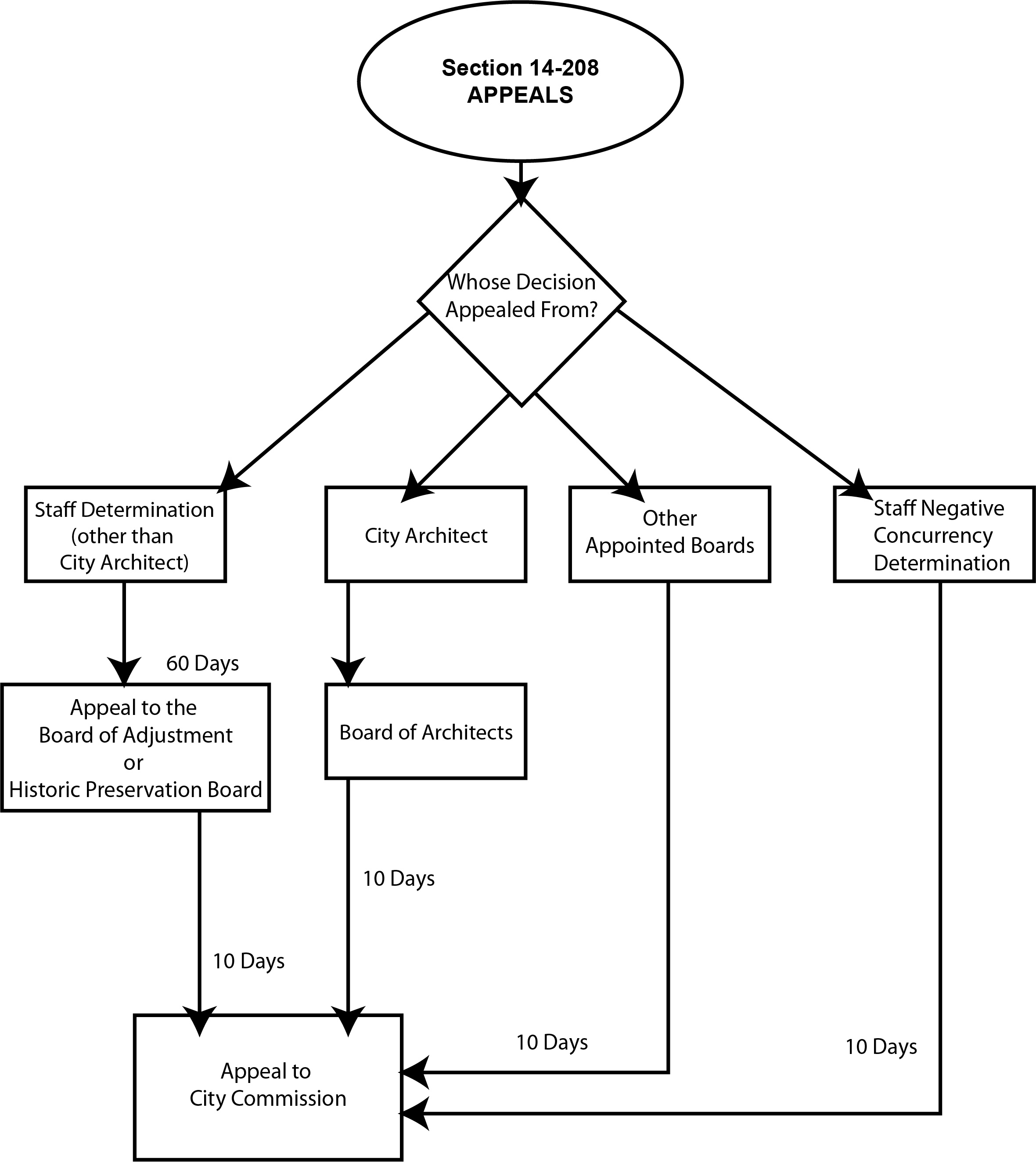
Section 14-208.3. Appeals from negative concurrency determinations.
An appeal from a negative concurrency determination shall be taken to the City Commission by any aggrieved party in accordance with the procedures of Section 14-208.6.
Section 14-208.4. Appeals from decisions of City Staff.
Other than a request for reconsideration of a decision of the City Architect, where it is alleged that there is an error in any order, requirement, decision or interpretation made in the enforcement or interpretation of these regulations by City Staff, an appeal shall be taken by an aggrieved party to the Board of Adjustment or the Historic Preservation Board, in the case of an appeal from a decision of the Historic Preservation Officer, no later than sixty (60) days after the decision has been made. Application for postponement of the public hearing of an appeal shall be considered according to the provisions stated in Sections 14-208.6. and 14-208.8.A. See Section 15-103. for City Architect reconsideration provisions.
Section 14-208.5. Appeals from decisions of the Board of Adjustment, Board of Architects, Historic Preservation Board, and Planning and Zoning Board.
An appeal from any decision of the Board of Adjustment, Board of Architects or Historic Preservation Board, and an appeal of a tentative plat decision of the Planning and Zoning Board, may be taken to the City Commission by any aggrieved party in accordance with the provisions of Section 14-208.6.
Section 14-208.6. Procedures for appeals.
The following procedures shall govern the filing of appeals:
- Appeals of City Staff administrative decisions other than the City Architect. An aggrieved party may file a written Notice of Appeal to the Board of Adjustment or the Historic Preservation Board with the designated Development Review Official or Historic Preservation Officer, as provided in Section 14-208.4., within sixty (60) days of the administrative decision being appealed from. The appeal shall be accompanied by any relevant documents related to the appeal as determined by the Development Review Official. The appeal shall be considered by the Board of Adjustment or Historic Preservation Board at the next available meeting after the required advertising has been completed. The Board of Adjustment or Historic Preservation Board shall grant the appeal, with or without conditions, deny the appeal, or respond for further proceedings.
- Appeals of Board of Adjustment, Board of Architects, Historic Preservation Board, and Planning and Zoning Board. Any aggrieved party desiring to appeal a decision of the Board of Adjustment, Board of Architects or Historic Preservation Board, or a tentative plat decision of the Planning and Zoning Board, shall, within ten (10) days from the date of such decision, file a written Notice of Appeal with the City Clerk, whose duty it shall then become to send a written notice of such appeal to all persons previously notified by the Board in the underlying matter. For the purpose of appeals from the Historic Preservation Board only, Dade Heritage Trust, Inc. is included as a party that may file an appeal of a decision of the Historic Preservation Board. If any time after the initial ten (10) day appeal period has lapsed, City Staff determines that the written Notice of Appeal is deficient or that the party that filed the Notice of Appeal lacks standing, the City Staff, where it deems appropriate, shall have seventy-two (72) hours from the date of that determination to appeal the decision. The appeal shall then be heard by the City Commission at its next meeting, provided at least thirteen (13) days has intervened between the time of the filing of the Notice of Appeal, as well as at least thirteen (13) days from the date of mailed notice as required pursuant to subsection E below, and the date of such meeting. If thirteen (13) days shall not intervene between the time of the filing of the notice and the date of the next meeting or thirteen (13) days shall not intervene between the sending of the mailed notice and the date of the next meeting, then the appeal shall be heard at the next regular meeting of the City Commission and the City Commission shall render a decision, without any unnecessary or undue delay, unless application for deferral has been made as permitted in Section 3-608 of this Article.
- Stay of proceedings. An appeal shall stay all proceedings in the matter appealed from until the final disposition of the appeal by the City Commission or other Board with jurisdiction. The pendency of an appeal shall toll all time periods applicable to the decision which is subject to appeal until final disposition of the appeal by the Commission or other Board with regard to the appeal.
- City Commission decision. The City Commission shall conduct a review of the decision of the Board of Adjustment, Board of Architects Special Master, Historic Preservation Board, or Planning and Zoning Board. The appeal shall be based on the record of the hearing, shall not be a de novo hearing, and no new, additional testimony shall be taken. A full verbatim transcript of all proceedings which are the subject of the appeal shall be provided by the party filing the petition. The transcript shall be provided seven (7) days prior to the City Commission meeting at which the appeal will be heard with a sufficient number of copies for the City Commission, the City Attorney, the City Manager and the affected departments. The City Commission is authorized to affirm, affirm with conditions, override the decision of the Board of Adjustment, Board of Architects Special Master, Historic Preservation Board or Planning and Zoning Board, or remand for further proceedings to the applicable Board. Any decision by the Board of Adjustment, Board of Architects Special Master, Historic Preservation Board or Planning and Zoning Board can only be reversed by a majority vote of the City Commission. The granting of any appeal by the City Commission shall be by resolution.
- Notice of hearings of appeals before the Board of Adjustment, Board of Architects, or City Commission shall be in accordance with the provisions of Article 15 of these regulations; provided however, notice shall be mailed at least thirteen (13) days prior to the date of such public hearing.
Section 14-208.7. Appeals from decision of the City Commission.
- An action to review any decision of the City Commission under these regulations may be taken by any person or persons, jointly or separately, aggrieved by such decision by presenting to the Circuit Court a petition for issuance of a Writ of Certiorari, duly certified, setting forth that such decision is illegal, in whole or in part, certifying the grounds of the illegality, provided same is done in the manner and within the time provided by Florida Rules of Appellate Procedure.
- Challenges to development order decisions based on consistency or inconsistency of the development order with the City of Coral Gables Comprehensive Plan shall be governed by the provisions of Section 163.3215, Florida Statutes (2006).
- The record of the Commission or any board or official from which appeal is taken shall include any application, exhibits, appeal papers, written objections, waivers or consents, considered by the Commission, or such board, as well as transcripts or stenographic notes taken at a hearing held before the Commission or any such board, the City Commission minutes or the board’s minutes and resolution showing its decision or action, and if the record of a lower board is transmitted to the City Commission, the record of the City Commission shall include the record of the lower board. The record shall also include any and all applicable portions of these regulations and where applicable the City Code, the report and recommendations of City staff, the City’s Comprehensive Plan, as well as applicable district boundary maps, aerial photographs and final zoning resolutions or ordinances. It shall also include the record made as a result of any prior applications for development approval on the same property. The City Clerk shall identify all exhibits used at the hearing. All exhibits so identified or introduced shall be a part of the City’s record.
Section 14-208.8. Postponement of appeals.
- Applicant or aggrieved party postponement. Applicants and/or aggrieved parties desiring postponement of an appeal before the City Commission shall adhere to the following provisions for postponements:
- First postponement. Requests for initial postponement must be requested in writing to the Office of the City Manager. A copy of the request shall be forwarded to the appropriate board secretary and the City Clerk. The request shall include a specific time frame for postponement. No more than ninety (90) calendar days may be requested and will be automatically granted.
- Second postponement. Requests for second postponement must be requested in writing to the Office of the City Manager. A copy of the request shall be forwarded to the appropriate board secretary and the City Clerk. The second postponement request may not exceed thirty (30) calendar days. The City Manager’s Office shall evaluate the request and may administratively grant the request or schedule the request for City Commission review and approval.
- Third postponement. If the appeal is not considered by the City Commission within the one hundred and twenty (120) calendar days as provided above, the application shall be scheduled for City Commission consideration at the next available City Commission meeting. The City Commission shall evaluate the application and determine if additional postponements are warranted. The maximum time frame an appeal can be postponed from the initial date the application was scheduled for City Commission consideration is one hundred and eighty (180) days.
- Appeal postponement fees. Applicants and/or aggrieved parties shall be required to pay all costs for all postponement requests including any fees established by the City Code. If the City Commission requests adjacent property owners be notified or advertised, all costs shall be the responsibility of the applicant or aggrieved party.
- Applicant responsibility. It shall be the responsibility of the applicant to adhere to the requirements provided in this Article, which shall include monitoring and insuring the application proceeds forward for City Commission consideration. Failure of the applicant to follow the above provisions shall terminate the appeal.
- Appeal review expiration. Appeals which do not secure City Commission consideration as provided in the above sections or are not considered by the City Commission within six (6) months shall be deemed abandoned and void.
- City postponement. The City Manager (or the Development Review Official) may postpone an appeal whenever it is deemed necessary to ascertain a complete record, to allow for the filing of a foreseeable related appeal (which would then be heard concurrently), to maintain an orderly hearing or in the best interests of the City but avoiding any unnecessary or undue delay. Postponement may be requested by the applicant or an aggrieved party as described in Section 14-208.8.A. or be at the initiative of the City Manager (or the Development Review Official). After the City Manager (or the Development Review Official) makes the decision regarding postponement, the applicant or aggrieved party may seek review of that decision to the City Commission within ten days and the matter will be scheduled for Commission consideration at one of the next two regularly scheduled meetings. The applicant or aggrieved party may request that a prior decision to hear appeals concurrently be modified where factual circumstances have changed so that the matter should be reconsidered. A request for modification will be handled in the same procedural manner as an application to hear appeals concurrently.
Section 14-209.1. Purpose and applicability.
The purpose of providing for a moratorium on development is to preserve the status quo for a reasonable time while the City develops and adopts a land use strategy to respond to new or recently perceived problems. The moratorium, initiated by the adoption of a Zoning in Progress Resolution, prevents developers and property owners from developing land under current land use rules that the community is in the process of changing. By so doing, a moratorium helps to accomplish the purpose of the new rules by preventing outdated development and allowing time to conduct a comprehensive growth management study which will be used to assist the City Commission in implementing needed changes to these regulations.
Section 14-209.2. General procedures for moratoria.
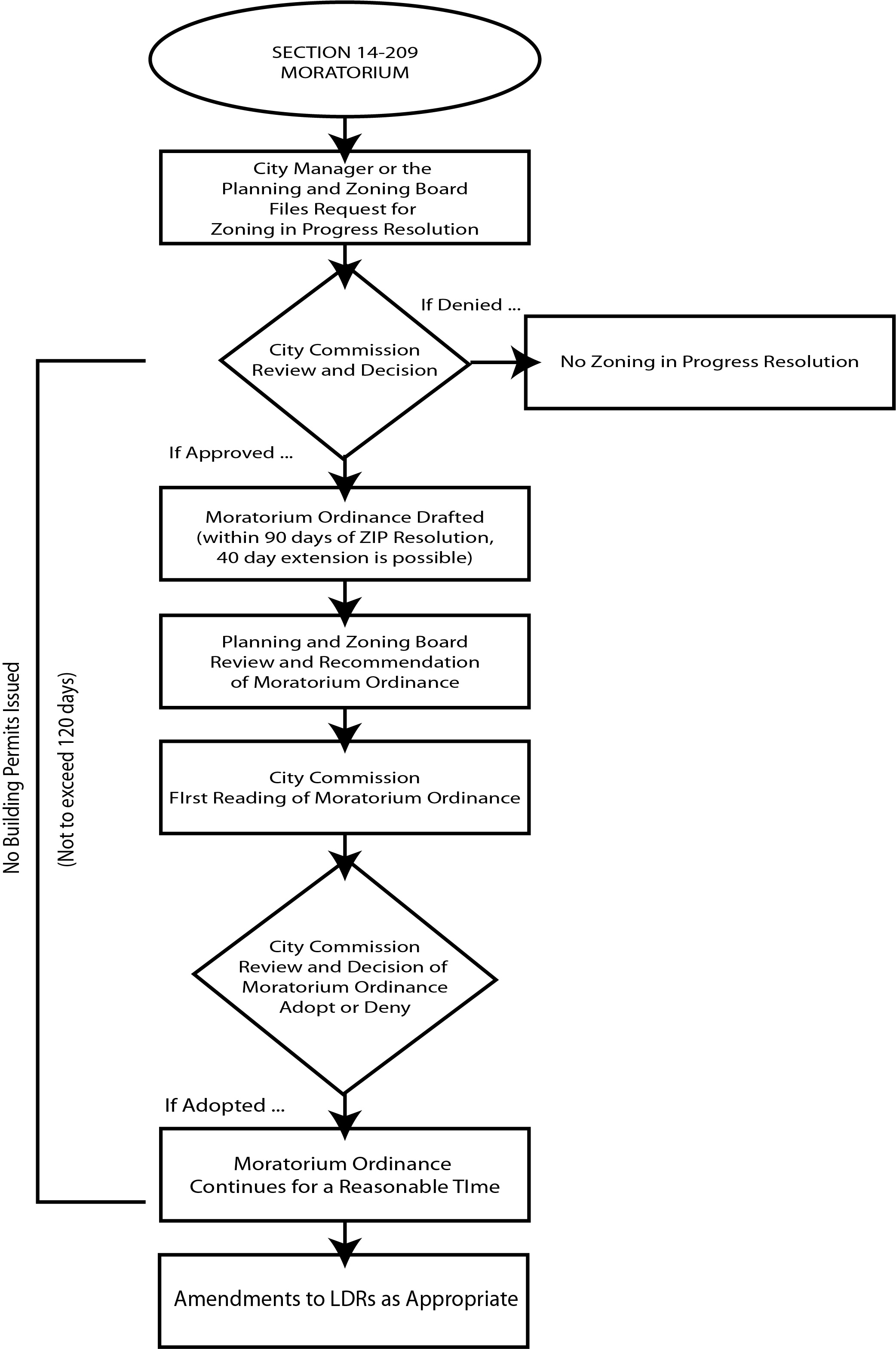
Section 14-209.3. Zoning in progress request.
The City Manager or the Planning and Zoning Board may file a request with the City Commission for a Zoning in Progress Resolution. The request shall be made in writing and shall be accompanied by a City staff report summarizing the need for a revision to these regulations and the area or areas within the City that will be affected. Such report shall contain a determination concluding the need for a resolution of the City Commission declaring Zoning in Progress and for the adoption of a formal moratorium. The City Commission may consider a Zoning in Progress Resolution on its own initiative.
Section 14-209.4. City Commission zoning in progress resolution review and decision.
- The City Commission shall review the Zoning in Progress Resolution at the next available regularly scheduled meeting following the submittal of the Zoning in Progress request.
- The City Commission shall make preliminary findings and accordingly approve or deny the proposed Zoning in Progress Resolution.
- Should the City Commission determine that a moratorium pending the preparation of a detailed and comprehensive analysis of the area in question is reasonably necessary or desirable, it shall:
- Approve the Zoning in Progress Resolution; and
- Order a fixed time, not to exceed ninety (90) days, within which City staff shall report to the Planning and Zoning Board and the City Commission with its report, a proposed ordinance amending these regulations, and recommendations relating to a potential moratorium.
- The Zoning in Progress Resolution shall be for a period not to exceed the first regularly scheduled City Commission meeting after one hundred twenty (120) days, unless an extension not exceeding forty (40) days is ordered pursuant to section F below.
- The City Commission on its own motion or otherwise may extend any Zoning in Progress Resolution for a longer period of time if reasonably necessary and the public interest requires.
- Should City staff be unable to report back to the City Commission within the time prescribed by its order, upon timely request by City staff and after public hearing on the need, the City Commission may extend the time limitation one (1) time for a period not to exceed forty (40) days.
- Upon adoption of the Zoning in Progress Resolution, the City Clerk shall publish the adopted resolution within ten (10) days following the date of adoption.
(Ord. No. 2024-03, 01/09/2024)
Section 14-209.5. Effect of zoning in progress resolution.
- During the period of time that the Planning and Zoning Board and City Commission are considering a moratorium ordinance, no permit(s) or development order(s) of any kind shall be issued if issuance would result in the nonconforming or unlawful use of the subject property should the moratorium or text amendment or zoning district change be finally enacted by the City Commission.
- During the period of time that the Planning and Zoning Board and City Commission are considering a moratorium ordinance, no permit(s) or development order(s) of any kind shall be issued if issuance would result in the nonconforming or unlawful use of the subject property should a moratorium ordinance be adopted by the City Commission.
- The period of time of such moratorium on permits shall begin on the earlier of:
- City Commission adoption of Zoning in Progress Resolution; or
- Notice has been given as required by law of the initial public hearing before the Planning and Zoning Board on the amendment to these regulations.
Section 14-209.6. City Staff review, report and recommendation.
- In the event the City Commission determines a moratorium is necessary to give City staff sufficient time to complete planning studies or other analysis prior to instituting an amendment to the regulations, the City Commission, as part of the Zoning in Progress Resolution, shall direct City staff to prepare a moratorium ordinance.
- Within the time fixed by the City Commission, City staff shall report to the Planning and Zoning Board and then the City Commission with its ordinance, amending these regulations and recommendations regarding the moratorium and its scope.
- City staff shall:
- Provide a detailed report indicating the necessity for zoning changes.
- Provide a recommendation as to whether the proposed moratorium ordinance should be approved, approved with conditions, or denied.
- Schedule the moratorium ordinance for hearing before the Planning and Zoning Board.
- Provide notice of the Planning and Zoning Board hearing pursuant to Article 15.
Section 14-209.7. Planning and Zoning Board review and recommendation.
The Planning and Zoning Board shall:
- Review the proposed moratorium ordinance at a public hearing.
- Make a written recommendation to the City Commission with regard to whether the proposed moratorium ordinance should be approved, approved with conditions, or denied.
Section 14-209.8. City Commission review and decision.
- Upon receipt of the report and recommendation of City Staff and the Planning and Zoning Board, the City Commission shall review the report and recommendations at two (2) public hearings.
- The City Commission shall read the moratorium ordinance by title, in full, on the first public hearing following receipt of the City staff’s and the Planning and Zoning Board’s recommendation.
- The City Commission shall hold a second public hearing and following the hearing adopt or deny the proposed moratorium ordinance.
- The City Commission may, upon request by City staff, amend the scope and timing of the moratorium as needed.
- The City shall consider such amendments to these regulations as are appropriate in accordance with the provisions in Section 14-212.
- The City staff shall provide notice of hearing of the City Commission meeting in accordance with the provisions of Article 15 of these regulations.
Section 14-209.9. Waivers.
If the City Commission has provided for waivers in the ordinance adopting a moratorium, the City Manager may grant a waiver of the moratorium where the applicant can show the following:
- The proposed development complies with the existing land development regulations.
- The proposed development satisfies the objective of the City Commission in ordering a moratorium. For example, if the City Commission is considering increasing the minimum setback in a residential zoning district by two (2) feet, and the applicant demonstrates that it complies with the proposed modification to the setback, the City Manager may grant a waiver of the moratorium.
- The waiver will not hinder the intent of the City Commission in its proposed amendment to these regulations.
Section 14-209.10. Exemptions. [formerly 3-710]
Notwithstanding the adoption of a moratorium ordinance, the City Manager may authorize the issuance of building permits for nondeleterious items including fences, repairs and similar matters, where he determines that such permit will not affect the outcome of the planning study; provided, however, that with regard to any particular moratorium the City Commission may by ordinance increase or decrease allowable exemptions and may by ordinance provide either a supplemental or exclusive procedure for acting upon requests for exemptions. Such procedure may vest jurisdiction and responsibility for acting upon requests for exemptions in the City Manager or any City administrative or quasi-judicial body or board.
Section 14-209.11. Conditional uses, variances, change in land use, change of zoning or tentative plats during moratorium.
During the existence of any moratorium, no applications for conditional uses, variances, changes in land use, changes of zoning, development orders or tentative plats within the affected area shall be acted upon by the City, except as provided in Sections 14-209.9 and 14-209.10, or unless otherwise specifically provided by the City Commission by ordinance with regard to a specific moratorium.
Section 14-210.1. Purpose and applicability.
The purpose of this Article is to provide application and review procedures for the platting and subdivision of land within the City. This Article shall be applicable to any subdivision or re-subdivision of land that creates one (1) or more parcels. No building permit shall be issued for construction of any improvements on a parcel that was not legally created in compliance with these regulations.
Section 14-210.2. Tentative plat.
- Pre-application conference-sketch plan.Prior to filing an application for tentative plat approval, the applicant shall have a pre-application conference as set forth in Section 14-202.1.
- Application.An applicant for plat approval shall submit an application for review of a tentative plat upon an application form approved by the City staff and shall be accompanied by all applicable fees. In addition, the application shall be accompanied by any application for a variance of the subdivision requirements as set forth more fully in Section 14-210.4. below.
- Staff report and recommendation.
- The staff shall review the application in accordance with the provisions of Section 14-202. of these regulations. Any such review by the Development Review Committee shall, at a minimum, include a review and comment by the Public Works Department.
- Upon completion of review of an application, the Development Review Official shall:
- Prepare a report that summarizes the application, including whether the application complies with the platting standards set forth in Section 4-100 and the requirement for the undergrounding of utilities in Section 4-203 of these regulations.
- Provide written recommendations as to whether the application should be recommended for approval, approval with conditions, or denied.
- Provide a report and recommendation, with a copy to the applicant, to the Planning and Zoning Board at least one (1) week prior to the next scheduled meeting of the Planning and Zoning Board.
- Schedule the application for hearing before the Planning and Zoning Board.
- Provide notice of the hearing before the Planning and Zoning Board in accordance with the provisions of Article 15 of these regulations.
- Planning and Zoning Board review.Upon receipt of the recommendations of the Development Review Official, the Planning and Zoning Board shall conduct a public hearing on the tentative plat and shall review the plat to ensure that it conforms to the requirements of these regulations.
- Planning and Zoning Board recommendation.Upon completion of its review, the Planning and Zoning Board shall either recommend the tentative plat for approval, approval with conditions, or disapprove the tentative plat.
- Optional review of tentative plat by City Commission.Where the applicant desires to obtain an expression from the City Commission on the tentative plat as recommended by the Planning and Zoning Board before proceeding to prepare the final plat, the applicant shall submit a written request to the Director of the Department of Planning who shall schedule the item for an informal review by the City Commission at the next available Commission date. During such an informal review, the City Commission shall evaluate the tentative plat for conformance with these regulations. In addition, the City Commission may issue an advisory opinion as to the desirability of any requests for conditions or modifications to the tentative plat that were requested by the Planning and Zoning Board or the Development Review Official.
- Expiration of tentative plat and variance.The tentative plat, and where applicable, any variance of these subdivision requirements shall expire and be of no further force and effect if a completed application for a final plat is not filed as set forth in Section 14-210.3. below within one hundred and eighty (180) days of the Planning and Zoning Board’s approval. After the expiration of one hundred and eighty (180) days, the applicant will be required to re-submit the tentative plat for staff and Planning and Zoning Board review as set forth in this Section.
Section 14-210.3. Final plat.
- Application.The application for final plat review shall be accompanied by all applicable fees and prepared on a form approved by the City’s staff.
- Incorporation of changes.The final plat shall have incorporated all changes or modifications recommended by the Planning and Zoning Board and (where applicable) the City Commission. To the extent that any such modifications have not been made, the applicant shall indicate in writing as part of the application the grounds for any such departure.
- Development Review Official.Upon receipt of a complete application for final plat review, the Development Review Official shall review the submittal to ensure that all modifications requested by the Planning and Zoning Board and (where applicable) the City Commission have been made and that the final plat complies with these regulations and the Comprehensive Plan. Any such review by the Development Review Official shall, at a minimum, include a review and comment by the Public Works Department.
- Development Review Official report.Upon completion of its review, the Development Review Official shall:
- Prepare a report that summarizes the application, including whether the applicant has complied with the recommendations of the Planning and Zoning Board and (where applicable) the City Commission.
- Provide written recommendations as to whether the final plat should be approved, approved with conditions, or denied.
- Provide the report, recommendation, and a copy of all prior recommendations to the City Commission with a copy to the applicant, at least one (1) week prior to the next scheduled meeting of the City Commission.
- Schedule the application for hearing before the City Commission.
- Provide notice of the hearing before the City Commission in accordance with the provisions of Article 15 of these regulations.
- Preliminary approval of final plat.Preliminary approval of a final plat may be given by the City Commission where bonds, engineering plans, or specifications have not been completed by the subdivider, and conditions make it desirable for the subdivider to obtain an expression from the City Commission before proceeding further. Preliminary approval shall vest the subdivider for a period of six (6) months with the right to obtain final approval upon the terms and conditions under which said preliminary approval is given, The City Commission shall reserve discretion to disapprove the final plat in the event that missing items (bonds, engineering plans, or other specifications) do not comply with these regulations.
- Final action on final plat.The City Commission shall review the final plat for conformance to these regulations and the Comprehensive Plan. The City Commission shall either approve, approve with conditions, or deny the final plat by resolution. Said resolution shall include any acceptance of dedications made on the plat. Where applicable, the City Commission shall approve, approve with conditions, or deny a variance of the subdivision requirements prior to approving or denying the final plat. Approval or denial of such a variance shall be by ordinance. When approved, the Mayor, City Clerk and Public Works Director shall affix their signatures to the plat together with the City Seal and resolution number. When disapproved, the City Clerk shall attach to the plat a statement setting forth the reasons for such action, and return it to the applicant.
- Revisions after City Commission approval and prior to recordation.
- Any changes, erasures, modifications or revisions to an approved plat prior to recordation may only be made by the Director of Public Works to correct scrivener’s errors, reflect accurate legal descriptions and locate right-of-way dedications, drainage ways and easements. However, no such request shall be considered unless the application is made by the preparer of the final plat.
- No other changes, erasures, modifications or revisions to an approved plat prior to recordation shall be made unless resubmitted for new approval; provided, however, that the City Commission may, after public hearing and based only upon a recommendation of the Public Works Department, change, modify or revise dedicated road rights-of-way or drainage easements. No such change, modification, or revision of the dedication of road rights-of-way, or drainage easements shall be reviewed unless the application is made by the preparer of the final plat.
- Recording.Following final approval of the final plat by the City Commission, the City Clerk shall notify the applicant by letter who shall record the final plat in the public records of Miami-Dade County. The final plat shall be recorded within twenty (20) days of final approval by the City Commission. After recordation of the final plat, the City Clerk shall obtain from the subdivider five (5) eighteen (18) by twenty four (24) inch certified copies of the recorded final plat with one (1) copy going to the City Clerk's files, two (2) copies to the Public Works Director, one (1) copy to the Building and Zoning Director, one (1) copy to the Finance Director and one (1) copy to the Planning Director.
- Building permits.No building permits for residential or residential accessory structures shall be issued until all subdivision improvements required in Section 4-100 (e.g. monuments, streets, sidewalks, parks, fire hydrants) have either been completed or sufficiently bonded on a form to be reviewed and approved by the City Attorney. As set forth in Section 4-113.C, the subdivider shall indemnify the City from liability for all injuries to person or property caused by their actions or the action of their authorized agents, which injuries result from the City's issuance of a building permit for a dwelling unit or its accessory structure pursuant to these regulations.
- Withholding of public improvements.The City shall withhold all public improvements including the maintenance of streets, the furnishing of sewage facilities and water service from all subdivisions that have not been approved, and from all areas dedicated to the public which have not been accepted in the manner set forth herein.
Section 14-210.4. Variances from subdivision requirements.
- Purpose and applicability. The City Commission may grant a variance of the subdivision requirements set forth in this Article and Section 4-100, where the strict application of said requirements would cause an unnecessary and undue hardship on the property owner.
- Application. An application for a variance of the subdivision standards shall be made in writing and shall accompany and be processed concurrently with the application for a tentative plat. The application for a variance shall be processed, noticed, and reviewed in the manner as the tentative plats as set forth in Section 14-210.2. above.
- Standards for review.The City Commission shall provide findings of fact that such variance complies with the following standards:
- That special conditions and circumstances exist which are peculiar to the land, structure or building involved and which are not applicable to other lands, structures or buildings in the same zoning district.
- That the special conditions and circumstances do not result from the actions of the applicant.
- That granting the variance requested will not confer on the applicant any special privilege that is denied by these regulations to other lands, buildings or structures in the same zoning district.
- That literal interpretation of the provisions of these regulations would deprive the applicant of rights commonly enjoyed by other properties in the same zoning district under the terms of these regulations and would work unnecessary and undue hardship on the applicant.
- That the variance granted is the minimum variance that will make possible the reasonable use of the land, building or structure.
- That the granting of the variance will be in harmony with the general intent and purpose of these regulations, and that such variance will not be injurious to the area involved or otherwise be detrimental to the public welfare.
Section 14-210.5. Facing of lots and principal buildings.
- All facing of lots and principal buildings constructed within an established building site(s) within the SFR, MF1, MF2, or MFSA zoning districts shall adhere to the provisions provided in this Section.
- Facing of the lots and principal buildings. The facing of lots and principal buildings upon an abutting street shall be determined by the Development Review Official unless prescribed otherwise within Appendix A, Site Specific Zoning Regulations, or Section C below. The final determination shall be subject to satisfying one or more of the following criteria:
- Identification of the shortest street line of platted lot(s).
- Existing facing of principal buildings of adjoining lots.
- Existing platting configuration of adjoining lots.
- Required facing of lots and principal buildings in specific cases or certain streets. Except as provided otherwise in this Section, all principal buildings on a lot or corner lots shall face the following streets:
- Alhambra Circle and South Alhambra Circle.
- Country Club Prado.
- DeSoto Boulevard.
- Indian Mound Trail except in Block 20, Section D.
- Maynada Street.
- Ponce de Leon Boulevard.
- East Ponce de Leon Boulevard shall be deemed to face on said Circle, Boulevard, Trail, Prado and Street, as the case may be.
- Ponce de Leon Boulevard. All lots in the one hundred (100) foot strip on either side of Ponce de Leon Boulevard shall be governed by restrictions for lots facing that boulevard.
- On Red Road. All lots abutting upon Red Road, from Coral Way to Southwest Eighth Street, shall be deemed to face both Red Road and Country Club Prado, and residences erected upon such lots may face either of such streets.
- Setback requirements. Minimum front, side and rear setbacks and setback(s) from a canal, waterway, lake or bay shall be determined based upon City final determination of facing of the lot(s) and building(s). All minimum required setback requirements provided within the applicable assigned zoning districts shall be satisfied, unless specified otherwise in Appendix A, Site Specific Zoning Regulations.
Section 14-211.1. Purpose and applicability.
The purpose of this Article is to establish a uniform procedure for the review or abandonment and vacation of non-fee property interests of the City with regard to compliance with the Comprehensive Plan. This Article applies to city streets, alleys, easements and other non-fee property interests of the City of similar character.
Section 14-211.2. Application.
Prior to the City Commission action with regard to abandonment or vacation, such requests for city streets, alleys, easements and other non-fee interests which the City may have in real property shall be reviewed for consistency with the Comprehensive Plan and shall be subject to conditions of approval which mitigate the impact of the abandonment or vacation of the City’s real property interest and/or the impact of additional development resulting from the abandonment or vacation. All applications shall be reviewed in accordance with the provisions of Section 14-202 and Article 15 and other applicable provisions of the City’s Code.
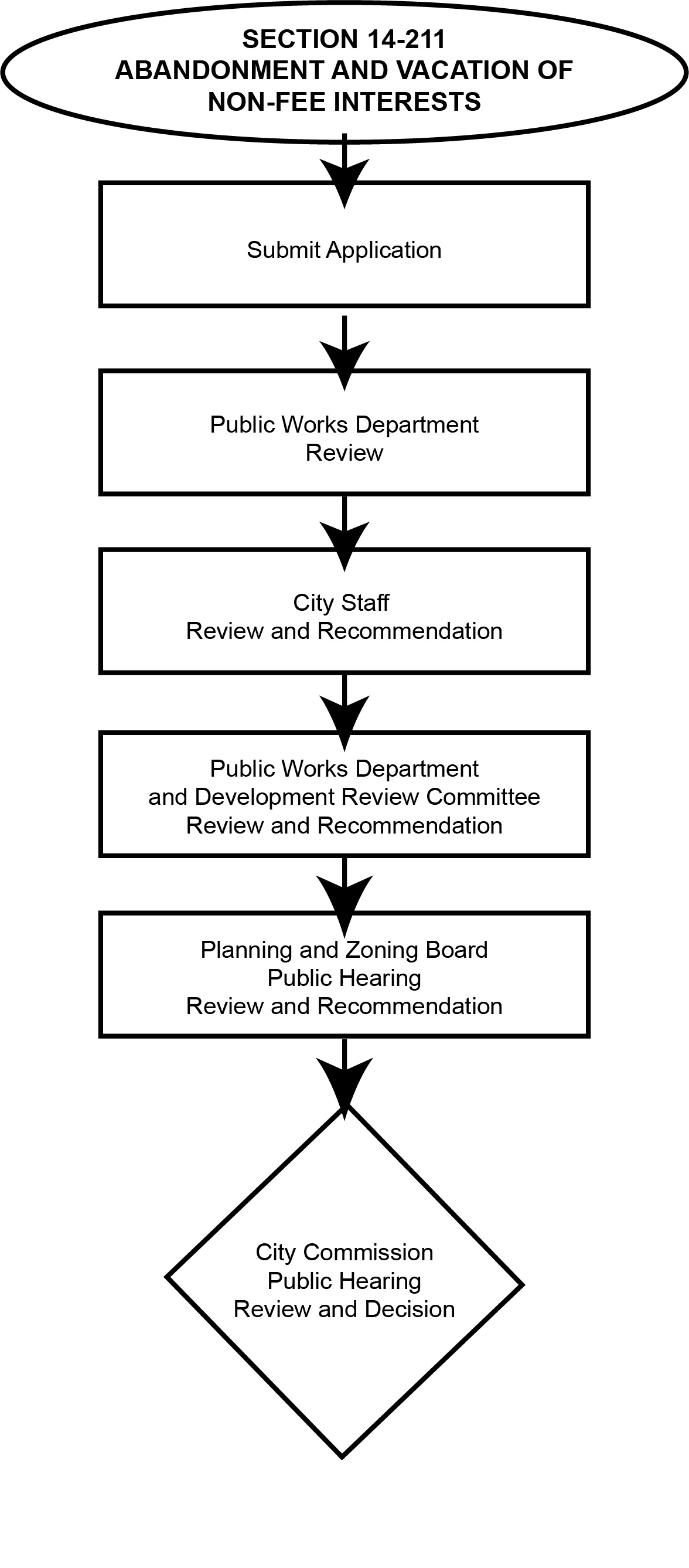
Section 14-211.3. Standards for review.
Applications for abandonment and vacation of city streets, alleys, special purpose easements and other non-fee interests which the City may have in real property may be approved provided that it is demonstrated that:
- The non-fee property interest sought to be abandoned:
- Does not provide a benefit to the public health, safety, welfare, or convenience, in that:
- It is not being used by the City for any of its intended purposes.
- The Comprehensive Plan, special purpose plan, or capital improvement program does not anticipate its use; or
- Provides some benefit to the public health, safety, welfare, or convenience, but the overall benefit anticipated to result from the abandonment outweighs the specific benefit derived from the non-fee property interest, in that:
- The vacation or abandonment will not frustrate any comprehensive plan, special purpose plan, or capital improvement program of the City;
- The vacation or abandonment will not interfere with any planning effort of the City that is underway at the time of the application but is not yet completed; and
- Does not provide a benefit to the public health, safety, welfare, or convenience, in that:
- The vacation or abandonment will provide a material public benefit in terms of promoting the desired development and improves the City’s long-term fiscal condition and the applicant provides beneficial mitigation in the form of a proffered mitigation plan which mitigates the loss of real property, the increase in the intensity of use and/or impacts on the public health, safety and welfare including increased parking and traffic.
Section 14-211.4. Planning and Zoning Board review and recommendation.
The Planning and Zoning Board shall:
- Review the application at a public hearing conducted in accordance with the provisions of Article 15.
- Make written findings with respect to whether the application complies with the standards set out in Section 14-207.6.
- Identify appropriate conditions of approval which mitigate the impact of the vacation or abandonment of property.
- Provide a recommendation to the City Commission with regard to whether the application should be approved, approved with conditions, or denied.
Section 14-211.5. City Commission review and decision.
The City Commission in its sole discretion, after notice of hearing in accordance with Article 15, may approve, approve with conditions or deny an application for the abandonment or vacation of city streets, alleys, easement and other non-fee interests which the City may have in real property.
Section 14-212.1. Purpose and applicability.
The purpose of this Article is to establish a uniform procedure for district boundary changes (map amendments) and for text amendments to these regulations. This Article applies to all such amendments, whether text or map amendments initiated by the City or map amendments by one (1) or more private property owners. In making zoning changes, primary concern shall be given to protection of residential uses, where occupancy is generally for twenty-four (24) hours per day and seven (7) days per week, than to other types of uses; and primary consideration shall be given to protection of established investments than to projected investments.
Section 14-212.2. General procedures for text and map amendments.
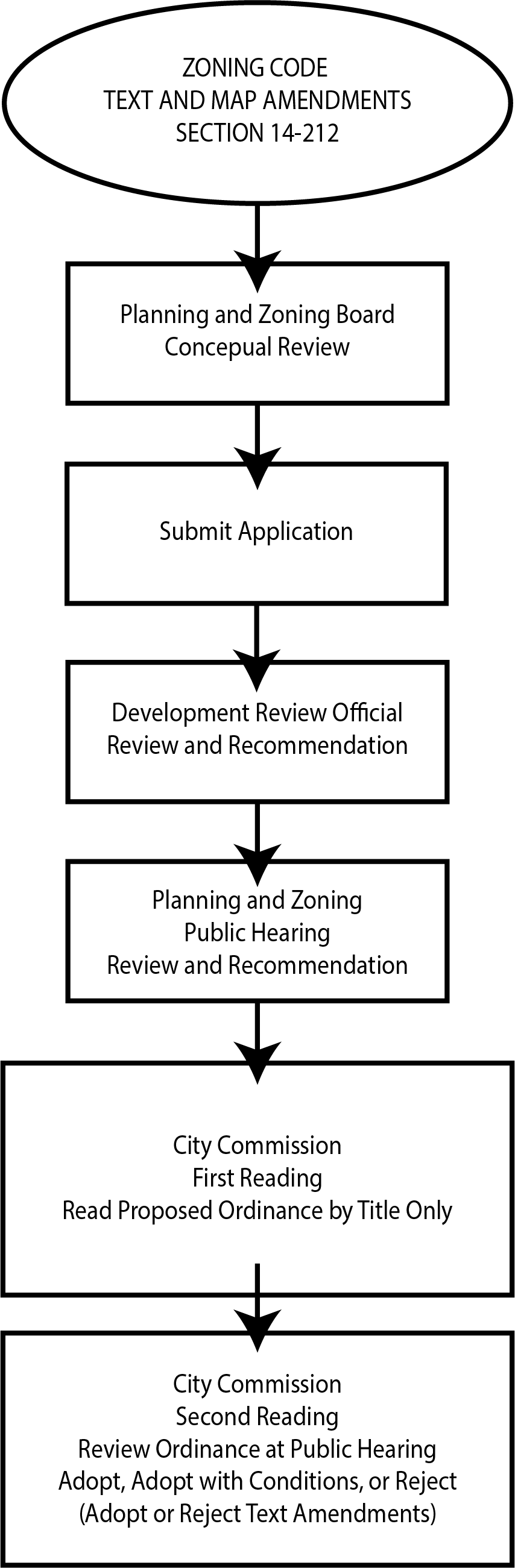
(Ord. No. 2025-03, 02/25/2025)
Section 14-212.3. Application.
All applications for district boundary changes, including the Planning and Zoning Board conceptual review application, shall be made in writing upon an application form approved by the City, and shall be accompanied by applicable fees.
(Ord. No. 2025-03, 02/25/2025)
Section 14-212.4. Standards for review of district boundary changes.
- A district boundary change may be approved if it is demonstrated that the application satisfies all of the following:
- It is consistent with the Comprehensive Plan in that it:
- Does not permit uses which are prohibited in the future land use category of the parcel proposed for development.
- Does not allow densities or intensities in excess of the densities and intensities which are permitted by the future land use category of the parcel proposed for development.
- Will not cause a decline in the level of service for public infrastructure to a level of service which is less than the minimum requirements of the Comprehensive Plan.
- Does not directly conflict with any objective or policy of the Comprehensive Plan.
- Will provide a benefit to the City in that it will achieve two or more of the following objectives:
- Improve mobility by reducing vehicle miles traveled for residents within a one-half (1/2) mile radius by:
- Balancing land uses in a manner that reduces vehicle miles traveled.
- Creating a mix of uses that creates an internal trip capture rate of greater than twenty (20%) percent.
- Increasing the share of trips that use alternative modes of transportation, such as transit ridership, walking, or bicycle riding.
- Promote high-quality development or redevelopment in an area that is experiencing declining or flat property values.
- Create affordable housing opportunities for people who live or work in the City of Coral Gables.
- Implement specific objectives and policies of the Comprehensive Plan.
- Improve mobility by reducing vehicle miles traveled for residents within a one-half (1/2) mile radius by:
- Will not cause a substantial diminution of the market value of adjacent property or materially diminish the suitability of adjacent property for its existing or approved use.
- It is consistent with the Comprehensive Plan in that it:
- An applicant may propose limitations regarding the use, density or intensity which will be permitted on the parcel proposed for development in order to achieve compliance with the standards of Section 14-212.4.A. Such limitation(s) shall be offered by a restrictive covenant or declaration of use that is provided to the City in a recordable form acceptable to the City Attorney.
Section 14-212.5. Standards for review of Zoning Code text amendments.
Text amendments to these land development regulations may be approved if the text amendment satisfies the following :
- Promotes the public health, safety, and welfare.
- Does not permit uses the Comprehensive Plan prohibits in the area affected by the text amendment.
- Does not allow densities or intensities in excess of the densities and intensities which are permitted by the future land use categories of the affected property.
- Will not cause a decline in the level of service for public infrastructure which is the subject of a concurrency requirement to a level of service which is less the minimum requirements of the Comprehensive Plan.
- Does not directly conflict with an objective or policy of the Comprehensive Plan.
Section 14-212.6. Development Review Official review, report and recommendation.
- Upon receipt of an application for a district boundary change pursuant to this Section, or upon receipt of a recommendation by the City Manager or their designee for an amendment to the text of these regulations, the Development Review Official shall:
- Schedule the district boundary change request for conceptual review before the Planning and Zoning Board. Notice of conceptual reviews before the Planning and Zoning Board shall be in accordance with the provisions of Article 15. The Board shall provide input and comments on the application at the conceptual review, however, there shall be no recommendation by the Planning and Zoning Board.
- Review the application or City Manager recommendation in accordance with the provisions of Section 14-202.
- Upon completion of review of an application, the Development Review Official shall:
- Review the application for compliance with the standards set out in Section 14-212.4 or 14-212.5, as applicable.
- Provide a report with regard to the application’s compliance with the standards set out in Section 14-212.4 or 14-212.5, as applicable.
- Provide a recommendation as to whether the application should be approved, approved with conditions, or denied.
- Schedule the application for hearing before the Planning and Zoning Board.
- Provide notice of the Planning and Zoning Board hearing pursuant to Article 15.
- Upon receipt of the recommendation of the Planning and Zoning Board, the Development Review Official shall:
- Schedule the application for hearing before the City Commission.
- Forward its report and recommendation and the findings and recommendation of the Planning and Zoning Board to the City Commission.
- Provide notice of the City Commission hearing pursuant to Article 15.
- At the second public hearing of the City Commission , City staff shall provide timely notice of the public hearing pursuant to Article 15.
(Ord. No. 2025-03, 02/25/2025)
Section 14-212.7. Planning and Zoning Board review and recommendation.
The Planning and Zoning Board, sitting as the Local Planning Agency, shall:
- Review the application at a public hearing.
- Make written findings with respect to whether the proposed district boundary change or text amendment to these regulations is consistent with the Comprehensive Plan.
- Make a written recommendation to the City Commission with regard to whether the application should be approved, approved with conditions, or denied.
Section 14-212.8. City Commission review and decision.
- For text amendments to these regulations and district boundary changes that affect ten (10) or more contiguous acres of property, the City Commission shall hold two (2) public hearings, as follows:
- At the first public hearing, the City Commission shall read the proposed ordinance by title only.
- At the second public hearing, the City Commission shall
- If the proposed amendment is a district boundary change, changes the list of permitted, conditional, or prohibited uses in a use district, then one (1) of the public hearings shall be held after 5:00 p.m. on a weekday, unless the City Commission, by a majority plus one (1) vote, elects to conduct that hearing at another time of day.
Section 14-213.1. Purpose and applicability.
The purpose of this Article is to establish a uniform procedure for amending the text and maps of the Comprehensive Plan. This Article does not supersede the requirements of Section 163, Part II, Florida Statutes, as may be amended from time to time. If any part of this Section conflicts with Section 163, Part II, Florida Statutes, the statutory requirement shall control. This Section applies to all text and map amendments to the Comprehensive Plan, whether initiated by the City or by one (1) or more private property owner.
Section 14-213.2. General procedures for text and map amendments to the Comprehensive Plan.
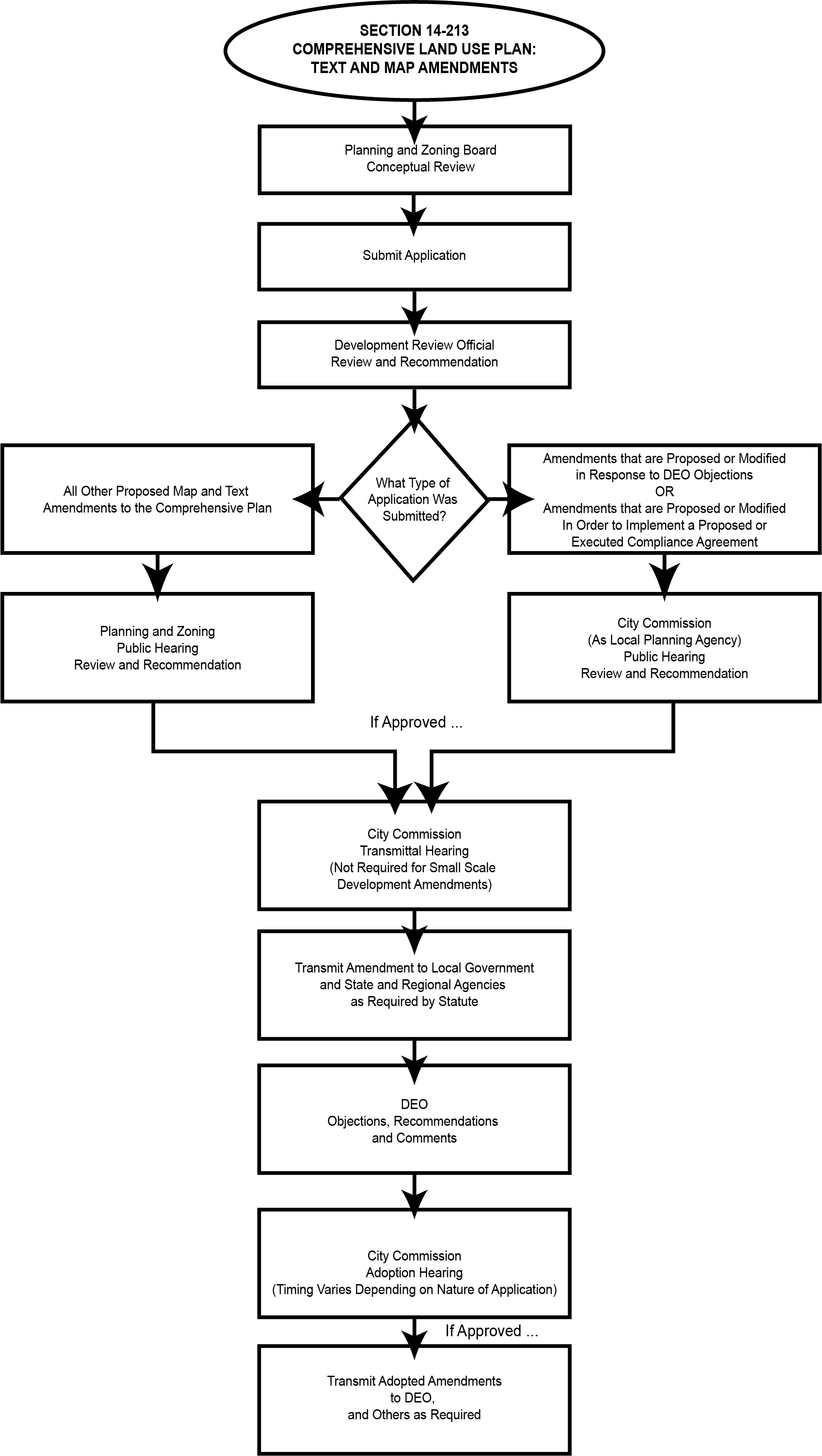
(Ord. No. 2025-03, 02/25/2025)
Section 14-213.3. Comprehensive Plan amendment cycles.
The City shall provide two (2) comprehensive plan amendment cycles as identified by the Director of Planning per calendar year for proposed amendments (small and large scale) except as provided in Section 163.3187(1) (a) and (b), Florida Statutes.
Section 14-213.4. Application.
All applications for amendments to the maps of the Comprehensive Plan, including the Planning and Zoning Board conceptual review application, shall be made in writing upon an application form approved by the Development Review Official, and shall be accompanied by the applicable fees.
(Ord. No. 2025-03, 02/25/2025)
Section 14-213.5. Conditions of approval.
- An applicant may propose additional limitations regarding the use, density or intensity which will be permitted on a parcel proposed for development. Such limitation shall be offered by executed restrictive covenant or declaration of use that is provided to the City in a recordable form that is acceptable to the City Attorney, and if the amendment is approved with the restrictive covenant or declaration of use, the recording information shall be set out on the Future Land Use Map.
- The City Commission may condition the grant of a Future Land Use Map amendment upon the timely development of the parcel proposed for development, and may include provisions that the district boundary change does not become effective until a complete application for development approval is accepted by the Development Review Official.
Section 14-213.6. Standards for Comprehensive Plan Text and Map Amendments.
- Proposed amendments to the Text and Maps of the Comprehensive Plan shall be reviewed pursuant to the following standards:
- Whether it specifically advances any objective or policy of the Comprehensive Plan.
- Whether it is internally consistent with Comprehensive Plan.
- Its effect on the level of service of public infrastructure.
- Its effect on environmental resources.
- Its effect on the availability of housing that is affordable to people who live or work in the City of Coral Gables.
- Any other effect that the City determines is relevant to the City Commission’s decision on the application.
Section 14-213.7. City review, report and recommendation.
- Upon receipt of an application pursuant to this Article, or upon a recommendation by the City Manager or their designee for an amendment to the text of the Comprehensive Plan, the Development Review Official shall:
- Schedule the map amendment request for conceptual review before the Planning and Zoning Board. Notice of conceptual reviews before the Planning and Zoning Board shall be in accordance with the provisions of Article 15. The Board shall provide input and comments on the application at the conceptual review, however, there shall be no recommendation by the Planning and Zoning Board.
- Review the application or City Manager recommendation in accordance with the provisions of Section 14-202.
- Upon completion of review of an application, the Development Review Official shall:
- Provide a report that summarizes the application and the effect of the proposed amendment in regard to the standards set out in Section 14-213.6:
- Whether it specifically advances any objective or policy of the Comprehensive Plan.
- Whether it is internally consistent with the Comprehensive Plan.
- Its effect on the level of service of public infrastructure.
- Its effect on environmental resources.
- Its effect on the availability of housing that is affordable to people who live or work in the City of Coral Gables.
- Any other effect that the City determines is relevant to the City Commission’s decision on the application.
- Provide a recommendation as to whether the application should be approved, approved with conditions, or denied.
- Provide a proposed ordinance that could be used to adopt the proposed amendment.
- Schedule the application for hearing before the Planning and Zoning Board.
- Provide notice of the Planning and Zoning Board hearing pursuant to Article 15.
- Provide a report that summarizes the application and the effect of the proposed amendment in regard to the standards set out in Section 14-213.6:
- Upon receipt of the decision of the Planning and Zoning Board, the Development Review Official shall:
- Schedule the application for hearing before the City Commission.
- Forward its report and recommendation and the recommendation of the Planning and Zoning Board to the City Commission.
- Provide notice of the City Commission hearing in accordance with the provisions of Article 15.
(Ord. No. 2025-03, 02/25/2025)
Section 14-213.8. Planning and Zoning Board review and recommendation.
The Planning and Zoning Board, acting as the Local Planning Agency (LPA), shall:
- Review the application at a public hearing that is held before the transmittal hearing, or if no transmittal hearing is required, before the adoption hearing.
- Make a written recommendation to the City Commission with regard to whether the proposed amendments should be adopted, adopted with conditions, or rejected.
Section 14-213.9. Transmittal hearing.
- A transmittal hearing by the City Commission shall be held on each proposed comprehensive plan amendment except small-scale development amendments.
- All transmittal hearings shall be held on weekdays.
- If the City Commission approves the plan amendment at the transmittal hearing, the City shall immediately transmit the amendment to those local governments and state and regional agencies to which transmittal is required by state statute or administrative rule.
- City Commission transmittal hearing shall be noticed in accordance with the provisions of Article 15.
Section 14-213.10. Department of Economic Opportunity (DEO) Objections, Recommendations, and Comments (ORC) Report.
- If DEO comments on and/or formally objects to a privately initiated amendment, the City shall promptly notify the applicant in writing which shall include a copy of the Objections, Recommendations, and Comments Report.
- The applicant may submit a draft response to the City within fifteen (15) days. If the City determines that the draft response is appropriate and responsive to the objection, the City shall forward the response to DEO.
- The City may respond to DEO objections on behalf of an applicant who does not provide an appropriate and responsive objection, but shall not be obligated to do so.
Section 14-213.11. Adoption hearing.
- The adoption hearing by the City Commission shall be scheduled as follows:
- After City review, if the amendment is a small-scale development amendment.
- Within sixty (60) days of:
- Receipt of DEO’s ORC Report if DEO provides said report; or
- The date the DEO review period ends if the amendment:
- Was transmitted to DEO;
- DEO did not object; and
- No affected person requested review within thirty-five (35) days of the date the proposed amendment was transmitted.
- If submitted as part of the statutory evaluation and appraisal process, within one hundred twenty (120) days of receipt of DEO’s Objections, Recommendations, and Comments Report if DEO provides said report.
- At the adoption hearing, the City Commission shall adopt the proposed amendment, adopt the proposed amendment with amendments that respond to DEO objections, recommendations, or comments, or reject the proposed amendment.
Section 14-213.12. Transmittal of adopted amendments.
The City shall transmit all adopted Comprehensive Plan and Future Land Use Map amendments to DEO, the South Florida Regional Planning Council, and any other unit of local government or governmental agency which has requested the amendment in writing within ten (10) working days after the adoption hearing. If the amendment is a small-scale development amendment, the City shall include copies of the public notices with the transmitted material.
Section 14-213.13. Compliance agreements.
The City Commission may enter into a compliance agreement with DEO with regard to any proposed or adopted Comprehensive Plan amendment, as follows:
- A. If the City elects to commence negotiation of a compliance agreement with DCA, it shall mail notice to all parties that have intervenor status in proceedings before DEO at least seven (7) days before substantive negotiations commence. Parties that have intervenor status in proceedings before DEO shall be afforded a reasonable opportunity to participate in the negotiation process.
- All negotiation meetings with the City and/or the parties with intervenor status in proceedings before DCA shall be open to the public.
- No compliance agreement shall be executed by the City unless such execution is considered at a public hearing of the City Commission.
Section 14-214.1. Purpose and applicability.
It is the purpose of this Article to provide a process for applicants to notify the City of potential litigation and invoke the exercise of the City’s authority and discretion pursuant to Article VIII, Sections 2(b) and 6(e) of the Florida Constitution, Section 70.001 of the Florida Statutes, Section 6.02 of the Charter of Miami-Dade County, Article 1, Section 7 of the Charter of the City of Coral Gables, and Objectives ADM-1.2, and Policies ADM-1.1.2 and FLU-1.1.9 of the City of Coral Gables Comprehensive Plan, to avoid expensive, uncertain, unnecessary, and protracted litigation regarding the application of these land development regulations to individual properties. The City may grant relief pursuant to this Article when it is demonstrated that the applicant for said relief has been unfairly, disproportionately or inordinately burdened by a final order of the City that either denied development approval to the applicant or imposed one (1) or more conditions of approval on the applicant. The process may also be initiated by the City to settle litigation in order to avoid unfairly, disproportionately, or inordinately burdening a party to that litigation, such as to mitigate the burden where a party to a settlement agrees in the settlement to bear a disproportionate burden of a government use that benefits the public. This Article does not apply to matters that arise from the application of the Florida Building Code.
Section 14-214.2. Application.
- All requests for relief pursuant to this Article shall be made in writing upon an application form approved by the City, and shall be accompanied by applicable fees. All such applications shall be filed with the City Manager’s office.
- Applications pursuant to this Article shall be filed no later than fifteen (15) days from the date a final order is rendered which the applicant alleges unfairly, disproportionately, and inordinately burdens its real property. City staff may initiate this procedure and file an application at any time in order to settle a pending dispute or litigation, as well as a pending matter before a federal or state administrative agency.
Section 14-214.3. Guidelines.
- If the City Commission finds that an applicant has demonstrated that it has suffered an unfair, disproportionate or inordinate burden as a result of the application of these regulations to its property, the City Commission may grant appropriate relief. Likewise, if the City demonstrates that a settlement would avoid, mitigate, or remedy an unfair, disproportionate, or inordinate burden to a property owner, the City Commission may grant appropriate relief. Proposed terms may include, but are not limited to:
- Relief from the application of particular provisions of these regulations, including the granting of variances.
- The transfer of developmental rights from one (1) parcel to another within the City.
- Approval of the original application with conditions; or modifications to any previously imposed conditions of approval.
- Any of the remedies listed in section 70.001(4)(c) of the Florida Statutes.
- The decision to grant relief pursuant to this Article rests in the sound discretion of the City Commission in the exercise of its inherent sovereign powers to settle legitimate disputes. The policy of the City is to fashion a proposal for resolving the dispute based on a considered balance of the following factors:
- The degree of burden suffered by the applicant or property owner.
- The nature and significance of the public interest that is served by the application of the regulation to the property.
- The likelihood of litigation, and its likely cost, the City’s potential exposure, the uncertainty of outcome, the timetable for resolving the issues, and whether there is a perceived need for a judicial determination of the issues raised by the application.
- In general, it is the policy of the City to resolve disputes in a manner that does not require significant financial expenditures by the City.
- All relief granted pursuant to this Article shall be consistent with the City of Coral Gables Comprehensive Plan and shall not violate any controlling federal law, state statute, or Miami-Dade County ordinance.
- All relief granted pursuant to this Article is conditioned upon the execution of a release of all claims that may arise from or relate to the application of the land development regulations that allegedly created the unfair, disproportionate or inordinate burden. The release of claims shall be in a form that is acceptable to the City Attorney and shall be recorded at the applicant’s expense.
(Ord. No. 2022-17, 04/26/2022)
Section 14-214.4. Staff review, report and recommendation.
- Within five (5) days of receipt of an application pursuant to this Article, the City shall review the application to determine whether it is complete.
- Within seven (7) days of receipt of a complete application, City Staff shall deliver the complete application to the City Manager, with copies to the Development Services Department, Historic Resources Department, City Attorney, and any other department as directed by the City Manager.
- The City Manager shall direct the departments to provide a joint evaluation of the merits of the application, which shall include:
- The principal purpose or purposes for the regulation that was applied to the applicant’s property, or the property that is the subject of a settlement. These purposes may include, but are not limited to:
- To address specific, identified public health and safety concerns;
- To protect or enhance community character;
- To protect archaeological or historic resources;
- To protect environmental resources (water supply, listed species, air quality); and
- To comply with state infrastructure concurrency mandates.
- The recommendation of the City departments with regard to whether the applicant has been unfairly, disproportionately or inordinately burdened by the application of these land development regulations that is the subject of the application or settlement, in light of the purposes for which the regulations that created the alleged burden are intended to serve, and the burden (or potential burden) carried by other property owners who are similarly situated, if any.
- The principal purpose or purposes for the regulation that was applied to the applicant’s property, or the property that is the subject of a settlement. These purposes may include, but are not limited to:
- Within forty-five (45) days of receipt of a complete application pursuant to this Article, the City Manager shall provide the City Commission with a report and recommendation on the application or settlement and a proposed dispute resolution agreement, and shall place the matter on the agenda of the City Commission.
Section 14-214.5. City Commission review and decision; Execution of Dispute Resolution Agreement.
- The City Commission shall review the application or proposed settlement at a public hearing (noticed in accordance with the provisions of Article 15, and shall decide whether to make an offer to resolve the dispute with the applicant, or to approve a settlement proposed by the City, which shall be in the form of a dispute resolution agreement.
- The City Commission may approve, approve with conditions, or reject the proposed dispute resolution agreement. If the City Commission requires modifications to the proposed dispute resolution agreement, the City Manager shall cause a new proposed dispute resolution agreement to be drafted within fourteen (14) days.
- When the City Commission has approved a proposed dispute resolution agreement or approved a proposed dispute resolution agreement with conditions, the City Manager is authorized to execute said dispute resolution agreement (as modified, if applicable).
- Once executed by the City Manager, the dispute resolution agreement shall be placed on the next available consent agenda of the City Commission for ratification. The item shall not be pulled from the consent agenda except by supermajority vote of the entire membership of the City Commission.
Section 14-214.6. Effect of Dispute Resolution Agreement.
- Dispute resolution agreements that are executed pursuant to this Article shall not be effective until the later of:
- The date executed by the applicant or other parties to the settlement;
- The date ratified by the City Commission; or
- Such other date that is set by the parties to the agreement.
- When relief is provided in a dispute resolution agreement pursuant to this Article, no further procedures are necessary to give effect to said relief unless:
- The further procedures are specifically required by the dispute resolution agreement; or
- The City agreed to consider a zoning district boundary change or text amendment to these land development regulations.
- Dispute resolution agreements that are executed pursuant to this Article shall run with the land.
Section 14-214.7. Recording of Dispute Resolution Agreement. [formerly 3-1707]
All dispute resolution agreements that are executed pursuant to this Article shall be recorded in the public records of Miami-Dade County, Florida. If the agreement is silent with regard to who bears the cost of recording, the cost shall be borne by the applicant.
Section 14-215.1. Purpose, applicability and definitions.
- The purpose of this Article is to provide the standards and process for a special, accelerated approval process within the Zoning Code to obtain land use and zoning approvals that can be used to facilitate the resolution of anticipated or pending judicial or administrative proceedings, noncompliance determinations, warning letters, or other proceedings involving federal, state or other governmental agencies, as well as others who have bona fide claims, which are the subject of pending judicial proceedings.
- This Article applies to the review of proposals for development and use of public or privately-owned land, buildings and structures that would be authorized by the City as an element of the settlement of any Governmental Proceedings that are brought for the protection of the public health, safety or welfare, including proceedings addressing the remediation or prevention of allegedly discriminatory practices and the protection of the public health, environment, or natural resources.
- This Article authorizes the City Commission to waive certain otherwise applicable requirements of the Zoning Code in order to facilitate such settlements through Commission approval of the development and use of public or privately-owned land, buildings and structures that would otherwise not be in compliance with the Zoning Code, provided the requirements of this Article are met.
- This Article also provides a mechanism whereby the City can implement a resolution of any potential conflict between the Zoning Code and a federal, state, or county statute or provision that pre-empts local regulation in accordance with Section 1-109(F) of the Zoning Code.
- In addition to the other applicable definitions in the Zoning Code, the following definitions shall apply for this Article:
- “Governmental Proceeding” shall mean a judicial or administrative proceeding, noncompliance determination, warning letter, or other governmental action to which the City is a party, involving federal, state, or other agencies, relating to the protection of the public health, safety or welfare, including proceedings addressing the remediation or prevention of discriminatory practices and the protection of the public health, environment, or natural resources. Governmental Proceeding shall also include judicial proceedings involving private parties and the City in which matters of federal or state protected rights or fundamental fairness are implicated or at issue.
- “Government Settlement” shall mean the proposed settlement of a Government Proceeding to which the City is a party that would require, as part of the settlement, authorization by the City of the development and use of public or privately-owned land, buildings and structures and would be presented to the City Commission for approval.
- This Article may be applied in conjunction with Section 14-214 of the Zoning Code.
Section 14-215.2. Application process.
- On behalf of the City, the City Attorney, with the approval of the City Manager, may initiate a Request for City Commission Approval of Government Settlement by submitting the Government Settlement, along with any supporting documents, to the Development Review Officer for review and recommendation. The Request shall identify the specific zoning or land use approvals being sought as part of the Government Settlement and explain why the City is seeking these approvals from the City Commission.
- The Development Review Officer shall review the City Attorney’s request using the procedures and applying the standards for review set forth in this Article.
Section 14-215.3. Notice and hearing procedures.
- The City shall publish and shall display on the City's public notice bulletin board and on its website a Notice of a Request for City Commission Review of Government Settlement, and shall maintain copies of the Request available for review in the Development Services Department and the City Clerk's Office. The notice shall advise the public that the City is evaluating whether the specific zoning or land use approvals being sought as part of the proposed Government Settlement comply with applicable provisions of the Zoning Code. The notice shall include a summary of the zoning or land use approvals being sought, how to view a copy of the request, how comments on the request can be presented to the City in writing or in person, and the date, location and time that a public hearing will be held on the request before the City Commission. A notification containing this information shall also be mailed by the City Clerk at least ten (10) days prior to the public hearing to the property owners of record, as well as property owners within a radius of one thousand (1,000) feet of the property described in the request, if the request is site-specific.
- Development Review Officer report and recommendation. The report and recommendation of the Development Review Officer shall be submitted to the City Manager based upon the requirements of this Article, shall be limited to the proposed zoning and land use approvals, shall be advisory in nature, and shall not be binding in the approval proceedings. The form of the recommendation and the time for receipt of the recommendation shall be as established by the City Manager
- City Attorney Recommendation. After receipt and consideration of the Development Review Officer recommendation, the City Attorney, in consultation with the City Manager, shall submit a recommendation to the City Commission with regard to approval of the Government Settlement. The City Attorney’s recommendations with regard to the proposed land use and zoning approvals in the proposed Government Settlement shall be based upon the requirements of this Article.
(Ord. No. 2024-03, 01/09/2024)
Section 14-215.4. Commission hearing.
- The City Commission shall have original and exclusive jurisdiction to decide whether to approve the land use and zoning approvals necessitated by the proposed Government Settlement. The City Commission’s approval shall be in the form of a resolution. The resolution can be approved only after the City Commission convenes a quasi-judicial public hearing on the Request for Approval of Government Settlement, no sooner than seven days after receipt of the City Attorney’s recommendation. In its resolution the City Commission may (i) grant the relief as requested, (ii) grant the relief with modifications, or (iii) deny the request. The resolution shall also state the reasons for the decision, shall identify any zoning or land use approvals granted or denied pursuant to the Zoning Code pursuant to this Article, and shall become final upon adoption.
Section 14-215.5. Standards for review.
- In order to achieve the purposes of this Article while remaining consistent with and further the goals, policies and objectives of the Comprehensive Plan and the purposes of these regulations and other City ordinances and actions designed to implement the Plan, the following standards shall apply to review and recommendations by City staff and the decision of the City Commission regarding the elements of the Request for Review of Government Settlement to which this Article of the Zoning Code applies. To the extent of any inconsistency between these standards and other Zoning Code standards, the standards in this Article shall apply:
- The City Commission shall weigh the following criteria in determining whether to allow a waiver of or variance from the limitations on any provision of the Zoning Code outside of this Article in order to facilitate approval of the Government Settlement:
- The property is owned, or partially owned, by the City or will be owned, or partially owned, by the City as part of implementation of the Government Settlement;
- The proposed use of a property has a combined government and private use and facilitates important public policy objectives that are identified in the Comprehensive Plan, including improvement of mobility alternatives to the automobile as described in the Mobility Element;
- Implementation of the Government Settlement is designed to redress the effects of alleged discrimination on the basis of a protected classification;
- Implementation of the Government Settlement resolves a federal or state administrative proceeding or will be made part of a consent order;
- Implementation of the Government Settlement will further the protection of the public health, safety or welfare, including the remediation or prevention of allegedly discriminatory practices and the protection of the public health, environment, or natural resources;
- Implementation of the Government Settlement will facilitate the resolution of any potential conflict between the Zoning Code and a federal, state, or county statute or provision that pre-empts local regulation in accordance with Section 1-109.F of the Zoning Code;
- The proposed use is compatible with the nature, condition and development of adjacent uses, buildings and structures and will not adversely affect the adjacent uses, buildings or structures;
- The nature of the proposed development is not detrimental to the health, safety and general welfare of the community.
- The City Commission shall weigh the following criteria in determining whether to allow a waiver of or variance from the limitations on any provision of the Zoning Code outside of this Article in order to facilitate approval of the Government Settlement:
Section 14-215.6. Non-exclusivity of remedy.
Use of the review procedures set forth in this Article is optional with the City. Nothing herein shall preclude the City from requiring that any land use approvals involving a Government Settlement be reviewed in accordance with the procedures and standards otherwise set forth in the Zoning Code.
Section 14-215.7. Temporary relief.
While an application for City Commission approval of a Government Settlement is pending before the City, the City Manager or a private party may seek temporary relief.
Section 14-215.8. Standing.
A party waives any right to seek judicial relief from a City Commission resolution made under this Article unless the party makes an objection to the City Commission at the quasi-judicial hearing itself.
Section 14-215.9. Appeal.
The decision of the City Commission to reject a Government Settlement under this Article is not appealable. The decision of the City Commission to grant land use and zoning approvals as part of an approved Government Settlement under this Article is reviewable through a petition for writ of certiorari to the Circuit Court Appellate Article within 30 days from the date of adoption of the resolution approving the settlement. The failure to seek review within that time frame is an absolute bar and waiver of any further challenge to those approvals.
Section 14-216.1. Purpose and applicability.
It is the purpose of this Article to provide an administrative remedy for applicants who allege that their vested rights have been abrogated by a final action of the City. This Article sets out a process for obtaining an official and binding determination of vested rights to use or develop property in a particular manner.
Section 14-216.2. Application.
- All applications for a determination of vested rights pursuant to this Article shall be made in writing upon an application form approved by City staff, and shall be accompanied by applicable fees.
- Applications pursuant to this Article shall be filed no later than thirty (30) days from the date a final action is taken which allegedly abrogates rights the applicant claims to be vested pursuant to the standards in Section 14-215.3.
Section 14-216.3. Standards.
The City Commission shall grant an application for a determination of vested rights if it is demonstrated that all of the following are satisfied:
- A valid, unexpired governmental act of the City of Coral Gables authorizes the specific development for which the determination is sought.
- Expenditures or obligations were made or incurred in reliance upon the authorizing act that are not reasonably usable in a development that is permitted by these regulations.
- It would be highly inequitable to deny the applicant the opportunity to complete the previously approved development, in that:
- Actual construction has commenced;
- The injury suffered by the applicant outweighs the public cost of allowing the applicant’s development to proceed;
- The development was economically viable at the time it was approved;
- The expenses or obligations incurred in good faith, and without notice of a pending change in regulations that would prohibit the development for which vested rights are sought; and
- The applicant cannot make a reasonable return on its previous expenditures on the project by developing according to the requirements of the current regulations.
- The relief granted is the minimum relief necessary to provide the applicant with a reasonable rate of return on his investment made before the effective date of the regulations which the applicant alleges have abrogated its vested rights.
Section 14-216.4. City review, report and recommendation.
City review of the application shall be conducted pursuant to 14-202 of these regulations.
Section 14-216.5. City Commission review and decision.
The City Commission shall review the application at a public hearing, noticed in accordance with the provisions of Article 15 and shall decide whether the application should be approved, approved with conditions, or denied.
Section 14-216.6. Effect of Vested Rights Determination.
- A vested rights determination shall be set out in writing which specifically sets forth the rights that have been recognized by the City Commission as vested.
- Vested rights shall be utilized within two (2) years of the date that the determination is rendered. If physical construction of buildings has not commenced or is not on-going and continuous pursuant to a valid building permit, the vested rights shall be extinguished without further notice or hearing.
Section 14-217.1. Purpose and applicability.
The City Commission may enter into development agreements in accordance with the provisions of this Section and Chapter 163, Florida Statutes to encourage a stronger commitment to comprehensive and capital facilities planning, ensure the provision of adequate public facilities for development, encourage the efficient use of resources, and reduce the economic cost of development.
Section 14-217.2. Application.
- All applications for a determination of a development agreement pursuant to this Article shall be made in writing upon an application form approved by the City, and shall be accompanied by applicable fees.
- Applications pursuant to this Article shall be filed no later than thirty (30) days from the date a final action is taken.
Section 14-217.3. Development Review Official review and report.
The designated Development Review Official shall review the application for a development agreement with the Development Review Committee in accordance with the provisions of Section 14-202 and shall preparea written recommendation to the Planning and Zoning Board.
Section 14-217.4. Planning and Zoning Board review.
The Planning and Zoning Board shall review the proposed development agreement, the recommendation of the Development Review Official, and the testimony at the public hearing, the standards in Section 14-216.6. and shall issue a recommendation to the City Commission for approval or denial of the development agreement.
Section 14-217.5. City Commission review and decision.
The City Commission shall conduct a public hearing noticed in accordance with the provisions of Article 15 on the proposed development agreement. Upon conclusion of the public hearing, the Commission shall review the proposed development agreement, the recommendation of the Development Review Official, the recommendation of the Planning and Zoning Board, the testimony at the public hearing and approve, approve with modifications, or deny approval of the proposed development agreement.
Section 14-217.6. Standards for review.
In reaching a decision as to whether or not the development agreement should be approved, approved with changes, approved with conditions, or disapproved, the City Commission and the Planning and Zoning Board shall determine whether the development agreement is consistent with and furthers the goals, policies and objectives of the Comprehensive Plan.
Section 14-217.7. Contents of development agreement/recording.
- Contents. The approved development agreement shall contain, at a minimum, the following information:
- A legal description of the land subject to the development agreement.
- The names of all persons having legal or equitable ownership of the land.
- The duration of the development agreement shall not exceed twenty (20) years.
- The development uses proposed for the land, including population densities, building intensities and building height.
- A description of the public facilities and services that will serve the development, including who shall provide such public facilities and services; the date any new public facilities and services, if needed, will be constructed; who shall bear the expense of construction of any new public facilities and services; and a schedule to assure that the public facilities and services are available concurrent with the impacts of the development. The development agreement shall provide for a cashier's check, a payment and performance bond or letter of credit in the amount of one hundred fifteen (115) percent of the estimated cost of the public facilities and services, to be deposited with the City to secure construction of any new public facilities and services required to be constructed by the development agreement. The development agreement shall provide that such construction shall be completed prior to the issuance of any certificate of occupancy.
- A description of any reservation or dedication of land for public purposes.
- A description of all local development approvals approved or needed to be approved for the development.
- A finding that the development approvals as proposed are consistent with the Comprehensive Plan and these regulations. Additionally, a finding that the requirements for concurrency as set forth in Section 14-218 of these regulations have been satisfied.
- A description of any conditions, terms, restrictions or other requirements determined to be necessary by the City Commission for the public health, safety or welfare of the citizens of the City of Coral Gables. Such conditions, terms, restrictions or other requirements may be supplemental to requirements in existing codes or ordinances of the City.
- A statement indicating that the failure of the development agreement to address a particular permit, condition, term or restriction shall not relieve the developer of the necessity of complying with the law governing said permitting requirements, conditions, terms or restrictions.
- The development agreement may provide, in the discretion of the City Commission, that the entire development or any phase thereof be commenced or be completed within a specific period of time. The development agreement may provide for liquidated damages, the denial of future development approvals, the termination of the development agreement, or the withholding of certificates of occupancy for the failure of the developer to comply with any such deadline.
- A statement that the burdens of the development agreement shall be binding upon, and the benefits of the development agreement shall inure to, all successors in interest to the parties to the development agreement.
- All development agreements shall specifically state that subsequently adopted ordinances and codes of the City which are of general application not governing the development of land shall be applicable to the lands subject to the development agreement, and that such modifications are specifically anticipated in the development agreement.
- Recording. No later than fourteen (14) days after the execution of a development agreement by all parties thereto, the City shall record the development agreement with the Clerk of the Circuit Court in Miami-Dade County. The applicant for a development agreement shall bear the expense of recording the development agreement. Additionally, the City shall submit a recorded copy of the development agreement to the State of Florida Department of Community Affairs no later than fourteen (14) days after the development agreement is recorded.
Section 14-217.8. Effect of decision.
- The codes and ordinances of the City governing the development of land subject to a development agreement, in existence at the time of the execution of a development agreement, shall govern the development of the land for the duration of the development agreement. Upon the expiration or termination of a development agreement, all codes and ordinances of the City in existence upon the date of expiration or termination shall become applicable to the development regardless of the terms of the development agreement.
- The City may apply codes and ordinances adopted subsequent to the execution of a development agreement to the subject property and development only if the City Commission, upon holding a public hearing, has determined that such subsequent codes and ordinances are:
- Not in conflict with the laws and policies governing the development agreement and do not prevent development of the land uses, intensities or densities in the development agreement.
- Are essential to the public health, safety or welfare, and expressly state that they shall apply to a development that is subject to a development agreement.
- Are specifically anticipated and provided for in the development agreement.
- The City demonstrates that substantial changes have occurred in pertinent conditions existing at the time of approval of the development agreement.
- The development agreement is based on substantially inaccurate information supplied by the developer.
Section 14-217.9. Changes to development agreements.
A development agreement may be amended by mutual consent of the parties, provided the notice and public hearing requirements of Article 15 of these regulations are followed. A party to a development agreement may request one (1) extension of the duration of the development agreement, not to exceed one (1) year from the date of expiration of the initial term of the development agreement, by submitting an application to the Development Review Official at least sixty (60) days prior to the expiration of the initial term of the agreement. The application shall address the necessity for the extension and shall demonstrate that the extension is warranted under the circumstances. The Development Review Official shall schedule the requested extension as a proposed amendment to the development agreement for public hearing before the Planning and Zoning Board and City Commission, in accordance with Article 15 of these regulations.
Section 14-217.10. Expiration or revocation of approval.
The City Manager shall review all lands within the City subject to a development agreement at least once every twelve (12) months to determine if there has been demonstrated good-faith compliance with the terms of the development agreement. The City Manager shall make an annual report to the City Commission as to the results of this review. In the event the City Commission finds, on the basis of substantial competent evidence, that there has been a failure to comply with the terms of the development agreement, the development agreement may be revoked or modified by the City Commission upon giving at least fifteen (15) days written notice to the parties named in the development agreement. Such termination of a development agreement shall occur only after compliance with the public hearing and notice requirements of Article 15.
Section 14-218.1. Purpose and applicability.
It is the purpose of this Article to provide a process for ensuring that the public facilities and services needed to support development are available concurrent with the impacts of such development.
Section 14-218.2. General procedures for concurrency review.
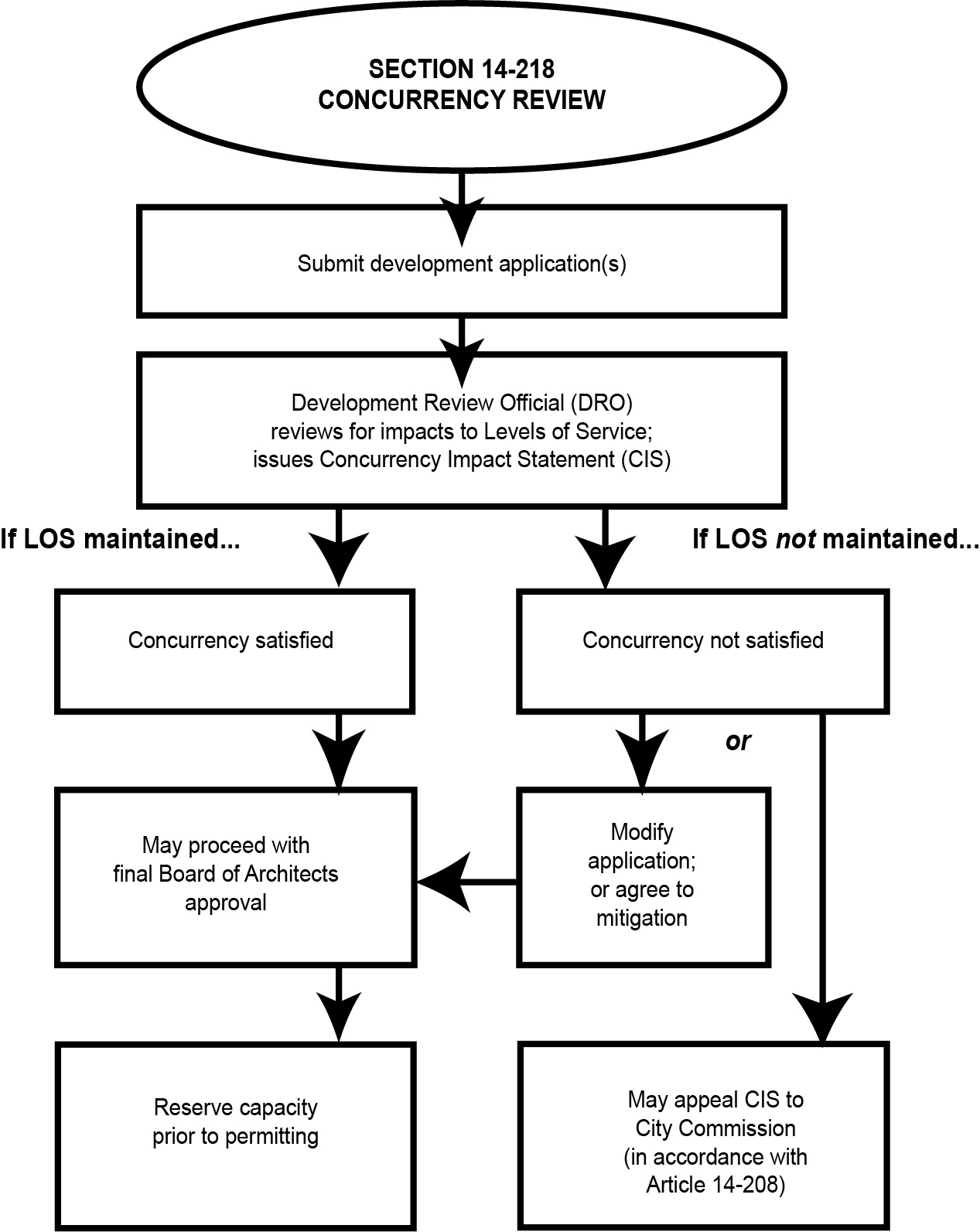
Section 14-218.3. Concurrency review required.
- Pursuant to Florida Statutes and the City’s comprehensive plan, concurrency review is required for all applications for development approval in order to identify and address the impacts of new development on the levels of service for various public facilities and services, except as exempted under the provisions of Sections 14-218.3(B) and (C) below.
- Concurrency review is not required for the following:
- Applications for single-family residential development platted prior to December 8, 1992.
- Applications for additions, renovations, or reconstruction of residential dwellings which do not increase the number of dwelling units placed on the premises or approved for the property.
- Additions, renovations, or reconstruction of uses accessory to residential dwellings.
- Sign permits.
- Applications which will not result in a development order.
- Applications requesting modifications of previously approved development orders where it is determined that the impacts on the prescribed levels of service imposed by the requested modifications will be no greater than the impacts posed by the previously approved development order or the previously existing use.
- Vested projects.
- Certificates of use and occupancy may be issued without the requirement for further concurrency review where the applicant for the certificate of use and occupancy holds a valid, unexpired building permit for the identical use of the subject structure or site or pertinent portion thereof; provided said building permit is not subject to a development agreement of other conditions requiring the applicant, successors, or assigns to provide or contract for the construction of necessary public services and facilities or other appropriate service impact mitigation measures. Where the building permit is subject to such development agreement or appropriate conditions, no certificate of use and occupancy shall be issued until the Development Review Official determines that all agreements and conditions have been satisfied.
Section 14-218.4. Public School Concurrency review required.
- In addition to the provisions in Section 14-218.3 above, pursuant to Florida Statutes and the City’s comprehensive plan public school concurrency review is required for all applications for development approval in order to identify and address the impacts of new residential development on the levels of service for public school facilities, except as exempted under the provisions of Section 14-218.4(B) below.
- Concurrency review is not required for the following:
- Applications for one (1) unit single-family homes.
- Assisted Living Facilities, as defined in Article 16.
- Non-residential development.
- Any Development of Regional Impact (DRI) for which a development order was issued, pursuant to Chapter 380, F.S., prior to July 1, 2005.
- Applications for which preliminary Board of Architects approval was secured prior to January 1, 2008.
Section 14-218.5. Application.
All applications for concurrency review shall accompany all applications for development approval, unless otherwise exempt under the provisions of this Article. Such applications shall be made in writing upon an application form approved by the City and shall be accompanied by applicable fees.
Section 14-218.6. City review and determination.
- The Development Review Official shall review each application for a development order and shall determine whether the request would have no impact or would have impacts on levels of service that fall below thresholds for public facilities and services prescribed in the Concurrency Manual.
- In the event that the Development Review Official determines that there is no impact, a statement of no impact shall be issued to the applicant and the Board of Architects or other decision maker responsible for the issuance of the development order. Such statement of no impact shall be valid for a period not to exceed one (1) year from issuance.
- Concurrency Impact Statement.
- Prior to final Board of Architects review and approval, the applicant, its successors, or assigns shall secure a written Concurrency Impact Statement from the Development Review Official, who shall determine the impacts to levels of service for public facilities and services, pursuant to concurrency review criteria contained in Section 14-218.7.
- If the concurrency impact statement indicates that the proposed development satisfies the adopted levels of service, the applicant shall secure the statement, furnish it to the Board of Architects and other decision makers, and reserve capacity for all applicable public facilities and services within the timeframes prescribed in the City’s Concurrency Manual. An applicant’s failure to successfully reserve capacity for all applicable public facilities and services within the timeframes prescribed in the City’s Concurrency Manual will render a final Board of Architects approval and/or final development order null and void.
- If the concurrency impact statement indicates that the approval cannot be issued because the proposed development would result in a reduction in adopted levels of service, the applicant may modify the application, or come to an acceptable mitigation agreement with the City and/or other appropriate entity responsible for the public service or facility in question, subject to the City’s final review and approval. Such modifications, agreements or conditions shall ensure that the necessary public facilities and services shall be available concurrent with the impacts of development. The concurrency impact statement shall be secured by the applicant and furnished to the Board of Architects and/or other decision-makers responsible for the issuance of the development order, and shall specify the modifications, agreements or conditions which shall be satisfied prior to the issuance a final Board of Architects approval and/or final development order.
- Reservation of capacity.
- Upon payment of a fee prescribed in the City of Coral Gables Concurrency Manual, or other fee schedule, as amended, an applicant, its successors, or assigns may reserve capacity for up to twelve (12) months from the date of capacity reservation for the project. An applicant’s failure to successfully reserve capacity for all applicable public facilities and services within the timeframes prescribed in the City’s Concurrency Manual will render a final Board of Architects approval and/or final development order null and void. An applicant, its successors, or assigns may secure an extension of capacity reservations for an additional twelve (12) months, subject to the terms prescribed in the Concurrency Manual, and the payment of all applicable fees.
- A Public School Concurrency Certificate issued by Miami-Dade County Public Schools to the applicant, its successors, or assigns, shall be valid for the following time periods, unless otherwise provided for in the Proportionate Share Mitigation Agreement:
- Twelve (12) months from the issuance of a document signifying public school capacity reservation.
- Twenty-four (24) months from the date of issuance of a final Board of Architects approval and/or final development order. However, with one hundred twenty (120) days advance notice, up to three (3) twelve (12) month extensions of the Public School Concurrency Certificate may be granted by Miami-Dade County Public Schools. In no event shall a Public School Concurrency Certificate be valid for more than six (6) years.
- Extensions will only be granted when Miami-Dade County Public Schools receives documentation that the applicant, its successors, or assigns are progressing in good faith through the City’s review process. Once the City issues the final Board of Architects approval and/or final development order, the Public School Concurrency Certificate shall remain valid pursuant to the timeframes prescribed herein.
- The applicant, its successors, or assigns shall be responsible for all coordination, monitoring, payments, and notification associated with the Public School Concurrency Certificate, and shall advise the City of any associated agreements with Miami-Dade County Public Schools.
Section 14-218.7. Concurrency review criteria.
- The public facilities and services needed to support development shall be deemed to be available concurrent with the impacts of development if the following criteria are satisfied:
- The necessary public facilities and services are in place at the time a final Board of Architects approval and/or final development order is issued; or
- A final Board of Architects approval and/or final development order is issued subject to the condition that the required public facilities and services will be in place when the impacts of the development occur; or
- The necessary public facilities are under construction at the time the final Board of Architects approval and/or final development order is issued and such construction is the subject of enforceable assurance that it shall be completed and serviceable without unreasonable delay; or
- The necessary public facilities and services are the subject of a binding executed contract for the construction of the facilities or the provision of services at the time the final Board of Architects approval and/or final development order is issued; or
- The necessary public facilities are funded and programmed for implementation in year one (1) of the City’s adopted capital budget, or similarly adopted budget of other government agencies; or
- The necessary traffic circulation, mass transit, or public school facilities or services are programmed for implementation in or before year three (3) of the city’s adopted budget or similarly adopted budget of other governmental agencies including the county’s capital budget, the School Board’s Facilities Work Plan, or the state agency having operational responsibility for affected facilities; in all cases, such facilities must be committed for construction in or before year three (3); or
- The necessary public facilities and services are guaranteed in a development agreement to be provided by the developer, pursuant to Section 163.3220, Florida Statutes, or Chapter 380, Florida Statutes; or
- Timely provision of the necessary public facilities and services will be guaranteed by some other means or instrument providing substantially equivalent assurances, subject to City review and approval; and
- In all instances where a decision to issue a building permit is based on the foregoing provision (5), (6), (7), or (8), all of the following conditions shall apply:
- The necessary public facilities and services shall not be deferred or deleted from the adopted capital budget unless the dependent final development order expires or is rescinded prior to the issuance of a certificate of use and occupancy; and
- Implementation of the necessary public facilities and services must proceed to completion with no unreasonable delay or interruption.
In determining the availability of public facilities and services, the applicant may propose and the City may approve development in stages or phases so that the public facilities and services needed for each stage or phase will be available in accordance with the criteria required by this chapter.
Section 14-218.8. Concurrency manual.
The City shall promulgate and maintain a Concurrency Manual which shall contain the administrative procedures to be applied in the implementation of this Article, as determined by the Director of the responsible department.
Section 14-218.9. Appeals.
An appeal from a negative concurrency determination may be taken to the City Commission by an aggrieved party in accordance with the provisions of Section 14-208 of these regulations.
Section 14-302.1. Violations.
- Failure to comply with any of the provisions of these regulations shall constitute a violation. Each day such violation continues shall be considered a separate offense.
- Failure to adhere to approved development plans or to comply with any condition set out in a development approval shall constitute a violation. Each day such violation continues shall be considered a separate offense.
- It shall be a misdemeanor in the second degree punishable pursuant to Florida Statutes 775.082 and 775.083, if any unauthorized person shall tamper with or remove the signs posted pursuant to Article 15.
- Failure to complete work authorized by a building permit within one (1) year of commencement of the work and in compliance with the permit, shall constitute a violation. Each day such violation continues shall be considered a separate offense.
- Failure to diligently proceed with work authorized by a building permit once said work has commenced shall constitute a violation. Each day such violation continues shall be considered a separate offense.
- For the purposes of Section 14-302.1(D) and (E), a full complement of workmen and equipment that is present at the site to diligently incorporate materials and equipment into the structure throughout the day on each full working day, weather permitting, shall be considered evidence of commencement of construction and that work is proceeding.
Section 14-302.2. Persons liable for violations.
In addition to the owner of the property that is the subject of the code enforcement proceeding, the tenant of the building, structure, premises, or part thereof, and any architect, builder, contractor, agent, or other person who commits, participates in, assists in, or maintains such violation may each be found guilty of a separate offense and suffer the penalties herein provided.
Section 14-303.1. Code enforcement adjudication.
- The Code Enforcement Officer may request a hearing regarding the enforcement of these regulations before any of the following adjudicative bodies:
- A court of competent jurisdiction;
- The City of Coral Gables Code Enforcement Board, pursuant to Ch. 2, Art. 3, Division 2 of the Code of Ordinances of the City of Coral Gables; and
- The Code Enforcement Hearing Officer, pursuant to Ch. 2, Art. 3, Division 2A of the Code of Ordinances of the City of Coral Gables.
Section 14-303.2. Penalties for violations.
- Judicial proceedings. In addition to orders to cure the violation and/or pay for such cure, violations as set forth in Section 14-302.1 shall be punishable upon adjudication by a court of competent jurisdiction with:
- A fine of up to five-hundred ($500) dollars per offense, imprisonment not exceeding sixty (60) days, or both;
- Revocation of an active development approval if either:
- The application or accompanying plans are in any respect false or misleading; or
- Development or use of the premises differs materially from that which was permitted or a condition of approval;
- Restitution of the differences between the total amount of taxes which would have been due in March in each of the previous years in which the covenant or agreement was in effect had the property not received the exemption and the total amount of taxes actually paid in those years, plus interest on the difference calculated as provided in F.S. 212.12(3), if the violation is of a restrictive covenant that provides for historic preservation;
- Costs, including court costs and not less than fifty ($50) dollars or more than one-hundred ($100) dollars per reinspection by the Development Services Department or Code Enforcement Officer which was necessary to determine code compliance after the violation was discovered.
- Code enforcement proceedings. Upon finding a violation as set forth in Section 14-302.1, the Code Enforcement Board or Code Enforcement Hearing Officer may order one (1) or more of the following:
- That the violation be cured within a specified period of time;
- That the violator pays for the violation to be cured under the supervision of the City of Coral Gables;
- A fine of up to two-hundred-and-fifty ($250) dollars per offense for a first violation or five-hundred ($500) dollars per offense for a repeat violation;
- A fine of up to five-thousand ($5,000) dollars per offense if it is determined that the damage due to a code violation is irreversible;
- That an active development approval be revoked if either:
- The application or accompanying plans are in any respect false or misleading; or
- Development or use of the premises differs materially from that which was permitted or a condition of approval;
- That incomplete buildings, structures, or additions be demolished and removed if:
- The building permits that authorized their construction have expired; and
- Good cause, such as strikes, natural disasters, material shortages, or unusual inclement weather, has not been shown; and
- Costs, including all administrative and enforcement costs and the cost of reinspection by the City which was necessary to determine code compliance after the violation was discovered.
D. Additional mandatory penalties for violations of historic preservation provisions. Any person who carries out or causes to be carried out any work in violation of Article 8, shall be required to restore the subject improvement, landscape feature, or site, either to its appearance prior to the violation or in accordance with a Certificate of Appropriateness approved by the Historic Preservation Board, subject to the conditions imposed by the Board. All civil remedies shall be in addition to and not in lieu of any criminal prosecution and/or any other applicable penalty. The Historical Resources Director is authorized, where it is deemed necessary for enforcement of these regulations, to require the execution of an agreement for recording, together with appropriate documents.
Section 14-304.1. Administrative stop-work orders.
- If the Code Enforcement Officer determines that development is being undertaken in a manner that is inconsistent with a development approval, or is being undertaken without a required approval, the Code Enforcement Officer may issue a stop-work order which shall be effective against all further work on the site except that which is required to cure the violation.
- If the Code Enforcement Officer determines that development is being undertaken in a manner that is inconsistent with a certificate of appropriateness, or is being undertaken without a required certificate of appropriateness, the Code Enforcement Officer shall issue a stop-work order which shall be effective against all further work on the site except that which is required to cure the violation.
- All stop-work orders shall be issued in conjunction with a summons, notice to appear, or notice of violation, depending on the adjudicative body that is selected to hear the case.
- If a stop-work order is issued in conjunction with a notice of violation, the Code Enforcement Officer shall immediately request a hearing of the Code Enforcement Board or Code Enforcement Hearing Officer.
- A stop-work order shall remain effective until any of the following events occur:
- Verification by the Code Enforcement Officer that full compliance with these regulations has been accomplished;
- A hearing before a court, Code Enforcement Board, or Code Enforcement Hearing Officer, which the Code Enforcement Officer shall request immediately after issuing the stop-work order; or
- Such other reasonable time established by the Code Enforcement Officer has elapsed.
Section 14-304.2. Stay of development approvals.
Upon the entry of an order of violation by the Code Enforcement Board, Code Enforcement Special Master, or court, no further development approvals shall be processed or granted regarding the property which is the subject of the violation, except for permits necessary to correct the violation, until the violation is corrected and fines and costs which have been imposed are paid.
Section 14-305.1. Variances.
- A violation may be cured through subsequent approval of an application for a variance.
- Applications for such variances shall be processed in the same manner as any other variance, except that the application fee shall be separately set by resolution of the City Commission.
- The Code Enforcement Board or Code Enforcement Hearing Officer may require that fines continue to be assessed during the period in which the variance is processed, or may suspend fines until the application is decided and then impose them if it is denied or withdrawn.
- Nothing in this section requires the City to grant a variance to cure a code violation.
Section 14-306.1. Reporting violation; Investigations.
- Any person may report a violation of these regulations or a condition of development approval by filing a complaint with the Code Enforcement Officer.
- The Historic Preservation Board or its staff shall report violations of these regulations if they determine that any improvement within a designated historic landmark, or historic landmark district is endangered by failure to comply with City Code, or that other improvements in visual proximity to an historic landmark or historic landmark district fail to comply with City Code to such an extent as to detract from the desirable character of the historic landmark or historic landmark district.
- Upon receipt of a complaint, a Code Enforcement Officer shall promptly investigate to determine whether a violation of these regulations exists.
- Within ten (10) days of the date a complaint is filed, a Code Enforcement Officer shall report to the complainant regarding the disposition or status of the complaint.
Section 14-306.2. Minor violations; Notice and reinspection.
- Where it has been determined that a violation exists, and that the violation can reasonably be corrected within twenty-four (24) hours, said offense shall be known as a “minor violation.”
- The Code Enforcement Officer shall issue a written notice to the owner and any other alleged participant in the code violation, specifying the minor violation and directing the owner and any other alleged participant in the code violation to correct such minor violation within a period of forty-eight (48) hours at which time a reinspection shall be made.
- If the minor violation still remains upon reinspection, the Code Enforcement Officer shall issue a second notice of violation to the owner and any other alleged participant in the code violation by certified mail, return receipt requested, specifying that if said minor violation is not corrected within seventy-two (72) hours of the owner's receipt of notice, the case shall be set for a hearing before the Code Enforcement Board of the City of Coral Gables or the Code Enforcement Hearing Officer.
- If the minor violation still remains upon the second reinspection, the Code Enforcement Officer shall promptly request a hearing before the Code Enforcement Board of the City of Coral Gables or the Code Enforcement Hearing Officer, and shall notify the owner and any other alleged participant in the code violation of said hearing by certified mail, return receipt requested.
Section 14-306.3. Violations; Notice and reinspection.
- Where it has been determined that a violation exists that is not subject to Section 14-306.2, the Code Enforcement Officer shall issue a written notice to the owner and any other alleged participant in the code violation, specifying the violation and directing the owner and any other alleged participant in the code violation to correct such violation within a period of seven (7) days, at which time a reinspection shall be made.
- If the violation still remains upon reinspection, the Code Enforcement Officer shall issue a second violation notice to the owner and any other alleged participant in the code violation by certified mail, return receipt requested, specifying that if said violation is not corrected within a period of fourteen (14) days from the date of the first notice, the case shall be set for a hearing before the Code Enforcement Board of the City of Coral Gables or the Code Enforcement Hearing Officer.
- If the violation still remains upon the second reinspection, the Code Enforcement Officer shall promptly request a hearing before the Code Enforcement Board of the City of Coral Gables or the Code Enforcement Hearing Officer, and shall notify the owner and any other alleged participant in the code violation of said hearing by Certified Mail, Return Receipt Requested.
Section 14-306.4. Repeat violations.
- A violation of a provision of these regulations by a person who has been previously found by the Code Enforcement Board of the City of Coral Gables, the Code Enforcement Hearing Officer, or a court of competent jurisdiction, to have violated, or who has admitted violating, the same provision within five (5) years prior to the violation, is a "repeat violation," even if the violations occur at different locations.
- If a repeat violation is found, the Code Enforcement Officer shall notify the owner and any other alleged participant in the code violation and request a hearing before the Code Enforcement Board of the City of Coral Gables or the Code Enforcement Hearing Officer. The Code Enforcement Officer is not required to give the owner or any other alleged participant in the code violation time to correct the violation.
- The case may be presented to the Code Enforcement Board of the City of Coral Gables or the Code Enforcement Hearing Officer even if the repeat violation has been corrected prior to the hearing, and the notice shall so state.
- If the repeat violation has been corrected, the Code Enforcement Board of the City of Coral Gables or Code Enforcement Hearing Officer may still schedule a hearing to determine costs and impose the payment of reasonable enforcement fees upon the repeat violator.
- The repeat violator may choose to waive his or her rights to this hearing and pay said costs as determined by the Code Enforcement Board of the City of Coral Gables or Code Enforcement Hearing Officer.
Section 14-306.5. Continuous violations.
- Whenever a property owner is cited at least three (3) times for the same violation at the same location within a period of twelve (12) consecutive months, said offense shall be known as a “continuous violation.”
- When a Code Enforcement Officer finds a continuous violation, the case shall be promptly set for a hearing before the Code Enforcement Board of the City of Coral Gables or the Code Enforcement Hearing Officer and the owner and any other alleged participant in the code violation shall be immediately notified by Certified Mail, Return Receipt Requested, of the hearing. All hearings shall be set such that there is at least seven (7) days between the date notice is mailed and the date of the hearing.
- The proper authorities of the City of Coral Gables, in addition to the remedies herein provided for, may institute any appropriate action or proceeding to prevent such unlawful erection, construction, reconstruction, alteration, repair, conversion, maintenance or use, or to impose a penalty for such violation or to restrain, correct or abate such violation in order to prevent the occupancy or use of said building, structure or land contrary to the provision hereof, or to prevent any illegal act, conduct, business or use in or about such premises.


