
Coral Gables City Zoning Code
ARTICLE 8
HISTORIC PRESERVATION
Section 8-101. Purpose and applicability.
The purpose of the designation of historic landmarks and districts is to promote the educational, cultural, and economic welfare of the public by preserving and protecting historic structures or sites, portions of structures, groups of structures, manmade or natural landscape elements, works of art, or integrated combinations thereof, which serve as visible reminders of the history and cultural heritage of the City, region, state or nation. Furthermore, it is the purpose of this Article to strengthen the economy of the City by stabilizing and improving property values in historic areas and to encourage new buildings and developments that will be harmonious with the existing historic attributes of the City including buildings, entrances and fountains. In addition, the provisions of this article will assist the City and property owners to be eligible for federal tax incentives, federal and state grant funds and other potential property tax abatement programs for the purpose of furthering historic preservation activities.
Section 8-102. General Procedures for Designation.

Section 8-103. Criteria for designation of historic landmarks or historic districts.
Districts, sites, buildings, structures and objects of national, state and local importance are of historic significance if they possess integrity of location, design, setting, materials, workmanship, or association. In order to qualify for designation as a local historic landmark or local historic landmark district, individual properties must have significant character, interest or value as part of the historical, cultural, archaeological, aesthetic, or architectural heritage of the City, state or nation. For a multiple property nomination, eligibility will be based on the establishment of historic contexts, of themes which describe the historical relationship of the properties. The eligibility of any potential local historic landmark or local historic landmark district shall be based on meeting one (1) or more of the following criteria:
- Historical, cultural significance:
- Is associated in a significant way with the life or activities of a major historic person important in the past;
- Is the site of an historic event with significant effect upon the community, city, state, or nation;
- Is associated in a significant way with a major historic event whether cultural, economic, military, social, or political;
- Exemplifies the historical, cultural, political, economic, or social trends of the community;or
- Is associated in a significant way with a past or continuing institution, which has contributed, substantially to the life of the City.
- Architectural significance:
- Portrays the environment in an era of history characterized by one (1) or more distinctive architectural styles;
- Embodies those distinguishing characteristics of an architectural style, or period, or method of construction;
- Is an outstanding work of a prominent designer or builder; or
- Contains elements of design, detail, materials or craftsmanship of outstanding quality or which represent a significant innovation or adaptation to the South Florida environment.
- Aesthetic significance:
- By being a part or related to a subdivision, park, environmental feature, or other distinctive area, should be developed or preserved according to a plan based on an historical, cultural, or architectural motif; or
- Because of its prominence of spatial location, contrasts of siting, age, or scale, is an easily identifiable visual feature of a neighborhood, village, or the City and contributes to the distinctive quality or identity of such neighborhood, village, or the City. In case of a park or landscape feature, is integral to the plan of such neighborhood or the City.
- Archaeological significance: Has yielded or may be likely to yield information important in prehistoric history or history.
- Criteria considerations: Ordinarily cemeteries, birthplaces, or graves of historical figures, structures that have been moved from their original locations, reconstructed historic buildings, properties primarily commemorative in nature, and properties that have achieved significance within the past fifty (50) years shall not be considered eligible for the Coral Gables Register of Historic Places. However, such properties will qualify if they are integral parts of districts that do meet the criteria or if they fall within the following categories.
- A building or structure removed from its original location but which is significant primarily for architectural value, or which is the surviving structure most importantly associated with an historic person or event;
- A birthplace or grave of an historical figure of outstanding importance if there is not appropriate site or building directly associated with his or her productive life;
- A cemetery which derives its primary significance from graves of persons of transcendent importance, from age, from distinctive design features, or from association with historic events;
- A reconstructed building when accurately executed in a suitable environment and presented in a dignified manner as part of a restoration master plan, and no other building or structure with the same association has survived;
- A property primarily commemorative in intent if design, age, tradition, or symbolic value has invested it with its own exceptional significance; or
- A property achieving significance within the past fifty (50) years if it is of exceptional importance.
Section 8-104. Designation procedures.
Properties which meet the criteria for local historic landmarks and local historic landmark districts set forth in Section 8-103 shall be designated according to the following procedures:
- Proposals for designation of potential local historic landmarks and local historic landmark districts:
- Proposals for designation of potential local historic landmarks and local historic landmark districts may be submitted to the Historical Resources Department for recommendation to the Historic Preservation Board by the Board of Architects or any citizen or City property owner who provides information, which illustrates that the property meets the criteria for listing as set forth in Section 8-103. The information submitted must include sufficient preliminary information to enable the staff’s review for an initial determination that the property meets the minimum eligibility criteria. Proposals for the designation of potential historic landmarks shall include the property address, legal description, tax folio number, location map, date of construction, architectural style, architect (if known), color photographs of the property, and a written statement. Proposals for the designation of potential local historic landmark districts and multiple property nominations shall include this information for each property within the proposed district and a description of the proposed district boundaries with boundary map. The written statement shall be based on the information provided, and any other relevant supplemental information, explaining the historic, cultural, aesthetic or architectural significance of the proposed landmark, or district, or multiple property nomination. In addition to furnishing all any necessary information, the applicant may be required to pay applicable fees, if any. If the department’s initial determination is that the property does not meet the minimum eligibility criteria for listing, the applicant may present the proposal for designation to the Historic Preservation Board. The applicant must submit a report within 30 days of the eligibility determination which describes in sufficient detail the criteria the potential historic landmark satisfies for designation. The applicant will then present at the next regularly scheduled Historic Preservation Board meeting where notice can be provided.;
- The Board may, on their own or upon the recommendation from staff or any citizen pursuant to Subsection (a) 1. of this section, direct staff to begin the designation process by preparing a designation report pursuant to Subsection (b) below of this section and any other standards the Board may deem necessary, submitting this report to the procedures described herein, and arranging for a public hearing before the Historic Preservation Board on this matter; or
- Whenever a determination is made by either the Director of the Historical Resources Department or the Historic Preservation Board that an application for historic designation shall proceed to public hearing as provided in this Article, no development permits shall be issued until the public hearing is held and a determination made on the subject designation in accordance with the provisions of Section 8-104.C. In the case where an owner seeks a demolition permit, the public hearing shall be held in accordance with 8‐107(G).
- Preparation of historic landmark designation report. For every proposed designated historic landmark and historic landmark district, the Historic Preservation Officer shall prepare a designation report, which shall be presented to the Board at a regularly scheduled meeting. The report shall contain the following:
- Proposed boundaries. Boundaries for individual historic sites shall generally include the entire property or tract of land, unless such tract is so large that portions thereof are visually and functionally unrelated to any significant historic improvement. Proposed historic district boundaries shall, in general, be drawn to include all appropriate properties reasonably contiguous within an area and may include noncontributing properties which individually do not conform to the historic character of the district, but which require regulation in order to control potentially adverse influences on the character and integrity of the district. Where reasonably feasible, historic district boundaries shall include frontage on both sides of streets and divide the proposed historic landmark districts from other zoning districts in order to minimize interdistrict frictions. Archaeological zone boundaries shall generally conform to natural physiographic features, which were the focal points for prehistoric and historic activities.
- Optional internal boundaries. Internal boundaries may subdivide an historic landmark district into sub areas and transitional areas as appropriate for regulatory purposes. If a proposed historic landmark or historic landmark district is visually related to the surrounding areas in such a way that actions in the surrounding area would have potentially adverse environmental influences on its character and integrity, proposed boundaries for such transitional areas may be included within the historic landmark or historic landmark district.
- Detailed regulations. Every historic landmark and historic landmark district may be assigned a set of detailed zoning district regulations. Such regulations may be designed to supplant or modify any element of existing zoning regulations to the following: use, floor area ratio, density, height, setbacks, parking, minimum lot size, and transfer of development rights, or create any additional regulations provided for in this section. The zoning amendment may identify individual properties, improvements, landscape features, or archaeological sites, or categories or properties, improvements, landscape features, or archaeological sites for which different regulations, standards and procedures may be required.
- Significance analysis. A report shall be submitted establishing and defining the historic significance and character of the proposed historic landmark or historic landmark district, setting forth the criteria upon which the designation of the historic landmark, or historic landmark district, and its boundaries are based, and describing the improvements and landscape features of public significance, present trends and conditions, and desirable public objectives for future conservation, development, or redevelopment. The report shall include a review guide which identifies the major exterior features of any improvements or landscape features which contribute significantly to the historic character of the historic landmark site or historic landmark district. A designation report for an historic landmark shall also contain a location map and photographs of all designated exterior surfaces (and interior if applicable).
- Optional designation of interiors. Normally interior spaces shall not be subject to regulation under this section; however, in cases of existing structures having exceptional architectural, artistic, or historical importance, interior spaces which are customarily open to the public may be specifically designated. The designation report shall describe precisely those features subject to review and shall set forth standards and guidelines for such regulations.
- The historic landmark designation report will be provided to property owners or applicants no less than 14 days prior to the Historic Preservation Board meeting at which the designation shall be heard.
- Procedures for notification andhearings on proposed designation. The Board shall hold a public hearing with notification as follows:
- Notification of Owners. For each proposed designation of an historic landmark or historic landmark district, the Historical Resources Departmentis responsible for mailing a copy of the designation report and a courtesynotice of public hearing to all property owners of record whose properties are located within the boundaries of the designation. This notice shall serve as notification of the intent of the Board to consider designation of the property at least ten (10) days prior to a public hearing held pursuant to this section. However, failure to receive such courtesy-notice shall not invalidate the action of the Board. The property shall be posted at least ten (10) days prior to the hearing.
- Notice of Public Hearings. Additional notice of public hearings shall be provided in accordance with the provision of Article 15 of these regulations.
- Decision of the Board. If after a public hearing the Board finds that the proposed local historic landmark or proposed local historic landmark district meets the criteria set forth in Section 8-103, it shall designate the property as a local historic landmark or local historic landmark district. All decisions of the Board shall be by Resolution. If zoning regulations are recommended to be changed in the designation report and the Historic Preservation Board agrees, then such recommendation shall be reviewed in accordance with the provisions of Section 14-212 of these regulations.
- Notification of the Board actions. The Historic Preservation Officer shall provide a courtesy notice to the following of its action with a copy of the Resolutions:
- Development Services Department.
- Planning and Zoning Division.
- City Clerk.
- Public Works Department.
- Owners of affected property and other parties having an interest in the property, if known.
- Any other municipal agency, including agencies with demolition powers that may be affected by this action.
- Development permits suspended during consideration of designation.
- Upon the filing of a designation report by the staff with the Historic Preservation Board, the owner(s) of the real property which is the subject matter of the designation report or any individual or private or public entity shall not:
- Erect any structure on the subject property, or
- Alter, restore, renovate, move or demolish any structure on the subject property until such time as a final administrative action, as provided by this Article, is completed.
- Suspension of development review shall expire when:
- The Historic Preservation Board determines that the property is not significant and an appeal to the City Commission is denied;
- An appeal to the City Commission for the designation of the property is upheld; or
- A Certificate of Appropriateness is issued subject to the conditions herein.
- Upon the filing of a designation report by the staff with the Historic Preservation Board, the owner(s) of the real property which is the subject matter of the designation report or any individual or private or public entity shall not:
- Recording of designation. The City Clerk shall provide the circuit court clerk with all designations for the purpose of recording such designations in the public record.
- Appeal of designation. Within ten (10) days from the date of a decision of the Historic Preservation Board, any resolution of the Historic Preservation Board may be appealed to the City Commission, as provided for under Section 14-208 otherwise the Resolution will be final.
- Procedure for Designation of the City Plan and Amendments to such Plan.
- The procedure for designation of the City Plan as historic shall follow the process set forth in this Article except that notwithstanding anything in this Article to the contrary, notice of any public hearing designating the City Plan historic shall be by publication in a newspaper of general circulation ten (10) days in advance of such hearing.
- In the event that the City Plan is designated historic, any material amendments to the City Plan, including the closing of streets and any developments that would affect such City Plan, shall be in accordance with the following procedure notwithstanding any provisions in this Article to the contrary:
- The Historic Preservation Board, at a public hearing, shall review and make recommendation for a Special Certificate of Appropriateness on any proposed amendments to the City Plan under a balancing of interests weighing the following factors: historic integrity, development, and public purpose;
- Any development that would cause an amendment to the City Plan shall also be reviewed by the Planning and Zoning Board.
- The City Commission shall at a public hearing render a decision to either grant or deny a Special Certificate of Appropriateness after review of the recommendation by the Historic Preservation Board and after notice as provided herein.
- Any public hearing either to consider and make a recommendation on a Special Certificate of Appropriateness before the Historic Preservation Board, or a public hearing before the City Commission to render a decision on a Special Certificate of Appropriateness shall be by publication in a newspaper of general circulation ten (10) days in advance of such hearing.
Section 8-105. Procedures for review of national register properties.
The City was granted Certified Local Government (CLG) status in November of 1986. Review of national register nominations is a function of a CLG and shall be governed by “Florida Guidelines for Certified Local Governments.”
- The Historic Preservation Officer will, within thirty (30) days after receipt of a national register nomination, determine whether the nomination is technically complete and notify the nomination’s sponsor of such determination.
- If the nomination is technically complete, the Historic Preservation Officer shall, at least thirty (30) days but not more than seventy-five (75) days prior to the Historic Preservation Board meeting at which the proposal is to be considered, notify the following:
- Owner(s) of record; and
- Appropriate local official(s).
- Nomination proposals to be considered by the Historic Preservation Board shall be on file in the office of the Historic Preservation Officer for at least thirty (30) days but not more than seventy-five (75) days prior to the Board meeting at which they will be considered. A copy shall be made available by mail when requested by the public and shall be made available at a location of reasonable local public access so that written comments regarding a nomination proposal can be prepared.
- Nomination proposals shall be considered by the Historic Preservation Board at a public hearing, and all votes shall be recorded and made part of the permanent record of that meeting. All nomination proposals shall be forwarded, with a record of official action taken by the Board and the recommendation of the appropriate local officials, to the state historic preservation officer within thirty (30) days of the Board meeting at which they were considered. If either the Historic Preservation Board or appropriate local officials or both support the nomination, the state historic preservation officer shall schedule the nomination for consideration by the Florida Review Board of the National Register as part of the normal course of business at the next regular meeting.
- If both the Historic Preservation Board and appropriate local officials recommend that a property not be nominated to the national register, the state historic preservation officer shall take no further action on the nomination unless an appeal is filed with the state historic preservation officer. Any reports and recommendations that result from such a situation shall be included with any nomination submitted by the state historic preservation officer to the U.S. Secretary of the Interior.
- Any person or organization which supports or opposes the nomination of a property to the national register shall be afforded the opportunity to make its views known in writing. An owner or owners of a private property who wish to object to the nomination shall provide the Historic Preservation Board with a notarized statement certifying that the party is the sole or partial owner of the property as appropriate. All correspondence regarding a nomination proposal shall become part of the permanent record concerning that proposal and shall be forwarded with approved proposals to the state historic preservation officer.
- Appeals. Any person may appeal the decision of the Historic Preservation Board in its review of national register nominations. Appeals should be directed to the state historic preservation officer in writing within thirty (30) days of the decision of the Historic Preservation Board. Nominations or proposals which have been appealed shall be considered by the Florida Review Board for the National Register as part of the normal course of business at its next regular meeting. If the opinion is that the property or properties is or are significant and merit nomination to the national register, the state historic preservation officer shall notify the City’s Historic Preservation Board within thirty (30) days of the national register review Board meeting of its intent to forward the nomination to the national register with a recommendation that the property or properties be listed.
Section 8-106. Certificates of Appropriateness.
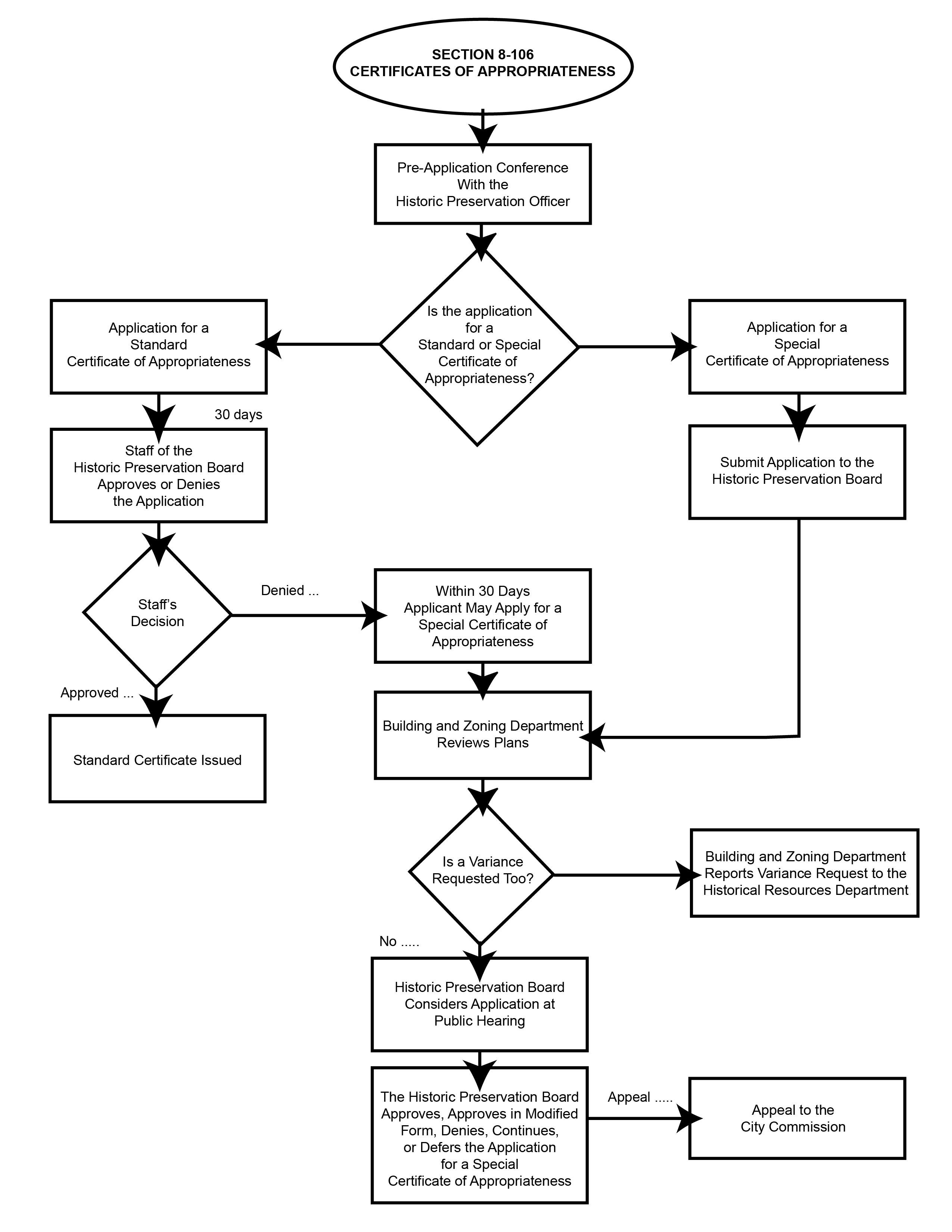
- Certificate Required.
No building, structure, improvement, landscape feature, or archaeological site within the City, which has been designated an historic landmark or historic landmark district, shall be erected, altered, restored, rehabilitated, excavated, moved, reconstructed or demolished until an application for a Certificate of Appropriateness regarding any architectural features, landscape features, or site improvements has been submitted and approved pursuant to the procedures in this Article. Unless otherwise specified, exterior alterations, additions, demolitions, etc. to non-contributing structures or properties within historical landmark districts shall be reviewed and approved by the Historic Preservation Board and/or Historical Resources Department.
- Guidelines for review of certificates.
- The Historic Preservation Board has adopted the U.S. Secretary of the Interior’s Standards for Rehabilitation as the standards by which applications for any Certificate of Appropriateness are to be measured and evaluated. In adopting these guidelines, it is the intent of the Board to promote maintenance, restoration, adaptive reuses appropriate to the property, and compatible contemporary designs which are harmonious with the exterior architectural and landscape features of neighboring buildings, sites and streetscapes. These guidelines shall also serve as criteria for staff to make decisions regarding applications for Standard Certificates of Appropriateness. From time to time, the Board may adopt additional standards to preserve and protect special features unique to the City.
- For applications related to alterations or new construction, the proposed work shall not adversely affect the historic, architectural, or aesthetic character of the subject improvement or the relationship and congruity between the subject improvement and its neighboring improvements and surroundings, including form, spacing, height, setbacks, materials, color, or rhythm and pattern of window and door openings in building facades; nor shall the proposed work adversely affect the special character of special historical, architectural or aesthetic interest or value of the overall designated historic landmark or historic landmark district. Except where special standards and guidelines have been specified in the ordinance creating a particular designated historic landmark or historic landmark district, or where the Board has subsequently adopted additional standards and guidelines for a particular designated historic landmark or historic landmark district, decisions relating to alteration or new construction shall be guided by the U.S. Secretary of the Interior’s standards for rehabilitation.
- Duration of approval of certificates.Unless otherwise provided in the Certificate of Appropriateness, both Standard and Special Certificates of Appropriateness shall expire after two (2) years if no building permit is issued. Staff may grant an extension of up to an additional one hundred and eighty (180) days for restoration or rehabilitation work subject to the following:
- Request for the extension is submitted in writing to the Historical Resources Department.
- The work completed is consistent with the approved scope of work.
- Preapplication conference.
Before submitting an application for a Certificate of Appropriateness, an applicant shall confer with the Historic Preservation Officer to obtain information and guidance before entering into binding commitments or incurring substantial expense in the preparation of plans, surveys, and other data. The Historic Preservation Officer or his/her representative, may, at the request of the applicant, hold additional preapplication conference(s) with the applicant. The purpose of such conference(s) is to further discuss and clarify conservation objections and design guidelines in cases that do not conform to established objectives and guidelines. In no case, however, shall any statement or representation made prior to the official application review be binding on the Board, the City Commission or any City departments.
- Standard certificates.
Based on the standards for rehabilitation, the designation report, a complete application for a Standard Certificates of Appropriateness, any additional plans, drawings or photographs to fully describe the proposed alteration and any other guidelines the Board may deem necessary, the Historic Preservation Officer (HPO) shall, withinthirty (30) days from the date a complete application has been filed, approve or deny the application for a Standard Certificate of Appropriateness by the owner of an existing improvement or landscape feature within the boundaries of a designated historic landmark or historic landmark district. The findings of the staff shall be mailed to the applicant accompanied by a statement in full regarding the staff’s decision. The applicant shall have an opportunity to challenge the staff’s decision by applying for a Special Certificate of Appropriateness within thirty (30) days of the date ofstaff’s findings.
- Special certificates.
- An applicant for a Special Certificate of Appropriateness, whether for alteration, addition, restoration, renovation, excavation, moving or demolition, shall submit his application to the Historic Preservation Board accompanied by full plans and specifications, site plan, and samples of materials as deemed appropriate by the Board to fully describe the proposed appearance, color, texture or materials, and architectural design of the building and any outbuilding, wall, courtyard, fence, landscape feature, paving signage, and exterior lighting. The applicant shall provide adequate information to enable the Board to visualize the effect of the proposed action on the applicant’s building and its adjacent buildings and streetscapes. If such application involves a designated archaeological zone, the applicant shall provide full plans and specifications of work that may affect the surface and subsurface of the archaeological site. An applicant may apply for an accelerated Certificate of Appropriateness that is reviewed by the Historic Preservation Board at the same meeting as the public hearing for designation of the subject property.
- The Development Services Department shall review all plans for alterations, additions, restoration or renovation of Historic Landmarks prior to the Board’s consideration of such Special Certificate of Appropriateness and shall report any variance items in connection with the proposed construction to the Historical Resources Department.
- In the event the applicant is requesting a Special Certificate for demolition, the Board shall be provided with the details for the proposed disposition of the site. The Board may require architectural drawings of any proposed new construction.
- An applicant requesting a Special Certificate of Appropriateness for a reconstructed building, whether for alteration, addition, restoration, renovation, excavation, moving or demolition shall follow the same process to receive the Board’s approval. A reconstructed building will be clearly identified for the public.
- A public notice of a request for a Special Certificate of Appropriateness shall be published one (1) time at least ten (10) days prior to the date of such hearing. All such notices published shall state in substance the request and shall give the date, time, and place of the public hearing. All properties being considered by the Historic Preservation Board for a request for a Special Certificate of Appropriateness shall be posted at least ten (10) days in advance of the public hearing. Such posting shall consist of a sign, the face surface of which shall be not be larger than forty (40) square inches and shall contain the following language:
Notice of Public Hearing
By [insert name of decision making body]
Phone [insert phone}
[insert email address]
Hearing date [insert date]
Application or hearing number [insert number]
- The posting of the property shall comply with Article 15 of these regulations.
- Appeal of Decision of Board. An appeal from any decision of the Historic Preservation Board may be taken to the City Commission by any aggrieved party in accordance with the provisions of Section 14-208.
- Decision of the Board.
- The decision of the Historic Preservation Board shall be based upon the guidelines set forth in Section 8-106(B) as well as the general purpose and intent of this Article and any specific planning objectives and design guidelines officially adopted for the particular historic landmark or historic landmark district. No decision of the Board shall result in an undue economic hardship for the owner, provided, however, that the Board has determined the existence of such hardship in accordance with the provisions of Section 8-115. The decision of the Board shall include a complete description of the reasons for such findings, and which details the public interest which is sought to be preserved, and shall direct one (1) or more of the following actions:
- Approval of a Special Certificate of Appropriateness for the work proposed by the applicant;
- Approval of a Special Certificate of Appropriateness with specified modifications and conditions;
- Denial of the application and refusal to grant a Special Certificate of Appropriateness for modification or demolition; or
- Approval of a Special Certificate of Appropriateness with a deferred effective date in cases of demolition or moving a significant improvement or landscape feature, pursuant to the provisions of Sections 8-107, 8-108 and 8-109.
- The Historic Preservation Board shall act upon an application within sixty (60) days of the Board’s receipt of the completed application adequately describing the proposed action. The Board shall approve, approve in modified form, deny, continue or defer the application. The time limit may be waived at any time by mutual written consent of the applicant and the Board.
- Evidence of approval of the application shall be by the recording in the minutes of theCertificate of Appropriateness granted by the Board.
- When an application is denied, the Board’s notice shall provide an explanation of the basis of the decision. When a Special Certificate of Appropriateness is granted, the proceedings of the Historic Preservation Board shall state the basis for granting the Special Certificate of Appropriateness. Such record shall be filed in the office of the Historical Resources Department, and shall be open for public inspection.
- A written record of the proceedings of the Board shall be kept and produced, showing its action on each Special Certificate of Appropriateness considered. The record when pertaining to the record of the Board or official from which appeal is taken shall include any application, exhibits, appeal papers, written objections, waivers or consents, considered by the Board as well as transcripts or stenographic notes taken for the department at a hearing held before the Historic Preservation Board, the Board minutes, and resolution indicating its decision.
- The decision of the Historic Preservation Board shall be based upon the guidelines set forth in Section 8-106(B) as well as the general purpose and intent of this Article and any specific planning objectives and design guidelines officially adopted for the particular historic landmark or historic landmark district. No decision of the Board shall result in an undue economic hardship for the owner, provided, however, that the Board has determined the existence of such hardship in accordance with the provisions of Section 8-115. The decision of the Board shall include a complete description of the reasons for such findings, and which details the public interest which is sought to be preserved, and shall direct one (1) or more of the following actions:
- Changes in approved work. Any change in work proposed subsequent to the issuance of a Certificate of Appropriateness shall be reviewed by the Board’s staff. If the Board’s staff finds that the proposed change does not materially affect the historic character, or the proposed change is in accord with approved guidelines, standards and certificates of appropriateness, it may issue a supplementary Standard Certificate of Appropriateness for such change. If the proposed change is not in accordance with guidelines, standards, or certificates of appropriateness previously approved by the Board, a new application for a Special Certificate of Appropriateness shall be required.
- Ordinary maintenance and repair. Nothing in this Article shall be construed to prevent the ordinary maintenance or repair of any improvement which does not involve a change of design, appearance or material, or to prevent ordinary maintenance of landscape features.
(Ord. No. 2024-03, 01/09/2024)
Section 8-107. Demolition.
- No permit for demolition of a designated building, structure, improvement or site shall be issued to the owner thereof until an application for a Special Certificate of Appropriateness has been submitted and approved pursuant to the procedures in this Article. Denial of such application indefinitely and refusal by the Board to grant a Special Certificate of Appropriateness to demolish shall be evidenced by written order detailing the public interest which is sought to be served. The Historic Preservation Board shall be guided by the criteria contained in subsection (D) below.
- The Board may grant a Special Certificate of Appropriateness to demolish with a deferred effective date. The effective date shall be determined by the Board based upon the significance of the structure and the probable time required to arrange a possible alternative to demolition. During the demolition deferral period, the Board may take such steps as it deems necessary to preserve the structure concerned, in accordance with the purposes of this Article. Such steps may include, but shall not be limited to, consultation with civic groups, public agencies and interested citizens, recommendations for acquisition of property by public or private bodies or agencies, and exploration of the possibility of moving one (1) or more structures or other features. After the specified expiration of the deferred Special Certificate of Appropriateness, a demolition permit shall be issued if requested forthwith by the appropriate administrative officials.
- As a condition of grantingany Certificate of Appropriateness, standard or special, for demolition of buildings or improvements designated as historic landmarks or located in an historic landmark district, the Board may require at the owner’s expense, salvage and preservation of specified classes of building materials, architectural details and ornaments, fixtures, and the like for reuse in restoration of other historic properties. The Board may also require, at the owner’s expense, the recording of the improvement for archival purposes prior to demolition. The recording may include, but shall not be limited to, photographs and scaled architectural drawings.
- In addition to all other provisions of this Article, the Board shall consider the following criteria in evaluating applications for a Special Certificate of Appropriateness for demolition of designated properties:
- The degree to which the building, structure, improvement or site contributes to the historic and/or architectural significance of the historic site or district;
- Whether the building, structure, improvement or site is one of the last remaining examples of its kind in the neighborhood, the county or the region;
- Whether the loss of the building, structure, improvement or site would adversely affect the historic and/or architectural integrity of the historic site or district;
- Whether the retention of the building, structure, improvement or site would promote the general welfare of the City by providing an opportunity for study of local history, architecture, and design or by developing an understanding of the importance and value of a particular culture and heritage;
- Whether architectural plans have been presented to the Board for the reuse of the property if the proposed demolition were to be carried out, and the appropriateness of said plans to the character of the historic site or district, if applicable; and demonstration as well as the posting of a bond requirement that there are sufficient funds in place to carry out such plans;
- Whether the building, structure, improvement or site poses an imminent threat to the public health or safety;
- Whether the applicant has demonstrated that retention of the building, structure, improvement or site would create an unreasonable or undue economic hardship as described in Section 8-115; and
- Whether there is a compelling public interest requiring the demolition.
- As a condition of granting a Certificate of Appropriateness for demolition, the Historic Preservation Board may require that no building permit be issued for the demolition of said structure until a building permit for the construction of a new building has been issued.
- The owner of the property shall permit access to the subject property for the purpose of inspections and/or appraisals required by the Historic Preservation Board or Historic Preservation Officer.
- All demolition permits for non-designated buildings and/or structures must be approved by the Historic Preservation Officer or designee. The approval is valid for eighteen (18) months from issuance and shall thereafter expire and the approval is deemed void unless the demolition permit has been issued by the Development Services Department. Any citizen may appeal the approval within 10 days of online posting. A completed designation report, as determined by the Historic Preservation Officer, must be submitted within 21 days of filing the notice of intent to appeal. The Historic Preservation Officer may require review by the Historic Preservation Board if the building and/or structure to be demolished is eligible for designation as a local historic landmark or as a contributing building, structure or property within an existing local historic landmark district. This determination of eligibility is completed by Historic Preservation Officer within 45 days of submittal and is preliminary in nature. The determination of eligibility will include criteria that was considered in the preliminary determination but is not included as an exhaustive list. The final report may include additional criteria or exclude others after further research is completed. The final public hearing before the Historic Preservation Board on Local Historic Designation shall be held as soon as practically possible and no later than within ninety (90) days from the Historic Preservation Officer determination of “eligibility.” Consideration by the Board may be deferred by mutual agreement by the property owner and the Historic Preservation Officer. The Historic Preservation Officer may require the filing of a written application on the forms prepared by the Department and may request additional background information to assist the Board in its consideration of eligibility. Independent analysis by a consultant selected by the City may be required to assist in the review of the application. All fees associated with the analysis shall be the responsibility of the applicant. The types of reviews that could be conducted may include the following: property appraisals; archeological assessments; and historic assessments.
- The damage, destruction, or demolition of any building, structure, improvement or site or portion thereof protected by this Article (a) for which a certificate of appropriateness for demolition has not been granted, or (b) which was carried out in violation of the provisions for demolition and demolition by neglect under the provisions of this Section, shall cause the City to reject an application for a building permit until the following criteria have been met:
- A pre-application shall be submitted to the Historical Resources Department containing the following information:
- A detailed sworn explanation outlining the facts surrounding the unlawful damage, destruction, or demolition.
- Evidence that any and all code enforcement fines have been paid.
- Evidence that all violations on the property have been corrected or a stipulation outlining the agreed upon steps to correct all outstanding violations.
- Review and approval of the Historical Resources Department checklist by the following departments so that the applications for issuance of a building permit may proceed.
- Building and Zoning.
- Planning.
- Public Works.
- Public Works Landscape Division.
- Historic Resources.
- City Manager.
- City Attorney.
- All approvals issued within the parameters of this section shall not be construed to be a development order and shall not be evidence of approval by any of the City’s departments of the building permit.
- A pre-application shall be submitted to the Historical Resources Department containing the following information:
- The ad valorem tax exemption provided for under Sections 8-118 through 8-120 does not apply to buildings, structures, improvements or sites that have been demolished in violation of this Section.
(Ord. No. 2023-03, 01/10/2023)
Section 8-108. Demolition by neglect.
- Demolition by neglect is any failure to comply with the minimum required maintenance standards of this Section, whether deliberate or inadvertent.
- The owner of any building, structure, landscape feature, improvement, site or portion thereof which has been historically designated pursuant to the Historic Preservation provisions of this Article shall be required to properly maintain and preserve such building or structure in accordance with the standards set forth in the applicable sections of the Florida Building Code, and this Article.
- It is the intent of this Section to preserve from deliberate or inadvertent neglect, the interior, exterior, structural stability and historic and architectural integrity of any historically designated building, structure, landscape feature, improvement, site or portion thereof. All such properties, building and structures shall be maintained in accordance to minimum maintenance standards, preserved against decay, deterioration and demolition and shall be free from structural defects through prompt and corrective action to any physical defect which jeopardizes the building’s historic, architectural and structural integrity; such defects shall include, but not be limited to, the following:
- Deteriorated and decayed facades or façade elements, facades which may structurally fail and collapse entirely or partially;
- Deteriorated or inadequate foundations;
- Defective or deteriorated flooring or floor supports or any structural members of insufficient size or strength to carry imposed loads with safety;
- Deteriorated walls or other vertical structural supports, or members of walls, partitions or other vertical supports that split, lean, list or buckle due to defective material or deterioration;
- Structural members of ceilings, roofs, ceiling and roof supports or other horizontal members which sag, split or buckle due to defective material or deterioration;
- Deteriorated or ineffective waterproofing of exterior walls, roofs, foundations or floors, including broken or missing windows or doors;
- Defective or insufficient weather protection which jeopardizes the integrity of exterior or interior walls, roofs or foundations, including lack of paint or weathering due to lack of paint or other protective covering;
- Any structure which is not properly secured and is accessible to the general public;
- Any fault or defect in the property that renders it structurally unsafe or not properly watertight; and
- The spalling of the concrete of any portion of the interior or exterior of the building.
- A City code enforcement official who finds a violation of this Section shall issue a written warning to the violator to immediately correct the violation. If any building, structure, landscape feature, improvement, site, or portion thereof which has been historically designated pursuant to the Historic Preservation provisions, in the opinion of the Historic Preservation Board, or the Historic Preservation Officer in this Article, or the City’s Building Official, falls into a state of disrepair so as to potentially jeopardize its structural stability and/or architectural integrity, and/or the safety of the public and surrounding structures, the Historic Preservation Officer or the City’s Building Official shall have right of entry onto the subject property and may inspect the subject property after forty-eight (48) hours notice to the owner of intent to inspect. In the event the property owner refuses entry of any City official onto the subject property, the City may file an appropriate action to allow such officials access to the subject property for an inspection. The City may require that the property owner retain a professional structural engineer with comprehensive experience with historically designated properties registered in the state, to complete a structural evaluation report to be submitted to the City. Upon receipt of such report, the property owner shall immediately take steps to effect all necessary remedial and corrective actions to restore the structure's or building's compliance with the required minimum maintenance standards herein; remedial action in this regard shall include, but not be limited to, the structural shoring, stabilization and/or restoration of any or all exterior walls, including their original architectural details, interior load bearing walls, columns and beams, roof trusses and framing, the blocking of openings and securing of existing windows and door openings, as well as sealing of the roof surface against leaks, including holes, punctures, mechanical systems, and/or roof penetrations as necessary to preserve the building or structure in good condition. The owner shall substantially complete such remedial and corrective action within thirty (30) days of receipt of the report, or within such time as deemed appropriate by the building official, in consultation with the Historic Preservation Officer. Such time may be extended at the discretion of the City's building official, in consultation with the Historic Preservation Officer.
- If the owner of the subject property, in the opinion of the City's Building Official and Historic Preservation Officer, fails to undertake and substantially complete the required remedial and corrective action within the specified time frame, the City may, at the expense of the owner, file an action seeking an injunction ordering the property owner to take the remedial and corrective action to restore the structure or building into compliance with the required minimum maintenance standards herein and seeking civil penalties, such civil action may only be initiated at the discretion of the City Manager or designee. The court shall order an injunction providing such remedies if the City proves that the property owner has violated the required minimum maintenance standards or any portion of this section or this code.
- Any historically designated building, structure, landscape feature, improvement, site, or portion thereof which requires an application for a certificate of appropriateness for demolition shall not have its architectural features removed, destroyed or modified until the certificate of appropriateness is granted. Owners of such property shall be required to maintain such properties in accordance with all applicable codes up to the time the structure is demolished.
- There shall be no variances, by either the Board of Adjustment or the Historic Preservation Board, from any of the provisions contained in this Section, except if the property owner demonstrates to the Board that the required remedial and corrective action would create an unreasonable or undue hardship as described in Section 8-115.
- It is the intent of this Section to preserve from deliberate or inadvertent neglect, the interior, exterior, structural stability and historic and architectural integrity of any historically designated building, structure, landscape feature, improvement, site or portion thereof. All such properties, building and structures shall be maintained in accordance to minimum maintenance standards, preserved against decay, deterioration and demolition and shall be free from structural defects through prompt and corrective action to any physical defect which jeopardizes the building’s historic, architectural and structural integrity; such defects shall include, but not be limited to, the following:
- The ad valorem tax exemption provided for historic properties under Sections 8-118 through 8-120 does not apply to historically designated buildings, structures, landscape features, improvements or sites that are damaged, destroyed or demolished in violation of this Section.
Section 8-109. Moving of existing improvements.
The moving of significant improvements from their original location shall be discouraged; however, the Historic Preservation Board may grant a Special Certificate of Appropriateness if it finds that no reasonable alternative is available for preserving the improvement on its original site and that the proposed relocation site is compatible with the historic and architectural integrity of the improvement.
Section 8-110. Removal or destruction of existing landscape features.
- No Certificate of Appropriateness shall be granted for removal, relocation, concealment, or effective destruction by damage of any landscape features or archaeological sites especially designated as significant within the boundaries of an historic landmark or historic landmark district unless one (1) of the following conditions exists:
- The designated landscape feature or archaeological site is located in the buildable area or yard area where a structure may be placed and unreasonably restricts the permitted use of the property;
- The designated vegetation is inappropriate in an historical context or otherwise detracts from the character of the district; or
- The designated vegetation is diseased, injured, or in danger of falling, unreasonably interferes with utility service, creates unsafe vision clearance or conflicts with other applicable laws and regulations.
- As a condition contained in the Certificate of Appropriateness, the applicant may be required to relocate or replace designated vegetation.
Section 8-111. Construction, excavation or other disturbance in archaeological zones.
In cases where new construction, excavation, tree removal, or any other activity may disturb or reveal an interred archaeological site, the Historic Preservation Board may issue a Certificate of Appropriateness, standard or special, with a delayed effective date up to forty-five (45) days. During the delay period, the applicant shall permit the subject site to be examined under the supervision of an archaeologist approved by the Board. A Certificate of Appropriateness may be denied if the site is of exceptional importance and such denial would not unreasonably restrict the primary use of the property.
Section 8-112. Reconstruction of destroyed historic landmarks.
- Except as provided in the Historic Preservation Code, in the event of a catastrophic occurrence, including fire, tornado, tropical storm, hurricane, other act of God, or major accidental damage not the fault of the owner which results in damage to an historic building, structure, landscape feature, improvement or site that:
- Exceeds fifty (50%) percent of the replacement value of the building or structure at the time of damage as determined by the building official after consultation with the Historic Landmark Officer. Upon a final determination of the Historic Preservation Board such building may be reconstructed, repaired or rehabilitated, and the building or structure’s total gross floor area, height, and setbacks may remain, if the following conditions are met:
- The number of units in a repaired or rehabilitated residential and/or hotel building shall not be increased.
- The building shall have previously been issued a certificate of use, certificate of completion, certificate of occupancy or occupational license by the City to reflect its current use.
- The repairs or rehabilitations shall meet the requirements of the City Code, the applicable Florida Building Code, and the Life Safety Code.
- The repairs or rehabilitations shall comply substantially with the Secretary of the Interior’s Standards for Rehabilitation, as amended, as well as the certificate of appropriateness criteria in Section 8-106.
- Is less than fifty (50%) percent of the replacement value of the building or structure at the time of damage as determined by the building official after consultation with the Historic Landmark Officer. Such building shall be reconstructed, repaired or rehabilitated, and the building or structure’s total gross floor area, height, and setbacks may remain, if the following conditions are met:
- The number of units in a repaired or rehabilitated residential and/or hotel building shall not be increased.
- The building shall have previously been issued a certificate of use, certificate of completion, certificate of occupancy or occupational license by the City to reflect its current use.
- The repairs or rehabilitations shall meet the requirements of the City Code, the applicable Florida Building Code, and the Life Safety Code.
- The repairs or rehabilitations shall comply substantially with the Secretary of the Interior’s Standards for Rehabilitation, as amended, as well as the Certificate of Appropriateness criteria in Section 8-106.
- Exceeds fifty (50%) percent of the replacement value of the building or structure at the time of damage as determined by the building official after consultation with the Historic Landmark Officer. Upon a final determination of the Historic Preservation Board such building may be reconstructed, repaired or rehabilitated, and the building or structure’s total gross floor area, height, and setbacks may remain, if the following conditions are met:
- For the reconstruction, repair, or rehabilitation of historically designated buildings, structures, landscape features, improvements, sites or portions thereof in violation of the demolition or demolition by neglect sections, please refer to Section 8-107 and Section 8-108.
Section 8-113. Variances.
The Historic Preservation Board shall have the authority to grant a variance from the terms of these regulations for those properties designated as local historic landmarks, either individual sites, buildings or structures within districts, where it is deemed appropriate for the continued preservation of the historic landmark or historic landmark district. The Board shall only authorize such variances in conjunction with an application for a Special Certificate of Appropriateness, in accordance with the provisions of Section 8-106 and Section 14-209.
Section 8-114. Transfer of development rights.
The Historic Preservation Board shall have the authority to grant certificates of transfer of development rights (TDR) to property owner(s) of designated historic landmarks, either individual sites or buildings within districts in accordance with the criteria and standards for transfer of development rights in Section 14-204 of these regulations. Any historic landmark that has transferred development rights shall not be demolished.
Section 8-115. Undue economic hardship.
A claim of undue economic hardship may only be asserted in conjunction with an application to the Historic Resources Department with an application for a Special Certificate of Appropriateness, in accordance with Section 8-106, which shall be considered by the Historic Preservation Board at a public hearing.
Application submittal and review requirements. The application shall be considered by the Historic Preservation Board within sixty (60) days of application submittal. Consideration by the Board may be deferred by mutual agreement by the property owner and the Historic Preservation Officer. The applicant filing the claim shall file a written application on the forms prepared by the Department. The application shall include an affidavit validating all submitted information. Independent analysis by a consultant selected by the City may be required to assist in the review of the application. All fees associated with the analysis shall be the responsibility of the applicant. The types of reviews that could be conducted may include the following: property appraisals; archeological assessments; and historic assessments. The Historic Preservation Board may also require the applicant to provide additional information to assist in its findings and determination of undue economic hardship.
As a minimum, the applicant shall provide at time of application, the following information:
- For all property:
- The amount paid for the property, the date of purchase and the name of the previous property owner(s).
- The assessed value of the land and all improvements thereon, according to the two (2) most recent Miami-Dade County property assessment records.
- Real estate taxes for the previous two (2) years.
- Annual debt service, if any, for the previous two (2) years.
- All appraisals obtained within the previous two (2) years by the property owner or applicant in connection with the purchase, financing or ownership of the property.
- Any property sale listing(s) of the property for sale or rent, price asked and offers received, if any.
- Any consideration by the property owner as to profitable adaptive uses for the property.
- Two (2) appraisals completed by two (2) separate State of Florida certified appraisers, completed within six (6) months of application submittal.
- For income producing property:
- Annual gross income received from the property and all improvements for the previous two (2) years.
- The assessed value of the land and improvements thereon, according to the two (2) most recent Miami-Dade County property assessment records.
- Annual cash flow, if any, for the previous two (2) years.
Section 8-116. Unsafe structures.
In the event the Building Official determines that any structure within a designated historic landmark or historic landmark district is unsafe pursuant to the applicable building code adopted by the City, he/she shall immediately notify the Historic Preservation Board with copies of such findings. Where reasonably feasible within applicable laws and regulations the building official shall endeavor to have the structure repaired rather than demolished and shall take into consideration any comments and recommendations by the board. The board may take appropriate actions to effect and accomplish preservation of such structure including negotiations with the owner and other interested parties, provided that such actions do not interfere with procedures in the Florida Building Code.
Section 8-117. Emergency conditions.
For the purpose of remedying emergency conditions determined to be imminently dangerous to life, health or property, nothing contained herein shall prevent the making of any temporary construction, reconstruction, demolition or other repairs to an improvement, landscape feature, or site within a designated historic landmark district pursuant to an order of a government agency or a court of competent jurisdiction, provided that only such work as is reasonably necessary to correct the hazardous condition may be carried out. The owner of an improvement damaged by fire or natural calamity shall be permitted to stabilize the improvement immediately and to rehabilitate it later under the normal review procedures of this Article.
Section 8-118. Scope of tax exemptions.
- A method is hereby created for the City Commission to allow tax exemptions for the restoration, renovation or rehabilitation of historic properties. The exemption shall apply to one hundred (100%) percent of the assessed value of all improvements to historic properties, which result from restoration, renovation or rehabilitation made on or after the effective date of this Article. The exemption only applies to taxes levied by the City. The exemption does not apply to taxes levied for the payment of bonds or to taxes authorized by a vote of the electors pursuant to Section 9(b) or Section 12, Article VII of the Florida Constitution. The exemption does not apply to personal property.
- The City of Coral Gables hereby elects to provide for an ad valorem tax exemption of fifty (50%) percent of the assessed value of certain commercial or not-for-profit historically designated properties. The exemption shall only apply to taxes levied by the City. The exemption does not apply to taxes levied for the payment of bonds or to taxes authorized by a vote of the electors pursuant to Section 9(b) or Section 12, Article VII of the Florida Constitution.
Section 8-119. Duration of tax exemptions.
Any exemption granted under this section to a particular property shall remain in effect for ten (10) years, as specified in the ordinance approving the exemption. The duration for ten (10) years shall continue regardless of any change in the authority of the City to grant such exemptions or any changes in ownership of the property. In order to retain an exemption, the historic character of the property must be maintained over the period for which the exemption was granted.
Section 8-120. Eligible properties and improvements.
- Property is qualified for an exemption under this section if:
- At the time the exemption is granted, the property is:
- Individually listed in the National Register of Historic Places pursuant to the National Historic Preservation Act of 1966, as amended;
- A contributing property within a National Register-listed district; or
- Individually listed in the Coral Gables Register of Historic Places, or noted as a contributing structure within a designated local historic district as enacted by ordinance of the City Commission.
- At the time the exemption is granted, the property is:
- In order for an improvement to an historic property to qualify the property for an exemption under Section 8-118, the improvement must be:
- Consistent with the United States Secretary of the Interior’s Standards for Rehabilitation; and
- Determined by the Historic Preservation Board to meet criteria established in rules adopted by the Department of State.
- Property is qualified for an exemption under Section 8-118.B. above if the property meets the following criteria: (1) the property must be used for commercial purposes or used by a not-for-profit organization under s. 501(c) (3) or (6) of the Internal Revenue Code of 1986; or (2) The property must be listed in the National Register of Historic Places, as defined in Florida Statutes section or (3) must be a local historic contributing property to a National Register Historic District; or must be a local historic landmark or a contributing property within a local historic district; and (4) The property must be regularly open to the public, which means that there are regular hours when the public may visit to observe the historically significant aspects of the building. This means a minimum of forty (40) hours per week, for forty-five (45) weeks per year, or an equivalent of eighteen hundred (1,800) hours per year. A fee may be charged to the public; however, it must be comparable with other entrance fees in the immediate geographic locale.
- Only those portions of the property used predominantly for the purposes specified in paragraph (c) shall receive the ad valorem tax exemption of fifty (50%) percent of the assessed property value. In no event shall an incidental use of property qualify such property for an exemption or impair the exemption of an otherwise exempt property.
- In order to retain the exemption, the historic character of the property must be maintained in good repair and condition to the extent necessary to preserve the historic value and significance of the property.
Section 8-121. Applications for tax exemption.
- Any person, firm or corporation that desires ad valorem tax exemption from the improvement of an historic property must, prior to construction, file with the Historical Resources Department a written application on an approved form.
- Any person, firm or corporation who is claiming the ad valorem tax exemption provided under Section 8-118.B. shall, on or before March 1 of each year, file an application for exemption with the Miami-Dade County Property Appraiser, describing the property for which exemption is claimed and certifying its ownership and use.
Section 8-122. Required restrictive covenant.
To qualify for an exemption, the property owner must enter into a restrictive covenant or agreement with the City Commission for the term for which the exemption is granted. The form of the covenant or agreement must be established by the Department of State and must require that the character of the property, and the qualifying improvements to the property, be maintained during the period that the exemption is granted. The covenant or agreement shall be binding on the current property owner, transferees, and their heirs, successors, or assigns. Violation of the covenant or agreement results in the property owner being subject to the payment of the differences between the total amount of taxes which would have been due in March in each of the previous years in which the covenant or agreement was in effect had the property not received the exemption and the total amount of taxes actually paid in those years, plus interest on the difference calculated as provided in F.S. 212.12(3).
Section 8-123. Review by Historic Preservation Board.
The Historic Preservation Board, or its successor, is designated to review applications for exemptions. The Historic Preservation Board may recommend that the City Commission grant or deny the exemption. Such reviews must be conducted in accordance with rules adopted by the Department of State. The recommendation and the reasons therefore must be provided to the applicant and to the City Commission before consideration of the application.
Section 8-124. Approval by the City Commission.
A majority vote of the City Commission shall be required to approve a written application for exemption. The City Commission shall include the following in the resolution or ordinance approving the written application for exemption:
- The name of the owner and the address of the historic property for which the exemption is granted.
- The period of time for which the exemption will remain in effect and the expiration date of the exemption.
- A finding that the historic property meets the requirements of this section.
Section 8-201. Purpose and applicability.
- The purpose of this Article is to maintain and preserve the architectural quality and character of Coral Gables' traditional, small scale, residential neighborhoods by encouraging the preservation of the existing Coral Gables Cottage style houses.
- The provisions of this Article may only be applied to the following:
- Any existing development which meets the eligibility standards contained in Section 3-302, herein (as determined by the Historic Resources Department).
- Any existing development which, by virtue of proposed development plans, would return sufficient original features to the building to render it eligible as a Coral Gables Cottage as provided in Section 3-302.
- Selected incentives are established in this Article which supersede the standard regulations for single-family residential development contained in other sections of these regulations. If not specifically addressed in this Article, the regulations and requirements of the underlying zoning district shall apply.
Section 8-202. Criteria for designation as a Coral Gables Cottage.
- Coral Gables Cottage is a detached, single-family dwelling which is distinguished by its movement in plan, projections and recessions, asymmetrical arrangement of entrances, frequently employed surface ornament for embellishment, and at least twelve (12) of the following specific features which are original with the cottage:
- Coral rock or stucco finish.
- Combination roof type (e.g., gable, shed, hip or flat roof).
- Front porch.
- Projecting bay on front elevation.
- Masonry arches or arches springing from columns on front elevation.
- Decorative doorway surrounds.
- Decorative and/or predominant chimney.
- Detached garage to the rear of the property.
- Similar decorative features, parapet and/or roof slope on main house and detached garage.
- Porte-cochere or carport.
- Decorative wing walls.
- Barrel tile roof.
- Varied height between projecting and recessed portions of the front elevation.
- Vents grouped as decorative accents.
- Cast ornament and/or tile applied to front elevation.
- Built-in niches and/or planters.
- First floor above crawl space.
- Casement or sash windows.
- Loggias/arcade.
- A cottage property must:
- Be designated as a local historic landmark.
- Be no more than one (1) story in height.
- Be zoned SFR.
- Have a frontage no greater than sixty-five (65) feet.
- Include a single-family dwelling built prior to 1940.
- Include a single-family dwelling having at least twelve (12) of the features identified in Section 8-202.A.
Section 8-203. Incentives for existing development.
The following setback provisions may be utilized by qualified cottage properties in order to modify, alter or add to an existing Coral Gables Cottage, provided that the resulting changes made to the dwelling do not diminish its character or its status as a Coral Gables Cottage.
- Setbacks:
- Notwithstanding the setback provisions in the underlying zoning district, new additions and alterations may utilize the same setbacks and extend as close to the property line as the main walls of the existing Coral Gable Cottage with the limitation that the addition/alteration may not be closer than two (2) feet, six (6) inches to the property line, and, when combined with all other existing structures may not result in the following:
- Side yard of less than two-hundred-and-fifty (250) sq. ft.
- Front yard of less than seven-hundred-and fifty (750) sq. ft.
- Rear yard of less than one-hundred-and-fifty (150) sq. ft.
- Where existing setbacks meet current standards, a reduction in the setback requirement of up to twenty five (25%) percent shall be permitted, with the same limitation outlined in subsection 1 above.
- Notwithstanding the setback provisions in the underlying zoning district, new additions and alterations may utilize the same setbacks and extend as close to the property line as the main walls of the existing Coral Gable Cottage with the limitation that the addition/alteration may not be closer than two (2) feet, six (6) inches to the property line, and, when combined with all other existing structures may not result in the following:
- Ground area coverage: Coral Gables Cottages shall be permitted to occupy up to forty-eight (48%) percent of the building site. Auxiliary buildings or structures, whether free standing or attached to the primary building, including swimming pools, may occupy additional site area provided, however, that the total ground area coverage for all structures shall not exceed fifty-eight (58%) percent of the site
- Enclosed garages may be converted to living space or storage space subject to the following requirements:
- That a carport or porte-cochere is provided for the storage of an automobile.
- That the converted garage may not be used as a rental unit.
- The landscape open-space requirement of forty (40%) percent for single-family dwellings may be reduced by ten (10%) percent.
(Ord. No. 2022-40, 07/25/2022)


