
Cottonwood Heights City Zoning Code
19.36 MU
Mixed Use Zone
19.36.010 Purposes
- The purposes of the MU zone are to provide areas in the city for a mix of uses, including mixed-use developments with commercial, institutional, office and service uses apportioned on-site in a manner sensitive to the street environment and adjacent uses; to support an urban village where amenities are focused on a local main street; to encourage and support transit-oriented development by allowing transit supportive density, where desired; and to enhance the accessibility of the Fort Union area and the Gateway Overlay District.
- The MU zone is intended to achieve cohabitation of uses, while ensuring that negative impacts on residents are minimized. The spaces created in the MU zone are intended to encourage a diminished need for motorized travel and shall possess characteristics (accomplished through roads, passages and sidewalks) that serve the needs of pedestrians, bicyclists and motor vehicle users while still allowing casual encounters of human beings at an intimate, or pedestrian, scale.
19.36.020 Permitted Uses
- Permitted uses in the MU zone include the following:
- Mixed-use residential buildings as defined in this chapter;
- Bed and breakfast;
- Churches;
- Commercial recreation;
- Convenience store without gasoline or convenience store/fast food combination without gasoline;
- Home occupations;
- Home day care/preschool, small (see Section 19.76.040[D]);
- Retail, gross square footage less than 25,000 square feet;
- Financial institutions;
- Community recreation services;
- Convenience retail stores;
- Restaurant or bar establishment, under 25,000 square feet of gross floor area;
- Shop for the manufacture of retail articles sold primarily on the premises;
- Government services;
- Public libraries and cultural exhibits;
- Open food stand/market/food truck, temporary;
- Professional office, administrative and medical buildings with a maximum of 25,000 gross square feet; and
- Grocery store, foodstuffs, retailing, or delicatessen with a maximum of 25,000 gross square feet.
Amended by Ord. 429 on 1/7/2025
19.36.030 Conditional Uses
- Conditional uses in the MU zone include the following:
- Home day care/preschool (see 19.76.040[E]);
- Child daycare/preschool;
- Convenience store with gas;
- Parks, playgrounds or community recreation;
- Public and private utility buildings or facilities;
- Residential facilities for persons with disabilities;
- Residential facilities for elderly persons;
- Schools;
- Grocery store, foodstuffs, retailing, or delicatessen greater than 25,000 gross square feet;
- Hotels;
- Retail, gross square footage greater than 25,000 square feet;
- Commercial schools;
- Professional office, administrative and medical buildings greater than 25,000 gross square feet;
- Restaurant or bar establishment, over 25,000 gross square feet;
- Indoor theatre;
- Garages (public); and
- Mixed-use self-storage.
- Unlike the NC zone, which is intended for smaller mixed-use developments potentially within established communities, the MU zone does not have a maximum allowed floor area for most uses. Such deregulation is intended to encourage those proposing larger commercial and residential developments to consider creating a mixed-use development rather than a regional commercial type development.
- Any applicant requesting an increase in height or decrease in setbacks which are standard in the MU zone, or any other variation based on permitted planning commission approval under this chapter, shall be considered a conditional use.
Amended by Ord. 429 on 1/7/2025
19.36.040 Mixed Use Building
A mixed-use building is a single building containing more than one type of land use, or a single development of more than one building and use, where the different types of land uses are in close proximity, planned as a unified complementary whole, and functionally integrated to the use of shared vehicular and pedestrian access and parking areas. An example of a mixed-use residential building with a retail storefront on the main floor and two floors of residential living above the main floor is below: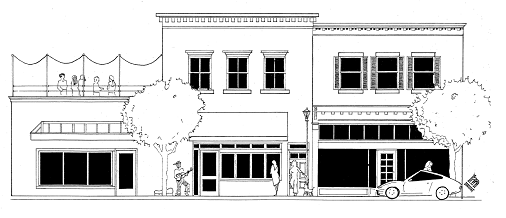
19.36.050 Maximum Height Of Structures
- For uses where the slope of the original ground surface is greater than 15%, or if a slope stability hazard is present on site, the maximum structure height shall be 30 feet.
- All other properties shall not exceed a height of two stories or 35 feet, whichever is less. The planning commission, after receiving a favorable recommendation from the DRC, may increase the maximum height of a structure in an MU zone to no more than three stories, upon a finding that such increased height will not adversely affect the public health, safety, or welfare.
Amended by Ord. 412 on 4/9/2024
19.36.060 Maximum Lot Coverage
In an MU zone, buildings shall not occupy more than sixty-five percent (65%) of the lot area, except portions of those properties also located in the Sensitive Lands Overlay Zone, for which the maximum lot coverage shall be 30% including all structures and impervious surfaces.
Amended by Ord. 412 on 4/9/2024
19.36.070 Development Standards
Any development in the MU zone shall conform to the city’s general plan, the standards of the city’s Gateway Overlay District (if applicable), and the standards of this chapter. The maximum density of any development in the MU zone shall not exceed 35 units per acre.
19.36.080 Minimum Lot Size
Except as may be required to meet minimum setbacks and any requirements providing for a minimum square footage of a building or structure, there are no minimum lot size requirements, provided that the density requirements of this chapter are met.
19.36.090 Setbacks, Yards And Other Requirements
- Yards and setbacks.
- The minimum front or side yard along a street shall be 20 feet; however, the planning commission may reduce or eliminate the setback if it abuts CR, MU, NC, ORD, or PF-zoned properties and finds that the reduction or elimination helps create a better designed development, and that the reduction or elimination will not adversely affect the public health, safety or welfare.
- Minimum side and rear yards of 25 feet shall be required for side or rear yards of a lot in an MU zone abutting a residential zone. For lots adjacent to a non-residential zone, the minimum setback shall be ten feet for side and rear yards not on a street; however, the planning commission may reduce the setback if it finds that the reduction helps to create a better designed development, and that the reduction will not adversely affect the public health, safety or welfare.
- Building orientation.
- All single-family attached homes and multi-family residential complexes shall have their primary orientation to the street. Entrances to multi-family buildings may include entrances to individual units or breezeway/courtyard entrances; or
- All single-family attached homes and multi-family residential complexes may have their primary orientation to a side yard when a direct pedestrian walkway is provided between the main entrance and the street, with at least one entrance located not more than 20 feet from the curb line of the street.
- Design guidelines and standards. All mixed use developments shall comply with the provisions of the city’s design guidelines available through the community and economic development department and on the city website.
19.36.100 Use Of Existing Structures
The continued use of an existing structure in the MU zone is permitted, provided that the structure meets the requirements of this chapter and any other applicable ordinances.
19.36.110 Site Plan Required
Developments in the MU zone must submit a site plan, which is subject to planning commission approval.
19.36.130 Screening
- All trash or refuse receptacle areas shall be completely screened from surrounding properties by a masonry wall or screening that is a minimum of six feet high with visually obscuring painted metal gates or shall be enclosed within a building. Any trash or refuse receptacle area shall be a minimum of 50 feet from any residential or agricultural zone boundary or property containing a residential or agricultural use.
- All ground-mounted mechanical equipment (including, without limitation, heating and air conditioning units) shall be completely screened from surrounding properties by a masonry wall or shall be enclosed within a building.
- The use of roof appurtenances is discouraged. If roof appurtenances (including, without limitation, air conditioning units and mechanical equipment) are used, they shall be placed within an enclosure at least as high as such roof appurtenances that reflects the architectural design scheme of the project and complies with the requirements for penthouses and roof structures of the city’s building code. Such enclosures require planning commission approval, and shall minimize visibility from on-site parking areas, adjacent public streets, and residential or rural residential zoned property. Landscaping and/or rooftop patio equipment and screening may be used to screen mechanical and other rooftop equipment, as approved as part of a site plan. The landscaped area may not be enclosed or screened in such a way so as to create permanent occupancy space.
- All utility connections shall be compatible with the architectural elements of the site and not be exposed except where necessary. Pad-mounted transformers and/or meter box locations shall be included in the site plan with an appropriate screening treatment. Power lines and other utility cables shall be installed underground where possible.
- Loading areas and docks shall be screened by landscaping and/or visual barriers from adjacent properties and public streets.
- All development located in a Gateway Overlay District shall comply with the stated goals and standards of that district.
19.36.140 Landscaping Requirements
All developments one acre or more in size shall dedicate at least 15% of the lot to landscaping, including, without limitation, landscape buffers, seating areas, natural walking paths separate from sidewalks, and so on. Drought resistant plants are encouraged. Further,
- All developments in the MU zone shall provide a landscaped buffer between any commercial development and any adjoining residential zone. The landscaped buffer shall be at least eight feet wide, and shall include trees planted at least every 30 feet on center. This requirement may be included within the side and rear setbacks of the MU zone.
- Developments in the MU zone are intended to blend with the surrounding land uses, whether they are residential or non-residential. For that reason, the landscaped buffer should not be used as an obstructing barrier between land uses, but instead should provide a landscaped transition between uses and pedestrian walkways and trails.
19.36.150 Site Plans
In this chapter, a “site plan” means a plan or set of plans for a single building or series of buildings containing the primary land use, or a single development of more than one building and use, where the different types of land uses are in close proximity, planned as a unified complementary whole, and functionally integrated to the use of shared vehicular and pedestrian access and parking areas. Uses in the MU zone are intended to contain a mix of uses, including general, professional office, medical or dental offices, retail and/or residential dwelling units uses.
- Uses in the MU zone over 25,000 square feet of gross leasable area shall be reviewed for building design, scale and architectural compatibility with established design principles by the city’s architecture review commission (the “ARC”). The ARC shall make a recommendation regarding the proposed use to the planning commission.
- The following criteria shall be considered by the ARC and the planning commission when reviewing a site plan(s) for uses over 25,000 square feet:
- Detailed building elevations and color/material boards shall be submitted to and reviewed by the ARC prior to any consideration by the planning commission of an application for site plan approval.
- Exterior building materials must be approved by the ARC, and shall match the quality, texture and architectural intent of surrounding buildings, if applicable, and the intent and regulations of any applicable overlay zone design guidelines.
- All buildings shall have a minimum of 15% transparency on all floors, which shall consist of windows that provide visibility from the public right-of-way or adjacent property.
- Buildings with more than one story shall be designed to have the appearance and function of a multi-story building through the use of windows, doors, awnings, canopies and other appropriate building and architectural elements.
- The front facade of buildings, visible from the public right of way, shall be designed to have ample bulk and massing and design quality to adequately establish a prominent, pedestrian-oriented streetscape.
- External unit doors must be screened from neighboring land uses to an extent determined appropriate by the ARC based on the potential impact to surrounding land uses.
- Signage. Approval of signage is subject to the applicant meeting the regulations contained herein and in other pertinent chapters of this title. Signage in mixed-use self-storage facilities shall be limited to wall, monument and projecting signs as outlined below.
- Wall signs for uses in the MU zone are:
- Limited to one sign for each separate principal use for each unit, suite or other division of the building whose business facade fronts on a public street.
- Limited to no more than ten percent of the business facade frontage for each associated principal use.
- No sign shall exceed six feet in overall height.
- Signage is limited to individual pan-channel lettering only. Cabinet signs are not permitted.
- Monument signs for the uses in the MU zone are:
- Limited to one sign along an adjacent public street for each building facade which fronts that street.
- Limited to a total of 48 square feet of signable area.
- Limited to a maximum height of six feet, including the pedestal.
- Projecting signs for mixed-use self-storage facilities may be used in lieu of wall signs and:
- Are limited to no more than ten percent of the business facade frontage for each associated principal use.
- Shall maintain a vertical clearance of at least eight feet, and no more than 18 feet, from the adjacent sidewalk, drive area or other adjacent ground.
- Wall signs for uses in the MU zone are:
- No resident manager apartment shall be allowed in mixed-use self-storage facilities unless at least 50% of secondary uses are residential.
- No outside storage of vehicles, boats, motor homes, RVs or any other materials or equipment shall be allowed at or around any mixed-use facility.
- Commercial moving truck rentals shall be prohibited at mixed-use self-storage facilities. A mixed-use self-storage facility shall be allowed to have no more than two private moving trucks owned and operated by the facility and available only to the renters of units within the facility. Moving trucks meeting the above regulation shall be stored out of sight of the public way.

