Cottonwood Heights City Zoning Code
19.80 Off
Street Parking Requirements
19.80.010 Purpose
The purpose of this chapter is to reduce congestion and traffic hazards on public rights of way by requiring adequate, functional, and effective use of off-street parking areas. This chapter also establishes minimum landscaping requirements in order to reduce adverse impacts of headlight glare and lighting within the parking area; improve circulation within parking areas by channeling vehicles and pedestrians; provide climatic relief from broad expanses of pavement; and improve the appearance of the site and surrounding neighborhood.
19.80.020 Required Parking
Off-street parking shall be provided according to standards noted in this chapter for all newly constructed buildings and additional parking shall be provided for any structure or use that is expanded.
19.80.030 General Provisions
- Materials for Parking Areas. Parking areas shall consist of a paved surface as defined in this title.
- Maintenance of Parking Areas. Pavement, striping, landscaping, and lighting are required to be maintained in all parking areas. During times of snowfall, parking areas shall be cleared of snow as soon as is practically possible and otherwise in accordance with this code.
- Parking Area Access. Parking areas for one or more structures may have a common access. The determination of the locations for a common access shall be based upon the geometry, road alignment, and traffic volumes of the accessed road. All structures other than residential are required to provide parking areas wherewith automobiles will not back across a sidewalk to gain access onto a public street.
- Lighting in Parking Areas. Parking areas shall have adequate lighting to ensure the safe circulation of automobiles and pedestrians. Such lighting shall be shielded in such a way as to not be a nuisance to, or otherwise adversely affect, adjacent properties or uses.
- Location of Parking Areas. Required off-street parking areas for non-residential uses shall be placed within 600 feet of the main entrance to the building.
- Storm Water Runoff. All parking areas other than single family and two family dwellings shall be reviewed and approved by the city engineer for adequate drainage of storm water runoff.
Amended by Ord. 397 on 7/11/2023
19.80.040 Submittal And Approval Of Parking Areas
Plans depicting the parking areas for newly constructed buildings and expanded structures or uses shall be submitted in conjunction with a site plan for all non-residential and multiple family residential development. Single and two-family dwellings may submit a plan with applications for building permits that shows driveways and other areas to be dedicated to parking. All other parking plans shall show the following: the required number of stalls and aisles scaled to the correct dimensions, the correct number of handicapped accessible parking spaces, storm water drainage capabilities, lighting, landscaping and irrigation, and pedestrian walkways.
19.80.050 Assessing Parking Requirements
The following criteria shall be used in conjunction with the standards of the ITE Summary of Parking Generation Rates referred to in Section 19.80.110 when determining required parking for any project:
- When a parking requirement is based upon square footage, the assessed parking shall be based upon net square footage of the building or use.
- When parking requirements are based upon the number of employees, parking calculations shall use the largest number of employees who work at any one shift. Where shifts changes may cause substantial over-crowding of parking facilities, additional stalls may be required.
- When a development contains multiple uses, more than one parking requirement may be applied.
- Where no comparative land use standard for parking is found in the publication referenced in Section 19.80.110, the city’s Development Review Committee or planning commission shall determine an appropriate requirement.
- Any information provided by the developer relative to trip generation, hours or operation, shared parking, peak demands or other information relative to parking shall be considered when evaluating parking needs.
- Parking requirements may deviate from the standards contained in Section 19.80.110 when the city’s Development Review Committee or planning commission determines that the deviation meets the intent of this chapter.
19.80.060 Dimensions For Parking Stalls
- The dimensions of parking stalls and aisles contained within the parking areas shall be dependent upon the orientation of stalls. The table titled “Dimensions for Parking Stalls and Aisles” under Section 19.80.130 details these standards, and any deviation to these standards must be recommended by the city engineer and approved by the planning commission.
- Tandem parking spaces are allowed, provided that in all uses other than single family residences, only the space with direct access to the driveway or street shall count toward meeting the minimum parking requirements under Section 19.80.120. “Tandem parking spaces” means the placement of parking spaces one behind the other, so that the space nearest the driveway or street access serves as the only means of access to the other space.
19.80.070 Handicapped Accessible Parking
- Handicapped parking stalls shall be provided in off-street parking areas and shall count towards fulfilling the minimum requirements for automobile parking.
- Handicapped parking stalls shall be located as near as practical to a primary building entrance with access ramps negotiable for equipment used in assisting handicapped persons. A permanently affixed reflective sign and/or surface identification painting depicting the standard symbol for handicapped parking shall identify each parking stall.
- The number of handicapped parking stalls shall conform to the minimum requirements of the Americans with Disabilities Act (ADA) and the table detailed in Section 19.80.130.
- The dimensions of handicapped parking stalls shall be thirteen (13) feet by twenty (20) feet or such standard as may be required by the ADA.
19.80.080 Landscaping In Parking Areas
The following requirements shall apply to all landscaping of off-street parking areas:
- Parking Areas Adjacent to Public Streets. All parking areas for non-residential or multi-family residential uses, which are adjacent to public streets, shall create a landscaped strip of not less than ten feet in width placed between the sidewalk and the parking area. Trees, both deciduous and evergreen, shall be placed in the strip with spacing of no less than 30-foot intervals.
- Curbs. All landscaped areas abutting any paved surface shall be curbed. Boundary landscaping around the perimeter of the parking areas shall be separated by a concrete curb six inches higher than the parking surface.
- Clear Sight. At intersections of streets, driveways, and sidewalks all landscaping shall be limited to a height of not more than three feet. The grade at such intersections shall not be bermed or raised for a distance of 30 feet at intersections and 15 feet back from driveways to allow for sight distance.
- Components of Landscaped Areas. All landscaped parking areas shall consist of trees, shrubs, and groundcover. Areas not occupied by structures, hard surfaces, vehicular driveways, or pedestrian walkways shall be landscaped and maintained. All landscaped areas shall have an irrigation system.
- Required Parking Islands.
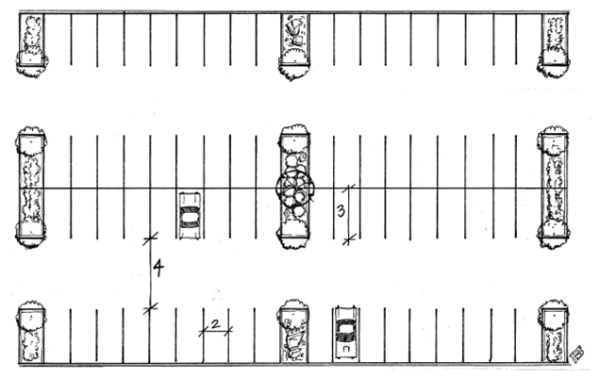
- Islands on Doubled Rows of Parking. On doubled rows of parking stalls, there shall be one landscaped island measuring 36 feet by 9 feet on each end of the parking rows, plus one landscaped island measuring 36 feet by 9 feet placed at minimum of every 20 parking stalls. Each island on doubled parking rows shall include a minimum of two trees per planter.
- Islands on Single Rows of Parking. On single rows of parking or where parking abuts a sidewalk, there shall be one landscaped island measuring 18 feet by 9 feet a minimum of every ten stalls. Islands on a single parking row shall have a minimum of one tree planter.
- Landscaped islands at the ends of parking rows shall be placed and shaped in such a manner as to help direct traffic through the parking area. There shall be a break in parking rows at a minimum of 40 parking stalls for each double row of parking for the purpose of facilitating traffic circulation on the site.
- Landscaped Boundary Strips. All landscaped boundary strips shall be a minimum of five feet in width. A landscaped screen, berming or fence may be required by the planning commission or city council around the perimeter of the parking area to mitigate intrusion of lighting from headlights and other lighting on surrounding property.
- Completion of Landscaping. All landscaping improvements shall be completed in accordance with the approved site plan, landscape-planting plan, and irrigation plan and occur prior to the issuance of a certificate of occupancy for the building. Exceptions may be permitted and certificates of occupancy issued where weather conditions prohibit the completion of required landscaping improvements. In such cases, an extension period of up to six months is permitted upon posting of a bond for not less than 110% of the value of the landscaping, which shall be held until the requirements of this chapter are met.
- Snow Stacking Capacity. Every parking lot design shall plan for a snow stacking area to accommodate the stacking volume of a one foot snow base over the entire parking lot.
19.80.100 Pedestrian Walkways And Accesses
Parking lots larger than 75,000 square feet shall provide raised or delineated pedestrian walkways. Walkways shall be a minimum of ten feet wide and shall be placed through the center of the parking area, or any area where pedestrian traffic will be obvious, and extend to the entrance of the building. Landscaped islands along the center walkway shall be placed at a minimum interval of every 30 feet. Landscaped islands are encouraged to be offset from one another to create a feeling of greater coverage. Covered pedestrian walkways may be substituted for tree-lined walkways. Where the developer desires to have a driveway access at the center of the parking area, a pedestrian access shall be placed on either side of the driveway.
19.80.110 Shared Parking And Curb Cuts
- Up to 50% of the required parking may be shared with the other required parking areas upon approval by the planning commission. The developer must show:
- An agreement granting shared parking or mutual access to the entire parking lot.
- A professional traffic engineer shall provide peak demand data showing that shared parking is feasible.
- In most cases, shared parking areas shall also share ingress and egress. This requirement may be waived when the city engineer believes that shared accesses are not feasible. In reviewing the site plan, the city engineer shall evaluate the need for limited access, appropriate number of curb cuts, shared driveways or other facilities that will result in a safer, more efficient parking and circulation pattern.
19.80.120 Required Parking By Land Use
The city adopts the ITE manual of parking generation rates. The city requirement shall be the average rate of parking for the most intense parking period listed in the most current edition of such publication for each land use.
19.80.130 Charts And Graphs
Dimension for Parking Stalls and Aisle
| Parking Angle | Stall Width | Stall Length | Aisle Width | Aisle Width* |
| Parallel | 9’ | 20' | 12' | |
| 45 | 9’ | 18’ | 25' | 14' |
| 60 | 9’ | 18’ | 25' | 18' |
| 90 | 9’ | 18’ | 24' | 24' |
* One-way traffic only
ADA Parking Requirements
| Total Parking Stalls in Lot | Minimum Handicapped Accessible Stalls |
| 1-25 | 1 |
| 26-50 | 2 |
| 51-75 | 3 |
| 76-100 | 4 |
| 101-150 | 5 |
| 151-200 | 6 |
| 201-300 | 7 |
| 301-400 | 8 |
| 401-500 | 9 |
| 501-999 | 2% of Total Stalls |
| Over 1000 | 20 Stalls plus 1 stall for every 100 stalls thereof over 1000 |
Parking stall configuration with illustration
| Stall Angle: | 0° | 30° | 45° | 60° | 90° |
| Stall Width: | 9’0” | 18’0” | 12’9” | 10’5” | 9’0” |
| Stall Depth: | 22’0” | 17’10” | 20’7” | 21’10” | 18’0” |
| Driveway | |||||
| One-way: | 12’0” | 14’0” | 14’0” | 18’0” | 24’0” |
| Two-way: | 17’0” | 17’0” | 17’0” | 18’0” | 24’0” |