
Cottonwood Heights City Zoning Code
19.76 Supplementary
And Qualifying Rules And Regulations
19.76.010 Effect Of Chapter Provisions
The rules and regulations hereinafter set forth in this chapter qualify or supplement, as the case may be, the zone regulations appearing elsewhere in this title.
19.76.020 Lots And Lot Area
- Lots in separate ownership. The requirements of this title as to minimum lot area or lot width shall not be construed to prevent the use for a single-family dwelling of any lot or parcel of land, provided that such lot or parcel of land is located in a zone which permits single-family dwellings, and is a legally divided lot held in separate ownership at the time such requirements became effective for such lot or parcel of land.
- Separately owned lots—Reduced yards. On any lot under a separate ownership from adjacent lots and of record at the time of passage of the ordinance codified herein, and such lot having a smaller width than required for the zone in which it is located, the width of each of the side yards for a dwelling may be reduced to a width which is not less than the same percentage of the width of the lot as the required side yard would be of the required lot width; provided that, on interior lots, the smaller of the two yards shall be in no case less than five feet, or the larger less than eight feet; and for corner lots, the wide yard on the side street shall be in no case less than 15 feet or the other side yard be less than five feet.
- Division of a two-family dwelling. Upon certification by the director, a legal, or legal non-conforming, existing or proposed two-family dwelling may be divided into attached single-family dwellings by dividing the lot. Each dwelling shall have a minimum lot area equal to one-half of the minimum lot area required in the zone for a two-family dwelling, which in no case shall be less than 4,000 square feet, and must meet all building, fire, health, parking and other requirements for a single-family dwelling. An application for lot division certification must be accompanied by a site plan showing buildings, landscaping, parking, and any other information deemed necessary by the director. The director may attach conditions to certification consistent with the purpose of the zoning ordinance. Any sale (prior to certification herein) dividing a lot occupied by a two-family dwelling shall be a misdemeanor.
- Sale of lots below minimum width and area. No parcel of land which has less than the minimum width and area requirements for the zone in which it is located may be cut off from a large parcel of land for the purpose, whether immediate or future, of building or development as a lot, except by permit of the appeals hearing officer.
- Sale of space needed to meet requirements. No space needed to meet the width, yard, area, coverage, parking or other requirements of this title for a lot or building may be sold or leased away from such lot or building.
- Yard space for one building only. No required yard or other open space around an existing building, or which is hereafter provided around any building for the purpose of complying with the provisions of this title shall be considered as providing a yard or open space for any other building; nor shall any yard or other required open space on an adjoining lot be considered as providing a yard or open space on a lot whereon a building is to be erected or established. This section shall be so construed to mean only one main building may be permitted on one lot, unless otherwise provided in this title.
- Front yard measurement from map. Wherever a front yard is required for a lot facing on a street for which an official map has been recorded in the office of the city recorder, the depth of such front yard shall be measured from the mapped street line provided by the official map.
19.76.030 Structures, Bulk And Massing Requirements
- Dwellings, including guest homes, on lots.
- Every dwelling shall be located and maintained on a lot, as defined in this title. Except for group dwellings and guest houses, not more than one dwelling structure shall occupy a lot.
- Guest houses shall be a permitted use in the following zones:
- R-1-8; R-1-10; and R-1-15
- RR-1-21; RR-1-29; and RR-1-43
- F-1-21; and F-1-43
- F-20
- The guest house shall be a detached accessory use to a principal residence and shall be located in the rear yard of the principal lot.
- The maximum allowed area of the guest house shall not exceed 25% of the area of the rear yard.
- The floor area of the guest house and principal residence combined shall not exceed the maximum impervious surface coverage for the site.
- The rental or lease of a guest house, or the use of a guest house as a permanent residence for a second family on the premises shall be prohibited.
- Installation of separate utility meters for the guest house is prohibited.
- All bulk and massing requirements for accessory buildings, as per the applicable zone, shall be applicable to the guest house.
- Accessory buildings—Area of coverage and building area.
- No accessory building or group of accessory buildings in any residential zone shall cover more than 25% of the rear yard. Accessory buildings in any residential zone except a rural residential zone shall not have a floor area greater than 70% of the floor area of the primary structure.
- Accessory buildings shall not be constructed before the principal/main building is constructed.
- Minimum yard area requirements for accessory buildings are as follows:
- Unless otherwise expressly permitted in an underlying zone, no accessory building shall be located in a front, side, or corner side yard area of any lot, including a detached ADU.
- Except as otherwise provided in this title, no accessory building shall exceed 20 feet in height. Further, for every foot of height over 14 feet, accessory structures shall be set back from property lines an additional foot from the minimum setback to allow a maximum height of 20 feet.
- Except as otherwise provided in this title, the following setbacks from property lines shall apply, based on accessory structure height:
- Accessory building height up to 14 feet: Three foot setback;
- Accessory building height up to 15 feet: Four foot setback;
- Accessory building height up to 16 feet: Five foot setback;
- Accessory building height up to 17 feet: Six foot setback;
- Accessory building height up to 18 feet: Seven foot setback;
- Accessory building height up to 19 feet: Eight foot setback; and
- Accessory building height up to 20 feet: Nine foot setback;
- Any detached ADU shall maintain a setback of at least six feet from the main building in the rear yard of the property and shall be subject to all primary structure setback standards for the zone in which it is located.
- Distance requirements between structures.
- All enclosed buildings/structures shall be separated by a minimum distance of six feet.
- Open-air accessory structures are exempt from the minimum six-foot building separation requirement, provided they are constructed in compliance with applicable building codes and maintain a minimum setback of five feet from any property line.
- All enclosed buildings/structures shall be separated by a minimum distance of six feet.
- All accessory structures shall comply with applicable setbacks, public easements, and fire code requirements. Electrical, plumbing, gas line, or other utility installations associated with any accessory structure shall require a building permit, regardless of whether the structure is less than 200 square feet in size.
- Public use—reduced lot area and yards. The minimum lot area and minimum yard requirements of this title may be reduced by the planning commission for a public use. The planning commission shall not authorize a reduction in the lot area or yard requirements if rule 19.76.030(H), “Additional height allowed when,” is in use, or unless the evidence presented is such as to establish that the reduction will not, under the circumstances of the particular case, be detrimental to the health, safety or general welfare of persons residing or working in the vicinity, or injurious to property or improvements in the vicinity.
- Structure height — Vertical measurement.
- Structure height shall be measured by taking the average vertical distance measured at the four corners of the main structure. This measurement shall be taken from the original natural grade of the lot to the highest point of the roof structure. In cases where the four corners of the structure are not explicitly clear, the city’s building official and the director shall designate the four corners of the structure.
- Structures may be stepped to accommodate the slope of the terrain provided that each step shall be at least 12 feet in horizontal dimension. The height of each stepped segment shall be measured as required in Subsection (A).
- Original ground surface shall be the elevation of the ground surface in its natural state before any manmade alterations such as, without limitation, grading, excavation or filling, excluding improvements required by zoning or subdivision ordinances. When the elevation of the original ground surface is not readily apparent because of previous manmade alterations, the elevation of the original grade shall be determined by the director using the best information available.
- Structure height determined to be within five feet of the maximum height allowance shall require height verification at the 4-way inspection, or its equivalent. Structure height determined to be within one foot of the maximum height allowance shall require height verification at the foundation and 4-way inspections, or their equivalents.
- Lot grade – measurement. The percent grade of a lot shall be derived by determining the percent increase or decrease in elevation using the area of the proposed structure footprint and the front yard.
- Height limitations—Buildings less than one story. No building shall be erected to a height less than one story above grade.
- Height limitations—Exceptions. In the ORD, CR, MU, NC, RO and PF zones, penthouse or roof structures for the housing of elevators, stairways, tanks, ventilating fans or similar equipment required to operate and maintain the building may be erected above the height limits prescribed in this title when approved by the planning commission, but no space above the height limit shall be allowed for the purpose of providing additional floor space. In the case of conflicting provisions, the stricter requirement shall apply.
- Additional height allowed when. Public or semipublic utility buildings, when authorized in a zone, may be erected to a height not exceeding 40 feet if the building is set back from each otherwise established building line at least one foot for each additional foot of building height above the normal height limit required for the zone in which the building is erected.
- Story, first. The lowest story in a building that qualifies as a story, except that a floor level in a building having only one floor level shall be classified as a first story. Where a floor in a building is more than four feet below existing grade for more than 50 percent of the total perimeter of the building, or more than eight feet below existing grade at any point, that floor will not qualify as a story for the purposes of measuring maximum structure height.
- Yard requirements. “Yard” means a space on a lot, other than a court, unoccupied and unobstructed from the ground upward by buildings or structures, except as follows:
- Fences;
- The ordinary projections of windows where the projection is at least 18 inches above floor level, awnings, parapets, relief carvings, roofs, cornices, chimneys, flues, and other ornamental features which project into a yard not more than three feet;
- Open or lattice-enclosed exterior stairways, located in a commercial or manufacturing zone, projecting into a yard not more than five feet;
- Structures less than 18 inches in height from the finished ground surface; and
- In case of rear setback, an uncovered landing or uncovered walkout porch connected to the rear of a residential dwelling that is no more than 32 square feet in size and is used for ingress to and egress from the rear of the residential dwelling.
- Demolition permits.
- An approved site plan is required before a commercial building can be approved for demolition.
- The following items must be submitted to obtain a demolition permit:
- An asbestos inspection from an approved asbestos inspector.
- A completed and approved “Pre-demolition Building Inspection Form” from Salt Lake Valley Health Department.
- Approval for demolition from the Utah Division of Air Quality.
- A letter or email, from all service providers to the property or structure, indicating that all utilities have been terminated.
- A completed city building permit application.
- Portable storage containers. In all municipal, residential, commercial, office or mixed-use zone, portable storage containers are permitted only in accordance with the following:
- As a temporary use, not to exceed 180 days, during the construction, remodeling or redevelopment of a permanent on site structure with a valid building permit.
- In no case shall a lot contain more than one of such portable storage containers, nor shall any portable storage container be located in required landscape areas, front yard area, required open space, detention basins, drive aisles, fire lanes, required parking spaces, loading zones or any other location that may cause a threat to public safety, or create a condition detrimental to surrounding land uses and property owners.
- For commercial, office and mixed-use zones a temporary site plan must be submitted for review by the department. Approval of more than one portable storage containers may be approved by staff if the DRC finds that the addition will not jeopardize the public health, safety or welfare or create a nuisance. In addition, the temporary use of portable storage containers shall not violate a conditional use approval.
- Construction mitigation plan for all construction. Prior to commencement of construction, a written construction mitigation plan addressing the following elements must be approved by the director or his designee. The construction mitigation plan shall address the following elements: (Please note: all elements may not apply to each individual project. There may also be additional elements, unique to the project that involve public health and safety issues).
- Hours of operation. The hours of operation are 7:30 AM to 6:00 PM, Monday thru Saturday, and 9:00 AM to 6:00 PM on Sunday. Upon a clear and convincing showing by the applicant that a waiver to the hours of operation is necessary and will not jeopardize the public health, safety or welfare, the director may modify hours of operation through the building permit. Exclusively indoor construction beyond the hours of operation listed above in this subsection shall be exempt from such hours of operation unless the director determines that such extended hours will adversely impact the surrounding neighborhood.
- Parking. Construction vehicle parking shall be restricted at construction sites so as to not block reasonable public and safety vehicle access along the street and sidewalks. Within paid and permit only areas, an approved parking plan must be obtained from the Public Works Department.
- Deliveries. Deliveries of all materials and supplies may be regulated as to time (hours of operation) and routing.
- Stockpiling & staging. In order to reduce the number of delivery trips to construction sites, the stockpiling of materials on site may be required.
- Construction phasing. Due to narrow streets, topography, small lot configuration, traffic circulation, weather, construction parking and material staging problems, some projects may be required to be phased. In cases where phasing is deemed necessary, the first project to receive a building permit shall have priority, however, the building official shall have authority to phase projects as necessary to assure efficient, timely and safe construction.
- Trash management and recycling of materials. Construction sites shall provide adequate storage and a program for trash removal. Construction material recycling bins are encouraged on sites with adequate room for separation of materials.
- Control of dust & mud. A program for the control dust or other airborne debris shall be required. Provisions must be made to prevent the tracking of mud on streets and it will be required to remove any such mud daily. Placing gravel in the egress and ingress areas to a job site is one method to control mud and dust problems.
- Noise. Any noise above 65 decibels violates the noise ordinance, as well as any excessive or unusually loud noise that is plainly audible beyond the property line or outside the hours of operation.
- Grading and excavation. Because of the truck hauling involved in grading and excavation, restrictions on trucking routes as well as the hours of operation may be necessary to mitigate the adverse impacts from such operations. Destination and total cubic yards of dirt shall be addressed. Any excavation six feet (1.8 m) or more in depth shall be protected from falling hazards by guardrail roofs, systems, fences, or barricades.
- Temporary lighting. An approved temporary lighting plan must be obtained from the Planning Department if any exterior temporary lighting is necessary for construction.
- Construction sign. A sign shall be posted in a location where the sign is readable from the street or driveway. The sign shall not exceed 12 square feet in size and six feet in height. The lettering shall not exceed four inches in height. Information on the sign shall include:
- Name, address and phone number of the contractor
- Name, address and phone number of the person responsible for the project
- Name and phone number of the party to call in case of an emergency
- Private swimming pools.
- Setbacks. Swimming pools shall be subject to the same setback, placement, and lot coverage standards for accessory structures or primary structures in the underlying zone, depending on whether the pool is attached or detached from the home. If detached, separation between buildings is not required.
- Permit. It shall be unlawful for any person to construct, alter or repair a private swimming pool within the city without first having secured a permit from the building official. An application for this permit shall be made on such forms as may be furnished by the city, and shall be accompanied by complete plans and specifications for the private swimming pool, including the type and location thereof with respect to the boundary lines of the land of the applicant. The applicant shall pay the fees established for such permit.
- Temporary buildings.
- Temporary buildings for uses incidental to construction work shall be require to obtain a permit from the CBO.
- Temporary buildings must be removed upon completion or abandonment of the construction work.
- If such buildings are not removed within 90 days upon completion of construction and 30 days after notice, the buildings will be removed by the city at the expense of the owner.
- Residential corner lot rear setback in R-1 zones. Corner lots in the R-1-6, R-1-8, R-1-10 and R-1-15 residential single family zones shall maintain a minimum rear setback of 15 feet for main structures; provided, however, that any portion of a main structure that is located closer than 20 feet from the rear lot line may not exceed 20 feet in height.
- Carports.
- Residential carports. Residential carports shall be subject to the same height, setback, placement, and lot coverage standards for either attached or accessory structures in the underlying residential zone, depending on whether the carport is attached to the main building or constructed as an accessory structure.
- Non-residential carports.
- All non-residential carports should be architecturally similar to the primary structure on the property.
- Non-residential carports may not exceed 20 feet in height.
- Non-residential carports which are attached to the primary building shall maintain the same setbacks as are required in the underlying zone for the primary building.
- Non-residential carports which are detached from the primary building shall maintain the following setbacks:
- If adjacent land is zoned non-residential, a non-residential carport shall be located in the rear of the primary building(s), at least six feet away from the primary building(s), and shall maintain a minimum setback from side and rear property lines of three feet.
- If adjacent land is zoned residential, a non-residential carport shall be located in the rear of the primary building(s), at least six feet away from the primary building(s), and shall maintain minimum setbacks from side and rear property lines which is required for detached structures in the adjacent residential zone.
- Any non-residential carport located nearer than five feet from any property line must install a one-hour rated fire wall.
- Detached non-residential carports may be permitted in the side or front yard of non-residential properties as approved by the ARC following demonstration by the applicant that this configuration accomplishes the purposes of the city's design guidelines.
- Residential carports. Residential carports shall be subject to the same height, setback, placement, and lot coverage standards for either attached or accessory structures in the underlying residential zone, depending on whether the carport is attached to the main building or constructed as an accessory structure.
- Miscellaneous Yard Elements
- Flagpoles
- Flagpoles may be located in any yard area, subject to a minimum three-foot setback from property lines, and may exceed the maximum structure height in the underlying zone by a maximum of 10 feet.
- Flagpoles may be located in any yard area, subject to a minimum three-foot setback from property lines, and may exceed the maximum structure height in the underlying zone by a maximum of 10 feet.
- Playgrounds
- Playgrounds shall be subject to the same height, setback, placement, and lot coverage standards for accessory buildings in the underlying zone.
- Playgrounds shall be subject to the same height, setback, placement, and lot coverage standards for accessory buildings in the underlying zone.
- Gazebos and Pergolas
- Gazebos and pergolas shall be subject to the same height, setback, placement, and lot coverage standards for either attached or accessory buildings in the underlying zone, depending on whether the gazebo or pergola is attached to the main building or constructed as an accessory structure.
- Gazebos and pergolas shall be subject to the same height, setback, placement, and lot coverage standards for either attached or accessory buildings in the underlying zone, depending on whether the gazebo or pergola is attached to the main building or constructed as an accessory structure.
- Tree Houses
- Tree houses shall be subject to the same setback and height requirements for accessory buildings in the underlying zone, but may also be located in the side yard and front yards, and are not subject to building separation or lot coverage standards. The height of the structure is measured from existing grade to the highest roof point.
- Tree houses shall be subject to the same setback and height requirements for accessory buildings in the underlying zone, but may also be located in the side yard and front yards, and are not subject to building separation or lot coverage standards. The height of the structure is measured from existing grade to the highest roof point.
- Decks
- Decks shall be subject to the same height, setback, placement, and lot coverage standards for either attached or accessory buildings in the underlying zone, depending on whether the deck is attached to the main building or constructed as an accessory structure.
- Decks shall be subject to the same height, setback, placement, and lot coverage standards for either attached or accessory buildings in the underlying zone, depending on whether the deck is attached to the main building or constructed as an accessory structure.
- Flagpoles
HISTORY
Amended by Ord. 397 on 7/11/2023
Amended by Ord. 402 on 9/5/2023
Amended by Ord. 411 on 3/5/2024
Amended by Ord. 412 on 4/9/2024
Amended by Ord. 421 on 9/10/2024
Amended by Ord. 429 on 1/7/2025
Amended by Ord. 397 on 7/11/2023
Amended by Ord. 402 on 9/5/2023
Amended by Ord. 411 on 3/5/2024
Amended by Ord. 412 on 4/9/2024
Amended by Ord. 421 on 9/10/2024
Amended by Ord. 429 on 1/7/2025
19.76.040 Land Use
- Occupancy permit.
- Land, buildings and premises in any zone shall hereafter be used only for the purpose listed in this title as permitted or conditional in that zone, and in accordance with the regulations established in this title in that zone.
- The permit of occupancy shall be issued by the director to the effect that the use and/or building or premises conforms to the provisions of this title and related ordinances prior to the occupancy of any building hereafter erected, enlarged or structurally altered, or where any vacant land is hereafter proposed to be occupied or used, except for permitted agricultural uses.
- Such a permit shall also be issued whenever the character or use of any building or land is proposed to be changed from one use to another use.
- Upon written request from the owner, such a permit shall also be issued covering any lawful use of a building or premises existing on the effective date of the amendment codified herein, including nonconforming buildings and uses.
- Uses not listed—Compatibility standards. It is recognized that new types of land uses may develop and various forms of land uses not anticipated may seek to locate in the city. The provisions of this section shall provide a mechanism to classify land uses not listed in this title. Determination as to the classification of uses not specifically listed in this title shall be made as follows:
- Written request. A written request for such a determination concerning an unlisted and not codified proposed land use shall be filed with the director. The request shall include a detailed description of the proposed use and such other information as the director may require.
- Investigation. The director thereupon shall make such investigations as are deemed necessary to compare the nature and characteristics of the proposed use with those of uses specifically listed in this title, and to make a determination of its classification, using the following compatibility standards:
- Volume and type of sales, retail, wholesale; size and type of items sold and nature of inventory on the premises;
- Any processing done on the premises; assembly, manufacturing, smelting, warehousing shipping and distribution; and dangerous, hazardous, toxic or explosive materials used in processing;
- The nature and location of storage and outdoor display of merchandise; enclosed, open, inside or outside the principal building; and predominant types of items stored. business vehicles, work in process, inventory and merchandise, construction materials, scrap and junk, and bulk materials, ores, powders and liquids;
- Number and density of employees and customers, per unit area of site and buildings in relation to business hours and employment shifts;
- Business hours the use is in operation or open for business, ranging from seven days a week, 24 hours a day to once to several times a year, such as sports stadiums or fairgrounds;
- Transportation requirements, including modal split for people and freight, by volume, type and characteristics of traffic generation to and from the site, trip purposes, and whether trip purposes can be shared with other uses on the site;
- Parking characteristics, turn over and generation, ration of the number of spacers required per unit area or activity, and potential for shared paring with other uses.
- Predilection of attracting or repelling criminal activities to, form or other premises;
- Amount and nature of nuisances generated on the premises noise, smoke, odor, glare, vibration radiation, and fumes; and
- Any special public utility requirements for serving the use water supply, waste water output, pre-treatment of wastes and emissions recommended or required, and any significant power structures and communication towers or facilities.
- Director’s recommendation. The director’s recommendation concerning the proposed use shall be rendered in writing to the planning commission within 30 days unless an extension is granted by the planning commission. The director’s recommendation shall state the zone classification in which the proposed use should be permitted as well as the findings which established that such use is of the same character and intensity of uses permitted in that zone classification.
- Planning commission determination and recommendation. Upon receipt of the director’s recommendation, the planning commission shall review such recommendation and either approve it as submitted, approve it with modifications, or deny it. The planning commission’s decision thereupon shall be forwarded to the city council as a recommendation for or against (as appropriate) inclusion of such new use as a permitted or a conditional use in one or more zones under this title.
- Effect of determination. A use approved by the city council for a zoning district based on the foregoing compatibility standards shall thereafter become a permitted or conditional use (as designated by the city council following recommendation by the planning commission) for that zoning district, and shall have the same status as a permitted or conditional use, as applicable, specifically named in the regulations for the zone classification in question.
- Special events and temporary sales.
- The director may issue a temporary use permit for a temporary sale, special events, or other amusement enterprise of a similar nature, transient in nature, or Christmas tree sales, providing he shall find that the use will not conflict with the uses in the neighborhood and/or zoning of the subject property. To determine the compatibility of uses, the director may call a public hearing. Request for such permit shall be submitted in writing. Special event permits shall be limited to one per property at any one location for any one time.
- In issuing a permit, the director may:
- Stipulate the length of time the permit may remain valid;
- Stipulate the hours of operation of the use; and
- Stipulate other regulations which are necessary for the public welfare.
- Home day care preschool, small. “Home day care/preschool, small” is a type of home occupation that means the keeping for care and/or preschool instruction of six or fewer children including the caregiver’s own children under the age of six and under and not yet in full day school within an occupied dwelling and yard. A home day care/preschool, small is exempt from the home occupation requirements of this code, but must meet all of the following standards:
- There may be a maximum of six children on premises at any time, including the caregiver’s own children under the age of six and not yet in full day school.
- There shall be no employees that do not reside in the dwelling.
- The home day care/preschool, small caregiver shall comply with all applicable licensing requirements under Title 5 of this code.
- The use shall comply with all applicable noise regulations.
- The play yard shall not be located in the front yard and only shall be used between 8:00 a.m. and 7:00 p.m.
- The lot shall contain one available on-site parking space not required for use of the dwelling. The location of the parking shall be approved by the director to ensure that the parking is functional and does not change the residential character of the lot.
- No signs shall be allowed on the dwelling or lot except a nameplate sign.
- The use shall comply with all local, state and federal laws and regulations.
- Upon complaint that any of the requirements of this section or any other city ordinance are being violated by a home day care/preschool, or small caregiver, the city shall review the complaint and, if substantiated, may institute a license revocation proceeding under Title 5 of this code.
- All property owners within a 500 foot radius of the caregiver’s property shall be mailed notice concerning the licensing of a home day care/preschool, small, at such property; provided, however, that provision of such notice shall not be a condition precedent to the legality of any such license, and no such license shall be deemed invalid or illegal because of any failure to mail any such notice.
- Home day care/preschool. “Home day care/preschool” is a type of home occupation that means the keeping for care and/or preschool instruction of 12 or fewer children including the caregiver’s own children age six or under and not yet in full day school within an occupied dwelling and yard. A home day care/preschool may be approved by the planning commission if it meets all of the following standards:
- There may be a maximum of 12 children on premises at any time, including the caregiver’s own children under the age of six and not yet in full day school.
- There shall be no more than one employee present at any one time who does not reside in the dwelling.
- The home day care/preschool caregiver shall comply with all applicable licensing requirements under Title 5 of this code.
- The use shall comply with all applicable noise regulations.
- The play yard shall not be located in the front yard and only shall be used between 8:00 a.m. and 7:00 p.m.
- The lot shall contain one available on-site parking space not required for use of the dwelling, and an additional available on-site parking space not required for use of the dwelling for any employee not residing in the dwelling. The location of the parking shall be approved by the director to ensure that the parking is functional and does not change the residential character of the lot.
- No signs shall be allowed on the dwelling or lot except a nameplate sign.
- The use shall comply with all local, state and federal laws and regulations.
- Upon complaint that any of the requirements of this section or any other city ordinance are being violated by a home day care/preschool caregiver, the city shall review the complaint and, if substantiated, may
- set a hearing before the planning commission to revoke any conditional use permit, and/or
- institute a license revocation proceeding under Title 5 of this code.
- All property owners within a 500 foot radius of the caregiver’s property shall be mailed notice of any hearing to grant or revoke any conditional use permit at least ten days prior to the date of the hearing; provided, however, that provision of such notice shall not be a condition precedent to the legality of any such hearing, and no hearing or action taken thereon shall be deemed invalid or illegal because of any failure to mail any such notice.
- Home occupations.
- “Home occupation” means, (unless otherwise provided in this code) any use conducted entirely within a dwelling and carried on by one person residing in the dwelling unit and one additional person who may, or may not, reside in the dwelling unit, which use is clearly incidental and secondary to the use of the dwelling for dwelling purposes and does not change the character of the dwelling or property for residential purposes, and in connection with which there is no display nor stock in trade, “stock in trade” being any item offered for sale which was not produced on the premises.
- The home occupation shall not include the sale of commodities except those produced on the premises; provided, however, that original or reproductions of works of art designed or created by the artist operating a home occupation may be stored and sold on the premises. “Reproduction of works of art” includes, but is not limited to printed reproduction, casting, and sound recordings.
- The home occupation shall not involve the use of any accessory building, yard space or activity outside the main building if the use of accessory buildings or outside activity, for the purpose of carrying on a home occupation, violates the rule of the use being clearly incidental and secondary to the use of the dwelling or dwelling purposes.
- The director shall determine whether additional parking, in addition to the two spaces required per dwelling unit, is required for a home occupation and shall also determine the number and location of such additional parking spaces.
- The director will review all home occupations for compliance with the above items. If the proposed home occupation cannot meet any one of the above items, the director shall not approve the home occupation.
- “Minor home occupation” means a home occupation which complies with the requirements of Chapter 5.54 of this code and which will not otherwise have an offsite impact which, when combined with the impact of the primary residential use of the dwelling, exceeds the impact of the residential use alone. A minor home occupation is a permitted use in any zone which allows home occupations.
- “Home occupation with clients” means a home occupation, not otherwise expressly prohibited by this code, where one or more persons visit the dwelling to conduct business on more than a very occasional, sporadic basis. A home occupation with clients requires a conditional use permit.
- Residential facility for elderly persons.
- “Residential facility for elderly persons” means a single-family or multiple-family dwelling unit that is occupied 24 hours a day by eight or fewer persons 60 years old or older capable of living independently.
- Placement in such facility is on a voluntary basis and may not be a part of, or in lieu of, confinement, rehabilitation, or treatment in a correctional institution.
- No person being treated for alcoholism or drug abuse may be placed in such a facility.
- The structure shall be capable of use without the residential character being changed by exterior structural or landscaping alterations.
- Each facility shall not be located within three-quarters of a mile of another residential facility for elderly persons or residential facility for handicapped persons.
- This use is nontransferable and terminates if the structure is devoted to a use other than a residential facility for elderly persons or if the structure fails to comply with applicable health, safety, and building codes.
- Car wash regulations.
- Applicability and general purposes. Construction and operation of a car wash is subject to prior conditional use approval by the planning commission. The regulations in this section are intended to allow reasonable opportunities for car washes in the city, while
- reducing noise and adverse visual impacts on abutting uses, particularly residential uses;
- ensuring adequate drainage;
- promoting safer and more efficient on-site vehicular circulation;
- promoting an aesthetically pleasing environment for car washes; and
- assuring that car washes are located so that they are not the dominant land use in the city’s primary commercial or gateway corridors.
- Location and site.
- The lot proposed for a car wash shall be located in a zone that specifically allows a car wash as a conditional use or a permitted use.
- The lot proposed for a car wash shall contain at least 10,000 square feet.
- The lot proposed for a car wash shall front on, and have direct access to, an arterial or collector street (as designated by the city).
- The ingress or egress points of a car wash, or any driveway thereon, shall not be located so to impede the safe operation of any intersection, as determined by the city.
- No car wash shall be located on a corner lot.
- Additional requirements.
- General.
- Any trash or service area of a car wash shall be fully screened from other properties and public streets.
- To the extent practicable, wash bays shall be sited parallel to the adjacent street in such a way as to use the frontage efficiently and be oriented away from any abutting residentially zoned or used property.
- Access, circulation and on-site parking.
- Access points and driveways shall be planned and shared between properties to the greatest extent possible.
- Sidewalks to accommodate pedestrian activity shall be provided. Pedestrian access shall be provided from the perimeter of the property to the car wash. Sidewalks in front of, or directly adjacent to, a car wash shall be at least four feet wide.
- The circulation system shall provide continuous traffic flow with efficient, non-conflicting movement throughout the site. Conflicts between major pedestrian movement and vehicular circulation shall be minimized.
- The planning commission shall specify the distance between any two curb cuts used for entrances or exits to a car wash on a case-by-case basis, provided that such distance shall not be less than 35 feet.
- If accessory vacuuming facilities are provided, a minimum of one parking space shall be provided for each vehicle capable of being serviced at any one time at such vacuum facility. Parking spaces for accessory vacuuming facilities shall not interfere with circulation or entrance or exit drives.
- In addition to parking requirements for employees and wash bays set forth in Chapter 19.80, each wash bay of a car wash shall have the following vehicle stacking capacity for vehicles waiting to be serviced: (1) three stacking spaces for each bay in a self-service car wash; and (2) six stacking spaces for each in-bay automatic or conveyor car wash.
- Building and equipment setbacks.
- A car wash shall be set back a minimum of twenty-five (25) feet from the front property line.
- Accessory equipment, such as vacuum facilities, shall be set back a minimum of twenty (20) feet from any adjacent street.
- Car washes shall meet the side and rear setbacks required by the underlying zone.
- Architectural design.
- A car wash shall maintain a consistent style and architectural theme. Architectural design, building materials, colors, forms, roof style and detailing should all work together to express a harmonious and consistent design.
- 360 degree architectural treatment is required. Building design must incorporate variations in building height, building mass, roof forms and changes in wall planes so as to avoid large expanses of flat, uninterrupted building walls.
- Building elements shall not function as signage. Incorporation of franchise or business design elements unique or symbolic of a particular business shall be secondary to the overall architectural design. Bold, brash, intense, fluorescent or metallic accent colors shall be used in limited application such as in signage.
- All car wash apparatus shall be enclosed or screened from adjacent streets and properties by means of an effective screening device of a height appropriate to its screening function. Screening may include: solid decorative brick walls, wood fences, earth berms, tight evergreen hedges which shall reach the necessary height within two (2) years of planting, or a suitable combination of the above.
- Site furniture. Site furniture (such as bicycle racks, trash receptacles, and benches) is required to be incorporated in the design of a car wash, as specified by the city through the conditional use process. The style of the site furniture must complement the overall design of the principal building and be of high quality.
- Compatibility. All structures within the development shall be designed, constructed and permanently maintained in a planned, integrated, compatible and coordinated manner using the same or substantially identical:
- Exterior building materials and colors;
- Architectural features and style; and
- Lighting and lighting fixtures.
- Lighting requirements. In addition to general lighting requirements specified in Chapters 19.76 and 19.80 of this code, the following specific lighting requirements shall apply to car washes:
- Lighting of car washes shall be adequate only to facilitate the activities taking place in such locations and shall not be used to attract attention to the business.
- Full cut-off lighting is required.
- Site lighting photometric plans are required.
- The following lighting is prohibited on car wash sites: (1) exposed strip lighting used to illuminate building facades or outline buildings; (2) neon tubing; and (3) blinking or flashing lights.
- Landscaping requirements. All landscaping shall comply with the landscaping requirements of the underlying zoning and the conditional use approval for the car wash.
- General.
- Operational requirements. The following operational requirements apply to all car washes:
- Water recycling.
- All car washes shall be required to be equipped with, and shall maintain in operation, a water recycling system that will recycle not less than 50% of the water being used by such car wash.
- Any applicant for a car wash shall submit site plan for review to the applicable water and wastewater provider(s) to ensure appropriate and safe provision, use and discharge of water, and shall provide the city with evidence of its submittal to and response/approval by the applicable water and wastewater providers.
- Hours of operation. Car washes shall not be open for business or otherwise in operation during the nighttime and early morning hours of 10:00 p.m. and 7:00 a.m. the following day.
- Water recycling.
- Applicability and general purposes. Construction and operation of a car wash is subject to prior conditional use approval by the planning commission. The regulations in this section are intended to allow reasonable opportunities for car washes in the city, while
- Non-depository institutions. Non-depository institutions are permitted as a conditional use within the Regional Commercial (CR) zone, subject to the following restrictions:
- A non-depository institution shall not be located within one mile of any other non-depository institution inside the city’s geographical boundaries. The distance shall be measured from the exterior walls of the building (or portions thereof) in which the non-depository institution is located or proposed to be located, and shall be measured as a straight and direct line distance from said point.
- In addition to the geographical restriction under Subsection 19.76.040(I)(1) above, the total number of non-depository institutions located within the city’s geographical boundaries shall not exceed one non-depository institution per ten thousand residents of the city. A portion or fraction resulting from such a calculation that does not equal a whole number shall not increase, through “rounding” or otherwise, the total number of non-depository institutions possible under this section. For example, if the city’s population was 39,999, then a maximum of three non-depository institutions would be possible in the city, and a fourth non-depository institution would not be possible until the city’s population was 40,000 or more. For purposes of such calculation, the city’s population shall be determined by the figures provided by the United States Census Bureau’s most recent annual estimate.
- All non-depository institutions are subject to all applicable architectural, design, aesthetic and other regulations of all applicable zones, overlay zones, and other requirements of this title. In addition, all non-depository institutions are subject to the following supplemental regulations:
- The color of the building housing the non-depository institution shall be restricted to earth tones or shall match the city-approved design theme of the development of which it is a part.
- At least 25% of the first floor facade that faces a public street or sidewalk shall be windows or doors of clear or lightly tinted glass that allow views into and out of the building at eye level.
- The use of bars, chains, or similar security devices that are visible from a public street or sidewalk is prohibited.
- The use of neon lighting shall be prohibited on the building exterior.
- All signage associated with any non-depository institution shall conform to the requirements of Chapter 19.82 of this title.
- Pet Boarding.
- Commercial Pet Boarding.
- Number of pets on site. The number of animals on site at a commercial pet boarding facility is limited by the number of caregivers on site, with a requirement for one caregiver on site for every ten animals on site. All pets being boarded, groomed, or trained at any given point shall be included in this calculation. Caregivers are those staff members providing actual care to animals on site, not including those staff members whose duties are limited to reception services, janitorial services, etc.
- Facility measurements. The number of animals on site is also limited by the square footage of available in the facility. All facilities shall have at least 60 square feet of dedicated boarding area per animal, not including kitchens, lobbies, storage rooms, grooming rooms, training rooms, and areas with other ancillary functions. All facilities shall provide boarding crates or enclosures which provide sufficient space for each animal to turn about freely, and stand, sit, and lie in a comfortable, normal position. The interior height of each crate or enclosure must be at least six inches higher than the head of the animal, when the animal is sitting upright in said crate or enclosure.
- Overnight and emergency plan. A plan specifying the details of overnight care and emergency procedures shall be submitted to the planning commission for review as part of the conditional use process. If a conditional use permit is not required due to the prior licensure of an establishment of this type at a subject property, these details shall be submitted to staff as part of the business license application, and reviewed by the city's development review committee.
- Number of pets on site. The number of animals on site at a commercial pet boarding facility is limited by the number of caregivers on site, with a requirement for one caregiver on site for every ten animals on site. All pets being boarded, groomed, or trained at any given point shall be included in this calculation. Caregivers are those staff members providing actual care to animals on site, not including those staff members whose duties are limited to reception services, janitorial services, etc.
- (Reserved)
- Commercial Pet Boarding.
HISTORY
Amended by Ord. 412 on 4/9/2024
Amended by Ord. 412 on 4/9/2024
19.76.050 Miscellaneous
- Intersecting streets and clear visibility. In all zones, no obstruction to view in excess of three feet in height shall be placed on any corner lot within a triangular area formed by public or private street property lines and a line connecting them at points 30 feet from the intersection of the street lines, except a reasonable number of trees pruned high enough to permit unobstructed vision to automobile drivers.
- Off-site improvements.
- Off-site improvements required. The applicant for a building or conditional use permit for all dwellings, commercial or industrial uses, and all other business and public and quasi-public uses shall provide curb, gutter, sidewalk and asphalt along the entire property line which abuts any public road or street in cases where it does not exist at city standards. Vehicular entrances to the property shall be provided as allowed in this code. Height, location, structural specifications, maximum and minimum cut radii and minimum roadway approach angles to the centerline of the street are subject to the approval of the agency concerned.
- Fee-in-lieu of improvements.
- Where conditions exist which make it unfeasible or impractical to install such curb, gutter and sidewalk, the planning commission may require the applicant to pay to the city a fee equal to the estimated cost of such improvements, as determined by the director. Upon payment of such fee by the developer, the city shall assume the responsibility for future installation of such improvements.
- The fees shall be placed in a special account, and shall credit to such account a proportioned share of interest earned from investment of city monies. Records relating to identification of properties for which fees have been collected, fee amounts collected for such properties, and money transfer requests shall be the responsibility of the department.
- Water and sewage facilities. In all cases where a proposed building or proposed use will involve the use of sewage facilities, and a sewer, as defined in the health department regulations, is not available within 300 feet of property where the building or use is proposed, and all cases where a proposed supply of piped water under pressure is not available within 300 feet of property where the building or use is proposed,, the alternative sewage disposal and the domestic water supply shall comply with requirements of the health department, and the application for a building permit shall be accompanied by a certificate of approval from the health department.
- Regulations regarding junk.
- “Junk” means any salvaged or scrap copper, brass, iron, steel, metal, rope, rags, batteries, paper, wood, trash, plastic, rubber, tires and waste, or other articles or materials commonly designated as junk. Junk, except as provided in Subsections (B) or (C), shall also mean any dismantled, wrecked or inoperable motor vehicles or parts thereof which are stored or parked on property outside of an enclosed building and which remain in such condition for a period of time in excess of 60 days. An automobile, truck or bus shall be considered inoperable if it is not currently registered and licensed in this state or another state.
- One truck with a capacity of one ton or less or automobile which is not currently licensed and registered in this state or another state but is otherwise operable may be stored on property for a period not to exceed one year if it is secured with the windows closed, the trunk and hood closed and the doors locked and is not damaged exposing jagged metal; or
- One truck with a capacity of one ton or less or automobile which is inoperable may be stored in a side yard, except a side yard which faces on a street or a rear yard on property for a period not to exceed one year provided:
- The automobile or truck is secured with the windows closed, the trunk and hood closed and the doors locked and is not damaged exposing jagged metal;
- The automobile or truck shall not be visible from any public street; and
- The automobile or truck is entirely concealed by a covering which is maintained in good condition and which does not extend closer to the ground than the lowest point of the vehicle body.
- All existing legal nonconforming motor vehicles as of the effective date of the ordinance codified in this section, or any amendment hereto, shall comply with the provisions of this section within one year from the date of the enactment of this section or any amendment thereto.
- General height and design regulations for walls, fences and retaining walls.
- Definitions. In this Subsection (E):
- “Fence” means a barrier of any material or combination of materials erected to enclose, screen or separate areas.
- “Fence height” means that a fence or wall shall be measured from the adjacent existing natural grade at the base of the fence or wall, to the top edge of the fence or wall.
- “Fences atop walls” means that if a fence is atop a wall, the total height shall be measured from the base of the wall to the top of the fence.
- “Neighbor consent” means that all neighbors abutting the proposed wall/fence will be required to provide written consent for retaining wall/fence height above eight feet up to 12 feet.
- “Retaining wall” means a structure that is designed and constructed to stabilize two generally horizontal surfaces which are vertically displaced, and which shall be either a landscape retaining wall or structural retaining wall.
- Permitted height. No fence, wall, hedge, retaining wall or vertical combination of these (hereinafter “fence”) may be erected to a height which exceeds the following requirements:
- Front yard. Four feet. Lots that are at least one acre in size and have only one primary residence may erect a fence up to six feet in height. A fence may be erected up to six feet in height along a side lot line in the front yard of a key lot, so long as it abuts the rear lot line of an adjacent lot. Fences/walls in these locations shall not be eligible for a wall height extension.
- Side and rear yards. Six feet.
- Exception. Retaining walls or fencing which comply with the setback requirements for primary structures in the underlying zone, or accessory structures in the underlying zone if wall or fence is in the rear yard may be erected to the height allowed for each respective structure, measured from existing grade. In cases where this provision conflicts with another portion of city code, the more restrictive provision shall apply.
- Conditional use. Fences in the side and rear yards may be erected to a maximum height of eight feet as a conditional use upon a clear and convincing showing by the property owner in accordance with Subsections (a) and (b) below:
- The existence of unique or special circumstances of a natural, material and adverse nature relating to the property that will be substantially minimized or eliminated by the increased height of the requested fence; and
- That erection of such a fence is the most reasonable solution under the circumstances. Any such conditional use permit may be granted by the director or his designee following an administrative hearing preceded by all required notifications. A building permit shall be required for all fences approved as a conditional use.
- In no case shall a conditional use permit be granted for a wall height extension in the front yard of a property, including key lots.
- Neighbor consent. Side and rear yard fences may exceed eight feet in height to a maximum height of 12 feet in cases where the applicant has neighbor consent, and has received conditional use approval in accordance with Subsection 19.76.050(E)(3).
- Terracing. If a taller retaining wall is necessitated by an engineering requirement as determined by the city engineer, the retaining wall may be terraced. Terracing shall be limited to three tiers. The horizontal width of the terrace between any two wall sections above existing grade shall be at least ten feet. Terraces created between retaining walls shall be landscaped or revegetated (see diagram).
- Exceptions. Fences, walls, hedges, retaining walls or any vertical combination thereof in the side or rear yard may be constructed to a maximum height of 12 feet without neighbor consent and conditional use approval if the fence is adjacent to property located in a commercial zone or adjacent to a public street.
- Chain link fences. Chain link fences which are not vinyl coated or galvanized shall not be allowed.
- Fences, etc. atop retaining walls. Fences and non-retaining walls shall not be constructed on top of a retaining wall unless the fence and/or non-retaining wall is set back 18 inches for every one foot of vertical height above six feet high. In no circumstance shall the combination of the retaining wall and fence and/or non-retaining wall exceed eight feet without a separation of at least three feet.
- Permit required. A building permit shall be required for any retaining wall over four feet in height from existing grade, and any fence over six feet in height from existing grade.
Table 1Maximum Residential Fence/Wall Height Height Location Required Approval 0-4' All residential zones, all yards Permitted 4-6 Side and rear yards, front yards of estate lots and key lots Permitted 6-8' Side and rear yards Conditional Use 8-12' Side and rear yards Conditional Use with Neighbor Consent
APPENDIX A
Terraced or Tiered Retaining Wall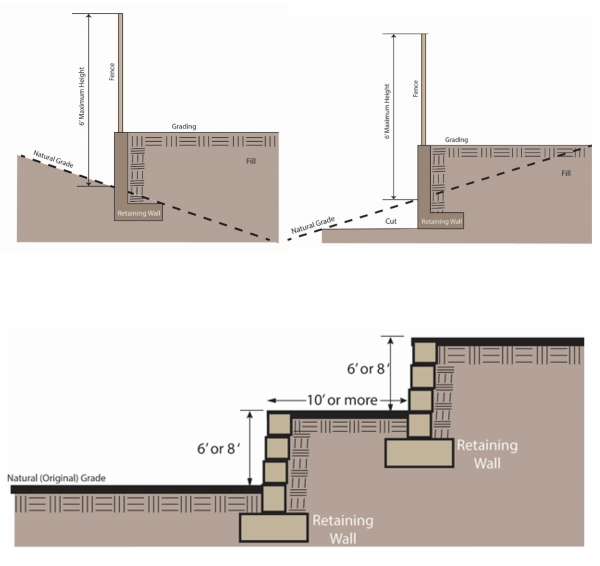
- Definitions. In this Subsection (E):
HISTORY
Amended by Ord. 412 on 4/9/2024
Amended by Ord. 421 on 9/10/2024
Amended by Ord. 412 on 4/9/2024
Amended by Ord. 421 on 9/10/2024
19.76.060 Paved Activity Surfaces
"Paved activity surface" means any area or surface over 500 square feet that is paved or otherwise covered with a non-vegetative material utilized for activities such as sports/recreation (of pets or humans), or other similar uses and not including areas such as driveways, walkways, and parking lots with the sole purpose of providing access to or within a property.
- Purpose. This section regulates paved activity surfaces in order to mitigate the potential unique impacts the use of such areas presents in terms of noise, outdoor lighting, and fencing.
- Applicability. The regulations of this section apply to all paved activity surfaces approved or constructed after March 5, 2024. The regulations in this section do not apply to paved activity surfaces legally constructed and already in existence as of that date, including the routine maintenance and repair of said surfaces. Improper use of all existing and/or new surfaces, however, constituting a nuisance or other violation of the requirements of this code are subject to enforcement.
- Standards for Approval.
- Building Permit Required. Paved activity surfaces require a building permit issued by the city, including review by all relevant city departments. The specifications for building permit plans may vary by project scope, but at a minimum shall include a site plan with setbacks from the proposed surface to all property lines; fencing details including material, height, and setback to property lines; outdoor lighting details including fixture height, bulb lumen, bulb kelvin, and lamp cut sheets; and materials information for surfacing.
- Setback Requirements. All paved activity surfaces shall comply with all accessory building regulations in the underlying zoning district, except that such surfaces without vertical structures are not required to be at least six feet away from the primary structure on the property.
- Fencing Regulations. Any fencing associated with paved activity surfaces shall conform to the standards outlined in Section 19.76.050 and other applicable fencing provisions of this title.
- Outdoor Lighting Regulations. All outdoor lighting of a paved activity surface shall conform to the standards outlined in Chapter 19.77 of this title, "Outdoor Lighting."
- Affidavit Required. All applications for paved activity surfaces shall include a recordable affidavit or other instrument on a city-approved form that is signed by the record owner(s) of the property and that includes a statement that use of the approved paved activity surface is subject to ongoing compliance with the requirements of all applicable noise control ordinances. The affidavit shall be recorded against title to the property in connection with any city approval of the paved activity surface to give perpetual constructive notice of the necessity of continued compliance of the paved activity surface with all legal requirements.
HISTORY
Amended by Ord. 411 on 3/5/2024
Amended by Ord. 411 on 3/5/2024

