
Crawfordville City Zoning Code
ARTICLE I
- IN GENERAL2
Sec. 1.4.- Interpretation of terms.
When referring to this Chapter [Appendix] the following rules of interpretation shall be applied, except when the context clearly requires otherwise.
The words "Comprehensive Plan" mean the official comprehensive planning document drafted in accordance with the State of Georgia's Standards and Procedures for Local Comprehensive Planning and adopted by the Crawfordville City Council.
The words "City Council" shall mean the Council of the City of Crawfordville, Georgia.
The words "Planning Commission" shall mean the Planning Commission of the City of Crawfordville, Georgia.
The word "Mayor" shall mean the Mayor of the City of Crawfordville, Georgia.
The word "person" includes a firm, co-partnership, company, corporation, or association.
The word "lot" includes the word "plot" or "parcel." The word "structure" includes the word "building."
The word "shall" is always mandatory, and not merely directory.
The word "used" or "occupied" as applied to any land or building shall be construed to include the words "intended, arranged, or designed to be used or occupied."
The word "district" shall mean "Zoning District" for the purposes of this Chapter [Appendix].
The word "map" or "zoning map" shall mean "Official Zoning Map of the City of Crawfordville" for the purposes of this Chapter [Appendix].
Sec. 1.5. - Definitions.
Words in the text or tables of this Title shall be interpreted in accordance with the provisions set forth in this Chapter [Appendix]. Where words have not been defined, the standard dictionary definition shall prevail.
Acre: For the purpose of this chapter [appendix], a measure of land consisting of 43,560 square feet.
Acreage: Acres collectively in a tract of land.
Adult entertainment: Performances by topless and/or bottomless dancers, strippers or similar entertainers, where such performances are characterized by the display or exposure of specific anatomical areas; any book, publication or film/video which depicts nudity, or sexual conduct, and bath houses, massage parlors, wrestling parlors or like activity including a nightclub, cabaret, lounge or other establishment which features adult entertainment.
Adult entertainment establishments: Any commercial establishment, which has as its primary purpose or business the offer for sale of any book, publication or film/video which depicts nudity, or sexual conduct or engages in services such as bath houses, massage parlors, wrestling parlors or like activity including a nightclub, cabaret, lounge or other establishment which features adult entertainment.
Agriculture: Agriculture shall be considered to mean the raising of soil crops and livestock in a customary manner on tracts of land at least five acres in size and shall include all associated activities. Selling of products raised on the premises shall be considered a permissible activity provided that space necessary for the parking of customers' vehicles shall be provided off the public rights-of-way.
Animal shelter: Any facility operated by or under contract for the state, a county, a municipal corporation, or any other political subdivision of the state for the purpose of impounding or harboring seized, stray, homeless, abandoned, or unwanted dogs, cats, and other animals; any veterinary hospital or clinic operated by a veterinarian or veterinarians which operates for such purpose in addition to its customary purposes; and any facility operated, owned, or maintained by a duly incorporated humane society, animal welfare society, or other nonprofit organization for the purpose of providing for and promoting the welfare, protection, and humane treatment of animals, with a valid state license.
Apartment: A dwelling unit for lease or rent within a multi-family building or other similar building for occupancy for an extended period of time.
Apartment building: A residential building containing three or more dwelling units exclusive of a townhouse building or unit.
Bed and breakfast inn: A residence in which the frequency and volume of visitors are incidental to the primary use as a private residence and where guest rooms are made available for visitors for fewer than 30 consecutive days. Breakfast is the only meal served and is included in the charge for the room.
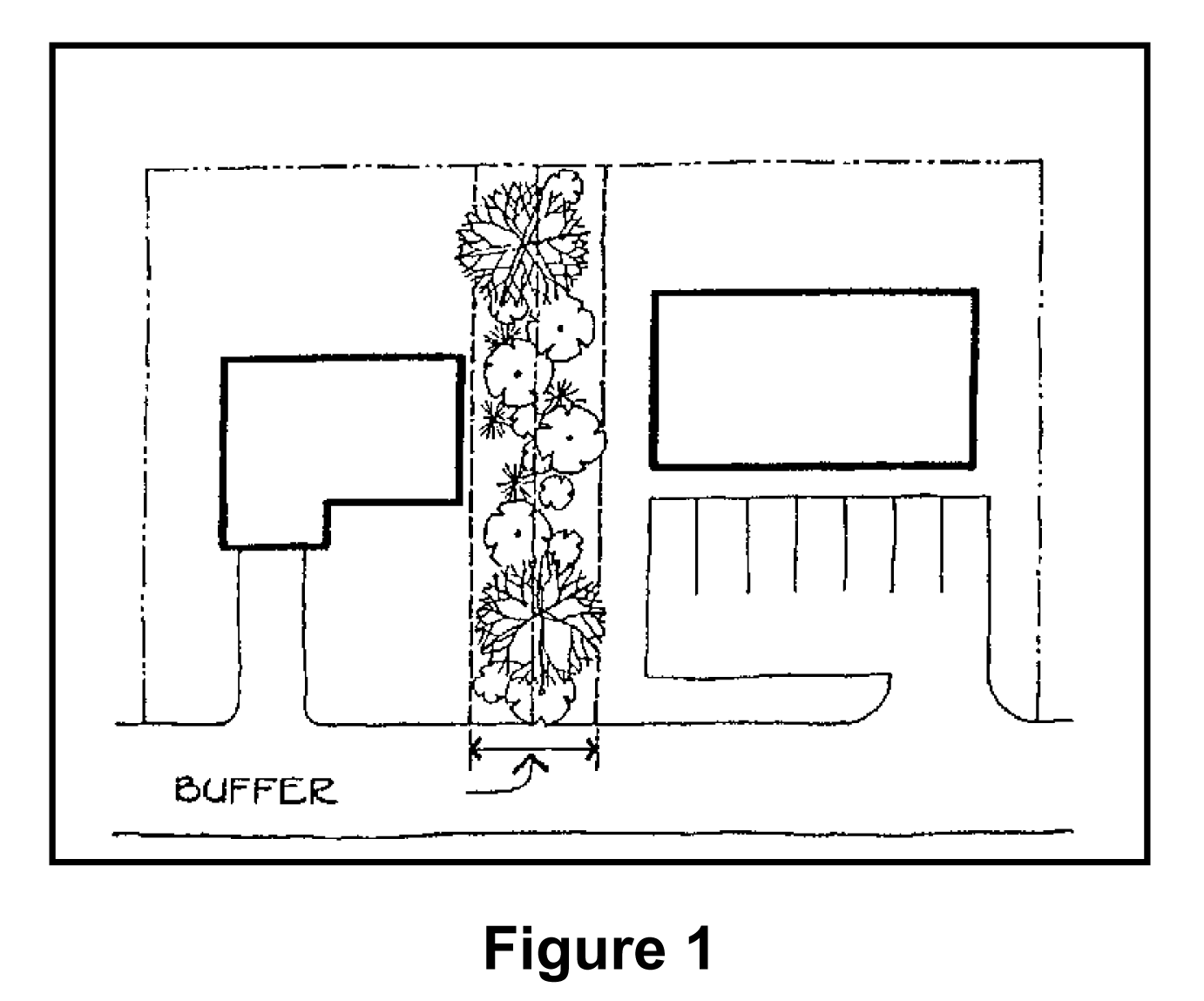
Buffer: A strip of land, fence, or border of trees, etc., between one use and another, which may or may not have trees and shrubs planted for screening purposes, designed to set apart one use area from another. An appropriate buffer may vary depending on uses, districts, size, etc. See Figure 1.
Build to line: An alignment established a certain distance from the curb line to a line along which the building shall be built.
Building: Any structure which has a roof and which is for the shelter, support or enclosure of persons, animals or property of any kind.
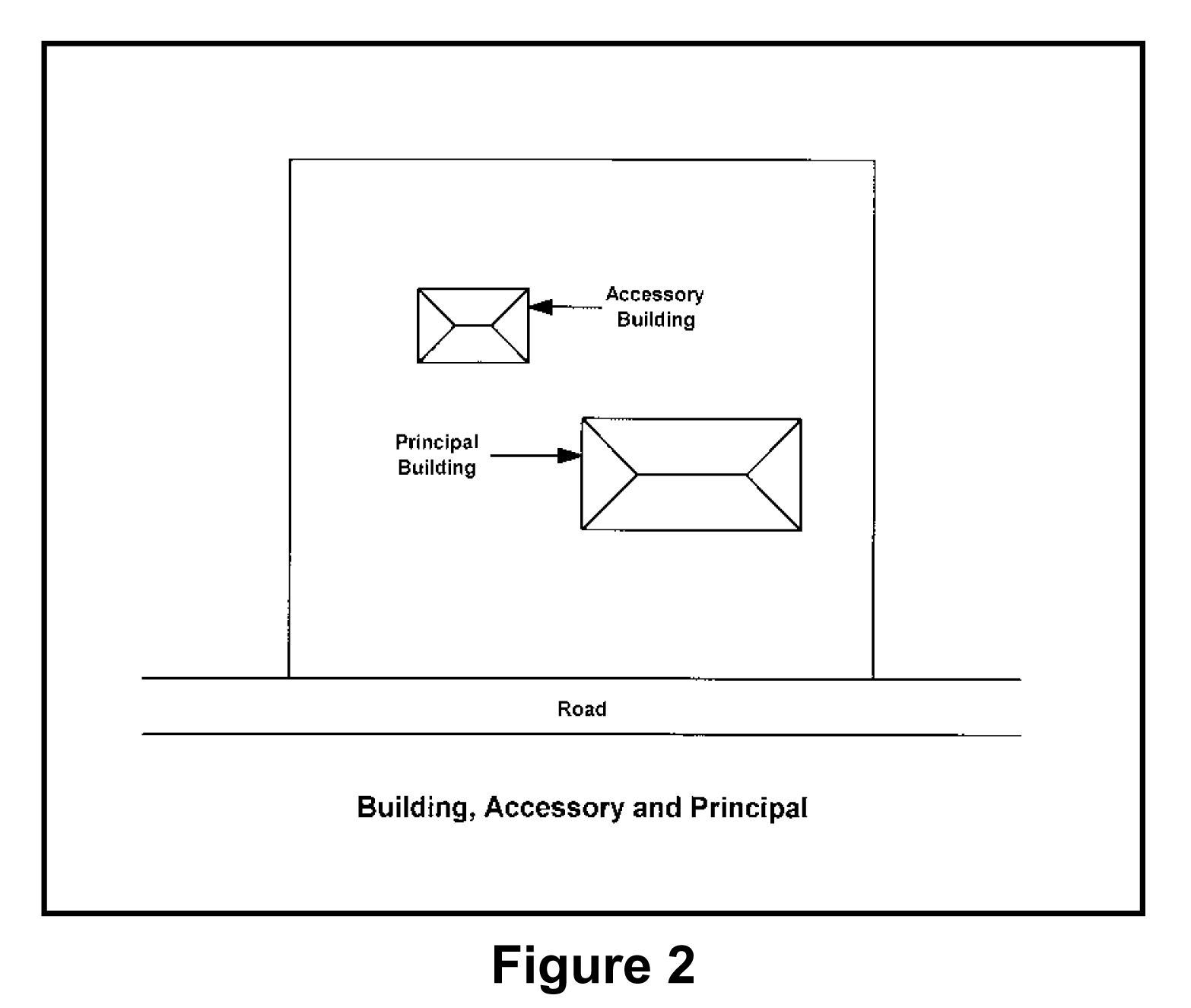
Building, accessory: A detached, subordinate structure, the use of which is clearly incidental to, customarily associated with, and related to the principal structure or use of the land, and which is located on the same lot as the principal structure or use. See Figure 2.
Building height: The vertical distance of a building measured from the average elevation of the finished lot grade along the front of the building to the highest point of the building.
Building line: A line parallel to the street right of way line at any story level of a building and representing the minimum distance which all or any part of the building is set back from said right-of-way line.
Building, multifamily: A building containing three or more individual dwelling units with separate cooking and toilet facilities for each.
Building, principal: The building containing or to contain the principal use of a lot.
Building, public: Structures principally of an institutional nature and serving a public need, such as churches, hospitals, schools, libraries, museums, post offices, police and fire stations, public utilities, and other public services, but not including the operation of a public bar, restaurant, or recreational facility as a commercial enterprise.
Business vehicle: A school bus, commercial bus, or church bus, tractor trailer, tandem rig, or any other vehicle driven for hire or utilized in conducting business affairs, such as transportation of equipment, freight, goods, or individuals.
Clubhouse: A building to house a club or social organization not conducted for private profit, as documented by state or federal records, and which is not an adjunct to or operated by or in connection with a public tavern, cafe, or other public place.
Communication tower: A structure that is intended to send and/or receive radio, television or cellular communications. (This term does not include noncommercial shortwave radio towers).
Condominium: A multi-family building containing individually owned dwelling units and related, jointly owned common areas as defined by the laws of the State of Georgia.
Density: The number of families, individuals, dwelling units, or housing structures per unit of land. The standard for density in single-family attached and multi-family districts shall be gross density which includes all land within the boundaries of the area excluding flood plain areas and standing bodies of water.
Development: The subdividing of land into two or more lots; the construction, reconstruction, conversion, structural alteration, relocation, or enlargement of any structure; any mining, excavation, landfill, or land disturbance; and any use or extension of the use of land.
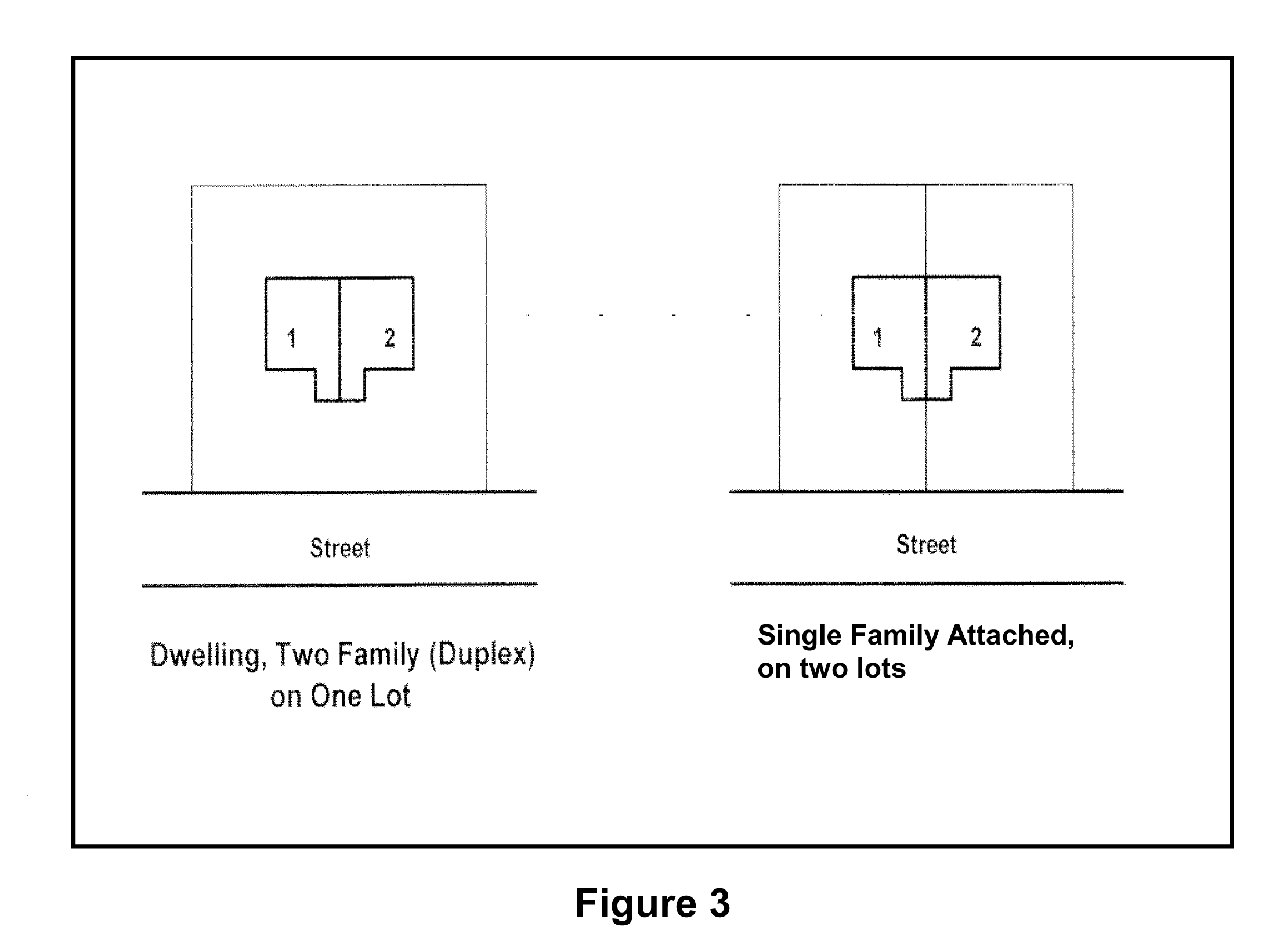
Dwelling, duplex: A building containing two dwelling units totally separated from each other by a common wall extending from ground to roof where the two dwellings are located on the same lot. See Figure 3.
Dwelling, multi-family: Dwelling unit having a common wall or common floor connecting it to at least one other dwelling unit in a multi-family building.
Dwelling, single-family attached: One of a series of two single-family dwelling units on separate lots attached to one another dwelling unit on an adjoining lot by a common party wall. See Figure 3.
Dwelling, single-family detached: A building containing one dwelling unit and that is not attached to any other dwelling by any means and is surrounded by open area or yards.
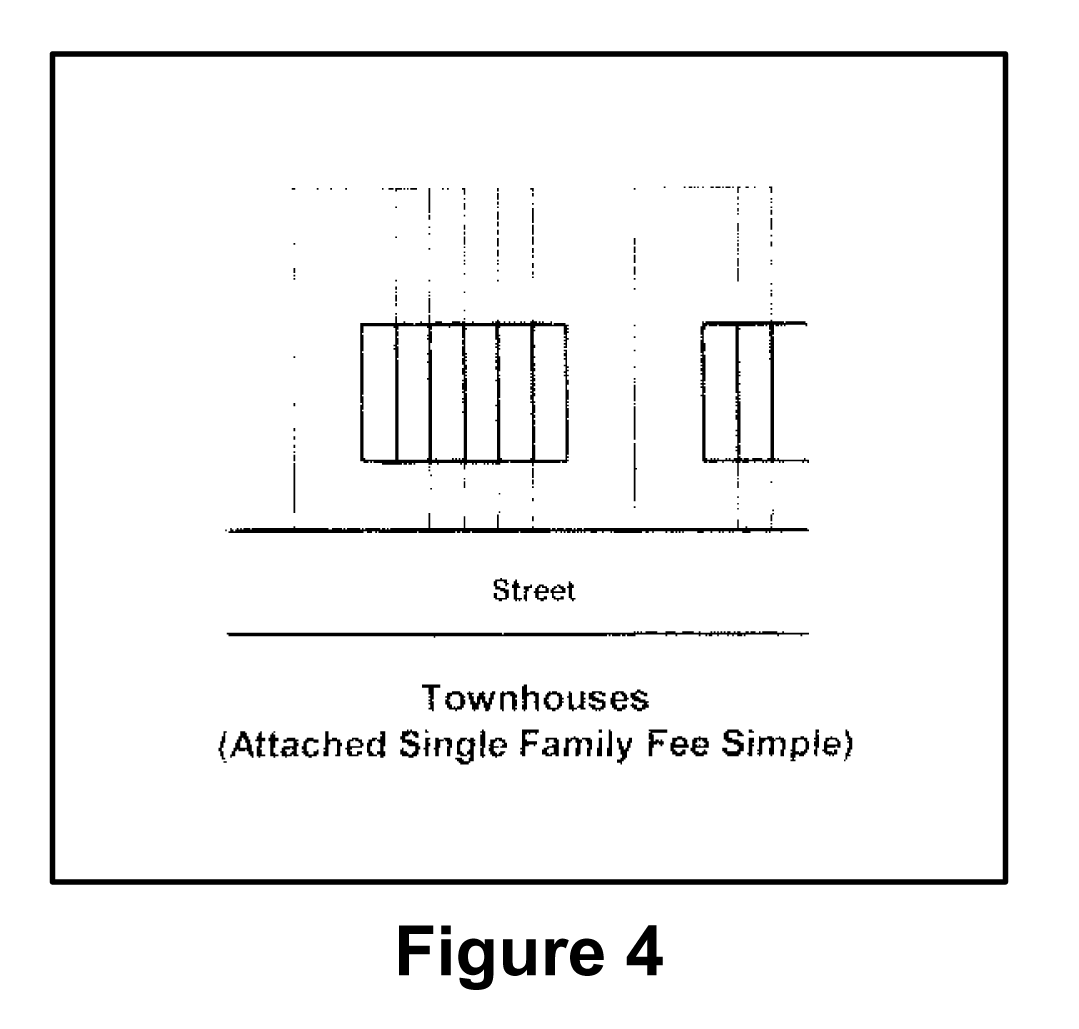
Dwelling, townhouse: One of a group of three or more single-family attached dwelling units under fee simple or condominium or cooperative ownership, as defined by the laws of the State of Georgia, in which each unit has its own front and rear access to the outside, no unit is located over another unit, and each unit is separated from any other unit by one or more vertical common fire-resistant walls. For the purposes of this chapter [appendix] the term "townhouse dwelling" shall not include a single-story attached dwelling unit. See Figure 5[4].
Dwelling unit: An enclosure of one or more rooms in addition to kitchen and bathroom facilities, but excluding closets, designed or constructed as a unit for residential occupancy by one family.
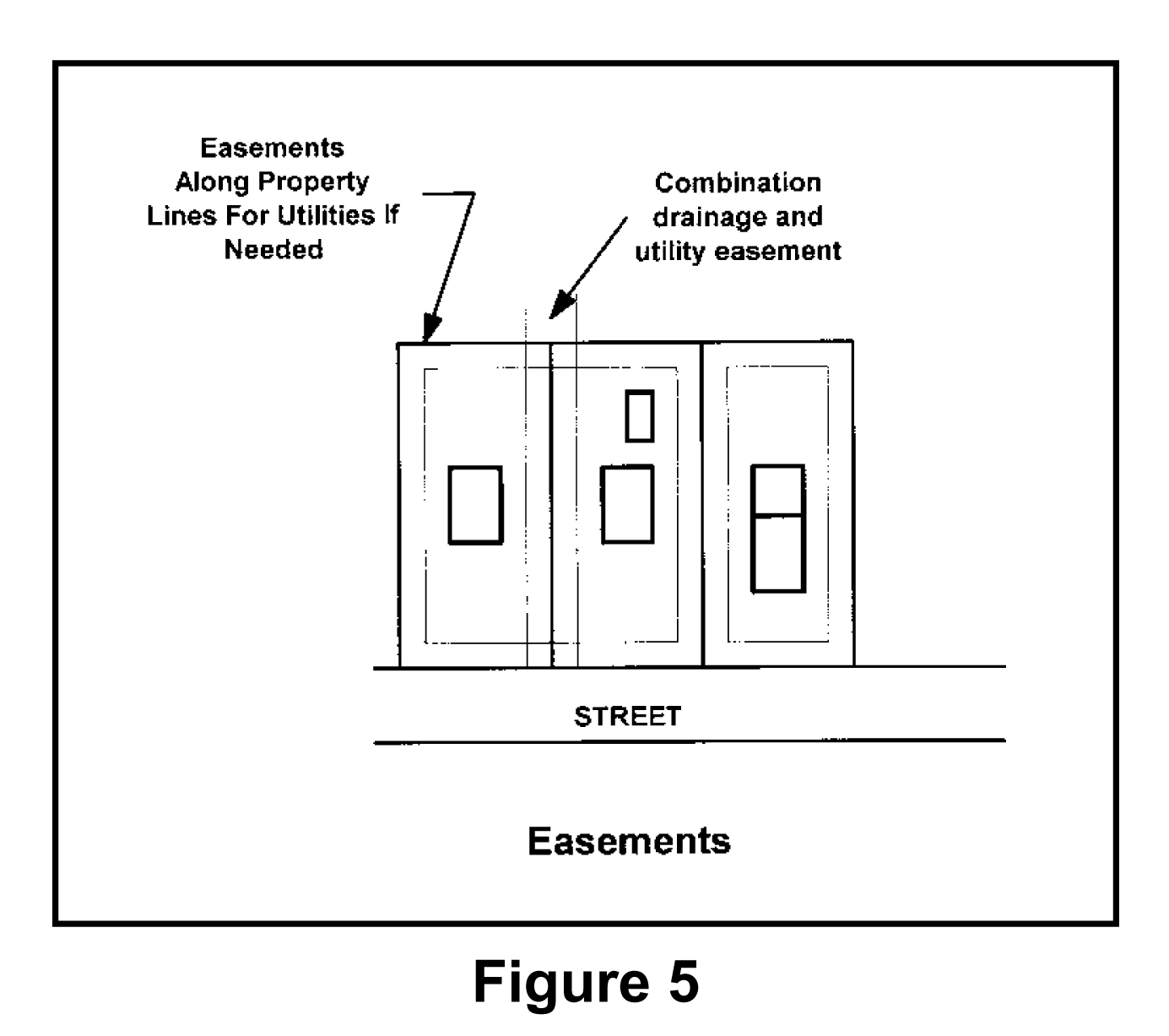
Easement: A grant by a property owner of the use of land for a specific purpose or purposes by the general public, a corporation, or a certain person or persons. See Figure 5.
Equipment, heavy duty: Includes but is not limited to bulldozers, loaders, backhoes, bobcats, farming equipment or other similar machinery.
Family: A group of individuals not necessarily related by blood, marriage, adoption, or guardianship living together in a dwelling unit as a single housekeeping unit under a common housekeeping management plan based on an intentionally structured relationship providing organization and stability in a permanent and long-term relationship as opposed to one that is short-term or transient.
Family day care: A home occupation in which shelter, care, and supervision are provided for six (6) or fewer children on a regular basis. A family day care may provide basic educational instruction.
Guest house: A detached accessory dwelling unit located on the same lot with a single-family dwelling unit. The square foot area of a guest house may not exceed 50 percent of the heated and finished floor area of the principal building on the lot or 1,000 square feet in floor area, whichever is less, and may be used only by family members, guests, or family employees without payment or consideration.
Home occupation: An occupation for gain or support customarily conducted on the premises in a residential structure by a person or family residing therein. The term "home occupation" shall not be deemed to include a bed and breakfast inn.
Hospital: Any institution receiving in-patients, or a public institution receiving out-patients, and authorized under Georgia law to render medical, surgical and/or obstetrical care. The term "hospital" shall include a sanitarium for the treatment and care of senile psychotics or drug addicts, but shall not include office facilities for the private practice of medicine or dentistry.
Hotel: A facility offering transient lodging accommodations to the general public and providing additional services, such as restaurants, meeting rooms, entertainment, and recreational facilities. The purpose of such use shall not be for extended-stay occupancy.
Institutional care facility: See institutional residential living facility.
Institutional residential living facility: Housing that provides residents with a program of assisted-living services to deal with the activities and instrumental activities of daily living.
Junkyard: Any lot or parcel, building, or structure used in whole or in part for the storage, collection, processing, or disposal of junk.
Kennel: Any location where boarding, caring for and keeping of a total of more than four (4) dogs or cats or other animals or combination thereof (except a litter of animals of not more than six (6) months of age) is carried on. The term also includes the raising of show and hunting dogs.
Livestock: Domestic animals raised for use and/or sale.
Lodge: See Clubhouse
Lot: A lot of record, or any combination of lots of record, held in a single ownership by one person, or in common ownership by more than one person, which has both lot area and lot dimensions equal to or greater than the lot width and lot area requirements established by this chapter [appendix] for the zoning district in which such tract of land is located and for the use proposed for the tract of land. See Figure 6.
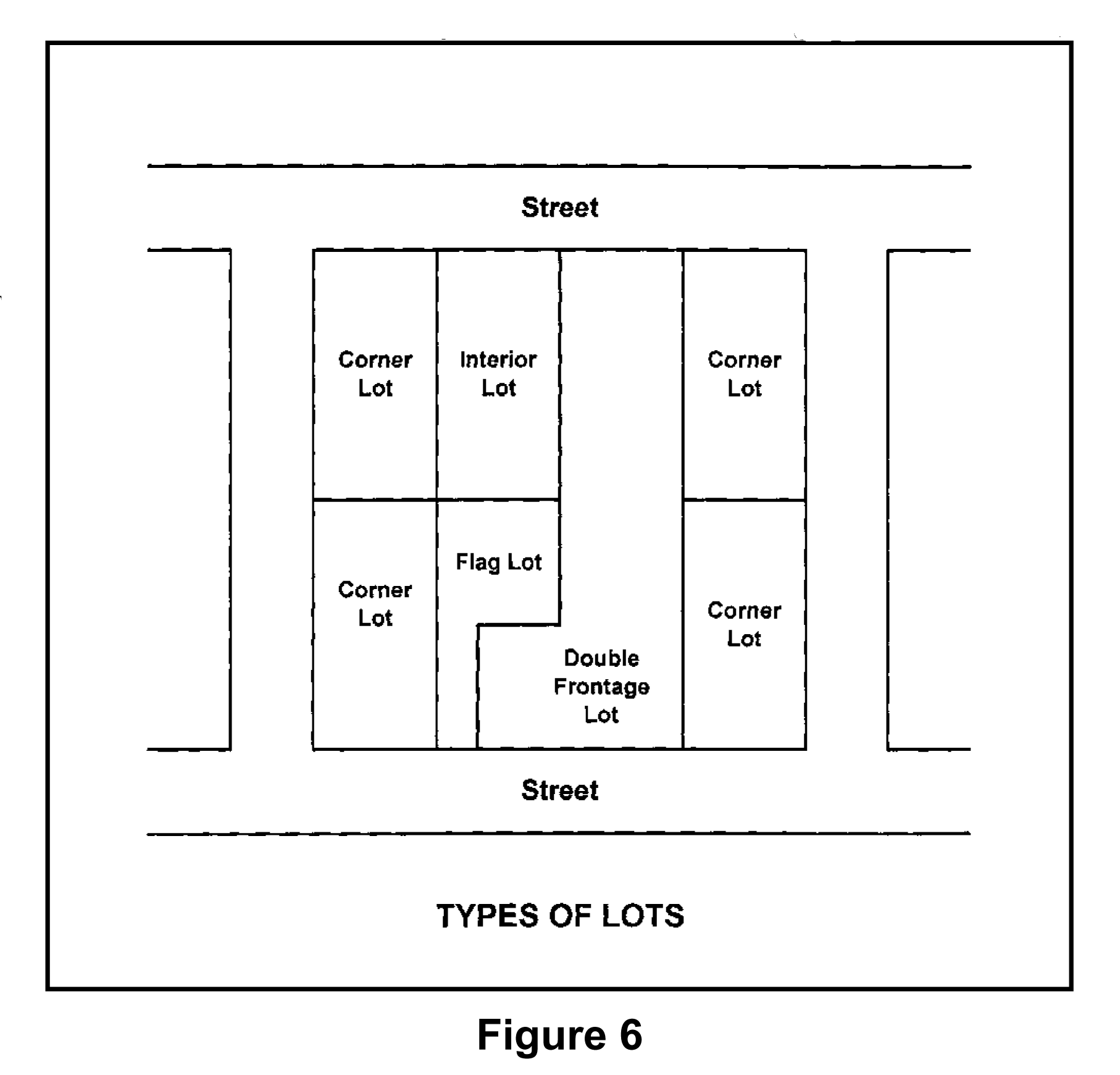
Lot, corner: A lot having frontage on two or more public streets at their intersection. See Figure 6.
Lot frontage: The shortest lot line adjoining a street right-of-way. A lot line adjoining a stub street shall not be considered as frontage unless it is proposed for access or is the only street frontage. Front yard requirements shall be measured from this lot line. In situations where a multiple frontage lot has equal distance on street frontages, the Land Development Officer shall determine the legal lot frontage.
Lot line: A line of record bounding a lot that divides one lot from another lot or from a public or private street or any other public space.
Lot line, front: The lot line separating a lot from a street right-of-way.
Lot line, rear: The lot line most opposite and most distant from the front lot line.
Lot line, side: Any lot line other than a front or rear lot line.
Lot, nonconforming: A parcel of land that has less than the minimum area or minimum dimensions required in the zoning district in which the lot is located.
Lot of record: A lot that exists as shown or described on a plat or deed in the records of the Office of the Clerk of the Superior Court of Taliaferro County.
Lot, through: A lot that fronts upon two parallel streets or that fronts upon two streets that do not intersect at the boundaries of the lot. Also referred to as a double frontage lot. See Figure 6.
Lot width: The horizontal distance between the side lines of a lot measured at right angles to its depth along a straight line parallel to the front lot line at the minimum required building setback line.
Manufactured home: A structure transportable in one or more sections and which is built on a permanent chassis and designed to be used as a dwelling unit with or without a permanent foundation when connected to the required utilities, and includes the plumbing, heating, air-conditioning, and electrical systems contained therein. Such dwelling unit is regulated by the manufactured home construction and safety standards, known as the HUD Code adopted in 1976.
Mobile home: A detached, single family dwelling unit with any or all of the following characteristics:
1)
Designed for long-term occupancy and containing sleeping accommodations, a flush toilet, a tub or shower bath, and kitchen facilities, with plumbing and electrical connections;
2)
Prefabricated and designated to be transported on its own wheels or on a flatbed or other trailer or detachable wheels;
3)
Arriving at the site where it is to be occupied as a complete dwelling including major appliances and furniture and ready for occupancy except for minor and incidental unpacking and assembly operations, location on foundation supports and connection to utilities and the like.
4)
Is at least 14 feet wide and forty (40) feet long.
Mobile home park: Any plot or tract of land on which two or more mobile homes are located or intended to be located.
Modular home: A structure not built on-site, but which is placed on a permanent foundation and meets the state building code standards.
Motel: An establishment providing sleeping accommodations for the traveling public with a majority of all rooms having direct access to the outside without the necessity of passing through the main lobby of the building. The purpose of such use shall not be for extended-stay occupancy.
Open space: Any parcel or area of land or water essentially unimproved and set aside, dedicated, designated or reserved for public or private use or enjoyment, or for the use and enjoyment of owners and occupants of land adjoining or neighboring such open space, or for the preservation and protection of environmentally sensitive land areas or natural land features. (Excludes streets, drives and yards)
Outdoor display: The displaying of goods or merchandise outdoors on the property with the intent to advertise for sale said goods.
Outdoor storage: The keeping, in an unenclosed area, of any goods, salvage, material, merchandise, storage trailers, or vehicles outdoors on the property for more than 24 hours. The term "outdoor storage" shall not include the keeping of vehicles or manufactured housing structures on sales lots in districts which allow such sales lots.
Personal service establishment: A business that provides services but not goods such as architects offices, shoe repair, and real estate services.
Plat: A map, plan or layout, of a county, city, town, lot, section, subdivision, or development certified by a registered surveyor indicating the location and boundaries of a property or properties.
Public hearing body: A group of elected or appointed officials that has the authority to hold public hearings on zoning decisions.
Recycling center: Any facility utilized for the purpose of collecting materials to be recycled including, but not limited to, plastics, glass, paper and aluminum materials.
Religious institution: A building in which persons regularly assemble for religious worship intended primarily for purposes connected with such worship, or for teaching a particular form of religious belief. (Excludes a religious bookstore or similar establishment)
Residential: Pertaining to the use of land, means premises such as single-family detached and attached homes, patio homes, townhouses, mobile homes, duplexes, condominiums or apartment complexes, which contain habitable rooms for nontransient occupancy and which are designed primarily for living, sleeping, cooking, and eating therein.
Retail trade establishment: A business consisting primarily of buying merchandise in gross and selling to general consumers in small quantities or broken lots or parcels and not in bulk and not for resale.
Right-of-way line: The dividing line between a lot, tract or parcel of land and a contiguous right-of-way.
Roadside stand: An accessory structure for the seasonal retail sale of grown or produced food products on the lot.
School: A facility where persons regularly assemble for the purpose of instruction or education including any playgrounds, stadiums, or other structures and grounds used in conjunction therewith. The term "school" shall include, but is not limited to, public and private schools used for pre-kindergarten, primary, secondary, or post-secondary education.
Setback, required: The distance between the building and any lot line.
Setback line, required: That line that is the required minimum distance from any lot line and that establishes the area within which a structure must be erected or placed.
Sign, freestanding: A self-contained sign structure of a permanent nature which is wholly independent of any building or other structure.
Special exception: Uses authorized under the zoning chapter [appendix] subject to appropriate conditions and safeguards set forth in this chapter [appendix]. Applicants for a special exception need not prove hardship but must comply with all other applicable zoning laws and any conditions for approval imposed by the zoning board.
Street, public: A public roadway, constructed within the boundaries of an officially deeded and accepted public right-of-way, which affords principal means of access to abutting property.
Structure: Anything constructed, erected, or placed with a fixed location on or in the ground, or attached to something having a fixed location on the ground. The term "structure" shall include, but is not limited to, buildings, mobile homes, billboards, freestanding signs, swimming pools, fall-out shelters, and truck or van trailers or bodies if detached from the cab of the vehicle and placed on the property to be used as a storage facility. For the purposes of this chapter [appendix], privacy walls and/or fences shall not be considered structures.
Structure, accessory: See Building, accessory.
Structure, principal: See Building, principal.
Townhouse: See Dwelling, townhouse.
Travel trailer: A vehicular portable structure whether self-propelled or pulled by a power unit, designed for temporary occupancy for travel, recreation or vacation uses.
Truck, heavy duty: A vehicle designed for hauling supplies, materials, or other vehicles and which has a weight of four (4) tons or greater empty weight or having a carrying capacity of more than one and one-half (1½) tons.
Truck terminal: A primary use of property where trucks/trailers are temporarily stored maintained or based. Trucks/trailers shall have current registration and license plates with decal.
Use, accessory: A use customarily incidental and subordinate to the principal use or building and located on the same lot with such principal use or building.
Use, conditional: a use not ordinarily permitted but which may be permitted by the planning commission upon the imposition of conditions related to the promotion of the public health, morals or general welfare and designed to minimize the negative impact on surrounding lands. Such conditions may include, but are not limited to, restrictions on land use; height, setback and other nonuse requirements; physical improvements to the property and infrastructure serving the property. A conditional use must be approved in the same manner as a rezoning request prior to the issuance of a permit.
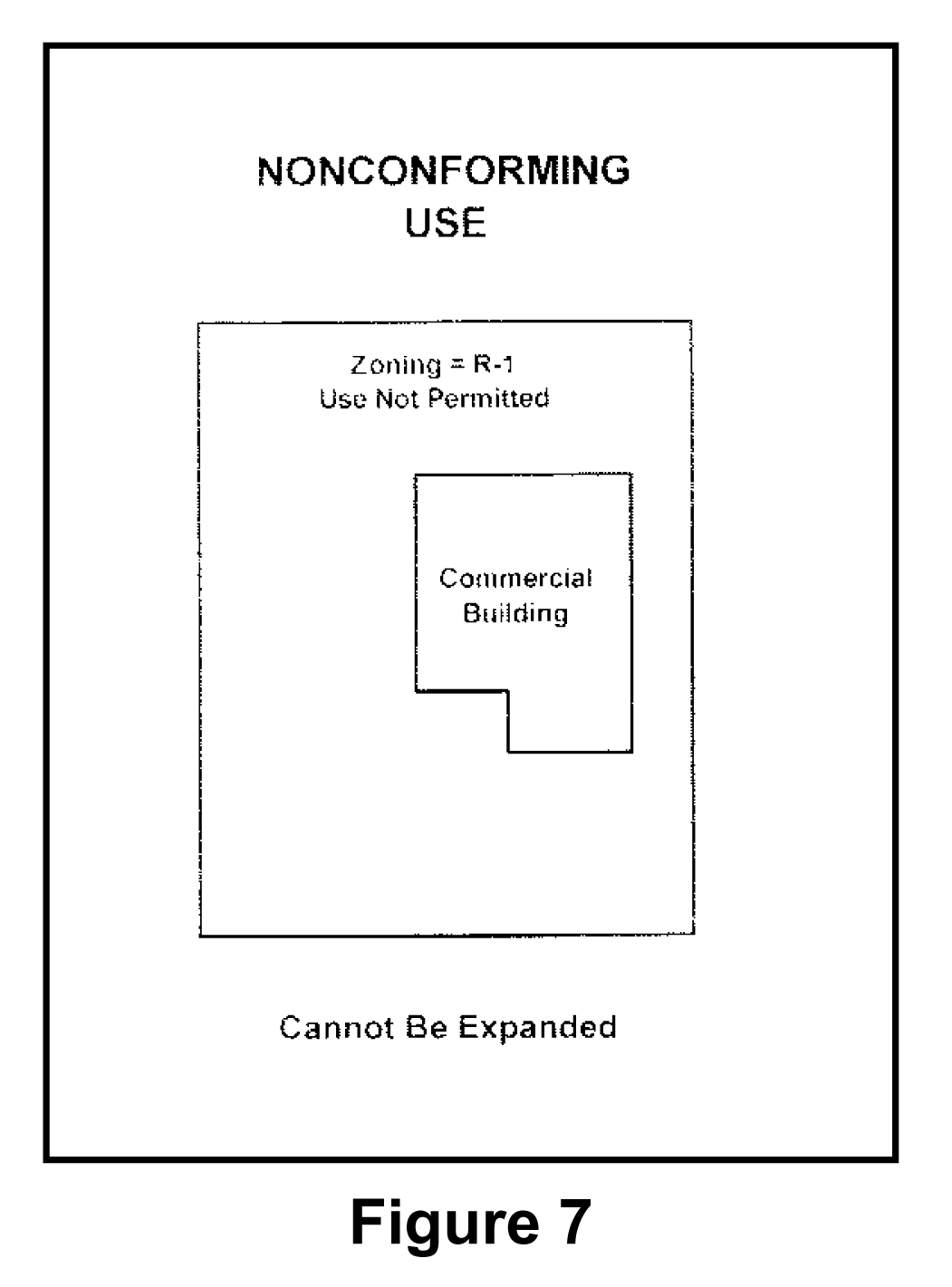
Use, nonconforming: A lawful use of, or vested right to use any building, structure or land existing at the time of the adoption of this Title or the adoption of any amendment thereto. See Figure 7.
Use, permitted: Any use allowed in a zoning district and subject to the restrictions applicable to that zoning district.
Use, principal: The principal purpose for which a lot or the main building thereon is designed, arranged, or intended, and for which it is or may be used, occupied, or maintained.
Use, public: Any use intended to be conducted in a facility or upon land which is owned by and operated for public use by a school district, city, county, state or federal government.
Use, semi-public: Uses operated by recognized religious, philanthropic, or educational or other charitable institutions on a nonprofit basis and in which goods, service, or merchandise are not provided for sale on the premises.
Variance: A variance is a relaxation of the dimensional requirements of the zoning chapter [appendix] where such variance will not be contrary to the public interest and where, owing to conditions peculiar to the property and not the result of the actions of the applicant, a literal enforcement of the regulations would result in unnecessary and undue hardship.
Yard: An open area that lies between the building or buildings on a parcel and the nearest lot line. The minimum required yard as set forth in this chapter [appendix] is unoccupied and unobstructed from the ground upward except as may be specifically provided in this chapter [appendix].
Yard, front: A space extending the full width of the lot between any building and the front lot line and measured perpendicular to the building at the closest point to the front lot line. See Figure 8.
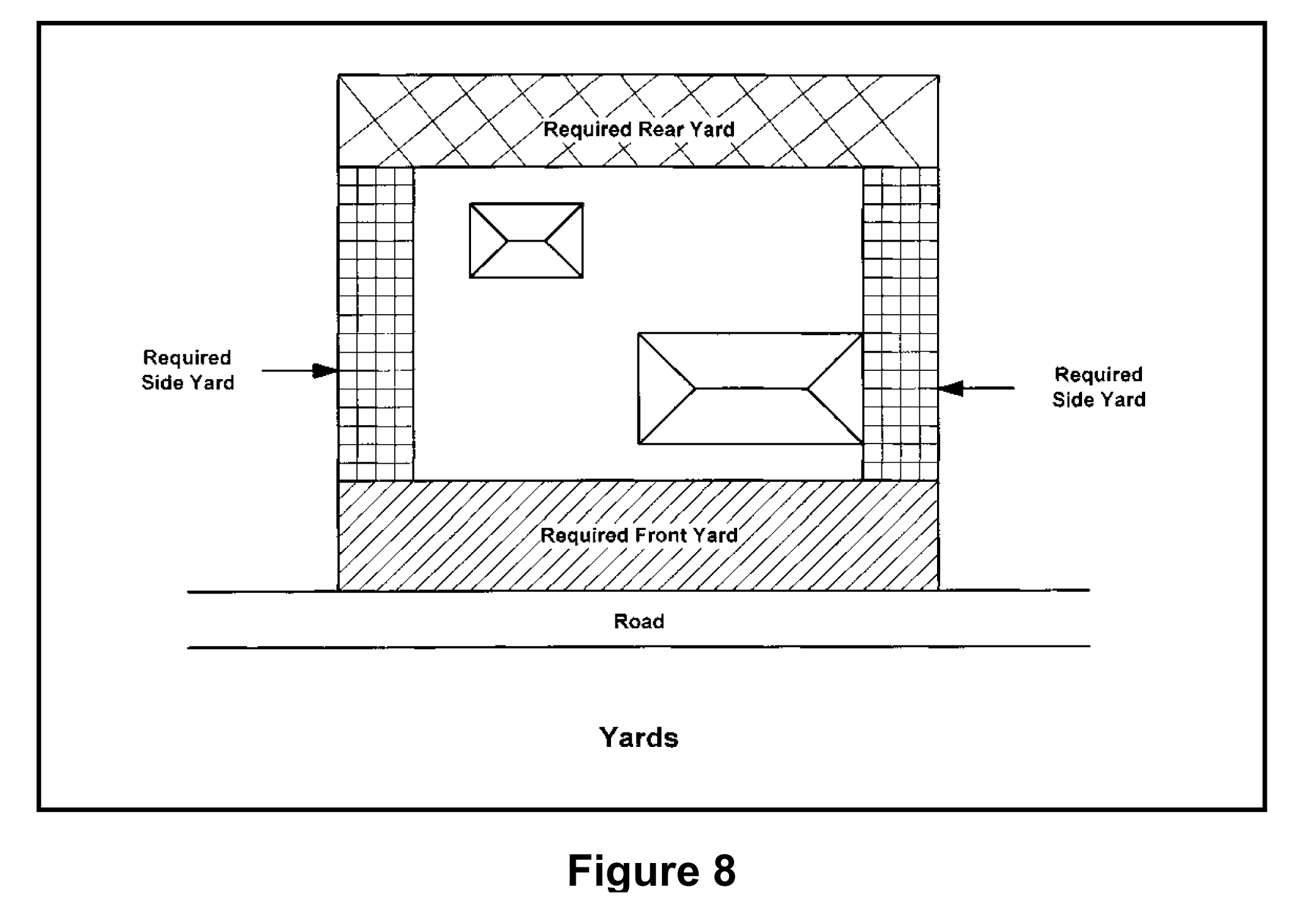
Yard, rear: A space extending across the full width of the lot between the principal building and the rear lot line and measured perpendicular to the building to the closest point of the rear lot line. See Figure 8.
Yard, required: The open area between a lot line and the setback line within which no structure shall be located except as provided in this chapter [appendix].
Yard, side: A space extending from the front yard to the rear yard between the principal building and the side lot line and measured perpendicular from the side lot line to the closest point of the principal building. See Figure 6.
Zoning: The power of local governments to provide within their respective territorial boundaries for the zoning or districting of property for various uses and the prohibition of other or different uses within such zones or districts and for the regulation of development and the improvement of real estate within such zones or districts in accordance with the uses of property for which such zones or districts were established.
Zoning decision: Final legislative action by a local government which results in: 1) The adoption of a zoning ordinance, 2) The adoption of an amendment to a zoning ordinance which changes the text of the zoning ordinance 3) The adoption of and amendment to a zoning map that rezones property from one zoning district classification to another 4) the adoption of an amendment to a zoning ordinance by a municipal local government which applies a zoning district classification to a property to be annexed into the municipality , or 4)[5)] the grant of a permit relating to the special use of a property.
(Ord. No. 2012-08-1, § 1, 11-6-2012)

