
Crowley City Zoning Code
ARTICLE 4
- SPECIAL DISTRICT STANDARDS
106.55 - DOWNTOWN CROWLEY DISTRICT
A.
PURPOSE AND INTENT: The Downtown Crowley District is a downtown neighborhood anchored by a civic core along Main Street which has local significance as a historic commercial corridor through the city and is currently a major regional corridor in southwest Tarrant County. The district highlights a desire for a community center based in tradition and history, but provides a lively atmosphere of community recreation and living. In order to grow and sustain downtown, the following is hereby established:
(1)
Walkability. In order to facilitate walkability and livability, Main Street and intersecting streets within the district shall provide accessible sidewalks with "street" trees; are established to facilitate an integrated set of transportation choices—driving, walking, and cycling—as well as to form public places bounded by building façades, creating a sense of "outdoor rooms" or enclosure along the street or within building courtyards opening to the street.
(2)
Public improvements. The public improvements along Main Street within city rights-of-way necessary to facilitate walkability shall be designed and constructed by the city, other public entities when funding becomes available, or through a combination of public/private partnerships; accordingly, new design and construction of private buildings and improvements within the district shall conform to and be complementary with those public improvements. For development on or along other roadways within the downtown district, sidewalks shall be installed by the developer if sidewalks meetings the requirements of this Code are not already in place.
(3)
Downtown Crowley sub-districts. Boundaries of the Downtown Crowley District and associated sub-districts are each based on Figure 106.55-1 - Downtown Zoning Map. Each of the sub-districts contain existing infrastructure for vehicular access, and future improvements include sidewalks and trail connections to allow for accessibility for the pedestrian and bicyclist to the historic downtown core of Crowley.
B.
GENERAL SITE DESIGN STANDARDS: The following general site design standards apply to all sub-districts in the Downtown Crowley District.
(1)
Frontage Build-Out: In order to create a nearly continuous pattern of buildings along a street and sidewalk, buildings are required to have a minimum building width, as a percentage of the lot width, along the street, which is referred to as the Frontage Build-Out. Each sub-district shall have a minimum Frontage Build-Out requirement as indicated in the sub-district standards. The frontage build-out along each street shall be calculated per Figure 106.55-2. The minimum frontage requirement may be achieved with multiple buildings by adding the frontages of each building that is located within the Build-To-Zone.
(2)
Build-to Zone: The Build-to Zone is the area between the minimum and maximum front setbacks as shown in Figure 106.55-2. For purposes of calculating the Frontage Build-Out, only that portion of the façade (or facades) that occurs within the Build-to-Zone counts toward the minimum Frontage Build-Out.
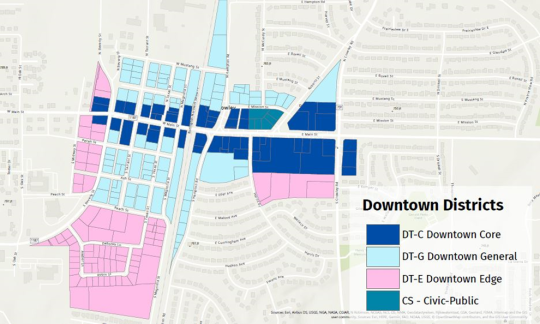
Figure 106.55-1: Downtown Zoning Map
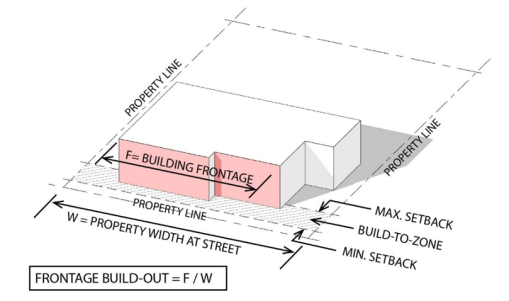
Figure 106.55-2: Three-dimensional diagram illustrating Frontage Build-Out and Build-to
Zone
(3)
Parking: Shall be located to minimize the visual impact on the street and sidewalk. Two parking Scenarios, as shown in Figure 106.55-3, are permitted as follows:
a.
Scenario 1 - rear parking: Scenario 1 may be utilized in any sub-district within the Downtown Crowley District.
b.
Scenario 2 - rear and side parking: Permitted in the Downtown General and Downtown Edge sub-districts only. When using Scenario 2, the site must still be in compliance with the minimum Frontage Build-Out. When located on a corner lot, the side parking shall be located on the side away from the street.
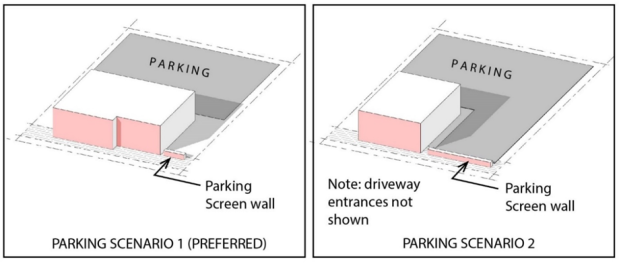
Figure 106.55-3: Parking Scenarios 1 and 2
106.56 - DOWNTOWN SUB-DISTRICT STANDARDS
A.
PURPOSE. This section shall establish the site development standards such as building and parking setbacks, height, and density standards for the three Downtown Sub-districts - Downtown Core, Downtown General, and Downtown Edge.
B.
DOWNTOWN CORE
| GENERAL DESCRIPTION | |
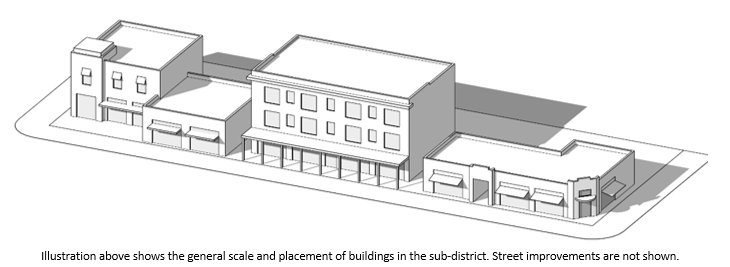
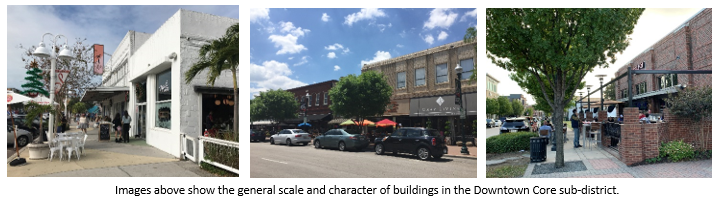
| The Downtown Core (DT-C) Sub-District is intended to provide for the development of mixed-use and nonresidential uses primarily along Main Street. It is intended to provide for a range of building heights that balance existing context with redevelopment potential. With the improvements to Main Street, the private realm standards focus on compatible infill development to fill any gaps along Main Street. This district allows for a range of commercial and upper floor residential uses that can create a vibrant downtown neighborhood. West of the railroad line, the scale is more neighborhood-focused with 1—3 story buildings, and east of the railroad, the scale could potentially allow for 3—5 story buildings given existing lot and block configuration. All off-street parking in this district shall be placed to the rear or to the side of the primary buildings facing Main Street. The standards in this section shall apply to all new construction, and additions to and remodeling of non-conforming structures within the DT-C. | |
 | |
 | |
| BUILDING PLACEMENT | |
| PRINCIPAL BUILDING PLACEMENT | |
| MAIN STREET FRONTAGE BUILD-OUT (MIN.) | 80% |
| FRONT SETBACK (MIN.) | 0' (but no less than 15' from a street curb) |
| FRONT SETBACK (MAX.) | 15' (up to 20' to accommodate outdoor dining, but not to exceed 50% of the Min. Frontage Build-out) |
| SIDE SETBACK (MIN.) (SECONDARY STREET) | 5' |
| SIDE SETBACK (MIN.) (INTERIOR) | 0' |
| REAR SETBACK (MIN.) | 5' (or minimum 15' from the center line of an alley where applicable) |
| LOT WIDTH (MIN.) | 25' |
|
Main Street shall be considered the Primary Street for all lots that have frontage
along Main Street.
Building encroachments into setback areas shall be permitted up to 50% into any required setback areas. Encroachments may include patios, awnings, signs, canopies, balconies, galleries, and similar building features. | |
| PARKING, ACCESS, & PLACEMENT | |
| PARKING PLACEMENT | |
| PRIMARY STREET SETBACK (MIN.) | Scenario 1 |
| SECONDARY STREET SETBACK (MIN.) | Scenario 1 or Scenario 2 |
| PARKING ACCESS | |
| DRIVEWAY ACCESS | Driveway access shall be from Secondary Street or Alley. Primary street driveway access may only be permitted if the lot has no Secondary Street or Alley access. Cross-access easements shall be required to adjoining parking lots where feasible. |
| PARKING COUNT | |
| MINIMUM REQUIRED PARKING | Refer to Article 7: Parking and Transportation of this Chapter. |
| SHARED PARKING | Refer to Article 7: Parking and Transportation of this code. |
| RESIDENTIAL DENSITY | |
| MAXIMUM NUMBER OF DWELLING UNITS PER ACRE (NET DENSITY) | No maximum |
| BUILDING HEIGHT | |
| MAX. BUILDING HEIGHT (INCLUDING ACCESSORY BUILDINGS) |
5 stories AND not to exceed 75 Feet (taller buildings may be permitted with an SUP
per Article 2: Procedures and Administration)
Minimum ground floor interior clear height = 12' |
| STREETSCAPE STANDARDS | |
| MAIN STREET FRONTAGES | Buildings fronting on Main Street shall extend the existing sidewalk to the building frontage. The new sidewalks shall match the existing sidewalk in pattern and finish. |
| ALL OTHER STREETS | Buildings with all other street frontage shall also extend any existing sidewalk or construct a new sidewalk based on standards in Section 106.58.B unless a fee-in lieu is allowed by the City based on any planned capital improvement project. |
| ADDITIONAL REQUIREMENTS WITHIN THE ZONING REGULATIONS | |
| PERMITTED USES | Article 5. Use Standards |
| BUILDING DESIGN | Article 4. Special District Standards (Section 106.57) |
| STREET IMPROVEMENTS (INCLUDING CROSS SECTIONS) | Article 4. Special District Standards (Section 106.58.B) |
| OTHER APPLICABLE SECTIONS | Article 7. Parking and Transportation
Article 8. Landscaping, Screening, and Open Space |
C.
DOWNTOWN GENERAL
| GENERAL DESCRIPTION | |
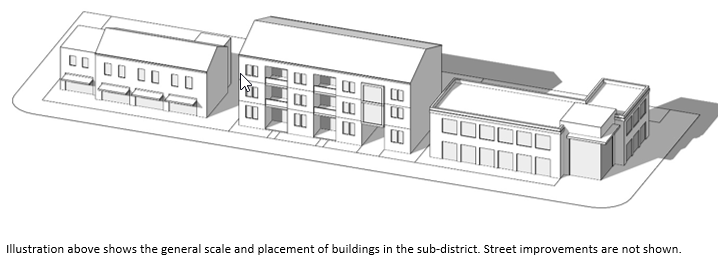
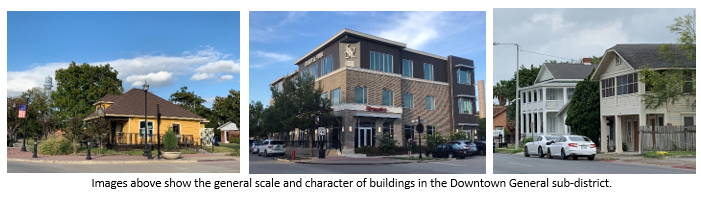
| The Downtown General (DT-G) Sub-District is intended to accommodate a wide range of development and redevelopment within the blocks immediately surrounding Main Street. This district allows for a range of retail, office, urban residential uses (lofts and apartments), and live/work uses that are compatible with the character and pattern of a walkable downtown. | |
 | |
 | |
| BUILDING PLACEMENT | |
| PRINCIPAL BUILDING PLACEMENT | |
| PRIMARY STREET FRONTAGE BUILD-OUT (MIN.) | 60% |
| FRONT SETBACK (MIN.) | 5' (but no less than 15' from the street curb) |
| FRONT SETBACK (MAX.) | 20' |
| SIDE SETBACK (MIN.) (SECONDARY STREET) | 5' |
| SIDE SETBACK (MIN.) (INTERIOR) | 3' (0' for abutting townhome and live/work units) |
| REAR SETBACK (MIN.) | 5' (or minimum 15' from the center line of an alley where applicable) |
| LOT WIDTH (MIN.) | 25' |
| ACCESSORY BUILDING PLACEMENT | |
| Accessory structures shall be placed behind the Principal Building and shall comply with the rear and side setbacks of the Principal Building. | |
| PARKING, ACCESS, & PLACEMENT | |
| PRIMARY STREET SETBACK (MIN.) | Scenario 1 or Scenario 2 |
| SECONDARY STREET SETBACK (MIN.) | Scenario 1 or Scenario 2 or 10' setback (if no building frontage along secondary street) |
| SIDE SETBACK (MIN.) | 3' (interior lot line) |
| REAR SETBACK (MIN.) | 2' (or min. 12' from the centerline of an alley) |
| PARKING COUNT | |
| MINIMUM REQUIRED PARKING | Refer to Article 7: Parking and Transportation of this Chapter. |
| SHARED PARKING | Refer to Section 106.85(F) in Article 7: Parking and Transportation of this Chapter. |
| RESIDENTIAL DENSITY | |
| MAXIMUM NUMBER OF DWELLING UNITS PER ACRE (NET DENSITY) | 36 |
| BUILDING HEIGHT | |
| BUILDING HEIGHT (MAX.) | 4 stories AND not to exceed 60 Feet (taller buildings may be permitted with an SUP per Article 2: Procedures and Administration) |
| ACCESSORY BUILDING HEIGHT (MAX.) | 2 Stories not exceeding 25 feet |
| ADDITIONAL REQUIREMENTS WITHIN THE ZONING REGULATIONS | |
| PERMITTED USES | Article 5. Use Standards |
| BUILDING DESIGN | Article 4. Special District Standards (Section 106.57) |
| STREET IMPROVEMENTS (INCLUDING CROSS SECTIONS AND STREETSCAPE STANDARDS) | Article 4. Special District Standards (Section 106.58.B) |
| OTHER APPLICABLE SECTIONS | Article 7. Parking and Transportation
Article 8. Landscaping, Screening, and Open Space |
D.
DOWNTOWN EDGE
| GENERAL DESCRIPTION | |
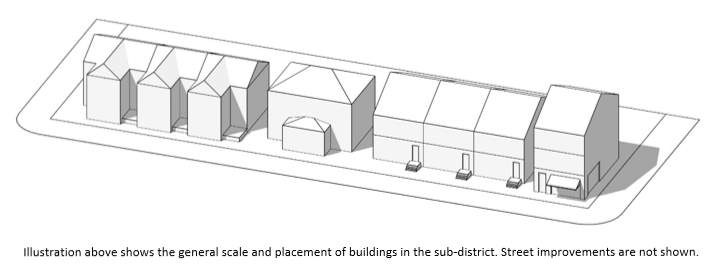
| The Downtown Edge (DT-E) Sub-District is intended to accommodate development and redevelopment within the blocks that are further south and west of the Downtown General district and immediately border single-family neighborhoods. This area has some block definition, but the goal is to encourage redevelopment in to smaller-scale "missing middle" residential such as townhomes, duplexes, and small apartment buildings. The scale of redevelopment is intended to transition between the higher intensity of the Downtown Core and General to the adjoining neighborhoods. This district would also allow professional offices, personal service uses, and corner retail commercial uses. | |
 | |
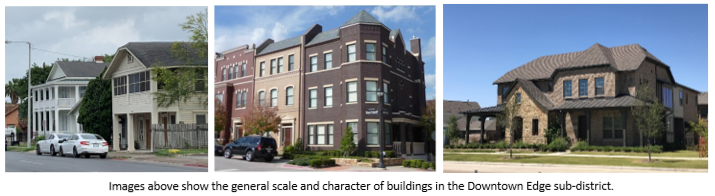 | |
| BUILDING PLACEMENT | |
| PRINCIPAL BUILDING PLACEMENT | |
| PRIMARY STREET FRONTAGE BUILD-OUT (MIN.) | 60% (may be reduced to 50% for properties with no alleys or rear cross access easements) |
| FRONT SETBACK (MIN.) | 10' (5' for corner commercial uses) |
| FRONT SETBACK (MAX.) (ALL USES) | 25' |
| SIDE SETBACK (MIN.) (SECONDARY STREET) | 10' (5' for commercial uses fronting a secondary street) |
| SIDE SETBACK (MIN.) (INTERIOR) | 5' |
| REAR SETBACK (MIN.) | 5' (or minimum 15' from the center line of an alley where applicable) |
| LOT WIDTH (MIN.) | 25' |
| ACCESSORY BUILDING PLACEMENT | |
| Accessory structures shall be placed behind the Principal Building and shall comply with the rear and side setbacks of the Principal Building. | |
| PARKING, ACCESS, & PLACEMENT | |
| PARKING PLACEMENT | |
| PRIMARY STREET SETBACK (MIN.) | Scenario 1 or Scenario 2 |
| SECONDARY STREET SETBACK (MIN.) | Scenario 1 or Scenario 2 or 10' setback (if no building frontage along secondary street) |
| SIDE SETBACK (MIN.) | 5' |
| REAR SETBACK (MIN.) | 5' (or min. 12' from the centerline of an alley) |
| PARKING COUNT | |
| MINIMUM REQUIRED PARKING | Refer to Article 7: Parking and Transportation of this Chapter. On-street parking shall not count toward any required minimum. |
| SHARED PARKING | Refer to Section 106.85(F) in Article 7: Parking and Transportation of this Chapter. |
| RESIDENTIAL DENSITY | |
| MAXIMUM NUMBER OF DWELLING UNITS PER ACRE (NET DENSITY) | 22 |
| LOT WIDTH (MIN.) | 25 feet |
| BUILDING HEIGHT | |
| BUILDING HEIGHT (MAX.) | 3 stories AND not exceeding 35 feet |
| ACCESSORY BUILDING HEIGHT (MAX.) | 2 Stories not exceeding 25 feet |
| ADDITIONAL REQUIREMENTS WITHIN THE ZONING REGULATIONS | |
| PERMITTED USES | Article 5. Use Standards |
| BUILDING DESIGN | Article 4. Special District Standards (Section 106.57) |
| STREET IMPROVEMENTS (INCLUDING CROSS SECTIONS AND STREETSCAPE STANDARDS) | Article 4. Special District Standards (Section 106.58.B) |
| OTHER APPLICABLE SECTIONS | Article 7. Parking and Transportation
Article 8. Landscaping, Screening, and Open Space |
106.57 - DOWNTOWN BUILDING DESIGN STANDARDS
A.
APPLICABILITY: This section shall apply to all new development and redevelopment (residential and nonresidential) within the DT Zoning District based on the proposed improvements per Table 106.57-1
(1)
A Site Plan shall be required for all development other than single-family detached and duplex residential and shall be per Article 2: Procedures and Administration.
(2)
Type 1 Site Plans may be approved administratively, and Type 2 Site Plans shall be approved by City Council after a recommendation by the Planning and Zoning Commission.
B.
COMMERCIAL, MIXED USE, AND MULTI-FAMILY BUILDING STANDARDS:
(1)
Building Orientation and Entrances:
a.
Buildings on lots with Main Street frontage shall be oriented toward Main Street with their primary building entrance located on that street. Buildings at street corners may have a chamfered (angled) entry (see Figure 106.57-1).
b.
Buildings along all other streets shall be oriented along their primary street frontage with the main building entrances from the sidewalk along that street (for example, a street with an address along Pecan Street shall have the main building entrance at the sidewalk along Pecan Street).
c.
All primary entrances shall be oriented to the public sidewalk or within a forecourt adjacent to a public sidewalk for ease of pedestrian access. Secondary and service entrances may be located from internal parking areas or alleys.
d.
Where a building is set back at the ground floor along Main Street or its primary street frontage, the setback area shall be paved flush with the sidewalk up to the front entrance.
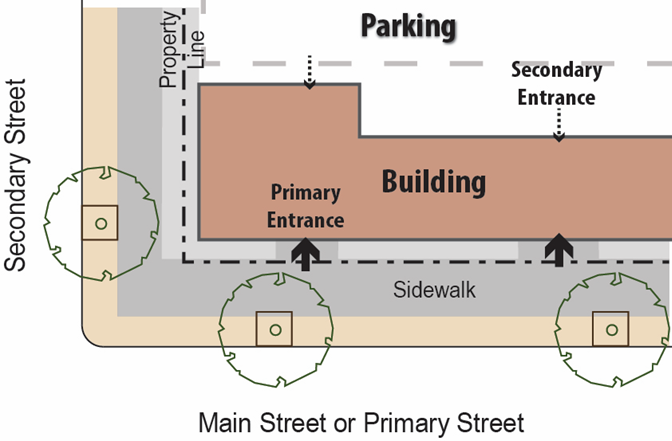
Figure 106.57-1: Illustration Depicting the Required Building Orientation and Primary
Entrance
(2)
Façade Composition and Massing.
a.
Building Articulation: Buildings having primary facades wider than 60 feet shall be designed to reduce apparent mass by dividing the primary facade into a series of smaller components. No individual component shall have a length of more than 60 feet nor less than 20 feet. Components shall be distinguished from one another through two or more of the following:
1.
Variations in roof form, variations in roof height, or parapet of two feet or more
2.
Changes in wall plane of a minimum 24 inches in depth
3.
Variations in the arrangement and recessing of doors and windows
4.
Recognizable changes in texture or material
b.
Corner articulation: At key intersections (typically a stoplight, stop sign, or a roundabout), buildings located on corner lots shall vary the building massing to emphasize street intersections as points of interest in the district. Maximum building heights shall be permitted to exceed by 25 percent for approximately 25 percent of the building frontage along each street façade (see Fig. 106.57-2).
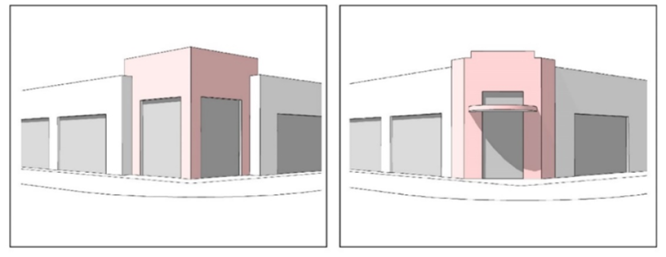
Figure 106.57-2: Illustration showing examples corner articulations. (Color is for
emphasis only)
(3)
Screening:
a.
Roof Top Mechanical Equipment: Exterior building walls shall be tall enough to shield all rooftop mechanical equipment from the view from any adjoining street (shall not include alleys). Other screening devices such as latticework, louvered panels, and any treatments that are compatible with the building's architecture may be considered on a case-by-case basis with approval by the Administrator and/or his or her designee.
b.
Ground Mounted Equipment: All ground-mounted mechanical equipment shall be screened within a masonry wall matching the building in material and color, or if located away from view from the public right-of-way, landscaping may be utilized.
(4)
Windows and Transparency:
a.
At ground level, buildings shall have a high level of transparency. All facades and walls that face any street, pedestrian walkways, and plazas (except rear or side service facades) must have windows per Table 106.57-2 below. The percentage area shall be calculated by dividing the total Fenestration Area (measured from the exterior wall opening and between two feet and ten feet vertically from the adjacent sidewalk grade), by the total façade area (including the windows and doors). Permanent opaque window coverings are prohibited on front facades. Glazing must allow views into the structure for a depth of at least four feet; tinting and reflective coatings must be minimized. The city manager or designee may allow permanent artwork and/or permanent covered outdoor seating to substitute for glazing on side facades.
(5)
Building Materials: The following materials are based on historical precedents in the community and the North Texas region. The selected architectural materials must reflect a sense of quality and permanence. The following materials shall be permitted based on the type of development (single-family materials are specified in Section 106.57.D(4):
a.
All Buildings (except single-family residential): Brick, stone, three-step stucco, wood, certain cementitious fiberboard, and concrete shall be permitted. EIFS (engineered insulated finishing systems) may be used at heights above ten feet from grade for cornices, medallions, and other architectural details and elements.
(6)
Façade Color: Facade colors shall be low reflectance, subtle, neutral, or earth tone colors. The use of metallic colors, black, or fluorescent colors may only be allowed with an Administrative Modification and shall not exceed 5% of any façade (including door and window area).
(7)
Roof Forms and Materials: Variations in rooflines shall be used to add interest and reduce the scale of large buildings. Roof features shall correspond to and denote building elements and functions such as entrances, arcades, canopies, etc. They shall also complement the character of the overall development. Roof Forms and materials permitted shall be based on the Downtown Sub-district as shown in Table 106.57-3.
| Table 106.57-3: Roof Types and Materials | |||
|---|---|---|---|
| ■ = Permitted "Blank Cell" = Not Permitted | |||
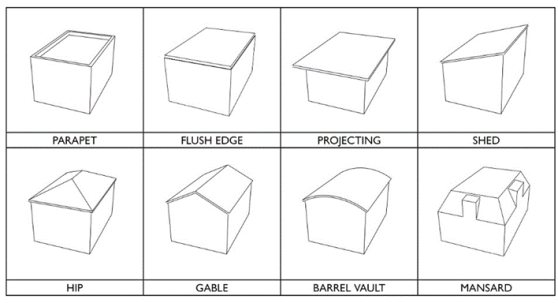 |
Downtown Core
|
Downtown General
|
Downtown Edge
|
| PERMITTED ROOF TYPES BY ZONE | |||
| Parapet | ■ | ■ | ■ |
| Flush edge | ■ | ■ | ■ |
| Projecting | ■ | ■ | ■ |
| Asymmetrical shed roof with slope less than 6:12 | ■ | ■ | |
| Hip | ■ | ■ | |
| Gable | ■ | ■ | |
| Barrel Vault | ■ | ■ | ■ |
| Mansard | |||
| ROOF MATERIALS | |||
| Any material that is not visible from the public ROW or public easement and that has an Initial Solar Reflectance of greater than or equal to 0.65. | ■ | ■ | ■ |
| Standing seam metal, light gray or natural metallic color | ■ | ■ | ■ |
| Green roofs | ■ | ■ | ■ |
| Corrugated metal, light gray or natural metallic color | |||
| Structural glass or structural composite translucent panels used for skylights and canopies | ■ | ■ | ■ |
| Asphalt Shingles | ■ | ||
| Materials not appearing on this list will be presumed to be NOT PERMITTED unless the Administrator determines that the proposed material shares the attributes and characteristics of a roof material that is permitted. | |||
(8)
Shading Devices: Shading devices shall be required along all new building facades along Main Street for a minimum of 50% of the façade width. Along all other streets, shading devices are encouraged. Examples of permitted and not permitted shading devices are shown in Figure 106.57-3 below.
a.
Awnings shall be fabricated from fabric with a metal frame. Vinyl awnings are not permitted.
b.
Suspended awnings, galleries, and arcades are to be fabricated of metal.
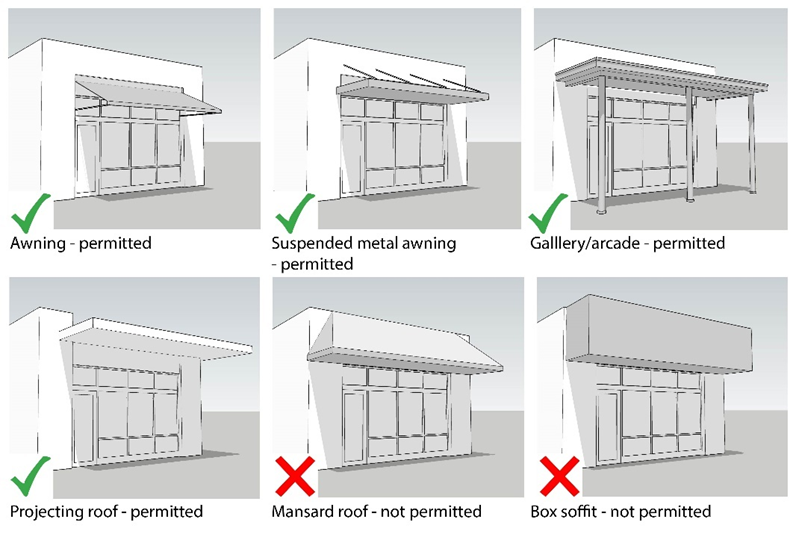
Figure 106.57-3: Examples of permitted and non-permitted shading devices
(9)
Sidewalk Cafes. All sidewalk café areas shall be located within the encroachment zone between the sidewalk zone (SW) and the building façade (see Fig. 106.57-4 and Section 106.58.B for Streetscape Standards). Dining areas shall comply with the Americans with Disabilities Act standards and any requirements for enclosed areas as per state alcohol and beverage commission requirements. Sidewalk cafes shall be permitted through administrative site plan review process in accordance with the table of permitted uses.
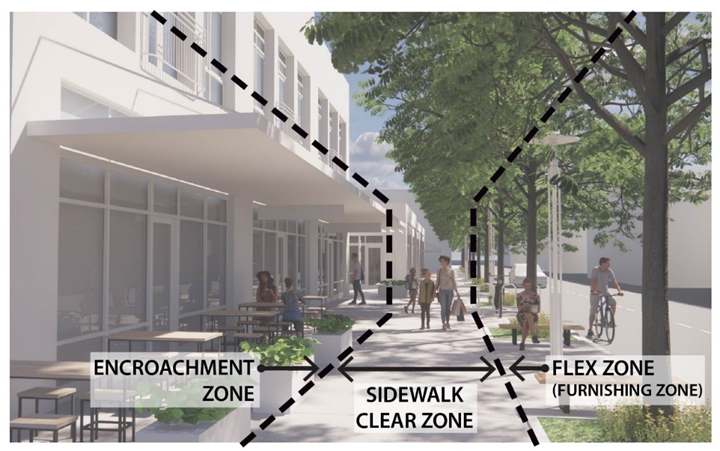
Figure 106.57-4: Illustration showing the main components of the sidewalk
(10)
Building Lighting: All outdoor lighting (building and site) shall comply with the International Dark Sky Association (IDA)'s model ordinance (dated 2011), including the use of cutoff fixtures, utilizing optical systems and shielding to prevent light from being directed above 90 degrees from horizontal.
C.
DESIGN OF STRUCTURED PARKING FACILITIES.
(1)
All frontages of parking structures located on Main Street shall not have parking uses on the ground floor to a minimum depth of 30 feet along the Main Street frontage.
(2)
The amount of Main Street frontage devoted to a parking structure shall be minimized by placing the shortest dimension(s) along the Main Street edge(s).
(3)
Where above-ground structured parking is located on upper floors at the perimeter of a building with frontage along Main Street; it shall be screened in such a way that cars on all parking levels are completely hidden from view from all adjacent public streets. Parking garage ramps shall not be visible from any public street. Unless site conditions do not allow or if an alternative design achieves the screening requirements, subject to review and approval by the administrative official, ramps shall not be located along the perimeter of the parking structure. Architectural screens shall be used to articulate the façade, hide parked vehicles, and shield lighting.
(4)
When parking structures are located at corners, corner architectural elements shall be incorporated such as corner entrance, signage, and glazing. Retail or faux retail storefronts are required for all parking structure corners and for any side facing a public street.
(5)
Parking structures and adjacent sidewalks shall be designed so pedestrians are clearly visible to entering and exiting automobiles.
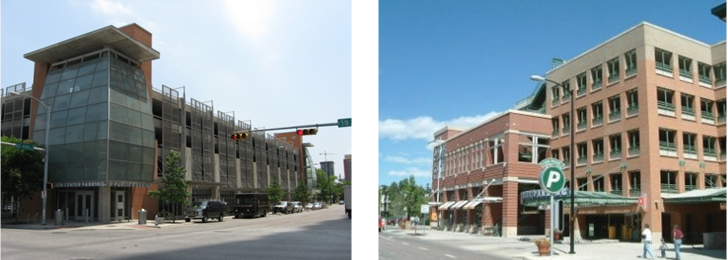
Figure 106.57-5: Images showing parking Garage Design Examples
D.
SINGLE-FAMILY AND DUPLEX BUILDING DESIGN STANDARDS
(1)
At least one of the following shall be added along residential building facades to add pedestrian interest along the street (Figure 106.57-6):
a.
porches;
b.
stoops;
c.
eaves; or
d.
balconies.
(2)
If a residential use building is setback less than 10' from the front property line, the grade of the slab or first floor elevation shall be elevated at least 12 inches above the grade of the sidewalk. If the residential structure is setback 10' or more from the front property line and is not elevated at least 12 inches above the grade of the sidewalk, a low fence (no higher than 3 feet) shall be provided at the front property line.
(3)
Windows and Doors: All building facades of residential use buildings under this section shall meet the transparency requirements established in Table 106.57-2.
(4)
Building Materials:
a.
Awnings and Canopies: Vinyl and/or plastic shall not be allowed.
b.
Single family detached: Brick, stone, and concrete shall be permitted. Wood and three-step stucco shall be permitted for up to 20 percent of each façade.
c.
Single family attached (townhomes): Brick, stone, and concrete shall be permitted. Concrete block or cinder block shall be permitted with a specific use permit (SUP).
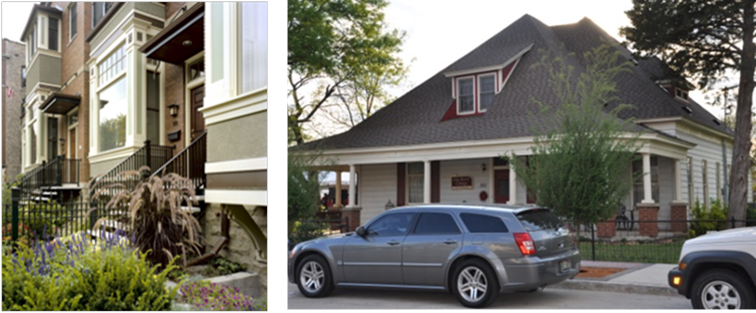
Figure 106.57-6: Residential buildings with porches, fencing, balconies, and stoops
to add interest along the street
E.
CONVERSIONS OF RESIDENTIAL BUILDINGS FOR COMMERCIAL USES: In order that residential structures may be used for commercial/office uses, the following conditions are applied to all residential conversions:
(1)
The reuse shall meet all applicable building code regulations for the use and occupancy requested.
(2)
Parking shall be located to the side or rear of the structure in order to preserve the residential-style front yard of the original structure.
106.58 - DOWNTOWN LANDSCAPING AND STREETSCAPING STANDARDS
A.
LANDSCAPING STANDARDS:
(1)
Parking Lot Landscaping: Any surface parking areas that contain ten (10) or more parking spaces shall provide interior landscaping, in addition to the required landscaped street buffer, as follows:
a.
Ten (10) square feet of landscaping for each parking space shall be provided within the paved boundaries of the parking lot area.
b.
Where an existing parking lot area is altered or expanded to add 10 or more spaces or results in a parking lot of twenty (20) spaces or more, interior landscaping shall be provided on the new portion of the parking lot in accordance with this Chapter.
c.
All surface parking lots shall incorporate the required landscaping as follows:
d.
Provide one (1) canopy tree for every ten (10) parking spaces provided.
1.
Canopy trees shall be located in landscape islands in the parking lot.
2.
Landscaped islands shall be a minimum of one hundred and fifty (150) square feet, not less than eight feet (8') wide, and a length equal to the abutting parking space.
3.
All landscaped areas shall be protected by a raised concrete curb. The Administrator may approve a curbless design per iSWM (integrated Stormwater Management Manual, NCTCOG) standards.
4.
No paving shall be permitted within four (4) feet of the center of a tree trunk.
(2)
Landscape Buffers:
a.
All development with any off-street surface parking between any building and the street right-of-way shall provide a landscape buffer of a minimum of 6' in width along the roadway. A landscape buffer shall not be required when the building is located in a zoning district requiring 10 feet or less of a setback along that street.
b.
Planting required within the Landscape Buffers:
1.
The landscape buffer area shall consist of living trees, turf, or other living ground cover shall be provided adjacent/parallel to the right-of-way.
2.
One (1) Canopy Tree, three inch (3") caliper minimum, shall be planted on an average spacing of no less than fifty feet (50') centers within the required landscape buffer area.
3.
A minimum of fifteen (15) shrubs with a minimum size of five gallons (5 gal.) each will be planted in the landscaped area for each fifty feet (50') of linear frontage.
c.
Parking abutting the landscape area will be screened from the adjacent roadway per Section 106.58.A (3) below. If a vegetative screen is chosen, it may be counted towards the required shrubs in the landscape buffer.
(3)
Parking Lot Screening (see Figure 106.58-1):
a.
All parking, maneuvering, customer loading areas, vehicular display, and storage areas that are not screened by on-site buildings shall be screened from view of public streets pursuant to the standards of this section.
b.
Parking lot screening shall be maintained at minimum of three (3) feet and maximum of four (4) feet in height (or minimum of two feet at the time of planting for vegetative buffers) and planted within the landscape buffer.
c.
Parking lot screening materials may be either:
1.
The same building material as the principal structure on the lot; or
2.
A vegetative screen composed of shrubs planted to be opaque at maturity; or
3.
A combination of the two.
d.
If a vegetative screen is selected, the shrub species shall be selected from the Planting List in Table 106.92-3 and may count towards the planting requirement in the landscape buffer area.
e.
Parking lot screens shall not block any required sight triangles along a cross street or driveway.
f.
Parking lot screens may include breaks to provide pedestrian access from any surface parking or service area to the public sidewalk.
g.
Wheel stops shall be provided for parking spaces adjacent to a landscape setback where no curb is provided to prohibit any car overhang over the planting area. Wheel stops shall be located two feet from the landscape setback.
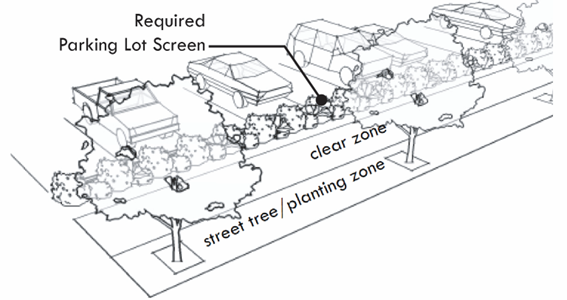
Figure 106.58-1: Illustration of Required Parking Lot Screening
(4)
Parking Lot Lighting: All parking lot and site lighting shall comply with the International Dark Sky Association (IDA)'s model ordinance (dated 2011), including the use of cutoff fixtures, utilizing optical systems and shielding to prevent light from being directed above 90 degrees from horizontal.
B.
STREETSCAPE STANDARDS:
(1)
Unless already installed, Streetscape improvements shall be required along all public and private street frontages of a lot at the time of development or redevelopment unless a fee-in lieu option is chosen by the applicant. Streetscape standards shall meet the standards in this subsection.
a.
Fee in lieu Option: With review and approval of the Administrator, an applicant may propose to pay a proportional fee in-lieu for the required streetscape if the development project is under an acre, in the middle of a block with no adjoining streetscaped lots, or adjacent to existing lots that do not have the streetscape improvements. The fee in lieu shall be based on a per linear foot cost of the streetscape including all elements to be placed between the curb and property line as required by this subsection.
(2)
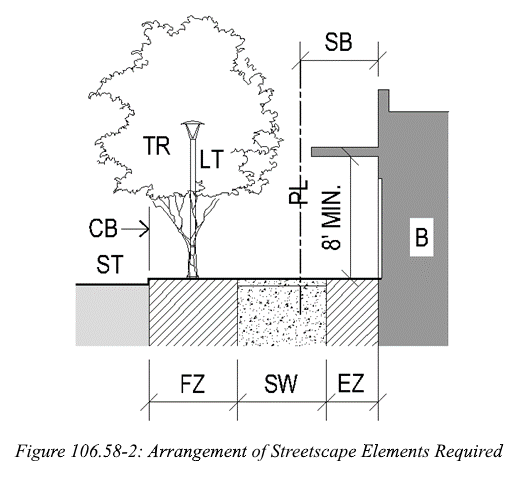
Standards in Table 106.58-1 shall apply for all Downtown development. The minimum width requirements shall apply regardless of the available right-of-way. If necessary to meet the required width, the sidewalk shall extend onto private property to fulfill the minimum requirement, with a sidewalk easement provided.
a.
Flex Zone (FZ): The planting zone is intended for the placement of street trees, where feasible, and street furniture including seating, street lights, waste receptacles, fire hydrants, traffic signs, bicycle racks, public utility equipment such as electric transformers and water meters, and similar elements in a manner that does not obstruct pedestrian access or motorist visibility (see Figure 106.58-2).
b.
Sidewalk Zone (SW): The sidewalk zone shall be hardscaped, shall comply with ADA and Texas Accessibility Standards, and shall be unobstructed by any permanent or nonpermanent element for the required minimum width and a minimum height of eight (8) feet (see Figure 106.58-2). All sidewalks shall connect to other existing adjacent sidewalks if available on adjoining lots.
c.
Encroachment Zone (EZ): Shall be the area along the public sidewalk on private property that includes porches, stoops, awnings, sidewalk cafes, and other similar elements.
| Table 106.58-1 Streetscape Standards | |||
|---|---|---|---|
 | |||
| STREETSCAPE - SECTION VIEW | |||
| The standards in this section may be modified by the Administrator based on approval from the City Engineer and Fire Marshal and based on the specific development context. However, the two major elements of the FZ and SW shall be implemented even if the widths have to be modified to accommodate site specific conditions. This applies to all streets other than Main Street within the Crowley Downtown District. | |||
| SW | Sidewalk: Min. 6 feet clear width (with no encroachments) | SB | Building Setback — Refer to site development standards |
| FZ | Flex Zone: 8' min. (intended to accommodate on-street parking within the FZ) | TR | Street Trees: provide according to Section 106.58.B (3). |
| EZ | Encroachment Zone: Varies per setback requirements. | LT | Pedestrian lighting shall be required. Locations to be coordinated with street trees. |
| B | Building as permitted according to district standards. | PL | Property line. Verify location relative to sidewalk. A pedestrian access easement may be required. |
(3)
Street Trees:
a.
Street trees shall be centered within the FZ and be planted a minimum of 3' from the face of curb.
b.
Spacing shall be an average of 30 feet (measured per block face).
c.
The minimum caliper size for each tree shall be 3" and shall be a minimum of seven (7) feet in height at planting. Each tree shall be planted in a planting area no less than 36 square feet.
d.
Species shall be selected from Canopy Trees in Table 106.92-3 Approved Planting List.
e.
Installation and maintenance of all landscape materials shall meet the requirements in Article 8: Landscaping, Screening, & Open Space Standards.
106.59 - PLANNED DEVELOPMENT DISTRICTS
A.
PURPOSE AND INTENT: The Planned Development (PD) District is established to provide an alternative to the base zoning districts and other special zoning districts established in this Chapter. The PD district is intended to accomplish the following:
(1)
To permit greater flexibility for new development or redevelopment projects to best utilize the physical features of the particular site in exchange for greater public benefits that would otherwise be achieved through development under this Chapter.
(2)
To ensure that any development impacts that occur through the use of greater flexibility in development standards and uses are offset by public benefits and that any negative impacts are mitigated to the extent feasible so as minimize the impacts on adjoining properties.
(3)
To encourage the provision and preservation of meaningful and usable open space.
(4)
To encourage innovative and integrated design of buildings and uses within a larger master planned context of the PD district.
B.
PD STANDARDS
(1)
Minimum Area Required for a Planned Development District:
a.
The minimum size for a Planned Development District is two (2) contiguous acres.
b.
The minimum access width to a Planned Development District from any existing public street is fifty (50) feet.
c.
All PDs shall have a minimum of 10% of the site dedicated to usable open space. Open space shall meet the standards in Article 8: Landscaping, Screening, & Open Space Standards.
(2)
Land Use Mix: A PD may provide for a mix of any number or types of uses, provided each use requested appears on the Schedule of Permitted Uses in Article 5: Use Regulations.
(3)
Development Regulations:
a.
In approving a planned development or a use designation in a planned development, the City Council, upon recommendation of the Planning and Zoning Commission, shall specify density, area, height, screening, parking, landscaping, and other development criteria as may be required in Article 2: Procedures and Administration.
b.
Such standards shall be indicated on the development plan and shall be made a part of the ordinance. No property located in a planned development shall be modified as to density, area, height, screening, parking, landscaping, or other development criteria unless a development plan containing such revised development criteria is approved.
C.
REVIEW PROCEDURES: The review and approval procedures in Article 2: Procedures and Administration under Concept Plan, Development Plan, and Site Plan shall apply including standards for modifications to approved PDs.
106.60 - MIXED-USE DISTRICT
A.
PURPOSE AND INTENT: The Mixed-Use District is intended to implement the Mixed-Use land use designations and recommendations in the City of Crowley Comprehensive Plan. For all areas designated as Mixed-Use in the Crowley Future Land Use Plan, the Mixed-Use Zoning District shall be the appropriate district for all rezoning requests.
B.
GENERAL: Boundaries of the Mixed-Use Districts and associated sub-districts, basic street network, and stormwater management areas shall be developed through the creation of Concept Plans and/or Development Plans at the time of zoning change per Article 2: Procedures and Administration.
C.
SUB-DISTRICTS ESTABLISHED:
(1)
Mixed-Use Core. Intended to have a mix of retail, office, retail service, and a range of residential uses in addition to civic and open spaces to create a vibrant, walkable environment.
(2)
Mixed-Use Transition. Intended to be predominantly residential with a mix of both attached and detached residential, with small office and local retail to appropriately transition between neighborhoods to commercial uses.
(3)
Mixed-Use Neighborhood. Primarily single-family residential with a variety of types and sizes of lots.
D.
CONCEPT PLAN: If a revised Concept Plan or request for new property zoning is submitted, then application of sub-districts within the Concept Plan shall adhere to the following requirements:
(1)
A Concept Plan cannot comprise of just one single sub-district for the entire area.
(2)
At least two sub-districts shall be designated within any Concept Plan.
(3)
If the Mixed-Use Neighborhood is used, then the Mixed-Use Transition sub-district shall be used to buffer Mixed-Use Neighborhood from the Mixed-Use Core.
E.
STREET TYPES: Pedestrian-Oriented Streets are used within the Concept Plan to achieve a higher level of pedestrian activity and connectivity. The amount of the required Pedestrian-Oriented Streets in any one Concept Plan is determined by the sub-district, within the Development Standards Table 106.60-1 below. Pedestrian-Oriented Streets include design considerations as follows:
(1)
Low-speed design to keep vehicle speeds at or below 25 mph;
(2)
Including the use of traffic calming designs (narrowing of pavement section, striping, elevated crosswalks, brick pavers, etc.);
(3)
Limiting use of curb cuts along the Pedestrian-Oriented Street;
(4)
Planting street trees between the curb and the sidewalk, or within tree-wells in the sidewalk area;
(5)
Adhering to the setback range according to the Development Standards Table; and
(6)
Utilizing shading devices along the nonresidential or mixed-use building frontage, such as porches, awnings, pergolas, and other similar shade devices.
F.
DEVELOPMENT STANDARDS: In order to produce a Concept Plan within any Mixed-Use District, the following development standards shall be used. Where items are marked as "flexible" in Table 106.60-1, the applicant shall provide a proposed standard with Concept Plan submittal.

