
Crowley City Zoning Code
ARTICLE 8
- LANDSCAPING, SCREENING, & OPEN SPACE STANDARDS
106.91 - APPLICABILITY
A.
APPLICABILITY MATRIX. Table 106.91-1 shall establish the applicability of the different standards in this Article.
106.92 - LANDSCAPING, TREES, AND BUFFERING STANDARDS
A.
PURPOSE
(1)
The standards of this section are intended to enhance the quality of development through the provision of appropriate landscaping and buffering.
(2)
The landscaping regulations serve to safeguard and enhance property values while protecting public and private investment.
(3)
The regulations encourage the preservation of the existing natural environment including prohibition of clear-cutting in order to aid in the stabilization of the environment's ecological balance whenever possible, and require property owners to provide landscape amenities, setbacks, and buffering that promote a positive image and pride for new development in the city.
(4)
It is also the intent of this section to provide flexible requirements that encourage and allow for creativity in landscape design. The results of this effort will be to improve the visual qualities of the city's commercial corridors and residential neighborhoods.
B.
APPLICABILITY
(1)
General: This section establishes minimum standards for landscaping and buffering for all new development and redevelopment in the City of Crowley as follows:
a.
All single-family residential development in subdivisions with zoning change approved or preliminary platted after the adoption of this Chapter and per Table 106.91-1 shall meet the standards in Section 106.92.C on Residential Landscaping and Buffering.
b.
All multi-family, non-residential development, and mixed-use development in the Downtown districts per Table 106.91-1 shall meet the standards in Section 106.92.D on Non-Residential and Multi-Family Landscaping and Buffering.
c.
All surface parking lots per Table 106.91-1 and with 10 or more parking spaces shall meet the standards in Section 106.92.D.(2) on Parking Lot Landscaping.
d.
All development in the DT District shall meet the standards in Section 106.58.
(2)
Parcel/Use Specific: Landscaping and buffering requirements in other sections or parcel-specific development approvals:
a.
Any use that is required to provide landscaping or buffering pursuant to Section 106.66, Supplemental Use Standards, shall comply with such requirements. In the event of a conflict between the Supplemental Use Standards and the requirements of this section, the Supplemental Use Standards shall control.
b.
Any use that is required to provide landscaping or buffering pursuant to a parcel-specific ordinance, including PD or MU zoning and/or approval conditions, shall comply with such requirements. In the event of a conflict between the parcel-specific zoning ordinance and/or conditions and the requirements of this section, the parcel-specific standards shall control.
(3)
Landscaping and Buffering Plan: Prior to the issuance of a building or construction permit for any development other than single-family or duplex dwellings, a landscape plan reflecting all landscaping and buffering required under this section shall be submitted in conjunction with a site plan. The landscaping plan may be combined with any site plan, screening plan, grading plan, or other plan required for compliance with other Articles of this Chapter. A Landscape Plan shall include the following information:
a.
Landscaping plans for all non-residential and multi-family sites shall be prepared by a registered landscape architect and shall contain, at a minimum, the following information:
1.
Minimum scale of one inch equals 50 feet or appropriate scale for legibility;
2.
North arrow;
3.
Date of preparation of the Landscaping Plan;
4.
Location, size and species of all trees to be preserved;
5.
Location of all plant and landscaping material to be used, including plants, paving, benches, screens, fountains, statues, or other landscape features including proposed topography of site using 1' contours;
6.
Identification of all plant material to be used (Common and Botanical);
7.
Size of all plant material to be used at the time of planting with appropriate spacing indicated on the plan;
b.
Irrigation Plan:
1.
Layout and description of irrigation, sprinkler or water systems including placement of water sources and including freeze/rain sensors on sprinkled systems;
2.
Irrigation plan must be prepared by a licensed irrigator in the State of Texas.
c.
Size and location of all existing and proposed utilities, including easements and duct banks, if any;
d.
Planting and/or other details or cross sections as required for clarification by the city; and
e.
Description of maintenance provisions for the landscape plan.
C.
TREES
(1)
Clear Cutting Prohibited: Clear cutting of trees is prohibited within the city. Cutting of trees and land clearing may be done, only for development purposes, in accordance with an approved final plat and/or site plan and in accordance with the requirements listed below.
a.
Cutting of trees and land clearing for other than development purposes shall be considered by the City Council.
b.
The existing natural landscape character of the city shall be preserved to the extent reasonable and feasible.
c.
In an area of the street frontage containing a strand of recommended trees, the developer shall use best good faith effort to preserve such trees.
d.
Any trees preserved as part of a development shall be eligible for tree preservation credits as established in Section 106.92(G)(1)h.
(2)
Land Clearing Not for Development Purposes:
a.
Cutting of trees and land clearing for other than development purposes may only be considered by the City Council. In determining whether to allow cutting of trees or land clearing, the City Council shall consider any of the following:
1.
Special conditions exist which are peculiar to the land and are not applicable to other lands in the same zoning district;
2.
The clear cutting is for a legitimate agricultural purpose and the property is zoned AG;
3.
The strict interpretation of the provisions of this section would deprive the property owner of rights commonly enjoyed by other properties in the same zoning district under the terms of this section;
4.
Allowing the land clearing will meet the objectives and intent of this section and not injure the adjoining property owners or be detrimental to the public welfare; or
5.
Allowing the land clearing will be in harmony with the spirit and purpose of this section.
b.
In allowing the land clearing, the City Council may impose such conditions as will reasonably accomplish the purposes of this section.
(3)
Selective Thinning: The removal of selected trees from within a densely forested area when done in a professionally accepted manner shall be allowed as a single permit upon approval by the Administrator. Approval will only be granted when the Administrator determines that the selective thinning is being done in a manner that would enhance the environment and likelihood of survival for the remaining trees. Approved selective thinning may take place either before, during, or after construction.
(4)
Exemptions. The following properties, activities, or conditions shall be exempt from the tree preservation requirements in this section. The burden of proof as a qualified exception is upon the person removing the tree.
a.
Trees that are within 150 feet of a primary structure on property in use as a single-family residence of less than five (5) acres or as a homestead;
b.
Trees that are diseased or damaged beyond the point of recovery, are in danger of falling, or are damaging a foundation as determined by a certified arborist or qualified botanist;
c.
Hazardous conditions as described below:
1.
Any tree determined to be causing a danger or be in a hazardous condition as a result of a natural event such as a tornado, storm, or flood that endangers the public health, welfare, or safety and requires immediate removal;
2.
Any tree that has disrupted a public utility service due to a tornado, storm, flood or other act of nature. Removal shall be limited to the portion of the tree reasonably necessary to reestablish and maintain reliable utility service;
3.
Nursery trees that are planted and growing on the premises of a wholesale nursery that are intended for sale in the ordinary course of business;
4.
A tree located within a visibility or sight triangle area as defined on a plat of record or under Chapter 98 of this Code or that conflicts with requirements of other ordinances or regulations, and immediate removal is required in order to comply with said regulations;
5.
For single family residential building permits, all areas within the building pad, driveway, sidewalks, patios, and pool and associated deck area as shown on a tree survey approved by the Administrator shall be exempt from the tree protection and replacement requirements specified herein. All other areas of the lot shall be subject to these requirements. If the lot has not already been clear for grading of a subdivision, trees shall not be approved for removal prior to application for a building permit for the home;
6.
Trees located within an area where capital improvements are to be constructed;
7.
Trees located within the right-of-way and the adjacent utility easements;
8.
Trees located within drainage facilities (easements and detention ponds) as defined on a plat of record; and
9.
Trees located with an area designated for ballfields, sport courts, or other play areas in a public park.
d.
All construction activities with an approved engineering site plan, final plat construction plans, or final plat approved prior to the effective date of this article shall be exempt from the requirements of this section and shall be subject to the clear-cutting regulations in place at the time of permit submittal.
e.
The city shall have the right to plant, prune, and maintain street trees and park trees within the lines of all streets, alleys, avenues, lanes, squares, and public grounds, as may be necessary to ensure public safety or to preserve or enhance the symmetry and beauty of the public properties. The city may remove, cause, or order to be removed any tree or part thereof which is in an unsafe condition, or which by reason of its nature is injurious to sewers, electric power lines, gas lines, water lines, or other public improvements, or which is affected with any injurious fungus, disease, insect, or other pest.
(5)
Tree Removal Authorization:
a.
Authorization to remove trees shall not be required for removal of a protected tree for allowed exemptions in Section 106.92(C)(4).
b.
Authorization shall be required for all other tree removal in the city.
(6)
Standards for Tree Removal Authorization: The Administrator shall review all applications for tree removal authorization.
a.
Residential development. All areas within street rights-of-way and public utility or drainage easements as shown on an approved final plat shall be exempt from the tree protection and replacement requirements specified herein, except that such areas with protected tree stands or exceptional trees shall not be exempt; protected tree stands and exceptional trees may only be removed if permitted under this section. The developer may request trees within potential building pad areas to be included in the exemption described herein, but the city is not required to grant such requests.
b.
Non-residential development. All area within street rights-of-way and public utility or drainage easements as shown on approved site plan or approved final plat, plus fire lanes, parking areas, and building pads as shown on approved construction plans shall be exempt from the tree protection and replacement requirements specified herein, except that such areas with protected tree stands or exceptional trees shall not be exempt; protected trees stands and exceptional trees may only be removed if permitted under this section. In addition, clearing of area in excess of 110% of the minimum parking requirements shall not be exempt.
c.
The Administrator may consider removal of protected trees stands or exceptional trees under the following conditions:
1.
The tree(s) must be removed in order to provide required infrastructure to a site to be developed and, in the opinion of the city engineer, no other reasonable alternative is available for providing such infrastructure, and
2.
Planting of new trees from the approved tree list shall be equal to or greater in caliper inches of the trees to be removed. This additional planting shall be in excess of any other tree planting requirements for the site. The party proposing to remove the tree(s) shall submit documentation of the existing tree caliper sizes, with such documentation to be prepared by a certified arborist; or
3.
An area one and one-half (1 ½) times the area of the canopy identified for removal is retained on the same site. The one and one-half (1 ½) retention of existing trees shall be of the same species as the tree being removed or from the approved tree list.
d.
Tree Replacement Fund: A person required to comply with Section 106.92.C(6) c. may request to make a payment to a tree replacement fund or other specifically dedicated fund approved by the City Council for such payments in accordance with the following requirements:
1.
The amount of the payment required in lieu of each replacement tree shall be the average cost of a quality tree of similar size and type to the replacement tree which would otherwise have been required by this Article, plus the cost of planting such a tree, as determined by the City Council and provided in a fee schedule published by the city.
2.
The funds shall be used only for purchasing and planting trees on public property or city right-of-way as authorized by the City Manager. City Council may also approve planting on or purchase of all other lands including conservation easements or environmental preserves which shall remain in a naturalistic state in perpetuity, or establishing a landscape or wildlife preserve or similar nature area.
3.
The Administrator shall submit periodic reports to the City Council of the deposits and use of the Tree Replacement Fund.
e.
Information Required for Tree Removal Authorization: The applicant shall prepare and submit a drawing(s) showing:
1.
The location and species of each native tree with a trunk greater than eight inches in caliper size (diameter measured at breast height);
2.
It shall indicate whether each tree is to be removed or retained, and for any tree to be removed, the plan shall state the reason for removing the tree.
3.
In areas of dense vegetation that are proposed to be undisturbed, an outline of the vegetation may be shown.
4.
An arborist or registered landscape architect or tree expert who has documented completion of at least sixteen hours of training in Texas tree identification shall prepare the plan.
5.
The tree survey shall be submitted prior to, or along with, the final plat construction plan submittal, grading permit application, or engineering site plan application.
6.
The applicant shall be required to furnish one paper copy at least 22×34 inches in size and one digital copy of the proposed development showing all proposed improvements (such as rights-of-way, easements, lot patterns, cut/fill, parking areas, building pads, fire lanes etc.) with the submittal of a final plat construction plans or site plan or building permit, whichever comes first. The digital copy shall use the North American Datum 1983 (NAD 83), Texas State Plane - North Central Zone (4202), United States, and providing a scale factor if a surface survey is used.
f.
Tree removal authorization shall be valid for a period of one hundred eighty (180) days.
g.
Upon request of the applicant, the Administrator shall be authorized to work with the owners, developers, and builders to make non-substantive changes, within the scope of this section, to plans, permits, and other requirements throughout the development and construction processes that will provide the greatest reasonable tree survival. The decision of the Administrator may be appealed by the applicant to the City Council.
h.
Appeals: Clearing of trees not in compliance with the Tree Removal Authorization standards in this section shall be considered by the City Council when requested by an applicant in writing. The applicant shall be required to provide plans showing which trees are proposed to be removed and where and shall provide information to City Council describing the need for removing trees beyond those is permitted for the development. In making a determination, the City Council may consider the existing natural landscape character, available alternative solutions, and other factors relevant to the specific project and property in question.
(7)
Tree Replacement: A party may request to remove a non-exempt protected tree or protected tree stand. If removal is approved by the city, the party (other than franchise utility companies) removing the tree shall be required to replace the protected trees being removed with trees meeting the standards below:
a.
A sufficient number of trees shall be planted to equal or exceed total caliper inches of all non-exempt trees removed. This mitigative measure is not meant to supplant good site planning. Tree replacement will be considered only after all design alternatives which could save more existing trees have been evaluated and reasonably rejected.
b.
The replacement trees shall be a minimum of three-inch (3") caliper (diameter measured at one (1) foot above ground) and seven (7) feet in height when planted and shall be selected from the list of Canopy Trees in the Approved Plant List in Table 106.92-3.
c.
All replacement trees that die within two (2) years of the date of the project completion will be replaced. The replacement tree(s) carries the same two-year requirement. The requirement to replace the trees shall run with the land.
d.
An applicant for a tree removal permit shall submit a signed, notarized landscape/tree replacement agreement to the city, on forms provided by the city, before a tree removal permit may be issued.
e.
In lieu of replacement on site, the applicant may pay into the Tree Replacement Fund as provided in Section 106.92.C.(6)d.
(8)
To preserve the required mandatory areas of natural vegetation landscape from inadvertent damage during construction, a physical barrier shall be erected around the perimeter of these areas to be protected. The barriers will be in place and approved by the building official or designee before any heavy equipment is set on site or before any site clearance can commence. The barrier may consist of a temporary chain link fence, wooden stake (snow) fence, plastic safety/construction fence or other devices as approved by the building official or designee. Minimum height of all types of barriers is four feet. Barriers shall remain in place until the final building and landscape site inspections are satisfactorily completed for the issuance of the certificate of occupancy. Only after this time can the barriers be removed. The city prohibits the use of heavy equipment for tree removal or site clearing under the drip line of any protected tree(s)/protected tree stand(s).
D.
RESIDENTIAL LANDSCAPING AND BUFFERING REQUIREMENTS: This section shall apply to all single family detached, single-family attached residential and duplex residential uses.
(1)
Front Yard Landscaping:
a.
Purpose: Landscaping should be selected and placed in the front yards of residences to soften the effect of the built environment and create attractive streetscapes. An arrangement of vegetation such as trees, shrubs, and grass, together with other suitable materials such as flowering plants, ground cover, mulch, etc., arranged in a complementary fashion, is desired.
b.
All residential lots shall have vegetation established per the requirements of this section prior to Certificate of Occupancy unless otherwise approved by Administrator because of weather conditions.
c.
Canopy Trees:
1.
Trees selected from the tree list included in Table 106.92-3 of this Article shall be planted on all single-family residential and duplex lots based on the zoning district as specified in Table 106.92-1.
2.
Fifty percent of the required canopy trees or at least one canopy tree shall be placed in the front yard.
d.
Front yard vegetation: In addition to the canopy tree requirement, all residential lots shall provide landscaping that results in the highest amount of vegetation of the two options below:
1.
Option 1 - Percentage Vegetative Cover: At least 10 percent of the front yard shall be landscaped with vegetative cover (trees, shrubs, ground covers, or ornamental grasses) other than turf grass. For the purposes of this requirement, front yard means the area between the house and the front property line.
2.
Option 2 - Required Materials: The front yard shall be landscaped with at least ten shrubs of at least two different species, and one ornamental tree.
(2)
Design and Planting Standards
a.
Each ornamental tree shall count for 20 square feet of the required vegetative cover in the landscaped area.
b.
The use of native vegetation, drought-tolerant plants, or rain gardens is encouraged.
c.
In addition to Options 1 and 2 above, front yard landscaping on corner lots shall wrap around the side for a minimum of 20 feet along the side street.
(3)
Residential Streetscape Standards
a.
Purpose: The intent of this requirement is to provide appealing and comfortable pedestrian street environments in order to promote pedestrian activity that, in turn, promotes public health through increased physical activity. An attractive streetscape is a significant community asset, and often helps maintain neighborhood values. Homes designed in relation to the streetscape become part of the neighborhood rather than a solitary residence.
b.
Applicability:
1.
This section is applicable to internal residential streets within a new development of 20 or more dwelling units.
2.
This section also applies to streets within the MU-Transition and MU-Neighborhood zones unless parcel specific standards are adopted through the MU Ordinance.
c.
Requirements: Streets shall be designed to include the following:
1.
A landscaped buffer area at least six feet in width shall be provided between the sidewalk and the back of the curb. The landscaped buffer area shall be designed as follows:
i.
Street trees shall be located within the buffer area and provided at the quantity and spacing of an average of one canopy tree per every 50 linear feet.
ii.
Trees shall be centered at a minimum distance of three feet from the back of the curb.
iii.
Trees shall be selected from the list of species approved in Table 106.92-3. No single species of tree shall represent more than 30 percent of the trees required to satisfy the street tree requirement.
iv.
Trees shall be planted based on the standards for planting in this Section.
v.
Street lampposts, street signs, mail kiosks and mailboxes shall be located in this buffer area, subject to post office regulations for mailboxes.
vi.
Street trees shall not be located closer than 10 feet to a lamppost.
2.
Sidewalk Zone: A continuous sidewalk at least five feet in width shall be provided on both sides of the street at least six feet distant from and generally parallel to the back of the curb. Meandering sidewalks may be approved by the Administrator to preserve trees and create a more informal streetscape.
3.
Walkways: Separate walkways that connect the front doorway or porch to the sidewalk shall be required. These walkways shall be at least four feet wide.
(4)
Subdivision Perimeter Landscaping: Refer to Section 106.93.D.2 Screening and Fence Requirements of this article.
E.
NON-RESIDENTIAL AND MULTI-FAMILY LANDSCAPING AND BUFFERING REQUIREMENTS
(1)
Applicability:
a.
This section shall apply to all non-residential and multi-family development (over two units per lot) per Table 106.91-1 with the exception of development in the DT district (DT-C, DT-G, and DT-E).
b.
In the Downtown districts, only the following sections shall apply:
1.
Parking Lot Landscaping;
2.
Landscape Buffer: for all development with off-street parking lots fronting arterial roadways only; and
3.
Parking Lot Screening: for all development with off-street parking lots fronting along any street.
(2)
Parking Lot Landscaping: Any surface parking areas that contain ten (10) or more parking spaces shall provide interior landscaping, in addition to the required landscaped street buffer, as follows:
a.
Ten (10) square feet of landscaping for each parking space shall be provided within the paved boundaries of the parking lot area.
b.
Where an existing parking lot area is altered or expanded to add 10 or more spaces or results in a parking lot of twenty (20) spaces or more, interior landscaping shall be provided on the new portion of the parking lot in accordance with this Article.
c.
All surface parking lots shall incorporate the required landscaping as follows:
1.
Provide one (1) canopy tree for every ten (10) cars of parking provided.
2.
Canopy trees shall be located in landscape islands in the parking lot.
3.
Landscaped islands shall be a minimum of one hundred and fifty (150) square feet, not less than eight feet (8') wide and a length equal to the abutting parking space.
4.
All landscaped areas shall be protected by a raised concrete curb. The Administrator may approve a curbless design per iSWM (integrated Stormwater Management Manual, NCTCOG) standards.
d.
No paving shall be permitted within four (4) feet of the center of a tree trunk.
(3)
Landscape Buffers:
a.
All development with any off-street surface parking between any building and the street right-of-way shall provide a landscape buffer that is based on the roadway frontage specified in Table 106.92-2. A landscape buffer shall not be required when the building is located in a zoning district requiring 10 feet or less of a front yard setback.
b.
Planting required within the Landscape Buffers:
1.
The landscape buffer area shall consist of living trees, turf, or other living ground cover and shall be provided adjacent/parallel to the right-of-way.
2.
One (1) Canopy Tree, three inch (3") caliper minimum, shall be planted on an average spacing of no less than fifty feet (50') centers within the required landscape buffer area.
3.
A minimum of fifteen (15) shrubs with a minimum size of five gallons (5 gal.) each will be planted in the landscaped area for each fifty feet (50') of linear frontage.
c.
Parking abutting the landscape area will be screened from the adjacent roadway per Section 106.92.D.(4) below. If a vegetative screen is chosen, it may be counted towards the required shrubs in the landscape buffer.
d.
Where a proposed non-residential development is adjacent to any of the following at the time of development: (i) property line of single- family zoned parcels; or (ii) areas shown as single-family uses on the Future Land Use Plan; or (iii) in use as single family residential use at the time of non-residential development; the following standards shall apply:
1.
one (1) Canopy Tree, three inch (3") caliper minimum, shall be planted on thirty foot (30') centers in a fifteen foot (15') wide landscape area.
2.
Areas where truck docks or loading spaces are adjacent to such property zoned single-family, canopy trees shall be planted on twenty five foot (25') centers.
3.
Vegetation used for perimeter buffering must be evergreen trees and shrubs selected from Table 106.92-3.
e.
Where a non-residential development is adjacent to the property line of parcels zoned for uses other than residential land use categories on the Future Land Use Plan:
1.
A six foot (6') wide landscape area is required.
2.
If the property line is the centerline of a fire lane or drive aisle, the six foot (6') wide landscape area will begin at the edge of the lane/aisle. If the drive aisle or fire lane only allows access to parking spaces, or if the site is part of a larger coordinated development, the landscape area may be eliminated or moved at the discretion of the Administrator.
3.
The six foot (6') wide landscape area between lots may be eliminated where the building is attached to another building on an adjoining lot and they are shown on an approved Site Plan.
4.
One (1) ornamental tree and one (1) five gallon (5 gal.) shrub will be planted every fifteen linear feet (15'). These trees and shrubs may be clustered in lieu of placing them every fifteen feet (15').
(4)
Parking Lot Screening:
a.
All parking, maneuvering, customer loading areas, vehicular display, and storage areas that are not screened by on-site buildings shall be screened from view of public streets pursuant to the standards of this section.
b.
Parking lot screening shall be maintained at a minimum of three (3) feet and maximum of four (4) feet in height (or minimum of two feet at the time of planting for vegetative buffers) and, if vegetative, planted within the landscape buffer.
c.
Parking lot screening materials may be either:
1.
The same building material as the principal structure on the lot (masonry or similar material only), or
2.
A vegetative screen composed of shrubs planted to be opaque at maturity, or
3.
A combination of the two.
d.
If a vegetative screen is selected, the shrub species shall be selected from the Approved Planting List in Table 106.92-3 and may count towards the planting requirement in the landscape buffer area.
e.
Parking lot screens shall not block any required sight triangles along a cross street or driveway.
f.
Parking lot screens may include breaks to provide pedestrian access from any surface parking or service area to the public sidewalk.
g.
Wheel stops shall be provided for parking spaces adjacent to a landscape setback where no curb is provided to prohibit any car overhang over the planting area. Wheel stops shall be located two feet from the landscape setback.
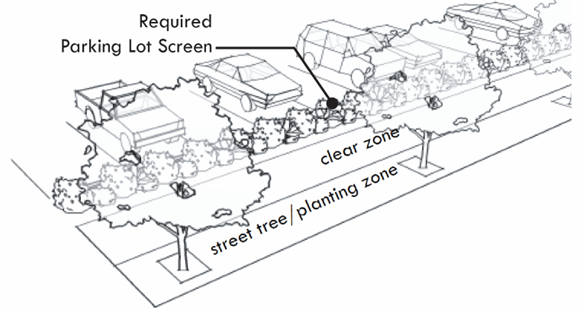
Figure 106.92-1: Illustration of Required Parking Lot Screening
F.
DOWNTOWN LANDSCAPING AND STREETSCAPING STANDARDS:
(1)
Shall meet standards in Section 106.58.
G.
GENERAL LANDSCAPING STANDARDS:
(1)
The following criteria and standards shall apply to landscape materials and installation:
a.
All required landscaped areas shall be covered with living plant material. Mulch and other materials can be used around required shrub and tree plantings. Supplemental plantings, hardscape, or other design elements may be considered by the Administrator on a case-by-case basis. Landscape Plans must meet the minimum requirements of this Article prior to approval. Other plant materials in excess of the quantities required in this Article may be smaller than the required material.
b.
Tree and plant materials shall be selected for energy efficiency and water efficiency; adaptability and relationship to the native environment; color, form and pattern; ability to provide shade; soil retention; and resistance to fire. The overall landscape plan shall be integrated with all elements of the project, such as buildings, parking lots, and streets, to achieve both an attractive environment and a desirable microclimate and minimize energy demand.
c.
Trees and plants installed to satisfy the requirements of this section shall meet or exceed the plant quality, measurements, size, and species standards in the code of standards set forth in the current edition of the American Standard for Nursery Stock (www.ansi.org) and the Best of Texas Landscape Guide published by the Texas Nursery and Landscape Association (TNLA).
d.
Plants shall be nursery-grown and adapted to the local area. Grass seed, sod, and other material shall be clean and reasonably free of weeds and noxious pests and insects. No artificial plants or vegetation shall be used to meet any standards of this section.
e.
The landscaping for every development shall consist of a combination of three or more of the following types of planting materials including, but not limited to grass, trees, shrubs, ground cover, and/or other forms of plant material.
f.
Trees:
1.
Canopy trees shall be of a minimum of three inches (3") in caliper as measured twelve inches (12") above natural soil level and seven feet (7') in height at time of planting.
2.
Canopy trees, measured from the center point of tree, shall be placed a minimum of three feet (3') from back of curb, sidewalks, utility lines, screening walls and/or other structures. Any reduction in the spacing requires a root barrier approved by the city. Utility installation that includes common trench and conduit banks is exempt from the canopy tree planting distance requirements.
3.
Evergreen trees such as conifers intended for screening will have a minimum height of six feet (6') at the time of planting. Evergreen shrubs intended for required screening shall be a minimum of seven gallons (7 gal.) and be capable of attaining six feet (6') in height in two growing seasons.
4.
Ornamental trees may be substituted for canopy trees at the rate of two ornamental trees for each canopy tree. Ornamental trees will have a minimum size of one and one-half inch (1½") caliper at the time of planting. This substitution shall not be allowed for required street trees. Ornamental trees can be placed closer than three feet (3') with approval from the Administrator.
5.
Trees shall be selected from the Plant List in Table 106.92-3.
6.
No single species of trees (canopy tree, evergreen tree, ornamental tree) shall represent more than 30 percent of the respective tree requirement.
g.
Tree Preservation Credits:
1.
Existing, healthy trees that are to remain in a living and growing condition may be used to satisfy the tree planting requirements. The Administrator shall consider the location, type and size of trees, their health, and the degree of protection received both during and after construction. Any credits for existing trees shall be indicated on the landscaping plan.
2.
Credit for existing trees shall be revoked if such trees are damaged due to, among other things, construction, broken branches, soil compaction or soil cut/fill.
3.
If existing trees are preserved, the minimum distance between parking spaces and the saved existing tree may need to be expanded, subject to approval by the Administrator.
4.
For the preservation of existing trees, extreme care shall be taken to prevent the compaction of soil and/or the placement of impermeable hard surfaces within the tree's dripline.
h.
Shrubs, Vines, and Grasses:
1.
Shrubs other than dwarf variety shall be a minimum of two feet (2') in height when measured immediately after planting. A screening hedge, where required, shall be planted and maintained so as to form a continuous, unbroken, solid visual screen that will be three feet (3') in height within one (1) year after planting or a minimum of two feet (2') in height at the time of planting.
2.
All shrubs intended for public, non-residential, or multi-family developments should be at least two gallons (2 gal.) or more.
3.
Vines shall be a minimum of two feet in height immediately after planting and may be used in conjunction with fences, screens, or walls to meet screening requirements as specified.
4.
Ground covers used in lieu of grass must provide complete coverage within one (1) year of planting and/or growing season. Ground cover planting must provide and maintain adequate coverage.
i.
Ground cover:
1.
Grass may be sodded, plugged or sprigged except that solid sod shall be used in swales, berms or other areas subject to erosion.
2.
Ground covers used in lieu of grass in whole or in part shall be planted in such a manner as to present a finished appearance and reasonably completed coverage within one (1) year of planting and/or growing season.
3.
Berms: Earthen berms, if used, shall not exceed a 3:1 slope; [three feet (3') of horizontal distance for each one foot (1') of height]. All berms will contain adequate drainage and preventive erosion measures. Berms will not include construction debris. Slippage or damage to the smooth finish grade of the berm must be corrected prior to any certificate of occupancy or acceptance of improvements.
(2)
Sight Triangles: Rigid compliance with these landscaping requirements shall not be such as to cause visibility obstructions and/or blind corners at driveway and street intersections. Whenever a street or driveway intersects a public right-of-way, it shall meet the visibility requirements in Section 106.86.C.(4).
(3)
Landscaping in City Right-of-Way:
a.
Any developer desiring to install and maintain landscaping materials and irrigation facilities within the city right-of-way must first enter into and execute a median right-of-way landscape and irrigation agreement.
b.
Entranceway or amenity features within the city right-of-way may be developed under the responsibility of a homeowners' association or commercial property owners' association. Documents shall be submitted, reviewed and approved by the city.
c.
Any developer desiring to install or maintain landscaping materials or irrigation facilities in any portion of a dedicated street, median or other public right-of-way shall submit to the complete plans for any and all proposed improvements to the Administrator. The plans shall include the following:
1.
A scaled drawing (one inch equals 40 feet) clearly indicating the location, type, size and description of all proposed landscaped materials and existing utilities. Planting design of materials must be submitted to ensure adequate coverage.
2.
The name of the subdivision or addition, and the name and address of the developer.
3.
A north arrow, scale and date of preparation.
4.
A clear indication of the configuration, location, type and size of all irrigation, piping, heads and controllers, including the name, address and license seal of the designer.
5.
Such other information reasonably deemed necessary by the Administrator.
d.
The city will review and approve or deny the submitted plans, and have the right to require revisions.
H.
APPROVED PLANTING LIST
(1)
The following plant list (see Table 106.92-3) shall be used to select plant materials as required by landscape standards in this Article as well as city plantings in parkways and medians. The plants were chosen because they are native and/or are adapted to this region without being identified as a noxious weed, a prohibited exotic species, or an invasive plant (see website: https://www.texasinvasives.org/invasives_database/).
(2)
The appropriate plant for the specific location shall be selected by a registered landscape architect based on its mature size, growth habit, and soil, light, and water requirements. Other species that are drought tolerant and adaptive may be used for planting within the city. The use of alternative species may only be permitted with the approval of the Administrator.
(3)
The use of native plant material ensures the following:
a.
Creates and maintains the unique character of the city
b.
Ensures a native plant legacy
c.
Limits water use
d.
Reduces maintenance requirements
e.
Promotes civic responsibility to support indigenous materials of the local ecology
I.
IRRIGATION STANDARDS
(1)
Responsible Party: The owner shall be responsible for the health and vitality of plant material through irrigation of all landscaped areas, turf and plant materials, and shall:
a.
Provide a moisture level in an amount and frequency adequate to sustain growth of the plant materials on a permanent basis.
b.
Be in place and operational at the time of the landscape inspection for certificate of occupancy.
c.
Be maintained and kept operational at all times to provide for efficient water distribution.
(2)
Irrigation Methods:
a.
Landscaped areas - One of the following irrigation methods shall be used to ensure adequate watering of plant material in landscaped areas:
1.
Conventional system - An automatic or manual underground irrigation system which may be a conventional spray or bubbler type heads.
2.
Drip or leaky-pipe system - An automatic or manual underground irrigation system in conjunction with a water-saving system such as a drip or a leaky-pipe system.
3.
Temporary and aboveground watering - Landscape areas utilizing xeriscape plants and installation techniques, including areas planted with native grasses and wildflowers, may use a temporary and above ground system, and shall be required to provide irrigation for the first two growing seasons only.
b.
Natural Areas and Undisturbed Areas: No irrigation shall be required for undisturbed natural areas or undisturbed existing trees.
c.
Compliance with state law - All irrigation systems shall comply with all applicable state laws, as may be amended, including rain and freeze shut off valves.
J.
LANDSCAPE MAINTENANCE
(1)
The owner, property manager, tenant and their agent, if any, shall be jointly responsible for the maintenance of all required landscaping.
(2)
All required landscaping shall be maintained in a healthy and growing condition as is appropriate for the current season. This shall include mowing, edging, pruning, fertilizing, watering, weeding, and other such activities common to the maintenance of landscaping.
(3)
Landscaped areas shall be kept free of trash, litter, weeds and other such material or plants not a part of the landscaping.
(4)
Plant materials which die shall be replaced with plant material of similar variety and size of materials that died within 30 days or as approved by the Administrator due to weather conditions.
106.93 - SCREENING AND FENCING
A.
PURPOSE. The purpose of these standards is to ensure that less intensive development is protected from negative effects that may occur when uses that are more intensive or structures are developed on adjacent sites through the use of non-vegetative screens or fences.
B.
APPLICABILITY
(1)
General: This section establishes minimum standards for screening and fencing for all new development and redevelopment in the City of Crowley as follows:
a.
All multi-family and non-residential development per Table 106.91-1 shall meet the standards in Section 106.93.C on Non-Residential and Multi-Family Screening and Fences.
b.
All single-family residential development in subdivisions with Zoning Change approved or Preliminary Platted after the adoption of this Chapter and per Table 106.91-1 shall meet Section 106.93.D on Single Family Residential Screening and Fences.
c.
All outdoor storage, service and utility functions shall be screened per standards in Section 106.93.E on Residential Screening of Utility Equipment.
d.
The following shall require a permit:
1.
All new fences
2.
Repair/replacement of over 50% of any existing fence
3.
Change in materials of an existing fence
(2)
Parcel Specific: Screening and fence requirements in other sections or parcel-specific development approvals:
a.
Any use that is required to provide screening pursuant to Article 5, Section 106.66, Supplemental Use Standards, shall comply with such requirements. In the event of a conflict between the additional use standards and the requirements of this section, the additional use standards shall control.
b.
Any use that is required to provide screening or fencing pursuant to a parcel-specific ordinance, including PD or MU zoning and/or approval conditions, shall comply with such requirements. In the event of a conflict between the parcel-specific zoning ordinance and/or conditions and the requirements of this section, the parcel-specific standards shall control.
(3)
Screening Plan: Prior to the issuance of a building or construction permit for any use other than single-family or duplex dwellings, a screening plan reflecting all requirements under this section shall be submitted in conjunction with the Landscape and Buffering Plan at the time of site plan approval.
C.
NON RESIDENTIAL AND MULTI-FAMILY SCREENING
(1)
Applicability:
a.
Standards in this section shall apply to all development in the OC, GC, I, and MF zoning districts.
b.
Standards in this section shall apply to development in the DT district only when the development shares a property line with any residential zoning district (R-1, R-2, R-3, or R-4).
(2)
Shopping Cart Storage: Outdoor shopping cart corrals shall be made of a material suitable for withstanding weathering and rusting. Plastic corrals are prohibited.
(3)
Screening of Service, Loading, and Outdoor Storage Areas: All service areas (trash dumpsters, loading zones, and outdoor storage areas) shall be placed at the rear or side of buildings and screened from:
a.
All arterial or collector streets including FM 1187 and FM 731/Crowley Road; and
b.
Any residential district that abuts or is directly across a public street or alley from the lot.
c.
Trash dumpsters and recycling collection areas shall be screened on three sides by a minimum 8-foot high masonry fence. The screening device shall consist of an opaque architectural screen or fence that substantially conforms to the color, detailing, and building materials of the principal structure. An opening shall be situated so that the container is not visible from adjacent properties or public streets. The opening shall include a metal-clad opaque gate. Chain-link gates are not permitted. Gates shall have tiebacks to secure in the open position.
d.
For all other screening, the height of the device shall not be less than the height of the materials stored or eight feet (whichever is greater). All service areas including truck berths; loading docks; and areas designated for permanent parking or outdoor storage of heavy vehicles, equipment, or materials shall be screened.
e.
Screening shall be long enough to screen the maximum size trailer that can be accommodated on site. Sites that can accommodate a full-size tractor-trailer shall provide a 48-foot wing wall, where wing walls are used.
(4)
Screening of Ground Mounted and Roof Mounted Utility Equipment
a.
Applicability: The standards of this section shall apply to all of the following:
1.
Air conditioning and heating equipment;
2.
Ductwork used to heat, cool, or ventilate;
3.
Swimming pool and spa pumps and filters;
4.
Power systems, transformers, and generators for the building or site upon which the equipment is located; and,
5.
Similar installations as identified by the Administrator.
b.
The standards of this section are not intended to impede systems that use solar or wind energy to reduce the costs of energy, if such systems are otherwise in compliance with applicable building codes, city ordinances and zoning requirements.
c.
Roof-Mounted Mechanical Equipment: shall be screened by a parapet wall or similar feature that is an integral part of the building's architectural design. The parapet wall or similar feature shall be of a height equal to or greater than the height of the mechanical equipment being screened.
d.
Ground-Mounted Mechanical Equipment: shall be screened from view by landscaping or by a decorative fence that is compatible with the architecture and landscaping of the site. The fence shall be of a height equal to or greater than the height of the mechanical equipment being screened.
e.
Alternate Screening: Where site constraints or other design limitations are present, the Administrator may allow mechanical equipment that is not screened in full compliance with the screening standards of this section to use alternative screening methods through an Administrative Modification. Alternate screening methods may include, but shall not be limited to, increased setbacks, increased landscaping, grouping the equipment on specific portions of a site, and painting or otherwise camouflaging the equipment.
(5)
Screening From Adjoining Residential Uses
a.
Any commercial or industrial use or parking lot that has a side or rear lot line contiguous to any residential district, shall be screened with a masonry fence (tilt wall or concrete block walls made to look like masonry may be approved by the Administrator at the time of Site Plan approval), six feet in height, in addition to any landscape buffers that are required by Section 106.92.D(3). As an alternative, berms in conjunction with a minimum of a six-foot wrought fence and a combination of trees and shrubs can be utilized to meet the screening requirements if the Administrator determines that the proposed alternative will provide sufficient screening. The screen shall be located on the property with the commercial or industrial use being screened. Any ordinances concerning sight obstructions of intersections shall be applicable to the screen where it is intersected by a street or driveway.
b.
All required screens shall be shown at the time of site plan review and shall require any additional building permits prior to installation.
c.
Plans shall be sealed by a registered engineer, or they shall conform to the City's standard design for screening walls.
d.
Such screen shall be constructed prior to the issuance of a certificate of occupancy for any building or portion thereof.
e.
The areas adjacent to the required screening wall, or areas adjacent to a public street or right-of-way, shall be maintained by the property owner in a clean and orderly condition, free of debris and trash in accordance with the applicable codes of the city.
D.
SINGLE FAMILY RESIDENTIAL FENCING
(1)
Applicability:
a.
These standards are applicable in all zoning districts, except the following:
1.
Planned Development and Mixed-Use zoning districts that have fence design standards established through development specific ordinances, and
2.
Downtown District
b.
Standards in Section 106.93.D are applicable to replacement and new residential fences.
(2)
Residential Fencing Types: Residential fencing standards are divided into two main categories: perimeter fencing and privacy fencing. Perimeter fencing is required to be completely installed by the developer for the boundary of the approved final plat in the areas as set forth below, prior to the issuance of a building permit. Privacy fencing is an option left up to the builder or homeowner, but if built it shall follow the standards listed below.
a.
All fencing in AG and R-1 zoning districts:
1.
Height: The height shall not exceed six feet measured from the highest adjacent grade within ten feet of the fence.
2.
Approved Materials
i.
Post and rail construction;
ii.
Pipe and cable construction;
iii.
Pipe rail; or
iv.
Woven wire.
3.
Prohibited Materials
i.
Chain-link fence
ii.
Barbed wire
iii.
Electric fence (may only be located interior of a fence of approved materials)
b.
Subdivision Perimeter Fencing: In the interest of public safety and privacy, perimeter fencing, meeting the standards in this section, shall be required on lots where the rear and/or side yards are adjacent to a highway frontage road, arterial, or collector as identified on the city's adopted Thoroughfare Plan. Along all other streets, perimeter fencing shall be optional, but if provided, standards in this section shall apply.
1.
Height: Six feet minimum and eight feet maximum as measured from the highest adjacent grade within ten feet of the fence. In order to create variation in the design of the fence, at certain locations for no more than 10 percent of the total linear length of the fence, the height may be increased to 10 feet with approval from the Administrator.
i.
Approved Materials: 100 percent masonry (brick, stone, concrete masonry unit [CMU]) with more than 30-year life expectancy to give a long lasting, aesthetically pleasing appearance. Materials should have a low maintenance factor and be complemented with landscaping, where appropriate. Ornamental metal rail fencing may be used to provide at least 75 percent transparency for the portions of the subdivision abutting an internal park/open space or to emphasize the landscaping at the entrance.
ii.
Prohibited Materials: Chain link, vinyl, and wood fencing are prohibited.
iii.
Design: Adjacent to major thoroughfares, the fence should be curved or angled at corner locations to accommodate appropriate visibility and add variety. Wall sections greater than 100 feet in length should incorporate at least one of the following design features that are proportionate to the fence length:
a.
A minimum one (1) foot change in a fence's horizontal plane and/or vertical height for at least ten feet, after at least every 20 feet; or
b.
Use of columns that are at least 12" wide and protrude a minimum of 6" from the wall plane at 35-foot intervals; or
c.
Any other feature approved by the Administrator that provides adequate relief from the monotony of a continuous fence.
2.
Construction Standard: It is intended that all fences erected pursuant to this section be constructed in such a manner to last 30 years with minimal maintenance required during said period. As such, all fences required by this section shall conform to the following minimum standards:
i.
The Building Department shall approve plans and specifications for fences and foundations. Such plans and specifications shall be submitted at the same time as construction plans for other subdivision infrastructure improvements are required.
ii.
Fences shall be located on or within the private property and outside of the public right-of-way. Fences may be in an offset configuration as long as there is no encroachment into the right-of-way.
iii.
The material, color, and design of fences shall be as specified within an approved preliminary plat, unless otherwise approved by the Administrator.
iv.
All fences shall be placed outside any utility easements unless otherwise allowed by the utility company or franchise.
v.
It shall be the responsibility of any person, firm, corporation or other entity who shall own or occupy any lot or lots on which a fence was constructed pursuant to the terms of this section to adequately maintain the fence and to prevent it from becoming dilapidated or unsightly, unless otherwise specified as the responsibility of a mandatory homeowners' association or other entity.
c.
Residential Privacy Fences on Single-Family Residentially Zoned Lots: This section applies to replacement of residential fences (50% or more) or construction of new fences. A permit shall be required for a new fence or replacement fence under this section.
1.
Height: shall not exceed eight feet as measured from the highest adjacent grade within ten feet of the fence.
2.
Approved Materials:
i.
Masonry (brick, stone, reinforced cement concrete) or any other sustainable material with more than a 30-year life expectancy;
ii.
Ornamental metal rail fencing;
iii.
Cedar and redwood with metal posts;
iv.
Composite fencing with metal posts; and
v.
Other wooden picket fences, only if constructed with metal posts, metal brackets, and metal caps.
3.
Prohibited materials:
i.
Chain link (unless replacing or repairing an existing chain link fence);
ii.
Sheet, roll, or corrugated metal; and,
iii.
Cast off, secondhand, or other items not originally intended to be used for constructing or maintaining a fence.
4.
Location of Fence: Privacy fences may be located along the property line with the following exceptions:
i.
In the interest of public safety, fences shall not block any sight/visibility triangles on any corner lots.
ii.
Any fence that is more than two feet high shall be set back at least five feet from the side property line of a corner lot. In the case of a reverse corner lot, any fence that is more than two feet high shall be set back at least 7.5 feet from the side property line.
5.
Orientation of Fence: When any fence or other screening device, whether required or not, is located on a lot adjacent to a public street, said fence or screening device shall orient the side with exposed posts or rails away from view from the adjacent public street.
d.
Fencing Adjacent to Floodplains, Parkland or Designated Open Space: The following standards shall apply to all privacy fences where the rear and/or side yards share a common property line with a designated floodplain, open space or parkland.
1.
Height: shall not exceed eight feet as measured from the highest adjacent grade within ten feet of the fence.
2.
Approved Materials:
i.
Ornamental metal rail fencing with columns (brick or stone) or ornamental metal posts shall be used to provide at least 75 percent transparency.
ii.
In the interest of privacy, homeowners may choose to plant vines or shrubs along the fence on their property.
3.
Prohibited Materials:
i.
Chain link;
ii.
Wood;
iii.
Sheet, roll or corrugated metal; and
iv.
Cast off, secondhand or other items not originally intended to be used for constructing or maintaining a fence.
e.
Fences in the Front Yard: Shall not be permitted unless they are:
1.
Permitted in the AG or R-1 zoning districts per Section 106.93.D.(2).a. above.
2.
In all other zoning districts, a maximum of four feet in height, and materials shall be limited to open wood picket fences, vegetative, or ornamental metal fencing only.
E.
RESIDENTIAL SCREENING OF UTILITY EQUIPMENT
(1)
A combination of trees and shrubs can be utilized to screen any residential utility equipment on residential lots from view along any adjacent street.
(2)
Trees and shrubs shall be planted at a spacing that provides adequate screening from the street.
(3)
The screen shall be located no closer to the street than the property line.
(4)
Any requirements concerning sight or visibility triangles at intersections shall be applicable to the screen where it is intersected by a street or driveway.
106.94 - OPEN SPACE STANDARDS
A.
PURPOSE: Common open spaces are set aside for the use and enjoyment of a development's residents, employees, or users. Common open space serves numerous purposes, including preservation of natural areas and resources, ensuring greater resident access to open areas and recreation, reducing the heat island effect, enhancing stormwater quality, and providing public health benefits.
B.
APPLICABILITY: All development subject to this article per Table 106.91-1 shall set aside the following minimum amounts of land area as common open space that meets the standards of this section unless alternative standards are established as part of a PD or MU development ordinance for a specific development.
(1)
For multi-family development with more than forty units: at least five (5) percent of the total gross site area.
(2)
For non-residential and mixed-use buildings or developments with a gross floor area or cumulative building area greater than 40,000 square feet: five (5) percent of total gross site area.
C.
OPEN SPACE STANDARDS:
(1)
GENERAL: The following shall be credited toward the common open space requirement:
a.
Natural Features:
1.
Shall include any of the following:
i.
Creeks, flood plains, buffer zones, and conveyance areas
ii.
Water features, including wetlands, and lakes
iii.
Retention/detention and drainage channels areas that are enhanced
iv.
Steep slopes of more than 15% slopes; however, no more than 25% of the open space provided shall have slopes greater than 15%
v.
Wildlife habitat areas for threatened and endangered species
2.
Design and Maintenance Requirements:
i.
Where natural features exist, the developer or owner shall give priority to its preservation as common open space. Placement of a conservation easement over the protected natural feature areas is encouraged.
ii.
In reviewing the proposed location of common open spaces, the Administrator shall use all applicable plans, maps, and reports to determine whether significant resources exist on a proposed site that should be protected.
iii.
Maintenance of natural areas should be limited to a minimum removal and avoidance of hazards, nuisances, or unhealthy conditions.
b.
Active Recreational Areas:
1.
Shall include any of the following:
i.
Mini-park/Playgrounds
ii.
Sports Complex/Ball Fields/Tennis Courts
iii.
Trails and Pathways
2.
Design and Maintenance Requirements
i.
In no case shall active recreation constitute more than 25% of the total common open space area within a residential or mixed-use district.
ii.
Land shall be compact and contiguous unless the land is used to link to an existing or planned open space resource.
iii.
At least 50% of the perimeter of the site shall be adjacent to a public street. Landscaping shall be planned along all rights-of-way to provide a buffer to surrounding areas.
c.
Plazas and Neighborhood Parks
1.
Includes any of the following:
i.
Neighborhood Park
ii.
Playground (even if located with a school facility)
iii.
Community Park
iv.
Private Park
v.
Squares, forecourts or plazas
2.
Design and Maintenance Requirements
i.
Where provided these features shall have a minimum size as follows: neighborhood parks: 5 acres; playgrounds: 900 square feet; community parks: over 20 acres; HOA/Private Park: 2 acres; squares, forecourts or plazas: 400 square feet.
ii.
At least 50% of the perimeter of such features shall abut at least one direct-access road, public or private; the only exception being squares, forecourts or plazas that shall abut a public trail or sidewalk.
iii.
Surrounding buildings shall be oriented toward the square, forecourt, or park when possible and a connection shall be made to surrounding development.
d.
The following may not be credited toward the open space requirement:
1.
Property within the rear yard
2.
Vehicular paving
3.
Required parking lot tree islands
4.
Building footprint
5.
Utility yards, or
6.
Required landscape buffers
7.
Retention/detention and drainage channels with no amenities associated
(2)
General Design Standards for Common Open Space: Land set aside for required common open space shall meet the following standards:
a.
Location: Where appropriate, open space shall be located to be readily accessible and useable by residents and users of the development. To the maximum practical extent, a portion of the open space should provide focal points for the development.
b.
Configuration
1.
The lands shall be compact and contiguous unless the land is used as a link to an existing or planned adjacent open space resource or where specific natural or topographic features require a different configuration.
2.
Where open areas, trails, parks or other open space resources are planned or exist adjacent to the development, the open space shall, to the maximum extent practical, be located to adjoin, extend, and enlarge the presently existing trail, park, or other open area land.
c.
Orientation of Adjacent Lots and Buildings: Lots and buildings adjacent to required open space, not including perimeter landscape buffers, shall have at least one entrance facing the open space.
d.
Provision in Multi-Phase Developments:
1.
Development proposed in phases shall be considered as a single development for the purposes of applying the open space requirements.
2.
Open space requirements and improvements shall also be phased proportionally with the development phases.
3.
Development shall not be phased in such a manner as to place the burden of all the open space provision to the last phase.
e.
Landscaping: Section 106.92 shall apply unless an alternative landscaping plan has been approved in conjunction with a City Council approved Concept Plan or Development Plan.
(3)
Detention or Retention Ponds and Drainage Ways
a.
A detention or retention pond and drainage ways may count toward the open space requirement only if it meets the following:
1.
Ponds located between the building and the street or in the front yard of the development,
2.
Ponds viewable from public space or street,
3.
At least 60% of the slope of the pond area does not exceed a 5 (horizontal):1 (vertical) slope
4.
Ponds and drainage ways accessible to the public with trails and walkways
b.
Detention or retention ponds and drainage ways must include the following amenities to be considered toward the usable open space requirement:
1.
Seating area, public art, or fountain, trails/sidewalks and
2.
One tree or planter at least sixteen (16) square feet for every five hundred (500) square feet of open space, and be located within or adjacent to the detention or retention pond or drainage way.

