
Crowley City Zoning Code
ARTICLE 7
- PARKING AND TRANSPORTATION
106.85 - OFF STREET PARKING
A.
PURPOSE. This article establishes off-street parking and loading facilities appropriate to satisfy the transportation needs generated in the adopted zoning districts. In all districts, development shall provide the prescribed number of off-street parking spaces at any time a new structure is erected or an existing structure expanded in accordance with Table 106.85-1 below. This section also protects the public health, safety, and general welfare by:
(1)
Avoiding and mitigating traffic congestion;
(2)
Providing necessary access for service and emergency vehicles;
(3)
Providing for safe and convenient interaction between motor vehicles, bicycles, and pedestrians;
(4)
Encouraging multi-modal transportation options and enhanced pedestrian safety;
(5)
Providing flexible methods of responding to the transportation and access demands of various land uses in different areas of the city;
(6)
Reducing stormwater runoff, reducing heat island effect from large expanses of pavement, improving water quality, and minimizing dust pollution; and
(7)
Avoiding and mitigating the adverse visual impact of large concentrations of exposed parking.
B.
APPLICABILITY
(1)
Generally: The off-street parking and loading standards of this section shall apply to all parking lots and parking structures accessory to any building constructed and to any use established in every district. Except when specifically exempted, the requirements of this section shall apply to all temporary parking lots and parking lots that are the principal use on a site.
(2)
Expansions and Enlargements: The off-street parking and loading standards of this section shall apply when an existing structure or use is expanded or enlarged per Table 106.85-1. Additional off-street parking and loading spaces shall be required to serve the enlarged or expanded area, provided that in all cases the number of off-street parking and loading spaces provided for the expanded use shall equal 100 percent of the minimum ratio established in Table 106.85-2.
(3)
Change in Permitted Uses: A permitted use that does not meet the parking requirements of this section may be converted to another permitted use without full compliance with the required number of parking spaces if the Administrator determines:
a.
The maximum amount of parking spaces possible is provided without removing or partially removing a structure.
b.
If a structure or a portion of a structure is voluntarily removed, the resulting area shall be used to provide the additional parking spaces necessary towards fulfilling the requirements of Table 106.85-2.
c.
The amount of parking available at least 75 percent of the parking required for the new use in Table 106.85-2.
(4)
Location: Required off-street parking, loading, and vehicle stacking spaces shall be located on the same lot as the principal use, except as otherwise provided in this section.
(5)
Use Limited to Parking: No required off-street parking facility or loading space shall be used for sales, non- vehicular or rental vehicle storage, repair, or service activities unless specifically provided for in this Chapter.
C.
OFF-STREET PARKING STANDARDS. The off-street parking requirements for uses allowed by this Chapter are listed in Table 106.85-2. The vehicle stacking requirements of Section 106.85.L, Drive-Through Vehicle Stacking, may also be applicable to certain uses.
D.
DOWNTOWN OFF-STREET PARKING REQUIREMENTS
(1)
Downtown-Core (DT-C) and Downtown-General (DT-G) Districts:
a.
No minimum required number of off-street parking spaces for the first 3,000 square feet of building area (cumulative) on the lot.
b.
Beyond 3,000 square feet, all uses shall provide parking at a rate of 50% of the minimum established in Table 106.85-2 above.
c.
The required 50% parking may be provided in public (on-street or off-street) or private parking lots (with shared parking agreements) within 1,320 feet of the subject property with approval of an Alternative Parking Plan as provided for in Section 106.85.(F).
d.
Outdoor patios and sidewalk café areas shall be exempt from any parking requirements.
e.
The location of off-street parking shall conform to the Downtown Zoning District standards in Article 4: Special District Standards.
(2)
The Downtown-Edge (DT-E): 50% of the minimum established in Table 106.85-2 above.
(3)
On-street parking provided in the DT District shall not count towards any required minimum except as provided for in Section 106.85.(D)(1) and Section 106.85.(F) Alternative Parking Plan below.
E.
MIXED USE DISTRICTS. Shall meet the standards in Table 106.85-2 above unless an Alternative Parking Plan is approved per Section 106.85.(F) below.
F.
ALTERNATIVE PARKING PLAN
(1)
Uses that reference Alternative Parking Plan in Table 106.85-2 have widely varying parking characteristics that make it difficult to establish a single standard. Upon receiving an application for a use subject to Alternative Parking standards, the Administrator shall apply the off-street parking standard specified for the listed use that is deemed most similar to the proposed use. The Administrator may also establish off-street parking requirements based on a parking analysis prepared by the applicant. Such analysis shall include estimates of parking demand based on recommendations of the Institute of Transportation Engineers, or other acceptable estimates, and shall include other reliable data collected from uses or combinations of uses that are the same as or comparable with the proposed use. Comparability shall be determined by density, scale, bulk, area, type of activity, and location. The analysis shall document the source of data used to develop the recommendations.
(2)
Reduced Parking: The Administrator may approve alternatives to providing the number of off-street parking spaces required by Table 106.85-2, so long as it does not exceed a 15% reduction and is in accordance with the following standards.
a.
Off-Premises Parking: The Administrator may permit an off-premise parking facility to accommodate either required or additional parking subject to the following conditions:
1.
The off-premises parking facility shall be located within 600 feet (1,320 feet for DT-C and DT-G Districts) from an entrance, as measured along the shortest practical walking route, to the structure for which it will be used.
2.
Off-premises parking should be connected to the use by a sidewalk or surfaced path.
3.
Residential parking or accessible parking may not be provided in off-premises facilities.
4.
Off-premises parking shall have the same or more intensive zoning classification as the primary use served.
b.
Credit for On-Street Parking: The Administrator may give credit for on-street parking spaces located on the street adjacent to the entry of the building in which the use is located. Credit may not be given for parking spaces located in a residential zoning district.
(3)
Shared Parking: The Administrator may approve shared parking facilities for developments or uses with different operating hours or different peak business periods if the shared parking complies with all of the following standards.
a.
Location: Shared parking spaces shall be located within 600 feet (1,320 feet for DT-C and DT-G Districts) of a public entrance to the uses served unless remote parking shuttle bus service is provided.
b.
Zoning Classification: Shared parking areas require the same or a more intensive zoning classification than required for the use served.
c.
Shared Parking Analysis:
1.
Where shared parking is contemplated, the applicant may be required to include parking accumulation analyses as a part of the request for approval. The analysis shall include the parking demand for each hour over a 12- to 24-hour period for a typical high-volume day. This will determine the minimum number of spaces that shall be provided. Based on the analysis submitted, if the maximum number of vehicles accumulated during a peak hour or hours for all overlapping uses exceeds the number of spaces that are required to be provided, shared parking shall be limited. A prorated number of shared parking spaces may be permitted based on the justification information of the analysis.
2.
A maximum of 50 percent of the parking spaces required for theaters, bowling alleys, dancehalls, nightclubs, churches, school auditoriums or similar uses may be provided and used jointly by any two similar uses not normally open, used or operated during the same hours; provided, however, that written agreement thereto is properly executed and filed as specified in this section. For example, any portion of a shared parking lot between a church and a night club may not be used for yet another similar use under this category.
d.
Agreement for Shared Parking: A shared parking plan will be enforced through a written agreement among all owners of record. An attested copy of the agreement between the owners of record shall be submitted to the Administrator for review and approval. The applicant shall record the agreement in the county deed records prior to the issuance of a building permit or certificate of occupancy for any use to be served by the shared parking. A shared parking agreement may be terminated if all required off-street parking spaces will be provided in accordance with the requirements of Table 106.85-2.
e.
Shared parking agreements that existed prior to the adoption of this Code shall continue in force.
f.
Amendments to pre-existing agreements shall be made pursuant to the terms of this Section and shall be done by written agreement.
G.
COMPUTATION OF PARKING
(1)
Floor area shall mean the gross floor area of the specified use.
(2)
Where fractional spaces result, the parking spaces required shall be constructed to the nearest whole number.
(3)
The parking space requirement for a use not specifically mentioned herein shall be the same as required for a use of similar nature.
(4)
Whenever a building or use, constructed or established after the effective date of the ordinance, is changed or enlarged in floor areas, number of employees, number of dwelling units, seating capacity or otherwise, to create a need for an increase of ten percent or more in the number of existing parking spaces, such spaces shall be provided on the basis of the enlargement or change. Whenever a building or use, existing prior to October 5, 2000, is enlarged to the extent of 50 percent or more in floor area used, said building or use shall then and thereafter comply with the parking requirements set forth herein.
H.
BICYCLE PARKING. Bicycle parking shall be provided along with any required vehicle parking for all uses except single-family detached residential uses in compliance with the following provisions, and except for adjustments approved by the Administrator because of building or site characteristics:
(1)
Location: Required off-street bicycle parking spaces shall be provided with bike racks, bike lockers, or similar parking facilities that support the bicycle frame and comply with the following standards:
a.
Located in a visible, well-lit ground-level area;
b.
Conveniently accessible to the primary entrances of a development's principal building(s);
c.
Does not interfere with pedestrian traffic; and
d.
Is protected from conflicts with vehicular traffic.
(2)
Multiple Building Developments: For developments with multiple buildings, bicycle parking shall be distributed evenly among principal buildings.
(3)
Design:
a.
Bicycle parking areas shall not be used for any other purposes.
b.
Each bicycle parking space must measure at least 2 feet by 7 feet
c.
Bicycle parking spaces shall be installed using standard requirements that are effective for storage and are permanently anchored to a hard surface.
I.
ACCESSIBLE PARKING
(1)
All areas of newly designed or newly constructed buildings and facilities required to be accessible under federal and state law shall comply with the standards set forth in the Texas Accessibility Standards (TAS) of the Architectural Barriers Act, Tex. Rev. Civ. Stat. Art. Ann. § 9102 (Vernon Supp 2000.), the International Building Code (IBC) as adopted in the Municipal Code of Ordinances, and the Americans with Disabilities Act (ADA), as amended.
(2)
ADA Parking Location: Accessible parking spaces and accessible passenger loading zones that serve a particular building shall be located on an accessible circulation route and as near as reasonably possible to the accessible primary entries of the facility. In separate parking structures, lots or basement garages, parking spaces shall be located on the shortest possible circulation route.
J.
PARKING LOT LOCATION AND DESIGN
(1)
Dimensions Standards for Stalls and Aisles: All parking and maneuvering areas shall be constructed according to the following dimensional standards:
a.
If the applicant can provide different acceptable standards based on the Institute of Transportation Engineers (ITE) standards (current edition), or other professionally recognized sources, the Director may approve alternative standards pursuant to the Administrative Modification process outlined in Section 106.34.G.
b.
All sidewalks adjacent to or within a parking lot with no wheel stops shall be at least two (2) feet wider than the required minimum.
c.
The minimum parking stall dimensions are illustrated in the figure below. Each letter in the figure is keyed to a corresponding dimensional requirement in Table 106.85-5.
Figure 106.85-1: Parking Lot Layout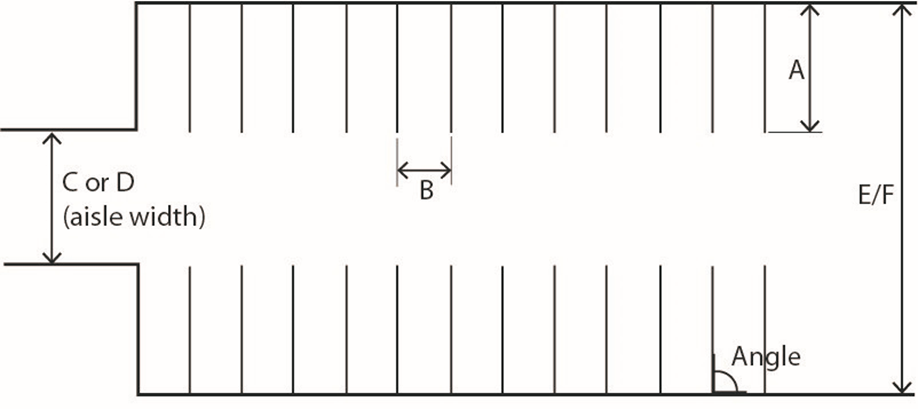
(2)
Compact Cars: Up to five percent of the total parking spaces required may be designated for compact cars. Minimum dimensions for compact spaces shall be eight by 16 feet. Such spaces shall be signed or the space painted with the words "Compact Car Only."
(3)
Surface Materials: All parking areas, aisles, turn-arounds and driveways shall be paved with concrete, asphalt or other approved surface, constructed to standards on file in the office of the City Engineer.
a.
Residential uses in the AG district may use a permeable surface for permanent parking such as crushed rock with approval from the city engineer;
b.
The city shall not issue a certificate of occupancy before the property owner/developer has installed the required parking on a permanent surface.
c.
Stall markings and/or other vehicular control devices shall be provided to the specifications of the City Engineer.
(4)
Location of Parking
a.
Location of parking within Downtown and Mixed-Use Districts shall be as required in the respective district regulations in Article 4: Special District Standards.
b.
All required parking spaces shall reside on the same lot as the use served, except in the following cases:
1.
When the Administrator has approved an alternative parking plan according to Section 106.85.F
2.
Where required parking is provided collectively to a variety of adjacent uses such as a commercial strip center or office park. In such cases a written agreement shall be filed with the city drawn and executed by all parties concerned. Such agreement must be filed and recorded in the county deed records prior to issuance of a building permit.
K.
LOADING REQUIREMENTS
(1)
Off-street loading shall be required for all commercial and industrial uses in all zoning districts.
(2)
Off-street facilities shall be provided and maintained for receiving and loading of merchandise, supplies, and materials within a building or on the premises.
(3)
Required off-street loading facilities may be adjacent to an existing public alley or private service drive or may consist of a berth within a structure.
(4)
No portion of a loading facility may extend into a public right-of-way or into an off-street parking facility.
(5)
The off-street loading spaces or truck berths shall provide maneuvering areas on site to prevent any blockage of public right-of-way.
(6)
Off-street loading spaces shall be screened in compliance with the provisions of Article 8: Landscaping, Screening, and Open Space Standards.
(7)
Off-street loading space or truck berth may be either regular or large and shall be provided in accordance with the Table 106.85-6. Regular loading spaces shall be ten feet by thirty feet (10' × 30'). Large loading spaces shall be ten feet by sixty-five feet (10' × 65).
L.
STACKING REQUIREMENTS FOR DRIVE-THROUGHS. The following standards shall apply to businesses that contain a drive-through establishment, regardless of if the drive-through is part of another use (e.g., restaurant or financial institution) or if it is a stand-alone use (e.g., automatic teller machine).
(1)
Location of stacking and use of ordering devices:
a.
Ordering devices or menu boards such as audible electronic devices with loudspeakers, automobile service order devices, and similar instruments shall be oriented away from any adjoining residential properties.
b.
No service shall be rendered, deliveries made, or sales conducted within the required front yard or corner side yard; customers served in vehicles shall be parked to the sides and/or rear of the principal building.
c.
All drive-through areas, including but not limited to menu boards, stacking lanes, trash receptacles, loudspeakers, drive up windows, and other objects associated with the drive-through area shall reside in the side or rear yard of a property to the maximum extent feasible, and shall not cross, interfere with, or impede any public right-of-way.
(2)
Staking space and lane requirements: The number of required stacking spaces shall be as provided for in Table 106.85-7, Stacking Space Requirements.
(3)
Design and dimensions: Stacking lanes shall be provided for any use having a drive-through establishment and shall comply with the following standards:
a.
Drive through aisles cannot:
1.
Interfere with the on-site parking and circulation for other vehicles on the site;
2.
Interfere with on-site parking; or
3.
Result in traffic queuing into a drive aisle, adjacent property, or street.
b.
Drive-through aisles shall have a minimum width of 10 ft.
c.
A drive-through by-pass lane shall be provided.
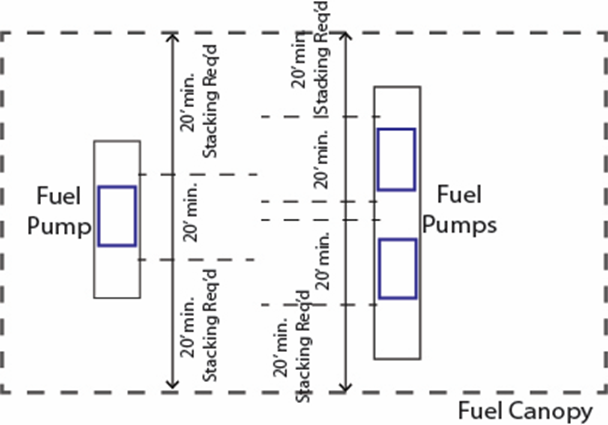
Figure 106.85-2: Figure Illustrating Stacking Required for Gas Stations
106.86 - TRANSPORTATION AND CONNECTIVITY
A.
PURPOSE. The purpose of this section is to:
(1)
support the creation of a highly connected transportation system within the city in order to provide choices for drivers, bicyclists, and pedestrians;
(2)
increase effectiveness of local service delivery;
(3)
promote walking and bicycling; connect neighborhoods to each other and to local destinations such as employment, schools, parks, and shopping centers;
(4)
to avoid the creation of large, isolated tracts without routes for pedestrian and bicycle connections and through traffic;
(5)
reduce vehicle miles of travel and travel times; reduce emergency response times; mitigate the traffic impacts of new development; and
(6)
free up arterial capacity to better serve regional long-distance travel needs.
B.
TRAFFIC IMPACTS. The Administrator or designee may require a Traffic Impact Analysis (TIA) or other type of engineering study from the developer in accordance with Chapter 98 prior to any approval for plats, zoning change, or site plans pertaining to the potential traffic impact of the proposed development on the city's street system.
C.
DRIVEWAYS, FIRE LANES AND ACCESS EASEMENTS
(1)
Standard Requirements: All driveway approaches, curbs, gutters, pavements and appurtenances necessary to provide access to properties shall be provided by the developer and shall be designed, constructed and maintained in accordance with standards in the city's adopted Design Criteria Manual and development specific ordinances in the Planned Developments (PDs), in Mixed Use (MU) and Downtown (DT) Districts (as applicable to the subject property).
(2)
Fire Lanes: Fire lanes are to be designed in accordance with the city's adopted Fire Code and Design Criteria Manual. Fire lane easements shall be shown on the Site Plan and shall be maintained to the city's standards by the property owner. For safety and emergency accessibility reasons during construction, developments other than single-family detached or two-family residential subdivisions shall not be allowed to proceed with vertical structural construction above the foundation prior to completion and city inspection of all fire lanes and fire hydrants on the site.
(3)
Access Easements: All non-residential development along highway frontage and arterial roadways shall provide cross access easements to adjoining properties unless grade issues prevent cross access connectivity.
(4)
Visibility at Intersections: On all lots or parcels of land on which a front setback is required, no obstruction that will obscure the view of motor vehicle drivers shall be placed within the triangular area formed by the adjoining driveway or street property lines between two and one-half (2½) and eight feet above grade as specified in this section, except that trees may be permitted within said triangular area provided that those trees are placed in the street planter strip and the limbs are pruned to at least six feet above the grade level of the adjacent street.
a.
TxDOT street and driveway intersections shall meet TXDOT sight visibility standards.
b.
All other streets and driveway intersections shall meet the standards in Figure 106.86-1
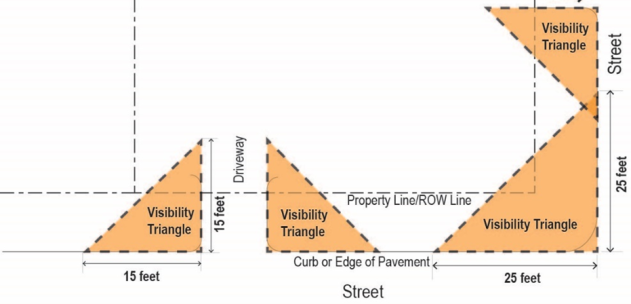
Figure 106.86-1 Visibility Triangles at Driveways and Intersections
D.
PEDESTRIAN AND BICYCLE ACCESS
(1)
Purpose: The purpose of this section is to reduce the number and length of automobile trips and related air pollution by encouraging walking and bicycling by integrating sidewalks and bicycle routes in new development and redevelopment, and by providing for shorter and more direct routes between many destinations.
(2)
Parking and Circulation Plan Required:
a.
In conjunction with a site plan, all development, except for single-family, duplex, and townhouse residential uses within previously platted subdivisions, shall prepare a parking and circulation plan. The plan shall meet the requirements of the Chapter 98: Subdivision Regulations, and contain the following information:
1.
Internal circulation and connectivity to existing street network;
2.
Emergency and service vehicle access;
3.
Parking layout;
4.
Loading operations;
5.
Turning radii based on uses;
6.
Traffic calming measures where future "cut-through" traffic is likely;
7.
Pedestrian, bicycle, and transit facilities; and
8.
Other similar issues identified by the Director.
b.
The Administrator may waive the requirement for a circulation plan on a case-by-case basis if a development is expected to have no impact upon circulation or proposes no change in existing circulation patterns. This standard shall not be construed to exempt development that includes additional parking, driveways, or substantial modifications to the existing pedestrian network.
c.
A circulation plan shall be submitted with the respective site plan or subdivision application, as appropriate.
d.
The Administrator may grant a waiver for projects smaller than 2 acres.
(3)
Pedestrian and Bicycle Circulation Standards
a.
Sidewalks shall be required along any street upon which a lot abuts, regardless of whether such lot faces, abuts on the side, or backs up to such street, or is separated from such street by an alley. Unless designated in an adopted city plan, sidewalks shall not be required along freeways and freeway frontage, or along any street abutting residential lots in zoning categories AG and other residential districts requiring lots larger than 1 acre.
b.
Sidewalks shall be constructed by the owner along all collector and arterial thoroughfares, and along all perimeter streets abutting the subdivision, regardless of whether such collector, arterial, or perimeter thoroughfare abuts a lot, alley, or other space. Sidewalks shall be constructed along all collector and arterial thoroughfares and perimeter streets prior to the issuance of a certificate of acceptance for the subdivision by the city.
c.
Sidewalks shall be constructed in accordance with the city's adopted Design Criteria Manual.
d.
The minimum width of sidewalks shall be five feet wide.
e.
To increase pedestrian safety and walkability, all sidewalks shall be located at least 6-feet from the back of curb.
f.
Meandering sidewalks may be approved by the Administrator to preserve trees and create a more informal streetscape.
g.
On-Site Pedestrian Walkways
1.
All development shall provide an on-site system of pedestrian walkways with a minimum width of five feet designed to provide direct access and connections to and between the following:
i.
The primary entrance or entrances to each building, including pad site buildings;
ii.
Any sidewalks, walkways, or multi-use paths on adjacent properties that extend to the boundaries shared with the development. Interconnected walkways should be designed with similar and/or complementary details, colors, finishes, etc.;
iii.
Any parking areas intended to serve the development;
iv.
Any sidewalk system along the perimeter streets adjacent to the development;
v.
Any public transit station areas, transit stops, park and ride facilities, or other transit facilities on-site or along an adjacent street;
vi.
Any adjacent residential neighborhoods (planned or existing) if sidewalk stubs are planned or existing; and
vii.
Any adjacent or on-site public park, trail system, open space, greenway, or other public or civic use or amenity.
2.
On-Site Pedestrian Walkway Design: required on-site pedestrian walkways shall:
i.
Be a minimum of five feet in width;
ii.
Be distinguishable from areas used by vehicles changing paving material, patterns, and/or paving color, but not including the painting of the paving material; decorative bollards; or raised median walkways with landscaped buffers;
iii.
Have adequate lighting for security and safety;
iv.
Be conveniently and centrally located on the subject property;
v.
Be ADA accessible; and
vi.
Not include barriers that limit pedestrian access between the subject property and adjacent properties.
3.
Pedestrian Access through Parking Areas
i.
All parking lots that contain more than 40 parking spaces shall include pedestrian walkways through the parking lot to the principal building entrance or a sidewalk providing access to the principal building entrance. At a minimum, walkways shall be provided for every three driving aisles or at a distance of not more than 150-foot intervals, whichever is less.
ii.
Parking lots with 100 spaces or more shall be divided into two or more separate equal areas and divided by landscaped areas or walkways at least 10 feet in width, or by a building or group of buildings.
iii.
Pedestrian Access through Parking Garages: Pedestrian walkways shall be provided through parking garages from the parking area to the abutting public right-of-way and/or to the primary entrance of the building served. Pedestrian walkways shall not use vehicle entrance or exit driveways from the parking area to a public right-of-way.
4.
Crosswalks
i.
Crosswalks shall be identified in consultation with the City Engineer to meet the specific need and functionality of pedestrian movement at a particular location.
ii.
The type and size of the crosswalk shall be determined based on federal and state guidelines described in the Manual on Uniform Traffic Control Devices (MUTCD).
5.
Use Restrictions and Maintenance of Pedestrian Connections
i.
Restrictions on Use: Sidewalks, walkways, and trails are intended to provide pedestrian access. Vehicle parking, garbage containers, merchandise storage or display, utility boxes and poles, signs, trees, and other obstructions shall not encroach into the required minimum clear width of any required sidewalk, trail, walkway, or other pedestrian way. Pedestrian amenities including bollards and trash receptacles for pedestrians are exempt from this requirement.
ii.
Maintenance: Sidewalks, trails, and walkways required by this title shall be maintained in usable condition throughout the year.

