
Dania Beach City Zoning Code
PART 7
CODE ADMINISTRATION
Sec. 700-10. - Short title.
The city's Land Development Code, codified by Ordinance No. 2010-020, shall be known and cited as the "City of Dania Beach Land Development Code", and is internally referenced as "the code", "this code", or as the "Land Development Code".
(Ord. No. 2010-20, § 2(Exh. A), 9-14-10)
Sec. 700-20. - Purpose and scope.
(A)
The purpose of this Land Development Code is to establish comprehensive controls for the development of land in the City of Dania Beach based on the comprehensive plan for the city and enacted in order to protect, promote and improve the public health, safety and the general welfare of the people.
(B)
The objectives of this Land Development Code are to provide:
(1)
For efficiency and economy in the process of development;
(2)
For the appropriate use of land in accordance with the comprehensive plan for the city, in order to provide well-planned and compatible areas for a variety of residential settings, densities and dwelling types, recreation and open space, transportation, commerce, industry, and civic facilities;
(3)
For an aesthetically pleasing built environment;
(4)
For preservation, protection, conservation, and enhancement of natural resources and animal habitats;
(5)
For convenient and efficient circulation of people and goods;
(6)
For the use and occupancy of buildings;
(7)
For healthful, convenient and efficient distribution of population;
(8)
For the availability of adequate public utilities, facilities concurrent with the impact of development;
(9)
For promotion of the civic amenities of beauty and visual interest;
(10)
For the longterm sustainability of the natural and built environment.
(11)
For lessened congestion in the streets; and
(12)
Adequate light and air and to prevent the overcrowding of land with due consideration to the character of the district, and its peculiar suitability for particular uses, the growth and development of the city, and with a view to conserving the value of buildings and encouraging the most appropriate use of lands throughout such municipality.
(C)
To accomplish these purposes, the city commission shall divide the entire city into districts of such number and shape as may be deemed best suited to carry out the purposes of this Land Development Code, and within these districts shall regulate, determine and establish:
(1)
Street and block patterns, locations and width;
Height, number of stories, size, bulk, location, erection, construction, repair, reconstruction, alteration and use of buildings and other structures, for trade, profession, residence and other purposes;
(2)
Use of land and water for trade, profession, residence and landscaping;
(3)
Size of yards and other open spaces;
(4)
Landscaping of yards and other open spaces;
(5)
Percentage of lot that may be occupied;
(6)
Density of population;
(7)
Conditions under which various classes of nonconformities may continue including authority to set fair and reasonable amortization schedules for the elimination of nonconforming uses;
(8)
Use and types and sizes of structures in those areas subject to seasonal or periodic flooding or storm damage so that danger to life and property in such areas will be minimized;
(9)
Performance standards for use of property and location of structures thereon.
(10)
Signage size, type and location;
(11)
Number, dimensions, arrangement, and location of off-street parking and loading spaces, and access thereto;
(12)
Public facility concurrency standards and procedures;
(13)
Procedures for review and issuance of development orders and permits; and,
(14)
Standards for architecture and design.
(Ord. No. 2010-20, § 2(Exh. A), 9-14-10)
Sec. 700-30. - Consistency with comprehensive plan.
The comprehensive plan, which contains expressions of public policy in the form of generalized maps, standards, guidelines and policy statements, is declared to be the official long-range and comprehensive guide for the orderly growth and development of the City of Dania Beach, Florida. The comprehensive plan shall be the policy basis for this Land Development Code. This Land Development Code implements the objectives and policies of the comprehensive plan. This Land Development Code shall be revised from time to time as necessary to ensure continued consistency with the amendments to the plan.
(Ord. No. 2010-20, § 2(Exh. A), 9-14-10)
Sec. 700-40. - Administrative official.
The administrative official designated to administer and enforce this Land Development Code is the community development director ("director") or its equivalent, in the event the position title may change. All references to the community development director shall include any designee of the director.
(Ord. No. 2010-20, § 2(Exh. A), 9-14-10)
Sec. 700-50. - Liability.
Any officer or employee charged with the enforcement of this Land Development Code, acting for the city in the discharge of his or her duties, shall not be rendered liable personally, and is relieved from all personal liability for any damage that may accrue to persons or property as a result of any act required or permitted in the discharge of his or her duties. Any suit brought against any officer or employee because of such act performed by him in the enforcement of any provisions of this Land Development Code shall be defended by the city until final termination of the proceedings.
(Ord. No. 2010-20, § 2(Exh. A), 9-14-10)
Sec. 700-60. - Minimum requirements.
In interpreting and applying the provisions of this Land Development Code, they shall be held to be the minimum requirements for the protection, promotion, and improvement of the public health, safety, and general welfare of the community. This rule of interpretation notwithstanding, certain standards—based upon their context or stated intent, and particularly urban-design-oriented development standards such as "build-to-lines"—shall be interpreted as specific requirements for the protection, promotion, and improvement of the public health, safety and general welfare of the community that are not intended to be minimum requirements.
(Ord. No. 2010-20, § 2(Exh. A), 9-14-10)
Sec. 700-70. - Abrogation; conflicting provisions.
(A)
It is not intended by this Land Development Code to interfere with or abrogate or annul any easements, covenants or other agreements between parties; provided, however, where this Land Development Code imposes a greater restriction upon the use of buildings premises, or upon the height of buildings, or requires larger open spaces than are imposed or required by other ordinances, rules, regulations or by easements, covenants, or agreements, the provisions of this Land Development Code shall control.
(B)
Where this Land Development Code includes regulations on the same point as contained in any other law or ordinance, the provisions of this Land Development Code shall govern unless otherwise prohibited by law; except that where the regulations of the other law or ordinance are more restrictive than those of this Land Development Code, the other shall govern.
(C)
Where there is a conflict between any regulations within this Land Development Code, the most recently adopted provision shall govern. In the case of provisions adopted concurrently but still in conflict, the more restrictive standard shall apply.
(D)
Where the numeric and spelled-out expressions of a given standard contained within this Land Development Code are not in agreement, the stricter and least permissive of the two (2) shall prevail. For example, if a minimum yard requirement is expressed as "twenty-five (5) feet," the text, "twenty-five feet" prevails, and if, for example, a maximum height requirement is expressed as "twenty-five (20) feet," the numeric expression, "(20)" prevails.
(Ord. No. 2010-20, § 2(Exh. A), 9-14-10)
Sec. 700-80. - Severability.
Should any article, section, clause or provision of this Land Development Code be declared by a court to be invalid, the same shall not affect the validity of the Land Development Code as a whole or any part of the Land Development Code, other than the part so declared to be invalid.
(Ord. No. 2010-20, § 2(Exh. A), 9-14-10)
Sec. 700-90. - Regulation of unzoned property.
Any property in the city not shown on the zoning map as being in a zoning district is classified as RS-18000.
(Ord. No. 2010-20, § 2(Exh. A), 9-14-10)
Sec. 700-100. - Regulations cited by reference.
Any law, regulation or rule that is referenced in this code (example: "F.S. § 163.3177(a)") shall include any amendments to said law, regulation or rule, and shall be read as if the term "as may be amended from time to time") is part of the reference.
(Ord. No. 2010-20, § 2(Exh. A), 9-14-10)
Sec. 700-110. - Zoning map.
(A)
The boundaries of the districts are as shown upon the zoning map which is adopted by references and made a part hereof, and entitled "Official Zoning Map of the City of Dania Beach, Florida".
(B)
The amended zoning map and all the notations, references and other information shown thereon are a part of this Land Development Code as if such information set forth on the map were all fully described and set out. This amended zoning map, properly attested, shall remain at all times on file in the office of the city clerk. The boundaries of such districts as are shown upon the official zoning map, or as will be shown by subsequent amendment thereto, are adopted and approved, and the regulations of this Land Development Code, governing the use of land and buildings, the height of buildings, building site areas, the size of yards about buildings and other matters as set forth in this Land Development Code, are established and declared to be in effect upon all land included within the boundaries of each and every district shown upon such map.
(C)
In the creation by this Land Development Code of the respective districts, the city commission has given due and careful consideration to the peculiar suitability of each and every such district for the particular regulations applied thereto, and the necessary proper and comprehensive groupings and arrangements of the various uses and densities of population in accordance with a well-considered plan for the development of the city.
(Ord. No. 2010-20, § 2(Exh. A), 9-14-10)
Sec. 700-120. - Interpretation of zoning district boundaries.
Unless otherwise shown, the district boundaries are lot lines or the center lines of streets, alleys, easements, railroads, or waterways, and where the districts designated on the official zoning map are approximately bounded by lot lines or the center lines of streets, alleys, easements, railroads, or waterways, such lines shall be considered to be district boundaries. Where uncertainty exists as to boundaries of any district, the following rules of interpretation shall apply:
(A)
Where such district boundaries are indicated as approximately following streets, alleys, easements, railroads, or waterways, the boundary lines shall be construed to be the centerline of such streets, alleys, easements, railroads, or waterways.
(B)
A district boundary shown approximately following the top of a bank of a waterway or waterbody shall be deemed to follow the top of the bank, and shall move with any natural changes in such bank.
(C)
Where a district boundary divides a lot of record existing at the time of the adoption of the [date] zoning map, and the location of the boundary is not dimensioned relative to the lot lines, the boundary shall be determined by use of the scale appearing on the map, provided that if the boundary line scales to within twenty-five (25) feet of a lot line, the boundary shall be deemed to be such lot line.
(D)
Where any street or alley is officially vacated or abandoned subsequent to the enactment of this Land Development Code, the regulations applicable to each parcel of abutting property shall apply to that portion of such streets or alley added thereto by virtue of such vacation or abandonment.
(E)
Where a district boundary is shown as approximately following city limits it shall be deemed to be following city limits.
(F)
Where a district boundary is indicated as an extension of features indicted in subsection (A) or (B), the boundary shall be such centerline as extended.
(G)
Where district boundary lines are indicated on the zoning map as intersecting waterway bulkheads or pierhead lines, such district boundary lines shall be construed to extend in the same general direction as indicated on said map to the corporate limits of the City of Dania Beach and all water and land, existing now or in the future, shall be included within said district boundary lines.
(H)
Where, due to scale or illegibility of the zoning map, or due to the absence of a street, alley, easement, waterway or recorded subdivision of plat lines, the director finds that there is uncertainty, contradiction or conflict as to the intended location of any district boundary, the director shall be responsible for interpreting the intent of the zoning map to determine and designate the proper location of such district boundary in accordance with the intent and purpose of the code. The ordinance causing the rezoning of land, the supporting materials made part of the city commission's consideration of the ordinance, and city commission meeting minutes concerning the ordinance causing the rezoning shall be primary considerations for determining district boundaries. Appeal from the interpretation of the director shall be to the city commission as required in article 615, "Appeal of Administrative Decisions".
(Ord. No. 2010-20, § 2(Exh. A), 9-14-10)
Sec. 700-130. - Reduction of required areas prohibited.
Except as otherwise provided:
(A)
The minimum lot area, yards and other open spaces and required areas, including the intensity of use provisions contained in this Land Development Code, for each building erected, added on to, reconstructed or structurally altered subsequent to the enactment of this Land Development Code, shall not be encroached upon or considered as a compliance with lot area, yard or open space requirements, or intensity of use requirements, for any other lot or building.
(B)
No lot area, yard or other required space shall be reduced in area or dimension so as to make said area or dimension less than the minimum required by this code; and if already less than the minimum required by this code for a new structure or use, said area or dimension shall not be further reduced, without first obtaining a variance pursuant to article 625, "Variances" that would specifically allow such reduction.
(Ord. No. 2010-20, § 2(Exh. A), 9-14-10)
Sec. 700-140. - Measurements.
When any of the distance or measurement requirements listed below are referred to in the code, such distance or measurements will be determined in accordance with this section unless otherwise specified in the provision that contains the measurement.
(A)
Other jurisdictions. Any separation, distance limitation or setback required by the code shall be applied without regard to municipal boundaries, and shall be applied in the same manner as if the abutting jurisdictions were part of the city.
(B)
Distance separations. Minimum distance separations required by the code shall be measured in a straight line, using the shortest airline distance between two (2) or more locations being measured (i.e. zoning boundaries, properties, buildings, portions of buildings, entrances to buildings etc., as applicable to each specific provision).
(C)
Computation of time. The time within which an act is to be done shall be computed by excluding the first and including the last day. If the last day of a time period is a Saturday, Sunday or legal holiday, the period shall run until the end of the next day which is neither a Saturday, Sunday nor legal holiday.
(D)
Fractional measurements.
(1)
[If fraction required.] When units or measurements result in a requirement of a fraction, any such fraction equal to or greater than exactly fifty (50) percent shall require the full requirement, unless otherwise provided in the code.
(2)
Density fractional measurements. When calculating density, any fraction of a unit shall be rounded down to the nearest whole number.
(Ord. No. 2010-20, § 2(Exh. A), 9-14-10)
Sec. 700-150. - Reserved.
Editor's note— Ord. No. 2021-028, § 3, adopted November 9, 2021, repealed § 700-150, which pertained to authority of city commission to name, rename, number or renumber roads, alleys, etc. and derived from Ord. No. 2010-20, § 2(Exh. A), 9-14-10; Ord. No. 2011-024, § 17, 8-9-11.
Sec. 700-160. - Public purpose uses.
The provisions of the code are not intended, and shall not be construed, to preclude the use of any property owned or controlled by the city for public purpose uses.
(Ord. No. 2010-20, § 2(Exh. A), 9-14-10)
Sec. 700-170. - Nonbinding effect of staff decisions.
An action taken or comment made by any city employee regarding a development for which approval by the city commission is required is not binding upon the city commission in its review of the application for a development permit; nor does it carry with it any right to approval of the development permit applications.
(Ord. No. 2010-20, § 2(Exh. A), 9-14-10)
Sec. 700-180. - Development orders and permits.
Administrative and legal provisions governing development orders and permits are fully contained within article 680.
(Ord. No. 2010-20, § 2(Exh. A), 9-14-10)
Sec. 700-190. - Municipal projects.
The provisions of the Land Development Code are waived and shall not be applied to the City of Dania Beach municipal projects, structures or facilities whether the projects, structures or facilities are owned or financed in whole or in part by the city. The city commission may waive, in whole or in part, the requirements of this Land Development Code for the projects, structures and facilities of any governmental entity whether the projects or facilities are owned or financed in whole or in part by the governmental entity.
(Ord. No. 2010-20, § 2(Exh. A), 9-14-10)
Sec. 705-10. - Authority to enforce.
The city manager, city attorney and city commission, as applicable, shall designate city personnel and contractual agents of the city, who shall have the authority to enforce the provisions of the code, including the city's law enforcement agency which may treat violations as it does other violations of city ordinances.
(Ord. No. 2010-20, § 2(Exh. A), 9-14-10; Ord. No. 2011-007, § 14, 2-22-11)
Sec. 705-20. - Method of enforcement.
(A)
Where it is found that any of the provisions of the code are being violated, enforcement proceedings may be initiated against the real property owner, the tenant if applicable, and any other person violating the provisions of the code as provided in the Code of Ordinances and as otherwise provided by law. Any enforcement procedure authorized by the code of ordinances, county or state law, may be used to enforce the provisions of the code. It shall be at the discretion of the city to determine which method of enforcement is appropriate and whether more than one (1) method of enforcement should be brought, as provided by law.
(B)
Further, the city commission or city manager may authorize the city attorney to bring legal action in a court of competent jurisdiction.
(Ord. No. 2010-20, § 2(Exh. A), 9-14-10; Ord. No. 2011-007, § 14, 2-22-11)
Sec. 705-30. - Complaints of violations.
Any person may file a complaint if there is any reason to believe a violation of this Land Development Code, exists. All such complaints must be in writing and shall be filed under oath with the code compliance office, which shall properly record such complaint and investigate accordingly.
(Ord. No. 2010-20, § 2(Exh. A), 9-14-10)
Sec. 705-40. - Right of entry.
For the purpose of enforcing the provisions of the code, officials and inspectors shall have a right of entry as provided by law whenever said officials and inspectors find such entry necessary for the proper discharge of their duties under the code. The office of the city attorney is authorized to seek inspection warrants as necessary.
(Ord. No. 2010-20, § 2(Exh. A), 9-14-10)
Sec. 710-10. - Intent/purpose.
The purpose and intent of this article is to regulate and limit the development and continued existence of uses, structures, and lots that were lawfully established but do not comply with the regulations of this code and were made nonconforming by the original adoption of this code or subsequent amendments hereto.
The provisions of this article are designed to generally curtail substantial investment in nonconformities and bring about their eventual elimination in order to preserve the integrity of these regulations. Any nonconforming use, structure or lot that does not conform to the requirements of this code and that lawfully existed as of the effective date of this code, and any use, structure or lot that has become nonconforming as a result of the adoption of these regulations or any subsequent amendment hereto may be continued or maintained only in accordance with the terms of this article as well as all other provisions in this code pertaining to nonconformities.
(Ord. No. 2010-20, § 2(Exh. A), 9-14-10)
Sec. 710-20. - Definitions and term usage.
(A)
Substantial damage. Substantial damage shall be defined as specified in chapter 12, Flood Damage Prevention of the city's Code of Ordinances.
(B)
Substantial improvement. Substantial improvement shall be defined as specified in chapter 12, Flood Damage Prevention of the city's Code of Ordinances.
(Ord. No. 2010-20, § 2(Exh. A), 9-14-10; Ord. No. 2012-025, § 9, 10-9-12; Ord. No. 2023-006, § 10, 4-25-23; Ord. No. 2025-007, § 7, 4-8-25)
Sec. 710-30. - Establishment of nonconformities.
The community development director shall make a determination as to the existence of a nonconformity based upon evidence furnished by the applicant for the determination. Although the director may make use of affidavits and investigation as the director determines necessary in a particular case, the applicant for the determination shall bear the burden of proof that the property is entitled to nonconforming status. The question as to whether a use, structure or lot is nonconforming shall be a question of fact, and the determination of the director may be appealed pursuant to the procedures of article 615, "Appeal of Administrative Decisions."
(Ord. No. 2010-20, § 2(Exh. A), 9-14-10)
Sec. 710-40. - Continuation of existing use or structure.
A nonconforming use, structure or structure devoted to a nonconforming use that is otherwise lawful may be continued as configured and existing on of the date the use, structure or both became nonconforming subject to the restrictions set forth in this article. Changes in tenancy, ownership or management of a nonconforming use or structure are permitted.
(Ord. No. 2010-20, § 2(Exh. A), 9-14-10)
Sec. 710-50. - Limitations on the continuance of nonconforming uses and structures.
(A)
Nonconforming use. Except as provided in section 710-60, a nonconforming use, and a structure or part of such structure devoted to a nonconforming use, shall not be enlarged, extended, repaired, reconstructed after substantial damage, relocated, moved, substituted, changed, divided, structurally altered, discontinued or repaired or reconstructed after substantial damage, unless it is for the purpose of replacing the nonconforming use with a conforming use. Any of the above actions for purpose other than permitted in this Land Development Code shall nullify the nonconforming status of the use, and shall require the use of the land and structure to comply with all code requirements.
(B)
Nonconforming structure. Except as provided in section 710-60, a nonconforming structure shall not be enlarged, extended, reconstructed, relocated, moved, substituted, divided, structurally altered, discontinued in use, or repaired after substantial damage, unless it is for the purpose of making a nonconforming structure comply with code requirements. Any of the above actions for purpose other than permitted in this section shall nullify the nonconforming status of the structure, and shall require the structure to comply with all code requirements.
(C)
Nonconforming adult entertainment uses. Within this subsection, nonconforming adult entertainment uses are termed, "regulated use(s)".
(1)
Any regulated use, lawfully operating on September 15, 2001, that is in violation of section 115-40 (List of permitted, special exception and prohibited uses in industrial districts) and section 115-50 (Conditions of use in industrial districts) shall be deemed a nonconforming use. The nonconforming use shall be permitted to continue for a period not to exceed three (3) years, unless terminated earlier for any reason, or discontinued for a period of ninety (90) days or more.
(2)
If two (2) or more regulated uses are were located within one thousand (1,000) feet of one another on September 15, 2001, but are otherwise in a permissible location, the regulated use which was first established and continually operating at a particular location is the conforming use and the later-established business(es) is (are) nonconforming.
(3)
However, an existing nonconforming regulated use that is not located in a permissible location (and will therefore be amortized out after three (3) years) shall not be used to prevent the location of a new regulated use in a permissible location that is within one thousand (1,000) feet of the amortized use's property line.
(4)
A regulated use lawfully operating as a conforming use is not rendered a nonconforming use by the subsequent location of an incompatible use as set forth above within one thousand (1,000) feet of the regulated use. This provision applies only to an ongoing regulated use, not to a regulated use that has been terminated for any reason or discontinued for a period of ninety (90) days or more subsequent to the location of the incompatible use.
(D)
Nonconforming parking and loading facilities, landscaping and signage. The respective provisions of articles 265, "Off-Street Parking Regulations", 270, "Off-Street Loading Regulations", 275, "Landscaping Regulations" and 505, "Signage Regulations" govern nonconformities pertaining to parking and loading facilities, landscaping and signage.
(Ord. No. 2010-20, § 2(Exh. A), 9-14-10)
Sec. 710-60. - Exceptions to limitations on the continuance of nonconforming uses and structures.
(A)
Moving, relocating. Moving of a nonconforming structure or use as a result of governmental action shall not require the structure or use to conform to the regulations for the zoning district in which it is located after it is moved.
(B)
Historical structures. Enlargements or alterations to a nonconforming historic structure listed in the National Register of Historic Places or the Florida Inventory of Historic Places shall be permitted provided that:
(1)
The enlargement or alteration does not exceed the nonconforming yard or height established by the existing structure and is otherwise in compliance with all other applicable land development regulations; and
(2)
A certificate of appropriateness for the enlargement or alteration has been obtained as required by chapter 8, article XI.
(C)
Discontinuance of nonconforming use of structure, or land and structure. A nonconforming structure may be unoccupied, and a nonconforming use of land and structure in combination, may be discontinued for a period of not more than six (6) consecutive months without constituting discontinuance, provided that governmental action that impedes access to the premises shall not count toward the six-month period.
(D)
Discontinuance of nonconforming use of land without structure. A nonconforming use of land without a structure may be discontinued for a period of not more than sixty (60) consecutive days without constituting discontinuance.
(E)
Discontinuance of mobile home or recreational vehicle. Removal of a mobile home or recreational vehicle located on an individual lot in a zoning district not permitting that use in excess of six (6) consecutive months shall constitute discontinuance.
(F)
Maintenance, repairs and improvements.
(1)
If damage is not substantial as defined in this Land Development Code, all repairs shall be completed (see section 725-30, "Construction, completion of") within one (1) year after damage occurs or such use or structure can be rebuilt and reused only in conformity with the code requirements in effect at the time of repair, reconstruction and establishment of a new use.
(2)
Normal maintenance, repair and incidental alteration of a nonconforming structure or a structure containing a nonconforming use is permitted, provided it complies with all building code requirements and does not extend the area or volume of space occupied by the nonconforming use. A structure containing residential nonconforming uses may be altered in any way to improve interior livability. However, no structural alterations shall be made which would increase the number of dwelling units.
(3)
Nonconforming structures or structures devoted to nonconforming uses may be improved as long as the improvement complies with all code requirements and does not constitute a substantial improvement as defined in this Land Development Code.
(4)
Notwithstanding the provisions of this article, the community development director may approve the aesthetic improvement of the exterior façade of a nonconforming structure or structure devoted to a nonconforming use, provided that:
(a)
The improvement is limited to the aesthetic improvement of the exterior façade and does not increase the footprint of a nonconforming structure, the square footage of a structure devoted to a nonconforming use, or the number of nonconforming dwelling units; and
(b)
The improvement will be consistent with all applicable code requirements relevant to the aesthetic standards for an exterior façade, as determined by the community development director.
(5)
Nonconforming two-family (duplex) dwelling may be reconstructed following substantial damage, as defined in section 710-20(A), provided that at least one dwelling unit of the structure is a homestead as defined in F.S. § 196.031.
(6)
A combination of one single family dwelling unit and one nonconforming two-family (duplex) dwelling, which is located on a single parcel with single ownership, may be reconstructed following substantial damage, as defined in section 710-20(A), provided that at least one dwelling unit on the unified property is a homestead as defined in F.S. § 196.031.
(G)
Single-family dwellings; special provisions. Nonconforming single-family structures located in any RS-6000, RD-8000, RS-8000, or NBHD-RES, or RO district, and which conform to the use regulations of the applicable district, may be reconstructed and added onto, provided the following conditions exist or are met:
(1)
Reconstruction after destruction by any means is permitted within the nonconforming footprint that existed prior to destruction. Rebuilding beyond the pre-destruction footprint is also permitted subject to the provisions of this subsection.
(2)
Additions shall maintain a minimum front yard of fifteen (15) feet in the NBHD-RES district and twenty-[five] (25) feet in the RS-6000, RS-8000 and RD-8000 districts, a minimum rear yard of fifteen (15) feet, a minimum interior side yard of seven (7) feet, and a minimum corner street side yard of fifteen (15) feet.
(3)
Additions to a single-family dwelling with an existing five-foot interior side setback may provide a minimum five-foot side setback for a maximum thirty-five-foot distance along the five-foot side setback line. Additions to dwellings, or sides of dwellings, with conforming setbacks shall provide the side setback currently required in the applicable zoning district. This section applies to ground floor additions to single-family residences only.
(4)
Any addition designed or used for the conversion of a single-family dwelling into a two-family dwelling must comply with all code requirements.
(H)
Nonconforming two-family and townhouse dwellings; special provisions. Nonconforming two-family dwellings and townhouses in RD-8000 and RM districts formerly zoned Broward County RD-10 or RM-10, may be rebuilt to their existing setbacks and extensions (i.e. structure envelope), provided that each unit is situated on its own fee simple lot.
(I)
IROM, IROM-AA and IROC districts; special provisions. In the IROM, IROM-AA and IROC districts, any group of structures designed as a single site or operating as a single site (hereafter called a "project") as of the date that any portion of the structures or uses in the project became nonconforming shall be subject to the following provisions that supersede conflicting provisions of this article.
(1)
The location of nonconforming uses within structures located in the project may change as long as the total square footage of those respective uses is not increased within the project.
(2)
If sixty-five (65) percent or less of the gross floor area of the structures within a project is destroyed by casualty or act of God, the nonconforming structure(s) may be restored or reconstructed to the predestruction location and configuration so long as the gross floor area of the structure(s) is not increased. If a structure contains multiple spaces, the spaces may be combined so long as such combination does not expand a nonconforming use in a manner inconsistent with paragraph (1), above.
(Ord. No. 2010-20, § 2(Exh. A), 9-14-10; Ord. No. 2010-025, § 8, 11-23-10; Ord. No. 2012-025, § 9, 10-9-12; Ord. No. 2013-001, § 9, 2-26-13; Ord. No. 2016-013, § 8, 7-26-16)
Sec. 710-70. - Nonconforming lots of record.
(A)
A lot of record that is nonconforming as to minimum required lot area, width or depth may be used for any use permitted in the zoning district within which the lot is located, provided that development of the lot complies with all requirements of this code other than for size and dimensional, and further provided that specific uses that are required to have greater plot area or dimensional requirements than the minimum established for the zoning district shall not be permitted on a nonconforming lot of record.
(B)
A nonconforming lot of record shall not be reduced in area or dimension.
(Ord. No. 2010-20, § 2(Exh. A), 9-14-10)
Sec. 715-10. - Established.
The department of community development is established as an administrative branch or division of the City of Dania Beach and shall be comprised of the following divisions, to-wit: planning and zoning, building permitting and inspections, code enforcement, business tax receipts and all other functions necessary in connection therewith.
(Ord. No. 2010-20, § 2(Exh. A), 9-14-10)
Sec. 715-20. - Director—Position established.
The position of director of community development is established, which director shall not be in the classified service, but shall be appointed by the city manager and shall serve at the pleasure of the city manager at a salary established by the city manager.
(Ord. No. 2010-20, § 2(Exh. A), 9-14-10)
Sec. 715-30. - Same—Duties and powers.
The director of community development shall serve under the direction of the city manager and shall have charge of all matters relating to supervision and control of the improvement and use of land, the construction and erection of buildings and the enforcement of the building and zoning ordinances and codes that are applicable within the City of Dania Beach, and shall perform such other duties as may be delegated to him by the city manager.
(Ord. No. 2010-20, § 2(Exh. A), 9-14-10)
Sec. 715-40. - Building official and inspectors.
There shall be a building official, a building plans examiner, a building inspector, a chief electrical inspector, a chief plumbing inspector, a chief mechanical inspector, and as many assistant inspectors and clerks, secretaries and other employees as may be deemed necessary by the building official to properly operate the division.
(Ord. No. 2010-20, § 2(Exh. A), 9-14-10)
Sec. 715-50. - Code compliance official and inspectors.
There shall be a code compliance official and code compliance inspectors charged with the enforcement of this Land Development Code,.
(Ord. No. 2010-20, § 2(Exh. A), 9-14-10)
Sec. 715-60. - Development review committee.
The Community Development Department is hereby assigned the responsibility to coordinate the duties of the Development Review Committee (DRC). The membership of the DRC shall include representatives from the fire-rescue, Community Development, and public services departments. When the circumstances of a proposed development necessitates review by additional city staff members or city consultants, the Community Development Director or his/her designee, may add such members to the committee as deemed necessary for the implementation of this section, in accordance with their respective areas of concern and expertise. In addition, if the proposed development is located within the CRA area, the Executive Director of the CRA or designee shall also participate in the review process. The Planning and Zoning Manager or designee shall chair, coordinate and administer the DRC. The duties of the DRC are to review small scale and large scale site plans, site plan modifications, plats and plat amendments, except for plat note amendments, for technical compliance and conformance with all applicable regulations, as it relates to each discipline and any other related issues as may be assigned by the Community Development Director. All meetings of the DRC shall be open to the public at all times and noticed in accordance with state law.
(Ord. No. 2016-021, § 11, 10-10-16)
Sec. 720-10. - Created; appointment.
The members of the city planning and zoning board as created by the City Charter, shall be appointed by the city commission. No city employee shall be eligible for membership on the board.
(Ord. No. 2010-20, § 2(Exh. A), 9-14-10; Ord. No. 2011-011, § 1, 4-26-11)
Sec. 720-20. - Planning and zoning board general duties; authority.
The duties of the city planning and zoning board shall be as follows:
(A)
To act in an advisory capacity to the city commission on questions relating to zoning, and to conduct investigations and hearings on matters of proposals to change zoning and land development regulations, and report its findings and recommendations on such proposals to the city commission;
(B)
To study any existing city plan, with the view to improving same so as to provide for the development, general improvement, and probable future growth of the city, and from time to time make recommendations to the city commission for changes in the existing city plans so as to incorporate new developments, or for the adoption of new city plans;
(C)
To approve small-scale site plans, as defined in section 635-20, and as provided in section 635-70;
(D)
To grant variances and special exceptions associated with small-scale site plans;
(E)
To serve as the local planning agency of the City of Dania Beach, Florida.
(F)
To act in an advisory capacity regarding waivers of distance requirements for establishments licensed to serve liquor on-premises.
(G)
To perform such other duties as may from time to time be assigned to such board by the city commission.
(Ord. No. 2010-20, § 2(Exh. A), 9-14-10; Ord. No. 2011-011, § 1, 4-26-11; Ord. No. 2016-007, § 12, 3-22-16)
Sec. 720-30. - Elections of officers; rules of procedure; recommendations to be written.
The city planning and zoning board, upon its organization, shall elect a chairman and a secretary and shall adopt regulations and rules for the conduct of its meetings, and the time and place of its meeting. Any and all recommendations made by the city planning and zoning board to the city commission shall be made in writing so that a proper record may be kept.
(Ord. No. 2010-20, § 2(Exh. A), 9-14-10)
Sec. 720-40. - Meetings.
The regular meetings of the City Planning and Zoning Board of the City of Dania Beach shall be held at 7:00 p.m. not less than once each month; provided, however, that the Board may cancel one or more meetings for reasons including, but not limited to, a recess in the summer or during a holiday season.
(Ord. No. 2010-20, § 2(Exh. A), 9-14-10; Ord. No. 2011-011, § 1, 4-26-11)
Sec. 720-50. - Procedures.
(A)
All regular and special meetings of the planning and zoning board, shall be open to the public at all times and noticed in accordance with state law.
(B)
The members of the board shall be notified of the conduct of any special meeting at least twenty-four (24) hours prior to the conduct of any such meeting.
(Ord. No. 2010-20, § 2(Exh. A), 9-14-10)
Sec. 721-10. - Amortization of regulated uses.
(1)
Any regulated use as defined in section 115-50, lawfully operating on September 15, 2001, that is in violation of article 115 shall be deemed a nonconforming use. The nonconforming use shall be permitted to continue for a period not to exceed three (3) years, unless terminated earlier for any reason or discontinued for a period of ninety (90) days or more.
(2)
Such nonconforming uses shall not be increased, enlarged, or extended. Buildings or premises devoted to nonconforming uses shall not be increased, enlarged, or extended. Buildings or premises devoted to a nonconforming use shall not be altered in any way except to be changed to a conforming use. Alteration shall mean any change, addition, or modification in construction or occupancy. Normal maintenance and repair shall be permitted.
(3)
If two (2) or more existing regulated uses are within one thousand (1,000) feet of one another but are otherwise in a permissible location, the regulated use which was first established and continually operating at a particular location is the conforming use and the later-established business(es) is (are) nonconforming. However, an existing regulated use that is not located in a permissible location (and will therefore be amortized out after three (3) years) shall not be used to prevent the location of a regulated use in a permissible location that is within one thousand (1,000) feet of the amortized use's property line.
(4)
A regulated use lawfully operating as a conforming use is not rendered a nonconforming use by the subsequent location of an incompatible use as set forth above within one thousand (1,000) feet of the regulated use. This provision applies only to an ongoing regulated use, not to a regulated use that has been terminated for any reason or discontinued for a period of ninety (90) days or more subsequent to the location of the incompatible use.
(Ord. No. 2010-20, § 2(Exh. A), 9-14-10)
Sec. 725-10. - General construction of terms.
For the purpose of this Land Development Code, certain terms are defined. When not inconsistent with the context:
(A)
Words used in the present tense include the future, words in the singular number include the plural and words in the plural number include the singular number.
(B)
The word "shall" is always mandatory and not merely directory.
(C)
The word "may" is permissive.
(D)
The word "or" shall mean "either or both", or "any or all"" unless the context dictates otherwise.
(E)
The words "including" and "such as" shall always mean that the listed items following said words are not all inclusive, and shall be read as if the words, "but not limited to" follow, unless the context is qualified and clearly states otherwise (ex: "including only the following:").
(F)
The word "used" shall include arranged, designed, constructed, altered, converted, rented, leased or intended to be used.
(G)
The words "designed" and "intended" shall include the word "used".
(H)
The word "occupied" includes arranged, designed, built, altered, converted, rented or leased, or intended to be occupied.
(I)
The word "land" shall include water surface.
(J)
The phrase "use of land" shall include use of buildings and other structures unless the otherwise specified otherwise.
(K)
The word "person" includes individuals, firms, corporations, associations, trusts, joint venture, partnership, estate, syndicate, fiduciary, government agency, two (2) or more persons having a joint or common interest, any combination of the preceding, and other similar entities.
(L)
The word "city" shall mean the City of Dania Beach, Florida.
(M)
The word "commission" shall mean the City Commission of Dania Beach, Florida.
(N)
The word "commissioner" shall mean the members of the city commission.
(O)
The word "county" shall refer to Broward County, Florida.
(P)
The word "Code" shall refer to this Land Development Code.
(Q)
The term "Code, of Ordinances" shall mean the Code of Ordinances of the City of Dania Beach, Florida.
(R)
The word "plan" shall mean the adopted City of Dania Beach Comprehensive Plan.
(S)
The word "manager" shall mean the City Manager of the City of Dania Beach, Florida.
(T)
Any reference to the City Manager, City Attorney, Public Services Director, Director of Community Development, or other administrative official of the City of Dania Beach, Florida, shall include their designees.
(U)
Any reference to Florida Statutes, Florida Administrative Code, the Florida Building Code, the Broward County Code, the Code of Federal Regulations, or any other official rule or law shall be construed to include the language, "as may be amended from time to time" unless otherwise specified.
(Ord. No. 2010-20, § 2(Exh. A), 9-14-10)
Sec. 725-20. - Abbreviations.
The following abbreviations are used in this Land Development Code, and are intended to have the following meanings:
(Ord. No. 2010-20, § 2(Exh. A), 9-14-10)
Sec. 725-30. - Terms defined.
Any term not defined in this section shall have the meaning given by the most recent edition of Webster's Unabridged Dictionary.
Academic school. See school, academic.
Access aisle. An element of off-street vehicular use areas providing direct vehicular access to off-street parking spaces.
Accessory dwelling unit (ADU). An ancillary or secondary living unit that has a separate kitchen, bathroom, and sleeping area existing within the same structure or on the same lot as the principal dwelling unit on a single-family zoned lot. This shall not be considered a multifamily use.
Accessory use, building or structure. A subordinate use, building or structure customarily incidental to, and located upon, the same lot occupied by the main use, building or structure.
Acre, gross. Forty-three thousand five hundred sixty (43,560) square feet of land area, which includes contiguous, private property under the same ownership and adjoining right-of-way or ingress/egress easement dedicated from such private property, which is typically measured to the street centerline.
Acre, net. Forty-three thousand five hundred sixty (43,560) square feet of contiguous, private property under the same ownership.
Adaptive reuse. The reconfiguring of a building to accommodate a use for which the building was not designed.
Adjacent. Separated only by a right-of-way for a street, alley, primary power transmission lines, railroad, or a waterway.
Administrative rules document. A publication containing rules, guidelines, procedures, and methodologies reviewed, revised, adopted and amended by the Broward County Planning Council for the purpose of providing assistance and guidance to local governmental entities and providing direction to city staff in implementing the Broward County Land Use Plan.
Adult residential care facility. Any housing facility for one hundred (100) or more elderly residents situated on property which has direct access to and is adjacent to either a minor arterial containing at least one hundred ten (110) feet of right-of-way or a principal arterial as designated on Broward County Trafficways Plan, which facility contains units with no more than one (1) sleeping room regardless of the number of accessory rooms including living rooms and bathrooms; and contains a central dining facility which serves at least one (1) full meal per day; and provides central housekeeping services to its residents no less than weekly; and employs a full-time registered nurse on call to the residents; and provides planned activities, which activities may include, but are not limited to, social, educational and recreational activities; and may provide on-site dispensing of drugs under the supervision and control of a licensed physician as an accessory use.
Airline measurement. The straight line, as the crow flies, measured from the property line of one property to the nearest property line of the second property, regardless of streets, walkways, or intervening structures, physical barriers or other obstructions.
Alcoholic beverages. All beverages containing more than one-half (½) of one (1) percent of alcohol by weight.
Alcoholic beverage establishment. Any establishment devoted primarily to selling or dispensing and drinking alcoholic beverages, or any place where a sign is displayed indicating that alcoholic beverages are obtainable for consumption on the premises. The terms "bar" and "lounge" shall have the same meaning as this term.
Alley. A right-of-way generally not less than twenty (20) nor greater than twenty-five (25) feet in width that affords vehicular access to abutting property. Alleys are not officially designated as streets, and are not intended to serve the general traffic circulation function of a street.
Amusement center. A permanent building housing mechanical amusement devices, automatic merchandise vending machines, or juke boxes without respect to number, except that mechanical amusement devices permitted as an accessory use pursuant to section 110-60 shall not be considered amusement centers.
Amusement device, mechanical. See mechanical amusement device.
Anchor business. A commercial, industrial or institutional entity occupying thirty-three (33) percent or more of gross leasable area of any shopping center, office or commercial building, office complex and park or industrial complex and park.
Antique store. A business establishment in which objects that are principally antique in nature are offered for sale; such objects typically having special value or significance because of their age or rarity, and having been made in, or associated with, an earlier period of history.
Apartment. A dwelling unit located within a building containing at least three (3) dwelling units or devoted primarily to nonresidential use.
Athletic club and studio. A gymnasium that typically has paid members who use fitness equipment for improved physical fitness. These facilities often offer group fitness classes as well.
Auction house. An establishment where new or used goods or tangible items are sold through means of a request or invitation for bids, exclusive of retail and wholesale sales.
Auto rental lot. A lot upon which passenger automobiles for active rental purposes only are stored or parked.
Automobile. A motor vehicle designed, marketed and commonly used by the general public for personal, noncommercial transportation on public streets, including a car, pickup truck, motorcycle, sports utility vehicle, or minivan. Mobile homes, trailers and recreational vehicles are not automobiles for purposes of these regulations.
Automobile dealership. A sales franchise or unit of an automobile manufacturer selling new automobiles. Used automobile and light truck sales, and minor automobile repair may comprise accessory uses to the sale of new vehicles.
Automobile sales, used. Any property used for the display or sale of automobiles that have been, or are advertised as having been, previously leased or owned. The display or sale of an automobile on a lot containing a single-family or duplex dwelling shall be considered an accessory use to the dwelling if the vehicle for sale was used for the personal transportation of the owner or tenant of the dwelling unit occupying the lot upon which the vehicle is displayed or sold, and further provided that no more than two (2) automobiles are displayed or sold within any twelve-month period on any such lot.
Automotive, motor vehicle repair, major. Rebuilding or reconditioning of motor vehicles, including engines and drive trains; collision service including body, frame or fender straightening or repair; painting or paint shop.
Automotive repair, minor. Routine maintenance services, upholstering, replacement of parts and motor service to automobiles, but not including any operation listed under "motor vehicle repair, major" or any other operation similar thereto.
Awning or canopy. An accessory structure either temporarily or permanently attached to a building, which is supported by an open framework and covered by fabric. This structure is intended to cover building entrances and sidewalks and protect pedestrians from environmental elements. When completely or partially supported by ground supports, shall be deemed a canopy.
Bar. See "alcoholic beverage establishment."
Basement. A story with a finished floor two (2) feet or more below the adjacent grade and having not more than one-half (½) of its height above the average grade at the perimeter of the story. A basement shall not be considered a story with regard to height regulations if no part of the basement exceeds eight (8) feet above NVGD The exterior walls or exterior faces of supporting columns of a basement of a building are subject to required setbacks as required for the building unless otherwise provided in the code for subterranean parking.
Basement, sub. A basement that does not exceed in height the lowest point of the public sidewalk abutting the property, or the public street if there is no public sidewalk.
Bed and breakfast dwelling. An owner-occupied and -operated detached dwelling unit that offers sleeping accommodations without individual food preparation facilities, and at least one (1) meal per day prepared within a centralized kitchen for transient guests, for a nightly fee, and which does not utilize outside services or employees, except for those customarily found in single-family residential neighborhoods such as housekeeping and landscape maintenance. Bed and breakfasts accept reservations directly on the premises and advertise themselves as a bed and breakfast.
Boardinghouse. An establishment providing transient lodging that is not considered a hotel or bed and breakfast dwelling.
Boat. Any contrivance designed to be propelled through the water, or any boat so licensed by the state, excepting air boats.
Broward County Land Use Plan. The future land use plan element for all of Broward County adopted by the Broward County Commission in conformance with the requirements of the Broward County Charter and the Local Government Comprehensive Planning and Land Development Regulation Act.
Broward County Trafficways Plan. The plan promulgated by the Broward County Planning Council pursuant to chapter 59-1154, Laws of Florida, as amended, and the Broward County Charter, which depicts a network of trafficways for Broward County (also known as the Broward County Planning Council Trafficways Plan).
Building. A roofed structure enclosed on all sides by walls and covered openings such as doors and windows, which is used or designed for the shelter or enclosure of persons, animals, or property. The term is inclusive of any part thereof. Where independent units with separate entrances are divided by party walls, each unit is a building.
Building, attached. An attached building shall mean a building which has one (1) or more party walls in common with adjacent buildings.
Building code. The Florida Building Code, inclusive of Broward County amendments, as may be amended from time to time.
Building group. Three (3) or more townhouse units attached as a single dwelling, and separated from any other building by a yard.
Building height. See height, building.
Building permit.
a.
Any permit required by the building code precedent to development activity. For the purpose of article 805, Concurrency Determinations, a building permit is any permit for a new building or addition to an existing building that would:
1.
Create one (1) or more additional dwelling units, or
2.
Involve a change in the occupancy of a building pursuant to the building code.
Building, principal.
(1)
A building that is occupied by, or devoted to, a principal use.
(2)
A proposed addition to an existing principal building that is the same size or larger than the existing building.
Bulkhead line. An official line therefore established by the city and appropriately recorded—includes canal line.
Business, anchor. See anchor business.
Business, office. See office, business.
Cabana (pool house). An accessory structure usually used in connection with outdoor bathing, providing enclosed space for showering or changing clothes, with recreational cooking, bar facilities or both, but no sleeping rooms.
Canopy. See awning, canopy.
Canopy/shade tree. See tree, shade/canopy.
Capital improvement. Physical assets constructed or purchased to provide, improve or replace a public facility and which are large scale and high in cost. The cost of a capital improvement is generally nonrecurring and may require multiyear financing. For the purpose of this rule, physical assets which have been identified as existing or projected needs in the individual comprehensive plan elements shall be considered capital improvements.
Carport. A canopy, roof-like structure, or shed, open on two (2) or more sides and attached to the main building for the purpose of providing shelter for one (1) or more motor vehicles.
Catering establishment. An establishment that prepares and supplies food to be consumed off premises at a different location, but not from the vehicle in which the food is transported.
Charity or thrift shop. A shop in which the items sold (or given away to the needy) have been obtained through donations or gifts and where the donor receives no value upon the sale (or gift) of such merchandise to a thrift shop customer, and where the use is designed to sell donated merchandise at a price below reasonable market value, or where the revenue received from selling same is retained by a charitable or not-for-profit organization or institution.
Check cashing store. Any business other than the United States Postal Service which provides check cashing, currency exchange, or money transmitting or remittance services, or issues or redeems money orders, travelers' checks, and other similar instruments.
City. The City of Dania Beach, Florida.
City attorney. The City Attorney of the City of Dania Beach, Florida, or designee.
City clerk. The City Clerk of the City of Dania Beach, Florida, or designee.
City commission. The City Commission of the City of Dania Beach, Florida.
City community development director. The Director of the Community Services Department, or designee, of the City of Dania Beach.
City engineer. The City Engineer of the City of Dania Beach, Florida, or designee.
City manager. The City Manager of the City of Dania Beach, Florida, or designee.
Clinic. See office, medical.
Club, private. See private club.
Cluster development, single-family. A development of single-family detached dwellings located on small lots in exchange for substantial commonly owned and maintained open space.
College. See school, college.
Commencement of construction. See construction, commencement of.
Commercial. Engaged in a business, enterprise, activity or other undertaking for profit.
Commercial zoning district. See district, commercial.
Commercial vehicle. See vehicle, commercial.
Common area. A room or designated area within a building or complex of buildings zoned for multifamily residential use served by shared or public parking areas, which is reserved for the exclusive use of the residents of the building or complex and their invited guests, and is an accessory use to the primarily residential use of such buildings.
Common open space. See open space, common.
Communication tower. A tower designed and used for sending and receiving cellular telephone service.
Community facility. A noncommercial use that provides a community service including, but not limited to, civic uses, or an institutional use whether or not commercial.
Community garden (urban farm). An area of land, which may be arranged into multiple plots, used primarily to grow and harvest food crops by individuals or collectively by members of a group, and is operated by the city or administered through an operating agreement with the city or CRA.
Compatible with. Not in conflict with.
Completion of construction. See construction, completion of.
Comprehensive plan. The adopted City of Dania Beach Comprehensive Plan.
Concession. A private business operated on public property in accordance with a lease agreement. Examples of concessions include food and beverage operations, pro shops and other similar businesses.
Concurrency. The statutory requirement that public facilities and services needed to support development shall be available at the same time or coincidental with the impacts of such development, as provided by law.
Concurrency management system. The provisions in the comprehensive plan and article 805 of this Code, encompassing the restrictions, methods, resources, timing and solutions intended to be compatible with and further compliance with the statutory requirement to provide public facilities and services needed to support development concurrent with the impacts of such development.
Condominium-hotel. A building or any part of a building, in which rooms, keys, or dwelling units are owned by an individual, corporation, or any other legal entity and rented to the public, on a daily, weekly, or monthly basis, and which maintains an inner lobby and front desk which all occupants must pass to gain access. Rooms, keys, or dwelling units are accessed solely through interior hallways, even on ground floors, and generally have kitchens (i.e., microwave, stove, and refrigerator) for use by the occupants. A condominium-hotel shall not be considered a residential use, and as such, no room, key, or dwelling unit shall be occupied by its owner for more than ninety (90) days in any consecutive twelve-month period.
Consignment store or shop. A business establishment in which secondhand merchandise is offered for sale; such merchandise is placed for sale with the business establishment by the owner of the item of merchandise and upon sale of the item the purchase price is divided between the business establishment owner and the owner of the item.
Consistent. Compatible with and furthers.
Construction, commencement of. The first placement of permanent evidence of a structure on a site pursuant to a duly issued building permit, such as the pouring of slabs or footings. Permanent construction does not include the installation of streets, walkways or other infrastructure, nor does it include excavation or erection of temporary forms.
Construction, completion of. Construction shall be completed upon issuance of a certificate of occupancy or certificate of completion, as appropriate.
Convenience store. A retail establishment, generally five thousand (5,000) square feet or smaller, that sells a variety of convenience goods, such as prepackaged snack and food items, tobacco, periodicals, beverages, household goods, automobile accessories, hardware, pharmaceutical items, prepared foods, beer and wine, and other popular, nonspecialty items that consumers generally use or consume frequently, or require on short notice, and which stocks smaller varieties of any type of good than would ordinary general purpose stores or specialty stores such as grocery stores, home supply stores, pharmacies, and hardware stores. May also offer convenience services such as limited banking services. Convenience stores are often associated with another use, such as motor fuel pumps or fast-food restaurants.
Convention hall. A building or portion of such building designed or used to facilitate large exhibitions and assemblies such as trade shows, or multiple smaller assemblies.
Corner lot. See lot, corner.
Corner side yard. See yard, corner side.
Corner street line. See street line, corner.
Cornice. A continuous, molded ornamental projection that crowns a wall at the top of the building's structural beam.
CRA form-based districts. See districts, CRA form-based.
Craft distillery or micro distillery. A facility producing beverage grade alcohol such as, but not limited to cognac, whiskey, gin or vodka, as defined by applicable state and federal regulations, and with a gross floor area of twenty-five thousand (25,000) square feet or less.
Customer service area. An area in a restaurant devoted to waiting area, food or beverage service or consumption, customer line cueing [queuing], or other similar areas devoted to interface between general walk-in customers and employees, terminals, or machines.
Day care center. A nonresidential facility that provides supervision and care of persons for periods of less than twenty-four (24) hours a day.
Day care home, family. See family day care home.
Dealership, automobile. See automobile dealership.
Density. The result of the number of dwelling units on a lot divided by the area of the lot expressed in acres.
Density, permitted. The acreage of land area used in density calculations shall be the gross acreage of the land area, plus half of the adjacent right-of-way, unless otherwise specified in this Code.
Department. The Community Development Department of the City of Dania Beach.
Developer. Any person, including a governmental agency, undertaking any development.
Development. The carrying out of any building activity or mining operation, the making of any material change in the use or appearance of any structure of land, or the dividing of land into two (2) or more parcels. Development includes all other development customarily associated with it unless otherwise specified. When appropriate to the context, development refers to the act of developing to the result of development. Reference to any specific operation is not intended to mean that the operation or activity, when part of other operations or activities, is not development. Reference to particular operations is not intended to limit the generality of this definition.
The following activities or uses shall be taken for the purposes of this Land Development Code, to involve development:
(A)
A reconstruction, alteration of the size or material change in the external appearance of a structure on land.
(B)
A change in the intensity of use of land, such as an increase in the number of dwelling units in a structure or on land or a material increase in the number of businesses, manufacturing establishments, offices, or dwelling units in a structure or on land.
(C)
Alteration of a shore or bank of a seacoast, river, stream, lake, pond, or canal, including any "coastal construction" as defined in F.S. § 161.021.
(D)
Commencement of drilling, except to obtain soil samples, mining, or excavation on a parcel of land.
(E)
Demolition of a structure.
(F)
Clearing of land as an adjunct of construction.
(G)
Deposit of refuse, solid or liquid waste, or fill on a parcel of land.
(H)
Installation of utilities.
The following operations or uses shall not be taken for the purpose of this Land Development Code, to involve development as defined in this section:
(A)
Work by a highway or road agency or railroad company of the maintenance or improvement of a road or railroad tract, if the work is carried out on land within the boundaries of the right-of-way.
(B)
Work by any utility and other persons engaged in the distribution or transmission of gas or water, for the purpose of inspecting, repairing, renewing, or constructing on established rights-of-way any sewer.
(C)
Work for the maintenance, renewal, improvement, or alteration of any structure, if the work affects only the interior or the color of the structure or the decoration of the exterior of the structure.
(D)
The use of any structure or land devoted to dwelling uses or any purpose customarily incidental to enjoyment of the dwelling.
(E)
The use of any land for the purpose of growing plants, crops, trees, and other agricultural or forestry products; raising livestock; or for other agricultural purposes.
(F)
A change in use of land or structure from a use within a class specified in an ordinance or rule to another use in the same class.
(G)
A change in the ownership or form of ownership of any parcel or structure.
(H)
The creation or termination of rights of access, riparian rights, easements, covenants concerning development of land, or other rights of land.
Development order. Any order granting, denying, or granting with conditions an application for a development permit.
Development permit. Includes any building permit, zoning permit, plat approval, or rezoning, certification, variance, or other action having the effect of permitting development.
Director. See city, community development director.
District. One (1) of the zoning districts of the City of Dania Beach as enacted or otherwise adopted in this code.
District, commercial. A zoning district that permits principal commercial uses and which may permit essential services and community facilities. The following are commercial zoning districts: C-1, C-2, C-3, C-4.
District, CRA form-based. Any of the zoning districts of part 3, subpart 1 of this code. The following are CRA form-based districts: CC, SFED-MU, EDBB-MU, GTWY-MU, GTWY-MU-II, and NBHD-MU Mixed-Use Districts, and the NBHD-RES Residential District.
District, industrial. A zoning district that permits industrial uses. The following are industrial zoning districts: IG, IR, IRO, IROM, IROM-AA, IROC, MA-1, PEDD.
District, mixed-use. A zoning district that permits both commercial and residential principal uses in the same building or on the same lot within separate buildings. The following are mixed-use zoning districts: RO, CC, EDBB-MU, SFED-MU, GTWY-MU, GTWY-MU-II, NBHD-MU.
District, nonresidential. A zoning district that does not permit principal residential uses. The commercial and industrial districts are nonresidential districts.
District, residential. A zoning district that permits principal residential uses and which may permit essential services and limited community facilities. The following are residential zoning districts: E-1, RS-18000, RS-12000, RS-8000, RS-6000, RD-8000, RM, RM-1, RM-2, PRD-1, RMH, and NBHD-RES.
Dock. A structure built over or on the water which is designed or used to provide anchorage for and access to one (1) or more boats at anchorage. Necessary service for boats, such as water and other utilities, are considered a part of a dock.
Drainage facilities. A system of manmade structures designed to collect, convey, hold, divert or discharge stormwater, and includes storm water sewers, canals, detention structures, and retention structures.
Drive-in restaurant. See restaurant, drive-in.
Drive-through restaurant. See restaurant, drive-through.
Driveway.
(1)
The paved area leading from the edge of a street pavement to the street line for the purpose of connecting an off-street vehicular use area with a street;
(2)
A circulation element of off-street vehicular use areas that provides access to off-street parking spaces from a street or alley;
(3)
In relatively large multiple-family and nonresidential developments that have, or are required to have, a hierarchy of on-site vehicular circulation elements, a driveway is a paved surface that connects access aisles, fire zones, drop-off areas and loading spaces, but generally does not provide direct access to parking spaces.
Drug store. A retail pharmacy, with or without a drive lane, unless otherwise specified in this code.
Dwelling. A building or portion of such building designed or used exclusively for residential occupancy, but not including trailers, campers, mobile homes, hotels, motels, motor lodges, boarding houses, or tents.
Dwelling, bed and breakfast. See bed and breakfast dwelling.
Dwelling, multiple or multifamily. (Commonly known as an apartment house.) A building, or portion of such building, used or designed as a residence for three (3) or more families living independently of each other, having individual living units with each unit having cooking facilities and containing a living room, one (1) or more bedrooms, or both.
Dwelling, single-family. A detached building designed for, and occupied exclusively by, one (1) family and located upon its own lot of record that is not shared with any other dwelling, except as may be provided in this code for an accessory dwelling unit.
Dwelling, townhouse. A single-family dwelling that is attached along one (1) or both sides by a party wall to other such dwellings of similar design, and forming a group of at least three (3) attached dwellings, such that each dwelling has its own individual entrance at grade level from outside, and has no other unit above, below, behind or in front of it.
Dwelling, two-family. A detached building designed for, or occupied exclusively by, two (2) families living independently of each other.
Dwelling unit. A room or group of rooms designed, used exclusively or occupied as separate living quarters by a single family.
Dwelling unit, mobile. See mobile home.
Dwelling unit, principal. The single-family home developed on the lot subject to all requirements of the zoning district to which it is located.
Dwelling unit, special residential facility. A room or group of rooms, located within a special residential facility, that is designed or occupied as separate living quarters for no more than two (2) residents and contains no more than one (1) sleeping room regardless of the number of accessory rooms, including living rooms and bathrooms.
Dwelling unit, time share. A short-term use of a residential dwelling unit that is jointly owned by several persons or entities, each of which is authorized to occupy the premises for short periods of time, such as two (2) weeks, often used for vacation purposes.
Efficiency. See studio or efficiency.
Employment agency. A professional business office where interviewing, testing, referring and other administrative functions relating to professional, technical, administrative or clerical employment and hiring are performed. No outside activities are conducted, and employees do not typically report to the location prior to going to the jobsite.
Entertainment, live. See live entertainment.
Essential services. Utility facilities, excluding water and wastewater treatment, pumping stations, power plant substations and transmission facilities and solid waste disposal and transfer stations, hazardous (medical or similar uses) waste; or public safety facilities such as fire stations and police stations.
Excavation. The digging, stripping or removal by any process of natural materials or deposits from their natural state and location, said materials and deposits to include rock, stone, minerals, shell, sand, marl, muck and soil, but not including sod. Excavation as used in this section shall not include digging for foundations, fences, structures or incidental to construction work, during which digging activities no materials are removed from the premises, except surplus not required for backfill or grading of premises.
Extended stay hotel. See hotel, extended stay.
Façade. The elevational surface of a building; the outside face of the perimeter walls of a building.
Family. Any of the following living together as a single housekeeping unit in a dwelling unit: an individual; two (2) or more persons related by legal adoption, blood or a licit marriage; or a group of not more than three (3) persons who need not be related by blood or marriage.
Family day care home. An occupied residence in which child care is regularly provided for children unrelated to the residents of the premises by a resident of the premises, which receives a payment, fee, or grant for any of the children receiving care, whether or not operated for profit, and may be regulated by F.S. § 402.313 and may be registered or licensed with the Department of Children and Family Services [Department of Children and Families] in compliance with state law. Not included in this definition are private residences used for an informal cooperative arrangement among neighbors or relatives, or the occasional care of children with or without compensation.
Farmer's market. A building, structure or place used by two (2) or more vendors for the sale of agricultural and horticultural produce, and cottage food products permitted by F.S. § 500.80, and other permitted accessory merchandise and uses authorized by operating agreement with the city.
Fast food restaurant. See restaurant, fast food.
Fenestration. Windows and other exterior openings of a building.
Financial institution. A bank, credit union or similar establishment where in-person consumer banking activity takes place.
Floor area, gross. The sum of the horizontal area of all floors of all stories of a building or structure under roof, including private garages, and excluding basements and subbasements, covered parking and loading areas, and parking structures. Enclosed floor area is measured from the exterior face of exterior walls, and from the centerline of a wall separating two buildings. In restaurants, gross floor area shall also include any outdoor or patio floor area used or designed for use for customer service, whether or not under roof.
Floor area, public use.
(A)
In hotel/motel and apartment complexes, the lobby area, recreational building, and areas specifically used for recreational uses within the building.
(B)
In all other categories of use, the area devoted to the principal use or activity.
(C)
No open air public use shall contribute to the calculation of public use floor area.
Floor area ratio. The gross floor area of the building or buildings on any lot divided by the area of the lot.
Florida Friendly Landscaping. Research-based landscaping program developed by University of Florida which promotes sustainable and integrated designs. Florida Friendly Landscapes should abide by one (1) or more of nine (9) core principles to reduce resource consumption, save money, limit pollution, benefit wildlife, and minimize maintenance:
1.
Right plant, right place.
2.
Water efficiently.
3.
Fertilize appropriately.
4.
Mulch.
5.
Attract wildlife.
6.
Manage pests responsibly.
7.
Recycle yard waste.
8.
Reduce runoff.
9.
Protect waterfront.
Front. The side of the building or tenant space adjacent to a street yard, or where the main entryway to the establishment is located, as determined by the community development director based upon the intent of the regulation in which the term is used.
Front lot line. See lot line, front.
Front street line. See street line, front.
Front yard. See yard, front.
Frontage. The length of a property, building façade or tenant space along a public right-of-way on which it borders or faces, as applicable.
Fuel pump. See motor fuel pump.
Full service restaurant. See restaurant, full service.
Garage, parking. See parking garage or structure.
Garage, private. An accessory building or portion of a dwelling that provides accessory parking on the ground story only for residential uses on the same lot, and in which no business, occupation or service for profit is in any way conducted.
Garage sale. See "garage sale" as defined in section 21-41 of the Code of Ordinances.
Gas pump. See motor fuel pump.
General service and repair shop. An establishment that services and repairs household and business items commonly delivered to the establishment by a consumer, such as appliances, personal computers, fax machines, small business machines, furniture, knives and other implements requiring sharpening or grinding, cameras, shoes, jewelry, watches and musical instruments, but excluding automotive repair, and items repaired as an accessory use to tool and equipment sales and rental establishments.
Grade. The final level of the ground after filling or excavation, if any, pursuant to approved development plans, unless otherwise specified. The term grade shall always mean finished grade if the term is not specified as either existing or finished.
Green roof or roof garden. The roof of a building that is partially or completely covered with vegetation and a growing medium, planted over a waterproofing membrane, which may contain additional layers such as a root barrier, drainage and irrigation systems. Container gardens on a roof are not considered a roof garden.
Height. For buildings, height is the vertical distance measured from the building slab to the tie beam of the top story.
Home occupation. A business activity conducted within a dwelling that is accessory to the use of the building for dwelling purposes, that involves only members of the family who reside permanently and continuously in the dwelling, and which does not diminish the residential character of the dwelling. Home occupations do not include garage sales and yard sales or home parties that are held for the purpose of the sale or distribution of goods or services. See section 105-80.
Homeowners association. An incorporated, nonprofit organization charged with the maintenance of common facilities and amenities within a residential development through which each property owner within the development is automatically a member and each parcel of property under separate ownership is automatically subject to a charge for a proportionate share of the expense of the organization's activity, such as maintaining open space and other commonly owned facilities such as drainage areas, irrigation systems and landscape buffers. This definition may also be applied to nonresidential developments where land has been subdivided and each property owner must to belong to a similar organization that is responsible for maintaining common facilities.
Hotel. A building or group of buildings under singular ownership and control, containing sleeping units—each having a private bathroom—for the purpose of providing transient overnight lodging accommodations to the general public, typically for one (1) to ten (10) days, for compensation. A hotel has a central inner lobby and front desk for on-site reservations, check-in and check-out, daily cleaning services and on-site management. A hotel may also include additional services such as restaurants, meeting rooms, spas, entertainment and recreational facilities. There is no distinction made in these regulations between a hotel and motel. This definition specifically excludes bed and breakfasts.
Hotel-condominium. See condominium-hotel.
Hotel, extended stay. A building or any part of a building in which sleeping units (not individually owned) are rented to the public and which maintains an inner lobby and front desk through which all occupants must pass to gain access. Sleeping rooms or units are accessed solely through interior hallways, even on ground floors. Guest stays are generally five (5) to thirty (30) days. Sleeping rooms or units generally have kitchens (i.e., microwave, stove, and refrigerator) for use by the occupants.
Housekeeping unit. A nontransient individual or group of persons occupying a dwelling unit with common access to, and use of, all living and eating areas, and all facilities for the preparation and storage of food within the dwelling unit.
Impervious. Any area of land that has been modified to reduce its natural ability to absorb and hold rainfall. Any placement of any nonorganic material which prohibits penetration by liquids or other soluble materials results in the creation of an impervious area.
Improvements, required. Include, but are not limited to, paved streets, curbs and gutters, paved sidewalks, paved alleys, water mains and distribution lines, sanitary sewer mains and feeder lines, pump stations, storm sewers and drains, stormwater retention areas, guardrails, pavement marking and traffic control signs, landscaping, permanent reference monuments, and permanent control points.
Industrial district. See district, industrial.
Industrial, light. Any combination of research, fabrication, development and testing of finished products intended for end users rather than for use by other industries for additional processing. Other uses may qualify as light industrial if they are compatible with residential use based upon minimal negative externalities (noise, glare, smoke, odor, vibration, etc.) and the absence of hazards sufficient quantities of explosives, volatile chemicals or other materials or processes that pose a danger to adjacent land uses.
Infrastructure. Those manmade structures which serve the common needs of the population, including, but not limited to, sewage disposal systems, potable water systems, potable water wells serving a system, solid waste disposal sites or retention areas, stormwater systems, utilities, piers, docks, wharves, breakwaters, bulkheads, seawalls, bulwarks, revetments, causeways, marines [marinas], navigation channels, bridges, and roadways.
Institutional use. A nonprofit or quasi-public use, such as a place of worship, library, academic school, hospital or government-owned or government-operated structure.
Interior lot. See lot, interior.
Interior side yard. See yard, interior side.
Juke box. Any music vending machine, contrivance or device which, upon the insertion of a coin, slug, token, plate, disc, or key into any slot, crevice, or other opening, or by the payment of any price, operates or may be operated for the emission of songs, music or similar amusement.
Kitchen. A room designed or used for the cooking and preparation of food that contains, as minimum equipment, a range or oven, sink and refrigerator.
Landscaping, required. Required landscaping shall consist of those plantings required by this Land Development Code, including beautification strips, hedges, trees, planted ground cover, sodded and grassed areas and planted floral installations, all of which must be composed of natural plantings only as distinguished from artificial manufactured planting reproductions.
Large retail establishment. A retail establishment or any combination of retail establishments in a single building or in separate buildings separated by a distance of less than fifty (50) feet site-planned as a single development site, with a ground story footprint occupying more than seventy-five thousand (75,000) gross square feet or a façade dimension exceeding three hundred (300) feet in length fronting any public street. If more than sixty (60) percent of the floor area of any retail establishment building is occupied by residential dwellings, then the building shall not be considered part of a large retail establishment.
Level of service. An indicator of the extent or degree of service provided by, or proposed to be provided by a facility based on and regulated to the operational characteristics of the facility. Level of service shall indicate the capacity per unit of demand for each public facility.
Light industrial. See industrial, light.
Live entertainment. Live entertainment shall mean facilities that present a band, disc jockey, comic, stage show, theatrical performance, dancing, or organized, in-person entertainment on a routine basis—either professional or amateur—and using live musicians, prerecorded music or soundtracks, with or without the sale or consumption of alcoholic beverages. Facilities that have live entertainment on a special-event basis, such as a special fundraiser, art show, fair or carnival, or a temporary social event, are excluded from this definition.
Loading space. Space logically and conveniently located and reserved for bulk pickups and deliveries.
Local planning agency. The Local Planning Agency of the City of Dania Beach, Florida, created pursuant to F.S. chapter 163, part II, and charged with the duties set forth in article 720. The planning and zoning board serves as the city's local planning agency.
Local street. See street, local.
Long-term storage. See storage, long-term.
Lot. Any contiguous quantity of land capable of being described with such definiteness that its location and boundaries may be established, and that will be used or developed as one unit, and meet all on-site requirements of this Code within its boundary. For the purpose of this Land Development Code, a lot shall be taken to mean any number of contiguous lots of record or portions of such lots not separated by a street or public way.
Lot area. The total horizontal area within the lot lines of the lot.
Lot, corner. A lot abutting upon two (2) or more streets at their intersection having an interior angle of less than one hundred thirty-five (135) degrees.
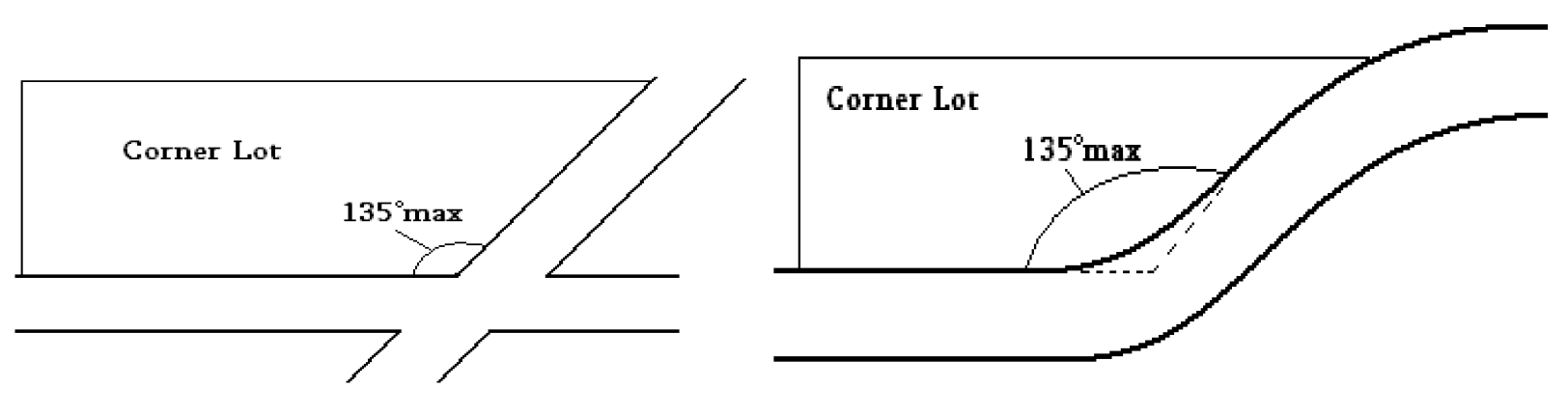
Lot coverage. That percentage of the lot area covered or occupied by buildings and roofed structures.
Lot depth. The distance that a lot extends back from the front lot line, as measured in section 210-10.
Lot, interior. A lot other than a corner lot.
Lot line, front. The lot line abutting a street. For corner and multiple-frontage lots, see section 15-20 and section 215-30, respectively, for standards guiding the determination of the front lot line(s).
Lot line, rear. The lot line opposite the front lot line.
Lot line, side. Any lot line other than a front or rear lot line. A side lot line separating a lot from a street is called a corner side lot line and a side lot line separating a lot from another lot is called an interior side lot line. See also street line, corner.
Lot lines. The lines bounding a lot.
Lot of record. A parcel of land as originally subdivided or subsequently resubdivided and properly recorded.
Lot, through. An interior lot having frontage on two (2) streets, other than a corner lot.
Lot width. The width of a lot is the distance between the side lot lines measured pursuant to section 210-10.
Lounge. See "alcoholic beverage establishment."
Marijuana. Any strain of cannabis or marijuana, in any form, that is authorized by state law to be dispensed or sold in the State of Florida. Also referred to as "medical marijuana."
Massage therapy services establishment. An establishment where services involving the manipulation of the superficial tissues of the human body with the hand, foot, arm, or elbow are performed.
Mechanical amusement device. Any machine or device which, upon the insertion of currency, including a credit or debit card, or the currency equivalent in tokens or other items purchased with currency, may be operated by the public generally for use as a game, entertainment or amusement, whether or not registering a score. It shall include such devices as mechanical grab machines, table-hockey, indoor shuffle boards, pinball machines, video game machines and all games, operations, or transactions similar thereto under whatever name they may be indicated. This term shall not include juke boxes, vending machines that dispense merchandise of reasonable value (ex: gum, candy, snack food items, soft drinks, trinkets), or machines such as clothes washers and dryers that would be classified as equipment not intended for amusement or entertainment.
Medical marijuana retail center. A retail establishment, licensed by the Florida Department of Health as a "medical marijuana treatment facility," "medical marijuana treatment center," "dispensing organization," "dispensing organization facility" or similar use, that sells and dispenses medical marijuana, but does not engage in any other activity related to preparation, wholesale storage, distribution, transfer, cultivation, or processing of any form of marijuana or marijuana product, and does not allow on-site consumption of marijuana. A medical marijuana treatment center shall not be construed to be a medical marijuana retail center.
Medical marijuana treatment center. Any facility licensed by the Florida Department of Health to acquire, cultivate, possess, process (including but not limited to development of related products such as food, tinctures, aerosols, oils, or ointments), transfer, transport, sell, distribute, dispense, store, or administer marijuana, products containing marijuana, related supplies, or educational materials, as authorized by state law. A medical marijuana treatment center may include retail sales or dispensing of marijuana. A facility which provides only retail sales or dispensing of marijuana shall not be classified as a medical marijuana treatment center under this chapter. Also may be referred to as a "medical marijuana treatment facility" or "dispensing organization" or other similar term recognized by state law.
Medical office. See office, medical.
Merchandise rental or leasing store. An establishment primarily used, designed or constructed for the rental or leasing of merchandise, through a lease or rental arrangement by which ownership of rented or leased merchandise is not acquired until the required rental or lease term is completed or the renter or lessee of such merchandise exercises an early purchase option. A "merchandise rental or leasing store" shall not be considered to be a "retail store."
Microbrewery. A brewing facility producing malt beverage as defined by applicable state and federal regulations, and with gross floor areas of twenty-five thousand (25,000) square feet or less.
Minimum required setback. See setback, minimum required.
Mixed use. A single building containing residential and nonresidential principal uses, or residential and nonresidential principal uses located on the same lot but in separate buildings, planned as a unified complementary whole, and functionally integrated to the use of shared vehicular and pedestrian access and parking areas.
Mixed-use district. See district, mixed-use.
Mobile food vendor(s). Retail sales of food from a motorized vehicle, or a contained unit able to be readily moved, or from temporary fixtures on a property outdoors, that is approved and licensed for such activity.
Mobile food vendor event. One (1) or more food trucks gathered at any time for any duration of time for the purpose of retail food sales in connection with an established and licensed business or an event with fifty (50) or more people, which requires a special event approval in accordance with article 675.
Mobile home. A detached dwelling constructed prior to June 15, 1976, with the following characteristics:
(A)
Designed or used for longterm occupancy, and containing sleeping accommodations, a flush toilet, a tub or shower bath, and kitchen facilities, with plumbing and electrical connections provided for attachment to outside systems;
(B)
Designed for transportation after fabrication on streets or highways on its own wheels;
(C)
Ready for occupancy except for minor and incidental unpacking and assembly operations, temporary or permanent foundations, connection to utilities, and the like; and
(D)
Premanufactured dwellings transported to building sites and constructed after June 15, 1976, are considered to be "manufactured homes" and are not distinguished from single-family dwellings within these regulations.
A travel trailer is not to be considered as a mobile home. (See "trailer, travel.")
Mobile vendors. Retail sales of goods and services from a motorized vehicle, or a contained unit able of being readily moved, or from temporary fixtures on a property outdoors, instead of the activity occurring within a building designed, approved, and licensed for such activity.
Motor fuel pump. A device or mechanism used for the dispensing of refined motor fuel products into automobiles and other motorized end-user vehicles and equipment.
Motor fuel pumps, retail. An establishment containing motor fuel pumps, which may also include a retail establishment occupying more than three thousand five hundred (3,500) gross square feet of floor area that sells a variety of convenience goods and may also offer convenience store services such as prepared foods and limited banking store services.
Multiple or multifamily dwelling. See dwelling, multiple or multifamily.
Nightclub. Restaurants, bars and other similar establishments where music is played at or above normal conversation sound level such that the music is primary entertainment and not merely background music for ambiance, or where live entertainment is provided.
Nonconforming lot. A lot of record that conformed with all lot area and dimensional requirements at the time it was legally subdivided and recorded, but as a result of the subsequent adoption or amendment of these regulations, the lot fails to conform to the present requirements for minimum lot area, dimensional requirements, or both.
Nonconforming structure. A lawfully existing structure, other than a sign, that conformed with all of the setback, height, bulk, coverage, area, separation, open space, design, and architectural standards of the code in effect at the time the structure was established, but as a result of the subsequent adoption or amendment of these regulations, the structure fails to conform to the present requirements.
Nonconforming use. A lawfully established use of land, water or structure, other than a sign, that as a result of the subsequent adoption or amendment of these regulations, is no longer permitted. The casual, temporary, or illegal use of land or structures, or land and structures in combination, shall not be sufficient to establish the existence of a nonconforming use or to create rights in the continuance of such use.
Nonresidential district. See district, nonresidential.
Office, business. Any office other than a medical office or professional office. Excludes financial institutions.
Office, medical. A facility providing services to the public by physicians, dentists, surgeons, chiropractors, pharmacists, osteopaths, physical therapists, nurses, acupuncturists, podiatrists, optometrists, psychiatrists, or others who are duly licensed to practice their respective professions in the State of Florida, as well as others, including but not limited to technicians and assistants, who are acting under the supervision and control of a licensed health care practitioner. A space of five thousand (5,000) square feet or less, consisting of facilities providing diagnostic analysis of medical tests (such as blood test, urinalysis, computerized tomography (CT), x-ray or other medical tests related to diagnostic treatment) are to be considered as medical offices. Retail pharmacies staffed by pharmacists that sell prescription drugs, nonprescription drugs or both and other retail goods for sale to the public, are not medical offices. Offices for social workers and mental health counselors are not medical offices. Pain management clinics, as defined in this provision, are medical offices.
Office, professional. An office that is not in the same building with any associated storage or warehousing, and that functions with minimal on-premises consultation or visitation, in contrast to medical offices, studios, financial institutions, and other establishments where business transactions occur largely on-premises.
Open space, common. That area of a development site that is dedicated to the homeowner's association, condominium association or similar maintenance entity as open space for the occupants of the development, and which is unencumbered by principal buildings and structures, streets, driveways and vehicular use areas, and excluding any part of a lot containing a dwelling unit.
Owner-occupied. A dwelling in a habitable condition occupied by the owner of record, as the owner's primary residence, and holding a valid certificate of occupancy.
Pain management clinic. A type of medical office providing a variety of personal services by an on-site physician who is currently licensed by either the Florida Board of Medicine or Board of Osteopathic Medicine and his or her staff, which, individually or collectively, are intended to reduce or manage pain.
Parking. The temporary, transient storage of private passenger vehicles used for personal transportation, while their operators are engaged in other activities.
Parking garage or structure; structured parking. A structure consisting of at least two (2) levels used for parking or storing automobiles, inclusive of the surface parking underneath the second level that is not a private garage (see garage, private).
Parking, required. Parking facilities that must be provided accessory to a permitted use of land in order to comply with the parking requirements of this code.
Parking space. An off-street parking area for the parking of one (1) automobile, having the minimum dimensions, access and construction required by this code.
Parking, supplemental. Parking facilities provided as a special exception and which are in addition to parking facilities required by this code.
Passenger vehicle. See vehicle, passenger.
Pawnshop. The location at which a pawnbroker conducts business. Pawnbroker means any person who is engaged in the business of making pawns as defined in F.S. Chapter 539, as may be amended, who makes a public display containing the term "pawn," "pawnbroker," or "pawnshop" or similar; or who publicly displays a sign or symbol historically identified with pawns.
Permit, building. See building permit.
Permit, development. See development permit.
Personal service establishment. A business primarily engaged in providing individual services on the premises involving the care of a person or their apparel, eyewear, jewelry and other items worn on one's person. Such establishments include beauty salons, tailors, shoe repair, personal training (fitness) studios, health and beauty spas, and other similar uses. Astrologists and other fortune telling activities, medical services, massage therapy establishments which are not accessory to a permitted personal service establishment, and mortuaries and related businesses shall not be considered personal service establishments.
Pervious area. Land surface that presents an opportunity for precipitation to infiltrate directly into the ground.
Pharmacy, retail. A retail establishment primarily offering goods for retail sale and on-site dispensing of prescription drugs, nonprescription drugs or both. A retail pharmacy may also offer accessory services such as photo processing, eyeglass care, etc.
Place of public assembly. A place intended or used for people to gather for events, activities or programs, including, but not limited to, arenas, auditoriums, theaters, lecture halls, place of worship, meeting rooms, recreation buildings, private clubs, and convention centers. Places of public assembly are generally characterized by open areas or areas with fixed seating intended or used for gathering.
Place of worship. A building or structure owned or used by a religious organization for worship, religious training, or education (nonacademic curriculum), including accessory uses such as day care.
Plat. A map or delineated representation of the subdivision of lands, being a complete exact representation of the subdivision and other information in compliance with the requirement of all applicable sections of this Land Development Code, and of any local ordinances, and may include the terms "replat," "amended plat," or "revised plat."
Platted. Land for which a plat has been recorded.
Pool house. See cabana (pool house).
Porch. A roofed space attached to the outside of an outer wall of a building, one (1) or two (2) stories in height, open on one (1) or more sides, which may have railings, screen or glass enclosure. An open or unenclosed porch is one without railing, glass, canvas, screen, or similar materials on the open sides.
Potable water facilities. A system of structures designed to collect, treat, or distribute potable water, and includes water wells, treatment plants, water storage facilities, and distribution mains.
Primary school. See school, primary.
Principal structure. See structure, principal.
Principal use. See use, principal.
Private club. Buildings or facilities, not open to the general public, owned and operated by a corporation or association of persons for social or recreational purposes for members and their bona fide guests and which may render, as an accessory use, services which are customarily carried on as a business. A private club may provide living quarters for its bona fide employees only. This term does not include private recreation facilities such as swimming pools, golf courses, tennis courts, marinas and their accessory facilities.
Private garage. See garage, private.
Professional office. See office, professional.
Professional Surveyor and Mapper. A person registered in the State of Florida to engage in the practice of surveying and mapping under F.S. §§ 472.001 through 472.037.
Public art. The permanent outdoor display on property accessible to the public, of tangible creations by artists exhibiting the highest quality of skill and aesthetic principles that include all forms of the visual arts conceived in any medium or material including, but not limited to, paintings, sculptures, engravings, carvings, frescos, stained glass, mosaics, mobiles, tapestries, murals, photographs, video productions, digital images, bas-relief, high-relief, fountains, kinetics, collages, drawings, monuments erected to commemorate a person or event, functional furnishings such as artist-designed seating and pavers, architectural elements designed by an artist, and artist-designed landforms or landscape elements. The following shall not be considered artwork or works of art:
(1)
Reproductions or unlimited copies of original artwork;
(2)
Art objects that are mass-produced;
(3)
Works that are decorative, ornamental or functional elements of the architecture or landscape design, except when commissioned by an artist as an integral aspect of a structure or site.
Public assembly, place of. See place of public assembly.
Public facilities. Major capital improvements, including, but not limited to, transportation, sanitary, solid waste, drainage, potable water, educational, parks and recreational, and health systems and facilities.
Public recreation. Recreational use on sites owned or leased on a longterm basis by a federal, state, regional or local government agency for recreational purposes.
Public use floor area. See floor area, public use.
Qualified registered patient/Qualified patient. A resident of the State of Florida who has been added to the state's compassionate use registry by a physician licensed under F.S. Ch. 458 or Ch. 459, to receive marijuana from a dispensing organization or medical marijuana treatment center as defined in Florida Statutes.
Rear lot line. See lot line, rear.
Rear yard. See yard, rear.
Record; recorded; of record. Refers to the act of, or state of a document being—or having been—recorded into the Official Public Records of Broward County, Florida. For plats, refers to recording or having been recorded in a specific page in a plat book (PB), and for other documents, usually refers to recording or having been recorded in a specific page or pages of an office of records book (ORB).
Recreational facility. A component of a recreation site used by the public such as a trail, court, athletic field or swimming pool.
Recreational vehicle. See vehicle, recreational.
Regional roadway network. The roads identified as trafficways on the Broward County Trafficways Plan.
Regulations. The terms "regulations" and "these regulations" refer to the City of Dania Beach Land Development Code (LDC) unless otherwise specifically indicated within the LDC.
Rehabilitation center. See substance abuse and rehabilitation centers.
Rental lot, auto. See auto rental lot.
Repair shop, general. See general service and repair shop.
Required improvements. See improvements, required.
Required landscaping. See landscaping, required.
Required parking. See parking, required.
Required setback line. See setback line, required.
Required yard. See yard, required.
Resale boutique. A shop that displays and sells used articles, especially clothing for a profit to the general public.
Residential care facility. A residential facility licensed by the State of Florida to provide any combination of nursing care, injury or illness rehabilitation, personal services, community reentry training, aids for independent living, or counseling, to persons with disabilities as defined by Federal Law, as well as clients of the Florida Department of Elderly Affairs, the Florida Agency for Persons with Disabilities, the Florida Department of Children and Family Services, or the Agency for Health Care Administration. This term does not include hospitals licensed under F.S. ch. 395, as may be amended from time to time, or any federally operated hospital facility.
"Adult residential care facilities" are separately defined in this section, and subject to additional standards as provided in section 105-70.
Residential district. See district, residential.
Restaurant. An establishment where food is prepared and served directly to the consumers who purchase the food, including bakeries and delicatessens.
Restaurant, drive-in. A restaurant where space is provided or allowance made for automobiles to congregate for the purpose of serving the occupants with food and refreshments in their automobiles.
Restaurant, drive-through. A restaurant at which patrons are served food or beverages from a drive-through window while they are within a motor vehicle.
Restaurant, fast food. A restaurant at which patrons are served food or beverages from a counter (no table service) and the food or beverage is served in disposable containers or wrappers for consumption on or off the premises.
Restaurant, full service. An establishment where food and beverages are ordered from a menu, prepared and served for pay, or are self-served from a buffet for pay, for consumption on the premises.
Restaurant, takeout. Restaurant at which patrons are served from a counter and the food or beverage is served in disposable containers or wrappers for off-premises consumption. Any seating in a takeout restaurant is negligible and incidental to the volume of food and beverage consumed off-premises.
Retail establishment, large. See large retail establishment.
Retail pharmacy. See pharmacy, retail.
Retail store. An establishment used, designed or constructed for display and sale of new merchandise at retail to the general public.
Right-of-way. The area of a highway, road, street, or alley, or other such strip of land, reserved for public use, whether established by prescription, easement, dedication, gift, purchase, eminent domain or any other legal means.
Right-of-way line. See street line.
Roadside vendor. A non-permanent vendor of merchandise or food located within or adjacent to a public right-of-way, the primary source of customers for which is generated from passing traffic.
Roof line. The top edge of a roof or building parapet, whichever is higher, excluding any mansards, cupolas, pylons, chimneys or minor projections.
Sanitary sewer facilities. Structures or systems designed for the collection, transmission, treatment, or disposal of sewage and includes trunk mains, interceptors, treatment plants and disposal systems.
School. An institution for the educational instruction of children or adults, encompassing all of the specific types of schools defined in this section, and including accessory facilities.
School, academic. A school that teaches state-approved academic curriculum to children at the kindergarten through twelfth-grade levels. Academic schools may be public or private.
School, college. A postsecondary institution for higher learning that offers state-licensed degree programs culminating in the granting of associate, bachelor, masters, or doctoral degrees, and that may also have research facilities.
School, preschool. See day care center.
School, primary. An academic school for the kindergarten through eighth grade levels, and may include ninth grade instruction.
School, secondary. An academic school for the tenth through twelfth grade levels and may include ninth grade instruction.
School, specialty. A school, other than a college, teaching specialized curriculum at the postsecondary level, including schools for the arts, theatrics, music, dance, vocational schools, technical schools, and trades schools.
Secondary school. See school, secondary.
Self storage. See storage, self (mini-warehouse).
Services, essential. See essential services.
Setback. The minimum horizontal distance measured from a property line, or street line wherever the lot abuts a street, and any part of any a building or other structure on the lot.
Setback line. The line or vertical plane that represents the depth or extent of a setback or yard.
Setback, minimum required. The minimum setback required by any code provision. A minimum setback requirement creates a minimum yard requirement, and a minimum yard requirement has the same effect as requiring a minimum setback. See section 215-30, "Multiple frontage lots", for determination of setbacks with multiple-street frontages.
Setback line, required. The line or vertical plane representing the minimum required setback distance and yard depth.
Sewer facilities, sanitary. See sanitary sewer facilities.
Shade/canopy tree. See tree, shade/canopy.
Shed, utility. See utility shed.
Shopping center. A group of retail stores, service establishments, or any other businesses planned to serve the community or neighborhood not necessarily owned by one party or a single land owner, but designed as a single site, which are generally adjacent to each other and utilizing a common parking area or areas, common name and common entry and exit points.
Shopping center outparcel. A structure separated from the multitenant structure that meets all zoning requirements independently from the shopping center (i.e., is not dependent upon the shopping center, for example, to meet parking, drainage, open space or landscaping requirements).
Showroom. Indoor display of materials, equipment, or products offered for sale primarily on a wholesale basis, and also including indoor display of vehicles accessory to retail sales of same.
Side lot line. See lot line, side.
Single-family cluster development. See cluster development, single-family.
Single-family dwelling. See dwelling, single-family.
Site plan. A drawing illustrating a proposed development and prepared in accordance with the specifications set forth in article 635.
Special exception. A use which may be allowed within a zoning district subject to the provisions of this Land Development Code, and in accordance with the procedures as set forth in article 630.
Special purpose vehicle. See vehicle, special purpose.
Special residential facility. A special residential facility is a term that is inclusive only of the following: community residential home and residential care facility. A special residential facility specifically excludes any residential facility that houses or treats persons who are of danger to themselves or others or who suffer from acute mental crisis. "Acute mental crisis" means a person who is experiencing a psychotic episode or a high level of mental or emotional distress which may be precipitated by a traumatic event or a perceived life problem for which the individual's typical coping strategies are inadequate. See also dwelling unit, special residential facility.
Community residential home, type 1. A dwelling unit licensed to serve clients of the State of Florida Department of Elderly [Elder] Affairs, Agency for Persons with Disabilities, Department of Juvenile Justice, or Department of Children and Family Services [Department of Children and Families] or a dwelling unit licensed by the Agency for Health Care Administration which provides a living environment for no more than six (6) individuals who operate as the functional equivalent of a family, including such supervision and care as may be necessary to meet the physical, emotional and social needs of residents. Residents may include frail elders (as defined in F.S. § 429.65), children who are found to be dependent or in need of services (as defined in F.S. § 39.01(14), F.S. § 984.03(9) or (12), or F.S. § 985.03), physically disabled or handicapped persons (as defined in F.S. § 760.22(7)(a)), developmentally disabled persons (as defined in F.S. § 393.063), or nondangerous, mentally ill persons (as defined by F.S. § 394.455(18)).
Community residential home, type 2. A dwelling unit licensed to service clients of the State of Florida Department of Elderly [Elder] Affairs, Agency for Persons with Disabilities, Department of Juvenile Justice, or Department of Children and Family Services [Department of Children and Families] or a dwelling unit licensed by the Agency for Health Care Administration which provides a living environment for seven (7) to fourteen (14) individuals who operate as the functional equivalent of a family, including such supervision and care as may be necessary to meet the physical, emotional and social needs of residents. Residents may include frail elders (as defined in F.S. § 429.65), children who are found to be dependent or in need of services (as defined in F.S. 39.01(14), F.S. §§ 984.03(9) or (12), or F.S. § 985.03), physically disabled or handicapped persons (as defined in F.S. § 760.22(7)(a)), developmentally disabled persons (as defined in F.S. § 393.063), or nondangerous, mentally ill persons (as defined by F.S. § 394.455(18)).
Residential care facility. A residential facility licensed by the state to provide any combination of nursing care, injury or illness rehabilitation, personal services, community reentry training, aids for independent living, or counseling, but not medical services, to persons with disabilities as defined by federal law, as well as clients of the Florida Department of Elderly [Elder] the Florida Agency for Persons with Disabilities, the Florida Department of Children and Family Services [Department of Children and Families] or the Agency for Health Care Administration. This term does not include hospitals licensed under F.S. chapter 395, as may be amended from time to time, or any federally operated hospital facility. Examples include facilities typically referred to as nursing homes, convalescent homes, and assisted living facilities.
Specialty school. See school, specialty.
Storage, longterm. Storage of materials for a period of time generally exceeding six (6) months. Longterm storage is generally a principal use, and does not generally include items that are for sale or distribution from the premises or associated with any other business activity on the premises. Some examples include extended storage of records and archives, donated blood products, collector automobiles, and disaster relief products.
Storage, self (miniwarehouse). An enclosed storage facility containing independent, fully-enclosed bays that are leased to individuals exclusively for long-term storage of their household goods or personal property.
Store, antique. See antique store.
Store, consignment. See consignment store or shop.
Store, convenience. See convenience store.
Store, drug. See drug store.
Story. A complete horizontal division of a building or parking structure, constituting the space between the surface of any floor and the surface of the next floor above it, or if there is no floor above it, then the space between such floor and the roof above it. A story consists of no less than eight (8) feet and no more than fourteen (14) feet in height, except as may be provided for ground stories in these regulations.
Street. A thoroughfare, either public or private, which affords the primary means of access to abutting property, and is intended for general traffic circulation. A street includes the entire area between street lines (right-of-way line).
Street, local. A street other than an arterial or collector, that functions primarily to provide access to individual lots.
Street line. The outer boundary line of the ultimate right-of-way of a public or private street. Also referred to as the right-of-way line. The ultimate right-of-way for any street is the planned width of the right-of-way prescribed for such street in article 815, measured on each side of the street centerline unless otherwise specified in article 815. There is no distinction made in this code between the edge of an existing dedicated right-of-way and the planned extent of a right-of-way for purposes of measuring setbacks, yards, clear site distance, etc., even though the full width of same has not yet been dedicated, unless the context specifically refers to an existing dedication, or a street right-of-way as currently dedicated.
Street line, corner. A street line abutting a corner side yard. See section 215-20 for determination of corner side streets and front streets.
Street line, front. A street line abutting a front yard.
Street yard. See yard, street.
Structural alterations. Any change, except the repair or replacement, in the supporting members of a building, such as bearing walls, columns, beams or girders or the rearrangement of any interior partitions affecting more than five (5) percent of the floor area of the building.
Structure. Anything constructed, installed or placed upon the land, or attachment thereto, the use of which requires, occupies, or is intended to occupy, a permanent or generally fixed location, but excluding landscape materials including accessory hardscape materials and earthen berms. By way of example, structures include buildings, sheds, slabs, statues, port-o-cocheres, shipping containers, pools, gazebos, tents, ground signs, fences, and any movable structure while it is located on land that can be used for housing, business, commercial, or office purposes either temporarily or permanently.
Structure, parking. See parking garage or structure.
Structure, principal. A building or structure in which is conducted the main or principal use of the lot on which said building is situated.
Studio or efficiency. A multiple-family dwelling unit that contains only one room for living, cooking and sleeping, and does not exceed eight hundred (800) feet of gross floor area.
Subdivision. The platting of real property into two (2) or more lots, parcels, tracts, tiers, blocks, sites, units, or any other division of land; and includes establishment of new streets and alleys, additions, and resubdivisions; and, when appropriate to the context, relates to the process of subdividing or to the lands or area subdivided.
Substance abuse and rehabilitation centers. A type of medical office established to aid persons affected by excessive or illegal use of drugs, narcotics or other hallucinatory substances, not including alcohol, who have developed a dependency on such substances, including but not limited to methadone maintenance facilities, and outpatient rehabilitation facilities.
Substantial conformity. Refers to the Broward County Charter requirement contained in article VI, [sub]section[s] 6.05 D and E that local governmental future land use plans shall be materially and pertinently compatible with and further the Broward County Land Use Plan in order to be certified or recertified.
Substantial improvement. Replacement of any two (2) exterior walls and the roof within a period of one (1) year shall constitute a substantial improvement. Substantial improvement shall also mean any repair, reconstruction or improvement of a structure within a period of one (1) year, the cost of which equals or exceeds fifty (50) percent of the market value of the structure, as determined by the Office of the Property Appraiser of Broward County, either:
(1)
Before the improvement or repair is started, or
(2)
If the structure has been damaged and is being restored, before the damage occurred.
The total cost shall not include nonstructural interior finishing, except when determining whether the structure has been substantially improved as a result of a single improvement or repair, or substantially damaged as a result of a single event. For purposes of this definition, substantial improvement is considered to occur when the first alteration of any wall, ceiling, floor or other structural part of the structure commences, whether or not that alteration affects the external dimension of the structure. The term does not include:
(1)
Any project for the improvement of a structure to comply with existing state or local health, sanitary or safety code specifications which are necessary solely to assure safe living conditions; or
(2)
Any alteration of a structure listed on the National Register of Historic Places or the Florida Inventory of Historic Places.
Supplemental parking. See parking, supplemental.
Surveyor and mapper. See professional surveyor and mapper.
Takeout restaurant. See restaurant, takeout.
Temporary use. A use of land, building or structure established for a fixed period of time with the intent to discontinue such use upon the expiration of such time, and which are authorized as temporary accessory or principal uses for time periods proportionate and appropriate to the nature of the temporary use.
Through lot. See lot, through.
Time share dwelling unit. See dwelling unit, time share.
Town house dwelling unit. See dwelling, town house.
Trafficways Plan, Broward County. See Broward County Trafficways Plan.
Trailer. A vehicular structure mounted on wheels designed to be pulled by another vehicle.
Trailer, travel. A temporary dwelling unit designed to be transported over streets and highways and for accommodating a family for temporary occupancy while traveling or temporarily living in a location, but not as a permanent dwelling unit, and is not a mobile home.
Trailer, utility. A trailer designed to transport materials, goods or equipment. This includes boat trailers.
Transient. An individual or group in transient occupancy. Transient occupancy is when it is the intention of the parties that the occupancy will be temporary.
Transit-oriented development (TOD). Mixed-use development that combines a pedestrian-friendly environment with retail or entertainment ground floor uses and significant amounts of office space and housing, and located within one-quarter (¼) to one-half (½) mile side-walk route to a transit station. Specifically, a TOD provides continuous, shaded sidewalks with street furniture and minimal driveway interruptions, paseos where appropriate, and nearly continuous shop frontage.
Transit hub. A commuter railroad or multi-modal (rail and bus) stop with parking facilities, ticket counters, restrooms and other accessory facilities.
Travel trailer. See trailer, travel.
Tree, shade/canopy. See section 825-50.
Two-family dwelling. See dwelling, two-family.
Use, principal. The primary use of a lot as distinguished from secondary or accessory uses. There may be more than one (1) principal or main use on a lot unless otherwise provided.
Use; use of land. Any purpose for which buildings, structures, land, or water may be arranged, designed, intended, maintained, or occupied; or any occupation, business, activity, or operation carried on or intended to be carried on in a building, other structure, or on land. Use of land shall include use of buildings, structures and water.
Utility. Includes any public or private utility, such as, but not limited to, storm drainage, sanitary sewers, electric power, water service, gas service, or telephone line, whether underground or overhead.
Utility shed. A detached subordinate accessory building or structure used for storage, and which may also include a greenhouse.
Utility trailer. See trailer, utility.
Vacant land. Any lot or parcel of land which is completely open, has no use associated with or upon it and is not utilized as the required yard area for any adjoining uses.
Variance. A modification from the literal interpretation of the provisions, other than those provisions relating to use requirements, subject to the procedures of article 625 of this Land Development Code.
Vehicle, commercial. Any vehicle designed or used primarily for the transportation of property, equipment or persons for hire other than a passenger vehicle as defined below, as well as any vehicle (including a passenger vehicle) that contains advertised markings in excess of three (3) square feet per side or per vehicle top. Commercial vehicles include, but are not limited to, tractor-trailers and any parts of such tractor-trailers, construction equipment, trucks with bucket lifts, wreckers, tow trucks or other vehicles equipped with a hoist or other mechanical equipment designed to perform a similar function, busses, taxicabs, step vans, utility trucks, flatbed trucks, limousines, any vehicle commonly recognized as a commercial vehicle, and any vehicle which contains advertising markings in excess of three (3) square feet per side or per vehicle top. Police cars, ambulances and fire trucks are not classified as commercial vehicles.
Vehicle, commercial, type A. Any commercial vehicle having any of the following characteristics:
(1)
Capacity of one and one-half (1.5) tons or more;
(2)
Overall height of eight (8) feet or taller;
(3)
Overall width exceeds six (6) feet ten (10) inches, excluding side-view mirrors;
(4)
Overall length exceeds twenty-two (22) feet six (6) inches;
(5)
Is an open truck having load space exceeding nine (9) feet six (6) inches in length;
(6)
Dual wheels (side by side on the same side of an axle);
(7)
More than two (2) axles;
(8)
Total square footage of signage on the vehicle in excess of fifteen (15) square feet;
(9)
Visible tools, ladders, materials, pipes, or racks;
(10)
Has a hoist, lift, dump body, or any combination of these features, or any other altered cargo box;
(11)
Manufacturer's gross vehicle weight rating (GVWR) is fourteen thousand (14,000) pounds or more.
Vehicle, commercial, type B. Any commercial vehicle that is not a type A commercial vehicle.
Vehicle, passenger. A vehicle that is designed, used or maintained primarily to transport private passengers and are currently licensed for travel on the public roads. This does not include vehicles designed for mass public transportation such as buses, nor does it include special purpose vehicles specially designed primarily for unusual terrain and conditions such as swamp buggies, track layers, etc.
Vehicle, recreational. Any vehicle or portable structure designed primarily to provide temporary living quarters for recreation, camping or travel use; either a vehicular structure mounted on wheels, self-powered or designed to be pulled by another vehicle or a structure designed to be mounted upon and carried by another vehicle. This definition is intended to include travel trailer, camping trailer, camp bus or house bus and truck-camper unit of walk-in capacity.
Vehicle repair. See automotive, motor vehicle repair, minor and automotive, motor vehicle repair, major.
Vehicle, special purpose. A vehicle especially designed primarily for unusual terrain and conditions and are not usually licensed for or used on the public road, such as swamp buggies, stockcars, air boats, etc.
Vehicular use area (VUA). An area used for parking, loading and vehicular access for any property not occupied by a single-family residence.
Vested rights. Rights which have so completely and definitely accrued to or settled in a person, which it is right and equitable that government should recognize and protect, as being lawful in themselves, and settled according to then current law.
Washing machine. See automatic or coin-operated service trade machine.
Watchman or caretaker dwelling unit. A dwelling unit designed to be used by one (1) person, either a caretaker or night watchman, and which is incidental to an authorized established commercial or industrial use.
Water facilities, potable. See potable water facilities.
Waterway. Any body of water, natural or artificial.
Worship, place of. See place of worship.
Xeriscape. Landscaping designed specifically for areas that are susceptible to drought, or for properties where significant water conservation is practiced. This landscape type and design requires little to no irrigation and maximizes drought tolerance.
Yard. An open space on the same lot with a building unoccupied and unobstructed from the ground upward, except by trees or shrubbery or as otherwise provided in the Land Development Code. Yards shall extend and be measured perpendicular and inward from the respective property lines and street lines. When a yard is required along a property line that abuts a waterway, it shall be measured from the face of the seawall in contact with the waterway (wetface), or from the top of bank of the waterway where no seawall exists.
Yard, corner side. The street side yard of a corner lot.
Yard, front. A yard across the full width of the lot, extending from the front street line to the front of the principal building on the lot.
Yard, rear. A yard extending across the full width of the lot and measured between the rear line of the lot and the closest wall of the principal building. In the case of corner lots, the rear yard shall be the yard opposite the front street line of the lot.
Yard, required. A minimum open area requirement, other than a court, on the same lot with a building, unoccupied and unobstructed from the ground upward, except as otherwise provided in these regulations. The depth of any required yard that abuts an existing or proposed street, for which additional right-of-way will be required pursuant to the Broward County Trafficways Plan, comprehensive plan, or other officially adopted plan, shall be measured from the ultimate right-of-way line of the street, provided that the area in between the existing and ultimate right-of-way lines shall also be considered part of the required yard.
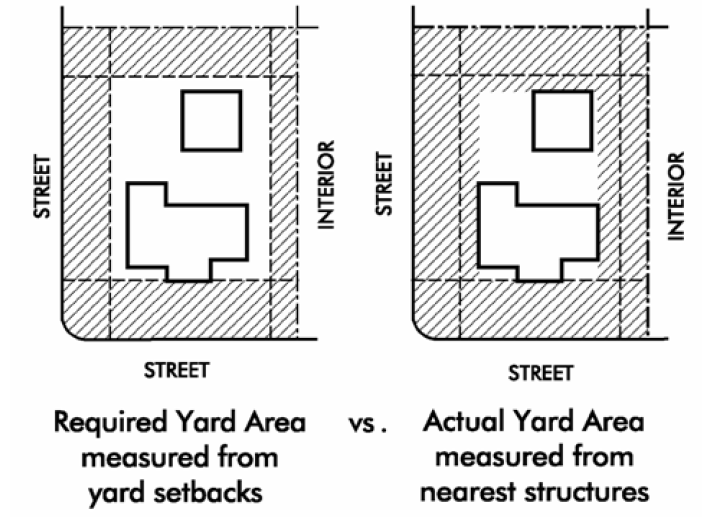
Yard, interior side. A yard extending between the side of the principal building line and the side line of the lot and between the front yard and the rear yard.
Yard sale. A "garage sale," as defined in section 21-41 of the Code of Ordinances.
Yard, street. A yard abutting a street.
(Ord. No. 2010-20, § 2(Exh. A), 9-14-10; Ord. No. 2010-025, § 9, 11-23-10; Ord. No. 2011-024, § 18, 8-9-11; Ord. No. 2012-008, § 15, 5-8-12; Ord. No. 2012-015, § 6, 8-14-12; Ord. No. 2012-025, § 10, 10-9-12; Ord. No. 2014-004, § 8, 5-27-14; Ord. No. 2014-016, § 2, 10-28-14; Ord. No. 2015-002, § 7, 1-13-15; Ord. No. 2016-013, § 9, 7-26-16; Ord. No. 2017-021, § 2, 7-25-17; Ord. No. 2017-022, § 11, 7-25-17; Ord. No. 2019-003, § 2, 3-12-19; Ord. No. 2019-026, § 6, 12-10-19; Ord. No. 2021-031, § 2, 12-14-21; Ord. No. 2022-007, § 2, 1-25-22; Ord. No. 2022-029, § 3, 9-27-22; Ord. No. 2025-010, § 9, 5-27-25; Ord. No. 2025-016, § 15, 8-26-25)

