
Dania Beach City Zoning Code
PART 8
TECHNICAL APPENDIX
Sec. 805-10. - Generally.
No development activity may be approved unless the provision of certain public facilities will be available at prescribed levels of service concurrent with the impact of the development on those facilities and as provided by Florida law.
(Ord. No. 2010-20, § 2(Exh. A), 9-14-10)
Sec. 805-20. - Applicability; development subject to adequacy determination.
A determination of adequacy shall be required as a condition of the following development activities.
(A)
New development.
(B)
Additional development or redevelopment. All redevelopment or additional development of previously improved lands shall be subject to an adequacy determination for the additional capacity needed to serve the difference between the capacity to be consumed by the proposed additional development and the capacity generated or consumed by the existing development.
(C)
Change in use. Any change in use of property shall be subject to an adequacy determination for the additional capacity needed to serve the difference between the capacity to be consumed by the proposed use and the capacity consumed by the existing use.
(D)
Exempt property and development. The following development shall be exempt from the requirement for a determination of adequacy:
(1)
Development that is authorized by an approved development of regional impact (DRI) development order.
(2)
Development orders or rights determined to be vested by the city attorney, including valid capacity reservations from a prior concurrency determination.
(3)
Development of one (1) single-family dwelling on a lot of record in single and separate ownership from adjacent lots as of March 1, 1989.
(4)
Development which is a government facility which the city commission finds is essential to the health or safety of the city residents.
(E)
Credit for previous impact. For the purpose of adequacy determinations involving previously improved land or previously occupied structures, credit shall be given for the impact of the last use of vacant structures and previous development vacated or demolished no earlier than eighteen (18) months prior to the date of an application submittal for an activity that is subject to a determination of adequacy pursuant to this section.
(Ord. No. 2010-20, § 2(Exh. A), 9-14-10)
Sec. 805-30. - Procedures, timeframes, expiration.
(A)
[Compliance required at site plan review.] An application for development must demonstrate compliance with this article at the time of site plan review, except that the adequacy determination for school concurrency is made at the time of platting, if applicable. If the code does not require site plan approval for a particular development activity subject to concurrency, the adequacy determination shall be made at the time of building permit review.
(B)
[Certificate of concurrency.] Applications for development approval shall be chronologically logged to determine rights to available capacity. Compliance will be calculated and capacity reserved with the issuance of a certificate of concurrency.
(C)
[Expiration of concurrency finding.] Concurrency finding shall expire with the site plan or building permit for which it is issued.
(D)
Responsibility. The director of community development shall be responsible for monitoring development activity to ensure the development is consistent with the comprehensive plan. A concurrency monitoring system is instituted to verify that public facilities and services will be available at adopted levels of service concurrent with the impacts of the development on those prescribed facility or service standards.
(E)
Development permit approval or disapproval. If an application for a site plan or building permit does not comply with the terms of this article by demonstrating that the adopted LOS standards will be maintained, the city cannot approve the application.
(F)
Burden of showing compliance on developer. The burden of showing compliance with these levels of service requirements shall be upon the developer. In order to be approvable, applications for development approval shall provide sufficient and verifiable information showing compliance with these standards.
(Ord. No. 2010-20, § 2(Exh. A), 9-14-10)
Sec. 805-40. - Determination of available capacity.
(A)
Determination of available capacity. For purposes of these regulations the available capacity of a facility shall be determined by:
(1)
Adding together 1) the total design capacity of existing facilities operating at the required level of service and 2) the total design capacity of new facilities that will come available concurrent with the impact of the development; then,
(2)
Subtracting from that number the sum of 1) the design demand for the service created by existing development and 2) the new design demand for the service (by phase or otherwise) that will be created concurrent with the impacts of the proposed development by the anticipated completion of other presently approved developments.
(B)
[Requirements for inclusion.] The capacity of new facilities may be counted only if one or more of the following is demonstrated.
(1)
The necessary facilities are in place at the time the adequacy determination is made, or the building permit is issued subject to the condition that the necessary facilities will be in place when the impacts of development occur.
(2)
Construction of the new facilities is under way at the time of application.
(3)
The new facilities are the subject of a binding executed contract for the construction of the facilities to be constructed within a period of time as stipulated in the contract or the provision of services at the time the development permit is issued.
(4)
The new facilities have been included in the city/county capital improvement program annual budget.
(5)
The new facilities are guaranteed at a specific time in an enforceable development agreement. An enforceable development agreement may include, but is not limited to, development agreements pursuant to F.S. § 163.3220 or an agreement or development order adopted pursuant to F.S. chapter 380. Such facilities must be consistent with the capital improvements element of the city/county comprehensive plan and approved by the city/county engineer.
(6)
The developer has contributed funds to the city/county necessary to provide new facilities consistent with the capital improvements element of the city/county comprehensive plan. Commitment that the facilities will be built must be evidenced by an appropriate budget amendment and appropriation by the city/county or other governmental entity.
(7)
There is an approved action plan to accommodate the traffic impact of the development.
(8)
The developer has otherwise provided for transportation facilities in accordance with F.S. § 163.3180 and Rule 9J-5.0055, F.A.C.
(Ord. No. 2010-20, § 2(Exh. A), 9-14-10)
Sec. 805-50. - Stormwater drainage level of service standards.
(A)
Measurement of drainage facilities will be based on the water management district basin design standards. Variations may exist for specific parcels but the overall effect of an areas drainage system must meet established water management practices criteria.
(B)
New development shall not be approved unless there is sufficient available design capacity to sustain the following levels of service for the drainage system as established in the drainage sub-element of the comprehensive plan:
(1)
Road protection. Residential and primary streets crown elevation meet the minimum elevations as published on the Broward County Ten-Year Flood Criteria Map.
(2)
Storm sewers. Shall be designed using the Florida Department of Transportation zone 10 rainfall curves.
(3)
Floodplain routing. Modified SCS routing method as established by the SFWMD "basis of review."
(4)
Best management practice. Efforts shall be utilized to use best management practice to reduce pollutants entering the groundwater.
(Ord. No. 2010-20, § 2(Exh. A), 9-14-10; Ord. No. 2025-007, § 8, 4-8-25)
Sec. 805-60. - Potable water level of service standards and demand generation rates.
(A)
[Measurement of water facilities.] Measurement of water facilities will be based on design capacities and service flows. Usage and discharge will be based on adopted level of service standards.
(B)
Adopted level of service standard. New development shall not be approved unless there is sufficient available design capacity to sustain the following level of service for potable water as established in the potable water sub-element ("water supply plan") of the comprehensive plan.
(C)
Potable water demand generation rates.
(Ord. No. 2010-20, § 2(Exh. A), 9-14-10)
Sec. 805-70. - Sanitary sewer level of service standard and demand generation rates.
(A)
[Basis for measurement.] Measurement of wastewater facilities will be based on design capacities and service flows. Usage and discharge will be based on adopted level of service standards.
(B)
Level of service standard. New development shall not be approved unless there is sufficient available design capacity to sustain the following level of service for wastewater treatment as established in the sanitary sewer subelement of the comprehensive plan.
(C)
Demand generation rates. All demand generation rates are expressed as equivalent residential connections (ERCs). One (1) ERC is the average amount of sanitary sewage generated by one (1) residential dwelling unit, which is equal to three hundred (300) gallons per day. Example: two (2) ERCs is equal to six hundred (600) gallons per day.
(Ord. No. 2010-20, § 2(Exh. A), 9-14-10)
Sec. 805-80. - Solid waste disposal level of service standard and demand generation rates.
(A)
Measurement of solid waste shall be based on assumed generation rates and the design capacity of the landfill, incinerator and recycling operations.
(B)
New development shall not be approved unless there is sufficient available design capacity to sustain the demand calculated using the following generation rates for solid waste as established in the solid waste subelement of the city comprehensive plan.
(Ord. No. 2010-20, § 2(Exh. A), 9-14-10)
Sec. 805-90. - Roadway level of service standards, demand generation rates.
(A)
Applicability. Adequacy determinations are made only for city roadways that are not identified as trafficways on the Broward County Trafficways Plan. Concurrency for trafficways is administered by Broward County in the form of concurrency assessments based upon the number and length of trips a given type of use generates. The county assesses its concurrency fee at the time of building permit application. The city shall not accept an application for building permit unless the applicant provides proof from Broward County that the concurrency assessment was paid, or that the application is not subject to a county concurrency assessment.
(B)
Measurement. The determination of roadway capacities is based upon the most recent Florida Department Of Transportation Table of Generalized Daily Level-of-Service Maximum Volumes for Urbanized Areas. The measurement of capacity may also be determined by substantiation in the form of engineering studies or other data acceptable to the city based upon professionally accepted traffic analysis techniques and data. The determination of the number of vehicle trips that will be produced from a proposed development shall be derived from the Institute of Traffic Engineers Trip Generation Manual, latest edition, using the peak-hour of adjacent roadway traffic standard for a.m. or p.m. peak hour, whichever produces the highest trip generation. Alternate data sources shall not be used unless approved by the community development director.
(C)
Levels of service. New development shall not be approved unless there is sufficient available design capacity to sustain the following levels of service for non-trafficway transportation systems as established in the transportation element of the comprehensive plan:
(D)
Determination of project impact. The impact of proposed development activity on available design capacity shall be determined by distributing the vehicle trip ends calculated from the trip generation data onto the road network using professionally accepted methodology as determined to be acceptable by the community development director. The director may require an applicant to provide a traffic impact analysis whenever the director determines that a proposed development may cause a city roadway segment or intersection to become overcapacity.
(E)
Compliance with proportionate fair share requirements of F.S. § 163.3180. In compliance with the transportation proportionate fair share requirements of F.S. § 163.3180, determination of an applicant's fulfillment of transportation concurrency requirements under the comprehensive plan shall be made, and transit concurrency assessments shall be imposed, in accordance with the methodology provided for transit-oriented concurrency districts in subsection 5-182(a)(5)a) of the Broward County Code of Ordinances. A developer may also satisfy concurrency for city roadways not subject to transit concurrency assessment (i.e. Roads other than trafficways) by paying the proportionate fair share of the cost of roadway or intersection improvements pursuant to F.S. § 163.3180.
(Ord. No. 2010-20, § 2(Exh. A), 9-14-10)
Sec. 805-100. - Public schools concurrency.
(A)
Timing of school facility availability. Pursuant to the public school facilities element of the comprehensive plan (PSFE) and the amended interlocal agreement for public school facility planning (ILA), the city, in collaboration with Broward County and the School Board of Broward County (school board), shall ensure that public school facilities will be available for current and future students consistent with available financial resources and adopted level of service standards and that such facilities are available concurrent with the impact of proposed residential development.
(B)
Applications subject to a public school concurrency determination. The city shall not approve an application for a plat, replat, plat note amendment, or any site plan with a residential component (hereafter referred to as "application[s]") that generates one (1) or more students, until the school board has reported that the school concurrency requirement has been satisfied or unless the city has determined that the application exempt or vested from the requirements of public school concurrency.
(C)
Exemptions. The following applications shall be exempt from the requirements of public school concurrency:
(1)
An application which generates less than one (1) student at each level in the relevant concurrency service area. Such development shall nevertheless be subject to the payment of school impact fees.
(2)
An application for age-restricted communities with no permanent residents under the age of eighteen (18). Exemption for an age-restricted community shall only be available subject to recordation of a declaration of restrictive covenants in the public records of Broward County, Florida, prohibiting the residence of school-aged children in a manner consistent with federal, state, or local laws or regulations.
(3)
A development of regional impact (DRI) with a development order issued before July 1, 2005, the effective date of Senate Bill 360, or an application submitted before May 1, 2005.
(4)
As may otherwise be exempted by Florida Statutes, including, but not limited to, applications that meet specific qualifying criteria outlined in the applicable statute, and approved by the school board.
(D)
Vested development.
(1)
Any application located within a previously approved comprehensive plan amendment or rezoning which is subject to a mitigation agreement in accordance with the following:
(a)
The mitigation to address the impact of the new students anticipated from the development has been accepted by the school board consistent with school board policy 1161, entitled "Growth Management," as may be amended from time to time; and
(b)
A declaration of restrictive covenant has been properly executed and recorded by the developer, or the development is located within a boundary area that is subject to an executed and recorded tri-party agreement (between the school board, city, and the developer) consistent with school board policy 1161, as may be amended from time to time.
(c)
The applicant shall provide a letter from the school board or other evidence acceptable to the city verifying subsections (a) and (b) above. Other evidence may include documentation as specified in the tri-party agreement.
(2)
Any application which is included within a residential plat or development agreement for which school impacts have been satisfied for the dwelling units included in the proposed application. This includes any unexpired applications approved by the county or city between February 2, 1979, and the effective date of the PSFE of the city's comprehensive plan. In the transmittal of an application to the School Board, the city shall include written information indicating that the units in the application are vested.
(3)
Any application that has received final site plan approval, and which has not expired, prior to the effective date of the PSFE of the city's comprehensive plan.
(E)
[Vested residential applications.] The following residential applications shall be vested from the requirements of public school concurrency: any application, for property that is included within a plat or development agreement for which school impacts have been satisfied for the dwelling units included in the proposed application. This includes any unexpired application approved by the city between February 2, 1979, and the effective date of the public school facilities element. In the transmittal of an application to the school board, the city shall include written information indicating that the units in the application are vested.
(F)
Written evidence of exemption or vesting required. To be exempt or vested from the requirements of public school concurrency, an applicant is required to submit written evidence sufficient to verify that the subject development meets the exemptions stated in this Land Development Code and, as such, is exempt from the requirements of public school concurrency.
(G)
Level of service standard. The level of service standard (LOS) shall be consistent with the most currently adopted Interlocal Agreement for Public School Facility Planning in Broward County.
(H)
Concurrency service areas (CSAs). The areas for implementation of public school concurrency in the city shall be known as concurrency service areas (CSAs), which shall be the approved school boundaries for elementary, middle and high schools, as annually adopted by the school board, or as identified in the most currently adopted Interlocal Agreement for Public School Facility Planning in Broward County. For the purpose of public school concurrency, such CSAs shall be effective starting on the first day of the school year, and ending on the last day before the beginning of the next school year.
(I)
Student generation rates. The effective adopted student generation rates pursuant to subsection 5-182(m) of the Broward County Land Development Code shall be utilized to determine the potential student impact of submitted applications.
(J)
Public school impact application (PSIA). Any applicant submitting an application that is not exempt or vested is subject to school concurrency and is required to submit a public school impact application (PSIA) for review by the school board. Evidence of acceptance of the PSIA and payment of the applicable PSIA fee to the school board is required prior to city acceptance of the application.
(K)
School capacity availability determination letter (SCAD); proportionate share mitigation.
(1)
The city shall not approve an application or amendment thereto unless:
(a)
The application is exempt or vested from the requirements of public school concurrency; or
(b)
A SCAD letter has been received from the school board confirming that capacity is available; or
(c)
If capacity is not available, the proportionate share mitigation has been accepted by the school board.
(2)
The school board shall determine the potential student impact from the application on the applicable CSA by performing the review procedure specified in school board policy 1161, as amended.
(3)
If the school board determines that sufficient capacity is available at the adopted LOS to accommodate students anticipated from the application, the school board shall issue a SCAD letter indicating that adequate school facilities exist to accommodate the student impact and the application satisfies public school concurrency requirements.
(4)
If the school board determines that sufficient permanent capacity is not available at the adopted LOS to accommodate students anticipated from the application, the SCAD letter shall state that the application has not satisfied public school concurrency requirements and the basis for such determination. The applicant shall have thirty (30) days to propose proportionate share mitigation to the school board.
(5)
If the applicant proposes proportionate share mitigation within the thirty-day period that the school board subsequently accepts, a legally binding document shall be executed among the school board, the city, and the applicant, and recorded in the public records of Broward County, Florida.
(6)
Upon execution of said document, the school board shall issue an amended SCAD letter stating that, based upon the accepted proportionate share mitigation, adequate capacity will exist to accommodate the student impact anticipated from the proposed development, and that the proposed development satisfies the public school concurrency requirement.
(7)
The total amount committed for any mitigation option shall not be less than the school impact fees due for the proposed units, as calculated based upon the adopted school impact fee schedule contained in the Broward County Land Development Code. The school impact fee due for the development shall be considered included in the total proportionate share mitigation amount due or paid. If the proportionate share mitigation is not accepted by the school board, the amended SCAD letter shall state the basis upon which the mitigation proposal(s) was rejected and why the development is not in compliance with public school concurrency requirements.
(8)
The SCAD letter shall be sent to the applicant, the Broward County Development Management Division, and the City of Dania Beach, no later than forty-five (45) days after acceptance of the PSIA by the school board.
(9)
An applicant adversely impacted by a SCAD determination may appeal such determination by written request to the school board within the designated thirty-day time period. A timely request for an appeal shall stay the requirement for an applicant to propose proportionate share mitigation until the appeal has been resolved.
(10)
If an application or approval expires, the SCAD letter will no longer be valid.
(L)
Expiration of concurrency/vesting.
(1)
The public school concurrency approval for an application shall expire if development does not commence, as outlined in paragraph (2) below, within five (5) years following the date of city commission approval.
(2)
The development application and the number anticipated students shall be considered vested for up to five (5) years beginning from the date the developer received approval from the city. Vesting of an application beyond five (5) years requires that one of the following conditions is met within the five (5) year period:
(a)
The issuance of a building permit for a principal building and first inspection approval; or
(b)
Substantial completion of project water lines, sewer lines, and the rock base for internal roads.
(M)
Local activity center (LAC) school impact mitigation.
(1)
[Educational mitigation.] Any application for a building permit for new residential development in the LAC is subject to an educational mitigation requirement. As required by Broward County's approvals of the LAC, by policy 1161 of the School Board of Broward County, and by interlocal agreement with the county and school board, the applicant shall pay to the school board an amount equal to the cost per dwelling unit (regardless of residential types or bedroom mix) as derived from the cost per student station for each LAC dwelling unit, as provided below.
(a)
Amount. The student station cost shall be an amount equivalent to at least one thousand seven hundred three dollars ($1,703.00) per residential unit, and shall be determined by the state's cost per student station schedule in effect at the time of application for building permit.
(b)
County determination of adequacy required. The applicant shall present documentation of the payment and notice to the city prior to submission of an application for a building permit. The city shall not issue a building permit or certificate of occupancy for residential development within the LAC without first receiving proof that Broward County has determined that the student station cost was paid as required and that the payment was adequate.
(2)
Notice to school board. The city shall notify the superintendent of the school board or his or her designee of approval of any site plan or plat for residential development within the LAC, which notice shall include the location of the project and the number and type of dwelling units approved.
(Ord. No. 2010-20, § 2(Exh. A), 9-14-10; Ord. No. 2012-008, § 16, 5-8-12)
Sec. 805-110. - Recreation and open space level of service standard, generation rates, and impact mitigation.
(A)
Measurement. Measurement shall be based on net acreage of land that qualifies as fulfilling the public recreation lands requirements of this section.
(B)
Level of service standard. New development shall not be approved unless there is sufficient available capacity to sustain the following levels of service for the recreational facilities as established in the recreation and open space element of the comprehensive plan:
(C)
Demand generation rates.
(D)
Demand calculation. Project demand is calculated using the formula
(E)
Payment of recreation and open space impact fee or dedication. Prior to issuance of a building permit for a residential unit, the owner of the property to be developed shall pay to the city a recreation and open space impact fee as provided for in Article 810 of this Part 8, and as approved by the city commission by separate resolution, to be used for parks, passive or active open space or recreational purposes and to meet the needs created by their development and use of the land.
(1)
Where payment of the city's recreation and open space impact fee is determined by the city to be not feasible or appropriate, the developer shall, in lieu of payment, dedicate land. The amount of land required to be dedicated is the acreage of demand that will be generated by the development in subsection (D) above.
(2)
If the development subject to a building permit has previously dedicated land under this section, or paid a fee in lieu of dedication under a previous version of this section, then the recreation and open space impact fee as provided in article 810 of this part 8 otherwise due at building permit shall be reduced by the amount previously paid and attributable to the development subject to the building permit.
(3)
In any event, the maximum total percentage of any plat which shall be required for dedication for public parks, open space or recreational purposes shall be as follows:
(a)
Single-family. Six (6) percent.
(b)
Townhouse. Twelve (12) percent.
(c)
Multifamily. Twenty (20) percent.
(F)
Deferral of land dedication pending submission of final site plan. Any approvals granted for a development that is required to provide payment of recreational and open space impact fee or to dedicate land pursuant to this section shall be understood to be expressly conditional upon meeting the dedication requirements of this article for park, open space and recreational land.
(Ord. No. 2010-20, § 2(Exh. A), 9-14-10; Ord. No. 2014-004, § 9, 5-27-14; Ord. No. 2016-007, § 13, 3-22-16)
Sec. 805-120. - Infrastructure construction.
If infrastructure construction is necessary to meet adopted levels of service standards, the developer must complete construction and issue performance bonds to ensure completion of work within the concurrency time limit or risk forfeiture of favorable concurrency status. If a developer in the area wishes to complete off-site infrastructure construction that may or may not be part of other effective developers agreements, the developer may provide such off-site infrastructure construction in accordance with a new developers agreement that may include reimbursable clauses for off-site infrastructure work and facility oversizing to meet area needs. The original developer will be contacted concerning the potential of work being deleted from his developers agreement. It shall be determined by the city that modifying the original developers agreement is in the best interests of the city. In this case, the original developer must pay reasonable infrastructure costs to new developer under the terms of the original or modified developers agreement.
(Ord. No. 2010-20, § 2(Exh. A), 9-14-10)
Sec. 810-10. - Findings.
The city commission makes the following findings in support of the creation of this article and the adoption and imposition of recreation and open space, fire and rescue, police, and administrative impact fees:
(A)
New development and growth in the city can add to and help maintain the quality of life in the city under a balanced growth management program.
(B)
Effective growth management is promoted when adequate public facilities are available to serve new growth coincident with the impacts of that growth.
(C)
The commission has caused impact fee reports in support of the impact fees established in this Ordinance to be completed and submitted to the city.
(D)
The city commission finds:
(1)
New development should assume a fair share of the cost of providing adequate recreation and open space, fire and rescue, police, and administrative facilities.
(2)
Impact fees are an equitable and appropriate means to help finance the capital costs of additional and expanded facilities needed to serve new development.
(E)
The implementation of recreation and open space, fire and rescue, police, and administrative impact fees that requires new development to contribute its fair share of the cost of capital improvements necessitated by growth caused by such development, promotes the general welfare of all city residents.
(F)
The provision of recreation and open space, fire and rescue, police, and administrative facilities which are adequate for the needs of growth caused by new development promotes the general welfare of all city residents and constitutes a public purpose.
(G)
The imposition of recreation and open space, fire and rescue, police and administrative impact fees, that requires new development to contribute its fair share of the cost of required capital improvements, serves as a regulatory tool that promotes the timing and management of growth in the city.
(H)
Ad valorem tax revenue and other revenues will not be sufficient to provide the additional capital improvements for the recreation and open space, fire and rescue, police, and administrative facilities which are necessary to accommodate new development.
(I)
The impact fee reports provide adequate and lawful bases for the adoption and imposition of recreation and open space, fire and rescue, police, and administrative facilities impact fees in accordance with article 810.
(Ord. No. 2010-20, § 2(Exh. A), 9-14-10; Ord. No. 2014-004, § 10, 5-27-14)
Sec. 810-20. - Established.
As a condition of the issuance of a building permit for the initial construction of or substantial reconstruction or expansion of a building, the person, firm or corporation who or which has applied for the building permit shall pay to the city, recreation and open space, the fire and rescue, police, and administrative impact fees as is set forth in the provisions of this article.
(Ord. No. 2010-20, § 2(Exh. A), 9-14-10; Ord. No. 2014-004, § 10, 5-27-14)
Sec. 810-30. - Definitions.
For the purpose of this article, certain terms and words are defined. Additionally, words used in the present tense shall include the future; the singular number shall include the plural, and the plural the singular:
Building permit shall mean a permit issued by the building official for the construction, enlargement, alteration, modification, repair, movement, demolition, or change in the occupancy of a building or structure.
Capital improvements shall mean physical assets constructed or purchased to provide, improve or replace a public facility and which are large scale and high in cost. The cost of a capital improvement is generally nonrecurring and may require multiyear financing.
Feepayer shall mean any person, firm, or corporation intending to commence new development and, during the life of the development, applies for the issuance of a building permit, except that the applicant for a building permit for a city-owned building shall be excluded.
Impact fee reports shall mean 1) the fire and rescue, parks and recreation, police, and administrative impact fees report prepared by James C. Nicholas, Ph.D., dated August 20, 2005, which establishes the basis for the fair share of capital facilities costs attributable to new residential development based upon standard and appropriate methodologies, and a copy of which is attached to and incorporated by reference into the ordinance creating this article and 2) the Recreation and Open Space Impact Fee Study prepared by Walter H. Keller, Inc., dated February 2014, which establishes the basis for the fair share of recreation and open space capital facilities costs attributable to new residential development based upon standard and appropriate methodologies, a copy of which is attached to, made a part of and incorporated by reference into the ordinance adopting the amendments to this article.
New development shall mean the carrying out of any building activity or the making of any material change in the use or appearance of any building or structure or land, which results in an additional impact or demand on recreation and open space, fire and rescue, police, and administrative facilities, except that city-owned buildings shall be excluded.
(Ord. No. 2010-20, § 2(Exh. A), 9-14-10; Ord. No. 2010-023, § 1, 10-26-10; Ord. No. 2014-004, § 10, 5-27-14)
Sec. 810-40. - Imposition of fees.
There is assessed, charged, imposed, and enacted recreation and open space, fire and rescue, administrative, and police impact fees on all new development occurring within the city. These fees will be assessed, charged, or imposed in accordance with the fee schedule adopted from time to time by resolution of the commission.
(Ord. No. 2010-20, § 2(Exh. A), 9-14-10; Ord. No. 2014-004, § 10, 5-27-14)
Sec. 810-50. - Payment.
(A)
The impact fees shall be paid to the city by the feepayer at the time the building permit is issued.
(B)
Petitions for an alternative impact fee determination or for a refund of impact fees paid shall be submitted using the petition process, requirements and time limits provided in this section.
(1)
All petitions shall be submitted to the city manager for processing and preparation of a report and recommendations by the appropriate staff on the petition. The final determination on the petition shall be issued by the city manager. The staff report and recommendations shall be forwarded by the city manager no later than sixty (60) days after filing of a complete petition. The community development director shall, no later than ninety (90) days after filing of the complete petition, issue a written determination on the petition, with the reasoning for the determination, and, if needed, direct the appropriate city staff to take the actions necessary to implement the determination.
(2)
The community development director is authorized to determine whether a petition is complete and whether additional data or supporting statements by an appropriate professional are needed for evaluation of the petition. If the community development director, or authorized representative, determines that the petition is not complete, a written statement identifying insufficiencies of the petition shall be provided to the petitioner within thirty (30) days of initial filing of the petition. The date of such written determination of insufficiency shall toll the time limits established in this section until submittal of a complete petition.
(3)
Upon written agreement by the city manager and the petitioner, the time limits in this section may be waived for any reason, including, but not limited to, the submittal of additional data and supporting statements by the petitioner.
(4)
The city manager determination on a petition shall be based on the fee calculation methodology in the technical report and the most appropriate land use category based on the evidence submitted by the applicant or the evidence provided in the staff report.
(5)
Except as otherwise provided in this subsection, the filing of a petition shall stay action by the city on the application for building permit and any other city action related to the development. No building permit or other city action shall be issued for development for which a petition has been filed unless the fees due, as determined by the city, have been paid in full or a sufficient bond or letter of credit satisfactory to the city attorney has been filed with the city.
(C)
Prior to or in conjunction with the submission of an application for a building permit, or within thirty (30) days of the date of a payment of a recreation and open space, fire and rescue, administrative, RAC Transportation Mitigation Impact Fee or police impact fee, an applicant may petition the city manager for a determination that:
(1)
The amount of the impact fee imposed on the development is inappropriate based on the specific land use category applied to the development or based on the amount of development (dwelling units, gross square footage or both) used to calculate the fee, as identified in the technical report, to be generated by the applicant's new development as documented by studies and data supported by qualified experts; or
(2)
The fees are otherwise unlawfully imposed. The petition shall specify in detail the basis on which the applicant asserts that the amount of the impact fee is inappropriate or unlawful. The petition shall be on a form provided by the city and shall, at a minimum, include: identification of the disputed factor(s), a detailed statement asserting the basis for the dispute, the data relied upon by the petitioner, a detailed statement by a qualified professional engineer, planner or other appropriate professional, and, if filed after payment of impact fees, a dated receipt for payment of the impact fee. The petitioner shall be responsible for all costs incurred by the city in reviewing and evaluating the petition, including but not limited to, staff time and costs of outside consultants used at the discretion of the city. Failure to timely file a petition for impact fee determination shall waive any right to challenge, review or recalculate the fee payment.
(D)
The current owner of property on which an impact fee has been paid may apply for a refund of such fee if: (i) the city has failed to appropriate or spend the collected impact fees by the end of the calendar quarter immediately following six years after the date of payment of the impact fee; (ii) the building permit for which the impact fee has been paid has lapsed for noncommencement of construction; or (iii) the project for which a building permit has been issued has been altered resulting in a decrease in the amount of the fee due.
(1)
Only the current owner of property may petition for a refund. A petition for refund must be filed within ninety (90) days of any of the above-specified events giving rise to the right to claim a refund. Failure to timely file a petition for refund shall waive any right to an impact fee refund.
(2)
The petition for refund shall be submitted to the city manager on a form provided by the city for such purpose. The petition shall contain a notarized affidavit that petitioner is the current owner of the property; a certified copy of latest tax records showing the owner of the subject property; a copy of a dated receipt for payment of the impact fee on the subject property issued by the city's building department; and a statement of the basis upon which the refund is sought. In the case of any uncertainty regarding the petitioner's right to the refund, the petitioner shall be responsible for providing adequate documentation supporting petitioner's legal rights and agreeing to indemnify and defend the city against any other claims to the refund.
(3)
Any money refunded pursuant to this subsection shall be returned with interest at the rate of three (3) percent per annum.
(Ord. No. 2010-20, § 2(Exh. A), 9-14-10; Ord. No. 2014-004, § 10, 5-27-14)
Sec. 810-60. - Disposition of fees.
(A)
All fees collected by virtue of this article and any interest earned on them shall be deposited in five (5) special and separate trust accounts to be designated "recreation and open space fees account", RAC Transportation Mitigation Impact Fee account", "fire and rescue impact fees account," "police impact fees account," and "administrative impact fee account," respectively. Funds from these accounts may be expended for land acquisition for the respective facilities. Funds from these accounts may also be expended for the construction of capital improvements for the respective city recreation and open space, RAC Transportation Mitigation impacts, fire and rescue, police, and administrative facilities, and the remodeling or enlargement of existing facilities and the equipping of same, all of which being necessitated by the impact of new construction and additional population. However, funds withdrawn from an account must be expended on the specific facilities for which the fees were collected. The funds shall be used exclusively for the purpose of undertaking these improvements or for financing directly, or as a pledge against bonds, revenue certificates and other obligations of indebtedness for the costs of such improvements, and shall be appropriated or expended by the end of the calendar quarter immediately following six years after the date of payment of the fee or such fees shall be subject to refund pursuant to section 810-50(D).
(B)
In addition to the foregoing, funds from these accounts may be expended for retirement of loans or bonds that may be issued to finance capital improvements. Furthermore, these funds may be expended for architectural, engineering, legal and other professional fees and expenses related to capital improvements.
(Ord. No. 2010-20, § 2(Exh. A), 9-14-10; Ord. No. 2014-004, § 10, 5-27-14)
Sec. 810-70. - Regional Activity Center Transportation Mitigation Impact Fee.
(A)
Impacts to the regional transportation system within the Regional Activity Center (RAC) designation of the city's comprehensive plan shall be mitigated through the RAC Transportation Mitigation Impact Fee, based upon a fair share contribution payment schedule, for the mitigation of transportation impacts associated with development within the RAC.
(B)
The amount of a required RAC Transportation Mitigation Impact Fee payment shall be determined by the number of trips to be generated by a proposed development at the time of building permit application. The amount of the fee shall be calculated based on the RAC Transportation Mitigation Impact Fee schedule which shall be adopted by resolution of the city commission.
(Ord. No. 2014-005, § 2, 6-24-14)
Sec. 811-10. - Intent and purpose.
(A)
This article shall be known and cited as the "Public Art Program."
(B)
It is the intent and purpose of the article to further the commitment of the City of Dania Beach to the aesthetic enrichment of the community through the creation and display of works of art and artifacts so that citizens and visitors to the City of Dania Beach are afforded an opportunity to enjoy and appreciate works of art. The requirements of this article shall be construed to promote the aesthetic values of the entire community and to encourage the preservation and protection of works of art. The public art requirements found in this article are development standards based upon the aesthetic needs of the community and are not intended to be either an impact fee or a tax.
(C)
It is the intent and purpose of this article to promote the general welfare by encouraging pride in the community, increasing property values, enhancing the quality of life through artistic opportunities, uniting the community through shared cultural experiences, and creating a cultural and historical legacy for future generations through the collection and exhibition of high-quality art that reflects diverse styles, chronicling history through the collection of artifacts, documents and memorabilia that will acknowledge the past and create programs and activities that will further these goals.
(Ord. No. 2019-025, § 2, 12-10-19)
Sec. 811-20. - Definitions.
For the purposes of this section, the following words and phrases shall have the following meanings:
Art means tangible creations by artists exhibiting the highest quality of skill and aesthetic principles and includes all forms of the visual arts conceived in any medium, material, or combination thereof, including, but not limited to, paintings, sculptures, engravings, carvings, frescos, stained glass, mosaics, mobiles, tapestries, murals, photographs, video projections, digital images, bas-relief, high relief, fountains, kinetics, collages, drawings, monuments erected to commemorate a person or an event, functional furnishings, such as artist designed seating, lighting, and clocks. The following shall not be considered as art for purposes of this chapter:
(a)
Reproductions or unlimited copies of original art.
(b)
Art objects which are mass produced.
(c)
Works that are decorative, ornamental, or functional elements of the architecture or landscape design, except when commissioned from an artist as an integral aspect of a structure or site.
Artist means a practitioner in the visual arts, generally recognized by critics and peers as a professional of serious intent and ability. Indications of a person's status as an artist include, but are not limited to, income realized through the sole commission of art, frequent or consistent art exhibitions, placement of art in public institutions or museums, receipt of honors and awards, and training in the arts.
Building means any structure that encloses space and is used or built for the shelter or enclosure of persons, businesses, or property.
Developer means the owner, including its successor and assigns, of the subject development project.
Development project means any development, including remodeling, construction, or redevelopment, which requires a building permit or permits as described on the precise plan submitted for approval to the City. For purposes of this article, development projects shall also include all new construction and tenant improvements for commercial, industrial, multi-family, institutional and mixed-use development.
Durable means lasting, enduring and highly resistant to deterioration due to weather or the passage of time.
Mural means any large-scale artwork, painting, mosaic, fresco, or other permanent artwork attached to or applied directly to the exterior of a structure. A mural is a pictorial representation or design intended to reflect a thematic or artistic expression. Murals on public or private property fall under the governance of the Public Art Program Mural Guidelines and require approval if they are (a) within public view via public right of way, or (b) funded in whole or in part with public monies.
Project cost means the total cost of the improvements, excluding land costs, approved for a development project, as approved for the building permit(s) for the subject improvements.
Public art means a work of visual art within public view from the public right-of-way in a variety of media produced by a professional visual artist(s). Artworks may be permanent or functional. Artworks may include painting, sculptures, engravings, carvings, frescoes, murals, collages, mosaics, statues, tapestries, photographs, prints, drawings, ceramics, crafts, installations, digital and light-based works, fabric and textile works, earthworks, conceptual works, functional elements if designed by a professional artist, or such other visual art media as shall be deemed appropriate by the PAAB. Artworks may include a performance, participatory or time-based element. Public art shall not include artworks designed by the capital project designers or engineers, mass-produced artworks, reproductions of original artworks, or landscape architecture except where these elements are designed by a professional visual artist and/or are an integral part of the artwork by the artist. Art and Murals on private property outside of public view via public right-of-way and funded with private dollars, do not need approval from the PAAB.
Public Art Advisory Board is the entity appointed by the City Commission to help administer the public art program and to advise the City Commission on all matters regarding the public art program and the public art collection.
Public art fund ("the fund") means a separate, interest bearing set of accounts set up by the city to receive monies for the public art program.
Public art plan shall mean a plan adopted by the city commission, pursuant to a recommendation by the public art advisory board, which shall identify locations for public art and establish a priority order to the city commission, and which shall be amended from time to time, to ensure a coherent program for acquisition of public art, and program implementation guidelines.
Public art program guidelines shall mean a set of standards, criteria and policies related to the acquisition and installation of public art as defined in the public art master plan, and which shall be adopted by the city commission and recommended by the CACAB, or other body as appointed by the city commission. The guidelines shall govern the standards and process by which the city commission shall approve the acquisition and installation of public art to fulfill the requirements of this article.
Public place means any exterior area on public or private property within the city which is easily accessible or clearly visible to the general public from adjacent public property such as a street or other public thoroughfare or sidewalk.
(Ord. No. 2019-025, § 2, 12-10-19; Ord. No. 2022-016, § 1, 4-26-22; Ord. No. 2022-020, § 4, 5-24-22; Ord. No. 2023-002, § 1, 1-24-23)
Sec. 811-30. - Public art plan.
(A)
The city commission shall adopt a public art plan. The public art plan and program shall be reviewed and recommended by the public art advisory board and shall be adopted by resolution of the city commission. Amendments to the public art plan and program shall be reviewed and adopted in the same manner as the initial public art plan and program.
(B)
The city commission shall make final decisions for all public art acquisitions in accordance with this article and the public art plan and implementation guidelines.
(C)
The city commission may desire to install murals, or other pieces of public art, not utilizing public art funds. Any such project shall also be required to go to the Public Art Advisory Board for review and recommendation, consistent with the city's public art plan.
(Ord. No. 2019-025, § 2, 12-10-19; Ord. No. 2022-016, § 1, 4-26-22; Ord. No. 2023-002, § 1, 1-24-23)
Sec. 811-40. - Art and artist selection criteria; public art program guidelines.
The city commission shall establish procedures and selection criteria for selection and acquisition of art to be purchased from the resources of the public art fund in accordance with the criteria and standards set forth in the adopted public art program guidelines, as may be amended from time to time. The city manager and city attorney will negotiate and execute appropriate contracts necessary for the acquisition of public art. Funds may be aggregated to acquire public art.
All selection of artists or of art pieces recommended by the public art advisory board shall comply with the city's procurement policy guidelines as set forth by the city's finance department, and shall be approved by the city commission, regardless of the cost. Any waiver of the call to artists or procurement policy guidelines shall require an explanation of why waiver of purchasing guidelines is recommended.
(Ord. No. 2019-025, § 2, 12-10-19; Ord. No. 2023-002, § 1, 1-24-23)
Sec. 811-50. - Application procedures for placement of art on private property.
An application for placement of art on private property shall be submitted to the community development director or designee and shall include:
(A)
Preliminary sketches, photographs or other documentation of sufficient descriptive clarity to indicate the nature of the proposed art;
(B)
An appraisal or other evidence of the value of the proposed art including acquisition and installation costs (to establish the value of art submitted to comply with this program's requirements, the city may contract with an independent art appraiser to provide a written appraisal of the art. Such appraisal shall either be funded from the public art fund or by the developer as part of the overall art contribution);
(C)
Preliminary plans containing such detailed information as may be required by the city to adequately evaluate the location of the art and its compatibility with the proposed development project and/or with the character of adjacent developed parcels and the existing neighborhood;
(D)
A narrative statement to be submitted to the city to demonstrate that the art will be displayed in a public place; and
(E)
A statement indicating the property owner's willingness to maintain the art in compliance with all applicable city Codes.
(F)
A payment of one-half of one (0.5) percent towards the city's public art program to be deposited by the city in the public art fund; and a payment of one-half of one (0.5) percent, which is to be held in escrow to ensure that the developer complies with the public art program requirements for placement of public art on private property as required by section 811-70(2). The city manager is authorized to return escrowed funds to the developer if the developer has complied with all the requirements of section 811-70(A)(2)(iii).
(Ord. No. 2019-025, § 2, 12-10-19; Ord. No. 2023-012, § 2, 6-13-23; Ord. No. 2025-014, § 2, 7-8-25)
Sec. 811-60. - Applicability.
This article applies to all development projects, as defined in section 811-20 of this article.
The city commission may exempt from the public art program a project that consists of the reconstruction or replacement of buildings or structures which have been damaged by fire, flood, wind, or other natural disaster.
(Ord. No. 2019-025, § 2, 12-10-19; Ord. No. 2021-019, § 2, 8-24-21)
Sec. 811-70. - Building permits.
(A)
Prior to issuance of a final building permit, the applicant or developer for projects subject to this article shall be required to comply with one of the following:
(1)
In-lieu public art fee. Pay one (1) percent of the cost of the proposed development project, as an "in lieu" public art fee, with a minimum payment of five thousand dollars ($5,000.00) and a maximum payment of five hundred thousand dollars ($500,000.00); or
(2)
Combination of in-lieu public art fee and placement of art on site. Placement of art on the site of the development project, which shall have a minimum value of one-half of one (0.5) percent of the cost of the proposed development project combined along with a one-half of one (0.5) percent payment of an "in lieu" public art fee. The owner shall provide documentation to the city that the art fee has been deposited into an escrow account for said purpose prior to the issuance of a building permit. Prior to placement on the development site, the art must be approved by the community development director or designee and conform to the adopted public art guidelines.
(i)
If the art is to be placed on site, the owner shall be given up to nine (9) months after issuance of the building permit to obtain approval of the proposed placement of art from the community development director or designee, unless the community development director or designee grants an extension for good cause as determined in their sole discretion. If no such approval is obtained within the time period, the city shall require transfer of required art fee funds to the fund.
(ii)
The owner shall be given up to nine (9) months after the issuance of a certificate of occupancy to install the art, as approved by the community development director or designee in accordance with adopted public art program guidelines. The community development director or designee may grant one additional six-month extension for good cause as determined in their sole discretion. If no installation occurs within the required time period, art fee funds shall be transferred from the escrow account to the fund.
(iii)
Prior to final certificate of occupancy, if all the applicable provisions of sections 811-50 and 811-70 are complied with, the funds escrowed by the developer may be returned to the developer, without interest, as the developer has properly and timely installed public art on the development site. The authority to return funds to the developer with respect to this section shall lie with the city manager, regardless of the amount returned.
(Ord. No. 2019-025, § 2, 12-10-19; Ord. No. 2023-006, § 11, 4-25-23; Ord. No. 2023-012, § 2, 6-13-23; Ord. No. 2025-014, § 2, 7-8-25)
Sec. 811-80. - Certificates of occupancy.
No final approval, such as a final inspection or a certificate of occupancy, for any development project subject to the city's public art program pursuant to section 811-70, shall be issued unless one (1) or more of the following has been achieved:
(A)
The approved art has been installed in a manner satisfactory to the community services director or designee in compliance with this article.
(B)
In-lieu art fees have been paid.
(C)
Financial security, in an amount equal to the acquisition and installation costs of an approved art selection, has been provided to the city in a form approved by the city attorney.
(Ord. No. 2019-025, § 2, 12-10-19)
Sec. 811-90. - Creation of public art fund.
There is hereby created within the city a set of accounts to be known as the City of Dania Beach Public Art Fund (hereinafter the "fund"). This fund shall be maintained by the city and shall be used solely for the acquisition, installation, improvement, maintenance and insurance of art as follows:
(A)
All funds received by the city pursuant to public art program or from endowments or gifts to the city designated for the arts shall be placed in the fund. All funds shall be deposited, invested, accounted for and expended as follows:
(1)
All money received shall be deposited in the fund in a manner to avoid any commingling with other revenues of the city and all funds shall be expended solely for the purposes for which they were collected. Any interest income earned by the money in the fund shall be expended only for the purpose for which the money was originally collected.
(2)
The fund shall be used solely for expenses associated with the selection, commissioning, acquisition, transportation, maintenance, public appraisal, education, promotion, administration, removal and insurance of the art.
(Ord. No. 2019-025, § 2, 12-10-19)
Sec. 811-100. - Art provided in lieu of a public art fee.
Art that is placed on private property in lieu of a public art fee must qualify as art under this article and the public art master plan and public art guidelines, as may be amended from time to time. Public art shall be operated and maintained at all times in substantial conformity with this article, the public art master plan and public art guidelines, and the terms of the approval of the art by the community services director or designee.
(Ord. No. 2019-025, § 2, 12-10-19)
Sec. 811-110. - Ownership of art.
(A)
Ownership of all art acquired on behalf of the city pursuant to the requirements of this article shall be vested in the city, which shall retain title to each work of art.
(B)
All works of art acquired on behalf of the city pursuant to the requirements of this article shall be donated and title shall be transferred pursuant to a standard city public art contract reviewed and approved as to form by the city attorney.
(C)
Ownership of all art incorporated into development projects shall be vested in the property owner who shall retain title to the art. Property owners retaining title to the subject art shall provide proof of insurance in the amount of the appraised value of the art. If the property is sold, the seller shall either include restrictions in the deed that require maintenance and insurance of the art and prevent its removal from the property, or remove the art and make a contribution to the fund in an amount equal to the amount of the in-lieu public art fee which would have initially been required based on the project cost. If the title is passed to a subsequent owner and, as a result, a deed restriction exists as to the art, the subsequent owner shall maintain the art in accordance with the deed restriction, applicable law and other established guidelines. The art shall not be altered, modified, relocated or removed other than as provided herein without the prior approval of the city commission.
(D)
Property owners retaining title to the subject art will be required to maintain the art in good condition in the approved location, as required by law or other applicable guidelines including but not limited to normal code enforcement rules, to ensure that proper maintenance is provided.
(Ord. No. 2019-025, § 2, 12-10-19)
Sec. 811-120. - Effective date.
All provisions of this article will be in effect upon final adoption of this article. All completed and submitted building permit applications for development projects that have been accepted by the Community Development Department within sixty (60) days of the final adoption of this article will be exempt from the requirements of this article.
(Ord. No. 2019-025, § 2, 12-10-19)
Sec. 811-130. - Public Art Advisory Board.
There shall be created a Public Art Advisory Board whose membership, meetings, duties, and other responsibilities are as described below:
(A)
Membership. The Board shall be composed of the following members:
(i)
Four (4) board members must be knowledgeable in one of the identified fields of: fine art, be employed by any art dealer, art gallery, artists' representative, museum or other entity which derives income from the sale or display of artwork, be a professional in the field of art, architecture, art history, architectural history, urban planning, landscape architecture, interior design, graphic or product design, urban planners, or possess a minimum of a bachelor's degree in said field from an accredited university, or be involved in an art program within the community. Dania Beach residents and Broward County residents will be eligible to serve on the advisory board.
(ii)
Three (3) city residents with a strong interest and knowledge of the visual arts; whom shall have been a resident of the City of Dania Beach for a minimum of six (6) months prior to any such appointment. For the first appointment to the Board, the two (2) members may be selected from the formerly active Creative Arts Council Advisory Board.
(iii)
That the City Commission shall appoint one (1) City Commissioner to sit as a liaison to the Board. Such appointed City Commissioner liaison shall serve a term consistent with the duration of their election term and without compensation at the pleasure of the City Commission of the City of Dania Beach.
(iv)
The City Commission shall vote on the selection of each member. The required quorum shall consist of four (4) members.
(v)
Each member shall be appointed by the City Commission, based upon the criteria and approved by a majority of the entire City Commission. The positions appointed to the Art Board, and their term provisions, and additional terms:
1 As there are seven positions, four of which must meet the art professional criteria, and three the resident criteria. Technically, any position can be a "resident" position, provided the other four meet the specific art profession criteria.
(B)
Meetings. If any member fails to attend three (3) meetings shall automatically be removed from the board, and the City Commission shall promptly fill that vacancy. Board meets a minimum of four (4) times per year but may meet more frequently as needed.
(C)
Conflict of interest. If any member of the Board shall find that his private or personal interests are involved in the matter coming before the Board, he shall disqualify himself from all participation in that matter. No member of the Board shall have his or her work of art considered or approved by the Board during their term of service on the Board or for one (1) year thereafter.
(D)
Duties. The board shall review and propose artwork items to be acquired under the City public art program. The board shall issue a recommendation to the City Commission for all artwork program acquisitions in accordance with this division. The board shall oversee the public education, and curatorial aspects of the program. The City Manager, or his/her designee shall provide support to the City-designated Public Art Consultant and Board. City Manager, or designee, shall prepare a budget for staff and other expenditures necessary to operate the program and shall deliver an annual report to the City Commission. The board shall screen submissions and will recommend to the City Commission for final authorization for each acquisition not more than three (3) possible selections, which may be existing works of art or new works or art or new commissions. That the duties and responsibilities of such Board shall be to:
(i)
Review and assist with defining the scope of collections for the City's Public Art Collection;
(ii)
Review applications from private developers submitted to meet the City's requirement for public art;
(iii)
Collaborate with the City Manager on the development of the Annual Public Art Plan;
(iv)
Recommend approval of the Annual Public Art Plan to City Commission;
(v)
One (1) member will chair Artist Selection Panel meetings for each project and communicate Panel recommendations;
(vi)
Review the Public Art Plan as needed;
(vii)
Maintain current knowledge of developments and issues in the visual arts and public art;
(viii)
Attend dedication ceremonies for new public art projects;
(ix)
Participate in community engagement activities for public art;
(x)
Ensure that public art is placed in all sectors of the City;
(xi)
The City Commission may desire to install murals, or other pieces of public art, not utilizing public art funds. Any such project shall also be required to go to the Public Art Advisory Board for review and recommendation, consistent with the City's public art plan.
(Ord. No. 2022-016, § 1, 4-26-22; Ord. No. 2023-002, § 1, 1-24-23; Ord. No. 2024-033, § 1, 10-22-24)
Sec. 811-140. - Mural guidelines.
(A)
Overview. The City of Dania Beach recognizes that a superior and diverse aesthetic character of the city's built environment is vital to the quality of the life of its residents, and to the economic success of its businesses. The City of Dania Beach Public Art Program is intended to encourage a stimulating cultural environment that reflects and enhances the City's heritage, diversity, and character through public artworks integrated in the architecture, infrastructure, and landscape. Murals are an important part of the program. Mural art is one of the most accessible forms of art - providing opportunity for participation by youth, community members, and businesses. Murals serve as a visitor attraction and can result in a reduction of graffiti and vandalism and crime.
(1)
Murals are part of the City of Dania Beach Public Art Program and are subject to the following guidelines. Murals located in Dania Beach are an investment in the Public Art Plan and should contribute to the overarching goals of the plan.
(2)
Murals in Dania Beach are governed by:
(a)
Location (on public or private property),
(b)
The use of public or private monies, and
(c)
Their duration status (temporary or permanent).
Temporary murals are intended to be installed and on view for six (6) months or less. Murals intended for installation and on view for more than six (6) months are considered permanent murals. All murals are subject to these mural guidelines.
(3)
Murals on private property outside of public view via public right of way and funded with private dollars do not need approval from the PAAB but are subject to all City codes and other ordinances.
(4)
These guidelines provide anyone who wishes to install a mural with a reasonable process safeguarding both the interests of the community and those of the individual property owner. The guidelines are designed to assure that murals within Dania Beach enhance the appearance of the area without confusing drivers and/or pedestrians or causing any other negative impact on public safety or welfare.
(5)
Applications for new outdoor murals are reviewed by the Public Art Advisory Board (PAAB), with final approval by City Commission.
(6)
Murals approved through this program are exempt from the City sign code.
(B)
Eligibility. Any individual or organization wishing to create an outdoor mural in the City of Dania Beach must apply for approval through the Dania Beach Public Art Program, regardless of the funding source. Applicants may be:
(1)
An individual artist or group of artists.
(2)
A business or building owner.
(3)
A not-for-profit organization, such as a neighborhood association, educational or community organization. Federal tax-exempt status 501(c)(3) is not required.
(4)
The City of Dania Beach utilizing the public art fund, utilizing general fund monies, or in collaboration with third-party donations.
(C)
Mural process.
(1)
Applicant meets with City Public Art staff/consultant for an initial review of the proposed location, imagery, artist's qualifications, funding sources and building owner's approval.
(2)
Applicant submits a fully complete Mural Program Application.
(3)
City Public Art staff/consultant confirms that there are no outstanding issues with City of Dania Beach codes.
(4)
Staff presents the proposal to the PAAB for review.
(5)
The Board recommendation is approved, the PAAB recommends approval to City Council.
(6)
If approved by Council, staff/consultant sends the artist an official letter of approval and a Notice to Proceed.
(D)
General Design Approval Guidelines. The PAAB reviews mural proposals to ensure aesthetic quality, design integrity, and to determine that the work is appropriate to the setting, architecture, and social context. For review, the PAAB considers the following criteria for murals:
(1)
Support of mural by community;
(2)
Strength of the artist's concept and demonstrated technical skills and expertise;
(3)
Character, culture, and history of the area, with an emphasis on relevance to the specific area;
(4)
Appropriateness of theme and other relationships to the surrounding environment;
(5)
Readability and appropriateness of scale;
(6)
Placement on building, including the consideration of door and window coverings;
(7)
Budget and timeline;
(8)
Confirmation of original work of the artist, with no violation of copyrights;
(9)
Designation of property (no installation allowed on designated historic property);
(10)
Appropriateness of content (e.g., no signage, names, logos, or subject matter that could be construed as advertising or as overtly political, religious, or sexual in nature). Any design considered indecent or illicit by community standards will be denied;
(11)
Suitability of the work for outdoor display, including its maintenance and conservation requirements.
(E)
Mural requirements. Every applicant must demonstrate that they will:
(1)
Create a mural that is visually accessible to the public.
(2)
Use materials that ensure mural longevity and durability.
(3)
Paint on a surface and structure that is stable and ready for painting.
(4)
Meet standards of artistic quality and suitability for the neighborhood.
(5)
Have a plan for painting the mural that ensures the safety of painters and the public, and that does not impede public access. If the safety plan submitted is not being adhered to, and the City has identified a safety risk to either the artist and/or the public, the City has the right to stop work until such time that safety issues or concerns are addressed by the artist.
(6)
Use an approved graffiti/UV coating on the finished mural that provides resistance to vandalism and weather.
(7)
Provide a copy of a signed agreement in which the building owner commits to keep the mural unchanged and in good condition for a minimum of five (5) years for permanent murals.
(F)
Mural maintenance. The mural may be maintained for a period of five (5) years. The City of Dania Beach does not take responsibility for maintenance, repair, or preservation of murals unless placed on City property. A mural placed on a private structure becomes the responsibility of the building/property owner. As such, the property owner is responsible for periodically monitoring the condition of the mural, facilitating its care and maintenance, and assuming any costs associated with maintenance, repair, and/or removal. Murals not maintained properly may be subject to code compliance penalties and removal. If a mural needs repair, the best practice is for the property owner to contact the artist to make the repairs.
(G)
Alteration or removal of murals must be approved by the PAAB. Alteration or removal of the mural within the first five (5) years of the date of completion is permitted under the following circumstances:
(1)
The building on which the mural is located is sold.
(2)
The building or property is substantially remodeled or altered in a way that precludes continuance of the mural.
(3)
The mural falls into disrepair.
(H)
Revisions or appeal. In the case that a mural is not approved, Public Art staff/consultant will communicate to the applicant in writing the reasons for the decision of the PAAB. The applicant is encouraged to address the concerns of the committee and submit a revised proposal. At the conclusion of the five-year Agreement, Applicant and the Dania Beach Public Art staff/consultant review the condition of the mural and file an extended agreement or make plans to remove the mural.
(Ord. No. 2022-020, § 4, 5-24-22; Ord. No. 2023-002, § 1, 1-24-23)
Sec. 815-10. - Applicability, purpose.
(A)
This article establishes the required widths of all rights-of-way in the city for the purpose of determining whether street dedications are required in connection with platting or development of property within the city.
(B)
In the event of conflict between this article and the street sections approved by the city commission in the CRA redevelopment plan for streets within the CRA form-based zoning districts, the approved sections in the CRA redevelopment plan shall prevail over this article.
(Ord. No. 2010-20, § 2(Exh. A), 9-14-10)
Sec. 815-20. - Schedule of required rights-of-way widths.
(Ord. No. 2010-20, § 2(Exh. A), 9-14-10)
Sec. 815-30. - Undesignated streets.
All other existing or dedicated streets that are not listed in this schedule are designated and determined to have a prescribed width of fifty (50) feet, and no building or other structure shall be erected closer than twenty-five (25) feet to the center line of such streets. The dedicated portion of such streets if any, shall constitute a portion of the fifty-foot street right-of-way. The public services director shall determine and fix the exact location of such streets, avenues and public ways.
(Ord. No. 2010-20, § 2(Exh. A), 9-14-10)
Sec. 820-10. - Trees, roots damaging public property—notice to community development director.
Whenever roots and branches of any trees, hedges, or other plant growth have, in the opinion of the public services director, caused damage or destruction or are in imminent danger of damaging any sidewalk, curb, gutter, street pavement, utility line or other city-owned or publicly owned property, the director of public services shall notify the owner of the trees, hedges, or other plant growth by notice in writing, to cut down, destroy, or remove such trees within ten (10) working days from the date of receipt of the notice, provided that for tree removal, a complete and adequate tree removal permit application, required pursuant to [section] 825-30, shall be submitted to the community development department within ten (10) working days of receipt of the notice, and the tree(s) shall be removed pursuant to a tree removal license within ten (10) days of permit issuance. In the event the owner fails or refuses to cut down, destroy, or remove same within the required timeframe, the director of public services shall cause the trees, hedges, or other plant growth to be removed or destroyed and shall charge the cost of such removal or destruction against the owner. The amount of the cost to the city shall be constituted as a lien upon the property and shall be added to the utility bill.
(Ord. No. 2010-20, § 2(Exh. A), 9-14-10)
Sec. 820-20. - Same—Removal on public property.
Upon receiving notice of such damage or destruction as set forth in section 820-10 hereof and if such tree or trees shall be growing upon property of the city, the community development director shall determine if any root pruning, installation of a root barrier or any other code-acceptable practice, including relocation can remedy the situation. If it is determined that these proposed actions required by the adjacent property owner can not remedy the situation, then the community development director shall immediately request such tree or trees to be removed with a tree removal license and replaced. If the tree or trees are growing in the swale area which abuts a residential or nonresidential structure it shall be the responsibility of the adjacent property owner to remove such tree or trees at their expense and to replace such tree or trees with an approved tree or trees as directed by the community development director. A tree removal license shall be issued prior to the removal of the tree or trees. The adjacent property owner shall also be responsible for the repair of any public property damaged by such tree or trees.
(Ord. No. 2010-20, § 2(Exh. A), 9-14-10)
Sec. 820-30. - Same—Removal on private property.
Upon receiving notice of any damage or destruction as set forth in section 820-10 hereof or upon receiving notice of any such damage or destruction or imminent damage or destruction to a private property, and if such tree or trees shall be growing upon private property abutting an adjacent private property and causing damage or destruction of such adjacent property, the community development director shall determine if any root pruning, installation of a root barrier or any other code acceptable practice, including relocation can remedy the situation.
If it is determined by the community development director that these proposed actions required by the property owner can not remedy the situation, then the community development director shall immediately notify the owner of such property in writing to obtain a tree removal license (with the required tree replacement) to cut down, or remove such tree or trees within thirty (30) days from the date of receipt of such notice in accordance with the article 825 (Tree Preservation).
In the event such owner shall fail to cut down, destroy or remove the tree or trees within thirty (30) days, then the community development director shall cause such tree or trees to be cut down, removed and estimate replacement tree(s) value by the city and shall charge the cost of such removal or replacement against the owner, and the amount of the cost to the city shall be a lien upon the property.
(Ord. No. 2010-20, § 2(Exh. A), 9-14-10)
Sec. 825-10. - Short title.
This article shall be known and may be cited as the Tree Preservation Ordinance of the City of Dania Beach.
(Ord. No. 2010-20, § 2(Exh. A), 9-14-10)
Sec. 825-20. - Declaration of intent.
The City Commission of the City of Dania Beach (the "commission") finds and declares that preservation of trees is integral to the preservation of air and water pollution in that trees use their leaf surface to trap and filter out ash, dust and pollen in the air, helping to alleviate air pollution: that the root systems of trees hold and consolidate soil and other loose earthen materials, helping to prevent erosion, reduce nonpoint source water pollution and maintaining the continued vitality of natural habitats for propagation and protection of wildlife, birds, game, fish and other aquatic life; and that removal of trees causes increased surface runoff which contributes to water pollution. Owing to the many benefits provided to the community by trees, it is the intent of the commission, in order to protect the air and water of the city, to preserve this valuable natural resource of the city for the health, safety and welfare of the general public. While the destruction of a single tree may not have a significant environmental impact, the commission recognizes that tree destruction has a cumulative impact that causes severe environmental degradation and causes severe deterioration of the quality of life in Dania Beach and, because of this impact, the commission finds that tree destruction is a public nuisance that must be controlled. In the evaluation of a tree removal license, priority shall be given to preservation, relocation, replacement and payment into the tree preservation trust fund.
(Ord. No. 2010-20, § 2(Exh. A), 9-14-10)
Sec. 825-30. - Tree removal license required.
(A)
Generally. A person shall not cause, suffer, permit or allow the removal or the effective destruction of any tree within the geographic boundaries of the city without first obtaining a license from the city as provided in this Land Development Code. The property owner, holder of an easement or person removing a tree without a license shall be responsible for the violation. The removal of trees in violation of this article is a public nuisance.
(B)
Historical trees. A person shall not cause, suffer or allow the removal of any historic tree without first obtaining a variance from the commission to conduct the removal.
(C)
Land clearing. Land clearing and site development where such activities may result in the removal of trees shall not occur until a tree removal license has been obtained. This may include site developments with an approved landscape plan that do not propose to remove trees but are required to preserve trees in place and provide a bond to assure their preservation.
(Ord. No. 2010-20, § 2(Exh. A), 9-14-10)
Sec. 825-40. - Landscape technical manual.
The city shall prepare and, from time to time, revise a landscape manual which shall provide specifications for and an illustration of the requirements of articles 275, 820, 825 and 830. The community development department shall make the manual available to the public.
(Ord. No. 2010-20, § 2(Exh. A), 9-14-10)
Sec. 825-50. - Definitions.
In interpreting the provisions of this article, if no definition is provided and the context permits, the latest editions of the following publications recognized as authoritative in the field shall apply. The publications are listed in order of authority should discrepancies occur.
(A)
City of Dania Beach Landscape Technical Manual;
(B)
American National Standards Institute (ANSI) A-300, Tree, Shrub and Other Woody Plant Maintenance—Standard Practices and Z-133.1; Safety requirements for Arboricultural Operations;
(C)
Florida Department of Agriculture Division of Plant Industry, Grades and Standards for Nursery Plants;
(D)
Florida Exotic Pest Plant Council Invasive Plant List;
(E)
Council of Tree and Landscape Appraisers, Guide for Plant Appraisal;
(F)
Florida Power and Light, Plant the Right Tree in the Right Place Brochure;
(G)
Florida Urban Forestry Council, Selecting and Planting Trees for the South Florida Forest;
(H)
Wunderlin and Hansen, Guide to the Vascular Plants of Florida;
(I)
Matheny and Clark, Trees and Development - A Technical Guide to Preservation of Trees;
(J)
Harris, Clark and Matheny, Arboriculture: Integrated Management of Landscape Trees, Shrubs and Vines;
(K)
Gary W. Watson and E.B. Himelick, Principles and Practices of Planting Trees and Shrubs;
(L)
Matheny and Clark, Guide to the Evaluation of Hazard Trees in Urban Areas.
In addition to the definitions of the city zoning ordinances the following definitions shall apply. When a word, term or phrase is not defined, the definitions provided by the publications listed in above shall apply.
Access way. A private vehicular roadway intersecting a public right-of-way.
Applicant. The owner of the property or his legally authorized agent.
Balled and burped (B&B). Field-grown trees or shrubs with roots established in an earthen ball encompassing the root system necessary for the full recovery of the plant; wrapped and bound to support the root ball.
Berm. An earthen mound.
Breast height. A height of four and one-half (4½) feet above natural grade.
Canopy coverage. The aerial extent of ground within the drip line of the tree.
Clear trunk. Point above the root ball along the vertical trunk of a tree at which lateral branching or fronds begin.
Clear wood (gray wood). That portion of the palm trunk which is mature, hard wood measured from the top of the root ball to the base of green terminal growth or fronds.
Condition. In reference to a tree, refers to the overall structure and health of the plant, taking into consideration form, pathogens, root structure, and apparent patterns of health over time. In general, condition is identified according to the following classifications:
Good. A tree with structural, pathogenic or other problems not apparent or apparent in a limited extent that will not compromise the longterm health of the tree.
Fair. A tree with structural, pathogenic or other problems that have compromised the health of the plant, but either occurring to an extent insufficient to bring the tree into a state of decline, or that may effectively be treated and the tree restored to health using proper arboricultural practices.
Poor. A tree with structural, pathogenic or other problems that have compromised the health of the plant enough to cause a state of decline in the tree or that cannot be effectively treated with proper arboricultural practices and are expected to continue to deteriorate the health of the tree over time.
Container grown. Plant material grown in a container of suitable size to allow adequate room for the healthy development of the root system.
Decline. In reference to the condition of a tree or palm, a state of worsening health or condition such that the tree or palm will likely die within two (2) years.
Diameter breast height (DBH). The diameter of a tree trunk measured at four and one-half (4½) feet above grade measured in accordance with the most recent guidelines published by the U.S. Forest Service.
Drip line. A vertical line extending from the outermost branching of a tree or plant to the ground.
Effectively destroyed. Means to cause, suffer, allow or permit any act which will cause a tree to die or to go into a period of unnatural decline within a period of one (1) year from the date of the act. Acts which may effectively destroy a tree include, but are not limited to, damage inflicted upon the root system by heavy machinery, excessive trimming, changing the natural grade above the root system or around the trunk, damage intentionally inflicted on the tree permitting infection or pest infestation, application of herbicides or other chemical agents or intentional fire damage to the tree permitting infection or pest infestation, the infliction of a trunk wound that is thirty (30) percent or greater of the circumference of the trunk, or the removal of sufficient canopy to cause the unnatural decline of the tree.
Equivalent replacement. A substitute for the tree which it replaces as determined by the director of community development, or his designee.
Equivalent value. A monetary amount reflecting the cost of vegetation to be replaced.
Florida Friendly Landscaping. The use of plant species and grouping of plants with similar requirements, in order to minimize irrigation, fertilization and other maintenance activities.
Gray wood. See "clear wood."
Ground cover. Low-growing plants that, by nature of their growth characteristics, completely cover the ground and do not usually exceed two (2) feet in height.
Hazard tree. A tree or palm that has structural, pathogenic or other problems beyond the natural habit for the species, that poses an imminent threat to people or property due to failure of a portion or the entire tree. A hazard tree must have a potential target (object in danger of damage). A tree may not be classified as a hazard solely by species or proximity to a target, a special potential for failure must be present. Trees with structural, pathogenic or other problems that may be remedied using proper pruning, fertilization, pest control or other standard arboricultural practices are not considered hazardous trees.
Hedge. An evenly spaced planting of shrubs which forms a compact, dense, visually opaque, living barrier.
Historical tree. A particular tree or group of trees, as approved by the city commission, which has historical value because of its unique relationship to the history of the region, state, nation or world.
Invasive plant species. Plant species that originated in other parts of the world and that have the potential to cause harm to native plant communities. Particular species are those identified as category I or category II invasive species on the current version of the Florida Exotic Pest Plant Council's Invasive Species List. The community development director may edit this list (for applicability for city requirements) including designating additional invasive species as necessary or if this publication is out of print.
Land clearing. The clearing of vegetation and soils for the purpose of land development activities. This includes, but is not limited to, construction for buildings, rights-of-way, utility easements or access, drainage ways, parking lots and other structures, rock mining, and agricultural activities that involve the removal of trees as defined by this section.
Landscaping.
(A)
(When used as a noun) Living plant material such as, but not limited to turf, ground cover, shrubs, vines, trees or palms and nonliving durable materials commonly used in environmental design such as, but not limited to, rocks, pebbles, sand, walls or fences and aesthetic grading and mounding: but excluding paving and structures.
(B)
(When used as a verb) The process of installing or planting materials commonly used in environmental design.
Landscape irrigation. The outside watering of shrubs, trees, lawns, grass, ground covers, vines, gardens and other such flora, not intended for resale, which are planted and are situated in such diverse locations as residential and recreation areas, cemeteries, public, commercial and industrial establishments, and public medians and rights-of-way.
Micro-irrigation. The application of small quantities of water on or below the soil surface as drops or tiny streams of spray through emitters or applicators placed along a water delivery line. Micro-irrigation includes a number of methods or concepts such as bubblier, drip, trickle, mist or micro spray and subsurface irrigation.
Mulch. An organic material (arsenic-free) such as wood chips, pine straw or bark placed on the soil to reduce evaporation, prevent soil erosion, control weeds and enrich the soil.
Native plant species. Those identified as native to the geographic area (county or region as listed) in the Guide to the Vascular Plants of Florida, by Dr. Richard P. Wunderlin and Bruce F. Hansen, and as amended by the Association of Florida Native Nurseries.
Native topsoil. The uppermost layer of existing soil on an undisturbed site, capable of supporting plant growth.
Off site. For tree relocation and tree replacement, means any location in excess of one (1) mile from the tree's original location.
On site. For tree relocation and tree replacement, means any location one (1) mile or less from the tree's original location.
Overall height. The measurement of a plant from the top of the root ball at the soil line to the tip of the uppermost part of the plant.
Owner-occupied. A dwelling in a habitable condition occupied by the owner of record, as the owner's primary residence, and holding a valid certificate of occupancy.
Planting soil. A medium composed of naturally occurring mineral particles and organic matter, which provides the physical, chemical and biological properties necessary for plant growth.
Potable water. Water that is suitable for drinking, culinary, or domestic purposes.
Protective barrier. Fences or like structures at least four (4) feet in height that are conspicuously colored and prevent or obstruct passage.
Shrub. A woody plant with typically more than one (1) stem produced from the base which naturally grows to or is maintained in a healthy state at a maximum overall height of twenty (20) feet, with no single stem achieving a DBH of two and one-half (2½) inches or greater.
Site specific plant material. The use of the best adapted plant species to minimize supplemental irrigation, fertilization and necessary pest control.
Sod. See "turf".
Special status category tree. Any tree or group of trees that occur in any of the following areas as designated in section 825-140:
(A)
Native forested community,
(B)
Local area of particular concern,
(C)
Natural resource area,
(D)
Urban wilderness area,
(E)
Specimen trees are also included within this designation.
Specimen tree. Any hardwood or conifer tree which has a DBH of eighteen (18) inches or greater and any palm tree which has a minimum of six (6) feet of clear wood and a DBH of twelve (12) inches or greater. The following trees are not specimen trees:
(A)
Fruit trees that are cultivated or grown for the specific purpose of producing edible fruit for commercial sale;
(B)
Species of the genus ficus provided however, the following trees may be considered specimen trees: F. aurea (strangler fig), F. laevigata (short leaf fig), F. rubiginosa (rusty fig or rust leaf fig), F. jacquinifolia; Paurotis palm (Acoelorraphe wrightii), the Phoenix palm (Phoenix reclinata), and all other clustering palms;
(C)
Species identified as category I or category II invasive species on the most recent version of the Florida Exotic Pest Plant Council's Invasive Species List; and
(D)
Trees and palms that are dead, in poor condition or are considered a hazard.
Tree. Any living, self-supporting, gymnosperm (conifer) or dicotyledonous (broadleaf) woody perennial plant which has a DBH of no less than two and one-half (2½) inches and normally grows to an overall height of no less than fifteen (15) feet in southeast Florida.
For general purposes and when not specifically stated otherwise, the term tree applies both to plants meeting the preceding definition and to palm trees, as defined separately in this section. However, various sections of the City Code may have differing requirements and allowed uses of trees and palm trees.
Tree canopy. The upper portion of the tree consisting of limbs, branches, and leaves.
Tree, intermediate. A tree which naturally develops an average height of a minimum of twenty (20) feet, as characteristic of the species.
Tree, palm. A monocotyledonous tree-like plant having fronds with parallel venation and no true woody bark with a minimum overall natural height of fifteen (15) feet at maturity.
Tree protection zone. The greater area of the drip line or the default protection zone as follows, unless a tree protection zone has been designated on an approved landscape plan. The default tree protection zone encompasses the trunk of the tree and extends to a radius of five (5) feet for palms, eight (8) feet for trees with a DBH of two and one-half (2.5) inches to eighteen (18) inches and fifteen (15) feet for trees with a DBH of greater than eighteen (18) inches.
Tree, shade/canopy. A tree, which by virtue of its natural shape, provides at maturity a minimum shade canopy averaging forty (40) feet in diameter and forty (40) feet in height.
Tree, small. A tree which naturally develops an average maximum height of twenty (20) feet as a characteristic of the species.
Tree, standard. A wood perennial plant with one stem which has been turned into an upright, small, tree-like form.
Tree survey. A document pertaining to a particular property or group of properties meeting the requirements of 21-HH F.A.C., and must provide, at a minimum, the following information:
(A)
The location plotted by accurate techniques, of all existing trees within the property boundaries and fifteen (15) feet outside of the property boundaries;
(B)
The common and scientific name of each tree;
(C)
The DBH of each tree, or if a multiple trunk tree;
(D)
Canopy coverage in square feet;
(E)
Condition of the tree (good, fair, poor or dead);
(F)
Appraised value (for specimen trees); and
(G)
Proposed disposition (remain, remove, relocate).
Turf (sod). Upper layer of soil bound by grassy plant roots and covered by viable grass blades.
Vehicular encroachment. Any portion of a motor vehicle outside of the boundaries of a vehicular use area that protrudes into a landscape area.
Vines. Any plant with a long, slender stem that trails or creeps on the ground or climbs by itself on a support.
(Ord. No. 2010-20, § 2(Exh. A), 9-14-10; Ord. No. 2017-005, § 6, 2-28-17)
Sec. 825-60. - General licenses.
The following activities are granted a general license to conduct tree removal(s), provided that the provisions and restrictions listed for the respective activity type are met. A general license that requires a use notice shall be valid for a period of three (3) months after the notice is received by the city. A one-time extension of up to six (6) months may be issued provided that the proposed activities otherwise meet the conditions of the general license. Where any activity regulated by the tree removal license has occurred, the licensee must comply with all conditions of the license even though the license may have expired.
(A)
[Removal of trees occurring in regulated waters.] Removal of trees occurring in regulated waters as defined by sections 27-331 to 27-339 of the Broward County Code of Ordinances when the mitigation required by that license for the removal of the trees is equal to or greater than the replacement requirements of this article. A copy of the Broward County license along with a general license use notice is required to be submitted to the community development department fifteen (15) days prior to proposed tree removal activities to use this general license.
(B)
Reserved.
(C)
Removal of hazard trees. Removal of a hazard tree, i.e. a tree that is diseased, injured or in danger of falling, to the extent that its continued existence threatens the health or safety of contiguous persons requires the submittal of a general license use notice to the community development department fifteen (15) days prior to the proposed tree removal activities. The general license use notice must include a plan to replace, by replanting, trees and palms proposed for removal on a one-to-one basis. In the event of an emergency situation, such as tree failure, a general license use notice is required to be submitted to the community development department within fifteen (15) days after the occurrence of the emergency event.
(D)
[Emergency conditions.] Under emergency conditions such as hurricanes, war, or other natural disasters of similar scope, government agencies including, but not limited to, county utilities, water management districts, improvements districts, county airports, Florida Department of Transportation, city utilities and franchised utilities, except as provided below, may remove a tree in order to prevent an imminent interruption of service or to restore interrupted service. A general license use notice is required to be submitted to the community development department within thirty (30) days after tree removal activities have been initiated.
(E)
[Hurricanes and other disasters.] During emergency conditions caused by a hurricane or other disaster, the city manager may issue a general license for tree removal activities for trees that have been affected by such act, to the general public or selected entities. This general license may require a general license use notice submittal or the city manager may waive this requirement.
(F)
Removal of any tree in owner-occupied residential properties of one (1) acre or less developed for detached single-family and duplex usage. A general license use notice is required to be submitted to the community development department fifteen (15) days prior to proposed tree removal activities. The issuance of a general license can allow the removal of a tree in excess of current code requirements at no cost, provided the trees is not a historic, specimen or protected. The fee for a general license for the removal of a tree shall be waived if the tree to be removed is not a historic, specimen or required tree. The following activities are not authorized by this general license:
(1)
Removal or relocation of planted landscape trees prior to the issuance of a certificate of occupancy;
(2)
Removal of historical, special status, or specimen trees;
(3)
Removal of an abused tree;
(4)
Removal of trees on a property that has a pending code compliance citation; or
(5)
Replacement trees required by a tree removal license or site plan approved trees.
(G)
Removal of trees, except historical or special status trees, by franchised utilities within an existing utility easement. The franchised utility must submit a general license use notice to the community development department and the recorded owner of the property five (5) [fifteen (15)] days prior to proposed tree removal activities. The record owners may appeal to the city prior to the expiration of the fifteen-day period. Tree removal may proceed after the expiration of the fifteen-day period, providing no letters of appeal have been received by the city. The general license use notice submitted to the city must include documentation that:
(1)
The tree will cause a continual disruption of service (specimen palm trees may be removed under this provision);
(2)
The easement or property is in actual use conveying utilities; and
(3)
The threat of service interruption cannot be corrected by tree pruning;
(4)
In accordance with the American National Standards Institute (ANSI A-300) as amended; or
(5)
The removal is for the purpose of providing new/additional onsite service to existing development.
(H)
Removal of trees, except historical or special status category trees, by a water management district or improvement district in or within a recorded maintenance easement of canals and lakes operated by the district. The district must submit a general license use notice to the community development department fifteen (15) days prior to proposed tree removal activities. The district may remove the tree(s) provided that the removal complies with all the standards, requirements, and conditions, other than licensing (sections 825-70 and 825-80) and bonding (section 825-150).
(I)
[Removal by certain governmental agencies.] Removal of trees, except historical or special status category trees, by the Florida Department of Transportation, Broward County or the city department of public services, on roads and road rights-of-way maintained by the county or city, provided that a general license use notice is submitted to the community development department fifteen (15) days prior to proposed tree removal activities. After the expiration of the fifteen-day period the trees may be removed provided that the removal complies with all standards, requirements, and conditions, other than licensing (sections 825-70 and 825-80) and bonding (section 825-150).
(J)
[Removal of invasive trees.] Removal of invasive tree species identified as category I or category II invasive species on the current version of the Florida Exotic Pest Plant Council's Invasive Species List. A general license use notice is required to be submitted to the community development department fifteen (15) days prior to proposed tree removal activities.
(K)
Exemption. All licensed and governmental nurseries may conduct tree removal activities without prior notice to the city, but only in relation to those plants which are planted and growing for sale or intended for sale in the ordinary course of business or for a public purpose.
(Ord. No. 2010-20, § 2(Exh. A), 9-14-10; Ord. No. 2015-024, § 12, 10-27-15; Ord. No. 2016-021, § 12, 10-10-16; Ord. No. 2017-005, § 6, 2-28-17)
Sec. 825-70. - License application.
An owner of fee simple title may apply for a tree removal license. After submitting certified approval of the fee simple owner, the agent of the owner, the lessee of the property, optionee, contract purchaser, or holder of an easement may apply for a tree removal license. A holder of an easement may obtain a license only when the proposed tree removal is consistent with the use granted by the easement. The city shall require that any tree surveys or site plans be prepared by any person qualified to do so under the Laws of Florida.
(A)
Application for license. Application for a tree removal license shall be made on city forms and be, at a minimum, accompanied by the following documents:
(1)
A complete, signed and notarized application form;
(2)
A map showing the size and location of the site where the licensed activities are to be conducted;
(3)
A starting date and duration of the proposed licensed activities;
(4)
A brief description of the work to be performed, including a drawing of the proposed work or a certified site plan as determined by the city, showing the location of all existing or proposed buildings, structures, and site uses;
(5)
A tree survey and site plan of identical scale designating those trees which are proposed to be preserved, relocated, or removed. However, in no case shall a tree survey be required when five (5) or less trees are proposed for removal or for owner-occupied residential properties of one (1) acre or less developed for detached single-family and duplex usage;
(6)
A relocation plan per section 825-90 or documentation that relocation is not a viable alternative for the project; and
(7)
The certified legal description of the site.
(B)
Application for license prior to approved site plan. Notwithstanding the above subsection (A), a tree removal license may be sought prior to site plan approval in accordance with section 635-30(I), for properties which:
(1)
Are greater than fifty (50) acres;
(2)
Are designated a Brownfield Site;
(3)
Are located within the RAC; and
(4)
Have subterranean conditions that are unsuitable for standard construction means and methods and would therefore unduly extend the development process, as evidenced by a sealed geo-technical report acceptable to the community development director or designee.
(5)
Applicant must provide a hold harmless document with the permit submittal.
(6)
All applicable county permits must be obtained prior to commencement of any site preparation activities.
(7)
The Applicant shall provide a written report from a qualified, independent, private consultant, approved by the city, which evaluates the land area's existing conditions, habitats and wildlife populations (by number, type and critical habitat). Such report shall include any warranted mitigation plans necessary for the protection and conservation of identified protected species including safe capture and relocation of any wildlife species protected by state or federal law.
Any such application for tree removal license prior to site plan approval shall include the following items, as approved by the community development director and city engineer:
(1)
A complete, signed and notarized application form;
(2)
A map showing the size and location of the site where the licensed activities are to be conducted;
(3)
A starting date and duration of the proposed licensed activities;
(4)
A brief description of the work to be performed, including a drawing of the proposed work, showing the location of all existing or proposed buildings, structures, and site uses;
(5)
A tree survey designating those trees which are proposed to be preserved, relocated, or removed;
(6)
A relocation plan per section 825-90 or documentation that relocation is not a viable alternative for the project;
(7)
The certified legal description of the site;
(8)
Tree assessment of specimen trees;
(9)
Geotechnical report;
(10)
Tree mitigation calculations;
(11)
Value of specimen trees;
(12)
Technical report on tree preservation efforts;
(13)
Tree removal and mitigation agreement, in a form approved by the city attorney, approved by resolution of the city commission at a public hearing, along with all permits from the city and other applicable agencies; and
(14)
Security bond covering the total value of all the trees on the site.
(C)
Application filing fee.
(1)
Before any application for a license required under this article is accepted for review, a license application filing fee shall be tendered. The amount of the fee shall be as established by resolution of the city commission.
(2)
The license application filing fee is not refundable and may not be applied to any license application other than the one for which it was originally paid.
(3)
For any substantial deviation from the original application there shall be an additional fee. The amount of the fee shall be established by resolution by the city commission.
(D)
Consent for site inspections. Application for a tree removal license constitutes consent by the property owner or applicant for the city to conduct site inspections in furtherance of this article on the subject property.
(Ord. No. 2010-20, § 2(Exh. A), 9-14-10; Ord. No. 2015-024, § 12, 10-27-15)
Sec. 825-80. - Tree removal license.
(A)
[Conditions for land clearing, site development.] As a condition precedent of any land clearing or site development where any tree removal or relocation is to be conducted, except as otherwise exempted under this article, a person may submit a sworn affidavit to the city stating that the property the person wishes to develop does not contain trees that are protected under this tree ordinance. The city may conduct a review or site inspection.
(B)
[Demonstration of need for tree removal.] A tree may be removed only when an applicant has demonstrated to the city that the proposed or existing developments, including residentially zoned properties, cannot be located on the site without the removal of the tree, and that there is no practical way to avoid tree removal. In determining if the applicant may remove trees pursuant to a tree removal license the city shall consider at a minimum the following:
(1)
The applicant has made every reasonable effort to incorporate existing trees and to minimize the number of trees removed;
(2)
The trees proposed to be removed are the minimum number necessary; and the trees proposed to be removed are of poor quality and appearance, are damaging existing improvements, are creating ongoing safety problems for existing development, or are growing in too close proximity to other trees to permit normal growth and development of affected trees consistent with good forestry practices.
(3)
The applicant must relocate the trees to be removed. If relocation is not a viable solution, an applicant shall replace removed trees. If it is determined that an applicant cannot relocate nor replace removed trees, the applicant shall pay the appropriate fee into the tree preservation trust fund.
(C)
[Determination of environmental impact.] A determination of the extent of environmental impact by the project development as covered by the scope of this article shall be performed by the city. This determination shall be based upon drawings or site plans and a completed tree removal license application form submitted to the city by the applicant. City staff shall have the right to conduct field inspections.
(D)
[Responsibility for certain relocations.] The applicant shall be responsible for the relocation or the replacement of trees removed for utilities, roads, drainage, and other services constructed to benefit the property for which the application was filed.
(E)
Other trees. The licensee shall only remove those trees so specified in the license. Any damage to any other tree on the site shall constitute a violation of this article.
(F)
Duration. A license shall be valid for the development for not more than six (6) months from the date of issuance. A one-time extension of up to one (1) year may be issued provided there is no substantial deviation from the original application and the license extension complies with all standards in effect at the time of the license extension. Additional conditions may be imposed in the license extension when there is a change in site conditions that may affect trees. Where any activity regulated by the tree removal license has occurred, the licensee must comply with all conditions of the license even though the license may have expired.
(G)
Other conditions. The city may impose other conditions as part of the license in order to promote health and survival of the trees proposed for replacement and onsite trees intended to be preserved during site development activities.
(Ord. No. 2010-20, § 2(Exh. A), 9-14-10)
Sec. 825-90. - Tree relocation.
(A)
[Relocation plan.] Before the city issues a tree removal license that allows the replacement of any tree, the applicant must demonstrate that relocation is not a viable alternative. Relocation shall occur either within the site or off site with the concurrence of the city, where the site is public property, or with the concurrence of the property owner, where the site is private property. The site shall be in reasonable proximity to the original site and have physiographic conditions similar to the original site. If any tree is to be located either onsite or offsite, a relocation plan shall be submitted. Relocation plans, as required by this section, must first be reviewed and approved prior to granting the tree removal license. Before a license is issued for tree relocation, performance bonds may be required to be posted.
(B)
Methods for relocation. The following guidelines shall be utilized to ensure successful transplanting of trees designated for transplanting:
(1)
Any tree being relocated shall not be unnecessarily damaged during removal, transport or replanting of that tree.
(2)
Trees should be transplanted at an appropriate time based on climate and species requirements. Transplantations should be avoided during periods where irrigation is restricted to the extent that it may have a negative impact on tree survival. The city may approve an extension of the tree removal license in this situation.
(3)
Adequate spaces for root and crown development shall be provided.
(4)
Trees shall be root and canopy pruned according to ANSI A-300 standards a minimum of thirty (30) days prior to transplanting.
(5)
During and following transplanting, the root ball and trunk shall be protected. The root ball must be kept moist at all times.
(6)
Transplanted trees shall be braced for at least one (1) year.
(7)
Transplanted trees shall not be fertilized at planting time, but shall be watered sufficiently until the tree growth is re-established.
(8)
All crown pruning shall be done in accordance with the American National Standards Institute (ANSI A-300) as amended.
(Ord. No. 2010-20, § 2(Exh. A), 9-14-10)
Sec. 825-100. - Tree replacement.
(A)
Replacement criteria. Trees that are removed and not relocated shall be replaced so that there is, at a minimum, no loss of tree canopy coverage upon maturity of the replacement trees. For owner-occupied single-family and duplex use, the current code requirements must be maintained. If, after removal, the existing tree count meets the current code requirements of Section 275-160, then no additional tree replacement is required.
Performance bonds may be required to be posted. The following procedures shall be used to determine the tree replacement requirements:
(1)
Tree canopy coverage on site shall first be determined using one (1) or any combination of the following methods: review of aerial photography, on-site inspection, or review of a tree survey. The city may require the applicant to submit a tree survey in order to substantiate tree canopy coverage determinations make this determination.
(2)
Relocation of trees on site will be counted towards equivalent replacement canopy.
(3)
Relocation of trees off site shall be counted as half credit towards equivalent replacement. Guidelines in this section shall be followed for any trees to be relocated.
(4)
For tree replacement requirements of one (1) to five (5) trees, a minimum of one (1) species shall be utilized as a replacement tree. For six (6) to ten (10) replacement trees required, a minimum of two (2) species shall be utilized. For eleven (11) to twenty (20) replacement trees required, a minimum of three (3) species shall be utilized. For twenty-one (21) to fifty (50) replacement trees required, a minimum of four (4) species shall be utilized. For fifty-one (51) or more replacement trees required, a minimum of five (5) species shall be utilized.
(5)
For trees removed on all new or amended developments pursuant to subsection 825-80(B), an additional fifty (50) percent tree replacement shall be required, except for those trees approved under a General License.
(6)
All trees removed under a General License shall be replaced on a one-to-one basis, except for invasive tree species identified as category I on the current version of the Florida Exotic Pest Plant Council's Invasive Species List, which shall be replaced with an adequate number of trees to replace twenty-five (25) percent of the removed canopy.
(7)
A determination of the number of trees to be replaced shall be performed. This determination shall be based upon the area of impact and the category of replacement trees selected by the applicant. The canopy replacement at tree maturity shall at least equal the canopy removed. The following table shall be used to determine the number of required replacement trees:
(B)
Minimum standards for tree replacement.
(1)
All trees to be used as replacement trees shall be a minimum quality of Florida No. 1 grade or better (Florida Department of Agriculture).
(2)
Trees identified as category I or category II invasive species on the most recent version of the Florida Exotic Pest Plant Council's Invasive Species List may not be used as replacement trees. The city may disallow additional species for replacement depending on the appropriateness of the species for the site as well as factors such as hurricane and pest resistance and maintenance requirements. The City of Dania Beach Landscape Technical Manual should be consulted for the latest list of recommended trees for planting within the city. The applicant shall have the option of choosing the category of trees for replacement provided that the total square footage of canopy coverage effectively destroyed, and at least fifty (50) percent of the replacement trees are from category 1. If category 1 native trees are unavailable, the category 2 trees may be used to fulfill this requirement.
(a)
Category 1A and 1B.
1.
1A: Minimum of sixteen (16) feet in height and five and a half (5½) inches caliper; or
2.
1B: Twelve (12) feet in height and five (5) inches caliper at time of planting (see landscape technical manual).
(b)
Category 2—Minimum of eight (8) feet in height at time of planting (see landscape technical manual).
(c)
Category 3—Minimum of six (6) feet in height at time of planting (see landscape technical manual).
(d)
Category 4—This covers replacement palm trees, minimum of six (6) feet clear trunk or greywood at time of planting (see landscape technical manual).
(C)
Removal of replacement trees. Replacement trees shall not be removed or effectively destroyed unless approval has been granted by a valid tree removal license. The original licensee and owner of any property on which trees have been replaced or relocated shall place a record of notice that shall inform subsequent purchasers, assigns and occupants of the replacement site, that trees on the replacement site may not be removed without a valid tree removal license.
(D)
Exemption from tree replacement for single family lots. Trees on a single family lot with a number of trees in excess of minimum requirements under section 275-160 (landscape requirements for single-family and duplex lots) are not required to be replaced, provided that the minimum number of trees under section 275-160 are installed, maintained or relocated on the lot and no more than two (2) trees are removed. This exemption shall not apply to the removal of specimen trees.
(Ord. No. 2010-20, § 2(Exh. A), 9-14-10; Ord. No. 2012-025, § 12, 10-9-12; Ord. No. 2015-024, § 12, 10-27-15; Ord. No. 2016-021, § 12, 10-10-16; Ord. No. 2017-005, § 6, 2-28-17)
Sec. 825-110. - General relocation/replacement conditions.
(A)
Any tree remaining on site shall not be unnecessarily damaged while relocating trees or planting or preparing the site for any replacement trees.
(B)
Replacement or relocated trees shall not be placed where they will interfere with existing or proposed utilities, either above or below ground. Acceptable trees that can be planted in the vicinity of overhead power lines are listed in the City of Dania Beach Landscape Technical Manual and in the Florida Power and Light Plant the Right Tree in the Right Place brochure.
(C)
Where practicable, replacement tree species, installation methods and maintenance methods shall follow Florida Friendly Landscape principles.
(D)
The licensee shall replace each tree specified in the license within thirty (30) days of the date of the start of tree removal activities. A time extension may be granted if future construction will endanger the replacement trees. However, where an extension for planting has been granted, each tree specified in the license must be replaced prior to approval of a certificate of occupancy or completion.
(E)
All relocated or replacement trees shall be located where they will have adequate space for root and canopy development, except where small trees planted in close proximity to one another are to be later relocated to other areas of the site.
(F)
Relocated or replacement trees which may reach a height of thirty (30) feet shall not be placed within twenty (20) feet of an overhead utility line as outlined or in selecting and planting for the South Florida urban forest.
(Ord. No. 2010-20, § 2(Exh. A), 9-14-10; Ord. No. 2017-005, § 6, 2-28-17)
Sec. 825-120. - Maintenance/monitoring requirements.
(A)
Maintenance period. The licensee shall be responsible for maintaining the health of any replacement or relocated tree for one (1) year from planting.
(B)
Determination of success.
(1)
The city may assess the condition of each tree one (1) year after the tree was relocated or planted, or request the licensee to do so.
(2)
Should any tree die or be in a state of unnatural decline within one (1) year of being planted or relocated, the licensee shall be required to replace the tree within sixty (60) days of that determination. The one-year monitoring and approval period shall begin anew whenever a tree is replaced. If that replacement tree is found not to be viable at the end of the second year monitoring period, the licensee may pay the appropriate amount into the tree preservation trust fund as required by section 825-130 in lieu of planting a third replacement tree. If the licensee fails to replace the tree or to pay the appropriate amount into the tree preservation trust fund within sixty (60) days, then the licensee shall be in violation of this section.
(C)
Large-scale projects. If a tree removal license includes the relocation of ten (10) or more trees, or the planting of one hundred (100) or more replacement trees, the determination of success for the overall relocation effort shall be braced upon a percent survival rate. A successful project shall be one in which ninety (90) percent or more of the relocated or replacement trees are determined to be viable after a period of one (1) year. If a larger scale project is determined to be successful, additional replacement trees will not be required.
(Ord. No. 2010-20, § 2(Exh. A), 9-14-10)
Sec. 825-130. - Payment in lieu of replacement/relocation.
In those instances in which a tree removal license is required, any trees which are removed and not relocated shall be replaced in accordance with the requirements of this article. As a condition of being granted permission to remove any trees, the developer, property owner or other applicant shall be required to replace such trees, unless it is demonstrated that replacement is not a viable alternative due to a lack of available space. Where replacement cannot be accomplished the applicant shall pay a replacement fee in lieu of actual tree replacement costs into the City of Dania Beach Tree Preservation Trust Fund. The cost of replacement trees shall be based upon the current edition of the Plant Finder catalog for the type of tree(s) required to replace the trees that were removed and multiplied by two and seven-tenths (2.7).
(Ord. No. 2010-20, § 2(Exh. A), 9-14-10)
Sec. 825-140. - Special status category trees.
Projects containing special status category trees are subject to the following additional criteria:
(A)
Criteria and procedures for designation as a natural forest community.
(1)
On the effective date of this Land Development Code, all local areas of particular concern (LAPCs), natural resource areas (NRAs), urban wilderness areas (UWAs) and environmentally sensitive lands (ESLs) which have been so designated by Broward County that lay in the City of Dania Beach shall be designated as a natural forest community.
(2)
The designation of other real property as a natural forest community shall be made by the commission following a public hearing. Before a site is designated as a natural forest community, the commission shall make a finding that a natural forest community is at least two (2) acres in size, is generally comprised of a canopy, subcanopy and groundcover, and is populated by native vegetation associated with one (1) or more of the following communities:
(a)
Beach and dune community. A community composed of unconsolidated sand facing the ocean and shaped by the wind, waves, currents, and tides. Sand may be piled up by the wind forming dunes. Characteristic plant species include beach sunflower, sea oats, sea grape, beach star, beach creeper, Spanish bayonet, cocoplum, railroad vine, beach peanut, beach croton, beach bean, saw palmetto, prickly pear and nickerbean.
(b)
High hammock community. This community develops slowly as organic material accumulated creating a favorable land elevation. The presence of a high hammock indicates that the site has been undisturbed for a period of time. High hammocks are among the most diverse systems in South Florida containing more than one hundred (100) species of trees and shrubs. Characteristic tree species include: live oak, willow bustic, lancewood, mastic, strangler fig, satinleaf, mulberry, Simpson stopper and a variety of ferns. Developed areas may also be in this classification. The community does not necessarily have to be vacant land.
(3)
The city commission shall direct the city manager to publish and mail or hand deliver a notice of public hearing to consider designation of a site as a natural forest community. Notice of hearing to be held by the commission to consider designation of a site as a natural forest community shall be those required for a city commission public hearing. In addition notice shall be mailed or hand delivered to the effected property owners at least fifteen (15) days prior to the hearing date. Such notice shall state time, date and place of the hearing, the location of the property under consideration, the ecological community or communities alleged to be included within the property, and the effect of the designation on lands classified as natural forest communities. For purposes of this notification, an owner of property shall be deemed to be the person who is shown as the owner on the tax rolls of the Broward County Property Appraiser unless the city has actual notice that a person or entity other than the person or entity shown on the tax roll is the owner.
(4)
Following designation of a natural forest community, notification of such designation shall be sent to the property owner(s). In addition a map depicting sites designated as natural forest communities shall be maintained at the city for viewing by the public.
(B)
[Removal of natural forest community trees.] Natural forest communities trees may be removed provided that the applicant adheres to the following preservation requirements to the extent determined to be practicable by the city and county:
(1)
[Habitat preservation.] Any areas identified during the licensing process as providing habitat to federal or state listed species shall be identified and preserved.
(2)
[High wildlife utilization.] Areas of high wildlife utilization onsite shall be identified and preserved.
(3)
[Undisturbed canopy.] Areas which contain relatively undisturbed canopy or have good stratification of cover (e.g. canopy, subcanopy, ground cover) shall be identified and preserved.
(4)
[Utility lines.] Utility line installations shall not be located in preservation areas.
(5)
Resource management plan. Any proposed development activity which would negatively impact the natural forest community must be mitigated through a resource management plan, approved by the city, which significantly improves the viability of the remainder of the resource. No tree removal license shall be issued until an agreement providing for the implementation of the resource management plan has been executed and recorded, and any covenants, easements or physical improvements required by the plan are in place. A certificate of occupancy shall not be issued for developments that include natural forest communities unless it is determined that the applicable provisions of the resource management plan have been met.
(6)
Conservation easement. As a condition of an issuance of a license under this subcategory where preservation is required, a conservation easement shall be granted by the applicant to the city and the citizens of the city. The conservation easement shall:
(a)
Be duly executed and recorded and placed on the face of the plat,
(b)
Meet the approval of the city attorney,
(c)
Prohibit land clearing, development or other harmful activity on the preserved portion of the natural forested community,
(d)
Allow access to the conservation easement by agents of the City of Dania Beach and county to conduct studies, inspection, and other activities consistent with the purpose of the conservation easement, and
(e)
Need not provide for access by the general public.
(C)
Specimen trees. Projects or properties containing specimen tree(s) are subject to the following additional criteria:
(1)
As part of the tree removal or relocation license, the applicant must identify if any of the trees are in the following categories, along with the species and condition of the tree:
(2)
Specimen trees are subject to the preservation and relocation criteria of this article. If it is determined by the city that tree relocation is not feasible, then payment shall be made into the tree preservation trust fund. Payment shall be based on the value of the tree(s), as determined by the city's specimen tree appraisal formula, as listed below, which reflects the city's tree preservation priorities based on size, health, and locations which enhance the ability of a tree to provide benefits to the greater community. An alternative method of tree valuation may be used if a request is submitted to and approved by the city. Hazard, invasive, and dead trees are assigned a zero-dollar monetary value. The cost of canopy replacement provided for by a specimen tree (based on price formula in Sec. 825-130) may be subtracted from the calculated specimen tree appraised value.
Specimen Tree Appraisal Formula:
Appraised Tree Value = Price of Replacement Tree × 2.7 × Size Factor × Health/Condition Factor × Location Score
Explanation of formula Components:
Replacement Tree Price shall be the average of three published prices of a common, native, locally available Category 1A Tree (for trees), or common, native, locally available palm tree with a minimum six foot (6') clear trunk (for palms). Locally available suppliers are considered to be those located within two hundred (200) miles of the city limits.
2.7 is a multiplier utilized to represent installation and establishment cost.
Size factor:
Hardwoods/conifers: 18-24" DBH = 3, >24" DBH = 4
Palms: six feet (6') - twelve feet (12') clear trunk = 1, > twelve feet (12') clear trunk = 2
Health/conditions factor:
Excellent/good (no major defects) = 1.25
Fair (defects are correctable or are not anticipated to cause tree death or required removal within 10 years) = 0.75
Poor (defects not correctable, expected to cause death or require removal within 10 years) = 0
Location score: (locations not described below and all prominent ratings are designated by Community Development Director)
Prominent: highly visible area for general public, significant contribution to area = 3
High: front or street side yard or swale/within ten feet (10') of roadway or sidewalk = 2
Medium: front yard/visible from road or sidewalk and greater than 10 feet from road or sidewalk = 1
Low: rear yard or otherwise similarly obstructed from view = 0.5
If the location of the tree is compromised in a way that cannot be remedied by the property owner, such that the long-term existence or viable growth of the tree is compromised, the location score is reduced by half.
(Ord. No. 2010-20, § 2(Exh. A), 9-14-10; Ord. No. 2017-005, § 6, 2-28-17)
Sec. 825-150. - Bond requirements.
Bonds, as required by this section, shall be in the form of letters of credit, certificates of deposit, cash bond, bonds issued by an insurance company legally doing business in the State of Florida, or other acceptable means agreeable to the city attorney. The letters of credit and certificates of deposit shall be drawn upon banks or savings and loans legally and actually doing business in Florida. Such bonds must meet the approval of the city attorney's office. This bond shall be in addition to any other bond required by any other governmental entity.
(A)
[Required.] Bonds shall be required for licenses involving the replacement of ten (10) or more trees, or the relocation of five (5) or more trees, or the relocation of any tree with a DBH of ten (10) inches or greater. Bonds may also be required to ensure the preservation of specimen trees proposed to be preserved on the project site, as deemed necessary by the community development director.
(B)
[Calculation of amount of bonds.] Calculation for the amount of bonds shall be computed based upon the equivalent canopy replacement criteria applied to each tree to be relocated or replaced, as provided in section 825-100 (Tree replacement) and upon the cost of installation and maintenance, calculated by obtaining the base price of the tree(s) from the most recent issue of the Plantfinder catalog or equivalent publication, and multiplying the base price by two and seven-tenths (2.7). The bond period shall be for the tree replacement performance period, as stated in the license or as extended or released, plus an additional sixty (60) days. The form of security shall be reviewed by the city attorney's office for legal sufficiency and may not be accepted until approved.
(C)
Release of bonds.
(1)
Upon successful tree relocation, preservation of specimen tree(s) and replacement as determined by this article and written approval by the city, bonds required for tree relocation and replacement shall be released. Where practical, bonds shall be partially released for partially successful relocation, preservation, or replacement projects, with the amount retained equal to the value of the additional replacement trees required, plus installation and maintenance.
(2)
Bonds may be released by the city when fee simple title is transferred. The city may condition the release of the bond upon the establishment of a new bond by the new owner in fee simple.
(D)
[Replacement trees in lieu of bond.] Where the licensee plants fifty (50) percent more than the required number of replacement trees and establishes a suitable maintenance plan to ensure the viability of the replacement trees, the city may recognize the additional replacement trees as suitable security in lieu of a bond.
(Ord. No. 2010-20, § 2(Exh. A), 9-14-10)
Sec. 825-160. - Historical trees.
(A)
[Request for designation.] The state, county, the City of Dania Beach or any historical preservation society recognized by the commission may request that the city designate a particular tree or group of trees within its jurisdiction as a historical tree. Also, any property owner may make a similar request providing the request is for a tree or group of trees located on property under his or her control or ownership. The request shall contain the exact location of the tree(s), the name and address of the current owner and effected utilities of the land upon which the tree is located, and the reasons for requesting the designation. Upon receipt of the request, the city shall notify the affected landowner and affected utilities by certified mail of the request a minimum of fifteen (15) days prior to the public hearing. The particular tree or group of trees which is the subject of the request shall not be removed until the designation request has been acted upon by the commission.
(B)
Consideration by the commission. A public hearing shall be scheduled within sixty (60) days of receipt of the request to consider the matter. When the person(s) requesting this designation is not the property owner, the property owner shall be notified of the request and the time, date, and place of the hearing. The commission shall only designate a tree or group of trees which meets the following criteria.
(1)
The tree(s) must be related to an event in modern history, historic events or individuals since the birth of our nation, or any event in the known history of the human race; and
(a)
The tree or group of trees resides on historically significant property and can be linked to the person or event of historical significance, or
(b)
The tree or group of trees is uniquely related to the heritage of the City of Dania Beach, or
(c)
The tree or group of trees has value due to extreme age that is estimated by the city to be at least seventy-five (75) years old.
(Ord. No. 2010-20, § 2(Exh. A), 9-14-10)
Sec. 825-170. - Protection from construction work.
During any construction, land development or lot clearing, the contractor and the owner of the property subject to this section shall adhere to the requirements which follow:
(A)
Place and maintain protective barriers around the tree protection zone of all trees to be retained on the site to prevent their destruction or damage. The protective barriers shall be conspicuous enough and high enough (minimum of four-foot height) to be seen easily by operators of trucks and other equipment. Protective barriers shall be constructed of sturdy material (not flagging or ribbons);
(B)
Not store or use materials or equipment within the tree protection zone of any tree to be retained on site unless the activity is being done to protect trees;
(C)
Not discharge or contaminate the soil within the tree protection zone of any tree to be retained on site with any construction materials such as paint, oil, solvents, petroleum products, asphalt, concrete, mortar, or other materials that may cause adverse impacts;
(D)
Clearing of vegetation within the tree protection zone of trees designated for preservation shall only be by hand or light rubber-wheeled equipment that will not damage tree roots;
(E)
Utilize retaining walls and drywalls where needed to protect trees to be preserved from severe grad [grade] changes;
(F)
Pruning of trees to be preserved shall be in accordance with the standards for pruning established by the American National Standards Institute (ANSI A-300) as amended;
(G)
Make no attachments, other than those of a protective and nondamaging nature, to any tree to be retained on the site;
(H)
Not change the natural grade above the root system within the tree protection zone of any tree to be retained onsite unless it can be demonstrated to the city that it will not damage any tree;
(I)
Avoid any encroachments, excavations or severe grade changes within the tree protection zone of preserved trees unless it can be demonstrated to the city that it will not impact any tree; and
(J)
Any tree designated to be preserved which are damaged during construction shall promptly be repaired or replaced in accordance with section 825-100 (tree replacement).
(Ord. No. 2010-20, § 2(Exh. A), 9-14-10)
Sec. 825-180. - Tree preservation trust fund.
(A)
Establishment of trust. There is created the Dania Beach Tree Preservation Trust Fund (the "trust") for the purposes of accepting and disbursing the replacement fees paid to the commission as part of tree removal licenses and any other monies deposited with the city for tree preservation purposes. This fund shall solely be used for tree conservation projects. These projects may include tree planting; inventories to determine available tree planting locations on public land; relocation of trees to public land; enhancement of the city's tree canopy by replacing invasive species with appropriate tree species; periodic distribution of saplings to the public to increase tree canopy coverage; and distribution of tree conservation education to the public. Ancillary costs shall not exceed twenty (20) percent of the cost of the particular project.
(B)
Term of existence. The trust shall be self-perpetuating from year to year unless specifically terminated by the commission.
(C)
Trust assets. All monies received hereunder from public or private concerns shall be placed in trust for and inure to the use and benefit of the city and its successors and assigns in interest. Said funds shall be expended, utilized and distributed only for tree conservation projects as designated by the commission.
(D)
Trust administration. Trust funds shall be expended, utilized and disbursed only for the purposes designated by the city.
(1)
All monies deposited hereunder shall be deposited in the trust, which shall be a separate account established and maintained apart from the general revenue fund and account of the City of Dania Beach.
(2)
Monies obtained hereunder may be accepted on behalf of the city by the director of community development or his or her designee, and upon receipt shall be delivered to the city finance department, which shall cause the same to be credited to the trust.
(E)
Disbursal or conversion of assets. Expenditures of over seven thousand five hundred dollars ($7,500.00) shall require commission approval.
(1)
The expenditures to be made by the city will be made in accordance with the guidelines of the city pertaining to contracting and purchasing and any detailed procedures will be reflected in the internal procedures of the city. The disbursement of these monies shall be under the control of the commission and, when required, shall be coordinated with city departments and the city commission.
(2)
Trust funds will be used to obtain trees, landscaping, sprinkler systems, and any other items, services or materials necessary and proper for the preservation, maintenance, relocation or restoration of tree ecosystems, for any public land in the city. These monies may also be used to cover the expense of relocation of trees in the city.
(Ord. No. 2010-20, § 2(Exh. A), 9-14-10)
Sec. 825-190. - Mitigation.
Mitigation shall be required to offset any environmental impacts caused by the unlawful removal of any tree.
(Ord. No. 2010-20, § 2(Exh. A), 9-14-10)
Sec. 825-200. - Enforcement and penalties.
(A)
It shall be unlawful for any owner or operator of any property within the city to allow or cause to be allowed any violation of this article, including but not limited to: tree preservation, tree abuse, or required landscaping as defined per City Code.
(B)
Any violation of this article shall be subject to the maximum fine as provided for in section 1-8 (General penalty; continuing violations; violation as public nuisance) of the Code of Ordinances; which fine shall be placed in the "tree preservation trust fund."
(C)
In addition to or in lieu of any criminal prosecution, the city shall have the power to sue in civil court to enforce the provisions of this article, or to seek code compliance as authorized by section 2-72 (Applicability) of the Code of Ordinances.
(D)
The following penalty provisions shall apply throughout this article, except as otherwise specifically provided.
(1)
Stop work orders. Whenever any work is being done by a person not in compliance with this article, a code enforcement officer may order that work be stopped and such persons performing such work shall immediately cease such work. The work may not resume until such time as the person is in compliance with this article.
(2)
[Remedial actions.] In the event a person abuses a tree in violation of the City Code, the violator shall be responsible to undertake pruning and other remedial actions that the enforcement agency determines are reasonably necessary to protect public safety and property, and to help the tree survive the tree abuse damage if the tree is not a nuisance species.
(3)
[Abused trees.] If the natural habit of growth of the tree is damaged or destroyed, the property owner shall install a replacement tree, or may elect to conduct remedial maintenance actions to restore the health of the tree, if he/she asserts that restoration is feasible within a two-year period. If the property owner elects to conduct remedial maintenance, the city may require a restoration plan and a bond for the canopy replacement and specimen tree value of the tree (calculated prior to abuse). The city will release the bond after the property owner demonstrates restoration of the tree in accordance with the city-approved plan. If restoration of the tree has not been achieved by the end of the two (2) year period, the city will collect on the bond. An abused tree, including one that is undergoing/has undergone restoration, may be required by the city to be removed if it threatens public safety or property, and a tree removal license may be required.
(4)
After-the-fact permitting. A code compliance officer may require an after-the-fact tree removal license for activities performed without a tree removal license that were required to obtain a license under the provisions of this article. Mitigation requirements for after-the-fact tree removal licenses include paying double the typical required license fee and providing double the required replacement for the removal of canopy. Payments to compensate the value of a specimen tree (over and above canopy replacement requirements) per subsection 825-140(C)(2) (specimen trees), are not subject to doubling.
(5)
[Violations.] Violators of this article, "Tree Abuse" shall be subject to revocation of tree service/arborist registration in accordance with the provisions of section 830-30(e).
(6)
[Deadline for remediation.] Remedial actions and replacement required under this section shall be completed within sixty (60) days of notice from the enforcement agency that such actions are required. The enforcement agency may require the violator to immediately undertake remedial actions in the event an abused tree is an immediate threat to the public or property.
(7)
[Remediation by city.] Upon failure of the owner to undertake remedial actions within sixty (60) days, the city may conduct the remedial actions at its own expense. The city clerk shall cause an affidavit to be placed upon the public records of the county describing the work done and the amount of cost incurred by the city, such affidavit shall constitute a claim of lien against the property, foreclosable in the manner of mechanics liens, together with the cost of the action and all reasonable attorneys' fees incurred by the city.
(Ord. No. 2010-20, § 2(Exh. A), 9-14-10; Ord. No. 2017-005, § 6, 2-28-17)
Sec. 826-10. - Purpose/intent.
The purpose of the Oak Hammock Tree Protection Overlay District is to preserve the functional, ecological, and aesthetic integrity of the existing mesic (oak) hardwood hammock forest community in a particular area described herein by establishing additional protections beyond what Article 825 of the City's Land Development Code currently provides. It is the City's desire to acknowledge the unique and irreplaceable nature of this tree hammock community and thus implement an enhanced institutional control that encourages conservation and preservation of this remnant natural area for the variety of reasons listed below while still enabling responsible development, redevelopment, or property improvement within the included properties.
The intent of this overlay is to provide specific standards and regulations to ensure a minimum number of trees on any lot or parcel within the overlay, protect and preserve native tree species, protect and preserve the natural forest community, foster and encourage maintenance of natural vegetation, and minimize loss of trees to development within the overlay district. It is the intent of the city to:
(A)
Acknowledge the existence of native tree resources and hammock community understory in the overlay district that collectively have synergistic value, while recognizing the existing residential structures and that new home construction, reconstruction, and other home improvements will occur;
(B)
Establish minimum landscape standards for all properties within the overlay district;
(C)
Ensure that new development and alterations to existing development are coordinated with the City to maximize compatibility with the existing tree resources and associated benefits protected by the overlay district;
(D)
Provide clear limitations on impacts to the hammock community within the overlay district;
(E)
Implement increased specimen and buffer tree protections;
(F)
Create disincentives for unnecessary tree/vegetation removals;
(G)
Ensure existing, mature native trees important to the overlay district are protected and maintained to the fullest extent possible;
(H)
Encourage new structures, utilities, and impervious surfaces to be planned, designed, and placed in such a way as to protect the survivability and substantial growth of the healthiest canopy trees on the property; and
(I)
Ensure all properties located within the overlay shall maintain compliance with the overlay article.
(Ord. No. 2021-003, § 2, 1-26-21; Ord. No. 2022-006, § 2, 1-11-22)
Sec. 826-20. - Goals.
In furtherance of the prescribed intent, this overlay district is intended to accomplish the following goals deemed particularly beneficial to the residents within the district and also to the City as a whole:
(A)
Maintain, preserve, and improve the existing, native trees and intact understory plant community within this mature, mesic hardwood hammock community, the largest remaining within the City;
(B)
Achieve a balanced, equitable and practical approach to preserving the canopy and fostering the establishment of new trees in the overlay area;
(C)
Preserve of the overlay's existing tree canopy by managing the impact of development or redevelopment, and preventing unreasonable or unnecessary damage to the community's existing native tree canopy and vegetative understory;
(D)
Maintain the diversity of tree species indigenous to the overlay area;
(E)
Preserve, enhance, and restore the unique natural environment in the overlay area for the enjoyment of present and future residents;
(F)
Preserve the scenic streets and sense of place the existing oak hammock creates;
(G)
Preserve the tree canopy and natural vegetation for their ability to serve as an important storm water management tool in the community;
(H)
Preserve the intact tree canopy for its synergistic resistance to storm conditions when maintained as a whole;
(I)
Achieve greater energy conservation by maximizing the shading and cooling effects of tree canopy and vegetated surfaces;
(J)
Maintain and expand the existing tree canopy to reduce the sound pollution in the neighborhood from surrounding commercial destinations;
(K)
Maintain and expand the existing tree canopy to decrease the light pollution resulting from surrounding commercial areas; and
(L)
Maintain and expand the existing tree canopy to reduce the heat island effects of urban development in the community.
(Ord. No. 2021-003, § 2, 1-26-21; Ord. No. 2022-006, § 2, 1-11-22)
Sec. 826-30. - Overlay district location and limits.
All public or private rights of way and residential properties accessed by and located on both sides of the following City roads north of Stirling Road: SW 37 Terrace, SW 37th Avenue, and SW 36 Street. The map of the overlay area is as follows:
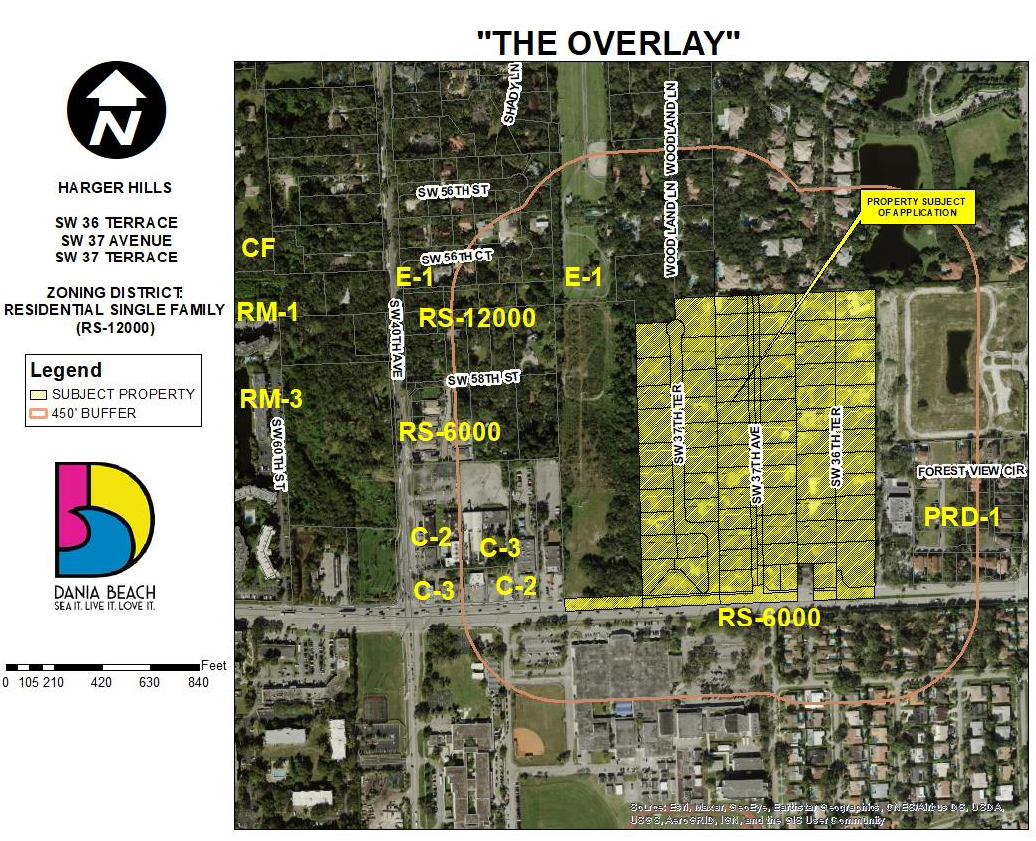
The legal description of the properties subject to the overlay are as follows:
Folio No. 504231010759 - REED LAND CO SUB 2-32 D 31-50-42 LOT 16 S 250 OF E½ LESS PT DESC IN OR 8288/127 FOR RD R/W BLK 3; Folio No. 504231010721 - REED LAND CO SUB 2-32 D 31-50-42 LOT 16 N 95 OF S 345 OF E½ BLK 3; Folio No. 504231010768 - REED LAND CO SUB 31-50-42 2-32 D LOT 16 N 105 OF S 450 OF E½ BLK 3; Folio No. 504231010753 - REED LAND CO SUB 2-32 D 31-50-42 N 95 OF S 545 OF E½ OF TR 16 BLK 3; Folio No. 504231010751 - REED LAND CO SUB 2-32 D 31-50-42 N 95 OF S 640 OF E½ OF TR 16 BLK 3; Folio No. 504231010765 - REED LAND CO SUB 2-32 D 31-50-42 TR 16 N 100 OF S 740 OF E½ BLK 3; Folio No. 504231010766 - REED LAND CO SUB 31-50-42 2-32 D LOT 16 N 95 OF S 835 OF E½ BLK 3; Folio No. 504231010766 - REED LAND CO SUB 2-32 D 31-50-42 LOT 16 N 95 OF S 930 OF E½ BLK 3; Folio No. 504231010758 - REED LAND CO SUB 2-32 D 31-50-42 LOT 16 N 100 OF S 1030 OF E½ BLK 3; Folio No. 504231010722 - REED LAND CO SUB 2-32 D 31-50-42 LOT 16 N 95 OF S 1125 OF E½ BLK 3; Folio No. 504231010720 - REED LAND CO SUB 2-32 D 31-50-42 LOT 16 N 95 OF S 1220 OF E½ BLK 3; Folio No. 504231010760 - REED LAND CO SUB 2-32 D 31-50-42 LOT 16 E½ LESS S 1220 BLK 3; Folio No. 504231010767 - REED LAND CO SUB 31-50-42 2-32 D LOT 16 W½ LESS S 1220 BLK 3; Folio No. 504231010755 - REED LAND CO SUB 2-32 D 31-50-42 LOT 16 N 95 OF S 1220 OF W½ BLK 3; Folio No. 504231010752 - REED LAND CO SUB 2-32 D 31-50-42 N 95 OF S 1125 OF W½ OF TR 16 BLK 3; Folio No. 504231010769 - REED LAND CO SUB 2-32 D 31-50-42 TR 16 N 95 OF S 1030 OF W½ BLK 3; Folio No. 504231010761 - REED LAND CO SUB 2-32 D 31-50-42 LOT 16 N 100 OF S 935 OF W½ BLK 3; Folio No. 504231010764 - REED LAND CO SUB 2-32 D 31-50-42 LOT 16 N 95 OF S 835 OF W½ BLK 3; Folio No. 504231010762 - REED LAND CO SUB 2-32 D 31-50-42 LOT 16 N 100 OF S 740 OF W½ BLK 3; Folio No. 504231010770 - REED LAND CO SUB 2-32 D 31-50-42 N 95 OF S 640 OF W½ OF TR 16 BLK 3; Folio No. 504231010763 - REED LAND CO SUB 2-32 D 31-50-42 N 100 OF S 545 OF W½ OF TR 16 BLK 3; Folio No. 504231010756 - REED LAND CO SUB 2-32 D 31-50-42 LOT 16 N 95 OF S 445 OF W½ BLK 3; Folio No. 504231010741 - REED LAND CO SUB 2-32 D 31-50-42 LOT 16 N 100 OF S 350 OF W½ BLK 3; Folio No. 504231010754 - REED LAND CO SUB 2-32 D 31-50-42 N 85 OF S 250 OF W½ OF LOT 16 BLK 3; Folio No. 504231010757 - REED LAND CO SUB 2-32 D 31-50-42 BEG SW COR OF LOT 16, NLY 53.01, ELY 71.60 TO POB, CONT ELY 96.61, NLY 112, WLY 97.35, SLY 112 TO POB BLK 3; Folio No. 504231020153 - HARGER HILLS 26-41 B LOT 23 N 112.03 OF S 130.03 OF E 73; Folio No. 504231020150 - HARGER HILLS 26-41 B LOT 23 N 112 OF S 130 LESS E 73 & LESS PT LYING SWLY OF CHORD FOR 25 RAD ARC, SAID ARC TANG TO W/L LOT 23 & TANG TO LINE 53 N OF S/L OF SEC 31, TOGETHER WITH E½ OF PT OF VAC'D SW 37 AVE LYING W OF SAID LOT, LESS STIRLING ROAD R/W & LESS 2 FT BIKEWAY; Folio No. 504231020152 - HARGER HILLS 26-41 B LOT 23 LESS S 130, TOGETHER WITH E½ OF PT OF VAC'D SW 37 AVE LYING W OF & ADJ TO SAID PROP; Folio No. 504231020140 - HARGER HILLS 26-41 B LOT 22 LESS N 25, TOGETHER WITH E½ OF PT OF VAC'D SW 37 AVE LYING W OF SAID PT OF LOT 22; Folio No. 504231020141 - HARGER HILLS 26-41 B LOT 21,22 N 25 TOGETHER WITH E½ OF PT OF VAC'D SW 37 AVE LYING W OF SAID LOTS; Folio No. 504231020120 - HARGER HILLS 26-41 B LOT 20 & E½ OF PT OF VAC'D SW 37 AVE LYING W OF & ADJ TO SAID LOT; Folio No. 504231020110 - HARGER HILLS 26-41 B LOT 19 TOGETHER WITH E½ OF PT OF VAC'D SW 37 AVE LYING W OF & ADJ TO LOT 19; Folio No. 504231020100 - HARGER HILLS 26-41 B LOTS 17 & 18 TOG WITH E½½ OF PT OF VAC'D SW 37 AVE LYING W OF & ADJ TO SAID LOTS 17 & 18 PER O.R. 23957/105 BCR; Folio No. 504231020080 - HARGER HILLS 26-41 B LOT 16 TOGETHER WITH E½ OF PT OF VAC'D SW 37 AVE LYING W OF & ADJ TO LOT 16; Folio No. 504231020070 - HARGER HILLS 26-41 B LOT 15 TOGETHER WITH E½ OF PT OF VAC'D SW 37 AVE LYING W OF & ADJ TO LOT 15; Folio No, 504231020060 - HARGER HILLS 26-41 B LOT 14 TOGETHER WITH E½ OF PT OF VAC'D SW 37 AVE LYING W OF & ADJ TO LOT 14; Folio No. 504231020050 - HARGER HILLS 26-41 B LOT 13 TOGETHER WITH E½ OF PT OF VAC'D SW 37 AVE LYING W OF & ADJ TO LOT 13; Folio No. 504231020040 - HARGER HILLS 26-41 B LOT 12 & E½ OF PT OF VAC'D SW 37 AVE LYING W OF & ADJ TO SAID LOT; Folio No. 504231020039 - HARGER HILLS 26-41 B LOT 11 TOGETHER WITH W½ OF PT OF VAC'D SW 37 AVE LYING E OF & ADJ TO LOT 11; Folio No. 504231020038 - HARGER HILLS 26-41 B LOT 10 & W½ OF PT OF VAC'D SW 37 AVE LYING E OF & ADJ TO LOT 10; Folio No. 504231020037 - HARGER HILLS 26-41 B LOT 9 & W½ OF PT OF VAC SW 37 AVE LYING E OF & ADJ TO LOT; Folio No. 504231020036 - HARGER HILLS 26-41 B LOT 8 TOGETHER WITH W½ OF PT OF VAC'D SW 37 AVE LYING E OF & ADJ TO LOT 8; Folio No. 504231020032 - HARGER HILLS 26-41 B LOT 7 TOGETHER WITH W½ OF PT OF VAC'D SW 37 AVE LYING E OF & ADJ TO LOT 7; Folio No. 504231020033 - HARGER HILLS 26-41 B LOT 6 TOGETHER WITH W½ OF PT OF VAC'D SW 37 AVE LYING E OF & ADJ TO LOT 6; Folio No. 504231020031 - HARGER HILLS 26-41 B LOT 5 TOGETHER WITH W½ OF PT OF VAC'D SW 37 AVE LYING E OF & ADJ TO LOT 5; Folio No. 504231020030 - HARGER HILLS 26-41 B LOT 4 TOGETHER WITH W½ OF PT OF VAC'D SW 37 AVE LYING E OF & ADJ TO LOT 4; Folio No. 504231020016 - HARGER HILLS 26-41 B LOT 3 N 90 TOGETHER WITH W½ OF PT OF VAC'D SW 37 AVE LYING E OF & ADJ TO SAID LOT; Folio No. 504231020015 - HARGER HILLS 26-41 B LOT 1 N 40,2,3 LESS N 90 TOGETHER WITH W½ OF PT OF VAC SW 37 AVE LYING E OF SAID LOT; Folio No. 504231020014 - HARGER HILLS 26-41 B LOT 1 S 90 OF N 130 TOGETHER WITH W½ OF PT OF VAC'D SW 37 AVE LYING E OF SAID LOT ; Folio No. 504231020013 - HARGER HILLS 26-41 B LOT 1 S 88 OF N 218 TOGETHER WITH W½ OF THAT PT OF VAC'D SW 37 AVE LYING E OF & ADJ TO SAID LOT; Folio No. 504231020012 - HARGER HILLS 26-41 B LOT 1 S 88 OF N 306 TOGETHER WITH W½ OF PT OF VAC'D SW 37 AVE LYING E OF & ADJ TO SAID LOT; Folio No. 504231020010 - HARGER HILLS 26-41 B LOT 1 LESS S 18 & LESS N 306 & LESS EXT AREA FORMED BY 25 RAD ARC TANG TO E/L OF LOT 1 & TANG TO A LINE 53 N OF & PARA TO S/L OF SEC 31-50-42 TOGETHER WITH W½ OF PT OF VAC'D SW 37 AVE LYING E OF & ADJ TO SAID LOT, LESS THEREFROM STIRLING RD R/W & LESS 2 FT BIKEWAY ; Folio No. 504231040160 - STIRLING OAKS ESTATES 77-39 B LOT 17; Folio No. 504231040150 - STIRLING OAKS ESTATES 77-39 B LOT 16; Folio No. 504231040140 - STIRLING OAKS ESTATES 77-39 B LOT 15; Folio No. 504231040130 - STIRLING OAKS ESTATES 77-39 B LOT 14; Folio No. 504231040120 - STIRLING OAKS ESTATES 77-39 B LOT 12; Folio No. 504231040110 - STIRLING OAKS ESTATES 77-39 B LOT 11; Folio No. 504231040100 - STIRLING OAKS ESTATES 77-39 B LOT 10; Folio No. 504231040090 - STIRLING OAKS ESTATES 77-39 B LOT 9; Folio No. 504231040080 - STIRLING OAKS ESTATES 77-39 B LOT 8; Folio No. 504231040070 - STIRLING OAKS ESTATES 77-39 B LOT 7; Folio No. 504231040060 - STIRLING OAKS ESTATES 77-39 B LOT 6; Folio No. 504231040050 - STIRLING OAKS ESTATES 77-39 B LOT 5; Folio No. 504231040040 - STIRLING OAKS ESTATES 77-39 B LOT 4; Folio No. 504231040030 - STIRLING OAKS ESTATES 77-39 B LOT 3; Folio No. 504231040020 - STIRLING OAKS ESTATES 77-39 B LOT 2; Folio No. 504231040010 - STIRLING OAKS ESTATES 77-39 B LOT 1; Folio No. 504231040171 - STIRLING OAKS ESTATES 77-39 B PORTION OF PARCEL A DESC AS COMM NW COR OF SAID PARCEL, SLY 103, ELY 158.52, NLY 102.98, WLY 157 TO POB AKA: LOT A-1 STIRLING OAKS ESTATES; Folio No. 504231040173 - STIRLING OAKS ESTATES 77-39 B PART OF PARCEL A DESC'D AS, COMM AT NW COR PAR A, ELY 157 TO POB, CONT E 106.57, SELY 39.87, SLY 77.40, WLY 129.71, NLY 102.98 TO POB AKA: LOT A-5 STIRLING OAKS ESTATES; Folio No. 504231040174 - STIRLING OAKS ESTATES 77-39 B PART OF PARCEL A DESC'D AS, COMM AT SW COR OF PARCEL A, E ALG S/L FOR 262.37 TO POB, NELY ARC DIST OF 38.67, N 132.60, W 144.11, SLY 50, ELY 25, SELY 141.03 TO POB AKA: LOT A-4 STIRLING OAKS ESTATES; Folio No. 504231040170 - STIRLING OAKS ESTATES 77-39 B PART OF PARCEL A DESC'D AS, COMM AT SW COR OF PARCEL A, ELY 25 TO POB, CONT ELY 237.37, NWLY FOR 141.03, WLY 50, SWLY 143.40 TO POB AKA: LOT A-3 STIRLING OAKS ESTATES; and Folio No. 504231040172 - STIRLING OAKS ESTATES 77-39 B PT OF PARCEL A DESC AS BEG SW COR PAR A, N 157, E 144.12, S 50, W 25, SW 143.40, W 25 TO POB AKA: LOT A-2.
(Ord. No. 2021-003, § 2, 1-26-21; Ord. No. 2022-006, § 2, 1-11-22)
Sec. 826-40. - Overlay standards and provisions.[6]
The enhanced standards of this section apply to all native (as defined in section 825-50) trees and intact understory areas within the limits of the overlay district. Non-native and ornamental trees/vegetation otherwise regulated by Articles 275 or 825 of the City's Code are not subject to these enhanced standards. For the reasons outlined in sections 826-10 and 826-20 of this article, these provisions shall help to preserve and maintain the functional integrity of the forest community as a whole by maximizing retention of native trees and understory that are characteristic of the overlay area.
All land development, redevelopment, improvement, or property maintenance (e.g. driveway repaving or fixing a cracked water line due to root intrusion; limb removal due to roof line or gutter conflicts) within the overlay district shall comply with the following new or increased standards which supersede or are in addition to existing requirements of Articles 275 (Landscaping) and 825 (Tree Preservation) of the City's Land Development Code:
(A)
Minimum landscape standards: For properties within the overlay district, the minimum tree requirements shall be either six (6) category 1A native canopy trees, forty (40) inches combined native tree caliper/dbh, or aerial canopy coverage equal to fifty (50) percent of the lot size. Credit for canopy coverage can extend beyond the property line for trees rooted wholly or mostly within the property requesting the credit.
The table below shows the differences between minimum landscape requirements for properties located within the district vs. those located elsewhere in the City.
*all requirements must be met
** only one of the three requirements must be met
(b)
Perimeter buffer preservation zone: A perimeter buffer preservation zone shall be established to preserve existing trees located nearest to property lines where conflicts with residences are lowest. All existing native trees in "fair" or "good" condition with a DBH larger than eight (8) inches and situated wholly within ten (10) feet of the property line are to be preserved. Intact understory areas within this same ten-foot buffer shall also be preserved against voluntary impacts. Any development, redevelopment or exterior site improvements shall be designed and implemented in a manner that preserves the existing canopy and critical root zones of such trees, and any native understory that may also be present. This perimeter buffer may be reduced in certain areas if other portions of the buffer with equal or greater value are equivalently increased as compensation.
(C)
Mandatory preservation of healthy specimen trees: Preservation against voluntary/elective impacts shall be required for all existing specimen trees (excluding palms) in "good" condition [section 825-50]. Any development, redevelopment, or exterior site improvements shall be designed and implemented in a manner that avoids impacts to or abuse of existing canopy and critical root zones of such trees.
(D)
Construction design standards: In designing a new residential structure or an addition/improvement to the exterior of an existing residential structure, including, but not limited to the installation of a shed, pool or driveway, the improvements shall be designed and constructed around regulated native trees in "fair" or "good" condition and intact understory areas to the maximum extent feasible. Horizontal and vertical design modifications shall prevent abuse of existing native tree resources.
(E)
Prohibition against elective variances: Variances to overlay requirements which would result in impacts to native trees (excluding palms) with a DBH larger than eight (8) inches in "fair" or "good" condition are prohibited.
(F)
Increased health and location protections: Trees with "Good" condition rating, as defined in section 825-50 of the LDC, and location scores of 2 or better, as described in section 825-140(C)(2)] shall receive greater protections and requirements for avoidance than other non-specimen trees or those with substantial structural defects or health issues.
(G)
Advanced notification requirement: At least forty-eight (48) hours prior to any contracted trimming, or removal of trees, the property owner is required to contact the City and provide a work schedule so that the City's arborist may meet on site meet with the tree removal or maintenance contractor and inspect the trees proposed for removal or trimming. This meeting shall provide opportunity to confirm the proposed trimming activities will not result in accidental abuse of protected trees and verify proposed removals have been approved.
(Ord. No. 2021-003, § 2, 1-26-21; Ord. No. 2022-006, § 2, 1-11-22)
F.S. § 163.45 provides that a tree that is determined to be dangerous to persons or property by a certified arborist licensed by the International Society of Arboriculture or a Florida licensed landscape architect does not require a permit or mitigation.
Sec. 826-50. - Specific tree protections.
(A)
Protective measures are required to minimize:
(1)
Mechanical injuries to roots, trunk, and branches;
(2)
Injuries by chemical poisoning;
(3)
Injuries by grade changes;
(4)
Injuries by excavations;
(5)
Injuries by root compression; and
(6)
Injuries by new impervious surfaces paving.
(B)
A Tree Protection Zone shall be established around each tree(s) on the property and in the general vicinity of the proposed construction/installation/maintenance area as follows:
(1)
At a minimum, the tree protection zone shall be defined as a circular area around a native tree with a radius equal to six (6) times the diameter of the trunk of the protected tree at breast height. In no case shall a tree protection zone be less than seventy-two (72) inches in diameter. As an example, a protected tree with a DBH of fifty (50) inches (four (4) feet two (2) inches) will have a tree protection zone with a radius of three hundred (300) inches (twenty-five (25) feet). A protected tree with a DBH of eight (8) inches will have a tree protection zone of seventy-two (72) inches.
(2)
Prior to commencement of construction, all native trees to remain shall be protected via the installation of a tree protection barricade. The tree protection barricade shall be at least three (3) feet tall. fence The barricade must remain in place through the duration of construction activities.
(3)
Trenching or excavation within the tree protection zone of a native tree intended for preservation must not impact more than thirty (30) percent of the tree protection zone. Directional boring/tunneling is the preferred method when applicable.
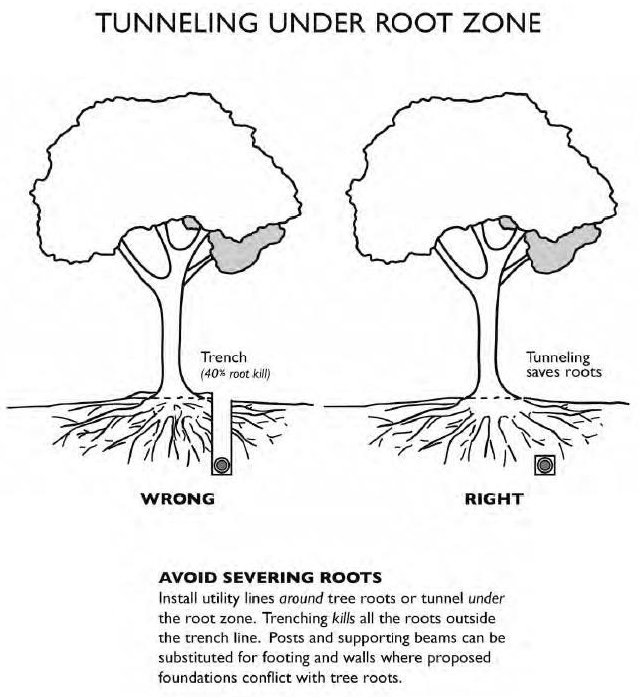
(4)
A deviation from the minimum size requirements of the tree protection zone may be granted by the Community Development Director if the strict application of this rule will result in the unnecessary removal of trees which can otherwise be preserved through application of best management and sound arboricultural/horticultural practices. Consultation with an ISA certified arborist is required to determine proper measures to ensure protection of the tree during construction activities. The plan shall be prepared and certified by an ISA certified arborist and include sufficient detail to clearly define the process, deviation from requirements herein, and alternative protective measures proposed.
(5)
The root systems of native trees shall be preserved when installing fences and walls. Postholes and trenches located close to trees shall be dug and adjusted as necessary to avoid damage to major roots. Continuous footers for masonry walls shall be ended at the point larger roots are encountered and the roots bridged.
(6)
If upon inspection by the City it is determined that a tree protection barricade has been improperly located or has not been properly maintained, a stop work order may be issued. The stop work order may not be lifted until all barricades have been re-established in accordance with this ordinance and any resulting corrective action has been completed.
(Ord. No. 2021-003, § 2, 1-26-21; Ord. No. 2022-006, § 2, 1-11-22)
Sec. 826-60. - Exemptions.
The following exceptions to the tree preservation requirements herein are authorized:
(A)
Generally accepted emergency/time-sensitive procedures necessary for the protection of life, health, safety, or property.
(B)
Pruning trees by qualified entities (e.g. property owners, utility or other easement holders or their authorized contractors/agents) that does not quality as tree abuse under Article 830 and is conducted wholly in accordance with ANSI A-300 standards or other applicable Statutes.
(C)
Non-native/exotic or ornamental landscape trees are exempt from the overlay requirements.
(Ord. No. 2021-003, § 2, 1-26-21; Ord. No. 2022-006, § 2, 1-11-22)
Sec. 826-70. - Permit application requirements.
A building permit or tree removal permit application that is reviewed for compliance with the standards of this chapter may require more information than a typical residential permit application not affected by these provisions. If alteration of native trees is proposed, the information below may be required by the City. This information must be prepared by certified or qualified professionals and submitted with any permit application packages proposing removal or alteration of specimen trees:
(A)
Tree survey or tree resource map assigning individual tree numbers and identifying the locations of all regulated trees on site. The survey/map should also include approximate/representative foliage limits for all unmaintained/intact understory areas, as well as additional trees rooted within fifty (50) feet of the property lines such that overhanging canopy areas are clearly reflected on the survey;
(B)
Tree Data Table listing the species, trunk diameter (inches), canopy spread (feet), canopy area (square feet), height (feet), and condition of the tree;
(C)
Tree disposition plan indicating the intent to remove, relocate, or preserve each tree shown on the survey (this may be included in the tree data table identified in section 826-70(B) above.;
(D)
Arborist report documenting and evaluating all native trees proposed for removal and all specimen trees on-site;
(1)
Arborist reports shall be prepared in accordance with ISA standards and at a minimum include documentation of the tree location, size, growth habit, condition, and conflicts with surrounding features as applicable for determination of potential hazard status [section 825-50, of the Land Development Code] or health/condition rating as required for specimen tree appraisal [section 825-140(C)(2), of the Land Development Code]; and
(E)
Tree-specific arborist evaluations shall be required for all new development or redevelopment applications proposing ground disturbing activities (e.g. plumbing, electrical, etc.) within the critical root zones of native trees protected under this article.
(Ord. No. 2021-003, § 2, 1-26-21; Ord. No. 2022-006, § 2, 1-11-22)
Sec. 826-80. - Mitigation.
Canopy replacement or Tree Trust Fund payments required for tree removals shall be subject to the following additional requirements.
(A)
This article supersedes the existing mitigation exemption for single family properties outlined in section 825-100(D), of the Land Development Code.
(B)
Mitigation for tree removals shall be required on-site for all properties which do not meet the minimum landscape standards described in section 826-40(A) above. Any property that legally does not meet the tree coverage criteria contained herein at the time of ordinance adoption may coordinate with the City to submit documentation of the pre-existing deficiency which would preclude assessment of this on-site requirement for compensatory mitigation that exceeds the documented pre-existing condition.
(C)
On-site mitigation is preferred for all projects regardless of compliance with section 826-40(A). To encourage on-site tree replacement, mitigation in excess of the minimum thresholds in section 826-40(A) that is provided off-site shall be valued at half the calculated canopy square footage (section 825-100) or monetary cost to the City's Tree Trust Fund (section 825-30). On-site mitigation/tree replacement shall be attributed full value outlined in section 825-100, of the Land Development Code.
(D)
Mitigation for specimen tree removals shall be provided at least fifty (50) percent on-site regardless of compliance with section 826-40(A).
(E)
Trees on the nuisance plants list may be removed regardless of size provided that each tree removed is replaced either with one native Category 2 tree or one hundred fifty (150) square feet of native understory shrubs representative of the protected community type and otherwise meeting the requirements for size and spacing of new landscape installations identified in Article 275 of the City's Land Development Code.
(F)
Replacement trees for on-site mitigation shall be of Category 1A size or larger and shall be of species typical of the mesic hardwood hammock habitat being protected. The City may authorize mitigation via the Tree Trust Fund on a case-by-case basis if a suitable on-site location for canopy tree growth and establishment does not exist.
(G)
For projects required to provide three (3) or more mitigation trees, at least two (2) different tree species shall be provided.
(Ord. No. 2021-003, § 2, 1-26-21; Ord. No. 2022-006, § 2, 1-11-22)
Sec. 826-90. - Conditions of city approval.
Planning/Zoning or Building Department approvals affecting native trees or intact understory areas within the overlay shall be subject to the following conditions:
(A)
All trees required on properties with approved site/landscape plans associated with an issued building permit shall be maintained continually and replaced with similar species at equal or greater size if they die.
(B)
Tree/vegetation protection measures must be reasonably implemented during construction of permitted site improvements and maintenance activities. All failures to protect as per approved plan, especially unauthorized damage to the critical root zone or trunk shall be subject to enforcement.
(C)
The City shall be notified at least forty-eight (48) hours prior to all native tree removals and/or trimming of native tree branches exceeding six (6) inches in diameter.
(Ord. No. 2021-003, § 2, 1-26-21; Ord. No. 2022-006, § 2, 1-11-22)
Sec. 826-100. - Enforcement.
After-the-fact regulation of unauthorized protected tree removals or tree abuse shall be subject to the following:
(A)
Application fees for after-the-fact permits shall be doubled.
(B)
The removal of a healthy specimen tree not meeting the criteria of this article, the removal of a specimen tree without a permit, or the damage of or effectively destroying a specimen tree which kills or will more likely than not cause the tree to die shall warrant the assessment of a penalty of up to five thousand dollars ($5,000.00), as determined appropriate by the Special Master as the harm is irreparable and irreversible, in addition to meeting the restoration requirements defined herein. Under this overlay district, unauthorized removals of trees or understory vegetation, actions that "effectively destroy" trees as defined at section 825-50, or actions constituting tree "abuse" as defined at section 825-50 shall be subject to the enforcement provisions of this section.
(C)
Double mitigation (canopy replacement and/or trust fund payments as determined by the criteria herein) shall be required in addition to processing fees and prescribed fines/penalties.
(Ord. No. 2021-003, § 2, 1-26-21; Ord. No. 2022-006, § 2, 1-11-22)
Sec. 830-10. - Trimming and pruning operations—Persons to be qualified.
No person, firm, company or corporation shall cause or cause to have trimming or pruning of any tree done within the city by any person, firm, company or corporation who is not registered or licensed in good standing with the City of Dania Beach and Broward County.
(Ord. No. 2010-20, § 2(Exh. A), 9-14-10)
Sec. 830-20. - Same—Exceptions.
(A)
[Trees on private property.] Owner-occupied, single-family or duplex lot owners may prune or trim any tree on their property that is less than six (6) inches DBH.
(B)
Nursery operations. All licensed and governmental nurseries shall be exempt from the terms and provisions of this article, but only in relation to those trees which are planted and grown for sale or intended for sale to the general public in the ordinary course of business or for public purpose.
(C)
[Temporary suspension of article.] Under emergency conditions such as hurricanes, war, or other disasters of similar scope, the city manager may suspend this article for a time to be determined, but only for trees that have been affected by such act.
(D)
[ANSI standards.] The trimming of any tree by a franchised utility, water management district, municipal or county government so long as it is done to the American National Standards Institute (ANSI A-300) standards.
(Ord. No. 2010-20, § 2(Exh. A), 9-14-10)
Sec. 830-30. - Registration required of tree services.
(A)
All persons, firms, companies or corporations must register with the department of community development prior to undertaking any pruning or trimming of trees within the City of Dania Beach, with the exception of those listed in section 830-20 of this article.
(B)
A once-a-year registration fee, the amount to be set by resolution of the city commission, will be required to be paid each year for the period beginning October 1 to September 30.
(C)
Prior to the commencement of any pruning or trimming activity and after registration required by this section, the person, firm, company or corporation performing the work shall be required to submit the property address on which the work is to be performed, the number of trees to be pruned or trimmed, the owners or associations name and phone number and, if an association, a letter of authorization from the association president.
(D)
Registered tree services/arborists shall maintain a copy of such registration on site, as well as a current Broward County tree trimmer license, for inspection when performing work within the city.
(E)
The city may revoke or deny renewal of a tree service/arborist registration if such tree service/arborist fails to conform to the tree trimming standards prescribed in this article or if found to have committed tree abuse as defined in this article, including work performed on developed single-family or duplex residential lots. Within ten (10) days of receipt of written notice revoking registration or denying renewal, a request may be made of the city manager to review the decision of the community development staff. In addition to revocation or non-renewal of registration, tree services/arborists who fail to conform to the standards of this article or found in violation of the provisions of this article shall be subject to the penalties as set forth in section 825-200.
(F)
Tree services/arborists performing work within the city shall have the name as shown on their city registration clearly marked on each of their vehicles/equipment.
(Ord. No. 2010-20, § 2(Exh. A), 9-14-10)
Sec. 830-40. - Definitions.
(A)
In interpreting the provisions of this article, if no definition is provided and the context permits, the latest editions of the following publications recognized as authoritative in the field shall apply. The publications are listed in order of authority should discrepancies occur.
(1)
Section 825-50 of the Dania Beach City Code;
(2)
City of Dania Beach Landscape Technical Manual;
(3)
American National Standards Institute (ANSI) A-300, Tree, Shrub and Other Woody Plant Maintenance—Standard Practices; and Z-133.1, Safety Requirements for Arboricultural Operations;
(4)
Florida Department of Agriculture Division of Plant Industry, Grades and Standards for Nursery Plants;
(5)
Florida Exotic Pest Plant Council Invasive Plant List;
(6)
Council of Tree and Landscape Appraisers, Guide for Plant Appraisal;
(7)
Florida Power and Light, Plant the Right Tree in the Right Place Brochure;
(8)
Florida Urban Forestry Council, Selecting and Planting Trees for the South Florida Forest;
(9)
Wunderlin and Hansen, Guide to the Vascular Plants of Florida;
(10)
Matheny and Clark, Trees and Development - A Technical Guide to Preservation of Trees;
(11)
Harris, Clark and Matheny, Arboriculture: Integrated Management of Landscape Trees, Shrubs and Vines;
(12)
Gary W. Watson and E.B. Himelick, Principles and Practices of Planting Trees and Shrubs;
(13)
Matheny and Clark, Guide to the Evaluation of Hazard Trees in Urban Areas.
(B)
As used in this article, the following words and terms shall be defined as set forth below:
Destruction of the natural habit of growth. Pruning that causes irreparable damage and permanent disfigurement to a tree such that, even with regrowth, the tree will likely never regain the original characteristics of its tree species, or pruning a tree in such a manner as to create a danger to the public or property; or pruning defined in this article as tree abuse.
Enforcement agency. The code compliance division of the city is designated to enforce this article.
Hatrack. To sever the leader or leaders, or to prune a tree by stubbing of mature wood.
Horizontal plane. An imaginary line that begins at the base of the live frond petioles.
Nuisance species. A tree species set forth under section 825-50 as an invasive species.
Over lift. The removal of the majority of the inner lateral branches and foliage, displacing weight and mass to the ends of the branches. The alteration of the tree's live crown ratio will be considered as evidence of over lifting.
Owner-occupied. A dwelling in a habitable condition occupied by the owner of record, as the owner's primary residence, and holding a valid certificate of occupancy.
Prune or trim. To cut away, remove, cut off or cut back parts of a tree.
Shape. The regular and frequent shearing of outer tree branches, making pruning cuts of one-half-inch diameter or less, for the purpose of controlling the size and shape of the tree canopy primarily for aesthetic purposes.
Shearing. The cutting of many small diameter stems of one-half (½) inch in diameter or less.
Tree. A living, self-supporting woody perennial plant which has a trunk diameter of no less than two and one-half (2½) inches, measured four and one-half (4½) feet above the ground, or a woody perennial plant installed per requirements of the applicable landscape code, which normally grows to an overall height of no less than fifteen (15) feet in South Florida.
Tree abuse. "Tree abuse" shall mean:
(1)
To hatrack a tree; or pruning that reduces the height or spread of a tree that has not attained a height or spread of thirty (30) feet unless branches are directly interfering with structures or utilities; or
(2)
Cutting upon a tree which destroys its natural habit of growth; or
(3)
Pruning that leaves stubs or results in a flush cut; or splitting of limb ends; or
(4)
Peeling or stripping of bark; or removal of bark to the extent that if a line is drawn at any height around the circumference of the tree, over one-third (⅓) of the length of the line falls on portions of the tree where bark no longer remains; or
(5)
The use of climbing spikes, nails or hooks, except for purposes of total tree removal or as specifically permitted by the American National Standards Institute (ANSI A-300); or
(6)
Pruning that does not conform to the American National Standards Institute (ANSI A-300) or recommendations, as amended.
(7)
The removal of diseased or dead portions of a tree, the removal of interfering, obstructing, or weak branches, or the complete removal of a tree pursuant to a valid tree removal license shall not constitute tree abuse under this article.
(8)
Removing palm fronds other than dead, declining or objectionable due to interference with a building or utility. Palm pruning shall be performed when fronds, fruit, or loose petioles may create a dangerous condition. Pruning of live palm fronds, which initiate above the horizontal plane as defined in the definition section of the code. Fronds removed shall be severed close to the petiole base without damaging living trunk tissue.
(9)
Palm peeling (shaving) shall consist of the removal of the dead frond bases only, at the point they make contact with the trunk without damaging living trunk tissue.
(10)
Over lifting a tree.
(11)
Shaping a tree, or
(12)
Neglect of care and likely risk of loss due to such neglect of any specimen tree, arising from overgrowth by competing, invasive vegetation such as, but not limited to, overgrowth by vines; or
(13)
Impartial removal of a tree, creating a stump in excess of six inches in height from the surrounding grade.
Topiary. The practice of pruning a tree into an ornamental shape by the pruning of branches no larger than one-half (½) inch in diameter.
Violator. A person who abuses a tree or otherwise violates this article. The owner of property upon which the abused tree is located shall also be deemed a violator if the tree abuse is undertaken by the owner's employee, agent or person under the owner's control or by the owner.
(Ord. No. 2010-20, § 2(Exh. A), 9-14-10; Ord. No. 2012-008, § 17, 5-8-12)
Sec. 830-50. - Legislative findings.
In addition to those legislative findings relating to the importance of trees to the public set forth under section 825-20 of the City of Dania Beach Code of Ordinances the commissioners of the city find that regulations of the cutting, trimming and pruning of trees within the city will help ensure that the health, function and value of trees are protected, and will help to prevent dangerous branching conditions that may result in damage or injury to citizens or property.
(Ord. No. 2010-20, § 2(Exh. A), 9-14-10)
Sec. 830-60. - Prohibition of tree abuse; exemptions; variances.
(A)
No person shall abuse a tree located within the city unless one of the following exemptions applies:
(1)
The tree is an invasive species as defined in section 825-50 and the abuse does not result in a tree that threatens public safety or adjacent property.
(2)
The abuse is necessary to alleviate a dangerous condition posing an imminent threat to the public or property provided that the threat cannot be remedied by pruning that is not defined as tree abuse.
(3)
County, city or franchised utilities, water control districts, and their authorized agents may obtain a registration form from the city, renewable on an annual basis, authorizing the pruning of trees in a manner that may be defined in this article as tree abuse provided such pruning is inspected and approved by the city to prevent ongoing interruptions, or to prevent interference with the operation of water control structures.
(4)
Topiary pruning shall only be allowed for trees located on owner-occupied property developed for detached single-family or duplex usage, or for those trees that were not installed to meet minimum landscape requirements and are identified on an approved landscape plan as appropriate for topiary pruning, and are located outside of rights-of-way or road easements.
(B)
Any person may apply to the community development department for a variance from the terms of this section, provided that:
(1)
The application is made before any actions for which a variance is sought have been undertaken.
(2)
Any alleged hardship is not self created by any person having any interest in the property. A hardship shall not be considered self created if the subject tree was installed prior to the effective date of this article.
(3)
There are unique and special circumstances or conditions applying to the subject tree or property upon which it is located, that do not apply generally to other trees or properties.
(4)
The variance proposed is the minimum variance necessary to alleviate the hardship.
(5)
That the granting of the variance will be in harmony with the general intent and purpose of this article and will not create a dangerous condition that threatens the public or property.
(Ord. No. 2010-20, § 2(Exh. A), 9-14-10)
Sec. 835-10. - Intent.
The regulation of telecommunication towers and antennas in this article is intended to:
(A)
Promote the health, safety and general welfare of the citizens and residents, the traveling public, and other persons by regulating the siting of telecommunication towers;
(B)
Provide for the appropriate location and use of telecommunication towers and antennas within the city;
(C)
Minimize adverse visual effects of telecommunication towers and antennas through careful design, siting, landscape screening and innovative camouflaging techniques;
(D)
Avoid potential damage to adjacent properties from tower failure through engineering and careful siting of tower structures;
(E)
Protect residential areas and land uses from potential adverse impacts of telecommunication towers and antennas by maximizing use of any new or existing telecommunication towers through shared use (i.e., co-location) to reduce the number of towers needed;
(F)
Recognize that telecommunication services are a nonessential public service and telecommunication towers and antennas will only be permitted where there is a demonstrated need;
(G)
Use of public property shall be given the highest priority in siting telecommunication towers and antennas; and
(H)
Co-location shall be fully considered and treated as an important factor included in the consideration of applications to locate new telecommunication towers or antennas.
(Ord. No. 2010-20, § 2(Exh. A), 9-14-10)
Sec. 835-20. - Definitions.
Antenna. A transmitting or receiving device used for wireless communication services that radiates or captures electromagnetic waves, digital signals, analog signals, radio frequencies (excluding radar signals), wireless telecommunication signals or other communication signals, including directional antennas, such as panel and microwave dish antennas, and omni-directional antennas and satellite earth stations.
FAA. The Federal Aviation Administration.
FCC. The Federal Communications Commission.
Guyed tower. A telecommunication tower that is supported, in whole or in part, by guy wires and ground anchors.
Microwave.A dish-like antenna used to link wireless communication services sites together by wireless transmission of voice or data.
Monopole tower. A telecommunication tower consisting of a single pole or spire self-supported by a permanent foundation, and constructed without guy wires and ground anchors.
Panel antenna. An array of antennas designed to concentrate a radio signal in a particular area.
Self-support/lattice tower. A telecommunication tower that is constructed without guy wires and ground anchors.
Stealth facility. Any telecommunication facility which is designed to blend into the surrounding environment. Examples of stealth facilities include architecturally screened roof-mounted antennas, antennas integrated into architectural elements, and telecommunication towers designed to look like light poles, power poles or trees.
Telecommunication tower. A guyed, monopole or self-support/lattice tower, constructed as a freestanding structure, containing one or more antennas intended to be used for personal wireless services, telephone, radio or a similar communication service. The term includes, but is not limited to, radio and television transmission towers, microwave towers, common carrier towers, cellular telephone towers and stealth towers. The term does not include a tower that provides only open video services.
(Ord. No. 2010-20, § 2(Exh. A), 9-14-10)
Sec. 835-30. - Applicability.
All new towers or antennas, and modifications to existing towers and antennas, in the city shall be subject to these regulations, except as provided for in paragraphs (1) through (3) [(A) through (C)], below:
(A)
These regulations shall not apply to any tower, or installation of any antenna, that is for the use of an open video broadcast-only facility, or is owned and operated by a federally-licensed amateur radio station operator, or is used exclusively for receive-only antennas.
(B)
Preexisting towers and preexisting antennas shall not be required to meet the requirements of these regulations, except to comply with the requirements of the nonconforming provisions of the zoning ordinance.
(C)
An AM array consisting of one (1) or more tower units and supporting ground system which functions as one AM broadcasting antenna, shall be considered one (1) tower. Measurements for setbacks and separation distances shall be measured from the outer perimeter of the towers included in the AM array. Additional tower units may be added within the perimeter of the AM array by right.
(Ord. No. 2010-20, § 2(Exh. A), 9-14-10)
Sec. 835-40. - General requirements.
Every new telecommunication tower and antenna, and modifications to existing towers and antennas, shall be subject to the following minimum standards:
(A)
Towers and antennas may be considered either principal or accessory uses. A different existing use of an existing structure on the same lot shall not preclude the installation of a tower or antenna on the same lot.
(B)
The city may require, as a condition of entering into a lease agreement with a telecommunication provider, the dedication of space on the facility for public health and safety purposes, as well as property improvement on the leased space. Any dedications and improvements shall be negotiated prior to execution of the lease.
(C)
For purposes of determining whether the installation of a tower or antenna complies with district development regulations, the dimensions of the entire lot shall control, even though the towers or antennas are proposed to be located on leased parcels within such lot.
(D)
Each application for a tower or antenna shall include a review of the city's inventory of existing towers, antennas and approved sites. All requests for locations other than a site on the inventory shall include specific information about the alternative location, height and design of the proposed tower or antenna, and an explanation regarding why the inventory sites are not appropriate. The information is a public record. The city may share the information with other applicants. The city does not warrant or represent that the information is accurate, or that sites on the inventory are available or suitable.
(E)
All applicants for new towers and antennas, or for towers and antennas which are to be modified or reconstructed to accommodate additional antennas, or for which a variance is required, must present a certified report by a professional engineer licensed to practice in the State of Florida, which shall include the following:
(1)
A site development plan which includes, without limitation, a photo digitization of the tower with all attachments.
(2)
An analysis of the impacts on adjacent property sites.
(3)
Specifics of design.
(4)
A narrative discussing the type of tower or antenna, current wind loading capacity and a projection of wind loading capacity using different types of antennas as models.
(5)
A statement of noninterference, which states that the construction and operation of the tower, including reception and transmission functions, will not interfere with public safety communication, or with the visual and customary transmission or reception of radio, television, or similar services, as well as other wireless services enjoyed by adjacent properties.
(6)
If the applicant proposes to not use a facility or site on the city's inventory, an explanation of the technological reasons why the use of the facility or site is unfeasible.
(F)
Towers and antennas shall meet the following appearance requirements:
(1)
Towers shall either maintain a galvanized steel finish or, if allowed by FAA standards, shall be painted a neutral color to reduce visual obtrusiveness.
(2)
The design of accessory buildings and related structures shall, to the extent possible, use materials, colors, textures, screening, and landscaping that will blend them into the natural setting and surrounding buildings to minimize visual impact.
(3)
If an antenna is installed on a structure other than a tower, the antenna and supporting electrical and mechanical equipment must be of a color that is neutral, identical to, or compatible with the color of the supporting structure, as determined by the city, to make the antenna and related equipment as visually unobtrusive as possible.
(G)
No signals, artificial lights or illumination shall be permitted on any tower or antenna unless required by the FAA or other applicable authority. If lighting is required, the lighting alternatives and design chosen must cause the least disturbance to the surrounding views. To the maximum extent possible, lighting shall be oriented away from residential districts.
(H)
The construction, operation, maintenance and repair of towers and antennas are subject to the regulatory supervision of the city, and shall be performed in compliance with all laws and practices affecting the subject, including, but not limited to, this Land Development Code, the building code and safety codes. The construction, operation and repair shall be performed in a manner consistent with high applicable industry standards. All towers and antennas must meet or exceed current standards and regulations of the FAA and the FCC, including emission standards. They must meet the requirements of all federal, state and local government agencies with the authority to regulate towers and antennas prior to issuance of a building permit by the city. If the standards and regulations are changed, then the owners of the towers and antennas governed by this article shall bring the facilities into compliance with the revised standards and regulations within six (6) months of their effective date, unless the facilities are grandfathered under the applicable regulation. The compliance date may be waived by the city manager if a different compliance schedule is mandated by the controlling federal, state and local agency. Failure to bring towers and antennas into compliance with the revised standards and regulations shall constitute grounds for removal of the tower or antenna at the owner's expense.
(I)
The owner shall additionally maintain a tower in compliance with the applicable standards for towers that are published by the Electronics Industries Association.
(J)
The tower must comply with all applicable requirements in the building code and industry construction standards. If, upon inspection, the city concludes that a tower fails to comply with the building code and industry construction standards, and constitutes a danger to persons or property, then upon notice, the owner of the tower shall have thirty (30) days to bring the tower into compliance. Failure to bring the tower into compliance within thirty (30) days from receipt of notice shall constitute grounds for removal of the tower or antenna at the owner's expense.
(K)
To ensure the structural integrity of towers, a statement shall be submitted, prepared by a professional registered engineer licensed to practice in the State of Florida, which, through engineering analysis, certifies the tower complies with all applicable building requirements in applicable building codes and with applicable industry construction standards. The statement shall describe the tower's capacity, including the number and types of antennas it can accommodate. For all towers and antennas attached to existing structures, the statement shall include certification that the structure can support the load superimposed from the tower or antenna. All new towers shall have the capacity to accept multiple users; at a minimum, monopole towers shall be able to accommodate two (2) users and at a minimum, self-support/lattice or guyed towers shall be able to accommodate three (3) users.
(L)
Telecommunication towers shall comply with current radio frequency emissions standards of the FCC.
(M)
Accessory buildings or structures shall meet all building design standards as listed in the Code, and shall be constructed in accordance with the provisions of the building code. All accessory buildings or structures shall require a building permit issued by the building division.
(N)
Mobile or immobile equipment not used in direct support of a tower or an antenna facility shall not be stored or parked on the site of the telecommunication tower, unless repairs to the tower are being made.
(O)
For purposes of measurement, tower setbacks and separation distances shall be calculated and applied to facilities located in the city irrespective of municipal boundary lines.
(P)
Towers and antennas shall be regulated and permitted pursuant to this article and shall not be regulated or permitted as essential services, public utilities or private utilities.
(Q)
Owners or operators of towers or antennas shall certify that all franchises required by law for the construction or operation of a wireless telecommunication system in the city have been obtained and shall file a copy of all such franchises with the city.
(R)
No signs, including commercial advertising or logo and political signs, flyers, flags or banners shall be allowed on any part of a tower or antenna.
(S)
All towers shall meet the following buffering requirements:
(1)
An eight-foot fence or wall constructed in accordance with article 235, "Walls, fences and hedges", as measured from the finished grade of the site, shall be required around the base of any tower and may be required around any accessory building or structures.
(2)
Landscaping, consistent with the requirements of article 275, shall be installed around the entire perimeter of any fence or wall. Additional landscaping may be required around the perimeter of a fence or wall and around any or all anchors or supports if deemed necessary to buffer adjacent properties. The city may require landscaping in excess of the requirements of the city code in order to enhance compatibility with adjacent residential and nonresidential land uses. Landscaping shall be installed on the outside of the perimeter fence or wall.
(3)
Landscaping consistent with perimeter and on-site requirements in article 275 shall be installed around any accessory buildings or structures.
(T)
"High voltage" and "No Trespassing" warning signs shall be provided as follows:
(1)
If high voltage is necessary for the operation of the telecommunication tower or any accessory structures, "HIGH VOLTAGE—DANGER" warning signs shall be permanently attached to the fence or wall and shall be spaced no more than forty (40) feet apart.
(2)
"NO TRESPASSING" warning signs shall be permanently attached to the fence or wall and shall be spaced no more than forty (40) feet apart.
(3)
The letters for the "HIGH VOLTAGE—DANGER" and "NO TRESPASSING" warning signs shall be at least six (6) inches in height. The two (2) warning signs may be combined into one (1) sign. The warning signs shall be installed at least five (5) feet above the finished grade of the fence.
(4)
The warning signs may be attached to freestanding poles if the content of the signs is not obstructed by landscaping.
(U)
All abandoned or unused telecommunication tower facilities shall be removed by the tower owner or operator within ninety (90) days of the cessation of use. A tower shall be considered abandoned if use has been discontinued for one hundred eighty (180) consecutive days. The city may require reasonable security to secure compliance with the requirements of this paragraph. Telecommunication towers being utilized for other purposes, including but not limited to light standards and power poles, may be exempt from this provision.
(Ord. No. 2010-20, § 2(Exh. A), 9-14-10)
Sec. 835-50. - Zoning districts, height and setback requirements, etc.
(A)
[Towers and antennas on city property.] Telecommunication towers and antennas shall be permitted on property owned, leased or otherwise controlled by the city (referred to as city property), provided a license or lease authorizing the antenna or tower has been approved by the city. Height and setback requirements shall be those that are provided in any lease agreed to by the city. The city shall have no obligation to execute a lease even if the applicant can meet all criteria contained in this article.
(B)
[Monopole or self-support/lattice equipment.] Monopole towers and antennas and guyed or self-support/lattice towers shall be permitted as a special exception, in the following zoning districts:
(1)
(IROM), (IROM-AA) Industrial Research, Office and Marine District and Industrial Research, Office and Marine Airport Approach District
(2)
(IROC) Industrial Research, Office and Commercial District.
(C)
[Stealth equipment as special exceptions.] Stealth towers or stealth rooftop and building mounted antennas shall be allowed as special exceptions in the following zoning districts:
(1)
(C-4) General Commercial District.
(2)
(C-3) General Business District.
(3)
(C-2) Commercial Business District.
(4)
(CC) City Center District.
(5)
(SFED-MU) South Federal Highway Mixed-Use District.
(6)
(EDBB-MU) East Dania Beach Boulevard Mixed-Use District.
(7)
(IRO) Industrial Research Office District.
(8)
(IROM), (IROM-AA) Industrial Research, Office and Marine District and Industrial Research, Office and Marine Airport Approach District
(9)
(IROC) Industrial Research, Office and Commercial District.
(10)
(IR) Restricted Industrial District.
(11)
(IG) Industrial General District.
(12)
Up to eight (8) stealth rooftop or building-mounted antennas from one (1) provider shall be allowed as special exceptions in the RM, RM-1 and RM-2 multifamily zoning districts, subject to the following additional conditions:
(a)
Such antennas shall be located at least five hundred (500) feet from E-1, RS, RD, and NBHD-RES zoning districts.
(b)
Such antennas shall not be located closer than one thousand (1,000) feet to any other such antennas in an RM, RM-1, and RM-2 multifamily zoning district.
(c)
The supporting equipment for such antennas must be located on the rooftop, must be enclosed in an equipment shelter painted to blend in with the rooftop, and must not extend more than nine (9) feet above the roofline.
(d)
Such antennas may only be placed on those structures at least sixty (60) feet or six (6) stories in height and with rooftops measuring at least five thousand (5,000) square feet in area.
(e)
Such antennas and the related equipment shall meet all applicable building and safety codes.
(D)
[Stealth guyed towers, antennas.] Stealth guyed towers and antennas shall be permitted as a special exception only in the following zoning districts:
(1)
(C-4) Community Business.
(2)
(C-3) General Business.
(3)
(IRO) Industrial Research Office.
(4)
(IR) Restricted Industrial.
(5)
(IG) Industrial General.
(6)
(IROM), (IROM-AA) Industrial Research, Office and Marine District and Industrial Research, Office and Marine Airport Approach District
(E)
[Setbacks, height.] Towers and antennas must meet the following setback and height requirements:
(1)
Tower height shall be measured from the crown of the road of the nearest street.
(2)
Telecommunication towers shall conform with the setbacks established for the district except when more restrictive requirements are contained within this section.
(3)
Towers shall not be permitted within two hundred fifty (250) feet of any residential district.
(4)
All buildings and other structures to be located on the same property as a tower shall conform with the setbacks established for the zoning district.
(5)
Unless provided for elsewhere in this article, the city commission may allow a maximum height of ninety (90) feet for a single user, up to one hundred twenty (120) feet for two (2) users and up to one hundred fifty (150) feet for three (3) or more users.
(F)
Inspections.
(1)
Telecommunication tower owners shall submit a report to the building division certifying structural and electrical integrity on the following schedule:
(a)
Monopole towers once every five (5) years.
(b)
Self-support/lattice towers once every two (2) years.
(c)
Freestanding and guyed towers once every two (2) years.
(2)
Inspections shall be conducted by an engineer licensed to practice in the State of Florida. The results of inspections shall be provided to the building division. The building official may require repair or removal of a telecommunication tower based upon the results of an inspection.
(3)
The building division may conduct periodic inspections of towers to ensure structural and electrical integrity. The owner of the tower may be required by the city to have more frequent inspections should there be reason to believe that the structural and electrical integrity of the tower is jeopardized.
(G)
Existing towers.
(1)
Antennas may be placed on existing towers with sufficient loading capacity after approval by the building division. The capacity shall be certified by an engineer licensed to practice in the State of Florida.
(2)
Towers in existence as of October 1, 1996, may be replaced with a tower of equal or less visual impact after approval by the city manager. However, if the proposed new tower would not be consistent with the minimum standards under this section, replacement must be approved by the city commission.
(Ord. No. 2010-20, § 2(Exh. A), 9-14-10; Ord. No. 2010-025, § 10, 11-23-10; Ord. No. 2016-013, § 10, 7-26-16)
Sec. 835-60. - Shared use of communication towers; co-location of antennas.
(A)
Co-location of telecommunication antennas by more than one (1) provider on existing, new, or modified towers shall take precedence over the construction of new single-use towers. Accordingly, each application for a telecommunication tower shall include a certified written evaluation, prepared by a professional engineer licensed to practice in the State of Florida, of the feasibility of sharing a telecommunication tower, if a telecommunication tower is located within five (5) miles of the proposed site, which examines the following:
(1)
Structural capacity of the tower or towers.
(2)
Radio frequency interference.
(3)
Geographical service area requirements.
(4)
Mechanical or electrical compatibility.
(5)
Ability to locate equipment on the tower or towers.
(6)
Availability of towers for relocation.
(7)
Any restrictions or limitations of the FCC that would preclude the shared use of the tower.
(8)
Additional information requested in writing by the city.
(B)
Each application for an antenna shall include a certified written evaluation, prepared by a professional engineer licensed to practice in the State of Florida, of the feasibility of co-locating its antenna on an existing tower. Evidence submitted to demonstrate that no existing tower can accommodate the proposed antenna may consist of any of the following:
(1)
No existing towers or structures are located within the geographic area required to meet the applicant's engineering requirements.
(2)
Existing towers or structures are not of sufficient height to meet applicant's engineering requirements.
(3)
Existing towers or structures do not have sufficient structural strength to support applicant's proposed antenna and related equipment.
(4)
The applicant's proposed antenna would cause impermissible electromagnetic interference, as determined by the FCC, with the antenna on the existing towers or structures, or the antenna on the existing towers or structures would cause impermissible interference, as determined by the FCC, with the applicant's proposed antenna.
(5)
The fees or costs required to share an existing tower or structure or to adapt an existing tower or structure for sharing are unreasonable. Costs exceeding new tower development are presumed unreasonable.
(6)
Property owners or owners of existing towers or structures are unwilling to accommodate the applicant's needs.
(7)
The applicant demonstrates that there are other limiting factors that render existing towers and structures unsuitable.
(C)
All applicants shall demonstrate reasonable efforts in developing a co-location alternative for a proposed new telecommunication tower or antenna. An applicant for a permit to construct a tower or antenna shall cooperate with other telecommunication service providers in co-locating additional antennas on existing authorized towers. An applicant and an owner, or operator, of an existing authorized tower shall exercise good faith in co-locating the facilities. Good faith shall include sharing nonpropriety [nonproprietary] technical information to evaluate the feasibility of co-location. In the event a dispute arises whether an applicant, or an owner or operator of an existing facility has exercised good faith in accommodating other facilities, the city may require a technical study by a third party at the expense of either or both of the parties to the proposed co-location.
(D)
Applications submitted by tenants seeking to co-locate on a preexisting tower, or to rent space on a proposed tower, shall receive an expedited review process by the city. Such review shall be completed thirty (30) days following the filing of a completed application.
(E)
The owner of any telecommunication tower approved for shared use shall provide a written notice of co-location, by certified mail, return receipt requested, of the location of the tower and the load capacity of the tower to all other providers of telecommunication services in Broward County, Florida.
(F)
Failure to comply with the co-location requirements of this section may result in the denial of a permit request or revocation of an existing permit for the specific tower.
(G)
Applicants seeking to co-locate antennas shall not pay rent to the owner or operator of the tower in excess of the fair market value for the space, as determined at the time of execution of an agreement.
(Ord. No. 2010-20, § 2(Exh. A), 9-14-10)
Sec. 835-70. - Applications.
(A)
Prior to the issuance of a building permit, a site development plan shall be presented for approval to the community development department. Each application for a proposed telecommunication tower shall include all requirements for site development plan approval, as required in article 635. The director of community development may waive all or some of these provisions for stealth towers which are designed to emulate existing structures already on the site. Where a request is made to use a pre-existing structure, including light and power poles, as a stealth facility, the facility and all modifications, shall comply with all requirements as provided in this article unless waived by the city.
(B)
A statement shall be submitted with the application, prepared by a professional registered engineer licensed to practice in the State of Florida, which, through engineering analysis, certifies compliance of the tower with applicable building requirements of the building code, and any applicable industry standards, including, but not limited to, Electronic Industry Association/Telecommunications Industry Association standard for wind load; and describes the tower capacity, including an example of the number and type of antennas it can accommodate. No tower shall be permitted to exceed its loading capacity. For all towers and antennas attached to existing structures, the statement shall include certification that the structure can support the superimposed load. All towers shall have the capacity to accept multiple users; at a minimum, monopole towers shall be able to accommodate two (2) users, and self-support/lattice, or guyed, towers shall be able to accommodate at least three (3) users.
(C)
The following supplemental information shall be included with all applications for special exceptions and variances:
(1)
A scaled site plan clearly indicating the tower site, type and height of the proposed tower, the location of the accessory building, on-site land uses and zoning, adjacent land uses and zoning, adjacent roadways, proposed means of access, distances from property lines, elevation drawings of the proposed tower, and any other proposed structures.
(2)
A current zoning or aerial photograph showing the location of the proposed tower.
(3)
A legal description of the parent tract and tower site (if applicable).
(4)
If the proposed tower site meets the required minimum distance from residentially zoned lands, the approximate distance between the proposed tower and the nearest residential dwelling and residentially zoned properties. If the proposed tower site does not meet the minimum distance requirements, then exact distances, locations and identifications of the residential properties shall be shown on an updated zoning map.
(5)
A landscape plan showing specific landscape materials.
(6)
The method of fencing, finished color if applicable, the method of aesthetic mitigation and illumination.
(D)
The city shall act promptly on any application submitted in accordance with the provisions of sections 835-10 to 835-40. The reasons for rejecting any application filed under this section do not prevent a person from filing an application for a special exception in accordance with applicable law.
(E)
Fees for tower placement and use, including antenna installation, will be determined by a separate resolution.
(F)
Public land and right-of-way lease agreements will be established by separate instruments.
(Ord. No. 2010-20, § 2(Exh. A), 9-14-10)
Sec. 835-90. - Security, access easements, removal of facilities.
The approval by the city of a building permit for a telecommunication tower shall be conditioned upon receipt by the city manager of the following:
(A)
Either a surety bond or standby letter of credit, acceptable to the city attorney as to form and financial condition of the issuer, securing the obligations of the applicant to remove the communication tower, accessory buildings and equipment, as required by subsection 835-40(U). The bond or letter of credit shall be payable to the city and shall provide to the city funds equal to the lesser of twenty-five thousand dollars ($25,000.00) or one hundred fifty (150) percent of the estimated cost of dismantling and disposing of the facilities, as evidenced by a certificate of a professional engineer licensed in the State of Florida, or other evidence reasonably satisfactory to the city manager. Each such bond or letter of credit shall be maintained in force [for] the term of any lease with the city, or for a minimum of fifteen (15) years and thereafter for additional periods designated by the city manager if the tower remains in place at the end of the original fifteen-year term. The security shall be payable to the city if the applicant is in default of its obligation to dismantle the tower and funds shall be used to pay the cost of dismantling and disposing of the facilities.
(B)
An easement granted by the fee owner of the land under the tower, and between the tower and the nearest pubic right-of-way, in favor of the city, to provide access to the tower site.
(C)
Written permission from all record owners, beneficial owners, and leaseholders of the tower in a form acceptable to the city attorney to enter upon the site and to remove and dispose of the tower.
(Ord. No. 2010-20, § 2(Exh. A), 9-14-10)

