
Dania Beach City Zoning Code
PART 2
- SITE DEVELOPMENT REGULATIONS
ARTICLE 205.- TABULAR SUMMARY OF SITE DEVELOPMENT STANDARDS FOR ALL ZONING DISTRICTS. *
*Excluding the CRA form-based districts (see part 3 of code).
Sec. 200-10.- Purpose.
The purpose of this article is to explain how to use part 2 (site development standards) of this code.
(Ord. No. 2010-20, § 2(Exh. A), 9-14-10)
Sec. 200-20. - Applicability.
(A)
The regulations of this article govern the physical form of development within the boundaries of a lot. Regulations pertaining to subdividing land and off-lot improvements (ex: streets, curbing, swales, pavement markings, traffic signage, water and sewer lines, etc.) are located in part 4 of this code. Part 2 regulations include, but are not limited to:
(1)
How large, wide and deep lots must be;
(2)
How tall and how large buildings can be;
(3)
Where buildings can be located upon a lot;
(4)
How much open space and landscaping is required;
(5)
How much parking must be provided;
(6)
Minimum and maximum lighting levels;
(7)
Standards for emergency generators and satellite dishes;
(8)
Standards for docks, pilings and boat lifts.
(Ord. No. 2010-20, § 2(Exh. A), 9-14-10)
Sec. 200-30. - How to use part 2 of this code, generally.
(A)
Article 205 (schedule of site development regulations) contains the minimum and maximum dimensional and area (size) regulations applying to lots, density, bulk (height and lot coverage), and yards.
(B)
Articles 210, 215 and 220 are regulations that supplement article 205 in terms of interpretations, exceptions, how to measure dimensions, and details that could not be summarized in the table of standards within article 205.
(C)
The rest of part 2 contains specialized site development regulations that are not covered in article 205, such as for fences and walls, accessory buildings, intersection visibility, parking, loading, landscaping, excavation, and marine structures, satellite dishes, generators, and outdoor lighting.
(Ord. No. 2010-20, § 2(Exh. A), 9-14-10)
Sec. 200-40. - How part 2 of this code relates to the CRA form-based and PMUD regulations.
(A)
The site development regulations for the CRA form-based districts (CC, EDBB-MU, SFED-MU, GTWY-MU, GTWY-MU-II, NBHD-MU, NBHD-RES) are not contained in the article 205 schedule of site development regulations. Instead, they are located in part 3 of this code. However, the detailed site development regulations of the remainder of part 2 apply to the CRA form-based districts unless otherwise noted. In the event of a conflict between part 2 and part 3, the standards of part 3 shall take precedence for areas zoned in one of the CRA form-based districts.
(B)
Unless otherwise provided, site development regulations for the Planned Mixed-Use Development District (PMUD) are specified within article 340 of this chapter and within the approved Development Design Guidelines (DDG). Similarly, site development regulation for the Planned Small Lot Mixed-Use Development District (PMUD-SL) are specific within article 350 of this chapter and within the approved Development Design Guidelines (DDG). However, the sections of part 2 that specifically govern airport safety, wildlife and environmentally sensitive lands shall apply to the PMUD and PMUD-SL Districts.
(Ord. No. 2010-20, § 2(Exh. A), 9-14-10; Ord. No. 2015-022, § 4, 10-13-15; Ord. No. 2019-015, § 4, 10-7-19; Ord. No. 2025-016, § 6, 8-26-25)
Sec. 200-50. - How part 2 of this code relates to other parts of this code.
(A)
Regulations pertaining to signage, urban design and architectural design are located within part 5 of this code.
(B)
Regulations for dividing land, building streets and installing infrastructure are located within part 4 of this code.
(C)
Development application procedures are located within part 6 of this code.
(D)
Definitions of terms used in part 2 are located in article 725.
(E)
Rules governing nonconforming uses, lots, building and structures are located in article 710.
Sec. 200-60. - Live local site plan approval required.
(A)
Construction, except as provided for live local buildings or improvement on any site may commence only following approval of a site plan by the city commission. All construction and improvements shall conform to such approved site plan per article 635 of the LDR.
(B)
Live local development projects developed pursuant to F.S. § 166.04151(7), shall be processed administratively under section 200-61, site plan review procedures for applications pursuant to F.S. § 166.04151(7).
(Ord. No. 2024-002, § 3, 2-13-24; Ord. No. 2024-020, § 3, 4-9-24)
Sec. 200-61. - Site plan review procedures for applications pursuant to F.S. § 166.04151(7).
(A)
Preplan review. The applicant shall review the proposed site plan with the community development director, or designee, to confirm general compliance with the requirements of section 205-11, "development pursuant to F.S. § 166.04151(7), under the Live Local Act," the land use designation, zoning and application provisions of the City Code and F.S. § 166.04151(7), as amended from time to time.
(B)
Filing.
(1)
Application. The applicant shall submit the proposed site plan to the Community Development Director, or designee. The application shall include:
a.
All information shall be submitted pursuant to the city's site plan application requirements and application form as identified in article 635, of the LDR.
b.
An affidavit of commitment. The applicant must file an affidavit of commitment, in a form provided by the city, to record a covenant detailing the affordable housing restrictions (and to comply with the monitoring and compliance requirements of the city). The covenant will detail income mix and required affordability, with a release provision ensuring that the covenant is in place for thirty (30) years from temporary certificate of occupancy (TCO) or certificate of occupancy (CO) and may only be released earlier by bringing the project info full compliance with all zoning and land use provisions applicable to the site at the time of the release. The city will provide the form covenant and monitoring and compliance forms upon submittal of the application.
c.
Legal documents demonstrating unified control of the proposed development site and providing for maintenance and cross-access as applicable.
d.
A specific purpose survey demonstrating the one (1) mile distance for the proposed height determination (unless the comparator site is so obviously close to render this unnecessary) with a brief analysis of the comparator site.
e.
A brief analysis of the comparator site for the proposed density determination.
f.
Easily visible notes on the site plan legend or data sheet, indicating the project is a Live Local Act, F.S. § 166.04151(7), project.
g.
A table, or tables, indicating the ratio of residential and non-residential square footage and affordable and market rate residential units.
(2)
Fees. The community development director, or designee, will compute the required filing and review fees. Such fees are due upon the date of submittal and are established in accordance with the city's adopted fee schedule (pursuant to sections 605-40 and 685-10), including, but not limited to any applicable impact fees and cost recovery charges. The applicant shall also digitally submit copies of a proposed preliminary engineering plan for the site. The filing fees are as follows:
Site plan .....$14,120.00
Site plan modification .....$11,700.00
(c)
Review and recommendation by the development review committee.
(1)
Development review committee members and departments responsible for development application review shall submit written recommendations to the director of community development, or designee, according to a review schedule. Fees are to be approved by the city commission, via resolution, as may amended from time to time.
(2)
The applicant will be notified in writing of comments concerning the site plan submission. Revisions, additions, or corrections will be reviewed together by the community development director, or designee, the development review committee, and the applicant. Required revisions and any other information required by the director of community development director, or designee, and the development review committee shall be resubmitted by the applicant within thirty (30) days of the review. Failure of any applicant to submit information or revised plans as required above shall result in cancellation of the application unless an extension is agreed to by the applicant and the director of community development, or designee. The applicant may also submit a waiver on a form provided by the city. Further, the applicant will be required to resubmit an application, including review fees according to the fee schedule adopted by the city commission. Applicants may withdraw an application at any time.
(3)
Any fees collected in conjunction with development review are nonrefundable.
(d)
Administrative review.
(1)
The community development director, or designee, shall review the development review committee comments, applicant responses, and final proposed plans and facade renderings, and based on compliance with the city's land development regulations, comprehensive plan, and applicable state laws, shall approve, approve with conditions, or deny the final site plan and issue a written development order, including findings supporting the decision. The decision of the community development director, or designee, may be appealed to the city commission pursuant to section 615-30, "administrative appeals."
(2)
If the proposed project does not meet the city's land development regulations, excepting use, height, or density as preempted by state law, the applicant may apply for a variance or other procedure and shall follow those procedures as provided in the code, including review by the development review committee, planning and zoning board, and city commission.
(e)
Modifications to approved site plan. Modifications to a site plan approved under this section may be permitted by the administrative approval of the director of community development, or designee. Proposed modifications shall be reviewed by the development review committee, as provided in section 635-80 above if the community development director, or designee, determines the modification, complies with the criteria identified in section 635-80(b) of the LDR.
(f)
Expiration or extension of site plan approval. A site plan approval or extension shall comply with section 645-100 of the LDR. However, upon expiration of a project under this section, the property will be governed by the entitlements allowed under the property's zoning without the benefit of the preemptive provisions of F.S. § 166.04151(7).
(g)
Denial. Denial of an application shall preclude the applicant from refiling the same application for one year from the date of denial consistent with section 649-60 of the Land Development Code.
(Ord. No. 2024-002, § 3, 2-13-24; Ord. No. 2024-020, § 3, 4-9-24)
Sec. 205-10.- Schedule of lot, yard and bulk regulations.
*Rear Yard Abutting Residential Properties: A rear yard setback of fifteen (15) feet is required for buildings that are less than twenty-six (26) inches in height and are within fifty (50) feet from the rear property line abutting residential properties. A rear yard setback equal to the seventy-five (75) percent of the height of the building is required for buildings that are greater than twenty-six (26) inches in height and not within fifty (50) feet of the rear property line abutting residential properties.
** Bonus density: Where a multi-family use meets the criteria for bonus density the maximum permitted density is fifty (50) units per acre and the maximum permitted height is eighty-five (85) feet.
1 Five-story—Fifty-five (55) feet, plus one (1) additional foot for each foot of ceiling height of each story over eight (8) feet six (6) inches, up to a maximum of sixty-two (62) feet.
2 Subject to the maximum permitted density of the underlying land use plan designation or allocation of residential flexibility or reserve units.
3 Seven (7) feet on each side for one-story buildings and fifteen (15) feet on each side for two-story buildings in the RO district.
4 Ten (10) feet for one-story buildings and fifteen (15) feet for two-story buildings in the RO District.
5 For single-family homes.
6 One (1) platted lot for new construction, two (2) platted lots for rehabilitation or addition.
7 RM-2 maximum density shall be 25 DU/AC or as determined by the city comission through the allocation of residential flexibility units, reserve units, or a land use plan map designation.
(Ord. No. 2010-20, § 2(Exh. A), 9-14-10; Ord. No. 2010-025, § 4, 11-23-10; Ord. No. 2011-007, § 7, 2-22-11; Ord. No. 2011-024, § 6, 8-9-11; Ord. No. 2012-008, § 6, 5-8-12; Ord. No. 2015-024, § 4, 10-27-15; Ord. No. 2017-022, § 4, 7-25-17; Ord. No. 2020-002, § 2, 1-14-20; Ord. No. 2020-003, § 2, 1-28-20; Ord. No. 2020-007, § 3, 4-28-20; Ord. No. 2020-013, § 3, 10-27-20; Ord. No. 2021-018, § 2, 8-24-21)
Sec. 205-11. - Mixed use or multifamily developments pursuant to F.S. § 166.04151(7), under the Live Local Act.
(a)
Intent and purpose. The purpose of this section is to establish procedures and regulations for the development of multifamily or mixed use affordable housing developments pursuant to the provisions of F.S. § 166.04151(7), as created by Chapter 2023-17, Laws of Florida, the "Live Local Act" (the "Act"), which development involves at least forty (40) percent of units which must qualify as affordable housing units, as defined in F.S. § 420.0004, to accomplish the following purposes:
(1)
Protect and promote the public health, safety, and general welfare of the residents of the city;
(2)
Facilitate the orderly and efficient development of affordable multi-family housing in the city pursuant to the Act;
(3)
Specify the city zoning districts to which this section is applicable and within which live local developments proposed pursuant to the Act are authorized and may be approved administratively pursuant to the Act;
(4)
Confirm the land development regulations applicable to proposed live local developments under the Act, including acknowledgment of the statutory mandates regarding use, height, and density;
(5)
Provide the minimum non-residential floor area for live local developments proposed under the Act in order to ensure a meaningful mixed-use development to support community sustainability and to reduce vehicle trips and vehicle miles traveled, whereby a mixed-use project must provide a minimum of forty (40) percent commercial on the ground floor;
(6)
Establish an administrative approval process for live local developments under the Act; and
(7)
Multi-family live local projects must contain at least sixty-five (65) percent multifamily, with forty (40) percent live local as affordable housing.
(b)
Applicability. Applications for a live local development pursuant to this section must be deemed complete prior to October 1, 2033. No applications for live local developments shall be accepted after October 1, 2033 unless the legislature extends or reenacts F.S. § 166.04151(7), and the city commission extends these deadlines accordingly.
(c)
Definitions.
Major transit stop shall mean a stop with at least one hundred fifty (150) square feet of overhead shelter for commuter rail service or at least three (3) bus rapid transit routes. For the purpose of this definition, commuter rail service and bus rapid transit routes provide average scheduled morning (7:00 a.m. to 9:00 a.m.) and evening (4:00 p.m. to 6:00 p.m.) peak hour service intervals of thirty (30) minutes or less.
Unified control means all land included for purpose of development within a Planned Unit Development (PUD) district shall be under the control of the applicant (an individual, partnership, or corporation, or group of individuals, partnerships, or corporations). The applicant shall present satisfactory legal documents to constitute evidence of the unified control of the entire area, which shall be approved by the city attorney. Upon application for rezoning, the applicant shall agree as follows:
(1)
To proceed with the live local development according to the provisions of this division and the affordability requirements as established by state law and recorded covenant;
(2)
To provide agreements, contracts, covenants, deed restrictions, and sureties acceptable to the city for completion of the development according to the plans approved at the time of site plan approval and for continuing operations and maintenance of such areas, functions, and facilities, which are not proposed to be provided, operated, or maintained at public expense; and
(3)
To bind their successors in title to any commitments made under the above. All agreements and evidence of unified control shall be reviewed by the city attorney and no site plan for a development shall be approved without verification by the city attorney that such agreements and evidence of unified control meet the requirements of this section.
(d)
Zoning Districts permitting live local developments. Based on the requirements of Florida law, live local developments shall be permitted in the following zoning districts:
(1)
Neighborhood Mixed-Use (NBHD-MU),
(2)
South Federal Highway Mixed-Use (SFED-MU),
(3)
Gateway Mixed-Use (GTWY-MU),
(4)
East Dania Beach Boulevard Mixed-Use (EDBB-MU),
(5)
Planned Mixed-Use Development (PMUD),
(6)
Planned Small Lot Mixed-Use Development (PMUD-SL),
(7)
General Commercial District (C-4),
(8)
General Industrial (IG),
(9)
Restricted Industrial (IR),
(10)
Industrial-Research-Office (IRO),
(11)
Industrial-Research-Office-Marine (IROM),
(12)
Industrial-Research-Office-Marine Airport Approach (IROM-AA), and
(13)
Industrial-Research-Office-Commercial (IROC).
(e)
Applicable development regulations.
(1)
Unified lot. All land included for purposes of a live local development, including all residential and non-residential components shall be under unified control.
(2)
Required residential use.
a.
Equivalency of affordable dwelling units.
1.
Affordable dwelling units and market rate units shall be located within the same structure or shall be proportionately distributed between multiple structures, if such are proposed, such that every development structure contains both (at least forty (40) percent) and market rate units in equal proportions; in no event shall a live local development structure consist entirely of market rate units.
2.
All common areas and amenities within a live local development shall be accessible and available to all residents (both affordable and market rate units).
3.
Access to the required affordable dwelling units shall be provided through the same principal entrance(s) utilized by all other dwelling units in the development, provided that for townhouse-style affordable dwelling units, each unit shall have its own entrance.
4.
The sizes and number of bedrooms in the affordable dwelling units shall be proportional to the sizes and number of bedrooms in the market rate units (e.g., for number of bedrooms, if twenty-five (25) percent of the market rate units consist of two (2) bedrooms, then twenty-five (25) percent of the affordable units shall also have two (2) bedrooms, etc., maintaining a proportional distribution across unit types and within each structure).
5.
Affordable dwelling units shall be developed simultaneously with, or prior to, the development of the market rate units.
6.
If the development is phased, the phasing plan shall provide for the construction of affordable units proportionately and concurrently with the market rate units.
7.
The exterior appearance of affordable units shall be the same as the market rate units and shall provide exterior building materials and finishings of the same type and quality.
8.
The interior building materials and finishes of the affordable units shall be the same type and quality as the market rate units, including but not limited to all electrical and plumbing fixtures, flooring, cabinetry, counter tops, and decorative finishes.
b.
Affordability commitment.
1.
Pursuant to F.S. § 166.04151(7), at least forty (40) percent of the multi-family residential units shall remain affordable, as defined in F.S. § 420.0004, for a period of at least thirty (30) years. The property owner shall execute and deliver to the city for recordation in the public records, on a form approved by the city attorney, a covenant, declaration of restriction, or other deed restriction in favor of the city ensuring compliance with this affordability requirement.
2.
Any violation of the affordability requirement shall result in a monetary penalty to be deposited into the general fund. Such monetary penalty shall be assessed as a daily fine of two hundred fifty dollars ($250.00) per day per violation until proof of compliance has been provided to the city. The monetary penalty shall not be subject to mitigation or otherwise modified by any board, including but not limited to the code enforcement special magistrate. This provision is in addition to any other enforcement action pursuant to code or agreement.
(3)
Allocation of shared space in multifamily live local projects.
a.
Lobby, service areas, and amenity areas exclusively serving the residential uses of a live local development shall be considered residential square footage use.
b.
Common ground floor lobby, service areas, and amenity areas within a structure housing both residential and non-residential uses shall be proportionately allocated to the residential and non-residential square footage requirements.
(4)
Site design.
a.
Live local developments located on land zoned commercial or mixed use must locate all development, residential and non-residential uses on the same (or unified) plot.
b.
Live local developments located on land zoned industrial must locate all nonresidential uses in a structure separate from any residential uses. Structures used for industrial purposes need to be buffered and setback from the residential structures in the same manner, applying setbacks, landscape buffers, and other applicable regulations as if the residential structures were on a separate site, to ensure compatibility between residential and industrial uses.
(5)
Development standards.
a.
The following standards are applicable to all live local developments regardless of the zoning district they are located in:
1.
Maximum density and height.
(i)
With respect to the residential component of a live local development, the maximum density shall be the highest allowed density on any land in the city where residential development is allowed by right, without incorporation of any bonus (incentive) density.
(ii)
The maximum height shall be the highest currently allowed for a commercial or residential development within the city and within one (1) mile of the proposed development, or three (3) stories, whichever is higher.
2.
Minimum air-conditioned dwelling unit size consistent with section 230-40 of the Land Development Code:
(i)
Efficiency: Five hundred (500) square feet;
(ii)
One (1) bedroom: Seven hundred and fifty (750) square feet;
(iii)
Two (2) bedrooms: Nine hundred (900) square feet;
(iv)
Three (3) or more bedrooms: One thousand one hundred fifty (1,150) square feet for the first three (3) bedrooms, plus one hundred fifty (150) square feet for each additional bedroom/den.
3.
All other applicable land development code development standards shall apply unless specifically regulated in this section.
(Ord. No. 2024-002, § 2, 2-13-24; Ord. No. 2024-020, § 2, 4-9-24)
Sec. 205-12. - Development regulations.
Qualifying development shall comply with the development regulations provided in the following development regulation table:
(A)
Properties zoned South Federal Highway Mixed-Use, Gateway Mixed-Use, or East Dania Beach Boulevard Mixed-Use are to following the development regulations identified for each zoning district provided in article 300.
(B)
Properties zoned Planned Mixed-Use Development, Planned Mixed Use Development - Small Lot, General Commercial, General Industrial, Industrial Restricted, Industrial Research Office, Industrial Research Office Marine, or Industrial Research Office Marine - Airport Approach are to follow the development regulations and design standards identified in section 205-13, of the LDR.
(Ord. No. 2024-002, § 2, 2-13-24; Ord. No. 2024-020, § 2, 4-9-24)
Sec. 205-13. - Development regulations table for Planned Mixed-Use Development, Planned Mixed Use Development - Small Lot, General Commercial, General Industrial, Industrial Restricted, Industrial Research Office, Industrial Research Office Marine, or Industrial Research Office Marine - Airport Approach.
(Ord. No. 2024-002, § 2, 2-13-24; Ord. No. 2024-020, § 2, 4-9-24)
Sec. 205-14. - Additional design standards for properties fronting Griffin Road, Stirling Road, Sheridan Street, Bryan Road and Anglers Avenue/Ravenswood Road.
(A)
The following design standards are applicable to any property having frontage on any of the following roadways within the City of Dania Beach:
(1)
Griffin Road.
(2)
Stirling Road.
(3)
Sheridan Street.
(4)
Bryan Road.
(5)
Anglers Avenue (Ravenswood Road).
(b)
Purpose. The purpose of the standards in this article is to promote design, which is architecturally compatible with the surrounding area and the design goals of the City of Dania Beach.
(c)
Intent. The standards in this article are intended to discourage generic suburban development types that bear little relation to the historic development pattern of Dania Beach.
(d)
City commission approval. The city commission may approve exceptions to this article as conditions to a site plan approval upon making the following findings:
(1)
There are circumstances peculiar to the site or the intended use that makes compliance with a particular requirement of this article impracticable; and
(2)
The applicant has offered significant enhancements to other pertinent aspects of the site that the city commission determines will offset any negative impacts that an exception to these standards might otherwise create.
(e)
Appearance.
(1)
All structures on a site shall create a unified architectural theme.
(2)
All building façades shall be articulated through the use of a coherent and clear architectural design that incorporates rhythms in form and construction details. Buildings shall be designed to incorporate rhythms in form and construction details.
(3)
Buildings facing a public street or interior courtyard space shall be architecturally emphasized through entrance treatment, fenestration, and building details. Buildings with more than one (1) façade facing a public street shall provide treatment for each façade.
(4)
Roof and exterior wall surfaces, with the exception of glass areas, shall be nonreflective. Opaque surfaces and reflective or mirrored type glazing at ground level visible from the sidewalk is prohibited.
(5)
The use of flat steel or metal panels for the exterior walls is prohibited.
(6)
The rear and sides of buildings shall be finished with material that in texture and color resembles the front of the building.
(7)
Glass windows and doors must make up at least thirty-five (35) percent of the primary elevation and fifteen (15) percent of the secondary elevation, except where additional fenestration is required in the CRA form-based zoning districts. On ground stories, the minimum required glass façade area shall be measured between a height of two and one-half (2.5) feet and eight (8) feet above the abutting grade. The windows shall not be covered or opaque. Display is permitted provided there is functional cross-vision between the inside and outside of the store. Display windows should be accented with awnings or other architectural features.
(8)
The coloration of all buildings shall be nature blending with a maximum of three (3) colors exclusive of roof. The use of "earth tone" or light pastel colors is encouraged. Semitransparent stains are recommended for application on natural wood finishes.
(9)
Canopies, if utilized, shall provide a minimum clearance of fourteen (14) feet in height for areas accommodating vehicles and a minimum clearance of ten (10) feet in height for non-vehicular areas, and shall be consistent with the main building design. The canopy columns shall be architecturally finished to match the building.
(10)
Heating, ventilation and air conditioning equipment, duct work, air compressors, other fixed operating machinery shall be either screened from view or located so that such items are not visible from the designated arterial, adjacent residential properties or intersecting streets.
(11)
No temporary structures shall be permitted, except those allowed in article 675, "Temporary Uses" and associated signage. Office-type mobile units when used as temporary facilities shall be screened from view from the designated arterial and equipped with rigid skirting on all sides. Any towing gear shall be removed, and if not removable, shall be screened from the designated arterial.
(12)
A minimum distance of eight (8) feet shall be maintained between the front of any building, including any walkway immediately adjacent thereto, and the parking area. This space is to be reserved for landscaping, either existing or planned, and is required to have a minimum three-foot-wide strip for plant material. No such space is required at the sides or rear of the building unless there is an adjoining residential use. This requirement is not applicable within the CRA form-based zoning districts.
(13)
Windows and doors visible from any listed arterial street shall not be obstructed by security bars or similar devices.
(14)
Windows and doors visible from any listed arterial street shall not be obstructed by storm or security shutters or panels, except as provided in chapter 8, section 8-186 of the Code of Ordinances (Storm shutter placement).
(15)
Commercial development must comply with article 275, "Landscaping Requirements", provided that the street tree requirements shall be altered to require palm clusters on the ends of landscape buffers. The palm clusters shall consist of three (3) palms with a minimum height of thirteen (13) feet.
(16)
Where hedges are utilized and adequate space exists, a tiered effect is required.
(17)
Landscaped areas shall be surrounded with a six-inch raised concrete curb. Grade within areas to be landscaped shall be raised to curb height.
(18)
Chain link, barbed wire and similar fencing along a designated arterial are prohibited. Where such fencing can be viewed from a designated arterial, landscaping, berming, or both shall be provided to minimize visibility from the designated arterial.
(19)
Perimeter walls, if utilized, shall be architecturally compatible with the principal structure.
(20)
The design of buildings and parking facilities shall take advantage of the natural features and topography of the project site, where appropriate.
(21)
Existing specimen trees shall, to the greatest extent possible, be preserved or relocated on site and integrated into the landscape plan.
(22)
Roads, pedestrian walks and open spaces shall be designed as integral parts of an overall site design.
(23)
Parking areas shall be landscaped and screened from public view to mitigate their visual impact.
(24)
Parking areas shall be designed with careful regard to orderly arrangement, landscaping, and ease of access, and shall be developed as an integral part of an overall site design.
(25)
The site development plan shall be designed to be compatible with existing and conforming development, and proposed development in the area surrounding the project site.
(f)
Multifamily/Mixed use option. A multifamily use is permitted subject to the development standards of the development regulations identified above (lot and yard requirements) and the following additional requirements for mixed-use developments:
(1)
The development may include commercial uses on the ground floor of the development such that the development is a mixed-use development as provided by the City of Dania Beach Comprehensive Plan. The following commercial uses shall be permitted:
i.
Athletic clubs/studios;
ii.
Banks and financial institutions with no drive-throughs;
iii.
Bakeries;
iv.
Delicatessens;
v.
Copy shop;
vi.
Day care centers;
vii.
Dry-cleaning establishments (no cleaning on premises);
viii.
Fast food restaurant with no drive-throughs;
ix.
Retail establishments;
x.
Office (business, professional and medical);
xi.
Personal service establishments;
xii.
Restaurants;
xiii.
Retail pharmacy; and
xiv.
Retail stores and those uses which are customarily accessory and clearly incidental to the principal permitted use, excluding smoke shops, cannabidiol (CDB) sales, and discount retail.
(2)
The mixed-use development shall be located abutting an arterial roadway and shall occupy the majority of the ground floor building area (excluding parking garages).
(Ord. No. 2024-002, § 2, 2-13-24; Ord. No. 2024-020, § 2, 4-9-24)
Sec. 205-15. - Regulatory compliance.
(A)
In addition to the provisions set forth above, live local developments shall comply with all other Land Development Regulations applicable to multi-family developments.
(B)
All aspects of the live local development shall be consistent with the city's Comprehensive Plan, with the exception of provisions establishing allowable use, height, and density.
(C)
Compliance with applicable laws and regulations. In addition to the provisions set forth herein, live local developments shall comply with all other applicable state and local laws and regulations.
(Ord. No. 2024-002, § 2, 2-13-24; Ord. No. 2024-020, § 2, 4-9-24)
Sec. 205-16. - Expiration or loss of live local development status.
(A)
Loss for failure to meet affordability requirements.
(1)
An approved project which fails to maintain the required number of affordable dwelling units and does not comply with the affordable housing requirements of this section after notice and ninety (90) days to cure, shall be considered non-conforming as to all portions of the development that do not comply with use and development regulations applicable based on the assigned zoning designation.
(B)
Expiration of covenant. A live local development, for which a covenant guaranteeing affordable housing has expired, shall be considered:
(1)
A legal conforming use, so long as the development maintains the same levels and standards of affordable housing.
(2)
A legal non-conforming use, if the number of required affordable dwelling units originally required under the covenant are not maintained as affordable, and shall be subject to the city's nonconforming code provisions.
(Ord. No. 2024-002, § 2, 2-13-24; Ord. No. 2024-020, § 2, 4-9-24)
Sec. 206-10.- Purpose and intent.
To establish city-wide mandatory green design practices, certification requirements and development incentives for building and site design, materials and construction techniques that minimize demand for nonrenewable material and energy resources, water consumption, and minimize the generation of waste products, pollution, and stormwater runoff.
(Ord. No. 2024-018, § 2, 4-9-24)
Sec. 206-20. - Definitions.
For purposes of this article, the following definitions shall apply unless the context clearly indicates or requires a different meaning:
ASHRAE. The American Society of Heating, Refrigerating and Air-Conditioning Engineers.
Biophilic design. A design approach to architecture that seeks to connect building occupants more closely to nature. Biophilic designed buildings incorporate things like natural lighting and ventilation, natural landscape features and other elements for creating a more productive and healthier built environment for people.
Circular products. Products that operate within the circular economy model i.e. those products that have reduced or completely no need for virgin resources and are designed with the end of their life in mind.
Energy Star. Energy Star rating system (use latest edition of rating system at time of submittal of permit application to the Building Division).
ENVISION. Sustainable infrastructure rating system developed by the Institute for Sustainable Infrastructure (ISI).
FGBC. Florida Green Building Coalition (use latest edition of rating system in effect at time of submittal of permit application to the Building Division).
GBI. Green Building Initiative.
Green design practice. Any of the design practices delineated in article 206, maintained by the community development department and adopted by resolution of the city commission, as may be amended from time to time.
Green Globes. Green Globes by the GBI (use latest edition of Green Globes rating system in effect at time of submittal).
LEED. Leadership in Energy and Environmental Design by the USGBC (use latest edition of LEED rating system in effect at time of submittal).
Lux. A is a measure of the amount of light level intensity, which is commonly referred to as unit of illuminance or illumination on a surface area. Luz is a SI unit that measures "luminous flux" per unit area. The measurement of one (1) lux is equal to the illumination of a one-meter square surface that is one meter away from the light output of a single candle. One (1) Lux is one (1) lumen projected over an area of one (1) square meter.
MERV. Minimum efficiency reporting value reports an air filter's ability to capture larger particles between 0.3 and 10 microns (um).
Solar Reflectance Index (SRI). A measure of the constructed surface's ability to reflect solar heat, as shown by a small temperature rise. It is defined so that a standard black surface (reflectance 0.05, emittance 0.90) is 0 and a standard white surface (reflectance 0.80, emittance 0.90) is 100.
Sustainable agriculture practices, sustainable agricultural practices are intended to protect the environment, expand the Earth's natural resource base, and maintain and improve soil fertility.
USGBC. U.S. Green Building Council.
(Ord. No. 2024-018, § 2, 4-9-24)
Sec. 206-30. - Applicability.
(A)
This article applies to construction of all new buildings, structures and sites, as well as major renovation consisting of alterations, modifications or additions that exceed fifty (50) percent of the total floor area of an existing building or structure in the city.
(B)
Development subject to the requirements of this article is classified in the following categories:
(1)
Single-family dwellings and duplexes (section 206-40);
(2)
Small scale development (section 206-50);
(3)
Large scale development (section 206-60); and
(4)
City facilities (section 206-70). City facilities shall also comply with F.S. § 255.2575.
(C)
This article does not apply to developments that have an approved development order issued prior to the effective date of this article; proposed developments that have a complete development application in the process of review by the City or that have been issued a building permit number prior to March 12, 2024.
(Ord. No. 2024-018, § 2, 4-9-24)
Sec. 206-40. - Single-family dwellings and duplexes.
New construction of, and a major renovation (substantial improvement) to, a single-family dwelling or duplex shall include a minimum of five (5) green design practices, as established in section 206-80.
(Ord. No. 2024-018, § 2, 4-9-24)
Sec. 206-50. - Small-scale development.
(A)
For the purposes of this article, small-scale development is defined as follows:
(1)
Multifamily residential development in buildings one (1) to three (3) stories in height, or less than fifty (50) dwelling units; or
(2)
Less than twenty thousand (20,000) square feet of nonresidential use; and
(3)
Does not include both residential and nonresidential uses.
(B)
For small scale development, new construction of, and a major renovation to any building, structure or site shall include a minimum of five (5) green design practices, as established in section 206-80.
(Ord. No. 2024-018, § 2, 4-9-24)
Sec. 206-60. - Large-scale development.
(A)
For the purposes of this article, large scale development is defined as follows:
(1)
Multifamily residential development in buildings over three (3) stories in height, or fifty (50) dwelling units or more; or
(2)
Twenty thousand (20,000) square feet or more of nonresidential use;
(3)
Development that includes both residential and nonresidential uses; or
(4)
Any development on a lot with a net land area of more than one (1) acre, regardless of building/structure size or dwelling unit count.
(B)
All large-scale development, including new construction of, and major renovation (substantial improvements) to, any building, structure or site, shall either: (i) include a minimum of ten (10) green design practices, as established in section 206-80, (ii) obtain minimum certification as a USGBC LEED-certified development, or (iii) obtain minimum certification as a GBI Green Globes-certified development.
(Ord. No. 2024-018, § 2, 4-9-24)
Sec. 206-70. - City facilities.
All new city facilities shall include a minimum of ten (10) green design practices, as established in section 206-80. City facilities shall also comply with F.S. § 255.2575.
(Ord. No. 2024-018, § 2, 4-9-24)
Sec. 206-80. - Green design practices.
(A)
The following green design practices are approved for single-family dwellings, duplex and small-scale development:
(1)
Minimum R-values for wall, roof and floor insulations. The entire building thermal envelope meets or exceeds the insulation requirements of 2021 IECC Table R402.1.3 including a minimum ceiling R-value of thirty (30).
(2)
Maximum assembly and fenestration requirements. The building thermal envelope meets the fenestration requirements of 2021 IECC Table R402.1.2. Assemblies have a U-factor that does not exceed the values specified in Table R402.1.2 and the glazed fenestration Solar Heat Gain Coefficient (SHGC) does not exceed a maximum of 0.25.
(3)
High reflectance roofs (cool roofs).
i.
All roof surfaces must provide a Solar Reflectance Index (SRI) as follows:
a.
Low-sloped roofs with a maximum slope of 2:12: initial SRI of eighty-two (82) or three-year-aged SRI of sixty-four (64).
b.
Steep-sloped roofs with a maximum slope of 2:12: initial SRI of three-year-aged SRI of thirty-two (32).
ii.
Compliant metal roofs meeting initial SRI values above are preferred.
iii.
Vegetated roofs automatically qualify.
(4)
Vegetated roof planters (green roofs).
i.
At least fifty (50) percent of the total roof surface must consist of a vegetated roof planter.
ii.
A vegetated roof, also referred to as a living roof or planter, shall mean a roof of a building that is partially or completely covered with vegetation and a growing medium, planted over a waterproofing membrane. It may also include additional components such as a root barrier, drainage and irrigation system, and soil containment.
iii.
Green roof structural components (non-vegetative components) shall be deemed permitted accessory equipment in all zoning districts.
iv.
The vegetated roof structural components (non-vegetative components) may exceed the maximum permitted height limit in any zoning district by no more than five (5) feet.
v.
For existing buildings non-conforming to height requirements, in order to be deemed permitted accessory equipment, green roof structural components may exceed the roof height by no more than five (5) feet.
(5)
Sanitation system for pools that reduces chlorine usage. To claim this design practice, a system that eliminates the use of liquid chlorine by recycling a salt alternative, or a system that reduces the amount of liquid chlorine required by using ionization technology must be used. An ultraviolet and ozone system that sterilizes the water without the use of chemicals is also acceptable. Systems must be shown on plans and verified by a plumbing inspector on site at final inspection.
(6)
No garbage disposal. No disposal should be shown on plans, and no disposal should be present at the time of final building inspection.
(7)
All Energy Star appliances. All permanent appliances in each dwelling unit that can be Energy Star rated must be so rated to claim this item. (This includes refrigerator, stove, washing machine, dryer, etc. Items not covered are countertop appliances such as toasters, mixers, etc.) Energy Star appliances must be verified by a building inspector on site at final inspection.
(8)
Energy Star qualified homes. The owner shall submit proof of application and the retainer retention of an energy star rater. A copy of the Energy Star home certificate shall be given to the Building Division upon receipt prior to the final certificate of occupancy.
(9)
Shower heads. Install low flow shower heads rated at a maximum flow of 1.75 gallons per minute at eighty (80) psi water pressure per compartment (compartment defined as a shower with a maximum area of two thousand five hundred (2,500) square inch). All showers shall have no more than one shower head per compartment (including rain shower heads and handheld shower heads) or shall install a point-of-use diverter so that a maximum flow rate per shower compartment is achieved. All shower heads must be shown on plumbing plans and verified by plumbing inspector on site at final inspection.
(10)
Central vacuum system (CVS). CVS canister shall be located in non-air-conditioned space and shown on plans accordingly. CVS system must be verified by building inspector on site at final inspection.
(11)
Washer and dryer outside of air-conditioned space. Washer and dryer outside of air-conditioned space must be shown on plans and verified by building inspector on site at final inspection.
(12)
Clotheslines (single-family and duplex development only).
i.
Clotheslines are deemed permitted accessory structures and shall conform to the accessory structure setback and height requirements of the zoning district in which the property is located.
ii.
A clothesline cannot be installed in an easement without a form signed by any holder of an easement on the property consenting to the installation within the easement.
(13)
Recycling.
i.
Residential uses: A dedicated storage area for a garbage bin and a recycle bin, sized to fit both, must be shown on the plans. Dedicated storage area shall be verified by plans examiner. Plans for the kitchen must include pull-out recycling and garbage bins built into cabinets. Pull-out bins built into cabinets shall be verified by plans examiner at permit review and by building inspector at final inspection.
ii.
Non-residential uses: A dedicated area for collecting recycled materials that is accessible to all occupants must be provided. This can be internal or external but must be shown on plans and verified by plans examiner at permit review and by the building inspector at final inspection.
(14)
Bicycle storage and changing room (small-scale development only).
i.
Long-term bicycle storage provided for a minimum of five (5) percent of full-time equivalent (FTE) employees and thirty (30) percent of residents.
ii.
The long-term bicycle storage area shall include covered dedicated lockable racks on the ground floor level with facilities to accommodate a minimum of fifty (50) percent of all required bicycle parking spaces per section 265-51.
iii.
Short-term bicycle storage provided for a minimum of two and a half (2.5) percent of all peak visitors, students, and retail customers.
iv.
The total number of residents per dwelling unit equals one plus the number of bedrooms for each unit (i.e. three (3) residents for a two-bedroom unit). The total number of FTE employees, peak visitors, students and retail customers can be estimated using the LEED v4 BD+C Reference Guide, Appendix 2, Table 1 Default Occupancy Numbers.
v.
The changing room shall be a dedicated lockable room for the changing of clothes to which occupants of the building have access when building is in use.
(15)
Photovoltaic (PV) system.
i.
Single-family and duplex development shall install solar PV system capable of generating at least sixty (60) percent of energy demand based on daytime peak load and on an annual basis.
ii.
Small scale development shall install solar PV system capable of generating at least ten (10) percent of energy demand based on daytime peak load and on an annual basis.
iii.
Section 220-65 contains additional regulations for rooftop photovoltaic systems.
(16)
Solar water heater must provide solar water heating with at least an eighty-gallon storage tank.
(17)
Electric vehicle charging station(s).
i.
Single-family and duplex development shall install electric lines and circuit breakers to readily accommodate future installation. Lines shall be installed up to the point where the charging station will be located.
ii.
Small scale development shall install a minimum number of electric vehicle-charging station(s) with the project at the rate of five (5) percent of the total number of required parking spaces. If five (5) percent calculates to a fractional number, that fractional number must be rounded up to the next higher whole number.
iii.
An electric vehicle charging station sign shall be posted at the electric vehicle charging station stating, "Electric Vehicle Charging Station." Signs shall be no less than twenty-four (24) inches wide by eighteen (18) inches high. Color and letter size specifications shall meet the Manual on Uniform Traffic Control Devices (MUTCD) requirements for sign designation (electric vehicle charging). Single-family and duplex stations are not required to meet the MUTCD standards.
iv.
The application documents for the project shall at a minimum identify the following:
a.
The location where the vehicle(s) will be parked,
b.
The location of the charging station(s), and
c.
The electrical plans showing the location of the meter, circuitry, panel schedules and routing.
v.
Permeable hardscapes. At least thirty (30) percent of total surface area of all hardscapes (driveways, walkways, plazas, patios, and surface parking) must be permeable surfaces that achieve a surface infiltration rate of five hundred (500) inches/hour when newly installed.
(18)
Florida Native Landscaping. Exceed the native planting requirements in section 275-60 by planting a minimum of eighty (80) percent of all vegetation, including turfgrass and groundcover.
(19)
Enhanced tree canopy.
i.
Single-family and duplex development shall provide a minimum of six (6) trees of three (3) different species and twenty (20) shrubs shall be planted per lot. For all lots larger than eight thousand (8,000) square feet in area, additional shrubs and trees shall be provided at the rate of two (2) trees and six (6) shrubs per three thousand (3,000) square feet of lot area.
ii.
Small scale development shall exceed the minimum tree requirements listed in article 275 by planting one hundred fifty (150) percent of the minimum trees required in the perimeter buffer landscape, and two hundred (200) percent of the minimum trees required in the interior landscape requirements for vehicular use areas.
(20)
Green walls.
i.
A green wall, also referred to as a living wall or vertical garden, shall mean an internal or external wall partially or completely covered with vegetation that includes a support structure and growing medium, and an integrated water delivery system.
ii.
A green wall must cover at least forty (40) percent of the external surface on the opaque wall assembly on which it is constructed or a minimum of twenty (20) percent of the entire façade.
iii.
Green wall systems shall be deemed permitted accessory equipment in all zoning districts.
iv.
The green wall structural components (non-vegetative components) may encroach into any required setback by no more than three (3) feet.
v.
For existing buildings non-conforming to height requirements, in order to be deemed permitted accessory equipment, green roof structural components shall not exceed the roof height by more than five (5) feet.
(21)
Irrigation systems.
i.
Drip irrigation system is installed for all landscape beds along with an irrigation plan and implementation executed by a qualified professional certified by a Water Sense labeled program or equivalent.
ii.
Provide irrigation controllers that are labeled EPA Water Sense program.
(22)
Rainwater collection and distribution. Collect rainwater installing an impermeable cistern system and distribute collected water for at least fifty (50) percent of irrigation demands or for at least twenty-five (25) percent of indoor flush fixtures (toilets, urinals) or a combination of both.
(23)
Enhanced hurricane resistant structure. Meet a wind load twenty miles per hour (20 mph) greater than Florida Building Code requirements.
(24)
Low-Impact Development/Green Infrastructure.
i.
Provide Green Infrastructure (GI) and Low-Impact Development (LID) rainwater management strategies as part of the overall stormwater management efforts for the project. LID strategies include bioretention, vegetated swales and buffers, rain gardens, permeable surfaces, rainwater harvesting systems, vegetated roofs, and soil amendments. Refer to EPA's National Menu of Stormwater Best Practices for additional reference.
ii.
For projects that propose Green Infrastructure or Low Impact Development systems for stormwater management and/or water quality protection, the applicant must demonstrate the proposed system meets the applicable stormwater management and/or water quality protection requirements as required by the city, Broward County, the South Florida Water Management District or the Florida Department of Environmental Protection as applicable.
iii.
The property owner shall provide the city with the issued permit(s) from any external applicable jurisdictional agency if required for the Green Infrastructure or Low Impact Development system.
iv.
The Green Infrastructure shall be maintained to ensure the efficacy of the system in managing stormwater and protecting water quality.
(25)
Diversion of waste from landfill. For projects involving demolition, provide documentation that at least thirty (30) percent of all demolition materials will be reclaimed, recycled or otherwise diverted from landfill.
(26)
Community Garden (Small-scale development only). A portion of the lot is established as a community garden, available to residents/occupants/visitors to provide local food production to residents or area consumers.
(27)
Community placemaking. Provide a publicly accessible space within the project that promotes social wellbeing of a community and serves as a positive neighborhood feature.
(28)
Reuse of existing building. At least seventy-five (75) percent by area or surface of the major elements or components of an existing building and structures are reused, modified or deconstructed for later use.
(29)
Salvaged/reclaimed materials. At least ten (10) percent by cost of the total construction cost are either salvaged or reclaimed materials from within the site or from off site. Cannot repeat the same item used for reuse of existing building.
(30)
Bio-based and wood products.
i.
Use at least two (2) types of bio-based materials, to reach two (2) percent of the project's projected building material cost. Bio-based products include but are not limited to:
a.
Bamboo, cork, cotton, or wool and engineered wood,
b.
Any products containing minimum fifty (50) percent of biobased content as determined by the manufacturer according to ASTM Standard D6866,
c.
Any biobased products meeting sustainable agriculture practices.
ii.
At least fifty (50) percent of all wood products (by total value) have been certified to Forestry Stewardship Council standards.
(31)
Low-emitting construction materials. Provide ninety (90) percent of adhesive, sealants, paints and coatings with low VOC content based on the South Coast Air Quality Management Division (SCAQMD) rules 1168 for Adhesives and Sealants and 1113 for Paints and Coatings.
(32)
Low-emitting flooring. Provide one hundred (100) percent of hard flooring with Floor Score certification and one hundred (100) percent of carpets with Green Label Plus certification.
(33)
Circular products.
i.
Use at least five (5) permanently installed products from three (3) manufacturers that demonstrate achievement of at least one (1) of the circular product reports listed below. No more than four (4) products can come from one (1) category of criteria below. Products that satisfy more than one (1) criterion cannot be double counted.
a.
Supply chain circularity.
b.
Zero waste manufacturing.
c.
Designed for circularity.
d.
Closed loop products.
(34)
Water-managed wall assembly.
i.
Flashing at bottom of exterior walls with weep holes included for masonry veneer and weep screed for stucco cladding systems, or equivalent drainage system.
ii.
Fully sealed continuous drainage plane behind exterior cladding that laps over flashing and fully sealed at all penetrations. Additional bond-break drainage plane layer provided behind all stucco and non-structural masonry cladding wall assemblies.
iii.
Window and door openings fully flashed.
(35)
Water-managed roof assembly.
i.
Step and kick-out flashing at all roof-wall intersections, extending greater than or equal to four (4) inches (≥ 4 inches) on wall surface above roof deck and integrated shingle-style with drainage plane above; boot/collar flashing at all roof penetrations.
ii.
For homes that don't have a slab-on-grade foundation and do have expansive or collapsible soils, gutters and downspouts provided that empty to lateral piping that discharges water on sloping final grade greater than or equal to five (5) feet (≥ 5 feet) from foundation, or to underground catchment system not connected to the foundation drain system that discharges water greater than or equal to ten (10) feet (≥ 10 feet) from foundation. See footnote for alternatives and exemptions.
iii.
Self-adhering polymer-modified bituminous membrane at all valleys and roof deck penetrations.
iv.
In 2009 IECC Climate Zones 5 and higher, self-adhering polymer-modified bituminous membrane over sheathing at eaves from the edge of the roof line to greater than two feet (> 2 feet) up roof deck from the interior plane of the exterior wall.
(36)
Water-managed building materials.
i.
Wall-to-wall carpet not installed within two and one-half (2.5) feet of toilets, tubs, and showers.
ii.
Cement board or equivalent moisture-resistant backing material installed on all walls behind tub and shower enclosures composed of tile or panel assemblies with caulked joints. Paper-faced backerboard shall not be used.
iii.
In warm-humid climates, Class 1 vapor retarders not installed on the interior side of air permeable insulation in above-grade walls, except at shower and tub walls. Building materials with visible signs of water damage or mold not installed or allowed to remain.
iv.
Framing members and insulation products having high moisture content not enclosed (e.g., with drywall).
v.
For each condensate-producing HVAC component, corrosion-resistant drain pan (e.g., galvanized steel, plastic) included that it drains to a conspicuous point of disposal in case of blockage. Backflow prevention valve included if connected to a shared drainage system.
(37)
Lighting Controls for shared multi-occupant spaces (applies to small scale development only).
i.
Provide multizone control systems that enable occupants to adjust the lighting to suit their needs, with at least three (3) lighting levels or scenes (on, off, midlevel). Midlevel is thirty (30) percent to seventy (70) percent of the maximum illumination level (not including daylight contributions).
(38)
Water shutoff devices. Provide lever-style clothes washer shutoffs, water sensors/shutoff system and armored/metal hoses from service to all fixtures and appliances.
(39)
Kitchen exhaust units. Kitchen exhaust units and/or range hoods are ducted directly to the outdoors and have a minimum ventilation rate of one hundred (100) cfm for intermittent operation and twenty-five (25) cubic foot a meter ("cfm") for continuous operation.
(40)
Implement biophilic design features Indoors.
i.
Include at least five (5) distinct design strategies related to biophilic design that addresses at least two (2) for each of the following criteria based on Terrapin Bright Green LLC's Fourteen (14) Patterns of Biophilic Design publication.
ii.
Nature in the space: Plants, water, breeze, scents, sun light, shadows, animals.
iii.
Natural analogues: Materials, patterns, objects, colors, shapes, façade ornamentation, décor and furniture.
iv.
Nature of the space: Prospect, refuge, mystery, risk/peril.
v.
Submit a biophilia design narrative at time of building permit.
(41)
Daylighting. Implement daylight measures by demonstrating that fifty-five (55) percent of the regularly occupied spaces illuminance levels are between three hundred (300) lux and three thousand (3,000) lux at both 9:00 a.m. and 3:00 p.m.
(42)
Quality exterior views. Provide occupants with direct access to a view to the outdoors for seventy-five (75) percent of the regularly occupied floor area through glass with a visible light transmittance (VLT) above forty (40) percent and include a view to nature, urban landmarks, art, or other objects at least twenty-five (25) feet from the exterior of the glazing.
(43)
Dual flush toilet.
(Ord. No. 2024-018, § 2, 4-9-24; Ord. No. 2025-007, § 2, 4-8-25)
Sec. 206-90. - Conflicts—Florida Building Code.
(A)
In the case of a conflict between the Florida Building Code and this article, the Florida Building Code shall prevail.
(Ord. No. 2024-018, § 2, 4-9-24)
Sec. 210-10.- Measurement of required lot area and dimensions.
(A)
[Calculations.] All lot, yard, lot coverage, pervious area, and open space measurements for both principal and accessory uses shall be calculated within the confines of a lot. Any portion of the lot from which additional dedication is necessary in order to complete an abutting street right-of-way section, pursuant to subsection (D), shall not be counted in such calculations.
(B)
Lot width. The minimum required width of any lot shall be measured along the minimum required front setback line between the side lines of a lots. For lots with required build-to-lines, the measurement shall be made along the build-to-line. For lots with no required setback or build-to-line, the measurement shall be made along the street line.
(C)
Lot depth. The minimum required depth of a lot shall be measured as the average straight-line distance from the front street line of the lot to the rear lot line (rear street line for through lots).
(D)
Street lot lines.
(1)
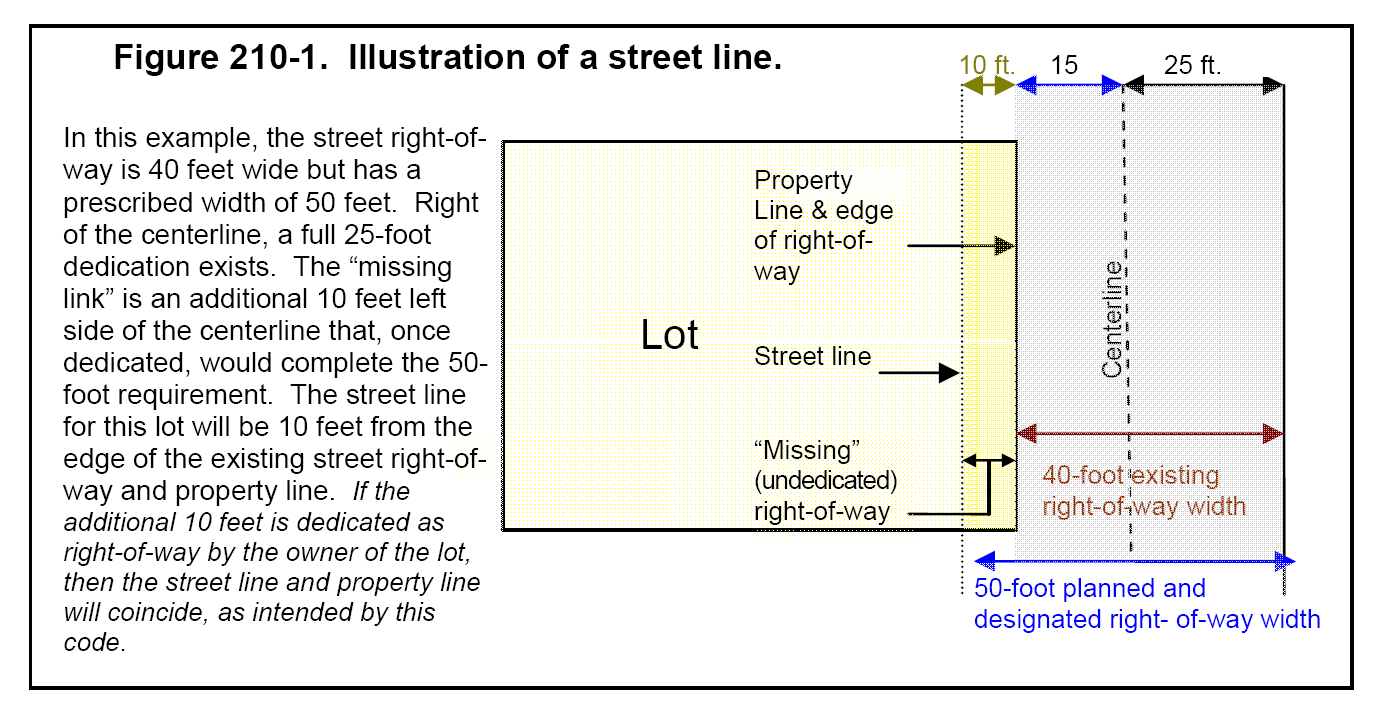
The right-of-way line of a street is the dividing line between a street right-of-way and a lot. When the full width of a street has been fully dedicated consistent with the right-of-way width prescribed in article 815, the right-of-way line, property line/lot line, and street line will coincide.
(2)
When the full width of a street right-of-way abutting a lot has not been dedicated, the street line will not coincide with the right-of-way and property lines. The street line is the location of the ultimate right-of-way line, which is the planned and designated extent of right-of-way for a given street, generally measured from the street centerline, and is a line representing where the edge of the right-of-way would be once dedicated. Figure 210-1 shows the difference between the actual edge of the street right-of-way and the street line in such a situation, and provides an example. Setbacks and yards adjacent to streets are measured from the street line.
(3)
When a lot abuts a street for which there is no prescribed width in article 815, or where the existing right-of-way width is unclear, the street lines shall be deemed to be twenty-five (25) feet from, and parallel to or concentric with, the center line of the street.
(4)
In the event of a conflict between the right-of-way widths prescribed in article 815 and those prescribed by Broward County or the Florida Department of Transportation for a county or state roadway, the width requirements of Broward County or the Florida Department of Transportation, as applicable, shall prevail.
(Ord. No. 2010-20, § 2(Exh. A), 9-14-10)
Sec. 210-20. - Lots that do not comply with minimum area or dimensional requirements.
Any lot that does not comply with the minimum required lot area, lot width or lot depth may be developed only in accordance with article 710, "Nonconforming Uses, Structures and Lots."
(Ord. No. 2010-20, § 2(Exh. A), 9-14-10)
Sec. 210-30. - Street frontage required.
Every building erected, added on to, reconstructed or structurally altered subsequent to the enactment of this code shall be located on a lot fronting on either a private or public street.
(Ord. No. 2010-20, § 2(Exh. A), 9-14-10)
Sec. 215-10.- Yard regulations, generally.
(A)
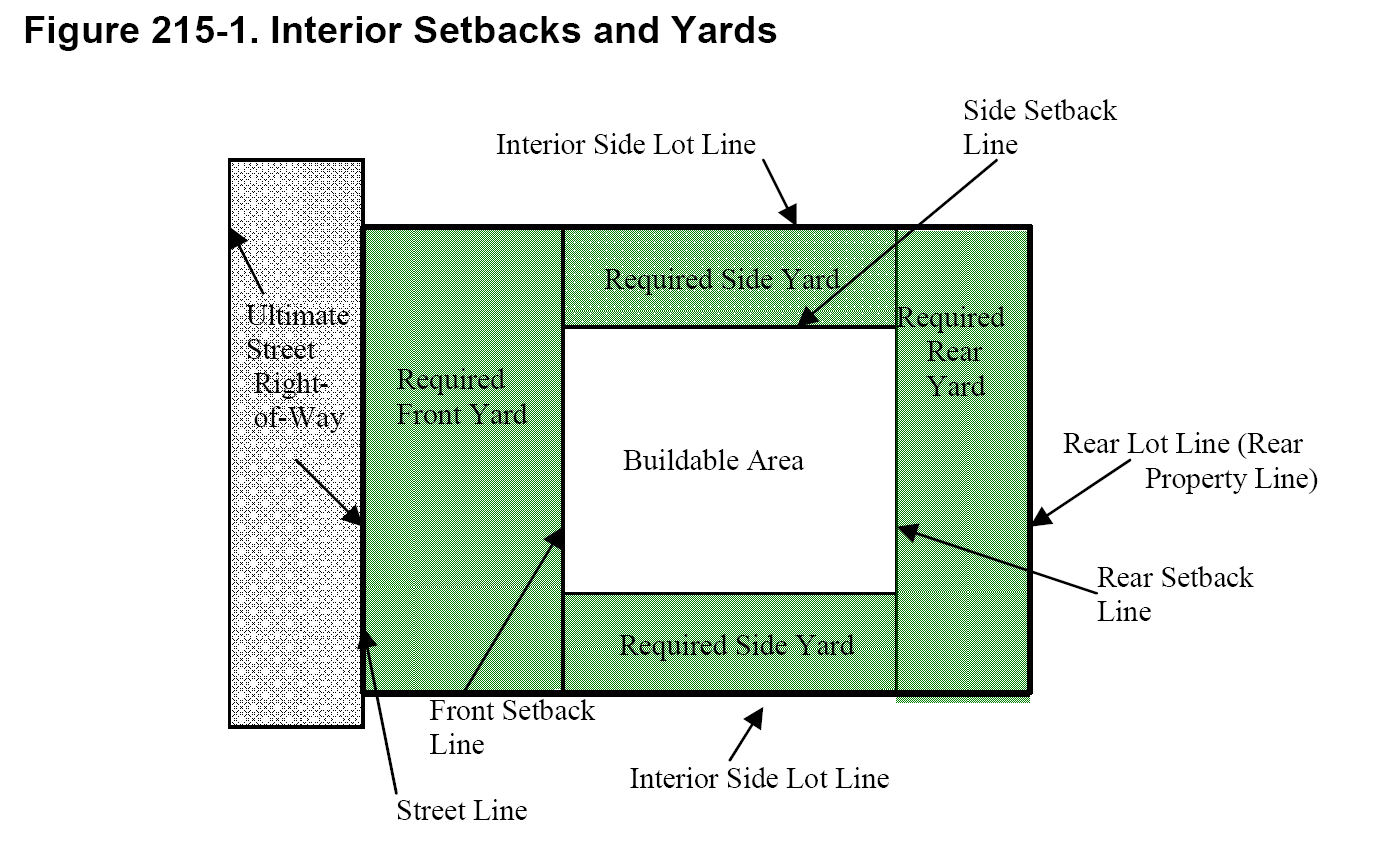
All setbacks, build-to-lines and yards abutting streets shall be measured from the street line. See section 210-10, which describes the difference between a street line and property line/lot line.
(B)
Every part of a required front, side and rear yard must be open to the sky and unobstructed except for accessory buildings and structures and other specific yard encroachments permitted in this article within required yards, subject to specific limitations.
(C)
Required area or space cannot be reduced. The area or dimension of any lot, yard, parking area or other space shall not be reduced to less than the minimum required by this code; and, if already less than the minimum required by this code, said area or dimension shall not be further reduced.
(Ord. No. 2010-20, § 2(Exh. A), 9-14-10)
Sec. 215-20. - Yard requirements for corner lots.
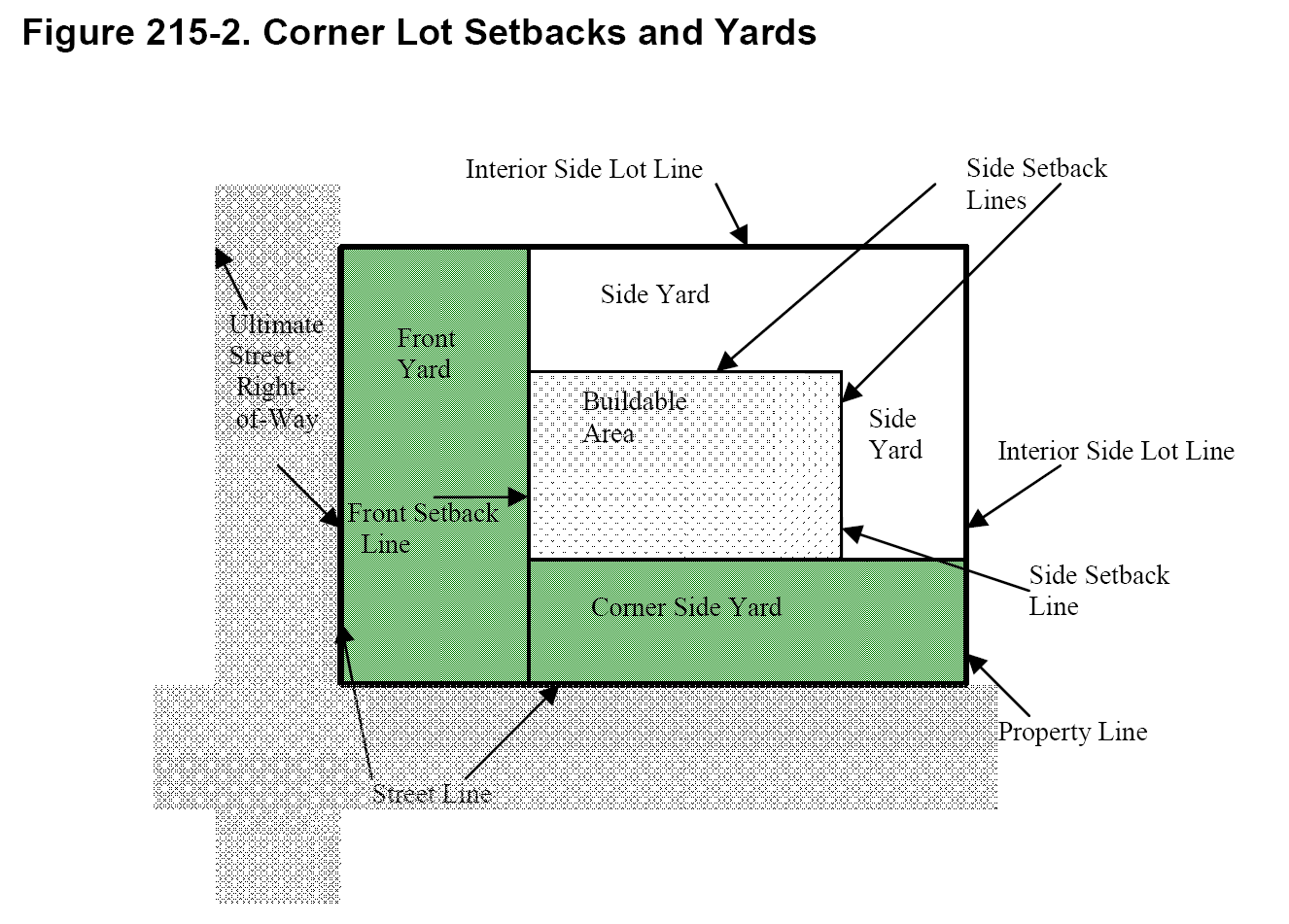
The community development director shall designate one (1) side of a corner lot facing a street as the front street line of the lot based upon the orientation of the building facing a street, and the other side of the lot facing a street as the corner side street line of the lot. The community development director may also consider the following factors in making the yard determination: usability of the lot; and compatibility with the configuration and pattern of adjacent lots, yards, streets, and future development of surrounding property.
(Ord. No. 2010-20, § 2(Exh. A), 9-14-10)
Sec. 215-30. - Yard requirements for multiple frontage lots.
(A)
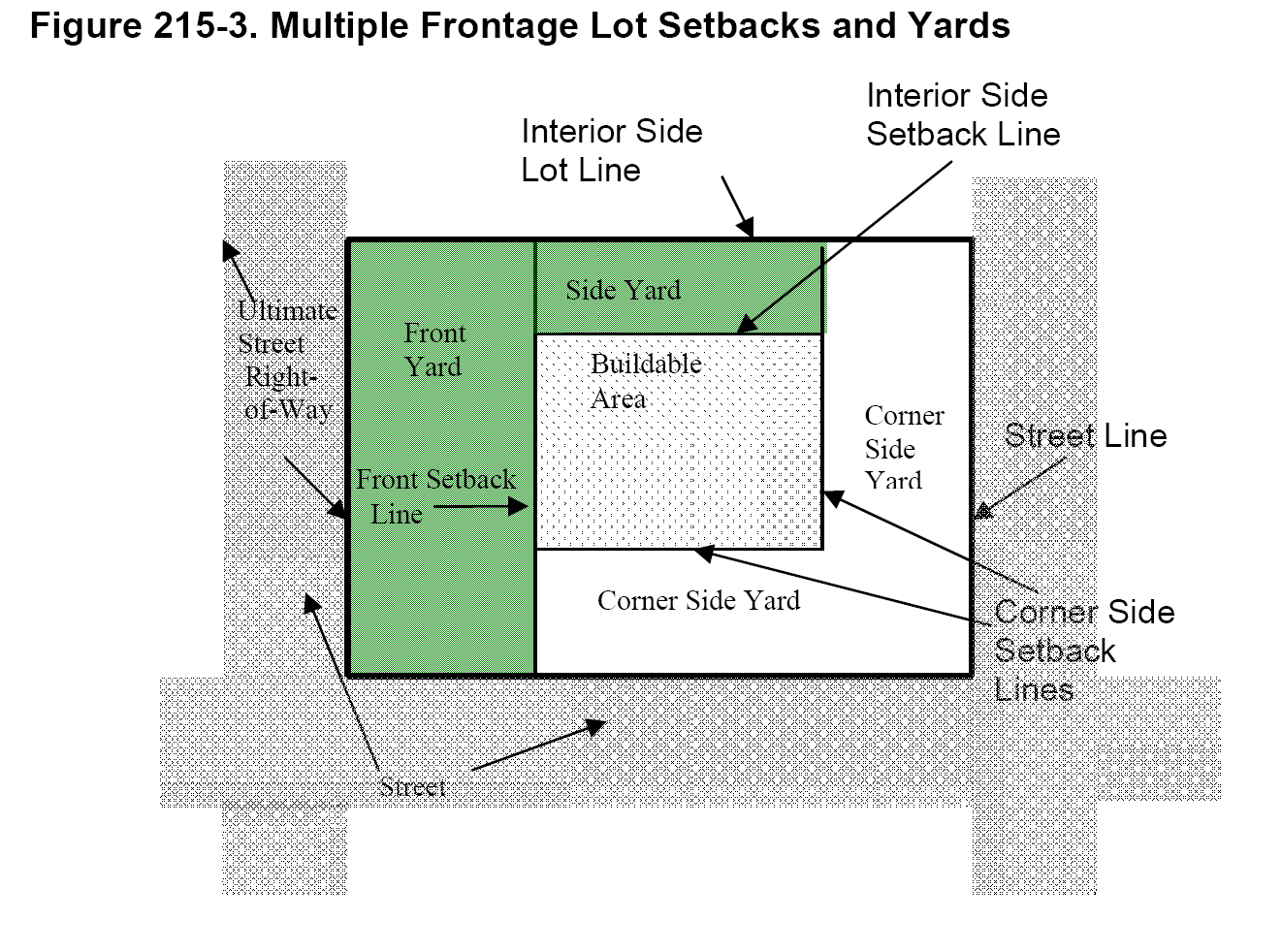
Where any lot abuts (3) three streets, a front yard and two (2) corner street side yards shall be provided, unless the community development director determines that more than one (1) front yard is required for compatibility with existing development, future development of vacant land, or an applicable city redevelopment plan.
(B)
Where any lot abuts more than three (3) streets, it shall have front yards on all sides unless the community development director determines that one (1) or more front yards are not necessary or appropriate for compatibility with existing development, future development of vacant land, or pursuant to an applicable city redevelopment plan, in which case corner side yards may be substituted for no more than two (2) front yards.
(Ord. No. 2010-20, § 2(Exh. A), 9-14-10)
Sec. 215-40. - Through lots.
(A)
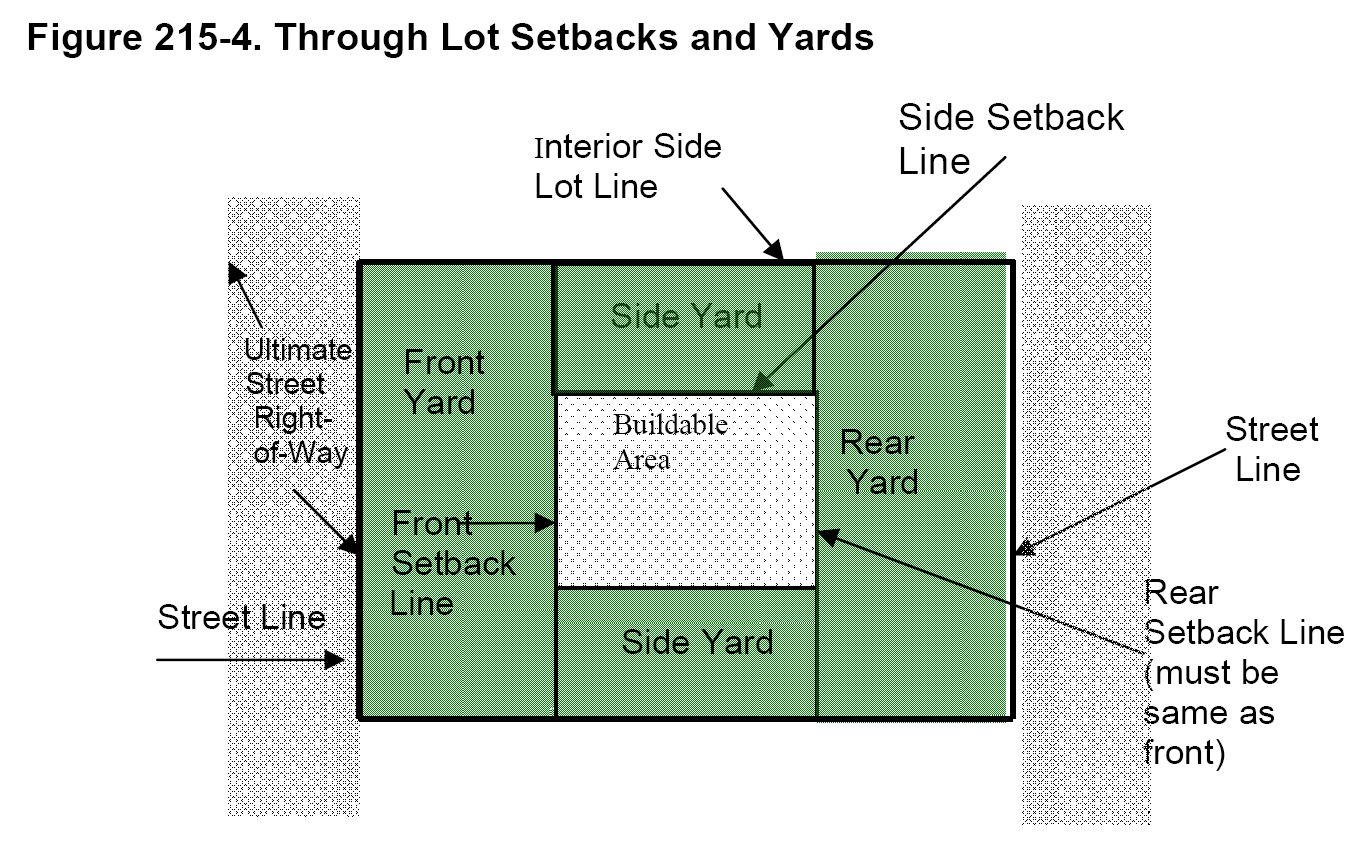
Where any lot extends the entire depth or width of a block and has frontage on more than one (1) street at opposite ends of the lot, one (1) side of the lot facing a street shall be determined to be the front street line of the lot by the orientation of the building facing a street, and the other side of the lot facing a street shall be determined to be the rear street line. The community development director may consider other factors in making the yard determination if appropriate for compatibility with the pattern and configuration of adjacent lots, yards, or streets, and the future development of surrounding property. The required rear street setback shall be the same as the required front setback, and the rear yard shall have the same provisions, requirements and restrictions as a required front yard.
(B)
Through lots in the CRA form-based districts are subject to the building placement, frontage standards, allowable building types, allowable frontage types, and all other regulations for each opposing street. In the event that a building will not extend the full depth of the buildable area of the lot, the community development director shall determine which street line is the front for the purpose of applying all of the aforementioned development standards. The portion of the lot adjacent to each opposing street line shall be first layers, with the area in between the first layers being the second layer.
(Ord. No. 2010-20, § 2(Exh. A), 9-14-10)
Sec. 215-50. - Permitted yard encroachments in the E-1, RS-18000, RS-12000, RS-8000, RS-6000, NBHD-RES, and RD-8000 Districts.
(A)
Chimneys, cornices, eaves, bay windows, canvas awnings, and balconies may extend not more than three (3) feet from a principal building into a required yard.
(B)
Carports, including fabric awnings or canopies, are permitted in required front and side yards with minimum front and corner side setbacks of ten (10) feet, and a minimum interior side setback of five (5) feet. Within the NBHD-RES District, the setback encroachment in the front yard is subject to section 303-90(C).
(C)
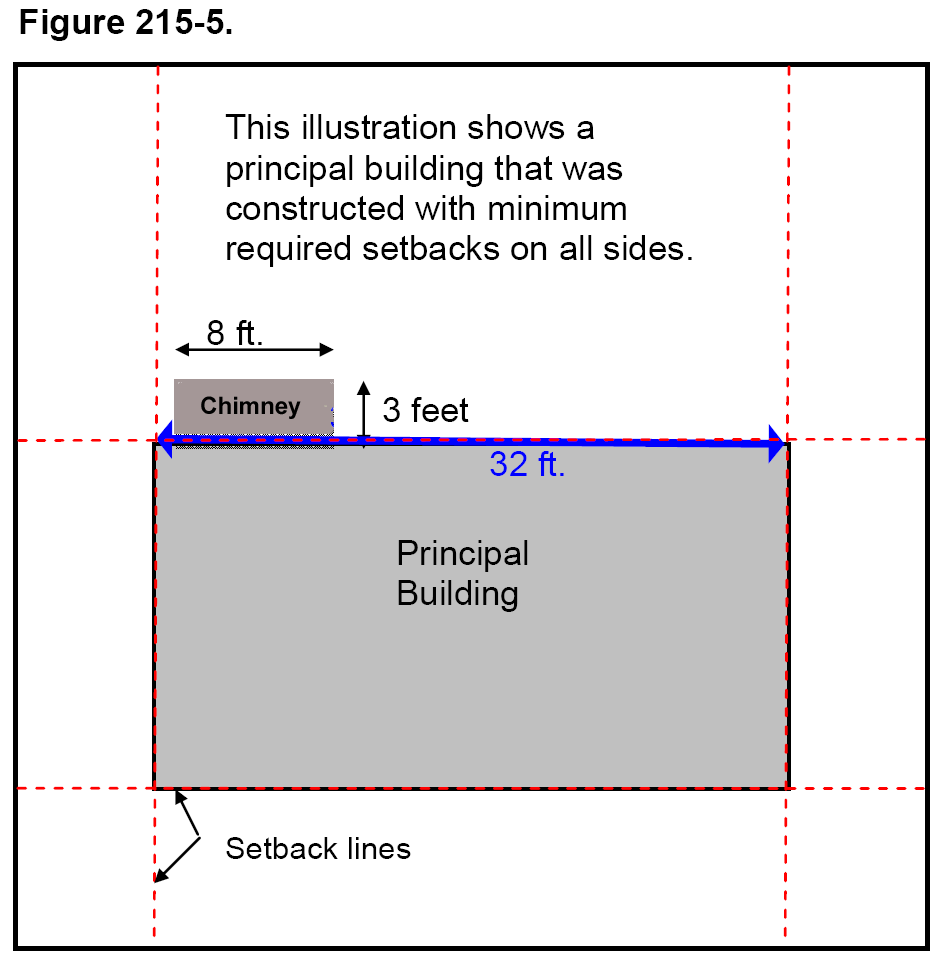
Chimneys and bay windows shall not, individually, exceed ten (10) feet in horizontal dimension measured parallel to the building wall, and shall not individually exceed twenty-five (25) percent of the length of the building wall from which the chimney, bay-window, or both, project. Example (illustrated in Figure 215-5., below): if the building wall is thirty-two (32) feet in length, the maximum horizontal dimension of the chimney cannot exceed eight (8) feet, which is twenty-five (25) percent of the length of the building wall. If the building wall is sixty (60) feet in length, the maximum allowable horizontal dimension of the chimney will be ten (10) feet, and not twenty-five (25) percent of the wall length, which is fifteen (15) feet. Clarification: If the chimney or bay window will not encroach into a required yard, the dimensional limitations of this provision do not apply.
(D)
First floor entrance platforms, steps, stoops and unenclosed porches may extend up to eight (8) feet into a required front yard.
(E)
At-grade air conditioning units, heating units, pool pumps, and related equipment shall not be located in a front yard or within five (5) feet of a side yard lot line. Such devices, and related equipment, may be located in a required rear yard provided a minimum five-foot setback is provided to any property line. Existing air conditioning, heating, and pool equipment that was installed with proper permits, but does not comply with the locational requirements of this section, may be replaced at the same location. Variances from the required yard setbacks for at-grade air conditioning units shall be considered pursuant to Article 620, "Administrative Variances."
(F)
At-grade generators and fuel tanks may encroach into required yards as provided in section 285-210 (Emergency generator regulations).
(G)
Patios, pools, and screened pool enclosures may encroach into required interior side yards and rear yards as provided in section 105-60 (Swimming pool regulations).
(H)
Patio and decks sun canopies and gazebos not associated with a pool shall provide a minimum of five-foot setback from any internal and rear property line.
(I)
Other accessory structures, as provided in section 215-90 (Accessory structure setbacks).
(J)
Driveways shall not be located within two (2) feet of an interior side lot line.
(K)
Outdoor sports courts may be constructed within required yard areas, except any required or provided yard abutting a street line, provided that any walls or fences shall conform with article 235.
(L)
Fences and walls pursuant to article 235.
(M)
Landscape materials.
(N)
Utility boxes.
(O)
Walkways and stairs to building entrances shall not be located within two (2) feet of any interior side lot line.
(Ord. No. 2010-20, § 2(Exh. A), 9-14-10; Ord. No. 2011-007, § 8, 2-22-11; Ord. No. 2011-024, § 7, 8-9-11; Ord. No. 2013-012, § 2, 10-22-13; Ord. No. 2014-004, § 5, 5-27-14; Ord. No. 2015-024, § 5, 10-27-15; Ord. No. 2022-004, § 1, 1-11-22)
Sec. 215-60. - Permitted yard encroachments in the RM, RM-1 and RM-2 districts.
(A)
Cornices, chimneys, balconies and fire escapes may extend not more than four (4) feet from a principal building into any required yard.
(B)
Walkways, ramps or steps may extend into required side or rear yard no closer than two (2) feet to adjacent property lines provided no part exceeds three (3) feet in height above the grade.
(C)
Allowable encroachments are permitted subject to the requirements for encroachments in the RS and RD districts unless otherwise specified herein.
(D)
Fences and walls pursuant to article 235.
(E)
Landscape materials.
(F)
Utility boxes.
(G)
Other accessory structures, as provided in section 215-90 (accessory structure setbacks).
(H)
Patio, deck, screen enclosures, sun canopies or gazebos not associated with a pool shall provide a minimum of a five (5) feet setback from any interior or rear property line, and a minimum of ten (10) feet from any street side property line.
(I)
At-grade air conditioning units, heating units, pool pumps, and related equipment shall provide a minimum of five (5) feet setback from any interior side or rear lot line.
(Ord. No. 2010-20, § 2(Exh. A), 9-14-10; Ord. No. 2017-005, § 3, 2-28-17; Ord. No. 2017-022, § 5, 7-25-17; Ord. No. 2022-004, § 1, 1-11-22)
Sec. 215-70. - Permitted yard encroachments in the C-1, C-2, C-3, and C-4 districts.
(A)
Cornices, canopies, balconies, and architectural features may extend horizontally a maximum of four (4) feet into a required yard over a walkway, provided it shall have at least nine (9) feet of vertical clearance above the sidewalk.
(B)
Marquees and canvas-covered fireproof canopies, no wider than the entranceways that they cover, may be constructed over main entrances to hotels, theaters and places of public assembly and may extend to the face of the street curb or the outside edge of the sidewalk if there is no curb, provided that no support shall be nearer than eighteen (18) inches to the face of the curb, and said installation shall have a minimum of nine (9) feet of vertical clearance above the sidewalk.
(C)
No projections shall be allowed in the required rear yard except open-type fire escapes, and these must be provided with a counter-balanced bottom section to provide for nine (9) feet clearance when up.
(D)
Awnings may be suspended over public and private sidewalks, provided that they shall not project nearer than eighteen (18) inches to the face of the street curb or outside edge of the sidewalk if there is no curb, nor more than eight (8) feet from the exterior wall of the building, and said installation shall have at least nine (9) feet of vertical clearance above the sidewalk.
(E)
Fences and walls pursuant to article 235.
(F)
Landscape materials.
(G)
Utility boxes.
(H)
Other accessory structures, as provided in section 215-90.
(Ord. No. 2010-20, § 2(Exh. A), 9-14-10)
Sec. 215-80. - Permitted yard encroachments in other zoning districts.
Note: permitted encroachments within the CRA form-based zoning districts are set forth in article 311.
(A)
Fences and walls pursuant to article 235.
(B)
Landscape materials.
(C)
Utility boxes.
(D)
Other accessory structures, as provided in this article.
(E)
In the RMH District, accessory structures pursuant to subsection 215-90(B).
(Ord. No. 2010-20, § 2(Exh. A), 9-14-10)
Sec. 215-90. - Accessory structure setbacks.
Certain accessory structures are permitted to encroach into required yards, as follows. All other accessory structures are subject to principal structure setbacks.
(A)
Accessory buildings and structures in E-1, RS-18000, RS-12000, RS-8000, RS-6000, NBHD-RES, and RD-8000 districts. Accessory buildings and structures are subject to the following requirements:
(1)
No accessory building or structure shall be located within five (5) feet of a side or rear lot line unless otherwise provided in this code.
(2)
No accessory building or structure shall be located within a required yard abutting any street line, such as front yards, corner side street yards and through lot rear yards, except as provided in section 215-50 for carports.
(3)
Any accessory building or structure located closer than ten (10) feet to a principal structure shall be considered attached, and shall comply in all respects with the lot, yard and bulk requirements of this code applicable to the principal structure, and shall not interfere with any part of a lot necessary to comply with parking requirements for the principal use.
(4)
Refer to article 230 (Special Floor Area, Building Dimension and Building Size Standards) for size limitations.
(5)
Refer to section 220-70 (Accessory structure height) for height limitations.
(6)
Refer to section 215-50 for allowable setback encroachments.
(B)
Accessory buildings and structures in the RMH District.
(1)
Carports shall be set back a minimum of two (2) feet from an interior side lot line, and are subject to the principal structure setback requirements from all other property lines. Storage closets erected inside a carport will only require the same setback as the carport.
(2)
Unroofed, raised wood decks and unroofed, raised concrete patios shall be set back at least six (6) feet from a street line and two (2) feet from a side or rear lot line. Said structures may only be enclosed with open mesh screening.
(3)
Refer to article 230 for size limitations.
(4)
Refer to section 220-70 for height limitations.
(5)
At grade air conditioner units, heating units or other mechanical equipment shall not be located in a front yard and may be located in the side or rear yard provided a minimum five foot (5') setback from the side and rear property line is provided.
(6)
Covered patio/deck shall provide a minimum of five foot (5') setback from side and rear property line and must maintain the front setback required of the primary structure.
(C)
Accessory buildings and structures in other districts. Accessory structures shall comply with front and side yard requirements for the principal structure to which they are accessory and shall be not closer to any rear property line than ten (10) feet. This subsection does not apply to the CRA form-based zoning districts.
(D)
[Parking.] Accessory buildings and structures shall not interfere with any part of a lot necessary to comply with parking requirements for the principal use in any zoning district.
(Ord. No. 2010-20, § 2(Exh. A), 9-14-10; Ord. No. 2017-005, § 3, 2-28-17; Ord. No. 2022-004, § 1, 1-11-22)
Sec. 215-100. - Waterway setbacks.
No structures shall be erected or constructed beyond the established bulkhead or bulkhead line or over any waterway except docks and moorings pursuant to article 240 (Docks and Moorings).
(Ord. No. 2010-20, § 2(Exh. A), 9-14-10)
Sec. 215-110. - Special setbacks for certain uses and zoning districts.
(A)
Wet or dry stack marina buildings and structures in commercial zoning districts: minimum setback of one hundred (100) feet from any lot designated residential on the future land use plan map or zoning map.
(B)
RS-12000 districts zoned Broward County RS-3 prior to the date of adoption of this code:
(1)
Front setback requirement: minimum of twenty-five (25) feet.
(2)
Interior side setback requirement: minimum of seven and one-half (7.5) feet.
(Ord. No. 2010-20, § 2(Exh. A), 9-14-10)
Sec. 215-120. - Separation between buildings and structures on the same lot, or within a unified development.
(A)
Mobile homes.
(1)
No part of any mobile home or travel trailer, or any addition or appurtenance thereto, shall be placed within ten (10) feet of any other mobile home, travel trailer, addition or appurtenance thereto.
(2)
No part of any mobile home or travel trailer, or addition or appurtenance thereto, shall be located within twenty-five (25) feet of any accessory or service building or structure used in connection with a mobile home park.
(3)
Utility buildings or other detached accessory buildings not located inside a carport shall not be located less than ten (10) feet from any other detached accessory building on an adjacent lot.
(B)
Townhouses. No part of an exterior wall of any building group shall be closer than fifteen (15) feet from any part of an exterior wall of any other building in the PRD-1 District, and twenty (20) feet in other districts. This does not apply to the CRA form-based zoning districts.
(C)
Multifamily dwellings (apartments) in the RM, RM-1, RM-2 districts. The distance between buildings shall be no less than forty (40) feet or the distance obtained by using the following formula, whichever is greater.
Commentary: the intent of this formula is to make the separation requirement proportionate to the height of two adjacent buildings. The required separation between buildings is also affected by their position relative to each other. For example, when two (2) buildings are placed side by side with similar dimension and setbacks (see Figure 215-6), the required separation will be greater than if buildings of the same height and dimensions are horizontally offset from each other (see Figure 215-7). The offset, or lack of offset, is defined as the "length of projection" of one building onto the other in the formula
Minimum separation between buildings = La +Lb +Ha +Hb divided by six
La = Length of Projection of Building B on Building A
Lb = Length of Projection of Building A on Building B
Ha = Height of Building A
Hb = Height of Building B
Example 1 (Figure 215-6)
200+200+30+40 = 470.
470 divided by 6 = 78 feet of separation required.
Example 2 (Figure 215-7)
Although the total length of each building is the same as in Example 1, only half
of each building overlaps the other. Therefore:
100+100+30+40 = 270.
270 divided by 6 = 45 feet of separation required.
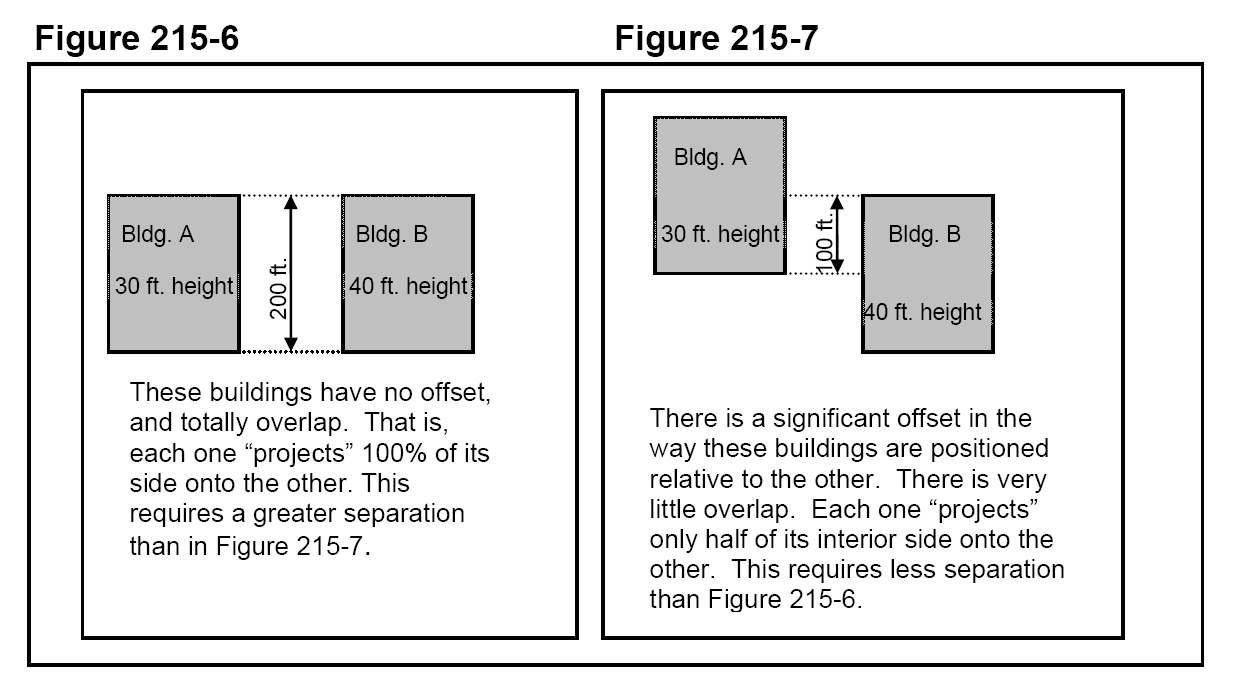
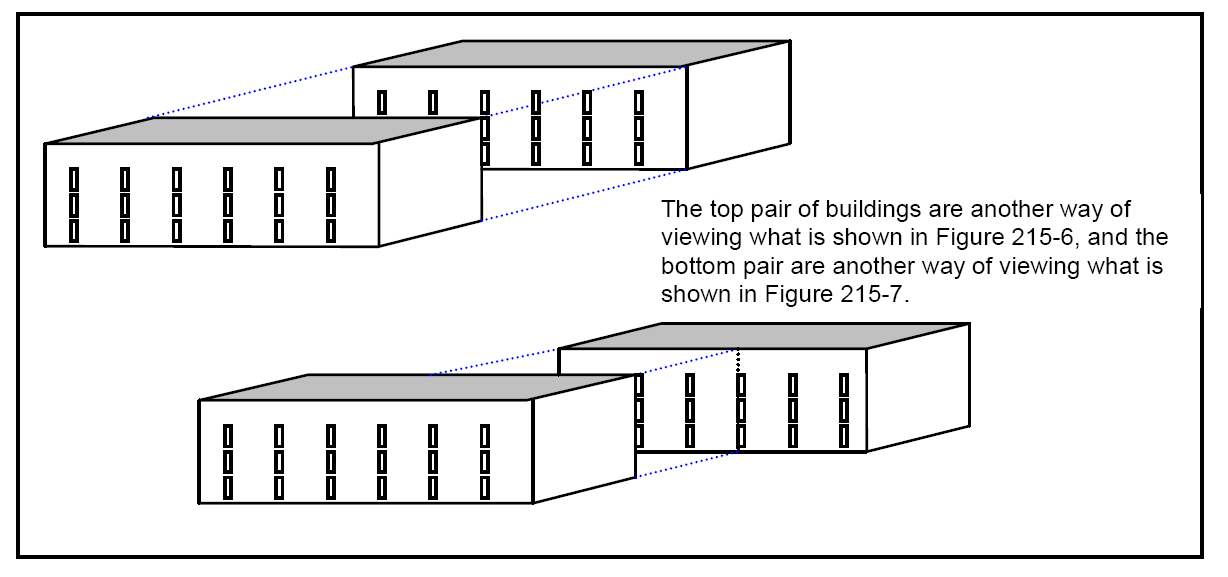
(Ord. No. 2010-20, § 2(Exh. A), 9-14-10)
Sec. 215-130. - Impervious area standards.
(A)
Maximum allowable impervious area. To effectively provide for the drainage of stormwater the area of land covered by buildings, structures and impervious surfaces shall not exceed sixty-three (63) percent for open space, residential and mobile home zoning districts, seventy-five (75) percent for commercial, eighty (80) percent for industrial and eighty-five (85) percent for residential office zoning districts, excluding the CRA form-based zoning districts for which open space standards are provided in the district regulations of article 303. PEDD requirements are provided in the district regulations in article 320.
(B)
[Commercial use category.] For the purpose of this section, all other uses such as, but not limited to, community facilities, utilities, transportation and office parks, shall be included in the commercial use category. In mixed-use developments located outside of the CRA form-based zoning districts, the most restrictive of the applicable impervious area limitations shall be utilized.
(C)
Allowable use of pervious area. Subject to compliance with all other regulations, pervious areas may be used to satisfy requirements for landscaping and setbacks, buffer strips, drain fields, passive recreation areas and any other purpose that does not require compaction, or filling or covering of the ground with a material that prevents infiltration of water into the ground.
(D)
Pervious area credit. Installation of a "green roof" or "roof garden" can be counted as pervious areas as described in this Code. If a green roof or roof garden is utilized, fifty (50) percent of the improved area can be counted toward the required pervious area.
(E)
Partial waiver of standard. Upon demonstration by an applicant that special conditions peculiar to the location or physical characteristics of a particular site are present, or that special conditions resulting from the design of existing facilities, project design, or surrounding land uses are present, the city commission may grant a waiver from the impervious area standards, subject to the following limitations:
(1)
The volume of stormwater runoff that would be increased by granting the partial waiver shall be completely mitigated through design and construction methods, including but not limited to, underground stormwater storage vaults, French drains, green (landscaped) roofs that absorb stormwater, stormwater storage and reuse systems for irrigation, positive outfall systems, use of pervious ground stabilization systems where deemed appropriate by the city engineer, and other improvements to aid in the retention and filtration of stormwater runoff.
(2)
If a waiver is granted, the impervious area shall not exceed eighty-five (85) percent for industrial uses, eighty (80) percent for commercial uses and seventy (70) percent for residential uses.
(Ord. No. 2010-20, § 2(Exh. A), 9-14-10; Ord. No. 2011-024, § 7, 8-9-11; Ord. No. 2015-002, § 4, 1-13-15)
Sec. 220-10.- Height measurements and general exceptions.
(A)
Height measurements. No building or structure shall exceed the maximum allowable number of stories or height limit expressed in feet, allowed in the schedules of site development regulations in article 205 and in the CRA form-based zoning regulations in article 303.
(B)
[Exceptions.] The following structures may exceed the maximum height limit of any zoning district by a maximum of twenty-five (25) percent unless otherwise provided below:
(1)
Rooftop structures in the CRA form-based zoning district are regulated in section 304-10.
(2)
Rooftop structures for the housing of elevators, stairways, tanks, skylights, ventilating fans, air conditioning or similar equipment required to operate and maintain the building, and cupolas, steeples, chimneys and other decorative rooftop projections, provided that the aggregate coverage of all such structures does not exceed fifteen (15) percent of the total roof area. See also section 220-60 (Rooftop mechanical equipment).
(3)
Radio and television antennas, whether freestanding or roof-mounted.
(4)
Solar panels and accessory equipment.
(5)
Ham radio antennas may exceed the maximum district height limit by forty (40) percent.
(C)
[FFEs] All buildings and structures shall be constructed with a lowest FFE of at least one (1) foot above the one-hundred-year flood elevation established by the Federal Emergency Management Administration's flood insurance rate Maps (FIRM), unless otherwise provided in chapter 12 (Flood Damage Prevention).
(Ord. No. 2010-20, § 2(Exh. A), 9-14-10; Ord. No. 2011-007, § 9, 2-22-11)
Sec. 220-20. - Airspace restrictions on allowable height; Federal Aviation Administration and other agency review.
(A)
The height of any structure, manmade or natural, near Fort Lauderdale-Hollywood International Airport may in some cases be restricted by Federal Aviation regulations, advisory circulars and orders (FAR part 77, FAR part 25 and FAA order 8260.3B, advisory circular 150/5300-13) and F.S. chapter 333 in order to provide safety and avoid conflicts between structures and aircraft operations. Due to the city's proximity to the airport, the following development applications require the submission of an airspace study (FAA form 7460) to the Federal Aviation Administration (FAA) for review resulting in a "determination of no hazard", and the issuance of an airspace permit from the Florida Department of Transportation (FDOT) (if applicable), prior to issuance of any city development order or permit. Submissions to the FAA and FDOT shall include points defining the entire building and structure envelope (man-made and natural) along with their respective heights, in addition to the building/structures highest point, above mean sea level (AMSL) per the FAA 7460 process.
(1)
An application to construct, substantially change, alter, modify or repair a building or structure that would exceed two hundred (200) feet in height above ground level (AGL), measured to the highest point of the building or structure; and
(2)
An application to construct, substantially change, alter, modify or repair building or structure that would be situated within twenty thousand (20,000) horizontal feet of runway, and that would be of a height that is greater than one (1) foot for each one hundred (100) feet of separation between the building and the nearest point of any runway (a 1:100 ratio of height to horizontal distance). Note: the majority of building activities proximate to the airport will require FAA review, but will not necessarily result in an FAA determination that the activity constitutes an obstruction or hazard.
Example: as shown in figure 220-1, below, if a one-hundred-foot building is proposed at a location five thousand (5,000) feet from the edge of a runway, FAA review would be required because the building would only have fifty (50) feet of runway separation for each foot of proposed height (five thousand (5,000) feet separation divided by one hundred (100) feet building height = fifty (50) feet of separation for each foot of height). If that same building is proposed ten thousand (10,000) feet from the edge of the same runway, FAA review may not be required, because the building would have the full one hundred (100) feet of runway separation for each foot of proposed height (ten thousand (10,000) feet separation divided by one hundred (100) feet height = one hundred (100) feet of separation per foot of height).
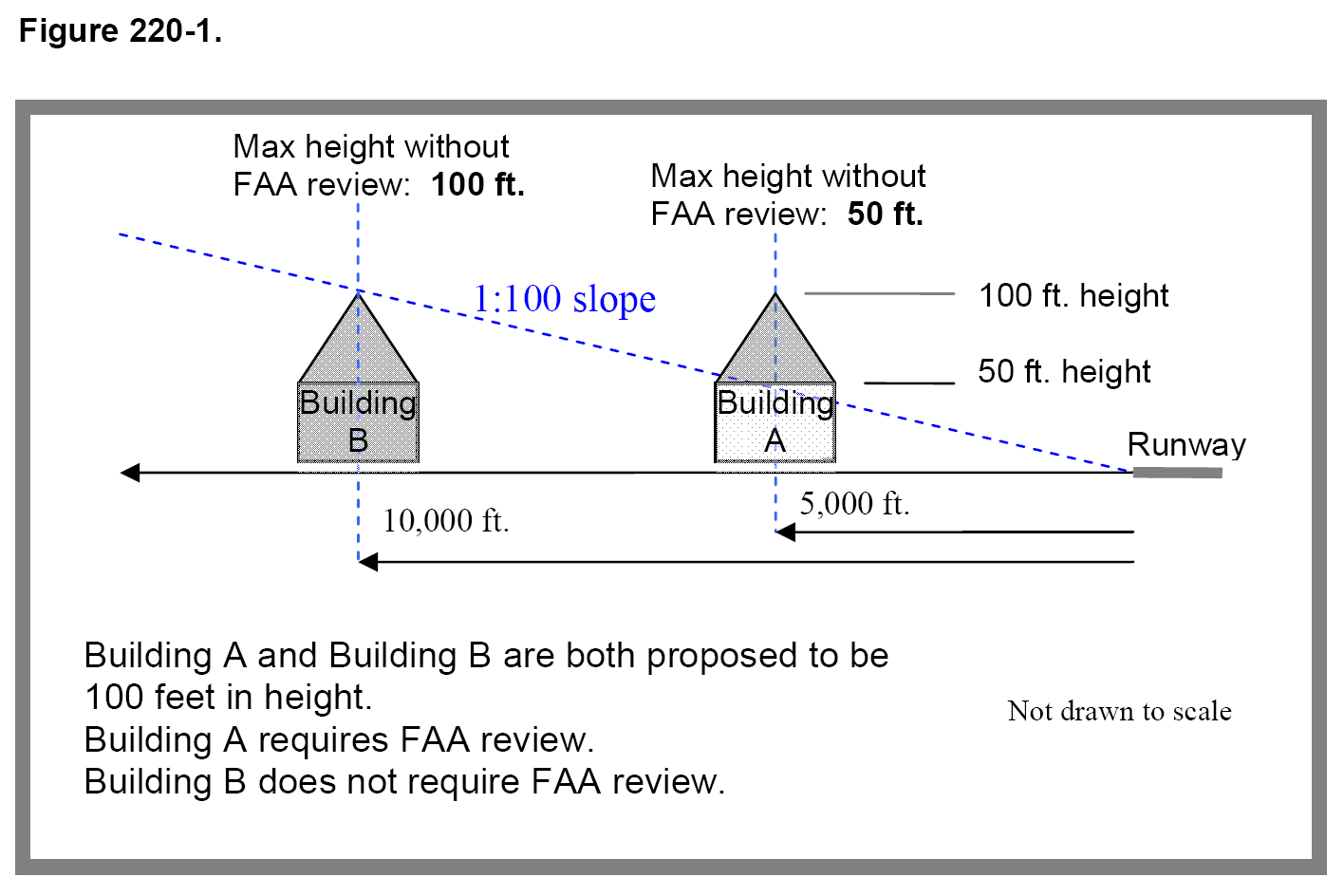
(B)
All development applications for structures that are required to undergo FAA review pursuant to subsection (A), or which are located within the "supplemental review zone" described and illustrated in figure 220-2, below, shall be provided to the Broward County Aviation Director, for review and comment. The Broward County Aviation Director shall provide comments to the city within thirty (30) days after being provided with a copy of the proposed development application. The city shall not approve the development application until any comments have been addressed by the developer in a manner satisfactory to the city official or board with final approval authority over the application.
(C)
Development applications for structures that include property that is within an existing or proposed runway protection zone shall be provided to the Broward County Aviation Director for review and comment. The Broward County Aviation Director shall provide comments to the city within thirty (30) days after being provided with a copy of the proposed development application. The city shall not approve the development application until any comments have been addressed by the developer in a manner satisfactory to the city official or board with final approval authority over the application.
(D)
Property owners with prior agreements with Broward County will not be required to follow the regulations to this section if it is more restrictive than the previous agreement.
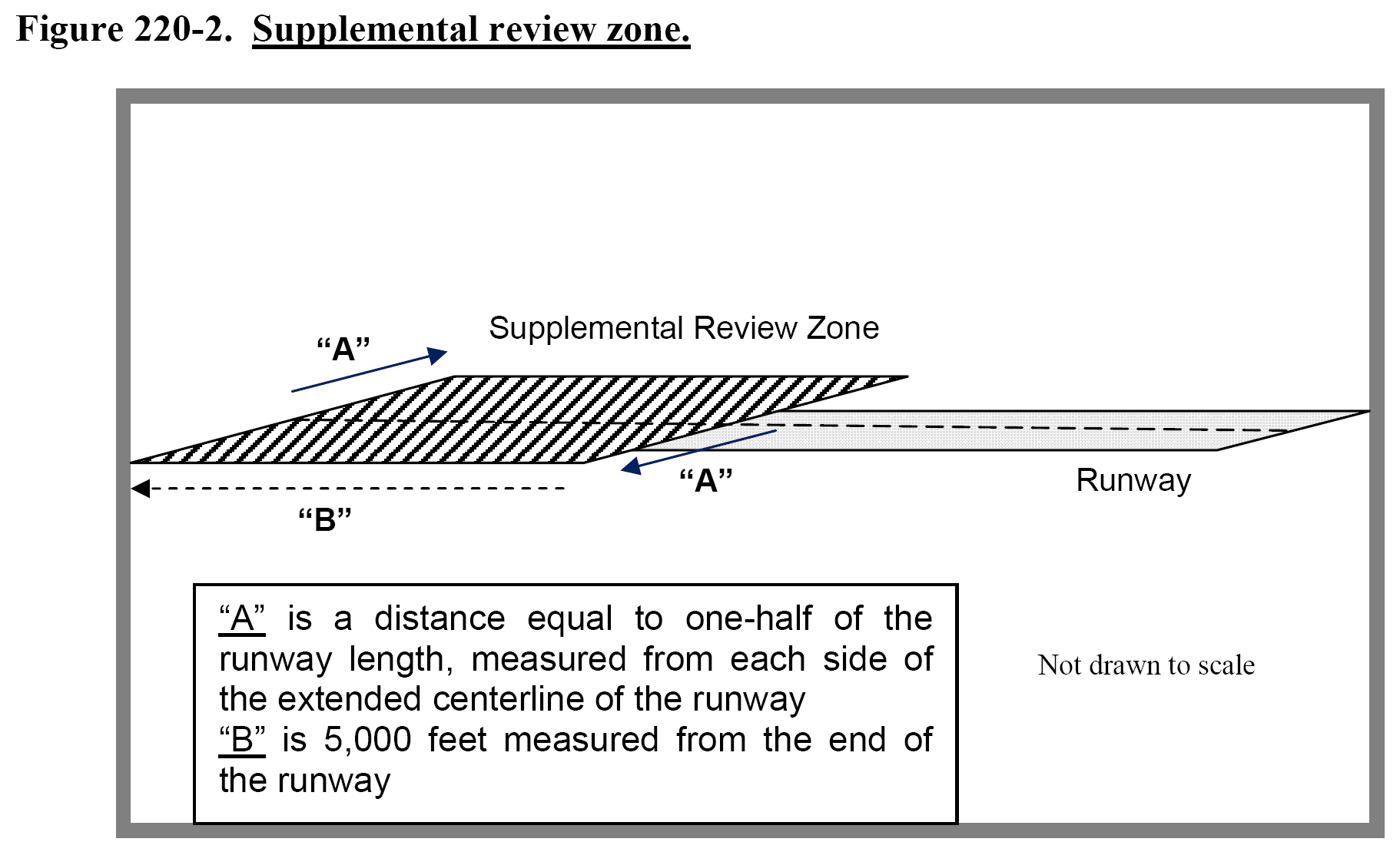
(Ord. No. 2010-20, § 2(Exh. A), 9-14-10; Ord. No. 2011-007, § 9, 2-22-11)
Sec. 220-30. - Additional height allowance in exchange for increased open space in multiple-family residential districts.
(A)
In order to encourage the provision of more open space than required through lot coverage and impervious area limitations in article 215, the maximum building height in RM, RM-1 and RM-2 districts may be increased by the city commission upon reduction of the lot coverage below twenty-five (25) percent, provided that the building height shall not exceed five (5) stories and sixty-two (62) feet in the RM District, nor eight (8) stories and ninety (90) feet in the RM-1 and RM-2 districts.
(B)
Within any lot zoned RM-2 having an area of ten (10) or more acres, building height may exceed eight (8) stories and ninety (90) feet by using the formula below. However, no building will be permitted to have a height greater than fifteen (15) stories and one hundred fifty (150) feet. The formula is as follows:
ALLOWABLE LOT COVERAGE = LOT AREA (in square feet) divided by NUMBER OF PROPOSED STORIES.
Example:
The owner of a ten-acre (435,600 sf) parcel proposes to construct a fifteen-story multifamily apartment building. What is the allowable lot coverage for the structure?
ALLOWABLE LOT COVERAGE = 435,600 divided by 15 = 29,040 sf, which is 6.66 percent of the total lot area.
(Ord. No. 2010-20, § 2(Exh. A), 9-14-10)
Sec. 220-50. - Special height restrictions for certain uses.
(A)
In the C-3 and C-4 districts, no wet- or dry-stack marina building or structure can exceed a height of thirty (30) feet.
(Ord. No. 2010-20, § 2(Exh. A), 9-14-10)
Cross reference— Sec. 110-170, Wet- and dry-stack marina and related facilities.
Sec. 220-60. - Rooftop mechanical equipment.
(A)
New rooftop air conditioning units in residential districts must be located on flat roofs only on the rear one-half (½) of the building, and must be screened from view from adjacent properties. The city may waive this standard as part of site plan approval in the CRA form-based districts if an acceptable design solution effectively hides the equipment from being viewed at street level and in adjacent buildings of the same or lesser height.
(B)
Property owners are allowed to replace roof air-conditioning units that are not located on the rear one-half (½) of the building, provided the units are painted the same color as the roof or are painted white.
(C)
Section 525-20 contains design standards for rooftop mechanical equipment in the CRA form-based zoning districts.
(Ord. No. 2010-20, § 2(Exh. A), 9-14-10)
Sec. 220-65. - Rooftop photovoltaic solar systems.
(1)
Intent. The provisions contained in this section are intended to promote the health, safety, and general welfare of the citizens of the city by removing barriers to the installation of alternative energy systems and to encourage the installation of rooftop photovoltaic solar systems.
(2)
Definitions. For purposes of this section, the following terms shall have the meaning prescribed in this section:
Roof line: The top edge of the roof which forms the top line of the building silhouette or, for flat roofs with or without a parapet, the top of the roof.
Rooftop photovoltaic solar system: A system which uses one (1) or more photovoltaic panels installed on the surface of a roof, parallel to a sloped roof or surface- or rack-mounted on a flat roof, to convert sunlight into electricity.
(3)
Permitted accessory equipment. Rooftop photovoltaic solar systems shall be deemed permitted accessory equipment to residential and commercial conforming and nonconforming buildings and structures in all zoning categories. Nothing contained in this chapter, including design standards or guidelines included or referenced in this section, shall be deemed to prohibit the installation of rooftop photovoltaic solar systems as accessory equipment to conforming and nonconforming buildings, including buildings containing nonconforming uses.
(4)
Height. In order to be deemed permitted accessory equipment, the height of rooftop photovoltaic solar systems shall not exceed the height of the roof line, as defined herein. For flat roofs with or without a parapet, in order to be deemed accessory equipment, the height of the rooftop photovoltaic solar system shall not be greater than five (5) feet above the roof.
(5)
Permits. Prior to the issuance of a permit, the property owner(s) must acknowledge, as part of the permit application, that:
(a)
If the property is located in a homeowners' association, condominium association, or otherwise subject to restrictive covenants, the property may be subject to additional regulations or requirements despite the issuance of a permit by the city; and
(b)
The issuing of a permit for a rooftop photovoltaic solar system does not create in the property owner(s), its, his, her, or their successors and assigns in title, or create in the property itself a right to remain free of shadows or obstructions to solar energy caused by development adjoining on other property or the growth of any trees or vegetation on other property or the right to prohibit the development on or growth of any trees or vegetation on another property.
(6)
Tree maintenance and removal. To the extent that the city has discretion regarding the removal or relocation of trees, solar access shall be a factor taken into consideration in determining whether and where trees may be removed or relocated.
(7)
Maintenance. All rooftop photovoltaic solar systems shall be properly maintained and be kept free from hazards, including but not limited to, faulty wiring, loose fastenings, being in an unsafe condition or detrimental to public health, safety, or general welfare.
(Ord. No. 2012-014, § 2, 8-14-12; Ord. No. 2022-004, § 1, 1-11-22; Ord. No. 2023-006, § 5, 4-25-23)
Sec. 220-70. - Accessory structure height.
Accessory buildings and structures are subject to the same height limitations as the principal building or structure, provided that within the E-1, RS-18000, RS-12000, RS-8000, RS-6000, RMH, NBHD-RES, and RD-8000 districts, maximum allowable height is ten (10) feet, and up to fourteen (14) feet to the peak of a sloped roof.
(Ord. No. 2010-20, § 2(Exh. A), 9-14-10)
Sec. 221-10.- Noise mitigation.
(A)
Residential properties located within the 60+ DNL noise contour shown on the most recent FAA accepted long range noise exposure contours for the Fort Lauderdale-Hollywood International Airport shall be subject to the following requirements:
(1)
An application for a building permit for a new residential dwelling unit or an existing residential structure making a substantial improvement to the main living structure or unit, as defined in section 725-30, shall provide evidence that appropriate noise mitigation measures will be provided in order to achieve a maximum indoor level of forty-five (45) decibels.
(2)
The application for residential building permit shall provide a certified engineered program identifying existing conditions, methods to be utilized, and the impact of each proposed upgrade.
(Ord. No. 2011-024, § 8, 8-9-11)
Sec. 225-10.- Intersection vision.
(A)
Intent. To aid to in the safe movement of vehicles and pedestrians at and near street intersections by maintaining sight lines and cross visibility for motorists and pedestrians.
(B)
[Obstructions.] No obstruction other than those listed in subsection (D) are permitted within the sight distance triangle area defined in subsection (C), between thirty (30) inches and eight (8) feet above the grade measured at the street line within the sight distance triangle.
(C)
[Sight distance triangle formation.] The triangle is formed with two (2) sides being thirty (30) feet in length along the abutting street lines (illustrated by the letter "B" in Figure 225-1 below), measured from their point of intersection, illustrated by the letter "A" in the diagram below, and the third side being a line connecting the ends of the other two sides, illustrated by the letter "C" in the diagram below. In the event the street lines do not intersect as shown in Figure 225-1, the point of intersection illustrated by the letter "A" in Figure 225-2, street lines shall be the point at which the street lines, if extended, would intersect.
(D)
Exceptions. The following obstructions are permitted within the sight distance triangle.
(1)
Trees having limbs and foliage trimmed in such a manner that no limbs or foliage extend into the area between thirty (30) inches and eight (8) feet above grade. Trees must be located so as not to create a traffic hazard.
(2)
Fire hydrants, public utility poles, street markers and traffic control devices.
(3)
Other obstruction materials may be approved subject to maintaining the required sight visibility as approved by the City Engineer.
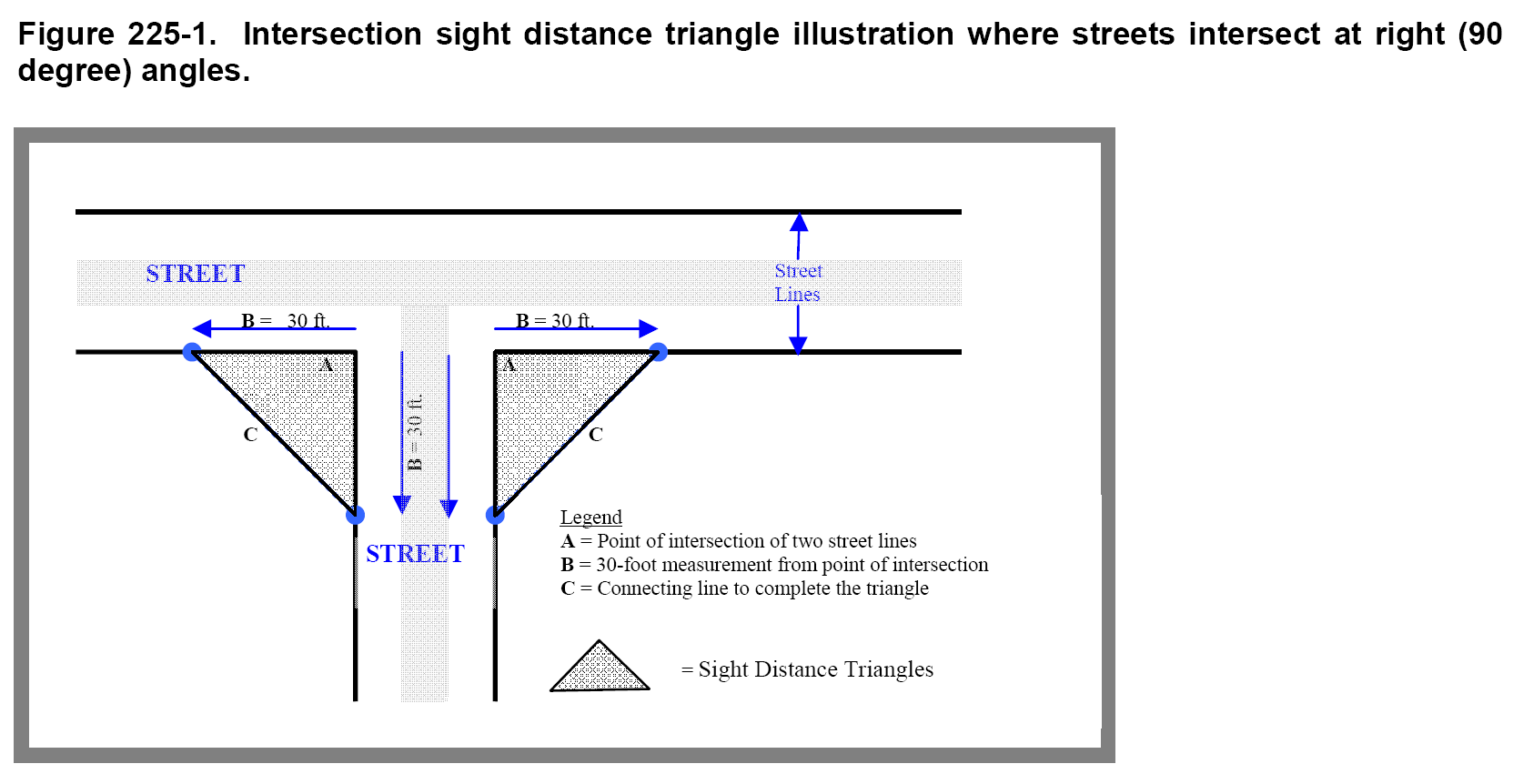
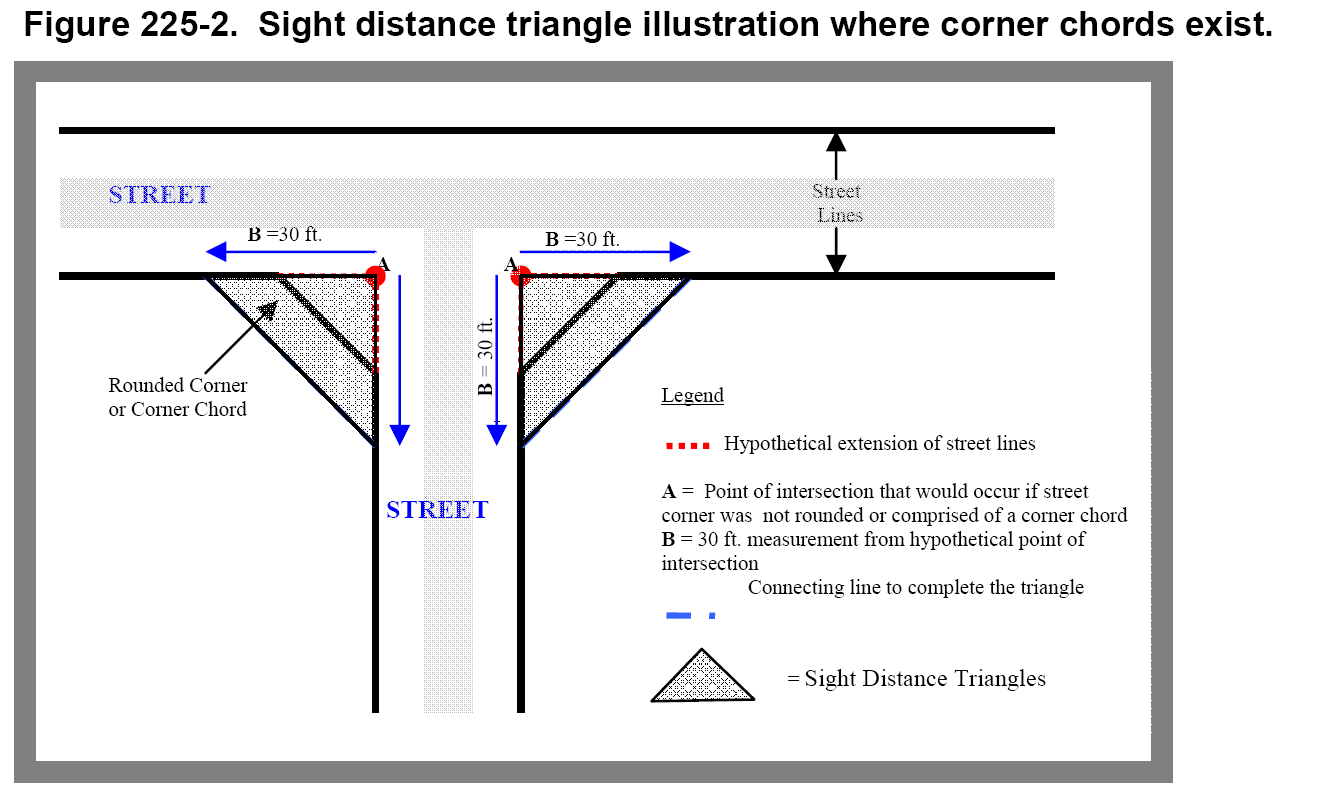
(Ord. No. 2010-20, § 2(Exh. A), 9-14-10; Ord. No. 2016-007, § 5, 3-22-16)
Sec. 230-10.- Maximum building length requirements.
(A)
In the C-1 District, the maximum length of any structure or group of attached structures shall not exceed one hundred fifty (150) feet.
(B)
The maximum length of a townhouse building group is one hundred fifty (150) feet.
(C)
The maximum length of a multiple-family dwelling is one hundred fifty (150) feet, unless there are at least four (4) dwelling units with exterior frontage along the length of the building, in which case the maximum allowable length shall be one hundred seventy-five (175) feet.
(Ord. No. 2010-20, § 2(Exh. A), 9-14-10)
Sec. 230-20. - Caretaker or watchman quarters.
The maximum permitted size of a watchman or caretaker dwelling unit is the lesser of one thousand two hundred (1,200) square feet of GFA or an amount equal to twenty (20) percent of the GFA of the principal commercial or industrial building.
(Ord. No. 2010-20, § 2(Exh. A), 9-14-10)
Sec. 230-40. - Minimum floor areas for dwellings and lodging units.
(A)
All residential dwelling units shall be a minimum of three hundred (300) square feet.
(B)
Multifamily dwelling units shall be a minimum of five hundred (500) square feet of net floor area for efficiencies, seven hundred fifty (750) square feet for one-bedroom units, nine hundred (900) square feet for two-bedroom units, one thousand one hundred fifty (1,150) square feet for three-bedroom units, and one hundred fifty (150) square feet for each additional bedroom.
(C)
Hotel, extended-stay hotel, time-share, and condominium-hotel rooms, units, or keys shall contain at least two hundred fifty (250) square feet of net floor area.
(D)
Accessory dwelling units (ADU) shall not exceed five hundred (500) square feet in size, as they are calculated as one-half (½) of a dwelling unit, consistent with Broward County Land Use Plan, POLICY 2.2.5.
(Ord. No. 2010-20, § 2(Exh. A), 9-14-10; Ord. No. 2025-010, § 3, 5-27-25)
Sec. 230-50. - Maximum allowable floor area for accessory buildings and structures in the E-1, RS-18000, RS-12000, RS-8000, RS-6000, NBHD-RES, RMH, and RD-8000 districts.
Accessory buildings and structures, including awnings, shall not occupy an area equivalent to more than forty (40) percent of the gross floor area of the principal building or structure, or seven hundred fifty (750) feet, whichever is less.
(Ord. No. 2010-20, § 2(Exh. A), 9-14-10)
Sec. 235-10.- Placement of walls, hedges and fences.
(A)
Fences, walls and hedges are permitted only within the boundaries of a lot, and are prohibited within any right-of-way.
(B)
Fences, walls and hedges may be placed within required yards subject to the provisions of this section.
(C)
The outer edge of fences and walls, including any footers, shall be placed no closer than one (1) inch to any property line or street line. The center of a line of shrubs that will form a hedges shall be planted no closer than one (1) foot to any property line or street line, and should be planted with additional setback in order to maintain the desired width without encroaching into an adjoining property or right-of-way.
(D)
The outer edge of any fence, wall and hedge shall be set back at least two and one-half (2.5) feet from any property line abutting a platted alley.
(E)
Fences, walls and hedges located adjacent to an intersection of streets are subject to the site distance requirements of article 225.
(Ord. No. 2010-20, § 2(Exh. A), 9-14-10)
Sec. 235-20. - Height measurement.
For the purpose of determining the maximum allowable height of a fence, wall or hedge, height shall be measured from the grade upon which it is erected. Where there is a difference in elevation on opposite sides of the wall, fence or hedge, the height shall be measured from the highest elevation.
(Ord. No. 2010-20, § 2(Exh. A), 9-14-10)
Sec. 235-30. - Requirements for placement within required yards.
Walls, fences or hedges may be located or constructed within the required yards and shall conform to the following regulations, except where special screening and buffering requirements are set forth in article 275.
(A)
Front yard. Walls, fences and hedges located in the front yard shall not exceed four (4) feet in height in the RS, RD and CRA form-based zoning districts. Walls, fences and hedges located in the front yard of all other zoning districts shall not exceed six (6) feet in height, provided that on any lot that is occupied by a single-family, two-family or townhouse dwelling, the maximum height in the front yard is four (4) feet.
(B)
Side and rear yards. Walls, fences and hedges located in side and rear yards, including corner street side yards and the rear yards of through lots, shall not exceed six (6) feet in height in all residential and CRA form-based zoning districts, and eight (8) feet in height in all other districts. For any property abutting a waterway or canal, no hedge, wall or opaque fence located within ten (10) feet of the edge of the waterway, measured from the outer face of the seawall or top of bank in the absence of a seawall, shall be permitted to exceed five (5) feet in height measured from the height of the adjacent seawall or top of bank; provided, however, a nonopaque fence shall be permitted to be erected up to six (6) feet in height.
(Ord. No. 2010-20, § 2(Exh. A), 9-14-10)
Sec. 235-40. - Materials.
(A)
Barbed wire, electrification. In residential zoning districts, CRA form-based zoning districts and along property lines abutting residentially zoned properties or CRA form-based zoning districts, no fence shall be constructed of barbed wire, electrified wire or any material inherently dangerous.
(B)
[Permissible materials.] Fences or walls shall be constructed of masonry materials, wood, chain link, P.V.C. or other materials approved by the building code. Louvered concrete fences are prohibited. Fences existing prior to the date of adoption of this section that do not comply with this subsection shall be governed by the nonconforming structure provisions of article 710.
(Ord. No. 2010-20, § 2(Exh. A), 9-14-10; Ord. No. 2013-004, § 4, 6-25-13; Ord. No. 2013-007, § 3, 8-13-13)
Sec. 235-50. - Orientation.
The decorative side of wall or fence shall face the exterior or public side.
(Ord. No. 2010-20, § 2(Exh. A), 9-14-10)
Sec. 235-60. - Fence requirements for vacant properties.
Fences on vacant properties located on principal arterial roadways as identified in section 510-20(a) shall be a maximum of four (4) feet in height and shall provide black vinyl coating on the chain link material and frame. The fence frame shall include a top horizontal support bar.
(Ord. No. 2013-007, § 3, 8-13-13)
Sec. 240-10.- Dock signage.
No advertising signs of any kind shall be permitted on docks or boats docked within residential areas of the city, except one "for sale" sign or one "dock for rent" sign not over eighteen (18) inches by thirty-six (36) inches in size.
(Ord. No. 2010-20, § 2(Exh. A), 9-14-10)
Sec. 240-20. - Construction of accessory boat slips and docks on waterways; limitations.
(A)
Boat slips and docks may be constructed by the owner of any waterfront lot where a principal building exists.
(B)
Accessory docks shall not extend into the waterway more than five (5) feet beyond the property line, unless the waterway exceeds fifty (50) feet in width; in which case a dock or slip may extend up to ten (10) percent the width of the waterway, or a maximum of twenty (20) feet, whichever is smaller, measured from the property line.
(C)
Notwithstanding section 240-20(B) above and the provisions of article 710, residential docks previously constructed and with structural evidence remaining at the effective date of adoption of this subsection and which have sustained substantial damage as defined in section 710-20 may be reconstructed, provided that approval is obtained from all required permitting agencies.
(D)
The deck of an accessory dock shall not exceed three (3) feet above mean high tide level, except when the adjacent property is higher than three (3) feet above mean high tide level the deck may be of the same elevation as the average ground level abutting the seawall.
(E)
Only materials and preservatives approved by the Florida Department of Environmental Regulation (D.E.R.) [Florida Department of Environmental Protection (D.E.P.)] and the Broward County Environmental Quality Control Board (B.C.E.Q.C.B.) can be used in submersion applications.
(F)
Mooring or dolphin piles shall not extend into the waterway more than five (5) feet beyond the property line, unless the waterway exceeds fifty (50) feet in width; in which case a mooring or dolphin pile may extend up to ten (10) percent the width of the waterway, or a maximum of twenty (20) feet, whichever is smaller, beyond the property line, except as provided in subsection (F), below, for the Dania Cut-off Canal.
(G)
For docks existing in the Dania [Beach] Cut-off Canal at the original effective date of adoption of this provision, September 22, 1987, mooring or dolphin poles shall be allowed to extend into the canal the same distance as the docks existing as of said ordinance adoption date.
(H)
No boathouse, permanent covering, or temporary covering for a boat shall be permitted within the setback area required for the zoning district in which such shelter is to be located nor shall any boat house, permanent covering or temporary covering for a boat, or any other structure be permitted within or over any public waterway.
(I)
Prior to the commencement of any construction activities, a permit for the erection of docks, slips, boat davits, hoists, mooring piles or similar boat mooring structures shall be obtained from the building department, and if constructed on or in navigable waters, the approval of all governmental authorities regulating the erection of such mooring structure must be secured. Further, before a permit is issued to any person to construct such mooring structure, the person shall certify that he either owns the land abutting the water upon which the mooring structure will be constructed or produce written consent of the owner or owners, be it a private person or a governmental agency, to construct such mooring structure in the particular waterway.
(J)
Inspection of all mooring structures, private, municipal and commercial, under the jurisdiction of the city, is the responsibility of the community development department. In the event any mooring structure shall be found in an unsafe or unsatisfactory condition, the owner shall be notified in writing that he has a period of thirty (30) days to correct the condition.
(K)
No extension of a boat-lifting device capable of being submerged shall extend more than twenty-five (25) percent of the width of the waterway, not to exceed fifteen (15) feet, unless a variance is first granted for same by the planning and zoning board and a guidepole is attached to the end of such device which extends over the waterway. The guidepole shall be a pole no less than one and one-half (1½) inches in diameter and permanently attached to such device. The guide pole shall be vertical and extend at least six (6) feet above the surface of the water at all times and shall display a reflective color over the exposed surface.
(L)
No cooking, sleeping or business activity shall be permitted or conducted on a dock.
(Ord. No. 2010-20, § 2(Exh. A), 9-14-10; Ord. No. 2011-007, § 10, 2-22-11; Ord. No. 2012-025, § 3, 10-9-12)
Sec. 240-30. - Seawalls
Tidal flood barriers shall have a minimum elevation of five (5) feet NAVD88. Applications for new or substantially repaired or substantially rehabilitated tidal flood barriers submitted prior to January 1, 2035, may be permitted a minimum elevation of four (4) feet NAVD88, if designed and constructed to accommodate a minimum elevation of five (5) feet NAVD88 by January 1, 2050. See chapter 12, article XVII, regulating seawalls.
(Ord. No. 2021-027, § 3, 10-26-21)
Sec. 245-10.- Permit required.
It shall be unlawful for any person to undertake any excavation or filling activity as defined in this code, or to pave driveways, sidewalks, parking lots, streets or any other area within the city unless a city permit authorizing such paving is first obtained.
(Ord. No. 2010-20, § 2(Exh. A), 9-14-10)
Sec. 245-20. - Minimum paving standards.
(A)
Concrete sidewalks shall be four (4) inches thick; drop sidewalks for driveways shall be six (6) inches thick with a depression of three (3) inches at the street edge; and
(B)
Corners at intersections of streets shall have safety islands with a minimum width of eight (8) feet on each side of the corner, the width to be measured along the inside of the sidewalks adjacent to the corner.
(C)
No permit shall be issued which would allow paving over existing sidewalks.
(Ord. No. 2010-20, § 2(Exh. A), 9-14-10)
Sec. 245-30. - Excavation permits.
(A)
Permits shall be obtained from the city and Broward County Department of Growth Management and Environmental Protection. Additional permits from the Broward County Water Resources Management Division, Florida Department of Environmental Protection, U.S. Army Corps of Engineers, and South Florida Water Management District may be required, depending upon the proposed location and extent of excavation.
(B)
Where excavation has been discontinued for a period of six (6) months or more, or has been abandoned, any renewal or resumption of excavation shall require a new excavation permit subject to all the requirements of this article for a new permit.
(C)
Applications for excavation permits shall be accompanied by the following:
(1)
A plot plan to show the property owned or controlled by the applicant with reference to streets, highways and contiguous platted areas.
(2)
Cross-sections to show approximate elevation and grades at the final outside boundaries of excavation.
(3)
A final grading plan to show the ground elevations of the land immediately adjacent to the side of the excavation and all of bounding streets or roads.
(4)
Detailed information as to the disposition of the excavated material.
(5)
Upon completion of the excavation, and where there is a question that the excavation is in accordance with the plans approved, a topographical survey may be required showing elevations and cross-sections of the final outside boundaries of each excavation at one-hundred-foot intervals.
(6)
The plans, maps, elevations and cross-sections required by this section shall be made by a professional engineer licensed to practice by the State of Florida.
(7)
A performance bond in an amount determined by the public services director to be sufficient to ensure completion of the work in compliance with the regulations of the city and any other permitting agencies, should the excavation be abandoned or undertaken in violation of permit requirements.
(Ord. No. 2010-20, § 2(Exh. A), 9-14-10)
Sec. 245-40. - Excavation requirements.
(A)
The use of heavy machinery for extraction and removal of natural material or deposits is permissible where the removal has been approved and authorized by permit.
(B)
The land area exposed by the extraction and removal of natural materials or deposits shall be left suitable for future use in consistent with the applicable zoning district regulations.
(C)
New excavation as a principal use shall be permissible use only in a zoning district in which that use is permissible under this code, subject to the provisions of this article and approval of the city commission.
(D)
An existing excavation for which a valid permit is maintained may be continued and extended pursuant to that permit and shall not be construed to be a nonconforming use.
(Ord. No. 2010-20, § 2(Exh. A), 9-14-10)
Sec. 245-50. - Locational restrictions on excavation activities.
No excavation shall be allowed closer to street lines and property lines than stipulated below.
(A)
Two hundred twenty (220) feet of the street line of any trafficway as defined on the Broward County Trafficways Plan.
(B)
One hundred fifty (150) feet [of] a nontrafficway street line.
(C)
Fifty (50) feet of any private property line.
(D)
An excavation may be extended to within not less than twenty-five (25) feet of a street line or private property line, if that excavation is clearly indicated on the lot for the excavation, and the excavation is backfilled with suitable material to a distance not less than one hundred fifty (150) feet from the future street or highway line, or not less than fifty (50) feet from the private property line, as the case may be.
(E)
Temporary excavation that will be completely backfilled with suitable material may occur up to twenty-five (25) feet from street lines and property lines.
(F)
The excavation and slope, if required, may commence at a common property line in the case of a private property, if waivers are secured from the abutting property owners.
(Ord. No. 2010-20, § 2(Exh. A), 9-14-10)
Sec. 245-60. - Excavation standards.
(A)
During the excavation operations, the premises shall be suitably and prominently posted with signs to warn the public of possible hazards.
(B)
The grading, leveling and sloping of the final banks shall be on a progressive basis as the project develops and the excavation progresses.
(C)
The vertical cut at the final bank shall be modified in such a manner that the required perimeter slope of one (1) vertical to four (4) horizontal will be sustained and maintained to a water depth of two (2) feet measured from mean low water level or as modified from time to time by the South Florida Water Management District.
(D)
The property shall be staked along the property line and the top slope line in the portion of the final perimeter to which the excavation extends during the period covered by the yearly permit in effect. Stakes shall be maintained in proper fashion during said period so that the limits of excavation slopes and grade levels in said portion of the final perimeter may be easily determined and verified.
(E)
During the entire operation, dynamite shall not be used except in accordance with state regulations or as approved by the city commission.
(F)
Every owner or operator of any excavation shall be insured in an amount determined appropriate by the city attorney against liability arising from any activities or operations incidental to excavation carried on or conducted pursuant to any permit or approval given for such excavation by the city.
(G)
All excavation access roads shall be well sprinkled to minimize dust, provided such sprinkling shall not be required five hundred (500) feet or more from a public street or highway.
(H)
Upon completion of an excavation that constitutes a principal use, the perimeter of the property shall be sodded and landscaped pursuant to the buffering requirements of section 275-110 (Perimeter buffer landscape requirements for areas separating business, commercial, mixed-use residential/commercial, and industrial property from residential property). When the excavation is accessory to development of land (ex: drainage retention lake), the site shall be graded and landscaped pursuant to the approved site plan.
(I)
The perimeter of the excavation shall be properly backfilled and graded, provided that a slope of one (1) foot vertical shall be maintained for each four (4) feet horizontal from the perimeter into a minimum depth of two (2) feet of water at mean low water elevation.
(J)
Whenever excavation operations on any property shall have been completed, abandoned or permanently discontinued, all plants, buildings, structures (except fences) and equipment shall be entirely removed from such property and all stockpiles, topsoil, refuse or waste materials shall be removed, redistributed on the premises, or backfilled within the pit, within ninety (90) days after such completion. The provisions of this subparagraph shall not apply to any plants, buildings, structures, equipment or stockpiles if the premises are being utilized to process rock, gravel or other material from other properties.
(Ord. No. 2010-20, § 2(Exh. A), 9-14-10)
Sec. 245-70. - Lake filling definition.
(A)
For purposes of this regulation, "lake filling" shall mean the placement of clean fill material into any existing body of water, either natural or manmade. Clean fill constitutes sand, rock, concrete, concrete with reinforcement steel and road bed material. Lake filling as used in this section shall not include filling of building foundations or excavations for utilities.
(Ord. No. 2010-20, § 2(Exh. A), 9-14-10)
Sec. 245-80. - Lake filling permit application requirements.
(A)
Permits shall be obtained from the city and all other governmental authorities prior to start of work. Other governmental authorities include the Broward County Department of Growth Management and Environmental Protection, Broward County Water Resources Management Division, Florida Department of Environmental Protection, U.S. Army Corps of Engineers, and South Florida Water Management District.
(B)
In order to apply for a permit from the city, the following shall be submitted:
(1)
A current survey of the property to be filled, certified by a land surveyor registered in the State of Florida.
(2)
A copy of the warranty deed for the property or contract to purchase.
(3)
A drawing showing the lake areas that are to be filled.
(4)
A drawing indicating lake depth on a grid of not more than one hundred (100) feet each way.
(5)
A description of the material that is intended to be placed in the lake along with a written description of the methods to be utilized in the filling.
(6)
An affidavit signed by the owner, indicating the intended use of the property after the filling operation is complete and whether structures are intended to be built on the property.
(7)
If structures are intended to be built on the property after filling, then the owner shall submit a report by an engineer, registered in the State of Florida and familiar with building foundations, as to the adequacy of the proposed method of filling and what foundations will be necessary after the lake is filled. The said report shall be submitted to the city within thirty (30) days of completion of the fill project.
(8)
Any additional submittal requirements listed on the city application form.
(9)
A performance bond in an amount determined by the public services director to be sufficient to ensure completion of the work in compliance with the regulations of the city and any other permitting agencies, should the activity be abandoned or undertaken in violation of permit requirements.
(Ord. No. 2010-20, § 2(Exh. A), 9-14-10)
Sec. 245-90. - Lake filling regulations.
(A)
Only clean fill shall be deposited. Clean fill constitutes sand, rock, concrete, concrete with reinforcement steel and road bed material.
(B)
The material used to fill the lake shall not contain any wood, lumber, trees, tree trimmings or other organic materials which could decompose causing water quality degradation. None of the above materials shall be allowed on the site, except when contained in removable dumpsters and then only in minimal amounts.
(C)
Should any unsuitable material inadvertently be placed in the lake, the filling operation shall be halted and the contractor shall notify the city. The filling shall remain halted until the unsuitable material is removed from the site and set aside for proper disposal.
(D)
In order to ensure that only clean fill is deposited, the contractor shall supply the city with documentation as to the source and contents of the fill material that the community development director deems sufficient. Upon determination of the community development director that the source and content of the fill have not been sufficiently verified, or that inappropriate fill has been utilized in violation of this section, the community development director may require a city or third-party inspector to monitor the site at the developer's expense.
(E)
The site shall be secured with a six-foot-high chain link fence prior to commencing operation, which shall be kept in place until completion of all work.
(F)
The owner/applicant must submit a copy of a license issued by Broward County Department of Growth Management and Environmental Protection with the application for the fill permit to be issued by the city. All provisions and conditions of the license shall be complied with by the owner/applicant.
(Ord. No. 2010-20, § 2(Exh. A), 9-14-10)
Sec. 245-100. - Site drainage requirements.
(A)
All developed land within the city shall comply with the stormwater level of service standards adopted in article 805, Concurrency Determinations.
(B)
Private property shall not drain onto any public right-of-way.
(C)
The grading, maintenance and use of swales is regulated in article 400 (Street Dedication and Design Standards).
(D)
Lots shall be filled to a height equal to the crown of the next adjacent street.
(Ord. No. 2010-20, § 2(Exh. A), 9-14-10)
Sec. 250-10.- Wildlife protection requirements.
(A)
The developer of any existing natural land area in excess of one-half (½) acre in the city must provide for the avoidance of impacts to or the safe capture and relocation of any wildlife species protected by federal or state law in accordance with relevant permits and regulations. The developer, at the developer's sole expense, shall:
(1)
Upon request from the city, provide a written report of a qualified, independent, private consultant, approved by the city, which evaluates the land area's existing conditions, wildlife populations of protected species (by numbers and types) and proposes a specific action plan for the conservation identified protected animal populations; and.
(2)
Upon request from the city, provide proof of permits and coordination with federal, state and county environmental regulatory agencies; and
(B)
The city may request changes to proposed development designs and proposed methods for construction in order to conserve wildlife species in the vicinity (including off site) regardless of protected status of the species and permit authorization to remove or relocate the species.
(C)
The city may require proof of compliance with federal, state, county and city wildlife protection measures prior to issuance of building permits as well as prior to issuance of certificates of occupancy.
(Ord. No. 2010-20, § 2(Exh. A), 9-14-10)
Sec. 255-10.- Environmentally sensitive lands.
If a proposed development includes all or any part of lands identified as environmentally sensitive in the comprehensive plan, or as a local area of particular concern, or as an urban wilderness site as designated by Broward County, an environmental impact assessment shall be required. The environmental impact assessment shall be prepared by the petitioner and subject to review and approval by the city consistent with the Broward County Land Development Code adopted September 25, 1989.
(Ord. No. 2010-20, § 2(Exh. A), 9-14-10)
Sec. 255-20. - Potable water wellfield protection.
An application for a development permit for land that is located within a wellfield protection zone shall comply with the wellfield protection regulations of the Broward County Land Development Code.
(Ord. No. 2010-20, § 2(Exh. A), 9-14-10)
Sec. 260-10.- Airport proximity and navigational hazard regulations.
(A)
[Height limitations, review requirements.] See article 220 for special height limitations and Federal Aviation Administration (FAA) and Florida Department of Transportation (FDOT) review requirements.
(B)
[Additional regulations.] See F.S. ch. 333 for additional height, land use, and zoning regulations in the vicinity of airports.
(C)
[Visual hazards, electronic interference.] Proposed developments that produce light or illumination, smoke, glare or other visual hazards, or produce electronic interference with airport/airplane navigation signals are subject to the standards specified in the FAA Procedures Manual 7400-2 G, as amended, consistent with F.S. § 333.03(3), as may be applied and enforced by the state and/or federal governments.
(D)
[Illumination.] Lights or illumination used in conjunction with streets, parking, signs or use of land and structures shall be arranged and operated in such a manner that it is not misleading or dangerous to aircraft operating from a public airport or in the vicinity thereof.
(E)
[Visual hazards.] No operations of any type shall produce smoke, glare or other visual hazards within three (3) statute miles of any usable runway of the airport.
(F)
Obstruction marking and lighting. Notwithstanding the preceding provisions of this section, the owner of any structure (1) that has been classified by the FAA as an "obstruction to air navigation," or (2) measures over two hundred (200) feet above ground level, or (3) has been required to do so as a provisions of an FAA airspace determination shall install and perpetually maintain obstruction marking and lighting in accordance with Federal Aviation Administration Advisory Circular 70-7460-1K and amendments thereto on such structure. This obstruction marking and lighting may include highly contrasting paint patterns, flashing red beacons, steady-burning red obstruction lights or high-intensity obstruction lights. All required obstruction marking and lighting must be installed and perpetually maintained in accordance with Federal Aviation Administration Advisory Circular 70-7460-1K and amendments thereto.
(G)
[Safety of aircraft.] No permit will be granted for any development or structure if the FAA or FDOT determines that the proposed development activity would endanger the landing, takeoff, or maneuvering of any aircraft in violation of state or federal law. Federal regulation 14 CFR part 77 provides that FAA review will include review of obstructions that would affect airport facilities and also planned airport facilities or uses, or planned change in an existing airport facility or use.
(H)
Wildlife attraction. Any proposed development or the expansion of an existing development having the potential to attract wildlife shall not be permitted within a five-thousand-foot radius of Fort Lauderdale/Hollywood International Airport unless the applicant can demonstrate that the development will not pose a hazard to aircraft operations. The city will discourage any use having the potential to attract wildlife within a radius of ten thousand (10,000) feet of the airport, per FAA Advisory Circular.
(I)
Runway protection zone (RPZ). The RPZ's function is to enhance the protection of people and property on the ground. This is achieved through airport owner control over RPZs. Such control includes clearing RPZ areas (and maintaining them clear) of incompatible objects and activities. Land uses prohibited from the RPZ are residences and places that are involve concentrations of people (places of public assembly, schools, hospitals, office buildings, shopping centers, and other uses with similar concentrations of persons.) Fuel storage facilities may not be located in the RPZ. This subsection shall prevail in the event of conflict with any other provision of the Land Development Code.
(J)
Educational facilities. Pursuant to F.S. § 333.03(3), construction of any educational facility of a public of private school shall be prohibited at either end of a runway within an area which extends five (5) miles in a direct line along the centerline of the runway, and which has a width measuring one-half (½) the length of the runway. Consistent with F.S. § 333.03(3), an exception approving construction of an educational facility within the delineated area shall only be granted if the city commission makes specific findings detailing how the public policy reasons for allowing the construction outweigh health and safety concerns prohibiting such a location.
(Ord. No. 2010-20, § 2(Exh. A), 9-14-10; Ord. No. 2011-007, § 11, 2-22-11)
Sec. 265-10.- Purpose.
The requirements of this article are intended to ensure that a sufficient number of off-street parking spaces are provided to allow the necessary functions for loading, unloading and parking maneuvers to be carried out on private property, and completely off of the street right-of-way, unless otherwise specifically permitted. It is further intended that the design of off-street parking areas ensure safe and efficient traffic circulation, with consideration given to the surrounding street plan, pedestrian movements and safety.
The off-street parking regulations specific to any zoning district shall supersede the corresponding regulations of this article. All other provisions of this article shall apply. For accessory parking of mobile living units, commercial vehicles, recreational vehicles and boats, see sections 105-110, 105-120, 105-130 and 105-140.
(Ord. No. 2010-20, § 2(Exh. A), 9-14-10)
Sec. 265-20. - Off-street parking space definition; dimensions.
(A)
An off-street parking space is an all-weather surfaced area located outside of a street or alley, that is permanently reserved for the temporary storage of one (1) private passenger motor vehicle, and that is connected to a street or alley by an all-weather surfaced driveway or access aisle. Minimum parking space dimensions are nine (9) feet in width and eighteen (18) feet in length, except as provided below.
(B)
Handicap-accessible parking spaces shall measure the requirements set forth in the building code, subsection 11-4.1.2.
(C)
Accessible parking spaces shall be provided in the quantity required by the building code, subsection 11-4.1.2, provided that building code has special requirements for certain uses.
(D)
Off-street parallel parking spaces in the CC, EDBB-MU, SFED-MU, and NBHD-MU districts shall measure eight (8) feet in width and twenty-three (23) feet in length. Off-street parallel parking spaces in all other districts shall measure ten (10) feet by twenty-three (23) feet. Handicap-accessible parallel parking spaces shall measure the requirements set forth in the building code, subsection 11-4.1.2.
(E)
This section does not permit storage of vehicles and equipment in excess of ten (10) hours nor does it permit overnight parking.
(Ord. No. 2010-20, § 2(Exh. A), 9-14-10; Ord. No. 2012-008, § 7, 5-8-12)
Sec. 265-30. - Vehicular stacking space definition; dimensions.
(A)
A vehicular stacking space is a space measuring twenty (20) feet in length and at least ten (10) feet in width. Stacking spaces shall be specifically reserved and demarcated through curbing or pavement markings as one (1) or more separate and distinct lane(s), for the temporary stopping of a vehicle awaiting service as provided in this section, and shall not be designed or used for, nor interfere with, any other purpose including, but not limited to, site circulation, parking, and loading.
(B)
A separate and distinct on-site escape lane shall be provided to allow motorists to bypass the drive-through service lane(s).
(C)
All inbound spaces are measured from the front of the first stopping point at a service position, and all outbound spaces are measured forward from the last stopping point at a service position.
(D)
Each stacking space shall be clearly defined on the site plan.
(Ord. No. 2010-20, § 2(Exh. A), 9-14-10)
Sec. 265-40. - Interpretation of off-street parking requirements.
(A)
[Additional spaces.] The parking required in this section is in addition to space for storage of trucks or other vehicles used in connection with a business, commercial or industrial use.
(B)
[Fractional spaces.] Where fractional spaces result, the parking spaces required shall be construed to be the next highest number.
(C)
["Or fraction thereof."] All parking requirements shall be construed to include the language, "or fraction thereof". For example, if one guest space is required per four dwelling units, the requirement shall be read to mean, "one guest space is required per four dwelling units, or fraction thereof."
(D)
[Uses not listed.] The parking space requirements for a use not specifically listed in the article shall be the same as for a listed use of similar characteristics of parking demand generation.
(E)
[Floor area.] All references to floor area are gross floor area unless otherwise indicated.
(F)
[Nonresidential overhead doorway.] No parking stall which is situated in front of a nonresidential overhead doorway shall count as required parking.
(G)
["Greater of."] Whenever two (2) or more formulas are provided for determining the required parking for a use, the term "greater of" shall mean "whichever formula requires the greatest number of parking spaces."
(H)
["Lesser of."] The term "lesser of" shall mean whichever parking reduction formula results in the smallest reduction in the number of required parking spaces.
(I)
[Single-car garages.] Two-car private garages shall have an interior unobstructed area measuring at least twenty (20) feet by twenty (20) feet. Single-car garages shall have an interior unobstructed area measuring at least eleven (11) feet by twenty (20) feet.
(J)
Measurement of seating capacity. The following equivalencies may be used as a minimum guide in the application of the schedule of off-street parking requirements:
(Ord. No. 2010-20, § 2(Exh. A), 9-14-10; Ord. No. 2023-006, § 6, 4-25-23)
Sec. 265-50. - Off-street parking required; on-street parking credit.
(A)
[Accessory off-street parking.] Accessory off-street parking spaces shall be provided for all uses of land, building and structure in accordance with this section.
(B)
[Handicap-accessible parking.] Handicap-accessible parking shall be provided in the quantity and location required in subsection 11-4.1.2 of the building code.
(C)
On-street parking. Wherever the city commission constructs or authorizes the construction of on-street parking spaces adjacent to a lot, the on-street spaces shall count toward the off-street parking requirement for said lot. An on-street parking space that overlaps the street frontage of two lots shall count toward the required off-street parking for a lot if at least fifty (50) percent of the parking space is situated along the street frontage of the lot. Whenever an on-street space is split evenly among the street frontage of two lots, the space shall count toward the off-street parking requirement of both lots. The on-street parking space shall be for public use and shall not be reserved for private use unless otherwise approved by the city commission.
(D)
[Abbreviations.] Abbreviations used in the off-street parking requirement table.
SCHEDULE OF MINIMUM OFF-STREET PARKING REQUIREMENTS
(1)
Ancillary office space (no more than twenty (20) percent) shall be included in the primary use parking requirement calculation and shall not be required to meet a separate office parking requirement.
(Ord. No. 2010-20, § 2(Exh. A), 9-14-10; Ord. No. 2011-024, § 9, 8-9-11; Ord. No. 2013-004, § 5, 6-25-13; Ord. No. 2014-012, § 4, 9-23-14; Ord. No. 2014-016, § 5, 10-28-14; Ord. No. 2016-004, § 6, 3-22-16; Ord. No. 2017-018, § 3, 6-13-17; Ord. No. 2017-022, § 6, 7-25-17; Ord. No. 2019-001, § 3, 2-26-19; Ord. No. 2021-018, § 2, 8-24-21; Ord. No. 2025-015, § 2, 8-26-25)
Sec. 265-51. - Minimum off-street bicycle parking requirements.
(A)
The city's minimum bicycle parking requirements for the various land uses are summarized below:
(B)
Single-family homes shall not be required to provide bicycle parking.
(Ord. No. 2010-20, § 2(Exh. A), 9-14-10; Ord. No. 2025-010, § 4, 5-27-25)
Sec. 265-60. - Alternate parking standards.
(A)
The genesis of this section is the city's recognition that the minimum parking requirements of this article, in certain circumstances, may result in excess provision of parking. Excess parking supply results in the inefficient use of land at the expense of additional landscaped area, civic space, or building area and subsequent tax revenue and employment. Requests under this section shall be based strictly upon the criteria of this section, and shall not be based upon hardship, which is the purview of the variance process, nor inconvenience or cost.
(B)
An applicant for a development order or permit may propose an alternate parking standard based upon a parking study or other data that justifies an alternative standard, and based upon best professional practices, taking into account the availability level of transit service, proximity to multimodal transportation facilities and other best practices as determined by the community development director.
(C)
Acceptable documentation includes applicable studies, demonstration of the successful use of the standard by similar development projects, or unique characteristics of the proposed use, which may include its location, operation or other characteristics that warrant a lower parking requirement.
(D)
City commission review and approval shall be governed by the site plan approval process.
(Ord. No. 2010-20, § 2(Exh. A), 9-14-10; Ord. No. 2012-025, § 4, 10-9-12)
Sec. 265-70. - Use of off-street parking facilities.
(A)
Designated parking spaces and associated vehicular use areas shall be used for vehicular parking only. No sales, rental, storage, repair, servicing of vehicles, equipment or materials, dismantling, or other activities shall be conducted or located in such areas.
(B)
Common use spaces shall be unrestricted use parking, available for use by any unit owner or guest. Common use spaces shall not be reserved, assigned, sold or leased in connection with any dwelling unit.
(Ord. No. 2010-20, § 2(Exh. A), 9-14-10)
Sec. 265-75. - Use of municipal public parking for existing developed site.
All uses proposing to locate within structures existing as of the date of this ordinance [May 8, 2012] and located within one quarter (¼) mile of an existing municipal public garage or municipal parking lot may utilize such public parking for all parking necessary to meet parking needs, without requiring review for compliance with the parking requirements of this article. An application for a development order or permit for a new structure, or expansion of an existing structure, shall be required to undergo parking review, and shall provide for off-street parking or payment in-lieu of required off-street parking, in accordance with this article.
(Ord. No. 2012-008, § 7, 5-8-12)
Sec. 265-80. - Off-site parking facilities.
(A)
All required parking spaces for nonresidential uses that are not provided on the same lot as the use(s) requiring such parking shall comply with the following criteria:
(1)
The off-site parking area shall be located within one thousand four hundred (1,400) feet of the lot for which the parking is required in the CC, EDBB and SFED-MU districts, and within five hundred (500) feet of the lot for which the parking is required in all other districts, measured as the shortest distance as traveled by a pedestrian. Appropriate directional signage shall be provided to advise patrons of the off-site parking and to reserve the off-site parking for the building or use it serves.
(2)
Perimeter landscaping shall be provided pursuant to the requirements of section 275-110.
(B)
The off-street parking facilities on a lot may be utilized to meet all or part of the required off-street parking requirements for another lot with a nonresidential use, if the uses of the two (2) or more lots operate during distinct and separate time periods with no overlap. Examples include a school that does not operate on weekends or religious holidays sharing its parking facility with a place of worship that only operates on weekends and religious holidays, and a nightclub utilizing the parking facility of an office building. If parking exists on a site in excess of the requirements of section 265-50, those extra parking spaces may be shared with another site, provided a shared use parking agreement is entered into, after review and approval by the city attorney.
(C)
When required parking spaces are not located on the same lot with the building or use served, or when the parking spaces are collectively or jointly provided and used, a written agreement shall be executed by the parties concerned, approved as to form by the city attorney, and filed with the application for a building permit along with proof of proper recordation in the Public Records of Broward County. The shared parking agreement shall provide for:
(1)
Cross access, ingress and egress, and reservation for the off-street parking use of the two (2) or more properties for the duration of the agreement. This may be accomplished through unity of title if the parking facility is under common ownership with the off-site use.
(2)
Maintenance responsibility.
(3)
The permissible hours of operation of each use under the agreement.
(4)
Enforcement. The agreement shall run to the benefit of the city and shall be binding upon the parties' heirs, successors and assigns. The agreement shall require cessation of the use(s) that are subject to the agreement in the event of violation unless one of the preconditions for termination of the agreement, below, is satisfied. The agreement may be terminated only upon the written consent of the city manager which may be granted if each use on its own satisfies the off-street parking requirements independent of the agreement, there is a change of use or intensity such that off-site parking is no longer necessitated, or an alternative parking facility is secured via a replacement agreement.
(Ord. No. 2010-20, § 2(Exh. A), 9-14-10; Ord. No. 2025-007, § 3, 4-8-25)
Sec. 265-90. - Parking reductions for mixed use development.
(A)
[Multiple types of uses.] When a building or combination of buildings on a lot is used for multiple types of uses, the total number of required parking spaces shall be determined by using the shared parking methodologies established by the latest edition of the Urban Land Institute Shared Parking Manual in order to provide the flexibility of proportioning the base parking rates established for each individual use under section 265-50. An alternate parking standard as defined in section 265-60 may also be utilized in determining base parking rates for individual uses for a shared parking analysis conducted using any of the methodologies provided for in this section.
(B)
[Schedule.] In lieu of the shared parking methodology, a developer may utilize the following schedule, although it may not provide the full parking reduction that the shared parking methodology provides.
(C)
How to use the mixed use development shared parking schedule. Multiply the required parking spaces for each individual use by the appropriate percentage listed in the table below for each of the designated time periods. Add the resulting minimum required spaces in each of the five (5) vertical columns for table below. The minimum total parking requirement is the highest sum of the vertical columns.
(D)
Mixed use development shared parking schedule.
(E)
[Mixed residential, nonresidential developments.] For mixed residential and nonresidential developments utilizing the shared parking schedule or shared parking methodology, a minimum of one (1) parking space shall be reserved for each residential unit. These spaces shall be included in the "other" category and applied as one hundred (100) percent utilization. All other spaces (including unreserved residential spaces) shall be available to all customers, residents, and guests of the development without restriction.
(F)
[Eligibility.] To be eligible for inclusion in the supply of shared parking, the parking spaces must be within one-quarter (¼) mile (one thousand three hundred twenty (1,320) feet) of the access entryway of any building that it is serving and the paths between the spaces and the uses they are serving should be unencumbered by physical obstructions or impediments.
(G)
[Mix of uses.] The approved site plan for the mixed-use development shall specify the mix of uses by nonresidential floor area, seating capacity and dwelling units, as applicable. Any change in the mixture or intensity of uses shall require site plan modification.
(Ord. No. 2010-20, § 2(Exh. A), 9-14-10)
Sec. 265-91. - Parking reductions for transportation demand management strategy implementation within the CRA form-based districts (CC, EDBB-MU, SFED- MU, GTWY-MU, GTWY-MU-II, NBHD-MU, NBHD-RES).
(A)
All new development or redevelopment within the CRA form-based districts (CC, EDBB-MU, SFED-MU, GTWY-MU, GTWY-MU-II, NBHD-MU, NBHD-RES) may apply for parking reduction through the implementation of transportation demand management (TDM) strategies. Parking reductions for each TDM strategy implementation may earn three (3) percent reduction. Total reduction shall not be more than ten (10) percent of the total required parking for all uses within the development. This reduction may be used in conjunction with other parking reduction provisions such as shared parking and affordable housing incentives.
(B)
The following transportation demand strategies may be utilized to achieve a parking reduction:
(1)
Reserved priority employee parking for qualifying multiple occupant vehicles with committed employee car pool/rideshare participation;
(2)
Parking areas for van pool vehicles with committed employee participation;
(3)
Sheltered, secured bicycle storage facilities;
(4)
Employee shower/changing facilities;
(5)
On-site availability of public transit tickets for one (1) or more of the existing public transit providers or public transit subsidies for employees;
(6)
Make commuter van service available to all employees; the van service may be a shared vehicle among a group of businesses;
(7)
Demonstration of the total number of employees "telecommuting"; telecommuting shall be the performance of a minimum of twenty (20) percent of the employee's business activities occurring off-site without commuting to the property;
(8)
Demonstration of a bus shelter or transit/bus pickup facility within three hundred (300) feet of the property on which the development is located;
(9)
Designation of an individual to act as the development's TDM coordinator with a commitment of regular communication and dissemination of TDM information;
(10)
Provision of parking "cash-out" option for employees; this option consists of providing employees with the option of a "free" parking space or the cash equivalent in exchange for commuting to work via car pool, van pool, transit, or other means.
(C)
Applicants requesting parking reductions through the implementation of TDM strategies shall provide details of the TDM strategies which are being proposed along with the respective parking reduction for each strategy. The information shall detail the cost, schedule, monitoring plan, identify a TDM coordinator who shall be responsible for the TDM program and other specifics of the respective strategy, as requested by the city. The community development director will make the final determination regarding the parking reduction based upon the proposed TDM strategies and the information provided.
(D)
Each development authorized parking reductions upon approval of a TDM program shall submit an annual report to the community development director or the CRA director, as applicable, detailing compliance with the TDM strategies which are accepted by the city. The report shall be due by April 1 of each year. In the event that the implementation of the TDM program involves persons employed by a company other than the owner of the development or existing development, the annual report shall also include information compiled by the property owner regarding each such employer identifying the participation of employees with the respective TDM strategies. Within thirty (30) days following the receipt of the annual report, the city will issue a finding determining compliance with the TDM program strategy. If the development fails to meet the requirements detailed in its accepted TDM program strategy, the owner, developer, or agent shall undertake remedial action, or institute an alternative TDM strategy, as approved by the city, which achieves an equal or greater parking reduction as compared the original approved strategy. The remedial action or alternative strategy must be implemented within ninety (90) days of the alternative strategy approval. If an alternative TDM strategy is not accepted by the city and implemented, the city may require a payment-in-lieu of parking or require the provision of additional parking either on site or off site.
(E)
The following words and phrases shall, for the purposes of this section, have the following meanings.
(1)
Transportation demand management (TDM) program means a program that consists of strategies or projects that are aimed at achieving efficient use of the transportation system and reducing peak hour single occupancy automobile trips.
(2)
Car pool means two (2) or more persons traveling together on a continued and prearranged common ownership, common phasing, common plan or lease basis in a private motor vehicle for the purposes of commuting to and from a place or places of employment.
(3)
Compressed work week means a limitation by an employer on the number of days worked during the week by increasing the hours worked each day. An example would be a forty-hour workweek that consists of four (4) ten-hour workdays.
(4)
Flexible work schedule means a work schedule that allows the person to avoid peak-hour travel periods, either morning or evening to reduce peak-hour automobile trips.
(5)
Preferential parking means parking spaces provided for car pool or van pool participants. These spaces are located nearest the entrance to the associated buildings as an incentive for participation.
(6)
TDM coordinator means a person that coordinates the employer's TDM activities and assists the employees with commuter benefits, programs, and services.
(7)
Ride matching means the process of identifying interested drivers and interested riders with other drivers and riders of similar interests, employment origins and destinations for purposes of sharing rides by car pooling, van pooling or other.
(8)
Ride sharing means the transportation of persons in a motor vehicle where such transportation is incidental to another purpose of the driver. The term shall include ride-sharing arrangements known as car pools, van pools, and bus pools.
(9)
Shared shuttle means a vehicle that is owned by a group of businesses and used to transport employees from transit stop locations to places of employment.
(10)
Shuttle means a privately or publicly owned vehicle used to transport employees from transit stop locations to places of employment.
(11)
Telecommuting means the use of communication devices such as facsimile, modem, computer, or other machine to perform a minimum of twenty (20) percent of an employee's business activities at the employee's home or employee's satellite location without commuting to a principal place of employment.
(12)
Transit means bus, shuttle, rail or any other form of public transportation provided by Broward County, South Florida Regional Transportation Agency or any other local or regional entity.
(13)
Transit subsidies means the provision of reimbursement or payment of transit fare (for example, tickets, tokens, or passes) to business occupants of a building to encourage use of public transit.
(14)
Van pool means a van or a similar vehicle provided for three (3) or more persons to travel together on a prearranged and continuing basis for commuting.
(Ord. No. 2010-20, § 2(Exh. A), 9-14-10; Ord. No. 2023-006, § 7, 4-25-23; Ord. No. 2025-016, § 7, 8-26-25)
Sec. 265-92. - Payment in-lieu of providing off-street parking.
(A)
Where the community development director determines that there is inadequate area on-the-site of a new or existing development to construct all of the code-required off-street parking, the owner of a property may request a waiver of a portion of the required off-street parking spaces through payment of a fee-in-lieu of providing required parking on-site, or off-site pursuant to section 265-80. The payment-in-lieu of parking fees shall be deposited in a newly created city payment-in-lieu of parking fund and shall be used for the purposes set forth in subsection (G). Requests to use the payment-in-lieu of parking fee for alternative compliance with the off-street parking requirements shall be submitted to the community development department and may be reviewed by the executive director of the CRA and the community development director, as applicable. The total number of required parking spaces that can be provided through contribution of the payment-in-lieu of parking fee may not exceed fifty (50) percent of the amount of off-street parking required by Code for the site.
(B)
Fee calculation. The amount of the payment to the payment-in-lieu of parking program shall be determined by the average cost to the city for the construction of a parking space in a parking structure on a program wide basis which shall be determined by the director of finance in coordination with the public services director and the community development director. The average cost shall include actual costs and fees for land acquisition, design and planning, legal, engineering, actual construction, and permit review and inspection.
(1)
New construction and substantial improvements, payment in full required. For new construction and substantial improvements to existing construction as defined in section 725-30, the Payment-in-Lieu of Parking fee shall be satisfied by two (2) equal payments of fifteen thousand dollars ($15,000.00) per parking space. The first payment shall be made to the community development department prior to issuance of a building permit for a principal building or structure on the lot. The second payment shall be made to the community development department prior to the issuance of the first certificate of occupancy for a principal building. New construction and substantial improvements to existing construction shall not be qualified to participate in a payment in lieu of parking fee agreement.
(2)
Existing structures. When expansion, alteration or rehabilitation, or change of use of an existing structure which does not meet the definition of a substantial improvement to existing construction as defined in section 725-30 results in an increased parking requirement as determined in accordance with the Code ("Existing Structures"), the in-lieu fee shall be satisfied by one of the following methods:
(a)
Two (2) equal payments of fifteen thousand dollars ($15,000.00) per parking space (certificate of use shall be substituted for certificate of occupancy for change of building use triggering an increase in parking requirements).
(b)
For applicants qualified for participation in an in-lieu of parking fee agreement, the applicant shall provide payment to the community development department in the amount of at least fifty (50) percent of the amount required by subsection (2)(a) of this section prior to issuance of a certificate of use or certificate of occupancy (whichever occurs sooner), with the remaining balance paid in accordance with subsection (C) of this section. The terms and conditions of the payment plan shall be set forth in an in-lieu of parking fee agreement approved by the director of community development and executed in accordance with section. However, in lieu of continued payments, the in-lieu of parking fee agreement shall provide that a one-time redemption payment may be made at any time for the full amount which remains unpaid under the agreement plus accrued interest.
The amount of this fee shall be reviewed on a yearly basis by the community development department and may be adjusted by the city commission based on estimates of the actual cost of providing parking spaces.
(C)
In-lieu of parking fee agreement. Existing structure applicants which are required to contribute in-lieu of parking fees in lieu of one (1) space must pay in full prior to issuance of a certificate of use (for change of building use triggering an increase in parking requirements), or certificate of occupancy for the principal building (for expansion). Applicants which are required to contribute in-lieu of parking fees in lieu of at least two (2) or more required parking spaces, but will not pay the entire in-lieu fee due prior to issuance of the certificate of occupancy for the principal building (for expansion) or certificate of use (for change of building use triggering an increase in parking requirements), must enter into an in-lieu of parking fee agreement with the city. The executed agreement shall be recorded with the public records office of Broward County, Florida, by the community development department prior to the issuance of the certificate of occupancy or certificate of use, as applicable. The obligations imposed by such an in-lieu of parking fee agreement shall constitute a restrictive covenant upon a property, and shall bind successors, heirs and assigns in favor of the city. The restrictive covenant shall be released by the city only upon full payment of the in-lieu parking fees due. In-lieu of parking fee agreements shall only be made between the city and the owner(s) of the subject property.
(D)
Fee collection for annual payment plan. The first fee payment shall be paid to the community development department prior to the issuance of a building permit for construction of a principal building or structure on the lot. If no building permit is needed, the first payment shall be due and paid to the community development department at the time the certificate of use, or certificate of occupancy (if required) is issued. The remaining amounts shall be paid in no more than twelve (12) quarterly payments due on the first day of the first month of each fiscal year quarter, including interest calculated in the amount of five (5) percent per annum, until the city has received payment in full of the remaining balance. For purposes of this section, fiscal year quarters shall be determined to begin with the months of October ("First Quarter"); January ("Second Quarter"); April ("Third Quarter"), and July ("Fourth Quarter"). Quarterly payments due in accordance with this section shall be delinquent if not paid by the tenth (10th) day following the first day of the first month of each fiscal year quarter. The finance department shall administer the collection of these remaining quarterly fees using information provided in writing by the community development department.
(E)
Administration.
(1)
Late payments. Monthly interest shall accrue on unpaid funds due to the city under the payment-in-lieu of parking program at the maximum rate permitted by law. Additionally, a fee in the amount of two (2) percent of the total due shall be imposed monthly to cover the city's costs in administering collection procedures.
(2)
Failure to pay. Any participant in this program who has failed to pay the required fee within three (3) months of the date on which it is due shall be regarded as having withdrawn from the program and shall be required to provide all parking spaces required by this section or cease the use for which said spaces were required. Failure to comply shall subject said participant to enforcement procedures by the city and may result in fines of up to two hundred fifty dollars ($250.00) per day and liens as provided by law, initiation of code enforcement proceedings and revocation of the certificate of use or certificate of occupancy.
(F)
Deposit of payment-in-lieu program funds. Funds generated through the in-lieu fee program shall be deposited in the payment-in-lieu of parking fund, which may consist of one or more city accounts specifically established to provide parking and related transportation improvements within the payment-in-lieu districts. The community development director and the executive director of the CRA shall maintain a map which includes a listing of the payment-in-lieu districts.
(G)
Use of payment-in-lieu program funds. The fee collected in the payment-in-lieu fund shall be used to fund the following activities which support the provision of parking structures and facilities:
(1)
Acquire, construct or develop off-street and on-street parking and related facilities;
(2)
Fund the capital costs associated with new, upgraded or expanded off-street parking area serving land uses within the priority parking districts.
(3)
Acquisition of land for present and future garage construction or interim parking uses; or
(4)
Reimburse capital costs or advances, or related financing costs, for spaces in existing facilities or to be constructed which are designated or set aside for the program.
(H)
Priority districts. The funds will be prioritized within the following districts as illustrated in Figure 265-1:
• Downtown District;
• Dania Beach Boulevard East District;
• Griffin Road East District;
• Griffin Road West District;
• Stirling Road District.
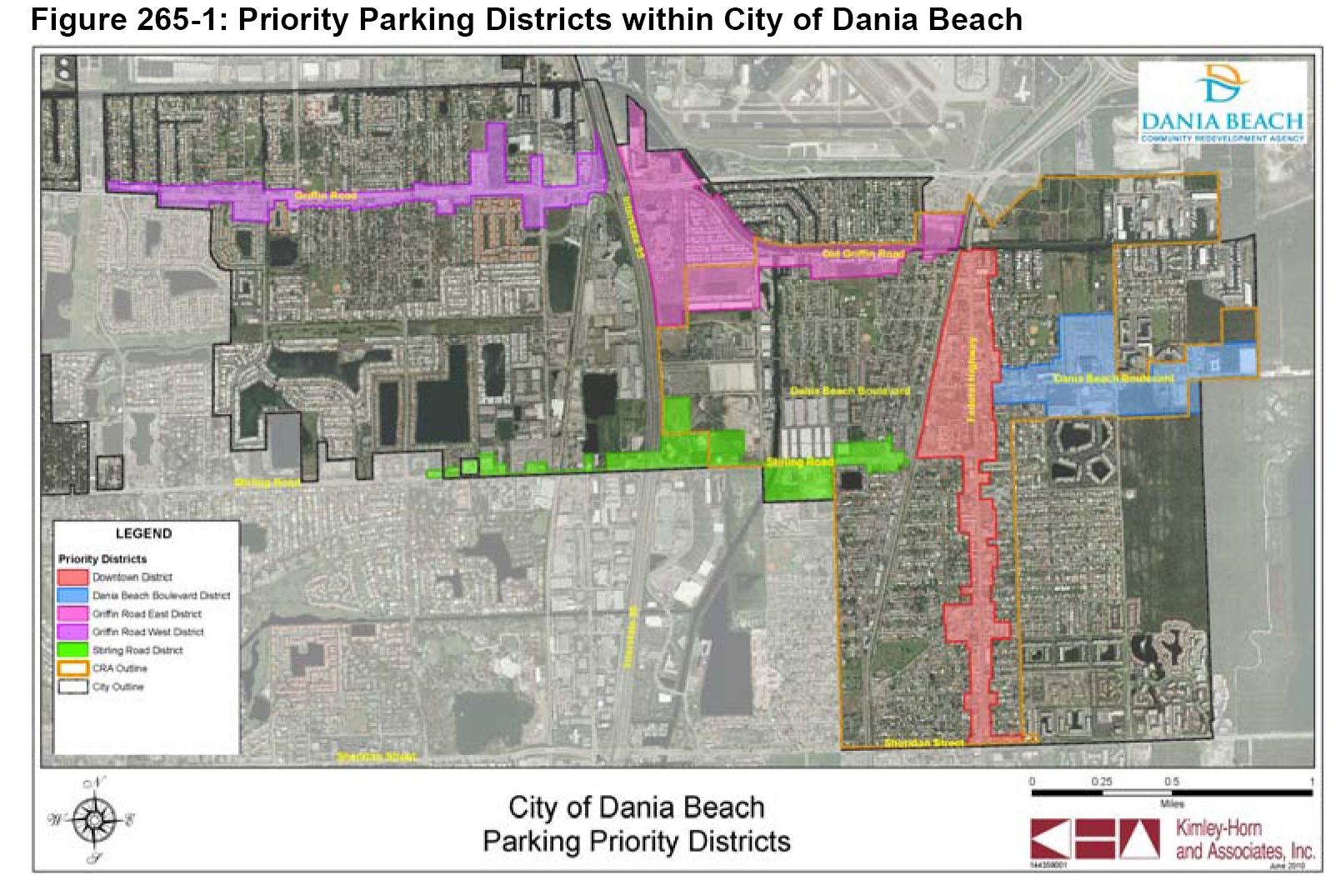
(I)
Joint venture agreements. An applicant may assure the provision of the required number of parking spaces within a facility developed through a joint venture agreement with the city or a private entity if the number of parking spaces needed to fulfill the applicant's parking requirements is specifically reserved for use solely by the applicant. An agreement addressing joint ventures to provide parking facilities shall be in a form approved by the city attorney. Agreements relating to city-owned parking facilities shall be approved by the city commission, and agreements relating to reservation of parking in privately-owned facilities shall be in accordance with section 265-80. All agreements pursuant to this section shall be recorded in the public records of Broward County, Florida, and shall run with the subject property in perpetuity.
(Ord. No. 2010-20, § 2(Exh. A), 9-14-10; Ord. No. 2012-008, § 7, 5-8-12; Ord. No. 2022-020, § 1, 5-24-22)
Sec. 265-100. - Design standards for residential parking spaces utilizing individual driveways or back-out parking.
(A)
Driveways and carports that meet the dimensional requirements of this provision may be counted as off-street parking spaces for detached single-family homes, duplexes and townhome units regardless of the need to move one (1) automobile in order to afford ingress and egress for another automobile.
(B)
No parking space shall be designed to permit back-out parking directly onto a public right-of-way or private street, other than a dedicated alley, except for single-family, two-family and townhouse dwellings with an individual driveway for each unit, as follows:
(1)
The back-out parking is on a roadway not classified as an arterial or collector roadway, as defined in the comprehensive plan;
(2)
A minimum five-foot-wide sidewalk is installed parallel to the street where the back-out parking is located. The sidewalk requirement may be wider than minimum if necessary for consistency with sidewalk improvements on adjacent properties, city capital improvement or redevelopment plans, special design standards established for a particular zoning district or part of such zoning district, or to meet engineering standards;
(3)
The back-out parking spaces must meet geometric, drainage and site clearance standards and such other standards determined to be necessary to provide adequate and safe parking as determined by the community development director; and
(4)
Within the CRA form-based zoning districts, the establishment of new front yard parking is prohibited, except as provided in section 303.90.
(C)
All off-street parking spaces shall be of smooth paved surface and in good repair in compliance with city codes. Where an off-street parking space is surfaced with gravel, the owner of such off-street parking spaces shall maintain the public right-of-way free from loose gravel. Section 265-170, nonconforming parking facilities, establishes conditions that require unpaved off-street parking facilities to be paved.
(D)
Driveways constructed with material other than concrete or asphalt must provide an engineered subsurface and be permitted and approved by the public services.
(E)
Residential driveways for single family and duplex may be composed of gravel (peat rock).
(Ord. No. 2010-20, § 2(Exh. A), 9-14-10; Ord. No. 2012-008, § 7, 5-8-12; Ord. No. 2015-024, § 6, 10-27-15; Ord. No. 2016-007, § 6, 3-22-16)
Sec. 265-110. - Design and construction standards for parking lots.
(A)
[Individual parking spaces.] Individual parking spaces shall not have direct access to a street, except as permitted in section 265-100, "Design standards for residential parking spaces utilizing individual driveways or back-out parking".
(B)
[Additional standards.] Construction and design standards not addressed in this article must conform to A Policy on Geometric Design of Highways and Streets, published by the American Association of State Highway and Transportation Officials ("AASHTO Geometric Highway Design") or a Manual of Uniform Traffic Control Devices, published by the U.S. Department of Transportation, Federal Highway Administration, as determined by the community development director.
(C)
Parking aisles.
(1)
Parking aisles shall be of adequate width to serve a particular design arrangement of parking spaces in accordance with the following table, and shall also comply with the minimum dimensions of the subsections following the table. Dimensions are for one (1) lane, one-way direction movement except for 90-degree parking, which may be two-way direction movement.
(2)
Two-way directional and two-lane, one-way directional movement require a minimum aisle of twenty-four (24) feet regardless of parking angle.
(3)
If a parking aisle requires access for emergency vehicles, garbage trucks or trucks moving to or from a loading area, that parking aisle shall be at least twenty-four (24) feet wide.
(4)
Parking stalls abutting the same continuous parking aisle shall have the same angle and orientation. Parking aisles less than twenty-four (24) feet wide and aisles abutting parking stalls with angles of less than ninety (90) degrees, shall be one-way only. Parking stall angles and parking aisle direction of flow may change only when the parking aisle is interrupted by a circulation drive, structure, or landscape median or similar feature.
(5)
All required parking stalls shall have direct and unobstructed access from a parking aisle.
(6)
When a row of parking stalls is immediately adjacent to a driveway, a minimum stacking area of twenty-five (25) feet is required between the property line and the entrance to the first stall.
(7)
Dead-end parking aisles are prohibited, except where a double-loaded dead-end aisle serves fewer than twenty-one (21) parking spaces and a turnaround area is provided that will accommodate a three-point turnaround, or where the number of parking spaces in the double-loaded dead-end aisle is ten (10) or fewer (AASHTO "P" Design Vehicle).
(D)
Circulation.
(1)
Vehicular circulation. A parking lot abutting a collector or arterial roadway shall be designed for full on-site circulation. A parking lot abutting any other street or alley may be designed for partial circulation. Parking facility design shall provide for a clearly defined vehicular circulation system, which allows free movement within the proposed site while discouraging excessive speed, and allows efficient and orderly circulation that minimizes congestion.
(2)
[Separation.] Pedestrian and vehicular circulation systems shall be adequately separated for pedestrian safety.
(3)
[Interconnection.] For nonresidential and mixed-use development on collector and arterial roadways, driveways, accessways and access aisles shall be interconnected with existing driveways, accessways, and access aisles in parking areas on abutting developed properties, and a cross-access easement shall be provided for this purpose. Where abutting properties are developed in such a manner that such interconnection is physically impossible, or where such connection would compromise safe and adequate circulation or cause an existing property to become nonconforming due to loss of parking or landscaped area, no connection shall be required.
(E)
Standard paving/composition. Except as provided in subsections (F) and (G), off-street parking facilities and spaces, including aisles and driveways, shall at a minimum be surfaced with at least one-inch-thick asphaltic cement on at least six-inch natural compacted limerock base course compacted to an average density not less than ninety-eight (98) percent of the maximum density obtainable under the test provided pursuant to engineering standard (AASHTO T-180) or an equivalent test. The minimum density that will be acceptable at any location within the base shall be ninety-six (96) percent of such maximum density and, in the determination of average density, the maximum density that shall be used in the calculation shall be one hundred two (102) percent. All pavement systems shall be maintained in a smooth, well-graded condition.
(F)
Pavers and alternate paving systems.
(1)
Brick or interlocking pavers may be utilized as parking and driveway facilities for residential-office district buildings, and for driveways and parking facilities serving individual single-family, duplex, triplex, and townhouse dwellings.
(2)
The public services director may approve use of pavers for other development types if vehicle traffic generation, vehicle user types and site characteristics support the use of pavers.
(3)
The public services director may approve other equivalent pavement systems that will support the intended use.
(G)
Grass parking surface. The following uses may utilize grass over a compacted subsurface as a parking and access aisle surface, subject to limitations listed below by use. The driveway connection to the public right-of-way must be paved. Grass parking surfaces shall consist of at least a six-inch course of natural limerock, surfaced with a species of grass acceptable for high-traffic use, over four (4) inches of topsoil. The public services director may approve other equivalent surfaces. The parking area shall have adequate drainage as required by this code. All requirements for landscaping vehicular use areas shall be met as well as all required interior-landscaping requirements for parking areas. Up to twenty-five (25) percent of the area devoted to grass parking may count toward satisfying required landscape area, pervious area and open space, based upon the porosity of the stabilization method.
(1)
For the following specified uses up to twenty-five (25) percent of the required off-street parking facilities may be provided through the utilization of a grass or lawn alternate parking surface:
(a)
Places of public assembly;
(b)
Private clubs;
(c)
Governmental;
(d)
Assisted living facilities, nursing homes.
(2)
Up to seventy-five (75) percent of the required off-street parking facilities may be provided through the utilization of a grass or lawn parking surface area for the following uses, based upon the projected frequency and degree of use set forth in the site plan application. The city may require paving of all or a portion of the parking facility should the frequency and degree of use projections prove to be inaccurate or should frequency and type of operations change.
(a)
Place of worship;
(b)
Funeral home, mortuary, cemetery;
(c)
Stadium or other sports arena;
(d)
Public recreational uses when use of the full parking lot is generally limited to three (3) days of the week or fewer;
(e)
Fire and police protection facilities.
(3)
The area of a parking space forward of the wheel stop or continuous curbing may be grassed, and applied towards the amount of required landscaped area, pervious area and open space.
(H)
Curbing, wheelstops.
(1)
Wheel stops, five and one-half (5 ½) inches high, shall be installed two (2) feet from the head (front) of a parking space.
(2)
The perimeter of a vehicular use area shall be constructed with a six-inch raised type "D" or "F" curb (nonextruded), which shall also be installed within interior vehicular use areas abutting landscape areas, walkways, sidewalks, streets, and alleys unless determined to be unnecessary by a finding that given the particular circumstances of the site, such curb can be eliminated in certain areas without creating safety hazards, damaging plant material, displacing topsoil and mulch, or otherwise having an undesirable impact or effect. The raised curb shall be constructed in such a manner as to facilitate proper drainage and prevent vehicles from crossing sidewalks or other pedestrian walkways other than by means of approved driveway approach.
(3)
Curbing shall be an acceptable substitute for wheelstops at the head (front) of a parking space when the parking space abuts a landscaped area.
(I)
Striping, signage and pavement markings.
(1)
[Requirements.] All off-street parking areas shall be so arranged and marked as to provide for orderly, safe loading, unloading, parking and storage of vehicles with individual parking stalls clearly defined with directional arrows and traffic signs provided as necessary for traffic control, including but not limited to, the clear demarcation of one-way traffic aisles or driveways.
(2)
Parking space designation. All required off-street parking spaces shall be clearly delineated by a single four-inch wide, white, painted striping wherever a hard-paved parking surface is required, except that striping shall not be required for:
(a)
Stacked parking, where permitted within residential driveways;
(b)
Brick-pavered parking surfaces, in which case wheel stops or alternating paver colors shall be substituted for striping in order to clearly delineate parking space boundaries.
(3)
Other striping. All other striping, excluding parking stalls, shall be installed with thermoplastic materials.
(4)
[Pavement markings.] Pavement markings for parking facilities shall be provided in conformance with the Manual on Uniform Traffic Control Devices, latest edition.
(5)
Identification of parking lots. All off-street parking areas required by this article shall be provided with identification as to purpose and location in the form of signage visible to vehicular traffic when such parking areas are not clearly evident from a street or alley. Signage shall comply with the requirements of article 505, Sign Regulations.
(J)
Drainage. All off-street parking facilities shall be drained so as not to cause any damage or nuisance on adjacent private or public property, including streets and alleys. Such drainage facilities shall be arranged for convenient access and safety of pedestrians and vehicles. On-site stormwater retention shall be provided in accordance with the requirements of the regulatory authority with jurisdiction over stormwater retention. Whenever the total pavement area in the swale area frontage on public right-of-way is fifty (50) percent or more of the total frontage on that public right-of-way, a French drain stormwater system in the swale area shall be constructed. When a licensed engineer can certify the adequacy of the existing storm drain facilities, the public services director may waive this requirement.
(K)
Storage lots for vehicles, boats and equipment. All open-air storage lots for vehicles, boats or trucks shall be surfaced with asphalt or concrete.
(L)
Maintenance.
(1)
Off-street parking areas shall be maintained in a clean, smooth and orderly condition, free of dust, trash and debris, at the expense of the owner or lessee.
(2)
Each owner electing the alternate parking surface as provided in subsection (F) shall maintain said surface in a healthy and viable condition, free of weeds, ruts, trash and debris.
(3)
The drainage system shall conform to approved grading and depth, with no obstructions within the system.
(4)
All painted lines, curbs, signs and markings shall be maintained in a legible, unfaded and uncracked condition.
(5)
The entire parking facility, including lighting, shall function to the standards under which permitted.
(M)
Lighting. Lighting shall be provided and maintained in accordance with article 280, Outdoor Lighting Standards.
(Ord. No. 2010-20, § 2(Exh. A), 9-14-10)
Sec. 265-120. - Attendant/valet parking.
(A)
[Valet parking.] Up to ten (10) percent of the required number of parking spaces for a use may be provided as valet parking by which attendants receive, park and deliver the automobile of occupants, tenants, customers and visitors, with or without charge. The required minimum width of each parking space shall be eight and one-half (8½) feet. All spaces need not be directly accessible provided that for any parking space to be accessible, no more than two (2) spaces may be crossed into when parking a motor vehicle.
(B)
[Identification of spaces.] The approved site plan and an agreement between the city and property owner(s) and approved by the city attorney, shall identify the number and location of parking spaces reserved for valet parking, and shall require that any use of the property for which valet parking is provided in order to satisfy the required number of parking spaces, shall cease immediately if for any reason the valet service is not provided at all times during the operation of the uses for which the parking is provided.
(C)
[Site plan.] The site plan shall delineate the drop-off area, valet podium, signage, and attendant-parking spaces, and provide an adequate number of stacking spaces for the drop-off area without blocking crosswalks or encroaching within rights-of-way.
(D)
[Restrictions.] The following limitations shall apply to all valet drop-off areas:
(1)
The loading and unloading of vehicles shall only occur in designed drop-off areas.
(2)
Vehicles in the drop-off area may not impede the travel of any emergency vehicles at any time.
(3)
Vehicles in drop-off areas may not block pedestrian crosswalks or accessibility ramps at any time.
(E)
Other requirements. The operator must possess a valid city local business tax receipt for a valet service. Each valet must be an employee of the operator and each must possess a valid State of Florida driver license. The operator shall have sufficient valets working at all times to avoid excessive stacking in the valet drop-off area. Excessive stacking shall exist when vehicles stacked for valet drop-off or pick-up extend into any drive aisle and impede the flow of routine traffic.
(F)
Revocation of permit. The community development director may revoke a valet parking permit if the operator violates any of the requirements of this section.
(G)
Valet parking service permit required. It shall be unlawful for any person to offer valet parking service or to designate any off-street parking spaces for valet parking unless a permit has been issued pursuant to this section.
(Ord. No. 2010-20, § 2(Exh. A), 9-14-10)
Sec. 265-130. - Parking in required yards.
(A)
Residential districts and uses. In E-1, RS-18000, RS-12000, RS-6000, RD-8000, R-M, RM-1, and RM-2 districts, parking for residential dwellings may be permitted in any required yard on driveways pursuant to section 265-100, and shall be counted as meeting off-street parking requirements, subject to compliance with the perimeter landscaping requirements [for multiple-family developments] in section 275-90.
(B)
Nonresidential districts and uses. In all nonresidential districts for all other permitted or approved special exception uses, parking may be permitted in any required yard and shall be counted as meeting off-street parking requirements, subject to compliance with the perimeter landscaping requirements in article 275.
(C)
RO District. Parking within required yards is permitted subject to landscaping requirement between the vehicular use area, and street and lot lines in section 275-90.
(D)
[Certain practices prohibited.] Nothing in this section shall be construed to allow parking on unimproved lots, or within a developed lot on any unimproved surface or surface not designed specifically for off-street parking, all of which are prohibited.
(Ord. No. 2010-20, § 2(Exh. A), 9-14-10)
Sec. 265-140. - Structured parking facilities.
Structured parking shall be considered an accessory use to a principal residential, commercial or industrial use, and is permitted as a principal use in certain zoning districts. Construction of structured parking facilities may be phased, when such phasing is approved by the city. Parking structures are subject to the following provisions that are supplemental to all other code requirements, provided that the city may approve for use third-party professionally accepted geometric standards.
(A)
Structured parking in the CRA form-based districts. See article 530 (Design Standards for Parking Structures) and the district regulations of article 303 (CRA Form-Based District Regulations) for liner building and screening requirements.
(B)
Intentionally left blank.
(C)
[Clearance.] The clearance between a parking space and a wall (excluding columns) or other solid obstruction shall be a minimum of two and one-half (2.5) feet.
(D)
[Ramps.] The maximum ramp grades for driveway access to above grade or below grade parking are twelve (12) percent for ramps not accessing parking spaces, six (6) percent for ramps accessing ninety (90) degree parking spaces, and five (5) percent ramps accessing angled parking spaces.
(E)
[Vertical clearance—Ground floor.] The ground floor vertical clearance shall be a minimum fourteen (14) feet when necessary to accommodate loading, sanitation, service, or emergency vehicle access.
(F)
[Vertical clearance—All other floors.] The vertical clearance for all other floors shall be a minimum seven (7) feet, two (2) inches.
(G)
[Facilities below grade.] Required off-street parking facilities may be located below grade within required yards, provided that the grade elevation of the yard does not exceed the elevation of any adjacent sidewalk or yards on adjacent properties as measured at the property line. There shall be no visible evidence of an underground use from a public street or sidewalk. Underground parking must provide a minimum setback of five (5) feet on all sides.
(H)
Automatic parking. Nothing in this section is intended to prohibit the installation of a fully automatic parking facility in which the placement and removal of automobiles are accomplished wholly by machinery.
(I)
Architectural standards and screening. See article 530.
(Ord. No. 2010-20, § 2(Exh. A), 9-14-10; Ord. No. 2015-002, § 5, 1-13-15; Ord. No. 2023-015, § 2, 9-13-23)
Sec. 265-150. - Design standards for surface parking lot and parking structure driveways.
On-site driveways that do not directly abut parking spaces shall be provided as follows:
(A)
For two-way travel. A minimum of twenty (20) feet in width shall be provided.
(B)
For one-way travel. A minimum of twelve (12) feet in width shall be provided.
(C)
[Driveway widths.] Every off-street parking facility shall have either driveway approaches of sufficient width to allow for two-way traffic, or one-way driveways connected to aisles, parking areas or maneuvering areas in such a manner as to permit traffic to both enter and leave the property, facing forward, at the same time. A driveway which is only wide enough for one-way traffic shall not be used for two-way access.
(D)
[Increase in widths.] For both one- and two-way driveways, required widths shall be increased if necessary to accommodate vehicle types that will utilize the driveways, or if the number of parking stalls connected or the number of trips generated justifies such an increase in width.
(E)
Minimum access width dimensions at the street.
(1)
Minimum (one-way). Fifteen (15) feet.
(2)
Minimum (two-way). Twenty-five (25) feet.
(3)
Maximum. Thirty-five (35) feet, unless otherwise required under subsection (D), above.
(Ord. No. 2010-20, § 2(Exh. A), 9-14-10)
Sec. 265-160. - Separation requirements applicable to all driveways.
(A)
No part of any driveway shall be located closer than eighty (80) feet from any intersection of collector or arterial streets.
(B)
The minimum distance between any two (2) driveways shall be fifty (50) feet on collector streets, and seventy-five (75) feet on arterial streets. The Florida Department of Transportation has jurisdiction over driveway locations on state roads.
(C)
The distance separation shall be measured from the point of intersection of two street lines, or the extensions of such street lines (see Figure 265-2), to the closest point at which the driveway intersects with a street line.
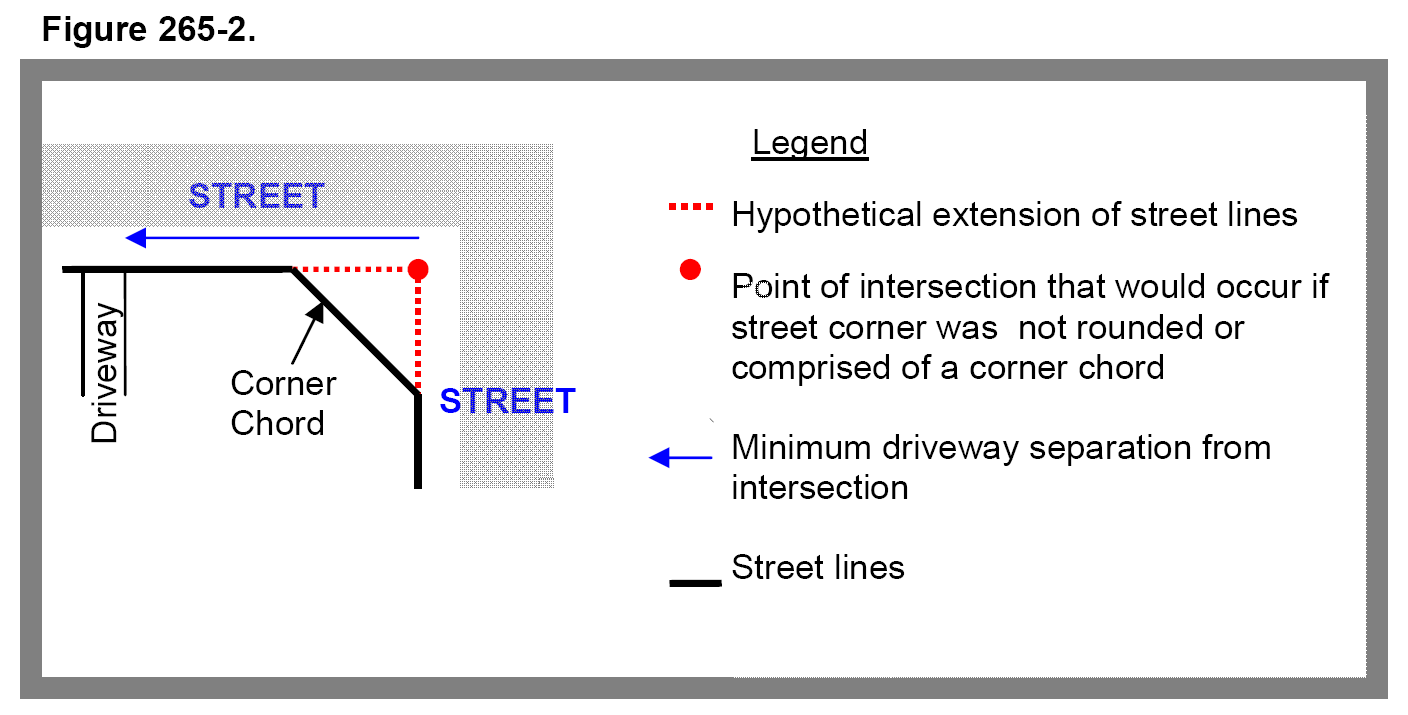
(Ord. No. 2010-20, § 2(Exh. A), 9-14-10; Ord. No. 2017-005, § 4, 2-28-17)
Sec. 265-170. - Nonconforming parking facilities.
(A)
[Additional floor area.] Whenever a building or use is changed or enlarged in floor area, number of dwelling or rental sleeping units, seating capacity or otherwise, to create a requirement for an increase in the number of off-street parking spaces provided, off-street parking spaces as specified in this article shall be provided for the additional floor area, dwelling units or capacity, except that when such change in use or increase in area or density would result in a requirement for more than a fifty (50) percent increase in parking spaces to the existing off-street parking facilities, the entire premises shall be brought into full compliance with the requirements of this article as a condition of the issuance of any site plan approval, permit or license required for the change in use or enlargement.
(B)
Cessation of nonconforming parking. Failure to utilize a use, building, or structure that is nonconforming with respect to required parking for a period of six (6) months (except where governmental action impedes access to the premises), or a change of use to a more restricted or conforming use for any period of time, shall be considered cessation of the nonconformity and such nonconformity shall not thereafter be revived.
(C)
[Gravel surfacing.] Off-street parking facilities surfaced with gravel in existence prior to the enactment of Ordinance No. 29-90 on July 10, 1990, may remain, unless any of the following occur, in which case the parking facility shall fully comply with the construction standards of this article:
(1)
The property owner is found to be in violation of this section by failing to maintain the adjacent public right-of-way free from loose gravel; or
(2)
The city determines that fifty (50) percent or more of a nonconforming driveway or vehicular area surface has degraded to missing rock/gravel or weeds or overgrowth overtaking the nonconforming parking area, the driveway or other vehicular use area must come into compliance with section 265-100; or
(3)
Any substantial improvement is made to the property, as defined in section 725-30, or any structure or addition to a structure is constructed or placed upon the property, with the exception of a utility shed of less than one hundred twenty (120) square feet and a fence with no masonry component (i.e. columns).
(Ord. No. 2010-20, § 2(Exh. A), 9-14-10)
Sec. 265-180. - Parking of commercial vehicles and recreational vehicles.
The parking of commercial vehicles and recreational vehicles within residential zoning districts is regulated in sections 105-110, 105-120, 105-130 and 105-140. Recreational vehicles and commercial vehicles are defined in section 725-30 (Definitions).
(Ord. No. 2010-20, § 2(Exh. A), 9-14-10)
Sec. 265-185. - Electric vehicle charging stations and parking spaces—Purpose.
The purpose of this section is to provide effective electric vehicle charging abilities throughout the city. Where any other provisions of the City of Dania Beach Code of Ordinances directly conflict with the regulation of electric vehicles (sections 265-185 through 265-189) the regulation of electric vehicles shall be controlled. All operations of electric vehicle charging stations shall comply with applicable federal, state, and local laws, rules, and regulations. As electric vehicle technology continues to evolve, the city's community development director, or his/her designee will review new systems and other adaptations, as may be required.
(Ord. No. 2024-017, § 2, 4-9-24)
Sec. 265-186. - Same—Definitions.
(A)
Electric vehicle. Abbreviated as (EV).
(B)
Electric vehicle charging station (EVCS) or charging station means an electric vehicle supply equipment station in a private or public parking space that delivers electricity or transfers electric energy to a battery or other energy storage device in an electric vehicle and is classified based on the following levels:
(1)
Level 1 operates on a 15- to 20-amp breaker on a 120-volt AC circuit. Level 1 Electric Vehicle Supply Equipment (EVSE) is found in common low-density residential single-family or duplex homes. On average it takes level 1 charger 40—50+ hours to fully charge a battery electric vehicle (BEV) and 5—6 hours to charge a plug-in hybrid electric vehicle (PHEV).
(2)
Level 2 operates on a 40- to 100-amp breaker on a 208- or 240-volt AC circuit. Level 2 chargers offer a faster rate of charging and are common in homes, workplaces, and public parking lots. Level 2 chargers can charge a BEV in 5—10 hours and a PHEV in 1—2 hours.
(3)
Level 3 operates on a 60-amp or higher breaker on a 480-volt or higher three-phase circuit with special grounding equipment. Level 3 operates on a direct current as opposed to an alternating current and offers the fastest charging capabilities. With BEV's being charged in 20 minutes to one hour. PHEVs currently cannot be charged by Level 3 chargers.
(C)
Operator means the auto manufacturer representative of an auto manufacturer, representative of an auto manufacturer, developer, shopping center property management company, free-standing building owner, or lessee, responsible for the installation, management, and operation of electric vehicle service and charging stations.
(Ord. No. 2024-017, § 2, 4-9-24)
Sec. 265-187. - Same—Applicability.
(A)
The requirements relating to electric vehicles and electric vehicle charging stations shall apply to new development, redevelopment, infill development or substantial enlargement and/or alteration of structures requiring a public hearing. Only new parking spaces added as part of a substantial enlargement or alteration are subject to the requirements of these regulations relating to electric vehicles and electric vehicle charging stations.
(B)
Electric vehicle charging stations may be located within new or existing enclosed parking garages or within new or existing surface parking areas.
(C)
Operators of electric vehicle charging stations must apply for a business tax receipt in compliance with City Code chapter 15, unless restricted for private use to employees at no cost to the employee, or if the charging station is located at an owner-occupied single-family residential property. All operators of electric vehicle charging stations are required to obtain a building permit for the installation and operation of the charging station.
(D)
Electric vehicle charging stations will be considered an accessory and an amenity use when the service is offered free of charge. Amenity-use electric vehicle charging stations are permitted within all residential, non-residential, and mixed-use zoning districts.
(E)
For the purposes of minimum parking space calculations, electric vehicle spaces shall count towards meeting a maximum of ten (10) percent of the minimum parking requirements, rounded down. This shall not apply to freestanding single-family structure.
(Ord. No. 2024-017, § 2, 4-9-24)
Sec. 265-188. - Same—General requirements.
(A)
Electric vehicle parking spaces shall meet all performance standards of this subsection.
(B)
Electrical vehicle supply equipment (EVSE) will be located in parking spaces clearly marked for EV charging and shall be installed per the requirements of the current National Electrical Code, as adopted and amended by the State of Florida.
(C)
Where parking is the primary use of the property, electric vehicles charging stations shall be permitted. For all other uses, electric vehicle charging shall be deemed accessory to the primary use.
(D)
Accessory use electric vehicle charging station parking spaces shall be specifically designated for charging an electric vehicle with a sign referencing F.S. § 366.94(3)(a), as may be amended. One exclusive use parking space, per charging station shall be required adjacent to each charging unit. Under F.S. § 366.94(3)(a), it is unlawful for a person to stop, stand, or park a vehicle that is not capable of using an electrical recharging station within any parking space specifically designated as an electric vehicle charging stations.
(Ord. No. 2024-017, § 2, 4-9-24)
Sec. 265-189. - Same—Electric vehicle charging station minimum requirements.
(A)
Electric vehicle charging station as an amenity use—Levels 1 and 2.
(1)
Levels 1 and 2 electric vehicle charging stations will be considered an amenity use when the service is offered free of charge and shall be subject to the following requirements:
(a)
Permitted in all zoning districts.
(b)
An electric vehicle charging station sign shall be posted at the electric vehicle charging station stating, "Electric Vehicle Charging Station." Signs shall be no less than twenty-four (24) inches wide by eighteen (18) inches high. Color and letter size specifications shall meet the Manual on Uniform Traffic Control Devices (MUTCD) requirements for sign designation (electric vehicle charging). Single-family and duplex stations are not required to meet the MUTCD standards.
(c)
All equipment components, including but not limited to functioning, shall be maintained at all times.
(d)
Current contact information, including but not limited to a telephone number for a representative or department of the operator of the charging station shall be posted on each station as a contact to report all issues relating to the particular station.
(B)
Electric vehicle charging station as an accessory use—Levels 2 and 3.
(1)
Electric vehicle charging stations will be considered an accessory use when there is a monetary transaction or subscription associated with the service.
(2)
Levels 2 and 3 electric vehicle charging stations shall be permitted to classify as an accessory use and shall be subject to the following requirements:
(a)
Are permitted in all zones.
(b)
An electric vehicle charging station sign shall be posted at the electric vehicle charging station stating, "Electric Vehicle Charging Station." Signs shall be no less than twenty-four (24) inches wide by eighteen (18) inches high. Color and letter size specifications shall meet the Manual on Uniform Traffic Control Devices (MUTCD) requirements for sign designation (electric vehicle charging). Single-family and duplex stations are not required to meet the MUTCD standards.
(c)
Accessory use of electric vehicle charging stations shall be permitted based on the availability of surplus parking.
(d)
EVSE must be concealed from the road right-of-way by landscape or other means and may be permitted in landscape and utility buffers, subject to prior approval of city staff.
(e)
All equipment components, including but not limited to functioning shall be maintained at all times.
(f)
Current contact information, including but not limited to a telephone number for a representative or department of the operator of the charging station shall be posted on each station as a contact to report all issues relating to the particular station.
(C)
Electric vehicle service stations as a principal use—Level 3.
(1)
Electric vehicle service stations shall be the principal use which shall include but is not limited to the following services: Charging, repair, retail, and maintenance.
(a)
Permitted operations including charging stations with an output of greater than or equal to four hundred eighty (480) volts, lithium-ion car battery replacement, and electric vehicle maintenance.
(b)
Operators of electric vehicle charging stations must apply for a business tax receipt in compliance with chapter 15 of the City Code of Ordinances.
(c)
All equipment components, including but not limited to functioning shall be maintained at all times.
(d)
All principal operators must have a Lithium-ion battery fire safety plan during the routine annual inspection.
(e)
An electric vehicle charging station sign shall be posted at the electric vehicle charging station stating, "Electric Vehicle Charging Station." Signs shall be no less than twenty-four (24) inches wide by eighteen (18) inches high. Color and letter size specifications shall meet the Manual on Uniform Traffic Control Devices (MUTCD) requirements for sign designation (electric vehicle charging). Single-family and duplex stations are not required to meet the MUTCD standards.
(Ord. No. 2024-017, § 2, 4-9-24)
Sec. 265-190. - Same—Location.
(1)
Placement or installation of electric vehicle charging equipment must be identified during the site plan approval process.
(2)
EVs charging stations shall not interfere with vehicle, bicycle or pedestrian access and circulation, or with required landscaping, above ground or underground infrastructure.
(3)
EV charging stations shall not be located within dedicated drainage or utility easements.
(4)
EV charging stations for single-family locations shall not be permitted in the front of the building.
(Ord. No. 2024-017, § 2, 4-9-24)
Sec. 265-191. - Same—Design standards.
(1)
Charging equipment must be mounted on the wall or on a structure at the end of the electric vehicle parking space provided.
(2)
Charging devices may not be placed within the dimensions of a space or entrance to a space. Electric vehicle parking spaces for non-single family residential use shall be marked by green lines, symbols, or curbs.
(3)
When cords and connectors are not in use, retraction devices and locations for storage shall be located sufficiently above the pedestrian surface and the parking lot to reduce conflicts with pedestrians and vehicle maneuvering.
(4)
Cords, cables, and connector equipment shall not extend across the path of travel in any sidewalk or walkway.
(5)
Equipment mounted on structures such as pedestals, lighting posts, bollards, or other protective devices shall be located in a manner that does not impede pedestrian, bicycle, or transit travel.
(6)
For EV charging stations installed on surface parking lots, all cabinets, switchgear and other transmission equipment (other than charging posts or connectors) related to the station shall be completely enclosed. For EV charging stations installed in enclosed parking garages, all equipment (other than charging posts or connectors) related to the station shall have safety screens around the equipment.
(7)
EV charging stations in residential and mixed-use zoned areas shall be constructed in a manner harmonious with surrounding aesthetics.
(8)
Additional landscape screening may be required for mechanical equipment such as transformers associated with charging equipment, consistent with mechanical equipment screening requirements and the current edition of the Florida Building Code.
(Ord. No. 2024-017, § 2, 4-9-24)
Sec. 270-10.- Loading space definition; dimensional requirement.
For the purpose of these regulations, a loading space is a space on the same lot of a principal building, logically and conveniently located for bulk pickups and deliveries. A loading space shall be six (6) feet in length greater than the largest vehicle expected to be accommodated, but not smaller than twelve (12) feet in width and twenty-five (25) feet in length, with fourteen (14) feet of minimum vertical clearance. Within the CRA form-based districts, an on-street loading space shall count toward the required off-street loading space requirement if the on-street space is located within three hundred (300) feet of an entrance to an establishment, measured along the sidewalk route from the loading space to the entrance. On-street and shared off-street loading spaces within the CRA form-based districts shall have a minimum length of forty (40) feet.
(Ord. No. 2010-20, § 2(Exh. A), 9-14-10)
Sec. 270-20. - Off-street loading required.
Except as otherwise provided in this article, when any nonresidential building or structure having a gross floor area of four thousand (4,000) square feet or more is erected, structurally altered to the extent of increasing the floor area by fifty (50) percent or more, or converted in use, accessory off-street loading spaces shall be provided in accordance with the following schedule. Within the CRA form-based districts, the community development director may waive the off-street loading area requirements for lots that front streets with on-street loading spaces, or where off-street loading spaces may be shared with an abutting property.
(A)
For each commercial building, warehouse, manufacturing or industrial establishment, or similar use, this has an aggregate floor area in square feet of:
4,000—25,000 sq. ft. .....1 space
25,001—40,000 sq. ft. .....2 spaces
40,001—60,000 sq. ft. .....3 spaces
For each additional 25,000 sq. ft. .....1 space
(B)
For each hotel without catering facilities, and with meeting facilities seating one hundred (100) or fewer persons, one (1) loading space is required. The loading space may be accommodated within space also used for other functions, provided that it shall not impede access to any parking space or obstruct on-site circulation of vehicular traffic.
(C)
For each hotel with catering and meeting facilities seating more than one hundred (100) persons, office building, hospital and similar institution, place of public assembly or similar use, which has an aggregate floor area in square feet of:
(1)
Over 5,000 but not over 10,000 .....1 space
(2)
Over 10,000 but not over 100,000 .....2 spaces
(3)
Over 100,000 but not over 200,000 .....3 spaces
Plus
(4)
For each additional 100,000 over 200,000 .....1
additional space
(Ord. No. 2010-20, § 2(Exh. A), 9-14-10)
Sec. 270-30. - Interpretation of off-street loading requirements.
(A)
The loading space requirements apply to all districts.
(B)
The loading requirements in this section shall be the minimum requirements. Additional requirements for provision of off-street loading may be imposed in connection with special exceptions.
(Ord. No. 2010-20, § 2(Exh. A), 9-14-10)
Sec. 270-40. - Alternate loading zone standards.
(A)
The genesis of this section is the city's recognition that the minimum loading zone requirements of this article, in certain circumstances, may result in excess provision of loading zones. Excess loading zone area results in the inefficient use of land at the expense of additional landscaped area, civic space, or building area and subsequent tax revenue and employment. Requests under this section shall be based strictly upon the criteria of this section, and shall not be based upon hardship, which is the purview of the variance process, nor inconvenience or cost.
(B)
An applicant for a development order or permit may propose an alternate loading zone standard based upon documentation that the proposed standard is a more accurate standard than the loading requirements of this article.
(C)
Acceptable documentation includes applicable studies, demonstration of the successful use of the standard by similar development projects, or unique characteristics of the proposed use, which may include its location, operation or other characteristics that warrant a reduced loading zone requirement.
(D)
City commission review and approval shall be governed by the site plan approval process of article 635.
(Ord. No. 2010-20, § 2(Exh. A), 9-14-10)
Sec. 270-50. - Design standards.
(A)
Location and access. Loading spaces shall be directly accessible from a street or alley without crossing or entering any other off-street loading space required by this article, or any required off-street parking space, except as otherwise provided in this article. It shall be arranged for convenient and safe ingress and egress by delivery vehicles, both motor truck, and truck and trailer combination. The city commission may allow loading spaces to be collocated with other site functions, and not separately designated, if the potential disruption to other site functions is minimal (example: a hotel that utilizes its registration/valet vehicle stacking area for infrequent deliveries during off-peak registration and check-out hours, involving small-to-medium sized trucks).
(B)
Screening. The loading space(s) shall be screened from the street or public way unless the screening requirement is specifically waived by the city commission. In no event shall loading areas be provided such that vehicles are required to back out onto a public street right-of-way.
(C)
Drainage and maintenance. Drainage for off-street loading facilities shall be designed to prevent damage to abutting property and public streets and alleys, and surfaced with erosion-resistant material in accordance with applicable city specifications. Off-street loading areas shall be maintained in a clean, orderly and dust-free condition at the expense of the owner, or lessee and not used for the sale, repair, dismantling or servicing of any vehicles, equipment, materials or supplies.
(D)
Entrances and exits. Location and design of entrances and exits shall be in accordance with all applicable traffic regulations and standards. Where the entrance or exit of a building is designed for truck loading and unloading, such entrance or exit shall be designed to provide at least one off-street loading space.
(Ord. No. 2010-20, § 2(Exh. A), 9-14-10)
Sec. 270-60. - Construction standards.
Off-street loading spaces shall be constructed to the standards set forth in section 265-110 (Parking facility design and construction standards).
(Ord. No. 2010-20, § 2(Exh. A), 9-14-10)
Sec. 275-10.- Declaration of legislative intent; applicability.
(A)
The intent of these regulations is to enhance the natural environment and beauty of the city by providing for landscaped green spaces, trees and other plant material and arranging them in a pleasing manner in relationship to paved areas and structures, and to encourage implementation of Florida Friendly Landscaping principles as identified by the South Florida Water Management District and as provided by Florida Statutes.
(B)
This article applies to all developed properties and those undergoing development, except as otherwise provided for vacant residential properties.
(C)
Several requirements of this article are modified or inapplicable to most of the CRA form-based zoning districts, because of the unique building placement and intensity standards of such districts. In all such cases, the modification or exemption applies only to lots that are developed or redeveloped in compliance with the standards and requirements of the CRA form-based district regulations in part 3 of this code. All other lots within the CRA form-based districts are fully subject to the requirements of this article.
(Ord. No. 2010-20, § 2(Exh. A), 9-14-10)
Sec. 275-20. - Definitions.
The definitions for this article are contained in section 825-50, "Tree preservation".
(Ord. No. 2010-20, § 2(Exh. A), 9-14-10)
Sec. 275-30. - Landscape manual.
Landscaping required per the provisions of this article shall conform with the specifications set forth in the City of Dania Beach Landscape Technical Manual. This manual is maintained as a separate document from this code and is available in the community development department. Failure to conform with these specifications shall be a violation of these regulations.
(Ord. No. 2010-20, § 2(Exh. A), 9-14-10)
Sec. 275-40. - Planting prohibited.
Plants identified as category I invasive species per section 825-50 (Definitions) are prohibited from being planted within the city limits of the City of Dania Beach. The community development director may further designate species prohibited for planting within the city based on hurricane resistance, health, maintenance needs or similar justifications.
(Ord. No. 2010-20, § 2(Exh. A), 9-14-10)
Sec. 275-50. - Reserved.
Editor's note— Ord. No. 2017-022, § 7, adopted July 25, 2017, repealed § 275-50, which pertained to existing nonconforming vehicular use areas. See Code Comparative Table for complete derivation.
Sec. 275-60. - Native plant material.
A minimum of fifty (50) percent of all vegetation required by this article, excluding turfgrass and groundcover, shall be indigenous to South Florida and meet the definition of native species as defined in section 825-50 (Definitions). The native percentage shall be calculated separately for shrubs and trees such that quantity of native plants for each shall not count towards the minimum requirement for the other.
(Ord. No. 2010-20, § 2(Exh. A), 9-14-10)
Sec. 275-70. - Variance.
In cases where strict application of this article cannot be met due to extenuating circumstances, the applicant may petition the city commission for a variance subject to the procedures and requirements of article 620 or article 625, as applicable.
(Ord. No. 2010-20, § 2(Exh. A), 9-14-10)
Sec. 275-80. - Landscape plans required.
A landscape plan shall be submitted with the site plan for consideration by the planning and zoning board and the city commission. The landscape plan shall be signed and sealed by a Florida registered landscape architect, shall conform to the guidance provided in the City of Dania Beach Landscape Technical Manual and shall at a minimum contain the following:
(A)
Minimum scale equivalent to the site plan.
(B)
Existing trees with a unique number assigned to each tree.
(C)
A tree survey table with the following information listed by tree number corresponding to the numbered existing trees on the plan view:
(1)
Common and scientific species name;
(2)
Diameter at breast height in accordance with the definition in section 825-50;
(3)
Canopy cover in square feet;
(4)
Tree condition;
(5)
Proposed disposition (remain, relocate or remove);
(6)
Dollar value of specimen trees calculated in accordance with section 825-140 of the Dania Beach [Land Development] Code.
(D)
Existing trees and shrubs and site improvements on abutting properties within twenty-five (25) feet of the property lines. This information may be obtained from aerial photographs and approximate locations based on field visits.
(E)
The location and outline of proposed buildings and site improvements including landscaping, paving, utilities, rights-of-way and final elevations. Proposed landscape trees and shrubs should be shown according to approximate size after five (5) years of growth following installation.
(F)
Existing site improvements to remain including buildings, paving, utility rights-of-way and elevations.
(G)
A table of data indicating required quantities and provided quantities of proposed.
(H)
Plant material listed according to corresponding code requirement, gross and net acreage, number of trees to remain, number of trees to be relocated, number of trees to be removed and square footage of vehicular use areas.
(I)
Proposed plant materials by botanical and common names, sizes, and spacing.
(J)
Site lighting locations.
(K)
Existing and proposed water bodies or retention ponds.
(L)
Planting details and planting specifications.
(M)
Irrigation plan containing the following:
(1)
A scale of one (1) inch equaling a maximum of thirty (30) feet;
(2)
Location of existing and proposed trees, vegetation and ecological communities, if applicable;
(a)
Location of existing building, paving and site improvements to remain;
(b)
Location of proposed buildings, paving, site improvements and water bodies;
(c)
Water main location, size and specifications;
(d)
Valve location, size and specifications;
(e)
Pump location, size and specifications and water source;
(f)
Backflow prevention device type and specifications;
(g)
Zone layout plan (minimum scale one (1) inch equals a maximum of twenty (20) feet), which is at least 60 percent complete, indicating sprinkler head types with location and coverage range, specifications and spacing of heads, and whether manual or automatic irrigation controls will be used. The plan shall indicate the water source (canal, greywater, etc.) and methods used to comply with Florida Friendly landscape principles including rain sensing devices, use of nonpotable water where available, minimization of application to impervious areas and placement of irrigation zones according to landscape needs, as required by F.S. § 125.568.
(N)
Visual depiction and delineation of the areas on the site attributed towards each applicable requirement of this article.
(O)
Such other information that may be required to give a complete understanding of the proposed plan including methods for preserving existing trees to remain, and a graphic rendering of the proposed landscaping.
(Ord. No. 2010-20, § 2(Exh. A), 9-14-10; Ord. No. 2013-004, § 6, 6-25-13)
Sec. 275-90. - Perimeter buffer landscape requirements for vehicular use areas (VUAs).
(A)
Generally. In order to improve the appearance of VUAs and to protect and preserve the appearance, character and value of the surrounding neighborhoods, and promote the general welfare by providing for installation and maintenance of landscaping, screening and aesthetic qualities, the following standards are established. This section is applicable to all VUAs, except underground or building enclosed use areas and parking areas serving individual single- and two-family homes.
(B)
Multifamily residential developments.
(1)
Required landscaping adjacent to public rights-of-way. On the site of a building or open lot use providing a VUA, where such area will not be entirely screened visually by an intervening building or structure from any abutting street right-of-way, there shall be provided landscaping between such area and such abutting right-of-way or property as follows:
(a)
A strip of land at least ten (10) feet in depth located between the abutting right-of-way and the VUA shall be landscaped. The required landscaping shall include one (1) tree for each thirty (30) linear feet or fraction thereof as measured along such abutting right-of-way.
(b)
Such trees shall be located between the abutting right-of-way and VUA, arranged to best enhance the property. In addition, a continuous hedge, wall or other durable landscape barrier shall be placed at no closer to the VUA than five (5) feet and shall be maintained at three (3) feet minimum height (after establishment) but not higher than six (6) feet above the adjacent VUA and the abutting property.
(2)
Required landscaping adjacent to abutting property. A strip of land a minimum of five (5) feet in depth located between the abutting property and the vehicular use area shall be landscaped. This paragraph does not apply in the following CRA form-based zoning districts: CC, SFED-MU, EDBB-MU, NBHD-MU. The required landscaping shall include one (1) tree for each forty (40) linear feet or fraction thereof as measured along said abutting property. Such tree shall be located between the abutting property and the VUA, arranged to best enhance the property. In addition, a continuous hedge, wall or other durable landscape barrier shall be placed no closer to the VUA than five (5) feet and shall be maintained at three (3) feet minimum height, but not higher than six (6) feet above the adjacent VUA and the abutting property, provided a wall is not required in the following CRA form-based zoning districts: CC, SFED-MU, EDBB-MU, NBHD-MU.
If such durable landscape barrier is of nonliving material, one (1) shrub or vine shall be planted along both sides of the nonliving material at the rate of one (1) plant for each four (4) feet arranged to best enhance the property. The remainder of the required landscape area shall be landscaped with turf, ground cover or other landscaping excluding pavement. This buffer shall not be counted toward meeting the requirements of section 275-100 of this article.
(3)
Landscaping required between multiple-family dwellings and driveways. This paragraph does not apply to the CRA form-based zoning districts.
(a)
A minimum of twenty-five (25) feet of landscaped area shall be provided between any driveway or parking lot and the front of any building.
(b)
A minimum of ten (10) feet of landscaped area shall be provided between any driveway or parking lot and the side or rear of any building, except where the story at ground level is used for other than residential occupancy.
(c)
In the case of an enclosed garage or carport provided as a portion of the main structure, distance requirements for driveways providing access to these accommodations shall not apply.
(C)
Business, commercial and industrial properties. On the site of a building or open lot use providing a vehicular use area, where such area will not be entirely screened visually by an intervening building or structure from any abutting right-of-way or adjacent property, there shall be provided landscaping between such area and such abutting right-of-way or property as follows:
(a)
A strip of land a minimum of five (5) feet in depth located between the abutting property and the VUA shall be landscaped.
(b)
The required landscaping shall include one (1) tree for each forty (40) linear feet or fraction thereof as measured along said abutting right-of-way or property. Such tree shall be located between the abutting right-of-way or property and the VUA, arranged to best enhance the property.
(c)
In addition, a continuous hedge, wall or other durable landscape barrier shall be placed no closer to the VUA than five (5) feet and shall be maintained at three (3) feet minimum height, but not higher than five (5) feet above the adjacent VUA and the abutting property.
(d)
If such durable landscape barrier is of nonliving material, one (1) shrub or vine shall be planted along both sides of the nonliving material at the rate of one (1) plant for each four (4) feet arranged to best enhance the property. The remainder of the required landscape area shall be landscaped with turf, ground cover or other landscaping excluding pavement. This buffer shall not be counted toward meeting the requirements of section 275-100.
(D)
Residential-Office District (RO). Sodded landscape strips shall be provided around the perimeter of vehicular use areas in the RO District as follows: ten (10) feet adjacent to street lines, five (5) feet adjacent to interior side lot line, ten (10) feet adjacent to a rear lot line, and ten (10) feet adjacent to an alley.
(E)
Accessways through landscaping. Necessary accessways from the public right-of-way through vehicular use area landscaping shall be permitted to service the vehicular use and pedestrian areas. Such accessways shall not be subtracted from the linear dimensions used to determine the quantity of plant materials required.
(Ord. No. 2010-20, § 2(Exh. A), 9-14-10; Ord. No. 2013-004, § 6, 6-25-13; Ord. No. 0222-004, § 1, 1-11-22)
Sec. 275-100. - Interior landscape requirements for vehicular use areas (VUAs).
(A)
Applicability. This section applies to all VUAs except as follows:
(1)
Parking facilities containing fewer than twenty-four (24) parking spaces in the CC, SFED-MU, EDBB-MU, NBHD-RES, and NBHD-MU CRA form-based zoning districts, and parking facilities containing fewer than twelve (12) parking spaces in all other districts. All requirements of this section shall be reduced by one-half (½) in the CC, SFED-MU, EDBB-MU, NBHD-RES, and NBHD-MU CRA form-based districts, except that surface parking lots as a principal use shall be subject to the full requirements unless otherwise specified;
(2)
Special vehicular use areas that are not open to the general public for automobile parking, such as storage areas for new, used or rental motor vehicles, watercraft, trailers, or construction equipment, bus bays in bus terminals, and trucking terminals; and
(3)
Parking structures.
(B)
Overall VUA landscape requirement. An area, or combinations of areas, equal to twenty (20) percent of the total vehicular use area exclusive of perimeter landscape buffers required under section 275-90 shall be devoted to interior vehicular use area landscaping. In no case shall a parking stall be further than sixty-five (65) feet from a tree, measured from the tree trunk. All landscape areas within the vehicular use area or abutting landscape areas shall be protected from vehicular encroachment through appropriate wheel stops or curbs. Wheel stops shall be located a minimum of two (2) feet from the required landscape area.
(C)
Intermediate landscape peninsulas.
(1)
There shall be no more than twelve (12) parking stalls along the same parking aisle without an eight-foot-wide by fifteen-foot-long intermediate landscape peninsula (exclusive of curb dimensions). Each peninsula shall have a minimum of two (2) category 2 or category 3 trees, or a minimum of one (1) category 1 tree, provided that the peninsula width is increased to ten (10) feet.
(2)
Intermediate peninsulas may be spaced to allow up to twenty (20) parking stalls between them along the same parking aisle when a minimum width of ten (10) feet plus one (1) foot for every extra parking space over fifteen (15) is added to one (1) of the adjacent islands in the row. These islands must contain a minimum of two (2) category 1 trees.
(3)
Intermediate peninsulas are not required for head-to-head parking rows or parking rows abutting buildings when separated by a landscape area a minimum of fifteen feet in depth and planted with a minimum of one (1) category 1 tree per twelve (12) parking stalls.
(4)
Parking stalls utilizing pervious pavers with a vegetative cover may be counted as three-fourths (¾) of a parking space for calculations for this subsection.
(D)
Terminal landscape peninsulas. Terminal landscape peninsulas shall be ten (10) feet wide and as long as the required length of the parking stall in that aisle (exclusive of curb dimensions). Each peninsula shall have a minimum of two (2) category 1 trees.
(E)
Vehicular use landscape areas abutting buildings.
(1)
Requirements for site plans not within CRA-form-based districts. A landscaped area having a minimum width of five (5) feet, or the equivalent square footage, shall separate the VUA from the walls of a single story building. The minimum landscaped area width shall increase by five (5) feet for each additional story up to a maximum landscaped area of twenty-five (25) feet. If the site constraints and configuration limit the ability to provide the required dimensions adjacent to the building, a minimum five (5) feet of landscaping, or the equivalent square footage, must be provided adjacent to the building, and the additional required square footage not provided adjacent to the building must be added to the perimeter landscape buffer of the site.
(2)
Requirements for site plans within CRA-form-based districts. Within the CRA form-based districts, the minimum width of the landscaped VUA buffer area shall remain five (5) feet regardless of the number of stories. The landscape area shall be designed to accommodate pedestrian access. This requirement shall not apply to openings into garages, carports, loading docks, or pool decks. At a minimum, an amount equal to five (5) feet of landscaping, or the equivalent square footage, must be provided adjacent to the building, and the additional required square footage not provided adjacent to the building must be added to the perimeter landscape buffer of the site.
(F)
Other vehicular use landscape areas. All other interior vehicular landscape areas shall be a minimum of five (5) feet wide and one hundred (100) square feet in area. There shall be no less than one (1) tree for each two hundred (200) square feet or fraction thereof in vehicular use landscape areas other than parking landscape peninsulas.
(Ord. No. 2010-20, § 2(Exh. A), 9-14-10; Ord. No. 2013-004, § 6, 6-25-13)
Sec. 275-110. - Perimeter buffer landscape requirements for areas separating business, commercial, mixed-use residential/commercial, and industrial property from residential property.
(A)
Applicability. This section applies to all zoning districts. Additionally, this section shall apply to the rear lot line of all lots in the NBHD-MU district.
(B)
Properties separated by a public open space. Property zoned or used for business, commercial, mixed commercial/residential, or industrial purposes shall include at least ten (10) feet of landscape area when separated by a street, canal or other public open space from every residential use or zoned area. This requirement may be satisfied by landscaping required under section 275-90 (where applicable). In all other scenarios, this area must contain one (1) tree and ten (10) shrubs per two thousand (2,000) square feet.
(C)
[Alleys.] When a lot zoned or used for community facility, commercial, mixed commercial-residential use, or industrial purposes is separated only by an alley from residentially zoned or used lot, a masonry wall, six (6) feet in height, shall be installed and setback a minimum of two and one-half (2½) feet from any property line abutting the alley.
(D)
Landscaping. When any property, except RO zoned property, is zoned or used for community facility, commercial, mixed commercial/residential, or industrial purposes and directly abuts a residentially zoned or used property, without separators between them such as a street, alley, canal or other public open space, then the business, commercial, mixed-use, or industrial property shall be provided with a landscaped area at least ten (10) feet in depth adjacent to the residential property. Such landscape area shall meet the following requirements:
(1)
Provide a six-foot masonry wall five (5) feet from the residentially zoned or used lot, and lots occupied by one or more permitted uses of an industrial district shall provide an eight-foot masonry wall five (5) feet from the residentially zoned or used lot.
(2)
However, as long as it will provide equivalent protection to the residential property, the community development director may allow one (1) or more of the following:
(a)
An alternative wall or fence material;
(b)
The location of the wall or fence immediately adjacent to the residential property, with a double row of category 1 trees, each row forty (40) feet off-center, placed in the area between the wall or fence and the commercial, business or industrial property.
(c)
Use of an existing wall on the abutting property.
(3)
Trees shall be installed one (1) per every forty (40) linear feet of residentially zoned or used property between the wall and said property. In addition, shrubs shall be installed one (1) per every three (3) feet of residentially zoned or used property between the wall and the residential property.
(4)
The area between the wall or fence and the commercial, business or industrial property shall be landscaped by providing a tree every forty (40) feet staggered from the ones on the other side of the wall.
(Ord. No. 2010-20, § 2(Exh. A), 9-14-10; Ord. No. 2015-024, § 7, 10-27-15)
Sec. 275-120. - Perimeter buffer landscape requirements for business, commercial and industrial properties.
A ten-foot landscape buffer shall be provided around the perimeter of the property in all zoning districts except for the CC, SFED-MU, EDBB-MU, and NBHD-MU CRA form-based districts, and except for areas required to provide landscape buffers in accordance with sections 275-90 or 275-110. Buffer requirements for properties less than half an acre in size are required to provide a minimum five-foot landscape buffer around the perimeter of the property except where adjacent to residential, in which case ten (10) feet is required. Such landscape buffer shall contain one (1) shade tree for each forty (40) linear feet and a row of hedges. Shade trees provided to satisfy the requirements of this section shall have a minimum overall height of sixteen (16) feet immediately upon installation.
(Ord. No. 2010-20, § 2(Exh. A), 9-14-10; Ord. No. 2013-004, § 6, 6-25-13)
Sec. 275-130. - Perimeter buffer landscape requirements for residential properties.
A landscape buffer shall be provided around the perimeter of lots that are zoned or used for residential use as follows, except within the CC, SFED-MU, EDBB-MU, and NBHD-MU CRA form-based zoning districts, where this requirement shall not apply:
(A)
Landscape buffers required in accordance with section 275-90 shall fulfill the requirement of this section.
(B)
Areas abutting trafficways as designated on the Broward County Trafficway Plan shall provide a fifteen-foot landscape buffer.
(C)
New multiple family development (three (3) or more units) abutting local public streets shall provide a ten-foot landscape buffer, provided that a five-foot landscape buffer shall be allowed if the city commission determines that based on the size, width, depth, configuration, or location of the lot, it is impractical to provide the required ten-foot landscape buffer. In the event more than one of the above subsections applies, the most restrictive subsection (i.e., the one requiring the widest buffer) shall be used. Walls or fences shall be permitted five (5) feet from property line abutting a street provided a continuous row of hedges is provided on the outside of the fence (closer to the street). In addition, one (1) tree for each thirty (30) linear feet must be located within ten (10) feet of the property line.
(Ord. No. 2010-20, § 2(Exh. A), 9-14-10; Ord. No. 2013-004, § 6, 6-25-13)
Sec. 275-140. - Landscape requirements for other nonvehicular open space.
(A)
Applicability. All open spaces in excess of the minimum required by sections 275-90 to 275-130 on any site shall conform to the minimum landscape requirements provided in this code. Nonvehicular open space shall include all pervious areas and green spaces, except water bodies.
(B)
General landscape treatment. Turf, ground cover, shrubs and other landscape materials shall be installed to cover all open spaces excluding any buildings and paving. No substance which prevents water percolation shall be used in these instances.
(C)
Shrub and tree requirements. The quantity of required shrubs and trees in the nonvehicular open space, including existing trees and shrubs to be preserved, shall be pursuant to the following table and shall be arranged so as to enhance the overall project.
(D)
[Utilities, etc.] Utilities and site amenities such as flagpoles, transformers, fire hydrants, sewer and water supply lines, trash enclosures, and similar items located on the site shall not be placed within fifteen (15) feet of an existing or proposed tree. Amenities requiring a cement pad or other footer shall not be designated as landscape area for calculations.
(E)
Supplemental requirement for the C-1 District. At least ten (10) percent of every lot in the C-1 District shall be landscaped on the ground level.
(Ord. No. 2010-20, § 2(Exh. A), 9-14-10)
Sec. 275-150. - Landscape requirements for vacant residential properties.
The owner(s) of any residentially zoned or used lot which, after demolition of residential buildings and related structures, is left unimproved, vacant and empty for a period of thirty (30) or more days after the lot has been cleared, shall be obligated to plant grass or install sod and maintain the trees, shrubs and other landscaping which exist on the property in good condition, keep them sufficiently irrigated, and otherwise maintained as elsewhere prescribed in the code of ordinances for the mowing of grass or weeds and clearance of debris and rubbish from vacant lots. A maintenance plan for each such lot, consisting of plans for irrigation and a schedule for landscaping maintenance, shall be reviewed and must be approved by the community development department, which must include proof that a periodic maintenance program will be undertaken by the owner or its designee, such as a landscape maintenance business. Any person aggrieved by a decision or requirement of the department may appeal the matter to the city commission.
(Ord. No. 2010-20, § 2(Exh. A), 9-14-10)
Sec. 275-160. - Landscape requirements for single-family and duplex lots.
All single-family and duplex dwellings shall conform to the following minimum landscaping requirements:
(A)
General landscape treatment. Trees, turfgrass, groundcover, shrubs and other decorative landscape material shall be used to cover all disturbed ground not covered by building and paving.
(B)
Shrub and tree requirements.
(1)
A minimum of three (3) trees of two (2) different species and ten (10) shrubs shall be planted per lot. For all lots larger than eight thousand (8,000) square feet in area, additional shrubs and trees shall be provided at the rate of one (1) tree and three (3) shrubs per three thousand (3,000) square feet of lot area; however, there shall be no more than ten (10) trees and thirty (30) shrubs required per acre of an individual or duplex lot, per the requirements of this subsection.
(2)
Where possible, a minimum of two (2) trees shall be required in the front of the lot. Shrubs shall be incorporated in a manner on the site so as to be a visual screen for mechanical equipment or other accessories to the residence.
(3)
Trees required in this subsection shall have a minimum overall height of twelve (12) feet with a minimum canopy spread characteristic of the species at such height and DBH requirements.
(Ord. No. 2010-20, § 2(Exh. A), 9-14-10)
Sec. 275-170. - Landscape requirements for screening.
(A)
Structures. Each structure shall be treated with landscaping to enhance the appearance of the structure and to screen unattractive or unsightly appearance as applicable, with a minimum of twenty (20) percent of the front of the structure being planted with shrubs at a minimum of two (2) feet in height. This requirement shall not apply to street-facing façades within the CC, SFED-MU, EDBB-MU GTWY-MU, or GTWY-MU-II districts.
(B)
Equipment. Dumpsters, dumpster enclosures, mechanical equipment and electrical transformers shall be screened on at least three (3) sides by landscape material that is a minimum of thirty (30) inches in height. Such screening shall not interfere with normal operation of equipment. In addition, bus shelters which are located within property lines shall be screened with plant material a minimum of two (2) feet in height on three (3) sides, and one canopy tree, ten (10) feet in height.
(C)
Signs. All freestanding sign installations require the installation and establishment of plant material to enhance the structure, at a minimum of one (1) shrub for every two (2) feet of linear width of the sign structure on each side; and ground cover, a minimum of five (5) feet around the perimeter of the sign base, designed in such a manner so as to not block the message on the sign.
(D)
[Applicability.] The landscape requirements of this section shall not be used to meet the minimum landscape requirements of other sections of this code.
(Ord. No. 2010-20, § 2(Exh. A), 9-14-10; Ord. No. 2025-016, § 8, 8-26-25)
Sec. 275-180. - Sight distance for landscaping adjacent to street intersections and points of access.
When a lot abuts the intersection of two (2) or more streets, all landscaping within the triangular area located within thirty feet (30) feet of the intersection of the front and side street property lines shall provide unobstructed cross-visibility at a level between thirty (30) inches and eight (8) feet, with the exception of tree trunks that do not impede visibility. See section 255-10 for illustration. The property owner shall be responsible for maintaining all landscaping within the cross-visibility triangle. Landscaping, except required turf and groundcover, shall not be located closer than five (5) feet from the edge of any roadway and three (3) feet from the edge of any alley or pavement.
(Ord. No. 2010-20, § 2(Exh. A), 9-14-10; Ord. No. 2021-007, § 2, 1-26-21)
Sec. 275-190. - Plant material and installation requirements.
(A)
Minimum requirements. The following shall be considered the minimum requirements for the installation of all landscaping. All landscaping shall be installed according to planting procedures of this section of the code with the quality of plant material as specified in this article. Planting specifications, notes and details shall conform to the guidance provided in the City of Dania Beach Landscape Technical Manual.
(B)
Replacement requirements. Vegetation which is required to be planted by this section of the code shall be replaced with equivalent vegetation if it is not living within one (1) year of issuance of a certificate of occupancy or completion.
(C)
Tree placement near utilities. Trees shall not be placed within easements for above or below ground utilities unless permission has been granted in writing from the utility.
(D)
Shade/canopy tree. Shade canopy tree shall be a category 1 tree, with a minimum overall height of fourteen (14) feet, with a minimum diameter at breast height of two (2) inches and a minimum of four and one-half (4½) feet of clear trunk immediately after installation. Category 1 trees are those which typically achieve a maximum height or width of fifty (50) or more feet. A list of category 1 trees recommended for planting within the city is included in the City of Dania Beach Landscape Technical Manual. Minimum canopy spread shall be characteristic of the species. This category shall constitute forty (40) percent minimum of the total trees required.
(E)
Intermediate trees. Intermediate trees shall consist of category 1 or category 2 trees, and shall be a minimum overall height of twelve (12) feet and a minimum trunk diameter at breast height of two (2) inches and a minimum of four (4) feet of clear trunk immediately after installation. Minimum canopy spread shall be characteristic of the species. This category shall constitute thirty (30) percent maximum of the total trees required. Category 2 trees are those which typically achieve a maximum height and width of thirty (30) to fifty (50) feet. A list of category 2 trees recommended for planting within the City of Dania Beach is included in the City of Dania Beach Landscape Technical Manual.
(F)
Small trees. Small trees shall consist of category 1, category 2 or category 3 trees, and shall be a minimum overall height of ten (10) feet and a minimum canopy spread of four (4) feet and a minimum trunk diameter at three (3) feet of one and one-half (1½) inches for at least one (1) of the trunks and a minimum of three (3) feet of clear trunk immediately after installation. This category shall constitute no more than ten (10) percent of the total trees required. Category 3 trees are those which typically achieve a maximum height and width of twenty (20) to thirty (30) feet. A list of category 3 trees recommended for planting within the City of Dania Beach is included in the City of Dania Beach Landscape Technical Manual.
(G)
Palms. Palms shall have a minimum of six (6) feet of gray wood and shall constitute no more than twenty (20) percent of the total trees. For all planting requirements, three (3) palms with a typical DBH at maturity of less than twelve (12) inches (including clustering palms) shall be equivalent to one (1) tree. Examples of these palms include Phoenix roebelenii, Carpentaria acuminata and Acoelorraphe wrightii. One (1) single-stem palm with a typical DBH at maturity of twelve (12) inches or greater shall equal one (1) category 2 tree. Examples of these palms include Sabal palmetto, Roystonea elata and Phoenix dactylifera. Category 4 includes all clustering and single-stem palms which typically achieve a maximum height of at least twenty (20) feet. A list of Category 4 palms recommended for planting within the City of Dania Beach is included in the City of Dania Beach Landscape Technical Manual. Examples of category 4 palms include Florida thatch palm (Thrinax radiata), royal palm (Roystonea elata) and sabal palm (Sabal palmetto).
(H)
Spacing. Trees shall be installed in accordance with the following spacing requirements:
(1)
Shade trees shall be located a minimum of fifteen (15) feet away from structures and twenty (20) feet from other shade trees.
(2)
Nonshade trees shall be located a minimum of eight (8) feet away from structures, and fifteen (15) feet from other trees.
(3)
Palms shall be located a minimum of three (3) feet from structures and three (3) feet from other palms and ten (10) feet from other trees.
(4)
Trees and palms which are in excess of the minimum number required may be spaced closer to each other.
(5)
Trees shall be planted no closer to an impervious area than half of the minimum size of the required planting area for the particular tree species (in accordance with item (7) below).
(6)
Where a conflict in spacing or canopy spread occurs between required trees and existing offsite or onsite trees, the requirements of this section may be modified as determined by the Director of the community development department.
(7)
Each tree shall have pervious area surrounding it sufficient to support the species, as determined by the community development department. Minimum planting areas are as follows:
(a)
Shade tree. Two hundred twenty-five (225) square feet with fifteen (15) feet the smallest dimension, except when used in parking area peninsulas.
(b)
Intermediate tree. Ninety (90) square feet with eight (8) feet the smallest dimension.
(c)
Small tree. Sixty-four (64) square feet with eight (8) feet the smallest dimension.
(d)
Single-stem palms with typical DBH at maturity of (12) inches or greater. Twenty-five (25) square feet with five (5) feet the smallest dimension.
(e)
Clustering palms/palms with typical DBH at maturity of less than twelve (12) inches. Nine (9) square feet with three (3) feet the smallest dimension.
(I)
Plant materials.
(1)
Quality. Plant materials used in accordance with the provisions of this section of the code shall conform to the standards for Florida Number One, or better, as provided for in the most current edition of "Grades and Standards for Nursery Plants," parts I and II, State of Florida Department of Agriculture and Consumer Services. Sod shall be clear and visibly free of weed, pests and diseases. Sod pieces shall be neatly mowed. Damage and breakage shall not occur when pieces are picked up by one end.
(2)
Plant ball sizes. Ball sizes on all plant material shall conform to or exceed the minimum standards as noted in the most current edition of "American Standards for Nursery Stock," prepared by the American Association of Nurserymen.
(3)
Use of site specific plant material. Plants used in the landscape design pursuant to this section of the code shall be to the greatest extent appropriate to the soil and other environmental conditions in which they are to be planted.
(4)
Shrubs and hedges. Shrubs shall be a minimum of two (2) feet in height when measured immediately after planting. When used as a hedge, shrubs shall be full to base, planted and maintained so as to form a continuous, unbroken solid, visible screen within a maximum of one (1) year after time of planting. When shrubs are used as a visual buffer around vehicular use areas, the height of solid shrubs at installation shall be measured as a minimum of two (2) feet above the vehicular use area pavement surface that directly abuts the shrubs and shall attain a height of three (3) feet within one (1) year.
(5)
Vines. Vines shall be a minimum of thirty (30) inches in supported height immediately after planting, and may be used in conjunction with fences, visual screens or walls to meet landscape buffer requirements as specified.
(6)
Ground cover. Ground cover shall be planted with a minimum of fifty (50) percent coverage with one hundred (100) percent coverage occurring within six (6) months of installation.
(7)
Turf. All turf areas shall be sodded using species suitable as permanent lawns in the City of Dania Beach. In no case shall seeding be allowed as a method of producing turf coverage.
(8)
Existing trees. An owner shall receive credit against the minimum landscape code requirements of this article for preservation, replacement or relocation of existing trees, other than preserved ecological communities, on a one-for-one basis. Existing trees in poor condition may not be counted toward landscape requirements. Existing trees determined by the community development department to be a hazard must be removed in accordance with section 825-60.
(9)
Restricted plant species. Existing trees identified as category I invasive species shall not be counted toward landscape requirements and must be removed, in accordance with articles 825 and 830. Existing trees identified as category II invasive species may not be counted toward landscape requirements but are not required to be removed.
(J)
Soils. All plant beds (excluding turf areas) shall be excavated to a minimum depth of twenty-four (24) inches and backfilled with a suitable soil consisting of fifty (50) percent composted organic matter, well-mixed with native soil. Backfill material shall be free from rock, construction debris, or other extraneous material.
(K)
Mulch. A two-inch minimum thickness, after initial watering in, of approved organic mulch material shall be installed in all areas not covered by buildings, pavement, sod, preserved areas and annual flower beds. Each tree shall have a ring of organic mulch no less than twenty-four (24) inches beyond its trunk in all directions.
(L)
Stabilization. All trees and palms planted as trees shall be securely guyed, braced or staked at the time of planting until established. The use of nails, wire, rope, or other methods which damage the tree or palm are prohibited. All plants shall be installed with the top of the root ball even with the soil grade.
(M)
Irrigation. Irrigation systems of an automatic type shall be required [for] all new and transplanted material.
(1)
All irrigation systems shall be designed to have a minimum of one hundred (100) percent coverage with fifty (50) percent overlap. Drip, trickle or other nonvisible irrigation systems will be permitted if designed and approved on the irrigation plan. Irrigation systems shall be designed to minimize application of water to imperious areas.
(2)
High water demand landscape areas, such as turf, shall be designed as separate zones from low water demand areas.
(3)
Controlled irrigation systems shall be operated by an irrigation controller capable of irrigating high demand areas on a different schedule from low water demand areas. The controller shall compensate for natural rainfall when it exceeds the application rate of this section.
(4)
The use of nonpotable water, in irrigation of landscape areas is required. Potable water may be used in the event that it is found that the total salts in the groundwater are unacceptable or with the written permission of the director of utilities. A certification that the total salts contained in the groundwater will not harm the plant material is required for all wells.
(5)
Water shall not be applied more frequently than every other day and shall not exceed two (2) inches total per week unless restricted by the city commission or the South Florida Water Management District to a greater extent. Hours of operation of irrigation systems shall be between the hours of 5:00 p.m. to 8:00 a.m. unless stricter hours of operation are set by the South Florida Water Management District or the city commission. Exemptions from the irrigation hour restrictions are as follows:
(a)
Irrigation using a micro-irrigation or drip irrigation system.
(b)
Irrigation of new landscaping for a thirty-day establishment period.
(c)
Watering in of chemicals, including insecticides, pesticides, fertilizers, fungicides, and herbicides when required by law, recommended by the manufacturer, or constituting best management practices.
(d)
Maintenance and repair of irrigation systems.
(e)
Irrigation using low-volume hand watering, including watering by one (1) hose attended by one (1) person, fitted with a self-canceling or automatic shutoff nozzle or both.
(6)
Pursuant to F.S. § 373.62 any irrigation system installed after May 1, 1991, shall install a rain sensor device which will override the irrigation cycle of the sprinkler system when adequate rainfall has occurred.
(7)
Florida friendly landscaping. A landscape plan which incorporates principles of Florida friendly landscaping may reduce the coverage and overlap requirements. The applicant may request this reduction by proposing an alternative irrigation coverage and overlap, along with justification for the new proposed levels of irrigation.
(8)
Where a new development, redevelopment or a replacement irrigation system is planned, the use of Florida friendly plants may preclude the need for installation of an irrigation system pursuant to this article. Where such a system is planned, the landscape architect shall certify the use of native species that do not require supplemental irrigation. For such plantings, an irrigation system shall not be required.
(9)
All new developments shall consider the use of a xeriscape landscaping system. The use of Florida friendly plants precludes the need for irrigation systems.
(10)
Irrigation plans may include the use of cisterns or other rainfall recapture technology that precludes the use of wells or potable water. All such plans must be certified by a landscape architect licensed in the State of Florida.
(N)
Finished grades of landscape areas. Finished grade of landscape areas shall be at or below the grade of adjacent VUA or public sidewalks, except for mounding or other surface aesthetics. Grade shall be designed to receive roof and surface runoff and to assist irrigation of plantings and then any overflow routed as necessary underground. Mounding or other surface aesthetics shall not inhibit or defeat intended rainwater capture, retention or percolation from a VUA.
(O)
Root barriers. A root barrier system shall be installed in situations where a tree or palm is planted within ten (10) feet of a sidewalk or parking area, unless other special provisions have been designed to accommodate tree roots.
(P)
Maintenance requirements for all landscape areas.
(1)
The owner of land subject to this Land Development Code shall be responsible for the maintenance of such land and landscaping so as to present a healthy, vigorous and neat appearance free from refuse, debris and weeds. All landscaped areas shall be sufficiently fertilized and irrigated to maintain the plant material in a healthy condition.
(2)
Two (2) inches of clean, weed-free, approved organic mulch should be maintained over all landscaped areas (exclusive of groundcover or turf areas) at all times.
(3)
All pruning shall be accomplished in accordance with the most current publication of the American National Standards Institute (ANSI A-300).
(4)
Irrigation systems shall be maintained to eliminate waste of water due to loss from damage, missing or improperly operating sprinkler heads, emitters, pipes and all other portions of the irrigation system.
(5)
Persons, corporation, businesses or any other who apply pesticides, or any other regulated substances, shall comply with all applicable local, state and federal regulations as amended.
(Ord. No. 2010-20, § 2(Exh. A), 9-14-10)
Sec. 275-195. - Artificial turf installation.
(A)
The following requirements shall govern the installation of artificial turf:
(1)
A building permit shall be required to install artificial turf. At a minimum, artificial turf must be installed according to the manufacturer's specifications and will be subject to further city stormwater requirements per section 27-227.
(2)
Artificial turf must replicate a common species of natural grass utilized in the Florida area such as St. Augustine, Bahia, or Bermuda grass in color and appearance.
(3)
New total impervious/pervious area calculations to include the artificial turf as pervious shall be submitted with the permit application.
(4)
Installations are not permitted within one (1) foot of the base of any tree trunk. Installations shall leave space to not conflict with existing exposed structural surface roots near the base of the tree.
(5)
Installations are permitted to the property line.
(6)
Artificial turf may not be installed within fifteen (15) feet of any artificial or natural water body (excluding residential pools).
(7)
A scaled cross section and details of proposed materials and installation including but not limited to, subgrade, drainage, base or leveling layer.
(8)
All artificial turf shall be installed over a subgrade that provides proper drainage and an evenly graded mass of compaction, porous crushed rock aggregate material. Bases must not be comprised of sand only. Proper drainage shall be provided for all artificial turf installations to prevent pooling of water.
(9)
Artificial turf shall be maintained free of dirt, mud, feces, stains, weeds, debris, tears, holes and fading.
(B)
Maintenance of artificial turf. The property owner shall routinely maintain artificial turf, including cleaning, brushing, debris removal, repairing and replacement. Such maintenance activities shall ensure that artificial turf continues to function as designed and permitted while maintain aesthetics.
(1)
All artificial turf must be replaced if it falls into disrepair with fading, holes or loose areas. Replacement and repairs shall be done with like materials and done so in a manner that results in a repair that visually blends in with the existing artificial turf.
(2)
The property owner's failure to maintain, repair and/or replace artificial turf in compliance with this section, or any agreement entered into with the city as required herein, shall constitute a violation of this subsection.
(3)
The artificial turf system shall be lead-free, and use recycled or organic plant-derived materials and natural infill components, including, but not limited to, cork, coconut, cornhusk, rice husk, and sand. The use of crumb rubber and other synthetic materials shall be prohibited in all applications except for sports fields. Documentation must be provided that identifies all recyclable or natural components of the artificial turf system.
(4)
All artificial turf shall be installed over a subgrade that provides positive drainage and an evenly graded mass of compacted, porous crushed rock aggregate material. Bases may not be comprised of sand only. Proper drainage shall be provided for all artificial turf installations to prevent runoff or pooling of water.
(Ord. No. 2024-029, § 2, 7-9-24)
Sec. 275-200. - Requirements for certificate of occupancy.
(A)
Final inspection.
(1)
The owner or agent for the property must have a copy of the approved landscape plans for the project on site at the time of the final inspection. This copy must include notations of any deviations from approved landscape plantings or other features.
(2)
If the landscaping requirements of this article have not been met at the time that a certificate of occupancy could be granted and is requested, the owner or his agent must post a surety bond or cash bond or letter of credit of one hundred (100) percent of the completion cost. Acceptance of a surety bond in lieu of completion of landscape requirements prior to certificate of occupancy is at the discretion of the director of community development.
(3)
A landscape maintenance regime must be in place at the time of final inspection prior to issuance of the certificate of occupancy. The owner, or agent, shall be responsible for the maintenance of all landscaping, which shall be maintained in good condition so as to present a healthy, neat and orderly appearance and shall be kept free from refuse and debris. Maintenance shall include the replacement of all dead plant material.
(4)
The irrigation system shall be in working condition prior to a certificate of occupancy or completion being issued. The system must be able to be turned on at the time of the final landscape inspection to ensure proper overlap is provided.
(B)
Phased approvals.
(1)
All required landscape installation for common areas, landscape buffers and street trees shall be completed for the entire project prior to the issuance of twenty-five (25) percent of the certificates of occupancies or completions.
(Ord. No. 2010-20, § 2(Exh. A), 9-14-10)
Sec. 275-210. - Enforcement and penalties.
Section 825-200, Enforcement and penalties, shall govern the enforcement of this article.
(Ord. No. 2010-20, § 2(Exh. A), 9-14-10)
Sec. 280-10.- Purpose, intent and applicability.
The purpose and intent of this article is to create outdoor lighting standards that promote the health, safety and welfare of the residents of the city by establishing maximum intensities of lighting and controlling glare from lighting fixtures. The provisions of this article shall apply to all permanent outdoor lighting from an artificial light source.
(Ord. No. 2010-20, § 2(Exh. A), 9-14-10)
Sec. 280-20. - Definitions.
The following words, terms and phrases, when used in this article, shall have the meanings ascribed to them in this section. In the absence of a specific technical definition, words and phrases shall have those definitions and meanings as provided by the Illuminating Engineering Society of North America.
Area light. Light that produces more than one thousand eight hundred (1,800) lumens.
Cutoff, full. A lighting fixture that emits zero (0) percent of its light above ninety (90) degrees and ten (10) percent above eighty (80) degrees from horizontal.
Floodlight. Any light that produces no more than one thousand eight hundred (1,800) lumens in a broad beam designed to saturate or illuminate a given area with light. Generally, flood lights produce from one thousand (1,000) to one thousand eight hundred (1,800) lumens. Floodlights are directional fixtures.
Glare. The sensation produced by lighting that results in annoyance, discomfort or a reduction of visual performance and visibility, and includes direct and reflected glare. All directional fixtures and any fixture with an output of more than one thousand eight hundred (1,800) lumens that is visible, either directly or by reflection, from adjacent properties or streets shall be considered to cause glare.
Outdoor lighting. Lighting located outside of an enclosed building, or otherwise installed in a manner that lights any area other than the inside of an enclosed building.
Recreational lighting. Fixtures of a type or intensity designed or used to light sports courts.
(Ord. No. 2010-20, § 2(Exh. A), 9-14-10)
Sec. 280-30. - Prohibited outdoor lighting.
Lighting that results in glare onto adjacent residentially zoned properties is prohibited, provided that fixtures activated only when motion is detected within the property upon which they are located may cause glare if the fixture shuts off within five (5) minutes of being activated, is not aimed at any residential window, and is not consistently activated by human activity or animal activity after 11:00 p.m.
(Ord. No. 2010-20, § 2(Exh. A), 9-14-10)
Sec. 280-40. - Outdoor lighting standards.
All applications for a development permit, submitted after the date of adoption of this article, shall comply with the following standards.
(A)
The overspill of light originating from any lot, regardless of zoning, onto any other lot located within a residential zoning district shall not exceed five-tenths of a (0.5) horizontal foot-candle measured at grade level at the property line.
(B)
All vehicular use areas on private property, other than those with "backout" parking onto a street, shall be lighted in compliance with the minimum standards established by the Illuminating Engineering Society of North America.
(C)
Vegetation screens shall not be employed as the primary means of controlling glare. Glare control shall be achieved primarily through the use of cutoff fixtures, shields and baffles, and the appropriate application of fixture mounting height, lighting intensity, placement and angle.
(Ord. No. 2010-20, § 2(Exh. A), 9-14-10)
Sec. 280-50. - Outdoor lighting permits.
(A)
All outdoor lighting accessory to any nonresidential use, and all applications for residential recreational lighting, for property that abuts a residentially zoned lot shall require issuance of a city permit, reviewed and approved pursuant to the standards of this article, prior to installation. The application for permit shall be accompanied by a photometric plan, prepared by a licensed engineer, in sufficient detail to demonstrate compliance with these regulations, including mounting heights, fixture specifications, and isofootcandle plots for individual fixture installations or a ten-by-ten-foot luminance grid for multiple fixture installations. All photometric plans shall overlay a site plan showing all structures, vehicular use areas and walkways. The plan shall also show all existing and proposed trees within twenty-five (25) feet of any existing or proposed light fixture within the area that is the subject of the photometric plan.
(B)
Prior to final inspection and the subsequent issuance of a final approval of any development permit for the construction of outdoor lighting, a letter of compliance from a registered professional engineer shall be provided to the community development director stating that the installation has been field checked and meets the requirements of these regulations.
(C)
The city reserves the right to conduct a postinstallation nighttime inspection to verify compliance with the requirements of this article, and if appropriate, to require remedial action at no expense to the city.
(Ord. No. 2010-20, § 2(Exh. A), 9-14-10)
Sec. 280-60. - Maintenance.
Lighting fixtures and ancillary equipment shall be maintained so as to always meet the requirements of this article.
(Ord. No. 2010-20, § 2(Exh. A), 9-14-10)
Sec. 285-10.- Emergency generators in residential districts.
(A)
Emergency generators and associated fuel tanks which operate with liquid propane or natural gas for fuel shall be permitted as accessory structures to single-family detached dwellings and two-family (duplex) dwellings, as provided in this article.
(B)
Generators are not permitted in a front yard. Generators not to exceed five (5) feet in height are permitted in side and rear yards with a minimum ten-foot setback to any side lot line, a minimum ten-foot setback to any rear lot line adjacent to a public alley or street line, and a minimum fifteen-foot setback to any other rear lot line.
(C)
Above-ground liquid propane tanks are not permitted in a front yard or side yard. A maximum of two (2) above-ground tanks with a maximum collective capacity of five hundred (500) gallons and a maximum height of five and one-half (5½) feet are permitted in the rear yard subject to the same setback requirements that apply to generators in subsection (B), above.
(D)
One (1) underground propane tank is permitted in lieu of any above-ground tank, or in combination with no more than one (1) above-ground tank, provided that the collective capacity of the underground tank and any above-ground tank shall not exceed five hundred (500) gallons. An underground tank is permitted only in the front or rear yard, if a minimum twenty-five-foot setback is provided to any street line and a minimum ten-foot setback is provided to any lot line.
(E)
Above-ground storage tanks shall be screened with an opaque fence at least six (6) inches higher than the top of any portion of the tank.
(F)
A generator located in an interior side yard and situated between two (2) dwellings shall be positioned to direct exhaust toward the rear yard.
(G)
Generators and fuel tanks shall not be located in any easement.
(H)
Any generator with a noise rating on its specifications sheet exceeding seventy (70) db (decibels) at a distance of twenty-three (23) feet is prohibited.
(Ord. No. 2010-20, § 2(Exh. A), 9-14-10; Ord. No. 2021-007, § 2, 1-26-21)
Sec. 285-20. - Emergency generators in nonresidential districts.
(A)
Emergency generators and associated fuel tanks which operate with liquid propane or natural gas for fuel are permitted as accessory structures to commercial, industrial, institutional, and other nonresidential uses, as provided in this section.
(B)
Generators and above-ground fuel tanks are not permitted in a front yard.
(C)
Generators and fuel tanks shall be set back a minimum of twenty-five (25) feet from street lines and any shared property line with a residentially zoned lot, and fifteen (15) feet from all other property lines.
(D)
Generators and above-ground fuel tanks must be screened from view from all streets and residentially zoned lots using landscaping, fencing or masonry walls, to a height of at least six (6) inches higher than the top of any portion of the generator and tank.
(E)
Generators and fuel tanks shall not be located in any easement.
(F)
Any generator with a noise rating on its specifications sheet exceeding seventy (70) db (decibels) at a distance of twenty-three (23) feet is prohibited.
(G)
Proposed generators, fuel tanks, or both that cannot be installed in compliance with this section may be proposed as special exception uses.
(Ord. No. 2010-20, § 2(Exh. A), 9-14-10; Ord. No. 2016-021, § 3, 10-10-16)
Sec. 286-10.- Definition.
For the purpose of this article, the term "satellite dish antenna" shall mean a telecast receiver that allows the reception of television signals directly from satellites rather than from other forms of broadcasting systems.
(Ord. No. 2010-20, § 2(Exh. A), 9-14-10)
Sec. 286-20. - Location.
Satellite dish antennas shall be restricted to rear yards only and shall not be installed on front or side yards. Satellite dish antennas are subject to zoning setback requirements for principal buildings and structures.
(A)
On corner lots, no portion of the satellite dish antenna may extend beyond the imaginary extension of the lines of the buildings on the property on the corner street side.
(B)
For satellite dish antennas that are freestanding, the highest point of the antenna shall not exceed the height of fifteen (15) feet above ground level if ground-mounted, or fifteen (15) feet above roof if roof-mounted. Antennas that are mounted solely on roofs and exceed three and one-half (3½) feet in diameter are prohibited in residential zoning districts. No antenna shall be installed on a portable or movable structure.
(C)
The antenna and supporting structure shall be made as unobtrusive as possible by shrubbery, trees, foliage or other screening which will provide a minimum opacity of at least fifty (50) percent. The plan for said screening shall be submitted for review and approval by the community development department.
(D)
Satellite dish antennas shall be neutral in color and, to the extent possible, compatible with the appearance and character of the neighborhood and the buildings on the land where the satellite dish antenna is located.
(E)
The dish of the satellite dish antenna shall not exceed twelve (12) feet in diameter, if circular, or twelve (12) feet at its greatest dimension, if not circular.
(F)
All satellite dish antennas shall be placed on anchoring pads which must be securely anchored to the ground, installed and constructed in accordance with and subject to all structural requirements of the National Electric Code and, where applicable, the building code, using a one-hundred-year hurricane storm event to calculate wind stress in structural design, or as otherwise provided in the building code. A Florida professional engineer who has obtained a business tax receipt shall certify, in writing, over his or her seal, that both construction plans and final construction of roof-mounted or tower-mounted stationary antennas meet the requirements of this article, the building code and the National Electric Code when applicable.
(Ord. No. 2010-20, § 2(Exh. A), 9-14-10)
Sec. 286-30. - Permit.
A city permit is required for the erection of a satellite dish antenna larger than eighteen (18) inches in diameter on any property in the city.
(A)
Application for a permit under this article shall be made to the community development department, and shall consist of plans, specifications, and a survey showing the location on the site.
(B)
The plans, specifications and other data to be submitted under this section shall be sufficient to show:
(1)
Existing structures, required minimum setbacks, proposed locations of satellite dish antenna and proposed location of enclosure or screening.
(2)
All dimensions of relevant items on the plot plan.
(3)
The applicant for a permit shall be responsible for determining if there are any deeds or other type restrictions which would prohibit installation of the satellite dish antenna in the manner proposed.
(Ord. No. 2010-20, § 2(Exh. A), 9-14-10)
Sec. 286-40. - Existing satellite dishes.
(A)
All satellite dish antenna installations in existence on the effective date of this article that were properly permitted at the time of the original installation of same, which are structurally safe and sound, and which are in compliance with the electrical connection regulations of the building code, shall be allowed to remain as a nonconforming structure for the remainder of their useful lives. Any new installation thereafter must be done in accordance with the requirements of this article.
(B)
All antennas existing on the effective date of Ordinance No. 08-92 that do not qualify as nonconforming structures as provided in this section, shall be required to comply with the requirements of this article on or before one (1) year from the effective date hereof.
(Ord. No. 2010-20, § 2(Exh. A), 9-14-10)
Sec. 286-50. - Antennas serving more than one place or business.
(A)
Satellite dish antennas not limited to the service of one (1) residence or business are not sanctioned or allowed under the terms of this article, but, because of their multiuse nature, are deemed franchises and shall be treated as such by the city.
(Ord. No. 2010-20, § 2(Exh. A), 9-14-10)
Sec. 290-10.- Intent.
It is the intent of this section to regulate the location and construction of bulk container enclosures in a manner that promotes the public health and safety and lessens or otherwise mitigates the visual impact of such bulk containers upon the community. A "dumpster" is a bulk container or receptacle with a capacity exceeding one (1) cubic yard, the purpose of which is the temporary storage and disposal of garbage, trash and any form of waste materials, not including hazardous or infectious wastes.
(Ord. No. 2010-20, § 2(Exh. A), 9-14-10)
Sec. 290-20. - Enclosure required; removal for collection.
(A)
A dumpster shall be placed within an approved enclosure.
(B)
A dumpster may be removed from its approved enclosure or location no earlier than twenty-four (24) hours prior to collection. The dumpster shall be returned to its approved enclosure or location on the same day that it has been serviced for collection.
(Ord. No. 2010-20, § 2(Exh. A), 9-14-10)
Sec. 290-30. - Applicability and exemptions.
(A)
On-site enclosure requirements. All commercial and multifamily uses using dumpsters shall provide on-site enclosures unless it is determined to be infeasible by the community development director.
(B)
Exemptions from enclosure requirements. Owners of the following systems are not required to provide on-site enclosures:
(1)
Dumpster or trash compaction systems which are in use on the effective date of this section, which are not visible from any adjacent property.
(2)
Trash compaction systems approved pursuant to site plan review.
(C)
[Restrictions.] Dumpster use is prohibited for any residential unit(s) or multifamily building containing four (4) or less dwelling units.
(Ord. No. 2010-20, § 2(Exh. A), 9-14-10; Ord. No. 2015-024, § 8, 10-27-15)
Sec. 290-40. - Minimum enclosure size.
Each enclosure shall provide a minimum ten-foot interior length and width subject to the following additional requirements. Each enclosure shall provide a minimum of twelve (12) inches of clear space between each side of the dumpster (including lifting flanges) and the adjacent wall surface of that enclosure, or any other dumpsters within that same enclosure. The dumpsters shall not exceed five (5) feet five (5) inches in height. The enclosure shall be six (6) feet in height; provided, however, that "industrial" zoned properties shall be permitted dumpsters up to seven (7) feet in height, provided the enclosures must be seven (7) feet six (6) inches in height.
(Ord. No. 2010-20, § 2(Exh. A), 9-14-10)
Sec. 290-50. - Dumpster and enclosure design and construction.
(A)
Gates. All enclosures shall have gates and their construction shall be of sturdy metal frame and hinges with an opaque facing material consisting of wood or other solid material. Metal or plastic slats inserted in chain link shall be prohibited. Servicing gates shall incorporate gate stops and latches that are functional in the full open and closed positions. Gates that swing out from the container shall be set back from the property line at least a distance equal to the width of the gate. Hinge assemblies shall be strong and durable so that access and servicing gates function properly and do not sag.
(B)
Pedestrian access. Maze-style pedestrian openings are required for new nonresidential development. A maze-style opening is an opaque wall or fence that can be located no more than forty-eight (48) inches and no less than thirty-six (36) inches from the enclosure opening. The enclosure opening shall be no more than forty-eight (48) inches and no less than thirty-six (36) inches in width.
(C)
Pads and service drives. All enclosures shall be placed on poured concrete, solid or perforated interlocking concrete block paving (ICB), or any existing hardened paving system. A service access drive for the purpose of disposing of the contents of a dumpster shall also be provided unless a hard surface that provides access to the dumpster already exists.
(D)
Cover. The dumpster shall include a top-loaded cover which shall remain closed at all times except when in use. No garbage, refuse, or waste may be located anywhere on the site except in a dumpster designed and approved for such temporary storage purpose.
(E)
Materials and construction methods. Enclosures for new construction shall be constructed of masonry or stucco concrete block painted to match the color of the principal building(s). Enclosures for existing development shall be constructed of masonry, stucco concrete block, durable opaque PVC or any combination of these elements. Gates shall be constructed of opaque materials in the manner provided in subsection (A), above.
(F)
Food handling establishments. All receptacles and bulk containers which temporarily store garbage, liquid waste or food from food handling operations including, but not limited to, bakeries, meat processing plants, or any business establishment where it is determined that garbage, liquid waste, or food will be accumulated, shall provide a raised concrete slab, a drain, and cleaning water facilities for such receptacles and containers and shall be constructed in accordance with the provisions of the Florida Building Code.
(Ord. No. 2010-20, § 2(Exh. A), 9-14-10)
Sec. 290-60. - Maintenance.
Approved enclosures shall be maintained in good condition and appearance at all times. Gates and latches shall be kept fully operable and shall be closed except during scheduled collection periods. Enclosures and containers shall be cleaned periodically to prevent noxious or offensive odors and unsanitary conditions from occurring. Enclosure pads and access drives shall be repaired or rebuilt whenever the pavement structure deteriorates.
(Ord. No. 2010-20, § 2(Exh. A), 9-14-10)
Sec. 290-70. - Location and access requirements.
(A)
[Placement.] A dumpster shall be placed for collection purposes in a location easily accessible to authorized collection vehicles.
(B)
Access for collection vehicles. Placement of dumpsters and enclosures shall be planned and constructed in a manner that allows unobstructed access to each dumpster and the unobstructed opening of the gates during the disposal process. Dumpsters shall not be located in such a manner that the service vehicle will block any roadway designated on the Broward County Trafficway Plan during the disposal process.
(C)
Location. The location of enclosures for new construction or additions requiring site plan review shall be determined pursuant to the site plan review process. The location of enclosures for uses not requiring site plan review shall be determined by the community development director upon submission of a site plan or survey showing the location of the building, the number and location of living units, lot size, existing and proposed landscaping, the number and location of parking spaces, the location, service frequency and capacity of the existing and proposed dumpsters.
(D)
Existing landscape areas. Existing landscaping may be removed to accommodate the enclosure if there is no other feasible location to place the enclosure on site.
(E)
Shared between adjoining properties. Enclosures for one (1) or more dumpsters may be located along or across adjoining property lines, and may serve two (2) or more adjacent properties, if affected property owners enter into a recorded restrictive covenant providing for perpetual joint use and maintenance of the enclosure.
(F)
Within parking areas. Enclosures may be located within or immediately adjacent to parking areas, regardless of building setback lines. The applicant shall be permitted to reduce the total number of provided spaces by two (2) if shown to be necessary to provide space for the enclosure.
(G)
[Setbacks in nonresidential districts.] Enclosures located in nonresidential zoning districts shall provide the following setbacks:
(1)
Ten (10) feet from any residentially zoned or used property.
(2)
Five (5) feet from any nonresidentially zoned property.
(3)
Twenty-five (25) feet from any street.
(4)
Twenty-five (25) feet from any residential unit.
(5)
See section 307-30 for additional location standards applicable to CRA form-based districts.
(H)
[Reduction of setback requirements.] The community development director may reduce setback requirements for an existing development if there is no other feasible location for the enclosure.
(I)
[Distance from dwelling units.] Enclosures located in residential zoning districts shall be located no further than one hundred fifty (150) feet from any on-site dwelling unit (new development only).
(J)
[Setbacks in residential districts.] Enclosures located in residential zoning districts shall be set back at least twenty-five (25) feet from any on-site dwelling unit or outdoor recreation area (new development only).
(K)
[Alleys.] When dumpsters are to be serviced from an alley, enclosures shall be angled thirty (30) degrees and recessed off the alley approximately six (6) feet. Recessing the enclosure is necessary so that gates do not open into the alley so as to obstruct traffic and so that adequate sight distance can be preserved.
(Ord. No. 2010-20, § 2(Exh. A), 9-14-10)
Sec. 290-80. - Screening.
The perimeter of all dumpster enclosures shall be landscaped pursuant to section 275-170. There are additional regulations in section 307-30 that apply to the CRA form-based districts.
(Ord. No. 2010-20, § 2(Exh. A), 9-14-10)
Sec. 290-90. - Waivers.
A property owner may request a waiver of the requirement for a dumpster enclosure in accordance with the public notice requirement of article 625, Variances.
(A)
Who may file. The owner of a tract of land or a duly authorized agent.
(B)
Where to file. Applications shall be filed with the community development department on forms furnished by the department.
(C)
Nonrefundable waiver fee. The fee shall be established by resolution of the city commission, which fee shall be paid upon submission of an application.
(D)
Submittal requirements. Applications shall contain the following documentation:
(1)
A site plan or survey showing the location of the building, the number and location of living units, lot size, existing and proposed landscaping, the number and location of parking spaces, and the location, service frequency and capacity of the existing and proposed dumpster containers.
(2)
A typewritten narrative of alternate waste disposal and other trash management options considered or available and the reasons why those options are not feasible, suitable or desirable for the location in question.
(E)
Decision of the city commission. If the city commission grants the waiver, the commission may require the applicant to observe certain conditions such as providing additional landscaping on the site, or a specific placement or orientation of the enclosure on the site may be required. The action of the city commission shall be based upon consideration of the following factors:
(1)
Impact on abutting properties;
(2)
Whether the applicant's proposal adequately serves the goals and intent of this article; and
(3)
Site limitations relating to size, dimensions, or parking.
(Ord. No. 2010-20, § 2(Exh. A), 9-14-10)
Sec. 290-100. - Administrative modification of standards.
A property owner may request that the community development director approve alternate dumpster enclosure requirements relating to enclosure location, setbacks, size, material, or color.
(A)
Who may file. The owner of a tract of land or a duly authorized agent.
(B)
Where to file. Applications shall be filed with the community development department on forms furnished by the department.
(C)
Nonrefundable modification fee. The city commission shall establish a fee for modifications by resolution, which fee shall be paid upon submission of an application.
(D)
Submittal requirements. A site plan or survey showing the location of the building, the number and location of living units, lot size, existing and proposed landscaping, the number and location of parking spaces, and the location, service frequency and capacity of the existing and proposed dumpster containers.
(E)
Decision of the community development director. If the community development director grants the waiver, the director may require the applicant to observe certain conditions such as providing additional landscaping on the site, or a specific placement or orientation of the enclosure on the site may be required. The action of the director shall be based upon consideration of the following factors:
(1)
Impact on abutting properties;
(2)
Whether the applicant's proposal adequately serves the goals and intent of this section; and
(3)
Site limitations relating to size, dimensions, or parking.
(Ord. No. 2010-20, § 2(Exh. A), 9-14-10)
Sec. 290-110. - Amortization.
Existing nonconforming dumpsters shall be brought into compliance with the enclosure requirements of this article by December 31, 2008.
(Ord. No. 2010-20, § 2(Exh. A), 9-14-10)
Sec. 295-10.- Generally.
(A)
Intent. Maintaining and improving travel in and through the city is an important responsibility and consistent with the city's on-going effort to improve liveability and support transportation options. Broadening the previous focus on motorized vehicular travel to include transit, bicycle and pedestrian movement is a key objective in accomplishing this goal, since increasing the number of transportation options reduces demand for any one option. This approach is viewed as an aid in managing increasing vehicular traffic demand, but will also support broader diversity within the city and offer healthy lifestyle choices by providing infrastructure that supports active transportation modes. This section institutes a policy to encourage development projects to utilize, incorporate and extend mobility options to its users and the general public through implementation of various voluntary design features and techniques that facilitate or enhance multimodal transportation options. The voluntary mobility program is a multimodal transportation program that is consistent with and implements Broward County's and the State of Florida's multimodal efforts, and the Transportation Element of the city's Comprehensive Plan.
(B)
Opportunity. Development applicants that would otherwise be required, under this Code, to complete a traffic impact study or other traffic analyses as a part of their development application are offered the opportunity to, instead, choose to identify, in conjunction with city staff, right-sized mobility improvements from a non-static list of pre-approved mobility improvements that enhance the mobility of the city and are physically and financially feasible. A development applicant may also propose original mobility improvements which are consistent with citywide mobility goals and approved by the director. Upon meeting with the applicant and review of the applicant's proposed mobility improvements, the director, with input from the city's transportation consultant, shall determine whether the proposed improvements will substantially address the transportation impacts of the proposed development.
(C)
Definitions. The following terms, as used in this article, shall have the meanings given below:
(1)
"Programmatic mobility improvements" consist of programs and strategies that support mobility. They may be citywide or may primarily impact a subcomponent of the city's physical area or population. Programmatic mobility improvements may operate both within and outside of city boundaries.
(2)
"Capital mobility improvements" or non-programmatic mobility improvements may take the form of physical mobility improvements or may consist of the maintenance of physical mobility improvements, or may be in the form of operational mobility improvements or the maintenance of operational mobility improvements.
(Ord. No. 2011-024, § 10, 8-9-11)
Sec. 295-20. - Location of mobility improvements.
Mobility improvements may be located off-site or on-site. Off-site mobility improvements may be located within the right-of-way of the local roadway network or within the right-of-way of roadways designated in the Broward County Trafficways Plan, with required county and state approval if applicable. Off-site mobility improvements may also be located on adjacent or nearby private property, with the approval of the property owner(s). Mobility improvements may be programmatic or capital, as defined herein.
(Ord. No. 2011-024, § 10, 8-9-11)
Sec. 295-30. - Support for established mobility improvements.
Where the city has established a need for a capital or programmatic mobility improvement, development projects may contribute funding toward such improvements.
The director may also accept contributions to mobility improvements which are determined to be consistent with citywide mobility goals and the adopted Mobility Program Guidelines.
(Ord. No. 2011-024, § 10, 8-9-11)
Sec. 295-40. - Mobility program guidelines.
A detailed description of the voluntary mobility program and the streamlined development approval process associated with this option is provided in Mobility Program Guidelines, a handbook published and maintained by the department of community development.
(Ord. No. 2011-024, § 10, 8-9-11)
Sec. 295-50. - Enforcement.
(A)
Off-site improvements. To ensure implementation of agreed-upon off-site capital or programmatic mobility improvements at the time of application for the first principal building permit for a development participating in the voluntary mobility program, the applicant shall post a performance bond, letter of credit or other form of surety approved by the city attorney in the amount of one hundred twenty-five (125) percent of the estimated cost to construct or implement city-approved mobility improvements in compliance with the agreed-upon terms of the improvement or enhancement, regulations of the city, and any other permitting agencies. However, in the event that the director determines that all of the agreed-upon off-site mobility improvements have been completed prior to the time of application for the first principal building permit for a development participating in the program, this surety requirement may be waived. If, at the deadline established in the agreed-upon terms of the improvements, all agreed-upon improvements have not been fully implemented, the issuer of the performance bond shall forfeit an amount equal to one hundred twenty-five (125) percent of the remaining cost to complete implementation.
(B)
On-site improvements. The director shall ensure implementation of agreed-upon mobility improvements which are located on the development project site by requiring that such improvements be completed prior to the issuance of a certificate of occupancy for any principal building.
(Ord. No. 2011-024, § 10, 8-9-11)
Sec. 295-60. - Acceptance of mobility improvements, and release of performance bond.
A mobility improvement shall not be deemed to be accepted by the city until all agreed-upon improvements, maintenance or enhancement work is determined by the director to be complete. Acceptance of a capital mobility improvement shall occur three hundred sixty-five (365) days after the date that the improvement passes all final city inspections. In the case of a programmatic mobility improvement or a mobility improvement involving ongoing obligations for maintenance or future performance tasks, the date of city acceptance for such improvement shall be as provided in the agreed-upon terms of the improvement. Upon the date of city acceptance, the director shall provide for the release of the performance bond or other surety.
(Ord. No. 2011-024, § 10, 8-9-11)

