
Dearborn Heights City Zoning Code
ARTICLE XIV
PROCEDURES AND STANDARDS
Sec. 36-476. - Applicability.
(a)
In general. The general procedures for processing of all requests for city action or review under the provisions of this chapter are described in this article. There are additional and more specific procedures and standards set forth in other parts of this chapter as follows:
(Ord. No. H-07-01, § 14.101, 7-24-07)
Sec. 36-477. - Application filing.
Forms. Any person requesting any action or review under the provisions of this chapter shall file an application on the forms provided by the city. The information required on each form shall be typed or legibly written on the form or on separate sheets attached to the form.
(Ord. No. H-07-01, § 14.102, 7-24-07)
Sec. 36-478. - General approval process.
The general approval process for site plan review, special land use, planned development, and rezoning applications shall be as follows:
(1)
Optional pre-filing conference. Applicants may request to meet with any consultants designated by the city council, and the building official, to preliminarily review applications prior to filing. Such pre-filing conferences are intended to assist the applicant and facilitate the future review and approval of the application. The city's consultants' fees for any such pre-filing conference shall be paid by the applicant and submitted to the building department prior to the scheduling of the pre-filing conference. No suggestions, recommendations, or other comments made by city officials, staff, or consultants at such conferences shall constitute approval of any application.
(2)
Processing and review.
a.
All applications accepted by the city shall be submitted to all appropriate city staff and consultants for their review and recommendation, and shall be in writing. The application shall be submitted along with all recommendations, to the planning commission no later twenty-eight (28) days before the scheduled meeting date.
b.
The staff and consultants may advise and assist the applicant in meeting chapter requirements and may approve or disapprove any application, but only as expressly provided in this section.
(Ord. No. H-07-01, § 14.103, 7-24-07)
Sec. 36-479. - Planning commission action.
The planning commission shall review all applications at a public meeting. The planning commission shall consider all recommendations of the staff and consultants.
(1)
Decisions. All applications that the planning commission has been charged with the authority to approve under the provisions of this chapter shall be approved, denied, or approved subject to conditions. The planning commission may table or postpone any such applications for further study or obtain additional information, but shall not unreasonably delay its final decision without the consent of the applicant. All decisions of the planning commission shall be in accordance with the purpose and intent of this chapter and all applicable standards and requirements set forth in this chapter.
(2)
Recommendations. For those applications that the planning commission has been charged with the authority to review and make a recommendation to the city council. The planning commission may recommend approval, denial, or approval subject to conditions. The planning commission may table or postpone any such applications for further study or to obtain additional information, but shall not unreasonably delay its recommendation without the consent of the applicant. All recommendations shall be in accordance with the purpose and intent of this chapter and all applicable standards and requirements set forth in this chapter.
(3)
City council action. The city council shall review all applications at a public meeting. The council shall consider all recommendations of the staff, consultants and the planning commission. The council may approve, deny, or approve subject to conditions, all applications it reviews. The council may table or postpone any application for further study or to obtain additional information, but shall not unreasonably delay its final decision without the consent of the applicant. All decisions of the city council shall be in accordance with the purpose and intent of this chapter and all applicable standards and requirements set forth in this chapter.
(Ord. No. H-07-01, § 14.104, 7-24-07)
Sec. 36-480. - Filing fees.
(a)
All applications shall be accompanied by a filing fee which shall be established by resolution of the city council, in accordance with Section 406 of Public Act 110 of 2006, as amended. This filing fee may include a deposit toward the costs of any consultants retained by the city for reviewing the application, such as consulting planning services, consulting engineering services, legal services, court reporter services, or similar services. The filing fee and deposit shall be paid before the approval process begins. Upon notification of deficient payment of fees, administrative officials charged with enforcement of the chapter shall suspend further review of the application and shall deny any new permits.
(b)
Any deposit toward the cost of any consultants shall be credited against the expense to the city of such consultants, which shall be fully charged to the applicant. Any portion of the deposit not needed to pay such expense shall be refunded without interest to the applicant within thirty (30) days of final action on the application.
(c)
A schedule of the current filing fees and deposit requirements shall be made available in the office of the city clerk and the building department.
(d)
The assessment and payment of application fees does not affect the requirements for a performance guarantee as specified in section 36-7.
(e)
There shall be no fee in the case of application filed in the public interest by a municipal department or city official.
(Ord. No. H-07-01, § 14.105, 7-24-07)
Sec. 36-481. - Public hearing process.
This section shall present the basic provisions which shall apply to the following applications that require a public hearing:
Amendments (including Rezonings)
Variances
Special Land Uses
Planned Development
(1)
Public notice. The following public notice procedure shall apply for any public hearing:
a.
Notice contents. The notice shall contain the following information, where applicable:
1.
A description of the nature of the application and the purpose of the public hearing;
2.
A statement indicating the applicable sections of the zoning ordinance;
3.
A legal description and, when known, the address of the property;
4.
A statement of when and where the public hearing will be held;
5.
A statement of when and where written comments can be sent concerning the application.
b.
Newspaper publication and written notification. The general requirements for newspaper publication and written notification shall be as indicated in the following chart:
Footnotes:
i.
The planning commission must hold at least one (1) public hearing.
ii.
The zoning board of appeals must hold a public hearing.
iii.
Notices of public hearings must be published in a newspaper of general circulation within the city not less than fifteen (15) days prior to the date of the hearing.
iv.
Notices must be mailed to owners and occupants of all properties and structures within three hundred (300) feet of the subject site, including those outside of the city (in adjacent cities, villages or city's), if applicable. Notices must be postmarked not less than fifteen (15) days prior to the date of the hearing.
v.
If ten (10) or fewer adjacent properties are involved, notice must be sent by mail to the owners and occupants of all property and structures within three hundred (300) feet of the subject site, including those outside of the city, if applicable. If eleven (11) or more adjacent properties are involved, no additional notification is necessary and addresses may be omitted from the notice published in the newspaper. Notices must be postmarked not less than fifteen (15) days prior to the date of the hearing.
vi.
Notification of a dimensional variance request must be sent by mail to the owners and occupants of all property and structures within three hundred (300) feet of the subject site, including outside of the city if applicable. Notification of an ordinance interpretation or decision appeal need not be sent by mail to surrounding property owners and occupants unless the interpretation or decision appeal involves a specific parcel, in which case notification must be sent by mail to the owners and occupants of all property within three hundred (300) feet of the subject site. Notices must be postmarked not less than fifteen (15) days prior to the date of the hearing.
vii.
Notice must be mailed to each electric, gas and pipeline utility company, each telecommunication service provider, each railroad operating within the district or zone affected, and each airport manager, that has registered its name and mailing address with the clerk to receive such notice. Notices must be postmarked not less than fifteen (15) days prior to the date of the hearing.
viii.
A property owner may request by certified mail, addressed to the clerk, that the city council hold a public hearing to hear comments on a proposed ordinance provision (adoption of a new ordinance, ordinance amendment, rezoning or planned development). Newspaper publication and written notification requirements shall be made as set forth in this section for the corresponding type of proposed ordinance provision. It shall be the responsibility of the property owner requesting the public hearing to pay for the costs incurred by the city for notification of the public hearing.
(Ord. No. H-07-01, § 14.106, 7-24-07)
Sec. 36-482. - Disclosure of interest.
The full name, address, telephone number, and signature of the applicant shall be provided on the application. If the application involves real property in the city, the applicant must be the fee owner, or have identified legal interest in the property, or be an authorized agent of the fee owner. A change in ownership after the application is filed shall be disclosed prior to any public hearing or the final decision on the application.
(1)
Required disclosure when applicant is not fee owner. If the applicant is not the fee owner, the application should indicate interest of the applicant in the property, and the name and telephone number of all fee owners. An affidavit of the fee owner shall be filed with the application stating that the applicant has authority from the owner to make the application.
(2)
Required disclosure when applicant is a corporation or partnership. If the applicant or fee owner is a corporation, the names and addresses of the corporation officers and registered agent shall be provided, and if a partnership, the names and addresses of the partners shall be provided.
(3)
Required disclosure when applicant or owner is a land trust. If the applicant or fee owner is a trust or a trustee thereof, the full name, address, telephone number, and extent of interest of each beneficiary must be provided.
(Ord. No. H-07-01, § 14.107, 7-24-07)
Sec. 36-483. - Records.
The city shall keep accurate records of all decisions on all applications submitted pursuant to this chapter.
(Ord. No. H-07-01, § 14.108, 7-24-07)
Sec. 36-491. - Purpose and intent.
The purposes of site plan review are to determine the following:
• Compliance with this zoning code;
• To promote the orderly development/redevelopment of the city through an open and predictable review process.
• To promote the stability of land values and investments and the general welfare;
• To help prevent the impairment or depreciation of land values and development/redevelopment by the erection of structures or additions thereto without proper attention to siting and appearance;
• To require the gradual upgrade of existing sites that do not conform with current standards of this Zoning Code; and
• To ensure that the arrangement, location, design and materials within a site are consistent with the character of the city and the goals and design guidelines in the comprehensive development plan.
(Ord. No. H-07-01, § 14.201, 7-24-07)
Sec. 36-492. - Site plan requirement.
(a)
Submission of a site plan shall be required prior to the erection of any building or structure in any zoning district for any principal permitted used in the city, any land use requiring special approval, conditional rezoning, or planned development, other than one (1) single-family residence and accessory buildings and structures thereto, subject to the procedures set forth in this section unless otherwise provided in subsection 36-493(b).
(b)
A sketch plan, rather than a complete site plan package, may be submitted for minor modifications to a legally existing and conforming use and building which is permitted in the zoning district including alterations to a building or site that do not result in expansion or substantially affect the character or intensity of the use, vehicular or pedestrian circulation, drainage patterns, the demand for public infrastructure or services, significant environmental impacts or increased potential for hazards, as set forth in subsection 36-493(b)(2). Sketch plans are further subject to the following restrictions:
(1)
Submittal of a sketch plan shall be limited to proposals eligible for building official review and approval.
(2)
Uses requiring special land use approval, conditional rezoning, and planned developments are not eligible for sketch plan review.
(c)
Construction, moving, relocating structurally altering a single- or two-family home including any customarily incidental accessory structure shall not require a site plan.
(Ord. No. H-07-01, § 14.202, 7-24-07)
Sec. 36-493. - Authority to approve site plans.
(a)
Planning commission approval. Planning commission approval of a site plan is required prior to establishment, construction, expansion, or structural alteration of any structure or use, as follows:
(1)
All special uses, conditional zoning, and planned development requests, subject to the provisions of this chapter.
(2)
All residential subdivision and condominium developments, single- and multiple family, subject to the provisions of this chapter, except that planning commission approval of a site plan is not required for the construction, moving, relocating or structurally altering of a single- or two-family home, including any customarily incidental accessory structure.
(3)
All office, commercial, and industrial developments, subject to the provisions of this chapter.
(4)
All other uses, not specifically mentioned in subsection (b), subject to the provisions of this chapter.
(5)
Any construction, expansion or alteration greater than one thousand five hundred (1,500) square feet to an existing building or use.
(6)
Construction, expansion or alteration of a manufactured housing park, as defined in article II (Definitions), shall be subject to preliminary plan approval in accordance with the procedures and standards of section 36-145, (Mobile home park).
(7)
Construction, expansion or alteration of a condominium, as defined in article II (Definitions), shall be subject to the procedures and standards of article VIII, division 5 (Condominium regulations).
(8)
Construction, expansion or alteration of a planned development (PD) project shall be subject to development plan approval in accordance with the procedures and standards of article XIV (Planned Development).
(9)
Essential services and public utilities and facilities, subject to the provisions of this chapter.
(10)
Development of a non-single-family residential use in a single-family district, subject to the provisions of this chapter.
(11)
Any excavation, filling, soil removal, mining or creation of ponds related to a residential, office, commercial or industrial development project, subject to the provisions of this chapter.
(12)
Any development that proposes a new means of ingress and egress onto a public or private road, subject to the provisions of this chapter.
(13)
Vacation of a road or road easement.
(14)
Any proposal that involves a variance or non-conforming use and/or structure, subject to the provisions of this chapter.
(15)
Modifications to an approved site plan for a special land use, conditional rezoning and/or planned development.
(16)
Modifications to an approved site plan deemed not minor, in accordance with subsection 36-499(i).
(b)
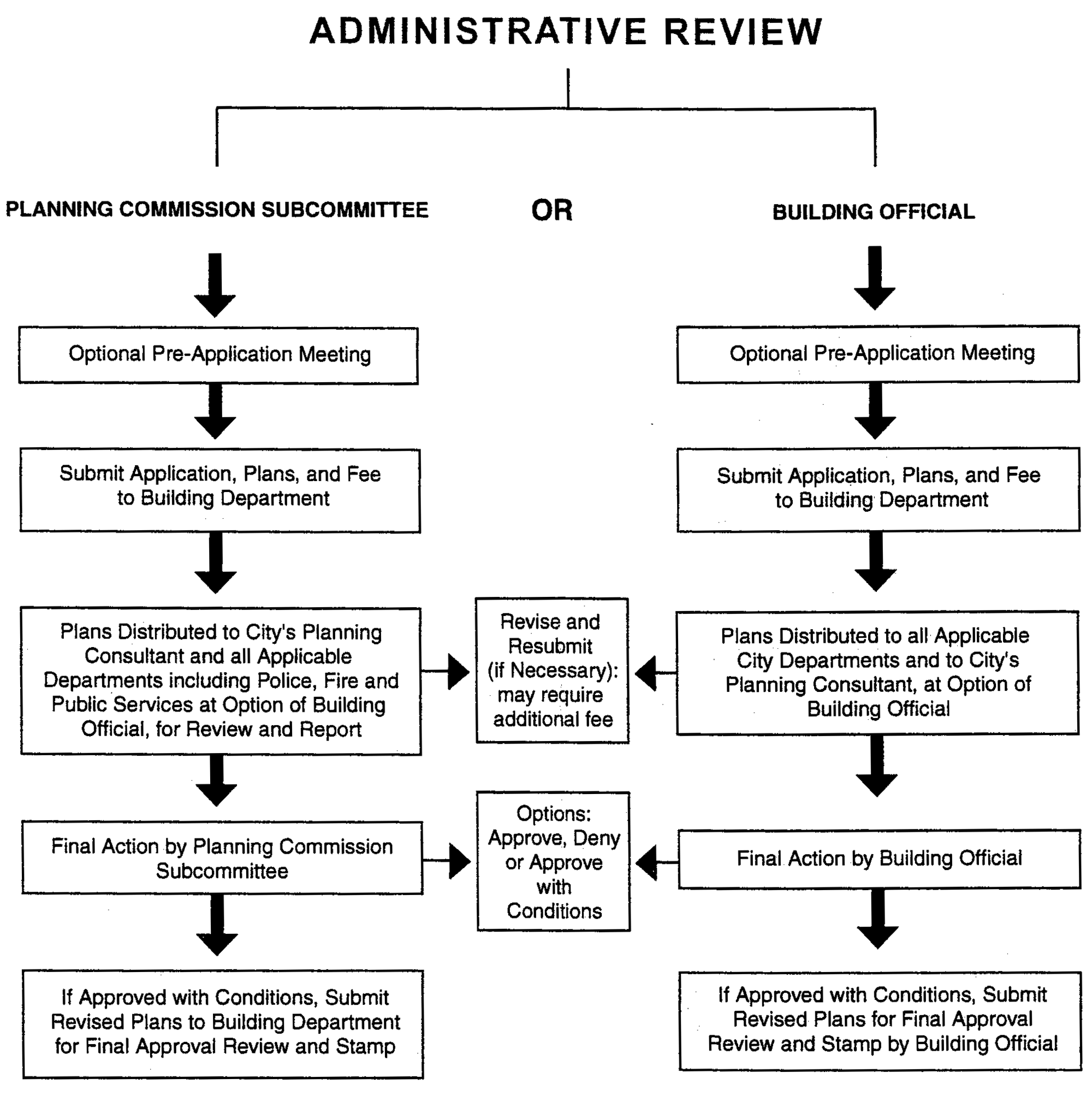
Administrative review. Projects eligible for administrative approval include development projects, uses, and activities, which have been determined to be appropriate for an administrative site plan review and approval of a subcommittee of the planning commission or the building official, by the building official.
In the case of reuse or expansion of an existing building or structure, an approved site plan must be on file at the city to be eligible for administrative review. The following provisions shall apply to administrative reviews:
(1)
Review by a subcommittee of the planning commission.
a.
A subcommittee of the planning commission (the "subcommittee") shall be established in accordance with section 3, article VI, Committees of the City of Dearborn Heights Planning Commission Bylaws, and shall consist of the building official or his designee, three members of the planning commission, of which one shall be the chairperson of the planning commission or her designee, and the city's planning consultant, if requested by the planning commission chair.
b.
Subcommittee approval of a site plan is required prior to the establishment, construction, expansion, or structural alteration of any structure or change of use, as follows:
1.
Construction of an addition to an existing building or expansion of an existing, conforming use, subject to the following:
(i)
The proposed addition or expansion shall not increase the total square footage of the building or area occupied by the use by more than one thousand five hundred (1,500) square feet, provided further that no other expansion has occurred within the past three (3) years.
(ii)
The proposed additional or expansion excludes a single-family dwelling.
2.
Co-location on an existing wireless communication facility.
3.
Family day care homes (less than six (6) children), as licensed by the State of Michigan.
4.
Modifications to an approved site plan not deemed minor, in accordance with subsection 36-499(i).
5.
Modifications to an approved site plan for a special land use, conditional zoning, or planned development project are not eligible for subcommittee review.
6.
Subcommittee approval of a site plan is not required for the construction, moving, relocating or structurally altering of a single or two-family home, including any customarily incidental accessory structure.
7.
The subcommittee of the planning commission or applicant shall have the option to request planning commission review of a project that would otherwise eligible for approval by the subcommittee, with all costs associated with such review borne by the applicant.
(2)
Review by the building official. Building official approval of a site plan or sketch plan shall be required prior to the establishment, construction, expansion, or structural alteration of any structure or change of use, as follows:
a.
Construction, moving, relocating, or structurally altering a single or two-family home, including any customarily incidental accessory structure.
b.
Construction of an addition to an existing and conforming building or expansion of an existing, conforming use, subject to the following:
1.
No variances to the requirements of this chapter are required.
2.
The proposed addition or expansion shall not increase the total square footage of the building or area occupied by the use by more than one thousand (1,000) square feet, provided further that no other expansion has occurred within the past three (3) years.
c.
Re-use or re-occupancy of an existing and conforming nonresidential structure or building, subject to the following:
1.
The proposed use shall not require additional parking demands, access changes or other substantial modifications and improvements to the existing site or building.
2.
The proposed use shall not require special use approval, as set forth in this chapter.
3.
No variances to the requirements of this chapter shall be required.
d.
Minor changes during construction due to unanticipated site constraints or outside agency requirements, and minor landscaping changes or species substitutions, consistent with an approved site plan, which do not change the intent of the approved site plan.
e.
Minor building modifications that do not alter the facade beyond normal repairs, height or floor area of a multiple-family or nonresidential building.
f.
For a multiple-family or nonresidential uses, construction of accessory structures or fences or construction of a wall around a waste receptacle, or installation of a fence around a mechanical unit or other similar equipment, subject to the provisions of this chapter.
g.
Changes to a site required by the building official to comply with state construction code requirements.
h.
Modifications to an approved site deemed minor, in accordance with subsection 36-499(i).
i.
Sidewalk or pedestrian pathway construction or relocation, or barrier-free access improvements.
j.
Temporary construction buildings and uses not to exceed a forty-eight-hour time period, subject to the requirements of this chapter.
k.
Accessory structures and uses specified in section 36-251 (Accessory buildings, structures and uses).
l.
Modifications to an approved site plan for a special land use, conditional zoning, or planned development project are not eligible for review by the building official.
m.
The building official or applicant shall have the option to request subcommittee or planning commission review of a project that would otherwise eligible for approval by the building official, with all costs associated with such review borne by the applicant.
(Ord. No. H-07-01, § 14.203, 7-24-07)
Sec. 36-494. - Application procedure; required information.
(a)
Application procedure, contents. The following information shall accompany all site plans and sketch plans submitted for all reviews:
(1)
An application for site plan review by the planning commission or subcommittee, supplied by the building department, shall be submitted to the building department, along with the required application fee and eight (8) copies of the site plan at the following scales:
a.
A scale of not less than one inch equals twenty (20) feet for property less than one (1) acre;
b.
One (1) inch equals thirty (30) feet for property larger than one (1) acre but less than three (3) acres; and
c.
One (1) inch equals fifty (50) feet for property larger than three (3) acres.
(2)
A completed site plan application and site plan materials must be submitted at least twenty-eight (28) days prior to the planning commission or city council meeting at which the review is requested. Upon confirmation from the city planning consultant, and other city consultants, and all other appropriate city officials, including but not limited to police, fire, and public works, that the site plan substantially meets the requirements of this chapter, the applicant shall submit an additional nine (9) copies of the site plan to the building department. The commission may prepare forms and require the use of such forms in site plan preparation. A separate escrow deposit may be required for administrative charges to review the site plan submittal.
(3)
Current proof of ownership of the land to be utilized or evidence of a contractual arrangement to acquire such land, such as an option or purchase agreement, and a title search or other evidence of any applicable easements or deed restrictions.
(4)
An application for sketch plan approval shall be submitted to the building department on forms supplied by the building department along with the required fee and one (1) copy of the sketch plan. The sketch plan shall contain the information required in subsection 36-496.
(b)
Distribution of plans.
(1)
Planning commission review. Upon submission of all required application materials, the site plan proposal shall be distributed, to the city planning consultant and all appropriate city officials, including, but not limited to police, fire, and public works, and other city consultants, as applicable, for review. Determination of compliance with city ordinances and regulation shall be made within fifteen (15) days of receiving an application for site plan review. Site plans determined to be in substantial compliance proceed to final site plan review (subsection 36-497(c)). For site plans determined not to be in substantial compliance, the applicant may be required to complete revisions and re-submit the plans for further review prior to final action. Upon receipt of the revised site plans, determination of compliance shall be made within fifteen (15) days.
(2)
Subcommittee review. Upon submission of all required application materials, the site plan proposal may be distributed to the city planning consultant and all appropriate city officials, including, but not limited to police, fire, and public works, and other city consultants, as applicable, for review, at the discretion of the building official or planning commission chair.
(3)
Building official review. If the building official or applicant requests a review by the subcommittee or planning commission, in accordance with subsection 36-493(b)(2)m, the site plan proposal shall be distributed in accordance with subsection (b)(1).
(Ord. No. H-07-01, § 14.204, 7-24-07)
Sec. 36-495. - Required site plan information.
Each site plan submitted for review shall have a sheet size of at least twenty-four (24) inches by thirty-six (36) inches and shall include the following information:
(1)
Descriptive and identification data.
a.
Applicant's name and address, and telephone number.
b.
Title block indicating the name of the development.
c.
Scale.
d.
Northpoint.
e.
Dates of submission and revisions (month, day, and year).
f.
Location map drawn to scale with northpoint.
g.
Legal and common description of property.
h.
The dimensions of all lots and property lines, showing the relationship of the site to abutting properties. If the site is a part of a larger parcel, the plan should indicate the boundaries of total land holding.
i.
A schedule for completing the project, including the phasing or timing of all proposed developments.
j.
Identification and seal of architect, engineer, land surveyor, or landscape architect who prepared plan.
k.
Written description of proposed land use.
l.
Zoning classification of applicant's parcel and all abutting parcels.
m.
Proximity to driveways serving adjacent parcels.
n.
Proximity to section corner and major thoroughfares.
o.
Notation of any variances which have or must be secured.
p.
Net acreage (minus rights-of-way) and total acreage, to the nearest one-tenth ( 1/10 ) of an acre.
(2)
Site data.
a.
Existing lot lines, building lines, structures, parking areas, and other improvements on the site and within one hundred (100) feet of the site.
b.
Front, side, and rear setback dimensions.
c.
Topography on the site and within one hundred (100) feet of the site at two-foot contour intervals, referenced to a U.S.G.S. benchmark.
d.
Proposed site plan features, including buildings, roadway widths and names, and parking areas.
e.
Dimensions and centerlines of existing and proposed roads and road rights-of-way.
f.
Acceleration, deceleration, and passing lanes, where required.
g.
Proposed location of driveway entrances and on-site driveways.
h.
Typical cross-section of proposed roads and driveways.
i.
Location of existing drainage courses, floodplains, lakes and streams, with elevations.
j.
Location and dimensions of wetland areas. If deemed necessary because of site or soil conditions or because of the scope of the project, a detailed hydrology study may be required.
k.
Location of sidewalks within the site and within the right-of-way.
l.
Exterior lighting locations and method of shielding lights from shining off the site.
m.
Trash receptacle locations and method of screening, if applicable.
n.
Transformer pad location and method of screening, if applicable.
o.
Parking spaces, typical dimensions of spaces, indication of total number of spaces, drives, and method of surfacing.
p.
Information needed to calculate required parking in accordance with zoning ordinance standards.
q.
The location of lawns and landscaped areas, including required landscaped greenbelts.
r.
Landscape plan, including location, size, type and quantity of proposed shrubs, trees and other live plant material.
s.
Location, sizes, and types of existing trees five (5) inches or greater in diameter, measured at one foot off the ground, before and after proposed development.
t.
Cross-section of proposed berms.
u.
Location and description of all easements for public right-of-way, utilities, access, shared access, and drainage.
v.
Designation of fire lanes.
w.
Loading/unloading area.
x.
The location of any outdoor storage of materials and the manner by which it will be screened.
(3)
Building and structure details.
a.
Location, height, and outside dimensions of all proposed buildings or structures.
b.
Indication of the number of stores and number of commercial or office units contained in the building.
c.
Building floor plans.
d.
Total floor area.
e.
Location, size, height, and lighting of all proposed signs.
f.
Proposed fences and walls, including typical cross-section and height above the ground on both sides.
g.
Building facade elevations, drawn to a scale of one (1) inch equals four (4) feet, or another scale approved by the building official and adequate to determine compliance with the requirements of this article. Elevations of proposed buildings shall indicate type of building materials, roof design, projections, canopies, awnings and overhangs, screen walls and accessory building, and any outdoor or roof-located mechanical equipment, such as air conditioning units, heating units, and transformers, including the method of screening such equipment. Such equipment shall be screened from view of adjacent properties and public rights-of-way. Such screening shall be designed to be perceived as an integral part of the building design.
(4)
Information concerning utilities, drainage, and related issues.
a.
Schematic layout of existing and proposed sanitary sewers and septic systems; water mains, well sites, and water service leads; hydrants that would be used by public safety personnel to service the site; and, the location of gas, electric, and telephone lines.
b.
Location of exterior drains, dry wells, catch basins, retention/detention areas, sumps and other facilities designed to collect, store, or transport stormwater or wastewater. The point of discharge for all drains and pipes should be specified on the site plan.
c.
Indication of site grading and drainage patterns.
d.
The following information shall be submitted as part of an application for permission to commence any type of development within a flood hazard area:
1.
The elevation in relation to mean sea level of the floor, including basement, of all structures.
2.
A description of the extent to which any watercourse will be altered or relocated as a result of proposed development.
3.
Proof of development permission from appropriate local, state, and federal agencies as required by this zoning code, including a floodplain permit, approval, or letter of no authority from the Michigan Department of Environmental Quality under authority of Act 245 of the Public Acts of 1929, as amended by Act 167 of the Public Acts of 1968, the Flood Plain Regulatory Authority.
4.
Base flood elevation data where the proposed development is subject to Act 288 of the Public Acts of 1967, the Subdivision Control Act, or greater than five acres in size.
e.
Additional information which may be reasonably necessary to determine compliance with the provisions of this zoning code.
f.
Soil erosion and sedimentation control measures.
g.
Proposed finish grades on the site, including the finish grades of all buildings, driveways, walkways, and parking lots.
h.
Listing of types and quantities of hazardous substances and polluting materials which will be used or stored on-site at the facility in quantities greater than twenty-five (25) gallons per month.
i.
Areas to be used for the storage, use, loading/unloading, recycling, or disposal of hazardous substances and polluting materials, including interior and exterior area.
j.
Underground storage tanks locations.
k.
Delineation of areas on the site which are known or suspected to be contaminated, together with a report on the status of site cleanup.
(5)
Information concerning residential development.
a.
The number, type and location of each type of residential unit (one (1) bedroom units, two (2) bedroom units, etc.).
b.
Density calculations by type of residential unit (dwelling units per acre).
c.
Lot coverage calculations.
d.
Floor plans of typical buildings with square feet of floor area.
e.
Garage and carport locations and details, if proposed.
f.
Pedestrian circulation system.
g.
Location and names of roads and internal drives with an indication of how the proposed circulation system will connect with the existing adjacent roads. The plan should indicate whether proposed roads are intended to be private or dedicated to the public.
h.
Community building location, dimensions, floor plans, and facade elevations, if applicable.
i.
Swimming pool fencing detail, including height and type of fence, if applicable.
j.
Location and size of recreation open areas.
k.
Indication of type of recreation facilities proposed for recreation area.
(6)
Information applicable to mobile home parks.
a.
Location and number of pads for mobile homes.
b.
Distance between mobile homes.
c.
Proposed placement of mobile home on each lot.
d.
Average and range of size of mobile home lots.
e.
Density calculations (dwelling units per acre).
f.
Lot coverage calculations.
g.
Garage and carport locations and details, if proposed.
h.
Pedestrian circulation system.
i.
Location and names of roads and internal drives.
j.
Community building location, dimensions, floor plans, and facade elevations, if applicable.
k.
Swimming pool fencing detail, including height and type of fence, if applicable.
l.
Location and size of recreation open areas.
m.
Indication of type of recreation facilities proposed for recreation area.
(7)
Additional information. Information related to condominium development. The following information shall be provided with all site plans including condominium development:
a.
Condominium documents, including the proposed master deed, restrictive covenants, and condominium bylaws.
b.
Condominium subdivision plan requirements, as specified in Section 66 of Public Act 59 of 1978, as amended, and Rule 401 of the Condominium Rules promulgated by the Michigan Department of Commerce, Corporation and Securities Bureau.
(8)
Items not applicable. If any of the items listed are not applicable to a particular site, the following information should be provided on the site plan:
a.
A list of each item considered not applicable.
b.
The reason(s) why each listed item is not considered applicable.
(9)
Other data which may be required. Other data may be required if deemed necessary by the city administrative officials, planning commission, or city council to determine compliance with the provisions in this article. Such information may include traffic studies, market analysis, environmental assessment and evaluation of the demand on public facilities and services.
(10)
Industrial site plan requirements. Site plan proposals for new or expanded industrial development shall comply with the site plan requirements in article XIV, division 2, including the requirements in section [36-342] regarding an industrial activity statement.
(11)
Transportation impact studies.
a.
Developments requiring a transportation impact study (TIS).
1.
A TIS shall be required prior to approval of any of the following types of projects:
(i)
Fast-food restaurants, businesses that have drive-up or drive-through service, including banks, pharmacies and other similar vehicle oriented uses.
(ii)
Residential projects containing one hundred (100) or more dwelling units in the total project.
(iii)
Commercial, office, industrial, warehouse, institutional, entertainment, and mixed-use development proposals involving one hundred thousand (100,000) square feet or more in gross floor area.
2.
On multi-phase projects, a TIS shall be required if the entire project exceeds the threshold levels cited above, even if one (1) or more phases of the project do not meet the threshold levels.
3.
The planning commission may require a TIS for a proposed development even though it does not meet the criteria listed above where there is evidence that the traffic that would be generated by the development would cause or aggravate unsafe traffic conditions. In making this determination, the planning commission may consider the design of proposed roads, driveways, and parking lots as well as conditions that exist on or around the site that may contribute to traffic safety concerns.
b.
Qualifications of person preparing the TIS.
1.
The TIS shall be prepared by a traffic or transportation engineer or community planner selected by the city and who has a minimum of three (3) years of experience preparing traffic impact studies. The resume and qualifications of the person who prepared the TIS shall be included in the study.
2.
The full cost of the TIS shall be paid for by the applicant. The city may require funds to be placed in escrow to cover such costs prior to initiation of the TIS.
c.
Contents of the TIS. The TIS shall contain the following elements, at minimum:
1.
Description of project. A description of the project and site plan shall be provided, showing the location of buildings, driveways, parking, adjoining roads, nearby intersections, and driveways on adjacent parcels. The project description should identify the proposed use, the gross and net square footage, and the number of parking spaces proposed.
2.
Existing conditions.
(i)
Maps and narrative shall be used to identify all roads within the impact area of the project, the number of lanes and right-of-way of each road, the most recent a.m. and p.m. peak hour traffic counts, and average daily traffic (ADT) counts on each road as are available from the Wayne County Road Commission.
(ii)
The historical growth rate of traffic on adjacent roads shall be determined by examining traffic counts over the past three (3) to five (5) years. The growth rate shall be used to project background growth for the next five (5) years of for the number of years to complete the proposed project, whichever is longer. Where information is available from the city planning consultant, trips from proposed projects in the impact area shall be included in the background growth projections.
(iii)
Where existing traffic counts are more than three (3) years old, new counts shall be taken. Traffic counts shall be taken during average or higher than average volume conditions, generally on a Tuesday, Wednesday or Thursday of a non-holiday week. For commercial development, additional Saturday counts shall also be taken.
(iv)
The description of existing conditions shall also include accident history within five hundred (500) feet of the site and for any intersection that is expected to experience a traffic volume increase of at least five (5) percent per twenty-four-hour period or during peak hour due to the proposed project.
3.
Projections.
(i)
Maps and narrative shall be used to estimate the impact of the proposed project on traffic. Morning and evening peak hour and average daily traffic shall be forecast for the proposed development, based on the data and procedures outlined in the most recent edition of the Institute of Traffic Engineers Trip Generation Manual. The preparer may use other commonly-accepted sources of data or supplement the ITE data with empirical data from similar projects in Michigan.
(ii)
The directional distribution of the projected traffic shall be distributed onto the existing road network (inbound versus outbound, left turn versus right turn) to project turning movements at major site access points, intersections, and interchange ramps. The rationale for the directional distribution shall be provided.
d.
Analysis of data. The TIS shall contain the following analysis, at minimum:
1.
Capacity analysis. The impact of the projected traffic on the capacity of roads serving the proposed development shall be analyzed, using procedures outlined in the most recent edition of the Highway Capacity Manual published by the transportation research board. Pre- and post-construction capacity analysis shall also be performed at all street intersections and expressway ramps where the expected traffic will comprise five (5) percent or more of the existing intersection capacity.
2.
Gap analysis. A "gap study" shall be completed to analyze the frequency and duration of gaps in the flow of through traffic.
3.
Access analysis. Maps and narrative shall be used to:
i.
Identify the location and design of proposed access driveways and new road intersections,
ii.
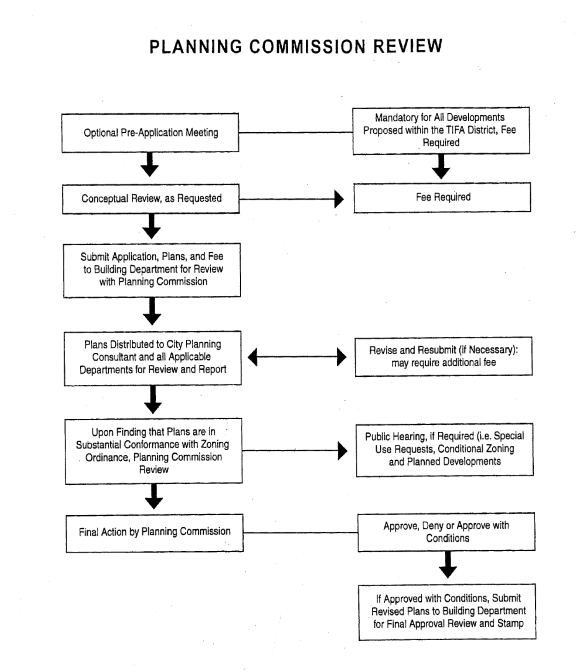
Identify sight distance limitations,
iii.
Determine the distance to adjacent driveways and intersections, and
iv.
Provide sufficient evidence that the design and number of driveways proposed is the fewest necessary, that the driveways will provide safe and efficient movement of traffic, and that all driveways comply with the sight distance requirements of the Wayne County Road Commission.
e.
Mitigation measures. The TIS shall identify realistic public and private mitigation measures needed to accommodate the projected traffic including the following, at minimum:
1.
The TIS shall identify improvements to intersections and roads to accommodate future volumes and provided adequate capacity.
2.
Using Wayne County Road Commission standards, the TIS shall identify taper lanes, turn lanes, and passing lanes necessary to provide safe and adequate ingress and egress to the site.
3.
The TIS shall identify opportunities to accommodate bicyclists and pedestrians.
4.
The TIS shall identify opportunities to coordinate development and access with adjoining sites so as to alleviate the impact of increased traffic on public roads.
(Ord. No. H-07-01, § 14.205, 7-24-07)
Sec. 36-496. - Required sketch plan information.
Sketch plan requirements for administrative approval. The sketch plan for administrative approval shall contain the following information:
(1)
Name, address, telephone and fax number(s), and email address(es) of the applicant(s) (and property owner, if different from applicant) and firm or individual preparing the plan.
(2)
The property location (address, lot number, tax identification number).
(3)
Sketch plan shall be drawn to an engineer's scale.
(4)
Size and dimensions of proposed structures, including gross and usable floor areas, number of stories, and overall height.
(5)
Dimensions of all property lines, showing the relationship of the site to abutting properties. If the site is part of a larger parcel, the plan should indicate the boundaries of total land holding.
(6)
Existing site features, including natural and historical features, structures, driveways, fences, walls, signs, and other improvements.
(7)
Location, dimensions, setback distances, and use(s) of all proposed improvements.
(8)
Location and description of all existing and proposed easements and rights-of-way for utilities, access, and drainage.
(9)
Location of existing public or private utilities including, but not limited to water, and sanitary and stormwater sewers.
(10)
Other information as requested by the reviewer to verify that the site and use are in accordance with the purpose and intent of this chapter and the city's master plan.
(Ord. No. H-07-01, § 14.206, 7-24-07)
Sec. 36-497. - Plan review procedure and authorization.
(a)
Pre-application meeting. In order to facilitate processing of a site plan in a timely manner, the city provides opportunities for potential applicants to meet with and discuss development/redevelopment proposals with city officials, staff, and consultants for the purpose of obtaining information and guidance in the preparation of the required site plan and application materials. No formal action shall be taken on a site plan submitted for pre-application meetings. The following two (2) options are available depending upon the type of proposal being considered:
(1)
Optional. The applicant may request a pre-application site plan meeting with the city planning consultant and building official, and the city engineering consultant, as may be applicable. The applicant need not present drawings or site plans at a pre-application conference, but even if drawings or site plans are presented, no formal action shall be taken on a site plan at a pre-application conference. The city planning consultant's and city engineering consultant's fees for any such pre-application conference shall be paid by the applicant. Optional pre-application meeting request shall be handled as follows:
a.
A request for a pre-application meeting shall be made in writing to the building department, and a fee deposited with the building department to cover the cost of the consultants' time.
b.
The building department shall distribute a copy of the written request to the planning consultant and the engineering consultant, in the event the engineering consultant's attendance is required.
c.
The planning consultant and building official shall coordinate the scheduling of the meeting.
(2)
Mandatory. A pre-application meeting is required for all proposed developments within the tax increment financing authority (TIFA) district by the director of the TIFA or its designated representative, the city planning consultant, building official, and other relevant city staff, and city engineer, as applicable. The applicant need not present drawings or site plans at a pre-application conference, but even if drawings or site plans are presented, no formal action shall be taken on a site plan at a pre-application conference. The city planning consultant's and city engineering consultant's fees for any such pre-application conference shall be paid by the applicant. Mandatory pre-application meeting requests shall be handled as follows:
a.
A request for a pre-application meeting shall be made in writing to the building department, and a fee deposited with the building department to cover the cost of the consultants' time.
b.
The building department shall distribute a copy of the written request to the planning consultant and engineering consultant, in the event the engineering consultant's attendance is required.
c.
The planning consultant and building official shall coordinate the scheduling of the meeting.
(b)
Conceptual review.
(1)
An applicant may file a written request for conceptual review of a preliminary site plan by the planning commission, prior to submission of a site plan for formal (final) review. Conceptual site plan review is required for all planned unit development and conditional rezoning projects.
(2)
Conceptual review fees shall be paid by the applicant, according to a fee schedule established by the city council.
(3)
No formal action shall be taken on a site plan submitted for conceptual review, and neither the applicant nor the planning commission shall be bound by any comments or suggestions made during the course of the conceptual review.
(4)
A site plan submitted for conceptual review shall be drawn to scale, and shall show site development features in sufficient detail to permit the planning commission to evaluate the following:
a.
Relationship of the site to nearby properties;
b.
Density;
c.
Adequacy of landscaping, open space, vehicular drives, parking areas, drainage, and proposed utilities; and,
d.
Conformance with city's development policies and standards.
(c)
Final site plan review. Upon determination of the building department director or his designee that the site plans substantially complies with city ordinances and regulations, the site plans shall be placed on the next available planning commission agenda. All required revisions must be completed prior to the site plan being placed on the planning commission agenda for review.
(d)
Public hearings. A public hearing conducted by the planning commission is required for all zoning amendments, and for all site plans involving uses that are subject to special land use approval, applications for conditional rezoning and planned unit developments, subject to the provisions of section 36-481. After payment of appropriate fees, the building official, or his designee shall set the date of the public hearing.
(e)
Authorization. The planning commission, or when applicable, the subcommittee or building official or city planning consultant shall review the site plan proposal together with any public hearing findings and any requested reports and recommendations from the building official, city planning consultant, and/or other city staff and reviewing agencies, as applicable.
(1)
The planning commission or the subcommittee or building official (as per section 36-493) is authorized to take the following action on the plan, subject to guidelines in the zoning ordinance: approval, approval with conditions, denial, or table the site plan, as follows:
a.
Approval. Upon determination that a site plan is in compliance with the standards and requirements of this chapter and other applicable ordinances and laws, approval shall be granted.
b.
Approval subject to conditions. Upon determination that a site plan is in compliance except for minor modifications, the conditions for approval shall be identified and the applicant shall be given the opportunity to correct the site plan. The conditions may include the need to obtain variances or obtain approvals from other agencies. If a plan is approved subject to conditions, the applicant shall submit four (4) copies of a revised plan with a revision date, indicating compliance with the conditions of approval, to the building department. Upon subsequent review and approval of the building official or city planning consultant, the plans shall be recorded, as provided in subsection (f), below.
c.
Denial. Upon determination that a site plan does not comply with the standards and regulations set forth in this article or elsewhere in this chapter, or requires extensive revision in order to comply with said standards and regulations, site plan approval shall be denied.
d.
Tabling. Upon determination that a site plan is not ready for approval or rejection, or upon a request by the applicant, the planning commission may table consideration of a site plan until a future meeting.
(f)
Recording of site plan review action. Each action taken with reference to a site plan review shall be duly recorded in the minutes of the planning commission, as appropriate. The grounds for action taken upon each site plan shall also be recorded in the minutes.
(1)
After the planning commission or the subcommittee (as per section 36-493) has taken final action on a site plan and all steps have been completed, four (4) copies of the application and approved plans shall be stamped "approved" and signed by the building official or city planning consultant. One (1) marked copy will be kept on file with the building department, one (1) will be kept by the city planning consultant, and the other two (2) copies will be returned to the applicant, where one stamped approved plan will be submitted with the detailed engineering/construction plans.
(2)
The building official shall be responsible for final stamp approval for administrative reviews conducted per subsection 36-493(b)(2).
(3)
If the planning commission grants conditional approval of the site plan, the applicant shall submit four (4) copies of the revised plans, indicating compliance with the conditions of approval, to the building department. Distribution of the revised plans shall be in accordance with subsection 36-494(b).
Upon subsequent review and verification that all conditions of approval have been met, the planning consultant shall stamp all four (4) copies of the plans "approved," and the plans shall be distributed in accordance with subsection (f)(1) (Recording of site plan action).
(4)
Once the site plan has been stamped "approved," it shall be a consent agenda item at the next planning commission meeting.
(Ord. No. H-07-01, § 14.207, 7-24-07; Ord. No. H-16-01, §§ 1D, 1E, 10-11-16)
Sec. 36-498. - Procedure after site plan approval.
(a)
Detailed engineering (construction) plan review. Following final approval of the site plan, six (6) sets of detailed engineering (construction) plans shall be submitted to the building department. The building department shall distribute the detailed engineering (construction) plans to the city's engineering consultant and relevant city departments for review. The city's engineering consultant shall verify that the site design and improvements shown on the construction or engineering plans are consistent with the approved site plan, except for changes that do not materially alter the approved site design, or that address any conditions of site plan approval.
Construction or engineering plans that are not consistent with the approved site plan shall be subject to review and approval by the planning commission as an amended site plan, prior to the start of development or construction on the site.
(b)
Application for building permit. Following final approval of the site plan and the engineering plans, the applicant may apply for a building permit. It shall be the responsibility of the applicant to obtain all other applicable city, county, or state permits prior to issuance of a building permit.
A building permit for a structure in a proposed condominium project shall not be issued until evidence of a recorded master deed has been provided to the city, in accordance with article VIII, division 4. However, the building official may issue permits for site grading, erosion control, installation of public water and sewage facilities, and construction of roads, prior to recording the master deed. No permit issued or work undertaken prior to recording of the master deed pursuant to this section shall grant any rights or any expectancy interest in the approval of the master deed.
(c)
Performance guarantee. Performance guarantees shall be required subject to the standards in article VIII, division 6.
(d)
Expiration of site plan approval. If construction has not commenced within twelve (12) months of final approval of the site plan, or if construction has not been completed within twelve (12) months after it was commenced or if substantial or continual progress in construction has not been made, the site plan approval becomes null and void and a new application for site plan review shall be required. Upon written request from the applicant, the building official or planning consultant, as designated by the building official, may grant an extension of up to twelve (12) months, upon a finding that the approved site plan adequately represents current conditions on and surrounding the site and provided that the site plan conforms to the current zoning ordinance standards, and further provided that construction has not commenced or if substantial or continual progress in construction has not been made.
(e)
Application for certificate of occupancy. Following completion of site work and building construction, the applicant may apply for a certificate of occupancy or a temporary certificate of occupancy from the building superintendent. It shall be the applicant's responsibility to obtain these required certificates prior to any occupancy of the property.
(f)
Property maintenance after approval. It shall be the responsibility of the owner of a property for which site plan approval has been granted to maintain the property in accordance with the approved site design on a continuing basis until the property is razed, or until new zoning regulations supersede the regulations upon which site plan approval was based, or until a new site design is approved. Any property owner who fails to so maintain an approved site design shall be deemed in violation of the use provisions of this chapter and shall be subject to the same penalties appropriate for a use violation.
With respect to condominium projects, the master deed shall contain provisions describing the responsibilities of the condominium association, condominium owners, and public entities, with regard to maintenance of the property in accordance with the approved site plan on a continuing basis. The master deed shall further establish the means of permanent financing for required maintenance and improvement activities which are the responsibility of the condominium association. Failure to maintain an approved site plan shall be deemed in violation of the use provisions of this chapter and shall be subject to the same penalties appropriate for a use violation.
(g)
Recorded and as-built condominium documents submittal requirements.
(1)
Prior to the issuance of a building permit for a condominium project involving new construction, the condominium project developer or proprietor shall record all condominium documents and exhibits with the Wayne County Register of Deeds office in a manner and format acceptable to the county and furnish the city with one copy of the recorded condominium master deed, bylaws, and all restrictive covenants as approved by the planning commission, city attorney and planning and engineering consultants;
(2)
Upon completion of the project, the condominium project developer or proprietor shall furnish the city with the following:
a.
Two (2) copies of an "as built survey", sealed by a licensed professional engineer, landscape architect or similar certified professional, in a format acceptable to the city; and
b.
One (1) copy of the site plan on a mylar sheet of at least thirteen (13) by sixteen (16) inches with an image not to exceed ten and one-half (10½) by fourteen (14) inches.
(3)
The as-built survey shall be reviewed by the city's engineering consultant for compliance with city ordinances. Fees for this review shall be established by the city council.
(4)
The building official may withhold building permit approval for any structure within the condominium project, if such documents have not been submitted within ten (10) days after written request from the building official to do so.
(h)
Revocation. Approval of a site plan may be revoked by the planning commission or subcommittee or building official if construction is not in conformance with the approved plans. In this case, the site plan shall be placed on the agenda of the planning commission or scheduled for review by the subcommittee for consideration and written notice shall be sent to the applicant at least ten (10) days prior to the meeting. The city planning consultant, building official, applicant, and any other interested persons shall be given the opportunity to present information to the planning commission and subcommittee and answer questions. If the planning commission or subcommittee or building official finds that a violation exists and has not been remedied prior to the hearing, then it shall revoke the approval of the site plan.
(i)
Modification to approved plan. A site plan approved in accordance with the provisions in this section may be subsequently modified, subject to the following requirements:
(1)
Review of minor modifications. Minor modifications to an approved site plan may be reviewed by the building official or his designee.
a.
Minor modification defined. Minor modifications are changes that do not substantially affect the character or intensity of the use, vehicular or pedestrian circulation, drainage patterns, the demand for public services, or the vulnerability to hazards. Examples of minor modifications include:
1.
An addition to an existing commercial or industrial building that does not increase the floor space by more than one thousand (1,000) square feet.
2.
Re-occupancy of a vacant building that has been unoccupied for less than twelve (12) months.
3.
Changes to building height that do not add an additional floor.
4.
Reduction in the square footage of an existing or proposed building.
5.
Additions or alterations to the landscape plan or landscape materials that do not result in the waiver of landscaping requirements.
6.
Relocation or screening of the trash receptacle.
7.
Alterations to the internal parking layout of an off-street lot.
8.
The construction of a new building or structure, adding or deleting parking or the addition of curb cuts onto a public road are examples of modifications, which are not considered minor.
9.
Modifications to an approved site plan for a special land use, conditional zoning, or planned development project or which require a variance, shall not be considered a minor modification.
b.
Determination of minor modification. The building official or his designee shall determine if the proposed modifications are minor in accordance with the guidelines in this section.
(2)
Modifications not deemed "minor". If the modifications are not deemed minor by the building official or his designee, then review and approval of the subcommittee or the planning commission shall be required, as determined by the building official or his designee. A review by the planning commission shall be required for all site plans that involve a request for a variance, a special land use, conditional rezoning, and planned development proposals that involves a discretionary decision, or a proposal that involves a nonconforming use or structure.
(j)
Recording of action. Each action related to modification of a site plan shall be duly recorded in writing on a copy of the approved plan, and shall be kept on file in the office of the building official. The planning commission shall be advised of all minor site plan modifications approved by the building official and such modifications shall be noted on the site plan and in the minutes of the planning commission.
(k)
Fees. Fees for the review of site plans and inspections as required by this article shall be established and may be amended by resolution by the city council.
(Ord. No. H-07-01, § 14.208, 7-24-07)
Sec. 36-499. - Standards for site/sketch plan approval.
All elements of the site plan shall be designed to take into account the site's topography, the size and type of plot, the character of adjoining property, and the traffic operations of adjacent streets. The site shall be developed so as not to impede the normal and orderly development or improvement of surrounding property for uses permitted in this zoning code.
In order that buildings, open space and landscaping will be in harmony with other structures and improvements in the area, and to ensure that no undesirable health, safety, noise and traffic conditions will result from the development shall conform to all requirements of this zoning code, including those of the applicable zoning district(s). The following criteria shall be used as a basis upon which site plans will be reviewed and approved, where applicable:
(1)
Adequacy of information. The site plan shall include all required information in sufficiently complete and understandable form to provide an accurate description of the proposed uses and structures.
(2)
Site design characteristics. All elements of the site design shall be harmoniously and efficiently organized in relation to topography, the size and type of parcel, the character of adjoining property, and the type and size of buildings. The site shall be developed so as not to impede the normal and orderly development or improvement of surrounding property for uses permitted by this chapter.
(3)
Appearance. Landscaping, earth berms, fencing, signs, walls, and other site features shall be designed and located on the site so that the proposed development is aesthetically pleasing and harmonious with nearby existing or future developments.
(4)
Compliance with district requirements. The site plan shall comply with the district requirements for minimum floor space, height of building, lot size, open space, density and all other requirements set forth in article V, Schedule of Regulations, except as provided elsewhere in this chapter. New and conversion condominium projects shall conform to the provisions of this chapter, as applicable, and with article VIII, division 4, Condominium Regulations.
(5)
Preservation of significant natural features. Judicious effort shall be used to preserve the integrity of the land, existing topography, and natural, historical, and architectural features as defined in this zoning code, in particular flood hazard areas and wetlands designated/regulated by the Michigan Department of Environmental Quality, and, to a lesser extent, flood hazard areas and wetlands which are not regulated by the department.
(6)
Emergency access. All buildings or groups of buildings shall be so arranged as to permit convenient and direct emergency vehicle access.
(7)
Pedestrian access and circulation. Existing and proposed sidewalks or pedestrian pathways connect to existing public sidewalks and pathways in the area, are insulated as completely as possible from the vehicular circulation system, and comply with applicable regulations regarding barrier-free access.
(8)
Vehicular access and circulation. Drives, streets, parking, site access, and other vehicle-related elements are designed to minimize traffic conflicts on adjacent streets and promote safe and efficient traffic circulation within the site.
(9)
Building design and architecture. Building design and architecture relate to and are harmonious with the surrounding neighborhood with regard to scale, mass, proportion, and materials. In addition to following design guidelines adopted in specific district or sub-area plans, where applicable.
(10)
Parking and loading. Off-street parking lots and loading areas are arranged and located to accommodate the intensity of proposed uses, minimize conflicts with adjacent uses, and promote shared-use of common facilities where feasible.
(11)
Exterior lighting. Exterior lighting shall be designed so that it is deflected away from adjoining properties and so that it does not impede vision of drivers along streets.
(12)
Screening. Landscaping and screening are provided in a manner that adequately buffers adjacent land uses and screens off-street parking, mechanical appurtenances, loading and unloading areas, and storage areas from adjacent residential areas and public rights-of-way.
(13)
Public services. Adequate services, including police and fire protection, and utilities, including water, sewage disposal, sanitary sewer, and stormwater controls services, shall be available or provided, and shall be designed with sufficient capacity and durability to properly serve the development.
(14)
Soil erosion and sedimentation control. The site shall have adequate lateral support so as to ensure that there will be no erosion of soil or other material. The final determination as to adequacy of, or need for, lateral support shall be made by the city engineer and building official.
(15)
Stormwater management. Appropriate measures shall be taken to ensure that removal of surface waters will not adversely affect neighboring properties or the public storm drainage system. Provisions shall be made to accommodate stormwater which complements the natural drainage patterns and wetlands, prevent erosion and the formation of dust. Sharing of stormwater facilities with adjacent properties shall be encouraged. The use of detention/retention ponds may be required. Surface water on all paved areas shall be collected at intervals so that it will not obstruct the flow of vehicular or pedestrian traffic or create standing water.
(16)
Privacy. The site design shall provide reasonable visual and sound privacy. Fences, walls, barriers, and landscaping shall be used, as appropriate, for the protection and enhancement of property and the safety and privacy of occupants and users.
(17)
Danger from hazards. The level of vulnerability to injury or loss from incidents involving hazardous materials or processes shall not exceed the capability of the city to respond to such hazardous incidents so as to prevent injury and loss of life and property. In making such an evaluation, the city shall consider the location, type, characteristics, quantities, and use of hazardous materials or processes in relation to the personnel, training, equipment and material, and emergency response plans and capabilities of the city.
(18)
Health and safety concerns. Any use in any zoning district shall comply with federal, state, county and local health and pollution laws and regulations with respect to noise; dust, smoke and other air pollutants; vibration; glare and hear; fire and explosive hazards; gases; electromagnetic radiation; and, toxic and hazardous materials.
(19)
Sequence of development. All development phases shall be designed in logical sequence to insure that each phase will independently function in a safe, convenient and efficient manner without being dependent upon subsequent improvements in a later phase or on other sites.
(20)
Coordination with adjacent sites. All site features, including circulation, parking, building orientation, landscaping, lighting, utilities, and common facilities, and open space shall be coordinated with adjacent properties.
(21)
Other agency reviews. The applicant has provided documentation of compliance with other appropriate agency review standards, including, but not limited to, the Michigan Department of Natural Resources, Michigan Department of Environmental Quality, Michigan Department of Transportation, Wayne County Drain Commission, Wayne County Health Department, and other federal and state agencies, as applicable.
(Ord. No. H-07-01, § 14.209, 7-24-07)
Sec. 36-511. - Intent.
The procedures and standards in this section are intended to provide a consistent and uniform method for review of proposed plans for special land uses. Special land uses are uses, either public or private, which possess unique characteristics and therefore cannot be properly classified as a permitted use in a particular zoning district (see article II, Definitions). This section contains standards for review of each special land use proposal individually on its own merits to determine if it is an appropriate use for the district and specific location where it is proposed.
(Ord. No. H-07-01, § 14.131, 7-24-07)
Sec. 36-512. - Procedures and requirements.
Special land use proposals shall be reviewed in accordance with the procedures in article XIV, division 2 for site plan review, except as follows:
(1)
Public hearing. The planning commission or building department shall schedule a public hearing in accordance with section 36-481.
(2)
Planning commission final action. The planning commission shall review the application for special land use, together with the public hearing findings and reports and recommendations from the building official, city planner, and/or other city staff and reviewing agencies, as applicable. The planning commission shall base its decision solely on the requirements and standards of this chapter. The planning commission is authorized to approve, approve with conditions, or deny a special land use proposal as follows:
a.
Approval. Upon determination that a special land use proposal is in compliance with the standards and requirements of this chapter and other applicable ordinances and laws, approval shall be granted.
b.
Approval with conditions. The planning commission may impose reasonable conditions with the approval of a special land use. The conditions may include provisions necessary to insure that public services and facilities affected by a proposed special land use or activity will be capable of accommodating increased service and facility loads generated by the new development, to protect the natural environment and conserve natural resources and energy, to insure compatibility with adjacent uses of land, and to promote the use of land in a socially and economically desirable manner. Conditions imposed shall meet all of the following requirements:
1.
Conditions shall be designed to protect natural resources, the health, safety, welfare, and social and economic well being of those who will use the land use or activity under consideration, residents and landowners immediately adjacent to the proposed land use or activity, and the community as a whole.
2.
Conditions shall be related to the valid exercise of the police power, and purposes which are affected by the proposed use of activity.
3.
Conditions shall be necessary to meet the intent and purpose of the zoning ordinance, related to the standards established in the chapter for the land use or activity under consideration, and necessary to insure compliance with those standards.
(3)
Denial. Conditions shall be necessary to meet the intent and purpose of the zoning ordinance, related to the standards established in the chapter for the land use or activity under consideration, and necessary to insure compliance with those standards.
(Ord. No. H-07-01, § 14.302, 7-24-07)
Sec. 36-513. - Standards for granting special land use approval.
Approval of a special land use proposal shall be based on the determination that the proposed use will comply with all applicable requirements of this chapter, including site plan review criteria set forth in article XIV, division 2, applicable site development standards for specific uses set forth in this chapter, and the following standards:
(1)
Compatibility with adjacent uses. The proposed special land use shall be designed, constructed, operated and maintained to be compatible with uses on surrounding land. The site design of the proposed special land use shall minimize the impact of site activity on surrounding properties. In determining whether this requirement has been met, consideration shall be given to:
a.
The location and screening of vehicular circulation and parking areas in relation to surrounding development.
b.
The location and screening of outdoor storage, outdoor activity or work areas, and mechanical equipment in relation to surrounding development.
c.
The hours of operation of the proposed use. Approval of a special land use may be conditioned upon operation within specified hours considered appropriate to ensure minimal impact on surrounding uses.
d.
The bulk, placement, and materials of construction of the proposed use in relation to surrounding uses.
e.
Proposed landscaping and other site amenities. Additional landscaping over and above the requirements of this chapter may be required as a condition of approval of a special land use.
(2)
Compatibility with the master plan. The proposed special land use shall be consistent with the general principles and objectives of the city's master plan and shall promote the intent and purpose of this chapter.
(3)
Public services. The proposed special land use shall be located so as to be adequately served by essential public facilities and services, such as highways, streets, police and fire protection, drainage systems, water and sewage facilities, and schools, unless the proposal contains an acceptable plan for providing necessary services or evidence that such services will be available by the time the special land use is established.
(4)
Impact of traffic. The location of the proposed special land use within the zoning district shall minimize the impact of the traffic generated by the proposed use. In determining whether this requirement has been met, consideration shall be given to the following:
a.
Proximity and access to major thoroughfares.
b.
Estimated traffic generated by the proposed use.
c.
Proximity and relation to intersections.
d.
Adequacy of driver sight distances.
e.
Location of and access to off-street parking.
f.
Required vehicular turning movements.
g.
Provisions for pedestrian traffic.
(5)
Detrimental effects. The proposed special land use shall not involve any activities, processes, materials, equipment, or conditions of operation, and shall not be located or designed so as to be detrimental or hazardous to public health, safety, and welfare. In determining whether this requirement has been met, consideration shall be given to the level of traffic, noise, vibration, smoke, fumes, odors, dust, glare, and light, subject to the standards in article VIII.
(6)
Isolation of existing uses. The location of the proposed special land use shall not result in a small residential area being substantially surrounding by nonresidential development, and further, the location of the proposed special land use shall not result in a small nonresidential area being substantially surrounded by incompatible uses.
(7)
Based on need. The planning commission shall find that a need for the proposed use exists in the community at the time the special land use application is considered.
(8)
Economic well-being of the community. The proposed special land use shall not be detrimental to the economic well-being of those who will use the land, residents, businesses, landowners, and the community as a whole.
(9)
Compatibility with natural environment. The proposed special land use shall be compatible with the natural environment and conserve natural resources and energy.
(Ord. No. H-07-01, § 14.303, 7-24-07)
Sec. 36-521. - Initiation of amendment.
The city council may amend, supplement, or change the district boundaries or the regulations herein, pursuant to the authority and procedures set forth in Michigan Pubic Act 110 of 2006, as amended. Text amendments may be proposed by any governmental body or any interested person or organization. Changes in district boundaries may be proposed by any governmental body, any person having a freehold interest in the subject property, or by the designated agent of a person having a freehold interest in the property.
(Ord. No. H-07-01, § 14.401, 7-24-07)
Sec. 36-522. - Application for amendment.
A petition for an amendment to the text of this chapter or an amendment to change the zoning classification of a particular property, shall be commenced by filing a petition with the building department, on the forms provided by the building department and accompanied by the fees specified. The petition shall describe the proposed amendment and shall be signed by the applicant and property owner if different from the applicant.
Petitions for rezoning of a specific site shall be accompanied by a plot plan or survey, which shall contain the following information:
(1)
Applicant's name, address, and telephone number.
(2)
Scale, northpoint, and dates of submission and revisions.
(3)
Zoning classification of petitioner's parcel and all abutting parcels.
(4)
Existing lot lines, building lines, structures, parking areas, driveways, and other improvements on the site and within fifty (50) feet of the site.
(5)
Proposed lot lines and lot dimensions, and general layout of proposed structures, parking areas, driveways, and other improvements on the site.
(6)
Dimensions, centerlines, and right-of-way widths of all abutting streets and alleys.
(7)
Location of existing drainage courses, floodplains, lakes and streams, and woodlots.
(8)
All existing and proposed easements.
(9)
Location of sanitary sewer or septic systems, existing and proposed.
(10)
Location and size of watermains, well sites, and building service, existing and proposed.
(11)
A sign location plot plan, in accordance with the rezoning sign requirements contained in this article.
(Ord. No. H-07-01, § 14.402, 7-24-07)
Sec. 36-523. - Review procedures.
(a)
Planning commission review. After the completed petition and all required supporting materials have been received and fees paid, the petition shall be reviewed in accordance with the following procedures:
(1)
The petition shall be placed on the agenda of the next regularly scheduled meeting of the planning commission. The planning commission shall review the petition for amendment in accordance with the procedures and public hearing and notice requirements set forth in section 36-481, Public hearing process, and other applicable sections of Michigan Public Act 184 of 1943, as amended.
If an individual property or several adjacent properties are proposed for rezoning, the planning commission shall comply with the public notice and public hearing procedures set forth in section 36-481, Public hearing process.
(b)
Rezoning sign requirements.
(1)
At least twenty-one (21) days prior to the public hearing before the planning commission, the applicant must, at his own expense, install rezoning signage on the property proposed for rezoning, in full public view along street or road frontages. The sign must be located along the property line of the right-of-way at the midpoint of the property width. A corner lot will require a sign for each road frontage. The location and content of the signage must be approved by the building department prior to installation. The signage must meet the following specifications:
a.
Black letters on white background.
b.
Size: Minimum four (4) feet (vertical) by minimum six (6) feet (horizontal).
c.
Sign facing must be exterior plywood, aluminum, or similar material.
d.
Wording on the signage shall be as follows:
e.
Sign support system must be structurally sound.
(2)
Rezoning signage must be removed within seven (7) days of adoption by the city council, seven (7) days of withdrawal of the rezoning application by the applicant, or seven (7) days of denial of the rezoning request by the city council. Failure to remove signage within this period may require the removal of the signage by the city at the owner's expense and/or prosecution.
(c)
Review considerations. The planning commission and city council, shall at a minimum, consider the following before taking action on any proposed amendment:
(1)
Will the proposed amendment be in accordance with the basic intent and purpose of the zoning ordinance?
(2)
Will the proposed amendment further the comprehensive planning goals of the city?
(3)
Have conditions changed since the zoning ordinance was adopted or was there a mistake in the zoning ordinance that justifies the amendment?
(4)
Will the amendment correct an inequitable situation created by the zoning ordinance, rather than merely grant special privileges?
(5)
Will the amendment result in unlawful exclusionary zoning?
(6)
Will the amendment set an inappropriate precedent, resulting in the need to correct future planning mistakes?
(7)
If a rezoning is requested, is the proposed zoning consistent with the zoning classification of surrounding land?
(8)
If a rezoning is requested, could all requirements in the proposed zoning classification be complied with on the subject parcel?
(9)
If a rezoning is requested, is the proposed zoning consistent with the trends in land development in the general vicinity of the property in question?
(d)
Action by planning commission. Following the hearing on the proposed amendment, the planning commission shall make written findings of fact, which it shall transmit to the city council, together with the comments made at the public hearing, and its recommendations.
(e)
Action by city council. The city council may hold additional hearings if the city considers it necessary. Pursuant to Michigan Public Act 110 of 2006, as amended, the city council may by majority vote of its membership:
(1)
Adopt the proposed amendment,
(2)
Reject the proposed amendment, or
(3)
Refer the proposed amendment back to the planning commission for further recommendation within a specified time period. Thereafter, the city council may either adopt the amendment with or without the recommended revisions, or reject it.
(f)
Notice of record of amendment adoption.
(1)
Following adoption of an amendment by the city council, one (1) notice of adoption shall be filed with the city clerk and one (1) notice shall be published in newspaper of general circulation in the city within fifteen (15) days after adoption, as follows, in accordance with Section 401(9) of Michigan Public Act 110 of 2006, as amended:
a.
The required notice shall include the following information:
1.
In the case of a newly adopted zoning ordinance, the required notice shall include the following statement: A zoning ordinance regulating the development and use of land has been adopted by the legislative body of the City of Dearborn Heights.
2.
In the case of an amendment to an existing zoning ordinance, the required notice shall include either a summary of the regulatory effect of the amendment, including the geographic area affected, or the text of the amendment.
3.
The effective date of the ordinance or amendment.
4.
The place where and time when a copy of the ordinance or amendment may be purchased or inspected.
2.
A record of all amendments shall be maintained by the city clerk, and the building department. A master zoning map shall be maintained by the building department, which shall identify all map amendments by number and date.
(Ord. No. H-07-01, § 14.403, 7-24-07)
Sec. 36-524. - Notice of intent to file petition.
(a)
Within seven (7) days following the passage of a zoning ordinance, a registered elector residing in the zoning jurisdiction of the city may file with the city clerk a notice of intent to file a petition, in accordance with Section 402 of Michigan Public Act 110 of 2006, as amended.
(b)
Prior to final legislative action on an amendment to the zoning ordinance by city council, a protest petition shall be presented to the city council, in accordance with Section 403 of Michigan Public Act 110 of 2006, as amended.
(Ord. No. H-07-01, § 14.404, 7-24-07)
Sec. 36-531. - Intent.
The purpose of this article is to provide guidelines and standards to be followed by the zoning board of appeals (ZBA) to act on matters where this chapter or state law gives jurisdiction to the ZBA.
(Ord. No. H-07-01, § 14.501, 7-24-07)
Sec. 36-532. - Authority of the zoning board of appeals.
(a)
General authority.
(1)
As set forth in Section 603(1) of Public Act 110 of 2006, as amended, and herein, the zoning board of appeals shall have the authority to hear and decide questions that arise in the administration of the zoning ordinance, including interpretation of the zoning map and to hear and decide appeals from and review any administrative order, requirement, decision, or determination made by an administrative official, planning commission or city council. The zoning board of appeals shall hear and decide upon matters referred to it as required in this chapter. Also, the zoning board of appeals may adopt rules to govern its procedures sitting as a zoning board of appeals pursuant to Public Act 110 of 2006, as amended.
(2)
The zoning board of appeals shall not have the authority to alter or change the zoning district classification of any property, nor make any change in the text of this chapter. The zoning board of appeals shall not have the authority to grant a "use variance." The zoning board of appeals shall not have the authority to hear and decide upon an appeal regarding a special use or a planned development. Further, the zoning board of appeals shall not grant any "non-use" or dimensional variance to any property located in a planned development zoning district, unless specifically authorized by the applicable recorded planned development agreement.
(b)
Administrative review.
(1)
The ZBA shall have authority to hear and decide appeals where it is alleged that there is an error in an order, requirement, permit, decision, or refusal made by an official, city or commission in carrying out or enforcing any provisions of this chapter. The applicant shall request such appeal within thirty (30) days of the date of the order, refusal, requirement, or determination being appealed.
(2)
In hearing and deciding appeals under this subsection, ZBA review shall be based upon the record of the administrative decision being appealed, and the ZBA shall not consider new information, which had not been presented to the administrative official, city or commission from whom the appeal is taken. The ZBA shall not substitute its judgment for that of the administrative official, city or commission being appealed, and the appeal shall be limited to determining, based upon the record, whether the administrative official, city or commission breached a duty or discretion in carrying out this chapter.
(c)
Interpretation. The ZBA shall have authority to hear and decide requests for interpretation of the zoning ordinance, including the zoning map. The ZBA shall make such decisions so that the spirit and intent of this chapter shall be observed. Text interpretations shall be limited to the issues presented, and shall be based upon a reading of the chapter as a whole, and shall not have the effect of amending the chapter. Map interpretations shall be made based upon rules in the chapter, and any relevant historical information. In carrying out its authority to interpret the chapter, the ZBA shall consider reasonable and/or practical interpretations, which have been consistently applied in the administration of the chapter. Prior to deciding a request for an interpretation, the ZBA may confer with staff and/or consultant to determine the basic purpose of the provision subject to interpretation and any consequences which may result from differing decisions. A decision providing an interpretation may be accompanied by a recommendation for consideration of an amendment of the chapter.
(d)
Variances. The ZBA shall have authority in specific cases to authorize one (1) or more dimensional or "non-use" variances from the strict letter and terms of this chapter by varying or modifying any of its rules or provisions so that the spirit of this chapter is observed, public safety secured, and substantial justice done. A dimensional or non-use variance allows a deviation from the dimensional (i.e., height, bulk, setback) requirements of the chapter. A use variance authorizes the establishment of a use of land that is otherwise prohibited in a zoning district. The ZBA is not authorized to grant use variances by this chapter and Section 604 of Public Act 110 of 2006, as amended. Such authority shall be exercised in accordance with the following standards:
(1)
The ZBA may grant a requested "non-use" variance only upon a finding that practical difficulties exist. A finding of practical difficulties shall require demonstration by the applicant of all of the following:
a.
Strict compliance with restrictions governing area, setback, frontage, height, bulk, density or other non-use matters, will unreasonably prevent the owner from using the property for a permitted purpose or will render ordinance conformity unnecessarily burdensome.
b.
The variance will do substantial justice to the applicant, as well as other property owners.
c.
A lesser variance than requested will not give substantial relief to the applicant and/or be consistent with justice to other property owners.
d.
The need for the variance is due to unique circumstances peculiar to the property and not generally applicable in the area or to other properties in the same zoning district.
e.
The problem and resulting need for the variance has not been self-created by the applicant and/or the applicant's predecessors.
(2)
In all variance proceedings, it shall be the responsibility of the applicant to provide information, plans, testimony and/or evidence from which the ZBA may make the required findings. Administrative officials and other persons may, but shall not be required to, provide information, testimony and/or evidence on a variance request. The fact that a variance would increase the value of property or allow an owner to increase profits is not sufficient grounds for granting the variance.
(e)
Conditions. The ZBA may impose reasonable conditions in connection with an affirmative decision on an appeal, interpretation or variance request. The conditions may include requirements necessary to insure that public services and facilities affected by a proposed land use or activity will be capable or accommodating increased service and facility loads caused by the land use or activity, to protect the natural environment and conserve natural resources and energy, to insure compatibility with adjacent uses of land, and to promote the use of land in a socially and economically desirable manner. Conditions imposed shall meet the following requirements.
(1)
Be designed to protect natural resources, the health, safety and welfare and the social and economic well-being of those who will use the land use or activity under consideration, residents and landowners immediately adjacent to the proposed land use or activity, and the community as whole.
(2)
Be related to the valid exercise of the police power, and purposes which are affected by the proposed use or activity.
(3)
Be necessary to meet the intent and purpose of the zoning ordinance, be related to the standards established in the ordinance, be related to the standards established in the ordinance for the land use or activity under consideration, and be necessary to insure compliance with those standards.
(4)
Conditions imposed with respect to the approval of a variance shall be recorded as part of the ZBA minutes, and shall remain unchanged except upon the mutual consent of the ZBA and the landowner following notice and hearing as required in a new case.
(f)
Temporary use permits.
(1)
The ZBA shall have authority to, pursuant to subsection 36-254(d), review applications for temporary use permits and licenses for festivals, referred to it by the building official. The building official shall ensure that each application for a temporary use permit is reviewed by the ZBA at a public hearing at least once every four (4) years, or more often as provided by subsection 36-532(f)(3).
(2)
The ZBA shall, when required by the building official according to subsection 36-532(f)(1), conduct a public hearing on the application for a temporary use permit. Following the close of the hearing, the ZBA shall grant the temporary use permit and recommend approval of the temporary festival license.
(3)
Where an applicant has been granted a temporary use permit to hold a festival within the past three (3) years and has been previously granted a license, the building official may review the application administratively unless: there is a material change to the application; there were substantial complaints received following the most recently held festival. The building official shall grant the festival license upon the recommendation of the ZBA where applicable, or upon his own review and approval of the application.
(Ord. No. H-07-01, § 14.502, 7-24-07; Ord. No. H-10-02, § 2, 4-21-10)
Sec. 36-533. - Applications and notices.
(a)
Application. All applications to the ZBA shall be filed with the city clerk, on forms provided by the city, and shall be accompanied by the applicable fee established by resolution of the city council. Applications shall include all plans, studies and other information and data to be relied upon by the applicant. Applications involving a request for a variance shall specify the requirements from which a variance is sought
(b)
Plot plans. Applications involving a specific site shall be accompanied by a sketch which includes the following information, where applicable:
(1)
Applicant's name, address, and telephone number.
(2)
Scale, north point, and dates of submission and revisions.
(3)
Zoning classification of petitioner's parcel and all abutting parcels.
(4)
Existing lot lines, building lines, structures, parking areas, driveways, and other improvements on the site and within fifty (50) feet of the site.
(5)
Proposed lot lines and lot dimensions, and general layout of proposed structures, parking areas, driveways, and other improvements on the site.
(6)
Dimensions, centerlines, and right-of-way widths of all abutting streets and alleys.
(7)
Location of existing drainage courses, floodplains, lakes and streams, and woodlots.
(8)
All existing and proposed easements.
(9)
Location of sanitary sewer or septic systems, existing and proposed.
(10)
Location and size of watermains, well sites, and building service, existing and proposed.
(11)
Any additional information required by the zoning board of appeals to make the determination requested herein.
Where an application requests a variance sought in conjunction with a regular site plan review, a site plan prepared according to article V shall satisfy the requirements of this section.
The zoning board of appeals has the authority to require a land survey prepared by a registered land surveyor or registered engineer when the ZBA determines it to be necessary to insure accuracy of the plan.
The ZBA shall have no obligation to consider and/or grant a request for relief unless and until a conforming and complete application has been filed; including relevant plans, studies and other information.
(c)
Applications involving an appeal of administrative order. In a case involving an appeal from an action of an administrative official or entity, the administrative official, or the clerk or secretary of the administrative entity, as the case may be, shall transmit to the ZBA copies of all papers constituting the record upon which the action was taken, together with a letter specifying an explanation of the action taken.
(d)
Consent of property owner required. Applications to the ZBA shall be made with the full knowledge and written consent of all owners of the property in question. This requirement shall include the consent of a land contract seller to the relief sought by a land contract purchaser.
(e)
Notice. The city shall provide written notice of the hearing of an appeal, variance, or interpretation in accordance with section 36-481 of the zoning ordinance.
(f)
Stay of proceedings. An appeal shall have the effect of staying all proceedings in furtherance of the action being appealed (with the exception of court proceedings already in process) unless the officer or entity from whom the appeal is taken certifies to the ZBA that, by reason of facts stated in such certification, a stay would in his or her opinion cause imminent peril to life or property, in which case proceedings shall not be stayed unless specifically determined by the ZBA, or by a court of competent jurisdiction.
(g)
Decision by the zoning board of appeals. The concurring vote of a majority of the membership of the ZBA shall be necessary to reverse any order, requirement, decision, or determination of an administrative official, city of commission made in the administration of this chapter, to decide in favor of an applicant on any matter upon which the ZBA is required to pass under this chapter, or to grant a "non-use" variance from the terms of this chapter.
(Ord. No. H-07-01, § 14.503, 7-24-07; Ord. No. H-07-03, § 1E, 1-8-08)
Sec. 36-534. - Disposition and duration of approval.
(a)
ZBA powers. The ZBA may reverse, affirm, vary of modify any order, requirement, decision, or determination presented in a case within the ZBA's jurisdiction, and to that end, shall have all of the powers of the officer, city or commission from whom the appeal is taken, subject to the ZBA's scope of review, as specified in this chapter and/or by law. The ZBA may remand a case for further proceedings and decisions, with or without instructions.
(b)
Decision final. A decision by the ZBA shall be considered final as of the meeting at which the decision has been made, and the date of such meeting shall be deemed to be the date of notice of the decision to the applicant. To the extent that decisions are requested or required to be in writing, the minutes of the ZBA meeting and decision, as proposed under supervision of the secretary, shall constitute the written decision.
(c)
Period of validity. Any decision of the ZBA favorable to the applicant shall remain valid only as long as the information and data relating to such decision are found to be correct, and the conditions upon which the decision was based are maintained. The relief granted by the ZBA shall be valid for a period not longer than twenty-four (24) months, unless otherwise specified by the ZBA, and within such period of effectiveness, actual, on-site improvement of property in accordance with the approved plan and the relief granted, under a valid building permit, must be commenced or the grant of relief shall be deemed void. The period of approval may be automatically extended by twelve (12) months if the variance was sought in conjunction with a site plan for which approval has been extended by the planning commission.
(d)
Record of proceedings. The city administrative staff, under the supervision of the secretary of the ZBA, shall prepare and keep minutes of the ZBA proceedings, showing the findings, decisions, conditions, if any, and votes of each member in each case, including a member's absence or failure to vote. The minutes shall be within the ultimate authority, and shall be the responsibility, of the secretary of the ZBA, and shall be subject to approval of the ZBA. To the extent that a written decision in a case is requested or required, the minutes, prepared under the supervision of the ZBA secretary, along with the plan submitted, shall serve as the written decision, even if the minutes are awaiting final ZBA approval.
(e)
Appeal of a ZBA decision. Appeals of a ZBA decision shall be filed within thirty (30) days after the zoning board of appeals certifies its decision in writing or approves the minutes of its decision, whichever comes first, and shall be made in the manner provided by Section 606 of Public Act 110 of 2006, as amended.
(f)
New application for variance. If the ZBA denies a request for a variance, the decision of the ZBA shall not be subject to reconsideration for a period of one (1) year, whereupon the applicant may submit a new application for the variance. However, the ZBA may waive the one (1) year period if conditions upon which their original decision was made change, or if information relating to their original decision are found to be incorrect or inaccurate.
(Ord. No. H-07-01, § 14.504, 7-24-07)

