
Dearborn Heights City Zoning Code
ARTICLE XVI
PLANNED DEVELOPMENTS
Sec. 36-571.- Intent.
(a)
The intent of the planned development option is as follows:
(1)
To permit regulatory flexibility;
(2)
To achieve development that is in accordance with the city's master plan;
(3)
To achieve economy and efficiency in the use of land, natural resources, energy, and in the provision of public services and utilities;
(4)
To encourage the creation of useful open/public space particularly suited to the proposed development and parcel on which it is located;
(5)
To conserve natural features, natural resources, and energy; and,
(6)
To provide appropriate development to satisfy the demonstrated needs of residential of the city.
(b)
It is further intended that development allowed in accordance with this article be designed to ensure that proposed uses, buildings, and site improvements relate to each other and to adjoining existing and planned uses in such a way that they will be compatible, with no adverse impact of one use on another.
(c)
The planned development option shall be considered an optional means of development. The availability of this option shall not obligate the city to approve proposed a planned development.
(d)
The election of the planned development option shall not be for the sole purpose of avoiding the requirements for dimensional variances involving uses that would already be permitted in the underlying zoning district(s).
(Ord. No. H-07-01, § 16.01, 7-24-07)
Sec. 36-572. - Qualifying conditions.
The following provisions shall apply to all planned unit developments:
(1)
A PD may be applied for in any zoning district. A PD application shall require a rezoning by way of an amendment to this chapter upon the recommendation of the planning commission and approval by city council.
(2)
Adequate public health, safety and welfare protection mechanisms shall be designed into the PD to ensure the compatibility of varied land uses both within and outside the development for any land use or mix of land uses authorized in this chapter, which may be included in a PD.
(3)
A PD zoning classification may only be approved in conjunction with an approved PD site plan.
(4)
The PD shall result in a recognizable and substantial benefit to the ultimate users of the project and to the community, and shall result in a higher quality of development than could be achieved under conventional zoning.
(5)
The proposed type and density of use shall not; 1) result in an unreasonable increase in the use of public services, facilities and utilities, 2) create a demand that exceeds the capacity of utilities, and 3) place an unreasonable burden upon the subject site, surrounding land, property owners and occupants, or the natural environment.
(6)
The proposed development shall not have an adverse impact upon the master plan for the city. Notwithstanding this requirement, the city may approve a PD proposal that includes uses or residential density which are not called for on the future land use map, provided that the city council, upon receiving a recommendation from the planning commission, determines that such a deviation from the future land use map is justified in light of the current planning and development objectives of the city.
However, upon approval of a PD, the planning commission shall initiate action where necessary to amend the master plan so that the future land use map designation is consistent with the approved planned development.
(7)
The proposed development shall not result in an unreasonable negative economic impact upon surrounding properties.
(8)
The proposed development shall preserve distinct natural features on the site to the maximum extent feasible, such as, but not limited to: woodlands, wetlands, rolling topography, natural drainage courses and flood hazard areas, etc. A PD shall comply with the city's tree protection ordinance.
(9)
The proposed development shall either; (1) be under single ownership or control such that there is a single person or entity having responsibility for assuring completion of the project in conformity with this chapter, or (2) if there is more than one owner or entity with an interest in the project, then there shall be a commitment in writing by each owner and/entity to work in unison to complete the project in complete conformity with this chapter.
a.
The applicant(s) shall provide legal documentation of single ownership, single control, or joint unified control in the form of agreements, contracts, covenants, and deed restrictions which indicate that the development can be completed as shown on the plans, and further, that all portions of the development that are not to be maintained or operated at public expense will continue to be operated and maintained by the developers or their successors. These legal documents shall bind all development successors in title to any commitments made as a part of the documents. This provision shall not prohibit a transfer of ownership or control, provided notice of such transfer is submitted to the building department.
(Ord. No. H-07-01, § 16.02, 7-24-07)
Sec. 36-573. - Application review procedure and authorization.
The approval of a planned development application shall require an amendment to the zoning ordinance to revise the zoning map and designate the subject property as PD, planned development. Approval granted under this article, including all aspects of the final plan and documentation and conditions imposed thereon, shall constitute an inseparable part of the zoning amendment.
(1)
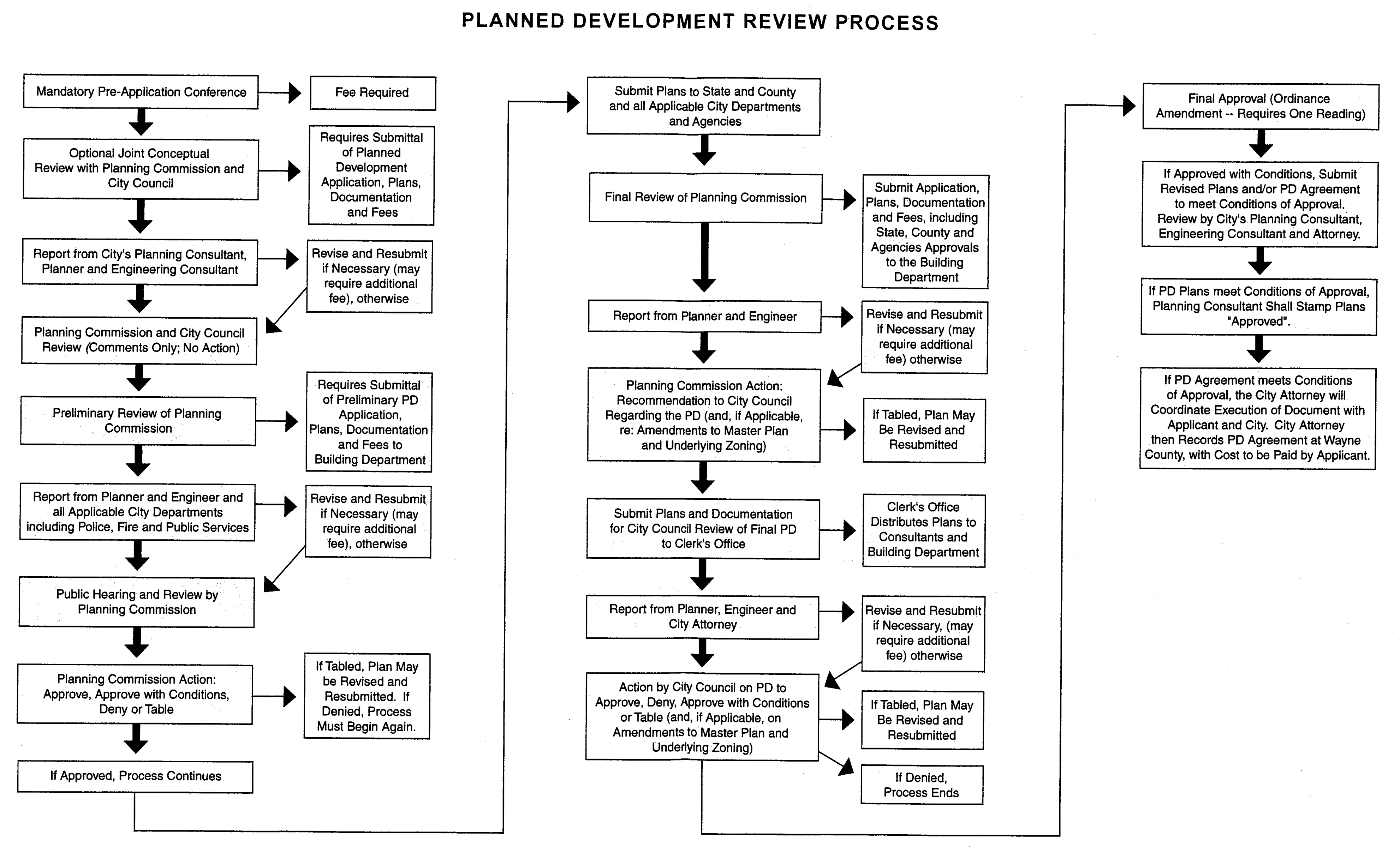
Summary of review procedures. A detailed explanation of the review procedures follows. If a proposal is inconsistent with the city's master plan and/or zoning map, then additional steps may be required to amend the master plan or change the underlying zoning to achieve consistency with the PD as described in subsection 36-572(6) and subsection (2)e below. Where a change to the underlying zoning is required, final action on the rezoning shall not be taken until immediately prior to action on the final PD plan.
(2)
General application requirements.
a.
The application for PD shall be made on the forms supplied by the building department, shall be submitted to the building department along with the required application fee and according to the guidelines approved by the planning commission. The applicant shall be responsible for all costs incurred to process and review the application. The applicant or a designated representative shall be present at all scheduled review meetings or consideration of the plan may be tabled due to lack of representation.
b.
All information required for conceptual or final review shall be submitted to the building department at least twenty-eight (28) working days prior to the planning commission or city council meeting in order to be eligible for consideration. Notwithstanding the twenty-eight-day time limit, a case may be withheld from an agenda because of deficiencies to the plans, public notice requirements, or the planning commission's or city council's need to manage their caseload.
c.
Pre-application meeting.
1.
Optional. In order to facilitate processing of an application for planned development in a timely manner, the city provides opportunities for potential applicants to meeting with and discuss development/redevelopment proposals with city officials, staff, and consultants for the purpose of obtaining information and guidance regarding land development regulations and the city's master plan in the preparation of the required PD site plan and application materials. The applicant shall have an opportunity to confer in a pre-application meeting with the community development director, building official, the city planning consultant, the city engineering consultant, and the city attorney, and all other appropriate city officials, including but not limited to police, fire and public works, and for proposals located within the TIFA district, the director of the TIFA. The city attorney and city planning and engineering consultant's fees for any such pre-application conference shall be paid by the applicant prior to the scheduling of the meeting and shall be processed in accordance with subsection 36-497(a)(1).
2.
Mandatory. A pre-application meeting is required for all proposed developments within the tax increment financing authority (TIFA) district by the director of the TIFA or its designated representative, the city planning consultant, building official, and other relevant city staff, and city engineer, as applicable. The applicant need not present drawings or site plans at a pre-application conference, but even if drawings or site plans are presented, no formal action shall be taken on a site plan at a pre-application conference. The city attorney and city planning and engineering consultant's fees for any such pre-application conference shall be paid by the applicant prior to the scheduling of the meeting and shall be processed in accordance with subsection 36-497(a)(1).
3.
At the pre-application meeting, the applicant shall submit a preliminary sketch plan for the proposed PD, plus a legal description of the property in question; the total number of acres in the project; a statement of the approximate number of residential units, if the proposal contains a residential component, and the approximate number of acres to be occupied by each type of use, for mixed use development proposals; the number of acres to be preserved as open or recreational space; and, all known natural resources and natural features to be preserved. The sketch plan shall show enough of the surrounding area to demonstrate the relationship of the PD to adjoining uses, both existing and proposed.
4.
No formal action shall be taken on a site plan submitted for pre-application conference. The pre-application meetings shall not constitute any form of approval of the planned development or the site plan. The process is intended to give the applicant an indication of the issues and concerns prior to formally applying for conceptual PD plan review.
d.
Optional joint conceptual review by the planning commission and city council. The following procedure shall be followed when applying for the optional joint conceptual PD review by the planning commission and city council. Planned development projects are encourage to undergo a conceptual review process in order to facilitate a complete and thorough review prior to approval. The joint conceptual review option is provided because PD projects are generally large or complex projects with higher intensity development that could have a major impact on surrounding land uses and significantly affect the health, safety and general welfare of city residents.
1.
Conceptual review procedure. All PD projects proposals are encouraged to undergo a joint conceptual review by the planning commission and city council. No formal action shall be taken on a plan submitted for conceptual review. Upon completion of the conceptual review by the planning commission and city council, the minutes of the conceptual review meetings shall be prepared and be made available for the benefit and use of the planning commission and city council during the final review of the proposal.
2.
Information required for conceptual review. The information required for conceptual review shall be provided according to the requirements of section 36-574(1) and shall be submitted to the building department for review. If complete and accurate plans and documents are submitted at least twenty-eight (28) days prior to a regularly scheduled planning commission of city council meeting, as appropriate, the case will be eligible to be placed on the meeting agenda (although placement on an agenda may be delayed due to other scheduling priorities).
3.
Effect of conceptual review. The conceptual review shall not constitute any form of approval of the planned development or the site plan. The process is intended to give the applicant an indication of the issues and concerns that must be resolved prior to preliminary and final PD plan review.
e.
Preliminary review. PD projects shall undergo a two-step plan review and approval process involving preliminary and final review. The procedures for preliminary review are outlined in this subsection. The preliminary site plan shall be subject to the site plan review requirements in article XIV, division 2, where applicable, as well as the additional requirements in this section.
1.
Information required for preliminary plan review. The information required for preliminary review shall be provided according to the requirements of subsection 36-572(2). The applicant shall submit copies of the preliminary plan and supporting materials to the building department for review. If complete and accurate plans and documents are submitted at least twenty-eight (28) days prior to a planning commission meeting, the case will be eligible to be placed on the meeting agenda (although placement on an agenda may be delayed due to other scheduling priorities).
2.
Amendment to the underlying zoning. If revisions to the underlying zoning are required pursuant to subsection (2)e. then such revisions shall be initiated at the preliminary plan stage of review. The rezoning shall be initiated by submitting a completed application for amendment to the zoning map pursuant to article XIV, division 4, which shall be accompanied by a legal description of the property that is subject to rezoning. The rezoning request may be processed concurrently with the PD application, but final action on the rezoning shall be delayed until immediately prior to final PD plan approval.
3.
Professional review. The preliminary PD plan and supporting materials shall be distributed to the city's planning consultant and engineering consultant, who shall submit written reviews of the preliminary plan to the planning commission, whenever possible at least five (5) days prior to the meeting at which the case will be discussed. Input from other city officials, such as police, fire and public works, and or outside agencies, such as the Wayne County DPS, may be sought.
4.
Public hearing. The planning commission shall hold a public hearing on each planned development proposal, in accordance with section 36-481.
5.
Planning commission review. The planning commission shall review the preliminary plan and application for planned development, together with the public hearing findings and any requested reports and recommendations from the building official, city planning consultant, city attorney, city public safety officials, city engineer, and other reviewing agencies. The planning commission may recommend approval, approval with conditions, or denial of the preliminary PD plan as follows, or the planning commission may table action on the case:
(i)
Approval. Upon determination by the planning commission that the preliminary PD plan is in compliance with the standards and requirements of this chapter and other applicable ordinances and laws, and that the proposed development would be beneficial to the public health, safety, and welfare and orderly development of the city, the planning commission shall grant approval of the preliminary PD plan.
(ii)
Approval with conditions. The planning commission may impose reasonable conditions upon the approval of a preliminary PD plan, to the extent authorized by law, for the purposes of insuring that public services and facilities affected by the proposed development will be capable of accommodating increased public service loads caused by the development, protecting the natural environment and conserving natural resources and energy, insuring compatibility with adjacent uses of land, and promoting the use of land in a socially and economically desirable manner. Conditions imposed shall be designed to protect the natural resources and the public health, safety and welfare of individuals in the development and those immediately adjacent, and the community as a whole. Conditions imposed shall also be necessary to meet the intent of this chapter and the standards set forth in section 36-571.
(iii)
Denial. Upon determination by the planning commission that a preliminary PD proposal does not comply with the standards and regulations set forth in this chapter, or otherwise would be injurious to the public health, safety, welfare, and orderly development of the city, the planning commission shall recommend denial.
(iv)
Table. If the planning commission determines that there is additional information needed to make a decision, and the developer is willing to provide such information, then the commission may table or postpone the case to a subsequent meeting.
6.
Effect of preliminary approval or denial. A preliminary approval shall mean that the PD project and plan generally meet the requirements of this chapter. Subject to any conditions imposed by the planning commission as part of its motion, final approval will be granted if:
(i)
All state and county approvals are obtained;
(ii)
No unresolved negative comments are received by any governmental agencies or public utilities; and
(iii)
All federal, state and local laws and ordinances are met; and
(iv)
All conditions imposed during preliminary plan approval are met.
A.
An unresolved negative comment shall be one that indicates the existence of a condition which is contrary to the requirements of this chapter or other applicable ordinances or laws, where such requirement has not been waived or dismissed as a result of an approval by the planning commission.
B.
If the planning commission determines that revisions are necessary to bring the PD proposal into compliance with applicable standards and regulations, the applicant shall be given the opportunity to submit a revised plan for further review by the planning commission and city council.
7.
State and county approval. Following preliminary PD plan approval by the planning commission, the applicant shall seek approval of the plan from local, county and state agencies that have jurisdiction over any aspect of the project. In the event that an agency cannot grant final approval based on the information currently available, then preliminary or conditional approval shall be sought to confirm the feasibility of the plan.
(i)
All PD projects shall require the review and approval of the following agencies prior to final site plan approval:
A.
All city officials, including police, fire and department of public works;
B.
The roads division of the Wayne County Department of Public Services or, if any part of the project includes or abuts a state highway or includes streets or roads that connect with or lie within the right-of-way of a state highway, the Michigan Department of Transportation;
C.
The Wayne County Department of Environment;
D.
The Wayne County Health Department and the Michigan Department of Environmental Quality shall approve the potable water system and the waste water disposal system;
E.
Approval of the Michigan Department of Environmental Quality shall be required for any activity involving regulated wetlands, watercourses, and floodplains.
In the that negative comments are received from any of these agencies, the planning commission shall consider the nature of such comments with respect to chapter requirements, conditions on the site, response from the applicant, and other factual data related to the issue or concern. Negative comments shall not automatically result in denial of the plan, but every effort shall be made to resolve any issues or concerns cited by these agencies prior to taking action on the plan.
(ii)
In addition to the specific required approvals, all planned development project site plans shall have been submitted to the Michigan Department of Natural Resources, each of the public utilities serving the site, and any other state agency designated by the planning commission, for informational purposes. The planning commission shall consider any comments made by these agencies prior to final site plan approval.
f.
Planning commission final review and recommendation. Final approval of the PD plan shall be considered by the planning commission upon the receipt of all the information required for final review in this subsection.
1.
Submission of revised site plan. The applicant shall submit copies of the final PD plan and supporting materials to the building department for review. If complete and accurate plans and documents are submitted at least twenty-eight (28) days prior to a planning commission meeting, the case will be eligible to be placed on the meeting agenda (although placement on an agenda may be delayed due to other scheduling priorities).
2.
Professional review. The final PD plan and supporting materials shall be distributed to the city's planning consultant and engineer consultant, who shall submit written reviews of the preliminary plan to the planning commission, whenever possible at least five (5) days prior to the meeting at which the case will be discussed.
3.
Final approval by planning commission. The planning commission shall review the application for final PD, together with the public hearing findings gathered during preliminary review, and any reports and recommendations from the building official, city planning consultant, city attorney, city public safety officials, city engineering consultant, and other reviewing agencies. The planning commission shall then make a recommendation to the city council, based on the requirements and standards of this chapter. If revision to the underlying zoning is required, then the planning commission shall make a recommendation on the rezoning prior to taking action on the final PD plan. The planning commission may recommend approval, approval with conditions, denial, or table action on the case, as follows:
(i)
Approval. Upon finding that the final PD plan and supporting documentation, including the planned development agreement, are in compliance with the standards and requirements of this chapter and other applicable ordinances and laws, that the development will not be injurious to the public health, safety, and welfare, and orderly development of the city, and that all conditions of preliminary plan approval have been met, then the planning commission shall recommend approval.
(ii)
Approval with conditions. The planning commission may recommend that the city council impose reasonable conditions upon the approval of a PD, to the extent authorized by law, for the purposes of insuring that public services and facilities affected by the proposed development will be capable of accommodating increased public service loads caused by the development, protecting the natural environment and conserving natural resources and energy, insuring compatibility with adjacent uses of land, and promoting the use of land in a socially and economically desirable manner. Conditions imposed shall be designed to protect the natural resources and the public health, safety and welfare of individuals in the development and those immediately adjacent, and the community as a whole. Conditions imposed shall also be necessary to meet the intent of this chapter and the standards set forth in section 36-571. In the event that the PD is approved subject to specified conditions, such conditions shall become a part of the record of approval and such conditions shall be modified only as provided in section 36-577.
Where construction is not proposed to begin immediately, or where a project is proposed for construction in phases, the planning commission may recommend that final approval be granted subject to subsequent review and approval of detailed site plans for each facility or phase, in accordance with article XIV, division 2, Site plan review provided that:
A.
The location and approximate size of such buildings shall be shown on the overall plan for the PD;
B.
Detailed site plans for such buildings shall be submitted for review and approval in accordance with the site plan review requirements in article XIV, division 2, Site plan review; and
C.
The plan shall comply with the phasing requirements in section 36-576.
(iii)
Denial. Upon determination by the planning commission that a PD proposal does not comply with the standards and regulations set forth in this chapter, including section 36-571, or otherwise would be injurious to the public health, safety, welfare, and orderly development of the city, the planning commission shall recommend denial.
(iv)
Table. If the planning commission determines that there is additional information needed to make a decision, and the developer is willing to provide such information, then the commission may table the case to a subsequent meeting.
4.
Transmittal of findings to city council. The city planning consultant shall prepare and transmit a report to the city council stating it's and the planning commission's conclusions and recommendation, the basis for it's the planning commission's recommendation, and any recommended conditions relating to an affirmative decision.
g.
City council action required. Following receipt of the planning commission's report, the application shall be placed on the city council next available meeting agenda. The city council shall review the final plan and proposed planned development agreement, together with the findings of the planning commission and the planning commission minutes, and, reports and recommendations from consultants and other reviewing agencies. Following completion of its review, the city council shall approve, approve with conditions, or deny a planned development proposal in accordance with the guidelines described previously in section 36-575. However, if the city council determines that there is additional information needed to make a decision, and the developer is willing to provide such information, then the council may table the case to a subsequent meeting and/or remand the case to the planning commission for further review. PD approval results in an amendment to the zoning ordinance, so one reading at a subsequent meeting is required by the city council. If a plan is approved subject to conditions, then all such conditions shall be addressed prior to execution of the planned development agreement. Denial of a final plan by the city council terminates the approval process.
1.
Planned development agreement. If the city council approves the pd proposal, the city and applicant shall execute the planned development agreement, which shall be recorded in the office of the Wayne County Register of Deeds. Final approval of the PD plan shall become effective upon recording of the agreement. Evidence of the recorded agreement shall be submitted to the city, whereupon the designation on the zoning map will be changed to PD.
2.
Effect of approval. Approval of a PD proposal shall constitute an amendment to the zoning ordinance. All improvements and use of the site shall be in conformity with the PD amendment and any conditions imposed. A notice of record of amendment adoption shall be filed, in accordance with subsection 36-523(f).
h.
Recording of planning commission and city council action. Each action taken with reference to a PD shall be duly recorded in the minutes of the planning commission or city council, as appropriate. The grounds for the action taken shall also be recorded in the minutes.
i.
Completion of site design.
1.
Obtaining a building permit. Following final approval and recording of a PD, a building permit may be obtained for the entire project or specific phases provided that:
(i)
Final site plan, condominium, or subdivision plat approval for the project or phase, as applicable, has been obtained;
(ii)
The engineering plans for the project or phase, as applicable, have been approved by the city engineering consultant, building official, and other city officials, including police, fire and public works; and
(iii)
All applicable city, county, and state permits have been obtained.
2.
Expiration and extension of approval.
(i)
Construction shall commence on at least one (1) phase of the project within twenty-four (24) months of final approval. However, the developer may seek subsequent twelve (12) month extensions of approval by submitting a written request to the building department prior to the expiration date. Extension of approval is not required for an uncompleted project where there is ongoing construction.
(ii)
A request for extension shall be distributed for review and recommendation by the planning consultant and building official, and other city officials, as applicable, who shall provide a written report to the planning commission.
(iii)
The planning commission shall consider the request after reviewing all reports from consultants and other city officials, as required to make a determination. The planning commission may grant an extension of up to twelve (12) months upon finding that the approved plan represents current conditions on and surrounding the site. The planning commission shall then provide a written report to the city council of their action.
(iv)
If construction has not commenced and a request for extension has not been received within twenty-four (24) months, the planning commission may initiate proceedings to amend the zoning classification of the site to remove the PD classification, in accordance with article XIV, division 4.
3.
Maintenance of the property. The owner of the property for which approval has been granted shall maintain the property in accordance with the approved PD plan on a continuing basis until the property is razed, or until an amendment to the PD is approved. Any property owner who fails to so maintain an approved planned development shall be deemed in violation of the zoning ordinance and shall be subject to the penalties appropriate for such violation.
4.
Expansion or conversion. Prior to expansion or conversion of a PD project to include additional land, plan review and approval shall be required pursuant to the requirements in this article and chapter.
j.
Performance guarantee. A performance guarantee shall be deposited with the city to insure faithful completion of improvements, in accordance with article I.
(Ord. No. H-07-01, § 16.03, 7-24-07)
Sec. 36-574. - Application and plan requirements.
Applications for PD projects shall include all data requirements specified in this subsection. All information required to be furnished under this subsection shall be kept updated until a certificate of occupancy has been issued pursuant to section 36-6.
(1)
Requirements for conceptual review. It is required that the following information be provided prior to conceptual PD plan review, pursuant to subsection 36-573(2)d. The absence of any requested information may limit the extent to which the planning commission and city council can comment on the proposal:
a.
The name, address and telephone number of:
1.
All persons with an ownership interest in the land on which the PD project will be located together with a description of the nature of each entity's interest (for example, fee owner, optionee, lessee, or land contract vendee).
2.
All engineers, attorneys, architects or registered land surveyors associated with the project.
3.
The developer or proprietor of the planned development project.
b.
The legal description of the land on which the planned development project will be developed together with appropriate tax identification numbers.
c.
The area of the land (in acres) on which the PD project will be developed.
d.
An overall conceptual land use plan for the PD, drawn to scale. The overall plan shall graphically represent the development concept using maps and illustrations to indicate each type of use, square footage or acreage allocated to each use, and approximate locations of each principal structure and use in the development. The overall plan shall indicate types of residential use; office, commercial, industrial, and other nonresidential uses; each type of open space; community facility and public areas; and other proposed land uses.
e.
The conceptual land use plan shall also show the following information:
1.
A general location map.
2.
The vehicular circulation system planned for the proposed development.
3.
The location of existing private and public streets adjacent to the proposed development with an indication of how they will connect with the proposed circulation system for the new development.
4.
The approximate layout of dwelling units, parking, open space, and recreation/park areas.
5.
Landscaped screening proposed along the perimeter of the development.
f.
Approximate number of nonresidential buildings and residential units proposed to be developed on the subject parcel. For residential developments, an analysis shall be provided to determine the number of units that could be developed on the property under conventional zoning.
g.
Topographic survey and soils inventory based on the Wayne County Soils Survey.
h.
General locations and approximate dimensions of wetland areas, floodplains, and significant site features such as tree stands, unusual slopes, streams and water drainage areas.
i.
A description of the proposed connections to public sewer and water systems. Plans should be sufficiently detailed to demonstrate connection is possible.
j.
Proposed stormwater management and drainage system.
k.
A map showing existing zoning designations for the subject property and all land within one-quarter (¼) mile.
l.
A map and written explanation of the relationship of the proposed planned development to the city's master plan for future land use.
m.
Maps and written analysis of the significant natural, cultural, and geographic features of and near the site. Features which shall be considered include existing vegetation, topography, water courses, wildlife habitats, streets and rights-of-way, easements, structures, and soils.
n.
An analysis of the traffic impact of the proposed PD on existing and proposed streets.
o.
An analysis of the fiscal impact (costs and revenues) of the proposed PD on the city and the school district in which the development is located.
p.
Documentation that the applicant has sufficient development experience to complete the proposed project in its entirety (e.g., provide a list of developments completed by the applicant in the past ten (10) years, with a description of the project, number of units, and time required to complete).
q.
A general schedule for completing the PD, including the phasing or timing of all proposed public and private improvements.
(2)
Requirements for preliminary review. In addition to the requirements in article XIV, division 2 and applicable information specified on the site plan checklist, the following information shall be included on, or attached to, all PD plans submitted for preliminary review:
a.
All preceding information required for conceptual review.
b.
A detailed overall plan for the PD which shows all of the information required on the conceptual land use plan plus the following:
1.
Locations and setbacks of each structure and use in the development.
2.
Typical layouts and facade design for each type of use or building. Detailed information, including floor plans, facade elevations, and other information normally required for site plan review, shall be provided for buildings which are proposed for construction in the first phase.
3.
The building footprint of proposed buildings. In the case of single family detached development, the plan should indicate the setbacks and outline of the area within which a house could be constructed on each lot.
4.
The vehicular circulation system planned for the proposed development, including a designation of each street as to whether it is proposed to be private or dedicated to the public.
5.
The proposed layout of parking areas, open space, and recreation/park areas.
6.
Proposed landscape screening along the perimeter and within the site, including greenbelts, berms and screening walls.
c.
The precise number of nonresidential and residential units to be developed on the subject parcel.
d.
An environmental analysis of the land, including a hydrology study, analysis of soil conditions, and analysis of other significant environmental features. The hydrology study shall consist of information and analysis in sufficient detail (as determined by the city's engineering consultant) to indicate the impact of the project on surface water and groundwater.
e.
Specific locations and dimensions of wetland areas and significant site features such as tree stands, unusual slopes, streams and water drainage areas.
f.
A complete description of the proposed connections to public sewer and water supply systems, including documentation from a qualified engineer indicating the feasibility of implementing such systems.
g.
Storm water and drainage system details.
h.
Location of bike paths and sidewalks along roads and elsewhere within the development.
i.
A specific schedule for completing the planned development, including the phasing or timing of all proposed improvements.
(3)
Requirements for final review. In addition to the requirements in article XIV, division 2 and applicable information specified on the site plan checklist, the following information shall be included on, or attached to, all PD plans submitted for final review:
a.
All information required for conceptual and preliminary review as specified in subsection (1) and (2), previously, and any specified as conditions of preliminary PD approval.
b.
Detailed site plans for all buildings and uses which the applicant intends to begin construction on immediately upon final PD approval. Where construction is not proposed to begin immediately or where a project is proposed for construction in phases, the planning commission may recommend that final approval be granted subject to subsequent review and approval of detailed site plans for each facility or phase, in accordance with article XIV, division 2.
c.
Detailed engineering plans for all portions of the project which the applicant intends to begin construction on immediately upon final planned development approval. Where construction is not proposed to begin immediately or where a project is proposed for construction in phases, the planning commission may recommend that final approval be granted subject to subsequent review and approval of detailed engineering plans for each facility or phase. Such plans shall be prepared in accordance with the city engineering standards, and shall at minimum include the following:
1.
Engineering plans for all roads, drive aisles, and paved areas,
2.
Site drainage plans, including retention and/or detention areas,
3.
Engineering plans for proposed utility systems, including sanitary sewerage and water systems.
4.
Plans for controlling soil erosion and sedimentation during construction.
d.
Following approval of a PD proposal and an amendment to the zoning ordinance per article XIV, division 4, final site plan and engineering review and approval shall be required prior to obtaining a building permit and commencement of construction for each facility or phase.
e.
A draft planned development agreement, setting forth the terms and conditions negotiated and to be agreed to by the applicant and the city, and upon which approval of the PD proposal will be based. The planned development agreement shall, at minimum, include the following:
1.
A description of the land that is subject to the agreement.
2.
A description of the permitted uses of the property, the density or intensity of use, and the maximum height and size of proposed buildings.
3.
History of the review procedures and action taken by the planning commission or city council.
4.
List of all plans, documents, and other materials submitted by the applicant.
5.
Review and explanation of all special provisions agreed to by the applicant and city during the course of review of the PD proposal.
6.
An explanation of all public improvements to be undertaken by the applicant or the city in conjunction with the proposed PD project.
7.
Description of any required dedications and permits.
8.
Confirmation that the proposed development is consistent with applicable city ordinances and planning objectives.
9.
Duration of the planned development agreement, along with terms under which a termination date may be extended by mutual agreement.
10.
Applicability of future amendments to the general zoning regulations to land that is subject to the proposed planned development agreement.
11.
Extent to which the PD plan may be modified subject to administrative approval, planning commission approval, or city council approval.
12.
Copies of permits and the conditions of approval received from local, county, or state agencies have jurisdiction over any aspect of the project.
(Ord. No. H-07-01, § 16.04, 7-24-07)
Sec. 36-575. - Approval standards.
In considering any application for approval of a PD plan, the planning commission and city council shall make their determinations on the basis of the standards for site plan approval set forth in article XIV, division 2, as well as the following standards and requirements:
(1)
Conformance with the planned development concept. The overall design and all uses proposed in connection with a PD shall be consistent with and promote the intent of the PD concept, as well as with specific project design standards set forth herein.
(2)
Compatibility with adjacent uses. The proposed PD shall set forth specifications with respect to height, setbacks, density, parking, circulation, landscaping, views, and other design and layout features which exhibit due regard for the relationship of the development to surrounding properties and the uses thereon. In determining whether this requirement has been met, consideration shall be given to:
a.
The bulk, placement, and materials of construction of proposed structures.
b.
The location and screening of vehicular circulation and parking areas in relation to surrounding development.
c.
The location and screening of outdoor storage, outdoor activity or work areas, and mechanical equipment in relation to surrounding development.
d.
The hours of operation of the proposed uses.
e.
The provision of landscaping and other site amenities.
f.
The anticipated level of noise, vibration, smoke, odor or other environmental discharge.
(3)
Public services. The proposed PD shall not exceed the capacity of existing and available public services, including but not necessarily limited to utilities, public roads, police and fire protection services, and educational services, unless the proposal contains an acceptable plan for providing necessary services or evidence that such services will be available by the time the PD is completed.
(4)
Impact of traffic. The PD shall be designed to minimize the impact of traffic generated by the proposed development on surrounding uses. In determining whether this requirement has been met, consideration shall be given to:
a.
Access to major thoroughfares.
b.
Estimated traffic to be generated by the proposed development.
c.
Proximity and relation to intersections.
d.
Adequacy of driver sight distances.
e.
Location of and access to off-street parking.
f.
Required vehicular turning movements.
g.
Extent and nature of road improvements.
h.
Provisions for pedestrian and bicycle traffic.
(5)
Protection of natural environment. The proposed PD shall be protective of the natural environment, and shall be in compliance with all applicable environmental protection laws and regulations. Every feasible effort shall be made to preserve distinctive natural features, such as woods, wetlands, streams, natural drainage courses and wildlife habitat, and incorporate such features into the design of the PD. Buildings and structures in PD projects shall comply with the wetlands and watercourse setback requirements specified in section [36-316] and flood hazard area overlay zone requirements in section [36-317].
(6)
Compatibility with the master land use plan. The proposed planned development shall be consistent with the general principles and objectives of the adopted city's master plan for future land use.
(7)
Compliance with applicable regulations. The proposed PD shall be in compliance with all applicable federal, state, and local laws and regulations.
(Ord. No. H-07-01, § 16.05, 7-24-07)
Sec. 36-576. - Phasing requirements.
Where a project is proposed for construction in phases, the project shall be so designed that each phase, when completed, shall be capable of standing on its own in terms of the presence of services, facilities, and open space, and shall contain the necessary components to insure protection of natural resources and the health, safety, and welfare of the users of the planned development and the residents of the surrounding area.
In addition, proposed phasing shall comply with the following requirements:
(1)
Coordination of residential and nonresidential components. In developments which include residential and nonresidential components, the residential component shall be completed at the same rate or prior to the nonresidential component. For example, if fifty (50) percent of the nonresidential component is proposed to be completed in a certain phase, then at least fifty (50) percent of the residential component should be completed in the same phase. One hundred (100) percent of the residential component shall be completed prior to the final phase of nonresidential construction. The construction of roads, utilities, and other infrastructure shall be considered completion of a residential component, where the intent is to sell lots to others who will construct the housing units.
The purpose of this provision is to ensure that PD projects are constructed in an orderly manner and, further, to ensure that the PD approach is not used as a means of circumventing restrictions on the location or quantity of certain types of land use. For purposes of carrying out this provision, the percentages shall be approximations as determined by the planning commission based on the floor area and land area allocated to each use. Such percentages may be varied should the city council, upon recommendation from the planning commission, determine that the applicant has presented adequate and effective assurance that the residential component or components of the project shall be completed within the specified period.
(2)
Commencement of construction. Construction of any facility may commence at any time following site plan approval per article XIV, division 2, provided that construction shall be commenced for each phase of the project within twenty-four (24) months of the schedule set forth on the approved plan for the PD.
However, the applicant may submit a revised phasing plan for review and approval by the planning commission. The applicant shall also submit a statement indicating the conditions which made the previous phasing plan unachievable. Once construction of a PD has commenced, approval of a revised phasing plan shall not be unreasonably withheld or denied, provided that the revised phasing does not materially change the integrity of the approved planned development proposal.
In the event that construction has not commenced within the required time period and a revised phasing plan has not been submitted, the city may initiate proceedings to amend the zoning classification of the undeveloped portion of the site.
(Ord. No. H-07-01, § 16.06, 7-24-07)
Sec. 36-577. - Revision and/or modifications of an approved planned development plan.
(a)
General revisions. Approved final plans for a PD project may be revised in accordance with the procedures set forth in section 36-573.
(b)
Minor changes. Notwithstanding subsection 36-573(1), minor changes may be permitted by the planning commission following normal site plan review procedures outlined in article XIV, division 2, subject to its finding that:
(1)
Such changes will not adversely affect the initial basis for granting approval.
(2)
Such minor changes will not adversely affect the overall planned development in light of the intent and purpose of such development as set forth in section 36-571.
(Ord. No. H-07-01, § 16.07, 7-24-07)
Sec. 35-578. - Project design standards.
Proposed planned developments that satisfy the qualifying criteria in section 36-572 shall comply with the following project design standards:
(1)
Location. A planned development may be approved in any location in the city, subject to review and approval as provided for herein.
(2)
Permitted uses. Any land use authorized in this chapter may be included in a planned development as a principal or accessory use, provided that:
a.
The predominant use on the site, based on acreage, shall be consistent with the uses specified in the city's future land use plan and zoning map. Where the predominant uses are not consistent, prior to PD approval, an amendment to the future land use plan, and map may be required, as noted in subsection 36-572(6), and an amendment to the zoning map may be required, as noted in subsection e., below.
b.
There shall be a reasonably harmonious relationship between the location of buildings on the site relative to buildings on lands in the surrounding area.
c.
Residential, neighborhood commercial, office, and public uses may be developed together in a PD project, provided the uses are compatible and complementary, demonstrating good site design and planning principles.
d.
The mix of uses and the arrangement of those uses within a PD project shall not impair the public health, safety, welfare, or quality of life of residents or the community as a whole.
e.
Where the existing underlying zoning district is residential, nonresidential uses may be permitted as a part of a planned development provided that such nonresidential uses occupy a maximum of twenty (20) percent of the buildable acreage of the site, subject to the following conditions:
1.
The mix of uses must be consistent with the planned uses in the master plan.
2.
An amendment to the zoning map to change the underlying zoning (see definition of "underlying zoning" in article II) shall be required prior to final PD approval if more than twenty (20) percent of the acreage in a residential PD is proposed to be occupied by nonresidential uses.
3.
For the purposes of this subsection (2)e, nonresidential may include, but is not limited to: commercial, office, research, public (e.g., library, post office, municipal facilities, schools, etc), and recreational.
(3)
Residential density. The overall density of residential uses within a PD may exceed the density that could be achieved with the underlying zoning by five (5) percent. In determining the density achievable with the underlying zoning, only the net buildable area of the residential portion of the site shall be considered. The "net buildable area" consists of the portion of the site that is not encumbered by regulated wetlands, steep slopes, existing road rights-of-way, easements, floodplains that cannot be included in residential lots, existing structures or lots, or other existing or proposed features that would prevent construction of a building or use of the site for residential purposes.
The city council, following review by the planning commission, may grant an increase in density above five (5) percent. Such an increase will be allocated based on a finding that certain characteristics would: 1) result in substantial benefit to the users and the community as a whole, and 2) result in design excellence. Examples of residential design excellence include (but are not limited to): a traditional neighborhood layout and design, preservation of natural habitat and trees, preservation of the natural topography, and layout of lots so that they are integrated into a pedestrian oriented network that is interconnected to nonresidential uses and public transportation alternatives. Additional criteria that the planning commission and city council may consider in determining whether a density increase is warranted include the following:
(4)
Yard setbacks. PD projects shall comply with the minimum yard setback requirements of the underlying zoning district. Modification to these yard setback requirements may be approved by the city council, upon recommendation from the planning commission, upon making the determination that other setbacks would be more appropriate because of the topography, existing trees and other vegetation, proposed grading and landscaping, or other existing or proposed site features.
(5)
Building height. Buildings within a PD project shall comply with the following height requirements: residential buildings: thirty (30) feet; commercial and office buildings: thirty (30) feet; industrial buildings: thirty-five (35) feet. Modification to these building height requirements may be approved by the city council, upon recommendation from the planning commission, upon making the determination that other building height requirements would be more appropriate because of the particular design and orientation of buildings.
(6)
Parking and loading. PD projects shall comply with the parking and loading requirements specified in article IX of the zoning ordinance, except that off-street parking for separate buildings or uses may be provided collectively, subject to the following:
a.
The total number of spaces provided collectively shall be based on evidence, consisting of projected hourly parking demand for each use, demonstrating that sufficient spaces will exist to meet parking needs at all times.
b.
Each use served by collective off-street parking shall have direct access to the parking without crossing roads.
c.
The collective off-street parking shall not be located farther than five hundred (500) feet from the building or use being served.
(7)
Landscaping. PD project shall result in a higher quality of development than could be achieved under conventional zoning. At a minimum, PD projects shall comply with the landscaping requirements of article X.
a.
Design flexibility. In consideration of the overall design and impact of a specific landscape plan, and in consideration of efforts to maintain the natural landscape, the planning commission may modify the specific landscape requirements outlined herein, provided that any such modifications are in keeping with the intent of this article.
(8)
Frontage and access. PD projects shall front onto a paved major thoroughfare or collector road (as designated in the city's master plan) or state trunkline, and the main means of access to the development shall be via the major thoroughfare, collector road, or state trunkline. All roads fronting a planned development shall be paved.
a.
Private roads are permitted in a PD project, provided that they comply with all requirements of the city's private road ordinance and are constructed in accordance with Wayne County specifications for paved roads.
b.
Individual residential dwelling units in a PD project shall not have direct access onto a major thoroughfare, collector road, or state trunkline.
(9)
Natural features. The development shall be designed to promote preservation of natural resources and natural features. If natural animal or plant habitats of significant value exist on the site, the planning commission or city council may require that the PD plan preserve the areas in a natural state and adequately protect them as open space preserves or passive recreation areas.
(10)
Bike paths and sidewalks. A public bicycle path or sidewalk shall be required along adjoining principal arterial, minor arterial, and collector roads (as illustrated on the bicycle path and sidewalk master plan map). In addition, five-foot wide sidewalks shall be installed on both sides of streets or private roads within proposed subdivisions and single-family condominium developments and on both sides of streets or private roads within multiple family residential developments. Bicycle paths and sidewalks shall comply with the city's bicycle path and sidewalk ordinance.
(11)
Stormwater detention or retention. Required stormwater detention or retention shall be provided in accordance with state, county and local statues. Open basins may be permitted and shall be incorporated into the landscaping or open space plan for the development so that they have the appearance of an appealing natural feature. Stormwater detention or retention shall comply with the city's engineering standards.
(12)
Additional considerations. The planning commission shall take into account the following considerations, which may be relevant to a particular project: thoroughfare, drainage; utility design and capacity of the utility systems; road capacity; underground installation of utilities; insulating the pedestrian circulation system from vehicular thoroughfares and ways; achievement of an integrated development with respect to signage, lighting, landscaping and building materials; and, noise reduction and visual screening mechanisms, particularly in cases where nonresidential uses adjoin off-site residentially-zoned property or where mixed uses are permitted.
(13)
Industrial activity statement. Industrial uses shall complete an industrial activity statement, as specified in section 36-342.
(Ord. No. H-07-01, § 16.08, 7-24-07)

