
Delaware City Zoning Code
TITLE ONE
PLANNING
1101.01. - Title.
The rules, regulations, procedures, and accompanying maps in Part 11 of the City of Delaware Codified Ordinances shall be known, cited, and referred to as the Delaware Zoning Ordinance. This Ordinance includes standards for planning, subdividing, and developing land within the City.
(Ord. 25-38. Passed 7-14-25)
1101.02. - Authority and scope.
This Zoning Ordinance is adopted by the City pursuant to its authority under the Ohio Revised Code and the City of Delaware Charter. Nothing in this Zoning Ordinance shall be construed to limit City Council in the exercise of all of the powers to zone or redistrict now or hereafter as authorized by the Ohio Revised Code or the City Charter.
(Ord. 25-38. Passed 7-14-25)
1101.03. - Purpose.
The purpose of this Zoning Ordinance is to promote and uphold the public health, safety, and general welfare of the City through regulation of the use of land and of the type, size, and use of structures. More specific purposes are to:
(a)
Establish districts of such classification and number to implement any applicable plans, including the City's Comprehensive Plan and Thoroughfare Plan, that encourages the most appropriate uses of the land and guides the future development of the City.
(b)
Ensure and encourage the most appropriate use of land to stabilize and preserve property values, to provide safety from hazards such as fire, flood, water, land and air contamination, and to guarantee adequate light, air, and open space to all residents of the City.
(c)
Encourage compatibility between different land uses and protect the scale and character of existing development from the encroachment of incompatible uses.
(d)
Preserve unique historical and/or natural features of structures or land within the City.
(e)
Regulate and restrict the location, bulk, height, design, and land coverage of buildings to protect the character and value of the City's residential, commercial, industrial, institutional, and recreational areas.
(f)
Regulate the area and dimension of lots, yards, and other open spaces.
(g)
Ensure efficient traffic circulation, manage congestion on the thoroughfares, and improve public safety by locating buildings and uses adjacent to thoroughfares in such a manner that they will cause the least interference with, and be damaged least by, traffic movements.
(h)
Facilitate development of land uses according to a comprehensive design that ensures the availability of and provision for adequate traffic capacity, water and sewer service, schools, public parklands, and other such public facilities.
(i)
Provide regulations, standards, and procedures for the administration, amendment, and enforcement of this Zoning Ordinance.
(Ord. 25-38. Passed 7-14-25)
1101.04. - Applicability.
(a)
After the effective date of this Zoning Ordinance, no use of a structure or land shall be changed, and no structure or part thereof shall be erected, moved, or altered unless for a use expressly permitted by and in conformity with, the regulations specified in this Zoning Ordinance. Existing buildings, structures, and uses of land that do not comply with the regulations of this Zoning Ordinance are non-conforming and subject to the regulations set forth in this Ordinance.
(b)
No trees shall be removed from land within the City of Delaware except in conformity with the regulations specified in this Ordinance.
(c)
No lot, yard, parking area, or other space shall be reduced in area or dimensions so as to make such area or dimension less than the minimum required by this Zoning Ordinance. No part of a yard, parking area, or other space provided about or for any building or structure for the purpose of complying with the provisions of this Ordinance shall be included as part of a yard, parking area, or other space required under this Ordinance for another building or structure.
(d)
Nothing in this Zoning Ordinance shall prevent the strengthening or restoring to a safe condition of any part of any building or structure declared unsafe by the proper authority.
(e)
Essential services shall be permitted as authorized and regulated by law and other ordinances of the City, it being the intention hereof to exempt such essential services from the application of this Zoning Ordinance.
(Ord. 25-38. Passed 7-14-25)
1101.05. - Interpretation.
The interpretation and application of the provisions of this Ordinance shall be held to be minimum requirements, unless otherwise specified within this text. The provisions of this Zoning Ordinance shall be liberally construed to further the purposes and objectives set forth herein and the purposes and intent of each district as set forth in each district chapter.
(Ord. 25-38. Passed 7-14-25)
1101.06. - Conflicting laws.
(a)
Except as specifically provided herein, the provisions of this Zoning Ordinance shall not repeal, abrogate, annul, or in any way impair or interfere with any existing ordinances, laws, rules, or permits previously adopted or issued.
(b)
Where provisions of this Ordinance impose greater restrictions than other existing laws, regulations, or ordinances, the provisions of this Zoning Ordinance shall govern. Conversely, other regulations shall govern where they are more restrictive in nature than this Zoning Ordinance.
(c)
These regulations shall not change any approved development plan or subdivision.
(Ord. 25-38. Passed 7-14-25)
1101.07. - Severability.
It is the legislative intent that, in adopting Part 11 of the City of Delaware Codified Ordinances, all its provisions shall be liberally construed to protect and preserve the peace, health, safety, and general welfare of the City of Delaware. It is the further legislative intent of the Council that Part 11 shall stand, notwithstanding the invalidity of any part, and that, should any provision be held to be unconstitutional or invalid, such holding shall not be construed as affecting the validity of any of the remaining provisions.
(Ord. 25-38. Passed 7-14-25)
1102.01. - Interpretation.
For the purpose of this Zoning Ordinance, terms or words used herein shall be interpreted according to this section. In the case of a discrepancy in meaning or implication between the text of this Ordinance and any illustration or caption, the text shall control.
(a)
The word "shall" signifies a mandatory requirement, one that is not discretionary; the word "may" signifies a permissive or discretionary requirement; and the word "should" is a preference.
(b)
The word "building" includes the word "structure." The word "structure" includes the word "building".
(c)
The word "person" includes a firm, association, organization, partnership, trust, company, corporation, or similar entity, as well as an individual.
(d)
The words "used" and "occupied" include the words "arranged, designed, constructed, altered, or intended to be used."
(e)
The word "lot" includes the words "plot" and "parcel."
(f)
The present tense includes the future tense, the singular number includes the plural, and the plural number includes the singular.
(g)
Whenever a number of days are specified, days shall mean calendar days, unless specifically noted otherwise.
(h)
Whenever a word is not defined, the dictionary definition shall apply.
(Ord. 25-38. Passed 7-14-25)
1102.02. - Definitions.
"Accessory use" or "structure" means a use, object or structure constructed or installed on the same lot as, and of a nature subordinate and customarily incidental to the principal (primary) use, object, or structure of a lot.
"Accessory dwelling unit (ADU)" means an internal, attached, or detached independent residential dwelling unit located on the same lot as a stand-alone single-family home or two-family dwelling which includes its own entrance and space for living, eating, sleeping, and cooking.
(1)
"ADU, attached" refers to dwelling units that are created by dividing space within a principal building, or by adding floor area to an existing dwelling.
(2)
"ADU, detached" refers to dwelling units that are located inside of accessory buildings located on the same lot as a principal dwelling.
"Accessory retail/service" means a retail or service facility that is clearly incidental and subordinate to the primary use of a structure.
"Addition" means a section added to a structure either through construction, thereby forming one architectural whole, or by joining, as by a passage, so that each section is a necessary adjunct or appurtenance of the other and thus constitutes the same structure.
"Adjusted total area (for a site)" means the area that is equal to the total area of the site that is subject of the development application, minus the area of any right-of-way required to be dedicated pursuant to the City's thoroughfare plan and any cleared stormwater detention or retention areas, as required by the City Engineer.
"Age restricted retail sales" means the sale at retail of:
(1)
Tobacco or vapor products or alternative nicotine products.
A.
When these products account for more than 50% of sales at the business.
(2)
"Medical marijuana" and "adult use cannabis," as those terms are defined in ORC §§ 3719.01, 3796.01, and 3780.01.
"Agriculture" means the production, keeping or maintenance, for sale, lease or personal use, of plants and/or animals useful to humans, including but not limited to: forages and crops; dairy, poultry and livestock including products breeding and grazing thereof; trees and forest products; or lands devoted to a soil conservation of forestry management program.
"Airport-related use" means a use that supports airport operations, including but not limited to aircraft repair and maintenance, flight instruction, and aircraft chartering.
"Alley" means a minor street used primarily for vehicular service access to the back or side of properties abutting on another street. For the purposes of frontage calculation, alleys shall not be considered a public street.
"Alternative energy" means energy from sources that are naturally replenishing, such as water, wind, and the sun.
"Antenna" means any system of wires, poles, rods, reflecting discs, or similar devices used for the transmission or reception of electromagnetic waves when such system is either external to or attached to the exterior of a structure. Antennae shall include devices having active elements extending in any direction, and directional beam type arrays having elements carried by and disposed from a generally horizontal boom that may be mounted upon and rotated through a vertical mast or tower interconnecting the boom and Antenna support, all of which elements are deemed to be a part of the Antenna.
"Antenna support structure" means any building or other structure other than a Tower which can be used for location of Wireless Telecommunications Facilities.
"Applicant" means a person, corporation or other legal entity submitting an application to the City for legislative or administrative approval including, but not limited to, zoning amendments, subdivision or lot splits, conditional uses, development plan approval, variances or appeals. The applicant shall be the owner of the property for which action is being sought or be its representative who shall have express written authority to act on behalf of the owner.
"Automotive repair garage, major" means the commercial repair or restoring of motor vehicles, including the repair, reconditioning or rebuilding of engines and/or transmissions; collision service (such as body, frame or fender straightening or repair); and the overall painting, or undercoating of vehicles all conducted within a completely enclosed building.
"Automotive repair garage, minor" means a commercial building or part of a building, structure or space where the retail sale of lubricants and motor vehicle accessories, the routine maintenance and service of vehicles and/or the making of repairs to motor vehicles are conducted. This definition excludes all work defined within automotive repair garage, major.
"Automotive sales and rental" means the use of any building, land area or other premise for the display and sale, lease or rental of three (3) or more new or use motor vehicles, and which may include the display and sale, lease or rental or new or use motorcycles, light trucks and vans, trailers or recreation vehicles that are used primarily for personal needs.
"Berm" means an earthen mound designed to provide visual interest, screen undesirable views, and/or decrease noise.
"Block" in describing the boundaries of a district, "block" refers to the legal description. In all other cases, a "block" refers to the property abutting on one side of a street between intersecting or intercepting streets or a street and a railroad right-of-way or waterway.
"Breezeway" means an enclosed hallway with a width of less than ten (10) feet connecting a primary structure to an accessory structure.
"Brewery or winery, macro" means an industrial use that brews ales, beers, meads, wines and/or similar beverages on site.
"Brewery or winery, micro" means a facility for the production and packaging of malt beverages of low alcoholic content or wines for distribution, retail, or wholesale, on or off premise, with a capacity of not more than 15,000 barrels per year. The development may include other uses such as a standard restaurant, bar or live entertainment.
"Buffer or buffer yard" means a unit of land, together with a specified type and amount of planting thereon, that is intended to eliminate or minimize conflicts between land uses.
"Building" means any structure having a roof support by or suspended from columns or walls designed or intended for the support, enclosure, shelter or protection of persons, animals or property. The term "building" does not include any vehicle, trailer (with or without wheels), or any removable device, such as furniture, machinery, or equipment.
(1)
"Building, accessory" means a subordinate building detached from, but located on the same lot as, the principal building, the use of which is incidental and accessory to that of the principal building.
(2)
"Building, principal" means a building in which is conducted the main or principal use of the lot on which said building is situated.
"Building coverage" means the total area of a site covered by principal and accessory buildings or roofed areas, excluding allowed projecting eaves, balconies, and similar features.
"Building height" means the vertical distance, measured from the average elevation of the finished grade at the front of the building to the highest point of the roof for flat roofs; to the deck lines of mansard roofs; and to the peak of the roof for gable, hip and gambrel roofs. Where a building is located on sloping terrain, the height shall be measured from the average of the finished grades of the tallest and shortest building walls.
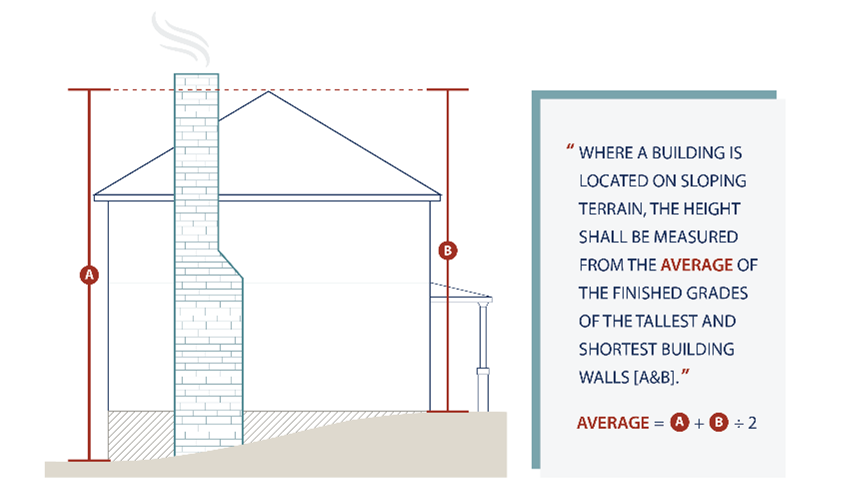
Figure 1102.02(25). Building Height
"Building line or building setback line" means an imaginary linear extension of the building wall parallel to the street right-of-way line defining the limits of the front yard(s).
"Car wash" means a building or area that provides facilities for washing and cleaning motor vehicles, which may use production line methods with a conveyor, blower, or other mechanical devices and/or which may employ hand labor for the washing and/or waxing of automobiles.
"Caliper" means the American Association of Nurseryman standard for trunk measurement of nursery stock. Caliper of the trunk shall be taken six (6) inches above the ground up to and including four-inch caliper size, and twelve (12) inches above the ground for a caliper size greater than four (4) inches
"Cemetery" means land used or intended to be used for the burial of the human or animal dead, and which is dedicated for cemetery purposes. Cemetery purposes include crematories, mausoleums, and mortuaries if operated in connection with, and within the boundaries of, a cemetery. The burial of cremains is not a cemetery.
"Certificate of appropriateness" means a certificate issued to an applicant by the Historic Preservation Commission authorizing a specific environmental change within an historic district.
"Certificate of building and zoning compliance" means a certificate issued by the Director of Planning and Community Development, which declares that plans for a proposed structure, building, use, or zoning lot conform to the provisions of this Part.
"City" means the City of Delaware, Ohio.
"City engineer" means the City Engineer for the City of Delaware, Ohio or their designee.
"Co-location (wireless telecommunications)" means the use of a wireless telecommunications facility by more than one wireless telecommunications provider.
"Code" refers to the codified ordinances and all regulations of the City of Delaware, Ohio.
"Commercial vehicle" means any motor vehicle, trailer, or semi-trailer designed or used to carry freight, passengers for a fee, or merchandise in the furtherance of any commercial enterprise and having a cargo capacity classification of more than one ton.
"Comprehensive plan" means the general recommended guide, consisting of maps, texts, data, etc. For the future development of the City as adopted in Chapter 1104. Also known as the master plan.
"Composition board" means a hardboard made up of wood fibers and resins to form a sheet or simulated board to be used as an exterior siding.
"Cul-de-sac" means a local street of relatively short length with one end open to traffic and the other end terminating in a vehicular turnaround
"Day care center, child or adult" means any building in which day care is provided for five (5) or more infants, preschool children, or school-age children outside of school hours, or five (5) or more adults; with or without compensation. An adult day care center shall not include a convalescent home, hospital or any other full-time care facility. Centers shall meet all applicable state laws governing such centers as administered by the Ohio Department of Human Services.
"Density" means the number of dwelling units per acre of land.
"Development" means the construction of a new structure on a lot; the expansion or relocation of an existing structure on a lot; the use of open land for construction of a structure; the use of open land for any non-agricultural use that does not involve the construction of a principal structure, including (but not limited to) paving, mining, drilling (but not including exploratory surveys, soil testing, or the first water well on a parcel), and dredging; plus the preparation of land for a use, including (but not limited to) demolition, grading, excavating, or filling of land, as well as the removal of trees but does not include a homeowner's lot with an existing home.
"Development plan" means a set of scaled drawings that includes a detailed layout of a development proposal and shows lot lines, access roads, rights of way, major landscape features, environmentally sensitive areas, existing and proposed utility easements, building elevations, lighting plans, signage, etc.
"Director of Planning and Community Development" means the director of the Planning and Community Development Department of the City of Delaware or their designee.
"Distribution facility" means a facility where vehicles load and unload cargo and freight and where the cargo and freight may be broken down or aggregated into smaller or larger loads for transfer to other vehicles or modes of transportation.
"Drive-thru facility" means any portion of a building or structure from which a business is transacted, or is capable of being transacted, directly with customers located in a motor vehicle during such business transactions. The term "drive-thru" shall also include "drive-up" and "drive-in" but shall not include "car wash", "fueling station", or "automotive service station".
"Dwelling" means any building or portion thereof intended or designed to be used for sleeping, living, cooking and dining purposes, having its own permanently installed cooking and sanitary facilities; and which shall consist of one or more dwelling units.
(1)
"Dwelling, cluster single-family" means a dwelling unit designed and used exclusively by one family and separated from all other dwelling units by open space from ground to sky, which is grouped with other dwelling units in an arrangement on a site. The dwelling does not need to be located on its own subdivided lot and is not required to have a front, side, and/or rear yard that complies with the standard zoning district regulations. Property ownership outside the building envelopes is commonly held by all single-family cluster dwellings in the cluster development.
(2)
"Dwelling, multiple-family" means a dwelling consisting of five or more dwelling units for occupancy by five or more families living independently of each other with varying arrangements of entrances and party walls. This definition does not include accessory dwelling units.
(3)
"Dwelling, single-family" means a dwelling consisting of a single dwelling unit used for residential purposes by one family.
(4)
"Dwelling, two-, three-, four-family" means a dwelling consisting of two (2), three (3) or four (4) dwelling units, which may be either attached side by side, or one above the other, with each dwelling unit having a separate entrance, and each occupied by one family.
"Dwelling unit" means a building or portion thereof providing complete housekeeping facilities including kitchen and toilet facilities for only one (1) family. An attached or detached garage shall not be included as part of the dwelling unit.
"Easement" means authorization by a property owner for the use, for a specified purpose, of a designated area of their property by another.
"Easement, highway" means the type of easement that conveys, in perpetuity, the right to construct and maintain a highway facility on the land of the fee holder. The owner retains the underlying fee.
"Elevations" means the exterior view of the front, rear, or sides of a building or structure.
"Engineer" means a registered engineer, authorized to practice professional engineering by the State Board of Registration, as specified in ORC § 4733.14.
"Engineering design standards" means the standard construction specifications and regulations in accordance with City Code Chapter 903 and any policies enacted by the City Engineer.
"Entertainment, indoor" means predominantly spectator uses conducted within an enclosed building. Typical uses include, movie theaters, bowling alleys, concert or music halls.
"Entertainment, outdoor" means predominantly spectator uses conducted in open or partially enclosed or screened facilities. Typical uses include sports arenas, motor vehicle or animal racing facilities, and outdoor amusement parks.
"Equipment shelter (wireless telecommunications)" means a structure in which the electronic receiving and relay equipment for a Wireless Telecommunications Facility is housed.
"Essential services" means the underground gas, electrical, steam, or water transmission, or distribution systems, collection, communication, supply, or disposal systems or sites, including poles, wires, mains, drains, sewers, pipes, traffic signals, hydrants, or other similar equipment and accessories in connection therewith which are reasonably necessary for the furnishing of adequate service by such public utilities or municipal or other governmental agencies or for the public health or safety or general welfare, but not including buildings.
"Event venue" means a location or facility used for the purpose of organizing or assembling public or private entertainment, educational or cultural events.
"Façade" means the face or front of a structure or any vertical surface thereof adjacent to a public way.
"Family" means a person living alone, any number of individuals related by blood, adoption, foster or marriage plus no more than two persons related by blood, marriage or adoption, or not more than five (5) unrelated persons living together occupying a dwelling unit but not including groups occupying motel or hotel, dormitory or fraternity and sorority.
"FCC" means the Federal Communications Commission or any legally appointed, designated or elected agent or successor.
"Fence" means any structure composed of wood, steel or other material, erected in such a manner and positioned to enclose or partially enclose any premises or part of any premises.
(1)
"Fence, barbed wire" means a fence made with metal wire having sharp points or barbs along its length.
(2)
"Fence, chain link" means a fence made of metal loops interconnected in a series of joined links.
(3)
"Fence, electrified" means all fences or structures included or attached to any device or object which emits or produces an electrical charge, impulse or shock when the same comes into contact with any other object, person or animal or which causes or may cause burns to any person or animal.
(4)
"Fence, privacy" means a fence made to inhibit public view and provide seclusion and when viewed at right angles, has less than fifty percent (50%) of the area of its vertical plane open to light and air.
(5)
"Fence, temporary" means a portable fencing system designed for temporary use that is neither permanently anchored to the ground, nor permanently affixed to a structure and is intended for a limited period of enclosure, typically used for activities such as gardening, construction, or bordering for special events.
"Fleet vehicle" means a truck, van, or other vehicle used as part of the operation of a principal use, but does not include privately owned customer or employee vehicles or farm equipment.
"Floodplain" means a watercourse and its adjacent area subject to inundation by the base flood. The flood plain is composed of the floodway and the floodway fringe and is the total area subject to Floodplain Development Regulations pursuant to Chapter of the Codified Ordinances.
"Floor area, gross" means the total number of square feet of all floor space within the outside surface of the exterior faces of the exterior walls or from the centerline of common walls separating two (2) buildings. The floor area measurement is exclusive of the areas of unfinished attics without flooring, attached garages, terraces, open porches or uncovered steps.
"Floor area, net" means the usable floor space of a property, determined as the internal area not occupied by stairways, structural elements, utilities, closets, restrooms, and employee only areas.
"Footcandle" means a unit of illumination produced on a surface, all points of which are one foot from a uniform point source of one candle. Footcandles will be measured with the meter pointed perpendicular to the property line or grade plane.
"Footprint, building" means the outline of the total area covered by a building's perimeter at the ground level.
"Fraternity" means a building, associated with an institution of higher learning, containing sleeping rooms, bathrooms, common rooms, and a central kitchen and dining room maintained exclusively for fraternity members and their guests or visitors.
"Frontage" means the boundary of a lot along an existing or dedicated public street or, where no public street exists, along a public way, either publicly owned or privately owned.
"Funeral home" means a building or part thereof used for human funeral services. Such building may contain space and facilities for: (a) embalming and the performance of other services used in preparation of the dead for burial; (b) the performance of autopsies and other surgical procedures; (c) the storage of caskets, funeral urns, and other related funeral supplies; (d) associated crematorium; and (e) associated funeral chapel.
"Garage, private" means an accessory building or portion of a principal building designed for the storage of motor vehicles, boats or similar vehicles owned and used by the occupants of the building to which it is accessory.
"Garage, public" means a principal or accessory building other than a private garage, used for parking or temporary storage of passenger automobiles, and in which no other service shall be provided for remuneration.
"Gasoline station" means an establishment where motor fuels are stored and dispersed into the fuel tanks of motor vehicles and may include facilities for the sale of other retail products.
"Glare" means the direct light that causes annoyance, discomfort, or loss in visual performance and visibility.
"Grade, finished" means the average level of the finished surface of ground adjacent to the exterior walls of the building after final grading and normal settlement.
"Grade, natural" means the elevation of the undisturbed natural surface of the ground prior to any recent excavation, dredging, or fill.
"Header" means the portion of a storefront below the lintel, separated from the rest of the storefront by a horizontal mullion or other member.
"Header area" means an area (on buildings without a header) extending in a band from wall to wall across the front of a building a maximum of four feet above the top of the storefront or display windows. The header area shall not extend above the top of the wall or the sills of the second story windows. Also known as the Sign band.
"Health club" means a facility where members or nonmembers use equipment or space for the purpose of physical exercise.
"Historic district" means a designated district within which the buildings, structures, appurtenances and places are of basic and vital importance because of their association with history, or because of their unique architectural style and scale, including materials, proportion, form and architectural detail, or because of their being a part of or related to a square, park or area the design or general arrangement of which should be preserved and/or developed according to a fixed plan based on cultural, historical or architectural motives or purposes.
"Historic landmark" means an individual property, structure, or building designated by the City that is worthy of rehabilitation, restoration and/or preservation because of its architectural or historical significance.
"Home occupation" means a secondary use of a dwelling unit or accessory building of said dwelling, carried on by one or more persons who reside in the home.
"Hospital" means an establishment which provides accommodations and medical or surgical facilities and services for the observation, diagnosis and care of two (2) or more individuals, primarily inpatients, suffering from illness, disease, injury, and other physical or mental conditions, and including, as an integral part of the institution, related facilities such as laboratories, outpatient, or training facilities.
"Hotel or motel" means any building, or part of a building, other than a short-term rental, which provides transient lodging accommodations to the general public in exchange for a fee.
"Hotel, boutique" means a small-capacity hotel that provides more personalized service than typical hotels. It will typically have fewer than one hundred rooms, and is considered more "intimate", often due to its location in urban areas.
"Illuminance" means the quantity of light arriving at a surface divided by the area of that surface, measured in footcandles.
"Improvements" means street pavements, with or without curb and gutter, sidewalks and trails, water mains, sanitary and storm sewers, street trees and other appropriate items. Also known as public improvements.
"Junk or scrap yard" means the use of any land, property, building, structure or combination thereof, to store, dump, sell, exchange, disassemble, or otherwise handle partly dismantled, obsolete, or wrecked vehicles or their parts, secondhand building materials, waste, debris, or other salvaged material which, unaltered or unchanged and without further reconditioning, cannot be used for its original purpose as readily as when new. It does not include salvaged materials incidental to manufacturing operations.
"Kennel or cattery" means any lot or premises on which four (4) or more dogs or cats at one time more than four (4) months old are housed, groomed, bred, boarded, trained or sold.
"Light pollution" means any measurable exterior artificial illumination that strays beyond a property line both horizontally at grade and vertically to the structure height.
"Light trespass" means light in sufficient quantity that crosses over property boundaries, impacts surfaces, and produces a negative response in persons owning or using the violated space.
"Light uniformity ratios" means the light uniformity ratio is expressed as either the maximum or average illuminance divided by the minimum illuminance.
"Lintel" means a cornice, stringcourse, or other horizontal building element separating the storefront from the upper part of the building façade.
"Lite" means a single pane or section of glass within a window frame.
"Loading space" means space logically and conveniently located for bulk pickups and deliveries, which is scaled to delivery vehicles, and accessible to such vehicles when required off-street parking spaces are filled.
"Long-term bicycle parking" means bicycle parking which accommodates employees, students, residents, commuters, and other persons who intend to leave their bicycle parked for more than two hours. Fixtures include lockers and bicycle racks in secured areas and are always sheltered or enclosed.
"Lot" means a parcel of land that is a lot of record in the Delaware County Recorder's office. Specific lot types include the following (see illustration, also):
(1)
"Lot, double frontage" means an interior lot other than a corner lot with frontage on more than one street. On a double-frontage lot only one lot line shall be considered the front lot line and the lot line opposite and approximately parallel to the front lot line shall be considered the rear lot line. The depth of the front yard shall be consistent with the block.
(2)
"Lot, corner" means a lot located at the intersection of two (2) streets on which the interior angle of two adjacent sides of the two streets is less than 135 degrees. A lot abutting on a curved street or streets shall be considered a corner lot if the arc is of less radius than 150 feet and the tangents to the curve, at the two points meet the curve or the straight street line extended, form an interior angle of less than 135 degrees.
(3)
"Lot, flag" means a lot utilizing a strip of land to provide access to or legal frontage on a public street, but where the majority of the area of the lot is situated immediately behind one or more lots relative to the street right-of-way to which such lot has access. Such lots are also commonly referred to as "panhandle lots".
(4)
"Lot, interior" means a lot with only one frontage on a street.
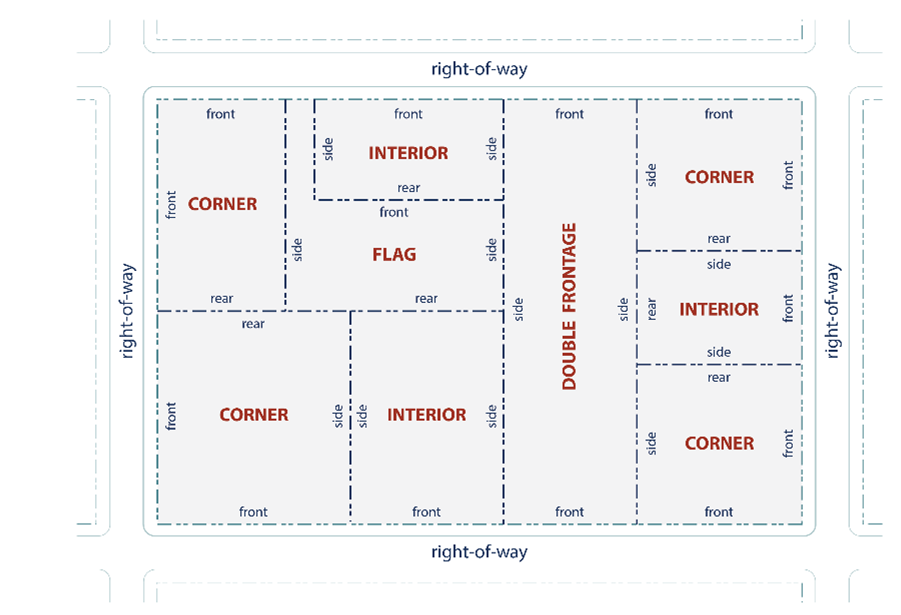
Figure 1102.02(98). Lot Types
(5)
"Lot, non-buildable" means a designated parcel, tract, or area of land established by plat or as otherwise permitted by plat, to be separately owned, but cannot be used, developed, or built upon, and includes lots created on a temporary basis in order to expedite the transfer of ownership and are replatted at a future date to remove the "non-buildable" designation.
"Lot area" means the area of a lot computed exclusive of any portion of the right-of-way of any public or private street.
"Lot depth" means the distance between the midpoints of straight lines connecting the foremost points of the side lot lines in front and the rearmost points of the side lot lines in the rear.
"Lot frontage" means the width of the lot, as measured at the right-of-way line or where no public street exists, along a public way.
"Lot line" means the line of demarcation between properties. Lot line is synonymous with "property line". More specifically:
(1)
"Lot line, front" means any lot line separating a public street from a parcel.
(2)
"Lot line, rear" means the lot line opposite and most distant from the front lot line.
(3)
"Lot line, side" means any lot line, other than a front or rear lot line.
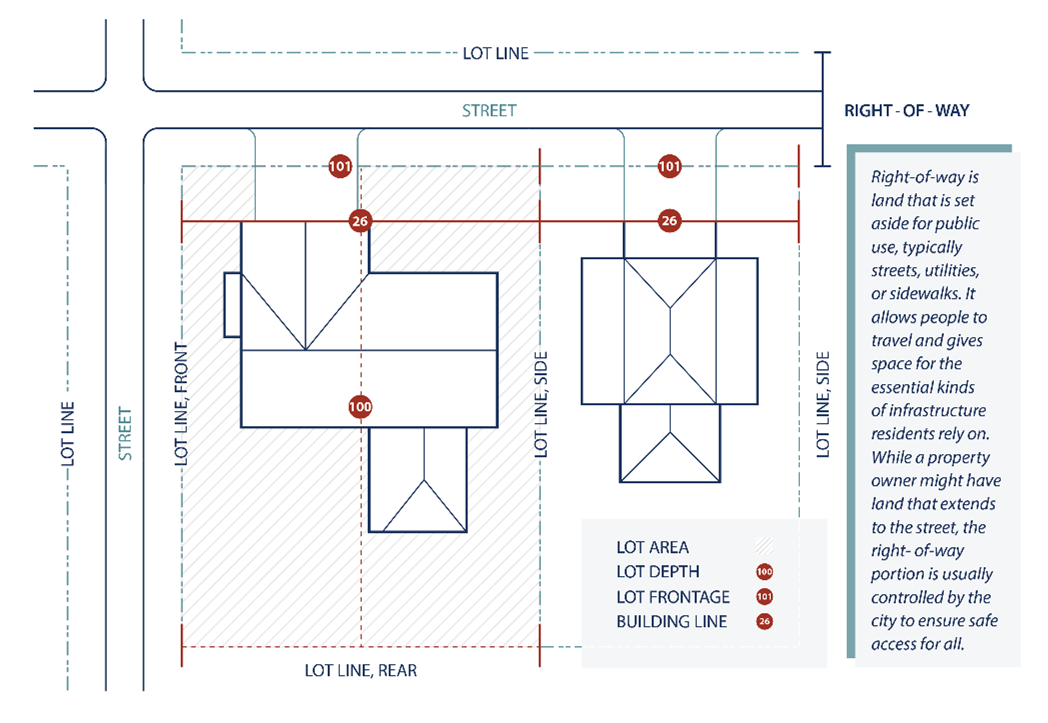
Figure 1102.02(99). Lot Terms
"Lot of record" means any lot, which, individually or as part of a subdivision, has been recorded in the Office of the Recorder.
"Lot of record, nonconforming" means any lot, which, individually or as part of a subdivision, has been recorded in the Office of the Recorder, which does not conform to the zoning regulations of the district with which it is located.
"Lot width" means the distance between the side lot lines, as measured at the building setback line.
"Luminaire" means a complete lighting unit consisting of a light source and all necessary mechanical, electrical and decorative parts.
"Manufactured home" means a dwelling unit fabricated at an off-site manufacturing facility for installation or assembly at the building site, bearing a label certifying that it is built in compliance with the Federal Manufactured Housing Construction and Safety Standards Act of 1974 (42 U.S.C. 5401 et seq.) and meeting all applicable regulations of the City of Delaware.
"Massage" means the use of any method on, or friction against, or stroking, kneading, rubbing, tapping, pounding, vibrating, pressing, compressing, percussing, stretching, rotating, heating, cooling, or stimulating of, the external soft parts of a living human body, which may be performed with direct or indirect human contact, or with the aid of an apparatus, appliance, or other tool or object. Massage does not mean any form of adult entertainment business as defined and regulated elsewhere within this Code.
"Massage treatment" means providing for a fee or any consideration whatsoever any of the following services:
(1)
Massage;
(2)
The application of liniments, antiseptics, oils, powders, creams, lotions, ointments, hot or cold liquids or solid objects, or other similar treatments.
"Massage establishment, licensed" means any establishment having a fixed place of business where a person or entity advertises the availability of, offers, provides, or permits to be carried on, massage treatments. Prior to issuance of a certificate of zoning compliance for a licensed massage establishment, the applicant must certify to the City that all individuals providing massage treatments reside at separate addresses than the proposed licensed massage establishment and that all massage treatments shall be provided by individuals licensed by the State Medical Board of Ohio pursuant to R.C. 4731.15 to practice "massage therapy." Holders of a certificate of zoning compliance for a licensed massage establishment are subject to inspection by the City at any time for the purpose of ensuring individuals providing massage treatments hold the appropriate license. If an individual providing massage treatments does not hold the appropriate license, the certificate of zoning compliance shall be revoked and the use shall cease and desist immediately.
(1)
A "massage establishment" does not include any establishment where massage treatment is provided as a portion of services provided by individuals licensed by, any of the following:
A.
The Ohio State Cosmetology and Barber Board or its predecessors pursuant to ORC §§ 4709 or 4713;
B.
The State of Ohio Board of Nursing pursuant to ORC § 4723;
C.
The Ohio Occupational Therapy, Physical Therapy, and Athletic Trainers Board pursuant to ORC § 4755;
D.
The Ohio State Chiropractic Board pursuant to ORC § 4734;
E.
The State Medical Board of Ohio Pursuant to ORC §§ 4730 or 4762; except those licensed pursuant to ORC § 4731.15 to practice "massage therapy."
"Micro-fulfillment center" means a small warehouse that stores inventory near consumers.
"Mining and mixing of stone, sand, and gravel" means any mining, quarrying, or processing of limestone, sand, and gravel, or other mineral resources but not including oil or gas.
"Mobile home or mobile unit" means a factory-constructed, transportable structure designed as a permanent residential unit when placed upon a foundation and connected to utilities.
"Mobile home park" means any tract of land upon which at least one mobile home is used for habitation are parked, either free of charge or for revenue purposes, and including any roadway, building, structure, vehicle or enclosure used or intended for use as part of the facilities of such a park. "Mobile home park" does not include a tract of land used solely for the storage or display for sale of mobile homes.
"Model dwelling unit" means a dwelling unit used as a sales or leasing office by a builder/developer and which is built with the purpose of displaying the craftsmanship of that builder/developer. The unit may initially serve as a marketing tool to sell future, similar units in the building or on other lots but eventually is occupied as a residential dwelling unit.
"Monopole" means a support structure constructed of a single, self-supporting hollow metal tube securely anchored to a foundation.
"Multi-family complex" means a grouping of two or more two- three- four-family and/or multiple-family dwellings.
"Muntin" means a narrow strip of wood or metal that divides a window or door into smaller panes of glass. It is used to separate individual pieces of glass within a single window frame.
"Natural materials" means building materials such as wood, brick, stone and stucco, including synthetic or cultured products, exterior insulation and finish system (ElFS), composition board products designed to mimic natural materials as approved by the Planning and Community Development Director, and fiber cement lap siding. Natural Materials shall exclude vinyl and aluminum siding.
"Neighborhood commercial establishment" means low-impact commercial businesses with a gross floor area dedicated to business purposes of less than 2,000 square feet on the first floor. Uses include counter-service restaurants, retail stores, art studios, etc.
"Neighborhood-scale" means site and building design elements with physical characteristics compatible with the surrounding character of the neighborhood in size, scale, location, and intensity of land use.
"Nonconforming structure" means a structure lawfully existing on the effective date of this Zoning Ordinance or any amendment thereto, which, on such effective date, does not conform to the regulations of the district in which it is located.
"Nonconforming use" means a use of land or a building or portion thereof, lawfully existing on the effective date of this Zoning Ordinance or any amendment thereto, which, on such effective date, does not conform to the regulations of the district in which it is located.
"Non-manufactured goods" means items or materials which require no manufacturing or processing or are manufactured by a third party and may be purchased for supply and distribution.
"Non-residential zoning districts" means those Districts classified in the Codified Ordinances of the City of Delaware Planning and Zoning Code, as C/I, C-NX, C-DC, C-CC, C-GC, I-1, I-2, C-PUD, I-PUD, MX-PUD.
"Nursing home" means a home used for the reception and care of individuals who by reason of illness or physical or mental impairment require skilled nursing care and of individuals who require personal care services but not skilled nursing care. A nursing home is licensed to provide personal care services and skilled nursing care per Ohio Revised Code section 3721. Hospitals are not included in this definition.
"Ordinary public view" means the sight line within the normal visual range of a person, unassisted by visual aids, from a public street or sidewalk adjacent or real property, or from within an adjacent property.
"Open space" means land, open to the sky, devoted to conservation or recreational purposes and/or land designated by the City to remain undeveloped (may be specified on a zoning map). Open space may be on the same lot with a building, and may include, along with the natural environmental features, recreation facilities that the Planning Commission deems permissive.
"Open space, required" means the portion of the open space that is of sufficient size and shape to meet the minimum zoning requirements.
"Outdoor display" means the placing of merchandise in an outdoor area that is open to the general public when the merchandise on display is removed from its shipping packaging and is representative of merchandise that is available for purchase inside the building and/or is available for purchase by the general public directly from the display area.
"Outdoor storage" means the keeping, in an area outside of a building, of any goods, material, merchandise, or vehicles in the same place for more than 24 hours, except for merchandise placed in an area for outdoor display.
"Overlay district" means a district that is added on top of another zoning district and imposes additional regulations and requirements beyond those normally required for the underlying district.
"Parking space, off-street" means a permanently surfaced rectangular area, exclusive of any driveways or circulation areas, accessible from a street or alley, designed for parking a motor vehicle.
"Performance standard" means a criterion established in the interest of protecting the public health, safety and welfare from nuisance factors and other objectionable or dangerous elements generated by, or inherent in, uses of land or buildings.
"Place of worship" means a building, structure, or other indoor or outdoor facility used for public worship. The term "place of worship" includes the words "church", "chapel", "synagogue" and "temple" and their uses and activities that are customarily related.
"Planned unit development" means an area of land to be planned and developed as a single entity, in which a single-use or variety of residential, commercial, or industrial uses are accommodated under more flexible standards, such as lot size, density, height and setbacks, than those that would normally apply under zoning district regulations.
"Plat" means a map of a tract or parcel of land made by a surveyor. Pre-construction plat map means the plat map initially submitted for review through the required Zoning Code review processes contained elsewhere within this Code. Post-construction plat map means the plat map containing all conditions of approval from the pre-construction plat map approval process, any field changes from construction required by the City, and produced in the format required for final signature and recording.
"Primary residence" means a residential dwelling unit that a person physically occupies and lives in on a day-to day basis. A person may only have one primary residence.
"Project boundary" means the boundary defining the tract(s) of land that is included in a proposed development to meet the minimum required project area for a planned residential multiple-family, commercial or industrial development. The term "project boundary" shall also mean "development boundary".
"Public safety facility" means a governmentally owned and operated facility established to provide police, fire, or other safety services to the surrounding area.
"Public service facility" means the buildings, power plants or substations, water treatment plants or pumping stations, sewage disposal or pumping plants, and other public or essential service structures used by a utility, by a railroad or by a municipal or governmental agency, including the furnishing of electrical, gas, rail transport, communications, public water and sewerage services.
"Public use" means any use of a building or land by any governmental entity for any public purpose.
"Public utility" means a public service or services for the generation, transmission and/or distribution of electricity, gas or steam, including water and irrigation systems and sanitary systems used for the collection and disposal of garbage, sewage and other wastes by means of destroying or processing materials.
"Public way" means an alley, avenue, boulevard, bridge, channel, ditch, easement, expressway, freeway, highway, land, parking right-of-way, road, sidewalk, street, viaduct, walk, bicycle path, or other ways, in which the general public or a public entity has an access right, or which are dedicated for public access, whether improved or not.
"Real property" means land and anything permanently attached to it, such as buildings or natural resources. These are fixed assets that cannot be easily moved or altered. Real property also extends to the rights and interests associated with owning land or buildings.
"Recreational facility, noncommercial" means a recreational facility that is privately owned and intended to serve the residents of the development, such as an apartment complex, a homeowners' association, a condominium association, an assisted living facility, and the like and may include, but is not limited to, such facilities as swimming pools, tennis courts, etc. A non-commercial recreation facility may sell memberships or charge a fee to non-resident households, provided such households may not exceed ten percent (10%) of the total number of households in the development.
"Recycling facility" means a building or area where recyclable materials are sorted and temporarily stored prior to shipment for remanufacture into new materials. This shall not include junkyards or scrapyards.
"Residential care facility" means a facility that provides 24-hour accommodation, supervision and personal or custodial care services, for three (3) or more unrelated individuals who are dependent on the services of others by reason of age and/or physical or mental impairment. Specific services provided by a residential care facility are limited by the Ohio Department of Health and residential care facilities are licensed by the Ohio Department of Health. "Residential care facility" does not include clinics, institutions, hospitals, convalescent or nursing homes, dormitories or similar uses.
"Residential zoning districts" means those districts classified in this Code as A-1, R-SF, R-NT, R-NX, R-MF, R-PUD.
"Restaurant, counter service" means a retail service establishment whose principal business is the sale of foods, frozen desserts, or beverages in ready-to-consume servings, for consumption either within the restaurant building or for carry-out, and where customers are not served their food, frozen desserts, or beverages by a restaurant employee at the same table or counter where the items are consumed.
"Restaurant, table service" means a retail service establishment wherein the entire business activity, or substantially all of the business activity, consists of the sale of food and service to patrons seated at tables for consumption within the building.
"Research and development facility" means a building or group of buildings used for scientific research, investigation, testing, or experimentation, but not facilities for the manufacture or sale of products, except as incidental to the main purpose of the laboratory.
"Retail establishment" means an establishment engaged in the selling of goods or merchandise to the general public for personal or household consumption, which is open to the general public during regular business hours and which has display areas that are designed and laid out to attract the general public.
"Reviewing body" means the designated individual or group of individuals, including but not limited to the Planning and Community Development Director, City Engineer, Chief Building Official, Planning Commission, Board of Zoning Appeals, Historic Preservation Commission, or City Council, identified by local ordinance as having the responsibility and authority to review and approve or disapprove the application.
"Right-of-way" means a strip of land taken or dedicated for use as a public way. In addition to the roadway, it normally incorporates at least curbs, lawn strips, sidewalks, lighting, and drainage facilities, and may include special features, as required by the topography or treatment (such as grade separation, landscaped areas, viaducts, and bridges).
"Satellite earth station (dish-type)" means a round parabolic antenna designed to send or receive television broadcasts from communications satellites orbiting the earth.
"School, public or private" means publicly or privately owned facilities providing full-time day instruction and training at the elementary, junior high, and high school levels in accordance with the requirements of ORC ch. 3313, or facilities providing kindergarten or nursery school training and care whose annual sessions do not exceed the school sessions for full-time day schools and which are operated by a board of education or an established religious organization.
"School, trade, business, or cultural arts" means facilities primarily teaching usable skills that prepare students for jobs within a specific trade or facilities providing instruction on social and religious customs and activities, performing arts and/or sports. Such facilities may include beauty schools, dance instruction centers and martial arts schools.
"Self-service storage facility or mini-warehouse" means a facility consisting of a building or group of buildings, usually, in a controlled access compound that contains varying sizes of individual, compartmentalized and controlled-access stalls or lockers for the dead storage of customers' residential goods or wares.
"Semi-conductor facility" means a facility or plant where integrated circuits (ICS), also known as microchips, are manufactured.
"Setback" means the required minimum horizontal distance between a property line or other line and a structure, parking lot, or use.
"Setback line" means the line established by the Zoning Ordinance, generally parallel to and measured from the lot line, defining the limits of a yard in which no building or other structure may be located above ground, except as may be provided in this Zoning Ordinance.
"Shade tree" means a tree with foliage that usually sheds annually and is planted primarily for its high crown of foliage or overhead canopy.
"Short-term bicycle parking" means bicycle parking located in designated areas where cyclists can securely park their bikes for brief periods, typically ranging from a few minutes to a few hours.
"Short-term rental" means a residential dwelling unit, or a portion of a residential dwelling unit, that is rented, or offered for rent, in exchange for a rental fee, for a period of 30 consecutive days or less. These may be advertised and rented through third-party services including but not limited to Airbnb or VRBO or be a bed and breakfast.
(1)
"Short-term rental host" means a person who occupies as their primary residence a residential dwelling unit located on the same lot as a short-term rental.
(2)
"Short-term rental, hosted" means a host has a physical presence at their primary residence located on the same lot as a short-term rental during the entire period that the short-term rental is rented.
(3)
"Short-term rental, non-hosted" means a host is absent from their primary residence located on the same lot as a short-term rental during some or all of the period that the short-term rental is rented.
"Shrub, landscape" means a woody plant, smaller than a tree, consisting of several small stems from the ground or small branches near the ground.
(1)
"Shrub, screening" means an evergreen landscape shrub of at least three feet in height at time of planting.
"Sign definitions" refers to definitions related to signs, or types of signs, or the regulation of signs as described in Chapter 1125 of this Code are found below:
(1)
"Alter" means any change in a sign, or any structural component or support system for a sign or sign copy, that changes its exterior dimensions or otherwise changes the sign's size, height, structure type, or illumination.
(2)
"Animation" means changeable sign copy, including graphics, images, and text, that appears to move toward or away from the viewer, expands or contracts, bounces, rotates, spins, twists or otherwise portrays movement or animation, including streaming, scrolling, flashing, fading, and blinking.
(3)
"Awning" means a shelter projecting from and supported by the exterior wall of a building, constructed of non-rigid materials on a supporting framework. See also definition of "canopy".
(4)
"Awning sign" means a permanent, attached sign that is painted on, applied to, or otherwise is a part of a fabric or other non-structural awning which awning is affixed to the building. An awning sign is considered a type of "building sign".
(5)
"Banner or banner sign" means any non-rigid cloth, plastic or canvas sign with no enclosing framework that is mounted along all of its edges to a building or structure. A banner sign is one type of temporary sign. Flags are not considered banners or banner signs.
(6)
"Building sign" means any sign that is directly attached to a building or that is attached to a non-structural element, such as an awning or canopy, which is affixed to the building. For the purposes of this chapter, building signs include "wall signs," "awning signs," "canopy signs," and "projecting signs." Window signs are not considered to be a building sign and are regulated separately.
(7)
"Building unit" means a stand-alone building or a building divided into separate units or spaces that are individually owned or leased by different enterprises, businesses, firms, or people, may be considered one or multiple building units based on the provisions of Section 1125.01(a).
(8)
"Canopy" means a permanent structure typically made of rigid materials such as metal, composites, wood or other similar materials attached to a building for the purpose of providing shelter to patrons or automobiles, or as a decorative feature on a building wall. A canopy is not a completely enclosed structure. See also the definition of "awning."
(9)
"Canopy sign" means a sign which is attached or made an integral part of a canopy. A canopy sign is considered a type of "building sign". Canopy signs may be attached above, below, or on the edge of the canopy, provided that the sign complies with the clearance requirements of Chapter 1125.
(10)
"Changeable copy sign" means a sign, or portion of a sign, designed so that the characters, letters, or illustrations can be changed or rearranged manually or electronically without altering the sign display surface." May also be known as readerboards. See also the definition of "electronic message center," which is digital or electronic form of a changeable copy sign.
(11)
"Clearance" means the distance from the bottom of a sign face elevated above grade and the grade below.
(12)
"Driveway sign" means a small permanent sign located near driveway access points and/or at the intersection of internal access drives.
(13)
"Electronic message center" means a sign designed so that the characters, letters, or illustrations can be changed or rearranged automatically on a lamp bank or through mechanical means (e.g., electronic or digital signs).
(14)
"Façade, primary" means for the purpose of the sign regulations, a primary façade shall be as defined in Section 1125.09(b)(4).
(15)
"Façade, secondary" means for the purpose of the sign regulations, a secondary façade shall be as defined in Section 1125.09(b)(4).
(16)
"Flag" means a non-rigid cloth or canvas sign with that is connected to a freestanding flag pole or to a wall-mounted post along one edge of the flag. Flags are not considered a banner or banner sign.
(17)
"Freestanding sign" means any sign affixed to or supported upon the ground by a monument, pedestal, pole, bracing, or other permanent structural element and not attached to any building. See also the definition of "monument sign," "pole sign," and "post and arm sign," which are three forms of a freestanding sign.
(18)
"Illuminated sign" means any sign which has characters, letters, figures, designs, or outlines illuminated externally or internally by any light source other than non-reflected natural daylight.
(19)
"Externally illuminated sign" means a sign that is illuminated by an external source, which reflects light off the surface of a sign face.
(20)
"Internally illuminated sign" means a sign with internal electronic circuitry emitting light through the sign face.
(21)
"Lettering area" means the area of the smallest rectangle that can be drawn around the lettering, logos and graphics of a sign, or of each individual letter if these are detached. Also known as Sign Area.
(22)
"Monument sign" means a permanent freestanding sign, not attached to a building, that is placed upon or supported by the ground independently of any other structure. A monument sign, unlike a pole sign or post and arm sign, is placed on a monument or pedestal structure.
(23)
"Nonconforming sign" means any sign that was erected legally prior to the adoption of this Zoning Ordinance, or amendment thereto, but which does not comply with subsequently enacted sign restrictions and regulations or a sign which does not conform to the regulations of Chapter 1125.
(24)
"On-premise sign" means a sign that identifies or advertises a business, person, or activity, and is installed and maintained on the same premises as the business, person, or activity to which it advertises.
(25)
"Pennant" means a triangular-shaped banner displaying no images or words.
(26)
"Permanent sign" means a sign permitted by this Zoning Ordinance to be located on the premises and designed to be permanently attached to a structure or the ground. Such signs are typically constructed of rigid, non-flexible materials or may be constructed of durable fabric or similarly materials if intended to be attached to a permanent structure (e.g., an awning sign made of fabric) and which is not specifically defined as a temporary sign.
(27)
"Pole sign" means a permanent freestanding sign which is supported from below by poles, posts, or other structural members regardless of material or dimension, where the sign does not otherwise meet the definition of a "monument sign" or a "post and arm sign." See Section 1125.09(a)(2) for specific provisions related to pole signs.
(28)
"Portable sign" means any sign not attached to a building or the ground that is designed to be transported, including signs designed to be transported by means of wheels. This definition shall not include "sidewalk sign" or other defined temporary sign types.
(29)
"Post and arm sign" means a permanent freestanding sign that is supported by a single pole or post with a support arm that allows the sign copy to hang from the arm.
(30)
"Projecting sign" means a permanent sign that is affixed perpendicular to a building or wall and extends more than 12 inches beyond the face of such building or wall.
(31)
"Ribbon" means a rectangular-shaped banner displaying no signage.
(32)
"Roof sign" means any sign or part of sign erected upon, against or directly above a roof or on top of or above the parapet or cornice of a building.
(33)
"Sidewalk sign" means a temporary sign that may be placed on a private sidewalk/walkway, during business hours in accordance with this chapter and which may include an "A-frame sign" or a "T-frame sign" as defined below:
(34)
"A-frame sign" means a detached temporary sign that is ordinarily in the shape of an "A" or some variation thereof, which is readily moveable, and is not permanently attached to the ground or any structure.
(35)
"T-frame sign" means a detached temporary sign that is ordinarily in the shape of an upside down "T" or some variation thereof, which is readily moveable, and is not permanently attached to the ground or any structure.
(36)
"Sign" means any object, device, display or structure or part thereof situated outdoors or adjacent to the interior of a window or doorway which is used to advertise, identify, display, direct or attract attention to an object, person, institution, organization, business, product, service, event or location by any means including words, letters, pictures, logos, figures, designs, symbols, fixtures, colors, illumination or projected images.
(37)
"Sign area" means the entire display area of a sign including the advertising surface located on one or more sign faces and any framing, trim and molding, but not including the supporting structure as measured pursuant to Section 1125.04.
(38)
"Sign band" means an area (on buildings without a header) extending in a band from wall to wall across the front of a building extending a maximum of four feet above the top of the storefront or display windows in buildings without a header. The sign band shall not extend above the top of the wall or the sills of the second story windows. Also known as the Header Area.
(39)
"Sign copy." Those letters, numerals, and figures, symbols, logos, and graphic elements comprising the content or message of a sign.
(40)
"Sign face" means the surface of the sign upon, against, or through which the message of the sign is exhibited.
(41)
"Sign height" means the vertical distance of a sign, from top to bottom, as measured in accordance with Section 1125.04.
(42)
"Static/ instant message change." On electronic message centers, a static or instant message change is when one message changes to another message instantly without scrolling, flashing, or other movement of the message.
(43)
"Storefront" means the lower portion of a building façade, consisting primarily of glass and slender elements separating panels of glass and/or other materials.
(44)
"Streamer" means a ribbon-shaped or cord-like rope that may have multiple pennants or ribbons attached and which is stretched or hung between two supports.
(45)
"Supergraphic" means a sign that is temporarily or permanently attached to a side or rear façade that covers a substantial area of the façade and that is not classified as any other form of building sign.
(46)
"Temporary sign" means a sign that is neither permanently anchored to the ground, nor permanently affixed to a structure, nor mounted on a chassis, and/or is intended for a limited period of display.
(47)
"Wall sign" means a permanent sign attached directly to an exterior wall of a building and which does not extend more than a 12 inches from the façade, as established in this chapter, nor above the roof line or beyond the limits of the outside wall. The exposed face of the sign in a plane parallel to the building wall.
(48)
"Window display." Merchandise or depictions of merchandise or services offered within the premises or by the occupant of the premises, placed so as to be viewed from the public way. Verbal descriptions of the merchandise, services, or the name of the business may be included, provided these are clearly subordinate to the merchandise or depictions. Non-sign portions of window displays shall not be treated as signs.
(49)
"Window sign" means a sign painted on or attached to a window or to glass paneling of any door or opening. A window sign shall include any sign that is installed inside of a building within two feet of the window that is legible from outside of the building.
(50)
"Yard sign" means any temporary sign placed on the ground or attached to a supporting structure, posts, or poles, that is not attached to any building.
"Site plan" means a plan prepared to scale, showing accurately and with complete dimensioning the boundaries of the site, the location of buildings, landscaping, parking areas, access drives, signs, outdoor storage areas and any other features that comprise a proposed development.
"Solar energy system (SES)" means any photovoltaic or solar collection system device used for the purposes of heating, cooling, or generating electricity for a primary or accessory structure.
(1)
"Solar energy system, accessory" means a ground-mounted or structure mounted solar energy system with the purpose primarily of generating electricity for the principal use on the site.
(2)
"Solar energy system, building mounted" means a solar energy system mounted on racking that is attached to or ballasted on the roof of a building or structure.
(3)
"Solar energy system, ground mounted" means a solar energy system mounted on support posts, like a rack or pole, that are attached to or rest on the ground.
(4)
"Solar energy system, principal use" means a commercial, ground-mounted solar energy system that converts sunlight into electricity for the primary purpose of off-site use through the electrical grid or export to the wholesale market.
"Sorority" means a building, associated with an institution of higher learning, containing sleeping rooms, bathrooms, common rooms, and a central kitchen and dining room maintained exclusively for sorority members and their guests or visitors.
"Story" means the portion of a building included between the surface of any floor and the surface of the floor next above it or, if there is no floor above it, then the space between the floor and the ceiling next above it.
"Street, private" means a local private way or driveway that provides vehicular access to more than one residential structure that is not and will not be dedicated to public use, but which is owned and maintained by an association, person, corporation or similar private entity.
"Street, public" means an avenue, highway, road, thoroughfare, boulevard, parkway, or other way proposed for vehicular traffic, and any existing State, County, or City street or way shown upon a plat heretofore duly approved, filed and recorded in the office of the County Recorder that has been dedicated or deeded to the public for public use and which affords principal access to abutting property. Included is the land between the street right-of-way lines, whether improved or unimproved, and may comprise pavement, shoulder, gutters, sidewalks, division strips or other areas within the street lines. This definition excludes alleys.
"Street right-of-way." See "right-of-way".
"Streetwall" means the building wall, or portion of a wall, facing the front of a lot.
"Structure" means anything constructed or erected, with a fixed location on the ground or attached to something having a fixed location on the ground. Among other things, structures include buildings, mobile homes, walls, and billboards. For the purposes of this Zoning Code, fences and architectural features are separately regulated and are not considered structures.
"Subdivision" means the division of a lot, tract, or parcel into two or more lots, tracts or parcels or other divisions of land.
"Substantial alteration" means an alteration or expansion of existing development is substantial when such alteration or expansion involves or exceeds twenty-five percent (25%) of the total floor area of the existing building, structure, or vehicular use area.
"Substantial completion" means the state of completion reached when an improvement upon real property may be used or occupied for its intended use following the issuance of an occupancy permit.
"Surveyor" means a registered surveyor, authorized to practice professional surveying by the State Board of Registration, as specified in ORC § 4733.14.
"Thoroughfare." See "Street".
"Tobacco lounge" means an establishment, whether attached to a retail or wholesale tobacco shop or not, that is dedicated to the use of tobacco products including hookah or shisha.
"Tower (wireless telecommunications)" means a self-supporting lattice, guyed or monopole structure constructed from grade which supports wireless telecommunications facilities. The term tower shall not include amateur radio operators' equipment, as licensed by the FCC.
"Trailer" means a structure on wheels, towed, or hauled by another vehicle and used for short-term human occupancy, carrying materials, goods, or objects, or as a temporary office.
"Training facility" means a building or place used in connection with vocational training in an activity that is associated with an industry but does not include a business premises or retail premises.
"Tree canopy coverage (for the City)" means the total area of the City covered by tree canopy, as determined by the Director of Parks and Recreation, divided by the total area of the City and multiplied by one hundred.
"Tree canopy coverage (for a site)" means the total area of the site covered by tree canopy, as determined by the arborist or landscape architect who prepared the tree canopy management plan, divided by the adjusted total area of the site and multiplied by one hundred.
"Tree lawn" means the part of a street not covered by a sidewalk or other paving lying between the property line and the roadway.
"Truck terminal" means a facility where vehicles load and unload cargo and freight and where the cargo and freight may be broken down or aggregated into smaller or larger loads for transfer to other vehicles or modes of transportation.
"Use, accessory" means a use, object or structure constructed or installed on the same lot as, and of a nature subordinate and customarily incidental to the principal (primary) use, object or structure of a lot.
"Use, conditional" means a use, which is permitted but only with conditions as determined by the Planning Commission of the City of Delaware.
"Use, permitted" means any use allowed in a zoning district and subject to the restrictions applicable to that zoning district.
"Use, permitted by right" means a use approved administratively when it complies with the standards and requirements set forth for the zoning district in which it is located.
"Use, principal" means the use or uses that are of primary importance or which is the predominant use on a parcel of land.
"Use, temporary" means a use that is established for a fixed period of time with the intent to discontinue such use upon the expiration of such time and does not involve the construction or alteration of any permanent structure.
"Variance" means a modification of the strict terms of the relevant regulations.
"Veterinary hospital" means a place where animals are given medical treatment and the boarding of animals occurs only as an incidental use.
"Wind energy system (WES)" means an apparatus for converting the energy available in the wind to mechanical energy that can be used to power a primary or accessory structure.
(1)
"Wind energy system, building mounted" means a wind energy system attached to the top of a building or structure.
(2)
"Wind energy system, ground mounted" means a freestanding pole or tower supported wind energy system.
"Wireless telecommunication facility" means any cables, wires, lines, wave guides, antennae, towers and any other equipment or facilities associated with the transmission or reception of communications as authorized by the FCC and does not include any satellite earth station antenna one (1) meter or less in diameter, regardless of zoning category or used by amateur radio operators. Such facilities are further defined in Chapter 1135.
"Yard" means an open space on the same lot with a principal use or building extending between a building or structure and the adjoining lot lines, unoccupied and unobstructed from the ground upwards, except as otherwise permitted by this Zoning Ordinance.
(1)
"Yard, front" means a yard extending between side lot lines across the front of a lot and from the front lot line to the front of the principal building.
(2)
"Yard, rear" means a yard extending between side lot lines across the rear of a lot and from the rear lot line to the rear of the principal building.
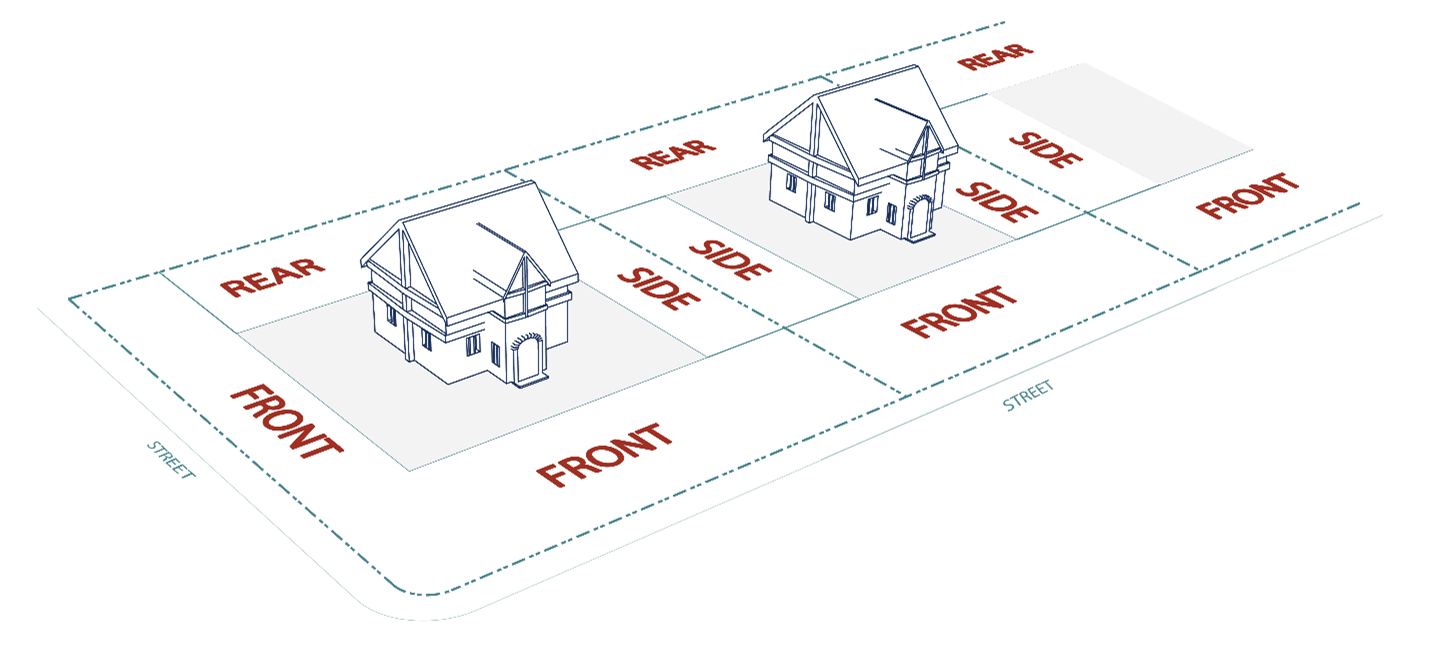
Figure 1102.02(200). Yard Terms
(3)
"Yard, side" means a yard extending from the principal building to the side lot line on both sides of the principal building between the lines establishing the front and rear side yards.
"Yard, required" means the space between a lot line and a setback line for a building, parking area or use that is the minimum area required to comply with the regulations of the district in which the lot is located, and within which no structures shall be located except as expressly permitted in this Zoning Ordinance.
"Zoning map" means an accurate map depicting the City of Delaware, Ohio, and indicating the boundaries of the zoning districts established by this Zoning Ordinance.
"Zoning Ordinance" refers to this Zoning Ordinance as amended, which comprises Titles One through Five of Part Eleven, Planning and Zoning Code.
(Ord. 25-38. Passed 7-14-25)
1103.01. - Purpose.
This chapter sets forth the powers and duties of the Director of Planning and Community Development, the Planning Commission, the Board of Zoning Appeals, the Historic Preservation Commission, and City Council with respect to the provisions of this Zoning Ordinance.
(Ord. 25-38. Passed 7-14-25)
1103.02. - Director of Planning and Community Development.
(a)
Establishment. The Director of Planning and Community Development shall act as the administrative officer for the purpose of effecting the proper administration and enforcement of the Zoning Ordinance. All duties required of the Director of Planning and Community Development shall be assumed by or delegated to any person he or she designates.
(b)
Powers and Duties. The Director of Planning and Community Development shall have the following powers and duties and shall:
(1)
Issue certificates of building and zoning compliance or refuse to issue the same in the event of noncompliance and keep a record of the same, with a notation of any special conditions involved.
(2)
Accept, review for completeness, and respond to questions regarding those applications which the Director of Planning and Community Development is authorized to review by the provisions of this Zoning Ordinance, including but not limited to, amendments to the Zoning Ordinance, development plans, modifications to development plans, conditional uses, variances, appeals, preliminary plats, final plats, and certificates of appropriateness.
(3)
Coordinate the City's administrative review of zoning applications, development plans, modifications to development plans, conditional use applications, subdivision plat applications, and certificates of appropriateness.
(4)
Collect the designated fees as set forth in the schedule of fees adopted by Council.
(5)
Maintain any records required by this Zoning Ordinance including inspection documents and records of all variances, amendments, conditional uses, and similar use determinations.
(6)
Make such records available for the use of Council, Planning Commission, Board of Zoning Appeals, Historic Preservation Commission, and the public.
(7)
Keep Planning Commission, Historic Preservation Commission, and Board of Zoning Appeals advised of all matters other than routine duties pertaining to the enforcement of this Ordinance and transmit to them all applications and records pertaining to applications, amendments, conditional use permits, appeals, or variances thereto.
(8)
Conduct or cause the inspection of buildings and uses of land to determine compliance with this Zoning Ordinance.
(9)
Maintain in current status the "Official City Zoning Map" of the City of Delaware.
(10)
Enforce this Ordinance and take all necessary steps to remedy any condition found in violation by ordering, in writing, a stop work order, notice of violation, or the revocation of any certificate of building and zoning compliance or certificate of appropriateness and may request the City Attorney to commence appropriate action.
(Ord. 25-38. Passed 7-14-25)
1103.03. - Planning Commission.
(a)
Appointment. The Planning Commission shall be composed of seven (7) members, consisting of one (1) elector from each of the four (4) City wards, two (2) at-large, and one (1) member of Council. Each resident member shall be an elector and hold no elective office. The City Manager shall be an ex-officio member/advisor without a vote. All members shall receive no compensation for service.
(b)
Term. The six (6) elector members shall be appointed by the Mayor with the concurrence of Council for three (3) years and their terms shall be so arranged that the term of no more than two (2) shall expire each year. The terms of all six (6) elector members shall end on the date of November 30, three (3) years after appointment. The term for the Council member shall be two (2) years, ending on November 30 of the odd- numbered years.
(1)
Removal. Members of the Commission shall be removable for nonperformance of duty, misconduct in office, or other reasonable cause by the Mayor upon written charges and after a public hearing has been held regarding such charges, a copy of the charges having been served upon the member so charged at least ten (10) days prior to the hearing either personally or by registered mail, or by leaving the same at the member's place of residence. The member shall be given an opportunity to be heard and answer such charges.
(2)
Vacancies. Vacancies shall be filled by appointment by the Mayor, with concurrence of Council, and shall be for the unexpired term.
(c)
Organization.
(1)
The Planning Commission shall organize by the end of January or the first scheduled meeting of each year and elect a chairperson and a vice-chairperson.
(2)
The Chairperson may, within budgetary limits, retain the services of a recording secretary.
(3)
The Commission may call upon the City Manager, and through the City Manager, any department of the City to render such assistance to the Commission as may be reasonably required.
(d)
Meetings. Administrative meetings of the Commission shall be held at the call of the chairperson and at such other times as determined by a majority of the Commission. All meetings shall be open to the public. The Commission shall keep minutes of its proceedings showing the vote of the board and shall keep records of its examinations and other official action, all of which shall be public record and be immediately filed with the City Clerk.
(e)
Quorum and Voting. The presence of four (4) members shall constitute a quorum. The concurring vote of four (4) members of the Commission shall be necessary to take action.
(f)
Powers and Duties. The Planning Commission shall have the following powers and duties and shall:
(1)
Recommend to City Council a comprehensive plan, Official City Zoning Map, area plans, development standards for the Municipality, and at least every five (5) years undertake a review and recommend appropriate revision of the comprehensive plan.
(2)
Carry on the continuous review of the effectiveness and appropriateness of this Ordinance, report to Council on the land use planning needs of the Municipality and recommend to Council amendments to the Zoning Ordinance and other related ordinances of the City as it feels would be appropriate.
(3)
Review all proposed amendments to this Zoning Ordinance and make recommendations to City Council as provided in this Zoning Ordinance.
(4)
Recommend to Council appropriate zoning classifications of newly annexed areas.
(5)
Review and approve all plans and plats for the subdivision of land.
(6)
Review all applicable development plan and zoning amendment applications and make recommendations to Council.
(7)
Adopt rules and bylaws for the holding of regular and special meetings for the transaction and disposition of its business and the exercise of its powers.
(8)
Review and approve all conditional uses and determinations of similar use.
(9)
Review and approve development plan extensions.
(Ord. 25-38. Passed 7-14-25)
1103.04. - Board of Zoning Appeals.
(a)
Appointment. There shall be a Board of Zoning Appeals (BZA) composed of seven (7) members, consisting of two (2) at-large members, one (1) resident member from each of the four (4) wards, and one (1) member of Council. Each resident member shall be an elector of the City and hold no elective office. All members shall be chosen by the Mayor and confirmed by Council. The City Manager shall be an ex-officio member/advisor without a vote. Members of the Board shall receive no compensation for service as such.
(b)
Term. The term of all resident members appointed shall be for three (3) years, ending November 30. The term for the appointed Council member shall be two (2) years, ending on November 30 of the odd-numbered years.
(1)
Removal. Members of the BZA shall be removable for nonperformance of duty, misconduct in office, or other reasonable cause by the Mayor upon written charges and after a public hearing has been held regarding such charges, a copy of the charges having been served upon the member so charged at least 10 days prior to the hearing either personally or by registered mail, or by leaving the same at the member's place of residence. The member shall be given an opportunity to be heard and answer such charges.
(2)
Vacancies. Vacancies shall be filled by appointment by the Mayor, with concurrence of Council, and shall be for the unexpired term.
(c)
Organization. By the end of January or at the first scheduled meeting of each year, the BZA shall elect a chairperson and vice-chairperson.
(d)
Meetings. Meetings of the BZA shall be held at the call of the chairperson and at such other times as the Board shall determine. All meetings of the Board shall be open to the public. The board shall keep minutes of its proceedings, showing the vote of the board, and shall keep records of its examinations and other official actions, all of which shall be immediately filed with the City and shall be a public record.
(e)
Quorum and Voting. Four (4) members of the BZA shall constitute a quorum. The board shall act by resolution, and the concurring vote of four (4) members of the BZA shall be necessary to reverse any order, requirement, decision, or determination of the Director of Planning and Community Development or any other administrative official of the City of Delaware, to decide in favor of an applicant in any matter on which it is required to pass under this Ordinance, or to grant any variance from the requirements stipulated in this Ordinance. The grounds of every such determination shall be stated.
(f)
Powers and Duties. The BZA shall have the following powers and duties and shall:
(1)
Hear and decide appeals where it is alleged there is an error in any order, requirement, decision, interpretation, or determination made by the Director of Planning and Community Development or any other administrative official carrying out or enforcing any provision of this Zoning Ordinance.
(2)
Authorize such variances from the terms of this Ordinance as will not be contrary to the public interest, where, owing to the special conditions, a literal enforcement of this Ordinance will result in extreme practical difficulty or unnecessary hardship provided that such variance will serve the public interest, observe the spirit of this Zoning Ordinance, and secure substantial justice to all parties concerned.
(3)
Hear and decide upon disputes concerning the exact location of zoning district boundaries.
(4)
Subpoena witnesses, punish for contempt, and require the production of documents, under such regulations as it may establish. The Chairperson, or in the Chair's absence, the Vice-Chairperson, may administer oaths.
(5)
Hear and decide applications, in accordance with the provisions of this Ordinance, filed as herein provided, for interpretation of the Zoning Map, or for decision upon other special questions on which the Board is authorized by this Ordinance to pass.
(6)
Adopt rules or bylaws for the holding of regular and special meetings, for the transaction and disposition of its business, and the exercise of its powers conferred herein.
(7)
Hear and decide floodplain variances per Sections 1347.20 and 1347.21 of the City of Delaware Code of Ordinances.
(Ord. 25-38. Passed 7-14-25)
1103.05. - Historic Preservation Commission.
(a)
Appointment and Membership. The Historic Preservation Commission (HPC) shall be composed of seven (7) members, of which the majority shall be City residents.
(1)
The members shall be appointed by the Mayor with the concurrence of Council.
(2)
The Commission shall include among its members at least one (1) member of City Council.
(3)
If possible, the Mayor shall appoint members with the following professional background(s):
A.
A professional historic preservationist or an historian;
B.
An architect;
C.
A real estate agent or a developer; and
D.
An historic district property owner.
(4)
Members shall serve without compensation.
(b)
Term. The six (6) elector members shall be appointed by the Mayor with the concurrence of Council for three (3) years and their terms shall be so arranged that the term of no more than two (2) shall expire each year. The terms of all six (6) elector members shall end on the date of November 30, three (3) years after appointment. The term for the Council member shall be two (2) years, ending on November 30 of the odd- numbered years.
(1)
Removal. Members of the Commission shall be removable for nonperformance of duty, misconduct in office, or other reasonable cause by the Mayor upon written charges and after a public hearing has been held regarding such charges, a copy of the charges having been served upon the member so charged at least ten (10) days prior to the hearing either personally or by registered mail, or by leaving the same at the member's place of residence. The member shall be given an opportunity to be heard and answer such charges.
(2)
Vacancies. Vacancies shall be filled by appointment by the Mayor, with concurrence of Council, and shall be for the unexpired term.
(c)
Organization.
(1)
By the end of January or at the first scheduled meeting of each year, the HPC shall elect one of its members to serve as chairperson and one to serve as vice-chairperson.
(2)
The HPC shall adopt rules and regulations consistent with this chapter governing its procedures and transactions. The HPC shall meet as required to carry out the review of applications for certificates of appropriateness for compliance with the adopted standards and guidelines for the historic district overlay and such other related work as may be accepted or undertaken.
(d)
Meetings. Meetings shall be held once a month when there are applications to be considered, and special meetings may be held at the call of the chairperson. The chairperson shall conduct the meeting of the HPC, and a record of minutes shall be kept as required by the approved Records Retention Policy of the City of Delaware. All meetings shall be open to the public.
(e)
Quorum and Voting. Four (4) members of the Commission serving at any given time shall constitute a quorum. The concurring vote of four (4) members shall be necessary to take action.
(f)
Powers and Duties. The Historic Preservation Commission (HPC) shall have the following powers and duties:
(1)
Recommend properties and initiate the process for historic listing designation and to hear, review, grant, deny, and recommend modifications to proposals for certificates of appropriateness involving environmental changes within a historic district. Applications for certificates of appropriateness shall be judged using adopted historic district standards and guidelines.
(2)
Recommend and initiate the process of designation or expansion of a historic district.
(3)
Maintain files, available to the public, containing all applications granted or denied to serve as a basis for prospective applicants to conform their plans to established policy.
(4)
Make recommendations to the Planning Commission regarding amendments to this chapter and with respect to other legislation affecting the historic districts when such recommendations are deemed appropriate and prudent.
(5)
Work for the continuing education of those within the historic district and the residents of the City with respect to this Zoning Ordinance and each district's historic heritage and architectural significance. In addition, the HPC shall publish informational literature and hold periodic public meetings to disseminate information on preservation and rehabilitation techniques and resources.
(6)
Develop standards and guidelines for preserving the historic and architectural significance of the historic districts, on a district-by-district basis, which shall be based on the Secretary of the Interior's Standards for Rehabilitation. The standards and guidelines shall promote redevelopment of historic structures and assure that new development within each district is compatible with existing development.
(Ord. 25-38. Passed 7-14-25)
1103.06. - City Council.
(a)
The Council may override a written recommendation of the Planning Commission or a decision by HPC, provided that such legislation is passed by a vote of not less than five (5) members of Council.
(b)
Powers and Duties. Pertaining to the Zoning Ordinance, the City Council shall have the following powers and duties:
(1)
Hold public hearings and vote upon proposed amendments to this Zoning Ordinance.
(2)
Investigate and propose on its own initiative such amendments to the Zoning Ordinance as it may deem consistent with the purposes of this Zoning Ordinance and which further the public health, safety, and general welfare of the City of Delaware.
(3)
Act upon suggested amendments to this Ordinance text or the Official City Zoning Map.
(4)
Confirm or reject the recommendation of the Planning Commission for planned unit developments and development plans according to the procedures, standards, and criteria set forth in this Zoning Ordinance.
(5)
Confirm or reject the decision of the Historic Preservation Commission regarding an appeal of a certificate of appropriateness issued for a project located within the Historic District Overlay according to the procedures, standards, and criteria set forth in this Zoning Ordinance.
(6)
Approve the appointments of members to the Planning Commission, Historic Preservation Commission, and Board of Zoning Appeals.
(7)
Establish by ordinance a schedule of fees for review of and action on applications for certificates of building and zoning compliance, development plan review, conditional use permits, appeals, variances, amendments, subdivision plats, and other procedures and services pertaining to the administration and enforcement of this Zoning Ordinance.
A.
Council shall consider the recommendation of the Director of Planning and Community Development with respect to actual administrative costs, both direct and indirect.
B.
The schedule of fees shall be available at City Hall and may be altered or amended only by Council. Until all such appropriate fees, charges, and expenses have been paid in full, no action shall be taken on any application, appeal, or administrative procedure.
(8)
Nothing in this chapter shall be construed to prevent City Council from reviewing, discussing, or acting on any matter before any Board or Commission subject to the provisions of this chapter where the Board or Commission is incapable of taking action for any reason.
(Ord. 25-38. Passed 7-14-25)
1104.01. - Comprehensive Plan adopted.
The Delaware Together Comprehensive Plan as prepared by the City of Delaware, a copy of which is on file in the Planning and Community Development Department, is hereby adopted as the official comprehensive plan for the City of Delaware, Ohio.
(Ord. 25-38. Passed 7-14-25)
1104.02. - Certification and file copy.
The City Clerk is authorized and directed to certify Council's approval on a copy of the comprehensive plan and such plan, as certified, shall be on file in the office of the City Manager.
(Ord. 25-38. Passed 7-14-25)
1104.03. - Amending the Comprehensive Plan.
(a)
Amendment Procedures. Amendments to the comprehensive plan may be initiated in one of the following ways:
(1)
Applications to amend the character map and focus area plans may be filed by the record property owner or their designee for the property located within the area of the proposed amendment; or by any government official, unit, or bureau affected by such amendment.
(2)
Applications to amend the text of the comprehensive plan may be filed by any individual or organization; or by any government official, unit, or bureau affected by such amendment.
(3)
By the adoption of a motion by the Planning Commission.
(4)
By the adoption of a resolution by the City Council.
(b)
Amendments to the Comprehensive Plan Initiated by Property Owner(s) or Designee. An amendment initiated under Section 1104.03 (a) shall be submitted and reviewed according to the following:
(1)
Submission Requirements. Applications for amendments shall contain all items set forth in the application checklist on file with the Planning and Community Development Department, unless items are determined by the Director of Planning and Community Development to be inapplicable or unnecessary and are waived.
(2)
Application Submission. Applications shall be submitted in accordance with the published deadline calendar. The Director of Planning and Community Development shall have the authority to amend the calendar from time to time.
(3)
Review for Completeness. The Director of Planning and Community Development shall review the submitted application for completeness and compliance with the applicable submission requirements within ten (10) business days of receipt of such application. If the application is deemed insufficient or incomplete, the Director of Planning and Community Development shall notify the applicant in writing of the deficiencies and shall place the application on hold until complete. When the application is determined to be sufficient and complete and the application fee has been paid, the Director of Planning and Community Development shall officially accept the application for consideration.
(4)
Transmittal to Planning Commission. After the filing of a completed application, the Director of Planning and Community Development shall transmit the application to the Planning Commission to begin the process set forth in this section.
(c)
Amendments Initiated by Planning Commission or City Council. After the passage of a motion by Planning Commission or the adoption of a resolution by Council, the motion or resolution shall be reviewed and considered first by Planning Commission who shall make a recommendation to City Council. Second, City Council shall review and consider the application after Planning Commission. The process for review shall be as set forth in this chapter.
(d)
Planning Commission Process for Public Hearing and Review. Upon the receipt of an application or resolution, the Planning Commission shall set a date for a public hearing thereon. Notice of the public hearing shall comply with the following:
(1)
Notice of the proposed amendment shall be published at least ten (10) days prior to the date of the required hearing, on the City's website.
A.
In addition, the Director of Planning and Community Development shall send a notice to the tax mailing addresses of all property owners whose property is located within 200 feet of the parcel(s) proposed to be amended.
(2)
Notices shall include the time and place of the public hearing, a summary of the proposed amendment, and a statement that the opportunity to be heard will be afforded to any person interested. Failure of delivery of such notice shall not invalidate any such amendment.
(3)
A sign notifying the public of an application under review shall be posted on each public road frontage of the property/properties in the area proposed to be amended in a location visible from an adjacent public street, or if necessary, in an alternative location approved by the Planning and Community Development Department.
A.
Sign size and contents shall be specified by the Planning and Community Development Department.
B.
The sign shall be posted at least ten (10) days in advance of the public hearing and shall remain in place for the duration of the approval process through the public hearing at Council.
(4)
The Planning Commission may continue or defer its consideration and no further written notice shall be required.
(e)
Recommendation by the Planning Commission.
(1)
Within sixty (60) days from receipt of the proposed amendment, and after the conclusion of the public hearing, the Planning Commission shall recommend one of the following to Council:
A.
That the amendment be granted as requested;
B.
That the amendment be granted as modified by the Planning Commission; or
C.
That the amendment be denied.
(2)
If the Planning Commission does not make a recommendation on the proposed amendment within the sixty (60) days, or an extended period as may be agreed upon by the applicant or City Council, it shall be deemed that the recommendation of the Planning Commission is that the amendment be denied.
(3)
The Planning Commission shall file with the Clerk of Council a report of the Planning Commission's action.
(f)
City Council Process for Public Hearing and Review. Upon receipt of the recommendation from the Planning Commission, Council shall schedule a public hearing. The hearing shall be not more than thirty (30) days from receipt of the recommendation. Notice of the public hearing shall be given by Council according to the following:
(1)
Notice of the proposed amendment shall be published at least ten (10) days prior to the date of the required hearing, on the City's website.
(2)
Notice shall include the time and place of the public hearing, a summary of the proposed amendment and a statement that the opportunity to be heard will be afforded to any person interested.
(3)
During the time between the recommendation of Planning Commission and prior to the public hearing, the text of the proposed amendment, maps, or plans, if applicable, and the maps, plans and reports that constitute the recommendation of the Planning Commission, shall be on file for public examination in the Department of Planning and Community Development.
(g)
Final Action by Council. Following such hearing and after reviewing the recommendations of the Planning Commission thereon, Council shall consider such recommendations and vote on the passage of the proposed amendment to the comprehensive plan. Approval of such amendment shall take effect within thirty (30) days.
(Ord. 25-38. Passed 7-14-25)
1104.04. - Thoroughfare plan accepted.
The 2020—2040 Thoroughfare Plan as prepared by the City of Delaware, a copy of which is on file with the City Engineer's Office, is hereby adopted as the official thoroughfare plan for major streets and thoroughfares for the City of Delaware, Ohio and its long-range planning area.
(Ord. 25-38. Passed 7-14-25)
1104.05. - Certification and file copy.
The City Clerk is authorized and directed to certify Council's approval on a copy of the Thoroughfare Plan and such plan, as certified, shall be on file in the office of the City Manager.
(Ord. 25-38. Passed 7-14-25)
1104.06. - Certification to County Recorder, Engineer, and Regional Planning Commission.
The City Clerk is authorized and directed to certify Council's approval and certification of the Thoroughfare Plan to the County Recorder, County Engineer, and Director of the Regional Planning Commission.
(Ord. 25-38. Passed 7-14-25)
1105.01. - Purpose.
In order to accomplish the purposes for which this Ordinance is adopted, it is essential that its regulations be soundly and consistently applied and administered. This chapter stipulates the procedures to be followed for:
(a)
1105.02. Certificates of building and zoning compliance
(b)
1105.03. Zoning amendments
(c)
1105.10. Development plan review
(d)
1105.19. Conditional use approval
(e)
1105.22. Plan approval extensions
(f)
1105.23. Appeals to the Board of Zoning Appeals
(g)
1105.24. Variances
(Ord. 25-38. Passed 7-14-25)
1105.02. - Certificate of building and zoning compliance.
(a)
Applicability. Certificates of building and zoning compliance shall be required for all construction within the City as well as for all businesses prior to occupying any building or space within a building.
(b)
Applications. Certificates of building and zoning compliance shall be issued only in conformity with the provisions of this Zoning Ordinance. Applications for certificates of building and zoning compliance are available in the Department of Planning and Community Development. A completed application form accompanied by all other applicable submission requirements shall be submitted to the Director of Planning and Community Development.
(c)
Expiration of Certificate. Each application shall clearly state that the certificate of building and zoning compliance will expire and may be revoked if work has not begun within one (1) year of date of issue or has not been substantially completed within two and one-half (2½) years. If such work has not been completed within such time frames and an extension has not been granted by the Planning and Community Development Director, a new application and certificate shall be required. Construction is deemed to have begun when all necessary excavation and piers or footings of the structure included in the application have been completed.
(Ord. 25-38. Passed 7-14-25)
1105.03. - Zoning amendment procedures.
Amendments to this Zoning Ordinance may be initiated in one of the following ways:
(a)
By the filing of an application by an owner or designee within the area of the proposed change or affected by such amendment; or by any government official, unit, or bureau affected by such amendment filing an application with the Planning and Community Development Department.
(b)
By the adoption of a motion by the Planning Commission.
(c)
By the adoption of a resolution by City Council.
(Ord. 25-38. Passed 7-14-25)
1105.04. - Zoning amendments initiated by property owner(s).
An amendment initiated by an owner or designee of property, or individual with an option or interest in such property within the area proposed to be changed or affected by said amendment, shall be submitted and reviewed according to the following:
(a)
Submission Requirements. Applications for amendments to either the text and map adopted as part of this Ordinance shall contain all items set forth in the application checklist on file with the Planning and Community Development Department unless items are determined by the Director of Planning and Community Development to be inapplicable and are waived.
(b)
Review for Completeness. The Director of Planning and Community Development shall review the submitted application for completeness and compliance with the applicable submission requirements within ten (10) business days of receipt of such application. If the application is deemed insufficient or incomplete, the Director of Planning and Community Development shall notify the applicant in writing of the deficiencies and place the application on hold until complete. When the application is determined to be sufficient and complete and the application fee has been paid, the Director of Planning and Community Development shall officially accept the application for consideration.
(c)
Transmittal to Planning Commission. After the filing of a completed application by an owner or designee of property, or individual with an option or interest in such property, the Director of Planning and Community Development shall transmit the application to the Planning Commission to begin the adoption process set forth in Sections 1105.06 through 1105.09 of this chapter.
(Ord. 25-38. Passed 7-14-25)
1105.05. - Zoning amendments initiated by Planning Commission or Council.
After the passage of a motion by the Planning Commission or the adoption of a resolution by Council, the motion or resolution shall be reviewed and considered by the Planning Commission and Council according to the process set forth in Sections 1105.06 through 1105.09 of this chapter.
(Ord. 25-38. Passed 7-14-25)
1105.06. - Public hearing and notice by Planning Commission for zoning amendments.
Upon receipt of an application or motion, the Planning Commission shall set a date for a public hearing thereon. Notice of the public hearing shall comply with the following:
(a)
Notice of the proposed amendment shall be published at least ten (10) days prior to the date of the required hearing on the City's website.
(1)
In addition, for map amendments,
(b)
Notices shall include the time and place of the public hearing, a summary of the proposed amendment, and a statement that the opportunity to be heard will be afforded to any person interested. Failure to deliver or publish such notice shall not invalidate any such amendment.
(c)
A sign notifying the public of a zoning application under review shall be posted on each public road frontage of the property(s) in the area proposed to be rezoned, in a location visible from an adjacent public street, or if necessary, in an alternative location approved by the Planning and Community Development Department.
(1)
Sign size and contents shall be specified by the Planning and Community Development Department.
(2)
The sign shall be posted at least ten (10) days in advance of the public hearing and shall remain in place for the duration of the amendment process through City Council.
(d)
The Planning Commission may continue or defer its consideration and no further written notice shall be required.
(Ord. 25-38. Passed 7-14-25)
1105.07. - Recommendation by the Planning Commission.
(a)
Within ninety (90) days from receipt of the proposed amendment (unless the applicant requests more than the 90 days), and after the conclusion of the public hearing required in Section 1105.06 of this chapter, the Planning Commission shall recommend one of the following to Council:
(1)
That the amendment be granted as requested;
(2)
That the amendment be granted as modified by the Planning Commission; or
(3)
That the amendment be denied.
(b)
If the Planning Commission does not make a recommendation on the proposed amendment within sixty (60) days, or an extended period as may be agreed upon by the applicant or Planning Commission, it shall be deemed that the recommendation of the Planning Commission is that the amendment be denied.
(Ord. 25-38. Passed 7-14-25)
1105.08. - Public hearing and notice by Council.
Upon receipt of the recommendation from the Planning Commission, Council shall schedule a public hearing. The hearing shall be not more than thirty (30) days from the receipt of the recommendation, unless the applicant requests more than the thirty (30) days. Notice of the public hearing shall be given by Council according to the following:
(a)
Notice of the public hearing shall be published on the City's website. The notice shall be published at least ten (10) days before the date of the hearing.
(b)
Notices shall include the time and place of the public hearing, a summary of the proposed amendment, and a statement that the opportunity to be heard will be afforded to any person interested. Failure of delivery of such notice shall not invalidate any such amendment.
(c)
During the time between the recommendation of Planning Commission and prior to the public hearing, the text of the proposed amendment, maps, or plans, if applicable, and the maps, plans and reports that constitute the recommendation of the Planning Commission, shall be on file for public examination in the Planning and Community Development Department.
(Ord. 25-38. Passed 7-14-25)
1105.09. - Final action by Council.
Following such hearing and after reviewing the recommendations of the Planning Commission thereon, Council shall consider such recommendations and vote on the passage of the proposed amendment to the text of the Zoning Ordinance or the Zoning Map in accordance with Charter Article XXI, Sections 104 and 106.
Upon a final decision by Council, the sign installed per Section 1105.06(c) of this chapter shall be removed within five (5) business days.
(Ord. 25-38. Passed 7-14-25)
1105.10. - Development plan.
(a)
Applicability. The development plan review and approval procedures shall be required for all development and redevelopment within the City.
(1)
Development in a planned overlay district that contains previously approved development text shall adhere to the approval procedures of this chapter.
(2)
Development in the Historic District Overlay must also adhere to all requirements of Chapter 1115 of this Code.
(b)
If the redevelopment of an existing site does not involve significant alterations to the building or site and a previous development plan has not been approved, the Director of Planning and Community Development shall determine whether improvements are exempt from development plan approval.
(Ord. 25-38. Passed 7-14-25)
1105.11. - Development plan requirements.
Approval of a development plan shall be in accordance with the following requirements:
(a)
Conformity with Zoning. The development plan shall conform to the approved zoning requirements for the property on which the proposed development is located.
(b)
Submission Requirements. An application for development plan review shall be required for each subarea of development. The application shall include the maps, plans, designs, and supplementary documents set forth within the application checklist on file with the Planning and Community Development Department unless items are determined by the Director of Planning and Community Development to be inapplicable and are waived. Multiple phases may be included in one set of plans.
(c)
Review for Completeness. The Director of Planning and Community Development shall review each submitted application to determine compliance with the submission requirements. If the application is deemed insufficient or incomplete, the Director of Planning and Community Development shall notify the applicant, in writing, within ten (10) business days of receiving such application of necessary changes or additional information needed. When the application is deemed sufficient and complete and the application fee has been paid, the Director of Planning and Community Development shall officially accept the application for consideration of the action(s) requested on the date such determination is made.
(Ord. 25-38. Passed 7-14-25)
1105.12. - Development plan review procedures.
Development plans shall be reviewed according to the following procedures:
(a)
Review by Director of Planning and Community Development. The Director of Planning and Community Development shall review the submitted application for completeness pursuant to Section 1105.11 of this chapter.
(b)
Review by Administrative Staff. After the application of a development plan has been determined to be complete, the Director of Planning and Community Development shall forward the application to appropriate City Departments. The application may also be transmitted to other appropriate professional consultants for review and comment.
(c)
Administrative Development Plan Review and Approval by Staff. Development not located within a PUD or planned overlay district that meets all zoning requirements for the district in which development is proposed requires staff approval only.
(1)
The applicant shall submit all required documents set forth in Section 1105.11 of this chapter.
(2)
Once the development plan is reviewed by staff and determined to be in compliance with all requirements set forth in this Zoning Ordinance, the applicant shall apply for a certificate of building and zoning compliance prior to the start of construction.
(d)
Review by Planning Commission. For development within PUDs and existing planned overlay districts, the Director of Planning and Community Development shall forward the application and any City department reports, comments, and recommendations, and/or expert opinions to the Planning Commission prior to the time of the Commission's review. During its review, the Planning Commission may distribute the application to additional appropriate administrative departments for review and comment. The Commission may require additional information as the Commission deems necessary and may request the carrying out of special studies and the provisions of expert advice. Such additional administrative and/or expert review should be completed, and any reports or comments submitted to the Planning Commission prior to the time of the Commission's decision.
(Ord. 25-38. Passed 7-14-25)
1105.13. - Public Hearing and Notice by Planning Commission.
The Planning Commission shall hold a public hearing on the development plan application.
(a)
Notice of such public hearing shall be given on the City's website at least ten (10) days prior to said public hearing. Notices shall include the time and place of the public hearing, a summary of the proposal, and a statement that the opportunity to be heard will be afforded to any person interested. Failure to delivery such notice shall not invalidate any such application.
(b)
A sign notifying the public of a zoning application under review shall be posted on each public road frontage of the property(ies) proposed for the development plan in a location visible from an adjacent public street, or if necessary, in an alternative location approved by the Planning and Community Development Department.
(1)
Sign size and content shall be specified by the Planning and Community Development Department.
(2)
The sign shall be posted at least ten (10) days in advance of the public hearing and shall remain in place for the duration of the development plan process except the sign shall be removed within five business days of a final decision by Planning Commission.
(Ord. 25-38. Passed 7-14-25)
1105.14. - Recommendation by Planning Commission.
The Planning Commission shall review the development plan according to the review criteria of Section 1105.16. Following its review, the Planning Commission shall either:
(a)
Recommend approval of the development plan as submitted; or
(b)
Recommend approval of the plan subject to specific conditions not included in the plan as submitted, such as, but not limited to, improvements in the yard layout, open space arrangement, on-site control of access to streets, or such features as fences, walls, and plantings to further protect and improve the proposed and surrounding developments; or
(c)
Recommend denial of the development plan. If the Commission finds that a proposed plan does not meet the purposes of these regulations, it shall deny the plan and shall submit its findings in writing to the applicant upon the applicant's request.
(d)
Failure of the Planning Commission to act within 120 days from the date the application was deemed complete, or an extended period as may be agreed upon, shall at the election of the applicant be deemed a denial of the application.
(e)
The applicant's determination of denial pursuant to Subsection (d) in this section does not give the applicant the right to seek Council's approval of the application unless the Director of Planning and Community Development receives from the applicant notification in writing within thirty (30) days of the end of that 120-day period that a denial due to inaction occurred and that placement on a Council agenda is requested. The application shall be placed on a Council agenda no later than thirty (30) days after receipt of that written request by the City, unless the applicant requests additional time.
(Ord. 25-38. Passed 7-14-25)
1105.15. - Action by City Council.
Within thirty (30) days of action by the Planning Commission, the development plan shall be submitted to Council, unless otherwise agreed to by the applicant.
(a)
Public Hearing and Notice by City Council. The Council shall hold a public hearing on the development plan application. Notice of such public hearing shall be given on the City's website at least ten (10) days prior to said public hearing. Notices shall include the time and place of the public hearing, a summary of the proposal, and a statement that the opportunity to be heard will be afforded to any person interested. Failure to deliver such notice shall not invalidate any such application.
(b)
Confirmation by City Council. Upon notification by the Planning Commission of their recommendation of approval or denial of development plans, Council shall by resolution accept or reject development plans or major modifications to development plans.
(1)
Council shall, by resolution, either confirm the approval made by the Planning Commission, reject the Planning Commission's approval, or override a denial of the Planning Commission as specified in the City Charter.
(2)
If Council rejects the Planning Commission's approval, the reason(s) shall be stated in writing and the application shall be remanded back to the Planning Commission to allow for the correction of stated deficiencies.
(3)
Failure of Council to act after forty-five (45) days from the date Council receives notice from the Planning Commission that a development plan has been approved, approved with conditions, or denied by the Commission shall be deemed a confirmation of the Planning Commission's approval and the approval of the Planning Commission shall stand.
(4)
Upon a final decision by Council, the sign installed per Section 1105.13(b) shall be removed within five (5) business days.
(Ord. 25-38. Passed 7-14-25)
1105.16. - Review criteria.
(a)
Development Plan Review Criteria. In reviewing a development plan, the appropriate reviewing body shall consider the location of buildings, parking areas, and other features with respect to the topography of the lot and existing natural features such as streams and large trees; the efficiency, adequacy, and safety of the proposed layout of internal streets and driveways; the location of the open space provided, considering the possible effects of irregularly shaped lots; the adequacy of the location, landscaping and screening of the parking lots; and such other matters as the Commission may find to have a material bearing upon the stated standards and objectives of the various district regulations. In reviewing the development plan, the Planning Commission, City Council, and City should consider the following criteria:
(1)
The proposed development is consistent with any plan or policy statement, including the comprehensive plan and thoroughfare plan for the orderly development of the City;
(2)
The proposed development complies with all zoning requirements of its respective zoning district;
(3)
The proposed development promotes the health, safety, and general welfare of the present and future inhabitants of the City;
(4)
The proposed development has no significant detrimental impact that outweighs the development's benefits to the community;
(5)
The proposed streets and driveways on the site of the proposed development will be appropriate to serve the residents, occupants, or users of the proposed development, and the development plan, along with any necessary off-site vehicular circulation improvements, provides appropriate vehicular ingress and egress and will be accessible from current or planned public thoroughfares adequate to carry traffic which will be imposed upon them by the proposed development;
(6)
The proposed development minimizes conflicts between vehicular, pedestrian, and bicycle circulation patterns and movement, and adheres to all City plans regarding bicycle and pedestrian improvements;
(7)
The benefits of the proposed development mitigate any burden on public services and facilities, including fire and police protection;
(8)
Existing and proposed utility services for residential population densities and nonresidential uses are adequate for the projected demand during all phases of development and at full completion of development;
(9)
Each individual section or subarea of the development, as well as the total development, can exist as a functionally independent environment. In the alternative and at the discretion of the City, adequate assurance has been provided by the applicant and to the satisfaction of the City that such objective will be achieved;
(10)
The design and other amenities incorporated in the proposed development will provide increased benefits to the residents, occupants, users, and the community and such design and other amenities are in accord with the planned unit development provisions of this Zoning Code and other applicable ordinances of the City;
(11)
The proposed development contains such covenants, easements, and other such forms of property rights and control as may reasonably be required for the maintenance and care of common, private facilities, and for public health, safety, and welfare. If governmental ownership of common open space, recreational facilities, or other common facilities is planned, a copy of its acceptance has been filed with the application;
(12)
The proposed development complies with all standards established by the City Engineer as outlined in the City of Delaware Engineering Design Standards;
(13)
The development plan indicates that the proposed development will result in a harmonious grouping of buildings within the proposed development and in relationship to existing and proposed uses on adjacent property;
(14)
The proposed development, to the extent practical, will preserve and be sensitive to the natural characteristics of the site;
(15)
Adequate provision is made for storm drainage within and through the site so as to maintain, as far as practicable, usual and normal swales, water courses, wetlands and their buffers, and drainage areas, and shall comply with any applicable regulation or design criteria established by the City; and
(16)
Site lighting is designed to minimize direct light, glare, and excessive glow, which unreasonably interferes with the use and enjoyment of adjacent property. If it is determined that, once the project is completed, the lighting does have unreasonable adverse impact on adjacent property, the Planning Commission may order reasonable alterations to the site lighting (such as reduced illumination, shielding, landscaping, etc.) to mitigate such unreasonable impacts.
(b)
Planned Unit Development Review Criteria. In reviewing development plans for planned unit developments, the Planning Commission, City Council, and the City should consider the review criteria for development plans set forth in this section.
(Ord. 25-38. Passed 7-14-25)
1105.17. - Development plan modifications.
Requests to modify an approved development plan, when such requested modification does not involve a change of permitted uses for the site or property, may be approved by administrative action. Requests to modify shall be in writing and signed by the property owner(s). The Director of Planning and Community Development shall determine the type and amount of any additional information necessary for consideration of the modification. Modifications shall be considered either major, minor, or incidental, and shall be approved or disapproved by administrative action in accordance with divisions (a) through (f) of this section.
(a)
Major Modifications. Major modifications to an approved development plan require resubmission of an application in accordance with Section 1105.11 of this chapter. At its discretion and in lieu of compliance with Section 1105.11 of this chapter, the Planning Commission may require the applicant to either submit a modified application or submit supplementary materials to accompany the original application materials. In all cases major modifications to the approved development plan shall be subject to review and approval procedures set forth in Sections 1105.12 through 1105.15 of this chapter.
(1)
Major modifications are defined as modifications which do not change the permitted uses for the proposed site and do not exceed any of the limitations and conditions of the development plan approval, and which result in one or more of the following:
A.
An increase of greater than 5% in building coverage.
B.
An increase of greater than 5% in dwelling unit density.
C.
A significant redesign of roadways or drainage.
D.
A major redesign of a building which significantly alters the central architectural design or theme of the building.
E.
Other modifications not considered to be of minor or incidental character.
(b)
Minor Modifications. Approval shall be based on a Planning Commission determination that the modifications are not in conflict with the intent and character of the approved development plan. Minor modifications do not require a public hearing and the Planning Commission's decision shall be final.
(1)
Minor modifications are defined as modifications which do not change the permitted uses of the proposed site and do not exceed any of the limitations and conditions of the development plan approval, and which result in one or more of the following:
A.
An increase of five percent (5%) or less in building coverage.
B.
An increase of five percent (5%) or less in dwelling unit density.
C.
Changes not exceeding twenty-five (25) feet in building location not affecting front yard setbacks from streets or setbacks from exterior property lines of the property or site.
D.
An increase of more than five (5) feet in the height of a building or structure.
E.
An increase of more than five percent (5%) in impervious surface (excluding buildings).
F.
Minor redesign of a building such as significant alterations to exterior materials, provided the redesign does not significantly alter the central architectural design or theme of the building.
G.
Changes not considered to be of major or incidental modification character. The Planning Commission shall, by resolution, approve or disapprove minor modifications to an approved development plan.
(c)
Incidental Modifications. The Director of Planning and Community Development shall approve or disapprove incidental modifications to a development plan approval. Such approval shall be based on the Director of Planning and Community Development's determination that the modifications are not in conflict with the intent and character of the approved development plan. In the alternative and at the discretion of the Director of Planning and Community Development, the Director may request that incidental modifications be approved by the Planning Commission.
(1)
Incidental modifications are defined as modifications which do not change the permitted uses of the proposed site and do not exceed any of the limitations and conditions of the development plan approval, and which result in one or more of the following:
A.
Less building coverage due to decreasing the size or number of structures.
B.
Minor redesign of street layout, such as adjustments in a turning radius.
C.
Minor redesign, such as a realignment of pedestrian circulation facilities or parking or loading areas.
D.
Changes in landscaping or screening materials that do not alter the intended function of the landscaping or screening.
E.
An increase of five (5) feet or less in the height of a building or structure.
F.
An increase of less than five percent (5%) in impervious surface (excluding buildings).
G.
Minor revisions of building elevations such as realignment of major building entrances, or window placement, or alterations to exterior building materials or colors, provided the revisions do not alter the central design or architectural theme of a building.
H.
Changes not considered to be of minor or major modification character.
(d)
Modifications to staff approved development plans shall be considered incidental modifications, regardless of the extent of the proposed modifications.
(Ord. 25-38. Passed 7-14-25)
1105.18. - Significance of development plan approval.
An approved development plan shall become a binding commitment of the specific elements approved for development.
(a)
All construction and development under any permit shall be in accordance with the approved plan. The property owner and successor(s), have a continuing obligation to comply with the approved plan. Any departure from such plan without prior approval shall be cause for revocation of the certificate of building and zoning compliance, and the property owner or other responsible parties are subject to penalties as prescribed by this Planning and Zoning Ordinance and the Codified Ordinances of the City of Delaware.
(b)
If, at the end of the twelve (12) month period from the date of plan approval, construction of the development has not begun and an extension has not been requested in accordance with Section 1105.22 of this chapter, then approval of such development plan shall expire and shall be of no effect unless resubmitted and reapproved in accordance with the procedures set forth in this chapter. Construction is deemed to begin when all necessary excavation and piers or footings of one or more principal buildings included in the plan have been completed.
(Ord. 25-38. Passed 7-14-25)
1105.19. - Conditional use approval.
The characteristics and impacts of an ever-increasing number of new and unique uses, together with the broadening of numerous conventional uses, have fostered the development of more flexible regulations designed to accommodate these activities in a reasonable and equitable manner, while safeguarding both the property rights of all individuals and the health, safety, and general welfare of the community. A conditional use approval allows for a more detailed evaluation of each use listed as a conditional use in a specific zoning district with respect to such considerations as location, design, size, method(s) of operation, intensity of use, requirements for public facilities, and traffic generation.
(a)
Nothing in these regulations shall prohibit the Planning Commission from prescribing supplementary conditions and safeguards to ensure adherence to the general criteria set forth in Section 1105.21 of this chapter.
(b)
A conditional use shall conform to the regulations of the district in which it is located and to other substantive requirements of this Zoning Ordinance.
(Ord. 25-38. Passed 7-14-25)
1105.20. - Conditional use review procedures.
(a)
The Director of Planning and Community Development shall review each submitted application to determine compliance with the submission requirements. If the application is deemed insufficient or incomplete, the Director of Planning and Community Development shall notify the applicant in writing within ten (10) business days of receiving such application of necessary changes or additional information needed. When the application is deemed sufficient and complete and the application fee has been paid, the Director of Planning and Community Development shall officially accept the application for consideration of the action(s) requested on the date such determination is made.
(b)
Public Hearing and Notice by Planning Commission. The Planning Commission shall hold a public hearing on the conditional use application. Notice of such public hearing shall be given on the City's website at least ten (10) days prior to said public hearing. Notices shall include the time and place of the public hearing, a summary of the proposal, and a statement that the opportunity to be heard will be afforded to any person interested.
(c)
A sign notifying the public of a zoning application under review shall be posted on each public road frontage of the property proposed for the conditional use in a location visible from an adjacent public street, or if necessary, in an alternative location approved by the Planning and Community Development Department.
(1)
Sign size and content shall be specified by the Planning and Community Development Department.
(2)
The sign shall be posted at least ten (10) days in advance of the public hearing and shall remain in place for the duration of the conditional use approval process. The sign shall be removed within five (5) business days of a final decision by Planning Commission.
(d)
Action by Planning Commission. Planning Commission shall approve, approve with conditions, or deny the conditional use approval and such action shall be entered into in the Motion Summary of Planning Commission.
(e)
Appeal. A decision by Planning Commission regarding a conditional use application may be appealed to the Delaware County Court of Commons Pleas within thirty (30) days of the Planning Commission decision.
(f)
Re-Application Waiting Period: If a conditional use approval expires or is denied, an application for the same conditional use category may not be submitted for a period of at least six (6) months after the date of the expiration or denial.
(g)
Automatic Expiration of Conditional Use Approval: If the approval conditions of a conditional use permit are not met or are violated, the conditional use approval shall expire automatically as of the moment that the approval conditions are not met or are violated.
(1)
The Director of Planning and Community Development shall issue a notice to the receiver of the conditional use approval outlining the violation and rescinding the approval. The use shall no longer be permitted to operate from the previously approved location.
(Ord. 25-38. Passed 7-14-25)
1105.21. - General criteria for all conditional uses.
A conditional use shall be permitted in a district only when specified as a conditional use in such district, and only if such use conforms to the following general criteria.
(a)
The Planning Commission shall review to determine whether the particular facts and circumstances of each proposed use meets the following criteria and shall find adequate evidence that the use as proposed satisfies the following criteria:
(1)
Will be designed, constructed, operated, and maintained to be harmonious and appropriate in appearance with the existing or intended character of the general vicinity, and that such use will not essentially change the character of the same area.
(2)
Will not be detrimental to property values in the immediate vicinity.
(3)
Will not restrict or adversely affect the existing use of the adjacent property.
(4)
Will be designed and constructed so that all access drives, access points to public streets, driveways, parking, and service areas shall comply with the regulations set forth in Chapter 1123.
(5)
Will be properly landscaped in accordance with Chapter 1121.
(6)
That the establishment, maintenance, or operation of the conditional use will not be detrimental to or endanger the public health, safety, or general welfare.
(7)
That the establishment of the conditional use in the proposed location will not impede the normal and orderly development and improvement of the surrounding property for uses permitted in the district.
(8)
That adequate utilities, access roads, drainage, and/or necessary facilities have been or are being provided.
(9)
That adequate measures have been or will be taken to provide ingress and egress designed to minimize traffic congestion on the surrounding public thoroughfares and to maximize public safety.
(10)
That the establishment of the conditional use will not be detrimental to the economic welfare of the community by creating excessive additional requirements or public cost for public facilities such as police, fire, and schools.
(11)
That there is minimal potential for future hardship on the conditional use that could result from the proposed use being surrounded by uses permitted by right that may be incompatible.
(Ord. 25-38. Passed 7-14-25)
1105.22. - Plan approval extensions.
(a)
Extension of Development Plan, Conditional Use Approval, or Modification Approval Period. Upon request by the owner, a one-time only, administrative extension of the one (1) year approval period for a development plan, conditional use, or modification approval may be granted by the Planning and Community Development Director. In the event such an extension is granted, the period of extension shall not exceed one (1) year.
(1)
The owner shall submit a written request with any additional requested information to the Planning and Community Development Director.
(2)
Within ten (10) days from receipt, the Director shall, in writing, either deny the request, approve the request as submitted, or approve the request for extension for a lesser period of time than requested by the owner.
(3)
Any extension of the approval period shall become effective and begin on the date of approval of such extension.
(b)
An additional one (1) year extension may be granted by the Planning Commission for a development plan, conditional use approval, modification, or an appeal to an extension denial.
(1)
The owner or applicant shall submit a written request with any additional requested information to the Planning and Community Development Director.
(2)
The extension request shall be presented at the next regularly scheduled Planning Commission meeting. The Planning Commission shall either deny the request for an extension, approve the request as submitted, or approve the request for a lesser period of time.
(3)
Any extension of the approval period shall become effective and begin on the date of approval of such extension.
(Ord. 25-38. Passed 7-14-25)
1105.23. - Appeals to the Board of Zoning Appeals.
Appeals to the Board of Zoning Appeals may be brought by any person, or by any government officer, board, or department of the City, deeming themselves to be adversely affected by a final decision of the Director of Planning and Community Development, or by any administrative officer of the City deciding matters relating to this Zoning Ordinance.
(a)
Initiation of Appeal. Applications for appeal shall be filed with the Director of Planning and Community Development upon the forms provided, within thirty (30) days after the date of any adverse final order, requirement, decision, or determination. Failure to file a notice of appeal within such thirty (30) days shall constitute a waiver of the right of appeal. The application for appeal shall include reference to the final decision and the provision of this Zoning Ordinance from which the appeal is sought, and reasons for the appeal as well as all requirements set forth in the application checklist on file in the Planning and Community Development Department, unless items are determined by the Director to be inapplicable and are waived. The Director of Planning and Community Development shall transmit to the Board the record upon which the action appealed was taken from.
(b)
Public Hearing by the Board. When an application for appeal has been filed in proper form and the application fee has been paid, the Director of Planning and Community Development shall immediately place the request upon the calendar for public hearing before the Board of Zoning Appeals. The Board of Zoning Appeals shall hold such public hearing within forty-five (45) days after the receipt of an application for an appeal from the Director of Planning and Community Development or applicant. The Board may recess such hearings from time to time, and, if the time and place of the continued hearing is publicly announced at the time of the adjournment, no further notice shall be required. Any person in interest may appear at the public hearing in person, by agent, or by attorney.
(c)
Notice of Public Hearing. The property owner requesting the appeal shall submit the name(s) and address(es) of all record title holders within 200 feet of the property to which such appeal relates to the Clerk/Secretary of the Board of Zoning Appeals at the time the application for the appeal or variance is filed. "Record title holder" shall mean the title holder of such property as disclosed by the records of the County Auditor.
(1)
Notice of the hearing shall be given by posting on the City's website for the ten-day period referenced in Subsection (2).
(2)
All notices shall be mailed at least ten (10) days before the date of said public hearing. All notices shall set forth the time, place and nature of the proposed appeal.
(3)
Failure of delivery of such notices shall not invalidate action taken on such application.
(d)
Stay of Proceedings. An appeal stays all proceedings in furtherance of the action appealed from, unless the Director of Planning and Community Development from whom the appeal is taken certifies to the Board, after the notice has been filed with him or her, that by reason of facts stated in the certificate of building and zoning compliance, a stay would in his or her opinion cause imminent peril to life or property. In such case, proceedings shall not be stayed other than by restraining order, which may be granted by the Board or by a competent court having lawful jurisdiction.
(e)
Review by the Board. The Board of Zoning Appeals shall review the appeal. The Board may call upon the City Manager for assistance from City departments and professional consultants in performance of its duties. Such City departments or consultants shall render such assistance to the Board as may reasonably be required.
(f)
Decision by the Board. Within its powers, the Board of Zoning Appeals may reverse or affirm, wholly or in part, the decision being appealed, and to that end shall have all the powers of the officers from whom the appeal is taken, and it may direct the issuance of a permit or certificate.
(1)
Within forty-five (45) days after the public hearing, unless an extended period of time is mutually agreed upon by the applicant and the Board, the Board of Zoning Appeals shall either approve, approve with supplemental conditions, or disapprove the request for appeal. If the Board fails to act within such period of time, the appellant may determine the appeal has been denied.
(2)
A certified copy of the Board's decision shall be transmitted to the applicant, or appellant, and a copy shall be filed with the Director of Planning and Community Development.
(3)
Any person(s) aggrieved by the decision of the Board may appeal to the Court of Common Pleas of Delaware County within thirty (30) days after the filing of the Board's decision.
(4)
Once the appellant has received the Board's decision, he/she may submit an application for a certificate of building and zoning compliance that complies with the Board's decision. A copy of the Board's decision shall be attached to the application.
(Ord. 25-38. Passed 7-14-25)
1105.24. - Variances.
The Board of Zoning Appeals may authorize in specific cases such variance from the terms of this Zoning Ordinance as will not be contrary to the public interest where a literal enforcement of the provisions of this Ordinance would result in practical difficulty.
(a)
Application. An application for a variance shall be filed with the Director of Planning and Community Development for review by the Board of Zoning Appeals upon the forms provided, and shall be accompanied by maps, plans, designs, and supplementary documents set forth within the application checklist on file with the Planning and Community Development Department, unless items are determined by the Director to be inapplicable and are waived.
(b)
Review for Completeness. Upon receipt of a written request for a variance, the Director of Planning and Community Development shall make a preliminary determination whether such application provides the information necessary for review and evaluation. If it is determined that such application does not provide the information necessary for such review and evaluation, the Director of Planning and Community Development shall within ten (10) business days so advise the applicant in writing of the deficiencies and shall not further process the application until the deficiencies are corrected.
(c)
Public Hearing by the Board. When an application for variance has been filed in proper form and the application fee has been paid, the Director of Planning and Community Development shall immediately place the request upon the calendar for public hearing before the Board of Zoning Appeals. The Board of Zoning Appeals shall hold such public hearing within forty-five (45) days after the receipt of an application for a variance from the Director of Planning and Community Development or applicant. The Board may recess such hearings from time to time, and, if the time and place of the continued hearing is publicly announced at the time of the adjournment, no further notice shall be required. Any person in interest may appear at the public hearing in person, by agent, or by attorney.
(1)
Notice of Public Hearing. The property owner requesting the variance shall submit the name(s) and address(es) of all record title holders within 200 feet of the property to which such appeal relates to the Clerk/Secretary of the Board of Zoning Appeals at the time the application for the variance is filed. "Title holder of record" shall mean the title holder of such property as disclosed by the records of the County Auditor.
(2)
Notice of the hearing shall be given by posting on the City's website for the ten-day period referenced in Subsection (c).
(3)
All notices shall be mailed by the City at least ten (10) days before the date of said public hearing. All notices shall set forth the time, place and nature of the proposed variance.
(4)
Failure of delivery of such notices shall not invalidate action taken on such application.
(d)
Review by the Board. The Board shall review each application for a variance to determine if it complies with the purpose and intent of this Ordinance and evidence demonstrates that the literal enforcement of this Ordinance will result in practical difficulty. The existence of nonconforming uses, lands, structures, or buildings in other districts shall not be grounds for issuance of a variance.
(1)
The following factors shall be considered and weighed by the Board to determine practical difficulty:
A.
Whether the granting of the variance would be in accord with the general purpose and intent of the regulations imposed by this Ordinance and the district in which it is located and shall not be injurious to the area or otherwise detrimental to the public welfare.
B.
Whether special conditions and circumstances exist which are peculiar to the land or structure involved and which are not applicable generally to other lands or structures in the same zoning district. Examples of such special conditions or circumstances are exceptional irregularity, narrowness, shallowness or steepness of the lot, or adjacency to non-conforming and inharmonious uses, structures, or conditions.
C.
Whether the property in question will yield a reasonable return or whether there can be any beneficial use of the property without the variance. Mere loss in value or financial disadvantage to the property owner does not constitute conclusive proof of practical difficulty, there shall be deprivation of beneficial use of land.
D.
Whether the essential character of the neighborhood would be substantially altered or whether adjoining properties would suffer substantial detriment as a result of the variance.
E.
Whether the variance would adversely affect the delivery of governmental services such as water, sewer, or trash pickup.
F.
Whether the property owner purchased the property with knowledge of the zoning restrictions. Purchase without knowledge of restrictions in itself is not sufficient proof of practical difficulty.
G.
Whether special conditions or circumstances exist as a result of actions of the owner.
H.
Whether the property owner's predicament feasibly can be obviated through some method other than a variance.
I.
Whether the granting of the variance is necessary for the reasonable use of the land or building, and the variance as granted is the minimum variance that will accomplish that purpose.
J.
Whether the proposed variance would impair an adequate supply of light and air to adjacent property, substantially increase the congestion in the public streets, increase the danger of fire, endanger the public safety, or substantially diminish or impair property values of the adjacent area.
K.
Whether the granting of the variance requested would confer on the applicant any special privilege that is denied by this regulation to other lands, structures, or buildings in the same district.
(e)
Requests for Additional Information. The Board of Zoning Appeals may request that the applicant supply additional information that the Board deems necessary to review and evaluate the request for a variance, prior to the next regularly scheduled Board of Zoning Appeals meeting or a later date specified by the Board. Should the applicant fail to provide the requested additional information in the specified time frame, the case shall be denied.
(f)
Supplemental Conditions and Safeguards. The Board may further prescribe any conditions and safeguards that it deems necessary to ensure that the objectives of the regulations or provisions to which the variance applies will be met. Any violation of such conditions and safeguards when they have been made a part of the terms under which the variance has been granted, shall be deemed a punishable violation of this Ordinance.
(g)
Decision by the Board. Within forty-five (45) days after the public hearing, unless an extended period of time is mutually agreed upon by the applicant and the Board, the Board of Zoning Appeals shall either approve, approve with supplemental conditions, or disapprove the request for variance. If the Board fails to act within such period of time, the appellant may determine the variance has been denied.
(1)
A certified copy of the Board's decision shall be transmitted to the applicant and a copy shall be filed with the Director of Planning and Community Development.
(2)
Any person(s) aggrieved by the decision of the Board may appeal to the Court of Common Pleas of Delaware County within thirty (30) days after the filing of the Board's decision.
(3)
Once the applicant has received the Board's decision, he/she may submit an application for a certificate of building and zoning compliance that complies with the Board's decision. A copy of the Board's decision shall be attached to the application.
(h)
Term and Extension of Variance. Variances shall be non-assignable and shall expire one (1) year from the date of their enactment, unless prior thereto, the applicant commences actual construction in accordance with the granted variance or an extension of time has been granted by the Board of Zoning Appeals prior to the expiration date. Failure to file a request for extension in writing within thirty (30) days prior to the expiration shall constitute a waiver of the right to a time extension. There shall be no modification of variances except by further consideration of the Board. Once the time limit pursuant to this section has expired, a request for a variance shall be considered a new application for a variance and shall meet all requirements for application and review pursuant to this section.
(Ord. 25-38. Passed 7-14-25)
1105.25. - Subdivisions.
If a proposed development includes the subdivision of land, the development shall be subject to the requirements of the plat approval process in accordance with Chapter 1106 of this Code.
(Ord. 25-38. Passed 7-14-25)
1105.26. - Determination of similar uses.
Where a specific use is proposed that is not listed or provided for in a district, the Planning Commission may make a determination that the proposed use is of the same general character as the uses permitted in the district in which the use is proposed, or is similar to a particular use permitted in the district in which the use is proposed; and is determined to be consistent with the purpose statement for the district in which such use is proposed. Such additional uses shall not include uses which, in the judgment of the Commission, would likely be objectionable in the district in which such use is proposed.
(a)
The initial determination of a similar use shall be approved in accordance with the conditional use procedures set forth in Section 1105.20, including the requirement for a public hearing.
(b)
Following such a determination, the similar use shall be considered to be added to the permitted use list for the district, either as a permitted principal use or as a conditional use, as determined by the Planning Commission.
(Ord. 25-38. Passed 7-14-25)
1105.27. - Records.
A record of all applications and certificates issued shall be kept on file, in accordance with the City's record retention policy, in the Department of Planning and Community Development and shall be made available to the public.
(Ord. 25-38. Passed 7-14-25)
1105.28. - Fees.
The schedule of fees for review of and action on applications for certificates of building and zoning compliance, development plan review, conditional use permits, appeals, variances, amendments, subdivision plats, and other procedures and services pertaining to the administration and enforcement of this Zoning Ordinance shall be available at City Hall. Until all such appropriate fees, charges, and expenses have been paid in full, no action shall be taken on any application, appeal, or administrative procedure.
(Ord. 25-38. Passed 7-14-25)
1105.29. - Mitigation of Environmental Impacts.
It shall be the responsibility of the applicant/developer to assess and identify all environmental impacts, determine permitting requirements, and provide any required mitigation in accordance with federal, state, and local laws and regulations. Environmental resources that may require permitting and mitigation include but are not limited to stream corridors and their buffers, floodplains, wetlands, species and their habitat, archaeological resources, and historic property resources. Agencies that may have jurisdiction over environmental impacts include but are not limited to the Federal Emergency Management Agency, Ohio Environmental Protection Agency, United States Army Corps of Engineers, Ohio Historic Preservation Office, Ohio Department of Natural Resources, United States Department of Agriculture, United States Fish and Wildlife Service, and Delaware County Historical Society.
(a)
To demonstrate compliance with applicable environmental laws and regulations, the developer shall provide to the Planning and Community Development Department and City Engineer the following information:
(1)
A summary of all environmental impacts caused by the development;
(2)
A list of all environmental permits required by the project;
(3)
Copies of all permit application and permit approvals for the project;
(4)
Copies of all executed environmental covenants or easements;
(5)
Where an impact requires mitigation, information about how mitigation is being achieved or a copy of the mitigation agreement;
(6)
An exhibit showing all environmental impacts as defined by federal, state, and local laws and regulations. The exhibit shall show the existing conditions, proposed development, identified environmental resources, impacts requiring mitigation, mitigation areas provided on the site, and any other applicable information.
(b)
If a development has not identified an environmental permitting need for one or more types of impacts to environmental resources, the Director of Planning and Community Development and/or the City Engineer may require the developer to provide additional background showing that an environmental assessment was performed and evidence indicating that permitting and mitigation is not required. If no such determination was made, the developer shall be required to comply with the requirements of this section prior to construction.
(c)
All required environmental permits shall be in place prior to commencing construction activities on the development site. If a project is phased, environmental permits for impacts in a future phase need not be obtained until the future phase.
(d)
At the time of the development plan submission and approval, environmental permits are not required to be issued. However, any known information about environmental resources and impacts shall be included with the development plan submission.
(Ord. 25-38. Passed 7-14-25)
1105.30. - Acceptance of public improvements.
Acceptance of public improvements (including but not limited to streets, sidewalks, streetlights, bike paths, street trees, etc.) shall be required of all public streets, whether a part of a subdivision or not as determined by the City Engineer and set forth in Chapter 1106 of this Code.
(Ord. 25-38. Passed 7-14-25)
1105.31. - Development agreements.
(a)
Purpose. These provisions establish uniform procedures and standards for the preparation, review, and adoption of Development Agreements to accomplish the following public purposes:
(1)
To provide more certainty to the City of Delaware that public amenities and improvements are provided concurrent with development and according to an agreed-upon schedule and at a level of quality sufficient to justify the grant of vested rights via a development agreement. Public benefits arising from a development agreement may include, but are not limited to, the provision of public facilities such as thoroughfares, sewerage, stormwater, parks and open space, transportation, schools, and utility facilities.
(2)
To provide more certainty to a landowner and/or developer through the grant of vested property rights for an agreed-upon term of years. The establishment of vested rights through the use of a development agreement can ensure reasonable certainty, ensure stability and fairness in the land development approval process, secure the reasonable investment-backed expectations of landowners, provide for a more efficient use of resources, and foster cooperation between the public and private sectors in the area of land use planning and development.
(b)
Applicability. A development agreement may be submitted by any person having a legal or equitable interest in real property for the development of that property (the Applicant) to the City Manager for approval prior to all development plans or preliminary subdivision plats, and final plats. In addition, a development agreement may be submitted to the City with a petition to annex land to the corporate boundaries, provided the agreement meets the requirements of this section as applicable. Nothing in these agreements shall conflict with the requirements of the City's Codified Ordinances.
(c)
Submission Requirements. The development agreement shall be submitted in document and electronic form and shall contain the following information, unless specific items are waived by the City Manager. If a separate pre-annexation agreement was approved for the subject property(s) and is applicable to the proposed development, the development agreement shall be consistent with the pre-annexation agreement unless otherwise agreed to in writing by all parties. Such consistency shall be noted in a statement in the development agreement. It shall also reference the pre-annexation agreement by title and date of execution.
(1)
Parties. The agreement shall name all parties to the agreement including their capacities to enter into the agreement. In the case of developers/owners, their equitable or legal interests in the property shall be stated. Names, addresses, telephone numbers, fax numbers and emails, and acreage by tract of the owners and their representatives, and representatives of the City of Delaware shall be so stated.
(2)
Relationship of the Parties. The relationship between the parties to the agreement should be stated clearly. The statement should specify that the relationship is contractual and that the owner/developer is an independent contractor, and not an agent of the City.
(3)
Property. The property to be subject to the agreement shall be clearly and thoroughly identified, including property ownership and tax identification numbers. A map specifically describing the property shall be provided and incorporated into the agreement by reference.
(4)
Authorization. The chapter and section of the Zoning Ordinance under which the parties are enabled and authorized to enter into the agreement shall be cited. The ordinance by which the agreement has been approved by the City Council shall be cited.
(5)
Intent of the Parties. The intent of the parties to be bound by the terms of the agreement shall be clearly stated.
(6)
Recitation of Benefits and Burdens. The parties shall recite the benefits each expects to gain from entering into the agreement, as well as the burdens each agrees to bear. Because the agreement will be treated as a contract, the consideration each party is to receive from the other shall be stated clearly.
(7)
Notice and Hearings. The date upon which the statutorily required public hearing was held should be noted, as well as all relevant findings resulting from such hearing. All other pertinent notice and hearing requirements should be recited.
(8)
Consistency with Plans. The findings of the City Council that the agreement is consistent with the City's plans (if applicable) must be stated. This includes the Comprehensive Plan.
(9)
Administrative Act. The agreement shall state that it is deemed to be an administrative act of the City made party to the agreement. The relevant section of the enabling statute shall be cited.
(10)
Permitted Uses and Conditions of Approval Under the agreement. The agreement shall reference any related zoning amendment approval, which includes the permitted uses for the development and shall stipulate that all conditions of approval of any applicable zoning approval and development plan shall be adhered to.
A.
In the case of annexations, the agreement shall stipulate only general terms regarding potential use of the property and shall not specify zoning districts. A general concept of the proposed development of the site may be attached to the agreement.
(11)
Status of Applicable Land Use Regulations and Plans. The agreement shall contain a statement based on a determination: whether or not applicable land use regulations or plans are currently under review or reconsideration, and whether or not there are legal challenges to the validity of such regulations or plans pending.
(12)
Approval and Permit Requirements. As far as possible at the time the agreement is written, the parties shall specify all discretionary approvals and permits which will have to be obtained before the development can proceed beyond its various stages (i.e. traffic impact study, acceptance of public improvements prior to start of construction, subdivision plats, payments in lieu, timing of off-site improvements, etc.). Permits and approvals obtained prior to execution of the agreement shall be specified. Any and all conditions precedent to the obtaining of permits and approvals shall be listed.
(13)
Project Phasing. The agreement shall stipulate the general phasing of the development according to a schedule, indicating the commitment on the part of the owner to develop specific portions of the development (by acreage and number of lots) by phase within general timeframes.
(14)
Dedications and Reservations. The agreement should provide, where appropriate, a statement of all reservations or dedications of land for public purposes as are required pursuant to laws, ordinances, resolutions, rules or policies in effect at the time of entering into the agreement. The agreement should also state all reservations or dedications which are permitted under existing laws at the time the agreement is entered, and to which the parties have agreed.
(15)
Infrastructure and Public Services. The agreement shall stipulate all infrastructure to be provided, including but not limited to roads, sidewalks, bike paths, water, wastewater, stormwater, parks, recreation facilities, schools, and other public buildings or facilities. The proposed timing and phasing of the construction of all infrastructure shall be indicated.
A.
The agreement shall stipulate the provision of transportation improvements, including commitments for right-of-way, road, intersection, sidewalk, and bike path improvements, financial contributions, and commitments to undertake traffic study(s) per City requirements, and/or the recommendations of a completed traffic study.
B.
The agreement shall stipulate the provision of parkland dedications, including fee in-lieu of parkland dedication, and open space commitments.
C.
The agreement shall stipulate the provision of all water, sewer, and stormwater service, either to be provided by the developer or by the City and should be described in detail.
D.
The agreement shall stipulate the provision of other public services to include police, fire, emergency medical, parks and recreation, solid waste, snow removal, etc.
E.
The agreement shall stipulate the schedules of construction completion (if not existing) for all infrastructure, cost allocation (between or among developers and City and later developers) or other financing mechanisms, and hookup or connection schedules.
(16)
Environmental Considerations. The agreement shall stipulate provisions to protect environmentally sensitive land on or adjacent to the property, and other measures to mitigate anticipated impacts from the development (such as noise, light pollution, and other external effects) on the general public.
(17)
Incentives. The agreement may stipulate any and all related economic incentives provided by the City, including amounts, duration of incentives, payback schedules, and other related details. Incentives may also be addressed in a separate agreement if necessary.
(18)
Duration of the Agreement. The agreement should state a termination date. It should also specify project commencement and completion dates, either for the project on the whole, or for its various phases. The agreement should specify that the termination date can be extended by mutual agreement, and that commencement and completion dates may also be extended.
(19)
Amendments, Cancellation or Termination. The agreement shall recite the statutory conditions under which the agreement can be amended, canceled, or otherwise terminated.
(20)
Periodic Review. The agreement may provide for periodic reviews of the project in order to determine compliance with the terms of the agreement, as required by statute and ordinance, if appropriate. The City representative responsible for performing such reviews should be identified and specific times for such reviews should be stated.
(21)
Progress Reports. The agreement shall specify that progress reports will be furnished to the City by the developer at specified intervals, or upon completion of specified phases of the project, or at whatever time periods the parties choose.
(22)
Remedies. Remedies for breach on the part of either party shall be provided. Specific remedies for specific breaches should be stated, if possible. The agreement should include a statement clarifying whether the remedies stated in the agreement are to be exclusive, or whether other statutory or common law remedies will also be available.
(23)
Enforcement. The agreement shall specify that the agreement shall be enforceable, unless lawfully terminated or canceled, by any party to the agreement or any party's successor in interest, notwithstanding any subsequent changes in any applicable law adopted by the City that alters or amends the laws, ordinances, resolutions, rules, or policies frozen by the agreement.
(24)
Hold Harmless Clause. The agreement shall contain a clause whereby the developer/property owner holds the City and its agents harmless from liability for damages, injury or death which may arise from the direct or indirect operations of the owner, developer, contractors, and subcontractors, which relate to the project.
(25)
Insurance and Bonds. Any insurance coverage required and/or secured by either party to the agreement, and affecting any aspect of the development project, should be specified. Existing performance bonds should be listed in detail, as well as bonds not yet obtained but required as conditions precedent for final approval of the development project. Applicable ordinances relating to bond requirements should be cited.
(26)
Severability Clause. The agreement shall include a clause specifying that the provisions of the agreement are severable if the parties so agree. Any limitations upon the severability of any particular clause or clauses should be clearly stated.
(27)
Merger Clause. A merger clause or other statement should be provided specifying that the terms of the agreement as stated in the written document are both a final and complete expression of the parties' intentions.
(28)
Statements of Incorporation by Reference. All documents related to the agreement or otherwise attached or appended thereto shall be expressly stated to be incorporated into the agreement by reference. These might include lists of conditions, schedules of completion for public facilities, imposition of dedications, impact fees, and development plans and specifications.
(29)
Cooperation. The agreement may include a statement of the extent to which the City will cooperate with the owner in its efforts to secure required permits from nonparty government agencies.
(30)
Subsidiary or Collateral Agreements. If the owner has obtained additional agreements relating to the development project from any nonparty agencies or persons, such agreements and the parties thereto should be specified.
(31)
Conflict of Laws. Procedures should be specified for dealing with situations in which changes in laws promulgated by nonparty government bodies (state or federal) might preempt or otherwise affect City laws frozen by the agreement.
(32)
Signatures. Signature lines shall be provided for Owners and/or their legal representatives, and for the City Manager and City Attorney.
(d)
Vested Rights. Unless otherwise provided by the development agreement, the ordinances, rules, regulations, and official policies applicable to development of the subject property and governing permitted uses, density, and design, improvement, and construction standards and specifications shall be those in force at the time of the execution of the agreement.
Ordinances, rules, regulations, and official policies applicable to development of the subject property and governing permitted uses, density, and design, improvement, and construction standards and specifications that are enacted subsequent to execution of the development agreement shall not be enforced against the subject property.
However, an agreement shall not prevent the City, in subsequent actions, from applying any of the following to the subject property:
(1)
New ordinances, rules, regulations, and official policies that do not conflict with those applicable to the subject property as set forth in the development agreement;
(2)
New ordinances, rules, regulations, and official policies that are specifically anticipated and provided for in the development agreement;
(3)
New ordinances, rules, regulations, and official policies that are necessary to address a significant and immediate threat to the public health, safety, and general welfare; or
(4)
New ordinances, rules, regulations, and official policies when the City finds that the development agreement is based on substantially inaccurate or incomplete information supplied by the applicant.
(e)
Process. The following steps shall apply:
(1)
The applicant shall meet with the City to discuss the proposed parameters of the development agreement prior to its submittal to the City.
(2)
The development agreement and application and fee shall be submitted by the applicant to the City Manager's Office for review by the City Manager and all relevant departments. Revisions shall be forwarded to the applicant for consideration and submittal of a revised agreement.
(3)
Once the City Manager has approved the development agreement, the agreement will be forwarded to City Council prior to or concurrent with development plan review. Council shall consider approval of a development agreement by Ordinance, which shall require a public hearing at the second reading. The Council shall also consider an ordinance directing the City Manager to sign the agreement.
(4)
The development agreement cannot be approved and executed without the corresponding development approval or annexation acceptance occurring. If associated with a development approval, an agreement must be completely consistent with such development approval including conditions of approval, otherwise the agreement is hereby null and void.
(f)
Modification and Termination. A development agreement may be canceled or modified by the mutual consent of the applicant and the City Council with a recommendation by the Planning Commission. The City Council may terminate or modify a development agreement based upon evidence that the applicant, or successor in interest thereto, has not complied with the terms or conditions of the agreement.
(1)
In the event that state or federal laws or regulations are enacted after execution of the development agreement and prevent or preclude compliance with one or more provisions of the agreement, such provisions shall be modified or suspended to the extent necessary to comply with such state or federal laws or regulations.
(Ord. 25-38. Passed 7-14-25)
1106.01. - Purpose.
The subdivision regulations outlined in this chapter serve the following purposes:
(a)
To ensure that all parcels within the City of Delaware are platted, all required right-of-way is dedicated, and all easements are conveyed.
(b)
Facilitation of the orderly and efficient layout of the land.
(c)
The proper arrangement of public ways in relation to existing and/or planned public ways and to the thoroughfare plan.
(d)
The proper arrangement of utilities in relation to existing and/or planned utilities.
(e)
Adequate and convenient spaces for vehicular and pedestrian traffic, utilities, access of emergency apparatus, recreation, light, and air.
(f)
The accurate surveying of land, preparing and recording of plats, and the equitable handling of all subdivision plats by providing uniform procedures and standards for observance by both the approving authority and subdividers.
(g)
The assurance that public facilities and services are available concurrent with development and will have sufficient capacity to serve the proposed development and that the community will be required to bear no more than the cost of providing the facilities and services through the requiring of the developer to pay fees, furnish land, or establish mitigation measures to ensure that the development provides its fair share of capital facilities needs generated by the development.
(Ord. 25-38. Passed 7-14-25)
1106.02. - Submission, form, and content of preliminary plat.
(a)
The owner of land who desires to subdivide shall submit the required information set forth in the application checklist on file in the Planning and Community Development Department.
(1)
The Director of Planning and Community Development shall review each submitted application to determine compliance with the submission requirements. If the application is deemed insufficient or incomplete, the Director of Planning and Community Development shall notify the applicant in writing within ten (10) business days of receiving such application of necessary changes or additional information needed. When the application is deemed sufficient and complete and the application fee has been paid, the Director of Planning and Community Development shall officially accept the application for consideration of the action(s) requested on the date such determination is made.
(b)
Preliminary plats will be required in all instances of subdivision except for the following:
(1)
A proposed plat that only consists of one section. Only a final plat shall be required.
(2)
A proposed plat for a project that has received or is in the process of receiving development plan approval from City Council in accordance with Section 1105.15. The final development plan shall serve as the preliminary plat.
(c)
Such plat shall contain:
(1)
The proposed name of the subdivision.
(2)
Locational map and a legal description.
(3)
Names and addresses of the owners and developers.
(4)
Date.
(5)
North point and graphic scale.
(6)
Signature block to indicate the approval of the Planning Commission.
(d)
The scale of the plat shall be one (1) inch equals 100 feet, unless the Director of Planning and Community Development approves otherwise.
(e)
The preliminary plat shall show the following existing conditions:
(1)
Boundary lines and total acreage included.
(2)
Locations, widths, and names of all existing or prior platted streets or alleys, easements, railroad and utility rights-of-way, parks and public open spaces, permanent buildings and structures, and section and corporation lines.
(3)
Existing sewers, water mains, culverts, or other underground facilities on or within 500 feet of the tract, unless the Director determines that such information is not needed, indicating pipe sizes, grades, and exact locations.
(4)
Boundary lines of adjacent tracts and ownership of unsubdivided and subdivided land.
(f)
Elevations shall be based on an indicated sea level datum. Drainage channels, major trees, wooded areas, watercourses, and other significant physical features shall be shown.
(g)
The preliminary plat shall also show the following concerning proposed conditions:
(1)
Layout and widths of street pavements and rights-of-way.
(2)
Layout of lots and blocks.
(3)
Parcels of land intended to be dedicated or temporarily reserved for public use, or reserved by deed covenant and the conditions proposed for such covenants and for the dedication.
(4)
Notes detailing all special agreements for parks, park development, bike paths, sidewalks in reserves, traffic controls, and similar items that will be installed or developed.
(5)
Expanded building setbacks in side yards adjacent to sidewalks or asphalt paths.
(6)
Notes indicating all anticipated agreements, improvements, and final plat details.
(7)
Lot width and lot frontage lines plus the distance between them, shown graphically with dimensions.
(h)
A preliminary plat may be submitted concurrently with the final plat. The preliminary plat shall be submitted in digital format approved by the Director of Planning and Community Development not larger than twenty-four inches by thirty-six inches and no smaller than eleven inches by seventeen inches, unless otherwise authorized. No preliminary plat shall be drawn in sections, unless otherwise authorized. If the preliminary plat is to be drawn in sections, each section shall be accompanied by a key map, showing the location of the several sections.
(i)
The preliminary plat shall show the plat divided into phases that indicate the approximate sequence in which the subdivision is to be built. Any changes from the preliminary plat sequencing may be considered by the Planning Commission and approved, if deemed appropriate.
(j)
For developments with fifty (50) or more lots, additional submission requirements may include a Traffic Impact Study adhering to the requirements of the City Engineer.
(Ord. 25-38. Passed 7-14-25)
1106.03. - Approval of preliminary plat.
All preliminary plats must be reviewed for approval or denial by the Planning Commission.
(a)
Failure of the Planning Commission to act within 120 days from the date the application was deemed complete, or an extended period as may be agreed upon, shall, at the election of the applicant, be deemed a denial of the application.
(b)
Preliminary approval of the subdivision plat shall be indicated in the official motion summary. The approval of a preliminary plat by the Planning Commission shall be effective for a maximum period of twelve (12) months, during which time any conditions of approval must be met. If more than twelve (12) months has elapsed since preliminary approval was granted, and no final plat has been submitted, the preliminary subdivision plat shall be resubmitted to the Planning Commission for consideration of reapproval. No extension shall be permitted once a preliminary plat expires.
(c)
If the Commission disapproves a preliminary plat, it shall enter into the motion summary the reason for the disapproval.
(Ord. 25-38. Passed 7-14-25)
1106.04. - Final plat submission requirements (pre-construction).
The owner of land who desires to subdivide shall submit the required information set forth in the application checklist on file in the Planning and Community Development Department.
(a)
A complete final plat (pre-construction) application shall be submitted to the Director of Planning and Community Development and shall be processed in accordance with this section.
(b)
The Director of Planning and Community Development shall review each submitted application to determine compliance with the submission requirements. If the application is deemed insufficient or incomplete, the Director of Planning and Community Development shall notify the applicant in writing within ten (10) business days of receiving such application of necessary changes or additional information needed. When the application is deemed sufficient and complete and the application fee has been paid, the Director of Planning and Community Development shall officially accept the application for consideration of the action(s) requested on the date such determination is made.
(c)
Surveying practices, plats and legal descriptions shall meet the requirements of the Ohio Revised Code and these regulations. All research, investigation, monumentation, measurement specifications, plat of survey, descriptions, and subdivision plats shall conform to the standards for boundary surveys in the State of Ohio in accordance with Ohio Administrative Code Rule 4733-37. The final plat shall contain all the information required for the preliminary plat, adhere to all conditions imposed by the City Engineer, meet all requirements imposed by the Planning Commission and include the following:
(1)
The name of the surveyor who made the plat.
(2)
Layout, numbers, and dimensions of lots and blocks.
(3)
Lot width and lot frontage lines plus the distance between them shown graphically with dimensions.
(4)
Boundary of plat, based on an accurate traverse, with angular and lineal dimensions, and the datum used.
(5)
True angles and distances to the nearest established street lines or official monuments, not less than three, accurately described on the plat.
(6)
Municipal, township, county or section lines accurately tied to the lines of the subdivision by distances and angles.
(7)
Radii, internal angles, points of curvature, tangent bearings, and lengths of all chord dimensions.
(8)
All lot numbers and lines with accurate dimensions in feet and hundredths.
(9)
Boundary monuments shall be in accordance with ORC Rule 4733-37-03. One such monument shall be placed at each corner and at each change of direction of the boundary. Monumentation shall be placed in the centerlines of all new roads at intersections and at other locations where required by the City Engineer. Boundary monuments installed in roadway pavement, areas of future roadway pavement, or at any other location required by the City Engineer, shall be installed in a cast iron monument box in accordance with the Engineering Standards, current at time of submission. The datum shall be stated.
(10)
Exact location, width, and name of all streets and other public ways. Lines of adjoining public and private streets and alleys, with their widths and names and including radii, arcs, points of tangency, and central angles for all curvilinear streets and alleys plus radii for all rounded corners.
(11)
Location, dimensions, acreage, and legal descriptions of any areas to be dedicated or reserved for public use, with the purposes indicated thereon, and of any area to be reserved by deed covenant for the common use of all property owners.
(12)
A statement by a surveyor registered in the State that the plat represents a survey made by them and that all dimensional and geodetic details are correct.
(13)
Notarized certification by the owner of the adoption of the plat and the dedication by him to public use of the streets and other public areas shown on the plat.
(14)
The proper form for the approval of the Planning Commission, with space for signatures, plus providing case number and date, plus Planning Commission case number and date.
(15)
Space for acceptance by signature of the City Manager of the public improvements required.
(16)
Coordinates of property corners, and major intersections within subdivisions shall be shown in the State Plane Coordinate System.
A.
Referenced to the Delaware County Monumentation System. The plat must specify which monuments were used to establish the coordinates. A map of the available monuments and their coordinates is available from the City of Delaware Engineer's Office or the Delaware County Map Office.
(17)
Notes concerning the establishment of a homeowners' association or other controlling party.
(18)
Proposed and existing easements (especially including electric and streetlight easements), and/or preservation zones as well as their purpose and width.
(19)
Within planned unit developments, a table summarizing building setbacks.
(20)
Other information necessary for the evaluation of the final plat, as deemed necessary by the Director of Planning and Community Development or the Planning Commission.
(21)
At the discretion of the Director of Planning and Community Development, the applicant can be required to show any off-site easements within 100 feet of the subject property.
(d)
The final plat (pre-construction) shall be drawn on standard size paper twenty-four inches by thirty-six inches in size, unless otherwise authorized. If the final plat (pre-construction) is to be drawn in sections, each section shall be accompanied by a key map, showing the location of the several sections.
(e)
The Planning Commission shall approve, approve with conditions, or disapprove the final plat (pre-construction). Failure of the Planning Commission to act within 120 days from the date the application was deemed complete, or an extended period as may be agreed upon, shall, at the election of the applicant, be deemed a disapproval of the application.
(f)
The Planning Commission approves the final plat (pre-construction) only if satisfied that the plat complies in all respects with this chapter:
(1)
That the owner shall make no conveyance of any lot smaller in width or area than indicated on the plat;
(2)
That all construction work and materials used in connection with public improvements in the area platted shall conform to the requirements and standards of the City and be installed under the City's supervision; and
(3)
A preconstruction meeting shall be held prior to beginning construction on all projects.
(g)
The approval of the final plat (pre-construction) shall be effective for a maximum period of thirty-six (36) months. During this time, construction of public improvements must be started within twelve (12) months of approval of a final plat (pre-construction) as evidenced by approval of the City via documented inspections. Within twenty-four (24) months of the public improvements being started, they must be installed or bonded to be installed per Section 1106.15, and approved by the City, or the final subdivision plat (pre-construction) shall be resubmitted to the Planning Commission for consideration of reapproval.
(h)
Upon request by the owner, a one-time only, administrative extension of the approval period may be granted by the Director of Planning and Community Development. In the event such an extension is granted, the period of extension shall not exceed one (1) year.
(1)
The owner shall submit a written request with any additional requested information to the Planning and Community Development Director.
(2)
Within ten (10) days from receipt, the Director of Planning and Community Development shall either, in writing, deny the request, approve the request as submitted, or approve the request for extension for a lesser period of time than requested by the owner.
(3)
Any extension of the approval period shall become effective and begin on the date of approval of such extension.
(4)
After approval of the final plat (pre-construction) by the Planning Commission and acceptance of the public improvements by the City according to the provisions of Section 1106.15, the final plat (post construction) shall be submitted for review and signature by the City followed by recording with the County Recorder. The owner shall file and record the final plat (post construction) with the County Recorder within sixty (60) days of City acceptance of the public improvements. If not recorded within this time, such plat (pre and post construction) shall become null and void, unless the delay is excused by the City for good reason, in its sole discretion. The owner shall provide the City a copy (or copies) of the recorded final plat (post construction) in a format(s) acceptable to and as required by the City.
(Ord. 25-38. Passed 7-14-25)
1106.05. - Physical considerations.
(a)
Natural Land Use. Subdivisions should be planned to take advantage of the topography of the land to economize in the construction of drainage facilities, to reduce the amount of grading, and to minimize destruction of trees and topsoil and aquatic resources and their buffers.
(b)
Land Suitability. If the Planning Commission finds that land proposed to be subdivided is unsuitable for subdivision development due to flooding, inadequate drainage, soil, and rock formations with severe limitations for development, susceptibility to mud slides or earth slides, severe erosion potential, unfavorable topography, inadequate water supply, or sewage disposal capabilities or any other feature harmful to the health, safety or welfare of the future residents of the proposed subdivision or community, and if from investigations conducted by the public agencies concerned, it is determined that in the best interests of the public, the land should not be developed for the purpose proposed, the Commission shall not approve the land for subdivision unless adequate methods are advanced by the subdivider for solving the problems that will be created by the development of the land.
(Ord. 25-38. Passed 7-14-25)
1106.06. - Minimum requirements for layout of subdivisions.
(a)
Street and Block Layout.
(1)
The street layout of the subdivision shall be in general conformity with a plan for the most advantageous development of adjoining areas and the entire neighborhood. The use of a grid plan is encouraged.
A.
Where appropriate to the design, proposed streets shall be continuous and aligned with existing, planned, or platted streets with which they are to connect. Where a publicly maintained street intersects with a privately maintained street, the continuous through traffic shall be along the public street unless approved otherwise by the City Engineer.
B.
Proposed streets shall be extended to the boundary lines of the tract to be subdivided, unless prevented by topography or other physical conditions or unless in the opinion of the Planning Commission, such extension is not necessary or desirable for the layout or the most advantageous future development of adjacent tracts. Permanent dead-end streets shall not be permitted unless necessitated by topography. Temporary dead-end streets shall be permitted only as a part of a continuing street plan.
C.
Proposed streets shall intersect one another as nearly at right angles as topography and other limiting factors of good design permit.
D.
Wherever there exists adjacent to the tract to be subdivided a dedicated or platted and recorded half width street, the other half width of such street shall be platted.
E.
Lands abutting highways or principal thoroughfares should be platted to make the lots, if for residential use, desirable for such use by cushioning the impact of heavy traffic on such trafficways, and to minimize interference with traffic on such trafficways as well as the accident hazard.
F.
No street names shall be used which will duplicate or be confused with the names of existing streets within Delaware County.
G.
Reserve strips controlling access to streets shall be prohibited except where their control is definitely placed in the City under conditions approved by the Commission.
(2)
Blocks shall have sufficient width to provide for two tiers of lots of appropriate depth.
A.
The length of blocks shall not exceed 1200 feet unless deemed necessary by the Commission.
B.
The number of intersecting streets along highways and thoroughfares shall be held to a minimum and shall conform to the access management guidelines of the engineering standards.
(b)
Minimum right-of-way widths of streets, alleys, and easements shall be shown as described in the City of Delaware Engineering Standards, current at time of submission.
(c)
Minimum pavement widths and other public improvements shall be shown as described in the City of Delaware Engineering Standards, current at time of submission.
(1)
Curbs and gutters shall be installed on all new streets.
(2)
Sidewalks and/or multi-use paths shall be required on both sides of the street. The edge of the sidewalk furthest from the roadway shall be at the right-of-way line.
(3)
Sidewalks and/or bike paths shall be required in all open spaces in all subdivisions (unless the Planning Commission grants an exception), in locations selected by the Planning Commission. In addition, bike paths shall be provided as shown in the comprehensive plan, the bike path/pedestrian master plan, or other City plan or policy to provide local and collector connections to those bike paths shown in said plans. Bike paths shall meet minimum City requirements and standards for such. All bike paths not located in the public right-of-way shall be within a public access easement.
(4)
Tree lawns shall be required to allow for pedestrian safety and proper driveway approaches. Proposed trees must be certified to be the native species approved by the Shade Tree Commission; and installed per the Delaware Shade Tree Commission and City requirements and guidelines. Trees will be free of disease and pests and come from a state-inspected nursery. Proof of nursery inspection is required prior to planting. Trees improperly installed, or that are non-native or invasive, are subject to immediate removal and replacement by the developer.
(5)
All utilities shall be installed underground. All electric, telephone, cable TV, and other wired utilities shall be installed in the rear yard, within ten (10) feet of the rear lot line, unless approved otherwise. Ground-mounted private utility boxes which cannot be located in the rear yard shall be placed in the side yard at a minimum of ten (10) feet behind the front elevation of the home. Such utility boxes shall be screened on all sides with evergreen shrubs planted at a minimum height of 24 inches and placed staggered two feet on center, no closer than two feet to or further than four feet from the utility box. If multiple boxes are required, they shall be placed in a cluster and screened to the same standard as noted above. The exterior of all utility boxes shall be dark green in color.
(d)
Lots.
(1)
The size, shape, and orientation of lots shall be appropriate for the location of the proposed subdivision and for the type of development contemplated. Lots shall meet the requirements of the Zoning Ordinance.
(2)
Every lot shall abut a public or private street.
(3)
Excessive depth in relation to width shall be avoided. A proportion of two to one (2:1) of depth to frontage shall be normal for lots having a width of sixty (60) feet or more, except as otherwise noted.
(4)
Side lot lines shall be approximately at right angles or radial to the street on which the lot faces.
(5)
Double-frontage and reversed-frontage lots shall be avoided where possible, as determined by the Planning and Community Development Director.
(6)
Corner lots should be oversized (in lot area) from minimum lot dimensions of the underlying zoning district by at least 33% to accommodate a similarly proportioned building envelope and rear yard area as other lots within a subdivision.
(7)
Residential lots fronting or abutting on highways, thoroughfares, and other important trafficways should have extra depth to permit deep setbacks for the buildings from such trafficways.
(e)
Street and Access Drive Requirements. A street shall be required to be publicly dedicated when such street:
(1)
Provides access to detached single-family dwellings on a subdivided lot.
(2)
Is a major street that connects two existing public streets, is intended to provide a future continuing street system beyond the project boundaries, or is expected to accommodate pass-through traffic going to and from adjacent developments.
(f)
Streets that are not so publicly dedicated may be approved as private streets when the City determines that:
(1)
The private street is not planned or expected to be extended to serve property outside the development.
(2)
Adequate utility easements are provided to the satisfaction of the City and the utility providers.
(3)
The design and layout of the private street provides adequate and safe access to the intended units, as determined by the City of Delaware Police and Fire Departments.
(g)
Access drives shall be permitted in compliance with the following:
(1)
An access drive shall serve no more than four (4) units.
(2)
An access drive shall extend from a public or private street and shall not connect to any other existing or planned public or private street.
(3)
The design and layout of the access drive shall provide adequate and safe access to the intended units, as determined by the City of Delaware Police and Fire Departments.
(h)
Private Street and Access Drive Construction. All elements of a private street that are to be provided shall be constructed in accordance with the construction standards set forth by the City of Delaware Engineering Design Standards, current at time of submission.
(Ord. 25-38. Passed 7-14-25)
1106.07. - Construction plans.
Construction plans (also known as engineering site improvement plans) shall be prepared by a registered professional engineer and be in accordance with the City's Engineering Standards and as required by the Codified Ordinances. Construction plans shall be submitted with the final plat map (pre-construction). Such construction plans must receive approval of the City prior to installation and before approval of the final plat map (post construction).
(Ord. 25-38. Passed 7-14-25)
1106.08. - Street construction.
Streets shall be graded to the full width of the right-of-way and fully constructed with all-weather pavements, concrete curbs and gutters plus sidewalks, and proper storm drains and inlets. Streets and sidewalks shall be constructed to the City's standard construction specifications and regulations.
All sidewalks or other public improvements (except street trees) shall be installed or constructed within eighteen (18) months after the City accepts the street public improvements.
(Ord. 25-38. Passed 7-14-25)
1106.09. - Water supply.
Where a public water supply main is reasonably accessible, in the judgment of the Director of Public Utilities, the subdivider shall provide at their expense, a complete water distribution system adequate to serve the area being platted, including a connection for each lot and fire hydrants. Lack of public water supply can be adequate cause for the City to disapprove a proposed subdivision within the City limits. Water lines shall be constructed to the City's standard construction specifications and regulations.
(Ord. 25-38. Passed 7-14-25)
1106.10. - Storm drainage.
Every subdivision shall provide, at the subdividers' expense, a storm sewer or drainage system adequate to serve the tributary drainage area and constructed to the City's standard construction specifications and regulations.
(Ord. 25-38. Passed 7-14-25)
1106.11. - Sanitary sewage.
Where a public sanitary sewer main is within one (1) mile of a proposed subdivision, the subdivider shall, at their expense, provide a complete sanitary sewer system connected to the public system, including a lateral connection for each lot. Lack of a public sanitary sewer can be adequate cause for the City to disapprove a proposed subdivision within City limits. If temporary measures for providing sanitary sewer facilities are approved by the City, such temporary measures including but not limited to lift stations, temporary sewer lines, or force mains which direct flow to sewers not planned to receive such flow, lands within such subdivision shall be subject to future assessments for relieving the temporary sanitary sewer measures. Proper notation of the City's assessment privileges shall be noted on the subdivision plans and plats and in the conveyance of such lands indicating the possible future assessments. Sanitary sewer lines shall be constructed to the City's standard construction specifications and regulations.
(Ord. 25-38. Passed 7-14-25)
1106.12. - Street signs and traffic signals.
The subdivider, at their expense, shall install street identification and traffic control signs in accordance with City specifications and standard drawings. Should traffic signals be required because of a proposed development, the subdivider shall either reimburse the appropriate authority for the cost of such signals, pay a proportionate share when they are installed, or complete installation at their sole expense as determined and authorized by the City through the processes contained within the codified ordinances of the City.
(Ord. 25-38. Passed 7-14-25)
1106.13. - Inspection.
Prior to the acceptance of public or private improvements, all work shall be inspected per City requirements.
(Ord. 25-38. Passed 7-14-25)
1106.14. - Cost of inspection.
For a subdivision within the City, the subdivider shall pay the cost as required by the City for review and approval of the plans and specifications, inspections (including street trees) and the cost of the legal services and administrative expenses incident to such improvements.
(Ord. 25-38. Passed 7-14-25)
1106.15. - Acceptance of public improvements by City.
(a)
Prior to acceptance of the public improvements by the City, the following conditions shall be met:
(1)
That upon final inspection by the City, the public improvements are found to be built according to City specifications and are in good repair and that all bonds or cash equivalents required by (d) and (e) of this section have been received by the City.
(2)
Unless bonded per the requirements of this section, a letter of monument certification from a licensed Ohio registered surveyor shall be submitted. It shall certify that all required monuments have been placed in accordance with the construction plans. The letter shall include coordinates and elevation of all monument markers.
(3)
That a two (2) year maintenance bond as required in (e) of this section is submitted to the City.
(4)
That inspection fees have been paid in full.
(5)
That a listing of final quantities and sizes of water and/or sewer lines with the cost of each such line be provided.
(b)
The City shall verify that all public improvements have been completed, accepted, or bonded and shall issue a letter accepting the public improvements for the subject subdivision if verified. The acceptance may be done administratively by staff.
(c)
Acceptance of public improvements shall be required of all public streets, whether a part of a subdivision or not.
(d)
Performance Bond. The majority of infrastructure improvements shall be completed and approved by the City before a performance bond or cash equivalent will be accepted by the City in its sole discretion. The following construction and/or site improvements are the only item(s) that the City will allow to be bonded for completion at its sole discretion, unless otherwise agreed to by the City Engineer for circumstances beyond the applicant's control:
(1)
ADA ramps;
(2)
Final grading and seeding;
(3)
Final wearing course of asphalt;
(4)
Bike path/walk in common areas;
(5)
Pavement markings and rejuvenate;
(6)
Landscaping;
(7)
Lighting;
(8)
Sidewalks and street trees;
(9)
Monument assemblies.
(e)
Maintenance Bond. For a period of two (2) years from the date that a public improvement is accepted by the City, the subdivider shall make such repairs or replacements as may be required by the City or for reasons of defective workmanship or material. The subdivider shall furnish the City with a maintenance bond or cash equivalent in the amount of ten percent (10%) of the actual construction cost (as determined in final amount by the City) for such public improvements, including but not limited to, streets, curbs and gutters, water and sewer, stormwater facilities, sidewalks, and streetlights. Where a portion of the public improvements are installed after the date the public improvements are accepted, the maintenance period shall extend to two years after the actual date of installation. Furthermore, the City, at its discretion, may require the maintenance bond to be extended to a period of two (2) years from the actual date of installation or correction of public improvements installed after the date of acceptance.
(f)
"As built" construction plans shall be submitted to the City in a format per the engineering standards within thirty (30) days of the completion of the infrastructure element and prior to construction of buildings or as otherwise determined by the City should some of the improvements be bonded per the requirements of this Code in which case piece by piece or a series of updated as built drawings may be required by the City.
(Ord. 25-38. Passed 7-14-25)
1106.16. - Construction of buildings.
Construction of buildings shall not be permitted until all public improvements (except sidewalks, streetlights, and street trees) leading to that lot are completed and approved by the City and/or that all bonds or cash equivalents required by Sections 1106.15(d) Performance Bond and (e) Maintenance Bond have been received by the City to ensure completion of said improvements.
(Ord. 25-38. Passed 7-14-25)
1106.17. - Dedication of right-of-way.
When subdividing a property, right-of-way shall be dedicated for any abutting public roadway as specified by the City Engineer or the City of Delaware Thoroughfare Plan. Such dedication shall convert any existing highway easement to fee simple public right-of-way. Furthermore, the width of right-of-way dedication shall at a minimum meet the width required by City Engineering standards for the classification of roadway, current at the time of dedication, unless required otherwise by the City Engineer.
(Ord. 25-38. Passed 7-14-25)
1106.18. - Dedication of land for public purposes.
(a)
The amount of land, a percentage of each residential development or planned unit development containing residential uses, inclusive of streets, which shall be required to be dedicated to either the City or a homeowners' association (HOA) or property owners' association (POA) as parkland shall meet the following standards as applied to the projected dwelling units (D.U.) per acre in residential areas.
(1)
The minimum standard for open space and neighborhood parks accepted by the Parks and Recreation Advisory Board and the Parks and Recreation Department is ten (10) acres per 1,000 people.
(b)
Provision for Park and Recreational Facilities. Every developer who files with the City an application for residential development of land shall either:
(1)
Dedicate a portion of such land to the City,
(2)
Set aside a portion of such land for parks and/or open space to be controlled by the HOA or POA,
(3)
Pay a fee-in-lieu of land dedication, as set forth in this section, for the purpose of providing park and recreation facilities to serve primarily future residents of the proposed subdivision, or
(4)
A combination of any or all the above.
(c)
Consistency with City Plans, Policies, and Programs. All land dedications, set asides, and/or fees-in-lieu of dedication required by this section shall substantially conform to the Parks and Recreation Master Plan and other applicable City plans, policies, and programs; where discrepancies exist, the determination of the Parks and Recreation Director shall govern.
(d)
Choice of Land Dedication to the City, Land Dedication to the HOA or POA, or Fee-in-Lieu.
(1)
Planning Commission Determination. Upon the advice of the Parks and Recreation Advisory Board and Parks and Recreation Director, the Planning Commission shall determine whether the developer shall dedicate land, set aside land, pay a fee-in-lieu of dedication, or provide a combination of dedication, set aside, and fee payment.
(2)
Procedure. In making the determination referred to in Subsection (1) above, the following procedure shall apply.
A.
At the time of official submission of the initial development plan for the property, the developer shall submit the plan to the Parks and Recreation Department for preliminary feedback.
B.
At the time of filing the initial development plan for the property (development plan, or preliminary or final subdivision plan, whichever is earlier), the developer shall, as a part of such filing, indicate whether the requirements of this section will be met by land dedication, fees in-lieu-of dedication, or a combination thereof. If the developer intends to dedicate land, such land shall be indicated on the development plan.
C.
Planning Commission determination regarding land dedication, fees, or a combination thereof, shall be made during the review of the initial development plan for the property. Insofar as practicable, the determination of the Planning Commission shall be compatible with the Parks and Recreation Master Plan.
(e)
Dedication of Land.
(1)
Intent. The primary intent of this subsection is to provide land to serve local or neighborhood recreational needs, including but not limited to facilities such as tot lots, play lots, playgrounds, neighborhood parks, playfields, community parks, and other specialized recreational facilities which may serve citizens of all ages.
(2)
Amount of Land to be Dedicated. The amount of land to be dedicated by a developer pursuant to this section shall be determined by the following formula:
A.
The maximum number of dwelling units permitted by the zoning approval; multiplied by:
i.
The average number of residents per relevant dwelling unit type (single-family or multi- family,) within the City as determined by the most recent available American Community Survey published by the US Census Bureau; multiplied by,
ii.
One-one hundredth of an acre (.01 acre) per person.
(3)
Consideration of Demographic Study. In the event such figures are disputed, a developer or subdivider may submit a demographic study, conducted at their expense, showing the estimated population to be generated from the subdivision for consideration by the Planning Commission, which may choose to reduce estimated population at their discretion.
(f)
Development of a Park/Playground. Parks or playgrounds shall be constructed by the developer per specifications approved by the Parks and Recreation Director. Appropriate deed restrictions are necessary for maintenance of the parkland and to ensure that the land will always be used for recreational use. These areas shall be maintained by the Homeowners Association (HOA) or the Property Owners Association (POA).
(1)
The open space shall be located to:
A.
Conserve significant natural features to the extent practicable.
B.
Be easily accessible to residents of the subdivision.
C.
Be interconnected with open space areas on abutting parcels wherever possible, by open space or wildlife corridors, trails, or paths.
D.
If the open space is meant to be athletic fields, the grading shall be sufficient to allow drainage and topsoil of good quality to support healthy turf.
(2)
The following open space area shall not be included as meeting the open space requirements:
A.
Public street rights-of-way, private roads, and parking areas.
B.
Required setbacks between buildings, parking areas, and project boundaries and between building and public or private streets unless the required setback is contiguous to and part of a larger open space.
C.
Private yards within subdivided lots.
D.
The land area within 15 feet of all dwelling units.
E.
Easements for above ground and below ground infrastructure with access restrictions.
(g)
Legal instruments setting forth the ownership and perpetual maintenance of the required common open space by the developer, HOA/POA or similar entity shall be submitted to the City Attorney for review and approval.
(1)
Should a HOA or POA dissolve, the common areas remain the responsibility of the residents governed by the former HOA/POA.
(h)
Fee-in-Lieu of Dedication. In the event a developer is required to pay a fee-in-lieu of land dedication, as outlined in Subsection (d) above, the following provisions shall apply:
(1)
Amount of Fee. The amount of the fee shall equal the amount of park land required to be dedicated under Subsection (e) multiplied by the Fair Market Value.
(2)
Determination of Fair Market Value. Fair Market Value shall equal the average value per acre of all land in the development in its raw, undeveloped state during the current year. The Fair Market Value shall be based upon an appraisal of the land value of the entire gross acreage of the development. Such appraisal shall be prepared by a certified appraiser selected and paid for by the developer and who is acceptable in advance of said appraisal to the Planning and Development Director.
(Ord. 25-38. Passed 7-14-25)
1106.19. - Water, sewer, and stormwater easements.
Water, sewer, and stormwater easements and notations shall be provided on the subdivision plat as directed by the City Engineer and Director of Public Utilities. Off-site easements may be required by the City Engineer or Director of Public Utilities.
(Ord. 25-38. Passed 7-14-25)
1106.20. - Areas of governmental purchase rights.
When a proposed development or subdivision contains an area described in the Comprehensive Plan, or as designated by a public agency, as a proposed public building site, park or school, such area shall be dedicated on the plat to a public agency or reserved for acquisition by such an agency within a period of five years by purchase or other means.
(Ord. 25-38. Passed 7-14-25)
1106.21. - Variances by Planning Commission.
The Planning Commission shall have the power to authorize such variances from the terms, provisions, or requirements of this chapter as will not be contrary to the public interest, but only in such cases where, owing to special conditions pertaining to a specific piece of property, a literal enforcement of the provisions or requirements of this chapter will result in practical difficulty or undue hardship. The spirit of this chapter shall be observed, public safety and welfare secured, and substantial justice done. A variance to a subdivision plat is adopted by adoption of the plat.
(Ord. 25-38. Passed 7-14-25)
1106.22. - Lot splits and lot combinations.
The Director of Planning and Community Development may approve lot splits and lot combinations that meet all zoning requirements, through delegated authority from the Planning Commission, in specific cases as set forth in (a) and (b) below.
(a)
Lot split. The Director of Planning and Community Development may approve a lot split if the proposed division meets the following conditions:
(1)
The split is transferred to and consolidated with an adjacent property.
(2)
The split does not create an additional buildable lot.
(b)
Lot Combination. The Director of Planning and Community Development may approve the combination of land and consolidation of lots.
(c)
Submittal Requirements.
(1)
If a lot split or combination is located within a platted subdivision, the applicant shall submit the application and final plat to include all requirements set forth in Section 1106.04.
(2)
If a lot split or lot combination is not located within a platted subdivision, the applicant shall submit an application and plat of survey prepared by a registered surveyor showing the original parcel being divided, the parcel to be divided and conveyed, and contiguous parcels as well as any additional information deemed necessary by the City. If the Planning Commission, acting through delegated authority to the Director of Planning and Community Development, is satisfied that such proposed subdivision is not contrary to applicable platting, subdivision or zoning regulation, or the Comprehensive Plan, it may approve such subdivision by stamping the conveyance "Approved by Planning Commission, City of Delaware, Ohio; no plat required" and affixing the signature of the Director of Planning and Community Development or their designated representative.
(Ord. 25-38. Passed 7-14-25)

