
Delaware City Zoning Code
TITLE FIVE
ENFORCEMENT AND PENALTIES
APPENDIX A. - SCHEDULE Of PERMITTED USES
(Ord. 25-38. Passed 7-14-25)
APPENDIX B. - SCHEDULE OF SIGN ALLOWANCES PER DISTRICT
(Ord. 25-38. Passed 7-14-25)
APPENDIX C. - ARCHITECTURAL STANDARDS FOR DOWNTOWN HISTORIC DISTRICT
INTRODUCTION
The Architectural Standards apply to all structures and sites within the Downtown Historic District. They are intended to provide guidance to property owners, business owners, architects and contractors who are proposing work on any building or site within the Downtown Historic District. The goal of the Standards is to protect the architectural resources and historic character of the downtown. These Standards supplement the City Building and Zoning codes in effect and do not in any way reduce the requirements set by those or any other codes. There are separate Signage Standards for the Downtown Historic District.
The Standards protect and enhance the overall value of property by encouraging the preservation of the character of historic structures and by requiring new construction to be compatible within the District. City staff and the Historic Preservation Commission (HPC) implement the Standards by reviewing all proposed exterior work and new construction within the Downtown Historic District. The review process has historical, aesthetic, and economic benefits to both the property owner and the community.
Delaware is rich in 19 th century commercial architecture that reflects the history of the downtown while providing an appealing environment for the present. It is this collection of buildings, in their arrangement, size, shape, and form, that gives downtown Delaware its character. Once lost, the unique identity of the downtown and the surrounding area is irretrievable. The downtown has been nationally recognized with a listing on the National Register of Historic Places.
Preservation provides benefits for the entire community. The preservation of the downtown's historic character is fundamental to its economic revitalization. By retaining and enhancing Delaware's older architecture, the community recognizes the achievements and significance of Delaware's past while establishing adaptive reuses of these buildings for present and future use. This, in turn, can be translated into economic vitality through renewed community pride in the downtown's historical character, as well as increased commercial activity.
Introduction to Part 1: Standards for Historic Structures.
Part 1 of the Standards directs the rehabilitation of historic buildings. Because these buildings were designed and built in a different era, using different materials and techniques from those common today, the materials and methods required for their preservation and maintenance are sometimes very different from those used on newer structures. Frequently, there are appropriate solutions for historic buildings which are more cost effective than replacing or covering up historic elements because they place an emphasis on preserving and repairing. For example, while properly maintained historic windows, doors, and siding will last for many decades, as shown by their continued existence, many modern replacement components are designed to last no more than 10-20 years. Therefore, if new materials are being considered, the cost of the eventual replacement has to be evaluated and added to the cost of rehabilitation. In addition, preservation and repair of historic features often increase the market value of the building and its contribution to the character of the Historic District. In the long run, both the historical integrity and value of the building are preserved and enhanced.
Introduction to Part 2: Standards for New Construction.
Part 2 of the Standards guides new construction in the Downtown Historic District. New construction includes entirely new structures and additions to historic structures, as well as alterations, additions, and maintenance of existing non-historic buildings.
In the Downtown Historic District, the goal is for new construction to be visually compatible with the existing historic character. This does not mean that new structures have to duplicate historic details and materials. In fact, efforts to duplicate historic details and materials may end up being very expensive and/or not very successful, principally because construction techniques, materials, and skills are different today from when Delaware's historic downtown building stock was constructed.
Part 2 of the Standards is based on the idea of type. Types define fundamental relationships between a building and its neighbors: how it sits on its site and how it relates to the street and the sidewalk. The concept of type, as used here, is different from style or use. Buildings of different styles (Italianate, Romanesque, etc.) and uses (retail, office, services, and so on) can sit very comfortably side by side, if they have certain elements in common. While style is important for the individual building, in the context of the whole community, it is the adherence to type that builds consistency and compatibility.
The Standards in Part 2 identify characteristics that define several types. These include number of floors, visual proportions, types of openings, entrance location, and emphasized building elements (such as base, lintel, and cornice). Some of the major building elements covered by these Standards include overall building form, site plan, storefronts, upper floors, awnings, porches, and required materials. The Standards do not address the style of these elements.
HOW TO USE THE STANDARDS
Different types of structures dominate different parts of the Downtown Historic District. What is appropriate new construction in the Downtown Core, for example, may not be appropriate in other parts of the District. Therefore, the Standards identify three subdistricts within the Downtown Historic District, based upon the predominant building types found within each. The three subdistricts are the Downtown Core subdistrict, the Transitional subdistrict, and the Residential subdistrict. Emphasizing similar and compatible building types within a subdistrict can create a consistent pattern for new buildings, renovations, and additions. This helps preserve the historic character of the District, while allowing flexibility in the design of particular buildings.
To apply the Standards, first determine whether you are rehabilitating a historic building under the Part 1 Standards or undertaking new construction, including alterations to a non-historic structure or an addition to a historic building, under the Part 2 Standards. If the proposed project falls under Part 2, look at the District Map in the Appendix and locate your project site within one of the three subdistricts. This will direct which subdistrict Standards apply.
There are illustrations in the Appendix of typical historic building types found within each subdistrict. The illustrations help define elements of each type of structure. Following the specific requirements for a subdistrict type enhances the new construction and adds to the visual cohesiveness of the Downtown Historic District as a whole.
Inasmuch as there are many zoning and building code issues which will affect a building project, it is highly advisable to get the help of a design professional, such as an architect, for the design of your project. For a small project, such as the renovation of a storefront, this service may not be expensive and may save time, money, and problems on your project.
PART 1: STANDARDS FOR REHABILITATION OF HISTORIC BUILDINGS
New additions to historic buildings shall comply with both the Secretary of the Interior's Standards for Rehabilitation and with the Standards for New Construction. Any alteration or addition to a non-historic building shall be treated as new construction and shall comply with the Standards for New Construction (Part 2).
For purposes of applying these Standards, a historic building is defined as any building or building feature that has gained historical significance in the community. In establishing historical significance, the Commission may consider a number of factors, including but not limited to the age of the building, the architectural contribution of the building, whether events of historical or cultural significance have occurred at the building, and whether a noted individual or group is associated with the building.
The Secretary of the Interior's Standards for Rehabilitation, as currently published and hereafter revised, shall be applied in rehabilitating historic buildings within the Historic District.
The Secretary of the Interior's Standards for Rehabilitation (37 CFR 67)
1.
A property shall be used for its historic purpose or be placed in a new use that requires minimal change to the defining characteristics of the building and its site and environment.
2.
The historic character of a property shall be retained and preserved. The removal of historic materials or alteration of features and spaces that characterize a property shall be avoided.
3.
Each property shall be recognized as a physical record of its time, place, and use. Changes that create a false sense of historical development, such as adding conjectural features or architectural elements from other buildings, shall not be undertaken.
4.
Most properties change over time; those changes that have acquired historical significance in their own right shall be retained and preserved.
5.
Distinctive features, finishes, and construction techniques or examples of craftsmanship that characterize a property shall be preserved.
6.
Deteriorated historic features shall be repaired rather than replaced. Where the severity of deterioration requires replacement of a distinctive feature, the new feature shall match the old in design, color, texture, and other visual qualities and, where possible, materials. Replacement of missing features shall be substantiated by documentary, physical, or pictorial evidence.
7.
Chemical or physical treatments, such as sandblasting, that cause damage to historic materials shall not be used. The surface cleaning of structures, if appropriate, shall be undertaken using the gentlest means possible.
8.
Significant archeological resources affected by a project shall be protected and preserved. If such resources must be disturbed, mitigation measures shall be undertaken.
9.
New additions, exterior alterations, or related new construction shall not destroy historic materials that characterize the property. The new work shall be differentiated from the old and shall be compatible with the massing, size, scale, and architectural features to protect the historic integrity of the property and its environment.
10.
New additions and adjacent or related new construction shall be undertaken in such a manner that if removed in the future, the essential form and integrity of the historic property and its environment would be unimpaired.
Treatment of Non-Historic Storefronts.
When undertaking changes to a non-historic storefront on a historic building, the new work shall be designed and constructed to reflect the historic character of the building. The historic character shall be determined from historic photographs and physical evidence. In the absence of such documentary evidence, a design shall be based upon typical commercial storefronts of the era from which the building dates. In any situation the Commission may consider changes in design necessitated by adaptive reuse of the building or by the use of modern materials and building techniques.
Historic Window and Door Treatments.
When existing historic windows cannot be repaired, replacement windows shall maintain the profile and size of the historic window, including sash and trim. Windows shall not be replaced with single fixed light installations. Window sash shall not be replaced with sash inappropriate to the age and style of the building. If divided sash are used, divisions shall appear from the exterior as true muntins. Aluminum cladding shall not be a mill finish and/or natural aluminum color. Replacement windows shall be of wood, wood with aluminum cladding, or wood with fiberglass cladding. Existing windows shall not be boarded up, bricked in, or otherwise covered up. Street-facing windows that have been boarded up, bricked in, or otherwise covered up shall be reopened and/or reinstalled as a part of any façade renovation or rehabilitation. Figure 9 in the Appendix illustrates a typical window profile with guidance on factors to consider in determining if a window may be repaired or replaced and selecting a replacement window.
PART 2: STANDARDS FOR NEW CONSTRUCTION
New construction is defined in these Standards as any entirely new structure, addition to a historic building, and alterations, additions, or maintenance of existing non-historic buildings.
STANDARDS FOR THE DOWNTOWN CORE SUBDISTRICT
The Standards in this subdistrict are intended to maintain the character of the Downtown Core as a pedestrian scale business environment. The majority of buildings sit within 20- to 25-foot-wide lots built to the back of the sidewalk, forming a uniform streetwall with continuous pedestrian interaction.
Two of the most striking architectural aspect of the Downtown Core's buildings is the emphasis on vertical proportions and the strong separation between the street-front level and the upper floors. The emphasis on the vertical is carried through to the storefront treatment and the proportions of the upper floor windows. Much of the vertical character of the historic storefronts derives from the construction difficulty of spanning more than seven or eight feet at the time the majority of the downtown buildings were built.
A fully glazed storefront occupies the entire ground floor. The upper floors are treated much differently than the storefront, expressing their difference in use. The wall of the upper floors has individual window openings, rather than continuous bands of windows.
A prominent lintel at the top of the storefront level carries across the entire building. A strongly articulated cornice caps the street wall.
Figures 1 and 2 in the Supplemental Information illustrate typical historic commercial buildings in the Downtown Core subdistrict.
Site Plan.
Buildings in the Downtown Core shall be built to the back of the sidewalk and cover the entire width of their lot, maintaining a continuous streetwall. Parking can be on the street or at the rear of the building but not on the side of the building. The main entrance shall be at the front. Rear entrances, where they exist, shall be designed as true entrances, not as back doors.
Overall Building Form.
All new construction in this subdistrict shall reflect the vertical design character of the existing historic streetscape. The emphasis on the vertical shall be carried through on the storefront treatment and the proportions of upper floor windows.
The entire ground-floor street wall shall be a fully glazed storefront. The upper floors shall be treated differently than the storefront. The wall of the upper floors shall have individual window openings, rather than continuous bands of windows.
A prominent lintel at the top of the storefront level shall carry across the entire building and shall be at least 12 inches high and not more than 24 inches high. The elevation of the lintel above the sidewalk shall match that of an adjacent building, where possible. A strong cornice element shall cap the street wall.
All new buildings erected in this subdistrict shall be a minimum of two stories and a maximum of four stories. Buildings may cover more than one lot; in which case the facade shall be visually treated to express bays of a single lot width.
Storefront.
The Downtown Core storefront shall consist of a solid base, transparent glass, and a header (which may be of transparent or opaque glass). The base shall be 12 to 24 inches high.
Columns and other vertical divisions within the street-front bays shall extend to the sidewalk and be superimposed over the base. Columns shall maintain slender proportions no wider than a 1:12 width to height ratio and shall contrast with the base.
Store entrances may be recessed 3-6 feet into the building face so that a door may open outwards without obstructing the sidewalk. The recessed opening shall extend from the ground to the bottom of the header. The door shall be glazed (with at least 50% glass in area and not more than 75%) and the sides of the recess at the entrance shall also be transparent above the base. A transparent or opaque glass transom shall extend from the top of the door to the bottom of the header.
Upper Floors.
The Downtown Core upper floors shall be faced with standard modular brick or cut stone facing with stone or cast stone details, such as lintels, sills, and capitals. Upper floors shall have vertically proportioned window openings whose width is no more than half their height. Existing windows are important to the look of a building and shall not be boarded up, bricked in, or otherwise covered up. Street-facing windows that have been boarded up, bricked in, or otherwise covered up shall be reopened or reinstalled as a part of any façade renovation or rehabilitation.
When replacing windows, the profile and size of the original sash and trim shall be maintained. Window sash shall not be replaced with sash inappropriate to the age and style of the building. If divided sash are used, divisions shall appear from the exterior as true muntins. Upper story windows shall be double hung or have a horizontal division in the middle and shall be of wood, wood with aluminum cladding, or wood with fiberglass cladding. Aluminum cladding shall not be a mill finish and/or natural aluminum color. Figure 9 in the Appendix illustrates a typical window profile with guidance on factors to consider in determining if a window may be repaired or replaced and selecting a replacement window.
Window spacing shall be consistent with the divisions that occur within the storefront.
In the case of a multi-lot width property, the upper floors shall express the 20 to 25-foot typical lot divisions in the form of bays by using different window types, pilasters, other changes in wall articulation, or any combination of these across lot divisions.
The street-facing roofline shall be horizontal and carry a strong cornice element that is at least 1/15 th of the total building height. Alternatively, the vertical dimension of the cornice of an adjacent building may be approximated.
Structures in the Interior of Blocks.
In the Downtown Core, structures constructed in the interior of city street blocks shall be no more than three stories or 40 feet in height. Walls of such structures that are visible from a public way shall be finished in brick that may be combined with pre-cast concrete or stone masonry details.
These walls shall have horizontal tops and be capped by a cornice. These walls shall also carry windows, openings or relief such as recesses to create the appearance of windows. These shall be proportioned so as to be taller than wide. Building walls not visible from a public way may be finished in brick or cementitious or synthetic stucco.
STANDARDS FOR THE TRANSITIONAL SUBDISTRICT
The Standards for this subdistrict are intended to maintain the character of the area surrounding the Downtown Core as a transitional environment between the downtown and the surrounding neighborhoods. This subdistrict consists primarily of commercial buildings of one or two stories. Some of the buildings form a uniform streetwall as in the Downtown Core subdistrict, while others appear as separate buildings.
In some areas of this subdistrict, one-and two-story buildings are characterized by a continuous wall surface that carries down to street level around the storefront. Others look more like Downtown Core buildings. The result is a streetscape that shows more building variation than the Downtown Core.
Figures 3, 4, and 5 in the Supplemental Information illustrate typical historic commercial buildings in the Transitional subdistrict.
Site Plan.
Transitional subdistrict buildings shall be built to the back of the sidewalk and cover the entire lot width, maintaining a continuous streetwall. Parking may be on the street or on-site at the rear of the building but not on the side of the building. The main entrance shall be at the front. Rear entrances, where they exist, shall be designed as true entrances, not as back doors.
Overall Building Form.
All new construction in the subdistrict shall be compatible with the design character of the surrounding historic streetscape. Buildings shall be either a Transitional building, as described herein, or a Downtown Core building, as described in the Standards for the Downtown Core subdistrict.
Transitional buildings shall be one or two stories with a continuous wall surface that carries down to street level around the storefront. The façade's primary building material shall be brick. At least ninety percent (90%) of the width of the ground-floor streetwall shall be fully glazed storefront. All upper stories shall have street-facing windows.
Buildings may cover more than one lot, in which case the facade shall be treated visually to express bays of a single lot width.
Storefront.
The storefront shall consist of a solid base, transparent glass, and a header, which may be transparent or opaque. The base shall be 12 to 24 inches high, and the material used shall contrast with the primary building material of the façade.
The entrance door shall be glazed (with at least 50% glass in area and not more than 75%) but does not need to be recessed. If it is recessed, the sides of the recess shall also be glazed. In both cases, the transom between the top of the door and the header shall also be made of transparent or opaque glass.
Upper floors.
The upper floors of buildings taller than one-story in the Transitional subdistrict shall have separate, vertically proportioned windows with at least a 2 to 1 height to width proportion. Existing windows are important to the look of a building, and shall not be boarded up, bricked in, or otherwise covered up. Street-facing windows that have been boarded up, bricked in, or otherwise covered up shall be reopened and/or reinstalled as a part of any façade renovation or rehabilitation. When replacing windows, the profile and size of the original sash and trim shall be maintained. Window sash shall not be replaced with sash inappropriate to the age and style of the building. If divided sash are used, divisions shall appear from the exterior as true muntins. Upper story windows shall be double-hung or have a horizontal division in the middle and shall be of wood, wood with aluminum cladding, or wood with fiberglass cladding. Aluminum cladding shall not be a mill finish and/or natural aluminum color. Their placement shall coordinate with the storefront divisions. Figure 9 in the Appendix illustrates a typical window profile with guidance on factors to consider in determining if a window may be repaired or replaced and selecting a replacement window.
The upper wall on the single-story type may include sign bands that do not extend over the storefront divisions.
The street-facing roofline shall be horizontal. The cornice at the top of the building face shall be plain and not heavily articulated as in the Downtown Core buildings. The cornice height shall be approximately 1/15 th of the total building height, unless it is or is to be a Downtown Core type of building. Alternatively, the vertical dimension of the cornice of an adjacent building may be approximated.
Structures in the Interior of Blocks.
Buildings constructed in the interior of city street blocks within the Transitional subdistrict shall be no more than two and one-half stories or 35 feet in height.
Walls of such buildings that are visible from a public way shall be finished in brick that may be combined with pre-cast concrete or stone masonry details. These walls shall have horizontal tops and be capped by a cornice. These walls shall also carry windows, openings or relief (such as recesses) to create the appearance of windows. These shall be proportioned so as to be taller than wide. Building walls not visible from a public way shall be finished in brick or cementitious or synthetic stucco.
STANDARDS FOR THE RESIDENTIAL SUBDISTRICT
Buildings in these areas, regardless of their use, are residential in character. Within the subdistrict, there is considerable variation in siting, streetscape, and the style of the buildings, depending on the immediate neighborhood. One of the defining characteristics of this subdistrict is that most of the buildings were built originally as free-standing, separate residences, with front, side, and back yards.
Figures 6 and 7 in the Supplemental Information illustrate typical historical buildings in the Residential subdistrict.
Overall Building Form.
The typical building form shall be a simple, one and a half or two-story box, with few projections. Projections may be the full height of the building, roof dormers, or simply be a front porch (open or screened). The roof may be hipped or gabled. Roof pitches shall be 6 in 12 or steeper. Street-facing windows shall be separate and shall align vertically between the two floor levels. Street-facing garages are prohibited.
Site Plan
The Standards for the Residential subdistrict reflect the variation in existing siting within the subdistrict. See Figure 8 in the Appendix.
Franklin Street, E. Winter Street, and Central Avenue
The front yard setback shall match that of an adjacent residential structure. If no residential structure is present, the front yard setback shall be 15 feet. No additional curb cuts shall be allowed without the approval of the City Engineer. The front yard shall be planted with turf and/or landscaped.
On-site parking shall be at the back of the building and shall be screened from the street. While there may be an entrance from the parking area, the building's main entrance shall be on the street face, connected to the sidewalk by a paved walkway.
Existing trees in the tree lawn shall be maintained or, if necessary, replaced at or near their present locations, as approved by the Shade Tree Commission.
William Street and S. Union Street
The front yard setback shall match that of an adjacent residential structure. If no residential structure is present, the front yard setback shall be 35 feet. No additional curb cuts shall be allowed without the approval of the City Engineer. The front yard shall be planted with turf and/or landscaped.
On-site parking shall be at the back of the building and shall be screened from the street. While there may be an entrance from the parking area, the building's main entrance shall face the street, connected to the sidewalk by a paved walkway.
Existing trees in the tree lawn shall be maintained or, if necessary, replaced at or near their present locations, as approved by the Shade Tree Commission.
Windows.
Street-facing windows shall be double-hung and shall maintain vertical proportions with at least a 3 to 2 height to width ratio. If divided sash are used, divisions shall appear from the exterior as true muntins. When replacing windows, the profile and size of the original sash and trim shall be maintained.
Required Materials.
Main building: Standard modular brick and/or painted horizontal wood siding.
Trim (e.g., fascia, soffit, frieze, casement, etc.): Stone and/or painted wood.
Porch columns, railings, etc.: Painted wood.
Roofing: Slate, standing-seam metal, asphalt shingles, or wood or composite shakes or shingles.
Windows: Wood, wood with aluminum cladding, or wood with fiberglass cladding. Aluminum cladding shall not be a mill finish and/or natural aluminum color. Figure 9 in the Appendix illustrates a typical window profile with guidance on factors to consider in determining if a window may be repaired or replaced and selecting a replacement window.
PART 3: STANDARDS APPLICABLE TO ALL PROPERTIES IN THE HISTORIC DISTRICT
Treatment of Brick Exteriors.
Brick shall not be cleaned with abrasive techniques. The method of cleaning, removing dirt or paint, replacing, or repairing of the brick or mortar shall be reviewed for approval or modification by the City or, upon appeal by the Applicant, by the Historic Preservation Commission.
For historic buildings, any unpainted surface such as, but not limited to, masonry such as brick, or stone shall not be painted. In the event that an existing unpainted surface cannot be restored or preserved through acceptable means, painting of the surface may be considered as a last resort.
Painting Exteriors of Buildings.
In choosing colors for a historic building in the Historic District, applicants shall use colors that are appropriate to the age and style of the building. In choosing paint colors for a non-historic building in the Historic District, applicants shall use colors that are appropriate to the overall character, age, and style of the Historic District. No garish, bright, or fluorescent colors will be permitted.
Historic and non-historic buildings shall not be painted so as to enlarge and/or extend the signage area beyond the approved signage, or to use the building itself as corporate identification.
Parking Lots.
New parking lots (including expansions of five or more parking spaces) within the Downtown Historic District shall be screened from the public way by means of fencing and landscaping. A brick or stone wall may be used instead of a fence. A permanent fence shall extend over the entire length of the lot that is visible from the public way, except where access is required. The fence shall not be more than four feet behind the back of the sidewalk.
The fence shall be historically-appropriate wrought iron or other metal made to resemble historically-appropriate wrought iron. Posts may be the same metal as the fence or may be of brick, stone, or pre-cast concrete masonry. In the residential districts only, fences and posts made of wood are also permitted.
The fence or wall shall be not more than 3 feet high. A landscaped area shall exist behind a fence, planted with dense shrubbery to hide the lot from view from the public way. No landscaped area is required behind a wall but is encouraged in front.
All landscaping (except for tree trunks and the like) shall be planted and kept trimmed from the clear sight zone that exists between three feet and six feet above the pavement everywhere within the parking lot plus along any vehicular access into or out of the parking lot.
All such parking lots shall have at least 10% of their surface area covered by landscaped areas.
Rear and Sides of Buildings.
Although these Standards address street fronts primarily, the rear and sides of a building are also important. Because these are visible from adjacent properties and often from parking areas or side streets, they can enhance or diminish the appearance of an entire area. The rear and sides of a building shall be compatible in design with the front façade.
Roof-Mounted Mechanical Equipment.
Roof-mounted mechanical equipment and other projecting items shall not be prominently visible from an adjacent right-of-way.
Awnings and Canopies.
Awnings shall be constructed of non-coated cloth material attached to a rigid or retractable frame. The outer edge (skirt) of a sloped awning shall not be more than 10 inches high. Awnings may only be supported by the building to which they are attached. "Awning" means a structure attached to a building constructed of a rigid fixed or retractable metal frame covered with cloth fabric.
Storefront awnings may be installed beneath the lintel and shall not extend beyond a storefront division. Such awnings may project to within two feet of the curb in front of the premises.
Upper story window awnings may be installed. Such awnings shall not extend more than 6 inches beyond the dimensions of any individual window opening.
New canopies are forbidden. "Canopy" means a rigid, permanent structure projecting from a building made from any material, which is cantilevered, suspended or supported on columns intended only for shelter or ornamentation. An awning-like structure not covered by cloth material is a canopy.
Standards for exterior colors for building, signs and awnings.
1.
For historic buildings, any unpainted surface such as, but not limited to, masonry such as brick, or stone shall not be painted. In the event that an existing unpainted surface cannot be restored or preserved through acceptable means, painting of the surface may be considered as a last resort.
2.
Historic and non-historic buildings shall not be painted so as to enlarge and/or extend the signage area beyond the approved signage, or to use the building itself as corporate identification.
3.
In choosing colors for a historic building and its signage (including awning) in the Historic District, applicants shall use colors that are appropriate to the age and style of the building. In choosing paint colors for a non-historic building and its signage (including awning) in the Historic District, the applicant shall use colors that are appropriate to the overall character, age and style of the Historic District. No garish, bright, or fluorescent colors will be permitted.
4.
Sign materials shall be compatible with those of the historic building. Materials characteristic of the building's period and style, used in contemporary designs, can form effective new signs.
Sidewalk Uses.
The following guidelines have been established for any tables and chairs proposed for temporary placement on the sidewalk area:
1.
The tables and chairs shall be comprised of metal or wood and the color shall compliment the storefront (refer to the*Downtown Historic District Architectural Standards for color standards). The style and material of any barriers (planters, fences, etc.) shall compliment the storefront.
2.
Any use purposing to serve alcoholic beverages in the sidewalk area will need to delineate the entire area with a physical boundary as required by the State Division of Liquor Control. The boundary shall be a removable fence that is secured by self-tapping concrete anchors; such anchors shall not exceed ¼ of an inch in diameter and be embedded at least 1 inch into concrete but not more than 1 ¾ inches. Such anchoring is not permitted on any brick section of the sidewalk.
a.
At the end of each outdoor season, the City reserves the right to require any holes to be filled per the specifications of the City.
b.
If the object is permanently removed or the hole pattern is modified, the applicant or property owner must fill all holes per specifications of the City.
c.
Any damage to the public sidewalk resulting from the anchoring of any object shall be corrected by the applicant or property owner at their own expense and per specifications of the City.
d.
All fencing and structures will be removed by November 1 st and not placed until March 1 st .
The fence shall be historically appropriate wrought iron or steel made to resemble historically appropriate wrought-iron.
Example fence styles include the following:

3.
Compliance with the guidelines can result in an administrative approval (no hearing with the Historic Preservation Commission). Those who do not comply will need to submit for a Certificate Of Appropriateness and the case will be set for a public hearing at the next available meeting of the Commission.
PART 4: SIGN STANDARDS
GENERAL REGULATIONS
Applicability: The standards of Chapter 1125 (Signs) in the Delaware Planning and Zoning Code shall apply to all permanent and temporary signs in the Downtown Historic District unless otherwise modified in this document. Such signs may require a Certificate of Appropriateness (COA) prior to applying for a sign permit.
Non-historic Paint and Materials: No part of a sign on private property shall be or use garish, bright, or fluorescent, glowing, reflective, or similar non-historic paint or materials. In choosing colors for signage and awnings on a historic building in the Historic District, applicants shall use colors that are appropriate to the age and style of the building. In choosing paint colors for signage and awnings on a non-historic building in the Historic District, applicants shall use colors that are appropriate to the overall character, age, and style of the Historic District. Sign materials shall be compatible with those of the historic building. Materials characteristic of the building's period and style, used in contemporary designs, can form effective new signs.
Installation: No sign shall be installed or mounted in any way which damages or impacts architectural details of a building.
Illuminated Vending Machines: Vending machines that have illuminated fronts, regardless of the presence of signage, shall not be visible from a public right-of-way in the Historic District.
SIGNS PERMITTED IN ANY SUBDISTRICT
The following signs shall not require a Certificate of Appropriateness in the Downtown Historic District:
(1)
Signs that are exempt from requiring a sign permit in Chapter 1125;
(2)
Temporary signs authorized by Chapter 1125;
All other signs shall require a Certificate of Appropriateness unless expressly stated otherwise.
SIGNS PROHIBITED IN ANY SUBDISTRICT
The following signs are specifically prohibited in any subdistrict of the Downtown Historic District:
(1)
Signs that are not on-premise signs;
(2)
Changeable copy sign with the exception that the illuminated window sign allowed in the C-DC (Downtown Commercial) District may have digital changeable copy if approved as part of the related COA;
(3)
Freestanding signs;
(4)
Signs on any street furniture and sidewalk patio fencing; and
(5)
Any sign prohibited by Chapter 1125.
SIGNS PERMITTED IN THE DOWNTOWN CORE AND TRANSITIONAL SUBDISTRICTS
Specific Requirements for Certain Signs
Awning Signs
Signs may be placed on the main body of the awning or on its skirt. In place of a wall sign, a sign placed on the body of an awning may be the primary sign for the premises and counts towards the total allowable sign area. If a wall sign is used, a sign on the body of an awning is prohibited.
Signs on the skirt of an awning are permitted, including the sides.
Area and Size of Awning Body Signs: The sign area shall be no more than 15 inches tall. The height of the sign area for signs on the body of an awning may be no greater than 85% of the height of the Sign Area of the awning.
Area and Size of Awning Skirt Signs: A sign may be placed on the skirt of the awning. Such graphics shall be no larger than 8 inches in height. Signs on the skirt of an awning that are no larger than 8 inches in height do not count towards the total allowable sign area.
Illumination of Awning Signs: Awnings may be lit externally. The illumination shall be such that the lettering, logo or graphics of the awning sign is brighter than the surrounding fabric.
Canopy Signs
Size and construction of signs: Signs mounted atop the canopy shall be no higher than 15 inches. Such signs shall be composed of detached letters or symbols separately mounted to the top of the canopy. Such signs shall not be mounted on a panel. Signs mounted on the face of the canopy shall be no more than 6 inches high.
Projecting Signs.
Illumination: Projecting signs may be illuminated externally or by exposed neon tubes (or a modern equivalent of neon).
Wall Signs.
Height limitations: The height of the sign area of a wall sign shall be no more than 85% of the height of the header on which it is mounted. The height of the sign area of a wall sign shall be no more than 85% of the height of the Sign Area of the sign or 15 inches, whichever is less.
If the sign is not mounted on a panel, the height of the sign area shall be no more than 85% of the height of the header or 15 inches, whichever is less. If the sign is mounted in a sign band, its Sign Area height shall be no more than 85% of the sign band height. The sign area height shall be no more than 85% of the Sign Area height or 15 inches, whichever is less.
Placement: Wall signs shall be placed in the header of the storefront, where such a header exists. If no header exists, then the sign shall be placed in the sign band. Signs may not cover or intrude upon any architectural features of the wall such as lintels, string courses, window sills, pilasters, and cornices.
Window Displays.
Area and Size of Window Displays: There is no limitation of the area or size of window displays.
Enclosure of Window Displays: Window displays may be enclosed so as to block the view of the premise's interior from the public way.
Illumination of Window Displays: Such illumination shall not create a nuisance to traffic, pedestrians or other premises. Such illumination shall not be intermittent or vary in brightness, color, or intensity.
SIGNS PERMITTED IN THE RESIDENTIAL SUBDISTRICT
Signs in the Residential Subdistrict shall follow the regulations outlined in Section 1125.08 of Chapter 1125 (Signs) in the Delaware Planning and Zoning Code.
SUPPLEMENTAL INFORMATION
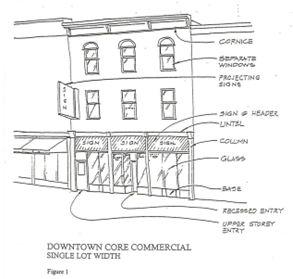
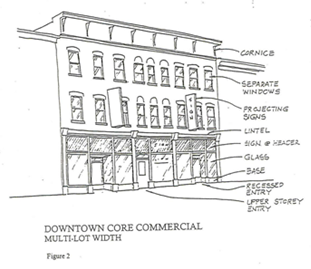
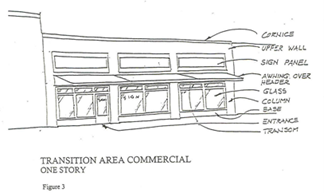
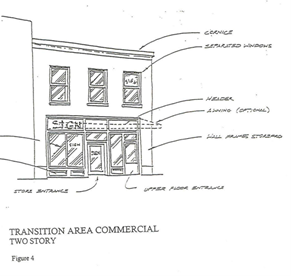
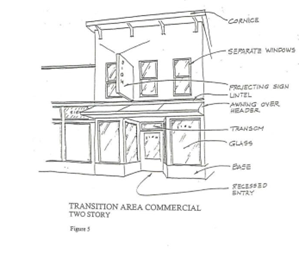
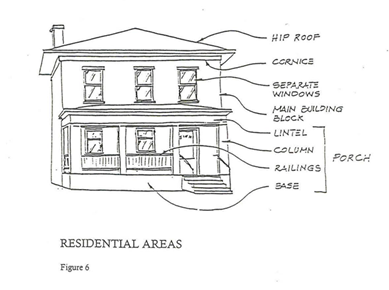
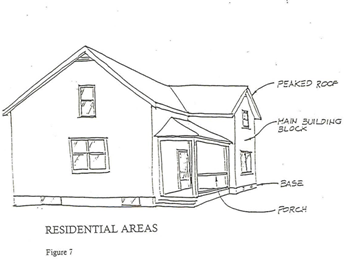
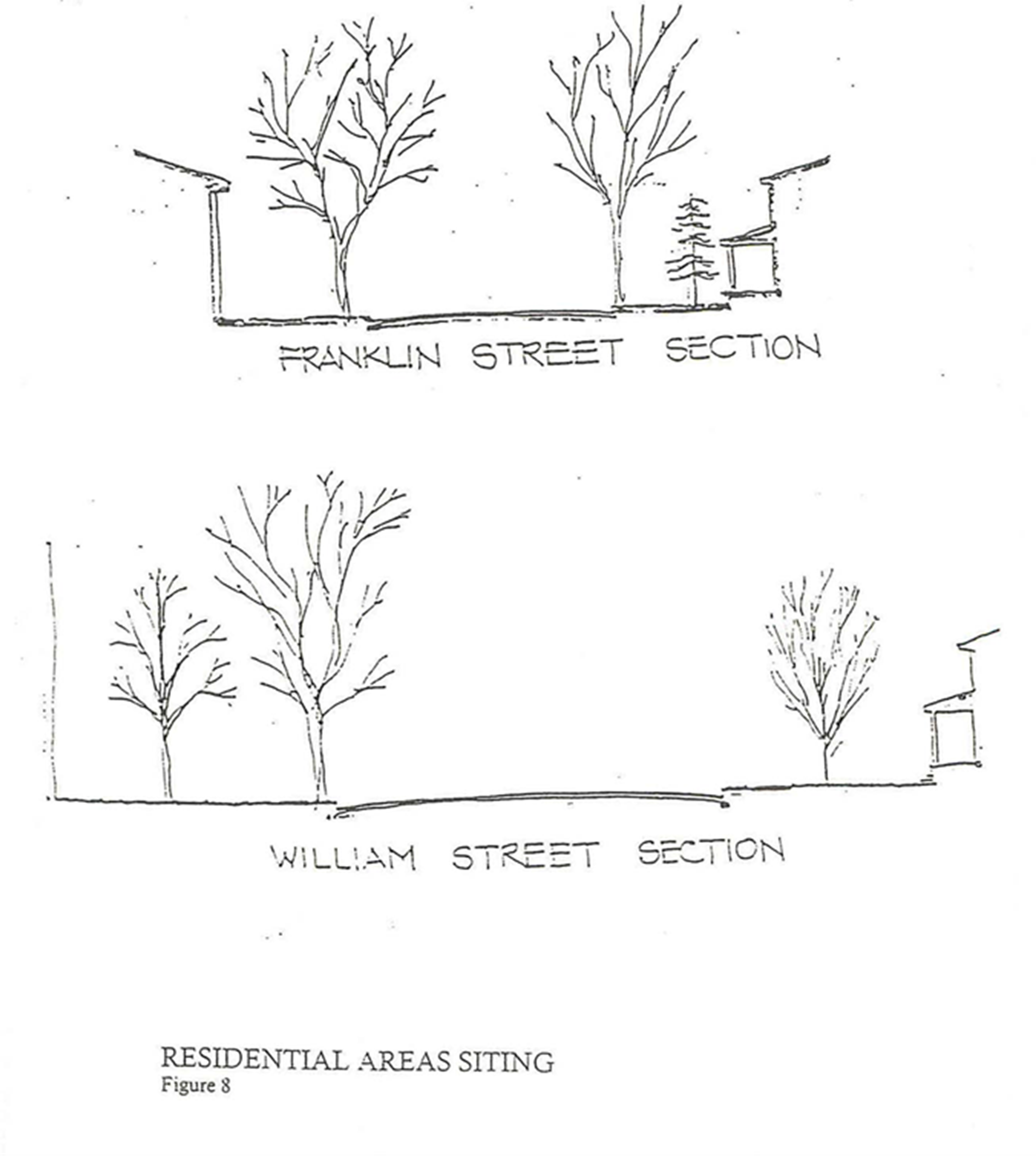
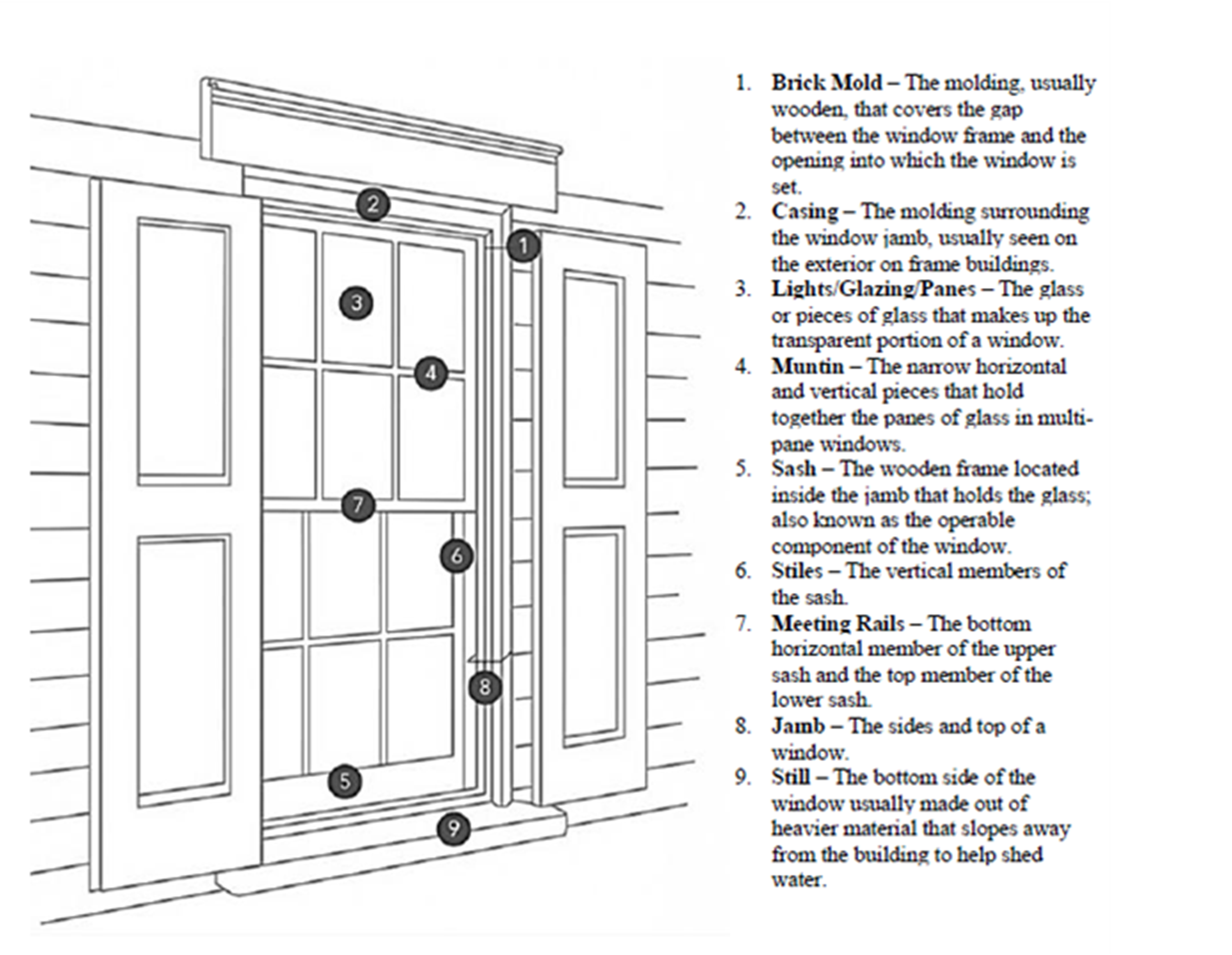
Figure 9: Typical Window Profile
GUIDANCE ON WINDOW REPAIR AND REPLACEMENT
Factors to consider in the repair or replacement of windows.
Original windows define the historic context of the building; reflect its time period, style, and regional characteristics; and should be preserved when possible. There is a point when the condition of a window may clearly indicate replacement. The decision process for selecting replacement windows should begin with an assessment of the existing windows, rather than window products currently available. Select a replacement window which retains as much of the character of the historic window as possible. Energy efficiency is only one of the factors for replacement; it should not dominate the decision.
Generally, typical residential windows and upper floor windows on downtown commercial buildings include: one-over-one, two-over-two, four-over-four, or six-over-six. This is in reference to the number of window panes in each window sash. (For example, the window in the diagram is considered six-over-six.) The original windows typically are double-hung with counterweights to move the sash up behind the upper sash. Attempt to understand the uniqueness of the window's contribution to the appearance of the façade, including:
•
The pattern of the window openings and their size
•
Proportions of the frame and sash (e.g. the width/depth of styles, rails, and meeting rails)
•
Configuration of window panes
•
Muntin profiles (replacement must be simulated divided lite-not just grids between the glass)
•
Type of wood
•
Paint color
•
Characteristics of the glass
•
Associated details such as arched tops, hoods, or other decorative elements
In many cases, repair and retrofit of the historic windows is more economical than total replacement. If not carefully analyzed, selected replacement units will be unlike the originals in design and appearance. Since windows are important in defining the building's historic character, insensitively designed replacement windows may destroy the building's historic character. At times, unique designs require custom-made windows. Changing the original window pane style or opening size is not appropriate.
Factors Determining Window Replacement.
The following factors may be considered in determining whether a window may be replaced:
•
The window frame or sash is missing.
•
The window is not original or contributing.
•
The window does not have stained or leaded glass.
•
More than half of the sash is rotten (wood) or rusting (metal) and the existing condition has been documented by the Applicant and reviewed by City Staff.
•
Mold is continuously growing on the interior of the window sash or frame and the existing condition has been documented by the Applicant and reviewed by City Staff.
•
Condensation is continuously appearing on the interior of the window and the existing condition has been documented the Applicant and reviewed by City Staff.
•
The window does not meet egress requirements.
•
Appropriate ongoing efforts to weatherize, maintain, or repair the window are not successful.
•
The installation of a storm window over a contributing primary window will not address the issue.
•
The installation of a storm window will not allow the operation of a contributing primary window.
Replacement Window Selection.
The following factors may be considered in selecting a replacement window if it is determined the existing contributing window cannot be weatherized, maintained, or repaired:
•
The Applicant is to submit details and profiles of the existing and new windows for comparison by the Historic Preservation Commission.
•
Only the sash should be replaced if the original frame is in good condition.
•
Replacement sash must be comparable to material and profiles of the existing contributing window.
•
All parts of a replacement window (including sash, frame, stile, rails, sills, moldings and muntins) must be comparable to the existing contributing window in material, size, profile, operation, and proportion.
•
A wood, aluminum-clad wood window, or fiberglass-clad wood window may be considered if the size, profile, operation, and proportion is comparable to the contributing window.
•
A wood, aluminum-clad wood window, or fiberglass-clad wood window may be considered if the contributing window was all metal. The new window must be comparable in profile, operation, and proportion to the contributing window.
•
Window openings shall not be filled in or altered to accommodate larger or smaller replacement windows.
•
Basement windows should be maintained to allow light and ventilation into that space.
•
Glass block should not to be installed in window openings.
•
An insulated window may be considered if the size, profile, operation, and proportion is comparable to the contributing window.
•
Insulated windows with divided lites shall have true divided lites with muntins that are comparable to the size and profile of the original muntins. Simulated divided lites may be considered, if the muntins are bonded to the exterior and interior of the window, are comparable to the size and profile of the original muntins, and have a minimally visible spacer bar between the two glass panes.
•
Glass color, texture, and tinting are to match existing.
•
Stained or leaded glass is not to be insulated unless original to the opening or historically documented for the opening.
•
A wood, aluminum-clad wood window, or fiberglass-clad wood window may be considered for new construction if the size, profile, operation, and proportion are appropriate to the style and design of the new construction.
Storm Windows and Window Screens.
The following recommendations may be considered in maintaining or installing storm windows and window screens:
•
If there are no historic photographs or other physical evidence of historic storm windows or screens being in place, in the absence of such documentary evidence, interior storm windows and interior screens are to be installed on residential use and commercial buildings in the Historic District following the design parameters above. Alternatively, a request for a Certificate of Appropriateness may be made to the Historic Preservation Commission for consideration of exterior screens on a case-by-case.
•
Maintain and preserve historic storm windows whenever possible. (These are typically found in the Residential Sub-district of the Historic District.)
•
To be historically accurate, choose removable or fixed exterior wood storm windows. Painted metal storm windows are an appropriate alternative to wooden storm windows.
•
Choose as narrow a sash frame as possible if an exterior metal storm window is selected.
•
The storm window meeting bar is to be in the same location as the meeting rails of the primary window sashes.
•
Install exterior, low profile storm windows that fit the original window openings and do not obscure the glass or sash. The frame of the storm window should be mounted inside the existing window frame.
•
Exterior wood and metal storm windows of the primary windows are to be a color compatible with the color scheme of the building, usually the same color as the sash.
•
Single sheets of glass or Plexiglas are not permitted as storm windows over double-hung windows.
•
Single sheets of glass may be used on transoms and single-pane or single-lite windows.
•
Do not install mirrored or tinted glass in storm windows.
SUBMISSION REQUIREMENTS
FOR A CERTIFICATE OF APPROPRIATENESS APPLICATION FOR WINDOW REPLACEMENT
The key to successful planning for window replacement is a careful evaluation of the existing physical condition of the existing windows. Replacement should match or be comparable to the historic sash in pane size and configuration, glazing, muntin detailing and profile, and historic color and trim. At times, the profiles of replacement elements, such as muntins, sash, frames, and moldings are flatter and wider or narrower and thinner than the historic profiles. These items are important for consideration since a change in relief and profile affects the character of the historic window, which in turn alters the overall appearance of the entire building.
If it is obvious that the windows in place are not the original windows, the Applicant will be asked to locate historic photographs of the building to replicate the original or earlier style. Or, in the absence of documentary evidence, select a window style that will not detract from the historic appearance of the building or the Historic District.
The following information will be required to submitted with a request for a Certificate of Appropriateness for window replacement for review by the Historic Preservation Commission:
1)
Clear, colored, detailed photographs, including at least one of each:
•
Full-frame shot of the entire building
•
Full-frame shot of individual windows from the exterior
•
Full-frame shot of individual windows from the interior
•
Close-up views of intersection of sills and frames
•
Close-up views of sash, focusing on bottom rail and muntins (if existing)
•
Close-up view of sills and bottom rails from the interior
2)
A photograph key illustrating the location of the windows on the building in relation to the photographs.
3)
A written description of each existing window denoting its material, the type of window it is, and its configuration. For example: Window 1 is wood, double-hung, 6-over-6.
4)
Window section drawings of both the existing and proposed windows or submitting a list of measurements comparing the individual elements of the existing windows to the proposed windows (as depicted in Figure 9 Typical Window Profile).
5)
A brochure from the window manufacturer detailing a durable mid-range to high-end quality product and the selected product color.
(Ord. 25-38. Passed 7-14-25)
1199.01. - Enforcement.
The provisions of this Zoning Ordinance shall be administered and enforced by the Director of Planning and Community Development.
(Ord. 25-38. Passed 7-14-25)
1199.02. - Certificate of building and zoning compliance required.
No occupied or vacant land shall be changed in its use, in whole or in part, until a certificate of building and zoning compliance has been issued by the Director of Planning and Community Development. No building or other structure requiring building permits shall be erected, moved, added to, or structurally altered, nor shall any building, structure or land be established or changed in use until a certificate of building and zoning compliance has been issued by the Director of Planning and Community Development. Certificates of building and zoning compliance shall be issued only in conformity with the provisions of this Zoning Ordinance.
(Ord. 25-38. Passed 7-14-25)
1199.03. - Tree clearance permit required.
No trees shall be removed from land within the City of Delaware except in conformity with the regulations specified in this chapter and Chapter 1122, and until a tree clearance permit has been issued by the Director of Planning and Community Development.
(Ord. 25-38. Passed 7-14-25)
1199.04. - Violation considered a nuisance.
Any building erected, altered, moved, razed, or converted, or any use of land or premises carried on in violation of any provision of this Zoning Ordinance may be declared to be a nuisance. Any building or land use activity considered to be a possible violation of any provision of this Zoning Ordinance that is observed by any City official shall be reported to the Director of Planning and Community Development.
(Ord. 25-38. Passed 7-14-25)
1199.05. - Complaints.
Whenever a violation of this Zoning Ordinance occurs, or is alleged to have occurred, any person may file a written or verbal complaint. Such complaints shall fully state the causes and basis of the complaint and shall be filed with the Director of Planning and Community Development.
(Ord. 25-38. Passed 7-14-25)
1199.06. - Inspection of property.
The Director of Planning and Community Development shall inspect any building erected, altered, moved, razed, or converted, or any use of land or premises carried on in alleged violation of any of the provisions of this Zoning Ordinance.
(Ord. 25-38. Passed 7-14-25)
1199.07. - Stop work order.
Subsequent to the Director of Planning and Community Development's determination that the work is being done contrary to this Zoning Ordinance or approved development plan, conditional use approval, or other legislation, or if the work being performed is causing any situation that threatens the health, safety, or welfare of the surrounding property owners, their respective properties, or of the general public passing through or near the construction area, the Director of Planning and Community Development shall write a stop work order and post it on the premises involved. It shall be a violation of this chapter for anyone other than the Director of Planning and Community Development to remove a posted stop work order. It shall also be a violation of this chapter to fail to comply with a stop work order posted by the Director of the Planning and Community Development
(a)
Such stop work order shall:
(1)
Be in writing;
(2)
Identify the violation(s);
(3)
Include the effective date of the order
(4)
Specify that all work must cease until the violation is remediated.
(Ord. 25-38. Passed 7-14-25)
1199.08. - Notice of violation.
(a)
Whenever the Director of Planning and Community Development determines that a violation of any provision of this Zoning Ordinance exists, a notice of violation shall be issued.
(b)
Such notice of violation shall:
(1)
Be in writing;
(2)
Identify the violation;
(3)
Include a statement of the reason or reasons why the notice of violation is being issued and refer to the chapters of this chapter being violated; and
(4)
State the date by which the violation shall be corrected and provide a reasonable time in which to correct the violation.
(c)
Service of a notice of violation shall be by either:
(1)
Personal delivery to the person or persons responsible; or
(2)
Certified mail addressed to the person or persons responsible at the last known address; or
(3)
Posted in a conspicuous place on the premises.
(e)
After the notice of violation is served, no work shall proceed on any building or premises included in the notice except to correct the violation or violations identified in the notice or to comply with the notice.
(Ord. 25-38. Passed 7-14-25)
1199.09. - Revocation of certificates.
The Director of Planning and Community Development may issue a revocation notice to revoke a certificate of building and zoning compliance which was issued contrary to this Zoning Ordinance or based upon false information or misrepresentation in the application.
(Ord. 25-38. Passed 7-14-25)
1199.10. - Clean-up of nuisance property and removal of violating buildings and structures.
Should any property owner fail to comply with the regulations of this Zoning Ordinance, the City may pursue all legal remedies available to it to obtain full compliance, up to and including clean-up and removal of violating buildings and structures. The City may require reimbursement of administrative, legal, court, and actual expenses relating to these actions.
(Ord. 25-38. Passed 7-14-25)
1199.99. - Penalty.
(a)
It shall be unlawful to:
(1)
Use or occupy any land or place; build, erect, alter, remodel, restore, or rebuild thereon any building or structure; permit any building or structure to remain on such land; or use, occupy, or operate such building or structure, in any way or for any use or purpose which is not permitted by the provisions of this Zoning Ordinance; or
(2)
Use or occupy any parcel of land; use or occupy a new building; or enlarge, substitute, or otherwise change the use, occupancy, or configuration of any land or building, without having received a zoning certificate or conditional use permit indicating compliance with the provisions of this Zoning Ordinance from the Director of Planning and Community Development; or
(3)
Aid, assist, or participate with any person in placing, building, erecting, altering, remodeling, restoring, or rebuilding any building or structure which is not permitted by the provisions of this Zoning Ordinance; or
(4)
Violate or fail to perform any condition, stipulation or safeguard set forth in any certificate issued pursuant to this Zoning Ordinance, or continue to use or occupy the premises or building as previously authorized by such certificate beyond the duration limit therein stated; or
(5)
Continue construction, renovation, or improvements contrary to a stop work order or notice of violation; or
(6)
Refuse to permit the Director of Planning and Community Development to enter any premises in the City to investigate a reported violation of the provisions of this Zoning Ordinance, or refuse or fail to furnish to such Director of Planning and Community Development a statement as to the number of persons occupying such premises; or
(7)
Knowingly make any materially false statement of fact in an application to the Director of Planning and Community Development for a zoning certificate, conditional use permit, or in the plans or specifications submitted to the Director of Planning and Community Development in relation to such application; or
(b)
Any person, firm, or corporation violating any of the provisions of this Zoning Ordinance and its subdivision regulations or any amendment or supplement thereto shall be deemed guilty of a minor misdemeanor and shall be punished by a fine not exceeding one hundred fifty dollars ($150.00). A separate offense shall be deemed committed each day during or on which a violation occurs. The owner or tenant of any building, premises, or part thereof, and any architect, builder, contractor, or other person who commits, participates in, assists in or maintains such violation may each be found guilty of a separate offense and suffer the penalties herein provided.
(c)
Any development that occurs without first obtaining a certificate of building and zoning compliance shall be subject to an additional penalty fee at the time of permit submittal, equal to the amount of the permit application fee.
(Ord. 25-38. Passed 7-14-25)

