
Delaware City Zoning Code
TITLE FOUR
GENERAL ZONING REGULATIONS
1130.01. - Purpose.
Accessory structure and fence regulations are established to identify and regulate such structures to ensure they do not create public safety or nuisance issues, do not create an adverse aesthetic from street rights-of-way, and do not create a negative impact (light, air, drainage, or aesthetic) on surrounding properties. For the purposes of this chapter fences shall include walls.
(Ord. 25-38. Passed 7-14-25)
1130.02. - Applicability.
Accessory structures and fences shall be permitted in all zoning districts including Planned Unit Developments (PUD) as set forth in this chapter unless otherwise noted in relevant PUD approvals.
(Ord. 25-38. Passed 7-14-25)
1130.03. - Accessory structure and fence regulations for all districts.
(a)
Principal Structure Required. No lot shall contain an accessory structure or fence without also containing a principal structure.
(b)
Permit Required. All new and expanded accessory structures and fences shall require a Certificate of Building and Zoning Compliance except for those noted below:
(1)
Accessory structures in residential districts with a footprint of less than 100 square feet, not permanently affixed to the ground;
A.
Regardless of size, accessory structures must adhere to all requirements set forth in this chapter.
B.
Only one exception is permitted per property.
(2)
Utility boxes and equipment;
(3)
Mechanical equipment including air conditioning units; and
(4)
At-grade patios/driveways, except where right-of-way permits are required.
A.
All requirements of Section 1130.04(l) must be met.
(5)
Fences not requiring a certificate of building and zoning compliance:
A.
Temporary fencing used to enclose gardens or other temporary installations.
i.
Non-welded wire (including chicken wire) shall only be used in rear yards.
ii.
Temporary fencing shall not exceed three (3) feet in height.
B.
Snow fencing between the months of November and March.
C.
Construction Fences. Fences necessary for construction and development shall be exempt from the provisions of this chapter provided such fences are temporary and are removed within thirty (30) days following the completion of the construction or development for which the fence was intended.
D.
Fences requiring three (3) or fewer post, holes located in side or rear yards and designed to screen mechanical equipment, refuse containers, hot tubs, or similar appurtenances not to exceed six (6) feet in height; and
E.
Border fencing designed to be pushed into the ground and not requiring post holes.
(c)
Design. All new and expanded accessory structures shall be designed to be compatible with and subordinate to the principal structure in terms of scale, color, and material selection.
(d)
Installation. All new and expanded accessory structures shall be tied down or secured as required by the then-current Ohio Building Code.
(e)
Any fence or wall located in a utility or drainage easement shall be located and designed to the specifications of the City. The City reserves the right to prohibit any fence or wall from being placed in a utility or drainage easement.
(f)
Maintenance and Repair. All accessory structures and fences shall be maintained in good repair and be structurally sound. General maintenance activities, including paint, siding, cleaning, and minor repairs shall not require a certificate of building and zoning compliance.
(1)
Repairs which involve the setting of new permanent posts or other major alterations shall require a certificate of building and zoning compliance.
(g)
Each property owner shall determine property lines and ascertain that all accessory structures or fences do not deviate from the plans as approved by the Director of Planning and Community Development, or designee, and do not encroach upon another lot. The issuance of a permit by the City shall not be construed to mean the City has determined an accessory structure or fence is not encroaching upon another lot, nor shall it relieve the property owner of the duty imposed herein.
(Ord. 25-38. Passed 7-14-25)
1130.04. - Supplemental accessory structure and fence regulations for residential uses.
(a)
Applicability. This section shall apply to all residential districts, and those districts that permit residential uses.
(b)
Breezeways. If an accessory structure is connected to a principal structure by a breezeway it shall only be considered an addition to the principal structure if:
(1)
The accessory structure and principal structure are separated by no more than twelve (12) feet.
(2)
Both the breezeway and accessory structure are fully enclosed.
(3)
The breezeway and accessory structure are constructed of building materials and color consistent with the principal structure.
(4)
The breezeway and accessory structure are designed to be consistent with the principal structure (including in height and roof pitch).
(c)
Connected structures that do not meet the criteria set forth in Section 1130.04 (b) shall be considered an accessory structure and will be counted toward the maximum allowed accessory structure square footage set forth in Section 1130.04(d).
(d)
Maximum size.
(1)
Height. Accessory structures shall not exceed twenty (20) feet in height.
(2)
Footprint. On any lot, the sum of the footprint of all accessory structures shall not exceed fifty percent (50%) of the footprint of the principal structure, with a maximum of 900 square feet.
A.
On lots where the principal structure has a footprint of less than 1,200 square feet, a total of 600 square feet of accessory structure square footage shall be permitted.
B.
There is no maximum footprint of accessory structures in the Agricultural District.
(3)
Lot coverage. The sum of the footprint of all impervious surfaces on any lot, including the principal structure, accessory structures, pavement, and/or gravel surfaces, shall not exceed fifty percent (50%) of the square footage of the total lot.
A.
At no time shall the lot coverage in the front yard exceed fifty percent (50%).
(e)
For the purposes of this chapter, yard designations shall be as shown in Figure 1130.04.
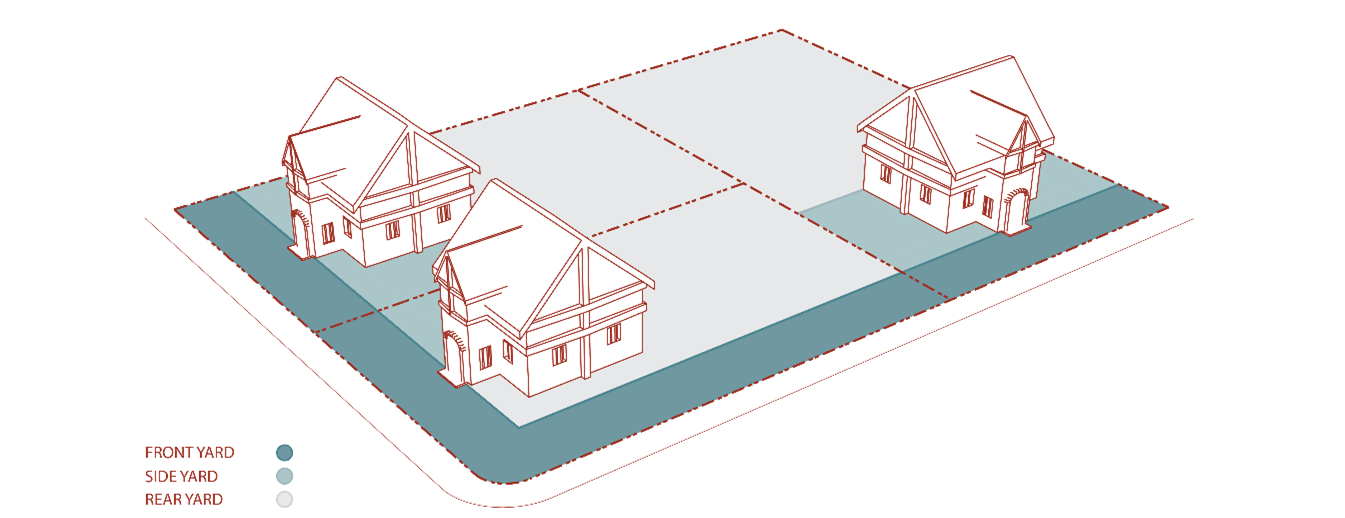
Figure 1130.04. Yards
(f)
Fences and Walls.
(1)
Permitted locations. Fences and walls are permitted in front, side, and rear yards.
A.
Fences and walls in front yards shall be setback at least one (1) foot from the right-of-way or sidewalk. The City Engineer may require fences in front yards to be set back farther from the right-of-way to preserve clear sight distance.
B.
Fences in side and rear yards may either be placed on the property line or setback at least three (3) feet. At no point shall a fence be installed within three (3) feet of another fence unless it is tied into the adjacent fence.
C.
Any fence or wall located in a City-owned or maintained utility or drainage easement shall be located and designed to the specifications of the City. The City reserves the right to prohibit any fence or wall from being placed in a utility or drainage easement.
D.
Fences installed in private utility easements may be installed at the risk of the property owner.
(2)
Design.
A.
The finished side of all fences shall face outward with no supporting structures visible from adjacent properties.
B.
Permitted materials include stone, brick, finished or treated wood, decorative aluminum, iron, welded wire, or synthetic look-a-like products as approved by the Director of Planning and Community Development.
i.
Welded wire fences shall require, at minimum, a frame on all sides of each panel constructed of wood or a similar synthetic material.
C.
Examples of permitted fence styles include, but are not limited to, those in Figure 1130.04(f)(2).

Figure 1130.04(f)(2). Fence Styles
(3)
Prohibited fences and fence materials include above-ground electric, barbed wire, or other sharp-edged fences; chain link fences with weave inserts or fabric coverings/screens; chicken wire and other similar non-welded wire; sheet metal panels.
A.
Chain link fences are prohibited in front yards.
(4)
Height. Fences in front yards shall have a maximum height of four (4) feet and shall be, at minimum, fifty percent (50%) transparent. Fences in side or rear yards shall have a maximum height of six (6) feet.
(g)
Decks, Gazebos, Pavilions.
(1)
Permitted locations. Decks, gazebos, pavilions, or other similar accessory structures shall be permitted in side or rear yards and setback at least three (3) feet from side and rear property lines.
(2)
Decks located within three feet of the primary structure shall meet the setback requirements for the primary structure.
(h)
Sheds or Greenhouses. Sheds or greenhouses shall be permitted in rear yards and located at least three (3) feet from side and rear property lines.
(i)
Detached Garages. Detached garages shall be permitted in side yards and rear yards, setback at least three (3) feet from side and rear property lines. In no instance may a garage be located closer to the front property line than the principal structure.
(j)
Carports. Carports attached to the primary structure shall be permitted in side and rear yards, no closer to the property line than the required yard setback for principle structure in the relevant zoning district. Detached carports shall be permitted in rear yards only and setback at least three (3) feet from side and rear property lines.
(1)
Design. Carports shall be constructed of a rigid material and affixed to the ground in a permanent manner. Carports attached to the existing principal structure shall be architecturally compatible with said principal structure.
(k)
Swimming Pools. Swimming pools shall be permitted in rear yards and setback at least ten (10) feet from side and rear property lines. Swimming pools shall be permitted in side yards, setback at least ten (10) feet from side property lines, only if surrounded by a six (6) foot privacy fence.
(1)
Fence Required. All swimming pools shall be enclosed by a fence or wall at least four (4) feet in height.
A.
All fences and other pool enclosures shall be constructed to have no openings, holes, or gaps larger than the current State of Ohio Building Code permits, except for doors, gates, or windows which shall be equipped with automatically latching gate to prevent unauthorized access. Access-secured accessory buildings and walls of principal buildings may be used in place of, or as part of, the enclosure.
B.
Above-ground pools with sides or railings with a combined height taller than four (4) feet with a locking ladder shall not require a fence.
C.
There is no requirement for fencing, provided the pool is at least fifty (50) feet from the rear and side property lines, and is equipped with an automated cover capable of being locked and having a load capacity at least equal to that set forth in the "Standard Performance Specification for Safety Covers and Labeling Requirements for All Covers for Swimming Pools, Spas and Hot Tubs" published by the ASTM International and designated as F 1346-91, or as modified which standard is incorporated herein by reference as if fully rewritten.
(l)
Accessory Dwelling Units. See Chapter 1131
(m)
At-Grade Patios and Driveways. At-grade patios and driveways are permitted in front, side, or rear yards. Other than an extension of a driveway from a designated curb cut and/or driveway apron, all at-grade patios and driveways shall be set back at least three (3) feet from all property lines. Existing driveways or parking areas may be expanded in accordance with criteria (1)-(3) as shown in Figure 1130.04(m).
(1)
Driveway aprons or curb cuts shall not be expanded except with an approved right-of-way permit.
(2)
A driveway or parking area shall taper to the driveway apron or curb cut.
(3)
A driveway or parking area shall not be expanded towards the front door of the dwelling unit.
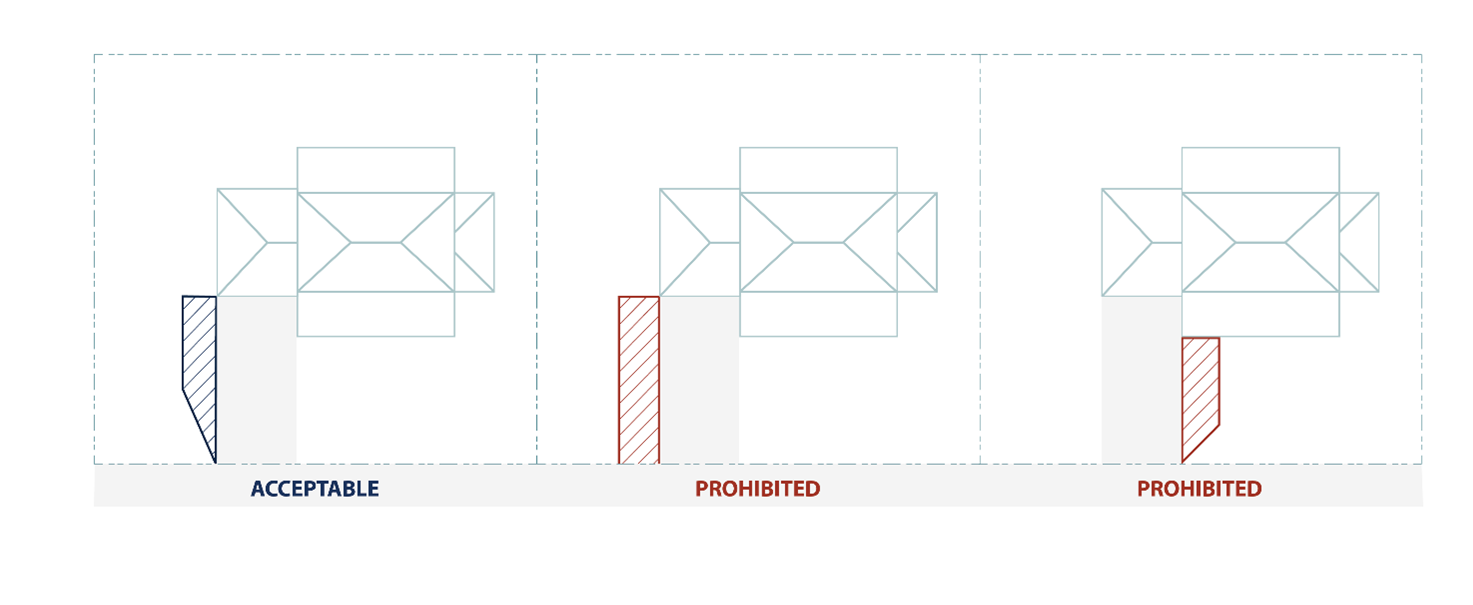
Figure 1130.04.(m) Driveway Expansion
(n)
Prohibited Accessory Structures. Steel arch buildings, temporary, portable, or inflatable garages or carports, converted shipping containers, semi tractor trailers used for storage (with or without wheels), or other containers not originally intended to be used as accessory structures are prohibited in all residential districts.
(Ord. 25-38. Passed 7-14-25)
1130.05. - Supplemental accessory structure and fence regulations for commercial uses.
(a)
Fences and Walls.
(1)
Permitted Locations. Fences and walls are permitted in front, side, and rear yards.
A.
Fences in front yards shall be setback at least one (1) foot from the right-of-way or sidewalk. The City Engineer may require fences in front yards to be set back farther from the right-of-way to preserve clear sight distance.
B.
Fences in side and rear yards may either be placed on the property line or setback at least three (3) feet. At no point shall a fence be installed within three (3) feet of another fence unless it is tied into the adjacent fence.
C.
Any fence or wall located in a City-owned or maintained utility or drainage easement shall be located and designed to the specifications of the City. The City reserves the right to prohibit any fence or wall from being placed in a utility or drainage easement.
D.
Fences installed in private utility easements may be installed at the risk of the property owner.
(2)
Design.
A.
The finished side of all fences shall face outward with no supporting structures visible from adjacent properties.
B.
Permitted materials include stone, brick, finished wood, iron, welded wire, vinyl-coated chain link, or synthetic look-a-like products as approved by the Director of Planning and Community Development.
i.
Welded wire fences shall require, at minimum, a frame on all sides of each panel constructed of wood or a similar synthetic material.
C.
Prohibited fences and fence materials include above-ground electric, barbed wire, or other sharp-edged fences; chain link fences with weave inserts or fabric coverings/screens; chicken wire and other similar non-welded wire.
D.
Height. Fences shall have a maximum height of six (6) feet. Fences in front yards shall be, at minimum, fifty percent (50%) transparent.
(b)
Sheds.
(1)
Permitted locations. Sheds are permitted in rear yards and shall be setback at least three (3) feet from side and rear property lines.
(2)
Each lot in a commercial district shall be permitted one (1) 100 square foot shed or storage building. In lieu of a shed, the dumpster enclosure may be expanded by 100 square feet to accommodate storage.
(3)
Design. The shed shall be designed to complement the architecture of the principal structure.
(c)
Outdoor Seating.
(1)
Permitted Locations. Outdoor seating shall be permitted in front, side, or rear yards within the setbacks established for primary structures according to Schedule 1112.04.
(2)
Design. Outdoor seating areas shall be designed to complement the architecture of the principal structure. All outdoor seating areas shall require a patio, deck, or other solid surface. Gravel is prohibited.
(d)
Prohibited Accessory Structures. Steel arch buildings, temporary, portable, or inflatable garages or carports, converted shipping containers, semi tractor trailers used for storage (with or without wheels), or other containers not originally intended to be used as accessory structures are prohibited in all commercial districts.
(e)
Secondhand Donation Drop-Boxes. Unless regulated, second-hand drop-off containers are a site for the accumulation of junk, rags, and other articles within and outside the container, and unless regulated, second-hand drop-off containers and the accumulation of articles outside the container may impede pedestrian and vehicular traffic. Any receptacle or box used to collect second-hand articles shall only be permitted in commercial districts and shall conform to the following provisions:
(1)
No articles shall be permitted to accumulate outside of the container.
(2)
The container must not block any public road or sidewalk, nor block any access way, drive aisle and or required parking spaces as determined by the Planning and Community Development Department.
(3)
No flammable or hazardous materials or perishable items shall be placed or kept in containers.
(4)
The container must not impede motorists' line-of-sight and must be located directly adjacent to the principal building.
(5)
The container shall be anchored to the ground or designed in such a manner that movement cannot easily occur.
(6)
The container and the immediate surrounding area shall be kept clean and free from trash and debris and must be emptied on a regular schedule to prevent overflow.
(7)
The container shall be equipped with a lid and/or door that automatically closes after the articles are deposited and the container must be kept free of rust.
(8)
The owner of the container shall be identified on the container along with applicable contact information, a pick-up schedule and a list of items to be collected.
(9)
Containers must be separated by at least 1000 feet (as the crow flies) throughout the City.
(10)
The Planning and Community Development Department shall review all requests for such containers and such application shall include a site plan containing dimensions and setbacks as well as an example photograph/rendering of the container with each application in order for approval to be considered. The application must be signed by the owner of the property where the container will be located.
(11)
Should the container violate any of the provisions set forth in Section 1133.14 (c), a notice of violation will be issued by the Director of Planning and Community Development to the owner of the property and the owner of the container. Should the violation(s) not be corrected within fourteen (14) business day(s), the certificate of building and zoning compliance shall be revoked, and corrective action taken for a non-permitted structure.
(Ord. 25-38. Passed 7-14-25)
1130.06. - Supplemental accessory structure and fence regulations for industrial uses.
(a)
All accessory buildings and structures shall comply with the development standards established for principal buildings.
(b)
Fences.
(1)
Fences and walls are permitted in front, side, and rear yards.
(2)
Fences in front yards shall be setback at least one (1) foot from the right-of-way or sidewalk. The City Engineer may require fences in front yards to be set back farther from the right-of-way to preserve clear sight distance.
(3)
Fences in side and rear yards may either be placed on the property line or setback at least three (3) feet. At no point shall a fence be installed within three (3) feet of another fence unless it is tied into the adjacent fence.
(4)
Any fence or wall located in a City-owned or maintained utility or drainage easement shall be located and designed to the specifications of the City. The City reserves the right to prohibit any fence or wall from being placed in a utility or drainage easement.
A.
Fences installed in private utility easements may be installed at the risk of the property owner.
(5)
Design.
A.
The finished side of all fences shall face outward with no supporting structures visible from adjacent properties.
B.
Permitted materials include stone, brick, finished wood, iron, welded wire, vinyl coated chain link, or synthetic look-a-like products as approved by the Director of Planning and Community Development.
i.
Welded wire fences shall require, at minimum, a frame on all sides of each panel constructed of wood or a similar synthetic material.
ii.
Fences at least seven (7) feet in height may be topped with barbed wire or other sharp-edged materials.
C.
Prohibited fences and fence materials include chain link fences with weave inserts or fabric coverings/screens; chicken wire and other similar non-welded wire; electrified fences.
D.
Height. Fences shall have a maximum height of eight (8) feet. Fences in front yards shall be, at minimum, fifty percent (50%) transparent.
(Ord. 25-38. Passed 7-14-25)
1131.01. - Purpose.
Accessory Dwelling Unit (ADU) regulations are established to achieve the orderly development of the City and its neighborhoods and the following purposes:
(a)
To regulate the bulk and location of accessory dwellings units.
(b)
To regulate the density and distribution of accessory dwelling units.
(c)
To achieve the goal of the City of Delaware comprehensive plan to promote and ensure a broad spectrum of housing options to meet the current and future needs of the population.
(Ord. 25-38. Passed 7-14-25)
1131.02. - Relevant chapters for cross-reference.
(Ord. 25-38. Passed 7-14-25)
1131.03. - General requirements.
ADUs shall be permitted on in all districts where one- and two-family homes are permitted and shall conform to the location, coverage, maintenance, and general standards contained in this section as well as provisions of the Ohio Building Code requirements for a habitable space.
(a)
Occupancy Requirement. The owner of each lot on which an accessory dwelling unit is established shall maintain a residence in the principal or accessory dwelling unit on the lot for so long as the accessory dwelling unit exists.
(1)
A Certificate of Building and Zoning Compliance shall be required prior to initial occupancy or use or If the ADU is changed, converted, or wholly or partly altered or enlarged in its structure.
(2)
The owner occupancy requirement shall be certified to the Planning and Community Development Department on an annual basis. The property owner shall provide a notarized, recorded affidavit to the Planning and Community Development Department attesting to the owner occupancy requirement prior to obtaining City approval for the ADU.
(b)
Maximum Number of ADUs. No parcel shall contain more than one ADU.
(c)
Yard Requirements.
(d)
Floor Area. All ADUs must contain a minimum of 400 square feet of livable area.
(1)
Attached ADU. The total area of the ADU shall not exceed fifty percent (50%) of the floor area of the principal structure.
(2)
Detached ADU. The sum of the footprint of all accessory structures, including an ADU shall not exceed fifty percent (50%) of the footprint of the principal structure, with a maximum of 900 square feet on any lot.
A.
On lots where the principal structure has a footprint of less than 1,200 square feet, the maximum footprint of all accessory structures shall not exceed 600 square feet.
B.
There is no maximum footprint of accessory structures in the A-1, Agricultural District.
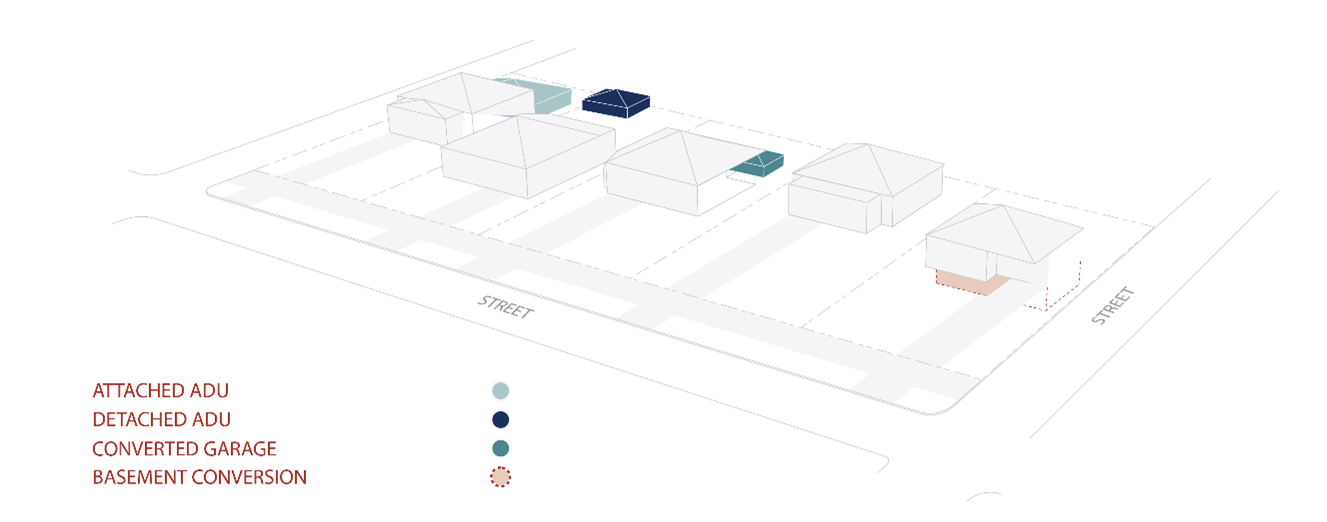
Figure 1131.03. General Requirements
(e)
Height Restrictions.
(1)
The maximum height of any attached ADU shall not exceed the maximum allowable height of a primary structure as set forth in each zoning district.
(2)
The maximum height of any detached ADU shall not exceed twenty (20) feet.
(f)
Parking Requirements. No additional off-street parking shall be required in locations where on-street parking is available within one block. In locations where on-street parking is not available within one block, the ADU shall provide one (1) additional off-street parking space. This may include space on an existing driveway.
(g)
Exterior Design Standards. ADUs shall be of similar style, color, and material selection as the primary building as set forth in Section 1120.04 and designed to portray the form of a single-family dwelling.
(h)
Additional Requirements.
(1)
Access to ADUs. A continuous paved access corridor shall be provided from the front of any lot containing an ADU to the ADU entrance. The route must be suitable for emergency responders to use and shall have an unobstructed vertical clearance of ten (10) feet and an unobstructed horizontal clearance of seven (7) feet, including five (5) feet clear of roof eaves or other projections. The access shall be kept accessible during all conditions, including being accessible when snow is on the ground.
(2)
Construction of ADUs may trigger public improvements, including but not limited to sidewalk improvements, curb ramps, street trees, driveway and driveway apron improvements, and water meter upgrades, as determined by the relevant City department.
(3)
ADUs proposed on a non-conforming lot shall conform to requirements set forth in Chapter 1139.
(4)
All ADUs shall require a certified address from the City of Delaware.
(Ord. 25-38. Passed 7-14-25)
1132.01. - Purpose.
The purpose of the home occupation regulations is to protect the character of the surrounding residential neighborhood while recognizing that traditional workplaces are no longer necessary in all situations due to changing technology, computerization, networking, and the changing job market. These regulations are intended to recognize this trend and allow home occupations that are located and conducted in such a manner that the existence of the home occupation is not detectable outside of the dwelling unit or accessory building. All home occupations shall be clearly subordinate and incidental to the residential use of the property.
(Ord. 25-38. Passed 7-14-25)
1132.02. - Standards for home occupations.
(a)
Uses Allowed.
(1)
Instructional Services. Including, but not limited to, music lessons, tutoring, religious instruction, and nursery school/day care.
A.
For instruction purposes, the number of students shall be no more than two (2) at any one time.
B.
For nursery school/daycare purposes, the maximum enrollment shall not exceed the number allowed by the State of Ohio in accordance with ORC §§ 5104.01 through 5104.99.
(2)
Professional Services. Including, but not limited to, hair/nail salons, barbers, massage therapists, and photographers.
A.
For service purposes, the number of clients shall be no more than one (1) at any one time.
(3)
Studio/Office. Including, but not limited to, art or recording studios, dressmaking/tailoring, business consulting, and computer/internet business.
A.
For office purposes, this may include a business which maintains a management office in a dwelling unit, but conducts day-to-day operation at another location (i.e. landscaping/lawn care service, interior decorating, cleaning services, direct sale of consumer products, etc.)
(b)
Districts Allowed. Home occupations shall be allowed in all districts and overlays where residential uses are permitted.
(c)
General Regulations for all Home Occupations.
(1)
Exterior Appearance. In no way shall the appearance of the structure be altered resulting from the home occupation. There shall be no entrance or exit way specifically provided in the dwelling unit or on the premises for the conduct of a home occupation, nor shall there be any display of products or equipment visible in any manner other than one sign, not to exceed two square feet in area, non-illuminated and mounted flat against the wall of the principal building.
(2)
External Effects. No home occupation shall be conducted in a manner which would cause the emission of sounds, noise, vibration, dust, smell, smoke, glare, electrical interference, or any other hazard or nuisance to any greater extent than experienced in an average residential neighborhood as set forth in Chapter 1126
(3)
Usable Area. No more than twenty-five percent (25%) of the gross area of such dwelling unit, or 500 square feet, whichever is less, may be used for the home occupation.
A.
No more than 500 square feet of either an attached garage or detached accessory building, but not both, may be used for the home occupation.
B.
Due to its nature, a daycare may be conducted throughout the primary structure. No day care operations may take place in an accessory structure.
C.
There shall be no exterior storage, display, use, or activity of any kind relating to the home occupation.
(4)
Employees. Only those residing in the dwelling unit may conduct work from the home occupation. One additional non-resident employee may work from the home occupation for up to 90 days in each calendar year.
(5)
Traffic. Traffic generated by the home occupation shall not create safety hazards nor be substantially greater in vehicular size nor exceed on any continual basis the average number of vehicle trips that would normally be expected for a residence in a residential neighborhood.
A.
There shall be no commodities sold or services rendered that require receipt or delivery of merchandise, goods, or equipment other than by passenger motor vehicle, parcel delivery service, or U.S. mail service. No deliveries by tractor/trailer trucks are permitted.
(6)
Parking. No area on the residential property may be created to park any commercial vehicles or equipment related to the home occupation. Any home occupation business which requires the creation of parking in addition to the parking area already provided for the single-family residence shall not be operated within a residential zoning district. The conduct of a home occupation shall not reduce or render unusable areas provided for required off-street parking for the dwelling unit.
A.
A maximum of one (1) passenger vehicle associated with the home occupation may be parked on existing parking areas on the residential property at any time.
(7)
Hazards. Storage of combustible or flammable matter, accumulation of rubbish, wastepaper, cartons, or boxes, in excess of normal home activities is prohibited.
(Ord. 25-38. Passed 7-14-25)
1133.01. - Purpose.
Short-term rental (STR) regulations are established to achieve the following purposes:
(a)
To provide the opportunity for property owners to supplement their income by leasing part or all of their property to short-term tenants.
(b)
To diversify available housing options for temporary residents, and those in need of temporary housing.
(c)
To protect the affordability of housing in the City of Delaware.
(d)
To protect the residential character of neighborhoods in the City of Delaware.
(e)
To encourage economic development and support partner agencies and events by allowing for tourist accommodations.
(Ord. 25-38. Passed 7-14-25)
1133.02. - Types of short-term rentals.
For the purposes of this chapter, "short-term rentals" shall include hosted short-term rentals and non-hosted short-term rentals. This chapter shall not apply to hotels or motels as otherwise defined in this Code.
(Ord. 25-38. Passed 7-14-25)
1133.03. - General regulations for all short-term rentals.
(a)
Permitted Locations. Short-term rentals shall be permitted by-right in the C-DC zoning district and on lots used for one or two-family dwellings.
(b)
Registration Required. All persons wishing to operate a short-term rental shall register with the City of Delaware Planning and Community Development Department in accordance with Section 1133.04.
(c)
Number of Permitted Short-Term Rentals. There shall be a maximum of one (1) short-term rental registration per fee simple lot.
(1)
For hosted short-term rentals, one STR registration shall allow the owner to host multiple short-term tenants simultaneously in separate rooms. There shall be a permanent resident host on-site pursuant to the definition of "hosted short term rental".
(2)
For non-hosted short-term rentals, one STR registration shall allow for the rental of a full dwelling unit to one short-term tenant or group.
(3)
Each individual, household, or commercial entity shall be permitted to register for a maximum of one (1) hosted short-term rental and one (1) non-hosted short-term rental.
(d)
Parking.
(1)
In the C-DC Zoning District, no additional off-street parking shall be required.
(2)
In zoning districts where single- and two-family dwelling units are permitted, no additional off-street parking shall be required in locations where on-street parking is available within one block. In locations where on-street parking is not available within one block, the short-term rental shall provide one (1) additional off-street parking space for every two (2) possible separate tenants. This may include space on an existing driveway.
(e)
Exterior Appearance. In no way shall the appearance of the structure be altered resulting from the short-term rental other than the allowance of one sign, not to exceed two (2) square feet in area, non-illuminated, and mounted flat against the wall of the principal building.
(f)
Required Posting.
(1)
All short-term rental hosts shall provide tenants with a current version of the "City of Delaware Short-Term Rental Guidelines" packet as provided by the Department of Planning and Community Development.
(2)
All short-term rental hosts shall include their current short-term rental registration number in all listings of their short-term rental.
(Ord. 25-38. Passed 7-14-25)
1133.04. - Short-term rental registration requirements and procedures.
(a)
Registration Application Requirements. Applications to operate a short-term rental shall be submitted in accordance with the checklist on file with the Planning and Community Development Department.
(1)
Review by Director of Planning and Community Development. The Director of Planning and Community Development (Director) shall review the submitted application for completeness pursuant to the submission requirements outlined in the checklist on file.
(2)
Required Inspection. After an application for a short-term rental permit has been deemed complete, the Director shall forward the application to the Planning and Community Development Code Enforcement Division and City of Delaware Fire Department to schedule an inspection to review the site for compliance with all City codes.
(3)
Fees. Upon passage of the required site inspection, the applicant shall pay all fees as determined by City Council to receive their permit.
(b)
Registration Expiration. Short term rental registration permits shall be in effect for one (1) calendar year from January 1 of the current year through December 31 of the following year. All permits shall expire on December 31 of each calendar year regardless of date received.
(1)
Registration Renewal. Applicants shall re-apply each year they intend to operate a short-term rental and shall pay all required fees set forth in the fee schedule.
(c)
Registration Revocation.
(1)
Any short-term rentals found to be operating without first registering with the City shall be caused to cease operations until such time as a registration application has been filed, accepted (including the required inspection), and paid in-full.
(2)
Any short-term rentals with three (3) violations of any City Code or Ordinance within one (1) registration year shall be caused to cease operations and any short-term rental registration shall be revoked for the remainder of the registration period. The applicant may re-apply the following year contingent upon coming into compliance with all City Codes and Ordinances.
(Ord. 25-38. Passed 7-14-25)
1134.01. - Purpose.
Alternative energy regulations are established to achieve the following:
(a)
To provide standards for the placement, design, and operation of solar and wind energy facilities.
(b)
To facilitate efficient and effective renewable energy development while preserving public health, safety, and welfare.
(Ord. 25-38. Passed 7-14-25)
1134.02. - Relevant complementary chapters.
(Ord. 25-38. Passed 7-14-25)
1134.03. - Wind energy systems (WES).
Wind energy systems shall be permitted in all zoning districts and adhere to the following standards:
(a)
Building-mounted wind energy systems shall be permitted in all zoning districts where structures are allowed, and shall meet the following requirements:
(1)
Height. Wind energy systems mounted to a principal or accessory building may not exceed a height ten (10) feet above the highest point of the roof, excluding chimneys, antennae, and similar roof-mounted objects.
(2)
Location. Systems shall be located at least ten (10) feet apart.
(3)
Quantity. Quantity is limited to two (2) per building.
(4)
Historic District. Roof-mounted WES located within the City of Delaware Historic District shall be placed on the roof such that the components would not be visible from public rights-of-way and require a certificate of appropriateness prior to installation.
(5)
Permit Required. All building-mounted WES shall be required to receive a certificate of building and zoning compliance prior to installation and include the location of the proposed WES, wiring and any associated equipment or provision as required by the Ohio Building Code.
(b)
Accessory ground-mounted wind energy systems shall be permitted as a conditional use in all non-residential districts and shall meet the following requirements:
(1)
Height. The tower of a tower-mounted wind energy system shall not exceed 150 feet in height as measured at grade to top of the tower. Wind energy systems shall be built to comply with all applicable Federal Aviation Administration regulations. The tower of a wind energy system shall be designed and installed so as not to provide step bolts or a ladder readily accessible to the public for a minimum height of ten (10) feet above the ground.
(2)
Siting. Freestanding wind energy systems mounted on a pole or tower shall be set back a minimum distance equal to the height of the wind energy system from any principal building, property lines, aboveground transmission lines, and other wind energy systems.
(3)
Signage. Appropriate warning signage (e.g. "Danger, High Voltage") shall be placed where it is clearly visible by persons standing near the tower base or other ground-mounted electrical equipment.
(4)
Visual Impact.
A.
The applicant shall demonstrate through project site planning and proposed mitigation that a wind energy system's visual impact will be minimized for surrounding neighbors and the community. This may include, but not be limited to information regarding site selection, wind energy system design or appearance, buffering, and screening of ground mounted electrical and control equipment.
B.
The color of wind energy systems shall be painted with a non-reflective, unobtrusive color that blends in with the surrounding environment.
C.
Wind energy systems shall not be artificially lit unless such lighting is required by the Federal Aviation Administration. If lighting is required, the applicant shall provide a copy of the Federal Aviation Administration determination to establish the required markings and/or lights for the wind energy system.
(5)
Sound. Operation of wind energy systems shall not exceed sound levels set forth in Section 509.10 of the Codified Noise Ordinance of the City of Delaware.
A.
Utility Connections.
i.
All electric and control equipment shall be safely and appropriately enclosed from unintentional access by means such as lockable equipment cabinetry, enclosed tower with lockable access door, or similar.
ii.
Wiring between wind energy systems and point of interconnection shall be underground.
iii.
Wind energy systems proposed to be connected to the power grid through net metering shall adhere to Ohio Revised Code Section 4928.67 or any future corresponding statutory provision.
(6)
Permit Required. All ground-mounted WES shall be required to receive a certificate of building and zoning compliance prior to installation and shall include:
A.
A site plan drawn to scale showing property lines and physical dimensions of the applicant's property.
B.
Location, dimensions, and types of existing structures on the property.
C.
Location of the proposed wind energy system, foundations, guy wires and associated equipment or provision as required by the Ohio Building Code.
D.
Fall zone depicted as a radius around the center of the tower for a tower mounted wind energy system.
E.
The right-of-way or future right-of-way according to the City of Delaware Thoroughfare Plan for any public road that is contiguous with the property.
i.
All overhead utility lines.
F.
Any additional information as requested by the Director of Planning and Community Development.
(7)
Decommissioning. Wind energy systems shall be removed within six (6) months after they have reached the end of their useful life, which is determined if no electricity is generated for a continuous period of twelve (12) months. Time extensions may be permitted allowed when good faith efforts to repair can be demonstrated. Extensions shall be requested in writing to the Director of Planning and Community Development.
(Ord. 25-38. Passed 7-14-25)
1134.04. - Solar energy systems (SES).
(a)
Building-mounted solar energy systems shall be permitted in all zoning districts where structures are permitted, and shall meet the following requirements:
(1)
Height. No portion of any pitched roof-mounted solar energy system may extend below the roof line or above the highest point of the roof. Flat roof-mounted panels shall not exceed nine (9) feet in overall height or extend more than five (5) feet above the building parapet, whichever results in less height.
(2)
Design. SES shall be designed and located to prevent reflective glare toward any inhabited on adjacent properties as well as adjacent street rights-of-way. All solar panels shall be configured in a contiguous square or rectangular shape and aligned with existing roof edges.
(3)
Permit Required. All building-mounted SES shall be required to receive a certificate of building and zoning compliance prior to installation and include the location of the proposed SES, wiring, and associated equipment or provision as required by the Ohio Building Code.
(b)
Ground-mounted solar energy systems shall be permitted as accessory uses in all districts where residential uses are permitted and permitted as a principal use in the A-1 Agricultural district, I-1 Light Industrial district, I-2 General Industrial, and C/I Civic/Industrial zoning districts. Ground-mounted SES are not permitted in commercial zoning districts.
(1)
Accessory ground-mounted solar energy systems shall be located to the side or rear of a principal building to the extent practicable, except in the I-1 Light Industrial District, and I-2 General Industrial Zoning Districts.
(2)
Footprint.
A.
Accessory Use. The sum of the footprint for all accessory structures located in residential zoning districts shall not exceed fifty percent (50%) of the footprint of the principal structure, with a maximum total accessory structure square footage of 900 square feet on any lot.
i.
On lots where the principal structure has a footprint of less than 1,200 square feet, up to 600 square feet of accessory structures shall be permitted, but the maximum footprint of all accessory structures shall not exceed 600 square feet.
ii.
Accessory use ground-mounted SES shall not have a maximum footprint in the A-1 Agricultural District, I-1 Light Industrial District, and I-2 General Industrial Zoning Districts.
B.
Principal Use. Principal-use ground-mounted SES shall not count towards the maximum lot coverage for the district unless installed on an impervious surface.
(3)
Height. Accessory use ground-mounted SES shall be installed at a maximum height of fifteen (15) feet. Principal use ground-mounted SES shall not exceed twenty (20) feet.
(4)
Setbacks. No ground-mounted solar energy system shall be permitted in the front yard and shall not encroach into the required rear or side yard setback for accessory structures of the applicable zoning district.
(5)
Screening. Ground-mounted SES shall be reasonably screened from ordinary public view and properties to the maximum extent practicable by a minimum of four (4) foot high landscaping, or other means, except to the extent that such screening is either impracticable or would result in ineffective solar access on the lot in question.
A.
Design. Any SES shall be designed and located to prevent reflective glare toward any adjacent residential lot on adjacent properties as well as adjacent street rights-of-way.
B.
Any power transmission lines connecting a ground-mounted or freestanding SES to any other structure on the property shall be buried underground.
C.
Ground Cover. Ground-mounted SES shall include the installation of perennial ground cover vegetation maintained for the duration of operation until the site is decommissioned.
D.
SES mounted upon existing impervious surfaces must comply with on-site storm water requirements.
E.
Permit Required. All ground-mounted SES shall be required to receive a certificate of building and zoning compliance prior to installation and include the location of the proposed SES on the property, height, tilt features, the primary structure, accessory structures, and setbacks to property lines, wiring and associated equipment or provision as required by the Ohio Building Code.
(Ord. 25-38. Passed 7-14-25)
1135.01. - Purpose.
The regulation of the placement, construction, and modification of towers or wireless support structures, and wireless telecommunications facilities to include small cell facilities in order to protect the health, safety, and welfare of the public, while at the same time not unreasonably interfering with the development of the wireless telecommunications environment in the City, specifically:
(a)
To direct the location of towers or wireless support structures, small cell facilities, and wireless telecommunications facilities in the City.
(b)
To protect residential areas and land uses from potential adverse impacts of towers or wireless support structures, small cell facilities, and wireless telecommunications facilities.
(c)
To minimize adverse visual impacts of towers or wireless support structures, small cell facilities, and wireless telecommunications facilities through careful design, siting, landscaping, and innovative camouflaging techniques.
(d)
To require co-location of towers and antenna support structures as a primary option rather than construction of additional single-use towers.
(e)
To avoid potential damage to adjacent properties caused by towers or wireless support structures, small cell facilities, and wireless telecommunications facilities by ensuring such structures are soundly and carefully designed, constructed, modified, maintained, and removed.
(f)
To ensure that towers or wireless support structures, small cell facilities, and wireless telecommunications facilities are compatible with surrounding land uses.
(g)
To ensure that proposed towers or wireless support structures, small cell facilities, and wireless telecommunications facilities are designed in harmony with natural settings and in a manner consistent with current development patterns.
(Ord. 25-38. Passed 7-14-25)
1135.02. - Relevant chapters for cross-reference.
(Ord. 25-38. Passed 7-14-25)
1135.03. - Applicability.
(a)
All towers, antenna support structures, small cell facilities, and wireless telecommunications facilities, any portion of which are located within the City, are subject to this chapter.
(b)
Except as provided herein, any use being made of an existing tower or antenna support structure on the effective date of this chapter (herein "nonconforming structures") shall be allowed to continue, even if in conflict with the terms of this chapter. Any tower site that has received City approval in the form of either a conditional use approval or certificate of building and zoning compliance, but has not yet been constructed or located, shall be considered a non-conforming structure so long as such approval is current and not expired.
(Ord. 25-38. Passed 7-14-25)
1135.04. - Permitted and conditional uses.
(a)
Conditional Use. Wireless telecommunications towers are conditional uses in all zoning districts contingent upon a number of requirements being met. These criteria are in place in an attempt to minimize adverse health, safety, public welfare, or visual impacts through buffering, siting, design, construction, and reduction of the need for new towers.
(1)
Application Submission. An applicant wishing to install a wireless telecommunication tower must submit a conditional use application in accordance with the requirements of Section 1105.20 of this Code.
(b)
Permitted Use. Antennae co-location and small cell facilities are a permitted uses in all districts subject to the requirements of this chapter.
(1)
A certificate of building and zoning compliance must be approved prior to the installation of any antennae or small cell facilities.
(2)
Historic District. Any application to locate a tower, wireless support structure, or wireless telecommunications facilities to include small cell facilities on a lot, building or structure located in the Historic District shall be subject to an appropriateness review by the Historic Preservation Commission and must receive a certificate of appropriateness prior to installation.
(Ord. 25-38. Passed 7-14-25)
1135.05. - General requirements.
(a)
Requirements of All Wireless Telecommunications Facilities. The following requirements apply to all wireless telecommunications facilities regardless of the zoning district in which they are to be located. These general standards are to be supplemented with the specific regulations for locations in non-residential zoning districts as set forth in Section 1135.06 and residential zoning districts as set forth in Section 1135.07.
(1)
Each applicant for an antenna and/or tower shall provide to the City an inventory of its existing towers, antennae, or sites planned and/or approved for towers or antennae that are either within the jurisdiction of the City or within two (2) miles of the border thereof, including specific information about the location, height, and design of each tower. The City may share such information with other applicants seeking to locate antennae within the jurisdiction of the City, provided, however, that the City is not, by sharing such information, in any way representing or warranting that such sites are available or suitable.
(2)
Towers and antennae shall meet the following requirements:
A.
Color and Finish. Towers shall either maintain a non-contrasting gray or similar color or have a galvanized steel finish unless otherwise required by the City or any applicable standards of the FAA, FCC, or ODOT.
B.
Compatible Design. At a tower site, the design of the buildings and related structures shall use materials, colors, textures, and screening so as to be aesthetically and architecturally compatible with the surrounding environment, as approved by the City.
C.
Antenna Color. If an antenna is installed on a structure other than a tower, the antenna and supporting electrical and mechanical equipment must be a neutral color, as approved by the City, that is identical to, or closely compatible with, the color of the supporting structure so as to make the antenna and related equipment as visually unobtrusive as possible.
D.
Fencing. Any fencing shall comply with Chapter 1130 of this Code and shall be subject to approval of the City.
E.
Lighting. Towers and antennae shall not be artificially lighted, unless required by the FAA or other applicable authority. If lighting is required, the lighting alternatives and design chosen must cause the least disturbance to the surrounding views and shall comply with the lighting regulations set forth in Chapter 1124.
F.
State or Federal Requirement. All towers must meet or exceed current standards and regulations for the FAA, FCC, and any other agency of the state or federal government with the authority to regulate towers and antennae. If such standards and regulations are changed, then the owners of the towers and antennae governed by this chapter shall bring such towers and antennae into compliance with such revised standards within six (6) months of the effective date of such standards and regulations, unless a different compliance schedule is mandated by the controlling state or federal agency. Failure to bring towers and antennae into compliance with such revised standards and regulations shall constitute grounds for the removal of the tower or antenna at the owner's expense.
G.
Building Codes and Safety Standards. To ensure the structural integrity of towers, the owner of a tower shall ensure that it is maintained in compliance with standards contained in applicable state or local building codes and the applicable standards for towers that are published by the Electronics Industries Association, as amended from time to time. If, upon inspection, the City concludes that a tower fails to comply with such codes and standards and constitutes a danger to persons or property, then upon notice being provided to the owner of the tower, the owner shall have thirty (30) days to bring such tower into compliance with such standards. Failure to bring such tower into compliance within said thirty (30) days shall constitute grounds for the removal of the tower or antenna at the owner's expense.
H.
Non-Essential Services. Towers and antennae shall be regulated and permitted pursuant to this chapter and shall not be regulated or permitted as essential services, public service facilities, or utilities (public or private).
I.
License to Operate. Owners and operators of towers or antennae shall submit copies of all franchises, certifications, licenses, and permits required by law for the design, construction, location, and operation of wireless communications in the City. Owners and/or operators shall be required to maintain the same and to provide evidence of renewal or extension thereof when granted.
J.
Signs. No signs shall be allowed on any antenna or tower except a sign shall be posted on the surrounding fencing or equipment shelters indicating the emergency contact phone number for the tower owner/operator. Any identification signage shall be in accordance with the requirements of Chapter 1125.
K.
Underground Equipment Shelters. Underground equipment shelters will be required where appropriate screening of a shelter cannot be accomplished.
L.
Accommodation. All towers shall be constructed or reconstructed to accommodate multiple users.
M.
Maximum height. No tower, including antenna, shall exceed two hundred (200) feet, as measured from the grade at the base of the tower.
N.
Minimum Distance. No tower may be located within 2,500 feet of any existing or approved tower.
(Ord. 25-38. Passed 7-14-25)
1135.06. - Location in non-residentially zoned districts.
(a)
Wireless telecommunication facilities are permitted in all non-residential zoning districts that do not contain a permitted residential use zoning component. Wireless telecommunication facilities are also permitted in residential zoning districts when co-located on existing structures such as apartment buildings, water towers, church towers, electric transmission towers, chimneys, and cooling towers and are subject to the following:
(b)
General Requirements.
(1)
The existing or future use of property containing a wireless telecommunications facility may be any permitted use in the district or any lawful nonconforming use and need not be affiliated with the wireless telecommunications provider.
(2)
The wireless telecommunications facility shall be fully automated and unattended on a daily basis and shall be visited only for periodic and necessary maintenance (except during construction or an emergency).
(c)
Tower-Sole Use on a Lot. A wireless telecommunications facility is permitted as a sole use on a lot subject to the following:
(1)
Minimum Yard Requirements. The minimum distance to any one or two-family residential use or district lot line shall be two hundred (200) feet from the base of the tower.
(2)
Maximum Size of Equipment Shelter. Four hundred (400) square feet for a single shelter, or, if there is more than one, eight hundred (800) total square feet.
(d)
Tower-Combined With Another Use. A wireless telecommunications facility is permitted on a property with an existing use subject to the following conditions:
(1)
Minimum Lot Area. The minimum lot area shall be the area needed to accommodate the tower (and guy wires, if used), the equipment shelter, security fencing, buffer planting, and any appropriate setback.
(2)
Minimum Yard Requirements. The minimum distance to any one or two-family residential use or district lot line shall be two hundred (200) feet from the base of the tower.
(3)
Access. The service to the equipment shelter shall, whenever feasible, be provided along the circulation driveways of the existing use.
(4)
Maximum size of Equipment Shelter. Four hundred (400) square feet for a single shelter, or if there is more than one shelter, eight hundred (800) square feet.
(e)
Antenna-Combined With An Existing Structure. Where possible, an antenna for a wireless telecommunications facility shall be attached to an existing structure or building subject to the following conditions:
(1)
The height of the antennae shall not exceed fifteen (15) feet or five percent (5%) of the building height above the existing building or structure, whichever is greater.
(2)
That the wireless telecommunications facilities will utilize camouflaging techniques or will be side-mounted to an antenna support structure in order that the wireless telecommunications facilities harmonize with the character and environment of the area in which they are located.
(3)
If the applicant proposes to locate the telecommunications equipment in a separate equipment shelter (not located on, or attached to the building), the equipment shelter shall comply with the following:
A.
Shall be set back a minimum of fifty (50) feet from any property line.
B.
A buffer yard shall be planted that has been prepared in accordance with Section 1135.06(d)(7)C. and approved by the Director of Planning and Community Development.
C.
Vehicular access to the shelter shall not interfere with the parking or vehicular circulation on the site for the principal use.
D.
The maximum size of the equipment shelter shall not exceed four hundred (400) square feet, or, if there is more than one, eight hundred (800) square feet.
(Ord. 25-38. Passed 7-14-25)
1135.07. - Locations in residentially zoned districts.
Wireless telecommunications facilities, including towers, are not permitted in residential zoning districts, except under the following conditions:
(a)
The proposed location is on residentially zoned property that is devoted primarily to a non-residential use (e.g., church, park, library, municipal/government, hospital, school, utility); or
(b)
The proposed location is located in a high-tension power line easement; or
(c)
The proposed location is located on a lot, at least two hundred (200) feet from a dwelling and is located within one hundred (100) feet of U.S. Highways 23, 42, and 36; and
(d)
A conditional use permit shall be acquired for a wireless telecommunications facility in a residential zoning district subject to the requirements of Chapter 1105 and the following:
(1)
The wireless telecommunications facility shall be fully automated and unattended on a daily basis and shall be visited only for periodic and necessary maintenance. This shall apply to Subsections (2), (3), (4) and (5) below.
(2)
Antenna—Combined With a Non-Residential Use. An antenna may be attached to a non-residential building or a structure that is a permitted use in the district; including but not limited to, a church, a municipal or governmental building, or facility, and a building or structure owned by a utility. the following conditions shall be met:
A.
The maximum height of the antenna shall not exceed fifteen (15) feet above the existing building or structure.
B.
If the applicant proposes to locate the telecommunications equipment in a separate equipment shelter, the equipment shelter shall comply with the following:
i.
The equipment shelter shall comply with the minimum setback of a principle structure for the zoning district it is located in.
ii.
The maximum size of the equipment shelter shall not exceed four hundred (400) square feet, or, if there is more than one shelter, eight-hundred (800) square feet.
iii.
A buffer yard shall be planted that has been prepared in accordance with Section 1135.06(d)(7)C.
iv.
Vehicular access to the equipment shelter shall not interfere with the parking or vehicular circulation on the site for the principal use.
(3)
Tower—Located on a Non-Residential-Use Property. A tower to support an antenna may be constructed on a property with a non-residential use that is a permitted use within the district, including but not limited to a church, hospital, school, municipal or government building facility, or structure and a utility use, subject to the following conditions:
A.
The tower shall be set back from any property line abutting a residential lot by two hundred (200) feet.
B.
The maximum size of the equipment shelter shall not exceed four hundred (400) square feet, or, if there is more than one, eight hundred (800) square feet.
C.
Vehicular access to the tower and equipment shelter shall be provided along the circulation driveways of the existing use.
(4)
Antenna—Located on a Residential Building. An antenna for a wireless telecommunications facility may be attached to a mid-rise or high-rise apartment building subject to the following conditions:
(5)
The maximum height of the antenna shall not exceed fifteen (15) feet above the existing building or structure.
A.
That the wireless telecommunications facilities will utilize camouflaging techniques or will be side mounted to an antenna support structure in order that the wireless telecommunications facilities harmonize with the character and environment of the area in which they are located.
B.
Equipment Shelter. If the applicant proposes locating the telecommunications equipment in a separate equipment shelter (not located in, or attached to the building), the equipment shelter shall comply with the following:
i.
The shelter shall comply with the setback of a principle structure for the zoning district.
ii.
The maximum size of the equipment shelter shall not exceed four hundred (400) square feet, or, if there is more than one, eight-hundred (800) square feet.
iii.
A buffer yard shall be planted in accordance with Section 1135.06(d)(7)C.
iv.
Vehicular access to the equipment shelter shall, if possible, use the existing circulation system
(6)
Tower—Located in Open Space. A wireless telecommunications facility is permitted on land that has been established as a permanent open space, or park subject to the following conditions:
A.
The open space shall be owned by the City, county or state government, a homeowners association, charitable organization, or a private non-profit conservation organization.
B.
The maximum size of the equipment shelter shall not exceed four-hundred (400) square feet, or, if there is more than one shelter, eight-hundred (800) square feet.
C.
The tower shall be set back two hundred (200) feet from any residential property line.
D.
In order to locate a telecommunications facility on a property that is vacant the tract shall be at least 1.5 acres, or as otherwise determined by the appropriate reviewing body.
(7)
Criteria for All Wireless Telecommunications Facilities—Towers. Wireless telecommunications facilities which include a tower may be permitted as a conditional use if they comply with the criteria below and any additional conditions deemed relevant by the Planning Commission. In order to be considered for review, the applicant must prove that a newly constructed tower is necessary because co-location on an existing tower is not feasible in accordance with Section 1135.05.
A.
The applicant shall demonstrate that the tower must be located where it is proposed in order to service the applicant's service area. there shall be an explanation of why a tower and this proposed site is technically necessary.
B.
Where the wireless telecommunications facility is located on a property with another principal use, the applicant shall present documentation that the owner of the property supports the application and that appropriate vehicular access is provided to the facility.
C.
The applicant shall present a site-landscaping plan showing the specific placement of the wireless telecommunications facilities on the site; showing the location of existing structures, trees, and other significant site features; and indicating type and locations of plant materials used to screen the facilities, and the proposed color of the facilities.
D.
The applicant shall present a signed statement indicating:
i.
The applicant agrees to allow for the potential co-location of additional wireless telecommunications facilities by other providers on the applicant's structure or within the same site location; and at reasonable fair market cost.
ii.
That the applicant agrees to remove the facility within one-hundred eighty (180) days after the site's use is discontinued.
E.
A conditional use permit must be approved by the Planning Commission with a subsequent certificate of building and zoning compliance issued for construction of new towers. Co-location of antennae on a single tower, towers located in industrial districts, or replacement towers to be constructed at the site of a current tower are permitted uses and will not be subject to the conditional use permitting process.
F.
The application for a wireless communication facility may be transmitted to appropriate professional consultants for review and comment. Any reports, comments, or expert opinions shall be compiled and reviewed by the Director of Planning and Community Development and transmitted to the Planning Commission prior to the time of the Commission's review.
G.
Any decision to deny a request to place, construct or modify a wireless telecommunications facility and/or tower shall be in writing and supported by evidence contained in a written record of the proceedings of the Planning Commission.
(Ord. 25-38. Passed 7-14-25)
1135.08. - Co-location requirements.
(a)
No new tower shall be constructed in the City unless such tower is capable of accommodating at least one (1) additional wireless telecommunications facility owned by others.
(b)
A conditional use permit shall be issued only if there is not technically suitable space reasonably available on an existing tower or structure within the geographic area to be served. With the permit application, the applicant shall list the location of every tower, building, or structure within the search area that could support the proposed antenna. The applicant must demonstrate that a technically suitable location is not reasonably available on an existing tower, building, or structure. If another communication tower is technically suitable, applicant must show that it has offered to allow the owner to co-locate an antenna on another tower within the City owned by applicant on reciprocal terms, and the offer was not accepted, or the other tower is presumed to be reasonably available.
(Ord. 25-38. Passed 7-14-25)
1135.09. - Abandonment of tower.
(a)
All providers utilizing towers shall present a report to the Director of Planning and Community Development notifying them of any tower located in the City whose use will be discontinued and the date this use will cease.
(1)
If at any time the use of the tower is discontinued for one hundred eighty (180) days, the Director of Planning and Community Development may declare the tower abandoned. (This excludes any dormancy period between construction and the initial use of the facility).
(2)
The tower's owner/operator will receive written notice from the Director of Planning and Community Development and be instructed to either reactivate the tower's use within one-hundred eighty (180) days or dismantle and remove the tower.
(3)
If reactivation or dismantling does not occur, the City will remove or will contract to have removed the tower and any appurtenances and assess the owner/operator the costs.
(4)
In the case of a multi-use tower, this provision does not become effective until all users cease use of the tower. However, the City may cause the abandoned portions of systems on the multi-use tower to be removed in accordance with this provision.
A.
The City must provide the tower owner three (3) months' notice and an opportunity to be heard before the Board of Zoning Appeals before initiating such action. After such notice has been provided, the City shall have the authority to initiate proceedings to either acquire the tower and any appurtenances attached thereto at the then fair market value, or in the alternative, treat the tower as a nuisance and order the demolition of the Tower and all appurtenances.
B.
The City shall provide the tower owner with the right to a public hearing before the Board of Zoning Appeals, which public hearing shall follow the three (3) month notice. All interested parties shall be allowed an opportunity to be heard at the public hearing.
C.
After a public hearing is held pursuant to Section 1135.07(c), the Board of Zoning Appeals may order the acquisition or demolition of the tower and any appurtenances. The City may require permittee and/or landowner to pay for all expenses necessary to acquire or demolish the tower.
(Ord. 25-38. Passed 7-14-25)
1135.10. - Variances and special exceptions.
Any request to deviate from any requirements of this chapter shall require variance approval in conformance with the procedures set forth in the Zoning Code. In the case of a conditional use approval, the Planning Commission may grant special exceptions to the requirements of this chapter at the time of their review.
(Ord. 25-38. Passed 7-14-25)
1135.11. - Miscellaneous.
Non-Waiver. Nothing in this chapter shall preclude the City from exercising any right or remedy it may have in law or equity to enforce the terms and conditions of this chapter.
(Ord. 25-38. Passed 7-14-25)
1135.12. - Small cell facilities in the public right-of-way.
Small cell facilities and support structures located within the public right-of-way shall be governed by the Design Guidelines for Wireless Telecommunications Facilities in the Right-of-Way dated July 31, 2018, or as amended by the City Engineer's Office. These guidelines are available from the City Engineer's Office.
(Ord. 25-38. Passed 7-14-25)
1136.01. - Purpose.
Age restricted retail sales regulations are established to limit the proximity of age restricted retail sales establishments in relation to places and locations that youth and young adults below legal purchasing age frequent.
(Ord. 25-38. Passed 7-14-25)
1136.02. - Relevant complementary chapters.
(Ord. 25-38. Passed 7-14-25)
1136.03. - Age restricted retail sales declared a conditional use.
Age restricted retail sales may be conditionally permitted in all districts where retail sales are permitted. The Planning Commission shall review and either approve, approve with additional conditions, or deny the conditional use request prior to the application of a Certificate of Building and Zoning Compliance in the Planning and Community Development Department.
(a)
Medical marijuana and adult use cannabis dispensaries shall be required to produce documentation of pre-qualification from state agencies with their request for conditional use approval.
(Ord. 25-38. Passed 7-14-25)
1136.04. - Proximity to certain other uses or locations.
(a)
Proximity to Youth-Oriented Facilities. No certificate of building and zoning compliance may be issued, and no existing use may be expanded if located within 500 feet of the boundaries of a parcel of real estate having situated on it a school, church, public library, public playground, or public park as defined in ORC §§ 3796.30 and 3780.01(35).
(b)
Proximity to other age restricted retail sales establishments. No certificate of building and zoning compliance may be issued for any age restricted retail sales establishment within one (1) mile of another age restricted retail sales establishment.
(1)
For the purpose of Subsection (a) and (b) of this section, measurement shall be made in a straight line, without regard to any intervening structures, topography, or objects, from the nearest portion of the building or structure used as the part of the premises where an age restricted retail sales establishment is located, to the nearest property line of the premises of a use listed in Subsection (a) and (b). Presence of a City, County or other political subdivision boundary shall be irrelevant for purposes of calculating and applying the distance requirements of this section.
(Ord. 25-38. Passed 7-14-25)
1136.05. - Existing age restricted retail establishments.
(a)
Any existing age restricted retail sales establishment shall be allowed to continue in operation as it was on the date prior to November 14, 2024. Where a lawful retail establishment exists at the effective date of adoption or amendment of this Zoning Ordinance that could not now be located under the terms of this Ordinance by reason or restrictions on proximity to other age restricted retail establishments may be continued so long as it remains otherwise lawful.
(b)
If an existing establishment is to be expanded, any expansion shall comply with the provisions within this chapter.
(c)
An existing establishment shall be considered to have stopped operations if it does not renew any licensure or registration that is required by the State of Ohio for the location related to age restricted retail sales, or if the use is discontinued for one 365-day continuous period. The fact that the ownership of a business is transferred does not constitute the ceasing of that business if an applicable valid license or registration is maintained for that location.
(Ord. 25-38. Passed 7-14-25)
1136.06. - Signage and outdoor activity.
(a)
Signage. Signs shall be limited to the permitted signage set forth in Chapter 1125.
(b)
There shall be no outdoor display of any kind, nor shall any activities related to the age restricted retail sales establishment occur outside of a fully enclosed building.
(Ord. 25-38. Passed 7-14-25)
1136.07. - Additional requirements.
(a)
Walk-up windows shall be prohibited.
(b)
The onsite consumption of any products sold on the premises shall be prohibited except for the consumption of tobacco products within tobacco lounges.
(c)
Metal bars or gates may not be used on windows or doors.
(Ord. 25-38. Passed 7-14-25)
1137.01. - Purpose.
It is the purpose of this chapter to regulate sexually oriented businesses in order to promote the health, safety, and general welfare of the citizens of the City, and to establish reasonable and uniform regulations to prevent the deleterious location and concentration of sexually oriented businesses within the City. The provisions of this chapter have neither the purpose nor effect of imposing a limitation or restriction on the content of any communicative materials, including sexually oriented materials. Similarly, it is not the intent nor effect of this chapter to restrict or deny access by adults to sexually oriented materials protected by the First Amendment, or to deny access by the distributors and exhibitors of sexually oriented entertainment to their intended market. Neither is it the intent nor effect of this chapter to condone or legitimize the distribution of obscene material.
(Ord. 25-38. Passed 7-14-25)
1137.02. - Definitions.
"Adult arcade" means any place to which the public is permitted or invited wherein coin-operated, slug-operated, or for any form of consideration, or electronically, electrically, or mechanically controlled still or motion picture machines, projectors, video or laser disc players, or other image-producing devices are maintained to show images to five or fewer persons per machine at any one time, and where the images so displayed are distinguished or characterized by the depicting or describing of "specified sexual activities" or "specified anatomical areas."
"Adult bookstore, adult novelty store or adult video store" means a commercial establishment which, as one of its principal purposes, offers for sale or rental for any form of consideration any one or more of the following:
(1)
Books, magazines, periodicals or other printed matter, or photographs, films, motion pictures, video cassettes or video reproductions, slides or other visual representations which are characterized by the depiction or description of "specified sexual activities" or "specified anatomical areas"; or
(2)
Instruments, devices, or paraphernalia which are designed for use in connection with "specified sexual activities."
(3)
A commercial establishment may have other principal business purposes that do not involve the offering for sale or rental of material depicting or describing "specified sexual activities" or "specified anatomical areas" and still be categorized as "adult bookstore, adult novelty store, or adult video store". Such other business purposes will not serve to exempt such commercial establishments from being categorized as an "adult bookstore, adult novelty store, or adult video store" so long as one of its principal business purposes is the offering for sale or rental for consideration the specified materials which are characterized by the depiction or description of "specified sexual activities" or "specified anatomical areas."
"Adult cabaret" means a nightclub, bar, restaurant, or similar commercial establishment which regularly features:
(1)
Persons who appear in a state of nudity or semi-nude: or
(2)
Live performances which are characterized by the exposure of "specified anatomical areas" or by "specified sexual activities"; or
(3)
Films, motion pictures, video cassettes, slides or other photographic reproductions which are characterized by the depiction or description of "specified sexual activities" or "specified anatomical areas."
"Adult motel" means a hotel, motel, or similar commercial establishment which:
(1)
Offers accommodations to the public for any form of consideration; video cassettes, slides, or other photographic reproductions which are characterized by the depiction or description of "specified sexual activities" or "specified anatomical areas"; and has a sign visible from the public right-of-way which advertises the availability of this adult type of photographic reproductions; or
(2)
Offers a sleeping room for rent for a period of time that is less than ten (10) hours; or
(3)
Allows a tenant or occupant of a sleeping room to sub-rent the room for a period of time that is less than (10) hours.
"Adult motion picture theater" means a commercial establishment where, for any form of consideration, films, motion pictures, video cassettes, slides, or similar photographic reproductions are regularly shown which are characterized by the depiction or description of "specified sexual activities" or "specified anatomical areas."
"Adult theater" means a theater, concert hall, auditorium, or similar commercial establishment which regularly features persons who appear in a state of nudity or semi-nude or live performances which are characterized by the exposure of "specified anatomical areas" or by "specified sexual activities."
"Employee" means a person who performs any service on the premises of a sexually oriented business on a full-time, part-time or contract basis, whether or not the person is denominated an employee, independent contractor, agent or otherwise and whether or not said person is paid a salary, wage or other compensation by the operator of said business. Employee does not include a person exclusively on the premises for repair or maintenance of the premises or equipment on the premises, or for the delivery of goods to the premises.
"Escort" means a person who, for consideration, agrees or offers to act as a companion, guide, or date for another person, or who agrees or offers to privately model lingerie or to privately perform a striptease for another person.
"Escort agency" means a person or business association who furnishes, offers to furnish, or advertises to furnish escorts as one of its primary business purposes for a fee, tip or other consideration.
"Establishment" means and includes any of the following:
(1)
The opening or commencement of any sexually oriented business as a new business;
(2)
The conversion of an existing business, whether or not a sexually oriented business, to any sexually oriented business;
(3)
The additions of any sexually oriented business to any other existing sexually oriented business; or
(4)
The relocation of any sexually oriented business.
"License" means a person in whose name a license to operate a sexually oriented business has been issued, as well as the individual listed as an applicant on the application for a license; and in the case of an employee, a person is whose name a license has been issued authorizing employment in a sexually oriented business.
"Nude model studio" means any place where a person who appears semi-nude, in a state of nudity, or who displays "specified anatomical areas" and is provided to be observed, sketched, drawn, painted, sculptured, photographed, or similarly depicted by other persons who pay money or any form of consideration. Nude model Studio shall not include a proprietary school licensed by the State of Ohio or a college, junior college or university supported entirely or in part by public taxation; a private college or university which maintains and operates educational programs in which credits are transferable to a college, junior college, or university supported entirely or partly by taxation; or in a structure:
(1)
That has no sign visible from the exterior of the structure and no other advertising that indicates a nude or semi-nude person is available for viewing; and
(2)
Where in order to participate in a class a student must enroll at least three days in advance of the class; and
(3)
Where no more than one nude or semi-nude model is on the premises at any one time.
"Nudity" or a "state of nudity" means the showing of the human male or female genitals, pubic area, vulva, anus, anal cleft or cleavage with less than a fully opaque covering, the showing of the female breast with less than a fully opaque covering of any part of the nipple, or the showing of the covered male genitals in a discernibly turgid state.
"Person" means an individual, proprietorship, partnership, corporation, association or other legal entity.
"Semi-nude" or in a "semi-nude condition" means the showing of the female breast below a horizontal line across the top of the areola at its highest point or the showing of the male or female buttocks. This definition shall include the entire lower portion of the human female breast, but shall not include any portion of the cleavage of the human female breast, exhibited by a dress, blouse, skirt, leotard, bathing suit, or other wearing apparel provided the areola is not exposed in whole or in part.
"Sexual encounter center" means a business or commercial enterprise that, as one of its principal business purposes, offers for any form of consideration:
(1)
Physical contact in the form of wrestling or tumbling between persons of the opposite sex; or
(2)
Activities between male and female persons and/or persons of the same sex when one or more of the persons is in a state of nudity or semi-nude.
"Sexually oriented business" means an adult arcade, adult bookstore, adult novelty store, adult video store, adult cabaret, adult motel, adult motion picture theater, adult theater, escort agency, nude model studio, or sexual encounter center.
"Specified anatomical areas" means the human male genitals in a discernibly turgid state, even if completely and opaquely covered; or less than completely and opaquely covered human genitals, public region, buttocks or a female breast below a point immediately above the top of the areola.
"Specified criminal activity" means any of the following offenses:
(1)
Prostitution of promotion of prostitution; dissemination of obscenity; sale, distribution of or display of harmful material to a minor; sexual performance by a minor; possession or distribution of child pornography; public lewdness; indecent exposure; indecency with a child; engaging in organized criminal activity; sexual assault; sexual assault; molestation of a child; gambling; or distribution of a controlled substance; or any similar offenses to those described above under the criminal or penal code of other states or countries; For which:
A.
Less than two (2) years have elapsed since the date of the conviction or the date of release from confinement imposed for the conviction, whichever is the later date, if the conviction is a misdemeanor offense;
B.
Less than five (5) years have elapsed since the date of conviction or the date of release from confinement for the conviction, whichever is the later date, if the conviction is a felony offense; or
C.
Less than five (5) years have elapsed since the date of conviction or the date of release from confinement for the conviction, whichever is the later date if the convictions are of two or more misdemeanor offenses or combination of misdemeanor offenses occurring within any 24-month period.
D.
The fact that a conviction is being appealed shall have no effect on the disqualification of the applicant or a person residing with the applicant.
"Specified sexual activities" means the fondling or other erotic touching of human genitals, pubic region, buttocks, anus, or female breasts; Sex acts, normal or perverted, actual or simulated, including intercourse, oral copulation, masturbation, or sodomy; or excretory functions as part of or in connection with any of the activities within this definition.
"Substantial enlargement of a sexually oriented business" means an increase in floor areas occupied by the business by more than twenty-five percent (25), as the floor areas exist on the date this section takes effect
"Transfer of ownership or control of a sexually oriented business" means and includes any of the following:
(1)
The sale, lease, or sublease of the business;
(2)
The transfer of securities which constitute a controlling interest in the business, whether by sale, exchange, or similar means; or
(3)
The establishment of a trust, gift, or similar legal device which transfers the ownership or control of the business, except for transfer by bequest or other operation of law upon the death of the person possessing the ownership control.
(Ord. 25-38. Passed 7-14-25)
1137.03. - Classification.
Sexually oriented businesses are classified as follows:
(a)
Adult arcades;
(b)
Adult bookstores, adult novelty stores, or adult video stores;
(c)
Adult cabarets;
(d)
Adult motels;
(e)
Adult motion picture theaters;
(f)
Adult theaters;
(g)
Escort agencies;
(h)
Nude model studios; and
(i)
Sexual encounter centers.
(Ord. 25-38. Passed 7-14-25)
1137.04. - License required.
(a)
It is unlawful:
(1)
For any person to operate a sexually oriented business without a valid sexually oriented business license issued by the City pursuant to this chapter.
(2)
For any person who operates a sexually oriented business to employ a person to work for the sexually oriented business who is not licensed as a sexually oriented business employee by the City pursuant to this chapter.
(3)
For any person to obtain employment with a sexually oriented business without having secured a sexually oriented business employee license pursuant to this chapter.
(b)
An application for a license must be made on a form provided by the City.
(c)
All applicants must be qualified according to the provisions of this chapter. The application may request and the applicant shall provide such information (including fingerprints) as to enable the City to determine whether the applicant meets the qualifications established in this chapter.
(d)
A person, who wishes to operate a sexually oriented business, must sign the application for a license as an applicant. If persons other than an individual wish to operate a sexually oriented business, all persons legally responsible for the operations of the sexually oriented business or who have power to control or direct its operations must sign the application for a license as applicant. Such persons include, but are not limited to, general partners, corporate officers, corporate directors, and controlling shareholders. Each application must be qualified under the following section and each applicant shall be considered a licensee if a license if granted.
(e)
The completed application for a sexually oriented business license shall contain the following information and shall be accompanied by the following documents:
(1)
If the applicant is:
A.
An individual, the individual shall state his or her legal name and any aliases and submit proof that he or she is of at least 18 years of age;
B.
A partnership, the partnership shall state its complete name, and the names of the partners, whether the partnership is general or limited, and a copy of the partnership agreement, if any;
C.
A corporation shall state its complete name, the date of its incorporation, evidence that the corporation is in good standing under the laws of its state of incorporation, the names and capacity of all officers, directors and controlling stockholders, and the name of the registered corporate agent and the address of the registered office for service of process.
(2)
If the applicant intends to operate the sexually oriented business under a name other than that of the applicant; he or she must state the sexually oriented business' fictitious name and submit the required registration documents.
A.
Whether the applicant, or a person residing with the applicant, has been convicted of a specified criminal activity as defined in this chapter, and, if so, the specified criminal activity involved, the date, place and jurisdiction of each.
B.
Whether the applicant, or a person residing with the applicant, has had a previous license under this chapter or other similar sexually oriented business ordinances from another state, city or county denied, suspended or revoked, including the name and location of the sexually oriented business for which the permit was denied, suspended or revoked, as well as the date of the denial, suspension or revocation, and whether the applicant or a person residing with the applicant has been a partner in a partnership or an officer, director or principal stockholder of a corporation that is licensed under this chapter whose license has previously been denied, suspended or revoked, including the name and location of the sexually oriented business for which the permit was denied, suspended or revoked as well as the date of denial, suspension or revocation.
C.
Whether the applicant or a person residing with the applicant holds any other licenses under this chapter or other similarly sexually oriented business ordinance from another city or county and, if so, the names and locations of such other licensed businesses.
D.
The single classification of license for which the applicant is filing.
E.
The location of the proposed sexually oriented business, including a legal description of the property, street address, and telephone number(s), if any.
F.
The applicant's mailing address, residential address, and a recent photograph of the applicant(s).
G.
The applicant's driver's license number.
H.
A sketch or diagram showing the configuration of the premises, including a statement of total floor space occupied by the business. The sketch or diagram does not need to be professionally prepared, but it must be drawn to a designated scale or drawn with marked dimensions of the interior of the premises to an accuracy of plus or minus six (6) inches.
I.
A current certificate and straight-line drawing prepared within thirty (30) days prior to application by a registered land surveyor depicting the property lines and the structures containing any existing sexually oriented businesses within 1500 feet of the property to be certified; the property lines of any established religious institution/synagogue, school, or public park or recreation area within 1500 feet of the property to be certified. For purposes of this section, a use shall be considered existing or established if it is in existence at the time an application is submitted.
J.
If an applicant wishes to operate a sexually oriented business, other than an adult motel, which shall exhibit on the premises, in a viewing room or booth of less than one hundred fifty (150) square feet of floor space, films, video cassettes, other video reproductions, or live entertainment which depict specified sexual activities or specified anatomical areas, then the applicant shall comply with the application requirements set forth in Section 1137.14.
K.
Before any applicant may be issued a sexually oriented business employee license, the applicant shall submit on a form to be provided by the City the following information:
1.
The applicant's name or any other name (including "stage" names) or aliases used by the individual;
2.
Age, date, and place of birth;
3.
Height, weight, hair, and eye color;
4.
Present residence address and telephone number;
5.
Present business address and telephone number;
6.
Date, issuing state and number of driver's permit or other identification card information; and
7.
Proof that the individual is at least eighteen (18) years of age.
L.
Attached to the application form for a sexually oriented businesses employee license as provided above, shall be the following:
1.
A color photograph of the applicant clearly showing the applicant's face, and the applicant's fingerprints on a form provided by the Police Department. Any fees for the photographs and fingerprints shall be paid by the applicant.
2.
A statement detailing the license history of the applicant for the five (5) years immediately preceding the date of the filing of the application, including whether such applicant previously operated or is seeking to operate, in this or any other county, city, state, or country or has ever had a license, permit or authorization to do business denied, revoked, or suspended or had any professional or vocational license or permit denied, revoked, or suspended. In the event of any such denial, revocation, or suspension, state the name, the name of the issuing or denying jurisdiction, and describe in full the reason for the denial, revocation or suspension. A copy of any order of denial, revocation, or suspension shall be attached to the application.
3.
A statement whether the applicant has been convicted of a specified criminal activity as defined in this chapter and, if so, the specified criminal activity involved, the date, place and jurisdiction of each.
(Ord. 25-38. Passed 7-14-25)
1137.05. - Issuance of license.
(a)
Upon the filing of said application for a sexually oriented business employee license, the City shall issue a temporary license to said applicant. The application shall then be referred to the appropriate City departments for an investigation to be made on such information as is contained on the application. The application process shall be completed within thirty (30) days from the date the completed application is filed. After the investigation, the City shall issue a license, unless it is determined by a preponderance of the evidence that one or more of the following findings is true:
(1)
The applicant has failed to provide information necessary for issuance of the license or has falsely answered a question or request for information on the application form;
(2)
The applicant is under the age of eighteen (18) years;
(3)
The applicant has been convicted of a "specified criminal activity" as defined in this chapter;
(4)
The sexually oriented business employee license is to be used for employment in a business prohibited by local or state law, statute, rule or regulation, or prohibited by a particular provision of this chapter; or
(5)
The applicant has had a sexually oriented business employee license revoked by the City within two (2) years of the date of the current application. If the sexually oriented business employee license is denied, the temporary license previously issued is immediately deemed null and void. Denial, suspension, or revocation of a license issued pursuant to this subsection shall be subject to appeal as set forth in Section 1155.10(d).
(b)
A license granted pursuant to this section shall be subject to annual renewal upon the written application of the applicant and a finding by the City that the applicant has both been convicted of any specified criminal activity as defined in this chapter or committed any act during the existence of the previous license, which would be grounds to deny the initial license application. The renewal of the license shall be subject to the payment of the fee as set forth in Section 1155.06(d).
(c)
Within 30 days after receipt of a completed sexually oriented business application, the City shall approve or deny the issuance of a license to an applicant. The City shall approve the issuance of a license to an applicant unless it is determined by a preponderance of the evidence that one ore more of the following findings is true:
(1)
An applicant is under eighteen (18) years of age.
(2)
An applicant or a person with whom applicant is residing is overdue in payment to the City of taxes, fees, fines, or penalties assessed against or imposed upon him/her in relation to any business.
(3)
An application has failed to provide information reasonably necessary for issuance of the license or has falsely answered a question or request for information on the application form.
(4)
An applicant or a person with whom the applicant is residing has been denied a license by the City to operate a sexually oriented business within the preceding twelve (12) months or whose license to operate a sexually oriented business has been revoked within the preceding twelve (12) months.
(5)
An applicant or a person with whom the applicant is residing has been convicted of a specified criminal activity defined in this chapter.
(6)
The premises to be used for the sexually oriented businesses have not been approved by the Health Department, Fire Department and the Building Official as being in compliance with applicable laws and ordinances.
(7)
The license fee required by this chapter has not been paid.
(8)
An applicant of the proposed establishment is in violation of or is not in compliance with any of the provisions of this chapter.
(d)
The license, if granted shall state on its face the name of the person or persons to whom it is granted, the expiration date, the address of the sexually oriented business and the classification for which the license is issued pursuant to Section 1155.03. All licenses shall be posted in a conspicuous place at or near the entrance to the sexually oriented business so that they may be easily read at any time.
(e)
The Health Department, Fire Department, and the Building Official shall complete their certification that the premises is in compliance or not in compliance within twenty (20) days of receipt of the application by the City.
(f)
A sexually oriented business license shall issue for only one classification as found in Section 1137.03.
(Ord. 25-38. Passed 7-14-25)
1137.06. - Fees.
(a)
Every application for a sexually oriented business (whether for a new license or for renewal of an existing license) shall be accompanied by a $250.00 non-refundable application and investigation fee.
(b)
In addition to the application and investigation fee required above, every sexually oriented business that is granted a license (new or renewal) shall pay to the City an annual non-refundable license fee of $250.00 within thirty (30) days of license issuance or renewal.
(c)
Every application for a sexually oriented business employee license (whether for a new license or for renewal of an existing license) shall be accompanied by an annual $150.00 non-refundable application, investigation and license fee.
(d)
All license application and fees shall be submitted to the Department of Planning and Community Development of the City.
(Ord. 25-38. Passed 7-14-25)
1137.07. - Inspection.
(a)
An applicant or licensee shall permit representatives of the Police Department, Health Department, Fire Department, Planning and Community Development Department, or other City departments or agencies to inspect the premises of a sexually oriented business for the purpose of insuring compliance with the law, at any time it is occupied of or open for business.
(b)
A person who operates a sexually oriented business or his agent or employee commits a misdemeanor if he refuses to permit such lawful inspection of the premises at any time it is open for business.
(Ord. 25-38. Passed 7-14-25)
1137.08. - Expiration of license.
(a)
Each license shall expire one year from the date of issuance and may be reviewed only by making application as provided in Section 1137.04. Application for renewal shall be made at least thirty (30) days before the expiration of the license will not be affected.
(b)
When the City denies renewal of a license, the applicant shall not be issued a license for one year from the date of denial. If, subsequent to denial, the City finds that the basis for denial of the renewal license has been corrected or abated, the applicant may be granted a license if at least ninety (90) days have elapsed since the date denial became final.
(Ord. 25-38. Passed 7-14-25)
1137.09. - Suspension.
The City shall suspend a license for a period not to exceed thirty (30) days if it determines that a licensee or an employee of a licensee has:
(a)
Violated or is not in compliance with any section of this chapter;
(b)
Refused to allow an inspection of the sexually oriented business premises as authorized by this chapter.
(Ord. 25-38. Passed 7-14-25)
1137.10. - Revocation.
(a)
The City shall revoke a license if a cause of suspension in Section 1137.09 occurs and the license has been suspended within the preceding twelve (12) months.
(b)
The City shall revoke a license if it determines that:
(1)
A license gave false or misleading information in the material submitted during the application process;
(2)
A license has knowingly allowed possession, use or sale of controlled substances on the premises;
(3)
A license has knowingly allowed prostitution on the premises;
(4)
A license knowingly operated the sexually oriented business during a period of time when the licensee's license was suspended;
(5)
Except in the case of an adult motel, a licensee has knowingly allowed any act of sexual intercourse, sodomy, oral copulation, masturbation, or other sex act to occur in or on the licensed premises; or
(6)
A license is delinquent in payment to the City, County, or State for any taxes or fees past due.
(c)
When the City revokes a license, the revocation shall continue for one (1) year, and the licensee shall not be issued a sexually oriented business license for one (1) year from the date the revocation became effective. If, subsequent to revocation, the City finds that the basis for the revocation has been corrected or abated, the applicant may be granted a license if at least ninety (90) days have elapsed since the date the revocation became effective.
(d)
After denial of an application, or denial of a renewal of an application, or suspension or revocation of any license, the applicant or licensee may seek prompt judicial review of such administrative action in any court of competent jurisdiction. The administrative action shall be promptly reviewed by the court.
(Ord. 25-38. Passed 7-14-25)
1137.11. - Transfer of license.
A licensee shall not transfer his/her license to another, nor shall a licensee operate a sexually oriented business under the authority of a license at any place other than the address designated in the application.
(Ord. 25-38. Passed 7-14-25)
1137.12. - Location of sexually oriented business.
(a)
A person commits a misdemeanor if that person operates or causes to be operated a sexually oriented business in any zoning district other than as a conditional use in an I-2, as defined and described in the City Zoning Code.
(b)
A person commits an offense if the person operates or causes to be operated a sexually oriented business within 1500 feet of:
(1)
A church, synagogue, mosque, temple or building which is used primarily for religious worship and related religious activities;
(2)
A public or private educational facility including but not limited to libraries, child day care facilities, nursery schools, preschools, kindergartens, elementary schools, private schools, intermediate schools, junior high schools, middle schools, high schools, vocational schools, secondary schools, continuation schools, special education schools, junior colleges and universities; school includes the school grounds, but does not include facilities used primarily for another purpose and only incidentally as a school;
(3)
A boundary of a residential district as defined in the City Zoning Code;
(4)
A public park or recreational area which has been designated for park or recreational activities including but not limited to a park, playground, nature trails, swimming pool, reservoir, athletic field, basketball or tennis courts, pedestrian/bicycle paths, wilderness areas, or other similar public land within the City which is under the control, operation, or management of the City park and recreation authorities;
(5)
The property line of a lot devoted to a residential use as defined in the City Zoning Code;
(6)
An entertainment business which is oriented primarily towards children or family entertainment; or
(7)
A licensed premises, licensed pursuant to the alcoholic beverage control regulations of the State.
(c)
A person commits a misdemeanor if that person causes or permits the operation, establishment, substantial enlargement, or transfer of ownership or control of a sexually oriented business within 1500 feet of another sexually oriented business.
(d)
A person commits a misdemeanor if that person causes or permits the operation, establishment, or maintenance of more than one sexually oriented business in the same building, structure, or portion thereof, or the increase of floor area of any sexually oriented business in any building, structure, or portion of thereof containing another sexually oriented business.
(e)
For the purpose of Subsection (b) hereof, measurement shall be made in a straight line, without regard to the intervening structure or objects, from the nearest portion of the building or structure used as the part of the premises where a sexually oriented business is conducted, to the nearest property line of the premises of a use listed in the Subsection (b). Presence of a city, county or other political subdivision boundary shall be irrelevant for purposes of calculating and applying the distance requirements of this section.
(f)
For purposes of Subsection (c) hereof, the distance between any two sexually oriented businesses shall be measure in a straight line, without regard to the intervening structures or objects or political boundaries, from the closest exterior wall of the structure in which each business is located.
(g)
Any sexually oriented business lawfully operating on July 1, 2005, that is in violation of Subsections (a) through (f) hereof shall be deemed a nonconforming use. The nonconforming use will be permitted to continue for a period not to exceed one year, unless sooner terminated for any reason or voluntarily discontinued for a period of thirty (30) days of more. Such nonconforming uses shall not be increased, enlarged, extended, or altered except that the use may be changed to a conforming use. If two or more sexually oriented business are within 1500 feet of one another and otherwise in a permissible location, the sexually oriented business which was first established and continually operating at a particular location is the conforming use and the later established business(es) is/are nonconforming.
(h)
A sexually oriented business lawfully operating as a conforming use is not rendered a non-conforming use by the location, subsequent to the grant or renewal of the sexually oriented business license, of a use listed in Subsection (b) hereof within 1500 feet of the sexually oriented business. This provision applies only to the renewal of a valid license and does not apply when an application for a license is submitted after a license has expired or been revoked.
(Ord. 25-38. Passed 7-14-25)
1137.13. - Additional regulations for adult motels.
(a)
Evidence that a sleeping room in a hotel, motel or a similar commercial establishments has been rented and vacated two or more times in a period of time that is less than ten (10) hours creates a rebuttable presumption that the establishment is an adult motel as that term is defined in this chapter.
(b)
A person commits a misdemeanor if, as the person in control of a sleeping room in a hotel, motel or similar commercial establishment that does not have a sexually oriented license, he or she rents or sub-rents a sleeping room to a person and, within ten (10) hours from the time the room is rented, he rents or sub-rents the same sleeping room again.
(c)
For purposes of Subsection (b) of this section, the terms 'rent" or "sub-rent" mean the act of permitting a room to be occupied for any form of consideration.
(Ord. 25-38. Passed 7-14-25)
1137.14. - Regulations pertaining to exhibition of sexually explicit films, videos, or live entertainment in viewing rooms.
(a)
A person who operates or causes to be operated a sexually oriented business, other than an adult motel, which exhibits on the premises in a viewing room of less than one-hundred fifty (150) square feet of floor space, a film, video cassette, live entertainment, or other video reproduction which depicts specified sexual activities or specified anatomical areas, shall comply with the following requirements:
(1)
Upon application for a sexually oriented license, the application shall be accompanied by a diagram of the premises showing a plan thereof specifying the location of one or more manager's stations and the location of all overhead lighting fixtures and designating any portion of the premises in which patrons will not be permitted. A manager's station may not exceed thirty-two (32) square feet of floor area. The diagram shall also designate the place at which the permit will be conspicuously posted, if granted. A professionally prepared diagram in the nature of an engineer's or architect's blueprint shall not be required; however, each diagram should be oriented to the north or to some designated street or object and should be drawn to a designated scale or with marked dimensions sufficient to show the various internal dimensions of all areas of the interior of the premises to an accuracy of plus or minus six inches. The City may waive the foregoing diagram for renewal application if the applicant adopts a diagram that was previously submitted and certifies that the configuration of the premises has not been altered since it was prepared.
(2)
The application shall be sworn to be true and correct by the applicant.
(3)
No alteration in the configuration or location of a manager's station may be made without the prior approval of the City.
(4)
It is the duty of the licensee of the premises to ensure that at least one licensed employee is on duty and situated in each manager's station at all times that any patron is present inside the premises.
(5)
The interior of the premises shall be configured in such a manner that there is an unobstructed view from a manager's station of every area of the premises to which any patron is permitted access for any purpose, excluding restrooms. Restrooms may not contain video reproduction equipment. If the premises has two or more manager's stations designated, the interior of the premises shall be configured in such a manner that there is an unobstructed view of each area of the premises to which any patron is permitted access for any purpose from at least one of the manager's stations. The view required in this subsection must be by direct line of the sight from the manager's station.
(6)
It shall be the duty of the licensee to ensure that the view area specified in Subsection (a)(5) hereof remains unobstructed by any doors, curtains, partitions, walls, merchandise, display racks or other materials and at all times to ensure that no patron is permitted access to any area of the premises which has been designated as an area in which patrons will not be permitted in the application filed pursuant to Subsection (a)(1) hereof.
(7)
No viewing room may be occupied by more than one person at any time
(8)
The premises shall be equipped with overhead lighting fixtures of sufficient intensity to illuminate every place to which patrons are permitted access at an illumination of not less than five (5.0) foot-candles as measure at the floor level.
(9)
It shall be the duty of the licensee to ensure that the illumination described above is maintained at all times that any patron is present in the premises.
(10)
No licensee shall allow openings of any kind to exist between viewing room or booths.
(11)
No person shall make or attempt to make an opening of any kind between viewing booths or rooms.
(12)
The licenses shall, during each business day, regularly inspect the walls between the viewing booths to determine if any openings or holes exist.
(13)
The licensee shall cause all floor coverings in viewing booths to be nonporous, easily cleanable surfaces, with no rugs or carpeting.
(14)
The licensee shall cause all wall surfaces and ceiling surfaces in viewing booths to be constructed of, or permanently covered by, nonporous, easily cleanable material. No wood, plywood, composition board or other porous material shall be used within forty-eight inches of the floor.
(b)
A person having a duty under Subsections (a)(1) through (14) above commits a misdemeanor if he knowingly fails to fulfill that duty.
(Ord. 25-38. Passed 7-14-25)
1137.15. - Additional regulations for escort agencies.
(a)
An escort agency shall not employ any person under the age of eighteen (18) years.
(b)
A person commits an offense if the person acts as an escort or agrees to act as an escort for any person under the age of eighteen (18) years.
(Ord. 25-38. Passed 7-14-25)
1137.16. - Additional regulations for nude model studios.
(a)
A nude model studio shall not employ any person under the age of eighteen (18) years.
(b)
A person under the age of eighteen (18) years shall not appear semi-nude or in a state of nudity or on the premises of a nude model studio unless the person under eighteen (18) years is in a restroom not open to public view or visible to any other person.
(c)
No person shall appear in a state of nudity, or knowingly allow another to appear in a state of nudity in an area of a nude model studio premises which can be viewed from the public right-of-way.
(d)
A nude model studio shall not place or permit a bed, sofa, or mattress in any room on the premises, except that a sofa may be placed in a reception room open to the public.
(Ord. 25-38. Passed 7-14-25)
1137.17. - Additional regulations concerning public nudity.
(a)
No person shall knowingly and intentionally, in a sexually oriented business, appear in a state of nudity or depict specified sexual activities.
(b)
No person shall knowingly or intentionally in a sexually oriented business appear in a semi-nude condition unless the person is an employee who, while semi-nude, is at least ten (10) feet from any patron or customer and on a stage at least two feet from the floor.
(c)
No employee of a sexually oriented business, while semi-nude in the sexually oriented business in which they are employed, shall solicit any pay or gratuity from any patron or customer, neither shall any patron or customer pay or give any gratuity to any employee of a sexually oriented business, while said employee is semi-nude in a sexually oriented business.
(d)
No employee of a sexually oriented business shall, while semi-nude, touch a patron or customer or the clothing of a patron or customer.
(Ord. 25-38. Passed 7-14-25)
1137.18. - Exemptions.
The following conduct is exempt from constituting a violation of Sections 1137.16 or 1137.17 that a person appearing in a state of nudity did so in a modeling class operated:
(a)
By a proprietary school, licensed by the State of Ohio; a college, junior college, or university supported entirely or partly by taxation.
(b)
By a private college or university which maintains and operates educational programs in which credits are transferable to a college, junior college, or university supported entirely or partly by taxation; or
(c)
In a structure:
(1)
Which has no sign visible from the exterior of the structure and no other advertising that indicates a nude person is available for viewing; and
(2)
Where, in order to participate in a class a student must enroll at least three (3) days in advance of the class; and
(3)
Where no more than one nude model is on the premises at any one time.
(Ord. 25-38. Passed 7-14-25)
1137.19. - Prohibition against children in a sexually oriented business.
No person shall knowingly allow a person under the age of 18 years on the premises of a sexually oriented business.
(Ord. 25-38. Passed 7-14-25)
1137.20. - Injunction.
A person who operates or causes to be operated a sexually oriented business without a valid license or in violation of Section 1137.06, 1137.07, 1137.11, 1137.12, 1137.13, 1137.14, 1137.15, 1137.16, 1137.17 or 1137.19 is subject to a suit for injunction as well as prosecution for criminal violations. Each day a sexually oriented business operates in violation of any of the sections of this chapter listed in this provision is a separate offense or violation.
(Ord. 25-38. Passed 7-14-25)
1138.01. - Purpose.
Temporary use regulations are established to achieve the following purposes:
(a)
To allow residents, business owners, property owners, and others to host temporary events which contribute to the economic and/or social vitality of the City of Delaware.
(b)
To ensure that temporary uses or events do not negatively impact the permanent character of residential, commercial, or industrial sites in the City.
(c)
To ensure that first responders can service a temporary use or event.
(Ord. 25-38. Passed 7-14-25)
1138.02. - General regulations for all temporary uses.
(a)
Permit Required. A temporary use permit shall be required for all temporary uses permitted unless set forth otherwise in this chapter.
(1)
An application for each temporary use permit shall be made on the appropriate form(s), submitted to and either approved or denied by the Director of Planning and Community Development.
(2)
A fee as set forth in the schedule of fees established by Council shall be submitted with the application.
(b)
Permitted temporary uses are subject to the specific regulations and time limits that follow, and to the other applicable regulations of the district in which the use is permitted.
(c)
The recipient of a temporary use permit shall provide for a thorough cleanup of the site upon termination of the outdoor sales, event or display.
(d)
Temporary use permits pursuant to this subsection may be issued to applicants other than the owner of the property or tenant when such owner or tenant has granted written permission for the proposed activity on the property.
(e)
Dependent on the use and related activities, building permits may be required regardless of whether a temporary use permit is or is not required.
(f)
All signs shall adhere to the requirements set forth in Chapter 1125 of this Code.
(g)
Decision Criteria. Temporary outdoor sales, displays, and events are permitted when it is determined during the review of the application that the proposed location and scope:
(1)
Does not create any safety hazards;
(2)
Does not unreasonably disrupt traffic, pedestrian movement, or parking;
(3)
Does not disrupt daily operations of the principal business located on the lot; and
(4)
Does not adversely impact the health, welfare, and safety of the community.
(h)
Revocation. Failure to comply with any of the regulations in this chapter shall result in immediate termination of any issued temporary use permit. Upon revocation, the property shall be ordered to be returned to its previous state prior to issuance of the temporary use permit.
(Ord. 25-38. Passed 7-14-25)
1138.03. - Permitted temporary uses.
(a)
Temporary Trailers or Mobile Units.
(1)
Used as Contractors' Offices and Equipment Sheds. Permitted in any district when erected accessory to a construction project or in conjunction with maintenance operations of an essential service as defined in Chapter 1102. No temporary use permit is required.
A.
Shall be limited to a period not to exceed the duration of the active construction phase of such project.
(2)
Used as Sales Offices. A temporary use permit is required for such a trailer in a residential district when erected accessory to a new residential development project.
A.
Shall be limited to a period not to exceed the duration of the active construction phase of such project.
(3)
Used as Temporary Classrooms. A temporary use permit is required for such a trailer in any district when it is erected accessory to principal use, or essential service as defined in Chapter 1102 of this Code.
A.
Shall be limited to a period not to exceed two (2) school years.
(b)
Model Dwelling Units. A temporary use permit is required for a model dwelling unit in a residential district when such use is accessory to a new development. Model dwelling units shall be subject to the following restrictions:
(1)
Location. Model dwelling units shall be permitted temporary uses in residential subdivisions in any district containing a residential component.
(2)
Construction. Model dwelling units shall be constructed as permanent residential structures with the future intention to sell or lease said unit as a primary residence and shall not include temporary structures, trailers, or mobile units.
(3)
Lighting. All exterior lighting shall comply with the exterior lighting standards set forth in Chapter 1124 of this Code. All exterior lighting, except for standard residential security lighting, shall be extinguished when the model is closed.
(4)
Landscaping and Screening. All model dwelling units shall be landscaped according to the requirements of Chapter 1121 for the district in which the model is located.
A.
A landscape plan shall be submitted with the temporary use permit application and shall show adequate landscaping and screening from adjoining residential lots, together with the clear marking of the boundaries of the model home lot.
(5)
Storage Prohibited. No building equipment or materials may be stored indoors or outdoors at the model home.
(6)
Signs. Each model dwelling unit is permitted one (1) temporary ground sign, not to exceed sixteen (16) square feet. The sign shall not exceed five (5) feet in height from natural grade. The sign may be illuminated only with down lighting and no light source may be visible from adjoining properties. Lighting shall be extinguished when the model is closed.
(7)
Hours of Operation. To protect the character of the residential neighborhood, model dwelling units shall limit hours of operation to between 8:00 a.m. and 10:00 p.m.
(8)
Parking. Additional parking may be required by the Director of Planning and Community Development and must adhere to all landscaping requirements set forth in Chapter 1121 of this Code.
(9)
Permit Termination. A temporary use permit for a model home shall be valid until building permits have been issued for ninety percent (90%) of the lots therein.
(c)
Temporary Outdoor Sales, Displays, and Events. Permits may be granted for temporary outdoor sales, displays, and events on private property subject to the following:
(1)
Up to Seven (7) Days in Duration. No permit shall be required for a temporary sale, display, or event that does not extend beyond seven (7) consecutive days, including set up and removal. Three (3) such occurrences are permitted within one (1) calendar year, and there must be at least seven (7) days between each.
(2)
Up to Sixty (60) Days in Duration. A temporary use permit for a display or temporary sales of non-manufactured goods, for up to sixty (60) consecutive days may be granted by the Planning and Community Development Director, following review from all relevant departments. No applicant, whether property owner or tenant, may be issued more than one (1) permit per calendar year.
(Ord. 25-38. Passed 7-14-25)
1138.04. - Mobile food vendors.
(a)
A mobile food vendor may be permitted on any non-residential property for up to forty-five (45) days in a calendar year provided that the mobile food vendor:
(1)
Receives approval of a temporary use permit and a mobile food vendor license from the Planning and Community Development Department (except for food trucks catering solely to a private event with no public service).
(2)
Does not offer any tables, seating, drive-thru, or drive-in service.
(3)
Does not have any other signs than that which are permanently affixed to the mobile vending equipment.
(4)
Provides a trash receptacle for use by customers and keeps the surrounding area free of trash and debris at all times.
(5)
Maintains all equipment and vehicles free of rust, dents, peeling paint, and in good maintenance and appearance at all times.
(6)
Obtains, displays, and keeps current all applicable health, food, safety, vehicle, vending, and other licenses.
(7)
Is registered for tax purposes with the City of Delaware.
(8)
Does not operate any equipment that creates excessive noise or violates Section 509.10 Noise Ordinance of this Code.
(Ord. 25-38. Passed 7-14-25)
1138.05. - Keeping of certain animals.
(a)
A temporary use permit may be issued for the outdoor keeping of certain small animals related to State approved agricultural society shows and competitions on lots whose principal use is a single-family dwelling. Lots whose principal use is other than a single-family dwelling are prohibited from obtaining this temporary use permit. Where permitted, this use is subject to the following regulations:
(1)
The purpose of these regulations is to allow State of Ohio approved entities, such as agricultural societies and the State Fair, to fulfill their missions with respect to Junior Fair shows, exhibitions, or competitions. To that end, only animals that are part of a Junior Fair (or equivalent as defined by the Delaware County Agricultural Society) exhibition, fair, or show sanctioned, governed or sponsored by or under the control of an Ohio County agricultural society, the State Fair, or independent agricultural society organized under Chapter 1711 of the Ohio Revised Code and subject to the laws administered by and rules promulgated by the State of Ohio Department of Agriculture for such purposes are permitted under this section. There is no fee for temporary use permits issued under this section.
(2)
The only animals permitted under such temporary use are chickens, rabbits, hamsters, guinea pigs, and birds. Other small animals as defined by the appropriate department of a Junior Fair may be considered by the City if they are of the same general size, character, and habit as those listed above.
(3)
Only six (6) such animals may be allowed on the lot any time, except for up to fifteen (15) rabbit kits or chicks, which may be kept for up to 90 days.
(4)
Ordinary and customary household pets, such as but not limited to dogs and cats, are not subject to the rules and regulations of this section but may be subject to other State, County, and municipal regulations.
(5)
Permitted animals under this section shall only be allowed for the documented time frame set out by the recognized group for the Junior Fair Show, exhibition, or competition, at which time the animals shall be completely removed from the premises so it is returned to the same condition as before the temporary use was initiated. Any accessory structures or appurtenances that were used for the keeping of animals shall be either removed completely or moved completely inside the principal structure or previously approved accessory structure or the property owner may apply to convert the structure to a conforming accessory structure as provided for elsewhere in the Zoning Code.
(6)
Animals shall be housed completely within an accessory structure, allowed in the rear yard only as defined in the Zoning Code for the City of Delaware, must be set back from any property line a minimum of fifteen (15) feet, and shall be subject to all other Zoning Code regulations regarding such accessory structures.
(7)
Structures shall have solid walls and roof as part of their design. Windows, doors, and vents are permitted. Structures must be constructed in a manner to resist access by rodents, wild birds, predators, pests, and the like.
(8)
Outdoor runs or exercise areas of up to fifty (50) square feet shall be allowed as part of an accessory structure. An exercise area must be fully enclosed with fencing designed to keep the animals contained within the area and may include fencing and poultry mesh but shall not include razor or barbed wire and the like.
(9)
Animal feed shall be either stored indoors or completely contained within a lockable, weather and rodent proof container.
(10)
All areas must comply with Section 505.08 of the City of Delaware Code of Ordinances and be kept clean of waste and debris and shall be maintained in a sanitary condition at all times in a manner that does not create a nuisance or otherwise disturb the use or enjoyment of neighboring lots due to noise, odor, or other adverse impacts. If raising the animals causes a documented health condition to an immediately adjacent neighboring property owner, it may be cause for removal of the animals and revocation of the temporary use permit.
(11)
Prohibitions. The following shall be prohibited with regard to this section:
A.
Keeping of roosters.
B.
Slaughtering of animals on the subject property.
C.
Selling of eggs or animals or other related commercial activity on the subject property.
(Ord. 25-38. Passed 7-14-25)
1138.06. - Public sidewalk use and occupation.
(a)
Allowed Activities on Public Sidewalks. Unless otherwise provided for in this section, no person shall place, deposit or maintain any merchandise, goods, material, equipment, or displays upon any public right-of-way except as follows:
(1)
The temporary placement of items for the purpose of delivery or pickup, except for the purposes of refuse collection, so long as such items shall not remain on the public sidewalk for more than one hour.
(2)
The placement of news racks and drop-boxes in conformance with Chapter 539 of the Codified Ordinances.
(b)
Special Community Events. The placement of items associated with special community events specifically approved by permit through the City Manager shall include, but not be limited to, the Arts Festival, Farmers Market, and Downtown Car Show. The City Manager shall establish the required application submittal requirements and approval policies and procedures. City Council shall establish the fee for said permit.
(c)
Temporary Displays and Occupations in the Historic District Overlay. The temporary display and occupation of any public sidewalk in the Historic District Overlay, for purposes other than those set forth above, shall comply with the following:
(1)
Permit Required. A permit for temporary displays and occupations of such items under circumstances other than those set forth above, including the placement of chairs or tables, shall require a permit to be approved by the City. The permit shall be valid for the minimum time period necessary for the intent and purpose of said permit and shall expire at the end of the calendar year in which the permit was issued. City Council shall establish a fee for such permit.
(2)
An indemnity agreement must be submitted with the permit application. Such agreement shall provide that the applicant will hold the City and its officials and employees harmless of all liability which might arise as a result of injuries or damages suffered as a result of the use of the right-of-way as authorized by this section, and to fully indemnify the City, its officials and employees, in the event they are required to pay such losses must keep current liability insurance that the City requires. Any permit issued for purposes of this section shall be revocable by the City at any time and for any reason.
(3)
Requirements. All uses authorized by this section shall conform to the following requirements:
A.
The use shall not have a substantial adverse impact on the use, enjoyment, or property values of adjoining properties.
B.
A minimum five (5) feet of unobstructed area of sidewalk shall be maintained for pedestrian traffic.
C.
Permit holder is responsible for ensuring that all activity stays within the approved area identified on the permit.
D.
No merchandise display shall exceed six (6) feet in height.
E.
No person shall unload upon, or transport any heavy merchandise, goods, material, or equipment over or across any sidewalk or curb without first placing some sufficient protection over the pavement to protect against damage or injury.
F.
No person shall allow any cellar or trap door, coal chute, elevator, or lift opening in any sidewalk to remain open without providing suitable safeguards to protect and warn pedestrian traffic of the dangerous conditions.
G.
All cellar stairways that project into any street or sidewalk in the City, or that open in or near the line of any street, shall be guarded by a good and sufficient railing and shall be sufficiently lighted to protect the public. All other permanent openings in streets or sidewalks shall be protected by nonskid metal covers of necessary load bearing capacity as determined by the City.
H.
No decorations, signage, or other items may be hung from any fences or enclosures within the public right-of-way with the exception of decorations associated with religious, national, or state holidays which are not intended to be permanent and planter boxes which do not encroach into the required five feet of clear pedestrian walkway and seasonal decorations.
(d)
Limitations. Nothing in this section shall be construed to prevent the City from unrestricted use of the public right-of-way for the purposes of public safety, public service, or the construction and maintenance of infrastructure and utilities, including private utilities placed in the public right-of-way.
(Ord. 25-38. Passed 7-14-25)
1139.01. - Purpose.
The purpose of this chapter is to recognize the existence of uses, buildings, lots, and structures that lawfully existed at the time of this Ordinance's enactment, or amendment thereto, but which now do not conform to one or more of the regulations contained in this Ordinance. Nonconforming status is considered to be incompatible with permitted uses in the zoning district in which it exists. Therefore, nonconforming uses, buildings, lots, and structures are subject to regulations limiting their use, restoration, reconstruction, extension, and substitution. Such nonconforming status shall be continued only in conformance with this chapter.
(Ord. 25-38. Passed 7-14-25)
1139.02. - Nonconforming buildings or structures.
Where a lawful structure exists at the effective date of adoption or amendment of this Zoning Ordinance that could not now be built under the terms of this Ordinance by reason or restrictions on area, lot coverage, height, yards, its location on the lot, bulk, or other requirements concerning the structure, such structure may be continued so long as it remains otherwise lawful, subject to the following provisions:
(a)
Enlargement/Alteration of Nonconforming Building or Structure. No nonconforming structure may be enlarged or altered in a way that increases its nonconformity, but any structure or portion thereof may be altered to decrease its nonconformity.
(1)
If the cause of the nonconformity of a principal structure and/or accessory structure on a permanent foundation is that it is located within a required setback, an addition to that principal structure or accessory structure may be constructed with a setback the same as or greater than the existing nonconforming principal structure but may not be located any closer to the corresponding lot line than the existing nonconforming principal structure.
(2)
Whenever there are existing nonconforming principal structures that do not comply with the required front yard setback, the required front yard setback for additions, alterations, and new construction shall either be the average front yard setback of the homes on either side of the subject property.
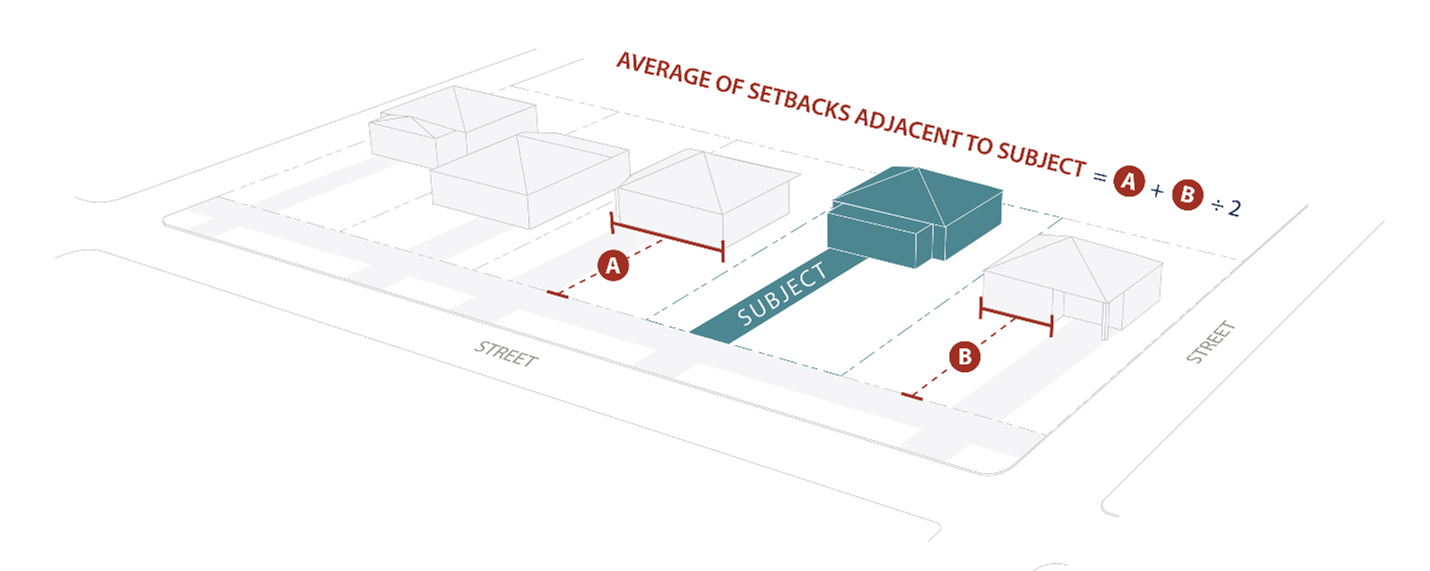
Figure 1139.02.(a)(2). Front Yard Setback
(b)
Reconstruction of Nonconforming Building or Structure. Should such nonconforming structure or nonconforming portion of structure be destroyed by any means, other than a natural disaster, criminal behavior of someone other than the owner, or unintentional fire, to an extent where more than fifty percent (50%) of the structure is destroyed, it shall not be reconstructed except in conformity with the provisions of this chapter.
(1)
Existing residential nonconforming foundations, so long as they are deemed safe, may be reused for the purposes of reconstruction, but may not be moved, expanded, or altered in such a way that increases the nonconformity. If the foundation can no longer be used, the new structure must conform to all provisions of this Code.
A.
The above section does not apply to any existing nonconforming foundations located within a special flood hazard area, which shall not be continued if more than fifty percent (50%) of the structure is destroyed.
(c)
Relocation of Nonconforming Building or Structure. Should such structure be moved for any reason for any distance whatever, it shall thereafter conform to the regulations for the district in which it is located after it is moved.
(d)
Repair and Maintenance of Nonconforming Building or Structure.
(1)
On any nonconforming structure or portion of a structure containing a nonconforming use, work may be done in any period of twelve (12) consecutive months on ordinary repairs, or on repair or replacement of walls, fixtures, wiring, heating, air conditioning, or plumbing, to an extent not exceeding ten percent (10%) of the current replacement cost of the nonconforming structure or nonconforming portion of the structure as long as the nonconformity is not increased.
(2)
If a nonconforming structure or portion of a structure containing a nonconforming use becomes physically unsafe or unlawful due to lack of repairs and maintenance and is declared by any duly authorized official to be unsafe, or unlawful by reason of physical condition, it shall not thereafter be restored, repaired, or rebuilt except in conformity with the regulations of the district in which it is located.
(3)
Nothing in this section shall be interpreted to prevent the strengthening or restoring to a safe condition any building or part thereof declared to be unsafe provided that all requirements set forth in this chapter are met.
(Ord. 25-38. Passed 7-14-25)
1139.03. - Nonconforming use of buildings or land.
Where, at the time of adoption of this Zoning Ordinance, lawful uses of buildings or land exist that would not be permitted by the regulations imposed by this Ordinance, the uses may be continued so long as no division of any parcel is made which creates a lot with width or area below the requirements stated in this Ordinance.
(a)
Alteration/Reconstruction of a Building Occupied by a Nonconforming Use. No building or structure occupied by a nonconforming use shall be altered, improved, or reconstructed except when the cumulative cost of the alteration, improvement, or reconstruction does not exceed fifty percent (50%) of the building's replacement value.
(b)
Expansion/Relocation of Nonconforming Use of Land. A nonconforming use of land shall not be physically enlarged, increased, extended, or relocated to a part of the lot that was not occupied by the use at the time it became nonconforming. No additional structures shall be constructed in connection with such nonconforming use.
(c)
Expansion/Relocation of Nonconforming Use of Buildings. A nonconforming use of an existing building may be extended throughout any parts of the building that were manifestly arranged or designed for such use at the time of adoption or amendment to this Ordinance. However, no such nonconforming uses shall be moved in whole or in part to any portion of the lot or parcel other than occupied by such uses at the effective date of adoption or amendment of this Ordinance, and no such building shall be enlarged or expanded to increase the nonconforming use.
(d)
Discontinuance of Use.
(1)
When a nonconforming use of a structure, or land is discontinued or abandoned for a one (1) year period, the structure or structure and premises in combination, shall not thereafter be used except in conformity with the regulations of the district in which it is located.
(2)
If any such nonconforming use of land ceases for any reason for a period of more than one (1) year, any subsequent use of such land shall conform to the regulations specified by this Zoning Ordinance for the district in which it is located.
(Ord. 25-38. Passed 7-14-25)
1139.04. - Nonconforming lots of record.
On or after the effective date of this Zoning Ordinance or any amendment thereto that causes a lot to become non-conforming, a lot of record that does not comply with the lot area, lot frontage, or lot width regulations of the district in which the lot is located shall be treated as if it were a conforming lot, if it conforms with the rest of this Zoning Ordinance and may be used as follows:
(a)
Existing Structure or Use on a Non-Conforming Lot. If the lot is occupied by a structure or use, such structure or use shall be maintained and may be repaired, modernized or altered, provided that the structure or use shall not be enlarged in area, height, or other extent, unless the enlarged section(s) complies with all regulations of this Zoning Ordinance, except the lot area, lot frontage, and lot width regulations of the district in which the lot is located. The number of dwelling units shall not be increased unless all regulations, including lot area, are complied with.
(b)
Existing Two-family Structure. If a two-family dwelling unit is to be split into two (2) dwellings on two (2) separate lots, the resulting dwellings and lots shall comply with all regulations of this Zoning Ordinance, except the lot area, lot frontage, lot width, or minimum side yard of the district in which the lot is located.
(c)
Vacant Lots in Combination. If a vacant non-conforming lot that is non buildable adjoins one or more lots in common ownership on the effective date of this Ordinance or applicable amendment thereto, such lots shall be combined to decrease or eliminate the nonconformity as a prerequisite for development. No portion of such parcel shall be used or sold or otherwise transferred in a manner that diminishes compliance with lot width and area requirements established by this Ordinance.
(Ord. 25-38. Passed 7-14-25)
1139.05. - Nonconforming site conditions.
Existing Non-Conforming Site Condition on a Lot with a Non-Residential Use. If any non-conforming site condition(s) exists when a site is redeveloped pursuant to Chapter 1105, then such site condition(s) must be brought into compliance with district regulations, unless the appropriate reviewing body determines that such conformance cannot be reasonably achieved because of existing site conditions. In such case, the reviewing body may approve a development plan that reduces the existing non-conforming site condition(s) to the maximum extent practicable. This includes but is not limited to parking, landscaping, and lighting.
(Ord. 25-38. Passed 7-14-25)
1139.06. - Nonconforming signs.
A sign, lawfully existing at the time this Zoning Ordinance, or any amendment thereto, became or becomes effective, but which fails to conform to the sign regulations of the district in which it is located is a nonconforming sign. Nonconforming signs shall comply with the regulations set forth in Chapter 1125.
(Ord. 25-38. Passed 7-14-25)
1139.07. - Nonconforming use due to reclassification.
The provisions of this chapter shall also apply to any building, structure, land or other use hereafter becoming nonconforming as a result of amendments made to this Zoning Ordinance or Zoning Map. A nonconforming lot, use, building, or structure does not include nonconformity with regulations pursuant to a legally granted variance from a zoning regulation.
(Ord. 25-38. Passed 7-14-25)
1139.08. - Change from nonconforming use.
A nonconforming building or use shall cease to be considered as such whenever it first comes into compliance with the regulations of the district in which it is located. Upon such compliance, no nonconforming use shall be made, resumed, or reinstated.
(Ord. 25-38. Passed 7-14-25)
1139.09. - Determination of nonconforming status.
At the time of application for a certificate of building and zoning compliance or request for variance, or upon the request of Director of Planning and Community Development regarding a nonconforming lot, building, structure, or use, the property owner shall submit sufficient evidence to verify that such lot, building, structure, or use was lawfully created or established in accordance with the zoning regulations in existence at that time. If the evidence submitted indicates the lot, building, structure, or use was legally established and has since become nonconforming because of the establishment of or amendment to this Ordinance, the Director of Planning and Community Development shall process the application subject to the requirements of this chapter and any other applicable zoning regulations.
(Ord. 25-38. Passed 7-14-25)
1139.10. - Existing use deemed conditional use; permit required for change.
Any lawfully existing use that, at the time of its establishment, was not classified as a conditional use, but which now, because of the passage of this Zoning Ordinance or amendment thereto, is listed as a conditional use in the district in which it is located, shall be deemed without further action to be a conforming conditional use. Any change, modification, enlargement, or alteration of such use or site development conditions shall only be permitted upon review and approval by the Planning Commission according to the procedures for conditional uses set forth in Chapter 1105.
(Ord. 25-38. Passed 7-14-25)
1139.11. - Completion of construction with zoning certificate.
Nothing in this Zoning Ordinance shall prohibit the completion of the construction and use of buildings for which a certificate of building and zoning compliance has been issued prior to the effective date of this Zoning Ordinance, or amendments thereto, provided that construction is commenced within ninety (90) days after the issuance of such certificate, that construction is carried on diligently and without interruption, and the entire building is completed within two (2) years after the issuance of the zoning certificate. Actual construction is hereby defined to include the placing of construction materials in permanent position and fastened in a permanent manner. Where demolition or removal of an existing building has begun preparatory to rebuilding, such demolition or removal shall be deemed to be actual construction.
(Ord. 25-38. Passed 7-14-25)

