
Delaware City Zoning Code
TITLE THREE
GENERAL DEVELOPMENT REGULATIONS
1120.01. - Purpose.
Site and building design requirements are established to provide guidelines for consideration when evaluating the appropriateness of proposed development in the City. Specifically, these provisions are intended to achieve, among others, the following purposes:
(a)
Establish site and design criteria to:
(1)
Ensure that development reflects and is sensitive to the history, climate, topography, vegetation, natural features, and building traditions of the City of Delaware.
(2)
Ensure that new development and redevelopment are integrated into the surrounding environment in an orderly manner and are compatible and harmonious with the existing overall character of the City.
(3)
Ensure that the existing design features which contribute to the unique character of Delaware are retained and recreated in a manner that maintains and enhances the sense of community.
(4)
Provide interest along the streetscape and a pedestrian friendly environment.
(5)
Foster and encourage creative application of design principles.
(Ord. 25-38. Passed 7-14-25)
1120.02. - Relevant chapters for cross-reference.
(Ord. 25-38. Passed 7-14-25)
1120.03. - Site design criteria.
(a)
In reviewing an application, the appropriate reviewing body shall consider the review criteria outlined in Section 1105.16 of this Code.
(b)
Open Space. Areas to be considered as open space shall include playgrounds and parkland, clubhouses, pools, linear parks with paths or trails, and other active open space as determined by the Parks and Recreation Director. Preserved wetlands, tree stands, or other natural features shall also be considered as open space. Public or private sidewalks and greenspace within building setbacks or on private residential or commercial lots shall not be counted as open space.
(1)
All new developments shall adhere to the following minimum open space requirements:
A.
Residential: 35% open space
B.
Commercial: 30% open space
C.
Industrial 20% open space
(2)
Dedication of parkland as set forth in Chapter 1106 shall count towards the open space requirements in new developments.
(Ord. 25-38. Passed 7-14-25)
1120.04. - Street and driveway design criteria.
(a)
Public Streets. A street shall be required to be publicly dedicated when such street:
(1)
Provides access to detached single-family dwellings on a subdivided lot.
(2)
Is a major street that connects two existing public streets, is intended to provide future continuing street system beyond the project boundaries or is expected to accommodate pass-through traffic going to and from adjacent developments.
(b)
Private Streets. A private street serves more than four (4) dwelling units or commercial outlots. Streets that are not so publicly dedicated may be approved as private streets when the City Engineer and the appropriate reviewing body determine that:
(1)
The private street is not planned or expected to be extended to serve property outside the development.
(2)
Adequate utility easements are provided to the satisfaction of the City and the Utilities Department.
(3)
The design and layout of the private street provides adequate and safe access to the intended units, as determined by the City of Delaware Police and Fire Departments.
(4)
Sidewalks shall be provided on one side of all private residential streets and separated from the street pavement with a grass buffer that is a maximum of eight (8) feet wide. Integral sidewalks (curbed or uncurbed) are not permitted.
(c)
Driveways. Driveways shall be permitted in compliance with the following:
(1)
A driveway shall serve no more than four (4) dwelling units.
(2)
A driveway shall extend from a public or private street and shall not connect to any other existing or planned public or private street.
(3)
The design and layout of the driveway shall provide adequate and safe access to the intended units, as determined by the City of Delaware Police and Fire Departments.
(d)
Private Street and Driveway Construction. All elements of a private street that are to be provided shall be constructed in accordance with the construction standards set forth in the Engineering Design Standards unless:
(1)
The appropriate reviewing body determines that certain elements of a public street do not or should not specifically apply to a private street due to the circumstances of a particular project or portion of a project, the reviewing body may waive or permit a modification to the installation of any such element(s) to the extent deemed just and proper provided such relief may be granted without detriment to the public good.
A.
This provision applies to waiving the requirement for curbs and storm sewers when the applicant demonstrates to the satisfaction of the City Engineer and reviewing body that, based on the topography of the site, open space, density and other environmental considerations, the proposed open natural drainage system will equally satisfy the City's stormwater requirements.
(2)
Private streets may be constructed with narrower pavement widths than required for public streets, provided they comply with the Engineering Design Standards.
(e)
Whenever a private street and/or driveway is included in a development, deed restrictions shall be required which shall specifically include the following language:
(1)
"The undersigned grantee(s) hereby acknowledge(s) that they understand the premises described herein is located upon a non-dedicated private street or driveway. And further, the grantee(s) understand(s) that no government body is responsible for care and maintenance of said private street or driveway."
(f)
Walkways shall be provided to connect to common open space areas and to provide convenient pedestrian access throughout the development and from the development to other areas of the community, including public sidewalk and path networks.
(Ord. 25-38. Passed 7-14-25)
1120.05. - Building design criteria for all structures.
In reviewing a development application, the appropriate reviewing body shall determine that the plan complies with the following building design criteria:
(a)
The proposed architectural design shall be a quality design which compliments the prevailing architectural characteristics of the surrounding area. In areas that have predominant historic characteristics, such character shall be a significant consideration in determining compatibility between proposed and existing structures.
(b)
Each building or unit of a multiple-building development shall have its own distinct identity and be compatible with adjacent units or buildings in terms of proportion, color, and materials.
(c)
Building components, such as windows, doors, eaves, and parapets, shall be composed on a façade of a building with harmonious proportions in relationship to one another and surrounding buildings.
(d)
A combination of materials, textures, colors, and finishes are utilized to create visual interest.
(e)
Buildings of the same model or elevation are not placed directly across from, diagonal from, or next to each other.
(f)
Elevations of the same building shall not be faced with a mix of siding types unless utilized as accent materials.
(g)
Entryways shall enhance the ability of the public to find their way into and around buildings and open spaces.
(h)
Building elevations visible from public roadways shall be designed with architectural features and accents which contribute to the aesthetic characteristics of the building.
(i)
Large buildings including, but not limited to, multi-family and multi-tenant buildings, shall be designed to minimize the scale. This shall be accomplished with any combination of the below:
(1)
The façade(s) visible from the public right-of-way or fronting private streets shall be articulated in different planes to reduce the apparent mass of the building.
(2)
Exterior materials shall be used creatively to break up the façade of the building, by mixing materials and emphasizing various sections of the façade.
(3)
A one-story porch or similar element can be provided to define the front door and entrance of the building and to break up the front elevation.
(4)
Sloping roofs such as gable and hipped roofs are the preferred primary roof form.
(j)
Any above-grade door that provides direct egress to the outside of a structure shall have, at a minimum, landing(s) and stair(s) to ground level constructed in accordance with any applicable building code. These above grade doorways shall not be obstructed or barricaded in any way. Temporary barricades may only be used during construction or as ordered by the City to preserve the health, safety, and welfare of occupants.
(k)
Mechanical equipment which is located on the roof of a building shall either be located in a manner that such structure is not visible from the public right-of-way or otherwise screened or disguised in accordance with Section 1121.09 of this Code.
(l)
When existing buildings are to be renovated, the distinguishing qualities or elements of a property that contribute to the overall character should not be destroyed. Removal or alteration of distinctive architectural features should be avoided, except for those considered to be noncontributing.
(Ord. 25-38. Passed 7-14-25)
1120.06. - Building design criteria for residential structures.
Residential structures shall adhere to the requirements set forth in this section, regardless of the zoning district in which they are located.
(a)
Architectural Styles. There shall be a mix of architectural styles within residential developments to avoid a monotonous streetscape.
(b)
Residential Elevation Standards. Schedule 1120.04 establishes minimum residential exterior standards by zoning district.
(c)
Elevations shall be measured to include all openings, such as windows, doors, and garage doors, in applying exterior materials.
(1)
"Natural Materials" shall include brick or brick veneer, stone or stone veneer, fiber cement (i.e. HardiePlank), wood, and glass.
A.
Unless prohibited, materials not listed above may be submitted for consideration along with an application for a certificate of building and zoning compliance for approval by the Director of Planning and Community Development.
(2)
Materials prohibited as exterior siding shall include wood fiber composites, plywood (except for soffits and porch ceilings), stucco or synthetic stucco, exterior insulation and finishing systems (EIFS), composition board, or hardboard that has not been approved by the Planning and Community Development Director.
Schedule 1120.06. Residential Structure Minimum Exterior Standards
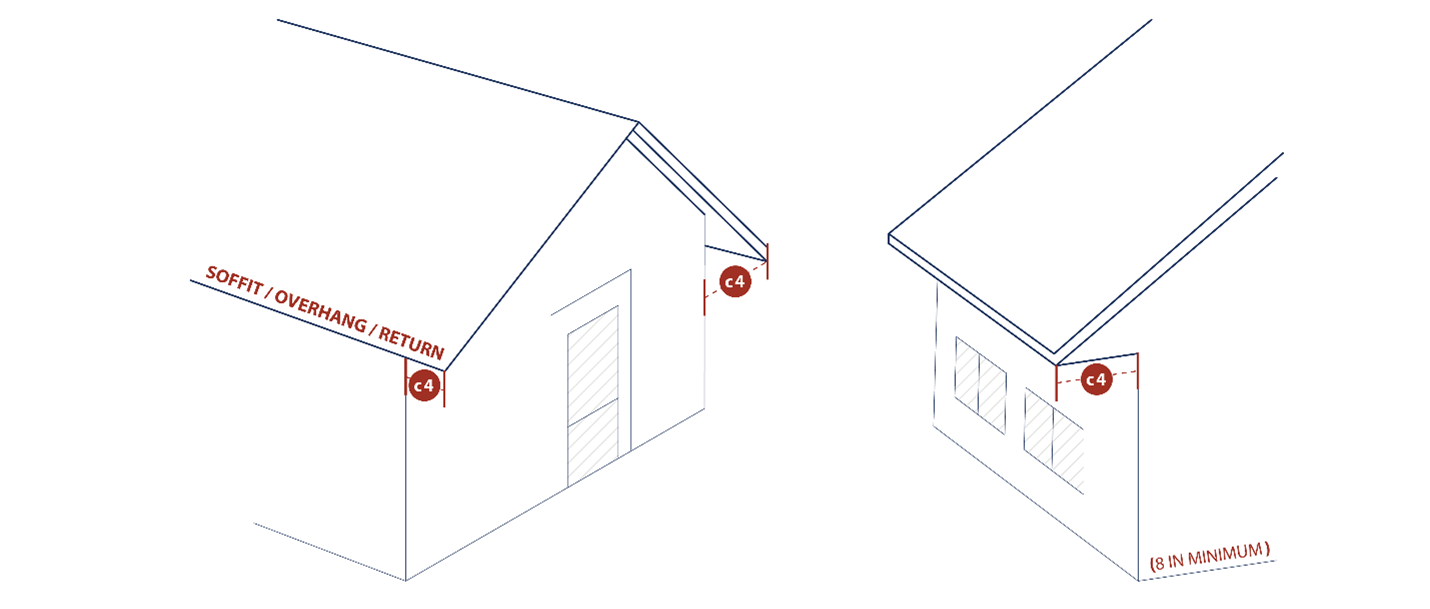
Figure 1120.06(c)(4). Soffit/Overhang/Return
(Ord. 25-38. Passed 7-14-25)
1120.07. - Building design criteria for commercial structures.
Commercial structures, including conditional and institutional uses in residential districts, shall adhere to the requirements set forth in this section, regardless of the district in which they are located.
(a)
Architectural Styles. There shall be a mix of architectural styles within commercial developments to avoid a monotonous streetscape.
(b)
No masonry shall be painted or altered without prior approval from the Planning and Community Development Department.
(c)
Required architectural features shall include transparent store and office fronts and other appropriate features to emphasize and reduce the building scale at the front.
(d)
There shall be no apparent rear to any building that has public facing elevations and windows and other architectural features shall be utilized to break up expanses of blank walls.
(e)
Roof and ground mounted equipment including HVAC systems, service ladders and the like shall be appropriately screened by physical barriers consistent with building design and/or landscaping.
(f)
Commercial Elevation Standards. Schedule 1120.05 "Commercial Structure Exterior Standards" establishes minimum commercial exterior standards by zoning district.
Schedule 1120.07. Commercial Structure Minimum Exterior Standards
(g)
Elevations shall be measured to include all openings, such as windows, doors, and garage doors, in applying exterior materials.
(1)
"Natural Materials" shall include brick or brick veneer, stone or stone veneer, fiber cement (i.e. HardiePlank), wood, and glass.
A.
Unless prohibited, materials not listed above may be submitted for consideration along with an application for a certificate of building and zoning compliance for approval by the Director of Planning and Community Development.
(2)
Metal and EIFS are only permitted as exterior siding as architectural accents.
(3)
Materials prohibited as exterior siding shall include exposed concrete or exposed concrete block (including split faced), Plywood (except for soffits and porch ceilings), or stucco.
(h)
In circumstances where a building elevation is not visible from the public right-of-way or adjacent lots, the reviewing body may waive natural material and/or window requirements.
(Ord. 25-38. Passed 7-14-25)
1120.08. - Building design criteria for industrial structures.
(a)
The architectural design of all buildings shall establish proper transitional relationships with adjacent developments. Quality architecture shall be utilized with a consistent look and feel. All structures shall be designed to be architecturally compatible with each other by employing similar roof pitches, architectural details, and be constructed of compatible exterior building materials. All buildings and portions thereof shall retain traditional building massing. Buildings shall incorporate elements and forms that reduce large masses into an assemblage of definable parts. The scale of the buildings(s) shall be aided using different materials and architectural elements to help reduce the perception of the building mass.
(b)
Split-faced concrete block and painted standard concrete masonry unit (CMU) block are prohibited as exterior building materials. Tilt-up or pre-cast concrete wall panels may be used provided the exposed exterior surface is textured, patterned, or detailed to be complementary to the building design.
(c)
No masonry shall be painted or altered without prior approval from the Planning and Community Development Department.
(d)
Required architectural features shall include transparent store and office fronts and other appropriate features to emphasize and reduce the building scale at the front.
(e)
There shall be no apparent rear to any building that has public facing elevations and windows and other architectural features shall be utilized to break up expanses of blank walls.
(f)
Roof and ground mounted equipment including HVAC systems, service ladders and the like shall be appropriately screened by physical barriers consistent with building design and/or landscaping.
(Ord. 25-38. Passed 7-14-25)
1121.01. - Purpose.
The intent of these landscaping and screening regulations is to promote and protect the public health, safety, and welfare through the preservation and protection of the environment. In addition, these regulations are intended to achieve, among others, the following purposes:
(a)
To promote the proper utilization of landscaping and screening as a buffer between certain land uses and to minimize the possibility of nuisances including potential noise, glare, and visual clutter of parking and service areas.
(b)
To protect, preserve, and promote the aesthetic appeal, character, and value of the City of Delaware's neighborhoods.
(c)
To establish a minimum standard for the consistent appearance of plant material in the community landscape.
(d)
To soften the appearance of building masses and paved areas and reduce generation of heat and storm water run-off.
(Ord. 25-38. Passed 7-14-25)
1121.02. - Sites affected.
(a)
New Sites. No certificates of building and zoning compliance shall be issued hereafter for any development or the construction of any building, structure, or vehicular use except where a final landscape plan for such development or construction has been approved according to the procedures set forth in Chapter 1105 of this Code.
(b)
Existing Sites. No building, structure, or vehicular use area shall be constructed or expanded unless the minimum landscaping and screening required by this chapter is provided to the extent of the alteration or expansion, but not for the entire property of which the alteration or expansion is a part unless the alteration or expansion is substantial. An alteration or expansion to an existing property is substantial when:
(1)
In the case of a building or structure that does not involve additional land, the square footage of the expansion exceeds twenty-five percent (25%) of the existing building.
(2)
In the case where additional land is involved, the additional land or the expanded square footage of a structure exceeds twenty-five percent (25%) of the existing site or structure.
(3)
Land as used herein includes land for open space, parking, or building uses.
(Ord. 25-38. Passed 7-14-25)
1121.03. - General landscaping and maintenance of yards.
Required yards and all other portions of the lot not covered by permitted structures shall be landscaped with grass, trees, shrubbery, and/or other appropriate ground cover or landscaping material, which at all times shall be maintained in good and healthy condition.
(a)
Each lot shall maintain open space with landscaping in compliance with the minimum percentage of the area of the lot specified in the district regulations.
(b)
All screening shall be free of advertising or other signs, except for approved signage and other signs for the efficient flow of vehicles.
(c)
Trees and shrubs shall be arranged to create varied and attractive views and plant material should provide a variety of color displayed throughout the year.
(d)
The required landscaping shall be maintained in healthy condition by the current owner and replaced when necessary. Replacement material shall conform to the original intent of the landscape plan.
(e)
Vehicle parking shall not be permitted in landscaped or buffer areas.
(Ord. 25-38. Passed 7-14-25)
1121.04. - Tree preservation and replacement requirements.
In all districts, trees shall be preserved or replaced in compliance with the provisions of Chapter 1122, unless exempted therein.
(Ord. 25-38. Passed 7-14-25)
1121.05. - Street tree planting requirements.
In all zoning districts, unless the requirement is waived by the Shade Tree Commission, developers shall plant and maintain shade trees along public and private streets in compliance with the following:
(a)
Species and Location Requirements.
(1)
Trees shall be limited to species characterized as hardy, long-lived shade trees, as defined by the Shade Tree Commission. Tree species will be approved by the Shade Tree Commission and finalized development plans will be shared with the contractor. The development plan should be used to determine which species will be planted on each lot. Any changes to the species made by the contractor due to acquisition issues must be approved by the City Forester.
(2)
Location: The development plan provides the total permitted trees that can be planted but is not intended to be an exact reference for planting location or quantity. The following specifications should be used to determine planting locations within each lot and throughout the development. A lot may receive less trees than depicted in the development plan or none at all if spacing does not permit.
(3)
(4)
Minimum Clearance of other Structures and Utilities.
A.
Driveway, fire hydrant, and utility pole: Ten (10) feet
B.
Underground water or sewer line and street sign: Five (5) feet
C.
Light post: Twenty (20) feet
D.
Utility wires: Only small trees may be planted below wires.
E.
Intersections. Street trees are not to be planted where they will obstruct the view of stop signs or traffic signals and no tree shall be planted closer than thirty-five (35) feet to any street corner, measured from the point of nearest intersecting curbs or curb lines.
F.
Trees are to be planted within the rights-of-way of roads within and abutting the development unless otherwise directed by the Shade Tree Commission.
G.
Each tree at the time of installation shall have a minimum caliper of 1.75 inches and a clear trunk height of at least six (6) feet.
(b)
Planting Procedures.
(1)
The developer shall provide a map, drawn to an appropriate scale and illustrating the location and species of shade trees to be planted, to the Parks and Recreation Department no less than three (3) days prior to planting.
(2)
The contractor shall identify any underground impediments prior to beginning planting by contacting Ohio Utilities Protection Service (OUPS).
(3)
The developer shall provide the Parks and Recreation Department with a state inspection certificate and a certificate for tree species authenticity for each tree within five (5) days of planting.
(4)
All nursery tags shall remain on planted trees until removed by the Parks and Recreation Department
(c)
Maintenance. The developer shall be required to maintain the trees for two (2) years after the trees are planted and to replace any tree that dies, is damaged, or removed, within such two-year guarantee period.
(1)
Upon completion of the street tree planting, the landscape contractor shall contact the Parks and Recreation Department.
(2)
The two-year guarantee period shall begin after the approval of the Parks and Recreation Department.
(3)
A final inspection shall be made at the end of the guarantee period.
A.
The developer shall notify the Parks and Recreation Department within five (5) business days of the end of the guarantee period to schedule the final inspection.
B.
All trees not exhibiting a healthy, vigorous growing condition, as determined by the City's inspection, shall be replaced at the expense of the developer or builder.
C.
If the City determines that replacement of a tree is required, such replacement shall occur within thirty (30) days of the date the City's inspection report is submitted to the developer. The two-year guarantee period shall begin anew for each replacement tree.
(Ord. 25-38. Passed 7-14-25)
1121.06. - Landscaping requirements for front yards.
Except for lots devoted to single-family dwellings and two-family dwellings, all areas within the required building and parking setback, excluding driveway openings, shall be landscaped and maintained in compliance with the following:
(a)
One (1) shade tree shall be provided for every fifty (50) linear feet of lot frontage or fraction thereof, not including drive entrances.
(b)
Each tree at the time of installation shall have a minimum caliper of 3.0 inches and a clear trunk height of at least six (6) feet. Two (2) 1.75-inch caliper trees may be substituted for each 3.0-inch tree.
(c)
One (1) landscape shrub shall be provided for every ten (10) linear feet of lot frontage or fraction thereof, not including drive entrances.
(d)
All areas not devoted to trees and shrubs shall be planted with grass, ground cover, or other live landscape treatment.
(e)
Foundation plantings shall be distributed evenly around the base of the primary structure(s).
(f)
The landscaping may be flexible in its arrangement by appropriately aggregating the required plant materials.
(Ord. 25-38. Passed 7-14-25)
1121.07. - Screening and buffering.
Screening and buffering along the entire length of a common boundary shall be provided in accordance with the following regulations and shall be approved as part of the development plan required by Chapter 1105 of this Code.
(a)
Screening and buffering shall be required according to the following:
(1)
When a non-residential use or district abuts a residential use or district.
(2)
When a multi-family parcel or development abuts any single-family residential use or district.
(b)
Width of Buffer Yard.
Schedule 1112.07. BUFFER YARD REQUIREMENTS (1)
(1)
Schedule 1112.07 applies to lots over one (1) acre. Lots under one acre shall maintain a minimum buffer of fifteen (15) feet against dissimilar uses.
(2)
Multi-family buildings containing five (5) or more dwelling units, adjacent to existing one family residential lots, shall maintain a minimum buffer of twenty (20) feet for the first two stories and an additional twenty (20) feet for each additional story. [i.e. a four-story building would require a sixty (60) foot buffer].
(c)
Buffers may not contain any paved surfaces with the exception of walking paths or sidewalks.
(d)
Screening. When the natural vegetation within the required buffer yard does not form a solid, continuous, visual screen or does not have a minimum height of six (6) feet along the entire length of the common boundary, screening shall be installed in compliance with the following:
(1)
Screening Materials. Screening within the buffer yard shall consist of one or more of the following:
A.
A dense vegetative planting incorporating evergreen trees and/or screening shrubs of a variety which shall be equally effective in winter and summer. Trees and/or shrubs shall be adequately spaced to form a solid, continuous visual screen within three (3) years after the initial installation.
B.
Non-living opaque structures such as a solid masonry wall or a solid fence that is compatible with the principal structure.
C.
A fence with openings through which light and air may pass together with a landscaped area at least ten (10) feet wide. A chain link fence shall not be permitted.
D.
A landscaped mound or berm at least five (5) feet wide, with no more than a 3:1 slope.
(2)
Location. The location of the wall, fence, or vegetation shall be placed within the buffer yard to maximize the screening effect, as determined by the appropriate reviewing body.
(3)
Height of Screening. The height of screening shall be in accordance with the following:
A.
Visual screening by walls, fences, or mounds in combination with vegetation, fences, or walls shall be a minimum of six (6) feet high measured from the natural grade, except as set forth in Subsection B. below.
B.
Whenever the required screening is located within a front yard or within fifty (50) feet of a parking lot, drive, or driveway entrance, the required screening shall not exceed a height of three (3) feet.
C.
When used alone, vegetation shall be a minimum of six (6) feet high, as measured from the natural grade, to accomplish the desired screening effect. The required height shall be achieved no later than three (3) years after the initial installation.
(Ord. 25-38. Passed 7-14-25)
1121.08. - Landscaping and screening of parking lots.
(a)
Landscaping on the Interior of Parking Lots. All new parking spaces and their associated driving aisles shall be defined by landscaped curbed islands. In addition to those parking lot islands, larger parking lots shall provide additional intervening or midway islands to break up large expanses of asphalt, to provide shade for cars and pedestrians, and to be areas to absorb run-off. As such, additional interior landscaping of parking lots shall be provided in accordance with the following requirements:
(1)
Landscaped islands shall be developed and distributed throughout the parking lot to:
A.
Define major circulation aisles and driving lanes; and
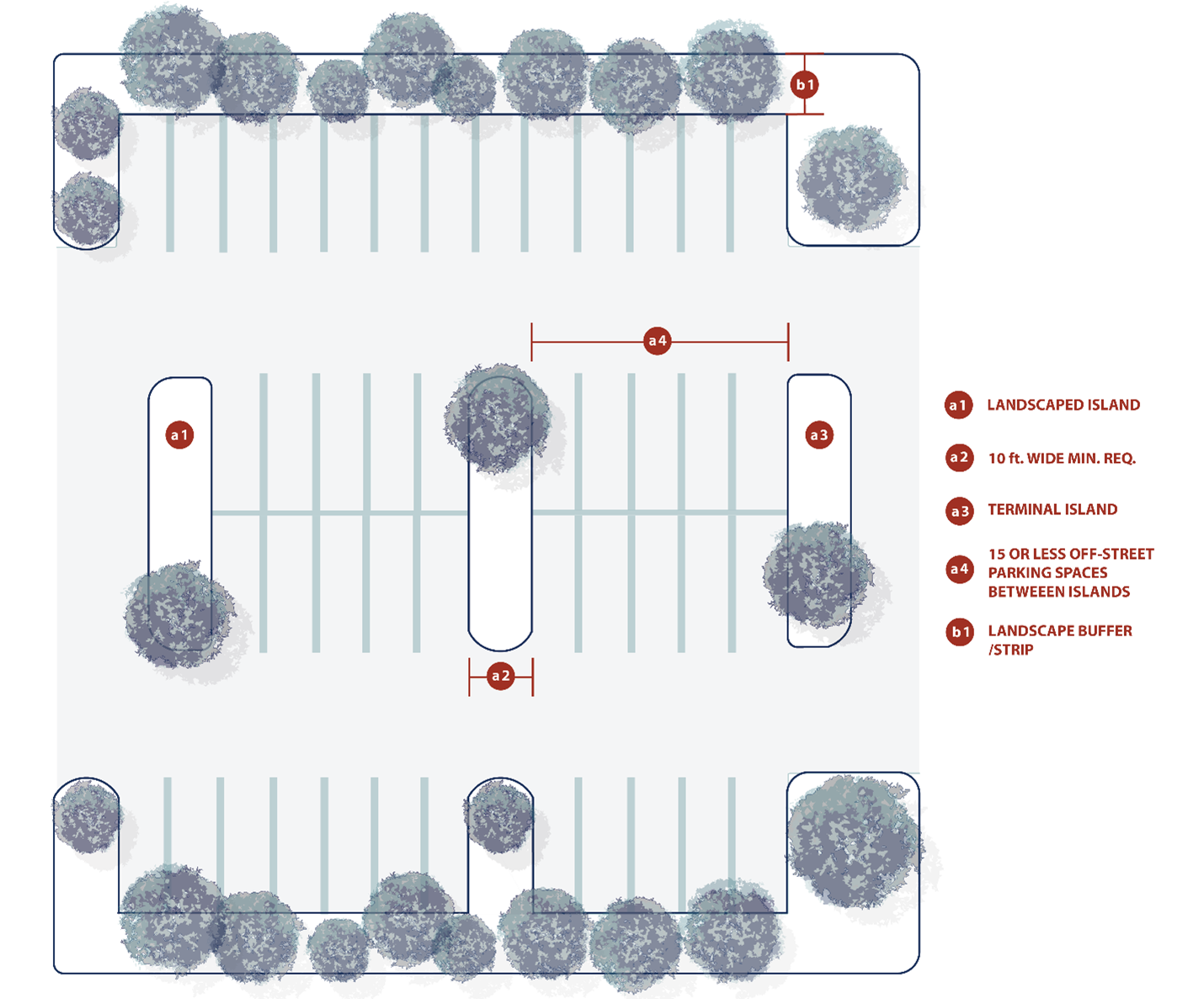
Figure 1121.08(a). Parking Lots
B.
Provide visual and climatic relief from broad expanses of pavement.
(2)
Each island shall be a minimum of ten (10) feet wide.
(3)
Terminal islands shall be required at the ends of all parking bays.
(4)
There shall be no more than fifteen (15) off-street parking spaces between landscape islands.
(5)
Within the landscaped islands, one (1) shade tree shall be provided for every fifteen (15) off-street parking spaces. Each tree, at the time of installation, shall have a minimum caliper of 3.0 inches and a clear trunk height of at least six (6) feet. Two (2) 1.75-inch caliper trees may be substituted for each 3.0-inch caliper tree.
A.
At a minimum, 75% of all parking lot islands shall be planted with perennials and shrubs, not exceeding two feet in height. The remaining 25% may be covered by grass or mulch.
B.
Landscaped areas adjacent to the perimeter of the parking area shall not be counted as interior parking lot landscaped areas.
C.
Exceptions. In the case where a light pole or other required appurtenance prohibits the installation of trees or other landscaping within an island, that landscaping may be relocated elsewhere on site.
(b)
Landscaping on the Perimeter of Parking Lots. The following options may be used individually or in combination for perimeter parking lot landscaping:
(1)
Provide a landscape strip between the parking lot and any adjacent property line. The strip shall be ten (10) feet wide for any lots over one (1) acre and five (5) wide for lots under one (1) acre.
A.
Within the landscape strip provide one shade tree and three landscape shrubs per thirty-five (35) linear feet of parking lot perimeter adjacent to the property line.
(2)
Provide a minimum of twenty-five (25) feet of existing woodlands.
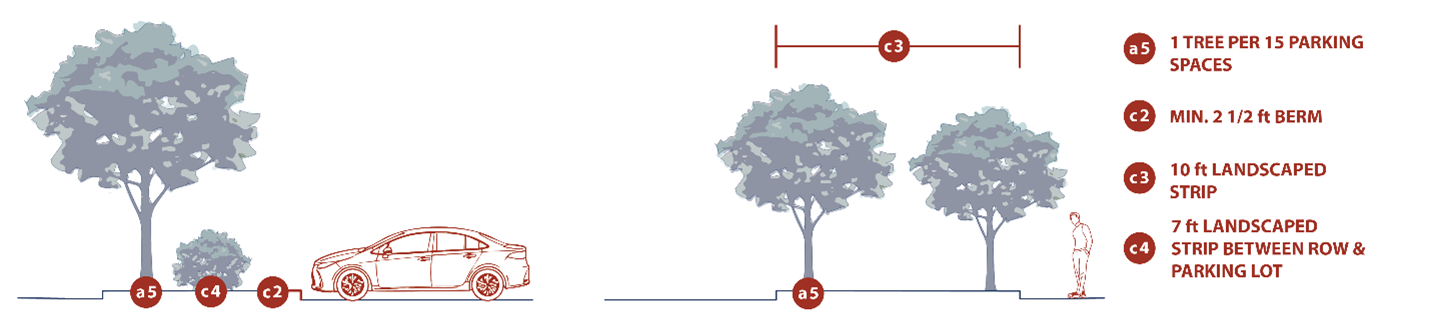
Figure 1121.08(b). Perimeter of Parking Lots
(c)
Landscape Strip Requirements. When a parking lot in any zoning district is located adjacent to a public right-of-way, a landscape strip shall be provided on the property between the parking lot and the right-of-way. The landscape strip may not include any paved areas except sidewalks or side paths perpendicular to the roadway. In any district where a greater parking lot setback is required, the greater setback shall prevail. To meet this requirement, any of the following treatments may be used:
(1)
Provide a minimum ten (10) foot wide landscaped strip between the right-of-way and the parking lot to be planted with a maximum of one (1) shade tree and ten (10) screening shrubs per thirty-five (35) linear feet of frontage, excluding driveway openings.
(2)
Provide a berm, the top of which is at least two and one-half feet higher than the elevation of the adjacent parking lot pavement. The slope of the berm shall not exceed 3:1. Berms should be graded to appear smooth, rounded, and naturalistic with varying heights, not linear in design. Plant with a minimum of one (1) shade tree per thirty-five (35) linear feet of frontage, excluding driveway openings.
(3)
Provide a minimum ten-foot-wide landscaped strip and a minimum three-foot grade drop from the right-of-way line to the adjacent parking lot pavement. Plant the resulting embankment with a minimum of one (1) shade tree and five (5) landscape shrubs per thirty-five (35) linear feet of frontage excluding driveway opening.
(4)
Provide a minimum seven-foot-wide landscaped strip between the right-of-way line and the parking lot with a minimum three (3) foot high brick, stone, or finished wall, matching the architecture, construction materials, and colors of the principal structure. Plant with a minimum of one shade tree per thirty-five (35) linear feet of frontage, excluding the driveway openings.
(d)
Bioswales and Raingardens. The use of bioswales and raingardens is encouraged within parking lots and may supplant the requirements of this section. The final design of any bioswale or raingarden must be reviewed and approved by the City Engineer.
(Ord. 25-38. Passed 7-14-25)
1121.09. - Additional screening requirements.
For all developments, screening of accessory uses shall be provided according to the following:
(a)
Trash Receptacles.
(1)
Applicability. These provisions shall not apply to single unit trash receptacles.
(2)
Trash receptacles in all developments shall consist of a solid, opaque enclosure constructed of brick, decorative concrete, integrated color concrete block or other decorative masonry and shall be consistent with the architectural character of the principal structure. The open end of the enclosure shall have a 100% solid opaque metal, vinyl, PVC, or wooden gate with self-closing hinges that includes stop pins to lock the gates open for servicing and which are not readily degradable due to sunlight, moisture, or wind.
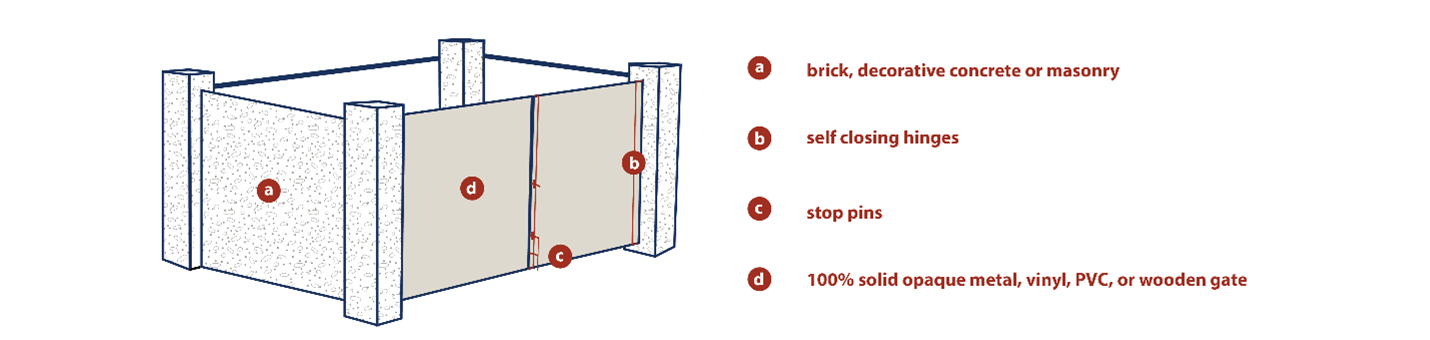
Figure 1121.09(a). Trash Receptacles
(3)
Trash receptacles may be further regulated according to the provisions of Section 1130.05 of this Code.
(b)
Ground mounted and roof mounted mechanical equipment.
(1)
Applicability. These provisions shall not apply to HVAC units for one, two, three or four family dwellings that are not part of a greater overall multi-family complex.
(2)
All ground mounted and roof mounted mechanical equipment such as HVAC systems and the like, shall be screened from ordinary public view, from the public streets, public rights-of-way, and from abutting or adjacent properties.
(3)
Screening of ground mounted mechanical equipment shall consist of either:
A.
A solid opaque enclosure constructed of brick, decorative concrete, integrated color concrete block, or other decorative masonry and shall be consistent with the architectural character of the principal structure.
B.
Landscape material such as shrubs, grass, and or evergreen trees to create an opaque natural enclosure.
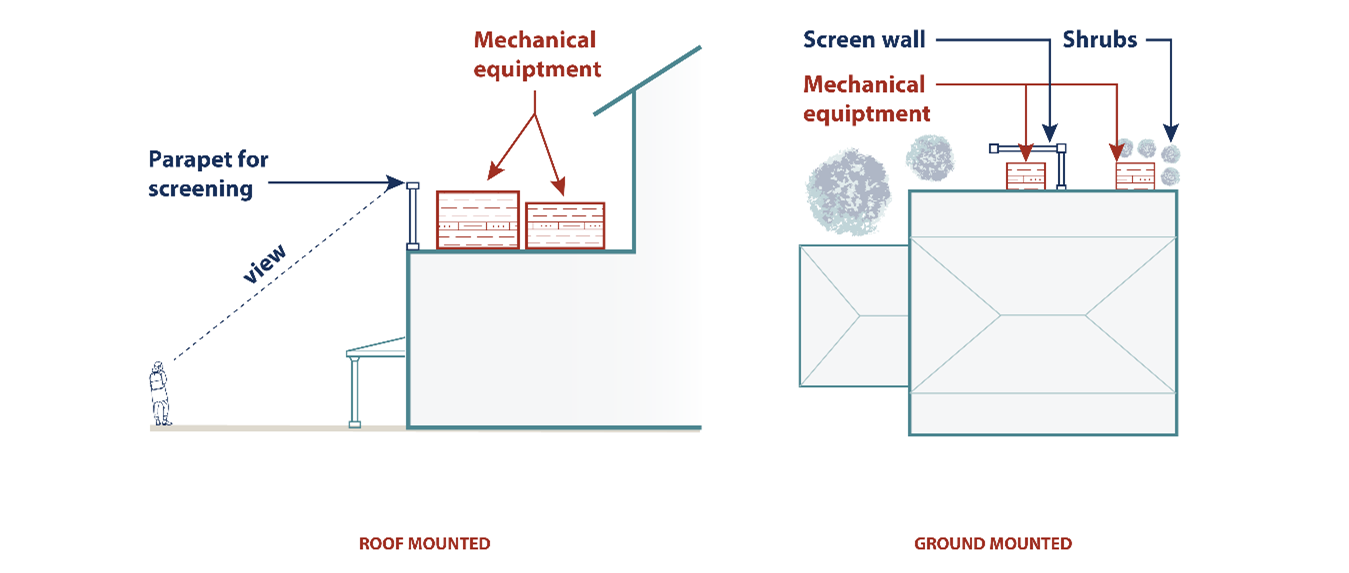
Figure 1121.09(b). Mechanical Equipment Parking Lots
(4)
Screening for roof mounted mechanical equipment shall consist of parapet walls or other screening consistent with the materials of the building.
(c)
Loading and Service Areas. Each loading area shall be screened along any perimeter that can be seen from a street right-of-way or adjoining property according to the screening requirements of Section 1121.07(d).
(d)
Accessory Drive-Thru Lanes. Drive-Thru lanes visible from a public right-of-way shall be screened according to the requirements of Section 1121.07(d).
(e)
Outdoor Storage. Permitted accessory outdoor storage of goods, supplies or equipment used in the operation of an establishment shall be screened according to the requirements of Section 1121.07(c).
(Ord. 25-38. Passed 7-14-25)
1121.10. - Approval process for required landscaping, fences, and walls.
Proposed landscaping, fences, or walls required to fulfill the standards and criteria of this chapter shall be reviewed and approved as part of a development plan pursuant to Chapter 1105 of this Code. One and two-family dwellings shall be exempted from these requirements.
(a)
Fences and Walls.
(1)
When a fence or wall is proposed at a separate time from any other development for new construction, additions or site renovation, a fence or wall may be approved administratively by the Director of Planning and Community Development.
(2)
Fences and walls shall comply with the regulations set forth in Chapter 1130.
(b)
Required Landscaping. When landscaping is required, no certificate of building and zoning compliance shall be issued until the required landscaping is completed as certified by City inspection.
(1)
Upon completion of the planting, the landscape contractor shall contact the Planning and Community Development department for a final inspection.
(2)
All plantings not exhibiting a healthy, vigorous growing condition, as determined by the City's inspection, shall be replaced at the expense of the developer or builder. If the City determines that replacement of a planting is required, such replacement shall occur within thirty (30) days of the date the City's inspection report is submitted to the developer.
(c)
Upon final inspection, if landscaping has not been installed per the approved landscape plan and the requirements of this chapter, a revised landscape plan shall be submitted to the Planning and Community Development Department in the form of an incidental modification to the approved development plan for reapproval and reinspection, per the procedure set forth in Section 1105.17 of this Code.
(a)
Said plan shall show additional landscaping proposed to be installed in order to adequately meet the requirements of this chapter.
(b)
Upon completion of the supplemental planting, the landscape contractor shall contact the Planning and Community Development department for a final inspection.
(d)
Maintenance. The developer and/or property owner shall be required to maintain the required landscaping in perpetuity after the items are planted and to replace any approved landscaping that dies, is damaged, or removed.
(Ord. 25-38. Passed 7-14-25)
1121.11. - Flexibility.
The standards and criteria in this chapter establish the City's objectives and levels of landscaping intensity expected. However, in applying these standards, the appropriate reviewing body may:
(a)
Adopt a "Planting Manual" and "Plant List" establishing minimal requirements to use as guidelines for meeting the provisions of this chapter.
(b)
Exercise discretion and flexibility with respect to the placement and arrangement of the required elements to ensure that the objectives of this district and the proposed development or redevelopment are best satisfied.
(Ord. 25-38. Passed 7-14-25)
1122.01. - Purposes.
This chapter seeks to preserve and enhance tree canopy to protect the public health, safety, and welfare of the City, recognizing the long-term health and safety, property value, economic, environmental, and community benefits provided by tree canopy specifically and tree preservation generally.
The benefits of tree canopy arise specifically from the following characteristics:
(a)
Conservation of energy;
(b)
Improved air quality;
(c)
Reduction of noise pollution and light glare;
(d)
Enhancement of habitat for birds and other desirable wildlife;
(e)
Improvement of soil stability and erosion control;
(f)
Increase of stormwater retention and runoff control;
(g)
Increase of property values;
(h)
Mitigation of heat island effects;
(i)
Provision of visual screening and windbreaks;
(j)
Enhancing the aesthetic character of the community;
(k)
Contributing to public health; and
(l)
Carbon sequestration.
These and other public benefits of tree canopy coverage cannot be realized on public property alone. This chapter recognizes that to preserve and enhance the public benefits of the tree canopy stated above, it is necessary to provide for shared responsibility among the City and private parties that is proportionate to their impact on the City's tree canopy.
(Ord. 25-38. Passed 7-14-25)
1122.02. - Applicability.
(a)
The requirements of this chapter apply to:
(1)
All real property in the City except as specifically exempted herein;
(2)
All real property annexed to the City, where trees have been removed from such property within one year prior to its submittal of a petition to annex to the City; and
(3)
Any activity that requires the issuance of a development permit involving site disturbance for any non-residential, multi-family residential, or mixed-use; or
(4)
Any activity that requires the issuance of a development permit involving site disturbance for any one- or two-family residential use, where such site disturbance is one-(1) acre or more; or
(5)
Any activity that requires the issuance of a development permit involving site disturbance and that is part of a larger common plan of development or sale.
(b)
The requirements of this chapter do not apply to:
(1)
Routine maintenance of existing trees, including pruning done in a manner consistent with established arboricultural standards; or
(2)
The removal of dead, severely damaged, or diseased trees that have been diagnosed and, if applicable, determined by a certified arborist to be beyond treatment or recovery, the burden of proof being upon the person removing the tree; or
(3)
Any tree nursery, silvicultural activity, or agricultural activity, defined as "agriculture" by the Ohio Revised Code and in an agricultural zoning district of the City; or
(4)
The removal of trees in a utility or road right-of-way, provided that such activities shall be done to minimize loss of tree cover; or
(5)
Removal of trees identified as invasive on the list maintained by State Department of Agriculture at Ohio Administrative Code 901:5-30-01 or successor thereof.
(Ord. 25-38. Passed 7-14-25)
1122.03. - Administration.
(a)
This chapter shall be administered by the Planning and Community Development Director. The assignment of administrative responsibility of this chapter to the Director shall not be construed as prohibiting the Director from soliciting the assistance and expertise of other City officials, including but not limited to the Department of Parks and Recreation, or other subject matter experts.
(b)
A party seeking to develop real property to which this chapter applies shall be required to submit a tree canopy management plan to the Director prior to commencing site disturbance activities. The tree canopy management plan shall be prepared by an arborist or landscape architect. The tree canopy management plan shall constitute an application for tree removal, and approval of said plan shall constitute a permit to remove trees in accordance with said plan. The tree canopy management plan shall include:
(1)
A map, drawn to scale, of the site and immediate adjacent property with existing tree canopy delineation and existing canopy tree groupings (general areas of trees of similar character), including such groupings on adjacent properties and within fifty (50) feet of the property line, and an accompanying table of existing tree species on the site, with general assessment of the typical age, size, health, structural stability and risk assessment, and construction tolerance thereof. Stands of trees for which no alteration or impact is proposed, need not be documented by a tree survey but must include a qualitative statement of the tree species and condition that can be verified in the field. The delineation of existing tree canopy coverage may be documented by survey or by using current aerial photographs available through the County's geographic information systems mapping or other source approved by the Director.
(2)
A map or maps, drawn to scale, of the proposed development layout, which shall include:
A.
Footprints of proposed buildings, other structures, and pavement areas;
B.
Limits of land disturbance to occur in association with the development;
C.
Property lines;
D.
Proposed new landscape and tree planting areas;
E.
Delineation of proposed tree canopy cover, at the time of completion of the site development, with an accompanying table of planned composition of the proposed tree canopy cover, and providing that no more than thirty percent (30%) of newly planted trees on site may be represented by any one tree family, twenty percent (20%) in any one tree genus, and ten percent (10%) in any one species;
F.
Delineation of proposed tree canopy cover upon occurrence of mature canopy size as indicated by tree nursery estimates for proposed and existing tree cultivars, with a table for proposed tree species or reference to materials concerning mature canopy size for various cultivars as maintained by the Department of Parks and Recreation;
(3)
A narrative stating plans for preservation of existing tree canopy cover as it relates to the following priority areas:
A.
Preservation of rural viewsheds for adjacent property owners and motorists on adjacent roads;
B.
Preservation of contributing canopy tree groupings that cross property lines;
C.
Preservation of trees adjacent to watercourses and wetlands;
D.
Preservation of trees in locations where, due to grade or soil structure, the removal of trees would have greater tendency for negative impact to soil stability and erosion; and
E.
Preservation of trees and tree groupings of sufficient size and configuration to provide habitat, for wildlife, including but not limited to wildlife corridors.
(4)
A description of site soil and hydrology characteristics, and implications for development, tree tolerance, and survival.
(5)
A narrative description of the overall strategy for tree canopy provisions on the site, including proposed tree protection strategy during construction.
(6)
Such application review fee as is established from time-to-time by Council.
(7)
Such additional information as determined by the Director to be advisable for the efficient review of tree canopy management plans and the administration of this chapter.
(c)
The Director shall cause the tree canopy management plan to be reviewed and may inquire of the party submitting said plan for additional information. The Director may require an onsite conference with the Director or the Director's designee(s) to evaluate the information provided in the submitted tree canopy management plan. The Director, following review, may approve; approve with conditions; or disapprove the tree canopy management plan.
(d)
The Director shall send the reviewed tree canopy management plan to Shade Tree Commission concurrently with the development review process detailed in Chapter 1105.
(e)
Conformance in all respects with an approved tree canopy management plan, and any conditions of approval thereof, shall be required prior to issuance of a certificate of zoning approval or final plat approval.
(Ord. 25-38. Passed 7-14-25)
1122.04. - Target canopy and minimum canopy provisions.
(a)
The City establishes the target tree canopy coverage for the City as thirty percent (30%). Tree canopy coverage shall mean the total area of the City covered by tree canopy, as determined by the Director of Parks and Recreation, divided by the total area of the City and multiplied by one hundred. The Director of Parks and Recreation shall calculate the total tree canopy coverage of the City not less than every five (5) years after adoption of this chapter.
(b)
Following calculation of the City's tree canopy coverage as set forth in division (a) of this section, the Director of Parks and Recreation shall provide such calculation to the Shade Tree Commission, along with a report and recommendation of whether to revise either the target tree canopy coverage or the minimum tree canopy coverage set forth herein. The Shade Tree Commission shall review the report and recommendation and may either adopt the report and recommendation for adoption by Council or may adopt its own recommendation for action by Council.
(c)
Tree canopy coverage for a site shall mean the total area of the site covered by tree canopy, as determined by the arborist or landscape architect who prepared the tree canopy management plan, divided by the adjusted total area of the site and multiplied by one hundred. The adjusted total area of a site shall be equal to the total area of the site that is subject of the development application, minus the area of any right-of-way required to be dedicated pursuant to the City's thoroughfare plan and any cleared stormwater detention or retention areas, as required by the City Engineer.
(1)
For sites in an industrial district, the minimum tree canopy coverage shall be the greater of five percent (5%), or twenty-five percent (25%) of the tree canopy coverage for the site as measured prior to development.
(2)
For sites in other districts, the minimum tree canopy coverage shall be thirty-five percent (35%).
(d)
All development activities subject to this chapter shall be required, as projected for the site based on the mature canopy size as indicated by tree nursery estimates for the tree cultivars existing or proposed for the site, to meet or exceed the minimum tree canopy coverage for the development site. The minimum tree canopy can be met with existing trees and newly planted trees, provided however that existing trees shall comprise at least one-third of required canopy coverage unless the pre-development existing canopy coverage is insufficient to meet this threshold, in which case existing trees shall comprise the greatest percentage of minimum tree canopy practicable and as approved by the Director in a tree canopy management plan.
(Ord. 25-38. Passed 7-14-25)
1122.05. - Payment in lieu of minimum tree canopy.
(a)
It is acknowledged that it may be infeasible, due to site conditions, arboricultural, engineering, or other environmental factors, for the minimum tree canopy to be provided on a given site. In such circumstances, and as approved by the Director in a tree canopy management plan, a party may submit to the City a fee-in-lieu of providing the minimum tree canopy on the development site.
(b)
The fee-in-lieu of minimum tree canopy shall be calculated on the basis of $1.20 per square foot or part thereof that is in deficit of the minimum tree canopy coverage. The fee shall be estimated in the tree canopy management plan and confirmed after completion of construction and prior to issuance of a certificate of zoning compliance or final plat approval. The Shade Tree Commission shall review this fee and make a recommendation to increase, decrease, or maintain at the same level, on the same schedule as the Shade Tree Commission's of target and minimum tree canopy provisions.
(c)
The fee-in-lieu shall be deposited in the City's tree fund, for uses as permitted by said fund, which shall include planting of trees on public property or publicly held easements, and expenses of maintenance, equipment, and limited administrative costs relative to public trees.
(Ord. 25-38. Passed 7-14-25)
1122.06. - Planting and maintenance requirements.
(a)
All newly planted trees shall be of the variety(ies) approved in the tree canopy management plan and, if applicable, an approved landscape plan. All newly planted trees shall be a minimum of one and three-quarter caliper inches (1.75") for deciduous cultivars or six (6) feet tall for evergreen cultivars.
(b)
Replacement trees that may reach a height of thirty (30) feet shall not be planted within twenty (20) feet of an overhead power line.
(c)
Trees shall be planted an adequate distance from access drives and intersections so that, at full maturity, such planting shall comply with Section 1149.06 to ensure the unobstructed visibility of motorists and pedestrians.
(d)
The developer, owner, or association of owners shall be required to maintain all newly planted trees in perpetuity.
(e)
Preserved or replacement trees shall not subsequently be removed from a site unless approved pursuant to this chapter, unless otherwise exempt under Section 1122.02.
(f)
The City will require the original owner of any property on which trees have been preserved or replaced according to the requirements of this chapter to add a restrictive covenant or easement (or other mechanism as required by the Director) to the deed or plat that shall inform subsequent purchasers, lessees or occupants of the site that trees shall not subsequently be removed from a site except when approved pursuant to this chapter.
(Ord. 25-38. Passed 7-14-25)
1122.07. - Variance and appeal.
Applications for variance from the provisions of this chapter, or appeal from a determination of the Director, shall be heard by the City's Board of Zoning Appeals and in accordance with the procedures set forth in Chapter 1105.
(Ord. 25-38. Passed 7-14-25)
1123.01. - Purpose.
Off-street parking regulations are established to achieve, among others, the following purposes:
(a)
To ensure an appropriate level of motorized and non-motorized parking facilities are provided to support a range of transportation, land uses, and housing types.
(b)
To manage growth and ensure multimodal parking facilities are provided in accordance with the goals outlined in the City of Delaware Comprehensive Plan.
(Ord. 25-38. Passed 7-14-25)
1123.02. - Relevant chapters for cross-reference.
(Ord. 25-38. Passed 7-14-25)
1123.03. - Parking facilities required.
(a)
Accessory off-street parking facilities, including access driveways, shall be provided prior to the occupancy of any building or use. Facilities shall be provided for the entire building or use in accordance with the regulations contained in this chapter whenever:
(1)
A building is constructed.
(2)
The use of an existing building is changed to a use requiring more parking facilities as determined by the Director of Planning and Community Development.
(3)
An existing building is altered and there is an increase in seating capacity, building floor area, or number of employees.
(b)
All required off-street parking facilities shall continue unobstructed in operation and shall not be reduced below the required size as long as the principal use remains, unless an equivalent number of spaces are provided for said use in another approved location.
(Ord. 25-38. Passed 7-14-25)
1123.04. - Units of measure.
In computing the number of parking spaces required by this chapter, unless otherwise specifically indicated, the following rules shall apply:
(a)
Floor Area. Where floor area is designated as the standard for determining parking space requirements, net floor area shall be used.
(b)
Seats. Where the number of seats is designated as the standard for determining parking space requirements, the number of seating units installed or indicated, or each 24 lineal inches of benches, pews, or space for loose chairs or similar seating facilities shall be used.
(c)
Employees. Where the number of employees is the standard for determining parking space requirements, employees shall mean the maximum number of employees during the largest shift.
(d)
Fractional Numbers. Where the computation results in a fractional unit, one additional off-street parking space shall be provided.
(e)
Parking for Mixed Uses. A building or group of buildings containing two (2) or more uses, operating normally during the same hours, and which have different off-street parking requirements, may jointly provide spaces for not less than the sum of the spaces required for each use.
(Ord. 25-38. Passed 7-14-25)
1123.05. - Required parking spaces.
(a)
Location of Spaces. All required off-street parking spaces shall be located on the same lot as the use served. Where land is not available on the same lot, or where an approved shared parking facility is available on a nearby lot per Section 1123.09, the appropriate reviewing body may modify the location of parking facilities to permit such facilities on another lot within 300 feet walking distance of the building or use.
(b)
Number of Spaces Required. The number of off-street parking spaces for each facility or use shall be determined according to Schedule 1123.05. For a use not specified in this Schedule, the appropriate reviewing body shall apply the standard for a specified use that the reviewing body determines to be most similar.
(c)
Planned Unit Development (PUD) Zoning District Parking Requirements. Applicants proposing a PUD shall work with the Director of Planning and Community Development during the development plan process set forth in Chapter 1105 of this Code to provide an individualized parking plan establishing both off-street parking and bicycle parking facilities. The applicant shall be permitted to develop modified parking and off-street loading standards for the number of spaces necessary for each permitted use within the PUD development plan, or adopt the parking requirements of Schedule 1123.05, and the off-street loading requirements of Section 1123.13. Parking and off-street loading standards shall be specified in the development plan and approved by the appropriate reviewing body.
(d)
Parking Maximum. The number of off-street parking spaces permitted for any development shall in no case exceed 10% of the minimum spaces required as set forth in Schedule 1123.05.
Schedule 1123.05. Required Off-street Parking Spaces
(Ord. 25-38. Passed 7-14-25)
1123.06. - Specific standards for community facilities.
All proposed uses in Schedule 1123.05(b) Community Facilities shall provide an individualized parking assessment for review and approval by the appropriate reviewing body.
(a)
A parking assessment shall be submitted with the development plan for all proposed uses, according to the procedures set forth in Chapter 1105 of this Code.
(b)
The goal of the parking assessment is to document the applicant's request to provide the appropriate number of parking spaces based on site specific needs or varying parking demands. In reviewing the parking assessment, the reviewing body may approve a fewer number of parking spaces, provided the parking that is proposed shall satisfy the parking demands of the use without placing excess burden on other available parking or in surrounding areas of the City.
(c)
The parking assessment shall include a description of the use and its anticipated relationship to, and impact on, the surrounding community. At a minimum, the assessment shall include the following:
(1)
The nature of the proposed uses, activities, and events that will be accommodated.
(2)
The maximum design capacity of the facility.
(3)
The anticipated pattern of use, including peak hours.
(4)
The estimated traffic generation and parking demand, including the estimated number of parking spaces required at peak capacity.
(5)
The current supply and utilization of parking spaces in the immediate area as well as total number of parking spaces available.
(6)
How the available spaces will serve to meet the needs of the proposed use.
(7)
Suggested parking management solutions to address any anticipated discrepancy between the number of parking spaces available and anticipated parking demand.
(Ord. 25-38. Passed 7-14-25)
1123.07. - Waiting spaces for drive-thru facilities.
Drive-thru establishments and other establishments that, by their nature, create lines of customers waiting to be served within automobiles shall provide off-street waiting spaces on the same lot as the use. Such waiting or stacking spaces shall be provided according to the regulations specified below.
(a)
Minimum Number of Waiting Spaces. Off-street waiting spaces shall be provided in addition to the required number of parking spaces specified in Schedule 1123.05, in accordance with Schedule 1123.07:
Schedule 1123.07. Minimum Number of Waiting Spaces
(b)
Waiting Space Dimensions. Each off-street waiting/stacking space shall have an area not less than 144 square feet (measuring 8 feet by 18 feet) exclusive of access drives and parking aisles.
(c)
Location of Waiting Spaces. All waiting/stacking spaces shall comply with the parking setback requirements of the district in which they are located, except for the inside lane of waiting/stacking spaces that are located closest to the wall of the principal use.
(1)
The required waiting spaces shall not interfere with other circulation and parking for the principal use, although spaces should be designed to interfere or impede on- and off-site traffic movements as little as possible.
(2)
In no case shall vehicles be permitted to wait within any public right-of-way for service at such drive-in or drive-thru facilities.
(Ord. 25-38. Passed 7-14-25)
1123.08. - Allowance for shared parking.
The appropriate reviewing body may approve a development plan or individual parking plan with a reduction in the number of parking spaces required if it can be shown that the lesser number of spaces is appropriate and consistent with these regulations under the following conditions:
(a)
In a project where different components of the use have different parking requirements because of varying peak demands, the parking demands of the uses can be adequately accommodated with a lesser number of parking spaces than that which is required based on the sum of the various uses computed separately.
(b)
Two or more non-residential uses may jointly provide and use parking spaces when their peak business hours do not normally overlap. In such case, not more than fifty percent (50%) of the required parking spaces shall be shared. A written agreement must be approved by the appropriate reviewing body and filed as a part of a development plan or individual parking plan according to the procedures set forth in Chapter 1105.
(Ord. 25-38. Passed 7-14-25)
1123.09. - Specific standards for the Downtown Commercial district.
Due to the nature of the Downtown Commercial District, the original Central Business District and expanded areas of the Central Business District shall comply with the parking requirements listed below. For the purposes of this Ordinance, expanded areas of the Central Business District shall be any lands rezoned to the Downtown Commercial zoning classification.
(a)
No off-street parking shall be permitted between the established building setback and the public right-of-way.
(b)
In expanded areas of the Central Business District, the number of off-street parking spaces required for each facility or use shall be fifty percent (50%) of the standards set forth in Schedule 1123.05.
(c)
However, in recognition of unique building and site characteristics that may be present in these expanded areas of the Central Business District, the appropriate reviewing body may approve a development plan with fewer parking spaces than fifty percent (50%) of requirements set forth in Schedule 1123.05. In order for the reviewing body to consider a reduction in the required number of spaces, the applicant must demonstrate that such a reduction is warranted based on the following criteria:
(1)
The character of the proposed use, the design of the building, and the ability of the proposed use to reinforce the surrounding environment.
(2)
The availability and accessibility of public parking spaces, both on-street and within public parking lots.
(3)
The availability of shared parking areas on adjacent sites, considering the hours of operation of the proposed use compared to adjacent uses.
(4)
The availability and use of public transportation.
(5)
The potential negative impact to the character of the Central Business District if the requisite number of parking spaces is provided.
(Ord. 25-38. Passed 7-14-25)
1123.10. - Parking design standards.
(a)
All parking areas shall be designed and constructed to promote the safety of circulation within a single parking area, and among any adjacent parking areas. Such areas shall also provide efficient ingress and egress points with respect to all affected public streets or public alleys. Where possible, parking shall be placed in the side or rear yard of the principal building.
(b)
In accordance with the Americans with Disabilities Act (ADA), all new construction and alterations to commercial facilities and places of public accommodation shall provide parking spaces that are designed and constructed to be readily accessible to persons with disabilities.
(c)
Off-street parking areas shall be designed and constructed in accordance with the minimum dimensions set forth in Schedule 1123.10, based on the angle of the spaces. Figure 1123.10 illustrates the requirements for each angle scenario.
Schedule 1123.10. Minimum Parking Space Dimensions 2
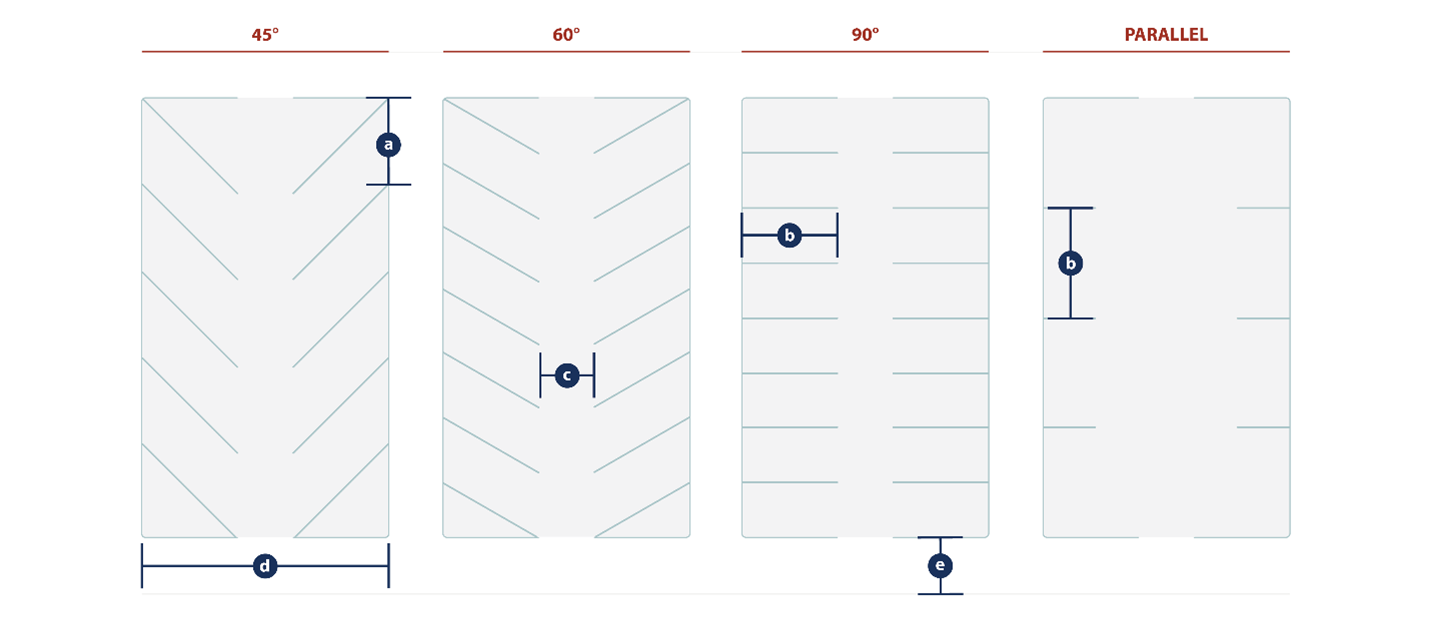
Figure 1123.10. Parking Standards
(Ord. 25-38. Passed 7-14-25)
1123.11. - Bicycle Access and Parking Requirements.
(a)
Any new development, expansion of an existing building 1,000 square feet or more, or major renovation of an existing building, shall provide short-term bicycle parking based on the provisions of this section.
(b)
Short-term bicycle parking shall be located within fifty (50) feet of, and clearly visible to, the main entrance of the building. Short-term bicycle parking accommodates visitors, customers, messengers, and other persons who intend to depart within two (2) hours or less. Fixtures include bicycle racks, which may be unsheltered.
(c)
Bicycle Parking Requirements and Design.
(1)
Standard bicycle parking spaces shall be a minimum of six (6) feet long and two (2) feet wide.
(2)
Bicycle parking spaces shall not encroach upon pedestrian walkways.
(3)
Designated bicycle parking spaces shall include adequate lighting.
(4)
Bicycle racks shall provide two points of contact with the bicycle frame such as an inverted "U" or a post and ring and shall allow locking of frame and at least one wheel with a U-lock. Wave, schoolyard, wheel well, bollard, and spiral racks are prohibited.
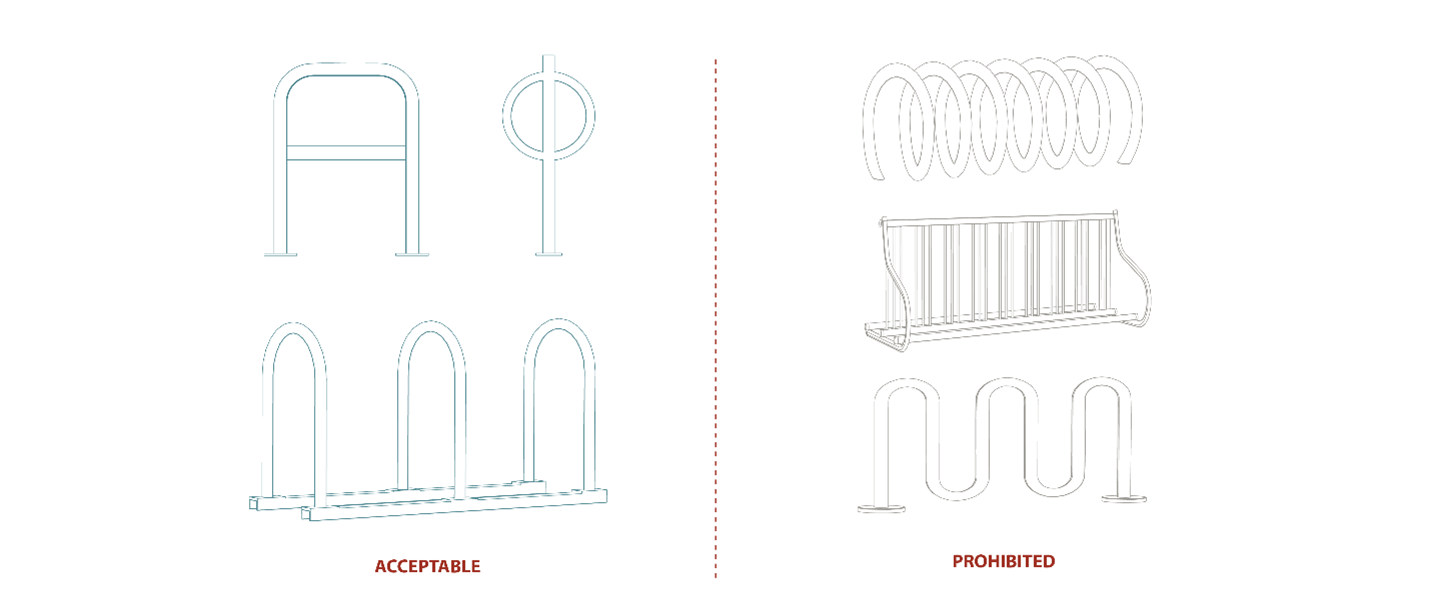
Figure 1123.11. Bicycle Racks
(d)
Long-Term Bicycle Parking.
(1)
There are no minimum long-term bicycle parking requirements, however, for every five (5) long-term bicycle spaces provided, 5% of required vehicle parking spaces may be deducted from the required minimum.
(2)
Long-term bicycle parking shall be provided in a well-lit, secure, and enclosed location within convenient distance of a public entrance, lobby, or other common area within the principal building.
(3)
Examples of appropriate long-term bicycle parking facilities include the following:
A.
A bicycle locker
B.
A lockable bicycle cage or other enclosure
C.
A lockable bicycle room
D.
A designated place visible from employee workstations
(4)
Long-term bicycle parking spaces shall be designed to ensure protection from vandalism, theft, and weather, while remaining easily accessible to intended users.
Schedule 1123.11. Minimum Bicycle Parking Requirements
(Ord. 25-38. Passed 7-14-25)
1123.12. - Regulations for access drives.
(a)
The location and width of entrance and exit driveways to parking facilities for non-single-family uses shall be planned to interfere as little as possible with the use of nearby property and with pedestrian and vehicular traffic on the nearest streets.
(b)
The location, width, and number of entrance and exit drives shall be in accordance with the City engineering design standards listed below:
(1)
Location. Access driveways shall be located at least forty (40) feet from the right-of-way line of the nearest intersecting street and no less than twenty (20) feet from the side property line.
(2)
Number of Drives. Each lot shall be permitted one two-way access drive per street frontage that is wider than 40 feet. Upon reviewing the site plan, the appropriate reviewing body may permit additional access drives.
(3)
Width of Access Drives.
A.
Access drives shall be limited to a maximum of two (2) lanes, except where one driveway provides the sole access to the property and serves as both an entrance and exit, and then it shall be limited to a maximum of three (3) lanes.
B.
The width of such entrance and exit lanes shall not be less than thirteen (13) feet or more than sixteen (16) feet per lane and shall not exceed a total of forty (40) feet.
(Ord. 25-38. Passed 7-14-25)
1123.13. - Off-street loading requirements.
When off-street loading spaces are provided for non-residential buildings, they shall comply with the following regulations:
(a)
All loading spaces shall be located on the same lot as the use served.
(b)
No part of any required yard, off-street parking area, access drive, street or public right-of-way shall be used for loading or unloading purposes.
(c)
No loading space shall face a street right-of-way unless the appropriate reviewing body determines that loading spaces facing the street right-of-way minimize the impact on adjoining properties. Such loading spaces, if approved, shall be enclosed on all sides by a wall or fence no less than six (6) feet in height.
(d)
Screening for all loading areas shall be provided along any perimeter that faces a street right-of-way or adjoining property according to the screening requirements of Chapter 1121 of this Code.
(e)
Access to truck loading and unloading space shall be provided directly from a public street or alley or from a right-of-way that will permit the orderly and safe movement of trucks and that will not interfere with public convenience.
(f)
Off-street loading spaces shall not be used for repair or servicing of motor vehicles.
(g)
Off-street loading spaces shall be provided in addition to, and not considered as meeting a part of, the requirements for off-street parking spaces.
(h)
Each off-street loading space shall have the minimum dimensions of twelve (12) feet in width, thirty (30) feet in length and fifteen (15) feet in height.
(Ord. 25-38. Passed 7-14-25)
1123.14. - Improvement and maintenance standards.
All driveways, parking areas, curbs, and parking blocks shall be constructed in accordance with standards established by the City Engineer and the following:
(a)
Surfacing. All parking and loading areas and access driveways shall be surfaced with asphalt, Portland cement concrete pavement, or other similar hard surface approved by the City Engineer.
(b)
Drainage. Parking areas shall be graded to ensure that accumulated surface water is properly drained.
(1)
Parking areas shall be drained to prevent injury to adjacent properties and to prevent water from draining across a public sidewalk or street.
(2)
Drainage shall comply with the engineering design standards.
(3)
Lighting. Parking areas shall be illuminated whenever necessary to protect the public safety. Lighting used to illuminate off-street parking areas shall be designed and located to shield adjoining residential areas from direct lighting and shall comply with the exterior lighting standards set forth in Section 1124.02.
(c)
Marking. All off-street parking areas with five (5) or more parking spaces shall indicate the location of each parking space, the location of spaces for persons with disabilities, and the location and direction for movement along the aisles and access drives by painting upon the surface, by raised directional signs, or by other similar measures placed in the surface.
(d)
Curbs, Medians, and Wheel/Bumper Guards.
(1)
All major circulation aisles and access drives shall be defined by the construction of raised curbing islands, dividers, or medians instead of only painted lines. Any such raised definitions shall be planted with trees and/or evergreen materials of the low, spreading variety to increase the visibility of the island, divider, or median and to provide an area through which water can permeate.
(2)
Appropriate curbs and parking blocks shall be provided in order to define parking spaces or limits of paved areas and to prevent vehicles from projecting into required yards, walkways, or alleys, unless otherwise permitted.
(e)
Signs. Signs shall adhere to the requirements set forth in Chapter 1125 of this Code.
(f)
Maintenance.
(1)
All parking areas, loading spaces, and adjacent sidewalks shall be maintained by the property owner in a safe condition and as free as practicable from rubbish, paper, and other loose particles, and free of any dangerous accumulation of water, snow, or ice.
(2)
All signs, markers, or other methods used to indicate direction of traffic movement and location of parking and/or loading spaces shall be maintained in a neat and legible condition. Any walls, trees, and shrubbery, as well as surfacing of the parking lot, shall be maintained by the property owner in good condition throughout its use for parking purposes.
(Ord. 25-38. Passed 7-14-25)
1123.15. - Landscaping and screening.
All off-street parking areas shall be landscaped and screened in compliance with the regulations set forth in Chapter 1121 of this Code.
(Ord. 25-38. Passed 7-14-25)
1124.01. - Purpose.
Lighting standards are established to protect the public health, safety, and general welfare, including a process for review and compliance to determine if an existing or proposed development complies with the exterior lighting standards of this chapter.
The purpose of this chapter is to control the installation of exterior lighting fixtures to prevent light pollution in the forms of light trespass and glare and to preserve, protect, and enhance the character of the City and the lawful nighttime use and enjoyment of property located within the City. Appropriate site lighting, including lights for signs, buildings, and streets, shall be arranged to provide safety, utility, and security; control light trespass and glare on adjacent properties and public roadways; and reduce atmospheric light pollution.
Specifically, these provisions are intended to achieve, among others, the following purposes:
(a)
Establish performance standards, including a process for review and compliance to ensure an environment free from elements that may jeopardize the health or welfare of the public, or degrade the quality of life in the City of Delaware.
(b)
Establish exterior lighting standards to:
(1)
Control the installation of exterior lighting fixtures to prevent light pollution in the forms of light trespass and glare.
(2)
Provide safe roadways and pleasing community vistas free from distracting and debilitating glare.
(Ord. 25-38. Passed 7-14-25)
1124.02. - Exterior lighting standards.
(a)
A lighting plan is required for all uses that are required to file a development plan or subdivision plat and shall be approved according to the procedures set forth in Chapters 1105 and/or 1106 of this Code.
(b)
Existing Sites. No building, structure, or vehicular use area shall be constructed or expanded unless the minimum lighting standards required by this chapter are provided to the extent of the alteration or expansion, but not for the entire property of which the alteration or expansion is a part unless the alteration or expansion is substantial. An alteration or expansion to an existing property is substantial when:
(1)
In the case of a building or structure that does not involve additional land, the square footage of the expansion exceeds twenty-five percent (25%) of the existing building.
(2)
In the case where additional land is involved, the additional land or the expanded square footage of a structure exceeds twenty-five percent (25%) of the existing site or structure.
(3)
Land as used herein includes land for open space, parking, or building uses.
(c)
The lighting plan shall demonstrate compliance with the exterior lighting standards of this section and shall include the following items:
(1)
A site plan showing location of all exterior light fixtures, controllers, and transformers.
(2)
Property boundaries, building location(s), parking lot layout, pedestrian paths, adjacent rights-of-way, north arrow, and scale.
(3)
Specifications and drawings or photographs for all exterior light fixture types, poles, conduit and appurtenant construction.
(4)
Lamp wattage of all proposed luminaires.
(5)
Information that indicates a minimum light level of 0.5 footcandles at grade in all vehicular use areas and connecting pedestrian paths.
(6)
Cut sheets for all proposed exterior light fixtures and poles.
(7)
Point-to-point plot with light levels meeting the light uniformity ratio standards of Subsection (g) hereof.
(8)
Any other information and data reasonably necessary to evaluate the required lighting plan.
(d)
General Requirements.
(1)
All exterior fixtures shall be full cut-off fixtures, unless exception F. below is used
A.
Architectural/accent lighting.
B.
Street lighting.
C.
Landscape lighting.
D.
Area lighting for recreational uses.
E.
Exterior residential lighting.
F.
Lighting listed in A. through E. above, may be semi-cutoff or non-cutoff luminaires which shall be installed or located so that no lamp or reflector image is directly visible from any site boundary, at or above grade, when the initial lumen output exceeds 2850 lumens (equivalent to a 150-watt incandescent A lamp).
(2)
No portion of a lamp, reflector, lens, or refracting system may extend beyond the housing or shield so as to be visible from off-site or cause disabling glare. Streetlights shall be exempt from this provision.
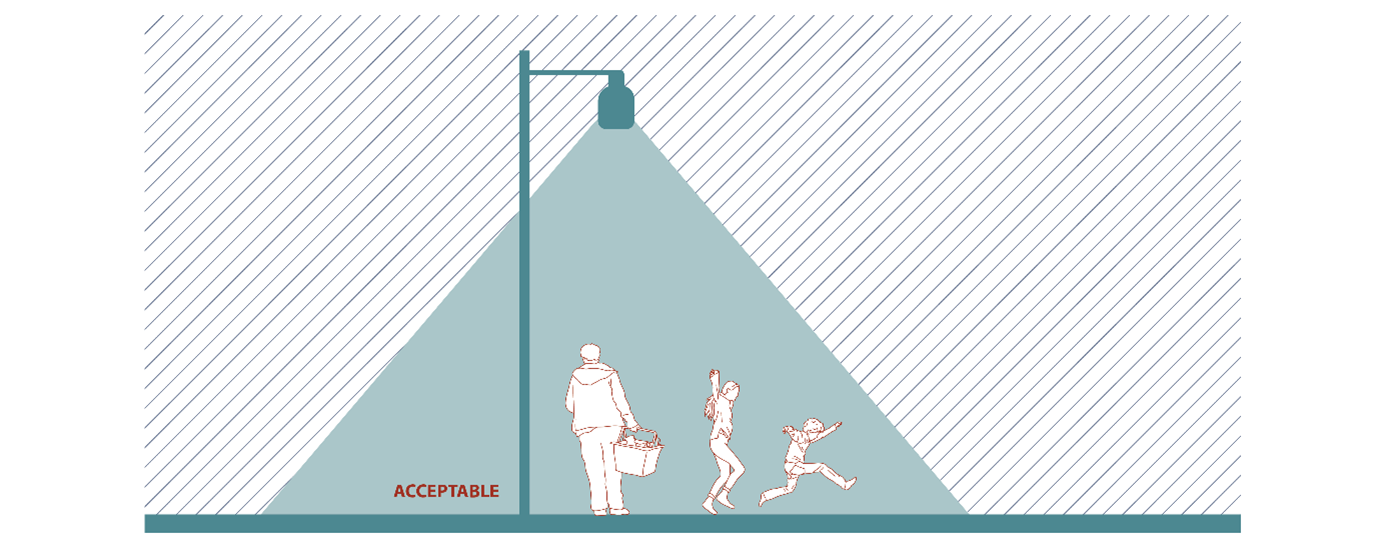
Figure 1124.02(d)(2). Full Cut-Off Lighting
(3)
All light fixtures, including streetlights, shall be directed downward. Uplighting is prohibited, except for accent lighting for buildings or signs, which may be approved as part of a development plan and meet the criteria of (1) C. above
(4)
Exterior residential lights are exempt from Subsections (2) and (3) above when the initial lumen output does not exceed 2850 lumens (equivalent to a 150-watt incandescent A lamp).
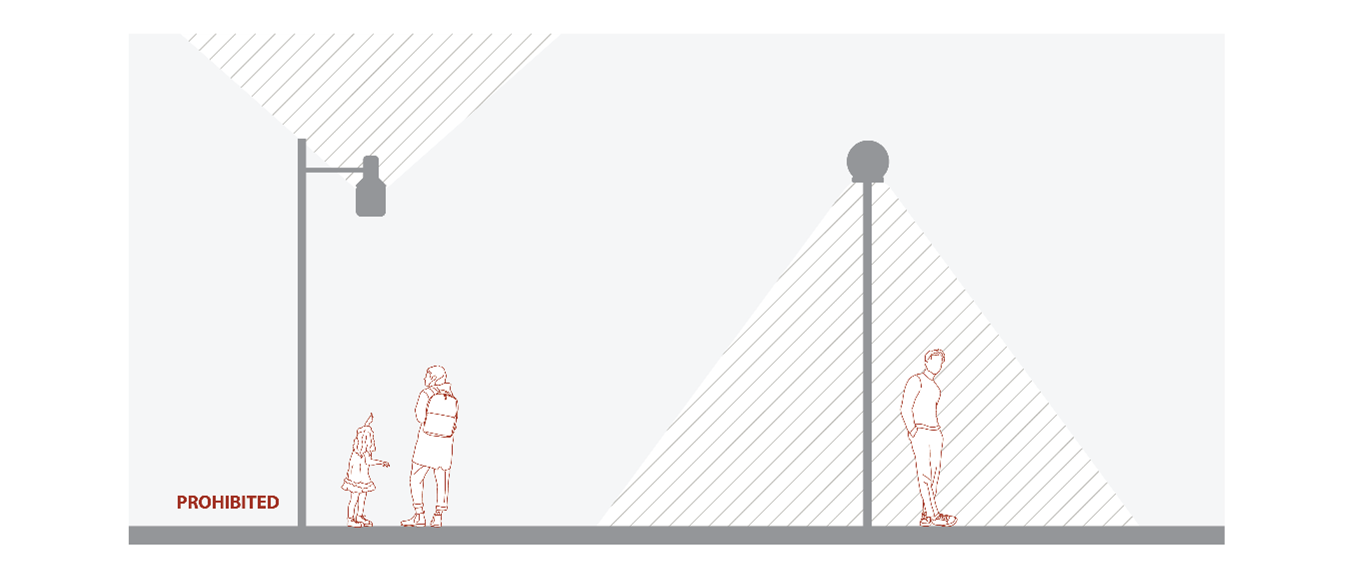
Figure 1124.02(d)(3). Uplighting
(5)
All outdoor light poles shall be constructed of metal, fiberglass, or finished wood, shall have a black finish, and shall be approved by the Chief Building Official.
(6)
All light poles shall be located outside of paved areas, either in landscape islands or within landscape strips.
(7)
All developments with ten (10) or more parking spaces are required to provide exterior lighting for all vehicular use areas including entrance and exit access drives and pedestrian paths connecting parking areas and principal buildings.
(8)
Automobile-oriented uses such as fuel stations, automotive service stations, and drive-through facilities shall install recessed ceiling fixtures in any canopy. The maximum allowable foot candle at three and one-half (3.5) feet above grade under the canopy shall not exceed thirty-five (35) foot candles.
(9)
Public street lighting and streetlights within residential developments shall conform to the engineering design standards.
(e)
Maximum Height Requirements.
(1)
The total height of exterior lighting fixtures shall not exceed the following maximum height requirements. Height shall be measured from the natural grade:
Schedule 1124.02(d). Maximum Height of Light Fixtures
(2)
All outdoor recreational/sports facility lighting will be reviewed for compliance with the intent of these lighting standards to minimize the impact on all surrounding properties and public rights-of-way.
(f)
Extinguish Requirement. All commercial, industrial, recreational, and institutional use exterior lighting (i.e., sign illumination, illumination for decorative effects, recreational facility, or sports field illumination) shall reduce lighting to no greater than twenty-five percent (25%) illumination no later than one (1) hour after closing.
(g)
Light Pollution Standards.
(1)
Artificially produced light that strays beyond property boundaries shall be considered a public nuisance when intensity levels exceed the maximum illumination levels at or beyond five (5) feet into the adjoining property as listed in Schedule 1124.03(f).
(2)
Lighting required exclusively for the illumination of entrance/exit access drives and pedestrian ways from the public right-of-way shall be permitted to illuminate to the far limit of the right-of-way.
Schedule 1124.02(f). Maximum Light Pollution Illuminances
(h)
Measurement.
(1)
Light levels shall be measured in footcandles with a direct reading, portable light meter. Readings shall be taken only after the cell has been exposed long enough to take a constant reading.
(2)
Measurements shall be taken at a height of three and one-half (3.5) feet above the ground.
(3)
Light Uniformity Ratios.
A.
For any one luminary, the light uniformity ratio shall be 10:1, maximum to minimum.
B.
The average light uniformity ratio for all luminaires located on a site shall be 4:1, average to minimum.
(i)
Exemptions. The following luminaires are exempt from the provisions of this section:
(1)
Luminaires required by the Building Code that operate only in an emergency mode.
(2)
Outdoor light fixtures that produce light directly from fossil fuel, such as kerosene lanterns or gas lamps.
(3)
Low-voltage lighting and holiday lighting in accordance with Chapter 1126.
(4)
Illuminated poles for governmental or institutional flags.
(5)
Lighting required by federal regulation such as, but not limited to, communication towers or airports.
(Ord. 25-38. Passed 7-14-25)
1124.03. - Performance bond for lighting plan completion.
No certificate of building and zoning compliance shall be issued until the improvements required by this chapter and as depicted in the lighting plan are completed as certified by City inspection, or their completion is guaranteed by a performance bond from a banking institution of sufficient amount to cover the estimated cost of materials and labor, as approved by the Chief Building Official, has been posted.
(Ord. 25-38. Passed 7-14-25)
1125.01. - Purpose and intent.
(a)
The purpose of this chapter is to promote the public health, safety, and welfare through the provision of standards for existing and proposed outdoor advertising and signs of all types. More specifically, this chapter is intended to:
(1)
Enhance and protect the physical appearance of the community;
(2)
Promote and maintain visually attractive, high value residential, retail, commercial, and industrial districts;
(3)
Preserve the scenic and natural beauty of designated areas;
(4)
Ensure that signs are located and designed to reduce sign distraction and confusion that may be contributing factors in traffic congestion and accidents, and maintain a safe and orderly pedestrian and vehicular environment;
(5)
To provide reasonable, yet appropriate conditions for identifying subdivisions and developments in residential zoning districts, as well as businesses and developments in nonresidential zoning districts by relating the size, type, and design of signs to the character and scale of individual zoning districts;
(6)
Provide review procedures that enable the City to comprehensively evaluate the appropriateness of a sign to the site, building, and surroundings; and
(7)
Prohibit all signs not expressly permitted by this chapter.
(b)
In establishing these purposes, the City has determined that signs which do not comply with these regulations (type, size, location, and limitation on the number of signs) are a public nuisance. Unregulated signs are unduly distracting to motorists and pedestrians and thereby create a traffic hazard and reduce the effectiveness of signs needed to direct the public.
(c)
The City does not intend to infringe on the rights of free speech as protected by the First Amendment to the United States Constitution and Chapter I, §11 of the Ohio Constitution. All regulations in this chapter are to be construed, whenever possible, in favor of vigorous political debate and accommodation of the rights of persons to speak freely.
(Ord. 25-38. Passed 7-14-25)
1125.02. - Applicability.
(a)
No person shall erect, place, relocate, expand, modify, maintain, or otherwise alter a sign, or cause a sign to be erected, placed, relocated, expanded, modified, maintained, or otherwise altered unless all provisions of this Code have been met. This provision shall include when a sign panel is removed and replaced within a sign structure that is intended to have changeable panels.
(b)
The construction, erection, safety, and maintenance of all signs shall be in accordance with all applicable municipal codes. The provisions of this chapter shall not amend or in any way interfere with other codes, rules, or regulations governing traffic signs within the municipality.
(c)
Unless otherwise provided, this chapter shall apply to any sign, in any zoning district, that is visible from a public right-of-way or from an adjacent property. The regulations shall apply only to signs over which the City of Delaware has regulatory authority.
(d)
Any sign legally established prior to the effective date of this chapter, and which sign is rendered nonconforming by the provisions herein, shall be subject to the nonconforming sign regulations of Section 1125.12.
(e)
If the type of any sign that legally existed prior to the effective date of this amendment is reclassified by this amendment, such sign shall be classified as the sign type defined in this chapter and shall be subject to the applicable standards for such sign type from the effective date of this amendment. Such reclassification shall be regardless of any variances that were approved prior to the effective date of this amendment.
(f)
Downtown Historic District Signs.
(1)
All residential and nonresidential signs in the Downtown Historic District shall comply with the "Architectural Standards for the Downtown Historic District," which provide supplemental standards for signs in the Downtown Historic District.
(2)
In the event of a provision or regulation which conflicts with this chapter, the Architectural Standards for the Downtown Historic District shall prevail.
(3)
If certain sign provisions are not addressed in the Architectural Standards, then the standards of this chapter shall apply.
(Ord. 25-38. Passed 7-14-25)
1125.03. - Sign permit required.
(a)
To ensure compliance with these regulations, a certificate of building and zoning compliance shall be required to be issued for all signs and sign components subject to this chapter unless specifically exempted in this chapter
(b)
A complete application for a certificate of building and zoning compliance must be submitted prior to consideration and review.
(c)
If a Certificate of Appropriateness (COA) is required for a sign in the Historic District, such COA must be approved prior to a decision on the related sign permit application.
(d)
The sign permit issued pursuant hereto shall be valid so long as the owner complies with the terms and conditions of this Zoning Ordinance or any amendment thereto.
(e)
Inspection and Enforcement.
(1)
The Director of Planning and Community Development shall have the authority to inspect signs and enforce the provisions of this chapter in accordance with Section 1103.02 of this Code.
(2)
The Director of Planning and Community Development may order removal of any sign that is not maintained in accordance with the provisions of Section 1103.02 of this Code.
(f)
Sign Permit Exceptions. The following signs are subject to the requirements of this chapter but do not require a sign permit or related fees. Permit-exempt signs may still be subject to additional reviews including review under the building code or other applicable code requirements.
(1)
Signs and/or notices issued by any court, officer, or other person in performance of a public duty. Any such sign shall be removed no later than seven (7) days after the last day it is required to be displayed;
(2)
Signs that are an integral part of the original construction of vending or similar machines, fuel pumps, automated teller machines, drive-through signage, or similar devices that are not of a size or design as to be visible from a street or by any person other than those using the machine or device;
(3)
Any sign that is located completely inside a building that is not visible from the exterior or that is not classified as a "window sign.";
(4)
Signs that are located within a stadium, open-air theater, park, arena, or other outdoor use that are not visible from a public right-of-way or adjacent property, and can be viewed only by persons within such stadium, open-air theater, park, arena or other outdoor use;
(5)
Certain temporary signs as established in Section 1125.10.
(6)
A single wall sign placed on the facade of an individual dwelling unit that is not illuminated and does not exceed two (2) square feet in area.
(7)
Signs that are an integral part of the historic architecture of a structure that has been designated an official landmark or historic structure by any agency or body of the governments of the United States, State of Ohio, Delaware County, or City of Delaware;
(8)
Ground signs and markings located completely within the interior of a lot used for a cemetery where such signs are not designed to be visible from a public street;
(9)
Any sign on a truck, bus, or other vehicle that is used in the normal course of a business (e.g., deliveries or fleet vehicles for contractors) for transportation (See also Subsection 1125.05(v)), or signage required by the State or Federal government;
(10)
Signs installed or required by a governmental agency including the City of Delaware, Delaware County, State of Ohio, and the United States, including local and regional transit agencies;
(11)
Any warning signs or traffic safety signs required by public utility providers;
(12)
Hand-held signs not set on or affixed to the ground;
(13)
Any address numbers required by applicable building and fire codes;
(14)
Changes of copy on changeable copy signs, including electronic message centers;
(15)
Flags. No more than four (4) flags are permitted to be located on flagpoles or on wall-mounted posts in all districts except the C-DC District provided the following shall apply:
A.
The maximum height of flag poles shall not exceed thirty (30) feet with a maximum flag area of forty (40) square feet for any individual flag attached to the pole.
B.
The maximum projection for wall-mounted flag post is six (6) feet and a maximum sign area of fifteen (15) square feet per flag.
C.
Flag poles may require a building permit.
D.
In the C-DC and/or Historic District, flag poles are prohibited and only one (1) wall-mounted post for flags is permitted. In such case, the wall-mounted post shall count as a projecting sign for the building unit. See Section 1125.09(b).
(16)
Window Signs.
A.
Window signs for residential uses are prohibited with the exception that temporary signs may be placed in windows in accordance with Section 1125.10.
B.
For non-residential window signs, the signs may be temporarily or permanently attached to the window surface.
C.
Window signs shall not occupy more than twenty percent (20%) of any window area on the first floor of buildings in the C-DC District and fifty percent (50%) of any window area on the first floor in all other commercial and industrial districts.
D.
For non-residential uses located entirely on upper floors of buildings in the commercial, neighborhood mixed residential, or industrial districts, one (1) window sign is permitted for each tenant or use space provided the window sign does not exceed six (6) square feet.
E.
Window signs shall not be illuminated with the exception of one window sign with a maximum sign area of three (3) square feet is permitted provided it is located on the interior side of the window and turns off at closing.
F.
Window signs in the Historic District shall require a COA.
G.
The sign area of a window sign shall be based on the total window area, regardless of the presence of an awning. Window areas separated by piers, architectural elements, or similar features that are not glass or window framing or support shall be considered separate and distinct window areas. See Figure 1125.03(16)(G).
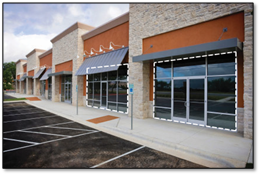
Figure 1125.03(16)(G). Window Sign Area
(17)
Any signs without a commercial message, including illuminated signs, or related decorations erected in observance of religious, national, or state holidays which are not intended to be permanent in nature and which contain no advertising material; and
(18)
General maintenance, painting, repainting without alteration of the design or copy, cleaning and other normal maintenance and repair of a sign or any sign structure unless a structural change is made, including changes to the sign dimensions.
(Ord. 25-38. Passed 7-14-25)
1125.04. - Computations and measurements.
(a)
Sign Setback. All required setbacks for signs shall be measured as the distance in feet from the lot line, right-of-way, or highway easement whichever is closest to the nearest point on the sign structure.
(b)
Sign Height.
(1)
The height of a sign shall be computed as the distance from the base of the sign at normal grade (average grade at the base of the sign) to the top of the highest attached component of the sign. Normal grade shall be construed to be the newly established grade after construction, exclusive of any filling, berming, mounding, or excavating solely undertaken for the purpose of locating or increasing the height of sign.
(2)
The filling of a hole or depression to create an average grade the same level as that surrounding the hole or depression is permitted, provided such filling is allowed by other ordinances.
(3)
In cases where the normal grade is at least five (5) feet below grade at street level, the overall height of a sign may exceed the allowed sign height by no more than five (5) feet.
(c)
Sign Area. The surface of a sign to be included when computing maximum allowable square footage of sign area shall be calculated as established in this section. For the purposes of calculating sign area, the following regular geometric shapes may be used: circle, ellipse, triangle, square, rectangle, trapezoid, pentagon, or hexagon.
(1)
The calculation of sign area shall not include any supporting framework, bracing, or decorative fence or wall unless such structural support is determined to constitute an integral part of the sign design by means of text, graphics, or other message, as determined by the Director of Planning and Community Development. See Figure 1125.04(c)(1).
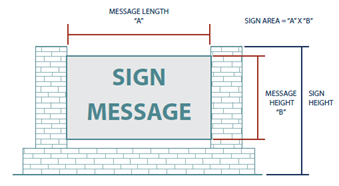
Figure 1125.04(c)(1). Sign Area Calculation
(2)
For sign copy mounted on, painted on, or similarly attached to a background panel or cabinet, the sign area shall be computed by means of the smallest permitted geometric shape, or combination of permitted geometric shapes, that encompasses the extreme limits of the background panel or cabinet. See Figure 1124.04(c)(2).
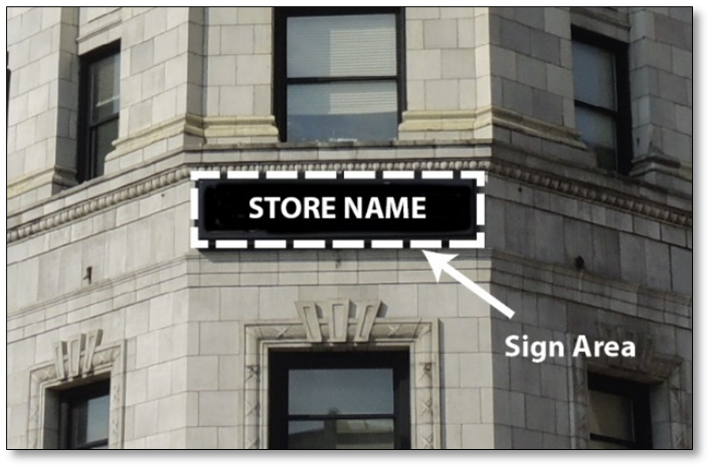
Figure 1125.04(c)(2). Sign Area Calculation
(3)
For sign copy that is painted on a surface or where individual letters or sign elements are mounted on a building façade or window where there is no clearly established background panel, cabinet, or surface distinctively painted, textured, lighted, or constructed to serve as the background for the sign copy, the sign area shall be computed by means of the smallest permitted geometric shape, or combination of permitted geometric shapes, that encloses all the letters or elements associated with the sign. See Figure 1125.04(c)(3).
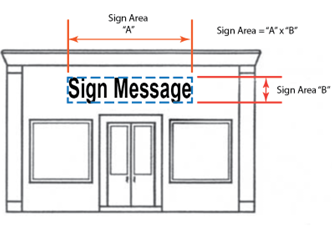
Figure 1125.04(c)(3). Sign Area Calculation
(4)
In cases where there are multiple sign elements of sign copy on the same surface, any areas of sign copy that are within two (2) feet of one another shall be calculated as a single sign area that shall be computed by means of the area that encloses all sign copy within two (2) feet of one another, otherwise the sign area shall be computed for each separate piece of sign copy. See Figure 1125.04(c)(4).
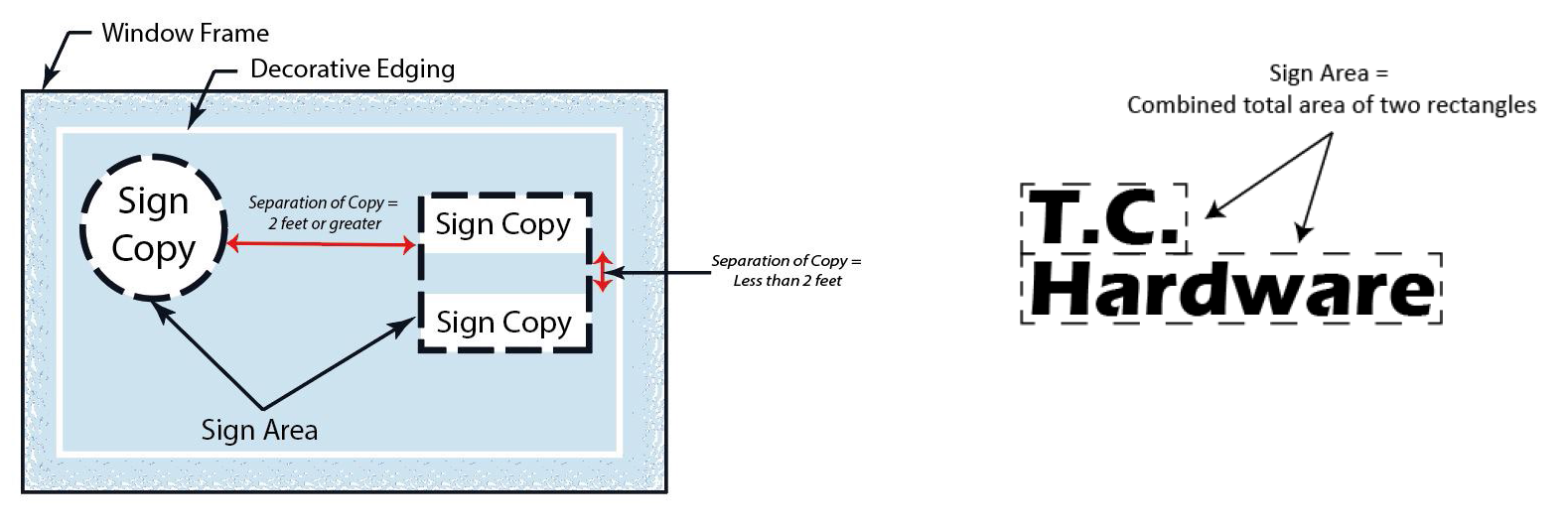
Figure 1125.04(c)(4). Sign Area Calculation
(5)
Decorative edging or other window treatments that are not an integral part of the sign copy shall not be considered a part of the sign for the purposes of this chapter.
(6)
A sign may contain a maximum of two (2) sign faces that are either mounted back-to-back or at an angle of less than 45 degrees. In such cases, the sign area shall be calculated based on the size of one (1) sign face. If the two (2) faces are unequal, the sign area shall be calculated based on the larger of the two (2) sign faces.
(7)
For spherical signs, the sign face shall be considered the plane created by bisecting the sphere with an imaginary line through the center of the sphere.
(d)
Buildings and Building Units. A stand-alone building or a building divided into separate units or spaces that are individually owned or leased by different enterprises, businesses, firms, or people, are subject to the following provisions:
(1)
A stand-alone, nonresidential building that contains one (1) tenant or occupant shall be considered a single building unit.
(2)
Where a building is divided into individual spaces for nonresidential uses, and the primary entrance or access point for each space is from the exterior of the building, then each individual space shall be considered a building unit. For example, in the case of a shopping center with multiple tenant spaces that each have its own exterior entrance, each of the tenant spaces shall be considered a building unit.
(3)
Where a building contains individual spaces that are all accessed from the interior through a joint entry, such building shall be considered one (1) building unit. For example, in the case of an office building where all of the office spaces are accessed internally, the entire office building shall be considered one (1) building unit.
(4)
Where a lot contains multiple principal buildings, each principal building shall be assessed for building units based on the above provisions.
(5)
The term "building unit" shall not be used to define an apartment building or similar residential-only building that is divided into individual dwelling units.
(6)
For mixed-use buildings that contain residential and non-residential uses, or for multi-story buildings with separate uses on the upper floors, the number of building units on any given lot shall be determined by the number of non-residential enterprises, businesses, firms, or other non-residential occupants where the spaces are accessed from the exterior of the building on the ground floor. All upper floor uses and activities shall be considered one building unit, regardless of the number of occupants. For example, a building with three (3) tenant spaces on the first floor, with exterior entrances, and apartments or office spaces on the upper floors, shall be considered to have four (4) building units. One building unit for each of the three (3) ground floor tenants and one (1) building unit total for all upper-level tenants.
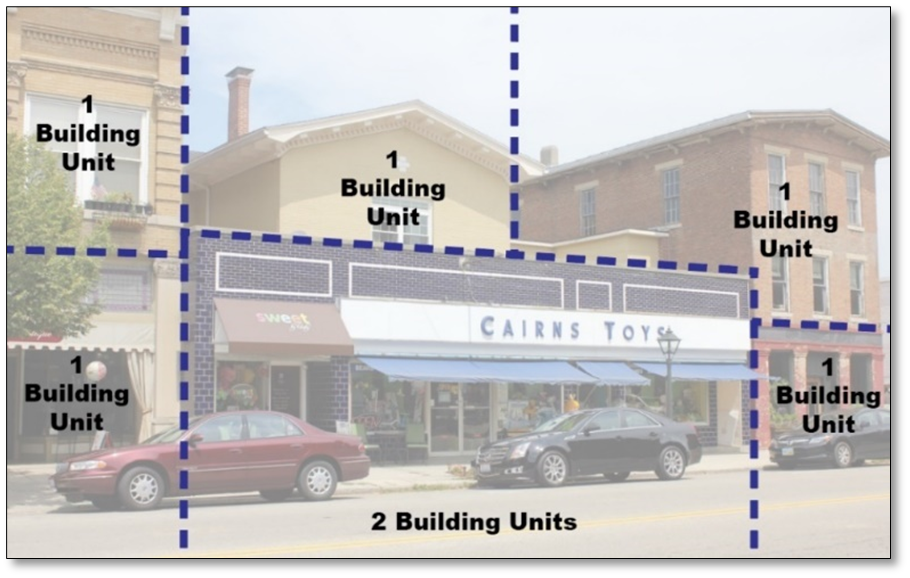
Figure 1125.04(d). Building Units.
The image shows how the upper floors of buildings only represent one building unit each, regardless of the number of tenants in those spaces or whether occupied by residential or nonresidential uses. The first/ground floors have a number of building units based on the number of non-residential businesses, tenants, etc. with the primary access from the exterior of the building.
(Ord. 25-38. Passed 7-14-25)
1125.05. - Prohibited signs.
The following types of signs are specifically prohibited within the City of Delaware:
(a)
Any sign that copies or imitates a sign installed by any governmental agency or purports to have been authorized by a governmental agency;
(b)
Signs erected so as to obstruct sight lines along any public right-of-way, including railroads, or visibility of traffic control lights, street name signs at intersections, or signals at railroad grade crossings;
(c)
Signs that interfere with, obstruct the view of, or are similar in appearance to any authorized traffic sign, signal, or device because of its position, shape, use of words, or color;
(d)
Signs placed in the right-of-way except for signs installed by government agencies or sidewalk signs as allowed in Section 1125.10 of this chapter;
(e)
Signs that constitute a hazard to safety or health by reason of inadequate or inappropriate design, construction, repair, or maintenance, as determined by the Director of Planning and Community Development or City Engineer, or either of their designees;
(f)
Awnings that internally light more than a limited sign area of the awning. Transparent or translucent awnings that are internally lighted to create a band of light on a building are also prohibited;
(g)
Signs that employ parts or elements which revolve, rotate, whirl, spin, or otherwise make use of motion to attract attention, including signs that are manually rotated, spun, etc. by a person. This shall not include electronic message centers as allowed in this chapter;
(h)
Signs with moving or flashing lights except for electronic message centers as permitted elsewhere in this chapter;
(i)
Beacons and searchlights, except for emergency purposes;
(j)
Windblown devices, pennants, streamers, and similar signs, except for flags as allowed in this chapter, that are designed to move by atmospheric, mechanical, electrical, or other means, whether containing words or numerals or containing no message;
(k)
Air-activated graphics;
(l)
Balloon signs;
(m)
Roof signs;
(n)
Signs that are applied to trees, bus shelters, utility poles, benches, trash receptacles, newspaper vending machines, or boxes, or any other unapproved supporting structure, or otherwise placed in the public right-of-way except as otherwise specifically provided for in this Code;
(o)
Signs that obstruct or substantially interfere with any window, door, fire escape, stairway, ladder, or opening intended to provide light, air, ingress, or egress to any building;
(p)
Signs which are not securely affixed to the ground or otherwise affixed in a permanent manner to an approved supporting structure unless specifically permitted as a temporary sign;
(q)
Portable signs, except where permitted elsewhere;
(r)
Permanent freestanding signs on an otherwise vacant lot;
(s)
Signs with exposed light bulbs or strings of lights not permanently attached to a rigid and permanent background;
(t)
Signs mounted upon school bus shelters, benches, and trash containers;
(u)
Signs placed on any surface located on public property or on, over, upon or across any public street or right-of-way, unless expressly allowed by this chapter;
(v)
Vehicle signs viewed from a public road with the primary purpose of providing signage not otherwise allowed by this chapter. A vehicle sign shall be considered to be used for the primary purpose of advertising if the vehicle fails to display current license plates; if the vehicle is inoperable; if evidence of paid-to-date local taxes cannot be made available; or if the sign alters the standard design of such vehicle. Vehicle signs include those attached to or placed on a vehicle or trailer. Vehicles or trailers shall not be parked continuously in one location to be used primarily as additional signage. This does not apply to a vehicle parked at a driver's residence and is the primary means of transportation to and from their place of employment; and
(w)
Any sign not specifically allowed by this chapter.
(Ord. 25-38. Passed 7-14-25)
1125.06. - General standards for all signs.
In addition to ensuring compliance with the numerical standards of these regulations, all signs regulated by this chapter shall be subject to the following standards unless explicitly stated:
(a)
Signs, as permitted in the various zoning districts, shall be professionally designed, constructed, and installed.
(b)
Signs shall be constructed of materials which are of appropriate quality and durability and which are compatible with the materials of the building upon which such signs are placed.
(c)
The construction, erection, and maintenance of all signs shall be in compliance with the Building Code and all other applicable municipal standards and regulations.
(d)
Signs Along the Olentangy Bypass. No signs, other than required by law, which are intended for visibility from the Olentangy Bypass, being the area of U.S. Route 23 between U.S. Route 42 on the south and Pennsylvania Avenue on the north, shall be placed within 200 feet of the right-of-way line of such Olentangy Bypass. The regulation of signs shall conform to the requirements of ORC ch. 5516 and the regulations adopted pursuant thereto.
(e)
Construction Standards.
(1)
The construction, erection, safety, and maintenance of signs shall comply with the Ohio Building Code and the Ohio Revised Code.
(2)
All signs shall be rigidly secured and no sign shall swing from a bar, crane, awning, or other sign. No part of any sign shall be revolving, oscillating, or otherwise designed to move to attract attention.
(3)
All freestanding signs shall have self-supporting structures erected on or permanently attached to concrete foundations.
(4)
Signs shall be constructed to withstand wind pressures of at least thirty (30) pounds per square foot of surface, and shall be fastened, suspended, or supported so that they will not be a menace to persons or property.
(f)
Clearance Requirements.
(1)
The lowest member of all signs which are supported or suspended from a building shall have a clearance of not less than seven (7) feet between the finished grade of a sidewalk or other pedestrian way and the bottom most portion of the sign. If located over a pavement used for vehicular traffic or within 18 inches of the vertical projection of the edges of such pavement, the lowest member of the sign shall not be less than 14 feet above the finished pavement.
(2)
Signs shall be located in such a way as to maintain horizontal and vertical clearance of all overhead electrical conductors in accordance with National Electrical Code specifications, depending on voltages concerned. However, in no case shall a sign be installed closer than twelve (12) inches horizontally or vertically from any conductor or public utility guy wire.
(3)
Sight Visibility Clearance. No sign shall be allowed to block the visibility form vehicles at intersections and driveways. Signs may require an additional setback to avoid blocking line-of-sight as determined by the City Engineer.
(g)
Illumination.
(1)
No sign shall incorporate movement or the illusion of movement. Any illuminated sign or lighting device shall only emit a light of constant intensity, and no sign shall be illuminated by or contain flashing, intermittent, rotating, or moving lights, or incorporate reflective materials which imitate or create the illusion of flashing or moving lights.
(2)
In no event shall an illuminated sign or lighting device be placed or directed so as to permit the beams and illumination therefrom to be directed or beamed upon a public thoroughfare, highway, sidewalk, or adjacent premises so as to cause glare or reflection that may constitute a traffic hazard or other nuisance.
(3)
Signs shall not be lighted in a manner which obstructs traffic control or any other public signs.
(4)
Externally illuminated signs, whether the lighting is mounted above or below the sign face or panel, shall have lighting fixtures or luminaires that are fully shielded.
(5)
Temporary signs shall not be illuminated.
(6)
All illuminated signs shall meet the requirements of Chapter 1124 of this Code.
(7)
In the Historic District, signs may be illuminated externally or by exposed neon tubes or a modern equivalent of neon tubes.
(h)
Changeable Copy and Electronic Message Center Signs. Changeable copy signs, including electronic message centers, shall be permitted subject to the following conditions and any other applicable regulations as established in this chapter:
(1)
The total changeable copy area shall be included as part of the total sign area allowed and constructed.
(2)
Manual changeable copy signs and electronic message centers are allowed in accordance with all applicable standards of this chapter.
(3)
Where electronic message centers are allowed, they shall be subject to the following standards:
A.
All electronic message centers shall be set back a minimum of 200 feet from the closest point of a residential dwelling unit.
B.
Any message changes shall be an instant message change and shall only change once every eight (8) seconds.
C.
The transition time between messages shall be less than one (1) second.
D.
All electronic message centers shall contain a default mechanism that will cause the sign to revert immediately to a black screen if the sign malfunctions.
E.
The electronic message center shall come equipped with an automatic dimming photocell, which adjusts the display's brightness based on ambient light conditions.
F.
Illumination shall not exceed 0.3 footcandles over ambient lighting conditions when measured at fifty (50) feet in any direction from an electronic message center sign.
G.
Audio emissions from electronic message center signs shall be prohibited.
(i)
Maintenance. All signs shall be reasonably maintained as needed. In pursuance of this, all signs shall be maintained in accordance with the following:
(1)
All signs hung and erected shall be maintained in a safe and secure condition or shall be removed by the owner or person responsible for maintaining the sign.
(2)
Signs shall be maintained in a manner that prevents the exposure of any internal elements through the removal of the sign face or the replacement of broken panels or elements.
(3)
Failure to maintain a sign in accordance with this section shall be a violation of this Code.
(Ord. 25-38. Passed 7-14-25)
1125.07. - Signs in Planned Unit Developments.
(a)
All developments in PUD districts shall be subject to the standards of this chapter unless otherwise modified through the PUD or development plan approval process. In general:
(1)
Single-family residential uses and public and institutional uses in a PUD shall comply with the sign requirements of the R-SF District.
(2)
Multi-family residential uses in a PUD shall comply with the sign requirements of the R-MF District.
(3)
Commercial and office uses in a PUD shall comply with the sign requirements of the C-GC District.
(4)
Industrial uses in a PUD shall comply with the sign requirements of the I-1 District.
(b)
This section shall apply to both permanent and temporary signs.
(Ord. 25-38. Passed 7-14-25)
1125.08. - Permanent signs in agricultural and residential districts.
The following provisions shall apply to permanents signs in the A-1, R-SF, R-NT, R-NX, and R-MF Districts:
(a)
Entrance or Development Signs. Permanent wall signs or permanent freestanding signs may be permitted for any subdivision or multi-family dwelling development that contains ten (10) or more dwelling units or lots, provided that the signs meet the following requirements:
(1)
General Standards.
A.
For subdivisions or multi-family dwellings with fewer than 25 dwelling units or lots, only one (1) permanent wall sign or one (1) permanent freestanding sign is permitted for the entire development in accordance with this section. The sign shall have a maximum sign area of 16 square feet.
B.
For subdivisions or multi-family dwellings with 25 or more dwelling units or lots, a maximum of two (2) permanent wall signs or one (1) permanent freestanding sign is allowed at each entrance to the subdivision or development from a collector or arterial street, as determined by the Director of Planning and Community Development. No more than two (2) freestanding signs shall be permitted for any subdivision or development. The maximum sign area of each sign shall be 32 square feet.
C.
The signage shall be an on-premise sign with the entire subdivision or lot counting as the premises.
D.
If the sign is to be illuminated, it shall only be illuminated through an external light source.
(2)
Freestanding Sign.
A.
A freestanding sign may include a monument sign or a post and arm sign.
B.
No such sign or any portion of the structure shall exceed five (5) feet in height.
C.
The freestanding sign shall be set back a minimum of ten (10) feet from any right-of-way or adjacent lot lines.
D.
The freestanding sign may be located on the center island of a boulevard entrance on a private street subject to the following additional standards:
1.
Sign faces must be back-to-back (i.e., no sign faces at an angle to one another).
2.
The sign shall be set back a minimum of five (5) feet from the edge or curb of the boulevard or street island edge.
3.
Sign placement must be approved by the appropriate reviewing body during the development plan process to ensure safety and visibility at the sign location.
E.
If an applicant proposes to use a freestanding sign, no wall signs, as allowed in Section 1125.08(a)(3) below shall be permitted.
(3)
Wall Signs on Entry Fences, Walls, or Features.
A.
The signs shall be mounted to a decorative wall, fence, or architectural feature adjacent to the entrance street.
B.
The placement of wall signs on architectural features shall only be permitted by the appropriate review body during the platting process or development plan review, whichever includes the details of the sign place, to ensure safety and visibility at the sign location. See Figure 1125.08.
C.
The sign shall be set back a minimum of ten (10) feet from any right-of-way or adjacent lot lines. If an applicant proposes to use wall signs, no freestanding sign, as allowed in Section 1125.10(a)(1) above, shall be permitted.
(b)
Signs for Nonresidential Uses in Residential Districts. The following signs are permitted for approved "institutional/public uses," "commercial uses," and "agricultural uses," as established in Schedule 1111.04 (Permitted Uses) in the residential districts:
(1)
One (1) permanent monument or post and arm sign may be permitted on a lot provided the sign meets the following requirements:
A.
For any lot that is one-half (½) acre or less in area, only a post and arm sign shall be permitted. On larger lots, either a monument or post and arm sign may be permitted.
B.
The sign shall be set back a minimum of ten (10) feet from any right-of-way or adjacent lot lines.
C.
The maximum sign area shall be 25 square feet.
D.
No such sign or any portion of the structure shall exceed five (5) feet in height.
E.
Up to 75% of the sign area may be used for a changeable copy sign, including an electronic message center if such electronic message center complies with Section 1125.06(h) and is located as part of a monument sign.
(2)
One additional freestanding monument or post and arm sign may be permitted on secondary street frontages on a corner lot.
(3)
Building signs shall be permitted in the same manner as building signs in the Civic/Institutional District, as established in Section 1125.09(b).
(4)
Driveway signs are permitted in accordance with Section 1125.09(d).
(5)
If any of the signs are to be illuminated, they shall only be illuminated through an external light source with the exception of electronic message centers, where allowed.
(Ord. 25-38. Passed 7-14-25)
1125.09. - Permanent signs in commercial and industrial districts.
The following provisions shall apply to permanent signs in the C/I, C-NX, C-DC, C-CC, C-GC, I-1, and I-2 Districts
(a)
Freestanding Signs. All freestanding signs in commercial and industrial zoning districts shall meet the following requirements:
(1)
Monument signs or post and arm signs are the only permitted form of freestanding sign.
(2)
Freestanding signs are not permitted in the C-DC District.
(3)
The freestanding sign shall be set back a minimum of ten (10) feet from any right-of-way lines and adjacent lot lines.
(4)
Only one freestanding sign shall be permitted on each lot, unless otherwise specifically stated.
A.
A building with multiple tenants that crosses property lines shall be considered to be located on one (1) lot for the purposes of this section. See 'Building C' in Figure 1125.09 (a)(6)B.
(5)
Maximum Freestanding Sign Area and Height. The maximum sign permitted area shall be 0.50 square feet of sign area per lineal foot of lot width with a maximum area as established in Schedule 1125.09
Schedule 1125.09. Maximum Sign Area and Height
A.
For lots with large lot widths that exceed 300 feet, one additional freestanding sign may be allowed along the same frontage. The maximum sign area and height of the second sign shall be the maximum allowed in the applicable zoning district. Each freestanding sign shall be separated by a minimum of 200 feet.
B.
For the purposes of measuring lot width for this section on freestanding signs, the lot width shall be measured along a straight line that runs parallel with the street frontage at the widest point of the lot. This measurement shall be regardless of the presence of driveway entrances to the lot or the presence of smaller outlots in front of the applicable lot. See Figure 1125.09(a)(6)C.
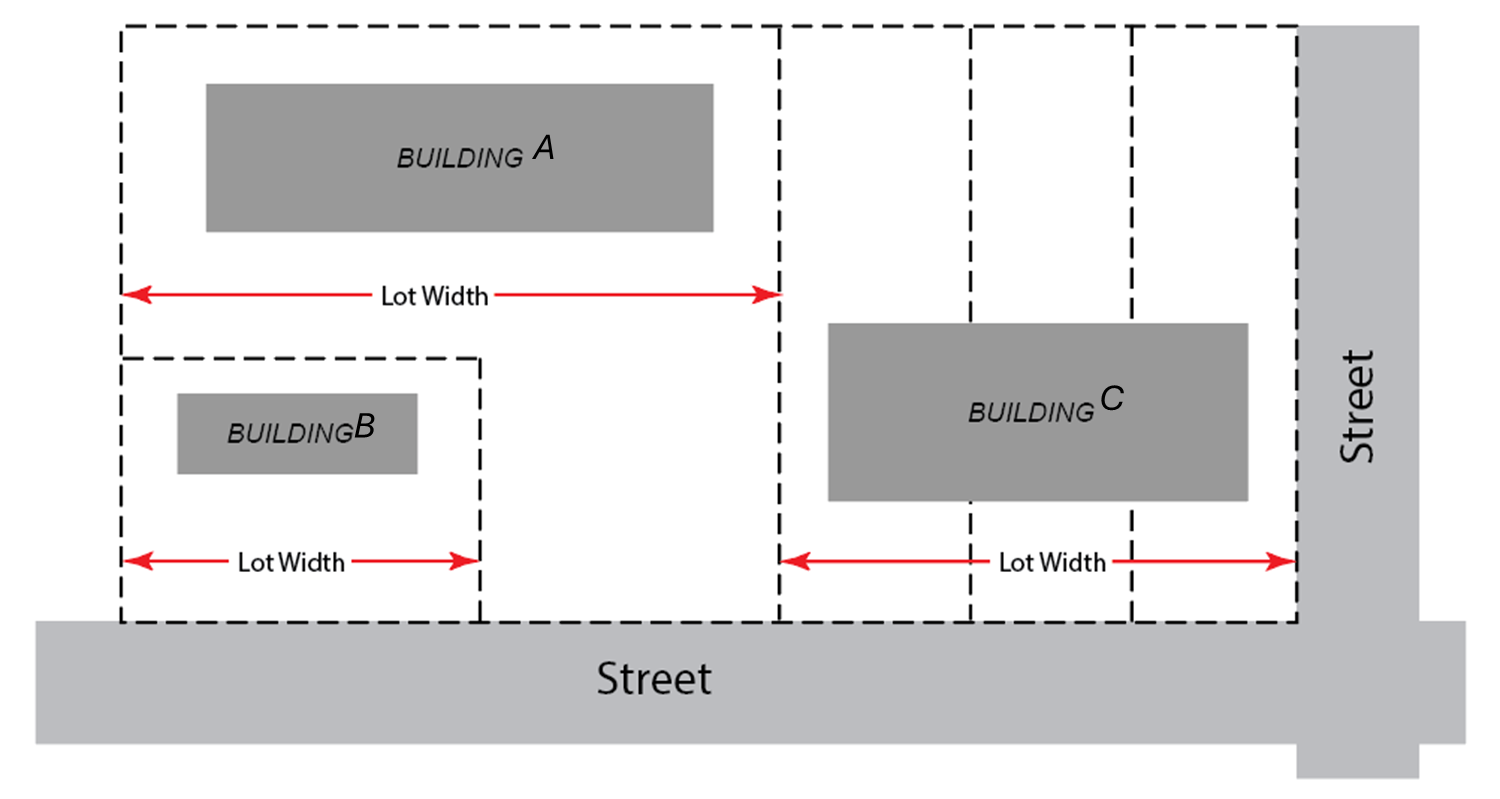
Figure 1125.09(a)(6)B. Lot Width Measurement
(6)
Monument signs may include manual changeable copy signs or electronic message centers as regulated by this chapter provided that the changeable copy sign area does not exceed 75% of the total sign area. Electronic message centers shall comply with Section 1125.06(h).
(7)
Where a freestanding sign serves a multi-tenant building, it shall be the responsibility of the property owner to determine the messaging on the sign.
(8)
Exposed sign foundations shall be constructed with a finished material such as brick, stone, or wood.
(9)
Freestanding signs shall be located in landscaped areas with a size that is equal to or larger than the total sign area that is being placed in the landscaped area.
(b)
Building Signs.
(1)
The building sign area allowed in this section shall include the total amount of all wall, canopy, awning, and projecting signs on each facade wall. Standards for each individual building sign type are established in this section.
(2)
Building signs may only be attached to the principal building. No building signage shall be attached to an accessory building or structure.
(3)
Building signage shall be an on-premise sign.
(4)
The amount of building sign area allowed is based on the facade width and whether the facade is a primary facade or secondary facade as defined below:
A.
When calculating the permitted sign area based on the width of any facade, such calculation shall be based on viewing the facade from a 90-degree angle (i.e., straight on), regardless of facade insets, offsets, or angles. See Figure 1125.09(b)(4)A.
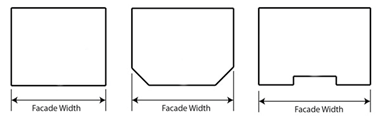
Figure 1125.09(b)(4)A. Facade Width
B.
The primary facade shall be the portion of a frontage that runs parallel and nearest to the street or that serves as the main access point to a building or building unit. A site or building can have one secondary facade when any of the following site/building characteristics are present (See Figure 1125.09(b)(4)B)
1.
The subject site is a corner lot;
2.
The primary parking area or customer entry is not located adjacent to a public street; or
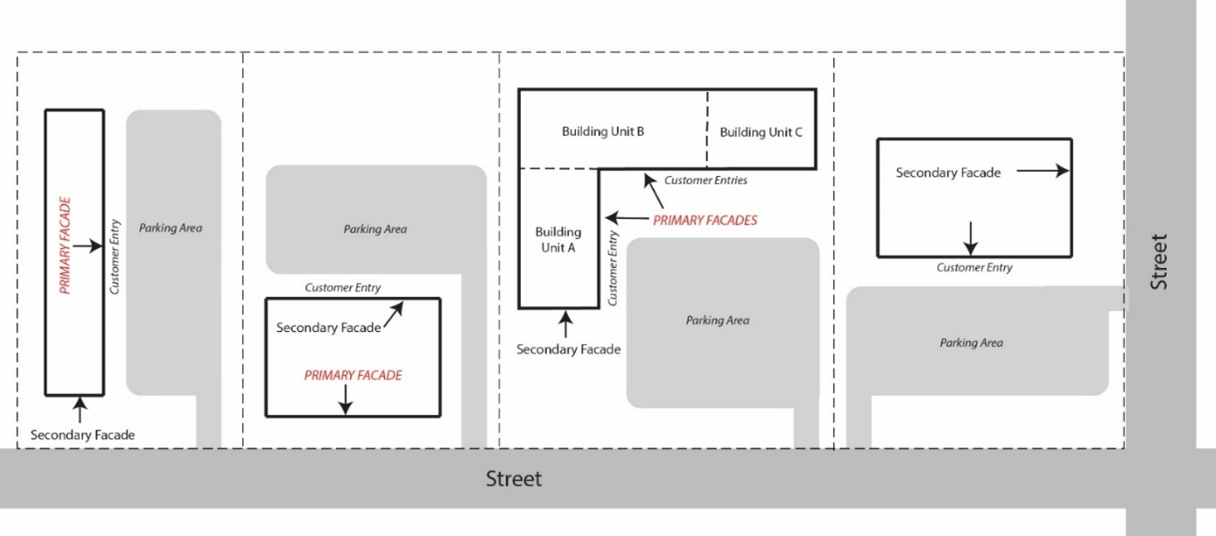
Figure 1125.09(b)(4)B. Primary & Secondary Facades
3.
The building or unit has walls with public or customer entrance points that do not face the public street.
C.
When a site has a primary and secondary facade as defined herein, the Director of Planning and Community Development shall determine which wall shall be the primary building facade and which wall shall be the secondary building facade. Only one outside wall of any business shall be considered its primary facade and only one wall may be a secondary facade.
D.
In the case of an L-shaped or other unique shape building where there are separate building units facing in different directions, the primary facade may extend along multiple facades based on the primary customer entry as determined by the Director of Planning and Community Development. See Figure 1125.09 (b)(4)B.
E.
For multi-tenant buildings, the facade width shall be based on the facade of each building unit. The facade width for a building unit shall be measured from the centerline of the party walls defining the building unit.
F.
The Director of Planning and Community Development shall have the authority to make the determination of what facades are primary facades and secondary facades for the purposes of this chapter.
(5)
Building signs shall not extend above the top of the roofline of the building to which it is attached. For canopy signs, the signs may be attached above the canopy, which is attached permanently to the building, provided that the sign does not extend above the top of the roofline of the building.
(6)
Building signs shall not include electronic message centers.
(7)
If a raceway or wireway is used for the mounting of signs, such raceway or wireway shall be painted or coated in a manner that matches the surface color of the facade.
(8)
Building Sign Allowance.
A.
There is no maximum number of permitted building signs per façade.
B.
Where there is a building sign allowance for a primary facade, such building sign area shall only be attached to the primary facade.
C.
Where there is a secondary facade, as determined in Section 1125.09(b)(4), there shall only be one designated secondary facade and any building sign area allowed for the secondary facade shall be attached to the applicable secondary facade.
D.
The following shall establish the maximum building sign area in all non-residential districts:
1.
The primary facade may contain a maximum sign area equal to one (1) square foot of sign area per lineal foot of facade width.
2.
Secondary facades may contain a maximum sign area 0.5 square feet per lineal foot of facade width.
E.
The maximum amount of sign area allowed on any facade shall be 300 square feet. In the Downtown Historic District, the maximum amount of sign area allowed on any primary facade shall be 100 square feet and any secondary facade shall be 25 square feet.
(9)
Wall Sign Standards. Any wall sign shall comply with the following standards:
A.
Wall signs shall be mounted on or flush with a wall and shall not project more than twelve (12) inches from the wall or face of the building to which it is attached.
B.
A wall sign may be mounted on the facade wall or mounted on a raceway or wireway.
C.
No wall sign shall extend any closer than three (3) feet to either the top or side edges of the surface or wall to which it is attached. No wall sign shall cover or obscure any wall opening.
D.
No wall sign shall extend above the parapet of the main building to which it is attached, nor beyond the vertical limits of such building.
E.
Wall signs may be internally or externally illuminated, except in the C-DC and/or Historic District where internal illumination is prohibited. Reverse channel letters or halo lighting is considered internal illumination for the purpose of this chapter.
F.
Detached accessory roof structures (i.e. open-air structures over fueling stations, car wash vacuum stations, etc.) shall be permitted 0.5 square feet of sign area per linear foot of frontage on three sides of the structure and shall be counted towards the maximum wall sign allowance per site.
(10)
Canopy or Awning Sign Standards. Any canopy or awning sign shall comply with the following standards:
A.
Signage shall not exceed six (6) square feet of any individual awning or sign attached to a canopy in the C-DC and/or Historic District or 24 square feet in any other commercial or industrial district.
B.
Signage may be mounted above any canopy that extends over a customer entrance provided that the maximum sign height over the canopy shall be 18 inches as measured from the top of the canopy to the top of the sign.
C.
Canopy and awning signs shall not extend into a right-of-way except in the C-DC District, in which case, the edge of the sign shall be set back a minimum of two (2) feet from the back of the street curb.
D.
Only the area of the sign may be illuminated internally on a canopy or awning. The remainder of any canopy or awning shall not be illuminated or may be illuminated by an external source such as gooseneck lighting.
(11)
Projecting Sign Standards. Any projecting sign shall comply with the following standards:
A.
Only one (1) projecting sign shall be permitted for each building unit. In the C-DC and/or Historic District, a maximum of two (2) projecting signs shall be permitted per primary facade.
B.
A projecting sign shall be perpendicular to the wall of the building to which it is attached and shall not extend more than three (3) feet from the facade wall to which it is attached.
C.
Projecting signs shall not extend into a right-of-way except in the C-DC and/or Historic District, in which case, the edge of the sign shall be set back a minimum of two (2) feet from the back of the street curb.
D.
The sign areas of a projecting signs shall maintain a minimum six (6) inch clearance from the facade of any building.
E.
Decorative supporting structures for projecting signs are encouraged and shall not count toward the maximum square footage of signs allowed, however, in no case shall the supporting structure exceed six (6) square feet.
F.
The maximum sign area for a projecting sign shall be 24 square feet in all commercial and industrial zoning districts except for the C-DC and/or Historic District, in which projecting signs on the first floor shall be limited to nine (9) square feet. Upper story projecting signs may be up to 24 square feet.
G.
Projecting signs must be suspended from brackets or other supports approved by the building code and contain no exposed guy wires or turnbuckles.
H.
A flag mounted on a wall post in the C-DC District shall count as a projecting sign for the purposes of this section. See also Section 1125.03(f)(15).
I.
Projecting signs shall be subject to the vertical clearance standards of Section 1125.06(f).
(c)
Drive-Through Signs.
(1)
The following drive through signs are allowed wherever a drive-through facility is permitted in any commercial or industrial zoning district except the C-DC District.
A.
Up to two (2) freestanding drive-through signs shall be allowed for each stacking lane in a drive-through facility provided the total aggregate sign area of all drive-through signs, for each facility, does not exceed 50 square feet. In no case shall a single drive-through sign exceed 25 square feet in sign area.
B.
If a drive-through sign is completely screened from view from any right-of-way, private street, ordinary public view, or adjacent residential uses, there shall be no maximum sign area.
C.
Drive-through signage shall not be included in the total calculated allowed signage for a property under the remainder of this chapter.
D.
No drive-through sign shall exceed six (6) feet in height measured from the grade of the adjacent driving surface to the top of the sign.
E.
Speakers associated with a drive-thru shall not be audible from any adjacent parcel.
F.
Drive-through signs may be 100 percent electronic message center subject to Section 1125.06(h).
G.
Drive-through signs may be mounted on a pole provided the entire structure does not exceed the maximum sign height established above.
H.
Drive-thru signs may be internally or externally illuminated.
(2)
No drive-through signs are permitted in the C-DC District.
(d)
Driveway Signs.
(1)
Driveway signs shall only be permitted near driveway entrances to a public street unless located internally to a development that are not visible from a public street or right-of-way, in which case, they are permitted, subject to the maximum sign area and sign height provisions of this section.
(2)
A maximum of one (1) driveway signs is permitted, per direction, for any individual driveway entrance to a public street.
(3)
Driveway signs shall be located within 50 feet of the right-of-way. There shall be no minimum setback from a right-of-way or lot line, but such signs shall not encroach into a right-of-way and shall not create a line-of-sight hazard.
(4)
Each driveway sign shall not exceed three (3) square feet in area and three (3) feet in height in every district except the I-1 and I-2 District.
(5)
In the I-1 and I-2 District, the maximum sign area shall be six (6) square feet with a maximum height of four (4) feet.
(6)
Driveway signs may be internally or externally illuminated in commercial or industrial districts. The illumination of driveway signs in residential districts shall be subject to the provisions of Section 1125.06(g).
(7)
Driveway signs shall not count toward any other sign allowance in this chapter.
(e)
Supergraphics. Supergraphics are only permitted in the C/I, C-CC, C-GC, C-DC, I-1, and I-2 Districts in compliance with the following standards.
(1)
Supergraphics may be temporarily or permanently attached to the wall on secondary facades.
(2)
In no case shall any supergraphic have a depth of more than four (4) inches as measured from the facade wall.
(3)
Internal illumination of the supergraphic is prohibited. External illumination is only permitted when the supergraphic is on a facade that is adjacent to a lot in a commercial or industrial district. The illumination shall be through indirect lighting methods such as up-lighting or gooseneck lighting.
(4)
The supergraphic shall not obstruct any architectural features, windows, doors, points of access, or other similar elements of the building.
(5)
Supergraphics shall not count toward any other sign allowance in this chapter.
(Ord. 25-38. Passed 7-14-25)
1125.10. - Temporary signs.
The following are the types of temporary signs allowed in the City of Delaware and the applicable regulations for each type of sign.
(a)
Standards Applicable to All Temporary Signs.
(1)
Temporary signs shall not be mounted, attached, affixed, installed, or otherwise secured in a manner that will make the sign a permanent sign.
(2)
No temporary sign shall be mounted, attached, affixed, installed, or otherwise secured so as to protrude above the roofline of a structure.
(3)
Temporary signs shall not be posted in any place or in any manner that is destructive to public property including, but not limited to, rights-of-way, utility poles, public trees, etc.
(4)
Unless otherwise specifically stated, temporary signs shall not be illuminated.
(5)
No temporary sign shall require a foundation, support, wiring, fittings, or elements that would traditionally require a building permit or electrical permit.
(6)
Temporary signs shall not be affixed to any permanent sign or permanent structure except when a banner sign is permitted to cover a permanent sign in accordance with Section 1125.10(c) or when such sign is attached to the principal building as permitted in this section.
(7)
All temporary signs shall be secured in such a manner as to prevent swinging or other significantly noticeable movement resulting from the wind that could pose a danger to people, vehicles, or structures.
(8)
Because of the nature of materials typically used to construct temporary signs, to avoid the unsightliness of deteriorating signs and all safety concerns which accompany such a condition, temporary signs must be removed or replaced when the sign is deteriorated. The City may remove any deteriorated sign and charge the expenses for the removal to the owner of the property on which the sign is displayed. Any unpaid charges may be assessed in the form of a lien against the owner of the property.
(9)
Temporary signs may be displayed on vacant lots so long as consent of the property owner to display the temporary sign is obtained.
(10)
Schedule 1125.10 establishes the allowances for temporary signs in all zoning districts. All sign types are subject to the general provisions above and the sign-type standards that follow the schedule.
(b)
Temporary Signs Allowed without Sign Permits. Schedule 1125.10 establishes the allowances for temporary signs in all zoning districts where the signs do not require a sign permit to post. All sign types are subject to the general provisions above and the sign-type standards in Section 1125.10(c)(3).
Schedule 1125.10 Temporary Sign Allowances
(c)
Additional Temporary Signs Allowed with Sign Permits.
(1)
In residential districts, a temporary sign may be authorized to be used for entrance or development signs prior to the construction of a permanent sign as allowed in Section 1125.08(a). Such sign shall comply with the following standards:
A.
The sign shall be restricted to a yard sign.
B.
The sign may be installed after the subdivision plat has been recorded or the development plan has been approved.
C.
The temporary sign shall comply with the maximum sign area, maximum sign height, and locational requirements of the permanent sign, as established in Section 1125.08(a).
D.
The temporary sign shall be removed upon the construction of the permanent sign. In no case shall the temporary sign be allowed for more than 18 months or when 90 percent of the units/lots are sold, whichever comes first.
(2)
For sign permit applications related to the change of use or tenant within an existing building, where there is existing permanent sign, a banner sign may be approved for up to 60 consecutive days to cover the existing permanent signs. Such banner sign shall not exceed the sign area of the permanent sign. This allowance shall only apply to non-residential uses.
(d)
Standards for Sign Types.
(1)
Banner Signs.
A.
There shall be a maximum of one (1) banner signs per building unit at any one time.
B.
Banner signs may only be attached to a building. A banner sign attached to posts and mounted in a yard or landscaped area shall be regulated as a temporary yard sign.
C.
The maximum height standard for temporary signs shall not apply to a banner sign but such signs shall not be mounted in a manner that extends above the roofline of a building or the top of the structure on which it is mounted.
D.
Banner signs shall only be permitted to be affixed to the principal building or an accessory building provided that it is placed fully against a facade and is secured along all sides of the banner to prevent movement.
E.
Banner signs are prohibited from being hung on or from other structures including but not limited to fences and walls.
F.
Banner signs used in the Historic District may only be used as a temporary sign if hung inside of a window or if used for covering pre-existing permanent signs pursuant to Section 1125.10(c).
(2)
Sidewalk Signs.
A.
Only one (1) sidewalk sign is allowed for any one (1) building unit with a ground floor entrance and shall be located within five (5) feet of the entrance of such building unit.
B.
There shall be no time limit for sidewalk signs with the exception that the sign shall only be placed outside during the hours of the establishment's operation.
C.
Such signs shall not exceed eight (8) square feet in area with a maximum height of four (4) feet.
D.
The sign shall only be permitted on a public sidewalk or private walkway provided it is placed on pavement and not in any landscaped areas or on pavement used for vehicles (e.g., driveways and parking lots).
E.
If the sign is placed on a sidewalk or walkway, the sign can only be placed where the paved sidewalk or walkway width, not including curb top, is at least seven (7) feet wide. The width and placement of the sign shall be such so that there shall be a minimum width of four (4) feet of clear and passable sidewalk or walkway for pedestrians.
F.
The sign must be freestanding and shall not be affixed, chained, anchored, or otherwise secured to the ground or to any pole, parking meter, tree, tree grate, fire hydrant, railing, or other structure.
G.
The sign must not obstruct vehicular traffic or access to parking meters, bicycle racks, and other features legally in the right-of-way.
H.
The sign must not interfere with the opening of car doors in legal spaces, or with the operation of wheelchair lifts and ramps, cab stands, loading zones, or bus stops.
I.
The sign shall be internally weighted so that it is stable and windproof.
J.
The City of Delaware shall be held harmless from any liability resulting from accident or injury caused by the placement and/or maintenance of such sign.
K.
A sign permit is not required for a sidewalk sign, but such signs are still subject to these regulations.
(3)
Window Signs.
A.
Temporary window signs shall be mounted or placed on the interior of the building.
B.
Temporary and permanent window signs in nonresidential districts are regulated in accordance with Section 1125.03 (f)(16).
(4)
Yard Signs.
A.
Unless otherwise specifically stated, there shall be no maximum number of yard signs provided the aggregate total square footage of all yard signs does not exceed the maximum sign area allowed in this section on temporary signs.
B.
There shall be a maximum of two faces to the sign, mounted back-to-back.
(Ord. 25-38. Passed 7-14-25)
1125.11. - Master sign plans.
The master sign plan allowance established herein is to provide for the consideration of additional permanent signage for large-scale nonresidential and mixed-use developments.
(a)
Applicability.
(1)
A master sign plan may be submitted for developments that meet one of the following thresholds:
A.
A minor modification to a development plan approved in accordance with Chapter 1105;
B.
A plan adopted with the approval of a development plan in accordance with Chapter 1105;
C.
A development that has no development plan and is not located within an overlay or PUD; or
D.
A subdivision in the C/I, C-CC, C-GC, I-1, or I-2 District where there are more than five lots.
(2)
In all cases, there must be a minimum of two (2) principal buildings proposed for the subdivision or site to qualify for a master sign plan.
(b)
Master Sign Plan Requirements.
(1)
Master sign plans shall be reviewed by the Planning Commission either as part of the PUD approval or Development Plan review process.
(2)
A master sign plan is intended to promote consistency among signs within a development, improve wayfinding around the site, and enhance the compatibility of signs with the architectural and site design features within a development, as well as with the surrounding neighborhood.
(3)
An application for review of a master sign plan shall include:
A.
A master sign plan, drawn to scale, delineating the site proposed to be included within the master sign plan and the general locations of all permanent signs, including freestanding and building signs and the property lines, buildings and roadways;
B.
Drawings and/or sketches indicating the dimensions in square feet, location and sign area for all the permanent signs;
C.
Drawings and/or sketches indicating the exterior surface details of all buildings on the site on which wall signs, awning signs, canopy signs, projecting signs, window signs or other building signs are proposed;
D.
Samples or photos of colors and materials to be used for signs and the relationship to the building materials; and
E.
Information regarding the illumination of any signs.
F.
Additional relevant information requested by the Director of Planning and Community Development.
(c)
Master Sign Plan Allowances. The Planning Commission may approve additional signage as part of a master sign plan in accordance with the following:
(1)
Each development or subdivision may contain one additional freestanding sign as allowed by Section 1125.09(a). Such sign may be placed on one of the lots within the subdivision or on the site subject to the master sign plan without counting toward other freestanding signs allowed by this chapter.
(2)
An additional ten percent (10%) of building signage may be permitted for each building unit provided that no individual sign shall exceed 300 square feet in area.
(d)
Review Criteria.
(1)
In order for the Planning Commission to approve a master sign plan, it must find all of the following:
A.
That the master sign plan's contribution to the design of the site and surrounding area will be superior to the quality that would result under the regulations and standards of this chapter;
B.
That the signs proposed as part of the master sign plan will create a uniform sign package for the site related to materials, lighting, design, and other features of the individual signs; and
C.
That the proposed signs are compatible with the style or character of improvements and are well-related to each other in terms of location and spacing.
(2)
The Planning Commission may impose reasonable conditions to a master sign plan necessary to carry out the intent of this chapter.
(3)
No sign permits, building permits, or other permits required for the construction of any sign shall be issued unless the sign complies with the approved master sign plan.
(4)
An approved master sign plan may only be amended or modified through the same review process required for its approval.
(Ord. 25-38. Passed 7-14-25)
1125.12. - Nonconforming signs.
Every sign that existed before the effective date of this amendment, was permitted by the City's zoning laws prior to this date, which was properly permitted, and which is not in conformance with the provisions of this chapter, shall be deemed a legal nonconforming sign. All legal nonconforming signs shall be maintained in accordance with this chapter.
(a)
All nonconforming signs shall be maintained in good condition in accordance with the requirements of this chapter.
(b)
A nonconforming sign shall not be structurally relocated, altered, or replaced unless it is brought into compliance with the provisions of this section. Should any replacement, alteration, or relocation take place without being brought into compliance, the sign shall be declared an illegal sign, subject to removal.
(c)
A nonconforming sign shall immediately lose its legal nonconforming status, and therefore shall be brought into conformance with this chapter or removed, when any of the following occur:
(1)
If the size, height, or structural components are changed or altered;
(2)
If the sign is relocated;
(3)
If either the sign structure or sign copy is damaged to the extent of 50 percent or more of either the structure or its replacement value, the sign shall be removed or brought into compliance. If the damage encompasses less than 50 percent of the structure or its replacement value, the sign may be repaired within 60 days of the date the damage was caused. The replacement value shall be the average of two replacement value estimates as determined by two sign companies requested to provide a quote by the City; or
(4)
If the sign is defined as a temporary sign and has been in use for more than one year following the effective date of this amendment.
(5)
Certain nonconforming signs shall not lose legal nonconforming status under the following conditions:
A.
For legal nonconforming changeable copy signs, the sign copy may be changed provided there are no structural changes to the sign;
B.
For legal nonconforming signs that have a sign cabinet or other structure where the sign copy is located on a changeable panel, the panel may be replaced where there are no structural changes to the sign cabinet; and
C.
For legal nonconforming wall signs that are painted on a wall in the C-DC District, such signs may be maintained and repainted with the original sign copy.
(d)
Subject to the provisions of this section, nonconforming signs may be repaired and renovated so long as the cost of such work, within any 12-month period, does not exceed 50 percent of the value of the sign.
(Ord. 25-38. Passed 7-14-25)
1125.13. - Removal of signs.
(a)
Abandoned Signs. If any sign shall become abandoned, in the manner defined herein, such sign is declared to be a public nuisance that continued lack of use results in lack of reasonable and adequate maintenance, thereby causing deterioration and a blighting influence on nearby properties.
(1)
An abandoned sign is defined as any sign that meets any one of the following criteria:
A.
Any legal nonconforming sign associated with an abandoned nonconforming use or that is associated with a business or other nonresidential use that has been closed or vacant for at least 365 consecutive days. Seasonal businesses are exempted from this determination.
B.
Any sign that is not maintained in accordance with this chapter.
(2)
When the Director of Planning and Community Development finds, upon investigation, that a sign has been abandoned, as defined herein, she shall notify the owner of said sign and the owner of the land on which the sign is located, by certified mail or by personal delivery, of her findings. Such notice shall advise the sign and property owners that the sign has been declared abandoned and shall be removed within thirty (30) days from the date of mailing of said notice. The sign owners or property owners may appeal such decision to the Board of Zoning Appeals as provided in Section 1103.04 of this Code.
(3)
It shall be the duty of the Director of Planning and Community Development to maintain a photograph and file on said sign together with a written report of his/her findings for submission to the Board of Zoning Appeals upon request.
(4)
If the sign is not removed, as ordered, the same may be removed by the City at the expense of the lessee or owner. If the City is not immediately reimbursed for such costs, the amount thereof shall be certified to the Delaware County Auditor for collection as a special assessment against the property on which sign is located.
(b)
When a sign is removed for any reason, all mast arms, guys of any nature, clips, brackets, and all structures of the old sign shall be removed with the sign. No new sign may be installed without the issuance of a new sign permit.
(Ord. 25-38. Passed 7-14-25)
1126.01. - Purpose.
This chapter is established to protect the health, safety, and welfare of residents of the City of Delaware and to minimize the impact of nuisances.
(Ord. 25-38. Passed 7-14-25)
1126.02. - Applicability.
No land or structure in any district shall be used or occupied in any manner to create a dangerous or objectionable condition, substance or element, in such a manner or in such amount to adversely affect the adjoining premises or surrounding area.
(Ord. 25-38. Passed 7-14-25)
1126.03. - General regulations.
(a)
Air Pollution. No use shall emit fly ash, dust, vapors, or other substances that are harmful to health, animals, vegetation or other property or which can cause excessive soiling.
(b)
Fire Hazards and Explosives. Flammable or explosive materials shall only be permitted in structures having incombustible exterior walls.
(c)
Heat. No use shall generate heat that is perceptible without the aid of instruments at any point beyond the lot occupied by the use.
(d)
Light and Glare. All exterior lighting and conditions that generate glare shall comply with the requirements of Chapter 1124 of this Code.
(e)
Noise. No use shall generate noise beyond that permitted in Section 509.10 of the Codified Ordinances of the City of Delaware.
(f)
Noxious, Toxic, or Corrosive Fumes. Noxious, toxic, or corrosive fumes or gasses shall not be emitted which shall be injurious to the property, vegetation, or health of the people residing in any adjacent residential district.
(g)
Odors. No use shall emit malodorous gas or matter that is discernible on any adjoining lot or property.
(h)
Radioactive and Electrical Disturbances. Radioactive emissions or electrical discharges shall be confined to the use and lot from which they originate and shall not occur across any lot line.
(i)
Waste.
(1)
Liquid wastes shall be disposed of in appropriate containers and removed from the site on a regular basis. Liquid waste or sewerage shall not be discharged into a reservoir, stream, or other open body of water or into a storm or sanitary sewer until treated so that the insoluble substances, such as oils, grease, acids, alkalines, and other chemicals in the waste do not exceed the amount allowed by other codes of the City, County, State, or similar jurisdictional authority.
(2)
Solid waste, including empty packing crates and other excess materials, shall not be allowed to accumulate on a lot and shall be disposed of on a regular basis or enclosed within a wall or fence.
(Ord. 25-38. Passed 7-14-25)

