
Delaware City Zoning Code
TITLE TWO
USE DISTRICT REGULATIONS
1110.01. - Districts established.
For the purpose of this Zoning Ordinance, the City is hereby divided into zoning districts. Such districts are designated as follows:
(a)
Residential Districts.
A-1 Agricultural District
R-SF Single-Family Residential District
R-NT Neighborhood Transition Residential District
R-NX Neighborhood Mixed Residential District
R-MF Multi-Family Residential District
(b)
Commercial Districts.
C/I Civic/Institutional District
C-NX Neighborhood Mixed Commercial District
C-DC Downtown Commercial District
C-CC Community Commercial District
C-GC General Commercial District
(c)
Industrial Districts.
I-1 Light Industrial District
I-2 General Industrial District
(d)
Planned Unit Developments.
R-PUD Residential Planned Unit Development
C-PUD Commercial Planned Unit Development
MX-PUD Mixed-Use Planned Unit Development
I-PUD Industrial Planned Unit Development
(e)
Special Districts.
Downtown Historic District
(Ord. 25-38. Passed 7-14-25)
1110.02. - Zoning map.
(a)
Those districts established in Section 1110.01 are bounded and defined as shown on the map entitled "Official Zoning District Map" of the City, which map, together with all notations, references, data, district boundaries and other information shown thereon, is hereby made a part of this Zoning Ordinance.
(b)
If, in accordance with the provisions of this Zoning Ordinance and the Ohio Revised Code, changes are made in district boundaries or other matters portrayed on the map, such changes shall be made on the map within thirty (30) days of such changes.
(c)
The Official Zoning District Map shall be and remain on file in the office of the Planning and Community Development Department. Regardless of the existence of other purported copies of the map, which may be made or published from time to time, this copy of the map shall be the final authority as to the current zoning status of lands, buildings, and other structures in the City.
(Ord. 25-38. Passed 7-14-25)
1110.03. - Interpretation of district boundaries.
Where uncertainty exists with respect to the boundaries of any of the aforesaid districts as shown on the Zoning Map, the following rules shall apply:
(a)
Where Boundaries Approximately Follow Streets, Alleys, Highways or Lot Lines. Except where referenced on the Zoning Map to a street or alley line or other designated line by dimensions shown on such map, the district boundary lines follow lot lines or the centerlines of streets or alleys as they existed at the time of the adoption of this Zoning Ordinance.
(b)
Where Boundaries Parallel Street Lines, Alley Lines, or Highway Right-of-Way Lines. Where district boundaries are so indicated that they are approximately parallel to the center line or street line of streets, the center line or alley line of alleys, or the center line or right-of-way lines of highways, such district boundaries shall be construed as being parallel thereto and at such distance therefrom as indicated on the map. If no distance is given, such dimensions shall be determined by the use of the scale shown on the Zoning Map.
(c)
Extension of District Where Lot Divided. Where a district boundary line established in this Zoning Ordinance or as shown on the Zoning Map divides a lot which was in single ownership at the time of enactment of this Ordinance, the use authorized thereon and the other district requirements applying to the most restricted portion of such lot under this Ordinance shall be considered as extending to the entire lot.
(d)
Vacation of Public Ways. Whenever any street, alley, or other public way is vacated by official action as provided by law, the zoning district adjoining each side of such public way shall be automatically extended to the center of such vacation and all areas included in the vacation shall then and henceforth be subject to all regulations of the extended.
(e)
Resolving Disputes. All uncertainties and disputes concerning the exact location of zoning district boundaries shall be resolved by the Board of Zoning Appeals according to the rules and regulations which it may adopt.
(Ord. 25-38. Passed 7-14-25)
1110.04. - Property not included; annexation.
In every case where property has not been specifically included within a district, the same is hereby declared to be in the A-1 District. Territory annexed to or consolidated with the City subsequent to the effective date of this Zoning Ordinance shall, upon the effective date of such annexation or consolidation, become a part of the A-1 District. Such districting may be temporary, and the Planning Commission may recommend to Council within a period of time, not to exceed six (6) months from such date of annexation or consolidation, a final Zoning Map designation for the annexed territory.
(Ord. 25-38. Passed 7-14-25)
1111.01. - Purpose.
Residential districts (A-1, R-SF, R-NT, R-NX, R-MF) and their regulations are established to achieve, among others the following purposes:
(a)
To provide residential areas for neighborhoods consistent with the land use designations of the City of Delaware Comprehensive Plan.
(b)
To meet the goals and objectives of the City of Delaware Comprehensive Plan.
(c)
To provide a range of housing types and densities that serve all economic segments of the community and emphasize high quality developments.
(d)
To provide for the proper location of certain neighborhood businesses, institutions, and other community facilities that complement residential development to increase general convenience, safety, and amenities.
(Ord. 25-38. Passed 7-14-25)
1111.02. - Relevant chapters for cross-reference.
(Ord. 25-38. Passed 7-14-25)
1111.03. - Residential districts.
(a)
The Agricultural District (A-1) is established to provide for agricultural activities, open recreational uses, and other open land uses, and is primarily located near the periphery of the urban area to protect agricultural areas from encroachment of urban-type uses until such time as the area is ready for more intense development.
(b)
The Residential Single Family (R-SF) district is established to provide land for one-family residential development that is located throughout the urban area to provide traditional suburban housing options.
(c)
The Residential Neighborhood Transition (R-NT) district is established primarily to provide land for one and two-family uses on smaller lots, enabling residential development similar in character to the walkable historic neighborhoods of the City, with a variety of housing types permitted in proximity to each other.
(d)
The Residential Neighborhood Mixed (R-NX) district is established to provide land for a variety of residential uses complemented by incidental, limited commercial uses like corner stores, counter service restaurants, or similar low impact uses.
(e)
The Residential Multi-Family (R-MF) district is established to provide land for multi-family residential uses which are generally consistent in scale and character with the surrounding uses and development patterns.
(Ord. 25-38. Passed 7-14-25)
1111.04. - Permitted uses.
(a)
Uses Permitted by Right. A use listed in Schedule 1111.04 shall be permitted by right as a principal use in a district when denoted by the letter "P", provided that all requirements of other City ordinances and this Zoning Ordinance have been met.
(b)
Conditional Uses. A use listed in Schedule 1111.04 shall be permitted as a conditional use in a district when denoted by the letter "C", provided the Planning Commission first makes the determination that the conditional use requirements have been met according to the procedures set forth in Section 1105.20 of this Code.
(c)
Use Not Listed in Schedule. Any use not specifically listed as either a permitted principal or conditional use shall be a prohibited use in these zoning districts and shall only be permitted:
(1)
Upon amendment of this Zoning Ordinance and/or the Zoning Map as provided in Section 1105.03; or
(2)
Upon finding that a use is substantially similar as provided in Section 1105.26 of this Code.
Schedule 1111.04. Permitted Uses
(Ord. 25-38. Passed 7-14-25)
1111.05. - Additional requirements for neighborhood commercial establishments.
(a)
Neighborhood commercial establishments are conditionally permitted within the Residential Neighborhood Mixed (R-NX) district and shall be those uses as defined in Chapter 1102.
(b)
The Planning Commission shall determine if the proposed use is consistent with the definition set forth in Chapter 1102 in conjunction with the evaluation of all requirements of conditional use approval set forth in Chapter 1105 of this Code.
(Ord. 25-38. Passed 7-14-25)
1111.06. - Yard and lot requirements.
(a)
All new lots in residential districts shall comply with the minimum requirements set forth in Schedule 1111.06.
Every primary structure within the residential districts shall be located on a lot in compliance with the building setback and spacing requirements set forth in Schedule 1111.06.
Schedule 1111.06. Yard and Lot Requirements
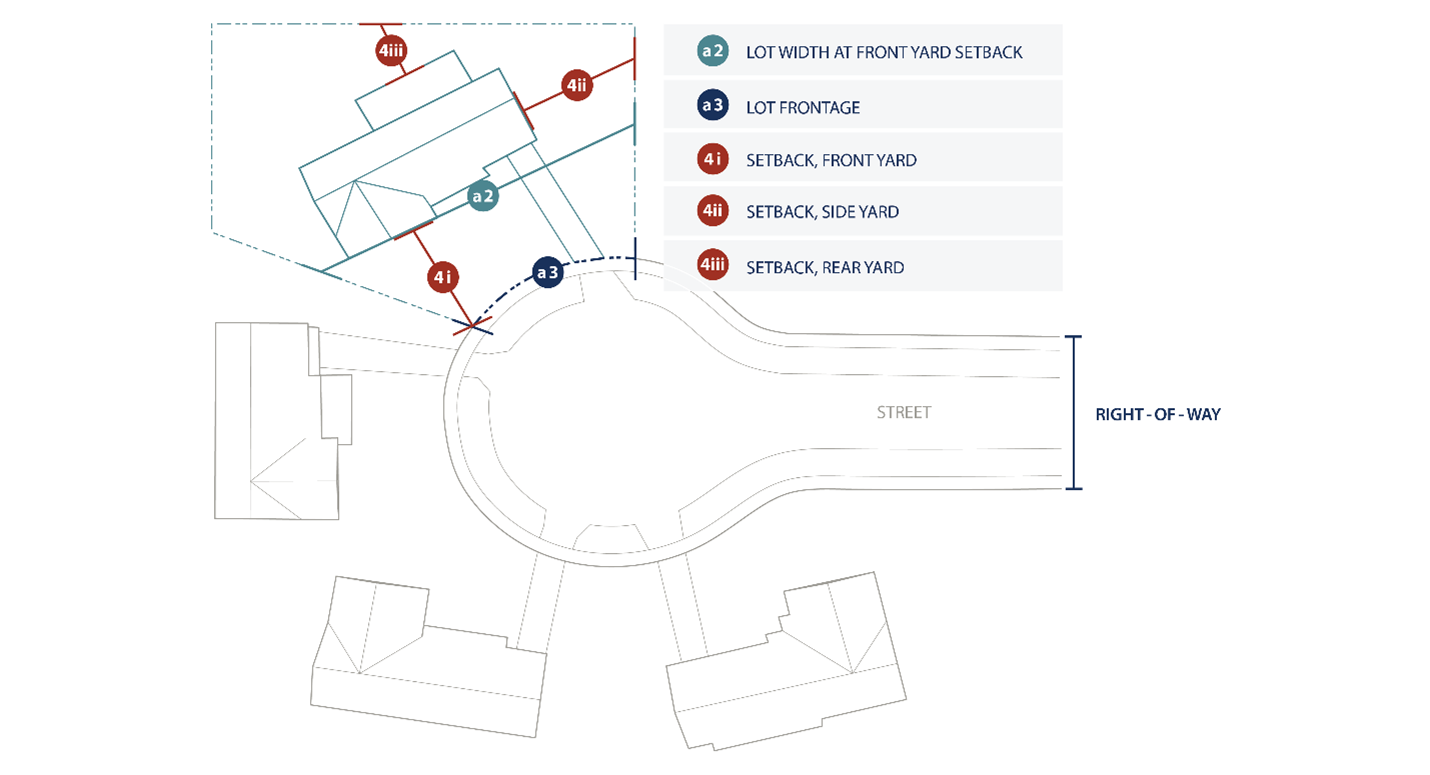
Figure 1111.06. Yard & Lot
(b)
Projections into Required Yards. Architectural features may project into required yards as follows:
(1)
Required Front and Required Rear Yards.
A.
Cornices, canopies, eaves, or other architectural features may project a distance not to exceed three (3) feet.
B.
Fire escapes may project a distance not to exceed four and one-half (4 ½) feet.
C.
An uncovered stair and necessary landing may project a distance not to exceed six (6) feet provided that such stair and landing shall not extend above the entrance floor of the building, except for a railing not to exceed three (3) feet in height.
D.
Bay windows, balconies, and chimneys may project a distance not to exceed three (3) feet, provided that such features do not occupy, in aggregate, more than one-third (1/3) of the length of the building wall on which they are located.
E.
Additions to the principal structure that are not fully enclosed (i.e. decks, patio covers, pergolas, etc.) shall be permitted to encroach up to twelve (12) feet into a required rear yard.
i.
Patio covers may be permitted to encroach into a required front yard up to six (6) feet provided there is a minimum of twelve (12) feet between the front of the primary structure and the front property line.
(2)
Required Side Yards. All features outlined in Section 1111.06 (c)(1) may project into a required side yard but may not encroach more than three (3) feet in any case.
(3)
A permitted addition that encroaches into the required yard setback per this section shall not be converted into a completely enclosed addition at any time.
(c)
Exceptions to Height Limitations.
(1)
Non-Occupied Appurtenances. The height limitations contained in Schedule 1111.06 do not apply to spires, belfries, cupolas, antennae, water tanks, ventilators, chimneys, or other appurtenances, excluding wireless telecommunication and wind energy conversion systems (WECS) facilities, except where the height of such structures will constitute a hazard to the safe landing and take-off of aircraft at an established airport. Exceptions to height limitations shall not exceed ninety (90) feet, unless approved by the Board of Zoning Appeals, or as further provided elsewhere in this Code.
(2)
Amateur Radio Towers. Towers located on parcels less than five (5) acres in total area shall not exceed sixty-five (65) feet in height, whether ground mounted or mounted to a residential structure. On parcels five (5) acres or larger in total area, said amateur radio towers shall not exceed ninety (90) feet in height, whether ground mounted or mounted to a residential or accessory structure.
A.
Any guy wire anchor supporting the tower must be located on the same property as the tower. The anchor must be set back a minimum of three (3) feet from any property line and shall not be located in the front yard.
B.
The horizontal antenna, typically on the top of the tower, must be set back a minimum of three (3) feet from any property line.
(Ord. 25-38. Passed 7-14-25)
1111.07. - Additional Residential Multi-Family (R-MF) requirements.
(a)
Building Arrangement. Cluster single-family, two or more-family, and multiple-family buildings may be arranged in a group and need not directly front onto a street.
(b)
Building height shall not exceed thirty-five (35) feet within 100 feet of an abutting residential district. Then, the maximum permitted height shall be forty-five (45) feet.
(c)
Site Development Requirements.
Schedule 1111.07. Site Development Requirements
(Ord. 25-38. Passed 7-14-25)
1111.08. - Mobile and manufactured home parks.
(a)
Mobile and manufactured home parks require conditional use approval in the Residential Multi-Family District (R-MF) and shall meet the following minimum development requirements. Additional development requirements may be established at the time the mobile home park application is reviewed.
(1)
Park Size. A mobile or manufactured home park shall contain a minimum of five (5) acres.
(2)
Width and Depth. The minimum width of a mobile or manufactured home park shall not be less than 250 feet. The ratio of width to depth shall not exceed one to five.
(3)
Minimum Setbacks. All mobile homes or accessory buildings shall be located no closer than fifty (50) feet from the front property lines, nor closer than twenty-five (25) feet from the side or rear property line.
(4)
Access. All mobile home parks should have access to adequate collector streets with road frontage of less than sixty (60) feet in width.
(5)
Streets. The design and construction of the interior street system shall conform to City street specifications. No street shall be located closer than ten (10) feet to any property line of a mobile or manufactured home park.
(6)
Sidewalks. All mobile or manufactured home parks shall have paved sidewalks at least three (3) feet in width on one side of parallel interior streets. A private sidewalk, with a minimum width of two (2) feet providing a sidewalk from a mobile home to a roadway or the common sidewalk system, shall be required and may vary relative to locations, intensity of use and location of recreational areas and service buildings.
(7)
Recreation and Open Space. A safe, usable recreation area of at least 1,000 square feet per mobile or manufactured home or ten percent (10%) of the gross land area of the mobile or manufactured home park, whichever is greater, shall be reserved for recreational and open space uses. At least one-half of the required recreation and open space area shall be developed as one recreation area. This figure is in addition to any other open areas required by minimum yard requirements or other sections of the chapter.
(8)
Screening Buffer. The outer boundaries of a mobile or manufactured home park shall contain a buffer zone planted and maintained by the park operator. This buffer zone shall be composed of a green strip, not less than ten (10) feet in width, planted and maintained with an evergreen hedge of dense planting of evergreen trees or shrubs not less than four (4) feet in height, located along all park boundaries.
(b)
Mobile and Manufactured Home Lots. Individual mobile or manufactured home lots within mobile or manufactured home parks shall conform to the following development requirements:
(1)
Lot Size. Each mobile or manufactured home lot shall contain a minimum area of 4,000 square feet.
(2)
Lot Width. The minimum width of each mobile or manufactured home lot shall be forty (40) feet. The minimum width of corner lots, however, shall be fifty (50) feet.
(3)
Clearance. There shall be a minimum clearance of twenty (20) feet between individual mobile or manufactured homes.
(4)
Mobile or Manufactured Homes. The minimum length of a mobile or manufactured home shall not be less than forty (40) feet, excluding the hitch and other transporting appurtenances with a total floor area of not less than 400 square feet. Mobile or manufactured homes shall meet or exceed federal and state mobile or manufactured home codes.
(5)
Parking. Automobile parking spaces shall be provided for each mobile or manufactured home lot as follows:
A.
One (1) space shall be provided for each mobile or manufactured home lot for the exclusive use of the occupants thereof.
B.
The size of the parking area shall not be less than 400 square feet. It shall be located not more than 100 feet from the mobile or manufactured home site it is intended to serve.
(6)
Mobile or Manufactured Home Foundation. Each mobile or manufactured home lot shall be provided with a stable base upon which to place the mobile or manufactured home. This base shall consist of two paved runways each at least five inches deep with re-rods, two feet wide and sixty feet long. Other acceptable mobile home foundations may be permitted, if approved by the Planning Commission. Each mobile home lot shall be provided with anchors and tiedowns for securing the stability of the mobile or manufactured home and shall be attached and used at all times when the lot is occupied.
(7)
Patio. Each mobile or manufactured home lot shall be provided with a paved patio area at least 200 square feet in area.
(8)
Storage. Suitable facilities, constructed of weather-resistant materials with a minimum of ninety (90) cubic feet of space per lot, shall be provided on each lot, or in compounds within 100 feet from each lot. When fuel oil storage is desirable, a tank shall be required for each user.
(9)
Corner Markers. The four corners of each mobile or manufactured home lot shall be visibly marked.
(10)
Skirting. Each mobile or manufactured home shall be securely skirted, entirely enclosing the bottom section at the time of occupancy. The skirting shall be of a visually impervious material, and consistent with the characteristics of the mobile home.
(11)
Landscaping. On half of the mobile or manufactured home lots proposed, at least one deciduous hardwood tree, a minimum of one and three-quarters caliper inches, shall be planted.
(12)
Floor Area. Each mobile or manufactured home placed within the mobile or manufactured home park shall have a minimum area of 400 square feet.
(13)
Height. The maximum height of mobile homes and accessory buildings shall not exceed twenty (20) feet.
(c)
Park Facilities and Services. Mobile or manufactured home park utilities, facilities and other services shall conform to the following requirements:
(1)
Storm Drainage. Within each mobile or manufactured home park, storm drainage shall be provided in accordance with all City and State regulations.
(2)
Water. Within each mobile or manufactured home park, the source of water supply shall be from the municipally owned water system. The installation of water lines and the connection of individual mobile homes to the mobile or manufactured home park water system shall be made in accordance with the standards of the City.
(3)
Sewage Disposal. Within each mobile or manufactured home park, sanitary waste disposal shall be by means of the municipally owned and operated sewerage system. The installation of sewer lines and the connection of individual mobile or manufactured homes to the mobile or manufactured home park sewerage system shall be made in accordance with the standards of the City.
(4)
Electrical System. Within each mobile or manufactured home park, there shall be installed an electrical distribution system in conformance with the National Electric Code.
(5)
Lighting. All interior streets shall be lighted in accordance with a plan approved by the City.
(6)
Antennas. Individual antennas not anchored to the ground shall not exceed twenty (20) feet in height from ground level.
(7)
Underground Utilities. Within each mobile or manufactured home park, all utility lines, including those for electricity and telephone service, shall be located underground.
(8)
Garbage and Refuse Storage. The storage and collection of garbage and refuse within each mobile or manufactured home park shall be conducted as to create no health hazards, rodent harborage, insect breeding areas, fire hazards, or air pollution. All garbage shall be stored in fly-tight, rodent-proof containers.
(9)
Fire Protection. Within each mobile or manufactured home park, adequate water mains, fire hydrants, gaited connections and other fire prevention and fire safety facilities shall be installed. Standard fire hydrants shall be located in accordance with the City Fire Hydrant Specifications. Portable fire extinguishers and smoke detectors shall be required in each mobile home by the park management.
(10)
Service Buildings. Suitable facilities may be required by the City for repair, storage, and laundry services.
(d)
Inspection Procedures. Inspection of public improvements shall be required as per Chapter 1106. A final inspection shall be required for each unit prior to occupancy.
(Ord. 25-38. Passed 7-14-25)
1111.09. - Landscaping and screening requirements.
Landscaping, visual screening, and landscape buffers shall be provided for all properties in accordance with the provisions set forth in Chapters 1121 and 1122.
(Ord. 25-38. Passed 7-14-25)
1111.10. - Development plan review.
Development in residential districts shall be permitted only after development plans or certificates of building and zoning compliance have been reviewed and approved by the City according to the procedures and review criteria set forth in Chapter 1105.
(Ord. 25-38. Passed 7-14-25)
1112.01. - Purpose.
Commercial districts (C/I, C-DC, C-CC, C-GC, and C-NX) and their regulations are established in order to achieve, among others, the following purposes:
(a)
To provide in appropriate and convenient locations, sufficient areas for business activities, and the exchange of goods and services.
(b)
To protect residential neighborhoods adjacent to business uses by restricting the types of establishments, particularly at the common boundaries, that would create congestion, noise, or other objectionable influences.
(c)
To provide for the proper location of supplementary residential uses which complement commercial development.
(d)
To meet the goals of the City of Delaware Comprehensive Plan.
(e)
To carry out the following specific purposes:
(1)
The Civic/Institutional District (C/I) is established to provide land for civic and institutional uses with careful consideration of their unique needs and demands for mixed-use arrangements, parking, and accessibility.
(2)
The Downtown Commercial District (C-DC) is established to maintain and encourage the preservation of the City's historic core as a pedestrian-oriented mixed-use commercial area.
(3)
The Commercial Neighborhood Mixed District (C-NX) is established to provide land for a variety of commercial uses complemented by incidental, limited residential uses to create a walkable neighborhood environment similar to that of the historic downtown core.
(4)
The Community Commercial District (C-CC) is established to provide land for a wide range of commercial uses in a manner that does not intrude upon residential areas.
(5)
The General Commercial District (C-GC) is established to provide land for more intense commercial uses in specific locations on major thoroughfares and at outlying locations in the community.
(Ord. 25-38. Passed 7-14-25)
1112.02. - Relevant chapters for cross-reference.
(Ord. 25-38. Passed 7-14-25)
1112.03. - Permitted uses.
(a)
Uses Permitted by Right. A use listed in Schedule 1112.03 shall be permitted by right as a principal use in a district when denoted by the letter "P" provided that all requirements of other City ordinances and this Zoning Ordinance have been met.
(b)
Conditional Uses. A use listed in Schedule 1112.03 shall be permitted as a conditional use in a district when denoted by the letter "C", provided the Planning Commission first makes the determination that the conditional use requirements have been met according to the procedures set forth in Section 1105.20 of this Code.
(c)
Use Not Listed in Schedule. Any use not specifically listed as either a permitted principal or conditional use shall be a prohibited use in these zoning districts and shall only be permitted:
(1)
Upon amendment of this Ordinance and/or the Zoning Map as provided in Chapter 1105; or
(2)
Upon a finding that a use is substantially similar as provided in Section 1105.26 of this Code.
Schedule 1112.03. Permitted Use Table
(Ord. 25-38. Passed 7-14-25)
1112.04. - Lot, setback, and height requirements.
(a)
All lots created or buildings constructed in a commercial district on or after the effective date of this Code shall comply with the requirements set forth in Schedule 1112.04.
Schedule 1112.04. Lot, Setback, and Height Table
(b)
Projections into Required Yards. Architectural features may project into required yards as follows:
(1)
Required Front and Required Rear Yards.
A.
Cornices, canopies, eaves, or other architectural features may project a distance not to exceed three (3) feet.
B.
Fire escapes may project a distance not to exceed four and one-half (4 ½) feet.
C.
An uncovered stair and necessary landing may project a distance not to exceed six (6) feet provided that such stair and landing shall not extend above the entrance floor of the building, except for a railing not to exceed three (3) feet in height.
D.
Bay windows, balconies, and chimneys may project a distance not to exceed three (3) feet, provided that such features do not occupy, in aggregate, more than one-third of the length of the building wall on which they are located.
E.
Additions to the principal structure that are not fully enclosed (i.e. decks, patio covers, pergolas, etc.) shall be permitted to encroach up to twelve (12) feet into a required rear yard.
F.
Patio covers may be permitted to encroach into a required front yard up to six (6) feet provided there is a minimum of twelve (12) feet between the front of the primary structure and the front property line.
(2)
Required Side Yards. All features outlined in Section 1112.04 (b)(1) may project into a required side yard but may not encroach more than three (3) feet in any case.
(3)
A permitted addition that encroaches into the required yard setback per this section shall not be converted into a fully enclosed addition at any time.
(c)
Exceptions to Height Limitations for Non-Occupied Appurtenances. The height limitations contained in Schedule 1112.03 do not apply to spires, belfries, cupolas, antennae, water tanks, ventilators, chimneys, or other appurtenances, excluding wireless telecommunication and WECS facilities, except where the height of such structures will constitute a hazard to the safe landing and take-off of aircraft at an established airport. Exceptions to height limitations shall not exceed ninety (90) feet, unless approved by the Board of Zoning Appeals, or as further provided elsewhere in this Code.
(Ord. 25-38. Passed 7-14-25)
1112.05. - Supplemental regulations for all uses.
(a)
Certificate of Building and Zoning Compliance. All persons wishing to operate a business out of an existing structure or portion thereof shall apply for a certificate of building and zoning compliance from the Director of Planning and Community Development prior to occupying any space or building.
(1)
Applications shall be made in accordance with the checklist on file in the Planning and Community Development Department.
(2)
Any application for a certificate of building and zoning compliance shall be reviewed pursuant to the following requirements:
A.
That the proposed use is permitted in the subject zoning district per Schedule 1112.03.
B.
That the business shall complete the required income tax registration forms.
C.
That the business will be designed, constructed, operated and maintained to be harmonious and appropriate in appearance with the existing or intended character of the general vicinity, and that such use will not essentially change the character of the same area in accordance with Chapter 1120.
D.
That all required permits and inspections are approved and completed.
E.
That the establishment, maintenance, or operation of the business will not be detrimental to or endanger the public health, safety, or general welfare.
(3)
Holders of a certificate of building and zoning compliance issued in this manner are subject to inspection by the City at any time.
(b)
Outdoor Storage and Display.
(1)
Outdoor storage is prohibited on all properties where the primary use is commercial, except outdoor storage may be permitted within a fenced-in area which is fully screened in accordance with Chapter 1121 and approved with a certificate of building and zoning compliance.
(2)
Outdoor display is permitted on all properties where the primary use is commercial in accordance with the regulations below:
A.
Permitted Locations. Outdoor display shall be permitted only in designated locations approved by the appropriate reviewing body at the time of development plan or certificate of building and zoning compliance review.
i.
Outdoor display shall be permitted in side or rear yards within the setbacks established for primary structures according to Schedule 1112.03.
ii.
All outdoor display areas must be contiguous to the principal building; however, such areas shall be spaced a sufficient distance from the building, as dictated by the City Fire Chief, to satisfy all fire safety requirements.
iii.
No outdoor display area shall be permitted to occupy or interfere with traffic circulation, required parking areas, public sidewalks or pedestrian access.
B.
Area. The area of the lot devoted to outdoor display shall not exceed twenty-five percent (25%) of the ground floor area of the principal building.
C.
Design. Outdoor display areas must be defined by or contained within an appropriate architectural or decorative demarcation as approved by the appropriate reviewing body during the Development Plan or Certificate of Building and Zoning Compliance process. This may include the use of landscaping elements, fencing, walls, or other appropriate materials. If building materials are utilized, these materials shall be consistent with the architectural design of the principal structure.
(3)
Temporary display. Any temporary display of goods shall adhere to the requirements set forth in Chapter 1138. Temporary Uses.
(4)
Areas devoted to outdoor display shall be paved with asphalt or concrete and free of dust.
(5)
Height. Outdoor display areas shall not exceed six (6) feet in height.
(Ord. 25-38. Passed 7-14-25)
1112.06. - Supplemental regulations for specific uses.
(a)
Drive-Thru Facilities.
(1)
Stand-alone drive-thru facilities shall comply with all regulations of this Ordinance including Chapter 1121 and Chapter 1123 of this Code.
(2)
Drive-thru facilities associated with a primary use shall be designed in a way which minimizes their visibility from the ordinary public view.
(b)
Fuel Stations.
(1)
Fuel stations shall be designed in a way which minimizes the visibility of individual fuel pumps from the ordinary public view.
(2)
When located on a corner lot, a station shall have at least 150-feet of frontage on each of the two intersecting streets.
(c)
Minor Automotive Repair Garage.
(1)
Minor automotive repair activities shall only be permitted to take place indoors.
(2)
Junk materials, vehicle parts, or junk vehicles may not be kept or stored outside of a fully enclosed building.
(d)
Massage Establishments. Massage establishments not licensed by the State of Ohio shall be reviewed pursuant to the following requirements in addition to those outlined in Section 1112.05(a):
(1)
That the owner and all individuals providing massage treatments shall be subject to and submit background checks.
(e)
Multiple-Family Dwellings in Commercial Districts. Two, three, and four family dwellings shall be designed in accordance with the regulations outlined in Section 1111.07.
(Ord. 25-38. Passed 7-14-25)
1112.07. - Landscaping and screening requirements.
Landscaping, visual screening, and landscape buffers shall be provided for commercial buildings and developments in accordance with the provisions set forth in Chapters 1121 and 1122 of this Code.
(Ord. 25-38. Passed 7-14-25)
1112.08. - Development plan review.
Development in commercial districts shall be permitted only after development plans or certificates of building and zoning compliance have been reviewed and approved by the City according to the procedures and review criteria set forth in Chapter 1105 of this Code.
(Ord. 25-38. Passed 7-14-25)
1113.01. - Purpose.
The Industrial Districts (I-1, I-2) and their regulations are established to achieve, among others, the following purposes:
(a)
To provide convenient and sufficient zoning districts for industrial activities and for the production, distribution, and exchange of goods and services to serve and promote the economic development of the community.
(b)
To protect residential neighborhoods adjacent to industrial districts by restricting the types of establishments, particularly at the common boundaries, which would create congestion, noise, or other objectionable influences beyond the district boundaries, and by separating and insulating residential districts from the most intense industrial activities.
(c)
To establish performance standards, parking specifications, and yard regulations to ensure that industrial development is compatible with adjacent uses.
(d)
To carry out the following specific purposes:
(1)
To provide Light Industrial Districts (I-1) which accommodate those limited industrial uses conducted entirely within enclosed buildings that operate with a minimum of noise, glare, odor, dust, vibration, air and water pollution, fire and safety hazard, or any potential nuisance characteristic. An I-1 District is designed to accommodate light industrial uses and activities, the operational and physical characteristics of which do not detrimentally affect surrounding zoning districts. All activities, operations, and storage for permitted uses in an I-1 District shall be carried out in wholly enclosed buildings, except for accessory outdoor uses such as storage of materials and fleet vehicles.
(2)
To provide General Industrial Districts (I-2) which accommodate a broader range of industrial activities than those permitted in the I-1 District. Such intensive industrial establishments may utilize products, materials, or processes that can create dust, smoke, fumes, glare, odors, or other objectionable characteristics, but do not create any danger to the health, safety, and general welfare of the surrounding neighborhoods due to the application of standards set forth in Chapter 1126 of this Code. Uses in the I-2 Districts typically generate outdoor activities and outdoor storage in association with permitted principal uses.
(Ord. 25-38. Passed 7-14-25)
1113.02. - Relevant chapters for cross-reference.
(Ord. 25-38. Passed 7-14-25)
1113.03. - Permitted uses.
(a)
Uses Permitted by Right. A use listed in Schedule 1113.03 shall be permitted by right as a principal use in a district when denoted by the letter "P", provided that all requirements of other City ordinances and this Zoning Ordinance have been met.
(b)
Conditional Uses. A use listed in Schedule 1113.03 shall be permitted as a conditional use in a district when denoted by the letter "C", provided the Planning Commission first makes the determination that the conditional use requirements have been met according to the procedures set forth in Section 1105.20 of this Code.
(c)
Accessory Uses. A use listed in Schedule 1113.03 shall be permitted as an accessory use in a district when denoted by the letter "A". Such use shall be permitted as a subordinate building or use when it is clearly incidental to and located on the same lot as the principal building or use. Accessory uses are further regulated in subsequent sections of this Ordinance.
(d)
Use not Listed in Schedule. Any use not specifically listed as either a permitted principal or conditional use shall be a prohibited use in these zoning districts and shall only be permitted:
(1)
Upon amendment of this Ordinance and/or the Zoning Map as provided in Chapter 1105; or
(2)
Upon a finding that a use is substantially similar as provided in Section 1105.26.
Schedule 1113.03. Permitted Uses
(Ord. 25-38. Passed 7-14-25)
1113.04. - Lot, setback, and height requirements.
(a)
All lots created or buildings constructed in an Industrial District shall comply with the minimum requirements set forth in Schedule 1113.04.
Schedule 1113.04. Lot and Setback Requirements
(b)
Projections into Required Yards.
(1)
Required Front and Required Rear Yards.
A.
Cornices, canopies, eaves, or other architectural features may project a distance not to exceed three (3) feet.
B.
Fire escapes may project a distance not to exceed four and one-half (4 ½) feet.
C.
An uncovered stair and necessary landing may project a distance not to exceed six (6) feet provided that such stair and landing shall not extend above the entrance floor of the building, except for a railing not to exceed three (3) feet in height.
(2)
Required Side Yards. All features outlined in Section 1113.04 (b)(1) may project into a required side yard but may not encroach more than three (3) feet in any case.
(c)
Exceptions to Height Limitations for Non-Occupied Appurtenances. The height limitations contained in Schedule 1113.04 do not apply to spires, belfries, cupolas, antennae, water tanks, ventilators, chimneys, or other appurtenances, excluding wireless telecommunication and wind energy systems, except where the height of such structures will constitute a hazard to the safe landing and take-off of aircraft at an established airport.
(1)
Exceptions to height limitations shall not exceed ninety (90) feet, unless approved by the Board of Zoning Appeals, or as further provided elsewhere in this Code.
(Ord. 25-38. Passed 7-14-25)
1113.05. - Off-street parking and loading regulations.
Off-street parking and loading areas shall conform to the screening regulations set forth in Chapter 1121 and to the parking requirements set forth in Schedule 1113.05 below.
(a)
Minimum Setbacks.
(1)
Off-street parking shall be located in compliance with the minimum setbacks, measured from the street right-of-way, or property line, as specified in Schedule 1113.05, unless otherwise noted.
Schedule 1113.05. Minimum Parking Setback Requirements
(2)
The area within the required parking setback shall be landscaped in accordance with Chapter 1121.
(b)
Parking Spaces and Access Drives. Off-street parking spaces and access drives shall be provided in compliance with Chapter 1123 of this Code.
(c)
Loading and Service Areas.
(1)
Off-street loading and service areas shall be provided in accordance with the provisions set forth in Chapter 1123 of this Code.
(2)
Loading and service areas in any I-1 or I-2 district shall be located in a side or rear yard. The preferred location for such uses shall be the rear yard, unless the Planning Commission determines that placement in a side yard would lessen the impact on adjacent residential uses. Loading and service areas shall comply with the parking setback requirements set forth in Schedule 1113.05 and shall be screened in accordance with the provisions set forth in Chapter 1121 of this Code.
(Ord. 25-38. Passed 7-14-25)
1113.06. - Outdoor storage regulations.
(a)
I-1 District Requirements. In an I-1 district, all accessory outdoor storage shall comply with the general requirements of this section, in addition to the requirements below. In no case shall any combination of accessory outdoor storage areas in an I-1 District exceed a total of thirty percent (30%) of the footprint area of the principal building.
(1)
General Outdoor Storage of Materials. This type of outdoor storage shall include the storage of goods, materials or products associated with the principal use.
A.
The storage of radioactive, toxic, or otherwise hazardous materials shall be permitted as set forth in Schedule 1113.03.
B.
The bulk storage of sand, gravel, salt, and other similar materials is permitted only when such material is effectively prevented from spreading and effectively screened according to the requirements set forth in Chapter 1121 of this Code.
C.
Areas devoted to general outdoor storage of materials shall be located in a side or rear yard only, behind the principal building and in compliance with all building setbacks as set forth in Section 113.05.
(2)
Special Regulations for Landscape Materials. Outdoor storage and display areas may be located in front of the principal building, provided:
A.
The area is landscaped or covered with porous materials; and
B.
The area is devoted to the storage of living landscape materials such as trees, shrubs, and flowers.
(3)
Outdoor Storage of Fleet Vehicles. This type of outdoor storage shall include the storage of trucks, vans, or other vehicles which are used as part of the operation of a principal use, but not including privately owned customer or employee vehicles.
A.
The outdoor storage of fleet vehicles shall be permitted as an accessory use only when associated with the operation of a permitted or conditionally permitted principal use.
B.
The accessory outdoor storage of fleet vehicles shall be located in a side or rear yard only, in compliance with the parking setbacks set forth in Section 1113.08.
(b)
I-2 District Requirements.
(1)
General Storage of Materials. This type of outdoor storage shall include the storage of goods, materials, or products associated with the principal use.
A.
The storage of radioactive, toxic, or otherwise hazardous materials shall be permitted as set forth in Schedule 1113.03.
B.
The bulk storage of sand, gravel, salt, and other similar materials is permitted only when such material is effectively prevented from spreading and effectively screened according to the requirements of Chapter 1121 of this Code.
(2)
Storage of Fleet Vehicles. This type of outdoor storage shall include the storage of trucks, vans, or other vehicles which are used as part of the operation of a principal use but not including privately owned customer or employee vehicles.
(3)
Storage of Equipment for Sale or Rental. This type of outdoor storage shall include the storage of equipment, motorized and non-motorized, for sale and/or rental, such as tools, trucks, tractors, construction equipment, agricultural implements, and similar industrial equipment, but not including fleet vehicles or vehicles associated with automotive sales and rental.
(4)
Location. Areas devoted to outdoor storage of any type shall be:
A.
Located in a side or rear yard only in compliance with the building setbacks as set forth in Section 1113.05.
B.
Accessible to firefighting equipment at all times.
C.
Depicted on the development plan and shall not occupy or interfere with traffic circulation, required parking areas, required open space, public sidewalks, or pedestrian access.
(5)
Surfacing. Areas devoted to outdoor activities shall be paved with asphalt, concrete, or similar material and maintained to be free of dust.
(6)
Screening.
A.
All outdoor storage of materials, goods, equipment, and overnight storage of vehicles shall be enclosed with a solid wall or fence, including solid gates. The wall or fence shall have a height tall enough to conceal all operations and materials therein from the view of any observer standing at the grade level at an abutting residential district line or a public street.
B.
All outdoor storage areas shall be effectively screened from adjacent residential districts, public parking areas, and public streets according to the screening requirements set forth in Chapter 1121 of this Code. The Planning Commission may increase the minimum height of required screening when it is determined that additional height is needed to effectively conceal all materials from ordinary public view.
(c)
Outdoor Storage of Flammable Liquids and Gasses (aboveground). Above ground storage tanks require conditional use approval and must comply with the following:
(1)
In the I-1 District, above ground storage tanks for flammable or toxic liquids or gases shall not exceed 500 gallons in combined capacity.
(2)
In the I-2 District, above ground storage for flammable or toxic liquids or gases shall not exceed 2,000 gallons of combined capacity.
(3)
All above ground storage tanks shall comply with all state and national fire code regulations.
(4)
All above ground storage tanks shall be set back a minimum of 100 feet from all abutting non-residential property lines and 300 feet from abutting residential property lines.
(d)
Signs. No signs shall be permitted in conjunction with outdoor activities except those otherwise in compliance with the sign regulations set forth in Chapter 1125.
(Ord. 25-38. Passed 7-14-25)
1113.07. - Airport vicinity.
(a)
Development within proximity to the airport, as outlined in the Airport Operations Map in the Airport Master Plan as approved by City Council, shall adhere to the following requirements:
(1)
Height restrictions shall apply to all buildings, structures, and objects whether permanent or temporary, as required by Title 14 Code of Federal Regulations (CFR) Part 77 (otherwise known as FAR Part 77) and as described in the City's engineering standards.
(2)
Notice. If any object of proposed construction located within 20,000 feet of the Delaware Airport runway surface will penetrate and exceed the slope of 100:1 horizontal (100 feet horizontally for each one foot vertically) from the nearest point of the runway, the applicant must show proof of filing an FAA Form 7460-1, Notice of Proposed Construction or Alteration. Furthermore, the applicant must show proof of obtaining a permit from the Ohio Department of Transportation, Office of Aviation in accordance with Ohio Administrative Code Section 5501:1.
(3)
Determination Report. A copy of a FAA determination report resulting from filing the FAA Form 7460-1, Notice of Proposed Construction or Alteration and Ohio Department of Transportation, Office of Aviation permit shall be submitted with a development plan.
(4)
The design of stormwater facilities in the vicinity of the airport shall be made to discourage nuisance waterfowl in accordance with the City's Engineering Design Standards.
(b)
Avigation Easements. Avigation easements shall be conveyed to the City of Delaware by all new land uses and/or buildings or structures permitting the right of flight in the airspace above all properties located within the Airport Operations Map. Such easements shall be supplied in a form prescribed by the City Manager and shall be recorded on the title of the subject property.
(Ord. 25-38. Passed 7-14-25)
1113.08. - Landscaping and screening requirements.
Visual screening and landscape buffers shall be provided for all lots in industrial districts in accordance with the provisions set forth in Chapter 1121.
(Ord. 25-38. Passed 7-14-25)
1113.09. - Development plan review.
Development in industrial districts shall be permitted only after development plans and certificates of building and zoning compliance have been reviewed and approved by the City according to the procedures and review criteria set forth in Chapter 1105.
(Ord. 25-38. Passed 7-14-25)
1114.01. - Purpose.
Planned Unit Development (PUD) zoning provides flexibility for landowners, engineers, site planners, and developers and encourages ingenuity and creativity in land use design. It promotes the efficient use of land and provides amenities that benefit the community while conserving the character and resources of the area. The use of this zoning district furthers the vision and goals of the City of Delaware Comprehensive Plan, and all development reviewed through this process should, at a minimum conform with said plan.
(Ord. 25-38. Passed 7-14-25)
1114.02. - Relevant chapters for cross-reference.
(Ord. 25-38. Passed 7-14-25)
1114.03. - Mandatory applicability.
Proposals shall be developed under PUD district provisions when the Director of Planning and Community Development determines the development proposal exhibits one or more of the following characteristics or a characteristic of similar magnitude or nature:
(a)
The total gross area of the area to be rezoned is ten (10) acres or more in size except;
(1)
Residential subdivisions submitted under standard zoning district requirements;
(2)
Development proposed for A-1 zoned property, when all uses proposed for the development are permitted by A-1 zoning; or
(b)
The proposed development involves uses permitted by standard zoning districts in accordance with this title, and such uses are permitted by one or more PUD districts, and without PUD zoning classification, the development would normally require the approval of more than one standard zoning district.
(Ord. 25-38. Passed 7-14-25)
1114.04. - Voluntary applicability.
Applicants of proposals for development in which the development is determined, per Section 1114.03, to not meet the conditions of mandatory PUD applicability may voluntarily request to be considered for PUD zoning classification and development under PUD district provisions. Approval for consideration shall not be construed or interpreted as approval of the requested PUD zoning. The City retains ultimate discretion to approve or deny any PUD application.
(Ord. 25-38. Passed 7-14-25)
1114.05. - Planned Unit Development (PUD) districts.
Each PUD shall be governed by the requirements specified for each respective PUD district and the general provisions governing Planned Unit Developments. PUDs are classified as follows:
(a)
R-PUD (Residential Planned Unit Development)
(b)
C-PUD (Commercial Planned Unit Development)
(c)
MX-PUD (Mixed Use Planned Unit Development)
(d)
I-PUD (Industrial Planned Unit Development)
(Ord. 25-38. Passed 7-14-25)
1114.06. - General provisions.
(a)
Project Control and Ownership. Planned unit development district designation is intended to apply to development sites that are under single ownership or unified control to promote comprehensive design and development of the site. The project land may be owned, leased, or controlled by either one or more persons, partnerships, corporations, or other appropriate business associations capable of satisfying the objectives and requirements of the planned unit development district.
(b)
Development Agreement. Upon approval of a development plan, the City, at its sole discretion, may require the developer of the PUD to enter into a development agreement with the City, and to furnish a performance bond for the purposes of assuring satisfactory completion of all requirements for site improvements such as landscaping, stormwater facilities, and any conditions and safeguards as may be set by City Council and the adopted ordinance approving the specific PUD. At its discretion the City may accept a letter of credit or other form of performance guarantee and security in lieu of a performance bond. In all cases the sufficiency and adequacy of such bond, letter of credit, or other form of guarantee or security shall be at the sole determination of the City.
(c)
Utility Requirements. All initial and future expanded utility systems within the limits of all PUDs are required to be placed underground. Utility systems subject to this requirement shall be those that primarily service the development within the PUD district and shall include, but not be limited to telephone, internet, cable, and electrical systems. Appurtenances of these systems that can effectively be screened may be excluded from this requirement if the City Council determines that such appurtenances are essential for utility service to other areas of the community and that such exclusion will not violate the intent or character of the proposed PUD or any conditions, restrictions, or other requirements imposed upon the development.
(d)
Application Process and Sequencing. The PUD approval process involves either a two-stage review or a concurrent review. The applicant may request a concurrent review process, but the Director of Planning and Community Development shall make the final determination, based on the complexity of the development. Unless the applicant informs the Director of Planning and Community Development at the time of submission of the PUD zoning classification application of the request for the concurrent review process, the process shall default to the two-stage review process.
(1)
Two-Stage Review Process.
A.
Stage One. The first stage of the process consists of submission of an application for PUD zoning classification in accordance with zoning amendment procedures set forth in Chapter 1105 of this Code. The Planning Commission reviews and makes a recommendation on the PUD zoning classification application in accordance with Section 1105.07. The City Council then, in accordance with Section 1105.09, reviews the PUD zoning classification application and decides to either approve as submitted, approve with supplementary conditions, or disapprove the application. Approval of a PUD zoning classification only constitutes approval of PUD district zoning for the subject property.
B.
Stage Two. The second stage of the two-stage review process consists of a development plan application for the subject property in accordance with Chapter 1105. A review and recommendation upon the development plan application is then conducted by the Planning Commission in accordance with Section 1105.14. The City Council then, in accordance with Section 1105.15, reviews the development plan application and makes an administrative decision to either approve the application as submitted, approve with supplementary conditions, or disapprove. Only upon approval of PUD zoning can the second stage commence.
(2)
Concurrent Review Process. At the request of the applicant and determination of the Planning and Community Development Director, the first and second stages of the review process may be combined for a concurrent review. If the applicant elects such option, a PUD zoning classification application per Section 1105.04 and related development plan application per Section 1105.11 shall be simultaneously submitted by the applicant and both applications shall together proceed through the concurrent review process. In such case, the Planning Commission shall concurrently review both applications but shall first make a recommendation upon the PUD zoning classification prior to making a recommendation upon the development plan application. The City Council shall then concurrently review both applications but shall first act upon the PUD zoning classification prior to taking administrative action upon the development plan application.
(e)
Application Completeness and Officially Filed Status. PUD and development plan applications shall not be considered officially filed until the applicant has submitted all applicable filing fees, and submitted all information as may be required by the Planning and Community Development Department. Completeness of an application and submission of all necessary information is the responsibility of the applicant. Only after an application is determined by the Director of Planning and Community Development to be complete and officially filed, will application review procedures begin.
(f)
Concept Plan Layout Requirements. As part of the PUD rezoning application a concept plan may also be required. The subarea and general building layout, circulation, open space and buffers, and other elements of the proposed PUD should be arranged, planned, and designed on the site to produce:
(1)
Favorable relationships with existing natural topography, bodies of water or water courses, existing desirable vegetation, exposure to significant views and exposure to sunlight and wind;
(2)
Safety, convenience, and ease of pedestrian and vehicular movement on, about, and throughout the site and between the site and community;
(3)
An overall positive visual quality throughout, into and from the development site;
(4)
An efficient, functionally organized, and cohesive development;
(g)
Zoning Map Identification. Areas approved as a planned unit development district will be clearly marked and identified on the zoning map by indicating the specific PUD district upon which approval was granted, either R-PUD, C-PUD, MX-PUD, or I-PUD; followed by the appropriate case number (i.e. "C-PUD 25-1").
(h)
Transition of PUD Provisions and Regulations.
(1)
Previous Overlay Approvals. Sites with existing overlay, planned development, text limitations, or other designations no longer outlined in this title shall continue to be enforced per their original approvals and development text, except for their procedures, which shall adhere to Chapter 1105 of this Code. Should at any point, one of these designations be amended or modified, the applicant shall proceed through the PUD process, adopting the existing condition of the site as the approved site plan. The new PUD shall be governed by the provisions and regulations of this chapter.
(i)
Appeal of Director of Planning and Community Development Determination. To assure that Planning Commission and City Council have all information pertinent to the decision-making process contained within this section, the Director of Planning and Community Development has been given the responsibility of requiring additional information as necessary for Planning Commission and City Council to make informed decisions. Any applicant who objects to the provision of additional information may request a determination by Planning Commission at its next regularly scheduled meeting. No further action shall take place regarding the application and submission until the Planning Commission has rendered its decision regarding the request for additional information, which shall be final.
(Ord. 25-38. Passed 7-14-25)
1114.07. - Approval procedures for PUD zoning classification.
(a)
Notice to Applicants. Notice is hereby provided to all applicants that:
(1)
Approval of PUD zoning classification shall not be deemed approval of a development plan or approval of a certificate of building and zoning compliance.
(2)
The issuance of a certificate of building and zoning compliance for all or any portion of a PUD project requires City Council approval of a development plan.
(b)
Pre-Application Meeting. Prior to filing an application for Planned Unit Development zoning, the applicant or their agent is required to meet with the Planning and Community Development Department. The purpose of the pre-application meeting is to generally discuss the proposed development with all pertinent departments and the PUD process and its requirements. The applicant shall note that no statement or representation of the Planning and Community Development Department or any other City department during this pre-application meeting or any subsequent pre-application meetings shall be binding upon the Planning Commission, City Council, or the City.
(c)
Approval procedures for a PUD zoning classification (zoning amendment) are set forth in Chapter 1105, Sections 1105.03 through 1105.09.
(d)
Standards and Criteria for Planned Unit Development Zoning Approval. When reviewing an application for Planned Unit Development zoning classification, the Planning Commission, City Council, or the City should consider the following criteria:
(1)
The Planned Unit Development complies with the purpose and intent of this Zoning Code;
(2)
Promotes the health, safety, and general welfare of the present and future inhabitants of the City;
(3)
The proposed zoning and the conditions and requirements incorporated within the ordinance approving the PUD zoning district provide for minimizing impacts on the surrounding properties;
(4)
The site will be accessible from current or planned public thoroughfares and shall be sufficiently designed to carry traffic which will be imposed upon them by the proposed development;
(5)
Potential impacts on public services and facilities can be mitigated by site and building design and the benefits which will accrue to the City and the public;
(6)
Existing and proposed utility services for the proposed residential population densities and non-residential uses which are or will be available to the project;
(7)
Complies with applicable requirements and conditions of Section 1114.06;
(8)
Carries out the purposes and intent of the City's Comprehensive Plan;
(9)
Each individual section or subarea of the development, as well as the total development, can exist as a functionally independent environment. In the alternative and at the discretion of the City, adequate assurance has been provided by the applicant and to the satisfaction of the City that such objective will be achieved; and
(10)
Any permitted, conditional, or accessory uses excluded from the specific proposed PUD are based upon findings in accordance with Sections 1114.13(b), 1114.14(b), 1114.15(b), and 1114.16(b).
(Ord. 25-38. Passed 7-14-25)
1114.08. - Development plan approval.
(a)
Notice to Applicants. Notice is hereby provided to all applicants that approval of a PUD zoning classification shall not be deemed approval of a development plan or a certificate of building and zoning compliance.
(b)
Required Development Plan Application. Prior to the issuance of a certificate of building and zoning compliance for any PUD project, a development plan application shall be officially filed in accordance with Chapter 1105 Procedures, Sections 1105.10 through 1105.15.
(c)
Previously Approved Development Plans. A development plan approved by City Council shall be deemed null and void upon approval of a subsequent development plan for all or part of the same property, unless otherwise conditioned by City Council.
(d)
Development Plan Conformance with Approved PUD.
(1)
An officially filed development plan shall conform to the PUD zoning plans, concepts, schedules, and development information as approved by City Council. If the Director of Planning and Community Development or the Planning Commission determines that the officially filed development plan does not conform, the applicant may either modify the plan to the extent necessary for conformance and resubmit for review or start afresh and submit a development plan for review or apply for an amendment to the PUD zoning classification ordinance. A submitted development plan shall not be considered officially filed if the Director of Planning and Community Development determines prior to Planning Commission review that the submitted plan does not substantially conform to the approved PUD.
(2)
At the discretion of the Planning Commission, a submitted development plan that contains modifications to the plans, concepts, schedules, and development information as approved by City Council, may be determined to substantially conform. In no event shall a development plan be determined to substantially conform if the development plan involves changes in permitted uses as per Section 1114.10, or changes which result in exceeding any limitation or any maximum amount imposed by an ordinance originally granting or amending the PUD zoning classification for the subject property.
(e)
Standards and Criteria for Development Plan Approval. A development plan shall only be approved when the standards and criteria set forth in Section 1105.16 of this Code are satisfied.
(Ord. 25-38. Passed 7-14-25)
1114.09. - PUD binding and enforceable conditions and obligations.
If any portion of property included in a planned unit development is sold or leased, the PUD zoning classification and development plan obligations shall continue to be binding upon all subsequent owners or lessees, regardless of the acreage involved in the sale or lease. As a matter of procedure, all terms and conditions of any planned unit development zoning classification and development plan that were approved by the City Council in the past or may be approved in the future shall remain binding upon and enforceable against the subject tract of land, except to the extent modified in accordance with Section 1105.17 of this Code.
(Ord. 25-38. Passed 7-14-25)
1114.10. - Modifications to PUD permitted uses.
The permitted and conditional uses for an approved PUD include all uses identified as permitted, conditional, and accessory for the type of PUD district under which the PUD was approved, except those uses expressly excluded uses in the ordinance granting PUD zoning approval for the subject property. Upon PUD zoning approval, an applicant is not required to develop all uses permitted for the applicant's specific PUD, however, an applicant shall only develop those uses permitted for the specific PUD. Any request to modify or change the permitted uses of a specific PUD, as such uses are identified in Section 1114.13(b), 1114.14(b), 1114.15(b) or 1114.16(b), and as may be conditioned by the original ordinance granting PUD zoning classification for the subject property, requires an amendment to such ordinance. Upon a request to modify or change the permitted uses for a specific PUD, the City, at its discretion, shall require the applicant to either submit a new, full application in accordance with Section 1105.04 or submit a modified PUD zoning application, or submit supplementary materials to accompany the original PUD zoning application materials. In all cases, proposed amendments to the original zoning ordinance shall be subject to review and approval procedures in accordance with Chapter 1105 of this Code.
(Ord. 25-38. Passed 7-14-25)
1114.11. - Similarity of uses and conditional uses.
(a)
Similarity of Uses. The Planning Commission shall have the power and duty to determine if uses not specifically mentioned in this Zoning Code are similar to uses permitted in PUD districts. In no event shall a determination of similarity of use by the Planning Commission overrule a City Council determination of exclusion of uses from a specific PUD, and the ordinance originally granting or amending PUD zoning classification shall govern. If a PUD zoning classification application includes a list of intended uses which requires a determination of similarity, the Planning Commission shall make such determination before its review and recommendation on the PUD zoning application or concurrently to its review and recommendation on the PUD zoning application.
(b)
Conditional Uses within PUDs. The Planning Commission shall have the power and duty to hear and decide upon applications for conditional uses within a PUD. The Planning Commission shall approve, deny, or approve with conditions, PUD conditional use applications. A conditional use request may be combined with a development plan application and must adhere to all requirements set forth in Sections 1105.19 through 1105.21 of this Code.
(Ord. 25-38. Passed 7-14-25)
1114.12. - Modifications to approved development plans.
Requests to modify an approved development plan, when such requested modification does not involve a change of permitted uses for the specific PUD, may be approved by administrative action and the procedures for such are set forth in Section 1105.17 of this Code.
(Ord. 25-38. Passed 7-14-25)
1114.13. - R-PUD Residential Planned Unit Development districts.
(a)
Intent. To encourage and accommodate, in a unified project, creative and imaginative residential developments that utilize innovations in land development that are in the best interests of the City, and to preserve sensitive natural areas and open space that contribute to the character of the City of Delaware. The R-PUD designation provides for a variety of dwelling types, including single-family, clustered, and multi-family units.
(b)
Permitted, Accessory, and Conditional Uses. The permitted, conditional, and accessory uses in R-PUD districts are those uses included as permitted and accessory uses in residential districts, excluding manufactured home developments. One or more of these permitted and accessory uses may be excluded from the specific R-PUD when the City Council determines that the specific permitted or accessory use normally allowed in the listed residential districts is inappropriate for the specific R-PUD. Such exclusion(s) shall be based upon at least one of the following findings that the specific excluded use:
(1)
Cannot be serviced by adequate public utilities; or presents the potential for significant environmental damage and a satisfactory plan of mitigation has not been provided by the applicant; or is inconsistent with the overall character and other uses of the proposed PUD; or is inappropriate for the topography of the site; or is incompatible with surrounding legal land uses or other approved land uses; or is inconsistent with the City's Comprehensive Plan or other approved plans of the City; or will create hazardous traffic conditions; or will impose an unmitigated burden on public services and facilities, such as fire and police protection; or
(2)
Will not promote the purpose and objectives of the planned unit development provisions of this Code; or
(3)
Does not advance the general welfare of the community and the immediate vicinity and will adversely affect or impact adjoining or surrounding development.
(c)
Land Use Intensity. For R-PUDs, the coverage of the total gross area of the development shall not exceed sixty-five percent (65%) of the entire development. For the purposes of this section, coverage shall be interpreted to include the area covered by all buildings, all parking areas, all driveways, and all public and private streets and paved rights-of-way. Structures and other impervious surfaces included within, and developed as an integral part of an area of open space may, at the sole discretion of the Planning Commission and City Council, may be excluded from the coverage of the total gross area percentage. Developers of R-PUDs are encouraged to achieve an approximate equal distribution of coverage for each individual phase or subarea of the total PUD.
(1)
Open space requirements. A minimum of ten (10) percent of the provided open space shall be common open space and shall be located and designed to:
A.
Be sufficiently aggregated to create large areas of planned open space.
B.
Conserve significant natural features to the extent practicable.
C.
Be easily accessible to residents of the PUD.
D.
Connect open space areas on abutting parcels whenever possible, by utilizing open space and wildlife corridors.
(d)
Land Use Density. The overall density of a R-PUD shall be established during the rezoning stage and shall be consistent with the recommendations of the City's Comprehensive Plan.
(e)
Lot Requirements:
(1)
The minimum lot width, for single family homes within R-PUDs, shall be 40 feet.
(2)
When designing site plans for proposed one-family R-PUDs which will abut existing residential developments, the lot size for the proposed lots which are directly adjacent to the existing residential lots shall be similar in size and width to existing adjacent residential development, unless those lots are greater than one acre. Then, lots shall be a minimum of 20,000 square feet with a minimum lot width of 100 feet.
(f)
Building Design Criteria. All buildings within a R-PUD shall, at a minimum, incorporate building design as generally prescribed in Chapter 1120 of this Code. A higher level of creativity in design and materials is encouraged and may be required at the discretion of the Director of Planning and Community Development, to meet the intent of the PUD zoning designation.
(g)
Building Height Regulations. No building shall be erected more than 45 feet in height, except at the discretion of the City Council, the maximum height may be increased when such increase is determined to improve site design and the overall aesthetic quality of the development, does not adversely affect surrounding neighborhoods and public facilities, does not obscure light and air sources to immediately surrounding structures, and satisfies applicable fire and safety regulations.
(h)
Landscaping, Screening, and Tree Preservation. All landscaping, screening, and tree preservation shall adhere to the requirements set forth in Chapter 1121 and 1122 of this Code. Upon approval of the City Council, any of these requirements may be modified, provided that such modification will improve the design and functionality of the site, increase benefits to the community that are derived from the development, and will not adversely affect surrounding neighborhoods and public facilities.
(i)
Exterior Lighting. All exterior site lighting shall adhere to the requirements of Chapter 1124 of this Code and the Engineering Standards. Upon approval of the City Council, any of these requirements may be modified, provided that such modification will improve the design and functionality of the site, increase benefits to the community that are derived from the development, and will not adversely affect surrounding neighborhoods and public facilities.
(j)
Parking. All off-street parking shall adhere to the requirements of Chapter 1123, Off-Street Parking and Loading Regulations. Upon approval of the City Council, any of these requirements may be modified, provided that such modification will improve the design and functionality of the site, increase benefits to the community that are derived from the development, and will not adversely affect surrounding neighborhoods and public facilities.
(k)
Signs. In conjunction with and at the same time as submission of a development plan application, the applicant may submit a master sign plan specifically fashioned for the PUD.
(1)
The applicant may submit a master sign plan specifically fashioned for the PUD for separate approval as a minor modification to be considered and decided upon by the Director of Planning and Community Development.
(l)
Variances. Variances within R-PUD districts shall be applied for in accordance with Chapter 1105 Procedures. They shall be considered on a case-by-case basis for individual parcels. The granting of a variance for an individual parcel shall not be considered approval of a variance for any other parcel within the same or any other district.
(Ord. 25-38. Passed 7-14-25)
1114.14. - C-PUD Commercial Planned Unit Development districts.
(a)
Intent. To allow flexibility that encourages the creative design and development of non-residential uses in a manner which enhances the community through the application of urban design and architectural principles, high quality construction techniques, and the provision of aesthetic amenities.
(b)
Permitted, Accessory, and Conditional Uses. The permitted, conditional, and accessory uses in C-PUD zoning districts are those uses included as permitted, conditional, and accessory uses in commercial zoning districts. One or more of these permitted, conditional, and accessory uses may be excluded from the specific C-PUD when the City Council determines that the specific permitted, conditional, or accessory use is inappropriate for the specific C-PUD. Such exclusion(s) shall be based upon at least one of the following findings that the specific excluded use:
(1)
Cannot be serviced by adequate public utilities; or presents the potential for significant environmental damage and a satisfactory plan of mitigation has not been provided by the applicant; or is inconsistent with the overall character and other uses of the proposed PUD; or is inappropriate for the topography of the site; or is incompatible with surrounding legal land uses or other approved land uses; or is inconsistent with the City's Comprehensive Plan or other approved plans of the City; or will create hazardous traffic conditions; or will impose an unmitigated burden on public services and facilities, such as fire and police protection; or
(2)
Will not promote the purpose and objectives of the planned unit development provisions of this Code; or
(3)
Does not advance the general welfare of the community and the immediate vicinity and will adversely affect or impact adjoining or surrounding development without satisfactory mitigation measures.
(c)
Land Use Intensity. For C-PUDs, the maximum land use intensity and lot coverage by all buildings, and by buildings and all other impervious surfaces is as follows:
(d)
Building Height Regulations. The maximum height of any building in a C-PUD District shall be 55 feet, except, at the discretion of the City Council, the maximum height may be increased when such increase is determined to improve site design and the overall aesthetic quality of the development, does not adversely affect surrounding neighborhoods and public facilities, does not obscure light and air sources to immediately surrounding structures, and satisfies applicable fire and safety regulations.
(e)
Landscaping, Screening, and Tree Preservation. All landscaping, screening, and tree preservation shall adhere to the requirements set forth in Chapter 1121 and 1122 of this Code. Upon approval of the City Council, any of these requirements may be modified, provided that such modification will improve the design and functionality of the site, increase benefits to the community that are derived from the development, and will not adversely affect surrounding neighborhoods and public facilities.
(1)
Any commercial development proposed to be located within 1,000 feet of any existing or proposed residential district, use, or development shall present and implement plans for providing a barrier from noise generated by the activities of the commercial development post-construction. These activities include but are not limited to loading dock and delivery activities, truck movements, idling and parking, waste collection, compactor or shredding activities, roof mounted and ground mounted mechanical equipment, and parking lots and driveways. Methods which may be utilized include earthen mounding, solid masonry walls, permanent engineered sound barriers, or other methods or materials of equal affect as those listed above. The noise barrier shall be tall enough to exceed the height of any noise source such as truck engines and exhaust stacks.
(f)
Exterior Lighting. All exterior site lighting shall adhere to the requirements of Chapter 1124, Lighting. Upon approval of the City Council, any of these requirements may be modified, provided that such modification will improve the design and functionality of the site, increase benefits to the community that are derived from the development, and will not adversely affect surrounding neighborhoods and public facilities.
(g)
Parking. All off-street parking shall adhere to the requirements of Chapter 1123, Off-Street Parking and Loading Regulations. Upon approval of the City Council, any of these requirements may be modified, provided that such modification will improve the design and functionality of the site, increase benefits to the community that are derived from the development, and will not adversely affect surrounding neighborhoods and public facilities.
(h)
Signs. In concurrence with the submission of a development plan application, the applicant may submit a master sign plan specifically fashioned for the PUD.
(1)
The applicant may submit a master sign plan specifically fashioned for the PUD for separate approval as a minor modification to be considered and decided upon by the Director of Planning and Community Development.
(Ord. 25-38. Passed 7-14-25)
1114.15. - MX-PUD Mixed Use Planned Unit Development district.
(a)
Intent. The Mixed Use Planned Unit Development district (MX-PUD) and its regulations are established to provide a flexible zoning management tool that responds to sites with unique physical, service, and functional constraints which also meets the needs of integrated developments that may mix residential, retail, office, institutional, civic, and open space uses in creative projects.
(b)
Permitted, Accessory, and Conditional Uses. The permitted, conditional, and accessory uses in MX-PUD zoning districts are those uses included as permitted, conditional, and accessory uses in residential and commercial districts, excluding manufactured home developments. One or more of these permitted, conditional, and accessory uses may be excluded from the specific MX-PUD when the City Council determines that the specific permitted, conditional, or accessory use is inappropriate for the specific MX-PUD. Such exclusion(s) shall be based upon at least one of the following findings that the specific excluded use:
(1)
Cannot be serviced by adequate public utilities; or presents the potential for significant environmental damage and a satisfactory plan of mitigation has not been provided by the applicant; or is inconsistent with the overall character and other uses of the proposed PUD; or is inappropriate for the topography of the site; or is incompatible with surrounding legal land uses or other approved land uses; or is inconsistent with the City's comprehensive plan or other approved plans of the City; or will create hazardous traffic conditions; or will impose an unmitigated burden on public services and facilities, such as fire and police protection; or
(2)
Will not promote the purpose and objectives of the planned unit development provisions of this Code; or
(3)
Does not advance the general welfare of the community and the immediate vicinity and will adversely affect or impact adjoining or surrounding development without satisfactory mitigation measures.
(c)
MX-PUD Residential Uses. Residential uses in MX-PUD Districts are intended to be developed as separate, residential subareas of the MX-PUD. Residential uses shall only be developed in MX-PUD Districts when the following conditions are satisfied:
(1)
The overall density of a MX-PUD shall be established during the rezoning stage and shall be consistent with the recommendations of the City's comprehensive plan.
(2)
The minimum lot width in single-family portions of MX-PUDs shall be forty (40) feet.
(3)
When designing site plans for proposed MX-PUDs which will abut existing residential developments, the lot size for the proposed residential lots which are directly adjacent to any existing residential lots shall be similar in size and width to those existing adjacent residential lots, unless those lots are greater than one acre. Then, lots shall be a minimum of 20,000 square feet with a minimum lot width of 100 feet.
(d)
Land Use Intensity. For MX-PUDs, the maximum land use intensity and lot coverage by all buildings, and by buildings and all other impervious surfaces is as follows:
(e)
Building Height Regulations. The maximum height of any building in a MX-PUD District shall be fifty-five (55) feet, except, at the discretion of the City Council, the maximum height may be increased when such increase is determined to improve site design and the overall aesthetic quality of the development, does not adversely affect surrounding neighborhoods and public facilities, does not obscure light and air sources to immediately surrounding structures, and satisfies applicable fire and safety regulations.
(f)
Landscaping, Screening, and Tree Preservation. All landscaping, screening, and tree preservation shall adhere to the requirements set forth in Chapter 1121 and 1122 of this Code. Upon approval of the City Council, any of these requirements may be modified, provided that such modification will improve the design and functionality of the site, increase benefits to the community that are derived from the development, and will not adversely affect surrounding neighborhoods and public facilities.
(1)
Any commercial development proposed to be located within 1,000 feet of any existing or proposed residential district, use, or development shall present and implement plans for providing a barrier from noise generated by the activities of the commercial development post-construction. These activities include but are not limited to loading dock and delivery activities, truck movements, idling and parking, waste collection, compactor or shredding activities, roof mounted and ground mounted mechanical equipment, and parking lots and driveways. Methods which may be utilized include earthen mounding, solid masonry walls, permanent engineered sound barriers, or other methods or materials of equal affect as those listed above. The noise barrier shall be tall enough to exceed the height of any noise source such as truck engines and exhaust stacks.
(g)
Exterior Lighting. All exterior site lighting shall adhere to the requirements of Chapter 1124, Lighting and the Engineering Standards. Upon approval of the City Council, any of these requirements may be modified, provided that such modification will improve the design and functionality of the site, increase benefits to the community that are derived from the development, and will not adversely affect surrounding neighborhoods and public facilities.
(h)
Parking. All off-street parking shall adhere to the requirements of Chapter 1123, Off-Street Parking and Loading Regulations. Upon approval of the City Council, any of these requirements may be modified, provided that such modification will improve the design and functionality of the site, increase benefits to the community that are derived from the development, and will not adversely affect surrounding neighborhoods and public facilities.
(i)
Signs. In concurrence with the submission of a development plan application, the applicant may submit a master sign plan specifically fashioned for the PUD.
(1)
The applicant may submit a master sign plan specifically fashioned for the PUD for separate approval as a minor modification to be considered and decided upon by the Director of Planning and Community Development.
(j)
Variances. Variances within residential portions of MX-PUD districts only shall be applied for in accordance with Chapter 1105, Procedures. They shall be considered on a case-by-case basis for individual parcels. The granting of a variance for an individual parcel shall not be considered approval of a variance for any other parcel within the same or any other district.
(Ord. 25-38. Passed 7-14-25)
1114.16. - I-PUD Industrial Planned Unit Development.
(a)
Intent. To provide a flexible zoning management tool that meets the needs of manufacturing developments that have unique needs that cannot be adequately addressed through a standard industrial zoning district.
(b)
Permitted, Accessory, and Conditional Uses. The permitted, conditional, and accessory uses in I-PUD zoning districts are those uses included as permitted, conditional, and accessory uses in Light Industrial and General Manufacturing districts. One or more of these permitted, conditional, and accessory uses may be excluded from the specific I-PUD when the City Council determines that the specific permitted, conditional, or accessory use is inappropriate for the specific I-PUD. Such exclusion(s) shall be based upon at least one of the following findings that the specific excluded use:
(1)
Cannot be serviced by adequate public utilities; or presents the potential for significant environmental damage and a satisfactory plan of mitigation has not been provided by the applicant; or is inconsistent with the overall character and other uses of the proposed PUD; or is inappropriate for the topography of the site; or is incompatible with surrounding legal land uses or other approved land uses; or is inconsistent with the City's comprehensive plan or other approved plans of the City; or will create hazardous traffic conditions; or will impose an unmitigated burden on public services and facilities, such as fire and police protection; or
(2)
Will not promote the purpose and objectives of the planned unit development provisions of this Code; or
(3)
Does not advance the general welfare of the community and the immediate vicinity and will adversely affect or impact adjoining or surrounding development without satisfactory mitigation measures.
(c)
Land Use Intensity. For I-PUDs, the maximum land use intensity and lot coverage by all buildings, and by buildings and all other impervious surfaces is as follows:
(d)
Building Height Regulations. The maximum height of any building in a I-PUD District shall be seventy (70) feet, except, at the discretion of the City Council, the maximum height may be increased when such increase is determined to improve site design and the overall aesthetic quality of the development, does not adversely affect surrounding neighborhoods and public facilities, does not obscure light and air sources to immediately surrounding structures, and satisfies applicable fire and safety regulations.
(e)
Landscaping, Screening, and Tree Preservation. All landscaping, screening, and tree preservation shall adhere to the requirements set forth in Chapter 1121 and 1122 of this Code. Upon approval of the City Council, any of these requirements may be modified, provided that such modification will improve the design and functionality of the site, increase benefits to the community that are derived from the development, and will not adversely affect surrounding neighborhoods and public facilities.
(1)
Any industrial development proposed to be located within 1,000 feet of any existing or proposed residential district, use, or development shall present and implement plans for providing a barrier from noise generated by the activities of the commercial development post-construction. These activities include but are not limited to loading dock and delivery activities, truck movements, idling and parking, waste collection, compactor or shredding activities, roof mounted and ground mounted mechanical equipment, and parking lots and driveways. Methods which may be utilized include earthen mounding, solid masonry walls, permanent engineered sound barriers, or other methods or materials of equal affect as those listed above. The noise barrier shall be tall enough to exceed the height of any noise source such as truck engines and exhaust stacks.
(f)
Exterior Lighting. All exterior site lighting shall adhere to the requirements of Chapter 1124, Lighting. Upon approval of the City Council, any of these requirements may be modified, provided that such modification will improve the design and functionality of the site, increase benefits to the community that are derived from the development, and will not adversely affect surrounding neighborhoods and public facilities.
(g)
Parking. All off-street parking shall adhere to the requirements of Chapter 1123, Off-Street Parking and Loading Regulations. Upon approval of the City Council, any of these requirements may be modified, provided that such modification will improve the design and functionality of the site, increase benefits to the community that are derived from the development, and will not adversely affect surrounding neighborhoods and public facilities.
(h)
Signs. In concurrence with the submission of a development plan application, the applicant may submit a master sign plan specifically fashioned for the PUD.
(1)
The applicant may submit a master sign plan specifically fashioned for the PUD for separate approval as a minor modification to be considered and decided upon by the Director of Planning and Community Development.
(Ord. 25-38. Passed 7-14-25)
1115.01. - Purpose.
Whereas the City declares as a matter of policy that the preservation, protection and use of areas, buildings, structures, and works of art in national and local registered historic districts is in the public interest and vital to maintaining the community's well-being, the purpose of this chapter is to:
(a)
Promote appreciation for the history and the traditions of the City.
(b)
Foster civic pride in the beauty and notable contributions of the past.
(c)
Preserve and protect the unique identity of the City's special interest areas.
(d)
Promote the use and preservation of the historic sites and structures for the economic, cultural, and aesthetic benefit of its residents.
(e)
Safeguard the heritage of the City for the education and the general welfare of the City.
(Ord. 25-38. Passed 7-14-25)
1115.02. - Identification, review, and designation.
(a)
Criteria. In considering the designation of any area, property or site in the City as a historic district or landmark, the Historic Preservation Commission (HPC) shall apply the following criteria:
(1)
The character, interest or value of the area, property or site as part of the development, heritage, or cultural characteristics of the City, County, State, or the United States.
(2)
The location as a site of a significant prehistoric or historic event.
(3)
The identification with a person or persons who significantly contributed to the culture and development of the City.
(4)
The exemplification by the area, property or site of the cultural, economic, social, or historic heritage of the City.
(5)
The embodiment of distinguishing characteristics of an architectural type or specimen.
(6)
Identification as the work of an architect or notable builder whose individual work has influenced the development of the City.
(7)
The embodiment of elements of architectural design, detail, materials, or craftsmanship which represent architecture of significant character.
(b)
Initiation. Proposals to designate or expand historic districts or designate historic landmarks may be initiated by the HPC, a property owner or by motion of Planning Commission, or Council. Proposals initiated by property owners, Planning Commission, or Council shall be referred to the HPC for recommendation and initiation of the formal designation process.
(1)
At the time a proposal is submitted, the HPC shall have previously established development regulations guiding future environmental changes within a historic district or on a landmark property. Such regulations may include architectural standards, site development regulations and sign regulations, and shall take effect immediately upon designation of a historic district or landmark property.
(c)
Proposal. Proposals to designate or expand a historic district shall be submitted with a rezoning application as well as the information listed below. Proposals to designate a historic landmark shall include, at a minimum, the following additional information:
(1)
Evidence of landmark property owner interest or property owner interest within the proposed historic district.
(2)
A boundary description.
(3)
An inventory of historic resources.
(4)
A description of the architectural and historical significance of properties within the proposed boundaries.
(5)
A map or description of existing zoning.
(d)
Study and Determination of Applicability. When a proposal to establish or expand a preservation district or to designate an individual property or site as a landmark for protection is received by HPC, the owner or owners shall be notified by the Director of Planning and Community Development, and the owner(s)' written comments requested.
(1)
For an individual structure or site, notice shall be given by mail to the owner of the real property on which the structure or site is located.
(2)
For the purpose of designation or expansion of a group or district, notice shall be published once on the City website and shall be mailed or otherwise distributed to each owner of real property located within such group or district.
(3)
The Historic Preservation Commission shall review the proposal in terms of the following critical provisions as well as the criteria set forth in Section 1116.02(a):
A.
Structural proportion
B.
Foundation and structures
C.
Exterior walls
D.
Building height
E.
Building width
F.
Roof type
G.
Building material
H.
Paving or walkways
I.
Significant landscaping fixtures
J.
Color or colors of the exterior as related to color or colors of surrounding buildings
(e)
Public Hearing. Once the proposal to establish or expand a preservation district or to designate an individual property or structure as a historic landmark has been reviewed by the HPC, the Historic Preservation Commission shall schedule a public hearing. The public hearing shall not be more than thirty (30) days after such a proposal is submitted. Notice of the public hearing shall be given according to the following:
(1)
The HPC shall give the owner(s) not less than fourteen (14) days' written notice of the date, time, and place of such hearing.
(2)
Notice of the public hearing shall be published at least ten (10) days before the date of the hearing on the City's website.
(3)
The Director of Planning and Community Development shall send a notice to all record title holders within 200 feet of the property to which such application relates at the time the application is filed. "Record title holder" shall mean the title holder of such property as disclosed by the records of the County Auditor as the "owner address". Historic designations of greater than ten parcels shall not require mailed notification.
(4)
Notice shall include the time and place of the public hearing, a summary of the proposal and a statement that opportunity to be heard will be afforded to any person interested. Failure of delivery of such notice shall not invalidate any such amendment.
(5)
The original application, all comments and additional considerations presented at the public hearing, and the recommendation of the HPC shall be forwarded to the Planning Commission for its consideration.
(f)
Recommendation by Planning Commission. Within thirty (30) days from receipt of the application from the HPC, and after the conclusion of the public hearing required in Subsection (3) above, the Planning Commission shall recommend one of the following to Council:
(1)
That the proposal be approved as requested;
(2)
That the proposal be approved as modified by the Planning Commission; or
(3)
That the proposal be denied.
(g)
If the Planning Commission does not make a recommendation on the proposal within the thirty (30) days, or an extended period as may be agreed upon by the applicant or City Council, it shall be deemed that the recommendation of the Planning Commission is that the amendment be denied.
(h)
The Secretary of the Planning Commission shall file with the Clerk of Council a report of the Planning Commission's action.
(i)
Final Review and Action by Council. Council shall give due consideration to the findings and recommendations of the HPC and the Planning Commission and shall make a final determination. Within thirty (30) days from receipt of the Planning Commission's recommendation, City Council shall:
(1)
Approve the proposal as requested and designate the structure, site, group or district as a historic property. Approval shall require at least five (5) members of Council to override a proposal previously denied by the Planning Commission.
(2)
Deny the proposal.
(j)
Designation. Immediately upon the designation of any structure, site, group, or district as a historic district or landmark, the Clerk of the Council shall promptly notify the Chief Building Official, the Historic Preservation Commission, the Director of Planning and Community Development, and other affected departments.
(1)
The Director of Planning and Community Development shall give written notice of the designation to the owner(s).
(2)
The Director of Planning and Community Development shall cause the historic district or historic landmark designation to be shown upon the official zoning maps as an overlay without changing the underlying zoning. Whenever there is conflict between regulation of the zoning district and the regulations of the historic district, the regulations of the Historic District shall apply.
(Ord. 25-38. Passed 7-14-25)
1115.03. - Applications for Certificate of Appropriateness.
Property owners and occupants are required to obtain a certificate of appropriateness (COA) before undertaking any environmental changes to any property within a historic district or to any individual historic landmark. A COA may be obtained through a Historic Preservation Commission (HPC) hearing or through an administrative COA review by the City of Delaware.
(a)
Upon receipt of all pertinent documents, including the payment of any fees set forth by City Council, the Planning and Community Development Director shall inform the applicant of the review process (administrative COA review or HPC hearing) and application requirements, and shall have the authority to request additional pertinent information regarding the proposed environmental change.
(b)
Level of COA Review. The table below lists the criteria used to determine if the COA requires an administrative review or a HPC hearing.
(c)
Administrative Review.
(1)
A notice and public hearing at the HPC is not required for an administrative review.
(2)
For each administrative review, the Director of Planning and Community Development will consult the HPC chairperson in making an approval determination.
A.
Both the Director of Planning and Community Development and the chairperson shall agree as to either approve, approve with conditions, or deny the administrative review.
B.
Should the Director of Planning and Community Development and the chairperson not be in agreement, or the administrative review is denied, the application shall be scheduled at the next available HPC meeting, for review and hearing as a major project.
C.
In the event the chairperson is not available, the Director of Planning and Community Development shall consult the HPC vice-chairperson. If both the chairperson and vice-chairperson are not available for a period exceeding seven (7) business days from the date of application, the Director of Planning and Community Development shall make the determination as prescribed and notify the chairperson in writing of such decision.
(d)
HPC Review.
(1)
Procedure: In processing applications before the Commission, the following shall apply:
A.
The HPC shall approve, conditionally approve, or deny an application within sixty (60) days from the meeting date on winch the application was first reviewed, unless an extended period of time is agreed to by the applicant.
i.
If an applicant or their designated representative fails to appear before the Commission at a designated meeting for any reason, the sixty (60) day time period shall be automatically extended until the next regular meeting of the Commission and thereafter until such time as the applicant or designated representative appears.
ii.
If within the prescribed time period or as automatically extended above, the HPC fails to table or take an action on an application at a meeting in which there was a quorum, the application shall, upon written request by the applicant to the Planning and Community Development Director, be considered denied by the HPC and may be appealed as regulated elsewhere in this chapter.
iii.
At the end of the sixty (60) day time period, or as extended automatically by this Code or as agreed to by the applicant, failure of the HPC to take an action as described shall result in the application being considered denied by the HPC and may be appealed as regulated elsewhere in this Code.
B.
At the hearing, the HPC shall issue an oral decision followed by a written decision within seven (7) days after the date of the hearing. The written notice shall include specific findings and comments.
(2)
In ruling upon a COA application, the HPC shall consider the following:
A.
The adherence of the environmental change to the Historic District's adopted standards and guidelines; and
B.
The effect of the HPC 's decision upon the applicant. The following criteria shall be used for all applicants to determine the existence of a substantial economic hardship or unusual and compelling circumstances:
i.
Substantial economic hardship:
a.
Denial of a certificate shall result in a substantial reduction in the economic value of the property.
b.
Denial of certificate shall result in a substantial economic burden on the applicant because the applicant cannot reasonably maintain the property in its current form.
c.
No reasonable alternative exists consistent with the architectural standards and guidelines for the property.
ii.
Unusual and compelling circumstances:
a.
The property has little or no historical or architectural significance.
b.
The property cannot be reasonably maintained in a manner consistent with the pertinent architectural standards and guidelines.
c.
No reasonable means of saving the property from deterioration, demolition or collapse other than applicant's proposal exists.
(e)
Expiration of Certificate of Appropriateness. Unless the work described in the certificate is commenced within one year and continued progress is made and is completed within two years, the certificate shall expire. Upon written request, the HPC shall grant an extension of time for good cause.
(Ord. 25-38. Passed 7-14-25)
1115.04. - Demolition.
(a)
In cases where an applicant applies for a certificate to demolish a structure within a designated Historic District or to demolish a historic landmark, the Historic Preservation Commission shall grant demolition and issue a certificate when one or both of the following conditions prevail:
(1)
The structure contains no features of architectural and historic significance.
(2)
There exists no reasonable economic use for the structure as it exists or as it might be restored, and that there exists no feasible and prudent alternatives to demolition, or that deterioration has progressed to the point where it is not economically feasible to restore the structure.
(b)
The HPC may delay the determination of the application for demolition for a period of 180 days upon a finding that the structure is of such importance that alternatives to demolition may be feasible and should be actively pursued by both the applicant and the HPC. In the event that action on an application is delayed as provided herein, the HPC may take such steps as it deems necessary to preserve the structure concerned, including mothballing, in accordance with the purposes of this Zoning Ordinance. Such steps may include but shall not be limited to:
(1)
Consultation with civic groups, public agencies, and interested residents.
(2)
Recommendations for acquisition of property by public or private bodies or agencies.
(3)
Exploration of the possibility of moving one or more structures or other features.
(4)
Under no circumstances can the HPC commit the use of public funds.
(c)
No building or portion of any building within the Historic District shall be permitted to be demolished without prior approval from the HPC.
(Ord. 25-38. Passed 7-14-25)
1115.05. - Appeals.
(a)
Administrative COA Review Decisions: Administrative COA review decisions may be appealed to the HPC. Notice of appeal shall be made within thirty (30) calendar days of the decision date. The appeal shall be heard at the next available HPC meeting that occurs after receipt of a written request to appeal the administrative COA review decision. A simple majority vote of HPC shall be required to overturn a decision of an administrative review.
(b)
Historic Preservation Commission Decisions. A decision made by the HPC to approve, conditionally approve, or deny an application may be appealed to the City Council by the applicant, property owner, or any adjoining property owner, including those property owners directly across any public right-of-way. Notice of appeal shall be made within thirty (30) calendar days of the decision to approve, conditionally approve, or deny an application. The appeal shall be heard at the next available Delaware City Council meeting. A simple majority vote of City Council shall be required to overturn a decision of the Commission.
(c)
No building permit or other permit requested shall be issued while the appeal is pending.
(Ord. 25-38. Passed 7-14-25)
1115.06. - Exclusions.
(a)
Nothing in this chapter shall be construed to prevent the ordinary maintenance or repair of any architectural feature of any property that does not involve a change in design, material or other appearance thereof covered by the Historic Preservation Commission's standards and guidelines.
(b)
Nothing in this chapter shall be construed to prevent the authorized municipal officers from abating public nuisances.
(1)
Whenever the Chief Building Official receives a public nuisance complaint involving structures within an historic district, they shall notify the Director of Planning and Community Development who shall notify the chairperson of the Historic Preservation Commission within two (2) working days after receipt of such nuisance complaint.
(Ord. 25-38. Passed 7-14-25)
1115.07. - Correlation of City programs.
(a)
The City shall consider its improvement programs, land purchased, and other plans in or proximate to an historic district, with respect to the purpose and the requirements of this Zoning Ordinance and shall, whenever feasible, support and conform thereto.
(b)
The Director of Planning and Community Development shall notify the Historic Preservation Commission of any activity requiring Department review that is within a historic district boundary. Notification shall be given to the HPC at least ten (10) business days prior to the department hearing. Said project shall also comply with the historic district standards and guidelines and a certificate of appropriateness secured from the Historic Preservation Commission as warranted prior to commencement.
(c)
At the discretion of the Director of Planning and Community Development, the zoning review process engaged to secure a certificate of appropriateness from the Historic Preservation Commission may be utilized to fulfill the development review requirements of the Board of Zoning Appeals and/or the Planning Commission as warranted should said project be located within the Historic District Overlay.
(Ord. 25-38. Passed 7-14-25)
1115.08. - Conformance with existing laws.
(a)
This section shall not be construed to repeal the provisions of any existing laws and ordinances establishing housing, building, and zoning requirements for the City generally or any other section of this chapter, except such as may directly conflict herewith.
(b)
The Director of Planning and Community Development shall have the authority to enforce the provisions of Chapter 1199 where alterations, construction, demolition, rehabilitation, or any other exterior modifications are being undertaken in a recognized historic district in the absence of an approved certificate of appropriateness.
(Ord. 25-38. Passed 7-14-25)
1115.09. - Historic district(s).
The Historic District Overlay, and the boundaries thereof, is hereby adopted and established as shown on the Historic District Overlay Map. Said map, together with all notations, references, data, and adopted standards, district boundaries, historic landmark designations, and other information shown thereon, is hereby made part of this Zoning Ordinance. The official Historic District Overlay Map, properly attested, shall be and remain on file in the office of the City Clerk of Council.
(Ord. 25-38. Passed 7-14-25)
1115.10. - Administration, powers, and duties.
Chapter 1103 sets forth the powers and duties of the Director of Planning and Community Development, the Historic Preservation Commission, and City Council with respect to the provisions of this Zoning Ordinance.
(Ord. 25-38. Passed 7-14-25)

