
Delray Beach City Zoning Code
ARTICLE 4
3. - DISTRICT REGULATIONS, GENERAL PROVISIONS
Sec. 4.3.1. - Application of district regulations.
The regulations established by this Article shall be minimum regulations and shall apply uniformly to each class or type of structure or land, except as herein provided:
(A)
No building, structure, or land shall hereafter be used or occupied, and no building, structure, or part thereof, shall hereafter be constructed, erected, moved, reconstructed, or structurally altered except in conformity with all of the regulations herein specified for the zoning district in which it is located.
(B)
No building or structure shall hereafter be erected or altered; to exceed the height or mass; to accommodate or house a greater percentage of lot area; or to have narrower or smaller front yards, side yards, rear yards, or other open spaces, than herein required; or in any other manner contrary to the provisions of this chapter.
(C)
No part of a yard, off-street parking space, loading space, or other open space, required about or in connection with any building for the purpose of complying with this chapter, shall be included as part of a yard, off-street parking space, loading space, or open space similarly required for any other building.
(D)
No yard or lot existing at the time of the passage of this chapter shall be reduced in area or dimensions below the minimum requirements set forth herein. Lots or yards created after October 1, 1990 shall meet the minimum requirements established by this chapter unless the City Commission declares at the time of approval of an associated development application that it is necessary and appropriate to create such a nonconformity. [Amd. Ord. 11-00 5/16/00]
Notwithstanding the above, the City shall provide notice by mail of any such action before the City Commission. Notice shall be provided pursuant to Section 2.4.2(B)(1)(n) to the owners of all property located within 500 feet of the perimeter of the property on which the action is being sought. The notice shall be mailed no later than ten calendar days prior to the meeting before the City Commission. [Amd. Ord. 11-00 5/16/00]
(E)
In no Single Family Residential District (R1), or Rural Residential District (RR) shall a lot contain more than one principal residential structure.
Sec. 4.3.2. - Determining use.
(A)
General. Uses are allowed as provided for in individual zoning districts pursuant to the purpose statement, categories of use, and types of use allowed therein.
Categories of use are principal uses, accessory uses, and conditional uses as described below. Types of uses are identified within each zoning district. Interpretation of a specific use which is not listed is governed by Subsection (C) herein.
(B)
Categories of use. All uses shall be categorized pursuant to the following:
(1)
Principal use. A principal use is allowed, by right, within a zoning district provided that all development regulations are met. A principal use must be conducted on a site in order to have accessory or ancillary uses on that site.
(2)
Accessory use. An accessory, or ancillary use, falls into one of three categories as follows:
(a)
A use which is otherwise allowed as a principal use but is subordinate in intensity to other principal uses (retail sales and business offices).
(b)
A use which is associated with a principal use and which is specifically identified within the zoning district as an accessory use (a garage used in conjunction with a single family house).
(c)
A use which is associated with a principal or accessory use by virtue of supplemental district requirements (a parking lot required for a multiple family use).
No building which contains an accessory use pursuant to (b) may be rented or used as a separate dwelling unit, except as a guest cottage. No accessory structure shall be constructed before the principal structure is under construction.
(3)
Conditional use. A use which may not be appropriate generally, or without restriction, within a zoning district. The purpose of identifying such conditional uses and regulating them in a special manner is that they possess certain characteristics which may make them incompatible with existing uses, contiguous zoning, permitted uses, or future uses. Through special conditions imposed through procedures set forth in Section 2.4.5(E), the adverse impacts of such a use may be mitigated. The allowing of a conditional use is discretionary.
(C)
Uses not listed. In most instances it is clear that a specific use is allowable under a use category (i.e. the specific use of "sale of clothing directly to a consumer" is allowed under the category of "general retail sales"). Some specific uses (e.g. sale of automobiles) involve a special product which is identified as such within these regulations and hence are allowed only as listed. However, in some cases, it may be necessary to have an interpretation made to determine whether or not a use is allowable. In such cases, the following applies:
(1)
Interpretation by Director. In situations where a specific use is not listed in examples provided under a type, the Director may determine that a specific use is allowable on the basis that it is identical to uses listed in the examples. The Director shall maintain a list of such determinations.
(2)
Determination of similarity of use. In situations where the Director finds that the requested use is not identical but has similar characteristics to allowable uses or when the use is of a specific nature (e.g. automobile sales) and is listed as a specific use in another zone district, the use may be established within a specific zone district by action of the Planning and Zoning Board in authorizing it through a determination of similarity of use.
(3)
Prohibited uses. When a use is not allowed by application of Subsection 4.3.2(C)(1) or (2), it shall be considered as a prohibited use and not allowed within the Zoning District.
Sec. 4.3.3. - Special requirements for specific uses.
By nature of characteristics unique to the following uses, such use may be established only in compliance with these special requirements. These requirements are in addition to those established elsewhere in these Regulations. Description of each use in this Section shall be of its common meaning or as pursuant to the Definitions Section of these Regulations.
(A)
Self-service storage facilities (SSSF). [Amd. Ord. 52-97 1/6/98]
(1)
Lot area. The minimum lot area is two acres, and the maximum lot area is five acres. [Amd. Ord. 52-97 1/6/98]
(2)
Facilities and requirements. [Amd. Ord. 52-97 1/6/98]
(a)
Any SSSF which has outdoor bay type access to storage units must be designed in such a way to create a compound like structure with a defined masonry perimeter. In addition, the facility should be designed in such a way to minimize or eliminate sight lines of any bay doors, or outdoor storage of boats and vehicles, from the adjacent rights-of-way. [Amd. Ord. 52-97 1/6/98]
(b)
No building shall exceed two stories or 30 feet in height. [Amd. Ord. 52-97 1/6/98] (Ord. No. 15-16, § 2, 9-20-16)
(c)
Parking shall be provided as follows: [Amd. Ord. 01-09 1/20/09]; [Amd. Ord. 52-97 1/6/98] (Ord. No. 15-16, § 2, 9-20-16)
1.
One space per 5,000 square feet of gross floor area for single story SSSF buildings. This requirement may be modified during the site plan approval process if a sufficient number of storage units have direct vehicle access, and internal driveways are designed to allow customers to safely park in front of their storage unit without impeding internal circulation. (Ord. No. 15-16, § 2, 9-20-16)
2.
One parking space per 100 units of multi-story SSSF buildings. (Ord. No. 15-16, § 2, 9-20-16)
3.
A minimum of three and one-half spaces/1,000 square feet of accessory office. (Ord. No. 15-16, § 2, 9-20-16)
4.
A minimum of two spaces for an onsite manager's residence, if applicable. (Ord. No. 15-16, § 2, 9-20-16)
5.
A minimum of three loading spaces for each multi-story SSSF building. Each loading space must be a minimum of 12 feet by 25 feet with sufficient driveway access to accommodate vehicular maneuvering. (Ord. No. 15-16, § 2, 9-20-16)
(3)
Limitation of uses. [Amd. Ord. 52-97 1/6/98]
(a)
Activities other than the rental or lease of storage units are not allowed to be conducted on the premises of the SSSF, unless specifically permitted by the City Commission. [Amd. Ord. 52-97 1/6/98] (Ord. No. 15-16, § 2, 9-20-16)
(b)
No business or activity other than dead storage shall be conducted from any storage unit in the facility. Examples of prohibited uses include, but are not limited to the following: the servicing, repair and/or restoration of automobiles, boats, recreational vehicles, lawnmowers and the like; garage sales; moving and storage companies; cabinet making and wood working (whether personal or professional); personal hobbies and arts and crafts; and any other activity unless specifically permitted through the conditional use process. [Amd. Ord. 52-97 1/6/98]
(c)
There shall be no electrical power provided to, or accessible from, any individual storage units. This includes the provision of lighting fixtures to the interior of a storage unit, unless specifically addressed in the site plan approval. The use of portable generators is also prohibited. [Amd. Ord. 52-97 1/6/98] (Ord. No. 15-16, § 2, 9-20-16)
(d)
The use or storage of any hazardous materials is expressly prohibited. [Amd. Ord. 52-97 1/6/98]
(e)
The terms and conditions of this section shall be clearly expressed in all storage rental or leasing contracts, as well as conspicuously displayed on a sign no smaller than one foot by two feet in the leasing office. [Amd. Ord. 52-97 1/6/98] (Ord. No. 15-16, § 2, 9-20-16)
(f)
Within the Light Industrial (LI) zoning district, facilities may not be located within a 750-foot radius of another approved SSSF. [Amd. Ord. 52-97 1/6/98] (Ord. No. 15-16, § 2, 9-20-16)
(4)
On-site manager required. All SSSF are required to have, and continuously maintain, an on-site manager during office business hours, and may provide on-site living quarters for such. [Amd. Ord. 52-97 1/6/98] (Ord. No. 15-16, § 2, 9-20-16)
(5)
Hours of operation. SSSF customers may not access individual storage units before 5:00 a.m. or any later than 10:00 p.m. Hours of operation may be further restricted when it is deemed that morning and evening traffic into and out of the facility may negatively impact the character of an adjacent residential area. In no circumstance shall customers of any SSSF have 24 hour access to their storage unit(s). [Amd. Ord. 52-97 1/6/98] (Ord. No. 15-16, § 2, 9-20-16)
(6)
Landscape requirements. In addition to all applicable landscape requirements and other special provisions pursuant to the individual zone district, a minimum ten-foot landscape buffer shall be required for the entirety of the property. [Amd. Ord. 52-97 1/6/98] (Ord. No. 15-16, § 2, 9-20-16)
(7)
Outdoor storage of vehicles and boats. The outdoor storage of boats and vehicles is permitted . In all cases, this use is permitted only as accessory to the main use, must be located in the interior of the masonry perimeter, and may not be visible from any rights-of-way. [Amd. Ord. 52-97 1/6/98] (Ord. No. 15-16, § 2, 9-20-16)
(8)
Truck rental. Truck rental may be conducted as an ancillary use, if an appropriate amount of additional parking spaces are provided. Storage of rental trucks must be located in the interior of the masonry perimeter, and may not be visible from any rights-of-way. [Amd. Ord. 52-97 1/6/98] (Ord. No. 15-16, § 2, 9-20-16)
(AA)
Adult entertainment establishments. In addition to the requirements of the underlying zoning district, other applicable general regulations, County licensing requirements, parking regulations and Section 113.20 of the Code of Ordinances of the City of Delray Beach, the following requirements shall apply to adult entertainment establishments: [Amd. Ord. 30-98 9/08/98]
(1)
No adult entertainment establishment shall be located on properties with frontage on an arterial road, located south of Atlantic Avenue, or located east of the CSX railroad track. [Amd. Ord. 30-98 9/08/98] (Ord. No. 06-25, § 3, 6-3-25)
(2)
No adult entertainment establishment shall be located closer than 1,000 feet from any house of worship, school, residential zoning district, community facilities zoning district (CF, OS, OSR, CD) where the use is or is to be regularly frequented by the general public (i.e. community center, parks, courthouse, child care facilities, offices, etc.) measured from lot line to lot line boundary along a straight airline route, except when the property containing the adult entertainment establishment is separated from the above by the I-95 right-of-way. [Amd. Ord. 30-98 9/08/98]
(3)
No adult entertainment establishment shall be located within 200 feet of an alcoholic beverage establishment, measured from lot line to lot line boundary along a straight airline route except if the establishment permitting nudity or partial nudity is separated from an alcoholic beverage establishment by a Railroad Corridor or an Arterial Roadway as the width of the Railroad Corridor and/or Arterial Roadway shall be deemed a sufficient separation. [Amd. Ord 43-03 12/2/03]; [Amd. Ord. 30-98 9/08/98]; [Amd. Ord. 55-90 11/13/90]
(4)
Signage. Only one sign per adult entertainment establishment is permitted, and such sign shall not extend above 12 feet above ground level or have an area of greater than 36 square feet. No neon material shall be permitted on the sign. All other restrictions of the sign code shall apply herewith. [Amd. Ord. 55-90 11/13/90]
(5)
No adult entertainment establishment shall be located within an historic district, on an historic site, or on properties listed on the Local or National Register of Historic Places, unless the historic district, site or property was previously used for an adult entertainment type use. [Amd. Ord. 30-98 9/08/98]
(6)
The minimum floor area per room or partitioned area within an adult entertainment establishment must be 2,000 square feet exclusive of kitchen, restrooms, storage areas, and other non-public/customer area of the establishment. [Amd. Ord. 30-98 9/08/98]
(7)
Performers/entertainers or employees in the state of nudity or partial nudity shall not approach within four feet of patrons, customers, or other employees or other performers/entertainers, and must perform/entertain from a stage encompassing an area of at least 100 square feet. [Amd. Ord. 30-98 9/08/98]
(AAA)
Adult gaming centers—Purpose. It is the intent of this section to regulate adult gaming centers that mimic the look and feel of gambling venues but are operated in accordance with Florida State Statute Chapter 849 (Gambling). Regulation of these venues ensures that they are permitted as conditional uses in the appropriate compatible designation within the City and that appropriate police powers are established to ensure reduction of any secondary effects. This section does not purport to regulate adult arcades which are addressed in Section 4.3.3(AA) of the City's Land Development Regulations entitled "Adult Entertainment Establishments" and Section 113.20 of the City's Code of Ordinances, nor Amusement Game Facilities as defined herein. [Amd. Ord. 58-04 10/19/04]
(1)
Development standards for adult gaming centers. [Amd. Ord. 58-04 10/19/04]
(a)
No Adult Gaming Center shall be located within 1,000 feet of or in the same block as, whichever distance is greater, an existing adult gaming center, measured from lot line to lot line in a straight line. [Amd. Ord. 58-04 10/19/04]
(b)
Location: No adult gaming center shall be located within an historic district, on an historic site, on properties listed on the Local or National Register of Historic Places or in any Redevelopment Area. [Amd. Ord. 58-04 10/19/04]
(c)
Adult gaming center requirements: [Amd. Ord. 58-04 10/19/04]
1.
An attendant must be provided on the premises during all hours of operation. [Amd. Ord. 58-04 10/19/04]
2.
The hours of operation shall be limited to 9:00 a.m. to 11:00 p.m., seven days a week. [Amd. Ord. 58-04 10/19/04]
3.
No one under 18 years of age shall be allowed in the Adult Gaming Center. [Amd. Ord. 58-04 10/19/04]
4.
The consumption and/or possession of alcohol shall be prohibited on the premises. [Amd. Ord. 58-04 10/19/04]
5.
The license for each machine shall be attached thereto. [Amd. Ord. 58-04 10/19/04]
6.
The use of gift certificates, gift cards, credit cards or other cash substitutes shall be prohibited. [Amd. Ord. 58-04 10/19/04]
7.
Prizes shall be limited to $.75 retail value per game played. [Amd. Ord. 58-04 10/19/04]
8.
Any machine on the premises of the enterprise or business shall not violate the State's laws against slot machines and shall be in full compliance with Section 849.16, Florida Statutes. [Amd. Ord. 58-04 10/19/04]
9.
The enterprise or business shall permit unlimited access to law/code enforcement officials to enter the premises and inspect any machine at any time to ensure that the provisions of this Ordinance are in compliance. [Amd. Ord. 58-04 10/19/04]
(2)
Conditional use criteria. [Amd. Ord. 58-04 10/19/04]
(a)
Application. No person shall operate or conduct an adult gaming center for use by the general public in the City for the reward of prizes without first applying for a conditional use and stating in the application, at a minimum, the following: [Amd. Ord. 58-04 10/19/04]
1.
The name under which the enterprise or business is to be conducted; [Amd. Ord. 58-04 10/19/04]
2.
The location at which the enterprise or business is to be carried on; [Amd. Ord. 58-04 10/19/04]
3.
The name, address and principal occupation of every person with an interest in the enterprise or business. [Amd. Ord. 58-04 10/19/04]
4.
The number of machines to be exhibited; [Amd. Ord. 58-04 10/19/04]
5.
The manufacturer, serial numbers, name of each machine, name of actual owner of each machine with address and phone numbers; and, [Amd. Ord. 58-04 10/19/04]
6.
Whether the applicant has ever been engaged in operating a gaming center, of whatsoever type or nature, and when, where and how long in each place within five years preceding the date of application. [Amd. Ord. 58-04 10/19/04]
7.
A conditional use shall not be approved if a person with an interest in the adult gaming center, or an employee of the adult gaming center, has been convicted of a violation of a Federal or State statute or any local ordinance pertaining to gambling or any other crime involving moral turpitude. [Amd. Ord. 58-04 10/19/04]
8.
The applicant shall be 18 years of age or more and provide proof thereof. [Amd. Ord. 58-04 10/19/04]
(b)
Inspection. As a prerequisite to the continuation of the granting of a conditional use within six months and periodically thereafter during the operation of the adult gaming center, the Chief Building Official, or designee, the City Fire Inspector or designee and the Delray Beach Police Department shall have the right to inspect the premises certifying that the adult gaming establishment is operating in accordance with the requirements of law and this ordinance. [Amd. Ord. 58-04 10/19/04]
(c)
Registration. Upon approval of a conditional use, registration for each coin operated amusement gaming device, however operated, shall be required. For each machine registered, a numbered metal tag or plastic decal shall be issued to the applicant for each machine so covered. Application for machine registration stickers must disclose the location where the machine is to be operated, the manufacturer of the machine, the manufacturer's serial number, and the software version, if any. Registration stickers are not transferable from person to person, place to place, or machine to machine. No machine will be eligible for a registration sticker if its operation involves any material elements of chance, unless: [Amd. Ord. 58-04 10/19/04]
1.
The applicant submits with the application, satisfactory proof that the applicant has registered with the United States Department of Justice pursuant to 15 United States Code 1171, and [Amd. Ord. 58-04 10/19/04]
2.
The applicant submits with the application, the records required under Federal law to be maintained by those who register under 15 United States Code 1171, and certifies the machine bears the permanent marking required by Federal law. [Amd. Ord. 58-04 10/19/04]
3.
The applicant shall keep the registered machines, the records of acquisition, location and disposition required by Federal law, and records of prize awards open to law/code enforcement inspection at any time. [Amd. Ord. 58-04 10/19/04]
(3)
Peace disturbances; gambling; intoxicated persons; minors. No licensee or owner of any adult gaming center, or any servant, agent or employee of such a licensee or owner, shall permit upon the premises housing a mechanical amusement devise any of the following: [Amd. Ord. 58-04 10/19/04]
(a)
Disorderly persons; [Amd. Ord. 58-04 10/19/04]
(b)
Gambling, or the use, possession or presence of gambling paraphernalia; [Amd. Ord. 58-04 10/19/04]
(c)
Intoxicated persons to loiter on the premises; [Amd. Ord. 58-04 10/19/04]
(d)
Loud noise or music to emerge from the licensed premises, which noise or music is disturbing to the surrounding area; and [Amd. Ord. 58-04 10/19/04]
(e)
Any licensee or owner, or any servant, agent or employee thereof, shall be presumptively deemed to have permitted the conduct enumerated in this Section if it occurs on the premises housing an adult gaming center. [Amd. Ord. 58-04 10/19/04]
(4)
Penalty. Section 10.99, "General Penalty" of the Code of Ordinances of the City of Delray Beach shall apply, but shall not be the exclusive penalty for violations of this section, which may include but not be limited to a finding that the conditional use is null and void if any adult gaming center is found to be in violation of Chapter 849, Fla. Stat. or this ordinance or conditions of approval. [Amd. Ord. 58-04 10/19/04]
(AAAA)
Simulated gambling devices. [New Section Added by Ord. 48-11 1/3/12]
(1)
Purpose. It is the intent of this section to prohibit the use of simulated gambling devices, including any related activity or behavior which can be reasonably construed to be the use of simulated gambling devices.
(2)
Prohibition of simulated gambling devices. It shall be unlawful for any person to manage, supervise, maintain, provide, produce or use one or multiple simulated gambling devices. Each individual act to manage, supervise, maintain, provide, produce, or use a simulated gambling device constitutes a separate violation of this section.
(3)
Exemptions.
(a)
This section does not prohibit the personal, recreational, non-commercial ownership, play, operation or use of a device which could be construed to be a simulated gambling device, provided such ownership, play, operation or use is not otherwise prohibited by Florida law and provided such ownership, play, operation or use does not constitute a lottery under Article X, Section 7 of the Florida Constitution.
(b)
This section does not prohibit the ownership, play, operation, or use of any device expressly permitted by the Florida Statutes and not otherwise prohibited by the Florida Constitution, except that devices permitted by Article X, Section 23 of the Florida Constitution and Chapter 551, Florida Statutes, in Broward and Miami-Dade County only are not permitted by this section.
(c)
This section does not prohibit Adult Gaming Centers, which are regulated by LDR Section 4.3.3(AAA).
(4)
Conflict with state law. Nothing in this section is intended to conflict with the provisions of the Florida Constitution or Chapter 849, Florida Statutes, concerning gambling. In the event of a conflict between this section and either the Florida Constitution or Chapter 849, Florida Statutes, then the provisions of the Florida Constitution or Chapter 849, Florida Statutes, as applicable, control.
(5)
Penalty. Any person who violates this section is subject to the provisions of Section 10.99, "General Penalty", of the Code of Ordinances of the City of Delray Beach. Each simulated gambling device, possession or use thereof constitutes an individual offense for purposes of Section 10.99.
(B)
Abused spouse residence.
(1)
Occupancy. Occupancy of sleeping rooms shall be as follows:
(a)
One abused spouse and all minor or dependent children of that spouse may occupy a sleeping room;
(b)
A maximum of four abused spouses with no minor or dependent children may occupy a sleeping room;
(c)
Should conditions warrant unrelated individuals to share quarters, a maximum of four individuals (abused spouses and minor or dependent children) may occupy a sleeping room.
(2)
Appearance. Abused spouse residences in residential zoning districts shall have exterior architectural elevations which are residential in character, shall maintain appropriate landscaping, and shall have no signs or external devices to detract from the residential character of the structure.
(3)
Inspections and licenses.
(a)
Fire inspections. Issuance of an occupational license shall be preceded by an annual fire safety inspection; issuance of an occupational license shall be contingent upon compliance with the recommendations of the City Fire Marshall and Chief Building Official.
(b)
State license. Should a State license become mandatory for abused spouse residences, a valid State license shall be required for renewal of the City occupational license.
(BB)
Performance standards for multi-family development. (Ord. No. 32-23, § 5, 10-17-23)
(1)
Applicability. Except for proposals within the Central Business District, these standards shall apply, as follows, to new site plans or to modifications to existing site plans that create additional residential units: (Ord. No. 32-23, § 5, 10-17-23)
(a)
To increase the density beyond the minimum number of units per acre allowed by the zoning district. (Ord. No. 32-23, § 5, 10-17-23)
(b)
To meet the requirements of a revitalization incentive density bonus. (Ord. No. 32-23, § 5, 10-17-23)
(c)
Some performance standards may not be entirely applicable to small, infill residential projects. In such cases, the ultimate density should be based upon the attainment of the applicable performance standards, as well as the development's ability to meet or exceed other minimum code requirements. (Ord. No. 32-23, § 5, 10-17-23)
(2)
Intent. The intent of the standards is to mitigate the impacts of the additional density both internal and external to the site. The extent to which a project meets the standards will determine the number of units per acre that will be permitted. Projects which only partially achieve these standards will be permitted a correspondingly lower density. (Ord. No. 32-23, § 5, 10-17-23)
(3)
Performance standards. The performance standards are as follows: (Ord. No. 32-23, § 5, 10-17-23)
(a)
The traffic circulation system is designed to control speed and reduce volumes on the interior and exterior street network. This can be accomplished through the use of traffic calming devices; street networks consisting of loops and short segments; multiple entrances and exits into the development; and similar measures that are intended to minimize through traffic and keep speeds within the development at or below 20 m.p.h. (Ord. No. 32-23, § 5, 10-17-23)
(b)
Buildings are placed throughout the development in a manner that reduces the overall massing, and provides a feeling of open space. (Ord. No. 32-23, § 5, 10-17-23)
(c)
Where immediately adjacent to residential zoning districts having a lower density, building setbacks and landscape materials along those adjacent property lines are increased beyond the required minimums in order to provide a meaningful buffer to those lower density areas. Building setbacks are increased by at least 25 percent of the required minimum; at least one tree per 30 linear feet (or fraction thereof) is provided; trees exceed the required height at time of planting by 25 percent or more; and a hedge, wall or fence is provided as a visual buffer between the properties. (Ord. No. 32-23, § 5, 10-17-23)
(d)
The development offers a varied streetscape and building design. For example, setbacks are staggered and offset, with varying roof heights (for multi-family buildings, the planes of the facades are offset to add interest and distinguish individual units). Building elevations incorporate diversity in window and door shapes and locations; features such as balconies, arches, porches, courtyards; and design elements such as shutters, window mullions, quoins, decorative tiles, etc. (Ord. No. 32-23, § 5, 10-17-23)
(e)
A number of different unit types, sizes and floor plans are available within the development in order to accommodate households of various ages and sizes. Multi-family housing will at a minimum have a mix of one, two and three bedroom units with varying floor plans. Single family housing (attached and detached) will at a minimum offer a mix of three and four bedroom units with varying floor plans. (Ord. No. 32-23, § 5, 10-17-23)
(f)
The development is designed to preserve and enhance existing natural areas and/or water bodies. Where no such areas exist, new areas which provide open space and native habitat are created and incorporated into the project. (Ord. No. 32-23, § 5, 10-17-23)
(g)
The project provides a convenient and extensive bicycle/pedestrian network, and access to available transit. (Ord. No. 32-23, § 5, 10-17-23)
(h)
Parking garage elevations provide a unified design with the main building through the use of similar building materials and color, vertical and horizontal elements, and architectural style. (Ord. No. 32-23, § 5, 10-17-23)
(i)
The project design creates a unified architectural character by the use of common architectural elements in the building(s), parking lot, and landscaping. Examples of unifying features are decorative freestanding light poles and exterior light fixtures; pedestrian amenities such as benches, shaded walkways, and decorative pavement treatment; focal points such as public art, water feature/fountain, courtyard or public plazas along a continuous pedestrian walkway; or a combination of similar features that meet the intent of this standard. (Ord. No. 32-23, § 5, 10-17-23)
(j)
The development provides common areas and/or amenities for residents such as swimming pools, exercise rooms, storage rooms or lockers, gardens, or courtyards. (Ord. No. 32-23, § 5, 10-17-23)
(k)
The development promotes pedestrian movements by providing convenient access to the public sidewalk system. Pedestrian areas adjacent to the building are enhanced by providing additional sidewalk area at the same level as the abutting public sidewalk. Accessways to parking areas are designed in a manner that minimizes conflicts between vehicles and pedestrians. The public street(s) immediately adjacent to the development are enhanced consistent with the streetscape in the surrounding area (i.e., installation of landscape nodes, extension of existing paver block system, installation of approved street lighting, etc.). (Ord. No. 32-23, § 5, 10-17-23)
(l)
The development provides opportunities to share parking, accessways, and driveways with adjoining properties, or additional parking spaces that may be used by the public. (Ord. No. 32-23, § 5, 10-17-23)
(4)
Findings. The approving body must make a finding that the development substantially complies with the performance standards listed in this section. (Ord. No. 32-23, § 5, 10-17-23)
(C)
Automotive rental facility. (Ord. No. 24-17, § 2, 11-7-17)
(1)
Purpose. It is the intent of this section to regulate commercial establishments that rent vehicles and that are located outside of the Automotive Commercial (AC) zoning district by establishing the following uses: (Ord. No. 24-17, § 2, 11-7-17)
(a)
Automotive rental facility, accessory. (Ord. No. 24-17, § 2, 11-7-17)
(b)
Automotive rental facility, neighborhood. (Ord. No. 24-17, § 2, 11-7-17)
(2)
General rules and regulations. (Ord. No. 24-17, § 2, 11-7-17)
(a)
These uses are restricted to vehicle rentals only. Vehicle sales are not allowed. (Ord. No. 24-17, § 2, 11-7-17)
(b)
Operations related to these uses including, but not limited to, vehicle returns, vehicle maintenance, and customer queuing, shall not impact the off-street parking lot circulation. (Ord. No. 24-17, § 2, 11-7-17)
(c)
The square footage of the lease space for Automotive Rental Facility, Neighborhood shall be limited to five percent or less of the gross square footage of the shopping center, inclusive of outparcels. (Ord. No. 24-17, § 2, 11-7-17)
(d)
Approval of a Class III Site Plan shall be required for the following: (Ord. No. 24-17, § 2, 11-7-17)
i.
Modification to a site plan requesting a change of the use of an existing building or portion of a building to Automotive Rental Facility, Neighborhood. (Ord. No. 24-17, § 2, 11-7-17)
ii.
Modification to a site plan requesting to add the Automotive Rental Facility, Accessory use to an existing business. (Ord. No. 24-17, § 2, 11-7-17)
(e)
Vehicle storage is subject to the following rules: (Ord. No. 24-17, § 2, 11-7-17)
i.
Vehicle storage is permitted in the off-street parking spaces so long as the off-street parking spaces are not located along the main drive aisles, do not utilize the first two rows of parking spaces typically utilized by retail customers, and are not visible from any adjoining right-of-way and properties. (Ord. No. 24-17, § 2, 11-7-17)
ii.
Vehicle storage is limited to no more than 10 percent of the off-street parking spaces, and in no event shall exceed 20 off-street parking spaces for each establishment. (Ord. No. 24-17, § 2, 11-7-17)
(f)
Vehicle maintenance shall be ancillary to the vehicle rental facility. At no time shall the facility serve as a commercial car wash. In addition, the facility shall be subject to the following standards: (Ord. No. 24-17, § 2, 11-7-17)
i.
Only hand-washing and vacuuming shall be permitted. The washing and vacuuming is permitted only in a designated washing and vacuuming area. (Ord. No. 24-17, § 2, 11-7-17)
ii.
If the hand-washing and vacuuming area is exterior to the principal building, this area shall be limited to one wash bay which shall be setback a minimum of 25 feet from any residentially zoned property, and shall be designed to incorporate a hard roof covering that is compatible with the principal use or with the structures within the shopping center. The hand-washing and vacuuming area shall be screened by either a wall, opaque fence or hedge and shall not be visible from any adjoining right-of-way or adjacent properties. The hand-washing and vacuuming area shall not have outdoor speakers or utilize a public address system. (Ord. No. 24-17, § 2, 11-7-17)
iii.
If the hand-washing and vacuuming area is interior to the principal building, this area shall be limited to one wash bay, which shall be fully enclosed. The access overhead bay door to this area shall remain closed during operation of all maintenance activities. (Ord. No. 24-17, § 2, 11-7-17)
iv.
Run-off from the washing operations shall be collected and contained on site. (Ord. No. 24-17, § 2, 11-7-17)
v.
All other vehicle services, including repair, maintenance, oil change and fueling shall not be permitted onsite. As a condition of site plan approval, the applicant shall provide documentation and an affidavit describing the location where these services will occur. (Ord. No. 24-17, § 2, 11-7-17)
(CC)
CBD Oil Establishments. (Ord. No. 58-20, § 2, 12-1-20)
(1)
Purpose and intent. The purpose of this section is to regulate the location and operation of establishments that sell and distribute cannabidiol products ("CBD oil establishments") to protect: the unique character and aesthetic of the City of Delray Beach's family-friendly, historic downtown and neighborhoods and renowned beach resort community; property interests and rights; the public health, safety, and welfare; and the administration of local laws. (Ord. No. 58-20, § 2, 12-1-20)
(2)
Hours of Operation. CBD oil establishments are limited to operating between 8 a.m. to 10 p.m. (Ord. No. 58-20, § 2, 12-1-20)
(3)
Accessory Use Regulations. (Ord. No. 58-20, § 2, 12-1-20)
a)
CBD oil sales shall be permitted as an accessory use within Medical, Medical Clinics and Pharmacies pursuant to all other provisions of the LDRs, without regard to the distance provisions of Section 4.3.3.(CC)(4) of the LDRs. (Ord. No. 58-20, § 2, 12-1-20)
b)
Where a CBD oil establishment would otherwise be a permitted principal use but for the prohibition set forth by Section 4.3.3(CC)(4), CBD oil establishments shall be permitted as an accessory use pursuant to all other provisions of the LDRs. For example, CBD oil establishments, even as an accessory use, shall not occupy "Required Retail Frontage" within any of the Central Business District Sub-districts. (Ord. No. 58-20, § 2, 12-1-20)
c)
When permitted as an accessory use, CBD oil establishments shall be limited as follows: (Ord. No. 58-20, § 2, 12-1-20)
i)
20% or less of gross floor area of the overall tenant space of the principal use. (Ord. No. 58-20, § 2, 12-1-20)
ii)
No exterior signage specifically for CBD oil establishments or related activities. (Ord. No. 58-20, § 2, 12-1-20)
(4)
Prohibition by Frequency. CBD oil establishments shall be located no more than one per block or within 750 feet of another such use, or from a bar, as measured from lot line to lot line in a straight line. (Ord. No. 58-20, § 2, 12-1-20)
(5)
Prohibition by Proximity. CBD oil establishments, whether principal or accessory, shall not be located within 300 feet of an established residential zone, school, public park, day care facilities, or houses of worship. (Ord. No. 58-20, § 2, 12-1-20)
a)
With respect to schools and parks, the 300 feet distance shall be measured from the nearest point of the property of the place of business, location, or establishment to the nearest point of the school property in use as a part of the school facilities. (Ord. No. 58-20, § 2, 12-1-20)
b)
With respect to houses of worship and day care facilities, the 300 feet distance shall be measured from the nearest point of the property of place of business, location, or establishment to the nearest point of the property of the house of worship building or buildings. (Ord. No. 58-20, § 2, 12-1-20)
c)
With respect to established residential zones, the 300 feet distance shall be measured from the nearest point of the building of place of business, location, or establishment to the nearest point of the residential zoning district boundary. (Ord. No. 58-20, § 2, 12-1-20)
d)
The 300 feet distance shall be measured in a straight line. (Ord. No. 58-20, § 2, 12-1-20)
(D)
Urban agriculture. (Ord. No. 07-17, § 2, 5-16-17)
(1)
Purpose and intent. The purpose of this section is to promote local production of food for consumption as well as non-food ornamental crops, such as flowers, cactus and shrubs and to promote the health, environmental, and economic benefits of having such uses in the City. (Ord. No. 07-17, § 2, 5-16-17)
(a)
Urban Agriculture includes commercial rooftop gardens, productive green walls, indoor farm facilities, urban farms, and other innovative food production methods in an urban area, excluding Community Gardens and School Gardens. (Ord. No. 07-17, § 2, 5-16-17)
(b)
Community Gardens and School Gardens are regulated by the City under the Community Gardens Program that has been adopted by the City of Delray Beach via resolution and, as such, are not regulated by this Section. (Ord. No. 07-17, § 2, 5-16-17)
(2)
Appearance. (Ord. No. 07-17, § 2, 5-16-17)
(a)
Urban Agriculture shall contribute to the appearance and aesthetics of the area, shall be compatible with surrounding land uses, and shall not negatively impact the surrounding area. (Ord. No. 07-17, § 2, 5-16-17)
(b)
The owner or lessee of the property on which an Urban Agriculture site is located shall be responsible for maintaining the property so that it does not become overgrown with weeds, infested by invasive exotic plants or vermin, or a become a source of erosion due to storm water runoff. (Ord. No. 07-17, § 2, 5-16-17)
(c)
Failure to maintain an outdoor Urban Agriculture site shall be a violation of City's Code of Ordinances Sections 100.01, 100.05, and 100.07, as appropriate. If the site does not come into compliance with the Code of Ordinances within 180 days after the issuance of a citation, the site shall be deemed abandoned. The owner of an abandoned site will be responsible for restoring the site in accordance with the City's Landscape Regulations in LDR Section 4.6.16. (Ord. No. 07-17, § 2, 5-16-17)
(3)
General rules and regulations. (Ord. No. 07-17, § 2, 5-16-17)
(a)
All forms of Animal Husbandry are prohibited. (Ord. No. 07-17, § 2, 5-16-17)
(b)
The following plants species are prohibited: (Ord. No. 07-17, § 2, 5-16-17)
(i)
Invasive species identified on the Florida Exotic Pest Plant Council's list of exotic species, as amended, such as Old World Climbing Ferns and Air Potato vines that are, and as determined by the Senior Landscape Planner. (Ord. No. 07-17, § 2, 5-16-17)
(ii)
Noxious weeds as defined by Rule 5B-57.007, Florida Administrative Code. (Ord. No. 07-17, § 2, 5-16-17)
(c)
Honeybee colonies must be registered with the Florida Department of Agriculture and Consumer Services in accordance with Rule 5B-54.010, Florida Administrative Code. (Ord. No. 07-17, § 2, 5-16-17)
(d)
The site shall be designed and maintained so that the water used in the production of agricultural products, compost, and fertilizer will not drain onto the adjacent property. (Ord. No. 07-17, § 2, 5-16-17)
(e)
Outdoor Urban Agriculture activities shall take place after sunrise or before sunset. Hours of operation will not be limited for indoor Urban Agriculture activities. (Ord. No. 07-17, § 2, 5-16-17)
(f)
The sale of produce, flowers, and plants produced by the site shall occur at the site only and shall not take place before 7:00 a.m. or after 9:00 p.m. (Ord. No. 07-17, § 2, 5-16-17)
(g)
Urban Farms must comply with the Americans with Disabilities Act design standards for accessible routes if the site allows customers to pick their own produce or other products. (Ord. No. 07-17, § 2, 5-16-17)
(4)
Site standards. (Ord. No. 07-17, § 2, 5-16-17)
(a)
A site plan is required for all Urban Agriculture. Site plans shall be subject to review by the Site Plan Review and Appearance Board or the Historic Preservation Board in accordance with LDR Section 2.4.5(F) "Site and Development and Master Development Plans) and LDR Section 2.4.5 (G) "Modification to Site and Development Plans". The approving body shall make a finding that the site is compatible with respect to size and scale of the development in which they are located. All outdoor plantings for crop production shall be setback a minimum of 15 feet from the front property line and five feet from the side interior or rear property lines. Corner lots shall maintain a ten-foot side street setback. All plantings shall comply with the visibility at intersection requirements pursuant to LDR Section 4.6.14. (Ord. No. 07-17, § 2, 5-16-17)
(b)
A Site Management Plan must be submitted with the Site Plan application. The Site Management Plan shall include: (Ord. No. 07-17, § 2, 5-16-17)
(i)
A narrative describing the types of crop(s) to be grown, the hours of operation, and a detailed maintenance plan. (Ord. No. 07-17, § 2, 5-16-17)
(ii)
A list of chemicals, pesticides, fertilizers or any combination of same to be used as well as the frequency of use. (Ord. No. 07-17, § 2, 5-16-17)
(iii)
Certification that the site is in compliance with LDR Section 4.5.5(B) "Wellfield Protection Ordinance". (Ord. No. 07-17, § 2, 5-16-17)
(iv)
Description of the on-site water source and a water management plan addressing containment of run off onto adjoining properties, waterways or rights-of-way. (Ord. No. 07-17, § 2, 5-16-17)
(v)
A description of proposed rain-capture systems including size, location and method of operation as well as how water stagnation will be prevented. (Ord. No. 07-17, § 2, 5-16-17)
(vi)
Photograph of the proposed Urban Agriculture site and existing structures. (Ord. No. 07-17, § 2, 5-16-17)
(vii)
Description of composting activities including, location, size and means of containment. (Ord. No. 07-17, § 2, 5-16-17)
(viii)
Complete description of any aspects of the operation that may generate noise or odor on site and that may impact adjacent property. (Ord. No. 07-17, § 2, 5-16-17)
(ix)
The Site Management Plan shall provide number of vehicles associated with the use and identification of permanent parking spaces on site, driveway, and drive aisle locations and the method of screening parking areas from adjacent properties and rights-of-way. (Ord. No. 07-17, § 2, 5-16-17)
(c)
The Urban Agriculture site shall be served by a water supply sufficient to support the cultivation practices used on the site. The use of City water services for irrigation may be permitted in accordance with Chapter 52 of the City's Code of Ordinances upon written approval from the Director of the Environmental Services Department with the concurrence of the City Manager. The use of rain-capture systems is encouraged on the site. (Ord. No. 07-17, § 2, 5-16-17)
(d)
Lighting used for the Urban Agriculture site shall be limited to that required for operational and safety purposes. Lighting shall comply with LDR Section 4.6.8. (Ord. No. 07-17, § 2, 5-16-17)
(e)
A perimeter fence or hedge for a ground level outdoor Urban Agriculture site is required. The use of decorative metal, wood masonry, pickets, wrought iron, or board-type wood is encouraged. The fence or hedge shall comply with Section 4.6.5 of the Land Development Regulations. Vegetative screening is encouraged and should consist of drought-tolerant South Florida native trees and shrubs and must be located outside the perimeter fence. (Ord. No. 07-17, § 2, 5-16-17)
(f)
For rooftop gardens, all equipment and containers shall be screened so they are not visible from the adjacent right-of-way. (Ord. No. 07-17, § 2, 5-16-17)
(g)
The following accessory structures may be permitted on Urban Agriculture sites: tool storage sheds, greenhouses, hoop houses, cold frames, raised/accessible planting beds, compost or waste bins, farm stands, restrooms, and offices, that are not used for cultivating crops. The height of these accessory structures shall not exceed the height of the associated principal structure and in no case be greater than 20 feet. The combined total square footage for all accessory structures for an outdoor urban farm shall not exceed one-twentieth of the site. (Ord. No. 07-17, § 2, 5-16-17)
(h)
In Historic Districts, all accessory structures associated with an Urban Agriculture use shall be located to the rear of the principal structure(s). (Ord. No. 07-17, § 2, 5-16-17)
(i)
In Historic Districts, where an Urban Agriculture use is an accessory use to a residential use, the Urban Agriculture use shall not be located within the front setback. (Ord. No. 07-17, § 2, 5-16-17)
(j)
Compost and organic matter to be used on the Urban Agriculture site shall be stored in appropriate containers, which must be located on the subject site and shall be setback a minimum of 25 feet from the front property line and a minimum of ten feet from all side and rear yard property lines. Compost bins shall be shielded from the adjacent right-of-way by plantings or fencing pursuant to LDR Section 4.6.5. Such containers shall be maintained to minimize odors, prevent run-off, and prevent the harborage of rodents and pests. (Ord. No. 07-17, § 2, 5-16-17)
(k)
For Urban Farms, storage of toxic and flammable materials is regulated as follows: (Ord. No. 07-17, § 2, 5-16-17)
(i)
Storage of toxic and flammable materials used for the operation of lawnmowers or other combustion engine-driven gardening machinery may be stored at the site and shall be kept in sealed containers in locked, ventilated structures in accordance of the National Fire Protection Association (NFPA) Code 30: "Flammable and Combustible Liquids" and the Florida Fire Prevention Code (FFPC). No other flammable materials or chemicals may be stored on site. A maximum of ten gallons of fuel is allowed to be stored at the site at any given time. (Ord. No. 07-17, § 2, 5-16-17)
(ii)
Tires shall not be stored at the site. (Ord. No. 07-17, § 2, 5-16-17)
(iii)
Toxic materials, such as pressure treated wood (creosote), shall not be used where they will come into contact with soils that are growing food. (Ord. No. 07-17, § 2, 5-16-17)
(l)
Signs shall conform to the standards set forth in Section 4.6.7 of the Land Development Regulations. (Ord. No. 07-17, § 2, 5-16-17)
(m)
Mechanical equipment used in the operation of outdoor Urban Agriculture sites that are located in districts that allow residential uses shall comply with the noise regulations in Chapter 99 of the Code of Ordinances and shall be limited to the following: (Ord. No. 07-17, § 2, 5-16-17)
(i)
Riding/push mower designed for personal use. (Ord. No. 07-17, § 2, 5-16-17)
(ii)
Handheld tillers or edgers that may be gas or electrically powered. (Ord. No. 07-17, § 2, 5-16-17)
(iii)
Other handheld farming equipment that create minimal impacts related to the operation of said equipment, including noise, odors, and vibration. (Ord. No. 07-17, § 2, 5-16-17)
(n)
Required on-site parking shall comply with the off-street parking regulations set forth in Section 4.4.13(C), Table 4.4.13(L); and Section 4.6.9(C)(7)(m) of the Land Development Regulations. (Ord. No. 07-17, § 2, 5-16-17)
(o)
Notwithstanding the foregoing, all Urban Agriculture sites and Urban Farms shall comply with the additional requirements of the applicable zoning district. (Ord. No. 07-17, § 2, 5-16-17)
(DD)
Drug paraphernalia (as defined by Section 893.145 Fla. Stat.): [Amd. Ord. 45-02 10/1/02]
(1)
General. It shall be unlawful for any person to sell or offer for sale drug paraphernalia or to operate a business which primarily sells drug paraphernalia. [Amd. Ord. 45-02 10/1/02]
(a)
Exemptions. This section shall not apply to: [Amd. Ord. 45-02 10/1/02]
(i)
Any person authorized by local, State, or Federal law to manufacture, possess, or distribute such items, or [Amd. Ord. 45-02 10/1/02]
(ii)
Any item that, in the normal lawful course of business is imported, exported, transported, or sold through the mail or by any other means, and traditionally intended for use with tobacco products, including any pipe, paper, or accessory. [Amd. Ord. 45-02 10/1/02]
(DDD)
Retail Tobacco and Nicotine Products Dealer. (Ord. No. 04-25, § 3, 6-17-25)
(1)
Purpose and intent. The purpose of this section is to regulate the location and operation of Retail Tobacco and Nicotine Products Dealers to protect the unique character and aesthetic of the City; for the public health, safety and welfare of all residents and visitors; and the administration of local laws. (Ord. No. 04-25, § 3, 6-17-25)
(2)
Prohibition by Frequency. Standalone Retail Tobacco and Nicotine Products Dealers shall not be located within 750 feet of another such use as measured from lot line to lot line. This restriction does not apply to a duly licensed grocery store, convenience store, or pharmacy that sells tobacco and nicotine products. (Ord. No. 04-25, § 3, 6-17-25)
(3)
Prohibition by Proximity. Standalone Retail Tobacco and Nicotine Product Dealers shall not be located within 300 feet of an established residential zone, school, public park, daycare facility, or place of worship as measured from property line to property line. This restriction does not apply to a duly licensed grocery store, convenience store, or pharmacy that sells tobacco and nicotine products. (Ord. No. 04-25, § 3, 6-17-25)
(4)
Limitations. (Ord. No. 04-25, § 3, 6-17-25)
(a)
CBD Oil. The sale of cannabidiol products is regulated by Section 4.3.3(CC), with such regulations determining if cannabidiol products may be sold by a standalone Retail Tobacco and Nicotine Products Dealer. (Ord. No. 04-25, § 3, 6-17-25)
(b)
Signage. Exterior signage, including window signage, specifically advertising tobacco and nicotine products is prohibited, unless such wording is part of the business name. (Ord. No. 04-25, § 3, 6-17-25)
(c)
Window Displays. Window displays of tobacco and nicotine products and accessories are prohibited. (Ord. No. 04-25, § 3, 6-17-25)
(d)
Hours of operation. Standalone Retail Tobacco and Nicotine Product Dealers are limited to operating between 8:00 a.m. to 10:00 p.m. (Ord. No. 04-25, § 3, 6-17-25)
(E)
Child care facilities. (See Subsection (T) Re: Family Day Care).
(1)
Lot area. The minimum lot area shall be 7,500 square feet.
(2)
Floor area. Facilities shall contain a minimum floor area of 35 square feet per child, exclusive of space devoted to bathrooms, halls, kitchen, offices, and storage.
(3)
Outdoor area. There shall be a minimum area of 75 square feet of outdoor play area per child. The play area shall be located on the same lot as the principal use and shall not be located in the front yard setback or adjacent to any outdoor storage area. The play area shall be surrounded by a six-foot high fence or wall.
(4)
Loading area. A pickup and drop-off area for children shall be provided in a convenient area adjacent to the building and shall provide clear ingress and egress to the building.
(5)
Other regulations. All child care facilities shall comply with State and County regulations.
(F)
Adult day care facilities. All provisions of Section 4.3.3(E) shall apply except as follows:
(1)
No outdoor play area needs to be provided.
(2)
The minimum floor area requirements shall be based upon adults instead of children.
(G)
Medical marijuana treatment center—Dispensing facility. Medical Marijuana Treatment Centers (MMTC)—Dispensing Facilities as defined in Appendix A are specifically prohibited in all zoning districts in the City of Delray Beach. (Ord. No. 34-17, § 2, 9-26-17)
(H)
Nursing homes. [Amd. Ord. 20-08 4/15/08]
(1)
Lot area. The minimum lot area for such uses shall be one acre.
(2)
Frontage. The minimum frontage of the parcel upon which such a use is to be located is 100 feet.
(3)
Locational factors.
(a)
Such uses shall not be located on any arterial street.
(b)
Should the facility require ambulance service, such access shall be from a collector street and shall be provided in such a manner to minimize adverse effects on adjacent property.
(c)
The environment created should be of a pronounced residential nature and shall be designed to minimize any adverse condition which might detract from the primary convalescent purpose of the facility.
(HH)
Public educational facilities of the School District of Palm Beach County. The following regulations apply. Relief from these requirements shall only be granted by the City Commission through the waiver process [Section 2.4.7(B)]. [Amd. Ord. 24-02 7/16/02]; [Amd. Ord. 79-94 10/18/94]
(1)
Lot area. The minimum lot area is one acre. [Amd. Ord. 24-02 7/16/02]; [Amd. Ord. 79-94 10/18/94]
DELETED (2) AND RENUMBERED. [Amd. Ord. 24-02 7/16/02]
(2)
Loading area. A pickup and drop-off area for children shall be provided in a convenient area adjacent to the building and shall provide clear ingress and egress to the building. A minimum of 100 feet dedicated to vehicular drop-off / pick-up lane shall be provided. The stacking area is measured from the loading area and shall not block drive-aisles or parking areas. A greater distance may be required by the approving body based on the capacity of the facility. A reduced stacking distance may be approved by the Board based on a traffic impact statement. Pathways that cross vehicular use areas shall be defined by special paving, brick, striping or other method acceptable to the Board. [Amd. Ord. 24-02 7/16/02]; [Amd. Ord. 79-94 10/18/94]
(3)
Landscape requirement. When abutting residentially zoned properties, excluding separators such as streets, canals, and railroads, a perimeter setback area of 15 feet must be provided. The perimeter landscape area shall be a landscaped area. No paving is allowed except for driveways and walkways leading to structures on the premises provided they are perpendicular to the property line. This perimeter setback area may be decreased to ten feet when an outdoor recreation area is provided and abuts residentially zoned property. [Amd. Ord. 24-02 7/16/02]
(4)
Parking requirement. Parking for public educational facilities of The School District of Palm Beach county must be provided pursuant to Section 4.6.9(C)(6)(e). [Amd. Ord. 24-02 7/16/02]
(5)
Other regulations. All Public Education Facilities of The School Board of Palm Beach County must comply with Chapter 235 of the Florida Statutes and the State Requirements for Educational Facilities as amended. [Amd. Ord. 24-02 7/16/02]; [Amd. Ord. 79-94 10/18/94]
(HHH)
Private schools and other similar education facilities. [Amd. Ord. 18-02 6/18/02]
(1)
Floor area. Facilities shall contain a minimum floor area of 35 square feet per child, exclusive of space devoted to bathrooms, halls, kitchen, offices, and storage. [Amd. Ord. 18-02 6/18/02]
(2)
Loading area. A pickup and drop-off area for children shall be provided in a convenient area adjacent to the building and shall provide clear ingress and egress to the building. A minimum of 100 feet dedicated to vehicular drop-off/pick-up lane shall be provided. The stacking area is measured from the loading area and shall not block drive-aisles or parking areas. A greater distance may be required by the approving body based on the intensity of the Private School. A lesser stacking distance may be approved by the Board based on a traffic impact statement. Pathways that cross vehicular use areas shall be defined by special pavings, brick, striping or other method acceptable to the Board. [Amd. Ord. 18-02 6/18/02]
(3)
Outdoor area. There shall be a minimum area of 75 square feet of outdoor play area per student. The play area shall be located on the same lot as the principal use and shall not be located in the front yard setback. The play area shall be surrounded by a six-foot-high opaque fence or chain link fence with a six-foot-high hedge. Outdoor play areas shall meet the minimum setbacks in the PC zoning district per LDR Section 4.3.4(K). Relief from this requirement shall only be granted by the City Commission through the waiver process [Section 2.4.7(B)]. [Amd. Ord. 18-02 6/18/02]
(4)
Transport vehicles. For private schools that utilize transport vehicles, an area must be designated for the parking/storage of these vehicles and that these areas be screened when visible from a public right-of-way or residentially zoned property in accordance with LDR Section 4.6.4(A) and 4.6.16(H)(3)(e). [Amd. Ord. 18-02 6/18/02]
(5)
Other regulations. All Private Schools and Similar Facilities shall comply with the American Disability Act (ADA), Standard Building Code, Fire Codes, and any other regulations including State and County regulations as may be required. [Amd. Ord. 18-02 6/18/02]
(6)
Private school facilities. Private school facilities shall be limited to a maximum of 100 students when located in the PC district. [Amd. Ord. 18-02 6/18/02]
(I)
Community residences application form and conditional use permit requirements. (Ord. No. 25-17, § 6, 7-18-17)
(1)
Application form. A "Community Residence Zoning Application" form shall be required for all community residences with any number of occupants established beginning on the date on which this ordinance goes into effect, for any existing community residence with any number of occupants not licensed by the State of Florida that had not been granted a reasonable accommodation by the City of Delray Beach under the provisions of Section 2.4.7(G) that this ordinance amends, and for the recertification of any existing community residence with any number of occupants to which the City of Delray Beach granted a reasonable accommodation prior to the date on which this ordinance went into effect. The "Community Residence Zoning Application" form shall be obtained from and shall be returned to the Director of the Planning, Zoning, & Building Department or his/her designee prior to occupancy or construction of the proposed community residence to determine whether the proposed community residence is a permitted use or requires a conditional use permit, to determine the maximum number of occupants allowed under city code provisions that apply to all residential uses, to determine the minimum number of off-street parking spaces required, and to identify whether any further accommodation is needed in accord with Section 2.4.7(G), "Requests for Accommodation" of these LDRs. (Ord. No. 25-17, § 6, 7-18-17)
(2)
Applicability. Subsection 4.3.3 (I)(1) shall be applicable to all community residences with any number of residents while subsections 4.3.3(I)(3) through 4.3.3(I)(6) are applicable only to those community residences that require a conditional use permit and house more than three unrelated individuals. (Ord. No. 25-17, § 6, 7-18-17)
(3)
Purpose of conditional use permit. In conjunction with Section 2.4.5(E) of these LDRs, the purpose of this section is to provide narrowly-tailored standards for determining whether to make the reasonable accommodation of granting a conditional use permit to ensure that the community residences these LDRs require to obtain a conditional use permit will: (Ord. No. 25-17, § 6, 7-18-17)
(a)
Be located a sufficient distance from any existing community residences so that the proposed community residence does not lessen nor interfere with the normalization and community integration of the residents of existing community residences or combine with any existing community residences to contribute to the creation or intensification of a de facto social service district, (Ord. No. 25-17, § 6, 7-18-17)
(b)
Operate as a functional family (also known as emulating a biological family) that fosters normalization and community integration of its residents, and (Ord. No. 25-17, § 6, 7-18-17)
(c)
Operate in a manner consistent with the protections afforded by the State of Florida's licensing or certification standards for community residences serving individuals with disabilities similar to those of the proposed community residence in order to protect the residents of the proposed community residence from abuse, exploitation, fraud, theft, insufficient support, use of illegal drugs or alcohol, and misuse of prescription medications. (Ord. No. 25-17, § 6, 7-18-17)
(4)
Standards for awarding a conditional use permit. A required conditional use permit may be issued only if the proposed community residence meets the following standards: (Ord. No. 25-17, § 6, 7-18-17)
(a)
When the proposed community residence is required to obtain a conditional use permit because it would be located within 660 linear feet of an existing community residence, (Ord. No. 25-17, § 6, 7-18-17)
1.
The applicant demonstrates that the proposed community residence will not interfere with the normalization and community integration of the residents of any existing community residence and that the presence of other community residences will not interfere with the normalization and community integration of the residents of the proposed community residence, and (Ord. No. 25-17, § 6, 7-18-17)
2.
The applicant demonstrates that the proposed community residence in combination with any existing community residences will not alter the residential character of the surrounding neighborhood by creating an institutional atmosphere or by creating or intensifying a de facto social service district by concentrating community residences on a block or in a neighborhood. (Ord. No. 25-17, § 6, 7-18-17)
(b)
When the proposed community residence is required to obtain a conditional use permit because the State of Florida does not offer a license or certification for this type of community residence and the population it would serve, the application must demonstrate that the proposed community residence will be operated in a manner effectively similar to that of a licensed or certified community residence, that staff will be adequately trained, that the home will emulate a biological family and be operated to achieve normalization and community integration, and that the rules and practices governing how the home is run will actually protect residents from abuse, exploitation, fraud, theft, insufficient support, use of illegal drugs or alcohol, and misuse of prescription medications. (Ord. No. 25-17, § 6, 7-18-17)
(c)
When the proposed transitional community residence is a conditional use in a specific zoning district, (Ord. No. 25-17, § 6, 7-18-17)
1.
The applicant demonstrates that the proposed transitional community residence will not interfere with the normalization and community integration of the residents of any existing community residence and that the presence of other community residences will not interfere with the normalization and community integration of the residents of the proposed community residence, and (Ord. No. 25-17, § 6, 7-18-17)
2.
The applicant demonstrates that the proposed transitional community residence in combination with any existing community residences will not alter the residential character of the surrounding neighborhood by creating an institutional atmosphere or by creating or intensifying a de facto social service district by concentrating community residences on a block or in a neighborhood, and (Ord. No. 25-17, § 6, 7-18-17)
3.
The applicant demonstrates that the proposed transitional community residence will be compatible with the residential uses allowed as of right in the zoning district, and (Ord. No. 25-17, § 6, 7-18-17)
4.
When the proposed transitional community residence would be located in a single-family zoning district, the applicant demonstrates that the proposed transitional community residence will not alter the residential stability of the single-family zoning district, and (Ord. No. 25-17, § 6, 7-18-17)
5.
The applicant demonstrates that the applicant or the proposed transitional community residence has been granted certification by the State of Florida or license required by the State of Florida, and (Ord. No. 25-17, § 6, 7-18-17)
6.
When the State of Florida does not offer certification or require a license for this type of transitional community residence and the population it would serve, the application must demonstrate that the proposed transitional community residence will be operated in a manner effectively similar to that of a licensed or certified community residence, that staff will be adequately trained, that the home will emulate a biological family and be operated to achieve normalization and community integration, and that the rules and practices governing how the home is run will actually protect residents from abuse, exploitation, fraud, theft, insufficient support, use of illegal drugs or alcohol, and misuse of prescription medications. (Ord. No. 25-17, § 6, 7-18-17)
(5)
[Request for reasonable accommodation.] To establish a community residence for more than ten individuals with disabilities, the applicant shall submit a Request for Reasonable Accommodation in accord with the procedures of Section 2.4.7 (G) of these LDRs. In all cases the City Manager or designee shall make findings of fact in support of all determinations and shall render the decision in writing. The City Manager or designee may meet with and interview the applicant to ascertain or clarify information sufficiently to make the required findings. To grant a Reasonable Accommodation to allow more than ten occupants in a community residence, the City Manager or designee shall affirmatively find compliance with all of the following standards in addition to the general standards promulgated in Section 2.4.7 (G)(4) of these LDRs: (Ord. No. 25-17, § 6, 7-18-17)
(a)
The applicant specifies by how many individuals it wishes to exceed the as of right maximum of ten residents and adequately demonstrates the financial and/or therapeutic need to house the proposed number of residents, and (Ord. No. 25-17, § 6, 7-18-17)
(b)
The primary function of the proposed community residence is residential where any treatment is merely incidental to the residential use of the property, and (Ord. No. 25-17, § 6, 7-18-17)
(c)
The applicant demonstrates that it will ensure that the proposed community residence emulates a biological family and operates as a functional family rather than as an institution, boarding house, nursing home, short term vacation rental, continuing care facility, motel, hotel, treatment center, rehabilitation center, or a nonresidential use, and (Ord. No. 25-17, § 6, 7-18-17)
(d)
The applicant demonstrates that the requested number of residents in the proposed community residence will not interfere with the normalization and community integration of the occupants of any existing community residence. (Ord. No. 25-17, § 6, 7-18-17)
(6)
[Review; fee.]A conditional use permit under this Section will be reviewed in accord with Section 2.4.5(E), however the fee for consideration of a conditional use permit under this Section is $300.00 as this type of conditional use is a form of reasonable accommodation and therefore the fees set for conditional uses in Section 2.4.3(k)(1)(r) are not applicable. (Ord. No. 25-17, § 6, 7-18-17)
(II)
Senior housing. See the definition of Senior Housing for clarification of terms and qualifying standards. [New Section Enacted by Ord. 39-05 6/21/05]
(1)
Floor area.
(a)
Rooms. The total floor area for each unit shall be a minimum of 400 square feet in area.
(b)
Common area. At least ten percent of the total floor area shall be devoted to a common area, exclusive of halls, corridors, stairs, and elevator shafts, wherein a variety of recreational or therapeutic activities may occur.
(2)
Facilities and requirements.
(a)
A sleeping room and separate bathroom facilities shall be provided for an on-site property manager who is required to remain on the premises overnight.
(b)
Adult residents may utilize private medical care or personal services while in residence and may not have a nurse in residence.
(c)
No more than two (2) residents shall be housed per unit.
(d)
Senior Housing located in any zoning district shall provide outdoor amenities, landscaping, design features, and yard space to serve the residents. Such features shall be reviewed and approved concurrent with Conditional Use Approval.
(e)
The facility shall not provide non-recreational services such as beautician, barber, tailor, seamstress, sale of convenience goods, and entertainment.
(f)
Commercial rated cooking equipment may be permitted provided such features shall be reviewed and approved concurrent with the Conditional Use approval. Meals prepared from this equipment shall only serve the residents.
(g)
The facility shall accommodate low to very-low income residents 60 years of age or older.
(3)
Intensity. A minimum of 900 square feet of lot area is required per bedroom.
(4)
Appearance. Senior Housing Facilities shall have building elevations which are residential in character and similar in appearance to the surrounding neighborhood and shall not be institutional in appearance as determined by the Site Plan Review and Appearance Board or the Historic Preservation Board.
(5)
Locational factors.
(a)
Such use shall also be within a 600 foot radius of a mass transit stop.
(b)
Such use shall not be located within a radius of 1,000 feet, measured from parcel to parcel, of another senior housing facility.
(6)
Parking requirement. One parking space shall be provided for each sleeping room plus one parking space shall be provided for an on-site property manager.
(7)
Signaqe. Signaqe is limited to one freestanding sign with a maximum of eight square feet in area and a maximum height of three feet, measured from finished grade to highest point.
(J)
Gasoline station. A gasoline station is any establishment at which the sale and delivery of fuel to a motor vehicle occurs. Gasoline stations are classified as to other activities which occur on the site of the establishment and are thus regulated as provided for herein.
(1)
Service station. A gasoline station which also sells and delivers lubricants and other products necessary to the operation of vehicles. It may include the sale and installation of accessories, tires, batteries, seat covers; and the provision of services such as tire repair, tune-ups, minor engine repair, wheel balancing and alignment, brake servicing, and washing either by hand or by an automated car wash facility. Food and drinks may be accommodated only through the use of vending machines.
(2)
Convenience mart (gasoline station with food sales). A gasoline station which also sells foods and convenience items and does not accommodate repair or installation services provided that the sale of food and convenience items is secondary to use as a gasoline station.
(3)
Full service station. A gasoline station at which activity of a service station and the sale of food and convenience items occurs.
(4)
Incidental gasoline sales. A gasoline station at which the sale of fuel is incidental or secondary to the primary function of the site as a retail business. There may be no outside display of vehicle products (oil, tires, etc.) at such a facility.
(5)
General development standards. Development standards as set forth in the following shall apply to sites upon which a service station or convenience mart is to be located. An establishment with incidental gasoline sales shall be governed by the site development requirements for the site and the main business except that the requirement of Subsection (6) shall apply. A full service station shall adhere to a combination of the requirements for a service station and a convenience mart.
(6)
Gasoline facility development standards. The following standards apply to whatever classification, a gasoline station has.
(a)
Location of dispensers. Gasoline dispensers, tanks, dispenser island, and canopies shall not be located closer than 15 feet from any property line. When property directly abuts residentially zoned property, gasoline dispensers, tanks, dispenser islands and canopies, signs, or vents shall not be located closer than 40 feet from the property line abutting the residentially zoned property.
(b)
Storage tanks. All storage tanks shall be underground.
(c)
Lift and repair facilities. All such facilities shall be located within a structure.
(d)
Display of products. Vending machines are to be located under roof and screened on three sides. Racks containing cans of lubricating oil may be displayed on service islands. Racks or pedestals used for the display of tires shall be located along any side (as opposed to front) of a structure.
(K)
Home-based business. A business is considered a home-based business if it operates from a residential dwelling unit and meets the following criteria: (Ord. No. 23-22, § 2, 8-16-22)
(1)
Employees must reside in the dwelling unit. Two additional employees that reside elsewhere may also work at the residential dwelling unit. The business may have additional remote employees who do not work at the residential dwelling unit. (Ord. No. 23-22, § 2, 8-16-22)
(2)
The business use shall be incidental and subordinate to the residential use of the property and shall under no circumstances change the residential character thereof. (Ord. No. 23-22, § 2, 8-16-22)
(3)
As viewed from the street, the use of the residential property must be visually consistent with the uses of the residential areas that surround the property. External modifications made to a residential dwelling to accommodate a business must conform to the residential character and architectural aesthetics of the neighborhood. (Ord. No. 23-22, § 2, 8-16-22)
(4)
One exterior sign up to one square foot in area may be affixed to the principal structure. (Ord. No. 23-22, § 2, 8-16-22)
(5)
No home-based business shall be conducted in any accessory structure. (Ord. No. 23-22, § 2, 8-16-22)
(6)
No traffic shall be generated in greater volumes than would normally be expected in a residential neighborhood. (Ord. No. 23-22, § 2, 8-16-22)
(7)
Parking related to the business activities shall comply with the zoning district parking regulations and cannot be greater in volume than would normally be expected at a similar residence where no business is conducted. (Ord. No. 23-22, § 2, 8-16-22)
(8)
No equipment or process shall be used that creates fumes, glare, noise, odors, vibration, or electrical interference detectable to the normal senses off the lot. In the case of electrical interference, no equipment or process shall be used that creates visual or audible interference in any radio or television receivers off the premises. (Ord. No. 23-22, § 2, 8-16-22)
(9)
All business activites must comply with any relevant local, state, and federal regulations related to the use, storage, or disposal of any corrosive, combustible, or other hazardous or flammable materials or liquids. Local regulations may not be more stringent than those that apply to a residence where no business is conducted. (Ord. No. 23-22, § 2, 8-16-22)
(10)
A home-based business shall be subject to all applicable city business taxes. (Ord. No. 23-22, § 2, 8-16-22)
(11)
Any business that does not meet the definition of a home-based business in Section 559.955, Florida Statutes, is not considered a home-based business, and is not permitted to operate in a residential zoning district. (Ord. No. 23-22, § 2, 8-16-22)
(KK)
Reserved. (Ord. No. 23-22, § 2, 8-16-22)
(KKK)
Live/work units. [New Section Ord. 23-10 10/5/10]
(1)
General.
(a)
The occupant of the residential unit must be the proprietor or owner of the business that occupies the nonresidential portion of the building.
(b)
Only one additional employee may work at the business.
(c)
Residential appearance must be maintained.
(d)
Unlighted signage with a maximum of 2 SF is permitted.
(e)
The Live/Work Unit must face either a public or private street that has available on-street parking.
(f)
May only be permitted with new development approvals, or modifications to approved site plans for buildings that have not begun construction.
(g)
The non-residential use must be internally connected to the residential unit and must also provide direct access from the public sidewalk adjacent to the street.
(h)
The Live-Work Unit shall meet the Florida Building Code requirements at the time of construction for mixed occupancy buildings.
(i)
Access to all Live-Work Units shall be clearly identified in order to provide for emergency services.
(2)
Allowed non-residential uses. Live-Work Units may include the following non-residential uses:
(a)
Business services, including but not limited to: commercial artist, photography, computer programming, detective agency, editing/proofreading, mail service, paralegal, photocopying service, secretarial service, telemarketing service.
(b)
Personal Services, including but not limited to: alterations/dressmaking, barber/beauty shop, income tax service, locksmith, shoe shine and repair, tailor shop, massage, pedicure, photographic studio [subject to 4.3.3.KKK(4)(d)], facials, and fortune teller or similar if geographically allowed by the LDRs.
(c)
Professional Services, including but not limited to: title company, accountant, insurance adjusters, advertising office, appraiser, architect, attorney, auditor, broker, contractors office (no construction materials permitted), stenographers, engineers office, interior decorating, loan company, model agencies, notary public office, real estate sales/management, stock exchanges, travel agency.
(d)
Fabrication of arts and handicrafts, with retail sales limited to materials fabricated by the owner/proprietor.
(3)
Interim residential use.
(a)
Residential use is permitted in the approved non-residential portion of a Live-Work Unit.
(b)
Prior to the issuance of a Business Tax Receipt for an approved non-residential use within the Live-Work unit, the applicant shall apply to the City for a change in use, and indicate that the unit was previously designated as a Live-Work Unit as part of a development approval.
(4)
Operation.
(a)
The net area devoted to an approved non-residential use shall be a maximum of 200 square feet. The "net area" means all areas not utilized for stairways, vestibules, hallways, closets, bathrooms, and garages.
(b)
One hundred percent of the building's net area above the ground floor shall be designated as residential.
(c)
The non-residential use of a Live-Work Unit may operate only from 8:00 a.m. to 6:00 p.m.; deliveries are limited to between 9:00 a.m. to 6:00 p.m.
(d)
Non-residential uses creating industrial-type impacts, such as those that involve processes that generate significant amounts of heat, require the use of heavy machinery, loud speakers, bells, or emit gases, fumes, and/or smoke or that create a nuisance (i.e., noise, odors and/or vibration) are prohibited.
(L)
Hospitals.
(1)
Lot area. The minimum lot area shall be five acres
(2)
Frontage. The minimum frontage shall be 300 feet.
(3)
Setbacks. No structure shall be located within 50 feet of a property line. Parking areas shall not be located within 25 feet of a property line.
(4)
Intensity. The maximum intensity, in terms of patient rooms is 30.37 patient rooms per acre computed on the basis of one patient room allowable for each 1,500 square feet of lot area.
(5)
Use Restriction: No rooms or suites shall be designed, altered, or maintained for housekeeping or family living purposes.
(LL)
Kidney dialysis centers. [Amd. Ord. 35-06 6/20/06]
(1)
Generators. [Amd. Ord. 35-06 6/20/06]
(a)
All new kidney dialysis centers that apply for a building permit on or after July 1, 2006 shall provide auxiliary power generators; and [Amd. Ord. 35-06 6/20/06]
(b)
All kidney dialysis centers in existence prior to July 1, 2006 shall have two years from the effective date of this ordinance to provide auxiliary power generators; and [Amd. Ord. 35-06 6/20/06]
(c)
Generators shall not be dependent on a municipal water supply for cooling purposes; and [Amd. Ord. 35-06 6/20/06]
(d)
Generators shall be designed and equipped to operate the full capacity of all of the kidney dialysis machines in the facility for a period not less than 120 hours; and [Amd. Ord. 35-06 6/20/06]
(e)
Generators shall be tested at least once a month and a test log shall be maintained for inspection by the City of Delray Beach, upon request. [Amd. Ord. 35-06 6/20/06]
(LLL)
Pharmacies. [Amd. Ord. 35-06 6/20/06]
(1)
Generators. [Amd. Ord. 35-06 6/20/06]
(a)
All new pharmacies that apply for a building permit on or after July 1, 2006 shall provide auxiliary power generators; and [Amd. Ord. 35-06 6/20/06]
(b)
All pharmacies in existence prior to July 1, 2006 shall provide auxiliary power generators within two years of the effective date of this ordinance; and [Amd. Ord. 35-06 6/20/06]
(c)
Generators shall not be dependent on a municipal water supply for cooling purposes; and [Amd. Ord. 35-06 6/20/06]
(d)
Generators shall be designed and equipped to operate the full capacity of the facility for a period of not less than 120 hours; and [Amd. Ord. 35-06 6/20/06]
(e)
Generators shall be tested at least once a month and a test log shall be maintained for inspection by the City of Delray Beach, upon request. [Amd. Ord. 35-06 6/20/06]
(LLLL)
Medical, professional and business offices, and medical clinics. [Amd. Ord. 36-10 10/19/10] [New Section Ord. 50-09 10/20/09]
(1)
Applicability. Medical, Professional and Business Offices, and Medical Clinics shall be subject to the following: [Amd. Ord. 36-10 10/19/10]; [Amd. Ord. 13-10 6/15/10]
(a)
On-site dispensing of controlled substances that are identified in Schedule II, III, or IV in Sections 893.03, and as further amended by Sections 893.035 or 893.0355, Florida Statutes, is prohibited, unless otherwise expressly permitted by statutory or general law. The following are exempt from this prohibition: [Amd. Ord. 13-10 6/15/10]
(i)
A health care practitioner when administering a controlled substance directly to a patient if the amount of the controlled substance is adequate to treat the patient during that particular treatment session.
(ii)
A pharmacist or health care practitioner when administering a controlled substance to a patient or resident receiving care as a patient at a hospital, nursing home, ambulatory surgical center, hospice, or intermediate care facility for the developmentally disabled which is licensed in this state.
(iii)
A health care practitioner when administering a controlled substance in the emergency room of a licensed hospital.
(iv)
A health care practitioner when administering or dispensing a controlled substance to a person under the age of 16.
(v)
A health care practitioner when dispensing a one-time, 72-hour emergency resupply of a controlled substance to a patient.
(2)
Appeal. An appeal from an administrative determination or board action, excluding the granting or denial of a variance, regarding Medical Offices shall be appealed to the City Commission. The applicant shall follow the procedures and requirements set forth in Section 2.4.7(E). In addition to the requirements listed in Section 2.4.7(E) the applicant shall also list the following:
(a)
If the applicant is a potential claimant under a federal or state law; and
(b)
That the applicant believes in good faith that the City through implementation of this section has intentionally or unintentionally violated federal or state law. The law(s) the City has allegedly violated shall be identified.
(M)
Hotels and motels.
(1)
Minimum floor area. Each sleeping room shall contain a minimum floor area of 325 square feet including closets and baths.
(2)
Orientation. If lounges, limo service, or rental car counters are provided as accessory uses, such uses shall be oriented primarily to guests of the establishment and shall be located within the building so as to not be visible to the general public, unless so approved through the conditional use process.
(3)
Accessory signs. Signage designating those accessory uses allowed in conjunction with a hotel shall be prohibited from being attached to the outside of the hotel unless such signage is approved as part of a conditional use approval.
(MM)
Grocery stores. [Amd. Ord. 35-06 6/20/06]
(1)
Generators. [Amd. Ord. 35-06 6/20/06]
(a)
All new grocery stores that apply for a building permit on or after July 1, 2006 that are 10,000 square feet or larger in size must provide auxiliary power generators; and [Amd. Ord. 35-06 6/20/06]
(b)
All grocery stores that are in existence prior to July 1, 2006 and are 10,000 square feet or larger in size must provide auxiliary power generators within six years of the effective date of this ordinance or at the time of renovations exceeding 25 percent of the facility value, whichever comes first; and [Amd. Ord. 35-06 6/20/06]
(c)
Generators shall not be dependent on a municipal water supply for cooling purposes; and [Amd. Ord. 35-06 6/20/06]
(d)
Generators shall be designed and equipped to operate the facility's refrigeration and freezer equipment in addition to basic lighting for customers and employees for a period of not less than 120 hours; and [Amd. Ord. 35-06 6/20/06]
(e)
Generators shall be tested at least once a month and test logs shall be maintained for inspection by the City of Delray Beach, upon request. [Amd. Ord. 35-06 6/20/06]
(N)
Towing and attendant storage facilities.
(1)
Screening. Outdoor motor vehicle storage must be entirely surrounded by a fence or wall which is a minimum of six feet in height. The enclosure shall be provided with vision obscuring gates.
(2)
Landscaping.
(a)
Frontage. Along the frontage, the fence or wall shall be located along the interior of a required perimeter landscape strip of a minimum of ten feet. Shade trees shall be provided every 25 linear feet in addition to hedging.
(b)
Other sides. Along other perimeters, the fence or wall shall be set on the property line with a ten-foot curbed planting island every 40 linear feet and shall abut the interior of the wall. One shade tree, with a minimum height of 12 feet and a minimum spread of six feet shall be planted therein.
(O)
Townhouses and townhouse type of development.
(1)
Application. These special requirements apply to townhome or townhouse development and to apartment complexes which are designed in the style of a townhome, except projects located within the Central Business District and Central Business District - Railroad Corridor, which shall comply with the applicable district regulations. [Amd. Ord. 64-04 11/16/04]; [Amd. Ord. 21-04 5/4/04]
(2)
Plat required. Each townhouse, or townhouse type, development shall be platted with a minimum designation of the interior street system as a tract. When the dwelling units are to be sold, each such unit must be shown on the plat.
(3)
Setbacks. Setbacks shall be measured as follows:
(a)
Setbacks from the perimeter of the overall project shall be as established by the base zone district requirements.
(b)
Setbacks interior to the project shall be measured from the platted street system.
(c)
Setbacks interior to the project with respect to side and rear lot lines shall not be observed; but in-lieu thereof structures (dwelling unit groups) shall not be located closer than 25 feet for a two-story structure, nor 30 feet or a three story, or greater, structure.
(4)
Design standards.
(a)
No more than two townhomes may be constructed without providing a front setback of not less than four feet offset front to rear.
(b)
No townhouse row shall consist of more than eight (8) dwelling units or a length of 200 feet, whichever is less.
(c)
Service features, garages, parking areas, and entrances to dwelling units shall, where possible, be located on a side of the individual lot having access to the interior street. Walkways should be designed to connect dwelling units with each other and connect each dwelling unit with common open space.
(d)
Not less than 25 percent of the total area, less water bodies, shall be usable open space, either for recreational or some other suitable purpose, public or private. For the purpose of this section; streets, driveways, garages, parking areas, and water bodies shall not be construed as usable open space.
(OO)
Multifamily residential buildings equipped with elevators.
(1)
Generators.
(a)
All new multifamily residential buildings (including hotels and motels) equipped with public elevators that apply for a building permit after the effective date of this ordinance shall provide auxiliary power generators for all interior corridor lighting and exit signs and at least one public elevator; and
(b)
All existing (as of the date of this ordinance) multifamily residential buildings, including but not limited to apartments, hotels and motels, but excluding condominiums, that are three stories or more in height, and that are equipped with public elevators, shall provide auxiliary power generators for all interior corridor lighting and exit signs and at least one public elevator within six years of the effective date of this ordinance; and
(c)
All existing (as of the date of this ordinance) condominium residential buildings that are equipped with public elevators and that are three stories or more in height, shall provide auxiliary power generators for all interior corridor lighting and exit signs and at least one public elevator within six years of the effective date of this ordinance, unless by a two-thirds vote of the unit owners it is agreed to not provide the auxiliary power generators; and
(d)
In the event that a condominium residential building is converted to an apartment residential building, or vice versa, the building shall be required to comply with the applicable City ordinances.
(e)
Generators shall not be dependent on a municipal water supply or cooling purposes; and
(f)
Generators shall be designed and equipped to operate the full capacity of the equipment being served for a period not less than 120 hours; and
(g)
Generators shall be tested at least once a month and a test log shall be maintained for inspection by the City of Delray Beach, upon request.
(h)
All building permit fees for the installation of the generators installed pursuant to this ordinance shall be waived.
(OOO)
Clubhouses and country clubs. [Amd. Ord. 35-06 6/20/06
(1)
Generators. [Amd. Ord. 35-06 6/20/06]
(a)
All new clubhouses and/or country clubs in residential communities that apply for a building permit on or after July 1, 2006 shall provide auxiliary power generators; and [Amd. Ord. 35-06 6/20/06]
(b)
Generators shall not be dependent on a municipal water supply for cooling purposes; and [Amd. Ord. 35-06 6/20/06]
(c)
Generators shall be designed and equipped to operate the full capacity of the facility for a period not less than 120 hours; and [Amd. Ord. 35-06 6/20/06]
(d)
Generators shall be tested at least once a month and a test log shall be maintained for inspection by the City of Delray Beach, upon request. [Amd. Ord. 35-06 6/20/06]
(P)
Satellite dish—Satellite television antenna.
(1)
A satellite dish or satellite television antenna that is greater than one meter (39.37 inches) in diameter or any size satellite dish that is mounted on a mast higher than 12 feet above the roof line shall be considered a structure and shall require a building permit. Antennas or dishes shall be of non-combustible and corrosive resistant material, shall be erected in a secure wind resistant manner, and shall be adequately grounded for protection against direct strike of lightning. Portable satellite dishes are not permitted. Only satellite dishes which are actually required for obtaining a signal may be erected and maintained on any property. Satellite dishes may not be used for display or advertising purposes on the exterior of any structure. Where a commercial enterprise is engaged in the sale of satellite dishes, the erection of more than two dishes (each of which shall be of different sizes) which perform essentially the same function, on the exterior of the structure shall be presumed to be for display or advertising purposes. Satellite dishes may not have any writing on them which is visible from the right-of-way. These structures shall be subject to the provisions of Chapter Seven, Building Regulations, which do not conflict with this section as well as the following conditions: [Amd. Ord. 34-04 8/3/04]
(a)
Application process. The application for a permit shall be reviewed by the Building Department for a determination that the structure is designed and will be erected in a manner which meets the technical requirements of the code including those set forth in this section. The City Horticulturist shall review the plans for screening the structure.
1.
All satellite dishes and/or satellite television antennas that are smaller than one meter (39.37 inches) in diameter and that receive video programming signals such as Direct Broadcast Satellites ("DBS"), Multichannel Multipoint Distribution (wireless cable) providers ("MMDS"), and Television Broadcast Stations (TVBS") shall not require a permit and shall be exempted from these regulations but shall be subject to removal if they are located as to create a hazard or safety issue. [Amd. Ord. 34-04 8/3/04]
(b)
Screening. The satellite dish shall be effectively screened from off-premises view and from visibility from public rights-of-way to the greatest extent practicable, except that such screening shall not be required in locations surrounding the satellite dish where and only to the extent it is proved that such screening interferes with reception. The visibility of the satellite dish shall be mitigated as much as possible by screening. The structure shall be screened by the use of landscaping or by a nonliving barrier such as a wall or fence, or by some combination of the above. Walls or fences used for screening may not exceed six feet in height unless they are erected in compliance with the building setbacks. Trees and shrubs used in screening shall be of a species capable of obtaining such height, spread, and density of canopy at maturity so as to effectively screen the satellite dish from off-premises view. Landscaping to be used as screening shall be planted at the time of construction or placement of the satellite dish and the landscaping shall be at least equal to four feet at the time of planting. Landscaping shall be maintained by the property owner or the persons or groups in control of the property in a manner which will encourage maximum screening without interference with the maintenance or operation of the satellite dish.
(2)
The following requirements apply in single-family districts.
(a)
One noncommercial satellite dish per residential dwelling unit shall be permitted.
(b)
The satellite dish shall be located on the lot in the rear of the house or in a side yard (which does not front on a public right-of-way) behind the front roof line of the house provided that the satellite dish shall be substantially screened from the right-of-way and from the adjacent property. A satellite dish must be located so as to provide the screening required by subsection (P)(1)(b) above.
(c)
Notwithstanding the provisions of the above, and subject to sufficient proof being submitted to the city, to prove that it is not possible to locate a proposed satellite dish in the rear yard or side yard as described above, then and only then satellite dishes which are 12 feet in diameter or less may be permitted on the roof of property in a single-family residential zoning district and such a dish may not be more than eight feet above the roof line as measured from the highest point of the dish.
(3)
The following requirements apply in multi-family districts:
(a)
Satellite dishes may be erected on individual multi-family lots if the ownership of an individual unit includes ownership of sufficient property to locate the dish in compliance with the requirements in single-family districts. (Property owned jointly or in common with other unit owners may not be used for purposes of calculating the unit owner's individual property.) Nothing in this provision shall be construed to alter or impair any rights, authority, or restrictions imposed by deed or under the rightful authority of any homeowners' association.
(b)
A satellite dish in a multi-family district may be erected to meet the following requirements:
1.
Only one satellite dish (other than those complying with (a) above) may be located in a multi-family complex and must be placed so as to be effectively screened from all public rights-of-way and adjacent residential complexes. In no event shall the dish be placed between a structure and any public right-of-way (other than an alleyway) unless the dish can be erected in compliance with this section and other code requirements so as to be entirely invisible from the public right-of-way and adjacent residential developments.
2.
Satellite dishes must be located to provide the screening required in subsection (1)(b).
3.
A satellite dish may not be located on a roof unless it complies with subsection (2)(c).
(4)
The following requirements apply in commercial and industrial zoning districts.
(a)
The satellite dish shall be located on the property so as to be effectively screened from all public rights-of-way and adjacent residential properties
(b)
A satellite dish may not be located on a roof so that the dish would thereby be visible from a public right-of-way or residential district; provided, however, if it is proved that there is no such location on a roof where the satellite dish may be located to gain proper reception, then and only then such a satellite dish may be located where it might be so visible, but only to the extent required to gain such proper reception.
(c)
Satellite dishes which are mounted on a tower and used for communication in connection with the operation of a business shall be required to provide reasonable screening and shall be subject to conditional use approval.
(5)
Nothing herein shall be construed to allow the use of any public rights-of-way for the carriage of a signal from a satellite dish erected in compliance with this section.
(6)
The City Manager shall have authority to grant administrative relief from LDR Section 4.3.3(P) to allow temporary portable satellite dishes provided that: [Amd. Ord. 76-94 10/18/94]
(a)
The satellite facilities are part of an approved special event. [Amd. Ord. 76-94 10/18/94]
(b)
The administrative relief shall not exceed ten calendar days in duration. [Amd. Ord. 76-94 10/18/94]
(PP)
Private parking lots and garages. Private parking lots and garages are defined as any parking facility not owned or operated by the City of Delray Beach or other governmental entities within City limits. Property temporarily being utilized for parking as part of a City-approved special event shall not be considered a private parking lot or garage for the purpose of these regulations. (Ord. No. 03-25, § 3, 2-18-25)
(1)
Required Signage. (Ord. No. 03-25, § 3, 2-18-25)
(a)
Lot entrance. One 12-inch x 18-inch parking sign with a blue background and white lettering is required at each entrance outside of the public right-of-way, with a 12-inch x 4-inch sign with a red background and white lettering stating "NOT A CITY LOT." Only one sign per entrance is allowed. (Ord. No. 03-25, § 3, 2-18-25)
Figure 4.3.3(PP)-1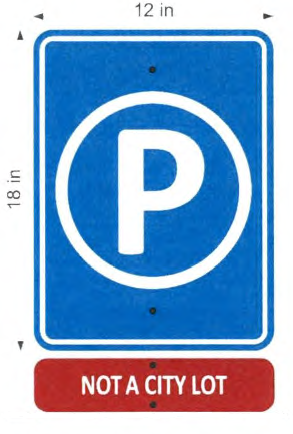
(Ord. No. 03-25, § 3, 2-18-25)
(b)
Rate and operator information. An 18-inch x 24-inch sign containing the information listed below shall be prominently displayed internally to the lot that conforms to the example in Figure 4.3.3(PP)-2, along with an 18-inch x 4-inch sign with a red background and white lettering stating "NOT A CITY LOT." No more than one sign is permitted for every 10 spaces. One additional sign with the full contract and appeal process is allowed per lot. (Ord. No. 03-25, § 3, 2-18-25)
Figure 4.3.3(PP)-2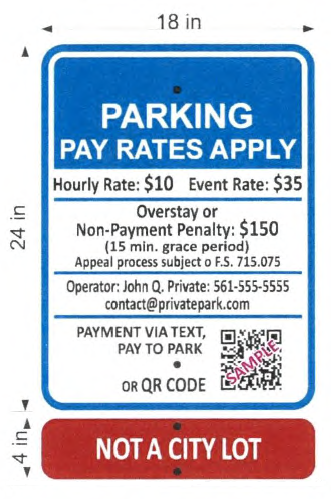
(Ord. No. 03-25, § 3, 2-18-25)
1.
Parking rate, including peak hour or special event parking; (Ord. No. 03-25, § 3, 2-18-25)
2.
Charges for violating the posted regulations; (Ord. No. 03-25, § 3, 2-18-25)
3.
A monitored phone number and email address for the operator and vendor issuing violations, immobilization, or towing of vehicles; (Ord. No. 03-25, § 3, 2-18-25)
4.
Notice of a grace period and appeal process; (Ord. No. 03-25, § 3, 2-18-25)
5.
Language that says the lot is not operated by a government entity; (Ord. No. 03-25, § 3, 2-18-25)
6.
A quick-response code (QR) code, mobile app, or text to payment information may also be provided on this sign; and (Ord. No. 03-25, § 3, 2-18-25)
7.
Payment vendor logos are permitted, but signage must conform with signage requirements. (Ord. No. 03-25, § 3, 2-18-25)
(c)
Payment devices. If a payment kiosk is installed, it must be co-located with the required rate and operator signage and illuminated after dark if the parking facility is open after sunset. (Ord. No. 03-25, § 3, 2-18-25)
(d)
Wheel stops. Wheel stops may be painted with the language "NOT A CITY LOT." (Ord. No. 03-25, § 3, 2-18-25)
(2)
Logos. The private operator may not use the logo of the City of Delray Beach or a logo that resembles it on any signage or printed materials. (Ord. No. 03-25, § 3, 2-18-25)
(3)
Adjacent lots. When adjacent lots are operated by different entities, signage must clearly indicate the spaces associated with each operator. (Ord. No. 03-25, § 3, 2-18-25)
(4)
Site condition requirements. (Ord. No. 03-25, § 3, 2-18-25)
(a)
On-site employees must wear clothing that clearly identifies the parking facility's operator including the company name and/or logo. (Ord. No. 03-25, § 3, 2-18-25)
(b)
Private parking lots and garages must be maintained in a clean condition, and free from hazardous conditions, such as but not limited to broken glass, debris, non-operational lighting, and potholes. (Ord. No. 03-25, § 3, 2-18-25)
(c)
Signage must be maintained free of visible post-production modifications. (Ord. No. 03-25, § 3, 2-18-25)
(5)
Violation/enforcement. (Ord. No. 03-25, § 3, 2-18-25)
(a)
It shall be unlawful to charge a rate or fee higher than the rate published on the posted signage or displayed on pay kiosks. (Ord. No. 03-25, § 3, 2-18-25)
(b)
Any violation of these regulations shall be subject to enforcement in accordance with Section 10.99 of the Code of Ordinances of the City of Delray Beach. (Ord. No. 03-25, § 3, 2-18-25)
(c)
Parking invoices that do not conform to the requirements of Section 715.075, Florida Statutes, shall be grounds for immediate enforcement action in accordance with Section 10.99 of the Code of Ordinances of the City of Delray Beach. (Ord. No. 03-25, § 3, 2-18-25)
(6)
Historic Districts. Parking lot signage in historic districts must maintain the standard blue parking symbol and contrasting "NOT A CITY LOT" signage on a black painted post; post design, sign framing, and font type may be adjusted through the administrative review and approval process for consistency with the character of the district. (Ord. No. 03-25, § 3, 2-18-25)
(Q)
Guest cottage.
(1)
Can only be used by members of the family occupying the principal dwelling, their nonpaying guests, (except in Bed and Breakfast Inns), or persons employed for service on the premises. [Amd. Ord. 11-10 7/20/10]; [Amd. Ord. 56-01 10/16/01]
(2)
The guest cottage shall not occupy more than one-twentieth of the lot area and in no case shall exceed a floor area of 700 square feet. Guest cottages greater than 350 square feet are subject to the standards in Section 4.3.3(QQ)(3). [Amd. Ord. 38-07 2/5/08] (Ord. No. 22-22, § 2, 10-11-22)
(3)
The structure shall be located to observe the setback requirements as imposed for the principal structure.
(4)
When located on individually designated historic properties or within designated historic districts, the structure shall not exceed the height of the principal structure. [Amd. Ord. 38-07 2/5/08]
(5)
Only one guest cottage shall be allowed on a property. [Amd. Ord. 11-10 7/20/10] (Ord. No. 22-22, § 2, 10-11-22)
(QQ)
Accessory structures. To promote aesthetically harmonious neighborhoods, accessory structures in residential zoning districts must comply with the regulations herein. (Ord. No. 22-22, § 2, 10-11-22)
(1)
The height of an accessory structure shall not exceed the height of the principal structure and is not permitted to exceed two stories. Screen enclosures without a solid roof are excluded from this limit. (Ord. No. 22-22, § 2, 10-11-22)
(2)
The floor area of an accessory structure shall not exceed 40 percent of the floor area of the principal structure. (Ord. No. 22-22, § 2, 10-11-22)
(3)
Accessory structures larger than 350 square feet or taller than ten feet are subject to the following standards: (Ord. No. 22-22, § 2, 10-11-22)
(a)
Must be designed with a similar architectural style and be finished with materials similar in appearance to the principal structure. (Ord. No. 22-22, § 2, 10-11-22)
(b)
Must provide foundation landscaping, in accordance with Section 4.6.16, along the entire building frontage, if visible from the right-of-way. (Ord. No. 22-22, § 2, 10-11-22)
(c)
All doors, including garage and overhead doors, must have a decorative appearance consistent with the overall architectural style of the primary residential structure. (Ord. No. 22-22, § 2, 10-11-22)
(d)
Blank walls visible from the right-of-way are prohibited. Fenestration consistent with the design and appearance of the principal structure and/or design treatments such as trellises with climbing vines or other plant materials, or architectural details may be used to avoid the appearance of blank walls. (Ord. No. 22-22, § 2, 10-11-22)
(R)
Keeping of livestock. The keeping, maintaining, or pasturing of horses, cattle, mules, goats, sheep, swine, poultry, or other livestock in the City of Delray Beach is prohibited except on property within the Agricultural (A) and Rural Residential (RR) Zone Districts and then only in compliance with provisions of those regulations.
Notes:
• Subsection (S) Junkyards deleted in its entirety. [Amd. Ord. 59-93 10/12/93]
• Enacted the following new Subsection (S) Telecommunication Towers and Antennas. [Amd. Ord. 21-97 6/3/97]
(RR)
Rooftop uses. (Ord. No. 02-21, § 2, 3-2-21)
(1)
Purpose and intent. These regulations are intended to provide guidance for the use of rooftop terraces in residential and non-residential zoning districts while maintaining building scale, privacy, and character of the surrounding area. The use of rooftops in mixed-use and commercial zoning districts is encouraged to create unique gathering spaces and to support sustainability efforts. (Ord. No. 02-21, § 2, 3-2-21)
(2)
Allowable rooftop uses. (Ord. No. 02-21, § 2, 3-2-21)
(a)
Rooftop uses in all residential zoning districts. Rooftop uses shall not be located higher than 26 feet and shall be limited to open air terraces and amenities that are ancillary or accessory to the principal use, including but not limited to outdoor kitchen areas, swimming pools, and hot tubs. Rooftops located higher than 26 feet shall not have rooftop uses, may only be accessed for maintenance and repair, and shall not provide elevator access. (Ord. No. 02-21, § 2, 3-2-21)
(b)
Rooftop uses in non-residential and mixed-use zoning districts. Central Business District (CBD) rooftop terraces shall be regulated by Section 4.4.13. Rooftops in OSSHAD and RO located higher than 26 feet shall not have principal or accessory rooftop uses, may only be accessed for maintenance and repair, and shall not provide elevator access. For all other nonresidential zoning districts, rooftops may be used for the following uses when allowed in the zoning district, subject to the height limitations in Section 4.3.4(J). (Ord. No. 02-21, § 2, 3-2-21)
1.
Open air terraces. (Ord. No. 02-21, § 2, 3-2-21)
2.
Exercise and fitness activities (both as principal and accessory uses). (Ord. No. 02-21, § 2, 3-2-21)
3.
Swimming pools and hot tubs are only permitted as amenities to hotel, motel, residential-type inn, or residential buildings. (Ord. No. 02-21, § 2, 3-2-21)
4.
Restroom facilities located above the maximum building height subject to approval pursuant to Section 4.3.4(J)(3). (Ord. No. 02-21, § 2, 3-2-21)
5.
Outdoor dining associated with a restaurant. (Ord. No. 02-21, § 2, 3-2-21)
6.
Retail display. (Ord. No. 02-21, § 2, 3-2-21)
7.
Rooftop gardens. (Ord. No. 02-21, § 2, 3-2-21)
8.
Urban agriculture. (Ord. No. 02-21, § 2, 3-2-21)
(3)
General design standards for rooftop uses and terraces. All rooftop uses and terraces shall meet the following: (Ord. No. 02-21, § 2, 3-2-21)
(a)
Features or structures shall not extend beyond the maximum building height, except pursuant to Section 4.3.4(J)(3), "Exceptions to zoning district height", or as specifically increased by the zoning district regulations. (Ord. No. 02-21, § 2, 3-2-21)
(b)
Parking must be provided for principal uses, such as restaurant seating, located on rooftops. Parking is not required for amenities that are ancillary or accessory to the principal use, such as a swimming pool for a condominium. (Ord. No. 02-21, § 2, 3-2-21)
(c)
Rooftop use areas greater than 100 square feet and located below the maximum building height shall landscape a minimum of ten percent of the rooftop use area. Rooftop use areas that are located at the maximum building height shall landscape a minimum of 20 percent. Landscaping shall consist of trees, shrubs, ground cover, and vines. (Ord. No. 02-21, § 2, 3-2-21)
(d)
Rooftop use areas shall be hardscaped with materials that reduce the urban heat island effect such as cool or reflective roofs, patterned concrete, pavers, or wood decking. Open-air shade elements, such as awnings, trellises, and shade sails are allowed up to ten feet in height subject to the setback requirements of the zoning district. (Ord. No. 02-21, § 2, 3-2-21)
(e)
Railings and parapets shall be provided as follows: (Ord. No. 02-21, § 2, 3-2-21)
1.
The full perimeter of rooftop use area shall be surrounded by a parapet or railing at a minimum height of four feet that is consistent with the architectural style. (Ord. No. 02-21, § 2, 3-2-21)
2.
For non-residential rooftop uses adjoining or separated by an alley from OSSHAD, RO, or a residential zoning district, rooftop uses and terraces larger than 100 square feet located at any story or height shall provide privacy and mitigate potential impacts to the adjoining property through at least one of the following: (Ord. No. 02-21, § 2, 3-2-21)
a.
a solid parapet or screening, greater than 75 percent opaque and minimum of six feet in height along the adjoining perimeter; or (Ord. No. 02-21, § 2, 3-2-21)
b.
a setback of at least 20 feet from the property line(s) with a railing or parapet at least four feet in height along the adjoining perimeter. (Ord. No. 02-21, § 2, 3-2-21)
(f)
Restroom facilities allowed to be located above the maximum building height shall be setback an additional ten feet on all sides. (Ord. No. 02-21, § 2, 3-2-21)
(g)
All rooftop lighting shall comply with Section 4.6.8 and shall provide full cutoff luminaries to minimize spillover on adjacent properties. Light poles shall not extend beyond the maximum building height. (Ord. No. 02-21, § 2, 3-2-21)
(h)
Relief to the general design standards for rooftop uses and terraces is subject to review and action by the City Commission through the waiver process per Section 2.4.7(B). (Ord. No. 02-21, § 2, 3-2-21)
(S)
Telecommunication towers and antennas. [Amd. Ord. 21-97 6/3/97]
(1)
Purpose and intent. The regulations and requirements of this section are intended to:
(a)
Promote the health, safety and general welfare of the citizenry;
(b)
Provide for the appropriate location and development of telecommunication towers and antennas within the City;
(c)
Minimize adverse visual impacts of telecommunication towers and antennas through careful design, siting, and screening criteria;
(d)
Avoid potential damage to adjacent properties from tower failure through engineering and careful siting of tower structures; and
(e)
Protect residential areas and land uses from potential adverse impacts of telecommunication towers and antennas by maximizing use of any new or existing telecommunication towers through shared use, i.e., co-location, to reduce the number of towers.
(2)
Freestanding telecommunication towers. Freestanding telecommunication towers are permitted as follows:
(a)
Monopole towers having a maximum height of 64 feet are a permitted use in the following zoning districts:
1.
Planned Commercial (PC)
2.
Planned Commerce Center (PCC)
3.
Mixed Industrial and Commercial District (MIC)
4.
Light Industrial (LI)
5.
Industrial (I)
6.
Open Space and Recreation (OSR)
7.
Community Facilities (CF)
(b)
Monopole towers having a maximum height greater than 64 feet may be permitted as a conditional use in the following zoning districts:
1.
Planned Commerce Center (PCC)
2.
Mixed Industrial and Commercial District (MIC)
3.
Light Industrial (LI)
4.
Industrial (I)
5.
Open Space and Recreation (OSR) (on sites greater than 10 acres in size)
6.
Community Facilities (CF) (on sites greater than 10 acres in size)
(c)
Notwithstanding the above listed requirements, monopole towers greater than 64 feet in height are a permitted use when located on the public properties listed below. Towers that are to be located on these properties are not subject to the minimum separation requirement between towers. Towers shall be located so as to create the least potential visual impact on adjacent rights-of-way and residential areas.
1.
Miller Park, 1905 S.W. 4th Avenue
2.
Delray Beach Municipal Golf Course, 2200 Highland Avenue
3.
Public Works Complex, 434 South Swinton Avenue
4.
South Central Regional Wastewater Treatment Facility, 1801 North Congress Avenue
5.
Lakeview Golf Course [Amd. Ord. 26-08 6/17/08]
6.
Barwick Park [Amd. Ord. 26-08 6/17/08]
(d)
Lattice and guyed towers may be permitted as a conditional use in the following zoning districts:
1.
Community Facilities (CF) (on sites greater than 10 acres in size)
2.
Industrial (I)
(e)
Development standards and criteria.
1.
Height.
a.
Tower height shall not exceed 125 feet unless a waiver is granted pursuant to Subsection 4.3.3(S)(7)
b.
Tower height is to be measured from the crown of the road of the nearest public right-of-way. The measurement of the tower height shall include any apparatus that extends above the tower structure, with the following exceptions:
(1)
Lightning rods, safety lighting, and any other apparatus required by the Federal Aviation Administration (FAA) or the Federal Communications Commission (FCC) to ensure the safe operation of the facility.
(2)
Whip antennas not exceeding 6 inches in diameter may extend 10 feet above the height of the tower structure.
2.
Setbacks.
a.
Towers shall be located a minimum of 50 feet from any existing or proposed public street right-of-way line.
b.
The minimum distance between a monopole tower and the nearest property line of a residential zoning district shall be equal to 200 percent of the height of the tower.
c.
The minimum distance between a lattice or guyed tower and the nearest property line of a residential zoning district shall be equal to 400 percent of the height of the tower.
d.
Monopole, lattice, or guyed telecommunication towers shall not be located within 1,000 feet of any existing monopole, lattice, or guyed telecommunication tower.
e.
Equipment buildings and other structures associated with a telecommunication tower shall conform to the setbacks established for the underlying zoning district.
3.
Buffering Requirements.
a.
An eight foot high fence or wall shall be constructed around the base of a telecommunication tower. The fence or wall shall be screened in accordance with LDR Section 4.6.5.
b.
Accessory equipment and structures shall be screened in accordance with Section 4.6.16.
c.
Landscaping may be required around anchors or supports, as well as around the perimeter of the site on which the tower is located, in order to enhance compatibility with adjacent properties.
4.
High voltage and "no trespassing" warning signs.
a.
If high voltage is necessary for the operation of the telecommunication tower or any accessory structures, "HIGH VOLTAGE - DANGER" warning signs shall be permanently attached to the fence or wall and shall be spaced no more than 40 feet apart.
b.
"NO TRESPASSING" warning signs shall be permanently attached to the fence or wall and shall be spaced no more than 40 feet apart.
c.
The letters for the above described signs shall be at least six inches in height. The two warning signs may be combined into one sign. Warning signs shall be installed at least five feet above the finished grade of the fence.
d.
Where the warning signs could be obscured by landscaping, they may be installed on free standing poles, at least five feet above the finished grade.
5.
Signs and advertising. The use of any portion of a tower for signs or advertising purposes, including company name, banners, streamers, etc. is strictly prohibited.
6.
Color. Except where superseded by the requirements of other county, state, or federal regulatory agencies possessing jurisdiction over telecommunication towers, telecommunication towers shall be constructed in neutral colors, designed to blend into the surrounding environment, such as non-contrasting gray.
7.
Lighting. Artificial tower lighting shall be limited to mandatory safety lighting required by county, state, or federal regulatory agencies possessing jurisdiction over telecommunication towers. Security lighting around the base of a tower may be provided if such lighting conforms with the requirements of Section 4.6.8.
8.
Hazardous materials. Review and approval by the Fire Marshal is required where telecommunication towers are proposed within 200 feet of a proposed or existing principal use which includes the storage, distribution, or sale of volatile, flammable, explosive, or hazardous wastes such as LP gas, propane, gasoline, natural gas, and corrosive or dangerous chemicals, unless such materials are used for backup power purposes.
9.
Equipment storage. Mobile or immobile equipment not used in direct support of a tower facility shall not be stored or parked on the site of the telecommunication tower, unless repairs to the tower are being made.
(f)
Required information. All applications for telecommunication towers shall contain the following information:
1.
Standard application items pursuant to 2.4.3(A).
2.
Site plan showing the location, dimensions, and elevations of the tower and accessory structures.
3.
An aerial photograph produced at a scale of not less than one inch equals 300 feet indicating all residential land uses and all existing telecommunication towers located within 1,500 feet of the proposed tower.
4.
Landscape plan pursuant to Section 4.6.16.
5.
A statement prepared by a professional registered engineer licensed to practice in the State of Florida, which through rational engineering analysis certifies the tower's compliance with applicable standards as set forth in the Standard Building Code, and any associated regulations; and describes the tower's capacity, including an example of the number and type of antennas it can accommodate. For all towers attached to existing structures, the statement shall include certification that the structure can support the load superimposed from the tower.
Deleted number 6. and renumbered. [Amd. Ord. 37-03 10/7/03]
6.
Written approval or a statement of no objection from other federal or state agencies that may regulate telecommunication tower siting, design, and construction. [Amd. Ord. 37-03 10/7/03]
7.
Verification that the facility has been licensed by the Federal Communications Commission (FCC). [Amd. Ord. 37-03 10/7/03]
8.
A certified statement that the construction and placement of the tower will not unnecessarily interfere with public safety communications and the usual and customary transmission or reception of radio and television service enjoyed by adjacent residential and nonresidential properties. A statement shall be prepared by a radio frequency engineer identifying any interference that may result from the proposed construction and placement. [Amd. Ord. 37-03 10/7/03]
9.
A line of sight analysis shall be required to assess the tower's visual impact on residential areas. Such analysis shall include a visual representation of the tower on the site, and an illustration of its impact when viewed from at least three specific points within a 1,000 foot radius of the proposed tower location. The exact location of the points to be included in the analysis shall be coordinated with Planning and Zoning Department staff. [Amd. Ord. 37-03 10/7/03]
(g)
Inspections.
1.
The owner of a telecommunication tower shall have the tower periodically inspected for structural and electrical integrity by an engineer licensed to practice in the State of Florida, in accordance with the following schedule:
(a)
Monopole: at least once every five years.
(b)
Self-support lattice: at least once every two years.
(c)
Guyed: at least once every two years.
2.
Inspections may be required on a more frequent basis if there is reason to believe that the structural or electrical integrity of the tower is jeopardized.
3.
Reports detailing the results of the inspections shall be submitted to the Chief Building Official. Based upon the results of an inspection, the Chief Building Official may require repair or removal of a telecommunication tower.
4.
The City Commission may approve an alternative inspection program when the Chief Building Official has determined that the alternative program is sufficient to ensure the safety of the facility.
5.
The City may conduct its own periodic inspections of a telecommunication tower to ensure its structural or electrical integrity.
(h)
Existing towers.
1.
Notwithstanding the above provisions of this section, whip and panel type telecommunication antennas may be placed on existing towers with sufficient loading capacity after approval by the Chief Building Official. Any other type of antenna requires a modification of the conditional use approval. The loading capacity of a tower shall be certified by an engineer licensed to practice in the State of Florida.
2.
Notwithstanding the provisions of this section, towers in existence as of May 6, 1997, may be replaced with a tower of equal or less visual impact upon approval by the Planning and Zoning Director, provided that the following criteria are met:
a.
The tower meets the minimum requirements of this section; or
b.
The tower received conditional use approval prior to May 6, 1997.
Replacement of existing towers which do not meet the above specified criteria may be approved by the City Commission as a new conditional use.
(i)
Abandoned towers.
1.
A tower shall be considered abandoned if its use for telecommunication service has been discontinued for 180 consecutive days. All abandoned or unused telecommunication tower facilities shall be removed by the tower owner/operator within 90 days of abandonment.
2.
Where a tower is abandoned but not removed within the specified time frame, the City may remove or demolish the tower and place a lien on the property following the procedures (but not the criteria) for demolition of unsafe buildings/structures contained in Article 7.8 of the LDRs, Unsafe Buildings or Structures. Telecommunication towers being utilized for other purposes, including but not limited to light standards and power poles, may be exempt from this provision.
(3)
Antennas not located on telecommunication towers.
(a)
Non stealth and stealth antennas mounted on rooftops, buildings, or other structures which constitute a principal use, are a permitted use in the following zoning districts, subject to the limitations and requirements contained herein:
1.
Medium Density Residential (RM) [Ord. No. 03-15 2/24/15]
2.
General Commercial (GC) [Ord. No. 03-15 2/24/15]
3.
Central Business District (CBD) [Ord. No. 03-15 2/24/15]
4.
Automotive Commercial (AC) [Ord. No. 03-15 2/24/15]
5.
Planned Commercial (PC) [Ord. No. 03-15 2/24/15]
6.
Resort /Tourism (RT) [Ord. No. 03-15 2/24/15]
7.
Planned Office Center (POC) [Ord. No. 03-15 2/24/15]
8.
Professional and Office District (POD) [Ord. No. 03-15 2/24/15]
9.
Planned Commerce Center (PCC) [Ord. No. 03-15 2/24/15]
10.
Mixed Industrial and Commercial (MIC) [Ord. No. 03-15 2/24/15]
11.
Industrial (I) [Ord. No. 03-15 2/24/15]
12.
Light Industrial (LI) [Ord. No. 03-15 2/24/15]
13.
Community Facilities (CF) [Ord. No. 03-15 2/24/15]
14.
Open Space and Recreation (OSR) [Ord. No. 03-15 2/24/15]
(b)
Non-stealth antennas:
1.
Shall only be permitted on buildings or structures which are at least 50 feet tall. Antennas may be placed on buildings or structures less than 50 feet tall in the CF or OSR zoning districts if public safety needs warrant the antenna.
2.
Shall be placed in a manner so as to minimize the visual impact of the antenna on adjacent properties, and shall be of a color which matches the exterior of the building or structure upon which it is situated.
3.
May not extend more than ten feet above the highest point of the roof or structure. Antennas may exceed this maximum height in the CF or OSR zoning districts if public safety needs warrant the antenna.
4.
Shall be accompanied by a statement which demonstrates in a technical manner why a stealth antenna cannot be used for the particular application.
5.
Require approval by the Site Plan Review and Appearance Board.
(c)
Stealth antennas:
1.
May extend up to 20 feet above the highest point of the roof or structure. If a greater height is necessary, the antenna must be approved by the Site Plan Appearance and Review Board.
2.
Requires approval by the Director of Planning and Zoning to ensure that the antenna is consistent with the definition of a stealth facility.
(d)
Requirements and standards:
1.
Each application shall contain a rendering or photograph of the antenna including, but not limited to, colors and screening devices.
2.
No commercial advertising shall be allowed on an antenna or on the screening devices or elements.
3.
The antenna must be in compliance with FAA requirements. No signals, lights, or illumination shall be permitted on an antenna, unless required by the FCC or FAA.
4.
Any related unmanned equipment building shall not contain more than 750 square feet of gross floor area or be more than 12 feet in height; and
5.
If the equipment building is located on the roof of the building, the area of the equipment building shall not occupy more than 25 percent of the roof area.
6.
An antenna proposed for location on a structure or site that is listed on the local or national register of historic places, or is located within a designated historic district, may be denied if the antenna creates an adverse impact on the historic character of the structure, site, or district.
(4)
Co-Location.
(a)
In order to minimize adverse visual impacts associated with a proliferation of towers, co-location of communication antennas by more than one provider on existing or new telecommunication towers shall take precedence over the construction of new single use telecommunication towers. An application for a new tower that is greater than 64 feet in height shall not be approved unless it can be demonstrated by the applicant that there is a need for the new tower which cannot be met by placing the antenna on an existing tower. Accordingly, the following requirements apply to each application for a new telecommunication tower that is greater than 64 feet in height.
1.
All new telecommunication towers shall be constructed so as to have the capacity to permit multiple uses. Monopole towers shall be able to accommodate a minimum of two users, and lattice or guyed towers shall be able to accommodate a minimum of three users.
2.
All applications for new telecommunication towers shall include a written analysis of the feasibility of sharing any existing telecommunication tower located within a half-mile radius of the proposed tower site. The analysis shall consider the following factors:
a.
Availability of existing towers for co-location.
b.
Structural capacity of existing tower or towers.
c.
Geographic service area requirements.
d.
Radio frequency interference.
e.
Mechanical or electrical incompatibility.
f.
Restrictions or limitations of the Federal Communications Commission that would preclude the shared use of the tower.
g.
Any other information that would demonstrate the need for the new tower.
3.
An existing telecommunication tower that is determined to be inappropriate for sharing shall be assumed to be inappropriate for sharing the same types of facilities in the future. Such towers will not need to be evaluated in the future regarding sharing with the same type of facility for which it has been determined to be inappropriate. The Planning and Zoning Department shall retain a list of such towers, and will provide a copy of the list to all potential applicants. The City may require additional sharing feasibility evaluations if warranted by changes in technology.
4.
A requirement to allow co-location will be a condition of approval for all new towers. This requirement will be deemed to have been met if the facility owner shows that it has executed a joint use agreement with at least one other unaffiliated entity for shared use, and agrees to offer the same contract to others. In other cases, the facility owner must provide a statement of intent to offer space on the tower on fair, reasonable, nondiscriminatory terms, at fair market value, and to negotiate leases promptly and without undue delay. A condition of any permit for a new telecommunication tower shall be that the permit shall be terminated, and the facility removed, if the City finds that the facility owner is not complying with its obligations under this section.
5.
For any telecommunication tower approved for shared use, the owner of the tower shall send a written notice to all potential users of the new tower, informing them of the opportunity for co-location, and including information on the tower's location and load capacity. Copies of the notice letters shall be provided to the City at the time that the application is filed. The list of potential users shall be provided by the Planning and Zoning Department.
6.
The City may deny an application if an available co-location is feasible and the application is not for such co-location.
7.
The requirement for a new tower to provide for co-location, and the applicable provisions of this subsection, may be waived pursuant to the requirements and findings stipulated in subsection 4.3.3(S)(7).
(5)
Use of city-owned property for telecommunication facilities.
(a)
No municipally-owned property may be used without a lease agreement with the City. The City shall authorize the application and use of City property after the applicant executes a lease agreement that is acceptable to the City. The City shall have no obligation whatsoever to execute such lease even if the applicant can meet the criteria set forth in this section.
(b)
The City may, as appropriate, to protect its property and the public interest, establish additional requirements beyond the minimum requirements of this section for facilities located on municipally-owned property.
(c)
The City may issue letters of interest for the purposes of leasing sites on designated City property for the construction and installation of personal wireless service facilities. The City will encourage the installation of facilities which have a minimal impact on the surrounding areas and are consistent with the development of the public property on which the facility is located.
(6)
Review and approval process.
(a)
The City shall process all applications for telecommunication towers and antennas in a timely manner and in accordance with established procedures. [Amd. Ord. 37-03 10/7/03]
1.
Application for new tower permits will be processed within 90 business days of receipt of a properly completed application. [Amd. Ord. 37-03 10/7/03]
2.
Applications for co-location permits will be processed within 45 business days of receipt of a properly completed application. [Amd. Ord. 37-03 10/7/03]
3.
The city will notify permit applicants within 20 business days after the date of submission of an application whether the application is for administrative purposes only, properly completed and properly submitted. [Amd. Ord. 37-03 10/7/03]
(b)
A waiver of the time frames set forth above must be voluntarily agreed to by the applicant and the City except in the case of a declared local, state or federal emergency that directly affects the administration of all permitting activities of the City. [Amd. Ord. 37-03 10/7/03]
(c)
The reason for the rejection or denial of any application filed in accordance with the provisions of this section shall be set forth in writing within the above specified time frames. [Amd. Ord. 37-03 10/7/03]
(d)
All conditional uses must be approved pursuant to the provisions of Section 2.4.5(E). In addition to the requirements of that section, the following finding must be made in connection with a conditional use approval for a new communication tower: [Amd. Ord. 37-03 10/7/03]
1.
That the visual impact of the tower has been minimized to the greatest extent possible through careful design, siting, and screening. [Amd. Ord. 37-03 10/7/03]
(7)
Waivers.
(a)
The City Commission may waive the requirements of this section pursuant to the authority granted in Section 2.4.7(B). In addition to the requirements and standards specified in that section, the following findings which are applicable to the nature of the waiver must be made:
1.
Waiver of locational restrictions:
Finding: That approval of the waiver will allow for the construction of a facility at a location that is more appropriate than sites which comply with the zoning and separation requirements, based upon factors such as its distance from residential uses, existence of permanent screening or buffers, and location within a large-scale non-residential area.
2.
Waiver of height restrictions: At least one of the following findings must be made:
a.
That a height greater than 125 feet is necessary to accommodate co-location by another provider, and it has been illustrated through a line of sight analysis that the additional height will not significantly impact residential neighborhoods. Waivers granted pursuant to this provision shall not allow heights in excess of 150 feet.
b.
That a height greater than 125 feet is required to meet public safety needs.
3.
Waiver of Co-Location Requirements:
Finding: That it has been specifically demonstrated through data and analysis that co-location is not feasible because of factors such as site constraints, radio frequency (RF) interference, geographic service area incompatibilities, mechanical or electric incompatibilities, or similar circumstances.
(T)
Family day care home: [Amd. Ord. 25-10 10/19/10]
(1)
Shall only be as an accessory use in a private residence and may function as either for or not for profit
(2)
Is limited to no more than six children at any one time but may be conducted 24 hours a day. [Amd. Ord. 25-10 10/19/10]
(3)
The person furnishing such service shall have a current, valid permit from Palm Beach County for operation of a family day care home, as required by Article II of Chapter 39, Palm Beach County Code; and a City of Delray Beach occupational license as a "Family Day Care Home". [Amd. Ord. 25-10 10/19/10]
(4)
A Family Day Care Home which is registered with the State Department of Health and Rehabilitative Services (HRS) are specifically exempt from having to obtain any special exemption or use permit or pay any special fee in excess of $50 to operate within the City (F.S. 166.0445). [Amd. Ord. 25-10 10/19/10]
(5)
Baby-sitting services provided by an individual at the home of the parents or legal guardians are deemed to be exempt from these provisions.
(TT)
Large family child care home. [New Section Ord. 25-10 10/19/10]
(1)
Requirements: Two full-time child care personnel must be on the premises during the hours of operation.
(a)
One of the full-time child care personnel must be the owner or occupant of the residence.
(b)
Such use must first have operated as a licensed family day care home for two years, with an operator who has had a child development associate credential or its equivalent for one year.
(c)
A large family child care home shall be allowed to provide care for one of the following groups of children which shall include those children under 13 years of age who are related to the caregiver:
(i)
A maximum of eight children from birth to 24 months of age, or;
(ii)
A maximum of 12 children with no more than four children under 24 months of age.
(2)
Floor area: Facilities shall contain a minimum floor area of 35 square feet per child, exclusive of space devoted to bathrooms, halls, kitchen, offices, and storage.
(3)
Outdoor area: There shall be a minimum area of 75 square feet of outdoor play area per child. The play area shall be located on the same lot as the principal use and shall not be located in the front yard setback or adjacent to any outdoor storage area. The play area shall be surrounded by a six-foot high fence or wall.
(4)
Loading area: A pick-up and drop-off area for children shall be provided in a convenient area adjacent to the building and shall provide clear ingress and egress to the building.
(5)
Other regulations: All child care facilities shall comply with state and county regulations.
(U)
Live aboard vessels: Live aboard vessels may be located only at full service marinas which used their facilities for such use as of September 1, 1985. In no event shall dockage at real property improved with a residential dwelling unit or residential dwelling units qualify as a full-service marina. [173.182(K)]
(V)
Uses involving alcoholic beverages: [Amd. Ord. 42-03 11/18/03]
(1)
Defined: For this subsection, alcoholic beverage is defined as:
* Distilled spirits and all beverages containing one-half of one percent or more alcohol by volume. [Amd. Ord. 42-03 11/18/03]
(2)
Prohibitions by frequency: The sale of alcoholic beverages for on-site consumption shall be allowed as a principal use within standalone bars and as an accessory use in chartered private clubs and golf courses with the restriction that: [Amd. Ord. 42-03 11/18/03]
(a)
Not more than one standalone bar shall be located within any one block, nor within 750 feet of another standalone bar measured from lot line to lot line in a straight line. [Amd. Ord. 42-03 11/18/03]
(b)
The above restriction does not apply to a duly licensed grocery store which sells beer and wine in packages for off-site consumption nor does it apply to a restaurant which holds a special restaurant license issued by the Department of Business Regulations of the State Division of Alcoholic Beverages and Tobacco. [Amd. Ord. 42-03 11/18/03]
(c)
To be allowed to begin operating a business as a standalone bar, the following rules shall apply: [Amd. Ord. 22-05 4/19/05]
1.
A written request to establish a standalone bar shall be submitted to the Planning and Zoning Department. Attached to the written request shall be a copy of a valid 4COP License, evidence of an executed lease to operate the business at the proposed location and a copy of an approved site plan for a restaurant or bar use (hereinafter referred to as the submission). The submission shall be date and time stamped by the Planning and Zoning Department. The submission shall be valid for a period of six months. [Amd. Ord. 22-05 4/19/05]
2.
If locational requirements allow for a standalone bar to be established, a person or entity that has filed a submission as set forth above at the earliest time and date will be notified that the use may be established. If the stand alone bar use is not legally established pursuant to LDR Section 2.4.4(D) within 60 days after notification, the person or entity who filed a submission next in time and date shall have an opportunity to establish a standalone bar use. That person or entity and subsequent persons or entities that have a submission on file must also comply with the 60-day establishment requirement. Persons or entities that fail to establish the stand alone bar use in accordance with LDR Section 2.4.4(D) within the 60-day period shall not have any further priority to establish the stand alone bar use and the submission shall be deemed void unless no other persons or entities have filed a submission wherein a longer time to establish the use may be permitted upon request. [Amd. Ord. 22-05 4/19/05]
3.
If for any reason the City is unable to determine who was first in time or unable to determine if the use was legally established and operational within the time permitted, the Planning and Zoning Board shall review all valid submissions on file regardless of time or date of the submission or establishment of the use, based on the required findings of LDR Section 2.4.5(E) and make a recommendation to the City Commission. The City Commission will then determine which standalone bar use is the most compatible with surrounding uses, based on the following: [Amd. Ord. 22-05 4/19/05]
a.
Compliance with code requirements, [Amd. Ord. 22-05 4/19/05]
b.
site's physical appearance, [Amd. Ord. 22-05 4/19/05]
c.
location, [Amd. Ord. 22-05 4/19/05]
d.
consistency with the Comprehensive Plan, and [Amd. Ord. 22-05 4/19/05]
e.
capacity of infrastructure to accommodate the proposed use, [Amd. Ord. 22-05 4/19/05]
f.
whether the stand alone bar will have a deleterious effect on adjacent businesses. [Amd. Ord. 22-05 4/19/05]
The standalone bar use deemed most compatible will then have the right to establish a standalone bar use as a permitted use within 60 days of the decision of the City Commission. [Amd. Ord. 22-05 4/19/05]
4.
No assignment of any submission or rights obtained as a result of a submission to establish a standalone bar use under this section shall be permitted, provided, however, an established standalone bar use may continue to exist at the same location without participating in the process outlined in Subsection (c) for as long as the use is operational. If the stand alone bar use is not operational for a period of 180 days or the business location has been occupied by an intervening use, then the process described in subsection (c) herein shall apply. [Amd. Ord. 22-05 4/19/05]
5.
New letters with attachments set forth above may be submitted once every six months. [Amd. Ord. 22-05 4/19/05]
(3)
Prohibition by proximity (schools and churches): Alcoholic beverages shall not be sold at any establishment which is located within 300 feet of an established school or church.
(a)
With respect to schools, the 300 feet distance shall be measured from the nearest point of the building of the place of business, location, or establishment to the nearest point of the school grounds in use as a part of the school facilities.
(b)
With respect to churches, the 300 feet distance shall be measured from the nearest point of the building of place of business, location, or establishment to the nearest point of the church building or buildings.
(c)
The 300 feet distance shall be measured in a straight line.
(d)
The above restriction does not apply to a duly licensed grocery store which sells beer and wine in packages for off-site consumption nor does it apply to a restaurant which holds a special restaurant license issued by the Department of Business Regulations of the State Division of Alcoholic Beverages and Tobacco.
(4)
Bottle clubs prohibited: Bottle Clubs as defined in Appendix A are prohibited in all zone districts. [Amd. Ord. 42-03 11/18/03]
(VV)
24-Hour or Late Night Businesses: [Amd. Ord. 41-01 8/7/01]
(1)
Purpose and intent: The purpose and intent of the regulations of this section are: [Amd. Ord. 41-01 8/7/01]
(a)
To promote the health, safety and general welfare of the citizenry; [Amd. Ord. 41-01 8/7/01]
(b)
To provide conditions upon the use of 24-Hour or late night businesses in order to minimize impacts upon residentially-zoned properties from such uses. [Amd. Ord. 41-01 8/7/01]
(2)
Requirements: Unless otherwise specified, the following regulations shall apply to 24-Hour or late night businesses: [Amd. Ord. 41-01 8/7/01]
(a)
Conditional use: Any 24-Hour or late night business located or proposed to be located within a 300-foot straight line route from any residentially-zoned property shall obtain a conditional use permit from the City for the operation of such use. The distance shall be measured from the nearest point of the property on which the 24-Hour or late night business is or will be located to the nearest point of a residentially-zoned property. [Amd. Ord. 41-01 8/7/01]
(b)
Conditions: In addition to complying with Section 2.4.5(E) of the Land Development Regulations, all other applicable regulations, and with any conditions imposed through the conditional use process, the following conditions shall apply to all 24-Hour or late night businesses which meet the requirements of subsection (2)(a): [Amd. Ord. 41-01 8/7/01]
1.
Security plan: A 24-Hour or late night business shall submit a security plan detailing the manner in which the business intends to address the security of the establishment, its patrons, employees and nearby residents. A convenience business as defined in Section 812.171, Florida Statutes (2000), as may be amended from time to time, is exempted from filing a security plan with the City pursuant to this subsection. However, convenience businesses shall comply with all applicable provisions of Sections 812.101-812.175, Florida Statutes (2000), as may be amended from time to time. A security plan shall include, at a minimum, a detailed description of the following: [Amd. Ord. 41-01 8/7/01]
a.
external lighting; and, [Amd. Ord. 41-01 8/7/01]
b.
other external security measures, such as security cameras or other similar measures; and, [Amd. Ord. 41-01 8/7/01]
c.
internal security measures, such as drop safes, silent alarms, security personnel or other similar measures. [Amd. Ord. 41-01 8/7/01]
2.
Buffering: A 24-Hour or late night business shall provide adequate buffering to minimize the effects of noise and to act as a visual buffer to the property from nearby residential districts. [Amd. Ord. 41-01 8/7/01]
(c)
Findings: In addition to any findings required by Section 2.4.5(E) of the Land Development Regulations, and any other required findings, the following specific findings shall be made in order for any 24-Hour or late night business to be approved for a conditional use: [Amd. Ord. 41-01 8/7/01]
1.
That the use will be consistent with Housing Element Policy HOU 1.1.12 of the adopted Comprehensive Plan of the City of Delray Beach. [Amd. Ord. 41-01 8/7/01] (Ord. No. 23-20, § 16, 9-10-20)
2.
That the submitted security plan contains measures adequate to reasonably protect the safety of patrons, employees and nearby residents. [Amd. Ord. 41-01 8/7/01]
3.
That the amount and type of proposed buffering is adequate to minimize the effects of noise impacts upon surrounding uses and nearby residential properties and to act as a visual buffer to the property from surrounding uses and nearby residential properties. [Amd. Ord. 41-01 8/7/01]
(3)
Applicability. [Amd. Ord. 41-01 8/7/01]
(a)
The provisions of this section shall not apply to 24-Hour or late night businesses which:
1.
are more than a 300-foot straight line route from any residentially zoned property as determined by the provisions of subsection (2)(a); or, [Amd. Ord. 41-01 8/7/01]
2.
are in operation at the time of the adoption of this ordinance; or, [Amd. Ord. 41-01 8/7/01]
3.
are under construction pursuant to a validly issued building permit at the time of the adoption of this ordinance. [Amd. Ord. 41-01 8/7/01]
(b)
Any 24-Hour or late night business which is in existence at the time of the adoption of this ordinance, which meets the requirements of subsection (2)(a), and which changes its use from one type of 24-Hour or late night business to another type of 24-Hour or late night business (e.g., restaurant to nightclub), shall be required to obtain a conditional use approval pursuant to the provisions of this section. [Amd. Ord. 41-01 8/7/01]
(W)
Domestic animal services. Facilities providing domestic animal services shall obtain a permit issued by Palm Beach County Animal Care and Control Division prior to the establishment of the use and must comply with the following: (Ord. No. 17-21, § 2, 10-19-21)
(1)
Hours of operation are limited to 7:00 a.m. to 8:00 p.m., except for veterinary clinics providing emergency services. (Ord. No. 17-21, § 2, 10-19-21)
(2)
Domestic animal service facilities shall be fully enclosed with solid core doors and walls sufficiently insulated to minimize noise and odor detection from outside the facility. If frequent, habitual, or long continued animal sounds are plainly audible from adjacent properties, the building is not considered sufficiently insulated. (Ord. No. 17-21, § 2, 10-19-21)
(3)
Outside activities and services are limited to drop-off and necessary outdoor walks of animals in direct control of a person by means of a leash or cord. Pursuant to Section 4.6.6, any other outside use requires approval through the conditional use process specifically determining the outside aspects of the use are appropriate. (Ord. No. 17-21, § 2, 10-19-21)
(4)
Pet services that are limited as an accessory use by the zoning district must be accessory to an approved domestic animal service. (Ord. No. 17-21, § 2, 10-19-21)
(5)
On-site disposal of carcasses is prohibited. (Ord. No. 17-21, § 2, 10-19-21)
(6)
Parking Requirements. The minimum number of parking spaces required shall be determined by the gross floor area. Facilities offering a mix of domestic animal services shall provide parking spaces based on the cumulative use designation of each area. (Ord. No. 17-21, § 2, 10-19-21)
(a)
Pet services and veterinary clinics shall provide 4.5 spaces per 1,000 square feet. (Ord. No. 17-21, § 2, 10-19-21)
(b)
Pet hotels and animal shelters shall provide one space per 300 square feet. (Ord. No. 17-21, § 2, 10-19-21)
(c)
Common areas within a facility offering a mix of domestic animal services shall calculate parking spaces based on the use requiring the least amount of parking spaces. (Ord. No. 17-21, § 2, 10-19-21)
(7)
Overnight boarding. Only veterinary clinics, pet hotels, and animal shelters may offer overnight boarding services subject to the following: (Ord. No. 17-21, § 2, 10-19-21)
(a)
An on-site attendant shall be present at all times during boarding services. (Ord. No. 17-21, § 2, 10-19-21)
(b)
Pet hotels and animal shelters shall not be located within a mixed-use building with residential uses. (Ord. No. 17-21, § 2, 10-19-21)
(c)
Emergency Preparedness Plan. Facilities approved for and offering overnight boarding services shall provide an Emergency Preparedness Plan to ensure continued humane care conditions are provided for the animals and their attendants, in case of an emergency, power outage, natural disaster, or other similar event. The plan shall include the following: (Ord. No. 17-21, § 2, 10-19-21)
1.
Description of how the animals in the facility will be accommodated if the main power source is out for more than 12 hours. (Ord. No. 17-21, § 2, 10-19-21)
2.
An auxiliary power generator, either portable or permanent, is required, and shall be designed and equipped to power, at a minimum, the surgery and boarding rooms, for a period of not less than 24 hours. (Ord. No. 17-21, § 2, 10-19-21)
a.
Generators shall not be dependent on a municipal water supply for cooling purposes. (Ord. No. 17-21, § 2, 10-19-21)
b.
Both portable and permanent generators shall be tested on a quarterly basis and a test log shall be maintained for inspection by the City of Delray Beach, upon request. (Ord. No. 17-21, § 2, 10-19-21)
3.
A minimum of one attendant on-site must be able to operate the generators. (Ord. No. 17-21, § 2, 10-19-21)
4.
Veterinary clinics, pet hotels and animal shelters that provide overnight boarding services and were legally established prior to the adoption of Ordinance No. 17-21 shall provide the facility's emergency preparedness plan within two years of the effective date. (Ord. No. 17-21, § 2, 10-19-21)
5.
Businesses that do not provide an on-site or portable auxiliary generator may request relief through the waiver process pursuant to Section 2.4.7(B). (Ord. No. 17-21, § 2, 10-19-21)
(8)
Outside use areas. Domestic animal service facilities may be approved for outside use areas pursuant to Section 4.6.6, subject to the following: (Ord. No. 17-21, § 2, 10-19-21)
(a)
Outdoor cages, crates, kennels, or other enclosures intended for animal habitation, and not for exercise or training purposes, are prohibited. (Ord. No. 17-21, § 2, 10-19-21)
(b)
A solid finished masonry wall or privacy fence six feet in height shall be provided on all sides of outside use areas designated for domestic animal services. (Ord. No. 17-21, § 2, 10-19-21)
(c)
Pervious outside use areas intended for domestic animal services may be counted towards open space requirements. (Ord. No. 17-21, § 2, 10-19-21)
(d)
Outside activities are limited to 7:00 a.m. to 8:00 p.m., except for necessary outdoor walks of one animal at a time in direct control of a person by means of a leash or similar device. (Ord. No. 17-21, § 2, 10-19-21)
(e)
Separation requirements: (Ord. No. 17-21, § 2, 10-19-21)
1.
Properties with outside use areas intended for domestic animal services shall not be located within 300 feet of residentially zoned properties or other properties with outside use areas intended for domestic animal services as measured from lot line to lot line in a straight line. (Ord. No. 17-21, § 2, 10-19-21)
2.
Outside use areas are subject to required minimum building setbacks, which may be increased as part of the conditional use approval. (Ord. No. 17-21, § 2, 10-19-21)
(X)
Residential-type inns: Residential-type inns shall be subject to the following provisions, limitations, and restrictions: [Amd. Ord. 9-98 2/17/98]
(1)
The use must be located with frontage on, or access from, at least one arterial or collector street as delineated on the City's Transportation Element;
(2)
The use must be located in proximity to office, industrial, or commercial uses; [Amd. Ord. 9-98 2/17/98]
(3)
The minimum floor area per suite shall be 450 square feet;
(4)
Accessory uses may include recreational facilities (i.e. swimming pool, whirlpool, jacuzzi, steam room, tennis courts), meeting rooms, complimentary room service, and other non-residential uses as permitted within the respective zoning district. [Amd. Ord. 9-98 2/17/98]
(5)
Parking shall be provided pursuant to Section 4.6.9(C)(7)(e). [Amd. Ord. 9-98 2/17/98]
(Y)
Bed and breakfast inns. In addition to the requirements of the underlying zone district, Section 4.5.1, Historic Preservation Districts and Sites, other applicable general regulations, parking regulations, and special conditions imposed through the conditional use process, the following requirements shall apply to Bed and Breakfast Inns: [Entire Section Revised Ord. 11-10 7/20/10]
(1)
Location. Bed and Breakfast Inns shall only be established as follows:
(a)
Within designated historic buildings, which are located on Individually Designated sites as listed in Section 4.5.1(K) or on those properties classified as "Contributing" within a designated historic district, as listed in Section 4.5.1(L); and which are a permitted or conditional use within the zoning district.
(b)
Not within 300 feet of another Bed and Breakfast Inn, measured lot line to lot line in a straight line, when located within the Medium-Density, Multi-Family (RM) district.
(2)
Parking. Parking for Bed and Breakfast Inns shall be provided as follows:
(a)
Parking shall comply with the requirements in Section 4.6.9.
(b)
One parking space shall be provided for the manager/owner and one parking space shall be provided for each guest room.
(c)
All required parking shall be provided in a manner which will not detract from the character of either the neighborhood or the historic property. No designated parking spaces may be located within the front or side-street setback areas
(d)
Circular driveways, and/or tandem parking spaces with a maximum two car depth are permitted
(e)
No parking may be provided via mechanical lift.
(3)
Common area. Within each Bed and Breakfast Inn, a common area must be provided for a central dining area and for, at least, one reading/discussion/living room.
(4)
Guest rooms.
(a)
There shall be no cooking facilities or food storage facilities in any guest room. Guest rooms do not have to contain bathroom facilities.
(b)
The number of bedrooms provided for guest use shall be as existed when the structure was originally constructed with subsequent additions, unless modifications are necessary to comply with Building, Fire, and/or Health codes. An existing guest cottage, subject to the requirements of Section 4.3.3(Q) may be used as the primary residence of the Property Owner. Historically designated guest cottages may also be used for paying guests.
(5)
Meals. Breakfast shall be the only meal provided for paying guests who are using the facility overnight. The breakfast meal shall not be served after 11:00 a.m.
(6)
Maximum stay. The maximum stay for each guest shall be not more than 14 days during any 30-day period. A guest book which accurately identifies all customers for each night's lodging shall be maintained by the owner and/or manager.
(7)
Employees and personnel. No more than one nonresident may be employed in the management and administration of the facilities on-site. This restriction excludes maintenance and cleaning personnel.
(8)
Property owner. The owner of the Bed and Breakfast Inn property must reside on the property.
(9)
Events. Events and/or private parties shall be limited to the property owner and guests staying at the Bed and Breakfast Inn.
(Z)
Resource recovery or waste management facilities.
(1)
Rule. Pursuant to the Palm Beach County Solid Waste Act (Chapter 75-473, Laws of Florida, as amended) requires that "No person shall operate, maintain, construct, expand, or modify any resource recovery and/or waste management facility without first having applied for and received a valid operating permit from the Solid Waste Authority". Examples of facilities which require such permitting include: landfills, transfer stations, mulching/composting sites, recycling facilities, biohazardous waste treatment facilities, and any facility that stores, processes, treats, incinerates or disposes of solid waste.
(2)
Notification required. Accordingly, as a part of any application, at any step of the land use and/or development approval process, which involves the aforementioned facilities, it shall be required that a letter from the Solid Waste Authority which states its knowledge of the proposed facility shall accompany said application.
(3)
Locations. Such facilities shall be allowed only upon land which is zoned Community Facilities (CF) with an underlying Future Land Use Map designation of Community Facilities. Such facilities shall not be located within Wellfield Protection Zones 1, 2, or 3. [Amd. Ord. 31-97 9/9/97]
(ZB)
Tattooing and tattoo establishments. (Ord. No. 33-16, § 1, 11-15-16)
Purpose: It is the intent of this section to permit Tattooing and Tattoo Establishments, which are expressive activities protected by the U.S. Constitution, pursuant to reasonable time, place, and manner restrictions which are narrowly tailored to protect: the unique character and aesthetic of the City of Delray Beach's award-winning, family-friendly, historic downtown and neighborhoods and renowned beach resort community; property interests and rights; the public health, safety, and welfare; and the administration of local laws.(Ord. No. 33-16, § 1, 11-15-16)
(1)
Tattoo means a mark or design made on or under the skin of a human being by a process of piercing and ingraining a pigment, dye, or ink in the skin.(Ord. No. 33-16, § 1, 11-15-16)
(2)
Tattooing Establishment is any establishment or business engaged in tattooing excluding micropigmentation or permanent cosmetic makeup which is considered a personal service typically provided at a medical office, beauty salon or day spas.(Ord. No. 33-16, § 1, 11-15-16)
(3)
Hours of operation. Tattoo establishments are limited to operating between 8:00 a.m. to 10:00 p.m.(Ord. No. 33-16, § 1, 11-15-16)
(4)
Visibility of tattooing. Tattooing shall not be visible from a public right-of-way public land, public open space or any private property open to the public, including common areas.(Ord. No. 33-16, § 1, 11-15-16)
(5)
Accessory use regulations.(Ord. No. 33-16, § 1, 11-15-16)
(a)
Tattooing shall be permitted as an accessory use within Medical, Professional, and Business Offices pursuant to all other provisions of the LDRs, except where expressly prohibited.(Ord. No. 33-16, § 1, 11-15-16)
(b)
Where a tattoo establishment would otherwise be a permitted principal use but for the prohibition set forth by Section 4.3.3(ZB)(4), tattooing shall be permitted as an accessory use pursuant to all other provisions of the LDRs. For example, tattooing, even as an accessory use shall not occupy "Required Retail Frontage" within any of the CBD Sub-districts.(Ord. No. 33-16, § 1, 11-15-16)
(c)
When permitted as an accessory use, tattooing shall be limited as follows:(Ord. No. 33-16, § 1, 11-15-16)
(i)
Twenty percent or less of GFA of the overall tenant space of the principal use.(Ord. No. 33-16, § 1, 11-15-16)
(ii)
No exterior signage specifically for tattooing or related activities.(Ord. No. 33-16, § 1, 11-15-16)
(6)
Prohibition by frequency. Whether allowed as a principal use, tattoo establishments and/or tattooing shall be located no more than one per block or within 750 feet of another such use, as measured from lot line to lot line in a straight line.(Ord. No. 33-16, § 1, 11-15-16)
(7)
Prohibition by proximity. Tattoo establishments shall not be located within 300 feet of an established school or places of worship.(Ord. No. 33-16, § 1, 11-15-16)
(a)
With respect to schools, the 300 feet distance shall be measured from the nearest point of the building of the place of business, location, or establishment to the nearest point of the school grounds in use as a part of the school facilities.(Ord. No. 33-16, § 1, 11-15-16)
(b)
With respect to churches, the 300 feet distance shall be measured from the nearest point of the building of place of business, location, or establishment to the nearest point of the church building or buildings.(Ord. No. 33-16, § 1, 11-15-16)
(c)
The 300 feet distance shall be measured in a straight line.(Ord. No. 33-16, § 1, 11-15-16)
(ZZ)
Permanently installed generators: The following standards shall apply to all permanently installed generators: [Section Added by Ord. 28-06 5/16/06]
(1)
Generators are prohibited in the front yard and side street setbacks.
(2)
Generators and accessory above ground facilities, such as fuel tanks, are to be screened from view from adjacent properties or rights-of-way by a wall or hedge equal to the height of the generator at the time of installation.
(3)
Generators may be operated for exercising purposes one time per week, excluding Sundays, for a period not exceeding 30 minutes between the hours of 10:00 a.m. to 6:00 p.m.
(4)
A maximum of one generator is allowed per single family, duplex, or townhouse residential dwelling unit except for multiple family, which is allowed one generator per multiple family structure. Non-residential uses are allowed one generator per tenant.
(5)
Generators are setback a minimum of three feet from the side interior property line in the R-1-A, R-1-AB and R-1-AAB Single Family Residential zoning districts, conventionally sited homes in the Planned Residential District, Mobile Home District, and Old School Square Historic Arts District and five feet from the side interior property line (development perimeter for townhouses) in all other zoning districts.
(6)
Generators are setback a minimum of five feet from the rear property line in all zoning districts.
(ZZZ)
Transient residential use: The entire dwelling unit or any part thereof, which is located in Single Family, Rural Residential, or Planned Residential Development Zoning Districts and is operated or used in such a way that any part of the dwelling unit turns over occupancy more often than three times in any one year shall be presumed to be a Transient Residential Use and therefore prohibited. An entire dwelling unit or any part thereof, which is located in Low Density Residential (RL) or Medium Density Residential (RM) Zoning Districts and is operated or used in such a way that any part of the entire dwelling unit turns over occupancy more often than six times in any one year shall be presumed to be a Transient Residential Use and therefore prohibited. [Amd. Ord. 40-12 11/6/12]; [Amd. Ord. 03-12 2/21/12]; [Section Added by Ord. 29-09 7/7/09]
[Deleted (1) and renumbered Ord. 03-12 2/21/12]
(1)
Exceptions/exemptions.
(a)
Existing transient residential uses with a turnover more often than three times per year but not exceeding six times per year in single-family, rural residential, and planned residential development zoning districts may continue until 12 months after the effective date of ordinance 03-12. [Amd. Ord. 40-12 11/6/12]; [Amd. Ord. 03-12 2/21/12]
(b)
The leasing, renting, licensing, subleasing or otherwise allowing in any manner or form the use of a single-family dwelling unit for a Community Residence is exempt. (Ord. No. 25-17, § 7, 7-18-17)
(c)
The real property owners of the dwelling unit and their family are exempt regardless of how much time the owners and family spend at the dwelling unit on a yearly basis. [Amd. Ord. 03-12 2/21/12]
(2)
Waiver for undue economic hardship: In all instances where there is a claim of undue economic hardship, the property owner may be granted a waiver from Section 4.3.3(ZZZ) after submission of waiver request to the City's Community Improvement Director or his/her designee. [Amd. Ord. 40-12 11/6/12]
(a)
All waivers requests shall include the following documentation: [Amd. Ord. 40-12 11/6/12]
1.
The amount paid for the property, the date of purchase, and the party from whom purchased;
2.
The assessed value of the land and improvements thereon, according to the two most recent assessments;
3.
Real estate taxes for the previous two years;
4.
Annual debt service or mortgage payments, if any, for the previous two years;
5.
All appraisals, if any, obtained within the previous two years by the owner or applicant in connection with the purchase, financing, or ownership of the property;
6.
Any listing of the property for sale or rent, price asked, and offers received, if any;
7.
The annual gross income from the property for the previous two years, if any;
8.
The annual cash flow, if any, for the previous two years;
9.
An applicant may submit and the Community Improvement Director or his/her designee may require that an applicant furnish additional information relevant to the determination of any alleged undue economic hardship; and [Amd. Ord. 03-12 2/21/12]
10.
In the event that any of the required information is not reasonably available to the property owner and cannot be obtained by the property owner, the property owner shall file statement of the information which cannot be obtained and the reasons why such information cannot be reasonably obtained. Where such unobtainable information concerns required financial information, the property owner will submit a statement describing estimates which will be as accurate as are feasible.
(b)
Notice of proposed decision. The City's Community Improvement Director, or his/her designee, shall have the authority to consider and act on waivers for undue economic hardship under this section. When a waiver has been requested, the City's Community Improvement Director, or his/her designee, shall issue a written determination within 45 days of the date of receipt of all required documentation and may, (1) grant the waiver request, (2) grant a portion of the request and deny a portion of the request, and/or impose conditions upon the grant of the request, or (3) deny the request. Any such denial shall be in writing and shall state the grounds therefore. All written determinations shall give notice of the right to appeal. The notice of determination shall be sent to the requesting party by certified mail, return receipt requested. If reasonably necessary to reach a determination on the request for reasonable accommodation, the City's Community Improvement Director, or his/her designee, may, prior to the end of said 45-day period, request additional information from the requesting party, specifying in sufficient detail what information is required. The requesting party shall have 15 days after the date of the request for additional information to provide the requested information. In the event a request for additional information is made, the 45-day period to issue a written determination shall no longer be applicable, and the City's Community Improvement Director, or his/her designee, shall issue a written determination within 30 days after receipt of the additional information. If the requesting party fails to provide the requested additional information within said 15-day period, the City's Community Improvement Director, or his/her designee, shall issue a written notice advising that the requesting party had failed to timely submit the additional information and therefore the request for waiver shall be deemed abandoned and/or withdrawn and no further action by the City with regard to said waiver request shall be required. [Amd. Ord. 40-12 11/6/12]
(c)
Appeal. Within 30 days after the Community Improvement Director's, or his/her designee's, determination on a waiver request is mailed to the requesting party, such applicant may appeal the decision. All appeals shall contain a statement containing sufficient detail of the grounds for the appeal. Appeals shall be to the City Commission who shall, after public notice and a public hearing, render a determination as soon as reasonably practicable, but in no event later than 60 days after an appeal has been filed. [Amd. Ord. 40-12 11/6/12]
(3)
Reasonable accommodation. Reasonable Accommodations from this section may be obtained pursuant to LDR Section 2.4.7(G).
(4)
Penalties for violations. The City adopts all enforcement methods, which include, but are not limited to, the issuance of a citation, summons, notice to appear in county court, arrest for violation of municipal ordinances, civil citations, injunction or any other enforcement method authorized by law including penalties as set forth in Section 10.99 of the City's Code of Ordinances. Any property owner that leases, rents, licenses, subleases, or otherwise allows in any manner or form the use of an entire dwelling unit within a single-family, rural residential, or planned residential development zoning district for a period of less than 12 months with a turnover in occupancy of any part of the dwelling unit more often than three times in any one year as well as those entire dwelling units that are located within Low Density Residential (RL) or Medium Density Residential (RM) Zoning Districts with a turnover in occupancy of any part of the dwelling unit more often than six times in any one year shall be in violation of this section. [Amd. Ord. 40-12 11/6/12]; [Amd. Ord. 03-12 2/21/12]
(5)
Severability.
(a)
Generally. If any part, section, subsection, paragraph, subparagraph, sentence, phrase, clause, term, or word of Section 4.3.3(ZZZ) is declared unconstitutional by the valid judgment or decree of any court of competent jurisdiction, the declaration of such unconstitutionality shall not affect the remainder of Section 4.3.3(ZZZ), "Transient Residential Uses".
(b)
If the entire Section 4.3.3(ZZZ) is declared unconstitutional by the valid judgment or decree of any court of competent jurisdiction, the earlier version of this section adopted by the City Commission on July 7, 2009 as Ordinance 29-09 shall be substituted herein and shall be deemed to be in full force and effect. [Amd. Ord. 03-12 2/21/12]
(ZZZZ)
Segway tours and segway sales. Segway Tours and Segway Sales shall mean a business that is approved as a conditional use under Section 4.4.13 (D) which conducts tours on Segways and/or sells Segways. [Section Added by Ord. 04-11 4/5/11]
(1)
"Segway" is used as a generic term and does not refer to a particular manufacturer's product. Segway is defined for these purposes as an electric personal assistive mobility device (EPAMD) as set forth in Appendix "A".
(2)
Special conditions and limitations. The following Special Conditions and Limitations are imposed on Segway tours and sales:
(a)
The applicant for Conditional Use will designate routes for the tours and shall be limited to only routes that are approved.
(b)
No more than nine tours shall be conducted each day.
(c)
All servicing of Segways shall be indoors and not utilize more than 20 percent of the floor area of the premises.
(d)
No Segway sales or tour businesses shall be located within 300 feet of any other Segway sales or tour business, as measured from property line to property line in a straight line.
(e)
Tour guides shall not amplify voice or music while operating tours.
(f)
Pre-tour instructions shall not be conducted on public streets, sidewalks, or between the building and the adjacent street.
(g)
Segway tours shall operate in compliance with the requirements of Chapter 132 of the City of Delray Beach Code of Ordinances.
Sec. 4.3.4. - Base district development standards.
(A)
General. The following standards are provided in order to fulfill those purpose statements found in Section 4.1.1 which pertain to determination and regulation of area, size, bulk, height, and other physical aspects of development. Standards for the following items are applicable to all zoning districts in the manner set forth in Subsection (K). The basis for measurement or calculation of those standards are set forth below as are provisions for exceptions.
(B)
Lot area. The area contained within the perimeter of the lot upon which the use is to be located.
(1)
Said area shall be calculated prior to dedication of additional land for right-of-way purposes or for dedication as a lake management tract. The lot area described in the matrix is the minimum lot area which is required for the establishment of use.
(2)
Notwithstanding the above, the lot area for a duplex which is to be held in separate ownership may be reduced to a minimum of 4,000 square feet per lot when a two hour or more fire rated tenant separation wall becomes the basis for the separation of lots. [Amd. Ord. 23-97 5/20/97]
(3)
Minimum lot areas do not need to be provided for individual ownerships within condominium and townhome developments; or for lots which are platted as tracts for specific purposes other than residential or commercial development.
(C)
Width. The mean horizontal distance between the side lines of a lot measured at right angles to the depth. Other than at this point, the width of a lot may be less than the minimum set forth in the matrix.
(D)
Depth. The distance measured from the midpoint of the front lot line to the midpoint of the opposite rear line of the lot. Other than at this point, the depth of a lot may be less than the minimum set forth in the matrix.
(E)
Front and frontage. [Amd. Ord. 43-98 11/3/98]
(1)
Each lot is required to have frontage.
(2)
On curving streets and cul-de-sacs the frontage may be reduced by 40 percent provided the centerline radius of the street is 100 feet or less. [Amd. Ord. 43-98 11/3/98]
(3)
The front of a lot is the side with frontage on a street. For corner lots, the side having the least street frontage shall be the front for setback purposes. Where a corner lot or through lot has frontage on an arterial or collector street, the front shall be the side with frontage on the arterial or collector. For lots with frontage on both an arterial and a collector, the front shall be the arterial frontage. [Amd. Ord. 43-98 11/3/98]
(4)
Notwithstanding the previous description, if a limited access easement or limited access right-of-way runs the length of the frontage on a street, then the front of the lot shall be on a frontage without such access restrictions. [Amd. Ord. 43-98 11/3/98]
(F)
Floor area.
(1)
In single family detached units and duplex structures, the floor area shall be all enclosed space in the principal structure exclusive of terraces and unroofed areas and 50 percent of the area for attached garages, carports, and screened porches.
(2)
In multiple family structures, the floor area shall be the net living area for each unit within the structure exclusive of balconies, decks, porches, and common areas such as corridors, lobbies, etc.
(G)
Lot coverage. Formerly "ground floor building area", lot coverage is the maximum amount of the lot which may be devoted to coverage by a structure or structures.
(H)
Setbacks.
(1)
General. Setbacks are measured at right angles to the lot line and represent the minimal distance within which a structure may come to said lot line. Setbacks are established for front, interior side, street side, and rear lot lines. Lot lines along rights-of-way are established, for setback purposes, as being for the ultimate right-of-way as required for the minimum section for the class of street or as otherwise required by the Traffic Network as contained in the Transportation Element of the Comprehensive Plan.
(2)
Large lot development. Where structures are established within a development which does not have interior lot lines (apartment complex), building setbacks shall be measured from the right-of-way or easement or other description provided for the interior street system and distance between building requirements as set forth in Section 4.6.2. However, in any event the setback requirements for the district shall be observed around the perimeter of the overall development.
(3)
Zero lot line development.
(a)
A zero lot line development allows the placement of a structure coterminous to a side property line provided the distance between the structure and the structure on the adjacent lot is a minimum of 15 feet. A zero lot line cannot occur adjacent to property which is not a part of a zero lot line development.
(b)
All accessory buildings, structures, or uses attached or unattached to the principal structure shall comply with the applicable setbacks for the zoning district in which the development is located except that attached garages may be placed contiguous to the side property line on which the principal structure is located.
(c)
Roof eaves may project over the zero lot line up to a maximum of 18 inches if adequate gutters are provided to prevent runoff onto the contiguous property and if an appropriate easement is recorded for roof encroachment. Eaves or other overhangs may not project over utility easements.
(4)
Building elements or site improvements allowed in setbacks.[2] The building elements and site improvements identified in Table 4.3.4(A) are allowed in building setbacks, subject to the limitations herein. These limitations apply to both structural and decorative features. When in conflict with the Central Business District (CBD) standards in Section 4.4.13, the CBD standards shall govern. (Ord. No. 13-24, § 3, 7-9-24)
(Ord. No. 13-24, § 3, 7-9-24; Ord. No. 10-25, § 3, 5-20-25)
(5)
Reduction in setbacks for screen enclosures and screen porches. Setbacks may be reduced for screen enclosures in residential zoning districts under the following conditions: [Amd. Ord. 12-91 3/13/91] (Ord. No. 13-24, § 3, 7-9-24; Ord. No. 10-25, § 3, 5-20-25)
(a)
Screen Porches. (Ord. No. 10-25, § 3, 5-20-25)
1.
The minimum rear setback for attached screen porches with a solid roof on residential dwelling units shall be ten feet whenever at least 50 feet of common open area, as defined in subsection (c) below, separates that rear property line from the abutting common open area. (Ord. No. 13-24, § 3, 7-9-24; Ord. No. 10-25, § 3, 5-20-25)
2.
In zero-lot line developments, screen porches with a solid roof may be located on the side of the lot with zero setbacks, provided a solid masonry fire-rated wall is constructed on the property line. (Ord. No. 10-25, § 3, 5-20-25)
(b)
Screen Enclosures. (Ord. No. 10-25, § 3, 5-20-25)
1.
Swimming pool screen enclosures may have a zero rear yard setback whenever at least 50 feet of common open area as defined in Subsection (c) below separates the rear property line from the property line directly across and abutting the common open area. (Ord. No. 13-24, § 3, 7-9-24; Ord. No. 10-25, § 3, 5-20-25)
2.
In zero-lot line developments, screened pool enclosure may extend into the interior side setback areas up to five feet from the property line. (Ord. No. 10-25, § 3, 5-20-25)
(c)
For the purpose of Subsection (5), common open area shall mean any exterior open area clear from the ground upward, such as canals, lakes, golf courses, parks, sidewalks, streets, parking areas, and bicycle paths. If a common open area, such as a golf course, includes buildings or structures utilized in connection therewith, the reduced setback shall still apply if there is a minimum of 50 feet between such buildings and structures, and the property line on which the subject screen porch is to be located. The common open area must either consist of common open space that is owned or leased by the owners of residential units within the subdivision, or be dedicated to the public, or restricted to such open space use by covenants, declarations, easements, or deed restrictions that guarantee the continuity of the common open area. (Ord. No. 13-24, § 3, 7-9-24)
(d)
In the case of a conflict between this subsection and the regulations in an individual residential zoning district, this subsection shall take precedent. (Ord. No. 13-24, § 3, 7-9-24; Ord. No. 10-25, § 3, 5-20-25)
(6)
Special setbacks. Three types of special setbacks are established in order to provide for preservation of area for expansion of roadways and/or streetscape beautification. These are: special building setbacks, special landscape setbacks, and a combination thereof.
(a)
Special building setbacks. Within the following special building setbacks, no structures shall be altered, erected, or reconstructed:
*
Along Ocean Boulevard (State Road A1A), a twenty-foot setback shall be provided from the "Brockway Line," as shown in Plat Book 20, Page 4, Public Records of Palm Beach County, Florida. The "Brockway Line" shall be the "building line" for Lots 1 thru 7 inclusive, Block 1, Ocean Park, as shown in Plat Book 5, Page 15, Public Records of Palm Beach County, Florida.
*
Reserved. [DELETED BY AMD. ORD. 70-95 12/5/95]
*
Within the residential district along the west side of S.W. 8th Avenue, between West Atlantic Avenue and S.W. 1st Street, a 50-foot setback shall be provided from the east property line.
*
Along Lake Ida Road extending from Swinton Avenue westward to Military Trail, a 64-foot setback shall be provided on both sides of the centerline. [Amd. Ord. 64-06 11/21/06]
*
Along George Bush Boulevard, between Swinton Avenue and A-1-A, a 50-foot setback shall be provided on both sides of the centerline.
(b)
Special landscape setbacks. Within the following special landscape setbacks, no structures shall be altered, erected, or reconstructed; nor shall any paving be allowed except for driveways and sidewalks which lead to structures on, or provide access to, the site and then only when generally perpendicular to the frontage. However, waivers may be granted to these restrictions at the time of site plan review in order to accommodate landscape features, decorative walls, meandering sidewalks, and other decorative pedestrian ways.
1.
Along Federal Highway (U.S. Highway 1), including the one way pairs (5 th and 6 th Avenues), extending from the south City limits to S.E. 10 th Street, special landscape areas shall be provided as shown below on both sides of the ultimate right-of-way: [Amd. Ord. 17-99 6/15/99]
* Includes frontage on both Federal Highway and Dixie Highway [Amd. Ord. 17-99 6/15/99]
2.
Along Federal Highway (U.S. Highway 1), including the one-way pairs (5 th and 6 th Avenues), extending from S.E. 10 th Street to the north City limits, but excluding the blocks between S.E. 1 st Street and N.E. 1 st Street, a ten- foot special landscape area shall be provided on both side of the ultimate right-of-way. [Amd. Ord. 17-99 6/15/99]
The special landscape area shall not be required between the front building edge and the ultimate right-of-way where storefronts face the roadway and no parking or vehicular circulation areas are provided between the building and the right-of-way. However, the body acting upon the development application may require that foundation plantings, street trees or other landscape features be installed in front of the building to add interest and provide relief from the building mass. [Amd. Ord. 17-99 6/15/99]
3.
Along West Atlantic Avenue, From I-95 to the Western City Limits, a special landscape area shall be provided on both sides of the ultimate right-of-way. [Amd. Ord. 17-99 6/15/99]
This landscape area shall be the smaller distance of either 30 feet or ten percent of the average depth of the property; however, in no case shall the landscape area be less than ten feet.
4.
Along Linton Boulevard, from A-1-A to the western City limits, a special landscape area shall be provided. This landscape area shall be the smaller distance of either 30 feet or ten percent of the average depth of the property; however, in no case shall the landscape area be less than ten feet: [Amd. Ord. 17-99 6/15/99]
5.
Along Congress Avenue, from the L-38 Canal northward to the L-30 Canal, a special landscape area shall be provided. This landscape area shall be the smaller distance of either 30 feet or ten percent of the average depth of the property; however, in no case shall the landscape area be less than ten feet. [Amd. Ord. 17-99 6/15/99]
6.
Along Military Trail, from the L-38 Canal northward to the L-30 Canal, a special landscape area shall be provided. This landscape area shall be the smaller distance of either 30 feet or ten percent of the average depth of the property; however, in no case shall the landscape area be less than ten feet. [Amd. Ord. 17-99 6/15/99]
(c)
Combination building and landscape setbacks. Within the following special setbacks, no structures shall be altered, erected, or reconstructed. Further, within the first ten feet thereof there shall be no paving except for driveways and sidewalks which lead to structures on, or provide access to, the site and then only when generally perpendicular to the frontage.
* Along South 10th Street and Lowson Boulevard, extending from S.E. 5th Avenue to Military Trail, a 30-foot special combination setback shall be provided. [Amd. Ord. 39-09 9/22/09]
(7)
Reduction along cul-de-sacs: When at least 50 percent of the frontage of a lot is located on a cul-de-sacs, the front building setback may be reduced by five feet. [Amd. Ord. 12-91 3/13/91]
(I)
Density.
(1)
Defined. Density is the calculation of the number of residential dwelling units allowed per gross acre of the land to be developed. The approved density for any project may be less than that defined as the maximum in that a project is reviewed in its totality and, in addition to meeting density requirements, it must comply with all other provisions of these regulations.
(2)
Calculation of unit count. The allowable unit count is determined by the maximum number shown for the base zoning district as reflected in the Matrix [Section 4.3.4(K)]. This number is multiplied times the lot area expressed in acres and rounded to one-hundredth of an acre. When a fraction exists, it shall be rounded down.
(3)
Duplexes.
(a)
A duplex on a single lot is allowed, regardless of the provisions of Subsection (2), provided that the minimum lot size for the zone district is met and provided that the use, a duplex, is allowed.
(b)
On a platted lot, where duplexes are permitted, and where the lot has at least 8,000 square feet, and where there is a two hour or more fire rated tenant separation wall separating the duplex units, each unit together with approximately one-half the lot may be conveyed, providing that each portion of the lot contains no less than 4,000 square feet and the dividing line runs through the separation wall. [Amd. Ord. 23-97 5/20/97]
(J)
Height.
(1)
The height of all structures within the City of Delray Beach shall be measured as the vertical distance from the base building elevation to the highest finished roof surface of a flat roof or to the mean level between tie beams and ridge for gable, hip, or gambrel roofs, except as provided below. The maximum height is established in the Development Standards Matrix for all structures within the respective zone district, except: [Ord. No. 03-15 2/24/15] [Amd. Ord. 2-06 1/17/06] (Ord. No. 02-19, § 2, 4-16-19)
(a)
as provided for in Subsection 4.3.4(J)(3) and (4); and (Ord. No. 02-19, § 2, 4-16-19)
(b)
the CBD zoning district as provided for in Subsection 4.4.13(D)(1)(a). [Ord. No. 03-15 2/24/15] [Amd. Ord. 2-06 1/17/06] (Ord. No. 02-19, § 2, 4-16-19)
(c)
Base building elevation is not used in the calculation of Building Height Plane in Section 4.5.1. (Ord. No. 02-19, § 2, 4-16-19)
(2)
The base building elevation, specifically for the measurement of building height, is defined as the highest point for the following site conditions: (Ord. No. 02-19, § 2, 4-16-19)
(a)
For sites not located within a FEMA designated special flood hazard area (SFHA), the base building elevation shall be a minimum of 18 inches (or less with approval by the City Engineer) and a maximum of 30 inches (which allows for 12 inches of freeboard) above the mean elevation of the crown of the street along the lot frontage or the average of the mean elevation of the crowns of the streets for lots with multiple lot frontages. (Ord. No. 02-19, § 2, 4-16-19)
Base Building Elevation:
Not within a Special Flood Hazard Area (SFHA)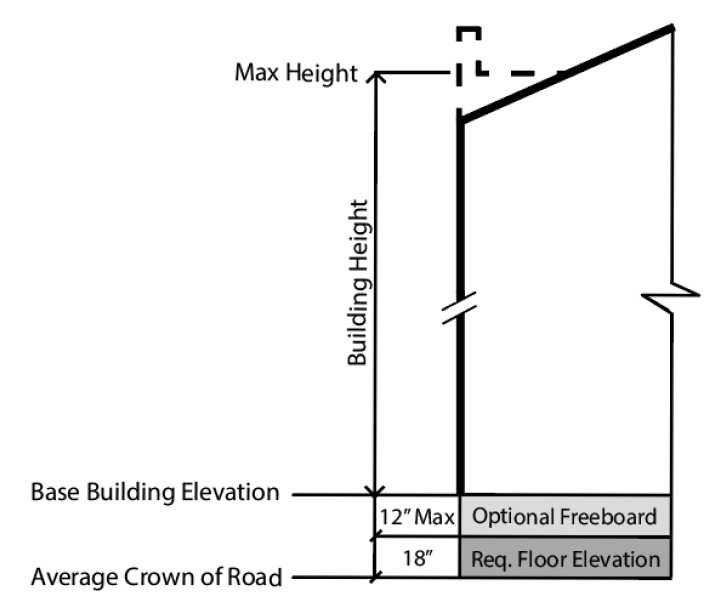
(b)
For sites located within a FEMA designated SFHA, as amended, the base building elevation is established as the higher of the following: (Ord. No. 15-18, § 2, 6-19-18; Ord. No. 02-19, § 2, 4-16-19)
(i)
The minimum required base flood elevation, as required by FEMA and the Florida Building Code (FBC), as amended, and allowing up to 12 inches for freeboard; or, (Ord. No. 15-18, § 2, 6-19-18; Ord. No. 02-19, § 2, 4-16-19)
Base Building Elevation:
Within a Special Flood Hazard Area (SFHA)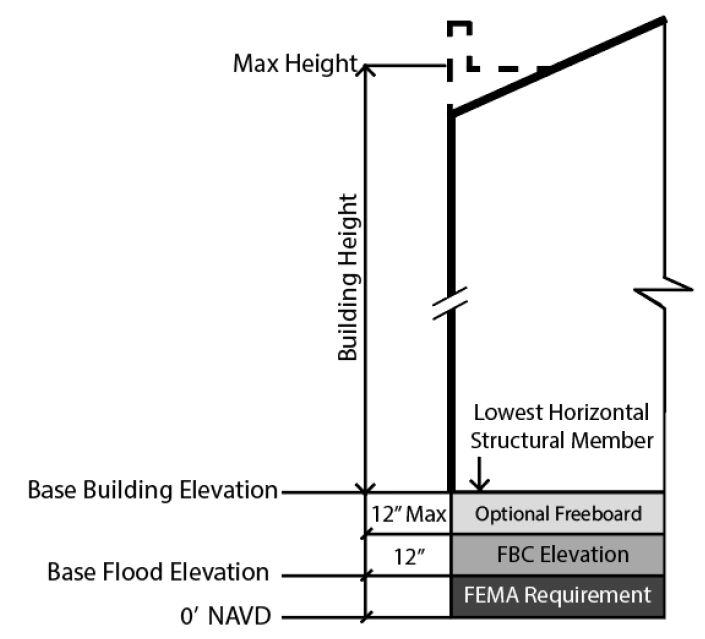
(ii)
The average crest of the dune located within the property limits, measured from north to south on the subject site. Any portion of the structure between the minimum required base flood elevation and the point of the average crest of the dune shall not be included in the height measure of the buildings on the subject site. (Ord. No. 15-18, § 2, 6-19-18; Ord. No. 02-19, § 2, 4-16-19)
(3)
Exceptions to the zoning district height.[3] The height limitations for freestanding and architectural features, rooftop appurtenances, parapets, and certain building structures constructed or placed above the roof are established in Table 4.3.4(J)(3), Height Exceptions, or in the specific zoning district regulations. Table 4.3.4(J)(3) identifies the maximum height and roof area allowed for each type. For the purposes of regulating exceptions to the zoning district height, references to residential zoning districts include the R-1, RO and OSSHAD. References to non-residential zoning districts include all other zoning districts, excluding the CBD pursuant to Section 4.4.13. (Ord. No. 02-21, § 3, 3-2-21)
(a)
Height exceptions allowed. Exception types that are "Allowed" in Table 4.3.4(J)(3) may be approved administratively if not associated with a request that requires board action. Height exception types that are "Allowed" in Table 4.3.4(J)(3) and are associated with a request that requires board action, do not require additional findings by the approving body. (Ord. No. 02-21, § 3, 3-2-21)
(b)
Height exceptions subject to action by the approving body. Exception types that are "Subject to Action by the Approving Body" in Table 4.3.4(J)(3), require board action by the approving body and are subject to the following procedure: (Ord. No. 02-21, § 3, 3-2-21)
1.
Documentation supporting the requested height exception must be provided, such as, but not limited to, massing study, line of sight diagrams, architectural proportion analysis, or roof area calculations, and justification statement addressing the necessity of the request and the criteria for board action in Section 4.6.18(E). (Ord. No. 02-21, § 3, 3-2-21)
2.
The approving body shall make findings that the granting of the height exception meets the standards in Section 4.6.18(E), and Section 4.5.1(E), as applicable. (Ord. No. 02-21, § 3, 3-2-21)
(c)
For detached single family and duplex residences not subject to review by the Historic Preservation Board, height exception requests "Subject to Action by the Approving Body" shall be reviewed by the Site Plan Review and Appearance Board. (Ord. No. 02-21, § 3, 3-2-21)
(d)
Requests that exceed the maximum allowable height or maximum allowable roof area in Table 4.3.4(J)(3) require approval by the City Commission through the waiver process in Section 2.4.7(B) with the additional findings of Sections 4.6.18(E) and 4.5.1(E), as applicable. (Ord. No. 02-21, § 3, 3-2-21)
(Ord. No. 02-21, § 3, 3-2-21)
(4)
Increases to height regulations.
(a)
Prohibitions. There are no provisions which allow, nor is any Board empowered to grant, an increase of height for any purpose in the following zone districts: (Ord. No. 32-23, § 6, 10-17-23)
(b)
Allowances. An increase, to a maximum height of 60 feet, may be approved by the City Commission in any zone district not listed above, except for the CBD zoning district, when approved as part of a site plan, based upon a finding of compliance with the applicable criteria below. [Ord. No. 03-15 2/24/15] [Amd. Ord. 05-13 3/5/13] (Ord. No. 32-23, § 6, 10-17-23)
(i)
The structure must be located in one of the following geographic areas: (Ord. No. 32-23, § 6, 10-17-23)
(1)
Area "A" - all property located east of Congress Avenue and west of I-95.
(2)
Area "B" - the property encompassed by the Delint DRI, with the exception of that portion platted as "Waterford Village"; along with property located west of S.W. 10th Avenue, south of Linton Boulevard, and east of I-95.
(3)
Area "C" - the property encompassed by the boundary of Linton Boulevard, Wallace Drive, S.W. 10th Street, and I-95.
(4)
Area "D" - the properties located south of Atlantic Avenue, north of S.W. 1st Street, west of S.W. 2nd Avenue, and east of S.W. 4th Avenue; and the properties located north of Atlantic Avenue, south of N.W. 1st Street, west of N.W. 1st Avenue, and east of N.W. 3rd Avenue. [Amd. Ord. 21-04 5/4/04]; [Amd. Ord. 71-95 12/5/95]
(5)
Area "E" - the property encompassed on the west by the F.E.C. Railroad, on the east by the Intracoastal Waterway, on the south by Allen Avenue extended to said easterly and westerly boundaries, and on the north to the northernmost boundary of the City.
(6)
Area "F" - the property located between the one-way pair system of Federal Highway (5th and 6th Avenues), except for property located in the CBD zoning district. [Ord. No. 03-15 2/24/15]
(7)
Area "G" - the property on either side of Linton Boulevard, extending 200 feet north and south of its ultimate right-of-way, extending from I-95 to Dixie Highway, and shall also include the Linton Commons Overlay District in its entirety. (Ord. No. 01-21, § 2, 1-19-21)
(8)
Area "H" - the area bounded by Linton Boulevard on the south, the F.E.C. Railroad on the east, the combination of Southridge Road and Swinton Avenue on the north, and S.W. 4th Avenue on the west.
(9)
Area "I" - the property within the Aura Delray Beach Overlay District, located on the west side of North Congress Avenue, north of Atlantic Avenue, east of the E-4 Canal, and south of the Palm Beach County Palm Tran property as depicted on the map in Ordinance No. 31-20. (Ord. No. 31-20, § 2, 9-10-20) (Ord. No. 32-23, § 6, 10-17-23)
(10)
Area "J" - the property encompassed by Lindell Boulevard on the north, Federal Highway on the east, Dixie Highway on the west, and the City limits on the south.
(11)
Area "K" - the property within the project known as Delray Medical Center (Delray Hospital), located on the south side of Linton Boulevard approximately 1,240 feet west of Military Trail, and as annexed into the City of Delray Beach via Ordinance No. 33-05. [Amd. Ord. 05-13 3/5/13] (Ord. No. 32-23, § 6, 10-17-23)
(ii)
The increase in height will not accommodate, an increase in the floor area beyond that which could be accommodated by a development that adheres to a height limitation of 48 feet, except to accommodate residential use on the top floor of the structure. [Amd. Ord. 51-08 11/18/08]; [Amd. Ord. 16-06 4/4/06] (Ord. No. 31-20, § 2, 9-10-20; Ord. No. 32-23, § 6, 10-17-23)
(iii)
Workforce housing units, equal to at least 20 percent of the residential units on the top floor, shall be provided within the development onsite, offsite, or through monetary contributions as referenced in Article 4.7. The workforce housing units shall be at the low or moderate income levels and shall comply with other applicable provisions of Article 4.7 or any workforce housing regulations specified as part of an adopted SAD Ordinance. [Amd. Ord. 51-08 11/18/08] (Ord. No. 31-20, § 2, 9-10-20; Ord. No. 32-23, § 6, 10-17-23)
(iv)
An increase in height shall be allowed if two or more of the following development standards are met: [Amd. Ord. 51-08 11/18/08]; [Amd. Ord. 16-06 4/4/06]; [Amd. Ord. 67-04 1/4/05] (Ord. No. 31-20, § 2, 9-10-20; Ord. No. 32-23, § 6, 10-17-23)
(1)
For each foot in height above 48 feet, an additional building setback of two feet is provided from the building setback lines which would be established for a 48-foot tall structure. The additional setback is required from all setbacks for the portion of the building that extends above 48 feet; [Ord. No. 03-15 2/24/15]; [Amd. Ord. 21-04 5/4/04] (Ord. No. 32-23, § 6, 10-17-23)
(2)
A minimum of 50 percent of the ground floor building frontage consists of nonresidential uses (excluding parking); [Amd. Ord. 67-04 1/04/05] (Ord. No. 32-23, § 6, 10-17-23)
(3)
Open areas, such as courtyards, plazas, and landscaped setbacks, are provided to add visual interest and reduce the building mass. [Amd. Ord. 16-06 4/4/06] (Ord. No. 32-23, § 6, 10-17-23)
(5)
Special Activities Districts. Increases above 60 feet are allowed for special uses within a particular Special Activities District (SAD), provided it is located within one of the geographic areas described above (not including residential, commercial, or industrial uses) that can only be accommodated by the SAD. The height limitations for such a use shall be specifically established in the enacting ordinance of that specific SAD. (Ord. No. 32-23, § 6, 10-17-23)
(K)
Development standards matrix. The following matrices set forth the minimum and maximum development standards for each zoning district subject to descriptions, interpretations, and exceptions as provided for elsewhere in Section 4.3.4.
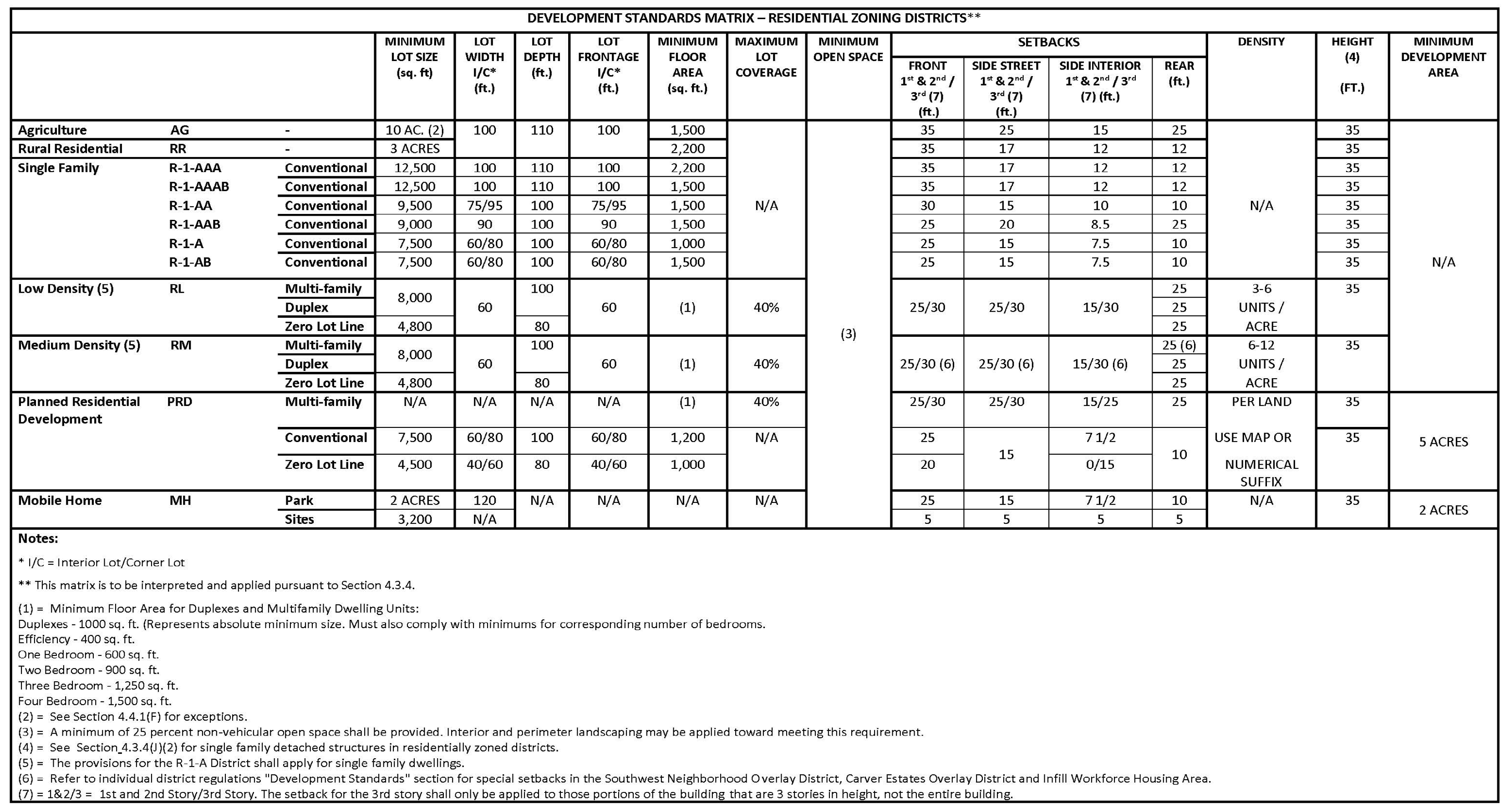
DEVELOPMENT STANDARDS MATRIX—NONRESIDENTIAL ZONING DISTRICTS
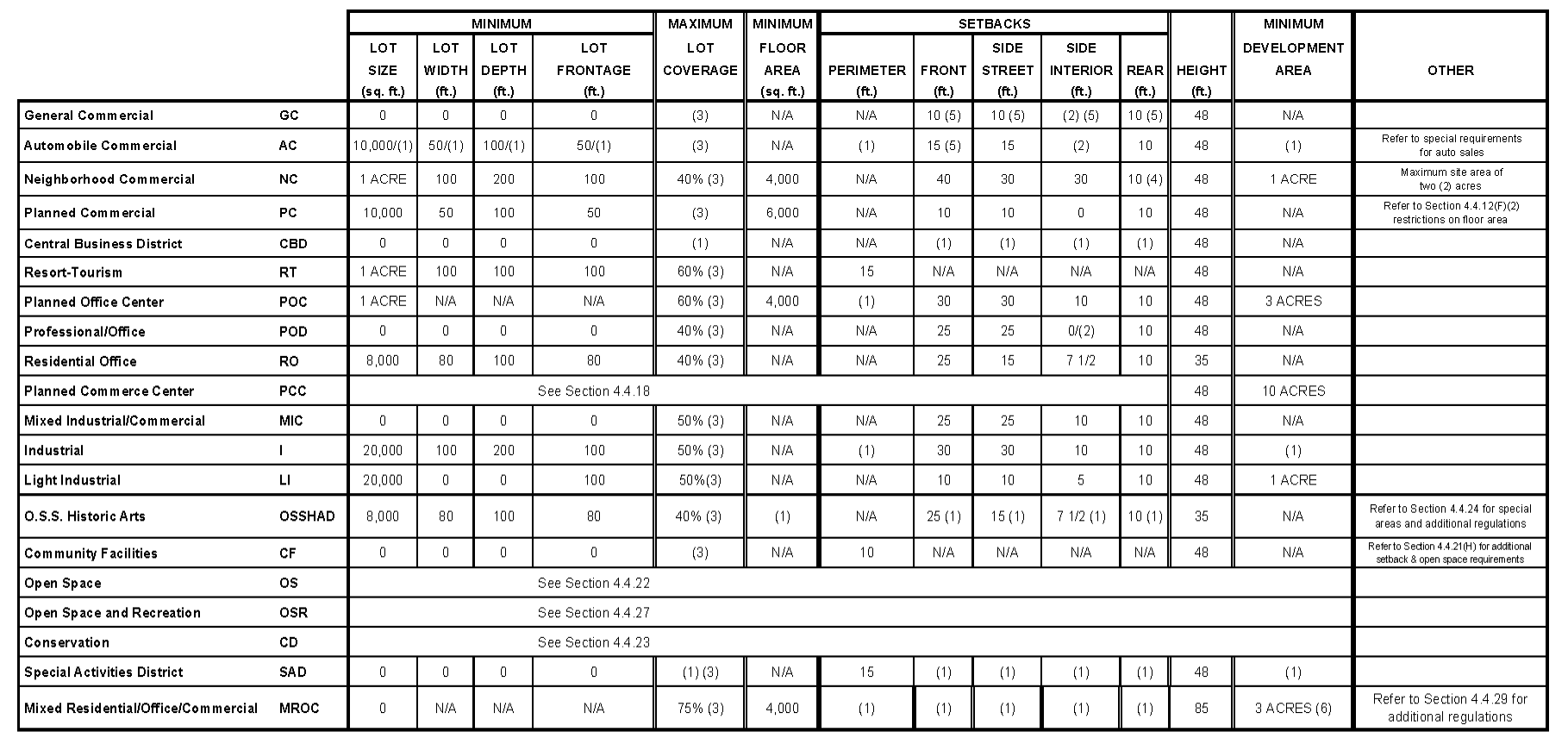
NOTES:
(1) = Refer to individual district regulations.
(2) = When there is no dedicated access to the rear of any structure a ten-foot side yard setback shall be provided.
(3) = In addition to lot coverage restrictions, a minimum of 25-percent non-vehicular open space shall be provided. Interior and perimeter landscaping may be applied toward meeting this requirement.
(4) = Minimum rear yard setback is ten feet and then one additional foot for each foot in building height above ten feet.
(5) = Refer to individual district regulations "Development Standards" section for special setbacks in the North Federal Corridor.
(6) = Waivers to this minimum size may be granted during the Master Plan approval process.
[Ord. No. 03-15 2/24/15] (Ord. No. 25-23, § 3, 7-18-23)
Editor's note— Ord. No. 13-24, § 3, adopted July 9, 2024 amended subsection 4.3.4(H)(4) in its entirety to read as set out herein and as may later be amended.
--- (3) ---
Editor's note— Ord. No. 02-21, § 3, adopted March 2, 2021, repealed subsection 4.3.4(J)(3) and enacted a new subsection 4.3.4(J)(3) as set out herein and later amended. Former subsection 4.3.4(J)(3) pertained to exceptions to district height limitations and derived from Ord. 2-06, adopted January 17, 2006.

