
Delray Beach City Zoning Code
ARTICLE 4
4. - BASE ZONING DISTRICT
NOTE: Each individual zoning district, except Central Business District, is structured as follows. This Article sets forth a description of each of the zoning districts established in Section 4.1.1 by addressing: [Ord. No. 03-15 2/24/15]
(A)
Purpose
(B)
Principal Uses and Structures Permitted
(C)
Accessory Uses and Structures Permitted
(D)
Conditional Uses and Structures Allowed
(E)
Review and Approval Process
(F)
Development Standards by Reference to 4.3.4
(G)
Supplemental District Regulations by Reference to Article 4.6
(H)
Special Regulations, as appropriate
Reference to a zone district by its symbol shall be interpreted to be a reference to its full title i.e., (A) is equivalent to Agriculture Zone District.
Sec. 4.4.1. - Agriculture Zone District (A).
(A)
Purpose and intent. The Agriculture (A) Zone District provides a means to allow existing agricultural uses to continue and be expanded upon as permitted uses within the City; to allow the conduct of other agricultural uses; and to allow for the operation of nurseries and similar open space activities. The (A) designation may also be affixed to properties at the time of annexation in which case, the designation shall serve as a holding zone. Further, land so zoned shall be eligible for an agricultural property tax reduction pursuant to the rules and regulations of the County Tax Assessor.
(B)
Principal uses and structures permitted. The following types of use are allowed within the (A) District as a permitted use:
(1)
The conduct of agricultural operations such as: crop lands, poultry, dairies, grazing lands, flower growing and fruit, citrus, and orchard groves; and structures normally associated there with such as: barns, chicken coops, drying sheds, farmhouses, greenhouses.
(2)
Horse Ranches, Horse Boarding Stables, Riding Stables and Academies; and structures normally associated there with such as: stables and training facilities.
(3)
Single family detached dwellings.
(4)
Family Community Residence, except as required by state law, that (1) is at least 660 linear feet from the closest existing community residence housing four or more individuals as measured from the nearest property line of the proposed community residence to the nearest property line of the existing community residence, and (2) the operator or applicant is licensed or certified by the State of Florida to operate the proposed community residence, has certification from an appropriate national accrediting agency, or has been recognized or sanctioned by Congress to operate the proposed community residence. [Amd. Ord. 23-01 5/1/01] (Ord. No. 25-17, § 8, 7-18-17)
(5)
Public educational facilities of The School District of Palm Beach County, pursuant to the regulations set forth in Section 4.3.3 (HH). [Amd. Ord. 24-02 7/16/02]
(6)
Reserved. [Amd. Ord. 01-10 1/19/10]
(7)
Urban Agriculture pursuant to regulations set forth in Section 4.3.3(D). (Ord. No. 07-17, § 3, 5-16-17)
(C)
Accessory uses and structures permitted. The following uses are allowed when a part of, or accessory to, the principal use:
(1)
A "Farmer's Market" as an outlet for products produced on the property.
(2)
Migrant worker housing for individuals employed on the site and their family
(3)
The keeping of livestock normally associated with a farm such as: cattle, fowl, goats, horses, ponies, sheep.
(4)
Uses and structures normally associated with residences such as: bird aviaries, boat docks, dog houses and dog runs, garages, greenhouses, guest cottages, playhouses, pool houses and covers, pump houses, slat houses, storage sheds, tennis courts, workshops, swimming pools, and home-based businesses. (Ord. No. 23-22, § 3, 8-16-22)
(5)
Urban Agriculture pursuant to regulations set forth in Section 4.3.3(D). (Ord. No. 07-17, § 3, 5-16-17)
(D)
Conditional uses and structures allowed. Except for family and transitional community residences as specified herein, there are no unrelated conditional uses listed based upon the premise that once an agricultural operation ceases, it is more appropriate to have the land rezoned to a district more in keeping with the designation on the Land Use Map. However, nurseries, either retail or wholesale, may be accommodated as a conditional use. (Ord. No. 25-17, § 9, 7-18-17; Ord. No. 23-20, § 17, 9-10-20)
(1)
Family Community Residence, except as required by state law, that (1) is less than 660 linear feet from the closest existing community residence housing four or more individuals as measured from the nearest property line of the proposed community residence to the nearest property line of the closest existing community residence, or (2) the State of Florida does not require the operator or applicant to be licensed or certified to operate the proposed community residence, has no certification from an appropriate national accrediting agency, or has not been recognized or sanctioned by Congress to operate the proposed community residence. (Ord. No. 25-17, § 9, 7-18-17)
(2)
Transitional Community Residence, except as required by state law. (Ord. No. 25-17, § 9, 7-18-17)
(E)
Reserved. (Ord. No. 32-23, § 7, 10-17-23)
(F)
Development standards. The development standards as set forth in Section 4.3.4 shall apply. Except for the following:
(1)
Nurseries duly approved as a conditional use, shall not be subject to a minimum lot size nor to lot dimension requirements;
(2)
When the Agriculture Zone District is used as a "holding zone: upon a annexation, the lot size and dimension requirements shall be as exist upon annexation.
(G)
Supplemental district regulations. The supplemental district regulations as set forth in Article 4.6 shall apply with the exception of those pertaining to parking, loading, and outside storage.
Sec. 4.4.2. - Rural Residential (RR) Zone District.
(A)
Purpose and intent. The Rural Residential (RR) Zone District has been created in order to establish areas throughout the City where large lot and estate development may occur, be promoted, and be preserved and to encourage the preservation of a semi-rural residential character without the maintenance of farm size acreage.
(B)
Principal uses and structures permitted. The following types of use are allowed within the (RR) District as a permitted use:
(1)
Single family detached dwellings.
(2)
Family Community Residence, except as required by state law, that (1) is at least 660 linear feet from the closest existing community residence housing four or more individuals as measured from the nearest property line of the proposed community residence to the nearest property line of the existing community residence, and (2) the operator or applicant is licensed or certified by the State of Florida to operate the proposed community residence, has certification from an appropriate national accrediting agency, or has been recognized or sanctioned by Congress to operate the proposed community residence. [Amd. Ord. 23-01 5/1/01] (Ord. No. 25-17, § 10, 7-18-17)
(3)
Public educational facilities of The School District of Palm Beach County, pursuant to the regulations set forth in Section 4.3.3 (HH).
(4)
Reserved. [Amd. Ord. 01-10 1/19/10]
(5)
Reserved. [Amd. Ord. 10-11 4/5/11]
(C)
Accessory uses and structures permitted. The following uses and structures are allowed when a part of, or accessory to, the principal use: (Ord. No. 22-22, § 3, 10-11-22)
(1)
The keeping of livestock normally associated with a rural environment. However, the keeping of such livestock is for domestic use only; commercial use or sale of such livestock is prohibited. (Ord. No. 22-22, § 3, 10-11-22)
(2)
Uses and structures normally associated with residences, such as bird aviaries, dog houses and dog runs, detached garages, greenhouses, playhouses, pool houses, slat houses, storage sheds, tennis courts, swimming pools, and workshops, subject to Section 4.3.3(QQ). (Ord. No. 23-22, § 4, 8-16-22)
(3)
Urban Agriculture, subject to Section 4.3.3(D). (Ord. No. 07-17, § 4, 5-16-17; Ord. No. 22-22, § 3, 10-11-22)
(4)
Home-based businesses, subject to Section 4.3.3(K). (Ord. No. 22-22, § 3, 10-11-22)
(5)
Boat docks, subject to Article 7.9. (Ord. No. 22-22, § 3, 10-11-22)
(6)
Guest cottages, subject to Section 4.3.3(Q). (Ord. No. 22-22, § 3, 10-11-22)
(D)
Conditional uses and structures allowed. Except for family and transitional community residences as specified here, there are no conditional uses listed based upon the premise that the RR District is to preserve a rural lifestyle and the introduction of other uses within the District is inappropriate to that end. (Ord. No. 25-17, § 11, 7-18-17)
(1)
Family Community Residence, except as required by state law, that (1) is less than 660 linear feet from the closest existing community residence housing four or more individuals as measured from the nearest property line of the proposed community residence to the nearest property line of the closest existing community residence, or (2) the State of Florida does not require the operator or applicant to be licensed or certified to operate the proposed community residence, has no certification from an appropriate national accrediting agency, or has not been recognized or sanctioned by Congress to operate the proposed community residence. (Ord. No. 25-17, § 11, 7-18-17)
(2)
Transitional Community Residence, except as required by state law. (Ord. No. 25-17, § 11, 7-18-17)
(E)
Reserved. (Ord. No. 32-23, § 8, 10-17-23)
(F)
Development standards. The development standards as set forth in Section 4.3.4 shall apply.
(G)
Supplemental district regulations. The supplemental district regulations as set forth in Article 4.6 shall apply.
Sec. 4.4.3. - Single Family Residential (R-1) Districts.
(A)
Purpose and intent. The Single Family Residential Districts have been created to provide areas where the traditional single family detached residence can be established and maintained and be protected from the unwarranted intrusion of other inappropriate uses. Further, the Single Family Residential Districts are established in compliance with provisions of Goal HOU 2 of the Housing Element of the adopted Comprehensive Plan which calls for the preservation and maintenance of stable neighborhoods. The following Single Family Residential Districts are regulated by this Section: [Bullets Changed to Numbers Ord. 36-07 9/18/07] (Ord. No. 23-20, § 18, 9-10-20)
(1)
R-1-AAA
(2)
R-1-AAAB
(3)
R-1-AA
(4)
R-1-AAB
(5)
R-1-A
(6)
R-1-AB
(B)
Principal uses and structures permitted. The following types of use are allowed within the Single Family Districts as a permitted use:
(1)
Conventionally sited single family detached residences.
(2)
Family Community Residence, except as required by state law, that (1) is at least 660 linear feet from the closest existing community residence housing four or more individuals as measured from the nearest property line of the proposed community residence to the nearest property line of the existing community residence, and (2) the operator or applicant is licensed or certified by the State of Florida to operate the proposed community residence, has certification from an appropriate national accrediting agency, or has been recognized or sanctioned by Congress to operate the proposed community residence. [Amd. Ord. 23-01 5/1/01] (Ord. No. 25-17, § 12, 7-18-17)
(3)
Parking lots not associated with a use, pursuant to an adopted neighborhood or redevelopment plan. [Amd. Ord. 8-00 4/4/00]
(4)
Pocket parks. [Amd. Ord. 8-00 4/4/00]
(5)
Public educational facilities of The School District of Palm Beach County, pursuant to the regulations set forth in Section 4.3.3 (HH). [Amd. Ord. 24-02 7/16/02]
(C)
Accessory uses and structures permitted. The following uses and structures are allowed when a part of, or accessory to, the principal use: [Amd. Ord. 68-04 1/4/05] (Ord. No. 22-22, § 4, 10-11-22)
(1)
Uses and structures normally associated with residences, such as bird aviaries, dog houses and dog runs, detached garages, greenhouses, playhouses, pool houses, slat houses, storage sheds, tennis courts, swimming pools, and workshops, subject to Section 4.3.3(QQ). (Ord. No. 22-22, § 4, 10-11-22)
(2)
Home-based businesses subject to the Section 4.3.3(K). [Amd. Ord. 20-95 4/18/95] (Ord. No. 23-22, § 5, 8-16-22)
(3)
Family day care home, subject to Section 4.3.3(T). [Amd. Ord. 25-10 10/19/10] (Ord. No. 22-22, § 4, 10-11-22)
(4)
Recreational facilities attendant to a subdivision which is operated under a homeowners association, such as tennis courts, swimming pools, exercise area, clubhouse, and golf courses. (Ord. No. 23-22, § 5, 8-16-22) (Ord. No. 22-22, § 4, 10-11-22)
(5)
Boat docks, subject to Article 7.9. The rental or lease of a boat dock is allowed when the dock is assigned to, or on the same lot as each residential use on a one-to-one basis. (Ord. No. 23-22, § 5, 8-16-22; Ord. No. 22-22, § 4, 10-11-22)
(6)
Guest cottages, subject to Section 4.3.3(Q). (Ord. No. 22-22, § 4, 10-11-22)
(D)
Conditional uses and structures allowed. The following uses are allowed as conditional uses within the Single Family Districts.
(1)
Child care and adult day care.
(2)
Churches, or places of worship, and their attendant educational, nursery, Sunday school, recreational, and columbarium facilities. The foregoing does not allow establishment of educational and care uses such as elementary school and general day care; however, such uses may be established by a separate conditional use application for child care or rezoning to C.F., as appropriate.
(3)
Private educational facilities subject to the restrictions set forth in Section 4.3.3(HHH). [Amd. Ord. 24-02 7/16/02]; [Amd. Ord. 79-94 10/18/94]
(4)
The use of common recreational facilities such as swimming pools and tennis courts, associated with a subdivision, for club or commercial purposes.
(5)
Single family detached residences in zero lot developments but only in the R-1-A and R-1-AA Districts.
Deleted (6) [Amd. Ord. 02-10 1/19/10]
(6)
Large Family Child Care Home, subject to Section 4.3.3(TT). [Amd. Ord. 25-10 10/19/10]
(7)
Family Community Residence, except as required by state law, that (1) is less than 660 linear feet from the closest existing community residence housing four or more individuals as measured from the nearest property line of the proposed community residence to the nearest property line of the closest existing community residence, or (2) the State of Florida does not require the operator or applicant to be licensed or certified to operate the proposed community residence, has no certification from an appropriate national accrediting agency, or has not been recognized or sanctioned by Congress to operate the proposed community residence.(Ord. No. 25-17, § 13, 7-18-17)
(8)
Transitional Community Residence, except as required by state law. (Ord. No. 25-17, § 13, 7-18-17)
(E)
Reserved. (Ord. No. 32-23, § 9, 10-17-23)
(F)
Development standards. The development standards in Section 4.3.4 shall apply, except as modified below: [Amd. Ord. 68-04 1/4/05] (Ord. No. 32-23, § 9, 10-17-23)
(1)
Properties located east of the Intracoastal Waterway that are not subject to subsection (4) below shall comply with the following regulations: [Amd. Ord. 36-07 9/18/07]; [Amd. Ord. 68-04 1/4/05] (Ord. No. 32-23, § 9, 10-17-23; Ord. No. 08-24, § 3, 3-5-24)
(a)
The maximum floor area ratio for a single family structure is 0.65. (Ord. No. 08-24, § 3, 3-5-24)
(b)
Properties not located within the North Beach/Seagate and Ocean Overlay Districts shall provide the following: (Ord. No. 08-24, § 3, 3-5-24)
1.
A five-foot step-back above the second story and/or at 26 feet of height, whichever is less, on the rear, side street, and side interior building facades. (Ord. No. 08-24, § 3, 3-5-24)
2.
On building facades that exceed 25 feet in length above the first story facing side interior and rear lot lines, at least one horizontal articulation at least two feet in depth for a combined minimum of 20 percent of the length of building elevation(s). (Ord. No. 08-24, § 3, 3-5-24)
(c)
Properties located within the North Beach/Seagate and Ocean Overlay Districts shall comply with the adopted Beach Property Owners Design Manual for the North Beach and Seagate Neighborhoods, including but not limited to, visual compatibility standards relating to limitations on height, width, mass, scale, materials, color, style, form, and square footage. (Ord. No. 08-24, § 3, 3-5-24)
(2)
In addition to the requirements of Section 4.3.4(K), properties located within the Lake Ida Neighborhood Overlay District shall comply with the following regulations: [New Section Amd. Ord. 24-08 6/17/08] (Ord. No. 32-23, § 9, 10-17-23)
(a)
Maximum lot coverage:
1.
Forty percent for one story houses.
2.
Thirty percent for multi-story houses.
(b)
The maximum Floor Area Ratio is .35 for a multi-story house. Property with frontage on Lake Ida are allowed a Floor Area Ratio of .40 for a multi-story house.
(c)
The area of the upper floors shall not be greater than 75 percent of the area of the first floor. Properties with frontage on Lake Ida are allowed to have upper floors with up to 100 percent of the area of the first floor.
(d)
Minimum setback for multi-story homes in the R-1-AA zoning district shall be 25 feet for the front yard and 15 feet for the rear yard.
(e)
Minimum setback for multi-story homes in the R-1-AAA and R-1-AAAB zoning districts shall be 30 feet for the front yard and 17 feet for the rear yard.
(f)
Additional landscaping required for both new multi-story houses or additions to existing multi-story houses shall be as follows:
1.
New houses: landscaping requirements shall be the same as the Beach Districts as provided in the Beach Property Owners Design Manual for the North Beach and Seagate Neighborhoods.
2.
Additions: supplemental landscaping shall be provided along that portion of the house where the new upper floor addition occurs within five feet of the minimum required setback lines. The intent of the requirement is to soften and screen the upper story addition and shall generally consist of additional vertical landscaping which would include 14-foot shade trees or 18-foot Palm trees at spacings determined by the City Landscape Department to be sufficient to meet the intent of this requirement.
(g)
First floor maximum height:
1.
Single-story or first floor limits shall be established by:
a.
Height from finished floor elevation to top of beam (tie or bond) shall not exceed 14 feet.
b.
Any portion exceeding the dimensions described in Section 4.4.3(F)(2)(g)1.a. above shall be considered multi-story structures.
(h)
Upper story height:
1.
Height from finished floor elevation to finished floor elevation or top of beam (tie or bond) shall not exceed 12 feet.
(3)
Carver Square Brownfield Area development standards. The following development standards apply to properties located in the Carver Square Brownfield Area (Resolution No. 20-07 - Carver Square Lots 11-30). [Amd. Ord. 25-09 5/19/09]
(a)
Setbacks.
(1)
Front: 20 feet
(2)
Side (Street): Ten feet
(3)
Side (Interior): Seven and on-half feet
(4)
Rear: Ten feet
(b)
Setbacks for garages, carports and porte-cocheres. Required parking is not allowed in the front or street side setback. Garages, carports and porte-cocheres must have a minimum 20 feet setback when the entrance faces a public street or alley. [Amd. Ord. 25-09 5/19/09]
(c)
Porch encroachments. Front porches may extend five feet into the front or side street setback and cannot be enclosed in any manner. [Amd. Ord. 25-09 5/19/09]
(4)
Historic districts, sites, and buildings. Properties located within a Historic District or Individually Designated Sites, as listed on the Local Register of Historic Places in Section 4.5.1(I), are subject to Section 4.5.1. [Amd. Ord. 01-12 8/21/12] (Ord. No. 32-23, § 9, 10-17-23)
(G)
Supplemental district regulations. The supplemental district regulations in Article 4.6 apply, except as modified below: [Amd. Ord. 68-04 1/4/05] (Ord. No. 32-23, § 9, 10-17-23)
(1)
Within the Carver Square Brownfield Area (Resolution No. 20-07 - Carver Square Lots 11-30), all irrigation must be connected to a City water system and irrigation from a well system is prohibited. [Amd. Ord. 25-09 5/19/09] (Ord. No. 32-23, § 9, 10-17-23)
(H)
Special regulations. Accessory structures are subject to Section 4.3.3(QQ). [Amd. Ord. 77-94 10/18/94] (Ord. No. 22-22, § 4, 10-11-22)
(I)
Construction site conditions/restrictions. Any construction activity, other than construction activity performed by the City or its agents and/or contractors, which requires a permit from the City and which occurs in any of the six single family zoning districts listed under Subsection 4.4.3(A) shall adhere to all rules, regulations, laws, policies of the City and in addition shall adhere to the provisions set forth herein. [Amd. Ord. 30-06 7-11-06]
(1)
Work Hours and the time that supplies/materials may be delivered shall be Monday through Friday from 7:00 a.m. to 6:00 p.m., and Saturday from 8:00 a.m. to 4:00 p.m. [Amd. Ord. 30-06 7-11-06]
(2)
Work is prohibited on Sundays and the following holidays: New Year's Day, Memorial Day, July 4 th , Labor Day, Thanksgiving Day and Christmas Day. [Amd. Ord. 30-06 7-11-06]
(3)
A temporary trailer, building or storage shed shall be allowed on site from the time a permit is issued and until the certificate of occupancy is granted. No more than one of these trailers/structures/sheds shall be allowed on the site at the same time and the size (footprint) of the trailer/structure/shed shall not exceed ten feet by 12 feet. [Amd. Ord. 30-06 7-11-06]
(4)
After submission of a construction permit application, if requested by the City, a silt fence shall be installed around the entire perimeter of the property and maintained in a secure operational manner, however part of the silt fence may be removed for site access. [Amd. Ord. 30-06 7-11-06]
(5)
In the event of tropical storm or hurricane warnings the Applicant/Owner shall empty all dumpsters, remove and/or secure all loose construction debris/materials and port-o-lets, and all roof tiles must be strapped or removed. [Amd. Ord. 30-06 7-11-06]
(6)
Dumpsters shall be provided if the construction debris, and other debris on site, is of such magnitude that the debris cannot be maintained in a safe or orderly manner on site. Dumpsters containing construction debris shall be promptly emptied when full. When full and waiting removal, the Applicant/Owner must cover the dumpster in an appropriate manner to prevent trash from blowing into neighboring property. Construction materials that are to be used on the job site must be stored in an orderly and neat manner or removed. [Amd. Ord. 30-06 7-11-06]
(7)
To the extent feasible, provisions for storm water must be made during construction to ensure that no water flows onto neighboring properties. [Amd. Ord. 30-06 7-11-06]
(8)
Portable toilets are to be placed in as unobtrusive a location as possible, so as not to affect neighboring property, and must be maintained in a neat, clean and sanitary condition. [Amd. Ord. 30-06 7-11-06]
(9)
All construction activity must be confined to the property under construction. [Amd. Ord. 30-06 7-11-06]
(10)
All deliveries to the site shall be placed on the construction site or compound only. Third party deliveries (deliveries by anyone other than the property owner) are prohibited on Sundays and the following holidays: New Year's Day, Memorial Day, July 4th, Labor Day, Thanksgiving Day, and Christmas Day. Deliveries may not be made between the hours of 9:00 p.m. and 6:00 a.m. [Amd. Ord. 30-06 7-11-06] (Ord. No. 20-19, § 2, 9-17-19)
(11)
Streets adjoining the project shall be cleaned of construction debris and other trash and debris and dirt on a daily basis. The Applicant/Owner is responsible for protecting and cleaning City drainage systems of construction dirt and debris, upon request from the City. [Amd. Ord. 30-06 7-11-06] (Ord. No. 20-19, § 2, 9-17-19)
(J)
Violations of Section 4.4.3(I). The City shall have any and all legal remedies available to it to enforce Section 4.4.3(I), including but not limited to, injunctive relief, issuance of a Notice to Appear, issuance of a Code Enforcement Citation, issuance of a Stop Work Order and any other penalty herein provided in the Code of Ordinances and the Land Development Regulations and as set forth in Section 10.99 of the Code of Ordinances. [Amd. Ord. 30-06 7-11-06]
Sec. 4.4.4. - Mobile Home (MH) District.
(A)
Purpose and intent. The Mobile Home (MH) District is provided to make provision for certain existing mobile home parks and subdivisions in the City. The MH District is not intended to be applied to the development of vacant land.
(B)
Principal uses and structures permitted. The following types of use are allowed within the (MH) District as a permitted use:
(1)
Mobile Home Parks which provide the sale or rental of sites for occupancy by mobile homes, wherein the park is operated as a unit.
(2)
The sale, by its owner or licensed dealer, of used mobile homes on sites presently or previously occupied by the owners of such mobile homes.
(3)
Storage or parking of mobile homes on sites preparatory to occupancy or between periods of occupancy.
(4)
Public educational facilities of The School District of Palm Beach County, pursuant to the regulations set forth in Section 4.3.3(HH). [Amd. Ord. 24-02 7/16/02]
(C)
Accessory uses and structures permitted. The following uses are allowed when a part of, or accessory to, the principal use:
(1)
Attached appurtenant and accessory structures such as enclosed porches, screened enclosures, storage closets, and carports.
(2)
Family Day Care pursuant to restrictions set forth in Section 4.3.3(T) (Child care, up to five children).
(3)
Recreational facilities attendant to a mobile home park such as tennis courts, swimming pools, exercise area, clubhouse, and golf courses.
(D)
Conditional uses and structures allowed. There are no conditional uses prescribed in the MH District.
(E)
Reserved. (Ord. No. 32-23, § 10, 10-17-23)
(F)
Development standards. The development standards as set forth in Section 4.3.4 shall apply to individual sites within a Mobile Home Park. The following standards apply to the Park, itself:
(1)
Minimum area of two acres
(2)
Minimum width of 120 feet.
(3)
Setbacks around the perimeter of the Park as follows:
(a)
Front of 25 feet.
(b)
Interior side of seven and one-half feet.
(c)
Street side of 15 feet.
(d)
Rear of ten feet.
(G)
Supplemental district regulations. The supplemental district regulations as set forth in Article 4.6 shall apply.
(H)
Special regulations.
(1)
A mobile home consisting of one or more units designed as a single dwelling shall not be placed on a lot which is less than 3,200 square feet in area and which is not less than 40 feet in average width on sites in being as of November 12, 1985.
(2)
No part of any mobile home, or any addition or appurtenance thereto shall be located within ten feet of any accessory or service building or structure used in connection with a mobile home park.
(3)
Structures of a permanent nature shall not be added or attached to a mobile home, unless such mobile home is placed upon a site conforming to the minimum requirements for a mobile home.
(4)
The combined area of all additions or attachments shall not exceed the gross area of the mobile home itself. Carports are not included in the above limitation, if the width of site is adequate for separation requirements.
Sec. 4.4.5. - Low Density Residential (RL) District.
(A)
Purpose and intent. The Low Density Residential (RL) District provides a residential zoning district with flexible densities having a base of three units per acre and a range to six units per acre. [Amd. Ord. 6-05 3/15/05] (Ord. No. 23-20, § 19, 9-10-20)
(B)
Principal uses and structures permitted. The following types of use are allowed within the (RL) District as a permitted use:
(1)
Single family detached dwellings.
(2)
Duplex structures.
(3)
Multiple family structures.
(4)
Community Residence housing four to ten individuals, except as required by state law, that (1) is at least 660 linear feet from the closest existing community residence housing four or more individuals as measured from the nearest property line of the proposed community residence to the nearest property line of the existing community residence, and (2) the operator or applicant is licensed or certified by the State of Florida to operate the proposed community residence, has certification from an appropriate national accrediting agency, or has been recognized or sanctioned by Congress to operate the proposed community residence. [Amd. Ord. 23-01 5/1/01] (Ord. No. 25-17, § 14, 7-18-17)
(5)
Parking lots not associated with a use, pursuant to an adopted neighborhood or redevelopment plan. [Amd. Ord. 8-00 4/4/00]
(6)
Pocket parks. [Amd. Ord. 8-00 4/4/00]
(7)
Public educational facilities of The School District of Palm Beach County, pursuant to the regulations set forth in Section 4.3.3(HH). [Amd. Ord. 24-02 7/16/02]
(8)
Reserved. [Amd. Ord. 01-10 1/19/10]
(9)
Residential Licensed Service Provider Facilities. [Amd. Ord. 10-11 4/5/11]
(C)
Accessory uses and structures permitted. The following uses and structures are allowed when a part of, or accessory to, the principal use: (Ord. No. 22-22, § 5, 10-11-22)
(1)
Uses and structures normally associated with residences, such as bird aviaries, dog houses and dog runs, detached garages, greenhouses, playhouses, pool houses, slat houses, storage sheds, tennis courts, swimming pools, and workshops, subject to Section 4.3.3(QQ). [Amd. Ord. 77-94 10/18/94] (Ord. No. 23-22, § 6, 8-16-22; Ord. No. 22-22, § 5, 10-11-22)
(2)
Home-based businesses, subject to Section 4.3.3(K). (Ord. No. 22-22, § 5, 10-11-22)
(3)
Family day care home, subject to Section 4.3.3(T). [Amd. Ord. 25-10 10/19/10] (Ord. No. 22-22, § 5, 10-11-22)
(4)
Recreational facilities attendant to a subdivision which is operated under a homeowners association, such as tennis courts, swimming pools, exercise area, clubhouse, and private golf courses. (Ord. No. 23-22, § 6, 8-16-22) (Ord. No. 22-22, § 5, 10-11-22)
(5)
Boat docks, subject to Article 7.9. The rental or lease of a boat dock is allowed when the dock is assigned to, or on the same lot as, each residential use on a one-to-one basis. (Ord. No. 23-22, § 6, 8-16-22; Ord. No. 22-22, § 5, 10-11-22)
(6)
Guest cottages, subject to Section 4.3.3(Q). [Amd. Ord. 77-94 10/18/94] (Ord. No. 23-22, § 6, 8-16-22; Ord. No. 22-22, § 5, 10-11-22)
(7)
Community Gardens, subject to Section 4.3.3(D). [Amd. Ord. 12-11 6/7/11] (Ord. No. 23-22, § 6, 8-16-22; Ord. No. 22-22, § 5, 10-11-22)
(D)
Conditional uses and structures allowed. The following uses are allowed as conditional uses within the RL District.
(1)
Child care and adult day care.
(2)
Churches, or places of worship, and their attendant educational, nursery, Sunday school, recreational, and columbarium facilities. The foregoing does not allow establishment of educational and care uses such as elementary school and general day care; however, such uses may be established by a separate conditional use application for child care or rezoning to C.F. as appropriate.
(3)
Private educational facilities subject to the restrictions set forth in Section 4.3.3(HHH). [Amd. Ord. 24-02 7/16/02]; [Amd. Ord. 79-94 10/18/94]
(4)
The use of common recreational facilities such as swimming pools, tennis courts, and golf courses (associated with a subdivision) for club or commercial purposes.
(5)
Single family detached residences in zero lot developments.
(6)
Community Residence housing four to ten individuals, except as required by state law, that (1) is less than 660 linear feet from the closest existing community residence housing four or more individuals as measured from the nearest property line of the proposed community residence to the nearest property line of the closest existing community residence, or (2) the State of Florida does not require the operator or applicant to be licensed or certified to operate the proposed community residence, has no certification from an appropriate national accrediting agency, or has not been recognized or sanctioned by Congress to operate the proposed community residence. [Amd. Ord. 23-01 5/1/01] (Ord. No. 25-17, § 15, 7-18-17)
(7)
Large Family Child Care Home, subject to Section 4.3.3(TT). [Amd. Ord. 25-10 10/19/10]
(E)
Reserved. (Ord. No. 32-23, § 11, 10-17-23)
(F)
Development standards. The development standards in Section 4.3.4 shall apply, except as modified below. (Ord. No. 08-24, § 4, 3-5-24)
(1)
The development standards for the R-1-A District shall apply for single family detached dwellings. (Ord. No. 08-24, § 4, 3-5-24)
(2)
The development standards in Section 4.3.4 apply to duplex and multi-family development, except as modified herein. (Ord. No. 08-24, § 4, 3-5-24)
(a)
Duplex and multi-family development located east of the Intracoastal waterway that is not subject to subsection (3) below shall comply with the following regulations: (Ord. No. 08-24, § 4, 3-5-24)
(i)
The maximum floor area ratio is as follows: (Ord. No. 08-24, § 4, 3-5-24)
(Ord. No. 08-24, § 4, 3-5-24)
(3)
Properties located within a Historic District or Individually Designated Sites, as listed on the Local Register of Historic Places in Section 4.5.1(I), are subject to the provisions of Section 4.5.1. [Amd. Ord. 01-12 8/21/12] (Ord. No. 08-24, § 4, 3-5-24)
(G)
Supplemental District Regulations: The supplemental district regulations as set forth in Article 4.6 shall apply, except as modified below: [Amd. Ord. 01-12 8/21/12]
(1)
Historic districts, sites, and buildings. Properties located within a Historic District or Individually Designated Sites, as listed on the Local Register of Historic Places in Section 4.5.1(I), shall comply with the Visual Compatibility Standards of Section 4.5.1(E)(7). [Amd. Ord. 01-12 8/21/12]
(H)
Special regulations.
(1)
A minimum density of three units per acre is established for duplex and multiple family housing development within this district. Density may exceed the base of three units per acre only after the approving body makes a finding that the project has substantially complied with performance standards in Section 4.3.3(BB). In no event shall a development's total density exceed six units per acre. [Amd. Ord. 6-05 3/15/05] Ord. No. 22-22, § 6, 10-11-22; Ord. No. 32-23, § 11, 10-17-23)
(2)
The density for a specific RL development in the RL zoning district may be limited by a numerical suffix affixed to the designation and shown on the zoning map (i.e. RL-5 limits the density to five units per acre). To seek a density greater than allowed by the suffix, it is necessary to rezone the property. (Ord. No. 32-23, § 11, 10-17-23)
(3)
For proposals to rezone property to RL with a density suffix, the approving body must make a finding that the proposed density is appropriate based upon the land use map designations of surrounding property as well as the prevailing development pattern of the surrounding area. (Ord. No. 32-23, § 11, 10-17-23)
(4)
Accessory structures are subject to Section 4.3.3(QQ). [Amd. Ord. 77-94 10/18/94] Ord. No. 22-22, § 6, 10-11-22; Ord. No. 32-23, § 11, 10-17-23)
(5)
Recreational areas are required for all new rental apartment developments, and owner occupied developments with homeowner associations are responsible for the maintenance of retention areas, private streets, or common areas. Recreational features should be designed to accommodate activities for children and youth of all ages. Tot lots are appropriate for toddlers; features such as a basketball court, volleyball court, and open playfields are appropriate for older children. A pool and clubhouse, unless specifically designed for children, does not meet this requirement. Projects with fewer than 25 units may be exempted from this standard where it is determined by the approving body that it is not practical or feasible to comply. [Amd. Ord. 6-05 3/15/05] (Ord. No. 22-22, § 6, 10-11-22; Ord. No. 32-23, § 11, 10-17-23)
(I)
Reserved. (Ord. No. 32-23, § 11, 10-17-23)
Sec. 4.4.6. - Medium Density Residential (RM) District.
(A)
Purpose and intent. The Medium Density Residential (RM) District is a residential zoning district with flexible densities having a base of six units per acre and a maximum standard density of 12 units per acre, with a maximum incentive density of 24 units per acre in designated areas, subject to compliance with Article 4.7 and Section 4.3.3(BB). [Amd. Ord. 24-07 8/21/07]; [Amd. Ord. 7-05 2/15/05]; [Amd. Ord. 42-97 10/7/97] (Ord. No. 32-23, § 12, 10-17-23)
(B)
Principal uses and structures permitted. The following types of use are allowed within the (RM) District as a permitted use:
(1)
Single family detached dwellings.
(2)
Duplex structures.
(3)
Multiple family structures.
(4)
An abused spouse residence with 12 or fewer residents.
(5)
Community Residence housing four to ten individuals, except as required by state law, that (1) is at least 660 linear feet from the closest existing community residence housing four or more individuals as measured from the nearest property line of the proposed community residence to the nearest property line of the existing community residence, and (2) the operator or applicant is licensed or certified by the State of Florida to operate the proposed community residence, has certification from an appropriate national accrediting agency, or has been recognized or sanctioned by Congress to operate the proposed community residence. [Amd. Ord. 23-01 5/1/01] (Ord. No. 25-17, § 16, 7-18-17)
(6)
Parking lots not associated with a use, pursuant to an adopted neighborhood or redevelopment plan. [Amd. Ord. 8-00 4/4/00]
(7)
Pocket parks. [Amd. Ord. 8-00 4/4/00]
(8)
Public educational facilities of The School District of Palm Beach County, pursuant to the regulations set forth in Section 4.3.3(HH). [Amd. Ord. 24-02 7/16/02]
(9)
Assisted Living Facilities that do not comport with the definition of "community residence" and Continuing Care Facilities. [Amd. Ord. 20-08 4/15/08] (Ord. No. 25-17, § 16, 7-18-17)
(10)
Nursing Homes within multi-family structures only. [Amd. Ord. 10-11 4/5/11] (Ord. No. 25-17, § 16, 7-18-17)
(C)
Accessory uses and structures permitted. The following uses and structures are allowed when a part of, or accessory to, the principal use: (Ord. No. 22-22, § 6, 10-11-22)
(1)
Uses and structures normally associated with residences, such as bird aviaries, dog houses and dog runs, detached garages, greenhouses, playhouses, pool houses, slat houses, storage sheds, tennis courts, swimming pools, and workshops, subject to Section 4.3.3(QQ). [Amd. Ord. 77-94 10/18/94] (Ord. No. 23-22, § 7, 8-16-22; Ord. No. 22-22, § 6, 10-11-22)
(2)
Home-based businesses, subject to Section 4.3.3(K). (Ord. No. 22-22, § 6, 10-11-22)
(3)
Family day care home pursuant to Section 4.3.3(T). [Amd. Ord. 25-10 10/19/10] (Ord. No. 22-22, § 6, 10-11-22)
(4)
Recreational facilities attendant to a subdivision which is operated under a homeowners association such as tennis courts, swimming pools, exercise area, clubhouse, and private golf courses. (Ord. No. 23-22, § 7, 8-16-22; Ord. No. 22-22, § 6, 10-11-22)
(5)
Boat docks, subject to Article 7.9. The rental or lease of a boat dock is allowed when the dock is assigned to, or on the same lot as, each residential use on a one-to-one basis. (Ord. No. 23-22, § 7, 8-16-22; Ord. No. 22-22, § 6, 10-11-22)
(6)
Guest cottages subject to Section 4.3.3(Q). [Amd. Ord. 77-94 10/18/94] (Ord. No. 23-22, § 7, 8-16-22; Ord. No. 22-22, § 6, 10-11-22)
(7)
Community Gardens, subject to Section 4.3.3(D). [Amd. Ord. 12-11 6/7/11] (Ord. No. 23-22, § 7, 8-16-22; Ord. No. 22-22, § 6, 10-11-22)
(D)
Conditional uses and structures allowed. The following uses are allowed as conditional uses within the RM District.
DELETED NUMBERS AND RENUMBERED. [Amd. Ord. 10-11 4/5/11]; [Amd. Ord. 20-08 4/15/08]
(1)
Child care and adult day care.
(2)
Private educational facilities subject to the restrictions set forth in Section 4.3.3(HHH). [Amd. Ord. 24-02 7/16/02]; [Amd. Ord. 79-94 10/18/94]
(3)
Churches, or places of worship, and their attendant educational, nursery, Sunday school, recreational, and columbarium facilities. The foregoing does not allow establishment of educational and care uses such as elementary school and general day care; however, such uses may be established by a separate conditional use application for child care or rezoning to CF, as appropriate.
(4)
The use of common recreational facilities such as swimming pools, tennis courts, and golf courses (associated with a subdivision) for club or commercial purposes.
(5)
Single family detached residences in zero lot developments.
(6)
Yacht club with facilities.
(7)
Dock master facilities when associated with a multi-family development which has a marina. [Amd. Ord. 23-01 5/1/01]
(8)
Private beach clubs with attendant recreational, dining, and related accessory facilities within one of the following areas: (a) the area lying south of Atlantic Dunes Park and east of State Road A1A, or (b) south of Casurina Road, north of Bucida road, and east of State Road A1A. [Amd. Ord. 62-05 8/16/05]; [Amd. Ord. 17-98 5/5/98]
(9)
Bed and Breakfast Inns, subject to LDR Section 4.3.3(Y). [Amd. Ord. 11-10 7/20/10] (Ord. No. 32-23, § 12, 10-17-23)
(10)
Large Family Child Care Home, subject to Section 4.3.3(TT). [Amd. Ord. 25-10 10/19/10] (Ord. No. 32-23, § 12, 10-17-23)
(11)
Community Residence housing four to ten individuals, except as required by state law, that (1) is less than 660 linear feet from the closest existing community residence housing four or more individuals as measured from the nearest property line of the proposed community residence to the nearest property line of the closest existing community residence, or (2) the State of Florida does not require the operator or applicant to be licensed or certified to operate the proposed community residence, has no certification from an appropriate national accrediting agency, or has not been recognized or sanctioned by Congress to operate the proposed community residence. (Ord. No. 25-17, § 17, 7-18-17; Ord. No. 32-23, § 12, 10-17-23)
(E)
Reserved. (Ord. No. 32-23, § 12, 10-17-23)
(F)
Development standards.
(1)
The R-1-A District regulations apply to single family detached dwellings. (Ord. No. 32-23, § 12, 10-17-23)
(2)
The development standards in Section 4.3.4 apply to duplex and multi-family development, except as modified herein. [Amd. Ord. 7-05 2/15/05] (Ord. No. 32-23, § 12, 10-17-23)
(a)
Southwest Neighborhood, Carver Estates, and the Flo Delray Overlay Districts, and Infill Workforce Housing Area Development Standards. Duplex and multi-family development in the Southwest Neighborhood Overlay District, Carver Estates Overlay District, The Flo Delray Overlay District, and the Infill Workforce Housing Area that are developed pursuant to Article 4.7, "Family/Workforce Housing" shall comply with the following regulations: [Amd. Ord. 17-06 4/4/06]; [Amd. Ord. 20-05 4/19/05]; [Amd. Ord. 7-05 2/15/05] (Ord. No. 32-23, § 12, 10-17-23; Ord. No. 08-24, § 5, 3-5-24; Ord. No. 39-23, § 3, 12-5-23)
1.
Setbacks. [Amd. Ord. 17-06 4/4/06] [Amd. Ord. 7-05 2/15/05] (Ord. No. 08-24, § 5, 3-5-24)
a.
Front: 15 feet. (Ord. No. 32-23, § 12, 10-17-23; Ord. No. 08-24, § 5, 3-5-24)
b.
Side (Street): 15 feet. (Ord. No. 32-23, § 12, 10-17-23; Ord. No. 08-24, § 5, 3-5-24)
c.
Side (Interior): 10 feet (One- and two-story) 15 feet (third story and above). (Ord. No. 32-23, § 12, 10-17-23; Ord. No. 08-24, § 5, 3-5-24)
d.
Rear: Ten feet. (Ord. No. 32-23, § 12, 10-17-23; Ord. No. 08-24, § 5, 3-5-24)
2.
Setbacks for garages, carports and porte-cocheres. Garages, carports and porte-cocheres must have a minimum 20 feet setback when the entrance faces a public street or alley. [Amd. Ord. 7-05 2/15/05] (Ord. No. 08-24, § 5, 3-5-24)
3.
Porch encroachments. Front porches may extend five feet into the front or side street setback and cannot occupy more than 50 feet of the building frontage and cannot be enclosed in any manner. [Amd. Ord. 7-05 2/15/05] (Ord. No. 08-24, § 5, 3-5-24)
(b)
Duplex and multi-family development located east of the Intracoastal Waterway that is not subject to subsection (3) below shall comply with the following regulations: (Ord. No. 08-24, § 5, 3-5-24)
1.
The maximum floor area ratio is dictated by lot size, as follows:
(Ord. No. 08-24, § 5, 3-5-24)
2.
A five-foot step-back must be provided above the second story and/or 26 feet of height, whichever is less, on the rear, side street, and side interior elevations. (Ord. No. 08-24, § 5, 3-5-24)
3.
Building facades that exceed 25 feet in lengh above the first story facing side interior and rear lot lines shall provide at least one horizontal articulation at least two feet in depth for a combined minimum of 20 percent of the length of building elevation(s). (Ord. No. 08-24, § 5, 3-5-24)
(3)
Historic districts, sites, and buildings. Properties located within a Historic District or Individually Designated Sites, as listed on the Local Register of Historic Places in Section 4.5.1(I), are subject to Section 4.5.1. [Amd. Ord. 01-12 8/21/12] (Ord. No. 32-23, § 12, 10-17-23; Ord. No. 08-24, § 5, 3-5-24)
(G)
Supplemental district regulations. In addition to the supplemental district regulations in Article 4.6, the following supplemental regulations also apply in the RM zoning district. [Amd. Ord. 7-05 2/15/05] (Ord. No. 32-23, § 12, 10-17-23)
(1)
Southwest Neighborhood, Carver Estates, and Flo Delray Overlay Districts and Infill Workforce Housing Area. The following supplemental district regulations shall apply to duplex and multi-family development in the Southwest Neighborhood Overlay District, Carver Estates Overlay District, Flo Delray Overlay District, and the Infill Workforce Housing Area, that are developed pursuant to Article 4.7, "Family/Workforce Housing". [Amd. Ord. 17-06 4/4/06]; [Amd. Ord. 20-05 4/19/05]; [Amd. Ord. 7-05 2/15/05] (Ord. No. 32-23, § 12, 10-17-23; Ord. No. 39-23, § 3, 12-5-23)
(a)
Street-facing garages and parking is discouraged. Parking shall only be allowed in the front yard if there is no dedicated access to the side or rear of the property. [Amd. Ord. 7-05 2/15/05] (Ord. No. 32-23, § 12, 10-17-23)
(b)
When garages are provided in the side or rear of the property, on-street parking must be provided. [Amd. Ord. 7-05 2/15/05] (Ord. No. 32-23, § 12, 10-17-23)
(H)
Special regulations.
(1)
Density may exceed the base of six units per acre only after the approving body makes a finding that the project has substantially complied with the performance standards in Section 4.3.3(BB), which are intended to mitigate the impacts of the increased density and ensure that the project is compatible with surrounding land uses. In no event shall a development's total density exceed 12 units per acre, except within the following incentive areas:[Amd. Ord. 26-11 9/20/11]; [Amd. Ord. 17-06 4/4/06]; [Amd. Ord. 7-05 2/15/05]; [Amd. Ord 42-97 10/7/97]; [Amd. Ord. 40-93 6/22/93] (Ord. No. 22-22, § 6, 10-11-22; Ord. No. 32-23, § 12, 10-17-23)
(a)
Southwest Neighborhood Overlay District: Up to 24 dwelling units per acre are allowed within the Southwest Neighborhood Overlay District, defined in Section 4.5.9, subject to compliance with Article 4.7. (Ord. No. 32-23, § 12, 10-17-23)
(b)
Carver Estates Overlay District: Up to 24 dwelling units per acre are allowed within the Carver Estates Overlay District, defined in Section 4.5.11, subject to compliance with Article 4.7. (Ord. No. 32-23, § 12, 10-17-23)
(c)
Infill Workforce Housing Area: Within the Infill Workforce Housing Area defined in Section 4.5.12, up to 18 dwelling units per acre are allowed, subject to compliance with Article 4.7. (Ord. No. 32-23, § 12, 10-17-23)
(d)
S.W. 10thStreet Overlay District: Within the S.W. 10 th Street Overlay District defined in Section 4.5.10, up to 24 dwelling units per acre are allowed, subject to compliance with Article 4.7. (Ord. No. 32-23, § 12, 10-17-23)
(e)
The Flo Delray Overlay District: Within the Flo Delray Overlay District defined in Section 4.5.22, up to 24 dwelling units per acre are allowed, subject to compliance with Article 4.7. (Ord. No. 39-23, § 3, 12-5-23)
(2)
The density for a specific RM development may be limited by a numerical suffix affixed to the designation and shown on the zoning map (i.e. RM-8 limits the density to eight units per acre). To seek a density greater than allowed by the suffix, it is necessary to rezone the property.[Amd. Ord. 26-11 9/20/11]; [Amd. Ord. 17-06 4/4/06]; [Amd. Ord. 7-05 2/15/05]; [Amd. Ord 42-97 10/7/97]; [Amd. Ord. 40-93 6/22/93] (Ord. No. 22-22, § 6, 10-11-22; Ord. No. 32-23, § 12, 10-17-23)
(3)
For proposals to rezone property to RM with a density suffix, the approving body must make a finding that the proposed density is appropriate based upon the land use map designations of surrounding property as well as the prevailing development pattern of the surrounding area. (Ord. No. 32-23, § 12, 10-17-23)
(4)
Accessory structures are subject to Section 4.3.3(QQ). (Ord. No. 22-22, § 6, 10-11-22)
(5)
Recreational areas are required for all new rental apartment developments, and owner occupied developments with homeowner associations are responsible for the maintenance of retention areas, private streets, or common areas. Recreational features should be designed to accommodate activities for children and youth of all ages. Tot lots are appropriate for toddlers; features such as a basketball court, volleyball court, and open playfields are appropriate for older children. A pool and clubhouse, unless specifically designed for children, does not meet this requirement. Projects with fewer than 25 units may be exempted from this standard where it is determined by the approving body that it is not practical or feasible to comply. [Amd. Ord 42-97 10/7/97] (Ord. No. 22-22, § 6, 10-11-22; Ord. No. 32-23, § 12, 10-17-23)
(I)
Reserved. (Ord. No. 32-23, § 12, 10-17-23)
Sec. 4.4.7. - Planned Residential Development (PRD) District.
(A)
Purpose and intent. The Planned Residential (PRD) District provides a residential zoning district with flexible densities in which multiple family and single family detached dwellings are designed together so as to: promote improved design, character, and quality of development; to preserve natural, scenic, and open space features of a site; and to accommodate flexibility in design. Further, the PRD provides for implementation of the adopted Comprehensive Plan and, more specifically Policy HOU 3.1.2 and Policy HOU 4.1.5 of the Housing Element, which calls for the provision of a variety of housing types, and Objective NDC 1.2 and Policy NDC 1.2.3 of the Neighborhoods, Districts, and Corridors Element, which calls for the provision of planned residential development with single-family residential housing or residential uses with a mix of housing types. (Ord. No. 23-20, § 20, 9-10-20)
(B)
Principal uses and structures permitted. The following types of use are allowed within the (PRD) District as a permitted use:
(1)
Single family detached dwellings whether conventional or zero lot line design.
(2)
Duplex structures.
(3)
Multiple Family structures.
(4)
Public educational facilities of The School District of Palm Beach County, pursuant to the regulations set forth in Section 4.3.3(HH). [Amd. Ord. 24-02 7/16/02]
(5)
Family Community Residence, except as required by state law, that (1) is at least 660 linear feet from the closest existing community residence housing four or more individuals as measured from the nearest property line of the proposed community residence to the nearest property line of the existing community residence, and (2) the operator or applicant is licensed or certified by the State of Florida to operate the proposed community residence, has certification from an appropriate national accrediting agency, or has been recognized or sanctioned by Congress to operate the proposed community residence. (Ord. No. 25-17, § 18, 7-18-17)
(C)
Accessory uses and structures permitted. The following uses and structures are allowed when a part of, or accessory to, the principal use: (Ord. No. 22-22, § 7, 10-11-22)
(1)
Uses and structures normally associated with residences, such as bird aviaries, dog houses and dog runs, detached garages, greenhouses, playhouses, pool houses, slat houses, storage sheds, tennis courts, swimming pools, and workshops, subject to Section 4.3.3(QQ). (Ord. No. 23-22, § 8, 8-16-22; Ord. No. 22-22, § 7, 10-11-22)
(2)
Home-based businesses, subject to Section 4.3.3(K). (Ord. No. 22-22, § 7, 10-11-22)
(3)
Family Day Care Home, subject to Section 4.3.3(T). [Amd. Ord. 25-10 10/19/10] (Ord. No. 22-22, § 7, 10-11-22)
(4)
Recreational facilities attendant to a subdivision which is operated under a homeowners association such as tennis courts, swimming pools, exercise area, clubhouse, and private golf courses. (Ord. No. 22-22, § 7, 10-11-22)
(5)
Boat docks, subject to Article 7.9. The rental or lease of a boat dock is allowed when the dock is assigned to, or on the same lot as, each residential use on a one-to-one basis. (Ord. No. 22-22, § 7, 10-11-22)
(6)
Guest cottages, subject to Section 4.3.3(Q). (Ord. No. 22-22, § 7, 10-11-22)
(D)
Conditional uses and structures allowed. The following uses are allowed as conditional uses within the PRD District.
(1)
Child Care and Adult Day Care.
(2)
The use of common recreational facilities such as swimming pools, tennis courts, and golf courses for club or commercial purposes.
(3)
Private educational facilities subject to the restrictions set forth in Section 4.3.3 (HHH). [Amd. Ord. 24-02 7/16/02]
(4)
Large Family Child Care Home, subject to Section 4.3.3(TT). [Amd. Ord. 25-10 10/19/10]
(5)
Family Community Residence, except as required by state law, that (1) is less than 660 linear feet from the closest existing community residence housing four or more individuals as measured from the nearest property line of the proposed community residence to the nearest property line of the closest existing community residence, or (2) the State of Florida does not require the operator or applicant to be licensed or certified to operate the proposed community residence, has no certification from an appropriate national accrediting agency, or has not been recognized or sanctioned by Congress to operate the proposed community residence. (Ord. No. 25-17, § 19, 7-18-17)
(6)
Transitional Community Residence, except as required by state law. (Ord. No. 25-17, § 19, 7-18-17)
(E)
Review and approval process.
(1)
All principal uses and structures must be approved by the Planning and Zoning Board through a Master Development Plan processed pursuant to Chapter 2. (Ord. No. 32-23, § 13, 10-17-23)
(2)
Site specific plans for open space, common areas, and recreational elements of the PRD must be approved pursuant to Chapter 2. (Ord. No. 32-23, § 13, 10-17-23)
(3)
Building Elevations must be approved pursuant to Chapter 2. (Ord. No. 32-23, § 13, 10-17-23)
(4)
All PRDs must be platted pursuant to Chapter 2. (Ord. No. 32-23, § 13, 10-17-23)
(F)
Development standards.
(1)
The development standards in Section 4.3.4 apply to individual lots. (Ord. No. 32-23, § 13, 10-17-23)
(2)
The following standards apply to the overall development project:
(a)
At least 50 percent of the units must be in single family detached units where the overall density is six units per acre or less, or at least 40 percent where the overall density is greater than six units per acre;
(b)
Fifteen percent of the gross area of the site must be placed in common open space where the overall density is six units per acre or less, or at least 20 percent where the overall density is greater than six units per acre;
(c)
Minimum site area is five acres.
(G)
Supplemental district regulations. The supplemental district regulations in Article 4.6 apply. (Ord. No. 32-23, § 13, 10-17-23)
(H)
Special regulations.
(1)
The density for a PRD is established by a numerical suffix affixed to the designation and shown on the zoning map i.e. PRD-8 limits the density to eight units per acre. To seek a density greater than the established density, it is necessary to rezone the property. If there is no density suffix, then the maximum density shall be as allowed by the Land Use Map. (Ord. No. 23-20, § 21, 9-10-20; Ord. No. 32-23, § 13, 10-17-23)
(2)
Prior to approving a Master Site Plan, the Planning and Zoning Board must make findings that:
(a)
The development plan provides for an effective and unified treatment of the development potential of the site, making appropriate provisions for the preservation of scenic features and amenities of the site;
(b)
The development plan fosters harmony with existing or proposed development in areas surrounding the site.
(c)
Buildings in the layout shall be an integral part of the development and have convenient access to and from adjacent uses and blocks;
(d)
In the multiple family portion, individual buildings shall be related to each other in design, masses, materials, placement, and connections so as to provide a visually and physically integrated development. Treatment of the sides and rear of buildings shall be comparable in amenity and appearance to the treatment given to the front.
(e)
The landscape treatment for plazas, streets, paths, and service and parking areas shall be designed as an integral part of a coordinated landscape and street furniture design.
(f)
The location, shape, size, and character of the common open space must be suitable for the contemplated development in terms of density, population characteristics, and housing types;
(g)
Common open space must be used for amenity or recreational purposes and must be suitably improved for its intended use. Natural features, worthy of preservation, shall be incorporated into the common open space system;
(h)
Roads, pedestrian ways, and open space shall be designed as an integral part of the overall design and shall be properly related to buildings and appropriately landscaped;
(i)
There shall be an adequate network of pedestrian pathways and landscape areas to provide safe pedestrian use of separate from vehicular travel lanes, and to separate pedestrian pathways and public transportation loading areas from general vehicular circulation; (Ord. No. 32-23, § 13, 10-17-23)
(j)
The location and design of pedestrian pathways should emphasize desirable views of new and existing development. (Ord. No. 32-23, § 13, 10-17-23)
(k)
Tot lots and recreational areas shall be a feature of all new housing developments containing more than 12 units located outside the downtown area. (Ord. No. 23-20, § 21, 9-10-20; Ord. No. 32-23, § 13, 10-17-23)
(3)
Accessory structures are subject to Section 4.3.3(QQ). [Amd. Ord. 77-94 10/18/94] (Ord. No. 22-22, § 7, 10-11-22)
Sec. 4.4.9. - General Commercial (GC) District.
(A)
Purpose and intent. The General Commercial (GC) District provides basic regulations for small parcels which are best suited for general retail and office uses. In addition, this district has regulations in the Four Corners Overlay District that encourages mixed use development that may include retail, office, and multi-family uses. The GC designation is applied to small parcels, most of which are developed, where adherence to standard regulations is most appropriate. The GC designation is to be applied primarily along arterial and collector streets. Uses may be conducted singularly or in combination within the same structure. [Amd. Ord. 8-07 3/20/07] (Ord. No. 32-23, § 14, 10-17-23)
(B)
Principal uses and structures permitted. The following are allowed within the GC District as permitted uses, except as modified in the Four Corners Overlay District by Section 4.4.9(G)(3)(a). [Amd. Ord. 8-07 3/20/07]; [Amd. Ord. 64-04 11/16/04]
(1)
General retail uses and/or facilities, including, but not limited to: [Amd. Ord. 35-10 10/19/10]
(a)
Antiques, arts and crafts, automotive parts, baked goods, books, carpet and floor covering, cheeses, beer, wine, liquor, confectioneries, cosmetics, meats, draperies and slipcovers, pharmacies, electrical fixtures and supplies, fabrics, fish, flowers and plants, fruits and vegetables, food, garden supplies, gifts, glassware, hardware and paints, home furnishings, ice cream, lawn care equipment, leather goods, luggage, medical and surgical equipment, music and musical instruments, nautical supplies, office furniture equipment and supplies, pets and pet supplies, photographic equipment and supplies, sewing supplies, sporting goods, toys, wearing apparel and accessories, appliances, bicycles, business machines, jewelry. [Amd. Ord. 35-10 10/19/10]
(2)
Business, Professional, and Medical uses including, but not limited to: [Amd. Ord. 09-10 7/20/10]
(a)
Interior decorating, medical and dental clinics, medical and dental laboratories, photographic studios, printing and publishing, business offices, professional offices, and medical offices. [Amd. Ord. 09-10 7/20/10]
(3)
Contractor's Offices, including but not limited to:
(a)
Air conditioning, general contractor, electrical, painting, and plumbing; however, any outside storage of materials is prohibited.
(4)
Services and Facilities including, but not limited to:
(a)
Auctions, barber and beauty shops and salons, caterers, dry cleaning limited to on-site processing for customer pickup only, dry cleaning and laundry pickup stations, financing e.g. banks and similar institutions including drive-through facilities, laundromats limited to self-service facilities, restaurants including drive-in and drive-through, tailoring, tobacconist, vocational schools limited to arts and crafts, business, beauty, dancing, driving, gymnastics, photography, modeling, and karate-judo, small item repair, Neighborhood Electric Vehicle (NEV) sales, lease or rental transactions only (no inventory on-site for any purpose), and rental of sporting goods and equipment (such as but not limited to bicycles, skates, boogie boards). With the exception of bicycles with an electric-helper motor as defined in Section 72.02, Delray Beach Code of Ordinances, all rented sporting goods must be non-motorized. [Amd. Ord. 36-11 10/18/11]; [Amd. Ord. 15-98 4/21/98] (Ord. No. 36-16, § 2, 1-10-17; Ord. No. 17-21, § 3, 10-19-21)
(b)
Abused spouse residence with 40 or fewer residents, galleries, broadcast studios, butcher shops, cocktail lounges, exercise facilities e.g. gyms and clubs, indoor shooting ranges, museums, libraries, newsstands, commercial or public parking lots and parking garages, theaters excluding drive-ins.
(5)
Dwelling units in the same structure as commercial uses provided that: commercial uses must be provided on the ground floor; commercial uses on the ground floor must occupy no less than 25 percent of the total structure excluding square footage devoted to vehicular use; residential uses are not located on the ground level; residential uses and non-residential uses are physically separated and have separate accessways; and the residential density does not exceed 12 units per acre, except the Four Corners District which may have a free standing residential building as part of a multi-building unified master plan or the residential component may be a part of a single mixed use building. The density of the Four Corners Master Plan shall not exceed 30 dwelling units per acre and is subject to the provisions under Section 4.4.9(G)(3)(d)(4). [Amd. Ord. 47-11 1/3/12]; [Amd. Ord. 10-11 4/5/11]; [Amd. Ord. 8-07 3/20/07]; [Amd. Ord. 43-04 8/17/04]; [Amd. Ord. 6-00 3/21/00] (Ord. No. 25-17, § 20, 7-18-17)
(6)
Astrologists, clairvoyants, fortune tellers, palmists, phrenologists, psychic readers, spiritualists, numerologists and mental healers, subject to the locational restrictions of Section 4.4.9(H)(3). [Amd. Ord. 64-04 11/16/04]; [Amd. Ord. 27-98 8/4/98]
(7)
Community Residence housing four to ten individuals, except as required by state law, that (1) is at least 660 linear feet from the closest existing community residence housing four or more individuals as measured from the nearest property line of the proposed community residence to the nearest property line of the existing community residence, and (2) the operator or applicant is licensed or certified by the State of Florida to operate the proposed community residence, has certification from an appropriate national accrediting agency, or has been recognized or sanctioned by Congress to operate the proposed community residence. [Amd. Ord. 23-01 5/1/01] (Ord. No. 25-17, § 20, 7-18-17)
(8)
Tattoo Establishments, pursuant to restrictions set forth in Section 4.3.3(ZB). (Ord. No. 33-16, § 2, 11-15-16)
(9)
Urban Agriculture pursuant to regulations set forth in Section 4.3.3(D). (Ord. No. 07-17, § 7, 5-16-17)
(10)
CBD oil establishments, pursuant to restrictions set forth in Section 4.3.3(CC). (Ord. No. 58-20, § 3, 12-1-20)
(11)
Veterinary clinics, subject to Section 4.3.3(W). (Ord. No. 11-25, § 3, 7-8-25)
(C)
Accessory uses and structures permitted. The following uses are allowed when a part of, or accessory to, the principal use:
(1)
Parking lots;
(2)
Refuse and service areas;
(3)
Provision of services and repair of items incidental to the principal use;
(4)
Storage of inventory either within the same structure as where the sale of goods occurs or in a separate structure on the same parcel provided that such storage facilities are not shared or leased independent of the primary commercial use of the site;
(5)
Single family detached dwellings for residence by business owners, proprietors, or employees.
(6)
Family day care home pursuant to Section 4.3.3(T). [Amd. Ord. 25-10 10/19/10]
(7)
Automotive rental facility, accessory, subject to the requirements of Section 4.3.3(C). (Ord. No. 24-17, § 3, 11-7-17)
(D)
Conditional uses and structures allowed. The following are allowed as conditional uses within the GC District, except as modified in the North Federal Highway Overlay District by Section 4.4.9(G)(2) and in the Four Corners Overlay District by Section 4.4.9(G)(3)(c). [Amd. Ord. 8-07 3/20/07]; [Amd. Ord. 64-04 11/16/04]; [Amd. Ord. 53-01 10/16/01]; [Amd. Ord. 53-96 11/19/96] (Ord. No. 32-23, § 14, 10-17-23)
DELETED NUMBERS AND RENUMBERED [Amd. Ord. 10-11 4/5/11]; [Amd. Ord. 30-98 9/8/98]; [Amd. Ord. 21-97 6/3/97]
(1)
Amusement game facilities. [Amd. Ord. 58-04 10/19/04]
(2)
Wash establishments or facilities for vehicles.
(3)
Child Care and Adult Day Care.
(4)
Clubs and Lodges; social, fraternal, and recreational not exceeding 3,500 square feet of gross floor area. [Amd. Ord. 70-04 1/4/05]
(5)
Drive-in Theaters.
(6)
Flea Markets, bazaars, merchandise marts, and similar retail uses. [Amd. Ord. 51-92 10/27/92]
(7)
Funeral Homes.
(8)
Gasoline Stations or the dispensing of gasoline directly into vehicles.
(9)
Hotels and Motels.
(10)
Free-standing multiple-family housing subject to the requirements of the RM District except for setback and height requirements which shall be pursuant to this Section. [Amd. Ord. 10-11 4/5/11] (Ord. No. 25-17, § 21, 7-18-17)
(11)
Recreational establishments such as bowling alleys, gymnasiums, health spas, miniature golf courses, skating rinks.
(12)
Sales and service of All Terrain Vehicles and personal watercraft (waverunners, jet skis), with no outside display, outside storage or outside service. [Amd. Ord. 1-96 1/23/96]
(13)
Vehicle care limited to the changing of oil and filters, and lubrication with no mechanical work or outside storage of vehicles except as a part of a gasoline station. [Amd. Ord. 1-96 1/23/96]
(14)
Pet services and pet hotels, subject to Section 4.3.3(W). [Amd. Ord. 1-96 1/23/96]; Amd. Ord. 14-91 02/26/91] (Ord. No. 17-21, § 4, 10-19-21; Ord. No. 11-25, § 4, 7-8-25)
(15)
Group Home, Type 2 and Community Residential Homes, pursuant to restrictions set forth in Section 4.3.3(I). [Amd. Ord. 23-01 5/1/01]
(16)
Adult Gaming Centers. [Amd. Ord. 58-04 10/19/04]
(17)
Churches or places of worship, and their attendant Sunday school, recreational and columbarium facilities not exceeding 3,500 square feet of gross floor area. The foregoing does not allow establishment of educational and care uses such as elementary school and general day care. [Amd. Ord. 70-04 1/4/05]
(18)
Assisted Living Facilities that do not comport with the definition of "community residence", Nursing Homes, and Continuing Care Facilities subject to the requirements of the RM District except for setback and height requirements which shall be pursuant to this Section. [Amd. Ord. 10-11 4/5/11]; [Amd. Ord. 20-08 4/15/08] (Ord. No. 25-17, § 21, 7-18-17; Ord. No. 32-23, § 14, 10-17-23)
(19)
Large Family Child Care Home, subject to Section 4.3.3(TT). [Amd. Ord. 25-10 10/19/10] (Ord. No. 32-23, § 14, 10-17-23)
(20)
Community Residence housing four to ten individuals, except as required by state law, that (1) is less than 660 linear feet from the closest existing community residence housing four or more individuals as measured from the nearest property line of the proposed community residence to the nearest property line of the existing community residence, or (2) the State of Florida does not require the operator or applicant to be licensed or certified to operate the proposed community residence, has no certification from an appropriate national accrediting agency, or has not been recognized or sanctioned by Congress to operate the proposed community residence. (Ord. No. 25-17, § 21, 7-18-17; Ord. No. 32-23, § 14, 10-17-23)
(E)
Review and approval process.
(1)
All development within the Four Corners Overlay District shall be governed by a Master Development Plan (MDP). The MDP shall consist of a narrative; conceptual site plan, landscaping, and utility plans; and conceptual elevations and architectural information. A MDP shall be processed pursuant to Chapter 2 with approval granted by the Planning and Zoning Board. A MDP may be modified pursuant to Chapter 2. Approval of any new development within an MDP must be granted pursuant to Chapter 2 and be consistent with the approved MDP. A site plan modification shall follow procedures outlined in Chapter 2. [Amd. Ord. 8-07 3/20/07] (Ord. No. 32-23, § 14, 10-17-23)
(a)
Applications for site plan approval must include a site and development plan (including landscaping, elevations, and floor plans) with sufficient detail to determine that the applicable performance standards are being met, and that is consistent with the adopted MDP. The detailed site plan is processed pursuant to Chapter 2. [Amd. Ord. 8-07 3/20/07] (Ord. No. 32-23, § 14, 10-17-23)
(b)
Waivers and internal adjustments to these standards may be approved by the Planning and Zoning Board as a part of the approval of the MDP. [Amd. Ord. 8-07 3/20/07] (Ord. No. 32-23, § 14, 10-17-23)
(c)
When considering a MDP in the Four Corners Overlay, the Planning and Zoning Board may attach conditions, safeguards, and stipulations to address the specific characteristics of the site and potential impacts of the proposed development. [Amd. Ord. 8-07 3/20/07] (Ord. No. 32-23, § 14, 10-17-23)
(F)
Development standards. The development standards set forth in Section 4.3.4 shall apply except as modified below: [Amd. Ord. 21-04 5/4/04]
(1)
If there is no vehicular access available to the rear of any structure, a side setback of ten feet shall be provided. For a side interior lot, a ten-foot setback is required only on one side. [Amd. Ord. 21-04 5/4/04]
(2)
North Federal Highway Area: The following development standard shall apply to parcels which have frontage on North Federal Highway or the North Federal Highway one-way pairs (N.E. 5 th Avenue and N.E. 6 th Avenue) between N.E. 4 th Street and the north City limits. [Amd. Ord. 17-99 6/15/99]
(a)
Parcels shall have a minimum front building setback of five feet measured from the ultimate right-of-way line. The maximum setback shall be 15 feet, unless it can be demonstrated to the Site Plan Review and Appearance Board that it is not feasible to comply with this standard. [Amd. Ord. 17-99 6/15/99]
(3)
Four Corners Overlay District. The following development standards shall apply to parcels within the Four Corners Overlay District: [New Subsection added by Ord. 8-07 3/20/07]
(a)
Minimum site area.
1.
Minimum site area for the total development within the Four Corners Overlay District is to be four acres. However, the approving body for the Four Corners Overlay may grant a waiver to the four acre requirement upon a determination that the development is consistent with the purpose and intent of the Four Corners Overlay District and attempts have been made to aggregate adjacent parcels. Evidence must be provided that aggregation is not feasible.
(b)
Minimum floor area.
1.
Residential units are subject to the minimum square footage per unit requirements of LDR Section 4.3.4(K) (Development Standards Matrix for Residential Zoning Districts - Subnote #1).
(c)
Lot coverage.
1.
Lot coverage by building, pavement and hardscape site improvements shall not exceed 75 percent of the area of development of any individual lot.
(d)
Perimeter buffers.
1.
A landscape buffer shall be provided around the perimeter of each parcel within the development pursuant to the applicable buffers as listed below in this section. Parking, structures, perimeter roadways, and other paving is not permitted within this buffer except for bicycle paths, sidewalks, jogging trails, and driveways or access streets which provide ingress and egress for traffic and which are generally perpendicular to the buffer. The width of the buffer shall be the smaller distance of either the dimensions below or ten percent of the average depth of the property; however, in no case shall the landscape area be a width of less than ten feet:
a.
When adjacent to a collector or arterial street: 30 feet
b.
When abutting residentially zoned property: 40 feet
c.
When adjacent to but separated from residentially zoned property by a street, waterway, alley, railway or park: 25 feet
d.
When abutting non residentially zoned property: 25 feet
e.
When commercial and/or office uses abut residential parcels within the Four Corners Overlay master development plan: 25 feet
(e)
Building height.
1.
Buildings shall be allowed to a maximum height of 60 feet on parcels of four acres or more and a maximum of 48 feet for parcels less than four acres.
(f)
Setbacks.
1.
Atlantic Avenue / Military Trail Frontage: To the greatest extent possible buildings shall be placed at the minimum setback of 30 feet to a maximum building height of 42 feet. Thereafter, additional setbacks for the portion of the building exceeding 42 feet shall be a minimum of an additional ten feet.
2.
If a Master Plan consists of multiple parcels, the setback from the internal parcel lines shall be 25 feet.
3.
Master Development Plan (MDP) perimeter non-frontage setbacks shall be consistent with the applicable perimeter buffers as specified in Sections (F)(3)(d).
(G)
Supplemental district regulations. In addition to the supplemental district regulations in Article 4.6, the following supplemental district regulations apply in the GC District. [Amd. Ord. 72-95 12/5/95] [Amd. Ord. 64-04 11/16/04] [Amd. Ord. 07-09 3/3/09] (Ord. No. 32-23, § 14, 10-17-23)
DELETED (1) AND RENUMBERED [Amd. Ord. 64-04 11/16/04]
ADDED (1) AND RENUMBERED [Amd. Ord. 07-09 3/3/09]
(1)
The parking requirement for business and professional offices within that portion of the GC zoning district bounded by S.E. 5th Avenue on the west, S.E. 6th Avenue on the east, S.E. 4th Street on the north and S.E. 10th Street on the south is established at one space per 300 square feet of net floor area. [Amd. Ord. 07-09 3/3/09]
(2)
North Federal Highway Overlay District: The following supplemental district regulations apply to the North Federal Highway Overlay District, as defined in Section 4.5.7. [Amd. Ord. 53-96 11/19/96
(a)
In addition to the uses listed in 4.4.9(D), the following light industrial uses are allowed as conditional uses: [Amd. Ord. 53-96 11/19/96
1.
Fabrication and/or assembly of manufactured materials or parts for distribution or sale, such as sheet metal, sign shops, glass shops, electronics, cabinet and furniture making. [Amd. Ord. 53-96 11/19/96]
2.
The wholesaling, storage and distribution of products and materials; [Amd. Ord. 7-03 4/15/03]; [Amd. Ord. 53-96 11/19/96]
3.
Self-service storage facilities that comply with subsection (c) below. [Amd. Ord. 7-03 4/15/03]
(b)
All uses listed under subsection (a) above must: [Amd. Ord. 53-96 11/19/96]
1.
Operate in conjunction with a permitted service or retail use that is located on the premises; [Amd. Ord. 53-96 11/19/96]
2.
Maintain a commercial facade along North Federal Highway, with the light industrial aspect of the business oriented toward Dixie Highway; [Amd. Ord. 53-96 11/19/96]
3.
Operate within an enclosed building, with no outside storage; [Amd. Ord. 53-96 11/19/96]
4.
Orient overhead doors away from adjacent rights-of-way, except where existing, or where the approving body determines that it is not feasible to comply; and, [Amd. Ord. 53-96 11/19/96]
5.
Along the property line adjacent to Dixie Highway, provide a landscape buffer consisting of a four feet high hedge, and trees planted 25 feet on center to form a solid tree line. [Amd. Ord. 53-96 11/19/96]
(c)
In addition to subsection (b) above, any self-service storage facility shall comply with the following. The following regulations supersede Section 4.3.3(A). [Amd. Ord. 7-03 4/15/03]
1.
Lot area. The minimum lot area is one and one-half acres and the maximum lot area is three acres. [Amd. Ord. 7-03 4/15/03]
2.
Facilities and requirements.
a.
Outdoor bay type access to individual self-storage units that face a street is prohibited. The exterior loading access points shall be designed in such a way to minimize sight lines from adjacent roads. [Amd. Ord. 7-03 4/15/03]
b.
No building shall exceed 48 feet in height. [Amd. Ord. 7-03 4/15/03]
c.
Parking shall be provided at the rates set forth in Section 4.6.9 for the permitted service, office and retail uses and for self-storage uses, parking shall be at a rate of one parking space per 100 storage units or portion thereof, including: (a) a minimum of three loading spaces for the self-service storage facility that must be striped and signed to limit the time for loading and unloading to one hour; and in addition (b) three and one-half spaces for each 1,000 square feet of accessory office use associated with the self-storage use. Notwithstanding the above, a minimum of five parking spaces other than loading spaces shall be provided in connection with the self-storage use. [Amd. Ord. 24-03 8/5/03]; [Amd. Ord. 7-03 4/15/03]
d.
At least 2,500 square feet of ground floor area shall be devoted to at least one additional principal retail or service use without limiting the foregoing. The additional principal uses may be eating and drinking establishments, retail or personal service. [Amd. Ord. 7-03 4/15/03]
3.
Limitation of uses.
a.
Activities not related to the rental or lease of self-storage units shall not be conducted within the self-service storage facility area, unless specifically permitted through the conditional use process. [Amd. Ord. 7-03 4/15/03]
b.
Except as otherwise provided in subsection (c), no business or activity other than self-storage shall be conducted from any self-storage unit in the facility. Examples of prohibited uses include, but are not limited to the following: the servicing, repair and/or restoration of automobiles, boats, recreational vehicles, and/or restoration of automobiles, boats, recreational vehicles, lawnmowers and the like; moving and self-storage companies; cabinet making and wood working (whether personal or professional); personal hobbies and arts and crafts; and any other activity unless specifically permitted through the conditional use process. [Amd. Ord. 7-03 4/15/03]
c.
Except as otherwise provided in this subsection (c), there shall be no electrical power provided to, or accessible from any individual self-storage units. This includes the provision of lighting fixtures to the interior of a self-storage unit, unless specifically addressed in the conditional use approval. The use of portable generators is also prohibited. [Amd. Ord. 7-03 4/15/03]
d.
The use or storage of any hazardous materials is prohibited. [Amd. Ord. 7-03 4/15/03]
e.
the terms and conditions of this section shall be clearly expressed in all self-storage rental or leasing contracts, as well as conspicuously displayed in plain view on a sign no smaller than one foot by two feet in the leasing office at the facility. [Amd. Ord. 7-03 4/15/03]
4.
On-site manager. An on-site manager shall be employed at the facility during all hours of operation. [Amd. Ord. 7-03 4/15/03]
5.
Hours of operation. Customers of the self-service storage facility may not access individual self-storage units before 5:00 a.m. or any later than 9:00 p.m. Hours of operation may be further restricted when it is deemed that morning and evening traffic into and out of the facility may negatively impact the character of an adjacent residential area. In no circumstance shall customers of any self-service storage facility have 24-hour access to their self-storage unit(s). [Amd. Ord. 7-03 4/15/03]
6.
Landscape Requirements: In addition to all applicable landscape requirements and other special provisions pursuant to the individual zone district, a minimum ten-foot landscape buffer shall be required adjacent to Federal Highway and Dixie Highway and a minimum five-foot landscape buffer shall be required along all property lines that do not abut a roadway. [Amd. Ord. 7-03 4/15/03]
7.
Outdoor storage of vehicles, boats and truck rental. Outdoor storage of boats and vehicles and truck rental is prohibited. [Amd. Ord. 7-03 4/15/03]
8.
Architecture. All self-service storage facility buildings must comply with the following architectural standards. [Amd. Ord. 7-03 4/15/03]
a.
Building facades visible from the public right-of-way shall have the appearance of a service and/or retail building through the use of doors, windows, awnings, and other appropriate building elements. [Amd. Ord. 7-03 4/15/03]
b.
Exterior building material shall be stucco or a similar material. [Amd. Ord. 7-03 4/15/03]
c.
Buildings that can accommodate two or more stories shall be designed where facing a street to have the appearance of a multi-story building through the use of windows, doors, awnings, canopies or other appropriate building elements. [Amd. Ord. 7-03 4/15/03]
d.
Building facades facing a public right-of-way must have a 15 percent minimum transparency consisting of windows that provide visibility from the public right-of-way from the interior. [Amd. Ord. 7-03 4/15/03]
e.
Detailed building elevations shall be submitted prior to the Conditional Use public hearing. [Amd. Ord. 7-03 4/15/03]
9.
Location. A self-service storage facility shall not be located within a radius of 1,000 feet of another existing self-service storage facility. [Amd. Ord. 7-03 4/15/03]
(3)
Four Corners Overlay District. The following supplemental district regulations apply to the Four Corners Overlay District, as defined in Section 4.5.14. [New Subsection added by Ord. 8-07 3/20/07]
(a)
The permitted uses shall be those uses listed in Sections 4.4.9(B)(1,2,4,5,8, 11). (Ord. No. 07-17, § 7, 5-16-17; Ord. No. 11-25, § 5, 7-8-25)
(b)
The accessory uses shall be those uses listed in Section (C).
(c)
The conditional uses shall be those uses listed in Sections (D)(2, 3, 9, 11, 14, 19, and 20). [Amd. Ord. 45-11; 1/3/12]; [Amd. Ord. 25-10; 10/19/10]; [Amd. Ord. 20-08 4/15/08]
(d)
Allocation of uses. (Ord. No. 32-23, § 14, 10-17-23)
1.
Office uses can encompass up to 100 percent of the total building square footage within a Four Corners Overlay master development plan.
2.
Retail uses shall not encompass more than 100 percent of the total building area square footage of the Four Corners Overlay master development plan.
3.
Hotels, motels, and residential all suite lodging shall not encompass more than 20 percent of the total building area square footage of the Four Corners Overlay master development plan. Notwithstanding the above, hotels, motels and residential all suite lodging can comprise 100 percent of the floor area of an individual building within a MDP containing multiple buildings.
4.
Multi-family dwelling units: Multi-family uses and assisted living facilities, excluding duplexes, subject to (a)(b)(c)(d)(e) below, with a density not to exceed 30 units per acre, subject to the following: [Amd. Ord. 47-11 1/3/12] (Ord. No. 32-23, § 14, 10-17-23)
a.
Residential units may comprise 75 percent of the total floor area of the development master plan at a maximum density of 30 units per acre and only when proposed as part of a mixed-use development containing office and/or commercial uses.
b.
Residential developments must include a minimum of 20 percent moderate income workforce units as defined by Article 4.7 Family/Workforce Housing. (Ord. No. 32-23, § 14, 10-17-23)
c.
Workforce units are subject to general requirements of Article 4.7.5, 4.7.6, and 4.7.7. (Ord. No. 32-23, § 14, 10-17-23)
d.
For mixed-use developments, the shared parking provisions in Section 4.6.9(C)(8) apply. (Ord. No. 32-23, § 14, 10-17-23)
e.
Developments with a residential component are subject to the performance standards in Section 4.3.3(BB). (Ord. No. 32-23, § 14, 10-17-23)
(e)
Standards unique to the Four Corners Overlay District. Where standards unique to the Four Corners Overlay District conflict with standards established elsewhere in the LDR, the standards of this Subsection apply: (Ord. No. 32-23, § 14, 10-17-23)
1.
Lot coverage and open space. Land area equal to at least 25 percent of the individual MDP, including the perimeter landscaped boundary, must be open space. Water bodies and paved areas cannot be applied to the 25 percent open space requirement. [Amd. Ord. 41-09 10/20/09] (Ord. No. 32-23, § 14, 10-17-23)
2.
Minimum structure size. Any free-standing non-residential principal structure shall have a minimum floor area of 4,000 square feet; shall be architecturally consistent with other structures in the MDP; and shall have direct access to and from other portions of the Four Corners Overlay development. (Ord. No. 32-23, § 14, 10-17-23)
3.
Required floor heights. The first floor shall be a minimum of 12 feet floor to floor, and all floors above shall be ten feet floor to floor. Residential uses shall have a minimum of nine feet floor to floor on all floors. Hotel, motel and residential all suite lodging shall have a minimum of eight feet six inches floor to floor on all floors. Auxiliary and service rooms, such as, garages, restrooms, closets, laundry rooms, dressing rooms, storage rooms, mechanical, electrical, and plumbing equipment rooms are exempted from the floor height regulations. (Ord. No. 32-23, § 14, 10-17-23)
(4)
Lintco Development Overlay District. Within the Lintco Development Overlay District, as defined by Section 4.5.19(A), non-residential development intensity in non-residential or mixed-use developments shall be limited to a maximum Floor Area Ratio (FAR) of 0.36. [Amd. Ord. 21-12 8/7/12] (Ord. No. 32-23, § 14, 10-17-23)
(5)
Infill Workforce Housing Overlay District. Within the Infill Workforce Housing Overlay District, as defined by Section 4.5.12, non-residential development intensity in non-residential or mixed-use developments shall be limited to a maximum Floor Area Ratio (FAR) of 0.75. Multiple family residential development, including assisted living facilities that do not comport with the definition of "community residence," are subject to RM District development standards, except for setback and height requirements, which are pursuant to GC standards. Density may exceed 12 units per acre, up to a maximum of 22 units per acre, subject to compliance with Section 4.3.3(BB) and Article 4.7. [Amd. Ord. 08-14 07/01/14] (Ord. No. 32-23, § 14, 10-17-23)
(H)
Special regulations.
(1)
The first ten feet of the front yard setback which is adjacent to a right-of-way shall be a landscaped area, except within the North Federal Highway Area as defined in 4.4.9(F)(2), which is subject to the special landscape setbacks of Section 4.3.4(H)(6)(b), and the Four Corners Overlay district which is subject to special landscape buffers under Section 4.4.9 (F)(3)(d).
Within the required front landscape area, no paving shall be allowed except for driveways and walkways which shall be generally perpendicular to the property line. [Amd. Ord. 8-07 3/20/07]; [Amd. Ord. 64-04 11/16/04]; [Amd. Ord. 17-99 6/15/99]
DELETED (2) and (3) AND RENUMBERED [Amd. Ord. 64-04 11/16/04]
(2)
Any outdoor display of sporting goods and equipment for rent is subject to the restrictions set forth in Section 4.6.6(C)(3). [Amd. Ord. 15-98 4/21/98]
(3)
Astrologists, clairvoyants, fortune tellers, palmists, phrenologists, psychic readers, spiritualists, numerologists and mental healers are limited to the geographical areas along N.E. and S.E. 5 th and 6 th Avenues (Federal Highway pairs), between S.E. 10 th Street and S.E. 3 rd Street, and between N.E. 4 th Street and N.E. 7 th Street, and shall be limited to no more than one of each business every 300 feet, measured in a straight line from lot line to lot line. [Amd. Ord. 27-98 8/4/98]
(4)
Twenty-four-hour or late night businesses as defined herein must be processed as a conditional use and are subject to the provisions of Section 4.3.3(VV). [Amd. Ord. 41-01 8/7/01]
(5)
No Clubs and Lodges (social, fraternal and recreational) or Church or Places of Worship shall be located closer than 750 feet from another such facility measured from lot line to lot line boundary along a straight airline route. [Amd. Ord. 70-04 1/4/05]
Sec. 4.4.10. - Automotive Commercial (AC) District.
(A)
Purpose and intent. The Automotive Commercial (AC) District has been created to provide specific regulations for this class of use and related uses when those related uses are not located within Commerce or Industrial Districts; and to further Objective NDC 1.1 of the Neighborhoods, Districts, and Corridors Element. (Ord. No. 23-20, § 22, 9-10-20)
(B)
Principal uses and structures permitted. The following uses are allowed within the AC District each as a separate and distinct permitted use:
(1)
Full service automotive dealerships.
(2)
The sale, lease, or rental of automobiles.
(3)
The sale, lease, or rental of boats.
(4)
The sale, lease, or rental of recreational vehicles, including Neighborhood Electric Vehicles (NEVs). (Ord. No. 36-16, § 3, 1-10-17)
(5)
The sale, lease, or rental of trucks.
(6)
The sale, lease, or rental of motorcycles.
(7)
Retail and wholesale sales of vehicular parts, equipment, and accessories without on-site installation.
(8)
The sale of new utility trailers. However, trailers in excess of 24 feet in length may not be stored on the premises. [Amd. Ord. 54-96 1/7/97]
(C)
Accessory uses and structures permitted. The following uses are allowed when a part of, or accessory to, a use as specified:
(1)
Principal use. Full-service automotive dealerships may also have the following accessory uses:
(a)
Paint and body shops.
(b)
Repair shops and garages.
(c)
Limousine service.
(d)
Towing service.
(2)
Principal use. Sale, lease, or rental of used cars, trucks, and recreational vehicles may also have the following accessory uses:
(a)
Vehicle preparation area.
(3)
All uses may have the following accessory uses:
(a)
Parking lots for customers, employees, temporary storage of vehicles awaiting repair, and for the display of vehicles
(b)
Refuse and delivery/loading areas.
(c)
Storage of inventory either within the same structure in which the sale of goods occurs or in a separate structure on the same parcel provided that such storage facilities are not shared or leased independent of the primary commercial use of the site.
(D)
Conditional uses and structures allowed. The following uses are allowed as conditional uses within the AC District:
(1)
Bus terminals.
(2)
Taxi stands, taxi terminals, or taxi dispatch facility at which more than one taxi may be located at the same time.
(3)
Limousine service.
(4)
Wash establishments for vehicles.
(5)
Gasoline and Service Stations.
(6)
Specialized Service Shops e.g., muffler shops, brake shops, tire shops, lubrication and oil change, window tinting, detailing.
(7)
Full service vehicle repair.
(8)
Commercial parking lots, so long as such lots are secondary to an existing legal conforming use, and such lots are developed and maintained in accordance with Section 4.6.9 of the City's Land Development Regulations. [Amd. Ord. 55-91 9/10/91]
(E)
Reserved. (Ord. No. 32-23, § 15, 10-17-23)
(F)
Development standards.
(1)
The development standards in Section 4.3.4 apply. (Ord. No. 32-23, § 15, 10-17-23)
(2)
The sale, lease, or rental of automobiles, boats, recreational vehicles, or trucks shall be conducted on a lot which has the following dimensions and area: (Ord. No. 32-23, § 15, 10-17-23)
(a)
Minimum frontage of 125 feet.
(b)
Minimum width of 125 feet.
(c)
Minimum depth of 200 feet.
(d)
Minimum area of one and one-half acres.
(e)
Exception. The foregoing may be waived for properties where a use listed above was legally established and continues in a nonconforming state, or for the expansion of such a site where it is sufficiently demonstrated that it is not possible to achieve the minimum requirements. The area established for such use must be comprised of a single lot, or a combination of abutting lots, which may be separated by an alley but not by a street. (Ord. No. 32-23, § 15, 10-17-23)
(3)
North Federal Highway Area. The following development standard applies to parcels with frontage on North Federal Highway or the North Federal Highway one-way pairs (N.E. 5 th Avenue and N.E. 6 th Avenue) between N.E. 4 th Street and the north City limits. [Amd. Ord. 17-99 6/15/99] (Ord. No. 32-23, § 15, 10-17-23)
(a)
Parcels shall have a minimum front building setback of five feet measured from the ultimate right-of-way line. The maximum setback shall be 15 feet, unless it can be demonstrated to the approving body that it is not feasible to comply with this standard. [Amd. Ord. 17-99 6/15/99] (Ord. No. 32-23, § 15, 10-17-23)
(G)
Supplemental district regulations. The supplemental district regulations in Article 4.6 apply except as modified herein. (Ord. No. 32-23, § 15, 10-17-23)
(1)
Outside display. Outside display areas for sale, lease, or rental of vehicles shall be designed as follows:
(a)
Such areas must be separated from all adjacent streets, asphalt, or vehicular use areas by a hedge or berm at least three feet high and trees planted at least 40 feet on center. However, the hedge may be planted at such a location that at least 24 inches of the hedge is above the finished grade of the adjacent parking area.
(b)
Such areas must be separated from all residential zoning districts, whether or not separated by a street or alley, by a six-foot high, solid masonry wall with decorative finished surfaces (e.g., stucco and capped) on both sides. If a display area is separated from residential zoning districts by an arterial or collector right-of-way, or under other singular circumstance, the wall may be waived by the approving body concurrent with site plan approval action. [Amd. Ord. 29-93 4/13/93] (Ord. No. 32-23, § 15, 10-17-23)
(c)
The depth of the landscape strip between the car display and the ultimate right-of-way shall be as provided in Section 4.3.4(H)(6), with the following exceptions. (Ord. No. 32-23, § 15, 10-17-23)
1.
Lots with a depth greater than 250 feet. As an alternative to the special landscape setback requirements in Section 4.3.4(H)(6), the outdoor display area may be allowed to encroach into the required landscaped setback up to 50 percent, so as to form a scalloped effect. However, the total amount of green space required along the right-of-way may not be reduced. In no case may the car display area encroach closer than ten feet to the ultimate right-of-way. (Ord. No. 32-23, § 15, 10-17-23)
2.
Other exceptions. Further, the approving body may waive or reduce the special landscape setback provision on existing sites or for additions to existing sites where it can be demonstrated that it is not feasible to comply due to physical constraints of the property. [Amd. Ord. 29-93 4/13/93] (Ord. No. 32-23, § 15, 10-17-23)
(d)
If the outdoor display area is located adjacent to a street or alley that separates it from a residential zoning district, the display area shall not be located closer than ten feet to the adjacent street or alley. This ten-foot setback shall be required to be landscaped and the six-foot wall required in subsection (G)(1)(b) above may be permitted within five feet of the street or alley with trees planted 25 feet on center inside the wall. (Ord. No. 32-23, § 15, 10-17-23)
(e)
If the outdoor display area is located adjacent to nonresidential zoning, a landscape strip with a minimum width of five feet is required. (Ord. No. 32-23, § 15, 10-17-23)
(f)
The outdoor display area shall be designed and constructed in accordance with Section 4.6.9(D). However, establishments that sell or lease at least 50 percent of their stock as compact cars may design up to 50 percent of their outdoor display area in accordance with the compact parking design criteria. (Ord. No. 32-23, § 15, 10-17-23)
(2)
Bullpen areas.
(a)
Vehicles may be stored on an approved parking surface without reference to parking stalls, stall striping, or wheel stops. This type of parking, called bullpen parking shall be allowed only pursuant to a site plan which is prepared and approved based upon the following:
1.
Wherever reasonably possible as determined by the approving body, bullpen areas shall be separated from a street by an outdoor display area, customer or employee parking area, or a building. Where not possible, the landscaping and separation requirements of Subsection (G)(1)(b) shall apply. (Ord. No. 32-23, § 15, 10-17-23)
2.
Landscaping strips and landscaped islands internal to the bullpen parking area are not required; however, the ten percent interior landscaping requirement shall be met by transferring the required landscaping to the perimeter of the site and/or bullpen area. The transferred landscaped areas shall be designed and located to mitigate and buffer the impact of the aggregated car storage area. (Ord. No. 32-23, § 15, 10-17-23)
(b)
Bullpen parking shall not be counted toward the parking requirements in Section 4.6.9. (Ord. No. 32-23, § 15, 10-17-23)
(c)
A bullpen parking arrangement may be used for an employee parking area provided that it complies with Subsection (G)(2)(a) and is in conjunction with a full-service new car automobile dealership. Employee parking provided in a bullpen arrangement may count toward meeting employee parking requirements. (Ord. No. 32-23, § 15, 10-17-23)
(3)
Customer and employee parking areas. Customer and employee parking areas shall be provided in accordance with Section 4.6.9(C)(3)(f).
(4)
Locational restrictions.
(a)
Repair facilities and paint and body shops shall be located at least 100 feet from any residentially-zoned property. Service bay doors shall not be oriented toward any adjacent residentially-zoned property, except where currently existing, nor oriented toward any adjacent public street unless it can be demonstrated to the approving body that it is not feasible to comply. [Amd. Ord. 29-93 4/13/93] (Ord. No. 32-23, § 15, 10-17-23)
(b)
Accessory fuel pump islands and automated wash facilities for vehicles shall not be located within 100 feet of any residentially-zoned property. Wash facilities shall be located within a completely enclosed building. Fuel pump islands, shall be located within an enclosed area so that they are not visible off premises.
(5)
Use and operating restrictions.
(a)
Except for automobiles, trucks, pickup trucks, vans, jeeps, motorcycle and recreation vehicles, no other outdoor sales or display of any materials, products, or goods shall be permitted. No industrial equipment shall be sold, leased, rented, or otherwise stored within the AC District. However, wherever reasonably possible, as determined by the City, trucks other than pickup trucks, vans, and jeeps shall be displayed in areas which are separated from a street by an outdoor display area for other permitted vehicles, customer or employee parking areas, or buildings.
(b)
No vehicle shall be parked with its hood or trunk open, nor elevated off the ground in any way. Vehicles shall not be parked in any right-of-way or driveway.
(c)
Other than information required by law to be posted on the side window of vehicles, advertising, flags, pennants, streamers, balloons, signs or vehicle stock numbers shall not be displayed on any vehicle or equipment. Similar objects, or advertising designed to attract the public's attention shall not be displayed outdoors on any lot, building, vehicle, or equipment except as permitted by Section 4.6.7. [Amd. Ord. 45-95 9/5/95] (Ord. No. 32-23, § 15, 10-17-23)
(d)
Except for existing areas designated for off-loading, any areas designated for the off-loading of vehicles or for loading and deliveries shall be located to the rear of buildings and shall be located to contain noise on-site. These areas shall not be located closer than 100 feet from any residentially- zoned lot, and shall be appropriately designated, marked, and signed.
(e)
Dealers are prohibited from using residential streets for the testing of vehicles after servicing and for the demonstration of vehicles. [Amd. Ord. 2-92 02/11/92]
(6)
Lighting restrictions. Exterior lighting fixtures shall not exceed 25 feet in height; shall be directed away from adjacent properties; shall be a sharp cutoff, luminary; shall confine light to the site only; and shall not exceed when measured at ten feet inside any property line, the following illumination:
(a)
One hundred foot-candles within display areas.
(b)
Forty foot-candles within all other areas.
(c)
After 11:00 p.m., the illumination in display areas shall be reduced to 50 foot-candles.
(H)
Special regulations.
(1)
Compliance upon expansion of area. When there is not a change of use, but there is an expansion of area devoted to any use and such expansion involves an increase in use area of 30 percent, or greater, in a cumulative amount, than that which existed as of April 14, 1987, the entire site shall be brought into compliance with the standards and supplemental regulations of this Section. If such expansion is less than 30 percent, the standards and design portions of the supplemental regulations shall apply only to that portion of the site which is being improved. (Ord. No. 32-23, § 15, 10-17-23)
(2)
Compliance upon expansion of building area. When there is not a change of use, but there is an expansion of building area and such expansion involves an increase in total floor area of 30 percent, or greater, in a cumulative amount, than that which existed as of April 14, 1987, the entire site shall be brought into compliance with the standards and supplemental regulations of this Section. If such expansion is less than 30 percent, the standards and design portions of the supplemental regulations shall apply only to that portion of the site which is adjacent to and required to be improved to comply with landscape and parking requirements made necessary by the addition. This provision for total site upgrading may be waived by the approving body in instances where because of the small size of the structure in relationship to the totality of the site, the upgrade is infeasible or impractical. [Amd. Ord. 29-93 4/13/93] (Ord. No. 32-23, § 15, 10-17-23)
(3)
Compliance with operating and use procedures. Notwithstanding the previous, the requirements of Subsection (G)(5) shall be complied with by all uses whether preexisting or not. (Ord. No. 32-23, § 15, 10-17-23)
(4)
Relief from open space requirements: Whenever the requirement to bring an existing site into full compliance triggers a requirement to increase the percentage of open space pursuant to Section 4.3.4(K), a reduction of that requirement may be approved by the approving body; however, in no instance shall the percentage be reduced below the existing percentage of open space. Concurrent with granting a reduction, the Board must find that such reduction does not diminish the practical application of the requirement, particularly as it relates to the perimeter of the site. [Amd. Ord. 3-95 1/17/95] (Ord. No. 32-23, § 15, 10-17-23)
Sec. 4.4.11. - Neighborhood Commercial (NC) District.
(A)
Purpose and intent. The Neighborhood Commercial (NC) District provides the opportunity to locate limited retail and service uses in a manner convenient to and yet not disruptive to residential areas. (Ord. No. 23-20, § 23, 9-10-20)
(B)
Principal uses and structures permitted. The following uses are allowed as a permitted use within the NC District subject to the limitations in Subsection (H): [Amd. Ord. 22-03 8/19/03] (Ord. No. 32-23, § 16, 10-17-23)
(1)
Retail uses and/or facilities such as: convenience foods; household supplies; garden and lawn supplies; pharmacies; small appliance sales and repairs; baked goods; delicatessen goods. [Amd. Ord. 35-10 10/19/10]
(2)
Provision of services such as: barber and beauty shops; dry cleaning limited to on-site processing for customer pickup only; dry cleaning and laundry pickup stations; vocational schools limited to arts and crafts, business, beauty, dancing, driving, gymnastics, photography, modeling, and karate-judo; financing e.g. banks and similar institutions excluding drive-through facilities; laundromats limited to self-service facilities; Neighborhood Electric Vehicle (NEV) sales, lease or rental transactions only (no inventory on site for any purpose), dining at sit down restaurants including takeout and ice cream parlors but excluding drive-in, drive-through facilities; newsstands. [Amd. Ord. 22-03 8/19/03]; [Amd. Ord. 1-02 2/5/02] (Ord. No. 36-16, § 4, 1-10-17)
(3)
Business and professional offices. [Amd. Ord. 22-03 8/19/03]; [Amd. Ord. 40-01 8/7/01]
(4)
Urban Agriculture pursuant to Section 4.3.3(D). (Ord. No. 07-17, § 8, 5-16-17; Ord. No. 32-23, § 16, 10-17-23)
(5)
Veterinary clinics, subject to Section 4.3.3(W). (Ord. No. 11-25, § 6, 7-8-25)
(C)
Accessory uses and structures permitted. The following uses are allowed when a part of, or accessory to, the principal use:
(1)
Parking areas for employees and customers.
(2)
Refuse and service areas. [Amd. Ord. 40-01 8/7/01]
(D)
Conditional uses and structures allowed. The following uses are allowed as conditional uses within the NC District subject to the limitations per Subsection (H). [Amd. Ord. 22-03 8/19/03]
(1)
Child care and adult day care.
(2)
Display and sale of lawn furniture, playground equipment, sheds and accessories. [Amd. Ord. 65-93 12/07/93]
(3)
Pet services, subject to Section 4.3.3(W). [Amd. Ord. 65-93 12/07/93] (Ord. No. 17-21, § 5, 10-19-21; Ord. No. 11-25, § 7, 7-8-25)
(4)
Equipment rental and display. [Amd. Ord. 1-02 2/5/02]
(E)
Reserved. (Ord. No. 32-23, § 16, 10-17-23)
(F)
Development standards. In addition to the development standards in Section 4.3.4, the following shall apply: (Ord. No. 32-23, § 16, 10-17-23)
(1)
Maximum site area of two acres. [Amd. Ord. 65-93 12/07/93]
(2)
Special Landscape Area: Within the first ten feet of the front yard setback area (abutting the property line) full landscaping shall be provided. Driveways and sidewalks shall be accommodated only when generally perpendicular to the property line.
(3)
Except in the Wallace Drive Overlay District, as defined in Section 4.5.8(A), any free-standing structure which accommodates a principal or conditional use shall have a minimum floor area of 4,000 square feet. [Amd. Ord. 17-12 6/5/12]
(4)
Wallace Drive Overlay District Development Standards: Within the Wallace Drive Overlay District, as defined in Section 4.5.8(A), the Development Standards depicted in the Section 4.3.4(K) Development Standards Matrix, shall be the same as those of the MIC (Mixed Industrial and Commercial) zoning district. [Amd. Ord. 17-12 6/5/12]
(G)
Supplemental district regulations. In addition to the supplemental district regulations in Article 4.6, the following shall apply. [Amd. Ord. 17-12 6/5/12] (Ord. No. 32-23, § 16, 10-17-23)
(1)
Within the Wallace Drive Overlay District, as defined in Section 4.5.8(A), the maximum Floor Area Ratio (FAR) is 0.25. [Amd. Ord. 17-12 6/5/12]
(H)
Special regulations.
(1)
Except in the Wallace Drive Overlay District, as defined in Section 4.5.8(A), the maximum area devoted to a single tenant for office or service uses shall not exceed 2,000 square feet in floor area. Banks or similar financial institutions excluding drive-through bank facilities, may not exceed 6,000 square feet The intent of these restrictions is to maintain the center at the neighborhood scale. [Amd. Ord. 17-12 6/5/12]; [Amd. Ord. 23-05 4/19/05]; [Amd. Ord. 65-93 12/07/93] (Ord. No. 32-23, § 16, 10-17-23)
(2)
Except in the Wallace Drive Overlay District, as defined in Section 4.5.8(A), the maximum floor area which can be allocated to a single retail use, or groups of similar (retail, office, services) principal uses, shall not exceed 10,000 square feet. [Amd. Ord. 17-12 6/5/12]; [Amd. Ord. 65-93 12/07/93]
(3)
Outdoor storage of any kind is prohibited, except as permitted herein. [Amd. Ord. 40-01 8/7/01]
(4)
Twenty-four-hour or late night businesses are subject to Section 4.3.3(VV). [Amd. Ord. 41-01 8/7/01] (Ord. No. 32-23, § 16, 10-17-23)
Sec. 4.4.12. - Planned Commercial (PC) District.
(A)
Purpose and intent. The Planned Commercial (PC) District provides for the establishment of retail, office, and other commercial activities on large sites in a well-planned, functional, and aesthetically pleasing manner; residential is allowed on a limited basis to preserve the generally non-residential character of the PC district. The PC District shall be applied to properties designated as General Commercial on the Land Use Map where the unified development is, or will be, in excess of five acres; or when it is appropriate to preserve the character of certain specialty retail and office centers; or to ensure that certain high visibility areas are attractively developed. Institutional uses may also be permitted as part of the Medical Arts Overlay District. [Amd. Ord. 09-11 4/5/11]; [Amd. Ord. 8-07 3/20/07] (Ord. No. 23-20, § 24, 9-10-20; Ord. No. 01-21, § 3, 1-19-21; Ord. No. 32-23, § 17, 10-17-23)
(B)
Principal uses and structures permitted. The following types of uses are allowed within the PC District as a permitted use, except within the Four Corners Overlay District, which is subject to Section 4.4.9(G)(3)(a): [Amd. Ord. 8-07 3/20/07] (Ord. No. 01-21, § 3, 1-19-21; Ord. No. 32-23, § 17, 10-17-23)
(1)
All uses allowed as such within the GC District (Section 4.4.9(B)(1) through (5), (7), (8), (10), and (11)). [Amd. Ord. 02-10 1/19/10] (Ord. No. 33-16, § 3, 11-15-16; Ord. No. 07-17, § 9, 5-16-17; Ord. No. 58-20, § 4, 12-1-20; Ord. No. 11-25, § 8, 7-8-25)
(2)
Automobile brokerage, including vehicle display within an enclosed structure, but excluding any preparation, service, or repair work.
(C)
Accessory uses and structures permitted. The following uses are allowed when a part of, or accessory to, the principal use, except within the Four Corners Overlay District which shall be pursuant to Section 4.4.9(G)(3)(b): [Amd. Ord. 8-07 3/20/07]
(1)
Parking lots.
(2)
Refuse and service areas.
(3)
Provision of services and repair of items incidental to the principal use.
(4)
Storage of inventory either within the same structure as where the sale of goods occurs or in a separate structure on the same parcel provided that such storage facilities are not shared or leased independent of the primary commercial use of the site.
(5)
Automotive rental facility, accessory, subject to the requirements of Section 4.3.3(C). (Ord. No. 24-17, § 4, 11-7-17)
(D)
Conditional uses and structures allowed. The following uses are allowed as conditional uses within the PC District except as modified in the Lindell/Federal (Redevelopment Area #6) Overlay District and the Silver Terrace Courtyards Overlay District by Section 4.4.12(G) and within the Four Corners Overlay District which shall be pursuant to Section 4.4.9(G)(3)(c): [Amd. Ord. 38-09 8/18/09]; [Amd. Ord. 8-07 3/20/07]; [Amd. Ord. 22-00 9/19/00]
(1)
All uses allowed as such within the GC District [Section 4.4.9(D)].
(2)
Playhouses, Dinner Theaters, and places of assembly for commercial entertainment purposes (e.g., concerts, live performances).
(3)
Private schools and other similar educational facilities, subject to Section 4.3.3(HHH). [Amd. Ord. 18-02 6/18/02]
(4)
Adult Gaming Centers. [Amd. Ord. 58-04 10/19/04]
(5)
Live/Work Unit, subject to 4.3.3(KKK). [Amd. Ord. 23-10 10/5/10]
(6)
Automotive Rental Facility, Neighborhood subject to the requirements of Section 4.3.3(C), provided that the use shall not fundamentally alter the retail nature of the shopping center. This use is allowed as a conditional use within the Four Corners Overlay District. (Ord. No. 24-17, § 4, 11-7-17)
(E)
Review and approval process.
(1)
A Master Development Plan may be processed for large scale or phased projects. (Ord. No. 32-23, § 17, 10-17-23)
(F)
Development standards. In addition to the development standards set forth in Section 4.3.4, the following shall apply, except within the Four Corners Overlay District which shall be pursuant to Section 4.4.9(F)(3): [Amd. Ord. 8-07 3/20/07]
(1)
Special landscape area. Within the first ten feet of the front yard setback area (abutting the property line) full landscaping shall be provided. Driveways and sidewalks shall be accommodated only when generally perpendicular to the property line.
(2)
Any free-standing structure shall have a minimum floor area of 6,000 square feet; shall be architecturally compatible with other structures, shall take access from the interior circulation system of the development and shall be able to meet all code requirements if it were to be situated on an outparcel. Architectural compatibility shall be determined pursuant to Section 4.6.18.
(G)
Supplemental district regulations. In addition to the supplemental district regulations in Article 4.6, the following shall apply. [Amd. Ord. 22-00 9/19/00] (Ord. No. 32-23, § 17, 10-17-23)
(1)
Development within the Lindell/Federal Redevelopment Area Overlay District (Redevelopment Area #6) shall be consistent with the adopted Redevelopment Plan for the area, with particular attention to "Section 4: Plan for Future Development." [Amd. Ord. 22-00 9/19/00] (Ord. No. 32-23, § 17, 10-17-23)
(2)
Within the portion of the Redevelopment Area bounded by Dixie Highway on the west, the C-15 canal on the south, Federal Highway on the east, and Avenue K (extended) on the north, multiple family residential development and assisted living facilities with densities of up to 16 units per acre are allowed, subject to RM development standards in Section 4.3.4, the performance standards in Section 4.3.3(BB), and based upon the development's conformity to the applicable standards and criteria in the adopted Redevelopment Plan. [Amd. Ord. 22-00 9/19/00] (Ord. No. 32-23, § 17, 10-17-23)
(3)
Dwelling units are permitted within the same structure as commercial uses with no restriction on the percentage of each use allowed. Residential uses and nonresidential uses must be physically separated and have separate accessways. [Amd. Ord. 22-00 9/19/00] (Ord. No. 32-23, § 17, 10-17-23)
(4)
All development within the Four Corners Overlay District shall also comply with Section 4.4.9(G)(3)(d) and (e) and Section 4.4.9(E)(4). [Amd. Ord. 8-07 3/20/07] (Ord. No. 32-23, § 17, 10-17-23)
(5)
Within the Silver Terrace Courtyards Overlay District, as defined by Section 4.5.17, multi-family residential, assisted living facilities and mixed-use development with residential densities up to 22 units per acre are allowed, subject to Article 4.7. The maximum nonresidential Floor Area Ratio (FAR) within the overlay district is 0.75. [Amd. Ord. 47-11 1/3/12]; [Amd. Ord. 38-09 8/18/09] (Ord. No. 32-23, § 17, 10-17-23)
(6)
Within the Medical Arts Overlay District, defined in Section 4.5.18, the following uses are also allowed as permitted uses: [Amd. Ord. 09-11 4/5/11] (Ord. No. 32-23, § 17, 10-17-23)
(a)
Institutional uses, such as: Non-residential Licensed Service Provider Facilities; Hospitals, with or without helipads and associated laboratories; Treatment Centers; Rehabilitation Centers; Testing Facilities; and Mental Health Treatment Facilities, including residential care. [Amd. Ord. 09-11 4/5/11]
(7)
Within the Linton Commons Overlay District, as defined in Section 4.5.21, multi-family residential, assisted living facilities and mixed-use development with residential densities up to 30 units per acre are allowed, provided at least 20 percent of the units are workforce units that comply with Article 4.7, "Family/Workforce Housing." (Ord. No. 01-21, § 3, 1-19-21; Ord. No. 32-23, § 17, 10-17-23)
(H)
Special regulations.
(1)
Where it is appropriate to limit the type, character, or intensity of use within a PC development, this may be accomplished by affixing the added designation of "S" (Small Scale) to the PC designation (i.e. PC-S). In such designated development, the maximum floor area which can be allocated to a single tenant or specific use, singularly or in the aggregate, shall not exceed 60,000 square feet. (e.g. although retail sales may exceed 60,000 square feet, the retail sale of home furnishings shall not exceed 60,000 square feet). [Amd. Ord. 3-91 1/29/91]
(2)
Twenty-four-hour or late-night businesses as defined herein must be processed as a conditional use and are subject to the provisions of Section 4.3.3(VV). [Amd. Ord. 41-01 8/7/01]
(3)
No Clubs and Lodges (social, fraternal and recreational) or Church or Places of Worship shall be located closer than 750 feet from another such facility measured from lot line to lot line boundary along a straight airline route. [Amd. Ord. 70-04 1/4/05]
Sec. 4.4.13. - Central Business (CBD) District.[4]
(A)
Purpose and intent. The Central Business District (CBD) is established to preserve and protect the cultural and historic aspects of downtown Delray Beach and simultaneously provide for the stimulation and enhancement of the vitality and economic growth of this special area. The CBD is comprised of five sub-districts, each with regulations to support their distinctive characteristics. The CBD is compatible with land areas designated as Commercial Core on the Land Use Map. (Ord. No. 19-18, § 2, 10-16-18; Ord. No. 23-20, § 25, 9-10-20; Ord. No. 26-21, § 2, 8-10-21; Ord. No. 20-21, § 2, 12-7-21)
(1)
Central Core Sub-district. The Central Core Sub-district regulations are intended to result in development that preserves the downtown's historic moderate scale, while promoting a balanced mix of uses that will help the area evolve into a traditional, self-sufficient downtown. Residential development is permitted at a density that fosters compact, pedestrian oriented growth that will support downtown businesses. See Figure 4.4.13-B-1 "Central Core and Beach Sub-Districts Regulating Plan." (Ord. No. 19-18, § 2, 10-16-18; Ord. No. 26-21, § 2, 8-10-21)
(2)
Beach Sub-district. The Beach Sub-district regulations are intended to preserve and enhance the character of these areas, the public condition of the beach, the vitality of its center, and the natural environment. Within this area, the Delray Beach Master Plan calls for redevelopment of existing buildings in a manner that places storefronts close to the street and parking to the rear. Where existing buildings are separated from the pedestrian ways by wide landscaped areas, the addition of arcades and new building square footage to bring the storefronts closer to the street is encouraged. The Beach Sub-district is located within the Coastal Planning Area, and as such, density and intensity are limited to promote community resiliency. See Figure 4.4.13-B-1 "Central Core and Beach Sub-Districts Regulating Plan." (Ord. No. 19-18, § 2, 10-16-18; Ord. No. 26-21, § 2, 8-10-21)
(3)
West Atlantic Neighborhood Sub-district. The West Atlantic Neighborhood Sub-district regulations are intended to be consistent with the Downtown Delray Beach Master Plan and the West Atlantic Master Plan. The emphasis of these regulations is on the preservation and enhancement of existing neighborhoods, while promoting a pedestrian friendly commercial area along West Atlantic Avenue that contains a mix of residential, commercial and civic functions. Businesses that are oriented toward serving the local neighborhood, as opposed to a regional area, are encouraged. Density incentives are available for redevelopment in this Sub-district to promote the inclusion of workforce housing. See Figure 4.4.13-B-2, "West Atlantic Neighborhood Sub-District Regulating Plan." (Ord. No. 19-18, § 2, 10-16-18; Ord. No. 26-21, § 2, 8-10-21)
(4)
Railroad Corridor Sub-district. The Railroad Corridor Sub-district regulations are intended to allow for development of light industrial type and mixed commercial and nonresidential uses on properties that are in the downtown area, but are also in close proximity to the FEC Railway. The purpose of the area is to recognize the long-standing light industrial character of this railroad corridor; to provide for the upgrading and expansion of existing uses when appropriate; and to enhance the economic growth of the CBD by providing additional employment opportunities in the downtown area. This Sub-district is comprised of two nodes, one in the northern part of the CBD and one in the southern part of the CBD. Density incentives are available for redevelopment in a limited area of this sub-district to promote the inclusion of workforce housing. See Figure 4.4.13-B-3 "Railroad Corridor Sub-District Regulating Plan." (Ord. No. 19-18, § 2, 10-16-18; Ord. No. 26-21, § 2, 8-10-21)
(5)
South Pairs Neighborhood Sub-district. The South Pairs Neighborhood Sub-district regulations are intended to result in development that promotes an attractive, walkable, mixed-use environment along the South Federal Highway corridor, while providing a compatible and appropriate transition to the residential neighborhoods to the east and west of the Sub-district. Density incentives are available in specific areas of this Sub-district to spur redevelopment along the corridor, to promote the inclusion of workforce housing, and to encourage compatible transitions to adjacent single-family neighborhoods. See Figure 4.4.13-B-4 "South Pairs Neighborhood Sub-District Regulating Plan." (Ord. No. 20-21, § 2, 12-7-21)
(B)
Regulating plans. The Delray Beach Central Business District Regulating Plans depict additional information necessary to apply the standards contained in this Section and are hereby officially adopted as an integral part of these regulations. A Regulating Plan for each CBD Sub-district is provided in this Section and versions at larger scales are available in the Development Services Department. The Regulating Plans depict the following information: (Ord. No. 19-18, § 3, 10-16-18; Ord. No. 26-21, § 3, 8-10-21)
(1)
Primary and secondary streets and alleys. Primary Streets are intended to develop over time as superior pedestrian environments and, as such, are held to higher standards in the regulations regarding building placement, building frontage, and the location of parking and service uses. Streets not designated as Primary Streets are considered Secondary Streets, which can accommodate service functions and vehicular-oriented development needs, including parking, loading, and drive-through facilities. Alleys are important assets in the CBD, performing many functions within small rights-of-way. See Section 4.4.13(C)(2). (Ord. No. 19-18, § 3, 10-16-18)
(2)
Required retail frontage. Certain Primary Streets within the CBD are intended to be lively, highly active pedestrian environments that support businesses and reinforce local character. Streets designated as with Required Retail Frontage are held to stricter standards regarding allowable frontage types and uses located within side-walk level stories. See Section 4.4.13(C)(3). (Ord. No. 19-18, § 3, 10-16-18)
(3)
Parking and transit locations. The locations of public parking garages and the planned Tri-Rail Coastal Link station are mapped on the Regulating Plan. Parking requirements may be adjusted based on the proximity to these transportation resources. In addition, the Atlantic Avenue Parking Area is mapped, which has special parking requirements for restaurant and lounge uses. See Section 4.4.13(I).
(4)
Limited Height Areas. Building height is limited in specific areas to protect and enhance existing development patterns. See Section 4.4.13(D). (Ord. No. 19-18, § 3, 10-16-18; Ord. No. 07-20, § 2, 5-19-20)
a.
Building height is limited on a portion of East Atlantic Avenue to help maintain the unique character of the City's historic main street. (Ord. No. 07-20, § 2, 5-19-20)
b.
Building height is limited in certain areas in the West Atlantic Neighborhood and South Pairs Neighborhood Sub-districts to encourage compatible transitions to the surrounding single-family neighborhoods. (Ord. No. 07-20, § 2, 5-19-20; Ord. No. 20-21, § 3, 12-7-21)
(5)
West Atlantic Neighborhood Commercial Area. The location of commercial uses is limited within the West Atlantic Neighborhood Sub-district to protect established residential areas from commercial intrusion. See Section 4.4.13(C)(4)(c). (Ord. No. 19-18, § 3, 10-16-18)
(6)
Old School Square Historic Arts District (OSSHAD) Zoning with CBD Overlay.Section 4.4.24(E) identifies OSSHAD properties with CBD Overlay and which CBD Sub-district standards apply. [Amd. Ord. 27-15 10/20/15] (Ord. No. 19-18, § 3, 10-16-18)
a.
Properties with OSSHAD Zoning with CBD Overlay may follow the applicable CBD Sub-district development standards for principal and accessory uses only and may not apply for conditional uses or participate in the Incentive Program in Section 4.4.13(H). (Ord. No. 19-18, § 3, 10-16-18)
b.
CBD Overlay properties are also subject to the OSSHAD Special District Regulations of Section 4.4.24(H). (Ord. No. 19-18, § 3, 10-16-18)
c.
CBD Overlay properties must adhere to the required standards set forth in Section 4.4.13(F)(1), and 4.4.13(K)(3). (Ord. No. 19-18, § 3, 10-16-18)
Figure 4.4.13-B-1 Central Core and Beach Sub-districts Regulating Plan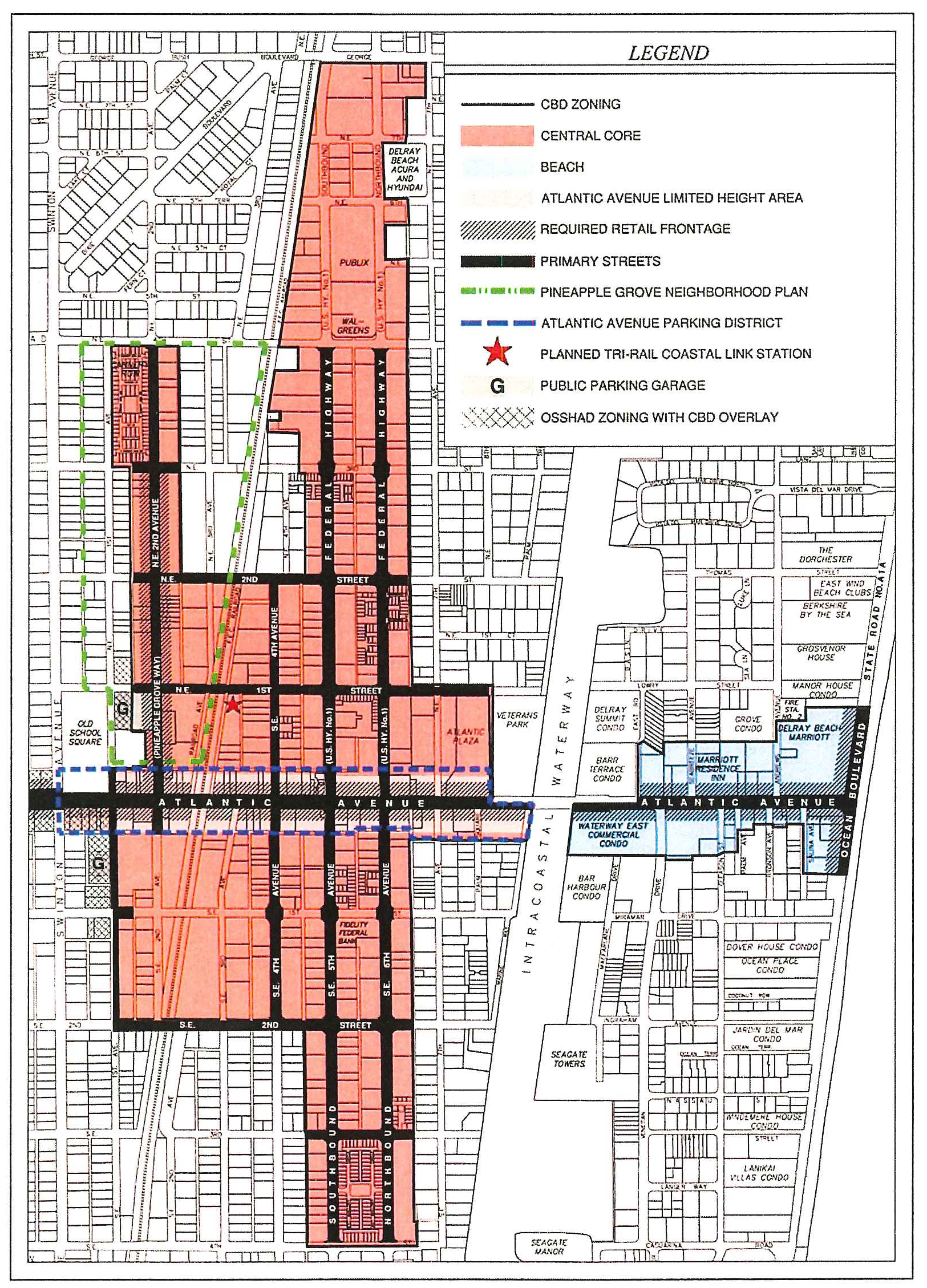
(Ord. No. 13-16, § 1(Exh. A), 6-7-16; Ord. No. 26-21, § 3, 8-10-21)
Figure 4.4.13-B-2
West Atlantic Neighborhood Sub-district Regulating Plan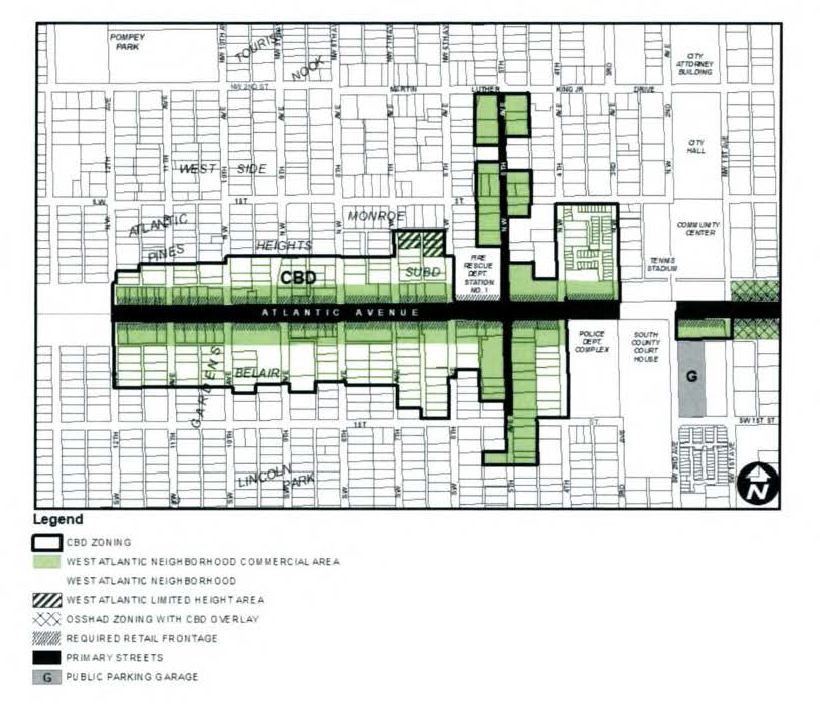
(Ord. No. 07-20, § 3, 5-19-20; Ord. No. 9-20, § 3 Exh. C, 8-18-20; Ord. No. 26-21, § 3, 8-10-21)
Figure 4.4.13-B-3
Railroad Corridor Sub-district
Regulating Plan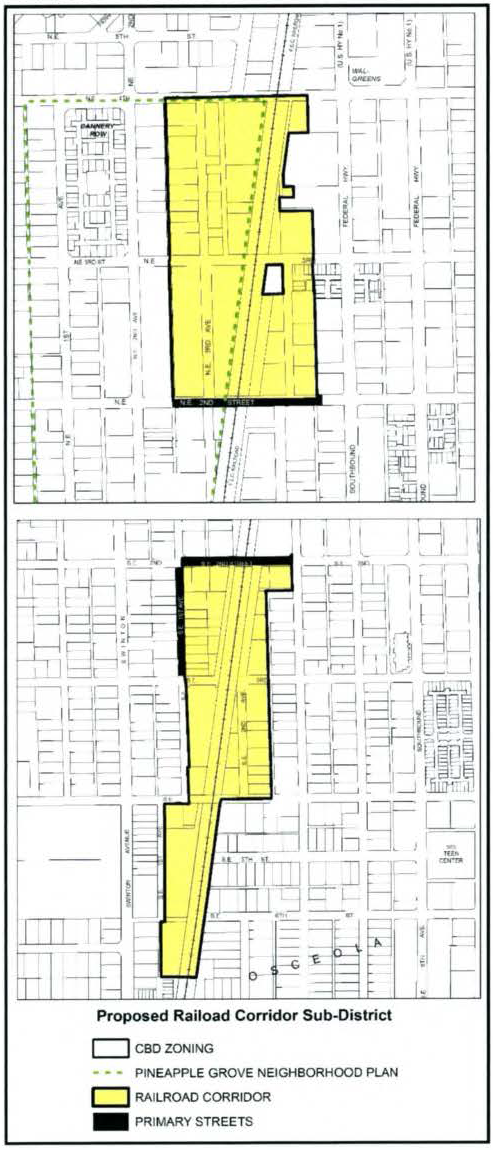
(Ord. No. 10-21, § 3(Exh. C), 5-4-21; Ord. No. 26-21, § 3, 8-10-21)
Figure 4.4.13-B-4 South Pairs Neighborhood Sub-district Regulating Plan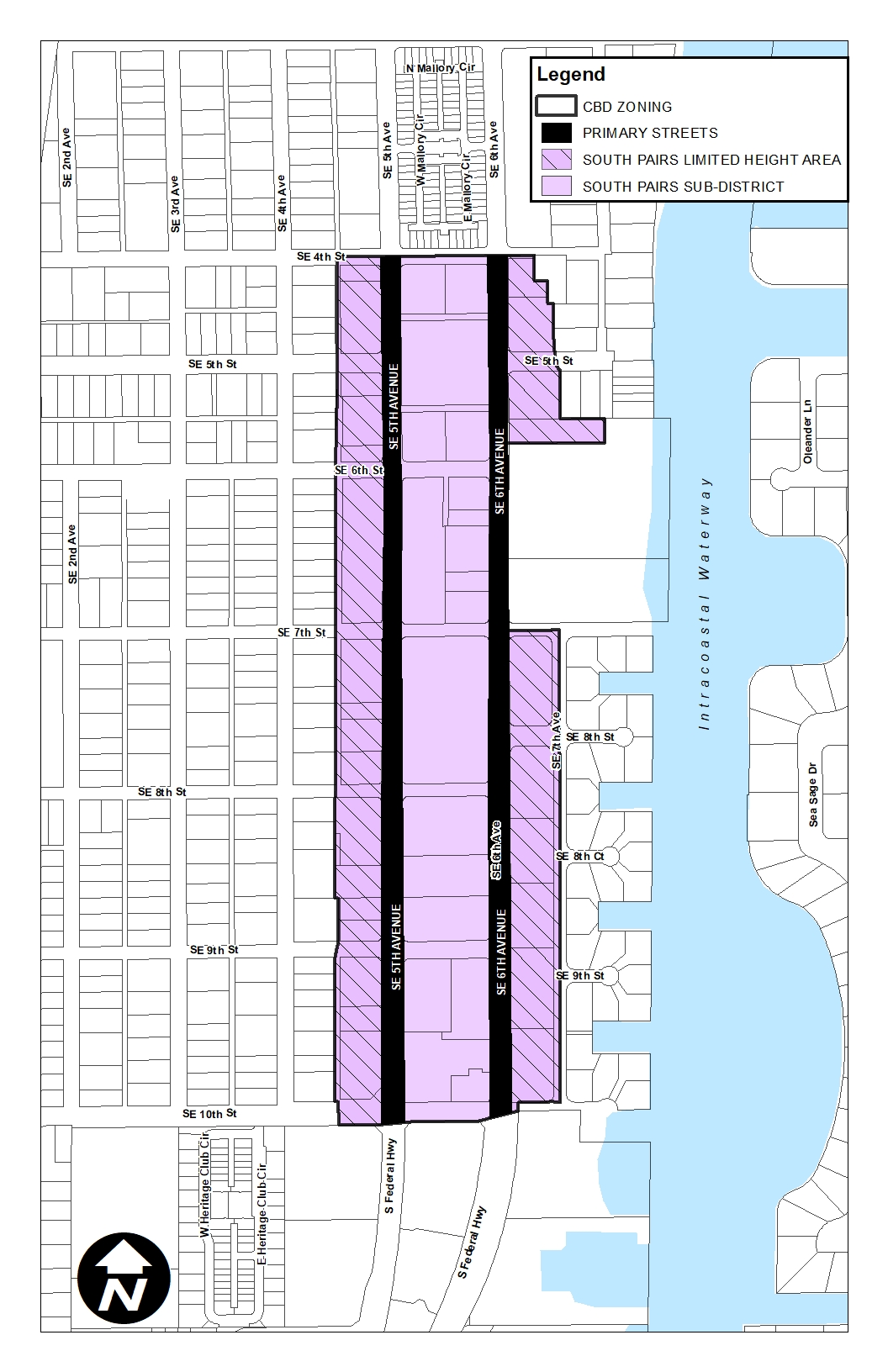
(Ord. No. 20-21, § 3, 12-7-21)
(C)
Allowable uses.
(1)
Principal, accessory, and conditional uses. Table 4.4.13(A) identifies the allowable principal, accessory, and conditional uses for each area of the CBD. See Section 4.4.13(J) for approval standards. Streets designated as "Primary Streets" and/or with "Required Retail Frontage" on any Sub-district Regulating Plan have additional standards. (Ord. No. 19-18, § 4, 10-16-18)
(2)
Use variations for Primary and Secondary Streets. Primary Streets are intended to be superior pedestrian environments and, as such, are held to higher standards regarding the location of certain uses, including parking. The Sub-district Regulating Plans designates certain streets as "Primary Streets" and all other streets are considered to be "Secondary Streets." (Ord. No. 19-18, § 4, 10-16-18)
(a)
Where a principal or accessory use does not have an "S" in Table 4.4.13(A), the use is permitted on both Primary and Secondary streets.
(b)
Where a principal or accessory use in Table 4.4.13(A) has an "S" in the column, the use is a "Secondary Street" use.
1.
Secondary Street uses are permitted without limitations on Secondary Streets, except for properties zoned OSSHAD with CBD Overlay, as identified on Figure 4.4.13-B-1, "Central Core & Beach Sub-districts Regulating Plan," and Figure 4.4.13-B-2, "West Atlantic Neighborhood Regulating Plan." [Amd. Ord. 28-15 12/08/15] (Ord. No. 26-21, § 4, 8-10-21)
2.
On Secondary Streets, properties zoned OSSHAD with CBD Overlay shall line Secondary Street uses (except accessory parking in a surface lot) along the street level for a depth of at least 20 feet on all stories by a use permitted on all streets. [Amd. Ord. 28-15 12/08/15]
3.
On Primary Streets, Secondary Street uses (including parking garage levels) shall be lined along the street for a depth of at least 20 feet on all stories by a use permitted on all streets (see Figure 4.4.13-C-1). (Ord. No. 28-15, § 2, 12-8-15; Ord. No. 26-21, § 4, 8-10-21)
4.
On Primary Streets, Public Parking Garages (as mapped on a regulating plan) shall be lined along the sidewalk level for a depth of at least 20 feet by a use permitted on all streets; a use liner is not required on upper levels. (Ord. No. 28-15, § 2, 12-8-15)
(c)
Additional standards for Conditional Uses are in Section 4.4.13(K)(7). (Ord. No. 19-18, § 4, 10-16-18)
Figure 4.4.13-C-1 Primary and Secondary Street Uses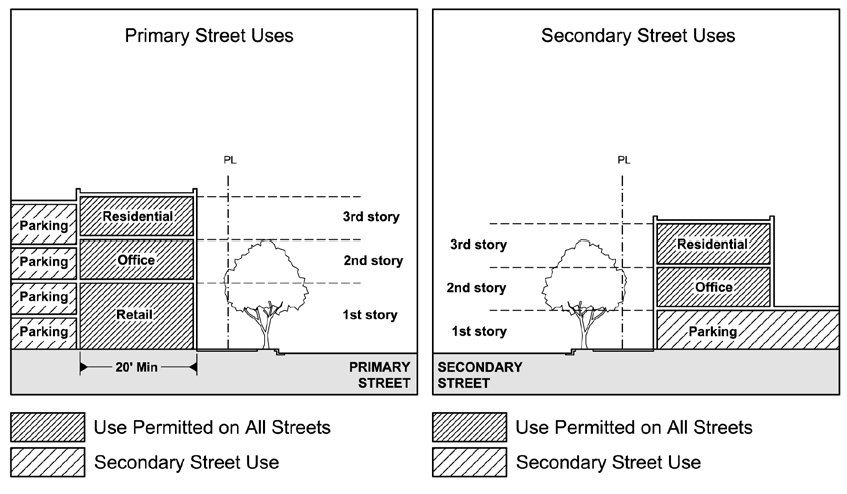
(Ord. No. 26-21, § 4, 8-10-21)
(3)
Required Retail Frontage Use Limitations. Streets designated on the Regulating Plan with Required Retail Frontage are intended to be lively, highly active pedestrian environments that support businesses and reinforce local character. Properties on streets designated with Required Retail Frontage have use and frontage type standards that apply to the sidewalk level story. (Ord. No. 19-18, § 4, 10-16-18)
(a)
All Sub-districts. (Ord. No. 19-18, § 4, 10-16-18)
1.
Residential units, including multi-family and live-work, are not permitted in the sidewalk-level story on streets with Required Retail Frontage.
2.
On streets with Required Retail Frontage, buildings and uses at the sidewalk level shall comply with the following: [Amd. Ord. 28-15 12/08/15] (Ord. No. 19-18, § 4, 10-16-18)
a.
The frontage type shall be either a Storefront or Arcade with a Storefront. See Section 4.4.13(E); (Ord. No. 19-18, § 4, 10-16-18; Ord. No. 26-21, § 4, 8-10-21)
b.
The width of an individual commercial space shall not exceed 75 feet (See Figure 4.4.13-C-2); (Ord. No. 19-18, § 4, 10-16-18; Ord. No. 26-21, § 4, 8-10-21)
c.
The depth of an individual commercial space shall be at least 20 feet and contain only uses permitted in 4.4.13(C)(3)(b) and (c); combinations of permitted uses with other uses not permitted at the sidewalk level are not allowed (See Figure 4.4.13-C-2); and (Ord. No. 19-18, § 4, 10-16-18; Ord. No. 26-21, § 4, 8-10-21)
d.
Uses not permitted in 4.4.13(C)(3)(b) and (c) shall not be accessed from the street designated with Required Retail Frontage and must be physically separated with no interior connections between common walls (See Figure 4.4.13-C-2). (Ord. No. 19-18, § 4, 10-16-18; Ord. No. 26-21, § 4, 8-10-21)
3.
Valet and passenger loading areas and access are not permitted. (Ord. No. 19-18, § 4, 10-16-18)
Figure 4.4.13-C-2 Required Retail Frontage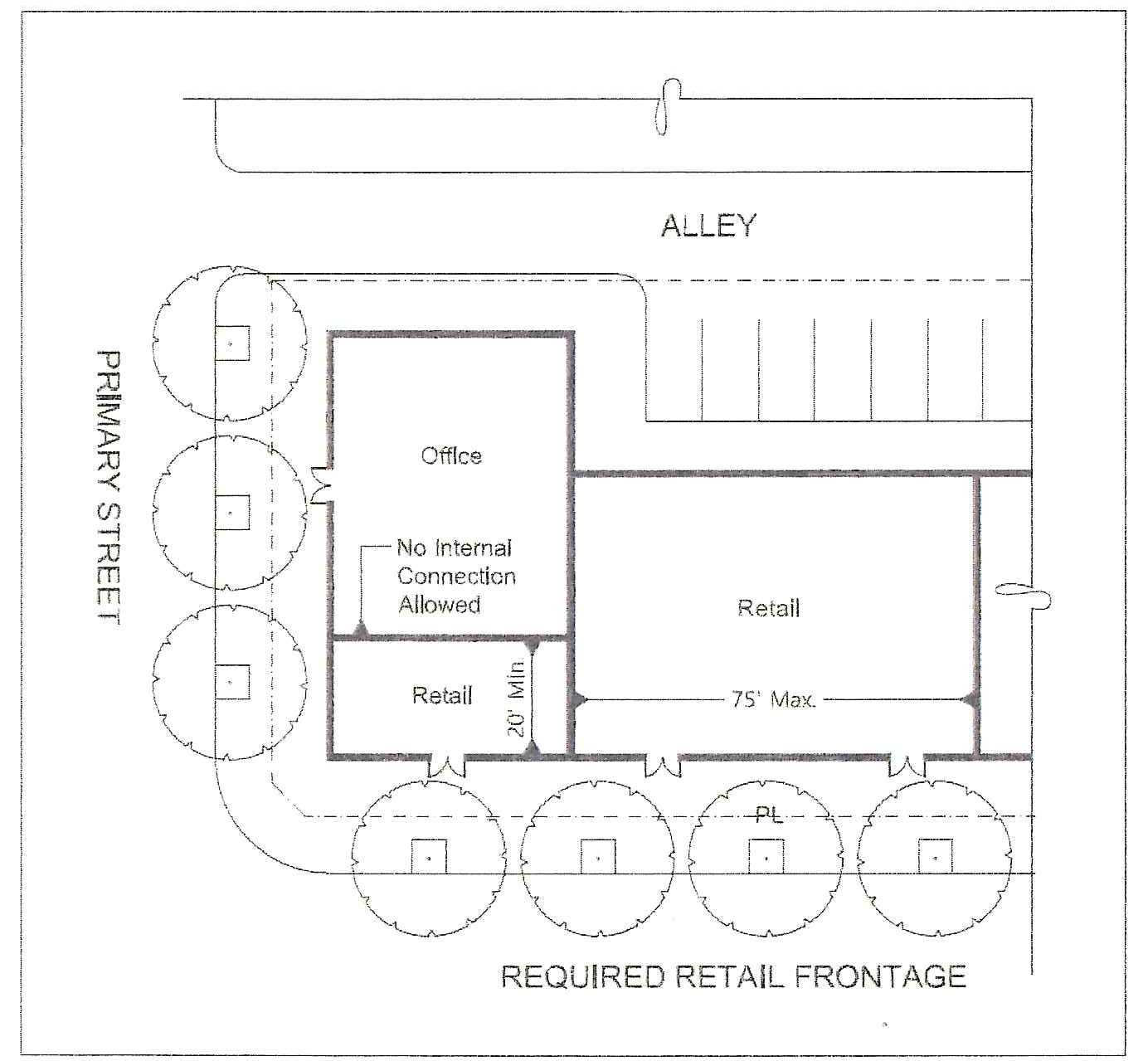
(Ord. No. 26-21, § 4, 8-10-21)
(b)
Central Core and Beach Sub-districts. One hundred percent of the building frontage at the sidewalk-level story shall be for the following uses (as described in Table 4.4.13(A)): (Ord. No. 19-18, § 4, 10-16-18)
1.
General retail uses and/or facilities. (Ord. No. 12-20, § 2, 10-20-20)
2.
Services and facilities. (Ord. No. 33-16, § 5, 11-15-16; Ord. No. 19-18, § 4, 10-16-18; Ord. No. 12-20, § 2, 10-20-20)
3.
Hotels, motels, or residence-type inns.
4.
NEV sales, lease or rental offices. (Ord. No. 36-16, § 5, 1-10-17)
5.
Limitations and exceptions. (Ord. No. 12-20, § 2, 10-20-20)
a.
Tattoo establishments are not permitted. (Ord. No. 12-20, § 2, 10-20-20)
b.
Financial institutions are limited to banks and savings and loan establishments; brokerage firms and private wealth management firms are not permitted. The following regulations also apply: (Ord. No. 12-20, § 2, 10-20-20)
i.
No more than 75 feet of financial institution frontage is allowed per block face; and (Ord. No. 12-20, § 2, 10-20-20)
ii.
No more than a total of 100 feet of financial institution frontage is allowed on facing street frontages. (For example, a new financial institution with 30 feet of street frontage may locate across the street from an existing financial institution with 70 feet of street frontage.) (Ord. No. 12-20, § 2, 10-20-20)
c.
Sale of automotive parts, lawn care equipment, firearms, or secondhand material (other than verifiable antiques) are not permitted. (Ord. No. 12-20, § 2, 10-20-20)
d.
Buildings constructed prior to 1980 located in the Beach Sub-district that have 80 percent or more of their frontage at a setback of 25 feet or greater shall be exempted from the 100 percent ground floor retail requirement. (Ord. No. 12-20, § 2, 10-20-20)
e.
CBD oil establishments as a principal use, or the sale of CBD oil products as an accessory use are not permitted. (Ord. No. 58-20, § 5, 12-1-20; Ord. No. 04-25, § 4, 6-17-25)
f.
Eyeglass stores with accessory optometry services are limited to one store per block face and are not permitted on facing street frontages. (Ord. No. 26-22, § 3, 12-6-22)
(c)
West Atlantic Neighborhood Sub-district.
1.
At least 50 percent of the building frontage of the sidewalk level story shall be for the following uses (as described in Table 4.4.13(A)): (Ord. No. 19-18, § 4, 10-16-18)
a.
General retail uses and/or facilities, except that sales of automotive parts, lawn care equipment, firearms, or second hand material (other than verifiable antiques) are not permitted.
b.
Services and facilities
c.
Hotels, motels, or residential-type inns as a Conditional Use
2.
Up to 50 percent of the building frontage of the sidewalk level story may be for business, professional, and medical uses/offices; more than 50 percent may be approved as a Conditional Use. (Ord. No. 19-18, § 4, 10-16-18)
1 Sales of automotive parts, lawn care equipment, firearms, or secondhand material (other than verifiable antiques) are not allowed on properties facing a designated Required Retail Street on the Regulating Plan or anywhere within the West Atlantic Neighborhood.
2 Drive-thru and Drive-in restaurants are not permitted within the CBD.
3 For density limits, see Table 4.4.13(C).
4 Not self-storage facilities; products and materials shall not exceed 55 gallons of any substance which is listed on the Generic Substances List of the Palm Beach County Wellfield Protection Ordinance (Ref.: Palm Beach County LDC, Article 9, Section 9.3)
5 See Section 4.4.13(C)(4)(a) for limits on commercial use locations in the West Atlantic Neighborhood Sub-district.
(Ord. No. 07-17, § 10, 5-16-17; Ord. No. 25-17, § 22, 7-18-17; Ord. No. 19-18, § 4, 10-16-18; Ord. No. 31-18, § 2, 1-15-19; Ord. No. 58-20, § 6, 12-1-20; Ord. No. 17-21, § 6, 10-19-21; Ord. No. 20-21, § 4, 12-7-21; Ord. No. 23-22, § 9, 8-16-22; Ord. No. 11-25, § 9, 7-8-25)
(4)
Supplemental use standards.
(a)
Community Residence Housing. Except as required by state law, a Community Residence housing four to ten individuals shall be allowed as a permitted use in all four CBD Sub-Districts if it (1) would be located at least 660 linear feet from the closest existing community residence housing four or more individuals as measured from the nearest property line of the proposed community residence to the nearest property line of the existing community residence, and (2) the operator or applicant is licensed or certified by the State of Florida to operate the proposed community residence, has certification from an appropriate national accrediting agency, or has been recognized or sanctioned by Congress to operate the proposed community residence. Except as required by state law, a conditional use permit must be obtained for any community residence that does not meet both criteria (1) and (2). See additional and related regulations at Section 2.4.7(G) and 4.3.3(I) of the Land Development Regulations. (Ord. No. 19-18, § 4, 10-16-18)
(b)
Worker transport/assembly points. The picking-up, dropping-off, or otherwise transporting workers, assigned through an employment agency, from an assembly point in the CBD to the work site is prohibited, except within the West Atlantic Neighborhood area provided the structure or assembly point is not located on West Atlantic Avenue. (Ord. No. 19-18, § 4, 10-16-18)
(c)
West Atlantic Neighborhood Sub-district Supplemental Use Standards: The following supplemental district regulations apply in the West Atlantic Neighborhood Sub-district: (Ord. No. 19-18, § 4, 10-16-18)
1.
West Atlantic Neighborhood Commercial Area. Commercial and mixed-use structures may extend up to 150 feet from West Atlantic Avenue and are allowed on NW 5th Avenue and SW 5th Avenue. Residential structures and accessory uses such as parking areas, landscaping, and drainage retention areas may extend beyond the 150-foot limit. Full service grocery stores may extend beyond the 150-foot limit from West Atlantic Avenue with approval by the SPRAB or the HPB of a site plan design that ensures compatible transitions between commercial and residential areas. Establishment or expansion of commercial and mixed-use structures beyond the 150-foot limit may be allowed as a conditional use, subject to the required findings of Section 2.4.5(E)(5). The West Atlantic Neighborhood Commercial Area is mapped on the West Atlantic Neighborhood Regulating Plan. (Ord. No. 19-18, § 4, 10-16-18; Ord. No. 07-20, § 4, 5-19-20)
2.
There is no restriction on repair of non-conforming single family residences located more than 150 feet from West Atlantic Avenue. (Ord. No. 19-18, § 4, 10-16-18)
(d)
Railroad Corridor Sub-district Supplemental Use Standards. The following supplemental district regulations apply in the Railroad Corridor Sub-district: (Ord. No. 19-18, § 4, 10-16-18; Ord. No. 31-18, § 3, 1-15-19)
1.
Outdoor uses: Within the Railroad Corridor Sub-district, except for outside storage approved pursuant to Section 4.6.6(C)(2) and outdoor dining, all principal and conditional uses shall be conducted within an enclosed building. (Ord. No. 19-18, § 4, 10-16-18; Ord. No. 31-18, § 3, 1-15-19)
2.
Automobile brokerages: Inventory must only be located within an enclosed building. Automobiles which are part of the business inventory must not be placed in parking areas. (Ord. No. 19-18, § 4, 10-16-18; Ord. No. 31-18, § 3, 1-15-19)
3.
Parking garages, automated: Automated parking garages are allowed on Secondary Streets located north of NE 2 nd Street. Automated parking garages are subject to the following requirements: (Ord. No. 31-18, § 3, 1-15-19)
a.
A traffic statement must be provided detailing the ingress, egress, queuing, and circulation demonstrating the specific measures taken to minimize stacking onto public right-of-way resulting from the automated parking garage. (Ord. No. 31-18, § 3, 1-15-19)
b.
An attendant must be on-site during all hours of operation, defined as any time the parking garage is accessible for parking purposes by the public, and the garage must be secured when not accessible for parking purposes. An attendant is not required if the parking garage is limited to private use. i.e, not available to the general public. (Ord. No. 31-18, § 3, 1-15-19)
c.
Projects with driveways that limit the ability to install the required number of street trees shall either provide the required trees at another location on-site or contribute to the Tree Fund, in accordance with the fee schedule in Section 4.6.19(E)(5)(d). (Ord. No. 31-18, § 3, 1-15-19)
d.
The SPRAB may approve automated parking garages that utilize an alternative façade design or cladding materials provided photovoltaic cells (solar panels) are incorporated into the structure and used as a power source for the garage operations or uses associated with the automated parking garage; if solar panels are not incorporated, facades that do not meet the architectural standards in Section 4.4.13(F) require City Commission approval. (Ord. No. 31-18, § 3, 1-15-19)
(e)
South Pairs Neighborhood Sub-district Supplemental Use Standards: The following supplemental district regulations apply in the South Pairs Neighborhood Sub-district: (Ord. No. 20-21, § 5, 12-7-21)
1.
Hotels, motels or residential-type inns shall only be permitted as a conditional use and on sites located between SE 5 th Avenue and SE 6 th Avenue. (Ord. No. 20-21, § 5, 12-7-21)
2.
Automobile brokerages/rental: Inventory must only be located within an enclosed building and shielded from the primary street. Automobiles that are part of the business inventory must not be stored in public or required parking areas. (Ord. No. 20-21, § 5, 12-7-21)
3.
Astrologists, clairvoyants, fortune tellers, palmists, phrenologists, psychic readers, spiritualists, numerologists and mental healers are limited to no more than one business every 300 feet, measured in a straight line from lot line to lot line. (Ord. No. 20-21, § 5, 12-7-21)
4.
Vehicle care limited to the changing of oil and filters and lubrication, with no mechanical work or outside storage of vehicles, except as part of a gasoline station. (Ord. No. 20-21, § 5, 12-7-21)
(f)
Special Requirements for Specific Uses: Permitted uses that are not specified in Table 4.4.13(A) may also have additional regulations in Section 4.3.3. (Ord. No. 19-18, § 4, 10-16-18; Ord. No. 26-21, § 4, 8-10-21; Ord. No. 20-21, § 5, 12-7-21)
(g)
Outdoor use areas: All outdoor uses areas, with the exception of accessory uses clearly ancillary to the principal use, are subject to parking requirements. This provision is applicable to balconies, porches, rooftops, and any other outdoor use area regardless of which story it is located. (Ord. No. 19-18, § 4, 10-16-18; Ord. No. 20-21, § 5, 12-7-21)
(h)
Rooftop Terraces: These regulations are intended to guide the use of rooftops in the downtown. (Ord. No. 19-18, § 4, 10-16-18; Ord. No. 20-21, § 5, 12-7-21)
1.
Rooftop uses. Rooftop terraces may be used for outdoor dining, open-air lounges, exercise and fitness activities (both as principal or accessory uses), rooftop gardens, urban agriculture, and recreational amenities. (Ord. No. 19-18, § 4, 10-16-18)
2.
General Standards for rooftops. All rooftop terraces shall comply with the following standards: (Ord. No. 19-18, § 4, 10-16-18)
a.
Rooftop terraces shall be architecturally compatible with the design of the overall building. (Ord. No. 19-18, § 4, 10-16-18)
b.
Rooftop terraces shall be designed to mitigate potential impacts to surrounding properties. (Ord. No. 19-18, § 4, 10-16-18)
i.
Lighting standards of Section 4.6.8 apply. All rooftop lighting shall be full cutoff luminaries to minimize spillover on adjacent properties. Light poles may not extend beyond the maximum building height limit. (Ord. No. 19-18, § 4, 10-16-18)
ii.
Live music and music played by a disc jockey are not permitted unless within enclosed spaces; and, noise control is subject to the City's Noise Ordinance. (Ord. No. 19-18, § 4, 10-16-18)
iii.
For properties adjoining or separated by an alley from a residential zoning district, OSSHAD, or an existing residential use, rooftop terrace design shall provide screening at least six feet in height along the adjoining perimeter to limit oversight into residential properties. Privacy screening shall not extend above 60 feet and may consist of a parapet, landscape, railings, etc. (Ord. No. 19-18, § 4, 10-16-18)
iv.
Outdoor rooftop activities (not within enclosed areas) are limited on Sunday through Thursday to the time between 7 a.m. and 10 p.m., and on Friday and Saturday to the time between 7 a.m. and 11 p.m. (Ord. No. 19-18, § 4, 10-16-18)
c.
Parking must be provided when a principal use is located on a rooftop terrace. (For example, restaurant seating or an outdoor yoga studio). Parking is not required for amenities that are ancillary to the principal use. (For example, a swimming pool for a condominium). (Ord. No. 19-18, § 4, 10-16-18)
d.
Railings or parapets shall be a minimum of four feet in height, consistent with proposed architectural style, and provided for the full perimeter of rooftop terrace. Railing and parapet height may not extend beyond the maximum building height of 60 feet. (Ord. No. 19-18, § 4, 10-16-18)
3.
Rooftops on Buildings with the Maximum Number of Stories. These regulations are intended to guide the non-habitable use of rooftops for buildings built to the maximum story height limit to allow rooftop terraces. Rooftop terraces and rooftop amenities, such as roof gardens, observation decks, swimming pools, and running tracks, are encouraged to create unique gathering spaces, to aid in the reduction of the urban heat index, and to add aesthetic value to the buildings. Rooftop terraces are not intended to add additional story height. Rooftop terraces shall be subject to the following criteria: (Ord. No. 19-18, § 4, 10-16-18)
a.
Rooftop terraces that are entirely open to the sky may occupy 100 percent of the total gross roof area. (Ord. No. 19-18, § 4, 10-16-18)
b.
Rooftop terraces shall be hardscaped with materials such as, but not limited to, patterned concrete, pavers, or wood decking. (Ord. No. 19-18, § 4, 10-16-18)
c.
Rooftop terraces shall be landscaped over a minimum of ten percent of the rooftop terrace area. Landscaping shall consist of trees, shrubs, ground cover, and vines. (Ord. No. 19-18, § 4, 10-16-18)
d.
Covered structures located above the maximum allowable number of stories are permitted to cover a maximum area of 25 percent of the rooftop terrace area. For the purposes of calculating the maximum area, the term "covered structures" shall not include enclosures for screening mechanical systems, elevator shafts, or stair towers. The following restrictions apply: (Ord. No. 19-18, § 4, 10-16-18)
i.
Covered structures located above the maximum number of stories shall not exceed a maximum height of 60 feet. (Ord. No. 19-18, § 4, 10-16-18)
ii.
The uses within covered structures shall not be for residential or similar use or for uses generally with a 24-hour occupancy. Covered structures that may be climate-controlled are limited to elevator lobby areas, restrooms, restaurants, lounges, fitness centers, and similar uses. (Ord. No. 19-18, § 4, 10-16-18)
4.
Swimming pools on rooftops. Swimming pools and/or hot tubs are permitted in rooftop terraces subject to the following criteria: (Ord. No. 19-18, § 4, 10-16-18)
a.
Swimming pools and hot tubs are only permitted as amenities to residential or hotel buildings. (Ord. No. 19-18, § 4, 10-16-18)
b.
Swimming pools and hot tubs are permitted provided the top of the surrounding deck does not exceed eight feet above the top of the main rooftop. (Ord. No. 19-18, § 4, 10-16-18)
c.
Swimming pools and/or whirlpools shall be surrounded by a minimum five-foot wide walkway. (Ord. No. 19-18, § 4, 10-16-18)
d.
Supporting restroom facilities associated with swimming pools shall comply with the standards for covered structures. (Ord. No. 19-18, § 4, 10-16-18)
(i)
Retail Tobacco or Nicotine Products Dealer. No more than one standalone retail tobacco or nicotine products dealer is allowed per block, and products may not be displayed in the window. Additional and related regulations in Section 4.3.3(DDD) apply. (Ord. No. 04-25, § 4, 6-17-25)
(D)
Configuration of buildings.
(1)
Standards for CBD. The following building configuration standards apply to all CBD Sub-districts: (Ord. No. 19-18, § 5, 10-16-18)
(a)
Building height. Unless otherwise specified herein, the height of buildings shall be measured in and regulated by the number of stories and the maximum overall building height (See Tables 4.4.13(B) and 4.4.13(C)). Stories are measured from the finished floor to finished ceiling. (See Figure 4.4.13-D-2). (Ord. No. 19-18, § 5, 10-16-18; Ord. No. 26-21, § 5, 8-10-21; Ord. No. 20-21, § 6, 12-7-21)
1.
Within the Atlantic Avenue Limited Height Area, maximum overall building height is 38 feet and maximum building height in number of stories is three. The Atlantic Avenue Height Limit Area is defined as those properties, or portions of properties, located within 125 feet north or south of the East Atlantic Avenue right-of-way line, between Swinton Avenue and the Intracoastal Waterway. (See Figure 4.4.13-B-1). (Ord. No. 19-18, § 5, 10-16-18; Ord. No. 26-21, § 5, 8-10-21)
2.
Within the West Atlantic Neighborhood Limited Height Area, the maximum overall building height is 35 feet and the maximum number of stories is three. The West Atlantic Neighborhood Limited Height Area is required for those properties rezoned from Single-family Residential (R-1-A) to Central Business District. (Ord. No. 07-20, § 5, 5-19-20; Ord. No. 20-21, § 6, 12-7-21)
3.
Within the South Pairs Neighborhood Limited Height Area, maximum overall building height is 48 feet and the maximum number of stories is four. The South Pairs Neighborhood Limited Height Area is defined as those properties or portions of properties located west of SE 5 th Avenue or east of SE 6 th Avenue. (See Figure 4.4.13-B-4) (Ord. No. 19-18, § 5, 10-16-18; Ord. No. 07-20, § 5, 5-19-20; Ord. No. 10-20, § 3, 9-22-20; Ord. No. 03-21, § 2, 3-2-21; Ord. No. 20-21, § 6, 12-7-21)
4.
Stories located below grade are for parking or storage uses only and are not counted for the purpose of measuring building height unless the floor of the first habitable story is elevated more than four feet above the adjacent sidewalk, then the space below counts as the first story for the purposes of measuring building height. (Ord. No. 19-18, § 5, 10-16-18; Ord. No. 07-20, § 5, 5-19-20)
5.
The ground story of commercial or mixed-use buildings shall be a minimum of 12 feet tall. (Ord. No. 07-20, § 5, 5-19-20)
6.
The ground story of residential buildings shall be a minimum of ten feet tall. (Ord. No. 07-20, § 5, 5-19-20)
7.
Each story above the ground story in all buildings must be at least nine feet tall. (Ord. No. 07-20, § 5, 5-19-20)
8.
Mezzanines that exceed the percentage of floor area for a mezzanine defined in the Florida Building Code are counted as stories for the purpose of measuring height. For the purpose of measuring building height, parking levels are counted as set forth in Section 4.4.13(D)(8). [Amd. Ord. 27-15 10/20/2015] (Ord. No. 07-20, § 5, 5-19-20)
9.
Each parking garage level exposed to a street or civic open space shall be counted as a story for the purposes of measuring height. Parking levels fully lined and concealed from view by a story containing an active use (i.e. retail, residential, office) are not counted as stories for the purpose of measuring height. See Figure 4.4.13-D-1. (Ord. No. 19-18, § 5, 10-16-18; Ord. No. 07-20, § 5, 5-19-20; Ord. No. 26-21, § 5, 8-10-21)
10.
Within the Central Core, Railroad Corridor, Beach and South Pairs Neighborhood Sub-districts, residential units must have the floor of the first habitable story elevated at least 18 inches above the adjacent sidewalk. Within the West Atlantic Neighborhood Sub-district, residential units must have the floor of the first habitable story elevated at least 12 inches above the adjacent sidewalk. Lobbies and common areas in multi-unit or mixed-use buildings may have a lower ground floor finish level. (Ord. No. 07-20, § 5, 5-19-20; Ord. No. 20-21, § 6, 12-7-21)
11.
Architectural features including church spires, steeples, belfries, and cupolas are not limited by story height; however, any part of any such feature shall not exceed ten feet above the maximum overall building height unless specifically approved by action of the City Commission. (Ord. No. 19-18, § 5, 10-16-18; Ord. No. 07-20, § 5, 5-19-20)
12.
Elevator overruns and stairways are not limited by the number of stories and shall not exceed 10 feet above the maximum overall building height. (Ord. No. 19-18, § 5, 10-16-18; Ord. No. 07-20, § 5, 5-19-20)
Figure 4.4.13-D-1 Counting the Number of Stories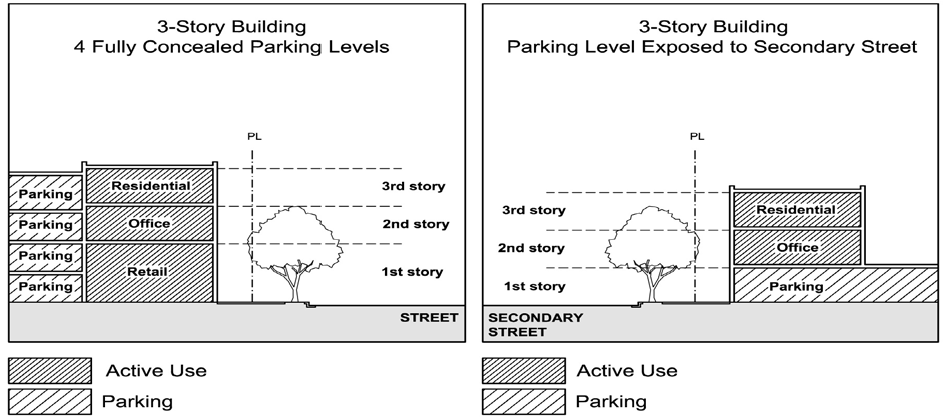
(Ord. No. 26-21, § 5, 8-10-21)
Figure 4.4.13-D-2 Measuring Building Height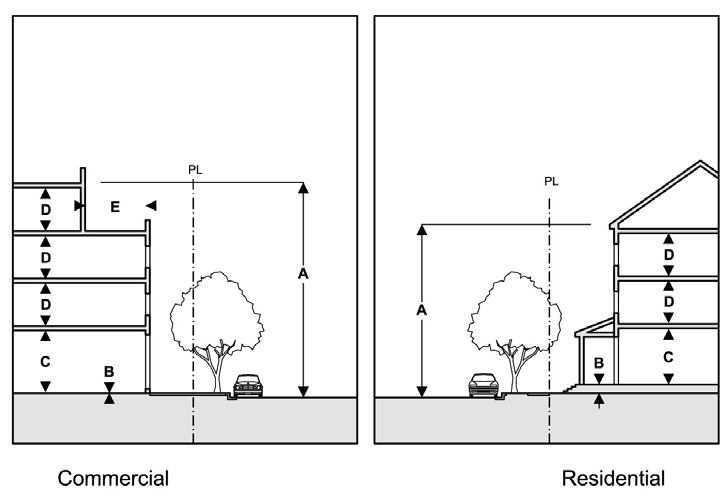
(Ord. No. 26-21, § 5, 8-10-21)
(Ord. No. 19-18, § 5, 10-16-18; Ord. No. 07-20, § 6, 5-19-20; Ord. No. 03-21, § 3, 3-2-21; Ord. No. 20-21, § 6, 12-7-21)
(b)
Building placement.
1.
Front setbacks shall be measured from the property lines coinciding with public rights-of-way, including streets and parks.
a.
Awnings, porches, balconies, stoops and arcades may encroach into the setbacks as set forth in Section 4.4.13(E) when utilized as the Frontage Type. (Ord. No. 19-18, § 5, 10-16-18)
b.
Roof Eaves, awnings, and balconies may encroach into the setbacks a maximum of four feet. (Ord. No. 19-18, § 5, 10-16-18)
c.
Section 4.3.4(H)(4) identifies additional structures permitted in setbacks.
d.
Underground parking or storage may encroach into the front setbacks. (Ord. No. 10-20, § 3, 9-22-20)
Figure 4.4.13-D-3 Building Frontage Requirement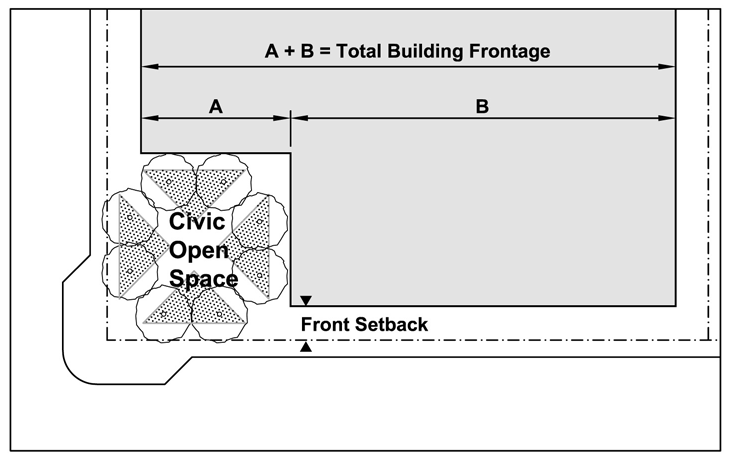
(Ord. No. 26-21, § 5, 8-10-21)
2.
Where development may build with no side setback, the following limitations also apply:
a.
Side setbacks are required when abutting a residential zoning district or a property with a building existing as of February 24, 2015, the effective date of Ordinance No. 02-15 with windows facing the adjoining lot line. Then, new development shall set back a minimum of five feet or the amount necessary to provide at least ten feet of separation between the existing and new buildings, whichever is greater. (Ord. No. 19-18, § 5, 10-16-18)
b.
Buildings with openings, including doors, windows, and glass wall materials, facing an interior side property line must setback a minimum of five feet from the property line. (Ord. No. 19-18, § 5, 10-16-18)
c.
Buildings taller than three stories in height have additional setback requirements for the upper stories, as described in Section 4.4.13(D)(2).
d.
These requirements shall not apply to any underground parking or storage located below grade. (Ord. No. 10-20, § 3, 9-22-20)
3.
In the South Pairs Neighborhood District, lot lines adjoining SE 7 th Avenue shall be considered a rear and regulated by rear setback requirements. Development abutting SE 7th Avenue shall not face or provide vehicular or pedestrian access to or from SE 7th Avenue. (Ord. No. 20-21, § 6, 12-7-21)
(c)
Frontage percentages. Building frontage is the percentage of the total width of a lot minus the required setbacks, which is required to be occupied by the building facade. Building frontage requirements are set forth in Table 4.4.13(C) for each CBD Sub-district. (Ord. No. 19-18, § 5, 10-16-18)
1.
Building façades shall be generally parallel to the right-of-way, located in accordance with the minimum and maximum front setback requirements. (Ord. No. 19-18, § 5, 10-16-18)
2.
The building façade may adjust around a Civic Open Space that meets the requirements in Section 4.4.13(G) as shown in Figure 4.4.13-D-3. (Ord. No. 19-18, § 5, 10-16-18; Ord. No. 26-21, § 5, 8-10-21)
3.
On corner lots, the building façade shall extend from the corner to ensure that new development (or civic open space) defines the corner. (Ord. No. 19-18, § 5, 10-16-18)
(d)
Dwelling unit standards.
1.
Diverse unit types. A number of different unit types, sizes and floor plans shall be available within the development. Two and three bedroom units are encouraged, as are a combination of multi-level units and flats. In projects consisting of more than 12 dwelling units, the proportion of efficiency or studio type units may not exceed 25 percent of the total units. One bedroom units may not exceed 30 percent; however, if no efficiency or studio units are constructed, the cumulative amount of one bedroom units may not exceed 55 percent. There is no maximum percentage for unit types established for projects having 12 or fewer units, however, a mix of unit types and sizes is encouraged.
2.
Minimum floor area. Minimum floor area for multi-family residential dwelling units shall be as established for the Medium Density Residential (RM) zoning district in Section 4.3.4(K).
(e)
Other standards. Other standards also apply in CBD sub-districts:
1.
Frontage Standards are in Section 4.4.13(E).
2.
Architectural Standards are in Section 4.4.13(F).
3.
Civic Open Space Standards are in Section 4.4.13(G).
4.
Incentive Program is in Section 4.4.13(H).
5.
Parking Standards are in Section 4.4.13(I).
6.
Review and Approval Process is in Section 4.4.13(J)
(2)
Dimensional requirements for CBD Sub-districts. Table 4.4.13(C) provides the dimensional requirements regarding lot size, building placement, building size, height, density, and civic open space for each CBD Sub-district. Figure 4.4.13-D-4 illustrates the dimensional requirements from the table. (Ord. No. 26-21, § 5, 8-10-21)
(a)
Buildings shall be located in accordance with the minimum and maximum setbacks in Table 4.4.13(C).
1.
The front setback or side setback facing a street or park is a minimum of 10 feet and a maximum of 15 feet, except within the South Pairs Neighborhood Sub-district on SE 5 th Avenue and SE 6 th Avenue where the front or side setbacks facing a street or park are a minimum of 15 feet and a maximum of 20 feet. (Ord. No. 20-21, § 6, 12-7-21)
2.
The minimum rear setback is ten feet and minimum side interior setbacks are zero feet, unless required per 4.4.13(D)(1)(b)2. Side lot lines adjoining alleys are regulated by rear setbacks. (Ord. No. 19-18, § 5, 10-16-18)
3.
Buildings over two stories in height are subject to additional setback requirements in order to ensure architectural articulation and reduce the impact of taller building heights. (Ord. No. 19-18, § 5, 10-16-18; Ord. No. 20-21, § 6, 12-7-21)
a.
Front and rear setbacks above the third story are 20 feet minimum. (Ord. No. 20-21, § 6, 12-7-21)
b.
With approval from the SPRAB or HPB, building entries, lobbies, and vertical circulation areas located above the second story may not be required to increase the setback to 20 feet, if configured as tower elements determined to be consistent with the Delray Beach Architectural Design Guidelines. (Ord. No. 20-21, § 6, 12-7-21)
c.
In the South Pairs Neighborhood Sub-district, rear setbacks above the second story are 20 feet minimum for buildings located either along SE 7 th Avenue or the alley between SE 4 th Avenue and SE 5 th Avenue. (Ord. No. 20-21, § 6, 12-7-21)
4.
Where the rear or side of a property abuts a residential zoning district with a height limitation of 35 feet without at least 30 feet of separation between the properties, such as a street, railroad, waterway, park, or other public open space; the following shall apply: (Ord. No. 19-18, § 5, 10-16-18; Ord. No. 26-21, § 5, 8-10-21)
a.
For buildings or portions of buildings three stories or less in height, a minimum side set back of ten feet from the property line shall be provided.
b.
At the top of the third story, minimum side and rear building setbacks of 30 feet shall be provided from the property line for the portion of the building that is over three stories in height.
c.
A solid finished masonry wall six feet in height, or a continuous hedge at least four and one-half feet in height at the time of installation, shall be located inside and adjacent to the portion of the boundary line of the CBD-zoned property which directly abuts the residentially zoned property. Walkways and other pedestrian or bicycle connections shall be placed through the wall or hedge if they provide links identified on any adopted bicycle and pedestrian master plan or if SPRAB or HPB determines they would promote desirable connectivity between properties. (Ord. No. 26-21, § 5, 8-10-21)
5.
Minimum building frontage requirements for Primary and Secondary Streets: (Ord. No. 26-21, § 5, 8-10-21)
a.
On Primary Streets in the Central Core, Beach, and West Atlantic Neighborhood Sub-districts, the minimum building frontage is 75 percent. (Ord. No. 26-21, § 5, 8-10-21)
b.
On Primary Streets in the Railroad Corridor Sub-district, minimum building frontage is not required. (Ord. No. 26-21, § 5, 8-10-21)
c.
On Primary Streets in the South Pairs Neighborhood Sub-district, the minimum building frontage is 60 percent. (Ord. No. 20-21, § 6, 12-7-21)
d.
On Secondary streets in all sub-districts, minimum building frontage is not required. (Ord. No. 26-21, § 5, 8-10-21; Ord. No. 20-21, § 6, 12-7-21)
6.
Buildings with more than 250 feet of street frontage shall provide a pedestrian/bicycle passageway at least ten feet wide connecting rear alleys and/or parking to the public sidewalk The passageway elevation(s) shall have storefront windows with a base between nine inches and three feet high with transparent glazed windows extending to at least eight feet high for 50 percent of the length of the wall. (Ord. No. 19-18, § 5, 10-16-18)
7.
These requirements shall not apply to any part of an underground parking facility located below grade. (Ord. No. 10-20, § 3, 9-22-20)
N/A is "Not Applicable"
1 Side lot lines facing streets are regulated by front setback requirements. Side lot lines along alleys are regulated by rear setbacks.
2 See Section 4.4.13(D)(1)(b)(2).
3 See Incentive Program in Section 4.4.13(H) for potential density increases pursuant to certain location and performance criteria.
4 See Section 4.4.13(D) for additional setback standards.
(Ord. No. 19-18, § 5, 10-16-18; Ord. No. 07-20, § 7, 5-19-20; Ord. No. 03-21, § 4, 3-2-21; Ord. No. 20-21, § 6, 12-7-21)
Figure 4.4.13-D-4 Building Placement and Configuration and Street Types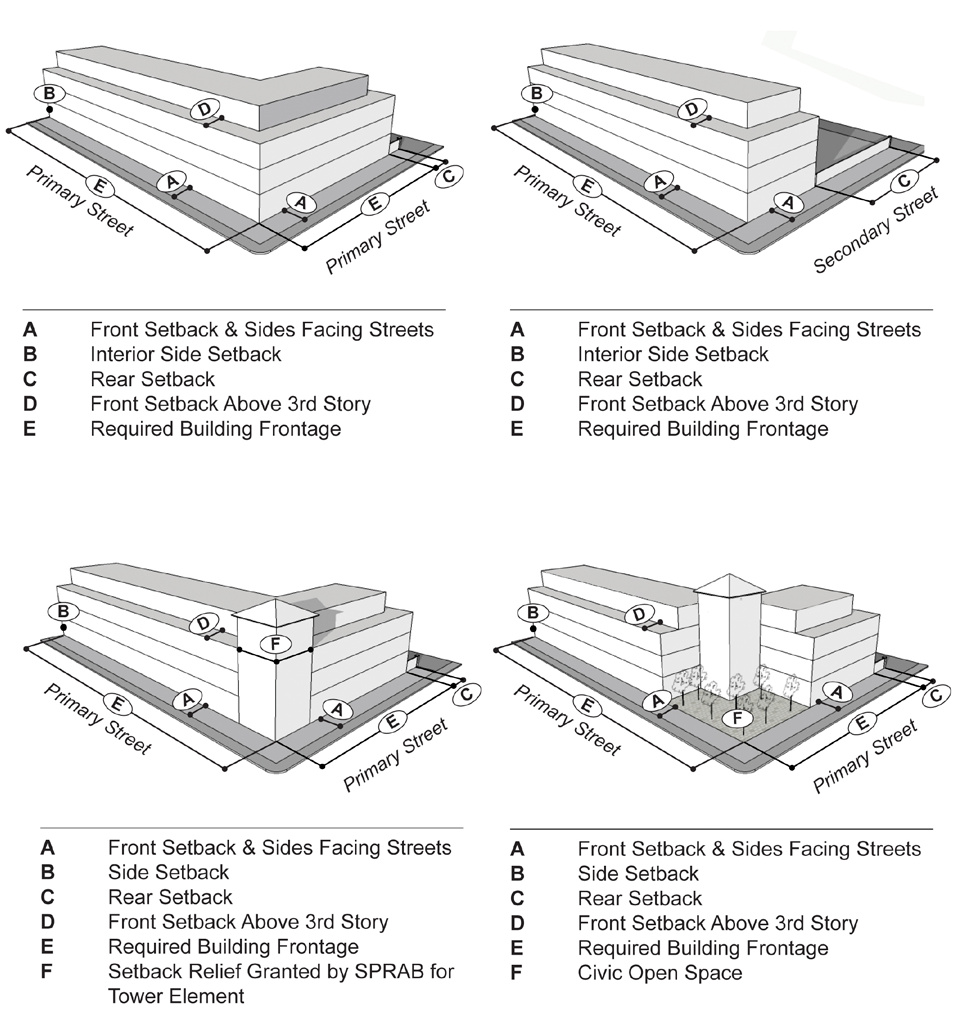
(Ord. No. 26-21, § 5, 8-10-21)
(E)
Frontage standards. Frontage Standards define architecture and design components for the entrance(s) to buildings and the area between building facades and streets. Building setbacks and other development standards are coordinated with street cross-sections to ensure a superior public realm results, improving both the overall visual appearance and multi-modal uses of downtown streets.
(1)
Frontage standards and allowable uses. The use of the ground story is an important factor in streetscape design and appropriate frontage types. For the purposes of Frontage Standards, unless otherwise specified, residential uses are single-family homes, townhomes, multi- family residential dwellings, assisted living facilities that do not comport with the definition of "community residence", nursing homes, continuing care facilities, community residences, and large family childcare homes and live/work uses. All other uses are considered to be "commercial uses" for the purposes of this section. (Ord. No. 25-17, § 23, 7-18-17; Ord. No. 19-18, § 6, 10-16-18)
(2)
Streetscape standards. Front setback areas, which include side setback areas facing streets, shall be detailed to augment public right-of-way design, to establish shaded, continuous routes for pedestrians, and to organize landscaping and other elements to ensure a superior public realm.
(a)
Minimum Streetscape Width. The combination of public sidewalk (located within the right-of-way) and hardscape (located in front setback areas) shall provide a minimum streetscape area no less than 15 feet in width, measured from the back of curb. The streetscape area shall be organized as follows: (Ord. No. 26-21, § 6, 8-10-21)
1.
Curb zone. The curb zone shall be at least four feet wide, measured from the back of curb to the pedestrian clear zone. This zone accommodates street trees and public infrastructure needs such as utility poles, street lights, street signs, parking meters, etc. These elements shall be located as close to the curb as possible; signs and parking meters shall be consolidated as much as possible. Space for pedestrian use is also accommodated in the curb zone. See Figures 4.4.13-E-1 and 4.4.13-E-2 (Ord. No. 19-18, § 6, 10-16-18; Ord. No. 26-21, § 6, 8-10-21)
2.
Pedestrian clear zone. A continuous pedestrian clear zone shall be provided on all streetscapes (See Figures 4.4.13-E-1 and 4.4.13-E-2). Any portion of the pedestrian clear zone within the front setback area shall be improved as an extension of the public sidewalk and shall match the public sidewalk in design and material, providing a seamless physical transition. A sidewalk easement, in a form acceptable to the City Attorney, over any portion of the pedestrian clear zone located within the front setback shall be granted to the City. The property owner shall also be required to enter into a maintenance agreement, in a form acceptable to the City Attorney, requiring the property owner to be responsible for and maintain any improvements made or installed by the owner to meet the requirements of this section. The sidewalk easement and maintenance agreement require City Commission approval subsequent to site plan approval and shall be recorded prior to site plan certification. (Ord. No. 19-18, § 6, 10-16-18; Ord. No. 26-21, § 6, 8-10-21; Ord. No. 20-21, § 7, 12-7-21)
a.
The minimum width of the pedestrian clear zone in the Central Core, Beach, West Atlantic Neighborhood and Railroad Corridor Sub-districts is six feet. (Ord. No. 20-21, § 7, 12-7-21)
b.
The minimum width of the pedestrian clear zone on Primary Streets in the South Pairs Neighborhood Sub-district is 10 feet and the minimum width of the pedestrian clear zone on all other streets in the Sub-district is six feet. (Ord. No. 20-21, § 7, 12-7-21)
3.
Remaining front setback area. Any remaining front setback area within the 15-foot wide minimum streetscape shall be detailed appropriately for the ground story use of the building (See Figures 4.4.13-E-1 and 4.4.13-E-2): (Ord. No. 26-21, § 6, 8-10-21)
a.
Commercial uses. Buildings with retail or commercial uses in the ground story shall detail and design any remaining front setback area within the 15-foot wide minimum streetscape area using a hardscape design. This portion may be used to accommodate outdoor dining areas, subject to Section 6.3. Landscaping comprised of plants in removable planters, palms and/or ground planting may be installed adjacent to the building provided views into storefront windows are not obstructed. (Ord. No. 19-18, § 6, 10-16-18)
b.
Residential or hotel uses. Buildings with residential or hotel uses in the ground story shall detail and design any remaining front setback area within the 15-foot wide minimum streetscape area using hardscape or foundation planting landscaping. The encroachment of porches or stoops in this area may be permitted, pursuant to Section 4.4.13(E)(4). (Ord. No. 26-21, § 6, 8-10-21)
(b)
Street trees. Street trees are intended to provide a shaded environment for the pedestrian, provide a physical separation between pedestrians and vehicles, improve the overall visual appearance of the street, and reduce urban heat island effects. (Ord. No. 19-18, § 6, 10-16-18)
1.
All new construction, relocation of a building, or addition equal to or greater than 20 percent of the gross floor area of an existing building shall install street trees at the time of development. Street trees shall be a canopy species, planted in the public right-of-way directly in front of the property line(s), uniformly spaced no greater than 30 feet on center. Spacing of trees may only exceed 30 feet in order to accommodate curb cuts, fire hydrants, utilities, existing trees, and other infrastructure elements. Palm varieties may be used at corners, crosswalks, or to accent building entrances and may be permitted in lieu of shade trees when physical conditions may prevent the proper growth of shade trees, as determined by the Development Services Director. Consistency in street tree species shall be established on both sides of the street along each block. The first to develop shall establish the species with approval from the Development Services Director. (Ord. No. 19-18, § 6, 10-16-18; Ord. No. 26-21, § 6, 8-10-21)
2.
Street trees shall be located in the curb zone of the streetscape to separate pedestrians from vehicular lanes and to provide room for tree canopies. Street trees may be planted in planting strips, landscaped planters or tree grates with approval from the Development Services Director. (Ord. No. 19-18, § 6, 10-16-18; Ord. No. 26-21, § 6, 8-10-21)
3.
All trees shall be Florida Grade #1 or better and satisfy the following standards at the time of planting:
a.
Canopy species: Minimum 14 feet in height with a clear trunk space of six feet and a spread of no less than eight feet.
b.
Palm trees: Minimum 18 feet in height, with a clear trunk space of eight feet.
4.
In the event that site constraints such as existing utility easements, infrastructure, or right-of-way constraints prevent the installation of required street trees, the Development Services Director may approve a different organization of the curb and pedestrian clear zones. Additional elements such as removable planters of small palms and shrubs, vines or seasonal flowers may be required. In addition, the building shall provide devices such as awnings or roof overhangs to establish a shaded pedestrian environment. (Ord. No. 19-18, § 6, 10-16-18; Ord. No. 26-21, § 6, 8-10-21)
5.
The property owner shall be required to enter into a maintenance agreement, in a form acceptable to the City Attorney, requiring the property owner to be responsible for and maintain any tree grates, irrigation, and landscaping installed by the property owner to meet the requirements of this section.
6.
For those properties where street trees exist at the time of site plan approval, the property owner shall either provide the required street trees in another location on-site or pay into the Tree Trust Fund, in accordance with the fee schedule in Section 4.6.19(E)(5)(d). (Ord. No. 19-18, § 6, 10-16-18)
Figure 4.4.13-E-1 Commercial Use Streetscape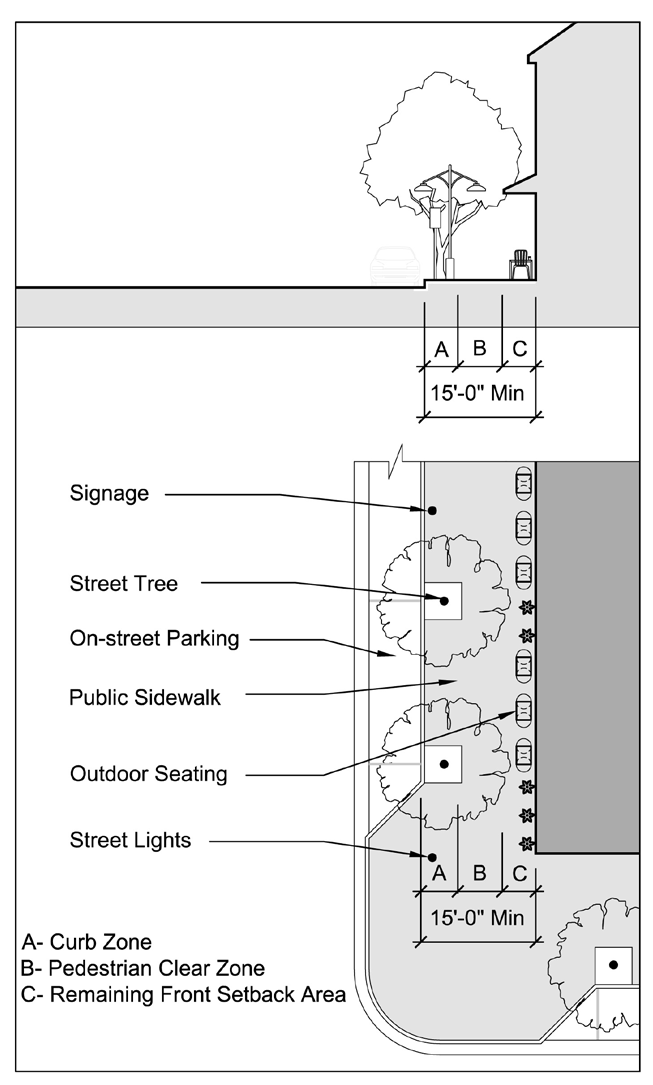
(Ord. No. 26-21, § 6, 8-10-21)
Figure 4.4.13-E-2 Residential Use Streetscape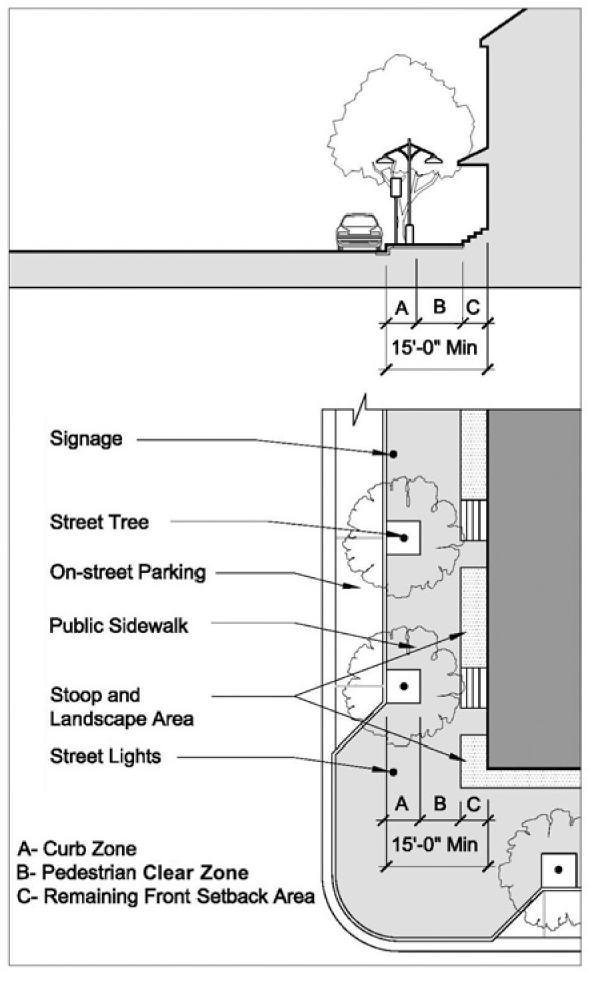
(Ord. No. 26-21, § 6, 8-10-21)
(3)
Building entrances. The main entrance to every building shall be accessible directly from and face a public right-of-way or civic open space. The main entrance(s) to ground story commercial space(s) shall be directly from and face a public right-of-way or civic open space. Doors allowing public access shall occur at intervals no greater than 75 feet.
(4)
Frontage types. Frontage Types define architectural characteristics for the detailing of building entrances. Seven distinct frontage types have been identified, which are appropriate for different uses. Table 4.4.13 (D) identifies the frontage types appropriate for each use by an "X". Using one or more of frontage types identified is required. [Amd. Ord. 27-15 10/20/15]
[Amd. Ord. 27-15 10/20/15] (Ord. No. 19-18, § 6, 10-16-18)
(a)
Porch. A porch is an open-air structure attached to a building forming a covered entrance large enough for comfortable use as an outdoor room. Table 4.4.13(E) provides the dimensional requirements and the maximum encroachment allowed, provided porches do not encroach into the minimum required curb zone or pedestrian clear zone as described in Section 4.4.13(E)(2). Figure 4.4.13-E-3 illustrates the dimensional requirements from Table 4.4.13(E). Figure 4.4.13-E-4 provides a character example. (Ord. No. 26-21, § 6, 8-10-21)
Figure 4.4.13-E-3 Porch Frontage Type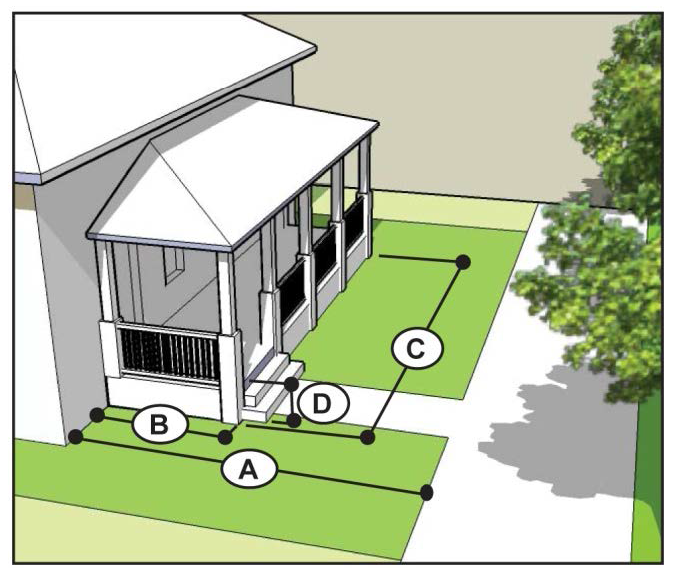
(Ord. No. 26-21, § 6, 8-10-21)
Figure 4.4.13-E-4 Porch Character Example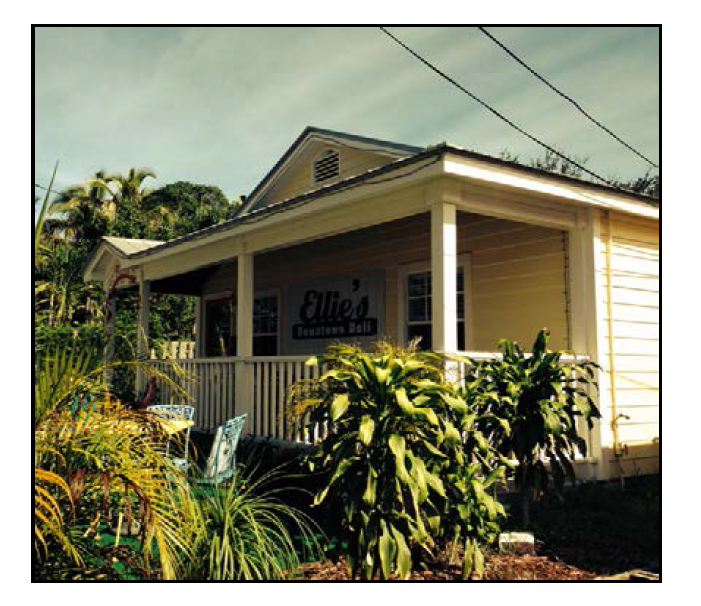
(Ord. No. 26-21, § 6, 8-10-21)
(b)
Stoop. A stoop is a small staircase leading to the entrance of a building that may be covered. The elevation of the stoop is necessary to ensure privacy for residential uses in the ground story of buildings. Stoops should provide sufficient space for a person to comfortably pause before entering or after exiting the building. Table 4.4.13(F) provides the dimensional requirements and the maximum encroachment allowed provided stoops do not encroach into the minimum required curb zone or pedestrian clear zone as described in Section 4.4.13(E)(2). Figure 4.4.13-E-5 illustrates the dimensional requirements from Table 4.4.13(F). Figure 4.4.13-E-6 provides a character example. (Ord. No. 26-21, § 6, 8-10-21)
Figure 4.4.13-E-5 Stoop Frontage Type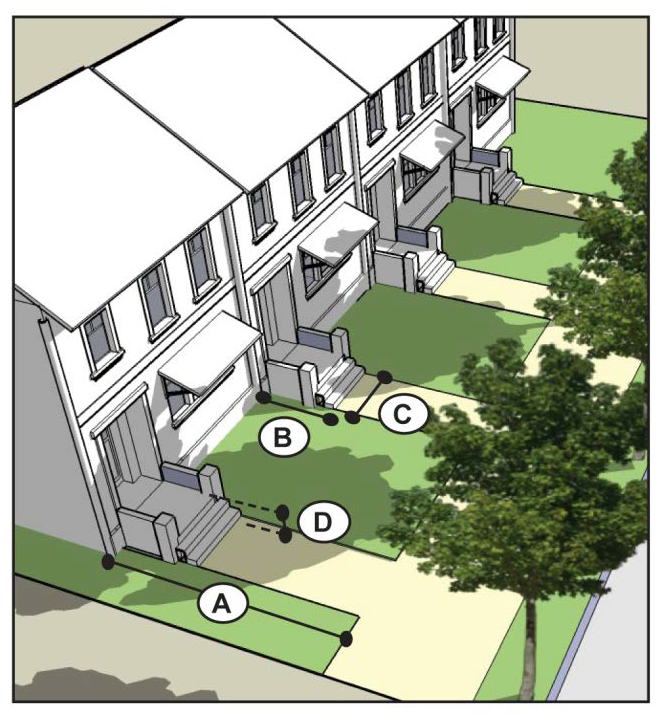
(Ord. No. 26-21, § 6, 8-10-21)
Figure 4.4.13-E-6
Stoop Character Example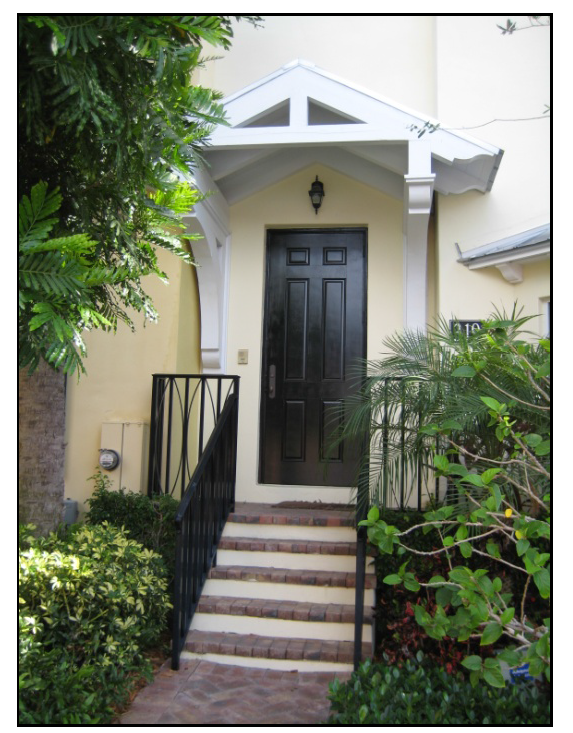
(Ord. No. 26-21, § 6, 8-10-21)
(c)
Bracketed balcony. A bracketed balcony is a second-story balcony, located over the main building entry, which provides cover for a person entering or exiting the building, emphasizes the entryway, and creates a semi-public space overlooking the street. The Delray Beach Architectural Design Guidelines provide guidance on balcony detailing. Bracketed balconies are typically associated with buildings with commercial uses in the ground story; however, bracketed balconies may be used with residential uses if combined with a stoop. Figure 4.4.13-E-7 illustrates the dimensional requirements from Table 4.4.13(G). Figure 4.4.13-E-8 provides a character example. (Ord. No. 26-21, § 6, 8-10-21)
Figure 4.4.13-E-7
Bracketed Balcony Frontage Type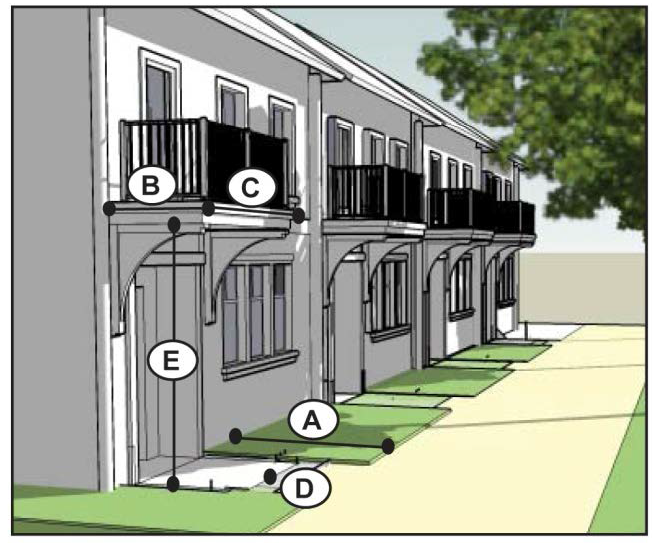
(Ord. No. 26-21, § 6, 8-10-21)
Figure 4.4.13-E-8
Bracketed Balcony Character Example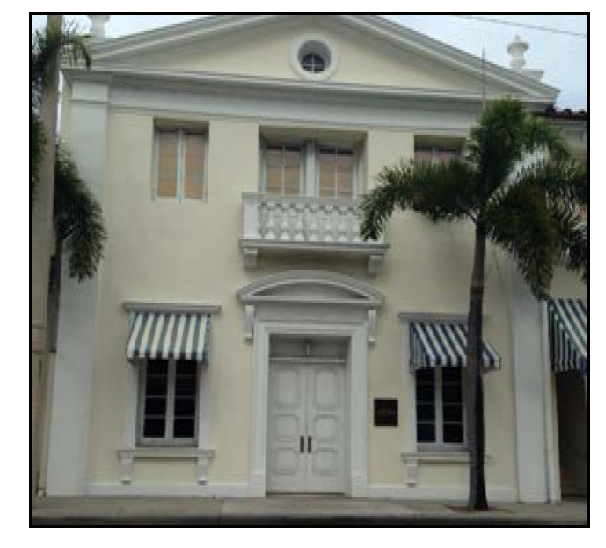
(Ord. No. 26-21, § 6, 8-10-21)
(d)
Forecourt. A forecourt is an open area in front of the main building entrance(s) designed as a small garden or plaza. Low walls or balustrades no higher than three feet six inches in height may enclose the forecourt. Forecourt walls are constructed of similar material as the principal building or are composed of a continuous, maintained hedge. A forecourt may afford access to one or more first floor residential dwelling units or incorporate storefronts for commercial uses. The forecourt is suitable for outdoor seating for residents or restaurants. Forecourts are typically associated with multifamily, mixed-use, and commercial buildings. Figure 4.4.13-E-9 illustrates the dimensional requirements from Table 4.4.13(H). Figure 4.4.13-E-10 provides a character example. (Ord. No. 26-21, § 6, 8-10-21)
Figure 4.4.13-E-9 Forecourt Frontage Type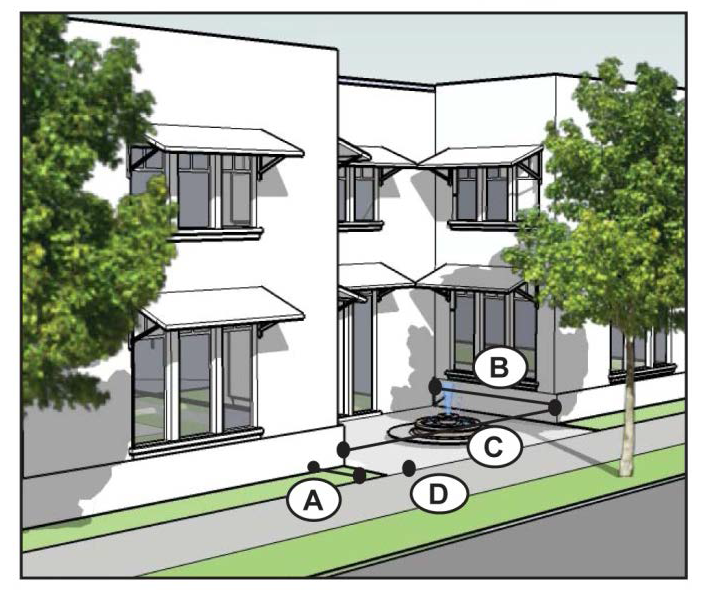
(Ord. No. 26-21, § 6, 8-10-21)
Figure 4.4.13-E-10
Forecourt Character Example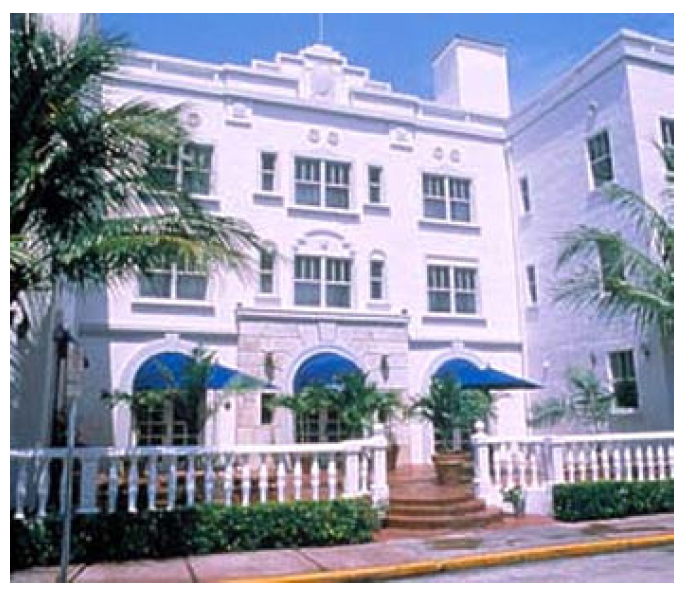
(Ord. No. 26-21, § 6, 8-10-21)
(e)
Storefront. The storefront is a frontage type along the sidewalk level of the ground story, typically associated with commercial uses. Storefronts are shaded by awnings or arcades. (Ord. No. 19-18, § 6, 10-16-18; Ord. No. 26-21, § 6, 8-10-21)
1.
Storefront dimensions. Table 4.4.13(I) provides the dimensional requirements and the maximum allowable encroachment permitted. Figure 4.4.13-E-11 illustrates the dimensional requirements and Figure 4.4.13-E-12 provides a character example. (Ord. No. 26-21, § 6, 8-10-21)
a.
Storefronts shall be directly accessible from sidewalks; storefront doors may be recessed up to ten feet. [Amd. Ord. 28-15 12/08/15]
[Amd. Ord. 28-15 12/08/15] (Ord. No. 19-18, § 6, 10-16-18)
Figure 4.4.13-E-11 Storefront Frontage Type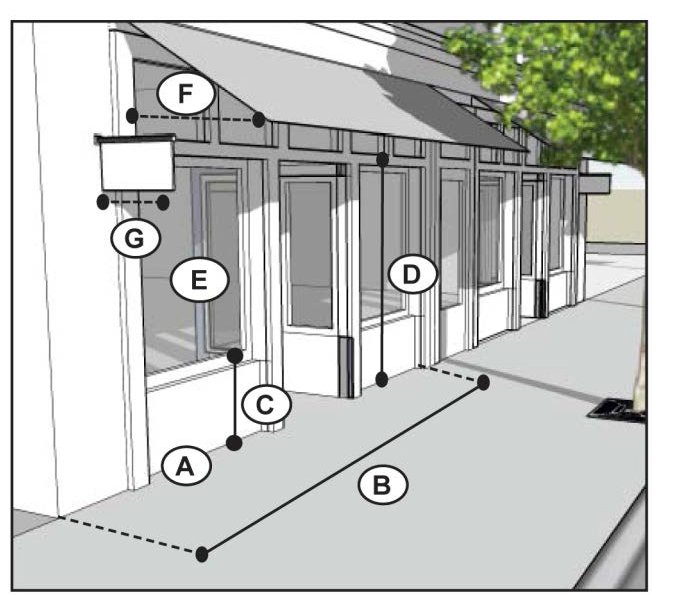
(Ord. No. 26-21, § 6, 8-10-21)
Figure 4.4.13-E-12
Storefront Character Example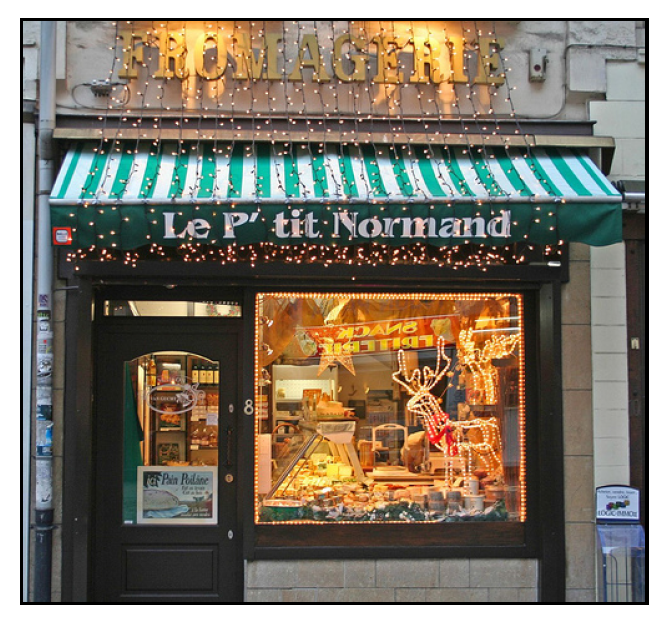
(Ord. No. 26-21, § 6, 8-10-21)
b.
Storefront (window and door) openings shall extend along at least 80 percent of the width of the facade of the commercial space, measured by the sum of the widths of the rough openings. [Amd. Ord. 28-15 12/08/15] (Ord. No. 19-18, § 6, 10-16-18)
c.
Storefront windows shall have a base nine inches to three feet high. (Ord. No. 19-18, § 6, 10-16-18)
d.
Transparent glazed windows shall extend from the base to at least eight feet in height as measured from sidewalk grade adjacent to the building. Transparent means non-solar, non-mirrored, glass with a light transmission reduction of no more than 20 percent. (Ord. No. 19-18, § 6, 10-16-18)
e.
Metal storefront window and door frames shall have powder-coated finishes. (Ord. No. 19-18, § 6, 10-16-18)
2.
Storefront elements.
a.
Storefronts shall have either awnings or an arcade. Awnings shall project a minimum of five feet from the building facade. Arcades shall meet the Arcade frontage standards in Section 4.4.13.(E)(4)(f). (Ord. No. 19-18, § 6, 10-16-18)
b.
Awnings shall be consistent with the building's architecture and proportionate to the façade opening shape and size. Except for curved awnings, all awnings shall be sloped 15 to 35 degrees from the horizontal plane. Valances shall be no more than 12 inches long. Internally illuminated or plastic awnings are prohibited.
c.
Storefronts may be combined with forecourts, porches, or arcades. [Amd. Ord. 28-15 12/08/15]
(f)
Arcade. An Arcade is a covered, unglazed, linear hallway attached to the front of a building, supported by columns or pillars. The arcade extends into the public right-of-way, over the streetscape area, creating a shaded environment ideal for pedestrians. This frontage type is typically associated with commercial uses.
1.
Arcade dimensions. Table 4.4.13(J) provides the dimensional requirements and the maximum allowable encroachment permitted. Figure 4.4.13-E-13 illustrates the dimensional requirements and Figure 4.4.13-E-14 provides a character example. (Ord. No. 26-21, § 6, 8-10-21)
(Ord. No. 19-18, § 6, 10-16-18)
Figure 4.4.13-E-13 Arcade Frontage Type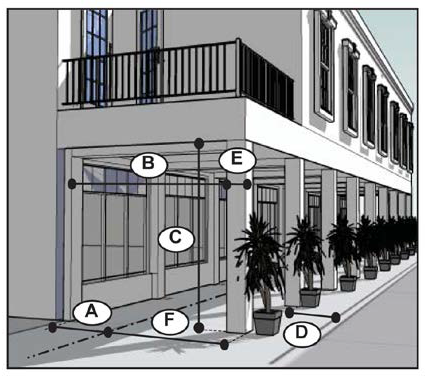
(Ord. No. 26-21, § 6, 8-10-21)
Figure 4.4.13-E-14 Arcade Character Example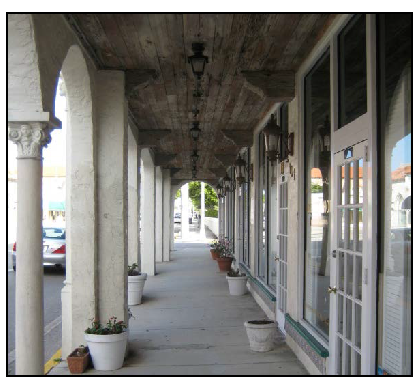
(Ord. No. 26-21, § 6, 8-10-21)
a.
Arcades shall extend over the sidewalk. A sidewalk should not run parallel to an arcade, allowing pedestrians to bypass storefront windows.
b.
Use of the arcade on local streets requires entering into a right-of-way agreement, in a form acceptable to the City Attorney, with the City. The City Commission shall determine in its sole and absolute discretion whether to approve or deny an agreement, which shall be based upon a determination of whether the arcade is in the best interest of the general public. This agreement shall establish liability, indemnification, and insurance responsibilities in a form acceptable to the City. For County, State, and Federal roads, agreements with the appropriate agencies and the City shall be required. (Ord. No. 19-18, § 6, 10-16-18)
c.
Arcades shall have a clear depth between the interior face of the columns and the building facade of at least ten feet and no more than 20 feet. If the distance between the property line and the face of curb is not sufficient to accommodate the minimum depth of ten feet required for an arcade, or, if the distance between the property line and the face of curb is deep enough that using the required building setback results in an arcade with a clear depth greater than 12 feet, the front setback may be administratively adjusted by the Development Services Director, taking into consideration the ultimate location of the face of curb. If determined necessary by the City, the property owner shall grant a pedestrian and underground utility easement to the City, in a form acceptable to the City Attorney, on the applicant's property to reach ten feet of clear depth. (Ord. No. 26-21, § 6, 8-10-21)
d.
Arcade ceilings shall be designed with coffers or exposed beams extruding at least six inches, aligned with columns or pillars. Arcades shall have a clear height above the sidewalk of at least ten feet and no more than 20 feet.
e.
Support columns or pillars shall be at least 12 inches wide and deep. See Section 4.6.18(B)(14)(iii). Columns and pillars shall be placed two to five feet from the face of the curb. (Ord. No. 19-18, § 6, 10-16-18)
f.
The arcade area extending over the public right-of-way may contain a second story or incorporate roof terraces; additional stories are not permitted.
2.
Arcade elements
a.
Arcades shall be combined with storefronts.
b.
The height and proportions of the arcade shall be consistent with the architecture and proportions of the building to which it is attached.
c.
Potted landscaping or ground planting shall be provided between the face of the columns or pillars and the face of curb.
d.
Lighting shall be incorporated into arcades to meet CPTED principles.
(g)
Lobby entry. The lobby entry is a frontage type that emphasizes the main entrance to the reception area of a building with a significant architectural feature. The lobby entry type provides an integral architectural element that provides a sheltered area to congregate in front of the main entrance to a commercial, mixed-use, multi-family, or civic building. The entry may be at sidewalk level or elevated. [Amd. Ord. 27-15 10/20/15]
1.
Lobby entry dimensions. Table 4.4.13(K) provides the dimensional requirements and the maximum allowable encroachment permitted for certain elements. Figures 4.4.13-E-15 and 4.4.13-E-16 provide character examples. (Ord. No. 26-21, § 6, 8-10-21)
a.
Lobby entry features shall be consistent with the architecture of building and encroaching elements shall be harmonious in scale and proportion to the building.
b.
Lobby entries shall be directly accessible from the sidewalk and may be recessed up to ten feet.
c.
Overhangs or awnings may encroach into the front setback area up to ten feet.
d.
Columns, pilasters, and posts may encroach into the front setback up to five feet.
Figure 4.4.13-E-15 Lobby Entry Character
Example 1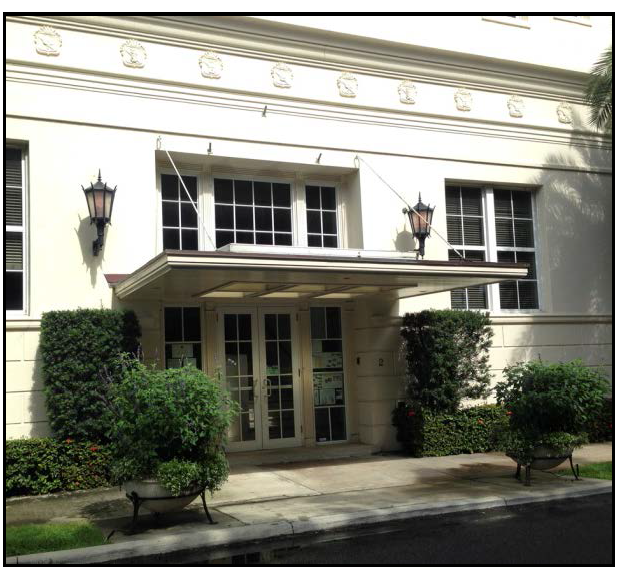
(Ord. No. 26-21, § 6, 8-10-21)
Figure 4.4.13-E-16 Lobby Entry Character
Example 2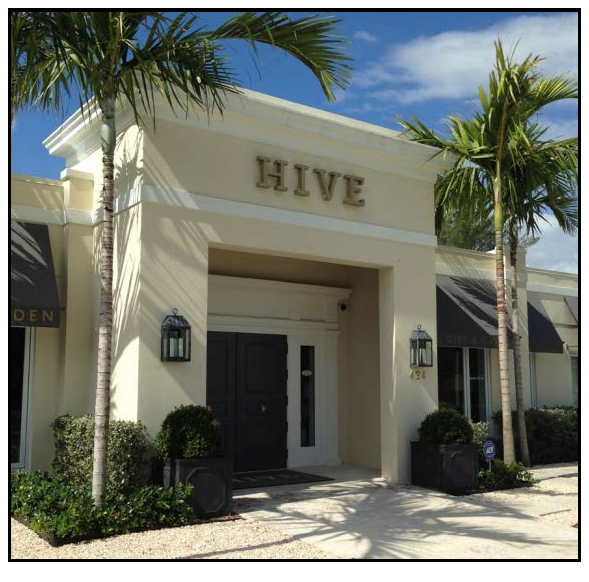
(Ord. No. 26-21, § 6, 8-10-21)
(F)
Architectural standards. To ensure high quality architecture in the downtown area, the following architectural standards apply to all buildings in the Central Business District Sub-districts and in the OSSHAD with CBD Overlay. In addition to the standards in Section 4.6.18, the following standards apply in all CBD Sub-districts. [Amd. Ord. 28-15 12/08/15]
(1)
Required standards. In addition to the standards in this section, all buildings shall follow the Delray Beach Architectural Design Guidelines. Properties located within a Historic District or Individually Designated Sites, as listed on the Local Register of Historic Places in Section 4.5.1(I), shall also comply with the Visual Compatibility Standards of Section 4.5.1(E)(7). [Amd. Ord. 28-15 12/08/15]
(2)
Façade composition. [Amd. Ord. 28-15 12/08/15]
(a)
Building Articulations. Buildings articulations that respond to the site's unique urban condition, such as but not limited to, locations on corners, near public open spaces, terminating the visual axis of a street, and/or that emphasize main building entries, shall be clearly expressed in the design. [Amd. Ord. 28-15 12/08/15] (Ord. No. 12-23, § 2, 5-16-23)
1.
Building articulations in the form of a change in building height and building placement shall be incorporated so that building façade proportions do not exceed height to width ratios of 3:1 or 1:2 (Figure 4.4.13-F-1). [Amd. Ord. 28-15 12/08/15] (Ord. No. 19-18, § 7, 10-16-18; Ord. No. 26-21, § 7, 8-10-21)
2.
Building articulations shall be reinforced by changes in roof design, fenestration patterns, or architectural elements. [Amd. Ord. 28-15 12/08/15]
Figure 4.4.13-F-1 Façade Articulation Proportions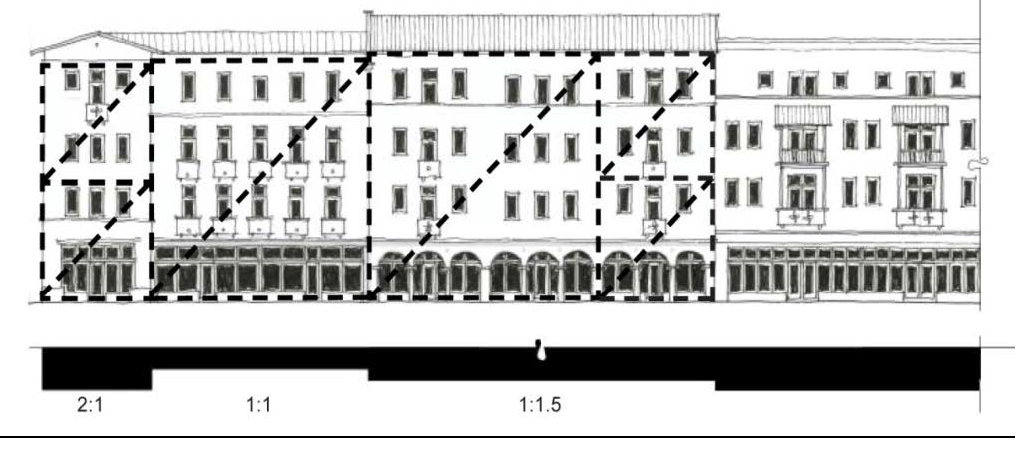
(Ord. No. 19-18, § 7, 10-16-18; Ord. No. 26-21, § 7, 8-10-21)
(b)
Tripartite composition (base, middle, top). All buildings shall have a clearly expressed base, middle, and top in the façade design. [Amd. Ord. 28-15 12/08/15]
1.
Base. The building base demonstrates the building is solidly anchored to the ground. The base may be configured in a number of ways, including, but not limited to the following: [Amd. Ord. 28-15 12/08/15]
a.
A thickening of the lower portion of the wall surface, accompanied by a change in material or color; [Amd. Ord. 28-15 12/08/15]
b.
the base of a storefront frontage type; or [Amd. Ord. 28-15 12/08/15]
c.
the first story of buildings three or more stories tall, demarcated by a cornice or molding. [Amd. Ord. 28-15 12/08/15]
Figure 4.4.13-F-2 Examples of Base, Middle, Top Configurations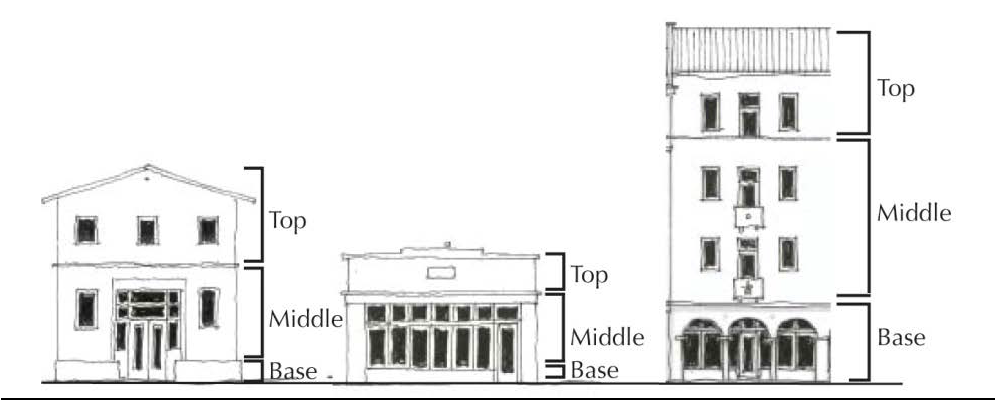
(Ord. No. 26-21, § 7, 8-10-21)
2.
Top. The building top may be demonstrated in a number of ways, including, but not limited to the following: [Amd. Ord. 28-15 12/08/15]
a.
a change in fenestration patterns; [Amd. Ord. 28-15 12/08/15]
b.
placement of architectural elements such as balconies, cornice line, and moldings; [Amd. Ord. 28-15 12/08/15]
c.
the parapet or roofline in buildings one to three stories tall; or [Amd. Ord. 28-15 12/08/15]
d.
a setback at the top story. [Amd. Ord. 28-15 12/08/15]
(c)
Visual screenings. Building facades shall be designed to visually screen "Secondary Street" uses (as identified in Table 4.4.13 (A)) and large expanses of blank walls. Appropriate façade design to screen these uses incorporates the consistent use of materials and construction assemblies, fenestration patterns, architectural articulation, and features such as, but not limited to, the application of architectural screens, louvers, or glass. In addition, at the sidewalk level, vegetated surfaces and planters or window display shall be incorporated. Paint, faux treatments, scoring, construction joints, lighting, and material projections less than two inches are permitted, but do not fulfill the façade design requirements. [Amd. Ord. 28-15 12/08/15]
Figure 4.4.13-F-3
Character Examples for Building Façade Screening Secondary Street Uses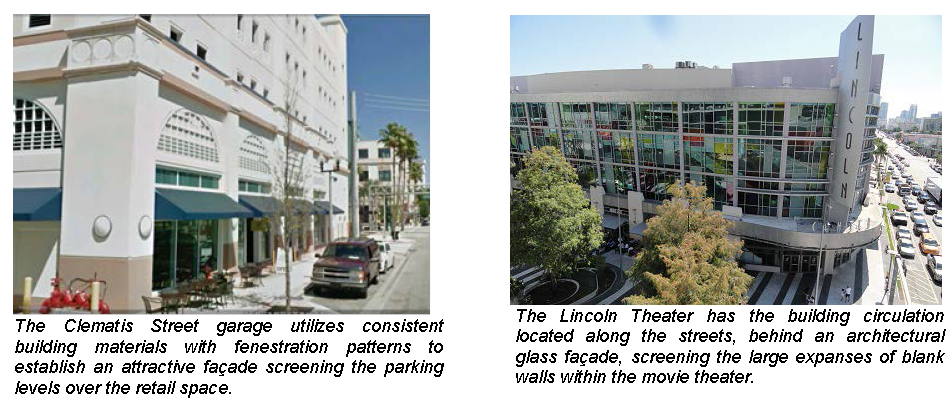
(Ord. No. 26-21, § 7, 8-10-21)
(d)
Façade composition compliance. All development submittals shall provide diagrams and/or documentation to illustrate compliance with the requirements of this Section which includes Building Articulation, Tripartite Composition, and Visual Screening. Additional analysis demonstrating compliance may be required by the Development Services Director at any point in the process. [Amd. Ord. 28-15 12/08/15] (Ord. No. 26-21, § 7, 8-10-21)
(3)
Appropriate architectural styles. The adopted "Delray Beach Central Business District Architectural Design Guidelines", as amended, identifies architectural styles as appropriate for downtown Delray Beach, based on historical precedent, climate, and building scale. Defining characteristics and character examples are provided for each of the styles as guidance. [Amd. Ord. 28-15 12/08/15] (Ord. No. 19-18, § 7, 10-16-18)
(a)
Permitted architectural styles. One of the architectural styles shall be identified on permit application drawings and the building design shall reflect the defining characteristics outlined in the "Delray Beach Central Business District Architectural Design Guidelines" document. [Amd. Ord. 28-15 12/08/15] (Ord. No. 19-18, § 7, 10-16-18)
(b)
Eclectic combinations or mixing of styles is not permitted; however, projects comprised of multiple buildings may use more than one style, provided each building uses one style (e.g. an Anglo-Caribbean building next to a Florida Vernacular building), and façade portions of long buildings may use different styles provided each portion uses one style. [Amd. Ord. 28-15 12/08/15]
(c)
Other Architectural Styles. Elevations introducing a new style may be utilized with City Commission approval, via recommendation by SPRAB or HPB, as applicable. City Commission approval is required prior to consideration of the site plan by SPRAB or HPB. Applicants shall provide the following: [Amd. Ord. 28-15 12/08/15] (Ord. No. 19-18, § 7, 10-16-18)
1.
A description including images of a documented and substantiated Florida vernacular architecture; [Amd. Ord. 28-15 12/08/15]
2.
A written justification of the appropriateness of the style for downtown Delray Beach; and [Amd. Ord. 28-15 12/08/15]
3.
An explanation including graphics demonstrating how the building design follows the proposed style. [Amd. Ord. 28-15 12/08/15]
(d)
Eclectic combinations of architectural styles may be used for civic buildings or for additions or renovations to existing buildings with City Commission approval, via recommendation by the SPRAB or HPB, as applicable. Applicant shall provide a written justification of the appropriateness of the eclectic combination of styles for downtown Delray Beach. [Amd. Ord. 28-15 12/08/15]
(e)
The use of Masonry Modern or Art Deco architectural styles requires City Commission approval, via recommendation by SPRAB or HBP, as applicable, City Commission approval is required prior to consideration of the site plan by SPRAB or HBP. Applicants shall provide an explanation, including graphics, demonstrating how the proposed building design implements the selected style. (Ord. No. 12-23, § 2, 5-16-23)
(f)
Accessory structures such as enclosures used for the screening of mechanical and electrical equipment, loading and service areas, and/or dumpster and recycling areas shall be consistent with the architectural style of the principal building. [Amd. Ord. 28-15 12/08/15] (Ord. No. 12-23, § 2, 5-16-23)
(4)
Walls. [Amd. Ord. 28-15 12/08/15]
(a)
Walls shall have a maximum of two primary materials, excluding windows, doors, accents and trims. The materials shall be appropriate to the architectural style and shall be consistent on all sides of the building. Materials that simulate other materials shall count as separate materials if there is a change in texture, color, or pattern of the finish. [Amd. Ord. 28-15 12/08/15]
(b)
Materials or patterns not expressly prohibited may be used if consistent with the architectural style of the building. [Amd. Ord. 28-15 12/08/15]
(c)
Metal curtain walls are permitted only on buildings designed in the Masonry Modern style and shall be limited to 30 percent of the total building exterior elevation. [Amd. Ord. 28-15 12/08/15]
(d)
Prohibitions. [Amd. Ord. 28-15 12/08/15]
1.
Prefabricated and pre-engineered metal wall panels. [Amd. Ord. 28-15 12/08/15]
2.
Metal curtain wall systems with 100 percent glass and metal combination. [Amd. Ord. 28-15 12/08/15]
(e)
Treatment of blank walls. [Amd. Ord. 28-15 12/08/15]
1.
Blank walls shall not exceed a length of 50 feet, or 20 percent of the length of the building facing the street, whichever is less. [Amd. Ord. 28-15 12/08/15]
2.
Blank walls shall receive two or more of the following special design treatments in order to increase pedestrian comfort or create visual interest: [Amd. Ord. 28-15 12/08/15] (Ord. No. 26-21, § 7, 8-10-21)
a.
Vertical trellis in front of the wall with climbing vines or other plant materials over at least 30 percent of the blank wall surface. [Amd. Ord. 28-15 12/08/15]
b.
Small setbacks, projections, or indentations with a minimum depth of eight inches, or intervals of material change to break up the wall's surface. [Amd. Ord. 28-15 12/08/15]
c.
Additional architectural details such as pilasters, medallions, decorative panels or castings, decorative accent tiles, wall-mounted fountains, or public art shall be integrated on any exterior wall to avoid a blank wall appearance. [Amd. Ord. 28-15 12/08/15]
(f)
A maximum of four base wall colors shall be used for each building, except as required for approved artworks or murals. (Ord. No. 26-21, § 7, 8-10-21)
(5)
Openings. [Amd. Ord. 28-15 12/08/15]
(a)
Building façades facing streets or civic open spaces must have transparent windows covering between 20 percent and 75 percent of the wall area of each story as measured between finished floors. Transparent means non-solar, non-mirrored glass with a light transmission reduction of no more than 20 percent. [Amd. Ord. 28-15 12/08/15]
(b)
Storefronts are required on all buildings located on streets designated on the Regulating Plan with Required Retail Frontage and on all new retail or restaurant uses. All storefronts shall meet the design requirements in Section 4.4.13(E)(4)(e). [Amd. Ord. 28-15 12/08/15]
(c)
All public entries, excluding emergency exits, shall be easily identifiable and integrated into the building architecture and use one of the frontage types in Section 4.4.13(E)(4). Each freestanding principal structure shall have a minimum of one clearly defined primary public entrance facing the street. [Amd. Ord. 28-15 12/08/15]
(d)
Window and door shutters shall be sized to match the dimensions of the wall openings. [Amd. Ord. 28-15 12/08/15]
(e)
Overhead doors shall be prohibited from facing any adjacent residentially zoned property. Overhead doors shall be oriented away from any adjacent public right-of-way, except where currently existing. [Amd. Ord. 28-15 12/08/15]
(f)
Garage doors, entrances and exits with street frontage shall be designed to have a decorative appearance consistent with the overall architectural composition of the project. [Amd. Ord. 28-15 12/08/15]
(6)
Roofs. [Amd. Ord. 28-15 12/08/15]
(a)
Roof eaves above pedestrian walkways must be guttered to promote a pedestrian friendly environment. Plastic gutters are prohibited. [Amd. Ord. 28-15 12/08/15]
(b)
Roof types and roofing materials must be consistent with the architectural style of the building. [Amd. Ord. 28-15 12/08/15]
(c)
Flat roofs shall be screened from adjacent properties and streets with decorative parapets. The maximum height of the parapet wall shall be six feet in height or sufficient height to screen all roof mounted equipment, whichever is greater, measured from the top of the roof deck to the top of the parapet wall. Exception to the height requirements shall be pursuant to Section 4.3.4(J)(3). [Amd. Ord. 28-15 12/08/15]
(d)
Roof mounted electrical, mechanical, air conditioning, and communication equipment shall be completely screened from adjacent properties and streets. [Amd. Ord. 28-15 12/08/15]
(e)
Rooftop terraces and uses are regulated in 4.4.13(C)(4)(h). (Ord. No. 19-18, § 7, 10-16-18)
(f)
Prohibitions. [Amd. Ord. 28-15 12/08/15] (Ord. No. 19-18, § 7, 10-16-18)
1.
Flat asphalt shingles. Architectural 3-tab asphalt shingles with a minimum 30-year warranty are permitted. [Amd. Ord. 28-15 12/08/15]
2.
Plastic gutters. [Amd. Ord. 28-15 12/08/15]
(7)
Elements. [Amd. Ord. 28-15 12/08/15]
(a)
Cornices and moldings shall extend a minimum of two inches from the surface plane of the building wall. Cornices and moldings are continuous façade elements and may not be covered by awnings or signs. Significant architectural elements such as columns, pilasters, and towers may interrupt moldings. [Amd. Ord. 28-15 12/08/15]
(b)
Arcades, porches, trellises, loggias and balconies. [Amd. Ord. 28-15 12/08/15]
1.
Materials for arcades, porches, trellises, loggias and balconies shall be consistent with the architectural style of the principal building. [Amd. Ord. 28-15 12/08/15]
2.
The spacing between columns, pillars, and posts shall have a height to width or width to height ratio of 1:1, 2:1, or 2:3 and shall be consistent with the building's architectural style. The maximum spacing between columns, from centerline to centerline shall be 24 feet. [Amd. Ord. 28-15 12/08/15]
3.
Columns, pillars and posts shall be appropriate for the architectural style of the building. Masonry columns or pillars shall be a minimum of 12 inches in width or depth. Wood posts shall be a minimum six inches in size, width, or depth. [Amd. Ord. 28-15 12/08/15]
4.
Arches over columns that are part of an arcade shall have no less than 8 inches in depth. [Amd. Ord. 28-15 12/08/15]
(c)
Awnings shall be consistent with the building's architecture and façade opening shape. Awnings shall project a minimum of three feet from the building facade. Except for curved awnings, all awnings shall be sloped 15 to 35 degrees from the horizontal plane. Valances shall be no more than 12 inches long. Internally illuminated or plastic awnings are prohibited. Any names or logos printed on awnings shall be counted as square footage against the overall permitted signage. [Amd. Ord. 28-15 12/08/15]
(d)
A streetwall is required along both Primary and Secondary Streets where there is no building frontage. Where required, streetwalls must be provided as follows: [Amd. Ord. 28-15 12/08/15] (Ord. No. 19-18, § 7, 10-16-18; Ord. No. 26-21, § 7, 8-10-21)
1.
Streetwalls located within the front setback shall be three to four feet in height. (Ord. No. 26-21, § 7, 8-10-21)
2.
Streetwalls located in line with a building façade shall be three to six feet in height. (Ord. No. 26-21, § 7, 8-10-21)
3.
Streetwalls shall be composed of either an opaque wall of the same material and color as the building, a metal or wood capped rail fence, or of a continuous, maintained hedge. In addition, one shade tree per 30 lineal feet, uniformly spaced, shall be installed along the length the streetwall. (Ord. No. 26-21, § 7, 8-10-21)
4.
In the South Pairs Neighborhood Sub-district, instead of the streetwall requirement above and the streetscape requirements in Section 4.4.13(E), development adjacent to SE 7 th Avenue shall provide a solid finished masonry wall along SE 7 th Avenue at least six feet in height, but not more than eight feet in height, measured from the side with the higher grade. A 10-foot-wide planting strip shall be provided between the wall and the edge of road pavement with a continuous installation of upright cluster palms or hedge bamboo a minimum of 8 feet in height at the time of installation at a spacing whereby the branches are touching at the time of planting. The landscaping shall be planted and maintained to form a continuous, solid, visual screen within a maximum of one year of planting. (Ord. No. 20-21, § 8, 12-7-21)
(e)
Chain link fences are prohibited except within sites containing outdoor recreation uses or facilities such as baseball, tennis, racquetball, etc. in which case they must be appropriately screened with landscaping pursuant to Section 4.6.16. [Amd. Ord. 28-15 12/08/15]
(f)
Mechanical elements and equipment necessary to the operation or maintenance of the building such as, but not limited to, elevator, stair, and mechanical rooms, cooling towers, vent stacks and antennae shall be designed to be integral parts of the overall building design, provide a balanced and graceful silhouette, and ameliorate the visual impact to adjacent buildings. Minor features not exceeding one foot in height shall be exempted from this regulation. [Amd. Ord. 28-15 12/08/15] (Ord. No. 26-21, § 7, 8-10-21) [5]
(g)
Miscellaneous free-standing, wall or ground mounted appurtenances such as electrical and gas meters, dumpster/recycling, trash compactors, gas tanks, air conditioning and communication equipment shall be enclosed or screened and integrated into the building's architectural treatment. The appurtenances shall also be prohibited within the front yards. [Amd. Ord. 28-15 12/08/15] (Ord. No. 26-21, § 7, 8-10-21)
(h)
Prohibitions. [Amd. Ord. 28-15 12/08/15] (Ord. No. 26-21, § 7, 8-10-21)
a.
Security bars on storefronts or display windows. [Amd. Ord. 28-15 12/08/15]
b.
Neon or fluorescent lighting, unless incorporated into the architectural concept of the project or public artwork and approved by the Site Plan Review and Appearance Board, the Historic Preservation Board, or Public Arts Advisory Board, as appropriate. An example of this may be a design element associated with an Art Deco project. [Amd. Ord. 28-15 12/08/15] (Ord. No. 26-21, § 7, 8-10-21)
(8)
Parking garages. Above ground parking garages shall comply with the architectural requirements of this Section and the following additional requirements: [Amd. Ord. 28-15 12/08/15] (Ord. No. 26-21, § 7, 8-10-21)
(a)
Ramps shall be visually screened from streets and adjacent residential zoning districts and oriented towards the interior of the lot within a project where possible. Ramp profiles shall be hidden on the exterior elevations. [Amd. Ord. 28-15 12/08/15]
(b)
Roof top parking shall be visually screened with articulated parapet walls or other architectural treatment acceptable to the reviewing body. Exterior lighting shall utilize fixtures provided with cut-off shielding in order to eliminate glare and spillage onto adjacent properties and roadways. [Amd. Ord. 28-15 12/08/15] (Ord. No. 32-23, § 18, 10-17-23)
(c)
The openings of the garage shall be designed in a manner that obscures parked vehicles. Decorative architectural elements on the ground floor level shall be designed to accommodate the pedestrian scale. Parking levels above the ground floor shall maintain the same vertical and horizontal articulation or rhythm and incremental appearance established on the ground floor. [Amd. Ord. 28-15 12/08/15]
(d)
Setback waiver. The reviewing body may grant a waiver from the setback requirements of Section 4.4.13(D) for any portions of the building above three stories to maximize the efficiency of a parking garage, subject to the following requirements: [Amd. Ord. 28-15 12/08/15] (Ord. No. 19-18, § 7, 10-16-18; Ord. No. 26-21, § 7, 8-10-21; Ord. No. 32-23, § 18, 10-17-23)
1.
The garage or the garage portion of the building elevation provides unified design elements with the main building through the use of similar materials and color, vertical and horizontal elements, and architectural style. [Amd. Ord. 28-15 12/08/15]
2.
In OSSHAD and on Secondary Streets in the CBD, a minimum 50 percent of the ground floor perimeter of the garage or the garage portion of the building adjacent to street rights-of-way shall be devoted to window displays or floor area for active uses such as retail stores, personal and business service establishments, entertainment, offices, etc. This number may be reduced by the reviewing body. On Primary Streets in the CBD, the perimeter of the garage or the garage portion of the building adjacent to the street rights-of-way shall be lined by active uses (outlined in Section 4.4.13(C). [Amd. Ord. 28-15 12/08/15] (Ord. No. 32-23, § 18, 10-17-23)
3.
Architectural features shall be incorporated into the facade to mitigate the building's mass and bulk and along portions of the building adjacent to street rights-of-way. [Amd. Ord. 28-15 12/08/15]
4.
In the South Pairs Neighborhood Sub-district, waivers to the setback requirements of Section 4.4.13(D) for parking garages may only be requested for property located between SE 5 th Avenue and SE 6 th Avenue. (Ord. No. 20-21, § 8, 12-7-21)
(9)
Reduction of Urban Heat Islands. To reduce urban heat islands for both roofed and non-roofed areas, the following standards shall apply to building and site design: [Amd. Ord. 28-15 12/08/15] (Ord. No. 30-22, § 5, 11-1-22)
(a)
Non-roofed: Provide landscaped or vegetated shade (within five years of planting) on at least 30 percent of non-roofed surfaces on the side, including parking lots, walkways, plazas, etc.; or use light-colored/high-albedo materials (reflectance of at least 0.3) for 30 percent of the site's non-roofed impervious surfaces; or, use open-grid pavement system (net impervious area of less than 50 percent) for a minimum of 50 percent of the parking lot area. [Amd. Ord. 28-15 12/08/15] (Ord. No. 30-22, § 5, 11-1-22)
(b)
Roofed: Use Energy Star roof-compliant, high-reflectance and high emissivity roofing based on the specifications of Low-Sloped Roofs (pitch: up to 2:12) and Steep-Sloped Roofs (pitch: greater than 2:12) or install a "green" (vegetated) roof for at least 50 percent of the roof area. [Amd. Ord. 28-15 12/08/15] (Ord. No. 30-22, § 5, 11-1-22)
(c)
Parking on roofs: Provide landscaped or vegetated shade to cover at least 30 percent (within five years of planting) of any exposed parking on the roof. [Amd. Ord. 28-15 12/08/15] (Ord. No. 30-22, § 5, 11-1-22)
(G)
Civic open spaces. Civic open spaces are privately maintained outdoor spaces which are accessible by the general public, improve the pedestrian environment, are aesthetically pleasing, and serve as an amenity for the city as a whole as well as for occupants of the building which the open space serves.
(1)
Amount required. New development or additions of gross floor area equal to 20 percent or more to existing buildings shall provide civic open space as follows: [Amd. Ord. 28-15 12/08/15]
(a)
Sites smaller than 20,000 square feet have no civic open space requirement. The first 20,000 square feet of sites larger than 20,000 square feet are not used in the computation of required civic open spaces.
(b)
Sites between 20,000 and 40,000 square feet are required to provide five percent of the site's area that is above 20,000 square feet as civic open space.
(c)
Sites 40,000 square feet of more in size are required to provide civic open space as follows: (Ord. No. 19-18, § 8, 10-16-18)
1.
Five percent of the site's area between 20,000 and 40,000 square feet; plus
2.
Nine percent of the site's area above 40,000 square feet. (Ord. No. 19-18, § 8, 10-16-18)
For example, a site 62,000 square feet in size will calculate civic open space as follows:
20,000 square feet = 0
20,000 square feet x 5% = 1,000 square feet
22,000 square feet x 9% = 1,980 square feet
Total Civic Open Space Required = 2,980 square feet
(Ord. No. 19-18, § 8, 10-16-18)
(d)
Dedicated rights-of-way and area used to meet the minimum setback or minimum streetscape standards in Section 4.4.13(E) do not count toward fulfilling the required amount. [Amd. Ord. 28-15 12/08/15]
(e)
Sites within the South Pairs Neighborhood Sub-district have reduced civic open space requirements as noted in Table 4.4.13(C). (Ord. No. 20-21, § 9, 12-7-21)
(2)
Types of civic open spaces. Civic open space shall be designed as one of the following types, which shall be identified on the site plan: (Ord. No. 19-18, § 8, 10-16-18)
(a)
Green. A green is at least 1,500 square feet in size and adjoins streets on at least two sides or a street and a pedestrian passageway or main building entry. Greens are designed primarily for passive uses, consisting primarily of lawn with either formally or informally arranged landscaping.
(b)
Plaza. A plaza is at least 1,500 square feet in size and adjoins streets on at least two sides or a street and a pedestrian passageway or main building entry. Plazas are mostly hardscaped with formally arranged landscaping and a water feature.
(c)
Playground. A playground is at least 2,500 square feet in size. Playgrounds provide children's play equipment and shaded seating. Playgrounds adjoin a street on at least one side and the configuration should ensure easy surveillance of the area from adjacent buildings and streets.
(d)
Square. A square is at least 10,000 square feet and adjoins streets on at least three sides. Squares may be up to 50 percent hardscaped, with formal landscaping. Squares accommodate both passive uses and community gatherings.
(e)
Attached Green. An attached green is generally 2,000 to 6,000 square feet and spans the entire length of a block. Attached greens shall be at least 30 feet wide and are appropriate on the short end of a block. Attached greens are primarily lawns with formally arranged landscaping.
(f)
Community Garden. A community garden is 2,500 to approximately 5,000 square feet and adjoins a street on at least one side. Community gardens are land that is cultivated collectively by members of a community (See Section 4.3.3 (D)).
(g)
For civic open space requirements between 250 and 1,500 square feet, buildings shall provide the required space using one of the following: (Ord. No. 19-18, § 8, 10-16-18)
1.
A Forecourt frontage type (see Section 4.4.13(E)(4)(d)). (Ord. No. 19-18, § 8, 10-16-18)
2.
A pedestrian passageway open to the sky connecting the front of the property to the rear, at least ten feet in width, and containing a minimum of 50% pervious, landscaped area, with decorative elements of interest, such as benches, trellises, sculptures, and water features which complement the design style of the building. Outdoor use areas may be provided adjacent to but not within the minimum required pedestrian passageway area. (Ord. No. 19-18, § 8, 10-16-18)
(h)
Public art. For civic open space requirements less than 250 square feet, the space shall incorporate a fountain, living wall, mural, or sculpture shall be provided facing a street or a pedestrian passageway. (Ord. No. 19-18, § 8, 10-16-18)
Figure 4.4.13-G-1 Character Example of Landscaped Pedestrian Passageway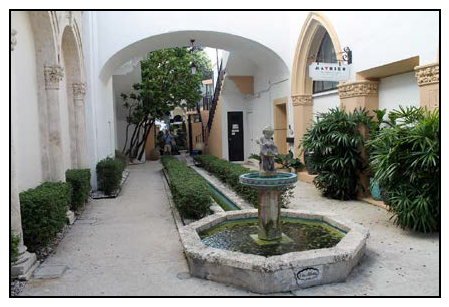
(Ord. No. 19-18, § 8, 10-16-18; Ord. No. 26-21, § 8, 8-10-21)
Figure 4.4.13-G-2
Character Example of Living Wall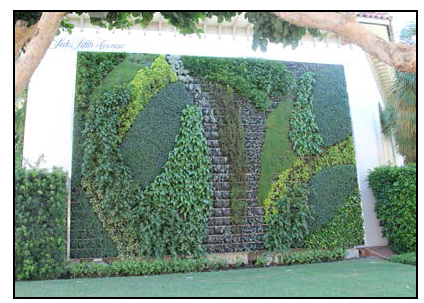
(Ord. No. 19-18, § 8, 10-16-18; Ord. No. 26-21, § 8, 8-10-21)
Figure 4.4.13-G-3 Civic Open Spaces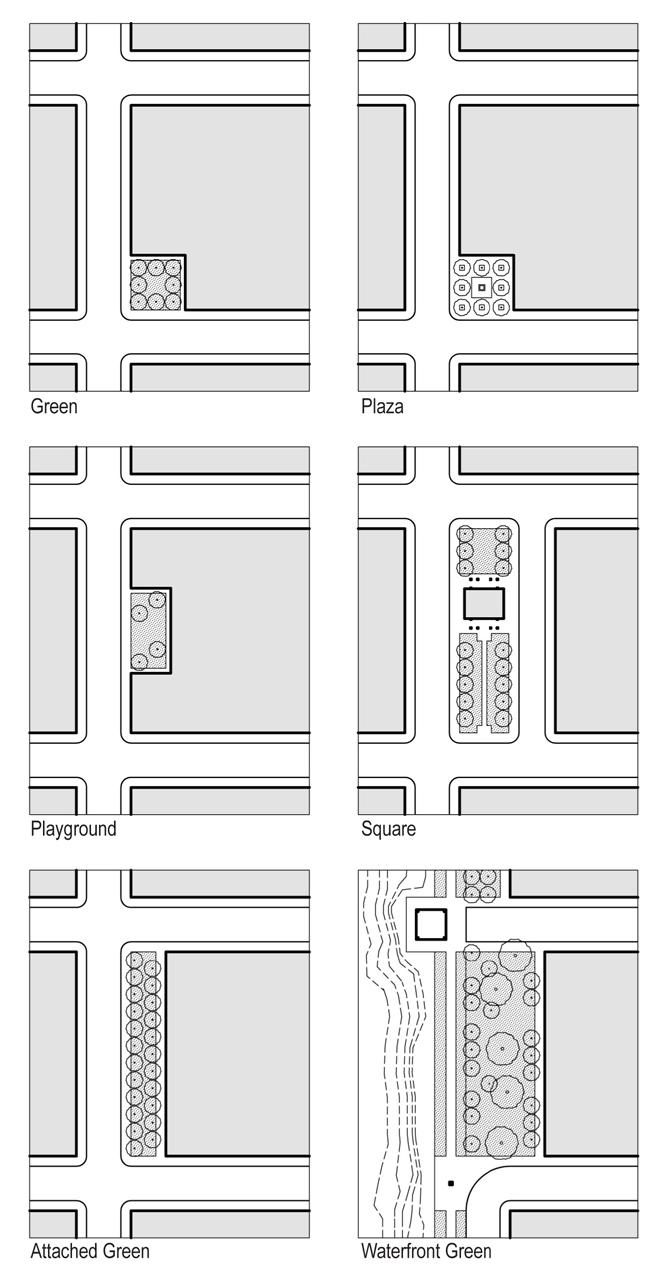
(Ord. No. 26-21, § 8, 8-10-21)
(3)
Configuration. Civic open spaces shall be configured as follows:
(a)
The civic open space shall adjoin a street front property line for no less than 30 linear feet.
(b)
The required amount of civic open space shall be configured in square or rectangle; additional area above the required amount may augment the space, creating another shape (See Figure 4.4.13-G-4). [Amd. Ord. 28-15 12/08/15] (Ord. No. 19-18, § 8, 10-16-18; Ord. No. 26-21, § 8, 8-10-21)
Figure 4.4.13-G-4 Civic Open Space Configuration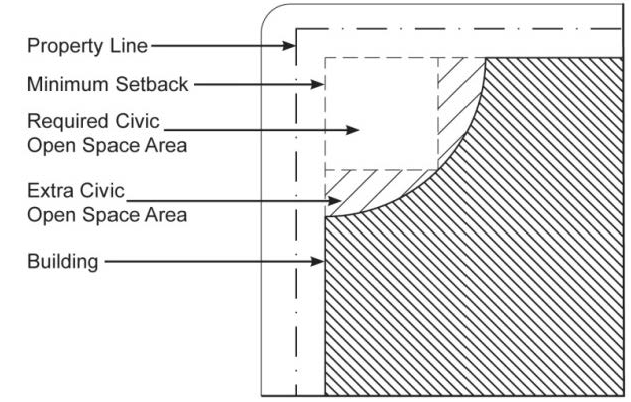
(Ord. No. 19-18, § 8, 10-16-18; Ord. No. 26-21, § 8, 8-10-21)
(c)
Except for attached greens, civic spaces shall have a proportion so that the depth is no more than two and one-half times the width and the width is no more than five times the depth. [Amd. Ord. 28-15 12/08/15]
(d)
Civic open spaces shall be lined by building facades or streets on all sides. In order to provide oversight of the space, buildings facing civic open spaces shall contain active uses; parking lots, parking garages, and storage areas are not considered active uses. [Amd. Ord. 28-15 12/08/15]
(e)
Civic open space requirements of 3,000 square feet or more may be provided in up to two spaces; requirements less than 3,000 square feet shall be provided in one space. [Amd. Ord. 28-15 12/08/15]
(4)
Additional standards. Civic open spaces shall meet the following minimum standards:
(a)
Civic open spaces must be accessible to the public during all daylight hours. A portion of a civic open space may accommodate outdoor dining provided:
1.
The business is located adjacent to the open space;
2.
The open space provides an alternative location for a sidewalk café instead of using the streetscape area of an adjoining street right-of-way; and (Ord. No. 19-18, § 8, 10-16-18)
3.
The size of the area is generally consistent with the potential size of a sidewalk café that could be located within the streetscape of an adjoining street right-of-way.
(b)
Civic open spaces must be situated to allow easy ingress and egress by pedestrians. Except for playgrounds, which may be fenced, no streetwalls, gates, fences or other impediments to pedestrian accessibility shall be permitted along the frontage lines;
(c)
Civic open spaces must be located at the sidewalk level;
(d)
Civic open spaces must be completely open to the sky, with no roofs, awnings, structural elements or covered areas above. Retractable awnings, trellises, and open-air garden structures such as pergolas, gazebos or band shells are permitted within civic open spaces; (Ord. No. 19-18, § 8, 10-16-18)
(e)
Landscaping shall be arranged in a manner reflective of the type of civic open space. One shade tree per 20 feet of perimeter of the space is required. Trees may be arranged in regular spacing or in informal clusters, depending on the type of open space. Trees shall be installed to provide shade along walkways and for benches. Substituting shade trees for multiple palm species is not permitted; however, adding palms to the landscape design is permitted.
(f)
Each civic open space shall provide the following elements, specifications subject to approval by the City of Delray Beach Public Works Department: (Ord. No. 29-20, § 2, 11-10-20)
1.
Seating for at least two people per 350 square feet of area. Seating may be provided on benches, chairs, or other horizontal surfaces designed for people to sit upon, including retaining walls, planter edges, tiers and other similar surfaces. Seating surfaces shall have a maximum height of 24 inches and have a minimum depth of 16 inches.
2.
One drinking fountain with dual pet water fountain feature; (Ord. No. 29-20, § 2, 11-10-20)
3.
At least one bicycle rack, but no more than two racks, as part of the required bicycle parking requirement. Any additional bicycle parking required by Table 4.4.13(M) shall be provided in other locations on the site; (Ord. No. 29-20, § 2, 11-10-20)
4.
One trash receptacle;
5.
One pet clean up station.
(g)
Fences are permitted only to enclose playgrounds. Fences may be composed of wood or metal pickets and shall not exceed four feet in height.
(h)
Vehicular traffic shall not be permitted within a civic open space.
(i)
Civic open spaces shall be designed to enhance user safety and security using Crime Prevention Through Environmental Design (CEPTED) principles by:
1.
Being well lighted;
2.
Having one or more focal points within the open space visible from all perimeter streets;
3.
Having a clear landscape zone between three feet and eight feet in height providing sightlines unobstructed by berms or bushes.
(5)
Availability. Civic open space shall be developed and open for use concurrent with the issuance of a certificate of occupancy for the building(s) for which the open space is required.
(H)
Incentive program. Certain incentives may be offered from time to time to encourage development that advances City strategic, policy-driven goals, such as diverse residential housing opportunities, sustainable building practices, historic preservation, public parking, civic open space, or office uses within the CBD. The specific incentives and required performance criteria are set forth in this Section and may be revised or amended after seeking community input and in response to factors such as update to the Downtown Master Plan, changing conditions within the CBD, transportation impacts, or market and/or demographic shifts. Any incentives shall be broad based and applicable within the entire CBD or CBD sub-district, no incentives programs shall be considered on a case-by-case basis or project-by-project basis. (Ord. No. 20-21, § 10, 12-7-21)
(1)
Residential Incentive Program. To encourage a variety of unit types, and income ranges within the downtown area, opportunities to increase density are offered in certain CBD Sub-districts. This Residential Incentive Program is the only way to obtain increases in density for property zoned CBD. The maximum density allowed by Table 4.4.13(C) in certain CBD Sub-districts may only be increased in the locations described below. (Ord. No. 33-19, § 2, 12-3-19; Ord. No. 20-21, § 10, 12-7-21)
(a)
Properties located within a historic district or on individually designated sites as listed on the Local Register of Historic Places in Section 4.5.1(I) are not eligible to use the Residential Incentive Program, unless specifically allowed by sub-district. (Ord. No. 20-21, § 10, 12-7-21)
(b)
West Atlantic Neighborhood Sub-district. (Ord. No. 33-19, § 2, 12-3-19; Ord. No. 20-21, § 10, 12-7-21)
1.
Density may be increased over 12 du/ac (up to 30 du/ac) within the West Atlantic Neighborhood Sub-district, subject to the Performance Standards set forth in Section 4.4.13(H)(2). (Ord. No. 20-21, § 10, 12-7-21)
2.
Properties located within the West Atlantic Neighborhood Sub-district that are also located within the West Settlers Historic District may utilize the Residential Incentive Program to increase the density to over 12 du/ac (up to 20 du/ac) if the following criteria is met: (Ord. No. 33-19, § 2, 12-3-19; Ord. No. 20-21, § 10, 12-7-21)
a.
The property is located between West Atlantic Avenue and NW 1 st Street; and, (Ord. No. 33-19, § 2, 12-3-19; Ord. No. 20-21, § 10, 12-7-21)
b.
The property does not contain a contributing structure; (Ord. No. 33-19, § 2, 12-3-19; Ord. No. 20-21, § 10, 12-7-21)
c.
The property does not contain a non-contributing structure that is at least 30 years old, from the original date of construction; (Ord. No. 33-19, § 2, 12-3-19; Ord. No. 20-21, § 10, 12-7-21)
d.
If the property is vacant, it has not contained a structure on the site for at least 15 years. (Ord. No. 33-19, § 2, 12-3-19; Ord. No. 20-21, § 10, 12-7-21)
(c)
Railroad Corridor Sub-district. Density may be increased over 30 du/ac (up to 70 du/ac) within the Railroad Corridor Sub-district south of SE 2 nd Street. (Ord. No. 03-21, § 5, 3-2-21; Ord. No. 20-21, § 10, 12-7-21)
(d)
South Pairs Neighborhood Sub-district. Density may be increased over 12 du/ac within the South Pairs Neighborhood Sub-district as follows: (Ord. No. 20-21, § 10, 12-7-21)
1.
For properties located in the Limited Height Area on the west of SE 5th Avenue, density may be increased up to 22 du/ac provided the development is comprised of attached single-family townhouses and is no more than three stories and 38 feet in height; (Ord. No. 20-21, § 10, 12-7-21)
2.
For parcels between SE 5 th Avenue and SE 6 th Avenue, density may be increased up to 30 du/ac provided the Performance Standards set forth in Section 4.4.13(H)(2) are met; and (Ord. No. 20-21, § 10, 12-7-21)
3.
For parcels between SE 5 th Avenue and SE 6 th Avenue, density may be increased up to 50 du/ac, subject to the following: (Ord. No. 20-21, § 10, 12-7-21)
a.
The Performance Standards set forth in Section 4.4.13(H)(2) are met; (Ord. No. 20-21, § 10, 12-7-21)
b.
Civic open space in the amount equal to 5% of the lot area above 20,000 square feet plus 9% of the lot area above 40,000 square feet is provided; and (Ord. No. 20-21, § 10, 12-7-21)
c.
Compliance with the provisions of Section 2.4.4(D), Establishment of Project, is achieved by December 31, 2025. Failure to timely establish a project pursuant to Section 2.4.4(D) will void any approval under this Subsection. (Ord. No. 20-21, § 10, 12-7-21)
(2)
Performance standards for density increases. Projects proposing to increase density from the base amount allowed in the West Atlantic Neighborhood Sub-district, the Railroad Corridor Sub-district, or the South Pairs Neighborhood Sub-district between SE 5 th Avenue and SE 6 th Avenue, shall provide workforce housing units as follows: (Ord. No. 03-21, § 5, 3-2-21; Ord. No. 20-21, § 10, 12-7-21)
(a)
Workforce housing units, equal to at least 20 percent of the total density shall be provided within the development onsite, offsite, or though monetary contributions as referenced in Article 4.7 (fractions shall be rounded up). (Ord. No. 03-21, § 5, 3-2-21; Ord. No. 20-21, § 10, 12-7-21)
(b)
The workforce housing units shall be equally distributed between the low and moderate-income levels and shall comply with other applicable provisions of Article 4.7. (Ord. No. 03-21, § 5, 3-2-21; Ord. No. 20-21, § 10, 12-7-21)
(c)
Projects within the Railroad Corridor Sub-district shall provide at least 20 percent of the total units as workforce housing units located on-site with an equal distribution of units for very low, low, and moderate Average Median Income levels for Palm Beach County. (Ord. No. 03-21, § 5, 3-2-21)
(3)
Approval process for incentives.
(a)
Applications to utilize the Incentive Program will be reviewed as part of a site plan for compliance with the regulations in this code that direct building configuration, uses, open space, streetscape design, parking location and quantity, and the performance standards in Chapter 3 and Section 4.4.13(H)(2). The board reviewing the site plan will make a recommendation to the City Commission on the entire site plan application before the City Commission takes final action to approve or deny the site plan and the increased density. (Ord. No. 03-21, § 5, 3-2-21; Ord. No. 32-23, § 18, 10-17-23)
(b)
Applications must include, in addition to the standard application items, a site and development plan (including landscaping, elevations, and floor plans) of sufficient detail to determine that the applicable development and all performance standards are being met. (Ord. No. 32-23, § 18, 10-17-23)
(I)
CBD parking standards.
(1)
Purpose of revised standards. This section provides modified regulations for off-street parking and bicycle parking and facilities within all Sub-districts of the CBD. These regulations reflect the needs of the urban, mixed use downtown and recognize that it is a compact, interconnected area with multimodal transportation options. Improper placement of parking and mandatory duplication of the parking supply on each building site separates the various land uses from each other that reduces the viability of the mixed-use district and harms the walkability throughout the downtown area. When in conflict with the regulations in Section 4.6.9, this section shall rule. (Ord. No. 29-20, § 2, 11-10-20)
(2)
Minimum number of off-street parking spaces.
(a)
The minimum number of parking spaces required in Section 4.6.9(C) "Number of Parking Spaces Required" is modified by this section for use in the CBD; Table 4.4.13(L) identifies the minimum number of off-street parking spaces required per use and location. Medical Offices, call centers, and any other uses not listed in the table shall use the requirements in Section 4.6.9(C). [Amd. Ord. 27-15 10/20/15]
1.
The Atlantic Avenue Parking District is mapped on the Central Core Regulating Plan (See Figure 4.4.13-5).
2.
Alternative Fuel Parking spaces are spaces provided on-site, clearly marked with adjacent charging stations for electric (EV)/plug-in hybrid vehicles (PHEV) and golf carts.
(b)
The parking required for the creation of new floor area, shall also include the replacement of any previously required parking which may be eliminated.
(c)
When the parking requirements are applied to new development or expansion of an existing use, which results in the requirement of only one new parking space, a one space exemption shall be allowed. This exemption may only occur once per property.
(d)
Properties less than 65 feet in width with a building no more than two stories in height are not required to provide off-street parking, except for restaurant and lounge uses. Properties less than 65 feet in width with a building more than two stories in height shall provide the full parking requirement for all uses in all stories. (Ord. No. 26-21, § 9, 8-10-21)
(e)
Properties located within 750 feet of a public parking garage or the Planned Tri-Rail Coastal Link station (See Figure 4.4.13-5) are not required to provide additional parking resulting from a change in use, except for new restaurant and lounge uses, within an existing building, provided additional floor area is not created. The distance shall be measured along the closest pedestrian route between nearest building entrances/the planned station location. [Amd. Ord. 27-15 10/20/15]
1 When parking spaces are not required, but are provided, then 3% of those provided shall be an Alternative Fuel space.
(Ord. No. 19-18, § 9, 10-16-18; Ord. No. 20-21, § 11, 12-7-21)
(f)
Business and Professional Office uses located within 750 feet of a public parking garage or the Planned Tri-Rail Coastal Link Station (See Figure 4.4.13-B-1) have lower parking requirements than those located farther from those transportation resources. The distance shall be measured along the closest pedestrian route between nearest building entrances/the planned station location. Offices less than 10,000 square feet in area also have lower parking requirements; this reduction is not cumulative and is only available to small businesses. [Amd. Ord. 27-15 10/20/15] (Ord. No. 26-21, § 9, 8-10-21)
(g)
Restaurants, Cocktail Lounges, Hotels, and Residential Type Inns may provide their required vehicular parking as valet parking, subject to the provisions of Section 4.6.9(F)(3). (Ord. No. 14-24, § 4, 12-10-24)
(h)
Within the West Atlantic Neighborhood Sub-district, west of NW/SW 4 th Avenue and east of NW/SW 12 th Avenue, changes in commercial use within existing (as of November 7, 2017) commercial buildings and associated outdoor areas subject to the provisions of Section 4.6.6, shall not be required to provide additional on-site parking. The provisions of this sub-subsection shall only be effective until December 31, 2026, and subject to submittal of a building permit. (Ord. No. 39-17, § 2, 11-7-17; Ord. No. 01-20, § 2, 6-16-20; Ord. No. 04-24, § 3, 2-20-24; Ord. No. 14-24, § 4, 12-10-24)
(i)
Existing buildings located in the portion of the CBD Railroad Corridor Sub-district between SE 2 nd Street and SE 3 rd Street that undergo a change of use are not required to provide additional on-site parking spaces required by the new use category, if applicable. The provisions of this sub-subsection shall only be effective until December 31, 2024, and subject to submittal of a building permit. (Ord. No. 02-18, § 2, 4-3-18; Ord. No. 05-21, § 2, 4-6-21; Ord. No. 14-24, § 4, 12-10-24)
(3)
Location and Access to Off-Street Parking. Parking and service areas shall be accessed and located at the rear or side of the building(s) whenever possible.
(a)
Location.
1.
Parking is not permitted in front setbacks or in side setbacks facing streets, parks, or civic open spaces.
2.
On Primary Streets, all parking lots shall be located to the rear of buildings. The SPRAB can approve alternative locations where parking in the rear is inappropriate or impossible and may require special perimeter treatments to protect and improve the pedestrian experience along the street.
3.
On Secondary Streets, parking lots may also be located on the side of buildings provided the parking is screened from view of the street by a streetwall (See Section 4.4.13(F)(7)) and landscaping as set forth in Section 4.6.16(H).
4.
On Primary Streets, parking garage levels shall be lined by another use permitted on Primary Streets for at least 20 feet of depth. (See Section 4.4.13(C)). On Secondary Streets, parking garage levels not lined by another use shall be screened by a building façade that meets the architectural requirements in Section 4.4.13(F).
5.
Offsite parking arrangements may be used instead of providing on-site parking as provided in Section 4.6.9(E)(3), except that the other property must be located within 750 feet, measured along the closest pedestrian route between nearest building entrance and nearest pedestrian garage entrance. (Ord. No. 14-24, § 4, 12-10-24)
6.
If the required parking is not or cannot be provided on-site or off-site, the in-lieu of parking fee option provided in Section 4.6.9(G) may be requested for certain developments that advance City policy-driven goals. (Ord. No. 14-24, § 4, 12-10-24)
7.
Within Townhouse and Townhouse type developments, parking may be provided in front of garage units provided that such parking does not result in the space for one unit impeding access to a space of the other unit.
(b)
Access. In addition to the standards in Section 6.1.4, the following standards apply in all CBD Sub-districts:
1.
On Primary Streets, alleys and Secondary Streets, when present, shall be the primary source of vehicular access to off-street parking. Alleys may provide access to parking lots and garages and function as standard drive aisles, provided public access is maintained and access to all properties adjacent to the alley is maintained. Vehicles may back out onto alleys.
2.
When neither alleys nor Secondary Streets are present, primary vehicular access may be from a Primary Street. In the instance that site constraints necessitate access from a Primary Street, and the provision of an access drive precludes meeting the minimum building frontage percentage required, the Development Services Director may administratively allow a reduction from the minimum building frontage in order to allow vehicular access to the site. (Ord. No. 20-21, § 11, 12-7-21)
3.
When an alley is not present, bicycle, pedestrian, and vehicular access between adjacent parcels across property lines is required, and shall be accommodated within the site layout. The first property owner to develop shall be required to make an irrevocable offer of cross-access to the adjacent parcels prior to issuance of a building permit. When adjacent property develops, a reciprocal offer of cross-access is required, and the physical connection shall be completed.
4.
Parking lots and structures shall provide pedestrian and bicycle access directly from a street. In addition, pedestrian access may also be provided directly from a building.
5.
Buildings with more than 250 feet of street frontage shall provide a pedestrian/bicycle passageway at least ten feet wide connecting rear alleys and/or parking to the public sidewalk. The passageway shall have transparent windows covering at least 50 percent of the wall area and the incorporation of storefront windows is encouraged.
6.
Public sidewalks may not be deviated to accommodate drop-off or valet parking.
7.
Notwithstanding the regulations above, development in the South Pairs Neighborhood Sub-district shall not provide pedestrian or vehicular access to or from SE 7 th Avenue. (Ord. No. 20-21, § 11, 12-7-21)
(4)
Bicycle parking and facilities. The requirements for bicycle parking and facilities include the provision of bicycle racks, bicycle storage rooms or lockers, and showers. (Ord. No. 29-20, § 2, 11-10-20) [6]
(a)
Minimum Requirements. Table 4.4.13(M), Minimum Number of Bicycle Parking Spaces and Facilities Required in the CBD, identifies the minimum number of on-site bicycle parking spaces and facilities required per use. Any uses not listed in the table shall use the requirements in Section 4.6.9(C). (Ord. No. 29-20, § 2, 11-10-20)
1.
For mixed use projects, both the non-residential and residential requirements shall be met. Calculations for mixed use projects are cumulative. (Ord. No. 29-20, § 2, 11-10-20)
2.
Bicycle Parking requirements are applied to new development, expansion of an existing use, and changes of use. (Ord. No. 29-20, § 2, 11-10-20)
3.
The required facilities associated with the provision of bicycle parking include showers and changing areas. When showers are required, an associated changing area must also be provided. Residential uses and public spaces are not required to provide any facilities. (Ord. No. 29-20, § 2, 11-10-20)
(Ord. No. 29-20, § 2, 11-10-20)
(b)
Bicycle Space Design and Location Requirements. Visitor, employee, and resident bicycle parking facilities shall be located on-site and visible to the intended users and provided in a safe, accessible, and convenient location within 100 feet of a primary building entrance. When there is more than one building entrance, bicycle parking shall be distributed to serve all entrances. In addition to the requirements of this subsection, bicycle parking facilities shall follow the requirements of Section 4.6.9(E)(7), Location and Spacing Requirements for Bicycle Parking. Any conflicts between this subsection (b) and the standards and regulations set forth in Section 4.6.9 shall be governed by the provisions of this subsection. (Ord. No. 29-20, § 2, 11-10-20)
1.
If bicycle parking is proposed within the minimum streetscape area (see Section 4.4.13(E)(2)), the bicycle rack or any parked bicycles shall not encroach within the minimum pedestrian clear zone. (Ord. No. 29-20, § 2, 11-10-20)
2.
Up to 50 percent of the required Type I bicycle parking may be located within a public right-of-way if the approving body with support from the City Engineer and the Development Services Director determines that existing conditions, such as the existing building location or configuration, limit bicycle parking from being located on site. Bicycle parking placed within the public right-of-way must meet the following requirements: (Ord. No. 29-20, § 2, 11-10-20)
a.
All bicycle parking shall use the City standard rack, as approved by the City Engineer. (Ord. No. 29-20, § 2, 11-10-20)
b.
A maintenance agreement (in a form acceptable to the City Attorney) is required. (Ord. No. 29-20, § 2, 11-10-20)
3.
If an improved alley is present or will be improved at the time of development, up to 20 percent of provided bicycle parking may be placed adjacent to the alley. (Ord. No. 29-20, § 2, 11-10-20)
4.
The acting body may approve bicycle parking spaces located further than 100 feet from the primary building entrance(s) if the applicant demonstrates this requirement is not feasible due to existing building or site conditions and provided a safe alternative is identified. (Ord. No. 29-20, § 2, 11-10-20)
(J)
Streets and blocks. The highly connected street and block structure of the downtown CBD area is a critical component of the cultural and historic character of the city. The network fosters multi-modal options, by reducing bike and walk distances, and allowing traffic to disperse.
(1)
Streets and alleys. Within the CBD, the following standards apply to streets and blocks:
(a)
Local streets within the CBD may have travel lanes ten feet in width provided on-street parking is incorporated in the cross-section and with approval by the City Engineer.
(b)
On-street parking spaces shall be located outside of the applicable sight visibility triangle measurement. (Ord. No. 19-18, § 10, 10-16-18)
(c)
Streets and alleys may not be abandoned, vacated or closed to accommodate new development. (Ord. No. 19-18, § 10, 10-16-18)
(d)
Alleys provide an important tertiary support system. Alleys may be relocated provided access and service is maintained to all properties and the reconfigured alley maintains public access and has at least two separate access points for entry and exit within the same block. Alleys that are identified routes in the City's adopted bicycle and pedestrian master plan may not be relocated. Dead-end service courts are not permitted. To meet the City's sustainability goals, alleys that are improved as a result of redevelopment are encouraged to use permeable paving such as porous asphalt or concrete, subject to approval by the City Engineer. Development on property alongside an alley shall provide street lights as set forth in Section 6.1.5. (Ord. No. 19-18, § 10, 10-16-18)
(2)
Analysis of traffic circulation and access points. To minimize impacts and coordinate traffic circulation, development which meets one of the following criteria must provide a professional study that analyzes options for internal traffic circulation and distribution to the external street network The professional study will be reviewed and analyzed by the City Engineer, or his designee. The applicant shall comply with the City Engineer recommendations prior to review by the acting body on the site plan. (Ord. No. 19-18, § 10, 10-16-18)
(a)
The development proposes to move an alley;
(b)
The development is located on a block that does not have an alley;
(c)
The site is two acres or more in size; or
(d)
The site is located along the Intracoastal Waterway or a waterfront park.
(e)
The development proposes valet parking circulation on public rights-of-way. (Ord. No. 19-18, § 10, 10-16-18)
(K)
CBD review and approval process.
(1)
Visual impact analysis: A 3-D visual impact analysis will be required which includes a model of the proposed development in a format compatible with GIS, such as SketchUp, Communityviz, City Engine, etc. Models shall depict building height, massing, and other details such as rooftop equipment which may visually impact adjacent properties. The model analysis shall be in accordance with the following: [Amd. Ord. 28-15 12/08/15]
(a)
New construction of 10,000 gross square feet or less: Model of the development site. [Amd. Ord. 28-15 12/08/15]
(b)
New construction of 10,001 gross square feet to 100,000 gross square feet: Model of the development site and all properties and structures within a 100-foot radius of the development site, as measured from the property lines of the development site. [Amd. Ord. 28-15 12/08/15]
(c)
New construction of 100,001 gross square feet or more: Model of the development site and all properties within a 500-foot radius of the development site, as measured from the property lines of the development site. [Amd. Ord. 28-15 12/08/15]
(d)
Additional analysis and/or an expanded analysis area may be required based upon project location or potential development impacts. This may be required by the Director at any point in the process. [Amd. Ord. 28-15 12/08/15] (Ord. No. 32-23, § 18, 10-17-23)
(e)
A Sight Line Study of all development consisting of two or more stories shall be submitted for review by the approving body. The study shall include a one or more two-dimensional cross section, at a minimum scale of 1:100, of the site showing the building with the equipment screening in relation to the adjacent properties (including views from upper stories) and/or the public street. [Amd. Ord. 28-15 12/08/15]
(f)
Graphic illustration showing that the equipment is not visible within a 200-foot radius. The radius shall be measured from the exterior side of the screen to a point ten feet above finished grade. [Amd. Ord. 28-15 12/08/15]
(2)
Approving body. For any new development requiring Board approval, the reviewing Boards have the following authority within the CBD: [Amd. Ord. 28-15 12/08/15] (Ord. No. 19-18, § 11, 10-16-18; Ord. No. 32-23, § 18, 10-17-23)
(a)
Modification of building frontage and setback requirements by waiver to accommodate civic buildings such as libraries, cultural facilities, municipal buildings, etc. along with parking garages associated with any development on properties that are not located within a Historic District or Individually Designated Sites as listed on the Local Register of historic Places in Section 4.5.1(I). (Ord. No. 19-18, § 11, 10-16-18)
(b)
Relief from the additional setback required above the third story for building entries, lobbies, and vertical circulation areas configured as tower elements consistent with the architectural character of the building; and setback relief for parking garage floors above the third story subject to Sec. 4.4.13(F)(8)(d). (Ord. No. 19-18, § 11, 10-16-18; Ord. No. 32-23, § 18, 10-17-23)
(c)
Determination of compliance with the Performance Standards of the Incentive Program and provide recommendations of approval or denial to City Commission of requested increases in density under the program.
(d)
Determination that a site plan design for a full service grocery store in the West Atlantic Neighborhood Sub-district has compatible transitions between adjacent commercial and residential areas. (Ord. No. 19-18, § 11, 10-16-18)
(e)
Determination that desirable connectivity between properties and/or links identified on any adopted bicycle and pedestrian master plan are achieved on the site plan.
(f)
Approval of alternative surface parking configurations for sites located on Primary Streets where parking in the rear is inappropriate or unfeasible. Special perimeter treatments to protect and improve the pedestrian experience along the street may be required. (Ord. No. 32-23, § 18, 10-17-23)
(g)
Recommend approval or denial to the City Commission of proposed architectural styles and/or any addition of architectural styles for use in the CBD or modifications to the Delray Beach Central Business District Architectural Design Guidelines. Recommendations must include an explanation of support or denial by the reviewing board as part of the motion to be transmitted to the City Commission. [Amd. Ord. 28-15 12/08/15] (Ord. No. 19-18, § 11, 10-16-18; Ord. No. 32-23, § 18, 10-17-23)
(3)
Historic Preservation Board. Any development of properties located within a Historic District or Individually Designated Sites as listed on the Local Register of Historic Places in Section 4.5.1(I) is subject to review by the Historic Preservation Board (HPB), pursuant to Article 2.1. Architectural styles are determined by those which are both permitted in the CBD and identified as appropriate for the historic district based on the Period(s) of Significance per the adopted Ordinance. (Ord. No. 19-18, § 11, 10-16-18; Ord. No. 32-23, § 18, 10-17-23)
(4)
Conditional uses. Conditional uses listed on Table 4.4.13(A) may be considered pursuant to Chapter 2. In addition, the following regulations apply: (Ord. No. 09-19, § 2, 3-12-19; Ord. No. 32-23, § 18, 10-17-23)
(a)
Drive-through facilities.
1.
Drive-in or drive-through restaurants are not permitted the CBD zoning district boundaries. [Amd. Ord. 27-15 10/20/15]
2.
On Primary Streets, drive through facilities serving banks and other commercial uses shall have the drive through window(s) and stacking area located behind buildings. On Secondary Streets, drive through facilities may be located to the rear or side of buildings.
(b)
Gasoline stations. Gasoline Stations are not permitted on Primary Streets. In addition to the standards in 4.3.3(J), the following configuration is required.
1.
A ground-story shop must be located along a street, with the gas pumps located to the rear of the lot as illustrated in Figure 4.4.13-K-1. No more than eight dispensing locations are permitted. [Amd. Ord. 27-15 10/20/15] (Ord. No. 19-18, § 11, 10-16-18; Ord. No. 26-21, § 10, 8-10-21)
2.
The shop shall have the primary entrance facing and directly accessible from the street; an additional entrance facing the parking lot is permitted.
3.
Gasoline Stations may be one story in height.
Figure 4.4.13-K-1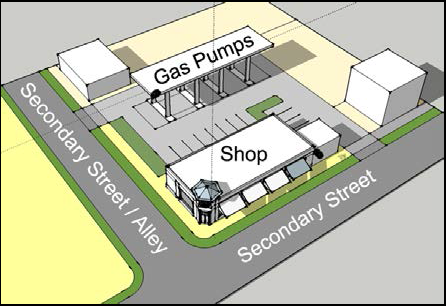
(Ord. No. 19-18, § 11, 10-16-18; Ord. No. 26-21, § 10, 8-10-21)
(c)
Car Wash establishments. Car wash establishments, with automatic/mechanical systems shall not be located east of the Intracoastal Waterway or on lots which front along Primary Streets. Further, this use must be established on property with a minimum lot area of 20,000 square feet. (Ord. No. 19-18, § 11, 10-16-18)
(d)
Automotive repair and detailing. Automobile repair and automobile detailing may not be located north of S.E. 1 st Street or south of SE 6 th Street, extended. Conditional use approval may not be granted for a new automobile repair facility, or for the expansion of an existing facility, unless it is specifically demonstrated that off-street parking is available in accordance with the requirements of Section 4.6.9.
Editor's note— Ord. No. 26-21, §§ 2—8 and 10, adopted August 10, 2021, repealed Figures 4.4.13-1—4.4.13-4 and redesignated the existing Figures 4.4.13-5—4.4.13-7, 4.4.13-8, 4.4.13-8A, 4.4.13-9—4.4.13-12, 4.4.13-13—4.4.13-28, 4.4.13-29—4.4.13-31, 4.4.13-32—4.4.13-35, and 4.4.13-36 as Figures 4.4.13-B-1—B-3, 4.4.13-C-1, 4.4.13-C-2, 4.4.13-D-1—4.4.13-D-4, 4.4.13-E-1—4.4.13-E-16, 4.4.13-F-1—4.4.13-F-3, 4.4.13-G-1—4.4.13-G-4, and 4.4.13-K-1, respectively.
--- (5) ---
Editor's note— Ord. No. 26-21, § 7, adopted August 10, 2021, repealed former subsection (f) and redesignated the existing subsections (g)—(i) as subsections (f)—(h). Former subsection (f) derived from Ord. 28-15, adopted December 08, 2015.
--- (6) ---
Editor's note— Ord. No. 29-20, § 2, adopted November 10, 2020, repealed and replaced subsection 4.4.13(I)(4) which pertained to similar subject matter and derived from Ord. 27-15, adopted October 20, 2015 and Ord. No. 19-18, adopted October 16, 2018.
Sec. 4.4.14. - Resort/Tourism (RT) District.
(A)
Purpose and intent. The Resort Tourism (RT) District is a specialized commercial district which provides for the designation and regulation of certain land uses which are primarily intended for visitors to the City. The RT District may be applied to property which is best suited to accommodating the needs of the visiting public without inappropriate impacts upon the daily functioning of the community or inappropriate impacts upon established residential areas.
(B)
Principal use and structures permitted. The following types of use are allowed within the RT District as a permitted use:
(1)
Residential Facilities for nonpermanent occupancy including Bed and Breakfast Establishments, Hotels, Motels, and Residence Inns.
(2)
Entertainment, Cultural and Recreation Facilities including Bowling (indoor and lawn alleys), Dinner Theaters, Exercise Facilities, Golf Courses, Handball and Racquetball Facilities, Tennis and Swimming Facilities, Theater for the Performing Arts, Museums, Art Galleries, Amusement Game Rooms.
(3)
Conference Facilities including meeting rooms, provisions for catering into the facilities, and business offices.
(4)
Service and Specialty Uses including: Beauty and Barber Shops, Delicatessens, Ice Cream Parlors, Gift Shops, Newsstands, and specialty food shops (including on-site preparation and service).
(C)
Accessory uses and structures permitted. The following uses are allowed when a part of, or accessory to, the principal use:
(1)
Parking Lots;
(2)
Refuse and Service Areas;
(3)
Restaurant, Bars, Lounges;
(4)
Instructional classes associated with permitted entertainment and recreational uses.
(5)
Sale of exhibits and accessory items associated with principal entertainment and recreational uses.
(D)
Conditional uses and structures allowed. The following uses are allowed as conditional uses within the RT District:
(1)
Entertainment and Recreational facilities which are designed for large audiences such as auditoriums and stadiums.
(2)
Outdoor activities such as go-cart tracks, skate board tracks, miniature golf.
(3)
Convention Centers/Facilities which provide meeting rooms and a complete range of services including food preparation, assembly for 200 people in a single room, and/or an exhibit area exceeding 3,000 square feet.
(E)
Reserved. (Ord. No. 32-23, § 19, 10-17-23)
(F)
Development standards. In addition to the development standards in Section 4.3.4, the following shall apply: (Ord. No. 32-23, § 19, 10-17-23)
(1)
A minimum of ten percent of the lot area must be provided in open space. This area shall be exclusive of open space provided for perimeter landscaping, parking lot landscaping, pools and pool decks, and area which is paved for parking and pedestrian way purposes.
(2)
A landscape area of not less than ten feet in width must be provided around the interior perimeter of the lot or parcel upon which the use is located. Within this landscape area, paving is not permitted except for bicycle paths, sidewalks, jogging trails, and driveways or access streets which provide ingress and egress for traffic and which are generally perpendicular to the greenbelt. This requirement does not supersede other requirements for greater landscape areas.
(G)
Special regulations. [Amd. Ord. 41-01 8/7/01]
(1)
Twenty-four-hour or late night businesses are subject to Section 4.3.3(VV). [Amd. Ord. 41-01 8/7/01] (Ord. No. 32-23, § 19, 10-17-23)
Sec. 4.4.15. - Planned Office Center (POC) District.
(A)
Purpose and intent.
(1)
The Planned Office Center (POC) District provides for the concentration of office and support uses in a well-planned and managed environment. It is not intended that the District be for commercial activities in which goods and merchandise are stored, displayed, or sold except as appropriate to meet the needs of users of the POC.
(2)
A POC is to be planned and developed on land under unified control and as a single development, or in a programmed series of development phases. Unified control may be achieved through single ownership or the existence of binding agreements among owners of individual parcels therein.
(3)
Institutional uses may also be permitted as part of the Medical Arts Overlay District. [Amd. Ord. 09-11 4/5/11]
(B)
Principal uses and structures permitted. The following types of use are allowed within the POC District as a permitted use:
(1)
Banks and financial institutions including drive-in and drive-through facilities.
(2)
Brokerage establishments, including watercraft, aviation, and motor vehicles but without on premises storage of items, except that securities brokers may store securities brokered by them on the premises.
(3)
Business offices. [Amd. Ord. 09-10 7/20/10]
(4)
Computer and data management services, including the servicing of hardware.
(5)
Medical offices. [Amd. Ord. 09-10 7/20/10]
(6)
Medical Clinics. [Amd. Ord. 09-10 7/20/10]
(7)
Medical and dental laboratories.
(8)
Professional offices.
(9)
Photographic studios.
(10)
Real estate, insurance, accounting, travel arrangements and similar services.
(11)
Neighborhood Electric Vehicle (NEV) sales, lease or rental transactions only (no inventory on site for any purpose). (Ord. No. 36-16, § 6, 1-10-17)
(C)
Accessory uses and structures permitted. The following uses are allowed when a part of, or accessory to, the principal use:
(1)
Parking lots.
(2)
Refuse and service areas.
(3)
Ancillary uses such as retail sales of convenience items, newspapers, candies; lunch counters, cafeteria, snack shop; exercise facility; when located within an office structure and designed for use of employees and their guests.
(4)
Ancillary uses such as galleries, displays, meeting and conference facilities when relate to the purpose and use of the specific POC complex.
(D)
Conditional uses and structures allowed. The following uses are allowed as conditional uses within the POC District:
(1)
Restaurants, excluding drive-in and drive-through facilities. [Amd. Ord. 45-99 11/16/99
(2)
Child care and adult day care.
(3)
Residential all suite lodging (residential inns).
(4)
Health spas, fitness centers, and exercise facilities which are open to the general public
(E)
Reserved. (Ord. No. 32-23, § 20, 10-17-23)
(F)
Development standards. In addition to the development standards in Section 4.3.4, the following shall apply: (Ord. No. 32-23, § 20, 10-17-23)
(1)
The minimum site area for the total POC is three acres with individual development parcels allowed to be one acre in size. However, the approving body may grant a waiver to the three acre requirement upon a determination that the development is consistent with the purpose and intent of the POC District and there exists good cause for not combining properties or aggregating additional property. (Ord. No. 32-23, § 20, 10-17-23)
(2)
When abutting residentially zoned property, a 25-foot setback must be provided.
(3)
Any free-standing structure shall have a minimum floor area of 4,000 square feet; shall be architecturally integrated with other structures; and shall have direct access to and from other portions of the POC. (Ord. No. 32-23, § 20, 10-17-23)
(G)
Supplemental district regulations. The supplemental district regulations as set forth in Article 4.6 shall apply except as modified by, or added to, as follows:
(1)
The first ten feet of the front yard setback which is adjacent to a right-of-way shall be a landscaped area. Within this area, no paving shall be allowed except for access drives and pedestrian ways which should be generally perpendicular to the property lines. [Amd. Ord. 48-92 10/13/92]
(2)
Within the Medical Arts Overlay District, as defined in Section 4.5.18, in addition to the uses listed in 4.4.15(B), the following are allowed as permitted uses: [Amd. Ord. 09-11 4/5/11]
(a)
Institutional uses, such as: Non-residential Licensed Service Provider Facilities; Hospitals, with or without helipads and associated laboratories; Treatment Centers; Rehabilitation Centers; Testing Facilities; and Mental Health Treatment Facilities, including residential care. [Amd. Ord. 09-11 4/5/11]
(H)
Special regulations.
(1)
Documentation of unified control of the entire area within a POC must be provided at the time of submission of the site and development plan. (Ord. No. 32-23, § 20, 10-17-23)
(2)
A program for full provision, maintenance, and operation of common areas, improvements, facilities, and services for the common use of occupants of the POC and which specifically provides that no such elements or features shall be provided or maintained at the public's expense must be provided at the time of submission of the site and development plan.
(3)
Executed agreements, contracts, covenants, deed restrictions, sureties, or other legal arrangements for the maintenance, repair, and operation of matters under Subsection (H)(2) and which bind successors in title to any such commitments shall be provided prior to certification of a POC site and development plan.
(4)
Twenty-four-hour or late night businesses are subject to Section 4.3.3(VV). [Amd. Ord. 41-01 8/7/01] (Ord. No. 32-23, § 20, 10-17-23)
Sec. 4.4.16. - Professional and Office (POD) District.
(A)
Purpose and intent. The Professional and Office District (POD) is created to provide a smaller-scale and very limited application of professional, office, and similar intensity uses to small parcels on properties designated as Transitional or General Commercial on the Land Use Map and mitigate against adverse effects which may occur with a higher intensity development. (Ord. No. 23-20, § 26, 9-10-20)
(B)
Principal uses and structures permitted. The following types of use are allowed within the POD District as a permitted use:
(1)
Professional Offices such as accountants, architects, attorneys, chiropractors, dentists, engineers, independent trustees, landscape architects, opticians, optometrists, osteopaths, physicians, psychologists, surgeons, and interior designers.
(2)
General Business Offices for businesses without outside storage of inventory or equipment.
(3)
Banks and Financial Institutions including drive-through facilities.
(4)
Finance, insurance, travel, and real estate services.
(5)
Medical Offices. [Amd. Ord. 09-10 7/20/10]
(6)
Medical Clinics. [Amd. Ord. 09-10 7/20/10]
(7)
Neighborhood Electric Vehicle (NEV) sales, lease or rental transactions only (no inventory on site for any purpose). (Ord. No. 36-16, § 7, 1-10-17)
(8)
Veterinary clinics, subject to Section 4.3.3(W). (Ord. No. 11-25, § 10, 7-8-25)
(C)
Accessory uses and structures permitted. The following uses are allowed when a part of, or accessory to, the principal use:
(1)
Parking lots.
(2)
Refuse and service areas.
(D)
Conditional uses and structures allowed. The following uses are allowed as conditional uses within the POD District:
DELETED NUMBERS AND RENUMBERED. [Amd. Ord. 10-11 4/5/11]
(1)
Educational facilities, training centers, and vocational schools.
(2)
Funeral Homes. (Ord. No. 11-25, § 11, 7-8-25)
(3)
Licensed, professional providers of personal services, e.g. pedicurist, beauticians, and cosmetologists. (Ord. No. 11-25, § 11, 7-8-25)
(E)
Reserved. (Ord. No. 32-23, § 21, 10-17-23)
(F)
Development standards. The development standards in Section 4.3.4 shall apply. (Ord. No. 32-23, § 21, 10-17-23)
(G)
Supplemental district regulations. The supplemental district regulations in Article 4.6 shall apply. (Ord. No. 32-23, § 21, 10-17-23)
Sec. 4.4.17. - Residential Office (RO) District.
(A)
Purpose and intent. The Residential Office (RO) District provides for mixed use of a neighborhood office and residential nature. The RO District is appropriate as:
(1)
A transitional land use between a commercial or industrial area and a residential area.
(2)
An incentive zoning in older residential areas which are in the need of redevelopment or revitalization or are in a state of transition.
(3)
To accommodate professional offices which will meet needs of nearby neighborhoods.
(4)
An incentive zoning designation for historic districts and/or individually designated historic properties to provide for the rehabilitation of residential structures into office use. [Amd. Ord. 38-07 2/5/08]
(B)
Principal uses and structures permitted. The following types of use are allowed within the RO District as a permitted use:
(1)
Single family detached dwelling units.
(2)
Duplex structures. [Amd. Ord. 9-04 2/17/04]
(3)
Business, Professional, and Medical offices. [Amd. Ord. 09-10 7/20/10]
(4)
Neighborhood Electric Vehicle (NEV) sales, lease or rental transactions only (no inventory on site for any purpose). (Ord. No. 36-16, § 8, 1-10-17)
(5)
Abused spouse residence limited to 40 or fewer residents. (Ord. No. 36-16, § 8, 1-10-17)
(6)
Funeral parlors, funeral homes. (Ord. No. 36-16, § 8, 1-10-17)
(7)
Parking lots not associated with a use, pursuant to an adopted neighborhood or redevelopment plan. [Amd. Ord. 8-00 4/4/00] (Ord. No. 36-16, § 8, 1-10-17)
(8)
Community Residence housing four to ten individuals, except as required by state law, that (1) is at least 660 linear feet from the closest existing community residence housing four or more individuals as measured from the nearest property line of the proposed community residence to the nearest property line of the existing community residence, and (2) the operator or applicant is licensed or certified by the State of Florida to operate the proposed community residence, has certification from an appropriate national accrediting agency, or has been recognized or sanctioned by Congress to operate the proposed community residence. [Amd. Ord. 23-01 5/1/01] (Ord. No. 25-17, § 25, 7-18-17) (Ord. No. 36-16, § 8, 1-10-17)
(9)
Assisted Living Facilities that do not comport with the definition of "community residence" and Nursing Homes. [Amd. Ord. 10-11 4/5/11]; [Amd. Ord. 01-10 1/19/10] (Ord. No. 36-16, § 8, 1-10-17; Ord. No. 25-17, § 25, 7-18-17)
(C)
Accessory uses and structures permitted. The following uses and structures are allowed when a part of, or accessory to, the principal use: (Ord. No. 22-22, § 8, 10-11-22)
(1)
Parking lots.
(2)
Refuse and service areas.
(3)
Uses and structures normally associated with residences, such as bird aviaries, dog houses and dog runs, detached garages, greenhouses, playhouses, pool houses, slat houses, storage sheds, tennis courts, swimming pools, and workshops subject to Section 4.3.3(QQ). (Ord. No. 23-22, § 10, 8-16-22; Ord. No. 22-22, § 8, 10-11-22)
(4)
Home occupations, subject to Section 4.3.3(K). (Ord. No. 22-22, § 8, 10-11-22)
(5)
Family day care home, subject to Section 4.3.3(T). [Amd. Ord. 25-10 10/19/10] (Ord. No. 22-22, § 8, 10-11-22)
(6)
Boat docks, subject to Article 7.9. The rental or lease of a boat dock is permitted when the dock is assigned to, or on the same lot as, each residential use on a one-to-one basis. (Ord. No. 22-22, § 8, 10-11-22)
(7)
Guest cottages, subject to Section 4.3.3(Q).
(D)
Conditional uses and structures allowed. The following uses are allowed as conditional uses within the RO District: [Amd. Ord. 35-00 1/2/01]
(1)
Child care and adult day care.
DELETED NUMBER (2) AND RENUMBERED. [Amd. Ord. 10-11 4/5/11]
(2)
Bed and Breakfast Inns, subject to the provisions of LDR Section 4.3.3(Y). [Amd. Ord. 11-10 7/20/10]
(3)
Community Residence housing four to ten individuals, except as required by state law, that (1) is less than 660 linear feet from the closest existing community residence housing four or more individuals as measured from the nearest property line of the proposed community residence to the nearest property line of the existing community residence, or (2) the State of Florida does not require the operator or applicant to be licensed or certified to operate the proposed community residence, has no certification from an appropriate national accrediting agency, or has not been recognized or sanctioned by Congress to operate the proposed community residence. [Amd. Ord. 23-01 5/1/01] (Ord. No. 25-17, § 26, 7-18-17)
(4)
Large Family Child Care Home, subject to Section 4.3.3(TT). [Amd. Ord. 25-10 10/19/10]
(E)
Reserved. (Ord. No. 22-22, § 8, 10-11-22; Ord. No. 32-23, § 22, 10-17-23)
(F)
Development standards. [Amd. Ord. 01-12 8/21/12]
(1)
The development standards in Section 4.3.4 shall apply. [Amd. Ord. 01-12 8/21/12] (Ord. No. 32-23, § 22, 10-17-23)
(2)
Historic Districts, Sites, and Buildings: In addition to the requirements in Section 4.3.4, properties located within a Historic District or Individually Designated Sites, as listed on the Local Register of Historic Places in Section 4.5.1(I), are subject to Section 4.5.1. [Amd. Ord. 01-12 8/21/12] (Ord. No. 32-23, § 22, 10-17-23)
(G)
Supplemental district regulations. The supplemental district regulations as set forth in Article 4.6 shall apply except as modified and added pursuant to the following:
(1)
All uses shall be in completely enclosed buildings and any outdoor storage is expressly prohibited.
(2)
Parking required for business, medical, and professional offices shall be at the standard of one space per 300 square feet of net floor area (1/300). However, this requirement may be reduced to 1/400, or at least by one parking space, when there is a mix of residential and office use in the same structure or for an existing structure on a property located within a designated historic district or an individually designated historic site. [Amd. Ord. 09-10 7/20/10]; [Amd. Ord. 01-09 1/20/09]; [Amd. Ord. 38-07 2/5/08]
(3)
Historic Districts, Sites, and Buildings: Properties located within a Historic District or Individually Designated Sites, as listed on the Local Register of Historic Places in Section 4.5.1(I), shall comply with the Visual Compatibility Standards of Section 4.5.1(E)(7). [Amd. Ord. 01-12 8/21/12]
(H)
Special regulations.
(1)
All buildings and structures shall appear to be residential in character regardless of the actual use therein, and in established neighborhoods shall be generally compatible in architectural style and scale with the surrounding area. (Ord. No. 32-23, § 22, 10-17-23)
(2)
A building or structure in the RO District may contain either a residential use, an office use, or a mix of uses.
(3)
All parking for nonresidential principal uses and conditional uses shall be located in the side or rear yard or adjacent to a rear alley. No parking shall be located in the area between any street and the structure. Where there are existing buildings, administrative relief may be sought pursuant to Chapter 2, if the determination can be made that compliance with these requirements is not feasible, that the residential character of the area will be maintained, and that such parking area shall be substantially screened from off-premises view by at least, a four-foot high hedge. (Ord. No. 32-23, § 22, 10-17-23)
Sec. 4.4.18. - Planned Commerce Center (PCC) District.
(A)
Purpose and intent. The PCC District regulations provide for a mix of light industrial, service industrial, research and development, office, and limited commercial use in an Industrial Park setting which is planned and then controlled through a Master Development Plan.
It is desired that the existence of the PCC Zoning District will encourage the planning and development of such commerce centers which will provide employment opportunities for the residents of the Greater Delray Beach Community.
The PCC District shall be applied to property which is best suited for light industrial land use, is shown as Industrial or Commerce on the City's Land Use Map, and is situated in proximity to the arterial street system of the community.
(B)
Allowed uses. Use areas as identified herein shall be depicted upon the land use map component of the Master Development Plan (MDP). The list of specific uses allowed within a specific PCC shall be established in the narrative portion of the MDP. Thereafter, uses identified as being allowed in a specific land use area are allowed pursuant to provisions of the narrative. Alterations to the list of specific uses may be made through the site and development plan modification process.
(1)
Office center. The "Office Center" aspects of a PCC may comprise as much as 50 percent of the total land area within an entire PCC District. Uses identified in this subsection can only be located in that area of the Land Use Map which is depicted as "Office Center". Such uses are exclusive of the storage of materials used off-site or sold in the associated trade and/or the repair of same. These uses are:
(a)
Business Offices e.g., travel agencies, bookkeeping agencies, general office location for an individual, partnership, or corporation
(b)
Neighborhood Electric Vehicle (NEV) sales, lease or rental transactions only (no inventory on site for any purpose) (Ord. No. 36-16, § 9, 1-10-17)
(c)
Educational Facilities e.g., vocational schools, commercial schools (sales, real estate, personal development, etc.)
(d)
Financial Institutions e.g., banks, savings and loan establishments, brokerage firms
(e)
Medical Offices e.g., physicians, dentists, chiropractors, podiatrists, optometrists, etc.
(f)
Professional Offices e.g., attorneys, engineering firms, architectural firms, real estate agencies, consultation services, accounting firms, etc.
(g)
Child Care Centers.
(2)
Light industrial areas. Manufacturing, fabrication, assembly, wholesale, and distribution uses are permitted within a PCC. Such uses, as further identified in this subsection are only permitted in those areas identifies as "Light Industrial" on the land use map components of the MDP. All aspects of these uses, except overnight storage of vehicles used by the business, must be carried out within a structure. In keeping with the intent of the PCC to involve a mix of uses, light industrial areas within a PCC are limited to 50 percent of the total area of that PCC.
(a)
Manufacturing. The processing of raw materials to create final products for distribution and which either involve or result in the following:
1.
Materials:
a.
Ceramics
and plaster.
b.
Fiberglass.
c.
Glass.
d.
Leather.
e.
Tobacco.
f.
Wood.
2.
Processes:
a.
Millwork
(woodwork).
b.
Welding.
3.
Products:
a.
Appliances.
b.
Bakery products.
c.
Beverages,
alcoholic and
nonalcoholic.
d.
Cabinets.
e.
Clothes.
f.
Coffee.
g.
Computer chips
and computer
components.
h.
Cosmetics.
i.
Dairy products.
j.
Dry ice.
k.
Electronic
components.
l.
Furniture.
m.
Ice.
n.
Optical.
o.
Pharmaceuticals.
p.
Signs of all/any
materials.
q.
Sporting goods.
r.
Textiles.
s.
Toys.
(b)
Fabrication and/or assembly. The working or combining of processed for manufactured materials or parts which are then prepared for distribution for sale. All processes and products identified under "manufacturing" are permitted as are the following:
1.
Processes:
a.
Assembly of mechanical and/or component parts.
b.
Bottling.
c.
Engraving.
d.
Machine shops.
e.
Printing.
f.
Repair of damaged goods and products which may have been manufactured on the premises.
2.
Products:
a.
Communication devices
(radio, television,
cameras).
b.
Confectioneries.
c.
Metal goods.
d.
Precision
instruments.
e.
Newspapers, books, periodicals.
(c)
Wholesaling, storage, and distribution. The wholesaling, storage, and distribution of any products which may be manufactured, assembled, or fabricated on the premises. In addition, the following items may be wholesaled, stored, or distributed from or within the Light Industrial areas of a PCC:
1.
Household furnishings and goods.
(d)
Other processes. The following processes may also be conducted within the Light Industrial areas of a PCC:
1.
Cold storage.
2.
Dry cleaning.
3.
Frozen food lockers, including personal lockers.
4.
Laundries.
5.
Tailoring.
(3)
Research and development. Research and Development (R&D) uses involve either some degree of product creation, testing, evaluation, and development or the provision of testing and evaluation services for use by others. The term "research and development use" does not include the actual manufacture, assembly, fabrication, or other processing techniques which result in either the direct wholesale or retail distribution of products from the premises. R&D uses may constitute 100 percent of the use of the entire PCC. Examples of such uses or resulting products include:
(a)
Product creation, testing, evaluation, and development.
1.
Computer hardware.
2.
Computer software.
3.
Pharmaceuticals.
(b)
Research and development services.
1.
Calibration laboratories or services.
2.
Chemical laboratories.
3.
Commercial testing laboratories.
4.
Soil laboratories.
5.
Scientific research laboratories.
(c)
The following uses are also considered as Research and Development uses for the purposes of being permitted within a PCC:
1.
Broadcast studios and facilities.
2.
Communications facilities and equipment.
3.
Motion picture and theater production facilities including the creation of props, scenery, costumes; filming and rehearsals; attendant storage; and screening and editing.
(4)
Service industry. Service Industry uses are those which are primarily engaged in providing an off-site service but which maintain inventory, storage of materials, and a business office at a central location. The area which may be devoted to "Service Industry" uses within a PCC is limited to 25 percent of the total land area of that PCC. Repair of equipment and materials associated with the service is also permitted at this central location, except as restricted below. All aspects of these uses must be accommodated within a structure except for overnight storage of vehicles used by the business. Uses which are allowed within the "Service Industry" classification include: [Amd. Ord. 12-00 6/20/00]
(a)
Assembly, fabrication, wholesale, and storage per Section 4.4.18(B)(2) when such use is limited to no more than 5,000 square feet per tenant.
(b)
Land Development Services (e.g. surveying, soils testing, mapping, architectural, engineering).
(c)
Food catering establishments, preparation and storage only (no food served on premises). [Amd. Ord. 50-04 9/21/04]
(d)
Contractor and Trade Services (e.g. general contractor, electrician, plumbers, heating and air-conditioning specialists, swimming pool maintenance, landscaping services, exterminators, equipment and tool rental).
(e)
Repair of office equipment (e.g. typewriters, computers, data processing equipment).
(f)
Limousine services with no vehicle repair or detailing on the premises. [Amd. Ord. 12-00 6/20/00]
(g)
Business Services (e.g. photocopying/ printing, photofinishing, provision of office equipment and furnishings, delivery services, computer and data processing services).
(h)
Educational Facilities e.g. vocational schools, commercial schools (sales, real estate, personal development, etc.). [Amd. Ord. 40-05 6/21/05]
(i)
Limited Retail Trade only as a secondary use within any one building, but only to the extent that the floor area for all retail use (either accessory to the service industry use or not) shall not exceed 25 percent of the floor area of the total building. Although the intent of the PCC does not encourage retailing of items other than at the designated "retail center", additional retail uses may be allowed in the service Industry areas shown on the MDP. Such retail use may involve the sale of products associated with an established service industry use or may involve any of the following products:
1.
Apparel and accessories.
2.
Appliances.
3.
Baked goods.
4.
Building materials and garden supplies.
5.
Camera and photographic equipment and supplies.
6.
Furniture and home furnishing.
7.
Hobbies, games, toys.
8.
Jewelry, gifts, novelties.
9.
Luggage and leather goods.
10.
Radio, television, and communication products.
11.
Sporting goods.
(5)
Retail center. A "Retail Center" may be a part of a PCC. It must be designed in such a manner that all access to it is from streets which are internal to the PCC. A "Retail Center" may not occupy more than ten percent of the total land area within a PCC; however, in no event, shall a "Retail Center" exceed 30,000 square feet in total floor area. The character of a "Retail Center" in a PCC should be such that it accommodates the other uses within the PCC. As such a "Retail Center" is restricted to the following uses:
(a)
Personal health services e.g. barbershop, beauty shop, salon, pharmacy, physical fitness centers.
(b)
Personal services e.g. dry cleaning pickup, laundromat, tailoring.
(c)
Child Care Facilities.
(d)
Financial Institutions e.g. banks, S and L, brokerage firms.
(e)
Personal Convenience Services e.g. florists, gift shops, hobby shops, newsstands, photo services and supplies, tobacconist.
(f)
Restaurants.
(g)
Specialty food shops.
(h)
Liquor stores.
(6)
Supplemental uses. The following uses are allowed within any of the above use areas provided that they are of such a scale, design, and location to cater to the needs of employees of the industrial park or to otherwise meet the rational stated herein. Space allocations for these uses shall be identified during site plan approvals. These uses may not be established in areas other than as shown on approved site plans.
(a)
Lunch counters, snack bars, and vending machine areas.
(b)
Classroom and training facilities.
(c)
Child Care facilities.
(d)
Sundry shops.
(e)
Retail outlets for the sale of items manufactured, assembled, fabricated, or otherwise produced on-site; provide that the floor area dedicated to such a retail outlet shall not exceed ten percent of the area used for the production of the product or products of a business; and, in no event, shall such uses exceed 1,000 square feet in area. This restriction does not apply to the Service Industry land use areas. See Section 4.4.18(B)(4) regarding retail use allowances in the Service Industry areas.
(f)
Pet services without outside use areas, subject to Section 4.3.3(W). (Ord. No. 17-21, § 8, 10-19-21)
(C)
Review and approval process.
(1)
General. The development of a PCC shall be governed by a Master Development Plan (MDP). The MDP shall consist of a narrative; a land use map; conceptual site, landscaping, and utility plans; and conceptual elevations and architectural information.
(2)
Process. A MDP shall be processed pursuant to Chapter 2 with approval granted by the Planning and Zoning Board. A MDP may be modified pursuant to Chapter 2. (Ord. No. 32-23, § 23, 10-17-23)
For areas which are zoned as PCC at the time of approval of this section, an MDP is required. The MDP may be processed as either a minor or major site plan modification, and is subject to approval by the Planning and Zoning Board. The MDP shall be evaluated against the site plan for record for the existing PCC. The MDP must be made of record prior to September 1, 1991. Failure to obtain a MDP of record shall be cause for the Building Department to not issue building permits for further development or modification to existing development within an existing PCC. (Ord. No. 32-23, § 23, 10-17-23)
(D)
Development standards. The following standards shall be adhered to in the development of a PCC. Waivers and variances to these standards may be approved by the Planning and Zoning Board concurrent and as a part of the approval of a Master Development Plan (MDP).
It is the intent of this subsection to establish minimum standards for development within the PCC Zone District. When considering a Master Development Plan (MDP) in any Planned Commerce Center (PCC) development proposal, the Planning and Zoning Board may attach suitable conditions, safeguards, and stipulations to address the specific characteristics of the site and potential impacts of the proposed development.
(1)
Standards pertaining to allocation of uses.
(a)
Office Center shall not encompass more than 50 percent of the total land area within a PCC.
(b)
Light Industry shall not encompass more than 50 percent of the total land area within a PCC.
(c)
Service Industry shall not encompass more than 25 percent of the total land area within a PCC.
(d)
Research and Development is not limited with respect to the amount of land area devoted to it. Further, such use may be placed within any of the "land use areas" depicted on the MDP.
(e)
Retail Center shall not encompass more than ten percent of the total land use area within a PCC; and, in no event, shall such use exceed more than 30,000 square feet in gross floor area.
(2)
Standards unique to the PCC District. Where standards unique to the PCC District conflict with standards contained elsewhere in the zoning, subdivision, and landscape codes, the standards of this Subsection (2) shall apply.
(a)
Minimum parcel/lot size.
1.
A PCC, in total, must be comprised of at least ten acres of land prior to computation of area required for public dedication purposes.
2.
Any use area within a PCC must have a minimum lot area of one acre exclusive of land dedicated for public purposes.
(b)
Minimum floor area.
1.
Tenant space for uses in the light industrial designation must have a minimum of 3,000 square feet. Research and development, and service industry use areas must have a minimum of 1,000 square feet per tenant.
2.
There are no minimum requirements for office and commercial uses.
(c)
Lot coverage and open space.
1.
By structures: a maximum of 50 percent of the area of any individual lot.
2.
For open space: land area equal to, at least 25 percent of the area included within the perimeter boundary of a MDP shall be in open space. Landscape areas required to meet parking lot design requirements, and paved areas shall not be included in the meeting of this 25 percent open space requirements.
(d)
Perimeter development. A landscape boundary shall be provided around each PCC. Parking, structures, perimeter roadways, and other paving is not permitted within this peripheral greenbelt except for bicycle paths, sidewalks, jogging trails, and driveways or access streets which provide ingress and egress for traffic and which are generally perpendicular to the greenbelt. The width of the greenbelt shall be as follows:
(e)
Setback requirements. Building setback requirements shall be established as a part of the MDP. Minimal setback requirements shall be the rule provided that:
(a)
Landscaping standards between buildings and perimeter boundaries are maintained.
(b)
Sight distance with respect to vehicular movements is adequate.
(E)
Supplemental district regulations. The supplemental district regulations as set forth in Article 4.6 shall apply with the exception of those pertaining to the following:
(1)
Truck and equipment storage. Trucks in excess of one ton carrying capacity shall be parking in rear or interior side yards. They shall be screened from the view of adjacent properties or any (adjacent) public right-of-way in a manner approved by the Site Plan Review and Appearance Board.
Industrial equipment (including bulldozers, cranes, drag lines, derricks, tractors, and other implements for moving equipment or construction) must be stored within fully enclosed buildings overnight or when otherwise not in use, or they shall be screened from the view of adjacent properties or any (adjacent) public right-of-way pursuant to requirements which may be specified within the Master Development Plan, as approved.
(2)
Overhead doors. Overhead doors are prohibited from facing an adjacent public right-of-way with the exception of the right-of-way of I-95.
(3)
Undergrounding of utilities. Within the boundary of a PCC all utilities, including telephone, television cable, and electrical systems shall be installed underground.
Primary facilities providing service to the site may be granted a waiver from the undergrounding requirement.
Appurtenances to utility systems which are normally located above are exempted from the undergrounding requirement; however, when located above ground they shall be screened in a manner approved by the Site Plan Review and Appearance Board.
(4)
Maintenance of common areas. All common open space shall conform to its intended use, per the MDP, through deeds, covenants, or other arrangements, as approved by the City Attorney, and which run with the land.
(5)
Educational facilities which train in the repair of motorized vehicles or equipment. Educational facilities which train in the repair of motorized vehicles or equipment must store vehicles and/or equipment used for training purposes within a fully enclosed building, shall not service motorized vehicles for the general public or conduct sales of such items, and overhead doors should remain in a closed position, except for delivery or removal of the vehicles and vehicle testing. [Amd. Ord. 40-05 6/21/05]
(F)
Special requirements/regulations. In order for land to be rezoned to and/or developed pursuant to the PCC designation, the following criteria must be met:
(1)
The property within the proposed PCC designation shall be under unified control (an individual, partnership, joint venture or corporation; or group of individuals, partnerships, or corporations). Any rezoning, master development plan, or site plan request shall include legal documents, acceptable to the City Attorney, which constitute evidence of unified control of the entire area within a proposed PCC.
(2)
The applicant must be able to bind the entire area within a proposed PCC to the terms, conditions, uses, and site development plan as approved in the Master Development Plan.
Sec. 4.4.19. - Mixed Industrial and Commercial (MIC) District.
(A)
Purpose and intent. The Mixed Industrial and Commercial (MIC) District is created to provide for a mix of industrial, commercial, and office use in a single zoning district. The uses allowed are intended to enhance employment opportunities in the industrial, manufacturing and trade sectors, with supporting business and professional office functions. Retail uses are appropriate on a limited basis, and only as a secondary use within the district. Residential uses are only allowed within the I-95/CSX Railroad Corridor Overlay District, subject to Article 4.7. The MIC District is applied to properties with a Commerce or Industrial designation on the Land Use Map. [Amd. Ord. 04-08 1/15/08]; [Amd. Ord. 10-07 3/20/07]; [Amd. Ord. 33-97 9/23/97] (Ord. No. 23-20, § 27, 9-10-20; Ord. No. 32-23, § 24, 10-17-23)
(B)
Principal uses and structures permitted. The following uses are allowed within the MIC District as a permitted use: (Ord. No. 32-23, § 24, 10-17-23)
(1)
Industrial uses. The manufacturing, fabrication and wholesale of items and other uses as described in Section 4.4.20 (B) (1), (2) and (3). [Amd. Ord. 33-97 9/23/97]
(2)
Service industry. Uses which provide an off-site service but maintain inventory, storage and an office at a central location, as described in Section 4.4.20 (B) (5). [Amd. Ord. 33-97 9/23/97]
(3)
Business and Professional Offices, including, but not limited to finance, insurance, real estate, accounting and bookkeeping services, advertising services, photographic studios, architectural and engineering services, computer and data processing services, correspondence and vocational schools, credit reporting and collection, detective and protective services, legal services, travel agencies, Neighborhood Electric Vehicle (NEV) sales, lease or rental transactions only (no inventory on site for any purpose), and general offices for an individual, partnership or corporation. [Amd. Ord. 33-97 9/23/97] (Ord. No. 36-16, § 10, 1-10-17)
(4)
Retail trade. Retail uses as a secondary use within a building that has as its primary occupant an industrial or service industry use, but only to the extent that the floor area for all retail use (either accessory to an industrial use or not) does not exceed 25 percent of the floor area of the total building. Although an intent of this Zoning District is to allow retailing of items manufactured, fabricated, or wholesaled on-site, additional retail uses may be allowed. Such additional uses include, but are not limited to: [Amd. Ord. 33-97 9/23/97] (Ord. No. 32-23, § 24, 10-17-23)
(a)
Apparel and accessory stores;
(b)
Bakeries;
(c)
Building materials and garden supplies, except mobile home dealers;
(d)
Camera and photographic equipment and supplies;
Deleted (e) and relettered. [Amd. Ord. 58-95 11/7/95]
(e)
Hobbies, games, and toys;
(f)
Jewelry, gifts, novelties;
(g)
Luggage and leather goods;
(h)
Mail order houses;
(i)
Radio and television sets;
(j)
Seasonal holiday items (Christmas trees, fruit baskets, other seasonal items);
(k)
Sporting goods, including bicycles.
(5)
Interior design and furnishings. The wholesale, retail, storage and distribution of home furnishings, floor coverings, wall coverings, lighting, and other items related to the finishing and furnishing of interior space. [Amd. Ord. 58-95 11/7/95]
(6)
Other processes and activities. The following activities may also be conducted: [Amd. Ord. 33-97 9/23/97]
(a)
Dry cleaning and laundering. [Amd. Ord. 33-97 9/23/97]
(b)
Emissions testing. [Amd. Ord. 33-97 9/23/97]
(7)
Adult Entertainment Establishments, subject to Section 4.3.3(AA). [Amd. Ord. 30-98 9/8/98] (Ord. No. 32-33, § 24, 10-17-23)
(8)
Urban Agriculture, subject to Section 4.3.3(D). (Ord. No. 07-17, § 11, 5-16-17; Ord. No. 32-23, § 24, 10-17-23)
(9)
CBD oil establishments, subject to Section 4.3.3(CC). (Ord. No. 58-20, § 7, 12-1-20; Ord. No. 32-23, § 24, 10-17-23)
(10)
Multiple family residential development up to 24 units per acre within the I-95/CSX Railroad Corridor Overlay District, as defined in Section 4.5.15, subject to Article 4.7. (Ord. No. 32-23, § 24, 10-17-23)
(C)
Accessory uses and structures permitted. The following uses are allowed when a part of, or accessory to, the principal use:
(1)
Parking lots.
(2)
Refuse and service areas.
(3)
Provisions or services and repair of items incidental to principal uses.
(4)
Storage of inventory, equipment, or materials, within a structure or in an approved outside locations. [Amd. Ord. 60-93 10/12/93]
(5)
The conducting of auctions incidental to a principal use, and subject to the provision of parking at the rate required for general commercial uses. [Amd. Ord. 30-94 6/21/94]
(6)
Urban Agriculture pursuant to regulations set forth in Section 4.3.3(D). (Ord. No. 07-17, § 11, 5-16-17)
(D)
Conditional uses and structures allowed.
(1)
The following uses are allowed as conditional uses within the MIC Zone District: [Amd. Ord. 33-97 9/23/97]; [Amd. Ord. 55-90 11/13/90]
Deleted (a) and Relettered. [Amd. Ord. 30-98 9/8/98]
(a)
Pet services with outside use areas, pet hotels, and animal shelters, subject to Section 4.3.3(W); [Amd. Ord. 33-97 9/23/97] (Ord. No. 17-21, § 9, 10-19-21)
(b)
Material and component recovery for reuse, such as the disassembly and resale of computer components, appliances, and electrical components. This does not include resource recovery facilities as described and regulated by Section 4.3.3(Z); [Amd. Ord. 33-97 9/23/97]
Deleted (c) and relettered. [Amd. Ord. 44-99 11/16/99]
(c)
Automobile paint, body, and repair shops; [Amd. Ord. 33-97 9/23/97]
(d)
Boat repair and service; [Amd. Ord. 33-97 9/23/97]
(e)
Self-Service Storage Facilities (SSSF), pursuant to Section 4.3.3(A). (Ord. No. 32-23, § 24, 10-17-23)
(2)
The following conditional uses are also allowed in the MIC zoning district. However, any outside storage associated with such uses may not be located within 150 feet of any property line adjacent to an arterial roadway (excluding Interstate 95); [Amd. Ord. 33-97 9/23/97] (Ord. No. 32-23, § 24, 10-17-23)
(a)
Lumberyards; [Amd. Ord. 33-97 9/23/97]
(b)
Garages and lots for the parking and storage of vehicles, including the storage of light trucks, up to and including two-ton trucks; [Amd. Ord. 33-97 9/23/97]
(c)
Storage and rental of light construction equipment not over 24 feet long, eight feet wide, and ten feet high; [Amd. Ord. 33-97 9/23/97]
(d)
Monument and ornamental stone cutting; [Amd. Ord. 33-97 9/23/97]
(e)
Rental and sales of modular buildings; [Amd. Ord. 33-97 9/23/97]; [Amd. Ord. 4-91 1/29/91]
(f)
Towing services, with outside storage; [Amd. Ord. 61-05 8/16/05]; [Amd. Ord. 44-99 11/16/99]
(g)
Storage and rental of construction equipment not over 100 feet long, 14 feet wide, and 15 feet high provided that each of the following requirements are met: [Amd. Ord. 61-05 8/16/05]
i.
Any outside storage associated with such use may not be located within 250 feet of any property line adjacent to an arterial roadway (excluding Interstate 95) and; [Amd. Ord. 61-05 8/16/05]
ii.
The property is buffered by a minimum six-foot wall or minimum six-foot hedge. However, if the property is adjacent to a public building, school, park, library, or residential area at the time of conditional use approval, a minimum six-foot high berm and either a six-foot wall or six-foot hedge on top of the berm shall be required. [Amd. Ord. 61-05 8/16/05]
iii.
Provision of a ten-foot minimum landscape buffer with trees planted 25 feet on center around the perimeter of the storage area. [Amd. Ord. 61-05 8/16/05]
(E)
Reserved. (Ord. No. 32-23, § 24, 10-17-23)
(F)
Development standards. The development standards in Section 4.3.4 shall apply, except as modified below: [Amd. Ord. 10-07 3/20/07] (Ord. No. 32-23, § 24, 10-17-23)
(1)
I-95/CSX Railroad Corridor Overlay District: The following development standards apply to parcels within the Overlay district as defined by Section 4.5.15, "I-95/CSX Railroad Corridor Overlay District." [Amd. Ord. 10-07 3/20/07] (Ord. No. 32-23, § 24, 10-17-23)
(a)
Residential uses, which may only be developed pursuant to Article 4.7, "Family/Workforce Housing" shall comply with the development standards in Section 4.4.6(F)(3) and the performance standards in Section 4.3.3(BB). [Amd. Ord. 10-07 3/20/07] (Ord. No. 32-23, § 24, 10-17-23)
(G)
Supplemental district regulations. The supplemental district regulations in Article 4.6 apply, unless otherwise modified. [Amd. Ord. 60-93 10/12/93] (Ord. No. 32-23, § 24, 10-17-23)
(1)
I-95/CSX Railroad Corridor Overlay District: In addition to the supplemental district regulations in Article 4.6, the supplemental district regulations in Section 4.4.6(G)(1) apply to parcels within the overlay district as defined by Section 4.5.15, "I-95/CSX Railroad Corridor Overlay District." [Amd. Ord. 10-07 3/20/07] (Ord. No. 32-23, § 24, 10-17-23)
(H)
Special regulations.
(1)
Loading and unloading is restricted to side and rear yards and is prohibited within the front yard setback. (Ord. No. 32-23, § 24, 10-17-23)
(2)
Within the front yard setback, the first ten feet abutting the right-of-way shall be a landscaped area with no paving, except for driveways and walkways leading to the premises. Such driveways and walkways shall be generally perpendicular to the property line. (Ord. No. 32-23, § 24, 10-17-23)
(3)
Overhead doors shall not face an adjacent minor arterial right-of-way, residential zoning district, or residential use. The use of decorative doors is encouraged. [Amd. Ord. 58-95 11/07/95] (Ord. No. 32-23, § 24, 10-17-23; Ord. No. 09-25, § 3, 5-20-25)
(4)
Except for outside storage approved pursuant to Section 4.6.6(C)(2), all principal and conditional uses shall be conducted within an enclosed building. [Amd. Ord. 58-95 11/07/95; Amd. Ord. 75-94 10/18/94]
(5)
I-95/CSX Railroad Corridor Overlay District: Within the Overlay District, as defined in Section 4.5.15, residential development is allowed at a density up to 24 dwelling units per acre, subject to the requirements in Article 4.7. [Amd. Ord. 10-07 3/20/07] (Ord. No. 32-23, § 24, 10-17-23)
Sec. 4.4.20. - Industrial (I) District.
(A)
Purpose and intent. The Industrial (I) District provides for industrial land uses and their regulation so as to provide reasonable protection for the environment and the public with respect to the impacts of such use.
(B)
Principal uses and structures permitted. The following types of use are allowed within the Industrial District as a permitted use:
(1)
Manufacturing. The processing of raw materials to create final products for distribution and which either involve or result in the following:
(2)
Fabrication and/or assembly. The working or combining of processed or manufactured materials or parts which are then prepared for distribution for sale. All processes and products identified under "manufacturing" are permitted as are the following:
(3)
Wholesaling, storage, and distribution. The wholesaling, storage, and distribution of any products which may be manufactured, assembled, or fabricated on the premises. In addition, the following items may be wholesaled, stored, or distributed:
•
household furnishings and goods
•
moving and related storage
(4)
Other process and activities. The following activities and processes may also be conducted:
•
automobile paint, body, and repair shops
•
boat repair and service
•
cold storage
•
dry cleaning
•
emissions testing
•
frozen food lockers, including personal lockers
•
laundering
•
publishing
•
tailoring
(5)
Service industry. Service Industry uses are those which are primarily engaged in providing an off-site service but which maintain inventory, storage of materials, and a business office at a central location. Repair of equipment and materials associated with the service is also permitted at this central location.
•
Land Development Services (eg., surveying, soils testing, mapping, architectural, engineering).
•
Contractor and Trade Services (e.g. general contractor, electrician, plumbers, heating and air-conditioning specialists, swimming pool maintenance, landscaping services, exterminators, equipment and tool rental).
•
Repair of office equipment (e.g., typewriters, computers, data processing equipment).
•
Business Services (e.g. typewriters, computers, data processing equipment).
•
Limousine Service.
•
Gun Ranges (indoor).
•
Food preparation and/or processing, including but not limited to bakeries and catering operations. [Amd. Ord. 28-05 5/17/05]
(6)
Urban Agriculture pursuant to regulations set forth in Section 4.3.3(D). (Ord. No. 07-17, § 12, 5-16-17)
(7)
CBD oil establishments, subject to the regulations of Section 4.3.3(CC). (Ord. No. 58-20, § 8, 12-1-20)
(C)
Accessory uses and structures permitted. The following uses are allowed when a part of, or accessory to, the principal use:
(1)
Parking lots;
(2)
Refuse and service areas;
(3)
Outside storage;
(4)
Snack bar and sale of convenience goods when limited to employees who work in the general industrial area;
(5)
Caretaker residence and or facilities for temporary housing of security personnel;
(6)
Business offices, accessory to the primary industrial use.
(7)
Urban Agriculture pursuant to regulations set forth in Section 4.3.3(D). (Ord. No. 07-17, § 12, 5-16-17)
(D)
Conditional uses and structures permitted. The following uses are allowed as conditional uses:
(1)
Boat manufacturing, repair, and/or service;
(2)
Bulk storage, gas and oil;
DELETED (3) AND RENUMBERED [Amd. Ord. 21-97 6/3/97]
(3)
Concrete products manufacturing, including concrete block and redimix concrete;
(4)
Custom fiberglass shops;
(5)
Dairy processing;
(6)
Heavy equipment and tool rental;
(7)
Bulk fertilizer sales, excluding compost heaps;
(8)
Garages for parking and storage of vehicles;
(9)
Junkyards; [Amd. Ord. 59-93 10/12/93]
(10)
Pet services with outside use areas, pet hotels and animal shelters subject to Section 4.3.3(W); (Ord. No. 17-21, § 10, 10-19-21)
(11)
Lumberyards;
(12)
Meat cutting and wholesale storage;
(13)
Monument and ornamental stone cutting;
(14)
Rental and sales of modular buildings;
(15)
Material and component recovery for reuse, such as the disassembly and resale of computer components, appliances, and electrical components. This does not include resource recovery facilities as described and regulated by Section 4.3.3(Z); [Amd. Ord. 31-97 9/9/97]
(16)
Scrap metal recycling, when all operations and storage are in a completely enclosed building, which generates no emissions, and which does not create a noise disturbance in violation of Chapter 99 of the City Codes;
(17)
Storage of light trucks, up to, and including two-ton trucks, and light construction equipment not over 24 feet long, eight feet wide, and ten feet high;
(18)
Towing services and attendant storage;
(19)
Truck terminals and storage facilities.
(E)
Reserved. (Ord. No. 32-23, § 25, 10-17-23)
(F)
Development standards. The development standards in Section 4.3.4 apply, except for minimum lot area dimensions that do not apply to lots of record created as of September 1, 1990. (Ord. No. 32-23, § 25, 10-17-23)
(G)
Supplemental district regulations. The supplemental district regulations in Article 4.6 shall apply. [Amd. Ord. 60-93 10/12/93] (Ord. No. 32-23, § 25, 10-17-23)
(H)
Special regulations.
(1)
Loading and unloading shall be restricted to side and rear yards and shall be prohibited within the front yard setback.
(2)
Within the front yard setback, the first ten feet abutting the right-of-way shall be a landscaped area within which no paving shall be allowed except for driveways and walkways leading to structures on the premises. Such driveways and walkways shall be generally perpendicular to the property line.
(3)
Overhead doors shall not face an adjacent minor arterial right-of-way, residential zoning district, or residential use. (Ord. No. 09-25, § 4, 5-20-25)
Sec. 4.4.21. - Community Facilities (CF) District.
(A)
Purpose and intent. The Community Facilities (CF) District is a special purpose zone district primarily intended for uses providing a community service or benefit. [Amd. Ord. 09-11 4/5/11] [Amd. Ord. 32-94 6/21/94] (Ord. No. 23-20, § 28, 9-10-20; Ord. No. 07-25, § 3, 10-14-25)
(B)
Principal uses and structures allowed. The following types of use are allowed within the CF District as a permitted use:
(1)
Governmental, such as: civic centers, courts, courthouses, temporary holding facilities, fire stations, governmental offices, public health facilities, law enforcement offices and facilities, post offices, public utility facilities (e.g. lift stations), water storage tanks, water treatment plants, water wells, wastewater treatment plants, drainage facilities. [Amd. Ord. 32-94 6/21/94]
(2)
Community, such as: civic centers, community centers, community theater, cultural facilities and auditoriums, arts and crafts centers, libraries, museums, public parking lots and garages. [Amd. Ord. 32-94 6/21/94]
(3)
Recreation, such as: community centers, tennis centers, swimming centers. [Amd. Ord. 32-94 6/21/94]
(4)
Services, such as: abused spouse residences, child care centers, day care centers. [Amd. Ord. 23-01 5/1/01]; [Amd. Ord. 32-94 6/21/94]
(5)
Places of Worship with attendant uses of day care, pre-school, educational facilities, and with other normal educational (Sunday school) and recreational facilities, and support facilities (e.g., parsonage). [Amd. Ord. 32-94 6/21/94] (Ord. No. 07-25, § 3, 10-14-25)
(6)
Restricted usage allowed pursuant to an ordinance enacted to sever developments rights under a Transfer of Developments (TDR). (See Section 4.6.20).
(7)
Public educational facilities of The School District of Palm Beach County, pursuant to the regulations set forth in Section 4.3.3(HH). [Amd. Ord. 24-02 7/16/02]
(8)
Clubs and Lodges provided that alcoholic beverages shall not be served or consumed on the property. [Amd. Ord. 46-05 7/19/05]
(9)
Assisted Living Facilities that do not comport with the definition of "community residence" and Continuing Care Facilities subject to the requirements of the RM District except for setback and height requirements which shall be pursuant to this Section. [Amd. Ord. 01-10 1/19/10]; [Amd. Ord. 20-08 4/15/08] (Ord. No. 25-17, § 27, 7-18-17)
(10)
Urban Agriculture pursuant to regulations set forth in Section 4.3.3(D). (Ord. No. 07-17, § 13, 5-16-17)
(11)
Community Residence housing four to ten individuals, except as required by state law, that (1) is at least 660 linear feet from the closest existing community residence housing four or more individuals as measured from the nearest property line of the proposed community residence to the nearest property line of the existing community residence, and (2) the operator or applicant is licensed or certified by the State of Florida to operate the proposed community residence, has certification from an appropriate national accrediting agency, or has been recognized or sanctioned by Congress to operate the proposed community residence. (Ord. No. 25-17, § 27, 7-18-17)
(12)
Single-family detached residence resulting from adaptive reuse of a Historic Place of Worship. (Ord. No. 07-25, § 3, 10-14-25)
(C)
Accessory uses and structures permitted. The following uses are allowed when a part of, or accessory to, the principal use:
(1)
Parking lots and garages.
(2)
Service and Refuse Areas.
(3)
Cafeterias, snack bars, restaurants, exercise facilities, etc., when contained in the same structure as the principal use.
(4)
Storage of inventory, equipment, or materials, within a structure or in an approved outside location. [Amd. Ord. 60-93 10/12/93]
(5)
Concessions and services provided under a license agreement with the City. [Amd. Ord. 32-94 6/21/94]
(6)
Urban Agriculture pursuant to regulations set forth in Section 4.3.3(D). (Ord. No. 07-17, § 13, 5-16-17)
(D)
Conditional uses and structures allowed. The following uses are allowed as conditional uses within the CF District: [Amd. Ord. 35-00 1/2/01]
DELETED (1) and RENUMBERED [Amd. Ord. 09-11 4/5/11]
(1)
Private educational facilities pursuant to the regulations set forth in Section 4.3.3 (HHH), and vocational schools except for training or programs which can be conducted in multipurpose buildings or offices (e.g. a dance school, real estate school, etc.) which may be located in various commercial districts, pursuant to the regulations set forth in Section 4.3.3 (HHH). [Amd. Ord. 24-02 7/16/02]; [Amd. Ord. 32-94 6/21/94]
(2)
Services, such as: Senior Housing as set forth in Section 4.3.3 (II). [Amd. Ord. 39-05 6/21/05]; [Amd. Ord. 23-01 5/1/01] (Ord. No. 25-17, § 28, 7-18-17)
(3)
Transportation, such as: bus stations, railway stations, taxi dispatch (more than one taxi), and park and ride areas. [Amd. Ord. 32-94 6/21/94]
(4)
Special Services and Facilities, such as: privately operated parking lots and garages; stadiums and arenas; refuse transfer stations; resource recovery facilities, pursuant to provisions of Section 4.3.3(Z); and power transfer stations. [Amd. Ord. 31-97 9/9/97]; [Amd. Ord 21-97 6/3/97]; [Amd. Ord. 32-94 6/21/94]
(5)
Community Residence housing four to ten individuals, except as required by state law, that (1) is less than 660 linear feet from the closest existing community residence housing four or more individuals as measured from the nearest property line of the proposed community residence to the nearest property line of the existing community residence, or (2) the State of Florida does not require the operator or applicant to be licensed or certified to operate the proposed community residence, has no certification from an appropriate national accrediting agency, or has not been recognized or sanctioned by Congress to operate the proposed community residence. (Ord. No. 25-17, § 28, 7-18-17)
(E)
Reserved. (Ord. No. 32-23, § 26, 10-17-23)
(F)
Development standards. The development standards in Section 4.3.4 shall apply, except as modified in this Subsection. [Amd. Ord. 01-12 8/21/12] [Amd. Ord. 32-94 6/21/94] (Ord. No. 07-25, § 3, 10-4-25)
(1)
Historic Districts, Sites, and Buildings: In addition to the requirements of Section 4.3.4, properties located within a Historic District or Individually Designated Sites, as listed on the Local Register of Historic Places in Section 4.5.1(I), are subject to Section 4.5.1, unless otherwise modified in this Subsection. [Amd. Ord. 01-12 8/21/12] (Ord. No. 32-23, § 26, 10-17-23; Ord. No. 07-25, § 3, 10-4-25)
(2)
A single-family detached residence resulting from the adaptive reuse of a Historic Place of Worship is subject to the development standards applicable to single-family detached residences within an R-1-A zoning district. (Ord. No. 07-25, § 3, 10-4-25)
(G)
Supplemental district regulations. In addition to the supplemental district regulations in Article 4.6, the following supplemental district regulations apply in the CF District. [Amd. Ord. 09-11 4/5/11]; [Amd. Ord. 60-93 10/12/93] (Ord. No. 32-23, § 26, 10-17-23)
(1)
Medical Arts Overlay District. The following supplemental district regulations apply to the Medical Arts Overlay District, as defined in Section 4.5.18. [Amd. Ord. 09-11 4/5/11]
(a)
In addition to the uses listed in Section 4.4.21(B), the following uses are allowed as permitted uses: [Amd. Ord. 09-11 4/5/11]
1.
Institutional uses, such as: Non-residential Licensed Service Provider Facilities; Hospitals, with or without helipads and associated laboratories; Treatment Centers; Rehabilitation Centers; Testing Facilities; and Mental Health Treatment Facilities, including residential care. [Amd. Ord. 09-11 4/5/11]
(2)
Historic Place of Worship. A single-family detached residence resulting from adaptive reuse of a Historic Place of Worship is subject to the supplemental district regulations applicable to single-family detached residences within a R-1-A zoning district. (Ord. No. 07-25, § 3, 10-4-25)
(H)
Special regulations.
(1)
The perimeter setback area, when provided, shall be a landscaped area within which no paving shall be allowed except for driveways and walkways leading to structures on the premises. Such driveways and walkways shall be generally perpendicular to the property line. [Amd. Ord. 32-94 6/21/94]
(2)
When this zone district is adjacent to residential zoning, the perimeter landscape area should be increased to a depth of 15 feet; or, as an alternative, either a wall, decorative fencing, or hedging should be installed for aesthetic and buffer purposes. [Amd. Ord. 32-94 6/21/94]
(3)
For CF zoned properties located within the West Atlantic Avenue Redevelopment Area, a minimum of ten percent non-vehicular open space shall be provided. Notwithstanding the provisions of this section, the body acting upon a development application may require additional open areas, including but not limited to courtyards, plazas, and landscaped setbacks, in order to add interest and provide relief from the building mass. All landscape requirements for parking lots and buffering of residential properties, pursuant to Sections 4.6.5 and 4.6.16, shall apply. [Amd. Ord. 44-02 10/1/02]
(4)
For a Historic Place of Worship approved for adaptive reuse as a single-family detached residence: (Ord. No. 07-25, § 3, 10-4-25)
(a)
The Special Regulations required for CF zoned properties do not apply. (Ord. No. 07-25, § 3, 10-4-25)
(b)
A building mounted or free-standing sign that provides information about the property's historic value is required. Signage shall not exceed three square feet in area and shall not exceed six feet above grade when free-standing. (Ord. No. 07-25, § 3, 10-4-25)
Sec. 4.4.22. - Open Space (OS) District.
(A)
Purpose and intent. The Open Space (OS) District is established to identify parcels of land which are used primarily in an open space manner. Created to reflect some of the open space areas as shown on the Land Use Map, the OS District is applied to portions of land development projects which are primarily open space in nature (e.g., water bodies) and to other open space areas, including the municipal beach, which normally do not have intense use or commercialization. The OS District is deemed compatible with all land use designations shown on the Land Use Map. [Amd. Ord. 33-94 6/21/94] (Ord. No. 23-20, § 29, 9-10-20; Ord. No. 32-23, § 27, 10-17-23)
(B)
Principal uses and structures permitted. The following types of use are allowed within the OS District as a permitted use: [Amd. Ord. 54-93 09/14/93]
(1)
Passive parks, public or private. [Amd. Ord. 33-94 6/21/94]
(2)
Water bodies and/or water management tracts within development projects.
(3)
Excess parcels located along the Interstate Highway System, Canals, and similar parcels which should be retained for open space and aesthetic purposes.
(4)
The municipal beach. [Amd. Ord. 33-94 6/21/94]
(5)
Drainage retention areas. [Amd. Ord. 33-94 6/21/94]
(C)
Accessory uses and structures allowed. The following types of use are allowed when a part of, or accessory to, the principal use:
(1)
Parking lots.
(2)
Restrooms, rest areas, picnic facilities. [Amd. Ord. 33-94 6/21/94]
(3)
Interpretative trails, jogging and exercise courses. [Amd. Ord. 33-94 6/21/94]
(4)
Lifeguard stands, headquarters and necessary support facilities. [Amd. Ord. 33-94 6/21/94]; [Amd. Ord. 15-93 2/9/93]
(5)
Maintenance facilities. [Amd. Ord. 33-94 6/21/94]
(6)
Boat ramps. [Amd. Ord. 33-94 6/21/94]
(7)
A beach cabana concession, under contract with the City, limited to the rental of chairs, umbrellas, cabanas, and boogie boards. [Amd. Ord. 67-95 12/5/95]
(D)
Conditional uses and structures allowed. There are no listed conditional uses in the OS District. If a use is so contemplated, it may be more appropriate to seek CF District zoning.
(E)
Review and approval process. The use of any land within the OS District must be pursuant to a site and development plan which has been approved pursuant to Chapter 2. (Ord. No. 32-23, § 27, 10-17-23)
(F)
Development, supplemental, and special regulations. All standards for the development and or use of property zoned OS shall be established pursuant to the site and development plan.
Sec. 4.4.23. - Conservation (CD) District.
(A)
Purpose and intent. The Conservation (CD) District is established to preserve and protect those environmentally sensitive lands as identified in the Conservation, Sustainability, and Resiliency Element of the adopted Comprehensive Plan and Ordinance of Palm Beach County. (Ord. No. 23-20, § 30, 9-10-20)
(B)
Principal uses. The only principal use of the Conservation District is that of conservation of the existing flora, fauna, and natural habitat of the site.
(C)
Accessory uses and structures. The only accessory use, structure, or activity on CD property is that which is:
(1)
Necessary to maintain and promote the existing habitat.
(2)
For educational purposes and which is conducted through the auspices of a public agency.
(D)
Conditional uses. There are no listed conditional uses which may be allowed on CD zoned property.
(E)
Reserved. (Ord. No. 32-23, § 28, 10-17-23)
(F)
Development, supplemental, and special regulations. All standards for the development and or use of property zoned OS shall be established pursuant to the development order issued by the Director.
Sec. 4.4.24. - Old School Square Historic Arts District (OSSHAD).
(A)
Purpose and intent. The Old School Square Historic Arts District (OSSHAD) is a mixed use district which is intended to:
(1)
Provide for mixed uses of residential, office, and commercial activities, with an emphasis on the arts, that will encourage the restoration or preservation of historic structures and, yet, maintain and enhance the historic and pedestrian scale of the area; [Amd. Ord. 13-93 2/23/93]
(2)
Stimulate greater awareness and pride in the City's architectural heritage, and create an atmosphere and feeling of "Old Delray Beach";
(3)
Improve the environmental quality and overall livability of this Historic District and stabilize and improve property value therein, and;
(4)
Allow uses which promote preservation and adaptive reuse of all structures within the District. [Amd. Ord. 13-93 2/23/93]
(B)
Principal uses and structures. The following types of uses are allowed within the OSSHAD as a permitted use:
(1)
Single family detached dwellings. [Amd. Ord. 59-04 11/16/04]
(2)
Duplex structures. [Amd. Ord. 59-04 11/16/04]
(3)
Business, Professional, Medical and Governmental Offices. [Amd. Ord. 59-04 11/16/04]
(4)
Retail uses and/or facilities through specialty shops (single purpose businesses) such as: bath shops, book stores, gift shops, florists, hobby shops, kitchen shops, boutiques, bicycle shops, excluding liquor stores, convenience stores and pharmacies. [Amd. Ord. 35-10 10/19/10]; [Amd. Ord. 59-04 11/16/04]
(5)
Arts related businesses such as craft shops, galleries, and studios within which is conducted the preparation of, display of, and/or sale of art products such as antiques, collectibles, custom apparel, jewelry, paintings, photography, picture framing, pottery, sculpture, stained glass. [Amd. Ord. 59-04 11/16/04]
(6)
Educational and/or Instructional activities including training, vocational, or craft schools, the arts, personal development, and libraries, museums, and social and philanthropic institutions. [Amd. Ord. 59-04 11/16/04]; [Amd. Ord. 13-93 2/23/93]
(7)
Restaurants of a sit down nature such as a cafe, snack shop, full service dining but excluding any drive-in and/or drive-through facilities or features. [Amd. Ord. 59-04 11/16/04]; [Amd. Ord. 13-93 2/23/93]
(8)
Providing of personal services such as barbershops, beauty shops, salons, cosmetologists. [Amd. Ord. 59-04 11/16/04]
(9)
Bed and Breakfast Inns, subject to the provisions of LDR Section 4.3.3(Y). [Amd. Ord. 11-10 7/20/10]; [Amd. Ord. 59-04 11/16/04]
(10)
Catering services not associated with a restaurant, subject to the special regulations of Section 4.4.24(H). [Amd. Ord. 59-04 11/16/04]; [Amd. Ord. 5-00 3/21/00]
(11)
Community Residence housing four to ten individuals, except as required by state law, that (1) is at least 660 linear feet from the closest existing community residence as measured from the nearest property line of the proposed community residence housing four or more individuals to the nearest property line of the existing community residence, and (2) the operator or applicant is licensed or certified by the State of Florida to operate the proposed community residence, has certification from an appropriate national accrediting agency, or has been recognized or sanctioned by Congress to operate the proposed community residence. [Amd. Ord. 59-04 11/16/04]; [Amd. Ord. 23-01 5/1/01] (Ord. No. 25-17, § 29, 7-18-17)
(12)
Within the following described areas, the uses allowed as permitted uses in Section 4.4.13(B) pursuant to the base district and special regulations of the Central Business District regulations shall also be allowed in the OSSHAD: [Amd. Ord. 59-04 11/16/04]; [Amd. Ord. 23-01 5/1/01]; [Amd. Ord. 5-00 3/21/00]
(a)
Lots 13—16, Block 60;
(b)
Lots 1—4, Block 61;
(c)
Lots 1—7, Lots 16—18 and 19-24, Block 69;[Amd. Ord. 09-14 7/1/14] [Amd. Ord. 47-99 1/4/00]
(d)
Lots 23-25, Block 70; [Amd. Ord. 09-14 7/1/14]
(e)
Lots 7—8, and the South 34.75 feet of Lot 6, Block 75; and [Amd. Ord. 79-04 1/18/05]
(f)
Lots 1—6, Block 76.
(13)
Assisted Living Facilities that do not comport with the definition of "community residence." (Ord. No. 25-17, § 29, 7-18-17)
(14)
Nursing Homes. [Amd. Ord. 10-11 4/5/11] (Ord. No. 25-17, § 29, 7-18-17)
(15)
Tattoo Establishments, pursuant to restrictions set forth in Section 4.3.3(ZB). (Ord. No. 33-16, § 6, 11-15-16) (Ord. No. 25-17, § 29, 7-18-17)
(C)
Accessory uses and structures permitted. The following uses are allowed when a part of, or accessory to, the principal use:
(1)
Uses and structures normally associated with residences such as: bird aviaries, dog houses and dog runs, garages, greenhouses, guest cottages, playhouses, pool houses and covers/enclosures, pump houses, slat houses, storage sheds, workshops, swimming pools, and home-based businesses. (Ord. No. 23-22, § 11, 8-16-22)
(2)
On a parcel that has as its principal use a non-residential use, there may be no more than two residential units, either within a separate structure or within a structure housing a non-residential use. [Amd. Ord. 59-04 11/16/04]; [Amd. Ord. 13-93 2/23/93]
DELETED (a), (b), (c). [Amd. Ord. 59-04 11/16/04]
(3)
Family Day Care Home, pursuant to Section 4.3.3(T). [Amd. Ord. 25-10 10/19/10]
(4)
Parking lots and refuse storage areas.
(5)
Outdoor dining areas which are accessory or supplemental to a restaurant or business use, provided the operation of the outdoor dining area is limited to daylight hours. [Amd. Ord. 13-93 2/23/93]
(6)
Within the following described areas, the uses allowed as accessory uses in Section 4.4.13(C) pursuant to the base district and special regulations of the Central Business District regulations shall also be allowed in the OSSHAD: [Amd. Ord. 57-07 1/03/08]
(a)
Lots 13—-16, Block 60;
(b)
Lots 1—4, Block 61;
(c)
Lots 1—7, Lots 16—18 and 19-24, Block 69; [Amd. Ord. 09-14 7/1/14]
(d)
Lots 23—25, Block 70; [Amd. Ord. 09-14 7/1/14]
(e)
Lots 7—8, and the South 34.75 feet of Lot 6, Block 75; and
(f)
Lots 1—6, Block 76.
(7)
Urban Agriculture pursuant to regulations set forth in Section 4.3.3(D). (Ord. No. 07-17, § 13, 5-16-17)
(D)
Conditional uses and structures allowed. The following uses are allowed as conditional uses within the OSSHAD:
DELETED (1) AND (2) AND RENUMBERED. [Amd. Ord. 59-04 11/16/04]
(1)
Outdoor dining which operates at night or which is the principal use or purpose of the associated restaurant. [Amd. Ord. 59-04 11/16/04]; [Amd. Ord. 13-93 2/23/93]
(2)
Child Care, and Adult Day Care. [Amd. Ord. 10-11 4/5/11]; [Amd. Ord. 20-08 4/15/08];[Amd. Ord. 59-04 11/16/04]; [Amd. Ord. 4-04 2/3/04]; [Amd. Ord. 35-00 1/2/01]
(3)
Public Parking lots not associated with a use. [Amd. Ord. 38-07 2/5/08]; [Amd. Ord. 59-04 11/16/04]
(4)
Residential-type inns, not to exceed more than 18 individually leased suites or rooms per acre. [Amd. Ord. 59-04 11/16/04]; [Amd. Ord. 9-98 2/17/98]
(5)
Community Residence housing four to ten individuals, except as required by state law, that (1) is less than 660 linear feet from the closest existing community residence housing four or more individuals as measured from the nearest property line of the proposed community residence to the nearest property line of the existing community residence, or (2) the State of Florida does not require the operator or applicant to be licensed or certified to operate the proposed community residence, has no certification from an appropriate national accrediting agency, or has not been recognized or sanctioned by Congress to operate the proposed community residence. [Amd. Ord. 59-04 11/16/04]; [Amd. Ord. 23-01 5/1/01] (Ord. No. 25-17, § 30, 7-18-17)
(6)
Large Family Child Care Home, subject to Section 4.3.3(TT). [Amd. Ord. 25-10 10/19/10]
(7)
Pet services and veterinary clinics, subject to Section 4.3.3(W) and Section 4.4.24(H)(8). (Ord. No. 17-21, § 11, 10-19-21)
(E)
Review and approval process.
(1)
Structures which require a building permit for external work must receive approval from the Historic Preservation Board, or the Director of Development Services or designee, as applicable, through the issuance of a Certificate of Appropriateness. [Amd. Ord. 59-04 11/16/04] (Ord. No. 32-23, § 29, 10-17-23)
(2)
For new development, or a change in use which results in the requirement to provide additional parking, approval must be granted from the Historic Preservation Board pursuant to Chapter 2. [Amd. Ord. 59-04 11/16/04] (Ord. No. 32-23, § 29, 10-17-23)
(3)
Conditional uses must be approved pursuant to Chapter 2. Prior to action by the Planning and Zoning Board, the conditional use request must be reviewed by the Historic Preservation Board with a recommendation forwarded to the Planning and Zoning Board. [Amd. Ord. 59-04 11/16/04] (Ord. No. 32-23, § 29, 10-17-23)
(F)
Development standards. The development standards as set forth, for the OSSHAD District, in Section 4.3.4 apply, except as modified below: [Amd. Ord. 59-04 11/16/04]; [Amd. Ord. 13-93 2/23/93]
(1)
The following locations shall be subject to the development standards of the Commercial Core (CC) area of the CBD Zone District, excluding exceptions to height limitations provided in Section 4.3.4(J)(4): [Amd. Ord. 64-04 11/16/04]; [Amd. Ord. 59-04 11/16/04]; [Amd. Ord. 21-04 5/4/04]; [Amd. Ord. 13-93 2/23/93]
(a)
Lots 1—7, Lots 16—18 and 19—24, Block 69; [Amd. Ord. 09/14 7/1/14]; [Amd. Ord. 21-04 5/4/04]; [Amd. Ord. 47-99 1/4/00]
(b)
Lots 23—25, Block 70; [Amd. Ord. 09/14 7/1/14]
(c)
Lots 7—8, and the South 34.75 feet of Lot 6, Block 75; and [Amd. Ord. 79-04 1/18/05]; [Amd. Ord. 21-04 5/4/04]
(d)
Lots 1—6, Block 76. [Amd. Ord. 21-04 5/4/04]
(2)
The following locations shall be subject to the development standards of the West Atlantic Neighborhood (WAN) area of the CBD Zone District: [Amd. Ord. 64-04 11/16/04]; [Amd. Ord. 21-04 5/4/04]
(a)
Lots 13—16, Block 60. [Amd. Ord. 21-04 5/4/04]
(b)
Lots 1—4, Block 61. [Amd. Ord. 21-04 5/4/04]
(3)
Parcels located along N.E. 1st Avenue between N.E. 2nd Street and N.E. 3rd Street (Banker's Row) shall comply with either provisions of Section 4.3.4 or provisions of the Banker's Row Development Plan, whichever is more permissive. [Amd. Ord. 21-04 5/4/04]; [Amd. Ord. 13-93 2/23/93]
(4)
Except for properties identified in Sections 4.4.24(F)(1) and (2) and the Old School Square Cultural Arts Complex, the maximum width of a building fronting a street shall be limited to 60 feet and shall have a minimum separation of 15 feet between buildings fronting a street in a development site that contains more than one structure. [Amd. Ord. 59-04 11/16/04]
(5)
The floor area for the third floor shall be limited to 50 percent of the second floor area and the building setbacks or planes of the façade are offset and varied to provide visual relief. [Amd. Ord. 59-04 11/16/04]
(6)
Notwithstanding the provisions of Section 4.4.24(F)(4), or elsewhere in this code, residential-type inn developments, shall be permitted to connect adjacent on-site buildings using all-weather, covered walkways, that are constructed of not less than 70 percent vertical transparent glass or similar material. Said walkways shall be on the ground floor only, shall be located not closer than 15 feet from the front building face, and may be joined to elevators, lobbies, or accessory use facilities permitted herein. [Amd. Ord. 01-12 8/21/12]; [Amd. Ord. 59-04 11/16/04]
(7)
All properties located within the Old School Square Historic District and are subject to the provisions of Section 4.5.1. [Amd. Ord. 01-12 8/21/12]
(G)
Supplemental district regulations. Supplemental district regulations as set forth in Article 4.6, except as modified herein, apply:
(1)
Parcels located along N.E. 1st Avenue between N.E. 2nd Street and N.E. 3rd Street (Banker's Row) shall comply with either provisions of Article 4.6 of these Supplemental District Regulations [Subsection (G)], or provisions of the Banker's Row Development Plan, whichever is more permissive. [Amd. Ord. 13-93 2/23/93]
(2)
The perimeter landscaping requirements of Section 4.6.16(H)(3)(e) shall not apply. [Amd. Ord. 13-93 2/23/93]
(3)
All parking, except for single family homes and duplexes, shall be located in the side or rear yard or adjacent to a rear alley. No such parking shall be located in the area between any street and the closest building or structure. Where there are existing buildings or structures, the Historic Preservation Board may waive this requirement during the site plan review process, provided that it is determined that compliance is not feasible and that the character of the area will be maintained. If approved, such parking shall be substantially screened from off-premises view by a hedge or decorative fencing. [Amd. Ord. 13-93 2/23/93]
(4)
Parking requirements. [Amd. Ord. 83-93 1/11/94]
(a)
All non-residential uses, with the exception of restaurants, and business and professional offices, shall provide one parking space per 300 square feet of total new or existing gross floor area being converted to non-residential use. This requirement may be reduced to one parking space per 400 square feet of gross floor area, or by at least one space, where there is a mix of residential and non-residential use in the same structure. [Amd. Ord. 01-09 1/20/09]; [Amd. Ord. 83-93 1/11/94] [Amd. Ord. 13-93 2/23/93]
(b)
Restaurants shall provide six spaces per 1,000 square feet of total new or existing floor area being converted to restaurant use, except for Lots 1 through 6 in Block 69 where 12 spaces per 1,000 square feet of gross floor area up to 6,000 square feet and then 15 spaces per 1,000 square feet of gross floor area over the initial 6,000 square feet is required. [Amd. Ord. 29-11 9/20/11]; [Amd. Ord. 83-93 1/11/94]
(c)
Residential-type inns shall provide one parking space per guest room/unit. Other accessory uses shall be calculated separately based upon square footage of the use area as provided for in subsections 4.4.24 (G) (4) (a) and (b) above. [Amd. Ord. 9-98 2/17/98]
(d)
Business and professional offices shall provide one space per 300 square feet of total new or existing net floor area being converted to office use. This requirement may be reduced to one parking space per 400 sq.ft. of net floor area, or by at least one space, where there is a mix of residential and office use in the same structure. [Amd. Ord. 01-09 1/20/09]
(5)
If the required parking is not or cannot be provided on-site or off-site, or it is just inappropriate to provide it on site, the in-lieu fee option provided in Section 4.6.9(E)(3) may be collected. For the purpose of this provision, "inappropriateness" may be considered in relationship to the historic character of this zone district. [Amd. Ord. 21-11 8/2/11]; [Amd. Ord. 13-93 2/23/93]
(6)
When the parking requirements are applied to either new development, expansion of an existing use or a change in use, which results in the requirement of only one new parking space, a one space exemption shall be allowed. This exemption may only occur once per property. [Amd. Ord. 01-12 8/21/12]; [Amd. Ord. 6-01 2/20/01]
(7)
Historic districts, sites, and buildings. Properties located within a Historic District or Individually Designated Sites, as listed on the Local Register of Historic Places in Section 4.5.1(I), shall comply with the Visual Compatibility Standards of Section 4.5.1(E)(7). [Amd. Ord. 01-12 8/21/12]
(H)
Special district regulations.
(1)
The gross floor area of residential units within a structure containing permitted non-residential use(s) shall not exceed 50 percent of the gross floor area of the structure within which they are located. [Amd. Ord. 38-07 2/5/08];[Amd. Ord. 13-93 2/23/93]
(2)
Residential uses shall comprise no less than ten percent of the uses in the OSSHAD District as expressed by the exclusive use of individual parcels, other than condominium ownerships. The existence of an occupational license, except for one issued for a home-based business, shall establish that such a parcel is non-residential. [Amd. Ord. 13-93 2/23/93] (Ord. No. 23-22, § 11, 8-16-22)
(3)
Residential-type inns shall create a transitional or buffer area between residential uses and non-residential uses (such as office, commercial, etc.) which are either on or near the subject property. [Amd. Ord. 9-98 2/17/98]
(4)
A residential-type inn shall be associated with an historic structure and must be residential in design, scale and character. [Amd. Ord. 9-98 2/17/98]
(5)
Catering services cannot exceed 2,000 square feet of total floor area and shall not have overnight storage of more than two vehicles, which shall not exceed 1-1/2 ton capacity. [Amd. Ord. 5-00 3/21/00]
(6)
24-Hour or late night businesses as defined herein must be processed as a conditional use and are subject to the provisions of Section 4.3.3(VV). [Amd. Ord. 41-01 8/7/01]
(7)
Duplex structures must have an integrated design to give the appearance of a single family dwelling. [Amd. Ord. 59-04 11/16/04]
(8)
Pet Services and veterinary clinics. Pet service facilities providing services other than grooming and veterinary clinics are also subject to the following: (Ord. No. 17-21, § 12, 10-19-21)
(a)
Veterinary clinics are limited to outpatient services only; (Ord. No. 17-21, § 12, 10-19-21)
(b)
Overnight boarding and outside use areas for domestic animal services are prohibited; (Ord. No. 17-21, § 12, 10-19-21)
(c)
Areas designated for daytime boarding and training services are limited to a maximum of 50 percent of the total gross floor area; and (Ord. No. 17-21, § 12, 10-19-21)
(d)
Veterinary clinics and pet service facilities shall not be located within a mixed-use building with residential uses. (Ord. No. 17-21, § 12, 10-19-21)
Sec. 4.4.25. - Special Activities District (SAD).
(A)
Purpose and intent. The Special Activities District (SAD) is established to provide a zone district appropriate for developments not otherwise classified or categorized in other districts; or, cannot be properly accommodated in any other zone district. The SAD is to be used for large scale and mixed-use developments for which conventional zoning and development standards are not appropriate. The uses, activities, and characteristics of a SAD are to be consistent with the Land Use Map designation, and the Goals, Objectives, and Policies of the adopted Comprehensive Plan to provide a development that is suitable and compatible with surrounding existing development, and with any adopted redevelopment plans for the area. (Ord. No. 23-20, § 31, 9-10-20)
(B)
Allowed uses and structures.
(1)
General. All uses which are to be allowed in a particular SAD shall be established at the time of establishment of the SAD zoning designation through inclusion in the rezoning ordinance. Additional uses may be allowed after review and recommendation by the Planning and Zoning Board and approval by ordinance of the City Commission.
(2)
SAD required. The SAD zone designation is required for the following:
(a)
Any development which is designated as a Large Scale Mixed Use pursuant to the Comprehensive Plan.
(b)
Any Development of Regional Impact (DRI).
(c)
A full service marina.
(d)
Any use which is otherwise not accommodated in any of the other zone districts.
(3)
A Community Residence housing four to ten individuals, except as required by state law, is allowed as of right when (1) it is at least 660 linear feet from the closest existing community residence housing four or more individuals as measured from the nearest property line of the proposed community residence to the nearest property line of the existing community residence, and (2) the operator or applicant is licensed or certified by the State of Florida to operate the proposed community residence, has certification from an appropriate national accrediting agency, or has been recognized or sanctioned by Congress to operate the proposed community residence. (Ord. No. 25-17, § 30, 7-18-17)
(C)
Conditional Uses and Structures Allowed: The following uses are allowed as conditional uses within the Special Activities District. (Ord. No. 25-17, § 31, 7-18-17)
(1)
A Community Residence housing four to ten individuals, except as required by state law, may be allowed by conditional use permit when (1) it is less than 660 linear feet from the closest existing community residence housing four or more individuals as measured from the nearest property line of the proposed community residence to the nearest property line of the existing community residence, or (2) the State of Florida does not require the operator or applicant to be licensed or certified to operate the proposed community residence, has no certification from an appropriate national accrediting agency, or has not been recognized or sanctioned by Congress to operate the proposed community residence. (Ord. No. 25-17, § 31, 7-18-17)
(D)
Review and approval process.
(1)
General. All SAD's are established by an ordinance which is processed as is a rezoning. Concurrent with processing of the rezoning application, a complete site and development plan with, at least, preliminary engineering plans shall be processed.
(2)
Alternative processing. A proposed SAD may proceed to first reading based upon a lesser submission provided that, if approved on first reading, prior to second reading a complete site and development plan including landscaping plans and architectural elevations must be processed through, and approved by the Site Plan Review and Appearance Board. However, in no event shall the time between first and second readings of the enacting ordinance exceed a period of 180 calendar days. In such an event, the rezoning process shall cease and the application considered denied without prejudice. A subsequent application may be processed thereafter anew. [Amd. Ord. 20-07 6/19/07]
(3)
Establishment. Vesting of a SAD project shall occur in the same manner established for the establishment of a site plan approval in Chapter 2, except that when the SAD is for a large Scale Mixed Use Development, the initial approval (validity) period shall be specifically stated in the enacting ordinance, but shall, in no event, be less than six years. In the event that a SAD project does not become established, all uses, waivers, adjustments, and other actions taken pursuant to the SAD shall be void. In order to proceed to establish the same, or another, use it shall be necessary to process a rezoning request. [Amd. Ord. 47-92 10/13/92, Amd. Ord. 31-91 3/26/91] (Ord. No. 32-23, § 30, 10-17-23)
(E)
Development standards. The development standards as set forth in Section 4.3.4 shall apply except as modified by the following:
(1)
A minimum setback of 15 feet shall be established around the perimeter of any property developed under the SAD designation. Within the front and any street side setback, the 15-foot setback area shall be a landscape area and no pavement shall be allowed therein except for pedestrian ways and driveways (or streets) which provide access to the property and which are generally perpendicular to the abutting street.
(2)
Setbacks for all interior spaces shall be as set forth on the site and development plan.
(F)
Supplemental district regulations. The supplemental district regulations as set forth in Article 4.6 shall apply except as modified by the following:
(1)
Parking and loading requirements (number of spaces) shall be as set forth on the site and development plan. [Amd. Ord. 60-93 10/12/93]
(2)
Waterford Overlay District. Within the Waterford Overlay District, as defined by Section 4.5.20(A), non-residential development intensity in non-residential or mixed-use developments shall be limited to a maximum Floor Area Ratio (FAR) of 1.32. Residential development in free-standing residential and mixed-use developments shall not exceed 12 units per acre. [Amd. Ord. 22-12 8/7/12]
(G)
Special regulations. Any special regulations may be applied through the SAD review and approval process.
(H)
S.A.D.s. The following S.A.D.s are shown on the Official Zoning Map and are regulated by the provisions of this Section and the referenced Ordinance:
(1)
The Extra Closet, Ordinance No. 28-89, which established the Extra Closet S.A.D. is modified by Ordinance No. 6-06, which is now named United Stor-All; [Amd. Ord. 6-06 4/18/06]
(2)
Laver's North, Ordinance No. 65-80, modified by Ordinance Nos. 21-95, 34-96, and 19-98, established; [Amd. Ord. 19-98 5/19/98]; [Amd. Ord. 34-96 10/15/96]; [Amd. Ord. 21-95 5/16/95]
(3)
Waterford Place/Delint DRI, Ordinance No. 79-84, as amended by Ordinance Nos. 45-01, 96-87, 68-89, 64-92, 11-96 also governed by DRI Resolution No. 49-85, established; [Amd. Ord. 45-01 9/19/01]; [Amd. Ord. 11-96 3/5/96]
(4)
Marina Cay, Ordinance No. 51-89, not established, approval expires on August 22, 1995; [Amd. Ord. 47-92 10/13/92; Amd. Ord. 31-91 3/26/91]
(5)
Marina Delray, Ordinance No. 31-95, modified by Ordinance No. 25-96, established; [Amd. Ord. 25-96 7/23/96; Amd. Ord. 31-95 6/20/95]
(6)
1177 Moderne, as established by Ordinance No. 04-21. [Amd. Ord. 01-11 2/1/11] (Ord. No. 04-21, § 5, 4-6-21)
(7)
Tutor Time Plaza, Ordinance No. 72-89, not established, approval expires on November 8, 1991.
(8)
Silver Terrace Subdivision, Ordinance No. 39-96, as amended by Ordinances 54-02, 51-02, and No. 30-00, established. [Amd. 54-02 1/7/03]; [Amd. Ord. 51-02 10/15/02]; [Amd. Ord. 30-00 11/21/00]
(9)
Robotic Space Savers, Ordinance No. 4-07.
(10)
Midtown Delray, Ordinance No. 46-07, modified by Ordinance 07-10. [Amd. 07-10 3/2/10]; [Amd. 46-07 12/11/07]
(11)
Delray Place, Ordinance No. 41-12. [Amd. 41-12 7/9/13]
(12)
Motor Lines truck Terminal, Ordinance No. 77-05 (Not listed in LDR). [Amd. 19-97 10/21/2015]
(13)
Levy Commercial Ordinance No. 42-96 (Not Listed in LDR). [Amd. 19-97 10/21/2015]
(14)
1690-2350 South Congress Avenue SAD, by Ordinance No. 30-18 and amended by Ordinance No. 61-20. (Ord. No. 30-18, § 4, 12-11-18; Ord. No. 61-20, § 4, 1-5-21)
(15)
Collier Car Club SAD, located at 777 South Congress Avenue, by Ordinance No. 14-19. (Ord. No. 14-19, § 2, 4-16-19)
(16)
Aura Delray Beach, located at the northwest corner of North Congress Avenue and West Atlantic Avenue, by Ordinance No. 32-20. (Ord. No. 32-20, § 3, 11-10-20)
(17)
Alexan Delray, located at 1155 South Congress Avenue, by Ordinance No. 32-22. (Ord. No. 32-22, § 4, 5-2-23)
NOTE: Number (4), Delray Lakes (FKA Isles of Delray) has been deleted in its entirety. It was rezoned from SAD to PRD-4 on November 7, 1995.
Sec. 4.4.26. - Light Industrial (LI) District.
[New Section Enacted by Ord. 20-93 2/23/93]
(A)
Purpose and intent. The Light Industrial (LI) District provides an opportunity to site, develop, and maintain high quality industrial land uses outside of an industrial park setting. It also allows certain industrial land uses to be located in areas which are considered to be environmentally or aesthetically sensitive. This District is appropriate in such areas due, in part, to the development standards, which are more strict than those found in the "I" and "MIC" Districts. While the LI District has flexibility in its application, it is not to be applied to small lots or other circumstances which would lead to non-conforming site development. (Ord. No. 23-20, § 32, 9-10-20)
(B)
Principal uses and structures permitted. The following types of uses are allowed within the Light Industrial (LI) Zone District as a permitted use:
(1)
Research and development. Research and Development (R&D) uses involve either some degree of product creation, testing, evaluation, and development or the providing of testing and evaluation services for products produced by others. However, this use does not include the actual manufacture, assembly, fabrication, or other processing techniques which result in either the distribution or sale, either wholesale or retail, of products from the premises. Further, when located within Wellfield Protection Zone 1, 2, or 3, materials used in such testing and evaluation shall not exceed an aggregate amount of 25 gallons per gross acre of land area for any material which is listed on the Regulated Substance list as maintained per Section 4.5.5(B) (Wellfield Protection). [Amd. Ord. 74-94 10/18/94]
(2)
Wholesaling, storage, and distribution. The wholesaling, storage, and distribution of any product, however, when located within Wellfield Protection Zone 1, 2, or 3, the products may not include those which are listed on the Regulated Substance list as maintained per Section 4.5.5(B) (Wellfield Protection). [Amd. Ord. 74-94 10/18/94]
(3)
Industrial (manufacturing, assembly). Only manufacturing and assembly operations are allowed. When located within Wellfield Protection Zone 1, 2, or 3, any materials used in such operations shall not exceed an aggregate amount of 25 gallons per gross acre of land area for any material which is listed on the Regulated Substance list as maintained per Section 4.5.5(B) (Wellfield Protection). [Amd. Ord. 74-94 10/18/94]
(4)
Office. General business offices and business services are allowed, including but not limited to Neighborhood Electric Vehicle (NEV) sales, lease or rental transactions only (no inventory on site for any purpose). However, professional offices dealing with medical activities and medicine are not permitted. (Ord. No. 36-16, § 11, 1-10-17)
(5)
Self-service Storage Facilities. Self-service Storage Facilities, pursuant to the provisions of Section 4.3.3(A). (Ord. No. 15-16, § 3, 9-20-16)
(6)
Urban Agriculture pursuant to regulations set forth in Section 4.3.3(D). (Ord. No. 07-17, § 14, 5-16-17)
(7)
CBD oil establishments, subject to the regulations of Section 4.3.3(CC). (Ord. No. 58-20, § 9, 12-1-20)
(C)
Accessory use and structures permitted. The following uses are allowed when a part of, or accessory to, the principal use:
(1)
Parking lots.
(2)
Refuse storage areas.
(3)
Monitoring Wells.
(4)
Retailing of items processed on the premises but only to the extent of no more than ten percent of the floor area of the structure or use area devoted to the item, but in no case to exceed 2,500 square feet of display and sales area. [Amd. Ord. 20-93 2/23/93]
(5)
Repair. Repair use is allowed only to the extent that it is consistent with or for items which may be manufactured or assembled within this zone district.
(6)
Outdoor storage of vehicles and boats, as an accessory to the self-service storage facility, subject to the provisions of Section 4.3.3(A)(7), and Section 4.6.6(C)(2), Restrictions on Outside Usage: Outside Storage. (Ord. No. 15-16, § 4, 9-20-16)
(7)
Truck rentals as an accessory use to self-service storage facilities, subject to the provisions of Section 4.3.3(A)(8), and Section 4.6.6(C)(2), Restrictions on Outside Usage: Outside Storage.(Ord. No. 15-16, § 4, 9-20-16)
(8)
Urban Agriculture pursuant to regulations set forth in Section 4.3.3(D). (Ord. No. 07-17, § 14, 5-16-17)
(D)
Conditional uses and structures allowed. The following uses are allowed as conditional uses within the LI Zone District:
(1)
Rental and Sales of Modular Structures.
DELETED (2) AND RENUMBERED [Amd. Ord. 21-97 6/3/97]
(2)
Food preparation and/or processing including bakeries and catering operations.
(3)
Principal Uses which require the storage and/or use of regulated substances in a manner other than allowed under Subsection (B).
(4)
Pet services with outside use areas, pet hotels, and animal shelters, subject to Section 4.3.3(W). (Ord. No. 17-21, § 13, 10-19-21)
(E)
Reserved. (Ord. No. 32-23, § 31, 10-17-23)
(F)
Development standards. The development standards as set forth in Section 4.3.4 shall apply except as modified herein.
(1)
For each foot in height above 25 feet, front and street-side setbacks shall be increased by one foot.
(2)
Except as further modified below, the LI Zone District shall not be applied to any lot which does not meet these standards; however, under a unified development plan which contains control for site maintenance and provides for cross-access and mutual use, lots below the District minimum may be created for ownership purposes only, provided that the minimum development area requirements are met. [Amd. Ord. 1-04 2/3/04]
(3)
Wallace Drive Overlay District Development Standards: Within the Wallace Drive Overlay District, as defined in Section 4.5.8(A), the Development Standards depicted in the Section 4.3.4(K) Development Standards Matrix, shall be the same as those of the MIC (Mixed Industrial and Commercial) zoning district. [Amd. Ord. 1-04 2/3/04]
(G)
Supplemental district regulations. The Supplemental District Regulations as set forth in Article 4.6 shall apply except as provided for herein.
(1)
Truck and equipment storage. Trucks, vans, and equipment may be stored in designated areas provided that such areas shall not be located along collector or arterial roadways or across from residential properties. Such areas shall be screened from view from adjacent properties and rights-of-way in a manner approved by the Site Plan Review and Appearance Board.
(H)
Special district regulations. The following regulations apply on property zoned LI.
(1)
Overhead doors shall not face an adjacent minor arterial right-of-way, residential zoning district, or residential use. (Ord. No. 09-25, § 5, 5-20-25)
(2)
All required setback areas shall be landscaped with no paving except for driveways and walkways leading to structures on the premises. Such driveways and walkways shall be generally perpendicular to the property line.
(3)
Except in the Wallace Drive Overlay District, as defined in Section 4.5.8(A), a minimum floor area of, at least 4,000 square feet per tenant or bay shall be provided with the exception of office (business) uses. [Amd. Ord. 1-04 2/3/04]
(4)
All industrial operations and activity on the premises, except loading and unloading, shall be conducted wholly within an enclosed building.
(5)
Attention is drawn to Section 4.5.5(B) (Wellfield Protection) and Section 4.4.20 (Industrial Zone District) as they pertain to uses allowed in this LI District and protection of municipal wells and wellfields.
Sec. 4.4.27. - Open Space and Recreation (OSR) District.
[New Section Enacted by Ord. 31-94 6/21/94]
(A)
Purpose and intent. The Open Space and Recreation (OSR) District is established to most appropriately identify parcels of land which are used primarily for recreational or public purposes in an outdoor setting (e.g. a swimming facility). The OSR District is generally applied to parks, golf courses, and properties where public recreational facilities may exist, and also accommodates the operation of activities licensed by the City. (Ord. No. 23-20, § 33, 9-10-20)
(B)
Principal uses and structures permitted. The following types of use are allowed within the OSR District as a permitted use:
(1)
Parks, public or private, active or passive including playgrounds, ballfields, interpretative trails, educational exhibits, and the like.
(2)
Recreational facilities such as swimming pools, tennis courts, exercise and activity rooms.
(3)
Golf courses (public or private) including club-houses with restaurants, meeting rooms, proshops, and similar facilities.
(4)
Cemeteries and mausoleums, public or private.
(C)
Accessory uses and structures allowed. The following types of use are allowed when a part of, or accessory to, the principal use:
(1)
Parking lots.
(2)
Restrooms, rest areas, picnic facilities.
(3)
Administrative and maintenance buildings.
(4)
Boat ramps.
(5)
Concessions and services provided under a license agreement with the City of Delray Beach.
(6)
Storage of inventory, equipment, and materials, within a structure or in an approved outside location.
(7)
Residential facilities for temporary occupancy by participants of recreational programs.
(8)
Child care programs as an accessory use to (B)(1) and (2) above. [Amd. Ord. 11-97 3/4/97]
(9)
Educational facilities. [Amd. Ord. 5-02 2/19/02]
Deleted Subsection 4.4.27(D), "Conditional Uses and Structures Allowed", in its entirety and relettered. [Amd. Ord. 21-97 6/3/97]
(D)
Review and approval process. The use of any land within the OSR District must be pursuant to a site and development plan which has been approved pursuant to Chapter 2. (Ord. No. 32-23, § 32, 10-17-23)
(E)
Development, supplemental, and special regulations. All standards for the development and/or use of property zoned OSR shall be established pursuant to the site and development plan.
Sec. 4.4.28. - Central Business District-Railroad Corridor (CBD-RC).
[New Section Enacted by Ord. 22-95 5/16/95] Reserved [Amd. Ord. 03-15 02/24/2015]
Sec. 4.4.29. - Mixed Residential, Office And Commercial (MROC) District.
[New Section Enacted by Ord. 33-06 12/5/06]
(A)
Purpose and intent. The MROC District regulations provide for a transit-supportive, pedestrian-friendly mix of residential, office, and commercial uses in a master-planned environment. (Ord. No. 14-16, § 2, 6-21-16; Ord. No. 20-22, § 2, 8-9-22)
(B)
Principal uses and structures permitted. The following types of uses are allowed within the MROC district as permitted uses:
(1)
Office center. The "Office Center" uses within an MROC development may comprise as much as one hundred percent (100%) of the total building square footage within the development. These uses can include:
(a)
Financial Institutions, e.g., banks, savings and loan establishments, brokerage firms.
(b)
Medical Offices, e.g., physicians, dentists, chiropractors, podiatrists, optometrists, etc.
(c)
Professional Offices, e.g., attorneys, engineering firms, architectural.
(d)
Governmental offices, e.g., including federal, state, county, and local offices, along with their related fleet and communications operations (which will be considered accessory uses to governmental offices and services), civic centers, courthouses, fire stations, public health facility, law enforcement offices and facilities, post office, public utility facilities, communication towers and community facilities such as civic centers, cultural facilities, libraries, auditoriums, museums, and public recreation facilities, and services such as day care centers, abuse, child care centers.
(e)
Business Support Services, primarily engaged in rendering services to other building establishments, e.g., such as mailing, building maintenance, personnel and employment services, management, and consulting services, protective services, copy and printing, travel, office supply, and similar services.
(f)
Veterinary clinics, subject to Section 4.3.3(W). (Ord. No. 11-25, § 12, 7-8-25)
(2)
Research and development. Research and Development (R&D) uses involve either some degree of product creation, testing, evaluation, and development or the provision of testing and evaluation services for use by others. R&D uses may constitute 100 percent of the total building square footage within the development. Examples of such uses or resulting products include:
(a)
Product creation, testing, evaluation, and development.
1.
computer hardware.
2.
computer software.
3.
pharmaceuticals.
(b)
Research and development services.
1.
calibration laboratories or services.
2.
chemical laboratories.
3.
commercial testing laboratories.
4.
soil laboratories.
5.
scientific research laboratories.
(3)
General retail uses. Retail uses and/or facilities not to exceed 20 percent of the total building square footage of the development, including, but not limited to: [Amd. Ord. 35-10 10/19/10]
(a)
Restaurants, baked goods, books, cheeses, beer, wine, liquor, confectioneries, cosmetics, meats, pharmacies, flowers and plants, fruits and vegetables, food, gifts, glassware, ice cream, leather goods, luggage, medical and surgical equipment, music and musical instruments, nautical supplies, office furniture equipment and supplies, pets and pet supplies, photographic equipment and supplies, sewing supplies, sporting goods, toys, wearing apparel and accessories, appliances, bicycles, business machines, jewelry. [Amd. Ord. 35-10 10/19/10]
(b)
Barber and beauty shops and salons, caterers, dry cleaning limited to on-site processing for customer pickup only, dry cleaning and laundry pickup stations, outdoor cafes, tailoring, tobacconist.
(c)
Galleries, butcher shops, cocktail lounges, exercise facilities, museums, libraries, newsstands, commercial or public parking lots and parking garages.
(d)
Neighborhood Electric Vehicle (NEV) sales, lease or rental transactions only (no inventory on-site for any purpose), accessory to any Research and Development or Office Center complex. (Ord. No. 36-16, § 12, 1-10-17)
(4)
Multi-family Dwelling Units: Multi-family uses are subject to Section 4.4.29(I), Special Regulations. [Amd. Ord. 17-11 5/17/11]; [Amd. Ord. 10-11 4/5/11] (Ord. No. 25-17, § 32, 7-18-17; Ord. No. 20-22, § 2, 8-9-22)
(5)
Hotel, motel and residential all suite lodging. These types of uses may comprise up to 20 percent of the total floor area of the overall master plan. For the purpose of calculating the percentages of uses within the development master plan, multiple hotels, motels, and residential all suite lodging uses will be considered one specific use category.
(6)
Assisted Living Facilities that do not comport with the definition of "community residence," Nursing Homes, and Continuing Care Facilities subject to the requirements set forth in Section 4.4.29(B)(4) a, b, and c above. [Amd. Ord. 20-08 4/15/08] (Ord. No. 25-17, § 32, 7-18-17)
(7)
Self-service storage facilities, pursuant to the Development Standards of Subsection (G)(1)(f). (Ord. No. 14-16, § 3, 6-21-16)
(8)
Community Residence housing four to ten individuals, except as required by state law, that (1) is at least 660 linear feet from the closest existing community residence housing four or more individuals as measured from the nearest property line of the proposed community residence to the nearest property line of the existing community residence, and (2) the operator or applicant is licensed or certified by the State of Florida to operate the proposed community residence, has certification from an appropriate national accrediting agency, or has been recognized or sanctioned by Congress to operate the proposed community residence. (Ord. No. 25-17, § 32, 7-18-17)
(9)
Urban Agriculture pursuant to regulations set forth in Section 4.3.3(D). (Ord. No. 07-17, § 14, 5-16-17)
(C)
Accessory uses and structures permitted. The following uses are allowed when a part of, or accessory to, the principal use:
(1)
Parking lots and parking garages.
(2)
Refuse, service and loading areas.
(3)
Meeting and conference facilities when associated with uses in the Master Plan.
(4)
Provision of services and repair of items incidental to the principal use.
(5)
Recreational facilities attendant to a multi-family residential development, such as tennis courts, swimming pools, exercise areas, and meeting rooms.
(6)
Fleet Management, field operations services, and communication facilities associated with governmental offices and services.
(7)
Family Day Care Home, pursuant to Section 4.3.3(T). [Amd. Ord. 25-10 10/19/10]
(8)
Urban Agriculture, pursuant to regulations set forth in Section 4.3.3(D). (Ord. No. 07-17, § 14, 5-16-17)
(D)
Supplemental uses. The following uses are allowed within the Office and Research and Development use areas of the development provided that they are of such a scale, design, and location to cater to the needs of employees of the office center or research and development park. Space allocations for these uses shall be identified during the approval. (Ord. No. 14-16, § 4, 6-21-16)
(1)
Lunch counters, cafeterias, restaurants, snack bars, and vending machine areas. (Ord. No. 14-16, § 4, 6-21-16)
(2)
Classroom and training facilities. (Ord. No. 14-16, § 4, 6-21-16)
(3)
Child Care facilities. (Ord. No. 14-16, § 4, 6-21-16)
(4)
Sundry shops. (Ord. No. 14-16, § 4, 6-21-16)
(5)
Exercise facilities. (Ord. No. 14-16, § 4, 6-21-16)
(E)
Conditional uses and structures allowed. The following uses are allowed as conditional uses within the MROC District. Uses approved in this section shall be part of the maximum percentage for each use.
(1)
Health spas, fitness centers, gymnasiums, and exercise facilities which are open to the general public
(2)
Pet services, subject to Section 4.3.3(W). (Ord. No. 17-21, § 14, 10-19-21; Ord. No. 11-25, § 13, 7-8-25)
(3)
Drive-thru facilities associated with any allowed use.
(4)
Twenty-four-hour/late night businesses (except for governmental offices and services) as defined herein must be processed as a conditional use and are subject to the provisions of Section 4.3.3(VV). (Ord. No. 20-22, § 2, 8-9-22)
(5)
Day Care Centers subject to LDR Section 4.3.3(E).
(6)
Educational Facilities, training centers, and vocational schools. This use will be considered similar to "Office Center" for the purposes of MROC regulations pertaining to types of uses, except for parking, which shall be pursuant to Section 4.4.29(H)(8). [Amd. Ord. 18-09 4/21/09]
(7)
Live/Work Unit, subject to Section 4.3.3(KKK). [Amd. Ord. 23-10 10/5/10]
(8)
Large Family Child Care Home, subject to Section 4.3.3(TT). [Amd. Ord. 25-10 10/19/10]
(9)
Community Residence housing four to ten individuals, except as required by state law, that (1) is less than 660 linear feet from the closest existing community residence housing four or more individuals as measured from the nearest property line of the proposed community residence to the nearest property line of the existing community residence, or (2) the State of Florida does not require the operator or applicant to be licensed or certified to operate the proposed community residence, has no certification from an appropriate national accrediting agency, or has not been recognized or sanctioned by Congress to operate the proposed community residence. (Ord. No. 25-17, § 33, 7-18-17)
(F)
Review and approval process.
(1)
All Development of parcels greater than three acres with development planned to be completed in a phased manner and/or which require waivers within the MROC District shall be governed by a Master Development Plan (MDP). The MDP shall consist of a narrative; a land use map; conceptual site, landscaping, and utility plans; and conceptual elevations and architectural renderings. An MDP shall be processed pursuant to Chapter 2 with approval granted by the Planning and Zoning Board. An MDP may be modified pursuant to Chapter 2. (Ord. No. 14-16, § 5, 6-21-16; Ord. No. 32-23, § 33, 10-17-23)
(2)
All site plan applications for new development must receive approval consistent with the procedures and findings in Chapter 2, and be consistent with the approved MDP, as applicable. (Ord. No. 14-16, § 5, 6-21-16; Ord. No. 32-23, § 33, 10-17-23)
(G)
Development standards. The following standards shall be adhered to for any new development within the MROC District. Waivers and internal adjustments to these standards may be approved by the Planning and Zoning Board as a part of the approval of an MDP, as applicable. When considering an MDP, the Planning and Zoning Board may require conditions to address the specific characteristics of the site and potential impacts of the proposed development. (Ord. No. 14-16, § 6, 6-21-16)
(1)
Standards pertaining to allocation of uses per development. (Ord. No. 14-16, § 6, 6-21-16)
(a)
Office Center uses may encompass up to 100 percent of the total floor area of a development. (Ord. No. 14-16, § 6, 6-21-16)
(b)
Research and Development uses may encompass up to 100 percent of the total floor area of the development. Such use may be placed within any of the "land use areas" depicted on the MDP. (Ord. No. 14-16, § 6, 6-21-16)
(c)
Retail uses shall not encompass more than 20 percent of the total floor area of the development. (Ord. No. 14-16, § 6, 6-21-16)
(d)
Hotels, motels, and residential all suite lodging shall not encompass more than 20 percent of the total floor area of the development. Hotels, motels, and residential all suite lodging may comprise 100 percent of the floor area of an individual building within an MDP containing multiple buildings. (Ord. No. 14-16, § 6, 6-21-16)
(e)
Multi-family uses may comprise 75 percent to 100 percent of a development, subject to Table 4.4.29-A. (Ord. No. 14-16, § 6, 6-21-16; Ord. No. 20-22, § 2, 8-9-22)
(f)
Self-service Storage Facility uses shall not encompass more than 50 percent of the total floor area of the development, unless the Development Bonus requirements are met, pursuant to Subsection (G)(2)(h)(7). Self-service storage facilities may comprise 100 percent of the floor area of an individual building as part of a mixed-use development containing multiple buildings. (Ord. No. 14-16, § 6, 6-21-16)
(2)
Standards unique to the MROC District. Where standards unique to the MROC District conflict with standards contained elsewhere in the LDRs, the standards of this Subsection (2) shall prevail. (Ord. No. 14-16, § 6, 6-21-16)
(a)
Minimum site area. Minimum site area for development within the MROC District is two acres. The approving body may grant a waiver to the two acre requirement upon a determination that the development is consistent with the purpose and intent of the MROC District. (Ord. No. 14-16, § 6, 6-21-16)
(b)
Minimum floor area.
1.
Tenant space within research and development use areas must have a minimum of 1,000 square feet per tenant. (Ord. No. 14-16, § 6, 6-21-16)
2.
There are no minimum floor area requirements for office, retail, hotels, motels, and residential all suite lodging uses. (Ord. No. 14-16, § 6, 6-21-16)
3.
Residential units are subject to the minimum square footage per unit requirements of LDR Section 4.3.4(K) (Development Standards Matrix for Residential Zoning Districts - Subnote #1). (Ord. No. 14-16, § 6, 6-21-16)
4.
Self-service storage facilities are limited in floor area pursuant to Subsection (G)(1)(f). (Ord. No. 14-16, § 6, 6-21-16)
(c)
Lot coverage and open space.
1.
Lot coverage by building, pavement and hardscape site improvements shall not exceed 75 percent of the MROC development of the area of any individual lot, excluding any hardscaping within the Civic Open Space provided through the Community Benefit Bonus. (Ord. No. 14-16, § 6, 6-21-16)
2.
Land area, equal to at least 25 percent of the total district including the perimeter landscaped boundary, shall be in open space. Landscape areas required to meet internal parking lot design requirements, water bodies and paved areas shall not be included in the meeting of this 25 percent open space requirement. (Ord. No. 14-16, § 6, 6-21-16)
(d)
Perimeter development. A landscape buffer shall be provided around each development. Parking, structures, perimeter roadways, and other paving is not permitted within this buffer except for bicycle paths, sidewalks, jogging trails, and driveways or access streets which provide ingress and egress for traffic and which are generally perpendicular to the buffer. The width of the buffer shall be the smaller distance of either the dimensions below or ten percent of the average depth of the property; however, in no case shall the landscape area be a width of less than ten feet. (Ord. No. 14-16, § 6, 6-21-16)
(e)
Minimum structure size. Any free-standing non-residential principal structure shall have a minimum floor area of 4,000 square feet; shall be architecturally consistent with other structures in the development plan; and shall have direct access to and from other portions of the development. (Ord. No. 14-16, § 6, 6-21-16)
(f)
Height. The maximum height of all buildings shall be 85 feet. The height of a self-service storage facility is limited to no more than two times the height of the lowest height of all other building(s) on the site. Floor heights for all buildings shall comply with the following: (Ord. No. 14-16, § 6, 6-21-16)
1.
Office, Research, and Commercial Floor Heights shall be a minimum of 12 feet floor to floor on the first floor and ten feet floor to floor on all floors above. (Ord. No. 14-16, § 6, 6-21-16)
2.
Residential uses shall have a minimum floor height of nine feet floor to floor on all floors. (Ord. No. 14-16, § 6, 6-21-16)
3.
Hotel, motel, residential all suite lodging, and self-service storage facilities shall have a minimum floor height of eight feet, six inches floor to floor on all floors. (Ord. No. 14-16, § 6, 6-21-16)
4.
Auxiliary and service rooms, such as, garages, restrooms, closets, laundry rooms, dressing rooms, storage rooms, mechanical, electrical, and plumbing equipment rooms are exempted from the floor height regulations. (Ord. No. 14-16, § 6, 6-21-16)
(g)
Setbacks.
1.
Congress Avenue frontage. Setbacks shall be a minimum of ten feet and a maximum of 20 feet. (Ord. No. 14-16, § 6, 6-21-16)
2.
Front yard. Shall be the minimum identified in LDR Section 4.4.29 (G)(2)(d), Perimeter Development Buffers, to a maximum height of 42 feet. Thereafter, additional setbacks for the portion of the building exceeding 42 feet shall be a minimum of an additional ten feet. (Ord. No. 14-16, § 6, 6-21-16)
3.
Side yard. When adjacent to residential uses, excluding mixed-use development, the side yard setback requirements shall be the minimum identified in LDR Section 4.4.29 (G)(2)(d) (Perimeter Development Buffers) to a maximum height of 42 feet. Thereafter, additional setbacks for the portion of the building exceeding 42 feet shall be a minimum of an additional ten feet. (Ord. No. 14-16, § 6, 6-21-16)
4.
Rear yard. Shall be the minimum identified in LDR Section 4.4.29 (G)(2)(d) (Perimeter Development Buffers) to a maximum height of 42 feet. Thereafter, additional setbacks for the portion of the building exceeding 42 feet shall be a minimum of an additional ten feet, excluding those properties with rear yards adjacent to the CSX Railway which do not require the additional setback above 42 feet. (Ord. No. 14-16, § 6, 6-21-16)
5.
Building separations. Shall be a minimum of 25 feet. For the purpose of this section parking structures are not considered to be buildings. (Ord. No. 14-16, § 6, 6-21-16)
6.
Properties adjacent to the CSX Railway. The required building setback for properties adjacent to the CSX Railway shall be a minimum of 25 feet, whether determined to be the front, side interior, side-street, or rear of a property. (Ord. No. 14-16, § 6, 6-21-16)
(h)
Self-service storage facilities. The following requirements apply to self-service storage facilities: (Ord. No. 14-16, § 6, 6-21-16)
1.
Location. Self-service storage facilities shall not be located within a radius of 1,000 feet of another existing self-service storage facility, measured from property line to property line. Self-service storage facilities are permitted only on properties east of Congress Avenue and adjacent to the Railway, as provided below: (Ord. No. 14-16, § 6, 6-21-16)
a.
Self-service storage facilities may not be established on the first and second floors of a building located within 200 feet of Congress Avenue, as measured in a straight line, perpendicular to the right-of-way. (Ord. No. 14-16, § 6, 6-21-16)
b.
The property containing the self-service storage facility must contain additional commercial and/or residential development between the self-service storage facility and Congress Avenue. (Ord. No. 14-16, § 6, 6-21-16)
2.
Facilities and requirements. (Ord. No. 14-16, § 6, 6-21-16)
a.
Bay access. Outdoor bay type access to individual self-service storage facilities is prohibited. The exterior loading access points shall be designed in such a way to minimize sight lines from adjacent roads. (Ord. No. 14-16, § 6, 6-21-16)
b.
Parking. Parking shall be provided at the rates set forth in Section 4.6.9 for the permitted service, office and retail uses. For self-service storage facilities, parking shall be at a rate of one parking space per 100 storage units or portion thereof, including: (a) a minimum of three loading spaces for the self-service storage facility that must be striped and signed to limit the time for loading and unloading to one hour; and in addition (b) three and one-half spaces for each 1,000 square feet of accessory office use associated with the self-service storage facility. Notwithstanding the above, a minimum of five parking spaces other than loading spaces shall be provided in connection with the self-service storage facility. (Ord. No. 14-16, § 6, 6-21-16)
3.
Limitation of additional on-site uses. (Ord. No. 14-16, § 6, 6-21-16)
a.
Activities not related to the rental or lease of self-service storage units shall not be conducted within the area designated for the self-service storage facility. (Ord. No. 14-16, § 6, 6-21-16)
b.
No business or activity other than self-storage shall be conducted from any self-storage unit in the facility. (Ord. No. 14-16, § 6, 6-21-16)
c.
Except as otherwise provided in this subsection, there shall be no electrical power provided to, or accessible from any individual self-storage units. This includes the provision of lighting fixtures to the interior of a self-storage unit. The use of portable generators is also prohibited. (Ord. No. 14-16, § 6, 6-21-16)
d.
The use or storage of any hazardous materials is prohibited. (Ord. No. 14-16, § 6, 6-21-16)
e.
The terms and conditions of this section shall be clearly expressed in all self-storage rental or leasing contracts, as well as conspicuously displayed in plain view on a sign no smaller than one foot by two feet in the leasing office at the facility. (Ord. No. 14-16, § 6, 6-21-16)
4.
Hours of operation. Customers of the self-service storage facility may not access individual self-storage units before 5:00 a.m. or any later than 9:00 p.m. Hours of operation may be further restricted when it is deemed that morning and evening traffic into and out of the facility may negatively impact the character of an adjacent residential area. In no circumstance shall customers of any self-service storage facility have 24 hour access to their self-storage unit(s). (Ord. No. 14-16, § 6, 6-21-16)
5.
Outdoor storage of vehicles, boats and truck rental. Outdoor storage of boats and vehicles and truck rental is prohibited. (Ord. No. 14-16, § 6, 6-21-16)
6.
Architecture. All building facades shall have the appearance of an office and/or retail building through the use of doors, windows, awnings, and other appropriate building elements, consistent with the overall development, with multi-story buildings clearly defined. (Ord. No. 14-16, § 6, 6-21-16)
7.
Development bonuses and requirements. Self-Service Storage Facilities may exceed the permitted floor area limit in Section (G)(1)(f), by complying with the following: (Ord. No. 14-16, § 6, 6-21-16)
a.
Location of an Office Headquarters, where the company's executive offices and direct support staff are located and which has committed to staying on the site for at least three years, may permit the total square footage of the self-service storage facility to be double the amount of total square footage attributed to the other uses within the development, and; (Ord. No. 14-16, § 6, 6-21-16)
b.
Provision of the required Community Benefit Bonuses, defined in Subsection (G)(2)(h)7.c.-g., may permit an additional square footage increase as established in Subsection (G)(2)(h)7.a., as follows: (Ord. No. 14-16, § 6, 6-21-16)
Ex.
* Self-Service Storage Facilities
c.
Civic open space. Civic open spaces are privately maintained outdoor spaces which are accessible by the general public, improve the pedestrian environment, are aesthetically pleasing, and serve as an amenity for the city as a whole as well as for occupants of the building which the open space serves. Civic Open spaces shall be provided in accordance with the following: (Ord. No. 14-16, § 6, 6-21-16)
i.
Civic open space shall consist of at least five percent of the total lot area in addition to the minimum required Open Space, and be clearly defined and contiguous. (Ord. No. 14-16, § 6, 6-21-16)
ii.
The civic open space shall adjoin a street front property line for no less than ten percent of the frontage width. (Ord. No. 14-16, § 6, 6-21-16)
iii.
Civic open spaces must be accessible to the public during all daylight hours. (Ord. No. 14-16, § 6, 6-21-16)
iv.
Civic open spaces must be situated to allow easy ingress and egress by pedestrians, and may not be fenced. (Ord. No. 14-16, § 6, 6-21-16)
v.
Civic open spaces must be located at the sidewalk level; (Ord. No. 14-16, § 6, 6-21-16)
vi.
Civic open spaces must be open to the sky; however, open-air garden structures such as gazebos or band shells are permitted within civic open spaces; (Ord. No. 14-16, § 6, 6-21-16)
vii.
Landscaping shall be arranged in a manner reflective of the type of civic open space. One shade tree per 20 feet of perimeter of the space is required. Trees may be arranged in regular spacing or in informal clusters, depending on the type of open space. Trees shall be installed to provide shade along walkways and for benches. Substituting shade trees for multiple palm species is not permitted; however, adding palms to the landscape design is permitted. (Ord. No. 14-16, § 6, 6-21-16)
viii.
Each civic open space shall provide street furniture elements, specifications subject to approval by the City of Delray Beach Engineering Department, including seating for at least two people per 500 square feet of area, one drinking fountain, one bicycle rack with no less than four spaces, one trash receptacle, and one pet clean up station. (Ord. No. 14-16, § 6, 6-21-16)
ix.
Civic open space shall be developed and open for use concurrent with the issuance of a certificate of occupancy for the building(s) for which the open space is required. (Ord. No. 14-16, § 6, 6-21-16)
d.
Congress Avenue Corridor Beautification Contribution. The Congress Avenue Corridor Beautification Contribution, which is based on the total project construction costs noted on the Building Permit application, shall be provided to the Planning and Zoning Department prior to the issuance of Certificate of Occupancy. Contributions are for the sole purpose of improving the Congress Avenue Corridor. (Ord. No. 14-16, § 6, 6-21-16)
e.
Greenway easement and contribution. The Greenway Easement and Contribution, which is based on the total project construction costs noted on the Building Permit application, shall be provided to the Planning and Zoning Department prior to the issuance of Certificate of Occupancy. Contributions are for the sole purpose of establishing and improving the CSX Railroad Greenway. (Ord. No. 14-16, § 6, 6-21-16)
f.
Delray Beach Mobility/Transit Contribution. The Delray Beach Mobility/Transit Contribution, which is based on the total project construction costs noted on the Building Permit application, shall be provided to the Planning and Zoning Department prior to the issuance of Certificate of Occupancy. Contributions are for the sole purpose of mobility or transit within the Congress Avenue corridor. (Ord. No. 14-16, § 6, 6-21-16)
g.
Workforce housing contribution. The Workforce Housing Contribution, which is based on the total project construction costs noted on the Building Permit application, shall be provided to the Planning and Zoning Department prior to the issuance of Certificate of Occupancy. Contributions are for the sole purpose of constructing additional Workforce Housing Units within the City.(Ord. No. 14-16, § 6, 6-21-16)
h.
Green building certification. Green Building Certification (or equivalent) of a Silver level or higher must be obtained upon receiving the final inspection and Certificate of Occupancy by the Building Division. A surety bond in the amount of five percent of the total project construction costs will be submitted to the City, and released upon certification of a Silver level or higher. If this certification is not achieved, the City Commission may determine if the bond, or a percentage thereof, will be retained. (Ord. No. 14-16, § 6, 6-21-16)
i.
Community benefit agreement. A Community Benefit Agreement (CBA), in a form acceptable to the City Attorney, approved and adopted via Resolution by the City Commission which directly benefits the community such as local hiring initiatives for construction jobs, provision of Living Wages for all new hires, location of Corporate Headquarters, and any other mutually agreed upon benefits. (Ord. No. 14-16, § 6, 6-21-16)
8.
Site development relief. Developments which utilize the bonus program in Subsection (G)(7) above are not eligible to seek relief for the Development Standards listed in Section 4.3.4(K), or the requirements of this Section. (Ord. No. 14-16, § 6, 6-21-16)
9.
Building permits. All permits for an approved development which contains a self-service storage facility will not be issued prior to the issuance of permits for other uses on the site, or issued a Certificate of Occupancy until the other uses are completed. (Ord. No. 14-16, § 6, 6-21-16)
(H)
Supplemental district regulations. The supplemental district regulations as set forth in Article 4.6 shall apply except as modified by, or added to, as follows:
(1)
The perimeter buffer shall be landscaped to provide a boulevard effect along Congress Avenue.
(2)
The parking requirement for restaurants is established at 12 spaces per 1,000 square feet of gross floor area. [Amd. Ord. 01-09 1/20/09]
(3)
The parking requirements for residential units in multi-family structures or mixed-use buildings shall be as follows:
(4)
The parking for commercial uses shall be four and one-half spaces per 1,000 square feet of gross floor area. [Amd. Ord. 01-09 1/20/09]
(5)
The parking for business and professional office uses shall be four spaces per 1,000 square feet of net floor area up to 3,000 square feet and then three and one-half spaces per 1,000 square feet of net floor area over the initial 3,000 square feet. [Amd. Ord. 01-09 1/20/09]
(6)
The parking for Medical office uses shall be five spaces per 1,000 square feet of gross floor area. [Amd. Ord. 01-09 1/20/09]
(7)
The parking for governmental uses shall be as outlined in LDR Section 4.6.9.(C).
(8)
The parking for educational facilities, training centers and vocational schools shall be as outlined in LDR Section 4.6.9(C)(6)(e). [Amd. Ord. 18-09 4/21/09]
(9)
For mixed-use developments, the shared parking formula under LDR Section 4.6.9(c)(8) can be utilized.
(10)
Guest parking spaces must be accessible to all visitors and guests and may be centralized or located near recreational features within a development project.
(11)
Parking adjacent to Congress Avenue. Parking shall be located to the rear of buildings having direct frontage along Congress Avenue. To that end no surface parking shall be located between buildings and Congress Avenue. Notwithstanding the above, relief to this requirement can be granted to accommodate pre-existing conditions.
(I)
Special regulations. (Ord. No. 20-22, § 2, 8-9-22)
(1)
Development Plans. Development proposals subject to the requirements of a Master Development Plan must comply with the following: (Ord. No. 20-22, § 2, 8-9-22)
a.
Documentation of unified control must be provided at the time of submission of the Master Development Plan. (Ord. No. 20-22, § 2, 8-9-22)
b.
A program for full provision, maintenance, and operation of common areas, improvements, facilities, and services for the common use of occupants of the MROC development, which specifies that no such elements or features shall be provided or maintained at the public's expense, must be provided at the time of approval. (Ord. No. 20-22, § 2, 8-9-22)
c.
Executed agreements, contracts, covenants, deed restrictions, sureties, or other legal arrangements for the maintenance, repair, and operation of facilities, services, and common areas that bind successors in title to any such commitments shall be provided prior to plan certification. (Ord. No. 20-22, § 2, 8-9-22)
(2)
Multi-family Development. Developments with multi-family dwelling units are subject to Table 4.4.29-A and the following: (Ord. No. 20-22, § 2, 8-9-22; Ord. No. 32-33, § 33, 10-17-23)
a.
Residential density is regulated by the distance of the property to the Tri-Rail Transit Station as measured in linear feet from the nearest point of the property to the Station. (Ord. No. 20-22, § 2, 8-9-22)
b.
The Workforce Housing Incentive allows an increase from the standard density up to the maximum incentive density, provided at least 20 percent of the total number of residential units in the development are Workforce Housing units, as defined in Article 4.7. (Ord. No. 20-22, § 2, 8-9-22)
c.
Development must have ground floor, non-residential uses facing South Congress Avenue, except for property within 1,000 feet of the Tri-Rail Transit Station, which may be 100 percent residential in use. (Ord. No. 20-22, § 2, 8-9-22)
d.
Reserved. (Ord. No. 20-22, § 2, 8-9-22)
e.
The maximum Residential Floor Area is calculated across the entire development and may be provided in one or more structures. (Ord. No. 20-22, § 2, 8-9-22)
f.
Multi-family development is subject to the Performance Standards for multi-family residential uses in Section 4.3.3(BB). (Ord. No. 20-22, § 2, 8-9-22; Ord. No. 32-33, § 33, 10-17-23)
(Ord. No. 20-22, § 2, 8-9-22)

