
East Tawas City Zoning Code
ARTICLE 44
X SIGNS
State law reference(s)—Highway advertising act, MCL 252.301 et seq.
Sec 44-353 Purpose
- The purpose of this article is to regulate on-site signs and outdoor advertising so as to protect the health, safety, and general welfare, to protect property values, and to protect the character of the various neighborhoods and the city generally.
- The principal features are the restriction of advertising to the use of the premises on which the sign is located and the restrictions of the total sign area permissible per site. Any sign placed on land or on a building for the purpose of identification or for advertising a use conducted on the premises shall be deemed an accessory use. It is intended that the display of signs will be appropriate to the land, building, or use to which they are appurtenant and be adequate, but not excessive, for the intended purpose of identification or advertisement. With respect to signs advertising business uses, it is specifically intended, among other things, to avoid excessive competition and clutter among sign displays. Outdoor advertising signs (billboards), which advertise products or businesses not connected with the site or building on which they are located, are deemed to constitute a principal use of a lot.
(Code 1992, § 24-341; Ord. No. 304, § 1001, 6-2-2003)
Sec 44-354 Definitions
The following words, terms and phrases, when used in this article, shall have the meanings ascribed to them in this section, except where the context clearly indicates a different meaning:
Abandoned sign means a sign which no longer advertises or identifies a business, lessor, owner, or activity conducted upon or product available on or off the premises where such sign is displayed.
Accessory sign means an accessory structure used for advertising and located on the same lot or parcel as the principal building.
Animation means a rapid display or a sequence of images or blinking lights in order to create an illusion of movement.
Announcement bulletin means a sign related to a public school, parochial school, private school, clubs or organizations, public park or recreation facility, church or other religious institution which identifies activities or events to take place involving the patrons of such specific use.
Billboard means a surface whereon advertising matter is set in view conspicuously and which advertising does not apply to premises or any use of premises wherein it is displayed or posted (an off-site sign) and is regulated in accordance with regulations governed by the Highway Advertising Act of 1972, Public Act No. 106 of 1972 (MCL 252.301 et seq.).
Canopy sign means any sign attached to or constructed within or on a canopy or on an awning, canopy, or other fabric, plastic, or structural protective cover over a door, entrance, window or outdoor service area. A marquee is not a canopy and a protective roof over gasoline filling station areas shall not be considered a canopy for purposes of this article.
Changeable copy sign means a sign or portion thereof with characters, letters, or illustrations that can be changed or rearranged without altering the face or the surface of the sign. A sign on which the only copy that changes is an electronic or mechanical indication of time or temperature shall be considered a "time and temperature" portion of a sign and not a changeable copy sign for purposes of this article.
Copy area means the area of the sign upon which the message is displayed or illustrated.
Directory sign means an off-premises ground sign listing only the names of tenants or occupants of a building, group of buildings, and/or business district, their professions or business activities, and their direction or location. (See figure 10-1.)
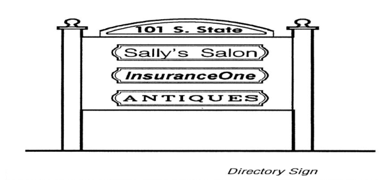 Fig. 10-1
Electronic message sign means a sign with a fixed or changing message composed of a series of lights or light-emitting diodes that may be changed through electronic means. A time and/or temperature sign shall not be considered as an electronic message sign.
Facade means a continuous area on the front or back of the building which is free of windows and doors.
Face area means the area of the sign face that shall be computed by means of measuring the smallest square or rectangle that will encompass the extreme perimeter of the writing, representation or emblem.
Footcandle means a unit of measure of the intensity of light falling on a surface, equal to one lumen per square foot and originally defined with reference to a standardized candle burning at one foot from a given surface.
Freestanding sign means a sign which is attached to or part of a completely self-supporting structure. The supporting structure shall be placed in or below the ground surface and not attached to any building or any other structure, whether portable or stationary.
Identification sign means a sign which carries only the name of the firm, the major enterprise, the principal product or service offered for sale on the premises, or a combination of these things, only to identify location of said premises and not to advertise. Such signs shall be located only on the premises on which the firm or major enterprise is situated, or on which the principal product is offered for sale.
Illuminated or illumination refers to lighting of a sign by any type of artificial light, whether by emission or reflection.
Inflatable sign means a sign consisting of a balloon or other gas-filled structure.
Marquee sign means a permanent roof-like projection over the entrance to a theater, movie house, etc.
Monument sign means a sign extending upward from grade which is attached to a permanent foundation for a distance not less than 50 percent of its length, and which may be attached or dependent for support from any pole, posts, or similar uprights, provided such supports are concealed within the sign structure.
Nit means a measurement of luminance equal to one candela per square meter.
Off-premises sign means a display sign, including billboards, that contains a message unrelated to or not advertising a business transacted or goods sold or produced on the premises on which the sign is located.
On-premises sign means a sign which advertises or identifies only goods, services, facilities, events, or attractions on the premises where located.
Portable temporary sign means a single or double surface painted or poster panel type sign or some variation thereof, which is temporary in nature, easily movable, and not permanently attached to the ground or a building.
Projecting sign means a sign which is perpendicularly attached to and projects from a structure or building wall not specifically designed to support the sign.
Real estate sign means a temporary sign placed upon property for the purpose of advertising to the public the sale or lease of said property.
Roof sign means any sign wholly erected, constructed or maintained on the roof structure of any building.
Sign means a device which is affixed to, or otherwise located or set upon a building, structure or parcel of land which directs attention to an activity or business. This includes interior signs which are directed at persons outside the premises and exterior signs, but not signs primarily directed at persons within the premises. This definition does not include goods for sale displayed in a business window.
Sign area means the area of a sign that shall be computed by means of the smallest square, circle, triangle, rectangle, or combination thereof, that will encompass the extreme limits of the representation, writing, emblem, or other display, together with any material or color forming the background of the display or used to differentiate the sign from the backdrop or structure against which it is placed. Frames and structural members not bearing copy shall not be included in computation of sign area. Where a sign has two or more faces, the area of all faces shall be included in determining the area of the sign, except where two such faces are placed back-to-back, parallel to one another, and less than 24 inches apart, the area of the sign shall be the area of one face. That portion of the sign structure connecting the sign face shall not be used for display purposes. (See figure 10-2.)
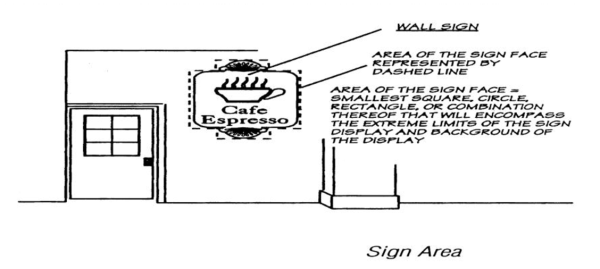 Fig. 10-2Sign height means the height of a sign shall be computed as the distance from the base of the sign at normal grade to the top of the highest attached component of the sign. Normal grade shall be construed to be the lower of existing grade prior to construction or mounding, or excavating solely for the purpose of locating the sign. In cases in which the normal grade cannot reasonably be determined, sign height shall be computed on the assumption that the elevation of the normal grade at the base of the sign is equal to the elevation of the nearest point of the crown of a public street or the grade of the land at the principal entrance to the principal structure on the zoning lot, whichever is lower.
Sign surface means any part of the sign upon, against, or through which the message is displayed or illustrated.
Temporary sign means a sign that is intended to be displayed for a limited period of time.
Wall sign means a sign that shall be affixed parallel to the wall or printed or painted on the wall of any building; provided, however, said wall sign shall not project above the top of the wall or beyond the end of the building. For the purpose of this chapter, any sign display surface that is affixed flat against the sloping surface of a mansard roof shall be considered a wall sign.
Welcome sign means a sign displaying the name of the owner or a sign saying "Welcome."
Window sign means a sign installed inside a window and intended to be viewed from the outside.
(Code 1992, § 24-342; Ord. No. 304, § 1002, 6-2-2003; Ord. No. 321, 8-17-2009; Ord. No. 339, § 1002, 7-16-2012)
Amended by Ord. 349 on 12/4/2017
Sec 44-355 Exempted Signs
The following types of signs are exempted from all provisions of this chapter, except for construction and safety regulations and the following standards:
- Signs of a noncommercial nature and in the public interest, erected by, or on the order of a public officer in the performance of a public duty, such as directional signs, regulatory signs, warning signs, and informational signs including electronic message signs (LED) used for right-of-way or public utility improvements.
- Names of brands, manufacture's labels and logos, date of erection, monument citations, commemorative tablets, and the like, when carved into stone, concrete, metal, or similar material or made of permanent type construction and made an integral part of the structure.
- Historic signs designating sites recognized by the state historical commission or local government body or agency.
- Signs directing traffic on private property, but bearing no advertising matter except logos not exceeding one square foot in area.
- Signs displayed for the direction or convenience of the public, including signs which identify restrooms, location of public telephones, public entrances, freight entrances, or the like, with a total surface area not to exceed six square feet per sign on any lot or parcel.
- Yard sale signs, provided that no person shall in any way attach posters, notices or advertisements to utility poles, meter posts, or trees in or along any street right-of-way within the city, and that no person shall put up any notice upon any building, wall or fence or other property of another person without having first obtained the consent of the owner of such property. The maximum time limit for all yard sale signs is three consecutive days.
- Gasoline price signs; provided the total sign area is less than five square feet. These signs may include light-emitting diode (LED) signs subject to section 44-362.
- At gasoline stations, corporate identification signs of less than ten square feet each, attached directly to a canopy providing coverage to pump islands.
- Wall murals and similar graphics containing no direct advertisement, subject to the review and approval of the planning commission.
- Real estate signs advertising the single parcel of land on which the sign is located, provided such signs are smaller than nine square feet for residential sales and 32 square feet for commercial sales.
- Home security signs and welcome signs not exceeding two square feet in area.
- In all districts, one sign for each public street frontage advertising a recorded subdivision or development shall be permitted. Each sign shall not exceed 25 square feet in area. Each sign shall be removed within one year after the sale of 70 percent of all lots or units within said subdivision or development.
- Temporary signs announcing any public, charitable, educational or religious event or function, located entirely within private premises as approved by the zoning administrator, shall be permitted. Maximum sign area for all signs shall not exceed 25 square feet. Signs advertising not more than two events per year shall be allowed for a period not to exceed 14 consecutive days for each event. If building mounted, signs shall be flat wall signs and shall not exceed six feet in height. Signs shall be set back a minimum of one-half the front yard requirements as measured from the street right-of-way line.
- Portable signs are permitted in WF, HSC, LI and I districts for a period not to exceed 14 consecutive days and not more than two times in any calendar year. Maximum sign area shall not exceed 25 square feet. Such signs and objects shall not obstruct pedestrian or vehicular view.
- Political campaign signs announcing candidates seeking public political office and other data pertinent thereto, providing that these signs shall be removed within 24 hours after the date of the election for which they were posted, and shall not exceed nine square feet in area.
- One "for rent" or "vacancy" sign may be placed on each public street frontage of a rental residential development, provided that such sign shall not exceed nine square feet in area and is incorporated into the identification sign. Signs shall be located behind the right-of-way line of any public street.
- One unlighted nameplate identifying the name of the occupant, not to exceed two square feet in area. The sign shall be attached flat against the front wall of the building.
- Drive-through restaurant menu boards, not to exceed 48 square feet in area or 8 1/2 feet in height.
- Temporary electronic message sign/LED announcing any public, charitable, educational or religious event or function, located entirely within private premises as approved by the zoning administrator shall be permitted. Maximum sign areas for all signs shall not exceed 25 square feet. Signs advertising not more than two events per year shall be allowed for a period not to exceed 14 consecutive days for each event.
- Menu sign(s) for restaurants, placed on their property, which do not exceed a total of four square feet.
(Code 1992, § 24-343; Ord. No. 304, § 1003, 6-2-2003; Ord. No. 313, 7-5-2005; Ord. No. 317, 2-4-2008; Ord. No. 321, 8-17-2009)
Amended by Ord. 344 on 9/30/2013
Sec 44-356 Prohibited Signs
The following types of signs are prohibited:
- Tacking, pasting, or otherwise affixing of signs or posters visible from a public way except "no trespassing," "no hunting," "beware of animal" warning or danger signs, and other legal postings as required by law, located on the walls of buildings, barns, sheds, on trees, poles, posts, or fences is prohibited.
- Pennants, banners, searchlights, twirling signs, sidewalk or curb signs, balloons, or other gas-filled figures are prohibited except as provided in section 44-362, temporary signs.
- No sign or any portion thereof which moves or assumes any motion constituting a non-stationary or non-fixed condition shall be permitted.
- As defined in this article, abandoned signs shall be prohibited and removed within 30 days of receipt of city written notification.
- A sign which displays flashing or blinking lights of changing degrees of intensity except as permitted in section 44-360(e), permitted signs in WF, HSC, LI, and I districts.
- A sign or illumination that causes any direct glare into or upon any building other than the building to which the sign may be accessory.
- Signs which are of a size, location, content, coloring, or manner of illumination which may be confused with or construed as a traffic control device or which hide from view any traffic, street sign or signal that obstructs the view in any direction at a street or road intersection.
- Signs which contain statements, words, or pictures of an obscene, pornographic or immoral character.
- Signs which emit audible sound or odor.
- A sign which obstructs any window or door opening.
- Signs attached to fences, printed directly on, attached to, or affixed to any tree, rock, or similar inorganic natural matter. For purposes of this chapter, the etching of advertising copy directly on a boulder or rock, or the affixing of a placard directly thereto, shall be permitted and regulated as a freestanding sign pursuant to section 44-360(c), freestanding signs.
- Roof sign, except as provided in section 44-360(d), roof signs.
- Off Premises signs.
- Temporary electronic message (LED) signs except as permitted in subsection 44-355(s).
(Code 1992, § 24-344; Ord. No. 304, § 1004, 6-2-2003; Ord. No. 313, 7-5-2005; Ord. No. 315, 7-24-2007; Ord. No. 321, 8-17-2009; Ord. No. 339, § 1004, 7-16-2012)
Amended by Ord. 356 on 1/4/2021
Sec 44-357 General Sign Regulations
The following regulations shall apply to all signs:
- Illumination.
- In LDR, MDR, HDR, TLWFR and MFR zoning districts, illuminated signs shall be allowed, provided such illumination is so shielded as to prevent direct light rays from the source of light being visible from the public right-of-way or any adjacent residential property and do not emit more than 200 nits. Sign lighting shall be shut off between the hours of 9:00 p.m. and 7:00 a.m. in LDR, MDR and HDR zoning districts.
- In HSC, OSC, CBD, WF, LI and I districts, illuminated signs are permitted, provided such illumination is so shielded as to prevent direct light rays from the source of light from being visible from the public right-of-way or any adjacent residential property.
- Exposed neon or gaseous light tubing shall be permitted.
- In no case shall any sign exceed a level of illumination of 0.1 footcandles when measured at the property line and shall not emit more than 375 nits between dusk and dawn.
- No freestanding sign or roof sign shall exceed 20 feet in height.
- Except where specified otherwise in sections 44-355, exempted signs; 44-360(c), freestanding signs; 44-360(f), exceptions, and 44-361(c), permitted signs in the CBD, all signs shall be set back a minimum of one-half the front yard requirements as measured from the street right-of-way line.
- All signs, except those exempted by sections 44-355, exempted signs; 44-361(d), signs permitted in the CBD; 44-362(b), shall be reviewed and approved by the city planning commission as part of the site plan review process and/or sign application, as required in article XI of this chapter, site plan review procedures.
- No sign, except for projecting, canopy, marquee signs allowed in the CBD and those maintained by the city, county, state or federal government, shall be located in or overhang a public right-of-way or dedicated easement.
- One sandwich board sign not exceeding 12.5 square feet per sign face and not more than 54 inches in height may be permitted in addition to the other permitted signs, provided the sign is located on private property of a commercial business. (See figure 10-3.) Refer also to section 44-362, temporary signs, for regulations pertaining to temporary sandwich board signs.
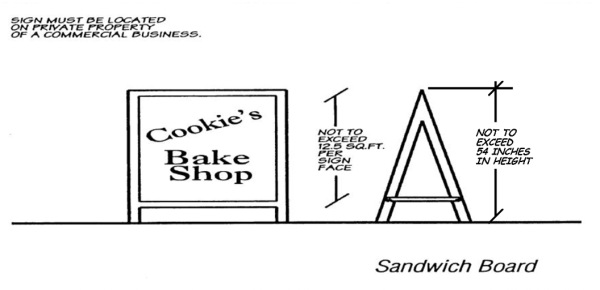
Fig. 10-3
(Code 1992, § 24-345; Ord. No. 304, § 1005, 6-2-2003; Ord. No. 313, 7-5-2005)
Amended by Ord. 349 on 12/4/2017
Sec 44-358 Signs Permitted In All Districts
Subject to the other conditions of this chapter, the following signs shall be permitted in any zoning district within the city:
- One announcement bulletin sign shall be permitted on any site which contains a church, regardless of the lot size or district in which it is located, provided said bulletin sign does not exceed 25 square feet in area and a height of six feet, and is set back a minimum of ten feet from the right-of-way line. An electronic message center can be used in place of an announcement bulletin sign per the following requirements:
- Illumination restrictions as set forth in Section 44-357.
- Message shall be text only and amber in color.
- The frequency of the message change shall be no more than once every 60 minutes.
- Message is to be static in nature without visual effects during display or during transition including text motion, fading or flashing.
(Code 1992, § 24-346; Ord. No. 304, § 1006, 6-2-2003)
Amended by Ord. 349 on 12/4/2017
Amended by Ord. 356 on 1/4/2021
Sec 44-359 Permitted Signs In LDR, MDR, HDR, TLWFR And MFR Districts
The following provisions shall apply to signs in the LDR, MDR, HDR, TLWFR and MFR zoning districts:
- Each sign shall not exceed 25 square feet in area. Signs shall be located behind the right-of-way line of any public street.
- One unlighted sign announcing a home occupation or professional service, not to exceed two square feet in area. The sign shall be attached flat against the front wall of the building.
- One unlighted sign announcing a bed and breakfast establishment or similar use not to exceed four feet in area. The sign shall be attached flat against the front wall of the building.
- Scoreboards or non-accessory signs made an integral part of a recreational building or stadium, provided that such signs do not exceed a maximum area of 100 square feet for each such sign so provided.
(Code 1992, § 24-347; Ord. No. 304, § 1007, 6-2-2003; Ord. No. 315, 7-24-2007)
Sec 44-360 Permitted Signs In The WF, HSC, OSC, LI And I Districts
The following provisions shall apply to signs in the WF, HSC, OSC, LI and I zoning districts. (Refer also to section 44-361, permitted signs in the CBD, for additional signs permitted in the CBD and subsection 44-357(f), general sign regulations, for permitted commercial sandwich board signs.) Signs shall be limited to one flat wall sign or canopy sign, and one freestanding sign on the premises of a business establishment or composite of businesses under single ownership by an individual, firm, or corporation, subject to the following conditions and/or exceptions:
- Wall signs.
- Flat wall signs may not project above the roof or parapet line and may not project more than one foot beyond the face of the wall of the building. Wall signs shall be attached to, and be parallel to, the wall of the building. (See figure 10-4.)
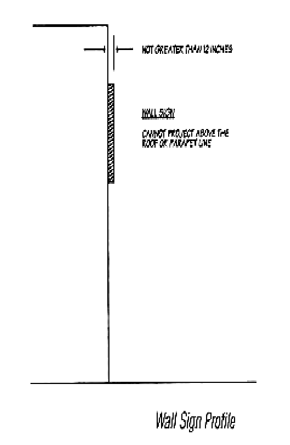
Fig. 10-4 - Wall signs shall be limited to one wall sign per business on each wall abutting a public right-of-way or on a wall that does not abut a public right-of-way and has a public entrance and adjacent privately owned parking lot. The maximum size of any such sign shall not exceed ten percent of the building face area abutting a public right-of-way. No such sign shall exceed 100 square feet. (See figure 10-5.)
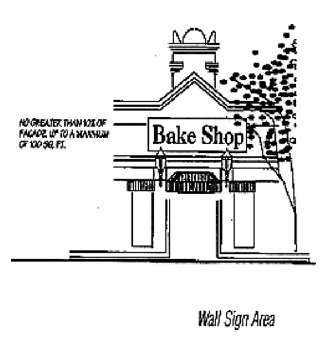
Fig. 10-5 - In the instance of several tenants utilizing a common public entranceway, such as in the case of a shopping mall or multi-story office building, one additional common wall sign shall be permitted, provided any such sign shall not exceed one square foot in area for each tenant listed, or 100 square feet, whichever is more restrictive. One such sign per side of building shall be permitted. This subsection shall not be interpreted to apply to businesses initially providing individual customer access points to the exterior subsequently enclosed by means of enclosed sidewalks or similar enclosures designed to provide climatic control.
- Nonresidential use structures containing a gross floor area of 10,000 square feet or more and having multiple tenants may have one wall sign identifying only the name and/or business for each tenant, provided no single sign is greater than 100 square feet and, provided further, that the total sign area on any wall does not exceed ten percent of the building face area to which it is attached.
- Flat wall signs may not project above the roof or parapet line and may not project more than one foot beyond the face of the wall of the building. Wall signs shall be attached to, and be parallel to, the wall of the building. (See figure 10-4.)
- Canopy signs.
- Canopy signs may be installed in lieu of wall signs, provided the canopy structure to which they are a part does not extend into a public right-of-way or encroach over abutting property lines.
- The maximum size of any canopy sign shall not exceed ten percent of the building facade where so provided; however, no such sign shall exceed 100 square feet.
- Any such canopy structure shall be at least two feet from any vehicular parking space or maneuvering lane.
- A minimum clearance of seven feet shall be maintained above the sidewalk by all canopy structures. (See figure 10-6.)
- Canopies hereafter erected shall, whenever practicable, match the established under clearance height and projection of canopies which exist on abutting parcels and/or businesses.
- Where a building has a canopy constructed as an integral part of such building, one additional sign may be permitted per customer access under the canopy and perpendicular to the building, provided it is not more than two square feet in area and, further provided, that a minimum clearance of seven feet shall be maintained above the sidewalk.
- Only the copy area of the canopy should be identified as sign area used for calculation purposes. (See figure 10-6.)
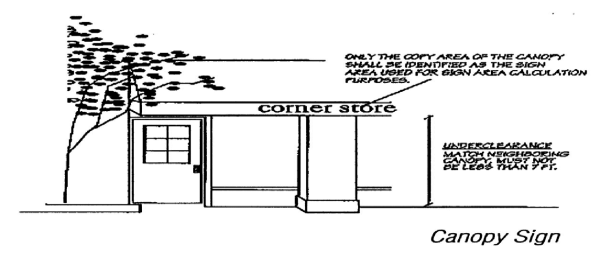
Fig. 10-6 - If a canopy sign is used in place of a freestanding sign as provided in section 44-361, permitted signs in the CBD, the combined square footage of the canopy sign and wall sign may not exceed one square foot or 15 percent of the building facade. Each sign must still comply with the square footage requirements as specified in section subsection (a)(3) and (b)(2) of this section.
- Freestanding signs.
- A maximum of one freestanding sign shall be permitted per structure or planned grouping of structures where a building does not cover the full area of the property. Signs may be freestanding ground supported and shall be setback at least five feet from the property line. Such signs shall not be placed closer than 25 feet to any residential district or another freestanding sign.
- The maximum allowable height from grade for such signs shall be 20 feet. (See figure 10-7.)
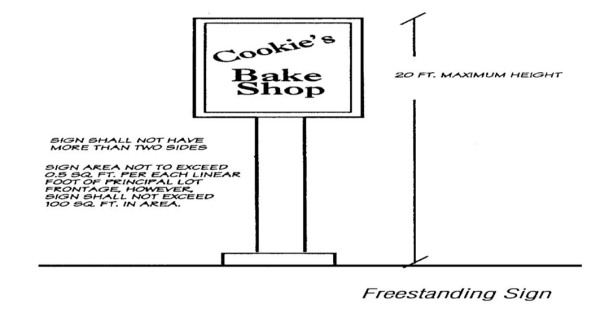
Fig. 10-7 - Freestanding signs shall not have more than two sides.
- Freestanding signs shall not exceed a size per face of 0.5 square foot per each one linear foot of principal lot frontage as determined by the planning commission. In no instance shall a freestanding sign face exceed 100 square feet. (See figure 10-7.)
- One additional freestanding sign shall be permitted for corner lots having frontage on two or more public roads.
- Roof signs.
- A maximum of one roof sign shall be permitted per structure or planned grouping of structures solely for businesses having frontage along US-23.
- Roof signs shall not have more than two sides.
- Roof signs shall not project beyond the face of the building walls.
- Roof signs shall not exceed a height of 20 feet, as measured from street grade.
- Roof signs shall be subject to the same size requirements as wall signs as specified in subsection (a)(2), (3) and (4) of this section.
- Electronic message sign.
- Electronic message signs shall be permitted only within the HSC and WF zoning districts, as either a freestanding or wall-mounted sign or window sign on lots with a minimum frontage of 200 feet. Such signs shall be allowed subject to the sign regulations of each Zoning District and subject to the following additional regulations:
- The frequency of the message change shall be restricted to no more than once every 6 seconds.
- An electronic message sign shall be considered a part of a wall sign or freestanding sign and shall be located below the main sign. Such electronic message signs shall not exceed fifty percent (50%) of the total sign area as allowed per Zoning District and sign regulations of Article 10.
- The maximum height of an electronic message sign shall conform to the height regulations for signs allowed in each Zoning District as specified in Article 10.
- An electronic message sign shall have functioning ambient light monitors and automatic dimming equipment which shall at all times be set to automatically reduce the brightness level of the sign proportionally to any reduction in the ambient light. In order to verify compliance with City Code or other applicable law, the interface that programs an electronic sign shall be made available to City staff for inspection upon request. If the interface is not or cannot be made available upon the City’s request, the sign shall cease operation until the City has been provided proof of compliance with City Code.
- Properties within the HSC and WF zoning districts with frontage less than 200 feet shall be allowed one electronic message sign subject to the sign regulations of each Zoning District and subject to the following additional regulations:
- Illumination restrictions as set forth in Section 44-357.
- An electronic message sign shall be considered as part of a wall sign or freestanding sign and shall be located below the main sign. Such electronic message sign shall not exceed fifty percent (50%) of the total sign area as allowed per Zoning District and sign regulations of Article X. Signs.
- The maximum height and setback of an electronic message sign shall conform to the height and setback regulations for signs allowed in each Zoning District as specified in Article X. Signs.
- Message shall be a single-color text only.
- The frequency of the message change shall be no more than once every 10 minutes.
- Message is to be static in nature without visual effects during display or during transition including text motion, fading or flashing.
Table 1008-1. Maximum Light Levels of Electronic Signs above ambient lightDistance = Square Root of (Sign Area x 100)Maximum Allowed
Ambient Light LevelArea of Sign (sq. ft.)
Measurement of Distance (ft.)*
0.3 footcandles
10
32
0.3 footcandles
15
39
0.3 footcandles
20
45
0.3 footcandles
25
50
0.3 footcandles
30
55
0.3 footcandles
35
59
0.3 footcandles
40
63
0.3 footcandles
45
67
0.3 footcandles
50
71
0.3 footcandles
55
74
0.3 footcandles
60
77
*Measured in feet, perpendicular to the face of the sign. Source: Model Code, Illuminating Engineering Society of North America
- Electronic message signs shall be permitted only within the HSC and WF zoning districts, as either a freestanding or wall-mounted sign or window sign on lots with a minimum frontage of 200 feet. Such signs shall be allowed subject to the sign regulations of each Zoning District and subject to the following additional regulations:
- Exceptions.
- Window signs shall be permitted and shall not be included in total sign area computation if said signs do not occupy more than 50 percent of the total window area of the floor level on which displayed or exceed a total of 100 square feet for any one building. If window signs occupy more than 50 percent of said window area or exceed a total of 100 square feet for any one building, they shall be treated as exterior signs and shall conform to subsection (a) of this section, wall signs. Electronic message signs/LED, as permitted in subsection (e) of this section, displayed within a window shall comply with the maximum size regulations of this section and the zoning district, frequency of change and illumination restrictions of subsection (e) of this section. Window signs which flash or blink shall be prohibited.
- A time and temperature sign shall be permitted in addition to the above conditions, provided that ownership identification or advertising copy does not exceed ten percent of the total sign area and further provided that the total area of the sign does not exceed 30 square feet.
- Monument signs may be substituted for an equal number of freestanding signs. They shall not exceed a height of five feet. They shall not be placed closer than five feet to the front lot line. The monument sign shall also be located outside of a clear vision sight triangle. This area is defined as the area formed at the corner intersection of a public right-of-way and a driveway, two sides of the triangle area being ten feet in length measured along the right-of-way line and driveway line and the third side being a line connecting these two sides. (See figure 10-8.) The area of a monument sign may be increased in size by 20 percent over that allowed for freestanding signs.
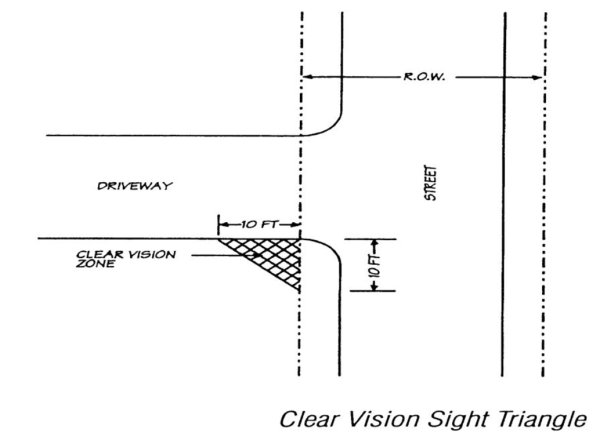
Fig. 10-8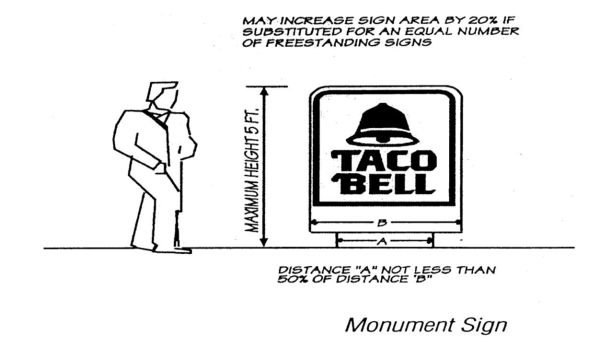
Fig. 10-9 - Backlit, changeable copy signs, e.g. Duratrans, shall be permitted and shall be included in the total sign area computation for wall signage.
(Code 1992, § 24-348; Ord. No. 304, § 1008, 6-2-2003; Ord. No. 313, 7-5-2005; Ord. No. 315, 7-24-2007; Ord. No. 321, 8-17-2009; Ord. No. 339, § 1008(5), 7-16-2012)
Amended by Ord. 346 on 9/6/2016
Amended by Ord. 347 on 7/17/2017
Amended by Ord. 350 on 11/5/2018
Amended by Ord. 354 on 3/2/2020
Amended by Ord. 355 on 8/17/2020
Sec 44-361 Permitted Signs In The CBD
Sign regulations for any new use or expanded use of property located entirely or partially within the CBD shall be determined as set forth in section 44-360, permitted signs in the WF, HSC, OSC, LI and I districts. Instead, a canopy sign, a projecting sign, marquee sign, or a monument sign may be substituted for prohibited freestanding signs within the CBD as stipulated below:
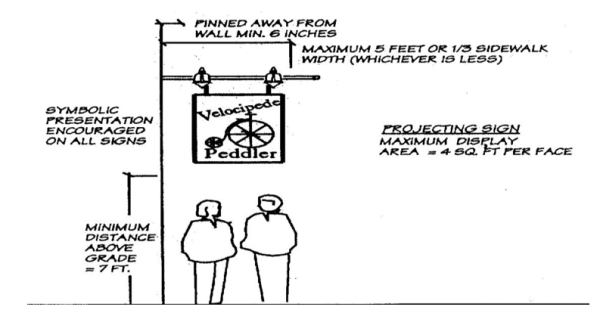
- Projecting signs may be allowed, subject to the following requirements:
- Projecting signs shall clear grade level below the sign by a minimum of seven feet.
- Projecting signs shall not exceed a display area of four square feet per face.
- Only one projecting sign per business is permitted.
- Projecting graphics shall project no more than five feet from the building or one-third of the sidewalk width, whichever is less.
- Projecting graphics shall be pinned away from the wall at least six inches.
- Projecting graphics shall project from the wall at an angle of 90 degrees.
- Angular projection at the corner of a building is prohibited.
- Marquee signs may be allowed for places of public assembly, subject to the following requirements:
- Marquee signs shall not extend into any public right-of-way more than seven feet or over the sidewalk more than one-half the width of the sidewalk, whichever is less.
- The minimum height of such sign is eight feet, six inches, measured from the sidewalk surface to the bottom edge of the sign.
- Monument signs may be allowed within the front yard in accordance with the requirements of section 44-360(f)(3), permitted signs in the WF, HSC, OSC, LI and I Districts. Canopy signs may be allowed in accordance with the requirements of section 44-360(b).
- Banners containing messages or slogans promoting the CBD, charitable organization, civic events, and other public activities may be displayed by the city subject to review by the zoning administrator.
- Design requirements.
- All signs within the CBD shall be designed to be compatible with the architectural style of the district and consistent with the CBD sign guidelines provided herein. Logos shall be exempt from the design requirements with the exception of non-registered portions of a sign, which shall be subject to said design guidelines, including poles, standard brackets, decorative trim, associated landscaping, and other appurtenances.
- Standards shall include compatibility with building architecture; use of antique lighting, and identifying symbology; signs should be easy to read and uncluttered; and text should be sized for the respective distance of the readers. (See figure 10-10.)
(Code 1992, § 24-349; Ord. No. 304, § 1009, 6-2-2003)
Sec 44-362 Temporary Signs
On-site temporary signs may be erected in accordance with the regulations of this chapter.
- Temporary construction identification signs identifying building contractors, professional design firms or lending institutions for construction projects to occur or occurring are subject to the following regulations:
- One temporary on-site construction sign for each project or development, except where a project or development abuts two or more streets, additional such signs, one oriented to each street abutting street, shall be permitted.
- On-site temporary construction signs shall not exceed 32 square feet.
- Temporary construction signs may be located in any required yard but shall not extend over any lot line or within 12 feet of any point of vehicular access or public roadway.
- Temporary construction signs shall not project higher than 12 feet.
- Temporary construction signs shall be permitted only as an accessory to an approved project or development. Temporary construction signs may be erected and maintained for not more than a six-month period and shall be removed within 14 days of the termination of construction of the project or development, except that the planning commission may at its discretion, upon application by the owner and for cause shown, provide one extension, not longer than six months in duration.
- Banners, pennants, search lights, twirling signs, sandwich board signs, balloons, or other gas filled figures may be approved by the zoning administrator at the opening of a new business in a commercial or industrial district for a period not to exceed 14 consecutive days. Street banners advertising a public entertainment or event may be displayed 14 days prior to and through the completion of such event. Street banners shall be removed within 24 hours following such event. As approved by the zoning administrator, banners and pennant displays shall be permitted in commercial districts only to call attention to a sale or promotion for a period not to exceed 14 consecutive days. No more than three banner and pennant displays shall be permitted for any one business during a calendar year commencing on January 1. Banners or pennants shall be restricted to 30 square feet per such sign and shall be attached only to the exterior walls of the building itself. (See figure 10-11.) In no instance shall more than one banner or pennant be allowed per approved event period. (Refer to subsection 44-357(f) for regulations pertaining to permanent sandwich board signs.)
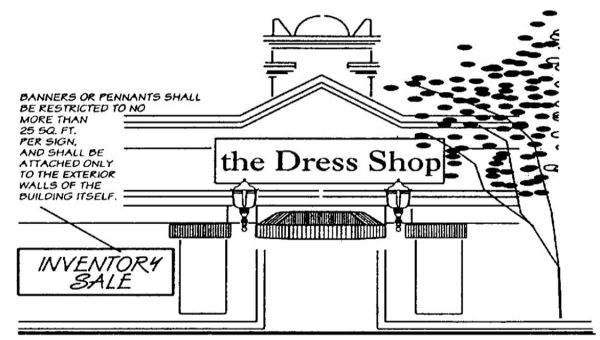
Fig. 10-11. Banner Sign
(Code 1992, § 24-350; Ord. No. 304, § 1010, 6-2-2003; Ord. No. 313, 7-5-2005)
Sec 44-363 Nonconforming Signs And Sign Structures
It is the intent of this section to eliminate existing nonconforming signs in such a manner that avoids the invasion of vested rights of the owners of such nonconforming signs as well as the infliction of any unnecessary hardship. The provision of this section shall be construed to that end.
- Normal Maintenance of Nonconforming Signs. Subject to the other provisions of this section, nonconforming signs may have normal maintenance performed.
- Nonconforming signs shall be allowed to continue use unless otherwise specified as follows:
- Nonconforming Signs shall remain unless the principal building on a site which a nonconforming sign is located is modified to the extent that site plan review and approval is required. In which case shall be removed at the owner’s expense.
- A building with a nonconforming sign shall remove the sign if the activity, business, or use to which it is related has been discontinued for more than 30 days.
- Nonconforming signs shall not be structurally altered or changed in shape, size, location, or design, except to bring the sign into complete compliance with the requirements of Chapter 10, Signs.
- Nonconforming signs shall be removed at the cost of the property owner, if declared unsafe by the Zoning Administrator, because of the physical condition of the sign.
- Nonconforming signs shall not be re-established after damage caused by accident, natural causes, or vandalism if the damage is in excess of 50% of its cash value at the time damage occurs as determined by the City.
- Modifications to Nonconforming Signs. The owner of a nonconforming sign may update a nonconforming sign if the owner enters into an agreement with the City that complies with the following requirements. For the purposes of this subsection, modifying a nonconforming sign means to change the area of the sign that displays the name, identifications, description, illustration, business, or solicitation.
- Removal of sign within five years. This states that in exchange for the opportunity to change the sign, the entire nonconforming sign, which includes the face and structure, shall be removed within five years of entering into the agreement.
- Owner(s) pay for removal. The owner of the sign and/or the owner of the land on which the sign is located will pay for removal of the sign.
- No variance. The owner of the sign and the owner of the land on which the sign is located waives the right to request a variance from the Zoning Board of Appeals so that the sign can remain after five years.
- Agreement runs with land. The agreement shall run with the land and become binding on any subsequent owners of the sign or owners of the land on which the sign is located.
- Future signs comply with this Ordinance. Any future sign constructed to replace the sign (if it is appropriate), shall comply with the requirements of Chapter 10, Signs.
- Recording. The agreement shall be recorded with the Register of Deeds by the owner of the sign within 30 days of the execution of the agreement, or the agreement shall be null and void.
(Code 1992, § 24-351; Ord. No. 304, § 1011, 6-2-2003; Ord. No. 323, 9-21-2009)
Repealed & Replaced by Ord. 355 on 8/17/2020
Sec 44-364 Maintenance Of Signs
- All signs and sign components thereof, including without limitation supports, braces, and anchors, shall be kept in a state of good repair. With respect to freestanding signs, components (supporting structures, backs, etc.) not bearing a message shall be constructed of materials that blend with the natural environment or shall be painted a neutral color to blend with the natural environment.
- If the zoning administrator or building department shall find that any sign is unsafe or insecure, or is a menace to the public, written notice shall be given to the owner, agent, or person having the beneficial interest in the building or the premises on which such sign is located. Correction of the condition which caused the zoning administrator or building department to give such notice shall be effected within ten days after receipt of the notice. If such condition is not corrected after the conclusion of such ten-day period, the building department is hereby authorized to cause the sign to be removed forthwith at the expense of the owner, agent, or person having the beneficial interest in the building or premises on which such sign is located. Notwithstanding the foregoing provision, the zoning administrator is authorized to cause any sign to be removed summarily and without notice, at the expense of the owner, agent, or person having the beneficial interest in the building or premises on which such sign is located, whenever he determines that such sign is an immediate peril to persons or property.
- If the message portion of a sign is removed, leaving only the supporting shell of a sign, the owner of the property where the sign is located or other person having control over such sign shall, within 30 days of the removal of the message portion of the sign, either replace the entire message portion of the sign or remove the remaining components of the sign. This subsection shall not be construed to alter the effect of section 44-363.
(Code 1992, § 24-352; Ord. No. 304, § 1012, 6-2-2003)
Amended by Ord. 355 on 8/17/2020
Sec 44-365 Permits And Fees
- Application for a permit to erect or replace a sign shall be made by the owner of the property, or his authorized agent, to the zoning administrator by submitting the required forms, fees, exhibits, and information. Fees for sign permits for all signs erected pursuant to this article shall be established by resolution of the city council.
- A zoning permit for a sign shall become null and void if the work for which the permit was issued has not been completed within a period of six months after the date of the permit. Said permit may be extended for a period of 30 days upon request by the applicant and approval of the planning commission.
- Painting, repainting, cleaning, and other normal maintenance and repair of a sign or a sign structure, unless a structural or size change is made, shall not require a sign permit.
- After receiving approval from the planning commission for the installation of freestanding signs, a permit must be obtained from the county building department.
(Code 1992, § 24-353; Ord. No. 304, § 1013, 6-2-2003)
Sec 44-366 Appeals
An appeal may be taken to the zoning board of appeals by any person aggrieved by an order, requirement, decision, determination, or interpretation of the zoning administrator, planning commission or other city official acting within the authority of the provisions of this chapter.
(Code 1992, § 24-354; Ord. No. 304, § 1014, 6-2-2003)
Sec 44-367 Billboards/Off-Premises Signs
- Districts. Billboards shall only be allowed in the US-23 Sign Overlay District as depicted on the City of East Tawas Zoning Map.
- Area. The total sign area of any billboard shall not exceed 672 square feet per face. A triangular or V-shaped billboard shall not have more than two sign faces.
- Setback. No billboard shall be located closer than 25 feet to a non-right-of-way property line. No billboard shall project over public property. Billboard signs shall be no closer than 500 feet to any adjacent residential property line. Billboards shall be set back a minimum of 25 feet from any other structure on or off the premises upon which the billboard is located.
- Distance from other signs. Billboards shall be spaced no closer than 1,250 feet to any other billboard sign on the same side of the right-of-way.
- Height. The top of any billboard shall not be higher than 25 feet above normal grade.
- Illumination. A billboard shall possess automatic dimming capabilities so that the maximum luminescence level is not more than 0.3 footcandles over ambient light levels measured at a distance of 150 feet for those sign faces less than or equal to 300 square feet, measured at a distance of 200 feet for those sign faces greater than 300 square feet but less than or equal to 378 square feet, measured at a distance of 250 feet for those sign faces greater than 378 square feet and less than 672 square feet, and measured at a distance of 350 feet for those sign faces equal to or greater than 672 square feet, and in accordance with the Michigan highway advertising act, Public Act No. 86 of 2009, as amended, and Public Act No. 106 of 1972, as amended. The frequency of a message change for an electric billboard shall be restricted to no more than once every six seconds. Prior to the issuance of a sign permit, the applicant shall provide written certification from the sign manufacturer that the light intensity has been factory-programmed not to exceed the above-listed light levels, and that the intensity level is protected from end-user manipulation by password-protected software or other method satisfactory to the city zoning administrator.
- Construction. A billboard shall be self-supported and pole-mounted.
- Letter of credit; cost of removal assessed. An irrevocable, automatically renewing letter of credit from a bank chartered and located in the United States of America in an amount established by the city council or city manager shall be required for continued maintenance. In the event that a billboard is vacated, the cost of removal, if that burden is placed on the city, shall be assessed to the property owner.
(Ord. No. 339, § 1015, 7-16-2012)

