
East Tawas City Zoning Code
ARTICLE 44
II DEFINITIONS AND RULES APPLYING TO TEXT
Sec 44-37 Rules Applying To Text
The following rules shall apply to the text and language of this chapter:
- The particular shall control the general.
- In case of any difference of meaning or implication between the text of this chapter and any caption, the text shall control.
- The word "shall" is always mandatory and not discretionary. The word "may" is permissive.
- Words used in the present tense shall include the future, words used in the singular number shall include the plural, and the plural shall include the singular, unless the context clearly indicates the contrary.
- The word "used" or "occupied," as applied to any land or building, shall be construed to include the words "intended, arranged, or designed to be used or occupied."
- Any word or term not defined herein shall be used with a meaning of common or standard utilization.
(Code 1992, § 24-31; Ord. No. 304, § 201, 6-2-2003)
Sec 44-38 Definitions
The following words, terms and phrases, when used in this chapter, shall have the meanings ascribed to them in this section, except where the context clearly indicates a different meaning:
Accessory building or structure means a supplementary building or structure on the same lot or parcel of land as the principal building occupied by or devoted exclusively to an accessory use.
Accessory use means a use reasonably and customarily incidental and subordinate to the principal use of the premises.
Adult book or supply store means an establishment having 20 percent or more of its stock in trade or its sales devoted to the distribution, display, or storage of books, magazines, and other periodicals and/or photographs, drawings, slides, films, video tapes, recording tapes, and/or novelty items which are distinguished or characterized by their emphasis on matters depicting, describing, or relating to specified sexual activities or specified anatomical areas.
Adult cabaret means an establishment which features any of the following: topless dancers and/or bottomless dancers, go-go dancers, strippers, male and/or female impersonators or similar entertainers, or topless and/or bottomless waitpersons or employees or any other form of nude or partially nude service or entertainment.
Adult foster care facility means a state-licensed establishment that provides foster care to adults. It includes facilities and foster care homes for adults who are aged, mentally ill, developmentally disabled, or physically handicapped who require supervision on an ongoing basis but who do not require continuous nursing care. An adult foster care facility does not include convalescent or nursing homes, homes for the aged, hospitals, alcohol or substance abuse rehabilitation centers, residential centers for persons released from or assigned to a correctional facility, or any other facilities which have been exempted from the definition of adult foster care facility by the adult foster care facility licensing act, MCL 400.701 et seq., as amended. The following additional definitions shall apply in the application of this chapter:
- Adult foster care small group home means an owner-occupied facility with the approved capacity to receive 12 or fewer adults who are provided supervision, personal care, and protection in addition to room and board, for 24 hours a day, five or more days a week, and for two or more consecutive weeks for compensation.
- Adult foster care large group home means a facility with approved capacity to receive at least 13 but not more than 20 adults to be provided supervision, personal care, and protection in addition to room and board, for 24 hours a day, five or more days a week, and for two or more consecutive weeks for compensation.
- Adult foster care family homes means a private residence with the approved capacity to receive six or fewer adults to be provided supervision, personal care, and protection in addition to room and board, for 24 hours a day, five or more days a week and for two or more consecutive weeks for compensation. The adult foster care family home licensee must be a member of the household and an occupant of the residence.
- Adult foster care congregate facility means an adult foster care facility with the approved capacity to receive more than 20 adults to be provided supervision, personal care, and protection in addition to room and board, for 24 hours a day, five or more days a week and for two or more consecutive weeks for compensation.
Adult-oriented commercial enterprise means an adult bookstore, adult supply store, adult motion picture theater, adult live stage performing theater, or adult cabaret as regulated in section 44-198.
Adult live stage performing theater means an enclosed building with a capacity of 50 or more persons used for presenting material distinguished or characterized by an emphasis on matter depicting, describing or relating to specified sexual activities or specified anatomical areas for observation by patrons therein. Such establishment is customarily not open to the general public, but only to one or more classes of the public, excluding any minor by reason of age.
Adult motion picture theater means an enclosed building used for presenting material distinguished or characterized by an emphasis on matter depicting, describing or relating to specified, sexual activities or specified anatomical areas, for observation by patrons therein. Such establishment is customarily not open to the general public, but only to one or more classes of the public, excluding any minor by reason of age.
Alteration means any change, addition or modification in construction or type of occupancy, any change in the structural members of a building, such as walls or partitions, columns, beams or girders, the consummated act of which may be referred to herein as "altered" or "reconstructed."
Animal hospital means a self-enclosed building wherein animals, including domestic household pets and farm animals, are given medical or surgical treatment and used as a boarding place for such animals limited to short-time boarding incidental to hospital use. Such hospitals include only those under direction of a licensed veterinarian registered in the state. Such animal hospitals shall be constructed in such a manner that noise and odor are not discernible beyond the property upon which they are located.
Animal shelter means a building supported by a governmental unit or agency or by a nonprofit corporation where domestic pets or other animals are kept because of requirements of public health officials, loss by owner, neglect or violation of a public law or ordinance.
Antique shop means a place offering primarily antiques for sale. An antique, for the purpose of this chapter, shall be a work of art, piece of furniture, decorative object, or the like, or of belonging to the past, at least 30 years old. The term "antique shop" does not include a secondhand store.
Apartments means the dwelling units in a multiple dwelling as defined herein:
- Efficiency unit means a dwelling unit consisting of not more than one room, in addition to kitchen, dining and necessary sanitary facilities, and, for the purpose of computing density, shall be considered as a one-room unit.
- One-bedroom unit means a dwelling unit consisting of not more than two rooms, in addition to kitchen, dining and necessary sanitary facilities, and, for the purpose of computing density, shall be considered as a two-room unit.
- Two-bedroom unit means a dwelling unit consisting of not more than three rooms, in addition to kitchen, dining and necessary sanitary facilities, and, for the purpose of computing density, shall be considered as a three-room unit.
- Three- or more bedroom unit means a dwelling unit wherein for each room in addition to the three rooms permitted in a two-bedroom unit, and, for the purpose of computing density, such three-bedroom unit shall be considered a four-room unit, and each increase in a bedroom over three shall be an increase in the room count by one over the four.
Automobile car wash means a building, or portion thereof, where self-propelled motor vehicles are washed as a commercial enterprise.
Automobile convenience mart means a place where gasoline, motor oil, lubricants, or other minor accessories are retailed directly to the public on the premises or in combination with the retailing of items typically found in a convenience market, carryout restaurant or supermarket.
Automobile dealer means a building or premises used primarily for the sale of new or used automobiles, not including farm equipment and recreational vehicles.
Automobile repair means a place where, with or without the sale of engine fuels, the following services may be carried out: general repair, engine rebuilding, rebuilding or reconditioning of motor vehicles; collision service, such as body, frame or fender straightening and repair; or painting and undercoating of motor vehicles.
Automobile storage means any storage of inoperable vehicles intended to be repaired back to operable condition, but not including such vehicles which are incident or accessory to an automotive repair garage or a licensed salvage yard used as a depository for such vehicles.
Basement means that portion of a building having more than one-half of its height below finished grade. (See figure 2-1.)
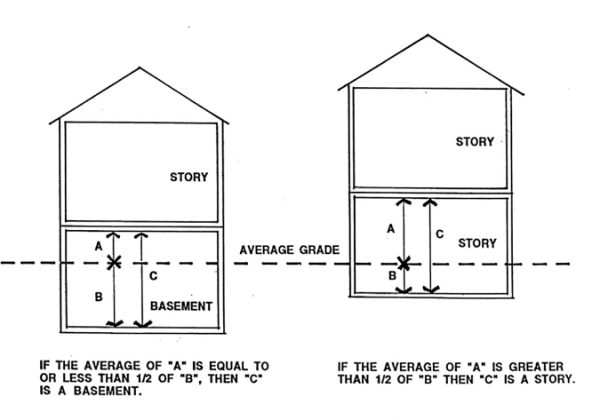 Fig. 2-1. Basement
Building means a structure having a roof supported by columns or walls.
Building area means the space remaining on a lot or parcel after the minimum yard and open space requirements of this chapter have been complied with.
Building height means the vertical distance from the established grade to the highest point of the roof surface for flat roofs, to the deckline of mansard roofs, and to the average height between eaves and ridge for gables, hip and gambrel roofs. Where a building is located on sloping terrain, the height may be measured from the average ground level of the grade at the building wall. (See figure 2-2.)
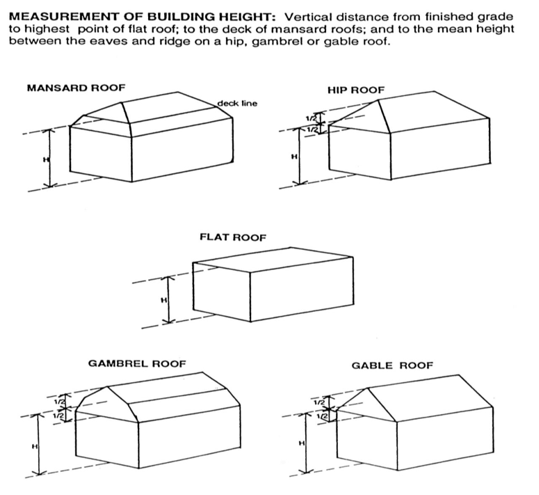 Fig. 2-2. Building Height
Building line means a line formed by the face of the building, and, for the purposes of this chapter, a minimum building line is the same as the front setback line.
Building permit shall be the written authority issued by the building inspector in conformity with the provisions of the construction code.
Building, principal, means a building in which the principal use of the premises on which it is situated is conducted.
Building setback line means the line established by the minimum required setbacks forming the area within a lot in which a building may be located.
Business district or shopping center means a group of two or more stores, offices, research, or manufacturing facilities which collectively have a name different than the name of any of the individual establishments and which have common off-street parking.
Campground means the uses and activities which take place on a lot or parcel for temporary short-term resort or recreational purpose in accordance with part 125 of Public Act No. 368 of 1978 (MCL 333.12501 et seq.) and the administrative rules promulgated under such act as administered by the county, district or state public health departments.
Change of copy means the replacement of a name, logo, symbol, number or graphic on a sign without changing the size of the sign, location of the sign or structural characteristics.
Child care facility includes the following definitions:
- Family child care home means a state-licensed, owner-occupied private residence in which one but not more than six minor children are received for care and supervision for periods less than 24 hours a day unattended by a parent or legal guardian, excepting children related to an adult member of the family by blood, marriage or adoption. It includes a home that gives care to an unrelated child for more than four weeks in a calendar year.
- Group child care home means a state-licensed, owner-occupied private residence in which seven, but not more than 12, children are received for care and supervision for periods less than 24 hours a day unattended by a parent or legal guardian, excepting children related to an adult member of the family by blood, marriage or adoption. It includes a home that gives care to an unrelated child for more than four weeks in a calendar year.
- Child care center means a state-licensed facility, other than a private residence, receiving one or more child for care and supervision for periods less than 24 hours, and where the parents or guardians are not immediately available to the child.
Church means a building wherein persons assemble regularly for religious worship, maintained and operated by an organized religious body and accessory uses, buildings and structures customarily associated with a church. The term "church" includes temples or synagogues.
Clinic, human, means a building or group of buildings where human patients are admitted for examination and treatment by more than one professional, such as a physician, dentist, or the like, except that such human patients are not lodged therein overnight.
Club or lodge means an organization of persons for special purposes or for the promulgation of agriculture, sports, arts, science, literature, politics or the like, but not for profit, and open only to members and not the general public.
Commercial use means a use of property in connection with the purchase, sale, barter, display, or exchange of goods, wares, merchandise, or services, and the maintenance or operation of offices.
Common areas, uses and services means land areas, improvements, facilities and utilities, the use, enjoyment and maintenance of which are intended to be shared by the owners and occupants of individual building units in a subdivision or a planned development.
Condominium means a building or lot governed under Public Act No. 59 of 1978 (MCL 559.101 et seq.).
Condominium document means the master deed, recorded pursuant to the Condominium Act, and any other instrument referred to in the master deed or bylaws which affects the rights and obligations of a co-owner in the condominium.
Condominium lot means the condominium unit and the contiguous limited common element surrounding the condominium unit, which shall be the counterpart of "lot" as used in connection with a project developed under the land division act, Public Act No. 288 of 1967 (MCL 560.101 et seq.).
Condominium unit means the portion of a condominium project designed and intended for separate ownership and use, as described in the master deed.
Convalescent or nursing home means a structure with sleeping rooms where persons are housed or lodged and are furnished with meals, nursing and medical care.
Convenience grocery store means a one-story retail store that is designed and stocked to sell primarily food, beverages and other household supplies to customers who purchase a relatively few items (in contrast to a supermarket). Convenience grocery stores are designed to attract a large volume of stop-and-go traffic.
Development means the modification of a parcel, alteration of terrain, construction of structures or modifications of existing structures.
District means a portion of the city within which certain uses of land and/or buildings are permitted and within which certain regulations and requirements apply under the provisions of this chapter.
Drive-in establishment means any establishment which offers goods and/or services over-the-counter or in motor vehicles.
Dwelling means a building designed and built in accordance with the current state construction code or used exclusively as a living quarters for one or more families, but not including automobile chassis, tents or portable buildings.
Dwelling, group, or group housing means two or more single- or multiple-family dwelling structures on a parcel of land under single ownership.
Dwelling, multiple-family, means a dwelling structure, or portion thereof, designed for occupancy by two or more families living independently of each other.
Dwelling, one-family, means a dwelling structure designed exclusively for occupancy by one family.
Dwelling, two-family, or duplex means a multiple-family dwelling structure designed exclusively for occupancy by two families independent of each other, such as a duplex dwelling unit.
Dwelling unit means any building or portion thereof or a mobile home having cooking facilities, which is occupied wholly as the home, residence or sleeping place of one family, either permanently or transiently. In cases of mixed occupancy, where a building is occupied in part as a dwelling unit, the part so occupied shall be deemed a dwelling unit for the purpose of this chapter and shall comply with the provisions thereof relative to a dwelling.
Essential services means the erection, construction, alteration or maintenance by public utilities or municipal departments of underground, surface or overhead gas, electrical, steam, fuel or water transmission or distribution systems, collection, communication, supply or disposal systems, including towers, poles, wires, mains, drains, sewers, pipes, conduits, cables, fire alarm and police call boxes, traffic signals, hydrants and similar equipment in connection herewith, but not including buildings which are necessary for the furnishing of adequate services by such utilities or municipal departments for the general health, safety or welfare.
Extended-stay motel means any building containing six or more guest rooms intended or designed to be used, rented or hired out to be occupied or which are occupied for sleeping purposes for guests and contain kitchen facilities for food preparation, including, but not limited to, such facilities as refrigerators, stoves and ovens.
Extractive operation means the premises from which any rock, gravel, sand, topsoil, or earth in excess of 50 cubic yards in any calendar year is excavated or removed for the purpose of disposition away from the premises except excavation in connection with the construction of a building or within public highway rights-of-way.
Family means an individual or a group of two or more persons related by blood, marriage or adoption, together with foster children and servants of the principal occupants, with not more than one additional unrelated person, who are domiciled together as a single, domestic, housekeeping unit in a dwelling unit; or a collective number of individuals domiciled together in one dwelling unit whose relationship is of a continuing non-transient domestic character and who are cooking and living as a single noncommercial housekeeping unit. This definition shall not include any society, club, fraternity, sorority, association, lodge, coterie, organization, or group of students or other individuals whose domestic relationship is of a transitory or seasonal nature or for an anticipated limited duration of a school term or terms or other similar determinable period.
Fence means a permanent partition, structure or gate erected as a dividing marker, barrier or enclosure, and not a part of a principal building or structure or other accessory structure.
Floodplain means that portion of land adjacent to or connected to a water body or water course which is subject to periodic inundation in accordance with the 100-year flood cycle as determined by the U.S. Army Corps of Engineers or other applicable federal agency.
Floor area, gross, or GFA means the sum of the gross horizontal areas of the several floors of the building measured from the exterior face of the exterior walls or from the centerline of walls separating two dwelling units. The gross floor area of a building shall include the basement (see definition) floor area when more than one-half of the basement height is above the established curb level or finished lot grade and of interior finished construction similar to first or main floor. Any space devoted to off-street parking or loading shall not be included in gross floor area. Areas of dwelling basements, unfinished attics, utility rooms, breezeways, porches (enclosed or unenclosed) or attached garages are not included.
Floor area, usable, or UFA means the usable floor area (measured from the interior face of the exterior walls) used for or intended to be used for services to the public as customers, patrons, clients or patients; including areas occupied by fixtures or equipment used for display or sale of goods or merchandise, but not including areas used or intended to be used principally for storage of merchandise, utility or mechanical equipment rooms, or sanitary facilities. In the case of a one-half-story area, the usable floor area shall be considered to be only that portion having a clear height of more than 90 inches of headroom.
Frontage, street, means the legal line which separates a dedicated street right-of-way or easement from abutting land to which it provides over-the-curb vehicular access.
Garage means a structure which is accessory to a principal residential dwelling and which is used for the parking and storage of vehicles owned and operated by the residents thereof.
General common elements means the common elements other than the limited common elements.
Grade means the degree of rise or descent of a sloping surface. (See figure 2-3.)
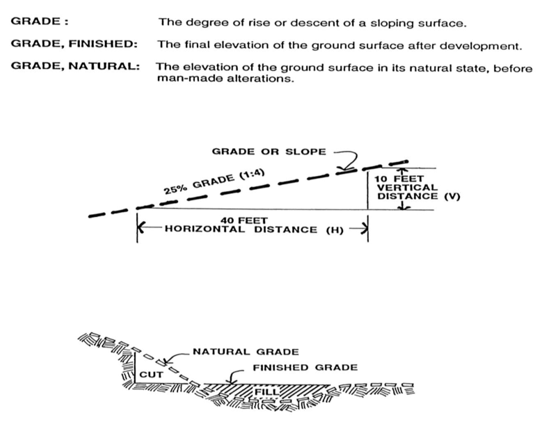 Fig. 2-3. Grade
Ground-Mounted Solar Energy System. A solar energy system that is not attached to and is separate from any building on the parcel of land on which the solar energy collector is located (Fig. 2-5.1).
Highway means any public thoroughfare dedicated and maintained for the use and operation of vehicular traffic by the state department of transportation.
Highway, local arterial, means those highways approved as such by the state department of transportation according to the Michigan highway law, Public Act No. 51 of 1951 (MCL 247.651 et seq.).
Highway, major arterial, means those highways approved as such by the state department of transportation according to the Michigan highway law, Public Act No. 51 of 1951 (MCL 247.651 et seq.).
Historical building, site or area means those parcels and/or uses of land and/or structures whose basic purpose is to:
- Safeguard the heritage of the city by preserving or allowing a structure or use which reflects elements of the community's cultural, social, economic, political, or architectural history;
- Stabilize and improve property values in the area;
- Foster civic beauty;
- Strengthen the local economy; and
- Promote the use of such sites for the education, pleasure and welfare of the local residents and of the general public.
Home improvement center means a facility of more than 30,000 square feet of gross floor area, engaged in the retail sale of various basic hardware lines, such as tools, builder's hardware, paint and glass, house wares and household appliances, garden supplies and cutlery.
Home occupation means an occupation, profession, activity, or use that is clearly a customary, incidental, and secondary use of a residential dwelling unit and which does not alter the exterior of the property or affect the residential character of the neighborhood.
Hospital means an institution providing health services, primarily for inpatients and medical or surgical care of the sick or injured, including as an integral part of the institution, such related facilities as laboratories, outpatient departments, training facilities, central service facilities and staff offices.
Industrial means a product manufacturing or conversion through assembly of new or used products or through the disposal or reclamation of salvaged material business and service activity that are operated primarily for profit.
Industrial park means a special or exclusive type of planned industrial area designed and equipped to accommodate a community of industries, providing them with all necessary facilities and services in attractive surroundings among compatible neighbors.
Institution means an organization having a social, educational or religious purpose established by law, custom, practice or a system to serve a public.
Junk means all rubbish, refuse, waste material, and garbage, including, but not limited to, the following: waste composed of animal, fish, fowl, fruit or vegetable matter, dead animals, putrescible and nonputrescible solid waste (except body wastes), ashes, glass, cans, bottles, discarded or abandoned machinery, household appliances, industrial wastes, discarded, inoperative, dismantled or partially dismantled motorized vehicles or parts thereof. This shall not preclude home or farm composting for on-site use.
Junkyard means any lot, parcel, field or tract of land on which there is an accumulation of junk, equipment or machinery, whether operated on a for-profit or not-for-profit basis. The term "junkyard" includes automobile wrecking yards and salvage areas of more than 200 square feet for the storage, keeping or abandonment of junk or for the dismantling, demolition or abandonment of automobiles or other vehicles or machinery or parts thereof, but does not include uses contained entirely within an enclosed building.
Kennel means any place or premise where more than four dogs, cats, or other domestic pets over six months of age are maintained, boarded, bred, or cared for in return for remuneration, or are kept for the purpose of sale.
Laboratory means a place in which the principal use is devoted to experimental, routine or basic study such as testing and analytical operations.
Lake means a permanent natural or manmade body of surface water of at least five acres in area.
Landscaping includes the following definitions in the application of this chapter:
- Berm means a landscaped mound of earth which blends with the surrounding terrain.
- Buffer means a landscaped area composed of living material, wall, berm, or combination thereof, established and/or maintained to provide visual screening, noise reduction, and transition between conflicting types of land uses.
- Conflicting nonresidential land use means any nonresidential use, such as office, commercial, industrial, research, parking or public road right-of-way land use which abuts a residential land use.
- Conflicting residential land use means any residential land use developed at a higher density which abuts a residential land use developed at a lower density.
- Greenbelt means a landscaped area, established at a depth of the minimum required front yard setback within a zoning district, which is intended to provide a transition between a public road right-of-way and an existing or proposed land use and/or between a conflicting land use and an existing or proposed land use.
- Opacity means the state of being impervious to sight.
- Plant material means a collection of living evergreen and/or deciduous, woody-stemmed trees, shrubs, vines and ground cover.
Large box retail means a singular retail or wholesale user, who occupies no less than 70,000 square feet of gross floor area, typically requires high parking to building area ratios and has a regional sales market. Regional retail/wholesale uses can include, but are not limited to, membership warehouse clubs that emphasize bulk sales, discount stores, and department stores.
Limited common elements means a portion of the common elements reserved in the master deed for the exclusive use of less than all of the co-owners.
Loading space means an off-street space on the same lot with a building or group of buildings for temporary parking of a commercial vehicle while loading and/or unloading merchandise or materials.
Lodging facility means any establishment in which individual units are rented to transients for periods of less than 30 days for the purpose of sleeping accommodations. The term "lodging facility" shall include hotels and motels but shall not include bed-and-breakfast operations, multiple-family dwellings, or roominghouses.
Lot means a parcel of land, excluding any portion in a street or other right-of-way, of at least sufficient size to meet minimum requirements for use, coverage, lot area, and to provide such yards and other open spaces as herein required. Such lot shall have frontage on a public street, or on an approved private street, and may consist of:
- A single lot of record;
- A portion of a lot of record;
- Any combination of complete and/or portions of lots of record;
- A parcel of land described by metes and bounds.
Lot area means the total area within the lot lines of a lot or parcel.
Lot, corner, means a lot with frontage on two intersecting streets. (See figure 2-4.)
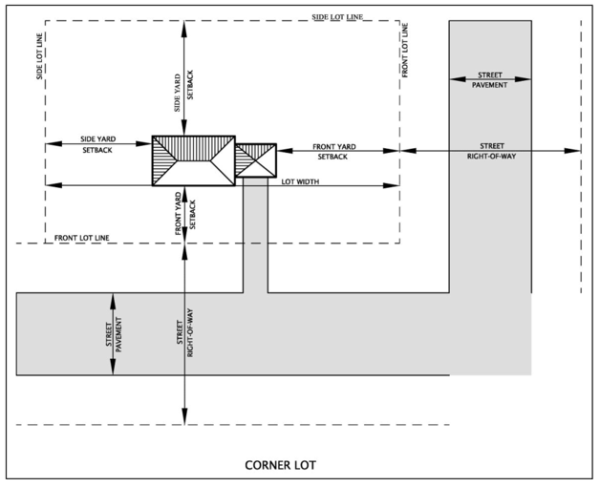 Fig. 2-4. Lot, Corner
Lot coverage means that percentage of the lot or parcel covered by all buildings and structures located on the lot or parcel.
Lot depth means the mean horizontal distance from the front lot line to the rear lot line, or, in the case of a waterfront lot, from the lake frontage line to the street frontage line, or, in the case of an acreage lot, from the right-of-way line to the rear lot line.
Lot, double frontage, means a lot having frontage on two street rights-of-way. (See figure 2-5.)
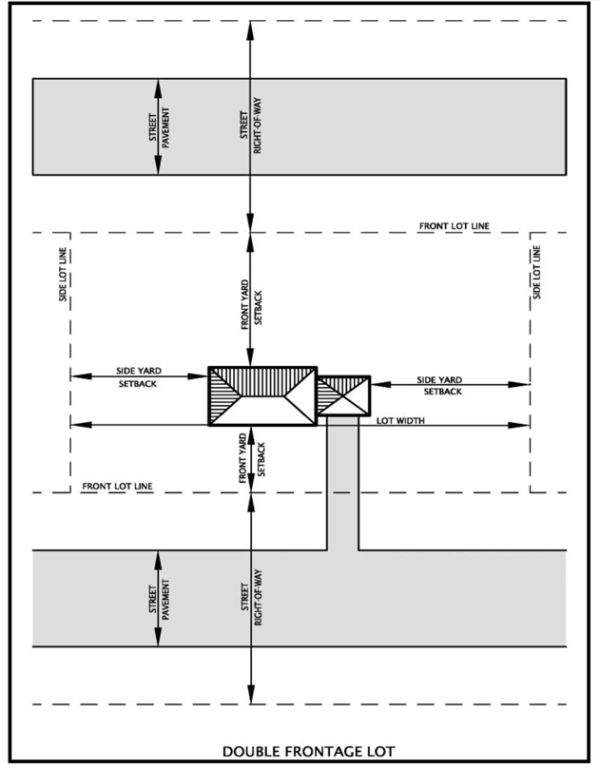 Fig. 2-5. Lot, Double Frontage
Lot, interior, means any lot other than a corner lot.
Lot line, front, means, in the case of an interior lot, that line separating such lot from the street right-of-way. In the case of a corner lot or double frontage lot, the term "front lot line" means that line separating such lot from that street which is designated as the front street in the plat and in the application for a zoning permit. This shall include the line separating such lot from the body of surface water upon which it fronts.
Lot line, rear, means that lot line opposite the front lot line. In the case of a lot pointed at the rear, the rear lot line shall be an imaginary line parallel to the front lot line not less than ten feet long farthest from the front lot line and wholly within the lot.
Lot line, side, means any lot line other than the front lot line or rear lot line.
Lot lines means the exterior perimeter boundary lines of a lot or parcel.
Lot of record means a lot or parcel recorded in the office of the county register of deeds.
Lot, waterfront, means a lot having a frontage directly upon a lake, river or pond. The portion adjacent to the water shall be designated as the water frontage of the lot, and the opposite side shall be designated the street frontage of the lot.
Lot width means the horizontal distance between the side lot lines, measured at the two points where either the building line or front lot line intersects the side lot lines.
Marginal access street means a public or private street or driveway paralleling and adjacent to any one of the major streets and arterials as designated in the master plan for streets and highways.
Master deed means the condominium document recording the condominium project to which are attached as exhibits and incorporated by reference the bylaws for the project and the condominium subdivision plan for the project, and all other information required by section 8 of the condominium act (MCL 559.108).
Master plan means the plan prepared and adopted by the city planning commission in accordance with Public Act No. 33 of 2008 (MCL 125.3801 et seq.) relative to the agreed-upon desirable physical land use pattern for future city development. The plan consists of a series of maps, plans, charts and written material representing, in summary form, the soundest planning direction to the city as to how it should grow in order to realize the very best community living environment.
Mobile home park means a specifically designated parcel of land constructed and designed to accommodate three or more mobile homes for residential dwelling use, and licensed by the state in accordance with Public Act No. 96 of 1987 (MCL 125.2301 et seq.), the mobile home commission act.
Nonconforming building or structure means a building or portion thereof lawfully existing at the effective date of this chapter, or amendments thereto, and which does not conform to the dimensional requirements of this chapter in the zoning district in which it is located.
Nonconforming use means a use which lawfully occupied a building or land at the effective date of this chapter, or amendments thereto, and that does not conform to the use regulations of the zoning district in which it is located.
Nuisance means an offensive, annoying, unpleasant or obnoxious thing or practice, a cause or source of annoyance, especially a continuing or repeating invasion of any physical characteristics of activity or use across a property line which can be perceived by or adversely affect a human being.
Off-street parking area means a land surface or facility providing vehicular parking spaces along with adequate drives and aisles for maneuvering so as to provide access for entrance and exit for the parking of more than two automobiles.
Open-air business uses means a business use operated for profit, substantially in the open-air, usually without buildings or structures, including uses such as the following:
- Bicycle, utility truck or trailer, motor vehicle, boats or home equipment sale, repair or rental services.
- Outdoor display and sales of garages, motor homes, mobile homes, snowmobiles, farm implements, swimming pools and similar products.
- Retail sale of trees, fruit, vegetables, shrubbery, plants, seeds, topsoil, humus, or fertilizer.
- Tennis courts, archery courts, shuffleboard courts, horseshoe pits, rifle ranges, miniature golf courses, golf driving ranges, children's amusement parks or similar recreation uses (transient or permanent).
Open space means any land area suitable for recreation, gardens or household service activities, such as clothes drying, but not occupied by any buildings or other structures, except as provided in this chapter.
Open space use means any principal or accessory use of a lot or parcel not involving the use of buildings or structures which are required to meet the construction code or any construction requirement of the city ordinances, rules or regulations, except as provided in this chapter.
Open storage means a land area occupied and used for outdoor storage of building materials, sand, gravel, stone, lumber, equipment and other supplies.
Ordinary high-water mark means the line between upland and bottomland which persists through successive changes in water levels, below which the presence and action of the water is so common or recurrent that the character of the land is distinguished from the upland as evidenced in the soil, the configuration of the surface of the soil and vegetation.
Parcel means a piece of land created by a partition, subdivision, deed, or other instrument recorded with the appropriate recorder. This includes a lot, lot of record, or a piece of land created through other methods.
Parking space means a land area of not less than nine by 20 feet, exclusive of driveways and aisles, and so prepared as to be usable for the parking of a motor vehicle and so located as to be readily accessible to a public street or alley.
Pet means only such animals as may commonly be housed within domestic living quarters.
Planned unit development means a special zoning district intended to permit flexibility and innovation in accordance with article V of this chapter.
Planned unit development agreement means a written agreement between a developer and the city which specifies the terms and conditions of planning unit development zoning.
Pond means a small body of surface water more than one-fourth of an acre but less than five acres and at least 18 inches deep which exists in a natural state or is established by either the damming of surface water or by excavation of soil to expose groundwater.
Public utility means any person, municipal department, board, or commission duly authorized to furnish to the public (under federal, state or municipal regulations) electricity, gas, steam, communications, telegraph, transportation, water, stormwater collection or wastewater collection and treatment.
Racking. Racking is any structure or building material used in the mounting of a solar panel (Figure 2-5.1). 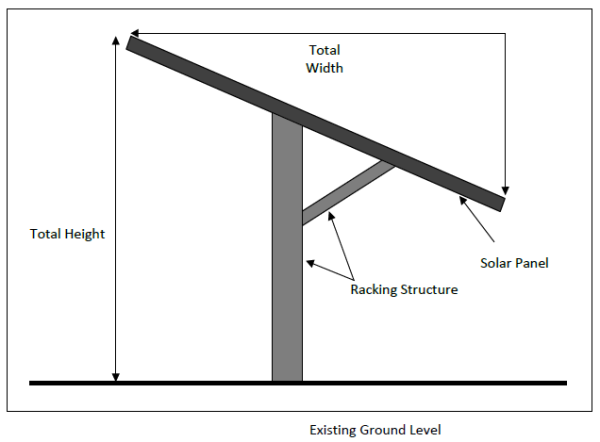 Fig. 2-5.1
Recreation vehicle means the following:
- Boats and boat trailers means and include boats, floats, rafts, canoes, plus the normal equipment to transport them on the highway.
- Folding tent trailer means a canvas folding structure mounted on wheels and designed for travel and vacation use.
- Motor home means a recreational vehicle intended for temporary human habitation, sleeping, and/or eating, mounted upon a chassis with wheels and capable of being moved from place-to-place under its own power. Motor homes generally contain sanitary, water, and electrical facilities.
- Other recreational equipment means and include snowmobiles, all-terrain or special terrain vehicles, utility trailers, plus the normal equipment to transport them on the highway.
- Pickup camper means a structure designed to be mounted on a pickup or truck chassis with sufficient equipment to render it suitable for use as a temporary dwelling during the process of travel, recreational, and vacation uses.
- Travel trailer means a portable vehicle on a chassis, not exceeding 36 feet in length or nine feet in width, which is designed to be used as a temporary dwelling during travel, recreational, and vacation uses, and which may be identified as a "travel trailer" by the manufacturer. Travel trailers generally contain sanitary, water, and electrical facilities.
Recreation vehicle park (RV park) means a recreation-oriented facility for the overnight or short-term parking of travel trailers, recreation vehicles or tents, but not including mobile homes. The term "recreation vehicle park (RV park)" may also be known as a campground.
Restaurant means any establishment whose principal business is the sale of food and beverages to the customer in a ready-to-consume state, and whose method of operation is characteristic of a carry-out, drive-in, drive-through, fast food, or sit-down restaurant, or bar/lounge, or combination thereof, as defined below:
- Carry-out restaurant means a restaurant whose method of operation involves sale of food, beverages, and/or frozen desserts in disposable or edible containers or wrappers in a ready-to-consume state for consumption primarily off the premises.
- Drive-in restaurant means any restaurant designed to permit or facilitate the serving of meals, sandwiches, ice cream, beverages or other food served directly to or permitted to be consumed by patrons in cars or other vehicles parked on the premises, or permitted to be consumed by patrons elsewhere on the site outside the main building.
- Fast-food restaurant means a restaurant whose method of operation involves minimum waiting for delivery of ready-to-consume food to the customer at a counter or cafeteria line for consumption at the counter where it is served, or at tables, booths, or stands inside or outside of the structure, or for consumption off the premises, but not in a motor vehicle at the site.
- Sit-down restaurant means a restaurant whose method of operation involves either the delivery of prepared food by waiters and waitresses to customers seated at tables within a completely enclosed building, or the prepared food is acquired by customers at a cafeteria line and is subsequently consumed by the customers at tables within a completely enclosed building.
- Bar/lounge means a restaurant which is operated primarily for the dispensing of alcoholic beverages, although the sale of prepared food or snacks may also be permitted. If a bar or lounge is part of a larger dining facility, it shall be defined as that part of the structure so designated or operated.
- Drive-through restaurant means a restaurant that serves customers who pull up in their vehicles; orders are taken and food is provided using a window while the customers remain in their vehicles.
Right-of-way shall be a legal right of passage over real property, typically associated with roads and railroads.
Roadside stand means a temporary or permanent building or structure operated for the purpose of selling only products or produce raised or produced on the same premises, including the immediately surrounding area by the proprietor of the stand or his family; its use shall not make it a commercial district land which is basically classified as residential, nor shall its use be deemed a commercial activity. The maximum floor area of a roadside stand shall not exceed 400 square feet.
Roof-Mounted Solar Energy System. A solar energy system that is attached to a building’s roof on the parcel of land including solar shingles.
Salvage yard means any parcel of land or building for which the principal or accessory use is the abandonment, collection, demolition, dismantlement, keeping, storage, processing, bailment, recycling, salvage or sale of used, discarded, worn-out or scrapped machinery, vehicles, vehicle parts, scrap metal, chains, used pipes, wastepaper, rags, enamelware, furniture, bottles, cans, rope, iron, copper or other scrap or discarded materials.
Setback means the minimum required horizontal distance between the building or structure and the front, side, and rear lot lines and natural features.
Shopping center means more than one commercial establishment, planned, developed, owned, and managed as a unit, with off-street parking provided on the property.
Sign means a device which is affixed to, or otherwise located or set upon, a building, structure or parcel of land which directs attention to an activity or business. This includes interior signs which are directed at persons outside the premises and exterior signs, but not signs primarily directed at persons within the premises. The term "sign" does not include goods for sale displayed in a business window. (See article X of this chapter for additional definitions.)
Solar Energy. Radiant energy (direct, diffuse, and reflected) received from the sun.
Solar Energy System. A solar system or other device or structural design feature of a structure that relies upon sunshine as an energy source and is capable of collecting, distributing, and storing (if appropriate to the technology) the sun’s radiant energy for a beneficial use.
Solar Panel. A panel consisting of an array of solar cells used to generate electricity directly from sunlight.
Solar Shingles. A roofing product made by combining thin film solar technology (which converts sunlight to electricity) with a durable backing to provide a structural roof shingle comparable to traditional roofing shingles.
Site condominium means a condominium development containing residential, commercial, office, industrial, or other structures or improvements for uses permitted in the zoning district in which located, in which each co-owner owns exclusive rights to a volume of space within which a structure or structures may be constructed, herein defined as a condominium unit, as described in the master deed.
Story means that portion of a building included between the surface of any floor and the surface of the floor above it, or if there is no floor above it, then the space between the floor and the ceiling above it.
Story, one-half, means a story under the gable, hip or gambrel roof, the wall plates of which on at least two opposite exterior walls are not more than two feet above the floor of such story and the floor area shall not exceed two-thirds of the area of the floor below.
Story height means the vertical distance from the top surface of one floor to the top surface of the next above. The height of the top story is the distance from the top surface of the floor to the ceiling above it.
Street means any public or private thoroughfare dedicated and maintained for the use and operation of vehicular traffic and which meets the minimum standards of construction of the city street agency.
Street block means that portion of both sides of a street located between two intersecting streets and having no other intersecting street between them.
Street, collector, means a street specified as such in the master plan for streets and highways which connects to minor streets.
Street, connecting, means a street specified as such in the master plan for streets and highways.
Street frontage means the legal line which separates a dedicated street right-of-way or easement from abutting land to which it provides over-the-curb vehicular access.
Street, frontage access, means a public or private street paralleling and providing ingress and egress to adjacent lots and parcels, but connected to the major highway or street only at designated intersections or interchanges.
Street, hard surface, means a highway or street built to the concrete or asphalt surface street building specifications of the master plan or the state department of transportation.
Street, local, means those streets approved as such by the state department of transportation according to the Michigan highway law, Public Act No. 51 of 1951 (MCL 247.651 et seq.).
Street, major, means those streets approved as such by the state department of transportation according to the Michigan highway law, Public Act No. 51 of 1951(MCL 247.651 et seq.).
Street, private, means a nonpublic street which serves at least two separately owned lots or parcels and which meets the city street construction standards.
Street right-of-way line means the line which forms the outer limits of a street right-of-way or easement, and which forms the line from which all setbacks and front yards are measured unless otherwise specified in this chapter.
Structural alteration means any change in the supporting members of a building such as bearing walls, columns, beams or girders or any substantial changes in the roof and exterior walls.
Structure means anything constructed or erected above the ground, including, but not limited to, buildings, houses, garages, pole barns, sheds, pergolas, decks, porches, game courts, fences, walls, screens, and gazebos.
Swimming pool means any outdoor structure or container, including Jacuzzis, hot tubs and any other pool meeting these specifications, located either above or below grade, designed to hold water to a depth greater than 20 inches, intended for swimming or bathing. A swimming pool shall be considered an accessory structure for purposes of computing lot coverage.
Temporary building means a structure without any foundation or footing and which is removed when the designated time period, activity, or use for which the temporary structure was erected has ceased.
Use means the lawful purpose for which land or premises, or a structure or building thereon, is designed, arranged, intended or occupied, maintained, let or leased for a use or activity.
Wireless communication facilities means and include all structures and accessory facilities relating to the use of the radio frequency spectrum for the purpose of transmitting or receiving radio signals. This may include, but shall not be limited to, radio towers, television towers, telephone devices and exchanges, microwave relay towers, telephone transmission equipment buildings and commercial mobile radio service facilities. Not included within this definition are citizen band radio facilities, shortwave facilities, ham amateur radio facilities, satellite dishes, and governmental facilities which may be subject to state or federal law or regulations which preempt municipal regulatory authority. For purposes of this chapter, the following additional terms are defined:
- Attached wireless communications facilities means wireless communication facilities that are affixed to existing structures, such as existing buildings, towers, water tanks, utility poles, and the like. A wireless communication support structure proposed to be newly established shall not be included within this definition.
- Co-location means the location by two or more wireless communication providers of wireless communication facilities on a common structure, tower, or building, with the purpose of reducing the overall number of structures required to support wireless communication antennas within the community.
Wireless communication support structures means structures erected or modified to support wireless communication antennas. Support structures within this definition include, but shall not be limited to, monopoles, lattice towers, light poles, wood poles and guyed towers, or other structures which appear to be something other than a mere support structure.
Yard means the required open spaces on the same lot with the principal structure which remain permanently unoccupied and unobstructed above and below the ground, except as permitted in section 44-269, accessory buildings.
Yard, front, means the open space between the front street lot line and the main building in which the principal use is located. (See figure 2-6.)
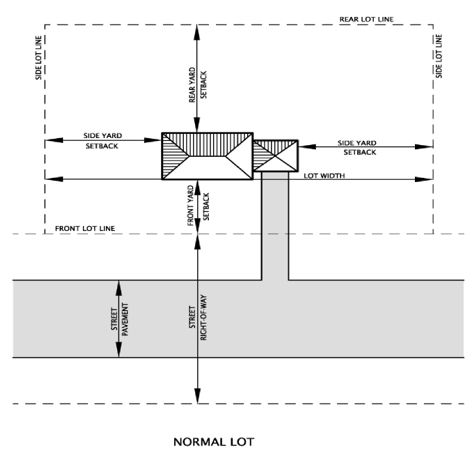 Fig. 2-6. Yard, Front
Yard, front, street and waterfront, means front yards or setbacks from street rights-of-way lines and shorelines of water bodies. (See figure 2-7.)
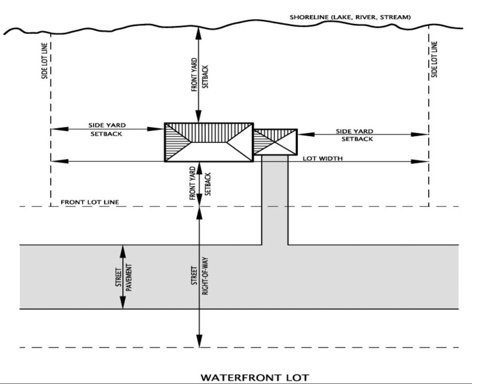
Fig. 2-7. Yard, Front, Street
Yard, rear, means the open space extending the full width of the lot, the depth of which is the minimum horizontal distance between the rear lot line and the nearest point of the main building in which the principal use is located. (See figure 2-6.)
Yard, required, means the minimum yard required as specified in each zoning district.
Yard, side, means the open space between a main building and the side lot line, extending from the front yard to the rear yard, the width of which is the horizontal distance from the nearest point of the side lot to the nearest point of the main building in which the principal use is located. (See figure 2-6.)
Zoning administrator means the city official appointed by the city council to administer and enforce the standards of this chapter.
Zoning permit shall be a permit issued by the zoning administrator prior to construction, enlargement or alterations of property in accordance with article XIII of this chapter.
(Code 1992, § 24-32; Ord. No. 304, § 202, 6-2-2003; Ord. No. 313, 7-5-2005; Ord. No. 317, 2-4-2008; Ord. No. 323, 9-21-2009)
Amended by Ord. 356 on 1/4/2021
Amended by Ord. 357 on 4/18/2022

