
Edmond City Zoning Code
CHAPTER 3
- DEVELOPMENT REVIEW PROCEDURES
22.3.1.- Common Review Procedures.
(A)
Conformity with Zoning Ordinance. Every official and employee of the City, vested with the duty or authority to issue a permit or license shall not issue a permit or license for any use, building, or purpose that conflicts with any provision of this Title. Any permit, license or certificate issued in conflict with the provisions of this Title shall be null and void.
(B)
Application Forms and Fees. The following regulations shall apply to all applications required under this Title.
(1)
Forms. Unless otherwise specified in this Title, applications required under this Title shall be submitted on forms and in such numbers as required by the City.
(2)
Fees.
(a)
Filing fees shall be established from time to time by ordinance of the City Council to defray the cost of processing the application.
(b)
All required fees shall be made payable to "The City of Edmond."
(c)
Appendix B of this Ordinance states filing fees and required charges.
(C)
Application Deadline. All applications shall be completed and submitted to the City. An application shall not be considered as officially submitted, accepted or filed until it has been determined to be complete as specified in subsection (D) below.
(D)
Initiation, Submission and Determination of Completeness.
(1)
Unless specifically stated otherwise, all development review procedures shall be initiated upon application of a property owner or designated agent.
(2)
All development review applications shall be filed with the office of the Planning Director.
(3)
A determination that the Zoning application conforms to the Edmond Plan. If the application does not conform to the Edmond Plan, a Plan Amendment request shall be filed in the case of rezoning.
(4)
An application shall be considered complete if it is submitted in the required form, includes all mandatory information, including all exhibits, and is accompanied by the applicable fee. A determination of application completeness shall be made by the Planning Director within five days of application filing.
(5)
Determination that an application is complete does not preclude any negative final action and does not include any implied determination that the application successfully meets any review criteria or standards found in this Title.
(6)
If an application is determined to be incomplete, the applicant shall be provided with written notice along with an explanation of the application's deficiencies. No further processing of the application shall occur until the deficiencies are corrected.
(E)
Preapplication Conference.
(1)
Purpose. A preapplication conference is a meeting between a potential applicant under this Title and the Planning Director or a designated representative. The purpose of the preapplication conference is to assure that the applicant is familiar with the City's overall land development regulatory process, to assist the applicant in determining those reviews and approvals required for his project, to develop an anticipated timeline for such review and approvals, to call the applicant's attention to applicable City standards not found in this Title, and to give the City an opportunity to explore and comment on the scope and impact of the project.
(2)
Preapplication Conference.
(a)
An applicant is required to attend a preapplication conference regarding the following applications:
i.
Zoning Map Amendment (Rezoning);
ii.
Specific Use Permit;
iii.
Planned Unit Developments;
iv.
Site Plans;
v.
Site Plans in CEUD; and
vi.
Variance.
(b)
If there are particular concerns that Planning Director is aware of affecting the subject property, the Director or designated representative may request a preapplication conference with the applicant.
(F)
Public Notice.
(1)
Summary of Notice Required.
(a)
At the time of filing a complete and correct application for the following types of development review and the payment of the filing fee and the public notice fee, public notice shall be required as shown in the following table.
✓ = Notice Required
(b)
In addition to the required filing fee, the applicant shall pay for costs incurred for all public notices.
(2)
Published Notice. The City Clerk shall publish notice of a public hearing in an official publication of the City. The notice shall be published no less than 20 days in advance of the public hearing.
(3)
Posted Notice.
(a)
For review procedures requiring posted notice, the applicant shall post a sign on the subject property no less than 20 days in advance of the first scheduled public hearing. The sign shall be a minimum of six feet in height and with City approval, may be posted on public right-of-way when that is the only practical location for the sign. The sign shall be a minimum of 32 square feet and shall have a white background with black letters at least four inches in height providing the following information:
i.
Date, time and place of the public hearing;
ii.
Who will conduct the public hearing;
iii.
The current zoning of the property;
iv.
The desired zoning classification (if a Zoning Map amendment); and
v.
The proposed use of the property (if a Zoning Map amendment).
(b)
Corner lots or properties that include over 300 feet of frontage on a single public right-of-way shall require two signs meeting the specifications above. The sign shall be updated by the applicant if there is a continuance or delay in the public hearing dates.
(c)
If the applicant is the City, and the application involves multiple contiguous properties, a separate sign shall not be required on each property. In such case, the number of signs, location and duration of posting shall be specifically authorized by the City Council.
(d)
The sign(s) shall be removed no less than 30 days following the final public hearing, where a final determination has been made.
(4)
Mailed Notice.
(a)
Upon confirmation of the posting of public notice signs as described in (3) above, the Secretary of the Planning Commission or Board of Adjustment shall mail notice to all owners of property within a 300 foot radius of the exterior boundary of the subject property at least 20 days before the first scheduled public hearing. The notice shall contain:
i.
Information listed in (3)(a) above; and
ii.
The legal description of the property and street address, or approximate location in the City;
(b)
Applicants shall be required to provide a certified list of property owners within a 300-foot radius of the exterior boundary subject property, to include at least 10 names. In the event that less than 10 property owners are within the prescribed 300 foot radius, the radius shall be extended in 100-foot increments until the required number of property owners is included on the ownership list. However, when it is necessary to extend the 300-foot radius, all owners within the extension shall be included in the official ownership list, even when that amount exceeds 10 owners.
(c)
The list shall be certified by an abstractor, attorney, Oklahoma County Assessor, or title company. The date of the certified list shall be no more than 90 days prior to the first scheduled public hearing.
(5)
Constructive Notice. Minor defects in notice shall not impair the notice or invalidate proceedings pursuant to the notice if a bona fide attempt has been made to comply with applicable notice requirements.
(G)
Public Hearing.
(1)
Required Public Hearing. The following table identifies the types of applications requiring a public hearing and the review body responsible for conducting the hearing.
✓ = Hearing Required
* = If decision appealed from Planning Commission
(2)
Review Constitutes a Public Hearing. Where a public hearing is required, the Central Edmond Urban District Board, Board of Adjustment, Planning Commission or City Council meeting at which the applicant formally presents his or her request shall constitute the required public hearing.
(H)
Limitation on Resubmittal of Application. In the event that an application submitted under this Title is denied or disapproved, an application for the same request shall not be resubmitted for six months from the advertised public hearing date, with the exception of site plan applications.
(I)
Expiration of Permits and Approvals.
(1)
Unless otherwise specified in this Title, approval of any site plan or specific use permit shall expire and become null and void 18 months from the date of such approval, including all time required for legal proceedings, provided that a building permit has not been issued.
(2)
A specific use permit shall expire regardless of the issuance of a building permit under the following conditions:
(a)
If the use is not established within 18 months;
(b)
If the use once established has been discontinued or abandoned for a period of 12 months; or
(c)
If the Planning Director finds that any proposed construction or occupancy shall not, in his or her opinion, substantially comply with the specific use permit.
(3)
The Planning Commission may extend the expiration date after the following provisions have been met. Required public notice shall be in accordance with the type required (i.e. published, posted or mailed) for the procedure for which the extension is sought.
(a)
The applicant shall file a letter of formal request for an extension to the Planning Director. The letter shall include any PUD or specific use permit designations applicable to the subject property.
(b)
The SPRT shall provide a report with recommendations.
(c)
Following notice in accordance with subsection (F), the Planning Commission shall hold a public hearing. The Commission shall act to recommend, recommend with conditions, or deny the request.
(4)
Reinstatement of a lapsed approval shall require the same submittal and approval as an original application.
(J)
Appeals.
(1)
Any party aggrieved by a decision of an administrative official regarding the provisions of this Title shall appeal to the Board of Adjustment in accordance with Section 22.3.7.
(2)
Any party aggrieved by a decision of the Planning Commission regarding site plan approval shall follow the appeal procedure specified in paragraph 22.3.5(B)(3).
(3)
Any party aggrieved by a decision of the City Council or Board of Adjustment may appeal to the District Court by filing a notice of appeal with the City Clerk within 10 days of the decision.
(Ord. 3068, § 1, November 27, 2006; Ord. 3182, §§ 2—4, November 10, 2008; Ord. 3248, § 2, January 11, 2010)
22.3.2. - Zoning Map Amendment (Rezoning).
(A)
Purpose. When the public necessity, convenience, general welfare, or appropriate land use practices and Edmond Plan including amendment, if applicable, justify such action, and after the required review, public notice and report by the Planning Commission, the City Council shall undertake the necessary steps to amend the Zoning Map.
(B)
Review Process.
(1)
Initiation of Zoning Map Amendments. A Zoning Map amendment may be initiated by:
(a)
City Council on its own motion;
(b)
Planning Commission; or
(c)
Application by property owner or agent.
(2)
Staff Review and Report. The Planning Director shall review the proposed Zoning Map amendment in light of the Edmond Plan, based on the criteria in subsection (C) below, and give a report to the Planning Commission on the date of the scheduled public hearing.
(3)
Planning Commission Recommendation.
(a)
Following notice in accordance with subsection 22.3.10(F), the Planning Commission shall hold a public hearing. All pertinent papers and other data submitted by the applicant and any other information deemed pertinent by the Planning Director shall be transmitted to the Planning Commission.
(b)
The Planning Commission shall study the proposed Zoning Map amendment, taking into account all factors which it may deem relevant including, but not limited to, the consistency of the proposed amendment with the Edmond Plan and whether the proposed amendment serves to carry out the purposes of this Title. The Planning Director shall prepare a report of the Planning Commission deliberations and recommendation that shall be forwarded to City Council.
(4)
CEUDB Recommendation. The CEUDB shall provide a recommendation as a part of the staff report to the Planning Commission for all proposed Zoning Map amendments that are located in the CEUDB jurisdiction as defined in subsection 22.6.4(C).
(5)
City Council Final Action.
(a)
Following notice in accordance with subsection 22.3.10(F), the City Council shall hold a public hearing.
(b)
The City Council shall consider the proposed Zoning Map amendment at the earliest reasonable date and shall consider the report of the Planning Commission, and CEUDB if applicable, in making a decision.
(c)
The City Council shall act to approve, approve with conditions, or deny the Zoning Map amendment request based upon the criteria below.
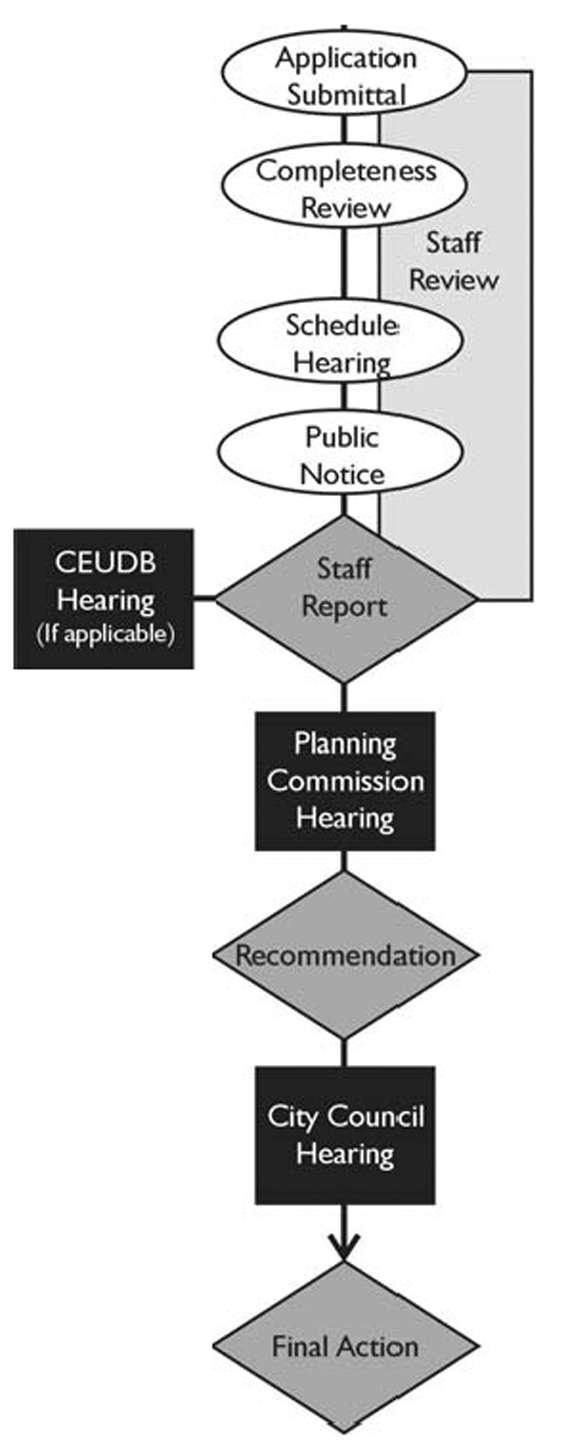
Zoning Map Amendment Review Process
(C)
Review Criteria. In determining whether to approve, approve with conditions or deny a Zoning Map amendment, the City Council shall consider the following factors:
(1)
Consistency (or lack thereof) with the Edmond Plan;
(2)
Compatibility with the present zoning and conforming uses of nearby property, including overlay zoning and with the character of the neighborhood;
(3)
Suitability of the property affected by the amendment for uses permitted by the district that would be made applicable by the proposed amendment;
(4)
Suitability of the property affected by the amendment for uses permitted by the district applicable to the property at the time of the proposed amendment;
(5)
Length of time the subject property has remained vacant as zoned;
(6)
The extent to which approving the rezoning shall detrimentally affect adjacent properties;
(7)
The gain, if any, to the public health, safety and welfare due to denial of the application, as compared to the hardship imposed upon the landowner, if any, as a result of denial of the application;
(8)
Availability of water, wastewater and stormwater facilities suitable and adequate for the proposed use;
(9)
The anticipated impact to tree canopy cover, forested areas, and areas of the Cross Timbers ecosystem; and
(10)
The negative impact, if any, which may be reasonably anticipated as a result of approval of the application.
(D)
Protests.
(1)
Petitions shall be presented to the Planning Commission or City Council before or at the time of the public hearing for the Zoning Map amendment.
(2)
At the time set for hearing protests, the Council shall proceed to hear and pass upon all protests made, either oral or written, and its decision shall be final and conclusive. An appeal of any action, decision or ruling pertaining to the amendment of the districts herein established may be taken by any person or persons jointly or severally aggrieved to the District Court by filing with the City Clerk within 10 days a notice of appeal.
(Ord. 3068, § 1, November 27, 2006; Ord. 3611, § 1, 6-26-2017)
22.3.3. - Specific Use Permit.
(A)
Purpose. A specific use permit may be granted by the City Council only for certain uses so designated in each zoning district in Chapter 4. The purpose of this special review provision is to closely scrutinize those uses which, because of the size of the land they require or the specialized nature of the use, may more intensely dominate the area in which they are located and their effects on the general public are broader in scope than other uses permitted by right or with limitations in the district. No use requiring a specific use permit shall be commenced or maintained except in accordance with an approved site plan in accordance with Section 22.3.5.
(B)
Review process.
(1)
Staff Review and Report. The Planning Director shall review the specific use permit application in light of the Edmond Plan, based on the criteria in subsection (C) below, and give a report to the Planning Commission on the date of the scheduled public hearing.
(2)
Planning Commission Recommendation.
(a)
Following notice in accordance with subsection 22.3.10(F), the Planning Commission shall hold a public hearing. All pertinent papers and other data submitted by the applicant and any other information deemed pertinent by the Planning Director shall be transmitted to the Planning Commission.
(b)
The Planning Commission shall study the specific use permit application, taking into account all factors which it may deem relevant including, but not limited to, the consistency of the proposed use with the Edmond Plan and whether the proposed use serves to carry out the purposes of this Title. The Planning Director shall prepare a report of the Planning Commission deliberations and recommendation that shall be forwarded to City Council.
(3)
City Council Final Action.
(a)
Following notice in accordance with subsection 22.3.10(F), the City Council shall hold a public hearing.
(b)
The City Council shall consider the proposed specific use application at the earliest reasonable date and shall consider the report of the Planning Commission in making a decision.
(c)
The City Council shall act to approve, approve with conditions, or deny the specific use application based upon the criteria below.
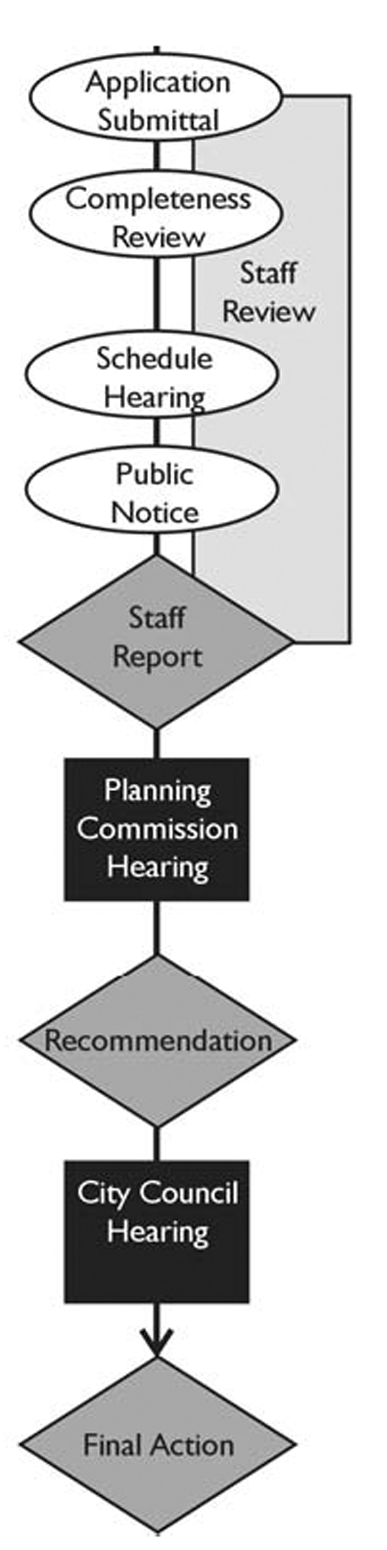
Specific use Permit Review Process
(C)
Review Criteria. On any specific use permit application the City Council may include the requirement of any such conditions and restrictions as may be necessary to minimize potential adverse impacts of the proposed use and to further the purposes of this Ordinance. Such features shall be provided and maintained during the continuance of any use of which they are appurtenant. In determining whether to approve, approve with conditions or deny a specific use permit application, the City Council shall consider the following factors:
(1)
The proposed specific use is not detrimental to the public health, safety, and welfare of the surrounding neighborhood;
(2)
All aspects of the proposed specific use site plan are harmonious with the character of the surrounding area;
(3)
The location and area of main and accessory buildings on the site properly relate to each other and to adjacent uses;
(4)
The proposed use does not negatively impact existing uses in the area and in the City through impacts on existing public infrastructure such as roads, parking, loading and access facilities and water and sewer systems, and on public services such as police and fire protection and solid waste collection; and
(5)
The standards in Section 22.6.5, Sensitive Borders Standards, are met when the use is proposed within 300 feet of any residential property.
(6)
The anticipated impact to tree canopy cover, forested areas, and areas of the Cross Timbers ecosystem.
(7)
The provision and manner of maintenance of fences, walls and landscaping is adequate.
(D)
Changes to Approved Site Plan.
(1)
Any modification to an approved site plan that was filed as part of a specific use permit shall be submitted to the Planning Director and reviewed in accordance with subsection 22.3.5(F).
(2)
In addition to the standards in subsection 22.3.5(F) for minor modification of an approved site plan, the following shall apply to modifications to an approved site plan filed as part of a specific use permit.
(a)
The Director may determine that the modification to the site plan does not change the basis for specific use permit approval and issue an approval of the modified specific use permit.
(b)
If the Director determines that the modifications to the site plan changes the basis for the initial specific use permit approval, the modified permit shall follow the normal review process for a specific use permit in subsection (B) above.
(E)
Specific Use Permits Required for Telecommunication Towers.
(1)
Applicability. Unless permitted by right in a Zoning district described in Chapter 4, it shall be unlawful for any person to erect, construct, place, or modify the tower, equipment, accessory building or accompanying fence within the boundaries of the City without making application for a Specific Use Permit where allowed as stated in the Zoning Districts in Chapter 4.
(2)
Review Procedure and Standards. The provisions for the review procedure and standards for telecommunication towers are stated in subsection 22.4.36(E).
(Ord. 3068, § 1, November 27, 2006; Ord. 3611, § 2, June 26, 2017)
22.3.4. - Planned Unit Development (PUD) Rezoning.
(A)
Purpose. A PUD may be used to permit new or innovative concepts in land utilization, master-planned communities or mixed use developments that other districts do not easily accommodate. A PUD also provides site-specific compatibility standards. While greater flexibility is given to allow special conditions or restrictions that would not otherwise allow the development to occur, procedures are established to ensure against misuse of increased flexibility. Planned Unit Developments are appropriate in areas where the Edmond Plan reflects either the specific uses proposed in the PUD or where the Edmond Plan reflects mixed use.
(B)
Review Process.
(1)
Staff Review and Report. The Planning Director shall review the PUD application in light of the Edmond Plan, based on the criteria in subsection (D) below, and give a report to the Planning Commission on the date of the scheduled public hearing.
(2)
Planning Commission Recommendation.
(a)
Following notice in accordance with subsection 22.3.10(F), the Planning Commission shall hold a public hearing.
(b)
The Planning Commission shall study the proposed PUD application, taking into account the recommendations of the staff, the review criteria and other applicable standards in this Ordinance.
(c)
The Planning Director shall prepare a report of the Planning Commission deliberations and recommendations that shall be forwarded to City Council.
(3)
City Council Final Action.
(a)
Following notice in accordance with subsection 22.3.10(F), the City Council shall hold a public hearing.
(b)
The City Council shall approve, approve with conditions or deny the PUD application, taking into account the recommendations of the staff and the Planning Commission.
(4)
Approval with Conditions. The City Council may grant approval with conditions only to the extent that such conditions specify the actions necessary to bring the application into complete compliance with applicable regulations or where additional conditions have been agreed to by the applicant.
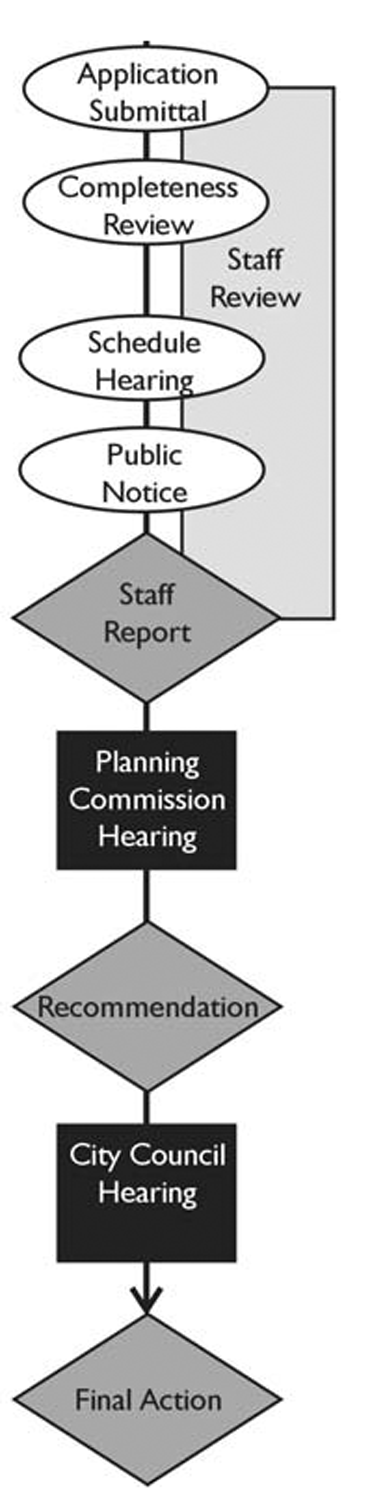
Planned Unit Development Rezoning Review Process
(C)
Application Requirements. A property owner or his or her agent may initiate an application for PUD designation by submitting an application for master plan review with the Planning Director. The following information shall constitute a PUD master plan:
(1)
A general circulation plan for the entire parcel, showing major pedestrian/bicycle and automobile circulation routes and connections to the public right-of-way and sidewalk system;
(2)
A general drainage plan for the entire parcel, showing in general—but without detailed calculations—how stormwater shall be handled and how the system shall interconnect with the City's stormwater system;
(3)
A proposed master plan, and a PUD Design Statement text describing the locations and intensities of all proposed land-uses, supported by calculations showing the effective density and a listing of all variances requested;
(4)
A proposed land use map, clearly indicating the location of all proposed open space and tree preservation and indicating each part of the open space as to whether it is proposed to be publicly or privately owned;
(5)
Access roads, service drives, parking areas, open spaces and other infrastructure intended solely for the property owners of the PUD shall not be maintained or improved by the City. At a minimum, such facilities shall be constructed in compliance with the standards for public facilities set out in Title 21 of the City Code unless provisions are specifically waived, conditioned or otherwise adjusted by the appropriate City entity in writing;
(6)
Outline of plan (or draft documents if available) creating the proposed property owners' associations and covenants, if applicable. Where the property owners' association will be responsible for fees on any privately-owned, required open space, and/or maintenance of any required open space, public rights-of-ways, stormwater facilities or sewer and water lines, the documents shall include a fiscal feasibility analysis showing how the operations of the property owners' association shall be financed, including provisions for a sinking fund for eventual replacement of facilities; final documents will be required with the final plat.
(7)
The application for PUD and master plan approval shall include all contiguous property under the ownership or control of the applicant.
(D)
Review Criteria. In determining whether to approve, approve with conditions or deny a PUD application, the City Council shall consider and make findings on the following factors:
(1)
Consistency (or lack thereof) with the Edmond Plan;
(2)
The standards set forth in Section 22.4.33 and Chapter 6;
(3)
Compatibility with the present zoning and conforming uses of nearby property and with the character of the neighborhood;
(4)
Suitability of the property affected by the amendment for uses permitted by the district that would be made applicable by the proposed PUD;
(5)
Suitability of the property affected by the PUD for uses permitted by the district applicable to the property at the time of the proposed PUD;
(6)
Utilities and infrastructure sufficient to address the needs of the proposed use;
(7)
Substantive conditions regarding the layout, density, circulation, and performance of the proposed development;
(8)
Any concerted effort that is made to preserve trees by the standard set forth in subsection 22.6.1 (D); and the anticipated impact to tree canopy cover, forested areas, and areas of the Cross Timbers ecosystem; and
(9)
Suitability of PUD Master Plan Design and requested variances from Chapter 6.
(E)
Compliance with PUD Master Plan. For any PUD approved more than five years previously or where the current owner wishes to change the PUD standards described in the original application, the applicant shall submit an updated or amended PUD application prior to the review of any building permit, preliminary plat, site plan or specific use permit. The applicant shall provide an updated or amended PUD application if a change or amendment is proposed. Public notification shall be required in accordance with subsection 22.3.10(F). The Planning Commission and City Council shall approve, approve with conditions or deny the amended PUD or Master Plan at a public hearing.
(F)
PUD Designations and Specific Use Permits. If the subject parcel is zoned with a PUD designation, no building permit shall be issued until all provisions of PUD review found in this Section have been followed, and nothing herein shall be deemed to abolish existing requirements or procedures for the obtaining of specific use permits in any district.
(Ord. 3068, § 1, November 27, 2006; Ord. 3249, § 1, January 11, 2010; Ord. 3611, §§ 3, 4, June 26, 2017)
22.3.5. - Site Plan Review.
(A)
Applicability.
(1)
Site plan review shall be required under the following circumstances:
(a)
Development of any new multiple-family or nonresidential use; or
(b)
The redevelopment or renovation of such use where the proposed alteration would:
i.
Increase number of units in a multiple-family project by five or more;
ii.
Increase gross floor area of a nonresidential structure by 20 percent or more; or
iii.
Increase impervious cover on nonresidential lot by 7,500 square feet or more.
(c)
In the event that any of the modifications in paragraph (b) above occur cumulatively within a five-year period, then all of the provisions of this Section shall apply.
(2)
No building permit will be processed without final site plan approval. All improvements reflected on approved site plans shall be constructed at the time of development. All buildings and site work shall be constructed and performed in accordance with an approved site plan.
(3)
Adherence to an approved site plan shall be a continuing obligation of the applicant. Any changes from the approved site plan shall be in accord with subsection (F) below.
(4)
Approval of the site plan does not exempt the applicant from compliance with other applicable building or construction standards or codes in effect.
(B)
Review Process.
(1)
SPRT Review and Recommendation.
(a)
Within 30 days of receipt of a complete and corrected site plan application, the Site Plan Review Team (SPRT) shall notify the Planning Commission in writing of its finding with any comments or recommendations on the application. The SPRT shall review the site plan application based on the criteria in subsection (D) below.
(b)
The SPRT leadership officials shall provide a report with finding and recommendation to the Planning Commission and, in the case of an appeal, to the City Council.
(c)
It is recognized that due to the unique conditions presented by some conversion projects and the nature of special limitations on a site, particularly in the built environment, there may be applications that will present some special conflicts complying with all parts of this Ordinance. It is also recognized that these conflicts will arise in 20 percent expansion projects where the original construction did not incorporate the standards listed in this Ordinance. In those cases, the SPRT recommendation shall outline the justifications for these minor variances and the Planning Commission may incorporate these recommendations into their action for approval.
(2)
Planning Commission Final Action.
(a)
Following notice in accordance with subsection 22.3.10(F), the Planning Commission shall hold a public hearing.
(b)
The Planning Commission shall study the proposed site plan application, taking into account the recommendation of the SPRT, the review criteria in subsection (D) below. The Planning Commission shall then approve, approve with conditions or deny the site plan application.
(c)
The Planning Director shall prepare a report to the Planning Commission regarding the staff's finding and recommendation and this report shall be forwarded to the City Council as an information item.
(3)
Appeals to the City Council.
(a)
An applicant may appeal the decision of the Planning Commission denying their site plan application by submitting a written notice of appeal specifying the grounds for the appeal, to the Planning Director within 10 days of the decision by the Planning Commission.
(b)
Protestants who own property within 300 feet of the site plan may appeal the decision of the Planning Commission approving the site plan application by submitting a written notice of appeal, specifying the grounds for the appeal, to the Planning Director within 10 days of the decision by the Planning Commission.
(c)
The City Council in considering any appeal from a decision of the Planning Commission shall consider the basis of the appeal, all reports from City Staff and the report from Planning Commission and either affirm the Planning Commission decision or render a different decision. In either case, the City Council decision is final.
(d)
When a site plan requires a major variance from the minimum adopted standard for new projects, the City Council shall consider those variances as a part of the review process prior to final site plan approval. Recommendations from the Planning Commission will be reviewed and notice will be provided to property owners within 300 feet of the subject property prior to the City Council hearing in those cases where a variance has been requested.
(4)
Approval with Conditions. The Planning Commission may grant approval with conditions necessary to bring the application into compliance with adopted regulations and objectives or where additional conditions have been agreed to by the applicant.
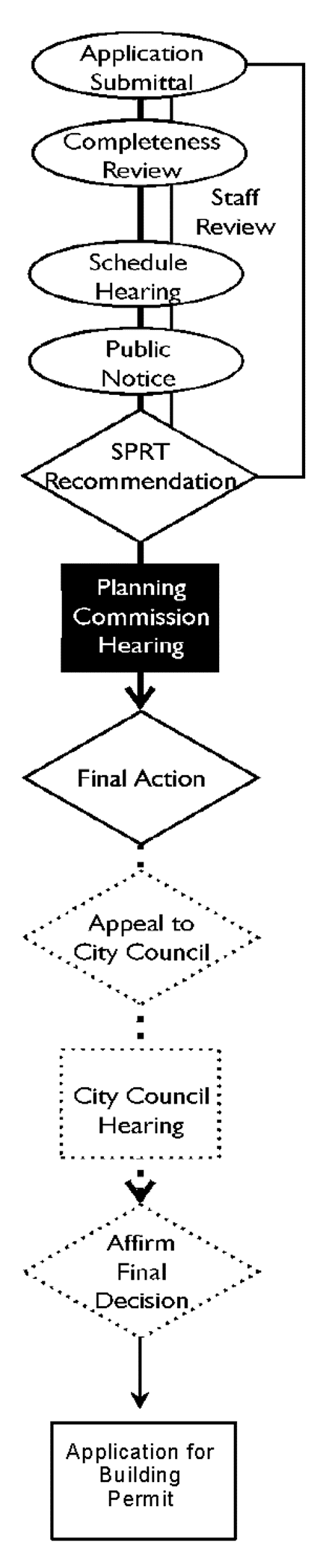
Site Plan Review Process
(C)
Application Contents. In addition to the required filing fees and notice fees, a site plan application shall include at least the following items. The materials described in paragraphs (1) through (5) below shall be signed and sealed by a Professional Engineer registered in the State of Oklahoma.
(1)
Cover sheet, providing the name of the proposed development accompanying plat, if available, the names of the current City of Edmond Mayor, City Council and City Manager, a sheet index, a vicinity map showing the location of the project, and the engineer of record and associated information;
(2)
Survey, providing a legal description of the property, the boundaries of the property, existing vegetation, all utilities and easements of record including the book and page numbers of the filed easements, topographic contours with intervals of not over two feet, any regulatory flood plain boundaries that affect the subject property, all adjacent streets and right-of-way, and existing driveways on the site and on properties adjacent to or across the street from the subject property;
(3)
For sites with an existing tree canopy cover of 20% or greater of the total site area or a parcel containing any amount of potential remnant forest, a Tree Resource Evaluation shall be performed in accordance with Section 22.6.1(D)(4), by a professional as identified in 22.6.1(D)(2);
(4)
Site plan, providing the location and dimensions of all structures and improvements, driveways/drive approaches, public right-of-way, parking and loading areas, drive aisles, sidewalks, outdoor storage areas and height and type of any fencing or screening;
(5)
Grading plan, providing all existing and proposed contours with intervals of not over two feet, the location of all structures, retaining walls, ponds, storm sewer improvements, and regulatory flood plain boundaries;
(6)
Drainage calculations report, related grading plan and erosion control plan, operation and maintenance manual signed and sealed by a Professional Engineer registered in the State of Oklahoma, in compliance with Title 23 of the City Code;
(7)
A retaining wall plan, if applicable, that includes materials used in the design and that meets the International Building Code;
(8)
Utility plan, providing the location of all proposed and existing public and private utilities and easements, proposed electrical loads, service type, ampacity and locations of the disconnect, service line and transformer;
(9)
Lighting plan, including number, location and height of poles, the type of lighting fixtures and type of illumination, pattern of illumination from each light, on-site building lighting, decorative lights, accent lights and sign lights;
(10)
Location, height, type, color material and size of all signs, including any site decorations or structures, such as flagpoles, benches, public art, banners, canopies, tents or other open display structures;
(11)
Elevation drawings depicting the number of stories and materials used on all exterior walls, roofs, entries and windows showing general architectural appearance and motif of the structures, including exterior finishes, treatments, materials and colors;
(12)
Landscape plan, including a program for continued landscape maintenance, a detailed landscape plan as specified in 22.6.1(D)(2) for the required site and a completed site plan landscape form;
(13)
Tree preservation plan for all trees proposed to be saved, as set forth in subsection 22.6.1(D);
(14)
Detailed plant listing that identifies types of plant material proposed; and
(15)
Summary of landscape area calculations and proposed plant unit values.
(D)
Review Criteria. In determining whether to approve, approve with conditions or deny a site plan application, the Planning Commission shall consider the following factors:
(1)
Consistency with the applicable provisions of Chapter 4, Chapter 5 and Chapter 6;
(2)
Compliance with other applicable City regulations;
(3)
Positive physical impact on the public health, safety, welfare and convenience of persons residing or working in the area;
(4)
Visual compatibility of the height, area, yards and overall mass, as well as parts of any structure or attendant facilities with the character and development of the surrounding area;
(5)
Ingress, egress, internal traffic circulation, off-street parking facilities, loading and service areas and pedestrian ways are designed to promote safe, efficient vehicular circulation, pedestrian movement, parking and site serviceability;
(6)
There is adequate utility access and easements to serve all buildings, structures and other facilities on the site;
(7)
There is adequate existing and proposed water, sewer and stormwater drainage facilities in accordance with the requirements for these facilities as specified in the City Code;
(8)
The inclusion or lack of tree preservation provided in accordance with the standard set forth in subsection 22.6.1(D)(6); and the anticipated impact to tree canopy cover, forested areas, and areas of the Cross Timbers ecosystem;
(9)
The standards in Section 22.6.5, Sensitive Borders Standards, are met when multiple-family or nonresidential uses are proposed within 300 feet of any residential property;
(10)
When multiple-family or nonresidential uses are proposed adjacent to existing less intensive multiple-family or nonresidential uses, the site plan emphasizes quality design and landscaping to minimize the impact of the project on the established area; and
(11)
When multiple-family or nonresidential uses are proposed adjacent to major arterials, the site plan emphasizes quality design to maximize the natural features of the land and create a safe and visually pleasant driving experience by substantial landscaping placed adjacent to the public right-of-way.
(12)
Compliance with PUD Master Plan Design and requested variances from Chapter 6.
(E)
Relationship to Building Permit.
(1)
The provisions of the approved site plan shall become a regular part of any application for any building permit in the district specified.
(2)
The approved site plan shall be the plot plan required to be submitted to the Building Department with the application for a building permit. No building permit may be issued prior to the completion of the site plan review process. Field changes made to an approved site plan shall be in accord with subsection (F) below.
(3)
If the location, species or quality of the plant material or if the tree preservation plan is altered from the approved site plan, a revised landscape plan or tree preservation plan shall be required prior to any inspection for a certificate of occupancy.
(F)
Minor Modification.
(1)
Minor modifications are those that implement only slight alterations to an approved site plan or PUD master plan. Such modifications are made necessary by the actual field conditions at the time of development and do not alter the impact of the development on nearby properties nor the intent or integrity of Chapter 6 or the PUD master plan as originally imposed.
(2)
Minor changes to an approved site plan or PUD master plan shall be approved, approved with conditions or denied by the Planning Director without complete re-submittal of the application if such changes are minor according to the criteria in (3) below.
(3)
In determining whether to approve, approve with conditions, or deny a minor modification request, the Planning Director shall consider the following matters.
(a)
Approved lot dimensions, yards and structure heights shall not be varied.
(b)
Principal structure locations shall vary by no more than 10 feet in any direction within the development in residential districts and in lots abutting residential districts provided that the building is not moved closer to the abutting residential development.
(c)
Dwelling unit type, density or floor area shall not be changed.
(d)
No change shall alter the basic intent of the original approved site plan or PUD master plan.
(Ord. 3068, § 1, November 27, 2006; Ord. 3611, §§ 5—7, June 26, 2017; Ord. 3811, § 1, January 25, 2021; Ord. 3867, § 1, October 11, 2021)
22.3.6. - Site Plan Review in Central Edmond Urban District (CEUD).
(A)
Applicability.
(1)
Site plan Review shall be required under the following circumstances:
(a)
Development of any new multiple-family or nonresidential use; or
(b)
The Redevelopment or renovation of such use where the proposed alteration would:
i.
Increase number of units in a multiple-family project by five or more;
ii.
Increase gross floor area of a nonresidential structure by 10 percent or more; or
iii.
Increase impervious cover on nonresidential lot by 7,500 square feet or more.
(c)
In the event that any of the modifications in paragraph (b) above occur cumulatively within a five-year period, then all of the provisions of this Section shall apply.
(2)
No building permit will be processed without final site plan approval. All improvements reflected on approved site plans shall be constructed at the time of development. All buildings and site work shall be constructed and performed in accordance with an approved site plan.
(3)
Adherence to an approved site plan shall be a continuing obligation of the applicant. Any changes from the approved site plan shall be in accord with subsection (F) below.
(4)
Approval of the site plan does not exempt the applicant from compliance with other applicable building or construction standards or codes in effect.
(B)
Review Process.
(1)
SPRT Review and Recommendation. Within 30 days of receipt of a complete and corrected site plan application, the SPRT shall notify the CEUDB in writing of its finding with any comments or recommendations on the application. The SPRT shall review the site plan application based on the criteria in subsection (D) below.
(2)
CEUDB Review and Recommendation.
(a)
Following notice in accordance with subsection 22.3.10(F), the CEUDB shall hold a public hearing.
(b)
The CEUDB shall study the proposed site plan application, taking into account the recommendation of the SPRT, review criteria in subsection (D) below and the objectives of the Downtown Design Guidelines.
(c)
The Planning Director shall prepare a report of the CEUDB deliberations and recommendation that shall be forwarded to City Council.
(3)
City Council Final Action.
(a)
Following notice in accordance with subsection 22.3.10(F), the City Council shall hold a public hearing.
(b)
The City Council shall approve, approve with conditions or deny the site plan application, taking into account the recommendation of the SPRT and the CEUDB, and the review criteria in subsection (D) below and the site design standards in Chapter 6.
(4)
Approval with Conditions. The City Council may grant approval with conditions necessary to bring the application into compliance with adopted regulations and objectives or where additional conditions have been agreed to by the applicant.
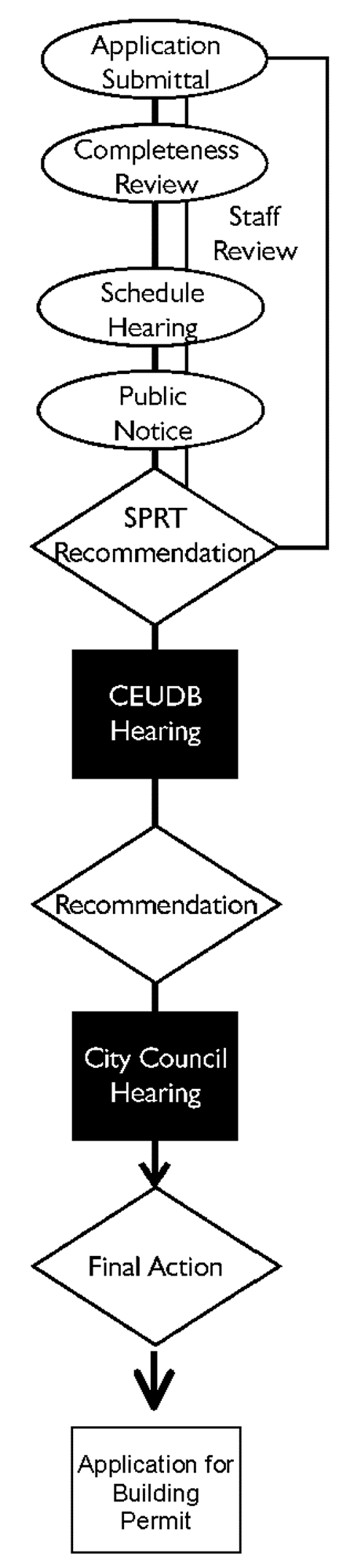
CEUD Site Plan Review Process
(C)
Application Contents. In addition to the required filing fees and notice fees, a site plan application shall include at least the following items. The materials described in (1) through (5) below shall be signed and sealed by a Professional Engineer registered in the State of Oklahoma.
(1)
Cover sheet, providing the name of the proposed development, the names of the current City of Edmond Mayor, City Council and City Manager, a sheet index, a vicinity map showing the location of the project, and the engineer of record and associated information;
(2)
Survey, providing a legal description of the property, the boundaries of the property, existing vegetation, all utilities and easements of record including the book and page numbers of the filed easements, topographic contours with intervals of not over two feet, any regulatory flood plain boundaries that affect the subject property, all adjacent streets and right-of-way, and existing driveways on the site and on properties adjacent to or across the street from the subject property;
(3)
For sites with an existing tree canopy cover of 20% or greater of the total site area or a parcel containing any amount of potential remnant forest, a Tree Resource Evaluation shall be performed in accordance with Section 22.6.1(D)(4), by a professional as identified in 22.6.1(D)(2);
(4)
Site plan, providing the location and dimensions of all structures and improvements, driveways/drive approaches, public right-of-way, parking and loading areas, drive aisles, sidewalks, outdoor storage areas and height and type of any fencing or screening;
(5)
Grading plan, providing all existing and proposed contours with intervals of not over two feet, the location of all structures, retaining walls, ponds, storm sewer improvements, and regulatory flood plain boundaries;
(6)
Drainage calculations report, related grading plan and erosion control plan, operation and maintenance manual signed and sealed by a Professional Engineer registered in the State of Oklahoma, in compliance with Title 23 of the City Code.
(7)
A retaining wall plan, if applicable, that includes materials used in the design and that meets the International Building Code;
(8)
Utility plan, providing the location of all proposed and existing public and private utilities and easements, proposed electrical loads, service type, ampacity and locations of the disconnect, service line and transformer;
(9)
Lighting plan, including number, location and height of poles, the type of lighting fixtures and type of illumination, pattern of illumination from each light, on-site building lighting, decorative lights, accent lights and sign lights;
(10)
Location, height, type, color material and size of all signs, including any site decorations or structures, such as flagpoles, benches, public art, banners, canopies, tents or other open display structures;
(11)
Elevation drawings depicting the number of stories and materials used on all exterior walls, roofs, entries and windows showing general architectural appearance and motif of the structures, including exterior finishes, treatments, materials and colors;
(12)
Landscape plan, including a program for continued landscape maintenance, a detailed landscape plan as specified in 22.6.1(D)(2) for the required site and a completed site plan landscape form;
(13)
Tree preservation plan for all trees proposed to be saved, as set forth in subsection 22.6.1(D);
(14)
Detailed plant listing that identifies types of plant material proposed.
(15)
Summary of landscape area calculations and proposed plant unit values.
(D)
Review Criteria. In determining whether to approve, approve with conditions or deny a site plan application, the City Council shall consider the following factors:
(1)
Consistency with the applicable provisions of Chapter 4, Chapter 5 and Chapter 6;
(2)
Compliance with other applicable City regulations;
(3)
Positive physical impact on the public health, safety, welfare and convenience of persons residing or working in the area;
(4)
Visual compatibility of the height, area, yards and overall mass, as well as parts of any structure or attendant facilities with the character and development of the surrounding area;
(5)
Ingress, egress, internal traffic circulation, off-street parking facilities, loading and service areas and pedestrian ways are designed to promote safe, efficient vehicular circulation, pedestrian movement, parking and site serviceability;
(6)
There is adequate utility access and easements to serve all buildings, structures and other facilities on the site;
(7)
There is adequate existing and proposed water, sewer and stormwater drainage facilities in accordance with the requirements for these facilities as specified in the City Code;
(8)
The inclusion or lack of tree preservation provided in accordance with the standard set forth in subsection 22.6.1(D)(6); and the anticipated impact to tree canopy cover, forested areas, and areas of the Cross Timbers ecosystem;
(9)
Consistency with the objectives of the Downtown Design Guidelines;
(10)
When multiple-family or nonresidential uses are proposed adjacent to existing less intensive multiple-family or nonresidential uses, the site plan emphasizes quality design, landscaping and Downtown Design Guidelines for streetscape to minimize the impact of the project on the established area; and
(11)
Compliance with PUD Master Plan Design and requested variances from Chapter 6.
(E)
Relationship to Building Permit.
(1)
The provisions of the approved site plan shall become a regular part of any application for any building permit in the district specified.
(2)
The approved site plan shall be the plot plan required to be submitted to the Building Department with the application for a building permit. No building permit may be issued prior to the completion of the site plan review process.
(3)
If the location of the plant material, species or quantity, or tree preservation plan is altered from the approved site plan/landscape plan, a revised landscape plan/tree preservation plan is required prior to any inspection for a certificate of occupancy.
(F)
Minor Modification.
(1)
Minor modifications are those that implement only slight alterations to an approved site plan or PUD master plan. Such modifications are made necessary by the actual field conditions at the time of development and do not alter the impact of the development on nearby properties nor the intent or integrity of Chapter 6 or the PUD master plan as originally imposed.
(2)
Minor changes to an approved site plan or PUD master plan shall be approved, approved with conditions or disapproved by the Planning Director without complete resubmittal of the application if such changes are minor according to the criteria in paragraph (3) below.
(3)
In determining whether to approve, approve with conditions, or deny a minor modification request, the Planning Director shall consider the following matters.
(a)
Approved lot dimensions, yards and structure heights shall not be varied.
(b)
Principal structure locations shall vary by no more than 10 feet in any direction within the development in residential districts and in lots abutting residential districts provided that the building is not moved closer to the abutting residential development.
(c)
Dwelling unit type, density or floor area shall not be changed.
(d)
No change shall alter the basic intent of the original approved site plan or PUD master plan.
(Ord. 3068, § 1, November 27, 2006; Ord. 3611, §§ 8—10, June 26, 2017)
22.3.7. - Variance.
(A)
Purpose. The Board of Adjustment is authorized to grant variances from the district dimensional standards found in Chapter 5, District Dimensional Standards unless a variance is specifically prohibited for a particular requirement. The granting of a variance shall not be contrary to the public interest or the spirit of this Title where, owing to special conditions, a literal enforcement of the provisions of this Title would result in unnecessary physical (not economic) hardship to the property owner. It is the intent of this delegation of power to the Board that no variance shall be granted which is a use variance and has the practical effect of rezoning property to a higher intensity of use than the district in which the property is located.
(B)
Review Process. Following notice in accordance with subsection 22.3.10(F) the Board of Adjustment shall hold a public hearing on the variance request, and, at the close of the public hearing act to approve, approve with conditions or deny the application based on the criteria in subsection (C) below. A concurring vote of at least three members of the Board of Adjustment shall be required to approve any variance request.
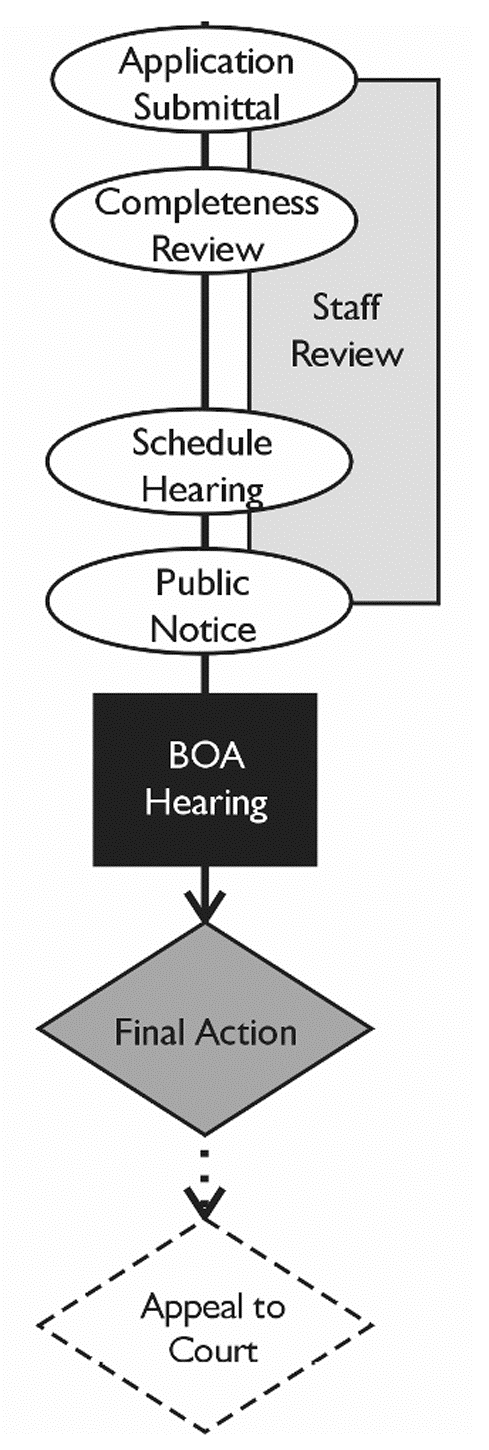
Variance Review Process
(C)
Review Criteria. A variance shall be granted upon an affirmative finding by the Board of Adjustment that all of the following exist.
(1)
The application of the ordinance to the particular piece of property would create an unnecessary physical (not economic) hardship because the property cannot be used for an otherwise allowed use without coming into conflict with applicable site development standards.
(2)
Such conditions are peculiar to the particular piece of property involved and are not a result of the owner's intentional action.
(3)
Relief, if granted, would not cause substantial detriment to the public good, or impair the purposes and intent of the ordinance or the Edmond Plan.
(4)
The variance desired shall not adversely affect the public health, safety or welfare or impair the purposes or intent of this Title or the Edmond Plan.
(5)
The granting of the permit for the variance shall not adversely affect the rights of adjacent property owners or residents.
(6)
The variance, if granted, would be the minimum necessary to alleviate the unnecessary hardship.
(D)
Finding of Fact. The Board of Adjustment shall, in making its finding on any specific case, determine the effect of the proposed change upon the supply of light and air to adjacent property, upon the congestion in the public rights-of-way, upon the public safety from fire and other hazards, upon the established property values within the surrounding area, and upon other factors relating to the public health, safety, and general welfare of the City. Every ruling made upon any variance shall be accompanied by a written finding of fact based upon the testimony received at the hearing afforded by the Board, and shall specify the reason for granting or denying the variance.
(E)
Appeal From Board Decision.
(1)
Procedure. An appeal from a variance decision by the Board of Adjustment shall be taken by any person or persons, jointly or severally, to the District Court by filing a notice of appeal with the City Clerk and with the Board of Adjustment within 10 days from the filing of the decision of the Board, which notice shall specify the grounds of such appeal. Upon filing of the notice of appeal, the Board shall forthwith transmit to the Court Clerk of the County the original or certified copy of all the papers constituting the record in the case, together with the decision of the Board.
(2)
Stay of Proceedings. An appeal to the District Court from the Board of Adjustment stays all proceedings in furtherance of the action appealed from, unless the Chair of the Board of Adjustment, from which the appeal is taken, certifies to the Court Clerk, after the notice of appeal shall have been filed, that by reason of facts stated in the certificate, a stay would, in his or her opinion, cause imminent peril to life or property. In such case, proceedings shall not be stayed or otherwise than by a restraining order which may be granted by the District Court upon application or notice to the administrative officer in charge of the enforcement of the terms and provisions of this title, and upon notice to the Chair of the Board of Adjustment from which the appeal is taken, and upon due cause being shown, the Court may reverse or affirm, wholly or partly, or modify the decision brought up for review.
(Ord. 3068, § 1, November 27, 2006).

