
Edmond City Zoning Code
CHAPTER 5
- DISTRICT DENSITY AND DIMENSIONAL STANDARDS
22.5.1.- Residential Standards.
(A)
Base Standards. The dimensional standards applicable to the G-A, R-1, R-2-A, A, B, C-1, C-2, and C-3 districts shall be those set forth in the following table. Except where clearly otherwise specified, these standards shall be considered minimum standards.
*Major Street Yard applies to corner lots
**Additional 2,700 square feet required per dwelling unit in excess of three dwelling units
***Or 20% lot depth, whichever is less
****8 feet if structure is 2 or more stories
On existing twenty-five foot (25') wide platted lots, the lot area may be reduced to five thousand (5,000) square feet.
When setbacks are shown on recorded plats exceeding the Base Standards, those setbacks shall be considered the minimum setbacks.
Refer to 22.4.37 (B) for Accessory Structure Dimensional Standards.
du = dwelling unit
(B)
Other Standards. There are other, context-specific, standards that may apply to one or more of the dimensional aspects of a project in these districts, including specifically Section 22.5.3, Measurements and Exceptions. Where more than one standard for a particular element, such as height or lot size, applies, the minimum standard shall apply unless there is specific language in one of the sections indicating that the provisions of that section shall supersede the standards in this section in particular circumstances.
(Ord. 3068, § 1, November 27, 2006; Ord. 3250, § 1, January 11, 2010)
22.5.2. - Nonresidential Standards.
(A)
Base Standards. The dimensional standards applicable to the D-O, D-1, D-2-A, D-3, D-4, E-1, E-2, E-3, F-O, F-1 and F-2 districts shall be those set forth in the following table. Except where clearly otherwise specified, these standards shall be considered minimum standards:
*For rear and side yards adjacent to residential districts, see Sensitive Border Standards.
Refer to Chapter 4 for zoning categories not listed above for dimensional standards.
(B)
Other Standards. There are other, context-specific, standards that may apply to one or more of the dimensional aspects of a project in these districts, including specifically Section 22.5.3, Measurements and Exceptions. Where more than one standard for a particular element, such as height or lot size, applies, the minimum standard shall apply unless there is specific language in one of the sections indicating that the provisions of that section shall supersede the standards in this section in particular circumstances.
(Ord. 3068, § 1, November 27, 2006; Ord. 3182, § 17, November 10, 2008)
22.5.3. - Measurements and Exceptions.
(A)
Lot Area.
(1)
Measurement. Lot area refers to the horizontal land area within lot lines.
(2)
Exceptions.
(a)
B and C Districts. Where permitted, a single-family dwelling shall have a minimum lot area of 6,000 square feet notwithstanding the minimum lot area for the particular district.
(b)
Credit for Lot Area or Open Space. No open space or lot area required for a building or structure shall, during its life, be occupied by, or counted as open space for, any other building or structure.
(B)
Lot Width.
(1)
Measurement. Lot width is measured between side lot lines along a line parallel to the street lot line or its chord and located the minimum yard distance from the street lot line.
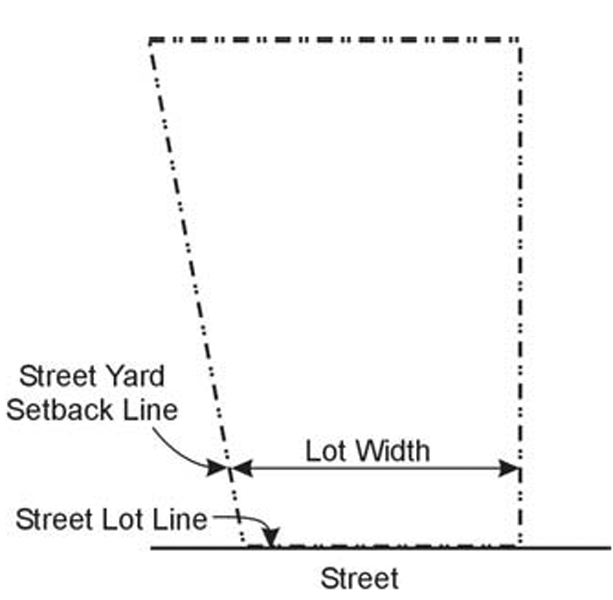
Lot Width Measurement
(2)
Exceptions.
(a)
Culs-de-Sac. Lot widths on a cul-de-sac turn around may be reduced to 50 feet measured at the setback line.
(b)
C-1, C-2 and C-3 Districts. For multiple-family dwellings there shall be a minimum lot width of 60 feet plus 10 feet per additional dwelling unit over three and up to 12.
(C)
Yards.
(1)
Measurement.
(a)
Yards refer to the unobstructed, unoccupied open area between the furthermost projection of a structure and the property line of the lot on which the structure is located, except as modified by the standards of this Section.
(2)
Exceptions.
(a)
Contextual Standards.
i.
Residential Districts. In all residential districts except C-2 and C-3, if 25 percent or more of the lots on one side of the public right-of-way between two intersecting public rights-of-way are improved with buildings, all of which have an average street yard greater than 25 feet, and no building varies more than five feet from this average yard line, then no building shall be erected closer to the property line than the minimum yard established by existing buildings. This regulation shall not require a street yard of greater depth than 40 feet.
ii.
C-2 and C-3 Districts. No new building shall be required to set back further than the established building line. The established building line shall be defined as the street yard existing for 50 percent or more of the buildings on one side of the public right-of-way between two intersecting public rights-of-way. This adjustment to the street yard requirement shall apply only to buildings of the same or higher zoning classification as those buildings creating the established building line.
(b)
Lots Abutting Specific Streets.
i.
The required street yards may be reduced to 25 feet from the property line on existing 25-foot wide lots on the following street sections:
a.
East Second from Rankin to the Santa Fe underpass; and
b.
On West Third from the Santa Fe underpass to Kelly where there is at least 50 feet of public right-of-way from centerline of the public right-of-way to the property line or where the public right-of-way already consists of four lanes.
ii.
Required street yards within 330 feet of the intersection of section line roads on existing 25-foot wide lots may only be reduced to 50 feet from the property line where there is at least 50 feet of public right-of-way from centerline of said public right-of-way to the property line or where the public right-of-way already consists of four lanes.
(c)
Rear Yards in the A District. When the side lot lines are not of equal length, the rear yard shall be determined by calculating 20 percent of the shortest side lot line, and that amount shall be the minimum horizontal distance required between the rear lot line and the exterior wall of the dwelling parallel to the rear lot line. In no case, shall the rear yard be reduced to a distance less than 12 feet.
(d)
Yard Encroachments.
i.
General.
a.
Open eaves, cornices and windowsills may project up to two feet into any required yard.
b.
Open patio covers may project up to 20 feet into the rear yard, but shall not encroach into any utility or drainage easement or public right-of-way.
c.
Fireplaces may project up to two feet into any required yard.
d.
Advertising signs and advertising structures may be located within the required yard provided that no sign or portion thereof shall extend into the public right-of-way, and further provided that such structures shall not encroach into the sight triangle described in subsection (E) below.
ii.
Major Streets.
a.
Open, free-standing canopies, not structurally attached to a building, for uses such as overnight accommodations, child care centers, drive-in restaurants and fuel sales may be located within required yards for major streets and section line roads. However, the minimum distance between the canopy and the property line shall not be less than 15 feet, except if within 330 feet either way of the intersection of section line roads in which case the minimum distance between the canopy and the property line shall not be less than 25 feet.
b.
Fuel dispensing pumps and pump islands may be located within required yards for major streets and section line roads. However, the minimum distance between the curb line of the motor fuel pump island, established nearest to the public right-of-way, and the property line shall not be less than 25 feet, except if within 330 feet either way of the intersection of section line roads in which case the minimum distance shall be 35 feet from the property line.
c.
Underground fuel storage tanks may be located within required yards provided they shall not be located less than 25 feet from the front property line.
d.
Canopies and fuel dispensing pumps and islands may be located within the required yard provided there is at least 50 feet of public right-of-way measured from the centerline of the public right-of-way, or where the public right-of-way already consists of four lanes.
e.
All canopies established in the yard area and motor fuel dispensing pumps and pump islands shall not be located within the sight triangle described in subsection (E) below.
f.
This Section shall not be construed to allow residential carports to be constructed projecting into the front or side yard areas except as provided for as accessory uses.
iii.
Minor-Collector Streets.
a.
Motor fuel dispensing pumps, pump islands, and canopies may be located within the yard lines herein established for minor and collector streets. The minimum distance between the canopy or the curb line of the motor fuel pump island, established nearest to the public right-of-way shall not be less than 15 feet on interior lots.
b.
In determining the 15-foot yard on corner lots, a sight distance triangle shall first be formed according to the provisions in subsection (E) below. Therefore, the minimum distance between the canopy or the pump island, established nearest to the public right-of-way for corner lots shall be yard not less than 15 feet onto the lot from the hypotenuse of the sight triangle.
c.
Underground fuel storage tanks may be located within the yard established in Chapter 5, but shall not be located closer than 25 feet to the front property line, or 15 feet from the side property line in all cases.
_____
(D)
Height.
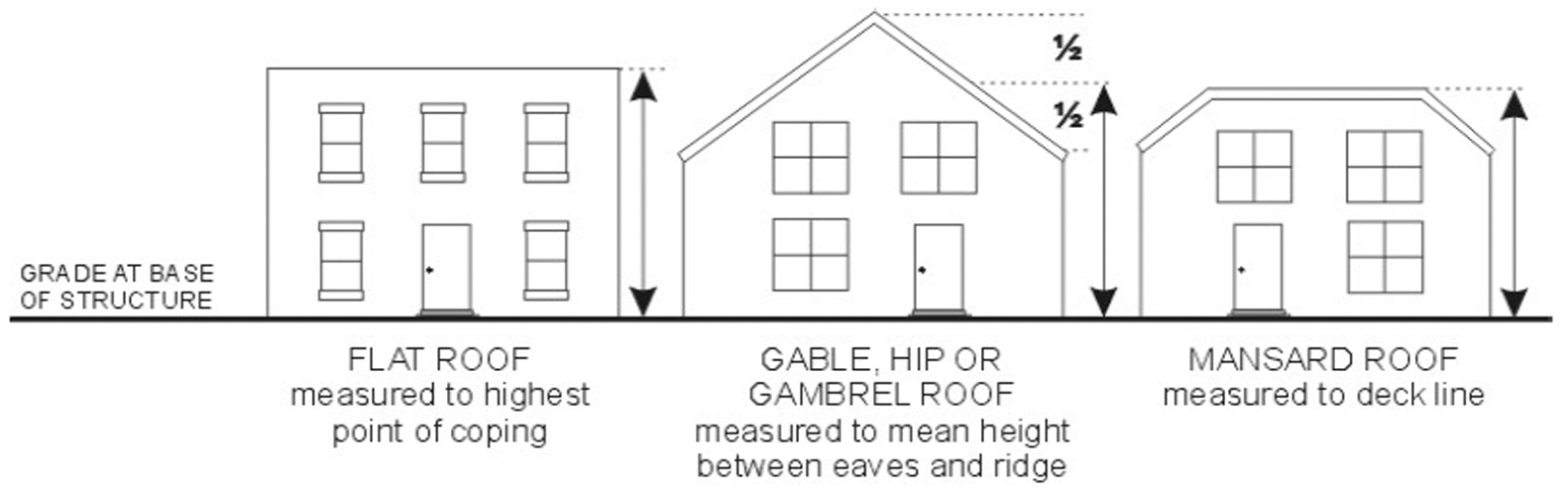
Roof Heights
_____
(1)
Measurement. Building height refers to the vertical distance between lowest finished grade at the base of a structure plus:
(a)
The highest point of the coping of a flat roof.
(b)
The mean height between the eaves and ridge line of a gable, shed, hip or gambrel roof; or
(c)
The highest point of a mansard roof.
(2)
Exceptions. The regulations herein set forth qualify or supplement, as the case may be, the specific regulations of each district.
(a)
General.
i.
In measuring heights, a habitable basement or attic shall be counted as a story, provided that a story in a sloping roof, the area of which story at a height of four feet above the floor does not exceed two-thirds of the floor area of the story immediately below it and which does not contain an independent apartment, shall be counted as a half-story.
ii.
Public and Civic uses, as defined in subsection 22.4.35(C), may exceed the maximum height limit of a district if the required minimum rear and side yards are increased one foot for each two feet by which the height of the structure exceeds the maximum height limit.
(b)
C-3, E-1 Districts.
i.
When adjacent to a nonresidential property, additional height shall be permitted on a ratio of one additional foot of building set back from all property lines for each one and one half additional foot of building height.
ii.
When adjacent to a residential property, the standards in subsection 22.6.5(C) shall apply.
(c)
D-3 District.
i.
When adjacent to a nonresidential property, additional height shall be permitted on a ratio of one additional foot of building set back from all property lines for each additional two feet of building height.
ii.
When adjacent to a residential property, the standards in subsection 22.6.5(C) shall apply.
(E)
Sight Triangle. According to the following requirements, a sight triangle shall be established at all intersections:
(1)
On all public streets the sight triangle shall be based on the right-of-way.
(2)
The sides of the sight triangle shall extend for 25 feet along the right-of-way/curb from the projected intersection of said right-of-way/curb. Where the right-of-way/curb curves as the intersection is approached, the tangents at the points of beginning for the corner curve shall be projected to determine the origination of the sides of the sight triangle.
(3)
No construction, planting or grading shall be permitted to interfere with the sight triangle between the heights of three and seven feet as measured from the crowns of the adjacent public rights-of-way, except as approved by the Planning Director.
(4)
However, trees having limbs and foliage trimmed in such a manner that no limbs or foliage extend into the unobstructed visual clearance shall be allowed, provided they are located so as not to create a traffic hazard.
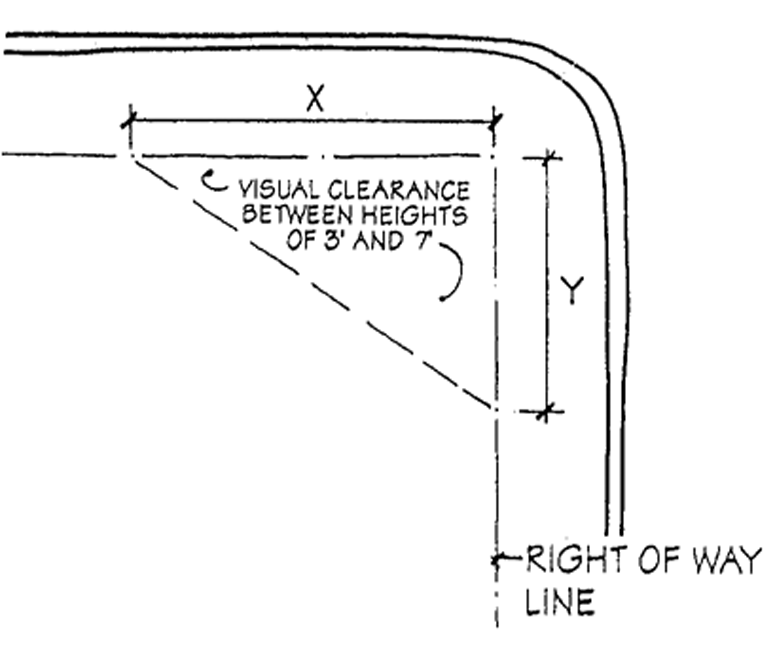
Sight Triangle
(Ord. 3068, § 1, November 27, 2006).

