
Edmond City Zoning Code
CHAPTER 9
- DEFINITIONS
22.9.1.- Abbreviations.
(1)
BOA. Board of Adjustment.
(2)
CEUD. Central Edmond Urban District.
(3)
CEUDB. Central Edmond Urban District Board.
(4)
DBH. Diameter at breast height.
(5)
GFA. Gross Floor Area.
(6)
ITE. Institute of Transportation Engineers.
(7)
NESC. National Electrical Safety Code.
(8)
PUD. Planned Unit Development.
(9)
SPRT. Site Plan Review Team.
(Ord. 3068, § 1, November 27, 2006).
22.9.2. - Defined Terms.
(A)
For the purpose of this Title words used in the present tense shall include the future tenses; words in the singular number include the plural and words in the plural number include the singular, except where the natural construction of the writing indicates otherwise. The word "shall" is mandatory and not directory. For the purpose of this Title, certain terms and words are to be used and interpreted as defined hereinafter.
(B)
Terms not defined in this Title shall be construed in accordance their customary usage and meaning.
ABUT. Means to physically touch or border upon, or to share a common property line.
ACCESSORY BUILDING OR STRUCTURE. A building customarily incidental and appropriate and subordinate to the main building or use and located on the same lot with the main building.
ACCESSORY USE. A use customarily incidental, appropriate and subordinate to the principal use of land or buildings located upon the same premises.
ADJACENT. Near or close but not necessarily having a common property line.
AGRICULTURE. The use of land for agricultural purposes, including farming, dairying, pasturage, agriculture, horticulture, floriculture, viticulture and animal and poultry husbandry and the necessary accessory uses for packing, treating, or storing the produce; provided, however, that the operation of any such accessory uses shall be secondary to that of the normal agricultural activities. The operation of commercial feed pens, sales yards and auction yards for cattle or hogs shall be deemed an industrial and not an agricultural use.
ALLEY. A public passage or way affording a secondary means of vehicular access to abutting property and not intended for general traffic circulation.
AUTOMOBILE. A self-propelled mechanical vehicle designed for use on public right-of-way for the conveyance of goods and people including but not limited to the following: passenger cars, trucks, busses, motor scooters, and motorcycles.
AUTOMATED/SELF-SERVE CAR WASH. A structure designed primarily for washing automobiles using production line methods with a chain conveyor, blower, steam cleaner, high pressure spray or other mechanical device.
BASEMENT. A story partly or wholly underground. For purposes of height measurement a basement shall be counted as a story when more than one-half of its height is above the average level of the adjoining ground or when subdivided and used for commercial or dwelling purposes by other than a janitor employed on the premises.
BERM. An earthen mound designed to provide visual interest, screen undesirable views and/or decrease noise.
BOUTIQUE HOTEL. Hotels with less than 100 rooms typically, that are unique in character and architecture with attention to high design that augments the surrounding district. They are typically smaller properties that offer personalized service and intimate experiences and have a distinct personality with a higher end feel.
BUILDING. Any structure intended for shelter, housing or enclosure of persons, animals or chattel. When separated by dividing walls without openings, each portion of such structure so separated shall be deemed a separate structure.
BUILDING COVERAGE. The percentage of the lot area covered by the building. The building area shall include all overhanging roofs.
BUILDING, MAIN. A building in which is conducted the principal use of the lot on which it is situated. In any residential district any dwelling shall be deemed to be a main building on the lot on which it is situated.
BUILDING SITE. A single parcel of land occupied or intended to be occupied by a building or structure.
CALIPER. The diameter of the tree trunk as measured at six inches above ground level for trees less than four inches in diameter. For trees greater than four inches in diameter, caliper is measured at 12 inches above ground level.
CANNABINOID. Consistent with Oklahoma Administrative Code 310: 681-1-4 and Title 63 Oklahoma Statutes Section 427.2 these are compounds that are active principles of marijuana.
CARPORT. A permanent roofed structure permanently open on at least two sides, designed for or occupied by private passenger vehicles.
CHILD CARE CENTER. Any place, home or institution which provides care for eight or more children for six or more hours of the 24 hour day.
(CHILD CARE) NURSERY SCHOOLS. Nursery schools, kindergartens, pre-schools or other facilities which keep children for educational purposes for any regular period of time.
CLINIC, DENTAL OR MEDICAL. A facility for the examination and treatment of ill and afflicted human outpatients; provided, however, that patients are not kept overnight except under emergency conditions, including but not limited to dental and doctor's offices.
CONVALESCENT, REST, NURSING HOME, OR EXTENDED CARE FACILITY. A health facility where persons are housed and furnished with meals and continuing nursing care for compensation.
COURT. An open unoccupied space, other than a yard on the same lot with a building or group of buildings and which is bordered on two or more sides by such building or buildings.
COURT, INNER. A court other than an outer court. The length of an inner court is the minimum horizontal dimension measured parallel to its longest side. The width of an inner court is the minimum horizontal dimension measured at right angles to its length.
COURT, OUTER. A court the full width of which opens onto a required yard public right-of-way. The width of an outer court is the minimum horizontal dimension measured in the same general direction as the yard or public right-of-way upon which the court opens. The depth of an outer court is the minimum horizontal dimension measured at right angles to its width.
CROSS TIMBERS FOREST, POTENTIAL REMNANT. Predominately post oak and black jack oak forested areas that have potentially remained forested since statehood. These are considered especially sensitive and valuable forest areas.
DECIDUOUS. A plant with foliage that is shed annually.
DIAMETER AT BREAST HEIGHT (DBH). The diameter of a tree trunk as measured four and one-half feet above ground level.
DISEASE AND PEST FREE. No visible signs of insect casts, egg sacks, fecal matter, webs or other signs. No signs of spots, necrosis, trunk or branch injury, open pruning wounds, sap flow, borer holes, etc.
DISTRICT, ZONING OR BASE. Any section or sections the City for which regulations governing the use of buildings and premises or the height and area of buildings are uniform.
DRIVE-IN FACILITY. An accessory portion of a main building that is designed to accommodate a patron's automobile. It is intended that the patron will consume a product or receive a service in the automobile.
DRIVE-THROUGH FACILITY. An accessory portion of a main building that provides a driveway and stacking spaces for vehicles to receive, but not consume a product or service.
DRY CLEANER OR LAUNDROMAT. Any attended or unattended place, building or portion thereof, available to the general public for the purpose of washing, drying, extracting moisture from, or dry cleaning wearing apparel, cloth, fabrics, and textiles of any kind by means of a mechanical appliance which is operated primarily by the customer.
DWELLING OR DWELLING UNIT. Any building, or portion thereof, which is designed or used as living quarters for one or more families, but not including house trailers, mobile homes or travel trailers. In quasi unit quarters such as nursing homes or extended care facilities, accommodations for every three persons shall be counted as a dwelling unit.
DWELLING, HIGH OCCUPANCY MULTIPLE-FAMILY. A dwelling designed for occupancy by multiple persons who live independently of each other, by having separate secured bedrooms and bathrooms, a common kitchen and living area, and are leased by the bedroom.
DWELLING, SINGLE-FAMILY ATTACHED. A dwelling having any portion of each of one or more walls in common with an adjoining dwelling, not including townhouses or rowhouses.
DWELLING, SINGLE-FAMILY DETACHED. A detached dwelling having open space on all sides designed to be occupied by one family.
DWELLING, TWO-FAMILY. A dwelling designed to be occupied by two families living independently of each other.
DWELLING, MULTIPLE-FAMILY. A dwelling designed for occupancy by three or more families living independently of each other, exclusive of auto or trailer courts or camps, hotels or resort type hotels.
DWELLING, TOWNHOUSE. Three or more dwelling units attached at the side or sides, each unit of which has a separate outdoor entrance and is designed to be occupied and may be owned by one family.
E.I.F.S. Exterior insulation finish system.
EROSION. The process by which the ground surface is worn away by the action of the wind, water, ice, gravity, or artificial means, and/or land disturbance activities.
EVERGREEN. A plant with foliage that persists and remains green year-around.
FAMILY. One or more persons related by blood or marriage, including adopted or foster children, or a group not to exceed five persons (excluding domestic servants or persons who provide personal or intermittent nursing services). Notwithstanding the foregoing provisions, no provisions of this Title or Code shall restrict the use of a family dwelling so as to interfere or violate the Fair Housing Act, the Oklahoma Fair Housing Law, or federal or state regulation which prohibits the discrimination based upon disability, age or infirmity.
FINISHED GRADE. The final grade or elevation of the ground surface conforming to an approved plan.
FLOOR AREA, GROSS. The sum of the gross horizontal areas of all of the floors of a building or buildings, measured from the exterior faces of exterior walls or from the centerline of walls separating two buildings, and including but not limited to, the following spaces:
(a)
Basements;
(b)
Elevator shafts and stairwells at each floor;
(c)
Floor space for mechanical equipment with structural head room of seven feet;
(d)
Penthouses;
(e)
Attic space providing head room of seven feet or more;
(f)
Interior balconies, mezzanines and enclosed covered porches and enclosed steps;
(g)
Accessory uses in enclosed covered space, but not including space used for off-street parking.
FLOOR AREA, NET. The total floor area within a building devoted or intended to be devoted to a particular use, with structural headroom of seven feet or more, whether above or below the finished lot grade, excluding:
(a)
Elevators, stairwells, hallways, walls and partitions, and
(b)
Floor space permanently devoted to a parking space or parking spaces, mechanical equipment, closets, washrooms, or other items permanently preventing the floor space from being occupied by persons while engaged in the use.
FORESTED AREA. The extent of a stand of trees of maturity, density, condition and vigor sufficient enough to maintain the ecosystem health.
FORESTER. A forester learns the art and practice of forestry through comprehensive scientific and technical coursework and practical field experience. A forester has a Bachelor's degree or higher from a SAF-accredited forestry program.
FUEL SALES. An establishment engaged in part or in whole in the sale of motor vehicle fuel.
GARAGE APARTMENT. A dwelling unit for one family erected connected to a private garage.
GARAGE, PRIVATE. An accessory building or a part of a main building used for storage purposes only for automobiles used solely by the occupants and their guests of the building to which it is accessory.
GARAGE REPAIR. A building in which are provided facilities for the care, servicing, repair, or equipping of automobiles.
GRADE, #1. Grade rankings are established by each nursery. Those that are #1 grade are the best formed, best structure, and best looking trees without any structural defects.
GRADING. Any act by which soil is cleared, stripped, moved, leveled, stockpiled, or any combination thereof, and includes the conditions that result from that act.
GROSS FLOOR AREA. See Floor Area, Gross.
HEIGHT, BUILDING. The vertical distance from the average line of the highest and lowest points of that portion of the lot covered by the building to the highest point of coping of a flat roof, or the deckline of a mansard roof, or to the average height of the highest gable of a pitch or hip roof.
HEIGHT, STRUCTURE. The vertical distance from the finished grade to the highest point of a structure.
HELP-YOURSELF LAUNDRY. See Drycleaner or laundromat.
HOME IMPROVEMENT CENTER. Any building or structure selling home improvement and building construction items including but not limited to paint, lumber, plumbing supplies, garden supplies, appliances and hardware and consisting of a minimum of 60,000 square feet of gross floor area, or any building or structure using outdoor storage or display of such materials or products.
HOME OCCUPATION. An accessory use of a dwelling that shall constitute all or some portion of the livelihood of a person or persons living in the dwelling. The home occupation shall be clearly incidental to the residential use of the dwelling and shall not change the essential residential character of the dwelling or adversely affect the uses permitted in the district of which it is a part.
HOSPITAL. An institution providing health services, primarily for human in-patient medical or surgical care for the sick or injured and including related facilities such as laboratories, out-patient departments, training facilities, central service facilities and staff offices which are an integral part of the facilities.
HOTEL. A building or group of buildings under one ownership containing six or more sleeping rooms occupied, intended or designed to be occupied as the more or less temporary abiding place of persons who are lodged with or without meals for compensation, but not including an auto or trailer court or camp, hospital, asylum, orphanage or building where persons are housed under restraint.
IMPERVIOUS COVERAGE. Surfaces that do not absorb water such as buildings, concrete or asphalt parking areas, roads, sidewalks or driveways.
ISA CERTIFIED ARBORIST. A certified arborist is a specialist in the art and science of planting, caring for, and maintaining individual trees. To become certified the arborist must have a minimum of three years' experience in arboriculture, pass a certification exam sponsored by the International Society of Arboriculture (ISA), and complete 30 hours of continuing education every three years.
JUNK OR SALVAGE. Any item discarded, worn out or having outlived its usefulness in its original form, commonly sold, salvaged, or converted into another product of the same or a different nature.
KENNEL. Any lot or premises on which there are five (5) or more dogs, excluding unweaned puppies.
LICENSED LAND SURVEYOR. An individual who is duly licensed by the Oklahoma State Board of Registration for Professional Engineers and Land Surveyors to practice surveying.
LOT. Any plot of land occupied or intended to be occupied by one building or a group of buildings, and accessory buildings and uses, including such open spaces as required by this Ordinance and other laws or ordinances, and having its principal frontage on a public right-of-way.
LOT AREA. The total horizontal area included within lot lines.
LOT, CORNER. A lot of which at least two adjacent sides abut for their full lengths on a public right-of-way, provided that the interior angle at the intersection of such two sides is less than 135 degrees.
LOT DEPTH. The average distance from the street line of the lot to its rear line, measured in the general direction of the side lines of the lot.
LOT, DOUBLE FRONTAGE. A lot having a frontage on two non-intersecting public right-of-way, as distinguished from a corner lot.
LOT, FRONTAGE. That dimension of a lot or portion of a lot abutting a public right-of-way, excluding the side dimension of a corner lot.
LOT, INTERIOR. A lot other than a corner lot.
LOT LINES. The lines bounding a lot as defined herein.
MAJOR STREET. A section line road, highway or arterial street.
MANUFACTURED HOME. A dwelling unit constructed in accordance with federal manufactured housing construction and safety standards (HUD code) in effect after June 15, 1976.
MANUFACTURED HOME PARK. Land or property which is used or intended to be used or rented for occupancy by one or more manufactured homes.
MARIJUANA. Consistent with Oklahoma Administrative Code 310: 681-1-4 and Title 63 Oklahoma Statutes Section 427.2, and Title 63 Oklahoma Statutes Section 2-101 means all parts of a plant of the genus cannabis.
MEDIA. Anything printed or written, or any picture, drawing, photograph, motion picture, film, videotape or videotape production, or pictorial representation, or any electrical or electronic reproduction of anything that is or may be used as a means of communication. Media includes but shall not necessarily be limited to books, newspapers, magazines, movies, videos, sound recordings, cd-roms, other magnetic media, and undeveloped pictures.
MEDICAL MARIJUANA COMMERCIAL GROWER. Consistent with Oklahoma Administrative Code 310: 681-1-4 and Title 63 Oklahoma Statutes Section 427.2, is licensed by the State of Oklahoma to cultivate and prepare medical marijuana for a medical marijuana dispensary and/or a medical marijuana processor.
MEDICAL MARIJUANA DISPENSARY. Consistent with Oklahoma Administrative Code 310: 681-1-4 and Title 63 Oklahoma Statutes Section 427.2, a facility licensed by the State of Oklahoma to act as a retail entity for medical marijuana products.
MEDICAL MARIJUANA PROCESSOR. Consistent with Oklahoma Administrative Code 310: 681-1-4 and Title 63 Oklahoma Statute Section 423.C and Section 427.2, a facility licensed by the State of Oklahoma to produce medical marijuana products.
MEDICAL MARIJUANA PRODUCTS. Consistent with Oklahoma Administrative Code 310: 681-1-4 and Title 63 Oklahoma Statutes Section 427.2, products that contain compounds that can act on cannabinoid receptors in cells, which are produced naturally by marijuana and some other plants.
MEDICAL MARIJUANA RESEARCH FACILITY. A type of medical office and/or research or experimental laboratory, consistent with Oklahoma Administrative Code 310: 681-1-4 and Title 63 Oklahoma Statutes Section 427.2, that has been approved by the State of Oklahoma to conduct medical marijuana research.
MEDICAL MARIJUANA TESTING LABORATORY. A type of medical office and/or research or experimental laboratory, consistent with Oklahoma Administrative Code 310: 681-1-4 and Title 63 Oklahoma Statutes Section 427.2 that has been licensed by the State of Oklahoma to conduct testing and research on medical marijuana.
MEDICAL MARIJUANA WASTE DISPOSAL FACILITY. An entity, consistent with Oklahoma Administrative Code 310: 681-1-4 and Title 63 Oklahoma Statutes Section 427.2 that has been licensed by the State of Oklahoma to render medical marijuana waste unusable and unrecognizable.
MINOR STREET. Any street not defined as a major street.
MOBILE HOME. A portable or mobile, factory-built living unit used or designed for single-family occupancy on a permanent basis that was manufactured prior to enactment of the federal Manufactured Housing Construction and Safety Standards Act of 1976 (42 U.S.C. Sec. 5401).
NONCONFORMING SITUATION. A lawful condition of a structure or land which does not conform to the regulations of the district in which it is situated. This may include but is not limited to failure to conform to use, height, area, coverage or off-street parking requirements.
NONCONFORMING USE. A structure or land lawfully occupied by a use that does not conform to the regulations of the district in which it is situated.
NURSERY, PLANT. A facility whose primary function is the growing of plants for commercial purposes.
OPEN SPACE, RECREATIONAL. Any land, under single ownership, which is dedicated to open, outdoor recreational uses such as golf courses or ball fields, and which is submitted for City development approval as a single plan and developed pursuant to one grading plan.
ORDINARY MAINTENANCE AND REPAIR. Shall mean any work for which a building permit or any other city permit or certificate is not required, and where the purpose of such work is stabilization, and further, where such work will not noticeably change the exterior appearance of the resource. Any work not satisfying all of the above requirements shall not be considered ordinary maintenance and repair. The following examples shall not be considered ordinary maintenance and repair: The application of paint to previously unpainted brick, or masonry, the construction or enlargement of a driveway or parking area, the replacement of exterior doors or windows, except for repair of broken glass or screens by use of like glass or screens, and further, there are other types of construction or other work that shall not be considered ordinary maintenance and repair.
PARKING SPACE. A permanently surfaced area, stripped per city standards, enclosed or unenclosed, sufficient in size to store one automobile together with a permanently surfaced driveway connecting the parking space with a public right-of-way and permitting ingress or egress of an automobile.
PLANNED UNIT DEVELOPMENT. A development planned in accordance with the provisions of Sections 22.3.4 and 22.4.33 of this Ordinance.
PLANNING DIRECTOR. The individual appointed by the City as the Planning Director.
PLANT UNIT. A measurement tool that translates the amount of required plant material into a quantifiable, but flexible unit.
POWER-GENERATION TOWER OR STRUCTURE. A power-generation tower or structure is anything constructed, erected or set up upon the ground or attached to something having a permanent location on the ground, the purpose of which is to generate and supply power, through the assistance of a renewable energy source, to be utilized by an existing principal residential or nonresidential use of the property on which it is situated. A power-generation structure shall be deemed to include all structural and mechanical components thereof. Nothing herein shall be construed or deemed to authorize the construction or use of any such tower or structure in the absence of compliance with any applicable ordinances, building or electrical codes, tariffs, contracts, utility regulations or State or Federal requirements or statutes of any nature.
PROFESSIONAL ENGINEER. An engineer duly licensed by the Oklahoma State Board of Registration for Professional Engineers and Land Surveyors to practice engineering.
PROPERTY OWNERS' ASSOCIATION. An incorporated non-profit organization operating under recorded land agreements through which:
(a)
Each property owner in a shopping center-type development is automatically a member;
(b)
Each lot is automatically subject to a charge for a proportionate share of the expenses for the organization's activities, such as maintaining a common property; and
(c)
The charge if unpaid becomes a lien against the property.
REMNANT CROSS TIMBERS FOREST. See Cross Timbers Forest, Remnant.
REST HOME. See Convalescent Home.
RESTAURANT, DRIVE-IN. A restaurant with a drive-in facility as defined above.
ROOMING OR BOARDING HOUSE. A dwelling other than a hotel, not including a bed and breakfast, where, for compensation and by prearrangement for definite periods, meals or lodging and meals are provided for three or more but not exceeding 12 persons.
SCREEN. A method of reducing the impact of noise and unsightly visual intrusions with less offensive or more harmonious elements, such as plants, berms, fences, walls or any appropriate combination thereof.
SEDIMENT. Soils or other materials transported or deposited by the action of wind, water, ice, gravity, or artificial means.
SHRUB. A woody plant, smaller than a tree, consisting of several small stems from the ground or small branches near the ground; may be deciduous or evergreen.
SINGLE-FAMILY DWELLING. See dwelling, single-family.
SITE. Any lot or parcel of land or a series of lots or parcels of land adjoining or contiguous or joined together under one ownership on which land development activity is proposed.
SLOPE. The inclined surface of a fill, excavation, or natural terrain expressed as a ratio of horizontal distance to vertical distance over a measured inclined surface.
SOIL. The unconsolidated mineral and organic material (i.e., earth, sand, gravel, rock or other similar material) on the immediate surface of the earth that serves as a natural medium for the growth of land plants.
STABLE, PRIVATE. A stable with a capacity for not more than two horses or mules.
STABLE, PUBLIC. A stable, other than a private stable, with a capacity for more than two horses or mules.
STAND. A community of trees sufficiently uniform in species composition, age, arrangement, and condition to be distinguishable as a group from the forest or other growth on the adjoining area, and thus forming a silviculture or management entity.
STORM SHELTER or SAFE ROOM. Any structure, built above or below ground, with sole intent to protect life and limb from adverse weather conditions.
STORY. That portion of a building, other than a basement, included between the surface of any floor and the surface of the floor next above it, or if there be no floor above it, then the space between the floor and the ceiling next above it.
STORY, HALF. A space under a sloping roof which has the line of intersections of roof decking and wall face not more than three feet above the top floor level, and in which space not more than two-thirds of the floor area is finished off for use. A half story containing independent apartment or living quarters shall be counted as a full story.
STREET. Any public right-of-way which affords the principal means of access to abutting property.
STREET, ARTERIAL. A street so defined by the Edmond Plan.
STREET, INTERSECTING. Any public right-of-way which joins another public right-of-way at an angle, whether or not it crosses the other.
STREET, LOCAL. A street so defined by the Edmond Plan.
STRUCTURE. Anything constructed or erected other than a building as defined above, the use of which requires permanent location on the ground or attached to something having a permanent location on the ground.
TOPPING. A form of pruning that includes the severe cutting back of limbs between lateral branches to such a degree as to remove the normal canopy and disfigure the natural shape of the tree. Other terms to describe topping include de-horning, hat-racking, heading, lopping, pollarding, rejuvenating, rounding-over, tipping or stubbing.
TOWNHOUSE. See Dwelling, Townhouse, or Row House.
TRAILER COURT. See Mobile Home Park.
TRAILER, TRAVEL OR CAMPING. A portable or mobile living unit used for temporary human occupancy away from the place of residence of the occupants, and not constituting the principal place of residence of the occupants.
TRAVEL TRAILER PARK. Land or property which is used or intended to be used or rented for temporary occupancy by one or more travel trailers or movable sleeping quarters of any kind.
TREE. A large, woody plant having one (1) or several self-supporting stems or trunks and numerous branches. May be classified as deciduous or evergreen.
TREE PRESERVATION PLAN. A plan consisting of text, graphics, and tables that lists and details all of the trees that will be preserved during the development of a site and the techniques that will be used to keep the trees maintained after construction. A detailed listing of requirements for the tree preservation plan is included in the Edmond Tree and Landscape Guide.
TREE PROTECTION ZONE. The area around an existing tree that is protected and left undisturbed until construction is completed. The minimum distance required for tree protection zones is the width of the canopy plus an additional distance required to preserve a critical root area.
TREE, EXISTING. A tree that exists on the property prior to development that will be preserved, and whose root system will not be disturbed in any way within the area covered by the tree's canopy.
TRUCK STOP. An establishment engaged primarily in the fueling, servicing, repair, or parking of tractor trucks or similar heavy commercial vehicles, including the sale of accessories and equipment for such vehicles. A truck stop may also include overnight accommodations, showers, or restaurant facilities primarily for the use of truck crews.
TWO-FAMILY DWELLING. See dwelling, two-family.
VEGETATIVE COVER. Any grass, shrubs, trees and other vegetation that protects and stabilizes soils.
WRECKER SERVICE OR SALVAGE YARD. An area outside of a building consisting of more than three acres where motor vehicles are disassembled, junked, wrecked or where motor vehicles not in operable condition are stored, which may include permanent machinery located on the property for wrecking vehicles.
YARD. An open space at grade between a building and the adjoining lot lines, unoccupied
and unobstructed by any portion of a structure from the ground upward except where
otherwise specifically provided in this Ordinance that an accessory building may be
located in a portion of a yard required for a main building. In measuring a yard for
the purpose of determining the width of the side yard, the depth of a street yard
or the depth of a rear yard, the least horizontal distance between the lot line and
the main building shall be used.
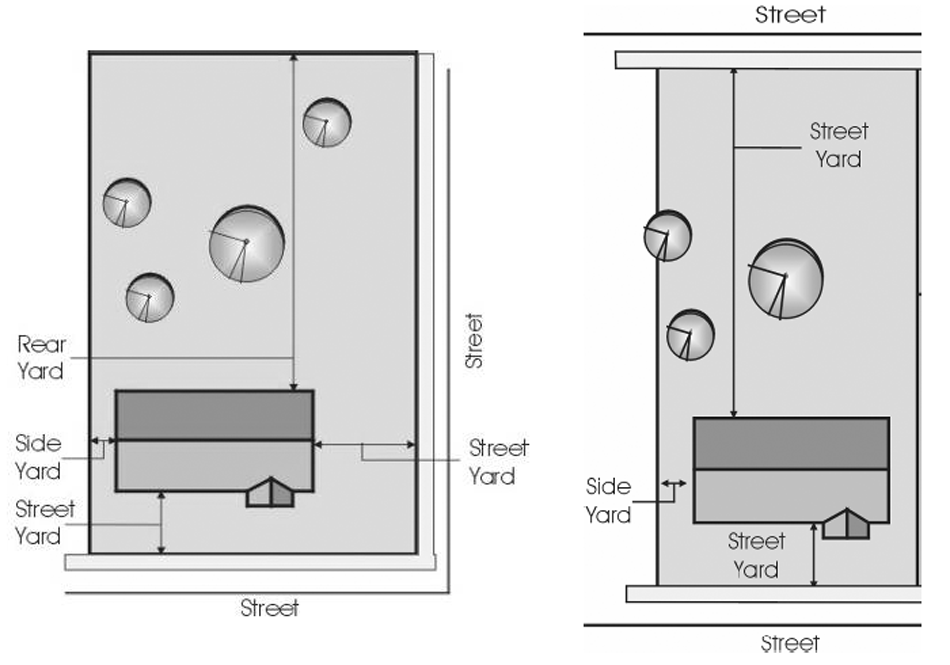
Yards
YARD, REAR. The area of a site extending across the rear of a lot measured between side lot lines and being the minimum horizontal distance between the rear lot line and the rear of the main building or any projections other than steps, unenclosed balconies or unenclosed porches.
YARD, SENSITIVE BORDER. A rear or side yard on a nonresidential site that abuts a residential property.
YARD, SIDE. A yard between the building and the side line of the lot and extending from the front lot line to the rear lot line and being the minimum horizontal distance between a side lot line and the side of the main building or any projections other than steps.
YARD, STREET. The area of a site formed by a line parallel to a street line, extending across the dimension of a site that is adjacent to a public right-of-way.
(Ord. 3068, § 1, November 27, 2006; Ord. 3248, § 8, January 11, 2010; Ord. No. 3500, § 1, August 24, 2015; Ord. 3611, § 19, June 26, 2017; Ord. 3790, § 1, July 27, 2020; Ord. 3872, § 1, November 8, 2021; Ord. 3932, § 1, January 9, 2023)

