
Edmond City Zoning Code
CHAPTER 4
- ZONING DISTRICTS AND USE STANDARDS
22.4.1.- Establishment of Zoning Districts.
(A)
Zoning Districts. The City is hereby divided into zones as shown on the Zoning Map. A digital Zoning Map created through the use of geographic information technology was adopted July 28, 2003 and is used in the administration and enforcement of these zoning regulations. The Map as amended and all explanatory material shall be considered as part of this Title as fully as if it were set out in this Chapter in detail. A copy of the Zoning Map is maintained in the office of the Planning and Zoning Department.
(B)
Classification of New Additions. All additions and annexations of land to the City shall be designated G-A, General Agriculture district, unless otherwise classified by the City Council.
(C)
Interpretation of District Boundaries. Where uncertainty exists with respect to the boundaries of any of the districts as shown on the Zoning Map, the following rules shall apply.
(1)
Where district boundaries are indicated as approximately following the centerlines of public right-of-way such centerlines, street lines, or highway, right-of-way lines shall be construed to be the boundaries.
(2)
Where district boundaries are so indicated that they are approximately parallel to the centerlines or street lines of public right-of-ways, or the centerlines or right-of-way lines of highways, such district boundaries shall be construed as being parallel thereto and at such scaled distance therefrom as indicated on the Zoning Map.
(3)
Where district boundaries are so indicated that they approximately follow the lot lines, such lot lines shall be construed to be said boundaries.
(4)
Whenever any public right-of-way or easement is vacated, the district classifications of the property to which the vacated portions of land accrue shall become the classification of the vacated land.
(5)
Where the boundary of a district line follows a railroad line such boundary shall be deemed to be located on the easement line to which it is closest, which shall completely include or exclude the railroad easement unless otherwise designated.
(6)
In unsubdivided property, unless otherwise indicated, the district boundary line on the Zoning Map shall be determined by the use of the scale contained on such map.
(7)
Boundary lines indicated as approximately following City Limits shall be considered to follow the City Limits.
(8)
All water areas within the City limits are considered to be within a district and controlled by applicable district regulations. District boundary lines over water areas are located by noted and scaled dimensions, by relation to physical features, by coincidence with the City limit line, or by a straight line projection of the centerlines of public rights-of-ways as indicated on the district maps. Straight line district boundaries over water areas shall be assumed to continue as straight line until they intersect with each other or with the City limit line.
(9)
Boundary lines indicated as following shorelines shall be considered to follow such shorelines, and in the event of change in the shoreline, shall be considered as moving with the actual shoreline.
(10)
Where existing physical or natural features contradict those shown on the Zoning Map, or in case any other uncertainty exists not addressed in (1) through (9) above, the location of district boundaries shall be determined by the Planning Director.
(D)
Conditions of a More Restricted District Applied to Residential Uses. Whenever the specific district regulations pertaining to one district permit residential uses of a more restricted district, such residential uses shall be subject to the conditions as set forth in the regulations of the more restricted district unless otherwise specified.
(E)
Districts. Districts shall be designated as follows:
(F)
Repealed Districts. The following districts are repealed under previous ordinances or by the adoption of this Ordinance. The districts shall continue to exist on the Zoning Map; however, no new lands in the City shall be rezoned to these designations. The uses and standards applicable to these repealed districts are stated in Appendix C. The standards in effect when the property was zoned shall remain applicable to these repealed districts.
(Ord. 3068, § 1, November 27, 2006).
22.4.2. - Types of Use.
Each district section below, from Sections 22.4.3 to 22.4.30, contains a use table with a check mark (✓) indicating whether a use is permitted by right, permitted subject to supplemental use standards, or subject to specific use permit review. If a use is not expressly listed, such use or use classification shall be prohibited unless the Planning Director makes a similar use determination in accordance with Section 22.4.34.
(A)
Uses Permitted By Right ("P"). Any use with a check mark (✓) in the "P" column of a district use table indicates that the use is allowed by right in the respective district. Permitted uses, however, may be subject to the supplemental use standards in Section 22.4.36. Permitted uses are subject to all other applicable regulations of this Title.
(B)
Specific Use Permit Required ("S"). Any use with a check mark (✓) in the "S" column of a district use table indicates that the use is allowed only if approved as a specific use by the City Council in accordance with the procedures in Section 22.3.3, Specific Use Permits. Uses requiring a specific use permit may be subject to the supplemental use standards, if applicable, contained in Section 22.4.36. Such uses are also subject to all other applicable regulations of this Chapter. The City Council may also impose, at its discretion, additional standards conditional upon the issuance of the specific use permit.
(C)
Standards. The "Standard" column of each district use table contains cross-references to supplemental use standards contained in Section 22.4.36. Such standards may apply to a permitted use or a use requiring a specific use permit.
(D)
Uses Prohibited in All Districts. Due to the limited industrial character and environmental assets of the City, the following uses are considered noxious and inappropriate and are therefore prohibited within the City limits.
(1)
Battery manufacturing, or recycling, or collection of batteries for recycling;
(2)
Intensive agriculture, including chicken or hog farming;
(3)
Meat packing;
(4)
Nuclear power plants;
(5)
Plastics manufacturing;
(6)
Pulp and paper manufacturing;
(7)
Rendering plants;
(8)
Rubber manufacturing;
(9)
Tanneries;
(10)
The manufacture, assembly, storage and testing of explosives, ammunition, blasting agents and fireworks; and
(11)
Medical Marijuana Waste Disposal Facility.
(Ord. 3068, § 1, November 27, 2006; Ord. 3872, § 1, November 8, 2021)
22.4.3. - G-A, General Agricultural.
(A)
Purpose. This district is intended for the land situated on the fringe of the urban area that is used for agricultural purposes. Most of these areas may be in close proximity to residential uses. Therefore, the agricultural activities conducted in this district should not be detrimental to nonagricultural land uses. The type of uses, area and intensity of use of land which is authorized in this district is designated to encourage and protect agricultural uses until urbanization is warranted and the appropriate change in district classification is made. The minimum lot area for the G-A district is five acres.
(B)
District Use Table. The following uses shall be permitted or subject to review according to Section 22.4.2 in the G-A, General Agricultural District.
Key:
P = Permitted by Right (may be subject to standards)
S = Requires Specific Use Permit
(C)
Accessory Uses. Uses customarily incidental and secondary to the uses permitted by right.
(D)
Dimensional Standards. See Chapter 5, District Dimensional Standards.
(E)
Site Design Standards. There are a number of site design standards that may apply to development in the G-A district. See Chapter 6, Site Design Standards.
(Ord. 3068, § 1, November 27, 2006; Ord. 3790, § 1, July 27, 2020; Ord. 3888, § 1, February 28, 2022)
22.4.4. - R-1, Rural Estate District.
(A)
Purpose. This district is intended to provide a location for those subdivisions which are to be developed using the rural standard of paved surfacing. It is also intended to provide a location for the land situated on the fringe of the urban area that is used for agricultural purposes but which will be undergoing urbanization in the near future. It is not intended that this district provide a location for a lower standard of residential development than is authorized in other districts. The minimum lot area for the R-1 district is 90,000 square feet.
(B)
District Use Table. The following uses shall be permitted or subject to review according to Section 22.4.2 in the R-1, Rural Estate district.
Key:
P = Permitted by Right (may be subject to standards)
S = Requires Specific Use Permit
(C)
Accessory Uses. Uses customarily incidental and secondary to the uses permitted by right.
(D)
Dimensional Standards. See Chapter 5, District Dimensional Standards.
(E)
Site Design Standards. There are a number of site design standards that may apply to development in the R-1 district. See Chapter 6, Site Design Standards.
(Ord. 3068, § 1, November 27, 2006; Ord. 3790, § 1, July 27, 2020)
22.4.5. - R-2-A, Suburban Estate District.
(A)
Purpose. This is a restrictive residential district for developments with larger home sites and related recreational, religious, and educational facilities normally required to provide the basic elements of a balanced and attractive residential area. Larger lot sizes provide light, air, and open space. Special attention should be given to overall design and protection of the area from intensifying zoning once the district has been established. The minimum net lot area for the R-2-A district is 60,000 square feet exclusive of street right-of-way.
(B)
District Use Table. The following uses shall be permitted or subject to review according to Section 22.4.2 in the R-2-A, Suburban Estate district.
Key:
P = Permitted by Right (may be subject to standards)
S = Requires Specific Use Permit
(C)
Accessory Uses. Uses customarily incidental and secondary to the uses permitted by right.
(D)
Dimensional Standards. See Chapter 5, District Dimensional Standards.
(E)
Site Design Standards. There are a number of site design standards that may apply to development in the R-2-A district. See Chapter 6, Site Design Standards.
(Ord. 3068, § 1, November 27, 2006; Ord. 3790, § 1, July 27, 2020)
22.4.6. - A, Single-Family Dwelling District.
(A)
Purpose. This is the most restrictive residential district. The principal use of land is for single-family dwellings and related recreational, religious and educational facilities normally required to provide the basic elements of a balanced and attractive residential area. These areas are intended to be defined and protected from the encroachment of uses not performing a function necessary to the residential environment. Internal stability, attractiveness, order and efficiency are encouraged by providing for adequate light, air and open space for dwellings and related facilities and through consideration of the proper functional relationship of each element. The minimum lot area for the A district is 6,000 square feet.
(B)
District Use Table. The following uses shall be permitted or subject to review according to Section 22.4.2 in the A, Single-Family Dwelling district.
Key:
P = Permitted by Right (may be subject to standards)
S = Requires Specific Use Permit
(C)
Accessory Uses. Uses customarily incidental and secondary to the uses permitted by right.
(D)
Dimensional Standards. See Chapter 5, District Dimensional Standards.
(E)
Site Design Standards. There are a number of site design standards that may apply to development in the A district. See Chapter 6, Site Design Standards.
(Ord. 3068, § 1, November 27, 2006; Ord. 3790, § 1, July 27, 2020)
22.4.7. - B, Two-Family Dwelling.
(A)
Purpose. This is a residential district to provide for a higher population density than single-family. The principal use of land is for single-family and two-family dwellings and related recreational, religious and educational facilities normally required to provide a balanced and attractive residential area. The minimum lot area for the B district is 7,000 square feet; however, see paragraph 22.5.3(A)(2) for exceptions to this standard.
(B)
District Use Table. The following uses shall be permitted or subject to review according to Section 22.4.2 in the B, Two-Family Dwelling district.
Key:
P = Permitted by Right (may be subject to standards)
S = Requires Specific Use Permit
(C)
Accessory Uses. Uses customarily incidental and secondary to the uses permitted by right.
(D)
Dimensional Standards. See Chapter 5, District Dimensional Standards.
(E)
Site Design Standards. There are a number of site design standards that may apply to development in the B district. See Chapter 6, Site Design Standards.
(Ord. 3068, § 1, November 27, 2006; Ord. 3790, § 1, July 27, 2020)
22.4.8. - C-1, Low Density Multiple-Family.
(A)
Purpose. This residential district is intended to provide for multiple-family developments which may have a relatively intense concentration of dwelling units served by large open spaces, including common areas and facilities, thereby resulting in low gross densities of approximately eight units per acre. The principal use of land may be for one or several dwelling types ranging from single family to low-rise multiple-family dwellings, and including garden apartments, condominiums and townhouses. The minimum lot area for the C-1 district is 5,000 square feet.
(B)
District Use Table. The following uses shall be permitted or subject to review according to Section 22.4.2 in the C-1, Low Density Multiple-Family district.
Key:
P = Permitted by Right (may be subject to standards)
S = Requires Specific Use Permit
(C)
Accessory Uses. Uses customarily incidental and secondary to the uses permitted by right.
(D)
Dimensional Standards. See Chapter 5, District Dimensional Standards.
(E)
Site Design Standards. There are a number of site design standards that may apply to development in the C-1 district. See Chapter 6, Site Design Standards.
(Ord. 3068, § 1, November 27, 2006; Ord. 3790, § 1, July 27, 2020).
22.4.9. - C-2, Medium Density Multiple-Family.
(A)
Purpose. This is a residential district to provide for medium density of no more than 12 units per net acre. The principal use of land is for single family dwellings, townhouses, low rise multiple-family dwellings and garden apartments. Recreational, religious and educational uses normally located to service residential areas are also permitted to provide the basic elements of convenient, balanced and attractive living areas. The minimum lot area is 3,500 square feet for each dwelling unit.
(B)
District Use Table. The following uses shall be permitted or subject to review according to 22.4.2 in the C-2, Medium Density Multiple-Family district.
Key:
P = Permitted by Right (may be subject to standards)
S = Requires Specific Use Permit
(C)
Accessory Uses. Uses customarily incidental and secondary to the uses permitted by right.
(D)
Dimensional Standards. See Chapter 5, District Dimensional Standards.
(E)
Site Design Standards. There are a number of site design standards that may apply to development in the C-2 district. See Chapter 6, Site Design Standards.
(Ord. 3068, § 1, November 27, 2006).
22.4.10. - C-3, High Density Multiple-Family Residential and Commercial Services.
(A)
Purpose. This is a residential district to provide for a density of 16 units per net acre. The principal use of land is for a variety of dwelling unit types including townhouses, low-rise multiple-family dwellings, garage apartments, and high-rise multiple-family dwellings. Commercial uses to serve the residents of the area are permitted on the lower floors of high-rise apartments, and recreation, religious and educational uses normally located to serve residential areas also are permitted to provide the basic elements of convenient, balanced and attractive living areas. It is the intent and policy of the City that this district be utilized only upon a strong showing of compatibility with the adjoining neighborhood and community and therefore zoning applications for this category should be predicated upon consistency with neighborhood plans for master plans adopted by the City Council and Planning Commission. The minimum lot area is 8,400 square feet with an additional 2,700 square feet required per dwelling unit in excess of three.
(B)
District Use Table. The following uses shall be permitted or subject to review according to Section 22.4.2 in the C-3, High Density Multiple-Family Residential and Commercial Services district.
Key:
P = Permitted by Right (may be subject to standards)
S = Requires Specific Use Permit
(C)
Accessory Uses. Uses customarily incidental and secondary to the uses permitted by right.
(D)
Dimensional Standards. See Chapter 5, District Dimensional Standards.
(E)
Site Design Standards. There are a number of site design standards that may apply to development in the C-3 district. See Chapter 6, Site Design Standards.
(Ord. 3068, § 1, November 27, 2006; Ord. 3248, § 3, January 11, 2010)
22.4.11. - G-1, Mobile Home Subdivision.
(A)
Purpose. This is a residential district in which the principal use of land is for mobile homes or manufactured homes located on lots which are owned by the mobile home owner. The district is intended to provide a single family environment. These areas are intended to be located and developed so that they are protected from encroachment of multiple-family and commercial land uses. They should also be situated so as to have a relationship with conventional single family housing without causing any disruption of traditional stability, order and attractiveness. Density and lot size standards are the same as for conventional dwellings to provide adequate lot size for public utilities or, if applicable, private water wells and septic tanks as well as light, air and open space and to emphasize the single family character of the district.
(B)
District Use Table. The following uses shall be permitted or subject to review according to Section 22.4.2 in the G-1, Mobile Home Subdivision district.
Key:
P = Permitted by Right (may be subject to standards)
S = Requires Specific Use Permit
(C)
Accessory Uses. Uses customarily incidental and secondary to the uses permitted by right.
(D)
Dimensional Standards. See Title 19 of the City Code.
(E)
Site Design Standards. There are a number of site design standards that may apply to development in the G-1 district. See Chapter 6, Site Design Standards.
(Ord. 3068, § 1, November 27, 2006).
22.4.12. - D-O, Suburban Office.
(A)
Purpose. This commercial office district is intended to provide a location for these professional offices which are near residential neighborhoods as a transitional use between more intensive commercial uses or office uses. This district places a great emphasis on open space and aesthetic considerations in building construction and landscaping. Uses should be limited to low rise professional offices. It shall not be construed that this district should be used to cause "strip commercial" development. There is no minimum lot size for the D-O District.
(B)
District Use Table. The following uses shall be permitted or subject to review according to Section 22.4.2 in the D-O, Suburban Office district.
Key:
P = Permitted by Right (may be subject to standards)
S = Requires Specific Use Permit
(C)
Accessory Uses. Uses customarily incidental and secondary to the uses permitted by right.
(D)
Dimensional Standards. See Chapter 5, District Dimensional Standards.
(E)
Other District Provisions.
(1)
Principal Structures.
(a)
Structures shall maintain a single-family detached residential appearance.
(b)
No individual structure or building shall exceed 10,000 square feet in gross floor area in a sensitive border condition.
(c)
No drive-through service shall be allowed for any use, unless approved with a specific use permit in accordance with Section 22.3.3.
(2)
Site Design Standards. There are a number of site design standards that may apply to development in the D-O district. See Chapter 6, Site Design Standards.
(Ord. 3068, § 1, November 27, 2006; Ord. 3182, § 5, November 10, 2008; Ord. 3790, § 1, July 27, 2020)
22.4.13. - D-1, Restricted Retail Commercial.
(A)
Purpose. This commercial district is intended for retail shops and stores that provide for the regular needs and are for the convenience of the people residing in the adjacent residential neighborhoods. This is to be a restricted district as to uses and site considerations due to the proximity to low density dwellings and other neighborhood facilities. There is no minimum lot size for the D-1 district.
(B)
District Use Table. The following uses shall be permitted or subject to review according to Section in the D-1, Restricted Retail Commercial district.
Key:
P = Permitted by Right (may be subject to standards)
S = Requires Specific Use Permit
(C)
Accessory Uses.
(1)
Uses customarily incidental and secondary to the uses permitted by right.
(2)
A specific use permit in accordance with Section 22.3.3 shall be required for a drive-thru facility associated with a permitted use abutting a sensitive border as described in Section 22.6.5.
(D)
Dimensional Standards. See Chapter 5, District Dimensional Standards.
(E)
Site Design Standards. There are a number of site design standards that may apply to development in the D-1 district. See Chapter 6, Site Design Standards.
(Ord. 3068, § 1, November 27, 2006; Ord. 3182, § 6, November 10, 2008)
22.4.14. - D-2-A, Light Retail General Commercial.
(A)
Purpose. This commercial district is for conducting retail trade. There is no minimum lot size for the D-2-A district.
(B)
District Use Table. The following uses shall be permitted or subject to review according to Section 22.4.2 in the D-2-A, Light Retail General Commercial District.
Key:
P = Permitted by Right (may be subject to standards)
S = Requires Specific Use Permit
(C)
Accessory Uses. Uses customarily incidental and secondary to the uses permitted by right.
(D)
Dimensional Standards. See Chapter 5, district Dimensional Standards.
(E)
Site Design Standards. There are a number of site design standards that may apply to development in the D-2-A district. See Chapter 6, Site Design Standards.
(Ord. 3068, § 1, November 27, 2006; Ord. 3182, § 7, November 10, 2008)
22.4.15. - D-3, Office Commercial.
(A)
Purpose. This commercial district is intended to provide a place for those types of institutional and commercial activities that require separate buildings and building groups surrounded by landscaped yards and open area. Land, space and aesthetic requirements of these uses make desirable either a central location or a suburban location not immediately adjacent to residential neighborhoods. There is no minimum lot size in D-3 district.
(B)
District Use Table. The following uses shall be permitted or subject to review according to Section 22.4.2 in the D-3, Office Commercial District.
Key:
P = Permitted by Right (may be subject to standards)
S = Requires Specific Use Permit
(C)
Accessory Uses. Uses customarily incidental and secondary to the uses permitted by right.
(D)
Dimensional Standards. See Chapter 5, District Dimensional Standards.
(E)
Site Design Standards. There are a number of site design standards that may apply to development in the D-3 district. See Chapter 6, Site Design Standards.
(Ord. 3068, § 1, November 27, 2006; Ord. 3182, § 8, November 10, 2008; Ord. 3790, § 1, July 27, 2020)
22.4.16. - D-4, Limited Light Retail Commercial.
(A)
Purpose. This is the most restricted retail district where uses and scale of buildings or structures are intended to be carefully planned to be compatible with the characteristics of the surrounding area or with single-family residential scale buildings. Hours of operation, traffic management, height considerations, preservation of existing vegetation and grading compatibility must be addressed in the commercial site plan process.
(B)
District Use Table. The following uses shall be permitted or subject to review according to Section 22.4.2 in the D-4, Limited Light Retail Commercial District.
Key:
P = Permitted by Right (may be subject to standards)
S = Requires Specific Use Permit
(C)
Accessory Uses. Uses customarily incidental and secondary to the uses permitted by right.
(D)
Dimensional Standards. See Chapter 5, District Dimensional Standards.
(E)
Other District Provisions.
(1)
Principal Structures.
(a)
No structure, building or shopping center shall exceed 20,000 square feet in gross floor area.
(b)
No commercial activities shall occur between the hours of 10 p.m. and 6 a.m.
(c)
No drive-through service shall be allowed.
(2)
Site Design Standards. There are a number of site design standards that may apply to development in the D-4 district. See Chapter 6, Site Design Standards.
(Ord. 3068, § 1, November 27, 2006; Ord. 3182, § 9, November 10, 2008)
22.4.17. - E-1, Retail General Commercial.
(A)
Purpose. This commercial district is intended for the conduct of personal and business services and the general retail business of the community. Persons living in the community and in the surrounding trade territory require direct and frequent access. Traffic generated by the uses will be primarily passenger vehicles and only those trucks and commercial vehicles required for stocking and delivery of retail goods. There is no minimum lot size in the E-1 district.
(B)
District Use Table. The following uses shall be permitted or subject to review according to Section 22.4.2 in the E-1, Retail General Commercial District.
Key:
P = Permitted by Right (may be subject to standards)
S = Requires Specific Use Permit
(C)
Other District Provisions. No outdoor storage or display of any merchandise, products or materials shall be allowed in this district.
(D)
Accessory Uses. Uses customarily incidental and secondary to the uses permitted by right.
(E)
Dimensional Standards. See Chapter 5, District Dimensional Standards.
(F)
Site Design Standards. There are a number of site design standards that may apply to development in the E-1 district. See Chapter 6, Site Design Standards.
(Ord. 3068, § 1, November 27, 2006; Ord. 3182, § 10, November 10, 2008; Ord. 3790, § 1, July 27, 2020)
22.4.18. - E-2, Open Display Commercial.
(A)
Purpose. This commercial district is intended to provide a location for the limited amount of merchandise, equipment and material being offered for retail sale that, because of the type of material or transportation requirements, are suitable for display and storage outside the confines of an enclosed building. There shall be more assembly of equipment and incidental activity than would prevail in the general commercial district. Persons of the community and the surrounding trade territory will require direct access. However, the concentration of shoppers will be much smaller and visits less frequent than in the general commercial district. There is no minimum lot size in the E-2 district.
(B)
District Use Table. The following uses shall be permitted or subject to review according to Section 22.4.2 in the E-2, Open Display Commercial District.
Key:
P = Permitted by Right (may be subject to standards)
S = Requires Specific Use Permit
(C)
Accessory Uses. Uses customarily incidental and secondary to the uses permitted by right.
(D)
Dimensional Standards. See Chapter 5, District Dimensional Standards.
(E)
Other District Provisions.
(1)
Access. Driveways/drive approaches used for ingress and egress shall not exceed 35 feet in width, exclusive of curb returns.
(2)
Storage Containers. Storage containers shall be screened from view from the public right-of-way and adjacent properties.
(3)
Exceptions.
(a)
Vehicles for sale as part of a properly permitted vehicle sales or rental use (including boats and manufactured housing) shall not be considered merchandise, material or equipment subject to the restrictions of this subsection.
(b)
Such vehicles shall be located and displayed on a paved vehicle use area, clearly indicated on the site plan.
(c)
Waste generated on-site and deposited in ordinary refuse containers shall not be subject to the restrictions of this subsection but shall be subject to paragraph 22.6.1(F)(3).
(4)
Site Design Standards. There are a number of site design standards that may apply to development in the E-2 district. See Chapter 6, Site Design Standards.
(Ord. 3068, § 1, November 27, 2006; Ord. 3182, § 11, November 10, 2008)
22.4.19. - E-3, Restricted Light Industrial.
(A)
Purpose. This industrial district is intended primarily for production and assembly plants that are conducted so the noise, odor, dust and glare of each operation is completely confined within an enclosed building. These industries may require direct access to rail, air or street transportation routes; however, the size and volume of the raw materials and finished products involved should not produce the volume of freight generated by the uses of the light and heavy industrial districts. Buildings in this district should be architecturally attractive and surrounded by landscaped yards. There is no minimum lot size for the E-3 district.
(B)
District Use Table. The following uses shall be permitted or subject to review according to Section 22.4.2 in the E-3, Restricted Light Industrial district.
Key:
P = Permitted by Right (may be subject to standards)
S = Requires Specific Use Permit
(C)
Accessory uses. Uses customarily incidental and secondary to the uses permitted by right.
(D)
Dimensional Standards. See Chapter 5, District Dimensional Standards.
(E)
Other District Provisions.
(1)
Performance Standards. Any use permitted by right or subject to review in subsection (B) above shall have its primary operations conducted entirely within enclosed buildings, and shall not emit any dust, smoke, noxious odor, fumes or noise outside the building housing the operation on the adjacent public right-of-way. Any building as an incidental part of the primary operation shall be so screened by ornamental walls and fences so that it cannot be seen from adjoining public rights-of-way or adjacent lots when viewed by a person standing on the ground level.
(2)
Site Design Standards. There are a number of site design standards that may apply to development in the E-3 district. See Chapter 6, Site Design Standards.
(Ord. 3068, § 1, November 27, 2006).
22.4.20. - F-O, Limited Light Industrial and General Office Corridor.
(A)
Purpose. This is a mixed use general office and light manufacturing district to be located serving the entire community and surrounding trade territory. This district shall be both a general business and employment center in the community. These uses are located along regional transportation corridors and expect to generate truck, commercial and regional scale traffic. Structures in this district may be developed as a part of a larger complex of buildings as a business park and are expected to be larger structures than in other business areas. The primary purpose of this district is for the employment of persons in industrial and office uses; however, retail uses located entirely within the office or industrial building for the benefit of the employees and customers of the industry or office may be permitted. There is no minimum lot size for the F-O district.
(B)
District Use Table. The following uses shall be permitted or subject to review according to Section 22.4.2 in the F-O, Limited Light Industrial and General Office Corridor district.
Key:
P = Permitted by Right (may be subject to standards)
S = Requires Specific Use Permit
(C)
Accessory Uses. Uses customarily incidental and secondary to the uses permitted by right.
(D)
Dimensional Standards. See Chapter 5, District Dimensional Standards.
(E)
Site Design Standards. There are a number of site design standards that may apply to development in the F-O district. See Chapter 6, Site Design Standards.
(Ord. 3068, § 1, November 27, 2006).
22.4.21. - F-1, Light Industrial.
(A)
Purpose. This industrial district is intended primarily for the conduct of light manufacturing, assembling and fabrication and for warehousing, wholesale and service uses. These do not depend primarily on frequent personal visits of customers by clients, but may require good accessibility to major rail, air, or street transportation routes. There is no minimum lot size for the F-1 district.
(B)
District Use Table. The following uses shall be permitted or subject to review according to Section 22.4.2 in the F-1, Light Industrial district.
Key:
P = Permitted by Right (may be subject to standards)
S = Requires Specific Use Permit
(C)
Accessory Uses. Uses customarily incidental and secondary to the uses permitted by right.
(D)
Dimensional Standards. See Chapter 5, District Dimensional Standards.
(E)
Other District Provisions.
(1)
Storage Containers. Storage containers shall be screened from view from the public right-of-way and adjacent properties.
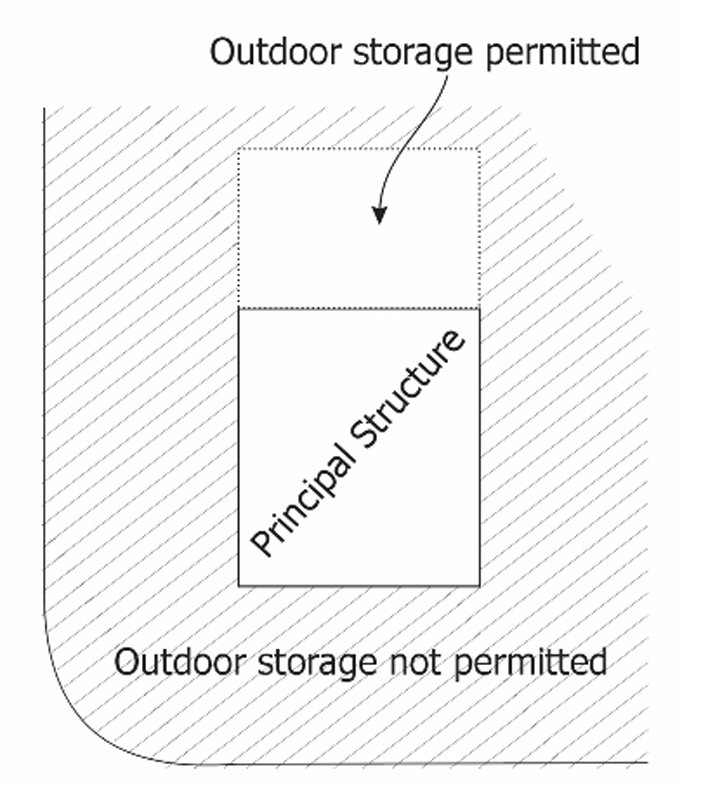
Outdoor Storage
(2)
Exceptions.
(a)
Vehicles for sale as part of a properly permitted vehicle sales or rental use (including boats and manufactured housing) shall not be considered merchandise, material or equipment subject to the restrictions of this subsection.
(b)
Such vehicles shall be located and displayed on a paved vehicle use area, clearly indicated on the site plan, and screened under the same requirements for a parking area.
(c)
Waste generated on-site and deposited in ordinary refuse containers shall not be subject to the restrictions of this subsection but shall be subject to paragraph 22.6.1(F)(3).
(d)
Dismantler's yard not allowed.
(e)
Acid manufacturing not allowed.
(3)
Site Design Standards. There are a number of site design standards that may apply to development in the F-1 district. See Chapter 6, Site Design Standards.
(Ord. 3068, § 1, November 27, 2006; Ord. 3790, § 1, July 27, 2020)
22.4.22. - F-2, Heavy Industrial.
(A)
Purpose. This industrial district is intended to provide for those heavy industrial uses and other uses not otherwise provided for in other districts. The intensity of uses permitted in this district makes it desirable that they be located down-wind and separated from residential and commercial uses whenever possible. There is no minimum lot size for the F-2 district.
(B)
District Use Table. The following uses shall be permitted or subject to review according to Section 22.4.2 in the F-2, Heavy Industrial district.
Key:
P = Permitted by Right (may be subject to standards)
S = Requires Specific Use Permit
(C)
Accessory Uses. Uses customarily incidental and secondary to the uses permitted by right.
(D)
Dimensional Standards. See Chapter 5, District Dimensional Standards.
(E)
Other District Provisions.
(1)
Storage Containers. Storage containers shall be screened from view from the public right-of-way and adjacent properties.
(2)
Exceptions.
(a)
Vehicle sales, rental or leasing facilities (including boats and manufactured housing) shall not be considered merchandise, material or equipment subject to the restrictions of this subsection.
(b)
Such vehicles shall be located and displayed on a paved vehicle use area, clearly indicated on the site plan, and screened under the same requirements for a parking area.
(c)
Waste generated on-site and deposited in ordinary refuse containers shall not be subject to the restrictions of this subsection but shall be subject to paragraph 22.6.1(F)(3).
(3)
Site Design Standards. There are a number of site design standards that may apply to development in the F-2 district. See Chapter 6, Site Design Standards.
(Ord. 3068, § 1, November 27, 2006).
22.4.23. - CBD, Central Business District.
(A)
Purpose. This district is intended to be the focus of mixed uses including commercial, office and service, and residential activities for the City. The regulations of this district reflect previously established regulations for construction and are intended to provide a method for the recognition and conservation of traditional and unique architectural structures and the continued development of such area in a manner consistent with its heritage and value to the community.
(B)
District Use Table. The following uses shall be permitted or subject to review according to Section 22.4.2 in the CBD, Central Business District.
Key:
P = Permitted by Right (may be subject to standards)
S = Requires Specific Use Permit
(C)
Accessory Uses. Uses customarily incidental and secondary to the uses permitted by right.
(D)
Dimensional Standards. The dimensional standards for all uses shall be as follows.
(E)
Other District Provisions.
(1)
Zoning map Amendment. A Zoning Map amendment to the CBD shall only be considered when proposed as an extension of the existing CBD district. To be eligible for rezoning to this district, a parcel shall abut or be directly across a public right-of-way from an existing CBD district.
(2)
Site Design Standards. There are a number of site design standards that may apply to development in the CBD district. See Chapter 6, Site Design Standards.
(3)
Residential Conversions. Residential structures may be permitted to convert to commercial usage whenever the CEUDB as part of the site plan review process of Section 22.3.6 determines that such conversion would be consistent with and in compliance with the review criteria set out in Section 22.3.6(D). All applications for residential conversions are encouraged to submit for conceptual review to the Central Edmond Urban Development Board.
(Ord. 3068, § 1, November 27, 2006; Ord. 3182, § 12, November 10, 2008; Ord. 3198, § 1, February 9, 2008; Ord. 3248, § 4, January 11, 2010; Ord. 3790, § 1, July 27, 2020; Ord. 3932, § 1, January 9, 2023)
22.4.24. - DRD, Downtown Residential.
(A)
Purpose. This residential and mixed use district is intended to be an area near schools, places of worship, parks, downtown commercial and service areas for the City. The regulations of this district reflect standards compatible with the residential characteristics and are in recognition and conservation of traditional and unique architectural structures and the continued development of this area in a manner consistent with its heritage and value as a residential neighborhood.
(B)
District Use Table. The following uses shall be permitted or subject to review according to Section 22.4.2 in the DRD, Downtown Residential district.
Key:
P = Permitted by Right (may be subject to standards)
S = Requires Specific Use Permit
(C)
Accessory Uses. Uses customarily incidental and secondary to the uses permitted by right.
(D)
Dimensional Standards.
*No building shall be permitted to be set back any further or less than the established
building line. The established building line shall be defined as the front set back
existing for 50 percent or more of the buildings on one side of the street between
two intersecting streets, except on University, East Second Street and Ayers, adjacent
to property zoned Edmond Downtown Residential district where the set back for all
structures shall be at the front property line.
(E)
Other District Provisions.
(1)
There are a number of site design standards that may apply to development in the DRD district. See Chapter 6, Site Design Standards.
(2)
Residential Conversions. Residential structures may be permitted to convert to commercial usage whenever the CEUDB as part of the site plan review process of Section 22.3.6 determines that such conversion would be consistent with and in compliance with the review criteria set out in Section 22.3.6(D). All applications for residential conversions are encouraged to submit for conceptual review to the Central Edmond Urban Development Board.
(Ord. 3068, § 1, November 27, 2006; Ord. 3198, § 2, February 9, 2008; Ord. 3932, § 1, January 9, 2023)
22.4.25. - D-1-NRC, Restricted Commercial - Nonresidential Conversions.
(A)
Purpose. This commercial district is intended for retail shops and stores that provide for the regular needs and are for the convenience of the people residing in the adjacent residential neighborhoods. This is to be a restricted district as to uses, commercial structures and design considerations due to the proximity to low density dwellings and other neighborhood facilities. There is no minimum lot size for the D-1-NRC district.
(B)
District Use Table. The following uses shall be permitted or subject to review according to Section 22.4.2 in the D-1-NRC, Residential Commercial-Nonresidential Commercial district.
Key:
P = Permitted by Right (may be subject to standards)
S = Requires Specific Use Permit
(C)
Accessory Uses.
(1)
Uses customarily incidental and secondary to the uses permitted by right.
(2)
A specific use permit in accordance with Section 22.3.3 shall be required for a drive-thru facility associated with a permitted use abutting a sensitive border as described in Section 22.6.5.
(D)
Dimensional Standards.
*When there is a dedicated alley the rear yard may be reduced to 10 feet.
(E)
Other District Provisions.
(1)
Residential Conversion. Residential structures shall not be converted to a commercial use.
(2)
Site Design Standards. There are a number of site design standards that may apply to development in the D-1-NRC district. See Chapter 6, Site Design Standards.
(Ord. 3068, § 1, November 27, 2006).
22.4.26. - F-1-A, Planned Light Industrial.
(A)
Purpose. This is an industrial district to provide for light manufacturing, assembling and fabrication and for warehousing, wholesale and service uses, where all processes, activities and storage are conducted entirely within fully enclosed buildings. There is no minimum lot size for the F-1-A district.
(B)
District Use Table. The following uses shall be permitted or subject to review according to Section 22.4.2 in F-1-A, Planned Light Industrial district.
Key:
P = Permitted by Right (may be subject to standards)
S = Requires Specific Use Permit
(C)
Accessory Uses. Uses customarily incidental and secondary to the uses permitted by right.
(D)
Dimensional Standards.
(E)
Other District Provisions.
(1)
Uses Not Permitted. A dismantler's yard, concrete batch or transit mix plant, refining or storage of petroleum products, wrecker service yard shall not be permitted in the F-1-A district.
(2)
Site Design Standards. There are a number of site design standards that may apply to development in the F-1-A district. See Chapter 6, Site Design Standards.
(F)
Sexually-Oriented Business Definitions.
(1)
Sexually-Oriented Business. An inclusive term used to describe collectively: sexually oriented cabaret; sexually oriented motion picture theater; motion picture arcade; and bathhouse. This collective term does not describe a specific land use and shall not be considered a single use category for purposes of the zoning code or other applicable ordinances.
(2)
Lingerie Modeling Studio. An establishment or business that provides the services of live models modeling lingerie, bathing suits or similar wear to individuals, couples or small groups in a room smaller than 600 square feet.
(3)
Sexually-Oriented Cabaret or Sex-Oriented Cabaret. A building or portion of a building regularly featuring dancing or other live entertainment if the dancing or entertainment which constitutes the primary live entertainment is distinguished or characterized by an emphasis on the exhibiting of specified sexual activities or specified anatomical areas for observation by customers therein.
(4)
Sexually-Oriented Cinema. A cinema or motion picture theater which shows hard-core features on more than half the days that it is open, or which is marketed as or offers features described as adult, XXX or sexually-oriented.
(5)
Sexually-Oriented Video Arcade or Sex-Oriented Video Arcade. One or more video arcade booths providing or displaying sexually-oriented media.
(6)
Video Arcade Booth. Any booth, cubicle, stall or compartment which is designed, constructed or used to hold or seat customers and is used for presenting motion-pictures or viewing publications by any photographic, electronic, magnetic, digital or other means or medium (including, but not limited to, film, video or magnetic tape, laser disc, cd-roms, books, magazines or periodicals) for observation by customers therein. The term "booth," "arcade booth," "preview booth," and "video arcade booth" shall be synonymous with the term "motion picture arcade booth".
(Ord. 3068, § 1, November 27, 2006).
22.4.27. - F-1-B, Special Industrial District, Including Limited Outdoor Storage.
(A)
Purpose. This is a specialized industrial district which provides for uses with outdoor storage, including parcels of a limited size involved in the dismantling of vehicles for the resale of parts. It is not intended to involve a large scale salvage operation involving permanent machinery, or other machinery or operations conducted outside of an enclosed building. The maximum lot area for the F-1-B district is 3 acres.
(B)
District Use Table. The following uses shall be permitted or subject to review according to Section 22.4.2 in F-1-B, Special Industrial District, Including Limited Outdoor Storage.
Key:
P = Permitted by Right (may be subject to standards)
S = Requires Specific Use Permit
(C)
Accessory Uses. Uses customarily incidental and secondary to the uses permitted by right.
(D)
Dimensional Standards.
(E)
Other District Provisions.
(1)
Wrecking Vehicles. No use shall include permanent machinery for wrecking vehicles.
(2)
Location Requirement. Uses in this district shall be located within 300 feet of the BN&SF railroad tracks or shall be located such that there is an existing industrial district adjacent to the site on four sides within 1,320 feet in each direction.
(3)
Site Design Standards. There are a number of site design standards that may apply to development in the F-1-B district. See Chapter 6, Site Design Standards.
(F)
Sexually-Oriented Business Definitions.
(1)
Sexually-Oriented Business. An inclusive term used to describe collectively: sexually oriented cabaret; sexually oriented motion picture theater; motion picture arcade; and bathhouse. This collective term does not describe a specific land use and shall not be considered a single use category for purposes of the zoning code or other applicable ordinances.
(2)
Lingerie Modeling Studio. An establishment or business that provides the services of live models modeling lingerie, bathing suits or similar wear to individuals, couples or small groups in a room smaller than 600 square feet.
(3)
Sexually-Oriented Cabaret or Sex-Oriented Cabaret. A building or portion of a building regularly featuring dancing or other live entertainment if the dancing or entertainment which constitutes the primary live entertainment is distinguished or characterized by an emphasis on the exhibiting of specified sexual activities or specified anatomical areas for observation by customers therein.
(4)
Sexually-Oriented Cinema. A cinema or motion picture theater which shows hard-core features on more than half the days that it is open, or which is marketed as or offers features described as adult, XXX or sexually-oriented.
(5)
Sexually-Oriented Video Arcade or Sex-Oriented Video Arcade. One or more video arcade booths providing or displaying sexually-oriented media.
(6)
Video Arcade Booth. Any booth, cubicle, stall or compartment which is designed, constructed or used to hold or seat customers and is used for presenting motion-pictures or viewing publications by any photographic, electronic, magnetic, digital or other means or medium (including, but not limited to, film, video or magnetic tape, laser disc, cd-roms, books, magazines or periodicals) for observation by customers therein. The term "booth," "arcade booth," "preview booth," and "video arcade booth" shall be synonymous with the term "motion picture arcade booth".
(Ord. 3068, § 1, November 27, 2006).
22.4.28. - L-1, Lake Preservation.
(A)
Purpose.
(1)
It is the purpose of this district to promote the public health, safety and general welfare and to minimize the public and private losses due to surface and subsurface water pollution and to provide for the protection of the rural environment of water supply reservoirs. It is not intended that this district provide a location for a lower or higher standard of residential or nonresidential development than is authorized in other districts. The type of uses, area and intensity of use of land which is authorized in this district is designated to encourage and protect the environmental resources of the district until urbanization is warranted and the appropriate change in district classification is made. This district is intended to preserve rural character and in specific areas is designed to:
(a)
Minimize the expenditure of public money for the costly replacement of environmental resources.
(b)
Minimize the need for additional water treatment measures and concepts associated with run-off pollution, which are generally undertaken at the expense of the general public.
(c)
Provide for the maintenance of the aesthetic value of the lake area.
(d)
Maintain a stable tax base by providing for the sound use and development of adjacent land areas in such a manner to minimize future water quality and environmental concerns.
(2)
The minimum lot area for the L-1 district is two and one-half acres.
(B)
District Use Table. The following uses shall be permitted or subject to review according to Section 22.4.2 in the L-1, Lake Preservation district.
Key:
P = Permitted by Right (may be subject to standards)
S = Requires Specific Use Permit
(C)
Accessory Uses. Uses customarily incidental and secondary to the uses permitted by right.
(D)
Dimensional Standards.
(E)
Site Design Standards. There are a number of site design standards that may apply to development in the L-1 district. See Chapter 6, Site Design Standards.
(Ord. 3068, § 1, November 27, 2006).
22.4.29. - L-2, Lake Residential.
(A)
Purpose.
(1)
It is the purpose of this district to promote the public health, safety and welfare and to minimize public and private losses due to surface water pollution and to provide for the protection of water supply reservoirs. It is not intended that this district provide a location for a lower or higher standard of residential, or nonresidential development than is authorized in other districts. The type of uses, area and intensity of use of land authorized in the district is designated to encourage and protect the environment of the district until urbanization is warranted and the appropriate change in district classification is made. This district is also intended to preserve semi-rural character and in specific areas is designed to:
(a)
Minimize the expenditure of public money for the costly replacement of environmental resources.
(b)
Minimize the need for additional water treatment measures and concepts associated with over use of the environment which are generally undertaken at the expense of the general public.
(c)
Maintain a stable tax base by providing for the sound use and development of adjacent land areas in such a manner as to minimize water quality, environmental and aesthetic concerns.
(2)
The minimum lot area for the L-2 district is 90,000 square feet.
(B)
District Use Table. The following uses shall be permitted or subject to review according to Section 22.4.2 in the L-2, Lake Residential district.
Key:
P = Permitted by Right (may be subject to standards)
S = Requires Specific Use Permit
(C)
Accessory Uses. Uses customarily incidental and secondary to the uses permitted by right.
(D)
Dimensional Standards.
*If city water and/or sanitary sewer lines serve the lot or building site the minimum
lot area may be reduced to 60,000 square feet excluding the street or road right-of-way
adjacent to the lot or building site.
**50 feet on cul-de-sac turn-a-rounds.
(E)
Site Design Standards. There are a number of site design standards that may apply to development in the L-2 district. See Chapter 6, Site Design Standards.
(Ord. 3068, § 1, November 27, 2006).
22.4.30. - L-5, Restricted Lake Commercial.
(A)
Purpose. This special purpose district is intended for retail sales and service that provide for the needs of the people visiting the lake area. This is to be a restricted district as to uses and site considerations due to the low density of the area and the proximity to the lake recreation areas and the municipal water supply.
(B)
District Use Table. The following uses shall be permitted or subject to review according to Section 22.4.2 in the L-5, Restricted Lake Commercial district.
Key:
P = Permitted by Right (may be subject to standards)
S = Requires Specific Use Permit
(C)
Accessory Uses. Uses customarily incidental and secondary to the uses permitted by right.
(D)
Dimensional Standards.
*If city water and/or sanitary sewer lines serve the lot or building site the minimum
lot area may be reduced to 60,000 square feet excluding the street or road right-of-way
adjacent to the lot or building site.
(E)
Site Design Standards. In addition to those listed below, there are a number of site design standards that may apply to development in the L-5 district. See Chapter 6, Site Design Standards.
(1)
Building Orientation. Commercial uses shall be oriented to the primary arterial street.
(2)
Parking Area Location. Off-street parking areas shall be located in the rear yard or interior side yard of all commercial lots. Off-street driveways /drive approaches may be located in the street yard or side yard on corner lots, but not off-street parking areas.
(Ord. 3068, § 1, November 27, 2006).
22.4.31. - D-LU, Light Commercial, Limited Use.
(A)
Purpose. This special purpose district is intended for limited light commercial uses in unique locations. This district should be applied only upon the specific request of the landowner and then applied to not more than three uses permitted by right in the D-1, Restricted Commercial district. In general, this district shall be used to allow low-impact commercial uses where such use is appropriate but where other commercial uses would create incompatibilities with the surrounding area and land uses.
(B)
Permitted Uses.
(1)
The permitted uses in this district shall be designated in the Zoning Map amendment application and reviewed in accordance with Section 22.3.2.
(2)
Only properties zoned C-2, C-3, D-O or more intense shall be eligible for a Zoning Map amendment to the D-LU district. The D-LU designation may apply to vacant property or to existing structures, unless such property or structure is prohibited from being converted to a commercial use.
(3)
The landowner may choose a minimum of one, but no more than three uses permitted by right in the D-1, Restricted Commercial district in submitting a Zoning Map amendment application for the D-LU district. Such uses shall be stated in the ordinance authorized by the City Council.
(4)
If the City Council approves the Zoning Map amendment, a D-LU numerical designation shall be shown on the Zoning Map and the list of uses stated in the ordinance shall not be modified without the approval of an additional Zoning Map amendment in accordance with Section 22.3.2.
(C)
Dimensional Standards. Dimensional standards applicable to the district shall be the dimensional standards in the D-1, Restricted Commercial district, including sensitive border requirements, if applicable.
(D)
Site Design Standards. There are a number of site design standards that may apply to development in the D-LU district. See Chapter 6, Site Design Standards.
(Ord. 3068, § 1, November 27, 2006).
22.4.32. - E-LU, General Commercial, Limited Use.
(A)
Purpose. This special purpose district is intended for limited community commercial uses in unique locations. This district should be applied only upon the specific request of the landowner and then applied to not more than three uses permitted by right in the E-1 General Commercial districts. In general, this district shall be used to allow higher-impact commercial uses where such use is appropriate but where other commercial uses would create incompatibilities with the surrounding area and land uses.
(B)
Permitted Uses.
(1)
The permitted uses in this district shall be designated in the Zoning Map amendment application and reviewed in accordance with Section 22.3.3.
(2)
Only properties zoned D-1, D-2 or D-2-A shall be eligible for a Zoning Map amendment to the E-LU district. The E-LU designation may apply to vacant property or to existing structures, unless such property or structure is prohibited from being converted to a commercial use.
(3)
The landowner may choose a minimum of one, but no more than three uses permitted by right in the E-1 General Commercial district except telecommunication tower, in submitting a Zoning Map amendment application for the E-LU district. Such uses shall be stated in the ordinance authorized by the City Council.
(4)
If the City Council approves the Zoning Map amendment, a E-LU numerical designation shall be shown on the Zoning Map and the list of uses stated in the ordinance shall not be modified without the approval of an additional Zoning Map amendment in accordance with Section 22.3.2.
(C)
Dimensional Standards. The dimensional standards applicable to the primary use shall be the dimensional standards of the E-1, General Commercial district, including sensitive border requirements, if applicable.
(D)
Site Design Standards. There are a number of site design standards that may apply to development in the E-LU district. See Chapter 6, Site Design Standards.
(Ord. 3068, § 1, November 27, 2006; Ord. 3182, § 13, November 10, 2008)
22.4.33. - PUD, Planned Unit Development District.
(A)
Purpose.
(1)
It is the purpose of the PUD, Planned Unit Development district to encourage unified design of housing, commercial, industrial or institutional areas and facilities, or combinations thereof, to provide for integrated developments having harmony of design and variety of function. This district is intended to provide for a greater flexibility in the design of buildings, yards, courts and circulation than would otherwise be possible through the strict application of the regulations in this Ordinance, and to produce:
(a)
A maximum choice in the types of environment and living units available to the public;
(b)
Open space and recreation areas;
(c)
A pattern of development which preserves trees, outstanding natural topography, and geologic features, and prevents soil erosion;
(d)
A creative approach to the use of land and related physical development;
(e)
An efficient use of land resulting in smaller networks of utilities and streets and thereby lower housing costs; and
(f)
An environment of stable character in harmony with surrounding development; and
(g)
A more desirable environment than would be possible through the strict application of the regulations in this Ordinance.
(2)
This district is designed to provide for small and large scale developments incorporating a single type or a variety of residential and related uses which are planned and developed as a unit. Such development may consist of individual lots or it may have common building sites. Common land shall be an essential and major element of the plan which is related to and affects the long-term value of the homes and other development. A Planned Unit Development (PUD) shall be a separate entity with a distinct character in harmony with surrounding development.
(B)
PUD Authorized. A PUD may be authorized, providing that all of the following provisions are met.
(1)
Location. A PUD shall be permitted in any district or any location in the city.
(2)
Design Characteristics. The proposed PUD shall be designed to provide for the unified development of the area in accordance with the spirit and purpose of the district in which the unit is located. The design may provide for modification of minimum yard and maximum height requirements on individual lots, but the use, density, intensity of use and coverage requirements for the district as applied to the total area of the PUD, and the minimum dimensions established for the design of courtyards shall not be reduced. Except if otherwise approved for the PUD Master Plan all uses, construction, and requirements in the PUD shall comply with this Title.
(a)
Number of Permitted Dwelling Units. The maximum number of dwelling units within a PUD shall be based on calculation of gross density. Gross density shall be established in the PUD master plan and shall be calculated by dividing the total land area to be developed for residential uses (exclusive of arterial streets) by the number of dwelling units.
(b)
Off-Street Parking. The off-street parking requirements, as established in Section 22.6.1, may be met by providing one or more permanent, common, off-street parking facilities for all uses within the development, provided that the parking facility contains the requisite number of spaces for each use and that the spaces provided for permanent residents shall be clearly designated and separated from spaces provided for employees, customers and service. The total spaces provided shall not be less than the sum of the individual requirements and the spaces required for each use, and shall be under the ownership of permanent control of the owners for the use for which the spaces are required.
(3)
Mixed Uses. Structures in PUDs containing both residential and nonresidential uses shall be designed, located, and oriented on the site so that such uses are directly accessible to residents of the PUD. For the purposes of this Section, "directly accessible" shall mean pedestrian or bicycle and automobile access by way of improved sidewalks or paths and streets that do not involve leaving the PUD or using a major thoroughfare. "Directly accessible" does not necessarily mean that nonresidential uses need to be located in a particular location but that the siting of such uses considers the accessibility of the residential component of the PUD to the nonresidential use.
(4)
Effect. Approval of a PUD shall create a special PUD District for the affected property. The provisions of the PUD Master Plan shall provide for the minimum requirements for all improvements and uses to be constructed within the affected PUD property. The entire PUD Master Plan shall be construed as a single inter-related approval.
(Ord. 3068, § 1, November 27, 2006; Ord. 3249, § 2, January 11, 2010)
22.4.34. - F/SD, Fraternity and Sorority Overlay District.
(A)
Purpose. The purpose of the Fraternity and Sorority Overlay district is to identify locations that are most suited to the establishment of fraternity and sorority houses. The district provides a convenient location to the University of Central Oklahoma campus and the character of the surrounding area provides for other multiple-family dwellings suitable for remodeling or for the construction of new buildings.
(B)
Applicability. The following described area is identified as the F/SD overlay district boundary (see attached map).
Generally located between 2nd Street and Danforth Rd, and N. Boulevard and Blackwelder Ave. and more particularly described as:
A part of Section Twenty-Five (25), Township Fourteen North (14N), Range Three West (3W) of the Indian Meridian, Edmond, Oklahoma County, Oklahoma.
The boundary begins on the centerline of Boulevard at a distance of 971 feet from the southwest corner of said Section, also being perpendicular to the northwest corner of Classens 5th addition, then it extends north along the centerline of Boulevard to the intersection of the centerlines of Lincoln Ave. and Boulevard, then east along the centerline of Lincoln Ave. to a point on the southwest corner of the parcel which is according to Oklahoma County records 403 E Lincoln Ave., then east along the southern parcel boundary to the southeast corner of said parcel, then north along the eastern parcel boundary to the northeast corner of said parcel, then east along the southern parcel boundary to the southeast corner of that parcel which is 1004 Jacobs St., according to Oklahoma County records, then north along the eastern boundary of said parcel to the northwest corner of Lot 17, Block 1, College View Addition, also being 911 N. Washington St., then northeasterly along the northern boundary of said parcel to the northeastern corner of same parcel, then to the southwest corner of Lot 15, Block 2, College View Addition, said parcel being 920 Washington St, then northeasterly along the southern boundary of said parcel to the southeast corner of same parcel, then in a northerly direction along the eastern boundary of Lot(s) 15, 14, 13, 12, 11, 10, 9, 8, 7, 6, 5, 4, 3, 2, 1, Block 2, College View Addition to the northeastern corner of said addition, then east to the northwest corner of Lot(s) 1, 2, Block 5, College View 2nd Addition, then south along the western boundary of Lot(s) 1, 2, 3, 4, Block 5, College View 2nd Addition, then easterly along the southern boundary of Lot 4, Block 5, College View 2nd Addition, then easterly along the southern boundary of Lot(s) 2, 3, Block 6, College View 2nd Addition to a point on the northwest corner of Lot 1, Block 7, College View 2nd Addition, then east to the northwest corner of the parcel which is 1200 Chowning Avenue, then east to the northeast corner of said Lot, then south along the eastern parcel boundary to the centerline of Crown Street, then east to the intersection of the centerlines of Crown Street and Chartrand, then south along the centerline of Chartrand to the northern edge of Lot 1, Block 7, Chowning Heights 4th Addition, then west to the northwest corner of said Lot 1, Block 7, also being the western boundary of Chowning Heights 3rd Addition, then south to the southwestern corner of Lot 3, Block 7, Chowning Heights 4th Addition, then east 86 feet, then south 1161 feet to the intersection of the centerlines of Chartrand and Thatcher St, then east along the centerline of Thatcher St to the intersection of the centerlines of Thatcher St. and Blackwelder Ave., then south along the centerline of Blackwelder Ave. to the intersection of the centerlines of Blackwelder and Main St., then west along the centerline of Main St. to the intersection of the centerlines of Main St. and Baumann, then south along the centerline of Baumann to the intersection of the centerlines of Baumann and 2nd St., then west along the centerline of 2nd St. to the intersection of the centerlines of 2nd St. and University Dr., then north along University Dr. to the intersection of University Dr. and the northern boundary of Classens 5th Addition, also being perpendicular to the northeastern corner of Lot 1, Block 1, Classens 5th Addition, then in a northwesterly direction along the northern boundary of Lot(s) 1 - 16, Block 1, Classens 5th Addition to the Point of Beginning, being on the centerline of Boulevard at a distance of 971 feet from the southwest corner of said Section.
(C)
Site Plan Required. Within the boundaries of the F/SD overlay district, fraternity and sorority houses may be located or structures may be converted with the approval of a site plan meeting the standards of Section 22.6.10. Property within this boundary may be used for the purpose of a fraternity or sorority house regardless of the underlying zoning district.
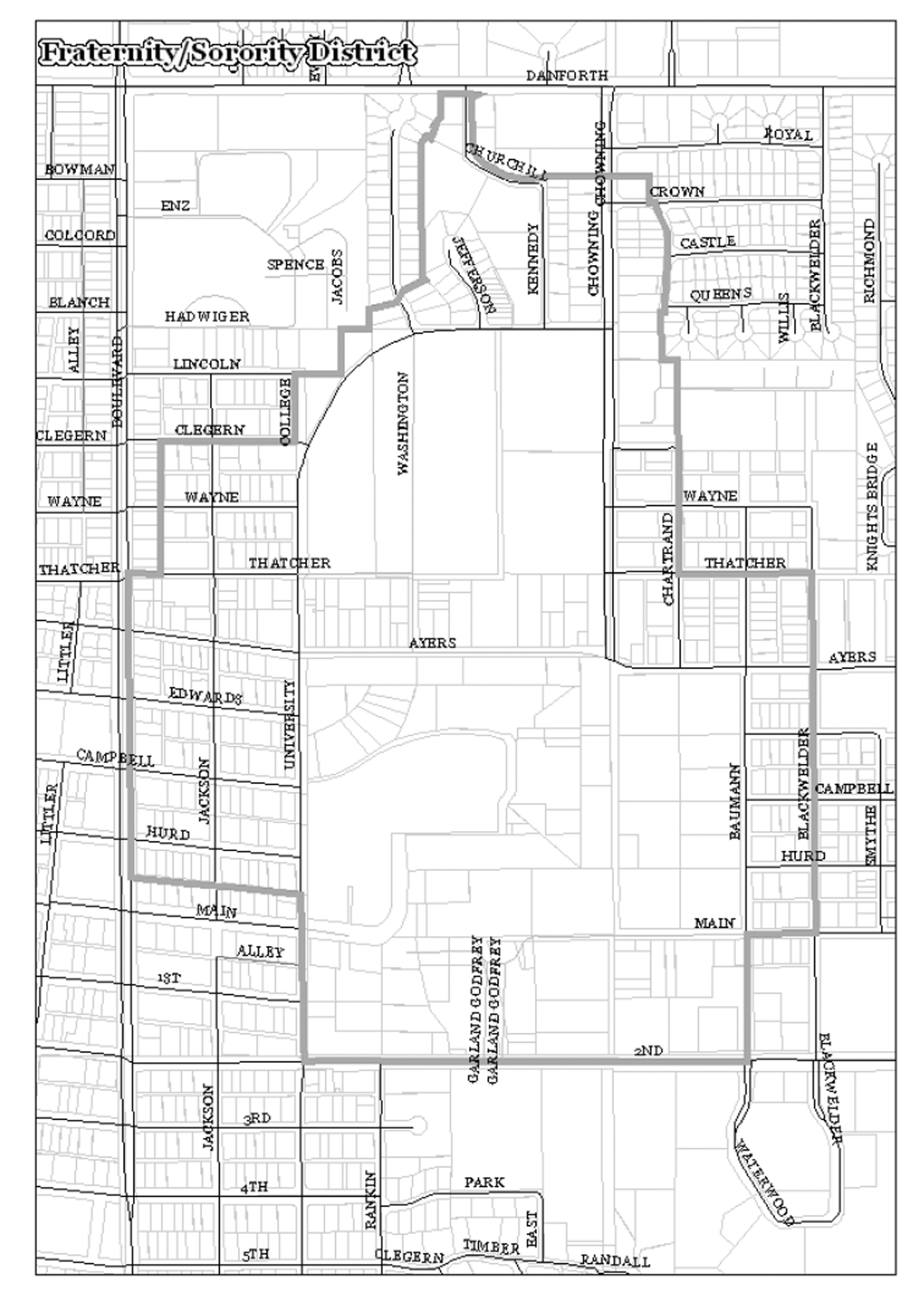
Fraternity/Sorority district
(Ord. 3068, § 1, November 27, 2006).
22.4.35. - Use Definitions.
(A)
General.
(1)
Basis for Classification. These use definitions classify land uses and activities based on similar functional, product, or physical characteristics. Characteristics include the type and amount of activity, the type of customers or residents, how goods or services are sold or delivered, likely impact on surrounding properties, and site conditions.
(2)
Considerations Regarding Principal Uses. The following shall be used to determine the appropriate category for a use not specifically listed in the district use tables or the examples in the use definition tables below and whether a use is considered principal or accessory:
(a)
The actual or projected characteristics of the activity in relationship to the stated characteristics of each use category;
(b)
The relative amount of site area or floor space and equipment devoted to the activity;
(c)
The customer type for each activity;
(d)
Hours of operation;
(e)
Building and site arrangement;
(f)
Vehicles used and their parking requirements;
(g)
The relative number of vehicle trips generated;
(h)
Required signage;
(i)
How the use is advertised;
(j)
The likely impact on surrounding properties; and
(k)
Whether the activity is likely to be found independent of the other activities on the site.
(3)
Developments with Multiple Principal Uses. Developments with multiple principal uses shall conform to the following.
(a)
When all principal uses of a development fall within one use category, the entire development shall be assigned to that use category.
(b)
When the principal uses of a development fall within different use categories, each principal use is classified in the applicable use category and each use shall be subject to all applicable regulations for that use category.
(c)
Developments with multiple principal uses (such as shopping centers) shall incorporate only those uses allowed in the underlying district.
(4)
Principal Uses. The "Principal Uses" column of each use category lists uses common to that use category.
(a)
A principal use is assigned to the use definition that most closely corresponds to its nature as described in the "Characteristics" subsection of each use category.
(b)
The "Principal Uses" portion of each use definition table lists principal uses common to that use category. The names of these uses are generic and are based on common meanings, not on what a specific use may call itself.
(c)
The uses provided are not all-inclusive, but describe the types of uses that are common to that category. Uses similar to those listed may also be permitted upon determination by the Planning Director that they are appropriate for that use category.
(B)
Residential Uses.
(1)
Household Living.
Characteristics: Residential occupancy of a dwelling unit by a household on a month-to-month or longer basis.
Principal Uses:
Single-family detached dwelling
Single-family attached dwelling
Zero lot line dwelling
Two-family dwelling
Townhouse
Multiple-family dwelling
Manufactured home, located in a manufactured home subdivision
Manufactured home park
(2)
Group Living.
Characteristics: Residential occupancy of a structure by a group of people that does not meet the definition of Household Living. Tenancy is usually arranged on a monthly or longer basis. Generally, Group Living structures have a common eating area for residents, and the residents may receive care, training, or treatment.
Principal Uses:
Convalescent, rest or nursing, or extended care facility
Fraternity or sorority house
Rooming or boarding house
(C)
Public and Civic Uses.
(1)
Community Service.
Characteristics: Uses of a public, nonprofit, or charitable nature providing professional service of an ongoing education, training, or non-correctional counseling to the general public, on a regular basis, without a residential component.
Principal Uses:
Art/photography gallery or studio
Assembly hall
Conference center
Library
Museum
(2)
Day Care.
Characteristics: Day Care uses provide care, protection and supervision for children or adults on a regular basis away from their primary residence for less than 24 hours per day.
Principal Uses:
Child care center
Preschool
(3)
Educational Facilities.
Characteristics: Public and private (including charter or religious) schools at the primary, elementary, middle, junior high, or high school level that provide basic academic education. Also includes colleges and other institutions of higher learning that offer courses of general or specialized study leading to a degree usually in a campus setting.
Principal Uses:
College or university
Public, private or charter elementary or secondary school
(4)
Government Facilities.
Characteristics: Offices for local, state, or federal government.
Principal Uses:
Municipal, county, state or federal buildings
(5)
Medical Facilities.
Characteristics: Uses providing medical or surgical care to patients possibly offering overnight care.
Principal Uses:
Dental or medical clinic
Hospital
(6)
Parks and Open Areas.
Characteristics: Uses focusing on natural areas consisting mostly of vegetation, passive or active outdoor recreation areas, or community gardens, and having few structures.
Principal Uses:
Cemetery
Country club
Golf course
Park
Zoological or botanical garden
(7)
Passenger Terminal.
Characteristics: Facilities for the takeoff and landing of airplanes and helicopters, and terminals for taxi, rail or bus service.
Principal Uses:
Airport
Bus terminal
(8)
Place of Worship.
Characteristics: Places of assembly that provide meeting areas for religious practice.
Principal Uses:
Church
Mosque
Meeting Hall
Synagogue
Temple
(9)
Funeral Parlor or Mortuary.
Characteristics: Places that provide for funeral and mortuary services and related assembly areas.
Principal Uses:
Funeral Homes
(D)
Commercial Uses.
(1)
Indoor Recreation.
Characteristics: Participatory and spectator-oriented recreation and entertainment uses conducted within an enclosed building.
Principal Uses:
Dance hall
Game room using any type of machines including computers
Indoor recreation center
Lodge
Movie or other indoor theater
Private club
Roller skating rink
Bowling alley
(2)
Office.
Characteristics: Activities conducted in an office setting and generally focusing on business, government, professional, medical, or financial services. These uses are compatible with residential uses and generate minimal traffic. Accessory uses generally have no external access or signs.
Principal Uses:
Bank or other financial institution
Computer and data processing service
Professional or administrative office
Medical marijuana research facility
Medical marijuana testing laboratory
Television or radio studio without antenna
Travel agency
(3)
Outdoor Recreation.
Characteristics: Participatory and spectator-oriented recreation and entertainment uses conducted in open, partially enclosed, or screened facilities.
Principal Uses:
Driving range
Miniature golf
Outdoor recreation center
Race track or drag strip
Skeet or trap shooting range
Theater, outdoor
(4)
Overnight Accommodation.
Characteristics: Residential units arranged for short term stays of less than 30 days for rent or lease.
Principal Uses:
Bed and Breakfast
Extended stay facility
Hotel
Motel
Travel trailer park
(5)
Restaurants.
Characteristics: Establishments that prepare and sell food for on- or off-premise consumption.
Principal Uses:
Delicatessen
Fast-food restaurant
Full service restaurant with waiter/waitress service
High turnover restaurant
Restaurant, drive-in
Restaurant, drive-through
Tavern, sports bar
(6)
Retail Sales and Service.
Characteristics: An establishment primarily engaged in the sale, lease or rent of new or used products to the general public, including those providing personal services, entertainment, product repair or sales of consumer goods.
Principal Uses:
Sales-Oriented
Stores selling, leasing, or renting consumer, home, and business goods including: antiques, appliances, art supplies, auto supplies (except tires), baby goods, baked goods at retail,, camera, candy, clothing, convenience goods, electronics, flowers, furniture, gifts, groceries, ice cream, jewelry, keys, leather, liquor, media (books, music, videos), medical marijuana products, musical instruments, office supplies, optical goods, pets, pharmaceuticals, plants, specialty foods, specialty home improvements, sporting goods, tea and coffee, toys or lawful combination of the above (e.g. department store)
Personal Service-Oriented
Art school, business college, conservatory or trade school
Catering establishment
Dry cleaner
Fitness center
Hair, nail, tanning, massage therapy, reflexology and personal care service
Laundromat
Metaphysical counseling
Palm reader or psychic
Printing or copy business
Tailor
Veterinarian
Yoga studio
Repair-Oriented
Establishments repairing appliances, computers, furniture, electronics, musical instruments or office equipment
(7)
Vehicle Sales and Service.
Characteristics: Direct sales of and service to passenger vehicles, light and medium trucks, and other consumer motor vehicles such as motorcycles, boats, and recreational vehicles.
Principal Uses:
Boat sales and service
Car wash, automated or self-service
Convenience store or fuel sales
Farm implement sales and service
Manufactured home and camper sales
Trailer sales and service
Vehicle sales, rental, or leasing facilities
Vehicle body shop
Vehicle service facility (lubrication, tires sales, etc.)
(E)
Industrial Uses.
(1)
Storage Facility.
Characteristics: Facilities providing separate storage areas for personal or business use designed to allow private access by the tenant for storing or removing personal property.
Principal Uses:
Boat and recreational vehicle storage
Self-storage facility
(2)
Warehouse and Freight Movement.
Characteristics: Firms involved in the storage or movement of goods for themselves or other firms. Goods are generally delivered to other firms or the final consumer with little on-site sales activity to customers.
Principal Uses:
Contractor's equipment storage
Industrial equipment storage
Freight or truck terminal
Oil field equipment storage or storage warehouse
(3)
Wholesale Trade.
Characteristics: Firms involved in the sale, lease, or rent of products primarily intended for industrial, institutional, or commercial businesses. The uses emphasize on-site sales or order-taking and often include display areas. Businesses may or may not be open to the general public, but sales to the general public are limited. Products may be picked up on-site or delivered to the customer.
Principal Uses:
Building material sales
Medical marijuana commercial grower
Plant nursery
Wholesale distribution center
(4)
Light Industrial Service.
Characteristics: Firms engaged in the manufacturing, assembly, repair or servicing of industrial, business, or consumer machinery, equipment, products, or by-products mainly by providing centralized services for separate retail outlets. Contractors and building maintenance services and similar uses perform services off-site. Few customers, especially the general public, come to the site.
Principal Uses:
Manufacturing or assembling of cabinets, electronics, furniture, jewelry or watches, medical or dental products, meters, musical instruments, novelties, optical goods, paper products, sporting goods, or toys
Bakery (non-retail)
Bottling works
Book bindery
Crematorium
Engraving plant
Food processing and packaging
Furniture repair and upholstery
Laboratory, research or experimental
Medical marijuana commercial grower
Medical marijuana processor
Medical marijuana research facility
Medical marijuana testing laboratory
Plant nursery
Wrecker service yard
(5)
Heavy Industrial.
Characteristics: Firms involved in fabrication and assembly operations; industrial/manufacturing activities. The uses emphasize industrial businesses, and sale of heavier equipment. Factory production and industrial yards are located here. Sales to the general public are limited.
Principal Uses:
Manufacturing, assembling or compounding of acid, bearings, canvas, cellophane, cement, ceramic products, cloth, cork, commercial advertising structures, communication equipment, cosmetics, dairy products, drugs, electric or neon signs, engines, felt, fiber, gas, glass, gypsum, HVAC equipment, leather goods, lime, machinery, perfume, pharmaceuticals, plaster of Paris, plastic, rubber and metal stamps, sheet metal, shell, textiles, tobacco, toiletries, valves, or wiring equipment;
Concrete batch or transit mix plant
Foundry
Machine shop
Printing plant
Refining or storage of petroleum products
Sign painting shop
Dismantler's yard
Recycling center
Salvage yard
(6)
Artisan Industry:
Characteristics: Small-scale fabrication, preparation, or production of goods by an artist, artisan, craftsperson, or cook, on the premises for wholesale, on-site, or online retail. Spaces and tools may be shared amongst users. Accessory uses include retail, teaching of these skills to others in the course of preparation or production, and outdoor seating areas, and incidental interior seating areas. Specific artisan industry uses shall be divided into the following two Principal Uses:
Principal Uses:
Artisan Industry, Low Intensity. This category is intended to include activities relating to small-scale arts, crafts, food and beverage production. Examples include but are not limited to small-scale sculpting or arts and crafts; small-batch bakeries, candy shops, and cheese shops; small scale-distilleries and -breweries (as defined by the State of Oklahoma) and other small-scale food and beverage producers; small-scale production of textiles, jewelry, and other artisan consumer goods.
Artisan Industry, High Intensity. The intent of this category is to separate more intensive activities from those described in Class 1. Examples include but are not limited to small-scale welding, metalworking, glass working, and firing of pottery or sculpture in kilns; small batch hardware and prototyping.
(F)
Other Uses.
(1)
Agriculture.
Characteristics: Characterized by uses that create and preserve areas intended primarily for the raising of animals and crops, and the secondary industries associated with agricultural production.
Principal Uses:
Animal raising or breeding including: bees, fish, cows, sheep, goats, poultry, rabbits, or other small animals
Animal hospital
Agricultural crops including: floriculture, horticulture, pasturage, row and field crops, tree or sod farms, or silviculture
Dairying
Equine hospital
Feed store
Keeping of horses
Kennel
Medical marijuana commercial grower
Plant nursery
Public stable
Sale barn
(2)
Mineral Extraction.
Characteristics: Characterized by uses that extract minerals and other solids and liquids from land.
Principal Uses:
Drilling for oil or natural gas
Extraction of sand, gravel or minerals
(Ord. 3068, § 1, November 27, 2006; Ord. 3182, § 14, November 10, 2008; Ord. 3790, § 1, July 27, 2020; Ord. 3932, § 1, January 9, 2023)
22.4.36. - Supplemental Use Standards.
(A)
Single-Family Detached Dwelling. A single-family detached dwelling shall be permitted for occupancy by employees in the operation and maintenance of farms and ranches of 80 acres or more.
(B)
Townhouse. A townhouse shall be permitted provided that the townhouse does not exceed eight units per building.
(C)
Upper-Story Dwelling. An upper-story dwelling shall be permitted subject to the following standards.
(1)
The residential use shall be clearly secondary to the primary commercial use. The gross floor area of the entire building shall include not more than 50 percent residential uses.
(2)
Separate designated parking spaces for use by the residential units are required.
(D)
Zero Lot Line Dwelling. A zero lot line dwelling, with one side lot line of zero feet, shall be permitted subject to the following standards.
(1)
A minimum building separation of 12 feet shall be maintained between all zero lot line units.
(2)
An easement between the two property owners to allow for maintenance or repair of the house is required when the roof overhang or side wall of the house are within four feet of the adjacent property line. The easement on the adjacent property must provide at least five feet of unobstructed space. The easement shall be recorded on the deed for the lot where the projection occurs.
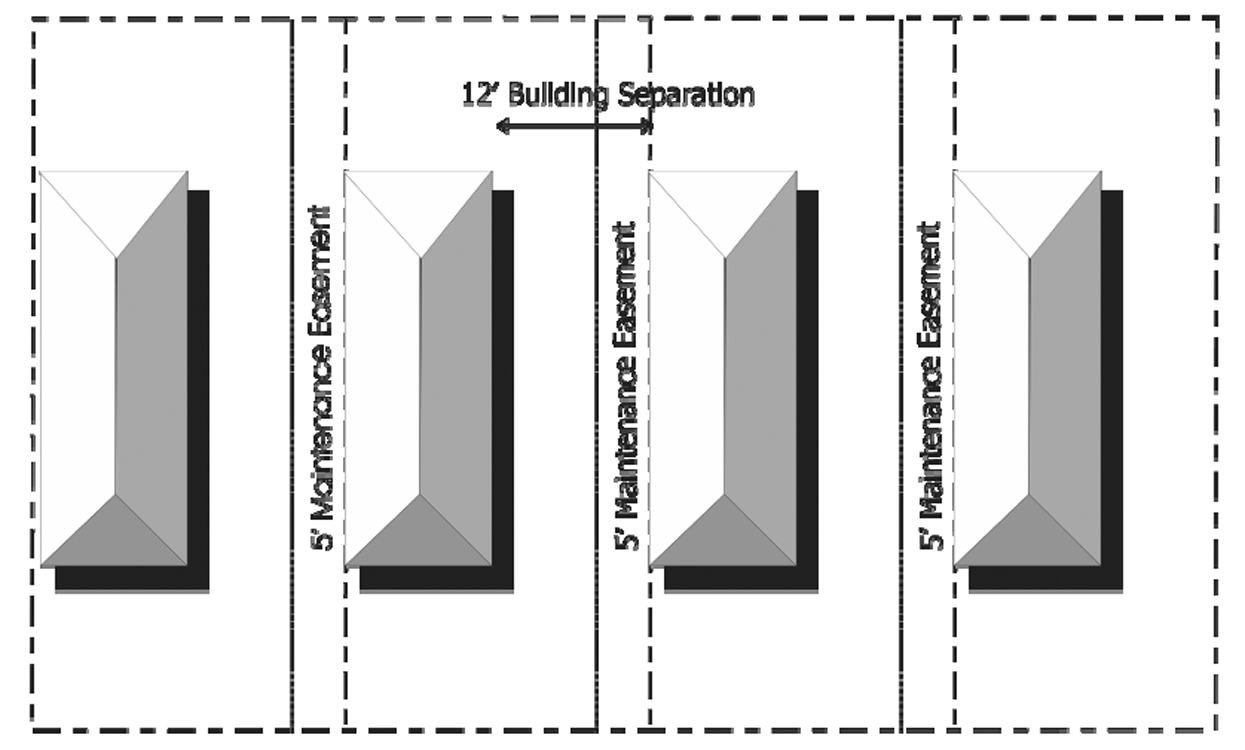
Zero Lot Line Dwelling
(3)
The eaves adjacent to the reduced yard may project a maximum of 18 inches over the side property line.
(4)
If the sidewall of the house is on the property line, or within three feet of the property line, windows or other openings that allow for visibility into the side yard of the adjacent lot are not allowed. Windows that do not allow visibility into the side yard of the adjacent lot, such as a clerestory window or a translucent window, are allowed.
(5)
Any rain gutters must be positioned so that they drain onto the lot of the house to which they are attached.
(E)
Telecommunications Towers and Antennas. Telecommunications towers and antennas, as defined in subsection (7) below, shall be subject to the following minimum dimensional and design standards.
(1)
Applicability of Regulations.
(a)
Shall apply in districts where a telecommunications tower is allowed by right or Specific Use Permit.
(b)
If there is already a lawful telecommunications tower on the site, an additional antenna may be allowed if installed on that tower or other preexisting structure where antennas have been approved.
(2)
Uses.
(a)
Permitted Use. Unless specifically exempted, a telecommunication tower or antenna shall comply with all provisions of the City Code. A tower that is a permitted use in a district use table shall require only the issuance of a building permit.
(b)
Specific Use.
i.
If the tower requires a specific use permit in a district use table, then such permit shall be required for the placement or erection of a tower or antenna pursuant to Section 22.3.3.
ii.
In addition to the requirements of Section 22.3.3, an applicant shall also submit the additional information required in paragraph (9) below.
iii.
Telecommunications towers requiring a specific use permit shall be subject to the specific use standards set forth in paragraph (3).
(3)
Standards Applicable to Construction of All Towers. The following standards shall apply to any tower, freestanding antenna or antenna to be attached to another structure:
(a)
No commercial advertising shall be allowed on a tower or antenna.
(b)
No signals, lights or illumination shall be permitted on a tower or antenna, unless required by the Federal Aviation Administration (FAA). Should lighting be required by State or Federal law, the lighting shall be placed on the tower and designed in such a way as to minimize the glare on adjacent residential properties.
(c)
Light fixtures may be attached if it is part of the design incorporated into the tower structure to be used for the illumination of athletic fields, parking areas, public right-of-way or other similar areas. Lighting of the accessory buildings for basic security purposes is permissible but may not result in unnecessary glare on adjacent properties
(d)
Towers and other facilities shall be sited to have the least practical adverse visual effect on the environment. Towers shall not be lighted except to assure human safety as required by the FAA. Towers shall be a galvanized finish or painted gray unless other standards are required by the FAA. Monopole towers shall be used. Towers shall be designed and sited so as to avoid, whenever possible, application of FAA lighting and painting requirements.
(e)
Subject to the requirements of this Section, more than one antenna may be attached to, or placed upon, the same structure.
(f)
A certified report from a qualified professional structural or electrical engineer that is licensed to practice in the State of Oklahoma, that:
i.
The tower or antenna is in compliance with the current edition of the National Electrical Safety Code (NESC) and prudent electric utility practices;
ii.
The tower or antenna conforms to the latest structural standards and wind loading requirements of the International Building Code; and
iii.
The tower or structure is able to safely support the proposed antenna and associated attachments.
(4)
Maintenance Standards Applicable to All Antennas and Towers. The following maintenance and operating standards shall apply to any tower, freestanding antenna or antenna to be attached to another structure:
(a)
Any tower, antenna or other facility that is not in use for a period of three years or more shall be removed by the owner at the owner's expense. Failure to remove the tower or antenna pursuant to non-use may result in removal and assessment of cost to the property as a nuisance.
(b)
The owner or operator shall at all times employ at least ordinary care and shall install, maintain and use commonly accepted methods and devices for preventing failures and accidents which are likely to cause damage, injuries or nuisances to the public.
(5)
Co-Located Antennas and Facilities (not Freestanding). Antennas erected upon, or attached to, existing structures shall be subject to standard yard and height requirements but shall not occupy more than 25 percent of the total roof area.
(6)
Freestanding New Towers - Design Standards. The following standards shall apply to freestanding antennas or new towers to be used to hold or support one or more antennas, in addition to the standards to be used in determining whether to permit such tower under subsection 22.3.3(E).
(a)
Height. No free-standing tower shall exceed 130 feet in height, unless approved with a specific use permit as a height variance when requested in an applicable district. In no event shall any tower exceed 180 feet in height.
(b)
Yards.
i.
The towers shall be setback from the property line in all directions a distance at least the height of the tower where the tower adjoins a residential district;
ii.
The tower shall be setback from the property line in all directions the distance required in the underlying district.
(c)
Other Design Standards.
i.
All freestanding towers shall be designed to accommodate at least three, two-way antennas for every 130 feet of tower height. The above requirements may be modified to provide the maximum number of compatible users within the radio frequency emission levels.
ii.
With the exception of necessary electric and telephone service and connection lines approved by the City, no part of any tower or antenna, nor any lines, cable, equipment, wires or braces in connection with either, shall at any time extend across or over any part of the public right-of-way, sidewalk, utility easement or property line.
iii.
Towers shall be of a monopole design. The use of guyed or lattice towers is prohibited.
iv.
Every freestanding tower shall be protected from trespassers in order to discourage the climbing of the tower by unauthorized persons.
v.
Towers shall be constructed so that if a failure does occur, the tower will collapse onto itself and will not fall onto structures near the site.
vi.
Mobile or immobile equipment not used in direct support of a tower facility shall not be stored or parked on the site, unless repairs to the tower or antenna are being made.
vii.
No tower shall have a platform, crow's nest or like structure around it, or attached to it, except while under construction or repair.
viii.
Lighting of the accessory buildings for basic security purposes is permissible but may not result in unnecessary glare on adjacent properties.
ix.
All accessory buildings or structures shall meet all building design standards as listed in this Chapter, shall require a building permit issued by the Building Department and shall conform with the height restrictions and yards established for the site's district. All buildings, structures and equipment accessory to a tower or antenna shall be designed to blend in with the surrounding environment through the use of color, camouflage and architecture. If located in or adjoining a residential district, the tower shall be surrounded by a landscaped buffer.
(7)
Telecommunication Tower Definitions. None of the below definitions or requirements pertaining to towers or antennas shall apply to federal, state or local government operations for any utility, emergency, communications, traffic, or any other health, safety and welfare purpose.
(a)
Antenna. Any structure or device used for the purpose of collecting or radiating electromagnetic waves including, but not limited to, directional antennas such as panels, microwave dishes, satellite dishes, and omni-directional antennas such as a whip antennas. This definition specifically includes devices used for television, radio and communications.
(b)
Antenna, Broadcasting. A tower and antenna combination for the transmission of licensed radio and television broadcasting.
(c)
Antenna, Amateur Radio. A tower and antenna combination used by a licensed amateur radio operator for amateur radio reception and transmission, with no commercial activity.
(d)
Satellite Dish. Any antenna that is designed to receive direct broadcast satellite service including direct-to-home satellite services and video programming services, via multi-point distribution services and including multi-channel multi-point distribution services, instructional television fixed services, local multi-point distribution services or television broadcast signals, via director orbital satellite signals.
(e)
Telecommunications Facility. The fixed or permanent site, structures, equipment, and appurtenances used to send radio frequency transmissions. Such facilities include, but are not limited to: antennas, poles, towers, cables, wires, conduits, ducts, pedestals, vaults, buildings, electronics and switching equipment.
(f)
Telecommunications Facility, Co-located. A telecommunications facility for such services as cellular telephone, personal communication services, enhanced/specialized mobile radio, and commercial paging services, that is attached to an existing pole, tower, or other structure including, but not limited to, a structure that can accommodate the future installation of two or more antenna systems.
(g)
Telecommunications Tower or Facility, Freestanding. A telecommunications facility for such services as cellular telephone, personal communication services, enhanced/specialized mobile radio, and commercial paging services, that consists of a new tower, monopole, or other unattached structure erected to support telecommunications communication antennas and connecting appurtenances and broadband services.
(8)
Height Limitations.
(a)
Height limitations applicable to buildings and structures in Chapter 5 shall not apply to towers approved by specific use permit, but provisions restricting heights of towers and antennas shall apply unless antennas are being installed on an existing structure previously approved with telecommunication antenna.
(b)
In addition to the criteria listed in subsection 22.3.3(C) above, Telecommunications towers requiring a specific use permit shall be subject to the specific use standards the City Council shall consider the standards, criteria and factors set forth in paragraph 22.4.36(E)(2)(a).
(9)
Application Requirements. Each application shall contain the following information:
(a)
For a tower permitted by specific use permit, the application shall include a complete site plan application containing a scaled drawing showing the property boundaries, tower, and other apparatus, existing and proposed structures, proposed transmissions buildings and/or other accessory uses, access roads, location, access road surface material, parking area, fences, location and content of warning signs, exterior light specifications, land elevation contours, and existing land uses surrounding the site. If any accessory structure is proposed, details of the structure, including elevations and proposed use of the structure, shall be included.
(b)
An area map that shall contain a scaled elevation view and other supporting drawings and design data showing the proposed location of the tower as well as the location of all other towers that are currently erected within a one mile radius of the proposed site and all other towers that the applicant currently has in operation, or plans to have in operation, within the City;
(c)
A statement as to whether the application is for co-location;
(d)
Evidence of the applicant's fee title to the property site or a license or lease from the fee titleholder of the property;
(e)
A statement as to the height of the proposed tower or antenna from the ground and the height of the proposed tower or antenna from mean sea level.
(10)
Freestanding New Towers - Additional Criteria for Review. In addition to the standards and conditions listed in paragraphs 22.4.36(E)(2)(a) and 22.4.36(E)(6), the City Council shall consider the following factors in determining whether or not to issue a specific use permit:
(a)
Height of proposed tower and antenna;
(b)
Proximity of tower or antenna to residential structures and residential district boundaries;
(c)
Technical or engineering requirements limiting placement of the tower or antenna in other areas in order to provide coverage;
(d)
Nature of uses on adjacent and nearby properties;
(e)
Surrounding topography, tree coverage and foliage;
(f)
Design of the tower and antenna, with particular reference to design characteristics that have the effect of reducing or eliminating visual obtrusiveness and making the proposed tower or antenna a stealth facility;
(g)
Availability of suitable existing towers or other structures for placement of proposed antenna; and
(h)
Whether the character of the proposed site and the proposed tower shall facilitate maximum utilization of space for placement of antennas serving multiple users.
(F)
Office. Office uses, as defined in paragraph 22.4.35(D)(2), shall be permitted subject to the following standards.
(1)
No activity shall be carried on catering to retail trade with the general public.
(2)
No stock of goods shall be maintained for sale to customers.
(G)
Retail Sales and Service. Retail sales and service uses, as defined in paragraph 22.4.35(D)(6), shall be permitted subject to the following standards.
(1)
The retail sales and service uses shall be in conjunction with C-3, High Density Multiple-Family Residential and Commercial Service district complexes where there are no less than 100 apartments and no less than three story construction.
(2)
Off-street parking space in the amount of one space for each 200 square feet of gross floor area devoted to commercial use shall be provided that is conveniently accessible to the commercial uses, clearly marked for customer use, and separated from parking spaces provided for residents of the dwelling. These requirements shall be in addition to the off-street parking spaces required to be provided for residents of the dwellings.
(H)
Refining or Storage of Petroleum Products. Refining or storage of petroleum products shall be permitted provided that storage facilities do not exceed 1,000 gallon capacity.
(I)
Sexually-Oriented Businesses. A sexually-oriented business, as defined in subsection 22.4.26(F), shall be permitted in the F-1A and F-1-B districts provided that it shall not be located within 1,000 feet of a place of worship, a public, private or charter elementary or secondary school, public park or playground, library or any land zoned or used for residential purposes.
(J)
Wrecker Service, Recycling Center or Salvage Yard. A wrecker service, recycling center or salvage yard shall be permitted subject to the following standards.
(1)
All outside storage of junk or salvage material shall be enclosed by a sight-proof fence, irrespective of abutting zoning or use, if such storage can be seen from adjoining public right-of-way or adjacent sites by a person standing on ground level. The height of any such fence shall be that necessary to effectively screen the view of said stored items.
(2)
The requirements of subsection (1) may be varied by the City Council upon any Planned Unit Development application, based on factors of design or topography, where the grant of such variance shall be in keeping with the intention and spirit of this enactment.
(3)
Any nonconforming use shall be permitted to remain as situated as of the effective date of this Title. However, no expansion of junk or salvage storage onto other portions of the property shall be permissible without full compliance with this subsection.
(K)
Vehicle Sales and Service. Vehicle sales and service uses, as defined in paragraph 22.4.35(D)(7), shall be permitted provided that all servicing of vehicles and assembly of equipment carried on as an incidental part of the sales operation shall be conducted within a completely enclosed building.
(L)
Veterinarian. Veterinarian offices shall be permitted provided that there are no outside pens, kennels or other materials stored outside the confines of the building and provided that no activities are conducted outside the confines of the building.
(M)
Medical Marijuana Commercial Grow. Medical Marijuana Commercial Growing facilities, as defined in 22.9.2 Medical Marijuana Commercial Grower, shall be permitted subject to the following standards.
(1)
To maintain the rural character associated with the zoning district, commercial grow facilities in the General Agricultural District are not required to meet the landscaping and parking requirements provided in 22.6 Site Design Standards.
(2)
Outdoor growing of medical marijuana shall not be closer than three hundred (300) feet from any dwelling unit other than the property owner/occupant's and shall be a minimum of one-hundred (100) feet from any property line.
(Ord. 3068, § 1, November 27, 2006; Ord. 3248, § 5, January 11, 2010; Ord. 3790, § 1, July 27, 2020; Ord. 3889, § 1, February 28, 2022)
22.4.37. - Accessory Uses.
(A)
Purpose. The purpose of this Section is to provide for the regulation of the placement and maintenance of certain uses which are accessory to the principal use of the property upon which they are located. The establishment of such accessory uses shall be consistent with the following standards in addition to any district- or use-specific requirements.
(1)
Unless otherwise stated, accessory uses are subject to the same regulations as the principal use. Some accessory uses have additional standards as indicated by the parenthetical cross-references in the district use tables.
(2)
The accessory use shall be subordinate to and serve a principal use or principal structure.
(3)
The accessory use shall be subordinate in area, extent and purpose to the principal use served.
(4)
The accessory use shall contribute to the comfort, convenience or necessity of occupants of the principal use served.
(5)
The accessory use shall be located within the same district as the principal use.
(6)
Accessory uses located in residential districts shall not be used for commercial purposes other than legitimate home occupations as described in subsection (E) Home Occupations.
(7)
Where applicable, the accessory use shall meet the standards of subsections (B) through (J) below.
(B)
Residential Accessory Structure Dimensional Standards.
(1)
No residential accessory structure shall be constructed, placed or maintained in violation of the height or yard regulations applicable to the district governing the property on which such structure is located, except in residentially zoned districts where the rear yard setback can be reduced to five (5) feet for single-story accessory structures.
(2)
No residential accessory structure shall be constructed, placed or maintained on any public utility, drainage or roadway easement.
(3)
No accessory structure shall be constructed, placed or maintained in the street yard of any property in any residential district, unless the property is two and a half (2.5) acres or larger.
(4)
In no event shall the total square footage of all residential accessory uses for a particular principal use or principal structure exceed the requirements of the chart below:
A.
Urban (lot size less than 10,000 square feet) - 20% of the square footage of the residence or up to 600 square feet, whichever is larger.
(5)
No building permit shall be issued for a residential accessory structure unless there is a principal residential structure on the property unless the property is zone "G-A" General Agriculture.
(6)
If a permit is denied, the applicant may submit an appeal to the Board of Adjustment.
(7)
Accessory Structures are defined in Section 22.9.2(B).
(C)
Agricultural Crop. An agricultural crop shall be permitted provided that any crop or product grown or produced on the premises is not sold on the lot where it is produced.
(D)
Animals, Raising of. The raising of animals shall be permitted as an accessory use provided that such raising shall done in accordance with the Title 7 of the City Code.
(E)
Home Occupations.
(1)
General. A home occupation is that accessory use of a dwelling that shall constitute all or some portion of the livelihood of a person or persons living in the dwelling. The home occupation shall be clearly incidental to the residential use of the dwelling and shall not change the essential residential character of the dwelling or adversely affect the uses permitted in the district of which it is a part.
(2)
Home Occupation Standards. Home occupations shall be permitted subject to the occupation meeting the following standards.
(a)
The occupation shall be conducted entirely within a dwelling or integral part thereof and have no outside storage of any kind related to the home occupation;
(b)
The occupation shall be clearly incidental and secondary to the principal use of the dwelling;
(c)
Business shall be conducted only by persons residing on the premises except that in the G-A district there may be a maximum of 10 nonresident employees;
(d)
The occupation shall be not affect the residential character of the dwelling nor cause the dwelling be extended;
(e)
One non-illuminated identification sign is permitted provided the sign is physically attached to the exterior wall of the dwelling and has a sign area no bigger than two square feet;
(f)
No deliveries by commercial vehicles shall occur only between the hours of 7 p.m. and 7 a.m.;
(g)
The occupation shall create no disturbing or offensive noise, vibration, smoke, dust, odor, heat, glare, unhealthy or unsightly condition, traffic, or parking problem;
(h)
The occupation shall not result in the off-street or on-street parking of more than two nonresident vehicles at any one time; and
(i)
The occupation shall involve no on-site retail sales or services.
(3)
Exclusions to Home Occupations.
(a)
No home occupation with the following characteristics shall be permitted.
i.
Internal or external alterations are inconsistent with the residential use of the building.
ii.
Evidence of the occupation (other than the home occupation sign permitted in paragraph (2)(e) above is visible from the public right-of-way or adjacent properties.
iii.
The occupation generates traffic, parking, sewerage, or water use in excess of what is normal in the residential neighborhood.
iv.
The occupation creates a hazard to persons or property;
v.
The occupation results in electrical interference;
vi.
The occupation is a nuisance; or
vii.
The occupation results in visible outdoor storage or display.
(b)
The following use shall not be permitted as home occupation.
i.
Beauty or barber shop with more than one chair;
(F)
L-1 District. There shall be a minimum rear yard of 25 feet for all accessory uses, including buildings, swimming pools, animal pens and tennis courts.
(G)
Power-Generation Tower or Structure. Power-generation towers or structures, as defined by Chapter 9 of this Ordinance, shall be permitted subject to the International Building Code, the International Residential Code for One and Two-Family Dwellings and National Electrical Code as set out in Title 16 of the Edmond Municipal Code to the following standards:
(1)
Wind-motivated power-generation towers or structures may not exceed the height limitation of the district in which located, but shall be emplaced in such manner that there shall be a distance from the base of the tower or structure to all property lines greater than the height of the tower or structure as measured from the base thereof to its highest point, to include height added by any blade in a vertical position, so that should said tower topple over it shall come to rest wholly within the confines of the property on which it is emplaced. All such towers and structures may not be attached or affixed to any residential structures.
(2)
The owner of the property upon which any power-generating tower or structure is proposed, shall provide to the City written authorization giving City employees the right to enter the subject property whenever deemed necessary by the City for the purpose of inspection of the structure, its supports and components for structural stability and integrity; provided, that any such right-to-enter shall not be deemed to relieve the owner of any of his duties under law, nor shall it be deemed to impose upon the City any obligations under law not existing prior to the execution of any such right-to-enter.
(H)
Storm Shelters.
(1)
Storm shelters shall not be constructed in any public utility, drainage, public right-of-way, or roadway easement or right-of-way, and shall comply with all applicable FEMA and ICC standards as set out in Title 16 of the Edmond Municipal Code.
(2)
In-Ground Storm shelters may be constructed in the street yard provided that a three foot side yard is maintained from the side property lines. In-Ground storm shelters constructed in the street yard shall not have any projection to include backfill, cover, hatches, stairs, or vent pipes exceeding twelve inches above grade in height, with measuring the point to be twelve inches from any side or radius of the constructed shelter. Above-Ground storm shelters must comply with the Residential Standards as set out in Section 22.4.37(B) of the Edmond Municipal Code.
(3)
Storm shelters may be constructed in the rear or side yard. In-Ground storm shelters shall be set back three feet from the side lot line on all corner and interior lots. In-Ground storm shelters constructed in the rear or side yard behind the front elevation of the house shall not exceed five feet in height for any projection of the structure.
(4)
Above-ground storm shelters, constructed in the rear or side yard, must comply with the Residential Standards as set out in Section 22.4.37(B) and 22.5.1 of the Edmond Municipal Code.
(I)
Swimming Pools. Private swimming pools may be constructed as an accessory use, but shall be completely enclosed by a permanent wall or fence not less than four feet in height, and shall meet the requirements of the City-County Health Department. A swimming pool shall not be constructed in front of the front building line or on an easement. The inside wall of the pool shall be located no less than six feet from the side or rear lot line. The pool equipment shall not be constructed on any easement and shall be no less than three feet to the side or rear lot line. The pool equipment shall be located in such a manner that it does not disturb the adjoining property owners.
(J)
Self-contained Portable Toilets, Privately serviced waste containers, and Portable Storage Units.
(1)
As used in this section, the following definitions shall apply:
(a)
"Self-contained portable toilets" means one or more self-contained toilet facility that is portable and is not designed, intended, or permitted for connection to a sewer system.
(b)
"Privately serviced waste container" means any container intended or used to collect or store trash, as defined in municipal ordinance 8.28.020, and that is not provided or serviced by the City, or an agent acting on the behalf and direction of the City.
(c)
"Portable Storage" means Storage containers, semi-trailers, mobile self storage containers, containerized structures, or mobile offices except for any such item for which a certificate of occupancy has been obtained.
(2)
Self-contained portable toilets must not remain upon any property zoned for a residential use except as required for jobsite sanitation in compliance with 8.24.040, or City permit requirements, and then only in accordance with the following:
(a)
must not be located within the right-of-way of any public or private street;
(b)
must be located to provide the maximum distance and practical screening from roads and adjacent properties as the site allows;
(c)
in instances that any project has existed a period of longer than 1 (one) year, any self-contained portable toilet(s) shall be screened on 3 (three) sides with a 6' tall privacy fence with no openings, gaps, or spaces larger than 1" in width on any of those 3 (three) sides.
(3)
The keeping of privately serviced waste containers, in any residential street or side yard, as identified in 22.5.1, for a period of more than 6 months in any 12-month period is prohibited.
(4)
The keeping of portable storage in any residential street or side yard, as identified in 22.5.1, for a period of more than 6 months in any 12-month period is prohibited.
(Ord. 3068, § 1, November 27, 2006; Ord. 3182, §§ 15, 16, November 10, 2008; Ord. 3247, § 1, December 14, 2009; Ord. 3248, § 6, January 11, 2010; Ord. 3367, §§ 1, 2, December 10, 2012; Ord. 3790, § 1, July 27, 2020; Ord. 3841, § 1, April 26, 2021)
22.4.38. - Specific Purpose Dwelling District, with Mixed Public and Private Utility Services.
(A)
Purpose. This is a Limited Residential District for development where public water lines are available for service or lines will be extended by a developer(s), but waste water lines are not available. This district is suitable for Single-Family homes and accessory uses. This zoning district is related to subdivision standards, meeting the specific utility conditions described. The minimum net lot area for the "R-4" District is 21,780 square feet, exclusive of street right-of-way and drainage easements or flood plain areas recognized by the City of Edmond.
(B)
District Uses. The following uses shall be permitted in the "R-4" Specific Purpose Dwelling District, with Mixed Public and Private Utility Services.
Single-Family Detached Dwelling.
Residential accessory uses, to include accessory buildings and structures
Swimming pools
Storm shelters
(C)
Dimensional Standards.
Minimum Yards
Front Yard — 25 feet
Side Yard, corner lot — 15 feet
Side Yard — 5 feet for one-story /
8 feet for two-story buildings/structures
Rear Yard — 20 feet
Lot Width — 50 feet, measured at the building line
Maximum Height — 35 feet
Building setbacks approved on the recorded plat may supersede the minimum setbacks listed in the Zoning District.
(Ord. 3476, § 1, March 9, 2015; Ord. 3846, § 1, June 28, 2021)

