
Edmond City Zoning Code
CHAPTER 6
- SITE DESIGN STANDARDS
22.6.1.- General Standards.
(A)
Applicability. Unless otherwise specified, these standards shall apply to all development, redevelopment or renovation of multiple-family or nonresidential uses that meet the criteria in paragraph 22.3.5(A)(1). Additional site design standards shall apply for such development in the I-35 Corridor (Section 22.6.2), in the Lake Commercial districts (Section 22.6.3), in the CBD and DRD districts (Section 22.6.4) and to uses that abut residential districts (Section 22.6.5).
(B)
Exclusions for Developed Industrial Parks-Existing Prior to the Adoption of this Code. It is recognized that certain requirements of this Ordinance may be too restrictive for building in developed industrial parks, consequently the Planning Commission, after considering the SPRT report and recommendation, may approve modifications or variances to this ordinance to accommodate applicants building in a developed industrial park.
(C)
Off-Street Parking.
(1)
Purpose. The purpose of off-street parking requirements is to ensure that the off-street parking spaces, stacking and loading needs of various uses shall be met without adversely affecting traffic patterns, vehicular and pedestrian safety or the aesthetic and natural environment.
(2)
Ownership. Except as permitted in subsection (5) below, the land upon which the off-street parking area is located shall be owned or controlled by the same entity which owns or controls the land on which the principal use is located.
(3)
Maximum Space Requirements. The following table represents the required number of parking spaces in all districts. The total number of spaces provided may be increased with additional landscaping.
GFA = gross floor area
(4)
Excess Spaces. If an applicant desires parking spaces in excess of the number required for a particular use in the table above, tree plant units in addition to those required in this Chapter shall be provided on the site. Fifteen additional tree plant units shall be provided for every four, or any portion thereof, excess parking spaces.
(5)
Off-Site Spaces. In the event an application proposes off-street spaces located on a separate site, this may be approved by the Planning Commission or City Council as required if the spaces comply with all of the following.
(a)
Ineligible Activities. Off-site spaces shall not be used to satisfy space requirements for residential uses (except for guest parking), restaurants, convenience stores or other convenience-oriented uses. Required spaces reserved for persons with disabilities shall not be located off-site.
(b)
Location. No off-site space shall be located more than 600 feet from the primary entrance of the use served unless shuttle bus service is provided to the space. Off-site spaces shall not be separated from the use that they serve by a public right-of-way of more than 80 feet in width, unless a grade-separated pedestrian walkway, shuttle bus service or other traffic control device is provided.
(c)
Zoning Classification. Off-site spaces serving nonresidential uses shall be located only in nonresidential districts. Off-site spaces serving residential uses may be located in either residential or nonresidential districts.
(d)
Off-Site Agreement. In the event there is insufficient parking on the subject site for the minimum parking required, a written agreement shall be required for using the land for the off-site space. A copy of the agreement shall be submitted on forms made available by the City for recordation.
(6)
Rules for Computing Space Requirements. The following rules apply when computing parking space requirements.
(a)
Multiple Uses. Sites containing more than one use shall provide spaces in an amount equal to the total of the requirements for all uses.
(b)
Fractions. When measurements of the number of required spaces result in a fractional number, any fraction of ½ or less shall be rounded down to the next lower whole number and any fraction of more than ½ shall be rounded up to the next higher whole number.
(c)
Area Measurements. All square-footage-based space requirements shall be computed on the basis of gross floor area, which shall be measured from the exterior faces of exterior walls or from the centerline of walls separating two buildings. Gross floor area shall also include the area of each floor of a structure and all attic space used for active commercial purposes.
(d)
Employee-Based Standards. In computing required spaces based on the number of employees, calculations shall be based on the largest number of persons working on any single shift or maximum fire-rated capacity, whichever results in the greater number of spaces.
(e)
People with Disabilities. Parking standards shall conform with elements found in Chapter 11 of International Building Code.
(7)
Parking Area Design.
(a)
Parking Dimensional Standards.
i.
Minimum aisle widths, space width and space length shall be as follows.
ii.
Aisle widths may be reduced to 12 feet for one-way traffic where no parking spaces empty into them.
(b)
Access. Required spaces shall not have direct access to a public right-of-way unless approved through the Planning Commission or City Council as required. Access to required spaces shall be provided by on-site driveways. Spaces shall be accessible without backing into or otherwise reentering a public right-of-way. The Planning Commission or City Council as required may approve on-street parking where deemed reasonable based on the traffic characteristics of the adjacent street.
(c)
Markings.
i.
Each required space shall be identified by white surface markings at least four inches in width. Markings shall be visible at all times.
ii.
One-way and two-way vehicular accesses into parking areas should be identified by directional arrows.
(d)
Surfacing. All site area used for parking space and aisle purposes shall be paved with a sealed surface pavement or engineered permeable pavement, and maintained in such a manner that no dust shall be produced by continued use.
(8)
Parking Area Landscaping. Off-street parking and vehicular circulation areas in excess of 1,500 square feet or five spaces shall provide interior landscape areas in accordance with the following. Interior landscape areas shall be located to divide and break up expanses of paving and at strategic points to guide traffic flow, direction, and to provide tree planting areas within and around the parking area. Interior island and median island requirements may be forgone when including such landscape areas will directly result in reduced forested area preservation. A Tree Resource Evaluation shall be provided to verify potential resulting impacts. No parking area landscape reductions may occur on sites where parking is provided in amounts greater than that required by code.
(a)
Perimeter Buffer. When an off-street parking or vehicular circulation area is located in a street yard, there shall be a landscape area along the entire perimeter of the parking area of not less than 10 feet in width. When the 10 foot width cannot be provided, the width may be reduced to a minimum of 5 feet. With any reduction in width, a two (2) foot width of permeable pavement shall be provided adjacent to the landscape area for each one (1) foot, or any portion thereof, of width reduction. When an off street parking or vehicular circulation area is located in the side yard, and where the zoning district requires a side yard width of five feet or greater, there shall be an improved landscape area along the entire perimeter of the parking area of not less than 5 feet in width. The required width of all perimeter buffers must be within the property lines of the site. Existing trees should be preserved and utilized to contribute to the required screening of the off-street parking area where possible. Plant material including trees, shrubs and/or perennials shall be included throughout the perimeter buffer area. Off-street parking areas are encouraged in the rear yard when vehicular access is possible between adjacent structures. Landscaping shall not encroach on public right-of-way or sight triangles unless specifically authorized.
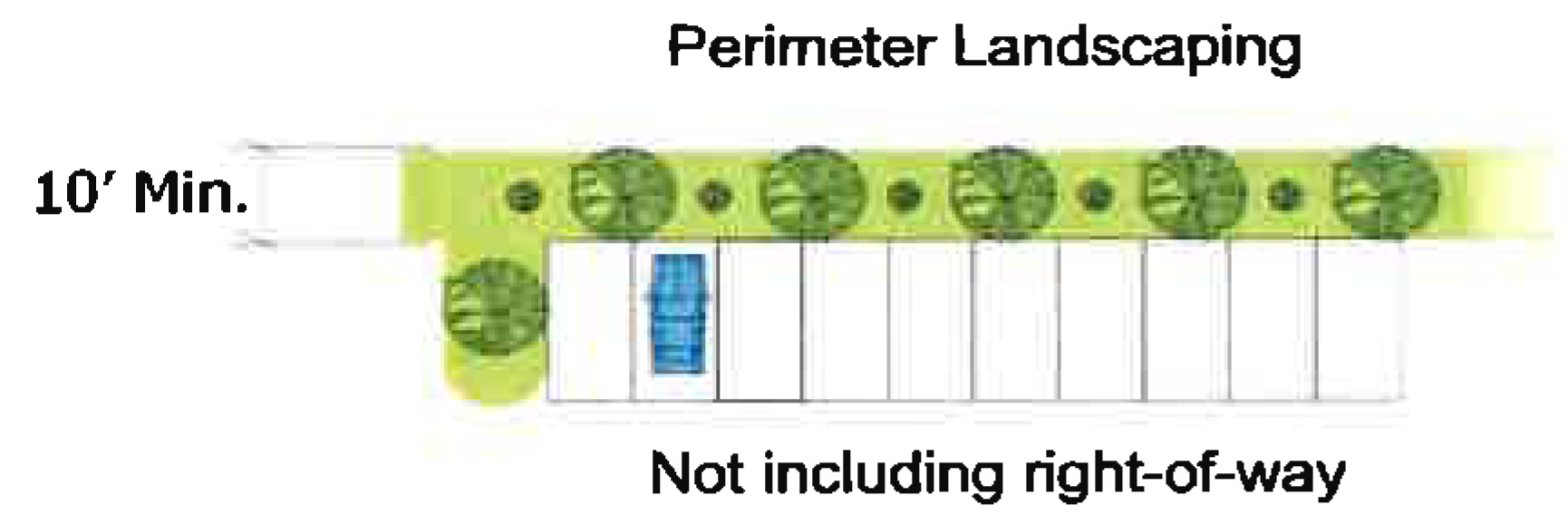
(b)
Interior Islands. An interior landscape island shall be provided for every 15 spaces. Each island planned shall contain a minimum of 200 square feet with a minimum width of 12 feet inside the pavement edge or curb. When the 12 foot width cannot be provided, the interior width may be reduced to a minimum of five foot. With any reduction in width, a two (2) feet width of permeable pavement shall be provided adjacent to the landscape area for each one (1) foot, or any portion thereof, of width reduction. One tree with a minimum caliper of two inches shall be included in each island. Selection of trees shall take into account the need for clear sight triangles in the parking area.
(c)
Terminal Islands. All rows of spaces should terminate in a curbed landscape island. Each island planned shall conform to the specifications described in paragraph (b) above.
(d)
Median Islands. A median island landscape area with a minimum width of 10 feet inside the pavement edge or curb shall be sited between every three double parking rows and should be provided along primary internal and external access drives. When the 10 foot width cannot be provided, the interior width may be reduced to a minimum of five feet. With any reduction in width, a two (2) foot width of permeable pavement shall be provided adjacent to the landscape area for each one (1) foot, or any portion thereof, of width reduction. Plant material including trees, shrubs, and/or perennials shall be included throughout the median island.
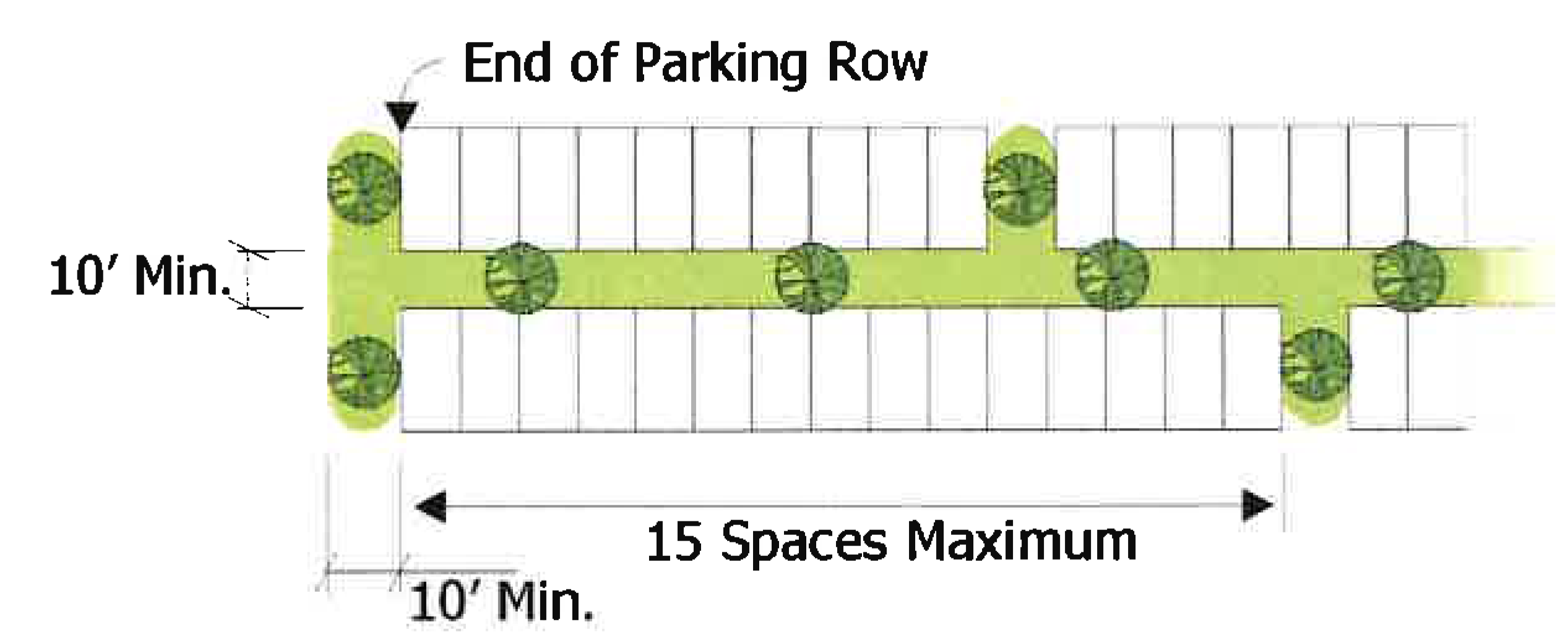
(e)
Permeable pavement should not be used adjacent to any surface water drainage structures.
(9)
Stacking Requirements. The following minimum vehicle stacking requirements shall apply unless otherwise approved through the Planning Commission or City Council as required. Additional stacking spaces may be required where trip generation rates suggest such spaces are needed.
(a)
Minimum Stacking Spaces. Off-street stacking spaces shall be provided as follows:
(b)
Stacking Design and Layout. Required stacking spaces shall be a minimum of eight feet by 18 feet in size. Stacking spaces shall not impede any traffic movement or movement into and out of parking spaces. Stacking spaces should be separated from other internal aisles by raised medians if deemed necessary by the Planning Commission or City Council as required for traffic movement and safety.
(c)
Drive-Through Lanes. Drive-through lanes located between a public right-of-way and the associated building should require a three-foot high continuous evergreen hedge along the entire length of the lane and the adjacent right-of-way.
(10)
Loading Space and Access Requirements. At no time shall goods be loaded or unloaded directly from a public right-of-way.
(11)
Bicycle Parking Facilities.
(a)
For all buildings and structures erected and all uses of land established after the effective date of this ordinance (February, 2010), accessory bicycle parking shall be provided as required by these regulations. Where a building permit has been issued prior to the effective date of this ordinance, and provided that construction is begun within one hundred eighty (180) days of such effective date, bicycle parking facilities in the amounts required or the issuance of said building permit are not required.
(b)
Whenever the existing use of a building or structure is enlarged or expanded, and Commercial Site Plan approval is required bicycle parking facilities shall be provided or the new increment only of such enlarged or expanded building or parking area in at least the amount that would be required if the enlarged use or expanded parking area was a separate use or parking area.
(c)
Residential Use - For residential lots containing more than three (3) dwelling units on the same lot, there shall be one bicycle parking space provided for the first eight (8) car parking spaces, and one bicycle space for each ten (10) car spaces provided thereafter. Single-family, two-family, and three-family units on the same lot are exempt from the requirement to provide bicycle parking facilities.
(d)
Commercial, Industrial, Office and Institutional Uses - For other non-residential uses, there shall be one bicycle parking space provided for any parking area containing at least eight (8) car spaces, and one additional bicycle space for each twenty (20) car spaces thereafter.
(e)
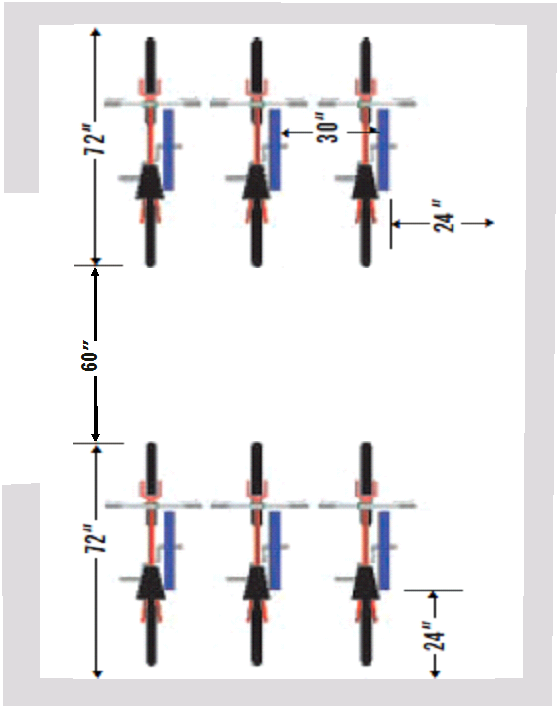
Design - Each bicycle parking space shall be sufficient to accommodate a bicycle at least six (6) feet in length and two (2) feet wide, and shall be provided with some form of stable frame permanently anchored to the ground or the building structure to which a bicycle frame and both wheels may be conveniently secured, with at least two points of contact with the bicycle, using a chain and padlock and/or U-shaped locking device. Figure I shows the types of racks that are recommended and those that may not be used. The separation of the bicycle parking spaces and the amount of corridor space shall be adequate for convenient access to every space when the parking facility is full. Figure 2 shows the minimum dimensions for bicycle racks in open or enclosed areas.
(f)
Location - All bicycle parking spaces required by this ordinance shall be located on the same zoning lot as the use served and shall be located in a clearly designated, safe and convenient location near the entrance of the use being served and within view of pedestrian traffic, if possible, to reasonably reduce the likelihood of bicycle theft. In multi-family areas, bicycle parking should be distributed throughout the complex near the entrance to each major building, preferably in a well-lighted area that is weather-protected.
(g)
Surface - Bicycle parking facilities shall be designed and maintained to be mud and dust free. A durable hard surface is required, but alternative paving material may be used, including gravel or stone, provided that edging materials such as landscape timbers are used so that the bicycle parking area is clearly demarcated and the rock material is contained.
FIGURE 1
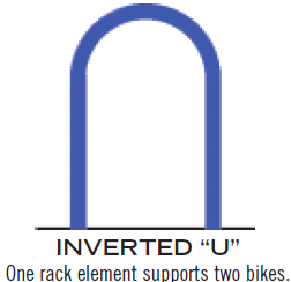
THE RACK ELEMENT
Definition: the rack element is the part of the bike rack that supports one bicycle.
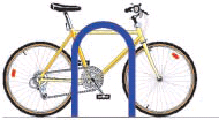
The rack element should:
•
Support the bicycle upright by its frame in two places
•
Prevent the wheel of the bicycle from tipping over
•
Enable the frame and one or both wheels to be secured
•
Support bicycles without a diamond-shaped frame with a horizontal top (e.g. a mixte frame)
•
Allow front-in parking: a U-lock should be able to lock the front wheel and the down tube of an upright bicycle
•
Allow back-in parking: a U-lock should be able to lock the rear wheel and seat tube of the bicycle
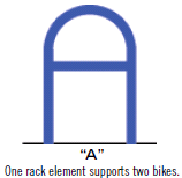
Comb, toast, school-yard, and other wheel-bending racks that provide no support for the bicycle frame are NOT recommended.

The rack element should resist being cut or detached using common hand tools, especially those that can be concealed in a backpack. Such tools include bolt cutters, pipe cutters, wrenches, and pry bars.
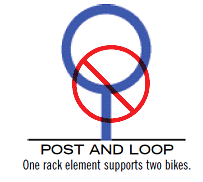
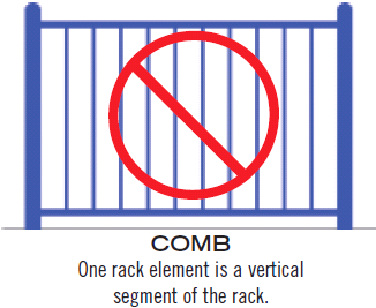
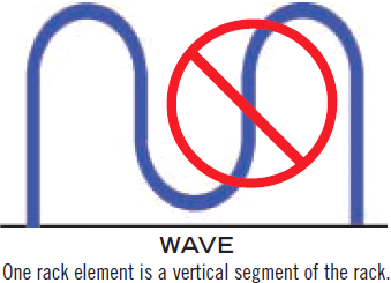
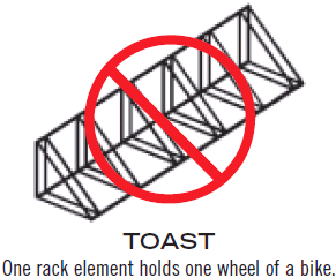
FIGURE 2
THE RACK AREA
Definition: the rack area is a bicycle parking lot where racks are separated by aisles.
(D)
Site Landscaping.
(1)
Purpose.
(a)
It is the purpose of this subsection that landscaping shall be included as an integral part of the built environment to provide an environmentally sound landscape, quality of life, and amenities in keeping with the natural physical surroundings of the city.
(b)
Use of plant preservation, new plant material, berms, fences, walls, and other landscape features is encouraged where feasible in order to:
i.
Preserve the existing, native trees and other physical site values.
ii.
Use trees to provide shade for the landscape, building and parking area, to result in urban heat island mitigation and energy conservation.
iii.
Minimize soil erosion.
iv.
Contribute to air purification through removal of dust and pollutants and production of oxygen.
v.
Provide appropriately selected and placed trees that avoid future conflicts with infrastructure and site uses.
vi.
Screen and buffer undesirable views and noise.
vii.
Soften the visual impact of large paved areas.
viii.
Soften the edge between a parking area and the building or adjacent public right-of-way.
ix.
Provide pedestrian friendly access and safety by defining walkways, traffic circulation, special use areas and building entries.
x.
Complement the architectural form of a building and provide outdoor uses.
xi.
Mitigate impacts of lighting or other negative influences.
xi.
Provide an aesthetically pleasing environment for site users, neighbors, and the public.
(2)
Landscape Plan Design Professional & Plan Elements.
(a)
Landscape plans shall be prepared by a licensed Landscape Architect or other as pre-approved by the Urban Forestry Commission.
(b)
Tree resource evaluations and preservation plans shall be prepared by a licensed Landscape Architect, a professional Forester registered with the State of Oklahoma, an ISA certified arborist, or other as pre-approved by the Urban Forestry Commission.
(c)
Others as approved by the Urban Forestry Commission: The Urban Forestry Commission shall adopt procedures and criteria for the review of professionals who are alternatively qualified to prepare either landscape plans, tree preservation plans, and/or conduct tree resource evaluations. The Commission shall maintain a list of alternatively qualified professionals.
(d)
Landscape Plan Elements: plans shall be prepared to contain and identify the following elements, and shall be submitted in the following manner.
i.
The date, scale, north arrow, project name, name of Landscape Architect/designer and name of the owner/developer.
ii.
Master plan for multi-phase developments within the same parcel.
iii.
The location of property lines, dimensions of the tract, and measurement of total lot area.
iv.
Delineated area of development.
v.
Parking requirement calculations.
vi.
Site Features:
a.
Existing and proposed public easements and infrastructure within or adjacent to the lot.
b.
Existing forested areas and trees committed to preservation, regardless of credit received.
c.
The approximate center line of all existing water courses.
d.
The location and size of existing and proposed drive aisles, streets and alleys, parking areas and other improvements to the site.
e.
Existing and proposed sidewalks on or adjacent to the lot.
f.
Proposed and existing structures remaining on the property.
g.
Existing topography and proposed grading.
vii.
Proposed Landscaping:
a.
Identification and measurement of deducted Forested Areas or Native Plant Communities as defined by 22.6.1(D) (5).
b.
Calculations for total lot area, landscape area required, and plant units required.
c.
Layout of plant material provided for plant unit credit.
d.
Plant symbols drawn to scale within approximately 20% of the mature size expected of the species.
e.
Chart specifying plant common and botanical name, material minimum size specifications, credit claimed towards required total, frontage, evergreen, and tree plant units.
f.
A tree planting detail compliant to ISA specifications and a shrub planting detail if shrubs are used.
(3)
Landscaping Standards. All applicable development, redevelopment or renovation shall be landscaped with trees and ornamental shrubs. Application for site plan approval shall be accompanied by a detailed landscape plan for both the required site area and, if appropriate, the area within the public right-of-way between the property line and curb. The plan shall meet the following requirements.
(a)
Landscape Area. Percent of landscaping required to meet the objectives of site plan review:
i.
Not less than 10 percent of the total lot area shall be landscaped for all applicable districts, exclusive of public right-of-way. Not less than 50 percent of this area shall be in the frontage.
ii.
Not less than 30 percent of the total lot area shall be landscaped in the F-O district.
iii.
Any landscape area less than 5 feet wide shall not be counted toward the landscape area requirement.
iv.
For industrial projects that do not abut residential uses or districts or without frontage on major arterial roadways, the minimum landscaping may be reduced to five percent of the site area at the discretion of the City Council.
v.
The surface area of a body of water existing on the property shall be excluded from the lot area when the existing body of water will remain.
vi.
The surface area of a regulatory flood plain may be excluded from the lot area. Plant material within an excluded area may not be credited toward required plant units.
(b)
Plant Unit. A plant unit is a measurement tool that translates the amount of required plant material into a quantifiable, but flexible unit.
(c)
There shall be a minimum of 20 live plant units provided for every 250 square feet of required landscape area.
(d)
A minimum of 40 percent of total plant units required shall be within the frontage adjacent to any public street.
(e)
A minimum of 52 percent of total plant units required shall be trees. Species diversity is encouraged and should be provided in accordance with sound urban forestry practices. No single tree species should account for more than 33% of the new tree plant units on sites where 150 or more tree plant units are required.
(f)
A minimum of 25 percent of total plant units required shall be evergreen.
(g)
The following table provides plant unit allocation for trees and shrubs. Plant types correspond to the American Standard for Nursery Stock.
(h)
Spaded trees may be claimed for credit in accordance with the plant unit chart for new plants.
(i)
Clear Sight Triangles. Traffic control requires that the plan respect all sight triangles at driveways and intersections as described in subsection 22.5.3(E) and be approved for all elements relating to overall traffic control. Small species plant material with a mature height greater than 24 inches shall not be planted in these areas.
(j)
Utility Easements. Trees inside, or with a trunk within 6' of any public utility easements cannot be counted towards the landscaping requirements. Plantings should be planned to minimize conflict between the tree, easement access, and utility hardware. Tree species selection and placement shall consider clearances around overhead utility lines.
(k)
Planting Areas. Any plant provided for plant unit credit shall be planted within an area consistent with the following provisions
i.
An edging material should be installed along any border between planting beds and bermuda grass. Steel, aluminum, stone, and wood composites are acceptable edging materials.
ii.
Any tree provided for plant unit credit shall be planted in a landscape area of at least 115 sq. ft.
iii.
Organic mulch shall be applied to all planting areas.
iv.
Any gravel or crushed stone used as a groundcover shall be of a size and shape that will prevent the material from being washed, blown, or tracked out of the bed area.
(4)
Tree Resource Evaluation. When required, the objective of the tree resource evaluation shall be to determine the tree resources present within the development site prior to planning and design so that the site may be designed to maximize tree conservation. Tree Resource Evaluations shall be performed in accordance with the following:
(a)
The evaluation shall be conducted for all trees or stands of trees within and adjacent to the area to be impacted by development activity.
(b)
The evaluation shall assess and identify, but not be limited to, the following:
(i)
The presence, condition, and location of any area exhibiting the Cross Timbers ecosystem.
(ii)
Any areas identified as potential remnant forest.
(iii)
Trees or stands of trees that are significant due to unique characteristics in species, size, or condition relative to the area.
(iv)
Forested areas and trees that could serve as a buffer between diverse land uses or provide ecosystem connectivity to adjacent sites or parts of the site.
(c)
Trees and areas that are candidates for retention and incorporation into the site design should be identified.
(d)
Landscape and site plans should incorporate the trees and areas to be retained and protected.
(e)
The information contained within the tree resource evaluation shall be used to evaluate the site plan's demonstration of meeting the objectives identified in 22.6(D)(1).
(5)
Deduction of Forested Areas or Native Plant Communities. Forested areas and areas of native plant cover within a parcel may be deducted from the total lot area when the following criteria are met:
(a)
The area is limited to the extent of a stand of trees or native vegetation of maturity, density, condition and vigor sufficient enough to maintain the ecosystem health after development of the site.
(b)
Maintenance of the area conserves the health and stand composition of the existing plant material type.
(c)
The area has contiguous plant cover measuring at least 10,000 sq. ft., uninterrupted by easements, or is part of a smaller area connected to one.
(d)
The area has a minimum width of 100 feet, uninterrupted by easements. Easements within an area will constitute the edge of the deducted area.
(e)
The area is protected in accordance with the most recently published edition of the Edmond Tree and Landscape Guide.
(f)
Plant material within the deducted area is not credited toward required plant units.
(g)
Areas deducted from the total lot area shall be evaluated, conserved and protected in accordance with the most recent version of ANSI A300 (Part 5) and the Edmond Tree and Landscape Guide.
(6)
Tree Preservation.
(a)
In order to preserve existing trees, trees that are evaluated and preserved in accordance with the most recently published edition of the Edmond Tree and Landscape Guide may be awarded plant unit credits. Plant unit credits for preserved trees are calculated by multiplying the number of trees per diameter class by their plant unit value. For large areas of trees, every tree does not need to be measured. Simpler methods may be used in estimating plant unit totals for large areas of trees or "stands". These are listed in the Edmond Tree and Landscape Guide. Tree credit is given based on the following chart.
(b)
An additional 25% multiplier of the base points may be claimed for preserved trees of species native to the Cross Timbers Ecosystem, as listed in the Edmond Tree and Landscape Guide.
(c)
An additional 25% multiplier of the base points may be claimed for preserved trees within a buffer area. A buffer area is defined as the land area between the limits of any past or future construction activities and the property lines of the site.
Example multiplier application
(d)
Cottonwoods (Populus deltoides) and Eastern Red Cedar (Juniperus virginiana) less than 12 inches DBH shall not be credited as plant units.
(e)
All trees committed to preservation shall include a tree preservation plan regardless of points allocated. The tree preservation plan shall be prepared in accordance with the Edmond Tree and Landscape Guide and the latest version of ANSI A300 (Part 5). The plan should be integrated with the site grading and demolition plans. The plan should include the following items:
i.
The location of trees to be retained.
ii.
The location of tree root protection zones.
iii.
The location of tree protection zone barriers.
iv.
Detail drawings and specifications for tree preservation methods and devices.
v.
Location and detail of soil erosion controls adjacent to tree protection zone barriers.
vi.
Schedule of implementing tree preservation practices as it relates to phases of site development.
(7)
Landscape Installation.
(a)
Plant material shall be installed according to the plan approved by Planning Commission or City Council. Plant species substitutions and minor adjustments may be made on site, with the approval of Urban Forestry and when such changes result in no reduction of plant units from the approved site plan or plant material required in the Site Design Standards.
(b)
Plant unit credit shall not be given for plant material that does not meet the minimum size requirements identified in 22.6.1(D) (3).
(c)
All plant material shall be in good condition, free of disease, insect infestation, freeze damage, sunscald, or other defects such as abrasions or disfigurement.
(d)
Trees shall be planted in accordance with the latest version of standards in ANSI A300 Part 6, and the Edmond Tree and Landscape Guide, with emphasis on the following specifications. Trees planted in a manner that does not comply with these specifications shall not be considered to meet the requirements of the site plan.
i
The root collar shall be at or no more than 2" above surrounding grade, with no soil backfilled on top of the root ball.
ii
All root ball supporting materials shall be cut-off from the top third of the root ball and removed from the planting hole prior to final back filling.
iii
Organic mulch shall be applied to a minimum depth of 3", extending from near, but not touching, the trunk to an area at least twice as wide as the rootball of the tree.
(e)
Tree protection zones shall be installed in accordance with the Edmond Tree and Landscape Guide and inspected prior to issuance of a building permit. Tree protection measures shall remain in place throughout the duration of the project.
(8)
Landscape Maintenance.
(a)
All landscaping improvements shall be maintained in a live and healthy condition. It shall be the continuing duty of the property owner, its successors, or anyone having beneficial use of the property, to maintain plant material in a live and healthy condition and, if necessary, to replace any dead, diseased or damaged plants as soon as natural conditions allow.
(b)
Tree maintenance should be conducted in accordance with standards in ANSI A300 Part 1, and the Edmond Tree and Landscape Guide. Pruning activities violating the following standards shall constitute a requirement for replacing the tree on which the maintenance occurred:
i.
Not more than 25 percent of a tree's crown shall be removed within an annual growing season.
ii.
Branches shall be retained on at least 50% of the length of the trunk.
iii.
Staking material shall be removed within one year of the landscape inspection approval date.
(c)
Replacements or Modifications: Any plant damaged or otherwise required to be replaced shall be evaluated as follows.
i.
For trees, the landscape plant unit value for preserved trees, as established in this Chapter, shall be determined. Replacement trees shall be planted on the site in a quantity so that the associated new plant unit values are not less than the preserved value of the trees being removed.
ii.
All other plant material should be replaced with a plant of the same type, as identified in the table for new plant material.
(d)
All tree preservation and deducted areas shall be maintained in a live and healthy condition. It shall be the continuing duty of the each succeeding property owner, or anyone having beneficial use of the property, to keep the preservation or area intact.
i.
Tree preservation areas, forested areas, or native plant areas shall be actively managed to maintain the health and stand composition of the existing plant material type. Management should minimize the existence and establishment of weeds, Johnson grass, eastern red cedar, cottonwood, potential nuisance plant types or plant species that threaten the health and balance of the plant community.
ii.
If changes or damages occur within the tree preservation area the owner is encouraged to retain the area in a natural state and replant naturally occurring trees in that area, as detailed in the Edmond Tree and Landscape Guide.
iii.
In the event of a failure of the preservation effort due to manmade loses in any area set aside that results in more than 15 plant units lost, additional plant material shall be required based on the preservation plant units lost. The points lost shall be replaced regardless of the original total plant unit requirement for the entire site.
iv.
Exceptions to this include naturally occurring disasters that affect tree preservation areas in excess of one half acre. In this instance owners are encouraged to replant. However, provided that the area is kept in a natural state, no landscape review is necessary.
v.
See subsection 22.8.6(H) Landscaping Maintenance Penalty.
(E)
Site Access and Circulation.
(1)
Purpose. The purpose and intent of this Section is to provide an orderly and consistent means of establishing vehicular and pedestrian access and circulation throughout the City, all for the welfare, convenience and safety of its citizens.
(2)
Street Access. No use shall be permitted to take direct access to a public right-of-way except as permitted in this Section.
(a)
Local Streets. All residential uses, other than multiple-family, may take direct access to local streets. Non-residential uses shall take direct access to arterial streets. Lesser street classification access by non-residential uses is only appropriate for meeting minimum health, safety, and welfare requirements when there is no additional opportunity for accessibility.
(b)
Arterial Streets and Higher. When a multiple-family use takes access to an arterial street, the point of access shall be directly across from an existing point of access, or spaced at least 150 feet from any intersecting street or other point of access to the arterial.
(3)
Driveway Connections to Adjacent Development.
(a)
Driveway connections to adjacent non-residential development shall be provided and clearly identified on any site plan submitted pursuant to this Title. All driveway connections shown on a site plan shall be constructed and stubbed, and future development of adjacent property shall complete a connection to any existing stub.
(b)
The City Council may waive the requirement for a driveway connection in those cases where unusual topography or site conditions would render such an easement of no useable benefit to adjoining properties.
(c)
The City Council may approve the closure of driveway access in those cases where adjoining parcels are subsequently developed with a residential use or in a manner inappropriate to the connection.
(4)
Access Design Standards.
(a)
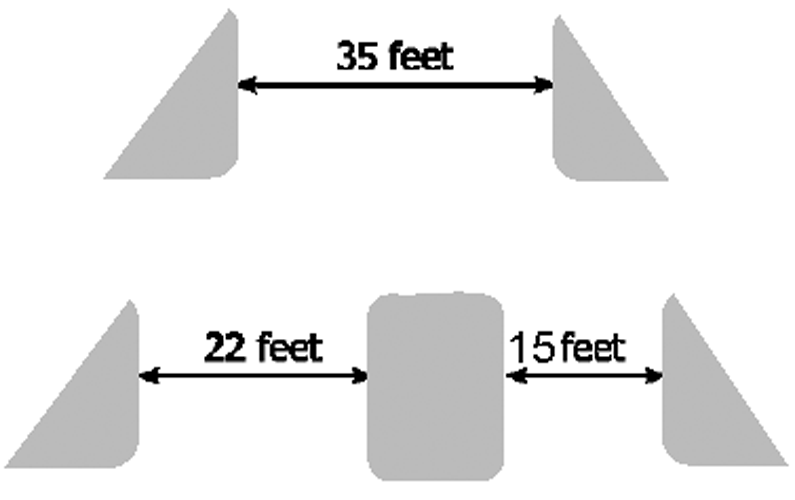
Width of Access. The width of access driveways or drive approaches shall be determined by the highway authority having jurisdiction over the roadway from which access is being taken. However, in no case shall an individual driveway or drive approach width be greater than 35 feet. Driveways with center medians shall have a 15-foot ingress and a 22-foot maximum egress width. Medians shall not extend into the right-of-way.
Width of Access
(b)
Spacing from Intersections. All points of access shall be separated from public right-of-way and private access intersections according to the following table, unless site dimensions prohibit such spacing. Driveway/drive approach spacing shall be measured from back of curb or edge of pavement to the center line of the proposed driveway/drive approach.
(c)
Emergency Access Drives. Emergency access drives shall be at least 20 feet in width.
(5)
Street Improvements.
(a)
Where a site is to be occupied by any multiple-family or nonresidential use, the owner shall improve one-half of any abutting public right-of-way, according to City standards.
(b)
Where a structure is being repaired or replaced due to damage by fire, storm or other natural phenomenon, that structure may be increased in square footage by up to 10 percent more than the original square footage without constructing paving improvements.
(6)
Sidewalk Improvements. Sidewalks shall be provided along all public right-of-way in accordance with Edmond standard specifications. All site plans shall show the location of proposed or existing sidewalks. No occupancy permit shall be approved until all sidewalks have been installed.
(a)
Exceptions. The Planning Commission may permit exceptions from sidewalk requirements in the following circumstances:
i.
Sidewalk construction may be delayed on those portions of large commercial developments that are not being built upon, until such time as a building permit is issued for the site.
ii.
Where extraordinary topographical or physical conditions exist that would result in exceptional practical difficulties or undue hardships upon the owner, an exception from or modification to the sidewalk requirements may be granted.
iii.
Within an industrial district where there is no established sidewalk pattern, sidewalks shall not be required. However, sidewalks shall be constructed adjacent to a section line roads.
(F)
Screening.
(1)
Purpose. Mechanical equipment, refuse facilities, outdoor display and storage, salvage yards and utility meters shall be located so as to cause minimum negative visual impact from the public right-of-way and adjacent properties.
(2)
Mechanical Equipment.
(a)
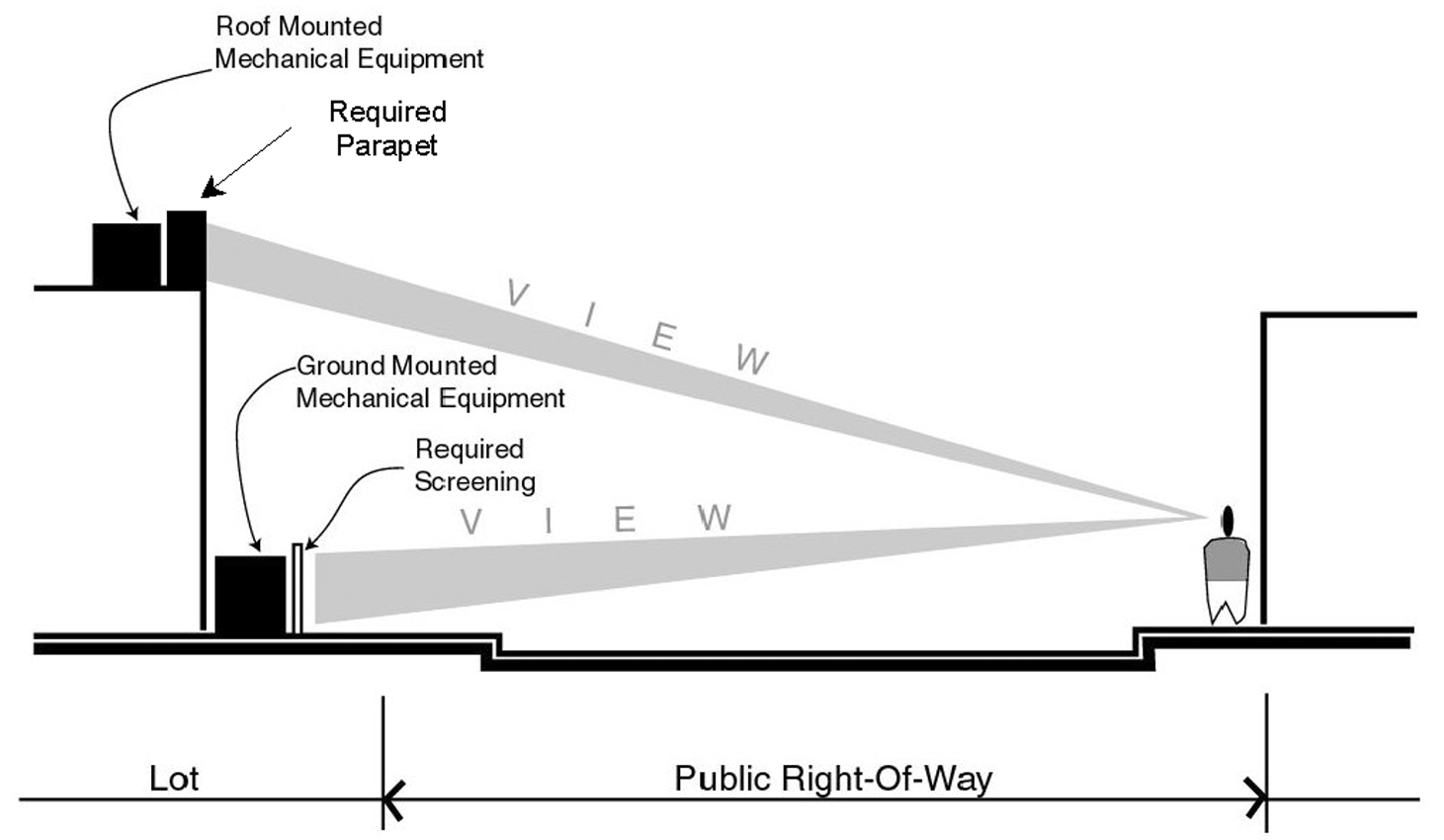
All mechanical equipment, such as air conditioning compressors should be located on the ground, regardless of the roofline or roof form. Where it is impractical to locate mechanical equipment on the ground, parapet walls shall be increased in height on all necessary sides of the roof to screen the equipment from the public right-of-way. Structures built on the roof around the equipment shall not be used for screening.
(b)
All mechanical equipment located on the ground shall be screened by an enclosure of sufficient height that the equipment is not visible from the public right-of-way or residential properties. The enclosure shall provide minimum separation as defined by the manufacturer's requirements for the particular equipment to be screened. The top of the enclosure may be left open.
Mechanical Equipment
(c)
If window air conditioning units or wall-mounted units are used, flush mounted installation shall be required. Screening through landscaping, walls or other appropriate architectural treatment shall be utilized.
(3)
Refuse Facilities. A concrete approach loading pad shall be constructed in front of all refuse enclosures. Such pad shall be at least 12 feet wide by 12 feet long, and a minimum of six inches thickness of concrete at a standard of 3500 PSI.
(a)
All refuse facilities shall be enclosed and screened on all four sides so that they are not visible from adjacent public right-of-way.
(b)
Required enclosures shall have a minimum inside dimension of 12 feet by 12 feet with an enclosure gate opening of not less than 12 feet in width. The height of any such enclosure shall be that necessary to prevent refuse material from protruding above the enclosure.
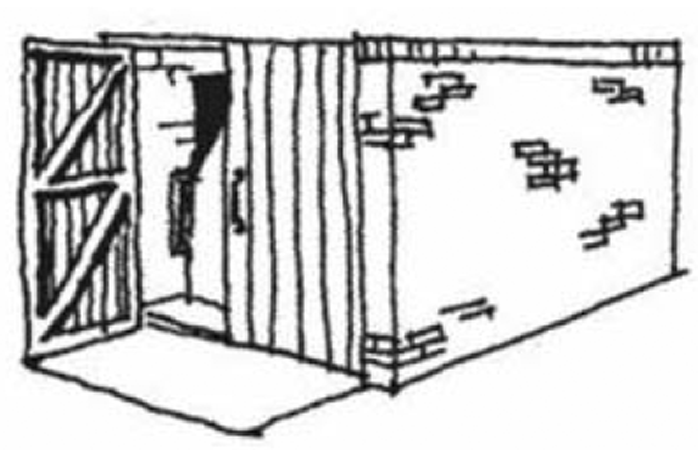
Refuse Facilities
(c)
Waste container enclosures shall have steel framed gates with spring-loaded hinges and fasteners. Keeper latches shall be required to hold gates in the fully opened position while refuse containers are being serviced. Four-inch diameter pipe bollards shall be required inside each enclosure to protect the enclosure from truck operations.
(d)
All required enclosures shall be at a minimum a combination of brick columns matching the building and sight-proof wood fencing.
(e)
An unobstructed approach path of not less than 50 feet in length shall be required for a 35-foot long collection truck to access the refuse facility. A turn-around area shall be provided of sufficient length to allow the collection truck to exit without backing onto public right-of-way.
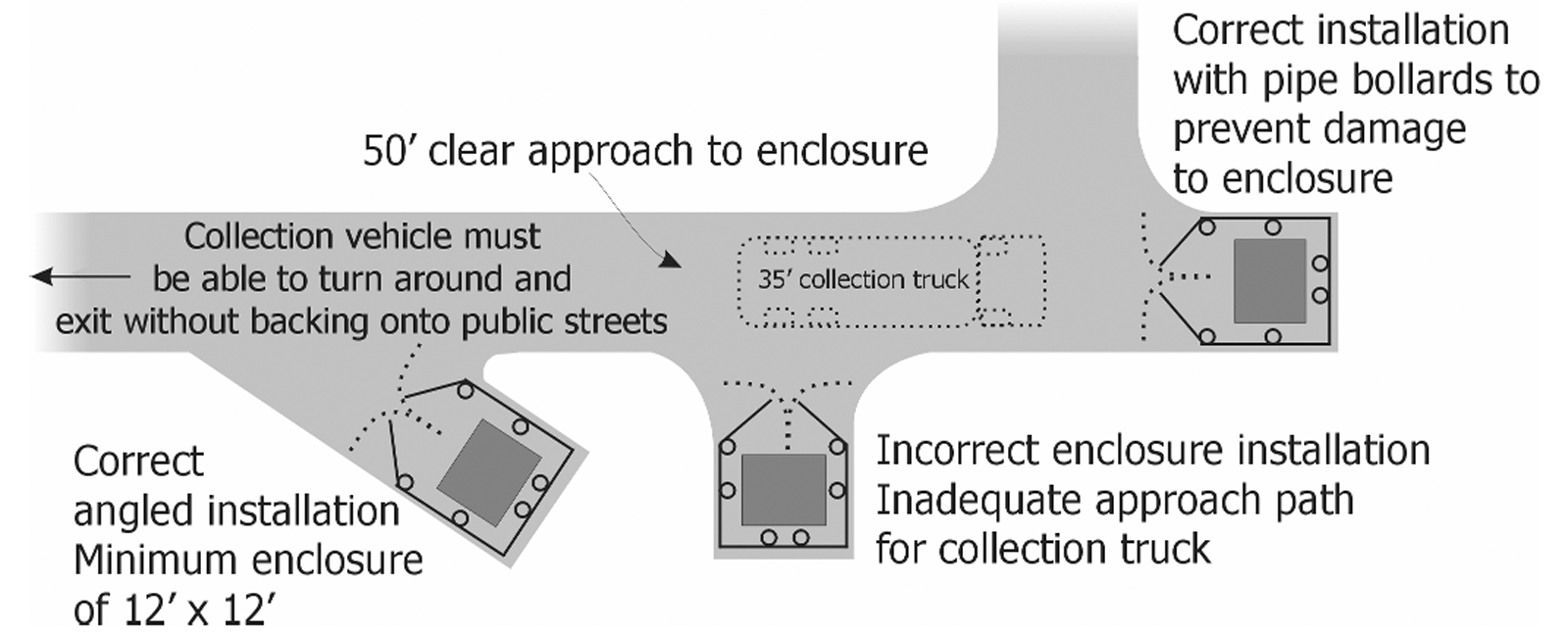
Access to Refuse Facilities
(4)
Utility Meters. Whenever possible, utility meters shall be installed to minimize visibility from adjoining public right-of-way.
(G)
Outdoor Lighting.
(1)
Purpose. The outdoor lighting standards of this section are intended to eliminate spillover light and light glare on traffic, pedestrians and land uses near light sources. Safety considerations are a primary basis for the regulations, especially pedestrian and traffic safety. In other cases, the regulations are intended to protect property values and the general welfare by controlling the nuisance aspects of glare or spillover light.
(2)
Exemptions. The regulations of this section apply to all uses except:
(a)
Public street lights which are subject to all applicable standards of the Oklahoma Department of Transportation and the City;
(b)
Decorative lights less than 36 inches in height that incorporate not more than 100 watt high or low pressure sodium lights;
(c)
Holiday lighting displayed between Thanksgiving Day and the second Sunday in January of the following year;
(d)
Outdoor recreation uses, which are subject only to the standards of Subsection (12).
(3)
Lighting Plan Required. An outdoor lighting plan shall be submitted whenever outdoor lighting is to be installed or whenever site plan review is required. The lighting plan shall be reviewed to determine whether the proposed outdoor lighting complies with the standards of this section. All outdoor lighting plans shall include a photometric plan and data on the types of lighting fixtures to be used. The photometric plan shall include the following:
(a)
Scale drawing of site showing all outdoor lighting fixture locations;
(b)
Fixture specifications, such as catalog cut-sheets, that are based on the photometric plan and indicate type of fixture, height, shielding, luminaire type and wattage;
(c)
Lamp type and size; and
(d)
A point-by-point illumination array for the major parking area, indicating site illumination along the lot line at 10-foot intervals and on the interior at 20-foot intervals.
(4)
Light Confinement.
(a)
All outdoor lights shall confine emitted light to the property on which the light is located and not be directed upwards toward the sky to the maximum extent feasible.
(b)
All fixtures shall confine lighting to the subject site.
(c)
Under-canopy or downcast, roof-mounted lights shall be recessed from the lowest point of the ceiling plane.
(5)
Spillover Light. Spillover light shall be measured at grade and regulated as follows:
(a)
Spillover light onto an abutting residential district shall not exceed 0.2 footcandles, measured at the residential lot line.
(b)
Spillover light onto residential districts across a public right-of-way from a multiple-family or nonresidential use shall not exceed one footcandle, measured at the residential lot line.
(c)
Spillover light onto any nonresidential district shall not exceed three footcandles, measured at the lot line.
(6)
Fixture Height. Lighting fixtures shall be a maximum of 24 feet in height within the parking area and a maximum of 12 feet in height within non-vehicular pedestrian areas.
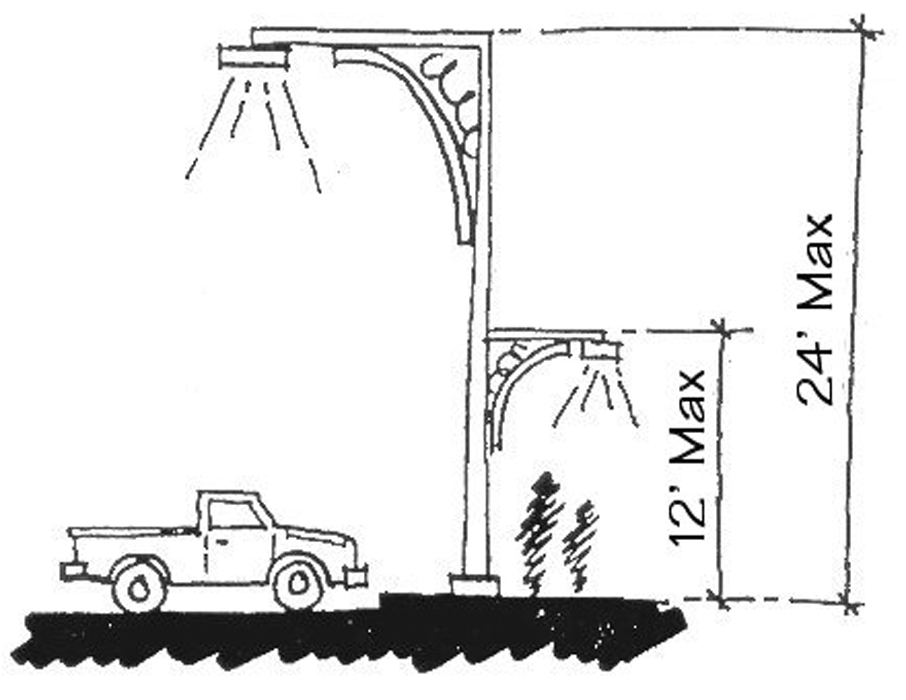
Fixture Height
(7)
Light Source (Lamp). Only incandescent, florescent, metal halide, or color corrected highpressure sodium lamps shall be used. The same light source type shall be used for the same or similar types of lighting on any one site throughout any development.
(8)
Visible Light Sources. Light sources shall not be visible and shall be shielded to reflect down on the ground and not out onto adjacent public right-of-way or properties. Any fixture that would interfere with traffic movement on public right-of-way or produce other traffic hazards shall be prohibited.
(9)
Lighting Limitations. Sensor technologies, timers or other means to activate lighting when needed may be required by the City to conserve energy, provide safety, and promote compatibility.
(10)
Security Lighting.
(a)
Building-mounted security lighting fixtures shall not project above the fascia or roof line of the building and shall be shielded. Such fixtures and shields shall be painted to match the surface to which they are attached or shall otherwise be of a harmonious color.
(b)
Security fixtures shall not be substituted for parking area or walkway lighting and shall be restricted to loading, storage, service and similar locations.
(11)
Architectural Compatibility. Outdoor lighting shall be architecturally compatible and consistent in design with associated buildings.
(12)
Excessive Illumination.
(a)
Lighting that illuminates or substantially interferes with the use or enjoyment of any other property shall be prohibited. Lighting unnecessarily illuminates another site if it exceeds the requirements of this Section.
(b)
Lighting shall not be oriented so as to direct glare or excessive illumination onto public right-of-way in a manner that may distract or interfere with the vision of drivers.
(c)
Fixtures used to accent architectural features, landscaping or art shall be located, aimed or shielded to minimize light spill into the night sky.
(13)
Outdoor Recreation Uses. Because of their unique requirements for nighttime visibility and limited hours of operation, the lighting of outdoor recreation uses shall be exempt from the preceding standards, except that:
(a)
Lighting pylons shall not exceed 60 feet in height;
(b)
Flickering or flashing lights shall not be permitted; and
(c)
As-built lighting and photometric plans shall be submitted.
(H)
Retaining Walls. Required retaining walls, as identified on the grading and detention plans, shall be identified and are of particular concern adjacent to sensitive borders. Elevation plans of all of the retaining wall locations are required to be reviewed with the site plan.
(I)
Building Design Standards.
(1)
Purpose. This Section is intended to promote high standards in architectural design and creative, innovative, aesthetically pleasing structures. Building design determines much of the image and attractiveness of the streetscapes and character of the community. Massive, duplicative or generic projects that do not contribute to, or integrate with, the community in a positive manner can be detrimental to a community's image and sense of place. The City's goal is to create and maintain a positive ambiance and community image and identity by providing for building design treatments that shall enhance the visual appearance of applicable development and the quality of life in the city.
(2)
General Requirements. The provisions of this subsection shall apply to all development, renovation or redevelopment of all two-family, multiple-family and nonresidential structures.
(a)
Metal Construction Allowed.
i.
Permitted Locations. Exposed exterior metal walls or untreated concrete block, including painted concrete block and unfinished or untreated concrete panels, shall only be permitted provided that adjacent buildings on two sides have been previously constructed with the above materials or provided that the proposed building is located in a legally platted subdivision wherein at least five structures have been erected using these materials.
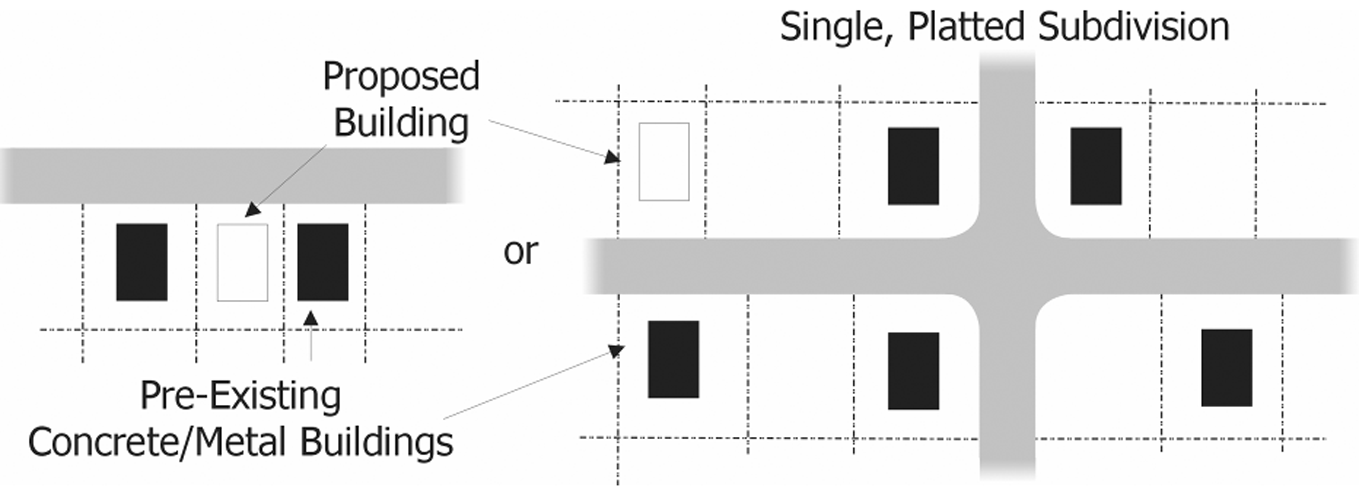
Permitted Locations
ii.
Non-Metal Coverage. All sides of a permitted metal building that face any public right-of-way shall contain at least 50 percent brick, glass, rock, wood or material other than metal. In computing the 50 percent area for each wall, the portion of the wall containing windows, window frames, door and signs shall not be considered a non-metal material.
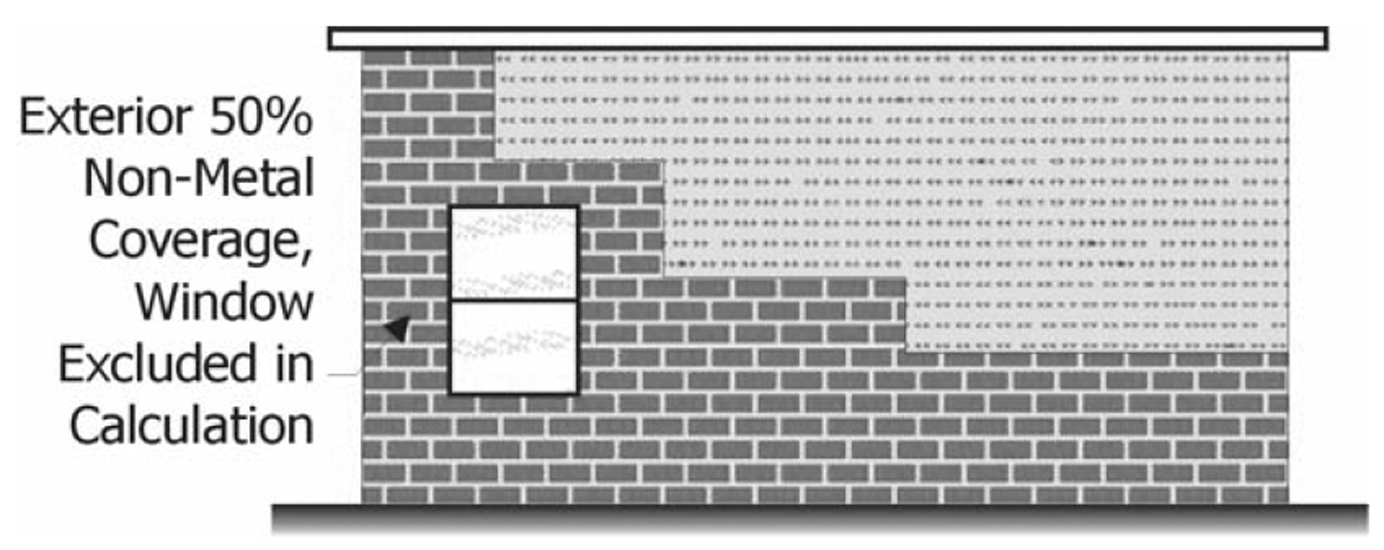
Non-Metal Coverage
(b)
Roofs. Roof tops shall contribute to the unified appearance of each development and shall be designed considering the perspective from higher areas, ground level, other buildings and roadways. In the event that any portion of any roof is visible to an observer standing on ground level at any place along the property lines of the subject property, no roofs of metal construction shall be permitted unless the roof is of standing seam construction or a functional and architectural equivalent thereof. In the case where a structure is proposed adjacent to previously-existing pitched roofed structures, any new construction incorporating flat roof shall make use of a mansard or other architectural treatment on all sides of the new structure in order to achieve compatibility with the surrounding area.
(c)
Multiple-Family Courts. A multiple-family dwelling or group of multiple-family dwellings with an inner or outer court shall comply with the following.
i.
Outer Court Width. The width of an outer court upon which windows open shall not be less than 10 feet, or equal to the height of the opposing wall, whichever is greater; and in no case shall an outer court be less than five feet in width or equal to 70 percent of the height of the opposing wall, whichever is greater.
ii.
Inner Court Width. The width of an inner court of a multiple-family dwelling shall not be less than two times the height of the lowest wall forming the court, but in no case shall it be less than 20 feet.
iii.
Passageway for Inner Court. An open unobstructed passageway shall be provided at grade of each inner court. Such passageway shall not be less than 12 feet in width, have a clearance of not less than 12 feet in height and provide a straight and continuous passage from the inner court to a yard or open space having a direct connection with a public right-of-way.
(3)
Major Nonresidential Office or Retail Building Structure.
(a)
Applicability.
i.
This subsection shall apply to new development, with a gross floor area of more than 60,000 square feet and/or when a building wall length is 150 feet or greater along a public right-of-way.
ii.
These standards shall be in addition to those standards under subsection (2) above and, where applicable, to those standards that apply to buildings within specific districts. In case of a conflict, the standards of this section shall control over the standards in subsection (2), and district-specific design standards.
(b)
Facades and Exterior Walls.
i.
Facades greater than 150 feet in length, measured horizontally, shall incorporate wall plane projections or recesses having a depth of at least three percent of the length of the facade and extending at least twenty percent of the length of the facade. No uninterrupted length of any facade shall exceed 100 horizontal feet.
ii.
Ground floor facades that face public right-of-way shall have arcades, display windows, entry areas, awnings or other such features along no less than 60 percent of their horizontal length.
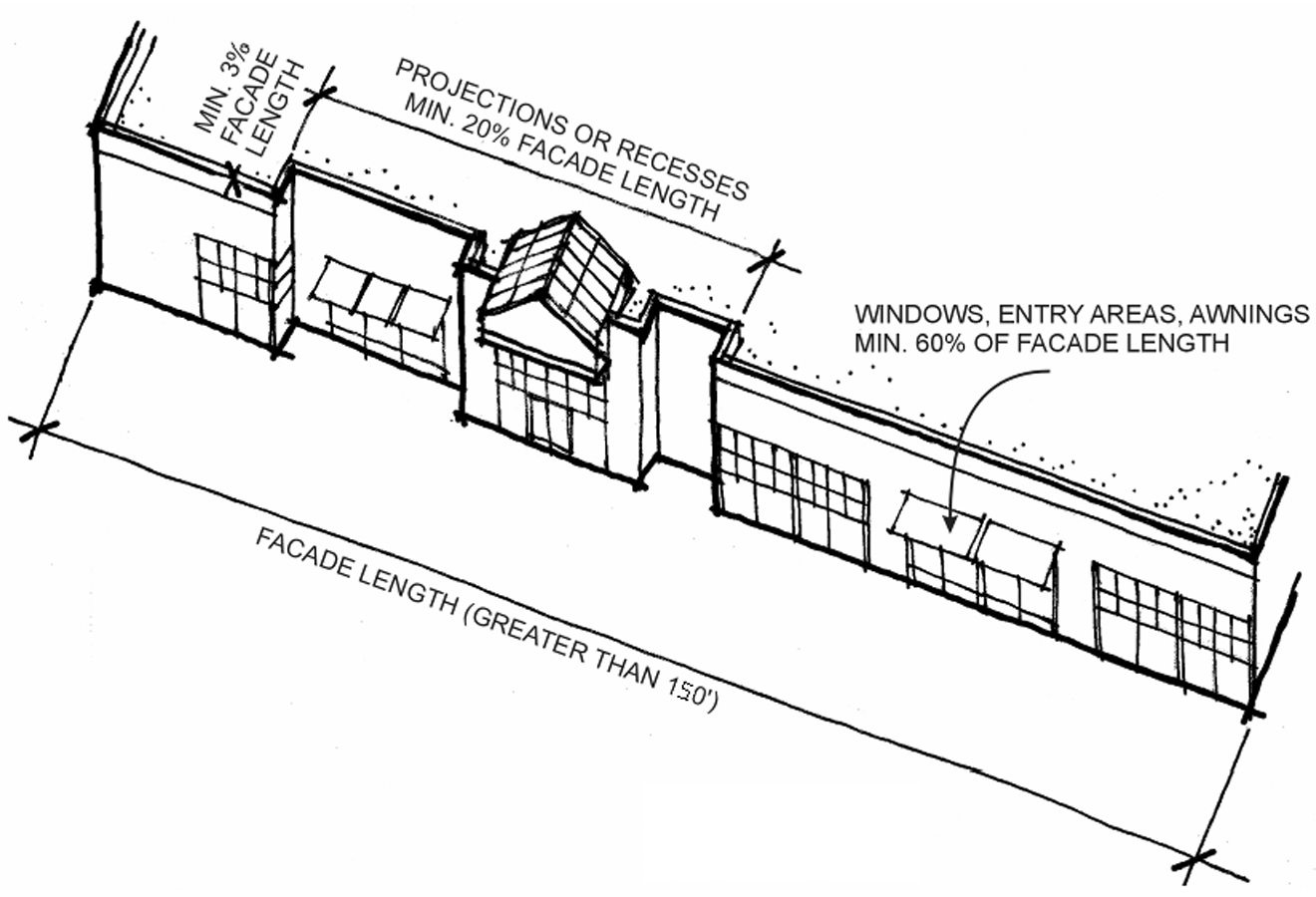
Features along Facade Length
iii.
Building structure facades shall include a repeating pattern that includes no less than three of the following elements:
a.
Color change;
b.
Texture change;
c.
Material module change; or
d.
An expression of architectural or structural bays through a change in plane no less than 12 inches in width, such as an offset, reveal or projecting rib.
iv.
At least one of elements a., b. or c., shall repeat horizontally. All elements shall repeat at intervals of no more than 30 feet, either horizontally or vertically.
(c)
Roofs. Roofs shall have no less than two of the following features:
i.
Screening meeting subsection (F) above.
ii.
Overhanging eaves, extending no less than three feet past supporting walls;
iii.
Sloping roofs that do not exceed the average height of the supporting walls, with an average slope greater than or equal to one foot of vertical rise for every three feet of horizontal run and less than or equal to one foot of vertical rise for every one foot of horizontal run; or
iv.
Three or more roof slope planes.
(d)
Materials and Colors.
i.
Predominant exterior building materials shall be high quality materials, including, but not limited to, brick, sandstone, other native stone and tinted/textured concrete masonry units.
ii.
Facade colors shall be low reflectance, subtle, neutral or earth tone colors. The use of high-intensity colors, metallic colors, black or fluorescent colors shall be prohibited.
iii.
Building trim and accent areas shall be no more than 15% of the exterior finish and may feature EIFS, brighter colors, including primary colors, but neon tubing, fiber optic or similar lighting shall not be an acceptable feature for building trim or accent areas.
iv.
Exterior building materials shall not include smooth-faced concrete block, tilt-up concrete panels or prefabricated steel panels.
(e)
Entryways.
i.
Each applicable establishment shall have clearly defined, highly visible customer entrances featuring no less than three of the following:
a.
Canopies or porticos;
b.
Overhangs;
c.
Recesses/projections;
d.
Arcades;
e.
Raised corniced parapets over the door;
f.
Peaked roof forms;
g.
Arches;
h.
Outdoor patios;
i.
Display windows;
j.
Architectural details such as tile work and moldings which are integrated into the building structure and design; or
k.
Integral planters or wing walls that incorporate landscaped areas and/or places for sitting.
ii.
Where additional stores are located in the applicable establishment, each such store shall have at least one exterior customer entrance, which shall conform to the above requirements.
(f)
Connectivity. The site design shall provide direct pedestrian and vehicular connections and safe street crossings to all adjacent uses.
(g)
Sidewalks and Walkways.
i.
Perimeter sidewalks shall at a minimum meet the City standard and be provided along all public right-of-way.
ii.
Continuous internal pedestrian walkways of no less than five feet in width shall be provided from the perimeter sidewalk or public right-of-way to the principal customer entrance of all establishments on the site. Walkways should connect focal points of pedestrian activity such as transit stops, street crossings, building and store entry points, and should feature adjoining landscaped areas that include trees, shrubs, benches, flower beds, ground covers or other such materials for not less than 50 percent of the length of the walkway.
iii.
Walkways of not less than five feet in width should be provided along the length of any building facade with a customer entrance, and along any facade abutting a parking area.
iv.
Internal pedestrian walkways should provide weather protection features such as awnings or arcades within 30 feet of all customer entrances.
v.
All internal pedestrian walkways should be distinguished from driving surfaces.
(h)
Central Features and Community Space. Each structure subject to these standards shall contribute to the establishment or enhancement of community and public spaces by providing at least two of the following features. Any such feature shall have direct access to the public sidewalk network and shall not be constructed of materials that are inferior to the principal materials of the building and landscape.
i.
Patio/seating area;
ii.
Pedestrian plaza with benches;
iii.
Transportation center;
iv.
Window shopping walkway;
v.
Outdoor playground area;
vi.
Kiosk area;
vii.
Water feature;
viii.
Clock tower;
ix.
Public art; or
x.
Other such deliberately shaped area and/or a focal feature or amenity that, in the judgment of the Planning Commission or City Council as required, adequately enhances such community and public spaces.
(J)
Signs. All site plans shall meet the standards of Title 15 of the City Code. Review bodies shall evaluate the compatibility of proposed signs with the surrounding area. In addition, the location of all signs, shall be identified and shall be appropriate to the development. In the event there is a change in the sign standards as approved on the original site plan, the alterations will require approval by the Planning Commission.
(K)
Conversion from Residential to Nonresidential Use.
(1)
Applicability. The standards in this subsection shall apply when a residential use is converted to a nonresidential use, even in those cases where no additions, alterations or modifications are made to the structure.
(2)
Miscellaneous Requirements.
(a)
No structure designed for, intended for, or previously or presently used for residential purposes shall be used for or occupied by any nonresidential use unless it is harmonious with the existing neighborhood and complies with the following: the site design requirements found in Chapter 6 of this Title, International Building Code, International Fire Code, National Electrical Code, and all other City codes currently adopted and enforced.
(b)
No commercial occupancy shall be permitted until site plan approval has been granted by the Planning Commission or City Council as required.
(3)
Driveways. All driveways/drive approaches shall be constructed to nonresidential standards. When a site plan is submitted to convert a dwelling to a nonresidential use, the applicant shall locate the driveway/drive approach for use by one or more of the adjoining sites. Where this can be met, an interconnecting driveway easement shall be submitted by the applicant.
(4)
Sensitive Borders. A converted nonresidential use located adjacent to a residential property shall comply with the provisions of Section 22.6.5.
(Ord. 3068, § 1, November 27, 2006; Ord. 3182, § 19, November 10, 2008; Ord. 3248, §§ 7, 9, January 11, 2010; Ord. 3611, §§ 11—14, June 26, 2017)
22.6.2. - I-35 Corridor District Supplemental Site Design Standards.
(A)
Purpose.
(1)
The purpose of this Section is to establish supplemental site design standards for the development, redevelopment or renovation of property meeting the applicability criteria in subsection (C) below and located in the City of Edmond I-35 Corridor.
(2)
These standards work toward assuring development which complies with the objectives of this Section and enhances area architectural and environmental elements in furtherance of the best interests of this community. Furthermore, developers are encouraged to design developments that harmonize with the existing terrain and forest areas, rather than changing the site to fit a specific design.
(B)
Objectives.
(1)
Proposed projects shall respect the natural, wooded environment of this important remnant cross timbers forest area and shall endeavor, as best as is practicable, to preserve, protect and incorporate this natural environment, with all its features, into the overall site plan design.
(2)
When projects are proposed along the arterial roadways or Interstate, the site plan review process shall emphasize quality design to maximize the natural features of the land and create a safe and visually pleasant driving experience for the roadway user.
(C)
Applicability.
(1)
These standards shall apply to all development, redevelopment or renovation of uses in the I-35 Corridor other than single-family residential that meet the criteria in paragraph 22.3.5(A)(1) and to all uses requiring a specific use permit in the Corridor.
(2)
These standards shall be in addition to those standards applicable to all districts under Section 22.6.1 and, where applicable, to those standards that apply to major commercial structures under paragraph 22.6.1(I)(3). In case of a conflict, the standards of this section shall control over the standards in Section 22.6.1, but the standards in paragraph 22.6.1(I)(3) shall control over both of the other sections.
(3)
The I-35 Corridor shall be defined as shown in the following map.
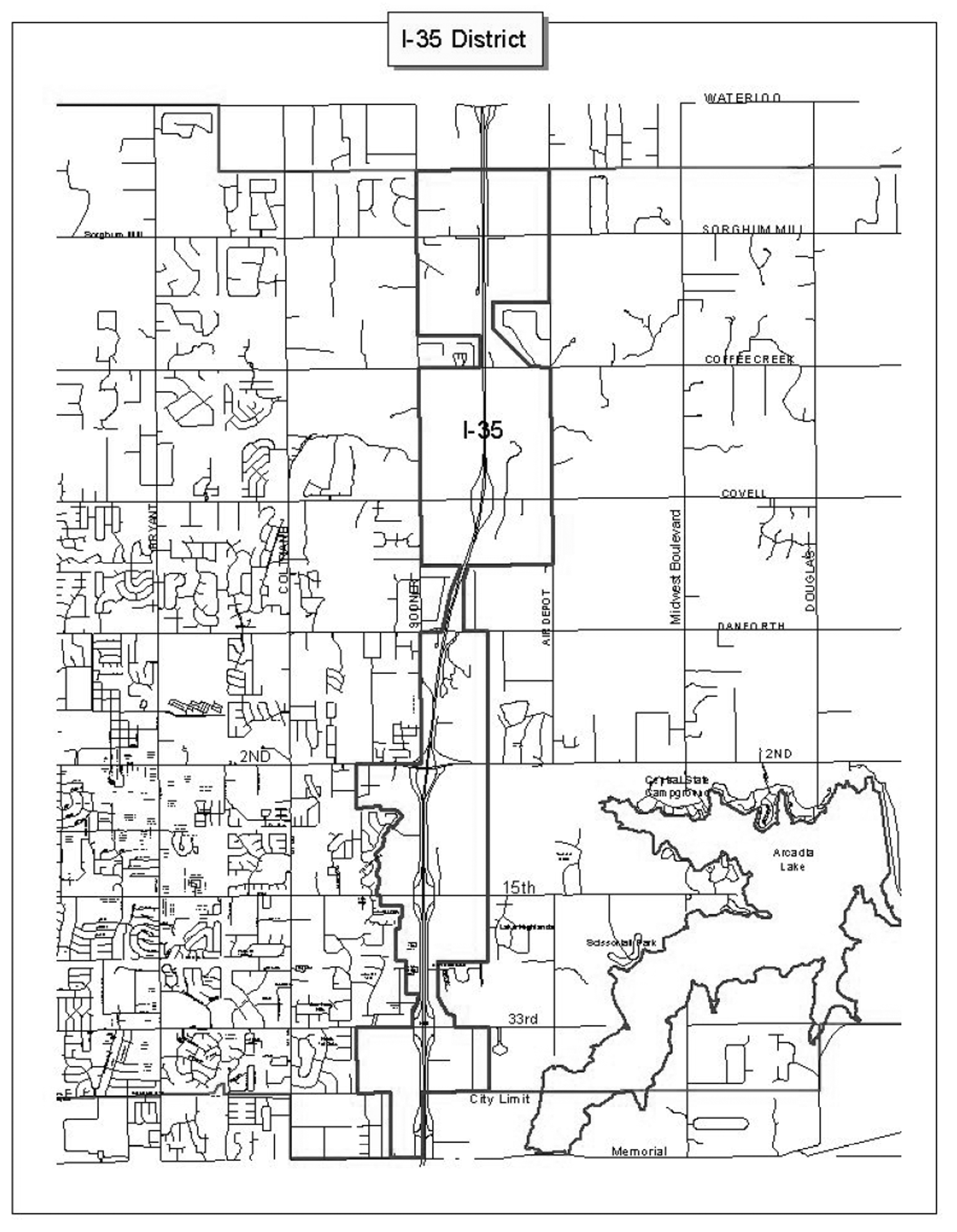
I-35 District
(D)
I-35 Site Landscaping. Application for site plan review shall be accompanied by a detailed landscape plan for both the required site area and the area within the public right-of-way between the property line and curb.
(1)
Open Space. Not less than 15 percent of the site area shall be landscaped, exclusive of the public right-of-way unless greater landscaping standards apply based on the requirement of another district. Forty percent of the total landscaping shall be along the frontage.
(2)
Plant Density. The site plan shall meet the following requirements.
(a)
At least 30 live plant units shall be provided for every 250 square feet of required landscaped area. Plant unit designations for various plant sizes and types are listed in paragraph 22.6.1(D) (3) and 22.6.1(D) (6) above.
(b)
Not less than 25 percent of all plant units shall be evergreen. Not less than 52 percent of the plant units shall be trees. Species diversity is encouraged and should be provided in accordance with sound urban forestry practices. No single tree species should account for more than 33% of the new tree plant units on sites where 150 or more tree plant units are required.
(c)
Any trees proposed for saving shall include a tree preservation plan according to paragraph 22.6.1(D) (6).
(d)
A majority of plant material should be species that are native to the Cross Timbers ecosystem or regional area.
(3)
Alternative Compliance. Landscaping requirements in paragraph (1) above may be reduced for each of the following conditions that are met or exceeded. However, in no event shall the percent of landscaped area be reduced by more than three percentage points regardless of the number of conditions met below.
(a)
Any trees proposed for saving shall include a tree preservation plan according to subsection paragraph 22.6.1(D)(6).
(b)
Features that aid in noise abatement may include a combination of berms, masonry walls and wooden fences in conjunction with landscaping.
(E)
I-35 Building Design Standards.
(1)
Purpose. The architectural design of structures shall comply with the standards of this Section and be complimentary with the surrounding development, and in harmony with the wooded environment. Elements to be considered include the building placement, size, shape, height, style, exterior materials and colors, and its relationship to all proposed site improvements. Buildings should be considered as three-dimensional objects, and attention should be given to the complimentary treatment of all exterior surfaces.
(2)
Exterior Walls. The exterior building materials, textures and colors shall be carefully selected so as to be in harmony with the surrounding environment. Buildings shall be predominantly of one or two exterior materials. Architectural detail such as change of plane, texturing, ribbing, fluting, banding, etc. should be considered to give large surfaces interest or dimension where appropriate. Exterior walls shall be brick, stone, rock, wood, or a combination of these materials with other accent materials. Glass may be considered if it complies with the objectives of this Section. Exterior walls using metal surfaces or untreated concrete block, including painted concrete block, shall be prohibited.
(3)
Trim or Accent Materials. Trim and accent materials shall comprise no more than 15 percent of the exterior finish of buildings. Suggested accent materials include glass block, plaster, EIFS, copper and the aforementioned exterior building materials.
(4)
Roofs. Composition, shingle, tile, clay tile and copper roofing material are encouraged.
(Ord. 3068, § 1, November 27, 2006; Ord. 3248, § 10, January 11, 2010; Ord. 3611, § 15, June 26, 2017)
22.6.3. - Lake District Supplemental Site Design Standards.
(A)
Purpose.
(1)
The purpose of this Section is to establish supplemental site design standards for the development, redevelopment or renovation of property meeting the applicability criteria in subsection (C) and located in the Arcadia Lake area in the City of Edmond.
(2)
A primary purpose of these standards is protection of health, safety, and welfare of Arcadia Lake as a long term water supply and community and regional recreation facility. A secondary purpose is to recognize the economic value to the community of quality commercial development along the east frontage of the interstate highway.
(3)
These standards work toward assuring development compatible with area environmental and architectural elements in furtherance of the best interests of this community.
(B)
Objectives. The Lake Site Plan Review process shall reach a determination that the following objectives have been met:
(1)
When commercial uses are proposed next to existing or projected L-1 or L-2 Districts, the design of such projects shall emphasize quality aesthetics and landscaping that recognize the Arcadia Lake Plan intent to preserve the semirural to rural land use character of the area surrounding the lake.
(2)
Proximity to municipal water supply with a special concern for pollution (short and long term) from land development, and concern for protection of the natural environs surrounding Arcadia Lake require that the project emphasize designs that will provide protection for natural environmental features, and preserve and enhance the environmental amenities of the site.
(C)
Applicability.
(1)
These standards shall apply in L-3, L-4 and L-5 districts to all development, redevelopment or renovation of uses other than single-family residential that meet the criteria in paragraph 22.3.5(A)(1) and to all uses requiring a specific use permit in these districts.
(2)
These standards shall be in addition to those standards applicable to all districts under Section 22.6.1 and, where applicable, to those standards that apply to major commercial structures under paragraph 22.6.1(I)(3). In case of a conflict, the standards of this section shall control over the standards in Section 22.6.1, but the standards in paragraph 22.6.1(I)(3) shall control over both of the other sections.
(3)
The Lake area shall be defined as shown in the following map.
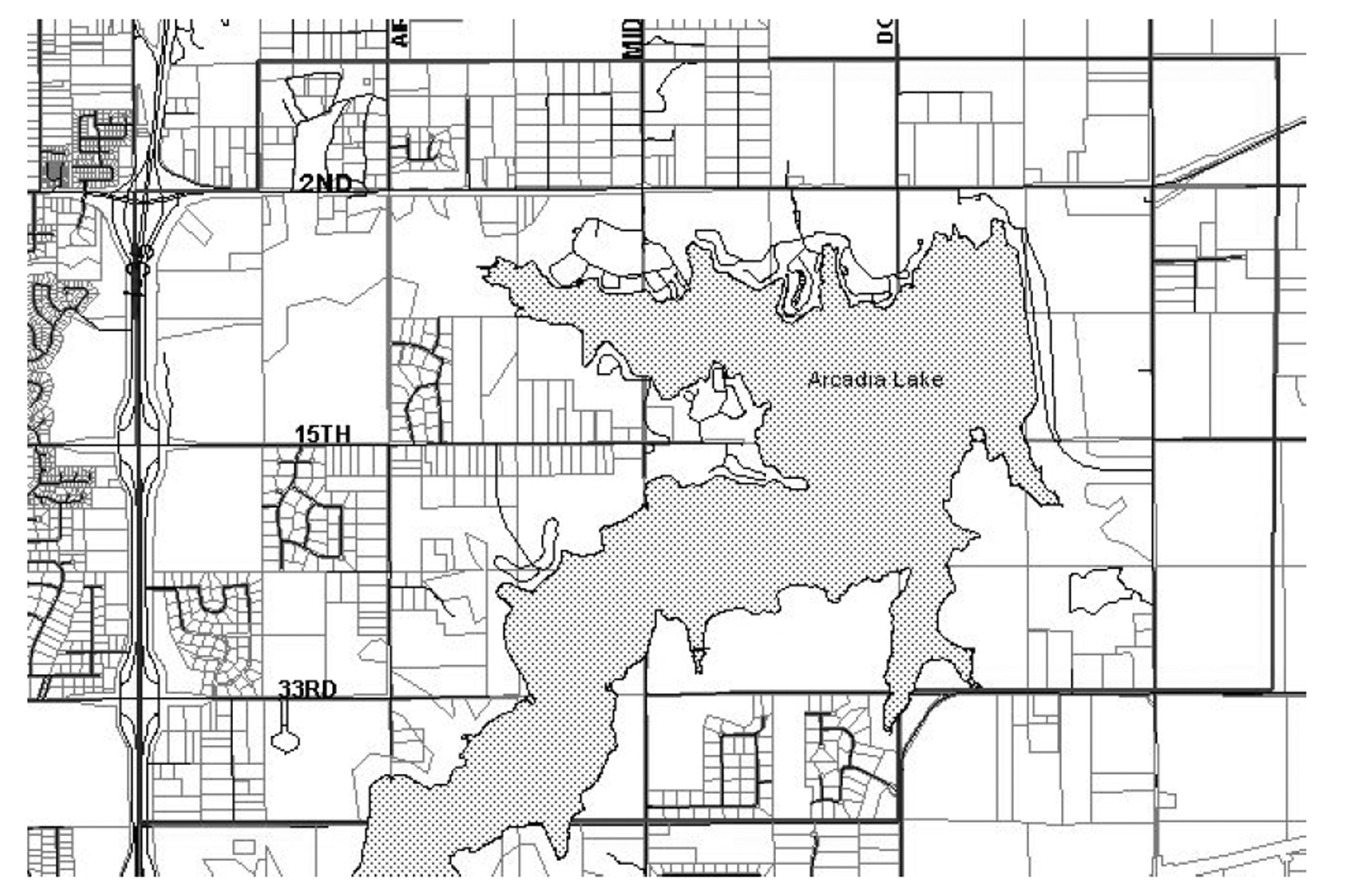
Lake Area
(D)
Lake Commercial Site Landscaping. In addition to the general landscaping standards found in subsection 22.6.1(D), landscaping in the applicable districts shall meet the following minimum standards.
(1)
Main and accessory buildings and off-street parking and loading facilities shall cover not more than 70 percent of the site area.
(2)
All yard areas and open spaces shall be landscaped and maintained in a live and healthy condition with trees, ornamental shrubs and grass areas according to the following standards.
(a)
Open Space. Not less than 30 percent of the total site area, exclusive of the public right-of-way, shall be landscaped with trees, ornamental shrubs and grass areas.
(b)
Plant Density. There shall be a minimum of 30 live plant units provided for every 250 square feet of area. A minimum of 25 percent of the plant units shall be evergreen. Any trees proposed for saving shall include a tree preservation plan according to paragraph 22.6.1(D) (6).
(c)
A 20-foot bermed and landscaped area shall be required adjacent to all residential districts.
(d)
A sight-proof fence of wood, masonry materials or of materials matching the building construction, not less than five feet nor more than six feet high, shall be located on top of all berms adjacent to residential districts.
(3)
Alternative Compliance. The landscaping requirement in paragraph (1) may be reduced for each of the following conditions that are met or exceeded. However, in no event shall the percent of landscaped area be reduced by more than three full percentage points regardless of the number of conditions met below. The amount of percentage points specified for each of the following conditions shall apply.
(a)
Any trees proposed for saving shall include a tree preservation plan according to paragraph 22.6.1(D)(6).
(b)
Features that aid in noise abatement may include a combination of berms, masonry walls and wooden fences in conjunction with landscaping.
(E)
Lake Commercial Building Design Standards.
(1)
Roofs. Roof construction on buildings shall provide for a minimum of three to 12 pitch. All canopies used in conjunction with the uses listed shall be attached to the main building and shall be an integral part thereof.
(2)
Concrete and Metal Walls. Exposed exterior metal walls or untreated concrete block, including painted concrete block and unfinished or untreated concrete panels, shall not be permitted under any condition.
(Ord. 3068, § 1, November 27, 2006; Ord. 3611, § 16, June 26, 2017)
22.6.4. - CEUD Including CBD and DRD Districts Supplemental Site Design Standards.
(A)
Purpose. The purpose of this Section is to establish standards for the review of all development and redevelopment projects in the Central Edmond Urban District (CEUD) and implement the Downtown Design Guidelines.
(B)
Objectives. The objectives of these standards are to:
(1)
Promote the development of pedestrian features through the Central Edmond Urban District (CEUD) that shall link the Downtown Core Area to surrounding Transition Areas as well as to the campus of the University of Central Oklahoma, which is recognized as a part of the CEUD;
(2)
Promote the preservation of historic commercial and residential structures in the CEUD;
(3)
Promote the design of quality new structures that represent the spirit of today's Edmond;
(4)
Protect the value and special identity that is the CEUD and help it grow into a sense of place for all of Edmond to enjoy;
(5)
Prevent the construction and deterioration that will take away from or is incompatible with the special qualities of the CEUD;
(6)
Promote residential growth in the CEUD;
(7)
Promote multi-disciplined projects involving retail, office, residential and entertainment uses in the CEUD; and
(8)
Promote arts and culture.
(C)
Applicability.
(1)
These standards shall apply to all development, redevelopment or renovation of uses other than single-family residential that meet the criteria in paragraph 22.3.5(A)(1) and to all uses requiring a specific use permit in these districts.
(2)
The Central Business District/Downtown Residential District standards shall be in addition to those standards applicable to all districts under Section 22.6.1 and, where applicable, to those standards that apply to major commercial structures.
(3)
The CEUD includes the core CBD and DRD districts and the defined transition areas as shown on the following map.
(4)
The defined transition areas within the CEUD shall at a minimum meet the Standards of Section 22.6.1.
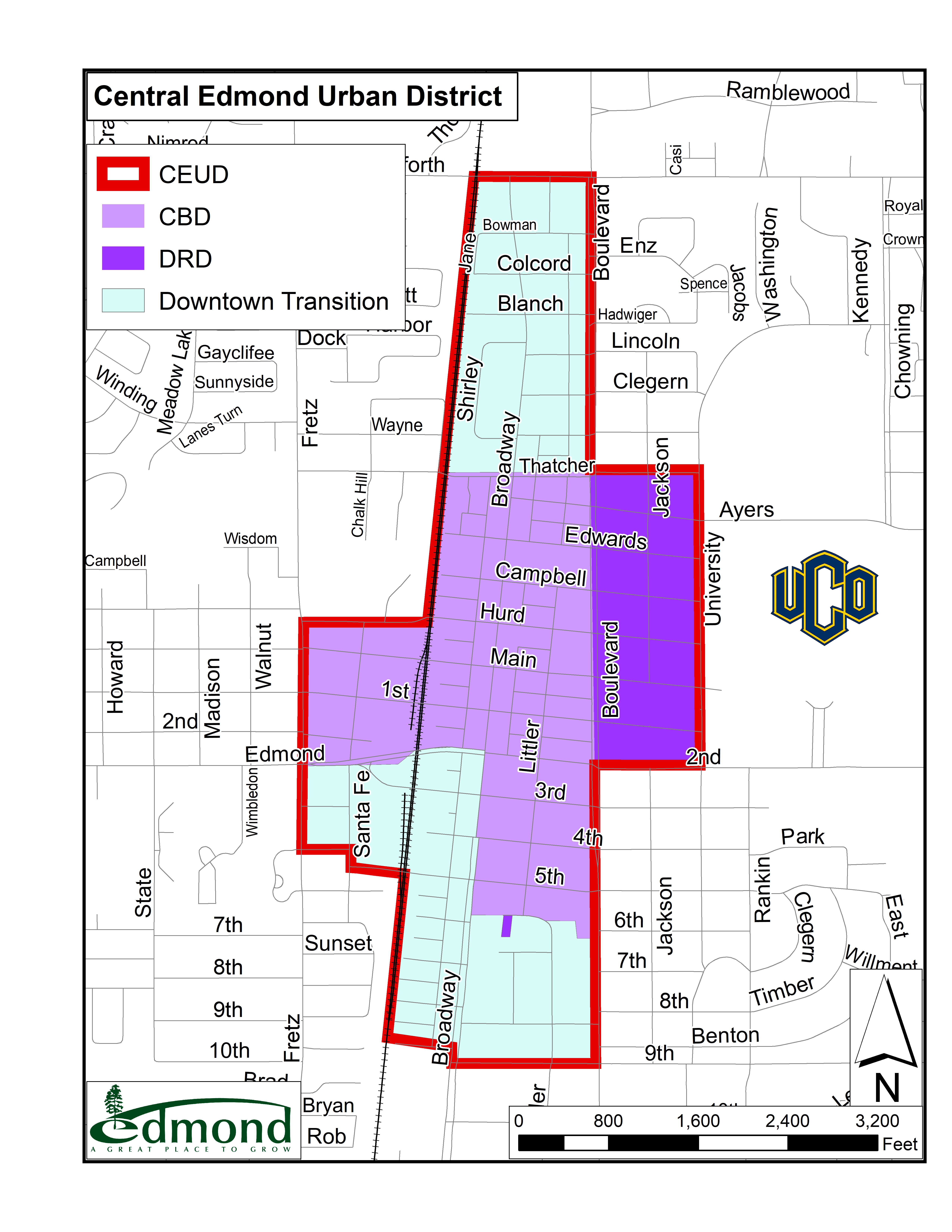
Central Edmond Urban Development District
(D)
CEUDB Off-Street Parking.
(1)
The following table represents the minimum and maximum parking requirement for new development in the CEUDB.
(2)
Diagonal on-street parking spaces adjacent to the property lines of the site shall be included in determining the parking requirement for a particular use. When on-street parking is not adequate to meet the parking need, off-street parking shall be constructed.
(3)
When parking is at a 45 or 60 degree parking angle or at right angle to the curb, edge or barrier, the parking stall shall be a minimum of nine feet wide and 20 feet long.
(4)
Where on-street parking is being used adjacent to a property, the owner shall bring to City paving standards such on-street parking.
(5)
A developer may pay a fee-in-lieu of providing/constructing on-site or on-street parking spaces as required by this Section for new construction. The amount of this fee per parking space depending upon the location of the new construction shall be determined by resolution of the City Council and shall be listed in Appendix B: Consolidated List of Development Fees in Title 22 of the Edmond Municipal Code. The amount and applicability of the fee shall be reviewed and amended as conditions warrant, at least every five (5) years. The applicable fee will be paid for new construction and must be paid in a lump sum prior to the issuance of a building permit for the structure for which new parking is required. The fees collected will be placed in a reserve account to be appropriated by the City Council and utilized for the future construction and maintenance of parking facilities constructed subsequent to the effective date of this Section, in the CBD and DRD District, including signage, landscaping and striping of the parking spaces.
(E)
CBD and DRD Streetscaping and Landscaping. All uses in this district shall be required to install trees, unless otherwise directed by the Central Edmond Urban Board through the site plan review process, either within the public right-of-way or on the subject lot, if trees meeting the following standards do not already exist. An application for site plan for new construction, remodeling or additions shall be accompanied by a streetscaping plan meeting the objectives of the Downtown Design Guidelines manual. The streetscaping and landscaping plan shall meet the following requirements.
(1)
In lieu of the requirements of 22.6.1(D)(3)(a) requirement for a minimum of 10 percent of the total lot area being landscaped, a minimum of one tree shall be planted at an interval of approximately 40 feet in accordance with the streetscaping plan meeting the objectives of the Downtown Design Guidelines manual. If streetscaping is not applicable, the aforementioned minimum 10 percent landscaping shall apply. The SPRT shall determine that the location and placement of any trees shown on a site plan comply with the applicable design standard.
(2)
All required trees shall be #1 grade, a minimum of two inch caliper and shall comply with all ANSI standards for nursery material and shall be pest and disease free.
(3)
Plantings including plant material, planting depth, staking materials and mulching shall comply with those standards found in 22.6.1 (D) and the Edmond Tree and Landscape Guide.
(4)
A listing of acceptable plant materials for the CBD/DRD area is found in the Downtown Design Guideline manual. Alternate plant materials may be accepted if approved by the Urban Forester.
(5)
Corner areas at the intersection of two public right-of-way shall be landscaped with live plants, trees, shrubs, or grasses. Landscaping shall not encroach on public right-of-way or sight triangles unless specifically authorized.
(6)
All landscaping installed to meet these requirements shall be maintained in a live and healthy condition.
(F)
CBD and DRD Screening. Screening standards shall meet the objectives of the Downtown Design Guidelines.
(G)
CBD and DRD Outdoor Lighting. All uses in this district shall be required to install street lights within the public right-of-way between the property line and the curb. These requirements shall apply for building permits for new construction, remodeling and additions and shall meet the following criteria.
(1)
The street lights shall be installed at an interval of approximately 40 feet along property lines adjacent to the public right-of-way in accordance with the streetscaping plan. The SPRT shall determine that the location and placement of any street lights shown on a site plan comport with the applicable design standard.
(2)
The street lights shall meet the objectives of the Downtown Design Guidelines.
(3)
The street lights shall be equivalent to the existing pattern of street lights established in the City Streetscape project.
(H)
CBD and DRD Outdoor Display and Storage. In the CBD, materials stored or offered for sale in connection with uses permitted in this district shall be stored or displayed outside the confines of the building only under the following conditions:
(1)
The City Manager shall grant, deny or grant with conditions a permit for a sales promotion or special event during which retail open display may be used. In no event shall such permit be construed to allow display of merchandise which is otherwise not permitted sold in such district. The decisions of the City Manager regarding such permits may be appealed to the City Council upon written notice to the Mayor and Council not less than six days before the Council meeting at which the appeal is to be considered.
(2)
In the appropriate season, Christmas trees may be displayed in a reasonable manner.
(3)
Newspaper vending machines and ice machines may be displayed in a reasonable manner.
(I)
CBD and DRD Paving Requirements.
(1)
Where a property is to be occupied by a dwelling containing more than a single-family dwelling unit or by a commercial or civic institution, the owner shall bring to City standards one-half of the public rights-of-way, or in the case of alleys, all of the public right-of-way, abutting and adjoining said property.
(2)
The widening and paving required in paragraph (1) above shall be shown on the plans submitted for the building permit.
(3)
Where on-street parking is to be established, the owner shall pave such parking to City standards adjacent to the abutting and adjoining public right-of-way.
(J)
CBD and DRD Sidewalk Requirements.
(1)
Sidewalks shall be provided along all public right-of-way and shall be a part of the requirements for a building permit for new development, redevelopment or renovation of any property uses within the City.
(2)
All sidewalks shall be constructed of concrete, brick or cobblestone and shall be constructed in accordance with the Downtown Design Guidelines manual.
(3)
In the CBD, sidewalks shall be constructed 12 feet wide or at a width established by the existing sidewalk on the block, but in no case shall the sidewalk be constructed at a standard less than that required for commercial construction.
(4)
In the DRD, sidewalks shall be constructed six feet wide or at a width established by the existing residential sidewalk on the block.
(Ord. 3068, § 1, November 27, 2006; Ord. 3182, § 18, November 10, 2008; Ord. No. 3504, § 1, October 12, 2015; Ord. 3611, § 17, June 26, 2017; Ord. 3840, § 1, April 26, 2021; Ord. No. 3964, § 2, 8-14-2023)
22.6.5. - Sensitive Border Standards.
(A)
Applicability. The following standards shall be met as a condition of approval of any specific use permit or site plan for new construction of multiple-family or nonresidential use located within 300 feet of any platted or developed single family residential property.
(B)
Hours of Operation.
(1)
Loading Operations.
(a)
No loading or unloading operations shall be conducted between the hours of 10:00 p.m. and 6:00 a.m.
(b)
No parking or idling of delivery vehicles shall occur between the hours of 10:00 p.m. and 6:00 a.m.
(2)
Outdoor Speakers. All outdoor speakers shall not be directed toward abutting residential property. No outdoor speakers shall be used between the hours of 10:00 p.m. and 6:00 a.m.
(C)
Height Limit Related to Setback. In addition to the setback requirements in Chapter 5, structures shall be setback an additional two feet for every one foot in height by which the structure exceeds 35 feet.
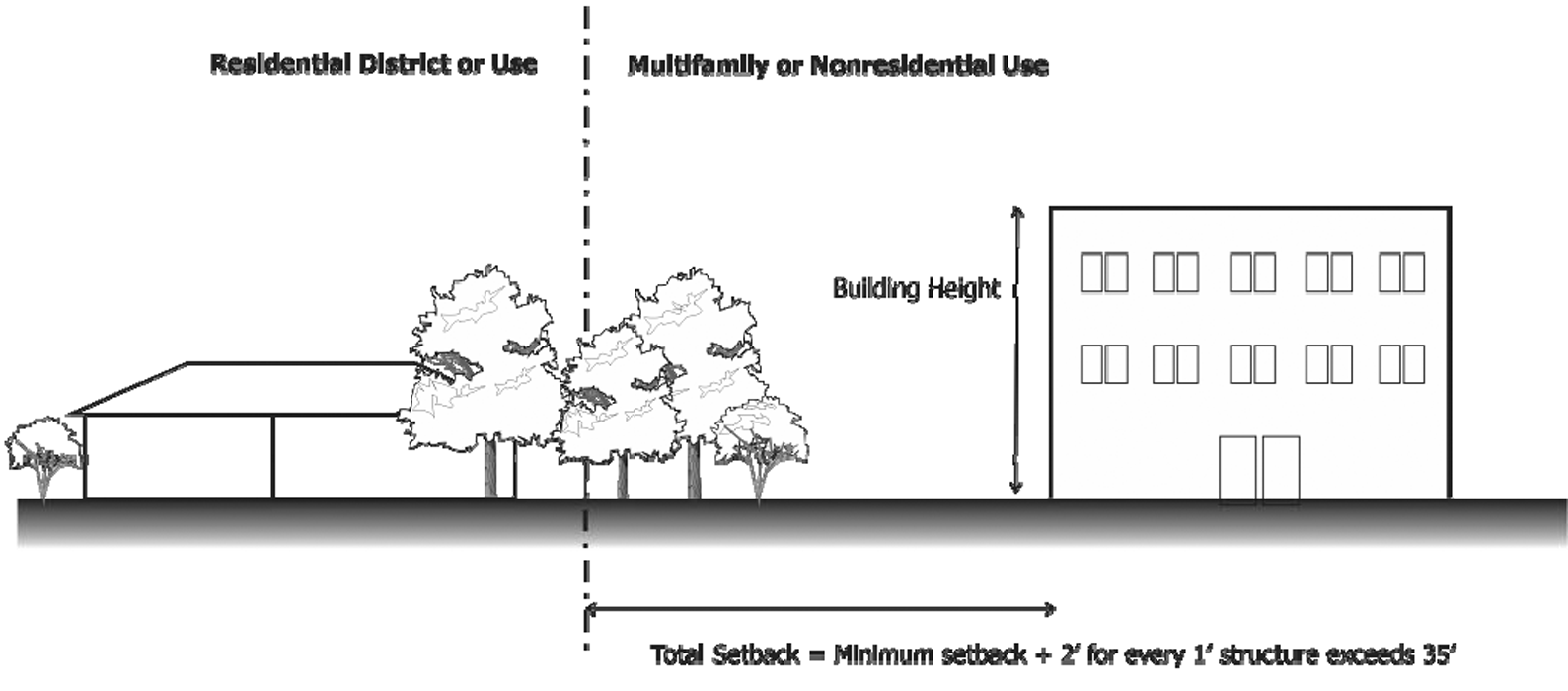
Height Limit Related to Setback
(D)
Sensitive Border Yards.
(1)
Base Yards. Notwithstanding the requirements of Section 22.5.2, the following sensitive border yards shall apply to any applicable use when such yards abut a platted lot or developed residential property. Such yards may be reduced in accordance with paragraph (2) below.
(2)
Reduction of Yard.
(a)
The sensitive border yard requirements in paragraph (1) above may be reduced when the following features are utilized in the yard abutting the residential property.
i.
A landscaped buffer 10 feet in width along the entire length of the residential property line shall result in a reduction of 10 feet in the required residential yard. Such buffer shall contain a minimum of three shade trees, three evergreen trees and 30 five gallon container stock shrubs per 100 linear feet. In the event that a wall as described in (ii) below is not utilized, then such shrubs shall be evergreen.
ii.
An eight-foot high masonry wall along the entire length of the residential property line shall result in a reduction of 10 feet in the required yard.
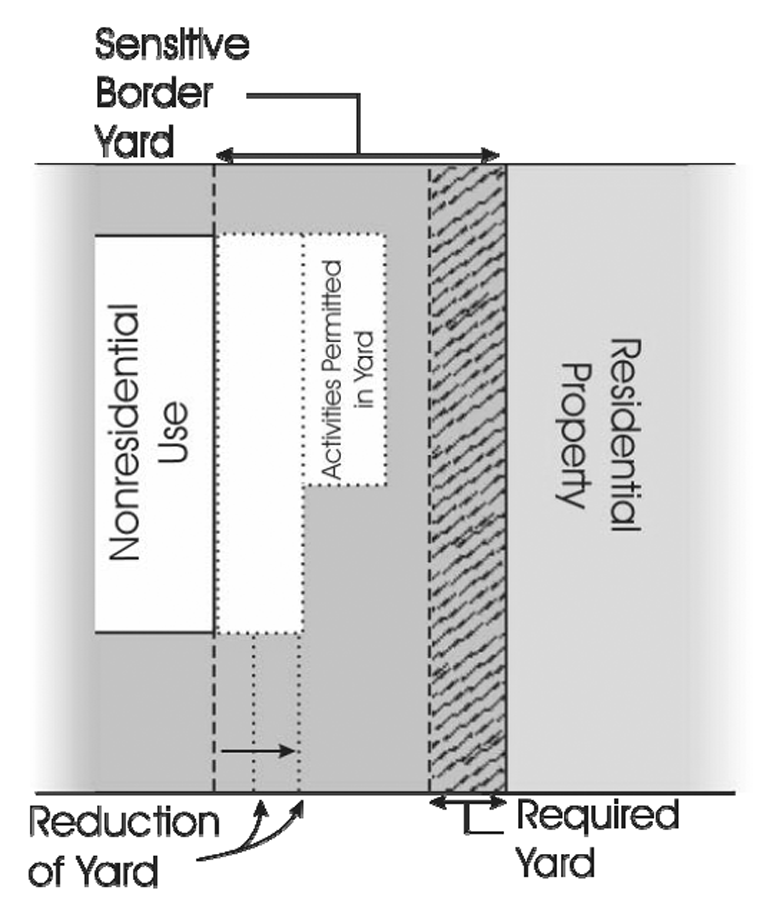
Reduction of Yard
(3)
Activity Permitted in Residential Yard. Parking spaces, fire lanes, detention areas, trails and sidewalks are activities permitted in the sensitive border. No portion of any building in the sensitive border yard shall provide service facilities such as loading areas.
(4)
Variance. It is recognized that due to unique site conditions presented by any application, particularly the redevelopment of existing multiple-family or non-residential uses, and in the built environment, the above listed base yard standards may be determined to not be applicable by the City Council.
(E)
Equipment and Facility Screening.
(1)
Fencing. Any applicable use shall require sight-proof fencing, no less than six feet in height, on any portion of the property which abuts single family residential unless an approved tree preservation area is provided in accordance with subsection 22.6.1(D), if approved by Forester for screening purposes.
(2)
Screening of Parking. The parking area for more than six vehicles shall be screened from the abutting residential property by an opaque, ornamental fence or wall not less than six feet high and not more than eight feet high. The fence or wall shall be constructed and maintained in good condition along the applicable lot line or paving line and shall continue up to, but not beyond, the abutting residential building street yard setback line.
(3)
Refuse Facilities.
(a)
No container used for refuse collection, recycling, trash compaction or the holding of grease shall be located in a yard abutting residential property. If the applicable use is surrounded by residential properties, then the facility shall be located a minimum of 25 feet from any side or rear property line.
(b)
No servicing of refuse facilities shall occur between the hours of 10:00 p.m. and 6:00 a.m.
(F)
Outdoor Lighting.
(1)
Spillover light onto an abutting residential property shall not exceed 0.2 footcandles, measured at the lot line.
(2)
Illumination at the public right-of-way line when an applicable use is across the public right-of-way from a residential property shall not exceed one footcandle.
(3)
Fiber optic or neon building decoration shall be prohibited.
(4)
All light fixtures located within 50 feet of any residential property shall not exceed 15 feet in height.
(G)
Building Design Standards.
(1)
Roofs. Flat roofs may be used provided that the top of the roof shall not be visible from adjacent protected properties. In all other cases, pitched roofs shall be required.
(2)
Privacy. No applicable use should have windows or other openings that allow for visibility into the side or rear yard of an adjacent residential property. Windows that do not allow visibility into the side yard of the adjacent site, such as a clerestory window or a translucent window, are allowed.
(H)
Supplemental Conditions. In addition to the requirements listed above, the review body may impose other conditions that are necessary to reduce or minimize any potentially adverse impacts on residential property, including, but not necessarily limited to, the following:
(1)
Location on a site of activities that generate potential adverse impacts on adjacent uses such as noises, odors and glare;
(2)
Location of loading and delivery areas;
(3)
Lighting location, intensity, type and hours of illumination;
(4)
Placement and illumination of outdoor vending machines, telephones, and similar outdoor services and activities;
(5)
Additional landscaping, berms and buffering;
(6)
Height restrictions to preserve light and privacy and views of significant features from public property, right-of-way and adjacent residential areas;
(7)
Preservation of natural lighting and solar access;
(8)
Ventilation and control of odors and fumes;
(9)
Paving or other surface treatment for dust control;
(10)
Additional building setback depending on the topographic change or grading of the property and the use of retaining walls;
(11)
Additional fencing requirements; and
(12)
Preservation of natural features adjacent to residential uses including tree preservation where there are substantial groupings of trees.
(Ord. 3068, § 1, November 27, 2006; Ord. 3182, § 19, November 10, 2008; Ord. 3252, § 1, January 11, 2010)
22.6.6. - Route 66 Corridor District Supplemental Site Design Standards.
(A)
Purpose.
(1)
The purpose of this Section is to establish supplemental site design standards for the development, redevelopment or renovation of property meeting the applicability criteria in subsection (C) below and located in the City of Edmond Route 66 Corridor.
(2)
These standards work toward assuring development which complies with the objectives of this Section and enhances area architectural and environmental elements in furtherance of the best interests of this community. Furthermore, developers are encouraged to design developments that harmonize with the existing terrain and forest areas, rather than changing the site to fit a specific design.
(B)
Objectives.
(1)
Proposed projects shall respect the natural, wooded environment of this important remnant cross timbers forest area and shall endeavor, as best as is practicable, to preserve, protect and incorporate this natural environment, with all its features, into the overall site plan design.
(2)
When projects are proposed along the arterial roadways or highway, the site plan review process shall emphasize quality design to maximize the natural features of the land and create a safe and visually pleasant driving experience for the roadway user.
(3)
Portions of the corridor are in proximity to municipal water supply which cause a special concern for pollution (short and long term) from land development, and concern for protection of the natural environs surrounding Arcadia Lake. Projects should emphasize designs that will provide protection for natural environmental features, and preserve and enhance the environmental amenities of the site.
(C)
Applicability.
(1)
These standards shall apply to all development, redevelopment or renovation of uses in the Route 66 Corridor other than single-family residential that meet the criteria in paragraph 22.3.5(A)(1) and to all uses requiring a specific use permit in the Corridor.
(2)
These standards shall be in addition to those standards applicable to all districts under Section 22.6.1 and, where applicable, to those standards that apply to major commercial structures under paragraph 22.6.1(I)(3). In case of a conflict, the standards of this section shall control over the standards in Section 22.6.1, but the standards in paragraph 22.6.1(I)(3) shall control over both of the other sections.
(3)
If in conflict with other supplemental site design standards the Route 66 Corridor Supplemental Site Design Standards shall take precedence.
(3)
The Route 66 Corridor District shall be defined as any property having frontage along Route 66 or within 600' either side of the center line of Route 66, between a point one-half mile west of the center line of Air Depot Boulevard (also the eastern edge of the I-35 Corridor District) and the center line of N. Westminster Road.
Route 66 District
(D)
Route 66 Corridor Site Landscaping. Application for site plan review shall be accompanied by a detailed landscape plan for both the required site area and the area within the public right-of-way between the property line and curb.
(1)
Open Space. Not less than 15 percent of the site area shall be landscaped, exclusive of the public right-of-way unless greater landscaping standards apply based on the requirement of another district. Forty percent of the total landscaping shall be along the frontage.
(2)
Plant Density. The site plan shall meet the following requirements.
(a)
At least 30 live plant units shall be provided for every 250 square feet of required landscaped area. Plant unit designations for various plant sizes and types are listed in paragraph 22.6.1(D) (3) and 22.6.1(D) (6) above.
(b)
Not less than 25 percent of all plant units shall be evergreen. Not less than 52 percent of the plant units shall be trees. Species diversity is encouraged and should be provided in accordance with sound urban forestry practices. No single tree species should account for more than 33% of the new tree plant units on sites where 150 or more tree plant units are required.
(c)
Any trees proposed for saving shall include a tree preservation plan according to paragraph 22.6.1(D) (6).
(d)
A majority of plant material should be species that are native to the Cross Timbers ecosystem or regional area.
(3)
Alternative Compliance. Landscaping requirements in paragraph (1) above may be reduced for each of the following conditions that are met or exceeded. However, in no event shall the percent of landscaped area be reduced by more than three percentage points regardless of the number of conditions met below.
(a)
Any trees proposed for saving shall include a tree preservation plan according to subsection paragraph 22.6.1(D)(6).
(b)
Features that aid in noise abatement may include a combination of berms, masonry walls and wooden fences in conjunction with landscaping.
(E)
Route 66 Corridor Building Design Standards.
(1)
Purpose. The architectural design of structures shall comply with the standards of this Section and be complimentary with the surrounding development, and in harmony with the wooded environment. Elements to be considered include the building placement, size, shape, height, style, exterior materials and colors, and its relationship to all proposed site improvements. Buildings should be considered as three-dimensional objects, and attention should be given to the complimentary treatment of all exterior surfaces.
(2)
Exterior Walls. The exterior building materials, textures and colors shall be carefully selected so as to be in harmony with the surrounding environment. Buildings shall be predominantly of one or two exterior materials. Architectural detail such as change of plane, texturing, ribbing, fluting, banding, etc. should be considered to give large surfaces interest or dimension where appropriate. Exterior walls shall be brick, stone, rock, wood, or a combination of these materials with other accent materials. Glass may be considered if it complies with the objectives of this Section. Exterior walls using metal surfaces or untreated concrete block, including painted concrete block, shall be prohibited.
(3)
Trim or Accent Materials. Trim and accent materials shall comprise no more than 15 percent of the exterior finish of buildings. Suggested accent materials include glass block, plaster, EIFS, copper and the aforementioned exterior building materials.
(4)
Roofs. Composition, shingle, tile, clay tile and copper roofing material are encouraged.
(Ord. 3945, § 1, April 10, 2023)

