
Farmington City Zoning Code
ARTICLE 2
USE REGULATIONS
ARTICLE 2 USE REGULATIONS
Sec. 2.1 - Districts established.
2.1.1 Establishment of base zoning districts. The following base zoning districts are hereby established, together with appropriate abbreviations, which may appear on the official zoning map and elsewhere within this UDC:
2.1.2 Zoning district hierarchy. Under the hierarchy of zoning districts established by this Unified Development Code, the RE-2 district is the most restrictive zoning district and the IND district is the least restrictive zoning district. The PUD district and the overlay districts are not included in the zoning district hierarchy.
2.1.3 Establishment of special purpose and overlay zoning districts. The following special purpose and overlay zoning districts are hereby established:
(Ord. No. 2021-1325, 3-9-21)
Sec. 2.2 - Zoning map.
The boundaries of the zoning districts established by this UDC are shown on the "Official Zoning Map of City of Farmington, New Mexico" which is a part of this UDC as fully as if it were set out in this UDC in detail. Original zoning district maps are maintained in the office of the Community Works Director or designee. Where uncertainty exists as to the boundaries of districts as shown on the official zoning map, the following rules shall apply:
2.2.1 Omitted land. It is the intent of this UDC that every part of the incorporated City of Farmington be included in one of the zoning districts established by this UDC. Any land located now or in the future in the city not shown to be included in a zoning district shall be deemed to be classified in the RE-2 district, pending approval of a zoning map amendment pursuant to the requirements of section 8.7.
2.2.2 Additional land areas. Any land area that comes under the jurisdiction of this UDC shall automatically be classified in accordance with state statutes.
2.2.3 Multiple zoning districts. Whenever a lot of record is divided by a zoning boundary, the development of the lot shall conform to the land use and design criteria of the zoning district in place on that specific portion of the lot.
2.2.4 District boundaries. The following rules govern interpretations regarding the location of zoning district boundaries.
A.
Municipal boundaries. Boundaries shown as following or approximately following the limits of any incorporated municipality shall be construed as following those limits.
B.
Streets and highways. Unless otherwise indicated on the map, boundaries shown as following or approximately following streets and/or highways shall be construed to follow the centerlines of those streets and/or highways.
C.
Property lines. Boundary lines shown as following or approximately following platted lot lines or other property lines shall be construed as following those lines.
D.
Section lines. Boundaries shown as following or approximately following section lines, half-section lines, or quarter-section lines shall be construed as following those lines.
E.
Railroads. Unless otherwise indicated on the map, boundaries shown as following or approximately following railroad lines shall be construed to lie midway between the main tracks of those railroad lines.
F.
Watercourses. Boundaries shown as following or approximately following the centerlines of streams, rivers, or other continuously flowing watercourses shall be construed as following the channel centerline of those watercourses taken at mean low water, and, in the event of a natural change in the location of those streams, rivers, or other watercourses, the zone boundary shall be construed as moving with the channel centerline.
G.
Map scale and distances. Boundaries shown as separated from, and parallel or approximately parallel to, any of the features listed in this subsection shall be construed to be parallel to those features and at such distances as are shown on the zoning district map. Distances not specifically indicated on the map shall be determined by the scale of the map.
(Ord. No. 2021-1325, 3-9-21)
Sec. 2.3 - Use table.
All allowable principal uses, as specified in the table below (Table 2.3), shall be established in permanent structures, except as may be otherwise expressly permitted or inherent to the character of such allowed uses. All of the use categories used in the table are explained in section 2.7. The first column contains use categories and the second column contains a list of specific uses, which provide an abbreviated explanation of the respective use category. If there is a conflict between the abbreviated specific use and the full explanation in section 2.7, the provisions of section 2.7 shall control. The final column of the table contains references to "Use Standards" that apply to the listed use type in all zoning districts and circumstances. The use standards applicable to the respective specific uses are presented in alphabetical order in section 2.4 following the use table.
2.3.1 Accessory uses. The regulations that apply to accessory uses are contained in section 2.5.
2.3.2 Temporary uses. Temporary uses may be allowed only if reviewed and approved in accordance with the temporary use review procedures. The regulations that apply to temporary uses are contained in section 2.6. Temporary uses are subject to all other applicable provisions of this UDC. Temporary Buildings shall receive a permit through the building division.
2.3.3 Uses not allowed. A blank cell (one without a "P", or "S") indicates that a use type is not allowed in the respective zoning district. Uses not listed may be allowed in accordance with the similar use interpretation provisions of section 2.7.2.
2.3.4 Principal uses.
P Permitted uses:
A "P" indicates that a use is allowed by right in the respective zoning district and may be reviewed and approved by the Director or designee, without public review. Permitted uses are subject to all other applicable regulations of this UDC.
S Special uses:
An "S" indicates that a use is allowed only if reviewed and approved as a special use, in accordance with the special use review procedures of section 8.9. Special uses are subject to all other applicable regulations of this UDC.
TABLE 2.3
(Ord. No. 2011-1242, § 1, 4-26-11; Ord. No. 2014-1270, §§ 1, 4, 10-28-14; Ord. No. 2017-1302, § 1, 6-13-17; Ord. No. 2021-1325, 3-9-21; Ord. No. 2025-1372, 1-14-25)
Sec. 2.4 - Use standards.
Specific uses listed below may be allowed in accordance with the Use Table in section 2.3 and subject to the following standards:
2.4.1 Adult bookstores and entertainment. (Retail, service and commercial use categories; retail sales and service, entertainment-oriented).
Adult bookstores and entertainments establishments shall comply with the standards of this section.
A.
Use limitations. Such uses may include the following uses as defined in Article 11, Definitions: adult bookstore, adult movie theater, adult lounge, parlor or cabaret, adult novelties, adult entertainment, and adult video. Adult modeling studios and any other type of sexual encounter center shall be prohibited.
B.
Minimum separation distance: One thousand feet.
The above separation distance applies to all adult entertainment establishments, and to specific uses including, other adult entertainment establishments, any residential property, religious assembly, library, cultural service, childcare center, elementary or secondary school, community centers, or public park.
(1)
Exception. City Council may approve a lesser separation than required above with the following findings:
a.
The location of the proposed sexual adult oriented business will not have a detrimental effect on nearby properties nor be contrary to the public safety or welfare;
b.
That the granting of the exception will not violate the spirit and intent of this section;
c.
That the location of the proposed sexually oriented business will not downgrade the property values or quality of life in the adjacent areas or encourage the development of urban blight;
d.
That the location of the adult oriented business in the area will not be contrary to any existing program of neighborhood conservation nor interfere with any efforts of urban renewal or restoration;
e.
That adequate buffering exists to protect neighboring zones; and
f.
That all other applicable provisions of this section will be observed.
C.
Measurement. For the purposes of this section, distances shall be measured in a straight line, without regard to intervening structures or objects, from the nearest point on the property line of the lot on which the adult entertainment establishment is located, to the nearest point on any property line of a residential property, specific use, or other adult entertainment establishment is located.
D.
Signs. Signs advertising an adult entertainment establishment, as defined in Article 11, definitions, shall comply with the standards of section 5.8, signs, and with those of this section. Such signs:
(1)
Shall not contain any flashing lights or moving parts;
(2)
Shall contain no photographs, silhouettes, drawings or pictorial representations of any manner, and shall not advertise either graphically or verbally, either by explicit or literal expression, any specified sexual activities or specified anatomical areas; and
(3)
May only contain the name of the enterprise and/or one or more of the following phrases: adult bookstore, adult movie theater, adult lounge, parlor or cabaret, adult novelties, adult entertainment, and adult video.
E.
Prohibited activities. An adult entertainment use shall not be conducted in any manner that provides the observation of any material depicting, describing or relating to "specified sexual activities" or "specified anatomical areas" defined in Article 11, definitions, from any public right-of-way. This provision shall apply to any display, decoration or show window.
F.
Limited exception for subsequent specific uses and residential property. An adult entertainment establishment, lawfully operating under this UDC, shall not be deemed to be in violation of the location restrictions set forth in this subsection solely because a specific use subsequently locates within the minimum required distance of the adult entertainment establishment, or when any other lot or tract within the required minimum distance of the adult entertainment establishment, subsequently becomes residential property.
G.
Licensing of the owner/manager. The city council shall determine that the owner/manager of the establishment qualifies for a licensee pursuant to the criteria set forth in section 8-14-4, Farmington Municipal Code.
H.
Specific prohibitions.
(1)
Private viewing areas. It shall be a violation of the Farmington City Code to operate an adult arcade or adult entertainment center as a part of any adult oriented establishment unless the building is internally constructed so that the viewing areas in such arcades or establishments are visible from a continuous main aisle and are not obscured by any curtain, wall, door, or other enclosure.
(2)
Underage employees and nude modeling studios. It shall be a misdemeanor for any person to employ, in any capacity, at a nude modeling studio, any person under the age of 18 years. Further, no sofa, bed, mattress, chair, or mat may be utilized in any such studio. Provided, however, that nothing herein shall be deemed to prohibit the presence of a couch or chairs in a public reception area or in any office area.
I.
Other requirements. The city council may establish additional, appropriate conditions as it deems necessary, on a case-by-case basis, including but not limited to:
(1)
Screening from adjacent uses in accordance with the requirements of section 5.5.7, screening standards;
(2)
The parking lot be visible from any street; and
(3)
Additional exterior lighting and/or landscaping.
J.
Timing requirements for review.
(1)
The planning and zoning commission shall forward its recommendation on applications for adult-oriented businesses to the city council for final action no later than 60 days from receipt of a completed application. If the commission has failed to take any action within 60 days from the date of its receipt of a completed application, the application shall be referred to the city council for final action without recommendation.
(2)
The city council shall act on such applications within 30 days following receipt by the city council of the commission recommendation.
(3)
Final action on such applications shall occur within 90 days of the receipt of a properly completed adult-oriented business application. Failure of the city council to either grant or deny such applications within a 90-day time period shall be deemed to constitute approval of the adult oriented business application.
(4)
Nothing herein shall prohibit the applicant from agreeing to an extension of any time periods. Applicant requests for extensions of time, tabling, or postponement by either the commission or the city council shall extend the time for final action by the period of time the applicant has requested a postponement.
(5)
As used herein, final action shall mean the action of the city council taken in open session granting or denying an application for an adult oriented business. The fact that the city council may require additional time to prepare written findings and conclusions shall not operate to extend the time for final action nor shall it be deemed a failure to act within the mandatory period for action.
2.4.2 Agriculture. (Other use categories, agriculture use).
Agriculture shall comply with the standards of this section.
A.
Agriculture shall be limited to field crops, as categorized by the State of New Mexico, truck gardening, berry or bush crops, tree crops, nurseries, aviaries and apiaries, including greenhouses; but shall not include salesrooms, farmers markets, or roadside stands.
B.
The keeping of animals or fowl not specifically authorized in this UDC, shall be prohibited. (See also section 2.4.7, animals or fowl.)
C.
All agricultural activities shall be subject to section 5.11 of this Code.
2.4.3 Agricultural service. (Industrial use categories, industrial sales and service).
Agricultural supplies, storage, or service centers uses shall comply with the standards of this section.
A.
Minimum lot area: 2 acres.
B.
Minimum setbacks (all sides):
(1)
Buildings: 35 feet.
(2)
Bulk storage tanks and containers: 150 feet.
C.
The site shall have frontage on and access to a collector or arterial street, provided the authority with jurisdiction over the subject road may approve alternative access.
D.
Trucks, tractors, portable storage tanks, and trailer or motorized agricultural implements shall be screened from view of adjacent streets and residential zoning districts.
E.
Contamination of water resources due to spillage or leakage of chemicals, fuels and other products that are stored on-site is prohibited.
F.
Sales shall be primarily to serve the agricultural community.
G.
All outside sales, storage, and display shall conform to the requirements of section 2.4.46, open air sales and display.
2.4.4 Airports, heliports. (Other use categories; aviation and surface transportation).
All airports and heliports shall comply with the standards of this section.
A.
All airports and heliports shall be required to provide an environmental impact statement approved by the Federal Aviation Administration or other appropriate agency.
B.
A site plan prepared in accordance with the requirements of section 8.5 shall be approved and filed as part of the findings of fact and conclusions of law in support of the approval.
C.
Documentation shall be submitted showing that the site complies with all applicable state and federal requirements.
D.
Setbacks, landscaping and fencing appropriate to the specific nature of the use proposed shall be established during the review process.
E.
The site shall have frontage on and access to a collector or arterial street, provided that the highway authority with jurisdiction over the subject road may approve alternative access.
F.
All areas proposed for active use, including fuel storage areas, shall be fenced.
G.
Take off and landing facilities shall be located so as to minimize the impact on existing and proposed residential areas.
H.
Heliports shall only be utilized as an accessory use to airports, hospitals, or government facilities.
2.4.5 Amphitheaters, auditoriums, arenas, and athletic fields. (Retail, service and commercial use categories; entertainment event, major).
Amphitheaters, auditoriums, arenas, and athletic fields shall comply with the standards of this section.
A.
Minimum lot area: 5 acres.
B.
Minimum setbacks (all sides): 100 feet.
C.
The above minimum setback shall be from any street or boundary line for all structures, parking areas, and seating areas.
D.
The site shall have frontage on and access to a collector or arterial street, provided, that the highway authority with jurisdiction over the subject road may approve alternative access.
E.
The following accessory uses may be permitted as incidental to, and limited to patrons of, the principal use:
(1)
Playground;
(2)
Refreshment/souvenir stands or booths; or
(3)
Offices.
2.4.6 Amusement parks. (Retail, service and commercial use categories; entertainment events, major).
Amusement parks shall comply with the standards of this section.
A.
Minimum lot area: 5 acres.
B.
All equipment shall be located and designed to minimize adverse impacts on adjacent uses.
C.
The site shall have frontage on and access to an arterial street, provided the authority with jurisdiction over the subject road approves alternative access.
2.4.7 Animals or fowl. (Other use categories, agriculture use).
Keeping or raising animals or fowl shall comply with the standards of this section.
A.
Within a residential agricultural (RA) district, the keeping of animals or fowl in accordance with the recommended animal unit capacity is permitted by right.
B.
The number of animal units allowed per acre/property in the residential agricultural (RA) district shall be determined by using the recommended animal unit capacity provided in the definition of animal unit in Article 11, definitions.
C.
Roosters on a RA: Rural Agricultural in excess of the maximum number allowed per the Animal Unit Table in Article 11 shall be relocated off-site or repurposed immediately subsequent to beginning to crow.
D.
If noise or other factors related to keeping of fowl on property become a nuisance to the neighbors, these factors shall be mitigated as soon as possible or the right to keep fowl may be revoked.
E.
Additional numbers of fowl shall be permitted through a special use permit.
F.
If complaints are received regarding the keeping of fowl on a property, issues must be addressed immediately or the right to keep fowl will be revoked. An Administrative Review Permit addressing any complaints received shall be obtained in order to retain the right to keep fowl on the property.
G.
No shelter for fowl shall be erected closer than 10 feet to a neighboring dwelling unit.
H.
No slaughtering of fowl on the property is permitted.
I.
In all residential districts other than residential agricultural (RA) the keeping of animals such as horses requires a Special Use Permit.
J.
Animal unit capacity (other than fowl) shall be calculated exclusively of otherwise applicable minimum lot area requirements.
K.
Adequate fencing, screening or separation from adjoining premises shall be provided based upon the type, number and size of animals for protection of the animals or fowl; protection of the public; and for control of dust, noise, odors or similar nuisance factors.
L.
A drainage narrative, waste management plan and watershed protection plan shall be required to accompany a special use permit for the keeping of animals in all districts.
M.
The provisions of this section shall not apply to the keeping or raising up to four domestic dogs and four domestic cats, and other small animals and birds commonly kept as house pets indoors.
2.4.8 Assisted living and nursing homes. (Public, civic and institutional use categories; congregate living).
Assisted living facilities and nursing homes shall comply with the standards of this section.
A.
Applications for assisted living facilities and nursing homes shall include:
(1)
A site plan prepared in accordance with the requirements of section 8.5 shall be approved and filed with the findings of fact and conclusions of law as part of the approval;
(2)
Detailed plan of operation showing proposed hours, number of residents, number of staff and number of 24-hour equivalent staff, lighting and other similar components which could adversely impact neighboring uses; and
(3)
Off-street parking plan in accordance with the provisions of section 5.2, off-street parking, and loading.
B.
All assisted living facilities and nursing homes shall comply with applicable state requirements for the location of such facilities and the minimum square feet of safe, outdoor recreation area and usable floor area for every person the assisted living facility or nursing home is licensed to accommodate.
C.
All assisted living facilities and nursing homes shall comply with applicable state requirements for the location of such facilities and the minimum square feet of safe, outdoor recreation area and usable floor area for every person the assisted living facility or nursing home is licensed to accommodate.
D.
Applications for permission to construct or operate an assisted living facility or nursing home shall be accompanied by copies of all valid permits required by the State of New Mexico. If such permit cannot be obtained prior to the time of application, the application shall be accompanied by a report from the applicable licensing agency stating the licensing requirements and an explanation of how the applicant intends to meet these requirements.
E.
The applicant must demonstrate adequate access and circulation for police, fire, ambulance and other emergency vehicles and must prominently display the street address. Increases in traffic above the allowed uses in the zoning district may not impact the safety of abutting landowners.
F.
The city may impose other conditions that it deems necessary and appropriate to safeguard the public health, safety and welfare and as may be imposed to limit any adverse effect on adjacent properties as a result of the proposed use including a provision that the special use permit may be revoked, after notice and hearing, for un-remedied material violations of any such conditions.
G.
For purposes of this section, a 24-hour equivalent care provider shall be a single provider residing in the facility or a number of providers who together provide coverage totaling 24 hours. Such care providers may be housed on-site.
H.
The assisted living or nursing home structure may contain a common food preparation area and may contain individual kitchenettes for occupants.
2.4.9 Asphalt, concrete or redi-mix plants. (Industrial use categories; manufacturing and production).
Asphalt, concrete, or redi-mix plants shall comply with the standards of this section.
A.
Minimum lot area: 5 acres.
B.
Minimum setbacks (all sides): 100 feet.
C.
The above minimum setback shall be from any residential zoning district or lot containing a residential use for all activity areas, including driveways and on-site roads.
D.
The City may specify the times of operation.
E.
All internal roads shall be maintained in a dust-free condition. The access drive from the site shall be paved with a surface of asphalt or concrete for a distance of at least 100 feet from the right-of-way of the public road from which access is taken. Provisions shall also be made to remove dust, dirt, mud or other debris from the vehicles before they leave the site.
F.
Provisions shall be made for the on-site reduction and containment of dust and other particulate matter.
G.
The site shall have frontage on and access to a collector or arterial street, provided the authority with jurisdiction over the subject road may approve alternative access.
H.
All such plants shall be subject to the limitations on noise, dust, fumes, odors, etc. of section 5.11, operational performance.
2.4.10 Bakeries, retail. (Retail, service and commercial use categories; sales-oriented).
Bakeries in the, LNC and MU districts shall comply with the standards of this section. Each such use shall be limited to a small-scale operation with less than 3,000 gross square feet. Such size limits shall not apply in other districts where the use is allowed.
2.4.11 Bed and breakfast. (Residential use categories; accommodations).
Bed and breakfast shall comply with the standards of this section.
A.
Guest rooms. No more than ten bedrooms or guest rooms shall be rented per night.
B.
Health department approval. Approval and inspection by the San Juan County Health Department shall be required.
C.
Signs. Notwithstanding other provisions to the contrary, up to a maximum of one sign with a maximum area of 25 square feet shall be allowed.
D.
Length of stay. Occupancy by any guest shall not exceed 15 consecutive days. A permanent register shall be maintained to show the names and signatures of all guests.
2.4.12 Boarding houses. (Residential use categories; congregate living).
Boarding houses shall be limited to providing lodging and/or meals for compensation for five or more persons, but not exceeding 20 persons.
2.4.13 Car washes, automatic or self-service. (Retail, service and commercial; vehicle service, limited).
Car washes shall comply with the standards of this section.
A.
Car washes shall be designed so as to minimize adverse impacts on any adjacent residential areas.
B.
A site plan prepared in accordance with the requirements of section 8.5 shall be approved and filed with the findings of fact and conclusions of law as part of the approval.
2.4.14 Cemeteries, mausoleums. (Public, civic and institutional; parks and open space).
Cemeteries and mausoleums shall comply with the standards of this section.
A.
Minimum lot area: 20 acres.
B.
Minimum setback, buildings (all sides): 30 feet.
C.
The site proposed for a cemetery shall not interfere with the development of a public infrastructure system, including streets, sewers and other utilities.
D.
Buildings shall be used for cemetery purposes only, including, offices, memorial chapels, mausoleums, vaults, columbaria, and other such structures as may be necessary for the preparation, presentation, and interment of human or pet remains and the maintenance of the cemetery.
E.
There shall be adequate provisions for perpetual care.
F.
(See also "crematoria" in the section 2.3, use table).
2.4.15 Convenience stores. (Retail, service and commercial use categories; retail sales and service, sales-oriented).
Convenience stores selling liquor as an accessory use shall limit such sales in accordance with the requirements of subsection 2.5.2G. (Convenience stores with gas sales are classified as retail, service, and commercial; vehicles, limited.)
2.4.16 Day care centers. (Public, civic and institutional use categories; day care).
Day care centers shall comply with the standards of this section.
A.
Day care centers may provide care for seven or more adults or children.
B.
A site plan prepared in accordance with the requirements of section 8.5 shall be approved and filed with the findings of fact and conclusions of law as part of the approval.
C.
Day care centers shall comply with all applicable state requirements for the location of such facilities and the minimum square feet of safe, outdoor recreation area and usable floor area for every person the day care facility is licensed to accommodate. No portion of such recreation area shall be located within the required front yard area of the property.
D.
Outdoor recreation areas shall be screened in accordance with the provisions of section 5.5.7, screening standards. Outdoor play or instruction area shall be enclosed by a fence - no less than four feet in height per section 8.16.24.4 of the NMAC. The three-foot fence height maximum indicated in section 5.4.4 of this Code is waived for approved day care facilities.
E.
A landscaped hedge or fence shall be provided along any rear or side property line adjoining any residentially zoned property not used for a similar purpose. Any such hedge or fence shall be designed and planted so as to be at least six feet in height, and, further, the fence or hedge shall provide a solid barrier between the day care facility and the adjoining residential property.
2.4.17 Electrical generation plants. (Industrial use categories; utilities).
Electrical generation facilities with power generation potential of 30 megawatts or more shall comply with the standards of this section.
A.
Minimum setback (all sides): 1,000 feet.
B.
The above minimum setback shall apply to all operational areas and shall be measured from all parcel boundary lines, provided, however these setback requirements shall not apply to adjacent land in the IND district.
C.
For the purposes of this section, the term "operational area" shall mean all electrical generation equipment, cooling equipment, exhaust or venting equipment, and any structures housing such equipment.
D.
Fencing shall be provided around the boundary of the property to prevent unauthorized access in accordance with the provisions of section 5.4, fences and walls.
E.
All current, state, and federal permits, waivers of permits, and licenses shall be on file with the community works director or designee's office throughout the life of the use.
F.
All certificates of insurance shall be on file with the city clerk's office throughout the life of the use.
G.
Reasonable standards and procedures shall be established to prevent contamination of water resources due to spillage or leakage of chemicals, fuels and other products that are stored on-site. The review process shall also consider the possibility of accidental explosion in establishing such standards.
H.
Any increase in the schedule, intensity, or energy output of operations, as established under the original permit, shall require an amendment to said permit.
I.
If all operations at the facility cease for a period of 24 consecutive months, removal of all equipment, structures, foundations, tanks, towers, and fences shall be completed within the next 12 calendar months and the site shall be returned to its previous landscape. A bond or letter of credit for 150 percent of an independent engineer's estimate of site cleanup (removal of structures, foundations, tanks, towers, and fences) shall be submitted to the community works director or designee prior to the issuance of a building permit.
2.4.18 Fairgrounds. (Retail, service and commercial use categories; entertainment events, major).
Fair fairgrounds shall comply with the standards of this section.
A.
Minimum lot area: 5 acres.
B.
Minimum setbacks (all sides): 100 feet.
C.
All equipment shall be located and designed to minimize adverse impacts on adjacent uses.
D.
The site shall have frontage on and access to a collector or arterial street, provided the authority with jurisdiction over the subject road approves alternative access.
E.
Off-street parking shall be set back from property boundaries a minimum of 100 feet from any residential use and residential district.
2.4.19 Family day care homes. (Public, civic and institutional use categories; day care).
Family day care homes shall comply with the standards of this section.
A.
Family day care homes may provide care for four to six adults or children.
B.
An annual business license shall be required for all family day care homes.
2.4.20 Farmers' markets. (Retail, service and commercial use categories; sales-oriented).
Farmers' markets shall comply with the standards of this section.
A.
Display or sale of primarily locally grown agricultural products shall be permitted.
B.
Roadside stands, where allowed, shall not exceed 400 square feet in floor area.
C.
Farmers' markets shall provide parking in accordance with the requirements of section 5.2, off-street parking, and loading.
2.4.21 Flea markets and swap meets. (Retail, service and commercial use categories; sales-oriented).
Flea markets and swap meets shall comply with the standards of this section.
A.
A site plan prepared in accordance with the requirements of section 8.5 shall be approved and filed with the findings of fact and conclusions of law as part of the approval.
B.
Such uses shall comply with the applicable requirements of section 2.4.46, outdoor sales and display.
C.
All sales and parking areas shall be set back at least 200 feet from any residential zone district and from a lot or parcel containing a residential use.
D.
Selling area and parking area shall be of an all-weather, dust-proof surface and shall be maintained in a usable condition at all times.
E.
Adequate traffic access to the use shall be available via nonresidential streets.
F.
All vendors shall hold a valid state sales tax permit.
G.
Such uses shall provide one off-street parking space for each employee (typical peak), in addition to off-street parking otherwise required pursuant to section 5.2, off-street parking and loading.
H.
Overnight lodging or parking of RV's shall not be permitted.
I.
The city may regulate the hours in which outdoor lighting may be used.
J.
The city may impose any further reasonable conditions necessary to protect the health, safety, or welfare of the public.
2.4.22 Golf courses. (Public, civic and institutional land use categories; parks and open space).
Golf courses shall comply with the standards of this section.
A.
A golf course may include swimming pools, snack shops or refreshment stands on the course and a club house that may contain dining/banquet facilities, locker room and shower facilities, a pro shop and a lounge. It may also include a golf practice range as accessory to the golf course, provided that it is an integral part of the golf course, is not lighted or operated other than daylight hours and is not operated at hours other than those during which the golf course is open for play. These lighting regulations and operating hour restrictions shall apply only when the facility is located in or adjacent to a residential zoning district.
B.
In approving a permit for golf courses in or nearby a residential zoning district, appropriate measures shall be required to minimize ill effects of harsh or uncomfortable bright light (i.e., glare) emanating from nighttime illumination, on any residentially zoned lot located outside the golf course.
C.
The site shall have frontage on and access to a collector or arterial street, provided that the highway authority with jurisdiction over the subject road may approve alternative access.
D.
Appropriate measures shall be taken to ensure control of errant golf balls and to protect pedestrians and properties, off-site.
2.4.23 Golf driving ranges. (Public, civic and institutional use categories; parks and open space).
Golf driving ranges shall comply with the standards of this section.
A.
Minimum lot area: 5 acres.
B.
Minimum setbacks (all sides): 100 feet.
C.
In approving golf driving range in or nearby a residential zoning district, appropriate measures shall be required to minimize ill effects of harsh or uncomfortable bright light (i.e., glare) emanating from nighttime illumination, on any residentially zoned lot located outside the golf driving range.
D.
Appropriate measures shall be taken to ensure control of errant golf balls and to protect pedestrians and properties, off-site.
2.4.24 Group care homes. (Residential land use categories; congregate living).
Group care homes shall comply with the standards of this section.
A.
Care may be provided for not more than eight adults or 12 minors; no more than eight adults, including 24-hour caregivers, may reside in any group care home.
B.
Group care homes shall be licensed or supervised by appropriate state or local agencies.
2.4.25 Group care facilities. (Residential land use categories; congregate living).
Group care facilities shall comply with the standards of this section.
A.
Care may be provided for more than eight adults or 12 minors; and more than eight adults, including 24-hour caregivers, may reside in any group care facility.
B.
City Council may increase occupancy limits where the square footage of the building, lot size, sanitary facilities, traffic impacts, and similar factors warrant increased occupancy.
C.
Applications for group care facilities shall include:
(1)
A site plan prepared in accordance with the requirements of section 8.5 shall be approved and filed with the findings of fact and conclusions of law as part of the approval;
(2)
Detailed plan of operation showing proposed hours, number of residents, number of staff and number of 24-hour equivalent staff, lighting and other similar components which could impact neighboring uses;
(3)
Demonstration that a group care home will not be used for purposes other than serving the residents except for normally allowed uses in the district in which the use is located; and
(4)
Off-street parking plan in accordance with the provisions of section 5.2.
D.
Applications for permission to construct or operate a group home shall be accompanied by copies of all valid permits required by the State of New Mexico. If such permit cannot be obtained prior to the time of application, the application shall be accompanied by a report from the applicable licensing agency stating the licensing requirements and an explanation of how the applicant intends to meet these requirements. Any approval may be conditioned upon approval by the appropriate state agency.
E.
All group care facilities shall have direct access to a dedicated public street.
F.
All group care facilities shall comply with applicable state requirements for the location of such facilities and the minimum square feet of safe, outdoor recreation area and usable floor area for every person that the assisted living facility or nursing home is licensed to accommodate.
G.
The applicant must demonstrate adequate access and circulation for police, fire, ambulance and other emergency vehicles and must prominently display the street address. Increases in traffic above the allowed uses in the zoning district may not impact the safety of abutting landowners.
H.
The city may impose other conditions that it deems necessary and appropriate to safeguard the public health, safety and welfare and as may be imposed to limit any adverse effect on adjacent properties as a result of the proposed use including a provision that the special use permit may be revoked, after notice and hearing, for un-remedied material violations of any such conditions.
I.
For purposes of this section, a 24-hour equivalent care provider shall be a single provider residing in the facility or a number of providers who together provide coverage totaling 24 hours. Such care providers may be housed on-site.
J.
Services shall be provided to persons who, because of mental or physical disability, addiction to drugs, alcohol, incarceration, or family/school problems, require specialized attention and care to achieve personal independence.
2.4.26 Kennels, animal shelters and animal training facilities. (Retail, service and commercial use categories; retail sales and service, personal service-oriented).
Kennels, animal shelters, and animal training facilities shall comply with the standards of this section.
A.
A site plan prepared in accordance with the requirements of section 8.5 shall be approved and filed with the findings of fact and conclusions of law as part of the approval.
B.
Adequate measures will be imposed to mitigate noise transmission beyond property lines, including, but not limited to, noise-deadening construction and/or deep open-space buffering.
C.
Waste handling and ventilation shall be designed to substantially control odors discernable off-site.
D.
All kennels with outdoor exercise areas, runs and yards shall be:
(1)
Fully enclosed within solid six-foot masonry walls;
(2)
Located a minimum of 500 feet from existing residential uses and residential zoning districts; and
(3)
Restricted to use during daylight hours.
2.4.27 Liquor wholesalers. (Industrial use categories; warehouse and freight movement).
Liquor wholesalers shall be subject to approval of otherwise required liquor license(s).
2.4.28 Liquor stores. (Retail, service, and commercial use categories; retail sales and service, sales-oriented).
Liquor stores shall comply with the standards of this section.
A.
Such uses shall be subject to the approval of otherwise required liquor license(s).
B.
Such uses shall not be permitted within 200 feet of a residential structure, unless the city council finds that waiving this requirement will not adversely affect the adjacent neighborhood. For the purposes of this subsection, all measurements taken in order to determine the location of liquor store in relation to a residential structure shall be the straight-line distance from the residential structure to the structure wherein the license shall be used.
2.4.29 Major utilities. (Industrial use categories; utilities).
Major utilities shall comply with the standards of this section.
A.
Such uses shall be screened in accordance with the provisions section 5.5.7, screening standards.
B.
Such uses shall comply with the operational performance standards requirements of section 5.11.
2.4.30 Mining and extractive uses. (Industrial use categories; mining).
All mining and extractive uses shall comply with the standards of this section.
A.
Minimum lot area: 5 acres.
B.
Such uses shall be operated in accordance with the requirements of section 5.11, operational performance standards and Municipal Code, Chapter 12 (noise, smoke and particulate matter, odorous matter, fire and explosive hazard material).
C.
All proposals for oil or gas refining shall be referred to the Oil and gas and geologic and engineering hazards advisory commission for recommendation in accordance with the provisions of the Municipal Code, Chapter 19.
D.
Compliance with any bonding, revegetation, and reclamation requirements of the New Mexico Energy, Minerals, and Natural Resources Department.
2.4.31 Mobile and manufactured home parks. (Residential use categories; household use).
Mobile and manufactured home parks shall comply with all applicable state regulations and the following standards:
A.
Allowable uses:
(1)
Principal uses. Allowable principal structures may include single-section manufactured homes, multi-section manufactured homes, mobile homes, travel trailers, recreational vehicles and owner's residence.
(2)
Accessory uses. The following accessory uses, which are incidental and subordinate to such parks, are permitted:
a.
Park business office;
b.
Manager's residence;
c.
Laundry; and
d.
Social and recreational center, including swimming pools, golf courses, playgrounds, etc., for the use of occupants and their guests.
B.
Density and dimensional standards. Notwithstanding other provisions to the contrary:
(1)
Maximum density: 7 units per acre.
(2)
Singlewide mobile home space:
a.
Minimum space area: 3,600 square feet.
b.
Minimum width: 40 feet.
c.
Minimum interior park driveway setback: 5 feet.
(3)
Doublewide mobile home space:
a.
Minimum space area: 5,000 square feet.
b.
Minimum width: 50 feet.
c.
Minimum interior park driveway setback: 5 feet.
(4)
Maximum height: 2½ stories or 26 feet.
(5)
Minimum dwelling separation (including all accessory structures):
a.
End-to-end: 10 feet.
b.
Side-to-side: 15 feet.
(6)
Minimum separation of service buildings: Service buildings shall be at least 25 feet from the perimeter park boundary.
(7)
Minimum park perimeter boundary setbacks:
a.
Front or street side: 15 feet.
b.
Side: 7 feet.
c.
Rear: 7 feet.
C.
Site plan. A site plan prepared in accordance with the requirements [of] section 8.5 shall be approved and filed as part of the approval of a new mobile home established after the effective date of this UDC, and prior to the enlargement of any existing mobile home park. In addition to the requirements of subsection 8.5.3B., the required site plan shall illustrate the following features:
(1)
Location and dimensions of all park boundaries;
(2)
Location and dimensions of all space boundaries;
(3)
Location of pavement on adjoining street rights-of-way;
(4)
Location and dimensions of any permanent improvements existing or planned within the park, including but not limited to the following:
a.
Improved surfaces for common driveways, off-street parking and recreation areas;
b.
Buildings for management, maintenance and recreational purposes;
c.
Any other recreational facilities; and
d.
Fences or walls.
(5)
Pipelines and systems for potable water distribution, sewage collection and fire protection, including location of all fire hydrants;
(6)
Location and type of landscaping and screening;
(7)
Location of sanitation pickup and access;
(8)
Parking spaces; and
(9)
Designation of useable open space.
D.
Internal park driveways. No access to such parks with more than two dwelling units shall be permitted except from approved internal park driveways. Otherwise, no individual access shall be allowed to the mobile home spaces from any public street or alley. Driveway accesses to such parks shall not be more frequent than every 200 feet. Each individual mobile home space shall abut an internal park driveway with a paved driving surface as follows:
(1)
Such parks shall be provided with safe and convenient vehicular access from a public street and shall be designed to allow free movement of traffic on such adjacent streets.
(2)
Entrances to such parks shall have direct connection to a public street and shall be designed to allow free movement of traffic on such adjacent public street.
(3)
All driveways or other means of vehicular circulation in the mobile home park shall be paved and maintained free of cracks and holes, and their edges shall be protected by suitable means to prevent traveling and shifting of the base.
(4)
Minimum pavement widths: 24 feet.
(5)
Lighting shall be provided and designed to produce a minimum of 0.1 footcandle luminance throughout the driveway system.
E.
Walkways. Such parks shall be provided with safe, convenient, all-season pedestrian access of adequate width for the intended use, durable and convenient to maintain with a minimum of three feet in width.
F.
Drainage plan. A drainage plan shall be approved by the city engineer.
G.
Required parking. A minimum of two off-street parking spaces shall be provided for each space or dwelling.
H.
Landscaping and screening. Landscaping and screening shall be provided in accordance with the requirements of section 5.5.7. A minimum landscaped area of 5,000 square feet or six percent of the site, whichever is less, shall be provided and maintained on the site to create an attractive visual appearance on the front or entrance to each such park.
I.
Solid waste disposal. All common or shared dumpsters shall be screened in accordance with the requirements of section 5.5.7, screening standards. Where individual mobile homes have their own waste containers, the park must provide stands for such containers designed to prevent the containers from being tipped in order to minimize spillage and container deterioration.
J.
Skirting. All mobile homes and single-section manufactured homes shall be fully skirted prior to occupancy with premium-quality, solid and nonporous skirting affixed thereto and approved by the building official, between the underside of the dwelling unit at its outer edge and anchored around the ground level. Each skirt shall include an access panel to the crawl space.
K.
Storage of recreational vehicles (RV). No travel trailer, unoccupied mobile home, camper, or boat shall be stored or parked unattached on a throughway or street within a mobile home park. Special storage areas for travel trailers, boats, campers and unoccupied mobile homes shall be screened by an opaque hedge, masonry wall or fence not less than five feet in height and shall be clearly designated on the required plans.
L.
Fire protection. Every dwelling within a mobile housing park shall be located no further than 500 feet from a fire hydrant.
M.
Underground utilities. All utilities shall be placed underground in the park.
N.
Signs. Residential neighborhood signs shall be allowed in compliance with the requirements of section 5.8, signs.
O.
Numbering. Every mobile home space shall be given an individual number, which shall be marked and located in compliance with city's addressing policies.
2.4.32 Mobile homes and manufactured homes, single-section. (Residential use categories; household living).
Mobile homes and single-section manufactured homes shall comply with the following standards:
A.
General. These standards shall apply to all mobile homes, single-section manufactured homes and lots used for mobile homes, single-section manufactured homes and for any other housing that does not meet the definition of single-family dwelling, duplex dwelling, multifamily dwelling, or manufactured home (single-section) as these terms are defined by section 11.1 in areas other than such parks.
B.
Principal structures. Mobile homes and single-section manufactured homes shall be permitted which are in excess of eight feet in width or 40 feet in length.
C.
Accessory structures. Accessory structures shall be subject to the requirements of section 2.5, accessory uses and structures, and limited to the following:
(1)
Attached or detached carports,
(2)
Attached or detached awnings,
(3)
Attached or detached screened enclosures, and
(4)
Storage buildings or utility buildings.
D.
Dimensional standards. All principal and accessory structures shall be subject to the following required front, rear or side setback requirements.
(1)
Maximum height: 2 stories or 30 feet, whichever is less.
(2)
Minimum lot area: 6,000 square feet.
(3)
Minimum lot width: 50 feet.
(4)
Minimum setbacks:
a.
Front: 25 feet.
b.
Side, Street: 15 feet.
c.
Side, interior:
(1)
Single-section manufactured homes: 5 feet.
(2)
Mobile homes: 8 feet.
d.
Rear: 15 feet.
e.
Exception for accessory structures. Accessory structures, including awnings and carports, which are open at the front and rear, which are made of noncombustible material, and which are not less than five feet from the property line may be placed in any interior side yard.
f.
Exception for replacement of existing mobile/manufactured home units. Setback requirements for replacement units shall be those in existence on site before the existing unit was removed.
E.
Skirting. All mobile homes and single-section manufactured homes shall be fully skirted prior to occupancy with premium-quality, solid and nonporous skirting affixed thereto and approved by the building official, between the underside of the dwelling unit at its outer edge and anchored around the ground level. Each skirt shall include an access panel to the crawl space.
F.
Utilities. All utilities shall conform to applicable codes.
G.
Parking. Off-street parking shall be required in accordance with the requirements of section 5.2, off-street parking and loading; provided, however,
(1)
Where such parking exceeds 50 percent coverage of the required front setback area, the driveway shall not exceed 18 feet in width.
(2)
Notwithstanding other provisions to the contrary, tandem parking shall be allowed.
2.4.33 Mobile and manufactured home sales. (Industrial use categories, industrial sales, and service).
Mobile and manufactured home sales shall comply with the standards of this section. In addition to the signs otherwise allowable by section 5.8, signs, each model home may be identified by one nonilluminated sign not to exceed six square feet at each model and not over six feet in height.
2.4.34 Multifamily dwellings. (Residential use categories; household living).
Multifamily Dwellings shall comply with the standards of this section.
A.
Parking shall be accessed from an alley where alley access is available, or from a shared common driveway(s) where alley access is not available. (See also section 5.2.6, off-street parking location).
B.
Long, flat facades over 100 feet in length shall be broken up by incorporating at least two recesses, minimum two-foot off-sets, angular forms or recessed windows, porches, balconies or other features to provide a visually interesting shape.
C.
Balconies and patios shall not be used for storage.
2.4.35 Nursery or greenhouse, retail. (Retail, service, and commercial use categories; retail sales and service, sales-oriented).
Retail nursery or greenhouses shall comply with the standards of section 2.4.46, open air sales and display.
2.4.36 Oil, gas or thermal drilling. (Other use categories; mining).
Oil, gas or thermal drilling shall comply with the standards of this section.
A.
All proposals for oil, gas, or thermal drilling shall be referred to the oil and gas and geologic and engineering hazards advisory commission for recommendation in accordance with the provisions of the Municipal Code, Chapter 19.
B.
Such uses shall be operated in accordance with the requirements of section 5.11, operational performance standards and Municipal Code, Chapter 12 (noise, smoke and particulate matter, odorous matter, fire and explosive hazard material).
C.
Such uses shall be subject to the residential protection standards of section 5.10, as specified in section 5.10.2, applicability.
2.4.37 Oil or gas refining. (Industrial use categories; manufacturing and production).
Oil or gas refining shall comply with the standards of this section.
A.
All proposals for oil or gas refining shall be referred to the oil and gas and geologic and engineering hazards advisory commission for recommendation in accordance with the provisions of the Municipal Code, Chapter 19.
B.
Such uses shall be operated in accordance with the requirements of section 5.11, operational performance standards and Municipal Code, Chapter 12 (noise, smoke and particulate matter, odorous matter, fire and explosive hazard material).
C.
Such uses shall be subject to the residential protection standards of section 5.10, as specified in section 5.10.2, applicability.
2.4.38 Places of worship with greater than 4,000 square feet of sanctuary space. (Public, civic and institutional categories; religious institutions).
Places of worship with with greater than 4,000 square feet of sanctuary space shall be located on either a minor or a principal arterial.
2.4.39 Post offices. (Industrial use categories; warehouse and freight movement categories).
Post offices shall comply with the standards of this section. Such uses that have drive-up facilities shall comply with the vehicle stacking area requirements of section 5.2.9.
2.4.40 Racetracks. (Retail, service and commercial use categories; recreation and entertainment, outdoor).
Animal and motor racetrack facilities shall comply with the standards of this section.
A.
General:
(1)
Minimum lot area: 20 acres.
(2)
A site plan prepared in accordance with the requirements section 8.5 shall be approved and filed with the findings of fact and conclusions of law as part of the approval.
(3)
All outdoor lighting shall be fully shielded.
(4)
Such uses shall comply with the requirements of section 5.11, operational performance, and not create excessive traffic, noise, light, or other activity that would negatively impact adjacent uses.
(5)
The applicant shall submit a notice of intent to the New Mexico EPA to comply with the National Pollutant Discharge Elimination System Stormwater Permit (NPDES). The approved animal and motor racetracks facilities plan shall fulfill the plan requirements in the NPDES permit.
(6)
The following accessory uses may be permitted as incidental to and limited to patrons of the principal use:
a.
Refreshment stands or booths;
b.
Souvenir stands or booths;
c.
Restaurants or lounges;
d.
Casinos;
e.
Motels or hotels;
f.
Playgrounds and day care facilities; and
g.
Any other customary and incidental uses which may be deemed appropriate.
(7)
Other conditions as may be specified in the review process.
B.
Minimum setbacks. Minimum setback requirements (below) apply to the racetrack and all buildings, viewing areas, and seating areas. Off-street parking shall setback from property boundaries a minimum of 100 feet from any residential use and residential district.
(1)
Racetracks, animal (all sides): 250 feet.
(2)
Racetracks, motor (all sides): 300 feet.
2.4.41 Recreational vehicle (RV) parks and campgrounds. (Retail, service and commercial use categories; sales and service, entertainment-oriented).
Recreational vehicle (RV) parks, campgrounds, and related accessory facilities shall comply with the standards of this section.
A.
Minimum space area:
(1)
Recreational vehicle, motor home, camp trailer and similar uses: 1,200 square feet.
(2)
Cabin or tent: 800 square feet.
B.
Minimum space width: 30 feet.
C.
Recreational vehicle park shall be occupied only by persons using recreational vehicles as defined in section 11.1, and small cabins without plumbing (traditional KOA-style), and tents for overnight, short duration, or seasonal camping.
D.
Each park shall be served by central water and sewer facilities.
E.
Each park shall provide common restroom and shower facilities in accordance with the requirements of the San Juan County Health Department.
F.
No space shall be located more than 300 feet from common restroom and shower facilities.
G.
Landscaping and screening shall be provided in accordance with the provisions of section 5.5, landscaping and screening; and
H.
One tree of a species suitable for the area shall be provided for each two spaces, and shall be located in close proximity to those spaces. (Existing trees on the site may be used to satisfy this requirement.)
2.4.42 Recreational vehicle (RV) storage yards, outdoor. (Industrial use categories; warehouse and freight movement).
Outdoor recreational vehicle storage yards shall comply with the following standards:
A.
A site plan prepared in accordance with the requirements section 8.5, site plan review, shall be approved and filed with the findings of fact and conclusions of law as part of the approval.
B.
Storage may be provided for boats, recreational vehicles, campers, trailers and similar possessions which may not conveniently be kept at a residence or dwelling.
C.
Screening shall be required in accordance with the screening standards of section 5.5.7, screening standards.
D.
All outdoor lighting shall be full cut-off fixtures as defined by section 11.1, terms defined.
2.4.43 Recreational vehicles sales. (Retail, service and commercial use categories; retail sales and service categories; sales-oriented).
Recreational vehicle sales and/or leasing facilities shall comply with the standards of this section.
A.
Minimum setbacks from all rights-of-way and property lines for all parked displayed or stored vehicles: 5 feet.
B.
Concrete wheel stops or other permanent barriers shall be installed to prevent vehicles from encroaching on required setbacks.
C.
All vehicles on premises shall be in an operable condition.
D.
The site shall have direct access to a major or minor arterial, as defined in section 11.1, terms defined.
2.4.44 Restaurants serving beer and wine. (Retail, service and commercial use categories; sales and service, entertainment-oriented).
Restaurants that serve beer and wine shall comply with the standards of this section. Such uses shall be subject to the approval of a beer and wine license pursuant to the requirements of Municipal Code section 5-2-1.
2.4.45 Restaurants serving liquor. (Retail, service and commercial use categories; sales and service, entertainment-oriented).
Restaurants that serve liquor shall comply with the standards of this section. Such uses shall be subject to the approval of otherwise required liquor license(s).
2.4.46 Sales or display, outdoor. (Retail, service and commercial use categories; retail sales and service, sales-oriented).
Outside display of goods and merchandise shall comply with the standards of this section.
A.
A site plan prepared in accordance with the requirements [of] section 8.5 shall be approved and filed with the findings of fact and conclusions of law as part of the approval.
B.
The display area shall not encroach or interfere with on-site access, parking, circulation, or required landscaping.
C.
The display area shall not encroach upon a public street, alley, sidewalk, or other public property unless a permit for any such encroachment has been obtained from the city.
D.
The display area shall, at all times, be kept neat, clean, and free of litter and debris.
E.
All goods, merchandise, vehicles, or implements which remain on display shall be properly watched or otherwise secured against theft, vandalism, damage, or loss in accordance with the requirements of section 5.4, fencing and walls.
2.4.47 Service stations. (Retail, service and commercial categories; vehicle services, limited).
Gasoline service stations shall comply with the standards of this section.
A.
Signs located on a canopy shall not extend above or below the fascia.
B.
All vehicle repair shall comply with the requirements of section 2.4.59.
2.4.48 Self-storage or mini-warehouses. (Retail, service and commercial use categories; self-storage warehouse).
Self-storage or mini-warehouses shall comply with the standards of this section.
A.
All outdoor lighting shall utilize full cut-off fixtures as defined by section 11.1, terms defined.
B.
In districts other than the IND, PIP and GC districts, self-storage or mini-warehouses shall be contained within buildings constructed with masonry walls, as defined in section 11.1, with multiple colors or textures. This provision does not apply to such uses in the IND, PIP and GC districts.
C.
Individual storage containers may only be utilized in the IND district.
D.
Electrical service to any individual storage unit shall be limited to a single circuit providing a maximum force of 20 amperes, with no more than one duplex outlet providing single-phase electrical service of no more than 110 volts. Higher voltage and amperage may be allowed for heating and cooling units.
E.
Each individual unit shall be directly accessible from a paved apron that is surfaced and maintained in accordance with the standards generally required for off-street parking areas (see subsection 5.2.11C.), and the paved apron shall access a paved 24-foot clear drive lane extension to the pavement on an adjoining street in accordance with the access management requirements of section 5.3.
2.4.49 Single-family and duplex dwellings, and multi-section manufactured homes. (Residential land use categories; household living).
All single-family and duplex dwellings, including multi-section manufactured homes, shall comply with the standards of this section. Such uses shall:
A.
Be placed on a slab-on-grade or permanent stem-wall foundation.
(1)
Exception. There may be an exception to this requirement where geographical conditions require alternate foundations such as piers.
(2)
Minimum square footage for a residential structure shall be determined by the current building code in use by the City of Farmington.
B.
Utilize nonreflective siding materials such as wood, stucco, adobe, brick, or stone, or materials that look similar to wood, stucco, adobe, brick, or stone.
2.4.50 Single-family dwellings, attached. (Residential land use categories; household living).
Attached single-family dwellings shall comply with the following standards:
A.
Long, flat facades over 100 feet in length shall be broken up by incorporating at least two recesses, minimum two feet off-sets, angular forms or recessed windows, porches, balconies or other features to provide a visually interesting shape.
B.
Maximum length of any continuous row of attached dwellings shall not exceed 200 feet in length.
2.4.51 Small local retail or service establishment in residential and OP districts. Retail sales and service, sales oriented; retail sales and service personal service oriented excluding sales of tobacco, alcohol, vape and CBD or related products.
Minimum requirements for a small local retail or service establishment in residential and OP districts and for barber shops or beauty salons in the OP district shall be as follows:
A.
Shall comply with standards and regulation of their underlying districts.
B.
Shall comply with development standards held within Article 5.
C.
No more than four people shall be employed in conjunction with the business being conducted on the premises at any one time, unless otherwise waived by the city council.
D.
Any sign erected on the premises shall comply with section 5.8.7, signs.
E.
The floor area of the enclosed premises shall not exceed 2,000 square feet.
F.
All businesses in connection with the establishment shall be conducted within an enclosed building on the premises.
G.
The enclosed building shall be of such a nature that it is not unsightly and shall fit into the surrounding neighborhood.
H.
The small local retail or service establishment shall be of a type which will not cause greater noise, vibration, traffic, smoke or other air pollution, or odor than the surrounding area.
I.
The small local retail or service establishment shall provide no less than three and no more than six off-street parking spaces. If the intensity of the retail or service is such that greater than six parking spaces is needed then the use will not be permitted.
J.
The business shall not detract from existing adjacent property.
K.
To ensure that small local retail or service establishment in residential and OP districts do not negatively impact their surrounding neighborhood or adjacent properties all standards in section 5.10 shall be met.
The above restrictions shall not apply to small local retail or service establishment in other districts where the use is allowed.
2.4.52 Stables and riding academies, public. (Other use categories; agricultural uses).
Public stables and riding academies shall comply with the following standards:
A.
Minimum lot area: 5 acres.
B.
Minimum setbacks (all sides):
(1)
Stables, pens and corrals: 100 feet.
(2)
Pastures: 0 feet.
C.
The site must be kept and operated in compliance with Municipal Code, Chapter 6.
D.
Such facilities shall be subject to the requirements of section 2.4.7, animals and fowl.
2.4.53 Storage, hazardous materials. (Industrial use categories; manufacturing and production).
Hazardous materials storage shall comply with the following standards:
A.
Screening shall be provided in accordance with the requirements of section 5.5.7, screening standards; and section 5.10, residential protection standards, if applicable.
B.
Hazardous materials use generation and disposition shall be operated in accordance with the requirements of section 5.11, operational performance standards (noise, smoke and particulate matter, odorous matter, fire and explosive hazard material).
C.
The site shall be kept in an orderly manner, free of litter and debris.
D.
Storage of explosives shall be prohibited, unless stored in accordance with the applicable fire code.
E.
Flammable liquids or gases in quantities greater than 660 gallons shall be stored underground, unless otherwise permitted by the city.
F.
Hazardous materials shall not be allowed in regulatory floodplain. (See section 5.6.2).
2.4.54 Storage and production yards, outdoor. (Industrial use categories; manufacturing and production).
Outdoor storage and production yards shall comply with the following standards:
A.
A site plan prepared in accordance with the requirements section 8.5 shall be approved and filed with the findings of fact and conclusions of law as part of the approval.
B.
Outside storage allowed in a GC or a nonresidential PUD district shall be directly related to a nonresidential use allowed in such district, and located on premises or in close proximity to and directly-related to the principal business premises.
C.
Screening shall be required in accordance with the requirements of section 5.5.7, screening standards.
D.
The proposed fencing, screening or landscaping shall be of such height, design and fabrication as to:
(1)
Be compatible with the existing architecture, structures, and buildings in the area.
(2)
Deter trespassers and hide from public view, the storage area and the materials stored therein.
(3)
If, in order to accomplish the purpose of hiding outside storage from public view, the proposed screening, fencing or landscaping will itself be unsightly or incompatible with the existing buildings and structures in the area, the special use permit shall not be approved.
E.
Required fencing, screening, or landscaping shall be constructed or installed within such time limits as may be established by the city, which shall, in any event, not exceed six months from the date of approval by the city.
F.
The display or storage area is at all times kept free of litter and debris.
G.
All goods, merchandise, vehicles, or implements that remain on display or that are stored outside are properly watched or otherwise secured against theft, vandalism, damage, or loss.
H.
The storage or display shall be set back from street and public right-of-way lines so as not to obstruct pedestrian or vehicle traffic and to allow such visibility as may be determined by the traffic engineering administrator to be necessary for visibility at intersections and for visibility of traffic signals, signs and approaching traffic.
I.
Outside display and outside storage may be discontinued by order of the Administrative Review Board (ARB), following notice and hearing, if the ARB finds:
(1)
The outside display area has not been kept free of litter and debris and has thereby become a nuisance;
(2)
The outside display or storage area is a nuisance which attracts and is dangerous to children;
(3)
The outside storage or display area places an undue burden upon police officials because goods, merchandise or property therein are not properly secured against theft, vandalism or loss;
(4)
Such storage or outside display area imposes an undue burden upon police or fire officials because it attracts vagrants, criminals, thieves, felons or public intoxication; or
(5)
The outside display or storage area is a fire hazard, is in violation of the fire prevention code, does not allow free access for firefighting equipment, or is otherwise unsafe and a hazard to members of the public.
2.4.55 Taverns, night clubs and lounges. (Retail, service and commercial use categories; retail sales and service, entertainment-oriented).
Taverns, night clubs, and lounges shall comply with the following standards:
A.
Such uses shall be subject to the approval of otherwise required liquor license(s).
B.
Where taverns, night clubs and lounges are allowed outside of the CB, GC and MU districts, such uses shall not be permitted within 200 feet of a residential structure, unless the city council finds that waiving this requirement will not adversely affect the adjacent neighborhood. For the purposes of this subsection, all measurements taken in order to determine the location of the use in relation to a residential structure shall be the straight-line distance from the residential structure to the structure wherein the license shall be used.
2.4.56 Telecommunications facilities. (Other use categories; utilities).
Telecommunications facilities, including commercial towers, broadcast towers, point-to-point microwave towers, antennas and wireless communication facilities and related facilities shall comply with the standards of this section.
A.
Purpose. These regulations are intended to provide for the development of telecommunications facilities to the community while:
(1)
Protecting residential areas and land uses from potential adverse impacts of towers and antennas;
(2)
Encouraging the location of wireless facilities in nonresidential areas;
(3)
Minimizing the total number of wireless communication-sites throughout the community;
(4)
Encouraging the joint use of new and existing tower sites as a primary option rather than the construction of single-use towers;
(5)
Encouraging the users of towers and antennas to locate them, to the extent possible, in areas where the adverse impact upon the community is minimal;
(6)
Encouraging users of towers and antennas to configure them in a way that minimizes the adverse visual impact of the towers and antennas through careful design, siting, landscape screening, and innovative camouflaging techniques;
(7)
Enhancing the ability of the service providers of telecommunications services to provide such services to the community quickly, effectively, and efficiently;
(8)
Considering the public health and safety associated with wireless communication facilities; and
(9)
Avoiding potential damage to adjacent properties from tower failure through proper engineering and careful siting of tower structures. In the furtherance of these goals the city shall give due consideration to the comprehensive plan.
B.
Exemptions. The following shall be exempt from the requirements of this section:
(1)
Towers, antennae and wireless communication, and related facilities not exceeding twice the maximum height and setback requirements of the underlying zoning district and used solely for transmissions and receipt by a single user and not otherwise restricted within that zone, including, but not limited to, amateur radio and devices necessary for use of a subscription to a commercial wireless provider service;
(2)
Towers less than 100 feet in height when located in a GC and IND district;
(3)
Towers not exceeding the maximum height of the underlying zoning district in any zoning district; and
(4)
Towers, antennae and wireless communication, and related facilities that are owned, operated or controlled by a governmental entity.
C.
Special submission requirements. Each application shall be on a form provided by the city and shall be accompanied by:
(1)
The site address;
(2)
The legal description and the zoning classification of the site;
(3)
A map of adjacent roadways;
(4)
A drawing of proposed means of access;
(5)
Elevation drawings of the exterior of each element of the proposed wireless communication facility;
(6)
Landscape and screening plan proposed;
(7)
The setback distance between the proposed wireless communication facility and:
a.
Nearest residential unit; and
b.
Residentially zoned properties within 300 feet of the wireless communication facility;
(8)
The separation distance from other towers described in the inventory of existing sites, their type of construction and the owner's name and address;
(9)
Proposed method of fencing; tower type, materials and colors; illumination; camouflage;
(10)
Certification that the applicant is licensed by the FCC to provide the service proposed and that the wireless communication facility, as represented in the application, will comply with all FAA, FCC and other applicable regulations;
(11)
A map of all locations owned, leased or operated by the applicant and their coverages which are located within ten miles of the proposed site or which are capable of wireless communication with the proposed site;
(12)
An inventory and map of all collocation sites within three miles of the proposed site; i.e., an inventory of towers, wireless communication facilities and alternative tower structures that are suitable for and could be used by the applicant for the proposed antennas, wireless communications facilities, within three miles of the proposed facility; the inventory shall include the location, height, and type of each;
(13)
Certification that no existing site reasonably meets the needs of the applicant, listing all such sites within three miles of the proposed site and the reason each is not adequate for reasonable commercial coverage;
(14)
Certification, as of the date of the application, that all wireless communication facilities, within 25 miles of the proposed site, which are owned, leased, or operated by any licensee who will use the proposed site, comply with all applicable FCC, FAA and other applicable regulations;
(15)
Certification that police, fire departments, public safety officials, water and sewer districts and local governments having jurisdiction within five miles of the site have been notified of the application;
(16)
Certification of whether the applicant's existing facilities in other locations within the City of Farmington are complying with collocation requirements; and
(17)
A list of each wireless telecommunication facility with which the proposed site has the potential to interfere, including the name, address and phone number of the owner. Within ten days following filing of the application, applicant shall file a certificate that each of the owners of facilities noted above has been given written notice of application.
D.
Collocation requirements.
(1)
Collocation criteria. A proposal for a new telecommunication or microwave tower shall not be approved unless the city council finds that the equipment planned for the proposed tower cannot be accommodated on an existing or approved tower or building within the City of Farmington or within a five-mile search of the proposed tower outside of the city, due to one or more of the following reasons:
a.
The planned equipment would exceed the structural capacity of the existing or approved tower or building, as documented by a qualified and licensed professional engineer, and the existing or approved tower cannot be reinforced, modified, or replaced to accommodate planned or equivalent equipment at a reasonable cost;
b.
Existing or approved towers and buildings within the City of Farmington or the search radius cannot accommodate the planned equipment at a height necessary to function reasonably as documented by a qualified and licensed professional engineer;
c.
All telecommunication or microwave towers shall be designed (structurally, electrically, and in all other respects) to accommodate both the applicant's antennas and comparable antennas for at least two additional users if the tower is to be over 60 feet in height, or for four additional users if the tower is over 100 feet in height; and towers must be designed to allow for future rearrangement of antennas upon the tower and to accept antennas mounted at varying heights;
d.
Other unforeseen reasons make it unfeasible to locate the planned telecommunications equipment upon an existing or approved tower or building.
(2)
Collocation agreement. An applicant who certifies in writing that it will construct a tower suitable for collocating and, as a condition of zoning, or permit approval executes a written agreement (collocation agreement) with the city prepared by the city attorney, consenting to application of the terms of this provision shall, unless waived by the applicant, receive preferential treatment for a final approval or rejection of its application after a complete and correct application, fee and all required documentation and information is filed. The collocation agreement shall provide for at least the following:
a.
The applicant shall accept for collocation any FCC licensed wireless communication provider (additional user) using any compatible technology on commercially reasonable terms considering all of the factors a reasonable tower leasing company would deem relevant in entering into such an agreement.
b.
Any additional user seeking collocation shall submit specifications for its equipment and use (request) to the applicant and applicant shall, within 30 days thereafter, respond to such party in writing (response) furnishing all technical requirements, which must be resolved before collocation. Copies of any such requests and responses shall be copied to the director or designee.
c.
The applicant and the additional user shall, thereafter in good faith, attempt to resolve any technical, or business terms. If, after 30 days from the response the additional user believes the applicant has not negotiated in good faith, additional user may submit in writing, a request for arbitration to applicant and the American Arbitration Association which shall designate a person knowledgeable in collocation of wireless communication carriers to act as arbitrator and decide all issues between the parties. Such arbitration shall be held within 30 days of the request for arbitration. Upon the written agreement of both parties, a different procedure for binding dispute resolution may be used. The result of the arbitration or other resolution method agreed to by the parties shall be binding and nonappealable.
d.
If the arbitrator certifies in writing to the city that the applicant has failed to comply with the decision of the arbitrator within ten days of its issuance by the arbitrator, the use permit for the wireless communication facility in question shall be terminated and the wireless communications facility shall be removed within 30 days of the date of the arbitrators certification, failing which, the city shall have all of the remedies available to it for elimination of a use in violation of this UDC.
e.
The additional party, upon submitting the request shall become a third party beneficiary to the collocation agreement.
f.
The city shall not be a party to any contract between the applicant and the additional party and shall not be a required party and shall not be made a party to any dispute or arbitration and applicant shall indemnify, defend, and hold the city harmless from any cost, including reasonable attorney fees, associated with such matters.
g.
Communication towers shall comply with all applicable Federal Communications Commission (FCC) standards for non-ionizing electromagnetic radiation (NIER).
h.
A lease or other agreement containing the business terms proposed by the applicant for collocation shall be attached as an exhibit to the collocation agreement.
E.
Tower and antenna design.
(1)
Towers and antennas shall be designed to blend into the surrounding environment through the use of color and camouflaging architectural treatment, except in instances where the color is dictated by federal or state authorities such as the Federal Aviation Administration.
(2)
Towers and antennas shall be of monopole design unless the city council determines that an alternative design would be more appropriate to or better blend in with the surrounding environment.
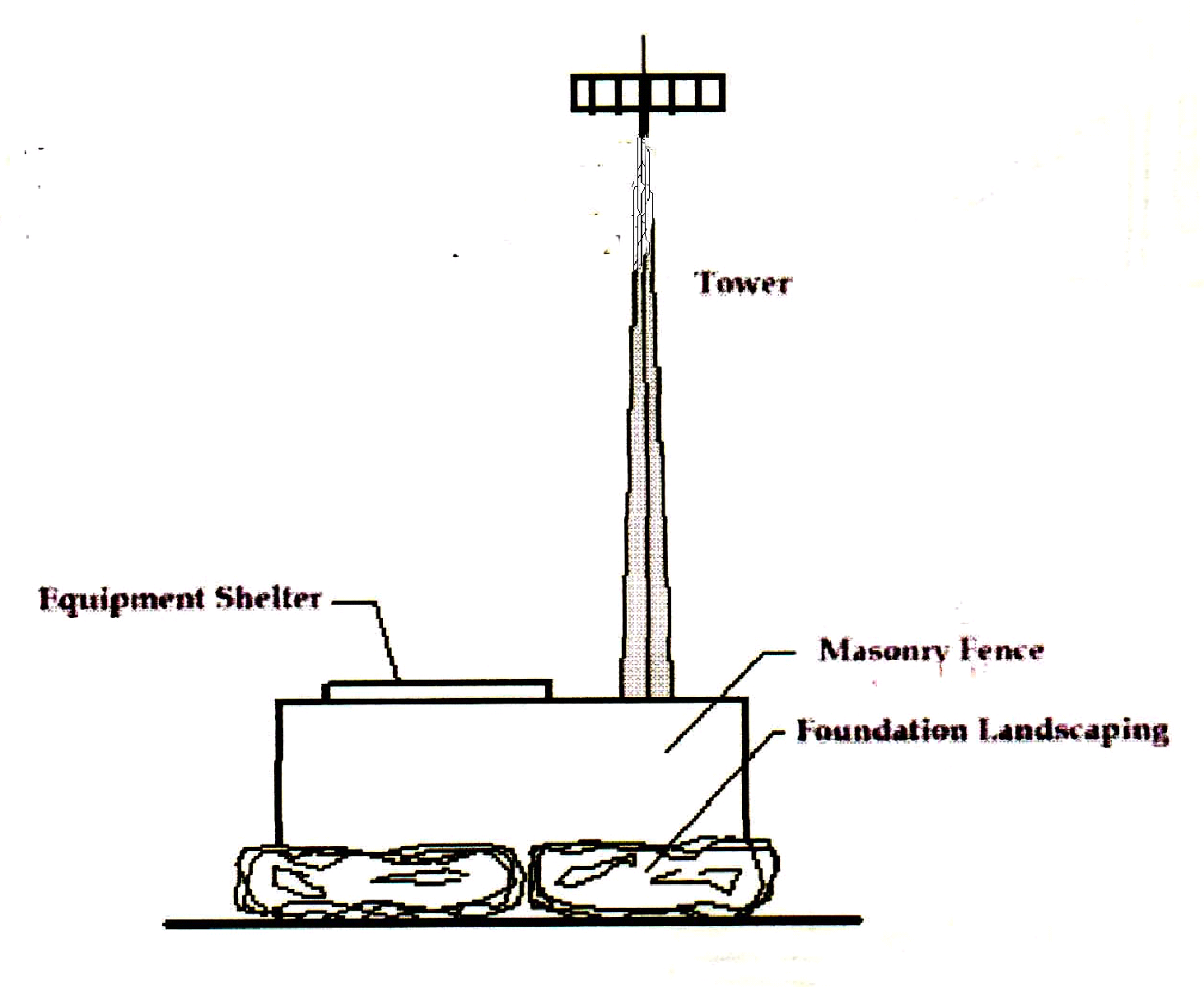
F.
Accessory building and structure design. The design and color of accessory or related structures or control buildings shall be architecturally designed to blend in with the surrounding buildings and environment.
G.
Maximum height. The maximum height of all telecommunications towers and antennas shall not exceed the minimum that is technically necessary to serve the design purpose; provided, however:
(1)
The maximum height of all commercial wireless antennas and supporting towers shall not exceed the distance to the nearest lot or parcel boundary on the subject lot or parcel or 150 feet, whichever is less.
(2)
No tower shall be in excess of a height equal to the distance from the base of the antenna and tower to the nearest overhead electrical power line, less five feet.
(3)
Co-location requirements notwithstanding, co-location shall not automatically be considered justification or grounds for a proposed height. In all cases, the city reserves the right to limit height of a proposed tower as necessary to insure compatibility with the neighborhood.
H.
Setbacks. The following setback requirements shall apply to all towers for which a special use permit is required; provided, however, standard setback requirements may be decreased if the goals of this section would be better served thereby:
(1)
Towers must be set back from any lot line a distance equal to the height of the tower.
(2)
Guy wires, accessory or related structures or control buildings shall be subject to the minimum setback requirements of the underlying zoning district
I.
Fences and walls. A fence or wall not less than six feet in height from finished grade shall be constructed around each communication tower and around each guy anchor and peripheral support.
J.
Landscaping and screening.
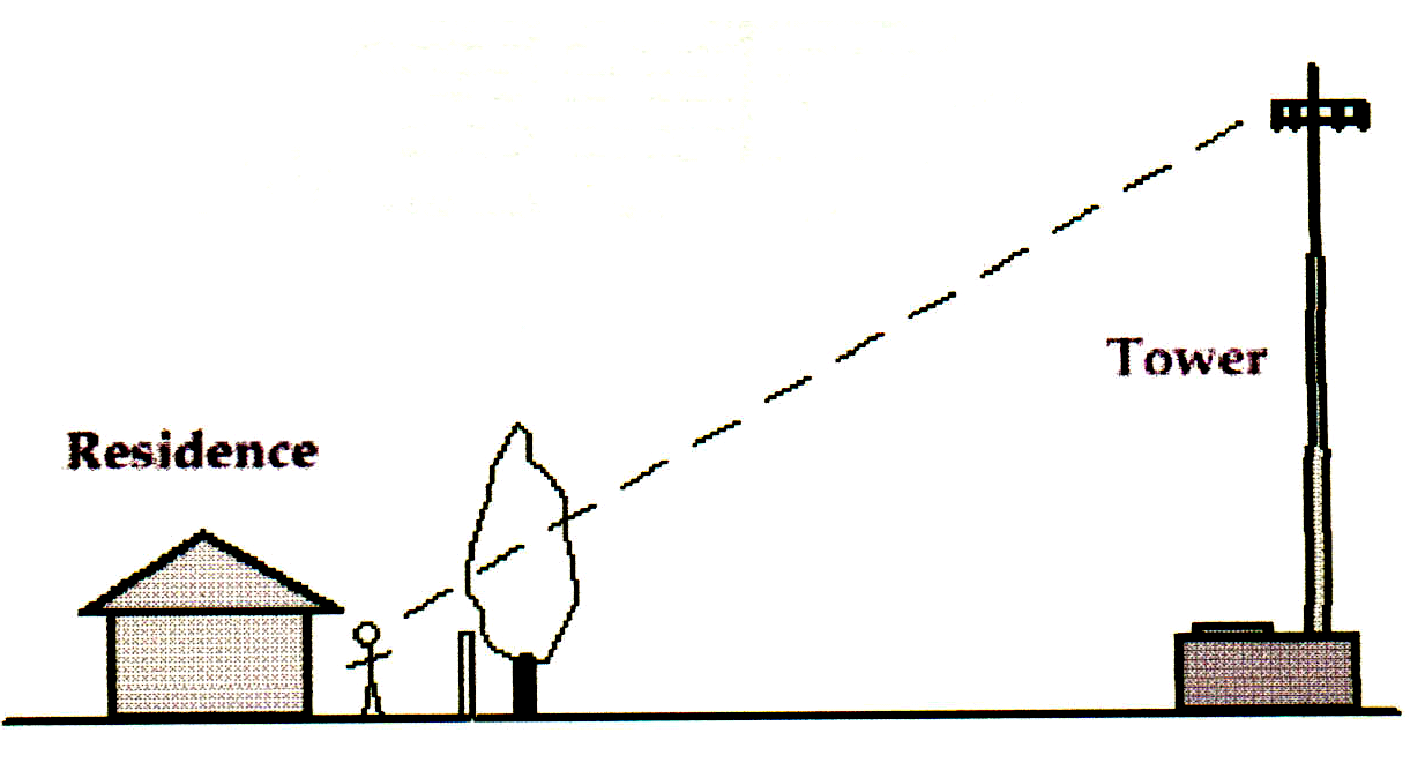
(1)
Ground- and rooftop-mounted mechanical equipment shall be screened from view off-site in accordance with the screening standards of section 5.5.7, screening standards;
(2)
Perimeter trees shall be used to help screen the tower from residences in accordance with the requirements of subsection 5.5.4C.
K.
Signs. No signs shall be allowed on a tower or antenna; provided, however, were high voltage is necessary for the operation of the communication tower and it is present in a ground grid or in the tower, signs located every 20 feet and attached to the fence or wall shall display in large bold letters the following: "HIGH VOLTAGE DANGER."
L.
Lighting. Towers shall not be artificially lit, unless required by the FAA or other applicable governmental authority. If lighting is required, the application shall contain a list of optional light devices and a statement of the reason for selection of the light device specified over each of the options. Economy and serviceability are among acceptable criteria for selection.
M.
General provisions.
(1)
Principal or accessory use. Antennas and towers may be considered either principal or accessory uses to the principal use of the property.
(2)
Site suitability. In addition to other applicable standards of this section, the city shall consider the following in determining site suitability: height proposed; proximity to other uses, proximity to historic sites and landmarks, vehicle traffic routes, proximity to medical facilities, proposed signs, topographical features, utilities, access, and suitability of alternative sites.
(3)
Density and dimensional standards. For purposes of determining whether the installation of a tower or antenna complies with density and dimensions standards of section 2.8, including but not limited to minimum lot area, lot width, and setback requirements, the dimensions of the entire lot shall control, even though the antennas or towers may be located on a separately leased portion of the lot.
(4)
State and federal requirements. All towers, antennae, and wireless communication facilities must meet or exceed standards and regulations of the FAA, the FCC, and any other agency of the state or federal government with the authority to regulate them or their components. If such standards and regulations are changed, then the owners of the towers and antennas governed by this section shall bring such towers and antennas into compliance with such revised standards and regulations within six months of the effective date of such standards and unless a different compliance schedule is mandated by controlling law.
(5)
Maintenance. Towers, antennae, and wireless communication facilities shall be maintained in compliance with standards contained in the current New Mexico Building Code and the applicable health and safety standards established by the FCC, the city, or other governmental bodies having jurisdiction, as amended periodically. Towers, antennae and wireless communications facilities, which are not in compliance, shall be removed at the owner's expense if not brought into compliance within 30 days after written demand by the city.
(6)
Site development standards. Except as provided in this section, all building and use processes and requirements, including height restrictions, applicable in the applicable zone shall apply to towers, antennae, and wireless communication facilities.
(7)
Engineered design. Any information of an engineering nature that the applicant submits, whether civil, mechanical, structural or electrical, shall be certified by an New Mexico licensed professional engineer.
(8)
Removal.
a.
Towers and antennae shall be removed, at the owner's expense, within 180 days of the discontinuance of use unless the city extends this time in writing.
b.
An owner wishing to extend the time for removal or reactivation shall submit an application stating the reason for such extension. The Director or designee may extend the time for removal or reactivation up to 60 additional days upon a showing of good cause. If the tower and antennae are not timely removed, the city may give notice that it will contract for removal within 30 days following written notice to the owner. Thereafter, the city may remove the structure at the cost of the owner.
c.
Upon removal of the wireless telecommunication facility, the site shall be returned to its natural state and topography and vegetated consistent with the natural surroundings.
(9)
Subsequent modification. Following city approval, no existing facility or wireless telecommunication facility may be changed or modified except as follows:
a.
Any modification to an existing facility shall require the existing facility to comply with all terms of this section and all other applicable codes and ordinances.
b.
Requests for modification shall include all special submission requirements of subsection 2.4.56C.
(10)
Performance criteria. The following characteristics are deemed consistent with the purposes of this section and will be afforded favorable weight in considering the application:
a.
Existing structures are preferred over new structures;
b.
New structures that appear to be structures commonly found within that zone are preferred over apparent wireless structures;
c.
Wireless communication facilities are preferred, which cannot be readily observed from adjacent public rights-of-way;
d.
Heights that do not exceed height limitations for the underlying zoning district;
e.
Collocation of multiple uses on a single wireless communication facility will have significant favorable weight in evaluating the application;
f.
Network development plans, which achieve the fewest number of wireless communication facilities of all users reasonably necessary for commercial coverage;
g.
Location in the least restrictive zone; and
h.
Suitability of the location for collocation of governmental public service wireless communication facilities.
(11)
Small cell wireless. Placement of small cell wireless facilities within the designated Historic District of the City of Farmington shall be subject to the following design criteria:
a.
A Joint Use Agreement with the Farmington Electric Utility Services shall be obtained prior to placement of small cell wireless equipment on City infrastructure.
b.
Collocation of small cell wireless equipment is strongly encouraged.
c.
Equipment shall be placed in the alleyway whenever technically feasible.
d.
Small Cell Wireless equipment shall not cause interference with the City's local wi-fi network.
e.
Equipment shall be designed to blend in with the surrounding streetscape with minimal visual impact.
f.
Equipment shall complement the existing and future furnishings along Main Street. Incorporation of an artistic motif, such as vinyl wraps on ground mounted equipment or sculpture on pole mounted equipment is strongly encouraged.
g.
Equipment shall be non-reflective and have a matte finish.
h.
If individual monopoles are installed they shall match the streetlight poles within the City of Farmington's Historic District as closely as possible.
i.
Individual monopoles shall not exceed the standard streetlight height.
j.
Ground based equipment shall not interfere with pedestrian walkways. Ground based equipment shall be fully sealed so as not to leak or rust onto adjacent hardscape.
k.
All wiring shall be contained within the equipment box or painted to match the finish of the infrastructure to which it is attached.
l.
Equipment shall not be placed on directional or place-making signage.
2.4.57 Upper-story residential. (Residential use categories; household living).
Upper-story residential uses in nonresidential structures shall comply with the standards of this section. Such uses, including apartments and condominiums, shall be allowed whether or not there is a current commercial use on the first floor. All new residential uses shall comply with the regulations of the current building code.
2.4.58 Vehicle sales/leasing. (Retail, service and commercial use categories; retail sales and service, sales-oriented).
Consumer vehicle sales and leasing facilities shall comply with the standards of this section.
A.
Minimum setbacks from all rights-of-way and property lines for all parked, displayed or stored vehicles shall be five feet, except where otherwise permitted by NMDOT.
B.
Concrete wheel stops or other permanent barriers shall be installed to prevent vehicles from encroaching on required setbacks.
C.
All vehicles on premises shall be in an operable condition.
D.
The site shall have direct access to a major or minor arterial, as defined in section 11.1.
2.4.59 Vehicle repair; paint and body shops. (Retail, service and commercial use categories; vehicle repair).
Vehicle repair and lubrication, oil changes, paint and bodywork and other maintenance services shall comply with the standards of this section.
A.
All repairs must be conducted within an enclosed building.
B.
All inoperable automobiles upon which repairs are to be conducted shall be enclosed behind a six-foot screening fence.
C.
No repairs shall be conducted within 200 feet of any property line of a residential use located within a residential boundary. This distance is measured from the property line to the front of the repair shop or area bay door.
D.
No automobile repair or service facility shall be permitted to have bay doors facing a residential use located within a residential district.
2.4.60 Veterinary clinics, large animal. (Other use categories; agriculture).
Large animal veterinary clinics shall comply with the standards of this section.
A.
Such facilities shall be located a minimum of 300 feet from existing residential uses and zoning districts.
B.
Such facilities shall be maintained in compliance with Chapter 6 of the Farmington City Code.
C.
Such facilities shall be subject to the operational performance standards of section 5.11, which address dust, noise, odors, and similar nuisance factors.
2.4.61 Veterinary clinics, small animal. (Retail, service and commercial use categories; retail sales and service, personal-service oriented).
Small animal veterinary clinics shall comply with the standards of this section.
A.
Adequate measures will be imposed to mitigate noise transmission beyond property lines, including, but not limited to, noise-deadening construction and/or deep open-space buffering.
B.
Only facilities that are entirely enclosed, soundproofed, and air-conditioned shall be permitted.
C.
Such facilities shall be maintained in compliance with Chapter 6 of the Farmington City Code.
D.
Adequate provisions shall be made for the protection of animals at the clinic and for protection of the public.
E.
Kennels, animal shelters, and animal training facilities shall be subject to the requirements of section 2.4.26.
F.
Small animal veterinary clinics shall be subject to the operational performance standards of section 5.11, which address dust, noise, odors, and similar nuisance factors.
2.4.62 Wineries. (Retail, service and commercial use categories; retail sales and service, sales oriented).
Wineries shall comply with the standards of this section.
A.
Tasting room, accessory. Allowable accessory uses may include tasting rooms subject to the approval of a liquor dispensing license by the city council.
B.
Liquor license. Such uses shall be subject to the approval of otherwise required liquor license(s).
2.4.63 Body art establishments. (Retail sales and service, entertainment-oriented).
Body art establishment uses in nonresidential structures shall comply with the standards of the Farmington City Code Article 15, body art safe practices, sections 8-15-1 through 8-15-6.
2.4.64 Watchman or caretaker residence. (Residential use categories).
A watchman or caretaker residence shall comply with the standards of this section. Such uses require a special use permit which expires in five years of the date of approval by the city council. Such permit may be renewed administratively by the director or designee for successive five-year periods upon making a determination that the conditions existing at the time of issuance of the original permit have not materially changed and that the use will continue to comply with the conditions of this section and the original special use permit. It is the responsibility of the owner of the property to apply to the director or designee of the community works department for renewal of the special use permit six months prior to the end of the five-year period. If the renewal has not been granted prior to the end of the five-year period, the owner will be required to re-submit an application for a special use permit in order to continue the watchman or caretaker residence use.
2.4.65 Private nonprofit entity producer of medical cannabis. (Industrial use categories; manufacturing and production).
Private nonprofit entity producers of medical cannabis shall comply with the standards of this section.
A.
Private nonprofit entity producers of medical cannabis shall be licensed and supervised in accordance with Sections 26-2B-1 through 26-2B-7 NMSA 1978, of the "Lynn and Erin Compassionate Use Act" and as administered by the New Mexico Department of Health, Public Health Division, Medical Cannabis Program.
B.
Such uses shall not be permitted within 300 feet of any school, church or daycare center.
2.4.66 Mobile food units.
A.
Site plan approval is required prior to placement of any mobile food unit. Site plan must show location of related power source, and proposed lighting, location of required restrooms and any utility infrastructure.
B.
Placement of units shall not interfere with on-site emergency access.
C.
Units shall not be placed in any existing designated parking spaces.
D.
Sales of cannabis products are prohibited from a mobile food unit.
2.4.67 Recreational cannabis sales.
A.
Retailers of recreational cannabis shall be licensed by the New Mexico Cannabis Control Division.
B.
Retail sales are permitted in the CB: Central Business, GC: General Commercial and I: Industrial Zoning Districts only.
C.
Such uses shall not be permitted within 300 feet of any school (public and private), religious institution, registered daycare center, residential use or from another cannabis dispensary. Distance is measured by a straight line from the closest property line of the retail business to the closest property line of a religious institution, school, registered daycare, residential use or dispensary. (NMSA Chapter 60-6B-10)
D.
Sales and consumption is not permitted on public property or in public places as defined in Farmington City Code 18-5-14.
E.
Business hours shall be daily from seven in the morning till eleven in the evening.
2.4.68 Cannabis consumption area.
A.
Are not permitted within the City of Farmington.
2.4.69 Cannabis, manufacturing and production.
A.
The manufacturing and production of Cannabis and Cannabidiol (CBD) products is permitted in the RA: Rural Agricultural, GC: General Commercial and I: Industrial Zoning Districts with a Special Use Permit.
B.
Such uses shall not be permitted within 300 feet of any school (public and private), religious institution, registered daycare center, residential use, cannabis dispensary, or from another commercial cultivation site. Distance is measured by a straight line from the closest property line of the retail business to the closest property line of a religious institution, school, registered daycare, residential use, dispensary or other commercial cultivation site.
2.4.70 Cannabis testing laboratory.
A.
The sampling, collection and testing of cannabis products is permitted in the GC: General Commercial and I: Industrial Zoning Districts with a Special Use Permit.
2.4.71 Cannabis, commercial cultivation.
A.
The planting, growing, harvesting, drying, curing, grading or trimming of cannabis for commercial use is permitted in GC: General Commercial, PIP: Planned Industrial Park and I: Industrial by Special Use Permit.
B.
Cultivation of plants must be in a green house or other fully enclosed structure with proper ventilation and must incorporate odor mitigation best practices.
C.
Such uses shall not be permitted within 300 feet of any school (public and private), religious institution, registered daycare center, residential use, cannabis dispensary, or from another commercial cultivation site. Distance is measured by a straight line from the closest property line of the retail business to the closest property line of a religious institution, school, registered daycare, residential use, dispensary or other commercial cultivation site.
2.4.72 Cannabis, personal cultivation.
A.
Cultivation of six plants per person who are 21 years or older with a maximum of twelve per household with two or more individuals who are 21 years or older, cannabis plants for personal use are permitted in all residential zoning areas.
(Must comply with Section 25 of the New Mexico Cannabis Regulation Act.)
B.
Cultivation of plants must be in a green house or other fully enclosed structure with proper ventilation and must incorporate odor mitigation best practices.
2.4.73 Variance and waiver requests.
A.
All requests for a variance or waiver to the regulations in section 2.4.41 through 2.4.46 of the Unified Development Code shall be heard by the planning and zoning commission in a public hearing. The commission shall make a recommendation to city council. The city council shall make the final determination.
(Ord. No. 2011-1242, § 2, 4-26-11; Ord. No. 2013-1263, § 1, 1-22-13; Ord. No. 2014-1270, §§ 2, 5, 10-28-14; Ord. No. 2021-1325, 3-9-21; Ord. No. 2021-1329, 10-12-21; Ord. No. 2022-1336, 7-26-22; Ord. No. 2023-1349, 6-27-23)
Editor's note— Ord. No. 2021-1329, adopted Oct. 12, 2021, set out provisions intended for use as §§ 2.4.41—2.4.46. Inasmuch as there were already provisions so designated, said sections have been codified herein as §§ 2.4.67—2.4.72 at the discretion of the editor.
Editor's note— Ord. No. 2022-1336, adopted July 26, 2022, set out provisions intended for use as § 2.4.47. Inasmuch as there were already provisions so designated, said section has been codified herein as § 2.4.73 at the discretion of the editor.
Sec. 2.5 - Accessory uses and structures.
2.5.1 Authorization. Any accessory use normally and customarily associated with a primary use, permitted by right consistent with applicable provisions of this UDC, may be permitted. However, any accessory use customarily associated with a primary use permitted only by special use permit, must meet all special use requirements. The establishment of such accessory uses shall be consistent with applicable design and performance standards set forth in this UDC.
2.5.2 General standards. All accessory structures and uses shall comply with the following standards:
A.
No accessory structure or use shall be constructed or established on any lot prior to the issuance of a building permit for the principal structure or an occupancy permit for a principal use to which it is accessory. This provision shall not prohibit the issuance of a permit for a detached garage at the time of issuance of a building permit for a principal dwelling unit on the subject parcel.
B.
Accessory uses and structures must be subordinate to the principal use and structure on the subject lot in terms of area, extent, and purpose. The total gross floor area of all accessory structures plus the total gross floor area of the primary structure shall not exceed forty percent of the lot size. The provisions of this paragraph shall not apply to agricultural uses.
C.
Unless otherwise expressly stated herein, accessory structures and uses shall comply with all applicable regulations of this UDC, including the maximum height and setback regulations. No accessory use or structure shall cause any of these standards to be exceeded for the underlying zoning district.
D.
A normal and customary accessory structure may be attached or detached from the principal building.
E.
Shipping crates, railroad cars, truck or bus bodies, semi-trailers and other similar containers shall not be used as accessory buildings or used outside the IND district. However, shipping crates may be used in the GC district if they are placed in the rear yard and screened from the view of any street and/or residence, in accordance with section 5.5.7, screening standards; and shipping crates may be used in residential districts if they are used only in the rear yard and can meet the requirements for accessory structures.
F.
No more than three accessory buildings shall be located on a single parcel in a residential district. The provisions of this paragraph shall not apply to agricultural uses.
G.
Where liquor sales are accessory to another principal use, such as a convenience store, liquor sales and display shall be limited to a maximum of 25 percent of the available display space.
(Ord. No. 2011-1251, § 1, 10-25-11)
2.5.3 Amateur radio facilities and antennas. Amateur radio facilities and antennas, which are owned and operated by a federally licensed amateur radio station operator, shall be allowed as an accessory use to residential uses, subject to compliance with the standards of this section.
A.
Maximum height. The maximum allowable vertical distance, as measured from the ground to the top of the antennae or support structure, whichever is higher, may not be more than twice the maximum allowable building height allowed in the underlying zoning district.
B.
Minimum setbacks. No support structure or antennae may be located nearer the street than the front building line or closer to a side or rear lot line than eight feet, except for peripheral supports and guy anchors, which may be located within the side or rear yard setbacks.
C.
Fencing requirements. Notwithstanding other provisions to the contrary, all towers shall either be within a yard enclosed by a seven-foot fence of solid construction or protected by a climb guard device at least seven feet high.
2.5.4 Apartments (accessory). An apartment may be allowed as an accessory use to a single-family dwelling by administrative review, subject to compliance with the standards of this section.
A.
One accessory apartment may be allowed per single-family dwelling in the RE-2, RA, RE-1, RE-20, SF-10, SF-7 and SF-5 districts; provided, however that no lot shall have both an accessory guest house and an accessory apartment.
B.
Such apartments may either be "attached to" or "detached from" the principal single-family dwelling.
C.
Such apartments shall be similar in appearance and design to the principal structure, with respect to roof design and materials, siding materials and window treatments.
D.
Such apartments may be rented, but not sold, separately from the principal dwelling unit.
E.
Such apartments and the primary dwelling shall share utilities or have separate utility meters if approved through the administrative review process. Apartments may have a kitchen.
F.
One off-street parking space shall be required for each apartment, in addition to that required for the primary dwelling unit. The additional required parking space shall be located on the same lot as the primary dwelling unit. Notwithstanding other provisions to the contrary, tandem parking shall be allowed.
G.
The resident of the single-family dwelling or the apartment must be the owner of record of the property.
H.
Approval period. Such use may be approved for a period of up to five years. Such permit may be renewed administratively by the director or designee for successive five-year periods upon making a determination that the conditions existing at the time of issuance of the original permit have not materially changed and that the use will continue to comply with the conditions of this section and original administrative review permit. It is the responsibility of the owner of the property to apply to the director or designee of the community works department for renewal of the administrative review permit six months prior to the end of the five-year period. If the renewal has not been granted prior to the end of the five-year period the owner will be required to re-submit an application for a special use permit in order to continue the apartment use.
2.5.5 Caretaker residences. Caretaker residences shall be allowed as an accessory use to a residential use provided that care is provided for not more than four children, including those who live in the residence.
2.5.6 Day care, home-based. Home-based day care facilities shall be allowed as an accessory use to a residential use provided care is provided for not more than four children, including those who live in the residence.
2.5.7 Family care units. Family care units may be allowed as an accessory to a single-family dwelling by special use permit, subject to the standards of this section.
A.
Accessory to single-family dwelling. A maximum of one family care unit may be permitted on a lot with a single-family dwelling in a residential zoning district. Both the single-family dwelling and the family care unit shall remain under single ownership.
B.
Occupancy. The principal dwelling and the family care unit together shall be occupied by one family, as defined in section 11.1, but no more than two persons may occupy the family care unit. In addition, at least one person living in either the principal dwelling or family care unit shall be an owner of the property and at least one person shall be 55 years of age or older or, regardless of age, a totally disabled person in accordance with the standards of disability established by the Social Security Administration.
C.
Attached unit standards. Family care units attached to or part of the principal building shall conform to the minimum height and setback requirements for the principal building. The floor area of an attached unit shall not exceed 30 percent of the floor of the principal dwelling up to a maximum of 700 square feet.
D.
Detached unit standards. Family care units may be detached from the principal building only when the city council finds that it is impractical to attach the unit to the principal building due to special conditions on the petitioner's property, including but not limited to the location or design of existing structures, the restriction of setbacks, or the size or shape of the lot.
(1)
The floor area for a detached unit shall in no case exceed 500 square feet.
(2)
Detached units shall conform to the minimum height and setback requirements for the principal building; provided, however, that where such units are separated at least ten feet from the principal structure, they may be constructed in a rear yard subject to the standards of subsection 2.8.3C(4)c.
(3)
Notwithstanding other provisions to the contrary, the minimum side yard shall be at least five feet.
E.
Exterior modifications. The entrance to the family care unit shall not be directly from the exterior of the front of the principal dwelling, and any exterior modifications shall maintain the appearance of a single-family dwelling.
F.
Parking. In addition to the parking spaces required for the principal dwelling, one additional off-street parking space shall be provided behind the required front yard setback.
G.
Approval period. Such use may be approved for a period of up to five years. Such permit may be renewed administratively by the Director or designee for successive five-year periods upon making a determination that the conditions existing at the time of issuance of the original permit have not materially changed and that the use will continue to comply with the conditions of this section and the original special use permit.
H.
Appeal. Any person aggrieved by an administrative decision made pursuant to this paragraph may appeal to the ARB as provided in section 8.15, appeals of administrative decisions.
I.
Conversion. The family care unit shall be converted into an integral part of the single-family dwelling within 90 days after the approved use is discontinued or after the expiration of the approved time period, whichever is earlier. A plan showing the specific physical modifications which will be made to the property upon the termination of the use shall be submitted with the application for the special use permit.
2.5.8 Guesthouses. Guesthouses (a maximum of one) may be allowed as an accessory use to single-family dwellings, subject to compliance with the standards of this section.
A.
General. All guesthouses shall comply with the standards of this subsection.
(1)
Guesthouses may be utilized by guests and persons employed on-site by the resident family of the principal dwelling, and may not be rented or sold separately from the principal dwelling unit.
(2)
Notwithstanding other provisions to the contrary, guesthouses:
a.
Shall comply with the setback standards applicable to the primary dwelling; and
b.
May be built to the same height as otherwise allowed for the primary dwelling.
(3)
Notwithstanding other provisions to the contrary, guesthouses:
a.
Shall comply with the setback standards applicable to the primary dwelling; and
b.
May be built to the same height as otherwise allowed for the primary dwelling.
(4)
One off-street parking space shall be required for each guesthouse, in addition to that otherwise required. Notwithstanding other provisions to the contrary, in all cases:
a.
The additional required parking space shall be located on the same lot as the primary dwelling unit; and
b.
Tandem parking shall be allowed.
(5)
Guesthouses shall have an open floor plan where the kitchen is not a separate room.
B.
Attached guesthouses.
(1)
Attached guesthouses may be allowed in all residential districts.
(2)
Attached guesthouses must connect to the principal dwelling unit via an interior doorway.
C.
Detached guesthouses.
(1)
Detached guesthouses may be allowed only in the RE-20, RE-1, RE-2 and RA districts.
(2)
Detached guesthouses shall meet all development standards generally applicable to accessory buildings or structures, including but not limited to, minimum building setbacks and building height.
2.5.9 Home occupations. A home occupation shall be allowed as an accessory use to a residential dwelling and shall be subject to compliance with the standards of this section.
A.
The use is carried on entirely within the residence by persons living at the residence;
B.
The occupation is clearly incidental and secondary to the principal use of the residence;
C.
The use and all related activities shall occupy no more than 25 percent of the first floor of the residence;
D.
All activities related to the home occupation shall be conducted entirely within the dwelling, and not within customary residential accessory structures;
E.
There shall be no outside storage of any kind related to the home occupation;
F.
No external structural alterations which are not customary in residential buildings are made;
G.
The occupation is not disruptive of the residential character of the neighborhood;
H.
Signs are subject to the regulations of section 5.8.7.A.13. The occupation shall not create any disturbing or offensive activity, noise, vibration, smoke, dust, odor, heat, glare, or other unhealthy or unsightly condition;
I.
The occupation shall not create any disturbing or offensive activity, noise, vibration, smoke, dust, odor, heat, glare, or other unhealthy or unsightly condition;
J.
The occupation shall not generate vehicular traffic or parking around the residence greater than that normally associated with the use of the residence as a dwelling; and
K.
The occupation does not involve retail sales on the premises.
L.
A City of Farmington Business Registration is required.
M.
Cultivation of cannabis and manufacturing of cannabis/cannabidiol products for retail sales is not permitted as a home occupation.
2.5.10 Limited retail and service. Limited retail and service establishment, exclusive of sales of tobacco, alcohol, vape, CBD or similar products, may be allowed as an accessory use to a single-family dwelling by special use permit, subject to compliance with the standards of this section.
A.
Shall comply with standards and regulation of their underlying districts.
B.
Shall comply with development standards held within Article 5.
C.
No more than four people shall be employed in conjunction with the business being conducted on the premises at any one time, unless otherwise waived by the city council.
D.
Any sign erected on the premises shall comply with section 5.8.7, signs.
E.
The floor area of the enclosed premises shall not exceed 2,000 square feet.
F.
All businesses in connection with the establishment shall be conducted within an enclosed building on the premises.
G.
The enclosed building shall be of such a nature that it is not unsightly and shall fit into the surrounding neighborhood.
H.
The small local retail or service establishment shall be of a type which will not cause greater noise, vibration, traffic, smoke or other air pollution, or odor than the surrounding area.
I.
The small local retail or service establishment shall provide no less than three and no more than six off-street parking spaces. If the intensity of the retail or service is such that greater than six parking spaces is needed then the use will not be permitted.
J.
The business shall not detract from existing adjacent property.
K
Such uses shall comply with the requirements of section 5.10, residential protection; provided, however that the maximum height of allowed outdoor lighting shall be 12 feet.
(Ord. No. 2021-1325, 3-9-21; Ord. No. 2021-1329, 10-12-21)
Sec. 2.6 - Temporary uses.
2.6.1 Temporary use permit required. No temporary use shall be established unless a temporary use permit shall be approved pursuant to the provisions of section 8.11, temporary use permits. The Director or designee shall be authorized to impose conditions on the application in accordance with section 8.11.
2.6.2 Applications. Applications for temporary use permits shall be submitted to the Director or designee on forms available in the Community Works department. Applications shall be submitted at least 15 days before the date of the event or start of the temporary use. Each application shall be accompanied by:
A.
A site plan prepared in accordance with the requirements of section 8.5 shall be approved and filed with the findings of fact and conclusions of law as part of the approval; and
B.
Signed, written permission from the owner of or the agency having jurisdiction over the subject property.
2.6.3 General standards. The following standards shall apply to all temporary uses unless otherwise expressly stated:
A.
Access approval from the authority with jurisdiction over the subject road shall be required.
B.
No permanent or temporary electrical connection shall be installed without an electrical permit and inspection.
C.
A building permit and inspection shall be obtained prior to the construction of any temporary structures.
D.
Temporary structures shall be located at least four feet from any buildings or structures on the subject property.
E.
The director or designee shall be authorized to require evidence of approval from the San Juan County Health Department regarding temporary sanitary facilities.
F.
No signs in connection with a temporary use shall be permitted except in accordance with the provisions of section 5.8, signs. All temporary signage shall be removed immediately upon cessation of the temporary use.
G.
Temporary uses or structures shall not encroach into any required landscaping.
H.
Parking areas shall be provided for the temporary use (in addition to required parking for any principal use existing or proposed on the site), and such areas shall be capable of accommodating the number of parking spaces that are required for the most similar use type pursuant to section 2.7.2, similar use interpretations.
I.
The director or designee shall have the authority to suspend, revoke, or modify a temporary use permit immediately upon determination that the conditions and requirements set forth in the permit have been violated. Written notice of the director or designee's determination to suspend, revoke, or modify the permit shall be promptly provided to the applicant. A determination under this subsection shall be final and conclusive unless the applicant files an appeal pursuant to the provisions of section 8.15, appeals of administrative decisions.
J.
The director or designee shall have the authority to deny temporary use permits to any person who has applied for or otherwise caused an uncorrected violation of a provision of this UDC or who has demonstrated a willful history of violations, including any condition attached to a permit or approval previously granted by the city. This provision shall apply regardless of whether the property for which the permit or other approval is sought is the property in violation.
K.
The director or designee shall have the authority to deny temporary use permits on any land or structure or improvements where upon there is an uncorrected violation of a provision of this UDC, including any condition attached to a permit or approval previously granted by the city. This enforcement provision shall apply regardless of whether the current owner or applicant is responsible for the violation in question.
2.6.4 Concrete and asphalt products. Temporary facilities for manufacturing concrete, asphalt or related products shall comply with the standards of this section. Such uses may be located in any zoning district where they are directly associated with construction in the area. Retail sales of such products shall be prohibited in conjunction with temporary plants. The production-site must be returned to its pre-construction state following completion of the associated project.
2.6.5 Carnival, circus or special events. Temporary carnivals, circuses, or special events shall comply with the standards of this section.
A.
Minimum setback (all sides): 200 feet.
B.
The above minimum setback shall apply to all equipment, from any off-site building used for residential purposes.
C.
The maximum length of the permit shall be ten days and no more than one such permit shall be issued per zoning lot in any calendar year.
D.
The applicant must provide adequate parking.
E.
The applicant must make arrangements for police protection and security guards for crowd control.
F.
The applicant must guarantee cleanup of the premises.
G.
The applicant may be required to post a bond in a reasonable amount as determined by the city council to ensure compliance with the requirements of this section.
2.6.6 Open-air sales. Temporary open-air sales shall comply with the standards of this section.
A.
Such uses may be allowed only in the CB and IND districts.
B.
Approval of a license is required pursuant to the requirements of section 8.11 and Chapter 8, Farmington City Code. Issuance of a temporary open-air sales permit(s) shall not limit participation of any business in community-wide events.
C.
The display area shall not encroach or interfere with on-site access, parking, circulation, or required landscaping.
D.
The display area shall not encroach upon a public street, alley, sidewalk, or other public property unless a permit for any such encroachment has been obtained from the city.
E.
The display area shall, at all times, be kept neat, clean, and free of litter and debris.
F.
All goods, merchandise, vehicles, or implements which remain on display shall be properly observed or otherwise secured against theft, vandalism, damage, or loss in accordance with the requirements of section 5.4, fencing and walls.
2.6.7 Real estate sales/leasing offices and model homes. Temporary real estate sales/leasing offices and model homes shall comply with the standards of this section.
A.
Temporary residential sales offices and model homes may be located within a residential district as part of an on-going residential development.
B.
Any temporary residential sales office or model home shall be removed or converted to a use permitted within the district when certificates of occupancy have been issued to 80 percent of the associated residential units or when use as a sales office or model home has ceased.
C.
Model homes for new subdivisions shall only be occupied for residential habitation after all business activities have ceased and upon sale of the home and shall comply with the applicable residential parking standards at that time.
2.6.8 Shelter. Temporary shelter shall comply with the standards of this section. When fire or natural disaster has rendered a residence unfit for human habitation, the temporary use of a single mobile home, manufactured or recreational vehicle located on the parcel during rehabilitation of the original residence or construction of a new residence is permitted subject to the following requirements:
A.
Water and sanitary facilities must be provided.
B.
The maximum length of a permit shall be six months, but the director or designee may extend the permit for a period or periods not to exceed 60 days, provided reasonable construction progress has been made and such construction is being diligently pursued. Application for the extension shall be made at least ten days prior to expiration of the original permit.
C.
Mobile homes shall be removed and recreational vehicle use shall be discontinued from the property upon issuance of any occupancy permit for the new or rehabilitated residence. The applicant shall be required to provide advanced written consent and authorization to the City of Farmington to remove the shelter at the owner's expense upon termination of the permit, if the applicant has not done so voluntarily.
(Ord. No. 2021-1325, 3-9-21)
Sec. 2.7 - Use categories.
2.7.1 General. Use categories shall be defined or otherwise interpreted in accordance with the following:
A.
Basis for classifications. Use categories classify land uses and activities based on common functional, product, or physical characteristics. Characteristics include the type and amount of activity, the type of customers or residents, how goods or services are sold or delivered and site conditions. The use categories provide a systematic basis for assigning present and future land uses into appropriate zoning districts.
B.
Principal uses. Principal uses are assigned to the category that most closely describes the nature of the principal use. The "characteristics" subsection of each use category describes the common characteristics of each principal use.
C.
Developments with multiple principal uses.
(1)
When all principal uses of a development fall within one use category, the entire development is assigned to that use category. A development that contains a coffee shop, bookstore, and bakery, for example, would be classified in the retail sales and service category, entertainment-oriented because all of the development's principal uses are in that category.
(2)
When the principal uses of a development fall within different use categories, each principal use is classified in the applicable category and each use is subject to all applicable regulations for that category. In a development that contains a coffee shop, bookstore and gas station, for example, the coffee shop and bookstore would be classified in the retail sales and service, entertainment-oriented category, however, the service station would be classified in the retail sales and service, vehicle services limited.
D.
Accessory uses. Accessory uses are allowed by right in conjunction with a principal use unless otherwise stated in the regulations. In addition, unless otherwise stated, accessory uses are subject to the same regulations as the principal use. Common accessory uses are listed as examples in the use category descriptions.
E.
Use of examples. The "examples" subsection of each use category lists common examples of uses included in the respective use category. The names of these sample uses are generic. They are based on common meanings and not on what a specific use may call itself. For example, a use that calls itself "wholesale warehouse" but which sells mostly to consumers is included in the retail sales and service category rather than the wholesale sales category. This is because the actual activity on the site matches the description of the retail sales and service category.
2.7.2 Similar use interpretations. The standards of this section shall guide officials in making similar use interpretations.
A.
Authority. If an application is submitted for a use type not listed in the use table, section 2.3, the director or designee shall be authorized to make a similar use interpretation, based on the following considerations:
(1)
The actual or projected characteristics of the activity in relationship to the stated characteristics of each use type;
(2)
The relative amount of site area or floor space and equipment devoted to the activity;
(3)
Relative amounts of sales from each activity;
(4)
The customer type for each activity;
(5)
The relative number of employees in each activity;
(6)
Hours of operation;
(7)
Building and site arrangement;
(8)
Vehicles used with the activity;
(9)
The relative number of vehicle trips generated by the use;
(10)
Signs;
(11)
How the use advertises itself; and
(12)
Whether the activity is likely to be found independent of the other activities on the site.
B.
Use interpretation standards.
(1)
No similar use interpretation shall allow a use in a zoning district when that use is a permitted or a special use in any other zoning district.
(2)
No similar use interpretation shall permit any use in any zoning district unless evidence shall be presented demonstrating that it will comply with all applicable use standards and all other applicable requirements and standards of this UDC.
(3)
No similar use interpretation shall permit any use in a zoning district unless the use is more similar to such uses than to permitted and special uses allowed in other zoning districts.
(4)
If the proposed use is more similar to a use allowed only as a special use in the zoning district in which it is proposed to be located, then any similar use interpretation permitting that use shall require a special use permit, as appropriate.
C.
Effect of similar use interpretation. No similar use interpretation finding a particular use to be permitted or specially permitted in a specific district shall authorize the establishment of such use or the development, construction, reconstruction, alteration, or moving of any building or structure, but shall merely authorize the preparation, filing, and processing of applications for any permits and approvals that may be required by the codes and ordinances of the City of Farmington or other governmental agencies having jurisdiction. These permits and approvals include, but are not limited to special use permits, development permits, building permits, and certificates of occupancy.
2.7.3 Residential use categories.
A.
Accommodations.
(1)
Characteristics. Dwelling units arranged for short term stays of less than 15 days for rent, lease, or interval occupancy.
(2)
Accessory uses. Accessory uses may include pools and other recreational facilities, limited storage, and offices.
(3)
Examples. Examples include bed and breakfast establishments, hotels, motels, inns, hostels, and interval occupancy facilities. Also includes central reception and check-in facilities for resorts and interval occupancy (time-share) facilities.
B.
Congregate living.
(1)
Characteristics. Congregate living is characterized by the residential occupancy of a structure by a group of people who do not meet the standards for household living in subsection 2.7.3C. The size of the group may be larger than the average size of a household. Tenancy is arranged on a monthly or longer basis. Uses where tenancy may be arranged for a shorter period are not considered residential. They are considered to be a form of transient lodging (see accommodations category). Generally, congregate living structures have a common eating area for residents. The residents may receive care, training, or treatment, and the caregivers may also reside at the site.
(2)
Accessory uses. Accessory uses commonly associated with congregate living are recreational facilities, dining facilities, offices, and maintenance facilities and parking of vehicles for occupants and staff.
(3)
Examples. Examples of congregate living include dormitories; fraternities and sororities; homeless shelters; monasteries and convents; nursing and convalescent homes; hospice homes for more than eight resident clients who are physically disabled, mentally retarded, or emotionally disturbed; and may include temporary housing for battered women or homeless families.
(4)
Exceptions.
a.
Lodging where tenancy may be arranged for periods of less than 15 days is classified in the accommodations category.
b.
Lodging where the residents meet the definition of household and where tenancy is arranged on a month-to-month basis or for a longer period, is classified as household living.
c.
Congregate care facilities where individual units meet the definition of a dwelling unit in subsection 2.7.3C. are classified as household living.
C.
Household living.
(1)
Characteristics. Household Living is characterized by the residential occupancy of a dwelling unit by a single-family. Tenancy is to be arranged on a month-to-month or longer basis. Uses where tenancy is arranged for a shorter period are not considered residential. They are considered to be a form of transient lodging (see the accommodations categories).
(2)
Accessory uses. Accessory uses commonly associated with household living are recreational activities, raising of pets, hobbies, home occupations, swimming pools, garages, carports greenhouses, storing of household goods, storing of supplies and equipment for maintaining the dwelling and associated yard, and parking and occasional maintenance of the occupants' vehicles. Home occupations and guest houses are accessory uses that are subject to additional regulations.
(3)
Examples. Examples of household living use (structure) types include: single-family dwellings, attached single-family dwellings, duplexes, patio homes, multifamily dwellings, townhouses, mobile and manufactured home parks, group care homes, retirement center apartments, manufactured housing and other structures with self-contained dwelling units.
(4)
Exceptions. Lodging in a dwelling unit or where units are rented on a less than monthly basis is classified in the accommodations category.
2.7.4 Public, civic and institutional use categories.
A.
Educational facilities.
(1)
Characteristics. This category includes public and private schools at the primary, elementary, middle, junior high, or high school level that provide state-mandated basic education. This category also includes colleges and other institutions of higher learning that offer courses of general or specialized study leading to a degree. Colleges tend to be in campus-like settings or on multiple blocks.
(2)
Accessory uses. Accessory uses at schools include play areas, cafeterias, recreational and sport facilities, auditoriums and before- or after-school day care. Accessory uses at colleges include offices, housing for students, food service, laboratories, health and sports facilities, theaters, meeting areas, parking, maintenance facilities, and support commercial.
(3)
Examples. Examples include public and private daytime schools, boarding schools, military academies, universities, liberal arts colleges, community colleges, nursing and medical schools not accessory to a hospital and seminaries.
(4)
Exceptions.
a.
Preschools are classified as day care uses.
b.
Business and trade schools are classified as retail sales and service.
B.
Community service.
(1)
Characteristics. Community services are uses of a public, nonprofit, or charitable nature generally providing a local service to people of the community. Generally, they provide the service on-site or have employees at the site on a regular basis. The service is ongoing, not just for special events. Community services or facilities that have membership provisions are open to the public to join at any time, (for instance, any senior citizen could join a senior center). The use may provide special counseling, education, or training of a public, nonprofit, or charitable nature.
(2)
Accessory uses. Accessory uses may include offices; meeting areas; food preparation areas; parking, health, and therapy areas, and athletic facilities.
(3)
Examples. Examples include libraries, museums, crematoriums, neighborhood or community centers, senior centers, community recreation centers, youth club facilities, and garages, shops and storage yards.
(4)
Exceptions.
a.
Private lodges and clubs, private or commercial athletic or health clubs are classified as retail sales and service.
b.
Public parks and recreation are classified as parks and open space.
C.
Day care.
(1)
Characteristics. Day care uses provide care, protection, and supervision for children or adults on a regular basis for less than 24 hours per day.
(2)
Accessory uses. Accessory uses include offices, recreation areas, and parking.
(3)
Examples. Examples include adult day care programs (for seven or more individuals), commercial day care center (for seven or more individuals), day care facility (for seven or more children or adults), family day care home (for four to six individuals), group child care (for seven or more individuals), nursery schools (for seven or more individuals), and preschools (for seven or more individuals).
(4)
Exceptions. Day care does not include public or private schools or facilities operated in connection with an employment use, shopping center or other principal use, where children are cared for while parents or guardians are occupied on the premises or in the immediate vicinity; such uses are accessory to other principal uses. Day care for three or fewer individuals cared for in a residential dwelling at any one time is considered as an accessory, home occupation.
D.
Medical facilities.
(1)
Characteristics. Medical facilities include uses providing medical or surgical care to patients and offering overnight care.
(2)
Accessory uses. Accessory uses include outpatient clinics, offices, laboratories, teaching facilities, meeting areas, cafeterias, parking, and maintenance facilities and housing facilities for staff or trainees. Accessory uses for hospitals and trauma centers include heliports.
(3)
Examples. Examples include hospitals, trauma centers, and medical centers.
(4)
Exceptions.
a.
Uses that provide exclusive care and planned treatment or training for psychiatric, alcohol, or drug problems, where patients are residents of the program, are classified in the assisted living category.
b.
Medical clinics or offices that provide care where patients are generally not kept overnight are classified as offices.
c.
Emergency medical clinics are classified as retail sales and service.
E.
Parks and open space.
(1)
Characteristics. Parks and open space are uses of land focusing on natural areas, large areas consisting mostly of vegetative landscaping, community gardens, or public squares. Land tends to be occupied by few structures.
(2)
Accessory uses. Accessory uses may include clubhouses, maintenance facilities, concessions, caretaker's quarters, and parking.
(3)
Examples. Examples include boat-launching ramps, botanical gardens, cemeteries, mausoleums, golf courses, nature preserves, park/playgrounds, noncommercial parks, pet cemeteries, plazas, public open lands, playfields, and recreational trails.
F.
Religious institutions.
(1)
Characteristics. Religious Institutions primarily provide meeting areas for religious activities.
(2)
Accessory uses. Accessory uses include Sunday school facilities, parking, parsonage, caretaker's housing, and congregate living facilities such as convents and monasteries.
(3)
Examples. Examples include places of worship, churches, temples, synagogues, and mosques.
(4)
Exceptions.
a.
Preschools are classified as day care uses.
b.
Schools are classified as schools.
G.
Utilities.
(1)
Characteristics. Major utilities are infrastructure services necessary to support legally established uses and do not need to be located in or near the area where the service is provided. Minor utilities are infrastructure services necessary to support legally established uses and involve only minor structures and need to be located in or near the area where the service is provided. Minor utilities generally do not regularly have employees at the site. Services may be publicly or privately provided.
(2)
Accessory uses. Accessory uses may include parking and control, monitoring, data or transmission equipment.
(3)
Examples.
a.
Examples of major utilities include water towers, gas regulating stations, water and waste treatment plants and electrical substations.
b.
Examples of minor utilities include water and sewage pump stations, stormwater retention and detention facilities, gas and electrical distribution lines, switch boxes, transformer boxes, underground water and sewer lines, mass transit stops, park-and-ride facilities and telephone exchanges.
(4)
Exceptions.
a.
Maintenance yards and buildings are classified as industrial sales and service.
b.
Utility offices are classified as offices.
c.
Telecommunications facilities are classified as other use categories, telecommunications facilities.
H.
Government service.
(1)
Characteristics. Offices, storage, maintenance, and other facilities for the operation of local, state, or federal government.
(2)
Accessory uses. Accessory uses may include auditorium and meeting rooms, cafeteria, day care, fuel storage, above ground fuel pump and island, helipad, heliport or landing field, holding cell, infirmary, off-street parking, satellite dish antenna under 1meter, and storage.
(3)
Examples. Examples include city hall, detention facility, penal or correctional facilities emergency medical and ambulance station, fire station, government office, local, state, or federal offices, police station, post office.
(4)
Exceptions.
a.
Community college, seminary or university elementary, middle or high schools are classified as educational facilities.
b.
Libraries are classified as community services.
c.
Public parks and recreation, or open area are classified as parks and open space.
d.
Utilities.
2.7.5 Retail, service and commercial use categories.
A.
Entertainment event, major.
(1)
Characteristics. Major entertainment event uses are characterized by activities and structures that draw large numbers of people to specific events or shows. Activities are generally of a spectator nature.
(2)
Accessory uses. Accessory uses may include restaurants, bars, concessions, and parking and maintenance facilities.
(3)
Examples. Examples include amphitheaters, stadiums, sports arenas, coliseums, auditoriums, drive-in theaters, exhibition and meeting areas, and fairgrounds.
(4)
Exceptions.
a.
Exhibition and meeting areas with less than 20,000 square feet of total event area are classified as retail sales and service.
b.
Banquet halls that are part of hotels or restaurants are accessory to those uses, which are included in the retail sales and service category.
c.
Indoor theaters are classified as retail sales and service.
d.
Recreation or entertainment uses conducted on a continuous basis are classified as outdoor recreation and entertainment or retail sales and service uses.
B.
Office.
(1)
Characteristics. Office uses are characterized by activities conducted in an office setting and generally focusing on business, government, professional, medical, or financial services.
(2)
Accessory uses. Accessory uses may include cafeterias, health facilities, gift shops, dry cleaning pick-up stations, parking, or other amenities primarily for the use of employees or customers of permitted primary uses.
(3)
Examples. Examples include professional services such as lawyers, accountants, engineers, or architects; financial businesses such as lenders, brokerage houses, bank headquarters, or real estate agents; publishers; data processing; sales offices; government offices and public utilities offices; TV and radio studios; medical and dental clinics (including minor emergency centers), medical and dental labs; and blood-collection facilities.
(4)
Exceptions.
a.
Offices that are part of and located within a principal use in another category are considered accessory to the firm's primary activity. Headquarters offices, when in conjunction with or adjacent to a principal use in another category, are considered part of the other category.
b.
Contractors and others who perform services off-site are included in the Office category if equipment and materials are not stored on the site and fabrication, services, or similar work is not conducted at the site.
C.
Parking, commercial.
(1)
Characteristics. Commercial parking facilities provide parking that is not accessory to a specific use. A fee may or may not be charged. A facility that provides both accessory parking for a specific use and regular fee parking for people not connected to the use is also classified as a commercial parking facility.
(2)
Examples. Examples include short- and long-term fee parking facilities, park and ride facilities, and mixed parking lots (partially accessory to a specific use, partly for rent to others).
(3)
Exceptions.
a.
Parking facilities that are accessory to a use, but that charge the public to park for occasional events nearby, are not considered commercial parking facilities.
b.
Parking facilities that are accessory to a principal use are not considered commercial parking uses, even if the operator leases the facility to the principal use or charges a fee to the individuals who park in the facility.
D.
Recreation and entertainment, outdoor.
(1)
Characteristics. Outdoor recreation and entertainment uses are large, generally commercial uses that provide continuous recreation or entertainment-oriented activities. They primarily take place outdoors. They may take place in a number of structures that are arranged together in an outdoor setting.
(2)
Accessory uses. Accessory uses may include concessions, restaurants, parking, caretaker's quarters, and maintenance facilities.
(3)
Examples. Examples include amusement parks, animal racetracks, archery ranges (outdoor), auto racetracks, BMX (bicycle) tracks, commercial parks/playgrounds, go-cart tracks, golf driving range, marina, miniature golf course, model airplane club, moto-cross tracks, recreational vehicle park, recreational uses (outdoor), shooting ranges (outdoor), skating rinks (outdoor), polo clubs, commercial swimming pools, outdoor theaters, theme parks, and zoos.
(4)
Exceptions.
a.
Golf courses are classified as parks and open space.
b.
Uses that draw large numbers of people to periodic events, rather than on a continuous basis, are classified as major entertainment events.
E.
Retail sales and service.
(1)
Characteristics. Retail sales and service firms are involved in the sale, lease, or rent of new or used products to the public. They may also provide personal services or entertainment, or provide product repair or services for consumer and business goods.
(2)
Accessory uses. Accessory uses may include offices, storage of goods, manufacture, or repackaging of goods for on-site sale and parking.
(3)
Examples. Examples include uses from the five following groups:
c.[a.]
Sales-oriented. Art supply stores, auto sales, antique sales, appliance sales, art gallery, bait shop, business machine sales, bakeries (retail), bicycle shops, boat sales, book stores, electronic equipment stores, fabric stores, furniture stores, garden supply stores, hardware stores, home improvement stores, household product stores, jewelry stores, motorcycle sales, pet food stores, pharmacies, plant sales (retail), plumbing supplies and fixture sales/service, retail, stationary and video stores, truck (light and medium) sales and service, camera shop, cigar/ cigarette/ tobacco store, clothing store, consumer vehicle sales/supplies and service, dairy products sales, department store, drug store, dry goods store, retail, electronics/computer sales, service, fire arms dealers, fish market, floor covering sales, florist sales, fruit and vegetable market, retail garden center, gift shop, retail greenhouse/nursery, grocery store or supermarket, retail hardware store, health food store, hearing aid sales, hobby shop, leather goods sales, liquor store, lumber and building material sales, magazine and news stand, meat market, music, musical instrument, and records, sales and service, office equipment and supplies, retail sales and service, paint and wallpaper sales, pawn shop, pet shop, picture frame sales and service, recreational vehicle sales, rental of equipment and supplies, shopping centers, sporting goods sales, toy store, watch/clock sales and repair shop, and water softening equipment sales/service.
d.[b.]
Personal service-oriented. Animal grooming, branch bank, drive-in bank, barber shop, beauty shop, business school, martial arts school, trade school, dance or music classes, dry cleaning drop-off/pick-up, emergency medical care, health clubs, funeral home, mortuary, hair salon, tanning salon personal care services, laundry drop-off, laundromats, photocopy and blueprint services, photography studios, tailors and clothing repair, taxi dispatch or dispatch, taxidermists, veterinary clinic, crematorium, currency exchange, kennels, animal boarding, obedience school and union hall.
e.[c.]
Eating- and drinking-oriented. Restaurants with or without drive-in or drive-through service; bars and taverns, lounges, coffee shop and stands, fast food establishments; yogurt or ice cream shops.
f.[d.]
Entertainment-oriented. Adult entertainment establishments (including adult bookstore, adult cinema, adult entertainment business and adult video sales and rental outlet), amusement arcades, archery ranges (indoor), billiard parlors, bowling alleys, campgrounds, casino/commercial watercraft, coin-operated arcade, dance halls, nightclubs, pool halls, private clubs, recreational vehicle parks, resorts, shooting (firing) ranges, skating rinks (indoor), recreational uses (indoor), shooting ranges (indoor), and indoor theaters.
g.[e.]
Repair-oriented. Appliance repair, bicycle repair, locksmith, shoe repair, television repair, upholsterer, furniture repair, furniture refinishing.
(4)
Exceptions.
a.
Convenience stores with gas sales are classified as retail, service and commercial; vehicles, limited.
b.
Lumberyards and other building material sales that sell primarily to contractors and do not have a retail orientation are classified as wholesale sales.
c.
Repair and service of consumer motor vehicles, motorcycles and light and medium trucks is classified as vehicle service/repair. Repair and service of industrial vehicles and equipment and heavy trucks is classified as industrial sales and service.
d.
Sales, rental, or leasing of heavy trucks and equipment, and mobile and manufactured home sales are classified as industrial sales and service.
e.
Hotels, restaurants and other services that are part of a truck stop are considered accessory to the truck stop, which is classified as industrial sales and service.
F.
Self-service storage.
(1)
Characteristics. Self-service storage uses provide separate indoor storage areas for individual or business uses. The storage areas are designed to allow private access by the tenant for storing or removing personal property.
(2)
Accessory uses. Accessory uses may include living quarters for a resident manager or security and leasing offices. Use of the storage areas for sales, service and repair operations, or manufacturing is not considered accessory to the self-service storage use. The rental of trucks or equipment is also not considered accessory to a self-service storage use.
(3)
Examples. Examples include facilities that provide individual storage areas for rent. These uses are also called mini-warehouses and mini-storage.
(4)
Exceptions. A transfer and storage business where there are no individual storage areas or where employees are the primary movers of the goods to be stored or transferred is in the warehouse and freight movement category.
G.
Vehicle repair.
(1)
Characteristics. Vehicle repair firms service passenger vehicles, light and medium trucks and other consumer motor vehicles such as motorcycles, boats, and recreational vehicles. Generally, the customer does not wait at the site while the service or repair is being performed.
(2)
Accessory uses. Accessory uses may include offices, sales of parts and vehicle storage.
(3)
Examples. Examples include alignment shop, auto body shop, auto detailing and tire sales and mounting, vehicle repair, auto upholstery shop, recreational vehicle service, transmission or muffler shop.
(4)
Exceptions. Repair and service of industrial vehicles and equipment and of heavy trucks; towing and vehicle storage; and vehicle wrecking and salvage are classified as industrial sales and service.
H.
Vehicle service, limited.
(1)
Characteristics. Limited vehicle service uses provide direct services to motor vehicles where the driver or passengers generally wait in the car or nearby while the service is performed. Fuel sales are often a related function.
(2)
Accessory uses. Accessory uses may include auto repair and tire sales.
(3)
Examples. Examples include car washes, convenience stores, quick lubrication services, and service stations (full-service or self-service).
(4)
Exceptions.
a.
Truck stops are classified as industrial sales and service.
b.
Refueling facilities for vehicles that belong to a specific use (fleet vehicles) are considered accessory uses if they are located on the site of the principal use.
2.7.6 Industrial use categories.
A.
Industrial sales and service.
(1)
Characteristics. Industrial sales and service firms are engaged in the sales, repair or servicing of industrial, business or consumer machinery, equipment, products or by-products. Firms that service consumer goods do so by mainly providing centralized services for separate retail outlets. Contractors and building maintenance services and similar uses perform services off-site. Few customers, especially the general public, come to the site.
(2)
Accessory uses. Accessory activities may include offices, parking, and storage.
(3)
Examples. Examples include agricultural implement sales/service; building contractors; heating contractors; plumbing contractors; electrical contractors; carpet/rug cleaning plant; contractor's equipment sales; dry cleaning/dyeing plant; electric motor repair; exterminators; farriers; feed and grain sales; fuel oil distributors; fuel oil sales; firewood sales; furnace/water heater sales; gas/butane and propane sales; heavy machinery sales; metal and building materials sales; janitorial and building maintenance services; landscape contractor's storage yard; laundry, dry-cleaning and carpet cleaning plants; machine shops; manufactured and mobile home sales; repair of scientific or professional instruments; repair and service of industrial vehicles and equipment sewage disposal (individual) systems sales/service; solid fuel yards; tire re-treading or recapping; tool repair; towing service and vehicle storage; truck stops; tractor or trailer sales and service; trucks (heavy) sales, repair, or rental; welding shops, and well drilling services.
(4)
Exceptions.
a.
Contractors and others who perform services off-site are included in the office category, if major equipment and materials are not stored at the site and fabrication, or similar work is not conducted at the site.
b.
Hotels, restaurants and other services that are part of a truck stop are considered accessory to the truck stop.
c.
Salvage or wrecking yards, or junkyards are not allowed in the City of Farmington.
B.
Manufacturing and production.
(1)
Characteristics. Manufacturing and production firms are involved in the manufacturing, processing, fabrication, packaging, or assembly of goods. Natural, manmade, raw, secondary, or partially completed materials may be used. Products may be finished or semi-finished and are generally made for the wholesale market, for transfer to other plants, or to order for firms or consumers. Goods are generally not displayed or sold on-site, but if so, they are a subordinate part of sales. Relatively few customers come to the manufacturing site.
(2)
Accessory uses. Accessory activities may include offices, cafeterias, parking, employee recreational facilities, warehouses, storage yards, repair facilities, truck fleets, and caretaker's quarters.
(3)
Examples. Examples include advertising display construction/sign shop; asphalt, concrete or redi-mix plant; bakery; boatworks; custom building; catering service; concrete batching and asphalt mixing; custom boatworks; food and related products processing; food processing and packing; lumber mills; manufacture or production of artwork and toys; manufacture or production of chemical, rubber, leather, clay, bone, plastic, stone, or glass materials or products; manufacture or assembly of machinery, equipment, instruments, including musical instruments, vehicles, appliances, precision items and other electrical items; manufacture, production or fabrication of metals or metal products including enameling and galvanizing, manufactured housing unit production and fabrication; monument works; ornamental iron work shop; printing, publishing and lithography; pulp and paper mills and other wood products manufacturing; research laboratory, including but not limited to pure research, product development, pilot plants and research manufacturing facilities; sign making; slaughterhouse; meat packing; weaving or production of textiles or apparel; and woodworking, including cabinet makers.
(4)
Exceptions.
a.
Manufacturing of goods to be sold primarily on-site and to the general public are classified as retail sales and service.
b.
Manufacture and production of goods from composting organic material (e.g., fertilizer) is classified as waste-related uses.
C.
Warehouse and freight movement.
(1)
Characteristics. Warehouse and freight movement firms are involved in the storage, or movement of goods for themselves or other firms. Goods are generally delivered to other firms or the final consumer, except for some will-call pickups. There is little on-site sales activity with the customer present.
(2)
Accessory uses. Accessory uses may include offices, truck fleet parking, and maintenance areas.
(3)
Examples. Examples include machinery storage yard; recreational vehicle storage; utility service yard or garage; bulk materials storage; bus barns; cold storage plants, including frozen food lockers; freight terminal; motor/rail; grain elevators; moving companies and general freight storage; parcel services; post office (main); post office (branches); truck or air freight terminals; warehouse; warehouses (separate from retail business) used by retail stores such as furniture and appliance stores; and wholesale distribution centers.
(4)
Exceptions.
a.
Uses that involve the transfer or storage of solid or liquid wastes are classified as waste-related uses.
b.
Mini-warehouses are classified as self-service storage uses.
D.
Waste-related.
(1)
Characteristics. Waste-related uses are characterized by uses that receive solid or liquid wastes from others for disposal on the site or for transfer to another location, uses that collect sanitary wastes, or uses that manufacture or produce goods or energy from the composting of organic material.
(2)
Accessory uses. Accessory uses may include recycling of materials, offices and repackaging and transshipment of by-products.
(3)
Examples. Examples include energy recovery plants, hazardous-waste-collection-sites, recycling center, transfer stations, sanitary landfills, and waste composting.
(4)
Exception.
a.
Incinerators are not allowed in the City of Farmington.
E.
Wholesale sales.
(1)
Characteristics. Wholesale sales firms are involved in the sale, lease, or rent of products primarily intended for industrial, institutional, or commercial businesses. The uses emphasize on-site sales or order taking and often include display areas. Businesses may or may not be open to the general public, but sales to the general public are limited. Products may be picked up on-site or delivered to the customer.
(2)
Accessory uses. Accessory uses may include offices, product repair, warehouses, parking, minor fabrication services, and repackaging of goods.
(3)
Examples. Examples include auction houses; mail order houses and wholesalers of food, clothing, auto parts, and building hardware.
(4)
Exceptions.
a.
Firms that engage primarily in sales to the general public or on a membership basis are classified as retail sales and service.
b.
Firms that are primarily storing goods with little on-site business activity are classified as warehouse and freight movement.
2.7.7 Other uses categories.
A.
Agriculture use category.
(1)
Characteristics. Agriculture includes activities that primarily involve raising, producing or keeping plants or farm animals.
(2)
Accessory uses. Accessory uses include dwellings for proprietors and employees of the use and animal training.
(3)
Examples. Examples include agriculture uses; aqua culture; farm animal breeding or raising; apiary, dairy farms' farming; truck gardening; tree farming; nonretail greenhouse/nursery; plant nurseries (wholesale); riding academies; and public stables.
(4)
Exceptions.
a.
Uses involved in the processing of animal or plant products are classified as manufacturing and production.
b.
Plant nurseries that are oriented to retail sales are classified as sales-oriented retail sales and service.
B.
Aviation and surface transportation.
(1)
Characteristics. Aviation and surface transportation facilities includes facilities for the landing and takeoff of flying vehicles, including loading and unloading areas. Aviation facilities may be improved or unimproved. Aviation and surface transportation facilities also includes passenger terminals for aircraft, and regional bus service.
(2)
Accessory uses. Accessory uses include freight handling areas, concessions, offices, parking and maintenance and fueling facilities.
(3)
Examples. Examples include airports, bus passenger terminals, bus terminal, helicopter landing facilities, and railroad passenger stations.
(4)
Exceptions.
a.
Bus passenger stations for regional service such as mass transit stops and park-and-ride facilities are classified as minor utilities.
b.
Private helicopter landing facilities that are an accessory to another use are considered accessory uses. However, they are subject to all the regulations and approval criteria for helicopter landing facilities.
C.
Mining.
(1)
Characteristics. Mining includes mining or extraction of oil, gas, mineral or aggregate resources from the ground for off-site use.
(2)
Accessory uses. Accessory uses include asphalt, concrete or redi-mix plant; and storage, sorting, stockpiling, or transfer off-site of the mined material.
(3)
Examples. Examples include mining and resource extraction; oil, gas, or geothermal drilling; and quarrying or dredging for sand, gravel or other aggregate materials.
D.
Telecommunications facilities.
(1)
Characteristics. Telecommunications facilities are signal distribution systems used or operated by a telecommunications carrier under a license from the FCC consisting of a combination of improvements and equipment including (i) one or more antennas, (ii) a supporting structure and the hardware by which antennas are attached; (iii) equipment housing; and (iv) ancillary equipment such as signal transmission cables and miscellaneous hardware.
(2)
Accessory uses. Accessory uses may include transmitter facility buildings.
(3)
Examples. Examples include broadcast towers, telecommunications facilities, telecommunications support towers and point-to-point microwave towers.
(4)
Exceptions.
a.
Amateur radio facilities and antennas that are owned and operated by a federally licensed amateur radio station operator are considered an accessory use to other permitted uses.
b.
Radio and television studios are classified in the office category.
(Ord. No. 2021-1325, 3-9-21)
Sec. 2.8 - Density and dimensional standards.
2.8.1 Residential base zoning district density and dimensional schedule.
The following table illustrates the dimensional standards that apply in the city's residential base zoning districts. Exceptions to the standards of this schedule are listed in section 2.8.3.
2.8.2 Nonresidential base zoning district density and dimensional schedule.
The following table illustrates the dimensional standards that apply in the city's nonresidential base zoning districts. Exceptions to the standards of this schedule are listed in section 2.8.3.
(Ord. No. 2011-1251, § 2, 10-25-11)
2.8.3 Measurements and exceptions.
A.
Lot area.
(1)
Measurements. The area of a lot shall include the total horizontal surface area within the lot's boundaries, excluding public rights-of-way.
(2)
Lots within multiple zoning districts. If a lot falls within multiple zoning districts, the minimum lot area requirements for the most restrictive district shall be met.
(3)
Flag or panhandle lots. The flagpole or panhandle portion of the lot shall not be included in calculating minimum lot size.
(4)
Exceptions. No building permit or development approval may be issued for a lot that does not meet the minimum lot area requirements of this UDC, except in the following cases:
a.
Nonconforming lots may be used in accordance with the provisions set forth in section 9.4.1, authority to utilize for single-family residence.
b.
Utilities using land or an unoccupied building covering less than 1,000 square feet of site area shall be exempt from minimum lot area standards.
c.
Minimum lot area requirements shall not apply to dormitories, fraternities, or sororities where no cooking facilities are provided in individual rooms or apartments.
B.
Lot width.
(1)
Measurements. Lot width shall be measured between side lot lines along a line that is parallel to the street lot line or its chord. Measurements of lot width shall be made at the required front setback line. When a lot has more than one front setback line, lot width shall be measured along the front setback line with the narrower width. In all cases, the width between side lot lines at their intersection with street lot lines shall be at least 25 feet.
(2)
Flag lots. The flag pole or panhandle portion of a flag lot shall be subject to the lot width requirements for non-flag lots.
C.
Required yards (setbacks).
(1)
Measurements. Required yards refer to the unobstructed, unoccupied open area between the furthermost wall or wall edge of an allowed structure and the property line of the lot on which the structure is located. Such yards shall be unobstructed from the ground to the sky except as specified in this section.
(2)
Front and street yards. Front and street yards shall extend the full width of a lot, the depth of which is the minimum horizontal distance between the street lot line and a line parallel thereto on the site.
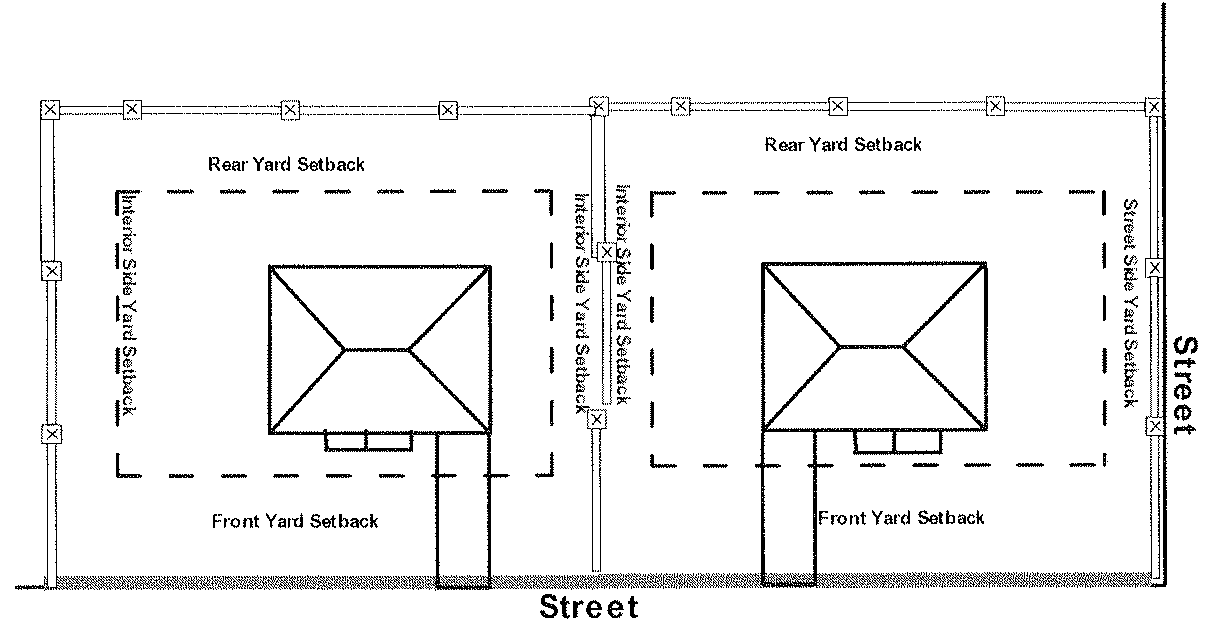
a.
Corner lots.
(1)
On back-to-back corner lots a 15-foot street side yard is allowed. However, a fence or wall may be constructed on the property line, provided no driveway access (except RV parking) exists on the street side yard of the subject property or on the property to the rear. If driveway access exists on the subject property or on the lot to the rear, all structures, including fence or wall, must respect the 15-foot street side yard setback and intersection visibility as set forth in section 5.3.6.
(2)
Where a corner lot abuts an interior side yard of the property to the rear, there shall be a front yard setback on both streets with the street side yard being equal to the front yard of the lot to the rear, but in no case less than 15 feet.
b.
Double-frontage lots (through lots). In rare case where double frontage (through) lots are approved, a front setback shall be maintained from both streets.
c.
Flag lots. For flag lots, the flagpole or panhandle portion of the lot shall not be considered part of the front yard, rather the lot line that is closest to and most closely parallel to the access street shall be considered the front lot line.
d.
Exceptions. No building permit or development approval may be issued for a lot that does not meet the front and street yard requirements of this UDC, except in the following cases:
(1)
Where an official line has been established for the future widening or opening of a street or thoroughfare upon which a lot abuts, the depth of a front or side yard setback shall be measured from such official line to the nearest line of the building.
(2)
Uncovered porches and decks may encroach into the required front yard for a distance of not more than six feet.
(3)
Filling station pumps and pump islands may encroach into required yards, provided that they are not less than 15 feet from the street lines.
(4)
All garages and carports shall maintain a minimum 20-foot front yard setback; provided, however, carports in subdivisions approved prior to the adoption of Ordinance Number 444 on April 9, 1969, shall maintain a minimum ten-foot front yard setback. Such uses shall comply with the requirements of section 5.3.6, corner setbacks and intersection visibility (safe sight triangle).
(5)
Signs, which are in conformance with the requirements of section 5.8, signs, and section 5.3.6, corner setback and intersection visibility (safe sight triangle), may encroach into required front yards.
(3)
Side yards. Side yards shall extend from the required front setback line to the required rear setback line and be measured from the side lot line. Side setbacks on double-frontage lots shall run the full length between street lot lines. However, the following exceptions shall apply:
a.
In the SF-10 and SF-7 districts, interior side yards for one-story portions of residences may be reduced to five feet for structures built to HUD standards, UBC standards, IBC and/or IRC standards.
b.
Development with no side yard setbacks is allowed only for attached townhouses and attached single-family.
c.
Residential accessory structures that are separated at least ten feet from the principal structure may be constructed in a rear yard; provided, the total square footage of all structures does not exceed forty percent of the lot size, is not greater than 15 feet in height, and the distance from any part of such structure to a side lot line is at least three feet, except that accessory buildings or structures of 120 square feet or less may extend to the rear and/or side lot line, provided such structures are not greater than ten feet in height, and no portion of the structure crosses into or drains onto adjacent property.
d.
Mobile homes are subject to the more restrictive standards of section 2.4.32.
e.
Signs, which are in conformance with the requirements of section 5.8, signs, and section 5.3.6, corner setback and intersection visibility, may encroach into required side yards.
(4)
Rear yards. Rear yards shall extend the full width of the lot and be measured from the rear lot line. If a corner lot has more than four sides, the yards along the interior lot lines that do not intersect a street line shall be considered rear yards. However, the following exceptions shall apply:
a.
Whenever a lot abuts to a public alley, one-half of the alley width may be considered part of the rear yard.
b.
Uncovered porches and decks may encroach into the required rear yard for a distance of not more than 50 percent of the required setback.
c.
Residential accessory structures that are separated at least ten feet from the principal structure may be constructed in a rear yard; provided, that such accessory structures:
(1)
Are not greater than 15 feet in height; and
(2)
The distance from any part of such structure to a rear lot line is at least five feet, and the distance from any part of such structure to a side lot line is at least three feet.
d.
Except, that accessory buildings or structures of 120 square feet or less may extend to the rear and/or side lot line, provided such structures are not greater than ten feet in height, and no portion of the structure crosses into or drains onto adjacent property.
(5)
Projections/encroachments, general. The following features may project in required setbacks to the extent indicated.
a.
Trees, shrubs, flowers, hedges, and other landscape features, provided that no fence, wall, hedge, shrubbery, etc. are not higher than a baseline extending from a point two and one-half feet above walk grade to a point four and one-half feet above walk grade at the depth of the required front yard. Single trees having single trunks that are pruned to a height of seven feet above walk grade are the exception;
b.
Fences and walls;
c.
Sidewalks and driveways;
d.
Architectural features, such as, but not limited to, cornices, chimneys, eaves, stoops and gutters, and ordinary projections of window air conditioners may project up to two feet into the required yards;
e.
Structural or mechanical devices added to structures to make such structures accessible to physically disadvantaged persons may encroach into required setbacks and buffers;
f.
Mechanical equipment such as air conditioning units, pool pumps and similar equipment may be located in any required yard;
g.
Utility lines, wires and associated structures, such as power poles; and
h.
Accessory, open and uncovered swimming pools and home barbecue grills may occupy a required rear yard, provided they are not located closer than five feet to the rear lot line and not closer than three feet to a side lot line.
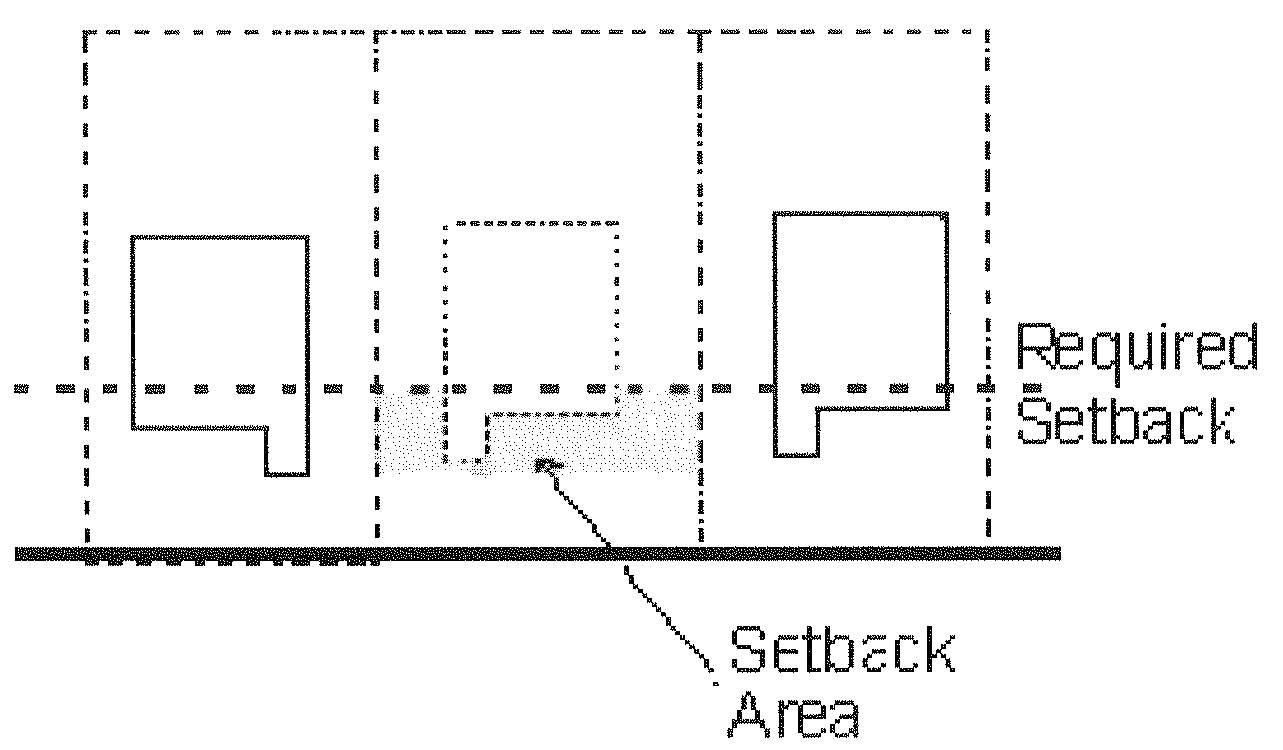
(6)
Setback averaging. Where the average of the front setbacks for all lots located within 200 feet of either side of a lot (same side of street) is less than the minimum required front setback, the required setback line may be reduced to this lesser average depth, but in no case, to less than ten feet. For the purpose of computing such average, a vacant lot shall be considered to have the minimum front setback required for the zoning district.
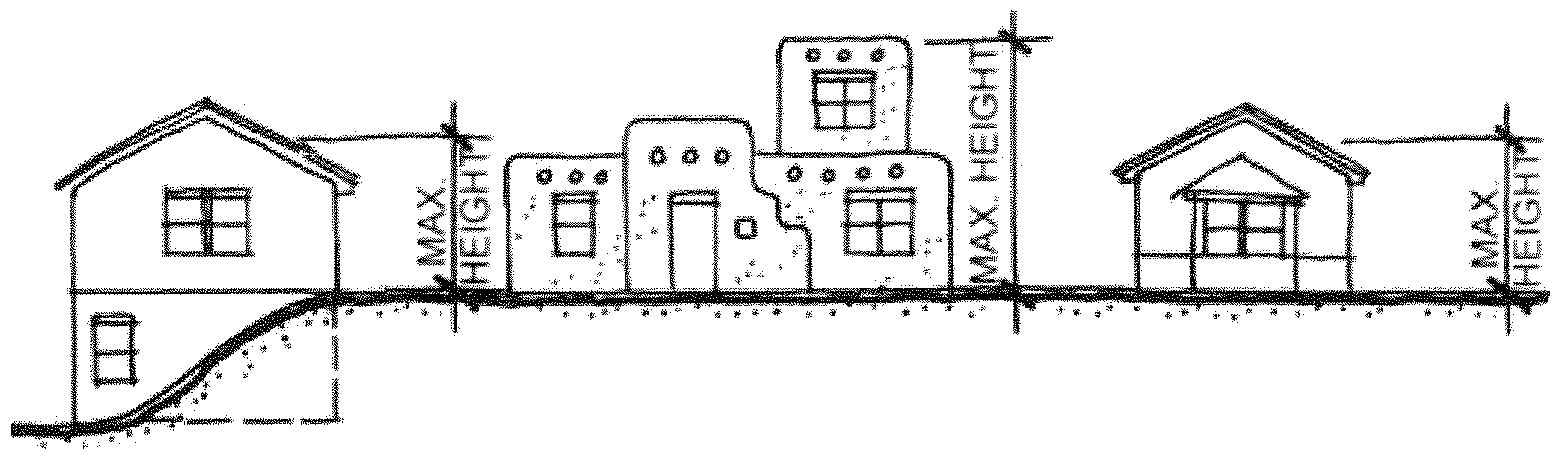
D.
Height.
(1)
Measurement.
a.
Height of buildings shall be measured as the vertical distance in feet between the lowest point where the wall face of the building intersects finished grade along the front of a building to the highest point of the building, i.e.:
(1)
Top of the highest roof beam on a flat or shed roof;
(2)
Deck level on a mansard roof; or
(3)
Average distance between the eaves and apex of a gable, hip, or gambrel roof.
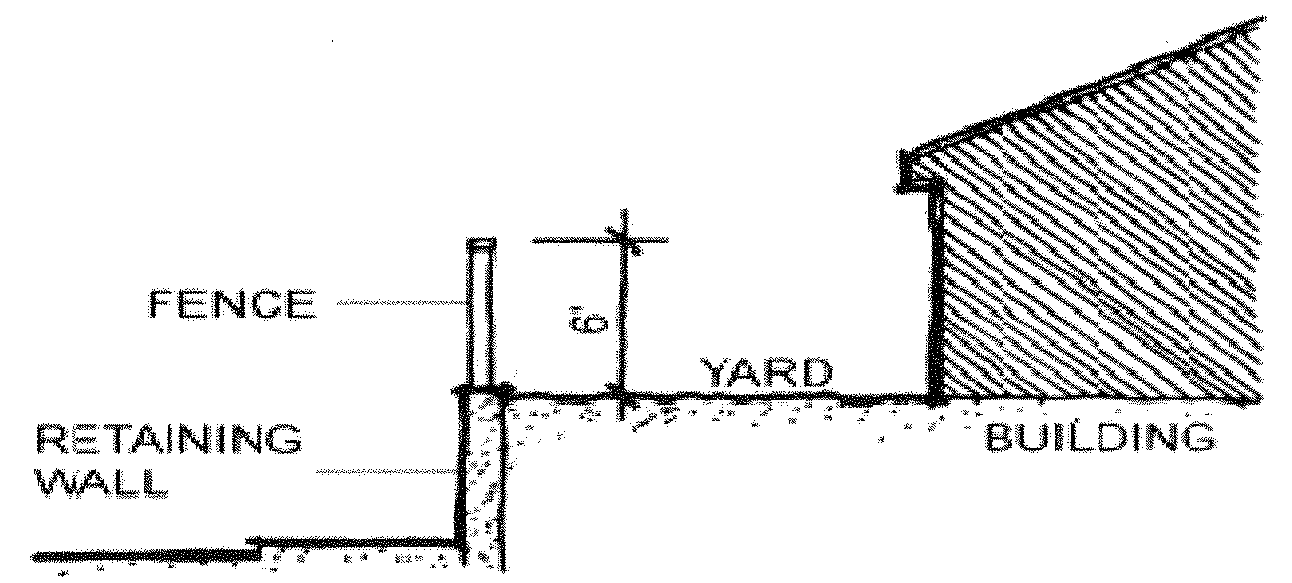
b.
Height of fences or walls shall be measured as the vertical distance between finished grade on the highest side of the fence or wall to the top of the fence or wall.
(2)
Exceptions to maximum building height.
a.
Towers, spires, cupolas, chimneys, elevator penthouses, water tanks, flagpoles, monuments, theater scenery lofts, radio and television antennas, and similar structures and necessary mechanical appurtenances covering not more than 25 percent of the roof area of the structure may exceed the maximum permitted height in the district in which the site is located. Such exceptions shall be subject to the following regulation: Ten feet with no discretionary review. A special use permit shall be required for features extending more than ten feet above the base district height limit.
b.
Public, semipublic or public service buildings, hospitals, institutions, or schools, when permitted in a district, may be erected to a height not exceeding 60 feet, and churches and temples may be erected to a height not exceeding 75 feet, when the required side and rear yards are each increased by at least one-foot for each one foot of additional building height above the height regulations for the district in which the building is located.
c.
Residential accessory structures located within required rear yards shall not be greater than 15 feet in height.
2.8.4 Building coverage. The portion of a site covered by principal and accessory buildings and structures, as measured from the outside of the building or structure at ground level, and expressed as a percentage of total site area.
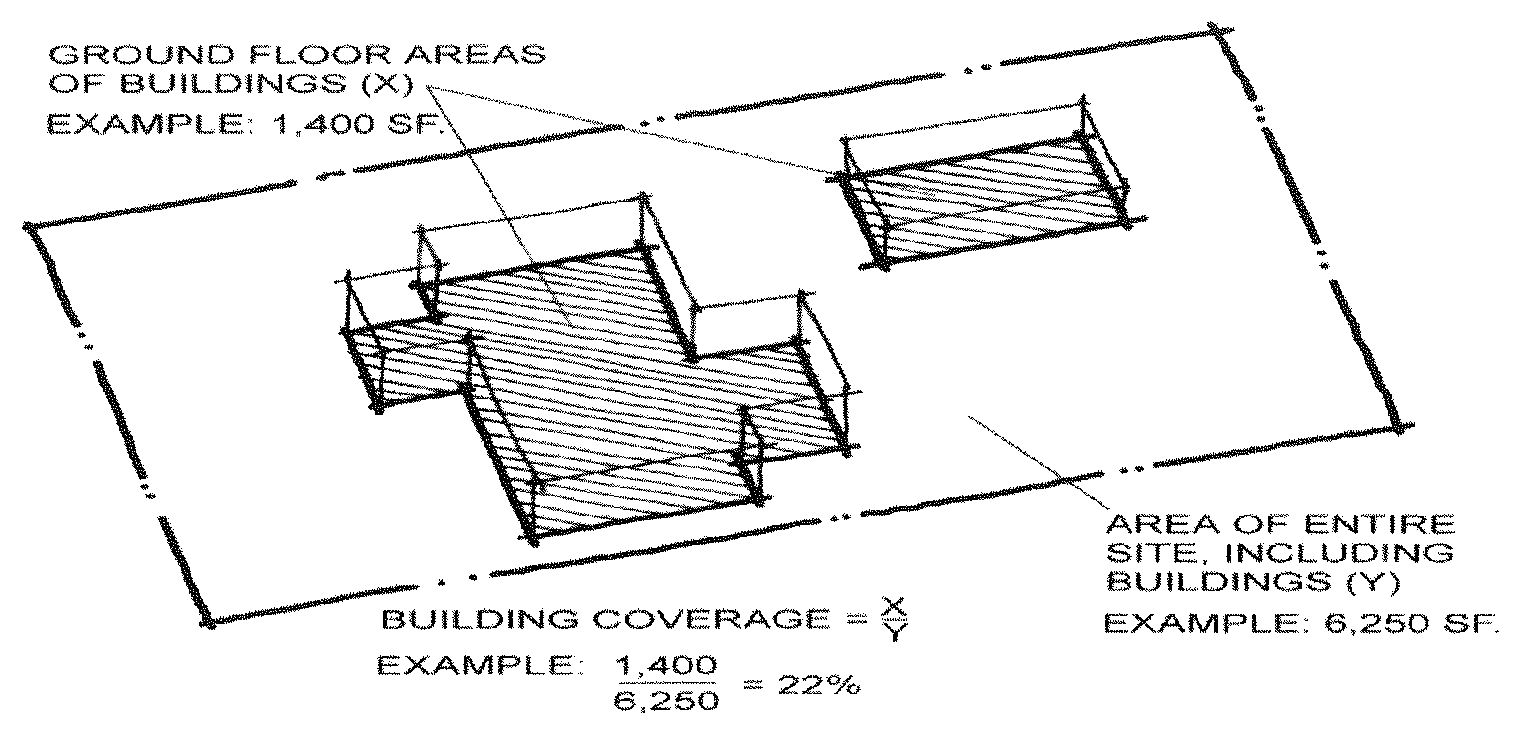
A. Exception. Building coverage may be increased by up to 50 percent when all required parking is provided underground.
(Ord. No. 2021-1325, 3-9-21)

