
Farmington City Zoning Code
ARTICLE 6
SUBDIVISION STANDARDS
ARTICLE 6 SUBDIVISION STANDARDS
Sec. 6.1 - Purpose.
The subdivision of land is a major factor in the process of sound community growth and ultimately becomes a public responsibility in that the streets must be maintained and various public services customary to urban areas must be provided. The welfare of the entire community is thereby affected in many important respects. Therefore, it is to the interest of the public, to the developer, and to the future owners, that subdivisions be conceived, designed, and developed in accordance with sound rules and proper minimum standards. It is in the intent of these regulations to encourage the growth of the City of Farmington in an orderly manner.
Sec. 6.2 - Applicability.
This article shall govern all plats and subdivisions of land within the corporate limits of the City of Farmington, New Mexico, and within five miles thereof of its corporate limits, or as established by the New Mexico Municipal Code section 14-19-5 (NMSA 1978, § 3-20-5).
Sec. 6.3 - Building lots.
No electrical service and, where applicable, no permit for the construction of a building or buildings upon any lot, tract or parcel shall be issued until a building lot, tract or parcel has been created by compliance with one of the following conditions:
A.
Platted subdivisions. The lot, tract or parcel is part of a plat of record, properly approved and filed in the plat records of San Juan County, New Mexico, in which case, a building permit may be issued conforming to all requirements of this UDC; or
B.
Lots of record. The lot, tract or parcel faces upon a dedicated access and utility easement, width to be determined by the City Engineer, and was a "lot of record" prior to the effective date of the original subdivision regulations [Ordinance Number 510, Adopted June 22, 1971] of the City of Farmington in which event, a building permit conforming to all the requirements of this UDC may be issued without first complying with subsection 6.3A., platted subdivisions (see also section 9.4, nonconforming lots of record).
C.
The property has a valid legal description through a warranty deed consolidating previously created lots in a subdivision
D.
Property has a recorded legal survey including a full legal description.
E.
In Tier 1 and Tier 2 of the City of Farmington's Platting and Planning Jurisdiction, property located in a previously approved and recorded subdivision in San Juan County, with the following exception:
(1)
If review of the existing county subdivision by the city shows deficiency, such as lack of easements, the city may require the property to complete a city subdivision application.
(Ord. No. 2021-1325, 3-9-21)
Sec. 6.4 - Subdivision design standards.
6.4.1 General. The city shall not approve the subdivision of land if, from adequate investigations conducted by all public agencies concerned, it has been determined that in the best interest of the public, the site is not suitable for platting and development purposes of the kind proposed. Land deemed to be environmentally unsuitable shall not be platted for residential occupancy, or for such other uses as may increase danger to health, life, or property, or aggravate erosion or flood hazard. Such land within the plat shall be restricted for such uses as shall not be endangered by periodic or occasional inundation or shall not produce unsatisfactory living conditions.
6.4.2 Subdivision classes. For purposes of this section, the following subdivision classes are established:
A.
Class 1 subdivisions are subdivisions in which the smallest lot has an area of less than 20,000 square feet and a width of less than 100 feet at the building line.
B.
Class 2 subdivisions are subdivisions in which the smallest lot has an area of 20,000 square feet or more and a width of 100 feet or more at the building line.
C.
Class 3 subdivisions are subdivisions in which the smallest lot has an area of one acre and a width of 150 feet or more at the building line.
6.4.3 Engineering and construction standards.
A.
All required improvements, including but not limited to streets, sidewalks, trails and accessways, water and sewer, and drainage facilities, shall be designed by a licensed engineer registered in New Mexico in accordance with the requirements of the most recent City of Farmington "Design & Construction Standards with Technical Specification."
B.
All required improvements, including but not limited to streets, sidewalks, trails and accessways, water and sewer, and drainage facilities, shall be constructed in accordance with the most recent City of Farmington "Design & Construction Standards with Technical Specification."
C.
All streets, water, sewer, and drainage facilities shall be designed and constructed to, and through, the property in question in accordance with the requirements of this article.
D.
Where city standards do not specifically cover a design or construction issue, the director may enforce other recognized industry standards.
6.4.4 Blocks.
A.
Block length shall be at least 400 feet and shall not exceed 1,200 feet in single-family residential areas and shall not exceed 800 feet in other areas. In blocks over 800 feet in length, and at the end of cul-de-sacs that abut an existing or future school, park, greenway, trail, bikeway or street, may be required an accessway in accordance with the requirements of subsection 6.4.8B.
B.
Blocks shall be wide enough to allow two tiers of lots of a minimum depth of 100 feet, except where single tier lots are required to separate residential development from arterial traffic, to separate lots from an incompatible use, to allow for unusual topographic conditions or when adjacent to the outer perimeter of the subdivision. (See also subsection 6.4.5B., double-frontage lots).
6.4.5 Lots.
A.
Arrangement.
(1)
Side lot lines shall be at right angles to straight street lines or radial to curved street lines.
(2)
Each lot must front upon a public street with a right-of-way width of not less than 50 feet, or a private street within an approved PUD with a right-of-way width of not less than 40 feet.
(3)
Corner lots for residential use shall have extra width to permit appropriate building setback from both streets.
(4)
Lot arrangement must be such that there will be no foreseeable difficulties, for reasons of topography or other conditions, in securing building permits to build on all lots in compliance with the standards of this UDC.
B.
Double-frontage lots (through lots). Double frontage lots shall be avoided except where necessary to provide separation of residential development from thoroughfares or to overcome specific disadvantages of topography and orientation. (See also the minimum lot depth requirements of subsection 6.4.4B.)
C.
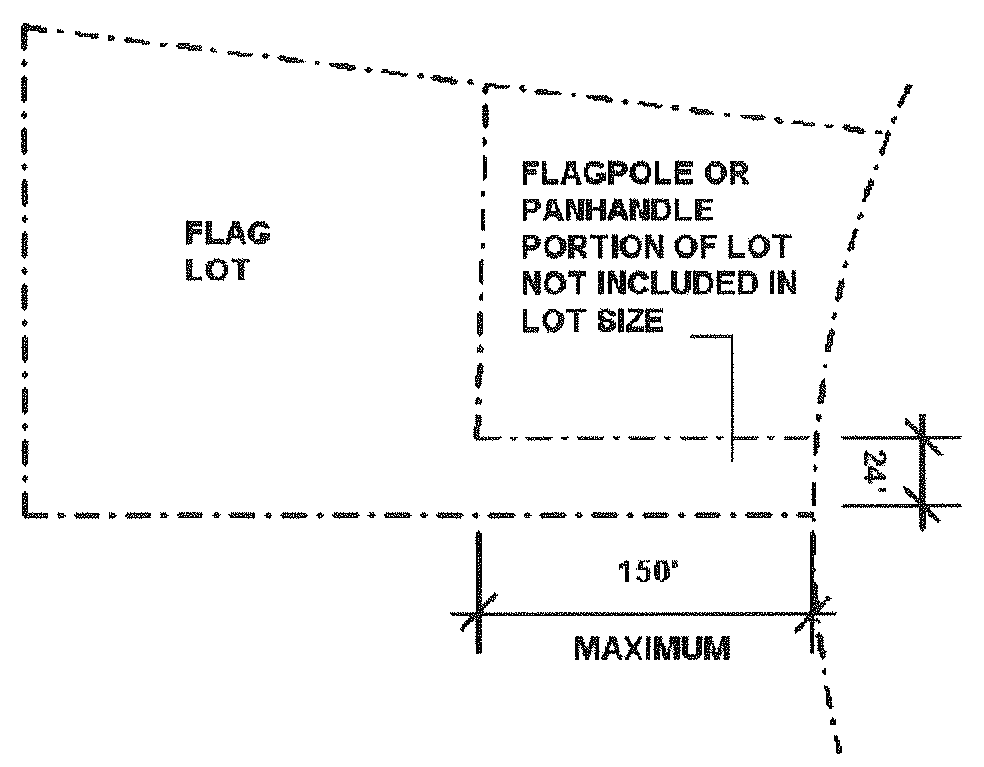
Flag or panhandle lots. Flag shaped or panhandle shaped lots may be created in any zone if all of the following requirements are met:
(1)
The lot has at least 24 feet of frontage on a dedicated public or private street, which frontage serves as access only to the subject lot or parcel;
(2)
The flagpole or panhandle portion of the lot shall be at least 24 feet in width for its entire length;
(3)
The depth of the flagpole or panhandle shall not exceed 150 feet as measured from the adjacent public or private street right-of-way; and
(4)
The flagpole or panhandle portion of the lot shall not be included in calculating minimum lot area.
6.4.6 Subdivision access.
A.
Large tracts or parcels. When land is subdivided into large parcels (further sub-dividable parcels, at least five acres in size) rather than ordinary building lots, such parcels shall be arranged so as to allow for the opening of future streets and logical further subdivisions. If the comprehensive plan of the city requires thoroughfares to cross the subdivision, the right-of-way shall be dedicated to the public.
B.
Required subdivision accesses. All subdivision accesses shall meet city standards and specifications. When determining the number of required accesses, all other connecting subdivision lots shall be counted. A Site Threshold Assessment (STH) shall determine the level of street classification required to connect to the existing public roadway system. Additional accesses shall be shown on the plat and construction plans for the development; however, construction of the street may be postponed to a later phase of development. The timing, or "trigger" for construction of the access(es) shall be established as part of the subdivision review process (final plat) and the improvements agreement.
(1)
A subdivision of 49 lots or less may provide access to the existing public roadway system via a single access to the STH determined roadway system.
(2)
Two accesses shall be required for a subdivision of 50 lots or greater. A subdivision must connect to a roadway that does not converge to a single choke point. The developer shall be required to provide a minimum of two unique accesses as determined by the STH.
(3)
Subdivisions of 250 lots or greater shall be required to provide a minimum of three or more non-choke point accesses to the existing or proposed public roadway system, subject to review by the director.
C.
Offsite street improvements. If the development requires additional offsite streets per UDC section 6.4.6B. the developer shall provide for the offsite improvement full right-of-way width and a complete street designed and constructed per the standards outlined in UDC section 6.4.7J. Geometric Standards. All offsite improvements will be required to be included in the construction plans and in the Subdivision Improvement Agreement.
Exception 1:
If the offsite street length is 250 feet or greater and if the offsite abutting property is undeveloped and developable, the following minimum requirements shall be met for the entire length of the offsite street:
(1)
Shall have full right-of way width designed per the standards outlined in UDC section 6.4.7J. Geometric Standards; and
(2)
May have pavement widths reduced to 24 feet wide with eight-foot graveled shoulders and drainage ditches and culverts, where appropriate; and
(3)
When the abutting property is developed the future developer will be required to construct the remaining proportional section of the access on their side of the street to meet the requirements of the standards outlined in UDC section 6.4.7J. Geometric Standards to include connecting pavement, sidewalk, curb and gutter.
If the offsite street length is 250 feet or greater and if the offsite abutting property is undevelopable or developed on any given or both sides, the following minimum requirements shall be met for the entire length of the offsi te street:
(1)
Shall have full right-of way width designed per the standards outlined in UDC section 6.4.7J. Geometric Standards; and
(2)
If both sides are developed or undevelopable then the developer shall construct the entire offsite street per the standards outlined in UDC section 6.4.7J. Geometric Standards. All offsite improvements will be required to be included in the construction plans and in the Subdivision Improvement Agreement; or
(3)
If only one side is developed or undevelopable then the developer shall have a minimum pavement width of 24 feet adjoining curb and gutter, and construct sidewalk on the said side. On the opposite side, the developer shall construct an eight-foot graveled shoulder and drainage ditch and culverts, where appropriate. The future developer will be required to construct the remaining connecting section of the street pavement on their side of the street to meet the requirements of the standards outlined in UDC section 6.4.7J. Geometric Standards including sidewalk, curb and gutter.
Exception 2: Pavement Exceptions.
(1)
If the required street improvements does not have all utilities installed, the developer may install a 24 feet wide all weathered road with eight-foot graveled shoulders and drainage ditches and culverts, where appropriate. The developer will maintain the unpaved street, including but not limited to shoulders, drainage ditches and culverts. An enforceable binding maintenance plan executed by the developer and the city shall be required; OR The city will provide coldmill material to be placed by the developer as per city standard. The city will accept maintenance of this right of way after the execution of the NOA; OR
(2)
City council may waive the paving requirements. The offsite street width may be reduced to 24 feet wide all weathered road with eight-foot graveled shoulders and drainage ditches and culverts, where appropriate. The developer will maintain the unpaved street, including but not limited to shoulders, drainage ditches and culverts. An enforceable binding maintenance plan executed by the developer and the city shall be required.
City council may waive the paving requirements based on the following considerations below:
a.
Density and intensity of uses, and anticipated traffic volumes to be generated by the subdivision;
b.
The location of the subdivision in relation to paved roadways;
c.
The rate of growth of the area in which the subdivision is to be located;
d.
The amount of traffic upon streets located within the subdivision created by surrounding land uses; and
e.
The presence or absence of soil conditions, drainage problems, unusual topography or similar physical land characteristics that may adversely affect the cost or difficulty of maintenance, or the safety, of unpaved streets if allowed within the subdivision.
City council may require as a condition of such waiver that the developer agree, on behalf of himself and his successors in title, to participate in an improvement district at such time as one is formed in the future for the purpose of assessing property owners with the cost of paving, and otherwise improving streets to applicable city standards.
6.4.7 Streets and alleys. All streets and alleys within a subdivision must meet the following minimum standards:
A.
Street layout. Adequate streets shall be provided by the subdivider so that the arrangement, character, extent, width and grade of each shall conform to the major thoroughfare plan or to requirements of subsection 6.4.7J., geometric standards—street design criteria, and shall be considered in their relation to existing and planned streets, to the topographical conditions, to the public safety and convenience and to their appropriate relationship to the proposed use of the land to be served by such streets.
B.
Relation to adjoining street systems. Where necessary to conform to the neighborhood pattern, existing streets in adjacent or adjoining areas shall be continued in the new development, in alignment therewith. Whenever connections to anticipated or proposed surrounding streets are required by this section, the right-of-way shall be extended and the street developed to the property line of the subdivided property (or to the edge of the remaining undeveloped portion of a single tract) at the point where the connection to the anticipated or proposed street is expected.
C.
Street jogs. Street jogs with centerline offsets of less than 125 feet shall be avoided.
D.
Half streets. Half streets shall be prohibited except where essential to the reasonable development of the subdivision and where the director finds it will be practicable to require the dedication of the other half of a street when the adjoining property is subdivided.
E.
Dead-end streets. Dead-end streets shall be no more than 600 feet long unless otherwise necessitated by topography. Temporary turnarounds shall be provided at the closed end with a turnaround having an outside roadway diameter of at least 80 feet. Such temporary turnarounds shall be required where the street stub exceeds one lot or 100 feet in length, whichever is greater. The developer shall provide a sign at the dead-end declaring that the particular street shall connect with any future development.
F.
Cul-de-sacs. Cul-de-sacs shall not exceed 600 feet in length to beginning of the cul-de-sac radius, and shall terminate in a turnaround with a minimum right-of-way diameter of 90 feet, and with a minimum outside edge-of-pavement radius of 40 feet exclusive of curbs.
G.
Street intersections. Street intersections shall be as nearly at right angles as possible. No intersection shall be at an angle of less then 60 degrees.
H.
Thoroughfares per comprehensive plan. Where a subdivision embraces, contains or abuts a thoroughfare(s) as shown on the major thoroughfare plan, such street(s) shall be platted to maintain continuity in the approximate location as shown, and of the type indicated. In certain cases, the city may have constructed a street through the area to be subdivided, in which case, the subdivider shall develop the necessary street intersections at his expense in accordance with the requirements of this section. The planning and zoning commission may require that, where practicable, residential lots adjacent to a thoroughfare be platted or restricted so as to prevent driveways opening into such streets.
I.
Local streets. Local streets (streets not shown on major thoroughfare plan) shall be laid out to discourage their use for through traffic.
J.
Geometric standards—Street design criteria. Minimum design criteria for streets are shown in the following table:
K.
Pavement widths. Pavement widths may be reduced for development relative to the requirements of subsection 6.4.7J., geometric standards—street design criteria, as follows:
(1)
Class 2 subdivisions. Pavement width may be reduced to 24 feet wide with eight-foot graveled shoulders and drainage ditches and culverts, where appropriate.
(2)
Class 3 subdivisions. Pavement widths may be reduced to 24 feet wide with eight-foot graveled shoulders and drainage ditches and culverts, where appropriate; provided, however, that:
a.
City council may waive the paving requirement in Class 3 subdivisions based on consideration of:
(1)
Density and intensity of uses, and anticipated traffic volumes to be generated by the subdivision;
(2)
The location of the subdivision in relation to paved roadways;
(3)
The rate of growth of the area in which the subdivision is to be located;
(4)
The amount of traffic upon streets located within the subdivision created by surrounding land uses; and
(5)
The presence or absence of soil conditions, drainage problems, unusual topography or similar physical land characteristics that may adversely affect the cost or difficulty of maintenance, or the safety, of unpaved streets if allowed within the subdivision.
b.
City council may require as a condition of such waiver that the subdivider agree, on behalf of himself and his successors in title, to participate in an improvement district at such time as one is formed in the future for the purpose of assessing property owners with the cost of paving, and otherwise improving streets to applicable city standards.
L.
Vertical curve. All changes in grade shall be connected by vertical curves of minimum length in feet equal to 15 times the algebraic difference in rates of grade for thoroughfares and ½ this minimum length for other streets. Profiles of all streets showing natural and finished grades drawn to a scale of not less than one-inch equals 100 feet horizontal, and one-inch equals ten feet vertical, shall be required by the director where topographic conditions warrant.
M.
Additional width of existing streets. Subdivisions that adjoin existing streets shall dedicate additional right-of-way if necessary to meet the minimum street width requirements set forth in this section, as follows:
(1)
The entire additional right-of-way shall be provided where the subdivision is on both sides of the existing street.
(2)
When the subdivision is located on only one side of existing street, one-half of the required additional rights-of-way shall be provided. In no case shall the resulting right-of-way width be less than 50 feet.
N.
Restriction of access to arterials. When a subdivision or portion thereof adjoins a principal or minor arterial, no lot shall have direct access thereto. Such lots shall be provided with frontage on a frontage road or other street with adequate depth for screening of the portion of any such lot contiguous with an arterial in accordance with the requirements of section 5.5.7, screening standards.
O.
Street names. Street names may not duplicate names of any existing street in the city or within the city's planning and platting jurisdiction (PPJ), except where the street is a continuation of an existing street, in accordance with the City of Farmington Street Naming and Numbering Policy. Street names shall be subject to the approval of the director.
P.
Alleys.
(1)
Alleys may be required at the rear of all lots intended to be used for nonresidential purposes and may be provided in residential areas, particularly in areas where alleys are part of the traditional neighborhood pattern.
(2)
Dead-end alleys shall not be allowed.
(3)
Alleys shall be graded to their maximum usable width to a grade approved by the city engineer.
6.4.8 Pedestrian, biking and multi-use facilities.
A.
General. The purpose of these standards is to promote the design of an urban environment that is built to human scale, to provide for the safe movement of pedestrians and bicyclists, to promote the more efficient utilization of public infrastructure, and to foster attractive street fronts and pedestrian environments, while accommodating vehicular movement and alternate transportation modes with bicycle and pedestrian access. To these ends, bicycle and pedestrian facilities designed in accordance with AASHTO standards and the requirements of this section shall be included in site plans and subdivision layouts and designed to reduce conflicts between motor vehicles and pedestrians or bicyclists. The standards of this subsection are further intended to implement to the bikeway plan (figure 6.6) of the comprehensive plan.
B.
Sizes of blocks. Blocks shall not be less than 400 feet nor more than 1,200 feet in length measured along the greatest dimension of the enclosed block area. In blocks over 800 feet in length, the planning and zoning commission may require one or more public crosswalks of right-of-way not less than ten feet in width to extend entirely across the block and at locations deemed necessary at intervals not closer than 400 feet. Blocks shall be wide enough to allow two tiers of lots of a minimum depth of 100 feet.
C.
Sidewalks.
(1)
When required.
a.
Sidewalks, designated crosswalks, safety islands are required on all streets, whether adjacent to or part of the subdivision, both private and public in nonresidential and all multifamily districts.
b.
Sidewalks shall be required on both sides of local streets adjacent to building sites where the smallest lot has an area of less than 20,000 square feet and a width of less than 100 feet at the building line (Class 1 subdivisions).
(2)
Sidewalk placement alternatives. The subdivider shall provide sidewalks within the rights-of-way in accordance with the requirements of this subsection, subject to the approval of the director. Sidewalks may be placed so as to maintain a minimum three-foot buffer/green space between the back of vertical curb and the inside edge of the sidewalk, or be placed against the back of a vertical curb. In either case, sidewalks shall be paved with a minimum unobstructed width of:
a.
Five feet, along collectors and arterials;
b.
Five feet, within nonresidential developments; and
c.
Four feet, in all other locations.
D.
Bikeways and multi-use facilities. Bikeways and multi-use facilities shall be provided as follows where recommended by the bikeway plan or other adopted plans:
(1)
Multi-use trails. A facility completely separated from auto traffic and within an independent right-of-way or within the right-of-way of another facility. Multi-use trails accommodate both biking and walking and are therefore wider in accordance with the requirements of subsection 6.4.8D(4), easements/treadways, to improve safety.
(2)
Bike lanes. A facility where both sides of the roadway or shoulder are striped, signed, and marked for exclusive or preferential bicycle use and where vehicle parking is not permitted, unless otherwise specified. The minimum bike lane width shall be six feet for bike lanes with curb and five feet, without curb.
(3)
Bike routes. A facility designated by signing to help make motorists aware of the presence of bicycles, which share the right-of-way with motor vehicles.
(4)
Easements/treadways. Multi-use trails, where required, shall have a minimum 15-foot right-of-way or easement, for bicycle and pedestrian uses dedicated to the public. A ten-foot treadway shall be constructed in the center of the right-of-way or easement conforming to the city standards, unless modified or waived by the city council.
(5)
Bikeway location criteria. Bikeways shall be located to integrate with the existing and future city street and park system in accordance with the bikeway plan (see figure 6.6 of the comprehensive plan). Additionally, criteria to be used in determining facility types and locations may be based on the following considerations:
a.
Safety in terms of existing street width;
b.
Existing and potential demand for use;
c.
Continuity, directness, and linkages to activity centers;
d.
Spacing in relation to other bikeway facilities;
e.
Location of schools and other public facilities frequented by bicycle riders; and
f.
Location of linear parks and greenbelts.
E.
Timing of dedication and construction.
(1)
All accessways, bikeways and multi-use facilities, as may be required by this UDC or recommended by the bikeway plan or other adopted plans, or as may be negotiated through the platting process, shall be dedicated and constructed prior to release of the subdivision guarantee, or as required below:
a.
All required accessways, sidewalks, bikeways multi-use facilities, street lights, traffic signs, pavement markings and traffic signals must be constructed concurrently with the adjacent street or thoroughfare;
b.
If the street or thoroughfare is already constructed, prior to acceptance of any improvements.
(2)
All sidewalks as may be required by this UDC, or as may be negotiated through the platting process, shall be dedicated, and constructed prior to the issuance of a certificate of occupancy.
6.4.9 Monuments.
A.
Location. Subdividers shall place permanent reference monuments at block corners, control points, and lot corners. A permanent benchmark with elevation on NAVD 88 must be set.
B.
Material specifications.
(1)
Corner and control point monuments must be Iron #4 rebar with cap set in concrete.
(2)
Lot corner monuments must be iron pins set in the ground.
(3)
Permanent benchmark is a 2½-inch brass or aluminum cap set in concrete.
6.4.10 Easements.
A.
Drainage easements. Where a subdivision is traversed by a watercourse, drainage way, natural channel or stream, there may be required a drainage easement or right-of-way conforming substantially to the limits of such watercourse. Additional width may be required to accommodate future needs as determined by the director. No construction shall impede, constrict, or block the flow of water in any easement or natural watercourse, except in accordance with section 6.4.14. Drainage easements may not be used for utilities unless specifically approved by the city engineer. Such easements shall not straddle lot lines, but must be wholly contained within a lot(s).
No fencing shall be allowed within a drainage easement, except:
(1)
Along the boundary of such easement, approximately parallel to the anticipated flow; and
(2)
Where designed to maintain the stormwater flow and specifically approved by the city engineer.
B.
Utility easements. Utility easements shall be provided in accordance with the requirements of subsection 5.3.1A.
6.4.11 Water supply. All subdivisions shall be provided with water supply and distribution systems for fire protection and domestic use either by the City of Farmington or a water supply district in accordance with the City of Farmington's Water Service Policy and the requirements of this section. Water system design shall be approved and enforced by the director in accordance with applicable city, state and federal statutes, codes, City of Farmington construction specifications, and acceptable engineering practice.
A.
Class 1 subdivisions. The subdivider shall make necessary arrangements to serve each lot with a water main of the Farmington water system.
B.
Class 2 and Class 3 subdivisions. The subdivider shall provide an adequate supply of potable water to each lot by a water system approved by the New Mexico Environmental Department, or shall serve each lot with a water main of the Farmington water system; or where it is feasible and practical for an adequate water supply to be made available for every lot by the individual lot owner to present evidence to this effect and include deed restrictions on the final plat requiring any such individual water systems to comply with the requirements of the New Mexico Environmental Department.
6.4.12 Fire hydrants. Fire hydrants and control valves shall be installed not more than 500 feet apart at proper locations to be determined by the director, in consultation with the fire marshall or his designee. All fire hydrants shall have two 2½-inch hose connections, and one 4½-inch steamer connection or two 4½-inch steamer connections for hydrants on 12 inches and larger water mains.
6.4.13 Sanitary sewer.
A.
Class 1 subdivisions. All subdivision lots shall have city sewer service.
B.
Class 2 subdivisions. Where a public sanitary sewer is within 600 feet of the subdivision and accessible by either gravity or an individual pressure sewer system, the subdivider shall connect with the public sanitary sewer system and provide adequate sewer lines accessible to each lot. Where lots cannot be connected with a public sewer system, provisions must be made for sanitary sewerage facilities, consisting of a central treatment plant or individual disposal devices for each lot, but the subdivision plat shall include deed restrictions requiring that all such disposal systems shall be constructed in accordance with the specifications of the New Mexico Environmental Department and under the supervision of and subject to the approval of the city engineer.
C.
Class 3 subdivisions. Where a public sanitary sewer is within 300 feet of the subdivision and accessible by either gravity or an individual pressure sewer system, the subdivider shall connect with the public sanitary sewer system and provide adequate sewer lines accessible to each lot. Where lots cannot be connected with a public sewer system, provisions must be made for sanitary sewerage facilities, consisting of a central treatment plant or individual disposal devices for each lot, but the subdivision plat shall include deed restrictions requiring that all such disposal systems shall be constructed in accordance with the specifications of the New Mexico Environmental Department and under the supervision of and subject to the approval of the city engineer.
6.4.14 Drainage.
A.
Drainage facilities shall be provided to handle runoff as calculated, street inlets for a 25-year storm; sewers for a 25-year storm, 24-hour storm; and bridges for a 100-year storm, all as approved by the director. Water shall not be carried on the street for a distance greater than a ten-year storm will overflow the curb.
B.
Drainage shall be handled in natural watercourses and stream channels insofar as practical. No lot shall be platted and no construction permitted that impedes, constricts, or blocks the flow of water in any natural or improved watercourse; provided, however, in Class 2 and Class 3 subdivisions, drainage may be by open channels located preferably along the streets or when drainage easements are provided, along rear lot lines.
C.
Drainage improvements shall prevent the collection of water in any low spot except where such collection occurs in an improved stormwater retention basin or area.
D.
Stormwater drainage shall not be permitted to combine with sanitary sewers or irrigation ditches.
6.4.15 Underground utilities.
A.
All new utility service and distribution facilities in new subdivisions, including electrical, telephone, and cable television facilities, shall be installed underground; provided, however, that the City of Farmington Electric Utility Department reserves the right to provide overhead service from existing power lines or to install overhead power lines due to terrain, design criteria, or other unforeseen problems [Resolution Number 91-656, January 22, 1991].
B.
Electric utility installations shall be in accordance with City of Farmington Electric Utility Rule and Regulation Number 16, as periodically amended. A line extension agreement is required.
(1)
Residential underground, as referred to by the City of Farmington Electric Utility, is a single phase primary system complete with pad-mounted transformers designed to reduce the primary system voltage to the standard usable residential voltage of 120/240 volts three wire single phase, plus the three wire electric service to the meter location on the house.
(2)
To obtain an electrical estimate and the installation of the electrical system in (residential or nonresidential) subdivisions, applicants shall provide a digital, scaled site plan in the most recent AutoCAD format (or other format as directed by the city electric department) to include the following information:
a.
Boundary lines of the subject property;
b.
Section corners ties;
c.
Locations of existing cable, water, sewer and gas lines; and
d.
Location of water meter(s).
(3)
Easements, indicated on the work sketch for the location of the underground lines as furnished by the utility, must be granted by the developer. All lot corners pertaining to the underground system must be staked and all final grading on the easements, alleys, and street completed before installation.
6.4.16 Street signs. A four-way metal street sign shall be installed at each street intersection. The signs shall conform to the standard requirements of the City of Farmington.
6.4.17 Street lights. The subdivider shall be responsible for the installation of street lights within the subdivision. The type and location of streetlights shall be determined, and may be waived, by the director. Street lights shall be installed by the Farmington Electric Utility System at the time electric lines are installed.
6.4.18 Maintenance of improvements outside corporate limits. Where a subdivision outside the corporate limits of the city contains sewers, sewage treatment plants, water supply systems, park or recreational areas, traffic signals, street lights or other physical facilities necessary or desirable for the welfare of the area and which are of common use or benefit and which the city does not desire to or cannot maintain, provisions shall be made by trust agreements made a part of the deed restrictions acceptable to the city for the proper and continuous maintenance and supervision of such facilities by the lot owners in the subdivision. Where traffic signals and/or street lights are required by the city to be provided outside the city, the city shall maintain such signals and/or lights.
6.4.19 Ownership of improvements.
A.
In the city. Upon completion by the subdivider and acceptance by the city of the streets, alleys, sidewalks, parks, drainage facilities, traffic signals, street lights, and utilities required to be installed by the subdivider within the city, such improvements shall become the property of the City of Farmington.
B.
In the PPJ. Upon completion by the subdivider and acceptance by the city of traffic signals and street lights within the city's planning and platting jurisdiction (PPJ) that are required by the city shall become the property of the City of Farmington.
6.4.20 Neighborhood box units (NBU) or community box units (CBU). The developer shall be responsible for the location and installation of neighborhood or community box units within the subdivision. The location of the NBUs/CBUs shall conform to the standard requirements of the City of Farmington. They shall be located adjacent to sidewalks or have an unobstructed paved path for pedestrians to access the NBUs/CBUs.
(Ord. No. 2013-1263, §§ 2, 3, 1-22-13; Ord. No. 2014-1270, § 3, 10-28-14; Ord. No. 2022-1335, 1-25-22; Ord. No. 2024-1362, 5-28-24)
Sec. 6.5 - Rural residential subdivisions (Tier 2).
6.5.1 General. The requirements outlined in this section are intended to allow the development of rural residential subdivisions in the areas outside the City of Farmington but within Tier 2 of the city's planning and platting jurisdiction (PPJ), as defined by the comprehensive plan (see Article 14, appendix section 13.3); and, in the RE-2, RE-1 and RA districts where deemed appropriate by the city council. It is the intent of this section that these regulations be used to allow a rural-type atmosphere for development in areas where the council deems it appropriate. It is not the intent of this section to sacrifice the integrity of the City of Farmington's current or future infrastructure systems.
The requirements of section 6.4, subdivision design standards, shall apply to all rural residential subdivisions, with the following modifications.
6.5.2 Blocks. Block length shall not exceed 1,500 feet in rural residential subdivisions. In blocks over 800 feet in length, accessways, as defined herein, may be required near the center of the block and at the end of a cul-de-sac to facilitate pedestrian traffic movement.
6.5.3 Streets and alleys.
A.
Streets shall comply with the requirements of section 6.4.7; provided, however, that streets Class 2 and 3 subdivisions shall have:
(1)
All-weather, gravel or crushed stone base;
(2)
Road surfaces with not less than a double penetration chip seal surface; and
(3)
Road surface width of not less than 24 feet; and
(4)
Eight-foot shoulder on each side.
B.
Minimum rights-of-way width shall be 50 feet; provided, however, that minimum rights-of-way for all thoroughfares, as shown on the City of Farmington Major Thoroughfare Plan, which cross or form a subdivision boundary, shall be in accordance with the requirements of subsection 6.4.7J., geometric standards—street design criteria.
6.5.4 Pedestrian, biking and multi-use facilities.
A.
Sidewalks are not required on residential and collector streets that are wholly contained within rural residential subdivisions. If sidewalks are provided or required, they shall meet all regulations in section 6.4.8, pedestrian, biking and multi-use facilities, and shall be constructed away from the roadway surface to provide adequate safety for pedestrians.
B.
Sidewalks are required on all collectors and arterials that will continue beyond the rural residential subdivision(s) and are required to be constructed in accordance with the requirements of section 6.4.7, streets and alleys. Sidewalks on these streets shall comply with the requirements of section 6.4.8, pedestrian facilities.
C.
Biking facilities are not required.
6.5.5 Water.
A.
Subdividers shall provide each lot with a water main of the Farmington water system or a private water system.
B.
Where private water systems are approved:
(1)
Subdividers shall provide each lot with an adequate supply of potable water to each lot sufficient in terms of quality, quantity, and dependability for the proposed development, approved by the New Mexico Environmental Department.
(2)
Each lot shall be served from a minimum eight-inch water main, unless a lesser diameter is specified by the city Engineer, but not less than six inches.
6.5.6 Sanitary sewer. All subdivision lots shall have city sewer service, excepted as provided herein.
A.
Septic systems shall be permitted on lots 32,670 square feet and larger; provided, however, that city sewer or community liquid waste package plant service shall be required if the smallest lot in the subdivision is less than one acre and within 600 feet of an existing, grade-accessible sewer line.
B.
An annexation petition shall be required for developments connecting to city sewer.
C.
All liquid waste disposal methods must be approved by the New Mexico Environmental Department.
(Ord. No. 2021-1325, 3-9-21)
Sec. 6.6 - Special conditions in PPJ (Tier 3).
6.6.1 General. The requirements of section 6.4, subdivision design standards, shall apply to subdivisions in the Tier 3 of planning and platting jurisdiction, as described in the Farmington Comprehensive Plan (see Article 14, appendix section 13.3), with the following modifications.
6.6.2 Blocks. Block length shall not exceed 1,500 feet.
6.6.3 Streets. Streets shall be in conformity with the requirements of section 6.4.7, streets and alleys; including the required road widths as listed in 6.4.7.J Geometric Standards.
6.6.4 Pedestrian and biking facilities. Pedestrian and biking facilities are not required.
6.6.5 Water supply.
A.
The subdivider shall provide an adequate supply of potable water to each lot that is sufficient in terms of quality, quantity, and dependability for the proposed development and approved by the New Mexico Environmental Department.
B.
Where a private water system is provided, each lot shall be served from a minimum eight-inch water main, unless a lesser diameter is specified by the city engineer, but not less than six-inches.
6.6.6 Sanitary sewer.
A.
Septic systems shall be permitted on lots 32,670 square feet and larger, subject to the approval of the New Mexico Environmental Department.
B.
Lots smaller than 32,670 square feet shall be subject to the approval of liquid waste disposal methods (other than septic systems) approved by the New Mexico Environmental Department.
6.6.7 Drainage. Drainage may be by surface channels.
6.6.8 Underground utilities. Underground utilities are not required.
6.6.9 Street lights. Streetlights are not required.
(Ord. No. 2021-1325, 3-9-21)
Sec. 6.7 - Recreational land dedication.
[RESERVED]
Sec. 6.8 - Subdivision improvements.
6.8.1 Preliminary plat. The preliminary plat process shall follow UDC section 8.8 - Subdivision plat review. Per UDC section 8.8 the planning and zoning commission and city council shall review the preliminary plat application and either vote to approve, approve with conditions, or deny the plat application. Initial review by staff shall be completed within 30 days of submittal.
6.8.2 Improvements agreement. Following city approval of the final plat including construction plans, the subdivider shall enter into an improvements agreement with the city.
The subdivider has two options:
A.
Construct the whole subdivision infrastructure without financial assurances prior to the issuance of building permits (i.e. section 6.8.3 - Construction of improvements without financial assurances); or
B.
Obtain a method of financial assurances, allowing for the issuance of building permits prior to completing the whole subdivision infrastructure (i.e. section 6.8.4 - Construction of improvements with financial assurances).
Once having executed an agreement approved by the city attorney, the subdivider agrees to install all improvements for which the subdivider is responsible under this section. Such agreement shall be signed by the mayor and recorded with the final plat with San Juan County.
The improvements agreement shall address all elements found in the template located in UDC Article 13 - Appendices.
6.8.3 Construction of improvements without financial assurances. Constructing the whole subdivision infrastructure without financial assurances prior to the issuance of building permits: If, after city approval of the final construction plans, the subdivider elects to construct the required infrastructure prior to recording of the final plat, after such plat has been approved, an improvements agreement shall be executed between the subdivider and the city. The improvements agreement shall follow section 6.8.2 - Improvements agreement.
Once the agreement is executed, all such construction shall be inspected while in progress, by the city engineer or their designee, and if standards are met, be approved upon completion by the city engineer or their designee. The construction of infrastructure shall follow Sec. 6.8.6 - Construction process. Once the subdivider satisfies all requirements per section 6.8.6 - Construction process, the final plat may be recorded and subsequently building permits and certificates of occupancy (CO's) may be issued.
6.8.3.1 Construction phasing. If the subdivider elects to construct the required infrastructure of the subdivision in phases, then the subdivision phases must be separated into their own construction plans and preliminary plat. Requirements for construction phasing include:
A.
Phases must be designated in the preliminary plat, construction plans and the improvements agreement.
B.
Triggers for connecting access roads and offsite improvements shall be stated in the agreement and meet UDC section 6.4.6 - Subdivision access. The proportional improvements as triggered must be completed prior to additional phases.
C.
The final plat for each subdivision phase must be recorded prior to the issuance of building permits and CO's.
Following city approval of the final plat of subdivision phases including construction plans, an improvements agreement shall be executed between the subdivider and the city per each approved subdivision phase. Once the subdivider satisfies all requirements per section 6.8.6 - Construction process, the final plat for the subdivision phase may be recorded and subsequently building permits and CO's may be issued per approved and recorded subdivision phase.
6.8.3.1.1. Undeveloped in£rastructure. For the remaining and undeveloped infrastructure within a subdivision phase, in lieu of constructing the required infrastructure to record final plat and obtain building permits and CO's, the subdivider shall acquire a method of financial assurance of 125 percent of the remaining required infrastructure within said phase, in a manner jointly agreed upon by both the subdivider and the director or designee to allow for the issuance of building permits and CO's. For releasing financial assurances please see section 6.8.5 - Release of financial assurances.
6.8.4 Ccmstruction of improvements with finacial assurances. The subdivider may elect to acquire building permits and certificates of occupancy (CO's) in advance of construction. This can occur only after the approval of the final plat including construction plans, and after the final plat is recorded with San Juan County. In lieu of completing all required subdivision infrastructure before the issuance of building permits and CO's, a method of financial assurance will be executed.
An improvements agreement would need to be executed between the subdivider and the city, and a method of financial assurance will need to be posted and accepted by the city. The improvements agreement shall follow section 6.8.2 - Improvements agreement.
Once the improvements agreement has been executed, a method of financial assurance shall be applied to the remaining and undeveloped infrastructure or to the whole subdivision in an amount of 125 percent of the estimated subdivision infrastructure improvement cost. The subdivider shall utilize one of the following methods of guaranteeing the cost of installing all required improvements, within an agreed period of time not to exceed three years from the date of final plat approval. Extensions of time may be granted by the director for three more years if the number of lots sold in the subdivision is less than 80 percent.
A.
Performance bond. Has filed with the city clerk a bond executed by a surety company holding a license to do business in the State of New Mexico, and acceptable to the City of Farmington on a form approved by the city, in an amount of 125 percent of the cost of the improvements as certified by the director. The performance bond shall be approved as to form by the city attorney and shall have a deadline printed on the bond document.
B.
Trust agreement. Has placed on deposit in a bank or trust company in the name of the city, and approved by the city, in a trust account, a sum of money equal to 125 percent of the estimated cost of all improvements required by this section, the cost and the time of completion as estimated by the director or a bona fid quote from a state licensed contractor; selection of the trustee shall be subject to approval by the city and the trust agreement shall be executed on the form provided by the city and approved as to form by the city attorney.
C.
Unconditional guarantee from bank (letter of credit). Has filed with the city clerk a letter, in a form approved by the city, signed by a principal officer of a local bank, local savings and loan association or other bank, acceptable to the city, agreeing to pay to the City of Farmington, on demand, a stipulated sum of money to apply to the estimated cost of installation of all improvements for which the subdivider is responsible under this section. The guaranteed payment sum shall be the 125 percent of the estimated costs and scheduling as prepared by the subdivider and approved by the director. The letter shall state the name of the subdivision and shall list the improvements, which the subdivider is required to provide.
D.
Cashier's Check. These methods of posting financial assurances in lieu of completing all required subdivision infrastructure will allow for the issuance of building permits and CO's prior to completing all required infrastructure as showed on the approved construction documents. Please see both building permit and CO requirements outlined in section 6.8.7 - Building permits and Sec 6.8.8 Certificates of occupancy. For releasing financial assurances please see section 6.8.5 - Release of financial assurances.
Within the agreed period of time not to exceed three years from the date of final plat approval, all require infrastructure shall be constructed and inspected while in progress, by the city engineer or their designee, and must be approved upon completion by the city engineer or their designee. The construction of infrastructure shall follow section 6.8.6 - Construction process.
6.8.5 Release of financial assurances. The release of financial assurance will follow the issuance of the Notice of Acceptance (NOA) letter. No release of any security or agreement will occur until the city has issued an NOA and formally accepted the improvements that are the subject of such security or agreement.
6.8.5.1 Terminate financial assurance. In the event the subdivider desires to terminate the project they may terminate the financial assurance (i.e. bond, etc.) for any lots that have not begun construction of structures.
6.8.5.2 Final inspection. Prior to release of security provided by the subdivider pursuant to the requirements of both section 6.8.3 Construction of improvements without financial assurances and section 6.8.4 - Construction of improvements with financial assurances, the director or designee shall independently inspect the construction of improvements while in progress, and shall likewise inspect such improvements upon completion of construction.
After final inspection, the director or designee shall notify the subdivider and the city attorney in writing as to its acceptance or rejection of the required subdivision infrastructure.
6.8.5.2.1 Acceptance. An NOA letter will serve as formal acceptance of the required subdivision infrastructure. Following the NOA, the subdivider will submit a letter of release request to the director or designee, requesting the release of financial assurance.
6.8.5.2.2 Nonacceptance. The director or designee shall reject such construction only if it fails to comply with the standards and specifications contained or referred to herein after the subdivider has been allowed sufficient time to correct any such deficiency. If the director or designee rejects such construction, the city attorney shall enforce the guarantees provided in this section. The financial assurance shall be utilized by the city to complete project construction after 120 days or as otherwise required by the expiration date on the method of financial assurance by the subdivider and their contractor.
6.8.6 Construction process. The subdivider is responsible for constructing all required infrastructure per the approved construction documents, except sidewalks adjacent to a buildable lot. Sidewalks are typically built by the home builder and are constructed per buildable lot, usually after the issuance of building permits and prior to the issuance of certificates of occupancy. All sidewalks adjacent to an unbuildable lot must be constructed per the construction documents along with all other infrastructure.
6.8.6.1 Infrastructure improvements. If applicable all as-builts submitted shall follow section 6.8.6.2 - As-built plans. All infrastructure improvements shall conform to the following:
A.
No infrastructure construction shall begin without first notifying the city engineer or their designee of the start date of construction for any utilities, or improvements including streets, curb and gutter, etc. The subdivider or construction representative shall notify the city engineer or their designee prior to the installation or construction of all improvements. When infrastructure construction begins the city will provide inspections.
B.
City approval of signed construction plans shall expire three years from the date of the director's signature. Completed and approved construction improvement components shall be grandfathered. Extension of time will be granted by the director for three more years if the number of lots sold in the subdivision is less than 80 percent.
C.
All infrastructure (except sidewalk) as stated on the subdivision construction documents shall be given separate inspections and Notice of Inspections (NOI) will be issued if final inspections are passed. Once a NOI is granted for an individual utility, it may be used.
D.
The city engineer or their designee shall have all water, sewer and subsurface storm systems captured by the city's survey division for the city's GIS. The city's ArcGIS as-built standard operating procedure will be followed. The city's surveyor shall respond within provided 24-hour notification.
Upon completion of all required infrastructure (except sidewalks), the subdivider will satisfy all requirements in the approved construction plans and improvements agreement, and supply infrastructure as-builts.
6.8.6.2 As-built plans. Prior to the acceptance of a subdivision by the city, the subdivider shall submit to the city staff a set of as-built drawings. The as-built drawings shall be completed by the subdivider's design engineer. The as-built drawings shall conform to the following:
A.
Each hard copy sheet shall contain an "as-built" stamp bearing the signature of the design engineer and the date;
B.
Be in such form and size as required by the city engineer or designee;
C.
Be prepared on reproducible mylar or similar material satisfactory to the city engineer or designee, and digital information shall be provided in the latest version of AutoCAD, or another format compatible with the city's GIS as may be specified by the city engineer or designee;
D.
Show horizontal and vertical locations (above and below ground) of all improvements required by the Agreement. Show all public utilities the design engineer was responsible for on the construction drawings, including, but not necessarily limited to streets, drainage ways, storm drainage, irrigation facilities, recreation areas and facilities, common use areas, slope stabilization, and utilities such as water, sewer, and gas, which the city, at present or in the future, may be required to locate or to maintain.
i.
For additional utility locations (i.e. gas, telephone, electric, cable TV, fiber optic, etc.), if the subdivider or their designee will notify the city when these utilities are being installed the city survey technicians will record the locations of these utilities on the city's GIS. Alternatively, a professional surveyor may be hired to create an as-built of the same.
E.
Capture changes to the approved construction plans, including but not limited to changes to pavement, sidewalk and drainage improvements;
F.
The location of improvements on such drawings shall be tied to lines which can be re-established through survey, i.e., a survey base line tied to section corners, quarter corners, other survey reference markers, property lines or right-of-way lines. Horizontal distances and vertical elevations shall be based on exact measurements taken during construction and shall be within on tenth of one foot (0.10 foot) of the exact location.
G.
All such as-built drawings shall be submitted to and approved by the city engineer or designee prior to the issuance of the notice of acceptance (NOA), which is the acceptance by the city of the infrastructure, improvements, development or facility.
6.8.6.3 One-year warranty and notice of acceptance. After the as-builts are supplied, the city will issue a NOA letter within ten days of final inspection, accepting the newly constructed infrastructure and initiating the one-year warranty period for the whole subdivision, or its respective phases as outlines in the construction plans or improvements agreement.
The one-year warrant is a guarantee that all workmanship and materials shall be free of defects for a period of one year from the date of acceptance on the NOA letter. The city engineer and the water/ wastewater administrator sign the NOA letter. The developer will also sign the NOA letter, acknowledging the one-year warranty.
If applicable, following the NOA, the subdivider will submit a letter of release request to the director or designee, requesting the release of financial assurance. For more information regarding the releasing financial assurances please see section 6.8.5 - Release of financial assurances.
6.8.7 Building permits. Building permits shall follow UDC section 8.2 - Building permits for all onsite construction, building permits shall not be issued by the City of Farmington until:
A.
The final plat and any related documents have been recorded with San Juan County.
B.
Construction plans have been approved by the director.
C.
The improvements agreement has been executed, signed by the mayor and recorded with the final plat with San Juan County.
D.
All infrastructure (except sidewalks), per the approved construction plans and improvements agreement, has been installed by a state licensed contractor and approved in writing by the city engineer via the notice of acceptance (NOA) letter.
In lieu of completing all infrastructure (except sidewalk) the subdivider may choose to post financial assurances per Sec 6.8.4 - Construction of improvements with financial assurances. All other requirements per the improvements agreement may need to be satisfied prior to the issuance of building permits.
Building permits may be issued for the complete subdivision or portion completed and approved in writing by the director or designee.
6.8.8 Certificate of occupancy. Certificates of occupancy (CO's) may be issued for the complete subdivision or phase completed and approved in writing by the director or designee. CO's shall be issued following the procedure as outlined in section 8.3 - Certificate of occupancy in the UDC. Before the issuance of CO's, sidewalks shall be installed, inspected and approved following both Municipal Code section 7-1-2-Sidewalks and ramps for handicapped, and UDC section 6.4.8 - Pedestrian, biking and multi-use facilities.
(Ord. No. 2011-1251, §§ 4, 5, 10-25-11; Ord. No. 2022-1335, 1-25-22; Ord. No. 2024-1362, 5-28-24)
Sec. 6.9 - Responsibility for payment for installation costs.
6.9.1 Required improvements. The subdivider shall pay all costs of materials and installation of the following:
A.
Setting of survey monuments and markers in accordance with the most recent City of Farmington "Design & Construction Standards with Technical Specification";
B.
Streets and road construction for all street improvements including base, grading, curbs, gutters, sidewalks, pavement, culverts, bridges, street lights, traffic signals, pavement markings and traffic signs. The Traffic Engineering Division (TED) will provide a cost estimation to the subdivider for the initial material and installation costs. The subdivider shall pay all costs of materials and installation for the pavement markings and traffic signs. The TED will install and maintain the pavement markings and traffic signs;
C.
Water and sewer lines installations including fire hydrants and manholes;
D.
Required storm water system and/or other drainage improvements;
E.
All field density and related testing of base, sub-base and other compacted backfill, gradation tests, concrete cylinder tests, asphalt tests, and/or other related tests required to insure minimum standard requirements;
F.
Traffic signals;
G.
Street lighting; and
H.
Electric, gas, and other utilities.
6.9.2 Engineering inspection and tests.
A.
The city may require compaction tests, to include camera inspections, on embankments and flexible bases, and depth tests on flexible bases and pavements, and pressure tests on piping systems, before final inspection and approval.
B.
The city will review the notice of intent (NOI) and the stormwater pollution prevention plan (SWPPP) for compliance with the EPA's construction general permit (CGP) and the city's municipal separate sewer (MS4).
C.
The city shall require certified inspections of all infrastructure within privately-owned developments. A professional engineer shall inspect such installation(s) and submit their certified final report, which includes copies of all test reports and documentation (soils tests, compaction tests, asphalt testing, concrete tests, potable water pressure tests, disinfection testing, video inspection of sanitary sewer, project photographs, as-built drawings, and other documentation as deemed necessary by the public works director) verifying that the installation(s) of such infrastructure has been constructed in full conformance with the approved construction plans. The cost of these inspections and associated tests and documentation shall be paid by the developer.
6.9.3 NPDES requirements. City will charge for review of notice of intent (NOI) and stormwater pollution prevention plan (SWPPP) to comply with EPA's construction general permit (CGP) and the city's MS4 permit, as well as required inspections to ensure compliance with the CGP.
(Ord. No. 2012-1259, § 1, 10-23-12; Ord. No. 2022-1335, 1-25-22)
Sec. 6.10 - Mandatory homeowners' associations.
6.10.1 Applicability. When a residential subdivision contains any physical facilities, structures, improvements, systems, areas or grounds held in common and necessary or desirable for the welfare of the area or subdivision, or that are of common use or benefit and that are not or cannot be satisfactorily maintained by the city or another public agency, the city may require the establishment and creation of a homeowners' association to assume and be responsible for the continuous and perpetual operation, maintenance and supervision of such facilities, structures, improvements, systems, areas or grounds.
6.10.2 Approval. If the establishment and creation of a homeowners' association is required by the city, a copy of the agreements, covenants and restrictions establishing and creating the association must be approved by the city attorney and city council prior to the approval of the final plat of the subdivision; and, they must be filed of record with said final plat and recorded in the office of the San Juan County Clerk. Said final plat shall clearly identify all facilities, structures, improvements, systems, areas, or grounds that are to be operated, maintained, and/or supervised by said association.
6.10.3 Responsibilities. Such homeowners' associations shall be responsible for the continuous and perpetual operation, maintenance and/or supervision of landscape systems, features or elements located in parkways, common areas, between screening walls or living screens and adjacent curbs or street pavement edges, adjacent to drainageways or drainage structures, or at subdivision entryways. Subdivision entryway treatments or features shall not be allowed unless a homeowners' association as required herein is established and created.
6.10.4 Dedications to association. All facilities, structures, improvements, systems, areas or grounds that are to be operated, maintained and/or supervised by a homeowners' association, other than those located in public easements or rights-of-way, shall be dedicated by easement or deeded in fee simple ownership interest to said association. Such easements or ownership shall be clearly identified on the final plat of the applicable subdivision.
6.10.5 Contents of agreements. At a minimum, the agreements, covenants, and restrictions establishing and creating a homeowners' association required herein shall contain and/or provide for the following:
A.
Definitions of terms contained therein;
B.
Provisions acceptable to the city for the establishment and organization of the homeowners' association and the adoption of bylaws for said association, including provisions requiring that the owner(s) of any lot or lots within the applicable subdivision and any successive buyer(s) shall automatically and mandatorily become a member of the association;
C.
The initial term of the agreements, covenants and restrictions establishing and creating the association shall be for a 25-year period and shall automatically renew for successive ten-year periods, and the association may not be dissolved without the prior written consent of the city;
D.
Provisions acceptable to the city to ensure the continuous and perpetual use, operation, maintenance, and/or supervision of all facilities, structures, improvements, systems, areas or grounds that are the responsibility of the association and to establish a reserve fund for such purposes;
E.
Provisions prohibiting the amendment of any portion of the association's agreements, covenants or restrictions pertaining to the use, operation, maintenance and/or supervision of any facilities, structures, improvements, systems, areas or grounds that are the responsibility of the association without the prior written consent of the city;
F.
The right and ability of the city or its lawful agents, after due notice to the association, to remove any landscape systems, features or elements that cease to be maintained by the association; to perform the responsibilities of the association if the association fails to do so in compliance with any provisions of the agreements, covenants or restrictions of the association or of any applicable city codes or regulations; to assess the association for all costs incurred by the city in performing said responsibilities if the association fails to do so; and/or to avail itself of any other enforcement actions available to the city pursuant to state law or city codes or regulations; and
G.
Provisions indemnifying and holding the city harmless from any and all costs, expenses, suits, demands, liabilities or damages, including attorney's fees and costs of suit, incurred or resulting from the city's removal of any landscape systems, features or elements that cease to be maintained by the association or from the city's performance of the aforementioned operation, maintenance or supervision responsibilities of the association due to the association's failure to perform said responsibilities.

