
Farmington City Zoning Code
ARTICLE 8
ADMINISTRATION AND PROCEDURES
ARTICLE 8 ADMINISTRATION AND PROCEDURES
Sec. 8.1 - Common procedure.
8.1.1 Conformity with Unified Development Code. Every official and employee of the City of Farmington vested with the duty or authority to issue a permit or certificate shall not issue a permit or certificate for any use, building, or purpose that conflicts with any provision of this UDC. Any permit, approval, or certificate issued in conflict with the provisions of this UDC shall be null and void.
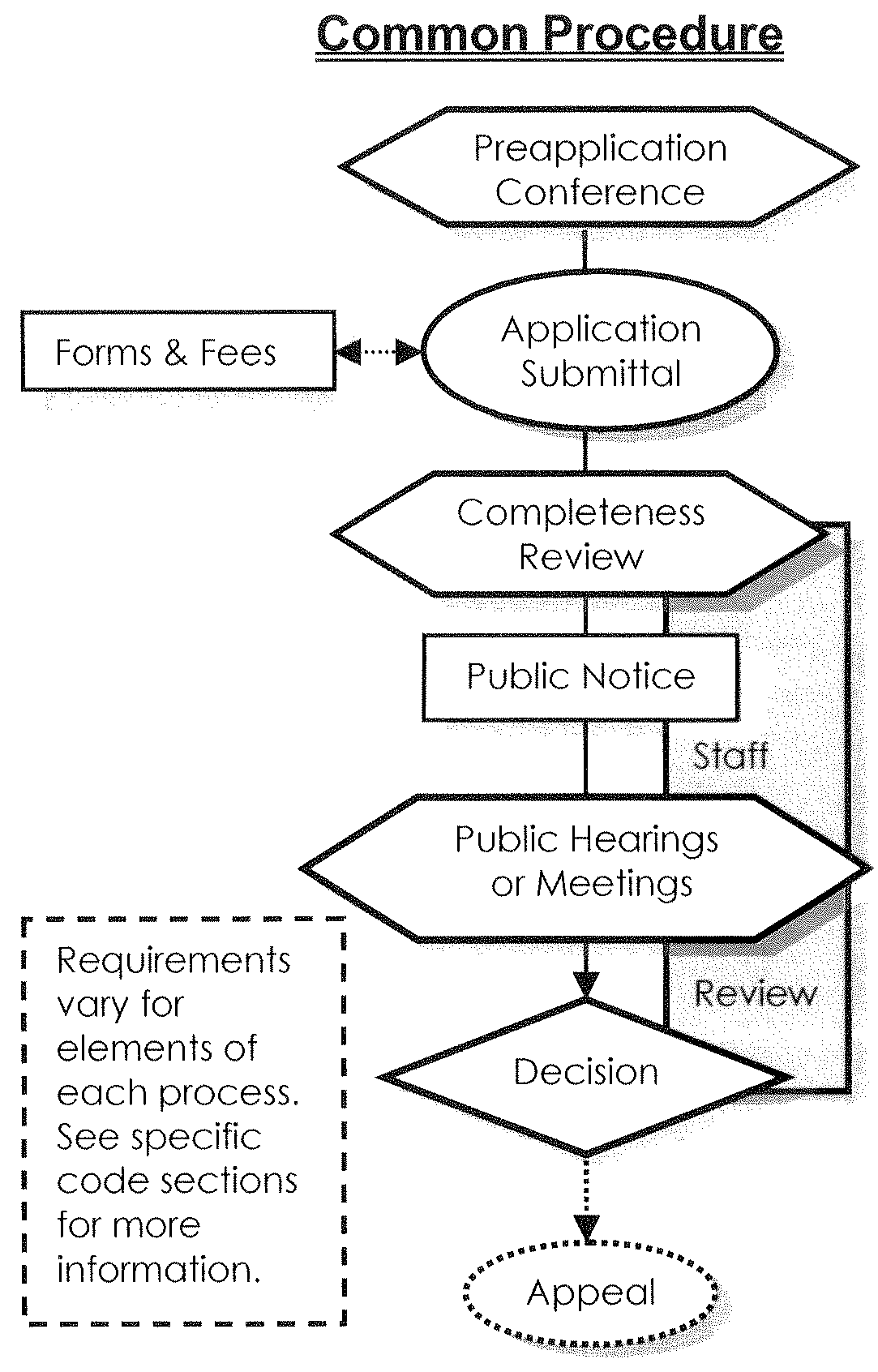
8.1.2 Preapplication conference. Prior to the submission of an application required by this UDC, a preapplication conference with the director or designee may be required as follows:
A.
Preapplication conference. A preapplication conference is recommended for all applications. Applicants are encouraged to attend an optional preapplication conference with the director or designee prior to submitting any application. The preapplication conference provisions of this section do not apply where the application or action is initiated by the city council or commission.
8.1.3 Minimum submission requirements. The following regulations shall apply to all applications:
A.
Property owner endorsement. All applications shall include the name and signature of the current property owner of all property within the boundaries.
B.
For all applications requiring public notice and hearing, community works staff verify property ownership of all property owners within the subject property and within 100 feet thereof, excluding public rights-of-way, through the San Juan County GIS database.
C.
The city reserves the right to require a certification by title company of all property owners within the subject property and within 100 feet thereof, excluding public rights-of-way, and as having been compiled within the 30 days before the application is submitted for complicated or controversial applications. This list shall be provided by the applicant. Additionally, the Director or designee may require title company certification of ownership for other applications, as necessary.
D.
Forms and content. Applications required under this UDC shall be submitted on forms, with any requested information and attachments and in such numbers as required by the city, including any community works department checklists for submittals. The director or designee shall have the authority to request any pertinent information required to ensure compliance with this UDC. Likewise, the director or designee may waive any submittal requirements deemed irrelevant in a given application.
E.
Electronic submission. Plats shall be prepared and submitted in digital format acceptable to the director or designee and compatible with the city's geographic information system.
F.
Fees.
(1)
Filing fees shall be established periodically by resolution of the city council commensurate with the level of service. Such fees may include all costs occasioned to the city, including publication of notices, public hearing, and review costs, planning and engineering, legal, and other professional review and inspection costs.
(2)
All required fees shall be made payable to "The City of Farmington."
(3)
All required fees shall be nonrefundable.
(4)
For lots split by two or more zones, the community works director or designee may waive filing fees for zoning map amendments.
G.
Vicinity map. A vicinity map [which may be a USGS one inch equals 2,000 feet scale] shall locate the property relative to surrounding areas.
8.1.4 Application. All applications shall be completed and submitted to the director or designee at least 30 days prior to any desired agenda date. An application shall not be considered as officially submitted until it has been found to be complete in accordance with the following paragraph.
8.1.5 Certification of completeness. An application shall be considered submitted only after the director or designee certifies that it is complete, provided in the required form, includes all mandatory information and exhibits, and is accompanied by the applicable fee. A determination of application completeness shall be made by the official responsible for accepting the application within five working days of application filing. If an application is determined to be incomplete, the director or designee shall contact the applicant to explain the application's deficiencies. No further processing of the application shall occur until the deficiencies are corrected.
8.1.6 Review by the development review committee (DRC). The director or designee shall refer complete applications, as necessary, to the DRC for review and recommendation consistent with the provisions of section 7.8.4. Upon receipt of such a referral the DRC shall review the application for compliance with applicable land development standards and provide written comments to the applicant, within ten working days, identifying any UDC compliance issues.
8.1.7 Required public notices.
A.
Summary of notice requirements (of this UDC). Notice shall be required for development review as shown in the table below.
B.
Notice requirements. All required public notices shall be accomplished in accordance with the following requirements:
(1)
Published notice. A distinctive advertisement (public hearing notice) shall be placed by the director or designee at least once in a local newspaper of general circulation within the city not less than 15 calendar days prior to the meeting for the purpose of notifying the public of the time and place of such public hearing.
(2)
Mailed notice.
a.
Whenever development review is proposed for an area of one block or less, notice of the public hearing shall be mailed by certified mail, return receipt requested, to the owners, as shown by the records of the county assessor, of lots of land within the area proposed to be changed by a zoning regulation and within 100 feet, excluding public rights-of-way, of the area proposed to be changed by zoning regulation. Such notice shall be so mailed not less than ten calendar days prior to the hearing for the purpose of notifying the owners of the time and place of such public hearing.
b.
Whenever development review is proposed for an area of more than one block, notice of the public hearing shall be mailed by first class mail to the owners, as shown by the records of the county assessor, of lots or [of] land within the area proposed to be changed by a zoning regulation and within 100 feet, excluding public rights-of-way, of the area proposed to be changed by zoning regulation. If the notice by first class mail to the owner is returned undelivered, the zoning authority shall attempt to discover the owner's most recent address and shall remit the notice by certified mail, return receipt requested, to that address. Such notice shall be so mailed not less than ten calendar days prior to the hearing for the purpose of notifying the owners of the time and place of such public hearing.
c.
Whenever development review is proposed for a replat, notice of the public hearing shall be mailed by first class mail to the owners, as shown by the records of the county assessor, of lots or [of] land within the area proposed to be replatted and within 100 feet, excluding public rights-of-way, of the area proposed to be replatted. If the notice by first class mail to the owner is returned undelivered, the zoning authority shall attempt to discover the owner's most recent address and shall remit the notice by certified mail, return receipt requested, to that address. Such notice shall be so mailed not less than ten calendar days prior to the hearing for the purpose of notifying the owners of the time and place of such public hearing.
(3)
Posted notice. A notice of public hearing shall be posted on all rights-of-way adjoining the subject property. Such notice shall be legible, composed of weatherproof materials, and shall be posted in clear view from adjacent rights-of-way. Such notice shall be so posted for not less than ten calendar days prior to the hearing for the purpose of notifying the public of the time and place of such public hearing.
C.
Notification of replats or resubdivisions. For the purpose of required public notices pursuant to this section, a replat or resubdivision is a resubdivision of platted lots or tracts that result in an increase in the number of lots, but does not include the resubdivision of platted lots or tracts for the purpose of reducing the number of lots.
D.
Content of notice. All published, posted, or mailed notices shall provide at least the following specific information:
(1)
General location of land that is the subject of the application;
(2)
Street address, if available, or other appropriate locational description;
(3)
Substance of the application, including the magnitude of proposed development and the current zoning district;
(4)
Time, date and location of the public hearing;
(5)
Phone number to contact the city; and
(6)
Statement that interested parties may appear at the public hearing.
8.1.8 Required public hearings. The following table illustrates the types of review and the review body responsible for conducting the hearing:
8.1.9 Simultaneous processing of applications. Whenever two or more forms of review and approval are required under this UDC, the applications for those development approvals may be processed simultaneously at the option of the director or designee and with the approval of the applicant. The simultaneous processing of applications shall be at the applicant's risk.
8.1.10 Commission recommendations to city council. The director or designee shall schedule all petitions and matters which have been considered by the commission for hearing on the agenda of the next regular meeting of the city council, unless otherwise directed by the city council.
(Ord. No. 2021-1325, 3-9-21)
Sec. 8.2 - Building permits.
8.2.1 Applicability. No building or other structure shall hereafter be erected, moved, added to, or structurally altered without a building permit except in conformity with the provisions of this section.
8.2.2 Authority. The building official holds the authority to issue building permits that meet the requirements of the current New Mexico Building Code and the provisions of this UDC. No building permit issued under the provisions of this section for land use or construction in the city shall be considered valid unless signed by the building official.
8.2.3 Building permit application process.
A.
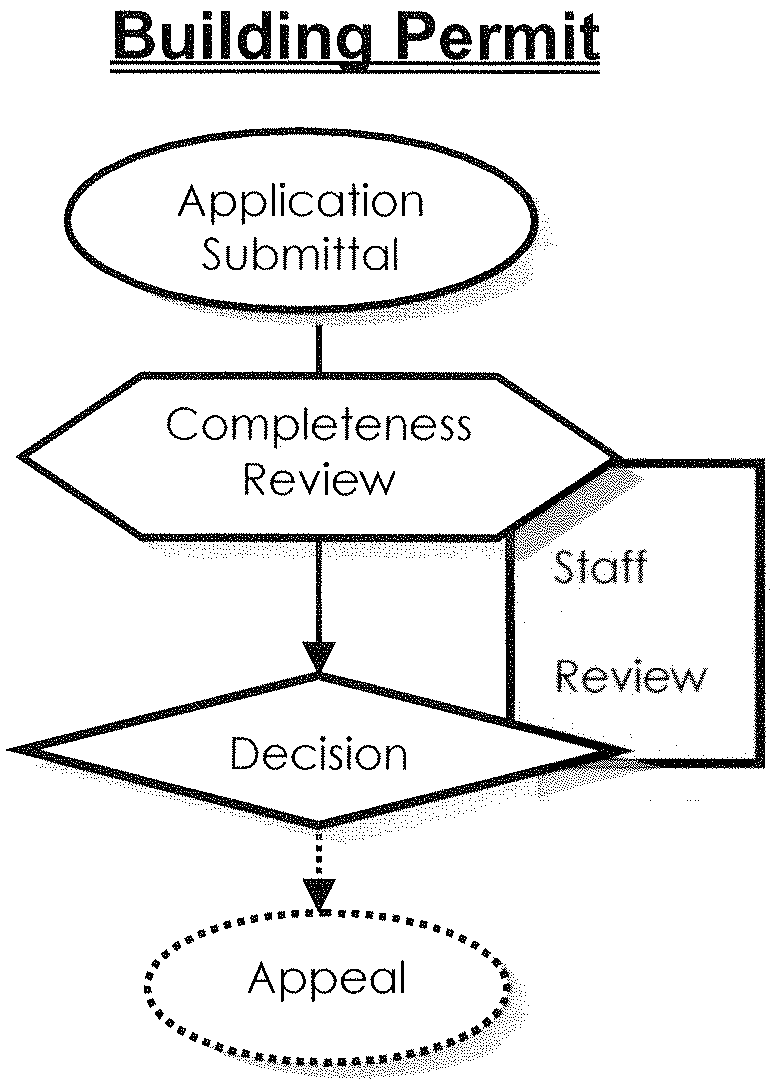
Application submittal. A complete application for a building permit shall be submitted to the Director or designee as set forth in section 8.1.3.
B.
Review and action by building official.
(1)
One copy of the plans shall be returned to the applicant by the building official, after he shall have marked such copy either as approved or disapproved and attested to same by his signature on such copy. The original copy of the plans, similarly marked, shall be retained by the building official and one copy of the associated site plan shall be retained by the director or designee.
(2)
If the subject property has been rezoned as a planned unit development (PUD) or planned development (PD), density and dimensional standards shall be established as part of the approved master plan. The director or designee shall verify compliance with the approved density and dimensional standards before the building permit is approved.
(3)
The building official shall make a final determination of whether the intended uses, buildings, or structures comply with all applicable regulations, standards and the building code. The building official shall not issue a building permit unless the plans, specifications, and intended use of such building or structures or part thereof conform in all respects to the provisions of this UDC and the current New Mexico Building Code.
8.2.4 Appeals. Appeals of any final decision regarding a building permit shall be made to the State of New Mexico Construction Industries Division within 30 days of the decision in accordance with applicable state requirements.
(Ord. No. 2021-1325, 3-9-21)
Sec. 8.3 - Certificate of occupancy.
8.3.1 Applicability. A certificate of occupancy shall be required for any of the following:
A.
Occupancy and use of a building hereafter erected or enlarged;
B.
Change in use of an existing building to a different use category as set forth in section 2.7; or
C.
Any change in a nonconforming use or structure.
8.3.2 Authority. The building official holds the authority to issue certificates of occupancy for projects completed in accordance with approved plans consistent with the requirements of the current New Mexico Building Code and the provisions of this UDC. No certificate of occupancy issued under the provisions of this section for land use or construction in the city shall be considered valid unless signed by the building official.
8.3.3 Certificate of occupancy application process.
A.
Application submittal. A complete application for a certificate of occupancy shall be submitted to the building official as set forth in section 8.1.3.
B.
Review and action by director or designee. The director or designee shall review all certificate of occupancy applications to determine if intended uses, buildings, or structures comply with all applicable UDC regulations and standards, and recommend approval or denial of the application.
C.
Review and final action by building official. Upon the filing of a complete application, the building official shall inspect the use or structure. If the building official determines that the use or structure complies with all applicable provisions of the current New Mexico Building Code and this UDC, a certificate of occupancy shall be issued.
8.3.4 Temporary certificate of occupancy. Pending the issuance of a permanent certificate of occupancy, a temporary certificate of occupancy may be issued. The temporary certificate of occupancy shall be valid for a period established by the building official and the director or designee, pending completion of an addition, or during partial or limited occupancy of a structure. Bonding at 125 percent of the estimated improvement costs may be required for outstanding improvements.
8.3.5 Unlawful to occupy without valid certificate of occupancy. It is unlawful to occupy any building that does not have a valid certificate of occupancy or temporary certificate of occupancy.
8.3.6 Appeals. Appeals of any final decision regarding a certificate of occupancy shall be made to the ARB within 30 days of the decision in accordance with section 8.15, appeals of administrative decisions.
(Ord. No. 2021-1325, 3-9-21)
Sec. 8.4 - Sign permits.
8.4.1 Applicability.
A.
Permit required. No sign shall be erected, moved, or structurally altered without a permit approved by the director or designee in conformity with requirements of this section. No permit is required where only the text is changed.
B.
Maintenance and repair. Cleaning, painting, repainting, and other normal maintenance and repair of a sign shall not require a sign permit unless a structural or size change is made. Maintenance does not include change or replacement of a sign face or structural support.
8.4.2 Exceptions. Signs types that are exempt from the provisions of this section are listed in section 5.8.3.
8.4.3 Sign permit application process.
A.
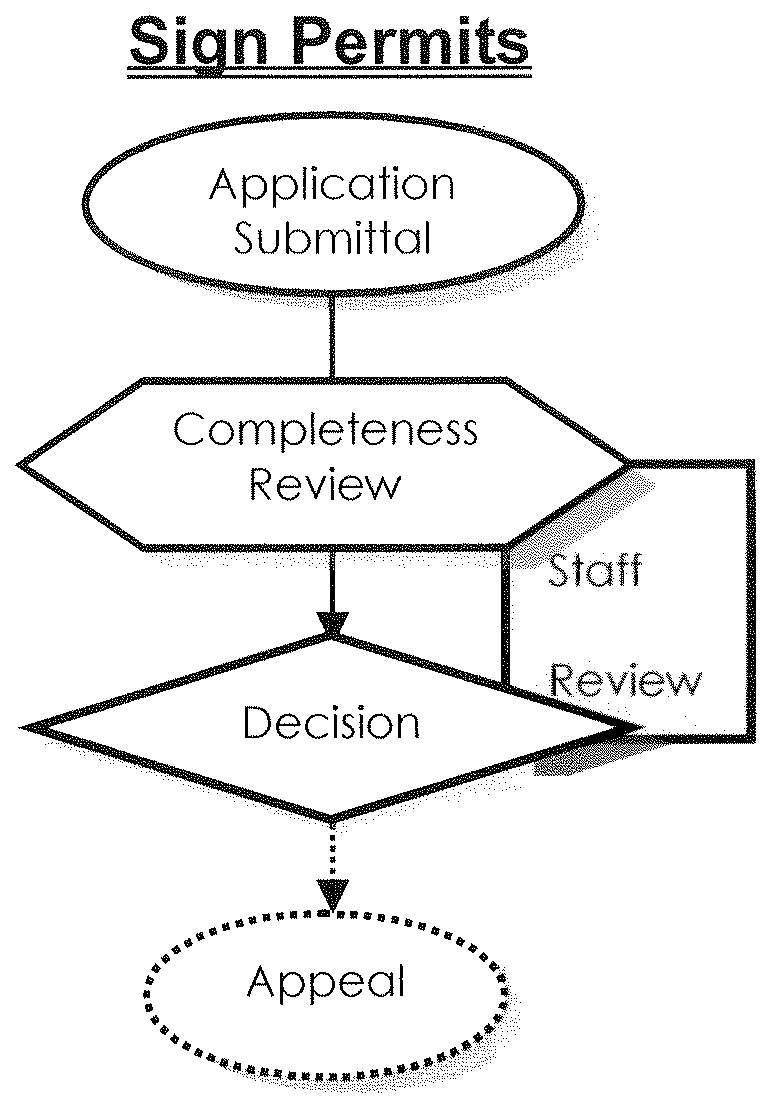
Application submittal. A complete application for a sign permit shall be submitted to the director or designee as set forth in section 8.1.3, above.
B.
Review and final action by the director or designee. The director or designee shall review each sign permit application for compliance with the requirements of this UDC and act to approve, approve with conditions, or deny the permit.
8.4.4 Notice of decision. Written notice of the decision to approve or approve with conditions, or deny shall be provided to the applicant within five working days of the decision, and a copy shall be filed in the office of the director or designee.
8.4.5 Appeals. Appeals of any final decision regarding a sign permit shall be made to the ARB within 30 days of the decision in accordance with section 8.15, appeals of administrative decisions.
(Ord. No. 2021-1325, 3-9-21)
Sec. 8.5 - Site plan review.
8.5.1 Applicability.
A.
Prior to development of any nonresidential or multifamily development, a site plan shall be approved in accordance with the requirements of this section.
B.
No development described in paragraph A., above, shall be lawful or permitted to proceed without final site plan approval.
C.
A site plan approved as part of a special use permit, planned unit development (PUD) or planned development (PD) shall be considered a site plan approval.
8.5.2 General requirements. A site plan approval is a binding development order and all improvements reflected on approved site plans must be completed, and all restrictions and conditions of site plan approval must be fulfilled prior to issuance of the final certificate of occupancy.
A.
All improvements reflected on approved site plans must be constructed at the time of development.
B.
All terms and conditions of site plan approval must be met at the time of development.
8.5.3 Site plan review procedures. Site plan review applications shall be processed in accordance with the following requirements:
A.
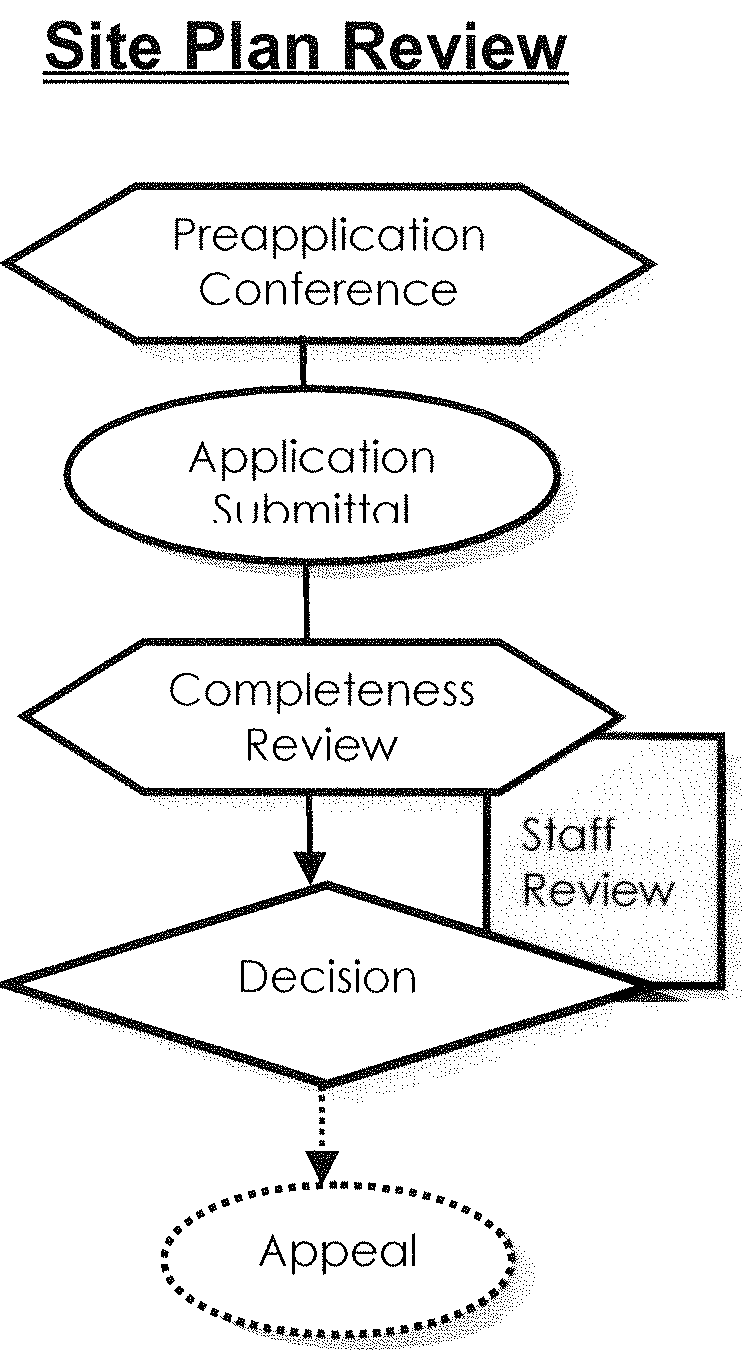
Pre-application conference. Prior to the submission of land use applications, applicants are encouraged to attend a preapplication conference as set forth in section 8.1.2.
B.
Application submittal. A complete application for site plan approval shall be submitted to the director or designee as set forth in section 8.1.3.
C.
Review and final action by the director or designee. The director or designee shall review the application and if the proposed site plan is determined to be consistent with all applicable provisions of the UDC, the director or designee shall approve the site plan. In the event of a denial, the applicant may correct the site plan and resubmit the corrected application to the director or designee.
8.5.4 Site plan review criteria. Approved site plans shall comply with the development standards of Article 5.
8.5.5 Notice of decision. Written notice of the decision to approve or approve with conditions, or deny shall be provided to the applicant within five working days of the decision, and a copy shall be filed in the office of the director or designee.
8.5.6 Expiration of approval. An approved site plan shall expire 24 months from the date of approval unless a complete building permit application has been submitted.
8.5.7 Modification. Minor modification to a site plan may be approved by the director or designee, provided that the development plan remains substantially consistent with the approved site plan.
8.5.8 Appeals. Appeals of any final decision regarding a site plan review shall be made to the ARB within 30 days of the decision in accordance with section 8.15, appeals of administrative decisions.
(Ord. No. 2021-1325, 3-9-21)
Sec. 8.6 - Text amendment.
8.6.1 Applicability. This UDC provides zoning for all properties within the incorporated area, and subdivision regulations for all properties within the incorporated area and the city's five-mile planning and platting jurisdiction in accordance with NMSA § 3-20-8. To initiate a change to the text of the land development regulations, an application for a text amendment must be filed with the city. All applications for text amendments are subject to the standards of this section.
8.6.2 Initiation of amendments. An amendment to the text of this UDC may be initiated by:
A.
City council on its own motion;
B.
The commission on its own motion;
C.
The director or designee; or
D.
An individual or group.
8.6.3 Text amendment application process.
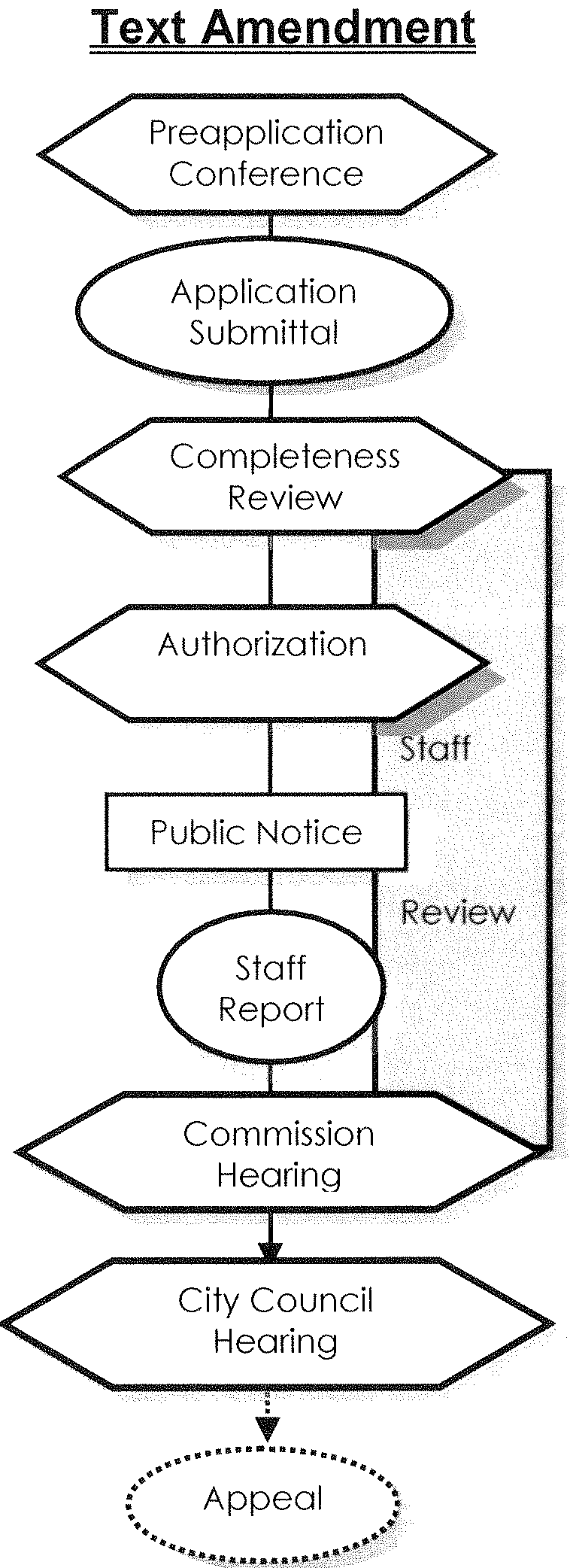
A.
Pre-application conference. Prior to the submission of text amendment applications, applicants are encouraged to attend a preapplication conference as set forth in section 8.1.2.
B.
Application submittal. A complete application and fee for a text amendment shall be submitted to the director or designee as required by section 8.1.3.
C.
Authorization. Applications for a text (UDC) amendment shall be subject to prior authorization by the city council or commission. Once the application is complete, the director or designee shall submit the application to the city council or commission for such authorization.
D.
Public notification. Once the application is complete, the required public notices shall be issued, as set forth in section 8.1.7.
E.
Review and report by director or designee. Upon receipt of a complete application, the director or designee shall review the proposed text amendment and prepare a report for presentation to the commission.
F.
Review and recommendation by the commission. The application shall be reviewed by the commission in a public hearing, unless the city council determines that a recommendation by the commission is unnecessary with respect to a proposed amendment. Upon completion of the public hearing, the commission may vote to recommend approval, approval with modifications, or denial of the amendment.
G.
Review and final action by the city council. Following receipt of the commission recommendation, the city council shall review all text amendments in a public hearing. Upon completion of the public hearing, the city council may direct staff to prepare an ordinance for approval of the text amendment or deny the amendment.
8.6.4 Issues for consideration. In making its determination, the commission and the city council shall consider the recommendations of the director or designee, staff reports, and written and oral testimony presented with respect to the proposed amendment, and the answers to the following questions:
A.
Is the proposed amendment consistent with the comprehensive plan?
B.
Is the proposed amendment consistent with the purpose and intent of this UDC, as listed in section 1.3?
8.6.5 Appeals. Any person aggrieved by a decision of the city council pursuant to this section may appeal to the district court within 15 days of the date of the decision rendered by the city council. If no appeal is filed in writing within 15 days, the decision shall be considered final.
(Ord. No. 2021-1325, 3-9-21)
Sec. 8.7 - Zoning map amendment (rezoning).
8.7.1 Applicability. The official zoning map of the City of Farmington provides zoning classifications for all properties within the incorporated area. To initiate a change in the zoning classification of any property, an application for an amendment to the zoning map must be filed with the city.
8.7.2 Initiation of rezoning. An application for an amendment to the official zoning map may be initiated by:
A.
City council;
B.
Commission;
C.
Director or designee; or
D.
The owner of the subject property.
8.7.3 Rezoning application process.
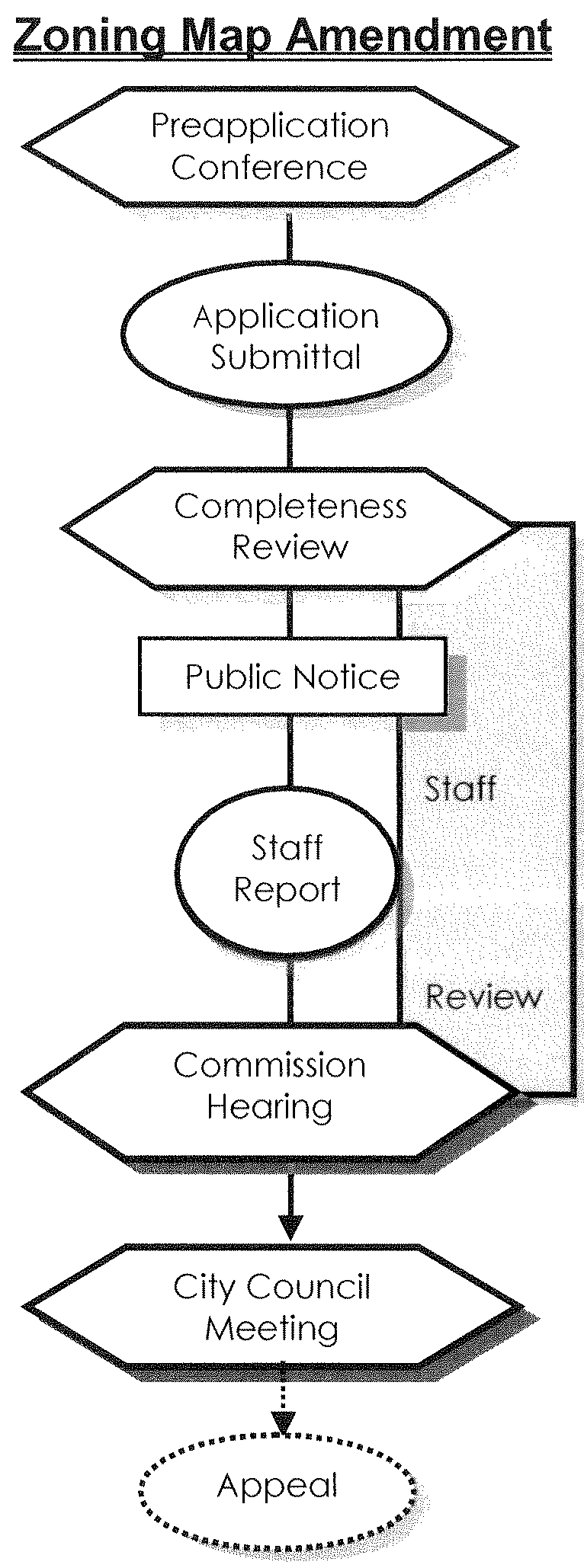
A.
Pre-application conference. Prior to the submission of land use applications, applicants are encouraged to attend a preapplication conference as set forth in section 8.1.2.
B.
Application submittal. A complete application for a zoning map amendment shall be submitted to the director or designee as set forth in section 8.1.3.
C.
Authorization. Applications for a text (UDC) amendment shall be subject to prior authorization by the city council or commission. Once the application is complete, the director or designee shall submit the application to the city council or commission for such authorization.
D.
Posting and public notification. Upon receipt of a complete application, the required public notices shall be issued, as set forth in section 8.1.7.
E.
Review and report by director or designee. Upon receipt of a complete application, the director or designee shall review the proposed amendment, subject to the criteria enumerated in section 8.7.4, and prepare a report and schedule its presentation to the commission on the date of the scheduled public hearing.
F.
Review and recommendation by the commission. The application shall be reviewed by the commission in a public hearing, unless the city council determines that a recommendation by the commission is unnecessary with respect to a proposed amendment. Upon completion of the public hearing the commission may vote to recommend approval, approval with modifications, or denial of the amendment.
G.
Review and final action by the city council.
(1)
Following receipt of the commission recommendation, the city council shall review all map amendments in a public meeting. Upon completion of the public meeting, the city council may vote to approve, approve with modifications, or deny the amendment.
(2)
Pursuant to NMSA 1978, § 3-21-6, if the owners of 20 percent or more of the area of the lots and land included in the area proposed to be changed by a zoning amendment or within 100 feet, excluding public rights-of-way, of the area proposed to be changed by a zoning amendment, protest in writing, the proposed change shall not become effective unless the change is approved by a three-fourths vote of all members of the city council.
(3)
Written protests must be received in the community works department offices of the City of Farmington 24 hours prior to the city council meeting at which the petition will be considered.
H.
Notice of decision. Written notice of the decision to approve or approve with conditions, or deny shall be provided to the applicant within five working days of the decision, and a copy shall be filed in the office of the director or designee.
8.7.4 Issues for consideration. In determining whether to approve, approve with modifications, or deny the proposed official zoning map amendment, the city shall consider the following questions:
A.
Is the proposed zoning consistent with the Farmington Comprehensive Plan?
B.
Is the proposed zoning and land use(s) compatible with the present zoning and conforming uses of nearby property and the character of the neighborhood?
C.
Will there be adverse impacts; and/or can any adverse impacts be adequately mitigated?
D.
Is the proposed density and intensity of use permitted in the proposed zoning district?
E.
Is the site physically suitable for development of uses and density permitted by the proposed zoning district?
F.
Are adequate public facilities and services available to serve development for the type and scope suggested by the proposed zone? If utilities are not available, could they be reasonably extended by the applicant? Is the applicant willing to pay for the extension of public facilities and services necessary to serve the proposed development?
G.
Does the proposed change constitute "spot zoning" as defined in Article 11, definitions?
8.7.5 Conditions of approval. The commission may recommend and the city council may:
A.
Impose reasonable conditions or requirements upon the granting of a rezoning as necessary to protect the public interest and to mitigate burdens imposed upon the public by the rezoning, including but not necessarily limited to:
(1)
Dedication of streets, roadways and easements to the city for public use;
(2)
Installation of paving, landscaping and other improvements;
(3)
Provision of adequate arrangements be made for ingress and egress of police, fire, sanitation, and other service vehicles;
(4)
Relocation, underground installation or other modification of utilities;
(5)
Installation or modification of drainage facilities;
(6)
Mitigate environmental conditions, including noise, water quality, air quality, and etc.;
(7)
Installation of walls, barriers or landscaping to eliminate or reduce noise or unsightly views;
(8)
Routing or re-routing of traffic;
(9)
Relocation, covering and maintenance of ditches and irrigation laterals; and
(10)
Protection of the unique features of the property (arroyos, rock formations, native vegetation, etc.).
B.
Impose time limits for installation of improvements or compliance with the conditions; and, in default thereof, may order that a public hearing be scheduled for the purpose of considering rezoning the subject property, pursuant to the procedures of this section, to that which existed prior to the application or to other more appropriate zoning category. Additionally or alternatively, the city council may direct that any certificates of occupancy issued in reliance upon the applicant's installation of improvements or compliance with the conditions be rescinded.
C.
Require that the applicant post a bond, letter of credit or other security, in a form acceptable to the director or designee, to guarantee required improvements or conditions.
8.7.6 Limitation on reapplication. In the event of a denial by the city council, another petition for reclassification of the same property or any portion thereof shall not be filed within a period of 365 days from the date of final denial unless the director or designee finds that such re-application demonstrates one of the following:
A.
A substantial change in circumstances relevant to the issues and/or facts considered during review of the application that might reasonably affect the decision-making body's application of the relevant review standards to the development proposed in the application; or
B.
New or additional information that was not available at the time of the review that might reasonably affect the decision-making body's application of the relevant review standards to the development proposed; or
C.
A new application is submitted that is materially different (e.g., proposes new uses, or a substantial decrease in proposed densities and intensities) from the prior application; or the final decision on the application was based on a material mistake of fact.
8.7.7 Appeals. Any person aggrieved by a decision of the city council pursuant to this section may appeal to the district court within 15 days of the date of the decision rendered by the city council. If no appeal is filed in writing within 15 days, the decision shall be considered final.
(Ord. No. 2021-1325, 3-9-21; Ord. No. 2025-1372, 1-14-25)
Sec. 8.8 - Subdivision plat review.
8.8.1 Purpose. The requirements of these subdivision regulations are intended to protect the health, safety, and general welfare of existing and future residents of the City of Farmington, and to:
A.
Lessen congestion in the streets and public ways;
B.
Secure safety from fire, floodwaters, panic and other dangers;
C.
Promote health and the general welfare;
D.
Provide adequate light and air;
E.
Prevent the overcrowding of land;
F.
Avoid undue concentration of population;
G.
Facilitate adequate provision for transportation, water, sewerage, schools, parks and other public requirements; and
H.
Control and abate the unsightly use of buildings or land.
8.8.2 Applicability.
A.
In the City of Farmington, subdivision approval shall be required for all divisions of land into two or more parts.
B.
Outside the City of Farmington and in the five-mile platting jurisdiction, subdivision approval shall be required for the division of land into two or more parts of less than five acres in any one calendar year for the following purposes:
(1)
Sale for building purposes;
(2)
Laying out a municipality or any part thereof;
(3)
Adding to a municipality;
(4)
Laying out lots; or
(5)
Resubdivision.
C.
For division of land within the five-mile platting jurisdiction not meeting the criteria in [subsection] B. above, the director or designee shall find that no subdivision requiring city review and approval is proposed and shall mark and sign the plat as follows:
Pursuant to the NMSA, § Sec. 3-20-1A(2), this plat is not subject to the land subdivision regulations as set forth within the Unified Development Code (UDC) of the City of Farmington.
Community Works Director
8.8.3 Unlawful to record plat without final plat approval.
A.
It shall be unlawful to record any subdivision plat, revision of plat or replat of land within the city limits unless the subject subdivision plat has been reviewed and approved by the city council or the director or designee, as specifically authorized by this UDC.
B.
It shall be unlawful to record any subdivision, revision of plat or replat of land within five miles of the city limits unless the subject subdivision plat has been reviewed and approved by the commission, as specifically authorized by this UDC.
8.8.4 General provisions. All subdivisions shall comply with the following minimum standards:
A.
Design and improvement standards. All subdivisions shall be designed and constructed in accordance with applicable requirements of:
(1)
Article 5, development standards; and
(2)
Article 6, subdivision design and improvements.
B.
Waivers. The commission may recommend and the council may approve, approve with conditions, or deny waivers of the standards in section 6.4, subdivision design standards, during the platting process.
C.
Zoning consistency. All subdivisions and the resulting lots shall be consistent with the requirements of the applicable underlying zone district.
D.
Comprehensive plan consistency. All subdivisions shall be reviewed for consistency with the comprehensive plan, and every plat approved by the city shall constitute an amendment, addition or a detail of the comprehensive plan or part thereof adopted by the commission.
8.8.5 Summary subdivision application process.
A.
Applicability.
(1)
A summary subdivision plat shall be required for all:
a.
Subdivisions consisting of up to two lots; or
b.
Resubdivision or replats, where the combination or recombination of portions of previously platted lots does not increase the total number of lots.
c.
Consolidation of existing lots defined by a legal description may be accomplished through a warranty deed or a recorded legal survey.
(2)
A summary subdivision may be approved where proposed changes in a recorded subdivision result in:
a.
Nominal increases or decreases of lot sizes; or
b.
Nominal changes in the location of streets, easements, and other public rights-of-way.
(3)
A summary plat is not required for lots:
a.
Created prior to 1971
b.
Property with a valid legal description through a warranty deed consolidation previously created lots in a subdivision.
c.
Property has a recorded legal survey including a full legal description.
d.
Property is located in Tier 1 or Tier 2 in an existing subdivision previously approved and recorded in San Juan County, with the following exception:
(i)
If review of the existing County subdivision by the City shows deficiency, such as a lack of easements, the City may require the property to complete a City Subdivision application.
B.
Application submittal. A complete application for a summary subdivision shall be submitted to the director or designee as set forth in section 8.1.3, common procedures.
C.
Review and final action by the director or designee. The director or designee shall review the proposed development for compliance with the applicable requirements of this UDC. If the director or designee finds that the plat is in substantial compliance with the applicable requirements of this UDC, the community works director or designee shall mark and sign the plat as follows
Approved pursuant to summary procedure of the City of Farmington UDC
Date:
City of Farmington Community Works Department
By:
Community Works Director
D.
Notice of decision. Written notice of the decision to approve, approve with conditions, or deny shall be provided to the applicant within five working days of the decision, and a copy shall be filed in the office of the director or designee.
E.
Recordation/expiration of approval. Upon approval by the director or designee, the applicant shall submit a mylar of the final plat, including all required changes, to the director or designee, and the director or designee shall require that the plat be recorded in the office of the San Juan County Clerk. A subdivision approval shall expire automatically unless the final plat is recorded within one year of the approval unless an extension is approved by the director or designee. within one year from the date of the approval by city council. City council may extend an approved unexpired abandonment/vacation plat for up to a year upon the written request of the petitioner.
F.
Recordation. Upon approval, the director or designee shall require that the plat be recorded in the office of the San Juan County Clerk.
G.
Appeal. Any person aggrieved by a decision of the city council pursuant to this section may appeal to district court within 15 days of the date of the decision rendered by the city council. If no appeal is filed in writing within 15 days, the decision shall be considered final.
8.8.6 Minor subdivision application process.
A.
Purpose. Minor subdivision procedures are included for purpose of promoting infill development.
B.
Applicability. The Minor Subdivision procedure is intended to provide an expeditious, one-time only process for small, low-impact subdivisions of up to five lots where all roads and utilities necessary to serve the subdivision are in place at the time of application and the resulting lots are in compliance with the underlying zoning. Notwithstanding any other provision of this UDC, a minor subdivision plat may be approved by the director without notice or hearing subject to the requirements of this section.
C.
Application submittal. A complete application for a minor subdivision shall be submitted to the director as set forth in section 8.1.3, common procedures.
D.
Review and final action by the director. The director shall review the proposed development for compliance with the applicable requirements of this UDC. If the director finds that the plat is in substantial compliance with the applicable requirements of this UDC, the community development director shall mark and sign the plat as follows:
Approved pursuant to Minor Subdivision procedure of the City of Farmington UDC
Date:
City of Farmington Community Development Department
By:
Community Development Director
E.
Notice of decision. Written notice of the decision to approve or approve with conditions, or deny shall be provided to the applicant within five working days of the decision, and a copy shall be filed in the office of the director.
F.
Criteria for approval.
(1)
No more than five lots are created, each for single-family residential use;
(2)
All roads and utilities, except for on-site, individual service lines, needed to serve the new lots are in place adjacent to the proposed lots (to the lot line);
(3)
No new streets, roads, extensions or access easements need to be widened, dedicated or developed;
(4)
No utilities, other than individual service lines, need to be extended to serve the parcel and the necessary utilities are in place immediately adjacent to the parcel;
(5)
The proposed subdivision, including necessary streets and roads, are in conformance with city standards;
(6)
Any public right-of-way needed through the subject property pursuant to the major thoroughfare plan or the comprehensive plan shall be dedicated as a part of the minor subdivision plat;
(7)
The resulting lots shall be in compliance with all zoning provisions, area and bulk requirements and any other applicable requirements of this UDC;
(8)
There are no other problems of public concern; and
(9)
These procedures may be utilized only one time for each parcel of land.
G.
Recordation/expiration of approval. Upon approval by the director, the applicant shall submit a mylar of the final plat, including all required changes, to the director, and the director shall require that the plat be recorded in the office of the San Juan County Clerk. A subdivision approval shall expire automatically unless the final plat is recorded within three years of the approval unless an extension is approved by the director.
H.
Recordation. Upon approval, the director shall require that the plat be recorded in the office of the San Juan County Clerk.
I.
Appeals. Appeals of any final decision regarding a minor subdivision review shall be made to the ARB within 30 days of the decision in accordance with section 8.15, appeals of administrative decisions.
8.8.7 Abandonment/vacation plat application process.
A.
Applicability. An abandonment/vacation plat shall be required where a resubdivision or replat vacates or relocates any street, alley, or other public right-of-way. Alternatively, major subdivision plats may be used to accomplish the same purposes, if deemed appropriate by the director.
B.
Application submittal. A complete application for an abandonment/vacation plat shall be submitted to the director as set forth in section 8.1.3.
C.
Review and recommendation by the director. The director shall review the abandonment/vacation plat application and recommend approval or disapproval of the same.
D.
Review and final action by the city council. In determining whether to approve, approve with modifications, or deny the proposed abandonment/vacation plat, the city shall consider the following criteria:
(1)
Consistency with the comprehensive plan;
(2)
Transportation and circulation needs of nearby property, the neighborhood and the city;
(3)
Right-of-way needs relative to sewer, water, and stormwater facilities.
E.
Notice of decision. Written notice of the decision to approve or approve with conditions, or deny shall be provided to the applicant within five working days of the decision, and a copy shall be filed in the office of the director.
F.
Expiration. An abandonment/vacation application will expire automatically unless an abandonment/vacation plat is recorded in the office of the San Juan County Clerk within one year from the date of the approval by city council. City council may extend an approved unexpired abandonment/vacation plat for up to a year upon the written request of the petitioner.
G.
Recordation. Upon approval, the director shall require that the plat be recorded in the office of the San Juan County Clerk.
H.
Appeal. Any person aggrieved by a decision of the city council pursuant to this section may appeal to district court within 15 days of the date of the decision rendered by the city council. If no appeal is filed in writing within 15 days, the decision shall be considered final.
8.8.8 Plat amendment application process.
A.
Applicability. A resubdivision or replat shall be required for:
(1)
Any division of a lot or lots in a recorded subdivision resulting in an increase in the total number of lots in that subdivision;
(2)
Any revision or replat involving dedication, vacation or relocation of a public street or other public rights-of-way;
(3)
Any change in lot lines in a recorded subdivision; provided, however, that changes in lot lines, which result in only nominal increases or decreases of lot sizes, may be administratively approved pursuant to the summary subdivision application process requirements of section 8.8.5;
(4)
Any changes in the location of streets, easements, and other public rights-of-way; provided, however, that nominal changes may be administratively approved pursuant to the summary subdivision application process requirements of section 8.8.5; or
(5)
Any changes in the exterior boundary of a recorded subdivision.
B.
Review procedure. All resubdivision and replats require application and processing in accordance with the preliminary and final plat procedures of subsection 8.8.9D. and subsection 8.8.9E., respectively.
8.8.9 Major subdivision application process.
A.
Applicability. All subdivisions that do not qualify as a summary subdivision, minor plat, vacation plat, or plat amendment require application and processing in accordance with the major subdivision requirements of this section.
B.
Pre-application conference. Prior to the submission of land use applications, applicants are encouraged to attend a preapplication conference as set forth in section 8.1.2.
C.
Sketch plan review. The purpose of the sketch plan is to determine the relationship of the area proposed for subdivision with the comprehensive plan, major thoroughfare plan, and any public improvement plans that might affect the area.
(1)
Application submittal. A complete application for a sketch plan, including sketch plans for the entire parcel, shall be submitted to the director or designee as set forth in section 8.1.3.
(2)
Review and final action by the director or designee. The director or designee shall review the application for compliance with applicable land development regulations and issue a report within ten working days.
(3)
Notice of decision. Written notice of the decision to approve or approve with conditions, or deny shall be provided to the applicant within five working days of the decision, and a copy shall be filed in the office of the director or designee.
D.
Preliminary plan review.
(1)
Application submittal. Within one year of the Director or designee's review of a sketch plan, the subdivider shall submit a complete application for preliminary plan, including preliminary plans for the entire parcel, to the director or designee as set forth in section 8.1.3.
(2)
Review and recommendation by the director or designee. The director or designee shall review preliminary plan application and recommend approval or disapproval of the same.
(3)
Review and recommendation by the commission. The commission shall review the application in a public meeting. Upon completion of the meeting, the commission shall vote to approve, approve with conditions, or deny the plat application.
(4)
Review and final action by the city council.
a.
The city council shall review the preliminary plan and approve, approve with conditions or deny the application.
b.
Upon approval of the preliminary plan by the city council, the subdivider may proceed to comply with the other requirements of these regulations and the preparation of the final plat.
c.
Approval of a preliminary plan shall not constitute approval of the final plat. Application for approval of the final plat will be considered only after the requirements for final plat approval as specified herein have been fulfilled and after all other specified conditions have been met.
(5)
Notice of decision. Written notice of the decision to approve or approve with conditions, or deny shall be provided to the applicant within five working days of the decision, and a copy shall be filed in the office of the director or designee.
(6)
Expiration of preliminary plan. Approval or conditional approval of a preliminary plan shall be effective for three years from the date of approval by the city council.
(7)
Extensions of preliminary plan.
a.
City council may extend an approved, unexpired preliminary plan for up to two years per request where the city council finds:
(1)
There has been no significant change in development conditions affecting the subdivision plan;
(2)
The preliminary plan continues to comply with all applicable standards, including amendments approved since initial approval; and
(3)
The request shall be in writing, and the application shall state the reason and justification for the requested extension.
b.
Final plat approval of each phase of an approved, phased development plan shall automatically extend preliminary plan approval for an additional two years from the date of such approval.
E.
Final plat review. The final plat shall substantially conform to the preliminary plan as approved by the city council, incorporating all changes, modifications, corrections, and conditions imposed by the city council; and provided further, that it shall conform to all applicable requirements of this UDC.
(1)
Final plat submittal. A complete application for a final plat shall be submitted to the director or designee as set forth in section 8.1.3, minimum submission requirements. The final plat will not be considered unless a preliminary plan has been approved.
(2)
Construction plans. Constructions plans for all proposed infrastructure for the subdivision shall be submitted before or with the final plat submission. The final plat shall not be recorded without infrastructure construction plans being approved by the director.
(3)
Review and final action/recommendation by the commission. The commission shall review the application in a public hearing. Upon completion of the hearing, the commission shall vote to approve, approve with conditions, or recommend denial of the plat application. If the commission finds that the plat is in substantial compliance with the applicable requirements of this UDC, the chairman of the commission shall mark and sign the plat as follows:
Approved pursuant to major subdivision procedure of the City of Farmington UDC
Date:
City of Farmington Planning Commission
By:
Chairman
(4)
Review and final action by city council. In the event that a final plat is recommended for denial by the commission, the city council shall review the final plat in a public meeting. Upon completion of the meeting the city council shall vote to approve, approve with conditions, or deny the plat application. Notwithstanding the provisions of subsection 8.8.9E(3), in the event of approval of a final plat by the city council, the signature block shall be modified accordingly and reflect approval by the city council and signature by the mayor.
(5)
Notice of decision. Written notice of the decision to approve or approve with conditions, or deny shall be provided to the applicant within five working days of the decision, and a copy shall be filed in the office of the director or designee.
(6)
Recordation/expiration of approval.
a.
Upon approval by the commission, the applicant shall submit a mylar of the final plat, including all required changes to the director or designee, and the director or designee shall require that the plat be recorded in the office of the San Juan County Clerk. A subdivision approval shall expire automatically unless the final plat is recorded within three years of the approval or an extension is approved by the city council.
b.
If the subdivider will be constructing required infrastructure, a subdivision agreement shall be required to be signed by the subdivider and recorded at the same time as the final plat.
F.
Appeal. Any person aggrieved by a decision of the city council pursuant to this section may appeal to district court within 15 days of the date of the decision rendered by the city council. If no appeal is filed within 15 days, the decision shall be considered contractually agreed to by the applicant and shall be final.
(Ord. No. 2011-1248, § 2, 7-12-11; Ord. No. 2013-1263, §§ 4, 5, 1-22-13; Ord. No. 2021-1325, 3-9-21; Ord. No. 2022-1335, 1-25-22)
Sec. 8.9 - Special use permits.
8.9.1 Purpose. Special use permit review allows for city council discretionary approval of uses with unique or widely varying operating characteristics, neighborhood compatibility issues, or unusual site development features, subject to the terms and conditions set forth in this UDC.
8.9.2 Applicability. Special uses may or may not be appropriate in a given zone district depending upon the nature of and compatibility with surrounding uses, and mitigating site-specific conditions or requirements. Such uses require individual review of their location, design, configuration, density, and intensity, in order to determine whether or not a use should be allowed; and may require the imposition of additional conditions in order to ensure the appropriateness and compatibility of the use at a particular location.
A.
Special use permits approvals attach to the property and are transferrable to subsequent owners.
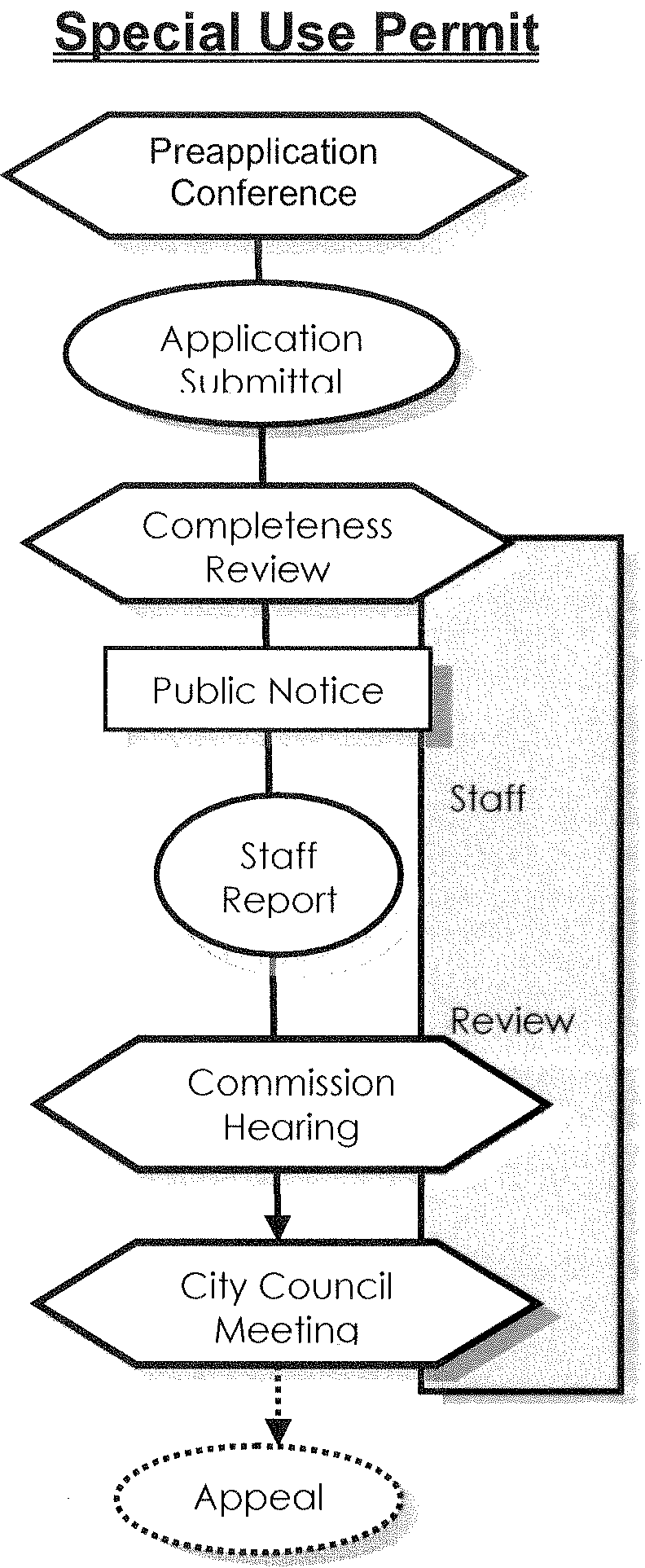
8.9.3 Special use application process.
A.
Pre-application conference. Prior to the submission of land use applications, applicants are encouraged to attend a preapplication conference as set forth in section 8.1.2.
B.
Application submittal. A complete application for a special use permit shall be submitted to the director or designee as set forth in section 8.1.3. A complete site plan prepared in accordance with section 8.5 shall accompany all applications for a special use permit.
C.
Posting and public notification. Once the application is complete, the required public notices shall be issued, as set forth in section 8.1.7.
D.
Review and report by the director or designee. The director or designee shall review the proposed development for compliance with the criteria enumerated in section 8.9.4, below, and prepare a report.
E.
Review and recommendation by the commission. The commission shall review the special use permit application in a public hearing. Following consideration of the application's consistency with the criteria enumerated in section 8.9.4, below, the commission shall vote to recommend approval, approval with conditions, or denial of the special use application.
F.
Review and final action by city council.
(1)
The city council shall review the special use application in a public meeting. Following consideration of the application's consistency with the criteria enumerated in section 8.9.4, below, the council shall vote to approve, approve with conditions, or deny the special use application.
(2)
Written protests must be received in the community development department offices of the City of Farmington 24 hours prior to the city council meeting at which the petition will be considered.
G.
Notice of decision. Written notice of the decision to approve or approve with conditions, or deny shall be provided to the applicant within five working days of the decision, and a copy shall be filed in the office of the director or designee.
H.
Revocation of a special use permit process. The special use permit may be revoked by this section whenever:
(1)
It is determined that a use of property for which a special use permit has been granted is not being conducted within the terms of the special use permit including [section] 8.9.4 special use criteria; that such use has been allowed to accumulate litter or debris, to be a public nuisance, to an attractive nuisance to children, or to attract vagrants, criminals or public intoxication; or is otherwise detrimental to the public health, safety or welfare.
(2)
Before the special use has commenced, and it is determined that such special use is not in the public interest; or
(3)
The owner of the property affected petitions for revocation.
8.9.4 Special use review criteria. Special use permits may be approved where it reasonably determines that there will be no significant negative impact upon residents of surrounding property or upon the public. The following criteria shall be considered in the application review:
A.
Effect on environment. The location, size, design, and operation characteristics of the proposed use shall not be detrimental to the health, welfare, and safety of the surrounding neighborhood or its occupants, nor be substantially or permanently injurious to neighboring property.
B.
Compatible with surrounding area. The proposed site plan, circulation plan, and schematic architectural designs shall be harmonious with the character of the surrounding area with relationship to scale, height, landscaping and screening, and density.
C.
External impacts minimized. The proposed use shall not have negative impacts on existing uses in the area and in the city through the creation of noise, glare, fumes, dust, smoke, vibration, fire hazard, or other injurious or noxious impact. The applicant shall provide adequate mitigation responses to these impacts.
D.
Infrastructure impacts minimized. The proposed use shall not have negative impacts on existing uses in the area and in the city through impacts on public infrastructure such as roads, parking facilities and water and sewer systems, and on public services such as police and fire protection and solid waste collection, and the ability of existing infrastructure and services to provide services adequately.
E.
Consistent with UDC and comprehensive plan. The proposed use will be consistent with the purposes of this UDC, the comprehensive plan, and any other statutes, ordinances or policies that may be applicable, and will support rather than interfere with the uses otherwise permitted in the zone in which it is located.
F.
Parcel size. The proposed use may be required to have additional land area, in excess of the minimum lot area otherwise required by the underlying zoning district, as necessary to ensure adequate mitigation of impacts on surrounding land uses and the zoning district.
G.
Site plan. The proposed use shall be required to comply with the site plan review procedures and standards of section 8.5, site plan review, as specified.
8.9.5 Additional conditions. The commission may recommend and the city council may impose additional reasonable conditions as necessary to carry out the purpose and intent of this UDC and to mitigate adverse effects of the proposed use.
A.
Such conditions may include, but are not limited to, increased open space, loading and parking requirements, additional landscaping or buffering, and additional improvements such as curbing and sidewalks.
B.
The applicant may be required to post a bond, letter of credit or other security, in a form acceptable to the director or designee, to guarantee required improvements or conditions.
8.9.6 Expiration of approval.
A.
Special use permit approval shall expire after 18 months from the date of approval if construction or operation of the approved use has not commenced.
B.
Time limits of special use permits shall be set through the conditions of approval. The city council may extend the special use permit for a definitive time period upon written request from the applicant, which must be received before the date of expiration.
8.9.7 Limitation on reapplication. In the event of a denial by the city council, another petition for a special use permit on the same property or any portion thereof shall not be filed within a period of 365 days from the date of final denial unless the director or designee finds that such re-application demonstrates one of the following:
A.
A substantial change in circumstances relevant to the issues and/or facts considered during review of the application that might reasonably affect the decision-making body's application of the relevant review standards to the development proposed in the application; or
B.
New or additional information that was not available at the time of the review that might reasonably affect the decision-making body's application of the relevant review standards to the development proposed; or
C.
A new application is submitted that is materially different from the prior application; or the final decision on the application was based on a material mistake of fact.
8.9.8 Appeals. Any person aggrieved by a decision of the city council pursuant to this section may appeal to the district court within 30 days of the date of the decision rendered by the city council. If no appeal is filed in writing within 30 days, the decision shall be considered final.
(Ord. No. 2014-1270, § 6, 10-28-14; Ord. No. 2018-1314, § 1, 12-11-18; Ord. No. 2021-1325, 3-9-21; Ord. No. 2025-1372, 1-14-25)
Sec. 8.10 - Floodplain development permit.
8.10.1 Permit required. A floodplain development permit shall be obtained before construction or development begins within any area of special flood hazard established in subsection 5.6.4C., basis for establishing the areas of special flood hazard.
8.10.2 Application submittal. A complete application for a floodplain development permit shall be submitted to the director or designee as set forth in section 8.1.3.
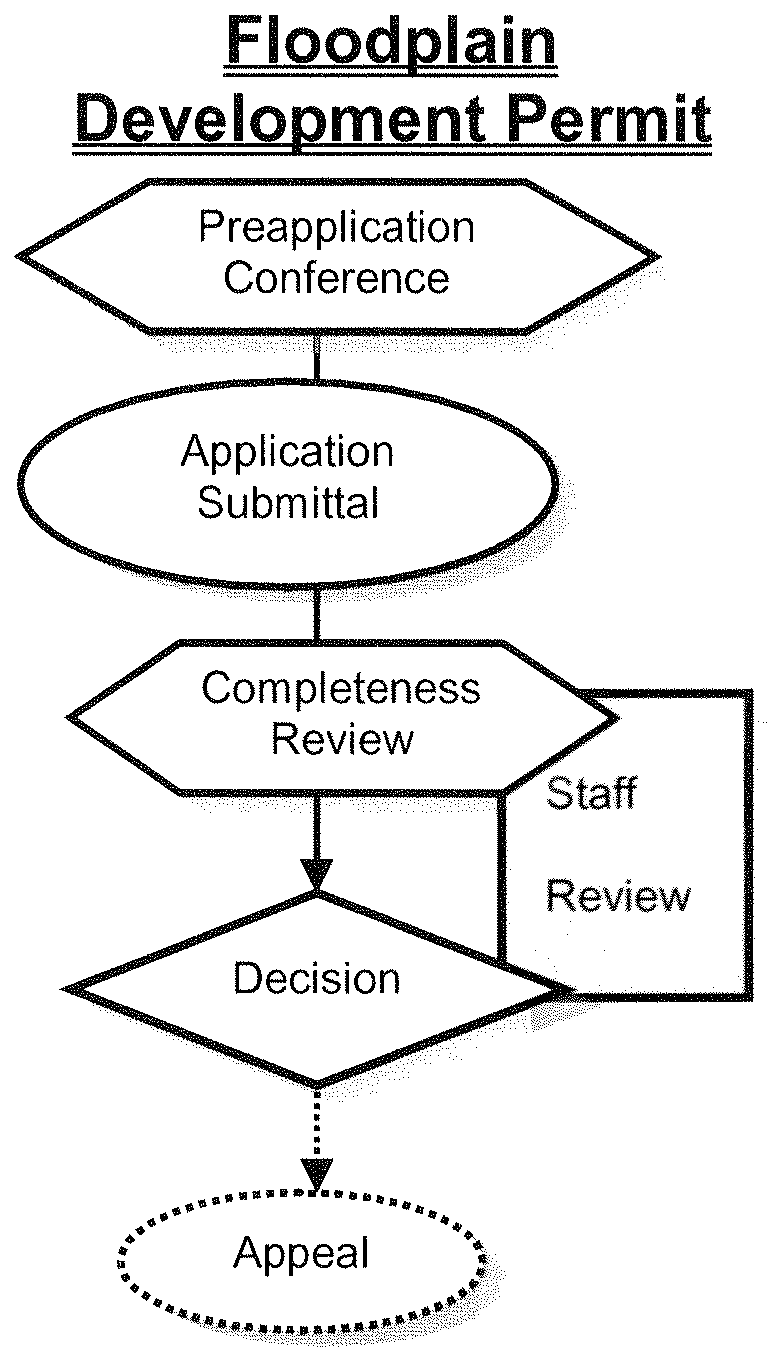
8.10.3 Issues for consideration. Approval or denial of a development permit by the floodplain administrator shall be based on all of the conditions of this section and the following relevant factors:
A.
The danger to life and property due to flooding or erosion damage;
B.
The susceptibility of the proposed facility and its contents to flood damage and the effect of such damage on the individual owner;
C.
The danger that materials may be swept onto other lands to the injury of others;
D.
The compatibility of the proposed use with existing and anticipated development;
E.
The safety of access to the property in times of flood for ordinary and emergency vehicles;
F.
The costs of providing governmental services during and after flood conditions, including maintenance and repair of streets and bridges, and public utilities and facilities such as sewer, gas, electrical and water systems;
G.
The expected heights, velocity, duration, rate of rise and sediment transport of the floodwaters and the effects of wave action, if applicable, expected at the site;
H.
The necessity to the facility of a waterfront location, where applicable;
I.
The availability of alternative locations, not subject to flooding or erosion damage, for the proposed use; and
J.
The relationship of the proposed use to the comprehensive plan for that area.
8.10.4 Variance procedure. The ARB shall hear and render judgment on requests for variances from the requirements of this section.
A.
The ARB shall hear and render judgment on an appeal only when it is alleged there is an error in any requirement, decision, or determination made by the floodplain administrator in the enforcement or administration of this section.
B.
The floodplain administrator shall maintain a record of all actions involving an appeal and shall report variances to the Federal Emergency Management Agency upon request.
C.
Variances may be issued for the reconstruction, rehabilitation, or restoration of structures listed on the National Register of Historic Places or the state inventory of historic places, without regard to the procedures set forth in the remainder of this section.
D.
Variances may be issued for new construction and substantial improvements to be erected on a lot of one-half acre or less in size contiguous to and surrounded by lots with existing structures constructed below the base flood level, providing the relevant factors in section 5.6.6, general standards, have been fully considered. As the lot size increases beyond one-half acre, the technical justification required for issuing the variance increases.
E.
Upon consideration of the factors noted in subsections A. through F. of this section and the intent of this section, the ARB may attach such conditions to the granting of variances as it deems necessary to further the purpose and objectives of this section.
F.
Variances shall not be issued within any designated floodway if any increase in flood levels during the base flood discharge would result.
G.
Variances may be issued for the repair or rehabilitation of historic structures upon a determination that the proposed repair or rehabilitation will not preclude the structure's continued designation as a historic structure and the variance is the minimum necessary to preserve the historic character and design of the structure.
H.
Variances shall only be issued upon a determination that the variance is the minimum necessary, considering the flood hazard, to afford relief; and upon:
(1)
Showing a good and sufficient cause;
(2)
Determination that failure to grant the variance would result in exceptional hardship to the applicant; and
(3)
Determination that the granting of a variance will not result in increased flood heights, additional threats to public safety, or extraordinary public expense; create nuisances; cause fraud on or victimization of the public; or conflict with existing local laws or ordinances; and
(4)
Any applicant to whom a variance is granted shall be given written notice that the structure will be permitted to be built with the lowest floor elevation below the base flood elevation, and that the cost of flood insurance will be commensurate with the increased risk resulting from the reduced lowest floor elevation.
(5)
Variances may be issued by a community for new construction and substantial improvements and for other development necessary for the conduct of a functionally dependent use, provided that the criteria outlined in subsections A. through G. of this section are met and the structure or other development is protected by methods that minimize flood damages during the base flood and create no additional threats to public safety.
8.10.5 Expiration of approval. A floodplain development permit within a designated flood hazard area issued by the floodplain administrator shall become invalid unless the work authorized shall have been commenced within 12 months after its issuance.
8.10.6 Notice of decision. Written notice of the decision to approve or approve with conditions, or deny shall be provided to the applicant within five working days of the decision, and a copy shall be filed in the office of the floodplain administrator.
8.10.7 Appeal. Appeals of any final decision regarding a floodplain development permit shall be made to the ARB within 30 days of the decision in accordance with section 8.15, appeals of administrative decisions.
Sec. 8.11 - Temporary use permits.
8.11.1 Applicability. The temporary use for which the permit is requested must be specifically authorized as a temporary use in the zoning district in which the use is to be located.
8.11.2 Temporary use permit application process.
A.
Application submittal. A complete application for a temporary use permit shall be submitted to the director or designee as set forth in section 8.1.3.
B.
Review and final action by the director or designee. The director or designee shall review the application to ensure compliance with all applicable code requirements and approve, approve with conditions, or deny the application.
8.11.3 Notice of decision. Written notice of the decision to approve or approve with conditions, or deny shall be provided to the applicant within five working days of the decision, and a copy shall be filed in the office of the director or designee.
8.11.4 Time limit. A time limit for the discontinuance of the temporary use shall be specified on the temporary use permit. An extension may be granted by the director or designee subject to a review of the permit application.
8.11.5 Appeals. Appeals of any final decision regarding a temporary use permit shall be made to the ARB within 30 days of the decision in accordance with section 8.15, appeals of administrative decisions.
(Ord. No. 2021-1325, 3-9-21)
Sec. 8.12 - Variances.
8.12.1 Purpose. The ARB shall have jurisdiction to hear requests for a variance from the terms of this UDC as outlined in section 7.4. The ARB shall be authorized to grant a variance from the terms hereof if they find that the strict enforcement of this UDC would create a substantial hardship to the applicant by virtue of unique special conditions not generally found within the vicinity, and that the granting of the variance would preserve the spirit and intent of the UDC, and would serve the general interests of the public and the applicant. Variances may be granted only when in harmony with the general purpose and intent of this UDC so that public health, safety, and welfare may be secured and substantial justice done.
8.12.2 Applicability.
A.
Administrative adjustments. A variance request up to ten percent of height, bulk, setback and other (numerical), site-related standards may be approved pursuant to the requirements of section 8.13, administrative adjustments.
B.
Variances. All other requests for a variance are subject to review and approval by the ARB pursuant to the requirements of this section.
C.
Variances to the access management plan standards. Variances to standards in the adopted access management plan shall be processed in the same manner as variances to the provisions of the UDC as set forth in this section, except where a variance has been granted pursuant to section 8.13, administrative adjustment.
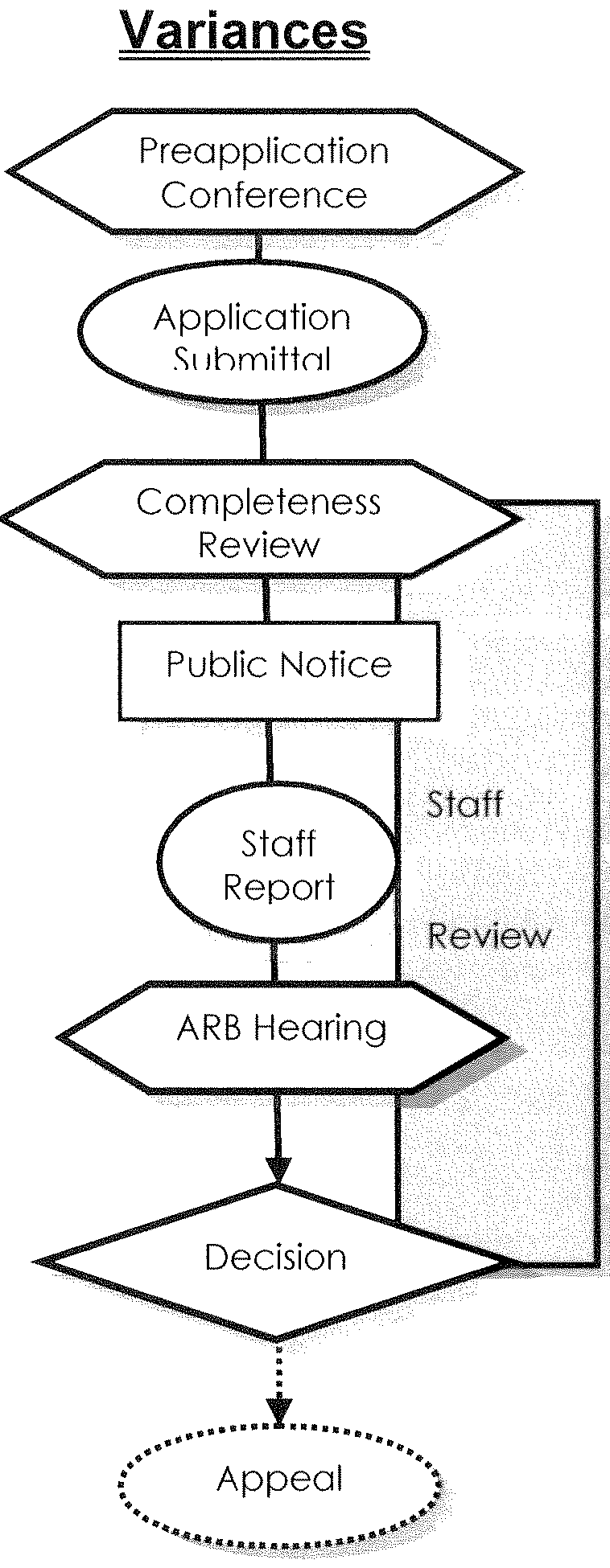
8.12.3 Variance application process.
A.
Pre-application conference. Prior to the submission of land use applications, applicants are encouraged to attend a preapplication conference as set forth in section 8.1.2.
B.
Application submittal. A complete application for a variance shall be submitted to the director or designee as set forth in section 8.1.3.
C.
Posting and public notification. Once the application is complete, the required public notices shall be issued, as set forth in section 8.1.7.
D.
Review and report by director or designee. Upon receipt of a complete application, the director or designee shall review the proposed variance for compliance with criteria enumerated in section 8.12.4 below. The director or designee shall prepare a report for presentation to the ARB and schedule a public hearing.
E.
Review and final decision by the ARB. The application and report shall be reviewed by the ARB in a public hearing. Following completion of the hearing, the board shall vote to approve, approve with conditions, or deny the variance. Such recommendation shall be based on the application's compliance with criteria enumerated in section 8.12.4 below.
F.
Notice of decision. Written notice of the decision to approve or approve with conditions, or deny shall be provided to the applicant within five working days of the decision, and a copy shall be filed in the office of the director or designee.
8.12.4 Variance criteria.
A.
Required findings. A variance may be granted only where a literal enforcement of the Code provisions would result in unnecessary hardship for a particular property. In order to grant a variance, the ARB must make a positive finding of fact concerning each of the following or, if a positive finding of fact cannot be made that the ARB specifically describes the circumstance that would outweigh the strict requirement for a positive finding of fact and determine that the variance will not be a public detriment:
(1)
That special conditions and circumstances exist, which are peculiar to the land, structure or building involved and are not applicable to other lands, structures or buildings in the same district; and; furthermore, that they are not self-imposed, self-created or otherwise the result of actions by the applicant;
(2)
That a literal interpretation of the provisions of the Code would deprive the applicant of rights commonly enjoyed by other properties in the same district under the terms of the Code;
(3)
The applicant demonstrates that the request is a minimum easing of the Code requirements, making possible the reasonable use of the land, building or structure;
(4)
That the granting of the variance is in harmony with the general interest, the general purpose and intent of the Code, and is not injurious to the neighborhood or otherwise detrimental to the public welfare;
(5)
That the proposed variance will not permit a use not otherwise allowed in the underlying district;
(6)
That no nonconforming use of neighboring lands, structures or buildings in the same district and no permitted use of lands, structures or buildings in other districts has been or shall be considered grounds for the issuance of a variance; and
(7)
That the applicant would suffer an unnecessary hardship if the variance requested were denied.
B.
Approval limitations. The ARB may not approve a variance that creates any of the following situations:
(1)
The establishment of a use not otherwise permitted in the applicable zoning district;
(2)
An increase in the density of a use in excess of the density permitted by the applicable district; or
(3)
A change in the zoning district boundaries shown on the official zoning map.
8.12.5 Limitation on reapplication. In the event of a denial by the administrative review board or city council, another petition for the same variance request on the same property or any portion thereof shall not be filed within a period of 365 days from the date of final denial unless the director or designee finds that such re-application demonstrates one of the following:
A.
A substantial change in circumstances relevant to the issues and/or facts considered during review of the application that might reasonably affect the decision-making body's application of the relevant review standards to the development proposed in the application; or
B.
New or additional information that was not available at the time of the review that might reasonably affect the decision-making body's application of the relevant review standards to the development proposed; or
C.
A new application is submitted that is materially different from the prior application; or the final decision on the application was based on a material mistake of fact.
8.12.6 Appeals. Appeals of any final decision regarding a variance shall be made to the city council within 15 days of the decision in accordance with section 8.16, appeals of ARB decisions.
(Ord. No. 2021-1325, 3-9-21; Ord. No. 2025-1372, 1-14-25)
Sec. 8.13 - Administrative adjustments.
8.13.1 Purposes. Administrative adjustments are minor variances, up to a maximum of ten percent, from otherwise applicable development standards where development is proposed that would be:
A.
Compatible with surrounding land uses;
B.
Harmonious with the public interest; and
C.
Consistent with the purposes of this UDC.
8.13.2 Applicability.
A.
The director or designee may authorize adjustment of up to ten percent from any numerical standard related to height, bulk, setback or other site plan related standards. Any adjustment request greater than ten percent shall be treated as a variance handled by the ARB subject to the requirements of section 8.12, variances.
B.
The director or designee may authorize alternative parking plans in accordance with the requirements of section 5.2.7.
C.
The limitations of subsection 8.13.2A. notwithstanding, the Director or designee may, but is not required to, waive or vary any requirement of the adopted access management plan, particularly, but not exclusively, when rigid adherence to the standards of said plan are not physically achievable by virtue of existing street or driveway location, or because of the existence of other conditions, that, in the opinion of the director or designee make such rigid adherence impractical or unnecessary. It is the intent of this provision to maximize relief through administrative adjustment, thus reducing processing delays.
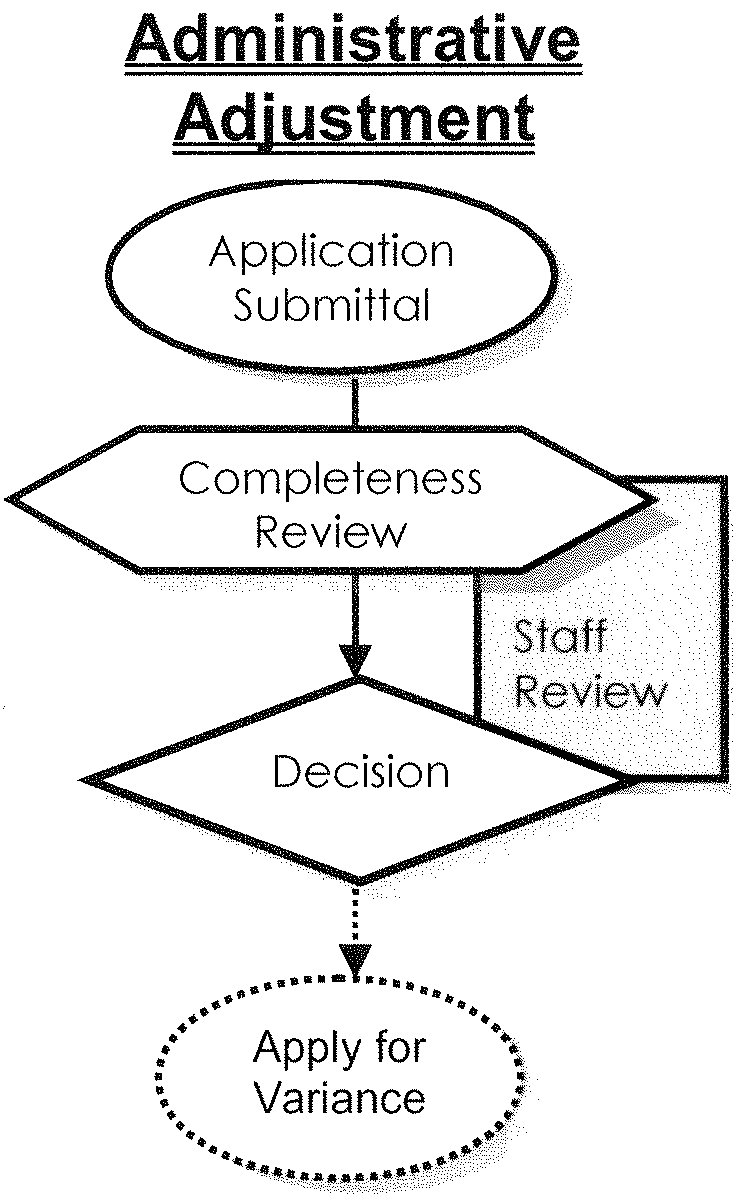
8.13.3 Administrative adjustment application process.
A.
Application submittal. A complete application for an administrative adjustment shall be submitted to the director or designee as set forth in section 8.1.3.
B.
Review and final action by director or designee. The director or designee shall review the application and approve, approve with conditions or deny the application based upon the criteria below.
C.
Notice of decision. Written notice of the decision to approve or approve with conditions, or deny shall be provided to the applicant within five working days of the decision, and a copy shall be filed in the office of the director or designee.
8.13.4 Administrative adjustment criteria. To approve an application for an administrative adjustment, the director or designee shall consider mitigation measures offered in support of the adjustment and the following criteria:
A.
Granting the adjustment will ensure the same general level of land use compatibility as the otherwise applicable standards;
B.
Granting the adjustment will not materially or adversely affect adjacent land uses and the physical character of uses in the immediate vicinity of the proposed development because of inadequate buffering, screening, setbacks and other land use considerations;
C.
Granting the adjustment will be generally consistent with the purposes and intent of this UDC; and
D.
Granting the adjustment will be based on the physical constraints and land use specifics, rather than on economic hardship of the applicant.
8.13.5 Action following a denial. Administrative adjustments may not be appealed to the ARB. In the event of a denial of an administrative adjustment, the applicant may apply for a variance in accordance with the requirements of section 8.12, variances.
(Ord. No. 2021-1325, 3-9-21)
Sec. 8.14 - Written interpretations.
8.14.1 Authority. The director or designee shall have authority to make written interpretations of this UDC.
8.14.2 Request for interpretation. A written request for interpretation shall be submitted to the director or designee.
8.14.3 Interpretation by director or designee. Within 15 days of receipt of a written request for interpretation, the director or designee shall:
A.
Review and evaluate the request in light of the text of this UDC, the official zoning map, the comprehensive plan, and any other relevant information;
B.
Consult with other staff, as necessary;
C.
Render an opinion; and
D.
Provide a written interpretation to the applicant.
8.14.4 Notice of decision. Written notice of the decision to approve or approve with conditions, or deny shall be provided to the applicant within five working days of the decision, and a copy shall be filed in the office of the director or designee.
8.14.5 Official record. The director or designee shall maintain an official record of interpretations, which shall be available for public inspection during normal business hours.
8.14.6 Appeals. Appeals of any final decision regarding a written interpretation shall be made to the ARB within 30 days of the decision in accordance with section 8.15, appeals of administrative decisions.
(Ord. No. 2021-1325, 3-9-21)
Sec. 8.15 - Appeals of administrative decisions.
8.15.1 Applicability. Appeals to the ARB may be taken by any person with standing who is aggrieved by any written interpretations made pursuant to section 8.13, or by other final administrative decisions; provided however, that building permit appeals shall be subject to the requirements of State of New Mexico Construction Industries Division. To have "standing" such persons shall:
A.
Be a resident of the City of Farmington or the city's extraterritorial jurisdiction, or
B.
Own property within the City of Farmington or the city's extraterritorial jurisdiction.
8.15.2 Effect of appeal. The filing of an appeal stays all legal proceedings in the matter appealed from, unless the director or designee certifies to the ARB that by reason of facts stated, a stay would cause imminent peril to life and property. In such case, proceedings shall not be stayed except by a restraining order which may be granted by the district court, based on the application, and director or designee, and on due cause shown.
8.15.3 Appeal process.
A.
Deadline for submission of application. An appeal from any final decision of the director or designee shall be filed in writing with the director or designee within 30 calendar days of receipt of the decision. If no appeal is filed within 30 days, the decision shall be considered final, unless such requirement shall be waived by the ARB or by the city council.
B.
Application submittal. A complete application for an administrative appeal shall be submitted to the director or designee as set forth in section 8.1.3.
C.
Posting and public notification. Once the application is complete, the required public notices shall be issued, as set forth in section 8.1.7.
D.
Record of administrative decision. Upon receipt of an appeal application, the director or designee shall forthwith transmit to the ARB all the papers constituting the record of the action appealed.
E.
Review and final action by the ARB.
(1)
Public hearing. The appeal shall be heard within 60 days of the date of the appeal application or such extension as requested by the applicant. During the public hearing, any party may appear in person or by agent or by attorney. Consideration of the appeal shall be limited to the specific interpretive language of the director or designee.
(2)
Action. At the conclusion of the hearing, the ARB, as appropriate, shall vote to reverse, affirm wholly or partly, or modify the appealed interpretation; and may provide direction for the appropriate action on the final interpretation. In any case, such action shall only present findings regarding specific errors made in the director or designee's interpretation or permit issuance.
F.
Notice of decision. The decision to uphold or reverse the administrative decision shall be communicated in writing to the applicant within five working days of the decision.
G.
Appeals. Appeals of any final decision regarding an appeal of administrative decisions shall be made to the city council within 15 days of the decision in accordance with section 8.16, appeals of ARB decisions.
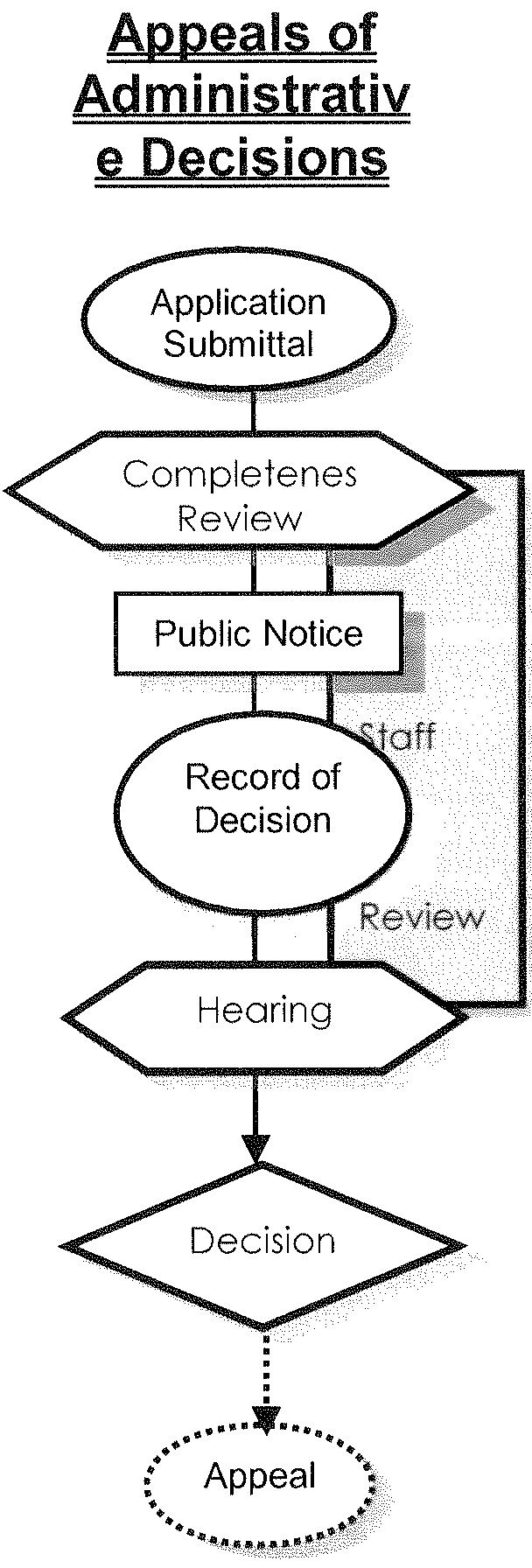
(Ord. No. 2021-1325, 3-9-21)
Sec. 8.16 - Appeals of ARB decisions.
8.16.1 Applicability.
A.
Appeals to the city council may be taken by any person with standing who is aggrieved by a decision of the ARB. To have "standing" such persons shall have offered testimony in writing or in person at the hearing at which the decision was made; and
(1)
Be a resident of the City of Farmington or the city's extraterritorial jurisdiction; or
(2)
Own property within the City of Farmington or the city's extraterritorial jurisdiction.
B.
Two or more members of the city council may issue written instructions to the ARB directing that such matter be forwarded to the city council for further review.
C.
Appeals to the city council may be taken by the director or designee when he believes the decision of the ARB was in error.
8.16.2 Effect of appeal. The filing of an appeal stays all legal proceedings in the matter appealed from, unless the director or designee certifies to the city council that by reason of facts stated a stay would cause imminent peril to life and property. In such case, proceedings shall not be stayed except by a restraining order granted by the district court.
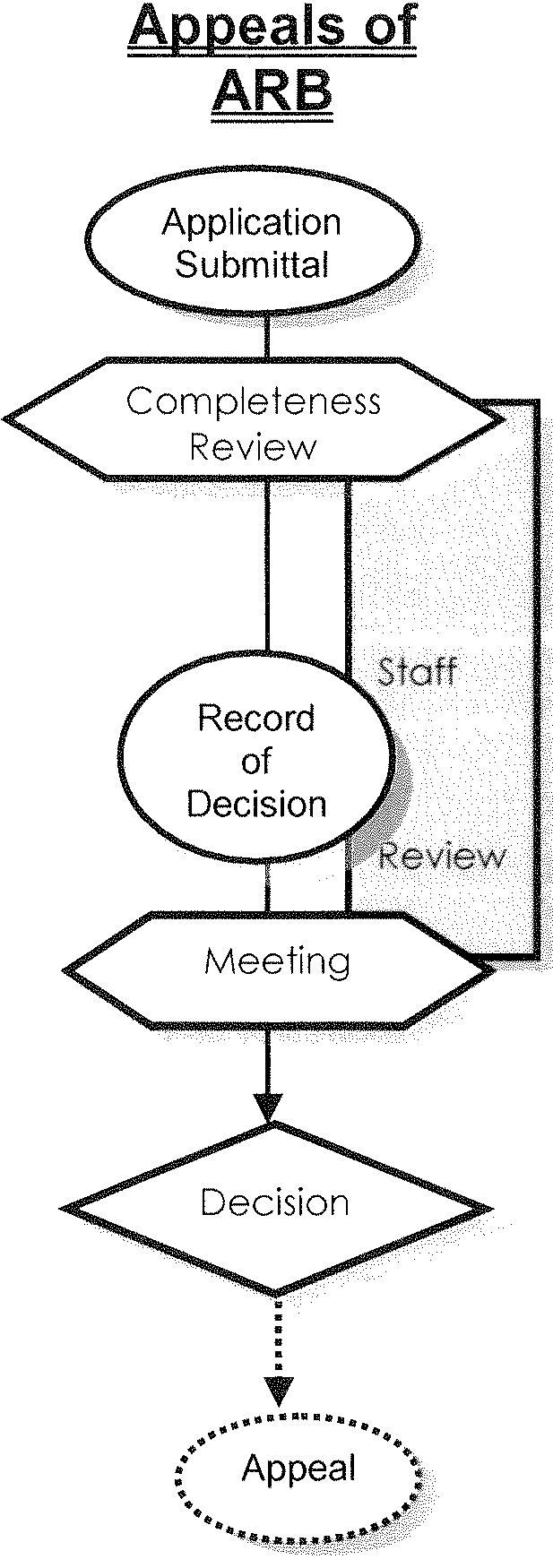
8.16.3 Appeal process.
A.
Deadline for submission of application. An appeal from any final decision of the ARB shall be filed in writing with the director or designee within 15 calendar days of the decision. If no appeal is filed within 15 days, the decision shall be considered final, unless such requirement shall be waived by the ARB or by the city council.
B.
Application submittal. A complete application for an administrative appeal shall be submitted to the director or designee as set forth in section 8.1.3.
C.
Review and final action by the city council.
(1)
Public meeting. The appeal shall be heard within 60 days of the date of the appeal application or such extension as requested by the applicant. During the public meeting, any party may appear in person or by agent or by attorney. Consideration of the appeal shall be limited to the specific interpretive language of the ARB.
(2)
Action.
a.
At the conclusion of the meeting the city council, as appropriate, shall vote to reverse, affirm wholly or partly, or modify the appealed decision; and may provide direction for the appropriate action on the final decision. In any case, such action shall only present findings regarding specific errors made in the ARB's decision.
b.
Pursuant to the Farmington City Code section 2-4-42, the decision of the administrative review board shall not be reversed, modified, amended or otherwise decided except by an affirmative vote of three councilors.
D.
Notice of decision. The decision to uphold or reverse the ARB's decision shall be communicated in writing to the applicant within five working days of the decision.
(Ord. No. 2021-1325, 3-9-21)
Sec. 8.17 - Appeal of council decision.
8.17.1 Appeals. Any person aggrieved by a decision of the city council pursuant to this article may appeal to the district court within 30 days of the date of the decision rendered by the city council [NMSA 1978, § 3-21-9]. If no appeal is filed in writing within 30 days, the decision shall be considered final.

