
Florence County Unincorporated
City Zoning Code
City Zoning Code
ARTICLE IV
APPEARANCE, BUFFERING, SCREENING, LANDSCAPING, AND OPEN SPACE REGULATIONS
The regulations contained in this article are intended generally to ensure land use compatibility, promote the greening of development, improve aesthetics, and ensure adequate provision of open space within the jurisdiction of this chapter.
Sec. 30-121.- Bufferyards.
(a)
Definition. The bufferyard is a unit of yard together with the planting, fences, walls, and other screening devices required thereon.
(b)
Purpose. The purpose of the bufferyard is to separate different land uses from each other in order to eliminate or minimize potential nuisances such as dirt, litter, noise, glare of lights, signs, and unsightly buildings or parking areas, or to provide spacing to reduce adverse impacts of noise, odor, or danger from fires or explosions, and promote land use compatibility.
(c)
Where required; location. Bufferyards shall be provided in accord with the requirements of Table VI, and shall be located on the outer perimeter of a lot or parcel, extending to the lot or parcel boundary line. Bufferyards shall not be located on any portion of an existing public or private street or right-of-way.
(d)
Determination of requirements. To determine the bufferyard required between two adjacent parcels or between a parcel and a street, the following procedure shall be followed:
(1)
Identify the proposed land use.
(2)
Identify the use of land adjacent to the proposed use.
(3)
Determine the bufferyard required on each boundary (or segment thereof) of the subject parcel by referring to Table VI, bufferyard requirements and bufferyard illustrations of this section. The letter designations contained in the table refer to the type of bufferyard specified by the illustrations.
(4)
Any of the several options contained in the illustrations shall satisfy the requirements of buffering between adjacent land uses and streets.
(e)
Responsibility for bufferyard.
(1)
It shall be the responsibility of the proposed use to provide the bufferyard required by Table IV.
(2)
When a use is first to develop on two adjacent vacant parcels, the first use shall provide the buffer specified for vacant land. The second use to develop shall, at the time it develops, provide all additional plant material and/or land necessary to provide the total required bufferyard.
(f)
Bufferyard specifications. The bufferyard illustrations contained in this section graphically indicate the specifications of each bufferyard. The requirements are stated in terms of the width of the bufferyard and the number of plants required per 100 feet of bufferyard. The requirements of a bufferyard may be satisfied by any one of the options illustrated.
The "plant unit multiplier" is a factor by which the basic number of plant materials required for a given bufferyard is determined given a change in the width of the bufferyard. The type and quantity of plant materials required for each bufferyard option are specified by the illustrations. Each illustration depicts the total bufferyard located between two uses. Whenever a wall, fence, or berm is required within a bufferyard, they are shown as "structures."
The exact placement of required plants and structures shall be the decision of the developer, except that evergreen (or conifer) plant materials shall be planted in clusters rather than singly in order to maximize their chances of survival.
All buffer yards shall be seeded with lawn grass or suitable ground cover.
(g)
Bufferyard substitutions. The following plant material substitutions shall satisfy the requirements of this chapter.
(1)
Evergreen canopy or evergreen understory trees may be substituted as follows:
In the case of deciduous canopy forest trees, up to a maximum of 50 percent of the total number of canopy trees otherwise required;
Evergreen canopy or evergreen understory trees may be substituted for deciduous understory trees and deciduous shrubs, without limitations.
(2)
In all bufferyards, evergreen or conifer shrubs may be substituted for deciduous shrubs without limitations.
(3)
Any existing plant material that otherwise satisfies the requirements of this section may be counted toward satisfying all such requirements.
(4)
Structures, where required, may be substituted with approval of the zoning administrator.
(h)
Use of bufferyards. A bufferyard may be used for passive recreation; however, no plant material may be removed.
(i)
Bufferyards part of required yards. Where front, side, and rear yards are required by this chapter, bufferyards may be established within such required yards.
(j)
Minimum plant size. Plants shall be sufficiently sized to insure buffering and screening at the time of installation. Where the bufferyard illustrations indicate a mass or line of plants paralleling the length of the property line, the plant materials shall be sufficiently sized to insure obscurity at the time of installation. However, seedling plants may be used where berms or structures are required as part of the bufferyard, or where the proposed use is contiguous to a street or vacant land.
The following table shall serve as a guide for determining minimum plant size.
Table V: Determining Minimum Plant Size
(k)
Required maintenance. The maintenance of required bufferyards shall be the responsibility of the property owner. All such yards shall be properly maintained so as to assure continued buffering. To this end, such areas shall be provided with an irrigation system or readily available water supply. Dead trees shall be removed and replaced; debris and litter shall be cleaned up; and berms, fences, and walls shall be maintained at all times. Failure to do so is a violation of this chapter and may be remedied by the zoning administrator in the manner prescribed for other violations.
Table VI: Bufferyard Requirements†
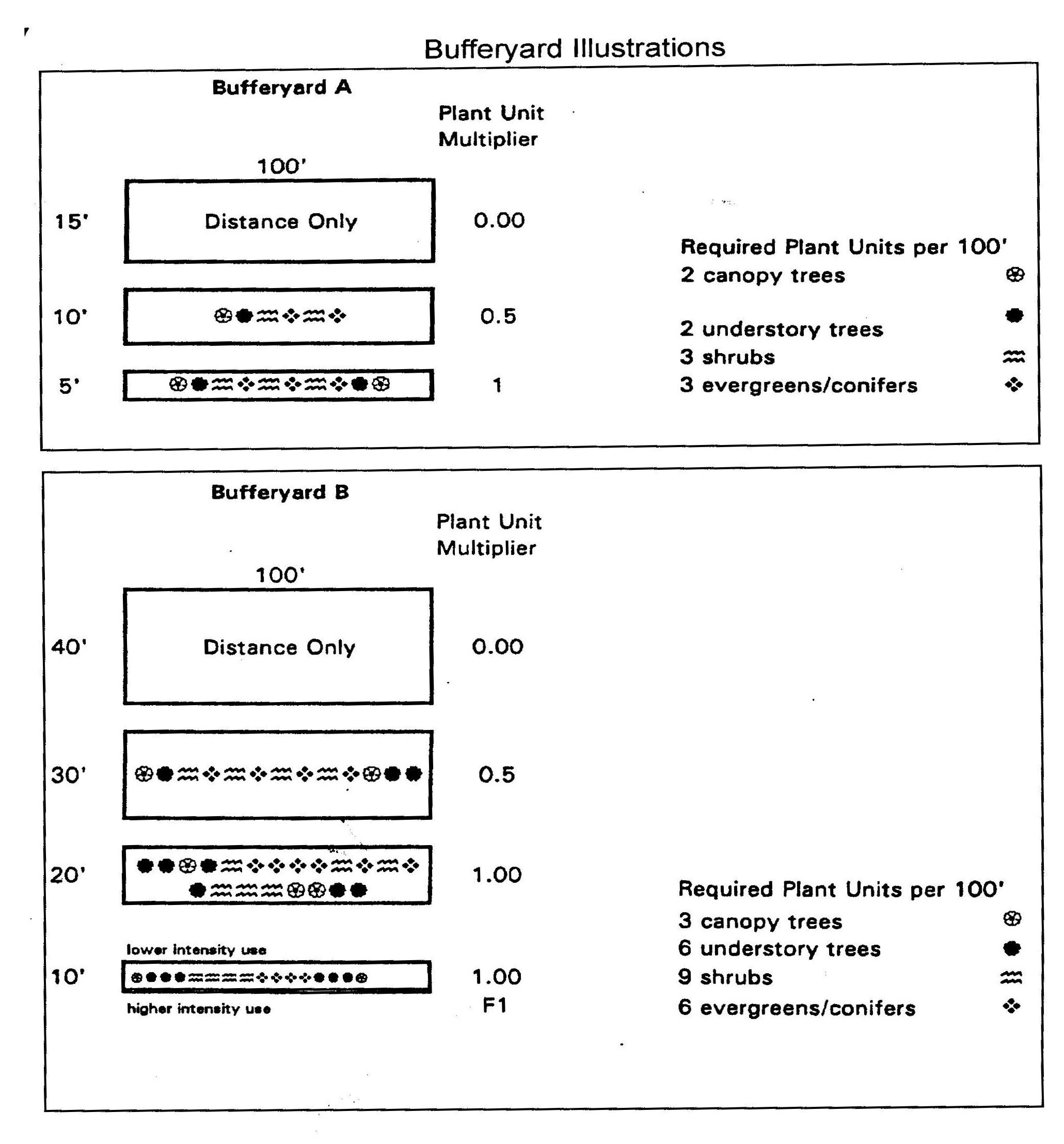
Bufferyard A and Bufferyard B
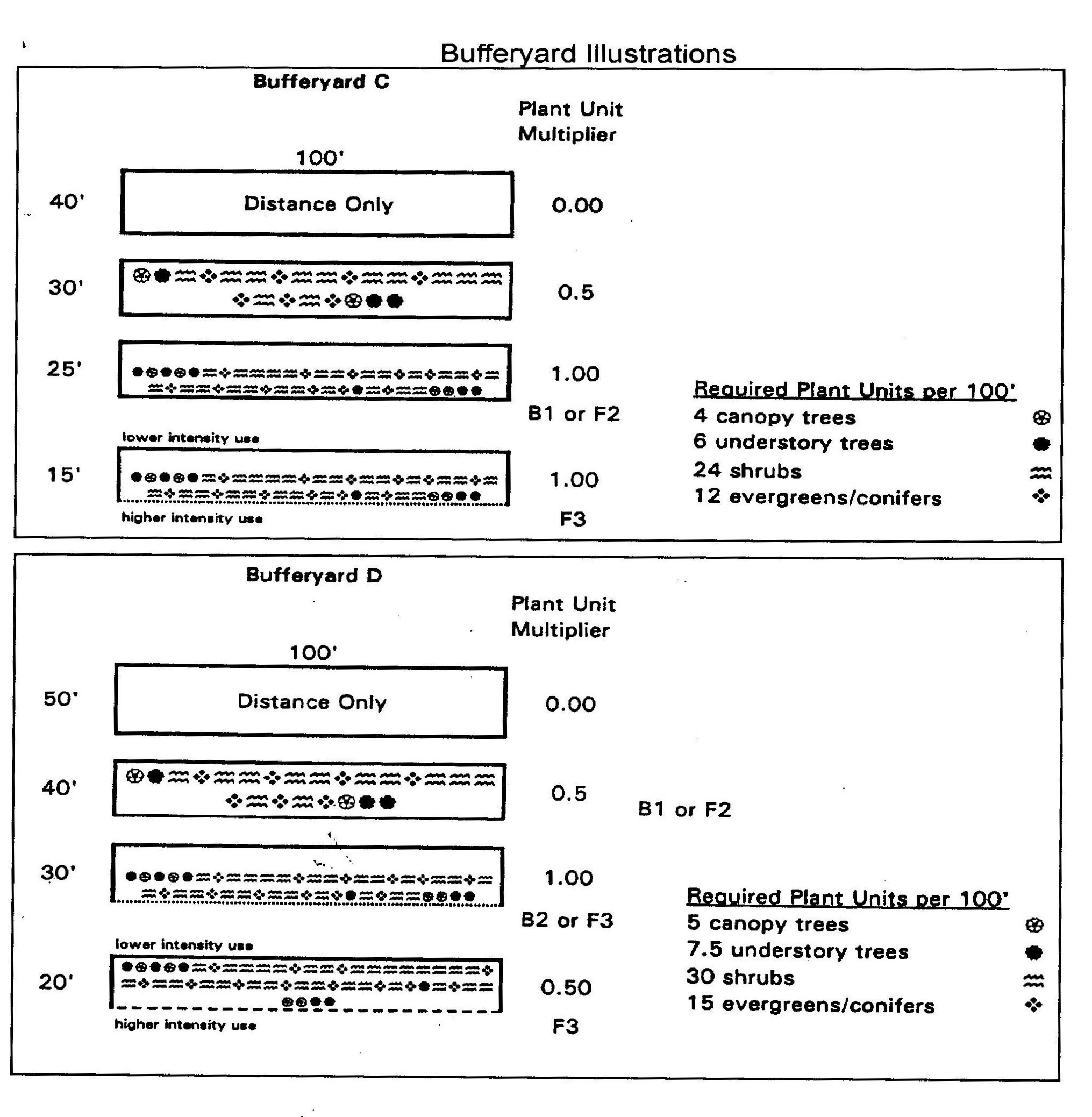
Bufferyard C and Bufferyard D
Bufferyard E
(1)
> 2,000 sf — < 4,000 s.f.: 30 feet from rear and side property lines*
(2)
> 4,000 sf: 50 feet from rear and side property lines*
(3)
Setback requirements may be substituted by plant materials and/or structures as outlined in bufferyard A, five foot illustration, with the approval of the zoning administrator. Any existing plant material/structures may be counted toward all such requirements upon the approval of the zoning administrator.
Structures
The structure is on the higher intensity side of the bufferyard, with landscaping continuing toward the less intense use.
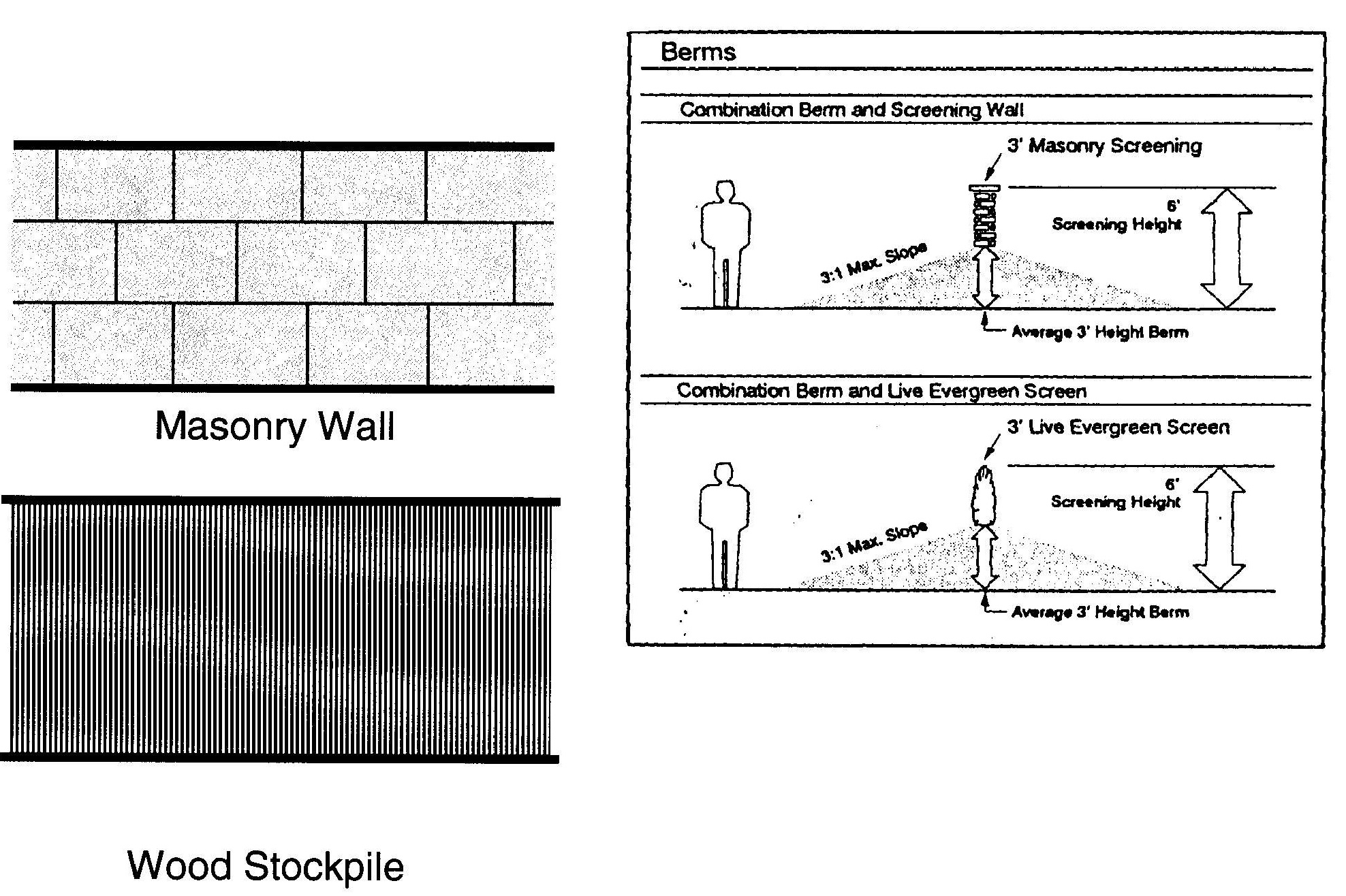
Masonry Wall
(Ord. No. 33-2006/07, §§ 4.1, 4.1-10, 6-7-07; Ord. No. 34-2015/16, § 1, 8-18-16; Ord. No. 13-2023/24, § 1, 10-19-23)
Sec. 30-122. - Screening.
(a)
Definition. Screening is a type of buffer that is designed to block or obscure a particular element or use from view.
(b)
Purpose. The purpose of screening is to minimize if not eliminate entirely the visual impact of potentially unsightly open storage areas and refuse disposal facilities.
(c)
Where required. Screening specified by this section shall be required of all open storage areas not devoted to retail sales visible from any public street, including open storage areas for shipping containers, building materials, appliances, trash containers of four or more cubic yards, salvage materials and similar unenclosed uses.
(d)
Type screening required. Screening shall be accomplished by an opaque divider not less than six feet high or the height of the object to be screened, whichever is greater. Screening may be accomplished by the use of sight obscuring plant materials (generally evergreens), earth berms, walls, fences, proper siting of disruptive elements, building placement or other design techniques approved by the zoning administrator.
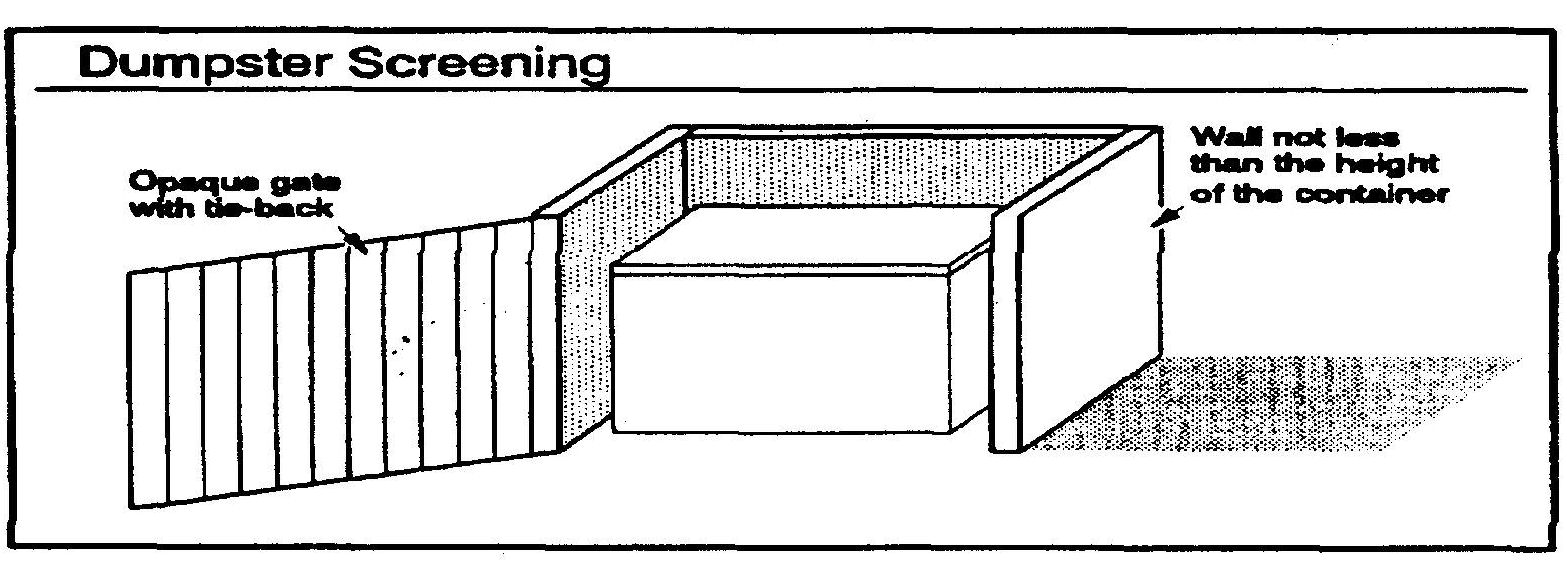
Dumpster Screening
(Ord. No. 33-2006/07, § 4.2, 6-7-07)
Sec. 30-123. - Landscaping.
(a)
Definition. Landscaping is a type of open space permanently devoted and maintained for the growing of shrubbery, grass, other plants and decorative features to the land.
(b)
Purpose. The purpose of landscaping is to improve the appearance of vehicular use areas and development abutting public rights-of-way; to enhance environmental and visual characteristics, to promote the greening of development, and the reduction of noise pollution, storm water run off, air pollution, and artificial light glare, and to safeguard property values, protect public and private investments, and promote high-quality development.
(c)
Where required. Except in the B-4 district, no proposed commercial, institutional, industrial or other non-residential use, or multi-family project or manufactured home park, shall hereafter be established or reestablished in an existing building or structure, and subsequently used unless landscaping is provided in accord with the provisions of this section. No existing building, structure, or vehicular use area shall be enlarged by 50 percent or more unless the minimum landscaping required by the provisions of this section is provided throughout the building site.
(d)
Landscaping plan. A landscaping plan shall be submitted as part of the application for a building permit. The plan shall:
(1)
Designate areas to be reserved for landscaping. The specific design of landscaping shall be sensitive to the physical and design characteristics of the site.
(2)
Indicate the location and dimensions of landscaped areas, plant materials, decorative features, etc.
(e)
Landscaping requirements. Required landscaping shall be provided as follows:
(1)
Along the outer perimeter of a lot or parcel, where required by the buffer area provisions of this article, to buffer and separate incompatible land uses. The amount specified shall be as prescribed by section 4.1, buffer areas.
(2)
Within the interior, peninsula or island type landscaped areas shall be provided for any open vehicular use area containing 20 or more parking spaces. Landscaped areas shall be located in such a manner as to divide and break up the expanse of paving and at strategic points to guide travel flow and directions. Elsewhere, landscaped areas shall be designed to soften and complement the building site and separate the building from the vehicular surface area.
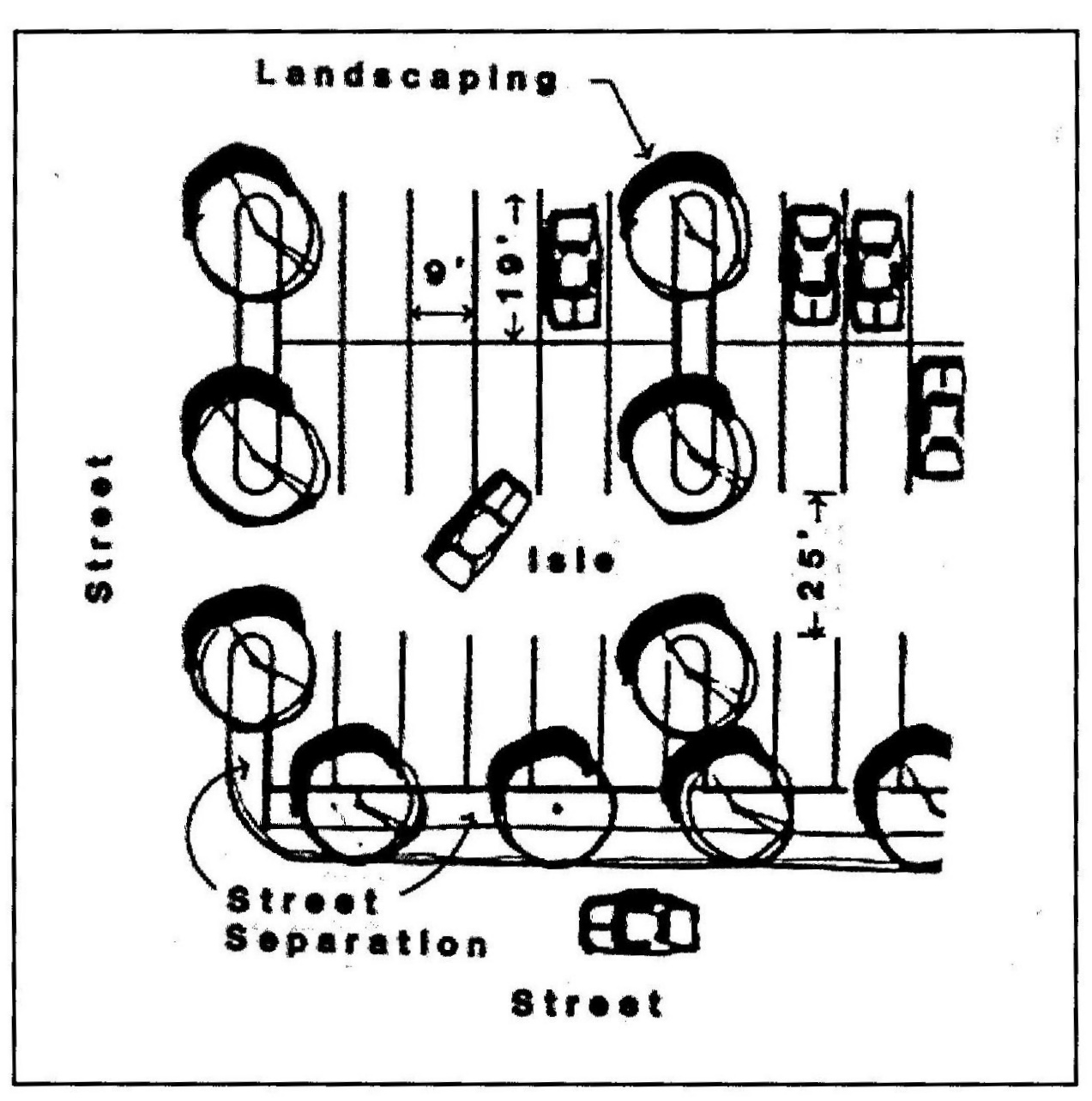
Landscaping
At a minimum, interior lot landscaping shall be provided in the following amounts:
Landscaping along exterior building walls and structures is suggested to separate with greenery the building from the vehicular surface area.
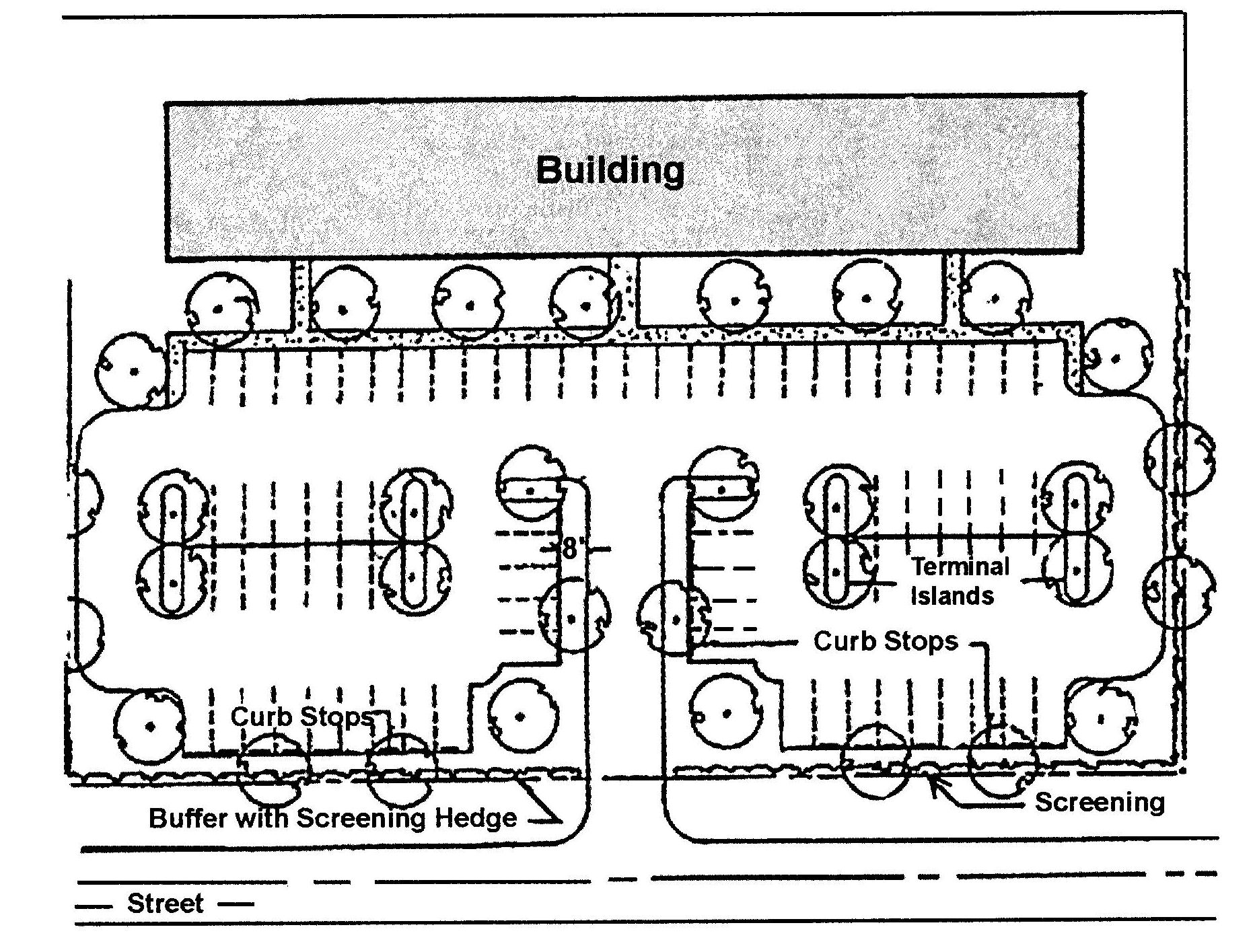
Landscaping around building walls
(f)
Landscaped areas.
(1)
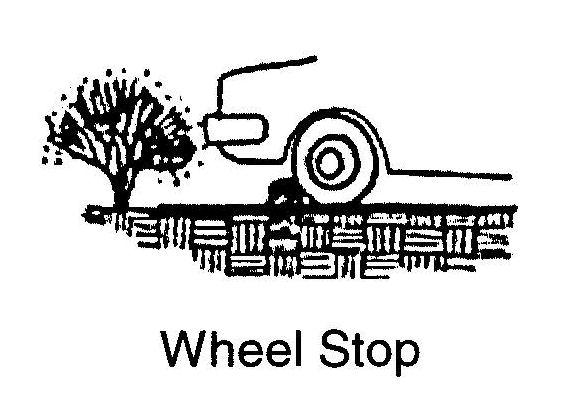
All landscaped areas in or adjacent to parking areas shall be protected from vehicular damage by a raised concrete curb, wheel stop, or an equivalent barrier of six inches in height. The barrier need not be continuous.
(2)
Landscaped areas must be at least 25 square feet in size.
(g)
Required maintenance. The maintenance of required landscaped areas shall be the responsibility of the property owner. All such areas shall be properly maintained so as to assure their survival and aesthetic value, and shall be provided with an irrigation system or a readily available water supply. Failure to monitor such areas is a violation of this chapter, and may be remedied in the manner prescribed for other violations.
(Ord. No. 33-2006/07, § 4.3, 6-7-07)
Sec. 30-124. - Common open space.
(a)
Definition. Common open space is land and/or water bodies used for recreation, amenity or buffer; it shall be freely accessible to all residents and property owners of a development, where required by this chapter. Open space shall not be occupied by buildings or structures other than those in conjunction with the use of the open space, roads, or parking nor shall it include the yards or lots of residential dwelling units required to meet minimum lot area or parking area requirements.
(b)
Purpose. The purpose of this section is to ensure adequate open space for high density residential development; to integrate recreation, landscaping, greenery and/or natural areas into such projects; to promote the health and safety of residents of such projects; to compensate for the loss of open space inherent in single-family residential projects; and to lessen the impact of surface water runoff on water bodies using a vegetative (riparian) buffer.
(c)
Where required. The following uses/projects consisting of seven or more units shall provide common open space in the amounts prescribed:
Note: Landscaped buffer areas provided to meet the requirements of section 4.3 for multi-family projects and manufactured home parks, or riparian buffers provided to meet the requirements of article II, division 6, may be applied toward meeting the above requirements if held in common ownership.
(1)
New sites: No proposed development, building or structure in connection with the above shall hereafter be erected or used unless common open space is provided in accord with the provisions of this section.
(2)
Existing sites: No existing development, building or structure in connection with the above shall be expanded or enlarged unless the minimum common open space required by the provisions of this section are provided to the extent of the alteration or expansion.
(d)
Common open space plan. Proposed uses/projects set forth in subsection (c) shall submit an open space or landscaping plan as part of the application for a building permit. The plan shall:
(1)
Designate areas to be reserved as open space. The specific design of open space shall be sensitive to the physical and design characteristics of the site.
(2)
Designate the type of open space which will be provided, and indicate the location of plant materials, decorative features, recreational facilities, etc.
(3)
Specify the manner in which common open space shall be perpetuated, maintained and administered.
(e)
Types of common open space and required maintenance. The types of common open space which may be provided to satisfy the requirements of this chapter together with the maintenance required for each are as follows:
(1)
Natural areas are areas of undisturbed vegetation or areas replanted with vegetation after construction. Woodlands and wetlands are specific types of natural areas. Maintenance is limited to removal of litter, dead trees, plant materials, and brush. Natural water courses are to be maintained as free-flowing and devoid of debris. Stream channels shall be maintained so as not to alter floodplain levels.
(2)
Recreational areas are designed for specific active recreational uses such as tot lots, tennis courts, swimming pools, ballfields, and similar uses. Recreational areas shall be accessible to all residents of the development. Maintenance is limited to ensuring that there exist no hazards, nuisances, or unhealthy conditions.
(3)
Greenways are linear green belts linking residential areas with other open space areas. These greenways may contain bicycle paths, footpaths, and bridle paths. Connecting greenways between residences and recreational areas are encouraged. Maintenance is limited to a minimum of removal and avoidance of hazards, nuisances, or unhealthy conditions.
(4)
Landscaped areas, lawns and required buffer areas, including creative landscaped areas with gravel and tile, so long as the tile does not occupy more than two percent of the required open space. Lawns, with or without trees and shrubs shall be watered regularly to ensure survival, and mowed regularly to ensure neatness. Landscaped areas shall be trimmed, cleaned, and weeded regularly.
(f)
Preservation of open space. Land designated as common open space may not be separately sold, subdivided or developed. Open space areas shall be maintained so that their use and enjoyment as open space are not diminished or destroyed. Open space areas may be owned, preserved and maintained as required by this section by any of the following mechanisms or combinations thereof:
(1)
Dedication of and acceptance by the governing authority.
(2)
Common ownership of the open space by a homeowner's association which assumes full responsibility for its maintenance.
(3)
Deed restricted, private ownership which shall prevent development and/or subsequent subdivision of the open space land and provide the maintenance.
(4)
Conservation easement.
In the event that any private owner of open space fails to maintain same, the appropriate governmental jurisdiction may in accordance with the open space plan and following reasonable notice, demand that deficiency of maintenance be corrected, and enter the open space to maintain same. The cost of such maintenance shall be charged to those persons having the primary responsibility for maintenance of the open space.
(Ord. No. 33-2006/07, § 4.4, 6-7-07; Ord. No. 39-2006/07, § 1(E), 8-16-07)
Sec. 30-125. - Riparian buffer requirements.
Riparian buffers are established in article II, division 6 of this chapter.
(Ord. No. 39-2006/07, § 1(E), 8-16-07)

