
Florence County Unincorporated
City Zoning Code
City Zoning Code
ARTICLE VII
GENERAL AND ANCILLARY REGULATIONS
The regulations set forth in this article are intended to clarify, supplement, or modify the regulations set forth elsewhere in this chapter.
Sec. 30-241.- Application of regulations.
The various zoning district regulations established herein are declared to be the minimum requirements necessary to carry out the purpose of this ordinance. These regulations apply to each class or kind of structure or land, and are the minimum standards for all site clearing, development, buildings, structures, or alterations to land or structures within the jurisdiction of this ordinance.
No part of a yard, open space, or off-street parking required in connection with any building for the purpose of complying with the regulations of this ordinance shall be included as part or all of the required yard, open space, or off-street parking for another building or structure, except as hereinafter provided.
(Ord. No. 33-2006/07, § 7.1, 6-7-07)
Sec. 30-242. - Exceptions and modifications.
(1)
Setbacks—Corner lots. The setback from the street upon which the principal building will face shall be the minimum required front yard setback for the district in which the lot is located. The setback from the street upon which the side of the building will face shall be not less than one-half the front yard distance required for the district, but not less than ten feet.
(2)
Setbacks—Through or double frontage lots. Front yard setbacks for double frontage lots shall be provided for both streets upon which the lot has frontage, and any accessory use(s) shall be prohibited from the required front yard setback of the street upon which the principal building fronts.
(3)
Setbacks—Partially developed areas. Where the majority of lots in a block fronting on the same side of a street between two intersecting streets are lawfully occupied with buildings having greater or lesser front yard depth than required by these regulations, no building hereafter erected or altered shall vary in the front yard setback by more than five feet from the average depth of said existing front yard setbacks without written approval of contiguous property owners. However, in no case shall setbacks be less than 15 feet.
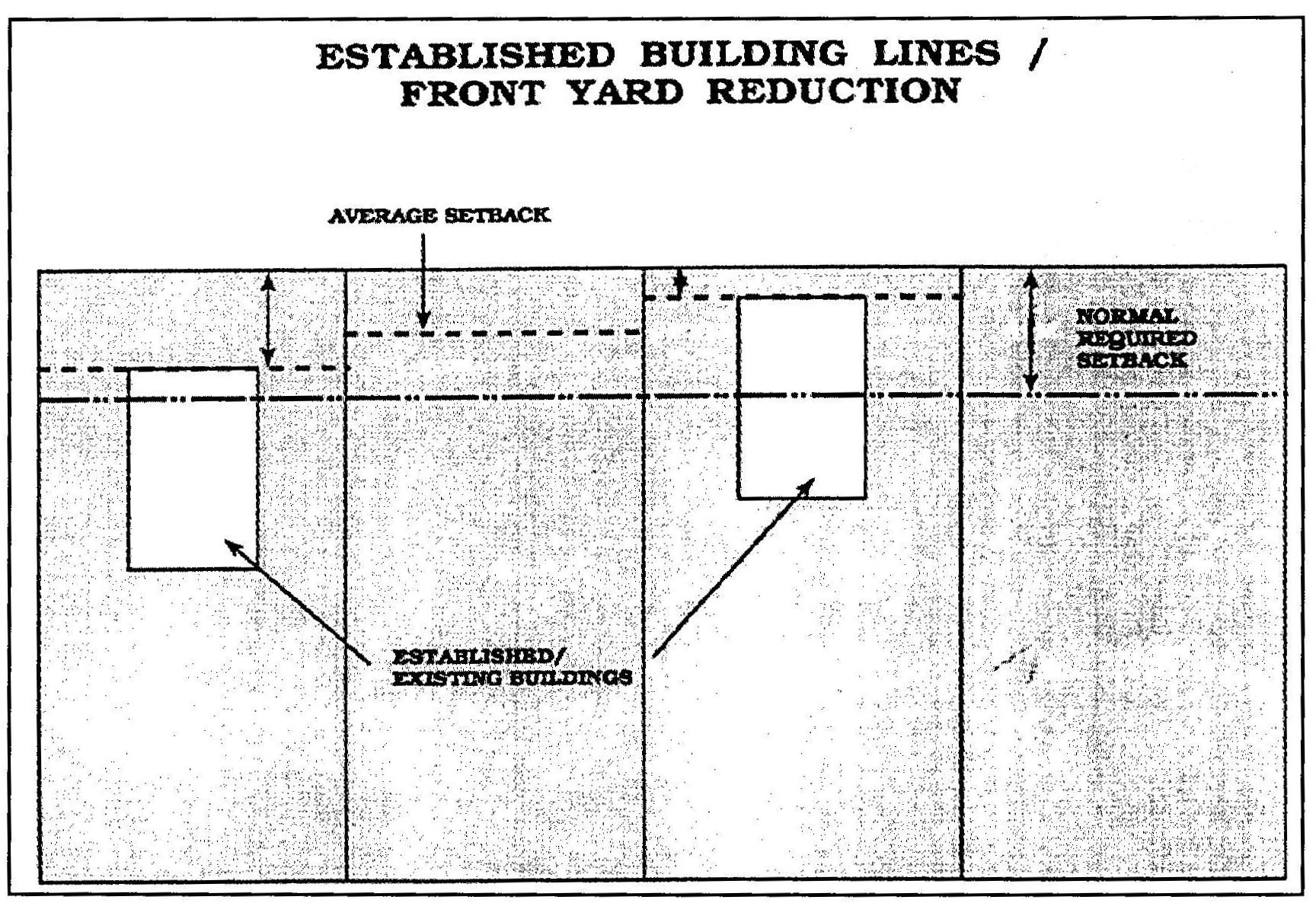
Established Building Lines
(4)
Height. The height limitations of this chapter shall not apply to the following (except in the AC, airport compatibility districts):
Such features shall be erected only to such height as is necessary to accomplish the purpose they are intended to serve and no height extension shall serve as a place for human habitation.
The height of communication towers and antennas, and water tanks, where permitted by Table II, also shall be exempt from the height requirements of this chapter; provided such structures shall be separated from any adjoining residential use by a distance equal to one foot for each one foot in height, measured from the property line.
(5)
Projections. The space in any required yard shall be open and unobstructed except for the ordinary projections of window sills, cornices, eaves, window air conditioning units, and other architectural features, provided that such features shall project no more than two feet into any required yard.
Steps and heating and cooling units may project into a required yard a distance not to exceed five feet but no closer than three feet of a property line. Fences, walls, and hedges may be erected in any required yard or setback area or along the edge of a property line, provided that no such structure or hedge shall impede visibility at intersections.
(Ord. No. 33-2006/07, § 7.2, 6-7-07)
Sec. 30-243. - Measurements.
(1)
Yards, setbacks, buildable area. The required front, side, and rear yards for individual lots, as set forth for by Table III shall be measured inward toward the center of said lot from all points along the respective front, side, and rear property lines of the lot. Once the yard areas of a given lot have been established, the remaining area of the lot which is not included in any required front, side, or rear lot shall be known as the "buildable" area within which the approved structure(s) shall be placed.
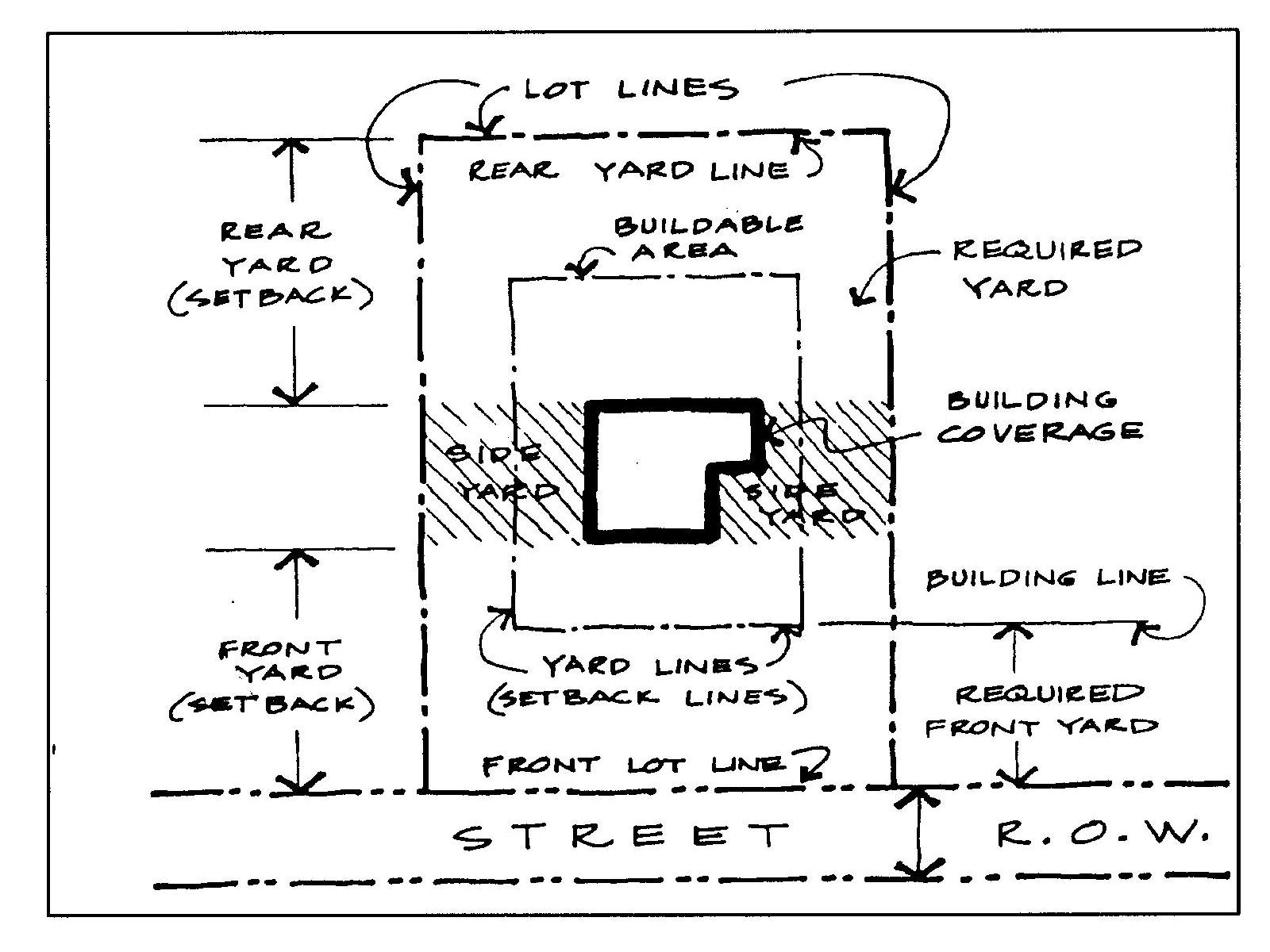
Buildable Area
(2)
Height. The height of a building or structure shall be measured from the average grade elevation within 20 feet of the structure or from the base of a tree when computing height in the several airport zones, to the highest point of the building, structure, or tree.
(Ord. No. 33-2006/07, § 7.3, 6-7-07)
Sec. 30-244. - Number of principal buildings/uses on a lot.
In all zoning districts, except in the rural districts and the townhouse and mixed-use districts, a limit of one single-family, patio home, modular home or manufactured dwelling is allowed to be located on an individual parcel of land. A limit of two of these residential structures (any combination) is allowed in the RU-1 and RU-2 districts. Multiple structures in the RU-1 and RU-2 districts shall meet all lot area and setback requirements of the district and also be placed on the parcel in such a way to meet all requirements as if both units were established on a single parcel. This arrangement will allow for public access if the parcel is subdivided in the future. Number of principle buildings permitted in the townhouse and mixed-use districts shall be determined by the requirements of section 30-80.5(b) of this chapter. Other than residential, there is no limit on the number of other principal uses on a single lot; provided such uses meet all applicable requirements of this chapter.
(Ord. No. 33-2006/07, § 7.4, 6-7-07; Ord. No. 19-2014/15, § 1, 3-19-15; Ord. No. 32-2024/25, § 1, 10-17-24)
Sec. 30-245. - Visibility at intersections.
On any corner lot in any district except the B-4, no planting shall be placed or maintained and no fence, building, wall, or other structure shall be constructed at any point between a height of two and a half feet and ten feet above the upper face of the nearest curb (or street center line if no curb exists) and within the triangular area bounded on two sides by the street right-of-way lines and on the third side by a straight line connecting points on the two street right-of-way lines as required by the site triangular and vertical vision clearance illustration. However, poles and support structures less than 12 inches in diameter may be permitted in such areas.
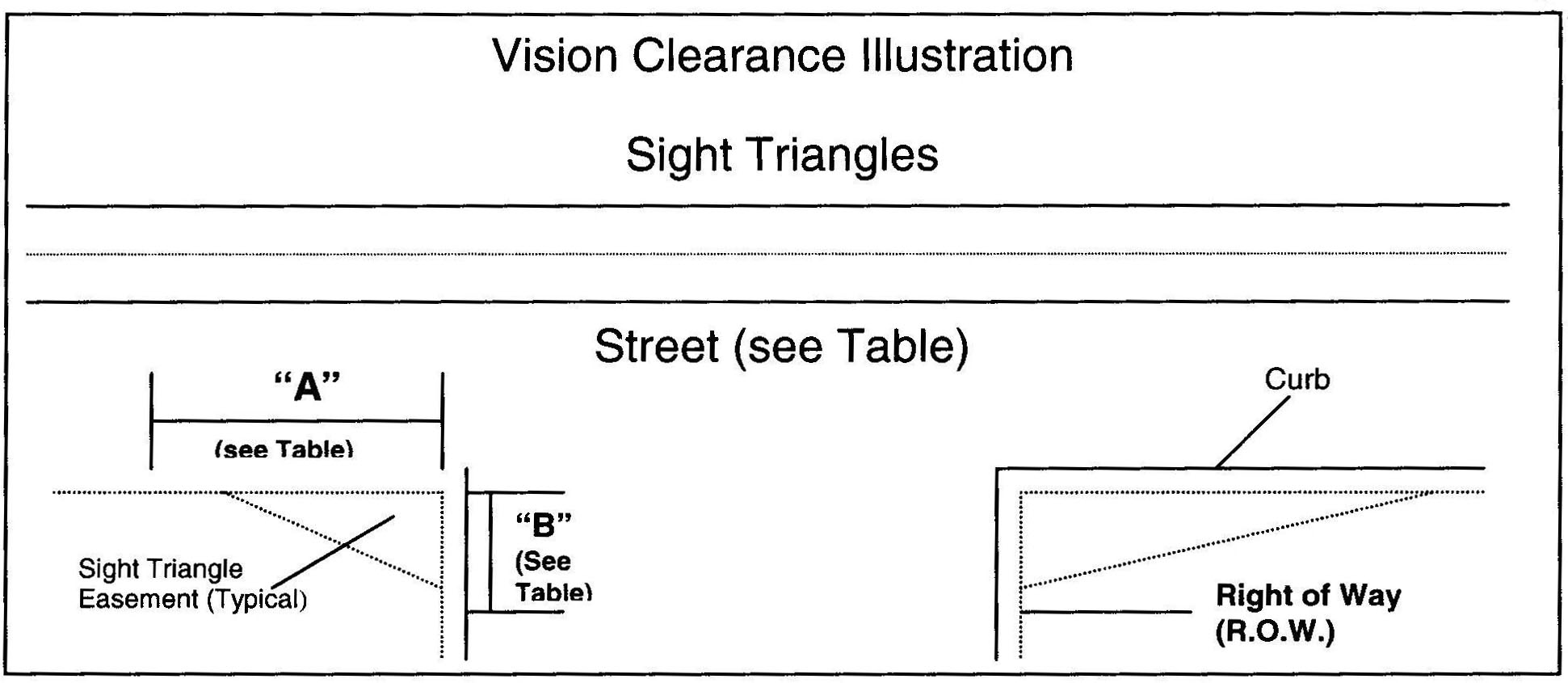
Vision Clearance Illustration
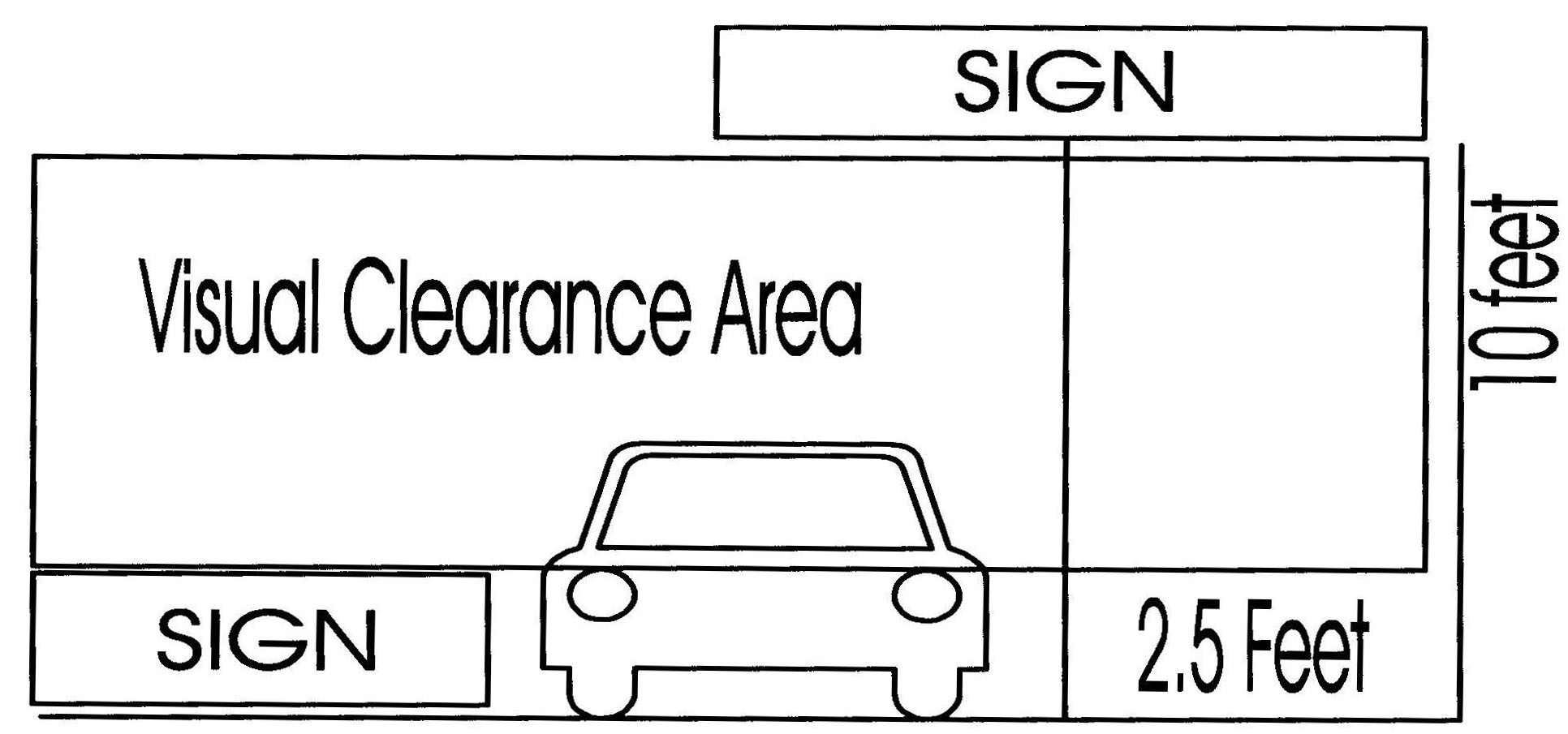
Visual Clearance Area
(Ord. No. 33-2006/07, § 7.5, 6-7-07)
Sec. 30-246. - Accessory buildings and uses.
Purpose. To establish the general rules for the placement of accessory structures and uses to a principal use on a parcel. As a general rule, all accessory structures and uses shall only be placed in side or rear yards. Any exception to this rule shall be spelled out in detail below.
(1)
Accessory structures and uses to observe required setbacks. Unless specifically provided herein, all accessory uses and structures shall observe all required setbacks, yard, and other requirements applicable to the principal building or use for the district within which they are located.
(2)
General requirements.
a.
Residential districts:
1.
The number of accessory structures are as outlined in Table II.
2.
The combined gross floor area (GFA) of all accessory structures is outlined in Table I.
3.
The height of accessory buildings shall not exceed 30 feet.
4.
No mobile home or standard design manufactured home shall be used as an accessory building.
5.
Setbacks are as outlined in Table II.
6.
Unless otherwise permitted in this section, accessory structures and uses shall only be placed in side or rear yards.
Table I. Maximum Floor Area
Table II. Maximum Number of Structures
b.
All other zoned districts:
1.
There is no limit to the number of accessory buildings however such buildings shall occupy no more than 30 percent of the total lot area.
2.
If located within the buildable area, accessory buildings shall observe the height limits for the district within which they are located. If located in a required setback area, said buildings shall not exceed 20 feet in height.
3.
Accessory structures and uses may be allowed up to three feet of a side or rear property line, except where contiguous to a residential zone, in which case the accessory use shall observe the setback requirement of the principal use.
4.
Residential use properties which are applicable to R-1, R-2, and R-3, located within business zoning districts, shall adhere to the following requirements: section 30-98, section 30-246(1), (2), section 30-228, and section 30-229(1), (2), (3) irrespective of use.
5.
Unless otherwise permitted in this section, accessory structures and uses shall only be placed in side or rear yards.
(3)
Location. Without exception, no accessory use, building, or structure shall be located in a required buffer area. Front yard as established by the above section shall also include secondary front yards. Unzoned areas of Florence County shall observe the setbacks for all other uses as established in section 30-111 of this chapter. Accessory buildings and uses are permitted anywhere within the buildable area of a lot or parcel unless specifically regulated, and are permitted within required yards and setback areas under the following conditions:
a.
Off-street parking and loading space. Off-street parking and loading spaces are permitted in required yards and setback areas in accordance with article VI of this chapter.
b.
Freestanding signs. Freestanding signs shall meet the requirements of article V of this chapter.
c.
Buildings, sheds, and structures for dry storage; greenhouses. Building sheds and structures for dry storage and greenhouses may be located in rear yard setback areas only, but no closer than three feet to the property line.
d.
Domestic animal shelters and pens. Domestic animal shelters and pens may be located in rear yard setback areas only, but no closer than ten feet from any side or rear residential property line.
e.
Swimming pools, tennis courts, recreational uses. These uses may be located in required rear yard and setback areas only; provided said uses shall be no closer than ten feet to the nearest property line, and shall have all lighting shielded or directed away from adjoining residences.
f.
Ground supported communication and reception antennas. These uses may be located in required rear and side yards only, but no closer than five feel to the property line, and if located in the buildable area shall not extend or be located in front of any principal building.
g.
Fences and walls. May be located in all required yards and along any property line. Fences and walls exceeding eight feet in height require a variance from the board of zoning appeals.
h.
[Accessory uses.] Accessory uses (not buildings) may be located in the front yard of business and rural zoning districts and unzoned areas with the following requirements:
1.
Uses with a total foot print of 12 square feet or less may be within ten feet of the front property line and three feet of the side property line provided they do not interfere with the site triangle requirements.
2.
Uses with a total foot print between 12 square feet and 30 square feet may be located within 20 feet of the front property line and three feet of the side property line provided they do not interfere with the site triangle requirements.
3.
Uses greater than 30 square feet or those listed above requiring a smaller setback shall be treated as a special exception before the board of zoning appeals.
(4)
Donation receptacles.
a.
Definition. Donation receptacle means any unattended container, box or similar device that is used for soliciting and collecting donations, including but not limited to, clothing, footwear, books, and salvageable household goods.
b.
Conditions for placement of donation receptacle. Any donation receptacle located on any property within the unincorporated area of Florence County must comply with the following regulations:
1.
Donation receptacles shall either be placed along the side or rear of any property and shall meet the required setback for that Zoning District as set forth in the Florence County Code of Ordinances. The donation receptacle shall be situated on the property so as not to interfere with sight-triangles or on-site circulation, or any bufferyards, landscaping, parking, or other elements of the design of a site that are required pursuant to the Florence County Code of Ordinances or that may have been imposed as part of the site plan approval or the premises. Donation receptacles shall not be allowed in any residential or agricultural zoning district, except on properties where a special use permit exists for a place of worship or assembly.
2.
Donation receptacles shall not be placed within a designated parking space.
3.
Donation receptacles shall not be placed in such a manner as to cause an obstruction for pedestrians or motorists. Donation receptacles should not be located in public rights-of-way, required building setbacks, landscape areas, drive aisles, required parking spaces, fire lanes, loading zones, buffers or any other location that may cause hazardous conditions, constitute a threat to public safety, or create a condition detrimental to surrounding land uses.
4.
Only one donation receptacle shall be permitted per lot and shall only be permitted on properties after the donation receptacle owner has completed a placement permit with Florence County. Each placement permit requires a separate placement permit for every donation receptacle placed within the County. Each placement permit will carry a $100.00 fee.
i.
Written permission, from the property owner, stating the allowance of a donation receptacle and placement in an area determined by a property owner/lessor and shown on a property layout plan and submitted with application for a placement permit.
ii.
The permit shall be valid for up to one year. Yearly re-application of any placement permit for a receptacle donation box will be contingent on the above conditions, including the $100.00 fee and written permission from the current property owner.
iii.
A permit is not required if the bin is located on the premises of the sponsoring organization.
iv.
With approval of the County Administrator, the $100.00 fee may be waived if the sponsoring organization is a non-profit organization.
5.
Donation receptacle shall not exceed 6 ½ feet in height, 8 feet in length and 10 feet in width.
6.
Signage on donation receptacles should be no less than 5" letter height. Each donation receptacle must provide one of the following, (i) this bin is for donations for a for-profit organization and may not be tax deductible or (ii) this bin is for donations to a non-profit organization and may be tax deductible. These notices shall be on the front of each bin, which has a visually identifiable slot/chute.
7.
The following information must be clearly and conspicuously displayed on the front and side exterior of the donation receptacle: the name and address of the property owner who owns the donation receptacle and the name of any entity which may share, profit, or benefit from any donations collected via the donation receptacle. Upon failure to provide the required information as set forth herein, the receptacle shall be removed by the County. Prior to removal a notice shall be placed on the receptacle advising that it will be removed and disposed of by the County ten days from the date of the notice.
8.
Donation receptacles shall be maintained in good condition and appearance with no structural damage, holes, or visible rust, and shall be keep free of graffiti. All donation receptacles shall be free of debris and shall be serviced regularly so as to prevent overflow of donations or the accumulation of junk, debris, or other material. All donation receptacles must be securely locked to prevent unauthorized individuals from being able to open or enter the donation receptacle.
c.
Notice of violation and fine. In the event that any property within the County of Florence has upon it any donation receptacle that violates the provisions of this Article, the owner of such donation receptacle shall be served with written notice of the violation and, in the event that the violation is not corrected within 30 days of service of such notice, the owner of such donation receptacle shall be issued a uniform ordinance summons. Notice of the violation shall be served upon the owners of the donation receptacle, at the owner's last known address, by first class mail, postage pre-paid, or served personally by an official of the County. The written notice shall include a detailed description of the violation(s) located on the property. Upon conviction a violator may be fined $200.00 per day and/or 30 days in jail. The notice shall also provide that upon failure to correct the violation the receptacle will be removed and disposed of by the County ten days from the end of the thirty day period. Prior to removal a notice shall be placed on the receptacle advising that it will be removed and disposed of by the County ten days from the date of the notice.
(Ord. No. 33-2006/07, § 7.6, 6-7-07; Ord. No. 26-2008/09, § 4, 6-4-09; Ord. No. 28-2008/09, § 1, 8-20-09; Ord. No. 34-2015/16, § 1, 8-18-16; Ord. No. 07-2016/17, § 1, 4-20-17; Ord. No. 14-2023/24, § 1, 10-19-23; Ord. No. 33-2024/25, § 1, 10-17-24)
Sec. 30-247. - Access to property.
(1)
Street access. Except as herein provided, no building shall hereafter be erected, constructed, moved, or relocated on a lot not located on a publicly dedicated, publicly accepted or maintained street, or private street as part of an approved PD, or easement which meets all standards of land subdivision. The access point shall be not less than 20 feet wide, measured at the street line and extending to the principal part of the lot.
(2)
Curb cuts. Ingress-egress openings in concrete, asphalt, rock, or other street curbing provisions, commonly referred to as "curb cuts" shall be regulated in accord with specifications by the South Carolina Department of Transportation.
(3)
Access to commercial and industrial zoned property prohibited from residential zones. Where a commercial or industrial zoning district is bounded by a residential zoning district, access to such industrial or commercial properties, including off-street parking and loading areas shall be restricted to streets and alleys within the respective commercial or industrial districts in which such uses are located; and no commercial or industrial vehicles or parking in connection with an industrial or commercial use shall occupy a public street or right-of-way separating commercial or industrial districts from residential districts.
(Ord. No. 33-2006/07, § 7.7, 6-7-07; Ord. No. 27-2008/09, § 3, 6-4-09)
Sec. 30-248. - Conversion of residential property.
When the conversion of a house to a commercial use is proposed, the house shall be made to meet all applicable codes for commercial buildings. Where a house will be used for a dwelling and a commercial use, that section of the house that will be open to the public shall meet all requirements for a commercial building.
All parking, landscaping, buffering, and other requirements of this ordinance for a commercial use shall be met.
(Ord. No. 33-2006/07, § 7.8, 6-7-07)
Sec. 30-249. - Nonconformities.
(a)
Continuation. Nonconforming uses, buildings, or structures are declared by this section to be incompatible with permitted construction in the districts in which they are located.
However, to avoid undue hardship, the lawful use of any such use, building, or structure at the time of the enactment, amendment, or revision of this section may be continued even though such structure does not conform with the provisions of this section.
(b)
Modification. A proposed change or modification to a nonconforming use shall be governed by the following:
(1)
Change of nonconforming use. If a change from one nonconforming use to another is proposed and no structural alterations are involved, the change may be permitted, provided:
a.
Nonconformity of dimensional restrictions such as height, density, setbacks, or other requirements such as off-street parking shall not be increased; and
b.
The proposed change will have little discernable impact over the existing nonconforming use.
If a change to a permitted use is proposed which is nonconforming only as to dimensional restrictions such as height, density, setbacks, or other requirements such as off-street parking, the change may be permitted, provided that all applicable requirements that can be reasonably complied with are met.
Compliance with a requirement is not reasonably possible if it cannot be achieved without adding land to the lot of the nonconforming use or moving the use if it is on a permanent foundation.
Whenever a nonconforming use of land or building has been changed to a more restricted use or to a conforming use, such use shall not thereafter be changed back to a less restricted or nonconforming use.
(2)
Enlargement or expansion of nonconforming use. Enlargement or expansion of a nonconforming building, use, or structure by no more than ten percent shall be permitted; provided such enlargement shall meet all applicable setbacks, buffer area, and off-street parking requirements.
(3)
Repair or alteration of nonconforming use, building, or structure. The repair or alteration of a nonconforming use shall in no way increase the nonconformity of said use, except as otherwise permitted by subsection (2) above.
(4)
Replacement of nonconforming use. A building permit for the replacement of a nonconforming building or structure where damaged or destroyed must be initiated within 18 months of the time of the damage or destruction or forfeit the right of replacement. Replacement, if initiated within 18 months of the time of damage or destruction shall adhere to all applicable requirements of Table III.
Replacement of a nonconforming mobile or manufactured home once removed from a lot or parcel shall be accomplished within 18 months of removal or forfeit nonconforming status, and if replaced shall not infringe on established setbacks, and shall meet in full the requirements of section 30-94 of this chapter. The applicant for a zoning compliance under this section must provide planning department staff with a notarized letter stating that the replacement is occurring within 18 months of the previous home being removed.
Existing outdoor advertising structure owners may apply for rebuilding permits for legal, nonconforming structures that are constructed by means other than the single steel pole structural design, as required by this section. The sign face square footage must remain the same as the existing sign face. If removed, a nonconforming sign structure shall not be replaced.
(5)
Reuse of vacant nonconforming commercial buildings. Existing vacant buildings in residential zones, previously occupied by and structurally designed for commercial usage may be renovated and reoccupied under the following conditions:
a.
All off-street parking requirements associated with the new occupant (use) shall be met on site;
b.
Buffer area requirements of article IV, division 2 shall be met;
c.
The reoccupied use shall be permitted in the B-1 and/or B-2 and/or B-3 zone districts;
d.
There is no encroachment into existing side, rear, or front yard setbacks.
(6)
Nonconforming signs. A nonconforming permanent sign which was in place at the adoption of this section may remain in place and be maintained indefinitely as a legal nonconforming sign subject to compliance with the following:
a.
Normal maintenance of such sign shall be allowed including changing of copy, structural repairs, repainting or electrical repairs, and incidental alterations which do not increase the degree or extent of the nonconformity.
b.
No structural alteration, enlargement, or extension of such sign including additional lighting shall be allowed.
c.
No relocation of sign structure except in strict compliance with this section.
d.
If a sign is damaged or is in need of repairs for any reason, which the materials required to make the repair cost more than 60 percent of the cost of replacing the sign, then the sign cannot be repaired and must be removed or brought into compliance with this section.
(c)
Discontinuance. Except as provided in section 30-249(b)(5), no building or portion thereof used in whole or in part for a nonconforming use which remains idle or unused for a continuous period of 18 months, whether or not the equipment or fixtures are removed, shall again be used except in conformity with the regulations of the district in which such building or land is located. In the case of a nonconforming commercial use, a valid business license or other governmental agency licenses must have been issued to the use and particular property within the last 18 months and cannot have been revoked by the governing authority.
(d)
Lot of record. Where the owner of a lot at the time of the adoption of this chapter does not own sufficient land to enable him to conform to the setback requirements of this section, such lot may nonetheless be used as a building site provided applicable setback requirements are not reduced by more than 25 percent. Setback reductions greater than 25 percent shall be referred to the board of zoning appeals for consideration. If, however, the owner of two or more adjoining lots with insufficient land dimensions decides to build on or sell off these lots, they must first be combined to comply with the dimensional requirements of this chapter.
(Ord. No. 33-2006/07, § 7.9, 6-7-07; Ord. No. 25-2009/10, § 3, 2-18-10; Ord. No. 26-2022/23, § 1, 11-17-22)
Sec. 30-250. - Bars, nightclubs, massage parlors, adult bookstores adult theaters.
(1)
Intent. There are some uses that, because of their very nature, are recognized as having serious objectionable characteristics, particularly when several of them are concentrated under certain circumstances or located in certain areas thereby having a deleterious effect upon the adjacent area. Special regulation of these uses is necessary to ensure that their adverse effects will not contribute to the blighting or downgrading of the surrounding neighborhood. The control or regulation is for the purpose of preventing a concentration of these uses in any one area and to prevent the location of these uses in certain areas.
(2)
Locational requirements. No adult bookstore, adult motion picture theater, adult mini-motion picture theater, adult drive-in motion picture theater, massage parlor or similar establishment shall be located within 1,000 feet of any school, public, or private park, church, or residential area, within Florence County, or within 1,000 feet of any such other such establishment.
A 500-foot minimum linear distance must be maintained between bars, nightclubs, and similar onsite consumption establishments in which greater than fifty percent of the revenues are from the sale of alcohol. Restaurants that primarily serve food do not fall under this requirement.
(3)
Variances. Variances from the locational requirements may be granted by the board of zoning appeals.
(Ord. No. 33-2006/07, § 7.10, 6-7-07)

