LANDSCAPING STANDARDS
The purpose of this article is to establish landscaping requirements and other regulations intended to preserve and maintain vegetation within in a manner that promotes the natural resource protection, aesthetic, and public health goals of the village.
(Ord. No. 090412-02, § 1, 9-4-2012)
Any use for which site plan approval is required under section 18-245 shall provide landscaping in accordance with the regulations of this section, including expansions of existing buildings. Where insufficient site area remains to comply with all provisions of this section, the village may require compliance to the extent practical. Single-family and agricultural land uses are exempt from landscaping requirements.
(Ord. No. 090412-02, § 1, 9-4-2012)
Landscaping shall be provided based on the following requirements for building foundations, street frontages, paved areas, general yard areas and bufferyards. These requirements are additive to each other and any other landscaping or screening requirements in this chapter. Credit for existing landscape plantings that are retained and protected with the development of the site, and for restoration or re-establishment of native flora, shall be allowed. In calculating the number of required landscaping points under the provisions of this section, all areas and distances on which required calculations are based shall be rounded up to the nearest whole number of square feet or linear feet. Any partial plant derived from the required calculations of this section (for example: 23.3 canopy trees) shall be rounded up to the nearest whole plant (for example: 24 canopy trees).
(1)
Building foundations.
a.
For each 100 feet of building foundation perimeter, the landscaping installed shall at a minimum meet the number of landscaping points specified in Figure 18-172(a).
b.
Foundation landscaping shall be placed so that at maturity, the plant's drip line is located within ten feet of the building foundation. Such landscaping shall not be located in areas required for street frontage, paved areas, general yard areas, bufferyards, or other green space areas.
c.
Climax trees and tall trees shall not be used to meet the foundation landscaping requirement.
d.
If the officially approved site plan depicts a future building extension, the foundation landscaping requirement shall be calculated by measuring the length of the total perimeter of the building, including extension. However, foundation plantings need only be installed for portion of the building for which a building permit has been issued.
(2)
Street frontages.
a.
For every 100 linear feet of street frontage of a developed lot abutting a public street right-of-way, the landscaping installed shall at a minimum meet the number of landscaping points specified in Figure 18-172(a).
b.
All landscaping used to meet street frontage requirements shall be located within ten feet of the public right-of-way. Under no circumstances shall such landscaping be located within a public right-of-way. Landscaping shall not impede vehicle or pedestrian visibility.
c.
Shrubs shall not be used to meet street frontage landscaping requirements. A minimum of 50 percent of all points shall be devoted to climax or tall trees, or a combination of such trees, and a minimum of 30 percent of all points shall be devoted to medium trees.
(3)
Paved areas.
a.
For every 20 off-street parking stalls or 10,000 square feet of pavement (whichever yields the greater landscaping requirement), landscaping shall at a minimum meet the number of landscaping points specified in Figure 18-172(a).
b.
Landscaping shall be located within ten feet of the paved area. Said area does not have to be provided in one contiguous area. Plants used to fulfill this requirement shall visually screen parking, loading and circulation areas from view from public streets.
c.
A minimum of 30 percent of all points shall be devoted to climax or tall trees, or a combination of such trees, and a minimum of 40 percent of all points shall be devoted to shrubs.
d.
Parking lot design.
1.
Landscaped medians shall be used to break large parking areas into distinct pods, with a maximum of 100 spaces in any one pod.
2.
Parking spaces must be broken by a tree island at the rate of one island for each linear row of 12 parking spaces for single-row or peninsula configurations, or for each 24 parking spaces in double-row configurations.
3.
All tree islands and landscaped areas with trees shall have a minimum of nine feet as measured from outside the curb or frame.
4.
All landscaped areas without trees, but planted with shrubs, shall have a minimum width of three feet measured from inside the curb or frame.
(4)
General yard areas. An additional 200 landscaping points shall be provided for each acre of total lot or development area. Landscaping required by this standard shall be placed where appropriate on the site, but generally in those areas not covered by other provisions of this section.
(5)
Bufferyards. A bufferyard is a combination of distance and a visual buffer or barrier. It includes an area, together with the combination of plantings, berms and fencing that are required to eliminate or reduce existing or potential nuisances (e.g., dirt, litter, noise, glare, signs, and incompatible land uses, buildings, or parking areas).
a.
The required level of bufferyard opacity is listed in Figure 18-172(b). Detailed bufferyard requirements are listed in Figure 18-172(c). Opacity is a quantitatively-derived measure which indicates the degree to which a particular bufferyard screens the adjoining property. The required level of opacity indicated is directly related to the degree to which the potential character of development differs between different zoning districts.
b.
Bufferyards shall be located along (and within) the outer perimeter of a lot wherever two different zoning districts abut one another. Bufferyards shall not be required in front yards.
(6)
Other green space areas. Green space areas not used for landscape plantings other than natural resource protection areas shall be graded and seeded or sodded with an acceptable maintainable seed mix, restored to native vegetation, or maintained in crop production if approved by the plan commission. Mulch of plantings or planting beds is acceptable provided that such mulching consists of organic or natural materials. Mulches shall be installed so that they will not erode, fall, be plowed or otherwise transported into walks, drives, streets or other hard surfaced portions of the site.
(7)
Natural resource protection areas. Landscaping in required natural resource protection areas, including those related to floodplains, wetlands, shorelands, woodlands, and wellhead protection areas, shall be prohibited, except for restorative planting and maintenance necessary to maintain native plantings in their natural state.
(8)
Permeable surface allowed.
a.
A permeable surface for use such as for driveways or patio areas or other similar paved areas shall be permitted as an exception to the calculation of impervious surface for purposes of the definition at section 18-13 and the impervious surface ratio set forth in sections 18-13, 18-245 and each of the limits on impervious surface ratios set forth in individual zoning districts, subject to the remaining requirements of this section.
b.
Subject to the limit set forth herein at subsection 18-172(8)c, in order to not be counted as an impervious surface per section 18-13, the permeable surface shall be designed and engineered and thereafter maintained so as to allow water from any source to pass through the permeable surface to and into the ground beneath the paved surface. A zoning permit shall be obtained before installation of said permeable surface by submitting an application, the engineering drawings for the proposed permeable surface installation, a proposed maintenance plan, together with an application fee as determined by the village board from time to time and a cost recovery certificate. The village engineer may be asked to render an opinion as to the applied for paving and permit.
c.
The permeable paver exception to the calculation of impervious surface as set forth herein shall be limited to the lesser of 2,500 square feet or 15 percent of the lot area.
d.
If approved and thereafter installed, said permeable surface shall be maintained as necessary, and according to the approved maintenance plan, in order to maintain the current and uninterrupted functionality of the permeable surface, but not less than every five years. The village engineer may be asked to render an opinion as to the adequacy of the maintenance. Proof of said required maintenance shall be provided as requested by the Village of Fontana.
Figure 18-172(a): Landscaping Requirements*
Figure 18-172(b): Required bufferyard opacity values
Figure 18-172(c): Detailed Bufferyard Requirements
Figure 18-172(d): Landscaping Points
(Ord. No. 090412-02, § 1, 9-4-2012; Ord. No. 12-09-19-02, § 2, 12-9-2019)
Species suitable for landscaping and compatible with local climate and soil factors are listed in Figure 18-173(a). However, this list is not intended to be exhaustive, and the zoning administrator shall review proposals for the applicability of species not listed and is authorized to approve appropriate similar species. See Figure 18-173(b) for species appropriate for specific and common landscaping situations (e.g., planting under power lines), and Figure 18-173(c) for a list of species to use sparingly or to avoid.
Figure 18-173(a): Common Appropriate Landscaping Species
Figure 18-173(b): Plant Species Appropriate for Specific Situations
Figure 18-173(c): Species to Use Sparingly or to Avoid
(Ord. No. 090412-02, § 1, 9-4-2012)
(a)
Rain gardens and bio-swales can serve both as landscaping and stormwater management features on a building site, where appropriately designed and sited. A rain garden is a shallow, depressed garden that is designed and positioned on a site to capture stormwater runoff and allow for the infiltration of water back into the ground. Rain garden plants are carefully chosen for their ability to withstand moisture extremes and potentially high concentrations of nutrients and sediments that are often found in stormwater runoff. A well designed and maintained rain garden serves as an attractive component of an overall landscaping plan for a development site.
(b)
A bio-swale is a linear, vegetative stormwater runoff conveyance system that is designed to store and infiltrate water from small storm events back into the ground and direct water from heavy rain events to appropriate storm sewer inlets or other management facilities. The flow of water being conveyed through a bio-swale is slowed down, allowing for municipal storm systems to more effectively manage heavier rain events and help reduce the risk of flooding on- or off-site. Water being infiltrated or conveyed via a bio-swale is also filtered by the vegetation within it, generally improving both ground and surface water quality.
(c)
The installation of a rain garden or bio-swale may contribute to the overall stormwater management plan for a development site and count toward meeting the village's landscaping guidelines. Raingardens may count for 20 points for every 20 square feet, provided the following requirements are met:
(1)
Detailed plans shall be provided that show all proposed dimensions of the rain garden or bio-swale including length, width, depth, and slope of depression; location of the rain garden or bio-swale on the lot relative to hard-surfaced areas, downspouts, and site topography; characteristics of the soil underlying the rain garden or bio-swale; description of planting media; the species, number, and size at time of installation of all vegetation proposed for the rain garden or bio-swale; and information on any other materials (e.g., rocks) that will be used to line the rain garden or bio-swale.
(2)
Installation shall not be proposed for any of the following areas of a site:
a.
Areas where there is known soil contamination unless the rain garden or bio-swale is proposed to be constructed with an underdrain;
b.
Areas where the characteristics of the soil would not allow for the proper infiltration of water into the ground; or
c.
Areas where there are expected to be high levels of foot traffic.
(3)
The owner of the site shall demonstrate that the rain garden or bio-swale shall be properly maintained; kept free of trash, weeds, debris, and dead or dying plants; any pipes associated with the rain garden or bio-swale will be inspected on an annual basis and kept free of debris; and by the beginning of every spring dead plant materials will be cut back or removed.
(4)
Bio-swales and rain gardens shall be generously (and appropriately) vegetated to qualify for landscaping points. Bio-swales and rain gardens (or portions thereof) that are lined with turf and/or rocks but do not include other vegetation will not count toward meeting landscaping point requirements.
(5)
Rain gardens and bio-swales may serve as a component of an overall stormwater management plan for a site only if detailed plans, calculations, and specifications are submitted. Detailed plans shall include the location and description of all other stormwater management facilities serving the site, particularly those to which any bio-swale will be directed.
(Ord. No. 090412-02, § 1, 9-4-2012)
(a)
Installation. Any and all landscaping and bufferyard material required by the provisions of this chapter shall be installed on the subject property, in accordance with the approved site plan within 365 days of the issuance of an occupancy permit for any building on the subject property, unless a conditional use is approved to allow for greater than 365 days.
(b)
Surety.
(1)
If the subject property is to be occupied prior to the installation of all required landscaping and bufferyard material, the property owner shall sign an instrument agreeing to install the landscaping within the 730-day period and shall furnish to the village an irrevocable letter of credit or other form of security acceptable to the village sufficient to guarantee completion of the work. Such security shall be provided by the property owner at the time that the agreement is signed. It shall be in an amount equal to 110 percent of the estimated actual cost for all of the required elements of the approved site plan and shall specifically guarantee that all such elements shall be made and installed according to the approved site plan. The costs of the work shall be furnished by the property [owner] and shall be verified by the village. The financial security shall remain in force until all of the work has been completed and approved by the village. This agreement shall also contain a statement indicating that the property owner's failure to comply with the requirements of the terms of the agreement will constitute a violation of the chapter and subject the property owner to a forfeiture upon conviction.
(2)
If the required landscaping and bufferyard materials are to be installed during different phases of a subdivision development, the developer may furnish for each phase financial security in an amount sufficient to guarantee completion of the landscaping and bufferyard work performed during a particular phase, unless the land division regulations requires otherwise.
(3)
If the property owner is a governmental unit, it may, in lieu of signing an agreement and furnishing a guarantee and file a resolution or letter from officers authorized to act in its behalf, agreeing to comply with the provisions of this article.
(c)
If existing plant material meets the requirements of this article and will be preserved on the subject property following the completion of development, it may be counted as contributing to the landscaping requirements.
(d)
All landscaping and bufferyard areas shall be seeded with lawn or native groundcover unless such vegetation is already fully established.
(e)
The exact placement of plants and structures shall be depicted on the required detailed landscaping plan submitted to the village for its approval. Such plant and structure location shall be the decision of each property owner provided the following requirements are met:
(1)
Evergreen shrubs shall be planted in clusters to maximize their chance for survival.
(2)
Where a combination of plant materials, berming, and fencing is used in a bufferyard, the fence and/or berm shall be located toward the interior of the subject property and the plant material shall be located toward the exterior of the subject property.
(3)
A property owner may establish through a written agreement, recorded with the register of deeds, that an adjacent property owner agrees to provide on the immediately adjacent portion of his or her land a partial or full portion of the required bufferyard, thereby relieving the developer of the responsibility of providing the entire bufferyard on his property.
(4)
Under no circumstance shall landscaping or bufferyard materials be selected or located in a manner resulting in the creation of a safety or visibility hazard.
(5)
The restrictions on types of plants listed in this article shall apply.
(f)
Maintenance. The continual maintenance of all required landscaping and bufferyard materials shall be a requirement of this chapter and shall be the responsibility of the owner of the property on which said materials and plants are required. This requirement shall run with the property and shall be binding upon all future property owners. Development of any or all property following the effective date of this chapter shall constitute an agreement by the property owner to comply with the provisions of this section. If the property owner fails to comply with these provisions, the village may enter upon the property for the purpose of evaluating and maintaining all required landscaping and bufferyard materials, and may specially assess the costs thereof against the property. A property owner's failure to comply with this requirement shall also be considered a violation of this chapter, and shall be subject to any and all applicable enforcement procedures and penalties.
(g)
Use of required bufferyard and landscaped areas. Any and all required bufferyards or landscaped areas may be used for passive recreation activities. Said areas may contain pedestrian, bike or equestrian trails provided that no required material is eliminated; the total width of the required bufferyard, or the total area of required landscaping, is maintained; and all other regulations of this chapter are met. However, in such areas, no swimming pools, tennis courts, sports fields, golf courses, or other such similar active recreational uses. No parking and no outdoor display of storage of materials shall be permitted. Paving in such areas shall be limited to that required for necessary access to, through, or across the subject property.
(h)
Utility easements. Landscaping materials, fences and berms located within a duly recorded utility or a pedestrian easement shall not count toward meeting a landscaping requirement, unless authorized otherwise by a conditional use permit. However, the width of such areas may be counted as part of a landscaping requirement.
(Ord. No. 090412-02, § 1, 9-4-2012)
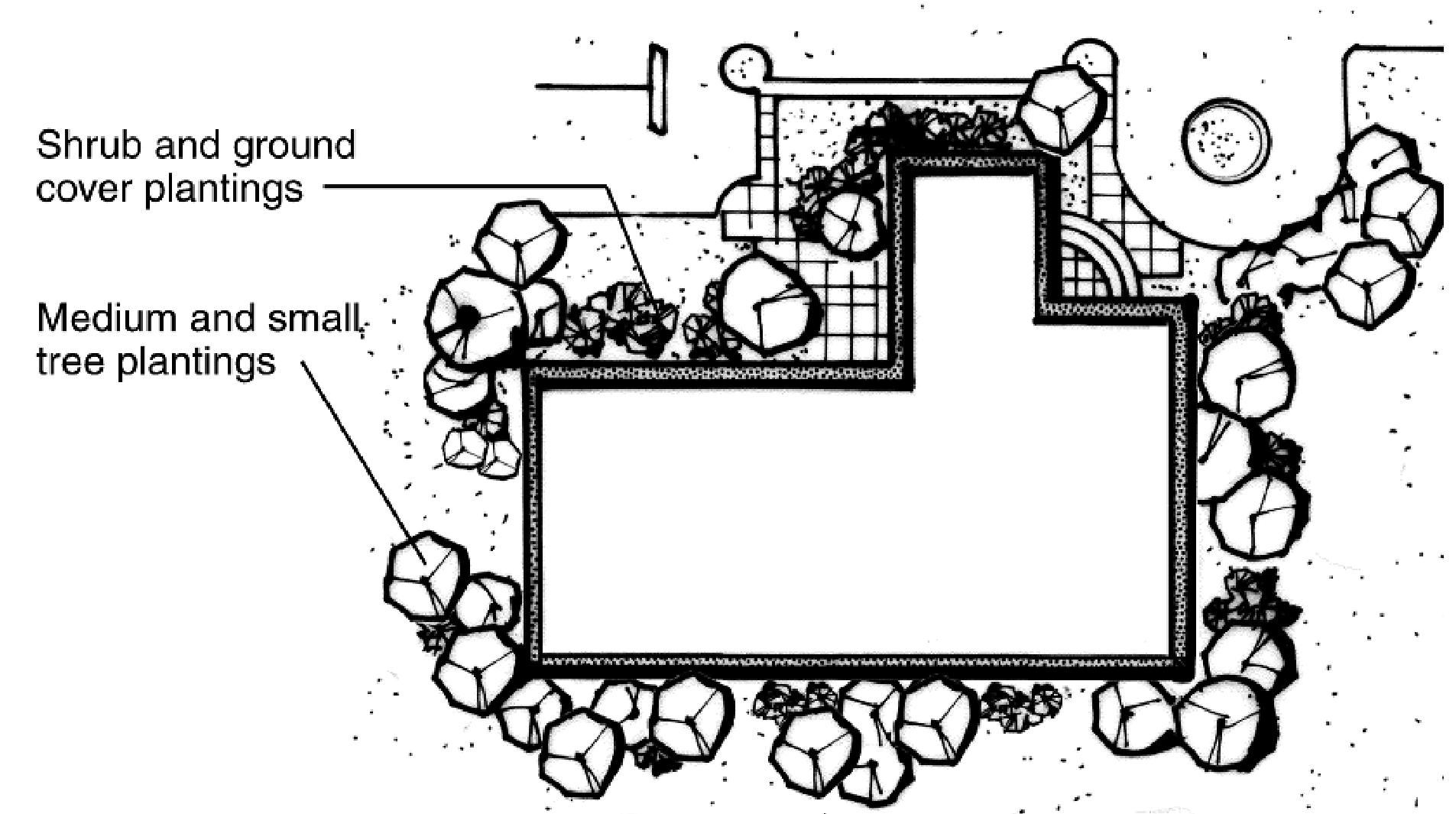
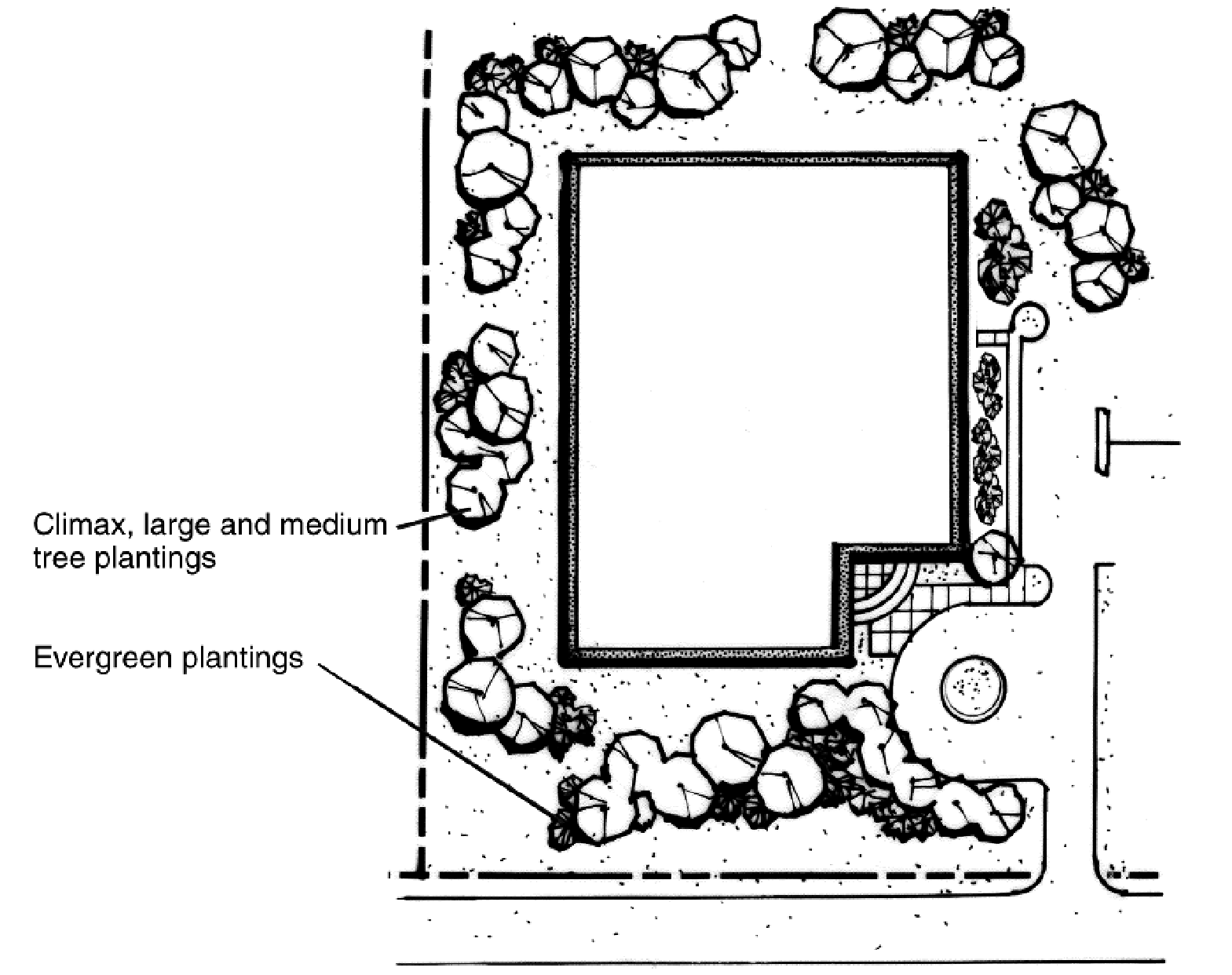
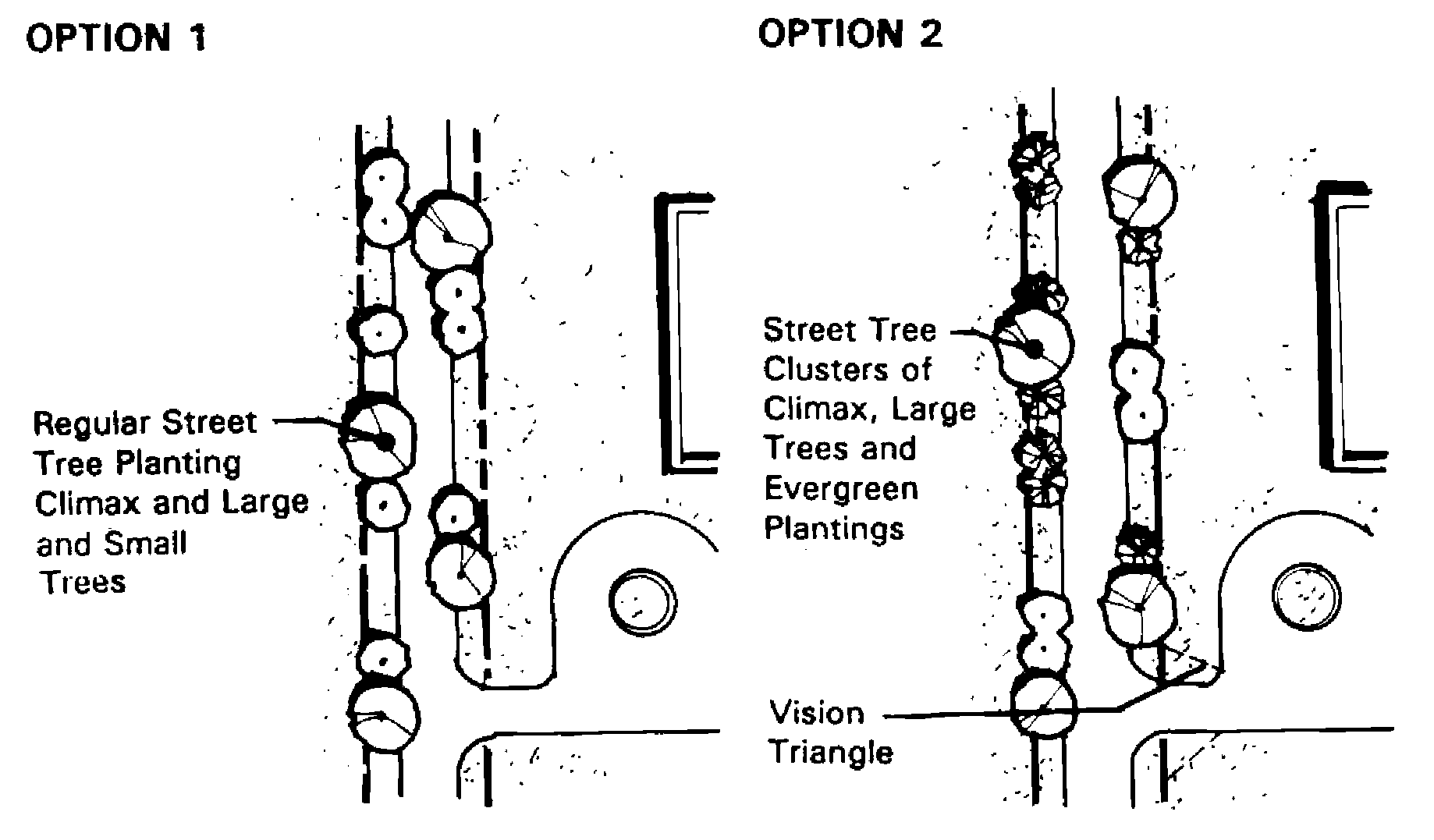
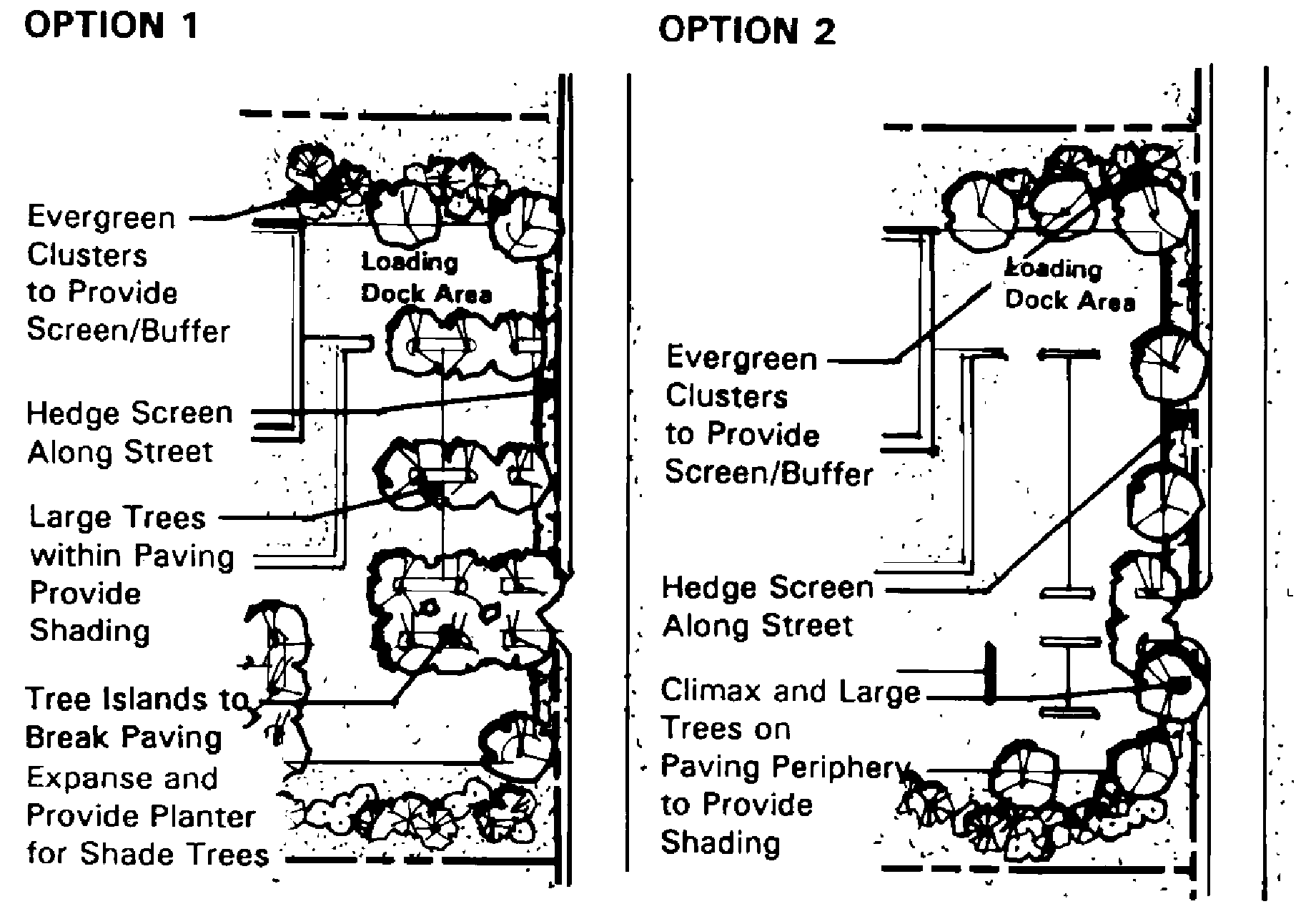
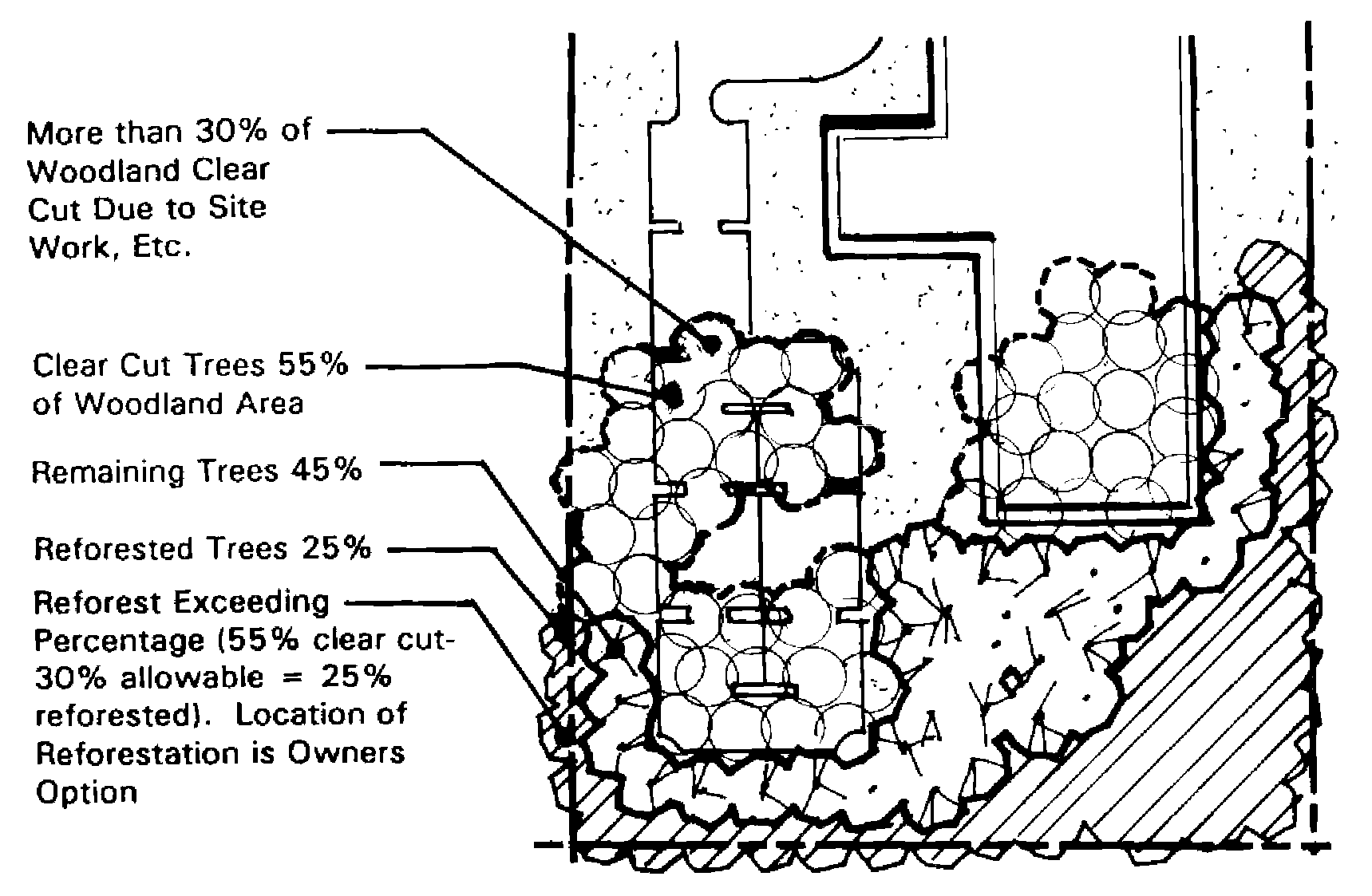
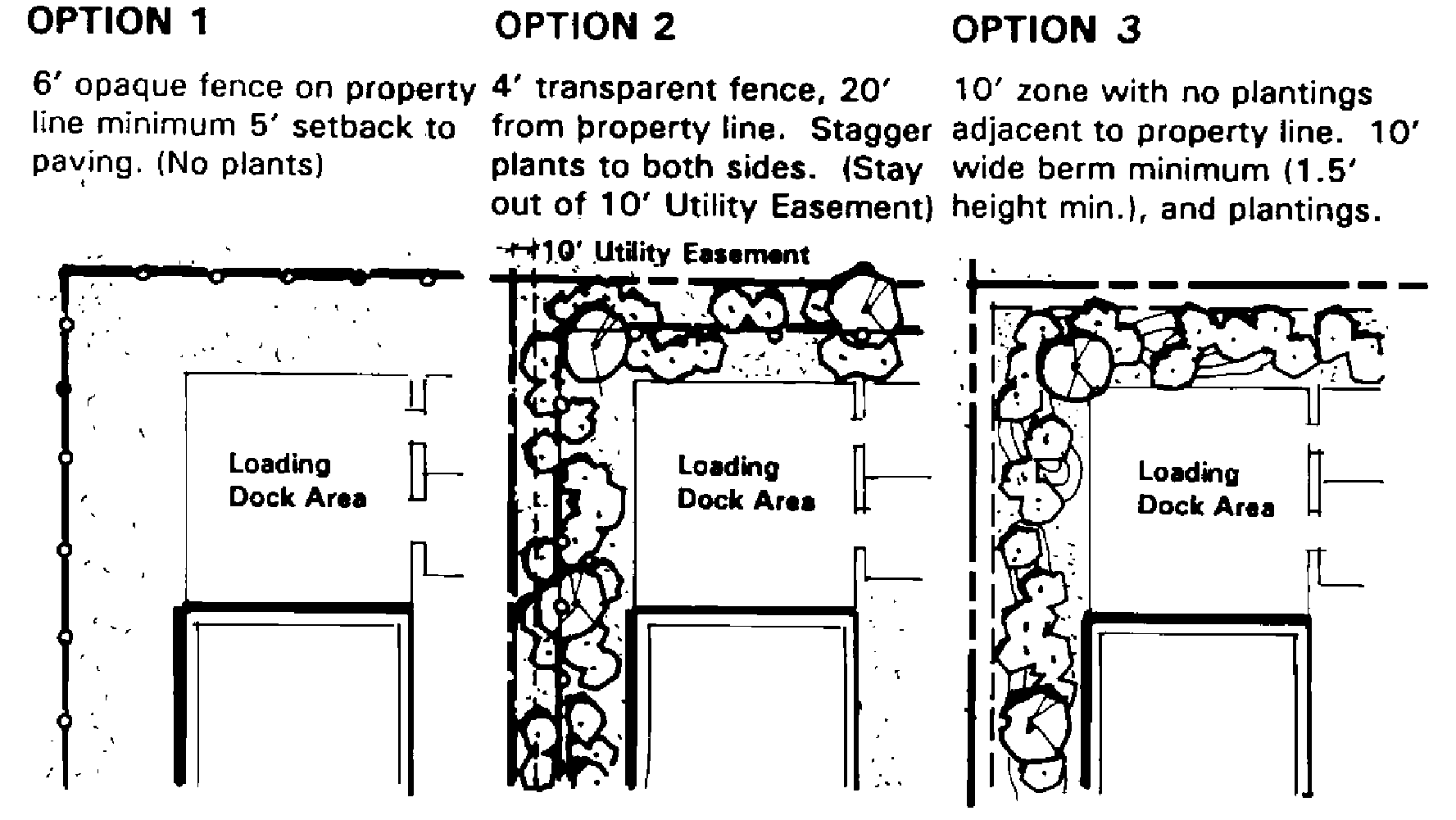
Sample landscaping schemes that may be used for building foundations, developed lots, street frontages, paved areas, reforestation, and bufferyards are depicted in Figure 18-173. In general, landscaping schemes similar to Alternative A are best for building foundations; landscaping schemes similar to Alternative B are best for developed lots; landscaping schemes similar to Alternative C are best for street frontages; landscaping schemes similar to Alternative D are best for paved areas (including parking lots, walkways and plazas); landscaping schemes similar to Alternative E are best for reforestation; and landscaping schemes similar to Alternative F are best for bufferyards.
Figure 18-176: Sample Landscaping Schemes
Alternative A: Best suited for building foundations.
Alternative B: Best suited for developed lots.
Alternative C: Best suited for street frontages.
Alternative D: Best suited for paved areas.
Alternative E: Best suited for reforestation.
Alternative F: Best suited for bufferyards.
(Ord. No. 090412-02, § 1, 9-4-2012)
(a)
Purpose. The purpose of this section is to:
(1)
Promote the preservation and planting of trees in order to preserve the village's character as a naturally wooded community.
(2)
Protect the waters of the state and Geneva Lake.
(3)
Preserve and enhance property values within the village.
(4)
Generally protect, promote and enhance the quality of life, public health and safety and general welfare of the people in the village.
(5)
This section 18-177 shall not apply to a commercial tree farm or to the management of trees on a golf course.
(b)
Prohibited tree removal or tree pruning/trimming.
(1)
Except as provided in this section 18-177, it shall be unlawful for any person or property owner to remove a protected tree or cause the substantial destruction of a protected tree.
(2)
Except as provided in this section 18-177, no protected tree may be pruned or trimmed except in compliance with the most current American National Standards Institute (ANSI) Tree Care Performance Standard. No permit is required for pruning a protected tree on private property.
(3)
No protected tree may be removed or trimmed that is located on public property, other than by the public property owner.
(4)
No protected tree may be removed or trimmed that is located on the property of another unless written consent is first obtained from the property owner and a tree removal permit is obtained pursuant to this section 18-177.
(5)
No clear cutting of protected trees from a property shall be permitted, other than pursuant to subsection (c)(2)c, herein. Clear cutting is defined as the removal or destruction of all, or substantially all, protected trees on a property.
(6)
No tree topping of a protected tree shall be permitted. Tree topping is defined as an inappropriate pruning technique to remove the top portion of the tree's main leader(s), resulting in an overall reduction in the tree's height, size and potential health or life expectancy.
(c)
Permit required for removal of protected trees.
(1)
No protected tree may be removed without first obtaining a tree removal permit pursuant to this section 18-177.
(2)
Tree removal permits authorizing the removal of protected trees may be issued by the Village of Fontana in accordance with at least one the following terms and conditions:
a.
The protected tree is dead, dying or diseased; or
b.
The protected tree is damaged or injured to the extent that it is likely to die or become hazardous to persons or property; or
c.
That the protected tree(s) proposed to be removed is/are the minimum number necessary so as to undertake a permitted or approved conditional use on private property, and including protected tree removal from an additional ten foot area surrounding the principle structure on the property; or
d.
That the protected tree is an "invasive species" tree. An "invasive species" tree shall mean those species so designated on the most recent Wisconsin Department of Natural Resources published list of invasive tree species.
(3)
In order to obtain a tree removal permit, the applicant shall submit the following information:
a.
A completed application and cost recovery form as supplied by the village. Said application shall be signed by the property owner and the person intended to remove the tree and may include, at applicant expense, a signed supporting statement by an authorized arborist who shall address the tree removal criteria set forth in subsection (c)(2) above. Said application shall include a statement of financial responsibility as to any damage or injury caused by the proposed tree removal.
b.
A tree survey, drawing or depiction indicating in adequate detail the location, size and species of all protected trees proposed for removal. Photographs of each protected tree proposed for removal shall be included.
c.
An explanation of the tree protection measures proposed so as to minimize damage to trees that are to remain on the property (see subsection (g), herein).
d.
For properties undergoing construction or grading, the location, shape and arrangement of all proposed buildings, walls, driveways, sidewalks or any other improvements or structures to be constructed on the property, including the area of grading or disturbance.
e.
The applicant, as a condition of filing an application and seeking a tree removal permit, agrees to provide access to the property by a village representative as needed in order to verify the tree removal permit application terms and representations and to inspect the tree(s) sought to be removed. Said village representative may elect to be present at the time a tree is removed.
f.
An issued tree removal permit shall be kept on-site at the time of tree removal and shall be presented to a village representative on demand.
g.
Such other information as may be requested by the village.
(d)
Protected trees. The village hereby declares that the following are protected trees for the purpose of this natural resource conservation ordinance:
(1)
Trees of any size located on any village-owned property, including any public right-of-way or terrace located in the right-of-way.
(2)
Trees of any size which are planted as part of a village-approved zoning landscape plan, such as for a conditional use permit, a planned development or other similar approval.
(3)
Any species of trees measuring six inches or more in DBH ("diameter at breast height").
(e)
Authorized arborist. The village shall maintain a publicly available list of Village of Fontana Authorized Arborists for purposes of providing the optional certification authorized by subsection (c)(3) of this section. The village may also utilize the paid services of a village-hired authorized arborist or other village professionals for purposes of evaluating applications, with the cost thereof to be reimbursed by the applicant pursuant to the village's cost recovery ordinance.
(f)
Exceptions.
(1)
A tree removal permit may be issued after removal only in a situation where a protected tree must be immediately removed outside of normal open hours for the Village Hall due to an imminent danger to the health, safety or welfare of property or persons due to the tree's dangerous condition. In such a removal, the applicant shall preserve photographs of the tree prior to removal and other evidence of the dangerous condition of the tree and shall apply for a tree removal permit and receive a permit as soon as practical following the tree's removal.
(2)
No tree removal permit shall be required for trees located on a commercial farm or for the management of trees on a golf course. Said exception shall also act as an exception to the tree replacement requirements set forth at subsection (h) below.
(g)
Tree protection during construction or land disturbance. Where any construction activity, land disturbance or tree removal is taking place on any property, the following tree preservation methods and standards must be followed and must be shown in advance on any application for tree removal:
(1)
No construction activity, movement or placement of equipment or vehicles, placement of material or spoils or excess soil shall be placed inside the root zone and drip line of any protected tree.
(2)
Temporary proactive fencing shall be installed outside of each protected tree's root zone and drip line. Said fencing shall remain in place during the entire time of construction, land disturbance or tree removal.
(3)
Such other measures as may be required by the Village of Fontana depending on unique or unusual property conditions, tree locations or proposed construction activity or land disturbance.
(h)
Tree replacement requirements. Any protected tree that is removed shall be replaced with a replacement tree. The village shall maintain and provide a publicly available list of authorized replacement trees. A replacement tree may not be an invasive species tree.
(1)
The minimum size of any replacement tree shall be two-inch diameter of breast height ("DBH"). Except as set forth in this subsection (h), the number of replacement trees shall be determined on the following basis:
a.
For a removed tree with a DBH of one to ten inches: One replacement tree.
b.
For a removed tree with a DBH of ten to 20 inches: Two replacement trees.
c.
For a removed tree with a DBH of 20 to 30 inches: Three replacement trees.
d.
For a removed tree with a DBH of 30 inches or larger: Four replacement trees.
(2)
If the village determines that it would not be consistent with the best practices to plant replacement trees on the parcel from which the trees were removed, then an amount of money equal to the value of the replacement trees, as determined by the village, shall be deposited into the Village of Fontana's Tree Bank Replacement Fund. This fund may be only used by the village for the planting of trees on public property and costs associated therewith.
(3)
If the removed protected tree is dead at the time of removal and the death was not directly caused by an intentional or negligent act or if the removed protected tree was removed due to a hazardous or unsafe condition, then the tree replacement requirement shall be one replacement tree, regardless of the DBH size of the removed tree.
(i)
Penalty. In addition to those penalties provided by the village ordinances and this chapter 18, any person who removes or substantially destroys a protected tree without a tree removal permit shall also be fined a minimum of $500.00 per inch of tree DBH. In the absence of proof to the contrary, any such tree illegally removed shall be presumed to be at least four inches DBH, unless a larger size can be established. The payment of a fine shall not relieve any person found to have violated this section from the tree replacement requirement set forth herein.
(Ord. No. 090412-02, § 1, 9-4-2012; Ord. No. 110121-02, § 1, 11-1-2021; Ord. No. 090622-02, § 1, 9-6-2022)
Editor's note— Formerly entitled "Natural resource conservation ordinance," which was amended as herein set out by Ord. No. 110121-02.

LANDSCAPING STANDARDS
The purpose of this article is to establish landscaping requirements and other regulations intended to preserve and maintain vegetation within in a manner that promotes the natural resource protection, aesthetic, and public health goals of the village.
(Ord. No. 090412-02, § 1, 9-4-2012)
Any use for which site plan approval is required under section 18-245 shall provide landscaping in accordance with the regulations of this section, including expansions of existing buildings. Where insufficient site area remains to comply with all provisions of this section, the village may require compliance to the extent practical. Single-family and agricultural land uses are exempt from landscaping requirements.
(Ord. No. 090412-02, § 1, 9-4-2012)
Landscaping shall be provided based on the following requirements for building foundations, street frontages, paved areas, general yard areas and bufferyards. These requirements are additive to each other and any other landscaping or screening requirements in this chapter. Credit for existing landscape plantings that are retained and protected with the development of the site, and for restoration or re-establishment of native flora, shall be allowed. In calculating the number of required landscaping points under the provisions of this section, all areas and distances on which required calculations are based shall be rounded up to the nearest whole number of square feet or linear feet. Any partial plant derived from the required calculations of this section (for example: 23.3 canopy trees) shall be rounded up to the nearest whole plant (for example: 24 canopy trees).
(1)
Building foundations.
a.
For each 100 feet of building foundation perimeter, the landscaping installed shall at a minimum meet the number of landscaping points specified in Figure 18-172(a).
b.
Foundation landscaping shall be placed so that at maturity, the plant's drip line is located within ten feet of the building foundation. Such landscaping shall not be located in areas required for street frontage, paved areas, general yard areas, bufferyards, or other green space areas.
c.
Climax trees and tall trees shall not be used to meet the foundation landscaping requirement.
d.
If the officially approved site plan depicts a future building extension, the foundation landscaping requirement shall be calculated by measuring the length of the total perimeter of the building, including extension. However, foundation plantings need only be installed for portion of the building for which a building permit has been issued.
(2)
Street frontages.
a.
For every 100 linear feet of street frontage of a developed lot abutting a public street right-of-way, the landscaping installed shall at a minimum meet the number of landscaping points specified in Figure 18-172(a).
b.
All landscaping used to meet street frontage requirements shall be located within ten feet of the public right-of-way. Under no circumstances shall such landscaping be located within a public right-of-way. Landscaping shall not impede vehicle or pedestrian visibility.
c.
Shrubs shall not be used to meet street frontage landscaping requirements. A minimum of 50 percent of all points shall be devoted to climax or tall trees, or a combination of such trees, and a minimum of 30 percent of all points shall be devoted to medium trees.
(3)
Paved areas.
a.
For every 20 off-street parking stalls or 10,000 square feet of pavement (whichever yields the greater landscaping requirement), landscaping shall at a minimum meet the number of landscaping points specified in Figure 18-172(a).
b.
Landscaping shall be located within ten feet of the paved area. Said area does not have to be provided in one contiguous area. Plants used to fulfill this requirement shall visually screen parking, loading and circulation areas from view from public streets.
c.
A minimum of 30 percent of all points shall be devoted to climax or tall trees, or a combination of such trees, and a minimum of 40 percent of all points shall be devoted to shrubs.
d.
Parking lot design.
1.
Landscaped medians shall be used to break large parking areas into distinct pods, with a maximum of 100 spaces in any one pod.
2.
Parking spaces must be broken by a tree island at the rate of one island for each linear row of 12 parking spaces for single-row or peninsula configurations, or for each 24 parking spaces in double-row configurations.
3.
All tree islands and landscaped areas with trees shall have a minimum of nine feet as measured from outside the curb or frame.
4.
All landscaped areas without trees, but planted with shrubs, shall have a minimum width of three feet measured from inside the curb or frame.
(4)
General yard areas. An additional 200 landscaping points shall be provided for each acre of total lot or development area. Landscaping required by this standard shall be placed where appropriate on the site, but generally in those areas not covered by other provisions of this section.
(5)
Bufferyards. A bufferyard is a combination of distance and a visual buffer or barrier. It includes an area, together with the combination of plantings, berms and fencing that are required to eliminate or reduce existing or potential nuisances (e.g., dirt, litter, noise, glare, signs, and incompatible land uses, buildings, or parking areas).
a.
The required level of bufferyard opacity is listed in Figure 18-172(b). Detailed bufferyard requirements are listed in Figure 18-172(c). Opacity is a quantitatively-derived measure which indicates the degree to which a particular bufferyard screens the adjoining property. The required level of opacity indicated is directly related to the degree to which the potential character of development differs between different zoning districts.
b.
Bufferyards shall be located along (and within) the outer perimeter of a lot wherever two different zoning districts abut one another. Bufferyards shall not be required in front yards.
(6)
Other green space areas. Green space areas not used for landscape plantings other than natural resource protection areas shall be graded and seeded or sodded with an acceptable maintainable seed mix, restored to native vegetation, or maintained in crop production if approved by the plan commission. Mulch of plantings or planting beds is acceptable provided that such mulching consists of organic or natural materials. Mulches shall be installed so that they will not erode, fall, be plowed or otherwise transported into walks, drives, streets or other hard surfaced portions of the site.
(7)
Natural resource protection areas. Landscaping in required natural resource protection areas, including those related to floodplains, wetlands, shorelands, woodlands, and wellhead protection areas, shall be prohibited, except for restorative planting and maintenance necessary to maintain native plantings in their natural state.
(8)
Permeable surface allowed.
a.
A permeable surface for use such as for driveways or patio areas or other similar paved areas shall be permitted as an exception to the calculation of impervious surface for purposes of the definition at section 18-13 and the impervious surface ratio set forth in sections 18-13, 18-245 and each of the limits on impervious surface ratios set forth in individual zoning districts, subject to the remaining requirements of this section.
b.
Subject to the limit set forth herein at subsection 18-172(8)c, in order to not be counted as an impervious surface per section 18-13, the permeable surface shall be designed and engineered and thereafter maintained so as to allow water from any source to pass through the permeable surface to and into the ground beneath the paved surface. A zoning permit shall be obtained before installation of said permeable surface by submitting an application, the engineering drawings for the proposed permeable surface installation, a proposed maintenance plan, together with an application fee as determined by the village board from time to time and a cost recovery certificate. The village engineer may be asked to render an opinion as to the applied for paving and permit.
c.
The permeable paver exception to the calculation of impervious surface as set forth herein shall be limited to the lesser of 2,500 square feet or 15 percent of the lot area.
d.
If approved and thereafter installed, said permeable surface shall be maintained as necessary, and according to the approved maintenance plan, in order to maintain the current and uninterrupted functionality of the permeable surface, but not less than every five years. The village engineer may be asked to render an opinion as to the adequacy of the maintenance. Proof of said required maintenance shall be provided as requested by the Village of Fontana.
Figure 18-172(a): Landscaping Requirements*
Figure 18-172(b): Required bufferyard opacity values
Figure 18-172(c): Detailed Bufferyard Requirements
Figure 18-172(d): Landscaping Points
(Ord. No. 090412-02, § 1, 9-4-2012; Ord. No. 12-09-19-02, § 2, 12-9-2019)
Species suitable for landscaping and compatible with local climate and soil factors are listed in Figure 18-173(a). However, this list is not intended to be exhaustive, and the zoning administrator shall review proposals for the applicability of species not listed and is authorized to approve appropriate similar species. See Figure 18-173(b) for species appropriate for specific and common landscaping situations (e.g., planting under power lines), and Figure 18-173(c) for a list of species to use sparingly or to avoid.
Figure 18-173(a): Common Appropriate Landscaping Species
Figure 18-173(b): Plant Species Appropriate for Specific Situations
Figure 18-173(c): Species to Use Sparingly or to Avoid
(Ord. No. 090412-02, § 1, 9-4-2012)
(a)
Rain gardens and bio-swales can serve both as landscaping and stormwater management features on a building site, where appropriately designed and sited. A rain garden is a shallow, depressed garden that is designed and positioned on a site to capture stormwater runoff and allow for the infiltration of water back into the ground. Rain garden plants are carefully chosen for their ability to withstand moisture extremes and potentially high concentrations of nutrients and sediments that are often found in stormwater runoff. A well designed and maintained rain garden serves as an attractive component of an overall landscaping plan for a development site.
(b)
A bio-swale is a linear, vegetative stormwater runoff conveyance system that is designed to store and infiltrate water from small storm events back into the ground and direct water from heavy rain events to appropriate storm sewer inlets or other management facilities. The flow of water being conveyed through a bio-swale is slowed down, allowing for municipal storm systems to more effectively manage heavier rain events and help reduce the risk of flooding on- or off-site. Water being infiltrated or conveyed via a bio-swale is also filtered by the vegetation within it, generally improving both ground and surface water quality.
(c)
The installation of a rain garden or bio-swale may contribute to the overall stormwater management plan for a development site and count toward meeting the village's landscaping guidelines. Raingardens may count for 20 points for every 20 square feet, provided the following requirements are met:
(1)
Detailed plans shall be provided that show all proposed dimensions of the rain garden or bio-swale including length, width, depth, and slope of depression; location of the rain garden or bio-swale on the lot relative to hard-surfaced areas, downspouts, and site topography; characteristics of the soil underlying the rain garden or bio-swale; description of planting media; the species, number, and size at time of installation of all vegetation proposed for the rain garden or bio-swale; and information on any other materials (e.g., rocks) that will be used to line the rain garden or bio-swale.
(2)
Installation shall not be proposed for any of the following areas of a site:
a.
Areas where there is known soil contamination unless the rain garden or bio-swale is proposed to be constructed with an underdrain;
b.
Areas where the characteristics of the soil would not allow for the proper infiltration of water into the ground; or
c.
Areas where there are expected to be high levels of foot traffic.
(3)
The owner of the site shall demonstrate that the rain garden or bio-swale shall be properly maintained; kept free of trash, weeds, debris, and dead or dying plants; any pipes associated with the rain garden or bio-swale will be inspected on an annual basis and kept free of debris; and by the beginning of every spring dead plant materials will be cut back or removed.
(4)
Bio-swales and rain gardens shall be generously (and appropriately) vegetated to qualify for landscaping points. Bio-swales and rain gardens (or portions thereof) that are lined with turf and/or rocks but do not include other vegetation will not count toward meeting landscaping point requirements.
(5)
Rain gardens and bio-swales may serve as a component of an overall stormwater management plan for a site only if detailed plans, calculations, and specifications are submitted. Detailed plans shall include the location and description of all other stormwater management facilities serving the site, particularly those to which any bio-swale will be directed.
(Ord. No. 090412-02, § 1, 9-4-2012)
(a)
Installation. Any and all landscaping and bufferyard material required by the provisions of this chapter shall be installed on the subject property, in accordance with the approved site plan within 365 days of the issuance of an occupancy permit for any building on the subject property, unless a conditional use is approved to allow for greater than 365 days.
(b)
Surety.
(1)
If the subject property is to be occupied prior to the installation of all required landscaping and bufferyard material, the property owner shall sign an instrument agreeing to install the landscaping within the 730-day period and shall furnish to the village an irrevocable letter of credit or other form of security acceptable to the village sufficient to guarantee completion of the work. Such security shall be provided by the property owner at the time that the agreement is signed. It shall be in an amount equal to 110 percent of the estimated actual cost for all of the required elements of the approved site plan and shall specifically guarantee that all such elements shall be made and installed according to the approved site plan. The costs of the work shall be furnished by the property [owner] and shall be verified by the village. The financial security shall remain in force until all of the work has been completed and approved by the village. This agreement shall also contain a statement indicating that the property owner's failure to comply with the requirements of the terms of the agreement will constitute a violation of the chapter and subject the property owner to a forfeiture upon conviction.
(2)
If the required landscaping and bufferyard materials are to be installed during different phases of a subdivision development, the developer may furnish for each phase financial security in an amount sufficient to guarantee completion of the landscaping and bufferyard work performed during a particular phase, unless the land division regulations requires otherwise.
(3)
If the property owner is a governmental unit, it may, in lieu of signing an agreement and furnishing a guarantee and file a resolution or letter from officers authorized to act in its behalf, agreeing to comply with the provisions of this article.
(c)
If existing plant material meets the requirements of this article and will be preserved on the subject property following the completion of development, it may be counted as contributing to the landscaping requirements.
(d)
All landscaping and bufferyard areas shall be seeded with lawn or native groundcover unless such vegetation is already fully established.
(e)
The exact placement of plants and structures shall be depicted on the required detailed landscaping plan submitted to the village for its approval. Such plant and structure location shall be the decision of each property owner provided the following requirements are met:
(1)
Evergreen shrubs shall be planted in clusters to maximize their chance for survival.
(2)
Where a combination of plant materials, berming, and fencing is used in a bufferyard, the fence and/or berm shall be located toward the interior of the subject property and the plant material shall be located toward the exterior of the subject property.
(3)
A property owner may establish through a written agreement, recorded with the register of deeds, that an adjacent property owner agrees to provide on the immediately adjacent portion of his or her land a partial or full portion of the required bufferyard, thereby relieving the developer of the responsibility of providing the entire bufferyard on his property.
(4)
Under no circumstance shall landscaping or bufferyard materials be selected or located in a manner resulting in the creation of a safety or visibility hazard.
(5)
The restrictions on types of plants listed in this article shall apply.
(f)
Maintenance. The continual maintenance of all required landscaping and bufferyard materials shall be a requirement of this chapter and shall be the responsibility of the owner of the property on which said materials and plants are required. This requirement shall run with the property and shall be binding upon all future property owners. Development of any or all property following the effective date of this chapter shall constitute an agreement by the property owner to comply with the provisions of this section. If the property owner fails to comply with these provisions, the village may enter upon the property for the purpose of evaluating and maintaining all required landscaping and bufferyard materials, and may specially assess the costs thereof against the property. A property owner's failure to comply with this requirement shall also be considered a violation of this chapter, and shall be subject to any and all applicable enforcement procedures and penalties.
(g)
Use of required bufferyard and landscaped areas. Any and all required bufferyards or landscaped areas may be used for passive recreation activities. Said areas may contain pedestrian, bike or equestrian trails provided that no required material is eliminated; the total width of the required bufferyard, or the total area of required landscaping, is maintained; and all other regulations of this chapter are met. However, in such areas, no swimming pools, tennis courts, sports fields, golf courses, or other such similar active recreational uses. No parking and no outdoor display of storage of materials shall be permitted. Paving in such areas shall be limited to that required for necessary access to, through, or across the subject property.
(h)
Utility easements. Landscaping materials, fences and berms located within a duly recorded utility or a pedestrian easement shall not count toward meeting a landscaping requirement, unless authorized otherwise by a conditional use permit. However, the width of such areas may be counted as part of a landscaping requirement.
(Ord. No. 090412-02, § 1, 9-4-2012)
Sample landscaping schemes that may be used for building foundations, developed lots, street frontages, paved areas, reforestation, and bufferyards are depicted in Figure 18-173. In general, landscaping schemes similar to Alternative A are best for building foundations; landscaping schemes similar to Alternative B are best for developed lots; landscaping schemes similar to Alternative C are best for street frontages; landscaping schemes similar to Alternative D are best for paved areas (including parking lots, walkways and plazas); landscaping schemes similar to Alternative E are best for reforestation; and landscaping schemes similar to Alternative F are best for bufferyards.
Figure 18-176: Sample Landscaping Schemes
Alternative A: Best suited for building foundations.
Alternative B: Best suited for developed lots.
Alternative C: Best suited for street frontages.
Alternative D: Best suited for paved areas.
Alternative E: Best suited for reforestation.
Alternative F: Best suited for bufferyards.
(Ord. No. 090412-02, § 1, 9-4-2012)
(a)
Purpose. The purpose of this section is to:
(1)
Promote the preservation and planting of trees in order to preserve the village's character as a naturally wooded community.
(2)
Protect the waters of the state and Geneva Lake.
(3)
Preserve and enhance property values within the village.
(4)
Generally protect, promote and enhance the quality of life, public health and safety and general welfare of the people in the village.
(5)
This section 18-177 shall not apply to a commercial tree farm or to the management of trees on a golf course.
(b)
Prohibited tree removal or tree pruning/trimming.
(1)
Except as provided in this section 18-177, it shall be unlawful for any person or property owner to remove a protected tree or cause the substantial destruction of a protected tree.
(2)
Except as provided in this section 18-177, no protected tree may be pruned or trimmed except in compliance with the most current American National Standards Institute (ANSI) Tree Care Performance Standard. No permit is required for pruning a protected tree on private property.
(3)
No protected tree may be removed or trimmed that is located on public property, other than by the public property owner.
(4)
No protected tree may be removed or trimmed that is located on the property of another unless written consent is first obtained from the property owner and a tree removal permit is obtained pursuant to this section 18-177.
(5)
No clear cutting of protected trees from a property shall be permitted, other than pursuant to subsection (c)(2)c, herein. Clear cutting is defined as the removal or destruction of all, or substantially all, protected trees on a property.
(6)
No tree topping of a protected tree shall be permitted. Tree topping is defined as an inappropriate pruning technique to remove the top portion of the tree's main leader(s), resulting in an overall reduction in the tree's height, size and potential health or life expectancy.
(c)
Permit required for removal of protected trees.
(1)
No protected tree may be removed without first obtaining a tree removal permit pursuant to this section 18-177.
(2)
Tree removal permits authorizing the removal of protected trees may be issued by the Village of Fontana in accordance with at least one the following terms and conditions:
a.
The protected tree is dead, dying or diseased; or
b.
The protected tree is damaged or injured to the extent that it is likely to die or become hazardous to persons or property; or
c.
That the protected tree(s) proposed to be removed is/are the minimum number necessary so as to undertake a permitted or approved conditional use on private property, and including protected tree removal from an additional ten foot area surrounding the principle structure on the property; or
d.
That the protected tree is an "invasive species" tree. An "invasive species" tree shall mean those species so designated on the most recent Wisconsin Department of Natural Resources published list of invasive tree species.
(3)
In order to obtain a tree removal permit, the applicant shall submit the following information:
a.
A completed application and cost recovery form as supplied by the village. Said application shall be signed by the property owner and the person intended to remove the tree and may include, at applicant expense, a signed supporting statement by an authorized arborist who shall address the tree removal criteria set forth in subsection (c)(2) above. Said application shall include a statement of financial responsibility as to any damage or injury caused by the proposed tree removal.
b.
A tree survey, drawing or depiction indicating in adequate detail the location, size and species of all protected trees proposed for removal. Photographs of each protected tree proposed for removal shall be included.
c.
An explanation of the tree protection measures proposed so as to minimize damage to trees that are to remain on the property (see subsection (g), herein).
d.
For properties undergoing construction or grading, the location, shape and arrangement of all proposed buildings, walls, driveways, sidewalks or any other improvements or structures to be constructed on the property, including the area of grading or disturbance.
e.
The applicant, as a condition of filing an application and seeking a tree removal permit, agrees to provide access to the property by a village representative as needed in order to verify the tree removal permit application terms and representations and to inspect the tree(s) sought to be removed. Said village representative may elect to be present at the time a tree is removed.
f.
An issued tree removal permit shall be kept on-site at the time of tree removal and shall be presented to a village representative on demand.
g.
Such other information as may be requested by the village.
(d)
Protected trees. The village hereby declares that the following are protected trees for the purpose of this natural resource conservation ordinance:
(1)
Trees of any size located on any village-owned property, including any public right-of-way or terrace located in the right-of-way.
(2)
Trees of any size which are planted as part of a village-approved zoning landscape plan, such as for a conditional use permit, a planned development or other similar approval.
(3)
Any species of trees measuring six inches or more in DBH ("diameter at breast height").
(e)
Authorized arborist. The village shall maintain a publicly available list of Village of Fontana Authorized Arborists for purposes of providing the optional certification authorized by subsection (c)(3) of this section. The village may also utilize the paid services of a village-hired authorized arborist or other village professionals for purposes of evaluating applications, with the cost thereof to be reimbursed by the applicant pursuant to the village's cost recovery ordinance.
(f)
Exceptions.
(1)
A tree removal permit may be issued after removal only in a situation where a protected tree must be immediately removed outside of normal open hours for the Village Hall due to an imminent danger to the health, safety or welfare of property or persons due to the tree's dangerous condition. In such a removal, the applicant shall preserve photographs of the tree prior to removal and other evidence of the dangerous condition of the tree and shall apply for a tree removal permit and receive a permit as soon as practical following the tree's removal.
(2)
No tree removal permit shall be required for trees located on a commercial farm or for the management of trees on a golf course. Said exception shall also act as an exception to the tree replacement requirements set forth at subsection (h) below.
(g)
Tree protection during construction or land disturbance. Where any construction activity, land disturbance or tree removal is taking place on any property, the following tree preservation methods and standards must be followed and must be shown in advance on any application for tree removal:
(1)
No construction activity, movement or placement of equipment or vehicles, placement of material or spoils or excess soil shall be placed inside the root zone and drip line of any protected tree.
(2)
Temporary proactive fencing shall be installed outside of each protected tree's root zone and drip line. Said fencing shall remain in place during the entire time of construction, land disturbance or tree removal.
(3)
Such other measures as may be required by the Village of Fontana depending on unique or unusual property conditions, tree locations or proposed construction activity or land disturbance.
(h)
Tree replacement requirements. Any protected tree that is removed shall be replaced with a replacement tree. The village shall maintain and provide a publicly available list of authorized replacement trees. A replacement tree may not be an invasive species tree.
(1)
The minimum size of any replacement tree shall be two-inch diameter of breast height ("DBH"). Except as set forth in this subsection (h), the number of replacement trees shall be determined on the following basis:
a.
For a removed tree with a DBH of one to ten inches: One replacement tree.
b.
For a removed tree with a DBH of ten to 20 inches: Two replacement trees.
c.
For a removed tree with a DBH of 20 to 30 inches: Three replacement trees.
d.
For a removed tree with a DBH of 30 inches or larger: Four replacement trees.
(2)
If the village determines that it would not be consistent with the best practices to plant replacement trees on the parcel from which the trees were removed, then an amount of money equal to the value of the replacement trees, as determined by the village, shall be deposited into the Village of Fontana's Tree Bank Replacement Fund. This fund may be only used by the village for the planting of trees on public property and costs associated therewith.
(3)
If the removed protected tree is dead at the time of removal and the death was not directly caused by an intentional or negligent act or if the removed protected tree was removed due to a hazardous or unsafe condition, then the tree replacement requirement shall be one replacement tree, regardless of the DBH size of the removed tree.
(i)
Penalty. In addition to those penalties provided by the village ordinances and this chapter 18, any person who removes or substantially destroys a protected tree without a tree removal permit shall also be fined a minimum of $500.00 per inch of tree DBH. In the absence of proof to the contrary, any such tree illegally removed shall be presumed to be at least four inches DBH, unless a larger size can be established. The payment of a fine shall not relieve any person found to have violated this section from the tree replacement requirement set forth herein.
(Ord. No. 090412-02, § 1, 9-4-2012; Ord. No. 110121-02, § 1, 11-1-2021; Ord. No. 090622-02, § 1, 9-6-2022)
Editor's note— Formerly entitled "Natural resource conservation ordinance," which was amended as herein set out by Ord. No. 110121-02.
