
Fontana On Geneva Lake
City Zoning Code
City Zoning Code
ARTICLE XIII
PERFORMANCE STANDARDS
Sec. 18-210.- Purpose.
The purpose of this article is to indicate the standards and minimum requirements for access, visibility, off-street parking and traffic circulation, off-street loading, exterior storage, swimming pools, vibration, noise, air pollution, odor, signal receiving antennas, glare and heat, fire and explosions, toxic or noxious materials, waste materials, hazardous materials, outdoor wood burning furnaces, preservation of existing grade, and such other subjects within the jurisdiction of this chapter.
(Ord. No. 090412-02, § 1, 9-4-2012; Ord. No. 050119-01, § 2, 5-1-2019)
Sec. 18-211. - Access standards.
(a)
Purpose. The purpose of this section is to alleviate or prevent congestion of public rights-of-way so as to promote the safety and general welfare of the public by establishing minimum requirements for the provision of access to public rights-of-way in accordance with the utilization of various sites.
(b)
Applicability. The requirements of this section shall apply to each access point onto a public street or right-of-way in all new developments.
(c)
Number of access points.
(1)
Each lot shall have not more than two access points on any street frontage adjacent to any lot. Said access shall require approval by the public works director.
(2)
No lot shall be permitted more than one access point on any one street if its frontage on said street is less than 100 linear feet (as measured along the right-of-way line).
(3)
On arterial streets, and in areas experiencing, or expected to experience, congestion and/or safety problems, access to a lot may be required to be located via an access point on an adjacent property or another street frontage.
(4)
For residential uses, two access points serving the same street frontage may be approved as a conditional use.
(d)
Residential uses. Residential uses shall not have access points onto a nonresidential collector or arterial street unless such street has the only available frontage.
(e)
Nonresidential uses. Nonresidential uses shall not have access points onto a residential street unless such street has the only available frontage.
(f)
Access near street intersections.
(1)
At its intersection with the street right-of-way line on an arterial or nonresidential collector street, no access point shall be located closer than 100 feet from the intersection of any two street rights-of-way unless such street is the only available frontage on the subject property. In all cases, access points shall be located as far from an intersection as the lot size permits.
(2)
Nonconforming driveways may be replaced in their current location, except as part of site plan review and approval.
(3)
Temporary access may be granted by the plan commission after review and recommendation by the highway agencies having jurisdiction. Such access permit shall be temporary, revocable, and subject to any conditions required and shall be issued for a period not to exceed 12 months.
(g)
Distance between access drives. The minimum distance between access drives serving the same property shall be 25 feet (edge to edge), as measured at the property line. A distance in excess of 25 feet may be required if existing or projected traffic warrants a greater distance.
(h)
STH 67 driveway access. All parcels within the STH 67 corridor shall take driveway access from a frontage road set back from and parallel to STH 67, or provide reverse frontage access to a street abutting the rear or the lot so that safe and efficient traffic flow can be maintained.
(i)
Angle of intersection with public right-of-way. All access drives shall intersect with any public right-of-way at an angle of not less than 75 degrees and shall intersect at an angle of 90 degrees wherever possible.
(j)
Distance from property line. The distance from an access drive to the property line of an adjacent property shall not be less than three feet, as measured along the right-of-way line.
(k)
Width of driveways. All access drives shall have a minimum width of ten feet for single- and two-family dwellings, and 18 feet for all other land uses. All curb openings for access drives shall have a maximum width of 24 feet for all residential uses, and 30 feet for all nonresidential uses, as measured at the right-of-way line. Access drives may be flared between the right-of-way line and the roadway up to a maximum of five additional feet. This requirement may be exceeded with explicit plan commission approval for uses other than single-family.
(l)
Traffic control. The traffic generated by any use shall be channelized and controlled in a manner which avoids congestion on public streets and other safety hazards. Traffic into and out of all off-street parking, loading, and traffic circulation areas serving six or more parking spaces shall be forward moving, with no backing into streets or pedestrian ways. Traffic control devices shall be required as determined by the public works director.
(m)
Paving of access. All access approach areas located within a street right-of-way shall be paved to the satisfaction of the zoning administrator with a hard, all-weather surface, and shall be maintained so as to prevent the transport of gravel, dirt, or other eroded material from the subject property into the right-of-way. This requirement must be fulfilled before building occupancy, unless granted a time-specific extension in writing by the zoning administrator.
(n)
Pedestrian access. Properties may have private pedestrian paths that connect to a public sidewalk with the path being no wider than five feet in width between the pavement setback line and the right-of-way. Paths that connect to the public street shall obtain a right-of-way permit from the public works director.
(Ord. No. 090412-02, § 1, 9-4-2012; Ord. No. 050117-01, § 1, 5-1-2017; Ord. No. 111323-02, § 1, 11-13-2023)
Sec. 18-212. - Visibility standards.
(a)
Purpose. The purpose of this section is to alleviate or prevent congestion of public and private rights-of-way so as to promote the safety and general welfare of the public by establishing minimum requirements for the provision of vehicular visibility.
(b)
Applicability. The requirements of this section shall apply to all new development.
(c)
Vision clearance triangle. To provide a clear view of intersecting streets to motorists, there shall be a triangular area of clear vision formed by the two intersecting streets and a chord connecting the centerlines of said streets. Generally, the following standards listed in Figure 18-212 shall apply. Within the triangular area, no signs, parking spaces, structures, earthwork, vegetation, fencing, or other obstructions above 30 inches in height or exceeding opacity of 0.2 (see article XI) shall be permitted above the centerline elevations of said two streets.
Figure 18-212: Vision Clearance Triangle Standards
(Ord. No. 090412-02, § 1, 9-4-2012)
Sec. 18-213. - Off-street parking and traffic circulation.
(a)
Purpose. The purpose of this section is to alleviate or prevent congestion of public rights-of-way so as to promote the safety and general welfare of the public by establishing minimum requirements for the provision of off-street parking and circulation in accordance with the utilization of various sites.
(b)
Applicability. This section shall apply to all new development and redevelopment within the village.
(c)
Minimum required off-street parking spaces.
(1)
Off-street parking requirements for each land use (see article III) are generally tied to the use's capacity and gross floor area or the number of employees at the subject property during the largest work shift. The term "capacity" means the maximum number of persons that may be accommodated by the use as determined by its design or by state building code regulations, whichever number is greater. The term "employee(s) on the largest work shift" means the maximum number of employees working at the facility during a single given day, regardless of the time period during which this occurs, and regardless of whether any such person is a full-time employee. The largest work shift may occur on any particular day of the week or during a lunch or dinner period in the case of a restaurant. In all cases, one reserved parking space shall be provided for each vehicle used by the operation during business hours.
(2)
Where said parking needs of any land use exceed the minimum requirements of this chapter, additional parking spaces sufficient to meet the average maximum daily peak-hour parking space demand shall be provided by said land use.
(3)
When the calculation for the number of off-street parking spaces required by this chapter results in a fraction (e.g., 3.25 spaces), the applicant shall round up to the highest whole number.
(d)
Off-street parking and traffic circulation standards.
(1)
Circulation. The site shall be designed to provide for the safe and efficient movement of all traffic entering, exiting, and circulating on the site. Circulation patterns shall conform to the general rules of the road. All traffic control measures shall meet the requirements of the Manual of Uniform Traffic Control Devices.
(2)
Surfacing and marking. All off-street parking and traffic circulation areas (including all residential driveways except those in the AH-35 District) shall be paved with a hard, all-weather or other surface to the satisfaction of the public works director. Said surfaces intended for two or more parking stalls shall be marked in a manner which clearly indicates required parking spaces.
(e)
Curbing. All off-street parking areas designed to have head-in parking within 6½ feet of any lot line shall provide a tire bumper or curb of adequate height and is properly located to ensure that no part of any vehicle will project beyond the required setbacks of this chapter.
(f)
Access.
(1)
Each off-street parking space shall open directly upon an aisle or driveway that is wide enough and designed to provide a safe and efficient means of vehicular access to the parking space without directly backing or maneuvering a vehicle into a public right-of-way exceeding 82½ feet in width.
(2)
All off-street parking and traffic circulation facilities shall be designed with an appropriate means of vehicular access to a street or alley, in a manner that least interferes with traffic movements.
(3)
No driveway across public property, or requiring a curb cut, shall exceed 40 feet for commercial or industrial uses or 25 feet for residential uses.
(4)
Off-street parking spaces for residential uses may be stacked or in front of one another for the same dwelling unit.
(5)
Parking spaces located behind an enclosed garage and located directly off a through aisle shall be a minimum of 30 feet deep.
(g)
Snow storage. Required off-street parking and traffic circulation areas shall not be used for snow storage.
(h)
Lighting. All off-street parking and traffic circulation areas serving six or more cars shall be lit so as to ensure the safe and efficient use of said areas during the hours of use. An illumination level of between 0.4 and 1.0 foot candles is recommended for said areas, and said illumination level shall not exceed the standards of section 18-165.
(i)
Signage. All signage located within, or related to, required off-street parking or traffic circulation shall comply with the requirements of article XII.
(j)
Landscaping. Parking lot landscaping shall comply with the paved area landscaping requirements in article XI.
(k)
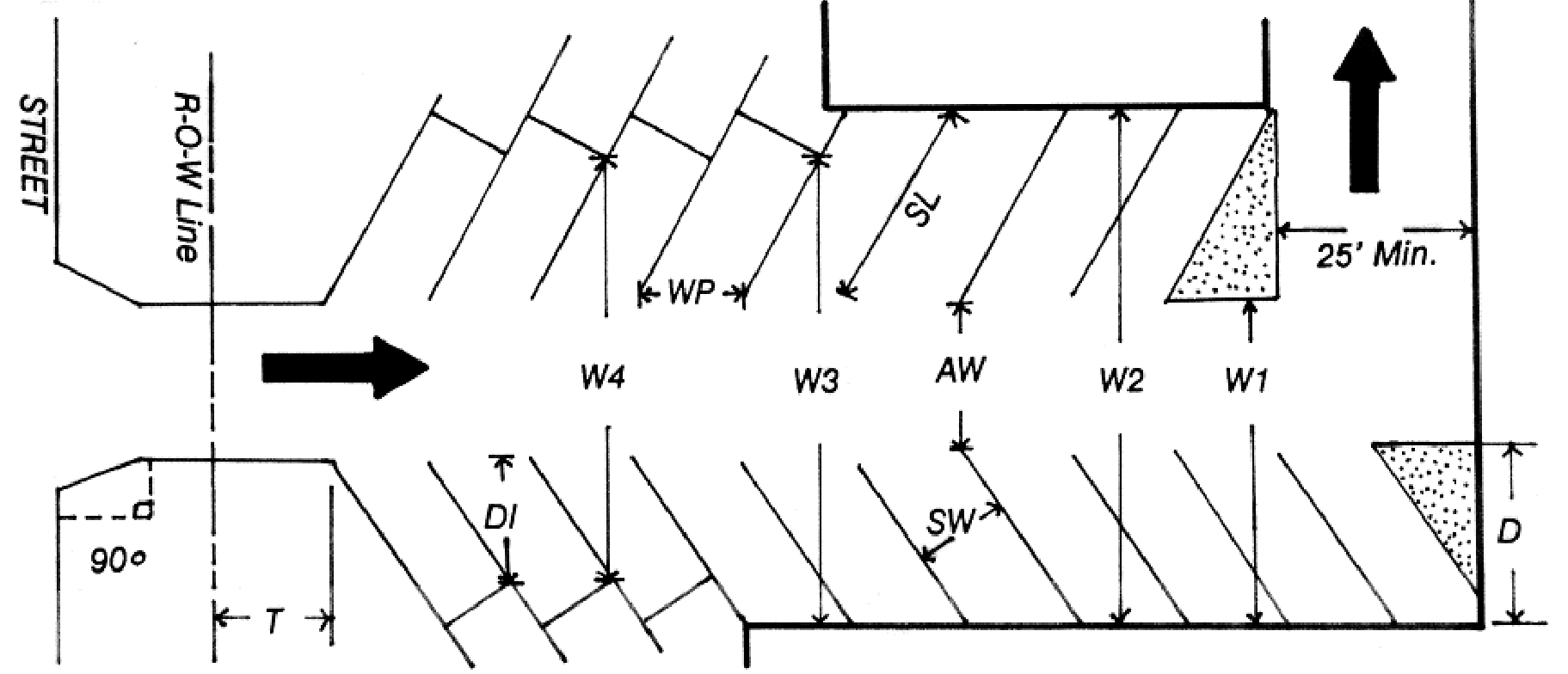
Parking space design standards. Other than handicapped parking, each off-street parking space shall comply with the minimum requirements of Figure 18-213(a). The minimum required length of parking spaces shall be 16 feet. All parking spaces shall have a minimum vertical clearance of at least seven feet.
(l)
Handicapped parking spaces. Handicapped parking shall be provided at a size, number, location, and with signage as specified by state and federal regulations.
(m)
Parking lot design standards. Horizontal widths for parking rows, aisles, and modules shall be provided at widths no less than listed in Figure 18-213(a). Additional design standards apply to group and large developments (see section 18-167).
(n)
Partial development of required parking spaces. At the time of site plan review, any developer may seek permission to not install a portion of its required parking unless and until such partial number of improved parking spaces are deemed insufficient by the plan commission to meet the average peak daily demand; however, the site plan shall depict the minimum number of required parking spaces.
(o)
Limit on the maximum number of required parking spaces. No site plan may be approved for a multifamily or nonresidential use that proposes more than 120 percent of the development's minimum number of required parking spaces, except as granted through a conditional use permit. In addition to the conditional use permit process (see section 18-246), the developer shall submit a report indicating the necessity for additional parking.
(p)
Joint and off-site parking facilities.
(1)
Parking facilities that have been approved by the public works director to provide required parking for two or more uses shall provide a total number of parking spaces that shall not be less than the sum total of the separate parking needs for each use during any peak hour parking period when said joint parking facility is utilized at the same time by said uses. However, this aggregate requirement may be reduced or expanded by the plan commission by explicit motion associated with this site plan review process.
(2)
Each parking space designed to serve as joint parking shall not be located farther than 400 feet from the access to all of the various uses it is designated to serve, except as allowed by a conditional use permit.
(3)
The applicant(s) for approval of a joint parking facility shall demonstrate to the satisfaction of the public works director that there will be no substantial conflict in the demand for parking during the principal operating hours of the two of more uses for which the joint parking facility is proposed to serve.
(4)
A legally binding instrument, approved by the village attorney, shall be executed by any and all parties to be served by a joint parking facility. This instrument shall be recorded with the register of deeds office and filed with the village clerk. A fee shall be required to file this instrument per the village's fee schedule.
(q)
Locational prohibitions for off-street parking areas.
(1)
Off-street parking shall not be located between the principal structure on a residential lot and a street right-of-way, except within residential driveways and parking lots designated on the approved site plan.
(2)
No private parking shall occur on street terraces, driveways, or any other areas located within a public right-of-way not explicitly designated by the public works director.
(3)
Parking lots and loading berths shall be located in the rear yard or side yard, and driveways shall be laid out to avoid a direct, unscreened view from the street to employee parking areas, loading docks, maneuvering areas, and permitted outdoor storage areas.
(r)
Minimum permitted throat length. Figure 18-213(b) shall be used to determine the minimum permitted throat length of access drives serving parking lots as measured from the right-of-way line along the centerline of the access drive. This regulation may be modified by the plan commission by explicit motion associated with this site review process.
(s)
Potential reduction in parking. The plan commission and village board may allow a decrease in the required number of off-street parking spaces by up to 25 percent of the normal requirements based upon one or more of the following criteria:
(1)
Technical documentation furnished by the applicant that indicates, to the satisfaction of the plan commission and village board, that actual off-street parking demand for that particular use is less than the required standard set forth in this chapter.
(2)
Bicycle parking spaces will be provided through racks, lockers, or equivalent structures located convenient to the proposed use.
(3)
Shared parking, on-site. This strategy works well in projects with a mix of uses that have different peak times. The strategy also may be employed with multi-phase projects where the parking requirements are recalculated with each phase to realize efficiencies as more uses are added.
(4)
Shared parking, off-site. A shared parking agreement between two or more different project/property owners can be an effective method of reaching larger economies of scale to reduce the overall parking requirements of the individual projects. The agreement shall be prepared in a form acceptable to the village attorney and recorded prior to the issuance of a building permit for any of the properties involved. The agreement shall be in effect for the life of the project or other time frame as agreed to by the village and the village shall be included as an interested party to the agreement such that the agreement cannot be amended or terminated without village approval.
(5)
Deed restrictions that limit the number of cars occupants may have at a project may be an effective strategy, particularly for residential units. The form of the deed restriction shall be subject to approval by the village, and the village shall be included as an interested party to the restriction such that the restriction cannot be removed without village approval.
(t)
Installation and maintenance. All off-street parking and traffic circulation areas shall be completed prior to building occupancy and shall be maintained in a dust-free condition at all times. In no instance or manner shall any off-street parking or traffic circulation area be used as a storage area.
(u)
Use of off-street parking areas. The use of all required off-street parking areas shall be limited to the parking of licensed operable vehicles not for lease, rent or sale. Within residential districts, required parking spaces shall only be used by operable cars and trucks.
Figure 18-213(a): Parking Layout Dimensions
| Parking Angle in Degrees | |||||
|---|---|---|---|---|---|
| Minimum Permitted Dimensions | 0° | 45° | 60° | 75° | 90° |
| Stall Width at Parking Angle (SW) | 9.0' | 9.0' | 9.0' | 9.0' | 9.0' |
| Stall Width Parallel to Aisle (WP) | 17' | 12.7' | 10.4' | 9.3' | 9.0' |
| Stall Depth to Wall (D) | 9.0'1 | 17.5'1 | 19.0'1 | 19.5'1 | 18.5'1 |
| Stall Depth to Interlock (DI) | N/A | 15.3' | 17.5' | 18.8' | N/A |
| Stall Length (SL) | 18.0' | 18.0' | 18.0' | 18.0' | 18.0' |
| Aisle Width (AW) | 12.0'2 | 12.0'2 | 16.0'2 | 17.20'2 | 24.0' |
| Throat Length (right-of-way to parking angle) (T) | Refer to requirements in Figure 18-213(b) | ||||
| Parking Module Width (PMW) | |||||
| Wall to Wall (Single-Loaded) (W1) | 21.0' | 29.5' | 35.0' | 42.5' | 44.5' |
| Wall to Wall (Double-Loaded) (W2) | 30.0' | 47.0' | 54.0' | 62.0' | 63.0' |
| Wall to Interlock (Double-Loaded) (W3) | N/A | 44.8' | 52.5' | 61.3' | N/A |
| Interlock to Interlock (Double-Loaded) (W4) | N/A | 42.6' | 51.0' | 60.6' | N/A |
 | |||||
|
Notes:
1 Parking spaces located behind an enclosed garage and located directly off a through aisle shall be at least 30 feet deep. 2 This dimension represents (AW) for one-way traffic. | |||||
Figure 18-213(b): Minimum Permitted Throat Length
(Ord. No. 090412-02, § 1, 9-4-2012)
Sec. 18-214. - Off-street loading standards.
(a)
Purpose. The purpose of this section is to prevent congestion of public rights-of-way and private lots so as to promote the safety and general welfare of the public by establishing minimum requirements for the provision of loading facilities on various sites.
(b)
Applicability. Any use that has a gross floor area of 6,000 square feet or more, and that requires deliveries or makes shipments from large trucks, shall provide off-street loading facilities in accordance with the regulations of this section.
(c)
Location. All loading berths shall be located 25 feet or more from the intersection of two street right-of-way lines. Loading berths shall be located in a rear or side yard wherever possible, but not within the required front yard or street yard setback area. All loading areas shall be located on the private lot and shall not be located within or interfere with any public right-of-way.
(1)
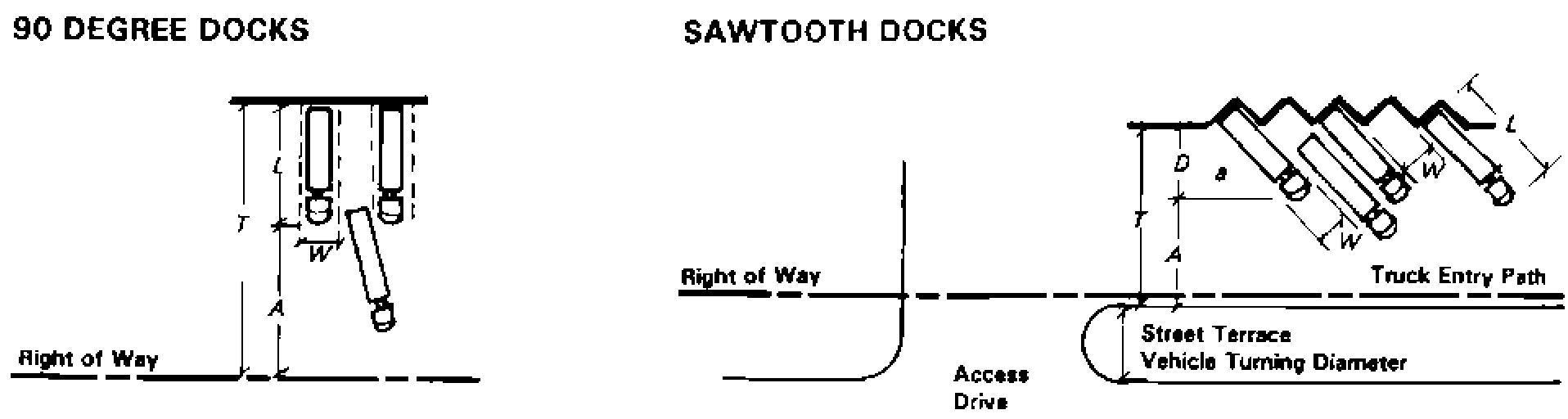
Size of loading area. The first required loading berth shall be designed in accordance with Figure 18-214. All remaining required loading berths shall be a minimum of 50 feet in length and ten feet in width. All required loading berths shall have a minimum vertical clearance of 14 feet. The following standards shall be the minimum used to design loading areas:
a.
Access to loading area.
1.
Each loading berth shall be located so as to facilitate access to a public street or alley, and shall not interfere with other vehicular or pedestrian traffic and shall not interfere with the function of parking areas.
2.
In no instance shall loading areas rely on backing movements into public rights-of-way.
(2)
Surface and marking. All required loading areas shall be paved and maintained in a dust-free condition at all times. Said surface shall be marked in a manner that clearly indicates required loading areas.
(3)
Use of required loading areas. The use of all required loading areas shall be limited to the loading and unloading of vehicles. Said area shall not be used to provide minimum required parking spaces.
(4)
Lighting. All loading areas shall be lit so as to not exceed the standards of section 18-165.
(5)
Landscaping. Loading, maneuvering, and vehicle storage areas shall be sited, designed and landscaped to avoid a direct unscreened view from the street and adjacent residentially zoned property. Loading areas shall also adhere to the paved area landscaping requirements in article XI.
(6)
Signage. All signage located within, or related to, loading areas shall comply with the requirements of article XII.
(d)
Calculation of required loading spaces.
(1)
Indoor institutional land uses: One loading berth shall be required for each building having a gross floor area of 6,000 square feet to 29,999 square feet. For such uses located in buildings having a gross floor area of 30,000 square feet or greater, two loading berths shall be required.
(2)
Business (except offices), storage, transportation, and industrial land uses: One loading berth shall be required for each building having a gross floor area of 6,000 square feet to 29,999 square feet. For such uses located in buildings having a gross floor area of 30,000 square feet or greater, an additional loading berth shall be required for any portion of each 50,000 square feet of gross floor area in addition to the original 29,999 square feet.
(3)
Office land uses: One loading berth shall be required for each building having a gross floor area of 6,000 to 99,999 square feet. For such uses located in buildings having a gross floor area of 100,000 square feet or greater, an additional loading berth shall be required for any portion of each 100,000 square feet of gross floor area in addition to the original 99,999 square feet.
Figure 18-214: Loading Standards
| Design Vehicle | Length in Feet | Dock Angle (a) | Clearance in Feet (D) | Berth Width in Feet (W) | Apron Space in Feet (A) | Total Offset in Feet (T) |
|---|---|---|---|---|---|---|
| WB-40 | 50 | 90° | 50 | 10 | 63 | 113 |
| 12 | 56 | 106 | ||||
| 14 | 52 | 102 | ||||
| 60° | 44 | 10 | 46 | 90 | ||
| 12 | 40 | 84 | ||||
| 14 | 35 | 79 | ||||
| 45° | 36 | 10 | 37 | 73 | ||
| 12 | 32 | 68 | ||||
| 14 | 29 | 65 | ||||
| WB-50 | 55 | 90° | 55 | 10 | 77 | 132 |
| 12 | 72 | 127 | ||||
| 14 | 67 | 122 | ||||
| 60° | 48 | 10 | 55 | 103 | ||
| 12 | 51 | 99 | ||||
| 14 | 46 | 94 | ||||
| 45° | 39 | 10 | 45 | 84 | ||
| 12 | 40 | 79 | ||||
| 14 | 37 | 76 | ||||
 |
(Ord. No. 090412-02, § 1, 9-4-2012)
Sec. 18-215. - Exterior storage standards.
(a)
Purpose. The purpose of this section is to control the use of residential, office and commercial property for exterior storage so as to promote the safety and general welfare of the public.
(b)
Applicability. The requirements of this section apply to all development.
(c)
Requirements for exterior storage in business districts. In all business zoning districts, all materials and equipment shall be stored within a completely enclosed building except for the following, which shall not be located within any front or street side yard and shall be stored a minimum of five feet from any and all property lines:
(1)
Screened refuse containers;
(2)
Construction materials;
(3)
Landscape materials and related equipment connected within on-site construction; and
(4)
Off-street parking (except for vehicles in designated parking spaces).
(d)
Exterior trash storage. All exterior trash storage shall be located within a completely screened enclosure. The enclosure shall be constructed of some or all of the materials used on the principal building. A solid wood fence shall be used to gain access to the storage area.
(e)
Outdoor storage of firewood.
(1)
Storage of firewood in the front yard on residentially zoned property is prohibited.
(2)
Delivered firewood shall be moved out of the front yard within 30 days from the date of its delivery.
(3)
Firewood should be neatly stacked and may not be stacked closer than two feet to any lot line and not higher than six feet from grade, except adjacent to a fence where firewood can be stacked against the fence as high as the fence. Fences as used in this section shall not include hedges and other vegetation.
(4)
All brush, debris and refuse from processing of firewood shall be promptly and properly disposed of.
(5)
Woodpiles that contain diseased wood that is capable of transmitting disease to healthy trees and woodpiles, or that harbor or are infested or inhabited by rats or other vermin, are public nuisances and may be abated pursuant to the provisions of this chapter.
(6)
Not more than 20 percent of the side and rear yard may be used for storage of firewood at any one time.
(f)
Inoperative motor vehicles and junk. Refer to the Village's Municipal Code.
(Ord. No. 090412-02, § 1, 9-4-2012)
Sec. 18-216. - Swimming pool standards.
(a)
Definitions. The following words, terms and phrases, when used in this section, shall have the meanings ascribed to them, except where the context clearly indicates a different meaning:
(1)
Public swimming pool means any swimming pool, other than a residential pool, intended to be used collectively by a number of persons for a swimming pool. Such persons may be residents or occupants of a hotel, motel, apartment or condominium and their guests, or the general public.
(2)
Residential swimming pool means any constructed permanent or portable pool which is intended for noncommercial use as a swimming pool in connection with a residence and available only to the family of the residence and their private guests, and having a depth of more than 24 inches and a surface area exceeding 250 square feet or a volume over 3,250 gallons.
(b)
Standards.
(1)
Reserved.
(2)
Plans and specifications for any public swimming pool must be approved first by the proper state authority in compliance with state and local codes regarding public swimming pools.
(c)
Permit required. No person shall construct or maintain a private swimming pool unless an application has first been made to the building inspector incorporating plans and specifications which shall meet the minimum standards for pools, and which application shall be approved by the building inspector, and a permit issued.
(d)
Plans and specifications. No person shall begin construction of either a residential or public swimming pool, or substantially alter or reconstruct any such pool without first having submitted plans and specifications to the building inspector for review and without having received a permit from the inspector for such construction or reconstruction. The plans and specifications must include the specifications of the enclosure and shall be submitted in duplicate. The building inspector shall arrange for the review and approval of the plans and specifications by other appropriate departments concerned with such matters as zoning, electrical, structural and plumbing requirements. A permit to construct, alter or renovate shall be issued by the inspector following approval and authorization by him and other departments or concerned officers.
(e)
Enclosure required. Every person owning or occupying land on which there is situated a swimming pool which contains 24 inches or more in depth at any point, shall erect and maintain an adequate enclosure surrounding the pool area sufficient to make such body of water inaccessible to small children. Pools within the scope of this section which are not enclosed with a permanent building shall be completely enclosed by a fence of sufficient strength to prevent access to the pool. Such fence shall not be less than four feet in height and so constructed as not to have voids, holes, or openings larger than four inches in one dimension. Gates or doors shall be kept locked while the pool is not in actual use. This enclosure shall be erected as soon as possible prior to or during construction, and unless special permission is given by the building inspector before water is placed in the pool.
(f)
Disposal of water.
(1)
No filter backwash water or pool drainage water shall be fed into the village sanitary sewer system.
(2)
An approved means of draining the pool when necessary shall be provided.
(g)
Lighting. Lighting other than underwater lights shall meet the requirements of section 18-165 regarding exterior lighting standards.
(h)
Location on property.
(1)
Swimming pools shall be classified as permanent accessory structures not classified as buildings and located on the property in accordance with the requirements of the zoning district the property is located.
(2)
Pumps and filter equipment shall in no case be closer than 20 feet to a property line and shall be adequately housed and muffled.
(3)
Surfaced terraces, sun decks, and walks may be permitted no closer than five feet to a lot line where accessory to a private residential pool. In any other case they may be permitted no closer than ten feet to a lot line.
(4)
Reasonable precautions shall be taken to ensure the safety of the pool area and to prevent it from becoming an attractive nuisance. Public and private residential swimming pools shall be completely fenced so as to prevent the unregulated entrance of young children to the pool area.
(Ord. No. 090412-02, § 1, 9-4-2012; Ord. No. 070824-01, § 1, 2, 7-8-2024)
Sec. 18-217. - Communication tower standards.
(a)
Purpose. The purpose of this section is to regulate the placement and maintenance of communication towers, other than exempt facilities, in order to prevent the creation of nuisances and to promote the healthy, safety and general welfare of the public.
(b)
Applicability. The requirements of this section apply to all new communications towers, other than exempt facilities, as described in subsection 18-59(e) of this chapter. Preexisting towers shall not be required to meet the requirements of this section, other than the requirements of subsection (c) of this section. Towers shall be considered principal uses. A different use on the same lot shall not preclude the installation of a tower on such lot.
(c)
Compliance with federal regulations. Towers shall be erected and installed in accordance with the state electrical code adopted by reference in section 101-31 et seq., National Electrical Code, Federal Communications Commission, Federal Aviation Administration, and the instructions of the manufacturer. In cases of conflict, the stricter requirements shall govern.
(d)
Review and approval. Except for exempt facilities, through both the site plan review process (section 18-245) and the conditional use process (section 18-246), the plan commission shall be responsible and have authority to hear, review, and act upon all proposed communication towers. Submittal and review procedure requirements and other requirements specific to communication towers must be consistent with Wis. Stats. § 66.0404.
(e)
Permit required. Except for exempt facilities, a permit is required for all new communication towers or modifications to existing communication towers. The permit shall contain all of the following information:
(1)
The name and business address of, and the contact individual for, the applicant.
(2)
The location of the proposed or affected support structure.
(3)
The location of the proposed mobile service facility.
(4)
If the application is to substantially modify an existing support structure, a construction plan which describes the proposed modifications to the support structure and the equipment and network components, including antennas, transmitters, receivers, base stations, power supplies, cabling, and related equipment associated with the proposed modifications.
(5)
If the application is to construct a new mobile service support structure, a construction plan which describes the proposed mobile service support structure and the equipment and network components, including antennas, transmitters, receivers, base stations, power supplies, cabling, and related equipment to be placed on or around the new mobile service support structure.
(6)
If an application is to construct a new mobile service support structure, an explanation as to why the applicant chose the proposed location and why the applicant did not choose collocation, including a sworn statement from an individual who has responsibility over the placement of the mobile service support structure attesting that collocation within the applicant's search ring would not result in the same mobile service functionality, coverage, and capacity; is technically infeasible; or is economically burdensome to the mobile service provider.
(f)
All service carriers and providers that offer or provide any telecommunications services for a fee directly to the public, either within the village or outside the corporate limits from telecommunications facilities within the village, and all communication tower owners, shall register and provide to the village, with each conditional use application the following information below. It shall be unlawful for any personal wireless services carrier or provider who offers or provides services within the village, or any communication tower owner who owns or operates telecommunications facilities within the village, to fail to register and provide the information required within 30 days of such request by the village.
(1)
The identity and legal status of the registrant, including any affiliates.
(2)
The name, address and telephone number of the officer, agent or employee responsible for the accuracy of the registration statement.
(3)
A narrative and map description of registrant's existing telecommunications facilities within the village and adjacent municipalities.
(4)
Such other information as the building inspector may reasonably require.
(g)
Collocation requirement. A proposed tower shall be structurally and electrically designed to accommodate the applicant's antenna and comparable antennas for two additional users. Towers shall be designed to allow for future rearrangement of antennas and to accept antennas mounted at varying heights.
(h)
Placement requirements. In addition to all applicable state and federal standards, the following shall apply:
(1)
Towers and guyed wires shall be setback from any property line a minimum distance equal to 100 percent of the height of the communication tower adjacent to zoning districts that permit single-family residential uses.
(2)
The placement of towers on the roof of existing buildings must maintain a setback from residential zones or properties the same as the building setback required for new buildings.
(3)
No communication tower shall be installed closer than one-quarter mile from another communication tower, measured from the base of the tower to the base of the proposed tower, unless it is a tower situated on a multi-tower zoning lot, or credible evidence to a reasonable degree of certainty acceptable to the plan commission is submitted showing a clear need for said new tower and the infeasibility of co-locating it on an existing site. For the purposes of this requirement, exempt telecommunications facilities unavailable for co-location shall not be included in the one-quarter mile computation.
(i)
Structural requirements. Every telecommunication facility shall be designed and constructed so as to comply with the requirements of COMM §§ 62.35 to 62.41, Wisconsin Administrative Code, amended from time to time. If, upon inspection, the building inspector concludes that a tower fails to comply with such codes, in effect at the time of construction, and constitutes a danger to persons or property, then upon notice being provided to the owner of the tower, the owner shall have 30 days, or such time as determined by the building inspector to bring such tower into compliance with said codes. Failure to bring such tower into compliance within 30 days or such time as determined by the building inspector shall constitute grounds for the removal of the tower or antenna at owner's expense.
(j)
Basic tower and building design. All new communication towers, except exempt facilities as defined in subdivision (q) below, shall be designed to blend into the surrounding environment to the greatest extend feasible. To this end all the following measures shall be implemented:
(1)
Communication towers shall be constructed out of metal or other nonflammable material, unless specifically permitted by the village to be otherwise.
(2)
Telecommunication support facilities, see subsection (k) Equipment buildings, below.
(3)
The village shall have the authority to require reasonable special design (materials, architectural features and color) of the communication tower where findings of particular sensitivity are made (e.g., proximity to historic or aesthetically significant structures, views and/or community features).
(4)
Communication towers shall insure that sufficient anti-climbing measures have been incorporated into the facility, as needed, to reduce potential for trespass and injury.
(5)
Accessory communication antenna shall be designed to blend with its supporting structure. The color selected shall be one that in the opinion of the plan commission will minimize the visibility of the antennas to the greatest extent feasible.
(6)
All new communication towers shall be structurally and electrically designed to accommodate at least three separate antenna arrays, unless credible evidence is presented that said construction is economically and technologically unfeasible or the plan commission determines that for reasons of aesthetics or to comply with the standards above, a communication tower of such height to accommodate three antenna arrays is unwarranted. Multi-use communication towers shall be designed to allow for future rearrangement of antennas and to accept antennas mounted at varying heights. Parking areas, access roads, and utility easements shall be shared by site users, at fair market rates as determined by customary industry standards, when in the determination of the plan commission this will minimize overall visual impact to the community.
(k)
Equipment buildings. Equipment buildings, including cabinets, used in connection with commercial communication antennas will be subject to the following conditions:
(1)
Any location and impact of the equipment buildings shall be made as minimal as possible so as not to prevent the principal use of the property.
(2)
Exterior storage of ground-mounted equipment or materials shall not be permitted.
(3)
Equipment buildings or structures may be mounted on the roof of a building provided that such building or structure is placed as unobtrusively as possible (e.g., integrated into the roof design) and/or is screened from view from adjacent roads and properties.
(4)
Any ground-mounted equipment building used for accessory equipment must either be screened from view from all adjacent residential and commercial uses and potentially incompatible municipal uses with a bufferyard with a minimum opacity of 0.40, or the equipment building must be constructed with similar materials, style, roof pitch, etc., to complement the architectural character of the surrounding neighborhood.
(5)
All ground-mounted equipment buildings shall at a minimum meet the required setbacks of a principal structure for the underlying zoning district and shall meet all applicable building code requirements.
(l)
Height requirements. Except for exempt facilities, Communication tower height shall be restricted to 200 feet.
(m)
Advertising. No form of advertising or identification, or sign is allowed on the tower other than the customary manufacturer identification plate.
(n)
Lighting. Tower shall not be artificially illuminated unless required by the FAA or any other applicable authority.
(o)
Fencing. A tower shall be enclosed by solid fencing not less than six feet in height or a bufferyard with a minimum opacity of 0.40 secured so that it is not accessible by the general public. Fence design, materials, and colors shall reflect the character of the surrounding area.
(p)
Color. The wireless communication tower and antennae shall be of a neutral color such as light gray or sky blue except as dictated by the Federal Aviation Administration (FAA) and be designed to minimize visibility and to blend into the surrounding environment. Towers with antennas shall be designed to withstand applicable wind load requirements as prescribed in the Uniform Building Code. Towers and/or antenna systems shall be constructed of, or treated with, corrosive resistant material. A regular maintenance schedule shall be followed.
(q)
Exempt facilities. Publicly owned and operated facilities required in the public interest to provide for and maintain a radio frequency telecommunication system, including digital, analog, wireless or electromagnetic waves for police, fire, and other municipal services.
(r)
Abandonment. The applicant shall provide a written agreement stating that if the tower, antennas or transmitters are unused for a period exceeding 12 months, the applicant shall remove the tower, antennas or transmitters upon written request from the zoning administrator at no cost to the village within 60 days of such request. If such listed items are not removed within 60 days of such notification, the village may remove the items at the expense of the holder of the conditional use permit. Within 30 days of the date on which the tower use ceases, the permit holder shall provide the commission written notice of the cessation of use.
(s)
Fee required. An application fee under this section shall be established by resolution. The applicant shall be responsible for all costs exceeding the application fee. In addition, if the plan commission determines it is necessary to consult with a third party in considering factors listed above, all reasonable costs and expenses associated with such consultation shall be borne by the applicant. All fees associated with small wireless facilities must be a reasonable approximation of the objectively reasonable cost associated with maintaining infrastructure or processing an application in accordance with the maximum values set forth by the Federal Communications Commission.
(Ord. No. 090412-02, § 1, 9-4-2012; Ord. No. 020623-02, § 19, 2-7-2023)
Sec. 18-218. - Antenna standards.
(a)
Purpose. The purpose of this section is to regulate the placement and maintenance of terrestrial and satellite antennas in order to prevent the creation of nuisances and to promote the healthy, safety and general welfare of the public.
(b)
Applicability. The requirements of this section apply to all terrestrial and satellite dish antennas with the exception of satellite dish antennas that are one meter or less in diameter. Satellite dish antennas that are two meters or less in diameter, which are proposed to be located in the CB, OP, RP Districts, are also exempt from these requirements.
(c)
Location.
(1)
Terrestrial antennas and satellite dish antennas may be located in the rear yard only or on the roof of the principal structure in all districts, except that antennas mounted on the roof shall not be permitted in the VC or RB Districts, unless they are fully screened.
(2)
In recognition of the negative aesthetic impact satellite dish antennas may have on the architecture of a building and the overall character of a neighborhood, satellite dish antennas shall be located and designed to reduce their visual impact on surrounding properties. Landscaping, fences, and architectural elements of buildings may be used for this purpose. In a residential district, no satellite dish antenna shall be mounted on the front of a building, unless it is fully screened in manner compatible with the architecture of the building.
(3)
In the event a property owner determines and documents that the placement of an antenna in a rear yard or on the roof would prevent its use for its intended purpose, or would unreasonably escalate the costs of installing, maintaining, or using the antenna, the property owner may apply to the zoning board of appeals for a variance to allow for the installation of the antenna in a side or front yard location or elsewhere on the building. Such placement in the front or side yard or elsewhere on the building shall be screened to the greatest extent possible to minimize any detrimental aesthetic effects the antenna may have on neighboring properties or the neighborhood in general.
(d)
Advertising. No form of advertising or identification may be displayed on the dish or framework of any antenna other than the customary manufacturer's identification plates.
(e)
Numbers limited. Not more than one terrestrial and one satellite dish antenna per dwelling unit shall be permitted on a lot or parcel in a residential zoning district.
(f)
Height.
(1)
All freestanding terrestrial antennas and roof antennas shall meet the height requirements for the district in which they are located.
(2)
Ground-mounted satellite dish antennas shall not exceed 15 feet in height.
(g)
Setbacks.
(1)
All terrestrial antennas shall be located not less than one foot from a lot line for each three feet of height above the surrounding grade, up to a maximum of 80 feet in residential districts, with the exception of government owned structures.
(2)
All satellite dish antennas shall be located not less than three feet from a side or rear lot line.
(h)
Construction.
(1)
The installation of a satellite dish antenna shall require a building permit. The property owner shall submit to the building inspector plans which indicate the appearance, proposed location, and installation method of the dish antenna.
(2)
All antennas shall be constructed and anchored in such a manner to withstand winds of not less than 80 miles per hour and such installations shall be constructed of noncombustible and corrosive-resistant materials.
(3)
An antenna support structure shall be erected in accordance with manufacturer's specifications.
(4)
All satellite dish antennas must conform to the city building ordinance and electrical ordinance regulations and requirements. Prior to the issuance of a building permit for a building-mounted satellite dish antenna, the applicant shall submit a plan or document prepared by a registered professional engineer which certifies that the proposed dish antenna installation is structurally sound.
(5)
An antenna support structure must be erected in accordance with manufacturer's specifications.
(i)
Interference. In the event that harmful interference is caused subsequent to the installation of an antenna, the owner of the antenna shall promptly take steps to eliminate the harmful interference in accordance with Federal Communications Commission regulations.
(j)
Restrictions. Portable or trailer-mounted antennas are not permitted with the exception of temporary installation for on-site testing and demonstration purposes for a period not to exceed two days at any one location.
(Ord. No. 090412-02, § 1, 9-4-2012)
Sec. 18-219. - Air pollution standards.
(a)
Purpose. The purpose of this section is to regulate the creation of air pollution which adversely affects adjoining properties in order to prevent the creation of nuisances and to promote the health, safety and general welfare of the public.
(b)
Applicability. The requirements of this section apply to all land uses and activities, except that these standards shall not apply to air pollution created during the construction of the principal use on the subject property, or by incidental traffic, parking, loading, or maintenance operations.
(c)
Standards. In addition to all applicable state and federal standards, the following shall apply:
(1)
The emission of particulate matter containing a particle diameter larger than 44 microns is prohibited.
(2)
Emission of smoke or particulate matter of a density equal to or greater than Number 2 on the Ringelmann Chart (U.S. Bureau of Mines) is prohibited at all times.
(3)
Dust and other types of air pollution borne by the wind from such sources as storage areas, yards, and roads within the boundaries of any lot shall be kept to a minimum by appropriate landscaping, paving, oiling, or other acceptable means.
(4)
All applicable state and federal standards.
(Ord. No. 090412-02, § 1, 9-4-2012)
Sec. 18-220. - Glare and heat standards.
(a)
Purpose. The purpose of this section is to regulate the creation of glare or heat in order to prevent the creation of nuisances and to promote the health, safety and welfare of the public.
(b)
Applicability. The requirements of this section apply to all land uses and activities, except that these standards shall not apply to glare created during the construction of the principal use on the subject property, or by incidental traffic, parking, loading, or maintenance operations.
(c)
Standards. No direct or sky-reflected glare shall be visible at the lot line of the subject property, whether from floodlights or from temperature processes, such as combustion, welding, or otherwise. As determined by the zoning administrator, there shall be no discernible transmission of heat or heated air at the lot line. Solar systems regulated by Wis. Stats. § 66.0401, shall be entitled to the protection of its provisions.
(Ord. No. 090412-02, § 1, 9-4-2012)
Sec. 18-221. - Fire and explosions.
(a)
Purpose. The purpose of this section is to regulate the creation of fire and/or explosion hazards which adversely affect adjoining properties in order to prevent the creation of nuisances and to promote the health, safety and general welfare of the public.
(b)
Applicability. The requirements of this section apply to all land uses and activities.
(c)
Standards. Any use involving materials which could decompose by detonation shall be located not less than 400 feet from any residential or commercial zoning district except that this standard shall not apply to the storage or usage of liquefied petroleum or natural gas for normal residential or business purposes. All activities and storage of flammable and explosive materials at any point shall be provided with adequate safety and fire-fighting devices in accordance with all Fire Prevention Codes of the State of Wisconsin.
(Ord. No. 090412-02, § 1, 9-4-2012)
Sec. 18-222. - Odor standards.
(a)
Purpose. The purpose of this section is to regulate the creation of odor which adversely affects adjoining properties in order to prevent the creation of nuisances and to promote the healthy, safety and general welfare of the public.
(b)
Applicability. The requirements of this section apply to all land uses and activities, except that these standards shall not apply to odors created during the construction of the principal use on the subject property, or by incidental fertilizer application, traffic, parking, loading, or maintenance operations. Public landfills and public sanitary sewage treatment plants shall be exempted from the requirements of this section as essential public services.
(c)
Standards. Except for food preparation and cooking odors emanating from residential land uses, and odors associated with property development and maintenance (such as construction, lawn care, and the painting and roofing of structures), no odor shall be created for periods exceeding a total of 15 minutes per any day which are detectable (by a healthy observer such as the zoning administrator or a designee who is unaffected by background odors such as tobacco or food) at the boundary of the subject property, where said lot abuts property within any residential, office or business zoning district, or the RB District.
(Ord. No. 090412-02, § 1, 9-4-2012)
Sec. 18-223. - Outdoor furnaces.
(a)
Purpose. The purpose of this section is to regulate outdoor furnaces in order to prevent the creation of nuisances and to promote the health, safety and general welfare of the public.
(b)
Applicability. This section applies to all outdoor wood-burning furnaces.
(c)
Permit required. A conditional use permit must be secured prior to the commencement of construction or erection of any outdoor furnace (see section 18-246). Plans, specifications and pertinent explanatory data shall be submitted to the zoning administrator at the time of application.
(d)
Standards. An outdoor furnace may be installed and used in the village only in accordance with following provisions.
(1)
Outdoor furnaces are prohibited in all zoning districts except the AH-35 District.
(2)
The outdoor furnace shall only use seasoned wood or other materials which have low smoke, odor, and pollutant generating properties, and which have been approved for such use by the State of Wisconsin. The outdoor furnace shall not be used to burn any prohibited materials, including rubbish or garbage, food waste, food wraps, packaging, animal carcasses, paint or painted materials, furniture, composite shingles, construction or demolition debris, or other household or business wastes, waste oil, asphalt, tires, and synthetic rubber-like products.
(3)
The outdoor furnace shall have a spark protector that shall be adequately maintained at all times.
(4)
The outdoor wood-burning furnace shall be located at least 300 feet from the property line.
(5)
Chimney heights shall be based on manufacturer's recommendations.
(e)
Nonconforming wood-burning furnaces. Use of any outdoor furnace in existence prior to the effective date of this chapter may continue until such time that replacement or maintenance is required, at which time all requirements of this section must be met.
(Ord. No. 090412-02, § 1, 9-4-2012)
Sec. 18-224. - Hazardous materials.
(a)
Purpose. The purpose of this section is to provide information to the village regarding the nature of land uses which involve research, production, storage, disposal, handling, and/or shipment of hazardous materials.
(b)
Applicability. The requirements of this section apply to all land uses and activities involving any one or more of the following:
(1)
Micro-organism cultures subject to Wis. Stats. § 94.65.
(2)
Pesticides subject to Wis. Stats. § 94.67(25).
(3)
Biological products subject to Wis. Stats. § 95.39.
(4)
Hazardous substances subject to Wis. Stats. § 100.37(1)(c).
(5)
Toxic substances subject to Wis. Stats. § 101.58(2)(j).
(6)
Infectious agents subject to Wis. Stats. § 101.58(2)(f).
(7)
Any material for which the State of Wisconsin requires notification of a local fire department.
(8)
Any other uses, activities, or materials which are subject to county, state or federal hazardous, or related, materials regulations.
(c)
Standards. All land uses involving such hazardous materials shall submit a written description of such materials and the operations involving such materials conducted on their property as part of the required site plan submittal.
(Ord. No. 090412-02, § 1, 9-4-2012)
Sec. 18-225. - Toxic or noxious materials.
(a)
Purpose. The purpose of this section is to provide information to the village regarding the nature of land uses which involve research, production, storage, disposal, handling, and/or shipment of hazardous materials.
(b)
Applicability. The requirements of this section apply to all land uses and activities.
(c)
Standards. No use shall discharge across the boundaries of the subject property, or through percolation into the subsoil, toxic or noxious material in such concentration as to be detrimental to, or endanger, the public health, safety, comfort or welfare, or cause injury or damage to the property or business. No use shall discharge at any point into any public or private sewerage disposal system or stream, or into the ground, any liquid or solid materials except in accordance with the regulations of the Wisconsin Department of Public Health.
(Ord. No. 090412-02, § 1, 9-4-2012)
Sec. 18-226. - Water quality standards.
No activity shall locate, store, discharge, or permit the discharge of any treated, untreated, or inadequately treated liquid, gaseous, or solid materials of such nature, quantity, obnoxiousness, toxicity, or temperature that might run off, seep, percolate, or wash into surface or subsurface waters so as to contaminate, pollute, or harm such waters or cause nuisances such as objectionable shore deposits, floating or submerged debris, oil or scum, color, odor, taste, or unsightliness or be harmful to human, animal, plant, or aquatic life.
In addition, no activity shall withdraw water or discharge any liquid, or solid materials so as to exceed, or contribute toward the exceeding of, the minimum standards and those other standards and the application of those standards set forth in Chapter NR-102 of the Wisconsin Administrative Code.
(Ord. No. 090412-02, § 1, 9-4-2012)
Sec. 18-227. - Noise standards.
(a)
Purpose. The purpose of this section is to regulate the creation of noise which adversely affects adjoining properties in order to prevent the creation of nuisances and to promote the health, safety and general welfare of the public.
(b)
Applicability. The requirements of this section apply to all uses and activities which create detectable noise, except that these standards shall not apply to noise created during the construction of the principal use on the subject property, or by incidental traffic, parking, loading, maintenance, or agricultural operations. The requirements of this section shall apply to any person making or assisting in making any noise in violation of the standard set forth in this section. Furthermore, the requirements of this section shall apply to any person, firm, corporation or other entity occupying, owning or having charge of or management of any building or premises, or any part thereof, at which noise is created in violation of the standard said forth in this section.
(c)
Requirements. All noise shall be muffled so as not be objectionable due to intermittence, frequency, or shrillness. In no event shall the sound-pressure level of noise continuously radiated from a facility exceed the values given in Figure 18-227 as measured by a Type 2 sound meter that is in compliance with ANSI standard S1.4-1983. The measurement shall be conducted at the lot line of the subject property.
(d)
Nonconforming noise. Noise that was in effect as of the effective date of this chapter shall be considered legal nonconforming. The burden of proof to demonstrate that said noises were in effect prior to the effective date of this chapter is the responsibility of the noise producer.
Figure 18-227: Maximum Permitted Noise Level at Lot Line for Continuous Noise
(Ord. No. 090412-02, § 1, 9-4-2012; Ord. No. 100421-03, § 1, 10-4-2021; Ord. No. 090622-03, § 1, 9-6-2022; Ord. No. 061223-01, § 4, 6-12-2023)
Sec. 18-228. - Vibration standards.
(a)
Purpose. The purpose of this section is to regulate the creation of vibration which adversely affects adjoining properties in order to prevent the creation of nuisances and to promote the health, safety and general welfare of the public.
(b)
Applicability. The requirements of this section apply to all uses and activities that create detectable vibrations, except that these standards shall not apply to vibrations created during the construction of the principal use on the subject property.
(c)
Depiction on required site plan. Any activity or equipment which creates detectable vibrations outside the confines of a building shall be depicted as to its location on the site plan required for the development of the subject property.
(d)
Requirements. No activity or operation shall cause or create earthborn vibrations in excess of the displacement values given in Figure 18-228, below.
(e)
Method of measurement. Measurements shall be made at or beyond the adjacent lot line or the nearest residential district boundary line. Vibration displacements shall be measured with an instrument capable of simultaneously measuring in three mutually perpendicular directions. The maximum permitted displacements shall be determined in each zoning district by the following formula: D = K/f, where D = displacement in inches; K = a constant to be determined by reference to Figure 18-228; f = the frequency of vibration transmitted through the ground (cycles per second).
Figure 18-228: Vibration Measurement Constant
(Ord. No. 090412-02, § 1, 9-4-2012)
Sec. 18-228.5. - Preservation of existing grade.
(a)
No damage to adjacent properties. In addition to any other obligation imposed by the Village of Fontana Municipal Code or by law, no land shall be developed or graded and no use shall be permitted which shall result in water runoff which causes property damage, a nuisance, or erosion on adjacent properties.
(b)
Grading permit required. In order to protect adjacent properties from possible damage due to the change in the existing grade of adjoining lands, and to aid in preserving and protecting the natural beauty and character of the landscape, no change in the existing topography of any land shall be made which would result in increasing any portion of the slope to a ratio greater than three horizontal feet to one vertical foot, within a distance of 30 feet from any property line. The property owner proposing to change the existing grade of that owner's land within 30 feet of a property line or proposing the installation of a retaining wall within a distance of 30 feet from any property line shall first obtain a village grading permit by submitting an application, paying a permit fee as determined by the board from time to time, a grading plan showing existing and proposed grades at one foot contours on the subject land with such detail as is necessary to allow the village to determine compliance with this section, a cost recovery certificate and such other information or documentation as the village may request.
Grading permits pursuant to this section shall be valid for six months. To the extent the ordinance codified in this section conflicts with the requirements of chapter 16 of the Village of Fontana Municipal Code, chapter 16 shall control.
(Ord. No. 070620-04, § 2, 7-6-2020)
Sec. 18-229. - Performance standards administration and enforcement.
(a)
Determinations necessary for administration and enforcement of performance standards set forth in this article range from those which can be made with satisfactory accuracy by a reasonable person using normal senses and no mechanical equipment, to those requiring great technical competence and complex equipment for precise measurement. It is the intent of this chapter that:
(1)
Where determinations can be made by the zoning administrator using equipment normally available to the village or obtainable without extraordinary expense, such determinations shall be so made before notice of violations is issued.
(2)
Where technical complexity or extraordinary expense makes it unreasonable for the village to maintain the personnel or equipment necessary for making difficult or unusual determinations, procedures shall be available for causing corrections or apparent violations of performance standards, for protecting individuals from arbitrary, capricious, and unreasonable administration and enforcement of performance standard regulations, and for protecting the general public from unnecessary costs for administration and enforcement.
a.
The zoning administrator shall give written notice, by certified mail or other means, ensuring a signed receipt for such notice to the person or persons responsible for the alleged violations. The notice shall describe the particulars of the alleged violation and the reasons why the zoning administrator believes there is a violation in fact, and shall require an answer or correction of the alleged violation to the satisfaction of the zoning administrator.
b.
The notice shall state, and it is hereby declared, that failure to reply or to correct the alleged violation to the satisfaction of the zoning administrator within the time limit set constitutes admission of violation of the terms of this chapter. The notice shall further state that upon request of those to whom it is directed, technical determination as described in this chapter will be made, and that if violations as alleged are found, costs of such determinations shall be charged against those responsible for the violation, in addition to such other penalties as may be appropriate, but that if it is determined that no violation exists, the cost of the determination will be paid by the village.
(3)
Consideration of exemptions. The conditional use process may be used to seek exemptions from certain requirements of this article, specifically those found in section 18-211 Access standards; section 18-212 Visibility standards; section 18-213 Off-street parking and traffic circulation; and section 18-214 Off-street loading standards. An appeal of the plan commission's determination may be taken to the zoning board of appeals.
(b)
Enforcement of the provisions of this article shall be per section 18-257.
(Ord. No. 090412-02, § 1, 9-4-2012; Ord. No. 03-07-16-03, § 1, 3-7-2016)

