
Fontana On Geneva Lake
City Zoning Code
City Zoning Code
ARTICLE VI
NONCONFORMING SITUATIONS
Sec. 18-90.- Purpose.
The purpose of this article is to establish regulations for nonconforming uses, nonconforming structures, nonconforming and substandard lots, and nonconforming sites created legally prior to the effective date of this chapter (i.e., September 4, 2012). Nonconforming signs are addressed further in article XII.
(Ord. No. 090412-02, § 1, 9-4-2012)
Sec. 18-91. - Nonconforming uses.
(a)
Continuance of a nonconforming use.
(1)
Any nonconforming use lawfully existing upon the effective date of this chapter or any amendment to it may be continued at the size and in a manner of operation existing upon such date, except as specified in this section.
(2)
A use which was approved as a conditional use prior to the effective date of this chapter shall be considered a legal, conforming land use so long as any previously approved conditions of use and site plan are followed. Any modification of the previously approved conditions of use or site plan shall require application and village consideration under the requirements of section 18-245.
(3)
Any prior legal use made nonconforming by this chapter, or by an amendment to it, may be granted legal conforming status and allowed to be extended, enlarged, reconstructed, or substituted by the issuance of a conditional use permit, subject to the standards and procedures prescribed by section 18-246.
(4)
Any prior legal use made nonconforming by a modification to the official zoning map after the effective date of this chapter may be granted legal conforming use status by changing the zoning district of the affected property to an appropriate district through an amendment to the official zoning map. Such requested amendment shall be subject to the standards and procedures prescribed by section 18-244.
(b)
Modification of a nonconforming use.
(1)
Except as permitted in subsection (b)(3), below, a nonconforming use shall not be expanded, enlarged, extended, or reconstructed, unless the use is changed to a use permitted in the district in which the use is located.
(2)
Substitution of new equipment may be permitted by the plan commission.
(3)
A nonconforming nonresidential use not served by public sanitary sewer and/or public water may be permitted to expand without being served by public sanitary sewer and/or public water if either or both facilities are not available within 1,000 feet of the subject property and a conditional use permit is granted for such expansion.
(c)
Discontinuance of a nonconforming use. When any nonconforming use of any structure or land is discontinued for a period of 12 consecutive months, or is changed into a conforming use, any future use of said structure or land shall be in complete conformity with the provisions of this chapter.
(d)
Nonconforming uses within floodlands or shoreland-wetland areas. For nonconforming use provisions applicable within the floodplain overlay districts, see article VIII. For nonconforming use provisions applicable within the Shoreland-Wetland Overlay District, see article IX.
(e)
Alterations to conforming buildings containing legal, nonconforming residential units. Structural alterations may be made to a building containing lawful nonconforming residential units, provided such alterations do not increase the number of dwelling units or the bulk of the building. Notwithstanding the foregoing, a conforming garage may be added if none previously existed. However, after the effective date of this chapter, such buildings shall not be enlarged, expanded, or extended without bringing the enlargement, expansion, or extension into compliance with the provisions of the chapter unless a variance is granted under section 18-253 and except as permitted under this section.
(Ord. No. 090412-02, § 1, 9-4-2012)
Sec. 18-92. - Nonconforming structures.
(a)
Blanket conforming status. Blanket conforming status for any and all requirements of this chapter is hereby granted to any principal or accessory structure lawfully existing upon the effective date of this chapter. However, after the effective date of this chapter, such structures may not be enlarged, expanded, or extended without bringing the enlargement, expansion, or extension into compliance with the provisions of this chapter (see also subsection (d), below) or unless permitted as a shoreyard commercial canopy within the meaning of subsection 18-110(d)(6)e. or unless a variance is granted by the zoning board of appeals under section 18-253.
(1)
This subsection is intended to eliminate nonconforming principal structures subject to the requirements of this chapter. This provision addresses two different situations:
a.
Many principal structures in the community were erected prior to the adoption of this zoning district and do not meet some or all of the density, building coverage, or bulk requirements of this chapter.
b.
In some instances, this chapter establishes new density, building coverage, and bulk requirements that existing legal structures under the previous zoning ordinance do not meet.
(2)
This section therefore ensures that owners of such structures legally established prior to the adoption of this chapter do not encounter difficulty because the structures would otherwise be considered nonconforming.
(b)
The following shall apply to all structures that do not meet the bulk and other requirements of this chapter:
(1)
Unsafe structures. Nothing in this chapter shall preclude the building inspector or any other village official from initiating remedial or enforcement actions when a structure is declared unsafe or presents a danger the public health, safety or welfare.
(2)
Ordinary maintenance. Ordinary maintenance repairs, including repairs reasonably necessary to prevent the deterioration of a structure, and remodeling of a structure are permitted, as well as necessary repairs and alterations that do not extend, enlarge, or intensify the nonconformance. Ordinary maintenance repairs and remodeling include: internal and external painting, decorating, paneling; the addition of acoustical ceilings; the installation of heating, electricity, plumbing (including fixtures) or insulation; and the replacement of doors, windows, and other nonstructural components.
(3)
Future modification. Existing structures outside of a floodplain district may be expanded, enlarged, or altered, provided that conformance with the established zoning requirements can be met. The following shall also apply:
a.
The proposed building addition or enlargement shall conform with all zoning requirements of the zoning district the lot is located in, which shall include, but are not limited to, setbacks, height, lot coverage, and parking.
b.
The proposed building addition or enlargement shall also be restricted as follows:
1.
Said expansion, enlargement, or alteration shall not create a greater degree of nonconformity than existed prior to the time of such expansion, enlargement, or alteration (see also subsection 18-94(c)).
2.
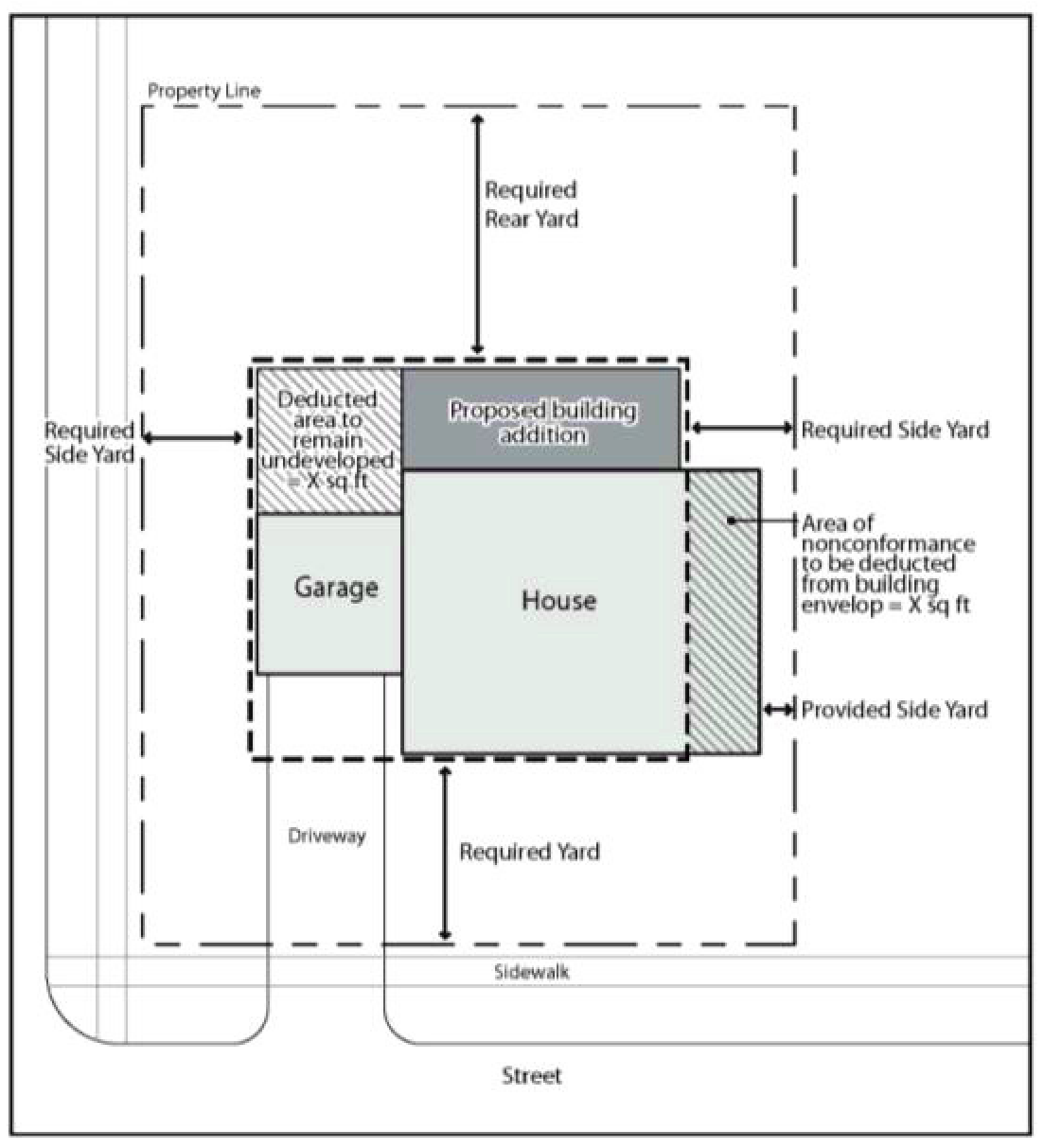
The total square footage of existing nonconformance of a structure (those portions of the existing structure currently and proposed to remain in the required setback areas, including all floor areas) shall be deducted from the conforming building envelope and remain undeveloped. For example, 300 square feet of a first floor and 100 square feet of a second floor existing and remaining in the required setback area shall require a total of 400 square feet within the building envelope to remain undeveloped by any proposed addition or enlargement. See also example in Figure 18-92 at the end of this section.
3.
Within the conforming building envelope, the height of the expansion, enlargement, or alteration may be measured to the maximum permitted height allowed within the zoning district the lot is located in.
4.
In no case may said expansion, enlargement, or alteration result in a greater height to the nonconforming areas of a structure, or to the nonconforming areas of the building envelope, than existed prior to the time of said expansion, enlargement or alteration.
5.
An increase in height, addition or enlargement of any kind shall not be approved in those areas which do not meet zoning requirements, or are proposed to be located outside the conforming building envelope, within setback and offset areas.
(4)
Restoration of structures following a calamity. A damaged or destroyed structure may be restored to the size, configuration, and location (including density, building coverage and floor area) that it had immediately before the damage or destruction occurred without any limits on the costs of the repair, reconstruction, or improvement if all of the following apply:
a.
The structure was damaged or destroyed on or after the effective date of this chapter.
b.
The damage or destruction was caused by violent wind, vandalism, fire, flood, ice, snow, mold or infestation.
(5)
Reconstruction of an existing structure following razing. Existing structures outside of floodplain district which have been razed as a result of property owner request or village order, may be reconstructed per subsections (b)(5)b.1. and (b)(5)b.2., below. Reconstruction in the Lakefront Residential district may be reconstructed per subsection (b)(5)b.3.
a.
The proposed reconstruction shall conform with all zoning requirements of the zoning district the lot is located in, which shall include, but is not limited to, setbacks, height, lot coverage and parking. The required setback of a principal building may be reduced by no more than four inches for every foot of deficiency in the lot width.
b.
If it is not possible to meet all zoning requirements, the proposed building reconstruction shall be restricted as follows:
1.
Insofar as is practicable, a building reconstruction shall be resituated on the lot to encourage improving existing nonconformities, such as increasing setbacks, building separation, green space and parking.
2.
In no case shall the reconstructed building be located as to encroach on property lines, easements, or road rights-of-way.
3.
In no case shall the reconstructed building create a greater degree of nonconformity than existed prior to the time of such reconstruction.
4.
In no case shall the nonconforming setbacks of the reconstructed structure be less than the nonconforming setbacks of the existing structure.
5.
The building footprint of the original structure may be manipulated; however, it shall not be enlarged or increased in overall size. The square footage of the building footprint of the reconstructed structure, as measured to the outside of the exterior walls shall be equal to or less than the square footage of building footprint of the existing structure. In no case shall the total reconstructed building footprint exceed the original building footprint. When determining the total size of "building footprint," those areas considered habitable of all existing floors shall be computed separately from those areas considered nonhabitable.
6.
The total existing habitable areas of an existing structure shall not be increased in the reconstructed structure. When computing the overall total of existing habitable space, nonhabitable spaces such as carports, garages, roofed porches, and screened porches shall not be included in computations. For example, an existing structure consisting of 800 square feet of habitable space on a first floor, 300 square feet of habitable space on a second floor, 150 square feet of a garage, and 80 square feet of a screened porch shall only be rebuilt to a maximum of 1,100 square feet of habitable space.
7.
The total nonhabitable areas of an existing structure shall not be increased in the reconstructed structure. For example, an existing structure consisting of 150 square feet of a garage and 80 square feet of a screened porch, shall only be rebuilt to a maximum 230 square feet of nonhabitable space.
8.
A building reconstruction shall not result in a greater building height than existed prior to the time of said reconstruction.
9.
The existing second- and third-floor areas shall not be increased in the reconstructed structure. For example, if the maximum second story floor area of the existing structure is 300 square feet, the reconstructed structure shall not exceed 300 square feet of floor area on the second floor.
10.
A building reconstruction shall not include the result of habitable space being created from those existing nonhabitable spaces (i.e., carports, garages, roofed porches, screened porches).
11.
Carports and garages may be reconstructed only if the reconstructed carport and garage is located completely within property lines, and all parking requirements have been met.
12.
A carport may be reconstructed and converted to an enclosed garage only when conforming to all required setbacks, lot coverage and parking requirements.
c.
Within in the Lakefront Residential District, in addition to subsections (1) and (2), above, the replacement structure may be no closer to the lake than the established foundation line; or as an alternative to subsections (1) and (2), above, all portions of the replacement structure shall be the greater of the ordinary high-water mark or the established foundation line.
(6)
Timing of building permit.
a.
Any structure for which a building permit has been lawfully granted prior to the effective date of this chapter, or an amendment to it, that will become nonconforming under the provisions of this chapter or that amendment thereto, may be completed in accordance with the approved plans, provided construction is started within 365 calendar days after issuance of the permit and construction is completed within 730 calendar days (two years) after the start of construction. If all such conditions are met, the structure shall thereafter be a legal nonconforming structure.
b.
Any residential building reconstruction (i.e., tear-down and replacement) may be built to the shore yard setback line of the existing residential structure if the new structure meets all other setback requirements of the district in which it is located and it is constructed within one year of the tear-down.
(7)
Nonconforming uses within floodlands or shoreland-wetland areas. For nonconforming structure provisions applicable within a floodplain overlay district, see article VIII. For nonconforming structure provisions applicable within the Shoreland-Wetland Overlay District, see article IX.
(8)
For regulations regarding alterations to conforming buildings containing legal, nonconforming residential units, see section 18-91 above.
Figure 18-92: Reservation of Land for Building Additions
(Ord. No. 090412-02, § 1, 9-4-2012; Ord. No. 10-07-13-02, § 4, 10-7-2013)
Sec. 18-93. - Nonconforming and substandard lots.
Any lot which does not meet all of the bulk requirements (i.e., lot area, setbacks, lake frontage or street frontage) of its zoning district shall herein be called a substandard lot.
(1)
Creation of new substandard lots prohibited.
a.
No existing lot area shall be reduced so as to create a lot of less than the required size or so that the existing setbacks, lot area, or minimum width would be reduced below that required by the regulations for the district in which such lot is located.
b.
After the effective date of this chapter, no lot shall be created that does not meet the dimensional requirements of the zoning district in which the proposed lot would be created except when combining substandard lots to make them less substandard per subsection (2)a., below.
(2)
Blanket conforming status. With the exception of subsections (1) above, blanket conforming status for any and all requirements of this chapter is hereby automatically granted to all substandard lots in their configuration existing or as finally approved as of the effective date of this chapter.
a.
If two or more such substandard lots are contiguous and have the same ownership as of the effective date of this chapter, and at least one is vacant, blanket conforming status shall apply to both such lots. Any such lots may be developed and/or may be sold, individually or together, without the requirement to combine, provided such development fully conforms to the other requirements of this article.
This section ensures that lots approved and created prior to the effective date of this chapter do not encounter difficulty because the lots would otherwise be considered substandard.
(3)
Size regulations and leniency for existing substandard lots. No building intended in whole or part for residential use shall be erected or relocated on a lot of less area than specified in subsections a., b., c., and d., below. This section 18-93(3) shall apply to both platted and unplatted lots.
a.
Area requirements and leniency for existing vacant substandard lots within Fontana Village limits. Where an existing vacant substandard lot located within the municipal boundaries of the Village of Fontana does not meet the minimum lot area requirements of the district in which it is located, it may be used as a single-family building site provided:
1.
In the LR-0 District, the lot is at least 32,000 square feet in area.
2.
In the SR-1 District, the lot is at least 32,000 square feet in area.
3.
In the SR-2 District, the lot is at least 12,000 square feet in area. In the SR-4 District the lot is at least 8,000 square feet in area.
4.
In the SR-5 District, the lot is at least 5,600 square feet in area.
5.
In the AH-35 District, a lot less than 35 acres in area that has no existing dwelling units (neither farm residence, nor single-family residence) may be utilized, or one detached single-family dwelling unit may be constructed, provided the measurements of such lot area and dimensions are equal to or greater than 80 percent of the minimum requirements of the AH-35 District, and adequate access to a public right-of-way is provided.
6.
In addition to the regulations set forth in subsections 18-93(3)a.1. to a.5, herein, where an existing vacant substandard lot located within the municipal boundaries of the Village of Fontana is proposed to be used as a single-family building site, a one lot certified survey map may be approved in a situation where the existing vacant substandard lot is proposed to be increased in size and where the overall residential density is not increased. However, such approval shall be based upon, as a condition of approval, recording of a deed restriction, in a form acceptable to the village, whereby said one lot CSM shall not be reduced in size by any means.
7.
In cases where a substandard lot does not meet the above listed lot area requirements, a variance may be requested per section 18-253.
b.
Area regulations for and leniency for existing vacant substandard lots outside Fontana Village Limits and in the extraterritorial subdivision jurisdiction. Where an existing vacant substandard lot located outside the municipal boundaries of the Village of Fontana and within the extraterritorial subdivision review jurisdiction of the village is proposed to be used as a single-family building site, a one lot certified survey map may be approved in a situation where the existing vacant substandard lot is proposed to be increased in size, and where the overall residential density is not increased. However, such approval shall be based upon, as a condition of approval, recording of a deed restriction, in a form acceptable to the village, whereby said one lot CSM shall not therefore be reduced in size by any means.
c.
Where public sanitary sewer is not provided and not required, the width and area of any lot shall be sufficient to permit the issue of on-site sewage disposal system in compliance with the Wisconsin Administrative Code.
d.
Setback requirements.
1.
The setback requirements in article II shall apply, except that the required side yard setback for a principal building may be reduced by four inches for every foot of deficiency in lot width. In no case shall the reduction in setback be applied at the rear of the lot. In no case shall the reduction in setback be reduced below one-half the required setback as listed in the standards of the district in which the lot is located.
2.
Land in EC Overlay Zoning District may be included as part of a lot in computing the required minimum lot size.
3.
Except as provided in subsections 18-93(3) a., and b., any development occurring on substandard lots shall be required to meet the setback requirements of this chapter unless a variance is granted per section 18-253.
e.
Other bulk requirements. In cases where the substandard lot does not meet the other bulk requirement of the zoning district in which the lot is located, a variance may be requested per section 18-253.
(4)
Provision of sanitary sewer.
a.
Where public sanitary sewer is not provided, the width and area of any lot shall be sufficient to permit the use of on-site sewage disposal system in compliance with Wis. Admin. Code, ch. Comm 83.
b.
Nothing in this section shall contravene the requirements for provision of adequate sanitation and water supply.
(Ord. No. 090412-02, § 1, 9-4-2012; Ord. No. 070218-01, § 1, 7-2-2018; Ord. No. 090825-01, § 1, 9-8-2025)
Sec. 18-94. - Nonconforming development.
(a)
Blanket conforming status. Blanket conforming status for any and all requirements of this chapter is hereby automatically granted to the site and building design components of all developments in their configuration existing or as finally approved as of the effective date of this chapter. However, after the effective date of this chapter, such developments shall not be permitted to modify, enlarge, expand, or extend without bringing the development into compliance with the site and/or building design provisions of this chapter, or to the extent practical without removal of lawful structures in accordance with the following subsections (c) through (e), below.
(1)
This section is intended to prevent the creation of certain nonconforming sites related to building and site design subject to the requirements of this chapter. These building and site design components may include one or more of the following:
a.
Build-to design requirements (e.g., minimum number of floors, maximum setbacks). See article II.
b.
Exterior building materials requirements. See section 18-164.
c.
Exterior building design requirements. See section 18-164.
d.
Parking, loading, access drive and other paved area design requirements. See sections 18-213 and 18-214.
e.
Landscaping design requirements. See article XI.
f.
Bufferyard design requirements. See article XI.
g.
Fencing design requirements. See section 18-166.
h.
Lighting design requirements. See section 18-165.
(2)
This section ensures that sites approved prior to the adoption of this chapter do not encounter difficulty because they would otherwise be considered nonconforming.
(b)
Enlargements, expansions, or extensions of buildings, structures, or paved areas that would result in creation of one or more nonconformities, render a nonconforming site incapable of being brought into full or greater compliance with nonconforming site requirements, or increase the degree of existing nonconformities with the site development standards of this chapter, shall not be permitted, unless a variance is granted by the zoning board of appeals under section 18-253.
(c)
On lots with adequate configuration and area to bring the site into full or greater compliance with site design standards, said compliance shall be required at the time of any property improvement, modification, enlargement, or expansion requiring site plan review by the plan commission. The degree to which the property shall be made to comply with site design standards shall be proportional to the degree of property improvement per the following:
(1)
Total additions or expansions to structures on nonconforming sites shall require correction of existing nonconformities associated with on-site improvements in accordance with the following:
a.
Renovations that result in expansions to the total gross square footage of the existing structure(s), paved areas, and/or outdoor storage areas of less than 50 percent of the existing structural, paved area, and/or outdoor storage area shall require a corresponding percentage increase in compliance with the site improvements required by this chapter until the site achieves 100 percent compliance. (Example: A property with a permitted, expandable use currently has only 50 percent of the required landscaping. An addition to the structure equaling 20 percent of the combined area of the existing structures on the site is proposed. Therefore, as a condition of approval, an additional 20 percent of landscaping required for the whole site must be added. In this instance, 70 percent of the landscaping requirement would be met upon completion of the improvements.)
b.
Complete replacement of existing structures or expansions of the existing structures that result in a total of 50 percent or greater increase of total gross square footage to meet all of the site improvement requirements of this chapter. The same requirements also apply to increased or new paved areas and outdoor areas used for outdoor operations/storage.
(2)
On lots where the configuration and undeveloped area of the nonconforming site provides insufficient space to bring the site into full compliance with all site requirements but nevertheless provides space to reduce the degree of one or more nonconformities, the plan commission shall make a determination as to the manner and degree to which each site nonconformities shall be brought into conformance.
(Ord. No. 090412-02, § 1, 9-4-2012)

