


Fort Oglethorpe City Zoning Code
CHAPTER 9
- APPEALS
ARTICLE 1. - SCOPE OF THIS CHAPTER
This chapter provides for relief from the requirements of this development code under the following topics:
(a)
Hardship variance. A reduction or other revision to the strict application of the minimum standards and provisions of this code to a particular property or development that would result in undue hardship to the property owner, builder or developer can be considered under article 2, Process for hardship variances, below.
(b)
Appeal from an administrative decision. An appeal from an administrative decision of the director of building, planning and zoning or any other city employee of general application, whether or not related to a particular property or development, can be considered under article 3, Appeals of an administrative decision, below.
(c)
Special provisions for variances or decisions relating to the following:
(1)
Signs;
(2)
Subdivisions; and
(3)
Flood hazard reduction.
(Ord. No. 2021-10, § 1, 6-28-2021)
ARTICLE 5. - SIGN VARIANCES
(a)
Hardship variances from the regulations of the chapter 5, Sign Regulations shall be limited to the minimum relief necessary to overcome the hardship. No variance shall be granted to allow a greater number of signs than would be allowed if the hardship did not exist. A variance from compliance with the sign regulations of chapter 5 shall be limited to the following hardship situations:
(1)
Where visibility of a conforming sign from the public street and within 50 feet of the proposed sign would be substantially impaired by existing trees, plants, natural features, signs, existing buildings or structures on a different lot; and
(2)
Placement of the sign elsewhere on the lot would not remedy the visual obstruction; and such visibility obstruction was not created by the owner of the subject property; and the variance proposed would not create a safety hazard to traffic.
(b)
Variance applications shall be submitted to the director of building, planning and zoning and shall be heard under the same time frames and rules governing hardship variances under this chapter 9, above.
(Ord. No. 2021-10, § 1, 6-28-2021)
ARTICLE 6. - INFRASTRUCTURE IMPROVEMENT VARIANCES
(a)
Hardship. Where the city council finds that extraordinary hardships may result from strict compliance with the regulations of chapter 7 of this development code due to unusual topographic or other conditions beyond the control of the subdivider, it may vary such regulations so that substantial justice may be done and the public interest secured; provided, however, that such variation will not have the effect of nullifying the intent or purpose of said regulations of chapter 7 or other provisions of this development code, or of an adopted thoroughfare plan or elements of the comprehensive plan. Any variance, thus authorized, is required to be entered in writing in the minutes of the city council, and the reason which justified the departure shall be set forth.
(b)
Application. Variance applications shall be submitted to the director of building, planning and zoning and shall be heard under the same time frames and rules governing hardship variances under this chapter 9, above.
(c)
Submission of plans. Plans for all such developments shall be submitted to be approved by the director of building, planning and zoning in accordance with the requirements of chapter 8, Procedures and Permits, whether or not such plat is to be recorded. No building permits shall be issued until such approval has been given.
(Ord. No. 2021-10, § 1, 6-28-2021)
ARTICLE 7. - FLOOD HAZARD REDUCTION VARIANCES
(a)
Application. Variance applications shall be submitted to the director of building, planning and zoning and shall be heard under the same time frames and rules governing hardship variances under this chapter 9, above.
(b)
City council decision.
(1)
The planning advisory board and city council shall hear and decide requests for variance from the requirements of the flood hazard reduction article in chapter 6, Natural Resource Protection, in accordance with the procedural requirements in article 2 of this chapter.
(2)
The city council shall hear and decide appeals when it is alleged an error in any requirement, decision, or determination is made by the director of building, planning and zoning in the enforcement or administration of the flood hazard reduction article in chapter 6 of this UDC.
(3)
Any person aggrieved by the decision of city council may appeal such decision to the county superior court, as provided in O.C.G.A. § 5-4-1.
(c)
Circumstances where a variance may be granted.
(1)
Variances may be issued for the repair or rehabilitation of historic structures upon a determination that the proposed repair or rehabilitation will not preclude the structure's continued designation as a historic structure and the variance is the minimum to preserve the historic character and design of the structure.
(2)
Variances may be issued for development necessary for the conduct of a functionally dependent use, provided the criteria of this article are met, no reasonable alternative exists, and the development is protected by methods that minimize flood damage during the base flood and create no additional threats to public safety.
(3)
Variances shall not be issued within any designated floodway if any increase in flood levels during the base flood discharge would result.
(4)
In reviewing such request, the city council shall consider all technical evaluations, relevant factors, and all standards specified in this and other sections of this article.
(d)
Conditions for variances.
(1)
A variance shall be issued only when there is:
a.
A finding of good and sufficient cause;
b.
A determination that failure to grant the variance would result in exceptional hardship; and
c.
A determination that the granting of a variance will not result in increased flood heights, additional threats to public safety, extraordinary public expense, create nuisance, cause fraud on or victimization of the public, or conflict with existing local laws or ordinances.
(2)
The provisions of the flood hazard reduction article in chapter 6, Natural Resource Protection are minimum standards for flood loss reduction; therefore any deviation from the standards must be weighed carefully. Variances shall only be issued upon a determination that the variance is the minimum necessary, considering the flood hazard, to afford relief; and in the instance of an historic structure, a determination that the variances the minimum necessary so as not to destroy the historic character and design of the building.
(3)
Any applicant to whom a variance is granted shall be given written notice specifying the difference between he base flood elevation and the elevation of the proposed lowest floor and stating that the cost of flood insurance will be commensurate with the increased risk to life and property resulting from the reduced lowest floor elevation.
(4)
The director of building, planning and zoning shall maintain the records of all appeal actions and report any variances to the Federal Emergency Management Agency upon request.
(e)
Upon consideration of the factors listed above and the purposes of the flood hazard reduction article in chapter 6, Natural Resource Protection, the city council may attach such conditions to the granting of variances as it deems necessary to further the purposes of the flood hazard reduction article.
(Ord. No. 2021-10, § 1, 6-28-2021)
Sec. 2.1. - Review of hardship variances.
(a)
A request for a hardship variance from the minimum standards and provisions of this code that apply to a particular property or development may be filed by the owner, or the owner's representative, of the property so affected.
(b)
Such hardship variance request shall be made by filing with the director of building, planning and zoning an application for approval of a hardship variance specifying the grounds thereof.
(c)
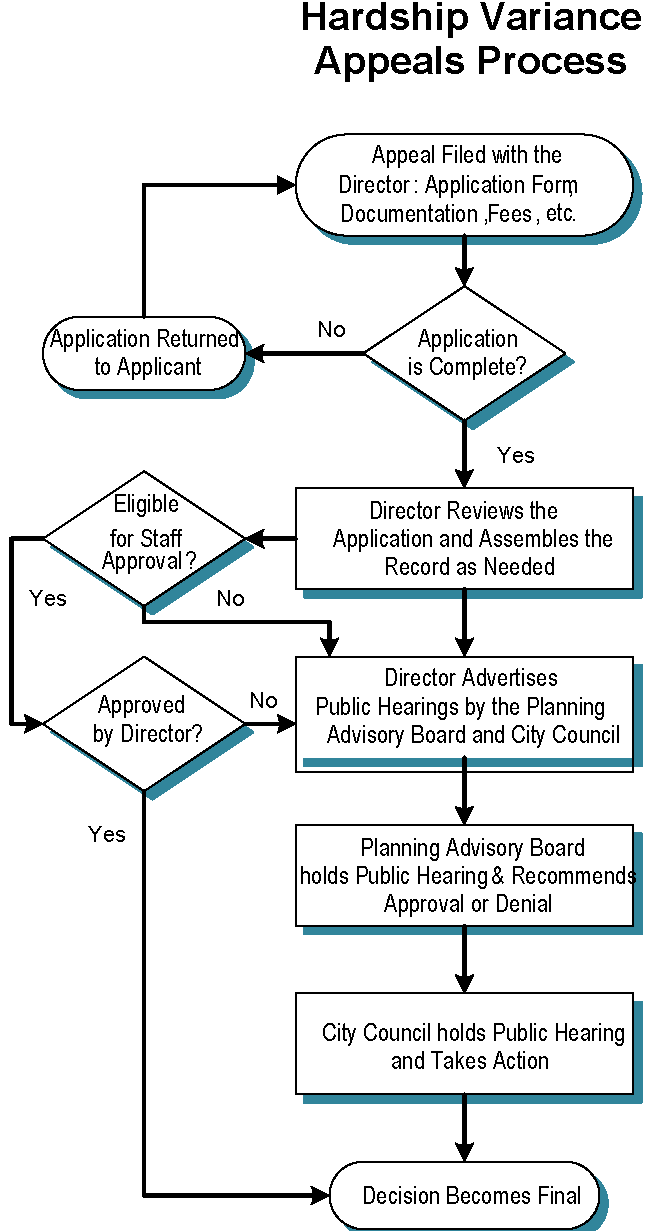
The director of building, planning and zoning will review the application for a hardship variance for completeness. Incomplete applications will be returned to the applicant.
(d)
Hardship variance requests that qualify for staff approval consideration will be reviewed under section 2.2 below.
(e)
For hardship variance requests that are not or could not be approved by the director of building, planning and zoning under section 2.2, the director of building, planning and zoning shall forthwith transmit to the planning advisory board the nature of the variance requested, the relevant requirements of this code appealed from, and all documentation received from the applicant.
(Ord. No. 2021-10, § 1, 6-28-2021)
Sec. 2.2. - Staff approval of minor hardship variances.
(a)
The director of building, planning and zoning may approve certain hardship variance requests under the following conditions of this section.
(1)
Hardship variance requests that are not approved by the director of building, planning and zoning will be forwarded to the planning advisory board following the process presented in this article, following this section.
(2)
In no case shall a variance from the conditions of approval imposed on a property through a zoning change granted by the city council be administratively approved by staff.
(b)
General limitations on relief. Variances eligible for staff approval under this section shall be limited to relief from the following requirements of this development code:
(1)
Minimum building setbacks.
(2)
Maximum building height.
(3)
Maximum height of a fence.
(4)
Minimum lot width for an existing lot of record.
(5)
Public street frontage for an existing lot of record.
(6)
Buffers and screening.
(7)
Parking requirements, such as the number of spaces required or improvement standards for parking lots. Approval of any change in parking lot improvement standards shall have the concurrence of the Fire Marshal.
(c)
Standards for approval. A variance may be granted by the director of building, planning and zoning upon findings that:
(1)
The relief, if granted, would not cause substantial detriment to the public good;
(2)
Would not be injurious to the use and enjoyment of the environment or of other property in the immediate vicinity;
(3)
Would not diminish and impair property values within the surrounding neighborhood; and
(4)
Would not impair the purpose and intent of the development code.
(d)
Staff approval. The director of building, planning and zoning, upon a finding that a variance listed below meets all of the standards for approval contained in subsection (c) above, may administratively approve such variance within and not exceeding the following parameters:
(1)
Minimum building setbacks. Not to exceed a reduction in the minimum setback required by ten percent, except the front setback may be reduced or waived for a multi-family or nonresidential use if the parking is located in the side or rear yards.
(2)
Maximum building height. Not to exceed an additional four feet above the maximum allowed.
(3)
Maximum height of a fence. Not to exceed an additional two feet above the maximum allowed.
(4)
Minimum lot width for an existing lot of record. The minimum lot width required by the zoning district within which the lot is located may be reduced to the extent necessary to allow reasonable construction of a building on the lot, provided that all minimum building setbacks required by the zoning district within which the lot is located are not reduced.
(5)
Public street frontage for an existing lot of record. The minimum public street frontage required by the zoning district within which the lot is located may be reduced to the extent necessary to allow reasonable construction of a building on the lot, provided that all minimum building setbacks required by the zoning district within which the lot is located are not reduced and adequate access for emergency vehicles to the lot from a public street is provided.
(6)
Buffers and screening. The landscaping requirements for buffers and screening on a lot or development project may be reduced based on alternate buffer and screening solutions proposed that are deemed to be equally effective as the minimum standards required by this development code.
(7)
Automobile parking requirements. Not to exceed a change by more than ten percent in the number of spaces required based on shared parking among two or more uses on site or the proximity of off-site spaces legally and permanently available to the use on the subject property.
(e)
If staff approval is denied by the director of building, planning and zoning, an application for the same staff approval of a variance affecting the same property shall not be reconsidered for a period of 12 months from the date of denial except for extenuating circumstances acceptable to the director of building, planning and zoning.
(Ord. No. 2021-10, § 1, 6-28-2021)
Sec. 2.3. - Powers of the planning advisory board and city council concerning hardship variances.
(a)
Purpose.
(1)
The planning advisory board shall make recommendations to the city council for approval of the variance only in those specific cases where such variance from the terms of the development code will not be contrary to the public interest and where, owing to special conditions, a literal enforcement of the provisions of the code will, in an individual case, result in unnecessary hardship, so that the spirit of this code shall be observed, public safety and welfare secured, and substantial justice done. Otherwise, based on the board's findings of fact, such variance shall be recommended for denial.
(b)
Hardship criteria.
(1)
A hardship variance may be granted by the city council, regardless of the recommendation made by the planning advisory board, in such individual case of unnecessary hardship upon finding by the city council that all of the following conditions apply:
a.
There are extraordinary and exceptional conditions pertaining to the particular piece of property in question because of its size, shape, or topography;
b.
The application of this code to this particular piece of property would create an unnecessary hardship;
c.
Such conditions are peculiar to the particular piece of property involved, and not of the making of the applicant;
d.
Relief, if granted, would not cause substantial detriment to the public good or impair the purposes and intent of this code, provided, however, that no variance may be granted for a use of land or building or structure that is prohibited by this code; and
e.
Approval would be the minimum needed to make possible the reasonable use of the land, building or structure.
(2)
In no case may a hardship variance be granted for a use of land or building (a "use variance") that is prohibited within the zoning district.
(c)
Authorization.
(1)
In hearing and deciding hardship variances, the city council shall have the authority to grant such variances as may be in harmony with the general purpose and intent of this code, public safety and welfare secured, and substantial justice done, including the following:
a.
Interpret or modify the provisions contained in the code in such a way as to carry out the intent and purpose of the development code as they apply to the particular property or development.
b.
Interpret the boundaries as shown upon the zoning map fixing the use districts, accompanying and made part of this code, where uncertainty exists relating to the particular property or development. In case of any question as to the location of the boundary line between zoning districts the city council shall interpret the zoning map.
c.
Allow the erection and use of a building or use of premises for public utility purposes.
d.
Allow the modification of the off-street automobile parking space or loading space requirements where, in the particular instance, such modifications will not be inconsistent with the purpose and intent of such requirements.
e.
Allow such modification of the height and area regulations as may be necessary to secure an appropriate improvement of a lot which is of such shape or so located with relation to surrounding development or physical characteristics that it cannot otherwise be appropriately improved without such modification.
f.
Allow temporary buildings and uses for periods not to exceed six months.
g.
Establish performance bonds to ensure compliance of any requirement which may be deemed necessary for approving any variance.
(2)
In making its recommendations to the city council, the planning advisory board shall consider the above criteria.
(3)
A hardship variance shall apply only to the particular property or development for which the variance was requested and shall not establish a precedent for any other hardship variance request or be made for general application.
(d)
Application.
(1)
A majority vote of a quorum of the city council shall be necessary to issue a hardship variance in favor of the applicant in any matter upon which it is authorized by this article to render a decision.
(2)
A majority vote of a quorum of the members of the planning advisory board shall be necessary to recommend approval of a variance in favor of the applicant in any matter upon which it is authorized by this article to recommend a decision.
(3)
If a variance request is not approved by the city council, it shall have been denied unless the request is tabled to a future meeting by a majority vote of a quorum present.
(e)
Standards.
(1)
In consideration of all appeals and all proposed variations to this code, the city council shall, before making any variations from the code in a specific case, first determine that the proposed variation complies with all of the conditions set forth in (b) above; and in addition, meets the following general standards:
a.
The proposed use will be of such location, size and character that it will be in harmony with the appropriate and orderly development of the surrounding neighborhood.
b.
The proposed use will be of a nature that will make vehicular and pedestrian traffic no more hazardous than is normal for the district involved, taking into consideration vehicular turning movements in relation to routes of traffic flow, proximity and relationship to intersections, adequacy of sigh distances, location and access of off-street parking and provisions for pedestrian traffic, with particular attention to minimizing child-vehicle contacts in residential districts.
c.
The location, size, intensity, site layout and periods of operation of any such proposed use will be designed to eliminate any possible nuisance emanating therefrom which might be noxious to the occupants of any other nearby permitted uses, whether by reason of dust, noise, fumes, vibration, smoke or lights.
d.
The location and height of buildings or structures and the location, nature and height of walls and fences will be such that the proposed use will not interfere with or discourage the appropriate development and use of adjacent land and buildings or unreasonably affect their value.
(2)
The planning advisory board, in making its recommendations, shall also consider the above general standards.
(f)
Upon hearing each hardship variance, the planning advisory board and the city council shall make findings of facts pertinent to the hardship variance, based on the hardship criteria contained in section 2.3(b) and the standards listed under section 2.3(e) above.
(g)
Conditions. The city council, acting on any appeal in connection with a request for a hardship variance, may attach any conditions to its approval which it finds necessary to accomplish the reasonable application of the foregoing standards.
(Ord. No. 2021-10, § 1, 6-28-2021)
Sec. 2.4. - Appeal of city council denial.
(a)
Any persons, jointly or severally, aggrieved by any decision of the city council on a hardship variance may present to a court of record a petition, duly verified, setting forth that such decision is illegal, in whole or in part, specifying the grounds of the legality.
(b)
Such petition shall be presented to the court within 15 calendar days of the adoption of the minutes of the city council meeting at which the decision was made. Otherwise the decision of the city council shall be final.
(c)
Such appeal shall be filed a certiorari.
(Ord. No. 2021-10, § 1, 6-28-2021)
Sec. 3.1. - Appellant.
Any person aggrieved by an alleged error in any order, requirement, decision or determination made in the interpretation or enforcement of this development code by the director of building, planning and zoning or any other city employee may initiate an appeal of such administrative decision.
(Ord. No. 2021-10, § 1, 6-28-2021)
Sec. 3.2. - Initiation of administrative decision appeal.
(a)
An appeal of an administrative decision shall be taken within 30 days of the action or interpretation appealed from, by filing the appeal in writing with the director of building, planning and zoning specifying the grounds of the appeal. The director of building, planning and zoning shall transmit a notice of said appeal to the planning advisory board specifying the grounds thereof.
(b)
The director of building, planning and zoning may initiate an administrative appeal independently when an interpretation or clarification of the meaning of words or phrases, of the particular boundaries of a zoning district or of any other provision of this development code is needed.
(c)
An administrative decision appeal shall stay all proceedings in furtherance of the decision or interpretation appealed from, unless the director of building, planning and zoning certifies to the city council, after the notice of appeal of an administrative decision has been filed with him or her, that by reason of facts stated in the certificate, a stay would, in his or her opinion, cause imminent peril to life or property, in which case the proceedings shall not be stayed otherwise than by a restraining order which may be granted by a court of record.
(Ord. No. 2021-10, § 1, 6-28-2021)
Sec. 3.3. - Action by the director of building, planning and zoning.
(a)
Upon receiving a notice of an appeal of an administrative decision, the director of building, planning and zoning shall assemble such memos, papers, plans or other documents from the appellant as may constitute the record for the appeal or as may provide an understanding of the issues involved.
(b)
The director of building, planning and zoning is authorized to resolve the appeal to the satisfaction of all parties involved, if possible, and may seek the advice of the city attorney.
(c)
The director of building, planning and zoning shall transmit any unresolved appeal of an administrative decision and all related documentation to the planning advisory board such that the appeal can be considered by the board.
(Ord. No. 2021-10, § 1, 6-28-2021)
Sec. 3.4. - Action by the planning advisory board on an appeal of an administrative decision.
(a)
The planning advisory board shall initially hear and make recommendations to the city council where it is alleged there is error in any order, requirement, decision, or determination made by an administrative official in the enforcement or interpretation of this development code.
(b)
The planning advisory board shall consider the appeal of the administrative decision at its next regularly scheduled meeting that occurs at least 15 days after the appeal has been advertised in accordance with the public notice requirements of section 4.2 of this chapter 9, below.
(c)
A majority vote of a quorum of the members of the planning advisory board shall be necessary to recommend approval of an appeal of an administrative decision.
(Ord. No. 2021-10, § 1, 6-28-2021)
Sec. 3.5. - City council authority.
(a)
The city council is authorized to:
(1)
Decide appeals from any order, determination, decision or other interpretation by any administrative official acting under authority of this development code, where a misinterpretation or misapplication of the requirements or other provisions of this development code is alleged;
(2)
Interpret the use of words or phrases within the context of the intent of this development code;
(3)
Determine the boundaries of the various zoning districts where uncertainty exists; and
(4)
Interpret such other provisions of this development code as may require clarification or extension in specific or general cases.
(b)
In exercising the above powers, the city council may, in conformity with the provisions of this code, reverse or affirm, wholly or partly, or may modify any order, requirements, decision, or determination, and to that end shall have all the powers of the officer from whom the appeal is taken in relation to this code and may issue or direct the issuance of a permit.
(Ord. No. 2021-10, § 1, 6-28-2021)
Sec. 3.6. - Decisions of the city council.
(a)
The city council shall consider the appeal at its next regularly scheduled meeting that occurs at least seven days after the planning advisory board meeting at which the appeal is considered.
(b)
In exercising its powers on such appeals, the city council may, by majority vote of a quorum present, reverse or affirm, wholly or partly, or may modify the order, requirement, decision or determination and to that end shall have all the powers of the administrative official from whom the appeal is taken.
(c)
If an appeal of an administrative decision is not approved by the city council, it shall have been denied unless the request is tabled to a future meeting by a majority vote of a quorum present.
(d)
Decision final.
(1)
The decision of the city council shall be final and may be appealed only to a court of competent jurisdiction by such person or persons, jointly or severally, aggrieved by the decision, by presenting to the court a petition, duly verified, setting forth that such decision is illegal, in whole or in part, and specifying the grounds of the appeal.
(2)
Such appeal must be taken within 15 days of the adoption of the minutes of the city council meeting at which the decision was made.
(3)
Such appeal shall be filed a certiorari.
(Ord. No. 2021-10, § 1, 6-28-2021)
Sec. 4.1. - Application and initial actions.
(a)
An application for a hardship variance or an appeal of an administrative decision shall include such descriptions, maps or drawings as needed to clearly illustrate or explain the action requested, and such filing fees as may be required. The director of building, planning and zoning may request such additional information from the appellant as necessary to provide a full understanding of the appellant's request.
(b)
Once the record has been assembled, the director of building, planning and zoning will:
(1)
Schedule unresolved appeals for consideration at the next meeting of the planning advisory board for which adequate public notice can be given; and
(2)
Send a letter by first class mail to the appellant or the appellant's attorney notifying the appellant of either: Administrative resolution of the matter; or the date, time and place of the public hearing.
(Ord. No. 2021-10, § 1, 6-28-2021)
Sec. 4.2. - Public notice.
(a)
For a hardship variance or appeal of an administrative decision relating to a particular property, public notice for the public hearings before the planning advisory board and the city council shall be provided in the same manner as for public notice for a rezoning or special exception under chapter 8, Procedures and Permits.
(b)
For an appeal not related to a particular property, public notice for the public hearings before the planning advisory board and the city council shall be published in a newspaper of general circulation within the territorial boundaries of the city at least 15 days but not more than 45 days prior to each public hearing. The public notice shall state the time, place and purpose of the hearings and the nature of the requested action. All other provisions for a public notice for a rezoning or special exception under chapter 8 shall apply.
(Ord. No. 2021-10, § 1, 6-28-2021)
Sec. 4.3. - Withdrawal.
Any appellant wishing to withdraw a hardship variance or appeal of an administrative decision prior to final action on the application shall file a written request for withdrawal with the director of building, planning and zoning in the same manner and procedures as set forth for a rezoning or special exception under chapter 8, Procedures and Permits.
(Ord. No. 2021-10, § 1, 6-28-2021)
Sec. 4.4. - Public hearing.
Sec. 4.5. - Decisions.
Decisions on a hardship variance or an appeal of an administrative decision shall be made in the same manner as for a rezoning or special exception under the provisions of section 4.4 of article 4 of chapter 8, Procedures and Permits for a rezoning or special exception.
(Ord. No. 2021-10, § 1, 6-28-2021)
Sec. 4.6. - Conditional approval.
Sec. 4.7. - Written decision.
The appellant shall be informed in writing of the city council's decision and the findings of fact regarding the decision, which will be sent by regular mail within seven working days of the date of the decision. Failure to receive the written decision within seven working days shall not constitute a procedural error on the part of the city, nor affect the decision of the city council in any manner.
(Ord. No. 2021-10, § 1, 6-28-2021)