
Fort Oglethorpe City Zoning Code
CHAPTER 5
- SIGN REGULATIONS
ARTICLE 3. - PERMIT REQUIRED, PROCEDURES.
Except as specifically excluded from the provision of this chapter, it shall be unlawful for any person to post, construct, enlarge, replace, display, substantially change, or erect a sign in the city without having first obtained a sign permit.
Sec. 1.1. - Findings.
The City of Fort Oglethorpe finds that the number, size, design characteristics, and locations of signs within the city directly affect the public health, safety and general welfare. The city finds that the signs need to be regulated in order to protect the public health, safety and general welfare of residents and nonresidents alike. The council has determined that signs can detract from the historical and aesthetic beauty of the City of Fort Oglethorpe, which is located adjacent to the Chattanooga-Chickamauga National Battlefield. The council has determined that a nationally recognized historic district is designated within the confines of the City of Fort Oglethorpe. The council has determined that parcels with historical significance are located within the confines of the City of Fort Oglethorpe.
(Ord. No. 2021-10, § 1, 6-28-2021)
Sec. 1.2. - Statement of legislative purpose.
(a)
The mayor and council recognize that signs provide an important medium through which individuals, businesses, and government may convey a variety of messages. However, left unregulated, signs can become a threat to the public health and safety as a traffic hazard, as a detriment to property values, and as an aesthetic nuisance affecting the overall economic growth of Fort Oglethorpe. Numerous professional studies have been prepared that examine and establish the effect of signs on traffic safety, aesthetics and economic prosperity, including the following:
(1)
Klauer, S.G., T.A. Dingus, V.L. Neale, J.D. Sudweeks, D.J. Ramsey. "The Impact of Driver Inattention on Near-Crash/Crash Risk: An Analysis Using the 100-Car Naturalistic Driving Study Data." National Highway Traffic Safety Administration. DOT HS 810 594. April 2006.
(2)
Snyder, Jonathan, Samuel S. Fels Fund. "Beyond Aesthetics: How Billboards Affect Economic Prosperity." December 2011.
(3)
Wachtel, J., 2009. "Safety Impacts of the Emerging Digital Display Technologies for Outdoor Advertising Signs." Prepared for AASHTO and the Standing Committee on Research of the National Cooperative Highway Research Program (NCHRP), April 2009. The Veridian Group, Inc., Berkeley, California.
(4)
Weitz, Jerry, Ph.D., AICP. "The Public Purpose of Roswell's Sign Ordinance and the Implications of Doing Without It: A Position Paper." December 7, 1999.
(b)
Based on a review of the cited materials and the studies referenced therein as well as other related studies, the mayor and council find that unregulated signs:
(1)
Can be a safety hazard to drivers and pedestrians;
(2)
Can be a detriment to the public health;
(3)
Can hamper economic growth;
(4)
Can lower property values;
(5)
Can adversely impact public investments;
(6)
Can degrade the utility of public safety signs; and
(7)
Can adversely impact the aesthetic quality of the community and surrounding environment.
(Ord. No. 2021-10, § 1, 6-28-2021)
Sec. 1.3. - Purpose and intent.
(a)
The purpose and intent of this chapter is to establish standards to protect the public health, safety and general welfare of the citizens of the City of Fort Oglethorpe for the fabrication, erection, use, maintenance and alteration of signs, symbols, billboards, and markings within the city. These standards will provide an avenue for communication needs and allow and encourage creativity, effectiveness, and flexibility in the design and use of signs, symbols, billboards, and markings within the city while promoting health and safety and avoiding an environment that encourages visual blight.
(b)
It is the further purpose of this chapter to prohibit the future erection, placement, or location of portable and certain other types of signs determined to be detrimental to the aesthetic sense, historic character and public health, safety and general welfare of the citizens of the city both generally and as it affects commerce.
(c)
The purpose and intent of the City of Fort Oglethorpe in enacting this chapter are also as follows:
(1)
To regulate the erection and placement of signs in order to provide for safe operating conditions for pedestrian and vehicular traffic without unnecessary and unsafe distractions to pedestrians and motor vehicle drivers;
(2)
To protect the right to the use of allowed and properly permitted signs for the identification of activities and related products, services, and events and for non-commercial messages;
(3)
To balance the rights of persons to promulgate their messages through properly permitted signs and the right of the public to be protected against the unrestricted proliferation of signs in the city;
(4)
To enhance and build the economy of the city by promoting the reasonable and effective displays of business and commerce in the city;
(5)
To protect the rights of individuals to privacy and the freedom for nuisances;
(6)
To preserve the value of property on which signs are located and the value of property from which the signs may be visible;
(7)
To maintain the use patterns of established zoning districts by allowing aesthetically compatible signs in such areas;
(8)
To maintain and maximize the tree and vegetation coverage in the city;
(9)
To ensure the protection of free speech rights under the Constitution of the State of Georgia and the Constitution of the United States of America;
(10)
To establish a permit system to allow specific types of signs in the city limits;
(11)
To place reasonable controls on nonconforming signs that are by definition contrary to the public health, safety and general welfare while protecting the constitutional rights of the owners of said nonconforming signs;
(12)
To provide for temporary signs in limited circumstances and to create a permitting procedure for such signs;
(13)
To prohibit signs which are not expressly permitted by this chapter, to provide for maintenance of signs, and the enforcement of provisions of this chapter.
(d)
A determination has been made by the city council that the regulations contained in this chapter are the minimum amount of regulations necessary to achieve the purposes of the City of Fort Oglethorpe.
(Ord. No. 2021-10, § 1, 6-28-2021)
Sec. 2.1. - Sign definitions.
The following words, terms and phrases, when used in this chapter, shall have the meanings ascribed to them in this section, except where the context clearly indicates a different meaning:
Aggregate sign area means the area of all sign faces on a parcel, excluding the area of one face on all double-faced signs.
Animated sign means a sign that has moving parts or includes action, motion, or color changes, or the optical illusion of action, motion, or color changes, including signs using electronic ink, signs set in motion by movement of the atmosphere, or made up of a series of sections that turn, including any type of screen using animated or scrolling displays such as an LED (light emitting diode) screen or any other type of video display, even if the message is stationary.
Architecturally treated means a structure that is constructed of or covered with such materials as brick, stone, painted or treated wood, or stucco, or covered with artificial representations of such materials that are visually undistinguishable from the natural materials and have a life expectancy of at least 20 years as evidenced by a manufacturer's warranty.
Area of sign face means the area, in square feet, within a continuous perimeter enclosing the limits of writing, representation, emblem, or any figure of similar character together with any frame, other material, open space, or color forming an integral part of the display or used to differentiate such sign from the background against which it is placed. The area of the support structure shall not be included in calculating area of sign face.
Awning sign. See under Building sign.
Banner means a sign, with or without characters, letters, illustrations, or ornamentations, applied to cloth, paper, plastic or fabric of any kind with only such material for a backing. Flags and pennants as defined herein shall not be considered banners.
Beacon means a stationary or revolving light which flashes or projects illumination, single color or multi-colored, in any manner which is intended to attract or divert attention; except, however, this term is not intended to include any kind of lighting device which is required or necessary under the safety regulations described by the Federal Aviation Administration or similar agencies.
Billboard means a freestanding sign with a sign face of more than 182 square feet on multi-lane divided highways or more than 150 square feet on other streets and highways or a wall sign with a sign face of more than 300 square feet.
Building sign means a sign that in any manner is fastened to, projects from, or is placed upon the exterior wall, or a window, door or roof of a building. The term "building sign" includes but is not limited to the following:
(1)
Awning sign. A sign imposed, mounted or painted upon an awning.
(2)
Building marker. A sign composed of concrete, bronze or other permanent material which is built into the surface of the building at the time of its construction.
(3)
Canopy sign. A sign imposed, mounted or painted upon a canopy, as defined herein.
(4)
Mansard sign. A sign imposed, mounted or painted upon the fascia portion of a mansard roof.
(5)
Marquee sign. Any sign attached flat against or upon a permanent marquee of a building.
(6)
Projecting sign. A sign affixed flat to a wall and extending more than eight inches from the surface of such wall, or any sign attached to and extending at an angle from a wall surface (usually perpendicular).
(7)
Roof sign. A sign that is mounted upon or above any portion of the roof of a building or structure including the upper slopes of a gambrel or mansard roof or any variations of such roofs. Signs mounted on the lower slope of a gambrel or mansard roof shall be considered wall signs.
(8)
Under-canopy sign. A display attached to the underside of a marquee or building canopy and protruding over a pedestrian walkway.
(9)
Wall (or façade) sign. A sign that is painted on, applied to or mounted to the wall or surface of a building or structure, the sign display surface of which does not project more than eight inches from the outside wall of such building or structure. The total lettering on one wall of a building or structure shall constitute one wall sign. Signs shall not project above the top edge of a wall or above or below the front wall, edge or face of a marquee.
(10)
Window sign. Any sign that is applied, painted or placed behind, inside or upon a windowpane or a glass door in such a manner as to be viewable and/or readable from the exterior of the building.
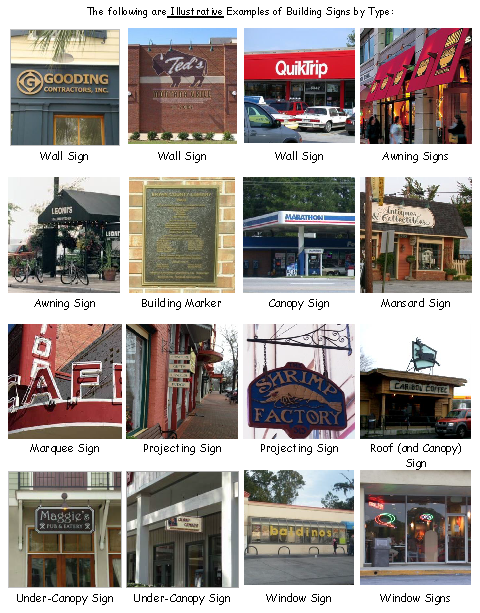
Canopy:
(1)
Building canopy. A permanent roof-like structure projecting from a building and open on at least one side for the purpose of shielding a pedestrian walkway from the elements.
(2)
Freestanding canopy. A freestanding roof-like structure supported by columns intended to shield a vehicular driveway or service area from the elements.
Certified arborist means a professional in the tree care industry who has passed an exam administered by the International Society of Arboriculture certifying such person as an arborist.
Changeable copy sign means a sign that is capable of changing the position or format of word messages or other displays on the sign face or of changing the visible display of words, numbers, symbols and graphics by the use of a matrix of electric lamps, moveable discs, moveable panels, light apertures or other methods, provided these changes are actuated by either a control mechanism or manually on the face of the sign. Tri-vision signs and LED signs are specifically excluded from the definition of changeable copy sign.
Column sign. See under Freestanding sign.
Commercial speech means the expression of an idea, opinion or message that directs or attracts attention to a business operated for profit; or to a product, commodity or service for sale, trade, barter, swap or lease; or to any other commercial interest or activity.
Double-faced sign means a sign which has two display areas opposite each other or where the interior angle formed by the display area is 60 degrees or less, where one face is designed to be seen from one direction and the other face from another direction.
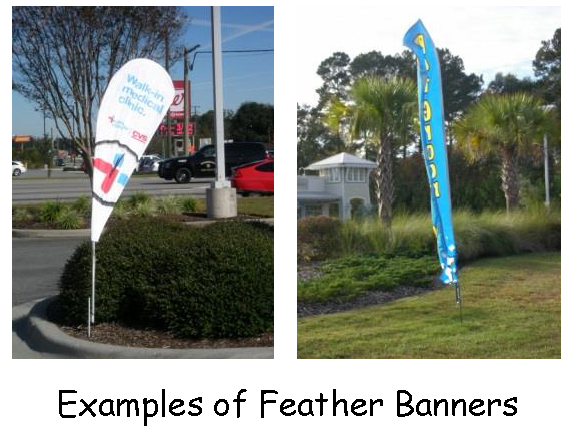
Feather banner means a banner mounted on a pole, such as the examples shown to the right. Such signs may be wind activated (see "animated sign") or rigidly mounted in a stationary position.
Festoons are strings of light bulbs or other lighted devices, and strings of ribbons, tinsel, pennants, streamers, pinwheels or other similar devices designed to move in the wind.
Flag means a sign made of paper, woven natural or synthetic fabric, thin plastic or similar lightweight pliable material that is normally displayed by flying from a pole as a wind-activated device, and is used as a symbol or emblem of a particular country, governmental entity, organization or institution.
Flashing sign means a sign, the illumination of which is not kept constant in intensity at all times when in use, and which exhibits marked changes in lighting effects. Flashing signs are considered animated signs.
Fluorescent color means a color that is intense, brilliantly colored and apparently giving off light, such as day glow (day-glo) colors.
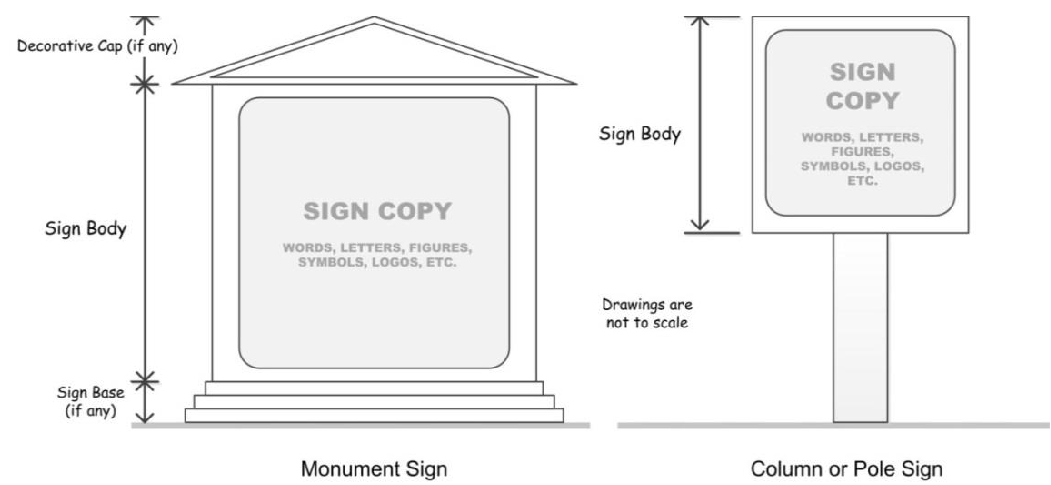
Freestanding sign means a sign which is attached to or part of a completely self-supporting structure, other than a building. The supporting structure shall be permanently and firmly set in or below the ground surface and be wholly independent of a building or any other structure, whether portable or stationary, for support. The term "freestanding sign" includes but is not limited to the following:
(1)
Stanchion sign. A sign that is mounted on one or more freestanding stanchions or columns such that the sign body is elevated above the ground by such supporting stanchions or columns, and such supporting stanchions or columns are each less than ten percent of the width of the sign body.
(2)
Column sign. A sign that is mounted on one or more freestanding stanchions or columns such that the sign body is elevated above the ground by such supporting stanchions or columns, and such supporting stanchions or columns are each ten percent of the width of the sign body or more.
(3)
Monument sign. A freestanding sign in which the entire bottom of the base of the sign structure is in contact with the ground, providing a solid and continuous background for the sign from the ground to the top of the sign structure; the base of which is as wide as or wider than the total width of the sign body plus any supporting columns.
(4)
Hybrid monument sign. A freestanding sign in which the entire bottom of the base of the sign structure is in contact with the ground, but a solid and continuous background for the sign from the ground to the top of the sign structure is not provided; the base of which is as wide as or wider than the total width of the sign body plus any supporting columns.
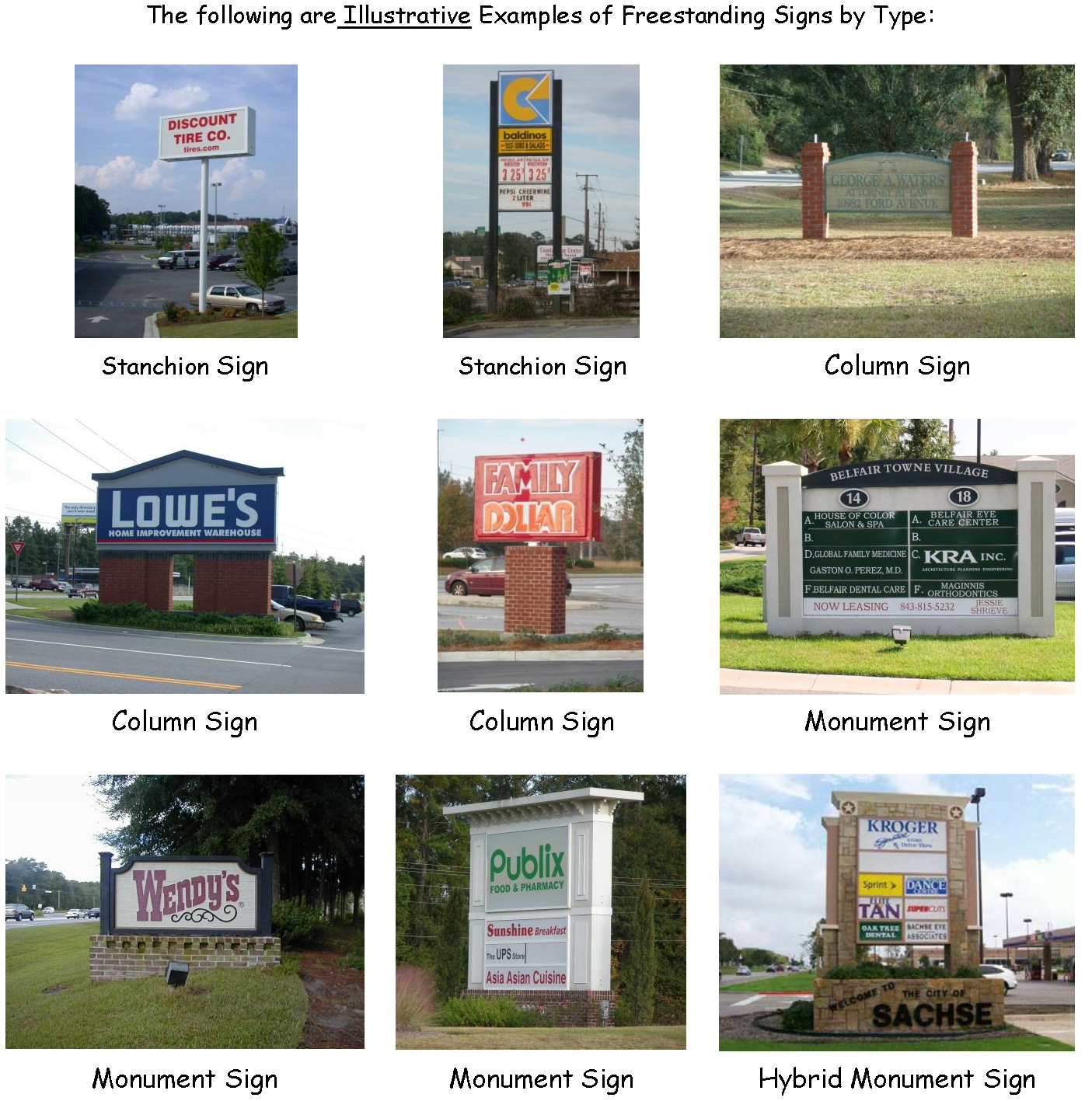
Ground clearance means the distance in vertical feet from the ground, sidewalk or other surface to the lowest point of the sign face or sign structure, whichever is lower.
Ground cover means low growing, spreading plants, other than turf grass, such as but not limited to ivy, liriope, juniper, mondo grass or sedge.
Guy or guy wire means a cable used to support or stabilize a freestanding pole or structure, such as a lattice telecommunications or citizen's band antenna, utility pole or traffic signal stanchion.
Height of sign means the vertical distance in feet from the ground, sidewalk or other surface to the highest point of the sign face or sign structure, whichever is higher.
Historic impact area means the entire area designated by ordinance as a historic district as well as a buffer area 750 feet in depth completely surrounding each such historic district and measured from the district's exterior boundary.
Holiday or seasonal event means a day established as a legal holiday by federal, state or local law; a nationally recognized holiday such as Halloween or Mother's Day; a nationally recognized calendar season such as Fall or Spring; a religious day or term of days such as Easter, Yom Kippur or Christmas, or Lent, Ramadan or Hanukah.
Illuminated sign means any sign or portion thereof which is illuminated by artificial light, either from an interior or exterior source, including outline, reflective or phosphorescent light, whether or not the source of light is directly affixed as part of the sign, and shall also include signs with reflectors that depend upon sunlight or automobile headlights for an image.
Illuminated sign, direct means a sign illuminated by an internal light source.
Illuminated sign, indirect means a sign illuminated by an external light source directed primarily toward such sign.
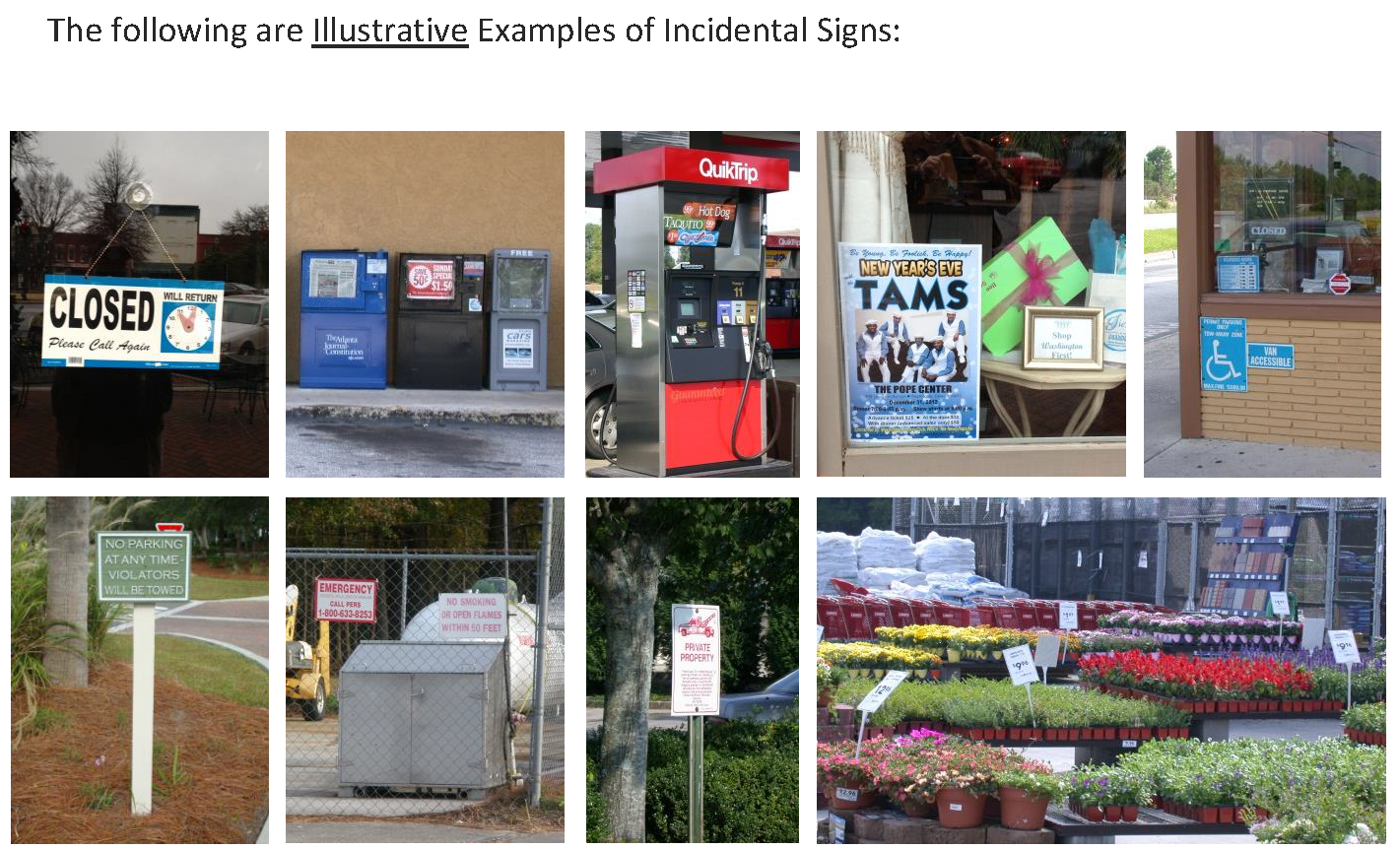
Incidental sign means a sign of no more than two square feet that serves the purpose of guiding safe traffic movements onto, from or on property, and without which there is an increased risk of incompatible traffic movements or obstructions. Examples of incidental signs include but are not limited to, "stop," "no parking," "entrance," "loading zone" and other similar traffic related directives.
Inflatable sign means a sign that is either expanded to its full dimensions or supported by gasses contained in the sign, or sign parts, at a pressure greater than the atmospheric pressure.
Iridescent color means a color which varies in color when seen at different angles; having a play of lustrous rainbow-like colors; pearlescent.
Kiosk means a freestanding sign structure, often cylindrical in shape, intended to be viewed from all sides and erected for the purpose of posting signs, notices or other public announcements. Kiosks that are composed of flat faces are treated as multi-faced signs.
Landscape materials means any combination of living plant materials, nonliving materials (such as rocks, pebbles, wood chips, mulch and pavers) and decorative features such as sculpture, patterned walks, fountains, and pools. This definition includes synthetic landscaping materials that are visually indistinguishable from natural materials.
Leased sign means an agreement by which a property owner conveys, usually for a specified rent, to other persons, permission to erect and maintain a sign upon their property.
LED sign means any sign or portion thereof that uses light emitting diode technology or other similar semiconductor technology to produce an illuminated image, picture, or message of any kind whether the image, picture, or message is moving or stationary. This type of sign includes any sign that uses LED technology of any kind, whether conventional (using discrete LEDs), surface mounted (otherwise known as individually mounted LEDs), transmissive, organic light emitting diodes (OLED), light emitted polymer (LEP), organic electro polymer (OEL), or any other similar technology. For the purpose of this chapter, LED signs are not considered changeable copy signs.
Mansard sign. See under Building sign.
Marquee means a roofed structure attached to and supported by a building and projecting over public or private sidewalks or rights-of-way.
Miscellaneous building sign means a building sign (as defined herein), other than a principal building sign, a temporary event sign or an incidental sign, commonly found on the wall of a nonresidential use property.
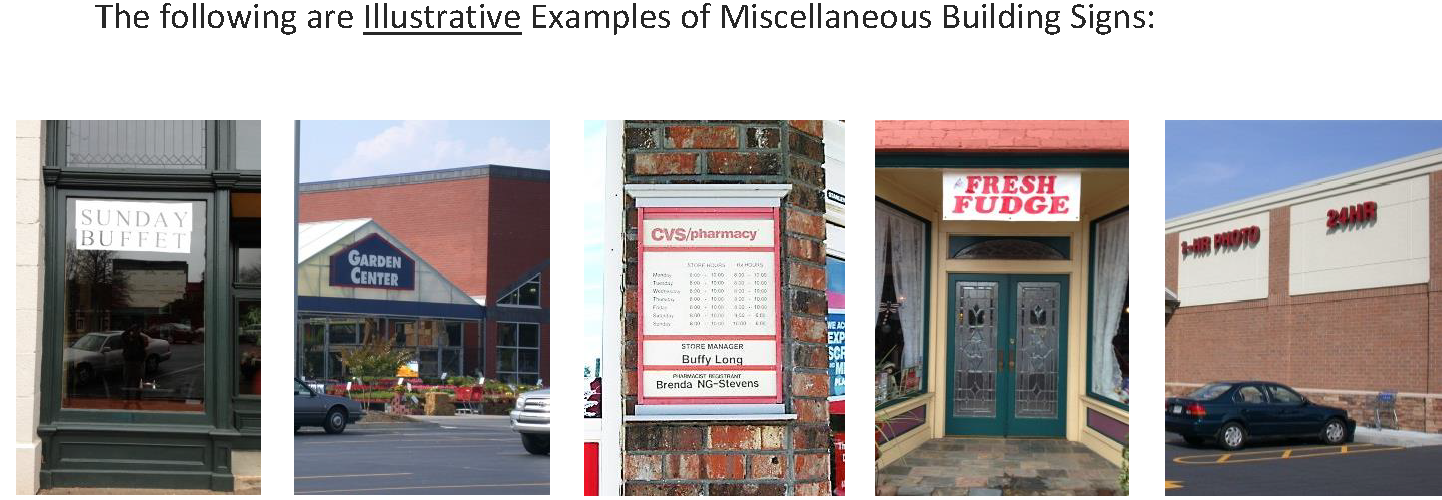
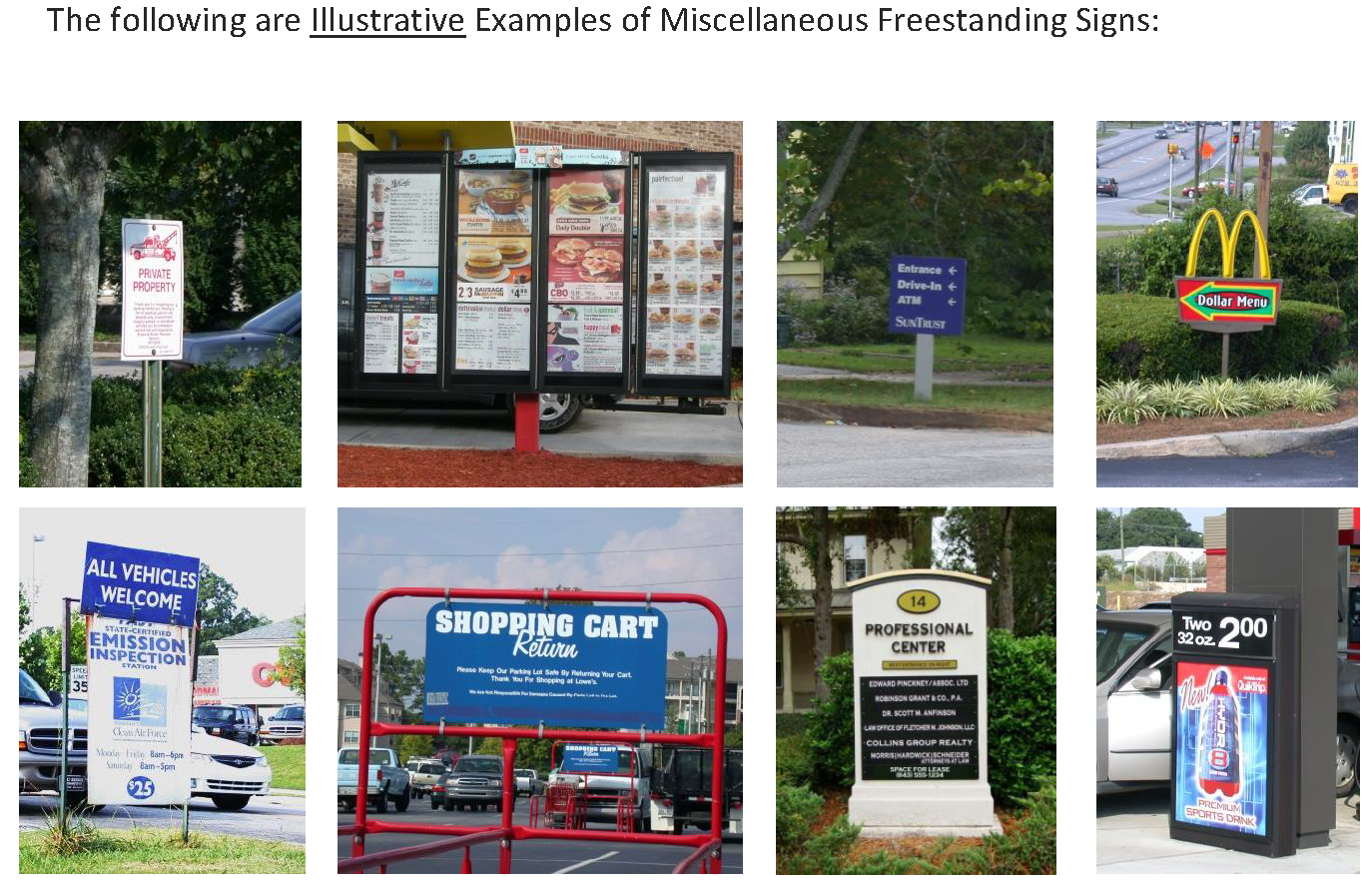
Miscellaneous freestanding sign means a freestanding sign, other than a freestanding principal sign, temporary event sign or incidental sign, commonly found on multi-family and nonresidential use properties located at entrance and exit driveways, drive-through windows, internal driving lanes, parking lots, designated handicap parking spaces, etc.
Mobile billboard sign means an off-site advertising sign mounted on a vehicle or trailer that can become part of traffic flow or be parked at specific locations. Neither vehicles or trailers which advertise the company of their primary use nor campaign signs are considered mobile billboards.
Monument sign. See under Freestanding sign.
Nonconforming sign means a sign, legally existing at the time of erection, but which does not conform to the provisions of this chapter.
Pennant means a lightweight plastic, fabric or similar material designed to move in the wind; pennants are often suspended from a rope, wire, or string in series. The term "pennant" shall not include a "banner" or a "flag" as defined herein.
Permittee means the person who secures a permit from the city to erect, install, attach or paint a sign.
Personal (noncommercial) speech means the expression of an idea, opinion or message that does not direct or attract attention to a business operated for profit; or to a product, commodity or service for sale, trade, barter, swap or lease; or to any other commercial interest or activity.
Pole sign. See under Freestanding sign.
Portable sign means a sign, whether on its own trailer, wheels or otherwise, which was designed and manufactured so that it can be transported from one place to another, and sidewalk, sandwich and A-frame signs as further defined and regulated in this chapter. Portable signs include, but are not limited to, signs mounted upon a trailer, bench, wheeled carrier or other non-motorized mobile structure with or without wheels.
Projecting sign. See under Building sign.
Roof sign. See under Building signs.
Seasonal event. See Holiday or seasonal event.
Serial sign means a sign which contains individual panels arranged vertically or horizontally, or both, in rows between two vertical supports, each panel utilized by a separate entity. Serial signs are designed to share signage among multiple tenants on a lot. Serial signs may be wall or freestanding signs. Freestanding signs shall have a minimum of two vertical supports.
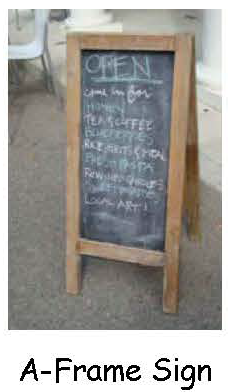
Sidewalk, sandwich and A-frame signs means a portable sign the support structure of which is not imbedded in the ground. Such signs are constructed in such a manner that they stand on their own but are not permanently installed. This includes a sign displayed on an easel.
Sign means any structure, device, object, design or display that is used or intended to be used to attract the attention of or to convey information to the public, and that is placed in such a way, whether out of doors or inside or near a window, as to be in the view of the general public from the exterior of any building on the property.
Sign, aggregate area means the combined sign area of all sign faces of a particular category on a single parcel. For example, the aggregate sign area of all freestanding signs on a parcel is the sum total of the sign face areas of all freestanding signs on such parcel.
Sign, animated. See Animated sign.
Sign, banner means a sign of fabric, thin plastic or similar lightweight material that is mounted to a pole or a building at one or more edges and is intended or displayed as commercial speech. Flags displaying noncommercial speech shall not be considered to be banners.
Sign, billboard means any monument sign erected on undeveloped property.
Sign body means that portion of a sign structure that is intended or designed primarily to support or display the sign face, exclusive of the sign's base or decorative cap, if any.
Sign, building marker. See under Building sign.
Sign, canopy. See under Building sign.
Sign, changeable copy means a type of animated sign that is capable of changing the position or format of word messages or other displays on the sign face or change the visible display of words, numbers, symbols and graphics by the use of a matrix of electric lamps, movable discs, movable panels, light apertures or other methods, provided these changes are actuated by either a control mechanism or manually on the face of the sign. Changeable copy signs include the following types:
(1)
Manually activated. A sign whose alphabetic, pictographic, or symbolic informational content can be changed or altered by placing such letters or other message elements directly on the sign face by hand.
(2)
Electronic. A sign whose alphabetic, pictographic, or symbolic informational content can be changed and is displayed electrically or electronically. See also LED sign.
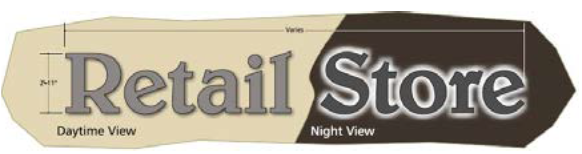
Sign, channeled letter means signs that have their letters cut out of the sign face or raised above the sign face, described as:
(1)
Internally channeled letters. Letters or other symbols cut into a sign face and located above a recessed background surface, often designed for the background surface to be illuminated by an artificial light source.
(2)
Reverse channeled letters. Letters or other symbols raised above a background surface designed to be illuminated from behind and within the letters or symbols by an artificial light source.
Sign copy means the words, letters, figures, symbols, logos, fixtures, colors or other design elements that are used to convey the message, idea or intent for which a sign has been erected or placed.
Sign, dilapidated/deteriorated means a sign that is structurally unsound, has defective parts, or is in need of painting or other maintenance.
Sign, double-faced means a sign structure with two sign faces that are parallel (back-to-back) or that form an angle to one another of no more than 60 degrees, where each sign face is designed to be seen from a different direction and the two sign faces are separated from each other at their nearest point by no more than 12 inches. Sign faces or sign modules on a single sign structure that are separated by more than 12 inches are treated as separate signs.
Sign face means that portion of the surface of a sign structure where words, letters, figures, symbols, logos, fixtures, colors, or other design elements are or may be located in order to convey the message, idea, or intent for which the sign has been erected or placed. The sign face may be composed of two or more modules on the same surface that are separated or surrounded by portions of a sign structure not intended to contain any advertising message or idea and are purely structural or decorative in nature.
Sign, height means the vertical distance from the ground to the highest point of the sign structure, as measured from the adjacent finished grade at the base of the sign.
Sign, incidental means a small sign, emblem or decal no larger than one and one-half square feet in area. Such signs are normally located on doors, windows and gas pumps, or in parking lots or loading areas, may be freestanding or building signs, and are generally not readily visible or legible from public rights-of-way.
Sign, inflatable means a sign that is either expanded to its full dimensions through mechanical means of an air blower or supported by gasses contained within the sign, or sign parts, at a pressure greater than atmospheric pressure.
Sign, kiosk. See Kiosk.
Sign, marquee. See under Building sign.
Sign, mobile. See Vehicular sign.
Sign module means each portion or unit of a sign face that is clearly separable from other such units by virtue of its individual or independent construction or framing.
Sign, monument. See under Freestanding sign.
Sign, multi-faced means a single freestanding sign structure consisting of two sign faces (see "double-faced sign") or three or more sign faces that are separated from each other at their nearest point by no more than 12 inches. Sign faces or sign modules on a single sign structure that are separated by more than 12 inches are treated as separate signs.
Sign, neon means an illuminated sign containing a glass tube filled with neon or phosphors, which is bent to form letters, symbols or other shapes, or otherwise used to highlight, decorate or outline the sign.
Sign, nonconforming means a sign legally existing at the time of its placement or erection that could not have been approved under the terms of this article.
Sign, permanent means any sign that is securely affixed to the ground or to a building and not readily removable. Temporary signs are not considered to be permanent signs.
Sign, portable. See under Portable sign.
Sign, pre-permanent means a temporary sign used for signage by a new business until their permanent sign is installed.
Sign, principal means the main, most prominent or largest freestanding or building sign on a property's street frontage or principal building, other than a project entrance sign as defined in this article. Such signs are of permanent construction and not placed as temporary signage.
Sign, prohibited means any sign, other than a non-conforming sign, not conforming to this chapter.
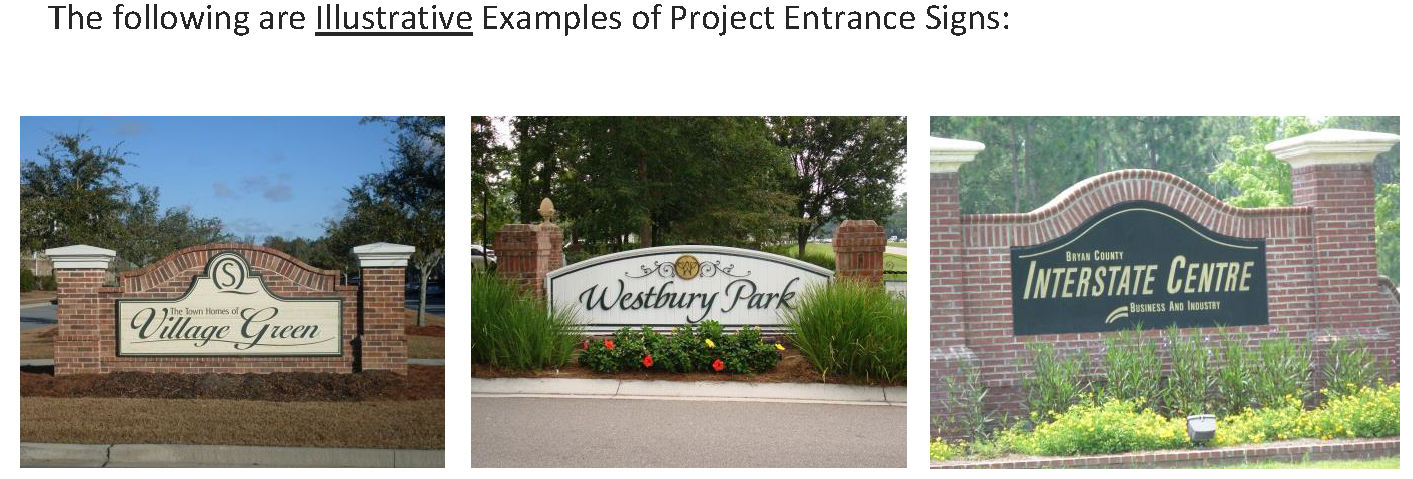
Sign, project entrance means a permanent freestanding sign located at an entrance designed and permitted for vehicular access into a multi-family development, or into a development containing multiple lots, such as but not limited to a particular single-family residential subdivision, a townhouse condominium subdivision, or a commercial subdivision such as an office park or industrial park where buildings are located on separate lots.
Sign owner means the person who has the legal right or exclusive title to the sign.
Sign, projecting. See under Building sign.
Sign, roof. See under Building sign.
Sign, stanchion. See under Freestanding sign.
Sign, temporary means any sign, the use of which is short-term in nature, that is affixed to or placed on the ground or to a building but is readily removable and not intended for permanent installation.
Sign, under canopy. See under Building sign.
Sign, wall. See under Building sign.
Stanchion sign. See under Freestanding signs.
Subtenant means a natural person, business or other entity that subleases or is otherwise allowed to occupy a portion of land or a building, the majority of which is also occupied by a tenant. For the purposes of this development code, a subtenant is not treated as a "tenant" as defined herein.
Swinging freestanding sign means a freestanding sign suspended from a horizontal structural support supported by vertical structural steel columns or wooden posts.
Swinging or projecting wall sign. See Projecting sign under Building sign.
Temporary sign means a sign, the use of which is short-term in nature, that is affixed to or placed on the ground or to a building but is readily removable and not intended for permanent installation.
Tenant means a natural person, business or other entity that occupies land or buildings by ownership, under a lease, through payment of rent, or at will; the primary occupant, inhabitant, or dweller of a place. See also subtenant.
Tenant frontage means the horizontal distance in feet between the walls that delimit an exterior façade of a tenant space. A "tenant space" may be a stand-alone building with a single occupant, or a portion of a planned center that is separated from all other tenant spaces for occupancy by a single tenant.
Trim or trimming means the pruning of excess limbs or branches from trees or other vegetation.
Tri-vision sign means a sign designed with a series of triangular slats that mechanically rotate in sequence with one another to show three different sign messages in rotation. For purposes of this chapter, a tri-vision sign is not a changeable copy sign.
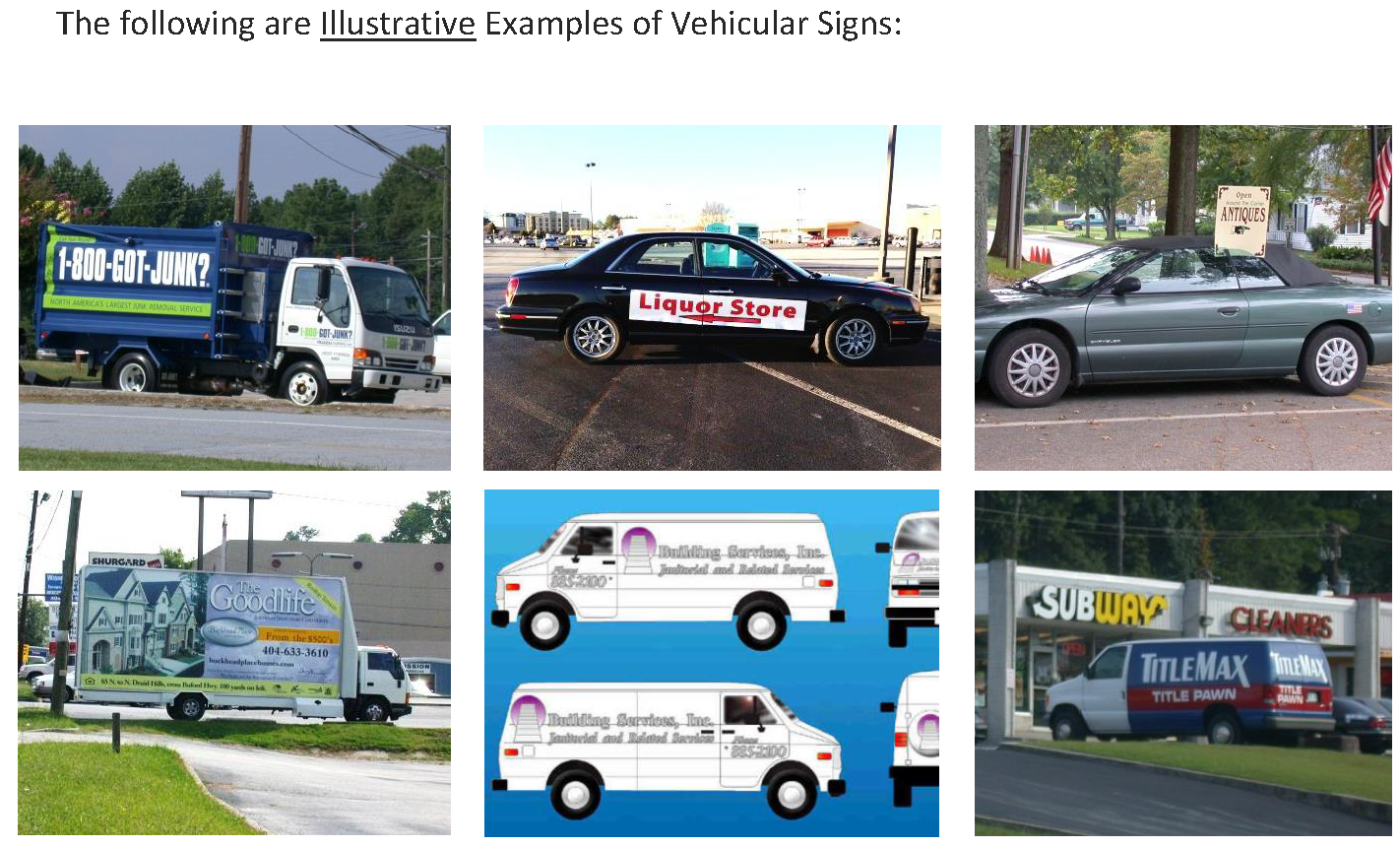
Vehicular sign means any sign placed, mounted, painted on or affixed to a motor vehicle or to a freight, flat-bed or storage trailer or other conveyance, whether motorized or drawn.
Wall sign. See under Building sign.
Window sign. See under Building sign.
Zoning administrator means the zoning official of the city.
(Ord. No. 2021-10, § 1, 6-28-2021)
Sec. 3.1. - Sign permits; when required.
(a)
Except for signs that are listed under [subsection] (d) Procedures for obtaining a sign permit are contained in chapter 8, Procedures and Permits of this development code.
(b)
Exemptions from permit requirements., below, or are listed under section 4.2. Signs that are exempt from regulation, a sign permit must be issued by the city before a permanent sign may be:
(1)
Erected or relocated;
(2)
Attached to, suspended from, or supported on a building or structure; or
(3)
Altered, enlarged, or materially improved (including the replacement of a sign face with an electronic changeable copy sign).
(c)
Any sign using electrical wiring and connection shall require a sign permit and an electrical permit. Such a sign permit shall become null and void if an electrical permit is not secured, if required, or if the sign for which the permit was issued has not been completed within a period of six months after the date of issuance.
(d)
Procedures for obtaining a sign permit are contained in chapter 8, Procedures and Permits of this development code.
(Ord. No. 2021-10, § 1, 6-28-2021)
Sec. 3.2. - Exemptions from permit requirements.
(a)
The following signs are exempt from the permit requirements of this chapter.
(b)
The following types of signs shall be exempt from the permit requirements of this chapter, provided that each is located and maintained in accordance with the provisions of this chapter and all other applicable codes and regulations:
(1)
Nonilluminated signs, having a sign area of less than 15 square feet, provided they are not located in the public right-of-way.
(2)
Window signs installed for purposes of viewing from outside the premises. However, such signs shall not exceed 30 percent of the space available in the window where the sign is placed.
(3)
Numerals displayed for purposes of identifying property location and not exceeding four inches in height in residential districts and ten inches in height in nonresidential districts.
(4)
Seasonal displays located outside of the public right-of-way that are erected for a maximum period of 30 days no more than twice a year.
(5)
Signs allowed under section 1.1. Miscellaneous freestanding signs., unless such signs require issuance of a building or electrical permit.
(6)
Signs allowed under section 8.2. Miscellaneous building signs., unless such signs require issuance of a building or electrical permit.
(7)
Incidental signs at the entrance drive of residences, estates, farms, ranches, and plantations which do not exceed one and one-half square feet in area.
(c)
Every parcel may display no more than two flags that shall not count toward the maximum aggregate sign area limits provided in this chapter without obtaining a permit.
(1)
Flagpoles in residential zoned districts shall not exceed 25 feet in height or the height of the primary structure, whichever is less. Flagpoles in commercial or industrial zoned districts shall not exceed 60 feet in height.
(2)
The dimensions of any flag shall be proportional to the flagpole height such that the hoist side of the flag shall not exceed 50 percent of the vertical height.
(3)
All flags mounted on a flagpole must have a minimum vertical clearance of eight feet above the ground, sidewalk, private drive or parking area, as applicable. Flags mounted on a pole projecting from a building must provide a minimum vertical clearance of eight feet above a sidewalk or other area of pedestrian movement.
(4)
The display of the Flag of the United States of America shall be guided by Title 4, Section 3 of the U.S. Code, which prohibits the use of the American Flag for commercial purposes.
(Ord. No. 2021-10, § 1, 6-28-2021)
Sec. 4.1. - Signs that are regulated.
The regulations and requirements of this article apply to all signs that are or are intended to be viewed from a public right-of-way or adjacent property, or that are intended to be viewed from outdoor areas of private property, except as otherwise exempt under this section.
(Ord. No. 2021-10, § 1, 6-28-2021)
Sec. 4.2. - Signs that are exempt from regulation.
The following signs are exempt from the provisions of this chapter.
(a)
Signs erected by or at the direction of the city or any government entity in the right-of-way or on any government owned parcel are exempt from provisions of this chapter.
(b)
Historic markers authorized by the city are exempt.
(c)
Property address numbers as required by the city are considered "official governmental signs" and are exempt.
(d)
Incidental signs (as defined in this chapter) that are located in conjunction with a multi-family or nonresidential use are exempt, provided such signs are not illuminated and that the aggregate of all such signs on a property may not exceed nine square feet (unless a larger aggregate area is required by law or government regulation).
(e)
Displays or decorations related to a holiday or seasonal event (as defined in this chapter) that are placed on a property by the owner or with the owner's permission as personal (noncommercial) speech (also as defined in this chapter) are exempt.
(f)
Window displays of goods available on a site are not considered to be signs and are exempt from these sign regulations.
(g)
A building design or color that is associated with a particular establishment or organization but which conveys no message is not considered to be a sign and is exempt from these sign regulations.
(Ord. No. 2021-10, § 1, 6-28-2021)
Sec. 4.3. - Prohibited signs.
The following types of signs are prohibited throughout the city:
(a)
All signs, other than legal non-conforming signs, which are not in compliance with this article are prohibited and illegal and shall not be erected or maintained.
(b)
Privately owned signs erected on or above public property.
(1)
No person shall erect a sign on or projecting over public property other than the governmental entity responsible for such property, or a public utility company or contractor occupying or working on public property pursuant to government contract or franchise.
(2)
For the purpose of this chapter the public right-of-way shall be measured and determined by the utility poles, unless otherwise indicated or more detailed information is available.
(c)
Any sign placed or erected on a property without the permission of the property owner.
(d)
Roof signs.
(e)
Vehicular signs, as defined in this chapter, are not allowed to be placed or parked in such a manner as to be viewed or intended to be viewed from a public right-of-way, except that this prohibition shall not apply in the following circumstances:
(1)
When such conveyances are actively being used to transport persons, goods or services in the normal course of business;
(2)
When such conveyances are parked in an inconspicuous area; or
(3)
When such conveyances are actively being used for storage of construction materials for, and on the same lot with, a bona fide construction project for which building and other applicable permits have been issued and where construction is underway.
(f)
Animated signs, with the exception of electronic changeable copy signs, banners and flags as may be regulated by this chapter, are not allowed.
(g)
Signs that pose a threat to public safety are not allowed, such as:
(1)
Signs containing or imitating an official traffic sign or signal or contain the words "stop," "go," "danger," "caution," "warning," or similar words, except for construction signs and barricades and except when the words are incorporated in the permanent name of a business.
(2)
Signs that display intermittent or blinking lights resembling the flashing lights customarily used in traffic signals or on police, fire, ambulance or rescue vehicles.
(3)
Signs located so as to obscure, or otherwise interfere with the effectiveness of any official traffic sign, signal or device.
(4)
Signs located so as to obscure, or otherwise interfere with a motor vehicle operator's view of approaching, merging, or intersecting traffic.
(5)
Signs that obstruct any fire escape; any means of ingress, egress, or ventilation; or prevent free passage from one part of a roof to any other part thereto; and signs attached in any manner to a fire escape.
(6)
Signs which interfere with road or highway visibility or obstruct or otherwise interfere with the safe and orderly movement of traffic.
(7)
Signs which obstruct the orderly flow of pedestrian traffic on any sidewalk or public walkway.
(8)
Signs which simulate an official traffic control or warning sign or hide from view any traffic sign, signal or public service sign.
(9)
Signs on publicly owned rights-of-way other than publicly owned or maintained signs.
(h)
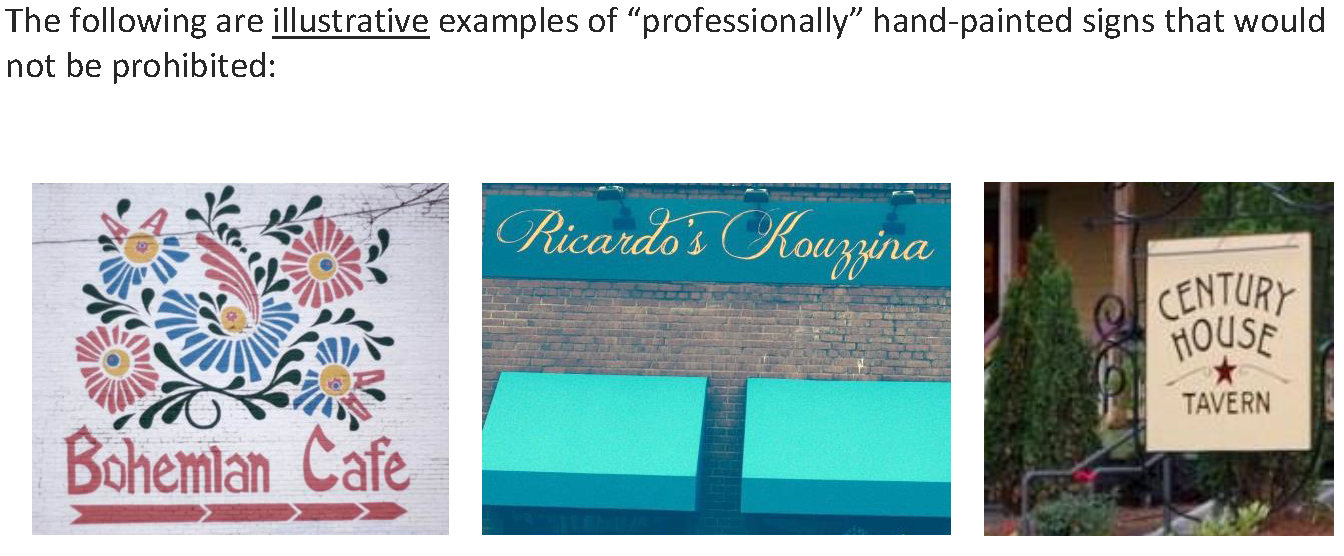
Handwritten, hand painted, handmade or other unprofessionally fabricated signs. A "professionally" hand-painted sign is one that has been prepared or created by a person engaged in the paid occupation of sign-painting and generally reproduces font sets created by such foundries as Adobe, Microsoft, BitStream, etc.
(i)
Window signs which exceed 30 percent of the window area.
(j)
Signs which contain words, pictures, or statements which are obscene, as defined by O.C.G.A. § 16-12-80(B), or displaying nudity as defined by the State of Georgia at O.C.G.A. Section 16-12-81 (b)(1).
(k)
Signs that advertise or encourage illegal activity as defined by local, state or federal laws.
(l)
Unshielded illuminated devices that produce glare or create a hazard or nuisance to motorists or occupants of adjacent properties.
(m)
Signs with lighting or control mechanisms that cause radio, television or other communications interference.
(n)
Motion picture mechanisms or video displays used in such a manner as to permit or allow moving or animated images to be visible from a public right-of-way or sidewalk.
(o)
Certain illuminated signs, as follows:
(1)
Signs containing, including, or illuminated by any flashing, intermittent, or moving lights, scrolling lights, and/or utilizing changes in the intensity of lighting are prohibited.
(2)
Any illumination of a sign that interferes with the effectiveness of, or obscures, an official traffic sign, device, or signal is prohibited.
(3)
Any illumination of a sign that is not effectively shielded so as to prevent beams or rays of light from being directed at any portion of the traveled way of a street and which are of such intensity or brilliance as to cause glare or to impair the vision of the driver of any motor vehicle, or which otherwise interfere with the operation of any motor vehicle, is prohibited.
(4)
No red, green or yellow illuminated sign shall be placed within 300 feet of any traffic light.
(5)
Search lights or spotlights, except for special business promotions or a new business "grand opening". For each event, such devices shall receive prior written approval by the city. Such lights shall not create a nuisance or interfere with vehicular traffic, and shall adhere to all applicable regulations of the Federal Aviation Administration (FAA).
(p)
Banners are prohibited except as allowed by this chapter for specific types of signs, including temporary event signage for a grand opening or special business promotion event under article 9, Temporary Event Signs.
(q)
Portable signs are prohibited, except A-frame signs as may be allowed under this chapter for a nonresidential use, or as provided for temporary signage for a grand opening or special business promotion event under article 9, Temporary Event Signs.
(r)
Festoons, as defined in this development code, are prohibited except as provided for temporary signage for a grand opening or special business promotion event under article 9, Temporary Event Signs.
(s)
Inflatable signs, including air or gas filled balloons or other inflatable devices, are prohibited in all nonresidential zoning districts except as exempted as seasonal and holiday decorations under this chapter or for temporary signage for a grand opening or special business promotion event under article 9, Temporary Event Signs.
(t)
Signs which emit or utilize in any manner any sound capable of being detected on any traveled road or highway by a person with ordinary hearing.
(u)
Signs erected by nailing, fastening or affixing the sign in any manner to any tree, post, curb, utility pole, or other structure located on any public right-of-way except as may otherwise be provided herein.
(v)
Signs which emit any visible smoke, steam, vapor, particles, or odor into the air.
(w)
Signs which emit any sound which can be heard at any place outside of the parcel on which the sign is erected.
(x)
Signs which have been attached to or painted on any telephone pole, light pole, telegraph pole, or any tree, rock or other natural object.
Prohibited signs shall be removed within 48 hours of notice of violation of this section provided that where permanent signs are installed, the 48-hour period may be extended for up to two weeks by the director of building, planning and zoning or zoning administrator where removal requires engagement of a specialized contractor.
(Ord. No. 2021-10, § 1, 6-28-2021)
Sec. 5.1. - Compliance with other codes and provisions.
(a)
Any sign that will be erected, replaced, reconstructed, repaired, altered, relocated or maintained within the city shall conform to the requirements of the International Building Code, Appendix H, and to the requirements of the National Electrical Code, Article 600, "Electrical Signs and Outdoor Lighting," as adopted with amendments by the State of Georgia. Where the provisions of the building or electrical code and this article conflict or overlap, the most stringent requirement shall prevail and be controlling.
(b)
In accordance with the National Electrical Code specifications, all signs shall be located in such a way that they maintain horizontal and vertical clearance from all overhead utilities. In no case shall any sign be installed within three feet horizontally or vertically from any overhead utility line or utility guy wire.
(c)
Any sign that will be erected, replaced, reconstructed, repaired, altered or relocated within the city shall conform to all other provisions of this code and other ordinances of the city.
(Ord. No. 2021-10, § 1, 6-28-2021)
Sec. 5.2. - Computation of sign area.
(a)
Generally.
(1)
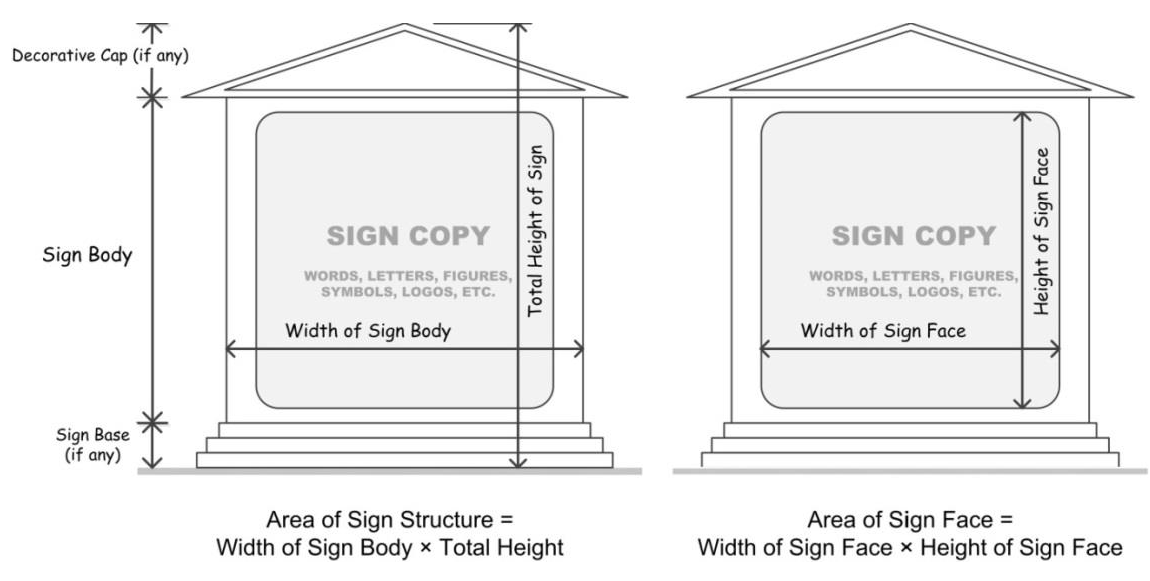
The area of a sign face or module shall be computed by means of the smallest rectangle that will encompass the extreme limits of the writing, representation, emblem, color, or other display, together with any material or color forming an integral part of the background of the display or used to differentiate the sign from the backdrop or structure against which it is placed, but not including any supporting framework, bracing, or decorative fence or wall when such fence or wall otherwise meets other regulations of the city and is clearly incidental to the display itself.
(2)
If a sign face is composed of two or more sign modules, the sign face area shall be the area of each module, measured in accordance with the preceding paragraph (1), totaled together.
(3)
The area of a sign structure shall be computed by means of the smallest rectangle that will encompass the extreme limits of the sign, by multiplying:
a.
The width of the body of the sign (exclusive of the sign's base or decorative cap, if any) measured at the widest portion of the sign body; times.
b.
The total height of the sign as defined in this article under "sign height."
(4)
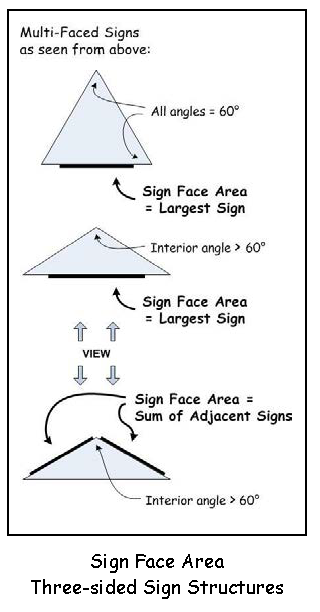
The following are examples of how sign structure and sign face area measurements are made; the signs shown are illustrative and only provided for clarity.
(b)
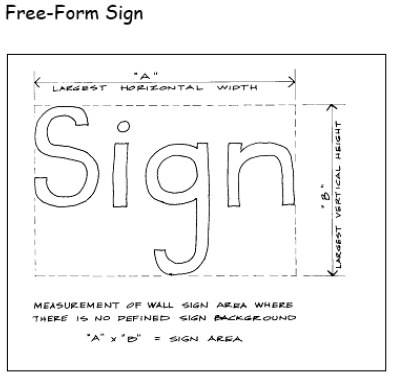
Area of multi-faced signs. The sign face area of a sign structure with more than one side, and such sides are not more than 12 inches apart at their closest point, shall be computed as follows:
(1)
Double-faced signs. For double-faced signs, when the sign face surfaces are parallel (back-to-back), or where the smallest angle formed between the two faces is 60 degrees or less, the area of the sign shall be taken as the area of the largest side. For double-faced signs where the interior angle formed by the faces is more than 60 degrees, the sign face area shall be the total area of both sides.
(2)
Signs with three or more faces.
a.
For sign structures having only three sides and the interior angle formed between each of the sides is 60 degrees, the sign face area shall be taken as the area of the largest of the three sides.
b.
For all other multi-faced signs with three or more sides, the sign face area shall be either the largest sign on any one side, or the largest total of all sign faces that are joined by an interior angle of more than 60 degrees, whichever can be viewed from an adjoining street.
(c)
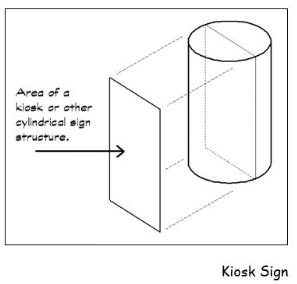
Free-form signs. For signs that have no identifiable frame or border, the smallest rectangle that includes all of the sign's words, letters, figures, symbols, logos, fixtures, colors or other design elements intended to convey the sign's message shall establish the area of the sign face.
(d)
Kiosks.
For a kiosk or other cylindrical sign structure, the area of the sign face shall be the largest measurement achieved from any view of the sign structure. Measurements shall be made as a flat plane rectangle projected on or bisecting the sign structure.
(Ord. No. 2021-10, § 1, 6-28-2021)
Sec. 5.3. - Number of signs.
(a)
For the purpose of determining number of signs, a single sign shall be considered to be a single sign structure, display surface or display device containing the sign copy (as defined in this development code) or other elements organized, related, and composed to form a unit.
(b)
Refer to the definition of "sign face" and "sign copy" for additional information.
(Ord. No. 2021-10, § 1, 6-28-2021)
Sec. 5.4. - Height measurements.
(a)
For a freestanding sign structure located within 100 feet of an adjacent street right-of-way (as measured perpendicular to the street), the following applies:
(1)
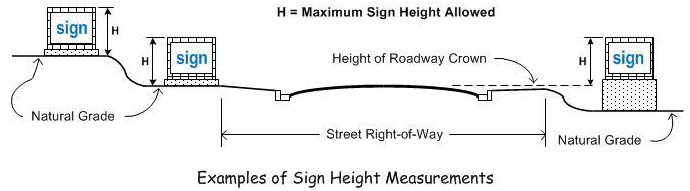
For a sign located on land at or above the crown of the roadway in the adjacent street, the height of a sign shall be equal to the vertical distance from the average grade at the base of the sign to the highest point of any portion of the sign. Any earthen berms or other site improvements that raise the sign above the pre-construction natural grade of the land upon which the sign is placed shall be included in the height measurement of the sign.
(2)
For a sign located on land below the crown of the roadway in the adjacent street, the height of a sign shall be equal to the vertical distance from the crown of the roadway to the highest point of any portion of the sign. Any earthen berms, elevated foundations or other site improvements that raise the sign up to the level of the crown of the roadway shall not be included in the height measurement of the sign.
(b)
For a freestanding sign structure located 100 feet or more from an adjacent street right-of-way (as measured perpendicular to the street), the height of a sign shall be equal to the vertical distance from the average grade at the base of the sign to the highest point of any portion of the sign. Any earthen berms or other site improvements that raise the sign above the pre-construction natural grade of the land upon which the sign is placed shall be included in the height measurement of the sign.
(Ord. No. 2021-10, § 1, 6-28-2021)
Sec. 5.5. - Illumination.
(a)
Illumination for signs shall not cast light on adjoining property or shine in such a manner as to cause traffic interference. Illumination shall be constant and shall not change, flash, scroll or stimulate movement.
(b)
Multiple message technology shall be allowed in accordance with Georgia law, to include spacing of at least 5,000 feet between any two multiple message signs.
(Ord. No. 2021-10, § 1, 6-28-2021)
Sec. 5.6. - Lighting restrictions.
In addition to illuminated signs that are prohibited under section 4.3. Prohibited, the following applies to all illumination of signs:
(a)
Only permanent signs shall be illuminated, either directly or indirectly.
(b)
A permit will not be issued for an illuminated sign on a nonresidential property within 100 feet from any property line of a residentially zoned parcel.
(c)
In a residential zoning district only project entrance signs may be illuminated, and such signs may only be illuminated indirectly by an external light source, such as floodlights or shielded neon tubes.
(d)
Any signage with internal lighting composed of light bulbs or neon tubing shall be covered so that the light sources are not directly visible from the outside.
(Ord. No. 2021-10, § 1, 6-28-2021)
Sec. 5.7. - Language and legibility.
(a)
Every principal freestanding sign shall contain the street number and the official street name in English letters and Arabic numbers of a size equivalent to the predominant size of the letters and numbers on the sign.
(b)
To aid in proper and timely response in an emergency, the name of the business or the type of business on the premises must also be indicated in English.
(c)
Nothing in this section shall prohibit the same and/or additional information on the sign from being written in a language other than English, provided that an English translation of the sign is included with the application for a sign permit.
(Ord. No. 2021-10, § 1, 6-28-2021)
Sec. 5.8. - Visibility clearance area.
(a)
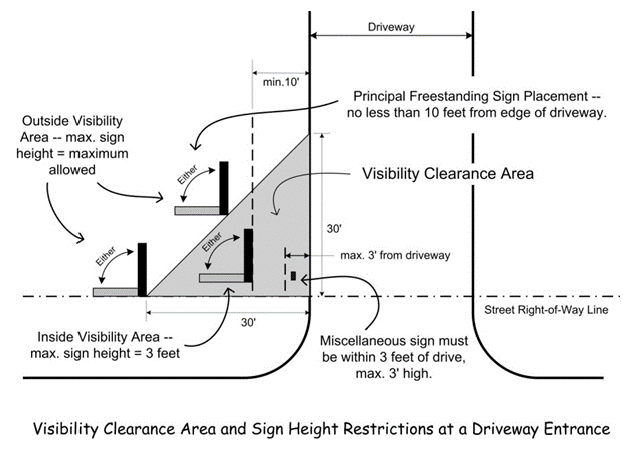
No sign more than three feet in height shall be erected within 30 feet of an intersection with a public or private street, private drive or other access point, or otherwise interfere with traffic movement and visibility.
(b)
Such visibility clearance area shall be established as the triangular area formed by the street right-of-way lines (or such lines extended to their intersection) and a line connecting such right-of-way lines at points 30 feet from the intersection of the right-of-way lines, or within 30 feet of the intersection of a street right-of-way line and the edge of a driveway.
(Ord. No. 2021-10, § 1, 6-28-2021)
Sec. 5.9. - Electronic changeable copy signs.
Electronic changeable copy signs, as defined in this development code, regardless of the technology employed, must conform to the following standards:
(a)
All electronic changeable copy signs viewable from a public street or sidewalk shall present only static displays (still pictures and printing). Such signs not viewable from a public street or sidewalk may display movies, animation or video containing motion.
(b)
Each static image shall be maintained for a duration of at least eight seconds. The change time between each static image shall be perceived as instantaneous within the capability of the technology employed (generally about 1/10th of a second).
(c)
For signs viewable from a public street or sidewalk, no flashing, scrolling, or other variation in the static image that gives an illusion of movement or variation in light intensity during the display of a single image is allowed.
(d)
LED signs. In addition to all other requirements of this section and this chapter, LED signs (as defined in this development code) must comply with the following:
(1)
All such signs shall be "tri-color" signs or better, in which each pixel consists of a group of at least one red, green and blue LED or similar light emitting device.
(2)
Maximum distances between pixels shall be as follows:
(3)
For building signs, no more than five mm between pixels, measured center-to-center both horizontally and vertically.
(4)
For freestanding signs (including billboards as defined in this development code), no more than 16 mm between pixels, measured center-to-center both horizontally and vertically.
(5)
All such signs shall be certified by a Nationally Recognized Testing Laboratory (NRTL) recognized by the US Occupational Safety and Health Administration (OSHA) in accordance with 29 C.F.R. 1910.7.
(6)
Maximum brightness.
a.
The sign must employ a light sensing device that adjusts the brightness as ambient light conditions change.
b.
The sign shall not operate at a brightness level of more than 0.30 foot candles above ambient light levels measured at 100 feet from the sign (150 feet for sign faces greater than 100 square feet in area), as certified under paragraph (f) below.
(7)
A fail-safe device shall be installed that, in the event of a failure of the light sensing device, drops the brightness level to the lowest night-time level allowed, regardless of the time of day.
(e)
Other electronic changeable copy signs.
(1)
Electronic changeable copy signs utilizing TV-type displays (LCD or Plasma, for instance) must comply with the following in addition to all other applicable requirements of this section and this chapter:
a.
Such signs shall be installed only as building signs.
b.
Such signs shall have a minimum resolution of 1,080p (High Definition) or equivalent.
c.
At any time of the day or night, such signs shall not operate at a brightness level of more than 0.30-foot candles above ambient light levels measured at 100 feet from the sign (150 feet for sign faces greater than 100 square feet in area), as certified under paragraph (f) below.
(2)
Electronic changeable copy signs utilizing incandescent bulbs are not allowed.
(f)
As part of an application for a sign permit, the sign owner must provide the city with a written statement from the installer that the sign will comply with the city's brightness requirements and all other requirements of this section and shall certify to such compliance within 30 days after installation of the sign.
(g)
Operation of an electronic changeable copy sign in violation of any provision of this section, including overriding the sign's light-sensing or fail-safe devices, may result in the disconnection of the electrical power supply to the sign at the owner's expense.
(Ord. No. 2021-10, § 1, 6-28-2021)
Sec. 5.10. - Construction and maintenance standards.
(a)
All signs for which a permit is required under this chapter shall be constructed and maintained in accordance with all applicable building codes.
(b)
Signs for which a permit is not required under this chapter and which are constructed of degradable material may be posted for a maximum of 60 days unless replaced with another sign of the same material. Any such replacement signs may be posted for a maximum of 60 days beyond the original 60-day period.
(c)
All freestanding signs with a display area greater than 100 square feet must be constructed to withstand winds of at least 120 miles per hour; in the event any other applicable code or regulation calls for wind tolerance in a greater amount, then such greater amount shall apply as the standard under this chapter as well.
(d)
All signs, together with their supports, braces, guys and anchors, shall be kept in good repair and unless constructed of galvanized or non-corroding metal, shall be given a protective coating as necessary to maintain a clean appearance and safe condition.
(Ord. No. 2021-10, § 1, 6-28-2021)
Sec. 6.1. - Residential restrictions in general.
The following shall apply to all properties located within residential zoning districts:
(a)
Other than subdivision entrance signs allowed under section 6.3 below, parcels located in residential zoning districts shall not contain signs having an aggregate sign area greater than 15 square feet.
(b)
No individual sign shall exceed six square feet in sign area in a residential zoning district.
(c)
Signs having a height of greater than five feet above the grade level of the center line of the adjacent street to which the parcel on which the sign is located shall not be located in residential zoning districts.
Signs meeting the standards of this section 6.1 are exempt from permitting requirements.
(Ord. No. 2021-10, § 1, 6-28-2021)
Sec. 6.2. - Historical district restrictions.
Parcels located in the designated historical districts shall comply with the following:
(a)
Such parcels shall not contain signs having an aggregate sign area greater than 15 square feet.
(b)
No individual sign shall exceed six square feet in a historical zoning district.
(c)
Signs having a height of greater than five feet above the grade level of the center line of the adjacent street to which the parcel on which the sign is located shall not be located in a residential zoning district.
(d)
The permitting requirements of this section and those of chapter 50, Historic Preservation in the City of Fort Oglethorpe Code of Ordinances shall be applicable to all permits issued in or adjacent as provided by definition herein.
(Ord. No. 2021-10, § 1, 6-28-2021)
Sec. 6.3. - Residential subdivision entrance signs.
Platted residential subdivisions consisting of more than two parcels may erect one monument sign at each entrance to the subdivision.
(a)
Such sign shall not exceed a height of five feet above the grade level of the center line of the adjacent street and shall not have a sign area greater than 25 square feet. Such entrance signs shall not count toward the maximum allowable signage on a residential parcel.
(b)
A project entrance sign may be lighted by external illumination. If floodlights or other incandescent bulbs are used, they may not be directed onto the street or toward vehicular traffic. If neon tubes are used, they must be shielded from view.
(Ord. No. 2021-10, § 1, 6-28-2021)
Sec. 7.1. - Height requirements.
The following height requirements shall be applicable to signs located in nonresidential zoning districts:
(a)
No stanchion sign shall exceed 24 feet in height at the highest point on the sign.
(b)
Monument signs shall not exceed six feet in height.
(c)
All sign heights shall be measured in accordance with section 5.4, Height measurements. The level of the ground shall not be altered in such a way as to provide additional sign height.
(Ord. No. 2021-10, § 1, 6-28-2021)
Sec. 7.2. - General size and location requirements.
(a)
No freestanding sign may be located within 30 feet of the intersection of street right-of-way lines extended.
(b)
No sign shall be located on any building, fence or other property belonging to another person without the consent of the owner, and as permitted under the provisions of this chapter.
(c)
Billboards.
(1)
Billboards shall not exceed 300 square feet per sign face.
(2)
Billboards shall only be located on parcels located in commercial or industrial zoning districts and such billboards shall be located at least 750 feet away from any residential or historically zoned parcel, as measured along a straight line in every direction.
(3)
Billboards shall only be located on parcels adjacent to designated state or federal highways and shall be oriented only towards those highways.
(4)
No billboards sign shall be located within 1,000 feet of another billboard sign, measured along a straight line in every direction.
(5)
No billboard shall be located within 750 feet in any direction of a public park, public playground, public recreation area, public forest, scenic area, or cemetery; provided, however, that such sign may be located within 500 feet of a public park, public playground, public recreation area, public forest, scenic area, or cemetery when the sign is separated by buildings or other obstructions so that the sign located within the 750-foot zone is not visible from the public park, public playground, public recreation area, public forest, scenic area, or cemetery.
(6)
No billboards shall be erected to a height in excess of 40 feet.
(7)
All billboards must comply with the State of Georgia's outdoor advertising regulations including size and spacing limitations. A permit issued by the State of Georgia for the billboard is required as a prerequisite for issuance of a building permit by the city.
(d)
Stanchion signs.
(1)
Stanchion signs for parcels exceeding three acres shall not exceed a sign face area of 150 square feet.
(2)
Stanchion signs for parcels less than three acres, but equal to or greater than 30,000 square feet shall not exceed a sign face area of 90 square feet.
(3)
Stanchion signs for parcels less than 30,000 square feet in size shall not exceed a sign face area of 70 square feet.
(4)
Stanchion signs shall only be located on property in commercial or industrial zoning areas and shall be limited to one such sign per parcel per street frontage.
(e)
Monument signs.
(1)
Monument signs and hybrid monument signs shall not exceed 60 square feet of total sign face area, which shall include signage and structure; and
(2)
Shall be limited to one such sign per parcel per street frontage.
(f)
Wall and awning signs.
(1)
Wall and awning signs shall not project above the parapet wall.
(2)
Wall signs shall not project beyond the building face. Awning signs shall not project beyond the building face by more than four feet.
(3)
Wall and awning signs shall not exceed a sign face area of 300 square feet or ten percent of the wall face of the premises to which the sign relates, whichever is less, on each street facing wall.
(4)
The maximum wall or awning sign height shall be ten feet.
(5)
Wall signs shall only be located on property in commercial or industrial zoning districts.
(6)
Each building tenant shall be limited to one wall or awning sign on each street facing wall.
(g)
Maximum aggregate sign area.
(1)
Parcels may contain more than one freestanding sign, provided that:
a.
Parcels exceeding three acres shall be allowed a maximum aggregate sign face area of 300 square feet for the entire parcel.
b.
Parcels less than three acres but greater than 30,000 square feet shall be allowed a maximum aggregate sign face area of 180 square feet for the entire parcel.
c.
Parcels less than 30,000 square feet in size shall be allowed a maximum aggregate sign face area of 100 square feet for the entire parcel.
d.
These limits shall not include the area of any wall signs, window signs or billboard signs located on the parcel.
(2)
These limits shall include the area of all freestanding signs on the parcel.
(Ord. No. 2021-10, § 1, 6-28-2021)
Sec. 7.3. - Landscaping requirements for signs.
All stanchion, column, monument and hybrid monument signs regulated under this chapter shall meet or exceed the following standards of this section.
(a)
Landscaping required. There shall be established a landscaping area along the long side of each principal freestanding sign and each project entrance sign that extends no less than two feet out from the sign face. The sign landscaping area may be at ground level or accommodated within planters created as an integral part of the sign base. Within this sign landscaping area, the following standards shall apply:
(1)
All portions of the sign landscaping area shall be covered by landscape materials, as defined in this code. A minimum of 80 percent of the required landscape area shall be covered with living plant materials, which may include any combination of ground covers and shrubs.
(2)
Shrubs that are provided within the sign landscaping area must be at least 12 inches tall at the time of planting and be of a species that will not normally exceed four feet in height at maturity.
(3)
Plant materials may be clustered for decorative effect following professional landscaping standards for spacing, location and design.
(b)
Maintenance of required plant materials. The owner, tenant and their agent, if any, and their successors and assigns shall be jointly and severally responsible for the maintenance in good condition of the plant materials used to meet the minimum landscaping requirements of this section.
(Ord. No. 2021-10, § 1, 6-28-2021)
Sec. 7.4. - Master sign plans.
(a)
A master sign plan may be submitted by a property owner or their authorized representative for pre-approval of permits for permanent signs, typically for multiple-tenant developments where there is a need for numerous signs and/or sign locations.
(b)
Procedures for submitting a master sign plan are contained in chapter 8, Procedures and Permits of this development code.
(Ord. No. 2021-10, § 1, 6-28-2021)
Sec. 8.1. - Miscellaneous freestanding signs.
Freestanding signs in addition to those regulated under this chapter are allowed as accessory uses on a property occupied by a residential, commercial, industrial or institutional use if each sign complies with all of the following:
(a)
Within the area between a street right-of-way line and the minimum building setback required from that street right-of-way line for the zoning of the property, the following applies:
(1)
Permanent signs. Permanently installed miscellaneous freestanding signs may be located only within three feet of driveways that provide access into or from the property. There shall be no more than two such signs per driveway and each such sign shall not exceed six square feet in sign face area nor be more than three feet in height.
(2)
Small temporary signs. One temporary sign per parcel per street frontage shall be permitted at any given time without a sign permit or fee. Said sign may be a double-faced sign, shall not exceed six feet in height and six square feet per side, and shall not be located within any visibility clearance area required under section 5.8, Visibility clearance. No balloons, streamers or other animated devices may be attached to or otherwise placed so as to draw attention to the sign and such a sign must be made of colors other than fluorescent type.
(b)
Miscellaneous freestanding signs located farther from the street than the minimum building setback from that street right-of-way line required by the zoning of the property, shall be allowed as follows:
(1)
On a property occupied by a multi-family or nonresidential use, one miscellaneous sign not to exceed 32 square feet in sign face area or more than eight feet in height may be located on the property for each principal building on the lot, or for each drive-through service window on the building.
(2)
Other miscellaneous freestanding signs are allowed beyond the minimum building setback, provided that such signs are no more than six square feet in sign face area nor more than three feet in height (except signs that are required by law to be higher than three feet, such as those marking a handicapped parking space).
(c)
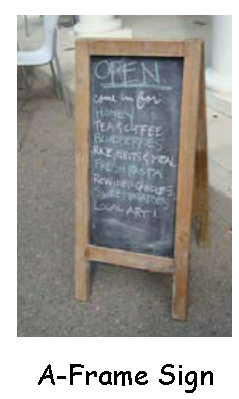
Portable signs are not allowed as miscellaneous freestanding signs except for an A-Frame sign for a nonresidential use (also known as a "sandwich board" sign). Such A-Frame signs must be located no farther from an entrance to the owner's business than six feet and may be no larger than six square feet in sign face area nor be more than three feet in height. Such A-Frame signs must be stored indoors when the owner's establishment is not open for business.
(Ord. No. 2021-10, § 1, 6-28-2021)
Sec. 8.2. - Miscellaneous building signs.
Miscellaneous building signs (as defined in this chapter) not otherwise prohibited under section 4.3, Prohibited signs, are allowed on nonresidential use properties in addition to the principal building signs allowed under this chapter, as follows:
(a)
General miscellaneous building signs. Miscellaneous building signs are allowed, provided that such signs shall be placed only on a tenant space façade fronting on a dedicated public street. Such signs are limited as follows:
(1)
For single-occupant buildings, the maximum aggregate area for all miscellaneous building signs shall be one square foot of sign face area per linear foot of the length of the tenant frontage (as defined in this chapter) on which the signs are affixed, or ten percent of the area of the façade, whichever is greater. No single such sign shall be larger than six square feet in sign face area.
(2)
For planned centers, the maximum aggregate area for all miscellaneous building signs for each tenant space shall be one square foot of sign face area per linear foot of the tenant frontage (as defined in this chapter), or ten percent of the area of the tenant's façade, whichever is greater. No single such sign shall be larger than six square feet in sign face area.
(3)
Such miscellaneous building signs placed in a window may not result in the obstruction of more than 50 percent of the window area in combination with all other signs in the window.
(b)
Subtenant signs.
(1)
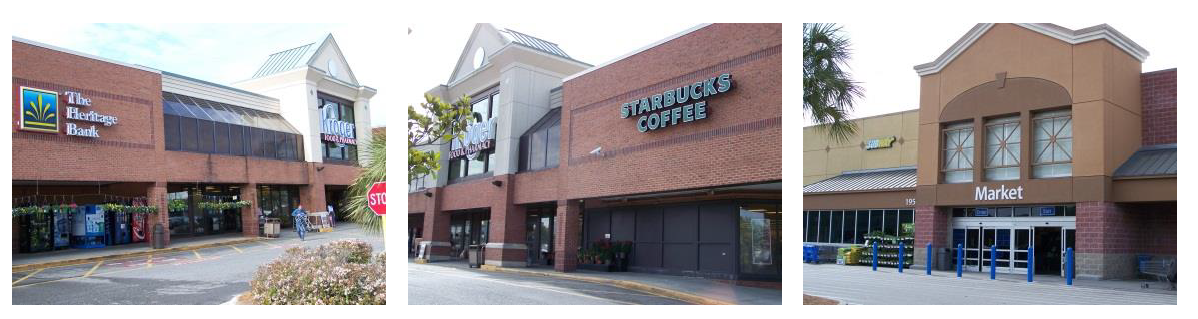
Each business that occupies space within a principal business as a subtenant is allowed one wall sign in addition to the principal building sign allowed for the principal business. Each subtenant wall sign shall not exceed 20 square feet in sign face area, nor shall the total for all such subtenant signs collectively exceed the sign face area allowed for the principal business.
(2)
The following are examples of subtenant wall signs allowed by this subsection:
(c)
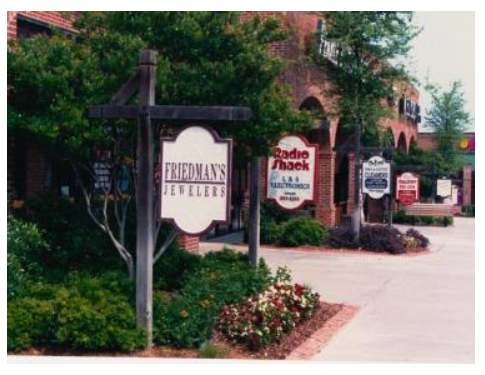
Sidewalk pedestrian signs. Each tenant (other than a subtenant) located within a planned center is allowed to have one sidewalk pedestrian sign in lieu of an under-canopy sign allowed by this article, as follows:
(1)
The sidewalk pedestrian sign must be post mounted in a sidewalk planter.
(2)
Each such sign is allowed to have a maximum sign face area of six square feet.
(3)
The following is an example of sidewalk pedestrian signs allowed by this subsection:
(d)
Convenience stores and service stations with pump islands. Additional signage is permitted as follows:
(1)
One sign per freestanding or building canopy face per public street frontage with a maximum of 16 square feet each is allowed. The canopy sign shall not extend above or below the edge of the canopy.
(2)
Spreader bars (signs located under canopy over pump islands) shall be limited to no more than two signs per spreader bar, not to exceed four square feet per sign. However, total square footage for all spreader bars shall not exceed 24 square feet.
(3)
On-site separate drive-through car wash building(s), shall be allowed one permanent wall sign, not to exceed eight square feet with an approved sign permit. This sign shall be for incidental purposes only.
(e)
Service entrance signs. For any tenant space that has a service entrance at the rear of the building, at least one service entrance sign is required.
(1)
Service entrance signs shall be located directly on or adjacent to the service entrance door.
(2)
The combined area of signs at a single service entrance shall not exceed six square feet and must be clearly legible for public safety personnel.
(Ord. No. 2021-10, § 1, 6-28-2021)
Sec. 8.3. - Changeable copy signs.
(a)
Manually activated changeable copy signs. Manually activated changeable copy signs are permitted in conjunction with freestanding signs and wall signs so long as the changeable copy portion of the sign face does not exceed 60 percent of the overall sign face of the freestanding or wall sign; and provided that the total sign face does not exceed the size limitations imposed elsewhere by this chapter.
(b)
Electronic changeable copy signs. Electronic changeable copy signs may be installed on any freestanding principal sign or principal building on a property occupied by a nonresidential use in accordance with the provisions of section 5.9, Electronic changeable copy signs.
(Ord. No. 2021-10, § 1, 6-28-2021)
Sec. 9.1. - Temporary event signs; allowed.
(a)
Signs in addition to those allowed under this chapter are allowed on a property for the duration of a temporary event (as defined below). Such additional signs shall not be restricted as to the message displayed on the sign.
(b)
Temporary event signs must comply with all requirements of this article, including the prohibitions of section 4.3, Prohibited signs and general requirements applying to all signs, except as modified by the provisions of this article.
(c)
Fixed location. All temporary event signs must be installed at a fixed location, either attached to the ground as a freestanding sign or attached to a building. Temporary event signs shall not be attached to a vehicle or other movable, animated or portable device, or attached to, held by or displayed upon a person.
(Ord. No. 2021-10, § 1, 6-28-2021)
Sec. 9.2. - Temporary event; defined.
A temporary event is an activity having a specific duration or the end of which is related to a specific action, usually lasting for only a few days or months at a time. Temporary events include but are not limited to such activities as:
(a)
The offering of a property or premises for sale or rent.
(b)
The construction of a building, subdivision or development project, or the rehabilitation, remodeling or renovation of a building.
(c)
Establishment of a new business or multi-family project, including temporary "pre-permanent" signage while awaiting installation of permanent signs, or for a "grand opening" of a new business.
(d)
A special business promotion other than a "grand opening," such as but not limited to a "close-out sale" and a holiday or seasonal sales event.
(e)
A yard sale.
(f)
An election, political campaign, referendum or ballot proposition put to the voters as part of city, county, state or federal governance.
(g)
A public announcement of a special event or seasonal activity by an individual or a nonprofit organization.
(Ord. No. 2021-10, § 1, 6-28-2021)
Sec. 9.3. - Duration of temporary event sign placement.
Temporary event signs may be placed on any property upon initiation of a temporary event, and must be removed upon the termination of the event. Initiation and termination of particular events shall be interpreted as follows:
(a)
Sale or lease of a building or premises. Initiation upon the availability of the building or premises for sale or lease, and termination within seven days after the closing of the sale or execution of the rental agreement.
(b)
Building construction or remodeling. Initiation upon issuance of a building permit authorizing the construction, interior finish or remodeling, and termination within seven days after issuance of the certificate of occupancy.
(c)
Residential or nonresidential subdivision or condominium under development. Initiation upon preliminary plat or site plan approval by the city. Termination upon the sale of 95 percent of the lots, dwelling units or buildings in the final phase, or at the end of 12 continuous months during which no building permits have been issued for new construction within the development, whichever occurs first.
(d)
Pre-permanent signage for a new business or multifamily project. Initiation upon issuance of a certificate of occupancy for the first multi-family building in the project or for the new business' premises, and termination upon the installation of the permanent signage for the project or business or six months from the date of issuance of the certificate of occupancy, whichever occurs first.
(e)
Grand opening for a new business.
(1)
Initiation upon announcement of the grand opening event, which must occur within six months of issuance of the certificate of occupancy, and termination upon its completion or 30 days after initiation, whichever occurs first.
(2)
A grand opening event may occur only once for a business that has newly occupied the property.
(3)
Banners, portable signs, festoons and inflatable signs are allowed for a grand opening event.
(f)
Special business promotion.
(1)
Initiation upon announcement of the special sale or sales event, and termination upon its completion.
(2)
A special business promotion event on the same property for each business or tenant may be held for any duration of time during October, November and December, and for one 30-day period in each of the other quarters of the year.
(3)
Additional provisions apply to various types of signs placed during a special business promotion event (see section 9.8, Temporary banners, portable signs, festoons and inflatable signs).
(g)
Yard sale. Initiation two days prior to the announced date of the sale, and termination at the end of the announced date.
(h)
Election or political campaign.
(1)
For a local or state election: Initiation upon the opening day of qualification of candidates, and termination within ten days after the election of all candidates to office or resolution of all ballot questions put to the voters in the election.
(2)
For a national election: Initiation upon the nomination of candidates, and termination within ten days after the election of all candidates to office or resolution of all ballot questions put to the voters in the election.
(i)
Public announcement. Initiation upon the placement of the sign and termination within 14 days after such placement.
(j)
Other temporary events. The initiation and termination dates for any temporary event not listed above shall be determined by the director of building, planning and zoning for each temporary event, based on considerations such as: Normal beginning and ending dates for such an event, the scheduled occurrence of the event, or similarities to other temporary events listed above or having previously occurred.
(Ord. No. 2021-10, § 1, 6-28-2021)
Sec. 9.4. - Number of temporary event signs.
Only one temporary sign related to each temporary event per business or tenant may be located on a property at any one time, except for the following:
(a)
Sale or lease of a building or premises.
(1)
One freestanding sign per street frontage may be placed on a property that is available for sale or lease. For a planned center, one additional building sign may be placed on each tenant space that is available for sale or lease.
(2)
For a commercial, industrial or institutional use building containing 50,000 square feet of gross floor area or more, the following shall apply:
a.
During construction or remodeling of the building, no more than two temporary freestanding or wall signs shall be allowed.
b.
During the start-up period while the building is initially for sale or lease, no more than two freestanding signs shall be allowed.
(b)
Residential or nonresidential subdivision or condominium under development. During construction of a residential or nonresidential subdivision or condominium development: One sign per entrance into the subdivision or development per builder.
(c)
Pre-permanent signage for a new business or multifamily project shall not exceed the number of permanent signs allowed for the project or business.
(d)
Grand opening for a new business. Up to five signs having a maximum aggregate area of 300 square feet are allowed, including any signs approved under section 9.8 of this article.
(e)
Special business promotion. Under a temporary sign permit, a maximum of five signs may be displayed having a maximum aggregate area not to exceed 300 square feet, including any signs approved under section 9.8, Temporary banners, portable signs, festoons and inflatable signs.
(f)
Election or political campaign. No limit on the number of signs.
Table 5-A: Temporary Event Sign Examples1
1 Examples only. All provisions of article 9, Temporary Event Signs apply in all cases.
2 Limitations on frequency of special business promotion events apply, as noted in this article.
(Ord. No. 2021-10, § 1, 6-28-2021)
Sec. 9.5. - Size of temporary event signs.
Temporary event signs are restricted to the following sign areas and sign heights:
(a)
Single-family residential, townhouse condominium or manufactured home lot. Temporary event signs located on such subdivided lots shall not exceed six square feet in sign face area and five feet in height.
(b)
Residential or nonresidential subdivision or condominium development under construction. Signage during construction of a residential or nonresidential subdivision or condominium development shall not exceed 32 square feet in sign face area and eight feet in height.
(c)
Multi-family, manufactured home park or nonresidential use property (as defined in this code). Temporary event signs located on a multi-family, manufactured home park, or nonresidential use property shall not exceed 32 square feet in sign face area and eight feet in height.
(d)
For a commercial, industrial or institutional use building containing 50,000 square feet of gross floor area or more, the following shall apply:
(1)
During construction or remodeling, temporary event signs shall not exceed 64 square feet in area or more than ten feet in height.
(2)
During the start-up period while the building is initially for sale or lease, temporary event signs shall not exceed 64 square feet in area or more than ten feet in height.
(Ord. No. 2021-10, § 1, 6-28-2021)
Sec. 9.6. - Location of temporary event signs.
(a)
All temporary event signs shall be located as follows:
(1)
At least ten feet from any street right-of-way line, back of street curb or edge of street pavement, whichever is farthest from the street.
(2)
At least ten feet from any side or rear property line and the pavement edge of a driveway.
(3)
Temporary signs located within 30 feet of an intersection of two streets or a driveway and a street shall be no more than three feet in height.
(b)
Temporary event signs are not allowed to be placed within or over a public street right-of-way or private street easement.
(c)
A temporary event sign must be a freestanding sign or a building sign (as defined in this article), and shall not be affixed to any tree, utility pole or official traffic sign or structure.
(d)
A temporary event sign shall be erected and maintained only with the permission of the owner of the property upon which the sign is located.
(Ord. No. 2021-10, § 1, 6-28-2021)
Sec. 9.7. - Construction and lighting standards of temporary event signs.
(a)
Construction standards for signs requiring building permits. A temporary sign for which issuance of a building permit is required by the building code shall meet the same engineering design and materials standards as for permanent signs as required by the building code.
(b)
Construction standards for signs not requiring building permits.
(1)
Nonpermanent but water-resistant construction materials may be used, such as but not limited to poster board, foam core board or illustration board.
(2)
The words, letters, figures, symbols, logos, fixtures, colors or other design elements that convey the sign's message shall be permanently applied to the sign's face.
(c)
Electronic and manual changeable copy signs shall not be allowed.
(d)
Lighting. Temporary signs shall not be illuminated.
(Ord. No. 2021-10, § 1, 6-28-2021)
Sec. 9.8. - Temporary banners, portable signs, festoons and inflatable signs.
All of the following types of signs are allowed as temporary signage during a "grand opening" or a "special business promotion" event through issuance of a temporary sign permit, and in accordance with the duration, number, size, location and lighting limitations of this article. For holiday or seasonal decorations (in contrast to commercial signs), see section 9.9 of this article 9:
(a)
Banners. Banners are allowed with the following additional provisions:
(1)
For a banner that is no more than 12 square feet in sign face area, such banner shall be placed on the site or on a building in such a manner as not to create a safety hazard as determined by the director of building, planning and zoning. They shall meet the same setback requirements as all other temporary signs. Such a banner shall not be hung as an under-canopy sign, flown as a flag, attached to or hung from an existing freestanding sign, or used as any other form of sign.
(2)
A banner that is more than 12 square feet in sign face area but no more than 24 square feet in size shall be allowed only as a wall or window sign and shall be placed flush upon the wall or window to which it is attached. Such a banner shall not be hung as an under-canopy sign, flown as a flag, or used as any other form of sign.
(3)
A banner that is larger than 24 square feet in size is not allowed.
(b)
Portable signs. No more than one portable sign is allowed on a property developed for commercial, industrial or institutional use, subject to the following restrictions:
(1)
Maximum size. The maximum size of a portable sign shall not exceed 32 square feet. Said sign shall not have flashing lights or animated devices, but may be internally illuminated and may be a manually activated changeable copy sign.
(2)
Placement. The sign must be placed on the site in compliance with section 9.6, Location of temporary event signs.
(3)
Securely anchored. To prevent wind damage to the sign or other property, the sign must be securely anchored to the site in a manner acceptable to the director of building, planning and zoning.
(4)
Electrical connections. All electrical connections to the sign must be in compliance with the electrical code as adopted by the city, and must be inspected prior to use.
(c)
Festoons. Festoons such as strings of light bulbs and other illuminated devices, and strings of ribbons, tinsel, pennants, streamers, pinwheels or other similar devices designed to move in the wind are allowed, provided that no part of any such festoon shall be located in or over a public right-of-way and no hazard to traffic safety shall be created.
(d)
Inflatable signs. Inflatable signs, such as air or gas filled devices and other inflatable devices, are allowed for a "grand opening" or a "special business promotion" event on parcels greater than 2.5 acres in land area. These devices shall be in the number and area of all "grand opening" or "special business promotion" signs allowed on the property. Inflatable devices must be de-inflated and properly disposed of or stored at the expiration of the permit period.
(Ord. No. 2021-10, § 1, 6-28-2021)
Sec. 9.9. - Holiday or seasonal decorations.
(a)
This section does not apply to any holiday or seasonal displays or decorations exempted from regulation under section 4.2(e) of this chapter.
(b)
Holiday or seasonal displays or decorations not otherwise exempt and that are intended as commercial speech or convey a commercial message are regulated as "special business promotions" under this article 9, Temporary Event Signs.
(Ord. No. 2021-10, § 1, 6-28-2021)
Sec. 10.1. - Registration of nonconforming signs.
(a)
Existing signs which are legal immediately prior to adoption of this chapter and which would be required to obtain a permit under this chapter if they had been newly erected after enactment of this chapter must register with the director of building, planning and zoning within 90 days of the effective date of this chapter. The information provided for registration will be the same information required in a permit application under the provisions of chapter 8 of this code, but no fee shall be required.
(b)
Nonconforming signs, which met all legal requirements when erected, may stay in place, provided that within 90 days of the effective date of this chapter the owner of the nonconforming sign or the owner's agent registers the sign with the city.
(1)
Such registration shall contain the same information required for issuance of a sign permit, which is found in the procedures and permits chapter of this code.
(2)
In addition, the registration shall specify the sign being registered as nonconforming and shall state that the sign was completely installed before the effective date of this chapter.
(3)
The burden of proof that an existing sign qualifies as a legal nonconforming sign lies with the owner of the sign.
(4)
The payment of a fee is not required for the registration of a nonconforming sign; however, failure to register shall be considered an offense and may be punished as any other ordinance violation.
(c)
Existing signs which are legal immediately prior to adoption of this chapter and which would be required to obtain a permit under this chapter if they had been newly erected after enactment of this chapter must register with the director of building, planning and zoning within 90 days of the effective date of this development code (from which this chapter derives). The information provided for registration will be the same information required in a permit application under the following section of this chapter, but no fee shall be required.
(Ord. No. 2021-10, § 1, 6-28-2021)
Sec. 10.2. - Maintenance and continuance.
(a)
Nonconforming signs shall be allowed until one of the following conditions occurs:
(1)
The deterioration of the sign or damage to the sign makes it a hazard or unsightly; or
(2)
The sign has been damaged by circumstances beyond the control of the owner to the extent that more than minor repairs are required to restore the sign; provided that signs damaged by Act of God and not due to the owner's action may be restored to their pre-damaged condition, provided that the useful life of the sign is not extended.
(b)
No change in shape, size or design, shall be allowed except to make a nonconforming sign comply with all requirements of this chapter.
(c)
The substitution or interchange of poster panels or painted boards on nonconforming signs shall be allowed provided the size, shape, placement or location of said sign does not change.
(d)
A nonconforming sign may not be replaced by another nonconforming sign except where changed conditions beyond the control of the owner render the sign nonconforming or warrant the sign's repair.
(e)
An existing sign that was legally erected and that becomes nonconforming as to the setback requirements of this code due to road widening may be moved to meet the setback requirements of this code. Such sign shall not be increased in size or changed in any manner except as to become conforming.
(Ord. No. 2021-10, § 1, 6-28-2021)

