
Fridley City Zoning Code
CHAPTER 601
Definitions
601.01 Interpretation Of Definitions
601.01 Interpretation of Definitions
1. For the purpose of this Chapter certain terms and words are hereby defined as:
(a) Words used in the present tense includes the future tense;
(b) Words in the singular include the plural, and the plural the singular;
(c) The word “lot” includes the word “plot”; and
(d) The word “shall” is mandatory while the word “may” is permissive; and
(e) The word “including” means “including, but not limited to.”
2. For the purpose of this chapter, the following definitions apply unless the context clearly indicates or requires a different meaning. All words and phrases not defined shall have their common meaning or be determined through the interpretation of the Community Development Director.
Adopted by Ord. 1431 on 6/18/2025
601.02 General Definitions
601.02 General Definitions
Alley. A public right of way which affords secondary access to an abutting property.
Alternate Energy Devices. Non fossil fuel energy devices.
Ambient. Description of measurement of existing conditions with respect to traffic, noise, air and other environments.
Applicant. Any person, firm, corporation, developer, partnership or association that applies for a land use, subdivision or permit application.
Articulation. Surface articulation in architecture refers to the design and detailing of a building's surfaces to enhance visual interest, texture and depth.
Basement. A portion of a building located wholly or partly underground, having more than 50% of its floor to ceiling height below the average grade of the building perimeter. A basement will not be considered a story for the purposes of determining building height.
Berm. A constructed mound of earth in excess of 18 inches in height used for decorative, screening or buffering purposes.
Bicycle Facility. Site furnishings which accommodate bicycling, including bicycle racks, storage and other facilities designated for bicycle parking.
Block. That property abutting on one side of a street and lying between the two nearest intersecting or intercepting streets or nearest intersecting or intercepting street and railroad right of way, waterway or other barrier to or gap in the continuity of development along such street.
Boulevard. That area between the street surfacing or curb and the public right-of-way line.
Buildable. Lands within an area suitable for a structure and site design features for residential, commercial and industrial uses. It includes both vacant land and developed land utilized for redevelopment.
Building. Any structure having walls and a roof, built for the shelter or enclosure of persons, animals or property of any kind.
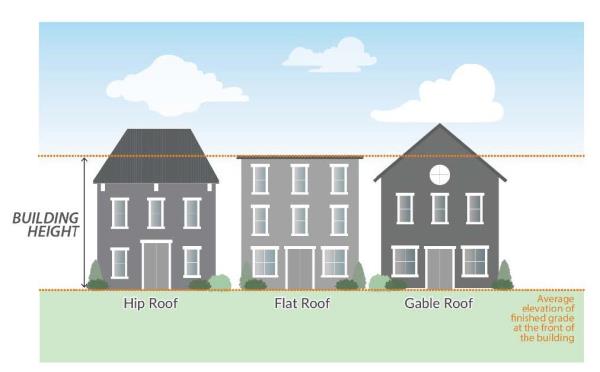
Building Height. The vertical distance measured from the average elevation of a finished grade at the front of the building to the highest point in the case of a flat roof; to the deck line of a mansard roof; and to the mean distance between eaves and ridge of a gable, hip or gambrel roof (See Figure 1).
Figure 1
Caliper. The ANSI (American National Standards Institute) standard for the measurement of nursery trees. For trees up to six inches in diameter, caliper is measured at six inches above the ground level. Trees that are a seven to twelve-inch caliper are measured at twelve inches above the ground. For nursery stock above twelve inches in diameter, a DBH (Diameter at Breast Height) measurement is used.
Carwash. A structure containing a machine or equipment for the cleaning, washing, polishing, or waxing of motor vehicles. This may be attached to a gas station or free-standing.
Charging Levels: Standardized indicators of electrical force, or voltage, at which an electric vehicle’s battery is recharged from Electric Vehicle Supply Equipment. The terms 1, 2, and DC are the most common charging levels, and include the following specifications:
1. Level 1 is considered slow charging and includes 120v outlets. 2. Level 2 is considered medium charging that includes 208v and 240v outlets, and/or charging head and cord hard-wired to the circuit. 3. Level 3 or DC is considered fast or rapid charging and includes outlets greater than 240v, charging heads and cord hard-wired to the circuit.
City. The City of Fridley.
Common Open Space. Any land, water or combination which is intended for the use and enjoyment of residents of a development, but not including individual building lots and land accepted for public dedication.
Curb Grade. The established elevation of the curb in front of the building measured at the center of such front. Where no curb grade has been established, the City will establish such curb elevation.
District. A section or sections of the incorporated area of the City for which the regulations and provisions governing the use of building and land are uniform for each class of use permitted therein.
Driveway. A hard surfaced area, such as concrete, asphalt or similar City accepted impervious material, that is designed to hold the weight of the vehicle while giving access from a public way to a building or abutting grounds. A hard surface material does not include gravel.
Dwelling Unit. Any building or portions thereof providing habitable, independent living facilities for one or more persons in a household, including permanent provisions for living, sleeping, eating, cooking and sanitation.
Easement. A grant by a property owner to the use of land by the public, an entity or persons for specific purposes such as the construction of utilities, drainageways and roadways.
Electric Vehicle. A vehicle that operates, either partially or exclusively, on electrical energy from the electrical grid or an off-grid source that is stored on board for motive purposes. “Electric vehicle” includes:
1. Battery electric vehicle 2. Plug-in hybrid electric vehicle
Electric Vehicle Charging Station (EVCS). A public or private parking space that is served by electric vehicle supply equipment.
Electric Vehicle Ready Parking Space. Parking space with sufficient electrical capacity and conduits to support future EV chargers, but not including an installed charger unit. Adequate electrical service is required to allow for future simultaneous charging of all future installed chargers.
Electric Vehicle Supply Equipment (EVSE). Any equipment or electrical component that has the primary purpose of charging electric vehicles at a specific location and meets the specifications of the Charging Levels listed above. EVSE does not include equipment located on the electric vehicles themselves.
Electrical Capacity means, at minimum:
1. Panel capacity to accommodate a dedicated branch circuit and service capacity. 2. Conduit from an electric panel to future EVCS location(s).
Expansion. Any modification which increases an intensity of a use, or an existing structure’s square footage, volume or footprint.
Exterior Materials. The protective material on the exterior of a building that typically features visually appealing finishes.
Façade. The entire external area of a building facing or side extending from the roof or parapet to the ground and from one corner of the building to another.
Fence. A structure, partition or wall erected for the purpose of enclosing a piece of land or to divide a piece of land into distinct portions.
Fence, Barbed Wire Security. A barrier system comprised of twisted strands of wire armed with barbs or sharp points arranged at intervals along the strands.
Fence, Electric Security. A barrier system comprised of wire and designed to deter unauthorized entry through the use of non-lethal electrical pulses. It consists of one or more insulated wires strung along a fence line or other supporting structure and connected to a commercially-available energizer, installed to manufacturer specifications, which delivers electrical pulses.
Foot Candle. A measure of illumination on a surface that is everywhere one foot from a uniform point source of light of one candle and equal to one lumen per square foot.
Grade. The average level of the finished surface of the ground adjacent to the exterior walls of the building.
Ground Cover. The ground area covered by vegetation.
Impervious Surface. A constructed hard surface that either obstructs the entry of water into the soil, or causes water to run off the surface in greater quantities and at an increased rate of flow than existed prior to development. Examples include rooftops, sidewalks, roads, patios, driveways, parking lots, storage areas, concrete, asphalt or other material that does not absorb stormwater run-off.
Landscaping. The improvement of land by the addition of berms, trees, shrubs, ground cover, crushed rock, wood chips, retaining walls and other functional, ornamental or decorative features.
Living Area. The area of a dwelling unit designed to be used for habitation purposes, including bedrooms, dining room, living room and the like, which are usually and customarily used for habitation purposes, as distinguished from any garage or other type of accessory space.
Loading Dock. Any off-street area or raised platform, on the same lot with a building or contiguous to a group of buildings, for the temporary parking of a commercial vehicle while loading or unloading merchandise or materials.
Lot. A parcel of land sufficient in size to meet the minimum zoning requirements for use, coverage and area, and to provide such yards and other open spaces as are required (See Figure 2). A lot must have frontage on a dedicated or private street and may consist of:
1. A single lot of record or a portion of a lot of record; 2. A combination of complete lots of record and/or portions of lots of record; or 3. A parcel of land described by metes and bounds, provided that any subdivision of any residual lot must meet the requirements of this Chapter.
Figure 2
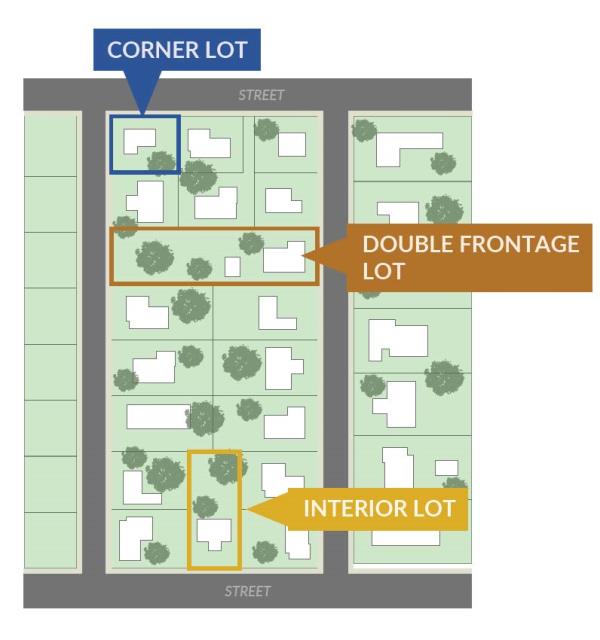
Lot, Corner. A lot situated at the intersection of two or more streets (See Figure 2).
Lot, Double Frontage (Through). A lot with opposite lot lines on two non-intersecting streets. Both street frontages will be considered as front yard areas (See Figure 2).
Lot, Interior. A lot situated such that its lot line abuts another lot, open space or yard (See Figure 2).
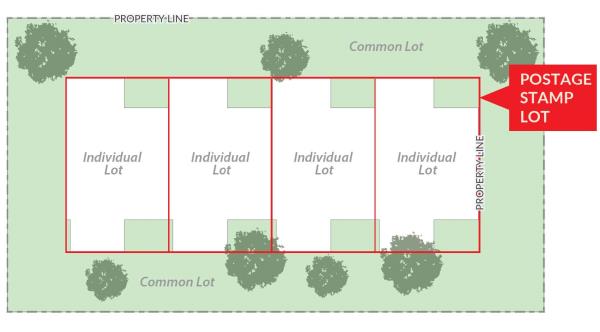
Lot, Postage Stamp. A lot arrangement typically within a homeowner’s association where individual lots define the area around the perimeter of an individual unit and there is a common lot for the remainder of the yard area (See Figure 3).
Figure 3
Lot Area. The area of land on a horizontal plane bounded by the front, side and rear lot lines, measured within the lot boundaries.
Lot Coverage. That portion of a lot that is covered by buildings or structures, but excluding paving and other impervious surfaces.
Lot Depth. The horizontal distance measured between the front and rear lot lines.
Lot Frontage. The front of a lot is that boundary of a lot along a street right of way. If a lot is a corner lot, the front will generally be the shorter lot line that abuts the street right of way. The Community Development Director may designate the front lot line based on the practical front yard of the property as determined by such factors as the existing or proposed building configuration and consideration of the characteristics of surrounding properties.
Lot (Property) Line. A line dividing one lot from another or from a street or any public space (See Figure 4).
Figure 4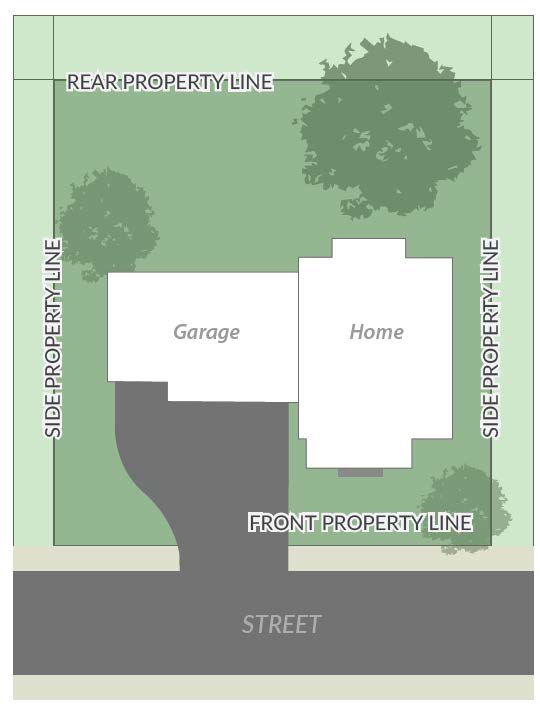
Lot (Property) Line, Front. The front line of a lot is that boundary abutting a public right-of-way, typically having the least width(See Figure 4).
Lot (Property) Line, Rear. The boundary of a lot that is opposite the front lot line (See Figure 4).
Lot (Property) Line, Side. Any boundary of a lot which is not a front or rear lot line (See Figure 4).
Lot Width. The horizontal distance between the side lot lines measured at right angles to the lot depth at a point equal to the minimum required front yard setback.
Manufactured (Mobile) Home: A structure transportable in one or more sections, which in the traveling mode, is eight body feet or more in width or 40 body feet or more in length, or, when erected on site, is 320 or more square feet and is built on a permanent chassis and designed to be used as a dwelling with or without a permanent foundation when connected to the required utilities, including plumbing, HVAC, and electrical system contained in it. The structure must comply with the Manufactured Home Building Code as defined by Minnesota Statutes (M.S.) § 327.31, subdivision 3, as it may be amended from time to time.
Manufactured Home Park: A contiguous parcel or parcels of land which has been developed for the placement of two or more manufactured homes and is owned by an individual, firm, trust, partnership, public or private association, company or corporation.
Material Classes. Classification of materials based on their physical properties and structural integrity.
Motor Vehicle. A machine propelled by power other than human power, designed to travel along the ground by use of wheels, treads, runners, or slides and transports persons or property or pulls equipment and includes but is not limited to automobiles, trucks, motor homes, motorcycles, tractors, all-terrain vehicles (ATVs), utility task vehicles (UTVs) and snowmobiles.
Nuisance. Anything, condition or conduct that endangers the public health, safety or welfare, or unreasonably offends the senses, or obstructs the free use and comfortable enjoyment of property or essentially interferes with the comfortable enjoyment of life.
Owner Occupancy. A property owner, as reflected in property records, makes their legal residence at the site, as evidenced by the property’s residential homestead classification.
Parking Stall. An area for the purpose of parking one automobile, with access to a public street or alley.
Parking Stall, Accessible. A parking space reserved exclusively for a motor vehicle registered with the state of Minnesota with accessible license plates or a state-issued temporary accessible parking pass.
Parking Stall, Angled. Any parking space that is not parallel to the curb or driving aisle.
Public Property. Any property owned by the City of Fridley or any other governmental entity or agency.
Public Right-of-Way. “Right-of-way” or “public right of way” means the area on, below, or above a public roadway, highway, street, alley, bicycle lane, or public sidewalk in which the City, County or State has an interest, including other dedicated rights-of-way for travel purposes and utility easements of the City, County or State. A right-of-way does not include the airwaves above a right-of-way with regard to cellular or other non-wire telecommunications or broadcast services.
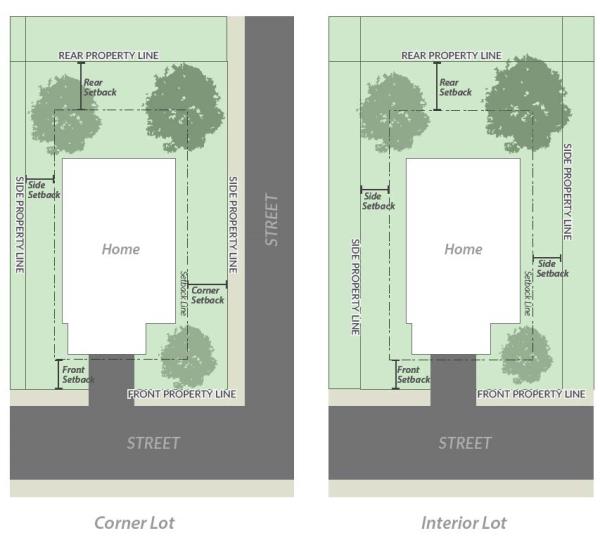
Recreational Vehicle: Any structure or vehicle equipped with wheels designed or used for habitation or recreational purposes to facilitate movement from place to place. Recreational vehicles also include automobiles that are used for habitation purposes and include pick-up coaches (campers), motorized homes, boats, travel trailers and camping trailers not meeting the definition of a manufactured home or mobile home. Setback. The minimum horizontal distance between a lot line and a structure located on that lot (See Figure 5).
Figure 5
Site Plan. A map drawn to scale depicting the development of a tract of land, including but not limited to the location in relationship of structures, streets, driveways, recreation areas, parking areas, utilities, landscaping and walkways as related to a proposed development.
Shrub. Any plant material, which at maturity is 15 feet in height or less. Such materials may be used for the formation of hedges.
Slope. The degree of deviation of a surface from the horizontal, usually expressed in percent or degrees.
Sod/Sodding. A section of grass-covered surface that can be transplanted for landscaping.
Stormwater Runoff. The direct runoff of water resulting from precipitation in any form.
Story. That part of a building included between the surface of any floor and the surface of the next floor above it; if there is no floor above it, the space between the floor and the ceiling above it. Street. A public or private thoroughfare which provides a principal means of access to abutting property.
Street, Arterial. A street designed primarily to carry traffic between large land use units, as designated in the transportation section of the current Fridley Comprehensive Plan.
Street, Collector. A street designed primarily to carry traffic from local streets to arterial streets and highways, as defined in the transportation section of the current Fridley Comprehensive Plan.
Street, Local. A street of limited continuity designed primarily to carry traffic to the abutting properties and higher order streets, as defined in the transportation section of the current Fridley Comprehensive Plan.
Structural Alteration. Any change, addition or modification in construction in the supporting members of a building, including exterior walls, bearing walls, beams, columns, foundations, girders, floor joists, rafters or trusses.
Structure. Anything constructed or erected on the ground or attached to the ground or on-site utilities above ground, such as buildings, sheds, detached garages, manufactured homes and satellite dishes.
Structure, Accessory. A subordinate structure which is located on the same lot as the principal structure or use and which is necessary or incidental to the conduct of the principal structure or use.
Structure, Principal. The main constructed building on a parcel of land that is utilized for the majority of activities.
Transparency. The quality of allowing light to pass through so that objects behind can be distinctly seen.
Tree, Coniferous. A woody plant, which at maturity is at least 30 feet or more in height, with a single trunk fully branched to the ground, having foliage on the outermost portion of the branches year-round.
Tree, Ornamental. A woody plant, which at maturity is less than 30 feet in height, including multi-stem or those with a single trunk unbranched for several feet above the ground, often planted for ornamental characteristics such as flowers or attractive bark.
Tree, Overstory Deciduous. A woody plant, which at maturity is 30 feet or more in height, with a single trunk unbranched for several feet above the ground, having a defined crown which loses leaves annually.
Use. The purpose for which land or a structure thereon is designated, arranged or intended or for which it is occupied, utilized or maintained.
Use, Accessory. A subordinate use which is located on the same lot as the principal structure or use and is necessary or incidental to the conduct of the principal building or use.
Use, Conditional. A specific type of land use that may be allowed, but only after an in-depth review procedure and with appropriate conditions or restrictions as provided in the Code.
Use, Interim. A temporary use of property until a particular date, until the occurrence of a particular event or until zoning regulations no longer permit it.
Use, Nonconforming. Any building, structure or land lawfully occupied by a use or lawfully existing at the time of the passage of this Chapter or amendments thereto, which does not conform with the regulations of this Chapter or future amendments for the district in which it is situated.
Use, Permitted. A land use which is specifically allowed in a zoning district.
Use, Permitted with Standards. A land use which may be lawfully established in a particular district or districts, provided certain standards are met.
Use, Principal. The main use of land or buildings as distinguished from subordinate or accessory uses.
Use, Proposed. In reference to this Chapter’s provisions regarding mandatory distances between uses, the “proposed use” is a regulated use which may not be located within a specified distance from a protected use. Proposed uses include but are not limited to automotive repair and cannabis cultivation.
Use, Protected. In reference to this Chapter’s provisions regarding mandatory distances between uses, the “protected use” is a use which may be adversely affected by a proposed use. Protected uses include but are not limited to residential uses and schools.
Variance. A modification or variation from the literal requirements of this Chapter as applied to a specific piece of property.
Vehicle. Any device in, upon or by which any person or property is or may be transported or drawn upon a highway, excepting devices used exclusively upon stationary rails or tracks.
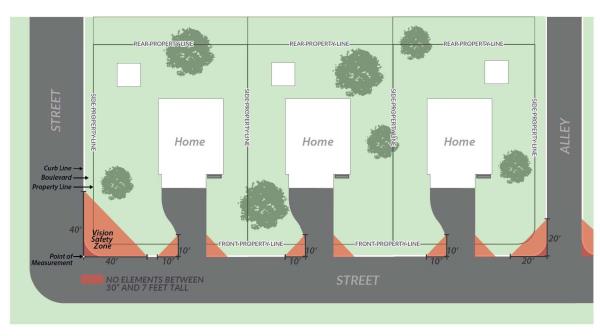
Vision Safety Zone. A triangular area of unobstructed vision that is located at the intersection of two streets; a street and an alley; or a street and a driveway. The area is measured by placing two points of the triangle 40 feet from a street corner, 20 feet from the alley intersection and 10 feet from the driveway intersection. The third side of the triangle is a straight line between the two aforementioned points (see Figure 6).
Figure 6
Walkway or Sidewalk. A surface designated for pedestrian use.
Waterway. Any body of water that receives storm water runoff, including but not limited to wetlands, lakes, ponds, streams, rivers, and reservoirs. This does not include water flowing on streets, or pooling for less than 24 hours on private property after a rain event.
Yard. The horizontal distance between the principal structure and a lot line, as measured perpendicular to the lot line. Eaves are not to be considered part of the principal structure for the purpose of determining the location or extent of a yard (See Figure 7).
Figure 7
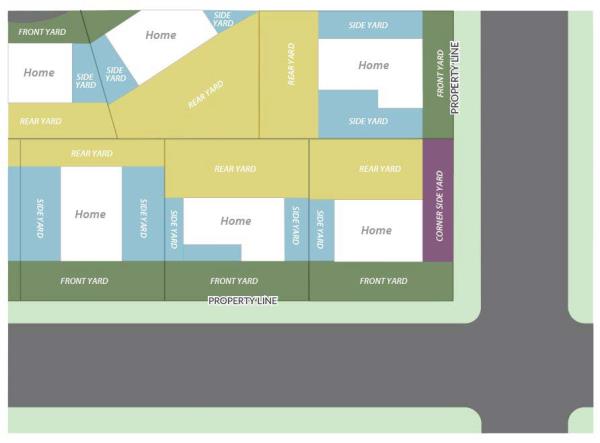
Yard, Corner Side. A yard which abuts a street, extending between the closest point of the principal building to the corner side property line, where the yard meets the front line to the rear line.
Yard, Front. A yard extending across the full width of the lot and lying between the front line of the lot and the nearest line of the principal building (See Figure 7).
Yard, Rear. A yard extending across the full width of the lot and lying between the rear line of the lot and the nearest line of the principal building(See Figure 7).
Yard, Side. A yard extending across the full length of a lot and the main building extending from the front yard to the rear yard and having a width equal to the shortest distance between the side line and the principal building(See Figure 7).
Zero Lot Line. The location of a building on a lot in such a manner that one or more of the building’s exterior edges rest directly on a side lot line, and complies with all fire code requirements for construction on a lot line.
Adopted by Ord. 1431 on 6/18/2025
601.03 Use Definitions
Accessory Dwelling Unit, Attached. A subordinate habitable permanent dwelling complying with the Minnesota State Building Code which is located within a principal one-unit detached dwelling.
Accessory Dwelling Unit, Detached. A subordinate habitable permanent dwelling complying with the Minnesota State Building Code which is located on the same lot as a principal one-unit detached dwelling. The detached accessory dwelling unit may be a freestanding structure or may be located within a detached garage.
Accessory Retail or Service. The sale of goods or provision of services located within the same building or on the same lot as the principal institutional, office, or industrial use and which supports or is cohesive with the principal use.
Adult Entertainment Establishment. Any business that is characterized by, or which places a significant emphasis on, providing its patrons with merchandise, services, or entertainment that is characterized by an emphasis on the depiction, exposing, describing, discussing or "specified sexual activities" or "specified anatomical areas." For the purposes of this definition, Adult Entertainment Establishments include adult bookstores, adult motion picture theaters, adult massage parlors, adult saunas, adult companionship establishments, adult health clubs, adult cabarets, adult novelty businesses, adult motion picture arcades, adult modeling studios, adult hotel or motel, and adult body painting studios.
Animal Boarding, Shelter, or Daycare Center. Any structure or premises on which more than three dogs or cats over six months of age are temporarily or permanently boarded as a commercial service, including animal day care/spa/grooming facilities. A portion of the site may be used for associated retail. Properties with multiple pet licenses in residential districts are as defined in the Animal Control Chapter of the City Code.
Animal Veterinary Clinic or Hospital. A facility for the diagnosis, treatment, or hospitalization of small animals, including dogs, cats, rabbits, hamsters, and other animals of a similar nature. This use necessitates a staff member(s) with a current state Veterinary License in good standing. The facility may also provide boarding for animals as part of medical services and associated retail.
Automobile Recycling Center. A facility which includes automobile wrecking, salvage, and/or recycling yard.
Automotive Fuel Station. Any building, land area, or other premises, or portion thereof, used or intended to be used for the retail dispensing or sale of vehicular fuels. Convenience store items such as groceries and household goods may also be sold on the premises.
Automotive Repair, Major. An establishment where major repair of motor vehicles is conducted, including engine rebuilding, repairing, or reconditioning and collision service which includes but is not limited to body, frame, or fender straightening and overall painting of motor vehicles.
Automotive Service, Same Day. An establishment where minor repairs and servicing of motor vehicles are conducted, including but not limited to, replacement of parts, oil changes, tire rotations, and sale of automobile accessories for passenger cars and trucks not exceeding 12,000 pounds gross weight.
Brewery, Winery, or Distillery. A facility that produces beer, wine, or other beverages made using fermentation which contain at least one-half of one percent alcohol by volume. Brewpub. A restaurant with an accessory brewery.
Cannabis Combination Business. A business with a cannabis mezzobusiness license with a retail operations endorsement or a cannabis microbusiness license with a retail operations endorsement from the State of Minnesota Office of Cannabis Management.
Cannabis Cultivation Business. A business with a cannabis cultivator license, medical cannabis cultivator license, or cultivation endorsement from the State of Minnesota Office of Cannabis Management.
Cannabis or Hemp Manufacturing. A business with a cannabis or hemp manufacturer license or manufacturing endorsement from the State of Minnesota Office of Cannabis Management, that is engaged in producing consumer items by packaging processed cannabis or hemp plant materials or cannabis or hemp extract or combining materials or extract with other pre-structured materials or components, but does not involve processing raw plant materials.
Cannabis Processing or Extraction. A business with a cannabis or hemp manufacturer license or manufacturing endorsement from the State of Minnesota Office of Cannabis Management, that is engaged in the process of extracting cannabis concentrate from cannabis plants or cannabis flower using heat, pressure, water, lipids, gases, solvents, or other chemicals or chemical processes, but does not include the process of extracting concentrate from hemp plants or hemp plant parts or the process of creating any artificially derived cannabinoid.
Cannabis Retail Business. A retail location and the retail location(s) of a mezzobusinesses with a retail operations endorsement, microbusinesses with a retail operations endorsement, medical combination businesses operating a retail location, excluding lower-potency hemp edible retailers.
Cannabis Transportation or Delivery. The transportation of cannabis products from one type of cannabis business to another or to the end consumer.
Car Wash. An area of land and/or a structure with machine- or hand-operated facilities used principally for the cleaning, washing, polishing, or waxing of motor vehicles.
Care Facility. A facility licensed by the state which serves individulas who are handicapped, aged or disabled, or are undergoing rehabilitation, and are provided services to meet their needs. This category provides primarily in-patient care, treatment, and/or rehabilitation services for persons who do not require hospitalization. Care facilities include facilities such as assisted living, nursing homes, rest homes, and convalescent care. This use does not include in-home residential care facilities or hospitals.
Care Facility, Continuum Of. A residential facility or complex which provides more than one type of living choice for adults, from independent living to long‐term care.
Care Facility, Residential. An in-home facility in a residential zoning district that is licensed by the state which provides primarily nonmedical care to individuals who are in need of personal assistance to manage the activities of daily life or for the protection of the individual. The number of people allowed in each facility is dictated by state statute with either groups of six or few persons or groups between seven – 16 persons.
Clinic. A facility used primarily for the provision of outpatient medical, dental, chiropractic, therapeutic, optometric or mental health care and treatment.
Commercial Center, Large. Large commercial buildings with footprints at least 25,000 square feet in size consisting of two or more separate businesses sharing common access, circulation, and pedestrian and parking areas so that a public right-of-way is not needed to get from one business to another.
Commercial Center, Small. Small commercial buildings with footprints no larger than 25,000 square feet in size consisting of two or more separate businesses sharing common access, circulation, and pedestrian and parking areas so that a public right-of-way is not needed to get from one business to the other.
Commercial Recreation, Indoor. Indoor recreational facilities operated as a business and which are open to the public for a fee, including but not limited to, health clubs, bowling alleys, swimming pools, tennis courts, country clubs, and arcades. Indoor commercial recreation may have accessory outdoor recreation to serve patrons.
Commercial Recreation, Outdoor. Land or outdoor recreational facilities operated as a business and which are open to the general public for a fee, including but not limited to, golf courses and outdoor swimming pools. Such businesses may also provide a snack bar, restaurant, retail sales of related items, and other support facilities.
Construction Contractor Yard. A lot or portion of a lot used to store and maintain construction equipment and other materials customarily required in the building trades by a construction contractor.
Crematory. A furnace for cremating; also: an establishment containing such a furnace.
Day Care Center. Any non-home based program, licensed by the state, that for compensation or otherwise, provides for the care of children or adults outside their home for part of a 24 hour day. Includes, but is not limited to, programs for children known as nursery schools, preschools, day nurseries, child care centers, and day care facilities.
Day Care, Group Family. A dwelling unit where a resident of the dwelling is providing care as defined and regulated under Minn. Rules 9502.
Drive-Through Establishment. A use, structure or portion of a principal structure accessory to a retail or service use where patrons may purchase products or receive service without having to leave their motor vehicles.
Dwelling. A building or portion thereof designed exclusively for residential occupancy.
Dwelling, Apartment. A residential structure containing seven or more dwelling units designed exclusively for independent living, but sharing hallways and main entrances and exits.
Dwelling, Attached Townhouse or Rowhouse. A single dwelling unit within a larger residential structure containing three or more units which is separated from the adjoining dwelling unit(s) by a common wall. Each dwelling unit may be located on its own individual lot or on a common lot containing all of the attached units, and each dwelling unit must have separate and individual entrances.
Dwelling, Manufactured Home. A structure, transportable in one or more sections, which is built on a permanent chassis and designed for use as a dwelling with or without a permanent foundation when attached to the required utilities. The term “manufactured home” does not include the term “recreational vehicle.”
Dwelling, One Unit. A residential structure designed for one dwelling unit only. This definition includes individual manufactured homes that are located outside of a manufactured home park.
Dwelling, Three- To Six-Unit. A residential structure on a single lot which contains three, four, five, or six separate dwelling units.
Dwelling, Two-Unit. A residential structure which contains two separate dwelling units.
Essential Services. Services provided by public and private utilities, necessary for the exercise of the principal use or service of the principal structure. These services include underground, surface or overhead gas, electrical, steam, water, sanitary sewerage, stormwater drainage and communication systems and accessories thereto, such as poles, towers, wires, mains, drains, vaults, culverts, laterals, sewers, pipes, catch basins, water storage tanks, conduits, cables, fire alarm boxes, police call boxes, traffic signals, pumps, lift stations and hydrants, but not including buildings used or intended to be used for human habitation.
Financial Institution. An establishment where the principal business is the receipt, disbursement or exchange of funds and currencies, such as banks or credit unions.
Fleet Vehicle. Any motor vehicle a company owns or leases that is in the normal operation of the accepted principal use. Vehicles not considered fleet vehicles include off-road, construction and personal vehicles owned or leased by employees.
Funeral Home. A building or part thereof used for human funeral services. Such building may contain space and facilities for:
1. Embalming and the performance of other services used in preparation of the dead for burial; 2. The performance of autopsies and other surgical procedures; 3. The storage of caskets, urns, and other related funeral supplies; 4. The storage of funeral vehicles; or 5. A funeral chapel or other area used for the performance of funeral ceremonies, mourning and viewing of the deceased.
Garden Center/Nursery. A business involving the retail sales of trees, flowering and decorative plants, and shrubs for the purposes of transplanting. This use is conducted primarily indoors.
Garage Sale. Home based retail sales event that is typically held in a garage, yard or anywhere on the subject property and includes moving sales, boutiques sales and craft sales.
Helicopter Landing Pad. A heliport, helipad, or helistop which provides helicopter landing area for the transport of persons in need of emergency medical care or specialized treatment, or the emergency transport of organs, blood, medicine, or medical equipment.
Home Occupation. A business, profession, occupation or trade conducted for gain or support as an accessory use entirely within a dwelling, or a structure, which is clearly incidental and secondary to the residential use of the premises and which does not change the essential residential character of such premises.
Hospital. An institution or establishment open to the public and/or owned and operated by a unit of government, providing acute primary health services and medical, psychiatric or surgical care to persons, primarily inpatients, and including, as an integral part of the institution, related facilities such as laboratories, outpatient facilities, training facilities, or medical offices.
Hotel. A building consisting of six or more guest rooms and designed for occupancy as a temporary lodging place of individuals.
Keeping of Bees. The long-term keeping of bees in a hive.
Keeping of poultry. The long-term keeping of chickens, geese and other fowl on a property.
Keeping of Livestock. The long-term keeping of livestock, including horses, cattle, goats, sheep, swine and other similar animals used for utility.
Laboratory. A facility involved in scientific research, investigation, testing or experimentation, but not including the manufacture or sale of products except as incidental to the main purpose of the laboratory.
Liquor Store. A retail store which primarily sells alcoholic beverages for off-premises consumption.
Makerspace or Studio. Work space for one or more artists, artisans, or craftspeople, including the creation, sale, instruction, or exhibition of works of art. Makerspace activities may include but are not limited to painting, jewelry making, printmaking, metalwork, furniture making, and the creation of clothing/apparel.
Manufactured Home Park. A parcel of land under single control or ownership which has been developed for the placement of two or more manufactured homes for residential use.
Manufacturing, Existing. Existing manufacturing uses located on lots less than 1.5 acres in size.
Manufacturing, Heavy. An establishment or use of land that manufactures, assembles or fabricates using processes that generally create odor, noise, vibration, illumination or particulates which may impact surrounding properties. Examples of heavy manufacturing include, but are not limited to, the following: large scale food and bottling operations; lumber, milling and planing facilities; grain milling; cement, lime, gypsum or plaster manufacture, aggregate, concrete, and asphalt plants; intensive metal fabrication; and chemical manufacturing.
Manufacturing, Light. An establishment or use of land for the assembly or processing of previously processed components or manufactured parts using processes that do not create significant amounts of odors, noise, vibration, illumination or particulates that may impact surrounding properties. Examples include, but are not limited to the following: manufacturing of food, pharmaceuticals, clothes, furniture (where wood is milled off-site), hardware, toys, light sheet metal products or mechanical components; printing; and small vehicle assembly.
Mining, Sand, Stone, and Gravel Extraction. A use involving on-site extraction of surface or subsurface mineral products or natural resources. This use does not include grading and removal of dirt and other materials associated with an approved project.
Mixed Use Building. A building which houses a mixture of two or more compatible land uses, such as retail, office and recreational. Residential uses are not allowed as part of this use.
Motel. A building containing guest rooms, with direct access to garage or parking spaces, and which is used for the accommodation of transient guests.
Motor Vehicle Fuel and Oil Sales. Any building or land area which is used or intended to be used for the retail dispensing or sale of vehicular fuels or oil.
Motor Vehicle Sales or Rental. Any land or buildings used for the display, sale or rental of new or used motor vehicles in operable condition. Leasing of vehicles is also included in this use.
Museum/Art Gallery. An establishment in which collections of artistic, historical or scientific objects are bought, sold, loaned, appraised or exhibited to the general public.
Off-Site Service Business. Any establishment where services are rendered off of the premises of the primary business location including but not limited to plumbing, installation, electrical or IT services.
Office. An establishment used primarily for conducting the predominantly administrative or clerical service affairs of a business, profession, service, industrial, government or like activity. This use may include ancillary services for office workers, such as a restaurant, coffee shop, and child care facilities.
On‐Sale Liquor. The sale of alcoholic beverages for direct on-site consumption, under a City liquor license.
Outdoor Dining. A specified outdoor area for dining which is accessory to a principal restaurant or food service use.
Outdoor Display. A temporary outdoor arrangement of the products a business sells outside of the building the business occupies.
Outdoor Sales. Sales of items which are displayed outdoors, including but not limited to recreational vehicles, manufactured homes, food, vehicles and equipment.
Outdoor Storage. The storage of business property for a period greater than 24 hours outside of an enclosed building, excluding outdoor storage otherwise authorized by this chapter. This use includes vehicles/trailers for rental and temporary exterior storage containers.
Parking Lot. Any public or private land area designed and used for the surface parking of motor vehicles.
Pawn Shop. A commercial business that loans money on the security of pledges of personal property, or deposits and conditional sales of personal property, or the purchase or sale of personal property.
Place of Assembly. A building or indoor space used in whole or in part for the gathering together of persons for civic and cultural purposes, including but not limited to, worship facilities, meeting halls, conference centers, fraternal organizations, and theater, dance or music performance facilities.
Public Building or Use. A building or use which is owned or managed by a public entity. Schools and hospitals are a separate use as otherwise defined.
Railroad Use. Accessory uses which are served by the railroad.
Recycling, Scrap or Salvage Yard. Any area, lot, land, parcel, building or structure, or part thereof, used for the storage, collection, processing, purchase, sale, salvage or disposal of scrap, waste, reclaimable or recyclable material or debris.
Recreational Amenity, Private. A private area or facility intended to serve the recreational needs of a specific residential population. Private recreational amenities may include sport courts, walking trails or playground equipment.
Recreational Facility, Public. An indoor or outdoor public complex or destination designed and equipped for the conduct of sports and leisure-time activities. This facility may include swimming pools, tennis courts or other similar uses. Related accessory buildings and structures are included within this use.
Restaurant. An establishment where food and drink are prepared and served for human consumption, principally within the establishment or for take-out purposes to be consumed off-premises.
Retail or Service Use. A commercial establishment that provides goods or services directly to the consumer. The storage of merchandise for the retail or service use on the same lot is incidental to this use.
Sacred Community. Means a residential settlement established on or contiguous to the grounds of a religious institution's primary worship location primarily for the purpose of providing permanent housing for chronically homeless persons, extremely low-income persons, and designated volunteers that meet the requirements of Minn. Stat. § 327.30.
School, College/Vocational/Business. A building or buildings used for the purpose of public or private post-secondary education.
School, Elementary, Middle, or Secondary. A building used for the purpose of public elementary, middle, or secondary education, which meets all the requirements of compulsory education laws of the State of Minnesota. Residential accommodations are not provided as part of this use.
School, Private Elementary, Middle, or Secondary. A building used for the purpose of private elementary, middle, or secondary education, which meets all the requirements of compulsory education laws of the State of Minnesota. Residential accommodations are not provided as part of this use.
Solar Carport. A solar energy system of any size that is installed on a carport structure that is accessory to a parking area, and which may include electric vehicle supply equipment or energy storage facilities.
Solar Collector. The panel or device in a solar energy system that collects solar radiant energy and transforms it into thermal, mechanical, chemical, or electrical energy. The collector does not include frames, supports or mounting hardware.
Solar Energy. Radiant energy received from the sun that can be collected in the form of heat or light by a solar collector.
Solar Energy System. A device, array of devices or structural design feature, the purpose of which is to provide for generation or storage of electricity from sunlight, or the collection, storage and distribution of solar energy for space heating or cooling, daylight for interior lighting or water heating.
Solar Energy Systems, Building-integrated. A solar energy system that is an integral part of a principal or accessory building, rather than a separate mechanical device, replacing or substituting for an architectural or structural component of the building. Building integrated systems include, but are not limited to, photovoltaic or hot water solar energy systems that are contained within roofing materials, windows, skylights and awnings.
(Solar), Ground-mounted. A solar energy system mounted on a rack or pole that rests or is attached to the ground. Ground-mounted systems can be either accessory or principal uses.
(Solar), Roof-mounted. A solar energy system mounted on a rack that is fastened to or ballasted on a structure roof. Roof-mounted systems are accessory to the principal use.
Standalone Store, Retail or Service, Large. A detached structure with a footprint of at least 25,000 square feet in size where goods or services are sold.
Standalone Store, Retail or Service, Small. A detached structure with a footprint of no more than 25,000 square feet in size where goods or services are sold.
Storage Facility, Personal. A building or group of buildings consisting of individual, self-contained units leased to individuals, organizations or businesses for self-service storage of personal property.
Taproom. An area accessory to a brewery, winery or distillery for the consumption of alcoholic beverages produced on the premises.
Towing/Impound Establishment. An establishment which provides for the removal and temporary storage of vehicles to be claimed by titleholders or their agents but which does not include disposal, permanent disassembly, salvage or accessory storage of inoperable vehicles.
Transportation Garage. A structure or area of land used for the parking, storage, fueling, repair, maintenance and washing of transportation vehicles such as buses, taxis and medical transport.
Trucking Terminal. Any premises used by a motor freight company that is a carrier of goods, which is the origin or destination point of goods being transported, for the purpose of storing, transferring, loading or unloading goods. This may include the repair and service of vehicles over 9,000 pounds and areas for the temporary storage of such vehicles.
Utilities. Transmission facilities and structures for electric power, gas, water, sewer, telephone and cable television.
Warehouse and Distribution Facility. An establishment engaged in the storage, packing and distribution of goods and materials.
Wholesale Establishment. The selling of goods, equipment and materials, including cannabis, in bulk to another business which in turn sells to the final customer. This use does not include exterior storage.
Wind Energy Conversion System (WECS). An electrical generating facility that consists of a wind turbine, feeder line(s), associated controls and may include a tower.
Wireless telecommunications antenna. A physical device attached to and support by a building or structure other than a tower through which wireless telecommunications signals authorized by the Federal Communications Commission are transmitted or received. This term does not include antennas used by amateur radio operators.
Wireless Telecommunications Facility. Any cable, wire, line, wave guide, antenna or any other equipment or facility associated with the transmission or reception of communications (other than radio or television broadcast communications) which a person seeks to locate or have installed upon or near a tower or an antenna support structure.
Wireless Tower. A self-supporting monopole structure constructed from grade which supports wireless telecommunications facilities. The term “tower” does not include amateur radio operator’s equipment as licensed by the FCC. Lattice or guyed structures are prohibited.
Adopted by Ord. 1431 on 6/18/2025
Amended by Ord. 1434 on 12/11/2025
601.04 Subdivision Definitions
Applicant. Any person, firm, corporation, company, partnership, or association who causes land to be divided, platted or planned into a subdivision for such person or others.
Auditor's Subdivision. All lands formerly described by complicated metes and bounds descriptions where the Anoka County Auditor has simplified the description for tax purposes by assigning a lot number.
Development Agreement. A written contract between City and the applicant, drafted by the City Attorney in conjunction with the approval by the City of a subdivision.
Improvement. Any drainage ditch, roadway, parkway, sidewalk, trail, pedestrian way, land-scaping, lighting, off-street parking area, grading, utility, lot improvement or other similar facility.
Private Improvement. Any improvement for which the City does not assume ownership or the responsibility for maintenance and operation, but which instead is owned, maintained and operated by a private property owner or group of private property owners.
Public Improvement. Any improvement for which the City may ultimately assume the ownership and responsibility for maintenance and operation, or which may affect an improvement for which local government responsibility is established.
Lot. An existing division of land that can be conveyed without further subdivision. The term "lot" is generally interchangeable with the terms "parcel" or "tract."
1. Lot Split. Division of a single platted lot to create no more than two lots where the newly created property line will not cause the remaining portion of the lot or any structure to be in violation of this Chapter. Metes and Bounds Description. A description of real property which is not described by reference to a lot or block shown on a map, but is described by starting at a known point and described the bearings and distances of the lines forming the boundaries of the property or delineating a fractional portion of the section, lot or area by described lines or portions thereof.
Plat. A map, drawing or chart which graphically delineates the boundary of land parcels for the purpose of identification and record of title. The plat is a recorded legal document and must conform to all Minnesota State laws.
Plat, Final. The final map, drawing or chart on which the subdivider's plan of subdivision is presented to the City Council for approval and which, if approved, will be submitted to the County Recorder or Registrar of Titles.
Plat, Preliminary. A preliminary map, drawing or chart indicating the proposed layout of a subdivision to be submitted to the City Council for its consideration.
Public Right-Of-Way. “Right-of-Way” or “Public Right of Way” means the area on, below, or above a public roadway, highway, street, alley, bicycle lane or public sidewalk in which the City, County, or State has an interest, including other dedicated rights-of-way for travel purposes and utility easements of the City, County or State. A right-of-way does not include the airwaves above a right-of-way with regard to cellular or other non-wire telecommunications or broadcast services.
Outlot. A lot remnant or parcel of land left over after platting, which is intended as open space or other use, for which no building permit shall be issued.
Registered Land Survey. A survey of unplatted registered land which meets the requirements of M.S. § 508.47, subd. 4. A registered land survey may be used as a means to subdivide property.
Street. A public or private thoroughfare which provides the principal means of access to the abutting property. A map of the following street classifications are as designated by the current Comprehensive Plan.
Street, Arterial. A street which provides for traffic movement to and from municipalities and the surrounding areas, to and from freeways/expressways and collector streets and between major parts of an urban area. Intersections are at grade and direct access to abutting property is intentionally limited.
Street, Collector. A street which collects and distributes the internal traffic within an area of a community such as a residential neighborhood or industrial district and between arterial and local streets, providing some access to abutting property.
Street, Corporate Boundary. A public street, road, or highway that can be used to define part of a corporate boundary.
Street, Cul-De-Sac. A local street with only one outlet and having an appropriate terminal for the safe and convenient reversal of traffic movement.
Street, Half Width. A portion of the width of a street, usually along the edge or boundary of a development, where the remaining portion of the street is to be provided by the development of an adjacent property.
Street, Interior. A private roadway located within the lot boundary.
Street, Trunk Highway. The trunk highway system is a network of interstate and state highways that connects communities throughout the state.
Street, Local. A street of limited continuity designed primarily to carry traffic to the abutting properties and higher order streets, as defined in the Transportation section of the current Fridley Comprehensive Plan.
Subdivision. The separation of an area, parcel or tract of land, under single ownership, into two or more parcels, tracts, lots or long-term leasehold interests where the creation of the leasehold interest necessitates the creation of streets, or roads, for residential, commercial, industrial, or other use or any combination thereof, except those separations referenced in M.S. § 462.358, subd. 4b.
Subdivision, zero lot line. A subdivision comprised of lots where the location of the building on the lot is such that one or more of the building’s exterior edges rests directly on a side lot line and complies with all fire code requirements for construction on a lot line.
Adopted by Ord. 1431 on 6/18/2025

