
Fridley City Zoning Code
CHAPTER 631
Off-Street Parking
631.01 General Parking Standards
1. Change in Use. Each time there is a change in use on a property, a site plan to demonstrate that there is sufficient parking and loading spaces as required by this Chapter must be reviewed and approved as required by the Procedures Chapter.
2. Use of Space. Required parking or loading spaces must not be used for snow storage, permanent storage of goods or equipment or for vehicles that are inoperable or for sale or rent.
3. All driveways, parking areas, and loading docks must be surfaced with blacktop, concrete, or other hard surface material approved by the City.
4. Outdoor Vehicle Parking
(a) Outdoor vehicle parking is permitted provided that the following standards are met:
(1) Meets the provision in the Off-Street Parking Chapter.
(2) Vehicles parked or stored on private property within any district must be operable and registered to the business, occupants or guests.
(3) Parking is prohibited in loading areas.
(b) Automotive repair uses are allowed to have outdoor vehicle parking as long as the requirements of the Principal Use Specific Standards or Accessory Use Specific Standards Chapter are met.
Adopted by Ord. 1431 on 6/18/2025
631.02 Minimum Parking Spaces Required
1. Calculating Spaces
(a) Calculations resulting in any fraction less than one-half may be disregarded and any fraction of one-half or more must be rounded up to one additional space.
(b) The term “floor area” for the purpose of calculating the number of off-street parking spaces required is determined on the basis of the exterior floor area dimensions of the building structure or use, multiplied by the number of floors, minus 10%.
(c) Should a building or structure contain two or more types of uses, each use should be calculated separately for determining the off-street parking spaces required.
2. The public right-of-way portion of a driveway cannot be used to meet the minimum parking requirements of a property.
3. The minimum number of off-street parking spaces required must be provided and maintained as follows in Table 1:
| Use | Minimum Parking Spaces Required |
| Residential | |
| Family Living | |
| Dwelling, One Unit detached | 2 enclosed spaces per dwelling Unit |
| Dwelling, Two Unit | 2 enclosed spaces per dwelling Unit |
| Dwelling, three to six unit | 1.5 Spaces for a studio or 1 bedroom unit Plus 0.5 space for each additional bedroom per dwelling unit |
| Dwelling, attached townhouse or rowhouse | 2 spaces per unit plus 1 guest space for every five units |
| Dwelling, apartment | 1.5 spaces for a studio or 1 bedroom unit Plus 1/2 space for each additional bedroom per dwelling unit |
| Manufactured home park | 2 spaces per dwelling unit |
| Group Living | |
| Care facility | 1 space per 3 client rooms/units |
| Assisted living facility | 1/2 space per client rooms/unit |
| Continuum of care facility | Parking Must be provided to meet each use included in the facility |
| Residential care facility, licensed-in-home | 1 space per 3 client rooms, including at least 1 enclosed space |
| Senior independent living | 1 space per studio or 1 bedroom unit 1.25 per 2 bedroom-unit 2 per 3+ bedroom units Plus 1 guest space per 5 units 50% of the total spaces must be enclosed |
| Lodging | |
| Hotel or motel | 1.25 per guest room. Additonal facilities (restaurant, assembly hall, etc.) must be calculated according to its use within this table and added to total. |
| Community Services | |
| Clinic | 3 spaces per treatment room |
| Commercial recreation, outdoor | 50 spaces per field or sports court plus 1 space per 3 fixed seats for spectator area |
| Daycare center | 1 space per classroom Plus 1 space per 5 students/clients and any additional spaces necessary to accomodate the parking of vans and buses used for client transport by the school or center |
| Place of assembly use, such as funeral home, museum/art gallery, public building or use, indoor commercial recreation, and theater, music, or performance space | 1 space per every 4 persons of the maximum building occupancy |
| School, college/vocational | 1 space per classroom Plus 1 space for each 3-student capacity. Additional spaces must be provided for assembly uses at a rate of 1 space per every 4 persons of the maximum building occupancy |
| Public or private school, elementary or middle | 1 space per classroom Plus 1 space for each 8-student capacity and any additional spaces necessary to accommodate the parking of vans and buses used for client transport by the school or center |
| Public or private school, secondary | 1 space per classroom Plus 1 space for each 3-student capacity and any additional spaces necessary to accomodate the parking of vans and buses used for client transport by the school or center |
| Commercial | |
| Mixed use building | Parking must be provided to meet each use included in the facility |
| Retail, Food or Beverage Sales and Services | |
| Liquor Store | 1 per 300 square feet of floor area |
| Restaurant, including brewpub | 1 space per every 4 persons of the maximum building occupancy |
| Animal boarding, shelter or daycare center | 1 per 300 square feet of floor area used for office space |
| Animal veterinary clinic or hospital | 1 per 400 square feet of floor area |
| Automotive fuel station/convenience store | 1 space per 2 fuel pumps. Space adjacent to fuel pumps does not count toward this requirement. |
| Automotive repair (minor and major) | 1 per 300 square feet of floor area Plus 2 per repair bay |
| Retail uses, such as commerical centers, standalone stores and pawn shop | 1 per 300 square feet of floor area |
| Garden center/nursery | 1 per 300 square feet of retail area Plus 1 space per 2,000 SF outdoor display area |
| Motor vehicle sales or rental | 1 space per 500 square feet of indoor showroom Plus 1 space for each company-owned vehicle stored on site |
| Off-site service business | 1 space per 300 square feet of office space Plus 1 space for each company owned vehicle store on site |
| Outdoor sales | 1 space per 300 square feet of office space Plus 1 space for each 3,000 square feet of outdoor storage area |
| Business & Techical Services | |
| Financial Institution | 1 space per 300 square feet floor area |
| Laboratory | 1 space per 300 square feet floor area |
| Office | 1 space per 300 square feet floor area |
| Industrial | |
| Automobile recycling center | 1 space per 300 square feet of office space Plus 1 space for each 3,000 square feet of indoor/outdoor storage area |
| Brewery, winery or distillery | 1 space for every four persons per maximum building occupancy |
| Construction contractor yard | 1 space per 300 square feet of office, sales or display area Plus 1 space per 3,000 square feet (indoor/outdoor) storage area |
| Makerspace or studio | 1 space per 500 square feet of indoor showroom Plus 1 space for each 3,000 square feet of outdoor storage or sales lot |
| Manufacturing | 1 space per 800 square feet |
| Warehouse and distribution facility | 1 space per 2,000 square feet |
| Wholesale establishment | 1 space per 2,000 square feet |
| Transportation and Utilities | |
| Transportation garage | 1 space for every 2 employees Plus 1 space for each company owned vehicle stored on site |
| Trucking terminal | 1 space per 300 square feet of office space Plus 1 space for each 3,000 square feet of indoor/outdoor storage area |
Adopted by Ord. 1431 on 6/18/2025
631.03 Parking Facility Design Requirements
1. This section applies to all parking facilities with four or more stalls.
2. Parking stalls
(a) All parking stalls must have a minimum stall width of nine feet and a minimum stall depth of 20 feet. Parking stalls within parking structures may be reduced to a minimum of 8.5 feet wide and 18 feet deep.
(b) The minimum stall depth for a parking space may be reduced equal to the amount of overhang, up to two feet.
3. Parking drive aisles
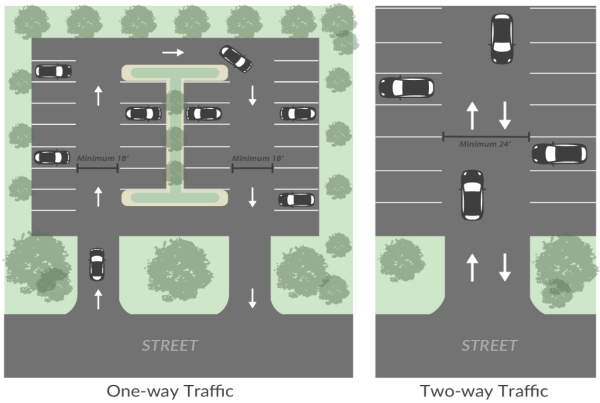
(a) Parking drive aisles for one-way traffic must be a minimum of 18 feet wide. Two-way traffic must be a minimum of 24 feet wide (see Figure 1).
4. All parking areas must be:
(a) No closer than 20 feet from any street right of way.
(b) No closer than five feet from any side lot line, except for a drive shared with the adjacent lot.
(c) No closer than five feet from any rear lot line, including alleys. Unless the property is located within the M-O District, then the rear lot line setback adjacent to an alley, may be zero feet.
(d) No closer than five feet to any building.
(e) All stalls must be striped.
5. Curbing
(a) The entire perimeter of all parking areas, access driveways, truck loading spaces or other hard surface areas that handle motor vehicle traffic must be curbed in accordance with curbing specifications on file at the City.
(b) Curbing is required around safety islands.
(c) The City may exempt curbing:
(1) Where the City has approved future expansion.
(2) Where the City has approved storm water features like natural swales or rain gardens.
(3) Where other circumstances exist to satisfy the curbing requirements.
6. A continuous internal pedestrian walkway must be provided from any perimeter public sidewalk or trail to each of the following connections. More than one walkway may be needed based upon specific site conditions:
(a) Entrances to each building on the site;
(b) Public sidewalks, walkways, paths or trails on adjacent properties that extend to the boundaries shared with the subject development;
(c) Public sidewalks along the perimeter streets adjacent to the development;
(d) Adjacent public park, trail or other public or civic use; and
(e) Adjacent public transit station areas, transit stops, park and ride facilities, or other transit facilities.
7. Safety signs, markings and traffic control devices may be required to promote vehicular and pedestrian safety.
8. All driveways and parking areas must be graded according to a drainage plan that has been approved by the City.
Adopted by Ord. 1431 on 6/18/2025
631.04 Residential Parking Standards
1. One- and Two-Unit Dwelling Parking Requirements
(a) General Provisions.
(1) Vehicle parking must only be located on a driveway or hard-surfaced parking space approved by the City.
(2) Paved driveways and any associated off-street parking areas within the front yard, must not occupy more than 50% of the area between the building front yard setback and the property line.
(3) Driveways must be set back at minimum three feet from any side or rear property line.
(4) The maximum slope (grade) on a residential driveway must not exceed 10%.
(b) Garage Requirements
(1) R-1, R-2, & R-H Districts
((a)) A two-stall garage is required for each principal dwelling unit. Two off-street parking spaces are required for an Accessory Dwelling Unit.
2. O-8 Transit Oriented Development Parking Requirements
(1) Reduction of the parking stall dimensions and number of parking stalls required in the underlying zoning district may be allowed due to the nature of the proposed use.
(2) The number of required parking stalls may be reduced by no more than 50% of the minimum required in the underlying zoning district for the proposed use.
(3) The maximum number of parking stalls must not exceed 120% of the minimum number of parking stalls required by the use in the underlying zoning district. This maximum provision does not apply to park-and-ride or other transit facilities.
(4) Off-street surface parking is not permitted in the front yard. Parking may be located in the rear or side yard.
Adopted by Ord. 1431 on 6/18/2025
631.05 Loading Facilities
1. Any use which requires receiving or distributing of materials must provide adequate space for off-street loading, adhering to the following requirements:
(a) Loading facilities must be located on the same lot as the use served.
(b) The space needed for the loading docks must be adequate to handle the loading and unloading needs of the use without obstructing the public right-of-way.
(c) Loading facilities must be on an impervious surface located in the rear or side yard of the property.
(d) Loading facilities must comply with the applicable standards in the Screening Chapter.
(e) Loading facilities must not to be used for the storage of goods or inoperable vehicles, or included as part of meeting the minimum off-street parking requirements.
(f) Within Industrial districts, no loading docks on corner lots across from any residential district are allowed to face the public right-of-way.
Adopted by Ord. 1431 on 6/18/2025
631.06 Driveway Requirements
1. Permit Required. Alterations to an existing driveway requires approval of a driveway permit from the City and must meet the following requirements.
(a) General Requirements:
(1) In the R-1 and R-H districts, the maximum width of a driveway at the property line is 26 feet (See Figure 2)
Figure 2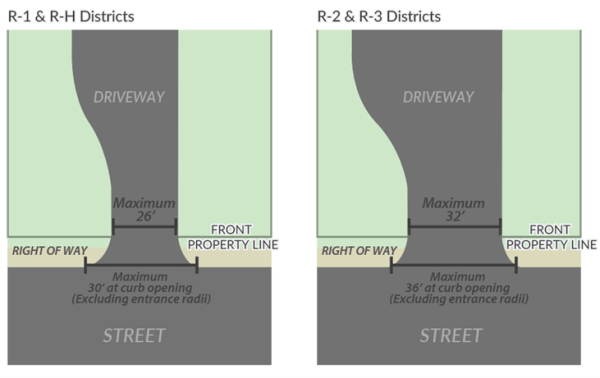
(2) In the R-2 and R-3 districts, the maximum width of a driveway at the property line is 32 feet for all driveways on the site combined.
(3) The curb opening, excluding the entrance radii, may be at maximum four feet wider than the driveway at the property line.
(b) For one- and two-unit dwellings:
(1) Driveways must be set back 35 feet at minimum from the intersection of streets on a corner lot.
(2) Only corner lots may have two driveways. Each driveway must meet the minimum 35-foot corner intersection setback.
(c) For parking areas in any district with four or more stalls:
(1) The edge of the curb opening to a parking area must not be closer to the nearest portion of a street right of way intersection than 75 feet or two thirds of the lot width, whichever is smaller.
Adopted by Ord. 1431 on 6/18/2025
631.07 Electric Vehicle Charging Stations (EVCS) Requirements
1. Electric vehicle charging stations are allowed in all zoning districts.
2. Minimum Number of Required EVCS.
(a) A Level 1 or higher wall plug is required for charging an electric vehicle in one unit detached or two-unit dwellings.
(b) For residential developments of three or more units with new parking areas, adding more than 25% of additional parking spaces to existing parking areas, and existing parking areas being fully reconstructed by more than 25% of the parking area are subject to the standards of Table 2:
Table 2
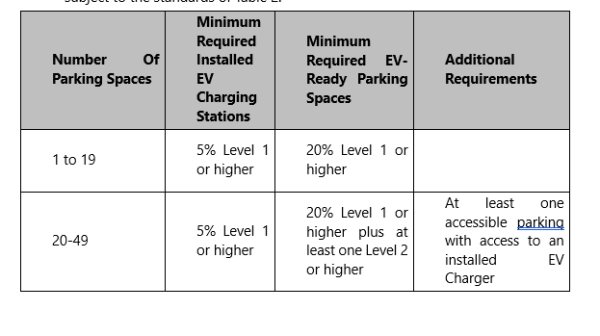
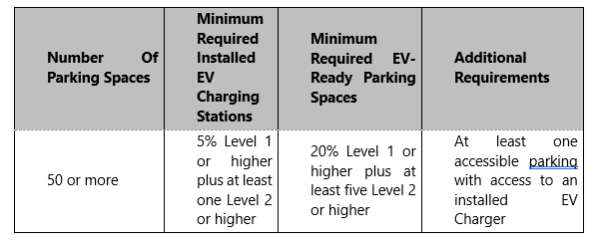
(c) If calculation results in a fraction, the next higher whole number must be used.
(d) For existing parking areas that are expanded or reconstructed (per this Chapter) by more than 25%, EVCS must be provided at the minimum quantities required for the prorated number of parking spaces in the area of expansion or improvement.
(e) Accessible Parking Spaces. An EVCS will be considered accessible if it can serve as an accessible parking space as defined and required by the ADA. It is not necessary to designate the EVCS exclusively for the use of vehicles parked in the accessible parking space and it shall not count toward required ADA parking requirements.
(f) Reductions to EVCS requirements.
(1) This number may be reduced by the Community Development Director, or their designee if proof can be provided that:
((a)) Such spaces will not be used.
((b)) The cost of installing the Electric Vehicle Supply Equipment (EVSE) required by this Chapter exceeds five% of the total project cost; or
((c)) It is unfeasible to provide sufficient electrical capacity at the site to power the EVSE.
3. Electric Vehicle Charging Spaces and EVSE must be designed and installed to meet the following minimum design requirements:
(a) EVSE must be in a parking island; mounted to an adjacent pedestal, wall or similar structure. Free standing EVSE must be protected by bollards, structures or curb.
(b) EVSE may be located adjacent to designated parking spaces in a garage or parking lot as long as the devices do not encroach into the required dimensions of the parking space (length, width, and height clearances).
(c) EVSE must be set back at least three feet from any property line. However, upon written request from the property owner, the Community Development Director, or their designee may reduce or rescind this setback requirement for shared access agreements or pursuant to a finding of necessity and public convenience.
(d) Where EVSE is located within three feet of the public right-of-way, the location must be approved by the Director of Public Works. EVSE may be in the right-of-way, with permission from the Director of Public Works and issuance of a Right-of-Way Permit.
(e) EVSE must be designed and located so as not impede pedestrian travel. Cords must be retractable or hung sufficiently above any pedestrian surface when not in use and must not extend across sidewalks or trails during charging.
(f) EVSE must be installed per manufacturer specification and must comply with all applicable building codes and relevant Americans with Disabilities Act (ADA) requirements.
(g) Any EVSE in single-family or two-family residential zoning district must be stored on the exterior wall of the home, in the garage, or on a freestanding pole with footing adjacent to the parking area.
(h) Any EVSE with a Charging Level 2 or Level 3 located inside a structure with three or more units must be approved by the Fire Marshal or their designee.
(i) EVSE must be maintained in all respects.
(1) The exterior of the station must be maintained in good condition including free of any rust.
(2) The manufacturer or specialist contact information must be provided on any Level 2 or Level 3 EVSE for reporting problems with the equipment or access to it.
4. EVSE must remain functional at all times. When an EVSE is not operational for 30 consecutive days, it must be removed or have a repair plan approved by the Community Development Director, or their designee. If applicable, a replacement may be required for compliance with Table 2.
Adopted by Ord. 1431 on 6/18/2025
631.08 Bicycle Parking Requirements
1. All dwellings with three or more units and all non-residential uses must provide at least one bicycle facility for any new development, building addition that adds more than 25% to the building square footage, or improvement to the parking lot that adds more than 25% of additional parking spaces.
2. Additional bicycle parking must be provided at two bike spaces bicycle space per 20 automobile spaces.
3. All bicycle rack design must be either of an inverted “U” or post and ring design; or as approved by the Community Development Director as providing a similar level of security.
4. All bicycle racks or lockers must be securely anchored to the ground or building structure on a level paved surface.
5. Bicycle racks must be placed near building entrances, within a view of each business front entrance, generally within 50 feet. Adjoining businesses may share common bicycle parking areas.
6. Bicycle racks must be located to avoid conflicts with pedestrians.
7. Sufficient lighting must be provided to illuminate the bicycle facilities at night.
Adopted by Ord. 1431 on 6/18/2025

