
Frisco City Zoning Code
ARTICLE II
- ADMINISTRATION
§ 180-2.1. - Purpose and organization of this article.
180-2.1.1.
Overview. This Chapter allows for a variety of land uses, intensity of uses, and associated processes in order to gain approval for the development of land in the Town. This Article describes the various land use applications, processes, submittal requirements, and criteria for reviewing such development. The Community Development Department and applicants use the information outlined in each applicable section to help guide property owners, determine if the proposal complies with all of the requirements of the Frisco Town Code, and inform all citizens of the processes for development.
180-2.1.2.
Purpose. The purposes of this Article are to:
A.
Guide future growth and development in accordance with the Master Plan and related municipal ordinances;
B.
Provide for an efficient process to review development proposals;
C.
Provide a framework by which development proposals are reviewed to ensure safe and functional developments which are compatible with the natural and man-made environment;
D.
Assist orderly, efficient and integrated development;
E.
Ensure conformance of development applications with public improvement plans of the Town of Frisco, Summit County, the State of Colorado, and other public agencies;
F.
Ensure coordination of all plans and programs of the Town; and
G.
Secure equitable handling of all development applications, providing due process and uniform procedures and standards.
180-2.1.3.
Organization of Article. This Article is divided into the following sections:
A.
Section 180-2.2, Summary of Procedures, includes a summary table listing the development approval procedures in the Unified Development Code.
B.
Section 180-2.3, Common Development Review Procedures, describes standard procedures that are applicable to most types of procedures.
C.
Section 180-2.4, Amendments, describes the procedures for rezonings and amending the Unified Development Code.
D.
Section 180-2.5, Development Processes, Permits, and Approvals, describes the applicable procedures for site-specific development provisions.
E.
Section 180-2.6, Subdivision Approvals, describes the approval procedures for applications for subdivision and conveyance of land.
F.
Section 180-2.7, Flexibility and Relief Procedures, describes the procedures for applications to vary from strict conformance with the development code and contains various relief provisions.
§ 180-2.2. - Summary of procedures.
Table 2-1 summarizes the land use and development procedures in this Chapter and identifies the decision-making authority for each development procedure. Specific details related to individual procedures are provided in the sections that follow, including any exceptions to the procedures outlined in Table 2-1.
(Ord. No. 17-04, 6-27-17; Ord. No. 18-03, 3-13-18; Ord. No. 23-09, § 1, 3-28-23)
§ 180-2.3. - Common development review procedures.
This section describes the procedures and rules applicable to all development applications unless otherwise stated in this Chapter. These common review procedures provide the foundation for specific review and approval procedures in Sections 180-2.4 through 180-2.7. See those specific sections to determine which of these common review procedures apply to individual applications for development review.
180-2.3.1.
Step 1: Applicant Attends a Pre-Application Conference.
A.
Purpose. The purpose of the pre-application conference is to discuss the overall concept of a development proposal early and informally, before the applicant has made substantial financial commitments or developed detailed plans. Major problems may be identified and solved before the formal application. Community goals, plans, and regulations that affect the proposal are identified and discussed between the applicant and staff. Following the conference, the applicant should understand the applicable code provisions that apply to the project, the process for moving forward, and any fees associated with the development application.
B.
When Required. A pre-application conference is required according to Table 2-1: Summary of Frisco Review Procedures.
C.
Conference Responsibilities.
1.
If a pre-application conference is required, the applicant shall request that the Director schedule the meeting.
2.
The Director shall schedule the pre-application conference and notify appropriate staff and the applicant of the time and location of the conference. The Director may invite representatives from other Town departments, agencies, or districts as he or she believes would be beneficial to the applicant and the process. As needed, the applicant may work directly with these other agencies to gain an understanding of special regulations or processes regarding their development.
D.
Informal Conceptual Plan. An informal conceptual plan shall be submitted at the pre-application conference, which shall include a brief description of the subject property, existing land use of the site, a general plan of the proposed development layout, proposed land uses (including number of living units and square feet of development), and parking. The applicant is strongly encouraged to use a plat and/or recent survey of the subject property as a base of information about the land. The conceptual plan should also show total acreage, land owners, land uses, streets, highways, utilities, major landscaping, physical features (including drainages), any natural hazards, and topography.
E.
Effect. Any information or discussions held at the pre-application conference shall not be binding on the Town or the applicant. Discussions of potential conditions to mitigate impacts do not reflect actions by the decision-making body until and unless a decision-making body takes formal action to attach that condition to a development approval.
180-2.3.2.
Step 2: Application Submittal.
A.
Authority to Submit Application.
1.
Unless expressly stated otherwise in this Chapter, a development application shall be submitted by:
a.
The owner or contract purchaser of the land on which development is proposed; or
b.
A person authorized to submit the application on behalf of the owner, contract purchaser, or other person having a recognized property interest in the land, as evidenced by a letter or document from the owner, contract purchaser, or other person.
2.
If there are multiple owners, contract purchasers, or other persons authorized to submit the application, all such persons shall acknowledge the application by a letter or document consenting to the application.
3.
No application shall be submitted prior to attending a pre-application conference, if required by Table 2-1: Summary of Frisco Review Procedures.
B.
Application Content.
1.
The application shall be submitted to the Director on a form established by the Director and shall be accompanied by all documents and information called for within the form. The applicant bears the burden of demonstrating compliance with application requirements.
2.
Additional information to assist in the review process may be required based on the review of the application by staff, Planning Commission, and Council.
3.
If the development project includes subdivision, resubdivision, condominiumization, planned unit development, or concurrent rezoning, an application and all required materials for these requests shall be submitted at the same time as the development application.
C.
Schedule of Fees.
1.
Fees for processing and reviewing applications submitted under this Chapter shall be as established by the Town Manager or his or her designee in a fee schedule amended and adopted from time to time.
2.
In preparing and adopting the fee schedule, the Town Manager or his or her designee shall determine the cost of performing administrative services under this Chapter, including, but not limited to, reviews of development proposals, publication and posting costs, inspections of proposed development sites, and subdivision applications, based upon all factors included in the current cost of performing those services.
3.
Any schedule of fees promulgated by the Town Manager or his or her designee shall be effective immediately upon filing with the Town Clerk and shall be available for public inspection in the office of the Community Development Department.
4.
A governmental or quasi-governmental entity shall be exempt from any fees established under this Subsection 180-2-3-2.C to the extent that such fees, when combined with any fees imposed under Chapter 65 of this Code in connection with the same project for which fees are imposed under this Subsection, are equal to or less than $1,000.00. For purposes of this subsection, a "quasi-governmental entity" shall include and be limited to entities formed under Title 32 of the Colorado Revised Statutes, as amended.
D.
Development Review Accounts and Publication Fees. The applicant shall pay to the Town certain Town costs associated with the application including without limitation, legal, engineering, environmental, traffic studies, or other similar technical fees for review and consultation incurred by the Town in connection with the application.
1.
Procedure for Payment. At the time that an application is submitted to the Town, the applicant shall pay to the Town the fees necessary to cover the costs of legal and engineering review or consultation incurred by the Town as set forth in the schedule of fees on file with the Town Clerk. The applicant shall then maintain a minimum balance above the costs the Town has incurred in connection with the application as set forth in the fee schedule. The Town shall keep record of the costs it has incurred, and when the applicant's balance is below that amount, it shall notify the applicant and the applicant shall pay an amount equal to the required minimum balance within five days. No submittal will be scheduled on an agenda or reviewed until the payment has been made. No site plan, final plat, or final plan approval will be given if the applicant does not have the minimum balance as set forth in the fee schedule.
2.
Return of Funds to the Applicant. Within 120 days after final approval or after the date on which the application has given written notice that he will not proceed with a development or any other planning applications, the Town shall determine the balance owing to the applicant, that amount being the amount deposited over the costs incurred, and return that amount to the applicant's address on file in the application. For purposes of this provision, final approval means the issuance of a Certificate of Occupancy or the recording of the plat with the Summit County Clerk and Recorder's Office, or the final, non-appealable approval of other applications made under this Chapter.
3.
Lien on the Property. If the Town incurs costs beyond the amount deposited and the applicant does not pay those costs within 30 days after written notice from the Town, then the Town shall be entitled to certification of the assessment for sale or a lien for those costs on the land being developed, which lien may be perfected and foreclosed in the same manner as provided in C.R.S. § 38-22-01 et seq., or may pursue any other legal remedy available to it, whether in law or equity, to recover costs incurred beyond the amount deposited with the Town.
E.
Application Withdrawal.
1.
After an application has been accepted for review, the applicant may withdraw the application at any time by submitting a letter of withdrawal to the Director.
2.
An applicant is not entitled to a refund of application fees for withdrawn applications. However, the Director may refund fees not expended during the first round of staff review if the application is withdrawn prior to preparation or distribution of any official written comments.
180-2.3.3.
Step 3: Completeness Determination.
A.
Determination of Application Completeness.
1.
A complete application shall be processed according to the procedures in this Article. An incomplete application shall not be processed or reviewed.
2.
The Director shall determine whether an application is complete or incomplete within five business days of submittal and provide written notification of such determination to the applicant. The applicant shall supply the Department with any items noted as missing from the submittal. If the information and materials requested are not received within 60 days, the Town will consider the application withdrawn and will return all submitted materials. In order to proceed, the applicant will be required to submit a new application, including all applicable fees and materials.
B.
Minor Revisions to an Application. An applicant may revise an application after receiving notice of completeness deficiencies following staff review of the application. Revisions shall be limited to changes that directly respond to specific requests or suggestions made by staff as long as they constitute only minor additions, deletions, or corrections and do not include significant substantive changes to the development proposed in the application, as determined by the Director. All other application revisions shall be processed as a new application, including, but not limited to, submission by the applicant of a new review fee.
180-2.3.4.
Step 4: Application Review and Preparation of Staff Report.
A.
Referral to Staff and Review Agencies. The Director shall distribute the complete application to appropriate staff and other appropriate review agencies.
B.
Staff Review and Application Revisions. Staff shall review the application and submit recommendations and comments to the applicant in a form established by the Director.
C.
Applications Subject to Staff Recommendation.
1.
Staff Report. If an application is subject to staff review and recommendation to the Planning Commission and/or Town Council under Table 2-1: Summary of Frisco Review Procedures, staff shall prepare a written staff report. The staff report shall set forth the staff's position on the question of whether or not the application complies with Code requirements, and shall include a recommendation for consideration by the appropriate decision-making body.
2.
Distribution and Availability of Application and Staff Report. Within a reasonable time period prior to any meeting or hearing at which an application will be considered, the Director shall submit a copy of the staff report to the applicant and the advisory and/or decision-making body, and shall make the staff report and related materials available for public review.
D.
Applications Subject to Staff Decision. If an application is subject to staff review and a final decision by staff under Table 2-1: Summary of Frisco Review Procedures, the Director shall make a decision based on the review standards applicable to the application type. The decision shall be in writing and shall clearly state factual findings and reasons for a denial or for conditions of approval.
E.
Conditions of Approval. Any conditions of approval shall be limited to conditions necessary to ensure compliance with the criteria for making a decision of approval or other requirements of the Frisco Town Code, and shall relate to the anticipated impacts of the proposed development.
F.
Simultaneous Processing of Development Applications. Where possible without creating an undue administrative burden on the Town's decision-making bodies and staff, this Chapter intends to accommodate the simultaneous processing of applications for different permits and approvals that may be required for the same development project in order to expedite the overall review process. Review and decision-making bodies considering applications submitted simultaneously shall render separate reports, recommendations, and decisions on each application based on the specific standards applicable to each approval.
1.
An example of a concurrent filing and processing of applications include, but are not limited to, a site plan, subdivision plan, and conditional use.
2.
Generally, no rezoning application shall be accepted or processed while an application for any of the permits or approvals listed in this Chapter is pending for the same property, and vice versa. An exception to this rule is that a rezoning to an HO and/or PUD overlay may be considered concurrently with a site plan and/or subdivision plan.
3.
Some forms of approval depend on the applicant having previously received another form of approval, or require the applicant to take particular action within some time period following the approval in order to avoid having the approval lapse. Therefore, even though this Chapter intends to accommodate simultaneous processing, applicants should note that each of the permits and approvals set forth in this Chapter has its own timing and review sequence.
180-2.3.5.
Step 5: Notice of Public Hearings.
A.
Scheduling.
1.
If an application is subject to a public hearing under Table 2-1: Summary of Frisco Review Procedures, the Director shall schedule the public hearing for either a regularly scheduled meeting or special meeting of the appropriate decision-making body. The applicant may request a public hearing review date at least 52 days from the time of submittal and during this time the completeness check, initial review, referral, legal noticing and report preparation will be conducted. This target date is intended to help create a timeline for the applicant and staff but is not binding.
2.
The public hearing shall be scheduled to allow sufficient time for consideration and preparation of a staff report under Section 180-2.3.4. At the discretion of the Community Development Department, an application may also be scheduled earlier than the targeted date dependent upon the complexity of the proposal, if complete application materials are submitted, and if agenda time is available.
B.
Public Hearing Notice.
1.
General Notice Requirements. All public hearings required by this Chapter shall be preceded by the notices identified in Table 2-1: Summary of Frisco Review Procedures.
2.
Responsibility of Party Seeking Hearing. The applicant or other person seeking the public hearing shall be responsible for providing accurate mailing labels as part of the complete project application and for posting of notice of the public hearing on the subject property, and such persons shall bear all costs incurred in connection with giving notice of the public hearing. The Community Development Department shall be responsible for writing the content of notices and mailing.
C.
Notice Format and Content.
1.
Published and Mailed Notice.
a.
Required published or mailed notices shall:
i.
Identify the application type;
ii.
Describe the general nature of the proposed project;
iii.
Identify the location subject to the application;
iv.
Identify the date, time, and location of the hearing being noticed;
v.
Identify where and when the application and associated materials may be inspected; and
vi.
Indicate the opportunity to appear at the public hearing.
b.
Published notice shall appear in a newspaper of general circulation in the Town at least four days prior to the scheduled hearing.
c.
Mailed notices shall be sent at least 14 days prior to the scheduled hearing via first class mail to all property owners as listed in the records of the Summit County tax assessor's office within 300 feet of the subject property, as measured from property boundaries.
2.
Posted Notice.
a.
Required posted notice shall include:
i.
At least one sign on the subject property at least 14 days prior to the public hearing; and
ii.
Posting in at least one place of public assembly at least seven days prior to the public hearing or meeting.
b.
Required sign(s) shall be provided by the Town. The applicant shall be responsible for posting the required sign(s). The sign(s) shall be clearly visible from adjacent streets or public rights-of-way and shall remain on the property until after the hearing.
c.
The Director may require additional signs based on access and configuration of the property.
d.
Required posted notice shall:
i.
Identify the application type;
ii.
Describe the nature of the proposed project;
iii.
Identify the date, time, and location of the hearing being noticed; and
iv.
Identify a telephone number for additional information.
3.
Certification of Notice. The applicant shall provide certification that proper notice has been provided, including photographic evidence of the posted notices and a signed affidavit that the mailing labels provided are correct. The format of such certification shall be established by the Director. The applicant shall submit the certification to the Director at least seven days prior to the scheduled public hearing.
D.
Constructive Notice.
1.
Minor Defects in Notice Shall Not Invalidate Proceedings. Minor defects in any notice shall not impair the notice or invalidate proceedings pursuant to the notice if a bona fide attempt has been made to comply with applicable notice requirements. Minor defects in notice shall be limited to errors in a legal description or typographical or grammatical errors that do not impede communication of the notice to affected parties. In all cases, however, the requirements for the timing of the notice and for specifying the time, date, and place of a hearing shall be strictly construed.
2.
Failure to Receive Notice Shall Not Invalidate Action. Failure of a party to receive written notice shall not invalidate subsequent action. If questions arise at the public hearing regarding the adequacy of notice, the decision-making body shall make a formal finding as to whether there was substantial compliance with the notice requirements of this Chapter.
180-2.3.6.
Step 6: Public Hearings. Public hearings required by this Chapter shall be conducted according to the procedures bylaws established by the respective bodies.
180-2.3.7.
Step 7: Decisions and Findings.
A.
Review and Decision.
1.
The application shall be subject to review, hearings, recommendations, and decisions as indicated in Table 2-1: Summary of Frisco Review Procedures.
2.
The applicable review body shall consider the application, relevant support materials, staff report, and any evidence and public comments from the public hearing (if required).
3.
The applicable review body shall approve, approve with conditions, or deny the application based on the applicable approval criteria listed in the application-specific procedures, or may continue the public hearing to another meeting.
4.
The recommendation or decision (as applicable) shall be based only on the record, shall include findings of fact based on competent evidence contained in the record, shall reflect the determination of contested facts, and shall state how the findings of fact support the decision.
5.
Following any decision by the Planning Commission, the Director shall provide written notification of such decision to the Town Council by the next regularly scheduled Council meeting.
B.
Conditions of Approval.
1.
Where this Chapter authorizes a review body to approve or deny an application subject to applicable criteria, the review body may approve the application with conditions necessary to bring the proposed development into compliance with such criteria, any other applicable provision of this Chapter or the Frisco Town Code, and any other duly adopted Town regulations.
2.
Conditions of approval shall be reasonably related to the anticipated impacts of the proposed use or development or shall be based upon standards duly adopted by the Town. No conditions of approval shall be less restrictive than the requirements of this Chapter, except where the Chapter expressly allows deviations.
3.
Any condition of approval that requires an applicant to dedicate land or pay money to a public entity in an amount that is not calculated according to a formula applicable to a broad class of applicants shall be roughly proportional both in nature and extent to the anticipated impacts of the proposed development, as shown through an individualized determination of impacts.
4.
During its consideration, the decision-making body may consider alternative potential conditions, and no discussion of potential conditions shall be deemed an attempt or intent to impose any condition that would violate the federal or state constitutions, statutes, or regulations. Discussions of potential conditions to mitigate impacts do not reflect actions by the decision-making body unless and until the decision-making body takes formal action to attach that condition to a development approval.
5.
Unless otherwise provided in this Chapter, any representations of the applicant in submittal materials or during public hearings shall be binding as conditions of approval.
C.
Notice of Decision.
1.
Within ten days after a final decision on an application, the Director shall provide written notification of the decision via personal delivery, electronic mail, or first-class mail to the applicant and shall make a copy of the decision available to the public in the Community Development Department.
2.
If the review involves a quasi-judicial hearing, the Director shall, within ten days after a final decision on the application, also provide a written notification of the decision via personal delivery, electronic mail, or first-class mail to the owner(s) of the subject site, and any other person that submitted a written request for a copy of the decision before its effective date.
D.
Final Plans. Within 60 days of approval, the applicant shall submit to the Town a final version of any plans approved showing any conditions, restrictions, or other modifications agreed to or required during final approval.
180-2.3.8.
Step 8: Amendments to Permits or Other Approvals. Unless otherwise provided in this Chapter, any modification of an approved plan, permit, or condition of approval shall require a new application that is submitted and reviewed in accordance with the full procedure and fee requirements applicable to the particular type of the original application.
180-2.3.9.
Step 9: Appeals.
A.
A party aggrieved or adversely affected by any final decision of the Town Council may seek review of the decision in the courts in accordance with applicable law.
B.
A party aggrieved by other final decisions may appeal the decision in accordance with the procedures in Section 180-2.7.1.
180-2.3.10.
Step 10: Lapse of Approval.
A.
An application approval shall be valid as authorization for the approved activity unless it expires in accordance with expiration time periods provided in this article.
B.
A change in ownership of the land shall not affect the established expiration time period of an approval.
C.
The expiration of approval timeline shall be based on the date of the most recent Planning Commission or Town Council approval.
D.
Unless otherwise provided in this Chapter, the Director may grant extensions of the expiration time period for up to one year, following a written request for such extension prior to the expiration date. The request shall include reasonable cause for an extension.
(Ord. No. 17-04, 6-27-17; Ord. No. 18-03, 3-13-18; Ord. No. 20-03, 3-24-20; Ord. No. 23-09, § 2, 3-28-23)
§ 180-2.4. - Amendments.
180-2.4.1.
Rezoning.
A.
Purpose. The purpose of this Section 2.4 is to provide a mechanism by which, and review procedures and criteria under which, the boundaries of zone districts may be changed or the zoning classification of any parcel of land may be changed. Rezonings may also be used to apply historic overlay designations or other overlay designations.
B.
Applicability.
1.
A proposed change of zone district boundaries may be initiated by the Council, the Planning Commission, or by application of one or more of the owners of property within the area requested to be changed.
2.
An application for rezoning to apply a Planned Unit Development overlay designation shall be considered pursuant to Section 180-2.4.2.
C.
Area Required. Changes in the Zone District Map of the Town of Frisco involving any zoning district requires a minimum of one acre in area for consideration, unless the area requested for rezoning abuts an existing zone district of the same general classification as that being requested on all or part of one side.
D.
Review Procedures. Figure 2-A identifies the applicable steps from the common review procedures in Section 180-2.3 that apply to the review of applications for rezonings. Additions or modifications to the common review procedures are noted below.
Figure 2-A: Rezoning Review Procedures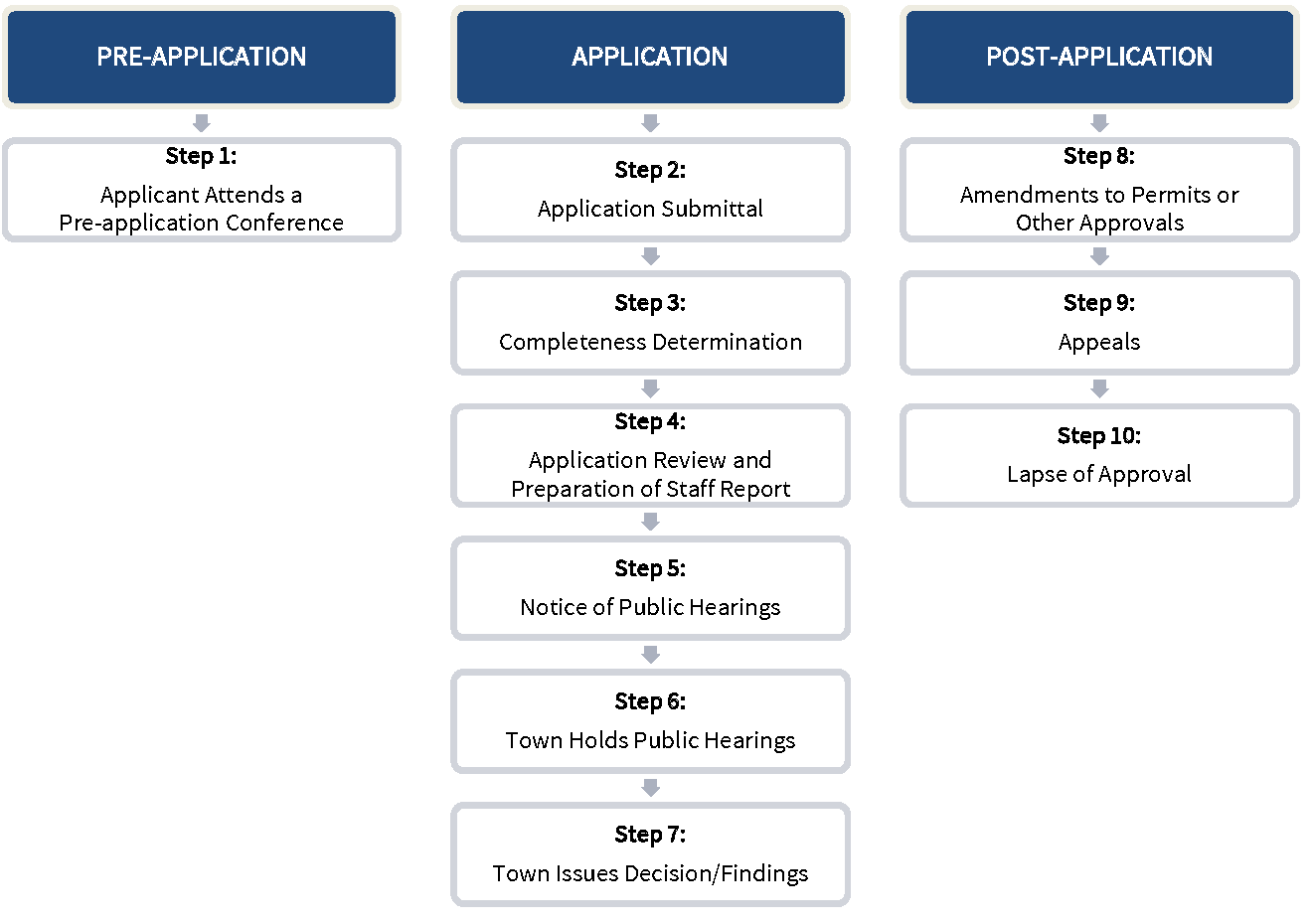
1.
Pre-Application Conference. A pre-application conference shall be held in accordance with Section 180-2.3.1.
2.
Application Materials. All requests for rezoning shall be upon written application to the Planning Commission and Town Council, and shall contain the following information:
a.
The names and addresses of the owners of the property.
b.
A legal description of the property.
c.
The names and addresses of all adjacent property owners within a radius of 300 feet of the property requesting the rezoning.
d.
A detailed explanation of the request for rezoning, including all reasons for the request.
e.
Supporting documents and maps.
3.
Planning Commission Review and Recommendation.
a.
At the preliminary public hearing, the Commission shall consider said application, hear comments and objections, and request additional information or make preliminary recommendations. If the Commission has requested additional information, they may request such information to be submitted by the applicant by a certain time before the final public hearing is conducted or the set date may be continued to another date.
b.
At the final public hearing, the Planning Commission shall consider all submitted data, comments, and objections and shall either continue the matter for further information and study for not more than 30 days, or shall render its recommendation to the Town Council and the applicant, recommending approval, disapproval, or conditional approval of the application.
4.
Town Council Review and Decision.
a.
Upon receiving the recommendation of the Planning Commission, a rezoning ordinance shall be prepared for consideration by the Town Council, and scheduled for public hearing before the Council subject to the noticing procedures specified in Section 180-2.3.5. Town Council shall approve, conditionally approve, or deny the application for rezoning.
b.
Upon approval of any request for rezoning, the Community Development Department shall note the amendment of the official Zoning Map of the Town of Frisco, keep appropriate records thereof, and notify the Clerk and Recorder of Summit County of said amendment of the official Zone District Map.
5.
Protest Against Change. In case of a protest against changes in regulations or restrictions or changes in the zone district applicable to particular land, which protest is filed with the Town Clerk at least 24 hours prior to the Council's vote on the change and is signed by the owners of 20 percent or more of the area of land extending a radius of 100 feet from the land which is subject to the proposed change, disregarding intervening public streets and alleys, such changes shall not become effective except by the favorable vote of not less than two-thirds of all the members of the Council.
6.
Reconsideration. No request for a rezoning shall be reconsidered by the Planning Commission or Town Council until the expiration of six months after the denial of a prior rezoning request for the same or substantially the same property, or there has been a substantial change of circumstances.
E.
Rezoning Criteria. For the purpose of establishing and maintaining sound, stable, and desirable development within the Town, the applicant for rezoning shall establish that at least one of the following criteria is met:
1.
The land to be rezoned was initially zoned in error or the rezoning is of a technical or corrective nature in order to conform zone district boundaries with lot lines;
2.
Because of changed or changing conditions in a particular area or in the Town generally, it is in the public interest and reasonably necessary in promotion of the public health, safety or welfare to rezone a property to encourage development or redevelopment;
3.
The rezoning is necessary to conform to the Master Plan; or
4.
The rezoning is necessary to provide land for a community-related use that was not anticipated at the time of adoption of the Master Plan, but which is generally consistent with the policies and goals of said plan, is in the public interest, and is reasonably necessary in promotion of the public health, safety, or welfare.
180-2.4.2.
Rezoning to planned unit development.
A.
Purpose. The zoning classification of any parcel may be changed to a Planned Unit Development (PUD) pursuant to this section. The purpose of the PUD designation is to encourage flexibility and innovation in the development of land and to provide relief from certain standards of the underlying zone district for projects that provide a community benefit in the form of useable open space or affordable or work-force housing in accordance with an overall development plan.
B.
Applicability.
1.
A PUD is an area of land, controlled by one or more landowners, to be developed under unified control or unified plan of development for a number of dwelling units, commercial, educational, recreational or contractor trade uses or any combination of the above, the plan for which does not necessarily correspond in lot size, dimensional requirements, type of use, density, lot coverage, open space, parking, or other restrictions to the existing land use regulations. A PUD is an overlay zoning district allowable under Section 24-67-101 et seq. Colorado Revised Statutes 1973 (1977 Replacement Volume) in all zoning districts.
2.
A minimum of three dwelling units or 10,500 square feet of lot area is necessary to constitute a PUD. If a PUD is proposed on a lot that is existing legally nonconforming due to parcel size, then the minimum lot area requirement does not apply.
3.
Any PUD that proposes a change in type of use, beyond what is allowed in the underlying zone district, shall constitute a rezoning request, and shall be reviewed as to the proposed change in type of use under the rezoning criteria in Section 180-2.4.1.E. All other aspects of the PUD proposal shall be reviewed according to the PUD approval criteria contained in Section 180-2.4.2.D.
C.
Review Procedures. Figure 2-B identifies the applicable steps from the common review procedures in Section 180-2.3 that apply to the review of applications for PUDs. Additions or modifications to the common review procedures are noted below.
Figure 2-B: Rezoning to Plannued Unit Development Review Procedure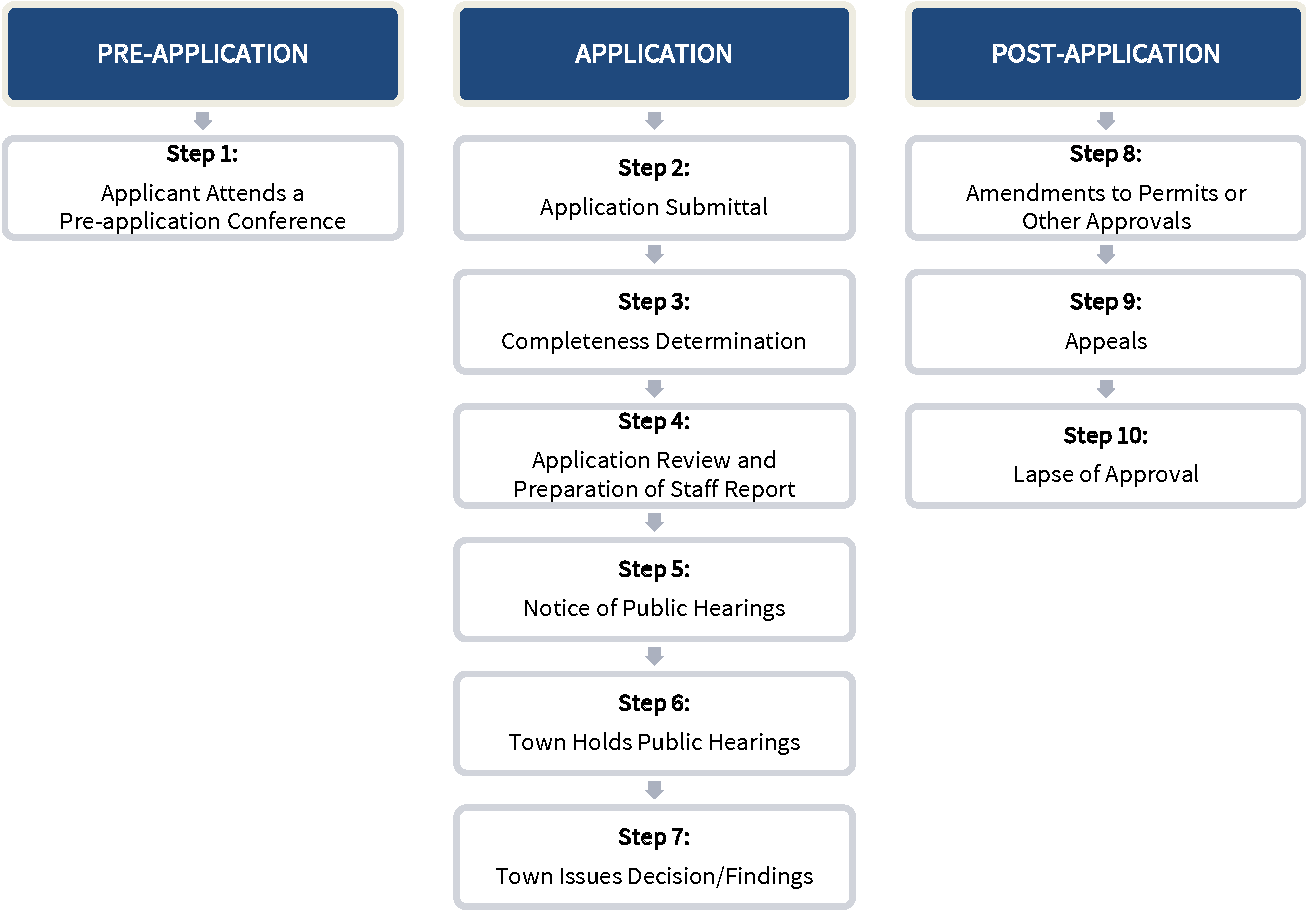
1.
Pre-Application Conference. A pre-application conference shall be held with staff in accordance with Section 2.3.1. In addition, the applicant shall provide the following conceptual materials related to the proposed PUD to help determine whether or not a PUD is the appropriate procedure for the applicant and the Town:
a.
Proposed uses; and
b.
Number and type of dwelling or commercial units (as applicable); and
c.
Percentage of workforce housing units proposed; and
d.
Floor area of all buildings; and
e.
Floor area of each use for mixed-use buildings (if applicable); and
f.
Proposed parking capacity and configuration; and
g.
General site planning layout and phasing.
2.
Application Submittal. A complete application shall be furnished to the Community Development Department not less than 52 days prior to an upcoming Planning Commission meeting targeted as the application review date.
a.
Owner Consent and Notice.
i.
An application for approval of a new PUD shall include written consent by the owners of all property to be included in the PUD.
ii.
In cases where an amendment to a previously approved PUD is requested, the application to amend the PUD may be made by any owner within the PUD, with written notice of the proposed application to be provided to all other property owners within the PUD.
b.
PUD Plan. An application for rezoning to a PUD shall include submittal requirements as specified by the Director, and shall provide a PUD plan and associated narrative outlining the development and design guidelines proposed to differ from the underlying zone district. Approval of the PUD plan is required prior to approval of a development permit in a PUD district. The regulations of this Chapter remain applicable to all PUD development, except as specifically modified pursuant to the provisions contained in the approved PUD plan.
i.
The PUD Plan indicates the broad concept of the proposed development. The plan shall include information and supporting materials as specified by the Director, which shall include at a minimum:
a)
An explanation of the objectives to be achieved by the PUD.
b)
Generally, where each type of use will be located in the PUD and the total acreage devoted to each use.
c)
Maximum number of dwelling units per gross acre to be permitted for each residential area within the PUD, indicated including sizes of building lots and types of dwelling units anticipated.
d)
The minimum acreage to be dedicated to common open space, plus the proposed use and the location of open space.
e)
The acreage and location of areas to be dedicated for school sites or other public uses.
f)
Major internal circulation systems, including locations of roadways, conceptual location of trails, and bicycle paths.
g)
A development schedule indicating the improvements included in each phase and the approximate dates when construction of the various stages of the PUD is anticipated to begin and be completed.
ii.
The PUD district is an overlay, and the PUD Plan and associated narrative shall identify the underlying zoning districts within the PUD boundaries. If the applicant is proposing to create different development standards than those of this Chapter, the application shall include:
a)
Development standards and other restrictions proposed by the applicant to be applied to each proposed use, or reference standards in similar zoning districts contained in this Chapter that shall apply to each proposed use in particular areas such as: building setbacks, height limits, access requirements and grade or slope restrictions, special provisions addressing sensitive areas, parking requirements, landscape requirements, lot coverage, and floor area ratios.
b)
Written explanation and graphic material illustrating the consideration that the modified standards will produce, demonstrating how the modifications will produce a living environment, landscape quality, and lifestyle equal or superior to that produced by the existing standards.
c)
Graphic illustrations and written explanations of how the PUD addresses the specific constraints and opportunities of the site and surrounding area in a superior manner to what might be accomplished without the PUD process.
3.
Concurrent Subdivision Review. If subdivision is required, the subdivision review procedure shall be carried out concurrently as noted in Section 180-2.6 with the review of the PUD as outlined in this Chapter.
4.
Planning Commission Review and Recommendation. The Planning Commission shall hold a publicly noticed hearing. The Planning Commission shall review the PUD application and the comments of referral agencies and the public and shall recommend approval, approval with conditions, or denial based on the approval criteria in Section 180-2.4.2.D.
5.
Town Council Review and Decision.
a.
The Town Council shall review the PUD application and act to approve, approve with conditions, or deny the PUD in accordance with the approval criteria in Section 180-2.4.2.D. The Town Council may also remand the PUD application back to the Director or the Planning Commission for further consideration.
b.
If the Town Council remands the application back to the Director or Planning Commission, additional public hearings may be required before final adoption.
6.
Effect of Approval.
a.
Following approval of a PUD, the applicant shall submit final copies of the PUD plans and associated narrative to the Director. The Director shall record the PUD plan and narrative and the ordinance with the County Clerk and Recorder as soon as practicable.
b.
The approved PUD zoning and the approved PUD plan along with all exhibits are inseparable, and a PUD shall not be established without the approval of the related PUD plan.
c.
The regulations in this Chapter remain applicable to all PUD development unless expressly modified by an approved PUD.
d.
A PUD shall remain valid until the PUD is subsequently amended or rezoned to another zoning district in accordance with this Chapter.
7.
Reconsideration After Three Years of No Development. It is expected that progress on the PUD development as a whole will begin and proceed in a timely manner. If the applicant does not establish vested rights for a PUD pursuant to Section 180-2.7.4, and no development has occurred on the site in three years following the approval date of the PUD, the Director may initiate a public hearing process to consider whether the property shall be rezoned to its prior zoning classification or another zoning classification.
8.
Phased Projects.
a.
If a project is to be built in phases, each phase shall include an appropriate share of the proposed open space, recreation facilities, public facilities, affordable or work-force housing, and other amenities of the development. The appropriate share for each phase of a specific project shall be determined at the time of preliminary plan approval, and shall be based primarily upon a proportional share for the entire development.
b.
Planned unit developments are to be developed under a unified control or unified plan. If the project is to be phased, final plans must be in substantial conformance with the approved PUD plan regardless of any change of ownership.
D.
PUD Approval Criteria. In order for Planning Commission to recommend approval and for Town Council to approve any application for or any amendment to a PUD, the applicant shall establish that the following criteria are met:
1.
That the project is beneficial or necessary for the economic development of Frisco; and
2.
That the application preserves or contributes to usable open space, and natural and scenic features (when open space is provided as a community benefit); or the application provides affordable or work-force housing when housing is provided as the community benefit; and
3.
That the application achieves a compatibility of land uses with neighboring land uses; and
4.
That the modifications to the underlying zoning district by the project are in the best interests of the Town, and neighborhood in which the development is planned; and
5.
That the projected capacity to fully serve the project site(s) with water and sewer is available; and
6.
That Town services shall be provided in the most efficient manner practicable; and
7.
That more than one housing type, or housing price, or housing form of ownership (i.e. for sale and rental) to satisfy the needs of more than one segment of the community be provided (when residential uses are proposed); and
8.
That the project contributes amenities to the development itself, and to the community at large; and
9.
That an owners association is established to promote a sense of community and to ensure the continued existence of a viable entity responsible for maintenance of private open space and other similar duties; and
10.
That the project meets all of the applicable requirements of this Chapter that are not expressly varied in the final PUD plan, contributes to design aesthetics and layout, and promotes efficient use of land.
E.
Enforcement and Amendments to a PUD.
1.
To further the mutual interest of the residents, occupants and owners of a PUD and of the public in preservation of the integrity of the PUD plan, the provisions of the PUD plan shall run in favor of the Town of Frisco and shall be enforceable in law or in equity by the Town of Frisco without limitation on any powers or regulation otherwise granted by law.
2.
All those provisions of the PUD plan authorized to be enforced by the Town of Frisco may be modified, removed, or released by the Town, subject to the following:
a.
No modification, removal, or release of the provisions of the PUD plan by the Town of Frisco shall be permitted except upon a finding by the Town, following a public hearing called and held in accordance with the provisions of this Chapter, that the modification, removal, or release is consistent with the efficient development and preservation of the entire PUD, does not affect in a substantially adverse manner either the enjoyment of land abutting upon or across a street from the PUD or the public interest, is not granted solely to confer a special benefit upon any person, and meets the criteria for PUD approval specified in Section 180-2.4.2.D.
3.
Minor Changes Allowed. Subsequent development applications may incorporate minor changes from the development defined by the PUD approval without the need to reapply, where the Director determines that the changes continue to comply with this Chapter and are consistent with the application approval—i.e., that the changes are necessary to comply with conditions of approval or would not significantly alter the development's general function, form, intensity, character, demand on public facilities, impact on adjacent properties, or other characteristic from that indicated by the PUD approval. In any case, the following changes shall not be deemed minor changes:
a.
A change in a condition of approval; or
b.
An increase, or decrease, in the number of lots and/or dwellings by a difference greater than ten percent of what was originally approved by the Town.
180-2.4.3.
Code Text Amendments.
A.
Purpose. The text of this Chapter may be amended pursuant to this section to respond to changed conditions, changes to public policy, or to advance the general welfare of the Town.
B.
Applicability. An amendment to the text of this Chapter may be initiated by the Director, the Planning Commission, or the Council whenever the public necessity, safety, general welfare, or good zoning practice justifies such action. The Council may approve an amendment after consideration and recommendation by the Planning Commission.
C.
Review Procedures. Figure 2-C identifies the applicable steps from the common review procedures in Section 180-2.3 that apply to the review of applications for amendments to the text of this Chapter. Additions or modifications to the common review procedures are noted below.
Figure 2-C: Code Text Amendment Review Procedures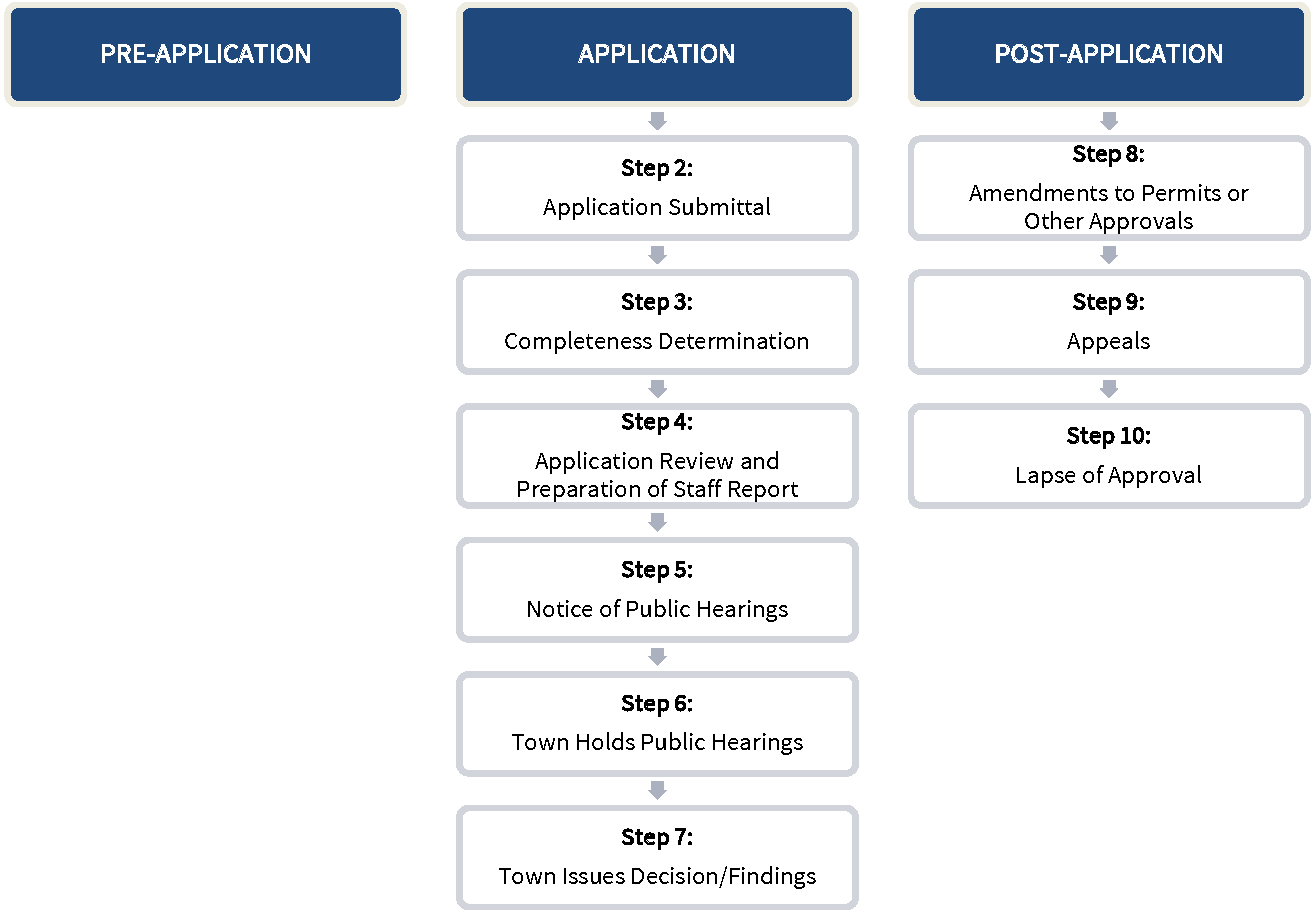
1.
Hearing and Recommendation. The Planning Commission shall recommend approval or disapproval, either in whole or in part, of a change to the text of this Chapter. Recommendations for such changes shall be presented to the Council and an ordinance embodying such changes in whole or in part may be adopted by the Council after public hearing, public notice of which is given. In the event of adoption by the Council of such changes in part, if such partial adoption has not been recommended as such by the Planning Commission, a favorable vote of at least three-fourths of the members of the entire membership of the Council shall be necessary.
D.
Code Amendment Approval Criteria. An amendment to the text of this Chapter is a legislative decision by the Town Council. Prior to recommending approval or approving a proposed amendment, the Planning Commission and Council shall consider whether and to what extent the proposed amendment:
1.
Is consistent with the Master Plan and other Town policies;
2.
Conflicts with other provisions of this Chapter or other provisions in the Frisco Town Code;
3.
Is necessary to address a demonstrated community need;
4.
Is necessary to respond to substantial changes in conditions and/or policy; and
5.
Is consistent with the general purpose and intent of this Chapter.
(Ord. No. 17-04, 6-27-17; Ord. No. 23-24, § 1, 9-26-23)
§ 180-2.5. - Development processes, permits, and approvals.
180-2.5.1.
Conditional Uses.
A.
Purpose. Conditional uses are land uses that, because of their unique character, size, operating characteristics, and potential impacts, must undergo special review with the potential for conditional approval in order to be undertaken in a particular zoning district. The conditional use process allows for the integration of certain land uses within the Town based on appropriate conditions imposed by the Planning Commission. Review is based primarily on compatibility of the use with its proposed location and with surrounding land uses and by reviewing the impacts a conditional use may have. Conditions are intended to minimize or ameliorate any negative circumstances that might arise by the use. Conditional uses shall not be allowed where the conditional use would create a nuisance, traffic congestion, a threat to the public health, safety, or welfare of the community or a violation of any provision of the Town Code, state law, rule, or regulation promulgated pursuant thereto.
B.
Applicability.
1.
Conditional use approval is required for those uses listed as conditional uses in the table of allowed uses in Section 180-5.1.
2.
An application for conditional use approval is required and shall be submitted at the same time as the site plan review, if one is necessary.
3.
Conditional use permits run with the land and approval may be revoked upon failure to comply with conditions associated with the original approval of the conditional use.
C.
Review Procedures. Figure 2-D identifies the applicable steps from the common review procedures in Section 180-2.3 that apply to the review of applications for conditional uses. Additions or modifications to the common review procedures are noted below.
Figure 2-D: Conditional Use Review Procedures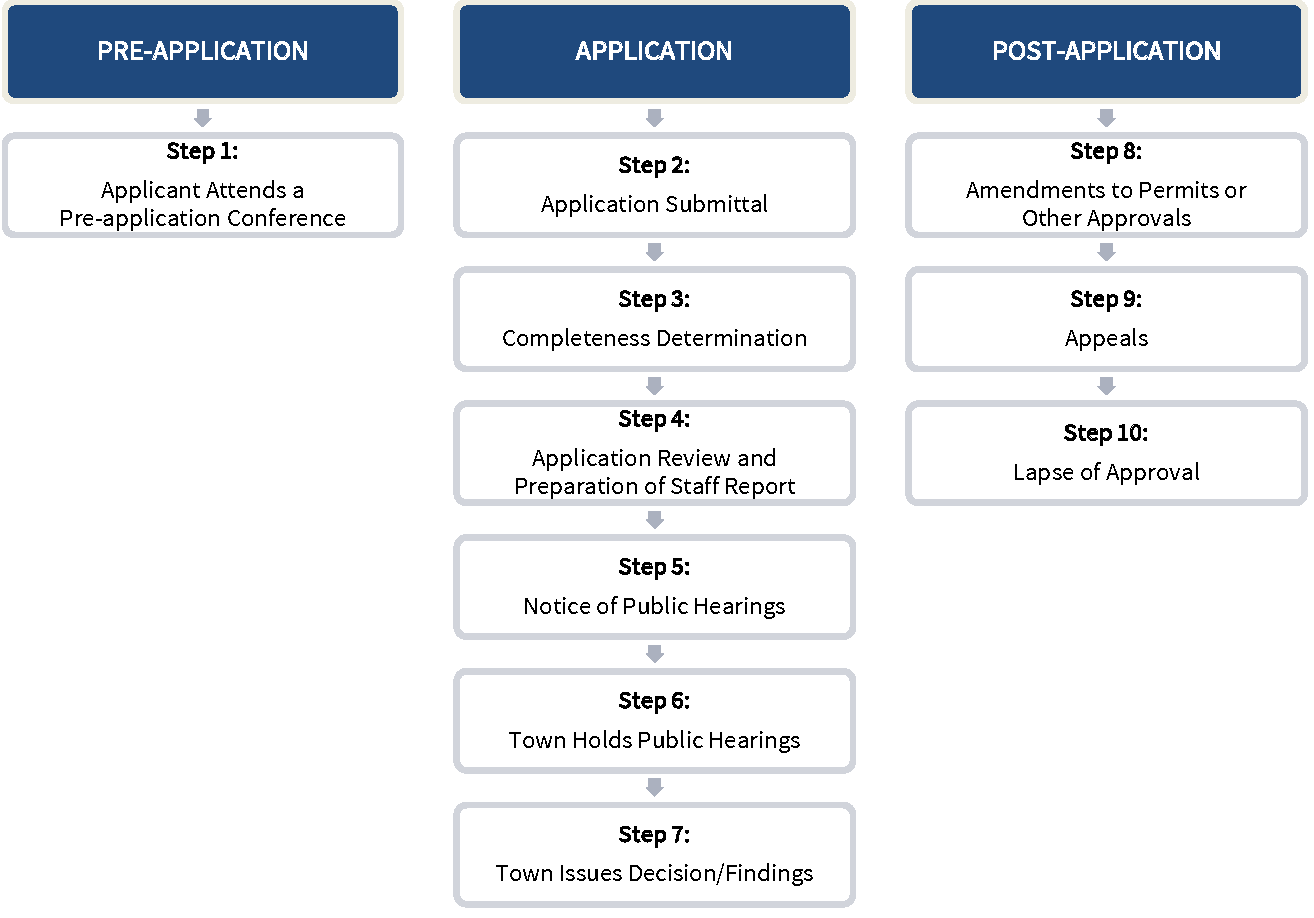
1.
Pre-Application Conference. A pre-application conference shall be held in accordance with Section 180-2.3.1.
2.
Application Submittal. The application for a conditional use shall include all documentation specified in 180-2.3.2.
3.
Public Hearing.
a.
The Planning Commission shall hold a public hearing for which public notice is given to hear testimony and evidence pertinent to the proposed conditional use. The Planning Commission may approve, approve with conditions, or deny the conditional use application. In authorizing a conditional use, the Planning Commission shall consider public comments, testimony, and evidence pertinent to the proposed use, and shall impose such requirements and conditions as may be necessary or desirable for the public welfare and achievement of the Master Plan and community goals and objectives.
b.
If a site plan application is a component of the proposed conditional use, a site plan development application must be reviewed concurrently.
4.
Final Approval. Final approval or disapproval of a conditional use rests with the Planning Commission. The Commission shall make findings, which shall be put forth in a notice of decision. Such notice of decision will include any conditions of approval. Unless a business license has been issued for the use, or a building permit issued for the project within a period of one year from the date of notice of decision of the conditional use approval, the conditional use approval shall expire. Where a conditional use has been abandoned or discontinued for a period of one year or longer, or where a conditional use has been changed to a permitted use or to any other conditional use, the conditional use approval shall become null and void.
5.
Expansion or Enlargement. Expansion or enlargement of a conditional use shall require a new application, unless the Director determines that:
a.
The expansion or enlargement is not expected to increase potential negative impacts to surrounding property or the Town; and
b.
The expansion or enlargement will not require adjustments to any standards greater than allowed through the administrative adjustment procedures in Section 180-2.7.2.
D.
Approval Criteria. The Planning Commission may approve a conditional use permit application upon finding that each of the following criteria are met:
1.
The conditional use is consistent with the purpose and intent of the zone district in which it is proposed to be located, furthers the applicable goals of the Frisco Community Plan, and is a desirable use that will contribute to the general welfare of the community; and
2.
The conditional use is compatible with the mix of development in the immediate vicinity of the parcel in terms of density, height, bulk, architecture, landscaping, and open space, as well as with any applicable adopted regulatory master plan or PUD; and
3.
The conditional use is consistent and compatible with the character of the immediate vicinity of the parcel proposed for development and surrounding land uses and enhances the mixture of complimentary uses and activities in the immediate vicinity of the parcel proposed for development; and
4.
The location, size, design and operating characteristics of the proposed conditional use minimizes adverse effects, including visual impacts, impacts on pedestrian and vehicular circulation, parking, refuse and recycling services/area, service delivery, noise, vibrations and odor on surrounding properties; and
5.
There are adequate public facilities and services to serve the conditional use including, but not limited to, roads, potable water, sewer, solid waste, parks, police, fire protection, emergency medical services, hospital and medical services, drainage systems and schools; and
6.
The Community Development Director may recommend and the Planning Commission may impose such conditions on a conditional use that are necessary to maintain the integrity of the Town's Zone Districts and to ensure the conditional use complies this Chapter; is compatible with surrounding land uses; and is served by adequate public facilities. This includes, but is not limited to, imposing conditions on size, bulk, location, open space, landscaping, buffering, lighting, signage, off-street parking and other similar design features, the construction of public facilities to serve the conditional use and limitations on the operating characteristics and hours of operation.
180-2.5.2.
Site Plan Review.
A.
Purpose. The site plan review and approval procedure is intended to ensure compliance with the development and design standards of this Chapter and to encourage quality development. For land uses requiring site plan review, such uses may be established in the Town, and building or land use permits may be issued, only after a site plan showing the proposed development has been approved in accordance with the procedures and requirements of this Section 180-2.5.2. The site plan review procedures ensure that the Town has the ability to address and mitigate any adverse impacts that may result from development projects.
B.
Applicability.
1.
Thresholds for Site Plan Review Type. The following table describes the applicable site plan review type (administrative, minor, or major) required for various types of projects.
2.
Referral Procedures. The Director may refer administrative or minor site plan reviews to the Planning Commission.
3.
Exemptions. The following are exempt from the site plan review procedure, but are subject to the standards of this Chapter:
a.
A change in use that does not involve or require other development (such as new or expanded structures, additional parking, etc.); or
b.
Tenant improvements that do not increase gross floor area or building height, increase the density or intensity of use, or affect other development standards such as parking.
C.
Administrative/Minor Site Plan Review Procedure. Figure 2-E identifies the applicable steps from the common review procedures in Section 180-2.3 that apply to the review of administrative and minor site plans. Additions or modifications to the common review procedures are noted below.
Figure 2-E: Administrative/Minor Site Plan Review Procedures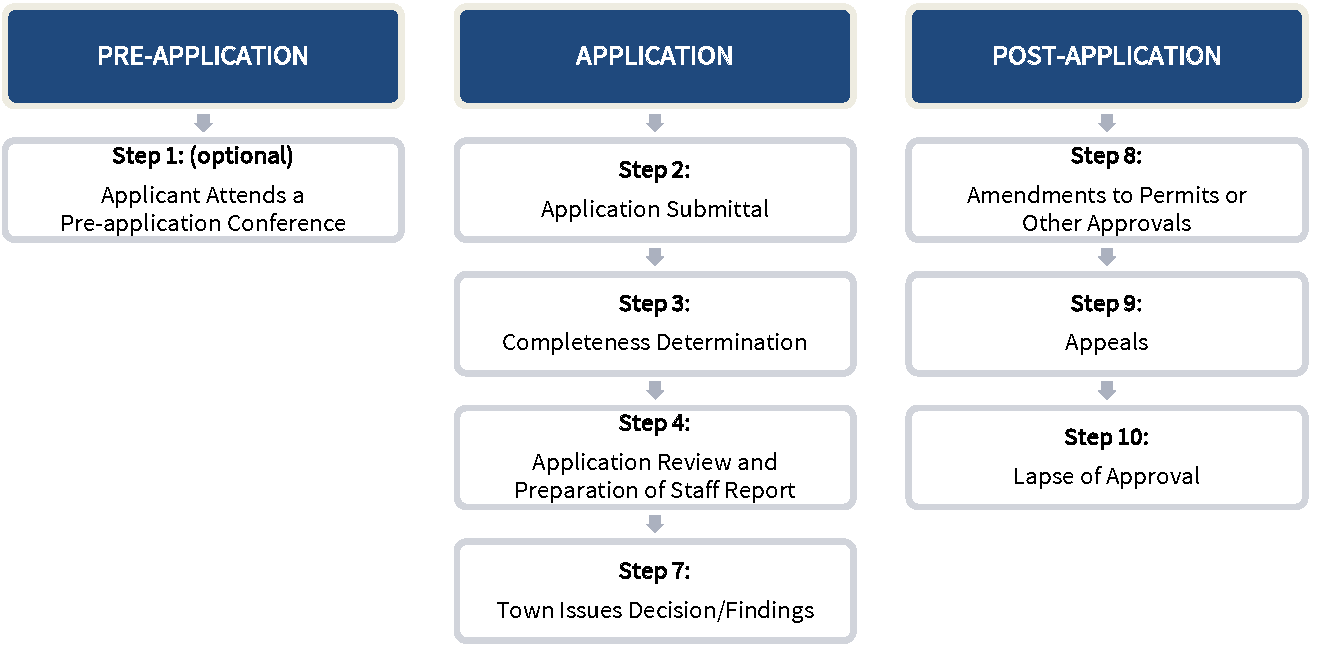
1.
Pre-Application Conference. A pre-application conference shall be held in accordance with Section 180-2.3.1.
2.
Application Submittal and Handling.
a.
The administrative/minor site plan application shall be submitted, accepted, and revised, and may be withdrawn, in accordance with 180-2.3.2.
b.
Construction plan applications submitted concurrently with administrative site plans shall include the information required under the Town of Frisco Technical and Engineering Standards Manual.
3.
Staff Review and Action. The Director shall review the administrative/minor site plan application and approve, approve with conditions, or deny the administrative/minor site plan in accordance with Section 180-2.3.4 and the approval criteria in Subsection 180-2.5.2.E.
4.
Post-Decision Actions and Limitations.
a.
Filing of Site Plan. An approved site plan shall be filed with the Community Development Department within 60 days of its approval, revised as needed based on comments or conditions of approval.
b.
No Building Permit without Approval. No building permit shall be issued until the administrative/minor site plan and associated construction plans have been approved pursuant to this section.
c.
Expiration of Approval. Unless vested rights are approved pursuant to Section 180-2.7.4, administrative/minor site plan approval shall expire if the authorized use has not begun or construction activity has not begun and been diligently pursued within three years after the date of the site plan approval, or an extension is granted pursuant to Section 180-2.3.10.
d.
Minor Changes Allowed. Development applications authorized by an administrative/minor site plan approval may incorporate minor changes from the approved site plan without the need for a new application, provided that the Director determines that the proposed changes:
i.
Could be approved under the allowable administrative adjustments pursuant to Section 180-2.7.2, had they been requested with the original application;
ii.
Comply with the standards of this Chapter and the Frisco Town Code;
iii.
Are necessary to meet conditions of approval; and/or
iv.
Would not significantly alter the function, form, intensity, character, demand on public facilities, or impact on adjacent properties as approved with the administrative/minor site plan.
D.
Major Site Plan Review Procedure. Figure 2-F identifies the applicable steps from the common review procedures in Section 180-2.3 that apply to the review of major site plans. Additions or modifications to the common review procedures are noted below.
Figure 2-F: Major Site Plan Review Procedures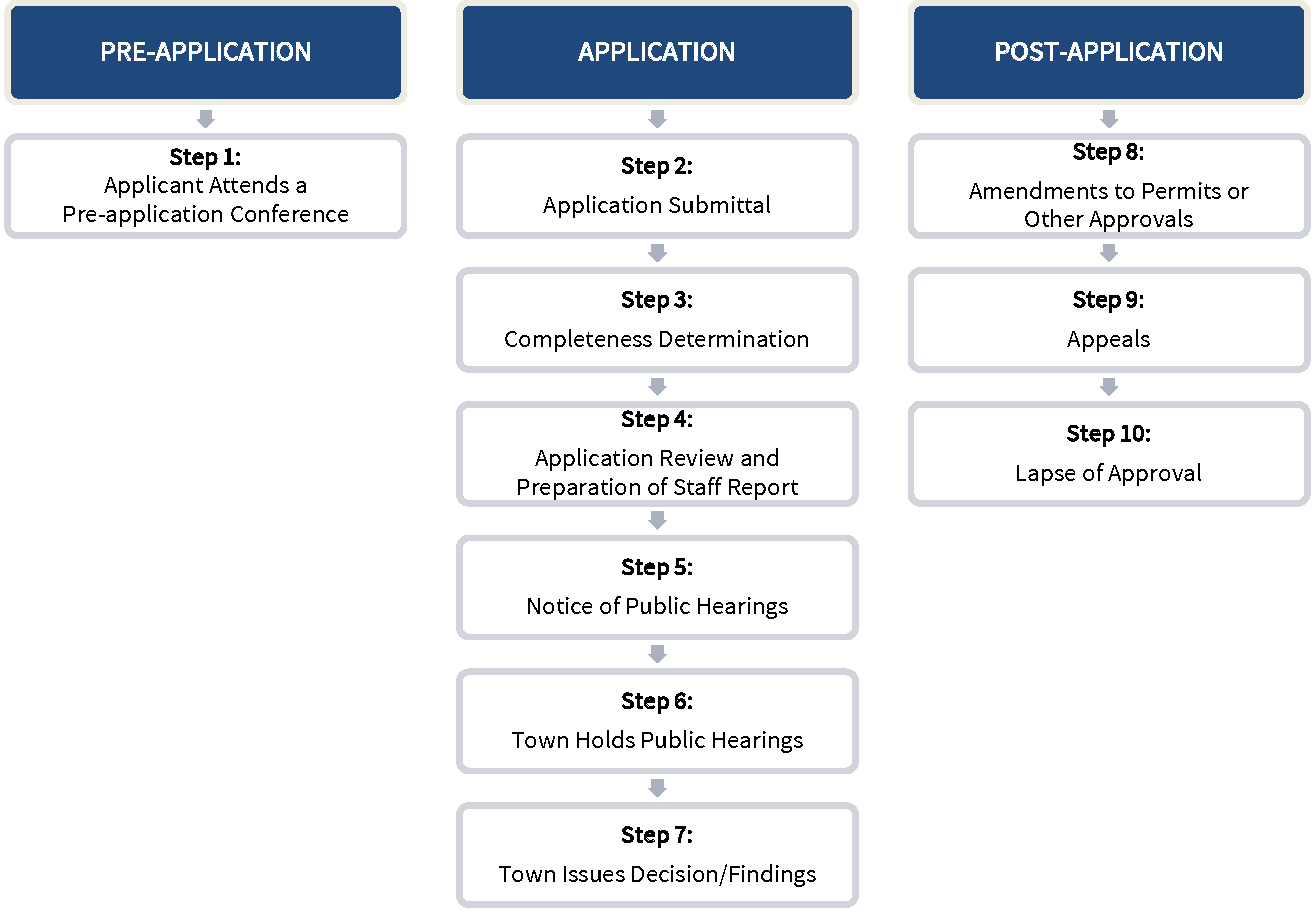
1.
Pre-Application Conference. A pre-application conference shall be held in accordance with Section 180-2.3.1.
2.
Application Submittal and Handling. The major site plan application shall be submitted, accepted, and revised, and may be withdrawn, in accordance with Section 180-2.3.2, with the following modifications:
a.
The major site plan application shall consist of two parts, an initial sketch plan followed by a full major site plan. Both parts shall require review by the Planning Commission.
3.
Sketch Plan.
a.
All applications for major site plans shall present an informal sketch plan of the development before a regularly scheduled meeting of the Planning Commission. The applicant shall submit an application to Community Development at least 21 calendar days prior to the Planning Commission meeting at which the sketch plan is requested to be presented. Materials to be presented in support of the development must be of sufficient nature to allow the Planning Commission and Community Development staff to provide informed feedback on the project. At a minimum the applicant must submit the following information:
i.
Written project description, including a synopsis of the proposed development program, and how the project will meet the principles of the Master Plan and the standards of the zoning code;
ii.
Site plan showing the location of the building(s) and other improvements (retaining walls, berms, dumpster locations, open space, etc.) with dimensions to setbacks, property lines, easements, north arrow, scale (no smaller than 1"=20'), legend, vicinity map;
iii.
Existing and proposed utility (main and service) lines;
iv.
Existing and proposed topography at two-foot intervals, including 50 feet beyond the property boundary, existing easements, lot dimensions, lot size in square feet/acreage;
v.
Existing site characteristics map with trees greater that six inches in diameter, vegetation, wetlands, unique natural features;
vi.
Parking space location and counts and traffic circulation design, with driveway locations, points of access from right-of-way, preliminary grades, bike and pedestrian improvements;
vii.
Proposed landscaping, post-development grades, snow storage, preliminary stormwater plan showing approach to stormwater handling;
viii.
Scaled drawings of all building locations and schematic elevations;
ix.
Samples of all colors and materials proposed; and
x.
Surveys must be prepared by a licensed surveyor and dated within the last year from submittal.
b.
The Planning Commission may require an applicant to return for additional sketch plan presentations if sufficient information is not received or if substantial changes to a proposal are recommended. Presentation of a sketch plan neither binds the Planning Commission to approve a site plan, nor does it confer the applicant any vested rights.
c.
The sketch plan presentation shall become null and void if a complete major site plan application is not submitted to the Community Development Department within 180 days after the date of the Planning Commission's review of the sketch plan or submittal of the sketch plan in accordance with above.
4.
Staff Review and Action. Following the review of the sketch plan, the applicant shall submit a complete major site plan application. The Director shall review the major site plan application and prepare a staff report and recommendation in accordance with Section 180-2.3.4. The applicant shall submit the application not less than 52 days prior to an upcoming Planning Commission meeting targeted as the application review date.
5.
Scheduling and Notice of Public Hearings. The major site plan application shall be scheduled for a public hearing before the Planning Commission, and noticed in accordance with Section 180-2.3.5.
6.
Planning Commission Review and Decisions. The Planning Commission shall review the major site plan application and approve, approve with conditions, or deny the major site plan in accordance with Section 180-2.3.7 and the approval criteria in Subsection 180-2.5.2.E.
7.
Post-Decision Actions and Limitations.
a.
Filing of Site Plan. An approved site plan shall be filed with the Community Development Department within 60 days of its approval.
b.
No Building Permit without Approval. No building permit shall be issued until the major site plan and associated construction plans have been approved pursuant to this section.
c.
Expiration of Approval.
i.
Unless vested rights are approved pursuant to Section 180-2.7.4, major site plan approval shall expire if the authorized use or construction has not begun and been diligently pursued within three years after the date of the site plan approval, or an extension is granted pursuant to Section 180-2.3.10.
ii.
Modifications that go through the public process and receive Planning Commission approval shall have a new expiration date set from the date the applicant received approval.
d.
Minor Changes Allowed. Development application authorized by a major site plan approval may incorporate minor changes from the approved site plan without the need for a new application, provided that the Director determines that the proposed changes:
i.
Could be approved under the allowable administrative adjustments pursuant to Section 180-2.7.2, had they been requested with the original application;
ii.
Comply with the standards of this Chapter;
iii.
Are necessary to meet conditions of approval;
iv.
Would not significantly alter the function, form, intensity, character, demand on public facilities, or impact on adjacent properties as approved with the major site plan; and/or
v.
A minor modification to a major site plan does not re-set the expiration date.
E.
Approval Criteria for All Site Plan Types. A site plan may be approved upon a finding that the application meets all of the following criteria:
1.
The site plan is consistent with the general purpose and intent of this Chapter as set forth in Section 180-1.3;
2.
The site plan complies with the dimensional, design, development, and all other applicable standards of this Chapter; and
3.
The site plan is consistent with any previously approved plat, planned unit development, or any other controlling land use approval.
180-2.5.3.
Improvement Location Certificate (ILC).
A.
Purpose. An Improvement Location Certificate (ILC) is required to verify compliance with location specific development requirements such as setbacks, building heights, and bulk plane.
B.
Applicability.
1.
A foundation ILC that shows the distance from the property lines to a foundation is required for all new buildings. A foundation ILC is also required for building additions proposed within five feet of a setback, easement, property line, or other similar boundary.
2.
A roof ILC that shows the location and height of the roof is required for all new buildings. A roof ILC is also required for building additions proposed within five feet of the maximum building height or required bulk plane.
3.
At the discretion of the Community Development Department Director, these requirements may be waived if compliance with the setback and building height requirements for a new building or building addition can be reasonably verified in the field by the Community Development Department without an ILC.
C.
Review Procedures.
1.
A foundation ILC must be performed after the foundation itself is in place. A foundation ILC must be submitted to the Community Development Department for review prior to the approval of a final foundation inspection. If the ILC shows that the completed foundation is located as required by the approved site plan, the developer will be permitted to proceed with further construction. If the ILC shows that the completed foundation is not located as required by the approved site plan, the developer will not be permitted to proceed with further construction until the foundation has been properly located and verified with an updated ILC.
2.
A roof ILC must be performed after the roof itself is in place. A roof ILC must be submitted to the Community Development Department for review prior to the approval of a final framing inspection. If the ILC shows that the roof is located as required by the approved architectural plans, the developer will be permitted to proceed with further construction. If the ILC shows that the roof is not located as required by the approved architectural plans, the developer will not be permitted to proceed with further construction until the roof has been properly located and verified with an updated ILC.
3.
If the ILC is prepared prior to the installation of the sewer cleanouts and water curb stops, an amended ILC showing the location of the sewer cleanouts and water curb stops with a bearing and distance reference to two points on a foundation wall must be submitted to the Community Development Department prior to the issuance of a certificate of occupancy or certificate of completion.
D.
Content. The ILC shall be prepared in a form consistent with professional land surveying practices and be certified by a land surveyor licensed in the State of Colorado. An ILC must contain the information necessary to demonstrate compliance with the applicable location specific development requirements such as setbacks, building height, and bulk plane. A foundation ILC shall show the location and principal dimensions of all foundations for structures approved on the site plan, the USGS elevation at the top of the foundation walls, and the location of all sewer cleanouts and water curb stops with a bearing and distance reference to two points on a foundation wall. A roof ILC shall show the location and heights of all roof forms for structures approved on the site plan and include the USGS elevations of all roof ridges.
180-2.5.4.
Building Permits Subject To Street Dedication. No building shall be erected on any lot nor shall a building permit be issued for a building unless the street giving access to the lot upon which said building is proposed to be placed has been dedicated and approved by the Town Council as part of a legal subdivision. However, a building permit may be issued for a residential lot not abutting a publicly dedicated street when private access is approved by the Planning Commission and is provided by plat, reservation, deed, covenant, or contract, and provisions satisfactory to the Town are made for maintaining the access and keeping it in good repair on a year-round basis.
(Ord. No. 17-04, 6-27-17; Ord. No. 18-03, 3-13-18; Ord. No. 19-04, 4-9-19; Ord. No. 20-23, 1-26-21; Ord. No. 23-09, §§ 3, 4, 3-28-23)
§ 180-2.6. - Subdivision approvals.
180-2.6.1.
Preliminary Plat.
A.
Purpose. The preliminary plat procedure provides a mechanism for the Town to review an overall plan for a proposed subdivision to ensure compliance with this Chapter and to ensure the adequate provision of facilities and services to subdivided lots in the Town.
B.
Applicability.
1.
A preliminary plat is required if the proposed subdivision:
a.
Is on land that has not been platted;
b.
Will produce four or more lots;
c.
Will include the dedication of public right-of-way, other public tracts, or public improvements; or
d.
Is not eligible to be processed as a minor subdivision or resubdivision, pursuant to Section 180-2.6.3.
2.
Minor subdivisions and resubdivision applications are exempt from the procedures of this preliminary plat section.
C.
Review Procedures. Figure 2-G identifies the applicable steps from the common review procedures in Section 2.3 that apply to the review of applications for preliminary plats. Additions or modifications to the common review procedures are noted below.
Figrue 2-G: Preliminary Plat Review Procedures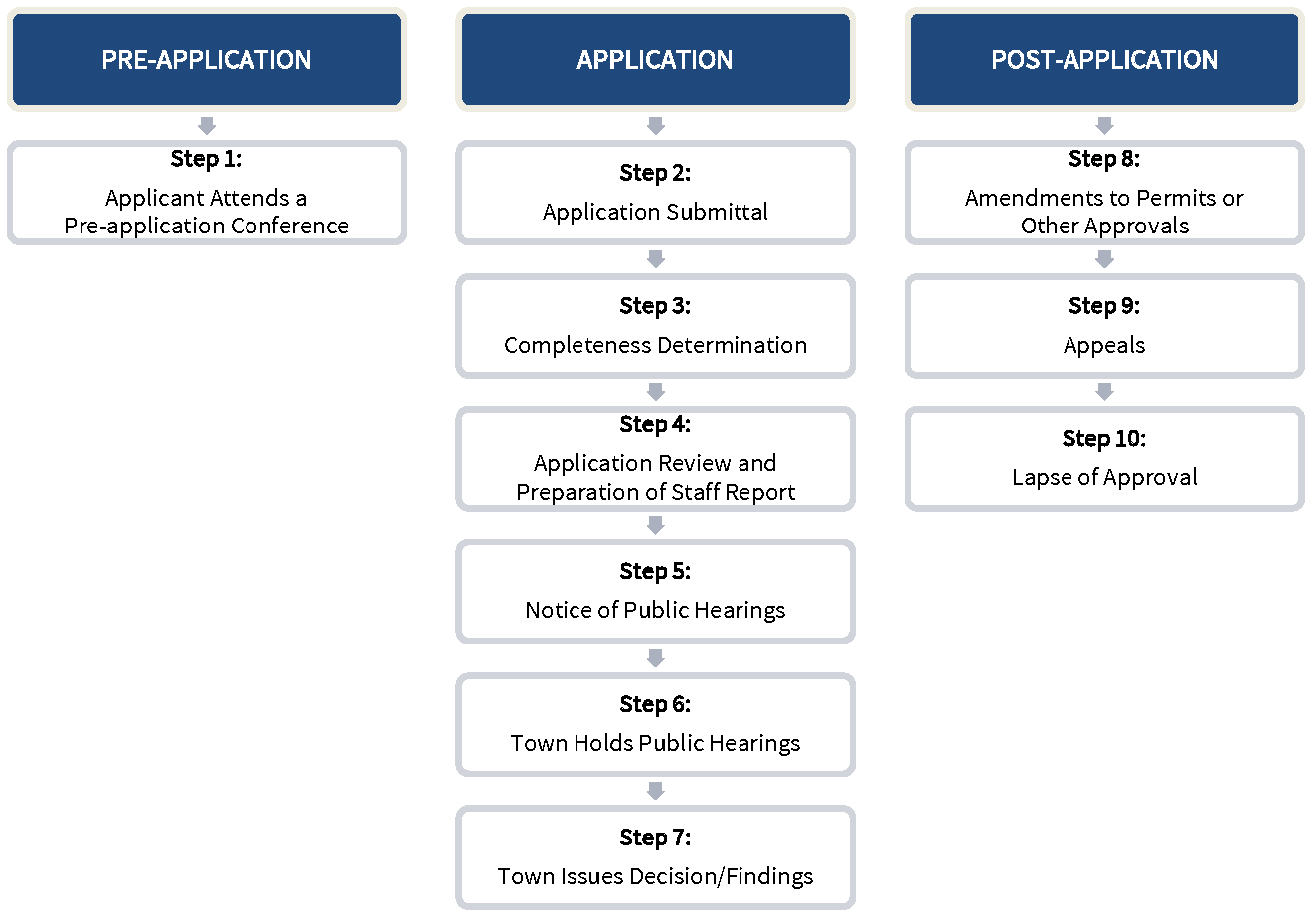
1.
Pre-Application Conference. A pre-application conference shall be held in accordance with Section 180-2.3.1.
2.
Application Review and Preparation of Staff Report. The Town may solicit comments from the review agencies determined appropriate by the Community Development Department, and may incorporate any comments received in a staff report.
3.
Planning Commission Review and Decision. Once the application is placed on a Planning Commission agenda, the Planning Commission shall hold a publicly noticed hearing. The Planning Commission shall consider the comments of the other agencies and the public before reaching its decision to approve, conditionally approve, or disapprove the preliminary plat. The Town Manager or his designee shall subsequently notify the subdivider of the Planning Commission's approval, conditional approval, or disapproval. If the plat is disapproved, the reason or reasons shall be noted and recommendations may be made whereby the plat might gain approval.
4.
Lapse of Approval.
a.
An approved preliminary plat shall expire if:
i.
Construction of the project within the area of the preliminary plat has not begun within three years after the date of preliminary plat approval;
ii.
Construction of the project within the area of the preliminary plat has not been completed within four years after the date of preliminary plat approval;
iii.
An application for final plat approval is not presented to the Community Development Department within four years after the date of the preliminary plat approval.
b.
If a final plat application is not presented to the Community Development Department prior to the preliminary plat expiration date, an extension to the preliminary plat may be granted by the Planning Commission upon good cause shown by the owner. Such extension shall be at the discretion of the Planning Commission.
D.
Preliminary Plat Approval Criteria. A preliminary plat may be approved only upon a finding that the application meets all of the following criteria:
1.
The plat complies with the applicable requirements of this Chapter;
2.
The general layout of lots, roads, driveways, utilities, drainage facilities, and other services within the proposed subdivision is designed to meet the Town's standards related to health and safety and in a way that minimizes the amount of land disturbance, maximizes the amount of open space in the development, and otherwise accomplishes the purposes and intent of this Chapter;
3.
The subdivision will not result in adverse impacts on the natural environment, including air, water, noise, stormwater management, wildlife, and vegetation, or such impacts will be substantially mitigated;
4.
Provides evidence of public water and sewer system connections; and
5.
If applicable, proposes reasonable project phasing in terms of infrastructure capacity.
180-2.6.2.
Final Plat.
A.
Purpose. The final plat procedure completes the subdivision process and ensures compliance with the approved preliminary plat and applicable standards in this Chapter.
B.
Applicability. The final plat procedure applies to all subdivisions in the Town unless otherwise stated in this Chapter.
C.
Review Procedures. Figure 2-H identifies the applicable steps from the common review procedures in Section 180-2.3 that apply to the review of applications for final plats. Additions or modifications to the common review procedures are noted below.
Figure 2-H: Final Plan Review Procedures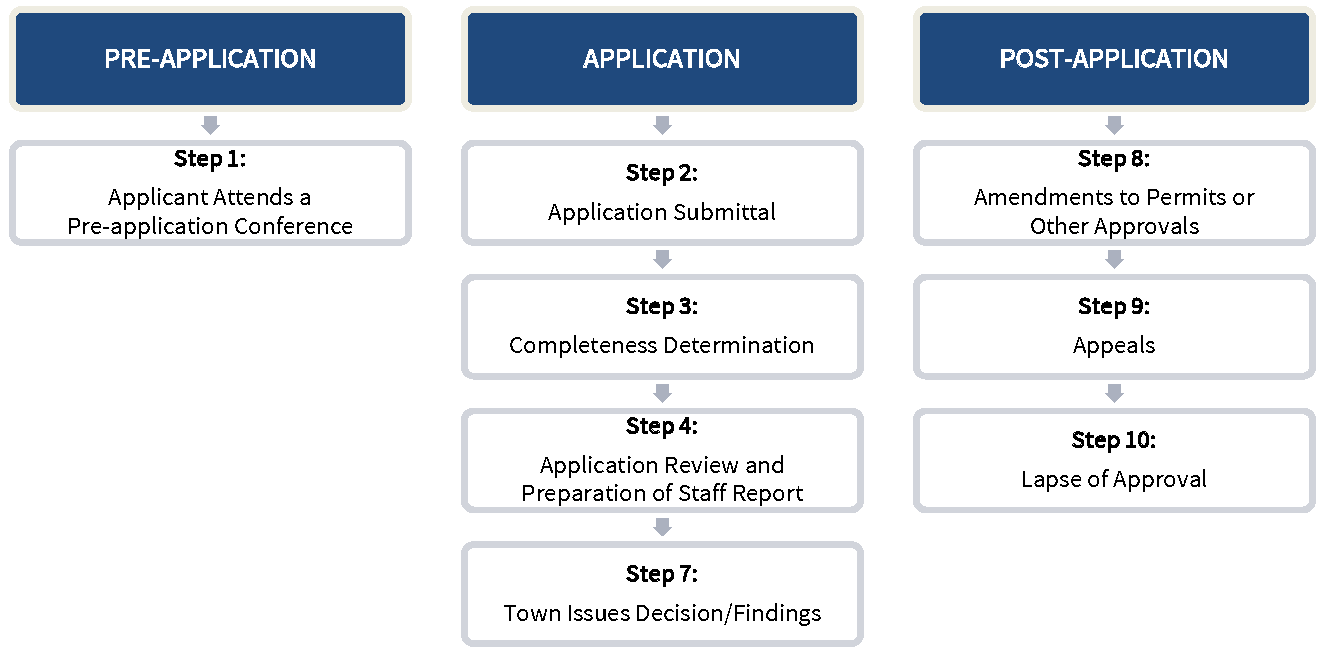
1.
Pre-Application Conference. A pre-application conference shall be held in accordance with Section 180-2.3.1.
2.
Application Submittal. Following approval of the preliminary plat, but not more than four years after such approval (unless an extension of time is granted pursuant to Section 180-2.6.1.C.3), the subdivider shall submit an application for final plat approval to the Community Development Department. The application shall be prepared in a form and containing such supporting materials as determined by the Director.
3.
Required Statements. The final plat shall contain the following required statements:
a.
Heading. The heading of the final plat shall include the complete name of the subdivision, the land sections, township, range, principal meridian, Summit County, Colorado. Also, where applicable, the United States mineral claim name, number, and mining district shall be shown.
b.
Dedication. Know all men by these presents: That (printed name of owner), being the owner(s) of the land described as follows: [insert legal description of land being subdivided and include area in acres to two decimal places] in Summit County, Colorado, under the name and style of (complete name of subdivision in capital letters), have laid out, platted and subdivided same as shown on this plat, and by these presents do (does) hereby dedicate to the perpetual use of the Town of Frisco, State of Colorado, the streets, alleys, roads and other public areas as shown hereon and hereby dedicate those portions of land labeled as easements for the installation and maintenance of public utilities as shown hereon.
In witness whereof, the said owner (printed name of owner) has caused his name to hereunto be subscribed this _______ day of _______, AD _______. ___________
Owner
c.
Notarial.
State of Colorado.
The foregoing instrument was acknowledged before me this _______ day of _______, AD _______, by (printed name of owner). (If by natural persons, here insert name; if by person acting in a representative official capacity, then insert the names of said person and his capacity; if by officers or a corporation, then insert the names of said officers as the president or other officers of such corporation, naming it).
My commission expires on (to be filled in by Notary).
Witness my hand and official seal.
(Signature)___________(Seal)
(Printed name of Notary) ___________
Notary Public
d.
Land Surveyor's Certificate.
I (printed name of land surveyor), being a licensed land surveyor in the State of Colorado, do hereby certify that this plat and survey of (name of subdivision in capital letters) was made by me and under my supervision and that both are accurate to the best of my knowledge. Steel pins and/or brass cap monuments were set at all boundary corners.
Dated this________ day of _______, AD _______
(Seal) Colorado Registration Number (number of registration)
e.
Frisco Planning Commission Approval.
The Planning Commission of Frisco, Colorado, represented by the Commission Chairman, does hereby authorize and approve this plat of the above subdivision on this _______ day of ________ AD _______.
By: ___________
Chairman
f.
Frisco Town Council Approval.
The within plat of ________ is approved by the Town Council of Frisco, Colorado, represented by the Mayor, for filing this _______ day of ___________. The dedication of the public ways shown hereon will not be accepted until said public ways have been satisfactorily completed to the town's specifications by the subdivider. Upon such satisfactory compliance, the Town Council of the Town of Frisco may adopt a resolution accepting the said dedication of public ways and duly record such acceptance.
By: ______________
Mayor
Attest: ___________
Town Clerk
g.
County Clerk and Recorder. (To be placed in the lower right-hand corner of the cover sheet)
Summit County Clerk and Recorder's acceptance. This plat was accepted for filing in the office of the Clerk and Recorder of the County of Summit, Colorado, on this _______day of _______, _______.
Reception Number________
Recordation of Protective Covenants (if applicable)
Protective covenants recorded under Reception Number _______
h.
Previous Recording of Information.
For platted area under Reception Number ________
i.
Title Company Certificate.
___________ Title Company does hereby certify that it has examined the title to all lands as shown on this plat, and title to such lands is in the dedication free and clear of all liens, taxes and encumbrances, except as follows:
___________
Agent
j.
Summit County Treasurer's Certificate.
"I, the undersigned, do hereby certify that the entire amount of taxes and assessments due and payable as of ________ upon all parcels of real estate described on this plat are paid in full.
Dated this _______ day of _______, 2___.
Signature ___________."
Summit County Treasurer
4.
Application Review and Preparation of Staff Report.
a.
The Town may solicit comments from review agencies determined to be appropriate by the Community Development Department and may incorporate any comments received in a staff report.
b.
A final plat of the subdivision will be reviewed by the Community Development Department. If the final plat does not substantially conform to the approved preliminary plat, as determined by the Community Development Department, the Director may require an additional preliminary plat review and filing fee not to exceed the amount specified for the preliminary plat.
5.
Town Issues Decision/Findings.
a.
Once all necessary information has been received and reviewed and the Community Development Department is satisfied that sufficient information has been submitted to demonstrate whether the applicable standards of the Frisco Town Code have been met, the application will be approved if the Town Manager or his designee finds that all applicable standards of the Frisco Town Code and all conditions of the preliminary plat approval have been met; conditionally approved if the Town Manager or his designee finds that all applicable standards of the Frisco Town Code and all conditions of the preliminary plat approval could be met upon compliance with certain conditions; or denied if any of the standards of the Frisco Town Code or conditions of the preliminary plat approval have not been met.
b.
Following approval of the final plat by the Town Manager or his designee, but no more than 30 days after such approval, the applicant shall submit to the Community Development Department two copies of the final plat on mylar film and all associated documents with all appropriate signatures, or such final plat shall be null and void. The Community Development Department shall then record the final plat and all associated documents within the next 15 working days. The applicant shall reimburse the Town for the cost of said recording. The Town Manager or his designee may grant one or more 30-day extensions, at the time of the plat review or at a later date, of the final plat submission deadline upon a showing by a party requesting such an extension of extraordinary or exceptional circumstances that do not generally exist for subdividers.
6.
Filing of Plats. All plats of a subdivision of land within the Town of Frisco shall be filed and recorded only after having been executed by the Chair of the Planning Commission and the Mayor and attested to by the Town Clerk.
7.
Minor Changes Allowed. The Director may approve development applications that incorporate minor changes from the approved final plat, without the need to reapply, where the Director determines that the changes continue to comply with this Chapter and are substantially consistent with the application approval— i.e., that the changes are necessary to comply with conditions of approval or would not significantly alter the development's general function, form, intensity, character, demand on public facilities, impact on adjacent properties, or other characteristic from that indicated by the subdivision approval. In any case, the following changes shall not be deemed minor changes:
a.
A change in a condition of approval; or
b.
An increase in the number of lots.
D.
Final Plat Approval Criteria. A final plat may be approved only upon a finding that the application meets all of the following criteria:
1.
The final plat conforms to the approved preliminary plat, including any conditions of approval;
2.
Plans and specifications for improvements connected with development of the subdivision comply with the standards in Chapter 180, Article I, Subdivision, of this Chapter, and any other relevant Town, county, or state regulations, except to the extent modifications, variances, or exceptions have been expressly allowed by the terms of the preliminary plat approval. All construction plans for improvements shall be approved by the Town Engineer prior to the Director's action on the final plat;
3.
The development will comply with the applicable technical standards and specifications adopted by the Town;
4.
The applicant has either installed all required improvements or has executed a development improvement agreement required under this Chapter; and
5.
The applicant has paid or satisfied all applicable fees and charges, including recording fees.
180-2.6.3.
Minor Subdivisions and Resubdivisions.
A.
Purpose. The minor subdivision procedure is used to evaluate proposed subdivisions that will create up to three lots or involve minimal adjustments to approved final plats. The minor subdivision procedure also provides an administrative process to correct plat errors and adjust property boundaries.
B.
Applicability. A minor subdivision is any one of the following activities:
1.
Subdivision that creates three lots or less.
2.
Minor relocation or adjustments of a lot line, property line, provided that written consent is furnished from all adjoining property owners.
3.
Correction of an engineering or survey error or other minor change to a recorded plat which has no effect on the conditions applied to the approval of the plat and does not violate any requirement of the Frisco Town Code.
4.
Conversion of a structure in existence at least five years from the date of Certificate of Occupancy to a condominium or townhome units regardless of the number of units.
5.
Resubdivision, including parcel resubdivision, duplex resubdivision resulting in a party wall, condominiumization, townhouse subdivision, and commercial pad subdivision.
C.
Review Procedure. Minor subdivisions shall be reviewed by the Community Development Department for conformity with all applicable requirements of the Town Code. Minor subdivisions shall comply with requirements for final plats in Section 180-2.6.2, Final Plat; no preliminary plat is required. All minor subdivisions are subject to the Town's public noticing requirements for final plats. Upon a finding of conformity, the Community Development Director shall approve the final plat, which will be signed by the Chair of the Planning Commission and the Mayor.
D.
Referral to Planning Commission and Town Council. Any minor subdivision may be taken to the Planning Commission and the Town Council at staff's discretion for final plat review.
E.
Additional Requirements for Resubdivision. Any resubdivision of a lot, tract, or other parcel of land that has previously been subdivided is subject to all provisions of this Chapter and all other rules and regulations that may apply to the original subdivision of land. Any resubdivision application shall comply with the general procedures for final plats in Section 180-2.6.2, Final Plat, as well as the additional requirements set forth below.
1.
Time-Share Developments. Any subdivision approved under this Chapter to resubdivide shall comply with all Town requirements related to time-share developments, if applicable.
2.
Duplex Resubdivision Resulting in a Party Wall. In addition to the general procedures required in this section, a party wall agreement must be filed with the final plat. The party wall agreement shall contain but not be limited to the following:
a.
Identification of the parties.
b.
Identification of the party wall.
c.
Provisions for repair and maintenance.
d.
Easements for repairs to the party wall.
e.
Restrictions, if any, pertaining to structural changes to the party wall.
f.
Restrictive liens for enforcement purposes.
g.
Utility easements (if needed).
h.
Any other documentation as may be reasonably required.
3.
Condominiumization. In addition to the provisions in Section 180-2.6.2.D, for final condominiumization approval the following is needed:
a.
A map showing all common areas (general and limited common elements) and usages of the building and grounds, for the interior division of the building showing horizontal and vertical boundaries of all units, including a distance from a building corner to a property corner or other survey reference.
b.
A copy of the declaration applicable to the condominium project, as defined in C.R.S. § 38-33-105, 1973, as amended and/or as may be required pursuant to the Colorado Common Interest Ownership Act, C.R.S. § 38-33.3-101 et seq., as amended.
c.
A copy of the condominium association Articles of Incorporation, bylaws and covenants. The bylaws and declaration of covenants shall contain the information required by the Condominium Ownership Act of the State of Colorado and the Colorado Common Interest Ownership Act, if applicable. All condominium projects shall comply with this requirement.
d.
A management plan that states:
i.
The responsible party for managing the common area, lodging reservations, etc.
ii.
Provisions for selecting, appointing, and securing management.
iii.
Responsibilities and duties of the management entity.
iv.
The responsible party for coordinating the use and rental unit occupancy of those units that are used for short-term lodging.
e.
A maintenance plan that states:
i.
The responsible entity for repair and maintenance of common areas.
ii.
What will be included in the maintenance program, including, but not limited to, provisions for snow removal, trash removal, maintenance of pools, hot tubs, common areas and other amenities.
iii.
The mechanism used to fund the management and maintenance activities of the development.
f.
In addition, if there are any restrictive covenants, conditions, or restrictions other than specified in the declaration, they shall be filed concurrently with the filing of the final plat.
4.
Townhouses.
a.
Notwithstanding the definition of a "Townhome" in Chapter 180, Article IX, a townhome lot may be subdivided prior to the construction of the foundation for the townhome provided that:
i.
The final plat of any such townhome lot shall contain a plat note that provides as follows:
a)
Pursuant to Chapter 180, Section 180-2.6.3.E.4 of the Frisco Town Code, the townhome lot identified hereon as "________" has been subdivided prior to the construction of the townhome or its foundation. Pursuant to said section, the owner(s) of the townhome lot, as well as the owner(s) of any property that abuts the townhome lot must, within 90 days after the construction of the foundation for the townhome, have a survey of the location of the foundation prepared and make a subdivision plat amendment application to the Town that shall cause the townhome lot depicted on the plat to be coterminous with the foundation of the townhome as constructed; and
ii.
Within 90 days after the construction of the foundation for the townhome, the owner(s) of the townhome lot shall have a survey of the location of the foundation prepared and, along with the owner(s) of any property that abuts the townhome lot, shall make and pursue to completion an application to the Town to amend the plat of the townhome that causes the townhome lot to be coterminous with the foundation of the townhome as constructed.
b.
With respect to a townhome lot that has been subdivided prior to the construction of the townhome or its foundation, it is unlawful:
i.
For the owner(s) of the lot to fail to, within 90 days after the construction of the foundation, have a survey of the location of the foundation prepared; and
ii.
For the owner(s) of the lot and the owner(s) of any property that abuts the townhome lot, to fail to, within 90 days after the construction of the foundation, make and pursue to completion an application to the Town to amend the plat of the townhome lot that causes the townhome lot to be coterminous with the foundation of the townhome as constructed.
c.
In addition to the provisions in Section 180-2.6.2.D, for final townhouse subdivision approval the following is needed:
i.
A map showing all common areas (general, limited common area), usages of the building and grounds, and the building showing horizontal boundaries for the interior division of all units.
ii.
A copy of the Townhouse Association Articles of Incorporation, bylaws, and covenants.
iii.
A management plan that states:
a)
The responsible party for managing the common area lodging reservations, etc.
b)
Provisions for selecting, appointing, and securing management.
c)
Responsibilities and duties of the management entity.
d)
The responsible party for coordinating the use and rental unit occupancy of those units that are used for short-term lodging.
iv.
A maintenance plan that states:
a)
The responsible entity for repair and maintenance of common areas.
b)
What will be included in the maintenance program, including, but not limited to, provisions for snow removal, trash removal, maintenance of pools, hot tubs, common areas and other amenities.
c)
The mechanism used to fund the management and maintenance activities of the development.
d.
In addition, if there are any restrictive covenants, conditions, or restrictions other than specified in the declaration, they shall be filed concurrently to filing of the final plat.
e.
A copy of the declaration applicable to the Townhouse project, as defined in C.R.S. § 38-33-105, 1973, as amended and/or as may be required pursuant to the Colorado Common Interest Ownership Act, C.R.S. § 38-33.3-101 et seq., as amended.
5.
Commercial Pad.
a.
Notwithstanding the definition of a "Commercial Pad" in Chapter 180, Article IX, a commercial pad may be subdivided prior to the construction of the foundation for the building to be located on the commercial pad provided that:
i.
The final plat of any such commercial pad shall contain a plat note that provides as follows:
a)
Pursuant to Chapter 180, Section 180-2.6.3.E.5 of the Frisco Town Code, the commercial pad identified hereon as "________" has been subdivided prior to the construction of the building, or foundation of the building, to be located on the pad. Pursuant to said section, the owner(s) of the commercial pad, as well as the owner(s) of any property that abuts the commercial pad must, within 90 days after the construction of the foundation for the building to be located on the pad, have a survey of the foundation prepared and make a subdivision plat amendment application to the Town that shall cause the commercial pad depicted on the amended plat to be coterminous with the foundation of the building as constructed; and
ii.
Within 90 days after the construction of the foundation for the building to be located on the pad, the owner(s) of the commercial pad shall have a survey of the foundation prepared and, along with the owner(s) of any property that abuts the commercial pad, shall make and pursue to completion an application to the Town to amend the plat of the commercial pad to cause the commercial pad depicted on the amended plat to be coterminous with the foundation of the building as constructed.
b.
With respect to a commercial pad that has been subdivided prior to the construction of the building to be constructed on the pad, or its foundation, it is unlawful:
i.
For the owner(s) of the commercial pad to fail to, within ninety (90) days after the construction of the foundation, have a survey of the location of the foundation prepared; and
ii.
For the owner(s) of the commercial pad and the owner(s) of any property that abuts the commercial pad, to fail to, within ninety (90) days after the construction of the foundation, make and pursue to completion an application to the Town to amend the plat of the commercial pad to cause the pad to be coterminous with the foundation of the building as constructed.
c.
A commercial pad may be resubdivided per the Town-approved foundation line shown on the site plan/preliminary plat at the risk of the subdivider, or it may be resubdivided once the foundation has been poured.
d.
In addition to the requirements of Section 180-2.6.2.D, for final commercial pad subdivision approval, the following submittals are required:
i.
A map showing all common areas (both general and limited common elements of a project), and uses of the building and grounds.
ii.
A plat note that restricts the use and design of the commercial pad and the building that will be constructed on that commercial pad, to that indicated on the previously Town-approved development plan/preliminary plat.
iii.
A copy of the articles of incorporation and bylaws of the owners association for the project and of the declaration of covenants applicable to the commercial pad.
iv.
A management plan, which may take the form of the articles of incorporation, bylaws, and declaration of covenants referenced above, which states:
a)
The responsible party for managing the common area.
b)
Provisions for selecting, appointing, and securing management.
c)
Responsibilities and duties of the management entity.
v.
A maintenance plan, which may take the form of the articles of incorporation, bylaws and declaration of covenants referenced above, which states:
a)
The responsible entity for repair and maintenance of common areas.
b)
What will be included in the maintenance program, including, but not limited to, provisions for snow removal, trash removal, maintenance of common areas and other amenities.
c)
The mechanism used to fund the management and maintenance activities of the development.
vi.
In addition, if there are any restrictive covenants, conditions, or restrictions other than specified in the declaration; they shall be filed by the Town together with the filing of the final plat, if not previously filed.
180-2.6.4.
Certificates of Occupancy. No certificate of occupancy shall be issued for any improvements within the subdivision if the improvements agreement is in default or until the remaining subdivision improvements have been installed to serve the properties for which a certificate of occupancy is sought, unless funds or performance bonds sufficient to guarantee completion and satisfaction to the Town have been provided by the subdivider.
(Ord. No. 17-04, 6-27-17)
§ 180-2.7. - Flexibility and relief procedures.
180-2.7.1.
Appeals.
A.
Applicability. Any owner or lessee of property within the Town limits may appeal a decision made in the administration or enforcement of this Chapter. Appeals shall be made as follows:
1.
Appeals from decisions of the Community Development Director or other administrative officials or agencies shall be to the Planning Commission.
2.
Appeals from decisions of the Planning Commission shall be to the Council.
3.
Appeals of decisions by the Town Council shall be made in accordance with applicable law.
B.
Review Procedures for Appeals. Figure 2-I identifies the applicable steps from the common review procedures in Section 2.3 that apply to the review of applications for appeals. Additions or modifications to the common review procedures are noted below.
Figure 2-I: Review Procedures for Appeals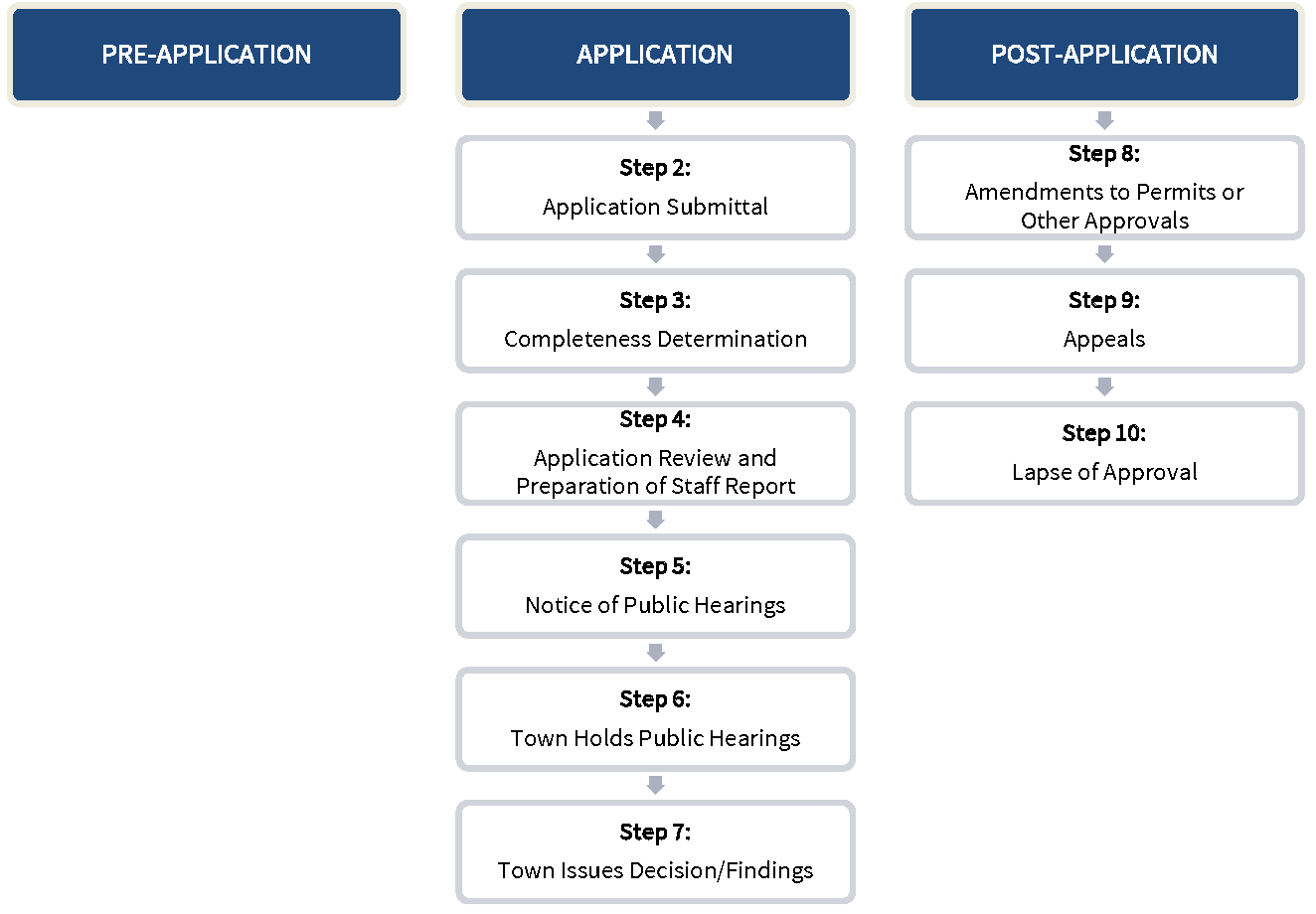
1.
Application Submittal. Appeals shall be filed with the Community Development Department not later than ten calendar days from the date of the decision being appealed.
2.
Town Holds Public Hearings.
a.
All appeals to the Planning Commission or the Council shall be considered de novo public hearings.
b.
Hearings on appeals shall be scheduled no sooner than 14 days and no later than 60 days from receipt of the appeal request.
c.
An appeal stays all proceedings and authorization in conjunction with the action being appealed, unless in the opinion of the Community Development Director a stay would cause imminent peril to life or property.
3.
Town Issues Decision/Findings. The appellate body may reverse or affirm, wholly or partly, or may modify or condition the order, requirement, decision or determination appealed from and shall make such order, requirement, decision or determination along with findings as in its opinion ought to be made, so that the letter and spirit of this Chapter is observed, public safety and welfare are secured and substantial justice done.
C.
Call-Up Appeals of Administrative and Planning Commission Decisions. Any other provision of this section notwithstanding, not later than ten calendar days from the date of the decision and with the concurrence of any two Council members, a decision of the Community Development Department or the Town Manager or his designee or the Planning Commission may be called up for an appeal hearing before the Council. Such called-up appeal shall be subject to the procedural requirements set forth in Subsection 180-2.7.1.
180-2.7.2.
Administrative adjustment.
A.
Purpose. The administrative adjustment procedure is intended to allow minor modifications or deviations from the dimensional or numeric standards of this Chapter with approval by the Director. Administrative adjustments are intended to provide greater flexibility when necessary, without requiring a formal zoning amendment or variance. The administrative adjustment procedure is not a waiver of Chapter standards and shall not be used to circumvent the variance procedure.
B.
Applicability.
1.
Allowable administrative adjustments are listed in the table below.
2.
However, the administrative adjustment procedure shall not apply to any proposed modification to or deviation that results in:
a.
An increase in the overall project density;
b.
A change in permitted uses or mix of uses;
c.
A deviation from the use-specific standards in Article V;
d.
A change to a development standard already modified through a separate administrative adjustment or variance;
e.
Building materials or aesthetic elements; or
f.
Requirements for public roadways, utilities, or other public infrastructure or facilities.
C.
Review Procedures.
1.
An application for an administrative adjustment shall be submitted and reviewed concurrently with an application for a conditional use permit, site plan approval (administrative, minor, or major), or plat approval (preliminary or final).
2.
Where the concurrently reviewed application requires review and approval by the Planning Commission and/or Town Council, the Planning Commission and/or Town Council shall review and decide the administrative adjustment application.
3.
The Director shall review the administrative adjustment application and shall approve, approve with conditions, or deny the adjustment based on the criteria below.
D.
Approval Criteria. The Director shall evaluate the application and may approve the application if the requested adjustment meets all of the following criteria:
1.
Is consistent with the purpose statement set forth in this Chapter for the applicable zoning district(s);
2.
Meets all other applicable building and safety codes; and
3.
The requested modification is necessary to either: (a) compensate for some practical difficulty or some unusual aspect of the site of the proposed development not shared by landowners in general; or (b) accommodate an alternative or innovative design practice that achieves to the same or better degree the objective of the existing design standard to be modified. In determining if "practical difficulty" exists, consideration shall be given to any unique circumstances of the property.
180-2.7.3.
Variances.
A.
Purpose. The Planning Commission finds and determines that there may be exceptional or extraordinary circumstances or conditions that are applicable to properties within the Town that do not generally apply to property within the Town, such that denial of an application for relief would result in an inability to reasonably utilize property. Therefore, it is necessary to provide for such extraordinary relief in the form of variances.
B.
Applicability. Any property owner seeking relief from this Chapter may request a variance when the strict application of a provision of this Chapter would result in an undue hardship. The variance procedure may not be used to allow a use in a zoning district where it is not currently permitted, and is not intended to alleviate inconveniences or financial burdens imposed on landowners. The burden shall be upon the applicant to meet the criteria set forth in this section.
C.
Review Procedures. Figure 2-J identifies the applicable steps from the common review procedures in Section 180-2.3 that apply to the review of applications for variances. Additions or modifications to the common review procedures are noted below.
Figure 2-J: Variance Review Procedures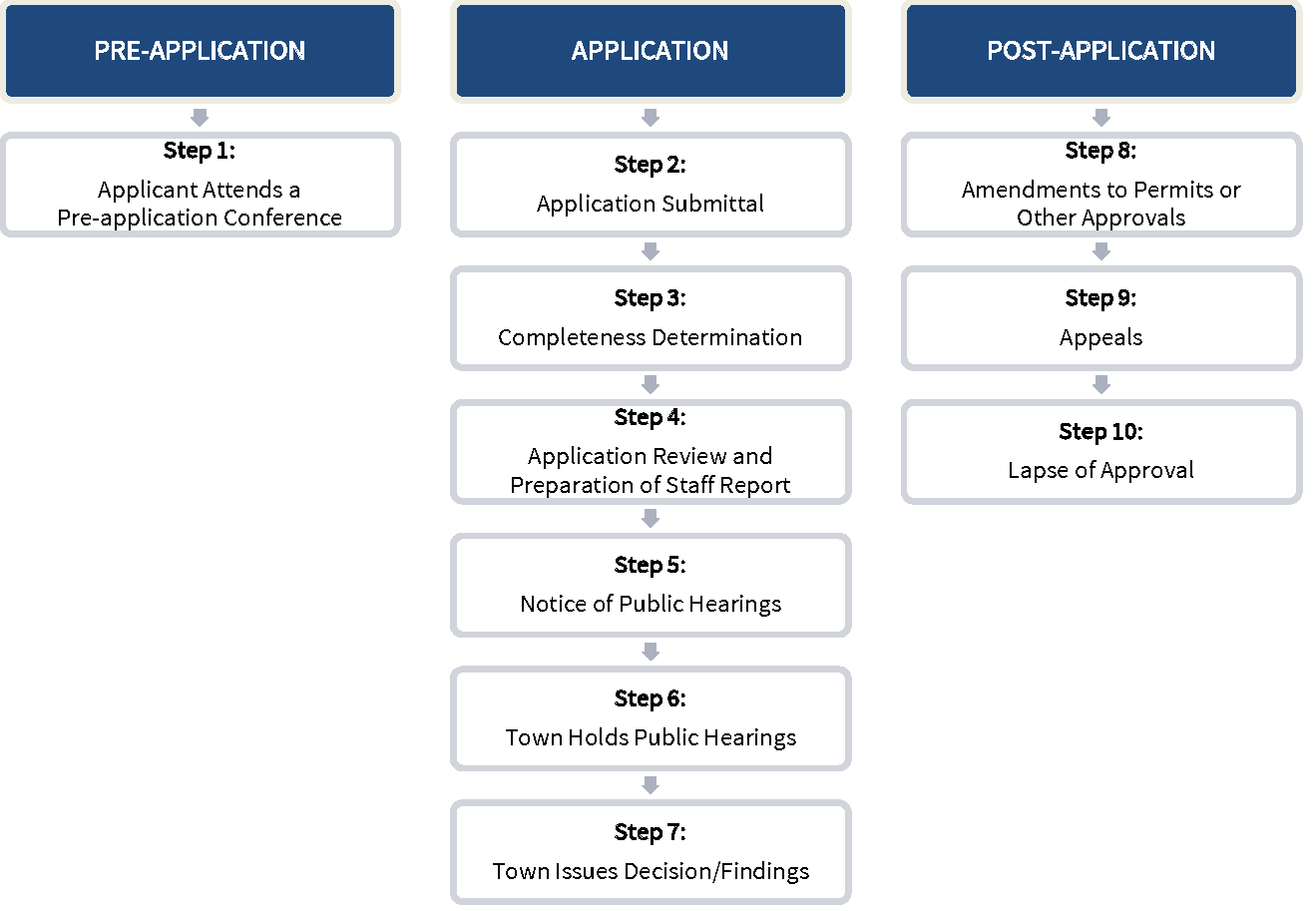
1.
Pre-Application Conference. A pre-application conference shall be held in accordance with Section 180-2.3.1.
2.
Application Submittal.
a.
An applicant for a variance must prove that due diligence was exercised by the applicant before the condition giving rise to the request for a variance occurred. Due diligence shall require a persistent and reasonable inquiry to investigate relevant and applicable facts through both personal and professional actions required of any reasonably prudent person acting as a fiduciary exercising professional judgment and common sense. If an applicant fails to exercise due diligence in discovering, preventing, or attempting to remedy a non-conforming condition the request for a variance shall be denied.
b.
An application for a variance must be submitted and approved by the Planning Commission prior to the submittal of a development application.
c.
No other applications may be submitted concurrently with a variance application. An applicant must have received approval of a non-use variance prior to submitting any development application or any other related application.
3.
Town Issues Decision/Findings.
a.
The application for a variance shall be reviewed by the Planning Commission. Provisions for a public hearing, notice, and appeals of a Planning Commission decision shall be in accordance with Section 180-2.3.4. A complete application containing all of the applicable information shall be presented not less than 52 days prior to the regular Planning Commission meeting at which it is targeted for hearing. The Community Development Department may, at its discretion and for good cause, require a longer submittal period. The applicant must contact the Community Development Department for further information on the application submittal process.
b.
After a public hearing, the Planning Commission may approve, approve with conditions, or deny the variance application.
c.
Every variance authorized hereunder shall be transferable and shall run with the land.
4.
Expiration and Termination of Right. A variance, together with the accompanying site or development plan granted pursuant to this section, shall expire two years after the date of final approval if action has not been taken within that period. This time may be extended with the approval of the Planning Commission or Town Council, if the petitioner can show due cause. For purposes of this subsection, "action" means obtaining a building permit or other applicable Town permit/license pursuant to the granting of the variance, or, if a permit or license is not required, the right that is granted pursuant to the variance is put to use.
D.
Criteria for Granting a Variance. The Planning Commission shall not approve the variance unless it finds that all of the following criteria are met:
1.
The property has extraordinary or exceptional physical conditions that do not generally exist in nearby properties in the same zoning district;
2.
That the extraordinary or exceptional physical condition of the property will not allow reasonable use of the property in its current zone in the absence of relief;
3.
That the granting of the variance will not have an adverse impact on the surrounding properties, the neighborhood, or the community as a whole;
4.
The granting of a variance will not be detrimental to public health, safety and welfare or injurious to surrounding property values and neighborhood character;
5.
The granting of the variance shall not be substantially inconsistent with any plans adopted by the Town;
6.
The granting of the variance shall not materially weaken the general purpose of this Chapter or its regulations; and
7.
The variance, if granted, shall only be to the extent necessary to afford a reasonable use of the property.
E.
Use Variances Prohibited. No variance authorizing a change in the permitted uses of property shall be granted.
180-2.7.4.
Vested Property Rights.
A.
Purpose. This section is intended to provide procedures necessary to implement Article 68 of Title 24, Colorado Revised Statutes, titled "Vested Property Rights."
B.
Plans/Plats that May be Recognized as a Site Specific Development Plan. The following plans/plats and only the following plans/plats provided for in this Chapter may be recognized as a "site specific development plan":
1.
Final site plan approvals (as defined by Section 180-2.5.2); and
2.
Final planned unit development plan approval (as defined by Section 180-2.4.2); and
3.
Final plats, including minor subdivisions (as defined by Section 180-2.6.2).
C.
Plans/Plats Not Recognized as a Site Specific Development Plan. In addition to any other plans/plats or other land use approvals that may be provided for by this Chapter, the following may not be recognized as a "site specific development plan":
1.
Sketch plans (as defined by Section 180-2.5.2.D.3); and
2.
Conditional uses (as defined by Section 180-2.5.1); and
3.
Nonconforming uses (as defined by Chapter 180, Article I); and
4.
Variances (as defined by Section 180-2.7.3); and
5.
Any zoning classification or district; and
6.
Preliminary plats (as defined by Section 180-2.6.1).
D.
Public Hearings Required.
1.
No "site specific development plan" shall be approved by the Town Council until after a public hearing, which hearing shall be requested by the landowner and which hearing follows the successful approval of the development at all other required stages of the review process as required by this Chapter. The request for such a hearing must be made in writing by the landowner to the Community Development director prior to the issuance of any building permit for construction within the development. Unless the landowner requests such a hearing, the approval of the development shall not be considered a "site specific development plan," and no vested property right shall be deemed to have been created.
2.
No "site specific development plan" shall be approved by the Town Council until after a public hearing, which hearing shall be requested by the landowner and which hearing follows the successful approval of the subdivision at all other required stages of the review process as required by Section 180-2.6. The request for such a hearing must be made in writing by the landowner to the Community Development Director prior to the issuance of any building permit for construction within the subdivision. Unless the landowner requests such a hearing, the approval of the subdivision shall not be considered a "site specific development plan," and no vested property right shall be deemed to have been created.
3.
The public hearing shall be preceded by written notice of such hearing. Such notice may, at the Town's option, be combined with any other required notice. At such hearing interested persons shall have an opportunity to be heard.
E.
Final Approval of Vested Property Rights.
1.
A "site specific development plan" shall be deemed approved upon the effective date of the Town Council approval action relating thereto as set forth in Subsection D above. In the event amendments to a "site specific development plan" are proposed and approved, the effective date of such amendments, for purposes of duration of a vested property right, shall relate back to the date of the approval of the original "site specific development plan," unless the Town Council specifically finds to the contrary and incorporates such finding in its approval of the amendment.
2.
Each map, plat, site plan, or other document constituting a "site specific development plan" shall contain the following language: "Approval of this plan/plat may create a vested property right pursuant to Section 102, Article 68 or Title 24, C.R.S., as amended." Failure of the document to contain this statement shall invalidate the creation of the vested property right. In addition, a notice describing generally the type and intensity of use approved, the specific lot(s) or tract(s) of property affected and stating that a "vested property right" has been created shall be published once, not more than 14 days after approval of the "site specific development plan," in a newspaper of general circulation in the Town.
3.
A vested property right shall be valid for a period of four years from its effective date of approval, unless a longer period is agreed to in writing between the Town Council and the owner.
4.
The approval of a "site specific development plan" by the Town Council shall contain such terms and conditions as are reasonably necessary to protect the public health, safety, and welfare. The failure of the developer to abide by such terms and conditions shall result in a forfeiture of the vested property right.
5.
In addition to any and all other fees and charges imposed by Section 180-2.3.2.C, the applicant seeking approval of a "site specific development plan" shall pay all costs incurred by the Town as a result of the owner's request for approval of a "site specific development plan," including administrative reviews, publication costs and legal fees.
6.
The approval of a "site specific development plan" shall not constitute an exemption from or waiver of any other provisions of this Chapter, or any other ordinances, codes and regulations of the Town pertaining to the development and use of property.
7.
Nothing in this section is intended to create any vested property right, but only to implement the provisions of Section 102, Article 68 of Title 24, C.R.S., as amended. In the event of the repeal of said article or a judicial determination that said article is invalid or unconstitutional, this section shall be deemed to be repealed and the provisions hereof no longer effective.
(Ord. No. 17-04, 6-27-17; Ord. No. 18-03, 3-13-18; Ord. No. 19-04, 4-9-19)

