
Frisco City Zoning Code
ARTICLE V
- USE STANDARDS
§ 180-5.1. - Table of allowed uses.
Table 5-1 lists the uses allowed within all base zoning districts. All uses are defined in Chapter 180, Article IX, Definitions. Approval of a use in Table 5-1, and compliance with the applicable use-specific standards for that use, authorizes that use only. Development or use of a property for any other uses not specifically allowed in Table 5-1 and approved under the appropriate process is prohibited.
180-5.1.1.
Explanation of Table Symbology. Table 5-1 identifies allowable uses and applicable procedures according to the following:
A.
● Permitted use by-right
B.
◑ Conditional use
C.
A blank cell indicates that the use is not permitted in that zoning district.
180-5.1.2.
Table Organization. Table 5-1 organizes the allowable uses by use category based on common functional, product, or physical characteristics such as the type and amount of activity, the type of customers or residents, how goods or services are sold or delivered, and site conditions. This classification provides a basis for assigning present and future uses into appropriate zoning districts. Specific use types are not included in multiple use categories. These categories are intended only for the purposes of indexing and not for regulatory purposes. The far right-hand column references additional standards that are applicable to a particular use.
180-5.1.3.
General Use Restrictions. No building or structure shall be erected, moved, altered, enlarged, or used except as set forth in this Chapter and in the regulations specified for the district in which the property is located. No building permit shall be issued for a use not specifically mentioned or described by category in this Chapter. In such case before a building permit is issued, the Planning Commission shall recommend to the Town Council the use group in which the use shall be allowed. The Council shall consider such recommendation and may assign the use to a use group by amending this Chapter.
180-5.1.4.
Classification of New and Unlisted Uses.
A.
When a proposed land use is not specifically listed in Table 5-1, Table of Allowable Uses, the Director shall determine whether or not it is included in the definition of a listed use or is so consistent with the size, scale, operating characteristics, and external impacts of a listed use that it should be treated as the same use. In making this determination, the Director shall consider the scale, character, traffic impacts, storm drainage impacts, utility demands, and potential impacts of the proposed use on surrounding properties. The Director's interpretation shall be made available to the public and shall be binding on future decisions of the Town until the Director makes a different interpretation or this Chapter is amended to treat the use differently. Should the Director determine no similar use is listed within this Chapter, the Director shall have the right to delay making a determination pending legislation adoption, or to propose the addition of a new use to the Table of Allowable Uses through an amendment to this ordinance as described in Section 180-2.4.3, Code Text Amendments.
B.
Appeal of the Director's decision may be made to the Town Council following the procedures under Section 180-2.7.1.
C.
On interpreting an unlisted use or structure as allowed in a zoning district, and finding that the use or structure is likely to be common or would lead to confusion if it remains unlisted, the Director may initiate an application for a text amendment to this Chapter in accordance with Section 180-2.4.3, Code Text Amendments, to list the use or structure in Table 5-1 as a permitted use, conditional use, or special use, as appropriate. Until final action is taken on the text amendment application, the interpretation of the Director shall be binding.
180-5.1.5.
Table of Allowed Uses.
(Ord. No. 17-04, 6-27-17; Ord. No. 19-04, 4-9-19; Ord. No. 20-23, 1-26-21; Ord. No. 22-12, 10-11-22; Ord. No. 23-09, § 7, 3-28-23; Ord. No. 24-12, § 1, 10-22-24)
§ 180-5.2. - Use-specific standards.
180-5.2.1.
Cabin Housing.
A.
Purpose. To provide an opportunity for innovative neighborhood housing development in the Town of Frisco. This type of development allows for an increase in density for small, compact homes to be built on a development site. This type of housing is intended to:
1.
Provide housing that meets the needs of a diversity of household demographics (e.g., retirees, small families, single person households);
2.
Provide opportunities for ownership of small, detached dwelling units in many Frisco neighborhoods;
3.
Increase the affordable housing supply;
4.
Encourage the creation of usable outdoor space for residents through flexibility in design;
5.
Provide development regulations to ensure the compatibility of cabin housing developments with surrounding land uses and encourage the preservation of Frisco's small mountain town character; and
6.
Encourage energy efficient structures.
B.
Description. A cabin housing development is a grouping of small, single-household detached dwelling units, clustered around a common area or courtyard and developed through a unified site plan. The small size, shared common area and coordinated design accommodates densities that are higher than what is otherwise allowed in the underlying zoning district while minimizing impacts on adjacent properties.
C.
Dimensional and Other Standards.
1.
Floor Area. The gross floor area for dwelling units within a cabin housing development shall be as follows:
a.
The maximum size for a cabin housing unit shall not exceed 1,200 square feet (including all levels, but excluding basements and attached garages).
b.
To ensure a range of sizes, no more than 50 percent of the cabin housing units proposed on a parcel shall be larger than 1,000 square feet in gross floor area (including all levels, but excluding basements and attached garages).
c.
The gross floor area for the second story of any cabin housing unit may not exceed 70 percent of the gross floor area of the ground floor (the portion of the structure that is at grade) for that unit.
2.
Crawlspaces and Basements. Basements or other similar below-grade living areas are permitted in a cabin housing development. A basement shall not exceed the gross floor area of the ground floor of the unit and shall be located primarily below the grade of the property so as not to be visible when viewed from the ground level. No more than 30 percent of the wall area of the basement may be above the finished grade and visible. A basement, regardless of its configuration or intended use, shall provide an egress window meeting the requirements of Chapter 65, Town of Frisco Building Construction and Housing Standards. Crawlspaces located below grade are permitted, but shall not exceed the gross floor area of the ground floor for the unit. Crawlspaces shall not be habitable living space as defined by Chapter 65, Town of Frisco Building Construction and Housing Standards. A crawlspace area may be used for storage, mechanical equipment, or other similar uses that do not involve habitation.
3.
Front Porches and First Floor Heights. A covered front porch shall be built on each cabin housing unit. Front porches are excluded from the gross floor area and lot coverage restrictions. Front porches shall be designed to be in scale with the cabin housing unit and the overall development. First floor ceiling heights are not limited by other provisions in the chapter.
4.
Affordable Housing Requirement. All cabin housing development proposals of five units or more shall provide affordable housing meeting the Town's affordable housing requirements and guidelines in the following amounts:
a.
Five to eight units: One affordable unit.
b.
Nine to 12 units: Two affordable units.
c.
Greater than 12 units: 25 percent of the total number of units.
5.
Design. Each cabin housing unit shall be designed to appear as a small cabin that is reflective of Frisco's historic architecture in terms of its small scale, pitched roof, has the appearance of natural siding, and miner's cabin influenced past. Modern or eclectic designs may be approved by the Planning Commission if it finds that the more modern or eclectic design is reflective or rationally related to Frisco's historic architecture in terms of its small scale, pitched roof, natural siding, and miner's cabin influenced past. In addition, each of the following requirements shall be met for each cabin housing development:
a.
Common usable open space shall be provided within the cabin housing development in an amount of not less than 400 square feet per cabin housing unit. The common usable open space shall be in a location within the development so that it may be practicably available for shared use by all residents. Common usable open space shall meet the Town's definition of usable open space found in Chapter 180, Article IX of this Chapter. (For example, for an eight-unit development, 3,200 square feet of common usable open space would be required.) The Planning Commission may alter the amount of required common usable open space and lot coverage if it finds that, due to the layout of the development or unique site or location conditions, the residents will have adequate outdoor living space.
b.
A minimum of 200 square feet of private usable open space shall be provided for each unit within a cabin housing development. This private space shall be located contiguous and adjacent to each unit and is for the exclusive use of the adjacent unit. It shall be oriented towards the common open space as much as possible, with no dimension less than ten feet. Notwithstanding any other provision of this Chapter, a partially covered deck and/or patio is permitted to be within the private usable open space area.
c.
There shall be a maximum building height limit for each cabin housing unit of 20 feet. In those instances where a structure has a 12/12 roof pitch or greater, then the maximum building height limit may be up to 22 feet.
d.
Notwithstanding any other provision of this Chapter, on-site parking areas shall be provided in the amount of one parking space per bedroom, with a maximum of two parking spaces required per unit. For cabin housing developments of four units or more, the following visitor parking shall be provided:
i.
Four to six units: One space.
ii.
Seven to ten units: Two spaces.
iii.
Greater than ten units: 25 percent of the total number of units.
e.
A common or private detached garage or carport is permitted, provided that the architecture of the garage structure is similar to the residential units. If a common or private garage or carport is not provided, then parking for the development may be provided in common and/or private parking spaces(s).
f.
Garages constructed underground are permitted as long as the topography of the site allows for construction. No more than 30 percent of the wall area of the garage may be above the finished grade and visible.
g.
Attached garages and carports are permitted as long as the following requirements are met:
i.
The maximum size of the garage or carport shall be nor more than 350 square feet in area;
ii.
Window designs shall be similar to the appearance of the windows of the cabin and shall be located on all external walls of the garage;
iii.
Architectural materials and color of the garage door or carport shall be similar to the residential structure;
iv.
The driveway for an attached garage or carport shall not exceed 12 feet in width;
v.
A minimum distance of 20 feet from the face of the garage or carport to the property line facing a public right-of-way is required.
h.
Storage sheds that are designed with the same materials and colors as the cabin units are permitted so as long as the storage shed is attached entirely on one side to the cabin unit and does not exceed 50 square feet of floor area. The floor area for an attached storage shed is exempt from the floor area calculation for the cabin unit, but is subject to cabin housing setback requirements.
i.
A common building for guest housing, joint cooking facilities, recreation, or similar uses is permitted as long as the structure appears as a residential structure and has architecture that is similar to the residential units. This space may be located over a garage.
j.
Notwithstanding any other provision of this section, if a cabin housing unit is to be constructed on a lot that has existing development, then the architecture of the cabin housing unit shall be similar to that of the existing structure(s).
k.
The following features are encouraged within cabin housing developments:
i.
Shed, gabled, arched, or hipped roof forms;
ii.
Skylights and/or solar panels;
iii.
Metal roofs; and
iv.
Accessory units above garages. Accessory units cannot be used to meet the requirement for deed restricted units.
Figure 5-A: Cabin Housing Design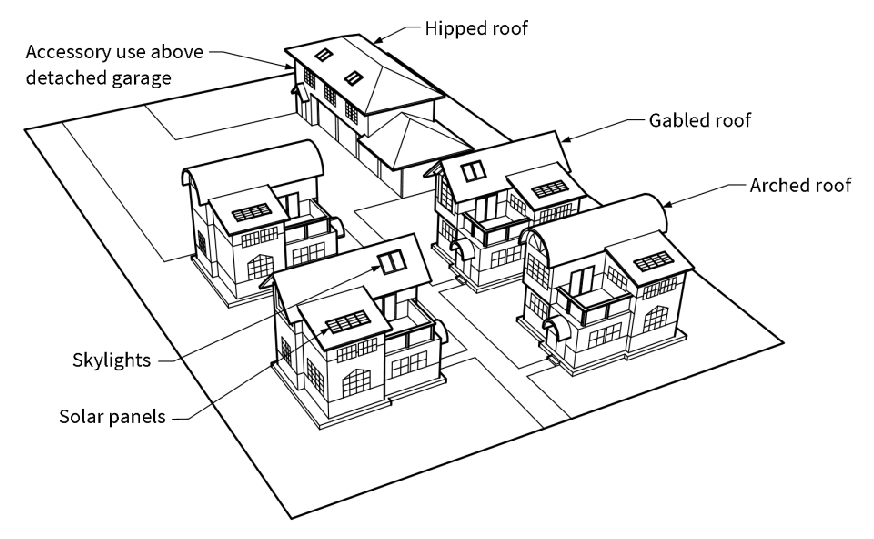
180-5.2.2.
Farmers' Markets. This use may sell food, food products, arts, and crafts prepared on- or off-site, as long as its principal ingredients or components are grown on-site or within Colorado.
180-5.2.3.
Outdoor Storage Areas.
A.
Purpose. The purpose of outdoor storage requirements is to promote safe and attractive residential and commercial areas in Frisco.
B.
Applicability. The provisions of this Section 180-5.2.3 shall apply to all properties within the Town of Frisco.
C.
General Provisions.
1.
Screening.
a.
Outdoor storage (including, but not limited to, commercial items, commercial construction or industrial related materials and equipment within commercial zones) shall be screened in a manner that is attractive and complementary to the principal use and/or structure that it serves. Such screening shall utilize enclosures such as, but not limited to, fences, walls, landscaping, or berms, so that no outdoor storage is visible from any public right-of-way, parks, public trails, and adjacent properties, with the exceptions outlined below.
b.
Exceptions within zones that allow residential use for properties where a residential use exists:
i.
The storage of materials or objects that are clearly incidental and customary to the residential functions of a residential property are not required to be screened, including, but not limited to, the storage of firewood and barbecue grills.
c.
Exceptions within all zones:
i.
Operable and licensed vehicles are not required to be screened. All inoperable vehicles shall comply with Section 124-4.M of the Town Code.
ii.
Refuse containers shall meet the requirements found in Section 6.17.
2.
Vehicle Access to Outdoor Storage Areas. If the outdoor storage area requires vehicular access, it shall be provided in accordance with Chapter 155, Minimum Street Design and Criteria. It shall not impair vehicular or pedestrian movements along public rights-of-way, including sidewalks and public trails.
D.
Construction Staging. An approved development application and grading or building permit are required prior to any construction staging activity. For construction staging not located on the same parcel as the approved building permit, approval of the off-site construction staging location is required.
1.
Off-site Construction Staging Criteria.
a.
The construction project for which the staging area is required is active as evidenced by an active and valid building permit or other evidence deemed acceptable by the Town.
b.
The approval for off-site construction staging shall only be valid for 365 days, or for 30 days following project completion or building permit expiration, whichever occurs first. One renewal of up to an additional 365 days may be granted, subject to the applicant showing diligent progress on the construction project associated with the staging area.
c.
The off-site staging area shall not be used to pre-construct any part of the building or site improvements, only as a laydown area to store materials, equipment, trailers and other such items.
d.
Any Construction trailers on the site shall be identified as part of the application and must meet the requirements of Section 180-5.4.1.
e.
The use complies with all other applicable criteria and requirements of this Code, specifically including, but not limited to, the site grading and development standards set forth in Section 180-6.
f.
The application shall be reviewed by the Town in accordance with the Site Plan Review process as designated in Section 180-2.5.2. The permit review may be consolidated with other development applications as appropriate. Public notice, public hearing, and appeals requirements shall follow the requirements for the Site Plan Review process.
g.
Financial security may also be required in accordance with Section 180-6.4.
180-5.2.4.
Outdoor Commercial Establishments.
A.
Purpose. Outdoor commercial establishments allow a transient or mobile commercial use and/or structure not otherwise allowed under the Town's Zoning Chapter to locate within the Town on any nonresidential property with the owner's consent. This section is intended to allow outdoor commercial establishments which contribute to the pedestrian and small mountain town atmosphere of the Town by permitting certain outdoor commercial uses.
B.
Permit Approval. It shall be unlawful to construct, erect, or use, or to cause to be constructed, erected, changed, or used, in any zoning district of the Town, any outdoor commercial structure, or equipment, or to engage in an outdoor commercial use, unless and until an outdoor commercial establishment permit has been approved by the Community Development Department as provided in this Section 180-5.2.4. At the discretion of the Community Development Department, any application for an outdoor commercial establishment permit may be referred to the Planning Commission for approval.
C.
Permitted Uses.
1.
Outdoor commercial establishment permitted uses include and are limited to the following: mobile food vendors, including carts and trucks, mobile vendors of merchandise, sale of merchandise, such as for sidewalk sales and other special events, seasonal farmer's markets and other similar fresh food sales, temporary art and craft fairs and festivals, seasonal holiday sales, and community events.
2.
Mobile vendors are defined as mobile carts and trucks that are under independent ownership from an established business located within a building in Frisco.
3.
The following criteria apply to mobile vendors along Main Street between Madison Avenue and Summit Boulevard:
a.
There shall be no more than one mobile vendor per each Main Street block. For purposes of this section, a Main Street block is defined as both sides of Main Street between any two intervening cross streets. Issuance of an outdoor commercial establishment license for such use shall be on a first come first serve basis, based upon the date of a complete application for the use.
b.
All Mobile Vendor structures or equipment shall not utilize temporary tents, and each outdoor commercial establishment must be able to secure the structure or equipment utilized each night while not in use.
c.
All outdoor commercial use that includes the sale of food shall remove any food item and trash from the structure or equipment each night while not in use.
d.
No Mobile Vendor may be in operation and open for business during more than 180 days in any calendar year.
4.
Exemption: Not withstanding any of the forgoing, any Town-sponsored outdoor community-wide events and festivals, held on Town-controlled property or on private property with permission of the property owner, are exempt from the regulations under this section.
D.
Permit Review Criteria. The Community Development Department shall approve an application if all of the foregoing and following applicable criteria and specific regulations are met or may deny an application for failure to meet the foregoing or following applicable criteria and specific regulations, or may impose such conditions of approval as may be necessary for approval of an outdoor commercial establishment permit to ensure that all of the following applicable criteria and specific regulations are met:
1.
The allowance of such outdoor commercial establishment will not be detrimental to the public health, safety, or general welfare, and the outdoor commercial establishment is compatible with the purpose and intent of this Chapter and the specific zoning district in which the outdoor commercial establishment is proposed.
2.
The outdoor commercial establishment is compatible in intensity of use, characteristics, and appearance with the existing land uses in the immediate vicinity of the proposed location. The use, value, and qualities of the neighborhood surrounding the proposed location will not be adversely affected by the outdoor commercial establishment or activities within it. Factors such as location, access, traffic generation, noise, lighting, parking, dust control, hours of operation, and structure, height, size, and appearance will be considered.
3.
The applicant shall provide as part of their application written consent from the property owner. If the outdoor commercial establishment is to be located partially or entirely on Town property, approval of the Town Council is required.
4.
Adequate parking is to be provided to serve the outdoor commercial establishment. The outdoor commercial establishment must not be located on or displace required parking spaces, including offsite spaces, seasonal snow storage areas (from October 31 to April 15) or loading areas of the principal permitted uses on the site. Required parking will be calculated based on the Town's parking requirements in Section 180-6.13 of this Chapter. Parking required for the outdoor commercial establishment shall be paved unless the applicant provides a method to minimize air pollution or dust on the property and on adjacent properties.
5.
No food or drink may be sold except in accordance with the standards and written approval of the Summit County Environmental Health Department, such approval must be submitted at time of application to the Community Development Department
6.
All lighting proposed for the outdoor commercial establishment shall meet the requirements of Section 180-6.16, Outdoor Lighting. No spot lights shall be permitted.
7.
It shall be unlawful for any outdoor commercial establishment merchandise or other promotional materials to hang from any building facade or door or from any foliage, and no outdoor commercial establishment shall block any window, door, or architectural feature of a building.
8.
Outdoor commercial establishments shall not be located within the right-of-way of any Town street or alley without the approval of the Town Council. Outdoor commercial establishments, upon approval from the Community Development Department and Public Works Department, may be allowed within the Town's three-foot sidewalk easement adjacent to both sides of the Main Street right-of-way as long as the outdoor commercial establishment does not significantly impede pedestrian traffic, snow removal, or general maintenance activities.
9.
No outdoor commercial establishment will be approved in a residential zoning district under this section of the Town Code or in an area where exclusively residential uses exist.
10.
Mobile Vendors. In addition to meeting all other requirements of this section, mobile vendor structure or equipment must provide for trash disposal and remove trash daily. Mobile vendor structure or equipment may not exceed 100 square feet in area.
11.
Formal seating areas are not permitted for any mobile vendor structure or equipment.
12.
An outdoor commercial establishment is limited to a maximum of ten square feet of signage, including any banners, and such signage may not be affixed to any building. No other items intended to draw attention to the outdoor commercial establishment are permitted (such as balloons, flags, etc.). All other requirements of Section 180-6.19 as amended from time to time, shall apply.
13.
For outdoor commercial establishments on Town-controlled property, at the discretion of the Town Council, financial security may be required to ensure compliance with any condition of approval and/or to ensure that the subject property is restored to its original use and condition.
14.
Before an outdoor commercial establishment involving the sale of merchandise or food may begin, the applicant's business must have a valid business license from the Town Clerk's office.
E.
Application. Application for an outdoor commercial establishment permit shall include:
1.
A general development application form obtained from the Community Development Department.
2.
A plan showing property lines, existing and proposed features relevant to the outdoor commercial establishment, the location of the outdoor commercial establishment in relationship to uses and structures in the immediate vicinity, setbacks from property lines, fencing or screening, lighting, trash receptacles, sign locations, parking, and anticipated circulation patterns. An application for an outdoor commercial establishment shall include drawings or pictures of any structure or equipment including elevations and a description of colors and materials proposed.
3.
A letter of intent explaining the nature of the outdoor commercial establishment including, but not limited to, the time period requested, hours of operation.
4.
Such other information as may be deemed necessary by the Community Development Department for the purposes of evaluating the application.
5.
Payment of the applicable permit fee and security deposit, if any. If determined necessary by the Community Development Department or Town Council, financial security may be required to ensure compliance with any and all conditions of approval and/or to restore the subject property to its original use and condition.
F.
No Vesting of Outdoor Commercial Establishments. A development application for and an approval of an outdoor commercial establishment shall not constitute nor be interpreted by any property owner, applicant or court as a site specific development plan entitled to vesting under Article 68 of Title 24 of the Colorado Revised Statues. Outdoor commercial establishments shall be considered transitory at all times and shall not vest. The failure of an applicant to adhere to any condition of approval for an outdoor commercial establishment shall result in the immediate forfeiture of approval and such establishment and the use of any accompanying structure or equipment shall immediately cease and may be subject to abatement as a public nuisance as provided for in the Code of the Town of Frisco.
G.
Appeals. Any appeal of the Community Development Department decision regarding an outdoor commercial establishment permit shall be made in accordance with Section 180-2.7.1 of this Chapter.
H.
Expiration of Approval. If a holder of an approved outdoor commercial establishment fails to renew the Town's annual business license within six months of receipt of said license renewal, the previously approved outdoor commercial establishment permit shall be deemed to be expired. An application for a new outdoor commercial establishment permit meeting all of the standards of this Section 180-5.2.4 will be required.
I.
Approval. Any change in use or location of an approved outdoor commercial establishment shall require a new outdoor commercial establishment application be submitted to the Community Development Department for review.
J.
Nonconformity. Any existing outdoor commercial establishment approved prior to the adoption of the current requirements may continue to operate under the conditions of approval.
K.
Fire Extinguisher Requirement. All mobile vendors with any heat source, and any mobile vendor using electricity for the purposes of operating equipment are required to have an approved fire extinguisher with a classification of 2-A:101B:C at the location of the outdoor commercial establishment.
180-5.2.5.
Mobile Homes and Campers.
A.
Permitted Occupancy. Mobile homes and mobile home parks are not permitted in Frisco. Campers may be occupied only within a campground.
B.
Mobile Home Parks. Mobile home parks existing as of the effective date of Ordinance 03-14 shall conform to the following requirements:
1.
No mobile home park shall contain more than 22 mobile homes per acre.
2.
Each mobile home site shall have an area of not less than 5,000 square feet.
3.
Mobile homes shall not be closer to each other or other structures than ten feet end to end or 20 feet laterally.
4.
Each mobile home site shall be serviced with water and sanitary sewage suitable for permanent connection.
5.
No mobile home shall be placed within 100 feet of a street line or 40 feet of any other lot line.
6.
Mobile home parks must have approved access from the Planning Commission and Summit Fire and EMS.
C.
Campgrounds. Campgrounds shall conform to the following minimum requirements:
1.
A minimum lot area of ten acres is required.
2.
Each rental site shall have an area of not less than 2,500 square feet and a width of not less than 40 feet in its smallest dimension.
3.
If each rental site is not serviced with water and sanitary drainage, common sanitary facilities shall be provided.
4.
No rental site for overnight occupancy shall be placed within 100 feet of a street line or 40 feet of any other lot line.
5.
No campground shall be occupied by the same person for more than six continuous months in any 12-month period.
6.
Campgrounds must receive approval of access and circulation by the Frisco Public Works Department, Planning Commission, and Summit Fired & EMS.
D.
Transitional Shelter Facility. Transitional Shelter Facilities shall conform to the following requirements:
1.
The application for the facility shall be submitted by the individual or entity that will be responsible for operation and maintenance of the facility, and for the application and approval process for potential users of the facility.
2.
The application shall include a site plan, which shall indicate access, user parking areas, sanitation, and refuse management facilities.
3.
The application shall include a facility management plan that includes, at a minimum: the process for application, and the criteria for approval, of use of the facility, including proof of local employment; facility rules of operation; and operator contact information for the individual(s) who will be available to respond to issues; and
4.
If the owner of the property on which the facility is proposed is not the for the facility, the applicant shall provide written approval of the owner for the proposed use.
180-5.2.6.
Medical Marijuana Dispensaries.
A.
Purpose and Intent. The purpose of this section is to implement the provisions of Article 43.3 of Title 12, C.R.S., known as the Colorado Medical Marijuana Code, and to regulate medical marijuana businesses in the interest of public health, safety, and general welfare. In particular, this section is intended to regulate the sale and distribution of marijuana in the interests of patients who qualify to obtain, possess, and use marijuana for medical purposes under Article XVIII, Section 14 of the Colorado Constitution. Nothing in this section is intended to promote or condone the sale, distribution, possession, or use of marijuana in violation of any applicable law. Compliance with the requirements of this section shall not provide a defense to criminal prosecution under any applicable law.
B.
Other Laws. If the state adopts any stricter regulation governing a medical marijuana business than that set forth in this section, the stricter regulation shall control the establishment or operation of any medical marijuana business in the Town. A licensee shall be required to demonstrate, upon demand by the local licensing authority, or by law enforcement officers, that the source and quantity of any marijuana found upon the licensed premises are in full compliance with applicable state regulation. If the state prohibits the sale or other distribution of medical marijuana, any license issued under this Section shall be deemed immediately revoked by operation of law, with no ground for appeal or other redress by the licensee. The issuance of any license pursuant to this section shall not be deemed to create an exception, defense or immunity to any person in regard to any potential criminal liability the person may have for the cultivation, possession, sale, distribution, or use of marijuana.
C.
Licensing Authority Created. There shall be and is hereby created a Medical Marijuana Licensing Authority hereafter referred to in this section as the "Authority."
D.
Composition of the Authority. The Authority shall be the Town Clerk.
E.
Functions of the Authority. The Authority shall have the duty and authority pursuant to the Colorado Medical Marijuana Code and this section to grant or deny licenses, as well as all powers of a local licensing authority as set forth in the Colorado Medical Marijuana Code. The Authority shall have the power to:
1.
Promulgate rules and regulations concerning the procedures for hearings before the Authority;
2.
Require any applicant or licensee to furnish any relevant information required by the Authority; and
3.
Administer oaths and issue subpoenas to require the presence of persons and the production papers, books and records at any hearing that the Authority is authorized to conduct. Any such subpoena shall be served in the same manner as a subpoena issued by a district court of the state.
F.
License Required; Term of License; Renewal Application.
1.
It shall be unlawful for any person to establish or operate a medical marijuana business in the Town without first having obtained from the Town and the state a license for each facility to be operated in connection with such business. Such licenses shall be kept current at all times and shall be conspicuously displayed at all times in the premises to which they apply. The failure to maintain a current license shall constitute a violation of this section.
2.
Any license issued by the Authority under this section shall expire at such time as any license then issued by the state or the medical marijuana business expires.
3.
An application for renewal of an existing license shall be made on forms provided by the Town and the state. At the time of the renewal application, each applicant shall pay a nonrefundable fee to the Town in the amount of $1,500.00 to defray the costs incurred by the Town for review of the application and inspection of the proposed premises, as well as any other costs associated with the processing of the application.
G.
Application Requirements; Payment of Application Fee.
1.
A person seeking a license pursuant to the Colorado Medical Marijuana Code and the provisions of this section shall submit an application to the Town on forms provided by the state and Town. At the time of application, each applicant shall pay a nonrefundable fee to the Town in the amount of $3,000.00 to defray the costs incurred by the Town for background investigations, review of the application and inspection of the proposed premises, as well as any other costs associated with the processing of the application. In addition, the applicant shall present for recording one of the following forms of identification:
a.
An identification card issued in accordance with C.R.S. § 42-2-302, C.R.S.;
b.
A valid state driver's license;
c.
A valid driver's license containing a picture issued by another state;
d.
A United States military identification card;
e.
A valid passport; or
f.
An alien registration card.
2.
The applicant shall also provide the following information on a form approved by, and acceptable to, the Town, which information shall be required for the applicant, and as applicable, the proposed manager of the medical marijuana business.
a.
Name, address, date of birth, and other identifying information as may be required by the Licensing Authority, as well as the name, address, date of birth, and other identifying information for any person that is required by the state in accordance with the applicant's application for a state license;
b.
A copy of the deed reflecting the applicant's ownership of, or a lease reflecting the right of the applicant to possess, the proposed licensed premises for the proposed use;
c.
Evidence of the issuance of a valid Town business license;
d.
Evidence of the issuance of a medical marijuana business license by the state licensing authority for the proposed licensed premise; and
e.
A "to scale" diagram of the boundaries of the proposed licensed premises;
f.
A description of any cultivation activities, if any, within the medical marijuana business including, without limitation, the area in which plants will be grown, and a description of the associated ventilation and odor filtration system for the premises; and
g.
If the medical marijuana business will be providing marijuana products in an edible form, evidence at a minimum of a pending application for any food establishment license that may be required by the state or by Summit County; and
h.
Any additional information that the Authority reasonably determines to be necessary in connection with the investigation, review, and determination of the application.
3.
A license issued pursuant to this section does not eliminate the need for the licensee to obtain other required permits or licenses related to the operation of the medical marijuana business including, without limitation, any development approvals or building permits required by this Code.
4.
Upon receipt of a complete application, the Authority shall circulate the application to all affected service areas and departments of the Town to determine whether the application is in full compliance with all applicable laws, rules, and regulations. No license shall be approved until after the Authority has caused the proposed premises to be inspected to determine compliance of the premises with any applicable requirements of this Article and Code, and with the plans and descriptions submitted as part of the application. Within 30 days after the completion of the Authority's investigation of the application, the Authority shall issue a written decision approving or denying the application for licensure, which decision shall state the reason(s) for the decision and be sent via certified mail to the applicant at the address shown in the application. In addition, the Authority shall promptly notify the state medical marijuana licensing authority of any approval of an application for local licensure.
5.
After approval of an application, the Authority shall not issue a license or license certificate until the building in which the business is to be conducted is ready for occupancy with such equipment in place as may be necessary to comply with the applicable provisions of this section. After approval of an application, the Authority shall not issue a license or license certificate until the applicant provides written evidence that the applicant has paid all license application fees due to the state in connection with the state licensing authority's review of the application. Each license certificate issued by the Town pursuant to this section shall specify the date of issuance, the period of licensure, the name of the licensee, and the premises or optional premises licensed.
H.
Issuance or Denial of Application. The Authority shall deny any application that does not meet the requirements or limitations of this section. The Authority shall deny any application that contains any false, misleading, or incomplete information. The Authority shall deny an application for good cause. Denial of an application for a license shall be subject to review by a court of competent jurisdiction.
I.
Persons Prohibited as Licensees. No license shall be issued to, held by, or renewed by any of the following:
1.
Any applicant who has made a false, misleading or fraudulent statement, or who has omitted pertinent information, on the application for a license;
2.
Any applicant for an optional premises cultivation operation license unless the applicant is simultaneously applying for, or currently holds, a license for a medical marijuana center or a medical marijuana-infused products manufacturing facility in the Town; and
3.
Any applicant for a medical marijuana-infused products manufacturer license unless the applicant is also applying for, or currently holds, a license for a medical marijuana center in the Town.
J.
Locational Criteria. No medical marijuana business shall be issued a license if, at the time of the initial application for such license, the proposed location is:
1.
Within 500 feet of any licensed child care facility;
2.
Within 500 feet of any educational institution or school, either public or private;
3.
Within 500 feet of any halfway house or correctional facility;
4.
Within 700 feet of another medical marijuana business or retail marijuana establishment;
5.
Within 500 feet of a residential dwelling unit;
6.
Within any residential zoning district, or the Central Core Zoning District, or the Mixed-Use Zoning District along East or West Main Street;
7.
Within any building containing a dwelling unit, a pediatrician's office, or any hotel, motel, condominium hotel, boarding facility, lodging facility or rooming facility; or
8.
Within a single development project that contains another medical marijuana business or a retail marijuana establishment.
For purposes of this section, a "residential dwelling unit" shall not include an accessory dwelling unit to a commercial unit nor any other dwelling unit that is accessory or incidental to a commercial. For purposes of this section, a "single development project" shall mean and include any area in which the property proposed for use as a medical marijuana business shares a common interest in common property, such as parking areas or sidewalk areas, or is a member of a property owners' association with another medical marijuana business or retail marijuana establishment. The distances set forth in this section shall be computed by direct measurement in a straight line from the nearest property line of the land used for the purposes stated above, respectively, to the nearest portion of the building in which the medical marijuana business is located. The locational criteria contained in this section shall apply to all proposed changes in the location of an existing license. Nothing in this subsection shall be construed so as to limit the location of a medical marijuana business or retail marijuana business based upon its distance from another medical marijuana business or retail marijuana establishment when the medical marijuana business is engaged in dual operations under Subsection (R) below or when the medical marijuana businesses are operated in the same licensed premises, in one contiguous location, and under the same ownership, in the event that applications for licensure of more than one medical marijuana business and/or retail marijuana establishment are pending at the same time and one proposed location is within 700 feet of another proposed location, the Licensing Authority shall consider and act first upon the application determined by the Licensing Authority to have first been a complete application without regard to the proposed location that is set forth in any application determined to have been complete at a later date.
Figure 5-BL Medical Marijuana Distance Requirements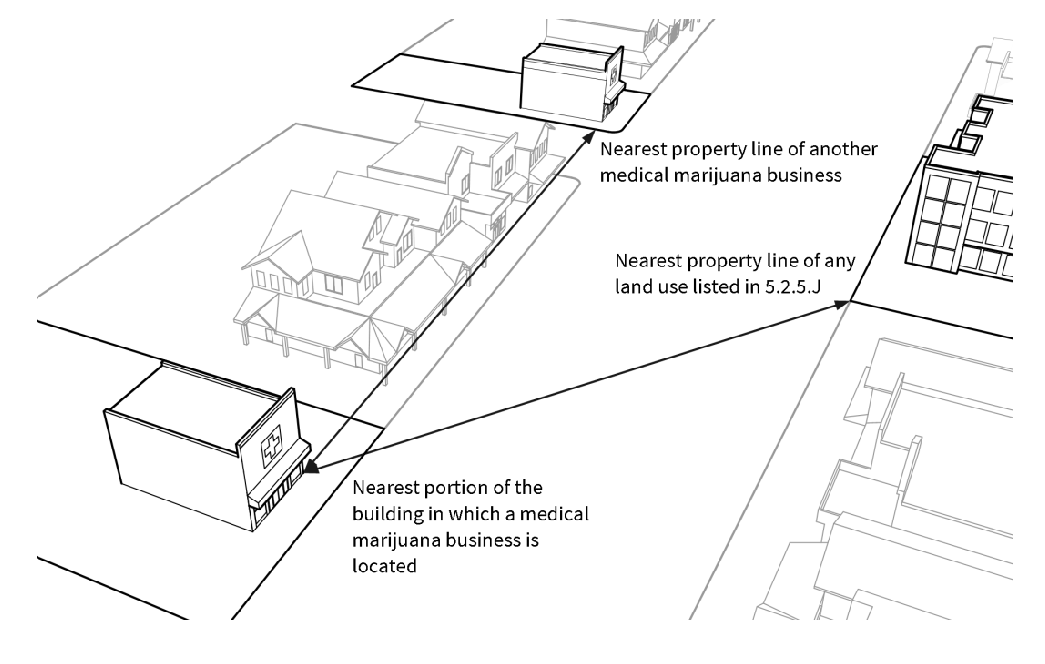
K.
Requirements Related to the Premises. Medical marijuana businesses shall be subject to the following additional requirements:
1.
All medical marijuana dispensing, production, manufacturing, and cultivation activities shall be conducted indoors.
2.
All product storage shall be indoors. Products, accessories, and associated paraphernalia shall not be visible from a public sidewalk or right-of-way. All medical marijuana or medical marijuana-infused products ready for sale shall be in a sealed or locked cabinet except when being accessed for distribution.
3.
The business may only be open for the sale, service, or distribution of medical marijuana between the hours of 8:00 a.m. and 10:00 p.m. of the same day, Monday through Sunday.
4.
No marijuana shall be consumed on the licensed premises.
5.
The cultivation of marijuana is only permitted when the premises are equipped with a system that removes the odors of the marijuana being cultivated so that the odor is not detectable from the exterior of the business or from within any adjoining premises. Approval of the odor removal system by the Building Official is required prior to any cultivation process beginning. The Building Official's determination of the adequacy of any proposed odor-removing system shall be based on his reasonable determination of the ability of the proposed system to remove odors as required by this Subsection, which determination shall be based upon the manufacturer's or an engineer's design specifications for the system as they relate to the premises in question.
L.
Prohibited Acts.
1.
It shall be unlawful for any licensee to permit the consumption of alcohol beverages, as defined in the Colorado Liquor Code, on the licensed premises.
2.
It shall be unlawful for any licensee holding a medical marijuana center license, or any agent or employee thereof, to sell, give, dispense or otherwise distribute medical marijuana or any medical marijuana infused product from any outdoor location or vehicle.
3.
It shall be unlawful for any optional premises cultivation operation to:
a.
Operate in the Town, unless it operates as an optional premises to a medical marijuana center or a medical marijuana-infused products manufacturer located in the Town that is under the same ownership as the optional premises cultivation operation; or
b.
Sell, give, dispense, or otherwise distribute medical marijuana except to a medical marijuana center or medical marijuana-infused products manufacturer located in the Town that is under the same ownership as the optional premises cultivation operation.
4.
It shall be unlawful for any medical marijuana-infused products manufacturer to:
a.
Operate in the Town unless its owner also holds a medical marijuana center license in the Town; or
b.
Sell, give, dispense, or otherwise distribute any of the products that it manufactures except to a medical marijuana center located in the Town that is under the same ownership as the medical marijuana-infused product manufacturer.
5.
After issuance of a license, it shall be unlawful for a licensee to make a physical change, alteration or modification of the licensed premises that materially or substantially alters the licensed premises or the usage of the licensed premises from the plans and specifications submitted at the time of obtaining the original license without obtaining the prior written approval of the Authority and the state licensing authority. For purposes of this subsection, physical changes, alterations or modification of the licensed premises, or in the usage of the premises requiring prior written approval, shall include, but not be limited to, the following:
a.
Any increase or decrease in the size or physical capacity of the licensed premises; and
b.
Any enlargement of a cultivation area.
M.
Inspection of Licensed Premises. During all business hours and other times of apparent activity, all licensed premises shall be subject to inspection by the Chief of Police or the Building Official, or the authorized representative of either of them, for the purpose of investigating and determining compliance with the provisions of this section and any other applicable state or local law or regulation. Such inspection may include, but need not be limited to, the inspection of books, records, and inventory. Where any part of the premises consists of a locked area, such area shall be made available for inspection, without delay, upon request.
N.
Nonrenewal, Suspension or Revocation of License.
1.
The Authority may suspend, revoke, or refuse to renew a license for good cause.
2.
The Authority shall not suspend or revoke a license until after notice and an opportunity for hearing has been provided to the licensee.
3.
The Authority shall not hold a hearing on a license renewal application unless a complaint has been filed concerning the licensee or there are allegations against the licensee that, if established, would be grounds for suspension, revocation, or non-renewal under this section.
O.
Violations and Penalties. In addition to the possible denial, suspension, revocation or nonrenewal of a license under the provisions of this section, any person, including, but not limited to, any licensee, manager or employee of a medical marijuana business, or any customer of such business, who violates any provision of this section, shall be guilty of a misdemeanor punishable in accordance with Section 1-14 of this Code.
P.
No Town Liability; Indemnification; No Defense.
1.
By accepting a license issued pursuant to this section, the licensee waives any claim concerning, and releases the Town, its officers, elected officials, employees, attorneys and agents from, any liability for injuries or damages of any kind that result from any arrest or prosecution of business owners, operators, employees, clients or customers of the licensee for a violation of state or federal laws, rules or regulations.
2.
By accepting a license issued pursuant to this section, all licensees, jointly and severally if more than one, agree to indemnify, defend and hold harmless the Town, its officers, elected officials, employees, attorneys, agents, insurers and self-insurance pool against all liability, claims and demands on account of any injury, loss or damage, including without limitation claims arising from bodily injury, personal injury, sickness, disease, death, property loss or damage, or any other loss of any kind whatsoever arising out of or in any manner connected with the operation of the medical marijuana business that is the subject of the license.
3.
The issuance of a license pursuant to this section shall not be deemed to create an exception, defense or immunity for any person in regard to any potential criminal liability the person may have under state or federal law for the cultivation, possession, sale, distribution, or use of marijuana.
Q.
Dual Operations. Any medical marijuana business that has been issued a license pursuant to this section may, in accordance with the requirements and limitations of state law, share its licensed premises with a licensed retail marijuana establishment.
R.
Medical Marijuana Definitions. The following words and phrases, when used in this section, shall have the meanings ascribed to them. In addition to the definitions contained in this section, other terms used in this section shall have the meaning ascribed to them in Article XVIII, Section 14, of the Colorado Constitution or the Colorado Medical Marijuana Code, and such definitions are hereby incorporated into this section by this reference.
1.
Applicant. Any person or entity who has submitted an application for a license or renewal of a license issued pursuant to this section. If the applicant is an entity and not a natural person, applicant shall include all persons who are the members, managers, officers, directors and shareholders of such entity.
2.
Colorado Medical Marijuana Code. Title 12, Article 43.3 of the Colorado Revised Statutes, as amended from time to time, and any rules or regulations promulgated thereunder.
3.
Cultivation or Cultivate. The process by which a person grows a marijuana plant.
4.
Dual Operation. A business that operates both as a licensed medical marijuana business and a licensed store in accordance with Subsection Q.
5.
Good Cause. For the purpose of refusing or denying a license or license renewal means:
a.
The licensee has violated, does not meet, or has failed to comply with any of the terms, conditions or provisions of this section, of the Colorado Medical Marijuana Code or of any rule and regulation promulgated pursuant to this section or the Colorado Medical Marijuana Code;
b.
The licensee has failed to comply with any special terms or conditions that were placed on its license, whether state or local, at the time the license was issued, or that were placed on its license, whether state or local, in prior disciplinary proceedings or that arose in the context of potential disciplinary proceedings; or
c.
The licensee's medical marijuana business has been found to have been operated in a manner that adversely affects the public health, welfare or safety of the immediate neighborhood in which the medical marijuana business is located. Evidence to support such a finding can include:
i.
A continuing pattern of offenses against the public peace;
ii.
A continuing pattern of drug-related criminal conduct within the premises of the medical marijuana business or in the immediate area surrounding the medical marijuana business; or
iii.
A continuing pattern of criminal conduct directly related to or arising from the operation of the medical marijuana business.
6.
Industrial Hemp. The plant of the genus cannabis and any part of such plant, whether growing or not, with a Delta-9 tetrahydrocannabinol concentration that does not exceed three-tenths percent on a dry weight basis.
7.
License. A document issued by the Town officially authorizing an applicant to operate a medical marijuana business pursuant to this section.
8.
Licensee. The person or entity to whom a license has been issued pursuant to this section.
9.
Licensed Premises. The premises specified in an application for a license under this section, or if required by the context, under Section 180-5.2.9 of this Chapter, which is owned or in possession of the licensee and within which the licensee is authorized to operate a medical marijuana business, or if required by context, a retail marijuana establishment, in accordance with state and local law.
10.
Marijuana. All parts of the plant of the genus cannabis whether growing or not, the seeds thereof, the resin extracted from any part of the plant, and every compound, manufacture, salt, derivative, mixture, or preparation of the plant, its seeds, or its resin, including marijuana concentrate. Marijuana does not include industrial hemp, nor does it include fiber produced from the stalks, oil, or cake made from the seeds of the plant, sterilized seed of the plant which is incapable of germination, or the weight of any other ingredient combined with marijuana to prepare topical or oral administrations, food, drink, or other product.
11.
Medical Marijuana Business or Business. A medical marijuana center, optional premises cultivation operation, or medical marijuana-infused products manufacturer as defined in the Colorado Medical Marijuana Code.
12.
Residential Zoning District. Includes the following Town of Frisco zoning districts:
a.
Residential Single-Household District;
b.
Residential Neighborhood District;
c.
Residential Low-Density District;
d.
Residential Medium Density District;
e.
Residential High Density District.
180-5.2.7.
Produce Stands. The majority of products sold at the stand shall have been grown, raised, or produced on the property where the stand is located. Only one stand is permitted on a property.
180-5.2.8.
Residential Uses in Central Core and Mixed-Use Districts.
A.
Central Core District. For properties located between Main Street and Galena Alley and properties located between Main Street and Granite Alley, residential uses and uses accessory to residential uses are prohibited on the ground floor.
B.
Mixed Use District. For properties fronting along Main Street, residential uses on the ground floor are a conditional use.
180-5.2.9.
Retail Marijuana.
A.
Purpose and Intent. The purpose of this section is to implement the Colorado Retail Marijuana Code, which authorizes the licensing and regulation of retail marijuana businesses and affords the Town the option to determine whether or not to allow retail marijuana businesses within its jurisdiction and to adopt licensing requirements that are supplemental to or more restrictive than the requirements set forth in state law. The intent of this section is to establish a nondiscriminatory mechanism by which the Town can control, through appropriate regulation, the location and operation of retail marijuana establishments within the Town. Nothing in this section is intended to promote or condone the sale, distribution, possession, or use of marijuana in violation of any applicable law. Compliance with the requirements of this section shall not provide a defense to criminal prosecution under any applicable law.
B.
Other Laws. If the state adopts any stricter regulation governing the sale or distribution of retail marijuana or retail marijuana products than that set forth in this section, the stricter regulation shall control the establishment or operation of any retail marijuana establishment in the Town. A licensee may be required to demonstrate, upon demand by the local licensing authority, or by law enforcement officers, that the source and quantity of any marijuana found upon the licensed premises are in full compliance with applicable state regulation. If the state prohibits the sale or other distribution of marijuana, any license issued under this section shall be deemed immediately revoked by operation of law, with no ground for appeal or other redress by the licensee. The issuance of any license pursuant to this section shall not be deemed to create an exception, defense or immunity to any person in regard to any potential criminal liability the person may have for the cultivation, possession, sale, distribution, or use of marijuana.
C.
Licensing Authority Created. There shall be and is hereby created a Local Licensing Authority hereafter referred to in this section as the "Authority."
D.
Composition of the Authority. The Authority shall be the Town Clerk.
E.
Functions of the Authority. The Authority shall have the duty and authority pursuant to this section to grant or deny licenses for marijuana stores. The Authority shall have the power to:
1.
Promulgate rules and regulations concerning the procedures for hearings before the Authority;
2.
Require any applicant or licensee to furnish any relevant information required by the Authority; and
3.
Administer oaths and issue subpoenas to require the presence of persons and the production papers, books and records at any hearing that the Authority is authorized to conduct. Any such subpoena shall be served in the same manner as a subpoena issued by a district court of the state.
F.
Retail Marijuana Establishment Prohibitions, Marijuana Store License Required; Term of License; Renewal Application, Taxes.
1.
It shall be unlawful for any person to operate any retail marijuana establishment within the Town of Frisco other than a marijuana store, marijuana cultivation facility, or marijuana products manufacturing facility that has been licensed by the state licensing authority. It shall further be unlawful for any person to operate any marijuana store, marijuana cultivation facility, or marijuana products manufacturing facility within the Town of Frisco without first having obtained from the Authority a license for the store or facility. Such licenses shall be kept current at all times and shall be conspicuously displayed at all times in the premises to which they apply. The failure to maintain a current state or Town license shall constitute a violation of this section.
2.
Any license issued by the Authority under this section shall expire at such time as any license then issued by the state for the marijuana store expires.
3.
An application for renewal of an existing license shall be made on forms provided by the Authority.
4.
A licensee shall collect and remit Town sales tax on all retail marijuana, retail marijuana products, paraphernalia and other tangible personal property sold at retail.
5.
A license issued pursuant to this section does not eliminate the need for the licensee to obtain other required permits or licenses related to the operation of the marijuana store, marijuana cultivation facility, or marijuana products manufacturing facility, including, without limitation, a Town business license, and any development approvals or building permits required by any applicable provisions of this Code.
G.
Application Requirements.
1.
A person seeking a license pursuant to the provisions of this section shall submit an application to the Town on forms provided by the Authority. As a part of any such application, the applicant shall present for recording one of the following forms of identification:
a.
An identification card issued in accordance with C.R.S. § 42-2-302;
b.
A valid state driver's license;
c.
A United States military identification card; or
d.
A valid passport.
2.
The applicant shall also provide the following information on a form approved by, and acceptable to, the Authority, which information shall be required for the applicant and the proposed manager of the marijuana store:
a.
Name, address, date of birth, and other identifying information as may be required by the Licensing Authority, as well as the name, address, date of birth, and other identifying information for any person that is required by the state in connection with the applicant's application for a state license;
b.
A copy of the deed reflecting the applicant's ownership of, or a lease reflecting the right of the applicant to possess, the proposed licensed premises for the proposed use;
c.
Evidence of the issuance of a valid Town business license;
d.
Evidence of the issuance of a marijuana store, marijuana cultivation facility and/or marijuana products manufacturing facility license by the state licensing authority for the proposed licensed premises;
e.
If the marijuana store will be providing retail marijuana products in an edible form, evidence, at a minimum, of a pending application for any food establishment license or permit that may be required by the state and Summit County;
f.
A description of cultivation activities, if any, within the retail marijuana establishment including, without limitation, the area in which plants will be grown, and a description of the associated ventilation and odor filtration system for the premises; and
g.
A "to scale" diagram of the boundaries of the proposed licensed premises.
3.
The applicant shall pay the to the Town a license fee in the amount of $3000.00 for an initial application, and $1,500.00 for an application to renew an existing license, to cover the cost of inspections conducted pursuant to Subsection (O) of this section for the purpose of determining compliance with this section and other applicable law.
H.
Issuance or Denial of Application.
1.
Upon receipt of a complete application, the Authority shall circulate the application to all affected service areas and departments of the Town to determine whether the application is in full compliance with all applicable laws, rules, and regulations. Within 30 days after the completion of the Authority's investigation of the application, the Authority shall issue a written decision approving or denying the application for licensure, which decision shall state the reason(s) for the decision and be sent via registered mail to the applicant at the address shown in the application. In addition, the Authority shall promptly notify the state licensing authority of its decision on the application for local licensure.
2.
The Authority shall deny any application that does not meet the requirements or limitations of this section. The Authority shall deny any application that contains any false, misleading, or incomplete information. The Authority shall deny an application for good cause. Denial of an application for a license shall not be subject to further administrative review, but shall subject to review by a court of competent jurisdiction.
3.
The Authority may impose such reasonable terms and conditions on a license as may be necessary or desirable to ensure compliance with the requirements of this section.
I.
Locational Criteria. A retail marijuana establishment shall be operated from a permanent, indoor location and, except as further limited in this subsection, within a zoning district of the Town that allows for retail sale uses. No retail marijuana establishment shall be permitted to operate from a moveable, mobile, or transitory location. The suitability of a location for a retail marijuana establishment shall be determined at the time of the issuance of the first license. The fact that later changes in the neighborhood occur that may render the site unsuitable for a marijuana store shall not be grounds to suspend, revoke, or refuse to renew the license. Noapplicant shall be issued a license for a retail marijuana establishment if, at the time of the initial application for such license, the proposed location of the licensed premise is:
1.
Within 500 feet of any licensed child care facility;
2.
Within 500 feet of any educational institution or school, either public or private;
3.
Within 500 feet of any halfway house or correctional facility;
4.
Within 700 feet of another retail marijuana establishment or medical marijuana business;
5.
Within 500 feet of a residential dwelling unit;
6.
Within any residential zoning district, or the Central Core Zoning District, or the Mixed-Use Zoning District along East or West Main Street;
7.
Within any building containing a dwelling unit, a pediatrician's office, or any hotel, motel, condominium hotel, boarding facility, lodging facility or rooming facility; or
8.
Within a single development project that contains another retail marijuana establishment or medical marijuana business.
For the purposes of this section, a "residential dwelling unit" shall not include an accessory dwelling unit to a commercial unit, nor any other dwelling unit that is accessory or incidental to a commercial use. For purposes of this section, a "single development project" shall mean and include any area in which the property proposed for use as a retail marijuana establishment shares a common interest in common property, such as parking areas or sidewalk areas, or is a member of a property owners' association with another retail marijuana establishment or medical marijuana business. The distances set forth in this subsection shall be computed by direct measurement in a straight line from the nearest property line of the land used for the purposes stated above, respectively, to the nearest portion of the building in which the medical marijuana business is located. The locational criteria contained in this subsection shall apply to all proposed changes in the location of an existing license. Nothing is this subsection shall be construed so as to limit the location of a retail marijuana establishment based upon its distance from another retail marijuana establishment or medical marijuana business when the retail marijuana establishment is engaged in dual operations under Subsection L below, or where the retail marijuana establishments are operated in the same licensed premises, in one contiguous location, and under the same ownership. In the event that applications for licensure of more than one medical marijuana business and/or retail marijuana establishment are pending at the same time and one proposed location is within 700 feet of another proposed location, the Licensing Authority shall consider and act first upon the application determined by the Licensing Authority to have first been a complete application without regard to the proposed location that is set forth in any application determined to have been complete at a later date.
Figure 5-C: Retail Marijuana Distance Requirements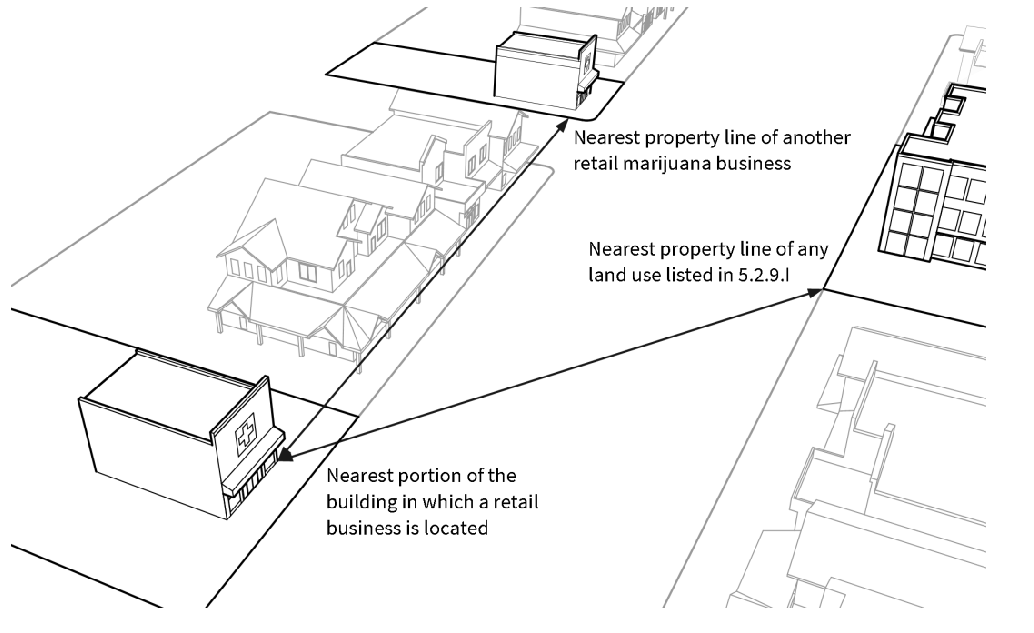
J.
Requirements Related to the Premises. Marijuana stores shall be subject to the following additional requirements:
1.
A licensed marijuana store may sell retail marijuana or retail marijuana products to persons 21 years of age or older in the following quantities:
a.
Up to one ounce of retail marijuana or its equivalent in retail marijuana products during a single sales transaction to Colorado residents; or
b.
Up to one-quarter ounce of retail marijuana or its equivalent in retail marijuana products during a single sales transaction to a non-Colorado resident.
2.
The following forms of identification may be accepted to determine Colorado residency: a valid state of Colorado driver's license; a valid state of Colorado identification card; or any other valid government-issued picture identification that demonstrates that the holder of the identification is a Colorado resident.
3.
The retail marijuana offered for sale and distribution shall be packaged and labeled in accordance with state law.
4.
The business may only be open for the sale or distribution of retail marijuana or retail marijuana products only between the hours of 8:00 a.m. and 10:00 p.m. of the same day, Monday through Sunday.
5.
No marijuana shall be consumed on the licensed premises.
6.
The cultivation of marijuana is only permitted when the premises are equipped with a system that removes the odors of the marijuana being cultivated so that the odor is not detectable from the exterior of the business or from within any adjoining premises. Approval of the odor removal system by the Building Official is required prior to any cultivation process beginning. The Building Official's determination of the adequacy of any proposed odor-removing system shall be based on his reasonable determination of the ability of the proposed system to remove odors as required by this subsection which determination shall be based upon the manufacturer's or an engineer's design specifications for the system as they relate to the premises in question.
K.
Prohibited Acts Related to Marijuana Cultivation Facilities and Marijuana Product Manufacturing Facilities.
1.
It shall be unlawful for any marijuana cultivation facility to:
a.
Operate in the Town, unless it operates in the same licensed premises and under the same ownership with a marijuana store located in the Town; or
b.
Sell, give, dispense, or otherwise distribute marijuana except to the marijuana store located in the same licensed premises and that is under the same ownership as the marijuana cultivation facility.
2.
It shall be unlawful for any marijuana product manufacturing facility to:
a.
Operate in the Town, unless it operates in the same licensed premises and under the same ownership with a marijuana store located in the Town; or
b.
Sell, give, dispense, or otherwise distribute any of the products that it manufactures except to the marijuana store located in the same licensed premises and under the same ownership as the marijuana product manufacturing facility.
L.
Dual Operations. Any medical marijuana business that has been issued a license pursuant to Section 180-5.2.6 of this Chapter may, in accordance with the requirements and limitations of this section and state law, share its licensed premises with a licensed retail marijuana establishment.
M.
Legal Nonconformity. Any other provision of this Chapter notwithstanding, any medical marijuana business that has, as of October 1, 2013, been issued a license pursuant to Section 180-5.2.6 of this Chapter, whether for a medical marijuana center, optional premises cultivation operation, or medical marijuana-infused products manufacturer, or any combination thereof, each as defined in the Colorado Medical Marijuana Code, may, without diminution of any legal nonconforming status that it may have, engage in dual operations as set forth in Subsection L above, or may, in accordance with applicable law, transfer its operations to that of a marijuana store, so long as, in each instance, the floor area of the dual operations or the new marijuana store does not exceed the floor area of the licensed medical marijuana business as of October 1, 2013.
N.
Prohibited Acts. It is unlawful for any licensee to:
1.
Permit the consumption of alcohol beverages, as defined in the Colorado Liquor Code, on the licensed premises;
2.
Purchase or otherwise obtain retail marijuana from a source that is not properly authorized under state and local law to sell or dispense retail marijuana;
3.
Permit the use, consumption, ingestion or inhalation of retail marijuana or retail marijuana products on or in the premises of a marijuana store; or
4.
Dispense marijuana to a person that is or appears to be under the influence of alcohol or under the influence of any controlled substance, including marijuana.
5.
After issuance of a license, make a physical change, alteration, or modification to the licensed premises that materially or substantially alters the licensed premises or the usage of the licensed premises from the plans and specifications submitted at the time of obtaining the original license without obtaining the prior written approval of the Authority and the state licensing authority. For purposes of this subsection, physical changes, alterations or modification of the licensed premises or in the usage of the premises requiring prior written approval, shall include, but not be limited to, the following:
a.
Any increase or decrease in the size or physical capacity of the licensed premises; and
b.
Any enlargement of a cultivation area.
O.
Inspection of Licensed Premises. During all business hours and other times of apparent activity, all licensed premises shall be subject to inspection by the Chief of Police or the Building Official, or the authorized representative of either of them, for the purpose of investigating and determining compliance with the provisions of this section and any other applicable state or local law or regulation. Such inspection may include, but need not be limited to, the inspection of books, records, and inventory. Where any part of the premises consists of a locked area, such area shall be made available for inspection, without delay, upon request.
P.
Nonrenewal, Suspension or Revocation of License.
1.
The Authority may suspend, revoke, or refuse to renew a license for good cause.
2.
The Authority shall not suspend or revoke a license until after notice and an opportunity for hearing has been provided to the licensee.
3.
The Authority shall not hold a hearing on a license renewal application unless a complaint has been filed concerning the licensee or there are allegations against the licensee that, if established, would be grounds for suspension, revocation, or non-renewal under Subsection (Q) of this section.
Q.
Violations and Penalties. In addition to the possible denial, suspension, revocation or nonrenewal of a license under the provisions of this section, any person, including, but not limited to, any licensee, manager, or employee of a marijuana store who violates any provision of this section, shall be guilty of a misdemeanor punishable in accordance with Section 1-14 of this Code.
R.
No Town Liability; Indemnification; No Defense.
1.
By accepting a license issued pursuant to this section, the licensee waives any claim concerning, and releases the Town, its officers, elected officials, employees, attorneys and agents from any liability for injuries or damages of any kind that result from any arrest or prosecution of business owners, operators, employees, clients or customers of the licensee for a violation of state or federal laws, rules or regulations.
2.
By accepting a license issued pursuant to this section, all licensees, jointly and severally if more than one, agree to indemnify, defend and hold harmless the Town, its officers, elected officials, employees, attorneys, agents, insurers and self-insurance pool against all liability, claims and demands on account of any injury, loss or damage, including without limitation claims arising from bodily injury, personal injury, sickness, disease, death, property loss or damage, or any other loss of any kind whatsoever arising out of or in any manner connected with the operation of the marijuana store that is the subject of the license.
3.
The issuance of a license pursuant to this section shall not be deemed to create an exception, defense or immunity for any person in regard to any potential criminal liability the person may have under state or federal law for the cultivation, possession, sale, distribution, or use of marijuana.
S.
Retail Marijuana Definitions. The following words and phrases, when used in this section, shall have the meanings ascribed to them by Section 180-5.2.9, Retail Marijuana. In addition to the definitions provided in this subsection, other terms used in this section shall have the meaning ascribed to them in Article XVIII, Section 16, of the Colorado Constitution or the Colorado Retail Marijuana Code, and such definitions are hereby incorporated into this subsection by this reference.
1.
Applicant. Any person or entity who has submitted an application for a license or renewal of a license issued pursuant to this section. If the applicant is an entity and not a natural person, applicant shall include all persons who are the members and managers of such entity.
2.
Colorado Medical Marijuana Code. Title 12, Article 43.3 of the Colorado Revised Statutes, as amended from time to time, and any rules or regulations promulgated thereunder.
3.
Colorado Retail Marijuana Code. Title 12, Article 43.4 of the Colorado Revised Statutes, as amended from time to time, and any rules or regulations promulgated thereunder.
4.
Consumer. A person 21 years of age or older who purchases marijuana or marijuana products for personal use by a person 21 years of age or older, but not for resale to others.
5.
Cultivation or Cultivate. The process by which a person grows a marijuana plant.
6.
Dual Operation. A business that operates as both a licensed medical marijuana business and a licensed marijuana store in accordance with Subsection (L) of this section.
7.
Industrial Hemp. The plant of the genus cannabis and any part of such plant, whether growing or not, with a Delta-9 tetrahydrocannabinol concentration that does not exceed three-tenths percent on a dry weight basis.
8.
Good Cause. For the purpose of refusing or denying a license or license renewal means:
a.
The licensee has violated, does not meet, or has failed to comply with any of the terms, conditions or provisions of this section, of the Colorado Retail Marijuana Code or of any rule and regulation promulgated pursuant to this section or the Colorado Retail Marijuana Code;
b.
The licensee has failed to comply with any special terms or conditions that were placed on its license, whether state or local, at the time the license was issued, or that were placed on its license, whether state or local, in prior disciplinary proceedings or that arose in the context of potential disciplinary proceedings; or
c.
The licensee's retail marijuana store has been found to have been operated in a manner that adversely affects the public health, welfare or safety of the immediate neighborhood in which the retail marijuana store is located. Evidence to support such a finding can include:
i.
A continuing pattern of offenses against the public peace;
ii.
A continuing pattern of drug-related criminal conduct within the premises of the retail marijuana store or in the immediate area surrounding the retail marijuana store; or
iii.
A continuing pattern of criminal conduct directly related to or arising from the operation of the retail marijuana establishment.
9.
License. A document issued by the Town officially authorizing an applicant to operate a retail marijuana establishment pursuant to this section or, if required by the context, means a document issued by the state licensing authority pursuant to the Colorado Retail Marijuana Code.
10.
Licensee. The person or entity to whom a license has been issued pursuant to this section.
11.
Licensed Premises. The premises specified in an application for a license under this section, or if required by the context, under Section 180-5.2.5 of this Chapter, which is owned or in possession of the licensee and within which the licensee is authorized to operate a retail marijuana establishment, or if required by context, a medical marijuana business, in accordance with state and local law.
12.
Marijuana. All parts of the plant of the genus cannabis whether growing or not, the seeds thereof, the resin extracted from any part of the plant, and every compound, manufacture, salt, derivative, mixture, or preparation of the plant, its seeds, or its resin, including marijuana concentrate. Marijuana does not include industrial hemp, nor does it include fiber produced from the stalks, oil, or cake made from the seeds of the plant, sterilized seed of the plant which is incapable of germination, or the weight of any other ingredient combined with marijuana to prepare topical or oral administrations, food, drink, or other product.
13.
Marijuana Accessories. Any equipment, products, or materials of any kind which are used, intended for use, or designed for use in planting, propagating, cultivating, growing, harvesting, composting, manufacturing, compounding, converting, producing, processing, preparing, testing, analyzing, packaging, repackaging, storing, vaporizing, or containing marijuana, or for ingesting, inhaling, or otherwise introducing marijuana into the human body.
14.
Marijuana Cultivation Facility. An entity licensed to cultivate, prepare, and package marijuana and sell marijuana to marijuana stores, but not to consumers.
15.
Marijuana Product Manufacturing Facility. An entity licensed to purchase marijuana; manufacture, prepare, and package marijuana products; and sell marijuana and marijuana products to marijuana stores, but not to consumers.
16.
Marijuana Store. An entity licensed to purchase marijuana from marijuana cultivation facilities and marijuana and marijuana products from marijuana product manufacturing facilities and to sell marijuana and marijuana products to consumers.
17.
Marijuana Testing Facility. An entity licensed to analyze and certify the safety and potency of marijuana.
18.
Medical Marijuana Business. A medical marijuana center, optional premises cultivation operation, or medical marijuana-infused products manufacturer as defined in the Colorado Medical Marijuana Code.
19.
Residential Zoning District. Includes the following Town of Frisco zoning districts:
a.
Residential Single-Household District;
b.
Residential Neighborhood District;
c.
Residential Low Density District;
d.
Residential Medium Density District;
e.
Residential High Density District.
20.
Retail Marijuana. Marijuana that is cultivated, manufactured, distributed, or sold by a licensed retail marijuana establishment.
21.
Retail Marijuana Establishment. A marijuana store, a marijuana cultivation facility, a marijuana products manufacturing facility or a marijuana testing facility.
22.
Retail Marijuana Products. Concentrated marijuana products and marijuana products that are comprised of marijuana and other ingredients that are intended for use or consumption, including without limitation edible products, ointments and tinctures.
23.
State Licensing Authority. The authority created by the Colorado Department of Revenue for the purpose of regulating and controlling the licensing of the cultivation, manufacture, distribution, sale and testing of retail marijuana in the State of Colorado pursuant to C.R.S. § 12-43.4-201.
180-5.2.10.
Sexually Oriented Businesses.
A.
Purpose and Intent. The purpose and intent of this section is to regulate sexually oriented businesses to promote the health, safety, and general welfare of the citizens of the Town, and to establish reasonable and uniform regulations to prevent the deleterious location and design of sexually oriented businesses within the Town, thereby reducing or eliminating the adverse secondary effects from such sexually oriented businesses. The provisions of this section are not intended to impose a limitation or restriction on the content of any communicative materials, including sexually oriented materials. It is not the intent of this section to restrict or deny access by adults to sexually oriented materials protected by the First Amendment or the Colorado Constitution, or to deny access by the distributors and exhibitors of sexually oriented entertainment to their intended market. Neither is it the intent nor effect of this section to condone or legitimize the distribution of obscene material.
B.
Definitions. The following words and phrases, when used in this section, shall have the meanings ascribed to them by Section 180-5.2.10, Sexually Oriented Businesses.
1.
Adult Arcade. Any commercial establishment to which the public is permitted or invited where, for any form of consideration, one or more still or motion picture projectors, slide projectors, or similar machines, or other image or virtual reality producing machines, for viewing by five or fewer persons per machine at any one time, are used regularly to show films, motion pictures, video cassettes, slides, or other photographic, digital or electronic reproductions describing, simulating or depicting "specified sexual activities" or "specified anatomical areas."
2.
Adult Bookstore, Adult Novelty Store, or Adult Video. A commercial establishment that, as one of its principal business purposes, offers for sale or rental for any form of consideration any one or more of the following:
a.
Books, magazines, periodicals or other printed matter, or photographs, films, motion pictures, video cassettes or video reproductions, slides, or other visual representations however produced that depict or describe "specified sexual activities" or "specified anatomical areas"; or
b.
Instruments, devices, or paraphernalia which are designed for use in connection with "specified sexual activities."
3.
Adult Cabaret. A nightclub, bar, restaurant, concert hall, auditorium or other commercial establishment that features:
a.
Persons who appear nude or in a state of nudity or seminudity; or
b.
Live performances that are characterized by the exposure of "specified anatomical areas" or by the exhibition of "specified sexual activities."
4.
Adult Motel. A hotel, motel or similar commercial establishment that offers accommodations to the public for any form of consideration and provides patrons with closed-circuit television transmission, films, motion pictures, video cassettes, slides, or other media productions, however produced, which are characterized by the depiction or description of "specified sexual activities" or "specified anatomical areas," and which commercial establishment has a sign visible from the public right-of-way which advertises the availability of this adult type of media production.
5.
Adult Motion Picture Theater. A commercial establishment that is distinguished or characterized by the showing, for any form of consideration, of films, motion pictures, video cassettes, slides, or similar photographic reproductions, on more than 100 days per year, that have an "X" rating or that have an emphasis on depicting or describing "specified sexual activities" or "specified anatomical areas."
6.
Adult Theater. A theater, concert hall, auditorium, or similar commercial establishment that, for any form of consideration, regularly features persons who appear in a state of nudity or live performances which are characterized by an emphasis on exposure of "specified anatomical areas" or by "specified sexual activities."
7.
Commercial Establishment. A Commercial Establishment may have other principal business purposes that do not involve the depicting or describing "specified sexual activities" or "specified anatomical areas" and still be categorized as a sexually oriented business. Such other business purposes will not serve to exempt such commercial establishments from being categorized as a sexually oriented business so long as one of its principal business purposes is the offering for sale or rental for consideration the specified materials that depict or describe "specified sexual activities" or "specified anatomical areas." The term "commercial establishment" includes clubs, fraternal organizations, social organizations, civic organizations, or other similar organizations with paid memberships.
8.
Employee. For the purposes of this section, a person who works or performs in and/or for a sexually oriented business, regardless of whether or not said person is paid a salary, wage, or other compensation by the operator of said business.
9.
Establishment of a Sexually Oriented Business. Any of the following:
a.
The opening or commencement of any such business as a new business;
b.
The conversion of an existing business into a sexually oriented business;
c.
The addition of a different sexually oriented business to any other existing sexually oriented business; or
d.
The relocation of a sexually oriented business.
10.
Foyer. An architectural element of a building that consists of an entry hall or vestibule that is completely enclosed and contains one door to provide access to areas outside of the building and a separate door to provide access to areas inside of the building.
11.
Licensee. A person in whose name a license to operate a sexually oriented business has been issued, as well as the individual listed as an applicant on the application for a sexually oriented business license.
12.
Licensing Officer. The Town Clerk or his or her designee.
13.
Manager. An operator, other than a licensee, who is employed by a sexually oriented business to act as a manager or supervisor of employees or is otherwise responsible for the operation of the business.
14.
Nude Model Studio. Any place where a person who appears in a state of nudity or displays "specified anatomical areas" is provided for money or any form of consideration to be observed, sketched, drawn, painted, sculpted, photographed, or similarly depicted by other persons.
15.
Nudity or State of Nudity.
a.
The appearance of human bare buttock, anus, male genitals, female genitals, or the areola or nipple of the female breast; or
b.
A state of dress which fails opaquely and fully to cover human buttocks, anus, male or female genitals, pubic region, or areola or nipple of the female breast.
16.
Operator. The owner, license holder, custodian, manager, operator, or person in charge of any licensed premises.
17.
Peep Booth. A room, semi-enclosure or other similar area located within a licensed premises wherein a person may view representations of "specified anatomical areas" or "specified sexual activities."
18.
Person. An individual, proprietorship, partnership, corporation, limited liability company, association, or other legal entity.
19.
Premises or Licensed Premises. For the purposes of this section, any premises that requires a sexually oriented business license and that is classified as a sexually oriented business, including parking lots and sidewalks immediately adjacent to the structure containing the sexually oriented business.
20.
Principal Business Purpose. As to any establishment, having as a substantial or significant portion of its stock in trade the items listed in subparagraphs (a) and (b) of the definition of adult bookstore, adult novelty store, or adult video store above and having on the premises at least 30 percent of the establishment's display space occupied by the display of the items described therein.
21.
Principal Owner. Any person owning, directly or beneficially:
a.
Any membership or partnership interest in a limited liability company or limited liability partnership if such person has any legal control or authority over the management or operation of the entity; or
b.
In the case of any other legal entity, five percent or more of the ownership interests in the entity, except for shareholders, but including such shareholders who are corporate officers or directors or who otherwise have any legal control or authority over the management or operation of the entity.
22.
Public Park. An area of land owned by a governmental entity and intended to be used for recreational purposes, but not including any such land that contains no improvements and is intended only for open space purposes, and not including any such land that is intended for use only for pathway purposes.
23.
Seminude or Seminudity. A state of dress in which clothing covers no more than the genitals, pubic region, and areola of the female breasts, as well as portions of the body covered by supporting straps or devices, which supporting straps or devices are used to support or enable the wearing of such clothing.
24.
Sexually-Oriented Business. An adult arcade, adult bookstore, adult novelty shop, adult video store, adult cabaret, adult motel, adult motion picture theater, adult theater, or nude model studio. The definition of sexually oriented business shall not include an establishment where a medical practitioner, psychologist, psychiatrist, or similar professional person licensed by the State of Colorado engages in medically approved and recognized sexual therapy.
25.
Specified Anatomical Areas. As used herein means and includes any of the following:
a.
Human genitals, pubic region, buttocks, anus or female breasts below a point immediately above the top of the areola, that are not completely and opaquely covered; or
b.
Human male genitals in a discernibly turgid state even if completely and opaquely covered.
26.
Specified Criminal Acts. Sexual crimes against children, sexual abuse, sexual assault, or crimes connected with another sexually oriented business including, but not limited to, distribution of obscenity, prostitution, or pandering.
27.
Specified Sexual Activities. Any of the following:
a.
The fondling or other intentional touching of human genitals, pubic region, buttocks, anus or female breasts;
b.
Sex acts, normal or perverted, actual or simulated, including intercourse, oral copulation, or sodomy;
c.
Masturbation, actual or simulated;
d.
Human genitals in a state of sexual stimulation, arousal, or tumescence; or
e.
Excretory functions as part of or in connection with any of the activities set forth in subsections a through d of this definition.
28.
Transfer of Ownership or Control of a Sexually oriented Business. Any of the following:
a.
The sale, lease, or sublease of the business;
b.
The transfer of securities that constitute a controlling interest in the business, whether by sale, exchange, or similar means; or
c.
The establishment of a trust, management arrangement, gift, or other similar legal device that transfers ownership or control of the business, including a transfer by bequest or operation of law.
C.
Interior Lighting Regulations.
1.
The interior portion of the premises of a sexually oriented business to which patrons are permitted access shall be equipped with overhead lighting fixtures of sufficient intensity to illuminate every place (including peep booths) at an illumination of not less than 5.0 foot-candles as measured at the floor level.
2.
It shall be the duty of the licensee and employees present on the premises to ensure that the illumination described above is maintained at all times that any patron is present on the premises.
D.
Location of Sexually Oriented Businesses and Design of Same.
1.
It shall be unlawful to operate or cause to be operated a sexually oriented business outside of the Gateway District, Commercial Oriented District, Mixed-Use District, Light Industrial District, and the Central Core District.
2.
It shall be unlawful to operate or cause to be operated a sexually oriented business within the Gateway District, Commercial Oriented District, Mixed-Use District, Light Industrial District, and the Central Core District within 500 feet of:
a.
Any church;
b.
Any school meeting all requirements of the compulsory education laws of the State of Colorado;
c.
An existing dwelling;
d.
A public park; or
e.
A licensed childcare facility.
3.
It shall be unlawful to operate or cause to be operated a sexually oriented business within the light industrial district zone on any property that has frontage on School Road.
4.
It shall be unlawful to cause or permit the operation, establishment, or maintenance of a sexually oriented business within 100 feet of any other sexually oriented business.
5.
All exterior windows in a sexually oriented business shall be opaque to such an extent that interior objects viewed from outside shall be so obscure as to be unidentifiable. Exterior windows in sexually oriented businesses shall not be used for any display or sign except for a sign that complies with the requirements of Section 180-5.2.10.O of this Chapter.
6.
All doors for ingress and egress to a sexually oriented business, except emergency exits used only for emergency purposes, shall be located on the front of the sexually oriented business. For purposes of this subsection, the front of a sexually oriented business shall be deemed to be that facade of the building that faces the front lot line of the lot or parcel on which the business is located. Every sexually oriented business shall have a foyer at every point of ingress or egress, except for emergency exits. In the case of a sexually oriented business having more than one front lot line, the sexually oriented business shall be oriented such that the front of the business faces away from the nearest of any of the land uses listed in Subsection (2) above.
E.
Measurement of Distance.
1.
The distance between any two sexually oriented businesses shall be measured in a straight line, without regard to intervening structures, from the closest exterior structural wall of each business, or, in the case of a sexually oriented business operating within a condominium estate or leasehold estate, from the closest airspace boundary of such condominium estate or from the closest wall of such leasehold estate.
Figure 5-D: Sexually Oriented Businesses Distance Requirements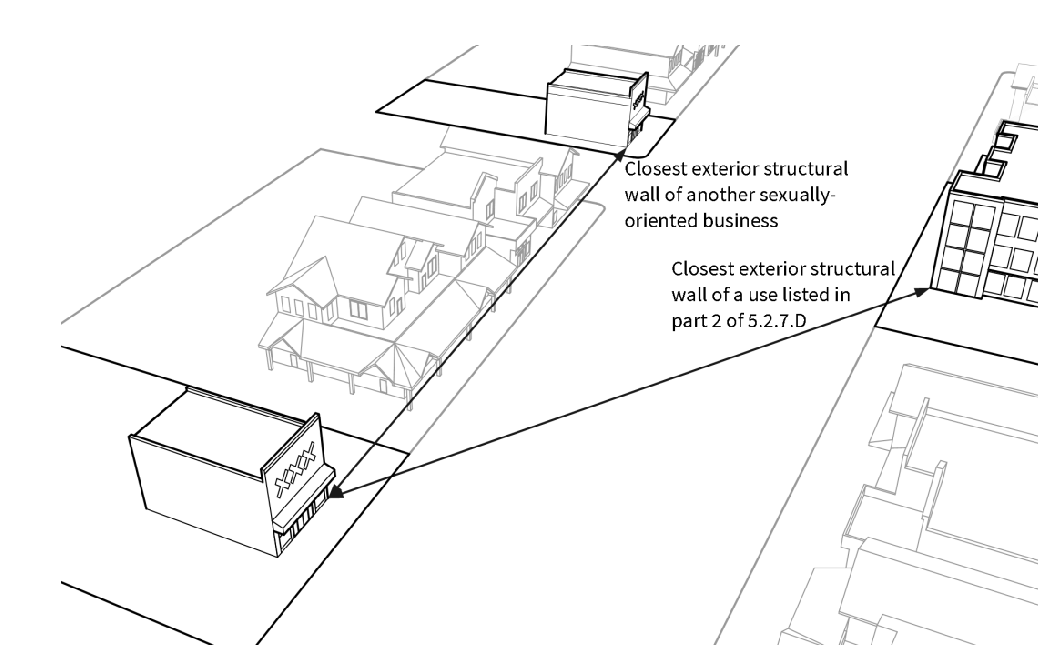
2.
The distance between any sexually oriented business and any church, school, dwelling, public park or childcare facility shall be measured in a straight line, without regard to intervening structures or objects, from the closest exterior structural wall of the sexually oriented business to the nearest property line of the premises of a church, school, dwelling, public park or childcare facility. If the premises where the sexually oriented business is conducted is comprised of a condominium estate or leasehold estate, such distance shall be measured in a straight line, without regard to intervening structures or objects, from the nearest airspace boundary of the condominium estate or the nearest wall of the leasehold estate used as part of the premises where the sexually oriented business is conducted to the nearest property line of the premises of a church, school, dwelling, public park or childcare facility.
F.
Other Locational Regulations.
1.
Any sexually oriented business lawfully operating on the effective date of this ordinance that is in violation of Section 180-5.2.10.D will be permitted to continue for a period of six months from the effective date hereof.
2.
Upon application made by the owner of a sexually oriented business within four months of the effective date of this ordinance, and notwithstanding the provisions of Subsection (1), the Town Manager may, after a hearing to be held within 30 days of the application, grant an extension of time during which a sexually oriented business in violation of Section 180-5.2.10.D will be permitted to continue upon a showing, by competent evidence, that the owner of the business has not had a reasonable time to recover the initial financial investment in the business. At the hearing, the Town Manager shall hear such statements and consider such evidence as the Town Attorney, the owner, occupant, lessee, or other party in interest, or any other witness shall offer that is relevant to issue of whether the owner of the business has had a reasonable time to recover the initial financial investment in the business. The Town Manager shall make findings of fact, from the statements and evidence offered, as to whether the owner of the business has had a reasonable time to recover the initial financial investment in the business. If the Town Manager grants an extension of time during which a sexually oriented business in violation of Section 180-5.2.10.D will be permitted to continue, he or she shall issue an order to that effect which states exactly the period of the extension. A copy of the order shall be mailed to or served on the owner within 30 days of the hearing. No extension of time shall be for a period greater than that reasonably necessary for the owner of the business to recover his or her initial financial investment in the business. A sexually oriented business in violation of Section 180-5.2.10.D may continue during such extended period unless the business is sooner terminated for any reason, or voluntarily discontinued for a period of 30 days or more. Such business shall not be enlarged, extended, or altered except that the business may be brought into compliance with this section. In performing his duties pursuant to this section, the Town Manager may retain independent counsel to advise him with regard to any matter.
3.
A sexually oriented business which at the time it received its sexually oriented business license was in compliance with the location requirements of Section 180-5.2.10.D does not violate that section if when the sexually oriented business applies to renew its valid sexually oriented business license a church, school, dwelling, public park or childcare facility is now located within 500 feet of the sexually oriented business. This provision applies only to the renewal of a valid sexually oriented business license and does not apply to an application for a sexually oriented business license that is submitted as a result of the previous sexually oriented business license at the same location expiring or being revoked.
G.
Stage Required in Adult Cabaret and Adult Theater. Any adult cabaret or adult theater shall have one or more separate areas designated as a stage in the diagram submitted as part of the application for the sexually oriented business license. Entertainers shall perform only upon a stage. The stage shall be fixed and immovable and located inside the building in which the adult use operates. No seating for the audience shall be permitted within three feet of the edge of the stage. No members of the audience shall be permitted upon the stage or within three feet of the edge of the stage.
H.
Conduct in Sexually Oriented Business.
1.
No licensee, manager or employee mingling with the patrons of a sexually oriented business, or serving food or drinks, shall be in a state of nudity. It is a defense to any prosecution for a violation of this subsection that an employee of a sexually oriented business exposed any specified anatomical area only during the employee's bona fide use of a restroom or during the employee's bona fide use of a dressing room that is accessible only to employees.
2.
No licensee, manager, or employee shall encourage or knowingly permit any person upon the premises to touch, caress, or fondle the genitals, pubic region, buttocks, anus, or breasts of any person.
I.
Employee Tips.
1.
It shall be unlawful for any employee of a sexually oriented business to receive tips from patrons except as set forth in Subsection 3 of this section.
2.
A licensee that desires to provide for tips from its patrons shall establish one or more boxes or other containers to receive tips. All tips for such employees shall be placed by the patron of the sexually oriented business into the tip box.
3.
A sexually oriented business that provides tip boxes for its patrons as provided in this section shall post one or more signs to be conspicuously visible to the patrons on the premises, in bold letters at least one inch high to read as follows:
"All tips are to be placed in the tip box and not handed directly to employees. Any physical contact between a patron and employees is strictly prohibited."
J.
Unlawful Acts. It shall be unlawful for a licensee, manager, or employee to violate any of the requirements of this Chapter, or of Article II of Chapter 110, or knowingly to permit any patron to violate the requirements of this section.
K.
Exemptions. The provisions of this section regulating nude model studios do not apply to:
1.
A college, junior college, or university supported entirely or partly by taxation;
2.
A private college or university that maintains and operates educational programs in which credits are transferable to a college, junior college, or university supported entirely or partly by taxation; or
3.
A business located in a structure that has no sign visible from the exterior of the structure and no other advertising that indicates a nude person is available for viewing; and where, in order to participate in a class, a student must enroll at least three days in advance of the class; and where no more than one nude model is on the premises at any one time.
L.
Regulation of Peep Booths. It shall be unlawful for a person who operates or causes to be operated a sexually oriented business with peep booths to violate the following requirements of this section:
1.
At least one employee must be on duty and situated at each manager's station at all times that any patron is present inside the premises. The interior of the premises shall be configured in such a manner that such employee shall be clearly visible from every area of the premises to which any patron is permitted access for any purpose, excluding restrooms. If the premises has two or more manager's stations designated, then the interior of the premises shall be configured in such a manner that there is an unobstructed view of the employee in at least one of the manager's stations from each area of the premises to which any patron is permitted access for any purpose. The view required in this subsection must be by direct line of sight from the manager's station. The view area shall remain unobstructed by any opaque coverings, two-way mirrors, doors, walls, merchandise, display racks, or other materials at all times, and no patron shall be permitted access to any area of the premises that has been designated as an area in which patrons will not be permitted in the application filed pursuant to Article II of Chapter 110 of this Code.
2.
The interior of the premises shall be configured in such a manner that there is an unobstructed view from a manager's station of every area of the premises to which any patron is permitted access for any purpose, excluding restrooms. Restrooms may not contain video display equipment. If the premises has two or more manager's stations designated, then the interior of the premises shall be configured in such a manner that there is an unobstructed view of each area of the premises to which any patron is permitted access for any purpose from at least one of the manager's stations. The view required in this subsection must be by direct line of sight from the manager's station. The view area shall remain unobstructed by any opaque coverings, two-way mirrors, doors, walls, merchandise, display racks, or other materials at all times, and no patron shall be permitted access to any area of the premises that has been designated as an area in which patrons will not be permitted in the application filed pursuant to Article II of Chapter 110 of this Code.
3.
No peep booth may be occupied by more than one person at any one time.
4.
No door, two-way mirror, screen, opaque covering, or other covering shall be placed or allowed to remain on any peep booth, and no holes or openings shall be placed or allowed to remain in the wall between any two adjacent peep booths.
M.
Hours of Operation. It shall be unlawful for a sexually oriented business to be open for business or for the licensee, manager or any employee of a licensee to allow patrons upon the licensed premises during the following time periods:
1.
On any Tuesday through Saturday from 2:00 a.m. until 7:00 a.m.;
2.
On any Monday, other than a Monday that falls on January 1, from 12:00 a.m. until 8:00 a.m.;
3.
On any Sunday from 2:00 a.m. until 8:00 a.m.;
4.
On any Monday which falls on January 1 from 2:00 a.m. until 7:00 a.m.
N.
Minimum Age.
1.
Except for such employees as may be permitted by law, it shall be unlawful for any person under the age of 21 years to be upon the premises of a sexually oriented business that operates pursuant to a type A sexually oriented business license. It shall be unlawful for any person under the age of 18 years to be upon the premises of a sexually oriented business.
2.
It shall be unlawful for the licensee, manager or any employee of the licensee to allow anyone under the age of 21 years, except for such employees as may be permitted by law, to be upon the premises of a sexually oriented business operated pursuant to a type A sexually oriented business license. It shall be unlawful for the licensee, manager or any employee of the licensee to allow anyone under the age of 18 years upon the premises of a sexually oriented business.
O.
Signs for Sexually Oriented Businesses. In addition to complying with all other sign regulations of this Chapter, a sexually oriented business shall display a sign, clearly visible and legible at the entrance to the business, that gives notice of the adult nature of the sexually oriented business and of the fact that the premises is off limits to minors or those under the age of 21 years, as the case may be. No sign for a sexually oriented business shall contain flashing lights, words, lettering, photographs, silhouettes, drawings, or pictorial representations that emphasize specified anatomical areas or specified sexual activities.
180-5.2.11.
Telecommunication Facilities.
A.
Purpose and Intent. The purpose and intent of this Section 180-5.2.11 is to accommodate the telecommunication needs of residents and businesses while protecting the public health, safety, and general welfare of the community. The Town Council finds that these regulations are necessary in order to:
1.
Facilitate the provision of wireless telecommunication services to the residents and businesses of the Town;
2.
Minimize adverse visual effects of towers through careful design and siting standards;
3.
Avoid potential damage to adjacent properties from tower failure through structural standards and setback requirements; and
4.
Encourage and maximize the use of existing and approved towers, buildings and other structures to accommodate new wireless telecommunication antennas in order to reduce the number of towers needed to serve the community.
B.
Applicability. The standards and procedures contained in this Section 180-5.2.11 apply to all applications for approval for telecommunication facilities. The Planned Unit Development process is not available to vary the standards applicable to telecommunication facilities. The applicant shall demonstrate that its proposed telecommunication facility meets all standards and provisions of this Section 180-5.2.11.
1.
Amateur Radio Antennas. This Section 180-5.2.11 shall not govern any tower or antenna owned or operated by a federally licensed amateur radio station operator or used exclusively for receive-only antennas. All other applicable zoning district requirements must be met.
2.
Residential Services and Small Dish Antennas. This Section 180-5.2.11 shall not govern any residential dish or antenna or the installation of any dish or antenna of less than three feet in diameter or seven square feet of frontal surface area.
3.
Pre-existing Telecommunication Facilities. Any telecommunication facility for which Town approval has been properly issued prior to the effective date of this Section 180-5.2.11 shall not be required to meet the requirements of this Section 180-5.2.11 other than the requirements of Sections 180-5.2.11.C.1. through 3, and Sections 180-5.2.11.C.5. through 7. Changes and additions to pre-existing telecommunication facilities must meet the applicable requirements of this Section 180-5.2.11.
C.
General Requirements. Unless otherwise provided by this Chapter or other applicable law, the following general requirements shall apply to all telecommunication facilities located within the Town of Frisco.
1.
Federal Requirements. All towers and antennas must meet or exceed the current standards and regulations of the FAA, the FCC, and any other agency of the federal government with the authority to regulate towers and antennas. If such standards and regulations are changed, then the owners of the towers and antennas governed by this Chapter shall bring such towers and antennas into compliance with such revised standards and regulations within the time period required by the controlling federal agency. Failure to bring a tower or antenna into compliance with such revised standards and regulations shall be a violation of this Chapter and constitute grounds for removal of the tower or antenna at the owner's expense.
2.
Radio Frequency Standards.
a.
All owners of telecommunication facilities shall comply with federal standards for radio frequency emissions.
b.
With the exception of any low power telecommunications facility, at the time of application for a tower, antenna or related telecommunication facilities, and thereafter at the request of the Town upon complaint (but not more than annually), the owner shall submit a project implementation report that provides cumulative field measurements of radio frequency emissions of all antennas installed at the subject site, and that compares the results with established federal standards.
c.
If, upon review, or at any time any telecommunications facility within the Town is operational, the Town finds that the facility does not meet federal standards, the Town may require corrective action within a reasonable period of time, and if not corrected, may require removal of the telecommunication facilities at the owner's expense. Any reasonable costs incurred by the Town, including reasonable consulting costs to verify compliance with these requirements, shall be paid by the owner.
3.
Building Codes; Safety Standards.
a.
To ensure the structural integrity of towers, the owner of a tower shall ensure that the tower is of sufficient structural strength to accommodate reasonable co-location, if required, and is maintained in compliance with standards for towers that are published by the Electronic Industries Association, as amended from time to time, and all other applicable codes of the Town.
b.
In addition to any other applicable standards and requirements, the following shall apply to all towers and telecommunication facilities:
i.
Sufficient anti-climbing measures must be incorporated into each facility to reduce potential for trespass and injury.
ii.
No guy wires employed may be anchored within the area in front of any principal building or structure on a parcel.
iii.
All telecommunication facilities shall comply with the power line clearance standards set forth by Colorado Public Utilities Commission.
iv.
All telecommunication facilities must be structurally designed and physically sited so that they do not pose a potential hazard to nearby residences or surrounding properties or improvements. Any tower shall be designed and maintained to withstand without failure maximum forces expected from wind, snow, ice, tornadoes, and other natural occurrences, when the tower is fully loaded with antennas, transmitters, and other telecommunication facilities and camouflaging. Initial demonstration of compliance with this requirement shall be provided via submission of a report to the Town's Building Official prepared and stamped by a structural engineer licensed in the State of Colorado describing the tower structure, specifying the number and type of antennas it is designed to accommodate, providing the basis for the calculations done, and documenting the actual calculations performed. Proof of ongoing compliance shall be provided upon request.
c.
If, upon inspection, the Town concludes that a telecommunication facility fails to comply with such codes and standards and constitutes a danger to persons or property, then upon notice being provided to the owner of a telecommunication facility, the owner shall have 30 days to bring such telecommunication facility into compliance with such standards. Upon good cause shown by the owner, the Town's Building Official may extend such compliance period not to exceed 90 days from the date of said notice. If the owner fails to bring such telecommunication facility into compliance within said time limit, the Town may remove such telecommunication facility at the owner's expense.
4.
Order of Preference.
a.
Zoning District. Applicants are encouraged to construct alternative telecommunication facilities in commercial districts. An applicant requesting approval to construct a telecommunication facility in a residential district must first demonstrate to the reasonable satisfaction of the Town that a location in a commercial district would not meet the applicant's service needs. Small cell facilities, however, shall be permitted as uses by right in all zone districts, subject to the process and standards described in Section 5.2.11.J.
b.
Facility Type. Wall- or roof-mounted telecommunication facilities and low power telecommunications facilities are preferred over freestanding telecommunication facilities. An applicant requesting approval to construct a freestanding telecommunication facility, which is not a low power facility must first demonstrate to the reasonable satisfaction of the Town that a wall- or roof-mounted facility is not feasible or is inadequate to provide service. When appropriate, the Town may require that an alternative telecommunication facility that reflects the character of the surrounding property (developed or undeveloped) be employed.
5.
Design Standards. The guidelines set forth in this Subsection 180-5.2.11.C.5 shall apply to the location of all telecommunication facilities governed by this Article VII; provided, however, that the Town may waive these requirements if it determines that the overall intent of this Section 180-5.2.11.C, as defined in 180-5.2.11.A, is not served by the implementation of a particular guideline with respect to a particular telecommunication facility.
a.
The location and design of a telecommunication facility and any accessory equipment shall use materials, colors, textures, screening, and landscaping that will blend the telecommunication facility to the surrounding natural setting and built environment. Accessory equipment in areas of high visibility shall, where possible, be sited below the ridgeline or designed (e.g., placed underground, depressed, or located behind earth berms) to minimize its profile.
b.
Any accessory equipment located within an overlay district adopted by the Town must generally conform with the intent of the specific district standards.
c.
Roof- and wall-mounted facilities shall be architecturally compatible with and colored to match the building or structure to which they are attached. Wall-mounted facilities shall be mounted as flush to the building wall as possible. A wall-mounted facility shall not encroach into the required setback for the building to which it is attached, and shall not extend across any required utility, pedestrian or sidewalk easement or extend across the property line.
Figure 5-E: Roof- and Wall-Mounted Telecommunications Facilities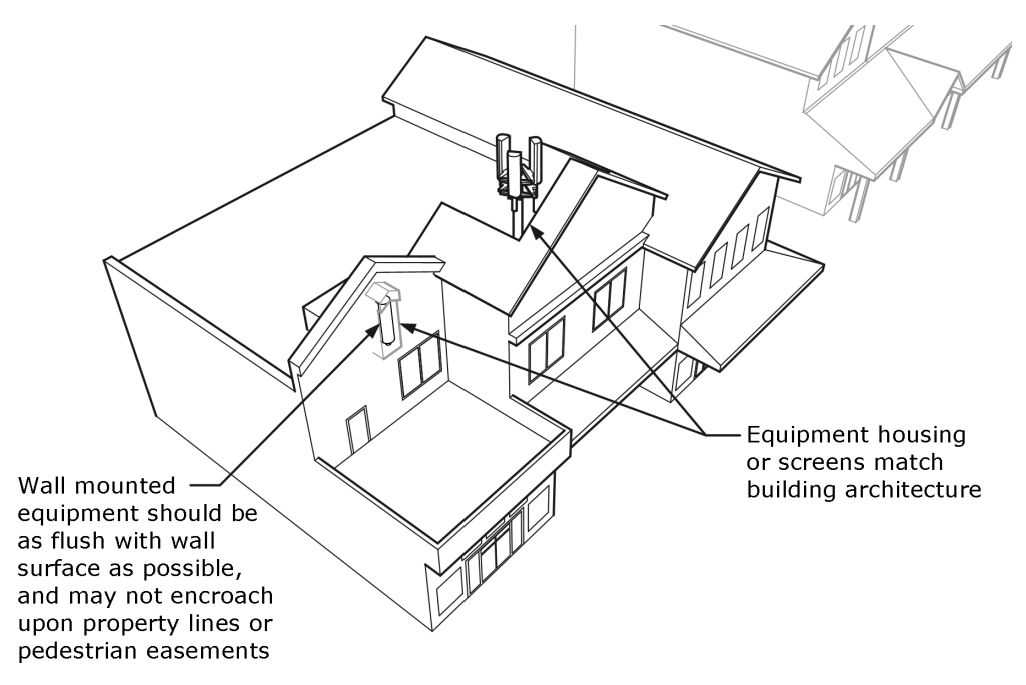
d.
Freestanding telecommunication facilities shall not be artificially lighted, unless required by the FAA or other applicable governmental authority. If lighting is required, the Town may review the available lighting alternatives and approve the design that would cause the least disturbance to the surrounding views. Lighting must be shielded or directed to the greatest extent possible so as to minimize the amount of light falling onto nearby properties, particularly residences.
e.
No portion of any antenna array may extend across a required property setback or beyond the property line.
f.
All applicants under this Article VII shall comply with the landscaping requirements and guidelines found in Section 180-6.14 of this Chapter.
g.
The height, bulk, and setback requirements for the telecommunication facility shall be controlled by the district regulations of the zoning district in which the facility is located. Accessory equipment shall be compatible with the surrounding area and must conform with all zoning requirements.
6.
Co-Location.
a.
No building permit shall be granted to construct a new freestanding telecommunication facility unless the applicant first demonstrates to the reasonable satisfaction of the Town that no existing tower or structure can accommodate the applicant's needs. Evidence submitted to demonstrate that no existing tower or structure can accommodate the applicant's proposed telecommunication facility shall consist of one or more of the following:
i.
No existing towers or structures are located within the geographic area required to meet the applicant's coverage requirements.
ii.
Existing towers or structures are not of sufficient height to meet the applicant's engineering requirements.
iii.
Existing towers or structures do not have sufficient structural strength to support the applicant's proposed antenna and related equipment.
iv.
The applicant's proposed antenna would cause electromagnetic interference with the antennas on the existing towers or structures, or the antennas on the existing towers or structures would cause interference with the applicant's proposed antenna.
v.
The applicant demonstrates that there are other limiting factors, including, but not limited to, engineering factors, that render existing towers and structures unsuitable for co-location.
vi.
There is insufficient land area to accommodate the placement of additional accessory equipment on the property.
b.
No telecommunication facility owner or operator shall unreasonably exclude a telecommunication competitor from using the same facility or location. Upon request by the Town, the owner or operator shall provide evidence and a written statement to explain why co-location is not possible at a particular facility or site.
c.
If a telecommunication competitor attempts to co-locate a telecommunication facility on an existing or approved telecommunication facility or location, and the parties cannot reach an agreement, the Town may require a third-party technical study to be completed at the expense of both parties to determine the feasibility of co-location.
7.
Prohibited Use. Advertising or communication of any visual messages from a tower or antenna is prohibited.
8.
Abandonment; Removal. The owner of any telecommunication facility located within the Town shall notify the Community Development Department when such telecommunication facility and any associated accessory equipment is no longer in operation. Upon such notification, or if the telecommunication facility is otherwise determined not to be in operation, the Town shall consider the facility abandoned. For the purposes of this subsection, a telecommunications facility that is not operated for a continuous period of six months shall be deemed to be abandoned. The Town, in its sole discretion, may thereafter require removal of the abandoned facility by the owner and shall notify the owner accordingly. If the facility is not removed within 90 days, the facility shall be considered a nuisance under Chapter 124 of the Town Code and may be removed by the Town. All costs for the removal shall be paid for by the owner of the facility. Upon removal the site shall be restored and/or revegetated to blend with the surrounding environment. After the antenna or tower is removed and the site is restored to the satisfaction of the Town, the Town shall return to the owner the performance bond required pursuant to Section 180-5.2.11.D.2.d. If the antenna or tower is not removed within said 90 days, the Town may remove and dispose of such antenna or tower at the owner's expense. If there are two or more users of a single tower, then this provision shall not become effective until all users cease using the tower.
D.
Permit and Application Requirements.
1.
Building Permit. It shall be unlawful for any person, firm, or corporation to construct or erect a telecommunication facility without first obtaining a building permit.
2.
Information Required. In addition to any other information required by this Chapter, the following information shall be submitted with all telecommunication facility building permits:
a.
The identity and legal status of the applicant, including any affiliates.
b.
The name, address, and telephone number of the officer, agent, or employee responsible for the accuracy of the application.
c.
Information sufficient to determine that the applicant has applied for and received any construction permit, operating license, or other approvals required by the FCC to provide telecommunication services or facilities within the Town.
d.
An agreement to post a deposit at the time a permit is issued, in an amount to be set by the Town, reasonably related to the removal costs that may be incurred by the Town, should the applicant fail to comply with any of its obligations with regard to the removal of a telecommunication facility, any accessory equipment, and revegetation of the site.
e.
An agreement to:
i.
Consider co-location proposals from other commercial radio providers with an interest in applicant's facility; and
ii.
Not unreasonably to exclude co-location by such entities, along with a statement explaining how the facility may be used for co-location.
f.
An agreement to notify the Town at least ten days prior to introduction of new services or changes in existing service, and to allow the Town to monitor interference levels with public safety communications during the testing process.
g.
Except for low power telecommunications facilities, a verified statement of a qualified radio frequency engineer certifying that a technical evaluation of existing and proposed facilities indicates no potential interference problems, or if such potential interference problems exist, a description of the nature of the potential interference and a plan to mitigate and eliminate any such interference.
h.
A narrative and map description of the applicant's existing or then currently proposed telecommunication facilities within the Town, and outside of the Town within three miles of its boundaries, including specific information about the location, height, and design of each tower and any accessory equipment. In addition, the applicant shall inform the Town generally of the areas of the Town in which it believes telecommunication facilities may need to be located within the next three years.
i.
This provision is not intended to be a requirement that the applicant submit its business plan, proprietary information, or make commitments regarding the location of facilities within the Town. Rather, it is an attempt to provide a mechanism for the Town and all applicants for telecommunication facilities to share general information, assisting in master planning process, and promote co-location by identifying areas in which telecommunication facilities might be appropriately constructed for multiple users.
ii.
The Community Development Department may share such information with other applicants applying for administrative approvals or special use permits under this Article VII or other organizations seeking to locate antennas within the jurisdiction of the Town, provided, however that the Community Development Department is not, by sharing such information, in any way representing or warranting that such sites are available or suitable.
iii.
Such other information as the Town may reasonably require.
3.
Supplemental Information. After issuance of a permit, each owner or operator of a telecommunication facility shall inform the Town, within 60 days, of any change of the information set forth in this Section 180-5.2.11.D.
E.
Fees. In addition to any other fees required by this Chapter or other applicable law, the applicant shall pay a telecommunication facility permit fee. Each application shall be submitted with the telecommunication facility permit fee. Such fee schedule shall be reasonably related to the cost of administering this Section 180-5.2.11. In addition, any reasonable costs incurred by the Town, including reasonable costs to verify compliance with any requirements under this Section 180-5.2.11, shall be paid by the applicant.
F.
Permitted Uses. Provided that a telecommunication facility is a permitted use in the applicable zoning district and the use is described in Subsection (1)(b) hereof, said facility shall not require a special use permit. Nevertheless, all such uses shall comply with Subsections 180-5.2.11.C and 180-5.2.11.D and the zoning district regulations for permitted structures in the zoning district in which they are located. Telecommunication facilities shall be considered a permitted use in the following zoning districts: Public Facilities District (PF); Central Core District (CC); Commercial Oriented District (CO); Gateway District (AC); Mixed-Used District (MU). A low power telecommunications facility intended for residential uses and services may be considered a permitted use in all zoning districts. Small cell facilities, however, shall be permitted as uses by right in all zone districts, subject to the process and standards described in Section 5.2.11.J.
1.
Specific Uses Considered Permitted Uses.
a.
Locating a wall- or roof-mounted facility that is within the maximum height limit and as long as all other requirements of the zoning district are met.
b.
Locating a freestanding telecommunications facility either as the principal use on a site, or on a site where a principal use already exists, so long as all other requirements of this Chapter, including setbacks and height limitations, are met and as long as all accessory equipment on the property disturb less than 350 square feet of lot area.
i.
No site may have more than one freestanding telecommunications facility as a principal use. If more than one freestanding telecommunications facility is requested, the application for the freestanding telecommunications facility shall be considered a special use.
c.
Installing an antenna on an existing tower, so long as said additional antenna does not exceed the height limit for the zoning district or adds no additional height to said existing structure, does not extend laterally a distance of more than 12 feet, and is consistent with any applicable conditions of approval for the subject site that previously have been imposed by the Town.
d.
Installing an antenna on an existing alternative telecommunication facility, so long as said additional antenna does not exceed the height limit for the zoning district or adds no additional height to said structure, is consistent with any applicable conditions of approval for the subject site that previously have been imposed by the Town and does not negatively affect the aesthetic appearance of the facility such that it no longer acts to camouflage or conceal the presence of antennas or towers.
e.
Installing a low power telecommunications facility on any structure, including a tower, provided:
i.
That the structure or tower does not exceed the maximum building height on the zoning district plus an additional 12 feet;
ii.
That the low power telecommunications facility is not allowed within any required setback, and any such facility in excess of eight feet in height shall be located one foot from the required setback for each foot in height above eight feet;
iii.
That the earth disturbance associated with providing access and or utilities to a low power telecommunications facility does not exceed 500 square feet; and
iv.
That no solar panels greater than 32 square feet in size are installed in association with a low power telecommunications facility.
2.
Design Review and Approval. Applications to construct telecommunication facilities that are permitted uses as provided in this Section 180-5.2.11.F shall undergo site plan review by the Community Development Department in accordance with Section 180-2.5.2 of this Chapter.
G.
Special Uses.
1.
Generally. All telecommunication facilities not treated as permitted uses pursuant to Section 180-5.2.11.F are deemed to be special uses and shall require a special use permit. An applicant proposing a telecommunication facility that exceeds the height limitations set by the zoning district in which such facility is proposed shall obtain a special use permit, in lieu of a variance.
2.
Review and Approval. Applications to construct telecommunication facilities that require a special use permit shall be processed according to the following procedure:
a.
Pre-Application Conference. The applicant shall schedule an informal conference with the Community Development Department prior to the submittal of an application.
b.
Information Required. Each applicant requesting special use approval under this section shall submit, in addition to the information required by Section 180-2.5.2 of this Chapter, documentation, signed and sealed by appropriate licensed professionals, showing the location and dimensions of the proposed telecommunication facilities, including information concerning topography, radio frequency coverage, tower height requirements, setbacks, drives, parking, fencing, landscaping, adjacent uses, and all other information deemed by the Community Development Department to be necessary to assess compliance with this Section 180-5.2.11.
c.
Planning Commission. The Planning Commission, at its next available meeting, a minimum of 45 days after the filing of a complete application, shall hold a public hearing on the application and consider the recommendations of the Community Development Department staff and the merits of the proposed application. The application shall be noticed in accordance with Section 180-2.3.5. In approving any application, the Planning Commission may impose any reasonable conditions to ensure that the proposal satisfies the criteria set forth in this Chapter.
3.
Height. An applicant proposing to construct a telecommunication facility that exceeds the height limitations set by the zoning district in which such facility is proposed shall provide a statement that justifies the need for the proposed facility and height requested. Such a statement shall include evidence that:
a.
The facility is designed to be the minimum height necessary to provide service; and
b.
A greater number of towers built at a lesser height would be inadequate to meet the applicant's service demands.
4.
Factors Considered in Granting Special Use Permits for Telecommunication Facilities. In addition to the applicable requirements of this Chapter, the Town shall consider the following factors in determining whether to issue a special use permit:
a.
Demonstrated need for a facility that exceeds the height limitation for the zoning district; and
b.
Proximity of the tower to residential structures and residential district boundaries; and
c.
Nature of uses on adjacent and nearby properties; and
d.
Surrounding topography; and
e.
Surrounding coverage and tree foliage; and
f.
Design of the tower, with particular reference to design characteristics that have the effect of reducing or eliminating visual obtrusiveness; and
g.
Proposed ingress and egress to the property; and
h.
An evaluation of the applicant's plans for development of its telecommunication facilities within the Town, as well as those plans on file from other telecommunication providers; and
i.
An evaluation of the criteria set forth in Sections 180-5.2.11.C and 180-5.2.11.D above; and
j.
Availability of suitable existing towers and other structures as discussed in Subsection 180-5.2.11.C.6; and
k.
Any other information that the Town deems reasonably necessary in connection with the review of the application.
5.
[Additional Provisions.] The following additional provisions shall govern the issuance of Special Use Permits for Telecommunication Facilities:
a.
In granting a special use permit, the Town may impose conditions to the extent it concludes such conditions are necessary to minimize any adverse effect of the proposed telecommunication facility on adjoining properties.
b.
Telecommunication facilities approved as a special use shall not require a variance for any specific conditions approved as part of the special use process.
c.
Any information of an engineering nature that the applicant submits, whether civil, mechanical, structural, or electrical, shall be certified by a licensed professional engineer, or a qualified radio frequency engineer.
6.
[Application and decision in writing.] All applications and the subsequent decision on whether to approve, approve with conditions or deny an application for a special use permit shall be in writing, based upon evidence presented to the Town.
H.
Public Property.
1.
A telecommunication facility applicant proposing to locate a telecommunication facility on any public property or public right-of-way shall contact the Public Works Department and the Community Development Department prior to submitting an application.
2.
Any telecommunications facility proposed to be located in a public right-of-way is additionally subject to the following requirements:
a.
The facility must meet all setback and other requirements of the zoning district in which it is located, unless located in a public right-of-way.
b.
The facility must not create any threat or impairment to public health and safety, including, but not necessarily limited to, blocking vehicular and pedestrian sightlines.
c.
The height of the facility shall not exceed the maximum permitted height of public utility poles located in the same zoning district.
I.
Telecommunication Facilities Definitions. The following words and phrases, when used in this section, shall have the meanings ascribed to them in this Subsection 180-5.2.11:
1.
Accessory Equipment. Equipment, including telecommunication facilities as defined herein, used to protect and enable radio switching equipment, back-up power, support structures, and other devices incidental to a telecommunication facility, but not including towers, antennas or alternative telecommunication facilities.
2.
Alternative Tower Facility. An existing or proposed structure that is compatible with the natural setting and surrounding structures and that camouflages or conceals the presence of the antennae and can be used to house or mount an antenna. Examples include manmade trees, clock towers, bell steeples, light poles, silos, existing utility poles, existing utility transmission towers and other similar alternative designed structures.
3.
Antenna. Any exterior apparatus designed for telephonic, radio or television communications through the sending and/or receiving of wireless communications signals.
4.
FAA. The Federal Aviation Administration.
5.
FCC. The Federal Communications Commission.
6.
Height, Tower or Telecommunication Facility. When referring to a tower or telecommunications facility, the distance measured from the ground level to the highest point on the tower or other structure, even if said highest point is an antenna.
7.
Micro-Cell Facility. A small wireless facility that is no larger in dimensions than 24 inches in length, 15 inches in width, and 12 inches in height and that has an exterior antenna, if any, that is no more than 11 inches in length.
8.
Pre-Existing Towers and Antennas. Shall have the meaning set forth in Section 180-5.2.11.B.3.
9.
Public Right-of-Way or Right-of-Way. Public streets, alleys, ways, highways, easements, and any other like access dedicated primarily for the use of the public.
10.
Small Cell Facilities.
a.
Shall mean facilities that either:
i.
Are mounted on structures 50 feet or less in height including their antennas;
ii.
Are mounted on structures no more than ten percent taller than other adjacent structures; or
iii.
Do not extend existing structures on which they are located to a height of more than 50 feet or by more than ten percent, whichever is greater; and
b.
Each antenna associated with the deployment is no more than three cubic feet in volume; and
c.
All other wireless equipment associated with the structure, including the wireless equipment associated with the antenna and any pre-existing associated equipment on the structure, is no more than 28 cubic feet in volume.
11.
Small Cell Network. A collection of interrelated small cell facilities designed to deliver wireless service.
12.
Telecommunication Facility. A facility that transmits and/or receives electromagnetic wireless communications signals. It includes antennas, microwave dishes, horns, and other types of equipment for the transmission or receipt of such signals, telecommunication towers or similar structures supporting said equipment, equipment buildings, parking area, and other accessory development. The following types of facilities are included within this definition:
a.
Alternative telecommunication facility. A telecommunication facility with an alternative design that camouflages or conceals the presence of antennas or towers such as, but not limited to, artificial trees, clock and bell towers, light standards, flagpoles and steeples.
b.
Freestanding telecommunication facility. A telecommunication facility that consists of a stand-alone support structure or tower, antennas, and accessory equipment.
c.
Low power telecommunications facility. A telecommunications facility necessary to broadcast telecommunications for voice, data or video with emitted power levels less than 36 dBm (or such other levels as may be authorized by the Federal Communications Commission to be low power telecommunications) with total frontal surface areas of all antennas not exceeding ten square feet for any single parcel.
d.
Roof- and/or wall-mounted telecommunication facility. A telecommunication facility that is mounted to the roof or any rooftop appurtenance, or to the face of a legally existing building or structure.
13.
Tower. Any structure that is designed and constructed primarily for the purpose of supporting one or more antenna, including self-supporting lattice towers, guy towers, or monopole towers. The term includes, but is not limited to, radio and television transmission towers, microwave towers, common carrier towers, cellular telephone towers and alternative telecommunication facilities.
J.
Standards for Small Cell Facilities and Networks.
1.
Applicable Requirements. Small cell facilities and small cell networks, shall comply in all respects with the requirements of this Subsection (J), in addition to all other requirements of this Section 5.2.11 applicable to all wireless telecommunication services facilities, with the following exceptions:
a.
Setback;
b.
Design;
c.
Location; and
d.
Any requirement or standard that an applicant demonstrates to operate in a manner that effectively prohibits or materially inhibits the provision of wireless service within the Town, in the context of the particular proposed application.
2.
Location. Small cell facilities are permitted in Town rights-of-way, upon facilities in these rights-of-way and on public easements owned by the Town under the following priority:
a.
First, on a Town-owned utility pole, if any, which shall be removed and replaced with a pole designed to contain all antennae and equipment within the pole to conceal any ground-based support equipment and ownership of which pole is conveyed to the Town.
b.
Second, a Town-owned utility pole with attachment of the small cell facilities in a configuration approved by the Town.
c.
Third, on an existing third-party owned utility pole, (with the consent of the owner thereof), with attachment of the small cell facilities in a configuration approved by the Town.
d.
Fourth, on an existing traffic signal pole or mast arm in a configuration approved by the Town, or in the case of a CDOT facility, by CDOT.
e.
Fifth, on an existing freestanding or ground-mounted facility which meets the definition of and requirements for an alternative tower structure in a location and configuration approved by the Town.
f.
Sixth, on a new freestanding or ground-mounted facility, which meets all applicable requirements and standards of this Section.
3.
Height. All small cell facilities shall not exceed ten feet above the light pole, traffic signal or other facility or structure to which they are attached, or, for such facilities located outside of the public right-of-way, the lesser of:
a.
Ten feet above the pole or other facility or structure to which they are attached; or
b.
The maximum height in the relevant zone district.
When new utility poles are proposed as an alternative tower, their height shall be similar to existing utility/light poles in the vicinity.
4.
Spacing. No small cell facility shall be located within 1,000 feet of any other such facility or such lesser distance as proven by the applicant to be necessary to locate an operational small cell facility within the Town, given all reasonably available location sites, existing technology, and other small cell facilities in the vicinity at the time of application.
5.
Design Standards. The purpose and goals of these design standards are to: (i) ensure that the design, appearance, and other features of small cell facilities are compatible with nearby land uses; (ii) manage the Town's rights-of-way to ensure traffic safety and coordinate and accommodate various uses; and (iii) protect the integrity of the Town's historic, cultural, and scenic resources and quality of life.
All small cell facilities shall be designed and located to minimize the impact on the surrounding neighborhood and to maintain the character and appearance of the Town, consistent with this Code.
a.
Camouflage/Concealment. All small cell facilities shall, to the extent possible, use camouflage and concealment techniques designed to minimize or eliminate the visual impact of such facilities to surrounding uses, including, but not limited to the use of materials, colors, textures, screening, undergrounding, or other design options that will blend the facilities to the surrounding natural setting and/or built environment. Design, materials and colors of small cell facilities shall be compatible with the surrounding environment. Designs shall be compatible with structures and vegetation located on the public right-of-way and on adjacent parcels. All visible exterior features of a small cell facility shall be constructed out of or finished with non-reflective metals.
b.
Proximity to Residential Uses. Small cell facilities shall be sited in a manner that evaluates the proximity of the facility to residential structures and uses and, to the extent practical, equitably distributes any visual impacts of such facilities among adjacent residential uses and properties.
6.
Relocation and Removal. All facilities in Town right-of-way or easements shall be removed and/or relocated at the applicant's expense in the event the Town's use of the right-of-way or easement precludes the continued presence of such facilities.
7.
Permitting and Procedural Deadlines. All small cell facilities and networks shall be reviewed pursuant to the procedure within this Section 5.2.11. Small cell facilities and networks shall also make application for a permit for work in the right-of-way, as applicable. The Town may accept applications for a small cell network, provided each small cell facility shall be separately reviewed. Once determined to be complete by the Community Development Department, an application to locate a small cell facility shall be acted upon:
a.
Within 60 days, for a facility co-locating on an existing structure; or
b.
Within 90 days, for a facility locating on a new site or structure.
For purposes of this subsection, an application to locate a small cell facility means and includes all applications for Town-approvals necessary to locate and operate said facility.
8.
Indemnification. The operator of a small cell facility which is permitted to locate on a Town right-of-way or easement or on a Town-owned utility pole, traffic signal or other structure owned by the Town, or within a Town-owned right-of-way or easement, shall, as a condition of permit approval, indemnify the Town from and against all liability and claims arising as a result of that location or attachment, including repair and replacement of damaged poles and equipment, in a form approved by the Town attorney.
9.
Bonding. All permits for location of small cell facilities on real property not owned by the small cell permittee shall include as a condition of approval a bond, in form approved by the Town attorney, to guarantee payment for any damages to the real property and removal of the facility upon its abandonment.
10.
Permit Timing and Expiration. Notwithstanding the seasonal limitation imposed by Section 87-4 of this Code on excavations, if a small cell facility installation requires an excavation permit in order to complete the facility's installation without undue delay, the Town Manager may permit an excavation permit to be issued if the Manager determines that the welfare of the Town's residents and visitors will not be unnecessarily adversely affected by said excavation. Applicants for small cell installations requiring excavation permits must state on their application the reasons why such excavation must occur between November 1 and April 14, in order to assist the Manager in making a determination.
A permit for a small cell facility shall expire nine months after approval unless construction of the permitted structure has been initiated, unless extended as a result of the seasonal time limits imposed by Section 87-4.
180-5.2.12.
Light Industrial Zoning District.
A.
Offices and Medical Offices. Offices and medical offices on the ground floor are a conditional use. Offices and medical offices not located on the ground floor are a permitted use.
180-5.2.13.
Mixture of Uses in the Mixed-Use District. For properties located in the Mixed-Use District, development shall be a mixture of residential and nonresidential uses, with each such use making up not less than 20 percent of the total gross floor area of all uses within the property. Developments with a lesser mixture of residential or nonresidential uses, including single use developments, are a conditional use.
180-5.2.14.
Large-Scale Solar Facilities.
A.
Purpose. The purpose of these standards is to promote large scale solar facility design that minimizes impacts on adjacent properties and promotes systems that are visually compatible with the character of the areas in which they are located.
B.
General Standards.
1.
Maximum Height. All large-scale solar energy systems and facilities shall comply with the building height limits for the applicable zone district.
2.
Setbacks. Large-scale solar energy systems shall be set back from all property lines a minimum of 30 feet, and shall be located at least 100 feet from all residentially zoned land.
3.
Fencing/Access. Ground-mounted large-scale solar energy systems shall be enclosed with a solid, opaque, perimeter fence six feet in height.
4.
Landscaping. Landscaping and/or screening materials shall be provided to assist in screening the facility from public rights-of-way and neighboring residences. Land beneath ground-mounted facilities shall be revegetated in accordance with Section 180-6.14, Landscaping and Revegetation Requirements.
5.
Lighting. Lighting shall be limited to the minimum extent necessary for security and operations.
6.
Electrical Interconnections. All electrical interconnection and distribution lines within the project boundary shall be underground, except for power lines that extend beyond the project site or are within a substation where applicable.
180-5.2.15.
Healing Centers. A healing center is a medical office that:
(i)
engages in the activities and provides the services of a "healing center" as defined in the Colorado Natural Medicine Health Act of 2022, as amended (the "Act"); and
(ii)
that has been licensed by the state of Colorado pursuant to the Act.
In addition to the zone districts that allow for medical office use, "natural medicine services," as defined in the Act, are permitted to be provided at any private residential location at which such service is allowed to be provided under state regulations promulgated under section 12-170-104(6)(c)(XI), C.R.S., as amended.
(Ord. No. 17-04, 6-27-17; Ord. no. 17-06, 8-8-17; Ord. No. 19-04, 4-9-19; Ord. No. 20-01, 2-12-20; Ord. No. 20-23, 1-16-21; Ord. No. 22-12, 10-11-22; Ord. No. 24-12, § 2, 10-22-24; Ord. No. 25-06, § 1, 4-22-25)
§ 180-5.3. - Accessory uses and structures.
180-5.3.1.
Accessory Dwelling Units.
A.
Accessory dwelling units shall be no larger than 900 square feet.
B.
Accessory dwelling units shall not be used for short-term rental housing.
C.
Accessory dwelling units shall not be subdivided.
D.
In all districts where accessory dwelling units are permitted or conditional, except the PR and PF Districts, one accessory dwelling unit is permitted per principal dwelling unit or commercial unit.
E.
An accessory dwelling unit shall be counted as a unit of density, unless exempted by Section 180-5.5.1.
180-5.3.2.
Carriage House Requirements.
A.
A "carriage house" is a separate detached dwelling unit that is incidental and subordinate in size and character to the primary residence and that is located on the same parcel or on a contiguous lot that is under the same ownership as that on which the primary residence is located. A primary residence may have no more than one carriage house. A carriage house may not be accessory to another accessory dwelling unit or carriage house. A carriage house shall be developed in accordance with all applicable requirements of this Chapter.
B.
A carriage house shall not be considered a unit of density with regard to zoning requirements provided that it is permanently deed-restricted for rent to persons earning a maximum of 80 percent of the area median income, at a rate established by the Summit Combined Housing Authority. For purposes of this section, the terms of the deed restriction or covenant governing the unit must be acceptable to the Town in its sole discretion.
C.
A carriage house shall conform to the following design standards:
1.
A carriage house may be no larger than 50 percent of the floor area of the principal dwelling unit, up to a maximum of 1,000 square feet. A minimum of ten percent of the floor area of the carriage house must be closet or storage area.
2.
A carriage house must function as a separate dwelling unit. This includes the following:
a.
A carriage house must be separately accessible from the exterior of the unit.
b.
One parking space for the carriage house shall be provided on-site for the benefit of the carriage house resident. The parking space shall not be stacked with any space for the primary residence.
c.
The maximum height of a carriage house is 25 feet.
d.
The finished floor heights of the carriage house shall be entirely above the natural or finished grade, whichever is higher, on all sides of the structure.
e.
The carriage house shall be detached from the primary residence. A carriage house located above a detached garage or storage area shall qualify as a detached carriage house.
f.
The roof design shall prevent snow and ice from shedding upon an entrance area to a carriage house. If the entrance area is accessed via stairs, sufficient means of preventing snow and ice from accumulating on the stairs shall be provided.
180-5.3.3.
Solar Energy Facilities. Solar energy facilities may include roof-mounted systems on any code compliant structure, and ground mounted systems on an area of up to 50 percent of the footprint of the primary structure on the parcel but less than one-half acre.
A.
General Standards.
1.
Maximum Height for Roof-mounted and Building-mounted Solar Energy Systems. Roof-mounted solar energy systems are exempt from the maximum building height limits within the zone district, except that they must comply with the following height limitations:
a.
For pitched roofs the height limit on roof-mounted solar energy systems on principal and accessory structures is two feet above the roofline. No portion of a solar energy system shall project above the maximum projection line of the roof ridge.
b.
For flat roofs the height limit on roof-mounted solar energy systems on principal and accessory structures is eight feet above the roofline.
c.
Building-mounted solar shall not extend horizontally beyond any roof overhang.
2.
Maximum Height for Ground-mounted Solar Energy Systems. Ground-mounted systems shall be a maximum of 20 feet in height.
3.
Setbacks. Ground-mounted solar energy facilities shall not be located in the front setback between the principal structure and the public right-of-way. Solar energy facilities shall comply with the zone district setback requirements and shall be located a minimum of five feet from all property lines and other structures.
4.
Landscaping. Landscaping and/or screening materials shall be provided to assist in screening the facility from public rights-of-way and neighboring residences. Land beneath ground-mounted facilities shall be revegetated in accordance with Section 180-6.14, Landscaping and Revegetation Requirements.
5.
Electrical Interconnections. All electrical interconnection and distribution lines within the project boundary shall be underground, except for power lines that extend beyond the project site or are within a substation.
(Ord. No. 17-04, 6-27-17; Ord. No. 20-23, 1-26-21)
§ 180-5.4. - Temporary uses and structures.
180-5.4.1.
Construction Trailers. The use and the placement of construction trailers are subject to the following requirements:
A.
Not Residential. Construction trailers cannot be used for living quarters.
B.
Period Permitted. All trailers shall be removed after 12 months from the date the Building Permit is issued, or when all Certificates of Occupancy have been issued, whichever occurs first. One extension of a maximum for 120 days may be granted at the discretion of the Community Development Department.
C.
Location. No construction trailer shall be located in the Town's right-of-way, or at any location where it will be detrimental to the overall health, safety, and welfare of the surrounding environment, businesses, and neighborhoods. Construction trailers shall be placed in the least visible locations and shall be shielded whenever possible. No pre-existing required parking spaces shall be occupied by construction trailers, unless otherwise approved by the Planning Commission. Construction trailers shall not be used for signage purposes (refer to Section 180-6.19.13.L). Construction trailers shall not be stacked on top of one another.
D.
Amendments. Any changes to the approved number, use, or placement of construction trailers on-site may be approved by the Community Development Department staff.
180-5.4.2.
Expansion of Replacement Facilities at the Frisco Peninsula Recreation Area and the Frisco Bay Marina. Temporary expansion or replacement facilities, consisting of transportable buildings that are pre-constructed and are readily removed from the site and installed at other sites, that are on the site of, and are for or in connection with the Town of Frisco's operation of the Frisco Peninsula Recreation Area or the Frisco Bay Marina for a period of no more than 24 months, are exempt from the requirements of this Chapter.
180-5.4.3.
Relocated Buildings Owned by the Town. The temporary placement, for a period of no more than 24 months, of existing buildings owned by the Town, including, but not limited to, historic structures, that are being relocated to another permanent location, are exempt from the requirements of this Chapter.
180-5.4.4.
Town Special Events. Temporary uses and structures that are part of a Town of Frisco special event or an event authorized by a Town of Frisco special event permit, and that are limited to the duration of said event, are exempt from the requirements this Chapter.
(Ord. No. 17-04, 6-27-17; Ord. No. 19-21, 11-12-19)
§ 180-5.5. - Affordable housing.
180-5.5.1.
Incentives.
A.
Accessory Dwelling Units. In the RL, RM, RH, GW, CC, and MU Districts, any accessory dwelling unit meeting the Town's requirements may be exempted from the density calculation as long as the unit is deed-restricted for rent to persons earning a maximum of 100 percent of the area median income, at a rate established by the Summit Combined Housing Authority for that income level, and pursuant to other criteria as established from time to time by the Town or the Summit Combined Housing Authority.
B.
Density Bonuses.
1.
Central Core, Gateway, Mixed-Use and Residential High Density Districts. In the CC, GW, MU, and RH Districts, a density bonus over the maximum allowable density is available if approved by Planning Commission, provided that:
a.
For projects that contain residential units being developed that are not restricted to affordable and/or workforce housing, a minimum of 50 percent of the total number of bonus units is provided as affordable housing deed-restricted for occupancy for purchase to households earning up to a maximum 140 percent area median income (AMI), or maximum 120 percent AMI for rental, with an average AMI not to exceed 100 percent at a rate established by the Summit Combined Housing Authority for that income level, and pursuant to the other criteria as established from time to time by the Town or the Summit Combined Housing Authority; or
b.
For projects that are being developed with all residential units restricted to affordable and/or workforce housing, bonus units shall be provided as affordable deed-restricted housing being available for purchase or rent to households earning, on average, an income up to 120 percent of the area median income (AMI), at a rate established by the Summit Combined Housing Authority for that income level, and pursuant to the other criteria as established from time to time by the Town or the Summit Combined Housing Authority; or
c.
For each bonus dwelling unit allowed, at least two affordable housing units are provided on property outside of the subject property, but within the Town of Frisco or within one mile of any corporate limit of the Town of Frisco; or
d.
A minimum of 50 percent of the total number of bonus units is provided as affordable housing restricted for rent in accordance with the Low-Income Housing Tax Credits (LIHTC) program requirements, with such units being nonetheless deed-restricted under the Town's standard covenant, to be effective only upon termination of the LIHTC restrictions.
2.
Density Bonus Requirements.
a.
In order to qualify for the density bonus incentive of additional dwelling units in multifamily and/or mixed-use projects, each deed restricted affordable unit shall be no more than 15 percent smaller in gross floor area than the corresponding bonus market rate unit. Provided, however, that if the affordable housing units provided under any density bonus provision of this Chapter are located off the site of the subject property, then the foregoing requirement shall not apply and, instead, for every two off-site affordable units provided, the total combined floor area of such units shall, at a minimum, be equal to the floor area of the associated one on-site density bonus unit. Further provided, however, that in no instance shall an off-site affordable housing unit provided under any density bonus provision of this Chapter be less than 600 square feet in gross floor area.
b.
Every owner of an affordable housing unit shall ensure that each potential buyer of the unit is qualified for the purchase through the Summit Combined Housing Authority.
c.
For each affordable housing unit that is provided under any density bonus provision of this Chapter and that is to be located on or off the site of the subject property, the required deed or covenant restriction for such unit shall be established and legally enforceable prior to the Town's issuance of a certificate of completion or a certificate of occupancy for the corresponding bonus market rate dwelling unit in the development project.
3.
Criteria for Approval. Bonus units may be approved by the Planning Commission upon finding that the additional units, because of the structure's design, height, mass, and scale, do not detract from the character of the vicinity and small mountain town character.
C.
Affordable Housing Development Incentive Program. The Affordable Housing Development Incentive Program encourages the voluntary preservation or development of new housing units, or preservation of existing dwelling units, for the local workforce through residential development incentives, in exchange for deed restriction of all of the housing units in the property. Designation of properties as an Affordable Housing Development will enhance the quantity and quality of affordable housing in the Town of Frisco through the use of incentives that allow increased flexibility in design in exchange for deed restricting all of the dwelling units as affordable housing.
1.
Applicability. An owner of a property within the Town of Frisco may apply for an Affordable Housing Development designation. This designation is available in the GW, CC, MU, RH, RM and RL zone districts, and the underlying zone district will remain in effect. In order to qualify for the Affordable Housing Development designation, a property must meet the criteria in Section 180-5.5.1.C.3. Any designation shall be in compliance with the purposes and criteria of this section. The entire property included in any Affordable Housing Development designation shall be subject to the controls and standards of this section. Any incentives described in this section may be requested and, if granted, applied to the entire development site; any incentives or designation not granted may be appealed as prescribed in the Unified Development Code.
2.
Application. An application for designation as an Affordable Housing Development may be made by the owner or the development applicant with the owner's written consent. The request for designation shall be included with a Site Plan application submitted in accordance with Section 180-2.5. The Community Development Department shall review the application for conformance with the criteria in Section 180-5.5.1.C. A proposed development application qualifies for an Affordable Housing Development designation and is eligible for the incentives described in this section if it meets the requirements of this section.
3.
Criteria. The criteria for designating properties as an Affordable Housing Development are as follows:
a.
Each of the dwelling units within the development are restricted as permanently affordable through the Town of Frisco standard covenant. The units shall be restricted for occupancy by households earning, on average, a maximum of 120 percent of the area median income (AMI). The draft deed restriction will be reviewed and approved as part of the Site Plan review; and
b.
Except where allowances are permitted as described in the incentives section below, all zoning requirements and other development standards have been met.
4.
Incentives. Any proposed development that meets the criteria and standards in this Section shall be eligible to utilize the incentives described herein.
a.
Zoning Requirements. The following zoning density and dimensional standard adjustments are applied to the zoning district requirements for Affordable Housing Developments:
i.
Density.
(1)
GW, CC, MU, RH zone districts utilize the Density Bonus provisions per Section 180-5.5.1.B.
(2)
RM, RL zone districts - 100 percent increase in maximum zoning density (i.e., 12 units per acre increase to 24 units per acre).
ii.
Lot coverage.
(1)
20 percent increase in allowed lot coverage (i.e., 55 percent allowed coverage in zone district would increase to 75 percent coverage).
(2)
Driveways up to 12 feet in width shall be exempted from lot coverage. Portions of driveways in excess of 12 feet shall count towards lot coverage.
iii.
Setbacks. Minimum setbacks allowed per Zone District as follows:
(1)
GW - Front: Ten feet, Side: Five feet, Rear: Five feet.
(2)
CC - On Main: Front: Three feet, Side: Zero feet, Rear: Zero feet.
Off Main: Front: Five feet, Side: Five feet, Rear: Five feet.
(3)
MU - On Main: Front: Three feet, Side: Five feet, Rear: Five feet.
Off Main: Front: Ten feet, Side: Five feet, Rear: Five feet.
(4)
RH, RM, RL - Front: Ten feet, Side: Five feet, Rear: Five feet.
iv.
Maximum Building Height.
(1)
Ten percent increase in maximum building height (i.e., 40-foot maximum height in zone district would increase to 44-foot maximum height).
Table 5-3 summarizes the incentives noted above.
b.
Development Standards. The following development standards may be modified for Affordable Housing Developments:
i.
Landscaping and revegetation. Plant material quantities may be reduced by up to 20 percent from the requirement in Section 180-6.14.3. Species mix may be increased to a 50-percent maximum for each species, and minimum tree caliper size may be reduced to 50 percent of the caliper size requirement in Section 180-6.14.
ii.
Nonresidential development standards. For developments that contain a minimum of 20 dwelling units, building articulation pursuant to Section 180-6.21.3.B.3, is not required on alley or non-right-of-way facing facades.
iii.
Residential development standards. Building articulation shall be demonstrated through use of at least two of the seven techniques described in Section 180-6.22.
iv.
Bulk plane.
(1)
Bulk plane encroachments may be permitted up to the ratio of 500 cubic feet per 10,000 square feet of lot area, subject to the criteria in Section 1806.23 and approval by the Planning Commission.
(2)
Bulk plane envelopes shall be measured at a 45-degree angle in all zones.
(3)
Bulk plane envelopes measurement shall begin at the lesser of the minimum setback in Table 5-4 or the measurement in Table 6-K, Bulk Plane Standards.
(4)
Ten-foot stepback shall not apply on alley-facing facades for developments of 20 units or greater. Landscaping and Revegetation (Section 1806.14).
Table 5-4 summarizes the incentives noted above.
c.
Parking. The following parking requirements may be applied to Affordable Housing Developments:
i.
One parking space per unit for studios and one bedroom units, one and one-half parking space per unit for two-bedroom units, and two parking spaces per unit for three bedrooms or greater. One visitor parking space is required for each five dwelling units in the development.
ii.
If a development application includes a minimum of 20 units, and is a single-owner development in which all units will be offered for rent, the development is eligible for each of the following parking incentives which may be cumulative:
(1)
Proximity to transit. For developments within one quarter mile of a transit stop which provides local service: One-half parking space per unit for studios and one-bedroom units, one parking space per unit for two-bedroom units, and two parking spaces per unit for three bedrooms or greater.
(2)
On-street overnight parking. Within the Central Core (CC) and Mixed-Use (MU) Districts, up to 20 percent of the required overnight parking spaces for residents and visitors may be accommodated on street frontages contiguous to the property, on a one for one basis, subject to construction of any needed improvements, Town approval of an acceptable agreement to ensure adequate maintenance and snow removal procedures, and a permit system for resident use.
(3)
Off-site parking. Up to 50 percent of the required overnight parking, excluding required accessible spaces, in the Central Core (CC) and Mixed Use (MU) Districts may be met off-site, subject to a permanent parking agreement approved by the Town. Off-site parking shall be located within 1,000 feet of the proposed development, measured as a viable pedestrian path.
(4)
Car-sharing service. Each car-sharing space provided shall count as four parking spaces, up to 20 percent of the parking requirement. The car-sharing program details and agreement shall be provided as part of the application and shall include provisions and alternative options to ensure operation for the duration of the project.
d.
Application Processing. Planning and Building Department application review periods shall be accelerated to the extent possible, while ensuring all required public notice requirements are met, and adequate time to appropriately review the applications.
Residential Development Standards (Section 180-6.22).
Bulk Plane (Section 180-6.23).
Building articulation shall be demonstrated through use of at least two of the seven techniques described in Section 180-6.22.
i.
Bulk Plane requirements increased to allow 500 cubic feet per 10,000 square feet of lot area.
ii.
Bulk plane envelopes shall be measured at a 45-degree angle in all zones.
iii.
Bulk plane envelopes measurement shall begin at the lesser of the minimum setback in Table 5-4 or the measurement in Table 6-K, Bulk Plane Standards.
iv.
Ten-foot stepback shall not apply on alley-facing facades for developments of 20 units or greater. Landscaping and Revegetation (Section 1806.14).
Nonresidential Development Standards. (Section 180-6.21.)
For developments that contain greater than 20 dwelling units, building articulation pursuant to Section 180-6.21.3.B.3, is not required on alley or non-right-of-way facing facades. or all other facades, building articulation shall be demonstrated through use of at least two of the seven techniques described in Section 180-6.21.
Plant material quantities may be reduced by up to 20 percent from the requirement in Section 180-6.14.3. Species mix may be increased to a 50-percent maximum for each species, and minimum tree caliper size may be reduced to 50 percent of the caliper size requirement in Section 180-6.14.
(Ord. No. 17-04, 6-27-17; Ord. No. 19-04, 4-9-19; Ord. No. 23-10, § 1, 4-11-23; Ord. No. 24-03, § 1, 2-27-24)

