
Frisco City Zoning Code
ARTICLE IX
- DEFINITIONS AND INTERPRETATIONS
§ 180-9.1. - Word usage and mathematical calculations.
When used in this Chapter, certain words shall be interpreted as follows:
180-9.1.1.
The masculine includes the feminine and neuter genders;
180-9.1.2.
Words in the present tense include future tense;
180-9.1.3.
Words in a singular number include the plural number;
180-9.1.4.
The word "shall" is mandatory, and the word "may" is permissive.
180-9.1.5.
Except as may be otherwise expressly provided in this Chapter, whenever it is necessary to perform a mathematical calculation to determine any standard or requirement set forth in this Chapter as such standard or requirement may apply to a particular property or situation, the following rule of construction shall apply: When the mathematical calculation results in a number that is not a whole number, the result shall be rounded up to the next greater whole number when the result is a whole number plus .50 or greater, and shall be rounded down to the next lesser whole number when the result is a whole number plus less than .50; provided, however, that when the mathematical calculation results in number that is less than one, the result shall be rounded up to the number one.
180-9.1.6.
For purposes of this Chapter, Community Development Director shall include the Director or his/her designee.
(Ord. No. 17-04, 6-27-17)
§ 180-9.2. - Definitions of general use categories.
This section defines the general use categories listed in Table 5-1, Table of Allowed Uses. Definitions for specific use types are in alphabetical order in Section 180-9.3.
180-9.2.1.
Residential Uses.
A.
Household Living. Uses characterized by residential occupancy of a dwelling unit as a household. Tenancy is arranged on a month-to-month or longer basis (lodging where tenancy may be arranged for a period of less than 30 days is classified under the "lodging facilities" category). Common accessory uses include recreational activities, raising of pets, gardens, personal storage buildings, hobbies, and parking of the occupants' vehicles.
B.
Group Living. Uses characterized by residential occupancy of a structure by a group of people who do not meet the definition of "household living." Tenancy is arranged on a monthly or longer basis, and the size of the group may be larger than a family. Generally, group living structures have a common eating area for residents. The residents may receive care, training, or treatment, and caregivers may or may not also reside at the site. Accessory uses commonly include recreational facilities and vehicle parking for occupants and staff.
180-9.2.2.
Public, Institutional, and Civic Uses.
A.
Community and Cultural Facilities. Uses including buildings, structures, or facilities owned, operated, or occupied by a governmental entity or nonprofit organization to provide a service to the public.
B.
Child Care Facilities. Establishments that provide care for children on a regular basis away from their primary residence. Accessory uses include offices, recreation areas, and parking. This category does not include public or private schools or facilities operated in connection with an employment use, shopping center, or other principal use, where children are cared for while parents or guardians are occupied on the premises.
C.
Educational Facilities. Public, private, and parochial institutions at the primary, elementary, middle, high school, or postsecondary level, or trade or business schools, that provide educational instruction to students. Accessory uses include play areas, cafeterias, recreational and sport facilities, auditoriums, and before- or after-school day care.
D.
Institutional Uses. Facilities where services are provided to the public, provided that facilities are operated primarily to provide a service to the public, and not primarily for the purpose of commercial enterprise. Accessory uses may include parking, offices, storage areas, gift shops, and (in the case of medical facilities) laboratories, outpatient, or training facilities.
E.
Parks and Open Space. Uses with a focus on natural areas, large areas consisting mostly of vegetative landscaping or outdoor recreation, community gardens, or public squares. Lands tend to have few structures. Accessory uses may include clubhouses, playgrounds, maintenance facilities, concessions, caretaker's quarters, and parking.
F.
Public Utilities and Facilities. All lines, buildings, easements, passageways, or structures used or intended to be used by any public or private utility related to the provision, distribution, collection, transmission, or disposal of power, oil, gas, water, sanitary sewage, communication signals, or other similar services at a local level.
180-9.2.3.
Commercial Uses.
A.
Agriculture Uses. Agricultural and farming activities, including nurseries and facilities for processing and selling agricultural products. Agricultural uses involve farming, dairying, pasturage, apiculture, horticulture, floriculture, and viticulture.
B.
Food and Beverage. Establishments involved in serving prepared food or beverages for consumption on or off the premises. Accessory uses may include food preparation areas, offices, and parking.
C.
Lodging Facilities. For-profit facilities where lodging, meals, and the like are provided to transient visitors and guests for a defined period.
D.
Offices. Uses that provide executive, management, administrative, or professional services, but do not involve the sale of merchandise except as incidental to a permitted use. Typical uses include real estate, insurance, property management, investment, employment, travel, advertising, law, architecture, design, engineering, accounting, call centers, and similar offices. Accessory uses may include cafeterias, health facilities, parking, or other amenities primarily for the use of employees in the firm or building.
E.
Personal Services. Establishments that provide individual services related to personal needs directly to customers at the site of the business, or that receive goods from or return goods to the customer, which have been treated or processed at that location or another location.
F.
Recreation and Entertainment. Uses that provide recreation or entertainment activities. Accessory uses may include concessions, snack bars, parking, and maintenance facilities.
G.
Retail. Uses involving the sale of a product directly to the final consumer for whatever purpose but not specifically or exclusively for the purpose of resale. Examples include, but are not limited to, bookstores, antique stores, bakeries, grocery stores, household product stores, and similar uses.
H.
Vehicles and Equipment. Uses include a broad range of uses for the maintenance, sale, or rental of motor vehicles and related equipment. Accessory uses may include incidental repair and storage and offices.
I.
Veterinary Services. Animal-related uses include the boarding and care of animals on a commercial basis. Accessory uses may include confinement facilities for animals, parking, and storage areas.
180-9.2.4.
Industrial Uses.
A.
Industrial Service and Research. Uses include the repair or servicing of agricultural, industrial, business, or consumer machinery, equipment, products, or by-products. Contractors and similar uses perform services off-site. Few customers come to the site. Accessory activities may include sales, offices, parking, and storage.
B.
Manufacturing and Production. Uses including all transformative processes, regardless of whether or not the new product is finished or semi-finished. Production is typically for commercial wholesaling rather than for direct sales.
C.
Warehouse and Freight. Uses that are engaged in the storage or movement of goods for themselves or other firms. Goods are generally delivered to other firms or the final consumer, except for some will call pickups. There is little on site sales activity with the customer present. Accessory uses may include offices, truck fleet parking, and maintenance areas.
180-9.2.5.
Accessory Uses. Uses incidental and subordinate to the principal use of the lot, building, or another structure on the same lot.
(Ord. No. 17-04, 6-27-17; Ord. No. 19-04, 4-9-19)
§ 180-9.3. - General definitions.
In this Chapter, the following terms shall have the following meanings unless a contrary meaning is required by the context or is specifically prescribed:
A
Access. A way or means of approach to provide vehicular or pedestrian physical entrance to a property.
Accessory Building. See Building, Accessory.
Accessory Dwelling Unit. A second, subordinate dwelling unit located on the same lot as a primary dwelling unit or commercial unit. The unit includes its own independent living facilities with provisions for sleeping, cooking, and sanitation, and is designed for residential occupancy independent of the primary dwelling unit or commercial unit. The unit may have a separate entrance or an entrance to an internal common area accessible to the outside.
Accessory Use. See Use, Accessory.
Acre, Developable. 43,560 square feet of horizontal land area neither occupied by a public way nor under a water body nor in a wetland as designated pursuant to procedures under Section 404 of the Clean Water Act, nor in a floodway, as defined on the Flood Insurance Rate Map, nor designated as public open space.
Active Recreation. Activities, usually of a formal nature, often performed with others, usually requiring equipment and taking place at prescribed places, sites, or fields. Activities include, but are not limited to, swimming, snowmobiling, Frisbee golf, bicycling, tennis and other court games, baseball and other field sports, track, soccer, skating, skiing, and playground activities. Active recreation areas include, but are not limited to, campgrounds, parks, the Frisco Peninsula Recreation Area.
Activities for Conservation of Natural Resources and the Environment. Activities such as flood control, erosion control, or wetland mitigation, or other similar measures to conserve soil, water, vegetation, and wildlife.
Adaptive Controls. Devices such as timers, motion-sensors, and light-sensitive switches used to actively regulate the emission of light from light fixtures.
Affordable Housing. A dwelling unit that is deed restricted in perpetuity to occupancy by individuals meeting the income limitations and occupancy standards as established from time to time by the Town or the Summit Combined Housing Authority. Occupancy standards include requirements for primary residency and local employment.
Exception: A Low-Income Housing Tax Credit (LIHTC) or similar approved program that does not allow for local employment restrictions; the local employment requirement may be waived if approved by Town Council. A LIHTC development deed restriction shall be recorded at certificate of occupancy for the project, with effective date deferred until the end of the LIHTC period if approved by Town Council.
Alley. A minor public thoroughfare upon which the rear of building lots generally abut, used for service purposes and not intended for general travel.
Alteration. A physical change in, or modification to, a structure including an expansion or change in use.
Animal Boarding or Training. An establishment where domesticated animals other than household pets are housed, groomed, bred, boarded, trained, or sold. This term shall not include the operation of a kennel.
Appeal. The request by an applicant, by an interested agency or by an owner or lessee of property within the Town limits of Frisco for review of an ordinance, resolution, motion, or action taken pursuant to the provisions of this Chapter, including modifications and waivers.
Applicant. A person or persons, corporation, company, association, society, firm, or partnership submitting an application, or having the intention to submit an application such that review is commenced by the Town.
Approved Plan. A plan that has been granted final approval by the Town, including all standard and special conditions.
Architectural Feature. A part, portion, or projection of a building or structure that contributes to its character or style, exclusive of signs, that is not necessary for the structural integrity of the building or to make a building habitable.
Architectural Projection. Any projection that is not intended for occupancy and that extends beyond the face of an exterior wall of a building, including arcades, roof overhangs, unenclosed exterior balconies, canopies, but not including signs.
Area Median Income (AMI). The median annual income for Summit County, Colorado (or such next larger statistical area calculated by the U.S. Department of Housing and Urban Development (HUD) that includes Frisco, Colorado, if HUD does not calculate the area median income for Summit County, Colorado, on a distinct basis from other areas), as adjusted for household size, that is calculated and published annually by HUD (or any successor index acceptable to the Town).
Arts and Entertainment Center. A structure or facility for the presentation of performing arts. Arts and entertainment centers do not include any business defined as sexually oriented business by this title.
Arts and Entertainment Center, Indoor. A structure or facility for the presentation of exclusively indoor performing arts, including indoor motion picture theaters, theaters for indoor live performances, and studios for arts education, such as dance or painting. Arts and entertainment centers do not include any business defined as sexually oriented business by this title.
Articulation. Variation in the depth of the building plane, roof line, or height of a structure that breaks up plain, monotonous areas and creates patterns of light and shadow.
Artisan Studio or Gallery. The workshop and/or public display rooms of an artisan, writer, craftsperson, or photographer, but not a place where members of the public come to receive instruction on a more than incidental basis or to sit for photographic portraits. The sales of art produced on the premises shall be permitted as an accessory use.
Automobile Fuel Sales. An establishment operated at a fixed location at which gasoline or any other motor vehicle engine fuel is offered for sale to the public.
Automobile, Boat, and Recreational Sales or Leasing. The use of any building or land for a business involving the sale or leasing of new or used motor vehicles, boats, and recreational vehicles. Such establishments may include office space, parking lots for the display and storage of vehicles available for sale, parking areas for customers and employees, vehicle repair facilities, facilities for body work, painting, or restoration and sale of parts.
Automobile Service and Wash. The use of the site for the repair, washing, polishing, or detailing of motor vehicles and recreational vehicles. This includes the sale and on-site installation of parts, wheel and brake shops, body and fender shops and similar repair and service but excludes salvage and servicing semi-tractor trailers.
Average Existing Grade. See Existing Grade, Average.
Awning. A roof-like cover extending over or in front of an opening, such as a window or door, intended to provide shelter from the elements.
B
Basement. A space within a building having one-half or more of its floor-to ceiling height below the average level of the adjoining ground and with a floor-to-ceiling height of not less than six and one-half feet.
Bedroom. A habitable space or room in a dwelling unit designed for or with potential for use as a sleeping room. Factors determining this use, in addition to Chapter 65, Town of Frisco Building Construction and Housing Standards, shall include a space or room with any of the following factors:
A.
Having walls and doors to separate it from other habitable spaces or rooms, or
B.
Having a closet or similar provision for clothes storage, or
C.
Having a full or partial bathroom directly connected or in close proximity to the space or room.
Rooms or floor areas in dwelling units determined by these criteria to be bedrooms, regardless of any names, labels, or intended uses proposed by the applicant, shall be used to designate the total number of bedrooms for purposes of determining required parking spaces and other regulations.
Block. A grouping of lots usually bound by streets or by a combination of streets and public land, railroad rights-of-way, water bodies, or any other physical barriers to the continuity of development, and not traversed by a through street.
Boarding, Rooming, or Lodging Facility. A building with a managing resident on the premises in which accommodations, with or without meals, are let on a short-term basis for compensation for no more than ten bedrooms. Does not include condominium hotels.
Building. Any structure used or intended for supporting or sheltering any use or occupancy. See also Structure.
Building, Accessory. A detached, subordinate building, located on the same lot with the principal building(s) the use of which is customarily incidental to the principal building such as a garage or shed. Accessory buildings may have a footprint no greater than 30 percent of the footprint of the principal building and may not exceed the ridge height of the principal building.
Building Envelope. A delineated area that identifies where all buildings and structures and other certain improvements shall be located on a property.
Building Façade. The outer surface of a building front, side, or rear wall, including windows, doors, and other architectural features.
Building Height. The vertical distance measured from any point on a proposed or existing roof to the natural grade or the finished grade, whichever is lowest, located directly below said roof point, excluding chimneys, steeples, cupolas, turrets, clock towers, similar rooftop decorative elements, mechanical equipment and screening, and solar panels of reasonable, balanced proportions. The building height is thus measured parallel to the existing grade in any direction as depicted in Figure 9-A. Where a building utilizes multiple roof styles or pitches, the highest point of each type of roof or parapet wall shall be in conformance with applicable height regulations as established for the respective roof pitches in each zoning district.
This methodology for measuring height maximums can best be visualized as an irregular surface located above the building site at the height limit mandated by the zoning district, having the same shape as the natural grade of the building site. This methodology can be calculated by overlaying a roof plan onto a site plan or land survey that contains topographic information. Where there are minor irregularities (as determined by the Community Development Department) of the natural grade, such minor irregular areas shall not be used in determining compliance with the height limitation set forth herein and the surrounding typical grade shall be used.
Figure 9-A: Building Height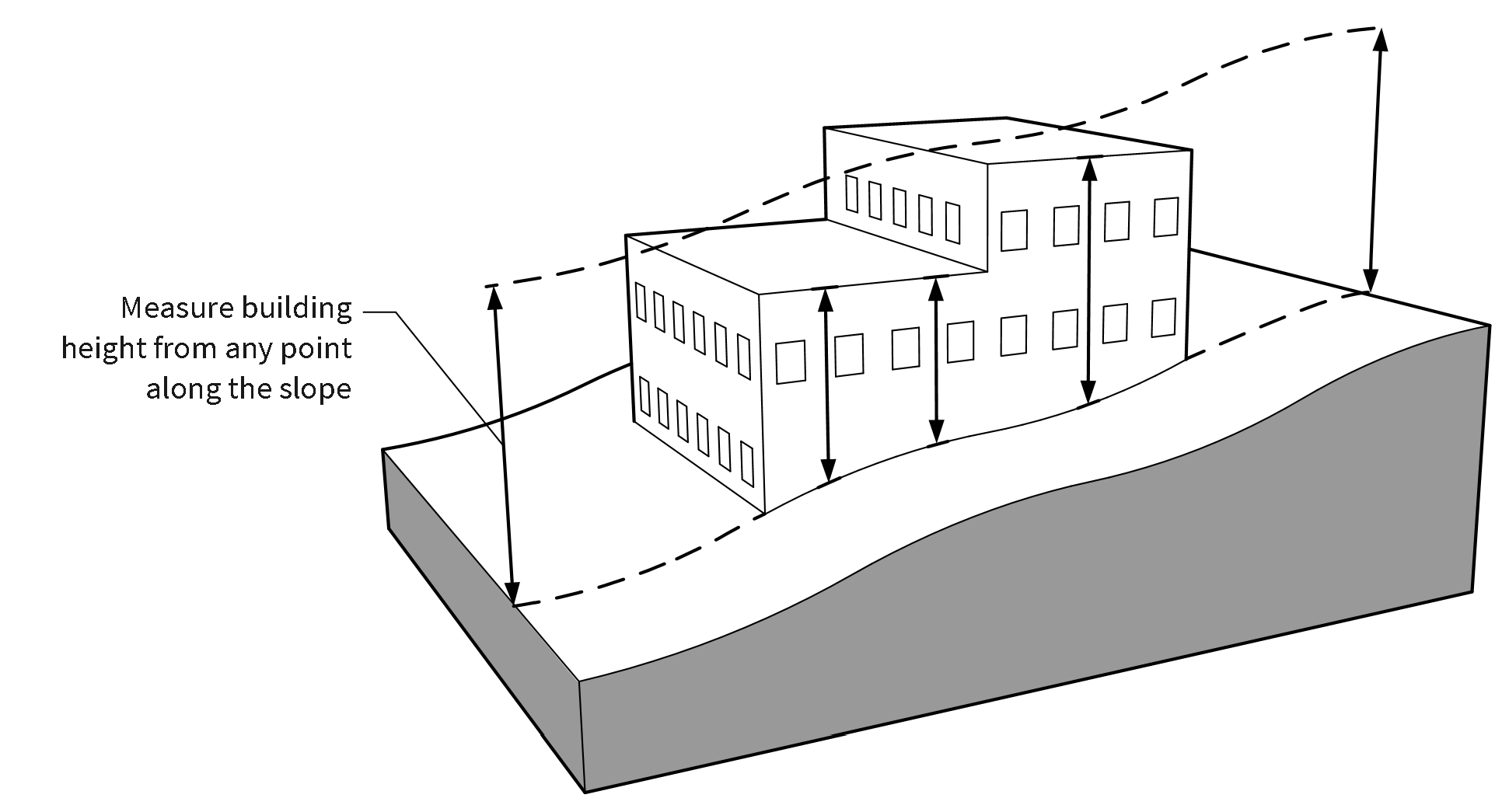
Exception: If fill must be placed on the site for drainage purposes, or to meet some other similar requirement such as the placement of utility services, building height may be measured from the finished grade within three feet of the location of the foundation. However, for the purposes of calculating the building height, the finished grade elevation cannot exceed any adjacent, paved street or alley elevation. If additional fill is needed above any adjacent right-of-way elevation, then the average right-of-way elevation as measured at the edge of the adjacent asphalt shall be used as the finished grade to determine building height. In the case where a building is proposed adjacent to two or more rights-of-way, then the building height will be calculated using the average grade of each right-of-way as measured at the edge of adjacent asphalt. For the purposes of calculating building height, any placement of fill on a lot must be determined as necessary, showing there are no other viable alternatives. Said determination and showing must be verified by a professional engineer licensed in the State of Colorado and approved by the Frisco Town Engineer.
Building, Principal. A building containing the main or principal use of the lot.
Bulk Plane Envelope. The three-dimensional space within which a structure is permitted to be built on a lot and that is defined by building height regulations, property setbacks, and other restrictions.
Business. A building in which commercial activities are conducted and where the business is structurally separated from other businesses and has its own entrance, either exterior or interior.
Business Day. A complete day that the Town of Frisco Community Development Office is open for business, during Monday through Friday, excluding regular holidays where the Town is closed for business. For example, a deadline of two business days means that there are two complete business days to complete an activity beginning the business day that such deadline began.
C
Cabin Housing. A grouping of small, single family detached dwelling units, clustered around a common area or courtyard and developed through a unified site plan.
Caliper. The diameter of a tree trunk.
Campground. An outdoor area providing space for vacationers to temporarily occupy in tents or recreational vehicles. A campground may also include an area with rental cabins, but its primary function is to accommodate visitors providing their own shelter.
Canopy. A roof-like cover that either projects from a building over a door, entrance or window, or a freestanding or projecting roof-like cover above an outdoor service area, such as at a gasoline service station.
Camper. A vehicle, eligible to be registered and insured for highway use, designed to be used as a temporary shelter for travel, recreational and vacation purposes, but not for a permanent residence. Includes but is not limited to equipment commonly called "fifth wheels," "independent travel trailers," "dependent travel trailers," "tent trailers," "pickup campers," "motor homes," and "converted buses," but does not include mobile homes.
Canyon Effect. The creation of a visual effect, which simulates a canyon, characterized by a narrow separation between tall building facades or walls. The canyon effect is created when the distance between the closest wall planes between two opposing buildings is less than 60 percent of the height of the taller building.
Caretaker Unit. A dwelling unit for use by a person or persons hired to look after or take charge of goods, property, or a person.
Carport. An accessory structure space used for the housing or storage of motor vehicles and enclosed on not more than two sides by walls.
Certificate of Occupancy (CO). A certificate issued by the Town of Frisco after completion, inspection, and approval of a new structure or change in use of an existing structure. The certificate states the described building has been inspected for compliance with the requirements of Chapter 65, Town of Frisco Building Construction and Housing Standards for the described group and division of occupancy and the use for which the proposed occupancy is classified. Certificates presuming to give authority to violate or cancel the provisions of Chapter 65, Town of Frisco Building Construction and Housing Standards or other ordinances of the Town of Frisco shall not be valid.
Certified Solid-Fuel-Burning Device. A solid-fuel-burning device which is certified by the Air Pollution Control Division of the Colorado Department of Health or the Summit County Environmental Health Division to meet the emission standards set forth in Section IV of Regulation No. 4 of Volume 1 of the Colorado Air Quality Control Commission.
Church or Place of Worship and Assembly. A building, together with its accessory buildings and uses, where persons regularly assemble for religious worship, and which building, together with its accessory buildings and uses, is maintained and controlled by a religious body organized to sustain public worship.
Co-Mingled Containers. Source separated receptacles composed of recyclable materials that may be mixed or combined with other source separated containers in a single collection facility to increase the efficiency of recycling. Co-mingled containers include, but are not limited to, aluminum bottles and cans, glass bottles and jars, and plastic bottles and jars.
Commission. The Planning Commission of the Town.
Commercial Firewood Cutting and Storage. The cutting and removal of trees for sale or for processing into wood products.
Commercial Pad. A previously approved commercial or mixed-use building footprint that is intended for individual ownership and which includes in such ownership an undivided interest in the common elements of a project, including land and infrastructure. Commercial Pad ownership includes the building, from foundation to roof in an unbroken vertical plane, and the land on which the foundation is constructed. A commercial pad may be defined by the building foundation line delineated on an approved site plan/preliminary plat, and may be subdivided per a site plan/preliminary plat prior to the actual pouring of the foundation at the risk of the subdivider. The commercial pad must be defined, by resubdivision, once the foundation has been poured. This does not prohibit the ownership of common areas by an owners' association holding title to such areas for and on behalf of the individual owners of a commercial pad.
Commercial Project. Development of attached or detached commercial structures, for which development approval is sought under a single or phased development application.
Commercial Unit. A building or portion of a building in excess of 1,000 square feet, intended for non-residential use, excluding boarding, lodging, or rooming facilities and motel, hotel, and inns.
Commercial Unit, Principal. A commercial unit excluding accessory buildings and accessory uses.
Common Areas. Undeveloped land within a subdivision that has been designated, dedicated, reserved or restricted from further development and is set aside for the use and enjoyment by residents of the development. It shall be substantially free of structures, but may contain historic structures and archeological sites, and/or recreational facilities for residents, including, but not limited to, benches, picnic tables, and interpretive signage as indicated on an approved development plan. Stormwater control facilities for the benefit of the subdivision may also be located within common areas.
Common Building. A building in a cabin housing development that includes guest housing, joint cooking facilities, recreation, or similar uses.
Common Elements. Land or buildings or parts thereof within or related to a development, not individually owned or dedicated for public use, which is designed and intended for the common use or enjoyment of the owners, residents or occupants of the development. It may include complementary structures and improvements. This does not prohibit the ownership of common areas by a homeowners' association holding title to such areas for and on behalf of the individual owners of property within the project.
Community Center. A building or portion of a building used for nonprofit, cultural, educational, recreational, religious or social activities which is open to the public or a designated part of the public, usually owned and operated by a public or nonprofit group or agency. Examples of community centers are learning centers, senior centers, and similar uses.
Community Garden. A shared land use which is planned, designed, built, and maintained by community members, governmental entities, or other non-profit entities for individual or community use and enjoyment. Community gardens may be solely used to raise food for gardeners and/or the surrounding community, or may be a decorative formal garden, an educational facility, or a rehabilitative facility. Community gardens may consist of one community plot, multiple plots, or individual plots.
Compatibility or Compatible. The characteristics of different uses, activities, or designs that allow them to be located near or adjacent to each other without adverse effect. Some elements affecting compatibility include height, scale, mass, bulk, building materials, and architecture of structures. Other characteristics include pedestrian or vehicular traffic, circulation, access, and parking impacts, landscaping, lighting, noise, and odor. Compatibility does not mean "the same as." Rather, compatibility refers to the sensitivity of development proposals in maintaining the character and context of existing development.
Complete Application. An application in the form required by this Chapter, including all information necessary to decide whether the application will comply with the requirements of this Chapter, including all items or exhibits specified during a pre-application conference and accompanied by the applicable fee.
Conditional Use. See Use, Conditional.
Condominium. A building or buildings consisting of separately owned air space units of a multi-unit property. Generally, the units or portions of the units are stacked one above another. In addition to the interest acquired in a particular unit, each unit owner has an undivided interest in the land or buildings as parts thereof used in common by all the unit owners (common elements). This does not prohibit the ownership of common areas by a homeowners' association holding title to such areas for and on behalf of the owner of a condominium unit.
Condominium Hotel. A multi-unit structure, consisting of dwelling units, hotel or motel units, or some combination thereof, in which units may be individually owned and which provides a centralized management structure.
Condominiumization. The development or use of the land and existing structures as a condominium project, regardless of the present or prior use of such lands and structures and regardless of whether substantial improvements have been made to structures.
Coniferous. Plants that bears seed or modified cone like structures; usually evergreens.
Correlated Color Temperature (CCT). A specification for the color appearance of the light emitted by a lamp, measured in Kelvins.
Figure 9-B: Correlated Color Temperature (CCT)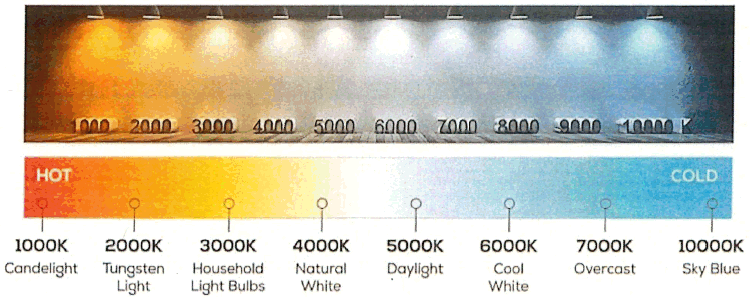
Council or Town Council. The Town Council of the Town of Frisco, Colorado (formerly the "Board" or the "Board of Trustees").
Cul-De-Sac. A street closed on one end which has a throat and a bulbous end.
Curfew. A period of time at night during which lighting must be significantly dimmed in output or extinguished in accordance with an expected decrease in human presence.
D
Day Care Center, Child. Any facility providing less than 24-hour care for over six unrelated children during the daylight hours for compensation.
Day Care, Family. The use of a residence for the care of six or fewer children other than the occupant's own children for periods of less than 24 hours per day. Home child care is considered a home occupation.
Deciduous. Plant that drops all leaves once per year.
Deck. A roofless outdoor space built as an above ground platform, freestanding or attached, projecting from the wall of a structure and supported by posts or pillars.
Dedication. The appropriation of land, or moneys in lieu of land, or a cash amount to be set aside and used for a specifically approved Town project. Acceptance of dedication does not necessarily constitute acceptance of maintenance by the Town, unless specifically agreed to in writing.
Density. The number of dwelling units allowed per developable acre.
Density Bonus. A density bonus is an increase in the allowable number of dwelling units over the base density.
Developable Acre. See Acre, Developable.
Development. Any manmade change to improved or unimproved real estate, including, but not limited to, construction of or improvements to buildings or other structures, the placement of mobile structures, mining, dredging, filling, grading, paving, excavation, material storage or drilling operations.
Development Proposal. The application submitted by an owner or owner's representative, seeking approval for the development of land.
Drainage Easement. A granting to the Town of the right to control development of a drainage right-of-way or an area subject to periodic flooding. Development on such easement shall be restricted to uses, which would not interfere with the flow of the water or act as a barrier for debris.
Drive-Through Business. A business that offers drive-through service where customers remain seated in a vehicle occupying a drivethrough service lane to the point of a window or other service area.
Driveway. An access way for vehicles providing a connection from a roadway to individual single-household or duplex dwellings or a parking lot serving multi-family dwellings, commercial development, industrial development, and other non-residential development. Driveways serve no more than four single-household dwellings, or two duplex dwellings. If an access way serves more than four residences, it shall be classified as a roadway rather than a driveway and must meet the Town's standards and requirements for road construction.
Dumpster Enclosure. A structure which is designed and used to house and screen a refuse dumpster and/or refuse containers, recycling bins, grease traps, or trash compactors, and to keep the materials which are deposited in the enclosure from being scattered.
Duplex. A single building containing two dwelling units, each of which shares a common unpierced wall that extends from ground to roof and that totally separates the enclosed living areas within the dwelling units or the enclosed area within attached accessory garages.
Dwelling, Multi-Unit. A structure containing three or more dwelling units.
Dwelling, Single-Household Detached. A structure containing one dwelling unit.
Dwelling Unit. A single unit providing complete independent living facilities for one or more persons, including permanent provisions for living, sleeping, eating, cooking, and sanitation. Dwellings may exist in many configurations, including, but not limited to, single-household detached, duplex, townhomes, multi-unit dwellings, and group homes. Dwellings do not include boarding, rooming, or lodging facilities, hotels, motels, extended stay lodgings, or lock-off units.
Dwelling Unit, Accessory. See Accessory Dwelling Unit.
Dwelling Unit, Principal. A dwelling unit excluding accessory buildings and accessory uses such as a garage.
E
Easement. A right granted by the property owner, generally created by a real estate deed, a recorded plat or by a written agreement, to permit the use of land by the public, a public agency, a utility, a corporation or a particular person for a specified purpose or use.
Electric Vehicle Charging Station. A public or private parking space served by electric vehicle supply equipment in which a vehicle is recharged.
Eave. The projecting lower edges of a roof overhanging the wall of a building.
Figure 9-C: Eave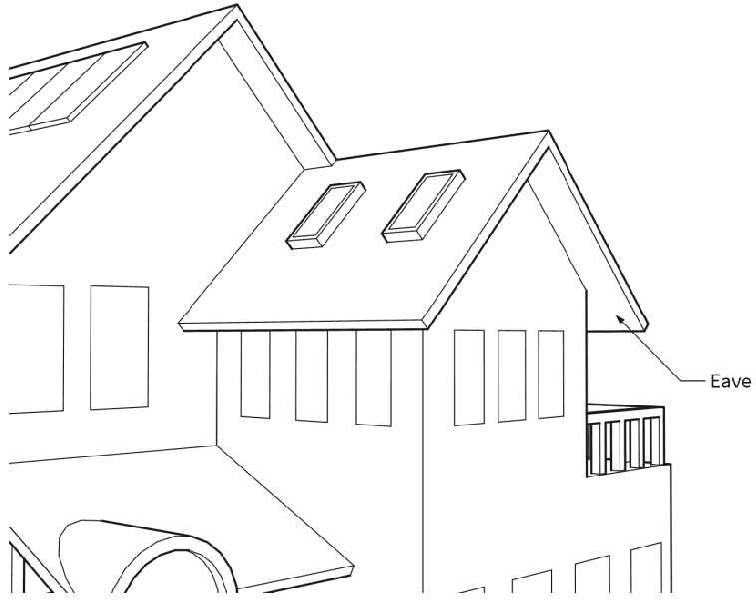
Employee. A person who receives payment for services rendered to a business. In a home occupation or home office business, an immediate family member of the business owner and/or a resident of the business premises is not considered an employee.
Evergreen. Plant that retains leaves/needles year-round.
Exemption. A release from specified procedural requirements of this Chapter.
Existing Grade, Average. See Natural Grade, Average.
Exterior Finish. A minor change to the appearance of the outside of a building, including, but not limited to, window and door replacements, roofing or siding, or painting or repainting. Does not include changes to building footprint, floor area, height, or any substantial change to the appearance of the building.
F
Facade. The square footage of a structure's vertical and horizontal dimensions as viewed in the elevation view. Also referred to as the "vertical surface area."
Farmers' Market. An occasional or periodic market held in an open area or structure where groups of individual sellers offer for sale to the public items such as fresh produce, seasonal fruits, fresh flowers, arts and crafts items, and food and beverages dispensed from booths located on-site.
Fast Food Restaurant. See Restaurant, Fast Food.
Fence. An artificially constructed barrier of any material or combination of materials that encloses, screens, or separates areas, exclusive of earthen mounds or berms.
Festoon Lighting, also referred to as Market Lighting, Bistro Lighting, or Ping-Pong Lighting. String lighting intended for permanent installation and year-round use. Festoon lighting is not seasonal lighting; see seasonal lighting for non-permanent lighting installations.
Financial Service. An establishment such as a bank, savings and loan, credit agency, investment companies, brokers and dealers of securities and commodities, security and commodity exchange, and other similar uses.
Final Plat. The final plat of a subdivision prepared for filing and recording in conformance with these regulations.
Floor Area, Gross (GFA). The area included within the exterior walls of a building or portion thereof including basements, lofts, usable spaces, and other areas with floors but excluding parking in garages.
Floor Area Ratio (FAR). The ratio of the total floor area of buildings on a lot to the size of the land of that lot, or the limit imposed on such a ratio. It is the total building square footage (building area) divided by the site size square footage (site area).
This means that if the lot area is 1,000 square feet, then 1,000 square feet of gross floor area has been built on the lot. Figure 9-C below shows a four-story building covering one-fourth of the site, giving a FAR of 1.0. Four floors of 250 square feet each are built on a site of 1,000 square feet.
Figure 9-D: Floor Area Ratio (FAR)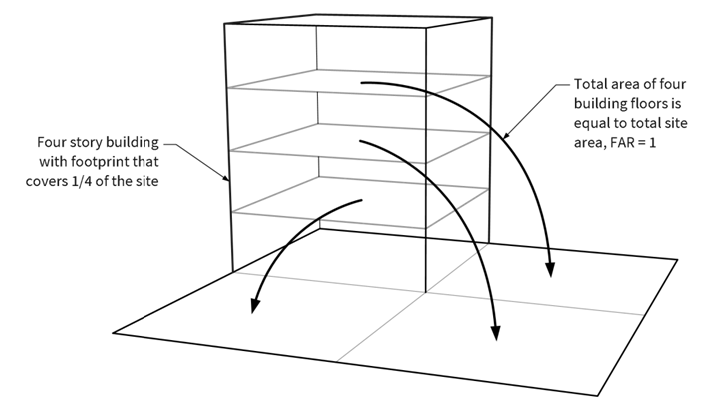
Fractional Ownership. Allows up to 13 weeks per calendar year of single ownership in a dwelling unit, or private residence club, by many different individual owners. Fractional ownership developments shall include 100 percent of all units in a project and shall include a management plan.
Front Yard. See Yard, Front.
Fully Shielded Fixture. A fixture for which the light source shall not be visible above a 90-degree horizontal plane passing through the lowest light-emitting part of the fixture. No light shall be projected at or above the horizontal plane. Any structural part of the fixture providing this shielding must be permanently affixed. The fixture must have a solid barrier (cap) at the top of the fixture in which the lamp (bulb) is located. Frosted glass in a fixture does not constitute shielding.
Figure 9-E: Examples of Fully Shielded Fixtures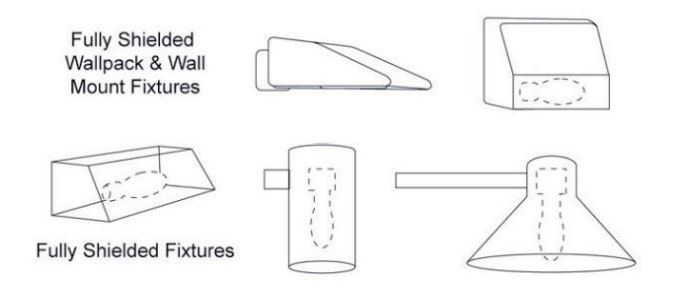
Figure 9-F: Diagram of fixture shielding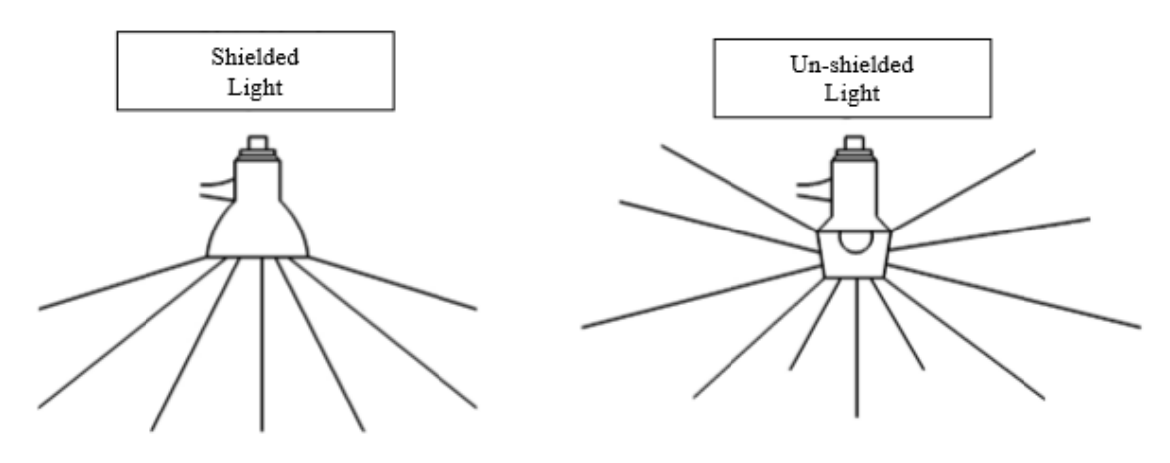
G
Garage. An accessory building or portion of a principal building that is intended or used primarily for the storage of motor vehicles, and which is enclosed in such a manner that the stored or parked motor vehicle is contained entirely within the building.
Garage, Private. A building or indoor space that is associated with an individual dwelling unit for purposes of parking or keeping a motor vehicle, is fully enclosed, and has a secure door dedicated exclusively to a specific unit.
Geometric Plane. A flat surface of a building wall that extends in two directions, vertically and horizontally, and is used to determine the amount of articulation being provided by a building's façade or footprint. Bays, decks, roof area, and other minor projections or insets are not counted when determining.
Grade, Finished. The final elevation and contours of the ground level after development.
Grade, Natural. The elevation and contours of the ground level in its natural state, before construction, filling, or excavation. See also Natural Grade, Average.
Grading. Any stripping, cutting, filling or stockpiling of earth or land, including the land in its cut or filled condition, to create new grades.
Greenhouse. A building with a roof and sides constructed of glass or other transparent or translucent material and in which the temperature and humidity can be regulated for the cultivation of plants.
Gross Floor Area (GFA). See Floor Area, Gross.
Group Care Facility. A facility, required to be licensed by the state, which provides training, care, supervision, treatment and/or rehabilitation to the aged, disabled, those convicted of crimes, or those suffering the effects of drugs or alcohol; this does not include day care centers, family day care homes, foster homes, schools, hospitals, jails or prisons.
H
Health, Recreation, and Exercise Establishment. An establishment or facility designed and equipped for the conduct of sports, exercise activities and other customary and usual recreational activities, including, but not limited to, tennis, racquetball, handball and squash courts, weight and aerobic exercise rooms, running facilities, swimming pools, yoga, bowling, martial arts, dance, and whirlpool and sauna facilities. Permitted accessory uses may include child care, sun tanning booths, health and nutrition counseling services, retail sales of sporting goods and restaurant services.
Height, Structure. The height of any structure measured in the same manner as building height. See Building Height.
Holiday Lighting. See "seasonal lighting."
Home Occupation. A business or profession engaged within a dwelling by a resident thereof which is clearly incidental and secondary to the use of the dwelling for residential purposes.
Home Office. An office of convenience engaged within a dwelling by a resident thereof where no more than four customers a day may visit, and where business is conducted primarily by phone, telecommunications, or by mail and no persons are employed by the resident so that the average neighbor will be unaware of its existence. There shall be no exterior indication of non-residential activity and deliveries shall not exceed volumes that would normally be expected in a residential neighborhood. There shall be no audible noise, detectable vibration or odor and no electrical interference beyond the confines of the subject dwelling unit. Advertising of the business may not include the physical address of the office. The home office shall not occupy more than 30 percent of the gross floor area of the dwelling unit in question.
Homeowners Association Recreational Facility. A place, building, or structure designed and equipped for the conduct of sports and leisure-time activities, which is operated by a homeowners' association and open only to bona fide members and guests of such a homeowners association.
Hospital. An institution designed for the diagnosis, treatment and care of human illness or infirmity and providing health services, primarily for inpatients, and including as related facilities, laboratories, outpatient departments, training facilities, and staff offices.
Hostel. A building other than a boardinghouse that contains more than five rooms where, for compensation, lodging is offered and provided to members of the general public, and where 75 percent or more of the rooms are accessed through a supervised inside office or lobby.
Hotel or Motel. A building or group of buildings in which lodging is provided and offered to transient guests for compensation. This does not include boarding, lodging, or rooming facilities or tourist homes.
I
Illuminance. The density of light falling onto a surface; commonly measured in the horizontal and vertical planes. Measured in lux or footcandles (fc).
Impervious Surface. A surface that has been compacted or covered with a layer of materials that is highly resistant to infiltration by water. Impervious materials include, but are not limited to, surfaces such as compacted sand, lime rock, or clay; asphalt, concrete, driveways, retaining walls, stairwells, stairways, walkways, decks and patios at grade level, and other similar structures.
Improvement. Street grading and surfacing, with or without curbs, sidewalks, crosswalks, water mains, sanitary and storm sewers, culverts, bridges, landscaping, drainage features, recreational trails, or other such improvements as may be designated by the Planning Commission or the Town Council as being required for the development of the land to be subdivided.
Improvements Agreement Guaranty. Any security which may be accepted by the Town, at the Town's sole discretion, in lieu of a requirement that certain improvements be made by the subdivider before the final plat is executed, including performance bonds, escrow agreements, irrevocable letters of credit, or other similar collateral or surety agreements as may be approved by the Town.
Institutional Use. A non-profit, governmental, public, or private use, building, structure, or land used by the public. Includes, but is not limited to a post office, cemetery, school, hospital, and library.
Intermittent Stream. A natural drainage way which does not flow continually but does drain 20 or more acres.
J
Junk. Old or scrap metal, rope, rags, batteries, paper, trash, rubber, debris, waste, or junked, dismantled, or wrecked automobiles or automobile parts or appliances or appliance parts.
K
Kennel. Any establishment where dogs and/or cats are bred or raised for sale, or boarded, trained, cared for and/or groomed commercially.
Kitchen. Any room or portion of a room within a building used, intended to be used, or designed to be used either wholly or partly for cooking and/or the preparation of food.
Kitchenette. An area used for the storage, preparation and serving of food or drink to guests that is limited to a sink, a refrigerator of no more than six cubic feet in size, a cabinet area not exceeding six cubic feet, and a counter area not exceeding six square feet.
L
Landscaping. Any combination of living plants such as trees, shrubs, plants, vegetative ground cover and turf grasses, and may include structural features such as walkways, fences, benches, works of art, reflective pools, fountains, or other similar features. May include retention and detention ponds.
Large Project. Any commercial or mixed-use project, occurring on a lot of 10,500 square feet or greater or occurring on a group of lots combined for a unified development project which contain a total lot area of 10,500 square feet or greater; or any residential development occurring on a lot of 21,000 square feet or greater or any development of five or more dwelling units.
Laundromat, Commercial/Industrial. An establishment that cleans fabrics and textiles (apparel, uniforms, towels, bedding, table linens, draperies, rugs, upholstery, etc.) for other businesses, with no more than 30 percent of the gross floor area occupied by an accessory self-service laundromat use. The establishment may include drop-off facilities and collection/delivery services.
Laundromat, Self-Service. An establishment providing washing and drying machines on the premises for rental use to the general public. This definition includes vended laundromats, also referred to as coin-operated laundromats. This definition does not include multi-housing laundries or on-premises laundries.
Laundromat, On-Premises. On-site laundry facilities that are an accessory use to a principal commercial, industrial, or institutional use, and are a part of normal business operations in industries such as healthcare, veterinary services, emergency services, sports and athletics, hospitality, spas and salons, farming and agriculture, manufacturing, etc.
Light Fixture. The assembly that houses the lamp or lamps and can include all or some of the following parts: a housing, a mounting bracket or pole socket, a lamp holder, a ballast, a reflector (mirror), and a refractor (lens).
Light Goods Repair. Any building or portion of a building that contains establishments for the repair, restoration, refurbishing, and/or mending of light portable items such as clothing, shoes, furniture, bicycles, skis, and small appliances.
Limited Common Element. Land or buildings (in part or in whole) within or related to a development, that is not individually owned or dedicated for public use, and is designed and intended for use by designated residents or occupants or owners of the development. The designation of use is generally identified on a plat or in a declaration of covenants. It may include complementary structures and improvements.
Lock-Off. A portion of a dwelling unit suitable for short-term habitation, with a separate entrance, containing at least one bathroom but no cooking facilities, and capable of being securely separated from the dwelling unit.
Long-Term Rental. See Rental, Long-Term.
Lot. See also Parcel. A measured portion of a subdivision or other parcel of land intended as a unit for transfer of ownership or for development.
Lot Area. The horizontal area of the lot.
Lot Coverage. The percentage of total lot area used for parking, roads, drives; and above or below-grade structures or improvements, including, but not limited to, hot tubs, decks, patios, and sheds. The following elements are excluded from the calculation of lot coverage: Two feet of roof eaves as measured perpendicular from the exterior building wall; ground-mounted solar energy facilities as an accessory use; 100 percent of publicly used non-vehicular pathways and three feet of the width of privately used non-vehicular pathways; and approved dumpster enclosures that provide adequate space for recycling containers.
Lot Frontage. That portion of a lot fronting upon and providing rights of access to a dedicated street. Lot frontage is measured continuously along only one street.
Lot Line. The legal boundaries of a parcel of land established by a recorded subdivision plat. Lot lines are classified as either front, side, or rear.
Lot Line, Front. The property line separating a lot from the street except, where a lot is bordered by more than one street, the property owner shall determine which side of the lot having street frontage is to be considered the front for setback purposes. Each lot proposed for development shall have at least one property line designated as the front lot line.
Lot Line, Rear. The property line opposite to and furthest away from the front property line except, where a lot is irregular in shape, the Community Development Department shall determine which property line is to be designated as the rear property line for setback purposes. Each lot proposed for development shall have at least one property line designated as the rear lot line.
Lot Line, Side. Any property line bounding a lot that is not designated as either a front or rear property line.
Lumen. The measure of visible light (luminous flux) emitted from a light source.
Lumens Per Acre. The total outdoor light output divided by the number of acres, or part of an acre, of the property.
M
Manufacturing. The creation of products either with machinery or by hand according to an organized plan and with the division of labor.
Manufacturing, Light. Fabrication of and/or assembly of goods from previously prepared materials, which does not generate significant odor, noise and/or light pollution, or negative impacts to air and water quality, and traffic.
Marina. A facility that offers service to the public or members of the marina for docking, loading, or other servicing or recreational watercraft. Accessory uses include boat storage and eating and retail facilities for owners, crews, and guests.
Master Plan. The currently adopted Frisco Community Plan for guiding policies and regulations and controlling future growth, protection, and development of the Town to achieve the community's vision of present and future needs.
Medical Office. See Office, Medical.
Microbrewery, Distillery, and/or Tasting Room. A small brewery, winery, or distillery operated separately or in conjunction with a drinking establishment or restaurant, provided the beer, wine, or liquor is sold for consumption onsite or off the premises and is not sold to other drinking establishments, restaurants, or wholesalers.
Minor Subdivision. A minor subdivision shall include a resubdivision of a structure of two or fewer units, a minor relocation of a property line, a correction of a survey or engineering error, and the conversion of an existing structure into townhomes or condominiums.
Mixed-Use Project. A project of attached or detached structures intended for more than one of the following uses, residential, office, retail, commercial, industrial, institutional, and public.
Mobile Home. A transportable dwelling unit attached or at one time attached to a chassis, containing complete electrical, plumbing, and sanitary facilities and designed for year-round living without necessity of a permanent foundation, but does not include camper or modularity constructed dwelling units.
Modification. A departure from the requirements set forth in this Chapter.
Motor Vehicle. A vehicle which is used to transport passengers and goods which is less than 33 feet in length and 15,000 gross vehicle weight, and is not designed for use as living quarters on either a temporary, seasonal or permanent basis, including, but not limited to, automobiles, pickup trucks and vans. Excludes recreational vehicles and park homes.
Mounting Height. The vertical distance between the finished grade elevation and the top of the lighting fixture.
Multifamily or Multi-Unit Residential Project. Development of three or more attached or detached dwelling units, for which development approval is sought under a single or phased development application.
N
Natural Grade, Average. The average of the existing or natural topography of a site as measured within three feet of the proposed foundation wall location prior to excavation and/or construction.
Nonconformity. The state, usually ascribable to uses and buildings, of lawfully conflicting with the provisions of this Chapter due to the existence of the use, building or portion thereof prior to the adoption or subsequent amendment of this Chapter.
Nonconforming Lot. A lot that does not meet the minimum lot size or street frontage requirements of the zoning district in which it is located, but that was lawfully created prior to the effective date of the ordinance establishing the zoning district or subsequent amendments that created the nonconformity.
Nonconforming Sign. A sign which was erected legally but which does not comply with subsequently enacted sign regulations and restrictions.
Nonconforming Structure. A building or structure that does not comply with the setback, height, lot coverage and other development requirements of the zoning district or overlay district in which it is located, but that was lawfully constructed prior to the effective date of the ordinance that established the zoning district or subsequent amendments thereto that created the nonconformity, and that has been continuously maintained. This term does not apply to any substandard condition that was legally granted a variance.
Nonconforming Use. Any activity, development or condition that is not a permitted use in the zoning district in which it is located, or is not a conditional use in that zoning district that has received conditional use approval under applicable law or other special permitting process, but that was lawfully established prior to the effective date of the ordinance establishing the zoning district or subsequent amendments thereto that created the nonconformity, and that has been continuously maintained. A nonconforming use may or may not involve buildings or structures and may involve part of or all of a building or property.
O
Occupancy. The purpose for which a building or structure is used or intended to be used; and, in the case of residential uses, such term can also refer to the number of persons who reside within a building, dwelling unit or other structure.
Office. A building or portions of a building in which commercial activities take place but where goods are not produced, sold or repaired. These include, but are not limited to, general and professional services, governmental offices, insurance offices, real estate offices, travel agency, utility offices; radio broadcasting and similar uses.
Office, Medical. A building or portion of buildings that contains establishments dispensing health services, and/or that provides support to the medical profession and patients. Examples include, but are not limited to, a healing center under the Colorado Natural Medicine Health Act of 2022, as amended and as codified at C.R.S section 12-170-104, et. seq., medical and dental laboratories, blood banks, oxygen providers, integrative medicine and holistic or homeopathic therapies, and other miscellaneous types of medical services.
Open Space. An area including buffers between neighborhoods and communities, buffers between trail systems and development, natural areas, scenic areas and vistas, historical and cultural lands, undeveloped shorelines or riparian areas, wildlife habitats and/or migration corridors, recreational access points, lands of unique ecological value, lands of significance to threatened or endangered species or species of special concern, pocket parks, trails and trail connections, and lands of aesthetic or passive recreational value.
Open Space, Usable. Any outdoor space usable for outdoor recreation activities, which may include areas maintained in a natural or undisturbed state, as well as plazas, pathways, sidewalks, landscaping, gardens, water features, fountains, or other similar areas which provide visual relief from the mass of buildings. Usable open space shall not include space used for driveways, parking areas, dumpster enclosures, or decks, patios, balconies above grade, or other similar features.
Outdoor Storage. The storage of materials, refuse, junk and/or other similar items outside of a building.
Overlay Zone. A zoning district that imposes requirements in addition to those required by the underlying zone.
Owner. Any person with a legal or equitable interest in property, with or without accompanying actual possession of the property; a person who is under contract to purchase property by land installment contract or by a purchase contract; or a person who is acquiring property, or a legal or equitable interest in it, through foreclosure.
P
Parapet. The extension of a false front or a building wall above the roofline.
Parcel. See also Lot. A contiguous area of land except for intervening easements and rights-of-way with a continuous boundary.
Parcel Resubdivision. Any subdivision of a lot, tract, or other parcel of land, which previously has been subdivided.
Park. An area or facility to be used for recreation, exercise, sports, education, rehabilitation, or similar activities, or an area intended to enhance the enjoyment of natural features or natural beauty.
Parking and/or Loading Space. A defined area designed for a parked single vehicle which has adequate access to a street or alley.
Parking Facility. Any parking lot or parking structure which is used primarily or habitually for the parking of vehicles (excluding street or alley rights-of-way).
Partially Shielded Fixture. A fixture with opaque top and translucent or perforated sides, designed to emit most light downwards. Fixtures that utilize frosted glass for shielding would be considered partially shielded.
Passive Recreation and Open Space. Leisure-time activities, usually of an informal nature that generally involve less intensive activities, including, but not limited to, walking, jogging, hiking, snowshoeing, Nordic skiing, sitting, picnicking, and other similar less intensive recreational uses.
Patio. A level hard-surfaced area at finished grade.
Permanent Monument. Any structure of masonry and/or metal (pins and caps) permanently placed on or in the ground, including those expressly placed for surveying reference.
Personal Services, General. Establishments primarily engaged in providing services involving the care of a person or his/her personal goods, including, but not limited to, dry cleaning pickup, cosmetics, beauty and barbershops, spas, nail salons, shoe repair shops, tailor shops, funeral services, and domestic services.
Planning Commission. See Commission.
Plant Establishment Period. The time needed for a plant to recover from being transplanted, either from a container or root ball condition or previous naturally occurring locations to its new location.
Plant Nursery. Any land or structure used primarily to raise trees, shrubs, flowers, and other plants for sale or for transplanting.
Plat. A map of certain described land prepared by a land surveyor, licensed in the State of Colorado, as an instrument for recording real estate interest with the County Clerk and Recorder.
Plat Correction. A minor change made to a previously recorded plat for the purpose of correcting unintentional errors made by the owner or owners of the parcel or parcels to be changed. Such changes shall not violate the applicable zoning or subdivision requirements for the said plat to be corrected.
Preliminary Plat. The preliminary plat of a subdivision prepared in accordance with the requirements of this Chapter.
Premises. A parcel of land, or contiguous parcels of land not separated by a public right-of-way, and developed under one site plan.
Property Lines. The boundaries of a tract of land established either by a recorded subdivision plat or by written, recorded conveyance. Includes lot and parcel lines.
Principal Dwelling Unit. See Dwelling Unit, Principal.
Principal Use. See Use, Principal.
Produce Stand. A building or structure used for the retail sales of fresh fruits, vegetables, flowers, herbs or plants grown on the same parcel of land where the stand is located. Such use may also involve the accessory sales of other unprocessed foodstuffs, home processed food products such as jams, jellies, pickles, sauces or baked goods, and homemade handicrafts.
Professional Trade. Industrial, contractor, or technology-related trade services. Such uses also include supply businesses in the fields of construction materials, interior design, landscaping, automotive, janitorial, medical, and office.
Public Hearing. A meeting announced and advertised in advance in accordance with applicable notice requirements and which is open to the public, with the public given an opportunity to address the decision-making body.
Public Improvement. Any improvement, facility, or service, together with its associated site and any right-of-way necessary to provide transportation, drainage, utilities, or similar essential services and facilities, that is usually owned and operated by a government entity or agency.
Public Meeting. A meeting announced and advertised in advance in accordance with applicable notice requirements and which is open to the public, at which the public may or may not be given an opportunity to address the decision-making body.
Public Notice. Notice to the public of a hearing or meeting by the Council, the Planning Commission or other board.
Public Utility Facilities. Major buildings, structures, and facilities including, but not limited to, generating and switching stations, electrical substations, water or sewer pumping stations, and telephone exchanges, related to the furnishing (storage and transportation) of utility services, including, but not limited to, electric, gas, telephone, cable, water, sewer, and public transit, to the public. Major public utility facilities located in rights-of-way or easements are not uses required to be zoned.
Q
[Reserved.]
R
Rear Yard. See Yard, Rear.
Recreational Vehicle. A vehicular-type, portable structure without permanent foundation, which can be towed, hauled or driven and primarily designed as living accommodation for recreational, camping and travel use and including, but not limited to, travel trailers, truck campers, camping trailers, and self-propelled motor homes.
Recyclable Materials. Waste materials that are collected, separated or processed, and used as raw materials or products including, but not limited to, newspaper, cardboard, paperboard, brown paper bags, office paper, mixed paper, magazines, glass bottles, jars, aluminum and steel cans, and plastic bottles and jars.
Redevelopment. Any development of previously developed land.
Refuse Container. A container, primarily used by the occupants of a single residential unit to temporarily store refuse or recycling materials, which includes all forms of solid waste, garbage, rubbish, trash, recycling items and other similar materials.
Rental, Long-Term. The rental of a room, apartment, or house for a time period of 30 days or more.
Rental, Nightly (Short-Term). The rental of a room, apartment, or house for a time period of less than 30 days.
Repair and Light Fabrication Workshop. A facility where goods are produced or repaired by hand, using hand tools or small-scale equipment, including small engine repair, furniture making and restoring, upholstering, custom care or motorcycle restoring and other similar uses.
Research and Development. An establishment or other facility for carrying on investigation in the natural, physical, or social sciences, which may include engineering and product development.
Resident Employee. An employee who lives on the property on which the employment is located.
Restaurant. An establishment where food and drink are prepared, table service is provided, and consumption takes place primarily within the principal structure.
Restaurant, Fast Food. An establishment where food and/or beverages are sold in a take-out fashion, no table service is provided, and all or a significant portion of the consumption takes place outside the confines of the restaurant, and/or ordering and pick-up of food may take place from an automobile.
Resubdivision. The changing of any existing lot or lots of any subdivision plat previously recorded with the County Clerk and Recorder. Resubdivision includes the condominiumization into private ownership units of property previously occupied on a rental basis. Resubdivision includes lots, parcels, units, and real property converted to time-share units or time-share estates.
Retail. The rental or sale of tangible personal property for any purpose other than for wholesale resale.
Retail, Light. The sale of tangible personal property for any purpose other than for resale where the total area utilized by a single tenant, exclusive of parking occupies less than 35,000 square feet.
Retail, Professional Trade. The rental or sale of tangible personal property related to professional trade supply businesses.
Retail, Regional. The sale of tangible personal property for any purpose other than for resale where the total area utilized by a single tenant, exclusive of parking occupies 35,000 square feet or more.
Ridgeline. The horizontal line formed by the juncture of two surfaces on a roof.
Road. All property located within a highway or dedicated right-of-way or easement that functions as a right-of-way for a public or private road, street, alley, highway, or freeway.
Roadway. The portion of the highway or road, including shoulders, for vehicle use.
Roof. The outside top covering of a building including, but not limited to, a mansard roof, a hipped roof, a flat roof, a gambrel roof, a gable roof and a shed roof.
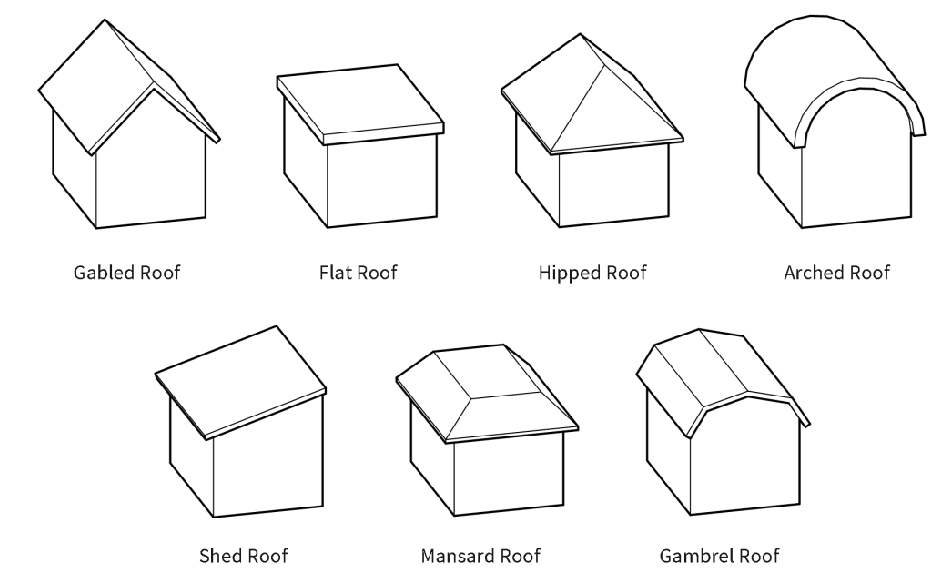
Figure 9-G: Roof Types
Roof, Flat. A roof having a slope of 2:12 or less.
Roof Overhang. Eaves or the lower edge of the roof which overhang the walls. This includes the eave or edge of the roof which overhangs the gable end walls.
Roof Slope or Roof Pitch. The ratio of horizontal distance (run) proportional to vertical distance (rise or drop) of a slope, such as a 4:1 slope having one foot of rise for every four horizontal feet.
S
School. Any of the following types of educational facilities:
1.
Type 1: Public, parochial or private school or academy providing pre-primary, primary, elementary or grammar school level courses (pre-K through 5th grade)
2.
Type 2: Public, parochial or private school or academy providing middle, preparatory or high school level courses (6th grade through 12th grade)
3.
Type 3: Junior college or university, public or founded, or conducted by or under the sponsorship of a religious or charitable organization
Screening. A method of visually shielding or obscuring one abutting or nearby structure or use from another by fencing, walls, berms, or densely planted vegetation.
Seasonal Lighting. String lighting meant for temporary use and displayed on buildings or landscaping.
Security Lighting. Lighting intended to provide bright illumination for security surveillance. This lighting shall not be used continuously as a general deterrent during hours of darkness.
Senior Housing. A residential establishment or institution other than a hospital or nursing home that provides living accommodations and medical services primarily to individuals 55 years of age or over and to individuals who, due to illness or disability, require care similar to that provided to persons who are 55 years or over. Services like transportation, housekeeping, dietary supervision, and recreational activities may also be offered.
Setback. The minimum required distance between the lot line and nearest line or point of the building or structure (including roof eaves or any projections such as decks).
Sexually Oriented Business. An adult arcade, adult bookstore, adult novelty shop, adult video store, adult cabaret, adult motel, adult motion picture theater, adult theater, or nude model studio. The definition of sexually oriented business shall not include an establishment where a medical practitioner, psychologist, psychiatrist, or similar professional person licensed by the State of Colorado engages in medically approved and recognized sexual therapy.
Shed. An accessory building of not more than 120 square feet in floor area and not more than 14 feet in height.
Shield. A device used to partially conceal or protect, such as concealing a light source.
Short-Term Rental. See Rental, Nightly.
Showroom. An establishment where the display of goods and wares is provided to provide conceptual models of various products.
Side Yard. See Yard, Side.
Site Plan. The development plan for one or more lots on which is shown the existing and proposed conditions of the lot, including topography, vegetation, drainage, flood plains, wetlands, and waterways; landscaping and open spaces; walkways; means of ingress and egress; circulation; utilities; structures and buildings; signs and lighting; berms, buffers, and fences; adjacent development; and any other information that reasonably may be required in order that an informed decision can be made by the Town.
Site Specific Development Plan. An approved plan/plat that creates a vested property right.
Small Lot. A parcel which does not meet the minimum lot size for the zoning district in which it is located.
Slope. The ratio of vertical distance to horizontal distance (rise divided by run). For example, a 1:4 slope (one-foot rise over a four-foot run) is a 25 percent slope.
Soil Disturbance. Any human-made or human caused activity such as, but not limited to, landscaping and vegetation removal, fences, structure or construction that changes the character or topography of the land on which the activity, structure or construction occurs.
Solid-Fuel Burning Device. Any fireplace, stove, firebox or other device which is or will be used for the purpose of burning wood, coal, pulp, pellets or other non-liquid or nongaseous fuel.
Solar Energy Facility. The components and subsystems required to convert solar energy into electric or thermal energy suitable for use. The area of the facility includes all the land inside the perimeter of the system, which extends to any fencing. The term applies, but is not limited to, solar photovoltaic (PV) systems, solar thermal systems, and solar hot water systems.
Solar Energy Facility, Large-Scale. A Solar Energy System occupying more than one-half acre.
Special Event. A special event is an organized event or a group activity including, but not limited to a performance, live music, broadcast music, commercial entertainment, assembly, contest, exhibit, ceremony, athletic competition, reading, or other similar gatherings where anything of value is exchanged in return for attendance or entry into the event. Special events do not include wedding events. Special events governed under this section are commercial in nature.
Specimen Quality. Shape, form, and density of foliage are typical of the species and no defects to these criteria are evident.
State. The state of Colorado.
Storage Facility. Provision of storage space for household or commercial goods within an enclosed building with direct public access to individual storage spaces.
Stepback. The horizontal distance that an upper portion of a building facade is set back from the face of the building's lower portion.
Street. Any street, avenue, road, lane, parkway, viaduct, alley or other way for the movement of vehicular traffic which is on an existing state, county or municipal roadway, or a street or a way shown upon a plat, previously approved, pursuant to law or approved by official action; and includes the land between street right-of-way, whether improved or unimproved, and may comprise pavement, shoulders, gutters, sidewalks, parking areas and other areas within the right-of-way. Definitions and specifications for street classifications are designated in the Town of Frisco Minimum Street Design and Access Criteria in the Frisco Town Code.
Street, Private. A street which exists exclusively on private property that has been approved by the Town but not been dedicated to or accepted by the Town.
Street, Public. A street dedicated to and accepted by the Town which is platted or otherwise created as a nonexclusive vehicular right-of-way for ingress and egress.
Structure. A purposeful combination of materials fixed to the ground or to some other structure. Structures include buildings, towers, masts, sheds, decks, hot tubs, roofed storage areas, mechanical equipment, and dumpster enclosures. "Structures" do not include benches, sculptures, fire pits, signs, fences, walls, driveways, walkways, other paved areas or public utility lines and cables.
Studio. A dwelling unit consisting of not more than one habitable room together with kitchen or kitchenette and sanitary facilities.
Sunset. The time of day when the sun disappears below the western horizon as defined daily by the National Weather Service and posted in regional newspapers.
Street Right-of-Way. That portion of land dedicated to public use for street and utility purposes.
Subdivider. Any person, group, corporation or other entity or any agency dividing or proposing to divide land so as to constitute a subdivision.
Subdivision. The process by which a metes and bounds tract of land is divided into two or more parcels, lots, units, or building sites for the purpose, whether immediate or future, of sale or building development. It includes resubdivision and, when appropriate, may refer to a relatively large development of similar uses.
Substantial Destruction. A building or structure has suffered substantial destruction if the cost of repair of the building or structure exceeds 75 percent of the replacement cost of the entire building, excluding the foundations. The replacement cost shall be derived from the fair market value of the building or structure, or the value as defined by Chapter 65, Town of Frisco Construction and Housing Standards, whichever is greater.
T
Tandem Parking. The parking of one motor vehicle behind another motor vehicle.
Temporary Structure. A structure without any permanent foundation or footings and that is removed when the designated time period, activity, or use for which the temporary structure was erected has ceased.
Temporary Use. See Use, Temporary.
Tenant Finish. An interior only change to the floor plan of a structure.
Time-Share. A time-share estate, as defined in C.R.S. § 38-33-110(5), 1973, but the term does not include group reservations made for convention purposes as a single transaction with a hotel, motel or condominium owner or association. In addition, a time-share estate means a contractual or membership right of occupancy which cannot be terminated at the will of the owner or for a term of years, to the recurrent, exclusive use or occupancy of a lot, parcel, unit or segment of real property, annually or on some other periodic basis, for a period of time that has been or will be allotted from the use or occupancy periods into which the property has been divided.
Town Engineer. Any engineer certified by the State of Colorado and retained or designated by the Town to provide engineering services.
Townhome. An individually owned residential unit that has an undivided interest in common with other unit owners in the common elements of a project including land and infrastructure. Townhouse ownership includes the structure, from foundation to roof in an unbroken vertical plane, and the land on which the foundation of the Townhouse is constructed. In order for footings to be considered a foundation in any location, that area must have an unbroken vertical plane to the roof and must be physically attached to the building. Townhouse units or portions thereof cannot be stacked one above another. Nothing shall be construed to prohibit the ownership of common areas by a homeowners' association holding title to such areas for and on behalf of the individual owners of a townhouse unit.
Trail Corridor. A multipurpose path designed for use by pedestrians, bicyclists, or in-line skaters, or for other non-motorized uses.
Transit-Oriented Facilities and Uses. Establishments engaged in furnishing local and regional passenger transportation, and/or furnishing services incidental to transportation, such as parking facilities, packing services, and passenger mobilization offices.
Transitional Shelter Facility. An approved designated outdoor location allowing for temporary sleeping in private passenger vehicles subject to specific conditions, including local employment, approved refuse management and sanitation, user screening, and management of the facility.
U
Usable Open Space. See Open Space, Usable.
Use. A purpose for which a parcel of land is designed, arranged or intended or for which it may be occupied or maintained under this Chapter.
Use, Accessory. Use of land or of a building or portion thereof customarily incidental and subordinate to the principal use of the land or building and located on the same lot or in the same building with the principal use. A dwelling unit shall not be allowed as an accessory use. Accessory uses may occupy no more than 30 percent of the gross floor area of the principal building.
Use, Conditional. A use which, because of its character, size and potential impacts, may or may not be appropriate in a particular zoning district and which may be undertaken, if at all, only in accordance with the provisions of Section 180-2.5 of this Chapter.
Use, Principal. The main or primary use of any lot or parcel.
Use, Temporary. A use established for a limited duration with the intent to discontinue such use upon the expiration of the time period.
Utility. Any firm, partnership, association, cooperative, company, corporation, governmental agency, special or metropolitan district, and the directors, trustees or receivers thereof, whether elected or appointed, which is engaged in providing electric, rural electric, telephone, telegraph, communications, cable television, gas pipeline carrier, water, sewerage or pipeline facilities and services.
V
Variance. A departure from the provisions of this Chapter relating to the coverage, setback, height, lot size or other development standards and requirements of the applicable zoning district, but not involving the actual use.
Vested Property Right. The right to undertake and complete the specific development and use of property under the terms and conditions of a "site specific development plan."
Veterinary Clinic. An establishment that provides medical treatment and care to animals, and which may include temporary or overnight boarding of animals that are recuperating from treatment. A veterinarian clinic or office may include a kennel.
W
Waiver. A relinquishment or abandonment of the requirements set forth in this Chapter relating to development and/or improvement standards.
Warehouse. An establishment whose primary activity is the storage of residential, commercial, industrial, or other goods, including inventory and/or finished products, and where no such goods are sold either at wholesale or at retail. This use does not include the storage of goods incidental to a different primary use on the same lot, which is considered an accessory use.
Waterbody. Permanently or temporarily flooded lands, other than wetlands. These could include lakes, reservoirs, ponds, mudflats, perennial or intermittent rivers, streams, creeks, swales, or ditches (whether natural or artificial). These features have a visible high-water line as evidenced by physical characteristics such as a clear, natural line impressed on the bank, shelving, changes in the character of soil, destruction of terrestrial vegetation, the presence of litter and debris, or other appropriate means that consider the characteristics of the surrounding areas.
Way. A street, road, sidewalk, alley or other area reserved for present or future use for the purpose of vehicular or pedestrian travel. A "way" is either public (i.e., dedicated) or private (i.e., established by plat, reservation, deed, covenant or contract approved by the Town).
Wetland. Those areas that are inundated or saturated by surface or ground water at a frequency and duration sufficient to support, and that under normal circumstances do support, a prevalence of vegetation typically adapted for life in saturated soil conditions. Common wetlands in and around Frisco include wet meadows, shallow marshes, willow stands, wet forested areas associated with high groundwater or snowmelt, peatlands, irrigated lands and other areas along water courses or where groundwater is near the ground surface. The procedures used to identify wetlands are those described in the Regional Supplement to the Corps of Engineers Wetland Delineation Manual: Western Mountains, Valleys, and Coast Region (U.S. Army Corps of Engineers 2010). All wetlands identified using this methodology are regulated by the Town, regardless of whether they are regulated by the U.S. Army Corps of Engineers under Section 404 of the Clean Water Act.
Wholesale Business. The sale of goods and merchandise for resale instead of for direct consumption.
Workforce Housing. A dwelling unit that is deed restricted in perpetuity to occupancy by individuals meeting the employment and occupancy standards as established from time to time by the Town. Occupancy standards shall include requirements for primary residency and local employment.
X
[Reserved.]
Y
Yard. An area of a lot not occupied by a structure, located between a street or other property line and any structure or element thereof other than a fence, wall or other customary yard accessory. Depth is to be measured perpendicularly to the street or property line.
Yard, Front. A yard between a principal structure and the front lot line and between the side lot lines.
Yard, Rear. A yard between a principal structure and the rear lot line, opposite the front yard.
Yard, Side. A yard between a principal structure and the side lot line and between the front and rear yards.
Figure 9-H: Yard Types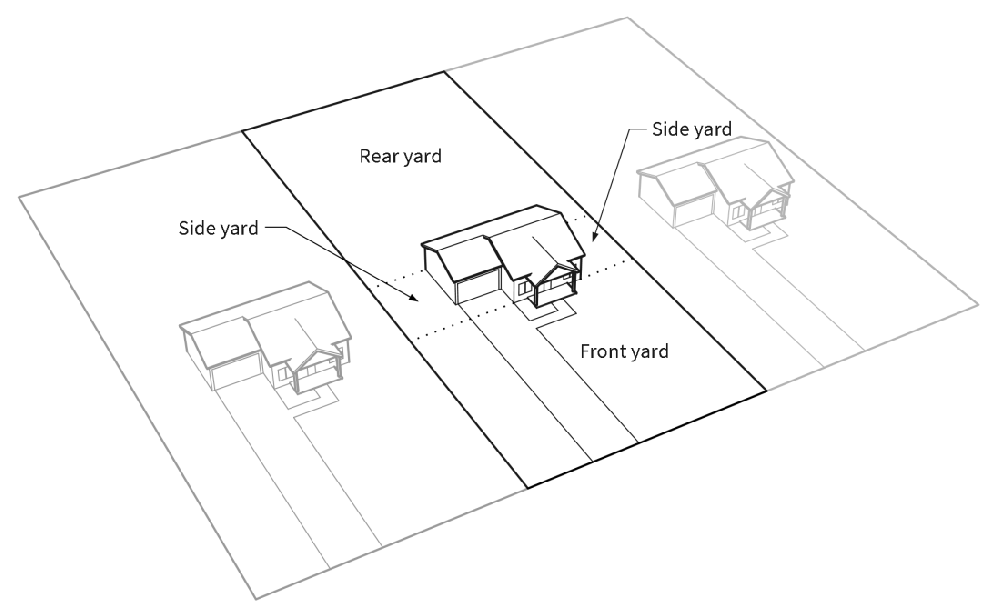
Z
Zero Lot Line Development. A single-household or duplex residential development in which each dwelling is placed within its lot such that one side of the dwelling is sited on a side lot line and the area reserved for the side setbacks is combined on one side of the lot.
Zone. A specifically delineated area or district in a municipality within which uniform regulations and requirements govern the use, placement, spacing, size, and other characteristics of land and buildings.
(Ord. No. 17-04, 6-27-17; Ord. No. 19-04, 4-9-19; Ord. No. 20-23, 1-26-21; Ord. No. 22-12, 10-11-12; Ord. No. 23-09, § 12, 3-28-23; Ord. No. 23-10, § 2, 4-11-23; Ord. No. 24-12, § 3, 10-22-24; Ord. No. 26-03, § 7, 2-10-26)

