
Gainesville City Zoning Code
ARTICLE V
- USE STANDARDS
Sec. 30-5.1. - Applicability.
A.
The requirements of this article shall be applicable to each specific use identified herein, regardless of the zoning district in which the use is located, regardless of whether the use is permitted as of right or by special use permit, and regardless of any less restrictive requirements generally applicable to the district in which the use is located. However, when any particular requirement or limitation generally applicable in any zoning district, or when any requirement or limitation imposed by the approving board as a condition of a special use permit approval or variance, is additional to or more restrictive than the requirements and limitations contained in this article, the additional and more restrictive requirements or limitations shall apply.
B.
In any district where a use is permitted as a special use permit and the dimensional requirements for such use are not specified, any dimensional limitation shall be as required by the approving board. Such dimensional limitations shall be established in consideration of the general requirements for the particular zoning district and the general limitations on uses permitted by special use permit, but in no event shall they be less restrictive than any particular dimensional limitation specified in this article.
C.
Development plan approval, in accordance with the requirements of article III, is required prior to the issuance of a building permit for any of the uses regulated in this article.
Sec. 30-5.2. - Adult day care homes.
A.
The total number of natural persons who are cared for or supervised shall not exceed five persons at any one time. In no event shall more than eight natural persons be permitted at the home at any one time. Such use shall not include nursing and personal care facilities, rehabilitation centers, social service homes or halfway houses, or other similar activities or facilities that are not customarily incidental to residential use.
B.
Adult day care homes shall be located no closer than 200 feet from any other adult day care home.
C.
The use shall be conducted in conformance with all applicable county, state and federal laws.
Sec. 30-5.3. - Alcoholic beverage establishments.
A.
No alcoholic beverage establishment may be located within 300 linear feet of an established place of religious assembly, which distance shall be measured by extending a straight line from the main entrance of the alcoholic beverage establishment to the main entrance of the place of religious assembly. This spacing requirement shall not apply in the U9 or DT district.
B.
No alcoholic beverage establishment may be located within 400 linear feet of any public or private school, duly accredited and offering any grades from kindergarten through the twelfth grade, which distance shall be measured by a straight line from the main entrance of the alcoholic beverage establishment to the nearest part of the school grounds normally and regularly used in connection with such school program. This spacing requirement shall not apply in the U9 or DT district.
C.
No entrance or exit, except for emergency entrances or exits, connected to any portion of a building normally used by patrons of an alcoholic beverage establishment as a continuous and unobstructed path of travel shall be located within 100 linear feet of the district boundary line of a residential zoning district, which distance shall be measured by extending a straight line from the entrance or exit of the alcoholic beverage establishment to the district boundary line.
D.
Special use permit. If required by this chapter to have special use permit approval, the city plan board shall consider, in addition to all of the above specific requirements, the factors and standards for special use permits stated in article III and may prescribe appropriate conditions and safeguards as stated in article III. In granting a special use permit for an alcoholic beverage establishment, the city plan board shall consider the standard criteria for all special use permits, in addition to the following factors regarding the effect on surrounding properties (particularly surrounding properties that are in residential districts or districts that contain dwelling units):
1.
Noise generated by the proposed establishment, considering placement of doors, windows and open spaces and any plans for music or entertainment;
2.
Amount of traffic generation and the pattern of its dispersal from the site, considering likely impacts on residential areas or conflicts with other uses; and
3.
Hours of activity.
Sec. 30-5.4. - Bed and breakfast establishments.
The following standards shall apply to all bed and breakfast establishments:
A.
The owner or manager shall live on the premises.
B.
Separate toilet and bathing facilities for the exclusive use of guests shall be provided.
C.
Cooking facilities shall be approved by the county health department. In residential zoning districts, cooking shall be for overnight guests and residents only. No cooking facilities shall be allowed in guest bedrooms.
D.
Bed and breakfast establishments shall comply with appropriate health permits, building and fire codes, and business licenses, including but not limited to a license from the division of hotels and restaurants applicable to such use.
E.
In addition to the parking required for the residence, one parking space shall be provided for each guestroom. The city manager or designee may vary the parking requirement for those properties listed on the local register of historic places based on site constraints, including small yards, inadequate space for parking, and the availability of on-street parking.
F.
Any sign for a bed and breakfast located in a local historic district or listed on the local register of historic places shall be reviewed by the applicable city staff according to the general signage regulations and by the historic preservation board in accordance with the preservation design guidelines.
Sec. 30-5.5. - Carwash, automated or self-service.
All principal and accessory structures used for carwash service must be located and constructed in accordance with the following requirements:
A.
When the use is located in an accessory structure, the structure must not exceed 25 feet in height.
B.
All bay openings must be oriented away from any property in a residential district (including MH, mobile home residential district) or other existing, conforming residential use.
C.
Bay openings must be located to the side or rear of the building and must be screened from the street.
D.
All outdoor lighting must be oriented away from any property in a residential district (including MH, mobile home residential district) or other existing conforming residential use.
E.
All uses must comply with the requirements of article VIII for buffering.
F.
Accessory automotive detailing within enclosed parking structures may be allowed consistent with applicable use standards in article V.
(Ord. No. 190292, § 6, 2-20-20; Ord. No. 190714, § 6, 6-4-20)
Sec. 30-5.6. - Community residential homes.
In addition to applicable state licensing requirements, all community residential homes shall meet the following standards:
A.
Distance requirements. The following separation distances shall be required between community residential homes:
* All distances are measured between principal structures.
** Measured from the nearest property line of the existing facility to the nearest property line of proposed facility.
B.
Residents. Residents of community residential homes shall be limited to those classes of persons included in F.S. § 419.001(1)(e).
Sec. 30-5.7. - Day care centers.
Day care centers shall comply with applicable state and county requirements and the following standards:
A.
Loading area. There shall be provided a turnaround driveway or other vehicular area for the safe loading/unloading of passengers. The walking distance from the loading/unloading area to the main building entrance shall be minimized, and a paved pedestrian path that is at least five feet wide and includes marked crosswalks shall be provided between the loading/unloading area and the main entrance.
Sec. 30-5.8. - Single room occupancy (SRO) residences.
A.
General. All SROs are subject to design review, bedroom limits, and density and other zoning requirements as specified by the applicable zoning district. The maximum allowed number of bedrooms is the development's maximum residential density allowed by the zoning district multiplied by a 2.75 multiplier.
B.
Rooms. Each SRO room or residence is limited to one room in the form of a studio or efficiency.
C.
Kitchen facilities. Kitchen facilities must be provided either as in-unit kitchenettes or shared facilities in common areas.
D.
Bathroom facilities. Bathroom facilities must be provided either in-unit or as shared facilities in common areas. Where in-unit bathroom facilities are not provided, at least one private bathroom with a lock, shower, toilet, and sink must be provided on each floor.
E.
Management serives. SRO Residents must have access to on-call management services 24 hours per day.
(Ord. No. 191128, § 6, 9-17-20; Ord. No. 2024-131, § 1, 6-20-24)
Editor's note— Ord. No. 191128, § 6, adopted September 17, 2020, amended § 30-5.8 in its entirety to read as herein set out. Former § 30-5.8, pertained to dormitories, small and large, and derived from Ord. No. 140818, 7-20-17.
Sec. 30-5.9. - Drive-through facilities.
A.
Standards for all drive-through facilities.
1.
The maximum number of drive-through lanes shall be based on the operating conditions of the impacted public streets and operational and safety concerns at the site. Drive-through uses that propose four or more drive-through lanes shall require special use permit approval, unless they are located within a shopping center or a mixed-use center, having a minimum of 20,000 square feet of gross floor area, and providing centralized motorized vehicle access.
2.
Adequate queuing space shall be provided for drive-through windows and order stations in compliance with the following minimum specifications:
a.
An adequate number of queuing spaces for service windows, receiving windows, drive-up or drive-through windows or order stations shall be required, so that there will be no back-up of traffic onto adjacent roadways. The number of spaces required will be based on a determination of traffic volume by the city manager or designee using the latest edition of the ITE Trip Generation Manual. This determination shall consider the nature of the use, its intensity, size, location of driveways, other parking facilities provided and other traffic generating characteristics;
b.
Queuing spaces dimensions and the configuration of the drive-through lane shall be in accordance with the specifications in the design manual; and
c.
Sufficient driveway area or a by-pass lane shall be provided so that vehicles may circulate freely around the site.
3.
The number of access points to public streets shall be minimized. This may be accomplished through the provision of joint driveway access from the street between adjacent uses, or by providing access through a shopping center or mixed-use development.
4.
Vehicular cross access or paved stub-outs shall be provided with any abutting non-residential and multi-family developments.
5.
Safe pedestrian and bicycle routes shall be provided which connect to the street sidewalk and adjacent developments and do not cross drive-through lanes.
6.
Drive-through lanes shall be located along the side or rear of buildings, away from street frontages.
7.
The visibility of drive-through lanes shall be minimized from the street and adjacent properties through the use of vegetative buffers, garden walls, berms or other screening.
B.
Additional standards for drive-through facilities in the transect zones. In addition to the above standards, drive-through facilities in the transect zones shall not directly access a principal or storefront street, and shall meet one of the following:
1.
The drive-through facility shall be limited to one drive-through lane only;
2.
Drive through lanes and windows shall be designed so that they integrated into a building (see Figure V-1); or
3.
The drive-through facility shall be located within a shopping center or a mixed-use center. Mixed-use centers shall be defined as developments regulated by a unified development plan, having a minimum of 20,000 square feet of gross floor area, and providing centralized motorized vehicle access.
Figure V-1: Drive-through integrated into a building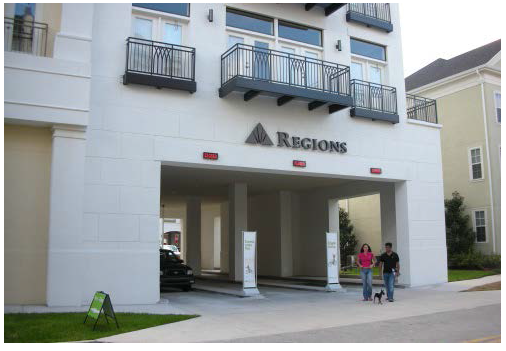
Sec. 30-5.10. - Family child care homes, large.
In addition to compliance with applicable state and county requirements, large family child care homes shall meet the following conditions:
A.
Spacing. Large family child care homes shall be located at least 1,000 feet from any other large family child care home.
B.
Primary residence on site. The residence containing the large family child care home shall be the occupied and the primary residence of the operator.
C.
Absence of code violations. There shall be no active code violations associated with the site or any structures on the site.
D.
Location of outdoor play areas. All outdoor play areas shall be located between the primary structure and the rear property line.
E.
Paved driveways. All driveways shall be paved.
F.
Staff approval of a plot plan. The operator shall submit for approval a plot plan showing all structures, dimensions, distances, driveways, play areas, parking areas, and other similar relevant information. The plan shall show that the existing paved driveway is used and not a new or altered driveway.
Sec. 30-5.11. - Farmers markets.
A.
Permit. The city manager or designee is authorized to issue a revocable permit to allow the operation of a farmers market on public or private property for one year at a maximum of four days per week.
1.
Requirements. The applicant for the permit shall provide a scaled plan of the proposed site showing the location of any tents in relation to rights-of-way, sidewalks, businesses, entryways to businesses, and any other features that affect accessibility to the site. The plan shall show any tables, display areas, or other equipment that will not be under tents. Tents and other structures or objects associated with the farmers market, such as chairs, tables, or displays, shall be located a minimum of five feet from the curb and so positioned as to not obstruct pedestrian passage on any sidewalk. They shall not be positioned within five feet of any crosswalk or fire hydrant or block ingress or egress from any building entrance or emergency exit. They shall be a minimum of 25 feet from any intersection.
2.
Grant or denial. The city manager or designee shall review the documentation provided by the applicant and shall grant or deny the permit within ten calendar days of receiving a completed application. The permit shall be denied if the location and accessibility to the site pose a public safety concern or if the applicant fails to file a complete application and documentation.
3.
Revocation. In the event a permit holder has been found to be in violation of any of the regulations of this section, or of any other city, county, state or federal regulations concerning the operation of the farmers market, including state or local health requirements, the city manager or designee may revoke the permit after notice and opportunity for a hearing. No applicant who has had a permit revoked shall be able to get another permit for one year after the revocation date.
B.
Additional requirements.
1.
Amplified sound. The farmers market shall comply with the provisions of chapter 15 concerning prohibited noise and procuring special permits for noise.
2.
Signs. Individual tents may have temporary banners, provided the banners extend no wider than the tent and are high enough to allow adequate clearance for people to pass under.
3.
Bond. The city manager or designee shall require the operator of the farmers market to provide a bond for cleanup of the sales area for any farmers market located on public property. The amount of the bond will be determined by the square footage of area used by the market.
Sec. 30-5.12. - Food distribution centers for the needy.
Except as provided as an accessory use to places of religious assembly, food distribution centers for the needy shall be regulated as follows:
A.
Meals served. All meals served shall be limited to a consecutive three-hour period within a 24-hour day between the hours of 8:30 a.m. and 7:00 p.m. This limitation does not apply to meals served to the residents and staff of a facility that is jointly licensed and operated as a residence for destitute people and a food distribution center for the needy.
B.
Prohibited area. Food distribution centers for the needy shall not be located within 2,000 feet from the University of Florida main campus as identified on the University of Florida Campus Master Plan. All distance measurements shall be a straight line from the nearest property line of the facility to the nearest property line of the University of Florida campus.
C.
Distance requirements. The distance between any food distribution center for the needy and any other food distribution center for the needy or residence for destitute people, or facility combining both uses, shall be at least 2,000 feet. The distance between any food distribution center for the needy and any social service home, halfway house or rehabilitation center shall be at least 1,320 feet. All distance measurements shall be a straight line from the nearest property line of any existing facility to the nearest property line of the proposed facility.
D.
Saturation. No more than two food distribution centers for the needy or residences for destitute people may be located within a two-mile radius.
E.
Bufferstrip. A food distribution center for the needy shall provide a buffer equal to that of a commercial use, in accordance with article VIII, when adjacent to any property zoned for residential use.
F.
Management program. Any applicant for a special use permit shall file with the city manager or designee a management program addressing hours of operation, personnel, client code of conduct, location of on-site waiting areas, management of solid waste and litter, lighting, and identification of a responsible person, as more specifically provided below. The name, address and telephone number of the person responsible for the facility shall be kept up to date, and submitted with the management program.
1.
Hours of operation. The application for a special use permit shall provide the hours of operations clearly indicating the three-hour timeframe for meal service. The hours shall be posted and clearly visible to the public.
2.
Personnel. The application shall indicate the minimum number of staff persons, including volunteers, which will be supervising the meal service and the clients during the three-hour timeframe. The applicant shall demonstrate to the board that the supervision will be adequate for providing the service and crowd control.
3.
Client code of conduct. A written client code of conduct shall accompany the application, including the following information at a minimum: The procedure for suspending meal service to persons who violate the code of conduct, including the number of violations, and the requirement for all persons to sign and consent to the code as a condition for receiving service. The enforcement of the code of conduct shall be the sole responsibility of the owner/operator.
4.
On-site waiting areas. The application for a special use permit shall include a diagram of the facility's onsite waiting area(s). Waiting area(s) shall be on the premise where the meal service is being provided. The owner/operator shall ensure that persons receiving service do not block public access to sidewalks, right-of-way and private property, and that emergency access points are clearly identified and maintained. The applicant shall demonstrate to the board that adequate space is available to accommodate the expected number of persons who will be served meals.
5.
Management of solid waste and litter. The application shall include a plan for controlling solid waste and litter on-site and off-site in the vicinity of the center. The application shall include information about whether carry-out meals or bag lunches will be provided. When carryout meals or bag lunches are provided, the application shall include a plan of personnel or staff that will provide litter clean-up within a quarter-mile radius of the center on the same day that the meals are served.
6.
Lighting. Facilities with night hours shall include with the application a plan for security lighting that complies with the lighting standards of the Land Development Code.
7.
Responsible person. The application shall include the name, address and telephone number of the person responsible for the center. The contact person shall have the authority to make corrective action when necessary. It shall be the responsibility of the owner/operator to keep the contact person's information up-to-date with the city manager or designee.
G.
Combined facility. A special use permit may be issued for a facility functioning as both a food distribution center for the needy and a residence for destitute people. All requirements for both facilities shall be met.
Sec. 30-5.13. - Food truck park.
A.
Location. Food truck parks may be located on property within zoning districts that allow food truck parks and within planned development (PD) zoning districts that allow either restaurants or alcoholic beverage establishments, both as defined in article II. Food trucks located within a food truck park are not subject to the requirements provided in article V for food trucks that are not located within a food truck park.
B.
Construction standards. Food truck pads and associated facilities may be constructed with alternatives to asphalt and cement as approved by staff if the applicant demonstrates that the site will meet acceptable stormwater management practices and will not accumulate mud or debris on public right-of-way.
C.
Utilities.
1.
Food truck parks must provide connections to electric utility services.
2.
Food truck parks must provide restroom facilities that are connected to water and sewer utility services in accordance with chapter 27 of the Code of Ordinances, and have plumbing facilities in the minimum number as required by the Florida Building Code for classification of "restaurants, banquet halls, and food courts."
3.
Food truck parks must provide one handwashing station, meeting any applicable state standards, per two food trucks or food truck pads.
4.
Food trucks operating within a food truck park must not operate a generator at the site, except when necessary in the case of an emergency.
5.
Food truck parks must provide central solid waste disposal areas and recycling facilities, in accordance with applicable standards. Where applicable, food truck parks must have grease interceptors in accordance with applicable regulations.
D.
Parking and pedestrian infrastructure. Except as provided in this section, parking must meet the requirements of article VII.
1.
Two bicycle parking spaces each must be provided per food truck pad.
2.
Food truck parks with five or fewer food truck pads may use existing pedestrian and service infrastructure to service the site, unless staff determines that sidewalk facilities are needed for safety reasons.
E.
Alcoholic beverages. Food truck parks may include the sale or consumption of alcoholic beverages on premises if it is located in a zoning district that allows the sale and consumption of alcoholic beverages, subject to applicable regulations.
F.
Accessory activity areas. Development plans must clearly designate all areas that will be used as accessory activity areas. The operation of such areas must comply with all applicable regulations, such as noise regulations.
G.
Designated agent. Each food truck park must have, and register with the city, a designated agent or team with management responsibility and authority to address and resolve issues of permitting, code compliance, operations, and site maintenance.
(Ord. No. 190714, § 7, 6-4-20)
Sec. 30-5.14. - Gasoline and alternative fuel stations.
Gasoline and alternative fuel stations also include retail petroleum sales at service stations or car washes, either separately or in combination with the sale of food or restaurants, or gas pumps as accessory to a convenience store or restaurant.
A.
Accessory uses. Permitted accessory uses to a gasoline or alternative fuel service station are as follows:
1.
Rental of vehicles, provided they are screened in accordance with applicable use standards in article V.
2.
Minor adjustments or repairs to automobiles, trucks, trailers or other vehicles that do not require body work, painting or removal of engines from frames or dismantling of differentials. No lift or repair facilities shall be located outside the principal structure. Additional adjustments or repairs at service stations shall only be permitted within zoning districts where major automotive repairs are a permitted principal use.
3.
The retail sale of minor automobile parts and accessories, gasoline, diesel fuel, alternative fuels, kerosene, lubricating oils and greases.
4.
Vending machines, provided such machines are located under the roof of the principal structure.
B.
Number of fueling positions.
1.
Within the transect zones, where allowed, up to six fueling positions are permitted by right.
2.
Within all other zoning districts, where allowed, up to six fueling positions are permitted by right, except for stations located within one-fourth mile from an interchange, where there may be up to 12 fueling positions permitted by right.
3.
Up to 12 fueling positions may be allowed as part of a planned development rezoning or special use permit process.
C.
Design requirements.
1.
All fuel pumps and pump islands shall be set back a minimum distance of at least 15 feet from any right-of-way line or property line.
2.
All gasoline and alternative fuel pumps and accessory automotive uses shall be located to the rear or side of buildings and at least 50 feet from the property line of any property zoned residential district or planned development district with predominantly residential uses. In the event the physical constraints of the site do not allow such uses to meet these requirements, the uses may be located to the front of the building in order to meet the 50 foot spacing requirement. This design requirement shall not apply in the I-1 or I-2 zoning districts.
3.
The number and width of driveways shall be minimized.
4.
Cross-access or joint use driveways shall be provided to adjacent non-residential developments.
5.
A minimum of 25 percent window area or glazing at pedestrian level (between three and eight feet above grade) on all first-floor building sides with street frontage. Windows or glazing shall be at least 80 percent transparent.
6.
A public entrance shall be provided that faces the street (a corner entrance may be provided where the building is located at the intersection of streets).
7.
Pedestrian and bicycle access shall be provided from the public sidewalk to any retail or restaurant facilities on site.
8.
Off-street parking shall be located to the side or rear of the building.
9.
Canopy height: The bottom surface of a canopy shall not exceed 15 feet in height.
10.
Perimeter buffers: Sites shall include type B buffers with a minimum four-foot tall opaque masonry wall or privet type hedge along the side and rear property boundaries to minimize the view of fueling pumps.
11.
Dumpster location: Dumpsters shall be enclosed by a masonry wall and placed as far away from existing, adjacent residential uses as practicable on the site and shall not be less than 50 feet as measured from the residential property line.
12.
Car wash facilities and associated elements such as vacuums shall be prohibited when adjacent to any property in a residential zoning district or a planned development district with predominately residential uses.
13.
A convenience store or restaurant or combination thereof shall be present when fueling positions exceed six.
(Ord. No. 160484, § 1, 9-7-17; Ord. No. 190292, § 7, 2-20-20; Ord. No. 190714, § 7, 6-4-20)
Sec. 30-5.15. - Industrial uses.
A.
Standards for manufacturing uses. All permitted manufacturing uses shall conform to the following standards:
1.
Manufacturing uses shall be limited to the fabrication, manufacture, assembly or processing of materials that are already substantially processed.
2.
All activity and uses except storage, loading/unloading operations and parking shall be conducted within completely enclosed buildings.
3.
Outside operations between the hours of 9:00 p.m. and 6:00 a.m., including loading/unloading but not including security operations, are prohibited within 100 feet of the property line of any property in a residential zoning district or a planned development district with predominately residential uses, unless conducted within a completely enclosed building that has no openings other than stationary windows or required fire exits. The appropriate reviewing board may grant a waiver to this prohibition if the board finds that the noise attenuation and screening being provided is sufficient to mitigate the adverse impacts of the night operations.
B.
Hazardous materials. Uses involving class D hazardous materials, as classified by Alachua County, shall be considered specially regulated industries and shall require special use permit approval. The following apply to uses designated as subject to specially regulated industry provisions:
1.
Reports. The applicant for a special use permit shall submit information specifying expected air emissions, surface and groundwater emissions, noise levels, truck traffic volumes, including time-of-day levels, odor levels, glare impacts, and the compatibility of these emissions and impact levels with other properties, uses and neighborhoods within 2,000 feet. The report shall indicate that these impacts will not violate local, regional, state, or federal limits. The report shall also indicate that "best available technology" is being used to control impacts from the specially regulated industry.
2.
Exemption. Uses or developments that will result in releases of pollutants to the air and water of no more than one percent of the average release of those pollutants on a list maintained by the city for that industry shall be exempt from the special use permit process, except for the report required in subsection 1. above. The owner requesting this exemption shall provide evidence acceptable to the city manager or designee that the use qualifies. Any use that was permitted under this exemption and is found to be releasing more than one percent of the average release of air or water pollutants reported for that industry shall cease operation until a special use permit is applied for and obtained.
(Ord. No. 190714, § 7, 6-4-20)
Sec. 30-5.16. - Junkyards and salvage yards.
Junkyards and salvage yards shall meet the following standards:
A.
Dimensional requirements. Minimum lot area is two acres.
B.
Spacing. Distance from any property in a residential zoning district or a planned development district with predominately residential uses shall be 300 feet.
C.
Screening. The entire area occupied by a junkyard or salvage yard shall be surrounded by a continuous solid masonry wall eight feet in height without openings, except for entrances and exits, which shall be equipped with solid gates.
D.
Hazardous materials. Junkyards and salvage yards shall comply with the county hazardous materials code.
(Ord. No. 190714, § 7, 6-4-20)
Sec. 30-5.17. - Light assembly, fabrication and processing.
Light assembly, fabrication and processing uses in zoning districts outside of the BI, W, I-1 and I-2 districts shall meet the following standards:
A.
The activity shall be conducted entirely within completely enclosed structures.
B.
Storage of hazardous materials shall be in accordance with the county hazardous materials management code.
(Ord. No. 190714, § 7, 6-4-20)
Sec. 30-5.18. - Microbreweries/microwineries/microdistilleries.
This section applies to operations outside of the BI, W, I-1, and I-2 zoning districts. Microbreweries, microwineries, and microdistilleries are prohibited where the proposed operation would abut single-family zoned property and shall be regulated in accordance with the provisions provided for alcoholic beverage establishments.
(Ord. No. 190714, § 7, 6-4-20)
Sec. 30-5.19. - Mini-warehouses/self-storage facilities.
Within the transect zones, there shall be no access to the individual storage units from the exterior of the building. All units shall be located within a building and accessed from within the building.
(Ord. No. 190714, § 7, 6-4-20)
Sec. 30-5.20. - Outdoor storage.
Where outdoor storage is a permitted principal use (not including accessory, short-term or temporary storage) the following requirements apply (see applicable use standards in article V for outdoor storage as an accessory use):
A.
Screening requirements. A landscape buffer strip must be provided in the same manner as if the property were in an industrial land use designation in accordance with the requirements of article VIII.
1.
Additional screening may be required to visually shield the use from the public right-of-way.
2.
No merchandise, equipment, machinery, materials, motor vehicles, or other items may be stored above the height of the landscape buffer strip.
(Ord. No. 190292, § 8, 2-20-20; Ord. No. 190714, §§ 7, 8, 6-4-20; Ord. No. 211358, § 14, 10-17-22; Ord. No. 2023-168, § 14, 6-1-23)
Editor's note— Ord. No. 2023-168, § 14, adopted June 1, 2023, repealed § 30-5.20, which pertained to neighborhood-scale multi-family and derived from Ord. No. 211358, § 14, 10-17-22. Same ordinance renumbered §§ 30-5.21—30-5.53 as §§ 30-5.20—30-5.52.
Sec. 30-5.21. - Parking, surface.
Surface parking lots as a temporary use are allowed in the U9 and DT districts subject to special use permit approval and the following requirements:
A.
Surface parking shall be permitted only when the surface parking will be replaced with either a building or structured parking in accordance with an approved master plan.
B.
Surface parking shall be paved.
C.
Surface parking shall have either perimeter landscaping or perimeter garden walls in accordance with the landscape regulations as provided in this Land Development Code.
D.
Surface parking shall be in compliance with all lighting and stormwater regulations in this Land Development Code.
E.
Any special use permit approved pursuant to this section shall be valid for a period not to exceed five years. The city plan board may extend a special use permit approved under this section for an additional period not to exceed five years if the applicant demonstrates that development in accordance with the approved master plan has commenced.
(Ord. No. 190714, § 7, 6-4-20; Ord. No. 211358, § 14, 10-17-22; Ord. No. 2023-168, § 14, 6-1-23)
Sec. 30-5.22. - Places of religious assembly.
A.
Within the SF and U1 districts, places of religious assembly are allowed upon the granting of a special use permit, subject to the following additional dimensional requirements:
1.
Minimum lot area shall be one acre for each place of religious assembly with a building code capacity of 100 persons or less plus an additional one-half acre for each additional 50 persons of building code capacity.
2.
Minimum yard setbacks:
a.
Front: 25 feet.
b.
Side, interior: 50 feet, unless the proposed use is adjacent to a non-residential district, in which case the district setbacks shall apply.
c.
Side, street: 25 feet.
d.
Rear: 50 feet, unless the proposed use is adjacent to a non-residential district, in which case the district setbacks shall apply.
B.
Day care centers and schools as accessory uses. Within the SF and U1 districts, day care centers and schools may be allowed as accessory uses to places of religious assembly upon the granting of a special use permit; within all other districts, day care centers and schools are permitted accessory uses to any lawful place of religious assembly provided, in all cases, that the requirements and limitations for day care centers and schools as listed in this article are met.
C.
Food distribution centers for the needy as accessory uses. The city manager or designee may issue a permit for a food distribution center for the needy in conjunction with a place of religious assembly subject to meeting the standards of section 30-5.12 and the following additional restrictions:
1.
No more than 20 meals may be served in a 24-hour period.
2.
The place of religious assembly can physically provide an indoor eating area meeting all state, county and city codes for the proposed use.
3.
No food distribution center for the needy may be closer than 1,320 feet from any other place of religious assembly having a food distribution center for the needy.
4.
Each place of religious assembly shall file with the city manager or designee a management program addressing hours of operation, personnel, management of solid waste, litter and lighting. The name, address, and phone number of the person responsible for the facility shall be kept up-to-date.
5.
Information shall be displayed including the name of the facility, hours of operation and other functional information.
D.
Residences for destitute people as accessory uses. The City Manager or designee may issue a permit for a residence for destitute people in conjunction with a place of religious assembly subject to meeting the applicable use standards in Article V and the following additional restrictions:
1.
The total number of beds shall not exceed 20.
2.
Meals may be provided only to residents.
3.
No one over the age of 18 may be admitted as a resident without submitting a written report issued by the city police department stating that the person has no outstanding warrants for his or her arrest and is not a "dangerous person", as defined in article II.
4.
Each place of religious assembly shall file with the city manager or designee a management program addressing hours of operation, personnel, management of solid waste, litter and lighting. The name, address, and phone number of the person responsible for the facility shall be kept up-to-date.
5.
Each place of religious assembly shall provide an indoor area meeting all state, county and city codes for use as a residence for destitute people. The area shall be inspected and approved by the building official prior to being used as a residence for destitute people, either on a temporary or recurring basis.
6.
There shall be at least one staff person or volunteer on site, and a director or administrator on-call, when anyone is sheltered overnight in a residence for destitute people.
(Ord. No. 190292, § 9, 2-20-20; Ord. No. 190714, § 7, 6-4-20; Ord. No. 211358, § 14, 10-17-22; Ord. No. 2023-168, § 14, 6-1-23; Ord. No. 2024-263, § 9, 10-3-24)
Sec. 30-5.23. - Recreational vehicle parks.
Recreational vehicle parks must meet the following standards:
A.
Permitted by right when located on property ten acres or greater. Permitted by special use permit when located on property less than ten acres.
B.
May not abut any property in the single-family (SF) future land use category.
C.
Connections are required to public utilities, including electric, potable water and wastewater, and solid waste.
D.
Must meet the required setbacks for the zoning district. However, the minimum setback for recreational vehicle parking spaces is 100 feet from any property in a residential future land use category.
E.
Minimum dimensions for recreational vehicle parking spaces: 18-foot width and 28-foot depth.
F.
Property must have frontage on a collector or arterial street as determined by the public works department.
G.
Primary ingress and egress must be from a collector or arterial street as determined by the public works department. Secondary access is required from all adjacent public streets.
H.
One on-site manager's residence is allowed. This may be in the form of a recreational vehicle in a parking space or a residential space within the management office.
I.
Recreational vehicle occupancy on the property is limited to a maximum of 60 days within any 120-day period, with the exception of the on-site manager's residence.
J.
Outdoor storage is prohibited, including storage of recreational vehicles and boats.
K.
Open fires are prohibited, except in barbeque pits or grates.
L.
Amplified music is prohibited.
M.
The use of generators is prohibited.
N.
Pedestrian and bicycle connections from the interior of the project to adjacent public pedestrian and bicycle facilities are required. Such connections must remain open and accessible to visitors and guests of the park. Vehicular access control in the form of a swing arm with keypad or similar is allowed for registration and payment purposes.
O.
The hours of activity in outdoor common areas, including pools, will be established at development plan review in consideration of the character and compatibility of the area. Outdoor recreation areas and pools must be located at least 100 feet from any property in the single-family (SF) future land use category.
P.
Individual recreational vehicle parking spaces may be gravel. All drive lanes must be paved.
Q.
The sale or dispensing of fuels is prohibited, excluding containers already containing propane gas.
R.
The use or storage of hazardous materials as regulated by the Alachua County Hazardous Materials Management Code is prohibited.
S.
Landscaping/screening requirements:
1.
Where recreational vehicle parking spaces are located within 40 feet of an adjacent property, they must have perimeter fencing in the form of an opaque six-foot tall fence.
2.
Where recreational vehicle parking spaces are located within 20 feet of a public right-of-way, they must be screened by a wall, fence, or hedge.
3.
Any pump out/dump station areas must be screened from roadways and abutting properties.
4.
Perimeter landscaping and compatibility buffers must meet the applicable standard in the Land Development Code.
5.
For interior areas of the recreational vehicle park, an average of one high-quality shade tree as listed on the Gainesville tree list as a species appropriate for "lot" planting is required for every ten recreational vehicle parking spaces.
(Ord. No. 190292, § 10, 2-20-20; Ord. No. 190714, § 7, 6-4-20; Ord. No. 211358, § 14, 10-17-22; Ord. No. 2023-168, § 14, 6-1-23)
Sec. 30-5.24. - Residences for destitute people.
Except when provided as an accessory use to places of religious assembly, residences for destitute people shall be regulated as follows:
A.
Spacing and location. Residences for destitute people shall not be located closer than 1,320 feet from any social service home, halfway house or rehabilitation center and shall not be closer than 2,000 feet from any other residence for destitute people, food distribution center for the needy or combination thereof. All measurements shall be measured from the nearest property line of the above-listed facilities to the nearest property line of the proposed facility.
B.
Saturation. No more than two food distribution centers for the needy or residences for destitute people may be located within a two-mile radius of the proposed facility.
C.
Renewal of special use permit. The owner of real property holding a special use permit for the operation of a residence for the destitute shall renew such permit in a hearing before the city plan board at a regularly scheduled hearing not more than seven years from the date of issue. The city plan board at such renewal hearing shall ascertain that the facility has been operating in substantial compliance with the above conditions.
D.
Number of beds. The total number of beds that may be provided in any residence for destitute people in a 24-hour period is 35.
E.
Police department report. Prior to the admission of any person in a residence for destitute people, such person shall submit a written report issued by the police department stating that such person has no outstanding warrant for his/her arrest.
F.
Dangerous persons. No person meeting the definition for a dangerous person shall be housed in any residence for destitute people.
(Ord. No. 190292, § 10, 2-20-20; Ord. No. 190714, § 7, 6-4-20; Ord. No. 211358, § 14, 10-17-22; Ord. No. 2023-168, § 14, 6-1-23)
Sec. 30-5.25. - Sexually oriented businesses.
A.
Intent and purpose. It is the intent and purpose of this section to regulate sexually oriented businesses in order to promote the health, safety, and general welfare of the citizens of the city, and to establish reasonable and uniform regulations to prevent the negative secondary effects of sexually oriented businesses within the city. The provisions of this section have neither the purpose nor effect of imposing a limitation or restriction on the content or reasonable access to any communicative materials, including sexually oriented materials. Similarly, it is neither the purpose nor the effect of this section to restrict or deny access by adults to sexually oriented materials protected by the First Amendment, or to deny access by the distributors and exhibitors of sexually oriented entertainment to their intended market. Neither is it the purpose nor effect of this chapter to condone or legitimize the distribution of obscene material.
B.
Findings. Based on evidence of the adverse secondary effects of sexually oriented businesses set forth in studies and case law considered by the city commission and on evidence and recommendations presented in hearings and in reports to the city commission, the city commission hereby finds as follows:
1.
Sexually oriented businesses, as a category of commercial uses, are associated with a wide variety of adverse secondary effects, including personal and property crimes, public safety risks, prostitution, potential spread of disease, lewdness, public indecency, illicit sexual activity, illicit drug use and drug trafficking, undesirable and criminal behavior associated with alcohol consumption, negative impacts on surrounding properties, litter, and sexual assault and exploitation.
2.
Each of the foregoing negative secondary effects constitutes harm that the city has a substantial government interest in preventing and/or abating in the future. This substantial government interest in preventing secondary effects, which is the city's rationale for this section, exists independent of any comparative analysis between sexually oriented and non-sexually oriented businesses. Additionally, the city's interest in regulating sexually oriented businesses extends to future secondary effects that could occur in the city related to current sexually oriented businesses as well as sexually oriented businesses that may locate in the city in the future. The city finds that the cases and secondary effects documentation relied on in this section are reasonably believed to be relevant to said secondary effects.
C.
Spacing. A sexually oriented business may not be established in any permitted district unless all other requirements of the chapter pertaining to such districts and to buildings generally are met and unless the sexually oriented business is at least 1,000 feet from any other sexually oriented business, place of religious assembly, public school, private school, public park, youth association or residential area.
1.
Measurement. For purposes of the spacing requirements, the measurement shall be made by extending a straight line from the nearest property line of the sexually oriented business to the nearest property line of the other sexually oriented business, place of religious assembly, public school, private school, public park, youth association or residential area. If any such use is located in a multi-tenant building, then property line shall mean the nearest line of the leasehold or other space actually controlled or occupied by the sexually oriented business, place of religious assembly, public school, private school or youth association.
2.
Exemption to spacing requirement. Any sexually oriented business that is established in conformity with this section and other applicable laws and ordinances shall not be made unlawful, if a place of religious assembly, public school, private school, public park or residential area is created or established within the distance limitations subsequent to the filing with the city of the application for the establishment of the sexually oriented business or subsequent to the lawful establishment of the sexually oriented business.
D.
Obscenity not permitted. Nothing in this section shall be construed as permitted or allowing a violation of any state or federal law, including F.S. Ch. 847, relating to obscenity.
E.
Existing establishments. Any use herein defined as a sexually oriented motion picture theater, retail store or cabaret that is on April 15, 2010, existing, in actual operation and open to the public, and which in all other respects is in full compliance with applicable laws and ordinances of the city, but which would not otherwise be permitted under the terms of this section, shall then become a permitted nonconforming use.
F.
Sexually oriented motion picture theaters. Any sexually oriented motion picture theater shall meet the following design standards at all times:
1.
Presentation area. All screenings and presentations of motion pictures, videos or other visual media shall occur in a room open to all customers of the establishment and containing at least 600 square feet of floor area. No curtains, screens, shades or other devices shall be used to obscure any part of the room.
2.
Lighting. The lighting level in the area occupied by customers shall be at least two footcandles at floor level.
3.
Seating. Seating shall consist of individual, theater-style chairs, with solid arms separating the chairs. No couches, benches, individual chairs, beds, loose cushions or mattresses, or other forms of seating may be provided. Separate spaces for wheelchairs shall be provided in accordance with the applicable provisions of the adopted building code in effect and the Americans with Disabilities Act.
G.
Sexually oriented cabarets. In addition to those standards applicable to adult performance establishments, the following design standards shall apply to any sexually oriented cabaret at all times:
1.
Presentation area. All performances and all interactions between performers and customers shall occur in a room open to all customers of the establishment and containing at least 600 square feet of floor area. No curtains, screens, shades or other devices shall be used to obscure any part of the room.
2.
Lighting. The lighting level in the area occupied by customers shall be at least five footcandles at a height of three feet off the floor.
H.
Retail store with limited quantities of sexually oriented media or devices. A retail trade establishment (SIC Division G) that devotes more than ten percent but less than 30 percent of its floor area, or stocks more than ten percent but less than 30 percenter of the number of items in inventory, to sexually oriented media or sexually oriented devices, shall be treated for zoning purposes as an accessory use to the primary retail trade of the store and not as a sexually oriented retail store, provided that it meets all of the following conditions (however, these conditions shall not apply to a retail trade establishment that allows only persons who are 18 years of age or older to enter the premises):
1.
All sexually oriented media or devices shall be maintained in a room that is separated from other material by an opaque wall that extends to the ceiling or eight feet above the floor, whichever is less.
2.
Access to the room containing the sexually oriented media or devices shall be through a door or through a space that can be entered only by passing directly by the manager's or cashier's principal work station.
3.
The room containing sexually oriented media or devices shall be posted with a notice indicating that only persons 18 years of age or older are allowed in the room.
4.
Access to the room shall be physically limited to adults through control of access by an employee of the store, through use of an access release located at least 66 inches off the floor, or through constant monitoring of the room by an employee on duty, where such employee has visual control of the separate room through direct visibility, through electronic means or through a window or mirror providing visibility into the room from the manager's or cashier's work station.
(Ord. No. 190292, § 10, 2-20-20; Ord. No. 190714, § 7, 6-4-20; Ord. No. 211358, § 14, 10-17-22; Ord. No. 2023-168, § 14, 6-1-23)
Sec. 30-5.26. - Shooting ranges, outdoor.
In addition to all other requirements, outdoor shooting ranges, including those within an outdoor gun club, shall comply with the following provisions. Failure to comply with any of these conditions is grounds for revocation of the special use permit.
A.
Location. Outdoor shooting ranges shall be located a minimum of 2,500 feet from any existing residence and any property zoned for residential use, any school, any hospital, or any public park.
B.
Storage. No live ammunition and no weapons may be stored on-site.
C.
Operational plan. The owner of the shooting range shall operate in accordance with national standards as written in the National Rifle Association Range Manual.
D.
Range master. A range master shall be present in accordance with the national standards as written in the National Rifle Association Range Manual.
E.
Design. The facility shall be designed by a licensed engineer in accordance with NRA design guidelines as written in the National Rifle Association Range Manual. No berm shall be less than eight feet in height.
F.
Fencing; signage. The outdoor shooting range shall be fenced with a minimum six-foot high chain link fence with barbed wire, or similar combination. Signs shall be placed around the perimeter of the fencing warning of the facility. The property shall be posted "No trespassing" and the prohibition on trespassing shall be enforced by the owner or operator.
G.
Hazardous materials. The outdoor shooting range shall comply with the provisions of the Alachua County Hazardous Materials Management Code.
(Ord. No. 190292, § 10, 2-20-20; Ord. No. 190714, § 7, 6-4-20; Ord. No. 211358, § 14, 10-17-22; Ord. No. 2023-168, § 14, 6-1-23)
Sec. 30-5.27. - Social service facilities.
Individual and family social services are subject to the following standards:
A.
If located in an industrial district, the fee simple owner(s) of the property shall sign the application and acknowledge that the use is in an industrial district that may be subject to noise, heavy truck traffic, fumes, odors and vibrations that are customary in an industrial district.
B.
The use shall not co-locate with another industrial use on the same parcel.
C.
The use shall occupy a building that is currently located on the parcel.
D.
Residential care is prohibited and no overnight stay or lodging is allowed.
E.
The special use permit is limited to a maximum of five years, subject to automatic renewal for the same term as the original permit, unless either: 1) the use is discontinued or abandoned for 90 consecutive days; or 2) the city or owner of the property seeks to terminate the use by providing written notice to the city manager or designee at least 90 calendar days prior to the expiration of the special use permit. In the event such notice is given, the special use permit shall expire and terminate unless the owner files a new application within 20 calendar days of receipt of said notice of termination. The application will then be processed and reviewed in the same manner as a new application.
(Ord. No. 190292, § 10, 2-20-20; Ord. No. 190714, § 7, 6-4-20; Ord. No. 211358, § 14, 10-17-22; Ord. No. 2023-168, § 14, 6-1-23)
Sec. 30-5.28. - Social service homes/halfway houses.
A.
Dimensional requirements. All principal and accessory structures for social service homes/halfway houses shall be located and constructed in accordance with the following requirements:
1.
Minimum lot area: 10,000 square feet.
2.
Minimum lot width at minimum front yard setback: 100 feet.
3.
Minimum yard setbacks:
a.
Front: 25 feet.
b.
Rear: 20 feet; 35 feet if the rear yard abuts property with residential land use or zoning.
c.
Side:
i.
Street: 10 feet.
ii.
Interior: 20 feet; 35 feet if the side yard abuts property with residential land use or zoning.
B.
Spacing and location requirements. Social service homes/halfway houses shall not be located closer than 1,320 feet from any other social service home, halfway house, community residential homes for 21 persons or more or rehabilitation center, and shall not be located closer than 2,640 feet from any soup kitchen or residence for destitute people or combination thereof. All measurement shall be from the nearest property line of any of the above-listed facilities to the nearest property line of the proposed facility.
C.
Buffer requirements. Social service homes/halfway houses shall comply with the requirements of offices, schools and places of religious assembly in accordance with article VIII.
(Ord. No. 190292, § 10, 2-20-20; Ord. No. 190714, § 7, 6-4-20; Ord. No. 211358, § 14, 10-17-22; Ord. No. 2023-168, § 14, 6-1-23)
Sec. 30-5.29. - Solar generation station.
Solar generation stations shall meet the following minimum requirements:
A.
Wetlands. The devices that capture solar energy and convert it to electricity shall not be placed in wetlands or surface waters or wetland buffers or surface water buffers. Any impacts to wetlands or surface waters or their buffers from required improvements for a solar generation station, such as impacts from roads or transmission lines, shall be regulated in accordance with article VIII.
B.
Dimensional requirements. A solar generation station shall not exceed the maximum principal building height of the zoning district in which it is located.
C.
Setback. Devices that capture solar energy and convert it to electricity shall be located at least 25 feet from any lot line.
D.
Public safety. The solar generation station shall be designed and operated to protect public safety, including without limitation, preventing the misdirection of concentrated solar radiation onto nearby property, public roads or other areas accessible to the public and implementing site design and operating procedures to prevent public access to hazardous areas.
E.
Other requirements. A solar generation station shall comply with all applicable local, state, and federal laws and regulations governing the operation of a solar generation facility, including without limitation chapter 27 of the Code of Ordinances.
F.
Removal. The property owner shall remove the solar generation station within one year following a continuous two-year period of non-use.
(Ord. No. 190292, § 10, 2-20-20; Ord. No. 190714, § 7, 6-4-20; Ord. No. 211358, § 14, 10-17-22; Ord. No. 2023-168, § 14, 6-1-23)
Sec. 30-5.30. - Urban agriculture.
The following standards apply to subsistence gardens and urban market farms, as defined in article II:
A.
May be the principal use on a property, or may be an accessory use to a residential or nonresidential principal use.
B.
All applicable design regulations of this chapter will regulate the design and operation of urban agricultural uses, including provisions for setbacks, gates, fences, walls, signs, parking, and stormwater.
C.
Adequate hand washing facilities must be provided onsite for workers and volunteers, unless there is access to facilities within one-quarter of a mile.
D.
Structures for growing food must not be made of tires, appliances, railroad ties, or pressure-treated lumber manufactured prior to 2004.
E.
Urban market farms that are one-half an acre or greater may keep up to 10 chickens for the first one-half acre, with two more chickens for each additional one-half acre, up to a maximum of 24 chickens. Except as provided in this section, chicken keeping must otherwise be in accordance with the regulations in article V of this chapter for the keeping of fowl when accessory to residential uses.
F.
Equipment not in use must be secured and must not be visible from any public right-of-way.
G.
Composting must be managed at least weekly to reduce odor and pests.
H.
Trash must be stored in appropriate containers and removed from the property at least weekly.
I.
Operations may not include practices that violate chapter 16, article IV - mosquito breeding grounds.
J.
The property owner must provide the city with the contact information for a designated manager of the use and property.
(Ord. No. 200727, § 6, 6-2-22; Ord. No. 211358, § 14, 10-17-22; Ord. No. 2023-168, § 14, 6-1-23)
Sec. 30-5.31. - Vehicle services or repair.
Development that provide vehicle services or repair shall meet the following standards:
A.
Service bays shall be designed and located either:
1.
With a maximum of three service area entrances at the rear of the building, not exceeding 14 feet in width for each, which provide direct access to an externally-oriented service bay; or
2.
With a maximum of two service area entrances at the rear or side of the building, not exceeding 26 feet in width for each, which provide indirect access to one or more internally-oriented service bays.
B.
In addition to the requirements above, service bay doors shall not face abutting property in a residential district or other existing, conforming residential use.
C.
All installation, sales and services shall be conducted within a completely enclosed building.
D.
All lifts, tools or repair facilities shall be located in a principal structure.
E.
Only low impact air guns may be used in an unenclosed work area located within 200 feet of any land zoned for residential use.
F.
Outdoor accessory display and storage shall be in accordance with applicable use standards in article V.
(Ord. No. 190292, §§ 10, 11, 2-20-20; Ord. No. 190714, § 7, 6-4-20; Ord. No. 211358, § 14, 10-17-22; Ord. No. 2023-168, § 14, 6-1-23)
Sec. 30-5.32. - Veterinary services.
A.
No such facilities shall be permitted to have outside cages or runs except for those that are located in industrial districts and that are at least 500 feet from any property zoned for residential use.
B.
All such facilities shall have sound attenuation so as to prevent common and ordinary animal noises from being heard outside any building or structure. Outside cages or runs permitted in industrial districts shall not be required to be so designed.
(Ord. No. 190292, § 10, 2-20-20; Ord. No. 190714, § 7, 6-4-20; Ord. No. 211358, § 14, 10-17-22; Ord. No. 2023-168, § 14, 6-1-23)
Sec. 30-5.33. - Wireless communication facilities and antenna regulations.
A.
Purpose. These regulations were developed to protect the health, safety and welfare of residents of the city, and to protect property values and minimize visual impact while furthering the development of enhanced telecommunications services in the city. These standards are designed to comply with the Telecommunications Act of 1996 and the requirements of F.S. Ch. 365. The provisions of this section are not intended to and shall not be interpreted to prohibit or have the effect of prohibiting the provision of personal wireless services. This section shall not be applied in such a manner as to unreasonably discriminate between providers of functionally equivalent services, consistent with federal regulations. These regulations are intended to:
1.
Provide uniform standards for the provision of both radio and television broadcast signals and telecommunication services, including two-way radio, paging, personal communication services (PCS), cellular and related wireless services;
2.
Protect the natural features and aesthetic character of the city by regulating the location, design and operation of wireless communication facilities, with special attention to residential neighborhoods, public parks, transportation view corridors, historic districts, historic landmarks, and environmentally sensitive lands;
3.
Minimize the adverse visual and aesthetic impacts of wireless communication facilities through innovative design, siting and landscaping standards, including incentives to promote the use of camouflaged towers, collocation of new antennas on existing communication towers and the placement of antennas on roofs, walls, existing towers and other existing structures;
4.
Accommodate the growing demand for wireless communication services, consistent with the Federal Telecommunications Act of 1996, and ensure an efficient and high-quality wireless communications network; and
5.
Expedite the review process for those new applicants choosing the least intrusive alternative of deploying wireless telecommunication services.
B.
Applicability and general requirements. The requirements of this section apply to all wireless communication facilities and broadcast towers. All property within the city limits shall be subject to the requirements of this section. It is the intent of the city to impose all regulations of this section to all land within the city, whether publicly or privately held, except as specifically provided herein. These regulations shall supersede all other code provisions concerning wireless communications facilities for those applications for development review that are filed on or after July 1, 2005, unless otherwise provided in law. Setback and separation distances shall be applied regardless of municipal and county jurisdictional boundaries. The design, construction and installation of wireless communications facilities shall comply with all applicable building codes.
C.
Collocation. Collocation on any existing facility or structure shall be completed in accordance with the standards stated in F.S. § 365.172(11), as applicable. All other collocations shall be reviewed in accordance with the provisions of subsection H. and, if applicable, subsection J.
D.
Modification of existing towers. Pursuant to F.S. § 365.172(11), an existing tower, including a nonconforming tower, may be structurally modified in order to permit collocation or may be replaced through no more than administrative review and building permit review and is not subject to public hearing review if the overall height of the tower is not increased and, if a replacement, the replacement tower is a monopole tower or, if the existing tower is a camouflaged tower, the replacement tower is a like-camouflaged tower.
1.
The replacement tower is located as close as reasonably possible to the existing tower and in no instance greater than 50 feet from the existing tower.
2.
In all cases the existing tower shall be removed within 30 calendar days of completion of the replacement tower.
3.
The replacement tower shall comply with the airport hazard zoning regulations of the city.
4.
Any other existing tower modifications or replacements are considered a new tower and are subject to the provisions of this section.
E.
Camouflaged towers. New camouflaged towers shall be permitted according to the process identified below in subsection 4. in all zoning districts except for those zones in the single-family and residential-low zoning categories (see Table V-1, below) and U2, where no actual or effective prohibition of the provider's service in that residential area or zoning district results. If a wireless provider demonstrates to the satisfaction of the city that the provider cannot reasonably provide its service to the residential area or zone from outside the residential area or zone, the city and provider shall cooperate to determine an appropriate location for a wireless communications facility of an appropriate design within the residential area or zone. In no instance shall the height of a camouflage tower in a single-family or residential-low zoning category exceed 80 feet in height, and shall be subject to a special use permit by the city plan board. The city may require that the wireless provider reimburse the reasonable costs incurred by the city in cooperating in this determination.
1.
Height. The maximum height of camouflaged towers in multiple-family, office or mixed-use districts, as listed in Table 1, below and in U1 and U6, is 80 feet. The maximum height of camouflaged towers in all other districts is 110 feet, except that in industrial districts a camouflaged tower may be a height of up to 130 feet. Camouflaged towers may be constructed in excess of the maximum heights listed above, provided a special use permit is issued in accordance with article III.
2.
Setbacks. For purposes of structural safety and aesthetics, regardless of the zoning district in which a camouflaged tower is located, the tower shall be set back a distance of at least the height of the tower from any adjoining lot line.
3.
Collocation. Any camouflaged tower in excess of 110 feet in height shall be designed to support the facilities of at least three providers, including the facilities of the applicant. Any camouflaged tower in excess of 70 feet in height but less than 110 feet in height shall be designed to support the facilities of at least two providers, including the facilities of the applicant.
4.
Development plan approval. Development plan approval for new uses shall be done in accordance with: the review procedures stated in article III; the provisions for neighborhood workshops stated in article III; and with the requirements as listed below in subsection L., submittal requirements. The base application fee for review of any development plan application to construct a camouflaged tower shall be the same as the fee for intermediate plan review, plus the fee for a special use permit, if necessary, and the fee for the technical consultant, if deemed necessary by the city. All proposed new camouflaged towers shall be architecturally and/or aesthetically compatible with the surrounding community. To determine architectural and/or aesthetic compatibility with the surrounding community, a public hearing shall be held before the development review board on the development plan application; however, if a special use permit is required for approval of the proposed camouflaged tower, a public hearing shall be held before the city plan board on the development plan application.
5.
Aircraft hazard. All towers shall comply with the airport hazard zoning regulations.
6.
Utility building. The equipment used to operate the facility shall be stored in:
a.
An existing building on the site;
b.
An equipment cabinet, shelter or an underground vault; or
c.
A building constructed or installed to accommodate multiple providers and designed to be compatible with the surrounding environment, while meeting the minimum building setback requirements of the underlying zoning district.
The equipment cabinet or shelter, if used, shall be screened by a fence or wall of not less than eight feet in height from finished grade, or by landscaping that conceals the cabinet or shelter.
7.
Equipment storage. No equipment, mobile or immobile, not used in direct support of the transmission or relay facility, shall be stored or parked on the site unless repairs to the facility are currently being made.
For the purposes of this section, zoning districts shall be classified as follows:
Table V-1: Zoning districts
F.
Monopole towers. Except as set forth herein, new monopole towers that are not accessory to communications uses, shall be permitted by right in I-1, I-2, and AGR zones and are subject to review in accordance with the process identified below in subsection 8.
1.
Height. The maximum height of a monopole wireless tower is 130 feet. Monopole towers may be constructed in excess of the maximum height, up to 200 feet, provided a special use permit is issued in accordance with article III.
2.
Setbacks. For purposes of structural safety and aesthetics, regardless of the zoning district in which a monopole tower is located, the tower shall be set back a distance of at least 300 feet from the nearest property lines of any single-family, residential-low, multiple-family, office or mixed-use district. The tower shall be set back from any adjoining lot line a distance equal to or greater than the height of the tower. Monopole towers may be constructed within 300 feet of the nearest property lines of any single-family, residential-low, multiple-family, office or mixed-use district, provided a special use permit is issued in accordance with article III.
3.
Collocation. Collocation is encouraged; therefore, monopole towers shall be designed to accommodate collocation for multiple wireless communication service providers in accordance with the following minimum requirements:
4.
Fencing and buffering; nonresidential districts. A metal or solid fence or wall of not less than six feet in height from finished grade, with locked gates, shall be provided around the base of each tower or around the yard area where the tower is located. Climb-proof shields can be substituted for a fence or wall around any tower. A monopole tower shall provide a buffer equal to that of commercial use in accordance with article VIII, except that in cases where the adjacent use is also commercial and a buffer is not required, adjacent use buffer C shall be provided (see section 30-8.5, chart A). Exceptions to the buffer strip requirement shall be in accordance with section 30-8.5.
5.
Utility building. The equipment used to operate the facility shall be stored in:
a.
An existing building on the site;
b.
An equipment cabinet, shelter or an underground vault; or
c.
A building constructed or installed to accommodate multiple providers and designed to be compatible with the surrounding environment, while meeting the minimum building setback requirements of the underlying zoning district.
The equipment cabinet or shelter, if used, shall be screened by a fence or wall of not less than eight feet in height from finished grade, or by landscaping that conceals the cabinet or shelter.
6.
Equipment storage. No equipment, mobile or immobile, not used in direct support of the transmission or relay facility, shall be stored or parked on the site unless repairs to the facility are currently being made.
7.
Aircraft hazard. All towers shall comply with the airport hazard zoning regulations.
8.
Development plan approval. A public hearing before the development review board shall be held to consider all new monopole tower development plan applications; however, if a special use permit is required for approval of the proposed monopole tower, a public hearing shall be held before the city plan board on the development plan application. The base application fee for review of any development plan application to construct a monopole tower shall be the same as the fee for intermediate plan review, plus the fee for a special use permit, if necessary, and the fee for the technical consultant, if deemed necessary by the city.
G.
Personal wireless service (PWS) antennas and wireless communications facilities.
1.
General. This subsection is relevant to all new PWS antennas and collocated PWS antennas that increase the height of the structure or are not otherwise preempted pursuant to F.S. § 365.172(11).
a.
PWS antennas attached to existing structures shall be permitted as accessory uses in all zoning districts.
b.
PWS antennas may be located on existing commercial, industrial, office, institutional or multiple-family structures. PWS antennas shall not be mounted on single-family structures or on two-family structures.
c.
PWS antennas may extend a maximum of 20 feet above the roofline or the highest point of the existing structure on which they are mounted.
d.
The height of a rooftop installation shall be measured from the finish level of the portion of the roof on which the antenna is mounted.
e.
PWS antennas placed on a legally non-conforming structure shall not be considered an expansion of the structure. Existing PWS antennas that were legally installed at the time of initial installation may be repaired, replaced and/or relocated at an equal or lower height on the existing structure.
2.
Visual compatibility for PWS antennas not located on a communication tower.
a.
All new PWS antennas and collocated PWS antennas that increase the height of the structure or are not otherwise preempted pursuant to F.S. § 365.172(11), shall be placed on the structure out of public view to the greatest extent possible. If this is not practical, screens or enclosures are required to conceal the facility from public view in a manner that is compatible with the scale, color and architectural character of the structure.
b.
If it is necessary to place the PWS antenna in public view, for aesthetic purposes it shall be integrated into the structure in such a manner that it is compatible with the scale, color and architectural character of the structure to the greatest extent practical.
c.
Equipment shelters used in conjunction with such PWS antennas shall be located inside the existing structure or hidden from public view, or made compatible with the scale, color and architectural character of the structure.
d.
A PWS antenna shall comply with the required setbacks for the zoning district in which it is located.
3.
Development plan approval. Development plan approval in accordance with article III, as applicable, and compliance with the application requirements stated below in subsections L.1., 6., and 11. are required prior to the issuance of a building permit for all new PWS antennas and collocated antennas that are not otherwise preempted pursuant to F.S. § 365.172(11).
H.
Amateur radio towers. All amateur radio towers in residential zoning districts shall meet the following requirements:
1.
Height. No amateur radio tower shall rise more than 80 feet from the ground level at the exact site on which it is erected except as otherwise provided for in subsection 7. below.
2.
Location. Amateur radio towers are only allowed in rear yards. Only one tower is allowed per lot.
3.
Guy anchors. Guy anchors shall meet the setback requirements of the respective district and are allowed in side and rear yards only.
4.
Construction standards. Amateur radio towers shall meet manufacturer's specifications and an engineer licensed in the State of Florida shall certify plans. Towers shall meet the requirements of the Standard Building Code, relating to wind loads, and shall be engineered or guyed so that in the event a tower falls it will collapse only within the property lines on which it is located. All towers shall meet the standards contained in the most current version of American National Standards Institute "Steel Antenna Towers and Steel Supporting Structures" (ANSI EIA/TIA 222, F-1996 (R 2003)).
5.
Fencing and buffering. A metal fence or solid wood or masonry wall at least eight feet in height shall be constructed and maintained around the perimeter of the rear yard or the base of the amateur radio tower. Climb-proof shields may be substituted for a fence or wall around the tower. A combination of hedges and/or evergreen trees, at least four feet in height when planted, shall be planted and maintained around the perimeter of the rear yard or in a continuous line around the tower and spaced close together to provide a continuous visual screen. Shrubs shall also be planted and maintained around the guy anchors for visual screening purposes.
6.
Design/landscape plan. A design/landscape plan shall be submitted for all proposed amateur radio tower sites, showing the proposed location of the tower, guy anchors and any existing or proposed landscaping as required by this section.
7.
Development plan approval. The level of review for amateur radio towers of up to 80 feet in height shall be rapid review in accordance with article III.
8.
Special use permits for excess height. Amateur radio towers may be constructed in excess of the 80-foot height limitation provided a special use permit is issued. In addition to the special use permit requirements stated in article III, considerations shall include the following:
a.
The effects of topography, terrain and height of surrounding tree canopy on broadcasting ability.
b.
The construction and design of amateur radio towers with regard to safety regulations including a consideration of the distance from the airport and whether the proposed tower would interfere with any flight paths.
c.
The visual impact on surrounding properties and existing or proposed screening and buffering.
I.
Historic preservation/conservation districts. A new wireless communications facility shall only be located in a historic preservation/conservation district if it is a camouflaged tower and is 80 feet or less in height. A certificate of appropriateness from the historic preservation board shall be required for approval, in addition to the requirements of subsection E. Personal wireless service (PWS) antennas located in a historic preservation/conservation district shall be required to obtain a certificate of appropriateness from the historic preservation board for approval, in addition to meeting the requirements stated at subsection G. Any alteration made to a historical structure to accommodate the placement of a PWS antenna shall be designed and constructed so that it is fully reversible without damage to the historical structure.
J.
Broadcast towers, retransmission and microwave transmission towers. New broadcast towers may be guyed towers, lattice towers or monopole towers.
1.
Dimensional requirements.
a.
Tower location. For purposes of structural safety and aesthetics, broadcast towers and retransmission and microwave transmission towers shall be set back at least 300 feet from the nearest property lines of any single-family, residential-low or multiple-family district. The tower shall be set back from any adjoining lot line at a distance equal to or greater than the height of the tower. No broadcast tower shall be located between the street and the front of any principal building. Broadcast towers adjacent to any residential district shall be screened along any common property line by trees and shrubs. A combination of hedges and/or evergreen trees, at least four feet in height when planted, shall be planted and maintained around the perimeter of the rear yard or in a continuous line around the tower and spaced close together to provide a continuous visual screen. Shrubs shall also be planted and maintained around the guy anchors for visual screening purposes.
b.
Anchor location. All tower supports and peripheral anchors shall be located entirely within the boundaries of the property.
c.
Height. The height of particular zoning districts shall not apply to broadcast towers.
2.
Fencing and buffering; nonresidential districts. A metal or solid fence or wall of not less than eight feet in height from finished grade, with locked gates, shall be provided around the base of each tower or around the yard area where the tower is located. Climb-proof shields may be substituted for a fence or wall around any tower. A broadcast tower shall provide a buffer equal to that of an industrial use in accordance with article VIII, except that in cases where the adjacent use is also industrial and a buffer is not required, adjacent use buffer D shall be provided (see section 30-8.5, chart A).
3.
Equipment storage. No equipment, mobile or immobile, not used in direct support of the transmission or relay facility, shall be stored or parked on the site unless repairs to the facility are being made.
4.
Aircraft hazard. All towers shall comply with the airport hazard zoning regulations.
5.
Development plan approval. Development plan approval shall be in accordance with the review procedures in article III, as applicable; the provisions for neighborhood workshops, citizen participation; and the requirements as listed below in subsection L., submittal requirements, as applicable.
K.
Unused or abandoned towers. A wireless communications tower is considered unused or abandoned when it is not used for transmission or retransmission for nine consecutive months. Upon determination that a tower has been abandoned, the city manager or designee shall provide written notice of the determination, by certified mail, to the owner of the tower. Upon receipt of the written notice of abandonment, the owner shall have 90 calendar days to:
1.
Reactivate the use of the tower;
2.
Transfer the tower to another owner who makes actual use of the facility; or
3.
Remove the tower and all associated equipment. If the tower is not removed within 90 calendar days of the receipt of notice of abandonment, the city may dismantle and remove the tower and recover the costs from the owner or by accessing the bond set forth in submittal requirements.
L.
Submittal requirements. In addition to the requirements of article III, an application for a new wireless communication facility shall contain the following information:
1.
The identity of the owner(s) of the proposed facility, as well as the identity of the wireless communication service provider(s) who have committed to locating on the proposed facility.
2.
The distance between the proposed tower and the nearest residentially zoned lands.
3.
Details of all proposed antennas and mounting equipment, including the location on the structure, size and color.
4.
A design drawing including a cross-section and elevation of the proposed tower.
5.
A description of the capacity of the tower including the number and type of antennas that can be accommodated.
6.
A certified statement from a licensed professional engineer attesting to the structural integrity of the proposed facility and its ability to accommodate collocation opportunities.
7.
Color photo simulations showing the proposed site of the tower with a photo-realistic representation of the proposed facility, as it would appear viewed from the closest residential property or properties and adjacent roadways.
8.
An application for a new wireless communication facility that requires a special use permit shall contain a propagation map depicting both the extent of the communication service provider's existing coverage within the subject area and the service area of the proposed tower.
9.
A bond or irrevocable letter of credit in an amount determined by the city manager or designee, and subject to the approval of the city attorney as to form and legality, to ensure that if the tower is abandoned pursuant to section 30-5.30, cost to the city for removal of the tower shall be guaranteed to the city.
10.
FCC license.
11.
Any additional information that is necessary for the city to complete the review of the application and is consistent with the requirements of Florida Statutes.
M.
Television antennas. For the purposes of this subsection, television antenna shall mean any exterior apparatus designed for television communications through the reception of electromagnetic waves. The following antennas used to receive video programming signals are allowed in all zoning districts and are exempt from the provisions of this section except as noted herein:
1.
Residential antenna satellite dishes that are one meter (39 inches) or less in diameter and are designed to receive direct broadcast satellite (DBS) service, including direct-to-home satellite service.
2.
Antennas that are one meter (39 inches) or less in diameter or diagonal measurement and are designed to receive video programming services via multichannel multipoint distribution service (MMDS or wireless cable). These antennas may be mounted on masts to reach the height needed to establish line-of-sight contact with the transmitter. Antennas mounted on masts higher than 20 feet are considered communication towers and shall be subject to the provisions of subsection G.
3.
Antennas that are designed to receive over-the-air television broadcast signals and that are mounted on masts higher than 20 feet are considered communication towers and shall be subject to the provisions of subsection G.
4.
General conditions for television antennas.
a.
There are no minimum setback requirements for antennas described in subsections M.1. through 3. In order to protect pedestrians and vehicle operators from possible conflict with structures in the right-of-way, no part of an antenna or its support structure shall extend over public sidewalk or right-of-way at a height of less than nine feet.
b.
Antennas described in subsections M.1. through 3, shall be placed in a location not visible from the street unless an acceptable signal cannot be obtained from any other location. If an antenna must be placed where it is visible from the street, it shall be placed wholly on the subject property and shall comply with the provisions for vision triangles. This is a safety-based restriction necessary to provide unobstructed sight distance in both directions on all approaches to an intersection.
c.
A certificate of appropriateness shall be required for the placement of antennas described in subsections M.1. through 3., in those districts or on individual properties that are listed on both the local and national register of historic places and for those districts or individual properties listed on the local register of historic places for which the Federal Communications Commission has granted permission for the city to regulate antenna placement.
N.
Environmental regulations. All wireless communications facilities shall comply with all applicable environmental regulations.
O.
Signs and illumination. No signage or advertising shall be permitted on any wireless communications facility, except that each tower facility shall have an identification sign of no more than six square feet, identifying the service providers, the dates of permit approval, and the FCC registration and site identification numbers. The maximum height of the sign shall be no more than six feet, as measured from the base of the tower. No signals, lights or illumination shall be permitted on any wireless communication facility unless required by the Federal Aviation Administration or as an integral part of the design of a camouflaged facility.
P.
Technical consultants. The city in its discretion shall have the right to hire independent technical consultants and experts that it deems necessary to properly evaluate individual commercial wireless facility applications for purposes of compliance with land use and zoning regulations. The applicant shall be responsible for paying the costs of such consultation, the costs of which shall be identified reasonable expenses incurred in the review of the application. Payment is due upon receipt of the billing invoice and proof of payment shall be required prior to the consideration of the application by the appropriate reviewing body of the city. The applicant shall also be responsible for paying the costs of such consultation that may occur at the time of consideration of the application by the appropriate reviewing body. No final development order for the project under review shall be issued by the city until payment in full has been received by the city for technical consultation costs incurred during review of the application by the appropriate reviewing body.
(Ord. No. 190292, § 10, 2-20-20; Ord. No. 190714, § 7, 6-4-20; Ord. No. 211358, § 14, 10-17-22; Ord. No. 2023-168, § 14, 6-1-23; Ord. No. 2024-263, § 10, 10-3-24)
Sec. 30-5.34. - Generally.
All accessory structures and uses shall meet the following general requirements and the standards established in this chapter for each specific use or structure:
A.
No accessory structure may be built unless in conjunction with or after the start of construction of the principal use on the building site.
B.
No accessory use may be in operation unless the principal use on the site is also active.
C.
Except as otherwise specifically permitted by this article, accessory uses and structures shall be located on the same building site as the associated principal use.
D.
Accessory structures shall be no larger than 50 percent of the building square footage of the principal structure.
E.
Except as otherwise specifically permitted by this article, no accessory use or structure shall be located within the front or street side yard.
F.
Accessory structures shall conform to the principal building setbacks, unless noted otherwise in this chapter.
(Ord. No. 190292, § 10, 2-20-20; Ord. No. 190714, § 7, 6-4-20; Ord. No. 211358, § 14, 10-17-22; Ord. No. 2023-168, § 14, 6-1-23)
Sec. 30-5.35. - Accessory automotive detailing.
Accessory automotive detailing (as defined in article II) may be permitted within all structured parking facilities. These accessory uses may be allotted an area equal to no more than three parking spaces within the parking structure.
(Ord. No. 190292, § 10, 2-20-20; Ord. No. 190714, § 7, 6-4-20; Ord. No. 211358, § 14, 10-17-22; Ord. No. 2023-168, § 14, 6-1-23)
Sec. 30-5.36. - Accessory dwelling units (ADUs).
A.
Purpose.
1.
Provide property owners with flexibility in establishing separate living quarters for purposes such as caring for seniors, providing housing for their children, or obtaining rental income.
2.
Increase the range of housing choices and the supply of accessible and affordable housing units within the community.
3.
Ensure that the development of ADUs meets neighborhood design standards.
B.
Standards.
1.
One attached ADU and one detached ADU may be permitted per lot or parcel, and ADUs are exempt from residential density calculations.
2.
Each ADU must comply with all standards applicable within the zoning district, including required setbacks and building height limits.
3.
A non-conforming accessory structure converted to an ADU must meet the requirements of section 30-10.4.
4.
Each allowed ADU, either attached or detached, may not exceed 850 square feet. Structures exceeding 850 square feet that existed on February 27, 2020, may be converted into ADUs.
5.
ADUs must be designed as a subordinate structure to the primary structure on the lot in terms of its mass, size, height, and architectural character. The architectural design, character, style, and appearance of the ADU must be consistent and compatible with the primary structure.
6.
New detached ADUs or ADUs extending from existing structures may not comprise more than 50 percent of the total visible facade area parallel to the front property line.
7.
Utilities. ADUs may share existing utility and service infrastructure with the primary unit, subject to compliance with GRU standards.
8.
Subdivision. An ADU may not be sold separately or as a condominium unless properly subdivided in accordance with this chapter.
(Ord. No. 190292, § 10, 2-20-20; Ord. No. 190714, § 7, 6-4-20; Ord. No. 190988, § 6, 9-3-20; Ord. No. 211358, § 14, 10-17-22; Ord. No. 2023-168, § 14, 6-1-23)
Sec. 30-5.37. - Consolidated apartment management offices.
Consolidated apartment management offices (defined in article II) are allowed as an accessory use to multiple-family uses, subject to the following:
A.
The maximum square footage for a consolidated apartment management office shall be 2,000 square feet.
B.
Parking. A maximum of three off-street parking spaces is allowed per consolidated apartment management office.
C.
Location. A consolidated apartment management office shall be located at least 150 feet from property zoned for single-family residential use.
D.
Number of apartments. Each consolidated apartment management office shall manage at least 50 apartment units. No apartment unit shall be counted towards this number for more than one such office.
(Ord. No. 190292, § 10, 2-20-20; Ord. No. 190714, § 7, 6-4-20; Ord. No. 211358, § 14, 10-17-22; Ord. No. 2023-168, § 14, 6-1-23)
Sec. 30-5.38. - Food trucks.
A.
The intent of this section is to allow and provide regulations for food trucks as a temporary use on property. This section does not apply to food trucks that are located within a food truck park.
B.
General regulations. Food trucks may be located on property in: 1) zoning districts that allow food trucks as a use by right; and 2) planned development (PD) zoning districts that allow either restaurants or alcoholic beverage establishments, both as defined in article II. The use and operation of food trucks must comply with the following regulations:
1.
Except as provided in subsection C. below, the number of food trucks allowed per lot or combination of contiguous lots under common ownership is limited to two food trucks per one-half acre of land area or fraction thereof. For example, a maximum of two food trucks are allowed on lots with a land area of one-half acre or less, a maximum of four food trucks are allowed on lots with a land area of one acre or less, and so on.
2.
Food trucks must be located in an area that will not obstruct vehicular or pedestrian circulation, bus stops, or any ingress or egress from building entrances or exits, and must be setback at least 15 feet from fire hydrants.
3.
Food trucks and any associated seating areas must not occupy any parking spaces reserved for persons with disabilities.
4.
Appropriate trash and recycling containers must be provided, and all sidewalks, parking areas, and other pedestrian spaces must be kept clean and free from any refuse or obstruction.
5.
Each food truck must be equipped with at least one approved portable fire extinguisher with a minimum rating of 8 BC.
6.
Food trucks must be licensed to operate by the State of Florida and must receive any necessary approvals, including from the Florida Department of Business and Professional Regulations, the Florida Department of Health, the Florida Department of Agriculture and Consumer Services, and the City of Gainesville. Food trucks must comply with applicable state or county health department licensing requirements for preparing and selling food items. All food truck operations must comply with Florida Administrative Code 61C-4.0161, Mobile Food Dispensing Vehicles.
7.
Any food truck generator(s) used must operate at a sound decible level of 60 db or less, measured at a distance of ten feet from the generator.
C.
Food truck special events. An owner, or authorized agent, of property located in a zoning district specified in subsection B above may apply for a food truck special event permit under this section to allow food trucks to operate on the property in a greater number than allowed under subsection B. A permit is not required under this section where food trucks will be operating as part of a special event that is permitted under another section of the Code of Ordinances. A property owner or authorized agent shall apply for a permit by paying the fee specified in appendix A and submitting an application to the city on a form furnished by the city. The application must include a site layout plan drawn to scale that includes dimensions and the proposed location of the food truck special event area, all entrances and exits to the property, parking areas, bus stops, loading zones, fire hydrants and any other information reasonably required by the city manager or designee to determine whether the food truck special event is in compliance with all applicable requirements of the Code of Ordinances. Upon determination that the application meets all applicable requirements of this section and the Code of Ordinances, the city manager or designee shall issue a food truck special event permit. A food truck special event permit may be issued no more than once every 30 days per location.
In addition to the regulations numbered 3. through 7. set forth in subsection B. above, food truck special events are subject to the following regulations. In the event of conflict between the regulations in this subsection and subsection B. above, the regulations in this subsection prevail.
1.
Food truck special events may not take place for more than two consecutive days. Food truck special events area must be returned to the property's original condition no later than four hours after the event.
2.
Vehicular traffic is prohibited within the designated food truck special event area.
3.
A food truck special event may satisfy the required number of restroom facilities by demonstrating access to existing surrounding bathroom facilities. Alternatively, temporary restroom facilities may be provided in accordance with FL Rule 64E-6.0101, Table PR I, subject to approval by the Alachua County Health Department.
(Ord. No. 190292, § 10, 2-20-20; Ord. No. 190714, §§ 7, 9, 6-4-20; Ord. No. 211358, § 14, 10-17-22; Ord. No. 2023-168, § 14, 6-1-23)
Sec. 30-5.39. - Fowl or livestock, accessory to residential uses.
The keeping or raising of fowl or livestock is allowed within the SF, RC, U1, and U2 districts as an accessory use, subject to the following standards:
A.
Permitted activities. The maximum allowed number of fowl or livestock is as follows:
B.
Limitations. Fowl or livestock permitted in this section shall be kept or raised for personal use only, except youth projects such as 4-H or FFA activities.
C.
Prohibited activities.
1.
On-premise sales of fowl or livestock or fowl or livestock byproducts (e.g. eggs, milk).
2.
Commercial raising or keeping of fowl or livestock.
3.
The keeping of roosters (defined as a male chicken of any age and generally characterized by an ability to crow) and any other crowing chickens are prohibited, as well as the slaughtering of hens in the SF, RC, U1, and U2 districts.
D.
Nuisance prohibited. The raising and keeping of all fowl or livestock shall be done in such a manner so as not to create a public nuisance as set forth in chapter 5 of the Code of Ordinances.
E.
Chicken coops within the SF, RC, U1, and U2 districts.
1.
Hens shall be contained within a covered chicken coop or fenced pen area. The coop and fenced pen area shall be located in the rear half of the residential lot behind the principal structure. It shall be unlawful for any person to allow hens to run at large upon the streets, alleys or other public places of the city, or upon the property of any other person.
2.
The coop and fenced pen area shall meet the setback requirements for an accessory structure in the applicable zoning district.
3.
The coop and pen area shall be kept in a clean sanitary manner, free of insects and rodents, offensive odors (which shall not be detectable at property boundaries), excessive noise, or any other condition that could potentially cause a nuisance. Stored feed shall be secured in rodentproof and raccoon-proof enclosed containers.
4.
A building permit is not required for the coop if it is movable or prefabricated, and 12 square feet or less in size.
(Ord. No. 190292, § 10, 2-20-20; Ord. No. 190714, § 7, 6-4-20; Ord. No. 200727, § 7, 6-2-22; Ord. No. 211358, § 14, 10-17-22; Ord. No. 2023-168, § 14, 6-1-23; Ord. No. 2024-263, § 11, 10-3-24)
Sec. 30-5.40. - Home occupations.
A.
The following standards apply to home occupations other than the teaching of fine arts (see subsection B. below), family day care homes and community residential homes, as defined in article II. Standards for family child care homes and community residential homes are found in article V, division 1.
1.
Permits.
a.
A person desiring to conduct a home occupation at his or her primary place of residence shall apply to the appropriate department as designated by the city manager. Permit fees must be paid in accordance with Appendix A, except any person exempt from the payment of a license tax under the provisions of section 25-50(a) of the Code of Ordinances is also exempt from this fee. Permit applications must include the following:
i.
Name of applicant;
ii.
Location of dwelling unit where the home occupation will be conducted;
iii.
Total floor area of the dwelling unit;
iv.
Area of room or rooms to be used in the conduct of the home occupation;
v.
A sketch with dimensions showing the floor plan and the area to be used for the conduct of the home occupation. This sketch will show the location and nature of all equipment to be used in the conduct of the home occupation, as well as the locations for storage of materials used in the conduct of the home occupation and the identity and nature of these materials; and
vi.
The exact nature of the home occupation.
b.
If the proposed home occupation complies with all of the requirements of subsection A.2. of this section, the enforcing officer shall issue the home occupation permit. Once such home occupation permit is issued to an applicant, it may not be transferred to another person through the sale, leasing or rental of the premises on which the home occupation is located or in any other manner; except that, in the case of death, should a surviving spouse or child residing at the same address desire to continue the home occupation, written notice to that effect must be given to the enforcing officer and the permit may be transferred. Such home occupation permit may not be used by the applicant for any premises other than that for which it was granted.
c.
Home occupation permits are effective for the period of October 1 through September 30.
2.
Required conditions. All permitted home occupations shall comply with the following criteria:
a.
The home occupation shall be conducted only within the principal building, except for any related activities conducted off the premises.
b.
No more than one additional person other than the residents residing on the premises shall be employed or engaged in the home occupation at the premises.
c.
There shall be no alteration or change to the outside appearance, character or use of the building or premises, or other visible evidence of the conduct of such home occupation. There shall be no display of products visible in any manner from the outside of the dwelling.
d.
No home occupation shall occupy more space than 20 percent of the total floor area of a dwelling unit, exclusive of any open porch, attached garage or similar space not suited for or intended to be occupied as living quarters, provided that in no event shall such home occupation occupy more than 500 square feet. Rooms which have been constructed as additions to the dwelling unit and any attached garage or open porch which has been converted into living quarters shall not be used for such home occupation, nor shall they be considered as floor area, until two years after the date of completion thereof, as shown on the city's records.
e.
No commodities or goods of any kind shall be sold on the premises, nor displayed on the premises for sale elsewhere, with the following exceptions:
i.
The sale and display of items produced or fabricated on the premises as part of the home occupation, such as art and handicrafts, is permitted.
ii.
Orders made by phone, mail or sales party may be filled on the premises.
iii.
If sales parties for the purpose of selling merchandise or taking orders take place at the location of the home occupation, such parties shall not take place more than four times in any one calendar year, and each party is limited to one 24-hour period.
f.
No equipment or process shall be used in such home occupation which creates noise, vibrations, heat, glare, fumes, dust, odors or electrical interference detectable to the normal senses outside the dwelling, or, in the case of attached dwelling units or multiple-family dwellings, detectable to the normal senses beyond the walls of the dwelling unit; nor shall there be any combustible materials located anywhere on the premises which are in violation of the city's fire code. In the case of electrical interference, no equipment shall be used which creates any visual or audible interference in any radio or television receivers off the premises, or causes fluctuations in line voltage off the premises.
g.
No articles or materials used in connection with such home occupation shall be stored on the premises other than in the principal building so used, and any area used for storage shall be counted toward the maximum permissible floor area used for such home occupation.
h.
No more than one automobile or truck, which shall not be larger than a stock three-quarter-ton panel or pickup truck, used in conjunction with such home occupation shall be permitted to park on the premises in question or off the premises in question and within view from surrounding properties. Such vehicle may only have two signs, not exceeding two square feet in area, each mounted flat against or painted on the sides.
i.
No home occupation shall be permitted which involves the visitation of clients, customers, salesmen, suppliers or any other persons to the premises which would generate vehicular traffic in excess of two vehicles concurrently or more than ten vehicles per day.
j.
Deliveries from commercial suppliers shall not be made more than twice a week to the dwelling unit in question, and the deliveries shall not restrict traffic circulation.
k.
In no case shall a home occupation be open to the public at times earlier than 7:00 a.m. or later than 10:00 p.m.
l.
The total number of home occupations conducted within a dwelling unit is not limited, except that the cumulative impact of all home occupations conducted within the dwelling shall not exceed the limits of one home occupation as established in this section.
m.
There shall be no illegal discharge of any materials, fluids or gases into the sewer system or any other manner of discharging such items in violation of any applicable government code.
n.
Home occupations shall comply with all local, state or federal regulations pertinent to the activity pursued, and shall not be construed as an exemption from such regulations.
o.
Permit revocation. In the event that an enforcing officer determines that a permit holder is in violation of the provisions of this section, the permit shall be immediately revoked. If an enforcing officer determines that the public safety is at risk, appropriate regulating agencies and authorities shall immediately be notified.
i.
The following shall be considered as grounds for the revocation of a home occupation permit:
1)
Any change in use or change in extent or nature of use, or area of the dwelling unit being used, that is different from that specified in the granted home occupation permit. The operator of a home occupation shall apply for a new home occupation permit prior to any such changes.
2)
Failure to pay the annual permit processing fee or the reinspection fee required every three years shall result in the loss of the home occupation permit.
ii.
The following conditions shall apply to home occupation permits that have been revoked:
1)
Initial revocation: Reapplication may only occur when the condition(s) causing the revocation has been abated.
2)
Second revocation: Reapplication may only occur after one year and when the condition(s) causing the revocation has been abated.
3)
Third violation: The home occupation permit shall not be reissued.
B.
Teaching of the fine arts. The teaching of the fine arts, limited to music, sculpture, painting and drawing, may be conducted within a single-family dwelling in any residential district and shall constitute a lawful accessory use of such single-family dwelling. The teaching of the fine arts does not include the sale of any product or item of value which may be produced as a byproduct of such teaching activity. The teaching of the fine arts shall comply with the following standards and criteria:
1.
Such activity shall be conducted solely within the principal building only by a person or persons who reside therein.
2.
There shall be no alteration or change to the outside appearance, character or use of the building or premises, or other visible evidence of the teaching activity.
3.
Such activity shall not result in the production of any noise or vibration, light, odor, dust, smoke or other air pollution detectable outside the single-family dwelling by the senses of normal human beings.
4.
Such activity shall not result in the production of any prolonged sound or noise for a long, continuous period of time so as to disturb the public peace, quiet and comfort of the neighboring inhabitants.
5.
Such activity shall not involve the storage of goods and materials in excess of 120 cubic feet.
6.
Such activity shall not generate the concurrent parking of more than 10 motor vehicles in any consecutive two-hour period.
(Ord. No. 170974, § 10, 2-21-19; Ord. No. 190292, § 10, 2-20-20; Ord. No. 190714, § 7, 6-4-20; Ord. No. 211358, § 14, 10-17-22; Ord. No. 2023-168, § 14, 6-1-23)
Sec. 30-5.41. - Ice manufacturing/vending machines.
A.
Permitted zoning districts. Ice manufacturing/vending machines shall be allowed as noted in article IV. Ice manufacturing/vending machines located within the BI, I-1, and I-2 districts shall meet the requirements of subsections B.1., C., E. and F. Within the BUS and BA zoning districts, the use shall require a special use permit and shall meet all the requirements of subsections B. through F. in this section.
B.
Locational requirements. The placement of ice manufacturing/vending machines shall comply with the following requirements:
1.
Shall be co-located with existing commercial, industrial, or retail uses; an ice manufacturing/vending machine is not allowed as a principal use on any lot.
2.
Shall meet the spacing requirement of one mile from another ice manufacturing/vending machine.
3.
Shall be located to the side or rear of principal structures at the site.
4.
Shall allow adequate queuing space for vehicles such that the on-site flow of traffic is not interrupted and there is no backup of traffic onto adjacent roadways.
5.
Shall be located on the site such that: Pedestrian/bicycle flow and safety is not interrupted or compromised; the architectural layout, landscaping and amenities of the principal use on the site are not visually blocked; and the minimum parking requirements and operations for the principal use are not reduced or interrupted.
6.
Shall be placed a minimum of 20 feet from any side or rear property line when abutting property is shown on the future land use plan for residential use.
7.
Shall be placed no further forward on the site than the location of the front facade of the principal building.
C.
Development plan approval. Ice manufacturing/vending machines shall be required to obtain development plan approval in accordance with the Land Development Code from the appropriate reviewing board.
D.
Architectural, design, and color standards. The following standards shall apply:
1.
A roof that screens all mechanical equipment from the view of the public right-of-way and pedestrian walkways is required.
2.
Building facades shall have the appearance of brick.
3.
Building and roof colors shall be consistent with the City of Gainesville Advisory Color Guidelines on file with the building inspection department and soft, earth tone colors shall be used for the building facade.
4.
Skirting is required and shall complement the building facade colors and be consistent with the city's advisory color guidelines.
5.
Roofs and canopies shall be designed to provide building articulation.
6.
Utility connections on the ice manufacturing/vending machines shall be screened from the public right-of-way and from pedestrian walkways.
E.
Landscaping. Ice manufacturing/vending machines shall meet the requirements of article VIII of this Code. In cases of special use permits, additional landscaping may be required for visual shielding and aesthetic purposes.
F.
Signage. Ice manufacturing/vending machines less than 24 feet long shall have a maximum of two signs with the total square footage of both signs not exceeding 20 square feet. Ice manufacturing/vending machines greater than or equal to 24 feet shall have a maximum of two signs with the total square footage of both signs not exceeding 36 square feet. Sign permits are required.
(Ord. No. 190292, § 10, 2-20-20; Ord. No. 190714, § 7, 6-4-20; Ord. No. 211358, § 14, 10-17-22; Ord. No. 2023-168, § 14, 6-1-23)
Sec. 30-5.42. - Outdoor accessory display and storage.
The reviewing board or city manager or designee may authorize accessory display and/or storage outside of enclosed buildings subject to the following conditions:
A.
The outdoor storage/display area shall be designated on an approved development plan.
B.
The proposal shall be in accordance with the overall design and conditions of the development plan for the principal use.
C.
If the proposed outdoor display or storage is located within 20 feet of a public right-of-way, it shall be enclosed and screened by a wall, fence or hedge that is not less in height than two-thirds the height of any equipment or fixtures used or any material stored or offered for sale.
D.
The outdoor storage and/or display shall be clearly incidental or accessory to the principal use of the property and shall be limited to not more than 25 percent of the total building size of the principal use.
(Ord. No. 190292, § 10, 2-20-20; Ord. No. 190714, § 7, 6-4-20; Ord. No. 211358, § 14, 10-17-22; Ord. No. 2023-168, § 14, 6-1-23)
Sec. 30-5.43. - Outdoor cafes.
A.
Outdoor cafés may not interfere with the circulation of pedestrian or vehicular traffic on adjoining streets, alleys, or sidewalks.
B.
Outdoor cafés may not be located in a side or rear yard when abutting any residential property.
C.
Smoke, odor, or other environmental nuisances must be confined to the lot upon which the outdoor café is located.
D.
Development plan review is required for new outdoor cafés. The area for the outdoor café must be shown on the development plan. The area must not be in conflict with required landscaped areas and development review may determine appropriate modifications of existing landscaped areas. Stormwater management is required for pervious areas that become impervious for the café use.
E.
An outdoor café that extends, wholly or in part, onto public right-of-way is subject to the standards of the sidewalk café in this article.
(Ord. No. 170974, § 11, 2-21-19; Ord. No. 190292, § 10, 2-20-20; Ord. No. 190714, § 7, 6-4-20; Ord. No. 211358, § 14, 10-17-22; Ord. No. 2023-168, § 14, 6-1-23)
Sec. 30-5.44. - Patrons' dogs within outdoor portions of restaurants.
A.
Purpose; intent; preemption. The purpose of this section is to provide a local exemption to certain provisions of the Food and Drug Administration Food Code, as authorized by F.S. § 509.233, in order to allow patrons' dogs within certain designated outdoor portions of restaurants. Nothing in this section is intended to conflict with, be inconsistent with, or preempt state or federal law. To the extent of any such conflict, inconsistency or preemption, the state or federal law shall prevail.
B.
Permit. In order to protect the health, safety and welfare of the general public, each restaurant shall obtain a permit from the city manager or designee prior to allowing patrons' dogs within outdoor portions of the restaurant. Applicants shall submit a completed permit application on the form provided by the city along with the permit fee set forth in appendix A. The application shall be signed by the property owner and by the tenant or operator of the restaurant (if different from the property owner) and shall include such information deemed reasonably necessary to enforce the provisions of this section, but shall include, at a minimum, the following information:
1.
The name, location and mailing address of the restaurant.
2.
The name, mailing address, telephone number and email address of the permit applicant.
3.
A diagram and description of the outdoor area to be designated as available to patrons' dogs, including dimensions of the designated area; a depiction of the number and placement of tables, chairs and restaurant equipment, if any; the entryways and exits to the designated outdoor area; the boundaries of the designated area and of other areas of outdoor dining not available for patrons' dogs; any fences or other barriers; surrounding property lines and public rights-of-way, including sidewalks and common pathways; and such other information reasonably required by the city. The diagram or plan shall be accurate and to scale but need not be prepared by a licensed design professional.
4.
A description of the days of the week and hours of operation that patrons' dogs will be permitted in the designated outdoor area.
5.
The license number for the restaurant issued by the Florida Division of Hotels and Restaurants.
A permit issued pursuant to this section shall not be transferred to a subsequent property owner, tenant or operator upon the sale, lease, or other transfer of the restaurant, but shall expire automatically upon the sale, lease or other transfer of the restaurant. The city shall provide the Florida Division of Hotels and Restaurants with a copy of all approved applications and permits issued.
C.
Permit conditions. Each restaurant receiving a permit under this section shall be subject to and shall enforce the following requirements:
1.
Dogs shall not be permitted to travel through indoor or non-designated outdoor portions of the restaurant. Ingress and egress to the designated outdoor portions of the restaurant shall not require entrance into or passage through any indoor area.
2.
Patrons shall keep their dogs on a leash at all times and under reasonable control.
3.
Dogs shall not be allowed on chairs, tables or other furnishings.
4.
The restaurant shall instruct employees and patrons that dogs shall not be allowed to come into contact with serving dishes, utensils, tableware, linens, paper products or any other items involved in food service operations.
5.
All table and chair surfaces shall be cleaned and sanitized with an approved product between seating of patrons. Spilled food and drink shall be removed from the floor or ground of the designated outdoor area between seating of patrons.
6.
Accidents involving dog waste shall be cleaned immediately and the area sanitized. A kit with the appropriate materials for this purpose shall be kept near the designated outdoor area.
7.
Employees shall wash their hands promptly after touching, petting or otherwise handling dogs. Employees shall be prohibited from touching, petting or otherwise handling dogs while serving food or beverages or handling tableware or before entering other parts of the restaurant.
8.
The restaurant shall advise patrons in the designated outdoor area that they should wash their hands before eating.
9.
Waterless hand sanitizer shall be provided at all tables in the designated outdoor area.
10.
A sign or signs shall be posted on the premises notifying the public that the designated outdoor area is available for the use of patrons and patrons' dogs. In addition, a sign or signs shall be posted on the premises informing patrons and employees of the requirements set forth in this section.
D.
Complaints; enforcement.
1.
Complaints regarding lack of compliance with this section may be made in writing to the city code enforcement division, which shall accept, document, and respond to all written complaints and shall report to the Florida Division of Hotels and Restaurants all complaints and the response to such complaints.
2.
The city shall revoke a permit if, after providing notice and a reasonable period of time for correction as specified in the notice, a restaurant is found to be in violation of any provision of this section. The revocation shall be issued in the form of a final administrative order signed by the city manager or designee.
3.
If a permit is revoked, no new permit may be approved for the restaurant until the expiration of 180 calendar days following the date of revocation.
(Ord. No. 190292, § 10, 2-20-20; Ord. No. 190714, § 7, 6-4-20; Ord. No. 211358, § 14, 10-17-22; Ord. No. 2023-168, § 14, 6-1-23)
Sec. 30-5.45. - Portable storage units and roll-offs.
Portable storage units and roll-offs, as defined in article II, are allowed by right as a temporary accessory use in the following zoning districts: SF, RC, MH, RMF-5, RMF-6, RMF-7, RMF-8, and OR; subject to the following conditions:
A.
Placement, dimensions, and use. Portable storage units and roll-offs:
1.
Shall not be placed within the public right-of-way or within the boundaries of a private street intended to provide access and circulation to more than one property owner.
2.
Shall be setback at least five feet from all property lines.
3.
Shall be setback at least five feet from all regulated trees.
4.
Shall not exceed ten feet in height.
5.
Shall not be used for the storage or handling of hazardous materials.
6.
In addition to the above requirements, the following additional requirements shall apply when located on a property with a single-family dwelling:
a.
Shall be limited to one portable storage unit or roll-off.
b.
Shall be placed in a front or side yard. The city manager or designee may allow placement in the rear yard when the property owner demonstrates that there are no other locations on the property that meet the requirements of this section.
B.
Proof of delivery certificate. A "proof of delivery certificate" indicating the date on which the portable storage unit or roll-off was placed on the property shall be displayed in a manner that is visible to a city official from the nearest property line.
C.
Time limit. Portable storage units and roll-offs shall be located on a property for no more than 30 calendar days, except as follows:
1.
The city manager or designee may allow one 30-day extension if the property owner demonstrates a continued need for the temporary use of the portable storage unit or roll-off.
2.
A portable storage unit or roll-off may remain in connection with and throughout the duration of an active building permit for development on the property.
3.
In the case of emergencies or natural disasters including, but not limited to, hurricanes, windstorms, floods, or other disasters officially declared by the authorized agency, the time limit may be waived by the city manager or designee until the city manager or designee determines that such emergency conditions have ended.
D.
Seasonal use by commercial parcel delivery services. In accordance with this subsection and F.S. § 316.2126, licensed commercial parcel delivery services may apply to the city for a permit to use a portable storage unit to facilitate seasonal delivery personnel, as defined in Florida Statutes, in making deliveries to residential developments with golf carts or low-speed vehicles and utility vehicles. For each desired portable storage unit location, the applicant shall submit to the city an application on a form provided by the city, together with the fee set forth in appendix A of this Code. Each application shall include a scaled site plan and other documentation demonstrating compliance with this subsection. Any permit issued in accordance with this subsection shall be valid for one season only and shall expire on February 1 of each year.
The use of a portable storage unit by a licensed commercial parcel delivery service is subject to the following conditions:
1.
The portable storage unit may be placed in the following areas:
a.
A common area of a residential development with written permission from the homeowners' association or property management firm, or
b.
On property of a conforming nonresidential use with written permission from the property owner. Such property shall have a minimum lot size of one acre and shall be contiguous to the area that will receive seasonal parcel deliveries with golf carts or low-speed vehicles and utility vehicles.
2.
The portable storage unit may be located on the property from October 15 through January 31 and may be accessed only between the hours of 7:00 a.m. and 9:00 p.m., Monday through Saturday.
3.
Only one portable storage unit per delivery service may be placed on the property.
4.
The portable storage unit shall be setback at least 50 feet from the property lines and all residential dwellings and setback at least five feet from all regulated trees.
5.
Outdoor storage of delivery vehicles is prohibited.
6.
A sign shall be posted on the portable storage unit that indicates the intended use, duration of the use, and the hours of operation. No other signage shall be permitted.
7.
The portable storage unit shall not exceed ten feet in height.
(Ord. No. 190292, § 10, 2-20-20; Ord. No. 190714, § 7, 6-4-20; Ord. No. 211358, § 14, 10-17-22; Ord. No. 2023-168, § 14, 6-1-23; Ord. No. 2024-263, § 12, 10-3-24)
Sec. 30-5.46. - Recreational, service and commercial vehicle parking and storage.
A.
Recreational vehicles. The following regulations apply to the use, parking, storage and keeping of recreational vehicles in all zoning districts:
1.
Recreational vehicles may be used for living, sleeping or housekeeping purposes only in mobile home parks and those districts permitting camps and recreational vehicle parks, except that recreational vehicles may be used on a lot of record in a residential district in accordance with regulation of temporary mobile homes. Development plan approval is required for any development of a recreational vehicle park.
2.
Parking of recreational vehicles is permitted only for the purpose of storing the vehicles in all districts, except as provided in subsection 1. of this section. Such vehicle shall not:
a.
Be used for the storage of goods, materials or equipment other than those items considered to be part of the vehicle essential for its immediate use;
b.
Discharge or discard any litter, effluent, sewage or other matter into any public right-of-way or upon any private property while parked and provided in this section;
c.
Be occupied or used for living, sleeping or housekeeping purposes; or
d.
Be stored on any vacant, unoccupied or unimproved lot.
3.
No owner shall allow any recreational vehicle 18 feet or more in length to be parked on a public street longer than eight hours in any 24-hour period.
4.
In all residential districts the following additional restrictions shall also apply to the parking, storing or keeping of recreational vehicles:
a.
Parking is permitted inside any enclosed structure which complies with the dimensional requirements of the particular district.
b.
Parking is permitted outside any structure in the side or rear yard, provided the vehicle is a minimum of two feet from the lot line.
c.
Parking is permitted outside any structure in the front yard, provided:
i.
Space is not available in the rear or side yard and no structure for storage is available or there is no access to either the side or rear yard.
ii.
The vehicle is parked perpendicular to the front property line. No part of the vehicle may extend over a public sidewalk, bike path or street.
5.
In all mixed use, business, office and industrial districts storage of such vehicles shall comply with requirements for outdoor storage.
B.
Public service vehicles. Public service vehicles may be parked in non-residential districts for up to nine hours in any 30-day period. Public service vehicles may be parked in these districts for longer periods only when a permit is obtained. Application for this permit shall be submitted to the city manager or designee, who shall issue such permits upon satisfaction of the following conditions:
1.
For up to 72 hours in any 30-day period on other than a public right-of-way: With written consent of the owner of the property and acknowledgment that public service vehicle parking shall not occur within the required minimum setbacks for accessory structures in the zoning district.
2.
For up to 72 hours in any 30-day period in a public right-of-way:
a.
No adjacent property abutting on the right-of-way may be zoned residential.
b.
The permit shall be reviewed by the police, public works and planning, each of which shall approve the permit unless the proposed use shall be considered a hazard to the public health, safety or general welfare, taking into account the flow and control of traffic, parking availability, auto and pedestrian safety, and the effect which such use and activity will have on surrounding uses.
3.
For up to 30 days within any 90-day period on other than a public right-of-way:
a.
Written consent of the owner of the property.
b.
Compliance with all setback lines for accessory structures in the zoning district.
c.
The lot shall be a conforming one for both the zoning district and the existing use, if any.
d.
The proposed activity may not use or interfere with the use of more than five percent of any parking spaces required as a minimum by any existing use on the property.
e.
The permit shall be reviewed by the police, public works and planning, each of which shall approve the permit unless the proposed use shall be considered a hazard to the public health, safety or general welfare, taking into account the flow and control of traffic, parking availability, auto and pedestrian safety, and the effect which such use and activity will have on surrounding uses, particularly adjoining residential uses.
4.
For all permits: No more than one valid permit for one public service vehicle shall be outstanding at any time for any location.
C.
Other vehicles. The following regulations shall apply to all residential zoning districts:
1.
Parking for any vehicle is permitted inside any enclosed structure which complies with the dimensional requirements of the particular zoning district.
2.
Parking shall not be allowed outside of an enclosed structure for any vehicle in excess of 10,000 pounds gross vehicle weight (manufacturer's capacity rating).
3.
Any vehicle containing a vehicle sign, as defined in article II, shall be stored in either an enclosed building or a location that would shield view of such advertising from the street.
(Ord. No. 190292, § 10, 2-20-20; Ord. No. 190714, § 7, 6-4-20; Ord. No. 211358, § 14, 10-17-22; Ord. No. 2023-168, § 14, 6-1-23)
Sec. 30-5.47. - Sidewalk cafés.
Sidewalk cafés are allowed in city right-of-way in all zoning districts, subject to this section. However, sidewalk cafés are allowed in State of Florida right-of-way only in the DT zoning district, subject to this section. Sidewalk cafés must be operated by the business owner of the principal use pursuant to a license agreement entered into with the city on the form provided by the city and approved by the city attorney as to form and legality. The city manager or designee is authorized to enter into such license agreements and to terminate any license agreement if it is determined by the city manager or designee that the licensee has violated the terms of the license agreement or this section or for such other reason as the city manager or designee deems necessary for the public health, safety or welfare. In addition, sidewalk cafés in state right-of-way are subject to approval by the Florida Department of Transportation (FDOT), all terms and conditions imposed by FDOT, and are subject to termination by FDOT. All license agreements are subject to the following minimum terms and conditions:
A.
The principal use and sidewalk café must remain in compliance with the requirements of this Code.
B.
The licensee shall maintain the portion of the right-of-way where the sidewalk café is located in a clean and safe condition and shall promptly repair any damage caused by the licensee, its invitees, employees and others using the sidewalk café.
C.
The licensee shall release, indemnify and hold harmless the city, and the State of Florida if the sidewalk café is located in a state right-of-way, for any personal injury or property damage resulting from the existence or operation of the sidewalk café and the condition and maintenance of the right-of-way upon which it is located, including utilities located within the right-of-way.
D.
For a sidewalk café located in a city right-of-way, the licensee shall maintain general liability insurance in an amount not less than $500,000.00 combined single limit for bodily injury and property damage. The city shall be named as an additional insured, as evidenced by a policy endorsement. Policies shall be issued by companies authorized to do business in the State of Florida and shall be rated at least A- and have a size category rating of VI or higher as per Best's Key Rating Guide, latest edition. The licensee shall give the city no less than 30 calendar days' written notice prior to any cancellation, nonrenewal, or any material change in a continuing policy. The city's risk management director is authorized to lower the amount of general liability insurance required, if the licensee can show that the above amount is excessive for the particular activity. The licensee shall furnish evidence of such insurance to the city annually.
E.
For a sidewalk café located in a state right-of-way, the licensee shall maintain general liability insurance in an amount not less than $1,000,000.00 for bodily injury or death to any one person or any number of persons in any one occurrence and not less than $1,000,000.00 for property damage, or a combined coverage of not less than $2,000,000.00. The State of Florida and the city shall be named as additional insured, as evidenced by a policy endorsement. Policies shall be issued by companies authorized to do business in the State of Florida and shall be rated at least A- and have a size category rating of VI or higher as per Best's Key Rating Guide, latest edition. The licensee shall give the city no less than 75 calendar days' written notice prior to any cancellation, nonrenewal, or any material change in a continuing policy. The licensee shall furnish evidence of such insurance to the city annually.
F.
Sidewalk cafés may not interfere with any utilities or other facilities such as street lights, fire hydrants, signs, parking meters, mailboxes, or benches located on the sidewalk or in the public right-of-way.
G.
A minimum five-foot wide clear, straight, and visually unobstructed pedestrian path must be maintained on the sidewalk at all times. However, where a sidewalk café is adjacent to a lane of traffic with no on-street parking and located on an arterial street, a minimum six-foot wide clear, straight, and visually unobstructed pedestrian path must be maintained on the sidewalk at all times. The width of a required clear pedestrian path may be increased during the day or decreased at night by the city manager or designee if deemed advisable for the public health, safety and welfare. However, in no event shall the clear pedestrian path be less than three feet in width.
H.
When adjacent to on-street parking, sidewalk cafés may include the area adjacent to the curbline, provided there is sufficient sidewalk width to maintain a five-foot wide clear pedestrian path. Curbside seating must allow enough space for on-street parked cars to safely open vehicle doors and enter or exit vehicles. With written authorization from the city manager or designee, sidewalk cafés may at certain designated times extend to on-street parking areas directly in front of the principal use.
I.
Sidewalk cafés may use the sidewalk in front of the abutting property in the same building or within the same block provided written permission is obtained from the property owner.
J.
All tables, chairs, and fixtures must be arranged so as to avoid any possible intrusion into the clear pedestrian path. Umbrellas and awnings may not intrude into the clear pedestrian path, unless they have a vertical height clearance of at least seven feet. All tables, chairs, and fixtures must be removed immediately after the daily close of business, and must be stored inside the building or securely adjacent to the building. Sidewalk cafés on streets where the clear pedestrian zone exceeds six feet may leave furniture in place after business hours.
K.
Barriers or enclosures are not required for sidewalk cafés. If enclosures or barriers are provided, they must be moveable and designed to provide ADA-compliant access to the public right-of-way. Enclosures or barriers may consist of screens, planters, fencing or other material that surrounds the area in which the sidewalk café is operated.
L.
No heating or cooking of food or open flames is allowed in the sidewalk café, except as may be allowed by the chief fire official.
M.
Sidewalk cafés may not use or obstruct a sidewalk located within the vision triangle.
N.
Each license agreement for a sidewalk café must be for a one-year term and must be renewed annually and upon any change of business ownership of the principal use. License agreements must include a diagram showing the largest sidewalk area that the sidewalk café will potentially be occupying in compliance with this section, and the license agreement and diagram must be kept at the principal use and be available for inspection during all hours of operation.
O.
Sidewalk cafés that serve alcohol must have the largest sidewalk area that the sidewalk café will potentially be occupying included within the requisite alcoholic beverage license.
(Ord. No. 170974, § 12, 2-21-19; Ord. No. 190292, § 10, 2-20-20; Ord. No. 190714, § 7, 6-4-20; Ord. No. 211358, § 14, 10-17-22; Ord. No. 2023-168, § 14, 6-1-23)
Sec. 30-5.48. - Mobile home dwellings, temporary.
A.
Within the AGR zoning district, the development review board may authorize a special use permit for one mobile home as a principal structure to be used as a temporary dwelling on a conforming lot of record, provided that the following conditions and requirements are met:
1.
The lot and the mobile home are used exclusively by the lot owner as a dwelling unit, subject to all the principal building dimensional requirements and the restrictions in the district in which it is located, except minimum yard setbacks upon a showing of necessity.
2.
In reaching its decision, the development review board shall consider the following factors and standards:
a.
Location of the mobile home on the parcel;
b.
Location of existing utility hookups;
c.
Impact on surrounding properties;
d.
Ingress and egress to the site;
e.
Provision for the removal of the mobile home; and
f.
Land assembly.
B.
Such special use permit shall be valid only during the active construction of a permanent, conforming dwelling upon the same lot, and shall expire upon the issuance of a certificate of occupancy for the permanent dwelling. Such special use permit shall in no instance be valid for more than one year from the date of issuance.
(Ord. No. 190292, § 10, 2-20-20; Ord. No. 190714, § 7, 6-4-20; Ord. No. 211358, § 14, 10-17-22; Ord. No. 2023-168, § 14, 6-1-23)
Sec. 30-5.49. - Model homes.
The appropriate reviewing authority may, after design plat review, authorize a temporary permit for model home units in subdivisions, residential portions of planned developments, or mixed-use developments, subject to the following provisions:
A.
Duration. Such temporary permits shall not exceed one year in duration, but shall be renewable annually for a total of four consecutive years. In considering renewal of a temporary permit, the appropriate reviewing board, upon investigation by the city manager, or designee, shall determine that the permit holder is operating in compliance with the provisions of this section and with any special conditions set by the appropriate reviewing board, and evaluate the impact of the model home units on the surrounding developing neighborhood. If the appropriate reviewing board determines that, due to increased noise, light, glare, activity or for a violation of any special condition placed upon the operation of model home units by the appropriate reviewing board, the model home units are having an undesirable impact on the neighborhood, the temporary permit shall not be renewed.
B.
Location. Any model home unit site issued a temporary permit shall be immediately identified by a sign affixed to the property prior to the sale of any abutting lot or dwelling unit to a person other than the operator of the model home unit. Such graphics shall clearly identify the site as a model home unit.
C.
Number. The maximum number of model home units allowed in any one residential development, planned development and mixed-use development is limited as follows:
For purposes of this section, the number of approved dwelling units means the cumulative number of dwelling units approved at final development plan, subdivision or planned development review(s) for any one residential development or residential planned development. However, in detached single-family dwellings the number of allowable model home units shall not exceed the number necessary to provide one example of each dwelling unit type offered in the residential development or residential planned development. Reversed floor plans and exterior facade variations will not be considered a separate dwelling unit type.
D.
Use as office. Although residential sales and presentations may be undertaken at a model home unit, the operator of the model home unit shall have a primary office in a properly zoned area and not in a residential development or the residential section of a planned development. A primary office is defined as a relatively fixed place of business where the activities of the operator of the model home unit are administered, including sales, or managed and informational data on employees, payroll, receipts and other establishment-type records are maintained. A model home unit shall not operate or function as a construction office. The model home shall be used primarily for demonstrating the type of units offered in the subdivision.
E.
Parking. Permanent, hard-surface parking shall not exceed that normally provided for other residential structures of the same type in the same residential development or residential planned development. The location and use of any temporary parking shall comply with all requirements of the approved development plan for the residential development or residential planned development. The development plan shall clearly indicate the type of allowable pervious material which shall be capable of supporting parking activities.
F.
Amendments. If a model home unit is included in the development plan of an approved residential development, planned development or mixed-use development, any amendments or modifications to the model home unit shall be processed in the same manner as an amendment to an approved final development plan.
(Ord. No. 190292, § 10, 2-20-20; Ord. No. 190714, § 7, 6-4-20; Ord. No. 211358, § 14, 10-17-22; Ord. No. 2023-168, § 14, 6-1-23)
Sec. 30-5.50. - Promotional/temporary sales.
The city manager or designee may issue a permit for the sale of certain goods and commodities that are strictly of a temporary nature, not including farmers markets, provided the following conditions and requirements are met:
A.
Such sales shall not be permitted on public rights-of-way; provided, however, that in areas zoned CCD such sales and displays may be permitted on sidewalks only; and provided, further, that parades and art shows may be permitted on public rights-of-way under such conditions as are otherwise provided by ordinances and policies of the city commission.
B.
The sales period for seasonal or temporary goods, such as Christmas trees, shall not exceed 30 calendar days; promotional sales such as characterized by the so-called "midnight madness," "truck sale," "tent sale" or "sidewalk sale" shall not exceed 72 hours; and special event sales such as may be permitted in conjunction with a parade, festival, or other such event shall not exceed the specified period approved for such event. No more than one permit per applicant per location shall be issued in any given six-month period for seasonal type sales, and no more than one special event permit per applicant per location shall be issued in any given 60-day period of time for promotional type sales.
C.
Application for a permit under the provisions herein shall be examined and approved by the appropriate departments of the city to ensure protection of the public health, safety, and general welfare. In addition to normal concerns of each such department, particular attention shall be given to traffic flow and control, auto and pedestrian safety, and the effect which such use and activity will have on surrounding uses, particularly where the adjoining use is residential.
D.
When the city manager or designee deems it necessary, the applicant may be required to post a bond or otherwise provide adequate assurance that the site of the selling activity will be returned to its original or an improved state when the selling activity has ceased.
(Ord. No. 190292, § 10, 2-20-20; Ord. No. 190714, § 7, 6-4-20; Ord. No. 211358, § 14, 10-17-22; Ord. No. 2023-168, § 14, 6-1-23)
Sec. 30-5.51. - Sales and leasing offices, temporary.
Temporary sales and leasing offices for residential developments are allowed with a permit in any zoning district. A permit shall be issued by the appropriate reviewing authority in conjunction with development plan approval if the development plan meets the following conditions in addition to the other requirements for development plan approval and applicable zoning district and use regulations:
A.
The development plan shall indicate the location of the temporary sales and leasing office.
B.
The temporary sales and leasing office shall be located in an area approved for impervious area by the development plan for the project.
C.
The temporary sales and leasing office shall be fenced off from the remainder of the site where general construction is in progress. The petitioner may propose other design measures to prevent customers from moving into the construction area.
D.
The number and location of parking spaces proposed for the temporary use shall be designed so as to avoid backing or stacking of vehicles into the right-of-way.
E.
No ground-mounted sign other than the allowable temporary development sign for the main project shall be allowed. However, the temporary use may have one sign not to exceed six square feet directing customers to the sales and leasing office.
F.
The temporary sales and leasing office shall meet all state requirements and be approved by the building division.
G.
Construction offices may only remain as long as an active site or building permit on the property.
H.
General conditions.
1.
A building permit for the temporary sales and leasing office shall be obtained from the building division prior to the office being erected. The following conditions shall be met prior to obtaining the building permit for the temporary sales and leasing office:
a.
The temporary sales and leasing office shall obtain development approval in accordance with article III.
b.
A valid building permit shall be issued for the main project.
2.
The temporary sales and leasing office use may only be conducted on a site that has an approved development plan with an active building permit for construction of the main project being marketed under the temporary sales and leasing permit.
3.
The office may not be used to lease or sell off-site properties.
4.
The office may be used for a period of 12 months or until a certificate of occupancy is issued for 25 percent or more of the approved units or until a certificate of occupancy is issued for a permanent on-site management office, whichever occurs first.
5.
Once any of the provisions in subsection 4. have been met, no additional permits or certificates of occupancy shall be issued until the temporary leasing and sales office is removed from the site.
6.
Neither the sales and leasing office nor the surrounding area where customers are permitted may be used for storage of building materials or building supplies.
(Ord. No. 190292, § 10, 2-20-20; Ord. No. 190714, § 7, 6-4-20; Ord. No. 211358, § 14, 10-17-22; Ord. No. 2023-168, § 14, 6-1-23)
Sec. 30-5.52. - Sales for fundraising by nonprofit agencies.
A.
The intent of this section is to permit the sale of goods, which may include the use of a building or parcel of land for such sales, by nonprofit institutions such as places of religious assembly, schools and fraternal societies, where such sales are clearly incidental to the primary function of such institution and where such a sale is conducted with or as a special event and for a specified time period.
B.
To qualify for permission to conduct such sales, an applicant shall secure a permit from the city manager or designee. Approval of such a permit shall be based upon a consideration of the location, which may be in any zoning district, the type of goods to be sold, and the manner of sale, which shall have been examined and approved by the various departments of the city, particularly police, fire and traffic engineering, to ensure protection of the public health, safety and general welfare. In granting their approval, such departments may suggest such conditions of approval as would be in keeping with their individual responsibilities and the general spirit and purpose of this section and may recommend that approval of such permit be denied where conditions warrant.
C.
A permit issued under the provisions of this section shall be effective for a period not to exceed 30 calendar days.
(Ord. No. 190292, § 10, 2-20-20; Ord. No. 190714, § 7, 6-4-20; Ord. No. 211358, § 14, 10-17-22; Ord. No. 2023-168, § 14, 6-1-23)

