
Gainesville City Zoning Code
ARTICLE IX
SIGNS2
Editor's note— Ord. No. 160485, § 2, adopted March 1, 2018, repealed the former Art. IX, §§ 30-9.1—30-9.11, and enacted a new Art. IX as set out herein. The former Art. IX pertained to similar subject matter. See Code Comparative Table for complete derivation.
Sec. 30-9.1.- Purpose.
This article shall be known as the "sign code." The intent of this sign code is to preserve and protect the health, safety, welfare, and general well-being of citizens by promoting public safety, economic vitality, and aesthetic qualities through regulations for the use and maintenance of signs that are:
A.
Compatible with their surroundings and appropriate within the parameters of the Comprehensive Plan;
B.
Appropriate to the location to which they pertain;
C.
Large enough to sufficiently convey a message, yet small enough to preserve and protect the natural beauty of the city and limit distractions to motorists;
D.
Not concentrated in a manner that results in clutter and unnecessary distraction to motorists;
E.
Placed in locations that do not result in the unnecessary removal of vegetation;
F.
Compatible to a pedestrian and motorist scale; and
G.
Otherwise conducive to the preservation and protection of the public health, safety, and welfare.
(Ord. No. 160485, § 2, 3-1-18)
Sec. 30-9.2. - Applicability.
This sign code applies to the use and maintenance of all signs within the City of Gainesville, unless otherwise provided for in accordance with federal, state, or local law, or used by a federal, state, or local governmental agency on public property or in a public right-of-way for public health, safety, and welfare.
(Ord. No. 160485, § 2, 3-1-18; Ord. No. 170974, § 16, 2-21-19)
Sec. 30-9.3. - Prohibited signs.
Any sign not expressly authorized by this sign code is prohibited. The following signs are expressly prohibited within city limits, except as otherwise provided by this sign code:
A.
Off-premises signs;
B.
Trailer signs;
C.
Vehicle signs that are parked in a location for greater than one hour and are being used as an off-premises sign;
D.
Roof signs;
E.
Electronic signs;
F.
Moving signs;
G.
Snipe signs;
H.
Obscene signs;
I.
Pennants; and
J.
Balloons, dancing tubes, and other tethered inflatable promotional devices.
(Ord. No. 160485, § 2, 3-1-18)
Sec. 30-9.4. - General requirements for all signs.
A.
Substitution of message. Any sign used in conformance with the provisions of this sign code may at the option of the owner contain either a commercial or noncommercial message.
B.
Location and general regulations.
1.
Signs shall not be located in such a manner as to obstruct the vision of pedestrians or motorists, including obstructions within the vision triangle. However, signs may be located at least eight feet above the highest crown of any adjacent street when such sign is mounted upon a sign support structure that does not exceed eight inches in diameter.
2.
Signs shall not be located in such a manner as to obstruct ingress/egress through any door or window required or designed for ingress/egress to any building, and shall not obstruct or be attached to a fire escape.
3.
Signs shall not be located in or on any public right-of-way.
4.
Signs shall not use the words "Stop," "Look," "Drive in," "Danger" or any similar word, phrase, symbol or character within ten feet of a public right-of-way or 200 feet of a traffic control device.
C.
Illumination.
1.
Only permanent signs may be illuminated. Temporary signs shall not be illuminated.
2.
Signs may be illuminated with a steady light, but shall not be illuminated to give the effect of blinking, flashing, or moving.
3.
Sign illumination shall not produce glare or any condition that constitutes a hazard to traffic.
4.
Sign illumination shall not use bare-bulb illumination, and shall minimize light pollution and meet the light trespass requirements of the Land Development Code.
5.
Colored lights. Colored lights shall be designed to prevent confusion with traffic control signals. No sign located within ten feet of public right-of-way or within 200 feet of traffic control signals shall contain red or green lights.
6.
Strip lighting.
a.
Shall be no greater than one inch in diameter.
b.
Shall not be directed towards any property located within 200 feet of the strip lighting that is zoned residential district or zoned planned development district with predominantly residential use.
c.
Shall obtain all necessary electrical permits.
d.
If not separated from a sign by at least two feet, it shall be included in the calculation of allowable signage area.
D.
Measurement.
1.
Sign structure height. The height of a freestanding sign structure shall be measured vertically from the established average grade directly below the sign structure to the elevation of the highest point of the sign structure.
2.
Distance between signs. The minimum required distance between signs shall be measured from the closest parts of any two sign areas.
3.
Sign area. The sign area shall be calculated as defined and as illustrated in the following:
TYPES OF SIGNS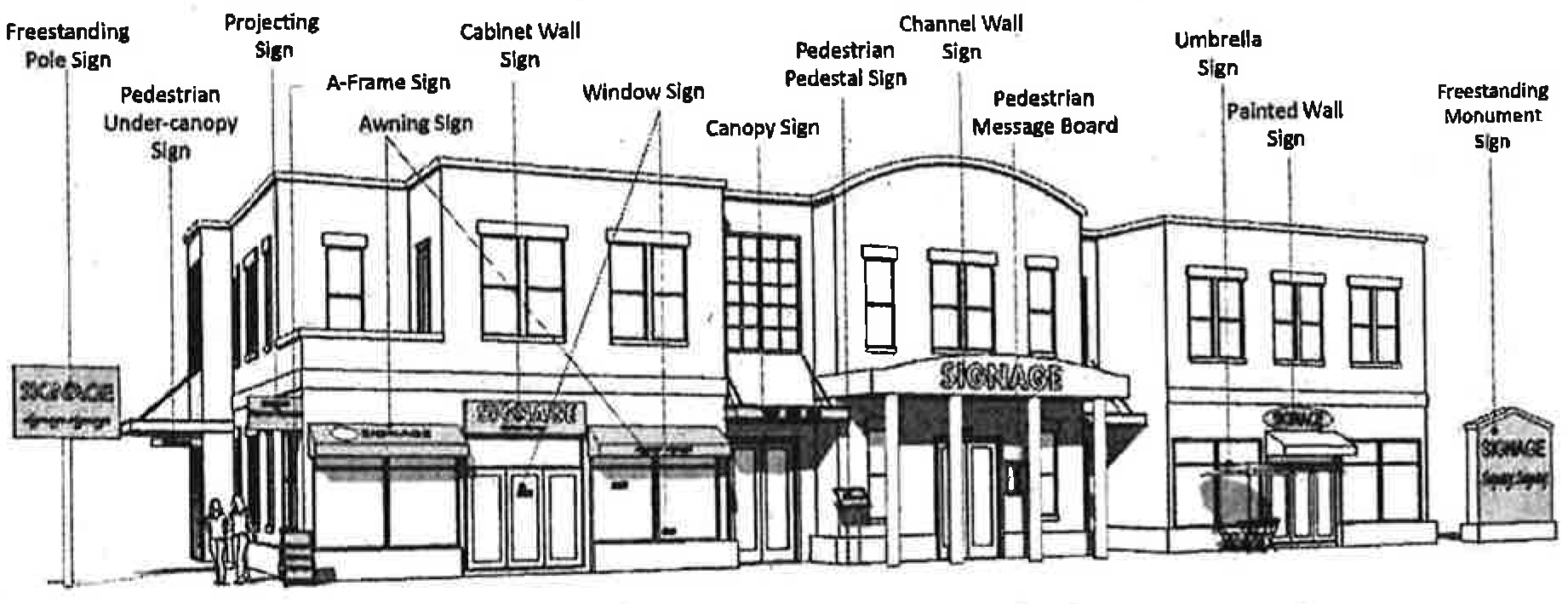
PROJECTING SIGNS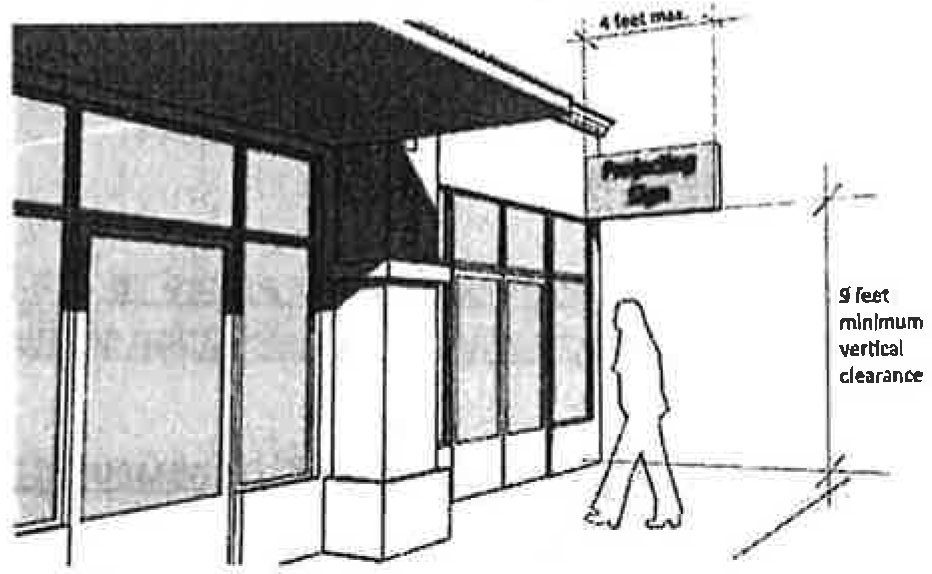
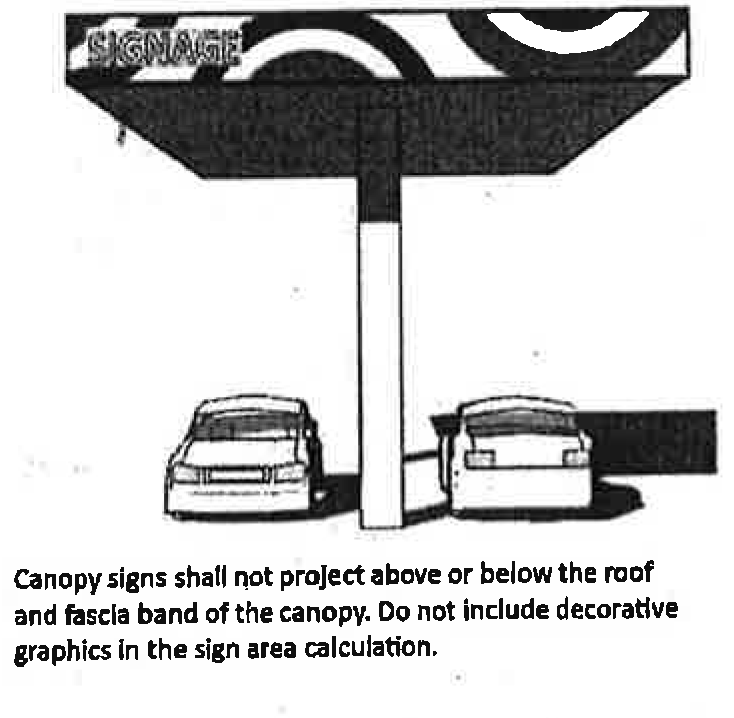
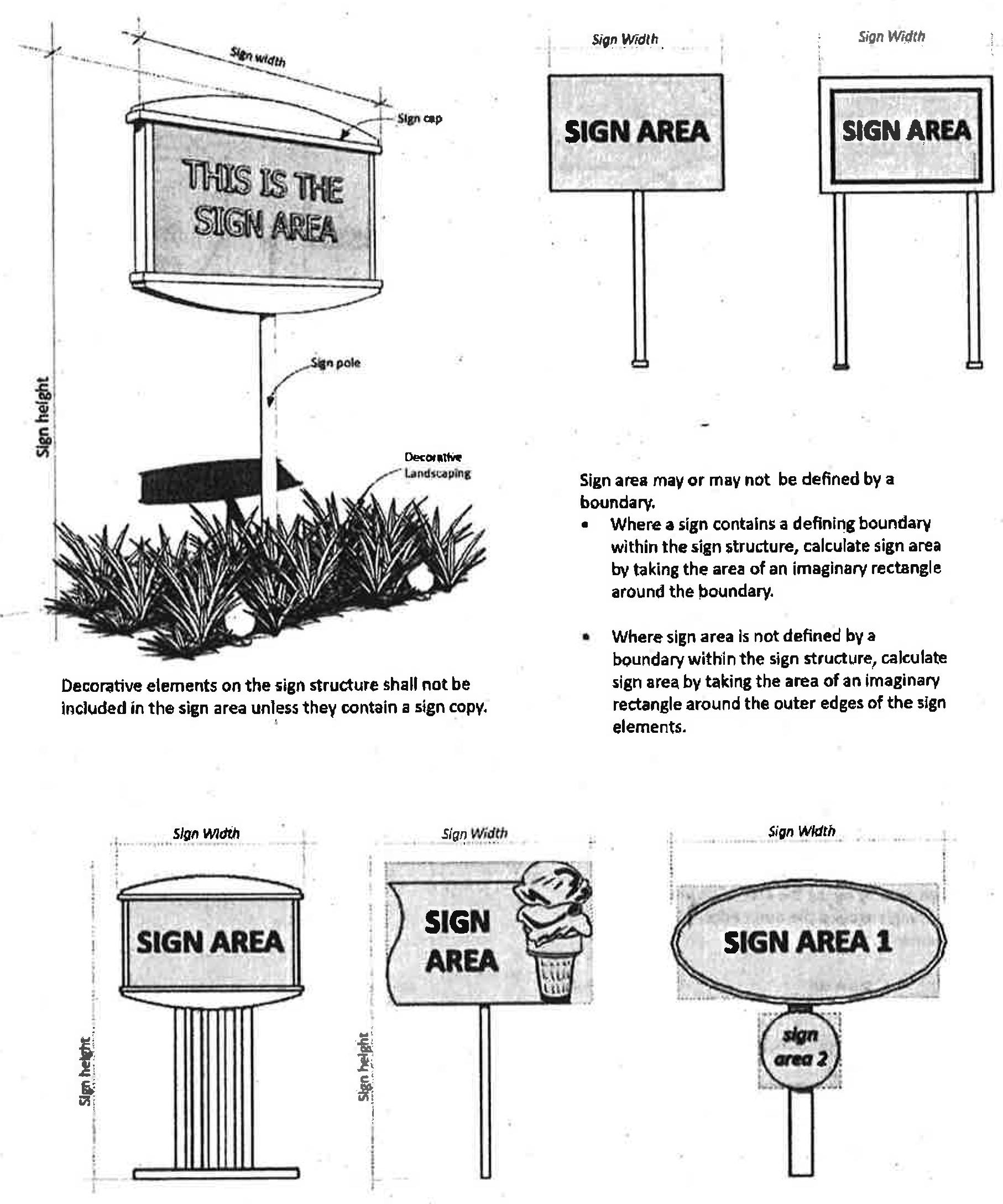
FREESTANDING POLE SIGNS
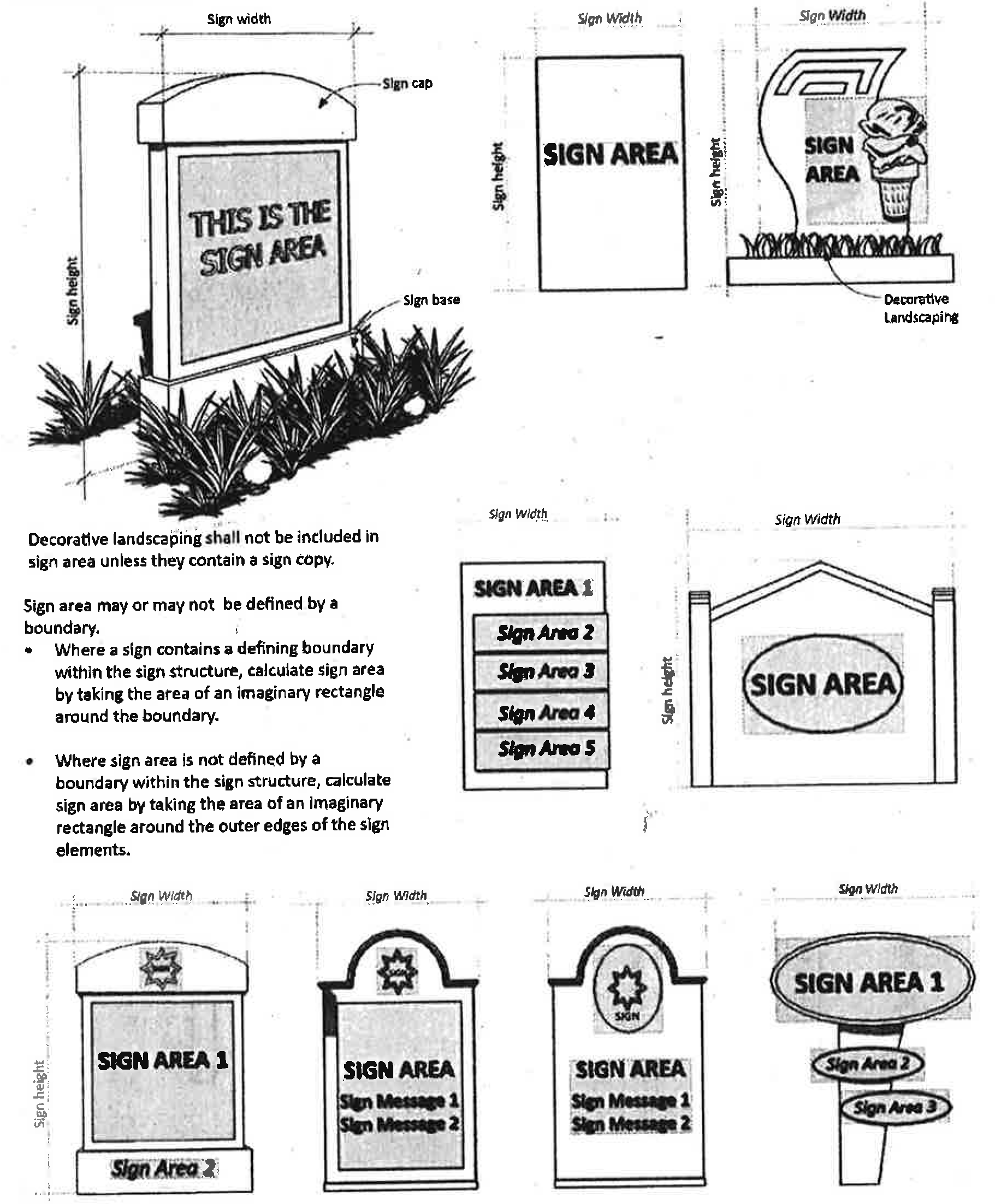
FREESTANDING MONUMENT SIGNS
SIGN FACES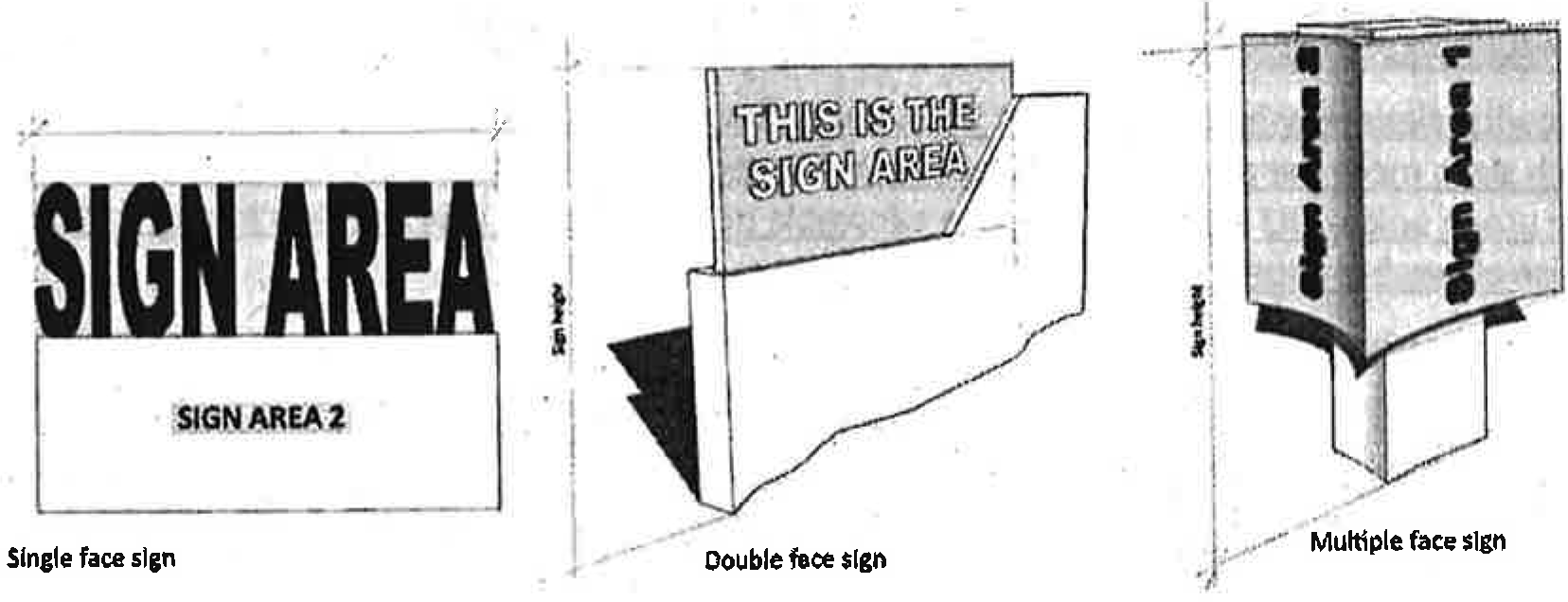
CALCULATING SIGN AREA FOR BUILDING MOUNTED SIGNS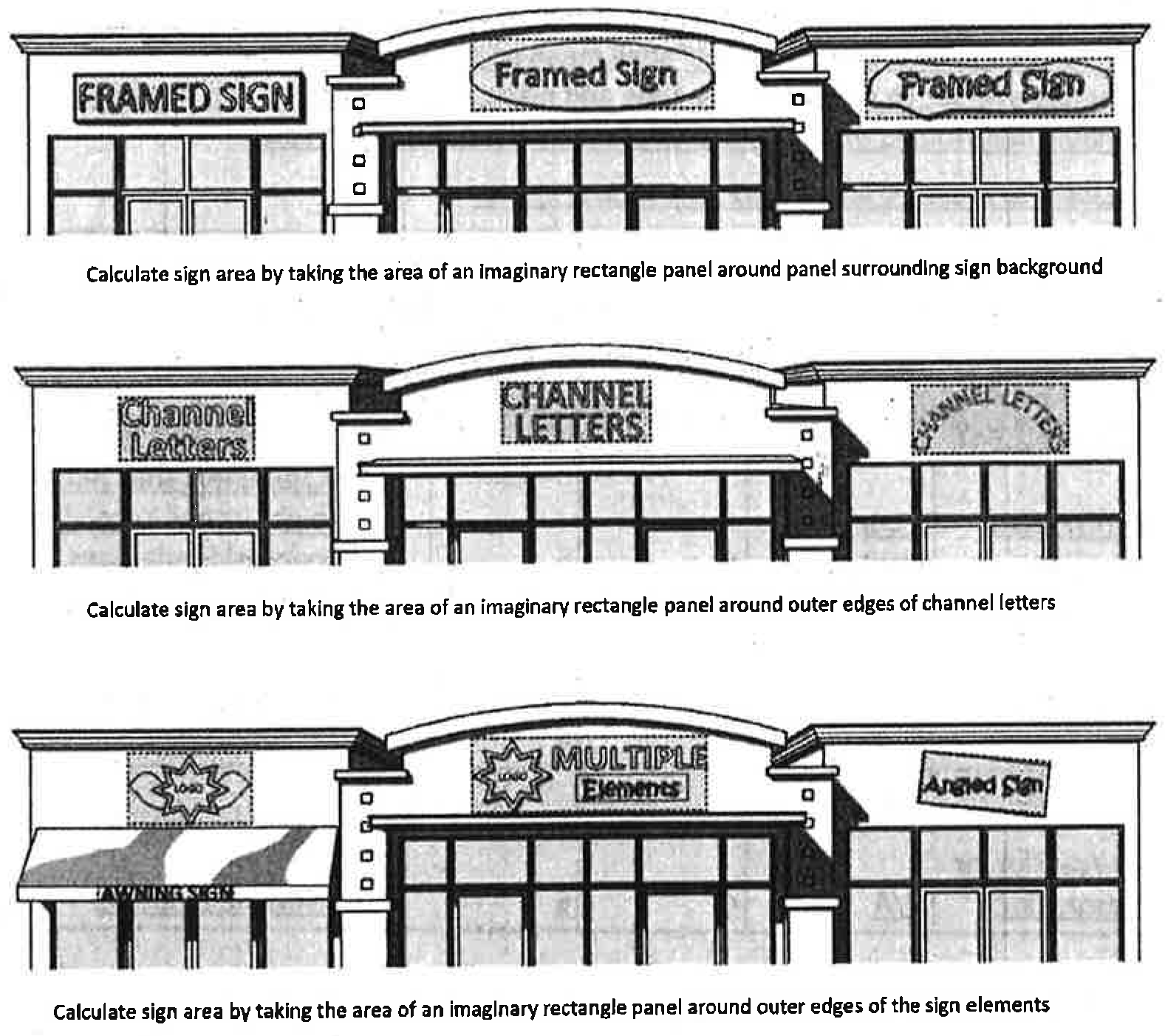
(Ord. No. 160485, § 2, 3-1-18)
Sec. 30-9.5. - Allowable signs—No permit required.
The following signs may be used without the need to first obtain a sign permit from the city, provided that such signs meet the applicable regulations in this section and section 30-9.4 and have no electrical parts or usage unless ULI listed. Any signage allowable per this section is in addition to any signage otherwise allowable under this sign code.
A.
Temporary signs.
1.
Events. Signs pertaining to an event shall be removed no later than 10 calendar days after the event. As used in this section, "event" shall mean an occurrence, happening, activity, or series of activities, specific to an identifiable time and place, if referenced on the sign itself or reasonably determined from all circumstances by the enforcing official.
B.
Signs necessary to preserve life and prevent serious injury.
C.
Miscellaneous signs.
D.
Flags.
1.
The vertical dimension of the flag shall be a maximum of 20 percent of the height of the flagpole.
2.
A flagpole may be freestanding or building-mounted. Freestanding flagpoles shall be set back at least ten feet from any property line.
E.
Murals and other works of art. Murals and other works of art, as defined in chapter 5.5 of this Code of Ordinances, shall not require a sign permit provided that they meet any applicable regulations in section 30-9.4 and have no electrical parts or usage unless ULI listed. Any part of a mural or work of art that contains a commercial message shall not be included within the allowance of this subsection and therefore shall comply with any applicable provisions of this sign code.
(Ord. No. 160485, § 2, 3-1-18)
Sec. 30-9.6. - Interim signs and street banners.
A.
Interim signs. Prior to or in conjunction with an owner or designated agent submitting an application for a sign permit in accordance with section 30-9.7, the owner or designated agent may apply to the city manager or designee, at no fee, for an interim sign permit to allow for the immediate and temporary use of the signage area allotments provided for in section 30-9.7. Interim sign permits shall expire one year after issuance or when a corresponding sign is permitted and installed in accordance with section 30-9.7, whichever occurs first, and may be extended for good cause. Interim signs shall be removed within three calendar days after expiration of the interim sign permit.
B.
Street banners. No sign may be erected, constructed, or maintained along or across any public streets, except across-street and vertical pole banners as permitted over or along certain streets designated by the city manager and the general manager for utilities. An application shall be filed with the city manager or designee together with a banner installation fee as prescribed by the general manager for utilities to allow full cost recovery to the city. The following regulations shall apply:
1.
Banners shall relate to an event that will be open to the general public and that is scheduled to occur within the city or unincorporated Alachua County;
2.
Banners shall not contain any commercial message, any phone numbers or addresses, or any traffic directions or traffic signage that may cause a traffic or pedestrian hazard; and
3.
The city will install street banners no more than 14 calendar days prior to the event and will remove them no later than seven calendar days following the event.
(Ord. No. 160485, § 2, 3-1-18)
Sec. 30-9.7. - Allowable signs—Permit required.
A.
Permit required. With the exception of the signage provided for in section 30-9.5 and section 30-9.6, it shall be unlawful to use, erect, maintain, alter, or extend any new or existing sign without first obtaining a sign permit from the city in accordance with this section. The owner or designated agent shall apply for a sign permit by submitting an application to the city manager or designee on a form provided by the city, together with the applicable sign permit fee.
1.
Review period. The city manager or designee shall grant or deny a sign permit application within 30 calendar days from the date a completed application and payment of the permit fee was submitted to the city. If the city manager or designee fails to take action by either granting or denying a sign permit application within this specified period, it shall be deemed approved.
2.
Review criteria.
a.
If the city manager or designee determines that the application meets the requirements of this sign code and all building, electrical, and other applicable regulations of the city, the city manager or designee shall approve the application and issue the sign permit contingent on an inspection after installation/alteration.
b.
If the city manager or designee determines that the application fails to meet one or more requirements of this sign code or building, electrical, or other applicable regulations of the city, the city manager or designee shall deny the application and shall make a written report of the denial and the reasons therefore. A copy of the report shall be sent by certified mail to the applicant.
c.
If the application is denied, the applicant may submit an amended application within 15 calendar days of the date posted on the notice of denial without additional cost. The city manager or designee shall grant or deny an amended application within 30 calendar days of receipt. If the city manager or designee fails to take action by either granting or denying an amended application within this specified period, it shall be deemed approved.
B.
Building-mounted, permanent. Building-mounted sign allowance may be used by a combination of wall, window, mansard, parapet, awning, marquee, or canopy signs, and shall not exceed the maximum sign area established below. Except where otherwise specifically provided, permanent building-mounted signs may be permitted as follows:
1.
Projecting. Signs shall not extend horizontally beyond the edges of the awning, marquee, mansard, or parapet to which they are attached or from which they are suspended and no more than four feet horizontally from the wall. Signs shall not project vertically above the roofline. Such signs under which a pedestrian walkway passes shall have at least a nine-foot vertical clearance.
2.
Canopy. Any signage on a canopy shall be considered, and included within the allowable allotment of, building-mounted signage.
3.
Wall. Where a wall supporting a building-mounted sign is less than 12 inches from a public right-of-way, the wall sign may project over the right-of-way, provided it does not project more than 12 inches from the wall.
C.
Freestanding, permanent. Except where otherwise specifically provided, permanent freestanding signs may be permitted as follows. However, permanent freestanding signs shall not be permitted on single-family residential properties.
1.
Spacing and setback. Shall be located at least 50 feet from any other permanent freestanding sign, and shall have a minimum setback of ten feet from any front or side property line.
D.
I-75 corridor signs.
1.
For purposes of this subsection, I-75 corridor signage shall be restricted to permitted uses in nonresidential districts that are located within ¼ mile of the centroid of an I-75 interchange with any arterial roadway.
2.
In addition to signage otherwise allowable per this sign code, an additional freestanding sign with a maximum sign structure height of 18 feet shall be allowed on a development (including outparcels), provided that the sign area of such sign in combination with other permitted signs on the development does not exceed a maximum sign area of 300 square feet. Such sign shall be readily visible from I-75. The location of this sign shall not be limited to properties actually abutting I-75; however, no I-75 corridor sign shall be located on any frontage where the adjacent or facing properties are designated single-family on the future land use map.
3.
Height extension. An owner or designated agent may apply for a height extension to allow for an I-75 corridor sign with a maximum sign structure height greater than 18 feet. However, under no circumstances may a sign structure exceed a height of 90 feet. Applications for a height extension shall be accompanied by a fee in the amount established for a variance as set forth in Appendix A. The city plan board shall review height extension applications and shall approve or deny the application based upon the following special considerations. The city plan board shall approve an application for a height extension only when the applicant proves each of the following requirements:
a.
A registered engineer certifies or other reliable documentary evidence proves that, due to special conditions and circumstances relative to topography, vegetation or the built environment, a sign structure with a height of 18 feet or less cannot be seen by motorists on I-75 at a distance of one-fourth mile from the nearest exit ramp;
b.
The height extension requested is the minimum necessary to achieve such visibility;
c.
The circumstances and/or special conditions do not result from the actions of the applicant;
d.
The height extension will have general compatibility and harmony with the uses and structures on adjacent and nearby properties; and
e.
The sign otherwise complies with all applicable regulations of this sign code.
The city plan board may prescribe appropriate conditions and safeguards to ensure the structural integrity and safety of the sign and to landscape and buffer the sign structure to ensure compatibility and harmony with the uses and structures on adjacent and nearby properties.
E.
Gainesville Regional Airport.
(Ord. No. 160485, § 2, 3-1-18)
Sec. 30-9.8. - Sign maintenance.
A.
All signs and sign structures regulated by this chapter, including any supports, braces, guys and anchors, electrical parts, lighting fixtures, and all painted and display areas shall be maintained to present a neat, clean appearance and maintained in a safe condition. Painted areas and sign surfaces shall be kept in good condition, and illumination, if provided, shall be maintained in safe and good working order.
B.
Weeds and grass shall be kept cut in front of, behind, underneath, and around the base of freestanding signs for a distance of ten feet, and no rubbish or debris shall be permitted under or near such signs.
C.
Any sign that becomes dilapidated, run down, or a safety hazard shall be repaired or removed by the owner or designated agent.
(Ord. No. 160485, § 2, 3-1-18)
Sec. 30-9.9. - Nonconforming signs.
Any sign that does not comply with the requirements of this chapter, but for which a permit has previously been issued by either the city or Alachua County, shall be deemed legally nonconforming. The owner of any legally nonconforming sign or the owner of any property upon which such sign is located shall bear the burden of proving that such sign is a legally nonconforming sign. All other signs that do not comply with the requirements of this chapter and that are not legally nonconforming shall immediately be removed or brought into compliance with this chapter.
A.
All legally nonconforming signs shall be allowed to remain as originally permitted.
B.
Reasonable repair and maintenance necessary to keep a legally nonconforming sign in a good state of repair is allowed, and may include but is not limited to:
1.
Changing light bulbs, neon, or other light source;
2.
Changing the face of a cabinet sign, or other modification that only involves a change of copy;
3.
Replacing cladding or other components that hold a sign face in place;
4.
Painting, cleaning, and other maintenance activities that do not affect the type, height, or size of the sign structure; and
5.
Repairing electrical components.
C.
Reasonable repair and maintenance does not include, by way of example and not limitation:
1.
Any modification that changes the structure or type of structure, such as conversion of a wooden sign structure to a metal sign structure, or otherwise prolongs the life of the sign structure;
2.
Any modification, including the addition of embellishments, that changes the sign area or the height above ground level: and
3.
Any modification that adds internal or external illumination, or increases the existing illumination.
D.
A legally nonconforming sign shall be removed or brought into compliance with this sign code if any of the following conditions apply:
1.
The sign becomes damaged, destroyed or deteriorated by any means to the extent that it requires more than reasonable repair and maintenance, as described above, or if the cost of renovation or repair exceeds 50% of the replacement cost of the sign;
2.
The principal structure on the parcel or parcels is demolished or requires renovations the costs of which exceed 50 percent of the assessed value of the structure; or
3.
The nonconforming sign is moved for any reason.
E.
Historic signs. A sign that has been added to the local historic register shall not be considered a nonconforming sign and shall be exempt from the limitations of this subsection.
(Ord. No. 160485, § 2, 3-1-18)
Sec. 30-9.10. - Enforcement.
A.
Duties of enforcing official. The city manager or designee shall be the enforcing official. The enforcing official is charged with the duty of administering and securing compliance with the provisions of this sign code. In furtherance of this responsibility, the enforcing official shall:
1.
Make such inspections as may be necessary to bring about the purpose and intent of this sign code and initiate appropriate action to bring about compliance if such inspection discloses any instance of noncompliance;
2.
Investigate thoroughly any complaints of alleged violations of this sign code, and indicate clearly in writing as a public record in his/her office the disposition made of such complaints;
3.
Order in writing as set out below the remedy of all conditions or all violations of the sign code found to exist in or on any premises;
4.
State in the violation order a time limit for compliance; and
5.
Request the assistance of the city attorney in taking appropriate legal action upon the failure of the responsible party to comply with such violation order by the time specified therein.
B.
Right of entry. The enforcing official or his/her agent is authorized and directed to lawfully enter in and upon all premises at reasonable times to determine their condition insofar as the provisions of this sign code are applicable.
C.
Contents of notice of violation. Whenever the enforcing official determines that a violation of this sign code exists, the official is authorized to issue a citation pursuant to section 2-337. Time for compliance shall be as follows:
1.
Temporary and prohibited signs. For all signs that are either temporary or prohibited as specified in this sign code, the time may not be less than one hour nor more than 24 hours from the time of such written notice. However, any condition found to exist in violation of this sign code that constitutes a hazard to the public safety shall be required to be abated immediately.
2.
All other signs. For all other signs, the time may not be less than ten calendar days nor more than 90 calendar days from the date of such written notice. However, any condition found to exist in violation of this sign code that constitutes a hazard to the public safety shall be required to be abated immediately.
D.
Unauthorized signs in right-of-way. Any sign placed in the public right-of-way in violation of this sign code shall be deemed to be abandoned and may be removed immediately by an enforcing official or agent. Any sign so removed may be disposed of by the city without notice or compensation. This removal shall not preclude prosecution or imposition of penalties for violation of this sign code.
E.
The enforcing official or agent may cause any sign that is a hazard or poses immediate peril to persons or property to be removed immediately at the expense of the owner, lessee or other person having beneficial use of the sign, or the owner or lessee of the land upon which the sign is located.
(Ord. No. 160485, § 2, 3-1-18)

