
Gainesville City Zoning Code
ARTICLE VII
PARKING AND LOADING
Sec. 30-7.1.- Generally.
A.
Applicability. Off-street parking facilities, including those provided for any new building constructed, any new use established, any addition or enlargement of an existing building, and any change in the occupancy of any building or the manner in which any use is conducted that would result in additional required parking spaces, shall be subject to the provisions of this article.
B.
Requirements for uses not mentioned. In the case of a use not mentioned, the requirements for off-street parking shall be the same as for the most similar use specifically mentioned.
C.
Optional parking study. Applicants may submit a parking study as part of the development plan that illustrates the actual demand for the proposed use.
D.
Shared parking (two or more uses on same site). Shared parking shall be based on the type of uses and the hours of operations. The total number of required parking spaces may be reduced up to 25 percent if each of the following criteria are met:
1.
The property owner(s) provide the city with a shared parking agreement signed by each property owner or authorized agent.
2.
Shared parking matrix. City standards shall be used to calculate the shared parking usage percentages for multiple uses according to the shared parking matrix below:
* Not 24-hour.
E.
Location of parking area.
1.
Required off-street vehicle parking areas shall be located on the same lot or parcel of land as the principal structure to be served, or on any lot or parcel of land within 300 feet of the principal structure to be served, or within 600 feet if the structure is located within a transect zone, as measured from the lot line to the nearest point of the off-street parking facility, provided that this provision shall not be interpreted to permit the location of off-street parking spaces within a zoning district where parking facilities are not otherwise permitted.
2.
All bicycle parking facilities required by this chapter shall be located on the same lot or parcel of land as the use for which such facilities are required and as close to the building entrance as possible without interfering with the flow of pedestrian traffic.
3.
Within the transect zones, a minimum of ten percent of the provided bicycle parking shall be located between the street curb and the front of the building. The remainder shall be located a maximum distance of 600 feet from a building entrance. Within the U9 and DT zones, bicycle parking that is not located along the street shall be covered from inclement weather or located within a parking structure.
F.
Joint use of parking area. The joint use of vehicle parking facilities of more than five spaces by two or more uses is permitted whenever such joint use is practicable and satisfactory to each of the uses intended to be served and when all requirements for location, design and construction can be satisfied. In computing capacities of any joint use, the off-street vehicle parking requirement is the sum of the individual requirements that will occur at the same time, provided that the total of such off-street vehicle parking facilities required for joint or collective use may be reduced during site plan approval in accordance with the following criteria:
1.
That the uses which the joint off-street parking facilities serve do not normally or regularly operate during the same hours of the day or night may be considered; and
2.
Not more than 60 percent of off-street vehicle parking facilities required for a use may be supplied by off-street vehicle parking facilities which are provided for other buildings or uses.
G.
Joint use agreement. A copy of an agreement between joint uses shall be filed with the application for a building permit. The agreement shall include a guarantee for continued use and maintenance of the parking facility by each party to the joint use.
H.
Leased parking facilities. Required off-street vehicle parking areas may be leased (the "leased area") with boundaries clearly delineated in the lease by the owner or operator of the principal structure to be served, provided the owner or operator enters into a written lease agreement, which shall be subject to the approval of the city attorney, under the following terms and conditions:
1.
The leased area is within 300 feet, or within 600 feet if the structure is located within a transect zone, of the main entrance of the principal structure measured to the nearest point of the leased area;
2.
The leased area shall be clearly marked with appropriate signage indicating that the area is for the exclusive use of the principal structure, except in a transect zone, wherein the leased area may be jointly used with another principal structure provided the uses in such principal structures do not normally or regularly operate during the same hours of the day or night and otherwise comply with the provisions of subsection F. of this section;
3.
The leased area shall comply with, the landscaping section and the design requirements of this chapter;
4.
The term of the lease for the leased area shall be a minimum of three years with a minimum one-year cancellation clause; and
5.
The lease shall expressly provide that the use of the principal structure is expressly contingent upon the parking facilities of the leased area, and if the lease is terminated for any reason the owner or operator of the principal structure shall immediately cease operations and terminate the use of the principal structure unless and until additional required off-street parking facilities are provided in accordance with provisions of this article.
I.
Assessed parking. The required off-street vehicle parking for a particular use shall be reduced by its proportionate share of publicly owned public parking for which it has been specifically assessed. The applicant shall acknowledge through an agreement or a statement in the development plan that the city retains the right to remove the on-street parking.
J.
Enforcement. Off-street parking facilities shall be maintained and continued as an accessory use as long as the principal use is continued. It shall be unlawful for an owner or operator of any building, structure or use controlled by this article to discontinue, change, dispense with, sell or transfer any required parking facilities, including those leased or jointly used, without establishing alternative vehicle parking facilities which meet the requirements of this article. It shall be unlawful for any person, firm or corporation to utilize a building, structure or use without providing the off-street parking facilities to meet the requirements of this article.
Sec. 30-7.2. - Off-street vehicle parking.
Off-street vehicle parking, including public parking facilities, must be designed, constructed and maintained in accordance with the following standards and regulations:
A.
Access. Vehicular ingress and egress to off-street parking facilities must be in accordance with the driveway ordinance, chapter 23, article V.
B.
General requirements. Parking areas must be so designed and marked as to provide for orderly and safe movement and storage of vehicles.
1.
All parking spaces must contain some type of vehicle wheel stop or other approved barrier that prevents any part of a vehicle from overhanging onto the right-of-way of any public road, alley, walkway, utility or landscaped area.
2.
All parking lots with two or more rows of interior parking must contain grassed or landscaped medians at least eight feet in width unless an alternative landscape plan is approved pursuant to section 30-8.4. Where it is determined by public works that the landscaped median(s) would obstruct the storm drainage, the city manager or designee may approve an alternative.
3.
Off-street parking on any property with RC or SF zoning, or planned development (PD) zoning with single-family or two-family dwellings, and that is located within either the University of Florida context area or a residential parking overlay district area will be regulated in accordance with section 30-7.7.
4.
Maneuvering and access driveways for off-street parking areas, except those provided for single-family dwellings, must be provided within the lot on which the parking is located so that any vehicle will not be required to back into or maneuver within the public street right-of-way on entering or leaving any off-street parking space.
5.
One hundred feet must be the minimum distance from the street right-of-way line at any major ingress or egress driveway to any interior service drive or parking space having direct access to such driveway. A major driveway is defined as the main ingress or egress point as approved by the applicable reviewing authority.
6.
Twenty feet must be the minimum distance from the street right-of-way line at any other ingress or egress driveway to any interior service drive or parking space with direct access from such driveway. However, the city manager or designee may allow a reduction of the 20-foot requirement, provided generally accepted traffic principles are maintained, under the following conditions:
a.
Where an existing vehicular use area would be impractical to meet the 20-foot requirement; or
b.
Where an existing vehicular use area proposed for improvement exists with less than the required 20 feet; or
c.
For any new development or redevelopment of a vehicular use area, except a vehicular use area with direct access to any roadway classified on the official roadway map, the minimum distance from the right-of-way line at any other ingress or egress driveway to any interior service drive or parking space with direct access from such driveway may be nine feet (which distance also meets landscape requirements) provided all of the following conditions are met for each type of use:
i.
Residential off-street parking:
1)
Vehicular use area access: from alleys or local streets (streets designed for or carrying traffic volumes of under 1,200 vehicles per day);
2)
Available right-of-way from edge of pavement to the private property line: Ten feet minimum (not required for alleys);
3)
Speed limit: The posted speed limit is 30 mph or less; and
4)
Use: Generates less than 300 trips per day.
ii.
Nonresidential off-street parking:
1)
Vehicular use area access: From alleys or local streets designed for traffic volumes under 1,200 vehicles per day;
2)
Available right-of-way from edge of pavement to the private property line: Ten feet minimum (not required for alleys);
3)
Speed limit: The posted speed limit is 35 mph or less;
4)
Size of parking lot: 25 or fewer nonresidential parking spaces; and
5)
Use: Generates less than 100 trips per day.
C.
Construction specifications.
1.
Paved parking facilities. Except as provided in subsection 2. below, all off-street parking areas must be paved using asphaltic concrete, concrete, paving block or brick, and must be designed and constructed in accordance with the standards and specifications adopted by resolution of the city commission and on file in the public works department.
2.
Unpaved parking facilities. Unpaved spaces must be located on the periphery of any paved parking areas in locations that will receive less use than those paved and more remotely located to the use served. All gravel areas must be self-contained with curbing that is acceptable to the public works department. The following parking facilities may be unpaved, provided such facilities are approved by the applicable reviewing authority to be in compliance with this section and other applicable requirements of the Land Development Code:
a.
Up to 70 percent of the required vehicle parking spaces for places of religious assembly provided that such unpaved parking spaces may not be used as joint parking with any uses other than places of religious assembly.
b.
Up to 20 percent of the total required spaces for multi-family dwellings, in accordance with section 30-7.2 C.3.
c.
Parking spaces provided in excess of the minimum number required by this article, or for uses not required to provide parking spaces.
d.
Parking lots located in the residential districts, as identified in section 30-4.1, when said lots contain ten or fewer parking spaces and parking lots in the office districts when such lots contain less than seven parking spaces.
e.
College Park/University Heights areas in accordance with section 30-7.7 B.
3.
Multiple-family dwellings with more than six parking spaces.
a.
If approved in site plan review, up to 20 percent of the total required vehicle parking spaces for multi-family dwellings may be provided by stabilized unpaved parking.
b.
Six months after a final certificate of occupancy is issued or, if phased, upon installation of all parking facilities required, an inspection will be made by the city manager or designee. If findings indicate that the unpaved spaces are in good condition or infrequently used, such unpaved spaces may remain unpaved. If findings show that the spaces receive as much use as the paved spaces, or have deteriorated, such unpaved spaces must be paved within 90 calendar days of written notice to the owner of the property.
c.
Stormwater management facilities must be provided for all vehicle use areas, whether paved or unpaved, at the time of construction unless the owner demonstrates that stormwater management facilities can be expanded to accommodate future required paving and upon recommendation of the Public Works Department.
d.
A violation of the Code of Ordinances occurs if the unpaved parking area deteriorates so that nearby properties, rights-of-way, or easements are adversely impacted or if the unpaved parking area has deteriorated so that it may no longer be used for parking. Evidence of deterioration includes but is not limited to:
i.
The settlement of the unpaved parking area(s) such that drainage patterns are redirected onto off-site properties rather than the intended stormwater management facilities.
ii.
Absence or failed condition of the approved unpaved parking surface.
iii.
Introduction of sediment and debris from the unpaved parking area onto city rights-of-way and easements.
e.
To remedy this violation, the city may require the property owner to pave the area or to stabilize the area in another manner. If paving is deemed necessary by the city, the property owner may be required to expand the stormwater management facilities as provided in subsection C.3.c. of this section.
4.
Vehicles and equipment display and storage areas.
a.
When allowed as a permitted use, parking, storage or display of automobiles for sale or lease must be conducted on a paved hard surface.
b.
All mechanical equipment and merchandise must be installed or displayed on a paved hard surface.
c.
Temporary parking and storage may be allowed by the city manager or designee for up to 60 calendar days in areas outside of the wellfield protection zones. The city shall make a determination that:
i.
The location of the facility will not be harmful to, nor impact surface waters, wetlands, or other environmentally sensitive areas;
ii.
The nature, extent, and duration of the proposed storage area will not create a nuisance or safety hazard;
iii.
That the storage use will be of an intensity that will maintain sod or some other vegetative cover; and
iv.
That the applicant has a plan to return the site to an original or improved condition.
D.
Dimensional requirements. Vehicular parking widths and depths must meet the specifications in the Design Manual.
E.
Handicapped parking. Accessible handicapped parking spaces must comply with the state accessibility requirements manual on file at the building inspection department.
F.
Tandem parking. When administered as a valet parking service, required off-street parking may be placed in a tandem configuration upon approval by the applicable reviewing authority. The area used for tandem parking must be clearly designated on a development plan and must meet all landscaping requirements, except that the location of required interior landscaping will be determined at the time of development review. Approval of tandem parking configuration will be based on continued maintenance of the administered parking service. If and when the service is discontinued, the regular off-street parking configuration of aisle and spaces must be reinstituted and the minimum parking spaces required must be provided in accordance with this article. When using this option the property owner shall demonstrate that private streets, vehicular maneuvering areas, service areas, loading and unloading area, queuing areas and any regular parking space can function efficiently and will not obstruct the efficient flow of traffic, service, utility, and vehicles on the site.
(Ord. No. 200722, § 13, 4-21-22; Ord. No. 2024-263, § 15, 10-3-24)
Sec. 30-7.3. - Structured parking.
A.
Development plans for new parking structures as a principal or accessory use must:
1.
Minimize conflict with pedestrian and bicycle travel routes;
2.
Provide parking for residents, employees, and customers to reduce the need for on-site surface parking;
3.
Be located and designed to discourage vehicle access through residential streets; and
4.
Design facilities for compatibility with neighborhoods by including ground floor retail, office, or residential use/development (as appropriate for the zoning district) when located on a public street. The facility must also have window and facade design that is scaled to relate to the surrounding area.
B.
Structured parking may not be located within 100 feet of property zoned for single-family use.
C.
Accessory automotive detailing may be allowed within structured parking facilities. These accessory uses may be allotted an area equal to no more than five parking spaces within the parking structure. One exterior sign of no more than six square feet at an entrance to the garage is allowed in association with accessory automotive detailing.
D.
There is no maximum limit on the number of parking spaces in parking structures.
(Ord. No. 190171, § 1, 11-21-19)
Sec. 30-7.4. - Bicycle and motorcycle parking.
A.
Required bicycle parking facilities shall be designed, constructed and maintained in accordance with the following standards:
1.
Bicycle parking facilities shall include provision for the secure storage and locking of bicycles on a hard surface at least seven feet in length. All required bicycle parking facilities shall be from an approved list of bicycle parking devices that is adopted by the city commission and maintained by the city. Other bicycle parking devices may be used if it can be established to the satisfaction of the building official that they are equivalent to any devices on the approved list in function, quality and construction.
2.
Fixed objects that are intended to serve as bicycle parking facilities shall be clearly labelled as available for bicycle parking.
3.
If a room or common locker not divided into individual lockers or rack spaces is used, one bicycle space shall consist of an area that is at least 12 square feet with locking devices. Adequate aisle widths shall be provided in rooms or common lockers. Bike racks should be spaced at least two and one-half feet on center.
4.
Individual locker spaces or racks shall be designed to provide convenient ramped access to users.
B.
Motorcycle spaces or stalls shall be a minimum of three feet in width. The locations and design of motorcycle stalls shall be in accordance with current engineering practices and motorcycle parking design and construction specifications on file in the public works department. Motorcycle parking stalls shall be constructed of concrete, suitable asphaltic, approved pervious surface or other material as approved by the city manager or designee that is not subject to motorcycle kickstand damage. Motorcycle parking shall be clearly labeled as such.
Sec. 30-7.5. - Required number of parking spaces.
A.
Generally. The maximum number of parking spaces allowed for each use is as provided in this section.
1.
In calculating the maximum number of parking spaces, a fractional space of one-half or more will be rounded up to one space.
2.
At development plan review, the approving authority may allow ten additional spaces or up to ten percent greater than the maximum allowed, whichever number is greater, upon presentation of evidence by the owner of the property that the proposed use has a justifiable need for the additional parking spaces. The approving authority may also allow additional spaces above those otherwise provided for in this section upon the property owner's presentation of a parking study demonstrating that:
a.
There is minimal impact to the surrounding area.
b.
The subject area has high parking demand combined with a current parking inventory that is near or at capacity.
c.
Excess parking will not create excessive distances between buildings and sidewalks.
d.
Excess parking will be screened and oriented away from street frontages.
e.
Existing high-quality trees will be preserved and the development will otherwise meet landscape regulations for vehicular uses.
3.
Structured parking.
a.
Parking provided within a building or parking structure will not be counted when calculating maximum allowable parking.
b.
Structured parking is required for any development exceeding 200 parking spaces. An exemption from this requirement may be granted as an offset for the provision of affordable housing in accordance with section 30-4.31.
4.
Bicycle parking. Unless otherwise specified, the required number of bicycle parking spaces is stated as a percentage of the maximum allowed vehicular spaces.
5.
Motorcycle and scooter parking.
a.
For developments that are in the University of Florida Context Area, but that are outside of the transect zones, the minimum requirement is one space per ten bedrooms.
b.
Proposed developments providing 40 vehicular parking spaces or more must provide off-street motorcycle and scooter parking spaces at a ratio of one space per 40 vehicle spaces.
6.
Relocatable structures. Any development within an ED district must comply with the parking requirements as set forth in this article, except that off-street parking facilities for relocatable structures are not required to be constructed for three years from the date of placement of the relocatable structure on a lot. However, the construction of off-street parking facilities in accordance with the provisions of this article must be commenced within 90 calendar days whenever any relocatable structure has been on a lot for a period of more than three years. The movement of a relocatable structure from one portion of a school lot to another location, or the replacement of one relocatable structure with another relocatable structure, will not extend the aforesaid time limits prescribed herein.
7.
Overflow parking. In situations where development proposals contain recreational facilities that are planned for regularly scheduled activities, the reviewing authority may require at site plan review upon advice of the public works department additional parking to be provided as overflow grass parking.
1 The parking ratios for these uses will serve as a guide in determining overflow grass parking requirements.
(Ord. No. 211262, § 1, 11-29-22; Ord. No. 2025-155, § 2, 8-7-25)
Sec. 30-7.6. - Off-street loading and unloading.
A.
Purpose. In order to prevent undue interference with public use of streets and alleys, every manufacturing, storage, warehouse, department store, variety store, wholesale store, laundry, dry cleaning, dairy, mortuary, and other uses similarly and customarily receiving or distributing goods by motor vehicles must provide loading and unloading space on the premises for that number of vehicles normally at the premises at any one time on an average day of full use.
B.
Loading and unloading space.
1.
Every building housing a use mentioned in this section and having over 5,000 square feet of gross floor area but less than 20,000 square feet of gross floor area must be provided with at least one off-street loading/unloading space, immediately adjacent to the principal building. In addition, one off-street loading/unloading space must be provided for each additional 10,000 square feet of gross floor area or fraction thereof over 20,000 square feet up to 50,000 square feet, plus one for each 25,000 square feet over 50,000 square feet. Where the requirement exceeds five loading spaces, the traffic engineer shall determine whether additional spaces are needed and to what extent. Such space is defined as an area of at least 50 feet in depth, 12 feet in width and with an overhead clearance of not less than 14 feet, exclusive of access, platform, or maneuvering area, to be used exclusively for loading and unloading of merchandise. The exact dimensions of the loading/unloading space(s) are subject to the approval of the traffic engineer.
2.
Access to all truck standing, loading, and unloading facilities must be provided directly from a public street or alley and must be so designed that all maneuvering areas are located on the property.
3.
Loading spaces required under this subsection must be provided onsite as an area additional to maximum off-street parking spaces and may not be considered as supplying off-street parking spaces.
C.
Loading areas within transect zones. In order to allow for in-fill development flexibility to better suit space restraints found within denser urban cores of the city, the approving authority will review, determine, and approve loading areas at development review in consideration of the following:
1.
Width of streets adjacent to the development;
2.
Times of deliveries;
3.
Intensity of use;
4.
Traffic; and
5.
Site constraints.
If a loading area is required, it must be located in the rear of the site incorporated into the building mass, or screened from public view by a wall (up to a maximum of eight feet) and landscaping.
D.
Loading and unloading mid-street parking in urban streets. For the purpose of this section, urban streets are as defined in the Land Development Code and "mid-street" is defined as five feet from the centerline of a public right-of-way in each direction. A vehicle may use mid-street parking in urban streets for the temporary short-term loading and unloading of goods or supplies, provided the parking of the vehicle does not obstruct traffic and conforms to the following requirements:
1.
The vehicle must straddle the center lines, leaving at least ten feet on each side for other vehicles to pass and shall not be positioned so as to prevent or block access from or to any streets, driveways, parking lots, or parking spaces, or to interfere with pedestrian crosswalks or traffic.
2.
Mid-street parking is limited to no more than 15 minutes, and may be used solely for purposes of loading or unloading of goods or supplies.
3.
The vehicle must be parked at least 30 feet from any intersection and must have the emergency hazard flashers activated at all times.
4.
No mid-street parking is allowed between the hours of 1:30 a.m. and 2:30 a.m.
5.
No mid-street parking is allowed during any special events or when traffic conditions otherwise render mid-street parking unsafe, as ordered by a law enforcement officer.
(Ord. No. 211262, § 1, 11-29-22)
Sec. 30-7.7. - Residential parking.
A.
Residential parking. This section is established to regulate off-street parking on specific property located in the following zoning districts: RC, SF, or in a district containing single-family or two-family dwellings on property zoned planned development (PD).
1.
Purpose and effect. This section allows residents to take affirmative steps to preserve the character of their residential and single-family neighborhoods and to enhance the public health, welfare and safety as well as the aesthetic value of their property by controlling off-street parking. Furthermore, healthy vegetation with an above-ground network of leaves, shoots, and stems and an extensive fibrous root system below reduces soil erosion and noise, and improves surface and groundwater by filtering rainwater.
This section acts as an overlay, in that the regulations of the underling zoning district and all other applicable regulations remain in effect and are further regulated by the residential parking overlay district standards described in this section. If provisions of this section conflict with the underling zoning, the provisions of this section shall govern and prevail.
2.
Criteria.
a.
The proposed area shall consist of at least 25 compact and contiguous parcels, as defined in this chapter.
b.
The area shall not cause the creation of an enclave or peninsula, as commonly defined in annexations.
c.
Each boundary of the area shall be one of the following identifiable landmarks: A street, alley, publicly owned right-of-way, platted subdivision boundary, or a creek.
d.
No area boundaries shall overlap the boundary of an existing residential parking overlay district or the context area.
e.
The area shall consist only of parcels that are in a RC or SF zoning district, or in a district of single-family or two-family dwellings on property zoned PD.
3.
Procedures.
a.
To create a residential parking overlay, a petition requesting imposition of the overlay district on an area that meets the criteria described above shall be submitted to the city manager or designee on forms provided by the city. Each petition shall meet the following requirements:
i.
The individual circulating the petition forms ("petitioner") shall obtain the requisite petition form from the city manager or designee.
ii.
The petitioner shall be an "owner", as defined in this chapter, of property located within the proposed overlay district area and shall be a signatory to the petition.
iii.
The petitioner shall submit to the city manager or designee an accurate, reproducible map of the proposed residential parking overlay district.
iv.
Each petition shall contain authentic signatures of at least 60 percent of the fee simple record title owners of the lots or parcels within the proposed overlay district area, exclusive of public property.
v.
To be verified by the city, signatures shall be accompanied by the legibly printed name of the signer, the address of the parcel owned by the signer, the parcel number of the parcel owned by the signer, and the date the petition is signed.
vi.
Jointly owned parcels are considered owned by a single person, for purpose of the petition, and any co-owner may sign a petition for the parcel. Only one owner of each parcel shall be included in the 60 percent requirement stated above. If a person owns more than one parcel of property within the proposed district area, that person may sign the petition one time for each parcel owned.
vii.
Signatures dated more than six months prior to the date the petition is filed with the city are not acceptable.
viii.
For a signature to be verified, Alachua County Property Appraiser records shall indicate that the printed name of the petition signatory is consistent with the name of the property owner as listed in the current records of the Alachua County Property Appraiser.
ix.
The petition shall clearly and accurately advise each putative signer of the type of restrictions that may be imposed on the property if the overlay district is imposed upon the area.
x.
The petition shall clearly and accurately describe the proposed boundaries of the area.
b.
When the petition is submitted to the city manager or designee, the city manager or designee shall verify the names and signatures, and shall determine whether the petition meets the criteria of this section.
c.
To pay for the cost of verifying signatures, the city shall charge a fee as set forth in appendix A of the Code of Ordinances.
d.
If an insufficient number of acceptable owner signatures are submitted, the city shall return the petition to the petitioner and the city shall retain the fee.
e.
If a sufficient number of acceptable owner signatures are submitted, the petitioner may apply for the rezoning of the area with the imposition of the overlay district as provided in this chapter for zoning changes (including application fees, public notice, and public hearings before the city plan board and the city commission).
f.
Criteria used to evaluate parcels for rezoning. The following criteria shall be used to evaluate the appropriateness of imposing this overlay district on the area:
i.
The petitioner shall submit evidence of the impact of off-street parking on the quality of vegetation or runoff within the proposed overlay district area. Such evidence includes, but is not limited to, evidence that off-street parking is resulting in a negative impact to the quality of the vegetation of parcels or contributing to a decline in said quality within the proposed area; and
ii.
The petitioner shall submit evidence that off-street parking is resulting in a negative aesthetic impact to lots or parcels within the proposed area, or the effect of that off-street parking on the environment of the area.
g.
The petition for imposition of the overlay district shall be considered by the city plan board for its recommendation to the city commission. In order to impose the overlay district upon parcels within an area, an affirmative vote of the city commission is required. If the petition or ordinance fails, a subsequent petition for imposition of the overlay district on all or any portion of the area may not be included in a new petition unless at least one year has transpired from the date of submittal of the previous petition for imposition of the overlay on an area.
4.
Off-street parking regulations in the context area and in any residential parking overlay. Off-street parking shall be limited to the driveway parking area meeting the dimensional requirements below and leading from the permitted driveway connection to the enclosed parking space (garage or carport), plus two pullout spaces as described below. If there is no garage or carport, the driveway parking area shall meet the dimensional requirements below and be able to provide parking and ingress or egress of vehicles.
a.
The maximum width of the driveway parking area is the greater of 18 feet or the maximum width of the enclosed parking space.
b.
Pullout spaces can be no more than nine feet wide and 16 feet long; shall be covered with pavement, gravel, wood chips, bark mulch, or other erosion-preventing material clearly defining the pullout spaces; and shall be contiguous to the driveway parking area.
c.
Notwithstanding subsections a. and b. above, no more than 40 percent of front open space may be devoted to driveway parking area and pullout spaces.
d.
Circular driveway parking areas meeting the above dimensional requirements are permitted provided the necessary driveway connections are provided; however only one pullout space is allowed with a circular driveway parking area.
e.
Access to all driveway parking areas shall be from an approved or existing legal driveway connection.
f.
All unpaved driveway parking areas and pullout spaces shall be covered with gravel, wood chips, bark mulch, or other erosion-preventing material clearly defining the driveway parking area, and have side borders of plants, pressure treated landscape timbers, railroad ties, pressure treated wood, composite "plastic wood", brick, concrete or similar border materials.
i.
Erosion preventing material.
1)
Where bark mulch or wood chips are used, they shall cover the entire surface of the driveway parking area and pullout spaces with a layer that is at least two inches thick. They shall be distributed evenly within the borders and shall be free of bare spots and vegetation. Other types of mulch may be used only after approval from the city manager or designee.
2)
Where gravel is used, it shall cover the entire surface of the driveway parking area and pullout spaces with a layer that is at least one inch thick. The gravel shall be evenly distributed within the borders and shall be free of bare spots and vegetation. The material used for a gravel parking area and/or pullout space shall be rock or crushed stone, shall not be more than one and one-half inches in diameter, and shall not contain dirt, sticks, construction debris or other foreign material. Sand, rock powder, or other similar material less than one-eighth inch in diameter may be used as a base, but shall not be included when measuring the gravel thickness.
3)
Leaves, pine needles, grass clippings, canvas, plastic sheets, poly sheets, or other similar rolled sheeting shall not be used as an erosion preventing material.
4)
The erosion preventing material shall be clearly stated on the submitted parking plan and approved by the city manager or designee prior to its use.
ii.
Borders.
1)
Plant borders shall be a one-gallon minimum size at the time of planting, spaced no greater than 36 inches apart. Plants shall be a minimum of 12 inches high when planted and shall be maintained at no less than 12 inches high.
2)
Wood borders shall be pressure treated or be treated to prevent the decomposition of the wood when the wood is applied to the ground surface. The minimum size of any wood borders or composite plastic wood borders shall be three and one-half inches wide by three and one-half inches high and shall be continuous around the border. Multiple pieces can be stacked to achieve the required size. Where railroad ties are used, the ties shall be structurally sound and fully intact and shall be continuous around the border. All wood borders or composite plastic wood borders shall be affixed to the ground by driving a metal stake through the wood/plastic into the ground. At least two stakes shall be driven into each wood or composite plastic wood border segment. The distance between stakes shall not be more than four feet. The metal stake shall be a minimum of three-eighths of an inch in diameter and driven a minimum of 12 inches below the ground surface. The metal stake shall be driven flush with the surface of the wood/plastic.
3)
Brick curbing shall be set in a mortar base and shall be a minimum of three and one-half inches wide by three and one-half inches high. Concrete curbing may be pre-cast, formed or machine extruded and shall be a minimum of six inches wide by six inches high and consist of a concrete mix with a minimum strength of 3,000 pounds per square inch. Brick and concrete curbing shall be continuous around the border. Pre-cast concrete curbing shall be affixed to the ground by driving a metal stake through the curbing into the ground. At least two stakes shall be driven into each piece of pre-cast concrete. The distance between stakes shall not be more than four feet. The metal stake shall be a minimum of three-eighths of an inch in diameter and driven a minimum of 12 inches below the ground surface. The metal stake shall be driven flush with the surface of the curbing.
4)
Other borders may be used only after approval of the city manager or designee. All parking plans shall include a full description, including specifications, of the proposed border.
g.
Off-street parking on other areas of property regulated by this subsection will be allowed on the day of major university related events as determined by the city manager or designee, such as University of Florida commencement programs and University of Florida home football games, subject to the following regulations:
i.
Parking is allowed only on the day of the event commencing at 8:00 a.m. and concluding at 12:00 a.m. or three hours after conclusion of the event, whichever occurs later. Vehicles may remain parked overnight, provided they are not occupied and may only be picked up the day after the event between the hours of 8:00 a.m. and 12:00 p.m.
ii.
All trash, signs, and other physical items associated with the parking must be removed by 6:00 p.m. the day after the event.
iii.
If any portable toilets are provided, they may be placed on the property the day prior to the event and must be removed by 6:00 p.m. on the second day after the event.
iv.
The parking area must be located solely within private property and may not extend onto any public property or public right-of-way.
h.
The city manager or designee may exempt a property from the driveway parking area limitations if all of the following conditions are found:
i.
The driveway parking area is clearly defined.
ii.
The driveway parking area is maintained in a safe, sanitary and neat condition.
iii.
The driveway parking area does not contribute to soil erosion.
iv.
The requirements of this section would impose an inordinate burden on the landowner due to topographical road configuration constraints or other significant design constraints.
i.
Each owner of property regulated by this subsection shall provide a parking plan showing the driveway parking areas and any pullout spaces. This plan shall be submitted as part of an application for a landlord permit. For residential properties that do not require landlord permits, the parking plan shall be submitted upon request of the city manager or designee within 30 calendar days of receiving a written request for a parking plan from the city manager or designee. Within 45 calendar days of the city manager or designee's approval of the new parking plan, the new plan shall be implemented and the parking area and any pullout spaces shall be constructed in the manner in this approved parking plan. When the new plan is implemented, the city manager or designee shall inspect the parking area and any pullout spaces for compliance.
j.
No driveway parking area regulated by this subsection may be leased, rented, or otherwise provided for consideration to someone not residing on the property, except as specifically provided otherwise in this article.
k.
If a property is found by the city manager or designee to not be in compliance with one or more of the provisions of the existing parking plan for that property, as approved by the city manager or designee, the owner of that property may be required to submit to the city manager or designee a new, modified parking plan which is in compliance with the requirements of this section. This modified parking plan for the non-compliant property shall be received by the city manager or designee within 30 calendar days of the owner's receipt of a written request for the new parking plan. Within 45 calendar days of the city manager or designee's approval of the new parking plan, the new plan shall be implemented and the parking area and any pullout spaces shall be constructed in the manner in this approved parking plan. When the new plan is implemented, the city manager or designee shall inspect the parking area and any pullout spaces for compliance.
l.
Where applicable, this plan shall be submitted as part of an application for a landlord permit and shall be approved by the city manager or designee prior to the issuance of a landlord permit. In all cases, each owner of property zoned RC or SF, or that contains single-family or two-family dwellings on property zoned planned development (PD), which is within the context area, shall provide the city manager or designee with an updated parking plan showing the driveway parking areas and any pullout spaces no later than April 1, 2007, or in conjunction with the landlord permit application, whichever date comes earlier.
B.
College Park/University Heights Unpaved Parking Overlay. With the exception of any properties that are regulated by subsection A. above, off-street unpaved parking within the College Park and University Heights areas as depicted in Figures V-18 and V-19 below shall be subject to the following regulations.
Figure V-18—College Park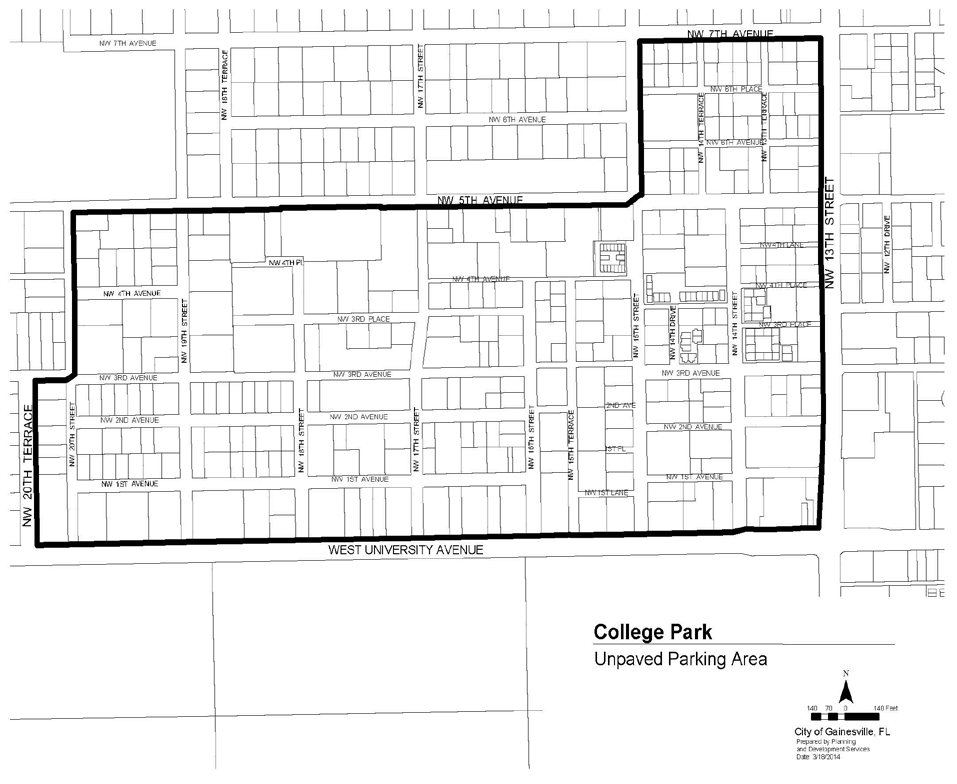
Figure V-19—University Heights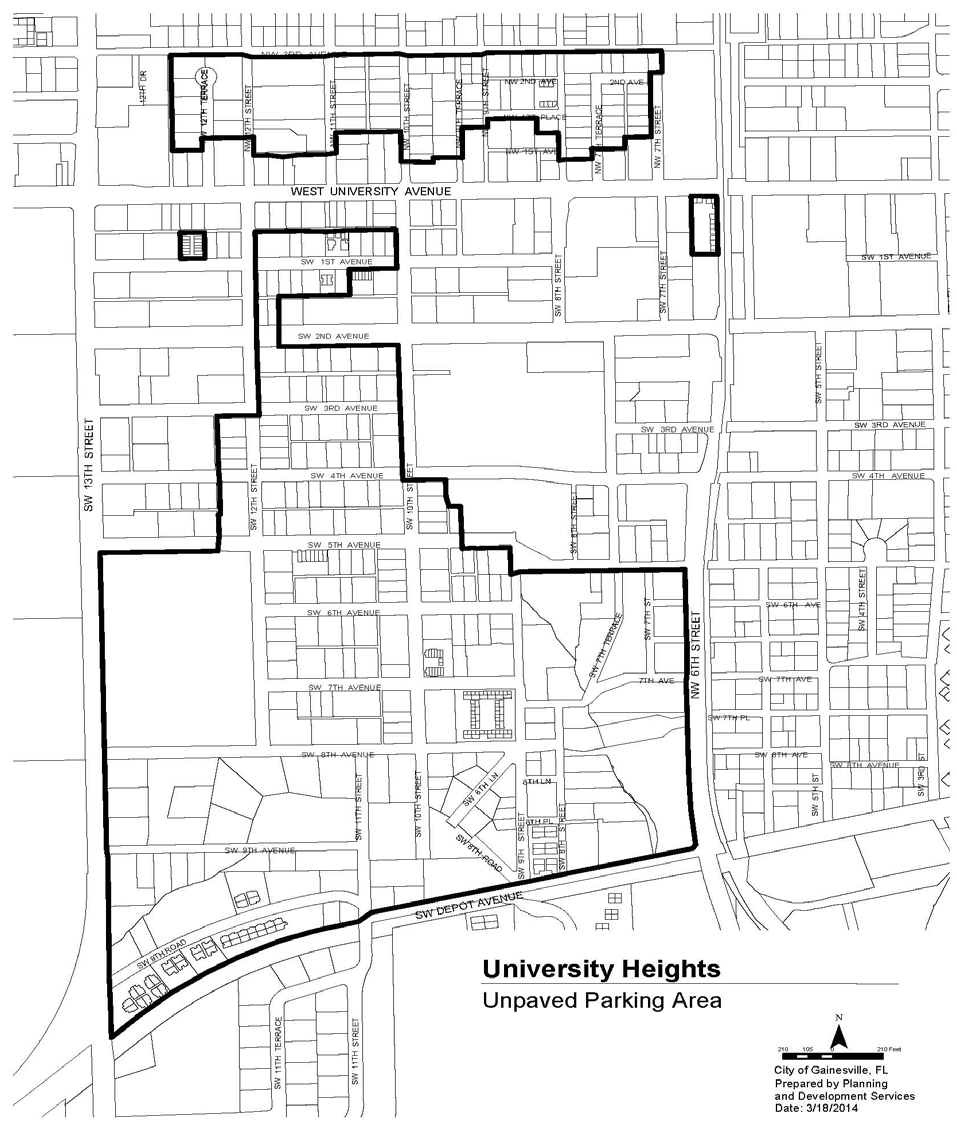
1.
Exemptions. The city manager or designee may exempt a property from this subsection upon a finding that each of the following conditions are met:
a.
The parking area is clearly defined;
b.
The parking area is maintained in a safe and neat condition;
c.
The parking area does not contribute to soil erosion or run-off of materials that would negatively impact the stormwater system; and
d.
The requirements of this subsection would impose an inordinate burden on the property owner due to significant design constraints.
2.
Parking plan. Off-street parking shall be limited to the parking area meeting the dimensional requirements below and leading from the permitted driveway connection to the parking area. Each owner of property regulated by this section shall submit to the code enforcement division, at no fee, a parking plan that clearly depicts:
a.
The location and extent of the proposed parking area;
b.
A general circulation plan showing how vehicles will safely access the parking area from a legal driveway connection; and
c.
The location and type of borders and parking area coverage materials to be used.
The city manager or designee shall approve a parking plan if it meets the requirements of this section and other applicable requirements of the Land Development Code. Within 90 calendar days of approval by the city manager or designee, the parking plan shall be implemented and the city manager or designee shall inspect the parking area for compliance.
3.
Borders. All unpaved parking areas shall be bordered with plants, pressure-treated landscape timbers, railroad ties, pressure-treated wood, composite "plastic wood," brick, concrete or similar materials that provide a clear delineation of the parking area and that inhibit runoff of the parking area coverage material.
a.
Plant borders at the time of planting shall be at least one-gallon in size, at least 12 inches in height, and spaced no greater than 36 inches apart. Any plant borders shall be maintained at a height of at least 12 inches.
b.
Wood, composite, or brick borders shall be at least three and one-half inches high by three and one-half inches wide and shall be securely affixed to the ground. Wood borders shall be pressure-treated or otherwise treated to inhibit decomposition.
4.
Parking area coverage material. All unpaved parking areas shall be covered and maintained with gravel, wood chips, mulch, leaves, or similar materials as further specified below:
a.
Coverage material shall be distributed evenly to cover the entire unpaved parking area with a depth of at least one inch and shall contain no bare spots and/or vegetation.
b.
Pervious and/or permeable pavement materials shall be allowable subject to the review and approval by the public works department.
c.
Grass clippings, canvas, plastic sheets, poly sheets, or other similar rolled sheeting shall not be used as a parking area coverage material.
5.
Parking area lease prohibition. No parking area regulated by this section may be leased, rented or otherwise provided for consideration, except as otherwise provided in this section. This prohibition shall not apply to leasing to tenants that occupy the same development where the parking spaces are located.
(Ord. No. 170974, § 13, 2-21-19; Ord. No. 2024-263, § 16, 10-3-24)

