
Gainesville City Zoning Code
ARTICLE VIII
PROTECTION OF RESOURCES
Sec. 30-8.1. - Purpose.
A.
Purpose. This article is established for the purpose of protecting the immediate and long-term public health, safety and general welfare by preserving, enhancing, conserving or restoring the natural environment and cultural resources. The intent with respect to the urban forest is to establish and maintain a sustainable tree canopy in which the healthiest and strongest existing trees are preserved during development, and new high quality shade trees are planted. Development and other activities within the city shall be in accordance with this purpose.
B.
Objectives. The provisions of this article are intended:
1.
To conserve energy through the cooling and shading effects of trees;
2.
To conserve water through the preservation of existing natural vegetation, the use of xeriscape techniques, and other water-conserving irrigation and landscape practices;
3.
To mitigate nuisances such as noise, glare, heat, air pollution and stormwater runoff;
4.
To preserve, enhance or restore the natural environment through the protection and establishment of native vegetation and existing natural systems for the enjoyment of present and future populations;
5.
To promote a linked open space system throughout the city and county;
6.
To preserve, enhance or restore the unique aesthetic character of the community;
7.
To mitigate, through buffering, potentially adverse impacts between land uses of differing type and intensity, and to ensure sufficient landscaping within areas designated for multiple-family uses and mixed uses;
8.
To assist in controlling vehicular and pedestrian movement to and within developed sites by:
a.
Clearly delineating the boundaries of vehicular use areas, in such a manner that movement, noise and glare do not adversely impact activity in adjoining areas;
b.
Establishing the points of ingress and egress so as to eliminate confusion and to control physical access to the site;
c.
Establishing the direction of internal vehicular and pedestrian circulation;
9.
To prevent personal injury, loss of life and excessive property damage due to flooding;
10.
To prevent the installation of structures which reduce the flood channel capacity and increase flood heights, the installation of which may cause excessive property damage;
11.
To reduce public expenditures for emergency operations, evacuations and restorations;
12.
To prevent damage to industries, transportation and utility systems;
13.
To restrict or prohibit uses which are dangerous to health, safety and property due to water or erosion hazards, or which result in damaging increases in erosion or in flood heights or velocities;
14.
To require that uses vulnerable to floods, including facilities which serve such uses, be protected against flood damage at the time of initial construction;
15.
To minimize the alteration of natural floodplains, creek channels and natural protective barriers which are involved in the accommodation of floodwaters;
16.
To minimize or prohibit filling, grading, dredging and other development which increases erosion, sedimentation or flood damage;
17.
To prevent or regulate the construction of flood barriers which will unnaturally divert floodwaters or which may increase flood hazards to other lands;
18.
To protect and enhance property values through regulation of the natural resources in the city;
19.
To ensure that potential home buyers are notified that property is in a flood area;
20.
To protect wetlands as areas for the natural storage of surface waters, and their function as a means to reduce pollution;
21.
To protect and restore the quality of groundwater and surface water through on-site treatment of stormwater runoff;
22.
To control the rate and quantity of stormwater discharging from any developed site;
23.
To protect groundwater levels;
24.
To prevent the breeding of mosquitoes;
25.
To protect the diverse plant and animal communities found in association with creeks, lakes, uplands, floodplains, nature parks and wetlands;
26.
To prevent soil erosion and sedimentation loadings to creeks, lakes and wetlands;
27.
To maintain the stability of creek and lake banks;
28.
To prevent adverse impacts to the water quality of creeks, lakes, wetlands, floodplains, groundwater and uplands;
29.
To protect municipal drinking water quality;
30.
To enhance the aesthetic and tree canopy qualities of significant entryway streets in order to convey the image of the city as "a city in a forest";
31.
To protect or restore significant entryway streets in order to promote transportation safety and to discourage blight;
32.
To protect the environmental, education and passive recreation functions of public parks and open spaces from nearby development, and, in some instances, to protect nearby development from such public properties;
33.
To protect public park wildlife, vegetation and park uses from potential adverse impacts by nearby land uses. Such impacts can include stormwater pollution, pesticides, noise disturbances, visual unsightliness and light pollution;
34.
To encourage development and preservation of a network of greenway transportation corridors throughout the city and county;
35.
To provide safe, convenient, scenic, historic and nonmotorized transportation linkages between land uses;
36.
To provide wildlife corridors, and other forms of environmental conservation and environmental education;
37.
To provide for recreation and access to recreation;
38.
To provide greenway buffering to protect environmental features and neighborhoods from nearby land uses;
39.
To preserve biological diversity and viable populations of special protection species dependent on upland, transitional and wetland ecological communities;
40.
To ensure adequate, safe, economic, reliable and environmentally sound water and wastewater utility services for the public;
41.
To promote economic development in a manner that will enhance the quality of life;
42.
To diminish the severity and frequency of southern pine beetle outbreaks in Gainesville by reducing the density of loblolly pines in urban areas;
43.
To preserve high quality heritage trees, especially where they occur within 20 feet of the public right-of-way; and
44.
To favor replanting with native species of high quality shade trees, including requiring such trees to be planted in locations that will reintroduce seed sources to adjacent natural communities.
Sec. 30-8.2. - General environmental performance standards.
A.
Applicability. All uses and activities permitted in any zoning district shall conform to the standards of performance described in this section.
B.
Showing of probable compliance. Uses and activities required to comply with this section shall make a showing of probable compliance with the performance standards described in this section. This showing shall be in the form of a letter submitted with a zoning compliance permit or development plan, as applicable, prepared by a professional engineer licensed by the State of Florida, certifying that the use or activity complies with all performance standards described in this section.
1.
Fire and explosion hazards. All activities and all storage of flammable and explosive materials or products at any place shall be provided with adequate safety devices against the hazards of fire and explosion, including adequate firefighting and fire suppression equipment, as prescribed by the fire prevention code adopted in chapter 10 of the Code of Ordinances.
2.
Radiation. All sources of ionizing radiation shall be registered or licensed by the Florida Department of Health. The handling of radioactive materials, the discharge of such materials into air or water, and the disposal of radioactive wastes shall be in conformance with applicable state and federal regulations.
3.
Electromagnetic radiation. Electromagnetic radiation generated by activities shall not adversely affect any operation or equipment other than those of the creation of the radiation. Interference with radio and television reception is prohibited. Equipment or activities generating electromagnetic radiation shall conform to the regulations of and, where appropriate, be licensed by the Federal Communications Commission.
4.
Waste disposal. All waste disposal including discharge of any liquid or solid waste into any public or private sewage system, the ground, or any lake, creek, or wetland shall be in accordance with state, federal, and local law and applicable regulations of state, federal and local agencies.
5.
Vibration. No use shall at any time create earth-born vibration which when measured at the boundary property line of the source operation exceeds the maximum allowable peak particle velocity set forth below. Ground vibration shall be measured as particle velocity using accelerometers. Particle velocity shall be recorded in three mutually perpendicular directions. The maximum allowable peak particle velocity shall apply to each of the three measurements.
6.
Sound. All uses and activities shall not exceed the sound pressure levels set forth in chapter 15 of the Code of Ordinances.
7.
Heat, cold, dampness or movement of air. Activities on any property which produce any adverse effect on the temperature, motion or humidity of the atmosphere beyond the lot lines are not permitted.
8.
Odor. No use shall be operated in any zoning district in such a manner that the emission of odorous matter occurs in such quantity or volume as to produce a nuisance, source of discomfort, or hazard beyond the bounding property lines of such a use. For the purpose of this performance standard, the presence of such a described odor shall be determined by observation by a person or persons designated by the city manager or designee. In any case, where the operator of an odor-emitting use may disagree with the enforcing officer where specific measurement of odor concentration is required, the method and procedures specified by the American Society for Testing and Materials (ASTM) E679 and E1432, entitled "Standard Practice for Determination of Odor and Taste Thresholds By a Forced-Choice Ascending Concentration Series Method of Limits" and "Standard Practice for Defining and Calculating Individual and Group Sensory Thresholds for Forced-Choice Data Sets of Intermediate Size," respectively. The operator and the city shall equally share the cost of conducting the more elaborate ASTM E679 Procedure.
9.
Air quality. All development shall maintain air quality levels that comply with state and national ambient air quality standards.
10.
Air pollution emissions. No industrial operation or use shall cause, create, or allow the emission of air contaminants which at the emission point or within the bounds of the property are in violation of the standards specified by the Florida Department of Environmental Protection, or successor agency, or any governmental entity with regulatory jurisdiction, whichever standards are more stringent.
11.
Other air pollution. Open storage and open processing operations, including on-site transportation movements, which are the source of windblown or airborne dust or other particulate matter; or which involve dust or other particulate air contaminant generating equipment including but not limited to paint spraying, grain or seed handling, sand or gravel processing or storage or sand blasting shall be conducted such that dust and other particulate matter so generated are not transported across the boundary property line or the tract on which the use is located in concentrations exceeding standards set by the Florida Department of Environmental Protection, or successor agency, or any governmental entity with regulatory jurisdiction, whichever standards are more stringent.
12.
Toxics. No industrial operation or use shall emit toxic or noxious matter at a concentration exceeding ambient air quality standards for the State of Florida across the property line of the parcel on which the operation or use is located. Where toxic materials are not listed in the ambient air quality standards of the state, concentrations shall not exceed one percent of the threshold limit values (TLVs) adopted by the American Conference of Governmental Industrial Hygienists (ACGIH). If a toxic substance is not listed by the ACGIH, verification of safe levels of the proposed toxic material for public health, plant and animal life will be required.
C.
Utility service. All utility services, including but not limited to those of franchised utilities, electric power and light, telephone, cable services, water, sewer and gas, shall be installed beneath the surface of the ground, unless the city manager or designee determines that the soil, topography and other compelling condition makes it unreasonable or impractical. The subsurface mounting of incidental appurtenances, including but not limited to transformer boxes or pedestal-mounted boxes for the provision of utilities, electric meters, back flow preventers and fire hydrants, is not required.
Sec. 30-8.3. - Elements of compliance.
All property within the city shall be subject to the following regulations, except as exempted by subsection B. below. No parcel within the city may be cleared, grubbed, filled or excavated, nor shall any building be demolished, altered or reconstructed in a manner that negatively impacts regulated trees, changes the site plan, site use or increases the impervious surface area except in compliance with this article. Requirements of these sections do not exempt property owners from compliance with any other section of this chapter.
A.
Minimum requirements for landscaped areas. All areas designed to meet the requirements of these sections shall comply with the following:
1.
Street trees shall be provided a minimum rootzone volume of 700 cubic feet, except street trees that share a rootzone volume shall require a minimum of 550 cubic feet. All other required shade trees shall be provided a minimum of 420 cubic feet of rootzone volume. Where existing conditions preclude the provision of the minimum rootzone volume, the reviewing board or city manager or designee may approve a lesser volume that meets the arboriculture needs of the tree within the existing conditions. Underground utility lines shall not be located within the rootzone volume, except for those lines that are four-inch diameter or less, and then only where the utility separation requirements in subsection 2. below are met. Prior to planting, any limerock or construction debris found in this area shall be removed, and rootzone media soil shall be provided to a depth of at least three feet. Shade trees shall be located a minimum of ten feet from a building face or from major architectural features of the building (including but not limited to balconies, awnings, bay windows or porches).
2.
A minimum separation requirement of seven and one-half feet is required between new trees and existing or proposed water, wastewater force main, reclaimed water, gas, electric and telecommunications main and service utility lines, to protect against root incursion. A minimum separation requirement of ten feet is required between new trees and existing or proposed wastewater gravity collection mains and laterals. Where feasible, separations should be marginally increased in order to account for inaccuracies in surveying, engineering or construction. Reduced separation distances to three and one-half feet may be allowed at the discretion of the utility company. In these instances the utility company may require one of the following measures to protect the utility lines, in accordance with the standards established by the utility company:
a.
Compaction of the soil immediately adjacent to the underground lines to 98 percent proctor density from the utility line to within 12 inches of ground surface;
b.
Encasing the utility line with excavatable flowable fill, steel casing, or other acceptable methods;
c.
Wrapping the utility line with an herbicide-impregnated geo-textile bio-barrier cloth;
d.
Protecting the utility line with structural barriers of cast-in-place or pre-cast concrete panels, steel or high-density plastic sheet-pile barriers; or
e.
Steel casing, installed in accordance with standards established by the utility company.
Where an existing tree is to be preserved, trenchless installation shall be required for the installation of underground utilities, using directional boring or jacking-and-boring of a casing pipe throughout the tree root plate.
3.
An irrigation system, or a readily available water supply within a distance of 100 feet, shall be supplied for all landscaped areas. An automatic irrigation system shall be provided for development if the total area of impervious surfaces devoted to vehicular use areas exceeds 10,000 square feet. Such irrigation shall promote water conservation by such methods as drip irrigation and/or efficient sprinkler zoning, as well as reducing the amount of irrigation as plants become established. Each required tree shall be served by a drip ring or bubblers or other appropriate means necessary to ensure that the entire rootball is irrigated. The irrigation system shall be designed and located to minimize the watering of impervious surfaces. Successful establishment of trees should occur within one year. After that time, use of the automatic irrigation system may be discontinued. If the required trees die within three years of planting, they shall be replaced in accordance with this article, and replanted trees will require irrigation throughout the next establishment phase.
4.
Landscape areas that are not planted shall be grassed or mulched with organic materials. Grassed areas shall be planted with sod that has been certified free of noxious weeds by the Florida Department of Agriculture and Consumer Services, Division of Plant Industry.
5.
When a landscaped area is adjacent to or within a vehicular use area, curbing shall be used to protect landscaped areas from encroachment. Parking spaces shall be designed to provide pervious surface for the vehicle overhang area. Shrubs and trees shall be placed away from the wheel stop, so that they will not be encroached upon by vehicles. In lieu of curbing, the alternative means of preventing encroachment shall be shown on the site plan.
6.
All required trees shall be selected from the Gainesville tree list. Tree species not appearing on the Gainesville tree list may be planted only with prior approval of the city manager or designee or appropriate reviewing board. Developments which require 16 or more shade trees shall have at least four different high quality shade tree genera. Street tree diversity is to be attained city-wide in order to reduce the effect of loss of street tree species due to insect or disease outbreaks, even though street tree diversity may not be attained on an individual street. The applicant or landscape contractor shall schedule an on-site meeting with the city manager or designee prior to the installation of any trees or shrubs to ensure compatibility with infrastructure and compliance with landscape code requirements.
7.
Any landscaped area adjacent to an intersection or driveway shall conform to the requirements for the vision triangle contained in the City of Gainesville Engineering Design and Construction Manual.
8.
Trees located near the street shall be planted in locations that meet the clear zone requirements of the city public works department or the maintaining agency.
B.
Exemptions to landscaping requirements.
1.
Lots designed or designated for single-family residential dwellings and the developed portion of any lot over two acres in actual single-family residential use are exempt from the requirements of this section, except as provided in section 30-8.7.
2.
Development within the approach and Airport Runway Protection Zone areas as specified on the adopted Gainesville Regional Airport master plan, on file with the director of aviation, Gainesville Regional Airport, is exempt from the provision of required shade trees in areas where federal regulations prohibit shade trees or where shade tree growth can be expected to penetrate airport zone surfaces regulated under Federal Aviation Regulations 14 CFR, Part 77. If permitted, understory trees must be substituted. Trees may be removed from such areas upon filing a tree removal permit accompanied by submission of written authorization from the Gainesville/Alachua County Regional Airport Authority or FDOT to the City Manager's designee. Reforestation is not required in areas where federal regulations prohibit trees or where shade tree growth can be expected to penetrate airport zone surfaces regulated under Federal Aviation Regulations 14 CFR, Part 77. Mitigation will not be required except for high-quality heritage trees, which must be mitigated in accordance with section 30-8.7.
3.
Where required shade trees are expected to conflict with planned solar energy generation, developments may compensate for the required trees by relocating them to a designated area or preserving an equal number of existing high-quality shade trees elsewhere on the site. At least 140 square feet must be provided for each new shade tree to be planted, and existing trees must be preserved in accordance with section 30-8.8. These trees must be located so that they can grow to maturity without obstructing the generation of solar energy, and the area where they are planted or preserved must be delineated and noted as a "designated tree area" on the development plans.
C.
Expansions, 50,000 square feet or more. Expansions of existing developments that contain 50,000 square feet or more shall comply with the following regulations:
5.
For purposes of this subsection, repeated expansions of property, including the construction or erection of separate buildings or accessory structures, which meet the threshold in the table shall comply with the provisions of this article as provided above.
6.
The determination of the exact location of the remainder area which shall be brought into landscape compliance shall be made by the appropriate reviewing board. In determining the exact location of such remainder area, the following factors shall be considered:
a.
Buffering incompatible land uses;
b.
Improvement to areas of visual or environmental impact;
c.
The economic and technical feasibility of landscaping particular areas; and
d.
The visibility of landscaping areas from public roads or sidewalks.
D.
Expansions, less than 50,000 square feet. Expansions of existing developments that contain less than 50,000 square feet shall comply with the following regulations:
1.
Expansions of vehicular use area shall meet the requirements of section 30-8.4 for the expanded area and shall also meet requirements for street and use buffers adjacent to the expanded area.
2.
Whenever expansion of a developed area, independently or cumulatively, totals 4,000 square feet or more than 35 percent of the gross square footage of the developed area, whichever is less, the entire site shall be brought into compliance with this article. For the purposes of this subsection, repeated expansions or alterations of the property, including the construction or erection of separate buildings or accessory structures, constructed within a period of 36 months, which meet the above threshold, shall comply with the provisions of this article.
3.
Any new use of property which alters the use of existing structures from a residential use to a nonresidential use shall be required to meet all applicable landscaping requirements. The city manager or designee shall determine the applicable requirements based on the character and orientation of the proposed mixed use development.
4.
The use of property, including outdoor activities and parking, which expands the lot area of any use, when such property adjoins property in actual use as a single-family residence or shown in any single-family zoning district, shall be required to conform with all buffer requirements.
5.
Expansions of outdoor storage shall require screening in accordance with the requirements in section 30-5.19.
E.
Minimum submittal criteria. All landscape plans shall be drawn to scale and have a north arrow, and accurately depict all buildings, pavement, on-site facilities, utilities and lighting systems. The landscape drawing or accompanying development plan shall give the permitted use of adjacent parcels and the total square footage of all pavement on-site. Stormwater basins shall be designated as either wet or dry. A plant schedule shall be provided showing the botanical name, size, spacing and number of all required plant materials. Architectural symbols depicting trees to be installed shall not exceed the scale equivalent of five feet in diameter with a solid line; a hatched line around the solid line shall show the expected canopy dimension after 20 years as identified in the Gainesville tree list. Any native tree or shrub may be substituted for the identified plant with city staff approval, provided that the tree or shrub is adaptable to the amount of sun/shade, wet/dry and size conditions where it will be planted, and insofar as the provisions for diversity, shading and/or screening described in the article are met. Changing tree species shall not diminish the total number of high quality shade trees in their required locations. Plant material shown in addition to the required elements of the landscape plan may be labeled as optional and shall not be subject to inspection.
F.
Design principles and standards. All landscaped areas required by this article shall conform to the following general guidelines:
1.
The preservation of structurally sound native trees of high quality shade tree species and shrubs is strongly encouraged to maintain healthy, varied and energy-efficient vegetation throughout the city, and to maintain habitat for native wildlife species. Developments should be designed to preserve existing high quality heritage trees, especially those located within 20 feet of the public right-of-way.
2.
The landscaping plan should integrate the elements of the proposed development with existing topography, hydrology and soils in order to prevent adverse impacts such as sedimentation of surface waters, erosion and dust.
3.
The functional elements of the development plan, particularly the drainage systems and internal circulation systems for vehicles and pedestrians, should be integrated into the landscape plan. The landscaped areas should be integrated, especially to promote the continuity of on-site and off-site open space and greenway systems, and to enhance environmental features, particularly those features regulated by the environmental overlay districts (article VIII).
4.
The selection and placement of landscaping materials should maximize the conservation of energy through shading of buildings, streets, pedestrian ways, bikeways and parking areas. Where possible, shade trees should be planted along internal sidewalks that connect buildings to the street sidewalk and to other buildings on the site.
5.
Landscaping design should consider the aesthetic and functional aspects of vegetation, both when initially installed and when the vegetation has reached maturity. Newly installed plants should be placed at intervals appropriate to their expected function as short-term or long-term elements. The natural and visual environment should be enhanced through the use of materials which achieve a variety with respect to seasonal changes, species of living material selected, textures, colors and size at maturity.
6.
The placement of trees around buildings should permit access to the building by emergency vehicles.
7.
The installation of the following invasive nonnative species is prohibited, as is installation of any species labeled as "Prohibited" in the most recently published version of the Institute of Food and Agricultural Science (IFAS) Invasive Species Assessment:
INVASIVE, NONNATIVE PLANT SPECIES
8.
For all new development, or redevelopment of existing property, the applicant shall remove invasive nonnative plant species listed on the Florida Prohibited Aquatic Plants List or the Florida Noxious Weed List from the property in accordance with the management plan prior to issuance of the certificate of occupancy. On property with invasive nonnative plant species, a plan shall be submitted with the development application that includes a timeline, success criteria, treatment recommendations, and identifies methods that will have minimal impact on non-target species. All herbicide applications to control invasive, nonnative plants in wetland or upland set-aside areas (including buffers) shall be applied by a contractor licensed by the Florida Department of Agriculture and Consumer Services, Division of Agricultural Environmental Services, with a current certification in Natural Areas Weed Management. The city manager or designee should inspect such sites for a minimum of three years after completion to verify effectiveness of control efforts. The plan shall state the entity responsible for additional treatments during the three-year follow-up if the populations of invasive nonnative plants rebound and cover more than ten percent of any previously infested area within the wetland or upland set-aside areas.
9.
Loblolly and slash pines should be at least 25 feet apart post-development to reduce southern pine beetle infestation outbreaks.
(Ord. No. 170974, § 14, 2-21-19)
Sec. 30-8.4. - Vehicular use areas.
A.
Perimeter requirements.
1.
Perimeter landscaped area required. All vehicular use areas shall be separated by a perimeter landscaped area, a minimum of nine feet in width, from any public or private street and from any adjacent properties.
2.
Exemptions. This landscape area is not required:
a.
When the paved ground surface area is completely screened from adjacent properties or streets by intervening buildings or structures; or
b.
When an agreement to operate abutting properties as essentially one contiguous parking facility is in force, and both sites are in compliance with vehicular use area landscaping requirements. The agreement shall be executed by the owners of the abutting properties, and shall bind their successors, heirs and assigns. Prior to the issuance of any building permit for any site having such a contiguous parking facility, the agreement shall be recorded in the public records of the county;
3.
Automotive sales uses. For automotive sales uses, the perimeter landscape area shall only be required for 300 feet along each street frontage in the area devoted to automobile display, with the remainder of the required plant materials being proposed for planting elsewhere on the site, such as around stormwater areas or the building foundation. Perimeter landscape areas shall be required for all storage, accessory service and customer parking areas at any auto sales facility.
4.
Modifications. The appropriate reviewing authority may determine that:
a.
Screening is better achieved by relocation of the landscape strip;
b.
There is an unresolvable conflict between other elements of the development plan and the location, width or height of the perimeter landscape area, and that the public interest is therefore best served by relocation of the landscape area, lowering the height of required material or the substitution of a solid fence or wall in conjunction with a reduction in width provided that the number of shade trees that would have otherwise been required are planted elsewhere on the development site; or
c.
On redevelopment sites where the conflict between existing utility line separation distances and the shade trees required within the perimeter landscaped area cannot be resolved through the practices listed in section 30-8.3.A.2., then the area shall be planted with shrubs and understory trees acceptable to the utility company. On projects where new utility lines are planned, sufficient space shall be allocated to meet both the utility separation requirements and the minimum tree-planting requirement.
5.
Required plant material. The perimeter landscape area shall contain:
a.
Shrubs, arranged to provide a visual screen of 75 percent opacity and achieve a height of at least three feet within three years; and
b.
High quality shade trees at a minimum average of three trees for every 100 feet of the linear distance of the perimeter landscape area, excluding the width of driveways that cross the landscape area. The distance between such trees shall not exceed 55 feet nor shall they be planted closer than 25 feet apart.
c.
The development review board or city plan board during development plan review, or staff during administrative review, may determine that natural vegetation is sufficient to screen adjacent properties and rights-of-way. In such instance the existing vegetation, including understory plants and bushes, is protected from pruning and removal except that diseased plant material and invasive nonnative species shall be replaced in accordance with this section. Where the property is adjacent to a railroad right-of-way or utility easement, these areas shall not be substituted for the perimeter landscape area or the required landscaping. Where encroachments are made for utility connections, replacement plants appropriate to the ecosystem shall be required.
B.
Interior landscaped areas. The interior of any vehicular use area shall also be landscaped in compliance with the following:
1.
Landscape islands, equal to the size of one parking space, shall be located at an average of every ten parking spaces. At no time shall a row of parking have landscape islands greater than 126 feet apart or closer than 36 feet apart. Additionally, terminal landscape islands containing a tree shall enclose each row of parking spaces.
2.
Each required landscape island shall contain at least one high quality shade tree listed on the Gainesville tree list as a species appropriate for "lot" planting. Such tree(s) shall be located within the landscaped area to maximize the shading of the pavement.
3.
All parking lots with two or more rows of interior parking shall contain eight-foot-wide landscape strips between the rows allowing for two-foot vehicle overhangs on each side. Shade trees shall be planted every 50 feet on average within these landscaped areas, but outside of the two-foot vehicle overhangs. As an alternative, every other row of head-to-head parking may provide a 16-foot-wide curbed landscape strip with shade trees every 35 feet on average. As needed, these wider landscape strips may contain sidewalks.
4.
The development review board or city plan board through development plan review, or staff when only staff review is required, may allow the relocation of interior landscaped areas to preserve existing trees, or where it is determined, upon review and recommendation of the city manager or designee, that the relocation is necessary for the safe maneuvering of vehicles or pedestrians.
5.
In those vehicular use areas including but not limited to auto dealerships, storage of service or delivery vehicles, or attendant parking where interior landscaping would interfere with the customary storage or display of vehicles, the development review board or city plan board through development plan review, or staff when only staff review is required, may allow some or all of the required interior landscaping to be located near the perimeters of the paved area, including such perimeters which may be adjacent to a building on the site. Such landscaped area would be in addition to required perimeter landscaping in the amount of one square foot of landscaped area for each 60 square feet of paved area. For each 140 square feet of relocated landscaped area, a high quality shade tree shall be provided.
Sec. 30-8.5. - Compatibility buffers.
This section is intended to provide the minimum requirements for separation of land uses of differing type and intensity. The need for a buffer strip between land uses shall not impede the development of appropriate pedestrian and bicycle accessways between these uses. Where such accessways are installed, they shall be landscaped in a manner to clearly delineate such trails and bikeways and also to provide shade trees as appropriate. Where certain uses or combinations of uses are difficult to categorize, as in planned developments or public service facilities, it is the intent of this section that buffering shall be provided which mitigates the impacts of such uses.
A.
Required buffer strip areas. Buffer strips between properties are intended to provide visual screening and sound attenuation of more intense land uses from abutting less intense land uses. The required buffer type, shown in Chart A below, depends on the land use designation of the subject property which is being developed and the land use designations of the abutting properties. The required width of the each buffer type and the required amount of shade trees, understory trees, and shrubs are shown in Chart B below:
CHART A. LAND USE BUFFER TYPES
CHART B. REQUIRED WIDTH AND PLANTINGS FOR BUFFER TYPES
B.
Buffer widths. The appropriate reviewing board, or the city manager or designee, may require the expansion of the minimum width of the buffer strip to ensure that trees will meet separation requirements from utility lines, buildings, or paved areas, or to allow for the inclusion of an existing high-quality shade tree in the buffer strip.
C.
Driveways and sidewalks. The widths of driveways and pedestrian or bicycle facilities that cross through a required buffer shall be subtracted from the linear feet of buffer length for the purposes of calculating the number of required plantings in Chart B above.
D.
Existing trees and natural vegetation in buffers. Any regulated, high quality shade trees existing within the minimum required buffer width shall be protected in accordance with section 30-8.8. Credit for preserving existing trees shall be applied in accordance with this article. High quality heritage trees within buffer areas should be preserved with the area underneath the canopy dripline protected. Sidewalks and bicycle access infrastructure may be permitted within the protection zones of a high quality heritage tree but not within the root plate. Natural vegetation, if it achieves a continuous 75 percent opacity for 10 months of the year, may be substituted for the required shrubs. If a buffer that preserved existing vegetation is subsequently cleared by the property owner or when permits for tree removal are granted post-development, then the required shrubs and trees in accordance with this section shall be required.
E.
Invasive nonnative vegetation in buffers. All buffers shall be maintained to remove invasive nonnative plant species and curtail natural regeneration of seedling loblolly and slash pines. The density of loblolly and slash pines in a natural buffer should be managed so the remaining pines grow no closer than 25 feet and seedling regeneration is curtailed.
F.
Sound attenuation. The reviewing board, or city manager or designee, may address the need for sound attenuation of certain equipment, such as refrigeration units, motors, fans, power tools, etc., or uses such as loading, vehicle repair, outdoor recreation, etc., by requiring a study, prepared by a licensed engineer or architect, to address the potential for a noise disturbance to be transmitted to adjacent properties by the proposed use, and may require the installation of a wall, fence or berm in addition to required landscape material. The wall, fence or berm may be located within the required buffer or directly around the equipment or use which requires sound attenuation.
G.
Street trees. Street trees shall be planted along the sides of all streets within a development and on the development side of any contiguous street. Street trees shall be planted for every 30 to 50 feet of street frontage, depending on the canopy area needed for the tree species. The widths of driveways along a street shall be subtracted from the linear feet of street frontage length for the purposes of calculating the number of required street trees. In no case shall trees be spaced closer together than 25 feet or farther apart than 60 feet. Alleys are exempt from this requirement for street trees.
1.
Street trees shall be high quality shade trees and shall be planted in tree lawns with a minimum width of eight feet, or within tree wells with minimum four-foot by four-foot surface openings.
a.
On-street parking spaces may be located between street trees, as long as the required number of trees is planted along the street frontage and the minimum rootzone volume is provided for each tree.
b.
Tree wells may be enclosed with pavers or other hardscape materials above the required rootzone volume. The city manager or designee may determine if installation of an aeration system is necessary to conduit water and oxygen to the roots of trees within tree wells.
2.
Where possible, street trees shall be planted between the street and the public sidewalk. Street trees may be planted between the sidewalk and adjacent buildings only where the location of existing or proposed utility lines along the street, or the clear zone requirements of the public works department or other maintaining agency, prevent the location of trees between the street and sidewalk. Where street trees are approved to be planted between the sidewalk and adjacent buildings, the trees may be located as close as five feet away from building face.
3.
The reviewing board, or the city manager or designee, may require the adjustment of the prescribed build-to line in order to accommodate the required street trees and ensure that the trees will meet separation requirements from utility lines, buildings, and paved areas.
4.
Where possible, developments shall be designed to preserve as street trees any existing champion or high quality heritage trees which are located in the right-of-way or on private property within 20 feet of the right-of-way. Where these trees are preserved, no new construction or grading shall occur within the tree root plate, and new buildings shall be designed so that no more than 25 percent of the crown of the trees is removed. The area underneath the canopy of the preserved trees shall be exempt from tree planting requirements, and the required distances between street trees may be modified.
5.
A minimum ten-foot separation shall be provided between street trees and street stormwater inlets, except where bioretention inlets that incorporate trees are utilized.
6.
Where the required street trees would overlap with trees that are required to satisfy perimeter landscaping requirements for vehicular use areas, only the requirements for the vehicular use area shall be met.
H.
Parking structures along a street. Except at points of ingress and egress, and except as required in article IV for transect zones, parking structures shall provide a ten-foot-wide landscaping strip between the public sidewalk and the structure, which is designed to screen automobiles from pedestrians on the street. This strip shall be planted with evergreen shade trees at an average of four trees for every 100 feet of the linear distance of the street frontage of the structure, excluding the width of driveways. The required trees shall be supplemented with a continuous line of shrubs. This landscaping strip is required when the ground floor use is parking, but is not required where parking structures are shielded from the street by liner buildings or provide office or commercial uses along the first floor street frontage.
Sec. 30-8.6. - Stormwater management areas.
A.
All stormwater basins shall be designed and landscaped to meet the following criteria:
1.
Shade trees shall be planted at an average of one tree for every 35 linear feet of the basin perimeter. Spacing of trees may be closer when trees are planted in groups for aesthetic effect, but the minimum distance between the trees shall be ten linear feet. Trees shall be selected from the Gainesville tree list that are appropriate for use within stormwater areas, and all landscaping shall be selected according to the function as a wet or dry basin. Trees shall be located at least 20 feet away from inflow and outflow structures. Bioretention swales and exfiltration facilities are exempt from these tree planting requirements.
2.
Twenty-five percent or more of the basin perimeter or littoral zone shall be landscaped with shrubs, groundcover, native perennials, or aquatic plants.
B.
Individual stormwater basins that are greater than 5,000 square feet in total area shall be designed with curvilinear sides that mimic a natural wetland, lake, or stream. The landscaping for these basins shall be integrated with the other required site landscaping.
C.
Individual stormwater basins that are greater than 40,000 square feet in total area shall also be designed to meet at least one of the following criteria:
1.
Provide a recreational or functional pathway for pedestrians or bicyclists and an aesthetic focal point such as a water feature or pedestrian structure; or
2.
Be designed to preserve and incorporate a significant tree or tree grouping; or
3.
Be designed to maintain an existing wetland function or to preserve or establish habitat for native animal species.
Sec. 30-8.7. - Permits for tree removal; mitigation.
A.
Removal or relocation permits. Except as provided below, no living regulated tree may be removed or relocated without a removal permit and mitigation as provided for in this section. Only the tree advisory board may approve or deny the removal, relocation or replacement of champion trees.
B.
Exemptions.
1.
On property with single-family dwellings, permits shall be required only for the removal of champion or heritage trees.
2.
Developments in which 100 percent of housing is affordable to low-income households may mitigate for removal of high-quality heritage trees through inch-for-inch replacement rather than payment of the tree appraised value. For purposes of this section, "low-income households" means those that make less than 80 percent of the Gainesville area median income adjusted for family size, and "affordable housing" means housing where the total monthly cost of that housing including taxes, insurance, and utilities is less than 30 percent of the household's total monthly income.
3.
Removal of loblolly or slash pines less than 20 inches in diameter from a natural or naturalized landscape shall not require mitigation planting, unless the removals result in a uniform tree density on the site of less than one tree per 900 square feet of unpaved area. Where resulting tree density would be less, sufficient mitigation trees meeting the standard of section 30-8.10 shall be established to achieve the specified minimum density.
4.
Removal of regulated trees in connection with ecosystem management or restoration on parcels with conservation easements, in conservation management areas or on parcels managed as nature parks or preserves, provided the following criteria are met:
a.
A plan for the removal and revegetation of the area has been approved by the city manager or designee;
b.
The only trees that may be removed are of the following species: Loblolly Pine, Slash Pine, Water Oak, Laurel Oak, Sweetgum, Sugarberry, and any species not native to Alachua County;
c.
The tree removal is being done in furtherance of restoration of a natural community or communities appropriate to the site as indicated by soils, remnant vegetation, and hydrological and geological conditions;
d.
The applicant has demonstrated that after the removals, the land will be maintained in a manner that promotes the continuation of the restored natural community; and
e.
The plan has been approved by the nature centers commission.
5.
For the immediate protection of the health, safety, or welfare of the public, trees may be removed without obtaining a permit in advance. However, the property owner or its authorized agent shall file a permit application during the next city work day. Permit approval shall be granted, provided the trees removed are mitigated in accordance with this code.
C.
Methods of mitigation. Mitigation is allowed by two methods: 1) mitigation trees (on an inch-for-inch basis or as otherwise specified); and 2) mitigation payment. The amount of mitigation is as specified in subsections D. and E. below.
1.
Mitigation trees. Mitigation trees shall be of high quality shade species as identified on the Gainesville tree list and sited in accordance with the requirements of section 30-8.3.A. The installation of new trees for a development as required by this chapter may count as mitigation for trees removed from the site, except where those removed trees are of a high-quality species. Increasing the diameter of trees required to be planted with a development shall not be used to meet mitigation requirements. The preference is for mitigation trees to be planted on the site, but where it is demonstrated that no space is available, mitigation trees may be planted offsite within city limits as approved by the city manager or designee.
2.
Mitigation payment. Mitigation payment shall be based on tree appraised value, or as otherwise specified in this code. Payment shall be made prior to the approval of a final development order, or prior to issuance of a certificate of occupancy for any development requiring only building permits. Mitigation payments received by the city shall be deposited in the city tree mitigation fund, which must be used in accordance with this subsection.
a.
Offsets for tree mitigation payment. A tree mitigation payment may be offset by installing improvements that create an improved growing environment for existing or proposed trees located within the project's street tree landscape zone within the public right-of-way, including:
i.
Use of a pre-manufactured, modular structural product to suspend and support paving over the root zone volume area of the tree in order to prevent soil compaction.
ii.
Provision of root zone volume greater than the required minimum as specified in section 30-8.3.A, provided that the root zone volume does not exceed six feet in depth. Credit will be granted per cubic foot over the required minimum up to 2,000 cubic feet total root zone volume. Trees must be provided with a minimum of 1,000 cubic feet of root zone volume to be eligible.
Proposed improvements and installation methods must be consistent with industry standards, and must be approved by the city arborist or urban forestry inspector prior to installation and inspected and approved prior to any credit towards the project's tree mitigation payment. The requested offset may not exceed the project's total tree mitigation payment, and proposed improvements must be used on the project requiring tree mitigation. Improvements must be installed by a qualified installer of the product as identified by the manufacturer's specifications.
b.
Use of tree mitigation funds. The intent of the tree mitigation fund is to benefit the public and properties that contribute to the tree mitigation fund by expanding improving, preserving, and managing a healthy and sustainable urban forest. Tree mitigation funds may not be used to plant or establish new trees required by this chapter for development or redevelopment and may not be used for routine landscape maintenance on public rights-of-way. Tree mitigation funds may be used for any of the following uses:
i.
New tree and native landscape planting and establishment on city-owned property, including purchase of trees, irrigation supplies, mulch, equipment staking materials, fertilizer, and innovative or engineered tree planting materials or techniques.
ii.
Structural pruning of trees on city-owned property in accordance with industry standards.
iii.
Preservation of tree canopy, with an emphasis on preserving high quality trees, through the city's purchase of conservation lands and associated acquisition costs including survey, fencing, appraisal, and invasive vegetation control.
iv.
Site preparation, planting, land management, invasive vegetation control, or natural regeneration of the city's urban forests.
v.
Ecological inventory or assessment of the urban forest every five years and updating the urban forest management plan every ten years.
vi.
Arboriculture, landscape architecture, engineering, and other professional services directly related to the development of the city's urban forest.
vii.
Purchase and supply of trees for planting in the city, including on private property, with a priority on replacement of invasive vegetation and establishment of high quality trees.
viii.
Reasonable miscellaneous costs necessary for or directly related to the uses allowed herein or expanding, improving, preserving, and managing a healthy and sustainable urban forest.
D.
Removal and mitigation of regulated trees subject to subdivision or development plan approval. When tree removal or relocation is contemplated in conjunction with any development requiring approval of a development plan or subdivision plat, such removal or relocation shall be considered and either approved or denied at the same time a development plan or plat is approved or denied, based upon the criteria specified in subsection F. of this section. No separate tree removal permit is required. All of the required plans, data or other information required with the application shall be included on the proposed development plan or on the supporting documents submitted with the plan or the plat. The following requirements apply:
1.
Decisions on tree removal shall be based on a tree survey or a qualitative tree survey. The landscaping plan shall show all trees to be preserved, provide for protective tree barriers that meet the requirements of section 30-8.8, and specify the details of the mitigation required in this section.
2.
Construction drawings shall be submitted to the building department and application for building permits made before any trees are removed.
3.
Subdivisions must be designed to maximize preservation of high-quality heritage trees. The owner/developer shall avoid or minimize removal of high-quality heritage trees by implementing practicable design alternatives including, but not limited to:
a.
Limiting the scope, degree, or magnitude of the proposed project;
b.
Exploring alternative on-site locations to avoid or reduce impacts to heritage trees;
c.
Designing open-space common areas to incorporate high-quality heritage trees;
d.
Configuring lots to include high-quality heritage trees along the sides of the lot, rather than in the center where removal is necessary for construction; and
e.
Preserving trees along roadways as street trees.
4.
After a certificate of occupancy has been issued for a development, any additional tree removal shall require either a tree removal permit or a development plan amendment. Failure to obtain a tree removal permit before removing or relocating any existing regulated tree or any tree that was planted to comply with the approved development plan shall be subject to the measures for enforcement specified in section 30-8.43.
5.
The requirements for mitigation of regulated trees approved for removal as part of development plan or subdivision plat review are as follows:
E.
Removal and mitigation of regulated trees not part of subdivision or development plan approval. Any person desiring to remove or relocate a regulated tree, except tree removal approved as part of subdivision or development plan approval, shall file a tree removal permit with the city manager or designee. As a condition to granting a permit, the applicant shall mitigate each tree being removed. The following requirements apply:
1.
Permit applications shall include the name of the property owner, address from which tree will be removed, tree species and diameter, and reason for removal of the tree. The permit application shall be signed by the property owner and, if applicable, its authorized agent. Applications for tree removal shall also include a scaled drawing of the site showing tree size and location, and a statement of how any other regulated trees are to be protected during any approved tree removal and any associated construction or clearing, or grade changes. The city manager or designee shall attempt to verify the information contained in the application and shall either approve or deny the application as to each regulated tree proposed to be removed.
2.
Where construction is associated with the tree removal, construction drawings shall be submitted to the building department and application for building permits made before any trees are removed.
3.
The requirements for mitigation of regulated trees not associated with development plan or subdivision plat review are as follows:
F.
Permit approval criteria. Removal or relocation of a regulated tree may be approved by the reviewing board, city manager or designee based upon one of the following findings, which shall be supported by competent substantial evidence provided by the applicant:
1.
The tree poses a safety hazard or has been weakened by disease, age, storm, fire or other injury;
2.
The tree contains a disease or infestation that could spread to other trees;
3.
The tree prevents the reasonable development of the site, including the installation of solar energy equipment or the installation or replacement of utility lines;
4.
The tree is causing or is likely to cause structural damage or problems to buildings or underground facilities due to excessive root or trunk growth, or soil expansion and contraction caused by uneven water uptake; or
5.
The tree should be removed for some other reason related to the public health, safety or welfare. This finding cannot serve as the sole basis for removal of high quality trees.
The city manager or designee may require the applicant to provide verification of the findings in the form of a written report signed and sealed by an appropriate licensed professional within the State of Florida. Regulated trees shall not be removed, damaged or relocated for the purpose of installing, replacing or maintaining utility lines and connections unless no reasonably practical alternative is available, as determined by the city manager or designee. Where a tree may be preserved by cutting the tree roots instead of removing a tree, that strategy shall be preferred.
G.
Natural emergencies or disasters. In the case of natural emergencies or disasters such as hurricanes, windstorms, floods or other disasters, issuances of permits for the removal of damaged trees may be waived by the city manager or designee. Such waiver may not be for an indefinite period and shall expire when the city manager or designee determines that emergency conditions have ended.
H.
Commercial tree removal permits. Commercial tree removal permits may be granted for the removal of trees associated with forestry management, tree harvest and other similar commercial purposes in accordance with the requirements of this subsection.
1.
Applicability. Commercial tree removal permits may be requested in lieu of other tree removal permits required by this section where no development of the property is intended. Where development of the property is planned, the petitioner shall address tree removal within the development plan review or normal tree removal processes.
2.
Permit granting authority. The city manager or designee or the development review board have authority to grant commercial tree removal permits as described below.
3.
Receipt of request. Owners of property may request the appropriate authority to grant a permit for the commercial removal of trees by filing such an application with the city, on forms supplied by the city, together with the appropriate fee. The request shall be accompanied with the following information supplied by the applicant:
a.
Suitability of the trees for harvest.
b.
Harvesting methods to be used.
c.
Sedimentation and erosion control measures to be used.
d.
Plan of property showing location of required buffers next to water bodies and property lines and tree canopy to remain as applicable.
e.
Tree protection measures for trees to remain.
f.
Species of trees to be used for replacement.
4.
Notice. Whenever a property is under consideration for a permit, except any property designated agriculture on the future land use map, all owners of property adjacent to the property shall be given notice by mail. Such notice shall be mailed at least 15 calendar days prior to the granting of the permit. For the purpose of this notification, an owner of property shall be deemed to be the person who, by his/her address, is so shown on the tax rolls of the city. If any such property is part of the common area of a condominium, notice shall be sent to all of the condominium unit owners as shown on the latest tax rolls. Additionally, the property under consideration shall also have a sign posted at least five calendar days prior to the date the permit is to be granted. The sign shall specify that the property is under consideration for a permit allowing tree removal for commercial purposes and specify the date the permit is to be granted.
5.
Procedure for review. If less than 20 percent of the noticed property owners file a written objection to the proposed tree removal within 15 calendar days of the mailing of the notice, the commercial tree removal permit may be issued provided all other provisions of this section and this chapter have been met.
a.
If 20 percent or more of such noticed property owners file a written objection within 15 calendar days of the date of mailing of the notice, the development review board shall hold a public hearing in accordance with its rules. The development review board, in deciding whether to approve or disapprove the application, shall consider the factors delineated in subsections H.7. and 8. of this section.
b.
Parcels designated agriculture on the future land use map. All applications for tree removal on such parcels shall be reviewed by the city manager or designee, who, in deciding whether to approve or deny the application, shall consider the factors delineated in subsections H.7. and 8. of this section. Appeals of the decision of the city manager or designee shall be made in accordance with provisions for appeal as provided in this chapter.
6.
Action on application. Upon receipt of a completed application and following the notice period specified above, or after the permit has been granted after a hearing under subsection H.5., the city manager or designee will issue the commercial tree removal permit, except as may be modified below, with the following conditions:
a.
Unless otherwise specified herein, trees will be removed according to best management practices, as specified in "A Landowner's Handbook for Controlling Erosion from Forestry Operations," published by the state department of agriculture and consumer services, division of forestry, or subsequent manuals on file with the public works department.
b.
No regulated tree shall be removed and no logging road shall be constructed:
i.
Within 35 feet of the break in slope at the top of the bank of any creek;
ii.
Within 35 feet of the landward extent of a lake or wetland; or
iii.
Within a designated conservation management area.
This requirement may be waived where crossing of the creek by a bridge is necessary to access the property where trees are to be removed. Such waiver shall be limited to the area necessary to construct the bridge. For the purposes of this subsection, creeks shall be those identified by the surface water district provisions of article VIII.
c.
Following removal of the trees granted by the permit, the petitioner shall within 18 months provide for reforestation of the site by one of the following means:
i.
Where forestry or other agricultural use of the property is to continue in the conservation or agriculture districts, pine seedlings or other forestry or agricultural crops, including pasture, may be planted.
ii.
Where forestry use is to be abandoned or in districts where it is not a permitted use, replacement of trees shall be required as per this article. This requirement may be waived when an adequate number of trees of appropriate size and species remain on-site to meet this requirement and are certified by the city manager or designee to be in good health and free from damage caused by harvest operation which may result in the death of the tree.
d.
All invasive nonnative tree species listed in section 30-8.3 may be required to be removed from the property.
7.
Imposition of additional conditions. The city manager or designee or development review board, as appropriate, may impose other reasonable conditions where need is demonstrated. Such conditions may include restrictions on percentage of canopy removed or the prohibition of tree removal from certain portions of the site under consideration. The city manager or designee, or development review board, as appropriate, shall be guided by, but not restricted to, the following criteria in imposing such additional conditions:
a.
The need to provide buffers to adjacent developed property;
b.
The need to protect soils highly susceptible to soil erosion as identified by the soil survey of the county;
c.
The need to protect slopes in excess of ten percent, particularly near creeks and other bodies of water;
d.
The need to protect existing wetlands, floodplains and flood channels and other environmentally sensitive areas as shown on existing maps, photographs and other reliable and available sources; and
e.
The need to preserve endangered, threatened or special concern animal and vegetative species, habitats and communities, rare hardwood hammocks or champion trees as identified from competent sources.
8.
Removal of trees specifically planted or managed for harvest. Where environmental and other factors limit the removal of trees on 75 percent or more of the site under consideration, the commercial tree removal permit may be denied. However, factors identified above may not be used to unduly prohibit the harvest of trees where it is demonstrated that the trees to be harvested were specifically planted for that purpose.
(Ord. No. 170971, § 3, 2-21-19; Ord. No. 190293, § 1, 10-15-20; Ord. No. 2023-407, § 1, 5-18-23)
Sec. 30-8.8. - Tree preservation during development and construction.
A.
Barriers required. Prior to clearing, demolition, or other construction activities, the city manager or designee or reviewing board shall determine which trees, if any, require protection. Protective barriers shall be constructed, as necessary, to prevent the destruction or damaging of regulated trees that are located within 50 feet of any construction activity or storage of equipment and materials. Trees identified for preservation which are destroyed or severely damaged shall be mitigated in accordance with section 30-8.7 prior to issuance of a certificate of occupancy or use. To avoid conflicts between barrier placements and demolition and construction activities, barriers shall be drawn to scale on the demolition, grading and paving sheets of the development plan.
B.
Barrier zones. All regulated trees in areas of demolition or construction that have not been permitted nor designated for removal by either the terms of the permit or approved development order shall be protected by barrier zones erected and inspected prior to construction of any structures, road, utility service or other improvements. Barricades shall comply with the following:
1.
Protective barriers shall be plainly visible and shall create a continuous boundary around trees or vegetation clusters in order to prevent encroachment by machinery, vehicles or stored materials. To further protect tree roots, a layer of wood chips at least eight inches thick shall cover the soil within the barricade. Barricades shall be at least three feet tall and shall be constructed of either wooden corner posts at least two by four inches buried at least one foot deep, with at least two courses of wooden side slats at least one by four inches with colored flagging or colored mesh attached, or constructed of one-inch angle iron corner posts with brightly colored mesh construction fencing attached. High quality heritage trees shall be protected by galvanized chain link fencing a minimum of 48 inches high, 11.5-gauge wire, two and three-eighths inch mesh size secured with one and seven-eighths inch line posts no further than ten feet apart secured at a depth of three feet below soil line. Corners shall be secured with two and three-eighths inch line posts secured to a depth of four feet below soil line.
2.
Barriers shall be placed at the greater of the following:
a.
At or outside the dripline for all heritage and champion trees and all regulated pine and palm trees;
b.
At a minimum of two-thirds of the area of the dripline for all other regulated species; or
c.
At the tree root plate.
3.
If complying with the above placement of barriers is found to unduly restrict development of the property, the city manager or designee, or the appropriate reviewing board may approve alternative barrier placements or methods of protection provided that at least 50 percent of the area under the canopy dripline remains undisturbed (no grade change or root cut) and further provided that there shall be no disturbance to the tree root plate. Protective barriers may not be removed or relocated without such approval.
4.
No trenching allowed within the protective barrier zone. Hand dig to install utility if approved by city manager or designee. Where roots greater than one inch in diameter are damaged or exposed, they shall be cut cleanly and re-covered with soil within one hour of damage or exposure.
5.
Protective barriers shall remain in place and intact until such time as landscape operations begin. If construction needs dictate a temporary removal (for less than 24 hours), the city manager or designee, may approve or deny the temporary removal of protective barriers.
6.
Landscape preparation in the protected area shall be limited to shallow discing of the area. Discing shall be limited to a depth of four inches unless specifically approved otherwise by the city manager or designee.
7.
No building materials, machinery or harmful chemicals shall be placed within protective barriers, except short-duration placements of clean fill soil that will not harm the tree. Such short-duration placements shall not exceed seven calendar days. The city manager or designee shall be notified of the dates the short duration placement will begin and end. The original soil grade that existed within the protected areas prior to the placement of such fill shall be restored.
8.
The American National Standards Institute A-300 Part V: Management of Trees and Shrubs During Site Planning, Site Development, and Site Construction or other nationally recognized arboricultural standards approved by the city manager or designee shall be used as guidelines for tree protection, planting, pruning and care during development and construction.
C.
Preservation generally. Trees may be preserved on development sites in locations where a new tree would be required. Credit for the preservation of such a tree will be given if the requirements listed below are met. During construction, if the requirements are not being met and/or the preserved tree is unlikely to survive in satisfactory condition, the owner shall apply for a tree removal permit in accordance with the requirements of this code.
1.
Fifty percent of the area within the dripline of the tree shall be naturally preserved, both above- and below-ground. Under no circumstances shall permission be given for any construction activity within the tree root plate. The 50 percent protection zone shall include the entire tree root plate. Landscape materials are permitted within the 50 percent protection zone but not within the tree root plate. Within the 50 percent protection zone there shall be no alteration to the existing grade, no trenching or cutting of roots, and no storage of materials or fill. No heavy equipment shall be permitted within the protection zone. All work shall be done by hand. There shall be no compaction of the soil, as from heavy construction equipment, and no concrete, paint, chemicals or other foreign substances placed within this protection zone.
2.
The city manager or designee may approve paving blocks within the protection zone, provided that all work is done by hand (no machinery), and that the soil area under the pavers is not compacted beyond the bulk density limits of 1.40 g/cc in clay, 1.50 g/cc in loam, or 1.70 g/cc in sand. No lime rock or other material shall be used underneath the pavers. Pavers may not be placed within the tree root plate.
3.
There shall be no evidence of active insect infestation potentially lethal to the trees and no damage from skinning, barking or bumping.
4.
The root plate of regulated trees within the public right-of-way should not be impacted by adjacent development, even where the tree root plate encroaches on the private property. The installation of new utilities or improvements to public utilities required to serve the development should not require the removal of trees on the public right-of-way, where the required separations from the utilities can be met.
5.
If any preserved tree is not alive and healthy three years after the certificate of occupancy is granted, it shall be removed and replaced with the tree or trees which originally would have been required by this code. The area that was preserved to accommodate the preserved tree shall be maintained in an unpaved condition and the replacement trees established in this area.
6.
The city shall maintain, and make available to the public, descriptions and illustrations of tree preservation and protection practices which will assist in assuring that preserved trees survive construction and land development.
D.
Inspections. The city manager or designee shall conduct periodic inspections of the site before work begins and/or during clearing, construction and/or post-construction phases of development in order to ensure compliance with these regulations and the intent of this section.
E.
Denial; conditions. The reviewing board or city manager or designee may deny a proposal for development because one or more champion or high quality heritage trees have not been preserved or adequately protected, or may require special conditions of approval that may include but are not limited to the following:
1.
Requiring the trees to be protected with chain link barricades.
2.
Requiring a soil aeration system in the vicinity of tree roots as needed, particularly where fill will be added over roots of preserved trees or where compaction may reduce the availability of water and oxygen to tree roots.
Sec. 30-8.9. - Installation and maintenance of landscape materials.
A.
Installation.
1.
Quality. All plants shall be Florida Nursery Grade Number 1 or better, according to the Florida Department of Agriculture Division of Plant Industry Grades and Standards for nursery plants. They shall be healthy, disease-free and pest-free, and hardy for the North Florida region. Nursery invoices or labels shall clearly specify that Grade Number 1 or better plants were purchased for installation.
2.
Tree size. Trees must have a minimum height of seven feet and a minimum trunk caliper of two inches. Trees must be in minimum 30-gallon containers or field-grown material and must have a ball diameter of at least 28 inches. Trees must have healthy root systems that have been pruned according to the Florida Grades and Standards best practices. Tree species must be selected from the Gainesville tree list with estimated size at maturity at least as large as the tree being replaced.
3.
Tree planting and mulching specifications. Trees should be planted in holes at least twice the diameter of the rootball. The final level of the newly planted tree should place the root-trunk union between .5 and 1.5 inches above grade. Mulch should be no deeper than one inch over the top of the rootball. A tree ring to hold water in place should be constructed to overlap the meeting of the edge of the rootball and surrounding soil. This tree ring and an area one foot outside it should be covered with four inches of mulch.
4.
Utility and landscaping compatibility. Lighting fixtures, transformer boxes, fire hydrants, power, cable television or telephone lines, sewer or water pipes, or any other existing or proposed utility facilities and associated appurtenances, shall be located and designed to provide adequate service in the presence of landscape materials when such landscape reaches maturity. Reasonable efforts shall be made to install utility service without impacting existing trees. Excavation to install utility services shall remain at least five feet outside the root plate of any existing high quality heritage tree. Lighting fixtures shall be located a minimum of ten feet from all required shade trees. No shade tree that exceeds 40 feet in height at maturity shall be placed within 15 feet of any overhead utility. Fire hydrant connections and building fire connections shall not be obstructed by plant material, nor shall dangerous plants such as Spanish bayonet be located within 15 feet of such facilities. Small, low-growing shrubs (ten inches or less in height) may be planted to soften the visual impact of these facilities, provided that the necessary access to such facilities is maintained.
5.
Native trees. At least 75% of trees on the required landscape plan should be native species. Cultivars of native trees are considered native species.
6.
Environmental suitability. The use and location of all landscaping materials shall be compatible with the soil and light needs of the proposed plant material. At the time of the required pre-purchase on-site inspection with the city manager or designee, substitution of plant species may be approved due to environmental unsuitability of the specified plant materials or due to existing infrastructure conditions on the site. If changes will occur for more than 25 percent of the trees on the site, then the changes shall be red-lined on the plans on file with the community development and building inspections departments. Tree substitutions should be for trees that reach the same maximum height at maturity.
7.
Water conservation. The use of grass, lawn, or turf shall be minimized to conserve water. All sod shall be inspected prior to purchase and installation and shall be certified as free of noxious weeds by the Florida Department of Agriculture and Consumer Services, Division of Plant Industry. All landscaped areas not covered with vegetation shall be covered with organic mulches. No plastic surface covers shall be used.
B.
Replacement of dead material. All trees planted in compliance with an approved development plan or as mitigation for the removal of regulated trees shall be maintained in good health. Within six months of a determination by the city manager or designee that a required tree or plant is dead or severely damaged or diseased, the tree or plant shall be replaced by the owner in accordance with the standards in section 30-8.9. If replacement trees die repeatedly, the city manager or designee may require that additional high quality shade trees be planted on the site.
C.
Pruning. All trees may be pruned to maintain shape and promote their shade-giving qualities and to remove diseased or dying portions in areas where falling limbs could be a hazard to people or property. Tree pruning shall be done in accordance with the most current version of the American National Standard for Tree Care Operations "Tree. Shrub and Other Woody Plant Maintenance" (ANSI A300) and "Pruning. Trimming. Repairing. Maintaining, and Removing Trees, and Cutting Brush —Safety Requirements"(ANSI Z133). No more than 25 percent of the crown should be removed at one time. On young trees, limb removal shall leave no more than 33 percent of the trunk bare of branches. So that shade trees can grow with sturdy structure, the top branch or leader shall not be removed. Hooks shall not be used to climb trees unless the tree is being taken down. Mature trees overgrowing vehicular use areas shall be pruned to allow the passage of emergency vehicles. Excessive pruning, pollarding, or pruning of trees into round balls of crown or branches, which results in an unnecessary reduction of shade and promotes weak branch attachments is prohibited. If the city manager or designee finds same additional shade trees shall be required to be planted on the site on up to an inch-for-inch basis.
(Ord. No. 170971, § 4, 2-21-19)
Sec. 30-8.10. - Gainesville Tree List.
U= Understory S = shade trees in Street Buffer column
Mature Urban Height refers to the expectation for trees planted in urban condition.
Sec. 30-8.11. - Generally.
A.
Purpose and intent. Natural and archaeological resources within and around the City of Gainesville provide environmental and social benefits and functions, such as water quality improvement, flood storage and attenuation, erosion control, biological diversity, and groundwater recharge, along with recreational, aesthetic and educational opportunities for people. It is the purpose and intent of this section to:
1.
Protect, conserve and restore natural and archaeological resources, and their environmental functions, which are of aesthetic, ecological, economic, educational, historical, recreational, or scientific value to the city and its citizens;
2.
Preserve the ecological values and functions of significant natural communities, in order to maintain and enhance the diversity and distribution of native plant and animal species, especially for species listed for protection by state and federal agencies;
3.
Conserve, enhance, and manage the ecological integrity of natural systems that have aesthetic, ecological, economic, educational, historical, recreational, or scientific value due to the interrelationships within the ecosystem and its natural communities, and among the populations of species within the communities;
4.
Promote connectivity and minimize fragmentation of natural systems, and to protect wetlands, floodplains, and associated uplands in a broad systems context through resource-based planning across multiple parcels rather than by individual parcel;
5.
Provide a greater degree of protection for strategic ecosystem resource areas in recognition that the larger resource areas within strategic ecosystems provide the broadest range of benefits, functions, and values listed above;
6.
Provide protection for Floridan aquifer high recharge areas, and for archaeological and geological resources, which are significant due to the interrelationships of natural or cultural resource values, characteristics, or due to unique hazards or vulnerabilities posed by developed land uses;
7.
Avoid loss or degradation of such benefits and functions, to minimize unavoidable degradation or loss of benefits and functions and to require sustainable mitigation that fully offsets any unavoidable loss or degradation of such benefits and functions; and
8.
Ensure that development activities that cause the unavoidable degradation or loss of benefits or functions provided by these resources are clearly in the public interest before approval of same.
B.
It is unlawful for any person to adversely impact any natural and archaeological resource regulated under this chapter without first obtaining the required natural and archaeological resources review and approval in accordance with these regulations. In addition to the regulations set forth in these sections, there may be other regulations within the City Code of Ordinances and the Alachua County Code of Ordinances that are applicable, including but not limited to:
1.
Water quality code - Chapter 77, Alachua County Code.
2.
Hazardous materials management code - Chapter 353, Alachua County Code.
3.
Wellfield protection zone - City Land Development Code.
4.
Surface waters and wetlands - City Land Development Code.
5.
Landscape and tree management - City Land Development Code.
6.
Historic preservation/conservation - City Land Development Code.
7.
Stormwater management - City Land Development Code.
C.
Scope of review. The following types of applications shall be reviewed to determine whether proposed development impacts a regulated natural or archaeological resource and if so, whether the proposed development complies with the Comprehensive Plan, the Land Development Code and other applicable law with respect to regulated natural and archaeological resources:
1.
Future land use map amendments (including large-scale and small-scale);
2.
Rezonings and amendments to rezoning ordinances;
3.
Development plans;
4.
Subdivisions/plats;
5.
Special use permits;
6.
Commercial tree removal permits; and
7.
Other development applications; including but not limited to special exceptions and variances, but excluding building permits.
D.
Exemptions. The following activities are exempt from review of impacts to regulated natural or archaeological resources. Such activities may, however, require a permit or review under other applicable sections of the Land Development Code.
1.
Certain small parcels of record. Any parcel of record as of November 13, 1991, that is less than or equal to five acres in size, and does not contain listed species, and does not include in whole or in part an archaeological site identified by a Florida Master Site file number. However, this exemption does not apply in the event the planning parcel equals or is greater than five acres in size.
2.
Bona-fide agriculture/silviculture activities. Ongoing bona fide agriculture or silviculture operations. However, for bona fide agricultural or silvicultural activities that are part of an application in subsection C. above and located within strategic ecosystems, identification and verification of best management practices shall be required as follows in order to remain exempt from resource review. All references to statutes, publications and rules in this subsection refer to the most current version, as may be amended or renumbered from time to time.
a.
The owner or operator shall submit to the city a signed statement identifying and verifying the use of current applicable best management practices. The most recent federal, state, and water management district best management practices (BMPs) shall be required, including, but not limited to, the following:
i.
Best Management Practices for Silviculture (2003), incorporated in Rule 5I-6.002, F.A.C., and available from the Florida Department of Agriculture and Consumer Services (FDACS).
ii.
BMPs for Agrichemical Handling and Farm Equipment Maintenance (1998), published by FDACS and FDEP.
iii.
Water Quality BMPs for Cow/Calf Operations (1999), published by the Florida Cattleman's Association.
iv.
Water Quality/Quantity Best Management Practices for Florida Vegetable and Agronomic Crops (2005), available from FDACS.
v.
Protecting Natural Wetlands: A Guide to Stormwater BMPs (1996), published by the U.S. EPA.
b.
Alternatively, required use of best management practices may be satisfied by participation in one or more of the following programs:
i.
Non-silvicultural activities: Notice of Intent filed with the Florida Department of Agriculture and Consumer Services as outlined in the Florida Administrative Code.
ii.
Silvicultural activities:
1)
Notice of Intent filed with Florida Forest Service, as outlined in Rule 5I-6.004, Florida Administrative Code;
2)
Certification by one of the following: Forest Stewardship Council, American Forest and Paper Association's Sustainable Forestry Initiative, American Forest Foundation's American Tree Farm System, Green Tag Forestry, Forest Stewardship Program; or
3)
Participation in one of the following cost-share programs: Conservation Reserve Program (CRP), Environmental Quality Incentives Program (EQIP), Wildlife Habitat Incentives Program (WHIP), or Forest Land Enhancement Program (FLEP).
3.
Removal of invasive non-native vegetation on conservation lands. Projects for which a plan has been approved by a federal, state, or local agency or water management district for the removal of undesirable invasive or non-native vegetation on lands owned, controlled, or managed for conservation purposes, excluding vegetation in surface waters and wetlands, which are separately regulated under section 30-8.19 of this Code.
4.
Vegetation on government-maintained land. Alteration of vegetation pursuant to an adopted management or restoration plan for government-maintained parks, recreation areas, wildlife management areas, conservation areas and preserves.
5.
Activities authorized by city-approved management plan. Activities consistent with a management plan adopted by, or reviewed and approved by the city, provided that the activities further the natural values and functions of the natural communities present. Examples of such activities include clearing firebreaks for prescribed burns or construction of fences.
6.
Existing utility installations, drainage or stormwater easements, and road right-of-way. Alteration of vegetation within an existing utility, drainage, or stormwater easement after installation, where the vegetation is interfering with services provided by a utility or alteration of vegetation within an existing road right-of-way for normal maintenance activities. Alteration associated with new construction, expansion of existing facilities, and development activity at an existing site that extends beyond the existing easement area is not an exempt activity.
7.
Fencing and firebreaks. The minimal removal of trees or understory necessary to construct a fence or wall, or to establish a firebreak, provided that:
a.
No regulated tree(s) is removed;
b.
The path cleared for the fence does not exceed 10 feet in width on either side of the fence or wall;
c.
No equipment heavier than a one-ton pick-up truck is used;
d.
Handheld outdoor power equipment or a standard farm tractor is used in clearing for the installation;
e.
No dredge or fill activity is required other than the installation of fence and wall materials;
f.
Access to navigable waterways will not be impaired by the construction; and
g.
Firebreaks established and maintained along each side of a fence or wall shall not exceed 10 feet in width, unless specified by an approved land management plan, by the local fire officer, or, if applicable, in Best Management Practices for Silviculture (2003), incorporated in Rule 5I-6.002, F.A.C., both as may be amended or renumbered from time to time.
8.
Survey or other required test. The necessary removal of vegetation by, or at the direction of, a State of Florida licensed professional surveyor and mapper, professional geologist, or professional engineer to conduct a survey or other required test, provided that no regulated tree is removed and the path cleared does not exceed ten feet in width.
9.
Text amendments. Text amendments to PD zoning or PUD land use ordinances that are unrelated to development activity, including, but not limited to, changes in or additions of allowable uses, changes in the expiration dates, or changes in elevations or building facades.
10.
De minimis impact. Any development activity or application for development review that is of such low intensity as to have a de minimis impact on regulated natural and archaeological resources as determined by the city manager or designee based on a professional review of the development site and application. This may include, but is not limited to, applications involving previously developed sites or small expansions at existing developed sites.
11.
County land use and zoning. The property has county land use and zoning and will be reviewed under the county's regulations.
12.
Certain prior city approvals. The property has a final master plan approved by the city prior to August 2, 2012; or has a valid PD zoning ordinance approved by the city prior to August 2, 2012 that addresses natural and archeological resources.
13.
Certain sinkholes. Sinkholes that form on developed sites may be filled, repaired or otherwise stabilized in order to maintain or prevent structural damage to an existing building or facility (such as a stormwater basin or parking lot).
E.
Levels of review. The level of resource review shall be classified as follows:
1.
Basic review. Unless exempt, all applications shall undergo basic review. Basic review shall consist of determining, from available data sources and site visits (where necessary), the potential presence of any regulated natural or archaeological resource. If the basic review indicates the presence of any regulated natural or archaeological resource, then a level 1 review is required. Future land use map amendments (except for PUD) and rezonings (except for PD) both require only basic review.
2.
Level 1 review. When the applicant has knowledge of the presence of any regulated natural or archaeological resource or if the basic review indicates the potential presence of any regulated natural or archaeological resource, then a level 1 review is required and the applicant shall submit a resources assessment of the natural and archaeological resources on the planning parcel. Level 1 review shall consist of a more detailed review of the project data and the potential impacts identified in the basic review and as further identified in a resources assessment. Level 1 review may include, but is not limited to, coordination with appropriate regulatory agencies, site visits/ground-truthing and recommendation of modifications to the development proposal in order to avoid and minimize impacts to any regulated natural or archaeological resource. If during review it is determined that a management plan for impacts to a regulated natural or archaeological resource is required or a mitigation plan is required, then a level 2 review is required.
3.
Level 2 review. Level 2 review shall consist of extensive review of the potential impacts, including coordination with appropriate regulatory agencies, recommendation of modifications to the development proposal in order to avoid and minimize potential impacts, review of and comment on the mitigation plan to address remaining impacts or review of the management plan.
F.
Review of planning parcel. The parcels involved in an application undergoing review to determine the presence of regulated natural and/or archaeological resources shall not be disaggregated, processed in piecemeal fashion, reviewed or developed in any manner that results in lesser natural resource protections than would otherwise be required if the planning parcel was considered as part of the application.
1.
Applications for parcels that contain, or potentially contain, regulated natural and/or archaeological resources shall include documentation for the planning parcel.
2.
The review and resource assessment required by this Code shall be done for the planning parcel. Where regulated natural or archaeological resources are identified in the resources assessment, in order to proceed with development on any portion of the parcel, the applicant shall demonstrate that developing the project on the parcel does not result in lesser protection of the regulated resources than would otherwise be required if the entire planning parcel were considered as part of the development proposal.
G.
Methodology agreement. Prior to submittal of any application that requires a level 1 or level 2 review, a binding methodology agreement which includes, but is not limited to, the boundary of the planning parcel, boundary of proposed development, boundary of the geographic study area for resource assessment (if less than the full planning parcel), and the level of review, shall be signed by the city and the applicant.
H.
Staff review. The city manager or designee is authorized to conduct all staff reviews pursuant to this section. The city manager or designee shall review and evaluate applications and resources assessments and make recommendations to the decision-making authority. Upon reviewing an application or resources assessment, the city manager or designee shall issue a written report that describes: The scope of the review conducted; the presence (or absence) of regulated natural or archaeological resources; the potential (or actual) impacts that the development will have on the regulated natural or archaeological resources; whether the proposed development is consistent with the Comprehensive Plan and complies with the Land Development Code and other applicable law with respect to the regulated natural or archaeological resources; appropriate site designs and strategies that maintain and protect the functions and values of the natural and archaeological resources; and recommendations to address the impacts. This written report may be issued in the form of technical review comments.
I.
Review fees. The fees for all reviews are set forth in appendix A, schedule of fees, rates and charges. The fee will cover up to three reviews within a two-year period for the same project. By way of example, a single project that is required to undergo basic and level 1 reviews due to three applications filed within a two-year period for a PD rezoning, a special use permit and a development plan will be charged one level 1 review fee, not three level 1 review fees. The fees shall be paid within five business days (excluding weekends and city holidays) of the date of written notice from the city that a level 1 or level 2 review is required. Failure to timely pay the review fees shall result in the application being deemed incomplete and returned to the applicant.
J.
Pre-application resource consultation. In order to assist applicants in assessing the probability that any of the regulated natural or archaeological resources are located at a site and to assist planning a development layout and design, an optional, pre-application resource consultation is available. Prior to the submittal of any application listed in section 30-8.11.C., an applicant may request this optional consultation. Staff will review submitted materials provided by the applicant and may visit the site with the applicant, if requested. There is no fee for this pre-application consultation. Any determinations based on this review are non-binding and are made solely for informational purposes and shall not be construed as an approval or denial or agreement to approve or deny a development order associated with the parcel.
K.
Optional binding resource determination process. Prior to the submittal of any application listed in section 30-8.11.C., an applicant may apply for an optional, binding resource determination of regulated natural and archaeological resources. The purpose of a resource determination is to assist the applicant in determining if and where regulated natural and archaeological resources are present on the planning parcel prior to the preparation of detailed development plans and site layouts. This determination does not vest the applicant for any development rights that will be conferred as part of the final development review and approval process, and any determinations made during the resource determination review shall not be construed as an approval or denial or agreement to approve or deny a development order associated with the planning parcel.
1.
Methodology agreement. Prior to submitting an application for a binding resource determination, the applicant and the city shall execute a methodology agreement as set forth in section 30-8.11 and establish specific calendar dates when the on-site resources assessment will be conducted.
2.
Requirements for a pre-application resource determination. Upon execution of the methodology agreement, the applicant may submit an application for a binding resource determination on the form provided by the city. The application shall include payment of the required review fee set forth in appendix A of the city code of ordinances, and a resources assessment per the data requirements of section 30-8.12 for a level 1 review. Since the sole purpose of this binding resource determination is to determine if and where natural and archaeological resources are present on the planning parcel, the applicant shall not submit information about proposed protection areas, impacts of proposed development, or proposed measures to avoid, minimize, or mitigate impacts on regulated natural and archaeological resources and the city will not review or make binding determinations on any of the foregoing matters.
3.
Staff review. The city manager or designee will review the application for completeness and request additional information as required if the application is deemed incomplete. After review of the application, which may include a site visit to the planning parcel, the city reviewer shall issue a written analysis of the application. The written analysis shall provide a verbal description and graphic depiction of the presence and location of significant natural communities, listed species or listed species habitat, strategic ecosystem resources, significant archaeological resources, Floridan aquifer high recharge areas, and significant geological features; any comments or conditions associated with the written analysis; and a recommendation to the city plan board.
4.
Board review. City staff shall submit the written analysis to the city plan board.
a.
Public hearing. The city plan board shall hold a public hearing on the resource determination.
b.
Notice. Notice shall be mailed at least ten calendar days prior to the public hearing to all property owners within 400 feet of the planning parcel. For this purpose, the owner of property shall be deemed to be the person whose name and address is listed in the latest ad valorem tax records provided by the county property appraiser.
c.
City plan board action.
i.
In considering whether to approve or deny a binding resource determination, the city plan board shall consider the evidence presented in the public hearing, including the written analysis of the city reviewer. The burden of presenting competent substantial evidence in support of the application shall be upon the applicant.
ii.
Action on the application shall be one of the following: 1) approval; 2) approval subject to conditions; or 3) denial, with a statement of the reasons for denial.
d.
Appeal of decision. Appeal of the city plan board's decision on an application for a binding resource determination to the appropriate reviewing authority shall be as provided in this chapter.
5.
Approval length, expiration and resource preservation. An approved resource determination is valid for a period of two years from the date of the final decision of the city plan board and is subject to the requirements set forth below. The resource determination shall expire at the end of the two year period. No extension shall be granted.
a.
The resources assessment will be updated at the time of development plan application review to determine the presence of regulated sinkholes or listed species. This update is subject to the payment of the update fee set forth in appendix A of the city code of ordinances.
b.
Updates will be required at the time of development plan review if changes have occurred on or adjacent to the planning parcel that could alter the resource assessment. These changes include, but are not limited to, flood, fire, major storm, or adjacent new development that might impact the planning parcel and the presence and location of the resources. This update is subject to the payment of the associated fee in appendix A of the city code of ordinances.
c.
During the two-year period the resource determination is valid, the applicant shall use best practices to preserve and protect any regulated natural and archaeological resources on the planning parcel.
d.
Approval of the resource determination establishes only the presence and location of the resources and does not exempt the applicant from level 1 review or level 2 review, if applicable, at the time of submittal of any application listed in section 30-8.11.C.
Sec. 30-8.12. - Resources assessment.
A.
A resources assessment, if required, shall be prepared by person(s) qualified in the appropriate fields of study, conducted according to professionally accepted standards, and based on data considered to be recent with respect to the resource. The resources assessment shall be submitted to the city for staff review and evaluation as part of a complete application for level 1 or level 2 resource review.
B.
The assessment shall use and report professionally accepted scientific methodology specific for each natural and archaeological resource, in order to assess the actual and potential presence of regulated natural and archaeological resources. The assessment shall include background research and analysis of available existing data, as well as ground-truthing and resource location by hand-held GPS, at a minimum accuracy of the sub-3 meter standard. Field surveys shall be conducted during the seasons, times of day, and field conditions under which each regulated natural and archaeological resource characteristic would most likely be observed. If field surveys are not conducted, the presumption is that the resource is present. Background research and analysis with aerial map review and ground-truthing of resources adjacent to, and up to 50 feet away from the site shall be required. However, this shall not require entry onto property without the permission of the owner. At a minimum, the assessment shall include a report, with numbered pages, that includes:
1.
Cover letter and/or executive summary, including written explanation of the need and intent of the development proposal, description of construction or alteration methodologies, and signed statement as to the likely presence of regulated natural or archaeological resources.
2.
Maps of regulated natural and archaeological resources, drawn to scale, including a north arrow and scale, showing the following:
a.
Location of project site in relation to major roads or other readily identifiable landmarks, showing parcel boundaries with dimensions.
b.
Existing roads, structures, wells, utilities, and other existing conditions and noteworthy features.
c.
Identification of all regulated natural and archaeological resources, labeled by resource type.
d.
General vegetation characteristics and quality.
e.
General soil types.
f.
Proposed location of protected conservation resources and open space.
g.
Potential connections to existing green space, open space, trails, and adjacent preservation or conservation resources.
3.
Data and analysis that includes evaluation of the following:
a.
Existing quality and characteristics of regulated natural or archaeological resources.
b.
Impact of the development proposal on each individual regulated natural and archaeological resource and on the ecosystems in which they function.
c.
Proposed measures to protect regulated natural and archaeological resources, specifically addressing avoidance, minimization, or mitigation of impacts on regulated natural and archaeological resources.
d.
Methods of stormwater pollution prevention.
4.
Names, qualifications, and resumes of all personnel involved in the assessment, and their roles with respect to the assessment.
C.
Additional data and analysis, as determined by the city manager or designee, may be required in the resources assessment as appropriate to the complexity of the proposed development activity and types of regulated natural or archaeological resources identified. Such information may include but is not limited to:
1.
Copies of historical and recent aerial photographs, topographic and other resource maps reviewed.
2.
Land use and land cover classifications according to the Florida Land Use, Cover and Forms Classification System (FDOT); FNAI Guide; or the Florida regional water management district systems.
3.
Wetlands, surface waters, or 100-year floodplains, floodways, flood channels or other special flood hazard areas identified by the National Wetlands Inventory; United States Geological Survey; Florida regional water management districts; Federal Emergency Management Agency; or the city public works department.
4.
Wildlife corridors, biodiversity hot spots, strategic habitat conservation areas, or element occurrences identified by the Florida Fish and Wildlife Conservation Commission; FNAI; Florida Department of Environmental Protection; or North Central Florida Regional Planning Council.
5.
Inventories of natural resources or archaeological sites within a planning parcel that includes additional lands under common ownership or control.
6.
For a proposal involving only a portion of a planning parcel, detailed assessments of areas more than 50 feet beyond the boundary of the proposed development that are necessary to understand the scope of impact of proposed development on areas not included in the development application. However, this shall not require entry onto property without the permission of the owner.
7.
A mitigation proposal, management plan, and/or monitoring plan, if applicable.
8.
Field surveys of the natural communities and an inventory of the listed plant and animal species that are present. The field survey shall be required prior to vegetation removal on any portion of a planning parcel where either direct or indirect impact to significant natural communities, listed species habitat, or strategic ecosystem is known or reasonably likely to occur. Applicants are encouraged to arrange a pre-application conference with city staff prior to undertaking a survey. The field survey shall meet the following standards:
a.
Non-destructive techniques designed to minimize disturbance of species shall be required, except where destructive or disruptive techniques (such as capture studies) are the preferred means to document species use given the size of the site and complexity of the resource.
b.
The survey shall include detailed descriptions and maps indicating:
i.
Field methods, conditions, dates, times of day, observations and results.
ii.
Transect locations, where applicable.
iii.
Natural communities or habitats, including dominant species, as field checked across the site.
iv.
Representative color photographs taken at ground level.
v.
Recent aerial photographs.
vi.
Actual and potential presence of listed plant and animal species, including indicators (sightings, signs, tracks, trails, nests, evidence of feeding, etc.), population estimates, and occupied habitat boundaries.
vii.
Professional opinions and conclusions regarding ecological value of the site.
c.
The city shall be notified of the schedule for significant fieldwork and allowed the opportunity to observe or independently verify survey techniques. Results of the survey may be field verified by the city.
9.
Archaeological surveys. Parcels containing known or probable archaeological resources shall require site specific surveys and analyses for archaeological resources. Surveys and analysis of archaeological resources shall, at a minimum, conform to Chapter 1A-46, Florida Administrative Code, and the provisions and standards contained in the "Secretary of the Interior's Standards and Guidelines for Archaeology and Historic Preservation," September 29, 1983, prepared under the authority of Sections 101(f), (g), and (h), and Section 110 of the National Historic Preservation Act of 1966, all as may be amended or renumbered from time to time. Maps of known archaeological sites are maintained by the Florida Department of State, Division of Historical Resources, Master Site File. Areas of known or probable archaeological resources have been modeled in Alachua County, "An Archaeological Survey of Unincorporated Alachua County, Florida" (Phase 1 and Phase 2), by Southeastern Archaeological Research, Inc., October 2001, as may be updated from time to time.
10.
Significant natural communities. The locations and general extent of natural communities and/or land cover types that potentially constitute significant natural communities have been mapped on a state-wide basis by public agencies and non-profit private organizations, available from the Florida Geographic Data Library.
a.
The resources assessment shall use digital data sources, including but not limited to the following:
i.
Florida Fish and Wildlife Conservation Commission maps of land cover, strategic habitat conservation areas, and biodiversity hot spots.
ii.
FNAI maps of areas of potential conservation interest and element occurrences.
iii.
Water management district land cover maps.
iv.
Digital aerial photographic series.
b.
Where map review indicates the likelihood of impact to significant natural communities, ground-truthing shall be used to identify the existence, scope and extent of the natural communities associated with the application. Significant natural communities shall be delineated based on consideration and assessment of at least the following factors:
i.
Quality of native ecosystem.
ii.
Overall quality of biological diversity.
iii.
Wildlife habitat value.
iv.
Presence of listed species.
v.
Proximity to other natural preserve areas and corridors.
vi.
Impact by prohibited and invasive non-native vegetation.
vii.
Habitat size that will support a viable population.
11.
Listed species. Descriptions of the natural communities or habitats with which these species are commonly associated are available in a variety of written and electronic formats.
a.
The resources assessment shall use digital data sources, including but not limited to the following:
i.
Florida Fish and Wildlife Conservation Commission maps of land cover, strategic habitat conservation areas, and biodiversity hot spots.
ii.
FNAI maps of areas of potential conservation interest and element occurrences.
iii.
Water management district land cover maps.
iv.
Digital aerial photographic series.
b.
Where map review indicates the likelihood of listed species habitat, ground-truthing shall be required in order to identify the existence, scope and extent of the listed species population(s) and habitats associated with the application. Listed species habitat shall be delineated based on consideration and assessment of at least the following factors:
i.
Quality of native ecosystem.
ii.
Overall quality of biological diversity.
iii.
Habitat value.
iv.
Presence of listed species.
v.
Location, density, and grouping characteristics of the listed species populations.
vi.
Proximity to other natural preserve areas and corridors.
vii.
Impact by prohibited and invasive non-native vegetation.
viii.
Habitat size that will support a viable population.
12.
Strategic ecosystems. The specific location and extent of regulated strategic ecosystem resources shall be determined through ground-truthing using the KBN/Golder Associates report as a guide to determine the location and extent of the significant natural community or communities, or other natural resources, consistent with the pertinent site summary for the indicated areas as described in the KBN/Golder report. Those areas found not to contain regulated strategic ecosystem resources may be developed provided the ecological integrity of the strategic ecosystem as a whole will be sufficiently protected. The resources assessment shall include:
a.
General analysis of adjacent properties sufficient to provide resource context;
b.
Ownership and use information, including parcel numbers and acreage, for all land under common ownership or control within the strategic ecosystem or contiguous to the proposed development site;
c.
All proposed protection and management strategies for the regulated natural and archaeological resources on the planning parcel; and
d.
An evaluation of whether the development proposal is sufficiently protective of the ecological integrity of the strategic ecosystem, and a finding shall be made by the city manager or designee as to whether the development proposal should be revised to sufficiently protect the strategic ecosystem resource in accordance with the provisions of this section.
13.
Significant geological resource features. The specific location and extent of sinkholes and other geological features shall be determined through ground-truthing. Closed depressions are areas where there is a significant probability that there are sand-filled sinkholes that have no surface indication. A professional geologic study may be required with the objective of locating any sinkholes that are not visible from the surface. If geological resource features are located, the study shall map all of these resources and their buffers.
Sec. 30-8.13. - Regulation of natural and archaeological resources.
A.
Applicability. If basic and level 1 review confirms the presence of a regulated natural or archaeological resource, then the planning parcel shall be further regulated as set forth in this section.
B.
Set-asides, density or intensity transfers. Density or intensity transfers within the planning parcel shall be allowed where set-asides for resource protection are required. In order to be eligible for the density or intensity transfer, the area of the planning parcel that is receiving density or intensity shall be included in the development proposal and the transfer shall be noted on the approved development order. In the instance where a regulated resource extends across a jurisdictional boundary with the county or another municipality, these regulations shall only apply to the area within Gainesville city limits. The unit number/amount of density/intensity available for transfer will be calculated on the basis of that which is allowed by right within the established zoning district in which the parcel is located, but only for the specific area of the required set-aside attributable solely to regulation under these natural and archaeological resource protection regulations. In the event the transfer within the planning parcel cannot be fully used because of other Land Development Code limitations (such as, but not limited to, height or floor area ratio), the applicant may propose alternative compliance as set forth in section 30-8.16.
C.
Maximum set-aside areas. The maximum set-aside areas shall be determined as follows:
1.
On a planning parcel that does not fall fully or partially within the area of strategic ecosystems, as shown on the environmentally significant land and resource map of the future land use map series, no more than 25 percent of the upland portion of the parcel may be required to be set aside for protection of all regulated natural and archaeological resources.
2.
On a planning parcel that does fall fully or partially within the mapped strategic ecosystems area but does not contain evaluated and delineated strategic ecosystem resources, no more than 25 percent of the upland portion of the parcel may be required to be set aside for protection of all regulated natural and archaeological resources.
3.
On a planning parcel that does fall fully or partially within the mapped area of strategic ecosystems and contains evaluated and delineated strategic ecosystem resources, no more than 50 percent of the upland portion of the parcel may be required to be set aside for protection of all regulated natural and archaeological resources, including the uplands within the identified strategic ecosystems resource area.
These set-aside maximums may be exceeded when the following environmental resource areas, which shall be protected due to other City Code, state or federal law, are present on a planning parcel: 1) Setbacks/buffers of surface waters and wetlands required by other City Code, state or federal law; or 2) Preservation of archaeological or geological resource areas, and listed species habitat or other critical habitat through regulation by state or federal law.
In every case, these otherwise protected upland areas will be counted first in the determination of the upland set-aside area. In the event that these otherwise protected areas cumulatively do exceed the upland set-aside maximums above, then no additional natural and archaeological set asides will be required.
D.
Significant natural communities.
1.
On-site protection and set-aside limitations. Significant natural communities shall be preserved and protected on-site, as follows: The city shall work with the applicant to select that portion of the significant natural community or communities that will be included in the set-aside area, based on the limitations and factors identified in this Code and the FNAI Guide. The applicant may relocate existing vegetation to another portion of the site or establish a new area of native plants on another portion of the site, as part of an approved management plan.
2.
Alternatives to on-site protection. Alternatives to on-site protection of significant natural communities may be considered in the following circumstances:
a.
When physical constraints of the parcel preclude maintenance of ecological integrity of preserved vegetation, given considerations as to size of the development site, habitat quality, connectivity, adjacent uses, and feasibility of management;
b.
When opportunities exist for long-term protection and management of significant natural communities of equal or greater habitat value than would have otherwise been protected; or
c.
When establishment of conservation management areas within a project would result in small, fragmented areas with limited ecological integrity and value compared to available alternatives.
3.
Standards for alternatives to on-site protection. If one or more of the circumstances identified above exists, an applicant may propose one or more of the following options, which shall be evaluated to determine whether the alternative provides better protection than on-site protection.
a.
The applicant may provide an off-site conservation management area of at least two acres of comparable habitat area for every one acre of on-site significant habitat that would have otherwise required protection by this section; or
b.
The applicant may propose an alternative mitigation plan or an alternative compliance plan as provided in this Code, with establishment of a conservation management area and approved management plan, as applicable. Such plans are subject to approval by the city.
E.
Listed species. If the resources assessment identifies the presence of listed species or potentially occupied listed species habitat, the applicant shall submit a management plan to the city for review and approval that meets federal, state and city regulatory requirements for the species and affords appropriate protection of the listed species and its habitat(s). Where listed species are regulated by the state or federal government, the applicant shall submit to the city the state or federally approved habitat survey and associated management or mitigation plans prior to the issuance of a development order. The city shall consult and coordinate with other permitting agencies, as appropriate. All activities shall comply with applicable state and federal laws, regulations, performance standards, and management guidelines.
1.
On-site habitat protection and set-aside limitations. Listed species habitat shall be preserved and protected on-site. The city shall work with the applicant to select that portion of the listed species habitat that will be included in the set-aside area, based on the limitations and factors identified in this Code, recommendations of state or federal agencies with jurisdictional authority for the protection of listed species, and the FNAI Guide.
2.
Alternatives to on-site habitat protection. Alternatives to on-site listed species habitat protection may be considered in the following circumstances:
a.
When scientific data demonstrates that on-site protection will not be conducive to the long-term health of the listed species or listed species habitat; or
b.
When evidence demonstrates that the protected habitat would be prohibitively difficult to manage adequately due to the management requirements of the habitat; or
c.
When protected areas would be less than the smallest minimum territorial requirements of identified species individuals, and cannot be connected with other protected areas which would result in sufficient territorial requirements; or
d.
When relocation of a listed species is recommended after consultation with the appropriate state or federal agency, provided that the listed species is relocated prior to any site modifications, in accordance with the city's development order and any authorizations required by a state or federal resource agency.
3.
Standards for alternatives to on-site habitat protection. If one or more of the circumstances identified above exists, an applicant may propose one of the following options, which shall be evaluated to determine whether the alternative provides better protection than on-site protection:
a.
For every one acre of on-site listed species habitat not protected, an off-site protection area shall provide two acres of comparable habitat as a conservation management area. The city may consider alternative mitigation proposals which provide equal or greater protection; or
b.
An alternative mitigation plan or an alternative compliance plan as provided in this Code, with establishment of a conservation management area and approved management plan, as applicable.
4.
Special design standards. Development approval conditions may limit or preclude development of structures, impervious surfaces, and other uses within an appropriate distance of protected species and habitat, if necessary, for the continued viability of the listed species habitat as determined by State of Florida and federal standards if same exists, or by best professional practices based on species. Depending on the type of species, the following special design standards may be required adjacent to regulated listed species habitat to minimize disturbance:
a.
A minimum setback of 25 feet from the protected listed species habitat may be required for construction activities. Clearing, grading, and filling may be prohibited within the setback area unless the applicant can demonstrate that vegetation within the protected area will not be damaged.
b.
Landscaping within required setbacks may require utilization of native plants that are compatible with existing native plant communities, soils, and climatic conditions.
c.
Habitat corridors may be required between protected habitat areas on-site, and between protected areas off-site.
F.
Strategic ecosystems.
1.
Protection. Areas of evaluated and delineated strategic ecosystem that will be preserved and protected are subject to the following conditions:
a.
Mechanisms to coordinate management activities with adjacent resources in the strategic ecosystem shall be provided, and a management plan shall be required.
b.
Vegetation loss, grade change, and disturbance of the development site shall be minimized by careful site design fitted to the topography and soil; removal of vegetation shall be limited to only that necessary to develop the site.
c.
Access, infrastructure, stormwater management and utilities shall be sited with consideration to minimizing impacts across multiple properties, providing for wildfire mitigation, and maximizing opportunities for shared facilities such as common driveways, utility access, and building impact areas.
d.
The applicant shall consult with the city to select that portion of the strategic ecosystem resources that will be included in the set-aside area, based on the provisions of this Code. No development or other adverse impact to the set-aside portion of the planning parcel shall be allowed, except where necessary to allow access where none is otherwise available. In such case, impact is allowed only in the least sensitive portion of the system and subject to mitigation requirements.
e.
Where impact is proposed in the remaining ground-truthed strategic ecosystem resource area outside the required set-aside, the following shall apply:
i.
The applicant shall locate development on buildable area outside of the strategic ecosystem to the greatest extent practicable.
ii.
Parcels, lots, building areas and driveways shall be configured to minimize overall impact to strategic ecosystem integrity.
iii.
Subdivisions and non-residential development shall meet requirements for cluster subdivisions set forth in the Land Development Code, unless otherwise regulated by an adopted planned development ordinance.
2.
Location of set-aside. The following shall be considered in determining the location of the set-aside requirement for the strategic ecosystem resource:
a.
Features that define the strategic ecosystem;
b.
Areas critical for system connectivity, and significant natural community areas;
c.
Ability to implement and conduct management strategies;
d.
Protection and management of additional resources for all properties within the city's limits under common ownership and control within the strategic ecosystem; and
e.
If the planning parcel has a city land use or zoning designation, in whole or in part, of Conservation, the upland areas of the Conservation portion shall count toward meeting the strategic ecosystem set-aside requirements.
3.
An agriculture/silviculture land use management plan shall be required before any agricultural or silvicultural activity occurs on land containing strategic ecosystem resources that is not used for bona-fide agriculture or silviculture, in accordance with one of the following:
a.
The agriculture/silviculture management plan shall provide for retention of the ecological integrity and value of the strategic ecosystem, and may include protection of resource areas through methods including but not limited to conservation easements or participation in a conservation program sponsored by the United States Department of Agriculture Natural Resources Conservation Service or the Florida Department of Agriculture and Consumer Affairs.
b.
The agriculture/silviculture management plan shall be submitted to the city for review and approval by staff. Management plans not meeting the general standards of this section will require review and approval through the development review process. The agriculture/silviculture management plan may be satisfied by any agricultural or silvicultural certification program's required management plan, provided it demonstrates that the ecological integrity and value of the strategic ecosystem resource is protected.
G.
Floridan aquifer high recharge areas. The following requirements apply to development on parcels within Floridan Aquifer high recharge areas to ensure both short and long-term protection of the aquifer and groundwater resources:
1.
Existing facilities that handle or store hazardous materials. Existing facilities shall meet the requirements of Alachua County's Hazardous Materials Management Code. Corrective action to retrofit or upgrade facilities that handle or store hazardous materials consistent with standards applicable to new facilities shall be required when existing facilities are proposed to be modified as part of a development plan. Development review and permitting activities for modification/expansion of existing facilities shall include careful evaluation and implementation of engineering and management controls, setbacks and buffers, and monitoring.
2.
New facilities that handle or store hazardous materials. New development that involves handling or storing of hazardous materials shall be prohibited in Floridan Aquifer high recharge areas unless it can be demonstrated that the materials, in the quantity and/or solution stored or the conditions under which it is to be stored, do not pose a hazard to human health or the environment. If permitted, such activities shall be subject to the general requirements, siting prohibitions, storage facility standards, and secondary containment and monitoring requirements contained in Alachua County's Hazardous Materials Management Code.
H.
Significant archaeological resources.
1.
Development on parcels identified as containing known or probable archaeological resources shall be conditioned, based on recommendation from an archaeological resource-trained professional, to protect the resource, including but not limited to, insuring proper archaeological investigation prior to development and construction. Avoidance, minimization, and mitigation of adverse impacts on significant archaeological resources shall be required as appropriate to the scale and significance of the resource.
2.
The discovery of unmarked human remains or burials during development activity, or other activity, is governed by F.S. §§ 872.02 and 872.05, as same may be amended or renumbered from time to time.
I.
Significant geological resource features. The purpose of management strategies for significant geological resource features is to protect water quality, hydrologic integrity, and ecological values associated with the feature and its hydrologic regime. Management strategies may include, but are not limited to, filling and development restrictions, buffers, runoff diversion, muck and debris removal, berm and weir construction, and filtration.
1.
Sinkholes. Open sinkholes and sinkholes with stream inflow shall be identified and protected as conservation management areas. The sinkhole shall be fully protected or restored as a natural area, and the applicant shall submit a plan that demonstrates the elimination of access and the restoration of the land to a natural condition, including stabilization of erosion channels, limiting drainage from non-natural areas, and restoration of buffer areas that have been disturbed. Where the applicant seeks to continue access or make improvements to existing access to a sinkhole, an applicant shall demonstrate the following in the management plan, or if access to the sinkhole is proposed after a management plan has been approved, a revised management plan shall be submitted for review, demonstrating the following:
a.
That there is a recreational or scientific benefit that the public derives from the retention or creation of access. If access exists, show that use of the area is such that closing the access would not be practical based on the current level of use.
b.
That all sources of erosion or pollution within the sinkhole buffer and the sinkhole are mitigated to eliminate or reduce erosion and pollution to the lowest reasonable level.
c.
That the access is the minimum needed to meet the needs. The route chosen shall be the least damaging and least vulnerable to erosion.
d.
That a plan for the maintenance of the access, stormwater controls, waste collection, and landscaping has been submitted, approved by the city, and funded.
2.
Protection strategies. It is recognized that strategies for protection of significant geological resource features vary based on the unique characteristics of the resource and require specific tailoring to address diverse geometries, connections to surface water and ground water, habitat functions and values, and the dynamics of natural systems processes. Such strategies required by the city may include, but are not limited to, the following:
a.
Significant geological resource features shall be designated and protected as conservation management areas. Significant geological resource features that are capable of being managed on-site shall be identified on development proposals and protected during construction and after development.
b.
Features may be incorporated as aesthetic elements into the development project design.
c.
Natural topographic features may be retained through lot layout and infrastructure siting.
d.
Stormwater management facilities shall be located outside the immediate drainage area associated with sinkholes and other similar karst geological formations, where practicable; and be designed to avoid and minimize impacts of stormwater discharge to the resource area and its characteristic features. The drainage area is the local geographic area which contributes surface water runoff to the resource area, and the management objective is to limit impervious surfaces and design drainage systems so as to ensure that sediments or contaminated water do not reach the sinkhole, solution cavities, or other similar direct conduits to groundwater.
e.
Buffers shall be required around significant geologic resources in order to maintain natural context, edge vegetation, and structural protection. The buffer areas around sinkholes or other karst surficial features are intended to protect the resource and groundwater by providing areas where surface or subsurface flows are preserved or restored to a natural condition. In the absence of scientific information which demonstrates that another buffer width is appropriate, the following default buffer widths shall be applied:
i.
Sinkholes: An average of 50 feet, but no less than 35 feet away from the outermost closed contour.
ii.
Caves, lineaments, ridges, and escarpments: an average of 75 feet, but no less than 50 feet, away from the outermost contour associated with the feature.
iii.
Springs, and significant geological resource features located within springsheds: an average of 150 feet, but no less than 100 feet, away from the outermost contour associated with the feature.
f.
Where slopes greater than or equal to five percent are found adjacent to sinkholes and inflowing watercourses, existing vegetation shall be substantially retained to minimize erosion consistent with best management practices and surface water and wetland buffers. Development shall be designed to include retention of the natural character of watercourses, seepage slopes and buffers associated with significant geological features.
g.
In instances where geological resource features function as habitats for listed species, special protection will be provided in consideration of the habitat characteristics and requirements of the species.
h.
Use of best management practices may be required to minimize erosion and maintain water quality, as provided in the Alachua County Water Quality Code
i.
Alternatives to on-site protection may be considered when physical constraints of the parcel preclude maintenance of the integrity of the resource, based on considerations such as size of the development site, resource quality, connectivity to the Floridan Aquifer, adjacent uses, or feasibility of management.
Sec. 30-8.14. - Conservation management areas and management plans.
A.
Identification of conservation management areas. The extent of land to be protected within a conservation management area shall include the regulated natural or archaeological resource area(s) which have been evaluated and delineated through the resources assessment, consisting of required set-asides, buffers, setbacks and linkages that preserve the natural system functions of the resource(s). Conservation management areas shall be designed and maintained in areas with generally intact vegetation, including canopy, understory and groundcover where applicable, in functional, clustered arrangement, with logical contiguous boundaries to eliminate or minimize fragmentation to the greatest extent practicable. Where alternative sites exist on the planning parcel, the site or sites selected shall be the best suited to preserve ecological integrity, maximize use by wildlife and maintain the long-term viability of significant natural communities. The selection shall be based upon the following:
1.
Function and value of natural and archaeological resources;
2.
Quality and condition of natural and archaeological resources;
3.
Protectability and manageability;
4.
Size and shape, avoiding enclaves of development or areas fragmented by development, and providing, where appropriate, adequate buffers from the secondary impacts of development and adequate wildlife corridors;
5.
Contiguity with adjacent existing natural communities, functional wetland system, floodplain, or habitat corridor;
6.
Existing species population sizes and life history requirements;
7.
Proximity and accessibility to other populations of the same species;
8.
Compatibility of conservation with adjacent land uses; and
9.
Coordination with the Florida Fish and Wildlife Conservation Commission and other agencies, as the city deems appropriate to the resource.
B.
Uses of conservation management areas. The use of conservation management areas shall be limited to that which is compatible with protection of the ecological integrity of the regulated natural or archaeological resources. The following uses may be permitted as part of an approved management plan, provided they do not adversely affect natural and archaeological resource function and ecological integrity:
1.
Nature trails (mulched walking paths, elevated wooden walkways);
2.
Low-intensity, passive recreational activities such as wildlife viewing and hiking;
3.
Scientific and educational activities (interpretive trails and signage, observation points);
4.
Site investigative work such as surveys, soil logs, and percolation tests;
5.
Scenic, archaeological, wildlife, or scientific preserves;
6.
Ongoing bona-fide agricultural and/or silvicultural activities that:
a.
Are consistent with the protection of the regulated natural and archaeological resource(s) identified on the site for protection under the management plan; or
b.
Follow certification programs or best management practices.
7.
Single-family residential dwellings established as part of an approved management plan;
8.
Constructing fences where no fill activity is required; and
9.
Other uses demonstrated to be compatible with regulated natural and archaeological resource protections as outlined in the management plan.
C.
Prohibited activities. Activities that are prohibited within conservation management areas, unless part of an approved management plan, include the following:
1.
Construction or placing of buildings, roads, signs, billboards or other advertising, utilities, or other structures on or above the ground;
2.
Dumping or placing of soil or other substance or material as landfill or dumping or placing of trash, waste, or unsightly or offensive materials;
3.
Removal or destruction of native vegetation;
4.
Excavation, dredging, or removal of soil, rock, or other material substance in such manner as to affect the surface;
5.
Surface use except for purposes that permit the land or water area to remain predominantly in its natural condition;
6.
Activities detrimental to drainage, flood control, water conservation, erosion control, soil conservation, or fish and wildlife habitat preservation;
7.
Acts or uses detrimental to such retention of land or water areas;
8.
Acts or uses detrimental to the preservation of the structural integrity or physical appearance of sites or properties of historical, architectural, archaeological, or cultural significance; and
9.
Wastewater and stormwater discharges to conservation management areas are generally prohibited. However, discharges may be allowed only in surface waters, wetlands, and significant geologic features if the following criteria are satisfied:
a.
The quantity, timing, and quality of discharge maintains or improves water quality, biological health, and function of the natural ecosystem;
b.
Downstream waters are not affected by nutrient loading;
c.
The project owner or responsible entity prepares and implements a maintenance and monitoring plan acceptable to the city;
d.
The project owner or responsible entity corrects any failures in design or operation of the wastewater and/or stormwater system that cause degradation of water quality, biological health, or the function of the natural ecosystem;
e.
The owner or responsible entity posts a performance bond or similar financial guarantee to assure implementation of maintenance and monitoring in compliance with the Land Development Code; and
f.
Treatment is provided in accordance with the requirements of the Land Development Code and the requirements of the appropriate water management district.
D.
Conservation management areas location. Conservation management areas shall be located within common open space and/or within the boundaries of a single individual lot or parcel.
E.
Boundary marking and protection. Prior to and during development, the conservation management area boundaries shall be clearly marked and appropriately protected as follows:
1.
Physical barriers shall be installed around the outer extent of the set aside portion of conservation management areas as necessary to prevent disturbance by individuals and equipment. Protective barriers shall be installed and approved prior to commencement of permitted activities and maintained in place until activities are complete;
2.
Erosion and turbidity control measures shall be required in order to prevent runoff of turbid water into conservation management areas; and
3.
The owner or responsible entity shall completely restore any portion of a protected conservation management area damaged during the activity. Certificates of occupancy or completion shall not be issued until restoration activity has been completed.
F.
Permanent protection of conservation management areas. Conservation management areas shall be permanently protected in perpetuity using a legal instrument that runs with the land, in a form acceptable to the city, and duly recorded in the Public Records of Alachua County, which assures the preservation and maintenance of the conservation management area. The preferred legal instrument shall be a conservation easement in accordance with F.S. § 704.06, which restricts the use of the land in perpetuity to conservation uses, or other uses consistent with conservation, and is expressly enforceable by the city. Other forms of dedication may be considered by the city if comparable protection is demonstrated which assures the preservation and maintenance of the conservation management area in accordance with the approved management plan. A boundary or special purpose survey certified by a professional land surveyor registered in the state and meeting minimum technical standards adopted pursuant to F.S. § 472.027, is required for the establishment and dedication of the conservation management area.
G.
Plat and plan notations. The boundaries of designated conservation management areas, including any required buffers, shall be clearly delineated on development plans, plats, and deed restrictions, and a legal description of the boundaries shall be included.
H.
Field markers. Permanent survey markers using iron or concrete monuments to delineate the boundary between conservation management areas and contiguous land shall be set, according to current survey standards. Markers shall be installed prior to issuance of the initial certificate of occupancy or other final approval, and shall be maintained by the owner in perpetuity.
I.
Signage. The perimeter of conservation management areas shall be permanently identified with city-approved signs that identify the area as protected conservation area. Signage that is required by another governmental agency and also meets the city requirements may be used.
J.
Rezoning or land use change. Conservation management areas may have a land use or zoning change to a conservation land use category or zoning district through a city-initiated or a landowner-initiated process.
K.
Management requirements for conservation management areas. Conservation management areas shall be maintained in compliance with the provisions of this Code, the conservation easement, the approved management plan, and the following standards. If a management plan is required, the scope of maintenance shall be specified in the management plan. The owner or responsible entity shall not be held responsible for maintenance which exceeds this scope due to external causes, such as through disasters or other events beyond the control of the responsible entity.
1.
Unless the area is dedicated to the public use and accepted by the city, the cost and responsibility of managing the conservation management area shall be borne by the owner or responsible entity.
2.
Management shall maintain or enhance the ecological value of the conservation management area and support the protection and maintenance of the identified resource. Management shall include, but not be limited to, the following minimum requirements:
a.
Non-native vegetation shall not be introduced into the conservation management area. Invasive, non-native vegetation shall be eliminated or controlled to a level of noninterference with the growth of native vegetation according to specific goals of the approved management plan. Removal shall be accomplished through ecologically sound techniques, including but not limited to, manual removal, hand-held power equipment, and prescribed burning. Control of non-native trees which are in use as a nesting site shall be postponed until the nesting season is over. All non-native vegetative debris shall be disposed of outside of the conservation management area.
b.
Dead trees that are not a hazard to humans or private property and that provide habitat for wildlife shall remain in the conservation management area.
c.
Where non-native vegetation is removed, replacement with appropriate native species may be required if specified in the conservation easement and/or approved management plan.
d.
Fencing may be required to control access to the conservation management area.
L.
Management plan. A management plan for a conservation management area shall be required for all development applications involving properties within, or partly within, a strategic ecosystem or properties that meet two of the following three criteria: Contains regulated natural or archaeological resources greater than or equal to five acres in size; contains at least one listed species; or provides the opportunity for a wildlife corridor adjacent to nature parks and public conservation/preservation areas.
1.
The management plan shall be prepared at the expense of the applicant by person(s) qualified in the appropriate fields of study, and conducted according to professionally accepted standards. The management plan shall include the following:
a.
Description of goals and objectives based on type of natural resources to be managed;
b.
Description of all proposed uses, including existing and any proposed physical and access improvements;
c.
Description of prohibited activities within buffers or set-aside areas;
d.
Descriptions of ongoing activities that will be performed to protect, restore, or enhance the natural or archaeological resources to be protected. These may include:
i.
Removal or control of invasive non-native vegetation and debris;
ii.
Replanting with native plants as necessary;
iii.
Provision for listed species habitat needs, including restricting, at appropriate times, intrusions into sensitive foraging, breeding, roosting, and nesting areas;
iv.
Fencing or other institutional controls to minimize impact of human activities on wildlife and vegetation, such as predation by pets;
v.
Prescribed burning, thinning, or comparable activities performed in an environmentally sensitive manner to restore or maintain habitat;
vi.
Cooperative efforts and agreements to help promote or conduct certain management activities, such as cleanups, maintenance, public education, observation, monitoring, and reporting;
vii.
Any additional measures determined to be necessary to protect and maintain the functions and values of conservation areas in conjunction with wildfire mitigation;
viii.
Schedules, estimated costs, staffing requirements, and assignments of responsibility for specific implementation activities to be performed as part of the management plan, and identification of means by which funding will be provided;
ix.
Performance standards with criteria for assessing goals and objectives;
x.
Three-year monitoring plan with schedule and responsibility;
xi.
Ownership and entity responsible for management activities;
xii.
Provision for changes to be reviewed and approved by the city;
xiii.
Contingency plans for corrective measures or change if goals are not met.
2.
The management plan shall be submitted for staff review and approval by the appropriate decision making authority, and shall comply with the provisions of this Code.
3.
Modifications to an approved management plan that do not result in lesser protection of the resources present may be allowed, subject to approval by the city manager or designee.
4.
The existence of the management plan shall be noted on plans and plats, covenants and restrictions, conservation easements and other documents as appropriate to the type of development and manner of protection provided.
5.
The property owner or responsible entity shall acknowledge and confirm its obligation and financial ability to maintain and manage the conservation management area.
Sec. 30-8.15. - Avoidance, minimization, mitigation and monitoring.
Development approval shall only be granted for activities that are located, designed, constructed, and maintained to avoid, minimize, and, where necessary, mitigate adverse impacts on regulated natural and archaeological resources, consistent with these sections. Fulfillment of the set-aside requirement shall constitute full compliance with avoidance, minimization, and mitigation related to the upland resources area of the set-aside, except as provided for strategic ecosystems in section 30-8.13.
A.
Avoidance. Avoidance of loss of the environmental and social benefits and functions of natural and archaeological resources is of the highest priority. The owner shall avoid loss of natural and archaeological resources by implementing practicable design alternatives to minimize adverse impacts to natural and archaeological resources. Specific measures for avoidance which will be required prior to authorization of any adverse impact may include, but are not limited to, the following:
1.
Limiting the scope, degree or magnitude of the proposed activity;
2.
Using appropriate and best available technology;
3.
Sensitive site design, siting of facilities, and construction staging activities;
4.
Exploring alternative on-site locations to avoid or reduce impacts of activities;
5.
Scheduling proposed activities at times of minimum biological activity to avoid periods of migration, rearing, resting, nesting and other species-specific cycles and activities;
6.
Managing the access to conservation management areas, such as fencing designed to separate wildlife and pets or to exclude humans from sensitive denning or breeding area; and
7.
Preserving and providing perimeter buffering around archaeological sites in order to maintain the security and integrity of the resources. This may include, if necessary, alteration to the proposed development plan.
B.
Minimization. Where an applicant proves it cannot avoid impacts to regulated natural and archaeological resources due to an extraordinary hardship owing to conditions peculiar to the land or structure and not the result of the actions of the applicant, the following measures may be required to minimize impacts to regulated natural and archaeological resources:
1.
Minimum setbacks for clearing of native plants adjacent to regulated natural resources, or for construction of impervious surfaces greater than 100 square feet in base coverage;
2.
Limiting native plant removal to the minimum necessary to carry out the proposed activity or to meet fire hazard standards. Protection of tree crowns and root zones may be required for all trees planned for preservation;
3.
Roads and other development features located to follow existing topography and minimize cut and fill;
4.
Designing stormwater to maximize overland flow through natural drainage systems and grassed overland (roadside and lot line) swales; multi-purpose use of stormwater management systems; use across or for multiple properties;
5.
Using performance-based treatment systems, or siting septic tanks and drainfields to prevent discharges that adversely impact the environmental quality of regulated natural and archaeological resources;
6.
Adaptive use of archaeological landforms or properties consistent with preservation of their archaeological character; and
7.
Other reasonable protective measures necessary to minimize adverse effects may be required depending on conditions specific to a particular site.
C.
Mitigation. Where an applicant proves that development activities cause or will cause impacts to regulated natural and archaeological resources and cannot be avoided or minimized, and after consideration of any extraordinary hardship owing to conditions peculiar to the land or structure and not the result of the actions of the applicant, mitigation shall be required. The mitigation shall provide compensation for the loss of all functions and values of the impacted resources through restoration, enhancement, and protection of resource areas of equal ecological value. In the case of archaeological resources, mitigation may include, but is not limited to, allowing an opportunity for the acquisition of fee or less-than-fee interest in the archaeological resource by a governmental unit, an organization, or by any other entity committed to the preservation, restoration, or rehabilitation of the resource(s).
1.
The requirement for the protection of a mitigation area of comparable resource type shall be based on the following criteria:
a.
A replacement ratio of one to one for physical access when no other physical access is available and impact is in the least sensitive portion of the resource for the limited purpose of providing access to the parcel.
b.
Except as provided in subsection C.1.a., a replacement ratio of two to one for impacts to regulated strategic ecosystem resources.
c.
Except as provided in subsections C.1.a. and C.1.b., a replacement ratio of two to one for impacts to regulated natural and archaeological resources; except the replacement ratio is reduced to one to one for parcels less than or equal to five acres which do not include regulated strategic ecosystem resources and when an extraordinary hardship is caused by the small parcel size and/or configuration and owing to conditions that are not the result of actions by the applicant, as determined by the appropriate reviewing entity.
2.
Resource-based mitigation shall be provided on-site or off-site. The order of preference in which mitigation will be considered shall be:
a.
On-site restoration or enhancement. An applicant may mitigate for impacts on-site by conducting resource restoration or enhancement on the planning parcel, species relocation within the planning parcel, if applicable, or other measures to restore the quality, function and value of the resource. The establishment of a conservation management area and/or conservation easement, acceptable to the city may be required to ensure the continued viability of the area to be restored or enhanced.
b.
Off-site preservation. The applicant may provide off-site mitigation through the preservation of land through off-site dedication, transfer of fee or less-than-fee simple title to a land conservation agency, non-profit conservation organization, or other entity approved by the city. Areas designated as conservation management areas for mitigation under this chapter shall not be used as credit towards mitigation for other projects or to mitigate for impacts to other regulated environmental resources such as trees or surface waters/wetlands. Mitigation areas are eligible only if the area would not otherwise be required to be set aside. Mitigation of impacts to a regulated listed species or its habitat that is required by a state or federal agency shall be applied towards off-site mitigation if it is for the same development project and meets the following requirements:
i.
Off-site protection sites shall meet all appropriate size, site selection and design, protection, ownership and maintenance, and other provisions of this Code applicable to on-site conservation management areas. Fencing may be required to control access to the mitigation area.
ii.
Off-site conservation management areas shall be located in the following order of priority: 1) Adjacent to the planning parcel; 2) Within the City of Gainesville municipal limits; 3) Within the City of Gainesville urban reserve area; and 4) Within other municipalities or the unincorporated area of Alachua County outside of the City of Gainesville urban reserve area.
3.
A mitigation proposal shall be submitted with the resources assessment. The mitigation proposal shall require the same assessment and specify the same details for mitigation areas as required for resources assessments in section 30-8.12. The cost and timing of any off-site acquisitions shall be specified. The mitigation proposal shall meet the following general mitigation standards, and shall be evaluated based on an assessment of the natural functions and values of both the proposed impact areas and the proposed mitigation areas. The mitigation proposal shall be acceptable only where it is determined that the mitigation will fully offset the loss of the functions and values of the regulated resource. The mitigation proposal shall demonstrate:
a.
The hydrologic, soil, slope, and other basic characteristics of the proposed mitigation project shall be adequate to achieve proposed mitigation project goals; and
b.
The mitigation area shall be at least as well established and sustainable as the existing regulated natural or archaeological resource it is intended to replace.
4.
A management plan shall be required and shall include contingency plans for corrective measures or change if goals are not met. The management plan shall generally provide for, but not be limited to, the following:
a.
Where plantings are required, success shall be measured by maintenance of at least 80 percent survivorship of all plantings. Semiannual replanting shall be required to maintain required survivorship.
b.
Removal and/or control of non-native invasive vegetation.
c.
The owner/applicant is responsible for submitting monitoring reports of the status of the mitigation area to the city manager or designee no less than annually. In the event the owner/applicant transfers fee simple ownership of the mitigation area to a third-party agency or entity whose purposes include protecting and preserving natural or archeological resources, the city manager or designee may waive the annual monitoring report requirement upon a finding that the agency or entity has substantial expertise in management of such resources. Indicators appropriate to the resource shall be tracked and evaluated. Such indicators may include water quality chemistry, number of surviving plantings and any plantings made to maintain required survivorship. The final report for release of the performance guarantee shall include, at a minimum:
i.
Discussion of the projected relative success or failure of the project in mitigating for lost natural resource area value and function;
ii.
Analysis of measures undertaken during the project that contributed to success;
iii.
Analysis of problems encountered during the project that decreased success;
iv.
Recommendations to increase the success of similar, future projects; and
v.
Summary of data collected.
5.
Management and monitoring. For all mitigation projects, the owner/applicant shall be responsible for management and monitoring for a minimum of three years, unless waived by the city manager or designee, as provided in subsection 4. above. This period may be extended as necessary, based on the complexity of the resource or type of mitigation proposed, in order to demonstrate substantial establishment and success of mitigation. Management and monitoring shall comply with the provisions of this Code and with the approved mitigation management plan.
6.
Performance guarantee. A performance guarantee shall be required in an amount equal to 110 percent of the estimated cost of mitigation, management and monitoring activities, to ensure the adequate monitoring and long-term viability of mitigation activities. The guarantee shall be provided for the duration of the time period required for maintenance and monitoring and until completion is certified by the city. The performance guarantee shall be kept in full force until all obligations are satisfied. The guarantee shall be in one of the financial assurance forms stated in section 30-8.21 and shall be submitted to the city. Within six months after the end of the period established for management and monitoring, the applicant shall submit a final report that details and certifies compliance with the requirements of this Code.
Sec. 30-8.16. - Alternative compliance.
An applicant may submit a proposal for alternative compliance which varies from the strict application of these natural and archaeological resource regulations to accommodate an extraordinary hardship or to utilize innovative design. Requests for alternative compliance from any natural or archaeological resource provision shall be reviewed and decided by the board or staff responsible for reviewing and taking action on the development application. An alternative compliance plan shall be approved only upon a finding that it fulfills the intent and purposes of the City of Gainesville's Comprehensive Plan and of these regulations as well as, or more effectively than, adherence to the strict requirements of these regulations. When granted, the alternative compliance shall be the minimum deviation from the requirements necessary to permit reasonable use or access. Mitigation may be required as a condition of granting the alternative compliance.
A.
Extraordinary hardship. The applicant shall have the burden of demonstrating the existence of an extraordinary hardship due to unique site characteristics and the reasons for alternative compliance. The application shall set forth facts demonstrating each of the following:
1.
That the applicant did not create their own hardship by taking actions that makes the property unable to be developed. Diminished value or inconvenience, or lack of due diligence, is not considered extraordinary hardship.
2.
There are no feasible on-site alternatives to the proposal. Feasible on-site alternatives include, but are not limited to:
a.
Reduction in density or intensity;
b.
Reduction in scope or size;
c.
Change in timing, phasing, or implementation; or
d.
Layout revision or other innovative site design considerations.
B.
Innovative design. The applicant shall have the burden of demonstrating that an innovative site design may be utilized that better protects regulated natural and archaeological resources. The application shall set forth facts demonstrating that the proposed innovative design will protect regulated natural and archaeological resources and will not jeopardize the ecological integrity of those resources on or adjacent to the property.
Sec. 30-8.17. - Regulated surface waters and wetlands.
All regulated surface waters and wetlands that are located in whole or in part within city limits are regulated by this article. Regulated surface waters and wetlands are as follows:
A.
Surface waters delineated pursuant to Rule 62-340.600, F.A.C., as may be amended or renumbered from time to time.
B.
Wetlands delineated pursuant to Rule 62-340.300, F.A.C., as may be amended or renumbered from time to time.
Sec. 30-8.18. - Exemptions.
A.
The provisions of the surface waters and wetlands sections of this article shall not apply to:
1.
Unless otherwise provided herein, any construction, development or use initiated pursuant to any valid building permit or approved development plan issued or approved before April 12, 2004.
2.
Any public works or utilities projects initiated by the city or by a property owner acting with the authorization of the city and state agencies (the state department of environmental protection or the appropriate water management district) to provide utility services or to maintain or modify existing public works or utilities infrastructure or to provide controlled stormwater discharge to the creek, lake or wetland. However, such projects shall not be exempt from first avoiding loss or degradation of wetland functions and habitats, and then minimizing unavoidable loss or degradation of wetland function and habitats. Such projects that cause unavoidable loss or degradation of wetland functions or habitats shall be clearly in the public interest.
3.
Repairs or replacement to the site structure(s) that do not increase the external dimensions of site impervious surface. When such development does increase said dimensions, the development up to the point at which dimensions increase will be exempt.
4.
Additions or accessory structures that do not add more than 100 square feet of impervious surface area cumulative from April 12, 2004, including any construction that does not require a building permit, and are at a distance greater than 50 feet from the landward extent of the wetland, or greater than 75 feet from the landward extent of the lake, or greater 35 feet from the break in slope at the top of the bank of a regulated creek. However, the placement of limerock surface, irrespective of size, shall comply with the provisions of these sections.
5.
Any construction or development initiated pursuant to the development plan of a planned development approved prior to April 12, 2004, if the development plan depicts the location of the buildings and structures on the site or if special consideration has been given to the issue of creek, lake or wetland protection as evidenced by specific limitations and/or restrictions having been placed on the lots or buildings during the approval process.
6.
Construction of public or private nature trails if the proposed plan is consistent with the intent of these sections and complies with each of the following restrictions:
a.
There is no significant alteration of creek, lake or wetland drainage patterns or special protection species population reduction or habitat alteration due to the trail.
b.
The natural grade within the buffer area is maintained to the maximum feasible extent.
c.
The maximum width for private trails within 35 feet of the break in slope at the top of the bank of a regulated creek or within 50 feet of a wetland is 50 inches. The maximum width for private trails within 75 feet of a regulated lake is 50 inches. A private trail greater than 50 inches in width that is located between 35 feet and 150 feet from the break in slope at the top of the bank of a regulated creek, is presumed detrimental to the creek unless the trail plan demonstrates otherwise. The width of public trails shall be set during site plan review.
d.
Materials used for the trails construction are limited to asphaltic concrete, concrete, wood, compacted earth, mulch, crushed shells or other materials that will not result in the creek receiving significant amounts of sediment or other adverse material harmful to the creek water quality. If materials other than asphaltic concrete or concrete are used, such materials shall be stabilized to prevent washouts or soil erosion.
e.
Developers, their successors and assigns of private trails shall provide the city with a maintenance agreement which is acceptable to the city attorney and provide for maintenance and preservation of the trail to ensure there is no adverse impact to creek, lake or wetland vegetation, water quality, or creek or lake bank soils.
7.
The reestablishment of native vegetation. When the reestablishment of native vegetation is for any property other than a single-family residential dwelling, a vegetative reestablishment plan shall be subject to the approval of the city manager or designee to ensure the appropriateness of the vegetation proposed and to ensure the incorporation of proper sediment control measures.
8.
All human-built impoundments, lakes, streams, ponds, and artificial or created wetlands, provided that development activities in these areas will not adversely impact natural or mitigation surface waters and wetlands. If these facilities were required as a mitigation project, they shall not be exempt from the provisions of these sections. If any surface waters or wetlands are part of a stormwater management facility approved by the city, the same functions shall be provided and any modifications shall be subject to approval by the public works department.
9.
Stormwater management facilities are allowed within wetland buffers provided that: The stormwater management facility will not adversely impact natural or mitigation surface waters and wetlands; the hydroperiod of the wetland will be maintained or restored; the stormwater management facility will have a maximum slope of 4:1; littoral zones will be established and maintained in all wet detention facilities; and that landscaping of stormwater management facilities will conform to section 30-8.3 and all other applicable requirements of chapter 30, and to the Design Manual. Stormwater management facilities are not exempt from the buffer requirements of section 30-8.20 for regulated creeks or lakes.
B.
All development, even if exempt or otherwise granted an exemption from any other provisions of these sections, shall incorporate either the city's general criteria for controlling erosion and sediment or equivalent practices.
Sec. 30-8.19. - Surface waters and wetlands review.
A.
Scope of review. The following types of applications shall be reviewed to determine whether the proposed development impacts regulated surface waters or wetlands, and if so, whether the proposed development complies with the Comprehensive Plan, the Land Development Code and other applicable law with respect to surface waters and wetlands:
1.
Future land use map amendments (including large-scale and small-scale);
2.
Rezonings and amendments to rezoning ordinances;
3.
Development plans (including minor plan, minor plan II, intermediate plan and major plan);
4.
Subdivisions/plats;
5.
Special use permits;
6.
Commercial tree removal permits; and
7.
Other development applications, including without limitation special exceptions and variances.
B.
Reviewing authority. The city manager or designee is authorized to conduct all reviews pursuant to this section.
C.
Level of review. The level of review shall be classified as follows:
1.
Basic review. All applications shall undergo basic review. Basic review shall consist of determining, from available data sources and site visits (where necessary), the potential presence of any regulated surface waters and wetlands. If the basic review indicates the presence of any regulated surface waters or wetlands, then a level 1 review is required.
2.
Level 1 review. Level 1 review shall consist of more detailed review of the project data and the potential impacts identified in the basic review, including coordination with appropriate regulatory agencies, site visits and recommendation of modifications to the development proposal in order to avoid or minimize impacts to the regulated surface waters or wetlands. If during environmental review it is determined that a mitigation plan for impacts to the regulated surface waters and wetlands is required, then a level 2 review is required.
3.
Level 2 review. Level 2 review shall consist of extensive review of the potential environmental impacts, including coordination with appropriate regulatory agencies, recommendation of modifications to the development proposal in order to avoid and minimize potential impacts; and review of and comment on the mitigation plan to address remaining impacts.
D.
Review report. Upon reviewing an application, the reviewing authority shall issue a written report that describes: The scope of the review conducted; the presence (or absence) of regulated surface waters and wetlands; whether the proposed development complies with the Comprehensive Plan, the Land Development Code and other applicable law with respect to the regulated surface waters and wetlands; the potential (or actual) impacts that the development will have on the environmental features of concern and the reviewing authority's recommendations to address the impacts.
E.
Review fees. The fees for all reviews are set forth in appendix A, schedule of fees, rates and charges. The fee will cover up to three reviews within a two-year period for the same project. By way of example, a single project that is required to undergo basic and level 1 reviews due to three applications filed within a two-year period for a PD rezoning, a special use permit and a development plan will be charged one level 1 review fee, not three level 1 review fees. The fees shall be paid within five business (excludes weekends and city holidays) days of the date of written notice from the city that a level 1 or level 2 review is required. Failure to timely pay the review fees shall result in the application being deemed incomplete and returned to the applicant.
Sec. 30-8.20. - General requirements and procedures.
A.
Wetlands and required wetland buffers shall not be included within any platted lots or blocks of any subdivision (not including lot splits and minor subdivisions) that is approved after April 12, 2004.
B.
Except as otherwise provided, there shall be no development in, on or over a surface water or wetland, or within 75 feet of the landward extent of a regulated lake, or within 35 feet of the break in slope at the top of the bank of any regulated creek.
C.
A minimum buffer distance of 35 feet and an average minimum buffer distance of 50 feet shall be required between the developed area and the landward extent of any wetland or surface water, other than (as provided in the preceding paragraph) a regulated lake or creek. Figure 1 depicts the minimum 50-foot buffer distance without encroachment. Wherever the buffer distance is less than 50 feet, the amount of such encroachment along the 50-foot buffer line shall be mitigated along an equal length of buffer line contiguous to the encroachment. Such mitigation shall consist of increasing the minimum buffer distance so that the average minimum buffer distance of 50 feet is maintained at that location. Figures 2 and 3 depict encroachment of the 50-foot distance with required mitigation contiguous to the encroachment. The required increase in minimum buffer distance can be provided along an equal length of buffer line not contiguous to the encroachment only if greater protection of wetland resources can be attained, subject to the approval of the city manager or designee or appropriate reviewing board. See Figure 4 for depiction of increased minimum buffer distance along equal length of buffer line not contiguous to the encroachment.
D.
The average minimum distance of 50 feet shall be maintained under all circumstances unless it is established, prior to permitting, by competent, substantial evidence that a distance greater than 50 feet is required for the protection of wetland functions, as required by this article. Buffers shall remain in an undisturbed condition except for drainage features that will not adversely affect wetland functions and public infrastructure exempted by section 30-8.18. Outfall structures from stormwater retention or detention basins can be allowed within required buffers. The buffer shall not apply to surface waters or wetlands created by humans, except those wetlands that are created for mitigation. The buffer shall be clearly delineated with permanent markers.
E.
Within required wetland or surface water buffers, there shall be no placement of impervious surfaces or sod, except as otherwise allowed pursuant to this article. All invasive, non-native plant species listed in section 30-8.3 shall be removed prior to issuance of the certificate of occupancy. All plants listed on the Noxious Weed List, Section 5B-57.007, Florida Administrative Code, shall be removed prior to issuance of the certificate of occupancy. Native vegetation shall be retained and/or installed in order to protect wetland and surface water environmental features.
Figure IX-1. Minimum 50-foot buffer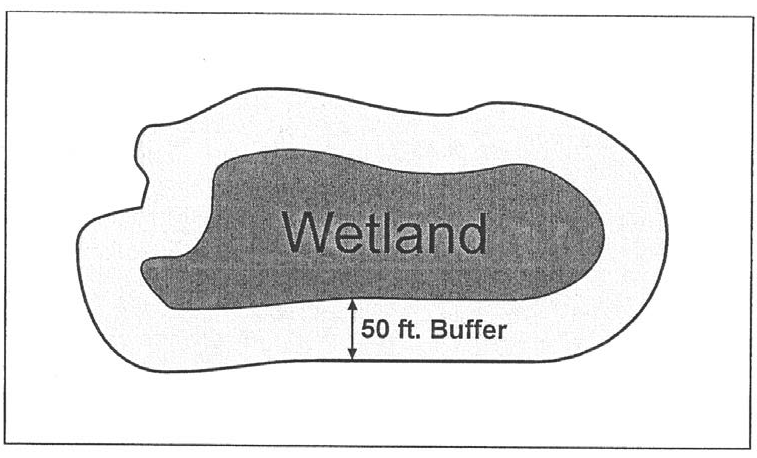
Figure IX-2. Buffer encroachment with contiguous increase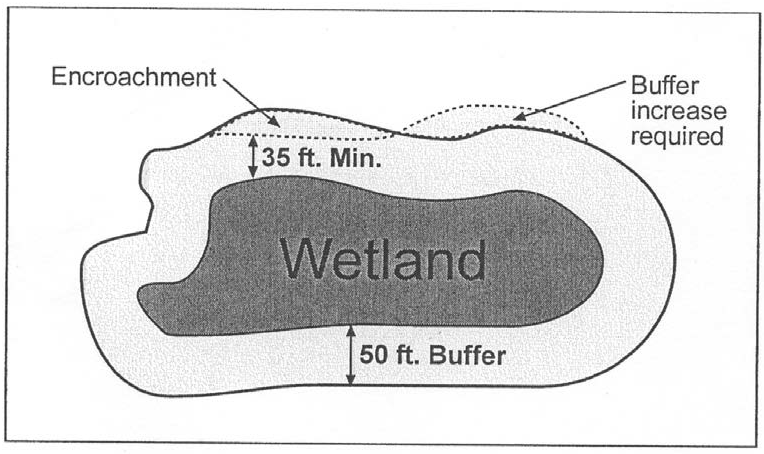
Figure IX-3. Buffer encroachment with contiguous increases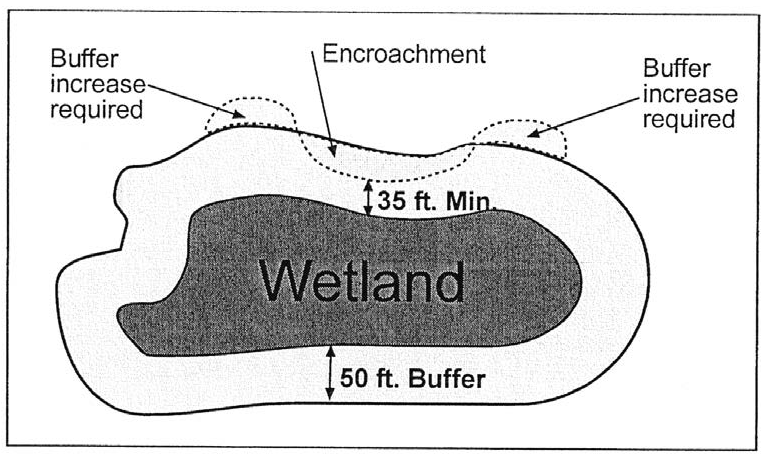
Figure IX-4. Buffer encroachment with non-contiguous increase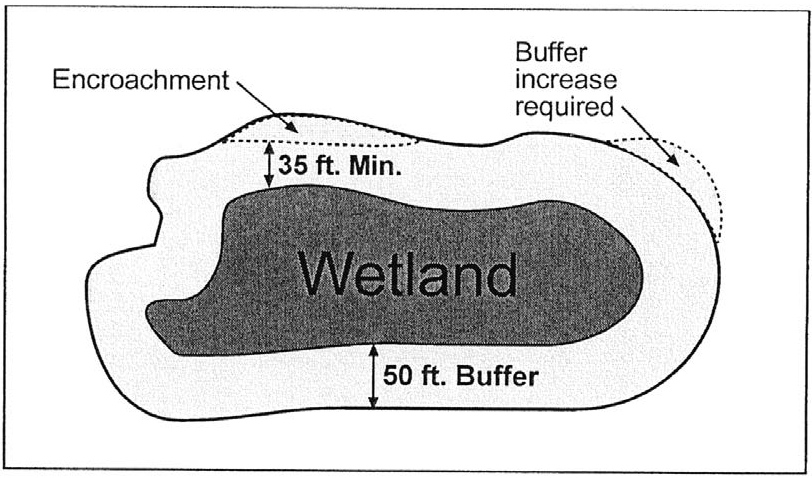
F.
Outstanding Florida Waters, as listed in Section 62-302.700, Florida Administrative Code, shall have a minimum buffer of 200 feet.
G.
For development activity between 35 and 150 feet from the break in slope at the top of the bank of any regulated creek, it is a rebuttable presumption that the development activity is detrimental to the regulated creek and is therefore prohibited unless approval is granted as set forth below.
H.
Development plans for lots within 150 feet of any regulated creek shall demonstrate compliance with the following standards (standards (2) and (3) shall not be applied to residential single-family lots):
1.
The development will not introduce erosion and sediment pollution to the creek both during and after construction;
2.
The first one inch of runoff or appropriate water management district standards, whichever is greater, will either be retained or detained through filtration on the project site;
3.
There will be no net increase in the rate of runoff from the site;
4.
There is no threat to the stability of the creek bank; and
5.
There will be no placement of buildings, structures, impervious surfaces, or sod that would require the removal of vegetation integral to the creek's ecological value. All invasive, non-native plant species listed in section 30-8.3 shall be removed prior to issuance of the certificate of occupancy. All plants listed on the Noxious Weed List, Section 5B-57.007, Florida Administrative Code shall be removed prior to issuance of the certificate of occupancy. Native vegetation shall be installed and/or retained to protect surface water or wetland environmental features.
I.
The development will not modify groundwater levels so as to have an adverse impact on the hydrological regime of a surface water or wetland. For the purposes of this provision, adverse impact is defined as a change that prevents the surface water or wetland from maintaining a structure and function equivalent to pre-development levels.
J.
If a proposed development requires development plan review pursuant to article III, the showing of compliance with the requirements of the surface waters and wetlands sections of article VIII shall be made in development plan review. The petition for development plan review shall provide both a hydrological report and construction plans prepared by a qualified engineer registered in the state.
K.
If a proposed development does not require development plan review, a showing of compliance shall be certified by the city manager's designee prior to issuance of any building permit. To demonstrate compliance with the requirements concerning quality and control of erosion and sediment pollution, the development plan may employ the city's "General Criteria for Controlling Erosion and Sediment," in the design manual, or equivalent practices, rather than employing the more elaborate hydrological and soil reports used in development plan review. Compliance with the measures required by "General Criteria for Controlling Erosion and Sediment" shall be presumed sufficient to meet the standards in subsections 30-8.20.H.1., 2. and 3. The development plan shall provide enough information to demonstrate compliance with the remaining standards, but need not ordinarily be prepared by a registered engineer. A professional land surveyor certified by the state shall provide the lot boundaries survey and topographical information.
L.
On-site transfer of development intensity and density. In order to protect surface water features of a site, development intensity and density for building areas may be transferred from a lower to a higher elevation within the same property or adjacent property under the same ownership and zoning category. Intensity and density may be apportioned over the property by reserving the surface water and its buffer area as common open space. If all of the intensity and density is transferred to the adjacent property, the owner shall record a restriction in the chain of title of the transferor property, prior to issuance of a final development order, to restrict the use of the land in perpetuity to non-development uses, with such restrictions being expressly enforceable by the city.
M.
The installation of new septic tanks is prohibited within 150 feet of the landward extent of a regulated lake or wetland, or within 150 feet from the break in slope at the top of the bank of a regulated creek.
Sec. 30-8.21. - Avoiding loss or degradation of wetlands.
Wetlands within and around the City of Gainesville provide environmental benefits such as water quality improvement, floodplain and erosion control, groundwater recharge and wildlife habitat, especially for species listed as endangered, threatened or of special concern by state and federal agencies, plus recreational, aesthetic and educational opportunities for people. These functions may be provided regardless of wetland size. Wetlands damaged or degraded shall either be restored to their function and condition prior to such damage, or mitigated pursuant to the mitigation requirements in the Comprehensive Plan, this Code, and in accordance with appropriate water management district standards.
A.
Purpose and intent. The purpose of this section is to avoid loss or degradation of wetland functions, to minimize unavoidable degradation or loss of wetland functions and to require mitigation that fully offsets any unavoidable loss or degradation of wetland functions. In addition, it is the purpose of this section to ensure that development activities that cause the unavoidable degradation or loss of wetland function are clearly in the public interest and fully offset any degradation or loss of wetland functions through sustainable mitigation. This section should contribute to the restoration of wetlands functions in the city.
B.
Applicability. Except as provided below this section shall be applicable to all wetlands within the City of Gainesville. This section shall not apply to the maintenance of permitted stormwater systems.
C.
Delineation. Wetlands shall be delineated pursuant to Rule 62-340.300, Florida Administrative Code. Delineations performed by the State of Florida pursuant to Rule 62-340.300, Florida Administrative Code, shall be binding on the city for the purposes of this section.
D.
Avoidance through minimization. Avoidance of loss of wetland function and wetland habitat is of the highest priority. The owner shall avoid loss of wetland function and wetland habitat by implementing practicable design alternatives to minimize adverse impacts to wetlands, except as permitted in this section.
The adverse impacts remaining after practicable design modifications have been made shall be offset by mitigation as provided herein. A development activity cannot cause a net adverse impact on wetland functions, wetland habitat, or surface water functions, if such activity is not offset by mitigation.
Avoidance through practicable design modifications is not required when the ecological value of the function provided by the area of wetland is low and the proposed mitigation will provide greater long-term ecological value than the area of wetland to be affected.
E.
Conditions for the issuance of a development permit for property upon which wetlands are located. The city manager or designee or appropriate reviewing board shall review all permit applications based on the conditions set forth below. No development of property containing wetlands shall be permitted unless the owner provides reasonable assurance that the activity:
1.
Will not adversely impact the value of wetland functions provided to fish and wildlife and listed species;
2.
Will not cause adverse secondary or cumulative impacts to water and wetland resources;
3.
Will be capable, based on generally accepted engineering and scientific principles, of being performed and of functioning as proposed;
4.
Will be conducted by an entity with the sufficient financial, legal and administrative capability to ensure that the activity will be undertaken in accordance with the terms and conditions of the permit, if issued;
5.
Will comply with criteria for buffer zones set forth herein;
6.
Is consistent with the owner's stormwater management permit, if required; and
7.
Is clearly in the public interest based on a balancing of the following criteria:
a.
Whether the development activity requires location in, on, or over wetlands or surface waters in order to fulfill its basic function;
b.
The effect of the development activity on the public health, safety, or welfare or the property of others;
c.
The effect of the development activity on fish, wildlife and native plant communities;
d.
The effect of the development activity on recreation, open space and aesthetic values;
e.
The effect of the development activity on significant historical and archaeological resources;
f.
Whether the development activity will be of a temporary or permanent nature;
g.
The current condition and relative value of wetland functions being performed by areas affected by the proposed activity;
h.
The type, extent, and geographic location of any mitigation proposed;
i.
The extent to which the development furthers the goals of the Comprehensive Plan, and the proximity of the development to existing infrastructure.
F.
Mitigation. This section applies to development activities in wetlands, which cannot be avoided or minimized, as determined by the criteria stated herein. Mitigation means an action or series of actions to offset the adverse impacts that would otherwise cause a regulated activity to fail to meet the criteria set forth herein.
1.
Types of mitigation; mitigation ratios. Mitigation consists of creation, preservation, enhancement, restoration, or a combination thereof in accordance with the ratios and preferences set forth in Chapter 62-345, Florida Administrative Code (Uniform Mitigation Assessment Method).
a.
Preservation means the protection of wetlands, other surface waters or uplands from adverse impacts by placing a conservation easement or other comparable land use restriction over the property, in favor of the governmental entity with the appropriate jurisdiction.
b.
Enhancement is an improvement in wetland function.
c.
Restoration means converting existing wetlands, surface waters or uplands from a disturbed or altered condition to a previously existing natural condition to the maximum extent possible.
d.
Creation means the establishment of new wetlands or surface waters by conversion of other landforms. Wetland creation is the least acceptable mitigation alternative and shall be considered only when preservation, restoration or enhancement within the sub-basin, basin or adjacent basin are infeasible at the ratios provided and when the owner can demonstrate that the proper hydrology and geology exist to make a created wetland sustainable.
2.
Location of mitigation. Any mitigation required pursuant to this section shall be performed within the basins and sub-basins described below, and may be performed on-site. These basins and sub-basins shall be specifically delineated on a map in the data and analysis section of the conservation, open space and groundwater recharge element of the Comprehensive Plan. Sub-basins include but are not limited to those drainage units within basins described below and as determined by the city manager or designee.
a.
Newnans Lake Basin. This basin generally includes the areas east of the Hogtown Creek watershed and the Blues Creek watershed and north and east of the Paynes Prairie watershed. It includes Hatchet Creek, Little Hatchet Creek, Gum Root Swamp, Sunnyland Creek, Lake Forest Creek and the Newnans Lake watershed.
b.
Paynes Prairie Basin. The Paynes Prairie Basin generally consists of the area west and south of the Newnans Lake Basin and south of the Hogtown Creek watershed flowing to Paynes Prairie and Alachua Sink. The Paynes Prairie Basin includes Sweetwater Branch, Rosewood Lateral, Tumblin Creek, Bivans Arm, Extension Ditch, Calf Pond Creek, Alachua Sink and the Paynes Prairie watershed.
c.
Hogtown Creek Basin. The Hogtown Creek basin generally includes the watershed for Hogtown Creek and Haile Sink and includes the depression basins that are adjacent to the west side of the watershed and within the Gainesville Community Basin. This Basin includes Hogtown Creek, Rattle Snake Creek, Springstead Creek, Pine Forest Creek, Ridge View Creek, Glenn Springs Creek, Possum Creek, Three Lakes Creek, Millhopper Creek, Monterey Creek, Royal Park Creek, Beville Creek, and the Lake Alice watershed, Lake Kanapaha, Rutledge Drain, Liberty Drain, Unnamed Branch and Unnamed Drain.
d.
Blues Creek Basin. The Blues Creek Basin generally includes the area northwest of the Hogtown Creek Basin. The basin includes Blues Creek, Alachua Slough and Sanchez Prairie.
e.
Sub-basins may be delineated for each basin.
G.
Order of mitigation preference. The order of preference for the location of the mitigation area in relation to the impacted area is as follows:
1.
In the same sub-basin;
2.
In the same basin;
3.
In another listed basin.
The appropriate reviewing board or city manager or designee, in writing, may approve a deviation from this order of preference if greater ecological benefits would be achieved with another order.
H.
Mitigation plan. Owners shall submit to the city manager or designee detailed plans describing proposed construction, establishment, and management of mitigation areas. These plans shall include the following information, as appropriate for the type of mitigation proposed by the owner:
1.
A soils map of the mitigation area and other soils information pertinent to the specific mitigation actions proposed;
2.
A topographic map of the mitigation area and adjacent hydrologic contributing and receiving areas;
3.
A hydrologic features map of the mitigation area and adjacent hydrologic contributing and receiving areas;
4.
A description of current hydrologic conditions affecting the mitigation area;
5.
A map of plant communities in and around the mitigation area, including buffer areas;
6.
Construction drawings detailing proposed topographic alterations and all structural components associated with proposed activities;
7.
Proposed construction activities, including a detailed schedule for implementation;
8.
Vegetation planting scheme and schedule for implementation, if planting is proposed;
9.
Sources of plants and soils used in wetland creation;
10.
Measures to be implemented during and after construction to avoid adverse impacts related to proposed activities;
11.
A management plan comprising all aspects of operation and maintenance, including water management practices, plant establishment, exotic and nuisance species control, fire management, and control of access;
12.
A proposed monitoring plan to demonstrate mitigation success;
13.
A description of the activities proposed to control exotic and nuisance species should these become established in the mitigation area. The mitigation proposal shall include reasonable measures to assure that these species do not invade the mitigation area in such numbers as to affect the likelihood of success of the project;
14.
A description of anticipated site conditions in and around the mitigation area after the mitigation plan is successfully implemented;
15.
A comparison of current fish and wildlife habitat to expected habitat after the mitigation plan is successfully implemented; and
16.
An itemized estimate of the cost of implementing mitigation, if applicable, as set forth herein.
I.
Monitoring requirements for mitigation areas. The owner shall monitor the progress of mitigation areas until success can be demonstrated as provided herein. Monitoring parameters, methods, schedules, and reporting requirements shall be specified as conditions within the appropriate permit. At a minimum, the owner shall transmit to the city manager or designee monitoring reports certified by an environmental scientist, biologist, registered engineer or registered landscape architect. These reports shall be submitted no less frequently than every 12 months for at least three years, except as provided herein. At a minimum, the monitoring reports shall include the following:
1.
An executive summary;
2.
A table of contents;
3.
A map of the site;
4.
Color photographs of the site and its important features;
5.
A description and analysis of water levels;
6.
A description and analysis of water quality;
7.
A description and analysis of the amount and types of nuisance and exotic plants;
8.
A description and analysis of the amount and types of intended and native plants;
9.
The survival rates of installed plants;
10.
Wildlife observations; and
11.
A description of mitigating activities by owner or agent.
Pursuant to the requirements of the Comprehensive Plan, regulatory fees for mitigation plan review and mitigation plan implementation shall be borne by the owner. Similar reporting to and review by the water management district shall be acceptable in lieu of this review.
J.
Protection of mitigation areas. The owner shall propose and be responsible for implementing methods to assure that mitigation areas will not be adversely impacted by incidental encroachment or secondary activities which might compromise mitigation success.
K.
Mitigation success. After three years of monitoring, the owner shall provide to the city manager or designee a written certification by an environmental scientist, biologist or registered engineer or registered landscape architect that the mitigation meets applicable success criteria as described below. If certification of success is not submitted or is not approved by the city manager or designee, then monitoring shall continue and monitoring reports shall be submitted until the city manager or designee deems the mitigation successful.
1.
Mitigation success criteria. Mitigation success will be measured in terms of whether the objectives of the mitigation are realized. The success criteria to be included in permit conditions will specify the minimum requirements necessary to attain a determination of success. The city manager or designee shall deem the mitigation successful when all applicable water quality standards are met, the mitigation area has achieved viable and sustainable ecological and hydrological functions, and the specific success criteria contained in the permit are met. If success is not achieved within the time frame specified within the permit, remedial measures shall be required. Monitoring and maintenance requirements shall remain in effect until success is achieved.
L.
Financial assurances. As part of compliance with this section, the owner shall provide proof of financial assurance when: 1) conducting the mitigation activities; 2) conducting any necessary management of the mitigation site; 3) conducting monitoring of the mitigation; and 4) conducting any necessary corrective action indicated by the monitoring.
1.
Cost estimates. The amount of financial assurance provided by the owner shall be an amount equal to 120 percent of the cost estimate for each phase of the mitigation plan. For the purposes of determining the amount of financial assurance that is required by this subsection, the owner shall submit a detailed written estimate, in current dollars, of the total cost of conducting the mitigation, including any maintenance and monitoring activities, and the owner shall comply with the following:
a.
The cost estimate for conducting the mitigation and monitoring shall include all associated costs for each phase thereof, including earthmoving, planting, structure installation, maintaining and operating any structures, controlling nuisance or exotic species, fire management, consultant fees, monitoring activities and reports.
b.
The owner shall submit the estimates, together with comprehensive and verifiable documentation, to the city manager or designee along with the draft of the financial assurance.
c.
The costs shall be estimated based upon a qualified third party performing the work and supplying services and materials at fair market value. All cost estimates shall be supported by comprehensive and verifiable documentation.
2.
Financial responsibility assurances. Financial responsibility for the mitigation, monitoring, and corrective action for each phase of the project may be established by any of the following methods, at the discretion of the owner:
a.
Bond. A performance bond shall be filed with the city manager or designee which is executed by a surety company authorized to do business in the state with a rating of not lower or less than A-XII as rated by A.M. Best Company, Inc., an independent national rating service for performance companies, which bond shall be conditioned to secure the required mitigation, monitoring, and corrective action in a satisfactory manner within 12 months from final plat approval and any extension of such period approved by the city commission, or, in the case of development (site) plan review, prior to final development plan approval. The bond shall be enforceable by and payable to the city in a sum at least equal to 120 percent of the total cost of the required mitigation, monitoring, and corrective action as estimated by the project engineer and verified and approved by the city manager or designee. The bond shall be first approved by the city attorney as to form and legality prior to its submission with the proposed final plat to the city commission for approval and shall be executed by both the owner and the party or parties with whom the owner has contracted to perform the required mitigation, monitoring, and corrective action. In the case of development (site) plan review, the bond shall be first approved by the city attorney as to form and legality prior to submission of the proposed final development plan to the appropriate reviewing entity (board or city manager or designee) and shall be executed by the developer and the party or parties with whom the developer has contracted to perform the required mitigation, monitoring, and corrective action; or
b.
Irrevocable letter of credit. Deposit with the city manager or designee an irrevocable and unconditional letter of credit by a Florida bank that has authority to issue letters of credit and whose letter of credit operations are regulated and examined by a federal or state agency. The letter of credit shall be for an amount equal to 120 percent of the estimated costs of the required mitigation, monitoring, and corrective action. The letter of credit shall remain with the city as a valid letter of credit until the city is satisfied that all of the required mitigation, monitoring, and corrective action has been completed in accordance with plans and specifications, that mitigation success as provided herein has been achieved, and that all other provisions of this chapter relating thereto have been fully complied with; or
c.
Insurance certificate. An insurance certificate from a company authorized to do business in the state and which has a rating of not lower or less than A-XII as rated by A.M. Best Company, Inc. The insurance certificate and its associated insurance policy shall be reviewed and approved by the city manager or designee before the city can accept the certificate as a financial responsibility assurance to secure the mitigation, monitoring and corrective action. The insurance certificate shall name the city named as an additional insured and shall provide not less than 30 calendar days' notice to the city of cancellation; or
d.
Cash deposit. A cash deposit in an amount equal to 120 percent of the estimated costs of the required mitigation, monitoring, and corrective action. The cash deposit shall remain with the city until the city is satisfied that all of the required mitigation, monitoring, and corrective action has been completed in accordance with plans and specifications, that mitigation success as provided herein has been achieved, and that all other provisions of this chapter relating thereto have been fully complied with.
3.
Owners not subject to financial assurance requirements. Owners whose mitigation is deemed successful pursuant to the mitigation success criteria provided herein prior to undertaking the construction activities authorized under their permit, or owners who purchase credits in a mitigation bank to offset the adverse impacts as required herein, are not subject to the financial assurance requirements of this section.
4.
General terms for financial assurances. In addition to the specific provisions regarding financial assurances set forth herein, the following shall be complied with:
a.
The city attorney shall approve the form and content of all financial assurances prior to the commencement date of the activity authorized by the permit.
b.
The financial assurance(s) shall name the city as sole beneficiary or shall be payable solely to the city. If the financial assurance is of a type that is retained by the beneficiary according to industry standards, the city shall retain the original financial assurance. For mitigation projects required both by the city and the water management district, the financial assurance(s) shall name the city and the water management district as joint beneficiaries or shall be payable to the city and the water management district jointly, unless the city and the water management district establish an alternative arrangement in writing with respect to the designated beneficiary or payee.
c.
The financial assurances shall be effective on or prior to the date that the activity authorized by the permit commences and shall continue to be effective through the date of notification of final release by the city, which shall occur within 30 calendar days of the determination that the mitigation is successful.
d.
The financial assurances cannot be revoked, terminated, or canceled without the owner first providing an alternative financial assurance that meets the requirements of this Code. Once the owner receives actual or constructive notice of revocation, termination, or cancellation of a financial assurance or other actual or constructive notice of cancellation, the owner shall provide such an alternate financial assurance prior to expiration of the financial assurance.
5.
Financial assurance conditions. For owners subject to the financial assurance requirements of this section, the city manager or designee will include the following conditions in the permit:
a.
An owner shall notify the city attorney by certified mail of the commencement of a voluntary or involuntary proceeding under Title XI (Bankruptcy), U.S. Code naming the permittee as debtor within ten business days of the owner filing of the petition.
b.
An owner who fulfills the requirements of this section by obtaining a letter of credit or bond will be deemed to be without the required financial assurance in the event of bankruptcy, insolvency or suspension or revocation of the license or charter of the issuing institution. The owner shall reestablish a financial assurance in accordance with this section within 60 calendar days after such event.
c.
When transferring a permit, the new owner or person with legal control shall submit documentation to satisfy the financial assurance requirements of this section. The prior owner or person with legal control of the project shall continue financial assurance until the city manager or designee has approved the permit transfer and substitute financial assurance.
6.
Releases.
a.
Partial releases. The owner may request the city attorney to release portions of the financial assurance as phases of the mitigation plan, such as earth moving or other construction activities for which cost estimates were submitted in accordance with this section, are successfully completed. The request shall be in writing and include documentation that the phase or phases have been completed and have been paid for, or will be paid for, upon release of the applicable portion of the financial assurance. The city attorney shall authorize the release of the portion requested upon verification that the construction or activities has been completed in accordance with the mitigation plan.
b.
Final release. Within 30 calendar days of successful mitigation, as determined by the city manager or designee and based on the criteria stated herein, the city shall notify the owner and shall authorize the return and release of all funds held or give written authorization to the appropriate party of the cancellation or termination of the financial assurance.
M.
Application procedure. An owner seeking a permit for a development activity in an area containing wetlands shall adhere to the application procedure set forth in the development review process provisions of the Land Development Code.
N.
Density transfers. The Land Development Code provisions relevant to onsite transfer of development intensity and density shall apply to the transfer of intensity and density of developments within or in an area containing wetlands.
O.
Exemptions. The wetlands protection regulations do not apply to owners and applications exempted pursuant to section 30-8.18.
Sec. 30-8.22. - Single-family lots.
A.
Applicability of standards. All development of single-family lots shall comply with the surface waters and wetlands sections of this article. If a subdivision plat has satisfied the requirements of these sections, the city may issue a certification of compliance for some or all of the lots in the subdivision at one time. In that case the lots are subject to further compliance review at the time of issuance of a building permit, only for compliance with the construction measures required by general criteria for controlling erosion and sediment.
B.
Special permits. In order to allow the reasonable development of a single-family dwelling and customary accessory structures and driveways on platted lots regulated by the surface waters and wetlands sections of this article, the development review board may grant a modification from compliance with the minimum buffer requirements of these sections only to the extent necessary to accommodate such reasonable development. As part of the same proceedings, the board may also grant variances to the yard setbacks required by this chapter in order to facilitate compliance with these sections subject to a finding that such special permits will neither be injurious to adjacent property owners or the neighborhood nor detrimental to the public welfare.
1.
Minimum requirement for special permits. Special permits may be granted by the Development Review Board for single-family lots located within the 75-foot required minimum buffer for regulated lakes, or within the required average minimum buffer distance of 50 feet from the landward extent of any wetland or surface water, or within 150 feet of the break in slope at the top of bank of a regulated creek for lots which are lawfully created before April 12, 2004.
2.
Criteria for granting of special permits. The following criteria shall be used in deciding whether and to what extent a special permit should be granted:
a.
The development review board shall determine what is reasonable development of a single-family lot, accessory structures and drives and shall consider the following factors:
i.
The size of existing single-family dwellings in the immediate vicinity should serve as a guide to what is customary and reasonable for the property under review.
ii.
No special permit shall be granted for the purpose of accommodating a swimming pool, tennis court, racquetball court or similar recreational structure, or to accommodate accessory uses that are not customary on single-family lots or exceed the customary size.
b.
The Development Review Board shall consider features of the site, including its topography, the width of the creek bed, and the presence or absence of vegetation natural to the creek, lake or wetland, which indicate that a special permit would or would not further the goals of these sections.
c.
The development review board shall consider building code requirements, including building orientation requirements to meet energy efficiency standards that affect the design and/or orientation of structures on the lot.
d.
The development review board shall consider presence of trees eight inches or greater in diameter at a point four and one-half feet above the ground level that can only be preserved if a special permit is granted.
3.
The development review board shall consider staff reports as needed in reaching its decision. In granting a special permit the board shall establish measures to ensure that the goals of these sections are substantially met, in particular maintaining natural vegetation where feasible, preventing sedimentation loading to the creek, lake or wetland, maintaining the stability of the creek or lake bank, and preventing the degradation of the water quality of the creek, lake or wetland. To achieve these aims, the Development Review Board shall attach such reasonable conditions and safeguards, such as construction control techniques and other mitigative measures, as it deems necessary.
C.
Special permit procedures. Applications shall be processed in accordance with the requirements in this chapter relating to variances, established for the development review board.
Sec. 30-8.23. - Administration.
A.
Title. These regulations shall be known as the Floodplain Management Ordinance (FPO) of the City of Gainesville, hereinafter referred to as "FPO Division 5."
B.
Scope. The provisions of FPO Division 5 shall apply to all development that is wholly within or partially within any flood hazard area, including but not limited to the subdivision of land; filling, grading, and other site improvements and utility installations; construction, alteration, remodeling, enlargement, improvement, replacement, repair, relocation or demolition of buildings, structures, and facilities that are exempt from the Florida Building Code; placement, installation, or replacement of manufactured homes and manufactured buildings; installation or replacement of tanks; placement of recreational vehicles; installation of swimming pools; and any other development.
C.
Intent. The purposes of FPO Division 5 and the flood load and flood resistant construction requirements of the Florida Building Code are to establish minimum requirements to safeguard the public health, safety, and general welfare and to minimize public and private losses due to flooding through regulation of development in flood hazard areas to:
1.
Minimize unnecessary disruption of commerce, access and public service during times of flooding;
2.
Require the use of appropriate construction practices in order to prevent or minimize future flood damage;
3.
Manage filling, grading, dredging, mining, paving, excavation, drilling operations, storage of equipment or materials, and other development which may increase flood damage or erosion potential;
4.
Manage the alteration of flood hazard areas, watercourses, and shorelines to minimize the impact of development on the natural and beneficial functions of the floodplain;
5.
Minimize damage to public and private facilities and utilities;
6.
Help maintain a stable tax base by providing for the sound use and development of flood hazard areas;
7.
Minimize the need for future expenditure of public funds for flood control projects and response to and recovery from flood events; and
8.
Meet the requirements of the National Flood Insurance Program for community participation as set forth in the 44 CFR 59.22.
D.
Coordination with the Florida Building Code. FPO Division 5 is intended to be administered and enforced in conjunction with the Florida Building Code. Where cited, ASCE 24 refers to the edition of the standard that is referenced by the Florida Building Code.
E.
Warning. The degree of flood protection required by FPO Division 5 and the Florida Building Code, as amended by the City of Gainesville, is considered the minimum reasonable for regulatory purposes and is based on scientific and engineering considerations. Larger floods can and will occur. Flood heights may be increased by man-made or natural causes. FPO Division 5 does not express or imply that land outside of mapped special flood hazard areas, or that uses permitted within such flood hazard areas, will be free from flooding or flood damage. The flood hazard areas and base flood elevations contained in the flood insurance study and shown on flood insurance rate maps and the requirements of 44 CFR 59 and 44 CFR 60 may be revised by the Federal Emergency Management Agency, requiring the city to revise these regulations to remain eligible for participation in the National Flood Insurance Program. No guaranty of vested use, existing use, or future use is implied or expressed by compliance with FPO Division 5.
F.
Disclaimer of liability. FPO Division 5 shall not create liability on the part of the City of Gainesville or by any officer or employee thereof for any flood damage that occurs, notwithstanding compliance with FPO Division 5 or any administrative decision lawfully made thereunder.
(Ord. No. 210195, § 1, 10-21-21)
Sec. 30-8.24. - Definitions.
Unless otherwise expressly stated, the following words and terms shall, for the purposes of FPO Division 5, have the meanings stated in this section. Where terms are not defined in FPO Division 5 and are defined in the Florida Building Code, such terms shall have the meanings ascribed to them in the Florida Building Code. Where terms are not defined in FPO Division 5 or the Florida Building Code, such terms shall have ordinarily accepted meanings such as the context implies.
Accessory structure means a structure on the same parcel of property as a principal structure and the use of which is incidental to the use of the principal structure. For the floodplain management purposes, the term includes only accessory structures used for parking and storage.
Alteration of a watercourse means a dam, impoundment, channel relocation, change in channel alignment, channelization, or change in cross-sectional area of the channel or the channel capacity, or any other form of modification that may alter, impede, retard or change the direction or velocity of the riverine flow of water during conditions of the base flood.
Appeal means a request for a review of the floodplain administrator's interpretation of any provision of FPO Division 5 or a request for a variance.
ASCE 24 means a standard titled Flood Resistant Design and Construction that is referenced by the Florida Building Code. ASCE 24 is developed and published by the American Society of Civil Engineers, Reston, VA.
Base flood means a flood having a 1% chance of being equaled or exceeded in any given year. The base flood is commonly referred to as the "100-year flood" or the "1% annual chance flood."
Base flood elevation means the elevation of the base flood, including wave height, relative to the National Geodetic Vertical Datum (NGVD), North American Vertical Datum (NAVD) or other datum specified on the flood insurance rate map (FIRM).
Basement means the portion of a building having its floor subgrade (below ground level) on all sides.
Design flood means the flood associated with the greater of the following two areas:
1.
Area with a floodplain subject to a 1% or greater chance of flooding in any year; or
2.
Area designated as a flood hazard area on the community's flood hazard map, or otherwise legally designated.
Design flood elevation means the elevation of the "design flood," including wave height, relative to the datum specified on the community's legally designated flood hazard map. In areas designated as zone AO, the design flood elevation shall be the elevation of the highest existing grade of the building's perimeter plus the depth number (in feet) specified on the flood hazard map. In areas designated as Zone AO where the depth number is not specified on the map, the depth number shall be taken as being equal to two feet.
Development means any man-made change to improved or unimproved real estate, including but not limited to, buildings or other structures, tanks, temporary structures, temporary or permanent storage of equipment or materials, mining, dredging, filling, grading, paving, excavations, drilling operations or any other land disturbing activities.
Encroachment means the placement of fill, excavation, buildings, permanent structures or other development into a flood hazard area which may impede or alter the flow capacity of riverine flood hazard areas.
Existing building and existing structure mean any buildings and structures for which the "start of construction" commenced before October 1, 1971.
Federal Emergency Management Agency (FEMA) means the federal agency that, in addition to carrying out other functions, administers the National Flood Insurance Program.
Flood or flooding means a general and temporary condition of partial or complete inundation of normally dry land from:
1.
The overflow of inland or tidal waters.
2.
The unusual and rapid accumulation or runoff of surface waters from any source.
Flood damage-resistant materials means any construction material capable of withstanding direct and prolonged contact with floodwaters without sustaining any damage that requires more than cosmetic repair.
Flood hazard area means the greater of the following two areas:
1.
The area within a floodplain subject to a 1% or greater chance of flooding in any year.
2.
The area designated as a flood hazard area on the community's flood hazard map, or otherwise legally designated.
Flood insurance rate map (FIRM) means the official map of the community on which the Federal Emergency Management Agency has delineated both special flood hazard areas and the risk premium zones applicable to the community.
Flood insurance study (FIS) means the official report provided by the Federal Emergency Management Agency that contains the flood insurance rate map, the flood boundary and floodway map (if applicable), the water surface elevations of the base flood, and supporting technical data.
Floodplain administrator means the office or position designated and charged with the administration and enforcement of FPO Division 5 (may be referred to as the floodplain manager).
Floodplain development permit or approval means an official document or certificate issued by the city, or other evidence of approval or concurrence, which authorizes performance of specific development activities that are located in flood hazard areas and that are determined to be compliant with FPO Division 5.
Floodway means the channel of a river or other riverine watercourse and the adjacent land areas that shall be reserved in order to discharge the base flood without cumulatively increasing the water surface elevation more than one foot.
Floodway encroachment analysis means an engineering analysis of the impact that a proposed encroachment into a floodway is expected to have on the floodway boundaries and base flood elevations; the evaluation shall be prepared by a qualified Florida licensed engineer using standard engineering methods and models.
Florida Building Code means the family of codes adopted by the Florida Building Commission, including: Florida Building Code, Building; Florida Building Code, Residential; Florida Building Code, Existing Building; Florida Building Code, Mechanical; Florida Building Code, Plumbing; Florida Building Code, Fuel Gas.
Functionally dependent use means a use which cannot perform its intended purpose unless it is located or carried out in close proximity to water, including only docking facilities, port facilities that are necessary for the loading and unloading of cargo or passengers, and ship building and ship repair facilities; the term does not include long-term storage or related manufacturing facilities.
Highest adjacent grade means the highest natural elevation of the ground surface prior to construction next to the proposed walls or foundation of a structure.
Historic structure means any structure that is determined eligible for the exception to the flood hazard area requirements of the Florida Building Code, Existing Building, Chapter 12, Historic Buildings.
Letter of map change (LOMC) means an official determination issued by FEMA that amends or revises an effective flood insurance rate map or flood insurance study. Letters of map change include:
1.
Letter of map amendment (LOMA): An amendment based on technical data showing that a property was incorrectly included in a designated special flood hazard area. A LOMA amends the current effective flood insurance rate map and establishes that a specific property, portion of a property, or structure is not located in a special flood hazard area.
2.
Letter of map revision (LOMR): A revision based on technical data that may show changes to flood zones, flood elevations, special flood hazard area boundaries and floodway delineations, and other planimetric features.
3.
Letter of map revision based on fill (LOMR-F): A determination that a structure or parcel of land has been elevated by fill above the base flood elevation and is, therefore, no longer located within the special flood hazard area. In order to qualify for this determination, the fill shall have been permitted and placed in accordance with the city's floodplain management regulations.
4.
Conditional letter of map revision (CLOMR): A formal review and comment as to whether a proposed flood protection project or other project complies with the minimum NFIP requirements for such projects with respect to delineation of special flood hazard areas. A CLOMR does not revise the effective flood insurance rate map or flood insurance study; upon submission and approval of certified as-built documentation, a letter of map revision may be issued by FEMA to revise the effective FIRM.
Light-duty truck means, as defined in 40 CFR 86.082-2, any motor vehicle rated at 8,500 pounds gross vehicular weight rating or less which has a vehicular curb weight of 6,000 pounds or less and which has a basic vehicle frontal area of 45 square feet or less, which is:
1.
Designed primarily for purposes of transportation of property or is a derivation of such a vehicle;
2.
Designed primarily for transportation of persons and has a capacity of more than 12 persons; or
3.
Available with special features enabling off-street or off-highway operation and use.
Lowest floor means the lowest floor of the lowest enclosed area of a building or structure, including basement, but excluding any unfinished or flood-resistant enclosure, other than a basement, usable solely for vehicle parking, building access or limited storage provided that such enclosure is not built so as to render the structure in violation of the non-elevation requirements of the Florida Building Code or ASCE 24.
Manufactured home means a structure, transportable in one or more sections, which is eight feet or more in width and greater than 400 square feet, and which is built on a permanent, integral chassis and is designed for use with or without a permanent foundation when attached to the required utilities. The term "manufactured home" does not include a "recreational vehicle" or "park trailer."
Manufactured home park or subdivision means a parcel (or contiguous parcels) of land divided into two or more manufactured home lots for rent or sale.
Market value means the price at which a property will change hands between a willing buyer and a willing seller, neither party being under compulsion to buy or sell and both having reasonable knowledge of relevant facts. As used in FPO Division 5, the term refers to the market value of buildings and structures, excluding the land and other improvements on the parcel. Market value may be established by a qualified independent appraiser, actual cash value (replacement cost depreciated for age and quality of construction), or tax assessment value adjusted to approximate market value by a factor provided by the property appraiser.
New construction means, for the purposes of administration of FPO Division 5 and the flood resistant construction requirements of the Florida Building Code, structures for which the "start of construction" commenced on or after October 1, 1971, and includes any subsequent improvements to such structures.
Park trailer means a transportable unit which has a body width not exceeding 14 feet and which is built on a single chassis and is designed to provide seasonal or temporary living quarters when connected to utilities necessary for operation of installed fixtures and appliances.
Recreational vehicle means a vehicle, including a park trailer, which is:
1.
Built on a single chassis;
2.
Four hundred square feet or less when measured at the largest horizontal projection;
3.
Designed to be self-propelled or permanently towable by a light-duty truck; and
4.
Designed primarily not for use as a permanent dwelling but as temporary living quarters for recreational, camping, travel, or seasonal use.
Special flood hazard area means an area in the floodplain subject to a 1% or greater chance of flooding in any given year. Special flood hazard areas are shown on FIRMs as zone A, AO, A1-A30, AE, A99, AH, V1-V30, VE or V.
Start of construction means the date of development permit issuance for new construction and substantial improvements to existing structures, provided the actual start of construction, repair, reconstruction, rehabilitation, addition, placement, or other improvement is within 180 calendar days of the date of the issuance. The actual start of construction means either the first placement of permanent construction of a building (including a manufactured home) on a site, such as the pouring of slab or footings, the installation of piles, or the construction of columns. Permanent construction does not include land preparation (such as clearing, grading, or filling), the installation of streets or walkways, excavation for a basement, footings, piers, or foundations, the erection of temporary forms or the installation of accessory buildings such as garages or sheds not occupied as dwelling units or not part of the main buildings. For a substantial improvement, the actual "start of construction" means the first alteration of any wall, ceiling, floor or other structural part of a building, whether or not that alteration affects the external dimensions of the building.
Substantial damage means damage of any origin sustained by a building or structure whereby the cost of restoring the building or structure to its before-damaged condition would equal or exceed 50 percent of the market value of the building or structure before the damage occurred.
Substantial improvement means any repair, reconstruction, rehabilitation, addition, or other improvement of a building or structure, the cost of which equals or exceeds 50 percent of the market value of the building or structure before the improvement or repair is started. If the structure has incurred "substantial damage," any repairs are considered substantial improvement regardless of the actual repair work performed. The term does not, however, include either:
1.
Any project for improvement of a building required to correct existing health, sanitary, or safety code violations identified by the building official and that are the minimum necessary to assure safe living conditions.
2.
Any alteration of a historic structure provided the alteration will not preclude the structure's continued designation as a historic structure.
Variance means a grant of relief from the requirements of FPO Division 5, or the flood resistant construction requirements of the Florida Building Code, which permits construction in a manner that would not otherwise be permitted by FPO Division 5 or the Florida Building Code.
Watercourse means a river, creek, stream, channel or other topographic feature in, on, through, or over which water flows at least periodically.
(Ord. No. 210195, § 1, 10-21-21)
Sec. 30-8.25. - Applicability.
A.
General. Where there is a conflict between a general requirement and a specific requirement, the specific requirement shall be applicable.
B.
Areas to which FPO Division 5 applies. FPO Division 5 shall apply to all flood hazard areas within the City of Gainesville, as established in subsection C. below.
C.
Basis for establishing flood hazard areas. The Flood Insurance Study for Alachua County, Florida and Incorporated Areas dated September 24, 2021, and all subsequent amendments and revisions, and the accompanying flood insurance rate maps (FIRM), and all subsequent amendments and revisions to such maps, are adopted by reference as a part of FPO Division 5 and shall serve as the minimum basis for establishing flood hazard areas. Studies and maps that establish flood hazard areas are on file at the:
City of Gainesville Public Works
405 NW 39th Avenue
Gainesville, FL 32609
Alachua County Public Library
Downtown Headquarters
401 East University Avenue
Gainesville, FL 32601
D.
Submission of additional data to establish flood hazard areas. To establish flood hazard areas and base flood elevations, pursuant to section 30-8.28 of FPO Division 5, the floodplain administrator may require submission of additional data.
1.
Where field surveyed topography prepared by a Florida licensed professional surveyor or digital topography accepted by the city indicates that ground elevations are below the closest applicable base flood elevation, even in areas not delineated as a special flood hazard area on a FIRM, the area shall be considered as flood hazard area and subject to the requirements of FPO Division 5 and, as applicable, the requirements of the Florida Building Code.
2.
Where field surveyed topography prepared by a Florida licensed professional surveyor or digital topography accepted by the city indicates that ground elevations are above the closest applicable base flood elevation, the area shall be regulated as special flood hazard area unless the applicant obtains a letter of map change that removes the area from the special flood hazard area.
E.
Other laws. The provisions of FPO Division 5 shall not be deemed to nullify any provisions of local, state or federal law.
F.
Abrogation and greater restrictions. FPO Division 5 supersedes any ordinance in effect for management of development in flood hazard areas. However, it is not intended to repeal or abrogate any existing ordinances including but not limited to land development regulations, zoning ordinances, stormwater management regulations, or the Florida Building Code. In the event of a conflict between FPO Division 5 and any other ordinance, the more restrictive shall govern.
G.
Interpretation. In the interpretation and application of FPO Division 5, all provisions shall be:
1.
Considered as minimum requirements;
2.
Liberally construed in favor of the governing body; and
3.
Deemed neither to limit nor repeal any other powers granted under state statutes.
(Ord. No. 210195, § 1, 10-21-21)
Sec. 30-8.26. - Duties and powers of the floodplain administrator.
A.
Designation. The city manager or designee is designated as the floodplain administrator. The floodplain administrator may delegate performance of certain duties to other employees.
B.
General. The floodplain administrator is authorized and directed to administer and enforce the provisions of FPO Division 5. The floodplain administrator shall have the authority to render interpretations of FPO Division 5 consistent with the intent and purpose of FPO Division 5 and may establish policies and procedures in order to clarify the application of its provisions. Such interpretations, policies, and procedures shall not have the effect of waiving requirements specifically provided in FPO Division 5 without the granting of a variance pursuant to section 30-8.30 of FPO Division 5.
C.
Applications and permits. The floodplain administrator, in coordination with other pertinent offices of the city, shall:
1.
Review applications and plans to determine whether proposed new development will be located in flood hazard areas;
2.
Review applications for modification of any existing development in flood hazard areas for compliance with the requirements of FPO Division 5;
3.
Interpret flood hazard area boundaries where such interpretation is necessary to determine the exact location of boundaries; a person contesting the determination shall have the opportunity to appeal the interpretation;
4.
Provide available flood elevation and flood hazard information;
5.
Determine whether additional flood hazard data shall be obtained from other sources or shall be developed by an applicant;
6.
Review applications to determine whether proposed development will be reasonably safe from flooding;
7.
Issue floodplain development permits or approvals for development other than buildings and structures that are subject to the Florida Building Code, including buildings, structures and facilities exempt from the Florida Building Code, when compliance with FPO Division 5 is demonstrated, or disapprove the same in the event of noncompliance; and
8.
Coordinate with and provide comments to the building official to assure that applications, plan reviews, and inspections for buildings and structures in flood hazard areas comply with the applicable provisions of FPO division 5.
D.
Substantial improvement and substantial damage determinations. For applications for building permits to improve buildings and structures, including alterations, movement, enlargement, replacement, repair, change of occupancy, additions, rehabilitations, renovations, substantial improvements, repairs of substantial damage, and any other improvement of or work on such buildings and structures, the floodplain administrator, in coordination with the building official, shall:
1.
Estimate the market value, or require the applicant to obtain an appraisal of the market value prepared by a qualified independent appraiser, of the building or structure before the start of construction of the proposed work; in the case of repair, the market value of the building or structure shall be the market value before the damage occurred and before any repairs are made;
2.
Compare the cost to perform the improvement, the cost to repair a damaged building to its pre-damaged condition, or the combined costs of improvements and repairs, if applicable, to the market value of the building or structure;
3.
Determine and document whether the proposed work constitutes substantial improvement or repair of substantial damage; and
4.
Notify the applicant if it is determined that the work constitutes substantial improvement or repair of substantial damage and that compliance with the flood resistant construction requirements of the Florida Building Code and FPO Division 5 is required.
E.
Modifications of the strict application of the requirements of the Florida Building Code. The floodplain administrator shall review requests submitted to the building official that seek approval to modify the strict application of the flood load and flood resistant construction requirements of the Florida Building Code to determine whether such requests require the granting of a variance pursuant to section 30-8.30 of FPO Division 5.
F.
Notices and orders. The floodplain administrator shall coordinate with appropriate local agencies for the issuance of all necessary notices or orders to promote compliance with FPO Division 5.
G.
Inspections. The floodplain administrator shall make the required inspections as specified in section 30-8.29 of FPO Division 5 for development that is not subject to the Florida Building Code, including buildings, structures and facilities exempt from the Florida Building Code. The floodplain administrator shall inspect flood hazard areas to determine if development is undertaken without issuance of a permit.
H.
Other duties of the floodplain administrator. The floodplain administrator shall have other duties, including but not limited to:
1.
Establish, in coordination with the building official, procedures for administering and documenting determinations of substantial improvement and substantial damage made pursuant to subsection D. above;
2.
Require that applicants proposing alteration of a watercourse notify adjacent communities and the Florida Division of Emergency Management, State Floodplain Management Office, and submit copies of such notifications to the Federal Emergency Management Agency (FEMA);
3.
Require applicants who submit hydrologic and hydraulic engineering analyses to support permit applications to submit to FEMA the data and information necessary to maintain the flood insurance rate maps if the analyses propose to change base flood elevations, flood hazard area boundaries, or floodway designations; such submissions shall be made within six months of such data becoming available;
4.
Review required design certifications and documentation of elevations specified by FPO Division 5 and the Florida Building Code and FPO Division 5 to determine that such certifications and documentations are complete; and
5.
Notify the Federal Emergency Management Agency when the corporate boundaries of the City of Gainesville are modified.
I.
Floodplain management records. Regardless of any limitation on the period required for retention of public records, the floodplain administrator shall maintain and permanently keep and make available for public inspection records that are necessary for the administration of FPO Division 5 and the flood resistant construction requirements of the Florida Building Code, which shall include: flood insurance rate maps; letters of map change; records of issuance of permits and denial of permits; determinations of whether proposed work constitutes substantial improvement or repair of substantial damage; required design certifications and documentation of elevations specified by the Florida Building Code and FPO Division 5; notifications to adjacent communities, FEMA, and the state related to alterations of watercourses; assurances that the flood carrying capacity of altered watercourses will be maintained; documentation related to appeals and variances, including justification for issuance or denial; and records of enforcement actions taken pursuant to FPO Division 5 and the flood resistant construction requirements of the Florida Building Code. These records shall be available for public inspection at:
City of Gainesville Public Works
405 NW 39th Avenue
Gainesville, FL 32609
(Ord. No. 210195, § 1, 10-21-21)
Sec. 30-8.27. - Permits.
A.
Permits required. Any owner or authorized agent who intends to undertake any development within the scope of FPO Division 5, including buildings, structures and facilities exempt from the Florida Building Code, which is wholly or partially within any flood hazard area shall first apply to the floodplain administrator, and the building official if applicable, and shall obtain the required permit(s) and approval(s). No such permit or approval shall be issued until compliance with the requirements of FPO Division 5 and all other applicable codes and regulations of the City of Gainesville has been satisfied.
B.
Floodplain development permits or approvals. Floodplain development permits or approvals shall be issued pursuant to FPO Division 5 for any development not subject to the requirements of the Florida Building Code, including buildings, structures and facilities exempt from the Florida Building Code. Depending on the nature and extent of proposed development that includes a building or structure, the floodplain administrator may determine that a floodplain development permit or approval is required in addition to a building permit.
C.
Buildings, structures and facilities exempt from the Florida Building Code. Pursuant to the requirements of federal regulation for participation in the National Flood Insurance Program (44 CFR 59 and 44 CFR 60), floodplain development permits or approvals shall be required for the following buildings, structures and facilities that are exempt from the Florida Building Code:
1.
Railroads and ancillary facilities associated with the railroad.
2.
Nonresidential farm buildings on farms, as provided in F.S. § 604.50.
3.
Temporary buildings or sheds used exclusively for construction purposes.
4.
Mobile or modular structures used as temporary offices.
5.
Those structures or facilities of electric utilities, as defined in F.S. § 366.02, which are directly involved in the generation, transmission, or distribution of electricity.
6.
Chickees constructed by the Miccosukee Tribe of Indians of Florida or the Seminole Tribe of Florida. As used in this paragraph, the term "chickee" means an open-sided wooden hut that has a thatched roof of palm or palmetto or other traditional materials, and that does not incorporate any electrical, plumbing, or other non-wood features.
7.
Family mausoleums not exceeding 250 square feet in area which are prefabricated and assembled on site or preassembled and delivered on site and have walls, roofs, and a floor constructed of granite, marble, or reinforced concrete.
8.
Temporary housing provided by the department of corrections to any prisoner in the state correctional system.
9.
Structures identified in F.S. § 553.73(10)(k), are not exempt from the Florida Building Code if such structures are located in flood hazard areas established on flood insurance rate maps.
D.
Application for a permit or approval. To obtain a floodplain development permit or approval the applicant shall first file an application in writing on a form furnished by the city. The information provided shall:
1.
Identify and describe the development to be covered by the permit or approval.
2.
Describe the land on which the proposed development is to be conducted by legal description, street address or similar description that will readily identify and definitively locate the site.
3.
Indicate the use and occupancy for which the proposed development is intended.
4.
Be accompanied by a site plan or construction documents as specified in section 30-8.28 of FPO Division 5.
5.
State the valuation of the proposed work.
6.
Be signed by the applicant or the applicant's authorized agent.
7.
Give such other data and information as required by the floodplain administrator.
E.
Validity of permit or approval. The issuance of a floodplain development permit or approval pursuant to FPO Division 5 shall not be construed to be a permit for, or approval of, any violation of FPO Division 5, the Florida Building Code, or any other subdivision of the city. The issuance of permits based on submitted applications, construction documents, and information shall not prevent the floodplain administrator from requiring the correction of errors and omissions.
F.
Expiration. A floodplain development permit or approval shall become invalid unless the work authorized by such permit is commenced within 180 calendar days after its issuance, or if the work authorized is suspended or abandoned for a period of 180 calendar days after the work commences. Extensions for periods of not more than 180 calendar days each shall be requested in writing and justifiable cause shall be demonstrated.
G.
Suspension or revocation. The floodplain administrator is authorized to suspend or revoke a floodplain development permit or approval if the permit was issued in error, on the basis of incorrect, inaccurate or incomplete information, or in violation of FPO Division 5 or any other ordinance, regulation or requirement of the city.
H.
Other permits required. Floodplain development permits and building permits shall include a condition that all other applicable state or federal permits be obtained before commencement of the permitted development, including but not limited to the following:
1.
The St. Johns River Water Management District (SJRWMD), or Suwannee River Water Management District (SRWMD), whichever is applicable; F.S. § 373.036.
2.
Florida Department of Health for onsite sewage treatment and disposal systems; F.S. § 381.0065, and Chapter 64E-6, Florida Administrative Code.
3.
Florida Department of Environmental Protection for activities subject to the Joint Coastal Permit; F.S. § 161.055.
4.
Florida Department of Environmental Protection for activities that affect wetlands and alter surface water flows, in conjunction with the U.S. Army Corps of Engineers; Section 404 of the Clean Water Act.
5.
Federal permits and approvals.
(Ord. No. 210195, § 1, 10-21-21)
Sec. 30-8.28. - Site plans and construction documents.
A.
Information for development in flood hazard areas. The site plan or construction documents for any development subject to the requirements of FPO Division 5 shall be drawn to scale and shall include, as applicable to the proposed development:
1.
Delineation of flood hazard areas, floodway boundaries and flood zone(s), base flood elevation(s), and ground elevations if necessary for review of the proposed development.
2.
Where base flood elevations, or floodway data are not included on the FIRM or in the flood insurance study, they shall be established in accordance with subsection 30-8.28.B.2. or 30-8.28.B.3. of FPO Division 5.
3.
Where the parcel on which the proposed development will take place will have more than 50 lots or is larger than five acres and the base flood elevations are not included on the FIRM or in the flood insurance study, such elevations shall be established in accordance with subsection 30-8.28.B.1. of FPO Division 5.
4.
Location of the proposed activity and proposed structures, and locations of existing buildings and structures.
5.
Location, extent, amount, and proposed final grades of any filling, grading, or excavation.
6.
Where the placement of fill is proposed, the amount, type, and source of fill material; compaction specifications; a description of the intended purpose of the fill areas; and evidence that the proposed fill areas are the minimum necessary to achieve the intended purpose.
7.
Existing and proposed alignment of any proposed alteration of a watercourse.
The floodplain administrator is authorized to waive the submission of site plans, construction documents, and other data that are required by FPO Division 5 but that are not required to be prepared by a registered design professional if it is found that the nature of the proposed development is such that the review of such submissions is not necessary to ascertain compliance with FPO Division 5.
B.
Information in flood hazard areas without base flood elevations (approximate zone A). Where flood hazard areas are delineated on the FIRM and base flood elevation data have not been provided, the floodplain administrator shall:
1.
Require the applicant to include base flood elevation data prepared in accordance with currently accepted engineering practices; or
2.
Obtain, review, and provide to applicants base flood elevation and floodway data available from a federal or state agency or other source or require the applicant to obtain and use base flood elevation and floodway data available from a federal or state agency or other source; or
3.
Where base flood elevation and floodway data are not available from another source, where the available data are deemed by the floodplain administrator to not reasonably reflect flooding conditions, or where the available data are known to be scientifically or technically incorrect or otherwise inadequate:
a.
Require the applicant to include base flood elevation data prepared in accordance with currently accepted engineering practices; or
b.
Specify that the base flood elevation is two feet above the highest adjacent grade at the location of the development, provided there is no evidence indicating flood depths have been or may be greater than two feet.
C.
Additional analyses and certifications. As applicable to the location and nature of the proposed development activity, and in addition to the requirements of this section, the applicant shall have the following analyses signed and sealed by a Florida licensed engineer for submission with the site plan and construction documents:
1.
For development activities proposed to be located in a regulatory floodway, a floodway encroachment analysis that demonstrates that the encroachment of the proposed development will not cause any increase in base flood elevations; where the applicant proposes to undertake development activities that do increase base flood elevations, the applicant shall submit such analysis to FEMA as specified in subsection 30-8.28.D. of FPO Division 5 and shall submit the conditional letter of map revision, if issued by FEMA, with the site plan and construction documents.
2.
For development activities proposed to be located in a riverine flood hazard area for which base flood elevations are included in the flood insurance study or on the FIRM and floodways have not been designated, hydrologic and hydraulic analyses that demonstrate that the cumulative effect of the proposed development, when combined with all other existing and anticipated flood hazard area encroachments, will not increase the base flood elevation more than one foot at any point within the city. This requirement does not apply in isolated flood hazard areas not connected to a riverine flood hazard area or in flood hazard areas identified as zone AO or Zone AH.
3.
For alteration of a watercourse, an engineering analysis prepared in accordance with standard engineering practices which demonstrates that the flood-carrying capacity of the altered or relocated portion of the watercourse will not be decreased, and certification that the altered watercourse shall be maintained in a manner which preserves the channel's flood-carrying capacity; the applicant shall submit the analysis to FEMA as specified in subsection 30-8.28.D. of FPO Division 5.
D.
Submission of additional data. When additional hydrologic, hydraulic or other engineering data, studies, and additional analyses are submitted to support an application, the applicant has the right to seek a letter of map change from FEMA to change the base flood elevations, change floodway boundaries, or change boundaries of flood hazard areas shown on FIRMs, and to submit such data to FEMA for such purposes. The analyses shall be prepared by a Florida licensed engineer in a format required by FEMA. Submittal requirements and processing fees shall be the responsibility of the applicant.
(Ord. No. 210195, § 1, 10-21-21)
Sec. 30-8.29. - Inspections.
A.
General. Development for which a floodplain development permit or approval is required shall be subject to inspection.
B.
Development other than buildings and structures. The floodplain administrator shall inspect all development to determine compliance with the requirements of FPO Division 5 and the conditions of issued floodplain development permits or approvals.
C.
Buildings, structures and facilities exempt from the Florida Building Code. The floodplain administrator shall inspect buildings, structures and facilities exempt from the Florida Building Code to determine compliance with the requirements of FPO Division 5 and the conditions of issued floodplain development permits or approvals.
D.
Buildings, structures and facilities exempt from the Florida Building Code, lowest floor inspection. Upon placement of the lowest floor, including basement, and prior to further vertical construction, the owner of a building, structure or facility exempt from the Florida Building Code, or the owner's authorized agent, shall submit to the floodplain administrator:
1.
If a design flood elevation was used to determine the required elevation of the lowest floor, the certification of elevation of the lowest floor prepared and sealed by a Florida licensed professional surveyor; or
2.
If the elevation used to determine the required elevation of the lowest floor was determined in accordance with subsection 30-8.28.B.3.b. of FPO Division 5, the documentation of height of the lowest floor above highest adjacent grade, prepared by the owner or the owner's authorized agent.
E.
Buildings, structures and facilities exempt from the Florida Building Code, final inspection. As part of the final inspection, the owner or owner's authorized agent shall submit to the floodplain administrator a final certification of elevation of the lowest floor or final documentation of the height of the lowest floor above the highest adjacent grade; such certifications and documentations shall be prepared as specified in subsection 30-8.29.D. of FPO Division 5.
F.
Manufactured homes. The building official shall inspect manufactured homes that are installed or replaced in flood hazard areas to determine compliance with the requirements of FPO Division 5 and the conditions of the issued permit. Upon placement of a manufactured home, certification of the elevation of the lowest floor shall be submitted to the building official.
(Ord. No. 170974, § 15, 2-21-19; Ord. No. 210195, § 1, 10-21-21)
Sec. 30-8.30. - Variances and appeals.
A.
General. The appropriate reviewing authority shall hear and decide on requests for appeals and requests for variances from the strict application of FPO Division 5 and, pursuant to F.S. § 553.73(5), the flood resistant construction requirements of the Florida Building Code.
B.
Appeals. The appropriate reviewing authority shall hear and decide appeals, as provided in this chapter, when it is alleged there is an error in any requirement, decision, or determination made by the floodplain administrator in the administration and enforcement of FPO Division 5.
C.
Limitations on authority to grant variances. The appropriate reviewing board shall base its decisions on variances on technical justifications submitted by applicants, the considerations for issuance in subsection 30-8.30.G. of FPO Division 5, the conditions of issuance set forth in subsection 30-8.30.H. of FPO Division 5, and the comments and recommendations of the floodplain administrator and the building official. The appropriate reviewing board has the right to attach such conditions as it deems necessary to further the purposes and objectives of FPO Division 5.
D.
Restrictions in floodways. A variance shall not be issued for any proposed development in a floodway if any increase in base flood elevations would result, as evidenced by the applicable analyses and certifications required in subsection 30-8.28.C. of FPO Division 5.
E.
Historic buildings. A variance is authorized to be issued for the repair, improvement, or rehabilitation of a historic building that is determined eligible for the exception to the flood resistant construction requirements of the Florida Building Code, Existing Building, Chapter 12, Historic Buildings, upon a determination that the proposed repair, improvement, or rehabilitation will not preclude the building's continued designation as a historic building and the variance is the minimum necessary to preserve the historic character and design of the building. If the proposed work precludes the building's continued designation as a historic building, a variance shall not be granted and the building and any repair, improvement, and rehabilitation shall be subject to the requirements of the Florida Building Code.
F.
Functionally dependent uses. A variance is authorized to be issued for the construction or substantial improvement necessary for the conduct of a functionally dependent use, provided the variance meets the requirements of subsection 30-8.30.D., is the minimum necessary considering the flood hazard, and all due consideration has been given to use of methods and materials that minimize flood damage during occurrence of the base flood.
G.
Considerations for issuance of variances. In reviewing requests for variances, the appropriate reviewing board shall consider all technical evaluations, all relevant factors, all other applicable provisions of the Florida Building Code, FPO Division 5, and the following:
1.
The danger that materials and debris may be swept onto other lands resulting in further injury or damage;
2.
The danger to life and property due to flooding or erosion damage;
3.
The susceptibility of the proposed development, including contents, to flood damage and the effect of such damage on current and future owners;
4.
The importance of the services provided by the proposed development to the community;
5.
The availability of alternate locations for the proposed development that are subject to lower risk of flooding or erosion;
6.
The compatibility of the proposed development with existing and anticipated development;
7.
The relationship of the proposed development to the Comprehensive Plan and floodplain management program for the area;
8.
The safety of access to the property in times of flooding for ordinary and emergency vehicles;
9.
The expected heights, velocity, duration, rate of rise and debris and sediment transport of the floodwaters and the effects of wave action, if applicable, expected at the site; and
10.
The costs of providing governmental services during and after flood conditions including maintenance and repair of public utilities and facilities such as sewer, gas, electrical and water systems, streets and bridges.
H.
Conditions for issuance of variances. Variances shall be issued only upon:
1.
Submission by the applicant, of a showing of good and sufficient cause that the unique characteristics of the size, configuration, or topography of the site limit compliance with any provision of FPO Division 5 or the required elevation standards;
2.
Determination by the appropriate reviewing board that:
a.
Failure to grant the variance would result in exceptional hardship due to the physical characteristics of the land that render the lot undevelopable; increased costs to satisfy the requirements or inconvenience do not constitute hardship;
b.
The granting of a variance will not result in increased flood heights, additional threats to public safety, extraordinary public expense, nor create nuisances, cause fraud on or victimization of the public or conflict with existing local laws and ordinances; and
c.
The variance is the minimum necessary, considering the flood hazard, to afford relief.
3.
Receipt of a signed statement by the applicant that the variance, if granted, shall be recorded in the office of the clerk of the court in such a manner that it appears in the chain of title of the affected parcel of land; and
4.
If the request is for a variance to allow construction of the lowest floor of a new building, or substantial improvement of a building, below the required elevation, a copy in the record of a written notice from the floodplain administrator to the applicant specifying the difference between the base flood elevation and the proposed elevation of the lowest floor, stating that the cost of federal flood insurance will be commensurate with the increased risk resulting from the reduced floor elevation, and stating that construction below the base flood elevation increases risks to life and property.
(Ord. No. 210195, § 1, 10-21-21)
Sec. 30-8.31. - Violations.
A.
Violations. Any development that is not within the scope of the Florida Building Code but that is regulated by FPO Division 5 that is performed without an issued permit, that is in conflict with an issued permit, or that does not fully comply with FPO Division 5, shall be deemed a violation of FPO Division 5. A building or structure without the documentation of elevation of the lowest floor, other required design certifications, or other evidence of compliance required by FPO Division 5 or the Florida Building Code is presumed to be a violation until such time as that documentation is provided.
B.
Authority. For development that is not within the scope of the Florida Building Code but that is regulated by FPO Division 5 and that is determined to be a violation, the floodplain administrator is authorized to serve notices of violation or stop work orders to owners of the property involved, to the owner's agent, or to the person or persons performing the work.
C.
Unlawful continuance. No person shall continue any work after having been served with a notice of violation or a stop work order, except such work as that person is directed to perform to remove or remedy a violation or unsafe condition.
(Ord. No. 210195, § 1, 10-21-21)
Sec. 30-8.32. - Buildings and structures.
A.
Design and construction of buildings, structures and facilities exempt from the Florida Building Code. Pursuant to subsection 30-8.27.C. of FPO Division 5, buildings, structures, and facilities that are exempt from the Florida Building Code, including substantial improvement or repair of substantial damage of such buildings, structures and facilities, shall be designed and constructed in accordance with the flood load and flood resistant construction requirements of ASCE 24. Structures exempt from the Florida Building Code that are not walled and roofed buildings shall comply with the requirements of section 30-8.38 of FPO Division 5.
B.
Elevation requirements for residential structures (as defined by ASCE 24). All new structures and substantial improvements of structures within the flood hazard area shall have the lowest finished floor elevated at a minimum elevation of 2.0 feet above the base flood elevation.
C.
Elevation requirements for non-residential structures (as defined by ASCE 24). All new structures and substantial improvements of structures within the flood hazard area shall have the lowest finished floor elevated at a minimum elevation of 2.0 feet above the base flood elevation or be designed with an approved floodproofing alternative.
D.
Accessory structures. Accessory structures are permitted below the base flood elevation provided the accessory structures are used only for parking or storage; and:
1.
Are one-story and not larger than 600 square feet.
2.
Have flood openings in accordance with Section R322.2 of the Florida Building Code, Residential.
3.
Are anchored to resist flotation, collapse or lateral movement resulting from flood loads.
4.
Have flood damage-resistant materials used below the base flood elevation plus one foot.
5.
Have mechanical, plumbing and electrical systems, including plumbing fixtures, elevated to or above the base flood elevation plus one foot.
(Ord. No. 210195, § 1, 10-21-21; Ord. No. 2024-743, § 1, 12-5-24)
Sec. 30-8.33. - Subdivisions.
A.
Minimum requirements. Subdivision proposals, including proposals for manufactured home parks and subdivisions, shall be reviewed to determine that:
1.
Such proposals are consistent with the need to minimize flood damage and will be reasonably safe from flooding;
2.
All public utilities and facilities such as sewer, gas, electric, communications, and water systems are located and constructed to minimize or eliminate flood damage; and
3.
Adequate drainage is provided to reduce exposure to flood hazards; in zones AH and AO, adequate drainage paths shall be provided to guide floodwaters around and away from proposed structures.
B.
Subdivision plats. Where any portion of proposed subdivisions, including manufactured home parks and subdivisions, lies within a flood hazard area, the following shall be required:
1.
Delineation of flood hazard areas, floodway boundaries and flood zones, and design flood elevations, as appropriate, shall be shown on preliminary plats and final plats;
2.
Where the subdivision has more than 50 lots or is larger than five acres and base flood elevations are not included on the FIRM, the base flood elevations determined in accordance with subsection 30-8.28.B.1. of FPO Division 5; and
3.
Compliance with the site improvement and utilities requirements of section 30-8.34 of FPO Division 5.
(Ord. No. 210195, § 1, 10-21-21)
Sec. 30-8.34. - Site improvements, utilities, and limitations.
A.
Minimum requirements. All proposed new development shall be reviewed to determine that:
1.
Such proposals are consistent with the need to minimize flood damage and will be reasonably safe from flooding;
2.
All public utilities and facilities such as sewer, gas, electric, communications, and water systems are located and constructed to minimize or eliminate flood damage; and
3.
Adequate drainage is provided to reduce exposure to flood hazards; in zones AH and AO, adequate drainage paths shall be provided to guide floodwaters around and away from proposed structures.
B.
Sanitary sewage facilities. All new and replacement sanitary sewage facilities, private sewage treatment plants (including all pumping stations and collector systems), and on-site waste disposal systems shall be designed in accordance with the standards for onsite sewage treatment and disposal systems in Chapter 64E-6, Florida Administrative Code and ASCE 24 Chapter 7 to minimize or eliminate infiltration of floodwaters into the facilities and discharge from the facilities into flood waters, and impairment of the facilities and systems.
C.
Water supply facilities. All new and replacement water supply facilities shall be designed in accordance with the water well construction standards in Chapter 62-532.500, Florida Administrative Code and ASCE 24 Chapter 7 to minimize or eliminate infiltration of floodwaters into the systems.
D.
Limitations on sites in regulatory floodways. No development, including but not limited to site improvements, and land disturbing activity involving fill or regrading, shall be authorized in the regulatory floodway unless the floodway encroachment analysis required in subsection 30-8.28.C.1. of FPO Division 5 demonstrates that the proposed development or land disturbing activity will not result in any increase in the base flood elevation.
E.
Limitations on placement of fill. Subject to the limitations of FPO Division 5, fill shall be designed to be stable under conditions of flooding including rapid rise and rapid drawdown of floodwaters, prolonged inundation, and protection against flood-related erosion and scour. In addition to these requirements, if intended to support buildings and structures (zone A only), fill shall comply with the requirements of the Florida Building Code.
(Ord. No. 210195, § 1, 10-21-21)
Sec. 30-8.35. - Manufactured homes.
A.
General. All manufactured homes installed in flood hazard areas shall be installed by an installer that is licensed pursuant to F.S. § 320.8249, and shall comply with the requirements of Chapter 15C-1, Florida Administrative Code and the requirements of FPO Division 5.
B.
Foundations. All new manufactured homes and replacement manufactured homes installed in flood hazard areas shall be installed on permanent, reinforced foundations that are designed in accordance with the foundation requirements of the Florida Building Code, Residential Section R322.2 and FPO Division 5.
C.
Anchoring. All new manufactured homes and replacement manufactured homes shall be installed using methods and practices which minimize flood damage and shall be securely anchored to an adequately anchored foundation system to resist flotation, collapse or lateral movement. Methods of anchoring include, but are not limited to, use of over-the-top or frame ties to ground anchors. This anchoring requirement is in addition to applicable state and local anchoring requirements for wind resistance.
D.
Elevation. All manufactured homes that are placed, replaced, or substantially improved in flood hazard areas shall be elevated such that the bottom of the frame is at a minimum elevation of 2.0 feet above the base flood elevation.
E.
Enclosures. Enclosed areas below elevated manufactured homes shall comply with the requirements of the Florida Building Code, Residential Section R322 for such enclosed areas.
F.
Utility equipment. Utility equipment that serves manufactured homes, including electric, heating, ventilation, plumbing, and air conditioning equipment and other service facilities, shall comply with the requirements of the Florida Building Code, Residential Section R322.
(Ord. No. 210195, § 1, 10-21-21; Ord. No. 2024-743, § 2, 12-5-24)
Sec. 30-8.36. - Recreational vehicles and park trailers.
A.
Temporary placement. Recreational vehicles and park trailers placed temporarily in flood hazard areas shall:
1.
Be on the site for fewer than 180 consecutive days; or
2.
Be fully licensed and ready for highway use, which means the recreational vehicle or park model is on wheels or jacking system, is attached to the site only by quick disconnect type utilities and security devices, and has no permanent attachments such as additions, rooms, stairs, decks and porches.
B.
Permanent placement. Recreational vehicles and park trailers that do not meet the limitations in subsection 30-8.36.A. of FPO Division 5 for temporary placement shall meet the requirements of section 30-8.35 of FPO Division 5 for manufactured homes.
(Ord. No. 210195, § 1, 10-21-21)
Sec. 30-8.37. - Tanks.
A.
Underground tanks. Underground tanks in flood hazard areas shall be anchored to prevent flotation, collapse or lateral movement resulting from hydrodynamic and hydrostatic loads during conditions of the design flood, including the effects of buoyancy assuming the tank is empty.
B.
Above-ground tanks, not elevated. Above-ground tanks that do not meet the elevation requirements of subsection 30-8.37.C. of FPO Division 5 shall be permitted in flood hazard areas provided the tanks are anchored or otherwise designed and constructed to prevent flotation, collapse or lateral movement resulting from hydrodynamic and hydrostatic loads during conditions of the design flood, including the effects of buoyancy assuming the tank is empty and the effects of flood-borne debris.
C.
Above-ground tanks, elevated. Above-ground tanks in flood hazard areas shall be attached to and elevated to or above the design flood elevation on a supporting structure that is designed to prevent flotation, collapse or lateral movement during conditions of the design flood. Tank-supporting structures shall meet the foundation requirements of the applicable flood hazard area.
D.
Tank inlets and vents. Tank inlets, fill openings, outlets and vents shall be:
1.
At or above the design flood elevation or fitted with covers designed to prevent the inflow of floodwater or outflow of the contents of the tanks during conditions of the design flood; and
2.
Anchored to prevent lateral movement resulting from hydrodynamic and hydrostatic loads, including the effects of buoyancy, during conditions of the design flood.
(Ord. No. 210195, § 1, 10-21-21)
Sec. 30-8.38. - Other development.
A.
General requirements for other development. All development, including man-made changes to improved or unimproved real estate for which specific provisions are not specified in FPO Division 5 or the Florida Building Code, shall:
1.
Be located and constructed to minimize flood damage;
2.
Meet the limitations of subsection 30-8.34.D. of FPO Division 5 if located in a regulated floodway;
3.
Be anchored to prevent flotation, collapse or lateral movement resulting from hydrostatic loads, including the effects of buoyancy, during conditions of the design flood;
4.
Be constructed of flood damage-resistant materials; and
5.
Have mechanical, plumbing, and electrical systems above the design flood elevation, except that minimum electric service required to address life safety and electric code requirements is permitted below the design flood elevation provided it conforms to the provisions of the electrical part of building code for wet locations.
B.
Fences in regulated floodways. Fences in regulated floodways that have the potential to block the passage of floodwaters, such as stockade fences and wire mesh fences, shall meet the limitations of subsection 30-8.34.D. of FPO Division 5.
C.
Retaining walls, sidewalks and driveways in regulated floodways. Retaining walls and sidewalks and driveways that involve the placement of fill in regulated floodways shall meet the limitations of subsection 30-8.34.D. of FPO Division 5.
D.
Roads and watercourse crossings in regulated floodways. Roads and watercourse crossings, including roads, bridges, culverts, low-water crossings and similar means for vehicles or pedestrians to travel from one side of a watercourse to the other side, that encroach into regulated floodways shall meet the limitations of subsection 30-8.34.D. of FPO Division 5. Alteration of a watercourse that is part of a road or watercourse crossing shall meet the requirements of subsection 30-8.28.C.3. of FPO Division 5.
(Ord. No. 210195, § 1, 10-21-21)
Sec. 30-8.39. - Applicability and effect.
A.
Effect of classification. The wellfield, nature park and public conservation/preservation areas, and greenway districts are overlay district classifications. They are intended to operate in conjunction with the underlying zoning district for the area. The regulations of the underlying zoning district remain in effect except to the extent that they are modified by the provisions of the applicable overlay district(s).
B.
Administration. The wellfield, nature park and public conservation/preservation areas, and greenway districts shall be applied and enforced like any other zoning district regulation.
C.
Extension of district boundaries. Property owners may apply for inclusion in the environmental overlay districts, regardless of contiguity. Such an extension or inclusion shall be subject to review and consideration according to the applicable terms of this article and shall be processed as a rezoning in accordance with this chapter. The city commission may extend or expand districts from time to time in accordance with the same standards and procedures as for the original district as determined by the Comprehensive Plan.
D.
Exclusion from district boundaries. It is a rebuttable presumption that a property qualifies for inclusion within the wellfield district. Qualified properties are those that are within the zone of contribution to the wellfield, as defined by the applicable water management district. Property owners whose land is within the district may apply for exclusion from the district. Such an exclusion shall be based on a determination made by a qualified engineer registered in the State of Florida that the property is not part of the zone of contribution. This determination is subject to review and consideration by the city public works department and the county office of environmental protection and the public utility according to the applicable terms of this article and shall be processed as a rezoning in accordance with this chapter.
Sec. 30-8.40. - Wellfield district.
A.
Adoption of wellfield district. The wellfield district is delineated on the map entitled, "Map Displaying Community Wellfields of Gainesville, Florida," on file with the city.
B.
Requirements and procedures.
1.
All new and existing developments shall comply with the county Murphree Well Field Management, Storage Tank Systems, and Hazardous Materials Management Codes, except that such development shall also comply with subsection B.2. of this section.
2.
In the Murphree wellfield management primary and secondary zone, the installation of new septic tanks in commercial, institutional and industrial districts is prohibited.
Sec. 30-8.41. - Nature park and public conservation/preservation areas district.
A.
Adoption of nature park and public conservation/preservation areas district. The nature park and public conservation/preservation areas district is delineated on the map entitled "Nature Parks and Public Conservation/Preservation Areas District Map" on file with the city.
B.
Applicability. Property that lies within 400 feet of the boundary of a designated nature park and public conservation/preservation area is regulated as set forth in this section.
C.
Requirements and procedures.
1.
Development plan requirements. Refer to article III, pertaining to development plan review process.
2.
Height limits.
a.
Maximum building height: 35 feet.
b.
Maximum lighting height: 45 feet.
c.
Maximum transmitter tower height: 80 feet.
3.
Exterior lighting control. All exterior lighting shall be shielded or directed away from the park. No exterior lighting shall cause illumination in excess of four-tenths footcandle measured at the park boundary. Buildings shall not be externally illuminated on the faces fronting the park, except that exterior lighting of building entrances, exits or loading docks is permitted. Downlights shall be used for area lighting instead of full globe lights or any similar type of light which illuminates in all directions.
4.
On-site transfer of development intensity and density. In order to protect nature parks and public conservation/preservation areas, development intensity and density for building areas may be transferred from areas near the park to areas remote from the park within the same property or adjacent property under same ownership and zoning category.
5.
Buffer/fencing. In order to avoid encroachment by invasive exotic plants, pets, livestock and fowl, and yard or trash debris, new development on parcels larger than two acres or new subdivisions shall leave a buffer at least 25 feet in width extending from the boundary of the nature park and public conservation/preservation area to be left in a generally undisturbed native plant condition. Buffers shall remain common open space or within the boundaries of a single lot or parcel. As an alternative to the buffer requirement, where sufficient justification is presented (such as, but not limited to, hardship due to configuration of the property, the extensive presence of invasive exotic plants or a need to confine pets) and approved at the time of development review, new development adjacent to a nature park and public conservation/preservation area may be allowed to install and maintain a fence along the property boundary between the nature park and public conservation/preservation area and the development area.
D.
Expansion or alteration of existing uses.
1.
Whenever expansion of an existing structure, independently or cumulatively, accomplished after June 10, 1992, totals 2,000 square feet or more than 20 percent of the gross square footage of the existing structure, whichever is less, the entire site shall be brought into compliance with this section. For the purposes of this subsection, repeated expansions or alterations of property, including the construction or erection of separate buildings or accessory structures, constructed over a period of time commencing after November 21, 1983, which meet the above threshold, shall comply with the provisions of this section.
2.
Any new use of property that alters the use of existing structures from a residential use to a nonresidential use, or any use of property that alters the use of property from one use to any other use, shall be required to meet all applicable requirements of this section. The city manager's designee shall determine the applicable requirements based on the character and orientation of the proposed mixed-use development. For purposes of this subsection, nonresidential use shall mean any office, commercial, public, semipublic, institutional or industrial use, including motels and hotels.
Sec. 30-8.42. - Greenway district.
A.
Adoption of greenway district. All designated greenways will be delineated on the map entitled, "Map Displaying Greenways of Gainesville, Florida" on file with the city. This map is for use only as a general reference for determining the location of the district. Actual affected properties will be identified by a list of parcels generated from the computerized GIS inventory maintained by the city.
B.
Requirements and procedures.
1.
Subdivisions. In addition to compliance with subsection B.3. of this section, subdivisions shall comply with article III. For cluster subdivisions, refer also to section 30-6.7.
2.
Developments other than subdivisions. For developments requiring development plan review other than subdivisions, where the designated greenway corridors lie inside a floodplain or required surface water or wetlands setback, whichever is more landward, the appropriate review board shall determine if there is a rough proportionality between the projected impact of the development on traffic and recreational needs and the nature and amount of property in the development encompassing the greenway. In making this determination, the board shall consider the factors listed in section 30-6.6. If the board finds the necessary proportionality, the applicant shall dedicate, to the city or a qualified agency designated by the city, a greenway right-of-way which encompasses the designated greenway.
3.
Greenway width and location. The minimum width of the greenway corridor shall be 15 feet. For properties containing a creek, the corridor shall be at least ten feet landward of the top of bank of the creek. For properties containing a lake or wetland, the corridor shall be at least ten feet landward of the landward extent of the lake or wetland. For creeks, lakes and wetlands, the city manager or designee may require a distance greater than ten feet when necessary to avoid significant harm to creek vegetation, water quality or creek bank soils. Top of bank and landward extent shall be determined by the city manager or designee. Reduced widths may be approved by the city manager or designee when necessitated by environmental or infrastructure constraints. The corridor shall be located so as to correspond with the entire length of the designated greenway as it passes through the subject property, and shall be aligned to connect with existing or potential greenways and other bicycle/pedestrian circulation systems on the parcel and on adjacent parcels.
4.
On-site transfer of development intensity and density. In order to promote or preserve the integrity of designated greenways, development intensity and density for building areas may be transferred from areas near the greenway to areas remote from the greenway within the same property or adjacent property under the same ownership and zoning category.
C.
Credit awarded for provision of greenway.
1.
Increased development intensity points. Refer to the density bonus points manual as adopted by resolution of the city commission.
2.
Landscape credit. Developments dedicating a greenway corridor as specified by the density bonus points manual are awarded a 30 percent reduction in the amount of tree and vegetation landscaping required by this chapter.
3.
Setback and lot coverage credit. Developments dedicating a greenway corridor may include the dedicated corridor as part of its setback, if the corridor would have otherwise been part of the setback. The area of the corridor may also be considered as open space in calculations of lot coverage.
D.
Demonstration of compliance for developments requiring development plan review. If a proposed development requires development plan review pursuant to this chapter, the showing of compliance with the requirements of this section shall be made in development plan review. The petition for development plan review shall provide both a hydrological report prepared by a qualified engineer registered in the State of Florida, as well as a map showing the location of the greenway corridor as it passes through the subject property.
Sec. 30-8.43. - Relief for reasonable or beneficial use.
A.
Landscape and tree management. The preservation of any existing regulated tree identified on the Gainesville tree list as being a high quality shade species may be considered as a basis for the granting of a variance pursuant to the procedures established in this chapter.
B.
Surface waters and wetlands. As regards the provisions of surface waters and wetlands sections of this article, the following standards and measures of relief shall apply:
1.
An applicant may be entitled to relief in the form of a minimum beneficial use if he/she demonstrates that private property rights are vested in accordance with the procedures and provisions set forth in article X. The relief which the applicant may receive shall be as follows:
a.
The city may purchase the land from the owner for an amount based upon an appraisal completed by an M.A.I. appraiser to be selected and paid by the city. If the owner desires a review of this M.A.I. appraisal, the owner may select a reviewer and the city will provide and pay for such a review. The appraised value of the land shall not be affected by consideration of the provisions of this article; or
b.
The development review board may grant a variance from the provisions of this article to the minimum extent necessary to allow reasonable development in accordance with the provisions of this chapter.
2.
Emergency procedure for surface waters and wetlands. The owner of any real property affected by this article may file written application with the city manager or designee in order to undertake emergency measures to prevent damage to any of the regulated creeks, lakes or wetlands. The enforcing official may grant authorization to the property owner that will expedite the city's effort to protect the public health, safety and welfare. The authorization for emergency action is temporary only and shall expire within 60 calendar days or upon the next regularly scheduled meeting of the development review board, whichever is sooner. Upon receipt of temporary emergency authorization, the recipient shall apply to the development review board for authorization for any permanent measures. The authorization by the city will not relieve the property owner from securing any necessary state permits prior to commencement of work.
C.
Floodplain management. As regards to floodplain management provisions of this article, the development review board may issue a variance in accordance with the provisions of this chapter and the following provisions:
1.
Criteria for relief. In addition to the relief provisions of this chapter, the following criteria for relief shall apply:
a.
The danger that materials may be swept onto other lands to the injury of others;
b.
The danger to life and property due to flooding or erosion damage;
c.
The susceptibility of the proposed facility and its contents to flood damage and the effect of such damage on the individual owner;
d.
The importance of the services provided by the proposed facility to the community;
e.
The necessity to the facility of a waterfront location, where applicable;
f.
The compatibility of the proposed use with existing and anticipated development;
g.
The relationship of the proposed use to the Comprehensive Plan and floodplain management program of that area;
h.
The availability of alternative locations not subject to flooding or erosion damage for the proposed use;
i.
The safety of access to the property in times of flood for ordinary and emergency vehicles;
j.
The expected heights, velocity, duration, rate of rise and sediment transport of the floodwaters and the effects of wave action, if applicable, expected at the site; and
k.
The costs of providing governmental services during and after flood conditions, including maintenance and repair of public utilities and facilities such as sewer, gas, electrical and water systems, and streets and bridges.
2.
Upon consideration of the factors of subsection C.1. of this section, and the purpose of the floodplain management sections of this article, the development review board may attach such conditions to the granting of variances as it deems necessary to further the purposes of these sections.
3.
The city manager or designee shall maintain the records of all appeal actions, including technical information, and report any variances to the federal insurance administrator (Federal Emergency Management Administration), upon request.
4.
Variances shall not be issued within any regulatory floodway if any increase in flood levels would result during a base flood discharge. Conditions for variances are as follows:
a.
Variances may be issued for new construction and substantial improvements to be erected on a lot one-half acre or less in size contiguous to, and surrounded by, lots with existing structures constructed below the base flood level, providing the factors of subsection C.1. of this section have been fully considered. As the lot size increases beyond the one-half acre, the technical justification required for issuing the variance increases.
b.
Variances may be issued for the reconstruction, rehabilitation or restoration of structures listed on the National Register of Historic Places or the state inventory of historic places, without regard to the procedures set forth in the remainder of these sections upon a determination that the proposed repair or rehabilitation will not preclude the structure's continued designation as a historic structure.
c.
Variances shall only be issued upon a determination that the variance is the minimum necessary, considering the flood hazard, to afford relief.
d.
Variances shall only be issued upon:
i.
A showing of good and sufficient cause;
ii.
A determination that failure to grant the variance would result in exceptional hardship to the applicant; and
iii.
A determination that the granting of a variance will not result in increased flood heights, additional threats to public safety, extraordinary public expense, create nuisances, cause fraud on or victimization of the public, or conflict with the local government's Comprehensive Plan or with other existing local laws or ordinances.
e.
Any applicant to whom a variance is granted shall be given written notice specifying the difference between the base flood elevation and the elevation to which the structure is to be built and stating that the cost of flood insurance will be commensurate with the increased risk resulting from the reduced lowest floor elevation.
5.
Special use permit. The city plan board may grant a special use permit in accordance with the procedures provided in article III to allow any of the permitted use listed in section 30-8.30 regardless of the zoning district in which the parcel is located, provided the board makes the following findings:
a.
A showing that no use permitted within the applicable zoning district can reasonably be conducted in accordance with the provisions of this chapter;
b.
A showing that the parcel cannot be combined with a contiguous parcel under the same ownership and thereby used in conformity with the applicable zoning regulations; and
c.
A determination that the granting of a special use permit will not result in increased flood heights, additional threats to public safety, extraordinary public expense, create nuisances, cause fraud on or victimization of the public, or conflict with other existing laws and ordinances.
The city plan board shall also consider all relevant factors, standards specified in other sections of this chapter, and:
d.
The size of the parcel, and whether it was platted as a lot suitable for development or otherwise established and recognized by the city as an individual lot suitable for development;
e.
The danger that materials may be swept onto other lands causing injury to others;
f.
The danger to life and property due to flooding or erosion damage;
g.
The susceptibility of the proposed facility and its contents to flood damage and the effect of such damage on the individual owner;
h.
The relationship of the proposed use to the Comprehensive Plan and floodplain management program of that area;
i.
The safety of access to the property in times of flood for private and emergency vehicles;
j.
The expected heights, velocity, duration, rate of rise and sediment transport of the potential floodwaters and the potential effects of wave action, if applicable, expected at the site;
k.
The costs of providing governmental services during and after flood conditions, including maintenance and repair of public utilities and facilities such as power, gas, electrical and water systems, and streets and bridges; and
l.
The compatibility of the proposed use with nearby properties and uses.
Upon consideration of the factors in this section and the purposes of this chapter, the city plan board may attach such conditions and restrictions upon the special use permit, including a limitation of the extent or type of uses permitted, as it deems necessary to further the purposes of this chapter.
Sec. 30-8.44. - Violations, enforcement and penalties.
A.
Stormwater management. As regards the provisions of the stormwater management sections of this chapter:
1.
Stormwater facilities shall function as per the approved final development plan/final plat. Failure to comply with this provision shall be a violation of this Code.
2.
During construction if the city manager or designee observes that the stormwater facilities are not functioning in accordance with the permitted site plan or subdivision construction design plan, in addition to other remedies provided for in this section, no certificate of occupancy shall be issued until such time as the facilities are corrected and are functioning properly.
3.
Any stormwater facility that is found by the city manager or designee to be contributing to mosquito control problems is in violation of this article and the property owner shall immediately correct the problem at the owner's expense.
4.
Prior to construction of a stormwater facility, a pollution prevention plan shall be submitted to the city manager or designee for approval. The pollution prevention plan shall detail specific best management practices for installation on a construction site and that when installed have the net effect of preventing a deposit, obstruction, damage or process problem to any of the city's stormwater management facilities or to the surface waters of the state. If such deposit, obstruction, damage or process problem occurs this occurrence shall be a violation of this article and the property owner shall cause the deposit or obstruction to be immediately removed or cause the damage or process problem to be immediately repaired.
Discharge from any facility that causes a deposit, obstruction, damage or process problem to any of the city's stormwater management facilities or to the surface waters of the state is a violation of this article and the property owner shall cause the deposit or obstruction to be immediately removed or cause the damage or process problem to be immediately repaired.
5.
Any temporary or permanent erosion or sedimentation control device that is unable to perform continuous effective control shall be a violation of this article and the property owner shall immediately correct the control device so that it performs continuous effective control. Such correction or repair shall be taken at the owner's expense.
6.
If an approved maintenance plan is not being adhered to, the property owner shall be in violation of this article and shall immediately resume adherence to the approved maintenance plan.
7.
Should any person violate the provisions of this section, the city manager or designee shall require the alleged violator to take corrective measures. In the event the alleged violator does not immediately correct the violation, the city may, depending upon the severity of the violation, take the following actions:
a.
If the city manager or designee finds a violation of this article or a violation of any provision of a property owner's pollution prevention plan, which has been provided to the city, is not immediately rectified, the city manager or designee shall notify the property owner of the violation within five calendar days of inspection and shall give the property owner a reasonable time to correct the violation. Should the violation continue beyond the time specified for correction, the city manager or designee shall issue a notice of violation to the alleged violator and shall notify the code enforcement board to request a hearing. The board, through its clerical staff, shall schedule a hearing, and written notice of such hearing shall be hand delivered or mailed to the property owner as provided in section 2-390 of the Code of Ordinances. In the case of notice provided under subsection 2-390(a), notice shall be given at least seven calendar days in advance of the hearing, not counting the day of the hearing. If the violation is corrected and then recurs or if the violation is not corrected by the time specified for correction by the inspector, the case may be presented to the board even if the violation has been corrected prior to the board hearing.
b.
Notwithstanding any other provision of this section, if the city manager or designee finds a violation of this article in relation to a city-issued permit or finds a violation of the pollution prevention plan has occurred that presents an imminent risk to the environment, the city manager or designee may issue a cease and desist order for any and all development on the site related to the permit. Any person receiving such an order for cessation of operations shall immediately comply with the requirements thereof. It shall be a violation of this Code for any person to fail to or refuse to comply with a cease and desist order issued once written notice of the cease and desist order is delivered by hand delivery or by certified mail, return receipt requested, to the person to whom the permit is issued.
If the city manager or designee issues a cease and desist order pursuant to this Code, the property owner shall immediately cease all work on the site until the violation is corrected or mitigated. The property owner shall have the right to appeal to the appropriate reviewing authority the administrative decision of the city manager or designee to issue a cease and desist order and shall show cause why the cease and desist order should be lifted. Any appeal shall not stay the cease and desist order.
8.
The city manager or designee may enter into consent agreements, assurances or voluntary compliance documents establishing an agreement with any user responsible for noncompliance. Such documents shall include specific action to be taken by the user to correct the noncompliance within the time period as specified in the document. Such documents may provide for judicial enforcement.
9.
In addition to all remedies provided above, in the event of failure to comply with any requirement of this section or in the event a violation of this section is occurring in the absence of a city-issued permit, the city manager may request the city attorney's office seek injunctive relief in a court of equitable jurisdiction so that the property owner will cease any and all activity on the site.
10.
The remedies provided in this section shall not be exclusive, and are in addition to any other remedies available to the county, state or federal government; and the city may seek whatever remedies are authorized in Code against any person or user for violating the provisions of this section.
B.
Landscape and tree management. As regards the provisions of the landscape and tree management sections, the enforcing official shall regularly inspect properties within the city to determine whether the areas devoted to landscape materials are in accordance with the provisions of these sections.
1.
Performance standards. Performance standards for regulated trees shall be as follows:
a.
Purpose. In order to assist the enforcing official, the code enforcement board and/or appropriate judicial forum in remedying a violation of the landscape and tree management sections of this article and ordering appropriate corrective action against the owner of the property as listed on the current tax assessor's tax roll, or other address of record, and/or the person committing any violation of these sections, there are adopted the following performance standards which meet the objectives of these sections.
b.
Minimum requirements.
i.
A tree that was established in compliance with a development order but which has been removed from the site or has died shall be replaced with a tree that meets the requirements of this article. The species should be the same as specified on the approved landscaping plan. If a different species is desired, it shall fill the required function - for example, a small flowering tree cannot replace a high quality shade tree. Whenever required street trees are removed to allow for infrastructure improvement projects along a street, they shall be replaced by the entity responsible for the improvement project.
ii.
High quality trees shall be used as mitigation trees for any trees that were removed without a permit. Mitigation trees should be planted on site in all the locations that would be required by code to bring the landscaping into compliance with current standards have been filled. The remainder of the mitigation trees may, as determined by the city manager or designee, be established on other appropriate sites within the city limits or may be given to the city tree-planting program.
iii.
All replacement or mitigation trees shall be nursery-grown trees. They may be balled and burlapped, tree spaded or containerized.
iv.
Replacement or mitigation trees shall be located in approximately the same location as the regulated tree that has died or has been removed from the site, unless such location does not meet utility separation requirements or would conflict with other requirements in the chapter in which event the location shall be determined by the city manager or designee.
v.
Replacement or mitigation trees may only be planted during the months of November through March, unless the trees are containerized or the site is served by an automatic irrigation system.
vi.
The total sum of the caliper inches of replacement or mitigation trees shall equal, at a minimum, to the total sum of the caliper inches of the regulated trees which were removed without a permit. If a regulated tree was removed without a permit, then the required mitigation shall be double what is required as in mitigation in this article. It shall be assumed that the tree removed without a permit was in fair or better condition.
2.
Reinspection. The enforcing official shall inspect the property upon completion of all corrective action or order issued pursuant to the landscape and tree management sections of this article to determine compliance. The enforcing official shall then reinspect the property approximately one month thereafter and then at four-month intervals to ensure compliance. If at any time the enforcing official determines that the corrective action is not successful, he/she shall notify the owner and/or resident of the property as provided in subsection B.1. of this section.
(Ord. No. 200431, § 5, 11-19-20; Ord. No. 2023-07, § 4, 2-2-23)

