
Glenwood Springs City Zoning Code
ARTICLE 070
070 - RULES OF CONSTRUCTION AND DEFINITIONS
070.070.010 - Rules of Construction.
The rules of construction from the Municipal Code, 010.010.020, shall apply with the following modifications:
(a)
Meanings and Intent. All provisions, terms, phrases, and expressions in this Code shall be construed according to the general purpose set forth in Section 070.010.030, Purpose and Intent, and the specific purpose statements elsewhere in this Code. If a specific section provides a different meaning of a term defined for general purposes in this Article, the specific section's meaning and application shall control.
(b)
Headings, Illustrations, and Text. In case of any difference of meaning or implication between the text of this Code and any heading, caption, figure, illustration, table, or map, the text shall control.
(c)
Lists and Examples. Unless otherwise indicated, lists of items or examples that use terms such as "for example," "including," and "such as," or similar are intended to provide examples and are not exhaustive lists of all possibilities.
(d)
Mandatory and Discretionary Terms. The words "shall," "must," and "will" are mandatory in nature, establishing an obligation to comply. The words "may" and "should" are permissive in nature.
(e)
Conjunctions. Unless the context clearly suggests otherwise, conjunctions shall be interpreted as follows:
(1)
"And" indicates that all connected items apply; and
(2)
"Or" indicates that one (1) or more of the connected items apply.
(f)
Tenses and Plurals. Words used in one (1) tense (past, present, or future) include all other tenses, unless the context clearly indicates the contrary. The singular includes the plural, and the plural includes the singular.
(g)
Computation of Time. References to days are calendar days unless otherwise stated. The time in which an act is to be done shall be computed by excluding the first day and including the last day. If the last day is a Saturday, Sunday, or a holiday observed by the City, that day shall be excluded.
(h)
Delegation of Authority. Whenever a provision requires the head of a department or another officer or employee of the City to perform an act or duty, that provision shall be construed as authorizing the department head or officer to delegate that responsibility to others.
(i)
Technical and Non-Technical Terms. Words and phrases shall be construed according to the common and approved usage of the language, but technical words and phrases that may have acquired a peculiar and appropriate meaning in law shall be construed and understood according to such meaning.
(j)
References to Other Regulations, Publications, and Documents. Whenever reference is made to this Code or any other resolution, ordinance, statute, regulation, or document, it shall be construed as a reference to the most recent edition of this Code or any other such regulation (as amended), resolution, ordinance, statute, regulation, or document, unless otherwise specifically stated.
(k)
Term Not Defined. In the event there is a term used in this Code that is not defined in this chapter, the Director shall have the authority to provide a definition based upon the definitions used in accepted sources.
(Ord. No. 19-2018, § 2(Exh. A), 8-2-2018)
070.070.020 - Definitions of Use Categories and Specific Use Types.
(a)
Residential Uses.
(1)
Household Living. Uses in this category are characterized by residential occupancy of a dwelling unit by a household. Tenancy is arranged on a month-to-month or longer basis. Common accessory uses include recreational activities, gardens, personal storage buildings, and residential parking.
a.
Dwelling, Live-Work. A dwelling unit combining both a residential living space and also an integrated work space principally used by one (1) or more of the residents. The unit typically has a storefront, workspace or studio, and public display area on the ground floor, with residential located either on the upper floor or in the back of the workspace.
b.
Dwelling, Multifamily. A building or buildings located on a single lot including three (3) or more dwelling units, each of which is designed for one (1) family, with separate housekeeping and cooking facilities for each. Multifamily dwellings are often stacked vertically, sharing both common vertical and horizontal walls and ceilings. Multifamily dwellings do not include those uses meeting the definition of single-family townhouse dwelling.
c.
Dwelling, Townhouse. A building that contains three (3) or more dwelling units, each having primary ground floor access to the outside and are attached to each other by common party walls without openings.
d.
Dwelling, Single-Family Detached. One (1) building on one (1) lot designed to be occupied by not more than one (1) family.
e.
Dwelling, Two-Family. A building designed as a single structure that contains two (2) separate dwelling units, each of which is designed to be occupied as a separate residence by one (1) family or household.
f.
Mobile Home Park. Any plat of ground upon which two (2) or more mobile homes are located and occupied for dwelling or sleeping purposes, regardless of whether or not a charge is made for such accommodations.
g.
Accessory Dwelling Unit. A separate, complete, dwelling unit containing separate facilities for sleeping, cooking, and sanitation that is contained within or attached to a detached single-family dwelling, or detached from it on the same property.
(2)
Group Living. Uses in this category are characterized by residential occupancy of a structure by a group of people who do not meet the definition of "household living." Tenancy is arranged on a month-to-month or longer basis and the size of the group may be larger than a family. Group living usually includes common eating areas for residents, and residents may receive care, training, or treatment. Caregivers often reside at the site. Accessory uses commonly include recreational facilities, personal storage buildings, gardens, and parking.
a.
Convalescent or Nursing Home. An extended or intermediate care facility licensed or approved to provide full-time convalescent or chronic care to individuals whom are unable to care for themselves.
b.
Personal Care Boarding Home. An assisted living residence that provides room and board to not less than three (3) and not more than six (6) adults eighteen (18) years of age or older and who, because of impaired capacity for independent living, elect protective oversight, personal services, and social care but do not require twenty-four-hour nursing or medical care. Personal care boarding homes shall not serve clients requiring a secured environment as defined by 6 C.C.R. 1011-1, Section 1.102, and shall not include residential facilities for those living together as a result of prior criminal offenses.
(b)
Public, Institutional, and Civic Uses.
(1)
Community and Cultural Facilities. Uses in this category include buildings and facilities owned, operated, or occupied by a governmental or non-profit entity providing a service to the public.
a.
Assembly. A facility intended primarily for organized services, meetings, events, or programs to benefit, educate, entertain, or promote discourse, with membership not required for participation. Examples include community centers, places of worship, meeting or lecture halls, or exhibition rooms. If an assembly use is ancillary to another principal use, and has a gross floor area of less than five thousand (5,000) square feet, it is considered part of that use and is not considered a separate principal use.
b.
Civic Facility. Any noncommercial public facility housing uses for the prepose of promoting the general health, safety, and welfare of the citizens of Glenwood Springs. Some civic facilities are also considered government offices.
c.
Club or Lodge. An organization and its premises operating on a membership basis for the promotion of interests of the members including facilities for business organizations; facilities or spaces for physical exercise and recreational activities; civic, social, and fraternal organizations, and other similar organizations, but which shall not include a club for the smoking or other consumption of medical or retail marijuana or marijuana products.
d.
Community-Centered Board Facility. An administrative facility maintained or operated by a Community Centered Board as authorized in C.R.S. § 27-10.5-101 et seq. as amended, where the Community Centered Board provides case management services to persons with developmental disabilities, determines eligibility of those persons within a specified geographical areas, serves as the single point of entry for persons to receive services and support, and provides authorized services and support to those persons either directly or by purchasing services and supports from service agencies.
(2)
Adult and Child Care Facilities. Uses in this category include temporary care facilities on a less than twenty-four-hour basis for adults and children of varying ages. Activities include supervision, education, and recreation for care facility participants. Accessory uses commonly include recreation, personal storage buildings, and parking.
a.
Adult Day Care. A facility, whether in a private home or institutional setting, providing temporary care and supervision for persons eighteen (18) years of age or older. Care is provided for periods of less than twenty-four (24) hours a day and does not include overnight care.
b.
Child Care Center, Large. A facility that is maintained for the whole or part of a day for the care of twelve (12) or more children who are eighteen (18) years of age or younger and who are not related to the owner, operator, or manager of the facility, whether such facility is operated with or without compensation for such care and with or without stated educational purposes. The term includes facilities commonly known as day care centers, school-age child care centers, before and after school programs, nursery schools, kindergartens, preschools, day camps, summer camps, and centers for developmentally disabled children and those facilities that give twenty-four-hour care for children and includes those facilities for children under the age of six (6) years with stated educational purposes operated in conjunction with a public, private or parochial college or a private or parochial school; except that the term shall not apply to any kindergarten maintained in connection with a public, private or parochial elementary school system of at least six (6) grades or operated as a component of a school district's preschool program operated pursuant to the Colorado Preschool and Kindergarten Program Act, C.R.S. § 22-28-101 et seq., as amended. The term shall not include any facility licensed as a family child care home or foster care home.
c.
Child Care Center, Small. A facility that is maintained for the whole or part of a day for the care of up to twelve (12) children who are eighteen (18) years of age or younger and who are not related to the owner, operator, or manager of the facility, whether such facility is operated with or without compensation for such care and with or without stated educational purposes. The term includes facilities commonly known as day care centers, school-age child care centers, before and after school programs, nursery schools, kindergartens, preschools, day camps, summer camps, and centers for developmentally disabled children and those facilities that give twenty-four-hour care for children and includes those facilities for children under the age of six (6) years with stated educational purposes operated in conjunction with a public, private or parochial college or a private or parochial school; except that the term shall not apply to any kindergarten maintained in connection with a public, private or parochial elementary school system of at least six (6) grades or operated as a component of a school district's preschool program operated pursuant to the Colorado Preschool and Kindergarten Program Act, C.R.S. § 22-28-101 et seq., as amended. The term shall not include any facility licensed as a family child care home or foster care home.
d.
Family Child Care Home (up to twelve (12) children). An occupied residence in which a qualified person or persons who live in the home provide child care for twelve (12) or less children who are not related to the person or persons providing the care, as defined and regulated by the Colorado Department of Human Services Child Care Facility Licensing regulations for child care facility licensing. Individual parking standards apply from all correlating residential use.
(3)
Educational Facilities. Uses in this category include public, private, and parochial institutions at the primary, elementary, middle, high school, or post-secondary level, including colleges and college campuses. Accessory uses commonly include play areas, cafeterias, recreation areas, auditoriums, and day care facilities.
a.
School. Any public or private school meeting all requirements of the compulsory education laws of the state and providing instruction to students in kindergarten through grade 12 and that are licensed through the State of Colorado. This does not include home-schooling facilities that are located within residential structures or other structures on a part-time basis.
(4)
Health Care Facilities. Uses in this category are characterized by activities focusing on medical services, particularly licensed public or private institutions that provide primary health services and medical or surgical care to persons suffering from illness, disease, injury, or other physical or mental conditions. Accessory uses may include laboratories, outpatient, or training facilities, and parking or other amenities primarily for the use of employees in the firm or building.
a.
Hospital. A state-licensed facility providing accommodation and medical care of sick and injured persons, not including group-care institutions or medical and dental clinics.
b.
Medical or Dental Clinic. A facility for the examination and treatment of human outpatients provided that patients are not kept overnight.
(5)
Parks and Open Space. Uses in this category focus on natural areas, large areas consisting mostly of vegetative landscaping or outdoor recreation, community gardens, or public squares. Lands tend to have few structures. Accessory uses may include clubhouses, playgrounds, maintenance facilities, concessions, caretaker's quarters, and parking.
a.
Park, Playground, and Open Space. Land designated for parks and recreation uses or to be left in a generally natural state, regardless of whether it is owned by a public entity or whether it is open to the general public.
(6)
Transit Uses. Uses in this category are primarily associated with the operation of public transportation services and facilities. Accessory uses may include limited convenience retail, cafeterias, parking, and personal storage.
a.
Transit Stop. An area posted as a place where transit passengers board or exit.
b.
Transit Terminal or Station. A passenger terminal or loading facility for a private or public transit system, including a private shuttle service.
(c)
Commercial Uses.
(1)
Agriculture and Animal-Related Services. This category includes agricultural and farming activities, including nurseries and facilities for processing and selling agricultural products. Agricultural uses involve farming, dairying, pasturage, apiculture, horticulture, floriculture, viticulture, and animal husbandry. Animal-related uses include the boarding and care of animals on a commercial basis. Accessory uses may include confinement facilities for animals, parking, and storage areas.
a.
Commercial Farming, Animal Husbandry, and Plant Husbandry. The land use of animal husbandry, farming, cultivation of crops, dairying, pasturage, floriculture, horticulture, viticulture, aquaculture, hydroponics, together with necessary accompanying accessory uses, buildings, or structures for housing, packing, treating, or storing said products. This definition includes associated dwellings for those involved in agricultural uses.
b.
Community Garden. A public or not-for-profit area for cultivation of fruits, flowers, vegetables, or ornamental plants by more than one (1) person or family. Incidental sales are permitted.
c.
Kennel. A facility where the training, grooming, or boarding of dogs, cats, or other animals is conducted as a business.
d.
Sale of Produce or Plants Raised on Premises. A sales table or kiosk of locally grown food crops and goods or non-food ornamental crops such as flowers, that is located at the site of a community garden or agricultural property and operates during the time of year coinciding with the growing season. Does not include any marijuana-related use.
e.
Veterinarian Hospital or Clinic. An establishment for licensed practitioners engaged in practicing veterinary medicine, dentistry, or surgery.
(2)
Adult Entertainment Establishments. Uses in this category include entertainment that is distinguished or characterized by an emphasis on material depicting, describing, or relating to specified sexual activities or specified anatomical areas.
a.
Adult Entertainment Establishment. An adult bookstore, adult mini motion picture theatre, adult motion picture theatre, adult motion picture arcade, adult cabaret, adult drive-in theatre, adult live entertainment arcade, or adult services establishment.
(3)
Food and Beverage Establishments. Uses in this category include establishments that serve prepared food or beverages for consumption on or off the premises. Accessory uses may include food preparation areas, offices, and parking.
a.
Bar, Lounge, or Tavern. An eating and drinking establishment providing or dispensing by the drink for on-site consumption fermented malt beverages, and/or malt, special malt, vinous, or spirituous liquors, and in which the sale of food products is secondary. A bar, lounge, or tavern may include the provision of live entertainment and/or dancing; however, shall not include any adult entertainment.
b.
Microbrewery, Distillery, or Winery. A small brewery, cidery, distillery, or winery serving beer, wine, or other alcohol for consumption onsite or sale of the same for consumption off the premises, but is not sold to other drinking establishments or restaurants. A limited quantity, up to twenty-five (25) percent of total annual production, may be sold to wholesalers. Such uses may operate in conjunction with a bar, lounge, or tavern and/or a restaurant.
c.
Restaurant. A commercial establishment where food and beverages are prepared, served, and consumed primarily within the principal building.
d.
Restaurant, with Drive-Through. A commercial establishment where food and beverages are prepared, served, and consumed either within the principal building, or ordered by customers at a walk-up or drive-up counter to be consumed on or offsite.
(4)
Funeral and Interment Services. Uses in this category include establishments for the preparation of the deceased for burial and the display of the deceased and rituals connected with, and conducted before, burial or cremation.
a.
Cemetery. Land used or intended to be used for the burial of human remains and dedicated for cemetery purposes. Cemetery purposes include columbaria, crematoriums, mausoleums, and mortuaries operated in conjunction with the cemetery.
b.
Funeral Home, Columbarium, Crematorium, or Mortuary. An establishment for the preparation of the deceased for burial and the display of the deceased and rituals connected with, and conducted before, burial or cremation. This definition includes other undertaking establishments such as columbaria, crematoria, and may include a facility for the permanent storage of cremated remains of the dead. This use type does not include cemeteries.
(5)
Lodging Facilities. Uses in this category include facilities where lodging, meals, and other services are provided to visitors and guests for a fee for a defined period of time. Accessory uses may include storage, cafeterias, limited retail, health and recreation facilities, and parking or other amenities. Uses in this category primarily include facilities where lodging, meals, and other services are provided to transient visitors and guests for a fee for a defined period of time less than thirty (30) days per instance. Transient lodging for any period of less than thirty (30) consecutive days shall pay accommodation tax.
a.
Accessory Tourist Rental. The rental for monetary compensation of not more than one (1) bedroom for transient lodging to guests in those residential dwelling units that contain a minimum of two (2) bedrooms and are owner-occupied or occupied by a resident manager.
b.
Bed and Breakfast. A detached single-family dwelling, that is owner-occupied or occupied by a resident manager, where individual bedrooms are offered as single accommodations to guests for transient lodging and which facility includes incidental eating and drinking service from a single kitchen serving only residents and guests and is not operated in the manner of a commercial restaurant, or as a facility for commercial activities such as for-profit private parties or receptions, retail sales or similar activities. Bed and breakfasts shall have a minimum of two (2) bedrooms available for lodging and one (1) bedroom available for the owner or manager residing on site.
c.
Boarding House. A building or portion of a building, other than a hotel, motel, or multifamily dwelling wherein non-transient lodging and/or meals are provided in bedrooms, sleeping units, or efficiency dwelling units, for six (6) or more persons for compensation. Such compensation may include money, services, or other things of value.
d.
Hotel, Motel, Hostel, or Lodge. A building or group of buildings where transient lodging is offered in bedrooms, sleeping rooms, and dwelling units. The building or buildings must include an on-site check in lobby serving as a guest reception, waiting, and gathering area. The building or buildings may include accessory facilities such as parking, restaurants, meeting rooms, recreation areas or similar facilities commonly associated with lodging. The term hotel/motel does not include Bed and Breakfast, Short-Term Rental or an Accessory Tourist Rental.
e.
Short-Term Rental. The rental of an entire dwelling unit for monetary consideration for a period of time less than thirty (30) consecutive days, not including a bed and breakfast, residency unit, boarding or rooming house, or hotel, motel, hostel, or lodge. This definition does not include offering the use of one's property where no fee is charged or collected.
f.
Extended-Stay Hotel. Any structure consisting of one (1) or more buildings, with more than five (5) dwelling units with provisions for living, sanitation, and sleeping, that is specifically constructed, kept, used, maintained, advertised, and held out to the public to be a place where temporary residence is offered to persons for non-transient extended stays or stays longer than thirty (30) days, regardless of the presence of rentals or leases for shorter periods of time. Extended-stay hotels must include individual kitchenette facilities.
(6)
Maintenance and Repair Services. Uses in this category include those engaged in repair or maintenance of equipment, home appliances, and building components. Accessory uses may include fleet and employee parking and storage yards.
a.
Repair Facility, Major. Repair, rebuilding, and painting of agricultural, industrial, implements, and equipment not customarily used in the home but excluding automobile and vehicular repair.
b.
Repair Facility, Minor. The maintenance and rehabilitation of appliances customarily used in the home including washing and drying machines, refrigerators, dishwashers, trash compactors, ovens and ranges, countertop kitchen appliances, vacuum cleaners, and hair dryers.
(7)
Marijuana Businesses. Uses in this category are primarily engaged in cultivating, manufacturing, testing, and sales of medical and/or retail marijuana.
a.
Medical Marijuana Business, Excluding Cultivation. Marijuana that is grown, produced, manufactured, sold, transmitted, or dispensed for medical use to the extent permitted by Article IVIII, Section 14 of the Colorado Constitution, Article 10 of Title 44 C.R.S., and any other applicable state or City law or regulation. The term "medical marijuana business" shall not include the private possession, distribution, and medical use of marijuana and cultivation of up to six (6) plants by an individual patient or caregiver for one (1) patient in the residence of the patient to the extent permitted by Article XVIII, Sec. 14 of the Colorado Constitution, Article 10 of Title 44 C.R.S. and any other applicable state or City law or regulation. The presence of more than six (6) marijuana plants on a property shall constitute a "medical marijuana business" regardless of the number of patients residing on the property.
b.
Retail Marijuana Business, Excluding Cultivation. The retail sale, storage, product manufacturing or testing of marijuana to the extent permitted by Article XVIII, Section 16 of the Colorado Constitution and in various provisions of the Colorado Marijuana Code, Article 10 of Title 44, C.R.S., and any other applicable state or City law or regulation.
(8)
Natural Medicine Business. Uses in this category are primarily engaged in healing offices, cultivating, manufacturing, and testing.
a.
Healing Center. A facility where an entity is licensed by the State Licensing Authority pursuant to article 50 of title 44 that permits a facilitator to provide and supervise natural medicine services for a participant.
b.
Natural Medicine Cultivation Facility. A location where regulated natural medicine is grown, harvested, and prepared in order to be transferred and distributed to either a healing center, facilitator, a natural medicine products manufacturer, or to another natural medicine cultivation facility.
c.
Natural Medicine Products Manufacturer. A location where a business manufactures regulated natural medicine products for transfer to a healing center, facilitator, or to another natural medicine products manufacturer.
d.
Natural Medicine Testing Facility. A public or private laboratory licensed, or approved by the Division, to perform testing and research on regulated natural medicine and regulated natural medicine product.
(9)
Office, Business, and Professional Services. Uses in this category provide executive, management, administrative, governmental, or professional services, but do not sell merchandise except as incidental to a permitted use. Typical uses include real estate, insurance, property management, investment, employment, travel, advertising, law, architecture, design, engineering, accounting, call centers, and similar offices. Accessory uses may include cafeterias, health facilities, parking, or other amenities primarily for the use of employees in the firm or building.
a.
Administrative, Professional, or Government Office. A building in which services are performed including administrative, professional, governmental, or clerical operations. This use includes accessory uses such as restaurants, coffee shops, and limited retail sales.
b.
Bank or Financial Institution. An establishment that provides retail banking, mortgage lending, and financial services to individuals and businesses, and including check-cashing facilities. Accessory uses may include automatic teller machines, offices, and parking.
c.
Printing and Copying Establishment. An establishment that reproduces, in printed form, individual orders from an individual, business, profession, service, industry, or government organization.
(10)
Personal Services. Uses in this category provide individual services related to personal needs directly to customers at the site of the business, or that receive goods from or return goods to the customer, which have been treated or processed at that location or another location.
a.
Commercial Laundry and Dry Cleaning. An establishment engaged in dry-cleaning, laundry, and linen services for the public or for businesses or institutions. This use includes pressing, repair, and dry-cleaning primarily for pick-up from and distribution to customers located off-site.
b.
Personal Service, General. An establishment that provides repair, care, maintenance or customizing of wearing apparel or other personal articles or human grooming services and includes such uses as beauty/barber shops, dry cleaning pickup, shoe repair, alterations, spas, and tanning salons.
c.
Self-Service Laundry. An establishment providing washing, drying, or dry-cleaning machines on the premises for rental use to the general public. This definition includes automatic, self-service only, or hand laundries.
(11)
Recreation and Entertainment, Indoor. Uses in this category provide recreation and entertainment activities entirely within a building. Accessory uses may include limited retail, concessions, parking, and maintenance facilities.
a.
Indoor Recreation Facility. A commercial recreational use conducted entirely within a building, including arcade, arena, art gallery and studio, art center, assembly hall, athletic and health clubs, auditorium, bowling alley, community center, conference center, exhibit hall, gymnasium, library, movie theater, museum, performance theater, pool or billiard hall, skating rink, swimming pool, and tennis court.
(12)
Recreation and Entertainment, Outdoor. Uses in this category provide recreation and entertainment activities mostly outdoors or partially within a building. Accessory uses may include limited retail, concessions, parking, and maintenance facilities.
a.
Commercial Outdoor Recreation Use. A commercial recreational use conducted entirely or partially outside of a building, characterized by potentially moderate impacts on traffic, the natural environment and the surrounding neighborhood, including athletic field; miniature golf; skateboard park; swimming, bathing, wading and other therapeutic facilities; tennis, handball and basketball courts; batting cages; and trampoline facilities.
b.
Commercial Outdoor Recreation Use - Concentrated. [reserved]
c.
Golf Course or Country Club. A club organized and operated for social and outdoor recreation purposes including golf courses, hunting and fishing, or other similar uses. This definition includes incidental accessory uses and structures.
d.
Recreational Vehicle Park. An outdoor facility designed for overnight accommodation of human beings in motorized vehicles, rustic cabins and shelters, or trailers for recreation, education, naturalist, or vacation purposes. Office, retail, and other commercial uses commonly established in such facilities and related parking structures shall be allowed as accessory appurtenances.
(13)
Retail Sales. Uses in this category are involved in the sale, lease, or rent of new or used products directly to the general public, but not specifically or exclusively for the purpose of resale. Accessory uses may include offices, parking, storage of goods, and assembly, repackaging, or repair of goods for on-site sale.
a.
Building Materials and Supply Store. An establishment engaged in the storage, distribution, and sale of building materials such as brick, tile, cement, insulation, floor covering, lighting, plumbing supplies, electrical supplies, cabinetry and roofing materials. Accessory uses may include repair or delivery services and outside sale of plants and gardening supplies.
b.
Convenience Store. A small retail establishment designed and stocked to sell primarily food, beverages, and other household supplies to customers for offsite use or consumption.
c.
Flea Market or Swap Meet. An indoor or outdoor premises where the primary use is the sale of new or used household goods, personal effects, tools, art work, small household appliances, and similar merchandise, objects, or equipment in small quantities, in broken stalls, lots or parcels, not in bulk, for the use or consumption by the immediate purchaser in a building, open air, or partly enclosed booths or stalls not within a wholly enclosed building. This definition shall not include wholesale sales establishments or rental services establishments, but shall include personal service establishments, food services establishments, and auction establishments. This definition does not pertain to retail sidewalk sales or garage sales.
d.
Grocery Store. A retail establishment that primarily sells food, but may also sell convenience and household goods for offsite use or consumption.
e.
Liquor Store. A retail establishment operating under a valid retail liquor store license that sells sealed alcoholic beverages for offsite consumption. A liquor store may sell other items allowed under the Colorado Liquor Code, C.R.S. § 12-47-101 et seq.
f.
Lumber Yard. An establishment for the sale of lumber and other materials customarily used in the construction of buildings and other structures, which includes facilities for outdoor storage.
g.
Pawn Shop. An establishment where money is loaned on the security of personal property pledged in the keeping of the owners (pawnbroker). Retail sales also take place of primarily used items.
h.
Retail, General. A facility or area for the retail sale of general merchandise or food to the general public for direct use and not for wholesale. This use includes but is not limited to sale of general merchandise, appliances, clothing and other apparel, convenience and specialty foods, dry goods, flowers and household plants, hardware and similar consumer goods.
i.
Retail, Shopping Center. A development that includes more than one (1) multiple-tenant or single-tenant retail facility, or other retail use located on a development site or on a combination of development sites.
(14)
Vehicles and Equipment. Uses in this category include a broad range of uses for the maintenance, sale, or rental of motor vehicles and related equipment. Accessory uses may include incidental repair and storage and offices.
a.
Automotive Fuel Sales and Service Station. An establishment primarily engaged in selling gasoline and lubricating oils and which may sell other convenience merchandise or perform minor repair work.
b.
Automotive Parts and Accessories Sales. An establishment that sells primarily new parts, tires, and other accessories for automobiles, light trucks, motorcycles, and similar vehicles. This definition does not include establishments dealing primarily in used parts, including junk or salvage operations.
c.
Automotive Repair Shop. The servicing of automobiles, including mechanical work, body work, and painting, entirely within a building.
d.
Automotive Sales or Leasing. The sale, display, lease, rental, or storage of light motor vehicles, including automobiles, vans, light trucks, light trailers, boats, ATVs, snowmobiles, and recreational vehicles. This definition shall not include salvage operations, scrap operations, vehicle impound yards, or commercial parking lots available for short-term use.
e.
Automobile Wash. A facility for the cleaning of automobiles or other motor vehicles, operated by the public or by on-site employees, whether or not in conjunction with other goods or services provided to customers.
f.
Parking as a Principal Use. The ownership, lease, operation, or management of a commercial surface parking lot, above-ground structure, or below-ground structure in which fees are charged.
g.
Equipment Sales and Rental. The sales and rental of supplies and equipment primarily intended for homeowner use and minor residential gardening and construction projects, but not including car or truck rentals. All maintenance of equipment shall be conducted within an enclosed building.
h.
Mobile Home Sales. The sale, display, lease, rental, or storage of mobile homes.
(d)
Industrial Uses.
(1)
Industrial Services. Uses in this category include the repair or servicing of agricultural, industrial, business, or consumer machinery, equipment, products, or by-products. Contractors and similar uses perform services off-site. Few customers come to the site. Accessory activities may include sales, offices, parking, and storage.
a.
Airport/Aviation-Related Business. Any area of land that is used or intended for use for the landing or take-off of aircraft, and any appurtenant areas that are used or intended for use for airport buildings or other airport facilities or rights-of-way, including taxi-ways, aircraft storage and tie-down areas, hangers, helipads, and other related buildings and open spaces. Aviation-related businesses utilize aircraft and require close proximity to the airport to function, including, but not limited to: aircraft servicing, fueling, or leasing; private aviation clubs or associations; and tours or transportation companies.
b.
Asphalt or Concrete Batch Plant. A facility that manufactures or prepares bituminous paving materials, aggregate concrete, or bulk cement.
c.
Motor or Rail Freight Terminal. A facility in which goods shipped by truck or rail are loaded, unloaded, or transferred between trucks and trains for shipping or distribution, together with incidental storage, maintenance, and administrative offices.
d.
Natural Resource Extraction or Processing. The extraction and processing of minerals, sand, gravel, and ores, from their natural occurrences and the distribution of extracted materials.
e.
Printing or Publishing Facility. A commercial facility that reproduces a large quantity of copies or books and other printed material including newspapers and magazines, including the storage and transshipment of such goods.
f.
Research and Development Facility. A facility including research, synthesis, analysis, development and testing laboratories, including the fabrication, assembly, mixing, and preparation of equipment and components necessary to the conduct of such activities.
(2)
Manufacturing and Production. Uses in this category include all transformative processes, regardless of whether or not the new product is finished or semi-finished. This use category includes firms involved in the manufacturing, processing, fabrication, packaging, or assembly of goods. Natural, constructed, raw, secondary, or partially completed materials may be used. Products may be finished or semi-finished and are generally made for the wholesale market, for transfer to other plants, or to order for firms or consumers. Goods are generally not displayed or sold on site, but if so, such activity is a subordinate part of sales. Relatively few customers come to the manufacturing site. Accessory uses may include retail sales, offices, storage, cafeterias, employee amenities, parking, warehousing, and repair facilities.
a.
Brewery or Bottling Plant. A facility in which processing and production of beverages occurs, including canning, bottling, and packaging for sale and/or distribution to retailers, drinking establishments, restaurants, or wholesalers. This use may include on-site consumption (a tasting room) as an accessory use.
b.
Fabrication, Manufacturing, and Testing Facility. Uses and facilities involving assembling, distributing, fabricating, manufacturing, packaging, printing, processing, publishing, recycling, repairing, servicing, storing, or wholesaling of goods or products.
c.
Food Processing and Packing Plant. The sorting, treatment, or preparation of food products for sale or as inputs to further processing. Examples include bakeries and baking plants; cold storage establishments; creamery operations, and frozen food lockers. This use does not include commercial feedlots, meatpacking, poultry dressing, stockyards, fat rendering, or the tanning, cutting, curing, cleaning or storing of green hides or skins.
d.
Craft Manufacturing. An indoor facility for the assembly of hand-fabricated parts or hand-fabrication of custom or craft products using predominantly hand tools or domestic-scaled mechanical or other equipment including but not exclusive of blacksmith or metal work; makers of clocks, saddles, boats, cabinets, furniture, 3-D printing.
(3)
Marijuana Businesses. Uses in this category are primarily engaged in cultivating, manufacturing, testing, and sales of medical and/or retail marijuana.
a.
Marijuana Cultivation, with or without Retail or Medical Business. The retail sale, cultivation, storage, product manufacturing or testing of marijuana to the extent permitted by Article XVIII, Section 16 of the Colorado Constitution and in various provisions of the Colorado Marijuana Code, Article 10 of Title 44, C.R.S., and any other applicable state or City law or regulation.
(4)
Natural Medicine Business.. Uses in this category are primarily engaged in healing offices, cultivating, manufacturing, and testing.
(5)
Storage and Warehousing. Uses in this category are engaged in the storage or movement of goods for themselves or other businesses. Goods are generally delivered to other businesses or the final consumer, except for some will-call pickups. There are typically few customers present. Accessory uses may include offices, truck fleet parking, and maintenance areas.
a.
Bulk Materials or Machinery Storage. An establishment engaged in the storage of oils, lubricants, grains, mineral products, machinery, or other goods or commodities not defined elsewhere in this Code as a specific type of warehousing or storage.
b.
Contractor Offices and Equipment Storage Yards. A building and related outdoor areas used to store and maintain construction equipment and other materials and facilities customarily required in the building trade by a construction contractor. This use may include showrooms and shops for the display and sale of electrical, plumbing, heating, air conditioning, sheet metal, and other material in connection with contracting services.
c.
Mini-Warehouse or Storage. A building or group of buildings that are rented and designed, through individual compartments or controlled stalls for self-service storage purposes.
d.
Storage of Hazardous Liquids and Gasses. A facility or site engaged in the storage and handling of flammable or otherwise hazardous materials, liquids, waste, or gasses.
e.
Warehousing. A building used primarily for the storage and distribution of goods and materials. This use shall include incidental accessory uses including offices, showrooms, and limited retail sales.
(6)
Waste and Salvage. Uses in this category receive solid or liquid wastes from others for disposal on the site or for transfer to another location. The category includes uses that collect sanitary wastes, or uses that manufacture or produce goods or energy from the composting of organic material or processing of scrap or waste material. Waste and salvage uses also include uses that receive hazardous wastes from others. Accessory uses may include recycling of materials, offices, and repackaging and shipment of by-products.
a.
Salvage Yard. A lot, parcel, development site, structure, or business operation that is primarily used for sales of, processing, or dismantling junk or similar material.
(7)
Utilities. Uses in this category includes all lines, buildings, easements, passageways, or structures used or intended to be used by any public or private utility related to the provision, distribution, collection, transmission, or disposal of power, oil, gas, water, sanitary sewage, communication signals, or other similar services at a local level.
a.
Commercial Television, Radio, or Microwave Tower. A structure for the transmission of broadcasting of radio, TV, microwave, or radar signals.
b.
Geothermal Heat Exchange. Equipment for the collection of geothermal energy and its conversion to electrical energy for use on the same property or for incidental sale to a public utility.
c.
Solar Energy System, Large-Scale. A roof, ground, or wall mounted device and/or system that collects and converts the sun's radiant energy into thermal, chemical, mechanical, or electrical energy.
d.
Wastewater Treatment Facility. A facility used to collect and treat wastewater for a defined services area that typically has employees on site.
e.
Wind Power Generation Tower. A wind energy conversion system which is elevated by means of a monopole tower and is not located on another supporting structure. Guyed, lattice, or other non-monopole style towers shall not meet this definition.
(e)
Accessory Uses and Structures.
(1)
Backyard Chickens. The non-commercial keeping, raising, and/or housing of chicken hens as an accessory use of property.
(2)
Home Occupation. A business, occupation, or activity undertaken for compensation within a residence in a residential zoning district and that is incidental to the use of that structure as a dwelling unit. A home occupation shall not be interpreted to include the following uses: Kennels, veterinary clinics, pet animal breeding operations; medical clinics, dental clinics, hospitals; restaurants, clubs, drinking establishments; motor or recreational vehicle repair, storage rental, painting, or wrecking; adult entertainment establishments; undertaking or funeral parlors; on-site retail sales of items made or produced off-site; or marijuana businesses.
(3)
Portable Storage Container. Any temporary, transportable, movable or portable container which is delivered to and placed outdoors on private property for storage purposes. A portable storage container does not include a refuse container.
(4)
Parking Structure. A structure below and/or above grade, constructed and used for the temporary parking or motor vehicles.
(5)
Solar Energy System, Small-Scale. A roof, ground, or wall mounted device and/or system that collects and converts the sun's radiant energy into thermal, chemical, mechanical, or electrical energy. Net Metered Residential solar systems are limited to an installed capacity of ten (10) KW. Net Metered Commercial solar systems are limited to an installed capacity of twenty-five (25) KW.
(f)
Temporary Uses and Structures.
(1)
Temporary Sales and Structures. An impermanent structure or land area intended for temporary and/or seasonal sales, with the intent to discontinue the use and structure upon the expiration of a set time period.
(2)
Temporary Special Event. A temporary use of land for the purposes of a public or private event including circuses, carnivals, parties, fairs, or other celebrations that may reasonably attract large crowds.
(Ord. No. 19-2018, § 2(Exh. A), 8-2-2018; Ord. No. 15-2020, § 2(Exh. A), 7-2-2020; Ord. No. 27-2020, § 2(Exh. A), 11-19-2020; Ord. No. 3-2021, § 2(Exh. A), 5-20-2021; Ord. No. 18-2022, § 2(Exh. A), 7-21-2022; Ord. No. 15-2023, § 2(Exh. A), 10-5-2023; Ord. No. 13-2024, § 2(Exh. B), 7-18-2024; Ord. No. 11-2025, § 2(Exh. A), 4-3-2025; Ord. No. 19-2025, § 2(Exh. A), 6-19-2025)
070.070.030 - All Other Terms Defined.
Abandoned sign. A sign that depicts or refers to a product, use, service, activity, condition, or person that has changed in such a fashion that the sign is no longer a correct identification or description that no longer exists at the location referred to in the sign or that no longer exists in any way or at any place. Signs in good repair of licensed seasonal uses shall not be classified as abandoned signs.
Accent material. Material covering thirty (30) percent or less of the exterior wall elevations.
Access way. A driveway of any length of which the purpose is to provide vehicular access between the public right-of-way and parking areas located on a lot.
Accessory structure. A detached subordinate structure located on the same lot as the principal building, the use of which is incidental to the principal building or use of the lot. Unless approved as an accessory dwelling unit that meets the standards of Subsection 070.030.040(d)(1), Accessory Dwelling Units, such structure shall not be used for living or sleeping quarters in a residential zoning district.
Active programmed recreation turf. Grass used for recreation that is one thousand five hundred (1,500) contiguous square feet or greater; co-located with facilities; and located at least ten (10) feet from a street or interior-facing parking lot unless the turf area is at least thirty (30) feet in all dimensions or immediately adjacent to an athletic field.
Active transit stop. A transit stop with current regularly scheduled service.
Addition. An extension or increase in floor area or height of an existing building or structure.
Adjacent. The condition where two (2) or more parcels share common property lines or where two (2) parcels are separated only by an alley, easement, or street.
Administrative adjustment. A development approval authorizing limited deviations from certain provisions of this Code's dimensional or numerical development standards that is reviewed by the Director under Subsection 070.060.070(b).
Administrative manual. A manual containing details regarding the development review procedures, information for potential applicants, and development review forms.
Alley. A minor or secondary right-of-way that provides only a secondary means of access to abutting property and that is used primarily for vehicular service to the back or side of properties that otherwise front on a street.
Alteration. Any construction or renovation to an existing structure other than a repair or addition.
Animated or moving sign. A sign or any portion of a sign that has any moving, rotating, or otherwise physically animated sign or that gives the illusion of a change of position.
Applicant. A person whom submits a development application requesting a development permit or approval authorized by this Code.
Architectural feature. A part, portion, or projection of a building or structure that contributes to its character or style, exclusive of signs, that is not necessary for the structural integrity of the building or to make a building habitable.
Area median income (AMI). The median household income estimates and program income limits compiled and released annually for Garfield County by the United States Department of Housing and Urban Development (HUD).
Athletic field turf. Grass used for sports or physical education that is one thousand five hundred (1,500) contiguous square feet or greater; not less than thirty (30) feet in any dimension; and located at a school, daycare, religious institution, recreation center, senior center, park or water park. Athletic field turf may be located less than ten (10) feet from a street or interior-facing parking lot if the contiguous turf area is at least thirty (30) feet in all dimensions
Attached sign. Any sign painted, incorporated in, or fixed to the building and any sign consisting of cutout letters or devices affixed to the building with no background design on the building and extending no more than twelve (12) inches.
Average elevation of ground. The average elevation between two (2) points, twenty (20) feet either side of the centerline of the sign parallel to the sign face.
Awning. A movable shelter or shading device supported entirely from the exterior wall of a building and composed of non-rigid materials except for the supporting framework.
Awning/canopy/marquee sign. A sign displayed on the surface of an awning, canopy, or marquee.
Balcony. An unenclosed platform structure supported by and projecting from or inset into the exterior of a building gaining sole access from said building, and designed and intended for either decorative purposes or lounging, dining, and similar activities.
Banner sign. A temporary sign made of fabric or any non-rigid material with no enclosing framework.
Bioswale. A long, channeled depression or trench that receives rainwater runoff (as from a parking lot) and has vegetation (such as grasses, flowering herbs, and shrubs) and organic matter (such as mulch) to slow water infiltration and filter out pollutants.
Bistro lighting. Any ornamental lighting of low voltage (twelve (12) volts or less per bulb) located primarily for the benefit of business patrons and employees or in common gathering spaces.
Block. A unit of land bounded by streets or by a combination of streets and parks or open space, railroad rights-of-way, waterways, or any barrier to the continuity of development.
Block face. Individual or collection of properties abutting one (1) side of a street or public right-of-way and lying between the two (2) nearest intersecting streets or rights-of-way, or intersecting right-of-way and railroad right-of-way, un-subdivided land, water course, or City boundary. Corner properties may be considered to be located on more than one (1) block face.
Buffer. Open spaces, landscaped areas, fences, walls or any combination of the same, used to physically separate or screen one (1) use or property from another to visually shield or block noise, lights, or other nuisances.
Building. Any permanent structure built for the shelter or enclosure of persons, animals, materials, or personal property of any kind, not including a porch, deck, fence, retaining wall, or similar non-enclosed structure. All buildings shall be considered "structures"; however, not all structures shall be considered buildings. See definition for "structure."
Building envelope. Lines enclosing a horizontal and vertical space where a building is to be constructed, which lines indicate the maximum exterior dimensions of the proposed building but do not necessarily depict the shape of the exterior walls of the building.
Building form. The shape and structure of a building as distinguished from its substance or material.
Building frontage. The horizontal, linear dimension of that side of a building that abuts a street, parking area, mall or other circulation area open to the general public and that has either a main window display of the business or a public entrance to the building.
Building height. The vertical distance above finished grade measured to the highest point of the coping of a flat roof or to the deck line of a mansard roof, or to the midpoint of the highest gable of a pitched or hipped roof. See Subsection 070.020.200(d), Building Height, for additional details and exceptions.
Building mass. The three-dimensional bulk of a building height, width, and depth.
Building official. The Building Inspector for the City or his/her designee.
Building scale. The size and proportion of a building as distinguished from its substance or material.
Building, accessory. A building or structure that is subordinate or incidental to, and on the same lot or on a contiguous lot in the same ownership, as the principal building or use on the property.
Building, principal. A building from which the principal use of the lot is conducted and/or located.
Canopy. A permanent, flat-roof shelter covering a sidewalk, driveway, or other similar area, that may be wholly supported by a building or may be wholly or partially supported by columns, poles, or braces extended from the ground.
Capital improvements.
(a)
Fire protection or emergency medical, rescue and ambulance service planning, preliminary architectural and engineering services, architectural and engineering design studies, land surveys, land acquisition, site improvements and off-site improvements associated with new or expanded facilities used for fire protection or emergency medical, rescue and ambulance service;
(b)
Construction of buildings and facilities used for fire protection or emergency medical, rescue and ambulance services; and
(c)
Purchase of fire suppression or emergency medical, rescue and ambulance apparatus and equipment, including communications equipment, with an average useful life of at least five (5) years, necessary to adequately protect and defend new development and its inhabitants.
Certificate of Occupancy. A document issued by the Building Official pursuant to the Building Code that allows the occupancy and use of buildings and structures, certifying that such buildings, structures, and uses have been constructed and will be used in compliance with the Municipal Code.
Character. Those attributes, qualities, and features that make up and distinguish a development or neighborhood and give such development or neighborhood a sense of purpose, function, definition, and uniqueness.
Chicken coop. An enclosed and secured facility for housing chicken hens.
City. The City of Glenwood Springs, in the County of Garfield and State of Colorado.
City Code. The City of Glenwood Springs Municipal Code, as amended.
Civic use. Any use intended to be conducted in a facility or upon land that is owned and operated for public use by school districts, a place of worship, or by a city, county, state, or the federal government.
Code. This Development Code, Title 070 of the Glenwood Springs Municipal Code, as amended.
Commercial development. Any development activity except development activity intended solely for residential or civic use.
Community housing or community housing unit. A residential dwelling unit within the City of Glenwood Springs that is deed restricted in accordance with this article and the City of Glenwood Springs' Community Housing Requirements and Guidelines, as approved and amended from time to time by resolution by the City Council, and in accordance with a deed restriction approved by the City of Glenwood Springs City Council or its designee.
Community housing rental unit. A community housing unit that is deed-restricted in accordance with this article and the City of Glenwood Springs' Community Housing Requirements and Guidelines, as approved and amended from time to time by resolution by the City Council, and in accordance with deed restrictions approved by the City of Glenwood Springs City Council or its designee, to establish a maximum rental prices, as well as residency, employment and income qualifications for owners and occupants.
Community Housing Residency Requirements and Guidelines. The requirements adopted by resolution by the City Council, from time to time, which may include, but shall not be limited to, standards concerning the procedure for qualifying to own or rent community housing units; the requirements (e.g. residency) for qualifying to own or rent community housing units; forms of approved deed restrictions; limitations on appreciation of sales prices of community housing; procedures for sale of community housing; priorities for persons bidding to purchase community housing units; maximum sales and rental rate increases; standards for the number of residents per dwelling unit; quality of construction requirements for new community housing units; and possible incentives for the construction of community housing. The Community Housing Residency Requirements and Guidelines, and amendments thereto, shall be adopted following a duly noticed public hearing at which such guidelines are considered.
Community housing for sale unit. A community housing unit that is deed-restricted in accordance with this article and the City of Glenwood Springs' Community Housing Requirements and Guidelines, as approved and amended from time to time by resolution by the City Council, and in accordance with a deed restrictions approved by the City of Glenwood Springs City Council or its designee to establish maximum initial sales and resale prices, as well as residency, employment and income qualifications for owners and occupants.
Compact vehicle parking. A vehicle parking space whose dimensions are smaller than a standard vehicle parking space, and that is intended to be occupied by smaller vehicles.
Compatibility. The characteristics of different uses, activities, or designs that allow such uses, activities, or designs to be located near or adjacent to each other without adverse impacts. Some elements affecting compatibility include height, scale, mass, and bulk of structures, pedestrian or vehicular traffic, circulation, access and parking impacts, landscaping, lighting, noise, odor, and architecture. Compatibility does not mean "the same as."
Compatible or compatibility. Consistent with, harmonious with and/or enhancing the mixture of complementary architectural styles either of the architecture of an individual structure or the character of the surrounding structures. The delicate historic character and scale of districts may be overwhelmed and disrupted by buildings out of proportion to those surrounding structures or styles which do not respect the existing historic neighborhood.
Comprehensive Plan. The Comprehensive Plan for the City, stating the goals, recommendations, and policies as adopted by the Planning Commission and City Council.
Condominium. A common interest community in which portions of the real estate are designated for separate ownership and the remainder of which is designated for common ownership solely by the owners of the separate ownership portions. A common interest community is not a condominium unless the undivided interests in the common elements are vested in the unit owners.
Condominium unit. A physical portion of the common interest community which is designated for separate ownership or occupancy and the boundaries of which are described in or determined from the declaration. If a unit in a cooperative is owned by a unit owner or is sold, conveyed, voluntarily or involuntarily encumbered, or otherwise transferred by a unit owner, the interest in that unit which is owned, sold, conveyed, encumbered, or otherwise transferred is the right to possession of that unit under a proprietary lease, coupled with the allocated interests of that unit, and the association's interest in that unit is not thereby affected.
Condominiumization. The division of a building or buildings and land into separate interests, normally called condominium units for the purpose of sale. Condominiumization shall comply with the standards and procedures in Subsection 070.060.060(d).
Construction or construct. The act of adding an addition to an existing structure or the erection of a new principal or accessory structure on a lot or property.
Contiguous. In contact with or sharing a common border, boundary, or property line.
Contributing. A "contributing" property adds to the historic architectural qualities, historic associations, or archaeological values for which the district is significant because: a) it was present during a period of significance and possesses historic integrity reflected in its character at that time or it is capable of yielding important information about the period; b) it independently meets the National Register criteria; and c) it meets the Glenwood Springs Historic Preservation criteria.
Contributing building structure, site/area, or object. A building, structure, site/area, or object that reflects the historical or architectural character of an historic district, as defined by GSHPC designation pursuant to Section 070.050.020, Designation of Local Landmarks and Historic Districts.
Copy. Any words, letters, figures, designs, symbols, fixtures, or colors, or motion, illumination, or projected images.
Cornice. A horizontal molding projecting along the top of a wall.
Crosswalk. A pedestrian pathway that cuts across a block to facilitate pedestrian access to adjacent streets and properties.
Deciduous. A plant that drops all leaves once per year.
Deck. A roofless outdoor space built as an above ground platform, freestanding or attached, projecting from the wall of a structure and supported by posts or pillars.
Deed restriction. A contract entered into between the City and the owner or purchaser of real property identifying the conditions of occupancy and resale.
Demolition by neglect. Neglect in the maintenance of any building resulting in any one (1) or more of the following:
a)
The deterioration of a building to the extent that it creates or permits a hazardous or unsafe condition as determined by the Building Department.
b)
The deterioration of a building characterized by one (1) or more of the following:
1.
Those buildings which have parts thereof which are so attached that they may fall and injure members of the public or property.
2.
Deteriorated or inadequate foundation.
3.
Defective or deteriorated floor supports or floor supports insufficient to carry imposed loads with safety.
4.
Members of walls or other vertical supports that are insufficient to carry imposed loads with safety.
5.
Members of ceiling, roof, ceilings, and roof supports or other horizontal members which sag, split or buckle due to defective material or deterioration.
6.
Fireplaces or chimneys which list, bulge or settle due to defective material or deterioration.
7.
Any fault, defect, or condition in the building which renders the same structurally unsafe or not properly watertight.
Demolition or Demolish. Any act or process that destroys in part or in whole a landmark or a structure within a historic district.
Density. A ratio of dwelling units to gross land area.
Design standard. A requirement for a minimum level of site and/or building quality, as set forth in Section 070.040.080, Residential Site and Building Design, and Section 070.040.090, Nonresidential and Mixed-Use Site and Building Design.
Designated use area (landscaping). Grass designated for special use at cemeteries and mortuaries.
Developer. Any person, firm, partnership, joint venture, limited liability company, association, or corporation who participates as owner, promoter, developer, or sales agent in the planning, platting, development, promotion, sale, or lease of a subdivision or development.
Development. The division of a parcel of land into two (2) or more parcels; the construction, reconstruction, conversion, structural alteration, relocation, or enlargement of any structure; any mining, logging, excavation, landfill or land disturbance; or any use or extension of use that alters the character of the property.
Development Code.Title 070 of the Glenwood Springs Municipal Code, as amended.
Development permit. Any of the approvals authorized by Section 070.060.050, Development Permits, including site/architectural plan review, master plan, construction plans, location and extent review, and special use permit.
Development review committee. The Development Review Committee (DRC) of the City of Glenwood Springs.
Development site sign. An on-premises sign in connection with a development in progress.
Development, mixed-use. A building or group of buildings, planned as a unified and complimentary whole, and containing both residential and nonresidential uses.
Directional sign. Any on-site sign that directs the necessary movement of pedestrians or vehicular traffic without reference to the name of the business, products sold or services offered. This definition includes signs locating public facilities such as rest rooms and emergency facilities.
Director. The Director of the Department of Community Development charged with the administration and enforcement of this Code, or the duly authorized representative of the Director.
Disturbed area. Any grading, scraping, excavating, trenching, filling of land, dumping of fill materials (including but not limited to dumping of soil, concrete, and construction debris), bulk outdoor storage, clearing of trees or vegetation, and any construction in preparation for development, reconstruction, or significant alteration of a structure.
Dormer. A window set upright in a sloping roof. Also used to refer to the roofed projection in which such window is set.
Downtown core. Area of land located south of the Colorado River, north of 13th Street, east of School Street, and west of Cleveland Avenue, and including North Glenwood, generally east of Laurel Avenue. The area includes Block 1—67, Glenwood Springs Original Town Site as platted in 1913, excluding outlots 1 through 33; and includes the South Addition as platted in 1936.
Driveway. A private access way providing access between a street and destinations points within an adjacent property.
Dwelling or dwelling unit. A building or portion of a building designed and intended to be used by a person or family for private residential occupancy. A dwelling has its own separate entrance, permanent plumbing, and is equipped with facilities for sleeping, bathing, and cooking.
Easement. A grant by a property for use of land for designated private or public purposes by another agency or the public.
Elevation. The external faces of a building; also a mechanically accurate "head-on" drawing of any one (1) face of a building or object, without any allowance for the effect of the laws of perspective.
Eligible. A property that has been determined by the State Historic Preservation Officer or the National Parks Service, Department of the Interior, to meet the National Register of Historic Places Criteria for Evaluation.
Emergency service provider. A governmental entity providing fire protection, emergency medical, rescue and ambulance services or any combination of such services.
Emergency services. Fire protection, emergency medical, rescue and ambulance services or any combination of such services.
Emergency services impact fee. A fee for fire protection or emergency medical, rescue and ambulance service established by Subsection 070.040.030(g)(5).
Employee/qualified resident. A person who is employed on the basis of a minimum of one thousand five hundred (1,500) hours worked per calendar year in the employment area, which averages thirty (30) hours per week for a minimum of ten (10) months per year, physically working the employment area and who resides in the community housing unit as their sole and exclusive place of residence a minimum nine (9) months of a twelve-month period. Priority will be given to employees/qualified residents employed within the City of Glenwood Springs boundaries or someone who has receive a local employment exemption pursuant to the Community Housing Residency Requirements and Guidelines.
Employment area. Glenwood Springs municipal boundary.
Encroachment. A private improvement, structure, or obstruction extending into or located within, upon, above, or under any public right-of-way or public easement.
Engineering standards. City of Glenwood Springs Engineering Standards.
Evergreen. A plant that retains leaves and/or needles year-round.
Exterior architectural appearance. The architectural character and general composition of the exterior of a structure, including, but not limited to, the kind, color and texture of the building material and the type, design and character of all windows, doors, light fixtures, signs, and appurtenant elements.
Façade. Any side of a building that faces a street or open space. The front façade is the front or principal face of a building.
Fence. A man-made barrier of any material or combination of materials erected to enclose, screen, or separate areas.
Final plans. Technical engineered drawings demonstrating compliance with this Code, the Building Code, and the City of Glenwood Springs Engineering Standards. Review and approval of final plans shall be pursuant to Subsection 070.060.050(c).
Finished grade. The final elevation of the ground surface after completion of authorized development and associated manmade alterations of the ground surface such as grading, grubbing, fillings, or excavating.
Fire protection. The prevention and extinguishment of fire, protection of life and property from fire, and enforcement of municipal, county, district and state fire prevention codes.
Fixture. A complete lighting unit, consisting of a lamp, reflector, refractor or lens, wiring and sockets.
Fixture height or mounting height. The vertical distance from the ground directly below the centerline of the fixture to the lowest direct light-emitting part of the fixture.
Flag. Any fabric containing distinctive colors, patterns, or symbols used as an emblem, symbol, standard, or decoration and which is hoisted on a permanent flagpole or otherwise displayed from a building.
Floodlight. A light fixture equipped with a reflector or reflector type bulb designed to broadly light a scene or object with minimal control. The beam spread of floodlights may range from "spot" lights of ten (10) to twenty (20) degrees to "floods" with angles of thirty-five (35) or more degrees.
Floor area. The total habitable horizontal area of all floors in a building. Bathroom, toilet compartments, closets, halls, storage or utility space, garages, and similar areas are not considered habitable space.
Flush-mounted or recessed fixture. A fixture that is mounted above the ceiling (or behind a wall or other surface) with the opening of the fixture even with the surface.
Focal point (nonresidential and mixed use). A box formed from lines extending thirty (30) feet away from intersecting property lines on corner lots. As noted in Figure 040-24 of Section 070.040.090.
Foot-candle (fc). A measure of light falling on a given surface or a unit of illumination of a surface that is equal to one (1) lumen per square foot. One (1) foot-candle is equal to the amount of light generated by one (1) candle shining on a square foot surface one (1) foot away. Foot-candles can be measured both horizontally and vertically by a foot-candle or light meter. Foot-candles shall be measured at grade level by a digital light meter, unless otherwise noted in Section 070.040.100, Exterior Lighting.
Footprint. For purposes of this Code, the physical area covered by a building or structure.
Free range. Chicken hens being allowed to move about within an open area on the property without the benefit of a chicken coop or run.
Freestanding sign. Any sign that is structurally separate from the building housing the use to which the sign pertains.
Full cut-off fixture. A fixture light distribution where a maximum of two and one-half (2½) percent of the total lamp lumens may be emitted ninety (90) degrees above the lowest point of a sphere; a maximum of ten (10) percent of the total lamp lumens may be emitted between eighty (80) and ninety (90) degrees above the lowest point of a sphere; and ninety (90) percent of the total lamp lumens must fall below eighty (80) degrees of the lowest point of a sphere. (Figure 070-1)
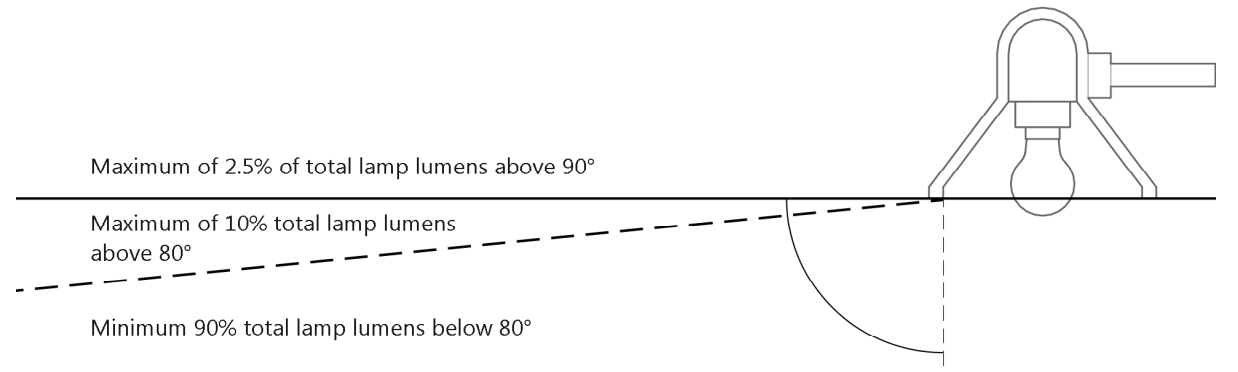
Figure 070-1: Full Cut-Off Fixture
Fully shielded light. Light fixtures shielded or constructed so that no light rays are directly emitted by the installed fixture at angles above the horizontal plane as certified by a photometric test report. The fixture must also be properly installed and adjusted to effectively down direct light in order to comply with the definition. Exemptions from this definition may be allowed for aesthetic lighting elements, such as shades with perforated patterns and opaque diffusers. (Figure 070-2)
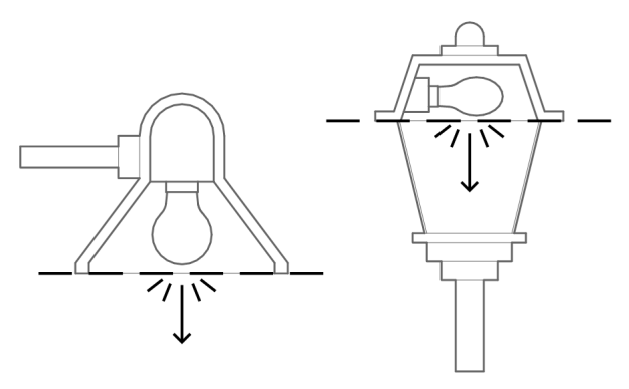
Figure 070-2: Fully Shielded Light
Functional turf. An irrigated grass area that provides a recreational benefit to the community and is:
a)
Located at least ten (10) feet from a street, installed on slopes less than twenty-five (25) percent and not installed within street medians, along streetscapes or at the front of entryways to parks, commercial sites, neighborhoods, or subdivisions.
b)
Active/programmed recreation turf, athletic fields, designated-use-area turf, golf course play areas, some pet relief turf, playground turf or resident area turf.
Gable roof. A pitched roof with a ridge and vertical ends.
Ghost sign. An old sign which may or may not be applicable to the building or use where it is located that appears faded and is not maintained. Ghost signs must be designated as historical signs. Ghost signs usually appear on masonry structures and the image appears when wet.
Glare. An intense light that is overpowering and visually unpleasant.
Golf course play area. Grass in driving ranges, chipping and putting greens, tee boxes, greens, fairways and rough.
Grade, finished. The average of the ground elevations at the center of all walls of a building, following completion of site grading. If a wall is parallel to and within five (5) feet of a sidewalk, finished grade is measured at the sidewalk.
Gross floor area. The total square footage of all finished and unfinished and enclosed floors of the building, including but not limited to living areas, garages, storage, utility spaces, and enclosed porches. Crawl spaces are not included in gross floor area calculations.
Gross income. The total income, including alimony and child support, derived from a business, trust, employment, Social Security benefits of any type and from income-producing property, before deductions for expenses, depreciation, taxes, and similar allowances.
GSHPC. The Glenwood Springs Historic Preservation Commission.
Hardship. A condition by which the property in question cannot be put to reasonable use under existing regulations, subject to a showing of proof under Subsection 070.060.070(a), Variance.
Heat island effect. Developed or built up areas that are hotter than undeveloped or rural areas due to the sun's effect on dry exposed surfaces such as roofs and pavement. Heat islands typically occur during the day and at night, and are stronger during the hot summer months.
Height, building. See "Building Height."
Height, sign. For freestanding signs, the vertical distance between the average elevation of the ground adjoining the sign and the level of the highest point of the sign.
High intensity discharge light source (HID). A light source characterized by an arc tube or discharge capsule that produces light, with typical sources being metal halide, high pressure sodium, and other similar types which are developed in accordance with accepted industry standards.
Hip roof. A roof with sloped ends instead of vertical ends.
Historic building, improvement, structure, site, or object. A building, structure, site, or object that that has been designated by the City Council pursuant to Article 070.050: Historic Preservation, as a local landmark or as contributing to a local historic district; or that is officially designated or has been determined eligible to be on the national or state registers of historic places.
Historic designation sign. A sign, designated by the City Council, as having historical significance to the City.
Historic district. An area designated as an "historic district" by ordinance of the City Council, which may contain within definable geographic boundaries one (1) or more landmarks, and which may have within its boundaries other properties, improvements or structures that, while not of such historic and/or architectural significance to be designated as landmarks, nevertheless contribute to the overall visual characteristics of the landmarks located within the historic district.
Holiday decorations. Ornamental materials temporarily displayed on traditionally accepted holidays.
Holiday lighting. Lighting displays from November 15 through February 28 of the following year.
Hydrozone. Landscape zones of different water requirements that group plants together with similar water needs in the following four (4) categories:
a)
High hydrozone: Eighteen (18) gallons/s.f./season.
b)
Moderate hydrozone: Ten (10) gallons/s.f./season.
c)
Low hydrozone: Three (3) gallons/s.f./season.
d)
Very low hydrozone: Zero (0) gallons/s.f./season.
Illuminating Engineering Society (IES). The Illuminating Engineering Society is an association of professionals in the field of lighting and related professions. Its membership is made up of engineers, architects, designers, manufacturers, contractors, distributors, utility personnel, educators, students, and scientists.
Illumination, direct. Lighting by means of an unshielded light source, including neon tubing but not including electronic message signs, that is effectively visible as part of a sign, where light travels directly from the source to the viewers' eyes.
Illumination, indirect. Lighting by the surface of a light source that is directed at the reflecting surface in such a way as to illuminate the sign from the front or a light source that is primarily designed to illuminate the entire building façade upon which a sign is displayed, but does not include lighting that is primarily used for purposes other than sign illumination, including without limitation, parking lot lights or lights inside a building that may silhouette a window sign that are not primarily installed to serve as illumination of a sign.
Illumination, internal. Lighting by means of a light source that is within a sign having a translucent background and silhouettes opaque letters or designs, or that is within letters or designs that are themselves made of translucent material.
Impervious surface. An asphalt, concrete, or other surface that is not a component of a porous paving system.
Improvements. For the purposes of this Code, the community public works and facilities determined to be necessary in relation to proposed development, including, but not limited to; access drives, landscaping, parking facilities, sanitary sewers, site and street lighting, storm drainage facilities, street facilities, traffic control facilities, and water facilities. All required improvements shall comply with current requirements and standards as established in this Code and other applicable sections of the Municipal Code.
Inclusionary community housing. The policy of requiring community housing in residential developments to ensure adequate housing stock for local residents and to maintain or increase the current ratio of primary to second home ownership in the City of Glenwood Springs.
Infill residential. Residential development on a parcel or tract of land that shares a common lot line with at least two (2) existing single-family homes and is located within a residential zoning district. Infill development generally occurs on lots that are already subdivided, and that are less than one (1) acre in size and located within established single-family neighborhoods; however, some larger parcels may also be included in this definition.
Inflatable sign. Any sign of non-rigid material that utilizes air or other gases, either under pressure or heated, to maintain its shape.
Initial sales price. The maximum price for which a price capped community housing for sale unit may be initially sold.
Interior sign. See "window sign."
Lamp. A bulb, an outer glass envelope, and metal base enclosing a filament or arc tube and electrodes.
Landmark. A property or structure designated as a landmark by ordinance of the City Council, pursuant to procedures prescribed herein, that is worthy of rehabilitation, restoration and preservation because of its historic and/or architectural significance to the City.
Landmark alteration certificate. A certificate issued after approval of plans for alteration, construction, removal or demolition of a landmark or of a structure within an historic district.
Landscape elements. Annual plants, benches, chairs, perennial plants, planters, shrubs, statuaries, trees, yard ornaments, and similar elements.
Landscape strip. A landscaped area located within the public right-of-way between the sidewalk and the edge of curb or pavement.
Landscape, landscaping. Live plant materials or areas designed, planted, preserved, and maintained with live plant materials, including perennial ground covers, trees, shrubs, and grasses.
Legally subdivided. Land that has been the subject of a plat filed with the Garfield County Clerk and Recorder that legally establishes boundaries or lot lines or for which a subdivision approval has been issued.
Light pollution. The excess illumination of the nighttime environment that results in the loss of visibility of the stars.
Light source. The element of a lighting fixture that is the point of origin of the lumens emitted by the fixture.
Light trespass. The shining of light produced beyond the boundaries of the property on which it is located, where light is produced by a light fixture or reflected light.
Limits of disturbance. The specific area(s) of a site established pursuant to Subsection 070.040.020(a)(4), Limits of Disturbance, within which construction and development activity shall be contained. The limits of disturbance shall be shown on the site/architectural plan and shall include all principal and accessory buildings and structures, driveways, septic fields, and areas used during construction activities.
Linear lighting. The use of visible or concealed light sources, including neon tubes, fluorescent tubing, and other surface-mounted or recessed light sources that describe or outline the features of a structure such as the roofline, all or part of the perimeter, the façade, walls, soffit, or other structural component, that results in the attraction of attention to the feature or structure. Lighting of drive-under canopies with a light band a maximum of ten (10) inches in width and that emit a light level of one and one-half (½) foot-candles or less, measured ten (10) feet from the source, are exempted from this definition.
Lot. A unit, plot, or parcel of land or assemblage of contiguous parcels of land as established by survey, plat, or deed.
Lot Coverage. The percentage of a lot area occupied by the ground area of principal and accessory buildings or structures excepting the percentage covered by ground-mounted small scale solar energy systems.
Lumen. A measure of light energy generated by a light source. Manufacturers list lumen ratings for all their lamps. Average lumen ratings are slightly lower than initial lumen ratings, as all light sources produce less light as they age.
Marquee. A permanent, rigid, flat, roof-like structure attached to and wholly supported by a building, and projecting over the primary entrance to a building.
Marquee sign. A sign depicted upon, attached to, or supported by a marquee.
Masonry. Stonework, brickwork, or concrete masonry unit (CMU) bonded with mortar by a mason.
Master plan. An optional procedure for large and complex projects whereby an applicant may obtain overall entitlements of a development project prior to submitting for site/architectural plan and/or construction plan approval pursuant to the procedures in Subsection 070.060.050(b), Master Plan.
Master sign plan. A comprehensive sign program for a multi-use building or multi-building commercial development.
Maximum extent feasible. As determined by the Director, no feasible and prudent alternative exists, and all possible efforts to comply with the regulation or minimize potential harm or adverse impacts have been undertaken. Economic considerations may be taken into account but shall not be the overriding factor in determining "maximum extent feasible."
Maximum extent practicable. The degree to which a project meets an adopted standard in which all possible efforts to comply with the standard or to minimize harmful or adverse effects have been undertaken by the applicant, but full compliance cannot be achieved, and no feasible or practical alternative exists. Economic considerations may be taken into account, but shall not be the overriding factor determining "maximum extent practicable."
Mean average. The mean average is calculated by summing all values in a series and dividing by the number of values in that series. For example, the mean average of the values 5, 7, 9, and 11 is 8 (5+7+9+11/4 or 32/4 = 8).
Mechanical and utility equipment. Mechanical and utility equipment includes, but is not limited to transformers, air conditioning units, heating and soft water tanks, television antennas/satellite dishes, security apparatus, and electric and gas meters. Mechanical and utility equipment does not include solar panels.
Median average. The median average is calculated by taking the "middle" value of all values in a series. For example, the median average of the values 5, 7, 8, 9, and 10 is 8 (two (2) values are below 8 and two (2) values are above 8). In the case where there is an even number of values, the median average shall equal the mean average of the middle two (2) values. For example, the median average of the values 5, 7, 9, and 11 is 8 (mean average of 7 and 9, or 9+7/2 = 8).
Minor subdivision. Any subdivision meeting the applicability standards in Subsection 070.060.060(a), Minor Subdivision.
Mobile home, dependent. Means a mobile home that has no toilet, bathtub or shower facilities.
Mobile home, independent. Means a mobile home that has a toilet and a bathtub or shower.
Mobile home space. Means a plot of ground within a mobile home park designated for the accommodation of one (1) mobile home.
Monument sign. A freestanding ground sign typically containing design elements such as a base, columns, borders, topper, or cap specifically intended for the display of the sign.
Multi-family development. A structure or part thereof designed exclusively for occupancy by two (2) or more families and commonly referred to as a duplex (two-family dwelling), triplex, fourplex, townhouse, or apartment house.
Multi-tenant building. Any nonresidential building with more than one (1) tenant or use. The issuance of multiple sales tax licenses by the City is not necessarily a criteria to determine multiuse building status.
Natural grade. The vertical elevation of the existing ground surface prior to excavation, filling, or disturbance.
Neighboring. A lot or parcel of land that shares a common lot line(s) with another lot or parcel of land. A property that shares only a corner with another property is excluded from this definition.
Nonconforming lot. A lawfully established lot created prior to adoption of this Code that does not comply with the minimum lot size requirements of this Code.
Nonconforming sign. A lawfully established sign constructed or installed prior to adoption of this Code that does not comply with the sign regulations of this Code.
Nonconforming sign. Any sign that was lawfully erected and maintained under prior codes but that does not meet the provisions of this Code.
Nonconforming site feature. Any driveway, off-street parking and loading, landscaping, buffer, screening, or exterior lighting that lawfully existed prior to adoption of this Code but does not comply with the driveway, off-street parking and loading, landscaping, buffer, screening, or exterior lighting standards of this Code.
Nonconforming structure. A lawfully established building or structure constructed or installed prior to adoption of this Code that does not comply with the area, height, or placement regulations of this Code.
Nonconforming use. A use that lawfully existed prior to adoption of this Code, but does not comply with the terms of this Code.
Nonconformity. An existing use, structure, lot of record, or sign that was lawfully established prior to the effective date of this Code and that does not conform to one (1) or more provisions of this Code.
Nonconformity, illegal. An existing use, structure, lot of record, or sign that does not conform with one (1) or more provisions of this Code and that was not lawfully established before the effective date of this Code.
Noncontributing. A "noncontributing" property does not add to historic architectural qualities, historic associations, or archaeological values, usually because of alterations, additions or other changes. If the property no longer possesses integrity reflecting its character at the time or is incapable of yielding information about the period, then it is considered noncontributing. Many buildings are rated noncontributing simply because the building was constructed within the last fifty (50) years.
Non-infill residential. Residential development, on a parcel not zoned residential or on a parcel or tract of land, zoned residential, which shares common lot lines with fewer than two (2) existing single-family homes. Non-infill development will generally occur in non-residential zone districts or on residentially-zoned parcels located outside of established single-family neighborhoods; however, some parcels greater than one (1) acre in size located in established single-family neighborhoods may also be included in this definition.
Nonliving ground cover. Any material used in landscaping including, but not limited to, concrete, gravel, bark, mulch, asphalt, stone and brick.
Nonstructural trim. The molding, battens, caps, nailing strips, latticing, cut-outs, letters, and other nonessential structures that are attached to the sign structure.
Occupancy. The purpose for which a building or structure is used or intended to be used; and, in the case of residential uses, such term can also refer to the number of persons who reside within a building, dwelling unit, or other structure.
Off-premises sign. Any off-premises sign, including without limitation, a billboard or general outdoor advertising device, that directs attention to a use, product, service, or activity conducted, sold or offered elsewhere than on the same property or within the same building upon which such sign is located.
Off-site parking. A site or portion of a site devoted to the off-street parking of motor vehicles, including parking spaces, aisles, access drives, and landscaped areas that is located outside the subject property boundary.
Off-street parking. Parking that is not located in a public or private right-of-way.
Open space. An area or areas suitable for passive and/or active recreational use, that provides visual relief to developed areas or that is set aside to protect water, air, wildlife habitat, vegetation, or significant or scenic views providing benefit to the particular development, surrounding environment, and/or surrounding community.
Open space, active. Common open space improved with permanent recreational facilities such as trails, playground equipment, ball courts, or playing fields.
Open space, common. A type of open space reserved for the use of the residents of a development or subdivision and their guests for passive and/or active recreation.
Open space, passive. Common open space lacking permanent recreational improvements.
Open space, private. The outdoor living area adjoining a dwelling unit or owned by or otherwise limited to the use of the residents of a particular dwelling unit. Examples include private patios, courtyards, and yard areas.
Ordinary repairs and maintenance. Work done on a building in order to correct any deterioration of, decay of or damage to a building or any part thereof in order to restore the same as nearly as practical to its condition prior to such deterioration, decay or damage.
Orient. To bring in relation to, or adjust to, the surroundings, situation, or environment; to place with the most important parts facing in certain directions; and/or to set or arrange in a determinate position.
Owner of record. The person, corporation, or other legal entity listed as owner on the records of the County Clerk and Recorder.
Parapet. The extension of the main walls of a building above the roof level.
Parcel. An area within legally described boundaries under common ownership and capable of being separately conveyed.
Park models. A trailer-type recreational vehicle designed to provide temporary accommodation for recreation, camping, or seasonal use. Park models are not intended to be permanently affixed to the property as a residence.
Parking area. A contiguous area provided for parking, including driveways, maneuvering space, parking lot landscaping areas, snow storage areas, and other ancillary space in addition to vehicle parking spaces.
Parking demand. The total number of off-street parking spaces needed to park the vehicles associated with the operations of and individuals present at a particular site, use, or structure.
Permanent sign. Any sign that is permanently affixed or attached to the ground or to any structure.
Pet relief area. Grass at a property providing commercial and retail services for pets, such as veterinarian and boarding facilities. The area must not exceed two hundred (200) square feet.
Phasing. A plan for construction of a development in portions over time, including time ranges that shall be specified in the development application.
Photocell. A type of resistor that can be used to detect light. Also commonly known as a CdS (Cadmium-Sulfide) cell, photoresistor, or LDR (light dependent resistor).
Planned unit development (or PUD). A development designed to accommodate varied types of development in patterns or layouts not otherwise permissible in other zoning districts established by this Code. Planned Unit Developments are designed to provide additional amenities or benefits to the City in return for flexibility in the design, layout, and dimensions of the development. Approval of a PUD shall require a rezoning pursuant to Subsection 070.060.040(b), Rezoning to PUD.
Planning commission. The Planning and Zoning Commission of the City of Glenwood Springs.
Plat. A map delineating the subdivision of land, commonly showing lots, blocks, streets, and other features relevant to the development of land pursuant to this Code, used as an instrument for recording real estate interests with the Garfield County Clerk and Recorder.
Playground turf. Grass in designated play areas with playground amenities, including, but not limited to, slides, swings and climbing structures on homeowner association owned/managed property or at a public park, water park, school, daycare, recreation center, senior center or religious institution. Playground turf may be located less than ten (10) feet from a street if fenced.
Pole sign. A freestanding sign erected on a frame, mast, or pole that is affixed to the ground and not attached to any building.
Porch. Any gallery, veranda, piazza, portico, or similar projection from the main wall of a building and covered by a roof, other than a carport, with no opaque side enclosures (except screens and handrails) that is more than thirty-six (36) inches in height.
Porous paving system. A system providing erosion control, softening hard surfaces, reducing stormwater/snowmelt runoff, and/or providing green space. The system includes concrete, plastic, or other systems which may incorporate grass or other landscaped spaces.
Portable sign. Any sign not permanently attached to the ground or a building, not including signs attached to vehicles, except vehicles parked specifically for the purpose of signage.
Premises. The land, building, or portion of the building occupied by the land use or activity being conducted.
Primary material. Material covering seventy (70) percent or more of the exterior wall elevations.
Primary street. The street from which the development faces or is accessed. Primary street frontages do not include alleys, interior parking courts, or other secondary access points.
Principal use. The primary or predominant use of any lot, building, or structure.
Projecting sign. A sign attached to a building or extending in whole or in part fifteen (15) inches or more horizontally beyond the façade of a building to which the sign is attached, but does not include a marquee sign.
Public hearing. A formal meeting held under public notice intended to inform the public and obtain public input.
Public improvements. Any improvement, facility, or service, together with its associate site and any right-of-way necessary to provide transportation, drainage, utilities, or similar essential services and facilities, that is usually owned and operated by a government entity or agency.
Public sign. A sign required by the local and/or state government, or signs erected or required by other government agencies, utilities, or special districts, including address signs, signs for traffic, schools, safety, railroad crossing, wayfinding, civic and special events, public notices, and other official and legal notices.
Reader board. An accessory sign cabinet contained within a distinct border that allows for changeable copy.
Recreation, active. Outdoor leisure activities requiring permanent recreational improvements to the area in which they are performed. These areas are intensively used and may include improvements such as trails, playground equipment, ball courts, or playing fields.
Recreation, passive. Outdoor leisure activities that do not require permanent recreational improvements to open space areas. Examples include picnicking, hiking unimproved trails, enjoyment of scenery, and play in open grassy areas.
Recreational vehicle. Means a portable structure not more than eight (8) feet wide and thirty-five (35) feet long that is designed for extended highway travel, to be driven as or pulled by a private vehicle which requires no special permit for the same, and which is intended as a portable dwelling for vacation and recreational purposes only; or a camp car, motorhome or tent trailer, with or without motor power, and identified as a recreational vehicle by the manufacturer.
Redevelopment. Development on a tract of land with existing structures where all or a majority of the existing structures would be razed and a new structure or structures built.
Reflected light. The light that is reflected off surfaces, becoming a secondary light source.
Related accessory equipment. The transmission equipment customarily used with, and incidental to WCF antennas, including by way of example, coaxial or fiber-optic cable, regular and backup power supply and remote radio units.
Relocation. Any relocation of a structure on its site or to another site.
Repair. The reconstruction or renewal of any part of an existing building for the purpose of its maintenance.
Required rear yard. A yard extending the full width of the lot, the depth of which is measured in the horizontal setback distance, based on the applicable zoning district and are set forth in Article 070.020: Zoning Districts, from the rear lot line.
Resident area turf. Grass up to one hundred fifty (150) square feet per dwelling unit at multi-family residential properties, multi-family mixed use properties, or assisted living and rehabilitation centers used by tenants for recreation or leisure. May not be located in parking lots, streetscapes or other non-accessible areas.
Resident occupied community housing. Housing with a deed restriction recorded against it requiring that it be owned or occupied by an employee/qualified resident as its primary residence as set forth in this article and the City of Glenwood Springs Housing Residency Requirements and Guidelines.
Rezoning. A change in the zoning district classification applied to land by the Zoning Map, reviewed and decided by the City Council under Subsection 070.060.040(a), Rezoning.
Right-of-way. Any strip or area of land, including surface, overhead, or underground, granted by deed, easement, dedication, prescription, or lease, for construction and maintenance according to designated use, such as for streets and highways, drainage ditches, irrigation canals, etc.
Roof form. The shape of a roof, of which there are many variations. The most common roof forms are sloped roofs (roofs constructed of flat sections that are sloped) and flat roofs. Sloped roofs include side gable roofs or end gable roofs (based on whether the gable ends are on the sides or front and back of the building), and may have dormers. The edges of flat roofs (particularly along the front of a building) are commonly defined by parapets and/or cornices.
Roof sign. A sign painted on the roof of a building, supported by poles, uprights, or braces, extending from the roof of a building, or projecting above the roof of a building, but does not include a sign projecting from or attached to a façade wall.
Run. When associated with backyard chickens, a "run" is an enclosed and secured facility where chicken hens are able to move around more freely than within a chicken coop.
Screening. A method of visually shielding or obscuring a nearby structure, building, or use on an abutting or adjacent property or lot from another by fencing, walls, berms, or densely planted vegetation.
Setback. The minimum distance between a lot line and a building or structure required by this Code.
Shared parking. The joint use of a parking area by more than one (1) use.
Sidewalk. Any portion of the street between the curb, or the lateral line of the roadway and the adjacent property line, intended for the use of pedestrians.
Sight distance triangle. The area around an intersection where no obstructions above forty-two (42) inches in height are permitted, and as specifically determined by the City Engineer as prescribed in the Engineering Standards.
Sign. Any object or device or part of an object or device situated outdoors that is used to identify, direct, or attract attention to an object, person, institution, organization, purpose, product, service, contract, event, or location by means of copy. Examples include: words, letters, figures, designs, symbols, fixtures, colors, motion, illumination, or projected images that are visible from any street, alley, or other public right-of-way.
Sign area. The entire area contained within the face of a sign, including all ornamentation or decoration used to attract attention. The sign area shall be the sum of the area of all letters, words, or symbols that can be contained in lines forming the smallest plane geometric shapes around all such letters, words, or symbols having eight (8) or fewer segments.
Sign on a parked vehicle. A sign placed on or affixed to vehicles and/or trailers that are parked on a public right-of-way, public property or private property so as to be visible from a public right-of-way where the apparent purpose is to advertise a product, use, service, or activity or direct people to a property.
Sign structure. Any supports, uprights, braces, or framework of a sign.
Significance. The value placed on a building relating to its architectural or historical importance, as defined by Article 070.050: Historic Preservation.
Single-tenant building. A building occupied by one (1) tenant or use.
Site/architectural plan. A plan drawn to scale showing uses and structures proposed for a lot or parcel.
Site/architectural plan approval. Approval of site/architectural plans according to the procedures in Subsection 070.060.050(a).
Site-specific development plan. A plan that has obtained final development approval under the standards and procedures contained in this Code, and that describes with reasonable certainty the type and intensity of use for a specific parcel or parcels of property, and includes all terms and conditions of approval. A site-specific development plan includes only the following application types:
a.
Master plan;
b.
Administrative site/architectural plan;
c.
Minor site/architectural plan;
d.
Major site/architectural plan;
e.
Planned unit development; and
f.
Final plat.
Special use permit. A permit issued pursuant to Subsection 070.060.050(e), Special Use Permit, for uses designated in the allowable use table (Table 030.1) as requiring special use permit approval.
Start of construction. The date the building permit was issued, including substantial improvements, provided that the actual start of construction, repair, reconstruction, rehabilitation, addition, placement or other improvement was within one hundred eighty (180) days of the permit date. The actual start means the first placement of permanent construction of a structure on a site, such as the pouring of slab or footings, installation of piles, construction of columns or any work beyond the stage of excavation or the placement of a manufactured home on a foundation.
Stop work order. An order issued by the Director that directs the person responsible for an activity in violation of this Code to cease and desist such activity.
Street. Any highway, street, avenue, or common place or square, bridge, viaduct, underpass, overpass, tunnel or causeway, dedicated to the City or otherwise devoted to common public use, excluding alleys.
Street, private. A way of access to two (2) or more parcels of land that is open to vehicular ingress and egress, and that is owned and maintained by affected property owners, but that is not considered to be a driveway.
Streetscape. Landscape materials located adjacent to street rights-of-way intended to enhance, soften, or screen the view of a building, structure, or land use.
Structure. Anything that is constructed or erected and located on or under the ground, or attached to something fixed to the ground, including a walled and roofed building, wall, fence, pergola, and/or a gas or liquid storage tank that is principally above ground.
Subdivision. The division of a lot, tract, or parcel of land into two (2) or more lots, sites, or other divisions for the purpose, whether immediate or future, of sale, lease, or building development, including any resubdivision. In some contexts, the term "subdivision" may also describe the process of subdividing land or the land subdivided.
Substantial compliance. Unless a specific permit or process establishes different criteria, a permit or plan substantially complies with the applicable approval criteria if the proposed use or development: does not significantly (i) alter the basic relationship of the proposed development to adjacent property; (ii) change the uses permitted; (iii) increase the maximum density, floor area ratio, or height; (iv) decrease the amount of required off street parking; or (v) reduce the minimum yards required at the boundary of the site.
Suspended sign. A sign suspended from the ceiling of an awning, marquee, or canopy.
Tandem parking. A parking space in which two (2) vehicles are parked end-to-end or stacked vertically using lift equipment and in which one (1) vehicle must be moved before the second vehicle can access a street, driveway, alley, parking lot, or parking garage driving aisle.
Temporary Sign. A sign, banner, or similar device or display that is intended for a limited duration of display.
Temporary use. Any outdoor retail and/or wholesale sales use on a short-term basis, including, but not limited to: produce stands, peddlers, solicitors, hawkers, itinerant merchants, and transient merchants, and excluding temporary promotions or sidewalk sales by permanent businesses on their own property.
Temporary use permit. A permit issued pursuant to Section 070.030.050, Temporary Uses and Structures.
Time-temperature-date sign. A sign that displays the current time, outdoor temperature, date of the month, or any combination of that information.
Tract. An area, parcel, site, piece of land, or property that is the subject of a development application. For subdivisions, the term is used for units of land created for and limited by deed restriction or dedication to a specific use, including access, utility placement, open space, or natural resource areas.
Traffic-control sign. Any government sign used to direct or control the movement of motor vehicles and/or pedestrians within public streets, alleys, or rights-of-way.
Tree lawn. See "landscape strip."
Twinkle lighting. String lighting of low voltage (not greater than 2.5 volts per light).
Uniformity ratio. The ratio of average illumination to minimum illumination (unless noted otherwise).
Use. The utilization of land and property as permitted by this Code. Allowable uses for each zoning district are listed in Table 030.1.
Variance. A development permit authorizing a deviation from the standards of this Code where strict application of this Code results in a hardship due to circumstances with a particular lot and that is reviewed and decided pursuant to Subsection 070.060.070(a), Variance.
Vertical foot-candles. A measurement of illuminance intensity on a vertical surface, such as a wall or billboard.
Vested property right. The right to undertake and complete the development and use of property under the terms and conditions of a site-specific development plan and any accompanying permit or agreement.
Walkway. An off-street hard-surfaced walk or raised pedestrian path.
Wall sign. A sign displayed upon or against the wall of an enclosed building, where the exposed face of the sign is in a plane parallel to the plane of the wall and extends no more than fifteen (15) inches horizontally from the face of the wall.
Wetland. An area that is inundated or saturated by surface water or groundwater at a frequency and duration sufficient to support, and under normal circumstances does support, a prevalence of vegetation typically adapted for life in saturated soil conditions.
Wind sign. A sign consisting of one (1) or more flags, pennants, ribbons, spinners, streamers, captive balloons, or other objects or material fastened in such a manner as to move upon being subjected to pressure by wind.
Window sign. A sign that is painted on, applied, or attached to, or located within fifteen (15) inches of the interior of a window and that can be seen through the window from the exterior of the structure, but excludes merchandise included in a window display.
Yard sign. A non-permanent sign constructed of paper, vinyl, plastic, wood, metal, or other material that is intended to be displayed for a limited duration.
Zoning district. A specific delineated area on the Zoning Map within which uniform standards govern the use, placement, spacing, size, and form of land and buildings.
Zoning map. The official zoning map as adopted by the City of Glenwood Springs.
(Ord. No. 19-2018, § 2(Exh. A), 8-2-2018; Ord. No. 8-2020, § 2(Exh. A), 5-7-2020; Ord. No. 15-2020, § 2(Exh. A), 7-2-2020; Ord. No. 1-2021, § 2(Exh. A), 2-18-2021; Ord. No. 3-2021, § 2(Exh. A), 5-20-2021; Ord. No. 18-2021, § 2(Exh. A), 1-6-2022; Ord. No. 31-2022, § 2(Exh. A), 1-5-2023; Ord. No. 9-2023, § 2, 10-26-2023; Ord. No. 15-2023, § 2(Exh. A), 10-5-2023)

