
Glenwood Springs City Zoning Code
ARTICLE 070
080 - GUIDELINES AND REGULATIONS FOR MATTERS OF STATE INTEREST
070.080.010 - Purpose and Findings.
(a)
Purpose. The purpose and intent of the regulations set forth in this article is to facilitate the identification, designation, and administration of matters of state interest consistent with the statutory requirements and criteria set forth in C.R.S. § 24-65.1-101 et seq. and the guidelines established in the Comprehensive Plan, as well as the following:
(1)
To regulate the site selection and construction of major facilities of public utilities, domestic water and sewage treatment systems, and/or major extensions of such facilities and systems in order to ensure that the same are conducted in areas which will result in the proper utilization of existing facilities and the orderly development of the same within the City and adjacent communities;
(2)
To regulate development in areas containing, or having a significant impact upon, historical, natural, or archaeological resources of statewide importance; and in areas around key facilities in which development may have a material effect upon the key facility or the surrounding community;
(3)
To regulate the site selection of rapid or mass transit terminals, stations, and fixed guideways to ensure that the same are located in a manner that will avoid conflicts with the City's land use plans; minimize congestion in the streets; secure safety from fire, floodwaters, and other dangers; promote health and general welfare; provide adequate light and air; prevent the overcrowding of land; avoid undue concentration of population; and facilitate the adequate provision of transportation, water, sewerage, schools, parks, and other public requirements;
(4)
To prevent potential redundancy of services associated with the site selection and construction of major new domestic water and sewage treatment systems and extensions thereof, which may increase costs on existing system users, limit improvements and maintenance of existing systems, perpetuate disorganized development, and alter the City's character;
(5)
To prevent unsuitable site selection and construction of major facilities of public utilities, which may harm the scenic and recreational assets that are essential to the City's economy;
(6)
To protect the beauty of the landscape and natural scenic characteristics, to conserve natural and cultural resources, to preserve historical assets and resources, to protect and enhance wildlife habitat, air and water quality, and to conserve natural resources;
(7)
To ensure that municipal and industrial water projects are developed efficiently to prevent damage to the City's water sources and riparian assets by poorly planned growth and project development that does not rely on existing facilities;
(8)
To minimize environmental impacts in the City associated with such matters of state interest, including significant deterioration or degradation of existing air and water quality in the City's watershed and view corridors with and surrounding the City;
(9)
To avoid or reduce incompatible uses and adverse impacts to City roads, parks, open spaces, natural resources, and trails, as well as areas adjacent thereto, by minimizing impacts to areas or by activities of state interest within the City;
(10)
To ensure proper planning and development in a manner so as not to impose an undue economic burden on existing or proposed communities;
(11)
To ensure that the off-site impacts of development, site selection, construction, and extension of facilities or systems designated as activities of state interest or within areas of state interest are effectively mitigated;
(12)
To ensure that urban development, population densities, and site layout and design are accomplished in a manner that will prevent the pollution of aquifer recharge areas and water resources;
(13)
To ensure that municipal and industrial water projects and major facilities of public utilities, including, but not limited to, transmission lines, power plants, substations, storage areas, and pipelines are located to avoid conflict with City land use plans;
(14)
To regulate municipal and industrial water projects that could cause extensive water and air pollution or that would otherwise degrade or threaten environmental quality within the City or the beauty of its landscape and the integrity of its waterways;
(15)
To ensure that municipal and industrial water projects emphasize the most efficient use of water, including to the extent permissible under existing law, and when appropriate, the recycling, reuse, and conservation of water;
(16)
To ensure that development planned in areas containing, or having a significant impact upon, historical, natural, or archaeological resources of statewide importance; and in areas around key facilities in which development may have a material effect upon the key facility or the surrounding community proceeds in a manner consistent with protection of those resources and the surrounding communities;
(17)
To provide planned and orderly use, development, and regulation of land and water resources and protection of the environment in a manner consistent with constitutional rights and private property rights;
(18)
To ensure that major extensions of municipal and industrial water systems be permitted only in areas in which the anticipated growth and development that may occur as a result of such extensions can be accomplished within the financial and environmental capacity of the area to sustain such growth and development;
(19)
To avoid or reduce conflicts with the Comprehensive Plan;
(20)
To protect the character of the City and surrounding area;
(21)
To promote the efficient and economic use of public resources; and
(22)
To preserve the health and welfare of the citizens of the City.
(b)
Findings. The City Council finds that:
(1)
The notice and public hearing requirements of C.R.S. § 24-65.1-404 have been followed.
(2)
These regulations are necessary because of the intensity of current and foreseeable development pressures on and within the City.
(3)
These regulations apply to entire territorial extent of the City, as may be altered over time.
(4)
These regulations interpret and apply to any provisions adopted for specific areas of state interest and specific activities of state interest which have been, or may be, designated by the City Council.
(Ord. No. 09-2022, § 2(Exh. A), 3-3-2022)
070.080.020 - Authority.
The regulations set forth in this article are authorized by, inter alia, C.R.S. §§ 24-65.1-101 et seq., 31-23-101 et seq., 29-20-101 et seq., 24-32-111, Title 31, Article 15, and the City of Glenwood Home Rule Charter.
(Ord. No. 09-2022, § 2(Exh. A), 3-3-2022)
070.080.030 - Applicability.
These regulations apply to all proceedings concerning the identification, designation, and regulation of any area or activity of state interest and any developments affecting any such area or activity of state interest, whether on public or private land, within the territorial boundaries of the City so designated by the City Council, as follows:
(1)
The site selection for all major new domestic water and sewage treatment systems located wholly or partially with the boundaries of the City and the construction, expansion, or major extension thereof as defined at Section 070.080.090.
(2)
The site selection of major facilities of any public utility to be located wholly or partially within the boundaries of the City.
(3)
Development in designated areas containing, or having a significant impact upon, historical, natural, or archaeological resources of statewide importance.
(4)
Development in designated areas around key facilities in which development may have a material effect upon the key facility or the surrounding community.
(5)
The site selection, development, including construction, expansion, or major extension or change in use or character of a municipal and/or industrial water project located wholly or partially within the boundaries of the City.
(6)
The site selection of rapid or mass transit terminals, stations, and fixed guideways, except that a permit under this article shall not be required for the addition or relocation of a bus stop on an existing bus route that does not require the addition of a parking area or vehicle turnaround.
(7)
A permit shall not be required for the following activities relevant to the major facilities of a public utility: Repair of storm damage, reframing, pole replacement, re-conductor and maintenance in the normal course of business without increasing the voltage rating of a transmission line, or reconstructing, upgrading, or replacing substation equipment inside an existing substation or within an existing substation fence.
(8)
This article shall not apply to interstate natural gas pipeline facilities regulated peremptorily by the Federal Energy Regulatory Commission ("FERC"), or its successor, provided the applicable federal and state requirements and procedures are complied with in the siting and construction of the interstate natural gas pipeline when partly located within the City.
(9)
A municipal or industrial water project or sewage treatment system is exempt from this article if it falls within one (1) of the following categories:
a.
The maintenance, repair, or replacement of an existing component of a facility if it does not constitute a material change, does not cause negative impacts different from the existing facility, and does not otherwise exacerbate existing impacts.
b.
Replacement of an existing water diversion or storage structure without change in the point of diversion, type or place of use of the water, or yield.
c.
A proposed municipal or industrial water project with a new or increased diversion per year, or a new or increased storage capacity of less than one hundred (100) acre-feet.
(10)
The requirements of these regulations shall not be deemed to waive the requirements of C.R.S. § 40-5-101 et seq., if applicable, that a public utility obtain a certificate of public convenience and necessity.
(Ord. No. 09-2022, § 2(Exh. A), 3-3-2022)
070.080.040 - Exemptions.
(a)
The regulations in this article shall not apply to any development in any area of state interest or any activity of state interest if, on the effective date of these regulations:
(1)
The specific and full scope of development or activity is authorized by a valid land use approval or building permit, as applicable, issued by or on behalf of the City;
(2)
The specific and full scope of development or activity was directly approved by the electorate of the City; provided however, that the approval by the electorate of any bond issue shall not in and of itself be construed to be an approval of the specific development or activity;
(3)
The specific and full scope of development or activity is to be on land which has been finally approved by the City for planned unit development or for a use other than a subdivision substantially the same as a planned unit development, and a site-specific development plan has been approved by the City prior to the effective date of these regulations for the development or activity which would otherwise be subject to these regulations;
(4)
The specific and full scope of development or activity is to be on land which has been zoned by the City expressly and specifically for a use by right for the use contemplated by the development or activity and a site-specific development plan has been approved for the specific development or activity which would otherwise be subject to these regulations.
(b)
The regulations in this Article 070.080 shall not apply to the division, subdivision, or resubdivision of land which complies with Title 070 of this Code, as long as the requirements set forth in this article are addressed in the land use approval process.
(c)
The regulations in this Article 070.080 shall not apply to the day-to-day operations of an existing project or facility, or a non-material change in the operation of an existing project or facility, including retrofitting or updating technology, so long as the change in operation does not constitute a material change and does not cause impacts different from that of the existing facility or project or otherwise exacerbate existing impacts. The determination of material change and exacerbating impacts shall be made by the Community Development Department.
(d)
The regulations in this Article 070.080 shall not apply to any use or structure otherwise lawfully existing on the date the area or activity is designated or subjected to these regulations which use or structure becomes nonconforming as a result of the adoption of these regulations; provided however, that such a nonconforming use or structure shall be considered to be discontinued after one (1) year of nonuse, or in the case that a nonconforming structure is damaged or destroyed to the extent of at least fifty (50) percent of the County Assessor's assessed value. Any reuse, reconstruction, or replacement of a preexisting nonconforming structure, or an increase of twenty-five (25) percent in the intensity of a use shall be deemed a new use and shall be subject to these regulations.
(e)
For development in a designated area of state interest, an application and permit under the regulations in this Article 070.080 is not required for projects that submit the following types of applications to the City, as summarized in Table 060.1 of the City Code:
(1)
Administrative Site/Architectural Plan Review under Section 070.060.050(a)(3).
(2)
Minor Site/Architectural Plan Review under Section 070.060.050(a)(4).
(3)
Optional Master Plan under Section 070.060.050(b).
(4)
Final Plan under Section 070.060.050(c).
(5)
Special Use Permit under Section 070.060.050(e).
(6)
ROW Encroachment License under Section 070.060.050(f).
(7)
Minor Subdivision under Section 070.060.060(a).
(8)
Preliminary Plat under Section 070.060.060(b).
(9)
Final Plat under Section 070.060.060(c).
(10)
Condominiumization under Section 070.060.060(d).
(11)
Vacation of ROW under Section 070.060.060(e).
(12)
Variance under Section 070.060.070(a).
(13)
Administrative Adjustment under Section 070.060.070(b).
(f)
For development in a designated area of state interest, an application and permit under the regulations in this Article 070.080 is not required for the following projects:
(1)
Conversion of non-residential building area into up to five (5) dwelling units, or mixed-use building area into up to five (5) dwelling units, without changing the existing building footprint or increasing the building area.
(2)
Alteration, repairs, or additions to existing buildings that increase the gross floor area by less than twenty-five (25) percent.
(3)
Tenant improvements that do not increase gross floor area or building height, increase the density or intensity of use, or affect other development standards (such as parking or landscaping requirements).
(4)
Construction of a single-family detached or two-family dwelling, additions to such dwellings, and structures accessory to such dwellings.
(5)
Construction or erection of accessory buildings, fences, hedges, or walls.
(g)
For development in the designated areas of state interest around key facilities comprising State Highway[s] 6 and 24 and the associated interchanges, State Highway 82 and the associated interchanges, and an area within one hundred (100) feet of such highways, an application and permit under the regulations in this Article 070.080 is not required where:
(1)
The project would not require a state highway access permit from the Colorado Department of Transportation pursuant to C.R.S. § 43-2-147, as amended; and
(2)
The project does not have the potential to increase volume on a state highway by twenty (20) percent or more and would not be referred to the Colorado Department of Transportation for comment, at the discretion of the City Engineer or Director pursuant to Code Section 070.040.070(e)(5)(d).
(Ord. No. 09-2022, § 2(Exh. A), 3-3-2022)
070.080.050 - Relationship of Regulations to Other Requirements.
(a)
Whenever these regulations are found to be inconsistent with any other resolution, ordinance, code, regulation, or other enactment of the City, the enactment imposing more restrictive standards or requirements shall control.
(b)
In the event these regulations are found to be more or less stringent than the statutory criteria for administration of matters of state interest set forth in C.R.S. § 24-65.1-202, the more stringent authority shall control.
(c)
These regulations are intended to be applied in addition to, and not in lieu of, all other regulations of the City, including without limitation, Titles 060, 070, 080, and 090 of this Code, as amended.
(d)
Permit requirements included in these regulations shall be in addition to and in conformance with all applicable state and federal water quality and environmental laws, rules, and regulations, including, but not limited to, the following:
(1)
C.R.S. § 25-8-701 et seq., regarding sewage treatment plant site approval;
(2)
5 C.C.R. § 1002-22, Regulation No. 22, regarding site location and design approval regulations for domestic wastewater treatment works;
(3)
C.R.S. § 25-8-501 et seq., regarding point source pollutant discharge permits;
(4)
33 U.S.C. § 1288, regarding area-wide wastewater treatment management planning administration;
(5)
33 U.S.C. § 1313, regarding river basin water quality management planning;
(6)
33 U.S.C. § 1345, regarding the disposal of sewage sludge;
(7)
C.R.S. § 32-1-201, the Special District Control Act;
(8)
16 U.S.C. § 661-666(c), the Fish and Wildlife Coordination Act;
(9)
42 U.S.C. § 4321 et seq., the National Environmental Policy Act ("NEPA");
(10)
33 U.S.C. § 1344, Section 404 of the Federal Clean Water Act; and
(11)
Current clearance letter or take permit for the project issued by the U.S. Fish & Wildlife Service for threatened or endangered animal or plant species.
(e)
Review or approval of a project by federal or state agency shall not substitute for the need to obtain a permit for that project under these regulations. An applicant may request that the City review process under these regulations be coordinated with that of other agencies to eliminate or reduce redundant submittal requirements.
(f)
Nothing in these regulations shall be construed as enhancing or diminishing the power and authority of the City, State, or Public Utilities Commission.
(Ord. No. 09-2022, § 2(Exh. A), 3-3-2022)
070.080.060 - Maps.
Any maps designating areas of state interest adopted by the City Council are deemed integrated into these regulations from the effective date of such adoption and shall be available for review in the office of the City Clerk.
(Ord. No. 09-2022, § 2(Exh. A), 3-3-2022)
070.080.070 - Duties of City Council.
Unless otherwise specifically provided herein, it shall be the duty of the City Council to perform all functions pertaining to matters of state interest.
(Ord. No. 09-2022, § 2(Exh. A), 3-3-2022)
070.080.080 - Severability.
If any section, clause, provision, or portion of these regulations is found to be unconstitutional or otherwise invalid by a court of competent jurisdiction, the remainder shall not be affected thereby.
(Ord. No. 09-2022, § 2(Exh. A), 3-3-2022)
070.080.090 - Definitions.
The words and terms used in these regulations shall have the meanings set forth below unless the context requires otherwise.
Airport means any municipal or county airport or airport under the jurisdiction of an airport authority.
Appurtenant facilities means any building, structure, or other property which is incidental to, and customarily found in connection with, major facilities of public utilities or domestic water and wastewater treatment facilities, and are operated and maintained for the benefit or convenience of the occupants, employees, customers, or visitors of such major facilities.
Aquifer recharge area means any area where surface waters may infiltrate to a water-bearing structure of permeated rock, sand or gravel. This definition also includes wells used for disposal of wastewater or other toxic pollutants.
Area around a key facility means an area immediately and directly affected by a key facility.
Arterial highway means any limited-access highway which is part of the federal-aid interstate system or any limited-access highway constructed under the supervision of the department of transportation.
City means the City of Glenwood Springs, Colorado.
City Council means the City Council of the City of Glenwood Springs, Colorado.
Code means the City of Glenwood Springs Municipal Code, as amended from time to time.
Collector highway means a major thoroughfare serving as a corridor or link between municipalities, unincorporated population centers or recreation areas, or industrial centers and constructed under guidelines and standards established by, or under the supervision of, the department of transportation. "Collector highway" does not include a city street or local service road or a county road designed for local service and constructed under the supervision of local government.
Department means the City of Glenwood Springs Community Development Department.
Designation means that legal procedure specified by C.R.S. § 24-65.1-101 et seq., as carried out by the City Council.
Development or project means any construction or activity which changes the basic character or the use of the land on which the construction or activity occurs.
Director means the City of Glenwood Springs Community Development Director.
Domestic water and sewage treatment system means a wastewater treatment plant, water treatment plant, or water distribution system, or water treatment facility, and any system of pipes, structures, and facilities through which wastewater is collected for treatment, including systems whose service area is, or will be, outside the boundaries of the City.
Efficient utilization of water means the employment of methods, procedures, techniques and controls to encourage use of water that will yield the greatest possible benefits including social, economic, environmental, aesthetic, agricultural, commercial and recreational benefits, and that will promote, where feasible and appropriate, the conservation of water in particular uses, and that emphasizes, to the extent permissible under law, the recycling and reuse of water.
Fixed guideway means a system of public transportation which utilizes and occupies a separate right-of-way or rail for the exclusive use of public transportation service.
Impact means any alteration or change to the natural or human environment resulting directly or indirectly from development.
Impact areas means those geographic areas in which impacts are likely to be caused by the project. Impact areas may include areas within the boundaries of another political subdivision if the City has entered into an intergovernmental agreement providing for cooperative regulation of impacts that may occur within the boundaries of both the City and the other political subdivision.
Industrial means any development of natural resources, business or trade, commercial activity, processing, fabrication, alteration or manufacture of raw or semi-processed materials, manufactured goods or any components thereof, and commercial feedlots. "Industrial" includes the provision of water directly or indirectly by a private entity or individual for domestic, municipal or industrial uses. "Industrial" does not include agricultural crop production or livestock watering.
Interceptor means a waste water interceptor sewer with an internal pipe diameter of equal to or greater than twenty-four (24) inches intercepting wastewater from a final point in a collection system and conveying the waste directly to a treatment plant, or meeting other requirements of the Colorado Department of Public Health and Environment to be classified as an interceptor.
Key facilities means airports; major facilities of a public utility; interchanges involving arterial highways; rapid or mass transit terminals, stations, and fixed guideways.
Legal description means a description from which it is possible to locate accurately on the ground the boundaries of the land be described.
Major facilities of a public utility means central office buildings of telephone utilities; transmission lines, power plants, and substations of electrical utilities; and pipelines and storage areas of utilities providing natural gas or other petroleum derivatives.
Mass transit means a coordinated system of transit modes providing transportation for use by the general public.
Material change means any change in a project as approved under these regulations which significantly alters the nature of impacts considered in approval of the original permit or in the case of a development not previously issued a permit, a structural modification, change of use, change of operation, or change of user, which significantly alters the nature of the development and its associated impacts.
Matter of state interest means an area or activity of state interest or both, as set forth in C.R.S. § 24-65.1-101 et seq.
Municipal and industrial water project means a water supply system and all related components through which a water supply from either surface or subsurface, alluvial or groundwater, renewable or non-renewable sources is derived for municipal or industrial uses or both. A water supply system includes wells, diversion facilities, pumps, conduits, canals, pipes, ditches, storage tanks, reservoirs or other impoundments, through which a water supply is obtained directly or by trade, substitution, augmentation or exchange, and also includes those components for returning unconsumed flows back to the stream system. The filing of an application in court or with the Colorado Ground Water Commission to adjudicate the use of water and obtaining a decree or determination, in and of itself, shall not constitute the development of a water project.
Natural resources of statewide importance means shorelands of major, publicly owned reservoirs and significant wildlife habitats in which the wildlife species, as identified by the division of parks and wildlife of the department of natural resources, in a proposed area could be endangered.
Nonconforming use means a use in existence at the time of the adoption of these regulations, which use, were it a new use, would be one for which a permit is required under these regulations.
Permit means a permit issued under these regulations to conduct an activity of state interest and/or to engage in development in an area of state interest.
Permit authority means the City Council.
Person means any private individual, partnership, corporation, association, company, or any public or corporate body, including the state and federal governments, and including any political subdivision, agency, instrumentality, or corporation thereof.
Pipeline means any pipeline and appurtenant facilities thereto, designed for, or capable of, transporting natural gas, manufactured gas, or other petroleum derivatives.
Power plant means any of the following:
(a)
Any fossil fuel, biofuel, or similar electrical energy generating facility or addition thereto with a generating capacity of fifty (50) megawatts or more, and any appurtenant facilities.
(b)
Any solar or wind electrical energy generating facility or addition thereto with a generating capacity in excess of five hundred (500) kilowatts, and any appurtenant facilities.
(c)
Any nuclear or hydropower electrical generating facility of five hundred (500) kilowatts or more.
Project means the proposed activity for which a permit is required together with any development activity that is reasonably enabled or made possible by the proposed activity.
Public utilities mean those utilities as defined by C.R.S. §§ 39-4-101 and 40-1-103.
Rapid transit means the element of a mass transit system involving a mechanical conveyance on an exclusive lane or guideway constructed solely for that purpose.
Recycling means the treatment of wastewater in a manner that will replenish its quality to the standard established by the Colorado Department of Public Health and Environment where permissible by state water law.
Site development permit means the development plan for one (1) or more lots showing the existing and proposed conditions of the lot and any improvements existing or to be constructed on the lot. This includes topography, vegetation, drainage, floodplains, wetlands and waterways, landscaping and open spaces, walkways, means of ingress and egress, circulation, utility services, structures and buildings, signs and lighting, berms, buffers and screening devices, surrounding development, and other information that may be reasonably required for the Director to determine compliance with the requirements of these regulations, and subsequently authorize issuance of a building or development permit.
Site selection and construction means and includes the initial site selection and construction of a facility as well as any subsequent relocation, reconstruction, or upgrade of such facility.
Station or terminal means a facility constructed to provide and facilitate passenger access to and from a rapid or mass transit system, including areas necessary for vehicle operations, parking areas for commuters and roadways connecting to the general road system of the City.
Substation means any facility designed to provide switching, voltage transmission, or voltage control required for the transmission of electricity at one hundred fifteen (115) kilovolts or more, but does not have as a primary purpose the transformation of voltage to fifty (50) kilovolts or less for distribution purposes.
Transmission line means any electric transmission line and appurtenant facilities used to transmit electricity.
Wastewater treatment plant means the facility or group of units used for treatment of wastewater from sewer systems and for the reduction and handling of solids and gases removed from such wastes.
Water distribution system means any combination of pipes, tanks, pumps, or other facilities that delivers water from a source or treatment facility to the consumer.
Water supply system means the system of pipes, structures and facilities through which a water supply is obtained, collected, treated, and sold or distributed for human consumption or household use, or the system of pipes, structures, and facilities through which a water supply is obtained which will be exchanged or traded for water which will be used for human consumption. Water supply systems include those systems whose service area is, or will be, outside the boundaries of the City.
Water treatment plant means the facility or facilities within the water supply system, which can alter the physical, chemical or bacteriological quality of the water.
(Ord. No. 09-2022, § 2(Exh. A), 3-3-2022)
070.080.100 - Designation.
The City Council shall designate areas and activities of state interest. Designations and amendments to designations may be initiated in two (2) ways:
(1)
The City Council may in its discretion designate and adopt regulations for the administration of any matter of state interest.
(2)
The City Council may refer a proposed matter or area of state interest to the Community Development Department and Commission for review and recommendation. The City Council shall decide, in its sole discretion, whether or not to designate any or all of the requested matters or areas of state interest.
(Ord. No. 09-2022, § 2(Exh. A), 3-3-2022)
070.080.110 - Public Hearing Required.
The City Council shall hold a public hearing before designating any area or activity of state interest and adopting regulations for the administration thereof. Said hearing shall be held not less than thirty (30) days nor more than sixty (60) days after giving the public notice of said hearing.
(Ord. No. 09-2022, § 2(Exh. A), 3-3-2022)
070.080.120 - Notice of Public Hearing, Mailing, Publication.
(a)
The Director shall prepare a notice of the designation hearing which shall include:
(1)
The time and place of the hearing;
(2)
The place at which materials relating to the area or activity to be designated and any regulations for the administration thereof may be examined; and
(3)
A description of the area or activity proposed to be designated in sufficient detail to provide reasonable notice as to property which would be included.
(b)
The Community Development Department shall maintain a mailing list of those persons requesting that they be placed on the list and paying to the City an annual fee of twenty dollars ($20.00) to cover the costs of production, handling, and mailing of notices of all hearings pursuant to C.R.S. §§ 24-65.1-404(2)(b) and 24-65.1-501(2)(c). In order to have a name and address retained on the list, the person shall resubmit their name and address and pay the annual fee before January 21 of each year.
(c)
At least thirty (30) days but no more than sixty (60) days before the public hearing, the Community Development Department shall publish the notice, and shall mail the notice by first class mail to each of the following:
(1)
Persons on the mailing list (subsequent to the initial adoption of these regulations);
(2)
In the discretion of the Community Development Department, any person considered likely to be affected by the proposed designation; and
(3)
If any other local governmental jurisdiction would be directly or indirectly affected, the proposed designation similarly may be mailed to such governmental body in the sole discretion of the Community Development Department.
(Ord. No. 09-2022, § 2(Exh. A), 3-3-2022; Ord. No. 13-2024, § 2(Exh. B), 7-18-2024)
070.080.130 - Matters to be Considered at Designation Hearing.
At the public hearing held pursuant to Section 070.080.110, the City Council shall receive into the public record:
(1)
Testimony and evidence from persons or organizations desiring to appear and be heard;
(2)
Any documents that may be offered; and
(3)
The recommendations and testimony of the Community Development Department and Planning Commission, if any.
(Ord. No. 09-2022, § 2(Exh. A), 3-3-2022)
070.080.140 - Record of Designation Proceedings.
The City Clerk shall collect and preserve the record of the public hearing according to the City's Records Retention Schedule.
(Ord. No. 09-2022, § 2(Exh. A), 3-3-2022)
070.080.150 - Adoption of Designation and Regulations.
(a)
At the conclusion of the hearing, or within thirty (30) days thereafter, the City Council may by ordinance adopt, adopt with modification, or reject the proposed designation which was the subject of the public hearing.
(b)
In making a designation of any matter of state interest, the City Council shall take into consideration:
(1)
The intensity of current and foreseeable development pressures;
(2)
The matters and considerations set forth in any applicable guidelines for identification and designations;
(3)
The boundaries of the proposed area;
(4)
Reasons why the particular area or activity is of state interest, the dangers that would result from uncontrolled development of any such area or uncontrolled conduct of such activity, and the advantages of development of such area or conduct of such activity in a coordinated manner;
(5)
The Comprehensive Plan or other adopted plans pertaining to or affected by the area or activity under consideration.
(c)
In the event the City Council finally determines that any area or activity is a matter of state interest, it shall be the City Council's duty, acting by ordinance, to designate such matter and adopt regulations for the administration thereof.
(d)
Each designation ordinance adopted by the City Council shall:
(1)
Specify the boundaries of the designated area of state interest or the boundary of the area in which an activity of state interest has been designated;
(2)
State the reasons why the particular area or activity is of state interest, the dangers that would result from uncontrolled development of any such area or uncontrolled conduct of such activity, and the advantages of development of such area or conduct of such activity in a coordinated manner; and
(3)
Specify the regulations applicable to the designated matter of state interest.
(Ord. No. 09-2022, § 2(Exh. A), 3-3-2022)
070.080.160 - Recording of Notice of Designation.
The ordinance designating the area or activity of state interest shall be certified by the City Clerk and recorded in the office of the County Clerk and Recorder.
(Ord. No. 09-2022, § 2(Exh. A), 3-3-2022)
070.080.170 - Designation as Matters of State Interest.
(a)
Designated Activities and Areas. The following activities and areas are hereby designated as activities and areas of state interest if located wholly or partially within the City. No person may engage in construction, expansion, reoperation, or other significant change in use of the following activities wholly or partially within the City, and no person may engage in development in such area wholly or partially within the City, without first obtaining a permit pursuant to these regulations.
(1)
The site selection and construction of major new domestic water and sewage treatment systems and/or major extension of existing domestic water and sewage treatment systems.
(2)
The site selection and construction of major facilities of a public utility. The issuance of a permit for this activity is contingent upon the subsequent approval of the major facility by the Public Utilities Commission, state Department of Public Health and Environment, U.S. Environmental Protection Agency, or other regulatory agencies, where required by appropriate statute or regulation.
(3)
The efficient utilization of municipal and industrial water projects.
(4)
The site selection of rapid or mass transit terminals, stations, and fixed guideways.
(5)
The area comprising the surface area and an area within thirty-five (35) feet of the ordinary high-water mark of the Roaring Fork River, Colorado River, Mitchell Creek, Oasis Creek, and Three-Mile Creek as an area containing and having a significant impact on natural resources of statewide importance, as shown on the map attached as Exhibit A to the ordinance from which this section is derived, and incorporated into these regulations as if fully set out herein.
(6)
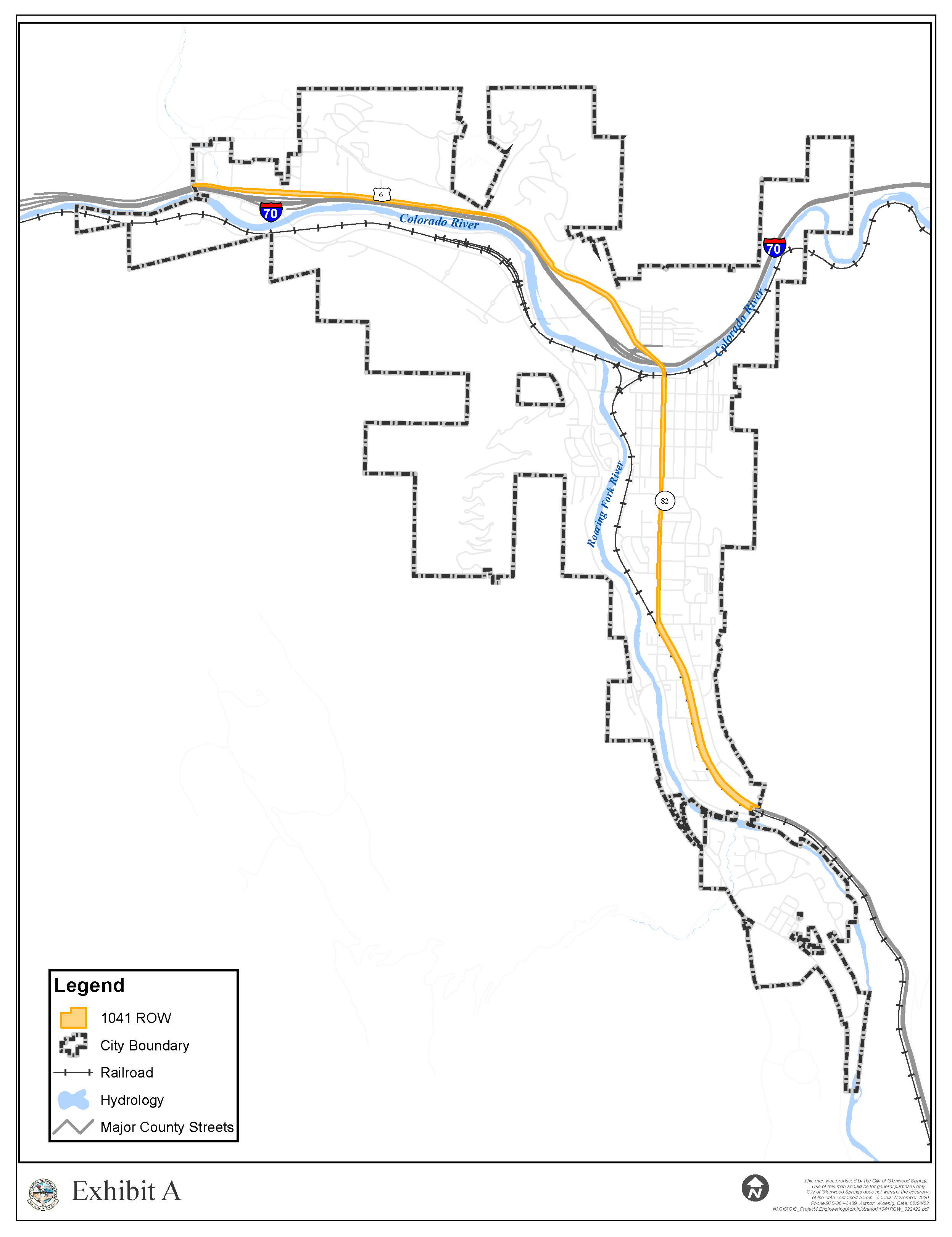
The area comprising State Highway[s] 6 and 24 and the associated interchanges, State Highway 82 and the associated interchanges, and an area within one hundred (100) feet of such highways as areas around key facilities in which development may have a material effect upon the key facility or the surrounding community, as shown on the map attached as Exhibit B to the ordinance from which this section is derived, and incorporated into these regulations as if fully set out herein.
(b)
Reasons and Findings for Designations. The City Council finds and concludes as follows:
(1)
The activities designated in Section 070.080.170(a)(1)—(4) are activities of state interest as provided in C.R.S. § 24-65.1-203.
(2)
The area comprising the surface area and an area within thirty-five (35) feet of the ordinary high-water mark of the Roaring Fork River, Colorado River, Mitchell Creek, Oasis Creek, and Three-Mile Creek is an area of state interest containing or having a significant impact on natural resources of statewide importance pursuant to C.R.S. § 24-65.1-201(1)(c). This area provides habitat for the Bald Eagle (Haliaeetus leucocephalus), Peregrine Falcon (Falco peregrinus anatum), Mountain Sucker (Catostomus playtrhynchus), and Cutthroat Trout (Oncorhynchus clarki pleuriticus), which are wildlife species listed on the Colorado Division of Parks and Wildlife list of species threatened, endangered, or of concern. This area provides recreational opportunities and is central to the economy of the City and surrounding communities. This area contains critical water resources, the quality and quantity of which are important to western Colorado downstream on the Colorado River from the designated area.
(3)
The area comprising State Highway[s] 6 and 24 and the associated interchanges, State Highway 82 and the associated interchanges, and an area within one hundred (100) feet of such highways, is an area of state interest around key facilities in which development may have a material effect upon the key facility or surrounding community because the highways are arterial highways and development around the highways or involving the highways may have a material effect on the highways and the surrounding community due to traffic impacts, air quality, safety, noise, parking, and other associated effects of increased traffic and heavy vehicle loads over and around such key facilities.
(4)
Uncontrolled conduct of the designated activities of state interest and uncontrolled development in the designated areas would result in a decreased quality of life for residents of the City by impacting the orderly and safe functioning of City infrastructure, reducing property values, decreasing open and recreational space, increasing traffic and congestion, causing air pollution and other environmental impacts, damaging natural resources and wildlife habitats, and degrading the scenic and recreational environment.
(5)
Conducting activities of state interest and developing areas of state interest in a coordinated manner under the regulations in this article will allow for increased public input and transparency, consideration and mitigation of potential long-term impacts, conservation of natural resources and open space, promotion of well-functioning City infrastructure, and development that comports with City and comprehensive planning.
(Ord. No. 09-2022, §§ 2(Exh. A), 4(Exh. A), 5(Exh. A), 3-3-2022)
Editor's note— The maps designating areas of state interest adopted by the City Council are attached to the ordinance from which this section derives as Exhibits A and B and are also available for review in the office of the City Clerk.
070.080.180 - Intent.
The intent of the permit regulations is to facilitate the process for the application, review, issuance, and administration of permits for areas and activities of state interest consistent with the statutory requirements and criteria set forth in C.R.S. § 24-65.1-101 et seq.
(Ord. No. 09-2022, § 2(Exh. A), 3-3-2022)
070.080.190 - Permit Authority Established.
(a)
The City of Glenwood Springs Permit Authority is hereby established, the members of which shall be the City Council.
(b)
Except as otherwise specifically set forth in these regulations, the Permit Authority shall exercise all powers and duties described in this article.
(Ord. No. 09-2022, § 2(Exh. A), 3-3-2022)
070.080.200 - Permit Required.
(a)
No person may conduct a designated activity of state interest, conduct development in a designated area of state interest, or conduct development that adversely impacts a designated area of state interest without first obtaining a permit or a permit amendment under these regulations.
(b)
When an applicant seeks approval to conduct more than one (1) activity of state interest and/or engage in development in more than one (1) area of state interest, the application may be completed for all such activities or developments and may be reviewed simultaneously and a single permit issued.
(Ord. No. 09-2022, § 2(Exh. A), 3-3-2022)
070.080.210 - Judicial Review.
Any action seeking judicial review of a final decision of the Permit Authority shall be initiated within twenty-eight (28) days after the decision is made, in the County District Court, pursuant to Rule 106 of the Colorado Rules of Civil Procedure. These regulations are not intended to create third-party rights of enforcement beyond those provided by law.
(Ord. No. 09-2022, § 2(Exh. A), 3-3-2022)
070.080.220 - Pre-application Process.
(a)
Prior to making a pre-application submittal, it is recommended that the applicant meet with the Community Development Department to review the project application process in order to determine the applicable regulations set forth in this Code.
(b)
Before submitting an application for a permit under these regulations, the applicant shall meet with the Community Development Department.
(c)
At or before the pre-application meeting, the applicant shall provide the Community Development Department with the following:
(1)
Names and addresses of all persons or interest proposing the activity or development;
(2)
Name and qualifications of the person(s) responding to the requirements detailed in these regulations;
(3)
A written summary of the project including:
a.
A map prepared at an easily readable scale showing:
1.
The boundaries of the proposed project;
2.
The relationship of the proposed project to surrounding topographic and cultural features such as roads, streams, and existing structures;
3.
Proposed buildings, improvements, and infrastructure;
(4)
Information that is sufficient for determining the nature of the project and the type, extent, and location of impacts associated with the project;
(5)
Any additional information requested by the Community Development Department as may be reasonably necessary to make the determinations contemplated by this article.
(d)
The purpose of the pre-application meeting is to permit the applicant and staff to review the proposal informally and to coordinate with or request review and comment from other relevant agencies before substantial commitment of time and money is made. Topics of discussion may include, as relevant to the specific application, but are not limited to:
(1)
Characteristics of the activity, including its location or potential locations, significant natural and man-made features, with particular attention to natural hazards, resources, or other special areas; the size and accessibility of the site; surrounding development and land uses; and its potential impact on surrounding areas, including potential environmental effects and planned mitigation strategies.
(2)
The nature of the development proposed, including land use types and their densities; placement of proposed buildings and maintenance of common open space or treatment of public use areas; the preservation of natural features; proposed parking areas and internal circulation system, including trails, the total ground coverage of paved areas and structures; and types of water and sewage treatment systems proposed.
(3)
Community policy considerations, including the review process and likely conformity of the proposed development with the policies and requirements of these regulations.
(4)
Applicable regulation, review procedures, and submission requirements.
(5)
Other regulatory reviews or procedures to which the applicant is subject, the applicant's timeframe for the project, and other concerns of the applicant.
(e)
Any comments or commitments made by the Community Development Department during the pre-application conference are only preliminary in nature and should not be relied upon as assurances to the applicant. All prospective applicants should be informed that formal comments cannot be made by staff until after the application is submitted.
(Ord. No. 09-2022, § 2(Exh. A), 3-3-2022)
070.080.230 - Permit Application.
(a)
Any person desiring to engage in development in a designated area of state interest or to conduct a designated activity of state interest shall first apply for and obtain a permit from the Permit Authority, in the form approved and maintained by the Community Development Department. Applications for permits shall be submitted to the Community Development Department. In the event a development or activity is proposed as an integral part of a subdivision or planned unit development, it shall be the responsibility of the service provider and/or developer to comply with these regulations.
(b)
A permit application shall not be accepted unless it is complete. A request for waiver of submission requirements shall not render the application incomplete. If the application is determined to be incomplete by the Community Development Department, the Department shall specify what additional information is required. An application need not meet the submission requirements for other than the particular development alternative for which a permit is being sought in order to be considered complete. When a submitted application is determined to be complete by the Community Development Department, it shall be noted upon the application the date and hour of its receipt.
(c)
The Permit Authority shall approve an application for a permit to develop within an area or conduct activity of state interest if the proposed development or activity complies with the applicable criteria in these regulations. If the proposed development or activity does not comply with these criteria, the permit shall be denied, or it may be approved with conditions.
(d)
When an applicant seeks a permit to engage in development in more than one (1) area of state interest and/or to conduct more than one (1) activity of state interest, a single application may be completed for all such developments or activities and may be reviewed by the Permit Authority in one (1) consolidated hearing, and, if approved, a single permit for all requested areas and/or activities may be granted.
(Ord. No. 09-2022, § 2(Exh. A), 3-3-2022)
070.080.240 - Permit Application Fee and Costs.
(a)
The permit applicant shall pay the required application fee at the time of application submittal as listed on the development review fee schedule. The fee schedule shall be established by resolution of the City Council and reviewed on an annual basis. Within ten (10) days following receipt of a completed application for a permit, the Community Development Department shall determine and set an estimated review fee in an amount necessary to cover the additional costs incurred in the review and action upon the permit application, including costs of copying, mailings, publications, labor, overhead and retention of consultants, experts, reasonable costs incurred in pre-application review, and attorneys that the Department deems necessary to advise it on the application package and all hearings conducted therefor, and shall notify the applicant in writing of the estimated review fee. The Department will determine the final fee at the conclusion of the permit hearing, which must be paid by the applicant before the permit is issued.
(b)
The Department reserves the right to waive all or a portion of the fees and costs imposed by this article if determined to be reasonably justified by the Community Development Department Director.
(c)
In the event of any litigation challenging a permit or the Permit Authority's action on the same, each party shall initially bear its own attorneys' fees and costs and such shall automatically become a condition of any issued permit. In any such action in which the City is the prevailing party, the applicant shall be required to reimburse the City for the actual costs of its attorneys' fees and costs.
(Ord. No. 09-2022, § 2(Exh. A), 3-3-2022)
070.080.250 - Submission Requirements for All Permit Applications; Waivers.
All applications for a permit under these regulations shall be submitted to the Community Development Department Director. The Director may request additional copies for review and processing purposes. Additional materials not listed may be required by the Director for a particular type of project. To the extent an applicant has prepared or submitted materials for a federal, state, or local permit, which are substantially the same as required herein, a copy of those materials may be submitted to satisfy the corresponding submission required below. The Department may waive any part, but not all, of the submission requirements imposed by these regulations upon petition of the applicant that full compliance with the submission requirements would be irrelevant or insignificant and that the submission requirements so waived would not address or disclose a substantial impact on the City or its residents. A waiver of submission requirements may be granted by the Community Development Department Director upon a written determination that the information to be submitted is sufficient for the Permit Authority to arrive at a permit decision in full compliance with the law and these regulations. In the event the waiver request is denied, the applicant may file a written appeal of the same within five (5) days with the City Manager, whose decision on the same shall be final and non-appealable. Thereafter, the applicant shall provide the required additional information before a hearing date will be scheduled.
(1)
Cover page. Completed application cover page in the format approved and maintained by the Community Development Department.
(2)
Information describing the applicant.
a.
The names, addresses, including email address and fax number, organizational form, and business of the applicant and, if different, the owner of the project.
b.
The names, addresses and qualifications, including those areas of expertise and experience with projects directly related or similar to that proposed in the application package, of individuals who are or will be responsible for constructing and operating the project.
c.
Written authorization of the application package by the project owner, if different than the applicant.
d.
Documentation of the applicant's financial and technical capability to develop and operate the project, including a description of the applicant's experience developing and operating similar projects.
e.
Written qualifications of report preparers.
(3)
Information describing the project proposal.
a.
A description of the proposed facilities and site.
b.
A description of the present or most recent use and zoning.
c.
Vicinity map showing the proposed site, including proposed zoning designation, and the surrounding area.
d.
Executive summary of the proposal indicating the scope and need for the project.
e.
Plans and specifications of the project in sufficient detail to evaluate the application against the applicable review criteria.
f.
Descriptions of alternatives to the project considered by the applicant. If the Community Development Director determines that the nature or extent of the proposal involves the potential for significant damage and warrants examination of other specific, less damaging alternatives, the Community Development Director may require the applicant to evaluate and present information on such additional alternatives as part of the application.
g.
Schedules for designing, permitting, constructing and operating the project, including the estimated life of the project.
h.
The need for the project, including a discussion of alternatives to the project that were considered and rejected; existing/proposed facilities that perform the same or related function; and population projections or growth trends that form the basis of demand projections justifying the project.
i.
Description of relevant conservation techniques to be used in the construction and operation of the project.
j.
Description of demands that this project expects to meet and basis for projections of that demand.
k.
List of adjacent property owners and their mailing addresses.
(4)
Scope of proposed project relevant to specific designated area and/or activity.
a.
Domestic water or sewage treatment systems and/or major extensions thereof.
1.
Detailed plans of the proposal, including not less than thirty (30) percent engineering plans and specifications prepared by a registered professional engineer, and proposed system capacity and service area plans mapped at a scale acceptable to the Department.
2.
A description of all existing or approved proposed domestic water or sewage treatment systems within the proposed project area.
3.
A description the design capacity of each domestic water or sewage treatment system facility proposed and the distribution or collection network proposed in the proposed project area.
4.
A description the excess capacity of each treatment system and distribution or collection network in the affected community or proposed project area.
5.
A description the operational efficiency of each existing system in the proposed project area, including the age, state of repair, and level of treatment.
6.
A description the existing water utilization, including the historic yield from rights and use by category such as agricultural, municipal, and industrial supply obligations to other systems.
7.
A description of any impacts to the City's water resources used to serve the City's water service area.
b.
Major facilities of a public utility.
1.
Specifications of approximate floor space of any office building, storage facility, or other enclosed structure.
2.
Voltage and length of transmission lines.
3.
The power source and generating capacity.
4.
The function and size of any substation.
5.
The diameter and length of any gas pipeline.
6.
The capacity of storage tanks, and type of petroleum derivative to be stored.
7.
The proposed service area.
8.
The resource area (e.g. source of power being generated or transmitted, source of petroleum derivative being transported).
9.
A computer modeled electromagnetic field measurement within the proposed transmission line easement for that portion of the transmission line between substations or transition sites.
10.
Measures taken to comply with the concept of prudent avoidance with respect to planning, siting, construction, and operation of transmission lines, which may be those steps taken to comply with CCR 723-3 § 3206(9)(b) or similar authority, for projects where other similar authority is applicable.
11.
Any impacts to vegetation and wildlife in the City.
12.
Possible alternatives to underground transmission lines associated with the facility.
13.
Visuals demonstrating impact to scenic resources.
c.
Efficient utilization of municipal and industrial water projects.
1.
A description of efficient water use, recycling and reuse technology intended for the project. Such description shall include estimated stream transit losses of water, reservoir evaporation losses, and power and energy requirements of the project and project alternatives.
2.
Map and description of other municipal and industrial water projects in the City and vicinity, including capacity and service levels, location of intake and discharge points, debt structure, fees and rates, and service plan boundaries.
3.
A description of the water to be used, including the applicant's right to use the water, adjudicated decrees or determinations, quantity, and comments from reviewing authorities.
d.
Development in areas containing, or having a significant impact upon, historical, natural, or archaeological resources of statewide importance.
1.
A description of the existing natural environment and an analysis of the impacts of the project on the natural environment and natural resources, including water resources, wildlife, and air quality, to include maps and engineering analyses regarding the surface water quality, groundwater quality, water quantity, flood lands, wetlands, and riparian areas.
2.
A description of proposals to mitigate any impact to the natural environment and natural resources, including to the watershed, wildlife, or air quality.
3.
A description of the existing historical and archaeological resources in the proposed project area and a description of proposals to mitigate any impact to the existing historical and archaeological resources.
e.
Development in areas around key facilities in which development may have a material effect upon the key facility or the surrounding community.
1.
A description of the existing key facilities and an analysis of the impacts of the project on the key facilities and the surrounding community to include maps showing the key facilities and including traffic and use studies.
2.
A description of proposals to mitigate the impact on the key facilities and surrounding communities.
(5)
Proof of notice as provided under Section 070.080.280.
(6)
Comments of other agencies. Any commentary received by other agencies with review authority over the proposal, including, without limitation, the state Department of Natural Resources, the state Department of Public Health and Environment, and any other federal, state, or local agency.
(7)
Demonstration of need.
a.
Population trends for the project area, including present population, population growth, and growth rates document the sources used.
b.
The predominant types of developments to be served by the proposed new systems and/or facilities or extensions thereof.
c.
The percentage of design capacity at which the current system is now operating.
d.
A description of conditions and projections that prohibit present facilities from being upgraded to adequately accommodate increased demand.
e.
Potential alternatives.
(8)
Property rights, other permits, and approvals.
a.
Description of property rights that are necessary for or that will be affected by the project, including easements and property rights proposed to be acquired through negotiation or condemnation.
b.
A list of all other federal, state, and local permits and approvals that will be required for the project, together with any proposal for coordinating these approvals with the City permitting process. Copies of any permits or approvals related to the project that have been granted.
c.
Copies of relevant official federal and state consultation correspondence prepared for the project; a description of all mitigation required by federal, state, and local authorities; and copies of any draft or final environmental assessments or impact statements required for the project.
d.
Details of the source and rights for the water supplies for the system, including any permits, decrees, or contracts for such rights, or the application submitted for change of water rights, appropriation of water, or augmentation plans.
e.
Proof of ownership or a contractual right to develop the property.
(9)
Land use.
a.
Provide a map at a scale relevant to the project and acceptable to the Community Development Department describing existing land uses and existing zoning of the proposed project area and the project service area, including peripheral lands which may be impacted. The land use map shall include but need not necessarily be limited to the following categories: Residential, commercial, industrial, extractive, transportation, communication and utility, institutional, open space, outdoor recreation, agricultural, forest land and water bodies. Show all special districts (school, fire, water, sanitation, etc.) within the project area.
b.
All immediately affected public land boundaries should be indicated on the map. Potential impacts of the proposed development upon public lands will be visually illustrated on the map as well as described in the text.
c.
Specify whether and how the proposed project conforms to the Comprehensive Plan.
d.
Specify whether and how the proposed project conforms to applicable regional and state planning policies.
e.
Specify whether and how the proposed project conforms to applicable federal land management policies.
f.
Specify how the proposed project will utilize existing easements or right-of-way to achieve project objectives.
g.
If relevant to the project design, describe the agricultural productivity capability of the land in the project area, using Soils Conservation Service soils classification data.
h.
Describe the probability that the project may be significantly affected by earthquakes, floods, fires, snow, slides, avalanches, rockslides or landslides and any measures that will be taken to reduce the impact of such events upon the project.
i.
Specify if excess service capabilities created by the proposed project will prove likely to generate sprawl or strip development.
j.
Specify whether the demand for the project is associated with development within or contiguous to existing service areas.
(10)
The Community Development Department Director may require submission of any plan, study, survey, or other information, in addition to the information required by this section, at the applicant's expense, as in the Director's judgment is necessary to enable it to review and act upon the application.
(11)
Any application which requires compliance with C.R.S. § 24-65.5-101 et seq. (Notification to Mineral Owners of Surface Development), shall not be considered to have been submitted as complete until the applicant has provided a certification signed by the applicant confirming that the applicant or its agent has examined the records of the County Clerk and Recorder for the existence of any mineral estate owners or lessees that own less than full fee title in the property which is the subject of the application, and stating whether or not any such mineral estate owners or lessees exist. In addition, for purposes of the City convening its initial public hearing on any application involving property which mineral estate owners or lessees owning less than full fee title in the property have been certified by the applicant to exist, the application shall not be considered to have been submitted as complete until the applicant has provided an additional signed certification confirming that the applicant has, at least thirty (30) days prior to the initial public hearing, transmitted to the City and to the affected mineral estate owners and lessees the notices required by C.R.S. § 24-65.5-101 et seq.
(12)
Projected development schedule.
a.
An estimate of the maximum number of employees, number of shifts and employees per shift during the following phases: Construction, operation, and maintenance.
b.
Information regarding any future phases or extensions of the facility and relationship of the facility (if currently foreseen) to larger programs and plans.
c.
A timetable for planning (e.g., federal permits, state permits, local zoning, etc.).
d.
An estimate beginning and completion of construction and beginning of operation of facility or system.
e.
A description of any support facilities (e.g., pollution control parking areas, landscaping, etc.) to be provided.
f.
A description of any feasible "non-structural" alternatives to meet the objectives of the proposed site selection and construction.
(13)
Financial information.
a.
Relevant bond issue, loan and other financing approvals or certifications (ex: approved bond issues; bond counsel opinion).
b.
A description of the intended financial/economic impacts on the proposed project on the City and surrounding area.
c.
Business plan that generally describes the financial feasibility of the project.
d.
A plan to offset increased demand on the City's existing facilities, systems, or public utilities.
(14)
Local infrastructure and services impacts. An impact analysis that addresses the manner in which the applicant will comply with the relevant permit application review criteria. The impact analysis shall include the following information: description of existing capacity of and demand for local government services including, but not limited to, roads, schools, water and wastewater treatment, water supply, emergency services, transportation, infrastructure, and other services necessary to accommodate the project within the City.
(15)
Recreational opportunities. Description of the impacts and net effect of the project on present and potential recreational opportunities.
(16)
Social impacts. A description of other intended social impacts of the proposed project, including, by way of illustration, increased access to relevant services.
(17)
Areas of paleontological, historic, or archaeological importance. Description of the impacts and net effect of the project on sites of paleontological, historic, or archaeological interest.
(18)
Nuisance. Descriptions of noise, glare, dust, fumes, vibration, and odor levels anticipated to be caused by the project.
(19)
Air quality. Description of the impacts and net effect that the project would have on air quality during both construction and operation, and under both average and worst case conditions, considering particulate matter and aerosols, oxides, hydrocarbons, oxidants, and other chemicals, temperature effects and atmospheric interactions.
(20)
Visual quality. Description of the impacts and net effect that the project would have on visual quality, considering viewsheds, scenic vistas, unique landscapes or land formations within view of the project area.
(21)
Surface water quality.
a.
Map and/or description of all surface waters relevant to the project, including description of provisions of Region XII's regional water quality management plan, and NPDES Phase II Permit and necessary Erosion and Stormwater Quality Control Permit ("ESQCP"), Section 404 Federal Clean Water Act Permit that applies to the project and assessment of whether the project would comply with those provisions.
b.
Existing data monitoring sources.
c.
Descriptions of the immediate and long-term impact and net effects that the project would have on the quantity and quality of surface water under both average and worst-case conditions.
(22)
Groundwater quality.
a.
Map and/or description of all groundwater, including any and all aquifers relevant to the project. At a minimum, the description should include:
1.
Seasonal water levels in each portion of the aquifer affected by the project.
2.
Artesian pressure in said aquifers.
3.
Groundwater flow directions and levels.
4.
Existing aquifer recharge rates and methodology used to calculate recharge to the aquifer from any recharge sources.
5.
For aquifers to be used as part of a water storage system, methodology and results of tests used to determine the ability of the aquifer to impound groundwater and aquifer storage capacity.
6.
Seepage losses expected at any subsurface dam and at stream-aquifer interfaces and methodology used to calculate seepage losses in the affected streams, including description and location of measuring devices.
7.
Existing groundwater quality and classification.
8.
Location of all water wells potentially affected by the project and their uses.
b.
Description of the impacts and net effect of the project on groundwater.
(23)
Water quantity.
a.
Map and/or description of existing stream flows and reservoir levels relevant to the project.
b.
Map and/or description of existing minimum stream flows held by the state Water Conservation Board.
c.
Descriptions of the impacts and net effect that the project would have on water quantity.
d.
Statement of methods for efficient utilization of water, including recycling and reuse.
e.
Descriptions on the impacts to riparian vegetation and fisheries.
(24)
Floodplains, wetlands, and riparian areas; terrestrial and aquatic animals, plant life, and habitat. Applicant shall only provide description of foregoing natural conditions, animal and plant life at, but not to exceed, the level of detail required by other federal or state permits or reviews which are applicable to the project.
(25)
Soils, geologic conditions, and natural hazards.
a.
Map and/or description of soils, geologic conditions, and natural hazards including, but not limited to, soil types, drainage areas, slopes, avalanche areas, debris fans, mud flows, rock slide areas, faults and fissures, seismic history, and wildfire hazard areas, all as relevant to the project area.
b.
Descriptions of the risks to the project from natural hazards.
c.
Descriptions of the impacts and net effect of the project on soil and geologic conditions in the area.
(26)
Hazardous materials.
a.
Description of all solid waste, hazardous waste, petroleum products, hazardous, toxic, and explosive substances to be used, stored, transported, disturbed or produced in connection with the project, including the type and amount of such substances, their location, and the practices and procedures to be implemented to avoid accidental release and exposure.
b.
Location of storage areas designated for equipment, fuel, lubricants, and chemical and waste storage with an explanation of spill containment plans and structures.
(27)
Monitoring and mitigation plan.
a.
Description of all mitigation that is proposed to avoid, minimize or compensate for adverse impacts of the project and to maximize positive impacts of the project.
1.
Describe how and when mitigation will be implemented and financed.
2.
Describe impacts that are unavoidable that cannot be mitigated.
b.
Description of methodology used to measure impacts of the project and effectiveness of proposed mitigation measures.
c.
Description, location, and intervals of proposed monitoring to ensure that mitigation will be effective.
d.
Emergency procedures to be used in the event of a fire, explosion, or other event which may endanger the public health, safety, and welfare.
(28)
Additional information. The Community Development Department Director may request that the applicant supply additional information related to the project if the Director and/or the Permit Authority will not be able to make a determination on any one (1) of the applicable review criteria without the additional information. Such additional information may include applicant's written responses to comments by a referral agency.
(Ord. No. 09-2022, § 2(Exh. A), 3-3-2022)
070.080.260 - Simultaneous Processing of Other City Permits.
In the event a special use permit, rezoning, or other land use permit is required under Title 070 of this Code for a proposed activity which is also governed by these regulations, review of the required permit under these regulations shall be combined with review of the other permit application pursuant to the following procedure:
(1)
The submission requirements for a special use permit, rezoning, or other land use permit as established by the Community Development Department Director shall be combined with those for the relevant permit under these regulations and duplication eliminated.
(2)
The Planning Commission hearing if required by Title 070 of this Code for a special use permit, rezoning, or other land use permit shall incorporate review of the relevant permit under these regulations and precede the City Council hearing. In such instances, the Planning Commission shall make a recommendation to the City Council to approve or deny a permit under these regulations as a separate item and may include additional comments for the City Council's consideration.
(3)
The City Council hearing on the special use permit, rezoning, or other land use permit may be combined with the City Council hearing on the relevant permit under these regulations.
(4)
At the close of the combined hearing, the City Council shall act first on the special use permit, rezoning, or other land use permit application, and either approve, approve with conditions or deny the same, as contemplated by Title 070 of this Code.
(5)
In the event the City Council approves the special use permit, rezoning, or other land use permit application, with or without conditions, the City Council then shall proceed to take action on the application for the relevant permit under these regulations.
(6)
Subsequent to approval of a special use permit, rezoning, or other land use permit under this combined procedure, the permit holder shall, if required by the terms of the special use permit, rezoning, or other land use permit, apply for renewals of the same in the manner prescribed by Title 070 of this Code.
(Ord. No. 09-2022, § 2(Exh. A), 3-3-2022)
070.080.270 - Referral Departments and Agencies.
The Community Development Department may, in the discretion of the Director, refer any pre-application and/or permit application submittal to any other City department and/or outside review agency. Copies of any such referral comments received shall be promptly forwarded to the applicant for response.
(Ord. No. 09-2022, § 2(Exh. A), 3-3-2022)
070.080.280 - Permit Hearing.
Not later than thirty (30) days after submission of a completed application for a permit, the Community Development Department Director shall set the date, time, and place for hearing(s) on said application, and shall publish notice(s) of such date, time and place for hearing(s) and any required separate hearing on any requested waiver of submission requirements. The notice of the public hearing shall be published once in a newspaper of general circulation in the City, not less than thirty (30) nor more than sixty (60) days before the date set for hearing and shall also be given to other persons and entities in the same manner as set forth for the notice of a designation hearing in Section 070.080.120. On or before fifteen (15) days prior to the hearing, the applicant shall send a copy of the notice by U.S. Mail, first class postage prepaid, to all property owners within two hundred (200) feet of the real property to be occupied or impacted by the project. The applicant shall also provide to the Director a list of such addressees accompanied by a certification that the notice was mailed to them.
(Ord. No. 09-2022, § 2(Exh. A), 3-3-2022)
070.080.290 - Conduct of Permit Hearing.
(a)
The Permit Authority shall conduct the public hearing pursuant to the rules and procedures generally applicable to City Council meetings, affording procedural and substantive due process to the applicant, the general public, supporters of the project, and any person who opposes issuance of the permit.
(b)
The Permit Authority shall hear testimony and receive evidence, including:
(1)
The recommendations of the Planning Commission, if any;
(2)
Relevant testimony and evidence from any and all persons or organizations desiring to appear and be heard, including City staff; and
(3)
Any relevant documents that may be offered into evidence.
(c)
The Community Development Department shall arrange for preservation of the record of the public hearing in accordance with the City's Records Retention Schedule.
(d)
In cases in which the development or activity must also obtain approvals under other City regulations, the permit hearing required by these regulations may be held at the same time as the final hearing required for such applications.
(Ord. No. 09-2022, § 2(Exh. A), 3-3-2022)
070.080.300 - Action by the Permit Authority.
(a)
If the Permit Authority finds that there is not sufficient information concerning any material feature of a proposed development or activity, it may deny the application or it may continue the hearing until the additional information has been received; however, no such continuance may exceed forty-five (45) days after such receipt unless agreed to by the applicant.
(b)
The Permit Authority shall approve an application for a permit to engage in development in an area of state interest or for the conduct of an activity of state interest if the proposed project or activity complies with all of the provisions of these regulations governing such area or activity. The Permit Authority may attach reasonable conditions to its approval to ensure compliance with these regulations. If the proposed project does not comply with these regulations governing the area or activity, the permit shall be denied or may be approved with conditions.
(c)
The burden of proof shall be upon the applicant to show compliance with the provisions of these regulations governing the area or activity of state interest involved.
(d)
The Permit Authority shall state, in writing, reasons for its decision on a permit application, and its findings and conclusions.
(e)
The Permit Authority shall reach a decision on a permit application within sixty (60) days after the completion of the permit hearing, or the permit shall be deemed approved.
(Ord. No. 09-2022, § 2(Exh. A), 3-3-2022)
070.080.310 - Combined Designation and Permit Hearing.
If a person proposes to engage in a development in an area of state interest or to conduct an activity of state interest not previously designated, or for which regulations have not been adopted, and has submitted a land use application, in lieu of processing such application, the Permit Authority may decide to hold one (1) hearing for determination of designation and regulation, as well as for granting or denying the permit. No permit that is granted at the conclusion of any such hearing shall be authority to engage in development or to conduct an activity until the designation and regulations are finally determined.
(Ord. No. 09-2022, § 2(Exh. A), 3-3-2022)
070.080.320 - Review Criteria for All Applications.
All applications under these regulations shall be evaluated against the following general criteria. Each subsection below constitutes a "criterion". Within each subsection are further guidelines to be considered for each criterion. Where such terms as "reasonable," "feasible" and "adequate" are used in the foregoing criteria, the Community Development Department Director and/or the Permit Authority shall determine in each case what is or is not reasonable, feasible, or adequate.
(1)
The health, welfare, and safety of the residents of this City will be protected and served.
(2)
The project is in general conformance with the Comprehensive Plan and other duly adopted plans and permit criteria. The determination of conformance of the project with these plans may include, but is not limited to, the following considerations:
a.
Likelihood that the project will/will not cause or contribute to urban sprawl or "leapfrog" development.
b.
Likelihood that the project will promote growth within existing municipalities or developed areas with the preexisting institutional capacity to maintain infrastructure and provide services to the anticipated development.
c.
Significant changes in the amount of impervious surfaces.
d.
Contiguity of development associated with the project to existing growth centers.
e.
Changes to unique land forms.
f.
Changes in the amount or character of open space.
g.
Changes to traffic patterns, road capacity and congestion.
(3)
The project is financially feasible. The determination of financial feasibility of the project may include but is not limited to the following considerations:
a.
The business plan submitted by the applicant.
b.
Relevant bond issue, loan and other financing approval or certifications (ex: approved bond issue; bond counsel opinion).
(4)
The project is not subject to significant risk from natural hazards. The determination of risk from natural hazards to the project may include but is not limited to the following considerations:
a.
Faults and fissures.
b.
Unstable slopes including landslides, rock slides, and avalanche areas.
c.
Expansive or evaporative soils and risk of subsidence.
d.
Wildfire hazard areas.
e.
Floodplains.
(5)
The project will not have a significant adverse effect on the capability of local governments affected by the project to provide local infrastructure and services, or exceed the capacity of service delivery systems. The determination of the effects of the project on local government services and infrastructure may include, but is not limited to, the following considerations:
a.
Current and projected capacity of roads, schools, infrastructure, drainage and/or stormwater infrastructure, housing, recreational facilities, emergency services, and other services necessary to accommodate development, and the impact of the project upon the current and projected capacity.
b.
Changes caused by the project in the cost of providing education, transportation networks, water treatment and wastewater treatment, stormwater drainage, channel stabilization, recreation facilities, bridges, emergency services, or other governmental services or facilities.
c.
Need for temporary roads to access the project for construction and maintenance.
d.
Change in demand for public transportation.
(6)
The project will not have a significant adverse effect on the quality or quantity of recreational opportunities and experience. The determination of effects of the project on recreational opportunities and experience may include, but is not limited to, the following considerations:
a.
Changes to existing and projected visitor days.
b.
Changes in quality and quantity of fisheries.
c.
Changes in instream flows or reservoir levels.
d.
Changes in access to recreational resources.
e.
Changes to quality and quantity of hiking, biking, or horseback riding trails.
f.
Changes to hunting experiences.
g.
Changes to open space.
h.
Changes to existing conservation easements.
i.
Changes to regional or neighborhood parks.
j.
Changes to recreational scenic experience.
(7)
The project will not significantly degrade air quality. The determination of effects of the project on air quality may include, but is not limited to, the following considerations:
a.
Changes in visibility and microclimates.
b.
Applicable air quality standards.
(8)
The project will not significantly degrade existing visual quality. The determination of visual effects of the project may include, but is not limited to, the following considerations:
a.
Visual changes to ground cover and vegetation, waterfalls and streams, or other natural features.
b.
Interference with viewsheds and scenic vistas.
c.
Changes in landscape character types of unique land formations.
d.
Compatibility of structure size and color with scenic vistas and view sheds.
e.
Changes to open space.
f.
Changes to existing conservation easements.
g.
Changes to impacts to regional or neighborhood parks.
(9)
The project will not significantly degrade surface water quality. The determination of effects of the project on surface water quality may include, but is not limited to, the following considerations:
a.
Changes to existing water quality, including patterns of water circulation, temperature, conditions of the substrate, extent and persistence of suspended particulates and clarity, odor, color or taste of water.
b.
Applicable narrative and numeric water quality standards.
c.
Changes in point and nonpoint source pollution loads.
d.
Increase in erosion.
e.
Changes in sediment loading to waterbodies.
f.
Changes in stream channel or shoreline stability.
g.
Changes in stormwater runoff flows.
h.
Changes in trophic status or in eutrophication rates in lakes and reservoirs.
i.
Changes in the capacity or functioning of streams, lakes, or reservoirs.
j.
Changes to the topography, natural drainage patterns, soil morphology and productivity, soil erosion potential, and floodplains.
k.
Changes to stream sedimentation, geomorphology, and channel stability.
l.
Changes to lake and reservoir bank stability and sedimentation, and safety of existing reservoirs.
(10)
The project will not significantly degrade groundwater quality. The determination of effects of the project on groundwater quality may include, but is not limited to, the following considerations:
a.
Changes in aquifer recharge rates, groundwater levels and aquifer capacity including seepage losses through aquifer boundaries and at aquifer-stream interfaces.
b.
Changes in capacity and function of wells within the impact area.
c.
Changes in quality of well water within the impact area.
(11)
The project will not significantly degrade wetlands and riparian areas, terrestrial or aquatic plant or animal life. The determination of effects of the project on these areas shall include the considerations raised in the applicable federal and/or state permits.
(12)
The project will not significantly deteriorate soils and geologic conditions. The determination of effects of the project on soils and geologic conditions may include, but is not limited to, the following considerations:
a.
Loss of topsoil due to wind or water forces.
b.
Changes in soil erodibility.
c.
Physical or chemical soil deterioration.
d.
Terrain deformation/mass wasting/subsidence.
e.
Compacting, sealing and crusting.
f.
Waterlogging.
g.
Soil morphology and productivity.
(13)
The project will not cause a nuisance. The determination of nuisance effects of the project may include, but is not limited to, the following considerations: Increase in odors, dust, fumes, glare, heat, noise, vibration or artificial light.
(14)
The project will not result in unreasonable risk of releases of hazardous materials. The determination of the risk of release of hazardous materials caused by project may include, but is not limited to, the following considerations:
a.
Plans for compliance with federal and state handling, storage, disposal, and transportation requirements.
b.
Use of waste minimization techniques.
c.
Adequacy of spill prevention and response plans.
(15)
Urban development, population densities, and site layout and design of storm water and sanitation systems shall be accomplished in a manner that will prevent the pollution of aquifer recharge areas. The determination of potential for pollution of the aquifer recharge areas by the project may include, but is not limited to, the following considerations:
a.
Proximity of urban development and population densities to aquifer recharge areas.
b.
Proximity of stormwater and sanitation systems to aquifer recharge areas.
c.
Changes in water quality in the aquifer recharge areas.
(16)
The project shall be reasonably necessary to meet projected community development and population demands in the areas to be served by the project, or to comply with regulatory or technological requirements. The determination of whether the project is reasonably necessary may include but is not limited to the following considerations:
a.
Relationship to reasonable growth projections and local land use plans.
b.
Relationship to other providers' service areas.
c.
Whether the project is not in compliance with regulatory or technological requirements or will not be in compliance in the near future.
(17)
The project shall be constructed in areas which will result in the proper utilization of existing facilities or systems to ensure the orderly and sustainable development of infrastructure in the City and adjacent communities, including the following considerations:
a.
Site selection and construction will not create or encourage growth and development which is incompatible with and cannot be accommodate by the local financial capacity of the area or residents to be served.
b.
New systems will not overburden existing systems and current and future demand for services can be met within existing and proposed capacity.
c.
The project will not create proliferation of special districts or overlapping of special districts with the boundaries of other special districts or municipalities.
d.
The project is the best alternative for the provision of services to the geographical area serviced.
e.
To the extent feasible, facilities and systems shall be consolidated with existing facilities and systems in the area.
f.
The project will not result in duplicative services or excessive capacity.
g.
The project will be administered so as to minimize disruption of utility services and preserve desirable existing community patterns.
(18)
Economic impacts including, but not limited to, taxable property, licensed and permitted facilities, and recreation related to the proposed project have been identified and will be compensated for or mitigated.
(19)
The project shall emphasize the most efficient use of water, including the recycling, reuse, and conservation of water, including the following considerations:
a.
Whether the project uses readily available conservation techniques.
b.
Whether the project recycles water to the greatest extent permissible.
c.
Whether the project will use raw water for exterior or irrigation use if available.
(Ord. No. 09-2022, § 2(Exh. A), 3-3-2022)
070.080.330 - Special Review Criteria for Major Extensions of Water and Sewage Treatment Systems.
(a)
No permit shall issue for a project related to major extensions of a water or sewage treatment system unless it contains conditions tailored to mitigate the environmental, infrastructure, and financial impacts to the City described in Subsection (b) below. Conditional permits shall issue at the discretion of the Permit Authority, pursuant to Section 070.080.360 of this article.
(b)
Applications for a project related to major extensions of water and sewage treatment systems shall be subject to the following mandatory special review criteria.
(1)
The project will not contribute to adverse impacts to the City's financial ability to provide adequately maintained infrastructure and community services, including, but not limited to:
a.
Roads.
b.
Sidewalks and non-motorized trails.
c.
Parks and recreation facilities.
d.
Emergency services.
e.
Code enforcement.
(2)
The project will not contribute to adverse impacts to the City's environmental conditions or natural resources, including, but not limited to:
a.
Sedimentation of waterways.
b.
Ambient air quality.
c.
Wildlife.
d.
Open space.
(3)
The project will not contribute to adverse impacts or decrease in quality of service, without proper mitigation, to:
a.
Roads.
b.
Public transportation.
c.
Recreation facilities.
(Ord. No. 09-2022, § 2(Exh. A), 3-3-2022)
070.080.340 - Special Review Criteria for Site Selection and Construction of Major Facilities of a Public Utility.
(a)
No permit shall issue for a project related to the site selection and construction of major facilities of a public utility unless it contains conditions tailored to mitigate the environmental, infrastructure, and financial impacts to the City described in Subsection (b) below. Conditional permits shall issue at the discretion of the Permit Authority, pursuant to Section 070.080.360 of this article.
(b)
Applications for a project related to the site selection and construction of major facilities of a public utility shall be subject to the following mandatory special review criteria.
(1)
The project will not increase the potential for fires and wildfires.
(2)
The project will not conflict with any local, regional, or state comprehensive plans.
(Ord. No. 09-2022, § 2(Exh. A), 3-3-2022)
070.080.350 - Special Review Criteria for Areas Around Key Facilities.
(a)
No permit shall issue for a project related to areas around designated key facilities in which development may have a material impact upon the key facility or surrounding community unless it contains conditions tailored to mitigate the environmental, infrastructure, and financial impacts to the City described in Subsection (b) below. Conditional permits shall issue at the discretion of the Permit Authority, pursuant to Section 070.080.360 of this article.
(b)
Applications for a project related to areas around designated key facilities in which development may have a material impact upon the key facility or surrounding community shall be subject to the following mandatory special review criteria.
(1)
The project will encourage the smooth flow of motorized and nonmotorized traffic.
(2)
The project will foster the development of such areas in a manner calculated to preserve the smooth flow of such traffic.
(3)
The project will preserve desirable existing community patters.
(Ord. No. 09-2022, § 2(Exh. A), 3-3-2022)
070.080.360 - Permit Issuance; Conditions.
The permit shall be issued on the form prescribed by the Community Development Department Director and adopted by the Permit Authority. The Permit Authority may attach any conditions to the permit to ensure that the requirements of these regulations are continuously met. The Permit Authority may impose additional mitigation requirements and conditions on an applicant under the following procedure:
(1)
The Permit Authority shall make written findings that each such requirement and condition is necessary to ensure that the proposed project will not result in significant adverse net effect on the resources, values and conditions in the applicable chapter of these regulations.
(2)
The Permit Authority shall also find in writing that each such requirement and condition is necessitated by the proposed project.
(3)
All such findings shall be based on material in the administrative record.
(4)
The Permit Authority shall base the additional requirements and conditions on applicable design standards as adopted by the City to the extent that such standards then exist.
(Ord. No. 09-2022, § 2(Exh. A), 3-3-2022)
070.080.370 - Term of Permit; Progress Reports.
The permit may be issued for an indefinite term or for a specific period of time, depending upon the size and complexity of the project. Periodic progress reports may be required to be submitted to demonstrate that the applicant is completing the development with reasonable diligence. If the applicant fails to take substantial steps to initiate the permitted project within twelve (12) months from the date of the permit or such other time period specified in the permit, if such steps have been taken but the applicant has failed to complete the development with reasonable diligence, then the permit may be revoked or suspended in accordance with Section 070.080.430.
(Ord. No. 09-2022, § 2(Exh. A), 3-3-2022)
070.080.380 - Renewal.
Permits issued under these regulations may be renewed following the same procedure for approval of the initial permit. The Permit Authority or the Community Development Department Director, as appropriate, may impose additional conditions at the time of renewal if necessary to ensure that the project will comply with these regulations.
(Ord. No. 09-2022, § 2(Exh. A), 3-3-2022)
070.080.390 - Permit Amendment.
(a)
Any material change, as determined by the Community Development Department Director, in the construction, use, or operation of a project from that initially approved shall require a permit amendment. The amendment shall be processed in accordance with and subject to the same procedures and requirements set forth herein for a new permit.
(b)
A government-sponsored project providing a public utility service, e.g. water, wastewater, gas or electric, shall not be subject to this provision with respect to future operations to the extent such operations utilize existing infrastructure for which a permit under these regulations has been obtained, and which are consistent with the originally intended scope and use of that infrastructure for which a permit has been obtained, subject to any limitations or conditions to the contrary contained in the original permit.
(Ord. No. 09-2022, § 2(Exh. A), 3-3-2022)
070.080.400 - Permit Administration, Enforcement, and Inspection.
The provisions of these regulations and any permits issued hereunder shall be administered, enforced, and inspected in accordance with the provisions of this article.
(Ord. No. 09-2022, § 2(Exh. A), 3-3-2022)
070.080.410 - Transfer of Permits.
A permit may be transferred unless a permit condition requires consent of the Permit Authority. The Permit Authority must ensure, in approving any transfer, that the proposed transferee can and will comply with all the requirements, terms, and conditions contained in the permit and these regulations; that such requirements, terms, and conditions remain sufficient to protect the health, welfare, and safety of the public; and that an adequate guarantee of financial security can be made.
(Ord. No. 09-2022, § 2(Exh. A), 3-3-2022)
070.080.420 - Financial Security.
(a)
Before any permit is issued, the Permit Authority may in its discretion require the applicant to file a guarantee of financial security deemed adequate by the Permit Authority and payable to the City.
(b)
The types of collateral which may be used as security are as follows:
(1)
Performance or property bonds.
(2)
Private or public escrow agreements.
(3)
Letters of credit.
(4)
Deposits of certified funds.
(5)
Other similar surety agreements.
(6)
Other agreements or contracts setting forth the plan, method, and parties responsible for the project which the City deems sufficient.
(c)
The purpose of the financial security shall be to assure that all requirements of the permit for mitigation and site remediation are adequately guaranteed.
(d)
The amount of the financial security shall be established by the Permit Authority upon consideration of the following criteria:
(1)
The estimated cost of returning the site of the permitted development or activity to its original condition or to a condition acceptable to the Permit Authority in accordance with standards adopted by the Permit Authority for the matter of state interest for which the permit is being granted; and
(2)
The estimated cost of complying with the mitigation requirements of the permit.
(3)
Other financial security provided by the applicant in connection with the same project.
(e)
Estimated cost shall be based on the applicant's submitted cost estimate plus the Permit Authority's estimate of the additional cost to bring in personnel and equipment to accomplish any unperformed purposes of the financial guarantee. The Permit Authority shall consider the duration of the development or activity and compute a reasonable projection of cost increases due to inflation.
(f)
The Permit Authority may require that all or a portion of the amount of the financial guarantee shall be in cash deposited with the City and placed in an interest-bearing account. Any interest earned shall be deemed additional security and returned to the applicant in the same manner as the original deposit.
(g)
The financial guarantee may be released only when:
(1)
The permit has been surrendered to the Permit Authority before commencement of any physical activity on the site of the permitted development or activity;
(2)
The development or activity has been abandoned and the site thereof has been returned to its original condition or to a condition acceptable to the Permit Authority in accordance with standards adopted by the Permit Authority for the matter of state interest for which the permit was granted; or
(3)
The mitigation requirements have been satisfactorily completed.
(h)
Any security may be cancelled or reduced by a surety only upon receipt of the Permit Authority's written consent which may be granted only when such cancellation or reduction will not detract from the purposes of the security.
(i)
If the license to do business in the state of any surety upon a security filed pursuant to these regulations is suspended or revoked by any state or federal authority, then the applicant or permit holder, within ten (10) days after receiving notice thereof, shall substitute a good and sufficient surety licensed to do business in the state. Upon failure of the permittee to make substitution of surety within the time allowed, the Permit Authority shall suspend the permit until proper substitution has been made.
(j)
If the Permit Authority determines that a financial guarantee should be forfeited or acted upon because of any violation of the permit, it shall direct the City Manager to take all steps necessary to do so and provide written notice to the surety and to the permit holder that the financial guarantee of such action. The Permit Authority shall, in such written notice, inform the permit holder that it has the right to make a written demand to the Permit Authority within ten (10) days of the action taken to hold a hearing thereon.
(k)
The Permit Authority shall hold a hearing within thirty-five (35) days after the receipt of the demand by the permit holder. At the hearing, the permit holder may present statements, documents, and other information with respect to the alleged violation. At the conclusion of the hearing, the Permit Authority shall either withdraw the notice of violation or enter an order forfeiting the financial guarantee.
(l)
The cash deposit described in Subsection (f) above may be used by the City in the event of the default or alleged default of the permit holder only for the purposes of recovering on the surety or fulfilling the permit obligations of the permit holder. The City may arrange with a lending institution which provides money for the permit holder that said institution may hold in escrow any funds required for said cash deposit. Funds shall be disbursed out of escrow by the institution to the City upon its demand for the purposes specified in this section.
(m)
If the forfeiture results in inadequate revenue to cover the costs of accomplishing the purposes of the financial guarantee, the City Attorney is hereby authorized to take such steps as deemed proper to recover such costs, including, without limitation, perfecting a lien upon any real property in the City owned by the permit holder, by certifying such costs to the County Treasurer for collection in the same manner as real property taxes or by civil action.
(n)
Upon request, the Permit Authority may, in its sole and exclusive discretion, waive all or any portion of the financial security requirements.
(o)
The City Attorney shall have authority to approve the form of security presented.
(Ord. No. 09-2022, § 2(Exh. A), 3-3-2022)
070.080.430 - Revocation or Suspension of Permits.
(a)
In the event the Community Development Department has reason to believe that the condition imposed on the permit has been violated by the permit holder, the Community Development Department Director may temporarily suspend the permit for a period of thirty (30) days. Before imposing such a temporary suspension, the Community Development Department Director shall give the permit holder written notice of the specific violation and shall allow the permit holder a period of at least ten (10) days to correct the violation. If the permit holder does not concur that there is a violation, the permit holder shall, within ten (10) days of the date of such notice, demonstrate to the Community Development Department Director why temporary suspension should not be ordered. Within ten (10) days thereafter, the Community Development Department Director shall make a decision, as follows:
(1)
If the Community Development Department Director determines there is no permit violation, the matter is closed and the permit remains in effect.
(2)
If the Community Development Department Director finds a violation exists, the permit shall be suspended for thirty (30) days. During such period, the permit holder shall either:
a.
Correct the violation;
b.
Request an extension of time to correct the violation; or
c.
Request a show cause hearing before the Permit Authority, which shall be conducted in substantially the manner set forth in Sections 070.080.120 and 070.080.280.
(3)
The Community Development Department Director may extend the time period for the correction of a violation upon the request of the permit holder.
(b)
In lieu of, or subsequent to a temporary suspension, the Permit Authority may permanently revoke or suspend the permit after conducting a public hearing in substantially the same manner and after substantially the same notice as for other permit hearings required under this article, and if it finds:
(1)
A violation of any provision or condition of approval of the permit or applicable regulation for administration of the matter of state interest concerned; or
(2)
The permit holder has failed to take substantial steps to initiate the permitted development or activity within twelve (12) months from the date of the permit, or, if such steps have been taken, the permit holder has failed to complete the development or activity or any condition of permit approval with reasonable diligence. "Substantial steps" do not require construction activity and may include, among other things, legal or administrative proceedings and activities directly associated with the permittee's project. An extension of the time within which substantial steps to initiate the permitted development or activity need be taken may be granted by the Permit Authority upon the request of the applicant and a showing of good cause therefore.
(3)
Upon good cause shown, any revoked or suspended permit may be reinstated by the Permit Authority, within twelve (12) months after revocation or suspension.
(Ord. No. 09-2022, § 2(Exh. A), 3-3-2022)
070.080.440 - Annual Review.
(a)
Within thirty (30) days prior to each annual anniversary date of the granting of a permit the permittee shall submit a report to the Community Development Department containing a summary of past activities conducted by the permittee pursuant to the permit including a satisfactory showing that the permittee has complied with all conditions of the permit and applicable regulations. The permittee need not inform of activities, such as operational changes, which are not the subject of a permit condition.
(b)
The Community Development Department shall review the report within thirty (30) days from the date of submittal thereof. If the Community Development Department Director determines that the permittee has or is likely to have violated the provisions of the permit and/or applicable regulations, he/she shall schedule the matter for public hearing by the Permit Authority. If the Permit Authority determines at the public hearing that the permittee has violated the provisions of the permit and/or applicable regulations, the Permit Authority may suspend and/or revoke the permit in accordance with Section 070.080.430.
(c)
Upon notice to the Permit Authority or the Community Development Department Director, of the fulfillment of all permit conditions, and the Permit Authority's concurrence therein, the Permit Authority shall terminate any annual review requirements.
(d)
The Permit Authority may waive or modify the annual review requirements upon petition of the permittee and a showing of good cause therefor.
(Ord. No. 09-2022, § 2(Exh. A), 3-3-2022)
070.080.450 - Enforcement and Penalties.
(a)
Any person engaging in development in a designated area of a state interest or conducting a designated activity of state interest who does not obtain a permit pursuant to these regulations, who does not comply with permit requirements, who acts outside the authority of an issued permit, or who exceeds the permission granted in an issued permit has thereby acted unlawfully.
(b)
All unlawful acts pursuant to these regulations may be referred to the City Attorney, who may follow the enforcement procedures of this Code for the institution of an injunction, mandamus, abatement, or other appropriate action to prevent, enjoin, abate, or remove a violation of these regulations to prevent a person from engaging in unlawful development or conducting an unlawful activity or to otherwise restore the premises to the condition that existed before the violation, and may be further subject to such other criminal or civil liability as may be prescribed by law.
(Ord. No. 09-2022, § 2(Exh. A), 3-3-2022)
070.080.460 - Mapping Disputes.
Where interpretation is needed as to the exact location of the boundary of any designated area and where there appears to be a conflict between a mapped boundary and actual field conditions, the Community Development Department Director shall make the necessary determination of the boundary. Any person contesting the location of the boundary shall be given an opportunity to appeal the decision to the Permit Authority. Any such appeal must be filed in writing with the Community Development Department Director within thirty (30) days of the date of the determination of boundary; otherwise, the determination of the Permit Authority will be final.
(Ord. No. 09-2022, § 2(Exh. A), 3-3-2022)
070.080.470 - Inspection.
(a)
The Community Development Department Director is hereby empowered to inspect and examine the use, occupation, or development in each and every area or conduct of any activity subject to these regulations for the purpose of determining from time to time whether or not any use occupation, development, or activity is in violation of any of the provisions of these regulations or of any permit issued or required pursuant to these regulations.
(b)
If a violation shall be found to exist, the Community Development Department Director shall by written order direct that such remedial action be taken forthwith as will result in full compliance with the applicable regulations; provided however, that the issuance of such order shall in no way or manner be deemed a prerequisite to the institution of such enforcement proceedings as are set forth in these regulations; and provided further, that compliance with such order shall not necessarily be deemed to be a defense to any alleged violation of these regulations or other applicable regulations of the City or the state.
(Ord. No. 09-2022, § 2(Exh. A), 3-3-2022)

